EP0542111A2 - Motorenöle mit hohem Dispergiervermögen - Google Patents
Motorenöle mit hohem Dispergiervermögen Download PDFInfo
- Publication number
- EP0542111A2 EP0542111A2 EP92118840A EP92118840A EP0542111A2 EP 0542111 A2 EP0542111 A2 EP 0542111A2 EP 92118840 A EP92118840 A EP 92118840A EP 92118840 A EP92118840 A EP 92118840A EP 0542111 A2 EP0542111 A2 EP 0542111A2
- Authority
- EP
- European Patent Office
- Prior art keywords
- meth
- weight
- acrylate
- oils
- alkyl
- Prior art date
- Legal status (The legal status is an assumption and is not a legal conclusion. Google has not performed a legal analysis and makes no representation as to the accuracy of the status listed.)
- Withdrawn
Links
Classifications
-
- C—CHEMISTRY; METALLURGY
- C10—PETROLEUM, GAS OR COKE INDUSTRIES; TECHNICAL GASES CONTAINING CARBON MONOXIDE; FUELS; LUBRICANTS; PEAT
- C10M—LUBRICATING COMPOSITIONS; USE OF CHEMICAL SUBSTANCES EITHER ALONE OR AS LUBRICATING INGREDIENTS IN A LUBRICATING COMPOSITION
- C10M145/00—Lubricating compositions characterised by the additive being a macromolecular compound containing oxygen
- C10M145/18—Macromolecular compounds obtained otherwise than by reactions only involving carbon-to-carbon unsaturated bonds
- C10M145/24—Polyethers
- C10M145/26—Polyoxyalkylenes
- C10M145/38—Polyoxyalkylenes esterified
-
- C—CHEMISTRY; METALLURGY
- C10—PETROLEUM, GAS OR COKE INDUSTRIES; TECHNICAL GASES CONTAINING CARBON MONOXIDE; FUELS; LUBRICANTS; PEAT
- C10M—LUBRICATING COMPOSITIONS; USE OF CHEMICAL SUBSTANCES EITHER ALONE OR AS LUBRICATING INGREDIENTS IN A LUBRICATING COMPOSITION
- C10M145/00—Lubricating compositions characterised by the additive being a macromolecular compound containing oxygen
- C10M145/02—Macromolecular compounds obtained by reactions only involving carbon-to-carbon unsaturated bonds
- C10M145/10—Macromolecular compounds obtained by reactions only involving carbon-to-carbon unsaturated bonds containing monomers having an unsaturated radical bound to a carboxyl radical, e.g. acrylate
- C10M145/12—Macromolecular compounds obtained by reactions only involving carbon-to-carbon unsaturated bonds containing monomers having an unsaturated radical bound to a carboxyl radical, e.g. acrylate monocarboxylic
- C10M145/14—Acrylate; Methacrylate
-
- C—CHEMISTRY; METALLURGY
- C10—PETROLEUM, GAS OR COKE INDUSTRIES; TECHNICAL GASES CONTAINING CARBON MONOXIDE; FUELS; LUBRICANTS; PEAT
- C10M—LUBRICATING COMPOSITIONS; USE OF CHEMICAL SUBSTANCES EITHER ALONE OR AS LUBRICATING INGREDIENTS IN A LUBRICATING COMPOSITION
- C10M2209/00—Organic macromolecular compounds containing oxygen as ingredients in lubricant compositions
- C10M2209/02—Macromolecular compounds obtained by reactions only involving carbon-to-carbon unsaturated bonds
- C10M2209/08—Macromolecular compounds obtained by reactions only involving carbon-to-carbon unsaturated bonds containing monomers having an unsaturated radical bound to a carboxyl radical, e.g. acrylate type
- C10M2209/084—Acrylate; Methacrylate
-
- C—CHEMISTRY; METALLURGY
- C10—PETROLEUM, GAS OR COKE INDUSTRIES; TECHNICAL GASES CONTAINING CARBON MONOXIDE; FUELS; LUBRICANTS; PEAT
- C10M—LUBRICATING COMPOSITIONS; USE OF CHEMICAL SUBSTANCES EITHER ALONE OR AS LUBRICATING INGREDIENTS IN A LUBRICATING COMPOSITION
- C10M2209/00—Organic macromolecular compounds containing oxygen as ingredients in lubricant compositions
- C10M2209/10—Macromolecular compoundss obtained otherwise than by reactions only involving carbon-to-carbon unsaturated bonds
- C10M2209/103—Polyethers, i.e. containing di- or higher polyoxyalkylene groups
- C10M2209/104—Polyethers, i.e. containing di- or higher polyoxyalkylene groups of alkylene oxides containing two carbon atoms only
-
- C—CHEMISTRY; METALLURGY
- C10—PETROLEUM, GAS OR COKE INDUSTRIES; TECHNICAL GASES CONTAINING CARBON MONOXIDE; FUELS; LUBRICANTS; PEAT
- C10M—LUBRICATING COMPOSITIONS; USE OF CHEMICAL SUBSTANCES EITHER ALONE OR AS LUBRICATING INGREDIENTS IN A LUBRICATING COMPOSITION
- C10M2215/00—Organic non-macromolecular compounds containing nitrogen as ingredients in lubricant Compositions
- C10M2215/02—Amines, e.g. polyalkylene polyamines; Quaternary amines
- C10M2215/04—Amines, e.g. polyalkylene polyamines; Quaternary amines having amino groups bound to acyclic or cycloaliphatic carbon atoms
-
- C—CHEMISTRY; METALLURGY
- C10—PETROLEUM, GAS OR COKE INDUSTRIES; TECHNICAL GASES CONTAINING CARBON MONOXIDE; FUELS; LUBRICANTS; PEAT
- C10M—LUBRICATING COMPOSITIONS; USE OF CHEMICAL SUBSTANCES EITHER ALONE OR AS LUBRICATING INGREDIENTS IN A LUBRICATING COMPOSITION
- C10M2215/00—Organic non-macromolecular compounds containing nitrogen as ingredients in lubricant Compositions
- C10M2215/24—Organic non-macromolecular compounds containing nitrogen as ingredients in lubricant Compositions having hydrocarbon substituents containing thirty or more carbon atoms, e.g. nitrogen derivatives of substituted succinic acid
- C10M2215/26—Amines
-
- C—CHEMISTRY; METALLURGY
- C10—PETROLEUM, GAS OR COKE INDUSTRIES; TECHNICAL GASES CONTAINING CARBON MONOXIDE; FUELS; LUBRICANTS; PEAT
- C10M—LUBRICATING COMPOSITIONS; USE OF CHEMICAL SUBSTANCES EITHER ALONE OR AS LUBRICATING INGREDIENTS IN A LUBRICATING COMPOSITION
- C10M2217/00—Organic macromolecular compounds containing nitrogen as ingredients in lubricant compositions
- C10M2217/02—Macromolecular compounds obtained from nitrogen containing monomers by reactions only involving carbon-to-carbon unsaturated bonds
- C10M2217/022—Macromolecular compounds obtained from nitrogen containing monomers by reactions only involving carbon-to-carbon unsaturated bonds containing monomers having an unsaturated radical bound to an amino group
- C10M2217/023—Macromolecular compounds obtained from nitrogen containing monomers by reactions only involving carbon-to-carbon unsaturated bonds containing monomers having an unsaturated radical bound to an amino group the amino group containing an ester bond
-
- C—CHEMISTRY; METALLURGY
- C10—PETROLEUM, GAS OR COKE INDUSTRIES; TECHNICAL GASES CONTAINING CARBON MONOXIDE; FUELS; LUBRICANTS; PEAT
- C10M—LUBRICATING COMPOSITIONS; USE OF CHEMICAL SUBSTANCES EITHER ALONE OR AS LUBRICATING INGREDIENTS IN A LUBRICATING COMPOSITION
- C10M2217/00—Organic macromolecular compounds containing nitrogen as ingredients in lubricant compositions
- C10M2217/04—Macromolecular compounds from nitrogen-containing monomers obtained otherwise than by reactions only involving carbon-to-carbon unsaturated bonds
- C10M2217/046—Polyamines, i.e. macromoleculars obtained by condensation of more than eleven amine monomers
-
- C—CHEMISTRY; METALLURGY
- C10—PETROLEUM, GAS OR COKE INDUSTRIES; TECHNICAL GASES CONTAINING CARBON MONOXIDE; FUELS; LUBRICANTS; PEAT
- C10M—LUBRICATING COMPOSITIONS; USE OF CHEMICAL SUBSTANCES EITHER ALONE OR AS LUBRICATING INGREDIENTS IN A LUBRICATING COMPOSITION
- C10M2217/00—Organic macromolecular compounds containing nitrogen as ingredients in lubricant compositions
- C10M2217/06—Macromolecular compounds obtained by functionalisation op polymers with a nitrogen containing compound
-
- C—CHEMISTRY; METALLURGY
- C10—PETROLEUM, GAS OR COKE INDUSTRIES; TECHNICAL GASES CONTAINING CARBON MONOXIDE; FUELS; LUBRICANTS; PEAT
- C10M—LUBRICATING COMPOSITIONS; USE OF CHEMICAL SUBSTANCES EITHER ALONE OR AS LUBRICATING INGREDIENTS IN A LUBRICATING COMPOSITION
- C10M2223/00—Organic non-macromolecular compounds containing phosphorus as ingredients in lubricant compositions
- C10M2223/02—Organic non-macromolecular compounds containing phosphorus as ingredients in lubricant compositions having no phosphorus-to-carbon bonds
- C10M2223/04—Phosphate esters
- C10M2223/045—Metal containing thio derivatives
-
- C—CHEMISTRY; METALLURGY
- C10—PETROLEUM, GAS OR COKE INDUSTRIES; TECHNICAL GASES CONTAINING CARBON MONOXIDE; FUELS; LUBRICANTS; PEAT
- C10N—INDEXING SCHEME ASSOCIATED WITH SUBCLASS C10M RELATING TO LUBRICATING COMPOSITIONS
- C10N2010/00—Metal present as such or in compounds
- C10N2010/04—Groups 2 or 12
-
- C—CHEMISTRY; METALLURGY
- C10—PETROLEUM, GAS OR COKE INDUSTRIES; TECHNICAL GASES CONTAINING CARBON MONOXIDE; FUELS; LUBRICANTS; PEAT
- C10N—INDEXING SCHEME ASSOCIATED WITH SUBCLASS C10M RELATING TO LUBRICATING COMPOSITIONS
- C10N2040/00—Specified use or application for which the lubricating composition is intended
- C10N2040/25—Internal-combustion engines
-
- C—CHEMISTRY; METALLURGY
- C10—PETROLEUM, GAS OR COKE INDUSTRIES; TECHNICAL GASES CONTAINING CARBON MONOXIDE; FUELS; LUBRICANTS; PEAT
- C10N—INDEXING SCHEME ASSOCIATED WITH SUBCLASS C10M RELATING TO LUBRICATING COMPOSITIONS
- C10N2040/00—Specified use or application for which the lubricating composition is intended
- C10N2040/25—Internal-combustion engines
- C10N2040/251—Alcohol-fuelled engines
-
- C—CHEMISTRY; METALLURGY
- C10—PETROLEUM, GAS OR COKE INDUSTRIES; TECHNICAL GASES CONTAINING CARBON MONOXIDE; FUELS; LUBRICANTS; PEAT
- C10N—INDEXING SCHEME ASSOCIATED WITH SUBCLASS C10M RELATING TO LUBRICATING COMPOSITIONS
- C10N2040/00—Specified use or application for which the lubricating composition is intended
- C10N2040/25—Internal-combustion engines
- C10N2040/252—Diesel engines
-
- C—CHEMISTRY; METALLURGY
- C10—PETROLEUM, GAS OR COKE INDUSTRIES; TECHNICAL GASES CONTAINING CARBON MONOXIDE; FUELS; LUBRICANTS; PEAT
- C10N—INDEXING SCHEME ASSOCIATED WITH SUBCLASS C10M RELATING TO LUBRICATING COMPOSITIONS
- C10N2040/00—Specified use or application for which the lubricating composition is intended
- C10N2040/25—Internal-combustion engines
- C10N2040/252—Diesel engines
- C10N2040/253—Small diesel engines
-
- C—CHEMISTRY; METALLURGY
- C10—PETROLEUM, GAS OR COKE INDUSTRIES; TECHNICAL GASES CONTAINING CARBON MONOXIDE; FUELS; LUBRICANTS; PEAT
- C10N—INDEXING SCHEME ASSOCIATED WITH SUBCLASS C10M RELATING TO LUBRICATING COMPOSITIONS
- C10N2040/00—Specified use or application for which the lubricating composition is intended
- C10N2040/25—Internal-combustion engines
- C10N2040/255—Gasoline engines
-
- C—CHEMISTRY; METALLURGY
- C10—PETROLEUM, GAS OR COKE INDUSTRIES; TECHNICAL GASES CONTAINING CARBON MONOXIDE; FUELS; LUBRICANTS; PEAT
- C10N—INDEXING SCHEME ASSOCIATED WITH SUBCLASS C10M RELATING TO LUBRICATING COMPOSITIONS
- C10N2040/00—Specified use or application for which the lubricating composition is intended
- C10N2040/25—Internal-combustion engines
- C10N2040/255—Gasoline engines
- C10N2040/28—Rotary engines
Definitions
- the invention relates to motor oils with a high dispersing action, built up on the basis of known, commercially available lubricating oil compositions.
- Modern engine lubricating oils both single and multigrade oils, bring the high demands placed on them in modern high-performance engines, including those with regard to their dispersing and detergent properties.
- additives had to be added to the hydrocarbon oils originally used as lubricants.
- the engine oils are classified according to the viscosity-temperature behavior of the oil on which the formulation is based according to SAE classes and secondly according to their performance level in API classifications. It took considerable effort to create the recipes for the engine lubricating oils available on the market. (Ullmann, Encyclopedia of Technical Chemistry, 4th edition, volume 20, pages 581 to 585 and 540).
- the present invention permits such an increase in the degree of performance in relation to the dispersibility of motor oils, as is required, for example, in the Sequence VE test or in the test based on the Mercedes-Benz M 102 E engine.
- a polyalkyl (meth) acrylate is outstandingly suitable as an additional additive for the stated purpose, and is distinguished by the fact that it consists only of the elements C, H and O and that it is a copolymer composed of 80 to 99.5 parts by weight of C6 to C24 alkyl (meth) acrylates and 0.5 to 20 parts by weight of a hydroxy C2-C6 alkyl (meth) acrylate and / or a polyalkoxy (ether) ester of (meth) acrylic acid as monomers.
- PAMA polyalkyl (meth) acrylate
- Such copolymers of long-chain alkyl (meth) acrylates and oxygen-functionalized alkyl methacrylates in the alkyl radical are known and are described, for example, in DE 39 30 142 A1. They are named as VI improver additives in lubricating oils with improved dispersing and detergent effects.
- the invention relates to motor oils with high dispersibility, both single and multigrade oils based on known, commercially available SAE viscosity class lubricating oil compositions, characterized, that to increase their dispersibility, these known motor oils 0.5 to 2% by weight of a polyalkyl (meth) acrylate, which is a copolymer of 80 to 99.5 parts by weight of alkyl (meth) acrylates of the formula I.
- R represents hydrogen or methyl and R1 represents an alkyl radical having 6 to 24 carbon atoms, preferably 8 to 20 carbon atoms, and 0.5 to 20 parts by weight of at least one functionalized alkyl (meth) acrylate of the formula (II) wherein R represents hydrogen or methyl and R2 represents an alkyl radical having 2 to 6 carbon atoms substituted by at least one OH group or a polyalkoxylated radical wherein R3 and R4 are hydrogen or methyl, R5 is hydrogen or an alkyl radical having 1 to 40 carbon atoms and n is an integer from 1 to 60, and has a molecular weight of 5,000 to 250,000 g / mol, included as an additional additive.
- the additive is advantageously added to the commercially available motor oil formulation as a 30 to 75% by weight mineral oil solution.
- the molecular weights Mw in g / mol of the additional additives according to the invention based on PAMA with oxygen-functionalized alkyl groups are in the range from 5,000 to 250,000, preferably in the range from 15,000 to 100,000, in particular in the range from 30,000 to 80,000.
- the viscosity is measured according to DIN 7745.
- the additive additive according to the invention is produced by known methods, e.g. described in DE 39 30 142 A1 by copolymerization of alkyl (meth) acrylates of the formula I in proportions of 80 to 99.5, preferably 85 to 95 parts by weight with 20 to 0.5, preferably 15 to 5 parts by weight.
- Parts of functionalized monomers of the formula II are (Meth) acrylic acid esters of tallow fatty alcohols (e.g. in the C number range 14 to 20, on average approx. 17.3) of coconut fatty alcohols (C number range 10 to 16, on average approx. 12.6) or of synthetic alcohols such as Dobanol® 25 ( C number range 11 to 16, on average 13.5).
- Functionalized monomers of the formula II which may be mentioned are those having an OH group in the alkyl radical, in particular those in the ⁇ -position of the alkyl radical, e.g. the 2-hydroxyethyl methacrylate and the acrylate, the 3-hydroxypropyl methacrylate and acrylate, further the 2-hydroxypropyl methacrylate and acrylate, the mixtures of 2- and 3-hydroxypropyl methacrylates and acrylates, or the 4-hydroxybutyl methacrylate and the acrylate.
- an OH group in the alkyl radical in particular those in the ⁇ -position of the alkyl radical, e.g. the 2-hydroxyethyl methacrylate and the acrylate, the 3-hydroxypropyl methacrylate and acrylate, further the 2-hydroxypropyl methacrylate and acrylate, the mixtures of 2- and 3-hydroxypropyl methacrylates and acrylates, or the 4-hydroxybutyl methacrylate and the acrylate.
- Functionalized monomers of the formula II in which R2 is a polyalkoxylated, in particular ethoxylated, radical are used, for example, 2- (2-ethoxyethoxy) ethyl methacrylate and acrylate or (Meth) acrylic acid esters of alcohols from ethoxylated C1 to C18 fatty alcohol mixtures with average degrees of ethoxylation from 1 to 60, for example with an average degree of ethoxylation 11 or 25, starting from appropriate industrial products, such as Carbowax® and Marlipal® types, so e.g. the methacrylic acid esters of Carbowax® 550, Marlipal® 1618/11, Marlipal® 1618/25, Carbowax® 2000 and Carbowax® 750.
- the commercially available motor oils labeled according to SAE classes, generally contain all as ashless dispersants, those based on polyisobutene (PIB), which by reaction with maleic anhydride and a polyamino compound as polyisobutenylsuccinimides (Ullmann, loc.cit. Vol. 20, p. 552 ) can be obtained.
- PIB polyisobutene
- the commercially available mixtures of polyisobutenylsuccinimides and in particular the multisuccinimides customary today are used as ash-free PIB dispersants. These are usually contained in the commercial detergent inhibitor (DI) packages, in which other synthetic compounds are added as additives to lubricants under the name additives.
- DI detergent inhibitor
- Typical modern engine oils in markets such as Europe or North America have the API SG / CD performance level. These oils contain 12 to 15% by weight D.I.package of which at least 1/3 are ashless dispersants. The amount of 8% by weight of dispersant added is approximately the upper limit of the amount added in practice.
- the additional ash-free dispersant (ZAD) described in the subject of the invention in a new and advantageous use is used in amounts of 0.5 to 2% by weight, in particular in amounts of 0.7 to 1.5% by weight. especially in amounts of around 1% by weight of the above-mentioned ready-formulated marketable motor oils or better mixed with their formulations according to known recipes, the DI packages to be used advantageously being part of the PAMA dispersant based on C, H, O, namely the copolymer of the alkyl (meth) acrylates of the formula I and the functional alkyl (meth) acrylates of the formula II according to claim 1, contained in such an amount that the finished motor oils 0.5 to 2 wt .-% of that contain high ash dispersing, additional ash-free dispersant.
- Lial® 125 is a mixture of essentially primary C12 to C15 alcohols with an average C number of 13.4.
- the second additional ashless dispersant used for certain tests and measurements was a 60% by weight solution of a copolymer (ZAD II) made from 88% by weight of methacrylates, a 70:30 mixture by weight of Lial® 125 and tallow fatty alcohol and 12% by weight. of Marlipal 13 * -200 methacrylate of the formula used.
- ZAD II a copolymer made from 88% by weight of methacrylates, a 70:30 mixture by weight of Lial® 125 and tallow fatty alcohol and 12% by weight.
- the copolymers ZAD I and ZAD II had M w of about 60,000.
Landscapes
- Chemical & Material Sciences (AREA)
- Chemical Kinetics & Catalysis (AREA)
- General Chemical & Material Sciences (AREA)
- Oil, Petroleum & Natural Gas (AREA)
- Organic Chemistry (AREA)
- Lubricants (AREA)
Abstract
Description
- Die Erfindung betrifft Motorenöle mit hoher Dispergierwirkung, aufgebaut auf der Basis bekannter, handelsüblicher Schmierölzusammensetzungen.
- Moderne Motoren-Schmieröle, sowohl Ein- als auch Mehrbereichsöle, bringen in modernen Hochleistungsmotoren die an sie gestellten hohen Anforderungen, auch die bezüglich ihrer Dispergier- und Detergenzvermögen. Um die heutigen, vielfältigen Anforderungen der Schmiertechnik an ein Motorenöl zu erfüllen, mußten den ursprünglich als Schmierstoffe verwendeten Kohlenwasserstoff-Ölen, weitere Stoffe zugesetzt werden, die heute synthetische Verbindungen oder deren Gemische sind, und unter dem Begriff Additive zusammengefaßt sind. Die Motorenöle werden zum einen nach dem Viskositäts-Temperatur-Verhalten des der Formulierung zugrundeliegenden Öls nach SAE-Klassen und zum anderen nach ihrem Leistungsgrad in API-Klassifikationen eingeteilt. Zur Erstellung der Rezepturen der auf dem Markt vorhandenen Motoren-Schmieröle bedurfte es erheblicher Aufwendungen. (Ullmann, Encyklopädie der technischen Chemie, 4. Auflage, Band 20, Seiten 581 bis 585 und 540).
- Trotzdem ergibt sich immer wieder die Situation, daß eine Verstärkung des Leistungsgrades der Schmieröle gefordert wird. Die kontinuierlichen Verbesserungen der Motorenöle seitens der Schmierölhersteller machten ebenso wie verschärfte Anforderungen daran, Revisionen der API-Klassifikationen notwendig. Zur Zeit kommt eine neue, in den USA von der Chemical Manufacturer Association (CMA) vorgeschlagene Produkt-Prüfungs- und Zulassungsprozedur für Motorenöle zur Anwendung. Die Prozedur verlangt, daß ein Schmieröl die für ein bestimmtes Leistungsniveau geforderte Prüfung praktisch auf Anhieb besteht (Literatur). Bisher war es durchaus möglich auch dann eine Zulassung eines Öls zu erhalten, wenn nur einer von mehreren (Wiederholungs)-Motortesten bestanden war.
- Das neue Prüfungs- und Zulassungsverfahren wird dahin führen, daß alle zukünftigen Schmierölformulierungen höher additiviert sein werden. Im Hinblick auf die beträchtlichen Aufwendungen, die für die Entwicklung und Markteinführung eines Motorenöls nötig waren, ist es wünschenswert die Erhöhung des Leistungsgrades existierender Schmierölformulierungen vornehmen zu können ohne die Schmierölrezeptur stark umzugestalten.
- Die vorliegende Erfindung erlaubt eine solche Verstärkung des Leistungsgrades in Bezug auf das Dispergiervermögen von Motorölen, wie es z.B. im Sequence V E Test oder im Test auf der Basis des Mercedes-Benz M 102 E Motors gefordert wird.
- Es wurde gefunden, daß sich für den genannten Zweck hervorragend ein Polyalkyl(meth)acrylat (PAMA) als Zusatzadditiv eignet, und das sich dadurch auszeichnet, daß es nur aus den Elementen C, H und O besteht und es ein Copolymerisat ist, aufgebaut aus 80 bis 99,5 Gew.-Teilen C₆- bis C₂₄-Alkyl(meth)acrylaten und 0,5 bis 20 Gew.-Teilen eines Hydroxy-C₂-C₆-alkyl(meth)acrylats und/oder eines Polyalkoxy(ether)esters der (Meth)acrylsäure als Monomeren. Solche Copolymerisate aus langkettigen Alkyl(meth)acrylaten und im Alkylrest Sauerstofffunktionalisierten Alkylmethacrylaten sind bekannt und beispielsweise in der DE 39 30 142 A1 beschrieben. Sie sind darin als VI-Verbesserer-Additive in Schmierölen mit verbesserter Dispergier- und Detergentwirkung benannt.
- Gegenstand der Erfindung sind Motorenöle mit hohem Dispergiervermögen, sowohl Ein- als auch Mehrbereichsöle auf der Basis bekannter, handelsüblicher SAE-Viskositätsklassen-Schmierölzusammensetzungen,
dadurch gekennzeichnet,
daß zur Verstärkung ihres Dispergiervermögens diese bekannten Motorenöle 0,5 bis 2 Gew.-% eines Polyalkyl(meth)acrylats, das ein Copolymerisat aus 80 bis 99,5 Gew.-Teilen Alkyl(meth)acrylaten der Formel I
worin
R für Wasserstoff oder Methyl und R₁ für einen Alkylrest mit 6 bis 24 Kohlenstoffatomen, vorzugsweise 8 bis 20 Kohlenstoffatomen steht,
und 0,5 bis 20 Gew.-Teilen mindestens eines funktionalisierten Alkyl(meth)acrylats der Formel (II)
worin
R für Wasserstoff oder Methyl und R₂ für einen mit mindestens einer OH-Gruppe substituierten Alkylrest mit 2 bis 6 Kohlenstoffatomen oder für einen mehrfach alkoxylierten Rest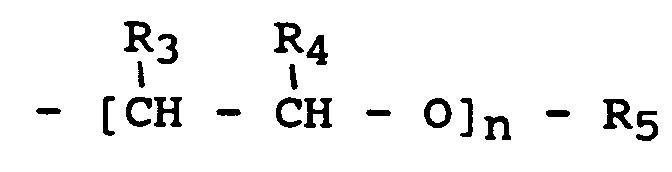
worin
R₃ und R₄ Wasserstoff oder Methyl, R₅ Wasserstoff oder einen Alkylrest mit 1 bis 40 Kohlenstoffatomen und n eine ganze Zahl von 1 bis 60 bedeutet, steht,
ist und ein Molekulargewicht von 5 000 bis 250 000 g/mol hat,
als Zusatzadditiv enthalten. - Das Zusatzadditiv ist vorteilhafterweise als 30 bis 75 Gew.-%ige Mineralöllösung der handelsüblichen Motorenölrezeptur zugesetzt.
- Die Molekulargewichte Mw in g/mol der erfindungsgemäßen Zusatzadditive auf PAMA-Basis mit Sauerstofffunktionalisierten Alkylgruppen liegen im Bereich von 5 000 bis 250 000, bevorzugt im Bereich von 15 000 bis 100 000 vor allem im Bereich von 30 000 bis 80 000.
- Die Molekulargewichte Mw in g/mol sind nach der Methode der Lichtstreuung (Ullmann, loc.cit. Band 15, Seiten 385 bis 387) oder mit der Eichbeziehung:

bestimmt. Die Viskosität wird nach DIN 7745 gemessen. - Der erfindungsgemäße Addtitvzusatz wird nach bekannten Verfahren, wie z.B. in der DE 39 30 142 A1 beschrieben, durch Copolymerisation von Alkyl(meth)acrylaten der Formel I in Anteilen von 80 bis 99,5, vorzugsweise 85 bis 95 Gew.-Teilen mit 20 bis 0,5, vorzugsweise 15 bis 5 Gew.-Teilen funktionalisierten Monomeren der Formel II, hergestellt. Als Monomere der Formel I seien z.B. (Meth)acrylsäureester von Talgfettalkoholen (z.B. im C-Zahlbereich 14 bis 20, im Mittel ca. 17,3) von Kokosfettalkoholen (C-Zahlbereich 10 bis 16, im Mittel ca. 12,6) oder von Synthesealkohlen wie Dobanol® 25 (C-Zahlbereich 11 bis 16, im Mittel 13,5) genannt.
- Als funktionalisierte Monomere der Formel II seien einmal diejenigen mit einer OH-Gruppe im Alkylrest, insbesondere mit solcher in ω-Stellung des Alkylrestes, genannt, z.B. das 2-Hydroxyethylmethacrylat und das -acrylat, das 3-Hydroxypropylmethacrylat und -acrylat, weiter das 2-Hydroxypropylmethacrylat und -acrylat, die Gemische von 2- und 3-Hydroxypropylmethacrylaten und -acrylaten, oder das 4-Hydroxybutylmethacrylat und das -acrylat.
- Als funktionalisierte Monomere der Formel II, in denen R₂ für einen mehrfach alkoxylierten, insbesondere ethoxylierten Rest steht, werden verwendet beispielsweise 2-(2-Ethoxyethoxy)ethyl-methacrylat und -acrylat oder (Meth)acrylsäureester von Alkoholen aus ethoxylierten C₁- bis C₁₈-Fettalkoholgemischen mit mittleren Ethoxylierungsgraden von 1 bis 60, z.B. mit einem mittleren Ethoxylierungsgrad 11 bzw. 25, ausgehend von entsprechenden industriellen Produkten, wie z.B. Carbowax®- und Marlipal®-Typen, so z.B. die Methacrylsäureester von Carbowax® 550, Marlipal® 1618/11, Marlipal® 1618/25, Carbowax® 2000 und Carbowax® 750.
- Die marktgängigen Motorenöle, nach SAE-Klassen gekennzeichnet, enthalten im allgemeinen alle als aschefreie Dispergiermittel solche auf der Basis Polyisobuten (PIB), die durch Umsetzung mit Maleinsäureanhydrid und einer Polyaminoverbindung als Polyisobutenylbernsteinsäureimide (Ullmann, loc.cit. Bd. 20, S. 552) erhalten werden. Als aschefreie PIB-Dispergiermittel werden die kommerziell verfügbaren Gemische von Polyisobutenylbernsteinsäureimiden und insbesondere die heute üblichen Multisuccinimide eingesetzt. Diese sind in der Regel in den handelsüblichen Detergent-Inhibitor (D.I.)-Paketen enthalten, in denen weitere synthetische Verbindungen als Zusatzstoffe zu Schmiermitteln unter der Bezeichnung Additive zusammengestellt sind. Neben den aschefreien Dispergiermitteln auf PIB-Basis werden neuerdings als solche auch niedrigmolekulare PAMA-Dispergiermittel eingesetzt, die Copolymerisate höherer Alkylmethacrylate mit Methacrylsäureestern, die basische Stickstoffgruppen im Esterrest enthalten, wie z.B. N-Dimethylaminoethylmethacrylsäureester, sind. (U.F. Schödel, Proceedings of the Japan International Tribology Conference, Nagoya 1990).
- Typische moderne Motorenöle in Märkten wie Europa oder Nordamerika haben das Leistungsniveau API SG/CD. Diese Öle enthalten 12 bis 15 Gew.-% D.I.-Paket von dem mindestens 1/3 aschefreie Dispergiermittel sind. Die Zusatzmenge von 8 Gew.-% Dispergiermittel stellt etwa die obere Grenze der Zusatzmenge in der Praxis dar.
- Das im Gegenstand der Erfindung näher beschriebene zusätzliche aschefreie Dispergiermittel (ZAD) in einer neuen und vorteilhaften Verwendung, wird in Mengen von 0,5 bis 2 Gew.-%, insbesondere in Mengen von 0,7 bis 1,5 Gew.-%, vor allem in Mengen um 1 Gew.-% den oben angegebenen fertigformulierten marktgängigen Motorenölen oder besser bei deren Formulierungen nach bekannten Rezepturen zugemischt, wobei vorteilhafterweise die dazu zu verwendenden DI-Pakete als Bestandteil das PAMA-Dispergiermittel auf C,H,O-Basis, nämlich das Copolymerisat aus den Alkyl(meth)acrylaten der Formel I und den funktionellen Alkyl(meth)acrylaten der Formel II entsprechend Anspruch 1, in einer solchen Menge enthalten, daß die fertigen Motorenöle 0,5 bis 2 Gew.-% des, das hohe Dispergiervermögen schaffenden, zusätzlichen aschefreien Dispergiermittels enthalten.
- Die in Prüfläufen ersehenen Verstärkungen der erfindungsgemäßen Motorenöle hinsichtlich ihrer Dispergiervermögen sind überraschend und waren nicht vorhersehbar, zumal vielfältige Anstrengungen in dieser Richtung durch Erhöhung der Dispergiermittelmenge auf PIB-Basis, wie auch angegebene Vergleichsversuche zeigen, nicht den erwarteten Erfolg zeigten ohne gleichzeitig nicht zu tolerierende Nebenwirkungen hervorzurufen.
- Die Hauptvorteile des vorgeschlagenen zusätzlichen aschefreien Dispergiermittels für Motorenöle sind:
- 1. Das spezifische Dispergiervermögen (Beitrag der Gewichtseinheit des Polymeren zur Verbesserung der Schlammbewertung eines Motors unter bestimmten Testbedingungen) ist gleichgut oder besser als das kommerziell verfügbarer aschefreier Dispergiermittel auf PIB-Basis.
- 2. Aufgrund seiner Zusammensetzung zeigt das neue Additiv keine oder minimale Wechselwirkung mit anderen in der Rezeptur enthaltenen Chemikalien.
- 3. Kein oder ein geringer positiver Einfluß auf das Dichtungsquellverhalten von Dichtungsmaterialien wie z.B. Viton®.
- 4. Vernachlässigbarer Beitrag zur Viskosität bei tiefen Temperaturen.
- 5. Viskositätsbeitrag bei hohen Temperaturen und unter High Temperature / High Shear (HTHS) Bedingungen.
- 6. Mögliche Einsparung an nichtdispergierenden V.I.-Verbesserern.
- Die folgenden Zusammenstellungen von Messungen dienen zur Erläuterung der Erfindung.
Als erfindungsgemäßes, "zusätzliches aschefreies Dispergiermittel" (ZAD) für Motorenöle, wurde für die Messungen ein Copolymerisat aus 91 Gew.-% Lial® 125-Methacrylat und 9 Gew.-% 2-Hydroxyethylmethacrylat, 60 %ig in Mineralöl (ZAD I), verwendet. Lial® 125 ist ein Gemisch von im wesentlichen primären C₁₂- bis C₁₅-Alkoholen mit einer mittleren C-Zahl von 13,4. - Als zweites zusätzliches aschefreies Dispergiermittel wurde für gewisse Prüfungen und Messungen eine 60 Gew.-%ige Lösung eines Copolymeren (ZAD II) aus 88 Gew.-% von Methacrylaten einer 70 : 30 Gewichtsmischung von Lial® 125 und Talgfettalkohol und 12 Gew.-% von Marlipal 13*-200-methacrylat der Formel

eingesetzt. - Die Copolymerisate ZAD I und ZAD II hatten Mw von etwa 60.000.
TABELLE 1 Einfluß auf Viskositätsdaten ZAD I-Zusatzmenge: 1 Gew.-% Viskositätsanhebung durch 1 % ZAD zu SAE 10W-30 Öl: ca. 0,4 mm²s⁻¹/100°C (DIN 51562) Viskositätsanhebung durch 1 % ZAD in SAE 10W-30 Öl unter High Temperature High Shear (HTHS) Bedingungen: ca. 0,1 mPas (150°C, 10⁶s⁻¹) (ASTM D4683) Viskositätsbeitrag in SAE 10W-30 Öl unter Kaltstartbedingungen im Cold Cranking Simulator (CCS): ca. 50 mPas/-20°C (ASTM D2602 multi temperature) Viskositätsverlust durch Scherung im Motor: vernachlässigbar 
- Bei Zusatz von 1 % des Hydroxyl-Gruppen enthaltenden Polymeren wird der Verschleißschutz durch das D.I.-Paket nicht beeinträchtigt. Dies ist in der Übereinstimmung mit Aussagen der D.I.-Hersteller, daß aschefreie Dispergiermittel auf PIB-Basis die OH-Gruppen enthalten, nicht mit den Zn-dialkyldithiophosphaten (ZnDDP) interferieren, die als Antioxidantien und Verschleißschutzadditive in D.I.-Paketen enthalten sind.
- Verbesserung der Leistungsfähigkeit im Mercedes-Benz M102E-Test.
- In diesem europäischen Standardtest kann eine Verebesserung der Leistungsfähigkeit beobachtet werden, wenn ZAD zu dem fertig formulierten SAE 10W-30 Öl zugesetzt wird.
- In dem M102E-Test von 200 Stunden Dauer wird die Öl-Leistungsfähigkeit hinsichtlich folgender Kriterien bewertet:
Mittlere Schlammbewertung (10 = sauber)
Kolbenhemd (100 = sauber)
Nockenverschleiß max. (µm)
Nockenverschleiß mittel (µm)Tabelle 2B Ein Zusatz von 2,1 % ZAD I wurde für diesen Test gewählt. Ergebnis SAE 10W-30 (Basis) SAE 10W-30 +2,1 Gew.-% ZAD I Mittlere Schlamm- bewertung 8,67 9,27 Kolbenhemd 28,2 28,7 Nockenverschleiß max. 42 22 Nockenverschließ mittel 24 9 

Tabelle 4A Vergleich aschefreier Dispergiermittel in VW Test für Dichtungsquellverhalten TL-VW 521 (FKM-E281 VITON® ) Gew.-% D.I. Additivierung des Grundöls % Änderung der Reißdehnung Rißbildung bei 120 % Dehnung V.I.I. zusätzliches aschefreies Dispergiermittel 8.3 % - - - 2.3 nein 8.3 % 5 % disp. V.I.-Verb. - - 8.0 nein 8.3 % " 1 % Dispersant A1) - 13 nein 8.3 % " 1 % Dispersant B1) - 21 ja 8.3 % " 1 % Dispersant C1) - 17 nein 8.3 % " 1 % Dispersant D1) - 32 ja 8.3 % " 1 % neues Dispergiermittel auf Methacrylatbasis (ZAD I) - 8 nein Grenzwerte: <|20|% nein Änderung der Reißfähigkeit (limit < 25 %) gehen parallel. 1) Die aschefreien Dispergiermittel A - D auf PIB-Basis werden kommerziell angeboten. -
TABELLE 4B Vergleich aschefreier Dispergiermittel im Dichtungsquellverhalten-Test VW-PV-3344, FKM-E281 (Viton® ) Mischung enthält in Gew.-% Reißfähigkeit %Änderung der Reißdehnung Rißbildung bei 120% Dehnung DI DISP.I ZAD I ZAD II 9.9 - - - -11 -13 nein 9.9 2.0 - - -17 -20 nein 9.9 - - 5 -9 -10 nein 9.9 - 5 - -12 -10 nein 9.9 - - 2.6 -9 -13 nein Tabelle 5 Einfluß des zusätzlichen aschefreien Dispergiermittels auf die Viskosität eines D.I.-Paketes. Viskosität (DIN 51562) D.I. Methacrylat Dispergiermittel ZAD I 68 %ig Verhält. D.I. : ZAD 10 : 1 10 : 2 mm²s⁻¹/100oC 180 750 230 310
Claims (4)
- Motorenöle mit hohem Dispergiervermögen, sowohl Einals auch Mehrbereichsöle auf der Basis bekannter, handelsüblicher SAE-Viskositätsklassen-Schmierölzusammensetzungen,
dadurch gekennzeichnet,
daß zur Verstärkung ihres Dispergiervermögens, diese bekannten Motorenöle 0,5 bis 2 Gew.-% eines auch die Dichtungsverträglichkeit gewährleistenden Polyalkyl(meth)acrylats, das ein Copolymerisat aus 80 bis 99,5 Gew.-Teilen Alkyl(meth)acrylaten der Formel I
R für Wasserstoff oder Methyl und R₁ für einen Alkylrest mit 6 bis 24 Kohlenstoffatomen, vorzugsweise 8 bis 20 Kohlenstoffatomen steht,
und 0,5 bis 20 Gew.-Teilen minestens eines funktionalisierten Alkyl(meth)acrylats der Formel II
R für Wasserstoff oder Methyl und R₂ für einen mit mindestens einer OH-Gruppe substituierten Alkylrest mit 2 bis 6 Kohlenstoffatomen oder für einen mehrfach alkoxylierten Rest
R₃ und R₄ Wasserstoff oder Methyl, R₅ Wasserstoff oder einen Alkylrest mit 1 bis 40 Kohlenstoffatomen und n eine ganze Zahl von 1 bis 60 bedeutet, steht,
ist und ein Molekulargewicht von 5 000 bis 250 000 g/mol hat,
als Zusatzadditiv enthalten. - Motorenöle mit hohem Dispergiervermögen nach Anspruch 1, dadurch gekennzeichnet, daß das Poly(meth)acrylat-Zusatzadditiv ein Molekulargewicht Mw von 5 000 bis 100 000 g/mol, bevorzugt ein Molekulargewicht Mw von 30 000 bis 80 000 g/mol hat.
- Motorenöle mit hohem Dispergiervermögen nach den Ansprüchen 1 und 2, dadurch gekennzeichnet, daß das Poly(meth)acrylat-Zusatzadditiv ein Copolymerisat aus Alkyl(meth)acrylaten der Formel I und einem Hydroxyalkyl(meth)acrylat der Formel II, in der R₂ für einen mit mindestens einer OH-Gruppe substituierten Alkylrest mit 2 bis 6 Kohlenstoffatomen steht, ist.
- Verfahren zur Herstellung von Motorenölen mit hohem Dispergiervermögen, sowohl Ein- als auch Mehrbereichsölen auf der Basis bekannter handelsüblicher SAE-Viskositätsklassen-Schmierölzusammensetzungen, dadurch gekennzeichnet, daß das, das Dispergiervermögen verstärkende Copolymerisat aus den Monomeren I und II nach Anspruch 1, als Bestandteil der bei der Formulierung der Motorenöle zugesetzten DI-Paktete zugegeben wird.
Applications Claiming Priority (2)
| Application Number | Priority Date | Filing Date | Title |
|---|---|---|---|
| DE4137269A DE4137269A1 (de) | 1991-11-13 | 1991-11-13 | Motorenoele mit hohem dispergiervermoegen |
| DE4137269 | 1991-11-13 |
Publications (2)
| Publication Number | Publication Date |
|---|---|
| EP0542111A2 true EP0542111A2 (de) | 1993-05-19 |
| EP0542111A3 EP0542111A3 (en) | 1993-06-16 |
Family
ID=6444676
Family Applications (1)
| Application Number | Title | Priority Date | Filing Date |
|---|---|---|---|
| EP19920118840 Withdrawn EP0542111A3 (en) | 1991-11-13 | 1992-11-04 | Motor oil with high dispensing capacity |
Country Status (4)
| Country | Link |
|---|---|
| EP (1) | EP0542111A3 (de) |
| JP (1) | JPH05222389A (de) |
| CA (1) | CA2082767A1 (de) |
| DE (1) | DE4137269A1 (de) |
Cited By (5)
| Publication number | Priority date | Publication date | Assignee | Title |
|---|---|---|---|---|
| EP0570093A1 (de) * | 1992-03-20 | 1993-11-18 | Rohm And Haas Company | Aschefreie Dispersante Poly(Meth)Acrylat-Polymere |
| EP0697457A1 (de) * | 1994-08-03 | 1996-02-21 | Röhm GmbH | Motorenöle mit hohem Dispergiervermögen und gutem Verschleissschutz |
| WO1999027037A1 (de) * | 1997-11-21 | 1999-06-03 | Rohmax Additives Gmbh | Additiv für biodiesel und biobrennstofföle |
| WO2008053033A3 (en) * | 2006-11-01 | 2008-08-14 | Shell Int Research | Lubricating oil composition comprising hydroxy-containing poly (meth) acrylate and metal dithiophosphate |
| DE102010001040A1 (de) | 2010-01-20 | 2011-07-21 | Evonik RohMax Additives GmbH, 64293 | (Meth)acrylat-Polymere zur Verbesserung des Viskositätsindexes |
Families Citing this family (5)
| Publication number | Priority date | Publication date | Assignee | Title |
|---|---|---|---|---|
| JP2769974B2 (ja) * | 1994-04-22 | 1998-06-25 | 三洋化成工業株式会社 | 潤滑油添加剤及び潤滑油 |
| JP2001220591A (ja) * | 1999-12-03 | 2001-08-14 | Sanyo Chem Ind Ltd | 流動性向上剤及び油組成物 |
| JP5205699B2 (ja) * | 2006-03-02 | 2013-06-05 | 日油株式会社 | 燃料油用潤滑性向上剤及びそれを含有する燃料油組成物 |
| JP5497982B2 (ja) * | 2006-11-01 | 2014-05-21 | 昭和シェル石油株式会社 | トランスミッション油用潤滑油組成物 |
| JP5584049B2 (ja) * | 2010-08-17 | 2014-09-03 | 株式会社Adeka | 潤滑油用極圧剤及びそれを含有する潤滑油組成物 |
Family Cites Families (5)
| Publication number | Priority date | Publication date | Assignee | Title |
|---|---|---|---|---|
| GB768690A (en) * | 1953-03-04 | 1957-02-20 | California Research Corp | Copolymeric dispersants and lubricant compositions containing them |
| FR1306897A (fr) * | 1960-11-25 | 1962-10-19 | Shell Int Research | Composés polymères convenant comme additifs pour huile lubrifiante, et huiles lubrifiantes contenant ces composés |
| NL109759C (de) * | 1961-12-29 | |||
| NL6917635A (de) * | 1969-11-21 | 1971-05-25 | ||
| DE3930142A1 (de) * | 1989-09-09 | 1991-03-21 | Roehm Gmbh | Dispergierwirksame viskositaets-index-verbesserer |
-
1991
- 1991-11-13 DE DE4137269A patent/DE4137269A1/de not_active Withdrawn
-
1992
- 1992-11-04 EP EP19920118840 patent/EP0542111A3/de not_active Withdrawn
- 1992-11-12 CA CA002082767A patent/CA2082767A1/en not_active Abandoned
- 1992-11-13 JP JP4303453A patent/JPH05222389A/ja active Pending
Cited By (8)
| Publication number | Priority date | Publication date | Assignee | Title |
|---|---|---|---|---|
| EP0570093A1 (de) * | 1992-03-20 | 1993-11-18 | Rohm And Haas Company | Aschefreie Dispersante Poly(Meth)Acrylat-Polymere |
| EP0697457A1 (de) * | 1994-08-03 | 1996-02-21 | Röhm GmbH | Motorenöle mit hohem Dispergiervermögen und gutem Verschleissschutz |
| WO1999027037A1 (de) * | 1997-11-21 | 1999-06-03 | Rohmax Additives Gmbh | Additiv für biodiesel und biobrennstofföle |
| US6409778B1 (en) * | 1997-11-21 | 2002-06-25 | Rohmax Additives Gmbh | Additive for biodiesel and biofuel oils |
| WO2008053033A3 (en) * | 2006-11-01 | 2008-08-14 | Shell Int Research | Lubricating oil composition comprising hydroxy-containing poly (meth) acrylate and metal dithiophosphate |
| DE102010001040A1 (de) | 2010-01-20 | 2011-07-21 | Evonik RohMax Additives GmbH, 64293 | (Meth)acrylat-Polymere zur Verbesserung des Viskositätsindexes |
| WO2011088929A1 (de) | 2010-01-20 | 2011-07-28 | Evonik Rohmax Additives Gmbh | (meth)acrylat-polymer zur verbesserung des viskositätsindexes |
| US9200233B2 (en) | 2010-01-20 | 2015-12-01 | Evonik Rohmax Additives Gmbh | (Meth)acrylate polymers for improving the viscosity index |
Also Published As
| Publication number | Publication date |
|---|---|
| JPH05222389A (ja) | 1993-08-31 |
| EP0542111A3 (en) | 1993-06-16 |
| CA2082767A1 (en) | 1993-05-14 |
| DE4137269A1 (de) | 1993-05-19 |
Similar Documents
| Publication | Publication Date | Title |
|---|---|---|
| DE102016224036B4 (de) | Schmiermittelölzusammensetzung, Verwendung und Verfahren zu deren Herstellung | |
| EP0418610B1 (de) | Dispergierwirksame Viskositäts-Index-Verbesserer | |
| EP1032620B1 (de) | Additiv für biodiesel und biobrennstofföle | |
| DE69820429T2 (de) | Gegen Hydrolyse beständiges Borat enthaltendes Handschaltgetriebe-Schmieröladditiv zum Erhöhen der Dauerhaftigkeit von Synchrongetrieben | |
| DE69915804T2 (de) | Ölzusammensetzung für gangschaltung | |
| EP0744457B1 (de) | Schmierstoffadditive | |
| DE69730568T2 (de) | Viskositätsindexverbessernde Zusätze für auf Phosphatestern basierte Hydraulikflüssigkeiten | |
| EP0436872B1 (de) | Kraftübertragungsflüssigkeit auf Basis Mineralöl | |
| DE2658952A1 (de) | Alkylacrylat- oder insbesondere alkylmethacrylat-polymerisatgemisch sowie eine dasselbe enthaltende schmieroelformulierung | |
| DE69007995T2 (de) | Schmierölviskositätsadditiv, Verfahren zu seiner Herstellung und dieses enthaltende Schmiermittelzusammensetzungen. | |
| DE19954658A1 (de) | Schmierölzusammensetzung für Automatikgetriebe | |
| DE2422609A1 (de) | Schmieroelformulierung | |
| EP0542111A2 (de) | Motorenöle mit hohem Dispergiervermögen | |
| DE1031918B (de) | Schmieroel auf Mineraloelbasis mit einem Gehalt an einem Mischpolymerisat aus einem Vinylester mit einem Fumarsaeuredialkylestergemisch | |
| EP0471266B1 (de) | Verwendung von Oligomeren bzw. Cooligomeren von (Meth)acrylsäureestern und 1-Alkenen als Syntheseöle | |
| DE3207292C2 (de) | ||
| DE3023523C2 (de) | Schmieröladditiv und dessen Verwendung | |
| DE1794257C3 (de) | Schmierölzusätze | |
| DE1920971A1 (de) | OElloesliche Mischpolymere,Verfahren zu ihrer Herstellung und ihre Verwendung als OElzusatzstoffe | |
| EP0332000B1 (de) | Verwendung ausgewählter Copolymertypen der Acryl- und/oder Methacrylsäureester als Fliessverbesserer in paraffinreichen Erdölen und Erdölfraktionen (I) | |
| DE2535472A1 (de) | Schmieroelgemisch | |
| EP0697457B1 (de) | Motorenöle mit hohem Dispergiervermögen und gutem Verschleissschutz | |
| DE69827533T2 (de) | Additivkonzentrate auf Basis von Mischungen aus organischen Verdünnungsmitteln und veresterten, Carboxylgruppen enthaltenden Interpolymeren und diese enthaltende Schmiermittel | |
| DE2225758C3 (de) | Schmieröl | |
| EP0566048A1 (de) | Syntheseöle enthaltende Cooligomere, bestehend aus I-Alkenen und (Meth)-acrylsäureestern |
Legal Events
| Date | Code | Title | Description |
|---|---|---|---|
| PUAI | Public reference made under article 153(3) epc to a published international application that has entered the european phase |
Free format text: ORIGINAL CODE: 0009012 |
|
| PUAL | Search report despatched |
Free format text: ORIGINAL CODE: 0009013 |
|
| AK | Designated contracting states |
Kind code of ref document: A2 Designated state(s): AT BE CH DE DK ES FR GB IT LI NL SE |
|
| AK | Designated contracting states |
Kind code of ref document: A3 Designated state(s): AT BE CH DE DK ES FR GB IT LI NL SE |
|
| 17P | Request for examination filed |
Effective date: 19931026 |
|
| 17Q | First examination report despatched |
Effective date: 19950424 |
|
| STAA | Information on the status of an ep patent application or granted ep patent |
Free format text: STATUS: THE APPLICATION HAS BEEN WITHDRAWN |
|
| 18W | Application withdrawn |
Withdrawal date: 19961202 |