EP0519085A1 - Dispositif pour radiofrequence - Google Patents
Dispositif pour radiofrequence Download PDFInfo
- Publication number
- EP0519085A1 EP0519085A1 EP92901922A EP92901922A EP0519085A1 EP 0519085 A1 EP0519085 A1 EP 0519085A1 EP 92901922 A EP92901922 A EP 92901922A EP 92901922 A EP92901922 A EP 92901922A EP 0519085 A1 EP0519085 A1 EP 0519085A1
- Authority
- EP
- European Patent Office
- Prior art keywords
- dielectric
- dielectric layers
- resonant
- gnd
- conductors
- Prior art date
- Legal status (The legal status is an assumption and is not a legal conclusion. Google has not performed a legal analysis and makes no representation as to the accuracy of the status listed.)
- Granted
Links
Images









Classifications
-
- H—ELECTRICITY
- H01—ELECTRIC ELEMENTS
- H01P—WAVEGUIDES; RESONATORS, LINES, OR OTHER DEVICES OF THE WAVEGUIDE TYPE
- H01P1/00—Auxiliary devices
- H01P1/20—Frequency-selective devices, e.g. filters
- H01P1/201—Filters for transverse electromagnetic waves
- H01P1/203—Strip line filters
- H01P1/20327—Electromagnetic interstage coupling
- H01P1/20336—Comb or interdigital filters
- H01P1/20345—Multilayer filters
-
- H—ELECTRICITY
- H01—ELECTRIC ELEMENTS
- H01P—WAVEGUIDES; RESONATORS, LINES, OR OTHER DEVICES OF THE WAVEGUIDE TYPE
- H01P1/00—Auxiliary devices
- H01P1/20—Frequency-selective devices, e.g. filters
- H01P1/201—Filters for transverse electromagnetic waves
- H01P1/203—Strip line filters
-
- H—ELECTRICITY
- H01—ELECTRIC ELEMENTS
- H01P—WAVEGUIDES; RESONATORS, LINES, OR OTHER DEVICES OF THE WAVEGUIDE TYPE
- H01P1/00—Auxiliary devices
- H01P1/20—Frequency-selective devices, e.g. filters
- H01P1/201—Filters for transverse electromagnetic waves
- H01P1/203—Strip line filters
- H01P1/2039—Galvanic coupling between Input/Output
-
- H—ELECTRICITY
- H01—ELECTRIC ELEMENTS
- H01P—WAVEGUIDES; RESONATORS, LINES, OR OTHER DEVICES OF THE WAVEGUIDE TYPE
- H01P1/00—Auxiliary devices
- H01P1/20—Frequency-selective devices, e.g. filters
- H01P1/201—Filters for transverse electromagnetic waves
- H01P1/205—Comb or interdigital filters; Cascaded coaxial cavities
- H01P1/2056—Comb filters or interdigital filters with metallised resonator holes in a dielectric block
-
- H—ELECTRICITY
- H01—ELECTRIC ELEMENTS
- H01P—WAVEGUIDES; RESONATORS, LINES, OR OTHER DEVICES OF THE WAVEGUIDE TYPE
- H01P3/00—Waveguides; Transmission lines of the waveguide type
- H01P3/02—Waveguides; Transmission lines of the waveguide type with two longitudinal conductors
- H01P3/08—Microstrips; Strip lines
- H01P3/088—Stacked transmission lines
-
- H—ELECTRICITY
- H01—ELECTRIC ELEMENTS
- H01P—WAVEGUIDES; RESONATORS, LINES, OR OTHER DEVICES OF THE WAVEGUIDE TYPE
- H01P7/00—Resonators of the waveguide type
- H01P7/04—Coaxial resonators
-
- H—ELECTRICITY
- H01—ELECTRIC ELEMENTS
- H01P—WAVEGUIDES; RESONATORS, LINES, OR OTHER DEVICES OF THE WAVEGUIDE TYPE
- H01P7/00—Resonators of the waveguide type
- H01P7/08—Strip line resonators
- H01P7/082—Microstripline resonators
-
- H—ELECTRICITY
- H01—ELECTRIC ELEMENTS
- H01P—WAVEGUIDES; RESONATORS, LINES, OR OTHER DEVICES OF THE WAVEGUIDE TYPE
- H01P7/00—Resonators of the waveguide type
- H01P7/08—Strip line resonators
- H01P7/084—Triplate line resonators
-
- H—ELECTRICITY
- H03—ELECTRONIC CIRCUITRY
- H03B—GENERATION OF OSCILLATIONS, DIRECTLY OR BY FREQUENCY-CHANGING, BY CIRCUITS EMPLOYING ACTIVE ELEMENTS WHICH OPERATE IN A NON-SWITCHING MANNER; GENERATION OF NOISE BY SUCH CIRCUITS
- H03B5/00—Generation of oscillations using amplifier with regenerative feedback from output to input
- H03B5/18—Generation of oscillations using amplifier with regenerative feedback from output to input with frequency-determining element comprising distributed inductance and capacitance
- H03B5/1841—Generation of oscillations using amplifier with regenerative feedback from output to input with frequency-determining element comprising distributed inductance and capacitance the frequency-determining element being a strip line resonator
- H03B5/1847—Generation of oscillations using amplifier with regenerative feedback from output to input with frequency-determining element comprising distributed inductance and capacitance the frequency-determining element being a strip line resonator the active element in the amplifier being a semiconductor device
-
- H—ELECTRICITY
- H05—ELECTRIC TECHNIQUES NOT OTHERWISE PROVIDED FOR
- H05K—PRINTED CIRCUITS; CASINGS OR CONSTRUCTIONAL DETAILS OF ELECTRIC APPARATUS; MANUFACTURE OF ASSEMBLAGES OF ELECTRICAL COMPONENTS
- H05K1/00—Printed circuits
- H05K1/02—Details
- H05K1/0213—Electrical arrangements not otherwise provided for
- H05K1/0237—High frequency adaptations
-
- H—ELECTRICITY
- H05—ELECTRIC TECHNIQUES NOT OTHERWISE PROVIDED FOR
- H05K—PRINTED CIRCUITS; CASINGS OR CONSTRUCTIONAL DETAILS OF ELECTRIC APPARATUS; MANUFACTURE OF ASSEMBLAGES OF ELECTRICAL COMPONENTS
- H05K3/00—Apparatus or processes for manufacturing printed circuits
- H05K3/46—Manufacturing multilayer circuits
- H05K3/4644—Manufacturing multilayer circuits by building the multilayer layer by layer, i.e. build-up multilayer circuits
- H05K3/4673—Application methods or materials of intermediate insulating layers not specially adapted to any one of the previous methods of adding a circuit layer
- H05K3/4676—Single layer compositions
Definitions
- the present invention relates to a high frequency device, such as a high frequency resonator, a high frequency filter, a high frequency oscillator, and a dielectric resonator, used in radio equipment or other communication equipments.
- a high frequency device such as a high frequency resonator, a high frequency filter, a high frequency oscillator, and a dielectric resonator, used in radio equipment or other communication equipments.
- These high frequency devices include a high frequency filter, high frequency oscillator, dielectric resonator, high frequency amplifier, or duplexer.
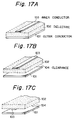
- Figs. 17A to 17C are diagrams showing a conventional high frequency transmission lines, in which Fig. 17A shows a microstrip line, Fig. 17B a suspended microstrip line, and Fig. 17C an inverted microstrip line. Those are used as high frequency signal transmission lines on circuit boards or as parts in delay lines.
- reference numeral 100 denotes an outer conductor, 102 a dielectric, 103 an inner conductor, and 104 a clearance.
- microstrip lines shown in Figs. 17A to 17C, have been used for the high frequency transmission lines.
- the microstrip line structured as shown in Fig. 17A is generally most extensively used.
- This microstrip line has an inner conductor (conductor used as a signal line) 103 provided on one side of a dielectric 102, and an outer conductor (conductor normally used as GND electrode) 101 provided on the other side (side opposite the inner conductor 103) of the dielectric 102.
- this microstrip line structured as described is widely used is because it is smaller and less expensive and easier to manufacture than other microwave circuits such as wave guide circuits when it is used in forming a flat high frequency circuit, for example.
- microstrip line mentioned above notably suffers general losses in the transmission line (e.g. radiation loss, dielectric loss, and conductor loss).
- improved products have been developed, which include the suspended microstrip line shown in Fig. 17B and the inverted microstrip line shown in Fig. 17C.
- the suspended microstrip line as depicted in Fig. 17B, has the inner conductor and dielectric suspended by a support member to provide a clearance 104 between the dielectric 102 and the outer conductor 101.
- the inverted microstrip line has the inner conductor 103 provided on one side of the dielectric 102, which side faces the outer conductor 101 and provides a clearance 104 between the dielectric 102 and the outer conductor 101 as shown in Fig. 17C.
- Figs. 18A and 18B show examples of high frequency filters
- Figs. 19A to 19C show equivalent circuits of the high frequency filter of Figs. 18A and 18B.
- reference numeral 111 denotes a substrate (dielectric), 112 and 113 ⁇ /4 type strip resonators, 114 a coupling capacitor, 115 through-holes, 116 GND electrodes (wide-area-contact grounding metals), 117 and 118 ⁇ /4 type dielectric resonators, IN input terminals, OUT output terminals, C1 to C4 capacitors, and L1 to L3 coils.
- Figs. 18A and 18B show Various types of high frequency filters. Out of them, band pass filters will be described with reference to Figs. 18A and 18B, in which Fig. 18A shows a strip line filter, and Fig. 18B shows a dielectric filter.
- two ⁇ /4 type strip resonators 112 and 113 are provided a certain distance apart from each other on one side of the substrate 111 (dielectric) 111, a coupling capacitor 114 is connected between those resonators, and a GND electrode (wide-area-contact grounding metal) 116 is formed on the other side of the substrate 111.
- a through-hole 115 is provided at the end of each of the two ⁇ /4 type strip resonators 112 and 113.
- the dielectric filter is structured as shown in Fig. 18B. More specifically, two ⁇ /4 type dielectric resonators 117 and 118 are arranged side by side and covered respectively with a GND electrode (wide-area-contact grounding metal), and a coupling capacitor 114 is placed in the middle to connect those dielectric resonators 117 and 118.
- GND electrode wide-area-contact grounding metal
- the two ⁇ /4 type dielectric resonators 117 and 118 are coaxial type dielectric resonators which each include a conductor and are covered over their circumferential surface with a GND electrode 116.
- FIG. 19A An equivalent circuit of the high frequency filter (band pass filter) as mentioned above is shown in Fig. 19A.
- the ⁇ /4 type strip resonators 112 and 113, and the ⁇ /4 type dielectric resonators 117 and 118 in Figs. 18A and 18B are equivalent to a parallel resonance circuit with L1 and C1 and a parallel resonance circuit with L2 and C2, respectively.
- the high frequency filters such as these are sometimes added with a coil or capacitors.
- Equivalent circuits of the high frequency filters with the additional coil and capacitors may be as shown in Figs. 19B and 19C, respectively (e.g., a polarized band pass filter, and a band rejection filter).
- Fig. 19B is an example in which a coil L3 is connected in parallel with the coupling capacitor 114.
- Fig. 19C is an example in which capacitors C3 and C4 are added to the circuit in Fig. 19A.
- Dielectric resonator (refer to Figs. 20A and 20B)
- Figs. 20A and 20B show a prior-art dielectric resonator ( ⁇ /4 type), in which Fig. 20A is a perspective view and Fig. 20B is a sectional view taken along the line X-Y.
- reference numeral 121 denotes a dielectric resonator, 122 a dielectric, 123, a through-hole, 124 a resonant conductor, and 125 a GND electrode.
- the prismatic and columnar dielectric resonators have been known. Out of these two types, a prismatic one is shown in Figs. 20A and 20B. As shown in the figures, the dielectric resonator 121 has the through-hole 123 formed in the center in the longitudinal direction of the dielectric 122. The GND electrode 125 is formed by covering the all sides of the dielectric 122, except for one of two sides having an opening of the through-hole 123 with a conductor.
- the internal circumferential surface of the through-hole 123 is covered with a resonant conductor 124, one end of which is integral with the GND electrode 125.
- the other end of the resonant conductor 124 which is not integral the GND electrode 125 is so formed as to be used for connection with an external terminal (not shown).
- the prior-art dielectric resonator has problems enumerated below.
- Dielectric filter (refer to Figs. 21A and 21B)
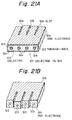
- Fig. 21A and 21B show a prior-art dielectric filter, in which Fig. 21A is a perspective view taken from the top side, while Fig. 21B is a perspective view taken from the reverse side.
- This dielectric filter is a kind of the band pass filter, and includes a plurality of 1/4 wavelength resonant conductors.
- the above-mentioned resonant conductors constitute resonators, respectively.
- a dielectric filter 121 comprises a dielectric 122, a plurality of through-holes 123, resonant conductors 124 covering the internal circumferential surfaces of the through-holes 123, and a GND electrode 125 covering the whole external circumferential surfaces of the dielectric 122 except for one side of the dielectric 122 (the side where there is the resonant conductors 124).
- the dielectric 122 has slots 126 formed therein. By those slots 126, the resonant conductors 124 are separated and the coupling among the resonant conductors 124 is adjusted.
- the GND electrode 125 is provided also on the internal surfaces of the slots 126. On the side where the slots 126 are provided, the resonant conductors 124 and the GND electrode 125 are connected (GND side ends of resonant conductors 124 are commonly connected with each other).
- the said plurality of resonant conductors 124 (four resonant conductors in this case) have different lengths (some resonant conductors may have the same length) so as to have different resonance frequencies with each other.
- Such dielectric filter 122 is made in a manner described below, for example. First of all, a dielectric 122 is produced with through-holes 123 and slots 126 provided by press forming. Then, all sides (including the internal surfaces of the through-holes 123) except for one side where there exist the through-holes 123 are metallized.
- the conductor formed inside the through-holes 123 is used as the resonant conductors 124, and the conductor formed on the external circumferential surface of the dielectric 122 is used as the GND electrode 125.
- the prior-art dielectric resonator has problems enumerated below.
- the line impedance of the resonator decreases, so that the Q of the resonator decreases, too.
- the resonator must be made thicker in the through-thickness direction for greater ⁇ to prevent the input impedance from decreasing.
- VCO Voltage Control Oscillator
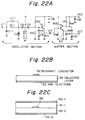
- Figs. 22A to 22C show explanatory diagrams of the prior-art example, in which Fig. 22A is a circuit example of the VCO (voltage control oscillator), Fig. 22B is an explanatory diagram of the microstrip line, and Fig. 22C is an explanatory diagram of the tri-plate type strip line.
- VCO voltage control oscillator
- Fig. 22B is an explanatory diagram of the microstrip line
- Fig. 22C is an explanatory diagram of the tri-plate type strip line.
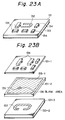
- Figs. 23A and 23B show two examples of prior-art VCO modules.
- Fig. 23A is a perspective view of first example of the VCO module
- Fig. 23B is an exploded view in perspective of second example of the VCO module.
- R11 to R18 denote resistors
- C11 to C21 denote capacitors
- L11 and L12 denote coils
- CV denotes a varactor diode (variable capacitance diode)
- SL denotes a strip line
- CT denotes a control voltage input terminal
- OUT denotes an output terminal
- Vcc denotes a power supply
- Tr1 and Tr2 denote transistors.
- Reference numerals 131 and 131-1 to 131-3 denote dielectric layers, 132 denotes a resonant conductor, 133 and 133-1 to 133-2 denote GND electrodes, 134 denotes parts (discrete parts), 135 denotes a through-hole, and 136 denotes a blank area.
- VCO Voltage Control Oscillator
- This VCO comprises an oscillator section and a buffer section, which are coupled through the coupling capacitor C17.
- the oscillator section includes the transistor Tr1, the strip line SL, the varactor diode (variable capacitance diode) CV, the capacitors C11 to C16, the resistors R11 to R14, and the coil L11.
- the buffer section includes the transistor Tr2, the capacitors C18 to C21, the resistors R15 to R18, and the coil L12.
- the oscillator When a control voltage is applied to the control voltage input terminal of the oscillator, the oscillator oscillates at a frequency corresponding to the control voltage, and supplies an output signal of the VCO from the output terminal OUT.
- strip line SL constitutes a resonator (strip line resonator), and how it is mounted on the substrate is shown by examples in Figs. 22B and 22C.
- Fig. 22B shows as an example of a microstrip line made by forming a resonant conductor 132 on the front surface of the dielectric layer 131 constituting the substrate, and forming a GND pattern on the back side thereof.
- Fig. 22C shows as an example a tri-plate type strip line which contains the resonant conductor 132 in a multi-layer substrate, and which is sandwiched by the GND patterns 133-1 and 133-2.
- Fig. 23A shows the first example of VCO module including a microstrip line formed as depicted in Fig. 22B.
- This VCO module has the resonant conductor 132 (thick film printing) formed on the front surface of the dielectric layer 131 constituting the substrate (a single substrate or a multi-layer substrate) and parts 134 (discrete parts) such as transistors and resistors mounted thereon.
- the GND pattern 133 is formed on the back surface of the above-mentioned dielectric layer 131.
- Fig. 23B shows the second example of VCO module including a strip line formed as depicted in Fig. 22C.
- This module has parts 134 (discrete parts) such as transistors and resistors mounted on the first dielectric layer 131-1 constituting a multi-layer substrate, and the GND pattern 133-1 formed on the second dielectric layer 131-2, the resonant conductor 132 on the third dielectric layer 131-3, and the GND pattern 133-2 formed on the back side of the third dielectric layer 131-3.
- the blank area 136 (an area devoid of a conductor) is provided in a part of the GND pattern 133-1, in the middle of which the through-hole electrode 135 is provided.
- the resonant conductor 132 and the parts 134 are connected through a blind through-hole (filled with a conductor) using the through-hole electrode 135 as a connection point.
- the resonant conductor is contained between the dielectric layers, it is expected that a wavelength is shortened to ⁇ / ⁇ ⁇ r ⁇ .
- the series resistance (r s ) can be decreased in proportion to the amount by which the resonant conductor is shortened, and therefore, the Q becomes high.
- the dielectric conductor is contained in the dielectric layers, it is difficult to adjust the resonator.
- the present invention has been made to solve the above problems, and has as its object to reduce in size a high frequency device by using a plurality of dielectric layers having different dielectric constants in combination, and thereby increasing the line impedance without decreasing Q.
- Q under unloaded (denoted as Qu) is defined by the following equation.
- 1 Qu 1 Qc + 1 Qd + 1 Qr (1)
- Qc denotes Q by a transmission line conductor
- Qd denotes Q by a dielectric
- Qr denotes Q by radiation.
- the wavelength shortening occurs which is expressed by the following formula and the resonant conductor length of a ⁇ /4 type resonator can be expressed by the formula ⁇ /4 ⁇ ⁇ r ⁇ .
- the resonant conductor (inner conductor) is pinched by high dielectric layers (dielectric layers with high dielectric constant) from both sides of the laminated direction, and no portion of the resonant conductor is exposed to the space as in the prior art, so that the resonant conductor length can be shortened to ⁇ /4 ⁇ ⁇ r ⁇ compared with the prior art.
- the presence of the low dielectric layers (dielectric layers with low dielectric constant) between the high dielectric layers and the GND electrode prevents the C component (capacitance component) from increasing even if the thickness of the dielectric resonator in the laminated direction is reduced. Therefore, a large line impedance Zo can be obtained.
- the wavelength shortening mentioned above permits the dielectric resonator to be shortened in the longitudinal direction.
- the series resistance component r s decreases, Qc increases, and also, Q under unloaded (Qu) increases.
- small-size high frequency devices can be produced without reducing the Q of the resonator.
- FIGs. 1A and 1B are diagrams showing a high frequency communication line according to a first embodiment of the present invention, in which Fig. 1A is a sectional view of the high frequency communication line, while Fig. 1B is an exploded view in perspective of a part (third and fourth dielectric layers) of Fig. 1A.
- reference numerals 1 to 4 denote first to fourth dielectric layers of a multi-layer substrate, respectively, 5 denotes an inner conductor, 6 and 7 denote GND electrodes, and 8 denotes blind through-holes (filled with a conductor).
- the first embodiment is a case in which a high frequency device according to the present invention is used as a high frequency transmission line in a signal communication line or a delay line.
- a multi-layer substrate is formed by laminating first to fourth dielectric layers 1 to 4.
- the first dielectric layer 1 and the fourth dielectric layer 4 are made of a material with a low dielectric constant ( ⁇ 2)
- the second dielectric layer 2 and the third dielectric layer 3 are made of a material with a high dielectric constant ( ⁇ 1, where ⁇ 1 > ⁇ 2).
- An inner conductor 5 used as a signal transmission line for propagating a high frequency signal is provided on the third dielectric (high dielectric constant) layer 3.
- An outer conductor (GND electrode) 6 for giving a ground potential (GND) is provided on the first dielectric (low dielectric constant) layer 1, and another outer conductor (GND electrode) 7 for also giving a ground potential (GND) is provided under the fourth dielectric (low dielectric constant) layer 4.
- the outer conductors 6 and 7 are connected to make them at the same potential (GND potential).
- high dielectric layers 2 and 3 are arranged on both sides of the inner conductor 5 in the laminating direction of the dielectric layers 1 to 4.
- Low dielectric layers 1 and 4 are arranged on both sides of the high dielectric layers 2 and 3, and on both sides of these low dielectric layers 1 and 4, outer conductors 6 and 7 are arranged, respectively. In this manner, a high frequency transmission line is formed.
- the high frequency communication line is formed in a tri-plate structure by having the inner conductor sandwiched by high dielectric layers, then sandwiched by low dielectric layers, and thereafter sandwiched by outer conductors.
- this high frequency transmission line is made in the same manner as by a method of manufacturing a ceramic multi-layer substrate, for example.
- a sheet with a relatively high dielectric constant is used for the second and third dielectric layers 2 and 3.
- a sheet with a relatively low dielectric constant is used for the first and fourth dielectric layers.
- the dielectric layers 1 to 4 made of those sheets are to be laminated to form a multi-layer substrate.
- the inner conductor 5 as the signal line is formed by printing a conductor paste on the third dielectric layer 3, and the outer conductors 6 and 7 (conductors for GND layer, for example) are formed on the outer surfaces of the first and fourth dielectric layers 1 and 4 by solidly printing a conductor paste (printing all over the whole surface).
- the high dielectric constant value ⁇ 1 should normally be 10 or larger, preferably 20 or larger, more preferably 30 or larger.
- the low dielectric constant value should normally be 20 or smaller, or more preferably 10 or smaller.
- dielectric materials used for the present invention dielectric materials of titanic acid family, for example, rutile family, may be used for the high dielectric constant ( ⁇ 1) material, while Al2O3, SiO2, forsterite, cordierite may be used for the low dielectric constant ( ⁇ 2) material.
- a combination of those material is selected to meet the condition ⁇ 1 > ⁇ 2. Above all, it is desirable to set a large difference between ⁇ 1 and ⁇ 2.
- the inner conductor 5 which serves as a transmission line for a high frequency signal, is formed in the longitudinal direction almost in the center of the surface of the third dielectric layer 3.
- the inner conductor 5 may have an optional width suitable for the impedance of the signal transmission line.
- this embodiment provides following effects.
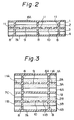
- Fig. 2 is a diagram showing a high frequency filter (in sectional view) according to a second embodiment.
- the same reference numerals as in Figs. 1A and 1B denote the same parts.
- Reference numeral 9 denotes a first resonant conductor, 10 a second resonant conductor, 11 conductors (GND electrode), and 6A and 7A GND electrodes.
- the two resonant conductors 9 and 10 (resonant conductors of the strip line resonator) corresponding in function to the inner conductor 5 mentioned above are mounted on the same dielectric layer 3, and the outer conductors 6A and 7A are used as GND electrodes, which are connected with a coupling capacitor to form a high frequency filter (band pass filter).
- the multi-layer substrate constituting the high frequency filter according to the second embodiment is formed by using the same dielectric layers as in these multi-layer substrate of the first embodiment.
- first and fourth dielectric layers 1 and 4 are formed by low dielectric layers (dielectric constant ⁇ 2), and the second and third dielectric layers 2 and 3 are formed by high dielectric layers (dielectric constant ⁇ 1, where ⁇ 1 > ⁇ 2).
- the first and second resonant conductors 9 and 10 are mounted on the third dielectric layer 3, and conductors 11 used as GND electrodes are provided a specified distance apart from each other and as if they surrounded the first and second resonant conductors 9 and 10.
- the first and second resonant conductors 9 and 10 constitute ⁇ /4 type strip resonators ( ⁇ is wavelength of high frequency signal), respectively, and they are at one end connected to the above-mentioned conductors 11.
- the GND electrodes 6A and 7A are provided on the upper side (outside surface) of the first dielectric layer 1 and on the under side (outside surface) of the fourth dielectric layer 4, and are connected through blind through-holes (filled with a conductor) 8 with the conductors 11, to be used at the same potential.
- the first and second resonant conductors 9 and 10 are connected with each other via a capacitor (not shown) contained in the multi-layer substrate.
- the capacitor and the resonant conductors constitute a strip line filter.
- Fig. 3 is a diagram showing a high frequency filter (sectional view) according to a third embodiment.
- the same reference numerals as these in Figs. 1A to 2 denote the same parts.
- reference numerals 7C, 11A, and 11B denote GND electrodes, and 1A, 2A, 3A, 4A, 1B, 2B, 3B, and 4B denote first to eighth dielectric layers.
- This third embodiment is a modification of the second embodiment.
- the first and second resonant conductors 9 and 10 are arranged in the laminating direction.
- the second, third, sixth and seventh dielectric layers 2A, 3A, 2B, and 3B are all formed of a high dielectric constant material (dielectric constant ⁇ 1), and the first, fourth, fifth, and eighth dielectric layers 1A, 4A, 1B, and 4B formed of a low dielectric constant material (dielectric constant ⁇ 2) are provided between those high dielectric layers and the GND electrodes 6A, 7C, and 7A.
- the first and second resonant conductors 9 and 10 are respectively placed between the high dielectric layers 2A and 3A, and 2B and 3B.
- the high dielectric layers are surrounded by low dielectric layers.
- the second and third embodiments offer following effects.
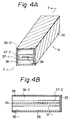
- Figs. 4A and 4B are diagrams showing a dielectric resonator according to a fourth embodiment, in which Fig. 4A is a perspective view of the dielectric resonator and Fig. 4B is a sectional view taken along the line X-Y of Fig. 4A.
- reference numeral 31 denotes a dielectric resonator, 34 a resonant conductor, 35 a GND electrode, 36-1 and 36-2 low dielectric layers, and 37-1 and 37-2 high dielectric layers.
- the fourth embodiment is a dielectric resonator constituted by using the resonant conductor 34 corresponding to the aforementioned inner conductor 5, and the peripheral GND electrode 35 as an outer conductor.
- this dielectric resonator 31 is prismatic in external appearance, and has the resonant conductor 34 placed in the center along the longitudinal direction.
- the high dielectric layers 37-1 and 37-2 are provided only around the resonant conductor 34.
- the low dielectric layers 36-1 and 36-2 are provided between the high dielectric layer 37-1 and the outside GND electrode 35 and between the high dielectric layer 37-2 and the outside GND electrode 35.
- the high dielectric layers 37-1 and 37-2 should preferably be thinner than the low dielectric layers 36-1 and 36-2.
- this dielectric resonator 31 is made by using laminating technology used for the multi-layer substrate, and therefore, does not have a through-hole present in the prior art.
- the dielectric resonator 31 is made in the manner described below, for example. First, a low dielectric layer 36-1 is formed, on which a high dielectric layer 37-1 is laminated.
- a conductor is printed to form the resonant conductor (thick film pattern) 34.
- a high dielectric layer 37-2 is laminated, so that the resonant conductor 34 is surrounded at the top, bottom, left and right sides with the high dielectric layers 37-1 and 37-2.
- the width of the resonant conductor 34 is made narrower than the high dielectric layers 37-1 and 37-2.
- a low dielectric layer 36-2 is laminated on the above-mentioned high dielectric layer 37-2, thereby making the whole laminated body prismatic.
- a GND electrode 35 is formed on all sides of the dielectric resonator except for one of two sides where the resonant conductor 34 is exposed. This GND electrode 35 is formed by printing a conductor paste, for example. At this step, the resonant conductor 34 is formed so that one end thereof contacts to the GND electrode 35, as shown in Fig. 4B.
- each of the above-mentioned low dielectric layers 36-1 and 36-2 is not limited to one layer, but may be any optional number of layers (multiple layers). Also, each of the high dielectric layers 37-1 and 37-2 may be formed in multiple layers.
- the low dielectric layer should preferably be thicker than the high dielectric layer.
- Figs. 5A and 5B are diagrams showing a dielectric resonator according to a fifth embodiment, in which Fig. 5A is a perspective view of the dielectric resonator, while Fig. 5B is a sectional view taken along the line X-Y of Fig. 5A.
- the same reference numerals as in Figs. 4A and 4B denote the same parts.
- Reference numerals 34-1 and 34-2 denote resonant conductors, and 37-1 to 37-3 denote high dielectric layers.
- the fifth embodiment was made to reduce the loss of the resonant conductor by using two resonant conductors, and its structure is shown in Figs. 5A and 5B. Also in this embodiment, the high dielectric layers are disposed only around the resonant conductors.
- the dielectric resonator 31 is made in the manner as described below, for example. First, a high dielectric layer 37-1 is laminated on a low dielectric layer 36-1, and then a resonant conductor 34-1 is formed (in thick film pattern) on the high dielectric layer 37-1. Thereafter, a high dielectric layer 37-2 is laminated thereon.
- the resonant conductor 34-2 is formed (in thick film pattern) on the high dielectric layer 37-2, and on which a high dielectric layer 37-3 is laminated. Thereafter, a low dielectric layer 36-2 is laminated on the layer 37-3. The whole laminated body is formed in a prismatic shape. Finally, a GND electrode 35 is formed on all external sides of the laminated body except for one of two sides where the resonant conductors 34-1 and 34-2 are exposed, and this GND electrode 35 is connected to one end of each of the resonant conductors 34-1 and 34-2.
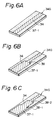
- Figs. 6A to 6F show structural examples of the resonant conductors in the above-mentioned fourth and fifth embodiments.
- the same reference numerals as in Figs. 4A to 5B denote the same parts.
- Reference numeral 34G denotes the GND terminals, and 38, 38-1 and 38-2 denote the point where the width changes.
- the resonant conductor 34 is formed as a thick film pattern on the high dielectric layer 37-1.
- the thick film pattern may be formed in various forms as shown in examples 1 to 6.
- the resonant conductor is denoted by reference numeral 34, and the high dielectric layer by 37-1.
- the above-mentioned patterning is applied to the resonant conductors 34-1 and 34-2, and the high dielectric layer 37-2 in the fifth embodiment.
- Example 1 in Fig. 6A is a thick film pattern of the resonant conductor 34 in the form of a strip with a fixed width.
- Example 2 in Fig. 6B is a thick film pattern which has a change point 38 of the width in almost the middle of the longitudinal direction of the resonant conductor 34.
- the thick film pattern width is narrow, and for the other range, the width is made wider (the width changes in two stages).
- Example 3 in Fig. 6C is a resonant conductor 34 having two width change points 38-1 and 38-2 at which the resonant conductor 34 is divided into three portions with almost equal lengths in the longitudinal direction.
- the pattern width is widest, for the range between the width change points 38-1 and 38-2, the pattern width is intermediate, and for the range from the width change point 38-2 to the GND-side end 34G, the pattern width is narrowest.
- the thick film pattern of the resonant conductor 34 is varied in three stages.
- Example 4 in Fig. 6D is a resonant conductor having the width change point 38 near the end thereof with the width wide near that end and narrow from the width change point 38 to the GND-side end 34G.
- the reason for providing the width change points is to prevent a harmful resonance in higher modes (harmonic suppress measure).
- Example 5 in Fig. 6E is a resonant conductor 34 formed by a thick film pattern having a fixed width but meandering. This meandering provides the resonant conductor with a substantially long length, so that the dielectric resonator can be made short in longitudinal length and hence, small in size.
- Example 6 in Fig. 6F is a resonant conductor 34 formed by a tapered thick film pattern. As illustrated, the thick film pattern is tapered so that the width is narrowest at the GND-side end 34G and widest at the opposite end.
- Figs. 7A and 7B, Figs. 8A and 8B, and Figs. 9A and 9B show structural examples of the electrodes (for external terminals) in the four and fifth embodiment mentioned above.
- the same reference numerals as in Figs. 4A to 6B denote the same parts.
- Reference numerals 40, 42, and 43 denote electrodes, and 44 denotes blank areas.
- the dielectric resonator 31 shown in the fourth and fifth embodiments mentioned above need to be fitted with electrodes for external terminals, as shown in Figs. 7A and 7B, Figs. 8A and 8B, and Figs. 9A and 9B, for example.
- Fig. 7A is a perspective view of the dielectric resonator
- Fig. 7B is a sectional view taken along the line X-Y of Fig. 7A.
- Example 1 in Figs. 7A and 7B is a structural example of the dielectric resonator in which a chip-like electrode 40 is mounted almost in the center of the side devoid of the GND electrode 35, connected to the resonant conductor 34.
- This electrode 40 is used as a terminal for connection with an external circuit.
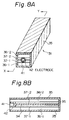
- Example 2 in Figs. 8A and 8B is a structural example of the dielectric resonator 31 in which a shallow pit (blind hole) 41 is provided almost in the center of the side without the GND electrode 35, at the internal circumference of which pit 41 an electrode 42 is formed, and the electrode 42 is connected to the resonant conductor 34.
- a shallow pit (blind hole) 41 is provided almost in the center of the side without the GND electrode 35, at the internal circumference of which pit 41 an electrode 42 is formed, and the electrode 42 is connected to the resonant conductor 34.
- the pit 41 is formed, and then, the conductor of the electrode 42 is attached.
- a convex electrode, insertable into the electrode 42 is inserted for connection with an external circuit.
- the electrode 42 serving as a female connector is connected detachably to an external electrode (male connector, in this case).
- Example 3 in Figs. 9A and 9B is a structural example made in SMD (surface mounted device) application. As illustrated, a rectangular electrode 43 is mounted at the side devoid of the GND electrode 35, and is connected with the internal resonant conductor 34.
- the electrode 43 is to have an electrode width corresponding to a length from the bottom of the low dielectric layer 36-1 to the top of the low dielectric layer 36-2.
- blank areas 44 are provided at the peripheral the electrode 43 (at the top side and bottom side).
- the fourth and fifth embodiments provide following effects.
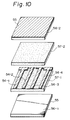
- Fig. 10 and Figs. 11A to 11B are diagrams showing a sixth embodiment, in which Fig. 10 is an exploded view in perspective of a dielectric filter, while Figs. 11A and 11B are perspective views of a dielectric filter (Fig. 11A is a view taken from the front side, and Fig. 11B is a view taken from the back side).
- reference numeral 54-1 to 54-4 denote ⁇ /4 type resonant conductors
- 55 denotes a GND electrode
- 56-1 and 56-2 denote low dielectric layers
- 57-1 and 57-2 denote high dielectric layers
- 58 denotes an input terminal
- 59 denotes an output terminal
- 60 denotes blank areas.
- the dielectric filter (band pass filter) in the sixth embodiment has four resonant conductors.
- the high dielectric layer (dielectric constant ⁇ 1) 57-1 is laminated on the low dielectric layer (dielectric constant ⁇ 2) 56-1.
- the relation ⁇ 1 > ⁇ 2 holds.
- the four resonant conductors 54-1, 54-2, 54-3, and 54-4 are arranged specified distances apart from one another on the mentioned high dielectric layer 57-1. Those resonant conductors 54-1 to 54-4 differ in length, and therefore, differ in the resonance frequency, too.
- each of the resonant conductors 54-1 to 54-4 (the ends where those conductors are wide in Fig. 10) is on the GND side, and the opposite ends thereof are on the signal input side.
- the high dielectric layer (dielectric constant ⁇ 1) 57-2 is laminated, so that the resonant conductors 54-1 to 54-4 are sandwiched by the high dielectric layers 57-1 and 57-2.
- the low dielectric layer (dielectric constant ⁇ 2) 56-2 is laminated.
- GND electrodes 55 are provided both on the upper side of the low dielectric layer 56-2 and on the under side of the low dielectric layer 56-1.
- the dielectric filter is constituted in such a structure that the resonant conductors 54-1 to 54-4 are sandwiched by the high dielectric layers 57-1 and 57-2 (on both sides of the laminated direction), and the layers 57-1 and 57-2 are further sandwiched by the low dielectric layers 56-1 and 56-2.
- the all sides of the laminated body, except for one side used as a signal input side, are covered with the GND electrode 55, and the signal input side is provided with the input terminal (IN) 58 and the output terminal (OUT) 59.
- the input terminal 58 and the output terminal 59 are made of a conductor with a length substantially equal to the thickness of the laminated body, so that part of the GND electrode 55 surrounding those terminals are cut off to form the blank areas (areas without any conductor) 60. If the dielectric filter is structured as described, the input terminal 58 and the output terminal 59 can be prevented from contacting the GND electrode 55. By providing these terminals, the dielectric filter can be made ready for SMD (Surface Mounted Device) application.
- SMD Surface Mounted Device
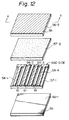
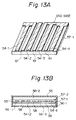
- Fig. 12 and Figs. 13A and 13B show a seventh embodiment, in which Fig. 12 is an exploded view in perspective of a dielectric filter, and Figs. 13A and 13B are structural diagrams of the dielectric filter (Fig. 13A is a partially enlarged view, and Fig. 13B a sectional view taken along the line X-Y of Fig. 13A).
- Fig. 13A is a partially enlarged view
- Fig. 13B a sectional view taken along the line X-Y of Fig. 13A.
- Reference numeral 61 denotes low dielectric parts.
- This seventh embodiment is a case in which low dielectric parts are placed between a plurality of resonant conductors so as to adjust the degree of coupling between the resonators.
- a high dielectric layer (dielectric constant ⁇ 1) 57-1 is laminated, and on this high dielectric layer 57-1, four resonant conductors 54-1, 54-2, 54-3, and 54-4 are formed.
- Low dielectric members (dielectric constant ⁇ 2) 61 are formed in respective spaces between the resonant conductors 54-1 to 54-4, by printing or sticking them in sheet form.
- a high dielectric layer (dielectric constant ⁇ 1) 57-2 is laminated, and on which in turn a low dielectric layer 56-2 (dielectric constant ⁇ 2) is laminated.
- a GND electrode 55 is provided on the under side of the low dielectric layer 56-1 and on the upper side of the low dielectric layer 56-2.
- the GND electrode 55 is also attached to the whole circumferential surface of the thus formed laminated body except for one side (the input side of the resonant conductor).
- the degree of coupling between the resonators is adjusted by varying the shape of the low dielectric parts 61 provided between each of the resonant conductors.
- step 1 to step 7 a dielectric filter is completed.
- the GND electrode as the outermost layer may be formed in the step 6.
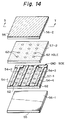
- Fig. 14 is an exploded view in perspective of a dielectric filter according to an eight embodiment.
- Figs. 15A and 15B are structural diagrams of the dielectric filter according to the eighth embodiment, in which Fig. 15A is a perspective view of a high dielectric layer, while Fig. 15B is a sectional view taken along the line S-T in Fig. 14.
- the same reference numerals as in Figs. 10 to 13B denote the same parts.
- Reference numeral 62 denotes through-holes.
- the eighth embodiment is a case in which a plurality of holes are opened in the high dielectric layers, and the holes are filled with a low dielectric substance so that the low dielectric substance lie between the resonant conductors to thereby adjust the degree of coupling between the resonators.
- a low dielectric layer 56-1, high dielectric layers 57-1 and 57-2, and a low dielectric layer 56-2 are laminated as illustrated.
- the arrangement of the dielectric layers and the structure of resonant conductors 54-1 to 54-4, and a GND electrode 55 are the same as that in the sixth embodiment.
- the through-holes are opened by punching the high dielectric layers 57-1 and 57-2, and the through-holes are filled with a low dielectric substance.
- the holes 62 opened in the high dielectric layers 57-1 and 57-2 are positioned so that they are arranged between the resonant conductors 54-1 to 54-4 when the layers are laminated.
- the dielectric constant of the low dielectric substance filled in the holes 62 is to be ⁇ 2 ( ⁇ 1 > ⁇ 2) as in the low dielectric layers 56-1 and 56-2, for example.
- step 1 to step 7 a dielectric filter is completed.
- the degree of coupling between the resonators is adjusted by the size and the number of the holes 62.
- the low dielectric parts which are formed by being filled in the holes 62 on the high dielectric layer 57-1 in Fig. 14, may be filled in the holes 62 simultaneously with forming (by printing or the like) of the low dielectric strips 61 arranged between the resonant conductors as shown in Fig. 13A.
- the sixth to eighth embodiments can be modified as described below.
- the sixth to eighth embodiments offers the following effects.
- Fig. 16 is a sectional view of the voltage control oscillator (VCO) in a ninth embodiment.
- VCO voltage control oscillator
- reference numerals 71-1L to 71-3L, and 71-6L and 71-7L denote low dielectric layers
- 71-4H and 71-5H denote high dielectric layers
- 73-1A and 73-2 denote GND electrodes
- 72 denotes resonant conductor (strip line resonator)
- 79 denotes a blank area (without conductor)
- 80 denotes side-face electrode.
- the ninth embodiment is a voltage control oscillator (VCO) formed by using a resonant conductor (strip line resonator) corresponding to the inner conductor in the first embodiment and connecting other parts thereto.
- VCO voltage control oscillator
- a resonator is mounted in the substrate on which discrete parts are mounted, and in order to obtain a thin substrate, a structure described below is used.
- a multi-layer substrate is formed by the first to seventh dielectric layers 71-1L, 71-2L, 71-3L, 71-4H, 71-5H, 71-6L, and 71-7L.
- the voltage control oscillator is composed of an oscillator section and a buffer section.
- This buffer section serves to protect the oscillator against adverse effects from voltage fluctuation and so on the output side of the VCO.
- transistors and other discrete parts are mounted on the first dielectric layer (low dielectric) 71-1L of the multi-layer substrate, while a coil and a wiring pattern are formed on the second dielectric layer (low dielectric) 71-2L (by solid printing).
- the GND pattern 73-1A is formed (by solid printing) on the whole surface, except for the blank area (area without conductor) 79, of the third dielectric layer (low dielectric layer) 71-3L.
- the resonant conductor 72 is formed (by printing a conductor paste) on the fifth dielectric layer (high dielectric layer) 71-5H.
- the GND pattern (wide-area-contact GND pattern) 73-2 is formed (in solid printing) on the seventh dielectric layer 71-7L.
- the above-mentioned patterns are extended by conductor patterns to the end of the dielectric layers, and connected to the GND electrode 80 formed on the GND side face for SMD (Surface Mounted Device) application.
- SMD Surface Mounted Device
- the GND pattern 73-1A may be constituted so as to cover the resonant conductor 72.
- the low dielectric layers 71-3L and 71-6L it is desirable to form the blank area 79 as shown in Fig. 16.
- the above-mentioned blank area 79 is made to have substantially the same shape as the resonant conductor 72 (somewhat larger than this), and formed above the resonant conductor 72.
- the GND pattern 73-1A is prevented from being present above (in the laminated direction) the resonant conductor 72.
- the GND pattern 73-1A is formed by patterning on the low dielectric layer 71-3L with the blank area 79 left as blank.
- the resonant conductor In an oscillator, the resonant conductor is used as a mere inductive element, and hence, there is no problem of radiation loss. Therefore, the resonant conductor need not be mounted in a tri-plate structure.
- One end, in the GND side, of the resonant conductor 72 is extended to the end of the fifth dielectric layer 71-5H and connected to the GND electrode 80 (not illustrated as it is in Fig. 16), while the other end is connected to a capacitor (a discrete part in this case) mounted on the surface of the substrate, for example.
- the strip line resonator is structured such that the GND pattern 73-2 is formed under the resonant conductor 72 with interposition of a dielectric layer, whereas no GND pattern is formed but only dielectric layers are formed above the resonant conductor 72. Also, this resonator is disposed at peripheral (including under side ) of a transistor of the oscillator section mounted on the surface of the substrate.
- the resonant conductor 72 of the strip line resonator is placed between the high dielectric layers 71-4H and 71-5H, thereby shortening the wavelength. Consequently, a resonator with high Q can be obtained, and the oscillator section, particularly the strip line resonator, is protected against adverse effects from the buffer section.
- the strip line resonator can be adjusted as follows.
- a trimming GND pattern (not shown) is formed on the low dielectric layer 71-1L just above a part of the strip line resonator 72, which part is not connected to the GND electrode 80, and connected to the GND electrode 73-1A. Then, the trimming GND pattern is trimmed. Since when trimming, a capacitance component between the resonant conductor 72 and the trimming GND pattern is varied, the resonance frequency of the strip line resonator can be adjusted.
- the ninth embodiment offers the following effects.
- High frequency devices can be applied to high frequency transmission lines such as a high frequency signal line or a delay line, high frequency filters, high frequency oscillators, and resonators, and other devices.
Landscapes
- Physics & Mathematics (AREA)
- Electromagnetism (AREA)
- Control Of Motors That Do Not Use Commutators (AREA)
Abstract
Applications Claiming Priority (11)
| Application Number | Priority Date | Filing Date | Title |
|---|---|---|---|
| JP414388/90 | 1990-12-26 | ||
| JP2414388A JPH04223704A (ja) | 1990-12-26 | 1990-12-26 | 高周波伝送路 |
| JP03031888A JP3126155B2 (ja) | 1991-01-31 | 1991-01-31 | 高周波フィルタ |
| JP31888/91 | 1991-01-31 | ||
| JP294446/91 | 1991-11-11 | ||
| JP29444691A JP3402369B2 (ja) | 1991-11-11 | 1991-11-11 | 発振器モジュール |
| JP304348/91 | 1991-11-20 | ||
| JP30434891A JPH05145308A (ja) | 1991-11-20 | 1991-11-20 | 誘電体共振器 |
| JP317892/91 | 1991-12-02 | ||
| JP31789291A JPH05152803A (ja) | 1991-12-02 | 1991-12-02 | 誘電体フイルタ |
| PCT/JP1991/001761 WO1992012548A1 (fr) | 1990-12-26 | 1991-12-25 | Dispositif pour radiofrequence |
Publications (3)
| Publication Number | Publication Date |
|---|---|
| EP0519085A1 true EP0519085A1 (fr) | 1992-12-23 |
| EP0519085A4 EP0519085A4 (en) | 1993-05-26 |
| EP0519085B1 EP0519085B1 (fr) | 1996-10-16 |
Family
ID=27521377
Family Applications (1)
| Application Number | Title | Priority Date | Filing Date |
|---|---|---|---|
| EP92901922A Expired - Lifetime EP0519085B1 (fr) | 1990-12-26 | 1991-12-25 | Dispositif pour radiofrequence |
Country Status (4)
| Country | Link |
|---|---|
| US (1) | US5406235A (fr) |
| EP (1) | EP0519085B1 (fr) |
| DE (1) | DE69122748T2 (fr) |
| WO (1) | WO1992012548A1 (fr) |
Cited By (3)
| Publication number | Priority date | Publication date | Assignee | Title |
|---|---|---|---|---|
| EP0638953A1 (fr) * | 1993-08-09 | 1995-02-15 | Oki Electric Industry Co., Ltd. | Filtre et duplexeur diélectrique du type LC |
| EP0877437A1 (fr) * | 1997-05-07 | 1998-11-11 | Murata Manufacturing Co., Ltd. | Résonateur du type ligne à bande et résonateur variable |
| WO1999063615A3 (fr) * | 1998-05-29 | 2000-01-27 | Koninkl Philips Electronics Nv | Filtre dielectrique |
Families Citing this family (56)
| Publication number | Priority date | Publication date | Assignee | Title |
|---|---|---|---|---|
| US5621366A (en) * | 1994-08-15 | 1997-04-15 | Motorola, Inc. | High-Q multi-layer ceramic RF transmission line resonator |
| JPH10126307A (ja) * | 1996-10-21 | 1998-05-15 | Murata Mfg Co Ltd | 高周波複合部品 |
| JPH11136002A (ja) * | 1997-10-30 | 1999-05-21 | Philips Japan Ltd | 誘電体フィルタ及び誘電体フィルタの通過帯域特性を調整する方法 |
| US6023205A (en) * | 1998-01-23 | 2000-02-08 | Adc Solitra, Inc. | Circuit arrangement for reducing passband ripple of a bandpass filter |
| US5978446A (en) * | 1998-02-03 | 1999-11-02 | Picker International, Inc. | Arc limiting device using the skin effect in ferro-magnetic materials |
| JP4204150B2 (ja) * | 1998-10-16 | 2009-01-07 | パナソニック株式会社 | 多層回路基板 |
| US6320468B2 (en) * | 1998-10-23 | 2001-11-20 | Raytheon Company | Method and system for suppressing oscillations in a multi-stage amplifier |
| EP1005151B1 (fr) * | 1998-11-24 | 2003-04-02 | Matsushita Electric Industrial Co., Ltd. | Push-push Oscillateur |
| JP3492225B2 (ja) | 1999-01-19 | 2004-02-03 | 松下電器産業株式会社 | 送受信装置 |
| US6515559B1 (en) * | 1999-07-22 | 2003-02-04 | Matsushita Electric Industrial Co., Ltd | In-band-flat-group-delay type dielectric filter and linearized amplifier using the same |
| JP2001060802A (ja) * | 1999-08-19 | 2001-03-06 | Sony Corp | 回路素子基板と半導体装置及びその製造方法 |
| JP2001189605A (ja) * | 1999-10-21 | 2001-07-10 | Matsushita Electric Ind Co Ltd | セラミック積層rfデバイス |
| US6456172B1 (en) | 1999-10-21 | 2002-09-24 | Matsushita Electric Industrial Co., Ltd. | Multilayered ceramic RF device |
| JP2001230606A (ja) | 2000-02-15 | 2001-08-24 | Matsushita Electric Ind Co Ltd | マイクロストリップ線路と、これを用いたマイクロ波装置 |
| AU2001274857A1 (en) * | 2000-05-18 | 2001-12-03 | Georgia Tech Research Corporation | High dielectric constant nano-structure polymer-ceramic composite |
| CN1190113C (zh) * | 2000-06-27 | 2005-02-16 | 松下电器产业株式会社 | 陶瓷叠层器件 |
| JP3711846B2 (ja) * | 2000-07-27 | 2005-11-02 | 株式会社村田製作所 | 高周波モジュール及びそれを用いた移動体通信装置 |
| JP2002299918A (ja) * | 2001-01-29 | 2002-10-11 | Murata Mfg Co Ltd | マイクロストリップ線路及びそれを用いた共振素子、フィルタ、高周波回路並びにそれらを用いた電子回路、回路モジュール及び通信装置 |
| US7023301B2 (en) * | 2001-05-16 | 2006-04-04 | Matsushita Electric Industrial Co., Ltd. | Laminated filter with a single shield conductor, integrated device, and communication apparatus |
| SE0200715D0 (sv) * | 2001-12-14 | 2002-03-11 | Optillion Ab | Feedthrough Interconnection Assembly |
| US6583498B1 (en) | 2002-08-09 | 2003-06-24 | International Business Machine Corporation | Integrated circuit packaging with tapered striplines of constant impedance |
| DE602004028349D1 (de) | 2003-03-04 | 2010-09-09 | Rohm & Haas Elect Mat | Koaxiale wellenleitermikrostrukturen und verfahern zu ihrer bildung |
| EP1652264A1 (fr) * | 2003-07-28 | 2006-05-03 | Philips Intellectual Property & Standards GmbH | Composant haute frequence |
| US6881895B1 (en) * | 2003-09-30 | 2005-04-19 | National Semiconductor Corporation | Radio frequency (RF) filter within multilayered low temperature co-fired ceramic (LTCC) substrate |
| CN101341628A (zh) * | 2006-08-02 | 2009-01-07 | 株式会社村田制作所 | 芯片元件 |
| CN101274734A (zh) | 2006-12-30 | 2008-10-01 | 罗门哈斯电子材料有限公司 | 三维微结构及其形成方法 |
| EP1939976A1 (fr) * | 2006-12-30 | 2008-07-02 | Rohm and Haas Electronic Materials LLC | Microstructures tridimensionnelles et leurs procédés de formation |
| JP2008188754A (ja) * | 2006-12-30 | 2008-08-21 | Rohm & Haas Electronic Materials Llc | 三次元微細構造体およびその形成方法 |
| KR101472134B1 (ko) | 2007-03-20 | 2014-12-15 | 누보트로닉스, 엘.엘.씨 | 동축 전송선 마이크로구조물 및 그의 형성방법 |
| KR101593686B1 (ko) | 2007-03-20 | 2016-02-12 | 누보트로닉스, 엘.엘.씨 | 일체화된 전자 요소들 및 이들의 형성 방법 |
| WO2008133010A1 (fr) * | 2007-04-12 | 2008-11-06 | Nec Corporation | Elément de circuit de filtrage et dispositif de circuit électronique |
| DE102007019447B4 (de) * | 2007-04-25 | 2009-05-07 | Spinner Gmbh | Hochfrequenzbauteil mit geringen dielektrischen Verlusten |
| JP5153246B2 (ja) * | 2007-07-27 | 2013-02-27 | 京セラ株式会社 | バンドパスフィルタならびにそれを用いた無線通信モジュールおよび無線通信機器 |
| US20090070916A1 (en) * | 2007-09-13 | 2009-03-19 | Mikhail Kassam | Personal protective garment |
| US7782237B2 (en) * | 2008-06-13 | 2010-08-24 | The Board Of Trustees Of The Leland Stanford Junior University | Semiconductor sensor circuit arrangement |
| US8659371B2 (en) * | 2009-03-03 | 2014-02-25 | Bae Systems Information And Electronic Systems Integration Inc. | Three-dimensional matrix structure for defining a coaxial transmission line channel |
| US20110123783A1 (en) | 2009-11-23 | 2011-05-26 | David Sherrer | Multilayer build processses and devices thereof |
| US8917150B2 (en) | 2010-01-22 | 2014-12-23 | Nuvotronics, Llc | Waveguide balun having waveguide structures disposed over a ground plane and having probes located in channels |
| KR101796098B1 (ko) | 2010-01-22 | 2017-11-10 | 누보트로닉스, 인크. | 열관리 |
| US8866300B1 (en) | 2011-06-05 | 2014-10-21 | Nuvotronics, Llc | Devices and methods for solder flow control in three-dimensional microstructures |
| US8814601B1 (en) | 2011-06-06 | 2014-08-26 | Nuvotronics, Llc | Batch fabricated microconnectors |
| EP2731783A4 (fr) | 2011-07-13 | 2016-03-09 | Nuvotronics Llc | Procédés de fabrication de structures électroniques et mécaniques |
| CN104272591B (zh) * | 2012-05-01 | 2017-05-31 | 株式会社村田制作所 | 高频滤波器 |
| US9325044B2 (en) | 2013-01-26 | 2016-04-26 | Nuvotronics, Inc. | Multi-layer digital elliptic filter and method |
| US9306254B1 (en) | 2013-03-15 | 2016-04-05 | Nuvotronics, Inc. | Substrate-free mechanical interconnection of electronic sub-systems using a spring configuration |
| US9306255B1 (en) | 2013-03-15 | 2016-04-05 | Nuvotronics, Inc. | Microstructure including microstructural waveguide elements and/or IC chips that are mechanically interconnected to each other |
| WO2015109208A2 (fr) | 2014-01-17 | 2015-07-23 | Nuvotronics, Llc | Unité d'interface de test à l'échelle d'une tranche: dispositifs et procédés à faible perte et haute isolation pour interconnexions de signaux mixtes à grande vitesse et haute densité, et contacteurs |
| WO2016047540A1 (fr) * | 2014-09-26 | 2016-03-31 | 株式会社村田製作所 | Ligne de transmission et dispositif électronique |
| US10847469B2 (en) | 2016-04-26 | 2020-11-24 | Cubic Corporation | CTE compensation for wafer-level and chip-scale packages and assemblies |
| US10511073B2 (en) | 2014-12-03 | 2019-12-17 | Cubic Corporation | Systems and methods for manufacturing stacked circuits and transmission lines |
| CN105226360B (zh) * | 2015-08-24 | 2018-05-29 | 上海交通大学 | 基片集成同轴波导互连阵列结构 |
| US10153531B2 (en) * | 2015-09-07 | 2018-12-11 | Vayyar Imaging Ltd. | Multilayer microwave filter |
| US10939541B2 (en) * | 2017-03-31 | 2021-03-02 | Huawei Technologies Co., Ltd. | Shield structure for a low crosstalk single ended clock distribution circuit |
| US10319654B1 (en) | 2017-12-01 | 2019-06-11 | Cubic Corporation | Integrated chip scale packages |
| RU2763692C1 (ru) * | 2020-11-27 | 2021-12-30 | федеральное государственное бюджетное образовательное учреждение высшего образования «Томский государственный университет систем управления и радиоэлектроники» | Микрополосковая линия с заземленным проводником сверху, защищающая от сверхкоротких импульсов |
| CN118137095B (zh) * | 2024-05-07 | 2024-07-16 | 成都雷电微力科技股份有限公司 | 一种低传输损耗的带状线结构 |
Family Cites Families (20)
| Publication number | Priority date | Publication date | Assignee | Title |
|---|---|---|---|---|
| US2994050A (en) * | 1959-04-10 | 1961-07-25 | Sanders Associates Inc | High frequency transmission line |
| US3633104A (en) * | 1970-08-05 | 1972-01-04 | Hewlett Packard Co | High-stability electromagnetic resonator |
| US3740678A (en) * | 1971-03-19 | 1973-06-19 | Ibm | Strip transmission line structures |
| JPS50151445A (fr) * | 1974-05-24 | 1975-12-05 | ||
| FR2535547B1 (fr) * | 1982-10-29 | 1988-09-16 | Thomson Csf | Resonateurs bi-rubans et filtres realises a partir de ces resonateurs |
| JPS61100002A (ja) * | 1984-10-22 | 1986-05-19 | Matsushita Electric Ind Co Ltd | 平面型誘電体フイルタ |
| JPS6286905A (ja) * | 1985-10-14 | 1987-04-21 | Tokyo Keiki Co Ltd | 超高周波フイルタ |
| JPS63209305A (ja) * | 1987-02-26 | 1988-08-30 | Matsushita Electric Ind Co Ltd | 発振器 |
| US4922325A (en) * | 1987-10-02 | 1990-05-01 | American Telephone And Telegraph Company | Multilayer ceramic package with high frequency connections |
| US4853660A (en) * | 1988-06-30 | 1989-08-01 | Raytheon Company | Integratable microwave devices based on ferromagnetic films disposed on dielectric substrates |
| JPH0229303A (ja) * | 1988-07-19 | 1990-01-31 | Kondo Yoko Kk | 内型 |
| US4916582A (en) * | 1988-12-20 | 1990-04-10 | Murata Manufacturing Co., Ltd. | Electronic component and its production method |
| US4918570A (en) * | 1988-12-20 | 1990-04-17 | Murata Manufacturing Co., Ltd. | Electronic component and its production method |
| JP2740966B2 (ja) * | 1989-02-28 | 1998-04-15 | 住友金属工業株式会社 | 高周波誘電体部品およびその製造方法 |
| FR2647599B1 (fr) * | 1989-05-24 | 1991-11-29 | Alcatel Espace | Structure de realisation de circuits et composants appliquee aux hyperfrequences |
| JPH03121705U (fr) * | 1990-03-27 | 1991-12-12 | ||
| US5216394A (en) * | 1991-07-19 | 1993-06-01 | Uniden Corporation | Dielectric multi-line resonator including a coupling conductor line mainly inductively coupled to a resonator conductor line |
| US5160905A (en) * | 1991-07-22 | 1992-11-03 | Motorola, Inc. | High dielectric micro-trough line filter |
| US5196813A (en) * | 1991-07-23 | 1993-03-23 | Matsushita Electric Industrial Co., Ltd. | Dielectric filter having a single multilayer substrate |
| US5184095A (en) * | 1991-07-31 | 1993-02-02 | Hughes Aircraft Company | Constant impedance transition between transmission structures of different dimensions |
-
1991
- 1991-12-25 DE DE69122748T patent/DE69122748T2/de not_active Expired - Lifetime
- 1991-12-25 WO PCT/JP1991/001761 patent/WO1992012548A1/fr not_active Ceased
- 1991-12-25 EP EP92901922A patent/EP0519085B1/fr not_active Expired - Lifetime
- 1991-12-25 US US08/225,341 patent/US5406235A/en not_active Expired - Lifetime
Cited By (4)
| Publication number | Priority date | Publication date | Assignee | Title |
|---|---|---|---|---|
| EP0638953A1 (fr) * | 1993-08-09 | 1995-02-15 | Oki Electric Industry Co., Ltd. | Filtre et duplexeur diélectrique du type LC |
| US5525942A (en) * | 1993-08-09 | 1996-06-11 | Oki Electric Industry Co., Ltd. | LC-type dielectric filter and duplexer |
| EP0877437A1 (fr) * | 1997-05-07 | 1998-11-11 | Murata Manufacturing Co., Ltd. | Résonateur du type ligne à bande et résonateur variable |
| WO1999063615A3 (fr) * | 1998-05-29 | 2000-01-27 | Koninkl Philips Electronics Nv | Filtre dielectrique |
Also Published As
| Publication number | Publication date |
|---|---|
| EP0519085B1 (fr) | 1996-10-16 |
| WO1992012548A1 (fr) | 1992-07-23 |
| US5406235A (en) | 1995-04-11 |
| EP0519085A4 (en) | 1993-05-26 |
| DE69122748T2 (de) | 1997-05-07 |
| DE69122748D1 (de) | 1996-11-21 |
Similar Documents
| Publication | Publication Date | Title |
|---|---|---|
| EP0519085B1 (fr) | Dispositif pour radiofrequence | |
| US5208565A (en) | Dielectric filer having a decoupling aperture between coaxial resonators | |
| EP0688059B2 (fr) | Filtre diélectrique | |
| EP0552761B1 (fr) | Filtre diélectrque et son procédé the fabrication | |
| JP2752048B2 (ja) | 対称型ストリップライン共振器 | |
| KR19990067717A (ko) | 대역저지 유전체 필터, 유전체 듀플렉서 및 이를 사용한 통신장치/b542> | |
| CN112563699B (zh) | 基于多层pcb结构的小型化螺旋形可表面贴装带通滤波器 | |
| KR100744203B1 (ko) | 수동 부품 | |
| US7026893B2 (en) | Dielectric resonator having a multilayer structure | |
| EP0499643B1 (fr) | Filtre passe-bande | |
| KR0148749B1 (ko) | 필터 및 그 제조방법 | |
| JPH0234001A (ja) | 帯域阻止フイルタ | |
| US5621365A (en) | Laminated dielectric resonator and filter | |
| JP2001111302A (ja) | ローパスフィルタおよびそれを用いた電子装置 | |
| JPH0741202Y2 (ja) | 誘電体有極形フィルタ | |
| JP2715350B2 (ja) | 誘電体フィルタ | |
| JPS60165102A (ja) | 誘電体フイルタ | |
| JPH05152803A (ja) | 誘電体フイルタ | |
| JP2762332B2 (ja) | 積層型誘電体デュプレクサ | |
| JP2568149B2 (ja) | 誘電体フィルタ及び誘電体分波器 | |
| JPH05145308A (ja) | 誘電体共振器 | |
| WO2022209122A1 (fr) | Filtre diélectrique | |
| JPH03254202A (ja) | 誘電体共振器及びそれを用いたフィルタ | |
| WO2022210086A1 (fr) | Filtre diélectrique et résonateur diélectrique | |
| JP2001237619A (ja) | 積層型誘電体共振器 |
Legal Events
| Date | Code | Title | Description |
|---|---|---|---|
| PUAI | Public reference made under article 153(3) epc to a published international application that has entered the european phase |
Free format text: ORIGINAL CODE: 0009012 |
|
| 17P | Request for examination filed |
Effective date: 19920731 |
|
| AK | Designated contracting states |
Kind code of ref document: A1 Designated state(s): DE FR GB NL |
|
| A4 | Supplementary search report drawn up and despatched |
Effective date: 19930402 |
|
| AK | Designated contracting states |
Kind code of ref document: A4 Designated state(s): DE FR GB NL |
|
| 17Q | First examination report despatched |
Effective date: 19950407 |
|
| GRAG | Despatch of communication of intention to grant |
Free format text: ORIGINAL CODE: EPIDOS AGRA |
|
| GRAH | Despatch of communication of intention to grant a patent |
Free format text: ORIGINAL CODE: EPIDOS IGRA |
|
| GRAH | Despatch of communication of intention to grant a patent |
Free format text: ORIGINAL CODE: EPIDOS IGRA |
|
| GRAA | (expected) grant |
Free format text: ORIGINAL CODE: 0009210 |
|
| AK | Designated contracting states |
Kind code of ref document: B1 Designated state(s): DE FR GB NL |
|
| REF | Corresponds to: |
Ref document number: 69122748 Country of ref document: DE Date of ref document: 19961121 |
|
| ET | Fr: translation filed | ||
| PLBE | No opposition filed within time limit |
Free format text: ORIGINAL CODE: 0009261 |
|
| STAA | Information on the status of an ep patent application or granted ep patent |
Free format text: STATUS: NO OPPOSITION FILED WITHIN TIME LIMIT |
|
| 26N | No opposition filed | ||
| REG | Reference to a national code |
Ref country code: GB Ref legal event code: IF02 |
|
| PGFP | Annual fee paid to national office [announced via postgrant information from national office to epo] |
Ref country code: NL Payment date: 20021227 Year of fee payment: 12 |
|
| PG25 | Lapsed in a contracting state [announced via postgrant information from national office to epo] |
Ref country code: NL Free format text: LAPSE BECAUSE OF NON-PAYMENT OF DUE FEES Effective date: 20040701 |
|
| NLV4 | Nl: lapsed or anulled due to non-payment of the annual fee |
Effective date: 20040701 |
|
| REG | Reference to a national code |
Ref country code: GB Ref legal event code: 746 Effective date: 20081007 |
|
| PGFP | Annual fee paid to national office [announced via postgrant information from national office to epo] |
Ref country code: GB Payment date: 20091223 Year of fee payment: 19 Ref country code: FR Payment date: 20091221 Year of fee payment: 19 |
|
| PGFP | Annual fee paid to national office [announced via postgrant information from national office to epo] |
Ref country code: DE Payment date: 20091217 Year of fee payment: 19 |
|
| GBPC | Gb: european patent ceased through non-payment of renewal fee |
Effective date: 20101225 |
|
| REG | Reference to a national code |
Ref country code: FR Ref legal event code: ST Effective date: 20110831 |
|
| PG25 | Lapsed in a contracting state [announced via postgrant information from national office to epo] |
Ref country code: FR Free format text: LAPSE BECAUSE OF NON-PAYMENT OF DUE FEES Effective date: 20110103 |
|
| REG | Reference to a national code |
Ref country code: DE Ref legal event code: R119 Ref document number: 69122748 Country of ref document: DE Effective date: 20110701 |
|
| PG25 | Lapsed in a contracting state [announced via postgrant information from national office to epo] |
Ref country code: DE Free format text: LAPSE BECAUSE OF NON-PAYMENT OF DUE FEES Effective date: 20110701 Ref country code: GB Free format text: LAPSE BECAUSE OF NON-PAYMENT OF DUE FEES Effective date: 20101225 |