EP0509551B1 - Shutter control device for a camera - Google Patents
Shutter control device for a camera Download PDFInfo
- Publication number
- EP0509551B1 EP0509551B1 EP92106802A EP92106802A EP0509551B1 EP 0509551 B1 EP0509551 B1 EP 0509551B1 EP 92106802 A EP92106802 A EP 92106802A EP 92106802 A EP92106802 A EP 92106802A EP 0509551 B1 EP0509551 B1 EP 0509551B1
- Authority
- EP
- European Patent Office
- Prior art keywords
- shutter
- opening
- diaphragm value
- exposure amount
- control means
- Prior art date
- Legal status (The legal status is an assumption and is not a legal conclusion. Google has not performed a legal analysis and makes no representation as to the accuracy of the status listed.)
- Expired - Lifetime
Links
- 230000033001 locomotion Effects 0.000 description 13
- PCTMTFRHKVHKIS-BMFZQQSSSA-N (1s,3r,4e,6e,8e,10e,12e,14e,16e,18s,19r,20r,21s,25r,27r,30r,31r,33s,35r,37s,38r)-3-[(2r,3s,4s,5s,6r)-4-amino-3,5-dihydroxy-6-methyloxan-2-yl]oxy-19,25,27,30,31,33,35,37-octahydroxy-18,20,21-trimethyl-23-oxo-22,39-dioxabicyclo[33.3.1]nonatriaconta-4,6,8,10 Chemical compound C1C=C2C[C@@H](OS(O)(=O)=O)CC[C@]2(C)[C@@H]2[C@@H]1[C@@H]1CC[C@H]([C@H](C)CCCC(C)C)[C@@]1(C)CC2.O[C@H]1[C@@H](N)[C@H](O)[C@@H](C)O[C@H]1O[C@H]1/C=C/C=C/C=C/C=C/C=C/C=C/C=C/[C@H](C)[C@@H](O)[C@@H](C)[C@H](C)OC(=O)C[C@H](O)C[C@H](O)CC[C@@H](O)[C@H](O)C[C@H](O)C[C@](O)(C[C@H](O)[C@H]2C(O)=O)O[C@H]2C1 PCTMTFRHKVHKIS-BMFZQQSSSA-N 0.000 description 7
- 239000006185 dispersion Substances 0.000 description 4
- 238000007796 conventional method Methods 0.000 description 1
- 230000001419 dependent effect Effects 0.000 description 1
- 238000010586 diagram Methods 0.000 description 1
- 230000000694 effects Effects 0.000 description 1
- 238000005259 measurement Methods 0.000 description 1
- 238000000034 method Methods 0.000 description 1
- 230000000717 retained effect Effects 0.000 description 1
- 230000035945 sensitivity Effects 0.000 description 1
Images
Classifications
-
- G—PHYSICS
- G03—PHOTOGRAPHY; CINEMATOGRAPHY; ANALOGOUS TECHNIQUES USING WAVES OTHER THAN OPTICAL WAVES; ELECTROGRAPHY; HOLOGRAPHY
- G03B—APPARATUS OR ARRANGEMENTS FOR TAKING PHOTOGRAPHS OR FOR PROJECTING OR VIEWING THEM; APPARATUS OR ARRANGEMENTS EMPLOYING ANALOGOUS TECHNIQUES USING WAVES OTHER THAN OPTICAL WAVES; ACCESSORIES THEREFOR
- G03B7/00—Control of exposure by setting shutters, diaphragms or filters, separately or conjointly
- G03B7/08—Control effected solely on the basis of the response, to the intensity of the light received by the camera, of a built-in light-sensitive device
- G03B7/091—Digital circuits
- G03B7/097—Digital circuits for control of both exposure time and aperture
-
- G—PHYSICS
- G03—PHOTOGRAPHY; CINEMATOGRAPHY; ANALOGOUS TECHNIQUES USING WAVES OTHER THAN OPTICAL WAVES; ELECTROGRAPHY; HOLOGRAPHY
- G03B—APPARATUS OR ARRANGEMENTS FOR TAKING PHOTOGRAPHS OR FOR PROJECTING OR VIEWING THEM; APPARATUS OR ARRANGEMENTS EMPLOYING ANALOGOUS TECHNIQUES USING WAVES OTHER THAN OPTICAL WAVES; ACCESSORIES THEREFOR
- G03B7/00—Control of exposure by setting shutters, diaphragms or filters, separately or conjointly
- G03B7/08—Control effected solely on the basis of the response, to the intensity of the light received by the camera, of a built-in light-sensitive device
- G03B7/091—Digital circuits
- G03B7/093—Digital circuits for control of exposure time
Definitions
- This invention relates to a shutter control device for a camera according to the preamble of claim 1, and particularly to a device for controlling an opening time of a shutter for a camera in a diaphragm-priority mode.
- An exposure amount (Ev) of a camera is generally dependent on a diaphragm value of a shutter and an opening time therefor, that is, the exposure amount is a function having the diaphragm value of the shutter and the opening time therefor as independent variables. Therefore, an opening time of the shutter is determined by setting desired exposure amount and diaphragm value.
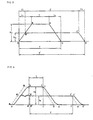
- FIG. 3 An operation of driving the shutter is schematically shown in Fig. 3. Abscissa and ordinate of the graph of Fig. 3 represent an aperture area and a time, respectively.
- the shutter starts its opening motion at a point A, is fully opened at a point B, starts its closing motion at a point C after an opening time t elapses, and then is completely closed at a point D.
- the area of a trapezoid which is closely surrounded by the points A, B, C and D, corresponds to an exposure amount (Ev) for this shutter driving operation.
- the shutter driving operation which provides such a trapezoidal waveform for the opening and closing operations of the shutter is referred to as "a trapezoid control".
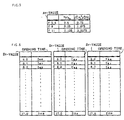
- the relationship between an exposure amount (Ev) and an opening time is beforehand stored as a data table as shown in Fig. 6 in a storing unit of a control device, and an opening time for a desired shutter driving operation is determined on the basis of the data table.
- a data table as shown at the left side of Fig. 6 is used for a shutter driving operation for a full-opened diaphragm (hereinafter referred to as "diaphragm full-opening operation").
- the opening time is varied in accordance with a diaphragm value.
- a diaphragm value For example. if the diaphragm value is set to a value smaller than a value for the full-opened diaphragm in the graph of Fig. 3. the opening time must be set to be longer to obtain the same exposure amount as set for the diaphragm full-opening operation. Therefore, in order to control the opening time with the data table, the data table must be individually prepared in accordance with each of various diaphragm values, for examples, diaphragm values such as F4, F5.6, F8, etc., and thus the number of the data table is greatly increased. In addition.
- a shutter control device for a camera according to the preamble of claim is known from DE-A-40 21 803.
- This known shutter device comprises a control means including a table in which exposure values are associated with control values for controlling the shutter. Furthermore, the control means includes calculating means for calculating control values by interpolating between control values stored in the table. Using this calculating means, the number of values stored in the table can be reduced.
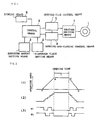
- the shutter control device for a camera includes setting means comprising exposure amount setting means 2 for setting an exposure amount of a shutter 1 and diaphragm setting means 3 for setting a diaphragm value, control means comprising opening-and-closing control means 4 for controlling opening and closing operations of the shutter, opening-time control means 5 for controlling an opening time of the shutter and control means 6 for performing a prescribed calculation on the basis of signals from the exposure setting means 2 and the diaphragm value setting means 3 to control the opening-and-closing control means 4 and the opening-time control means 5, and shutter driving means 7 for driving the shutter 1 on the basis of signals from the opening-and-closing control means 4 and the opening-time control means 5.
- setting means comprising exposure amount setting means 2 for setting an exposure amount of a shutter 1 and diaphragm setting means 3 for setting a diaphragm value
- control means comprising opening-and-closing control means 4 for controlling opening and closing operations of the shutter
- opening-time control means 5 for controlling an opening time of the
- the shutter driving means 7 comprises an AC motor, a motor such as a stepping motor, and a motor driver.
- the shutter 1 is a lens shutter which also serves as a diaphragm, and includes plural sectors whose opening and closing operations are carried out by a rotational motion of the motor of the shutter driving means 2 in forward and reverse directions.
- the shutter driving means 7 serves to carry out the opening and closing operations of the shutter sectors through the control of the opening-and-closing control means 4 and the opening-time control means 5.
- the exposure and diaphragm operations are carried out by keeping the shutter 1 at an opening state with a prescribed aperture for a prescribed time.
- the exposure amount setting means 2 detects various information such as brightness of an object, a film sensitivity, an exposure correction, etc., and outputs a signal representing an exposure amount to the control means 6 through a calculation of the exposure amount or a manual setting.
- the diaphragm value setting means 3 sets a diaphragm value through a manual setting, or detects various conditions to automatically set the diaphragm value, and outputs a signal representing the diaphragm value to the control mean 6.
- the control means 6 carries out a calculation as described later on the basis of the signals from the exposure amount setting means 2 and the diaphragm value setting means 3 to determine a forward/reverse rotation amount of the motor and an opening time for the diaphragm value and the exposure value which have been set, and outputs signals representing the determined rotation amount of the motor and opening time to the opening-and-closing control means 4 and the opening-time control means 5, respectively.
- the control means 6 is preferably equipped with non-volatile storing means 8 such as an EEPROM, in which data required for the calculation, such as an opening time for each exposure amount in a shutter full-opening operation, a shutter aperture area for each diaphragm value, a correction value inherent to the shutter. etc., are beforehand stored.
- the opening-and-closing control means 4 controls a driving time for each of the forward and reverse rotational motions, or a driving voltage, a driving current, a pulse of the motor if the motor is a stepping motor, etc. on the basis of the signal representing the forward/reverse rotation amount of the motor which is supplied from the control means 6, and outputs an instruction to the shutter driving means 7.
- the opening-time control means 5 controls a timing for a switching operation between the forward and reverse rotational motions of the motor on the basis of the signal representing an opening time which is supplied from the control means 6.
- a driving operation of the shutter thus constructed will be described with reference to Fig. 2. representatively using an embodiment where the driving operation is carried out by a stepping motor. Abscissa and ordinate of the graph of Fig. 2 represent a time and an aperture area of the shutter (a value corresponding to a diaphragm value).
- the motor is first driven in a forward rotational direction on the basis of the signal from the opening-and-closing control means 4, and the shutter sectors start their opening motion.
- the forward rotational motion of the motor is carried out while the phases ( ⁇ 1 , ⁇ 2 ) of the motor are alternately switched to each other, and the opening area of the shutter is determined on the basis of the number of switching pulses for the phase switching operation of the motor.
- the shutter sectors continue their opening motions until the motor is rotated by a prescribed rotation amount and the shutter has an aperture area which is set by the diaphragm setting means 3. Thereafter, the rotational motion of the motor is stopped, and the two phases ( ⁇ 1 , ⁇ 2 ) are retained for a prescribed period on the basis of the signal from the opening-time control means 5.
- the alternate switching operation between the phases ( ⁇ 1 , ⁇ 2 ) is restarted to drive the motor in the reverse rotational direction until the shutter is completely closed.
- Fig. 2 representing a point where the shutter starts its opening motion, a point where the shutter is opened at a prescribed amount, a point where the shutter starts its closing motion, and a point where the shutter is completely closed by A, B, C and D
- the area which is surrounded by the four points A, B, C and D and the abscissa corresponds to an exposure amount.
- the control means 6 determines an opening time in such a manner that through the calculation as described below the exposure amount is equal to a value set by the exposure setting means 2, and controls the opening-time control means 5 on the basis of the calculated opening time.
- Fig. 3 is a graph showing a driving operation of the shutter which is similar to that of Fig. 2.
- a trapezoid ABCD represents an opening waveform in a diaphragm full-opening operation
- a trapezoid A'B'C'D' an opening waveform for a set diaphragm value (a small diaphragm value): h1 and h2, maximum aperture areas for the trapezoids ABCD and A'B'C'D', respectively
- t and t' opening times in maximum opening state for the trapezoids ABCD and A'B'C'D', respectively
- t1 and t'1 times required for a shift from the opening-start state till the maximum-opening state for the trapezoids ABCD and A'B'C'D'.
- h1 and (t1 + t2) are data for the full-opened diaphragm, and thus may be beforehand obtained as values inherent to the shutter.
- the opening time t is determined by a desired exposure amount (Ev), and thus an opening time data for each exposure amount may be beforehand stored as a data table as shown in Fig. 5 in the storing means 8 of the control means 6, or it may be calculated as a function of the exposure amount.
- the aperture area h2 is a value for the set diaphragm value (Av), and thus an aperture-area data for each diaphragm value may be beforehand stored in the storing means 8 of the control means 6 like the opening time data, or it may be calculated as a function of the diaphragm value.
- the control means 6 outputs a signal representing the opening time t' for the set diaphragm value to the opening-time control means 5, and controls the shutter opening operation.
- the shutter driving operation as described above is satisfied in an ideal case where no dispersion occurs in the linearity of the opening waveforms.
- the dispersion of the opening area and nonlinearity of the opening and closing operations frequently occur. A correcting operation for these actual cases will be next described.
- Fig. 4 is a graph showing an operation of the shutter similar to that of Fig. 3.
- a solid line represents an opening waveform of an actual shutter which is deviating from an ideal state as indicated by a broken line.
- a figure abcd is an opening waveform for a full-opened diaphragm. and another figure a'b'c'd' is an opening waveform for a set diaphragm value.
- the same reference numerals as those of Fig. 3 represent the same elements.
- ⁇ Ev ⁇ (area of abe) + (area of cdf) ⁇ - ⁇ (area of a'b'e') + (area of c'd'f') ⁇
- (area of bcfe) h1 X t.
- h1 and ⁇ Ev are values inherent to the shutter, and obtained through an actual measurement
- t represents an opening time for the set exposure amount in the diaphragm full-opening operation, and it may be beforehand stored as a data for each exposure amount in the storing means 8 of the control means 6 or may be calculated as a function of the exposure amount.
- the aperture area h2 is a value corresponding to the set diaphragm value (Av), and it may be beforehand stored as a data for each diaphragm value in the storing means 8 of the control means 6 or may be calculated as a function of the diaphragm value. Therefore, by beforehand storing values of ⁇ Ev in the storing means 8, the correction can be easily performed, and thus a shutter control can be accurately carried out.
- the area of ab'e' of ⁇ Ev is set in consideration of a phenomenon occurring from the point a to the point b' where a shutter bound is stabilized, and thus an inherent error for each aperture area can be corrected.
- the opening time t' in the maximum opening state of the shutter is calculated, however, in place of this calculation an effective opening time for which the shutter starts its opening motion and completes its closing motion may be calculated.
- the trapezoid control for plural diaphragm values can be performed with a small amount of data, and thus a data from haxing small capacity can be used.
- the correction to various errors such as an error of the opening time due to the dispersion of a diaphragm or aperture area, an error due to the deviation in linearity of the opening and closing operations. etc. can be easily made by beforehand storing a correction amount inherent to the shutter in an EEPROM or the like, and the shutter control can be accurately performed.
Landscapes
- Physics & Mathematics (AREA)
- General Physics & Mathematics (AREA)
- Shutters For Cameras (AREA)
- Exposure Control For Cameras (AREA)
Applications Claiming Priority (2)
| Application Number | Priority Date | Filing Date | Title |
|---|---|---|---|
| JP88198/91 | 1991-04-19 | ||
| JP3088198A JP3041543B2 (ja) | 1991-04-19 | 1991-04-19 | カメラ用シャッタの制御装置および制御方法 |
Publications (3)
| Publication Number | Publication Date |
|---|---|
| EP0509551A2 EP0509551A2 (en) | 1992-10-21 |
| EP0509551A3 EP0509551A3 (en) | 1993-03-31 |
| EP0509551B1 true EP0509551B1 (en) | 1996-12-27 |
Family
ID=13936205
Family Applications (2)
| Application Number | Title | Priority Date | Filing Date |
|---|---|---|---|
| EP92106802A Expired - Lifetime EP0509551B1 (en) | 1991-04-19 | 1992-04-21 | Shutter control device for a camera |
| EP92106801A Expired - Lifetime EP0509550B1 (en) | 1991-04-19 | 1992-04-21 | Shutter control device for camera |
Family Applications After (1)
| Application Number | Title | Priority Date | Filing Date |
|---|---|---|---|
| EP92106801A Expired - Lifetime EP0509550B1 (en) | 1991-04-19 | 1992-04-21 | Shutter control device for camera |
Country Status (4)
| Country | Link |
|---|---|
| US (1) | US5255049A (enExample) |
| EP (2) | EP0509551B1 (enExample) |
| JP (1) | JP3041543B2 (enExample) |
| DE (1) | DE69216137T2 (enExample) |
Families Citing this family (7)
| Publication number | Priority date | Publication date | Assignee | Title |
|---|---|---|---|---|
| JP3041543B2 (ja) * | 1991-04-19 | 2000-05-15 | セイコープレシジョン株式会社 | カメラ用シャッタの制御装置および制御方法 |
| US5349414A (en) * | 1992-11-16 | 1994-09-20 | Samsung Aerospace Industries, Ind. | Aperture-priority lens shutter apparatus for a camera |
| US6009282A (en) * | 1995-06-13 | 1999-12-28 | Fuji Photo Optical Co., Ltd. | Built-in flash camera |
| US5790905A (en) * | 1996-01-26 | 1998-08-04 | Asahi Kogaku Kogyo Kabushiki Kaisha | Exposure controlling device for camera |
| JP3736915B2 (ja) * | 1996-09-25 | 2006-01-18 | セイコープレシジョン株式会社 | カメラ用シャッタの制御装置 |
| JP2000047297A (ja) * | 1998-07-28 | 2000-02-18 | Minolta Co Ltd | デジタルスチルカメラ |
| JP4735255B2 (ja) * | 2005-12-29 | 2011-07-27 | オムロン株式会社 | 画像処理装置および画像処理装置の動作条件設定方法 |
Family Cites Families (5)
| Publication number | Priority date | Publication date | Assignee | Title |
|---|---|---|---|---|
| JPH06103373B2 (ja) * | 1984-03-01 | 1994-12-14 | 株式会社精工舎 | プログラムシヤツタ |
| JP2529345B2 (ja) * | 1988-04-01 | 1996-08-28 | 富士写真フイルム株式会社 | プログラムシャッタ駆動装置 |
| JP2551846B2 (ja) * | 1989-07-10 | 1996-11-06 | セイコープレシジョン株式会社 | モータ駆動シャッタ |
| US5155521A (en) * | 1990-12-31 | 1992-10-13 | Eastman Kodak Company | Counter-driven shutter actuator control circuit |
| JP3041543B2 (ja) * | 1991-04-19 | 2000-05-15 | セイコープレシジョン株式会社 | カメラ用シャッタの制御装置および制御方法 |
-
1991
- 1991-04-19 JP JP3088198A patent/JP3041543B2/ja not_active Expired - Fee Related
-
1992
- 1992-04-20 US US07/871,368 patent/US5255049A/en not_active Expired - Lifetime
- 1992-04-21 DE DE69216137T patent/DE69216137T2/de not_active Expired - Fee Related
- 1992-04-21 EP EP92106802A patent/EP0509551B1/en not_active Expired - Lifetime
- 1992-04-21 EP EP92106801A patent/EP0509550B1/en not_active Expired - Lifetime
Also Published As
| Publication number | Publication date |
|---|---|
| JP3041543B2 (ja) | 2000-05-15 |
| EP0509550A2 (en) | 1992-10-21 |
| EP0509551A3 (en) | 1993-03-31 |
| JPH04319924A (ja) | 1992-11-10 |
| EP0509551A2 (en) | 1992-10-21 |
| US5255049A (en) | 1993-10-19 |
| EP0509550B1 (en) | 1997-01-08 |
| DE69216137T2 (de) | 1997-04-10 |
| DE69216137D1 (de) | 1997-02-06 |
| EP0509550A3 (en) | 1993-03-31 |
Similar Documents
| Publication | Publication Date | Title |
|---|---|---|
| JP3524374B2 (ja) | パワーウインド装置の挟み込み検知方法 | |
| EP0579404A2 (en) | Lens control apparatus | |
| US7728540B2 (en) | Motor driving circuit | |
| EP0509551A2 (en) | Shutter control device for a camera | |
| US5008607A (en) | Driving system for stepping motor | |
| US7710350B2 (en) | Method and apparatus for display | |
| CN102346349B (zh) | 快门设备、摄像设备和快门控制方法 | |
| US5746178A (en) | Throttle valve control system obtaining continuous sensor output and throttle valve control method thereof | |
| WO2005067637A2 (en) | Method and apparatus for increasing a perceived resolution of a display | |
| DE19824223B4 (de) | Steuereinrichtung für einen Reluktanzmotor | |
| JPH07134282A (ja) | 液晶駆動装置 | |
| US5862420A (en) | Control device for a camera shutter and a control method therefor | |
| JP3149001B2 (ja) | カメラ用シャッタの制御装置 | |
| US7130105B2 (en) | Method and apparatus for controlling the positioning of an optical dithering element | |
| EP1933199B1 (en) | Lens apparatus and camera system | |
| DE69021297T2 (de) | Verschlussvorrichtung, welche auch als Blendeneinrichtung nutzbar ist. | |
| JP2003224998A (ja) | ステッピングモータ駆動方法 | |
| JP2997953B2 (ja) | カメラ用シャッタの制御装置 | |
| JPH0746189B2 (ja) | 露出制御装置 | |
| JPH04319924A5 (enExample) | ||
| JPS6029244B2 (ja) | 周波数シンセサイザ受信機 | |
| JP2002354869A (ja) | アクチュエータ用制御装置 | |
| JP3450500B2 (ja) | 撮像レンズ制御装置 | |
| JPH0617466A (ja) | 衛生洗浄装置の流量調節におけるモータの制御方法 | |
| JP2706150B2 (ja) | ポリゴンミラー駆動モータの制御方式およびその装置 |
Legal Events
| Date | Code | Title | Description |
|---|---|---|---|
| PUAI | Public reference made under article 153(3) epc to a published international application that has entered the european phase |
Free format text: ORIGINAL CODE: 0009012 |
|
| AK | Designated contracting states |
Kind code of ref document: A2 Designated state(s): DE GB |
|
| PUAL | Search report despatched |
Free format text: ORIGINAL CODE: 0009013 |
|
| AK | Designated contracting states |
Kind code of ref document: A3 Designated state(s): DE GB |
|
| 17P | Request for examination filed |
Effective date: 19930701 |
|
| 17Q | First examination report despatched |
Effective date: 19950623 |
|
| GRAG | Despatch of communication of intention to grant |
Free format text: ORIGINAL CODE: EPIDOS AGRA |
|
| GRAH | Despatch of communication of intention to grant a patent |
Free format text: ORIGINAL CODE: EPIDOS IGRA |
|
| GRAH | Despatch of communication of intention to grant a patent |
Free format text: ORIGINAL CODE: EPIDOS IGRA |
|
| RAP1 | Party data changed (applicant data changed or rights of an application transferred) |
Owner name: SEIKO PRECISION INC. |
|
| GRAA | (expected) grant |
Free format text: ORIGINAL CODE: 0009210 |
|
| AK | Designated contracting states |
Kind code of ref document: B1 Designated state(s): DE GB |
|
| REF | Corresponds to: |
Ref document number: 69216137 Country of ref document: DE Date of ref document: 19970206 |
|
| PLBE | No opposition filed within time limit |
Free format text: ORIGINAL CODE: 0009261 |
|
| STAA | Information on the status of an ep patent application or granted ep patent |
Free format text: STATUS: NO OPPOSITION FILED WITHIN TIME LIMIT |
|
| 26N | No opposition filed | ||
| REG | Reference to a national code |
Ref country code: GB Ref legal event code: IF02 |
|
| PGFP | Annual fee paid to national office [announced via postgrant information from national office to epo] |
Ref country code: DE Payment date: 20070419 Year of fee payment: 16 |
|
| PGFP | Annual fee paid to national office [announced via postgrant information from national office to epo] |
Ref country code: GB Payment date: 20070418 Year of fee payment: 16 |
|
| GBPC | Gb: european patent ceased through non-payment of renewal fee |
Effective date: 20080421 |
|
| PG25 | Lapsed in a contracting state [announced via postgrant information from national office to epo] |
Ref country code: DE Free format text: LAPSE BECAUSE OF NON-PAYMENT OF DUE FEES Effective date: 20081101 |
|
| PG25 | Lapsed in a contracting state [announced via postgrant information from national office to epo] |
Ref country code: GB Free format text: LAPSE BECAUSE OF NON-PAYMENT OF DUE FEES Effective date: 20080421 |