EP0488945B1 - Fungizide Mittel - Google Patents
Fungizide Mittel Download PDFInfo
- Publication number
- EP0488945B1 EP0488945B1 EP91810876A EP91810876A EP0488945B1 EP 0488945 B1 EP0488945 B1 EP 0488945B1 EP 91810876 A EP91810876 A EP 91810876A EP 91810876 A EP91810876 A EP 91810876A EP 0488945 B1 EP0488945 B1 EP 0488945B1
- Authority
- EP
- European Patent Office
- Prior art keywords
- formula
- plant
- acid
- compound
- active
- Prior art date
- Legal status (The legal status is an assumption and is not a legal conclusion. Google has not performed a legal analysis and makes no representation as to the accuracy of the status listed.)
- Expired - Lifetime
Links
- MUJOIMFVNIBMKC-UHFFFAOYSA-N N#Cc1c[nH]cc1-c1cccc(O2)c1OC2(F)F Chemical compound N#Cc1c[nH]cc1-c1cccc(O2)c1OC2(F)F MUJOIMFVNIBMKC-UHFFFAOYSA-N 0.000 description 1
Classifications
-
- A—HUMAN NECESSITIES
- A01—AGRICULTURE; FORESTRY; ANIMAL HUSBANDRY; HUNTING; TRAPPING; FISHING
- A01N—PRESERVATION OF BODIES OF HUMANS OR ANIMALS OR PLANTS OR PARTS THEREOF; BIOCIDES, e.g. AS DISINFECTANTS, AS PESTICIDES OR AS HERBICIDES; PEST REPELLANTS OR ATTRACTANTS; PLANT GROWTH REGULATORS
- A01N43/00—Biocides, pest repellants or attractants, or plant growth regulators containing heterocyclic compounds
- A01N43/64—Biocides, pest repellants or attractants, or plant growth regulators containing heterocyclic compounds having rings with three nitrogen atoms as the only ring hetero atoms
- A01N43/647—Triazoles; Hydrogenated triazoles
- A01N43/653—1,2,4-Triazoles; Hydrogenated 1,2,4-triazoles
Definitions
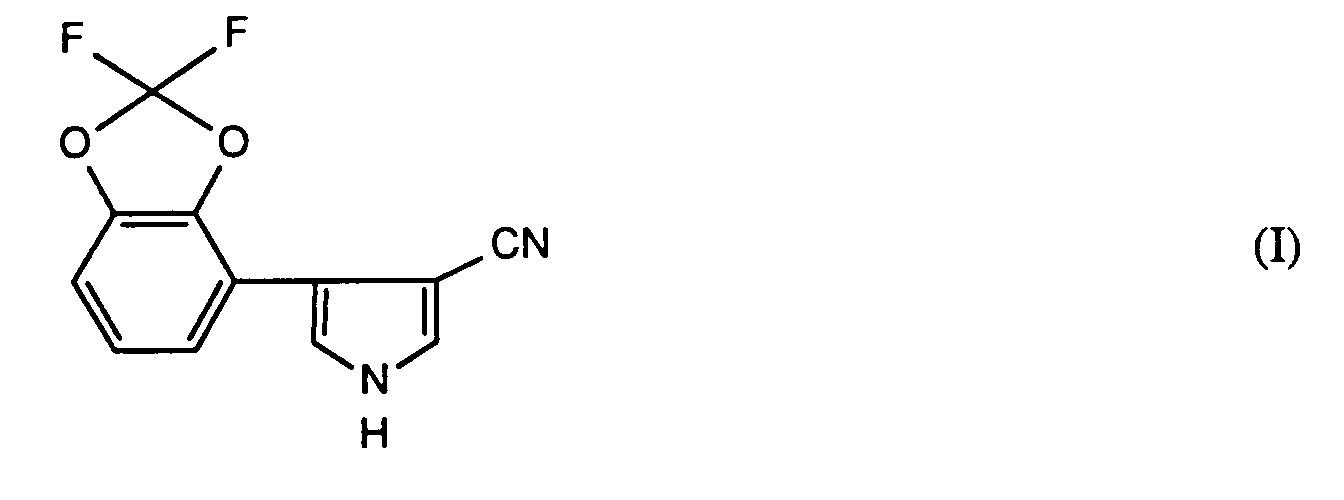
- the present invention relates to microbicidal mixtures with a synergistically increased action against plant diseases and against microorganism attack on plant propagation material or on other plant or animal material, and methods for using such mixtures, in particular for seed dressing.
- the invention relates in particular to the control or prevention of diseases in the cultivation of cereals.
- the compound of formula I is described in EP-A-206,999 as a fungicidal active substance described. It is characterized above all as a contact fungicide.
- the compound of formula II is described as a fungicidal active substance in GB patent application 2,098,607.
- the effect of this triazole derivative is based on the inhibition of ergosterol biosynthesis.
- the salts of the compound of the formula II mentioned can be prepared by reacting the base with acids.
- Hydrohalic acid such as hydrofluoric acid, Chlorwassserstoffklare, hydrobromic acid or hydriodic acid as well as sulfuric acid, phosphoric acid, nitric acid and organic acids such as acetic acid, trifluoroacetic acid, trichloroacetic acid, propionic acid, glycolic acid, thiocyanic acid, lactic acid, succinic acid, citric acid, benzoic acid, cinnamic acid, oxalic acid, formic acid, benzenesulfonic acid, p-toluenesulfonic acid , Methanesulfonic acid, salicylic acid, p-aminosalicylic acid, 2-phenoxybenzoic acid, 2-acetoxybenzoic acid or 1,2-naphthalene disulfonic acid.
- Hydrohalic acid such as hydrofluoric acid, Chlorwassserstoffklare, hydrobromic acid or hydriodic acid as well as sulfuric acid, phosphoric
- salts also includes metal complexes of basic component II. These complexes consist of the underlying organic molecule and an inorganic or organic metal salt, for example the halides, nitrates, sulfates, phosphates, acetates, trifluoroacetates, trichloroacetates, propionates, tartrates, sulfonates, salicylates, benzoates etc. of the elements of the second main group such as calcium and Magnesium and the third and fourth main groups such as aluminum, tin or lead and the first to eighth subgroups such as chromium, manganese, iron, cobalt, nickel, copper, zinc etc. The subgroup elements of the 4th period are preferred.
- the metals can be present in the various valences that they have.
- the metal complexes can occur in one or more cores, i.e. they can contain one or more organic moieties as ligands.
- the present invention enables seed dressing with smaller amounts of biocides than was previously known, and thus represents a very important enrichment of the technology.
- the invention relates not only to the use of mixtures of components I and II on the seed, but also to the application of the individual pure components in immediate succession.
- the combination of active components I and II according to the invention achieves a useful contact action and a systemic and long-term action in combating seed and soil-borne plant diseases.
- the combinations according to the invention destroy the microorganisms on the stored material and on the propagation material, in particular on the seed, and the plants in development are protected against attack by the soil-based microorganisms.
- the mixture according to the invention is normally used together with the auxiliaries customary in formulation technology.
- the active components of formulas I and II are e.g. for emulsion concentrates, spreadable pastes, directly sprayable or dilutable solutions, diluted emulsions, wettable powders, soluble powders, dusts, granules, also for encapsulation in e.g. polymeric materials processed in a known manner.
- the application methods such as spraying, atomizing, dusting, scattering, brushing or pouring and the shape of the agent are adapted to the desired goals and the given conditions.
- Storage and stock goods that can be protected with the mixture according to the invention, and in particular propagation material, in particular seeds, are to be understood in the context of the present invention as vegetable and / or animal natural products and their further processing products that are made storable over a longer period of time
- the following plants and their parts of the plant stems, leaves, tubers, seeds, fruits, grains
- This also includes the protection of timber, be it in the form of raw wood (construction timber, line poles, barriers) or in the form of finished parts (furniture, wooden articles).
- plant target crops cereals; (Wheat, barley, rye, oats, rice, sorghum, corn and relatives); Beets (sugar beet and fodder beet); Legumes: (beans, lentils, soy, peas); Oil crops: (rapeseed, mustard, poppy seeds, sunflowers); Cucumber family: (cucumber, pumpkin, melons); Fiber plants: (cotton, flax); Vegetables: (lettuce, cabbages, spinach, carrots, onions, tomatoes, potatoes, peppers); Ornamental plants: (tulips, daffodils, dahlias, chrysanthemums and other flowers) as well as aromatic herbs and their seeds.
- a preferred method for applying the mixture according to the invention consists in spraying or wetting the plant material with a liquid preparation or in mixing the plant material with a solid preparation of the active substances.
- These preservation methods are part of the present invention, as is the wood treated with this mixture of I and II, or stored and stored goods or propagated goods.
- reproductive material includes generative plant material such as seeds and vegetative plant material such as cuttings and tubers (e.g. potatoes).
- the active compounds of the formulas I and II are used according to the invention in the form of compositions and can be used together with, if appropriate, other carriers, surfactants or other application-promoting additives customary in formulation technology.
- Suitable carriers and additives can be solid or liquid and correspond to the substances useful in formulation technology, e.g. natural or regenerated mineral substances, solvents, dispersants, wetting agents, adhesives, thickeners, binders or fertilizers.
- a preferred method for applying a mixture of active ingredients of the formulas I and II or an (agro) chemical agent which contains these active ingredients is application to the foliage (leaf application).
- the number of applications and the application rate depend on the infestation pressure for the corresponding pathogen (type of fungus).
- the active ingredient mixture can also get into the plant through the roots through the root system (systemic effect) by soaking the location of the plant with a liquid preparation or introducing the substances into the soil in solid form, e.g. in the form of granules (floor application).
- the mixture of the compounds of the formulas I and II can be applied (coating) to seeds, tubers, fruits or other plant material to be protected (for example wood) by a particularly preferred process, either by soaking the material with a liquid preparation of the active compounds or coated with a solid preparation.
- a particularly preferred process either by soaking the material with a liquid preparation of the active compounds or coated with a solid preparation.
- other types of application are possible in special cases, e.g. the targeted treatment of plant sections or branches that are used for propagation.
- the compounds of the formulas I and II are in unchanged form or preferably used together with the auxiliaries customary in formulation technology and are therefore used, for example, to form emulsion concentrates, spreadable pastes (e.g. for wood preservation), directly sprayable or dilutable solutions, diluted emulsions, wettable powders, soluble powders, dusts, granules, and also for encapsulation in, for example, polymeric substances in processed in a known manner.
- the methods of application such as spraying, atomizing, dusting, scattering, brushing or pouring are chosen, as is the type of agent, in accordance with the intended goals and the prevailing conditions.
- favorable application rates are generally from 5 g to 5 kg of active substance (AS) of the formulas I and II per ha; preferably at 10 g to 2 kg ai / ha, particularly preferably at 20 g to 600 g ai / ha.
- AS active substance
- the formulations i.e.
- extenders e.g. with solvents, solid carriers, and optionally surface-active compounds (surfactants).
- Aromatic hydrocarbons preferably fractions C8 to C12, such as Xylene mixtures or substituted naphthalenes, phthalic acid esters such as dibutyl or dioctyl phthalate, aliphatic hydrocarbons such as cyclohexane or paraffins, alcohols and glycols and their ethers and esters such as ethylene glycol monomethyl ether, ketones such as cyclohexanone, strongly polar solvents such as N-methyl-2-pyrrolidone or dimethyl amide, dimethyl amide , and optionally epoxidized vegetable oils or soybean oil; or water.
- Aromatic hydrocarbons preferably fractions C8 to C12, such as Xylene mixtures or substituted naphthalenes, phthalic acid esters such as dibutyl or dioctyl phthalate, aliphatic hydrocarbons such as cyclohexane or paraffins, alcohols and glycols and their ethers and est
- solid carriers e.g. for dusts and dispersible powders, calcite, talc, kaolin, montmorillonite or attapulgite, highly disperse silica or absorbent polymers can be used.
- Pumice, broken brick, sepiolite or bentonite come as granular, adsorptive granulate carriers, e.g. non-sorptive carriers, Calcite or dolomite in question.
- suitable surface-active compounds are nonionic, cationic and / or anionic surfactants with good emulsifying, dispersing and wetting properties.
- surfactants are also understood to mean surfactant mixtures.
- application-promoting additives are natural or synthetic phospholipids from the series of kephalins and lecithins, such as Phosphatidylethanolamine, phosphatidylserine, phosphatidylglycerol, lysolecithin.
- the agrochemical preparations generally contain 0.1 to 99%, in particular 0.1 to 95% active ingredient of the formula I, 99.9 to 1%, in particular 99.9 to 5% of a solid or liquid additive and 0 to 25% , in particular 0.1 to 25% of a surfactant.
- Such (agro) chemical agents are part of the present invention.
- active ingredient means a mixture of compound I and compound II in a specific mixing ratio 10: 1 to 1:10.
- the active ingredient is mixed well with the additives and in a suitable mill grind well.
- Spray powder is obtained which can be diluted with water to form suspensions of any desired concentration. With such broths, leaf treatments can be carried out on plant crops, but also wet or wet pickling on reproductive material, for example on cereal seeds or plant tubers.
- Ready-to-use dusts are obtained by mixing the active ingredient with the carrier and grinding it in a suitable mill. Such powders can be used for dry dressing for seeds.
- Extruder granules Active ingredient (I: II 3:10) 13% Na lignin sulfonate 2% Carboxymethyl cellulose 1 % kaolin 84%
- the finely ground active ingredient is applied evenly in a mixer to the kaolin moistened with polyethylene glycol. In this way, dust-free coating granules are obtained.
- the finely ground active ingredient is intimately mixed with the additives.
- Such dilutions can be used to treat living plants and plant or animal products by spraying, watering or immersing them, and to protect them against microorganisms.
- Fungicides always have a synergistic effect if the fungicidal activity of the active ingredient combination is greater than the sum of the effects of the individually applied active ingredients.
- Each 100 seeds are sown 2 cm deep in sterile field soil in seed trays (45x35x10 cm). The experiment is repeated three times.
- the seed pans are moistened and kept at 5 ° C in the absence of light for 21 days. They are then transferred to an exposed climatic chamber (day / night: 16/8 hours; 10 ° C), where the plants emerge. Germination does not occur with grains heavily infested with G. nivalis. After 10 days, the dishes are covered with a plastic film and kept at 10 ° C without light. Due to the high humidity under the cover, fungus mycelium appears on the stem base of the G. nivalis infested plants. 59 days after sowing, the number of existing plants and the number of infected plants are determined. The sum of the number of non-germinated grains and the number of infected plants forms the total infestation. It is in relation to the total infestation in the comparison seed pans set with non-seeded seeds and expressed as% total infestation.
Landscapes
- Life Sciences & Earth Sciences (AREA)
- Agronomy & Crop Science (AREA)
- Pest Control & Pesticides (AREA)
- Plant Pathology (AREA)
- Health & Medical Sciences (AREA)
- Engineering & Computer Science (AREA)
- Dentistry (AREA)
- General Health & Medical Sciences (AREA)
- Wood Science & Technology (AREA)
- Zoology (AREA)
- Environmental Sciences (AREA)
- Agricultural Chemicals And Associated Chemicals (AREA)
- Organic Low-Molecular-Weight Compounds And Preparation Thereof (AREA)
- Cosmetics (AREA)
- Food Preservation Except Freezing, Refrigeration, And Drying (AREA)
- Low-Molecular Organic Synthesis Reactions Using Catalysts (AREA)
- Pretreatment Of Seeds And Plants (AREA)
- Acyclic And Carbocyclic Compounds In Medicinal Compositions (AREA)
- Saccharide Compounds (AREA)
- Plural Heterocyclic Compounds (AREA)
Description
- Die vorliegende Erfindung betrifft mikrobizide Gemische mit synergistisch gesteigerter Wirkung gegen Pflanzenkrankheiten und gegen Mikroorganismen-Befall an pflanzlichem Vermehrungsgut oder an sonstigem pflanzlichen oder tierischen Material sowie Verfahren zur Anwendung solcher Gemische, insbesondere zur Saatbeizung.
- Die Erfindung bezieht sich insbesondere auf die Bekämpfung bzw. Verhütung von Krankheiten im Getreide-Anbau.
- Es wurde gefunden, dass eine Kombination der Wirkstoff-Komponente I), 4-(2,2-Di-fluoro-1,3-benzodioxol-7-yl)-1H-pyrrol-3-carbonitril der Formel I
mit der Wirkstoff-Komponente II), 1-{2-[2-Chlor-4-(4-chlorphenoxy)-phenyl]-4-methyl-1,3-dioxolan-2-ylmethyl}-1H-1,2,4-triazol der Formel II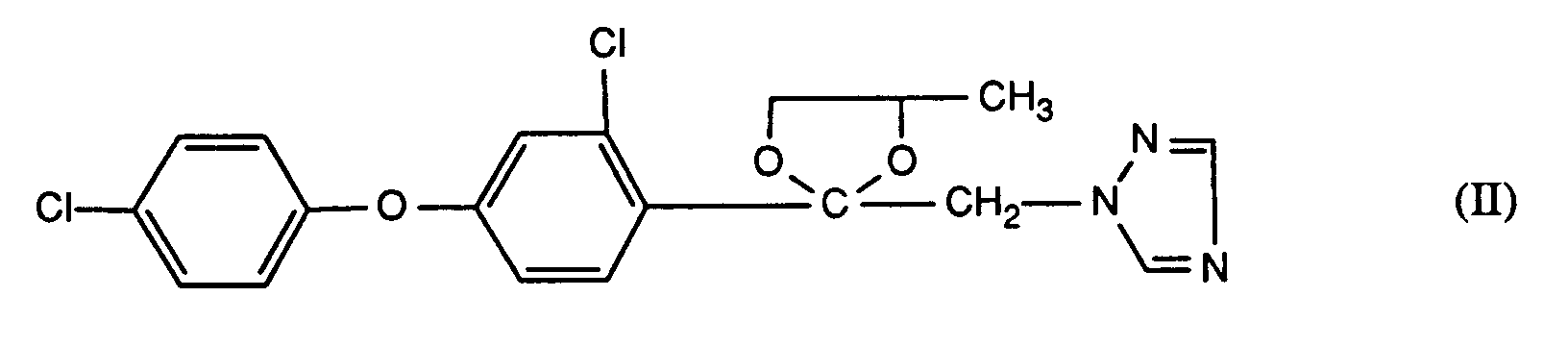
oder mit einem ihrer Salze zu einer synergistisch gesteigerten Aktivität bei der Bekämpfung und Verhütung von Pflanzenkrankheiten führt. - Die Verbindung der Formel I wird in der EP-A-206,999 als fungizide Aktivsubstanz beschrieben. Sie zeichnet sich vor allem als Kontaktfungizid aus.
- Die Verbindung der Formel II ist als fungizide Aktivsubstanz in der GB-Patentanmeldung 2,098,607 beschrieben. Die Wirkung dieses Triazolderivates beruht auf der Hemmung der Ergosterin-Biosynthese.
- Die erwähnten Salze der Verbindung der Formel II können durch Umsetzung der Base mit Säuren hergestellt werden.
- Unter den Säuren, die zur Herstellung von Salzen der Formel II verwendet werden können, sind zu nennen:
Halogenwasserstoffsäure wie Fluorwasserstoffsäure, Chlorwassserstoffsäure, Bromwasserstoffsäure oder Jodwasserstoffsäure sowie Schwefelsäure, Phosphorsäure, Salpetersäure und organische Säuren wie Essigsäure, Trifluoressigsäure, Trichloressigsäure, Propionsäure, Glycolsäure, Thiocyansäure, Milchsäure, Bernsteinsäure, Zitronensäure, Benzoesäure, Zimtsäure, Oxalsäure, Ameisensäure, Benzolsulfonsäure, p-Toluolsulfonsäure, Methansulfonsäure, Salicylsäure, p-Aminosalicylsäure, 2-Phenoxybenzoesäure, 2-Acetoxybenzoesäure oder 1,2-Naphthalin-disulfonsäure. - Der Begriff Salze schliesst auch Metallkomplexe der basischen Komponente II ein. Diese Komplexe bestehen aus dem zugrundeliegenden organischen Molekül und einem anorganischen oder organischen Metallsalz, beispielsweise den Halogeniden, Nitraten, Sulfaten, Phosphaten, Acetaten, Trifluoracetaten, Trichloracetaten, Propionaten, Tartraten, Sulfonaten, Salicylaten, Benzoaten usw. der Elemente der zweiten Hauptgruppe wie Calcium und Magnesium und der dritten und vierten Hauptgruppe wie Aluminium, Zinn oder Blei sowie der ersten bis achten Nebengruppe wie Chrom, Mangan, Eisen Kobalt, Nickel, Kupfer, Zink usw. Bevorzugt sind die Nebengruppen-Elemente der 4. Periode. Die Metalle können dabei in den verschiedenen ihnen zukommenden Wertigkeiten vorliegen. Die Metallkomplexe können ein- oder mehrkernig auftreten, d.h. sie können ein oder mehrere organische Molekülanteile als Liganden enthalten.
- Es ist dem Fachmann bekannt, dass die Wirkung einer fungiziden Aktivsubstanz durch den Zusatz eines anderen Fungizids mit unterschiedlichem Wirkungsspektrum weitgehend gesteigert oder erweitert werden kann.
- Ueberraschend wurde aber gefunden, dass die Kombination der Wirkstoffe I und II zu einer ganz unerwartet hohen Wirkungssteigerung gegen saatbürtige und bodenbürtige Pilze führt. Die durch die erfindungsgemässe Kombination erzielte Wirkungs steigerung ist entschieden grösser als die durch Addition der Wirkungen der beiden einzelnen Komponenten zu erwartende Aktivität, das heisst die Aktivität ist synergistisch gesteigert.
- Die vorliegende Erfindung ermöglicht eine Samenbeizung mit geringeren Mengen an Bioziden, als es vorher bekannt war, und stellt damit eine ganz wesentliche Bereicherung der Technik dar.
- Die Erfindung bezieht sich nicht allein auf die Anwendung von Gemischen der Komponenten I und II auf das Saatgut sondern auch auf die Applikation der einzelnen reinen Komponenten in unmittelbarer Folge.
- Günstige Mischungsverhältnisse der beiden Wirkstoffe sind I:II = 10:1 bis 1:100, besonders I:II = 5:1 bis 1:60 und ganz besonders I:II = 3:1 bis 1:12. Andere vorteilhafte Mischungsverhältnisse sind I:II = 5:2 bis 2:5, oder 3:5, 1:1, 3:20, 3:40.
- Die Kombination der Aktivkomponenten I und II gemäss der Erfindung erzielt nützliche Kontaktwirkung sowie systemische und Dauerwirkung bei der Bekämpfung der saat-und bodenbürtigen Pflanzenkrankheiten. Durch die erfindungsgemässen Kombinationen werden die Mikroorganismen am Vorratsgut und am Vermehrungsgut, insbesondere am Saatgut zerstört und die sich in Entwicklung befindlichen Pflanzen werden vor dem Angriff der bodenbürtigen Mikroorganismen geschützt.
- Die erfindungsgemässen Gemische sind gegen phytopathogene Pilze aktiv, welche den folgenden Klassen angehören: Ascomycetes (z.B. die Gattungen Erysiphe, Sclerotinia, Monilinia, Helminthosporium [= Drechslera], Mycosphaerella, Pyrenophora); Basidiomycetes (z.B. die Gattungen Puccinia, Tilletia, Rhizoctonia); Fungi imperfecti (z.B. die Gattungen Gerlachia [=Fusarium], Septoria, Phoma, Altemaria). Die erfindungsgemässen Kombinationen sind insbesondere bei der Saatbehandlung (Frucht, Knollen, Körner) wirksam, die Wirkung gegen Gerlachia nivalis [= Fusarium nivale] auf Weizen ist dabei besonders ausgeprägt. Sie eignen sich jedoch ebenfalls für die direkte Behandlung des Bodens oder anderer Pflanzenteile. Sie weisen eine gute Pflanzenverträglichkeit auf und sind ökologisch unbedenklich.
- Bei seiner Verwendung wird das erfindungsgemässe Gemisch normalerweise zusammen mit den in der Formulierungstechnik üblichen Hilfsmitteln eingesetzt. Die Aktivkomponenten der Formeln I und II werden z.B. zu Emulsionskonzentraten, streichfähigen Pasten, direkt versprühbaren oder verdünnbaren Lösungen, verdünnten Emulsionen, Spritzpulvern, löslichen Pulvern, Stäubemitteln, Granulaten, auch zu Enkapsulierung in z.B. polymeren Stoffen in bekannter Weise verarbeitet. Die Anwendungsverfahren wie Versprühen, Vernebeln, Verstäuben, Verstreuen, Bestreichen oder Giessen und die Form des Mittels werden den angestrebten Zielen und den gegebenen Verhältnissen angepasst. Günstige Aufwandmengen liegen im allgemeinen bei je 0,0005 bis höchstens 0,5 kg, insbesondere je 0,001-0,01 kg Aktivsubstanz I und II pro 100 kg zu schützendes Gut. Die Applikationsbedingungen hängen jedoch ganz wesentlich von der Beschaffenheit (Grösse der Oberfläche, Konsistenz, Feuchtigkeitsgehalt) des Gutes und dessen Umgebungseinflüssen ab.
- Unter Lager- und Vorratsgütern, die mit dem erfindungsgemässen Gemisch geschützt werden können, und insbesondere unter Vermehrungsgut, im speziellen Saatgut, sollen im Rahmen vorliegender Erfindung pflanzliche und/oder tierische Naturstoffe und deren Weiterverarbeitungsprodukte verstanden werden, die über einen längeren Zeitraum hin lagerfähig gemacht werden sollen, so beispielsweise die nachfolgend genannten und aus dem natürlichen Lebenszyklus herausgenommenen Pflanzen und deren Pflanzenteile (Stengel, Blätter, Knollen, Samen, Früchte, Körner), die im frisch geernteten Zustand oder in weiterverarbeitbarer Form vorliegen (vorgetrocknet, befeuchtet, zerkleinert, gemahlen, gepresst, geröstet etc.). Hierzu gehört auch der Schutz von Nutzholz, sei es in Form von Rohhölzern (Bauholz, Leitungsmaste, Abschrankungen) oder in Form von Fertigteilen (Mobiliar, Holzartikel). Weiterhin gehören hierzu Naturprodukte tierischer Herkunft, die lagerfähig gemacht werden sollen, z.B. Häute, Felle, Haare und dergleichen.
- Als pflanzliche Zielkulturen gelten im Rahmen dieser Erfindung beispielsweise folgende Pflanzenarten: Getreide; (Weizen, Gerste, Roggen, Hafer, Reis, Sorghum, Mais und Verwandte); Rüben (Zucker- und Futterrüben); Hülsenfrüchte: (Bohnen, Linsen, Soja, Erbsen); Oelkulturen: (Raps, Senf, Mohn, Sonnenblumen); Gurkengewächse: (Gurken, Kürbis, Melonen); Fasergewächse: (Baumwolle, Flachs); Gemüsesorten: (Kopfsalat, Kohlarten, Spinat, Möhren, Zwiebeln, Tomaten, Kartoffeln, Paprika); Zierpflanzen: (Tulpen, Osterglocken, Dahlien, Chrysanthemen und andere Blumen) sowie Gewürzkräuter und ihre Samen.
- Ein bevorzugtes Verfahren zum Aufbringen des erfindungsgemässen Gemisches besteht in einem Besprühen oder Benetzen des Pflanzenmaterials mit einer flüssigen Aufbereitung oder im Vermischen des Pflanzenmaterials mit einer festen Aufbereitung der Aktivsubstanzen. Diese Konservierungs-Verfahren sind ein Teil der vorliegenden Erfindung, desgleichen das mit diesem Gemisch aus I und II behandelte Holz oder Lager- und Vorratsgut bzw. Vermehrungsgut. Der letztgenannte Begriff Vermehrungsgut schliesst generatives Pflanzenmaterial wie Saatgut und vegetatives Pflanzenmaterial wie Stecklinge und Knollen (z.B. Kartoffeln) ein.
- Die Wirkstoffe der Formeln I und II werden erfindungsgemäss in Form von Zusammensetzungen verwendet und können zusammen mit gegebenenfalls weiteren in der Formulierungstechnik üblichen Trägerstoffen, Tensiden oder anderen applikationsfördernden Zusätzen eingesetzt werden.
- Geeignete Träger und Zusätze können fest oder flüssig sein und entsprechen den in der Formulierungstechnik zweckdienlichen Stoffen, wie z.B. natürlichen oder regenerierten mineralischen Stoffen, Lösungs-, Dispergier-, Netz-, Haft-, Verdickungs-, Binde- oder Düngemitteln.
- Ein bevorzugtes Verfahren zur Applikation eines Gemisches von Wirkstoffen der Formeln I und II bzw. eines (agro)chemischen Mittels, das diese Wirkstoffe enthält, ist das Aufbringen auf das Blattwerk (Blattapplikation). Anzahl der Applikationen und Aufwandmenge richten sich dabeinach dem Befallsdruck für den entsprechenden Erreger (Pilzsorte). Das Wirkstoffgemisch kann aber auch über den Erdboden durch das Wurzelwerk in die Pflanze gelangen (systemische Wirkung), indem man den Standort der Pflanze mit einer flüssigen Zubereitung tränkt oder die Substanzen in fester Form in den Boden einbringt, z.B. in Form von Granulat (Bodenapplikation). Das Gemisch der Verbindungen der Formeln I und II kann nach einem besonders bevorzugten Verfahren auf Samenkörner, Knollen, Früchte oder sonstiges zu schützendes Pflanzenmaterial (z.B. auch Holz) aufgebracht werden (Coating), indem man das Material entweder mit einer flüssigen Zubereitung der Wirkstoffe tränkt oder mit einer festen Zubereitung beschichtet. Darüber hinaus sind in besonderen Fällen weitere Applikationsarten möglich, so z.B. die gezielte Behandlung von Pflanzenabschnitten oder Zweigen, die der Vermehrung dienen.
- Die Verbindungen der Formeln I und II werden dabei in unveränderter Form oder vorzugsweise zusammen mit den in der Formulierungstechnik üblichen Hilfsmittel eingesetzt und werden daher z.B. zu Emulsionskonzentraten, streichfähigen Pasten (z.B. für Holzschutz), direkt versprühbaren oder verdünnbaren Lösungen, verdünnten Emulsionen, Spritzpulvern, löslichen Pulvern, Stäubemitteln, Granulaten, auch zu Verkapselungen in z.B. polymeren Stoffen in bekannter Weise verarbeitet. Die Anwendungsverfahren wie Versprühen, Vernebeln, Verstäuben, Verstreuen, Bestreichen oder Giessen werden ebenso wie die Art der Mittel den angestrebten Zielen und den gegebenen Verhältnissen entsprechend gewählt. Günstige Aufwandmengen liegen bei Feld-Behandlung im allgemeinen bei 5 g bis 5 kg Aktivsubstanz (AS) der Formeln I und II je ha; bevorzugt bei 10 g bis 2 kg AS/ha, insbesondere bevorzugt bei 20 g bis 600 g AS/ha.
- Die Formulierungen, d.h. die den Wirkstoff der Formeln I und II und gegebenenfalls einen festen oder flüssigen Zusatzstoff enthaltenden Mittel, Zubereitungen oder Zusammensetzungen werden in bekannter Weise hergestellt, z.B. durch inniges Vermischen und/oder Vermahlen der Wirkstoffe mit Streckmitteln, wie z.B. mit Lösungsmitteln, festen Trägerstoffen, und gegebenenfalls oberflächenaktiven Verbindungen (Tensiden).
- Als Lösungsmittel können in Frage kommen: Aromatische Kohlenwasserstoffe, bevorzugt die Fraktionen C₈ bis C₁₂, wie z.B. Xylolgemische oder substituierte Naphthaline, Phthalsäureester wie Dibutyl- oder Dioctylphthalat, aliphatische Kohlenwasserstoffe wie Cyclohexan oder Paraffine, Alkohole und Glykole sowie deren Ether und Ester, wie Ethylenglykolmonomethylether, Ketone wie Cyclohexanon, stark polare Lösungsmittel wie N-Methyl-2-pyrrolidon, Dimethylsulfoxid oder Dimethylformamid, sowie gegebenenfalls epoxydierte Pflanzenöle oder Sojaöl; oder Wasser.
- Als feste Trägerstoffe, z.B. für Stäubemittel und dispergierbare Pulver, lassen sich Calcit, Talkum, Kaolin, Montmorillonit oder Attapulgit, hochdisperse Kieselsäure oder saugfähige Polymerisate verwenden. Als gekörnte, adsorptive Granulatträger kommen Bimsstein, Ziegelbruch, Sepiolit oder Bentonit, als nicht-sorptive Träger z.B. Calcit oder Dolomit in Frage.
- Als oberflächenaktive Verbindungen kommen je nach Art der zu formulierenden Wirkstoffe der Formeln I und II nichtionogene, kation- und/oder anionaktive Tenside mit guten Emulgier-, Dispergier- und Netzeigenschaften in Betracht. Unter Tensiden sind auch Tensidgemische zu verstehen.
- Die in der Formulierungstechnik gebräuchlichen Tenside sind u.a. in folgenden Publikationen erschienen:
- "Mc Cutcheon's Detergents and Emulsifiers Annual" MC Publishing Corp., Glen Rock, New Jersey, 1988.
- M. and J. Ash, "Encyclopedia of Surfactants", Vol. I-III, Chemical Publishing Co., New York, 1980-1981.
- Besonders vorteilhafte, applikationsfördernde Zuschlagstoffe sind ferner natürliche oder synthetische Phospholipide aus der Reihe der Kephaline und Lecithine, wie z.B. Phosphatidylethanolamin, Phosphatidylserin, Phosphatidylglycerin, Lysolecithin.
- Die agrochemischen Zubereitungen enthalten in der Regel 0,1 bis 99 %, insbesondere 0,1 bis 95 % Wirkstoff der Formel I, 99,9 bis 1 %, insbesondere 99,9 bis 5 % eines festen oder flüssigen Zusatzstoffes und 0 bis 25 %, insbesondere 0,1 bis 25 % eines Tensides.
- Während als Handelsware eher konzentrierte Mittel bevorzugt werden, verwendet der Endverbraucher in der Regel verdünnte Mittel.
- Derartige (agro)chemische Mittel sind ein Bestandteil der vorliegenden Erfindung.
- Die nachfolgenden Beispiele dienen der Illustration der Erfindung, wobei "Wirkstoff" ein Gemisch aus Verbindung I und Verbindung II in einem bestimmten Mischungs-Verhältnis 10:1 bis 1:10 bedeutet.
Spritzpulver a) b) c) Wirkstoff I:II = [3:2(a), 1:9(b), 1:4(c)] 25 % 50 % 75 % Na-Ligninsulfonat 5 % 5 % - Na-Laurylsulfat 3 % - 5 % Na-Diisobutylnaphthalinsulfonat - 6 % 10 % Octylphenolpolyethylenglykolether - 2 % - (7-8 Mol Ethylenoxid) Hochdisperse Kieselsäure 5 % 10 % 10 % Kaolin 62 % 27 % - - Der Wirkstoff wird mit den Zusatzstoffen gut vermischt und in einer geeigneten Mühle gut vermahlen. Man erhält Spritzpulver, die sich mit Wasser zu Suspensionen jeder gewünschten Konzentration verdünnen lassen. Mit solchen Brühen lassen sich Blattbehandlungen an Pflanzenkulturen, aber auch Nass- oder Feuchtbeizen an vermehrungsfähigem Material durchführen, z.B. an Getreidesaatgut oder Pflanzenknollen.
Emulsions-Konzentrat Wirkstoff (I:II = 2:3) 10 % Octylphenolpolyethylenglykolether (4-5 Mol Ethylenoxid) 3 % Ca-Dodecylbenzolsulfonat 3 % Ricinusölpolyglykolether (35 Mol Ethylenoxid) 4 % Cyclohexanon 30 % Xylolgemisch 50 % - Aus diesem Konzentrat können durch Verdünnen mit Wasser Emulsionen jeder gewünschten Verdünnung hergestellt werden, die sich im Pflanzenschutz, aber auch im Holzschutz einsetzen lassen.
Stäubemittel a) b) Wirkstoff (I:II = 4:1 und 1:1) 5 % 8 % Talkum 95 % - Kaolin - 92 % - Man erhält anwendungsfertige Stäubemittel, indem der Wirkstoff mit dem Träger vermischt und auf einer geeigneten Mühle vermahlen wird. Solche Pulver lassen sich zur Trockenbeize für Saatgut verwenden.
Extruder Granulat Wirkstoff (I:II = 3:10) 13% Na-Ligninsulfonat 2 % Carboxymethylcellulose 1 % Kaolin 84 % - Der Wirkstoff wird mit den Zusatzstoffen vermischt, vermahlen und mit Wasser angefeuchtet. Dieses Gemisch wird extrudiert und anschliessend im Luftstrom getrocknet.
Umhüllungs-Granulat Wirkstoff (I:II = 3:5) 8 % Polyethylenglykol (MG 200) 3 % Kaolin (MG = Molekulargewicht) 89 % - Der fein gemahlene Wirkstoff wird in einem Mischer auf das mit Polyethylenglykol angefeuchtete Kaolin gleichmässig aufgetragen. Auf diese Weise erhält man staubfreie Umhüllungs-Granulate.
Suspensions-Konzentrat Wirkstoff (I:II = 3:5) 40 % Propylenglykol 10 % Nonylphenolpolyethylenglykolether (15 Mol Et-oxid) 6 % Na-Ligninsulfonat 10 % Carboxymethylcellulose 1 % Silikonöl (in Form 75%ig. wässriger Emulsion) 1 % Wasser 32 % - Der fein gemahlene Wirkstoff wird mit den Zusatzstoffen innig vermischt. Man erhält so ein Suspensions-Konzentrat, aus welchem durch Verdünnen mit Wasser Suspensionen jeder gewünschten Verdünnung hergestellt werden können. Mit solchen Verdünnungen kann man lebende Pflanzen sowie pflanzliche oder tierische Produkte durch Besprühen, Begiessen oder Eintauchen behandeln und vor Mikroorganismen-Befall schützen.
- Ein synergistischer Effekt liegt bei Fungiziden immer dann vor, wenn die fungizide Wirkung der Wirkstoffkombination grösser ist als die Summe aus der Wirkung der einzeln applizierten Wirkstoffe.
- Die zu erwartende Wirkung E für eine gegebene Wirkstoff-Kombination, z.B. zweier Fungizide, gehorcht der sogenannten COLBY-Formel und kann wie folgt berechnet werden, (COLBY, LR. "Calculating synergistic and antagonistic responses of herbicide combination". Weeds 15, Seiten 20-22.2) (LIMPEL and al., 1062 "Weeds control by... certain combinations". Proc. NEWCL, Vol. 16, pp. 48-53):
(g AS/ha = Gramm Aktivsubstanz je Hektoliter Spritzbrühe) - X =
- % Wirkung durch Fungizid I bei p g AS/ha
- Y =
- % Wirkung durch Fungizid II bei q g AS/ha
- E =
- die erwartete Wirkung der Fungizide I+II bei p+q g AS/ha Aufwandmenge (additive Wirkung),
- Mit Gerlachia nivalis infizierter Winterweizen (Sorte Eiger) wird vom Feld geerntet. Der Malzagar-Test ergibt, dass das Saatgut zu 24 % infiziert ist. Dieses Saatgut wird wahlweise mit einer der Aktivsubstanzen I oder II oder mit Mischungen der Aktivsubstanzen, wie in der folgenden Tabelle gezeigt, behandelt. Die Aktivkomponenten werden zunächst in Wasser dispergiert und auf das sich auf der rotierenden Scheibe befindliche Saatgut gespritzt. Diese Arbeitsweise entspricht praxisüblicher Anwendung. Als Vergleich dient nicht-gebeiztes Saatgut der gleichen Herkunft.
- Je 100 Körner werden 2 cm tief in Saatschalen (45x35x10 cm) in sterile Ackererde gesät. Der Versuch wird in dreifacher Wiederholung angelegt. Die Saatschalen werden befeuchtet und 21 Tage lang bei 5°C unter Ausschluss von Licht gehalten. Sie werden dann in eine belichtete Klimakammer (Tag/Nacht: 16/8 Stunden; 10°C) überführt, wo die Pflanzen auflaufen. Bei stark mit G. nivalis befallenen Körner unterbleibt die Keimung. Nach 10 Tagen werden die Schalen mit einer Plastikfolie abgedeckt und weiterhin bei 10°C ohne Licht gehalten. Infolge der hohen Luftfeuchtigkeit unter der Abdeckung erscheint bei den G. nivalis befallenen Pflanzen Pilzmyzel an der Stengelbasis. 59 Tage nach der Aussaat wird die Anzahl vorhandener Pflanzen und die Anzahl befallener Pflanzen ermittelt. Die Summe aus der Anzahl der nicht gekeimten Körner und der Anzahl der befallenen Pflanzen bildet den Gesamtbefall. Er wird in Relation zum Gesamtbefall in den Vergleichssaatschalen mit nicht-gebeiztem Saatgut gesetzt und als % Gesamtbefall ausgedrückt.
- So wird beispielsweise bei einer Aufwandmenge von 1.5 g AS/100 kg Saatgut allein der Komponente I eine Wirkung von nur 58 % erzielt. Komponente II allein erzielt in einer Aufwandmenge von 2.5 g AS/100 kg Saatgut eine Wirkung von nur 27 %. Eine Mischung aus diesen beiden Anteilen würde nach COLBY folgende erwartete Wirkung (E) ergeben:

- Im Vergleich zu den Einzelapplikationen der Komponenten I (Versuch Nr. 2, 3 und 4) und II (Versuch Nr. 5, 6, 7 und 8) zeigen, wie aus der folgenden Tabelle ersichtlich, Gemische der Wirkstoffe I und II eine sprungartig gesteigerte Aktivität.
Tabelle Behandlung Nr. g Aktivsubstanz/100 kg Saatgut Gesamtbefall (%) Wirkung E (berechnet) (%) (COLBY) Wirkung O (gefunden) (%) Komponente I Komponente II 1. Vergleich - - 100 - - 2. 0.38 - 64 - 36 3. 0.75 - 52 - 48 4. 1.5 - 42 - 58 5. - 2.5 73 - 27 6. - 5.0 53 - 47 7. - 10 39 - 61 8. - 20 25 - 75 9. 0.38 2.5 41 53 59 10. 1.5 2.5 22 69 78 11. 1.5 5.0 17 78 83 12. 1.5 10 10 84 90 13. 0.38 20 10 84 90 14. 0.75 20 8 87 92 15. 1.5 20 6 89 94 - Wie aus der Tabelle ersichtlich ist, weisen die Behandlungen Nr. 9-15, bei welchen die Komponenten I und II in einem breiten Bereich der Mischungsverhältnisse variiert wurden, eine deutlich gesteigerte, d.h. synergistische Wirkung auf.
- Aehnlich gesteigerte, d.h. synergistische Wirkung,zeigt sich gegen Schneeschimmel (Gerlachia nivalis) auf Gerste und Roggen, gegen Pyrenophora graminea und P. teres auf Gerste, gegen Tilletia caries auf Weizen sowie gegen andere samen- und bodenbürtige Pathogene.

Claims (10)
- Mittel enthaltend mindestens zwei Wirkstoff-Komponenten in einer eine synergistische fungizide Wirkung erzeugenden Menge, dadurch gekennzeichnet, dass die eine Komponente I), 4-(2,2-Difluoro-1,3-benzodioxol-7-yl)-1H-pyrrol-3-carbonitril der Formel I


- Mittel gemäss Anspruch 1, dadurch gekennzeichnet, dass das Gewichtsverhältnis I:II = 10:1 bis 1:100 beträgt.
- Mittel gemäss Anspruch 2, dadurch gekennzeichnet, dass das Gewichtsverhältnis I:II = 5:1 bis 1:60 beträgt.
- Mittel gemäss Anspruch 3, dadurch gekennzeichnet, dass das Gewichtsverhältnis I:II = 3:1 bis 1:12 beträgt.
- Verfahren zur Bekämpfung oder Verhütung von Pflanzenkrankheiten, dadurch gekennzeichnet, dass man in beliebiger Reihenfolge oder gleichzeitig die durch Infektion befallene oder gefährdete Stelle der Pflanze oder den Ort ihres Wachstums mindestens mit einem Wirkstoff der Formel I und einem Wirkstoff der Formel II in einer eine synergistische fungizide Wirkung erzeugenden Menge gemäss Anspruch 1 behandelt.
- Verfahren gemäss Anspruch 5, dadurch gekennzeichnet, dass pflanzliches Vermehrungsgut behandelt wird.
- Verfahren gemäss Anspruch 6, wobei als Vermehrungsgut das Saatgut dient.
- Das nach dem Verfahren gemäss Anspruch 6 behandelte pflanzliche Vermehrungsgut.
- Verfahren zum Schützen von tierischem oder pflanzlichem Material, insbesondere Lager- und Vorratsgut sowie Nutzholz, vor Pilzbefall, dadurch gekennzeichnet, dass man in beliebiger Reihenfolge oder gleichzeitig das zu schützende Material mindestens mit einem Wirkstoff der Formel I und einem Wirkstoff der Formel II in einer eine synergistische fungizide Wirkung erzeugenden Menge behandelt.
- Das nach dem Verfahren gemäss Anspruch 9 behandelte tierische oder pflanzliche Material.
Applications Claiming Priority (2)
| Application Number | Priority Date | Filing Date | Title |
|---|---|---|---|
| CH368290 | 1990-11-20 | ||
| CH3682/90 | 1990-11-20 |
Publications (2)
| Publication Number | Publication Date |
|---|---|
| EP0488945A1 EP0488945A1 (de) | 1992-06-03 |
| EP0488945B1 true EP0488945B1 (de) | 1996-03-13 |
Family
ID=4261255
Family Applications (1)
| Application Number | Title | Priority Date | Filing Date |
|---|---|---|---|
| EP91810876A Expired - Lifetime EP0488945B1 (de) | 1990-11-20 | 1991-11-13 | Fungizide Mittel |
Country Status (27)
| Country | Link |
|---|---|
| US (1) | US5250557A (de) |
| EP (1) | EP0488945B1 (de) |
| JP (1) | JP3062973B2 (de) |
| AT (1) | ATE135161T1 (de) |
| AU (1) | AU652591B2 (de) |
| BR (1) | BR9105026A (de) |
| CA (1) | CA2055773C (de) |
| CZ (1) | CZ284992B6 (de) |
| DE (1) | DE59107543D1 (de) |
| DK (1) | DK0488945T3 (de) |
| EE (1) | EE02991B1 (de) |
| ES (1) | ES2084802T3 (de) |
| GR (1) | GR3019330T3 (de) |
| HR (1) | HRP950141B1 (de) |
| HU (1) | HU209789B (de) |
| IE (1) | IE72099B1 (de) |
| LT (1) | LT3540B (de) |
| LV (1) | LV10994B (de) |
| MD (1) | MD324C2 (de) |
| MX (1) | MX9102126A (de) |
| PL (1) | PL167817B1 (de) |
| RU (1) | RU2027367C1 (de) |
| SI (1) | SI9111850B (de) |
| UA (1) | UA41864C2 (de) |
| UY (1) | UY23994A1 (de) |
| YU (1) | YU48603B (de) |
| ZA (1) | ZA919145B (de) |
Families Citing this family (15)
| Publication number | Priority date | Publication date | Assignee | Title |
|---|---|---|---|---|
| UA39100C2 (uk) * | 1993-06-28 | 2001-06-15 | Новартіс Аг | Бактерицидний засіб для рослин, спосіб боротьби з грибковими захворюваннями рослин та рослинний матеріал для розмноження |
| EP0741970B1 (de) * | 1993-12-02 | 2002-04-24 | Sumitomo Chemical Company Limited | Bakterizide zusammensetzung |
| AU2595695A (en) * | 1994-05-18 | 1995-12-05 | Nurture, Inc. | Sprayable particulate derived from seed |
| AU8626598A (en) * | 1997-06-16 | 1999-01-04 | Novartis Ag | Pesticidal compositions |
| GB9906692D0 (en) * | 1999-03-23 | 1999-05-19 | Novartis Ag | Pesticidal compositions |
| GB9906691D0 (en) * | 1999-03-23 | 1999-05-19 | Novartis Ag | Pesticidal compositions |
| GB0428136D0 (en) * | 2004-12-22 | 2005-01-26 | Syngenta Participations Ag | Novel materials and methods for the production thereof |
| GB0428134D0 (en) * | 2004-12-22 | 2005-01-26 | Syngenta Participations Ag | Novel materials and methods for the production thereof |
| WO2007002120A2 (en) * | 2005-06-23 | 2007-01-04 | Duke University | Fungicidal effect by regulating signal transduction pathways |
| GB0622071D0 (en) * | 2006-11-06 | 2006-12-13 | Syngenta Participations Ag | Flowers |
| PY1332818A (es) * | 2012-07-26 | 2017-01-02 | Syngenta Crop Protection Ag | Composiciones fungicidas |
| CN103734171A (zh) * | 2013-12-11 | 2014-04-23 | 北京燕化永乐生物科技股份有限公司 | 一种含吡虫啉的农药组合物 |
| CN103814902B (zh) * | 2014-01-27 | 2016-09-28 | 南京农业大学 | 一种含咯菌腈和苯醚甲环唑防治菊花病害的组合物 |
| CN106665566A (zh) * | 2016-12-28 | 2017-05-17 | 河南好年景生物发展有限公司 | 一种多功效缓控释药肥及其制备方法和应用 |
| CN113917087B (zh) * | 2021-10-19 | 2023-09-01 | 云南大学 | 一种植物病害发生和发病程度的监测方法及应用 |
Citations (1)
| Publication number | Priority date | Publication date | Assignee | Title |
|---|---|---|---|---|
| GB2098607A (en) * | 1981-05-12 | 1982-11-24 | Ciba Geigy Ag | Novel microbicidal arylphenyl ether derivatives |
Family Cites Families (2)
| Publication number | Priority date | Publication date | Assignee | Title |
|---|---|---|---|---|
| US4705800A (en) * | 1985-06-21 | 1987-11-10 | Ciba-Geigy Corporation | Difluorbenzodioxyl cyanopyrrole microbicidal compositions |
| ATE84668T1 (de) * | 1988-08-04 | 1993-02-15 | Ciba Geigy Ag | Mikrobizide mittel. |
-
1991
- 1991-11-13 DE DE59107543T patent/DE59107543D1/de not_active Expired - Lifetime
- 1991-11-13 EP EP91810876A patent/EP0488945B1/de not_active Expired - Lifetime
- 1991-11-13 ES ES91810876T patent/ES2084802T3/es not_active Expired - Lifetime
- 1991-11-13 DK DK91810876.2T patent/DK0488945T3/da active
- 1991-11-13 AT AT91810876T patent/ATE135161T1/de not_active IP Right Cessation
- 1991-11-15 US US07/792,845 patent/US5250557A/en not_active Expired - Lifetime
- 1991-11-18 CA CA002055773A patent/CA2055773C/en not_active Expired - Lifetime
- 1991-11-19 HU HU913607A patent/HU209789B/hu unknown
- 1991-11-19 MX MX9102126A patent/MX9102126A/es unknown
- 1991-11-19 RU SU915010330A patent/RU2027367C1/ru active
- 1991-11-19 BR BR919105026A patent/BR9105026A/pt not_active IP Right Cessation
- 1991-11-19 UA UA5010330A patent/UA41864C2/uk unknown
- 1991-11-19 AU AU88007/91A patent/AU652591B2/en not_active Expired
- 1991-11-19 JP JP3330105A patent/JP3062973B2/ja not_active Expired - Lifetime
- 1991-11-19 ZA ZA919145A patent/ZA919145B/xx unknown
- 1991-11-19 IE IE402591A patent/IE72099B1/en not_active IP Right Cessation
- 1991-11-19 CZ CS913505A patent/CZ284992B6/cs unknown
- 1991-11-20 PL PL91292458A patent/PL167817B1/pl unknown
- 1991-11-25 YU YU185091A patent/YU48603B/sh unknown
- 1991-11-25 SI SI9111850A patent/SI9111850B/sl unknown
-
1993
- 1993-05-27 LV LVP-93-426A patent/LV10994B/en unknown
- 1993-12-23 LT LTIP1661A patent/LT3540B/lt not_active IP Right Cessation
-
1994
- 1994-04-28 MD MD94-0103A patent/MD324C2/ro unknown
- 1994-11-17 EE EE9400314A patent/EE02991B1/xx unknown
-
1995
- 1995-03-23 HR HR950141A patent/HRP950141B1/xx not_active IP Right Cessation
- 1995-07-07 UY UY23994A patent/UY23994A1/es not_active IP Right Cessation
-
1996
- 1996-03-15 GR GR960400718T patent/GR3019330T3/el unknown
Patent Citations (1)
| Publication number | Priority date | Publication date | Assignee | Title |
|---|---|---|---|---|
| GB2098607A (en) * | 1981-05-12 | 1982-11-24 | Ciba Geigy Ag | Novel microbicidal arylphenyl ether derivatives |
Non-Patent Citations (1)
| Title |
|---|
| Seite 13; N.N.: 'Fungicidal mixtures of CGA 169374 with other fungicides for controlling cereal diseases' Offenbarung Nr. 29718 * |
Also Published As
Similar Documents
| Publication | Publication Date | Title |
|---|---|---|
| EP1023838B1 (de) | Mikrobizide | |
| EP0354183B1 (de) | Mikrobizide Mittel | |
| EP0556157B1 (de) | Fungizide Mischungen auf der Basis von Triazol-Fungiziden und 4,6-Dimethyl-N-Phenyl-2-Pyrimidinamin | |
| EP0548025B1 (de) | Mikrobizide | |
| EP0096658B1 (de) | Mittel zur Bekämpfung von Pflanzenkrankheiten, dessen Herstellung und dessen Verwendung im Pflanzenschutz | |
| EP0236272B1 (de) | Fungizide Verwendung eines Cyanopyrrol-Derivates | |
| DE69613843T2 (de) | Pflanzenschutzmitteln | |
| DE4422776A1 (de) | Mikrobizide | |
| EP0354182B1 (de) | Mikrobizide Mittel | |
| EP0488945A1 (de) | Fungizide Mittel | |
| EP0235082B1 (de) | Mikrobizide | |
| EP0630569B1 (de) | Mikrobizide | |
| EP0627164B1 (de) | Mikrobizide Mischungen die Prochloraz und Cyprodinil enthalten | |
| EP0237483B1 (de) | Mikrobizide | |
| EP0790000A1 (de) | Mikrobizide | |
| DE69811076T2 (de) | Pestizide zusammensetzungen | |
| EP0779030A1 (de) | Pflanzenschutzmittel | |
| EP0487451B1 (de) | Mikrobizide Mittel | |
| EP0370951B1 (de) | Mikrobizide Mittel | |
| DE69608806T2 (de) | Mikrobizide zusammensetzungen | |
| CH686160A5 (de) | Mikrobizide. | |
| CH669088A5 (de) | Mikrobizides mittel. | |
| CH686161A5 (de) | Mikrobizide. |
Legal Events
| Date | Code | Title | Description |
|---|---|---|---|
| PUAI | Public reference made under article 153(3) epc to a published international application that has entered the european phase |
Free format text: ORIGINAL CODE: 0009012 |
|
| 17P | Request for examination filed |
Effective date: 19911115 |
|
| AK | Designated contracting states |
Kind code of ref document: A1 Designated state(s): AT BE CH DE DK ES FR GB GR IT LI LU NL SE |
|
| 17Q | First examination report despatched |
Effective date: 19941115 |
|
| GRAA | (expected) grant |
Free format text: ORIGINAL CODE: 0009210 |
|
| AK | Designated contracting states |
Kind code of ref document: B1 Designated state(s): AT BE CH DE DK ES FR GB GR IT LI LU NL SE |
|
| REF | Corresponds to: |
Ref document number: 135161 Country of ref document: AT Date of ref document: 19960315 Kind code of ref document: T |
|
| REG | Reference to a national code |
Ref country code: DK Ref legal event code: T3 |
|
| REF | Corresponds to: |
Ref document number: 59107543 Country of ref document: DE Date of ref document: 19960418 |
|
| ITF | It: translation for a ep patent filed | ||
| ET | Fr: translation filed | ||
| REG | Reference to a national code |
Ref country code: ES Ref legal event code: FG2A Ref document number: 2084802 Country of ref document: ES Kind code of ref document: T3 |
|
| GBT | Gb: translation of ep patent filed (gb section 77(6)(a)/1977) |
Effective date: 19960430 |
|
| REG | Reference to a national code |
Ref country code: GR Ref legal event code: FG4A Free format text: 3019330 |
|
| PLBE | No opposition filed within time limit |
Free format text: ORIGINAL CODE: 0009261 |
|
| STAA | Information on the status of an ep patent application or granted ep patent |
Free format text: STATUS: NO OPPOSITION FILED WITHIN TIME LIMIT |
|
| 26N | No opposition filed | ||
| REG | Reference to a national code |
Ref country code: GB Ref legal event code: 732E |
|
| NLS | Nl: assignments of ep-patents |
Owner name: NOVARTIS AG |
|
| REG | Reference to a national code |
Ref country code: FR Ref legal event code: TP |
|
| REG | Reference to a national code |
Ref country code: ES Ref legal event code: PC2A |
|
| REG | Reference to a national code |
Ref country code: GB Ref legal event code: IF02 |
|
| NLS | Nl: assignments of ep-patents |
Owner name: SYNGENTA PARTICIPATIONS AG |
|
| REG | Reference to a national code |
Ref country code: FR Ref legal event code: TP |
|
| REG | Reference to a national code |
Ref country code: CH Ref legal event code: PUE Owner name: SYNGENTA PARTICIPATIONS AG Free format text: NOVARTIS AG#SCHWARZWALDALLEE 215#4058 BASEL (CH) -TRANSFER TO- SYNGENTA PARTICIPATIONS AG#SCHWARZWALDALLEE 215#4058 BASEL (CH) Ref country code: CH Ref legal event code: EP Ref country code: CH Ref legal event code: PFA Owner name: NOVARTIS AG Free format text: CIBA-GEIGY AG#KLYBECKSTRASSE 141#4002 BASEL (CH) -TRANSFER TO- NOVARTIS AG#SCHWARZWALDALLEE 215#4058 BASEL (CH) |
|
| PGFP | Annual fee paid to national office [announced via postgrant information from national office to epo] |
Ref country code: FR Payment date: 20101123 Year of fee payment: 20 Ref country code: DK Payment date: 20101110 Year of fee payment: 20 Ref country code: AT Payment date: 20101110 Year of fee payment: 20 Ref country code: NL Payment date: 20101110 Year of fee payment: 20 |
|
| PGFP | Annual fee paid to national office [announced via postgrant information from national office to epo] |
Ref country code: LU Payment date: 20110110 Year of fee payment: 20 Ref country code: CH Payment date: 20101112 Year of fee payment: 20 Ref country code: DE Payment date: 20101110 Year of fee payment: 20 |
|
| PGFP | Annual fee paid to national office [announced via postgrant information from national office to epo] |
Ref country code: GR Payment date: 20101014 Year of fee payment: 20 Ref country code: IT Payment date: 20101115 Year of fee payment: 20 Ref country code: GB Payment date: 20101110 Year of fee payment: 20 Ref country code: BE Payment date: 20101117 Year of fee payment: 20 Ref country code: SE Payment date: 20101111 Year of fee payment: 20 |
|
| PGFP | Annual fee paid to national office [announced via postgrant information from national office to epo] |
Ref country code: ES Payment date: 20101217 Year of fee payment: 20 |
|
| REG | Reference to a national code |
Ref country code: DE Ref legal event code: R071 Ref document number: 59107543 Country of ref document: DE |
|
| REG | Reference to a national code |
Ref country code: DE Ref legal event code: R071 Ref document number: 59107543 Country of ref document: DE |
|
| REG | Reference to a national code |
Ref country code: CH Ref legal event code: PL |
|
| REG | Reference to a national code |
Ref country code: NL Ref legal event code: V4 Effective date: 20111113 |
|
| REG | Reference to a national code |
Ref country code: DK Ref legal event code: EUP |
|
| BE20 | Be: patent expired |
Owner name: *SYNGENTA PARTICIPATIONS A.G. Effective date: 20111113 |
|
| REG | Reference to a national code |
Ref country code: GB Ref legal event code: PE20 Expiry date: 20111112 |
|
| REG | Reference to a national code |
Ref country code: SE Ref legal event code: EUG |
|
| PG25 | Lapsed in a contracting state [announced via postgrant information from national office to epo] |
Ref country code: NL Free format text: LAPSE BECAUSE OF EXPIRATION OF PROTECTION Effective date: 20111113 |
|
| REG | Reference to a national code |
Ref country code: GR Ref legal event code: MA Ref document number: 960400718 Country of ref document: GR Effective date: 20111114 |
|
| REG | Reference to a national code |
Ref country code: AT Ref legal event code: MK07 Ref document number: 135161 Country of ref document: AT Kind code of ref document: T Effective date: 20111113 |
|
| PG25 | Lapsed in a contracting state [announced via postgrant information from national office to epo] |
Ref country code: GB Free format text: LAPSE BECAUSE OF EXPIRATION OF PROTECTION Effective date: 20111112 |
|
| PG25 | Lapsed in a contracting state [announced via postgrant information from national office to epo] |
Ref country code: DE Free format text: LAPSE BECAUSE OF EXPIRATION OF PROTECTION Effective date: 20111114 |
|
| REG | Reference to a national code |
Ref country code: ES Ref legal event code: FD2A Effective date: 20140827 |
|
| PG25 | Lapsed in a contracting state [announced via postgrant information from national office to epo] |
Ref country code: ES Free format text: LAPSE BECAUSE OF EXPIRATION OF PROTECTION Effective date: 20111114 |