EP0473969B1 - Band zum Einsatz in Papiermaschinen - Google Patents
Band zum Einsatz in Papiermaschinen Download PDFInfo
- Publication number
- EP0473969B1 EP0473969B1 EP91113448A EP91113448A EP0473969B1 EP 0473969 B1 EP0473969 B1 EP 0473969B1 EP 91113448 A EP91113448 A EP 91113448A EP 91113448 A EP91113448 A EP 91113448A EP 0473969 B1 EP0473969 B1 EP 0473969B1
- Authority
- EP
- European Patent Office
- Prior art keywords
- layer
- band
- textile product
- ribbon
- fibre layer
- Prior art date
- Legal status (The legal status is an assumption and is not a legal conclusion. Google has not performed a legal analysis and makes no representation as to the accuracy of the status listed.)
- Expired - Lifetime
Links
- 239000000835 fiber Substances 0.000 claims abstract description 30
- 239000004753 textile Substances 0.000 claims abstract description 29
- 239000004744 fabric Substances 0.000 claims description 10
- 239000002759 woven fabric Substances 0.000 claims description 3
- 230000002787 reinforcement Effects 0.000 claims 1
- XLYOFNOQVPJJNP-UHFFFAOYSA-N water Substances O XLYOFNOQVPJJNP-UHFFFAOYSA-N 0.000 abstract description 6
- 230000015572 biosynthetic process Effects 0.000 abstract description 2
- 239000010410 layer Substances 0.000 description 52
- 239000000463 material Substances 0.000 description 3
- 239000004952 Polyamide Substances 0.000 description 2
- 239000007788 liquid Substances 0.000 description 2
- 229920002647 polyamide Polymers 0.000 description 2
- 229920000728 polyester Polymers 0.000 description 2
- 239000011800 void material Substances 0.000 description 2
- 230000007774 longterm Effects 0.000 description 1
- 239000000203 mixture Substances 0.000 description 1
- 230000035515 penetration Effects 0.000 description 1
- 230000000704 physical effect Effects 0.000 description 1
- 229920001643 poly(ether ketone) Polymers 0.000 description 1
- 229920002239 polyacrylonitrile Polymers 0.000 description 1
- 229920000069 polyphenylene sulfide Polymers 0.000 description 1
- 230000003014 reinforcing effect Effects 0.000 description 1
- 239000002356 single layer Substances 0.000 description 1
Images
Classifications
-
- D—TEXTILES; PAPER
- D21—PAPER-MAKING; PRODUCTION OF CELLULOSE
- D21F—PAPER-MAKING MACHINES; METHODS OF PRODUCING PAPER THEREON
- D21F3/00—Press section of machines for making continuous webs of paper
- D21F3/02—Wet presses
- D21F3/0209—Wet presses with extended press nip
- D21F3/0218—Shoe presses
- D21F3/0227—Belts or sleeves therefor
Definitions
- the invention relates to a belt for use in paper machines, in particular in wet presses with an extended press nip, which has a flexible, liquid-impermeable belt layer which is smooth on the back and in the front of which a textile product is only partially embedded to form open cavities.
- wet presses with an extended press nip so-called “shoe presses” have been developed in which the paper web is exposed to high press pressure over a longer distance and thus for a correspondingly longer time, so that it runs out of the wet press with a higher dry content.
- tapes in particular are used which have a flexible, liquid-impermeable tape layer which is smooth on the back. With this smooth back, they run in the press nip over a pressure shoe that is hydraulically actuated and presses the belt in the direction of an opposite pressure roller.
- the paper web to be dewatered is passed through between this pressure roller and the belt, the paper web being accompanied on at least one side by an additionally running wet felt which removes the squeezed out water.
- the invention is therefore based on the object of forming a belt of the type mentioned in such a way that it is distinguished on the one hand by high flexibility and large cavity volume for water removal, but on the other hand an improved bond between the textile product and the belt layer is achieved.
- the textile product has a carrier web and a fiber layer fastened thereon, which is arranged on the side adjacent to the band layer, and in that the textile product is only let into the band layer with the fiber layer and the carrier web lies outside the band layer.
- a textile product is used for the production of the band, which - as is known per se - has a carrier web suitable for the tensile forces, but additionally has a fiber layer attached to it at least on one side, the textile product alone being embedded in the band layer with the fiber layer, the carrier web therefore comes to lie completely outside the strip layer.
- This training has the advantage that even with a relatively thin carrier web - for example, a single layer Woven or knitted fabrics - a comparatively high void volume can be formed because it lies completely outside the band layer. Accordingly, the carrier web hampers the flexibility of the belt. It has surprisingly been found that the bond between the textile product and the strip layer is better than in the known solutions in which a carrier web is partially embedded in the strip layer, even though the bond is produced solely via the fiber layer. The shear strength is thus improved.
- the fiber layer is able to absorb to a certain extent different changes in length of the band layer on the one hand and the carrier web on the other hand, as they can occur due to different materials for these parts.
- the most suitable materials for the strip layer and the carrier web can therefore be used largely independently of their physical properties.
- This tape thus has significantly improved properties compared to all previously known tapes of this type.
- the side of the textile product facing away from the tape layer also carries a fiber layer. This provides additional padding on the paper side. With appropriate training of this fiber layer, it is even possible to dispense with the previously required wet felt running between the belt and the paper web. This can save considerable costs.
- the fiber layer (s) is or are expediently designed as needled nonwoven web (s), in particular with longitudinally oriented fibers.
- Each fiber layer can also consist of several needled nonwoven webs.
- Single or multi-layer fabrics, knitted fabrics or scrim or a combination thereof, but also others, are suitable as the carrier web textile carrier webs as far as they can absorb tensile forces.
- reinforcing threads running in the longitudinal and / or transverse direction are inserted into the fiber layer (s).
- the carrier web is composed of two or more woven or knitted fabrics which are connected to one another by needling of the fiber layer (s).
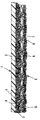
- the invention is illustrated in more detail using an exemplary embodiment schematically shown in longitudinal section. It shows a tape (1) which has a tape layer (2) with a front (3) and a back (4).
- the back (4) is ground smooth. When used as intended in the wet press of a paper machine with an extended press nip, this rear side (4) slides past the pressure shoe in the press nip.
- a textile product (5) is provided on the front side (3) of the strip layer (2), which has a carrier web (6) in the form of a double-layer fabric with longitudinal threads - denoted by (7) for example - and transverse threads - denoted by (8) as an example - has, in the top and bottom of each a fiber layers (9, 10 ⁇ ) is needled.
- the fiber layer (9, 10 ⁇ ) form the outer layers of the textile product (5).
- the overlying fiber layer (9) is partially embedded in the strip layer (2), in such a way that the carrier web (6) is still completely outside the strip layer (2). In this way, the connection between the carrier web (6) and the strip layer (2) is produced solely by the fiber layer (9). Nevertheless, this creates an extremely shear-resistant connection between the textile product (5) and the strip layer (2).
- the carrier web (6) itself absorbs the tensile forces acting on the belt (1).
- the lower band layer (10 ⁇ ) serves as a cushion against an adjacent, running wet felt, which in turn carries the paper web. With appropriate formation of the fiber layer (10 ⁇ ) can even be dispensed with the wet felt, so that the paper web directly on the belt (1), d. H. the fiber layer (10 ⁇ ), can rest.
- polyamide, polyester, PPS and PAN can be used for the fiber layers (9, 10 ⁇ ) in particular polyamide, polyester, PPS and PAN.
Landscapes
- Paper (AREA)
- Impression-Transfer Materials And Handling Thereof (AREA)
- Machines For Manufacturing Corrugated Board In Mechanical Paper-Making Processes (AREA)
- Devices For Conveying Motion By Means Of Endless Flexible Members (AREA)
- Artificial Filaments (AREA)
- Compositions Of Macromolecular Compounds (AREA)
- Cleaning Implements For Floors, Carpets, Furniture, Walls, And The Like (AREA)
Description
- Die Erfindung betrifft ein Band zum Einsatz in Papiermaschinen, insbesondere in Naßpressen mit verlängertem Pressenspalt, das eine biegsame, flüssigkeitsundurchlässige Bandschicht aufweist, die auf ihrer Rückseite glatt ist und in deren Vorderseite ein Textilprodukt nur teilweise unter Bildung von offenen Hohlräumen eingelassen ist.
- In Naßpressen von Papiermaschinen wird ein wesentlicher Teil der in der Papierbahn noch befindlichen Flüssigkeit zwischen Druckwalzen, die einen Pressenspalt bilden, herausgepreßt. Die Papierbahn wird durch den Pressenspalt mittels eines umlaufenden Naßfilzes geführt, wobei die Flüssigkeit in dem Pressenspalt aus der Papierbahn in den Naßfilz gedrückt und abgeführt wird.
- In neuerer Zeit sind Naßpressen mit verlängertem Pressenspalt, sogenannte "Schuhpressen", entwickelt worden, in denen die Papierbahn über einen längeren Weg und damit einer entsprechend längeren Zeit hohem Pressendruck ausgesetzt wird, so daß sie mit höherem Trockengehalt aus der Naßpresse herausläuft. Für das Führen der Papierbahn und mindestens eines Naßfilzes durch einen solchen verlängerten Pressenspalt dienen insbesondere Bänder, die eine biegsame, flüssigkeitsundurchlässige Bandschicht aufweisen, welche auf ihrer Rückseite glatt ist. Mit dieser glatten Rückseite laufen sie im Pressenspalt über einen Druckschuh, der hydraulisch beaufschlagt ist und das Band in Richtung auf eine gegenüberliegende Druckwalze preßt.
- Zwischen dieser Druckwalze und dem Band wird die zu entwässernde Papierbahn hindurchgeführt, wobei die Papierbahn auf mindestens einer Seite von einem zusätzlich mitlaufenden Naßfilz begleitet wird, der das ausgepreßte Wasser abführt.
- Solche Bänder sind im Pressenspalt hohen Beanspruchungen in Längs- und in Querrichtung unterworfen und unterliegen auf beiden Seiten nicht unbeträchtlichem Abrieb. Zur Lösung des ersten Problems ist vorgeschlagen worden, in die Bandschicht vollständig ein Textilprodukt in Form eines Gewebes einzulassen (vgl. DE-OS 32 31 0̸39, DE-OS 33 18 984, US-PS 4 559 258). Dabei kann erforderlichenfalls eine Bahn in das Gewebe eingenadelt werden (vgl. DE-OS 32 31 0̸39). Diese Ausführungsformen von Bändern haben sich jedoch nicht bewährt.
- Um die Wasserabfuhr an der Vorderseite der Bänder, also der Seite, die zur Papierbahn gerichtet ist und an einem mitlaufenden Naßfilz anliegt, zu verbessern, ist vorgeschlagen worden, die Vorderseite strukturiert auszubilden. Hierzu wurden Bänder entwickelt, an deren Vorderseite Textilprodukte nur teilweise eingelassen sind, also teilweise über die Bandschicht herausstehen. Auf diese Weise entstehen in dem aus der Bandschicht herausragenden Teil des Textilproduktes Hohlräume und Kanäle für die Wasserabfuhr. Als Textilprodukte wurden mehrlagige Gewebe (DE-PS 32 35 468, EP-PS 0̸ 0̸98 50̸2, EP-OS 0̸ 138 797, DE-GM 83 19 684.6, EP-OS 0̸ 185 10̸8, US-A-4 701 368) vorgeschlagen. Statt Gewebe kommen auch Drahtgliederbänder (EP-PS 0̸ 0̸98 50̸2) oder Kettengewirke (EP-OS 0̸ 290̸ 653) in Frage.
- Bei den zuletzt erwähnten gattungsgemäßen Bändern besteht das Problem, den Verbund zwischen dem die Zugkräfte aufnehmenden Textilprodukt und der Bandschicht auf Dauer zu sichern. Dabei ist zu berücksichtigen, daß ein solches Band großen Druck und Walkbeanspruchungen mit unterschiedlichen Krafteinwirkungen im Bereich der Vorder- und der Rückseite insbesondere im Pressenspalt ausgesetzt ist. Wenn das Textilprodukt sehr tief in die Bandschicht eingelassen wird, muß es außerordentlich dick ausgebildet sein, damit es trotz des tiefen Eindringens in den Querschnitt der Bandschicht so weit aus dieser herausragt, daß ein für die Wasserabfuhr noch hinreichendes Hohlraumvolumen entsteht. Ein so dickes Textilprodukt hat aber zur Folge, daß das Band sehr unflexibel wird und sich deshalb nur schlecht der Form des Druckschuhs und den Biegungen beim Laufen über Umlenkrollen anpassen kann. Wird das Textilprodukt nicht so tief in die Bandschicht eingelagert, muß in Kauf genommen werden, daß das Textilprodukt leichter aus der Bandschicht herausreißt.
- Der Erfindung liegt demnach die Aufgabe zugrunde, ein Band der eingangs genannten Art so auszubilden, daß es sich einerseits durch hohe Flexibilität und großes Hohlraumvolumen für die Wasserabfuhr auszeichnet, andererseits aber auch ein verbesserter Verbund zwischen Textilprodukt und Bandschicht erreicht wird.
- Diese Aufgabe wird erfindungsgemäß dadurch gelöst, daß das Textilprodukt eine Trägerbahn und eine darauf befestigte Faserschicht aufweist, die auf der der Bandschicht benachbarten Seite angeordnet ist, und daß das Textilprodukt nur mit der Faserschicht in die Bandschicht eingelassen ist und die Trägerbahn außerhalb der Bandschicht liegt.
- Nach der Erfindung wird für die Herstellung des Bandes ein Textilprodukt verwendet, das - wie an sich bekannt - eine für die Zugkräfte geeignete Trägerbahn, jedoch zusätzlich eine zumindest einseitig daran befestigte Faserschicht aufweist, wobei das Textilprodukt allein mit der Faserschicht in die Bandschicht eingelassen ist, die Trägerbahn also vollständig außerhalb der Bandschicht zu liegen kommt. Diese Ausbildung hat zunächst einmal den Vorteil, daß selbst mit einer relativ dünn ausgebildeten Trägerbahn - beispielsweise einem einlagigen Gewebe oder Gewirke - ein vergleichsweise hohes Hohlraumvolumen gebildet werden kann, da es vollständig außerhalb der Bandschicht liegt. Entsprechend wenig behindert die Trägerbahn die Biegsamkeit des Bandes. Dabei hat sich überraschenderweise herausgestellt, daß der Verbund zwischen Textilprodukt und Bandschicht besser ist als bei den bekannten Lösungen, bei denen eine Trägerbahn teilweise in die Bandschicht eingelassen ist, und zwar obwohl der Verbund allein über die Faserschicht hergestellt wird. Die Scherfestigkeit wird also verbessert.
- Hinzu kommt, daß die Faserschicht in der Lage ist, unterschiedliche Längenänderungen der Bandschicht einerseits und der Trägerbahn andererseits, wie sie auf Grund verschiedener Materialien für diese Teile auftreten können, in gewissem Umfang aufzunehmen. Es können deshalb für die Bandschicht und die Trägerbahn die jeweils am besten geeigneten Materialien weitgehend unabhängig von ihren physikalischen Eigenschaften verwendet werden. Somit hat dieses Band wesentlich verbesserte Eigenschaften gegenüber allen bisher bekannten Bändern dieser Art.
- In Ausbildung der Erfindung ist vorgesehen, daß auch die der Bandschicht abgewandte Seite des Textilprodukts eine Faserschicht trägt. Hierdurch wird eine zusätzliche Abpolsterung zur Papierseite hin erreicht. Bei entsprechender Ausbildung dieser Faserschicht kann sogar auf den bisher obligatorischen, zwischen Band und Papierbahn mitlaufenden Naßfilz verzichtet werden. Hierdurch lassen sich erhebliche Kosten einsparen.
- Die Faserschicht(en) ist bzw. sind zweckmäßigerweise als aufgenadelte Faservliesbahn(en) insbesondere mit längsorientierten Fasern ausgebildet. Jede Faserschicht kann dabei auch aus mehreren vernadelten Faservliesbahnen bestehen. Als Trägerbahn eignen sich ein- oder mehrlagige Gewebe, Gewirke oder Fadengelege oder Kombination davon, aber auch andere textile Trägerbahnen, soweit sie Zugkräfte aufnehmen können.
- Nach einem weiteren Merkmal der Erfindung ist vorgesehen, daß in die Faserschicht(en) in Längs- und/oder in Querrichtung verlaufende Verstärkungsfäden eingelegt sind. Ferner kann vorgesehen sein, daß die Trägerbahn aus zwei oder mehr aufeinander gelegten Geweben oder Gewirken zusammengesetzt ist, die durch Vernadelung der Faserschicht(en) miteinander verbunden sind.
- In der Zeichnung ist die Erfindung an Hand eines schematisch im Längsschnitt dargestellten Ausführungsbeispiels näher veranschaulicht. Sie zeigt ein Band (1), das eine Bandschicht (2) mit einer Vorderseite (3) und einer Rückseite (4) aufweist. Die Rückseite (4) ist glatt geschliffen. Bei der bestimmungsgemäßen Verwendung in der Naßpresse einer Papiermaschine mit verlängertem Pressenspalt läuft diese Rückseite (4) im Pressenspalt an dem dort vorhandenen Druckschuh gleitend vorbei.
- Auf der Vorderseite (3) der Bandschicht (2) ist ein Textilprodukt (5) vorgesehen, das eine Trägerbahn (6) in Form eines doppellagigen Gewebes mit Längsfäden - beispielhaft mit (7) bezeichnet - und Querfäden - beispielhaft mit (8) bezeichnet - hat, in dessen Oberseite und Unterseite jeweils eine Faserschichten (9, 10̸) eingenadelt ist. Dabei bilden die Faserschicht (9, 10̸) die jeweils außenliegenden Schichten des Textilproduktes (5). Die obenliegende Faserschicht (9) ist teilweise in die Bandschicht (2) eingelassen, und zwar derart, daß die Trägerbahn (6) noch vollständig außerhalb der Bandschicht (2) liegt. Die Verbindung zwischen Trägerbahn (6) und Bandschicht (2) wird auf diese Weise allein durch die Faserschicht (9) hergestellt. Gleichwohl wird hierdurch eine außerordentlich scherfeste Verbindung zwischen Textilprodukt (5) und Bandschicht (2) hergestellt. Die Trägerbahn (6) selbst nimmt die auf das Band (1) wirkenden Zugkräfte auf.
- Die untere Bandschicht (10̸) dient als Polster gegenüber einem daran anliegenden, mitlaufenden Naßfilz, der dann wiederum die Papierbahn trägt. Bei entsprechender Ausbildung der Faserschicht (10̸) kann sogar auf den Naßfilz verzichtet werden, so daß die Papierbahn direkt an dem Band (1), d. h. der Faserschicht (10̸), anliegen kann.
- Als Material für die Längs- und die Querfäden (7, 8) kommen PEK, PEEK, PPS sämtliche Polyestermischungen, PBT und alle denkbaren Polyamid Varianten, insbesondere PA6.6, PA6, PA6.10̸, PA6.12 sowie PA10̸ und PA11 in Frage. Für die Faserschichten (9, 10̸) können insbesondere Polyamid, Polyester, PPS und PAN verwendet werden.
Claims (7)
- Band zum Einsatz in Papiermaschinen, insbesondere in Naßpressen mit verlängertem Pressenspalt, das eine biegsame, flüssigkeitsundurchlässige Bandschicht aufweist, die auf ihrer Rückseite glatt ist und in deren Vorderseite ein Textilprodukt nur teilweise unter Bildung von offenen Hohlräumen eingelassen ist, wobei das Textilprodukt (5) eine Trägerbahn (6) und eine daran befestigte Faserschicht (9) aufweist, die auf der der Bandschicht (2) benachbarten Seite angeordnet ist,
dadurch gekennzeichnet, daß das Textilprodukt (5) nur mit dieser Faserschicht (9) in die Bandschicht (2) eingelassen ist und die Trägerbahn (6) außerhalb der Bandschicht (2) liegt. - Band nach Anspruch 1,
dadurch gekennzeichnet, daß auch die der Bandschicht (2) abgewandte Seite des Textilprodukts (5) eine Faserschicht (10) trägt. - Band nach Anspruch 1 oder 2,
dadurch gekennzeichnet, daß die Faserschicht(en) (9, 10) als aufgenadelte Faservliesbahn(en) ausgebildet ist bzw. sind. - Band nach einem der Ansprüche 1 bis 3.
dadurch gekennzeichnet, daß die Trägerbahn (6) ein Gewebe Gewirke oder Fadengelege oder eine Kombination davon, ist. - Band nach einem der Ansprüche 1 bis 4,
dadurch gekennzeichnet, daß die Faserschicht(en) (9, 10̸) in Laufrichtung orientierte Fasern hat bzw. haben. - Band nach einem der Ansprüche 1 bis 5,
dadurch gekennzeichnet, daß in die Faserschicht(en) in Längs- und/oder Querrichtung verlaufende Verstärkungsfäden eingelegt sind. - Band nach einem der Ansprüche 1 bis 6,
dadurch gekennzeichnet, daß die Trägerbahn aus zwei oder mehr übereinandergelegten Geweben besteht, die durch die aufgenadelte Faserschicht(en) verbunden sind.
Applications Claiming Priority (2)
| Application Number | Priority Date | Filing Date | Title |
|---|---|---|---|
| DE4028085 | 1990-09-05 | ||
| DE4028085A DE4028085C1 (de) | 1990-09-05 | 1990-09-05 |
Publications (2)
| Publication Number | Publication Date |
|---|---|
| EP0473969A1 EP0473969A1 (de) | 1992-03-11 |
| EP0473969B1 true EP0473969B1 (de) | 1994-12-14 |
Family
ID=6413608
Family Applications (1)
| Application Number | Title | Priority Date | Filing Date |
|---|---|---|---|
| EP91113448A Expired - Lifetime EP0473969B1 (de) | 1990-09-05 | 1991-08-10 | Band zum Einsatz in Papiermaschinen |
Country Status (7)
| Country | Link |
|---|---|
| EP (1) | EP0473969B1 (de) |
| AT (1) | ATE115663T1 (de) |
| CA (1) | CA2050663C (de) |
| DE (2) | DE4028085C1 (de) |
| DK (1) | DK0473969T3 (de) |
| ES (1) | ES2065588T3 (de) |
| FI (1) | FI93240C (de) |
Families Citing this family (8)
| Publication number | Priority date | Publication date | Assignee | Title |
|---|---|---|---|---|
| US6027615A (en) * | 1997-05-06 | 2000-02-22 | Albany International Corp. | Belts for compliant calendering |
| US6645420B1 (en) | 1999-09-30 | 2003-11-11 | Voith Sulzer Papiertechnik Patent Gmbh | Method of forming a semipermeable membrane with intercommunicating pores for a pressing apparatus |
| DE50009970D1 (de) * | 1999-09-30 | 2005-05-12 | Voith Paper Patent Gmbh | Semipermeable Membran mit miteinander in Verbindung stehenden Poren für eine Presse |
| DE50112624D1 (de) | 2001-04-18 | 2007-07-26 | Stowe Woodward Ag | Schuhpressenbelt |
| EP1293601A1 (de) | 2001-09-17 | 2003-03-19 | Stowe Woodward Aktiengesellschaft | Schuhpressenbelt |
| GB0204308D0 (en) | 2002-02-23 | 2002-04-10 | Voith Fabrics Heidenheim Gmbh | Papermachine clothing |
| US7011730B2 (en) | 2002-12-30 | 2006-03-14 | Albany International Corp. | Structure for process belt |
| DE102004011665A1 (de) * | 2004-03-10 | 2005-10-06 | Stowe Woodward Ag | Integraler Schuhpressenbelt |
Family Cites Families (4)
| Publication number | Priority date | Publication date | Assignee | Title |
|---|---|---|---|---|
| US4271222A (en) * | 1980-02-04 | 1981-06-02 | Albany International Corp. | Papermakers felt and method of manufacture |
| GB2106555B (en) * | 1981-09-15 | 1985-10-02 | Albany Int Corp | Improvements relating to extended nip dewatering presses and to the manufacture of belts for use in such presses |
| FR2513281B1 (fr) * | 1981-09-24 | 1985-07-26 | Albany Int Corp | Presse pour extraire l'eau d'une pate a papier et procede de fabrication d'une courroie pour une telle presse |
| JPS61252389A (ja) * | 1985-04-25 | 1986-11-10 | 市川毛織株式会社 | 抄紙用加圧ベルト |
-
1990
- 1990-09-05 DE DE4028085A patent/DE4028085C1/de not_active Expired - Lifetime
-
1991
- 1991-08-10 DE DE59103872T patent/DE59103872D1/de not_active Expired - Fee Related
- 1991-08-10 AT AT91113448T patent/ATE115663T1/de not_active IP Right Cessation
- 1991-08-10 DK DK91113448.4T patent/DK0473969T3/da active
- 1991-08-10 ES ES91113448T patent/ES2065588T3/es not_active Expired - Lifetime
- 1991-08-10 EP EP91113448A patent/EP0473969B1/de not_active Expired - Lifetime
- 1991-09-02 FI FI914107A patent/FI93240C/fi active
- 1991-09-04 CA CA002050663A patent/CA2050663C/en not_active Expired - Fee Related
Also Published As
| Publication number | Publication date |
|---|---|
| FI914107A0 (fi) | 1991-09-02 |
| ES2065588T3 (es) | 1995-02-16 |
| FI914107L (fi) | 1992-03-06 |
| DK0473969T3 (da) | 1995-05-08 |
| CA2050663C (en) | 2004-04-13 |
| FI93240C (fi) | 1995-03-10 |
| FI93240B (fi) | 1994-11-30 |
| DE4028085C1 (de) | 1992-02-27 |
| CA2050663A1 (en) | 1992-03-06 |
| EP0473969A1 (de) | 1992-03-11 |
| DE59103872D1 (de) | 1995-01-26 |
| ATE115663T1 (de) | 1994-12-15 |
Similar Documents
| Publication | Publication Date | Title |
|---|---|---|
| DE3245122C2 (de) | ||
| DE69702746T2 (de) | Papiermachergewebe mit ovalförmigen fäden | |
| DE3801739C2 (de) | ||
| DE69717966T2 (de) | Band für einen Weichkalender | |
| EP0290653B1 (de) | Materialbahn | |
| DE69008469T2 (de) | Band für eine Presse mit verlängerter Presszone. | |
| DE3244208A1 (de) | Pressfilz fuer papierbereitung und verfahren fuer dessen herstellung | |
| EP0048962A2 (de) | Doppellagiges Sieb für den Blattbildungsteil einer Papiermaschine | |
| DE2839629B2 (de) | Naßfilz für Papiermaschinen | |
| EP1002892B1 (de) | Textiles Flächengebilde | |
| DE1611764A1 (de) | Maschinenbekleidung fuer Papier-,Cellulose-,Asbest-Zement- und aehnliche Industrien sowie Bekleidung fuer Filtrierzwecke in diesen oder anderen Industrien | |
| EP0590288B1 (de) | Mehrlagiges Pressensieb für Nasspressen einer Papiermaschine | |
| DE60320667T2 (de) | Pressfilz und band mit wiederbefeuchtungsgchutz | |
| EP0473969B1 (de) | Band zum Einsatz in Papiermaschinen | |
| DE60317746T2 (de) | Transferband zur Überführung einer nassen Papierbahn | |
| EP2678472A1 (de) | Pressenpartie einer maschine zur herstellung einer faserstoffbahn und verfahren zur herstellung einer faserstoffbahn | |
| DE10040828B4 (de) | Filz | |
| DE2749043A1 (de) | Papiermaschinenfilz | |
| DE29706427U1 (de) | Biegsames Band, insbesondere zum Einsatz in Papiermaschinen | |
| DE3914534C1 (de) | ||
| DE69429390T2 (de) | Formiervorrichtung für mehrschichtige Faserbahnen | |
| DE3444082C2 (de) | ||
| EP1205599A2 (de) | Maschine zur Herstellung einer Faserstoffbahn | |
| DE2455185A1 (de) | Gewebe zur herstellung von papier | |
| DE3200030A1 (de) | Filztuch fuer die papierherstellung und verfahren zu dessen herstellung |
Legal Events
| Date | Code | Title | Description |
|---|---|---|---|
| PUAI | Public reference made under article 153(3) epc to a published international application that has entered the european phase |
Free format text: ORIGINAL CODE: 0009012 |
|
| 17P | Request for examination filed |
Effective date: 19911202 |
|
| AK | Designated contracting states |
Kind code of ref document: A1 Designated state(s): AT BE CH DE DK ES FR GB IT LI NL SE |
|
| 17Q | First examination report despatched |
Effective date: 19931122 |
|
| GRAA | (expected) grant |
Free format text: ORIGINAL CODE: 0009210 |
|
| AK | Designated contracting states |
Kind code of ref document: B1 Designated state(s): AT BE CH DE DK ES FR GB IT LI NL SE |
|
| REF | Corresponds to: |
Ref document number: 115663 Country of ref document: AT Date of ref document: 19941215 Kind code of ref document: T |
|
| REF | Corresponds to: |
Ref document number: 59103872 Country of ref document: DE Date of ref document: 19950126 |
|
| ITF | It: translation for a ep patent filed | ||
| GBT | Gb: translation of ep patent filed (gb section 77(6)(a)/1977) |
Effective date: 19950111 |
|
| REG | Reference to a national code |
Ref country code: ES Ref legal event code: FG2A Ref document number: 2065588 Country of ref document: ES Kind code of ref document: T3 |
|
| ET | Fr: translation filed | ||
| REG | Reference to a national code |
Ref country code: DK Ref legal event code: T3 |
|
| PLBE | No opposition filed within time limit |
Free format text: ORIGINAL CODE: 0009261 |
|
| STAA | Information on the status of an ep patent application or granted ep patent |
Free format text: STATUS: NO OPPOSITION FILED WITHIN TIME LIMIT |
|
| 26N | No opposition filed | ||
| PGFP | Annual fee paid to national office [announced via postgrant information from national office to epo] |
Ref country code: DK Payment date: 20010723 Year of fee payment: 11 |
|
| REG | Reference to a national code |
Ref country code: GB Ref legal event code: IF02 |
|
| PG25 | Lapsed in a contracting state [announced via postgrant information from national office to epo] |
Ref country code: DK Free format text: LAPSE BECAUSE OF NON-PAYMENT OF DUE FEES Effective date: 20020930 |
|
| REG | Reference to a national code |
Ref country code: DK Ref legal event code: EBP |
|
| PGFP | Annual fee paid to national office [announced via postgrant information from national office to epo] |
Ref country code: FR Payment date: 20050819 Year of fee payment: 15 |
|
| PGFP | Annual fee paid to national office [announced via postgrant information from national office to epo] |
Ref country code: DE Payment date: 20060613 Year of fee payment: 16 |
|
| PGFP | Annual fee paid to national office [announced via postgrant information from national office to epo] |
Ref country code: NL Payment date: 20060821 Year of fee payment: 16 |
|
| PGFP | Annual fee paid to national office [announced via postgrant information from national office to epo] |
Ref country code: BE Payment date: 20060828 Year of fee payment: 16 Ref country code: AT Payment date: 20060828 Year of fee payment: 16 |
|
| PGFP | Annual fee paid to national office [announced via postgrant information from national office to epo] |
Ref country code: CH Payment date: 20060829 Year of fee payment: 16 |
|
| PGFP | Annual fee paid to national office [announced via postgrant information from national office to epo] |
Ref country code: GB Payment date: 20060830 Year of fee payment: 16 |
|
| PGFP | Annual fee paid to national office [announced via postgrant information from national office to epo] |
Ref country code: ES Payment date: 20060831 Year of fee payment: 16 Ref country code: IT Payment date: 20060831 Year of fee payment: 16 |
|
| PGFP | Annual fee paid to national office [announced via postgrant information from national office to epo] |
Ref country code: SE Payment date: 20060829 Year of fee payment: 16 |
|
| BERE | Be: lapsed |
Owner name: THOMAS JOSEF *HEIMBACH G.M.B.H. & CO. Effective date: 20070831 |
|
| EUG | Se: european patent has lapsed | ||
| REG | Reference to a national code |
Ref country code: CH Ref legal event code: PL |
|
| GBPC | Gb: european patent ceased through non-payment of renewal fee |
Effective date: 20070810 |
|
| PG25 | Lapsed in a contracting state [announced via postgrant information from national office to epo] |
Ref country code: SE Free format text: LAPSE BECAUSE OF NON-PAYMENT OF DUE FEES Effective date: 20070811 Ref country code: LI Free format text: LAPSE BECAUSE OF NON-PAYMENT OF DUE FEES Effective date: 20070831 Ref country code: CH Free format text: LAPSE BECAUSE OF NON-PAYMENT OF DUE FEES Effective date: 20070831 Ref country code: NL Free format text: LAPSE BECAUSE OF NON-PAYMENT OF DUE FEES Effective date: 20080301 |
|
| NLV4 | Nl: lapsed or anulled due to non-payment of the annual fee |
Effective date: 20080301 |
|
| PG25 | Lapsed in a contracting state [announced via postgrant information from national office to epo] |
Ref country code: AT Free format text: LAPSE BECAUSE OF NON-PAYMENT OF DUE FEES Effective date: 20070810 |
|
| REG | Reference to a national code |
Ref country code: FR Ref legal event code: ST Effective date: 20080430 |
|
| PG25 | Lapsed in a contracting state [announced via postgrant information from national office to epo] |
Ref country code: DE Free format text: LAPSE BECAUSE OF NON-PAYMENT OF DUE FEES Effective date: 20080301 |
|
| PG25 | Lapsed in a contracting state [announced via postgrant information from national office to epo] |
Ref country code: BE Free format text: LAPSE BECAUSE OF NON-PAYMENT OF DUE FEES Effective date: 20070831 |
|
| PG25 | Lapsed in a contracting state [announced via postgrant information from national office to epo] |
Ref country code: FR Free format text: LAPSE BECAUSE OF NON-PAYMENT OF DUE FEES Effective date: 20070831 |
|
| REG | Reference to a national code |
Ref country code: ES Ref legal event code: FD2A Effective date: 20070811 |
|
| PG25 | Lapsed in a contracting state [announced via postgrant information from national office to epo] |
Ref country code: GB Free format text: LAPSE BECAUSE OF NON-PAYMENT OF DUE FEES Effective date: 20070810 |
|
| PG25 | Lapsed in a contracting state [announced via postgrant information from national office to epo] |
Ref country code: ES Free format text: LAPSE BECAUSE OF NON-PAYMENT OF DUE FEES Effective date: 20070811 |
|
| PG25 | Lapsed in a contracting state [announced via postgrant information from national office to epo] |
Ref country code: FR Free format text: LAPSE BECAUSE OF NON-PAYMENT OF DUE FEES Effective date: 20060831 |
|
| PG25 | Lapsed in a contracting state [announced via postgrant information from national office to epo] |
Ref country code: IT Free format text: LAPSE BECAUSE OF NON-PAYMENT OF DUE FEES Effective date: 20070810 |