EP0470467B1 - Mittel zur Bekämpfung von Flöhen - Google Patents
Mittel zur Bekämpfung von Flöhen Download PDFInfo
- Publication number
- EP0470467B1 EP0470467B1 EP91112643A EP91112643A EP0470467B1 EP 0470467 B1 EP0470467 B1 EP 0470467B1 EP 91112643 A EP91112643 A EP 91112643A EP 91112643 A EP91112643 A EP 91112643A EP 0470467 B1 EP0470467 B1 EP 0470467B1
- Authority
- EP
- European Patent Office
- Prior art keywords
- halogen
- collars
- methyl
- contain
- fleas
- Prior art date
- Legal status (The legal status is an assumption and is not a legal conclusion. Google has not performed a legal analysis and makes no representation as to the accuracy of the status listed.)
- Expired - Lifetime
Links
- 0 *OC(C=C1)=CC*C1OC1=CCCC=C1 Chemical compound *OC(C=C1)=CC*C1OC1=CCCC=C1 0.000 description 4
Classifications
-
- A—HUMAN NECESSITIES
- A01—AGRICULTURE; FORESTRY; ANIMAL HUSBANDRY; HUNTING; TRAPPING; FISHING
- A01K—ANIMAL HUSBANDRY; AVICULTURE; APICULTURE; PISCICULTURE; FISHING; REARING OR BREEDING ANIMALS, NOT OTHERWISE PROVIDED FOR; NEW BREEDS OF ANIMALS
- A01K27/00—Leads or collars, e.g. for dogs
- A01K27/007—Leads or collars, e.g. for dogs with insecticide-dispensing means
-
- A—HUMAN NECESSITIES
- A01—AGRICULTURE; FORESTRY; ANIMAL HUSBANDRY; HUNTING; TRAPPING; FISHING
- A01N—PRESERVATION OF BODIES OF HUMANS OR ANIMALS OR PLANTS OR PARTS THEREOF; BIOCIDES, e.g. AS DISINFECTANTS, AS PESTICIDES OR AS HERBICIDES; PEST REPELLANTS OR ATTRACTANTS; PLANT GROWTH REGULATORS
- A01N25/00—Biocides, pest repellants or attractants, or plant growth regulators, characterised by their forms, or by their non-active ingredients or by their methods of application, e.g. seed treatment or sequential application; Substances for reducing the noxious effect of the active ingredients to organisms other than pests
-
- A—HUMAN NECESSITIES
- A01—AGRICULTURE; FORESTRY; ANIMAL HUSBANDRY; HUNTING; TRAPPING; FISHING
- A01N—PRESERVATION OF BODIES OF HUMANS OR ANIMALS OR PLANTS OR PARTS THEREOF; BIOCIDES, e.g. AS DISINFECTANTS, AS PESTICIDES OR AS HERBICIDES; PEST REPELLANTS OR ATTRACTANTS; PLANT GROWTH REGULATORS
- A01N25/00—Biocides, pest repellants or attractants, or plant growth regulators, characterised by their forms, or by their non-active ingredients or by their methods of application, e.g. seed treatment or sequential application; Substances for reducing the noxious effect of the active ingredients to organisms other than pests
- A01N25/34—Shaped forms, e.g. sheets, not provided for in any other sub-group of this main group
Definitions
- the present invention relates to compositions for controlling fleas on and in the vicinity of pets which contain substances which inhibit insect development.
- the flea infestation of pets such as dogs and cats is not only annoying for the infected animal, but it also causes considerable pain (stab wounds, itching and allergies) and damage (blood loss) to the infected animals.
- Fleas can also transmit different types of tapeworms. They therefore also represent a medical problem for the infected animals and for the animal owners. But the animal owners can also be affected by fleas. In some people, this leads to Flea stitch allergy.
- An effective control of fleas in dogs and cats has therefore always been desirable and necessary, especially since these pets are living in increasing numbers and in closer contact with humans.
- Such agents are e.g. from the class of carbamates propoxur, bendiocarb, carbaryl, from the class of phosphoric acid esters, fenthion, diazinon, from the class of pyrethroids, permethrin, cypermethrin, resmethrin.
- the active ingredients are used on the host animal and e.g. applied by spraying, showering, washing, as powder, pour-on or spot-on. They can also be incorporated into collars (EP-OS 338 821).
- the active ingredients are also used in the form of aerosols, spray formulations, dust powders in the near and far surroundings of the host animals. For this purpose, berths and the apartment and areas outside the apartment are treated.
- Animal collars are also known which are soaked with a solution containing methoprene (EP-OS 124 404).
- the treated animals thus ensure, at the same time as the distribution of the flea eggs, that the active ingredient is distributed specifically to the locations from which a re-infestation with fleas can take place.
- the animals themselves ensure the targeted distribution of the active ingredient. This does not overlook areas that need to be treated, nor does the active substance be unnecessarily applied in places where the host animal is not. In addition, the work involved in applying the active ingredient is saved.
- the success of the treatment can be further increased by adding an insecticide (adulticide) which is effective against fleas to control the adult fleas.
- adulticide insecticide
- fleas are Ctenocephalides spec., Puix spec., Xenopsylla spec., Ceratophyllus spec., Echidnophaga spec., Tunga spec.
- phosphoric acid esters such as e.g. Fenthion
- carbamates such as e.g. Propoxur
- pyrethroids such as e.g. Cyfluthrin or flumethrin.
- polyvinyl resins for the production of the collars according to the invention, polyvinyl resins, polyurethanes, polyacrylates, epoxy resins, cellulose, cellulose derivatives, polyamides and polyesters can be used which are compatible with the above Active ingredients are sufficiently tolerated.
- the polymers must have sufficient strength and flexibility so as not to tear or become brittle when formed into a tape. They must be of sufficient durability to withstand normal wear and tear. In addition, the polymers must allow the active substances to migrate sufficiently to the surface of the shaped body. These properties are met in particular by solid polyvinyl resins, ie by polymers which are formed by polymers of a vinyl double bond.
- Typical vinyl resins are, for example, polyvinyl halides, such as polyvinyl chloride, polyvinyl chloride-vinyl acetate and polyvinyl fluoride; Polyacrylate and polymethacrylate esters, such as polymethyl acrylate and polymethyl methacrylate; and polyvinylbenzenes such as polystyrene and polyvinyltoluene.
- polyvinyl halides such as polyvinyl chloride, polyvinyl chloride-vinyl acetate and polyvinyl fluoride
- Polyacrylate and polymethacrylate esters such as polymethyl acrylate and polymethyl methacrylate
- polyvinylbenzenes such as polystyrene and polyvinyltoluene.
- plasticizers which are usually used to plasticize solid vinyl resins are suitable for the production of the collars according to the invention based on polyvinyl resin.
- the plasticizer to be used depends on the resin and its compatibility with the plasticizer. Suitable plasticizers are, for example, esters of phosphoric acid, such as tricresyl phosphate, esters of phthalic acid, such as dimethyl phthalate and dioctyl phthalate, and esters of adipic acid, such as diisobutyl adipate.
- esters such as the esters of Azelaic acid, maleic acid, ricinoleic acid, myristic acid, palmitic acid, oleic acid, sebacic acid, stearic acid and trimellitic acid, as well as complex linear polyesters, polymeric plasticizers and epoxidized soybean oils can be used.
- the amount of plasticizer is about 10 to 50%, preferably about 20 to 45% by weight of the total composition.
- stabilizers are antioxidants and agents that protect the tapes from ultraviolet radiation and unwanted degradation during processing, such as extrusion.
- stearates, stearic acid and low molecular weight polyethylenes can be used as lubricants. These ingredients can be used in a concentration up to about 5% by weight of the total composition.
- the various constituents are dry-mixed by known mixing methods and compression-molded by known extrusion or injection molding methods.
- the choice of the processing method for producing the collars according to the invention is fundamentally based on the rheological properties of the band material and the shape of the desired band.
- the processing methods can be set according to the processing technology or the type of shaping.
- process technology the processes can be subdivided according to the rheological conditions they run through. Thereafter, casting, pressing, injection molding and application are possible for viscous strip materials, and injection molding, extrusion (extrusion), calendering, rolling and, if necessary, edging for elastoviscous polymers.
- the moldings according to the invention can be produced by casting, dipping, feeding, injection molding, extruding, calendering, embossing, bending, deep-drawing, etc.
- polyurethanes are prepared in a manner known per se by reacting polyisocyanates with higher molecular weight compounds which have at least two groups which are reactive toward isocyanates and optionally low molecular weight chain extenders and / or monofunctional chain terminators.
- the active substances are present in the carrier polymers in concentrations of 0.05-20% by weight. Concentrations of 0.1-5% by weight are preferred. An active ingredient concentration of approximately 1 percent by weight is particularly preferred.
- Tiled enclosures of approx. 170 x 270 cm are carpeted (3.4 m2), leaving the area of the feeding bowls and litter box free and occupied by 2 cats each, who wear the collars to be tested. After 1 week, the carpets are removed from the enclosures and 20 test disks, each 80 mm in diameter, are cut out. The panes should be distributed as evenly as possible over the carpet.
- the carpet discs are sprinkled with a spatula tip of blood meal (specification: blood meal (powdery) for feeding purposes; company Ssniff) and inoculated with eggs or L1 larvae of the flea species to be tested. They are stored in an incubator at 25 ° C / 80% rel. Humidity. The development of the flea larvae is checked every 3 days. The shells in which larvae develop are tightly closed with Parafilm or Tesafilm after approx. 14 days to prevent adult fleas from escaping. The test will be a week after the fleas hatched in the untreated controls, ended. The dishes in which adult fleas developed were kept in a freezer at -15-18 ° C. for 24 hours and then evaluated. Although larvae hatch from the eggs, there is no development of adult fleas even after 16 weeks.
- the collars are continuously produced using the casting process using a belt system.
- Polyether, active ingredient or combination of active ingredients, color paste, zeolite paste, spreading agent and 1,4-butanediol are mixed together in a heatable kettle and heated to 60.degree.
- the catalyst dibutyltin dilaurate is then mixed in.
- the resulting mixture is component A, which is mixed in a weight ratio of 1: 1 with component B by means of a mixing unit.
- the mixing head is attached to a reciprocating traversing device.
- the reaction mixture flows continuously from the mixing head onto a carrier material (e.g. coating on a plastic band).
- the reaction mixture begins to react 30 seconds after leaving the mixing head and is hardened after approx. 60 seconds.
- the strip goods then slide through a cooling zone.
- the product is solidified to such an extent that it can be guided to the cutting device via a system of slowly rotating V-belts.
- Component B Tripropylene glycol-modified 4,4'-diisocyanatodiphenyl methane, isocyanate content 23% by weight 24.80 parts by weight
- Component B Tripropylene glycol-modified 4,4'-diisocyanatodiphenyl methane, isocyanate content 23% by weight 23.90 parts by weight
- Component B Tripropylene glycol-modified 4,4'-diisocyanatodiphenyl methane, isocyanate content 23% by weight 25.50 parts by weight
- Active ingredient, dye, PVC homopolymer are placed in a high-speed mixer and mixed.
- the mixer speed is increased and the temperature increased to 60 ° C.
- This mixture is processed into collars of the appropriate shape on an injection molding machine.
Landscapes
- Life Sciences & Earth Sciences (AREA)
- Health & Medical Sciences (AREA)
- General Health & Medical Sciences (AREA)
- Environmental Sciences (AREA)
- Pest Control & Pesticides (AREA)
- Plant Pathology (AREA)
- Wood Science & Technology (AREA)
- Zoology (AREA)
- Agronomy & Crop Science (AREA)
- Toxicology (AREA)
- Engineering & Computer Science (AREA)
- Dentistry (AREA)
- Animal Husbandry (AREA)
- Biodiversity & Conservation Biology (AREA)
- Agricultural Chemicals And Associated Chemicals (AREA)
- Pharmaceuticals Containing Other Organic And Inorganic Compounds (AREA)
- Acyclic And Carbocyclic Compounds In Medicinal Compositions (AREA)
- Catching Or Destruction (AREA)
- Saccharide Compounds (AREA)
Description
- Die vorliegende Erfindung betrifft Mittel zur Bekämpfung von Flöhen an und in der Umgebung von Haustieren, die insektenentwicklungshemmende Substanzen enthalten.
- Adulte Flöhe leben normalerweie bevorzugt im Haarkleid ihrer Wirtstiere. Sie ernähren sich von deren Blut und legen ihre Eier im Haarkleid des jeweiligen Wirtstieres ab.
- Da die abgelegten Eier nicht am Haarkleid des Wirtes haften bleiben, fallen sie rasch ab und können deshalb vor allem in der Umgebung der Wirtstiere z.B. in deren Lagern und Liegestätten gefunden werden.
- Das bedeutet, daß bevorzugt Lager und Ruhestätten der Wirtstiere mit Floheiern verseucht sind, aus denen innerhalb von wenigen Tagen Flohlarven schlüpfen. Man unterscheidet bei den Larven drei Entwicklungsstadien, die jeweils ca. 3 Tage dauern. Das dritte Larvenstadium spinnt ein Kokon und verpuppt sich. Unter günstigen Bedingungen (20 - 30°C, 60 - 80 % rel. Luftfeuchtigkeit) dauert die Entwicklung vom Ei zur Puppe ca. 10 Tage. Nach etwa weiteren 8 Tagen ist die Entwicklung der Flöhe abgeschlossen und in den auf dem Boden (Teppichböden, Schlafplätze usw.) liegenden Kokons befinden sich schlüpfbereite Flöhe. Der Jungfloh kann monatelang in seinem Kokon bleiben.
- Unter ungünstigen Bedingungen kann die Entwicklung vom Ei bis zum erwachsenen Jungfloh jedoch auch 4 - 5 Monate dauern. Flöhe benötigen zur Erlangung ihrer Geschlechtsreife, d.h. zur Ablage fertiler Eier, Blut als Nahrungsmittel. Dieses Blut stammt idealerweise vom jeweils spezifischen Wirt. Flöhe können aber auch besonders nach längerem Fasten das Blut anderer Wirte akzeptieren.
- Der Flohbefall der Haustiere wie Hunde und Katzen ist für das befallene Tier nicht nur lästig, sondern er fügt den befallenen Tieren auch erhebliche Schmerzen (Stichverletzungen, Juckreiz und Allergien) und Schäden (Blutverlust) zu. Flöhe können außerdem verschiedene Bandwurmarten übertragen. Sie stellen daher auch ein medizinisches Problem für die befallenen Tiere sowie für die Tierhalter dar. Aber auch der Tierhalter kann von Flöhen befallen werden. Bei manchen Menschen führt dies zur Flohstichallergie. Eine wirksame Bekämpfung der Flöhe bei Hunden und Katzen war deshalb von jeher wünschenswert und notwendig, zumal diese Haustiere in steigender Zahl und zunehmend engerem Kontakt mit den Menschen leben.
- Es sind bislang zahlreiche insektizide Wirkstoffe zur Bekämpfung von Flöhen bekannt geworden. Solche Wirkstoffe sind z.B. aus der Klasse der Carbamate Propoxur, Bendiocarb, Carbaryl, aus der Klasse der Phosphorsäureester, Fenthion, Diazinon, aus der Klasse der Pyrethroide, Permethrin, Cypermethrin, Resmethrin.
- Bei diesen Wirkstoffen handelt es sich um Kontaktinsektizide mit überwiegender Wirkung auf die adulten Flöhe. Bei Eiern oder den verpuppten Stadien der Flöhe zeigen diese Wirkstoffe keine Wirkung.
- Die Wirkstoffe werden am Wirtstier angewendet und z.B. durch Sprühen, Duschen, Waschen, als Pulver, im pour-on oder spot-on Verfahren ausgebracht. Sie können auch in Halsbänder eingearbeitet sein (EP-OS 338 821). Die Wirkstoffe werden auch in Form von Aerosolen, Sprühformulierungen, Stäubepulvern in der näheren und weiteren Umgebung der Wirtstiere eingesetzt. Dazu werden Liegestellen sowie die Wohnung und Bereiche außerhalb der Wohnung behandelt.
- Es ist auch bekannt, Mitteln mit denen die Umgebung der Wirtstiere behandelt wird, Entwicklungshemmer für Insekten wie Methoprene oder Cyromazine zuzusetzen. Dadurch wird die Entwicklung von adulten Flöhen aus Eiern und Larven und Puppen unterbunden. Allerdings war es bisher erforderlich, die gesamte Umgebung der Wirtstiere d.h. die gesamte Wohnung des Menschen zu behandeln.
- Es ist auch bekannt geworden, den Wiederbefall von Hunden und Katzen durch Flöhe dadurch zu verhindern, daß man Hunde und Katzen oral oder parenteral mit Wirkstoffen behandelt, die das Flohwachstum hemmen (EP-OS 255 803).
- Es ist außerdem bekannt geworden, Hunde und Katzen gegen Flöhe mit einer Aerosol-Formulierung die Methoprene enthält einzusprühen. Dadurch konnte verhindert werden, daß sich aus den abgesetzten Eiern Flohlarven entwickeln (International Pest Control 27, 1985, S. 10-14).
- Es sind auch Tierhalsbänder bekannt geworden, die mit einer Lösung getränkt sind, die Methoprene enthält (EP-OS 124 404).
- Alle bisher bekannt gewordenen Bekämpfungsmethoden für Flöhe bei Haustieren auf der Basis von Insektiziden oder Insektenentwicklungshemmern gehen von einer Behandlung des Wirtstieres (Hund oder Katze), seiner Lagerstätten oder seiner gesamten Umgebung aus. Die Behandlung der Wirtstiere allein ist wenig erfolgsversprechend, da über Wochen und sogar Monate die Gefahr des Wiederbefalls aus der Umgebung durch neu geschlüpfte Flöhe gegeben ist. Eine Behandlung nur der Lagerstätte des Wirtstieres ist ebenfalls wenig erfolgversprechend, da die Tiere ihre Lagerstätten oft wechseln und manche Lagerstätten gar nicht bekannt oder (besonders bei der Katze) einer Behandlung nicht zugänglich sind.
- Der größte Erfolg ist daher dann zu erzielen, wenn sowohl die Wirtstiere als auch ihre gesamte Umgebung behandelt werden. Die Behandlung der Umgebung ist dabei arbeits- und materialaufwendig. Es sollte daher nach Möglichkeiten gesucht werden, den Arbeitsaufwand sowie das zur Bekämpfung eingesetzte Material zu reduzieren.
- Dies wird durch die vorliegende Erfindung ermöglicht.
- Die vorliegende Erfindung betrifft:
Neue Halsbänder für Tiere, die Insektenentwicklungshemmer der allgemeinen Formel I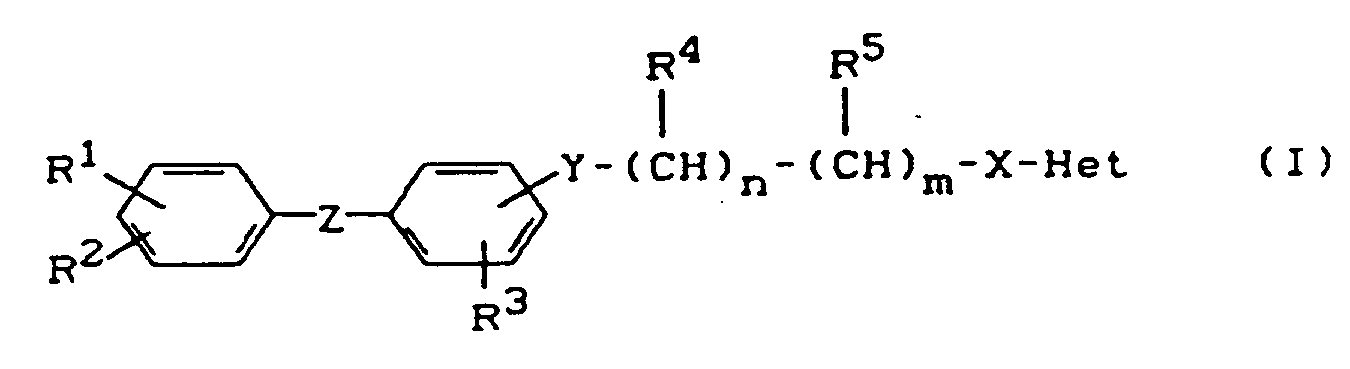
in welcher - R¹
- Wasserstoff, Methyl, Trifluormethyl, Methoxy, Trifluormethoxy, Chlor, Fluor steht
- R²
- für Wasserstoff steht,
- R³
- für Wasserstoff, Fluor, Chlor, Methyl steht,
- R⁴
- für Wasserstoff oder Methyl steht,
- R⁵
- für Methyl, Ethyl, Trifluormethyl oder Wasserstoff steht,
- Het
- für Pyridyl oder Pyridazinyl steht die gegebenenfalls substituiert sind durch Fluor, Chlor, Methyl, NO₂, Methoxy, Methylmercapto,
- X
- für O steht,
- Y
- für O steht,
- Z
- für O, CH₂ oder -C(CH₃)₂- steht,
- m
- für 1 steht,
- n
- für 1 steht,
- R¹
- für Halogen steht,
- R²
- für Wasserstoff oder Halogen steht,
- R³
- für Wasserstoff, Halogen oder C₁₋₄-Alkyl steht,
- R₄
- für Halogen, 1-5-Halogen-C₁₋₄-alkyl, C₁₋₄-Alkoxy, 1-5-Halogen-C₁₋₄-alkoxy, C₁₋₄-Alkylthio, 1-5-Halogen-C₁₋₄-alkylthio, Phenoxy oder Pyridyloxy die gegebenenfalls substituiertsein können durch Halogen, C₁₋₄-Alkyl, 1-5-Halogen-C₁₋₄-alkyl, C₁₋₄-Alkoxy, 1-5-Halogen-C₁₋₄-alkoxy, C₁₋₄-Alkylthio, 1-5-Halogen-C₁-C₄-alkylthio steht,
- Die behandelten Tiere sorgen damit, gleichzeitig mit der Verteilung der Floheier, für eine Verteilung des Wirkstoffs gezielt an die Stellen, von denen aus ein Wiederbefall mit Flöhen stattfinden kann. Die Tiere sorgen somit selber für die gezielte Verteilung des Wirkstoffs. Es werden damit weder Stellen, die zu behandeln sind, übersehen, noch wird Wirkstoff an Stellen an denen sich das Wirtstier nicht aufhält unnötig ausgebracht. Außerdem wird der mit der Ausbringung des Wirkstoffs verbundene Arbeitsaufwand eingespart.
- Es war überraschend, daß mit dieser Art der Ausbringung des Wirkstoffs eine Wirkung erzielt werden konnte. Bei den bisher bekannten Methoden wurden die Eier oder Larven, die sich in der Umgebung befanden direkt behandelt oder sie kamen auf den Tieren mit dem Wirkstoff in Berührung, wenn diese behandelt wurden.
- Es konnte aber nicht erwartet werden, daß durch die erfindungsgemäße Behandlung eine wirkungsvolle Bekämpfung der Flöhe in der Umgebung möglich ist.
- Der Behandlungserfolg läßt sich noch dadurch steigern, daß den Halsbändern zur Bekämpfung der adulten Flöhe ein gegen Flöhe wirksames Insektizid (Adultizid) zugesetzt wird.
- Als Haustiere seien Hunde und Katzen genannt. Als Flöhe seien genannt Ctenocephalides spec., Puix spec., Xenopsylla spec., Ceratophyllus spec., Echidnophaga spec., Tunga spec.
- Im einzelnen seien folgende Verbindungen der Formel I genannt:
R¹ R³ R⁵ R⁶ Z H H CH₃ H O H H CH₃ 2-Cl O 5-F H CH₃ H O H H CF₃ H O H H C₂H₅ H O H H H H O H H CH₃ H CH₂ H H CH₃ H C(CH₃)₂
Insbesondere seien folgende Verbindungen der Formel II genannt:

Bei den Insektenentwicklungshemmern besonders hervorgehoben seien die oben genannten substituierten Diarylether der Formel I. - Als Insektizide, die zusätzlich zu den angegebenen Entwicklungshemmer in die erfindungsgemäßen Halsbänder eingearbeitet werden können, seiengenannt: Phosporsäureester wie z.B. Fenthion, Carbamate wie z.B. Propoxur, Pyrethroide wie z.B. Cyfluthrin oder Flumethrin.
- Für die Herstellung der erfindungsgemäßen Halsbänder können Polyvinylharze, Polyurethane, Polyacrylate, Epoxyharze, Cellulose, Cellulosederivate, Polyamide und Polyester verwendet werden, die mit den obengenannten Wirkstoffen ausreichend verträglich sind. Die Polymeren müssen eine ausreichende Festigkeit und Biegsamkeit haben, um beim Formen in ein Band nicht zu reißen oder brüchig zu werden. Sie müssen von ausreichender Haltbarkeit sein, um gegen normale Abnutzung beständig zu sein. Außerdem müssen die Polymere eine ausreichende Wanderung der Wirkstoffe an die Oberfläche des Formkörpers zulassen. Diese Eigenschaften werden insbesondere von festen Polyvinylharzen erfüllt, d.h. von Polymerisaten, die durch Polymerisaten einer Vinyldoppelbindung gebildet werden.
- Typische Vinylharze sind beispielsweise Polyvinylhalogenide, wie Polyvinylchlorid, Polyvinylchlorid-Vinylacetat und Polyvinylfluorid; Polyacrylat- und Polymethacrylatester, wie Polymethylacrylat und Polymethylmethacrylat; und Polyvinylbenzole, wie Polystyrol und Polyvinyltoluol.
- Für die Herstellung der erfindungsgemäßen Halsbänder auf der Basis Polyvinylharz sind die Weichmacher geeignet, die üblicherweise zum Weichmachen von festen Vinylharzen verwendet werden. Der zu verwendende Weichmacher hängt von dem Harz und seiner Verträglichkeit mit dem Weichmacher ab. Geeignete Weichmacher sind beispielsweise Ester von Phosphorsäure, wie Tricresylphosphat, Ester von Phthalsäure, wie Dimethylphthalat und Dioctylphthalat, und Ester von Adipinsäure, wie Diisobutyladipat. Es können auch andere Ester, wie die Ester von Azelainsäure, Maleinsäure, Ricinolsäure, Myristinsäure, Palmitinsäure, Ölsäure, Sebacinsäure, Stearinsäure und Trimellithsäure, sowie komplexe lineare Polyester, polymere Weichmacher und epoxydierte Sojabohnenöle verwendet werden. Die Menge des Weichmachers beträgt etwa 10 bis 50 Gew.-%, vorzugsweise etwa 20 bis 45 Gew.-% der gesamten Zusammensetzung.
- In den Halsbändern können noch weitere Bestandteile, wie Stabilisierungsmittel, Spreitmittel, Schmiermittel, Füllstoffe und Färbematerialien, enthalten sein, ohne daß dadurch die grundlegenden Eigenschaften der Zusammensetzung verändert werden. Geeignete Stabilisierungsmittel sind Antioxydationsmittel und Mittel, die die Bänder vor ultravioletter Strahlung und unerwünschtem Abbau während der Bearbeitung, wie Strangpressen schützen. Einige Stabilisierungsmittel, wie epoxydierte Sojabohnenöle, dienen außerdem als sekundäre Weichmacher. Als Schmiermittel können beispielsweise Stearate, Stearinsäure und Polyethylene mit niedrigem Molekulargewicht verwendet werden. Diese Bestandteile können in einer Konzentration bis zu etwa 5 Gew.-% der gesamten Zusammensetzung verwendet werden.
- Bei der Herstellung der erfindungsgemäßen Halsbänder auf Vinylbasis werden die verschiedenen Bestandteile nach bekannten Mischverfahren trocken gemischt und nach bekannten Strangpreß- oder Spritzgußverfahren formgepreßt.
- Die Wahl des Verarbeitungsverfahrens zur Herstellung der erfindungsgemäßen Halsbänder richtet sich technisch grundsätzlich nach den rheologischen Eigenschaften des Bandmaterials und der Form des gewünschten Bandes. Die Verarbeitungsverfahren können nach der Verarbeitungstechnologie oder nach der Art der Formgebung eingestellt werden. Bei der Verfahrenstechnologie kann man die Verfahren nach den bei ihnen durchlaufenden rheologischen Zuständen unterteilen. Danach kommen für viskose Bandmaterialien Gießen, Pressen, Spritzgießen und Auftragen und für elastoviskose Polymere Spritzgießen, Strangpressen (Extrudieren), Kalandrieren, Walzen und gegebenenfalls Kanten in Frage. Nach Art der Formgebung eingeteilt, lassen sich die erfindungsgemäßen Formkörper durch Gießen, Tauchen, Fressen, Spritzgießen, Extrudieren, Kalandrieren, Prägen, Biegen, Tiefziehen etc. herstellen.
- Diese Verarbeitungsverfahren sind bekannt und bedürfen keiner näheren Erklärung. Im Prinzip gelten für andere Polymere die Erläuterungen, die oben beispielhaft für Polyvinylharze gemacht wurden.
- Weitere Trägermaterialien für die erfindungsgemäßen Halsbänder sind Polyurethane. Diese werden in an sich bekannter Weise durch Umsetzung von Polyisocyanaten mit höhermolekularen, mindestens zwei gegenüber Isocyanaten reaktionsfähigen Gruppen aufweisenden Verbindungen sowie gegebenenfalls niedermolekularen Kettenverlängerungsmitteln und/oder monofunktionellen Kettenabbrechern hergestellt.
- Ihre Herstellung erfolgt nach prinzipiell bekannten Methoden (z.B. vergleiche Europ. Offenlegungsschrift 50 782, Deutsche Offenlegungsschrift 2 715 596 und die darin angegebenen Literaturstellen).
- Die Wirkstoffe liegen in den Trägerpolymeren in Konzentrationen von 0,05-20 Gew.-% vor. Bevorzugt sind Konzentrationen von 0,1-5 Gew.-%. Besonders bevorzugt ist eine Wirkstoff-Konzentration um ca. 1 Gewichtsprozent.
- In den folgenden Beispielen werden folgende Wirkstoffe eingesetzt:
Pyriproxyfen : 2-[1-Methyl-2-(4-phenoxyphenoxy)-ethoxy]-pyridin
Triflumuron = 1-(2-Chlorbenzoyl)-3-(4-trifluormethoxyphenyl)-harnstoff
Propoxur = 2-Isopropoxyphenyl-N-methylcarbamat
Cyfluthrin : Cyano-(4-Fluor-3-phenoxyphenyl)-methyl-3-(2,2-dichlorvinyl)-2,2-dimethyl-cyclopropancarboxylat. - Der Versuch wird mit Halsbändern aus PVC durchgeführt, die 1 Gew.-% der Verbindung Pyriproxyfen der Formel

enthalten. - Gekachelte Gehege von ca. 170 x 270 cm werden mit Teppichboden ausgelegt (3,4 m²) wobei der Bereich der Futternäpfe und Katzentoilette frei bleibt und mit je 2 Katzen besetzt, die die zu prüfenden Halsbänder tragen. Nach 1 Woche werden die Teppiche aus den Gehegen herausgenommen und jeweils 20 Probescheiben a 80 mm Durchmesser herausgeschnitten. Die Scheiben sollen möglichst gleichmäßig über den Teppichboden verteilt sein.
- Die Teppichbodenscheiben werden mit einer Spatelspitze Blutmehl bestreut (Spezifikation: Blutmehl (pulvrig) für Futterzwecke; Firma Ssniff) und mit Eiern bzw. L1-Larven der zu prüfenden Flohart beimpft. Die Aufbewahrung erfolgt in einem Brutschrank bei 25°C/80 % rel. Feuchte. Die Entwicklung der Flohlarven wird in Abständen von 3 Tagen kontrolliert. Die Schalen, in denen eine Larvenentwicklung erfolgt, werden nach ca. 14 Tagen mit Parafilm oder Tesafilm fest verschlossen, um ein Entkommen adulter Flöhe zu verhindern. Der Test wird eine Woche, nachdem die Flöhe in den unbehandelten Kontrollen geschlüpft sind, beendet. Die Schalen, in denen eine Entwicklung adulter Flöhe erfolgte, werden für 24 Stunden in einem Gefrierschrank bei -15-18°C aufbewahrt und danach ausgewertet. Obwohl aus den Eiern Larven schlüpfen, erfolgt auch nach 16 Wochen keine Entwicklung adulter Flöhe.
- Die Halsbänder werden nach dem Gießverfahren mit Hilfe einer Bandanlage kontinuierlich hergestellt. Polyether, Wirkstoff bzw. Wirkstoff-Kombination, Farbpaste, Zeolith-Paste, Spreitmittel und Butandiol-1,4 werden in einem beheizbaren Kessel zusammengemischt und auf 60°C erwärmt. Danach wird der Katalysator (Dibutylzinndilaurat) zugemischt.
- Die resultierende Mischung ist die Komponente A, die im Gewichtsverhältnis 1:1 mit der Komponente B mittels eines Mischaggregates vermischt wird. Der Mischkopf ist auf einer hin- und hergehenden Changiervorrichtung befestigt. Aus dem Mischkopf fließt das Reaktionsgemisch kontinuierlich auf ein Träger-Material (z.B. Beschichtung auf ein Kunststoffband). Das Reaktionsgemisch beginnt 30 sek nach Verlassen des Mischkopfes zu reagieren und ist nach ca. 60 sek erhärtet.
- Anschließend gleitet die Bandware durch eine Kühlzone. Das Produkt ist soweit verfestigt, daß es über ein System von langsam umlaufenden Keilriemen zur Schneidevorrichtung geleitet werden kann.
-

-
Komponente B: Tripropylenglykol-modifiziertes 4,4'-Diisocyanatodiphenyl-methan, Isocyanatgehalt 23 Gew.-% 24,80 Gew.-Teile -

-
Komponente B: Tripropylenglykol-modifiziertes 4,4'-Diisocyanatodiphenyl-methan, Isocyanatgehalt 23 Gew.-% 23,90 Gew.-Teile -

-
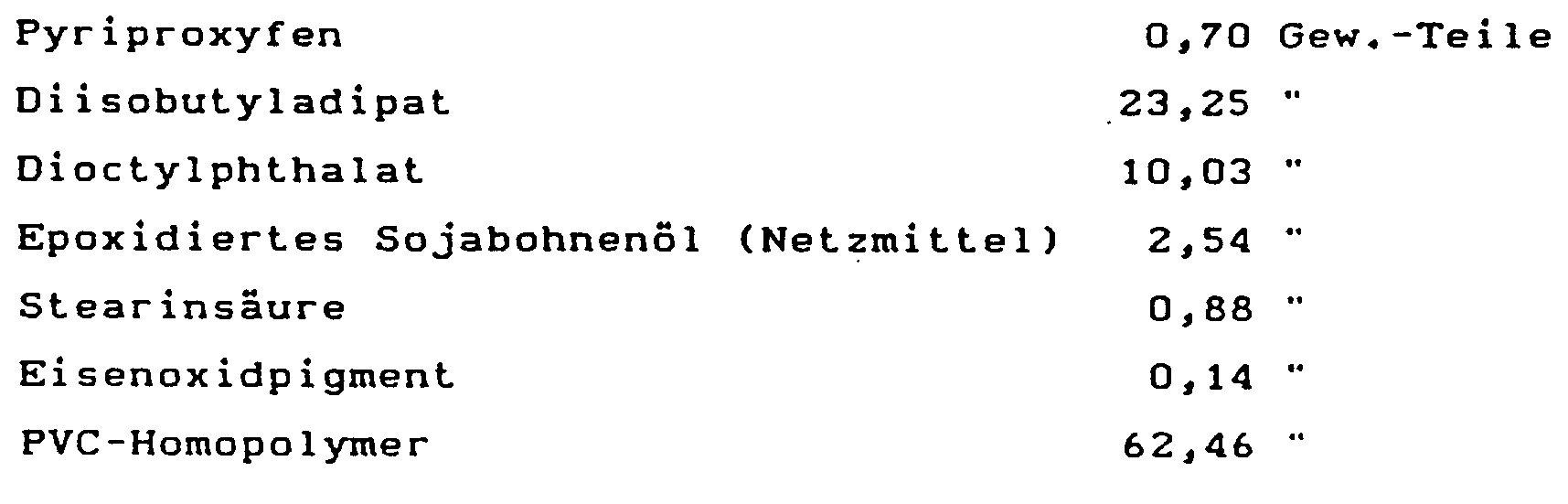
Komponente B: Tripropylenglykol-modifiziertes 4,4'-Diisocyanatodiphenyl-methan, Isocyanatgehalt 23 Gew.-% 25,50 Gew.-Teile - In einem hochtourigen Mischer werden Wirkstoff, Farbstoff, PVC-Homopolymer vorgelegt und durchgemischt. Die Tourenzahl des Mischers wird erhöht und die Temperatur auf 60°C erhöht.
- Dann werden die Diisobutyladipat, Dioctylphthalat, Netzmittel hinzugefügt und weitergemischt, bis 60°C wieder erreicht ist.
- Es wird nun langsam weitergerührt, bis die Mischung trocken und pulverig aussieht.
- Jetzt wird Stearinsäure zugegeben.
- Die Mischung wird nun schnell unter Rühren abgekühlt.
- Diese Mischung wird auf einer Spritzgußmaschine zu Halsbändern der entsprechenden Form verarbeitet.
-
-

-


in welcher
Claims (7)
- Halsbänder für Tiere, die Insektenentwicklungshemmer der allgemeinen Formel I
 R¹ Wasserstoff, Methyl, Trifluormethyl, Methoxy, Trifluormethoxy, Chlor, Fluor stehtR² für Wasserstoff steht,R³ für Wasserstoff, Fluor, Chlor, Methyl steht,R⁴ für Wasserstoff oder Methyl steht,R⁵ für Methyl, Ethyl, Trifluormethyl oder Wasserstoff steht,Het für Pyridyl oder Pyridazinyl steht die gegebenenfalls substituiert sind durch Fluor, Chlor, Methyl, NO₂, Methoxy, Methylmercapto,X für O steht,Y für O steht,Z für O, CH₂ oder -C(CH₃)₂- steht,m für 1 steht,n für 1 stehtoder der allgemeinen Formel II
 R¹ für Halogen steht,R² für Wasserstoff oder Halogen steht,R³ für Wasserstoff, Halogen oder C₁₋₄-Alkyl steht,R₄ für Halogen, 1-5-Halogen-C₁₋₄-alkyl, C₁₋₄-Alkoxy, 1-5-Halogen-C₁₋₄-alkoxy, C₁₋₄-Alkylthio, 1-5-Halogen-C₁₋₄-alkylthio, Phenoxy oder Pyridyloxy die gegebenenfalls substituient sein können durch Halogen, C₁₋₄-Alkyl, 1-5-Halogen-C₁₋₄-alkyl, C₁₋₄-Alkoxy, 1-5-Halogen-C₁₋₄-alkoxy, C₁₋₄-Alkylthio, 1-5-Halogen-C₁-C₄-alkylthio steht.zusammen mit Insektiziden aus der Reihe Phosphorsäureester, Carbamate, Pyrethroide in Polymeren, aus denen die Halsbänder bestehen, enthalten.
 - Halsbänder gemäß Anspruch 1, dadurch gekennzeichnet, daß sie als Insektenentwicklungshemmer Pyriproxyfen der Formel

- Halsbänder gemäß Ansprüchen 1 oder 2, dadurch gekennzeichnet, daß sie als Insektizide Fenthion, Propoxur, Cyfluthrin oder Flumethrin enthalten.
- Halsbänder gemäß Anspruch 1, dadurch gekennzeichnet, daß sie Pyriproxyfen und Propoxur enthalten.
- Halsbänder gemäß Anspruch 1, dadurch gekennzeichnet, daß sie Pyriproxyfen und Cyfluthrin enthalten.
- Halsbänder gemäß Anspruch 1, dadurch gekennzeichnet, daß sie Pyriproxyfen und Flumethrin enthalten.
- Verwendung von Insektenentwicklungshemmern der allgemeinen Formel I oder II gemäß Anspruch 1 zusammen mit Insektiziden aus der Reihe Phosphorsäureester, Carbamate oder Pyrethroide zur Herstellung von Halsbändern für Tiere, die Insektenentwicklungshemmer und Insektizide in Polymeren, aus denen die Halsbänder bestehen, enthalten.
Applications Claiming Priority (2)
| Application Number | Priority Date | Filing Date | Title |
|---|---|---|---|
| DE4025345 | 1990-08-10 | ||
| DE4025345A DE4025345A1 (de) | 1990-08-10 | 1990-08-10 | Verfahren und mittel zur bekaempfung von floehen |
Publications (3)
| Publication Number | Publication Date |
|---|---|
| EP0470467A2 EP0470467A2 (de) | 1992-02-12 |
| EP0470467A3 EP0470467A3 (en) | 1992-04-15 |
| EP0470467B1 true EP0470467B1 (de) | 1994-09-14 |
Family
ID=6411985
Family Applications (1)
| Application Number | Title | Priority Date | Filing Date |
|---|---|---|---|
| EP91112643A Expired - Lifetime EP0470467B1 (de) | 1990-08-10 | 1991-07-27 | Mittel zur Bekämpfung von Flöhen |
Country Status (10)
| Country | Link |
|---|---|
| EP (1) | EP0470467B1 (de) |
| JP (1) | JPH04229125A (de) |
| KR (1) | KR100202152B1 (de) |
| AT (1) | ATE111298T1 (de) |
| AU (1) | AU656141B2 (de) |
| CA (1) | CA2048543C (de) |
| DE (2) | DE4025345A1 (de) |
| DK (1) | DK0470467T3 (de) |
| ES (1) | ES2061136T3 (de) |
| ZA (1) | ZA916295B (de) |
Families Citing this family (9)
| Publication number | Priority date | Publication date | Assignee | Title |
|---|---|---|---|---|
| DE4216535A1 (de) * | 1991-08-21 | 1993-02-25 | Bayer Ag | Formkoerper zur bekaempfung von schaedlingen |
| DE69308392T2 (de) * | 1992-06-26 | 1997-06-12 | Sumitomo Chemical Co | Trägermaterialien für Insektizide |
| US5632999A (en) * | 1993-08-18 | 1997-05-27 | Virbac, Inc. | Sustained release pyriproxifen compositions for parasite control |
| NZ286944A (en) * | 1995-07-10 | 1998-08-26 | Sumitomo Chemical Co | Resin composition containing a biocide and a vapourisable plasticiser; shaped forms |
| IE80657B1 (en) * | 1996-03-29 | 1998-11-04 | Merial Sas | Insecticidal combination to control mammal fleas in particular fleas on cats and dogs |
| US6596291B2 (en) | 1997-12-05 | 2003-07-22 | Thomas A. Bell | Compositions and methods for treating surfaces infected with ectoparasitic insects |
| JP2002193808A (ja) * | 2000-12-26 | 2002-07-10 | Mitsubishi Chemicals Corp | ピラゾール誘導体を用いた有害生物防除用器具 |
| DE10115225A1 (de) * | 2001-03-28 | 2002-12-19 | Bayer Ag | Wirkstoffhaltige Formkörper auf Basis thermoplastisch verarbeitbarer Polyurethane zur Bekämpfung von Parasiten |
| DE102004031325A1 (de) | 2004-06-29 | 2006-01-19 | Bayer Healthcare Ag | Wirkstoffhaltige feste Formkörper zur äußerlichen Anwendung gegen Parasiten an Tieren |
Family Cites Families (5)
| Publication number | Priority date | Publication date | Assignee | Title |
|---|---|---|---|---|
| DE2715596C2 (de) | 1977-04-07 | 1986-04-30 | Bayer Ag, 5090 Leverkusen | Tierhalsbänder mit insektizider Wirksamkeit, Verfahren zu ihrer Herstellung und ihre Verwendung |
| FR2555408B2 (fr) * | 1983-04-14 | 1986-11-21 | Rombi Max | Collier insecticide et son procede de fabrication |
| NZ221262A (en) | 1986-08-06 | 1990-08-28 | Ciba Geigy Ag | Preventing the reinfestation of dogs and cats by fleas by administering to the host a flea growth inhibiting substance orally, parenterally or by implant |
| GB8809262D0 (en) * | 1988-04-20 | 1988-05-25 | Secto Co Ltd | Devices for protecting animals from parasites |
| DE4216535A1 (de) * | 1991-08-21 | 1993-02-25 | Bayer Ag | Formkoerper zur bekaempfung von schaedlingen |
-
1990
- 1990-08-10 DE DE4025345A patent/DE4025345A1/de not_active Withdrawn
-
1991
- 1991-07-27 DE DE59102918T patent/DE59102918D1/de not_active Expired - Fee Related
- 1991-07-27 DK DK91112643.1T patent/DK0470467T3/da active
- 1991-07-27 EP EP91112643A patent/EP0470467B1/de not_active Expired - Lifetime
- 1991-07-27 AT AT91112643T patent/ATE111298T1/de not_active IP Right Cessation
- 1991-07-27 ES ES91112643T patent/ES2061136T3/es not_active Expired - Lifetime
- 1991-08-01 AU AU81534/91A patent/AU656141B2/en not_active Ceased
- 1991-08-05 JP JP3218066A patent/JPH04229125A/ja active Pending
- 1991-08-07 CA CA002048543A patent/CA2048543C/en not_active Expired - Lifetime
- 1991-08-09 KR KR1019910013736A patent/KR100202152B1/ko not_active Expired - Fee Related
- 1991-08-09 ZA ZA916295A patent/ZA916295B/xx unknown
Also Published As
| Publication number | Publication date |
|---|---|
| EP0470467A2 (de) | 1992-02-12 |
| ES2061136T3 (es) | 1994-12-01 |
| KR920003856A (ko) | 1992-03-27 |
| ZA916295B (en) | 1992-05-27 |
| CA2048543C (en) | 2001-06-05 |
| DK0470467T3 (da) | 1995-02-13 |
| EP0470467A3 (en) | 1992-04-15 |
| JPH04229125A (ja) | 1992-08-18 |
| DE59102918D1 (de) | 1994-10-20 |
| KR100202152B1 (ko) | 1999-06-15 |
| ATE111298T1 (de) | 1994-09-15 |
| AU656141B2 (en) | 1995-01-27 |
| AU8153491A (en) | 1992-02-13 |
| DE4025345A1 (de) | 1992-02-13 |
| CA2048543A1 (en) | 1992-02-11 |
Similar Documents
| Publication | Publication Date | Title |
|---|---|---|
| EP0682869B1 (de) | Nicht-systemische Bekämpfung von Parasiten | |
| EP0224697B1 (de) | Verwendung von synthetischen Pyrethroiden zur Herstellung von Mitteln zur Bekämpfung von Parasitosen bei Bienen | |
| DE69329884T2 (de) | Verfahren zur Bekämpfung von Schadinsekten | |
| DE60109899T2 (de) | Decke für tiere | |
| EP0050784A1 (de) | Ektoparasitizidhaltige Polyurethane | |
| EP0470467B1 (de) | Mittel zur Bekämpfung von Flöhen | |
| DD206731A5 (de) | Zusammensetzungen zum kampf gegen parasiten | |
| DE2629192C2 (de) | Pestizide Polyvinylchlorid-Masse | |
| EP0528303A1 (de) | Formkörper zur Bekämpfung von Schädlingen | |
| DE3703105A1 (de) | Mittel gegen protozoen bei insekten | |
| US5266324A (en) | Processes and agents for combating fleas | |
| EP0576594B1 (de) | Schützende zusammensetzungen | |
| DE3825172A1 (de) | Mittel zur bekaempfung von floehen | |
| DE2800682A1 (de) | Halsband fuer warmbluetige tiere | |
| DE3300579C2 (de) | Antiparasitäres Halsband für Tiere und Verfahren zu dessen Herstellung | |
| DE69214518T2 (de) | Methode zur Bekämpfung von Flöhen | |
| DE60104115T2 (de) | Zusammensetzung mit verzögerter freisetzung enthaltend einen wirkstoff in einem plastischen träger sowie daraus hergestellte formkörper | |
| DE68916099T2 (de) | Vorrichtungen und Mittel zur auswendigen Anwendung von Substanzen an Tieren. | |
| EP3536327A1 (de) | Lithium-verbindungen zur bekämpfung von milben, die von teilen der menschlichen oder warmblüterischen haut leben | |
| EP0756821B1 (de) | Para-Hydroxyphenylessigsäure zur Reduktion der Repellenz von Insektiziden | |
| US20100015191A1 (en) | Device and method for controlling insects | |
| DE2318824A1 (de) | Schaedlingsbekaempfungsmittel mit verzoegerter wirkstoffabgabe | |
| JPH069319A (ja) | 動物の外部寄生生物駆除用成形品 | |
| WO2008150300A1 (en) | Pest control formulation | |
| CA3220746A1 (en) | Flea and tick collar |
Legal Events
| Date | Code | Title | Description |
|---|---|---|---|
| PUAI | Public reference made under article 153(3) epc to a published international application that has entered the european phase |
Free format text: ORIGINAL CODE: 0009012 |
|
| AK | Designated contracting states |
Kind code of ref document: A2 Designated state(s): AT BE CH DE DK ES FR GB GR IT LI LU NL SE |
|
| PUAL | Search report despatched |
Free format text: ORIGINAL CODE: 0009013 |
|
| AK | Designated contracting states |
Kind code of ref document: A3 Designated state(s): AT BE CH DE DK ES FR GB GR IT LI LU NL SE |
|
| 17P | Request for examination filed |
Effective date: 19920518 |
|
| 17Q | First examination report despatched |
Effective date: 19930809 |
|
| GRAA | (expected) grant |
Free format text: ORIGINAL CODE: 0009210 |
|
| AK | Designated contracting states |
Kind code of ref document: B1 Designated state(s): AT BE CH DE DK ES FR GB GR IT LI LU NL SE |
|
| REF | Corresponds to: |
Ref document number: 111298 Country of ref document: AT Date of ref document: 19940915 Kind code of ref document: T |
|
| REF | Corresponds to: |
Ref document number: 59102918 Country of ref document: DE Date of ref document: 19941020 |
|
| GBT | Gb: translation of ep patent filed (gb section 77(6)(a)/1977) |
Effective date: 19940922 |
|
| ITF | It: translation for a ep patent filed | ||
| ET | Fr: translation filed | ||
| REG | Reference to a national code |
Ref country code: ES Ref legal event code: FG2A Ref document number: 2061136 Country of ref document: ES Kind code of ref document: T3 |
|
| EAL | Se: european patent in force in sweden |
Ref document number: 91112643.1 |
|
| REG | Reference to a national code |
Ref country code: DK Ref legal event code: T3 |
|
| REG | Reference to a national code |
Ref country code: GR Ref legal event code: FG4A Free format text: 3014346 |
|
| PLBE | No opposition filed within time limit |
Free format text: ORIGINAL CODE: 0009261 |
|
| STAA | Information on the status of an ep patent application or granted ep patent |
Free format text: STATUS: NO OPPOSITION FILED WITHIN TIME LIMIT |
|
| 26N | No opposition filed | ||
| REG | Reference to a national code |
Ref country code: GB Ref legal event code: IF02 |
|
| REG | Reference to a national code |
Ref country code: CH Ref legal event code: PFA Owner name: BAYER AKTIENGESELLSCHAFT Free format text: BAYER AKTIENGESELLSCHAFT# #D-51368 LEVERKUSEN (DE) -TRANSFER TO- BAYER AKTIENGESELLSCHAFT# #D-51368 LEVERKUSEN (DE) |
|
| PGFP | Annual fee paid to national office [announced via postgrant information from national office to epo] |
Ref country code: BE Payment date: 20071008 Year of fee payment: 17 |
|
| REG | Reference to a national code |
Ref country code: CH Ref legal event code: PUE Owner name: BAYER ANIMAL HEALTH GMBH Free format text: BAYER AKTIENGESELLSCHAFT# #D-51368 LEVERKUSEN (DE) -TRANSFER TO- BAYER ANIMAL HEALTH GMBH# #51368 LEVERKUSEN (DE) |
|
| NLS | Nl: assignments of ep-patents |
Owner name: BAYER ANIMAL HEALTH GMBH Effective date: 20090622 |
|
| REG | Reference to a national code |
Ref country code: GB Ref legal event code: 732E Free format text: REGISTERED BETWEEN 20090917 AND 20090923 |
|
| PGFP | Annual fee paid to national office [announced via postgrant information from national office to epo] |
Ref country code: ES Payment date: 20090812 Year of fee payment: 19 Ref country code: FR Payment date: 20090710 Year of fee payment: 19 Ref country code: DK Payment date: 20090714 Year of fee payment: 19 |
|
| PGFP | Annual fee paid to national office [announced via postgrant information from national office to epo] |
Ref country code: SE Payment date: 20090708 Year of fee payment: 19 Ref country code: NL Payment date: 20090705 Year of fee payment: 19 Ref country code: LU Payment date: 20090804 Year of fee payment: 19 Ref country code: GB Payment date: 20090722 Year of fee payment: 19 Ref country code: AT Payment date: 20090715 Year of fee payment: 19 Ref country code: DE Payment date: 20090626 Year of fee payment: 19 Ref country code: CH Payment date: 20090721 Year of fee payment: 19 |
|
| REG | Reference to a national code |
Ref country code: FR Ref legal event code: TP |
|
| PGFP | Annual fee paid to national office [announced via postgrant information from national office to epo] |
Ref country code: IT Payment date: 20090725 Year of fee payment: 19 |
|
| PGFP | Annual fee paid to national office [announced via postgrant information from national office to epo] |
Ref country code: GR Payment date: 20090702 Year of fee payment: 19 |
|
| PG25 | Lapsed in a contracting state [announced via postgrant information from national office to epo] |
Ref country code: BE Free format text: LAPSE BECAUSE OF NON-PAYMENT OF DUE FEES Effective date: 20080731 |
|
| REG | Reference to a national code |
Ref country code: NL Ref legal event code: V1 Effective date: 20110201 |
|
| REG | Reference to a national code |
Ref country code: CH Ref legal event code: PL |
|
| GBPC | Gb: european patent ceased through non-payment of renewal fee |
Effective date: 20100727 |
|
| REG | Reference to a national code |
Ref country code: FR Ref legal event code: ST Effective date: 20110331 |
|
| PG25 | Lapsed in a contracting state [announced via postgrant information from national office to epo] |
Ref country code: CH Free format text: LAPSE BECAUSE OF NON-PAYMENT OF DUE FEES Effective date: 20100731 Ref country code: LI Free format text: LAPSE BECAUSE OF NON-PAYMENT OF DUE FEES Effective date: 20100731 Ref country code: DE Free format text: LAPSE BECAUSE OF NON-PAYMENT OF DUE FEES Effective date: 20110201 |
|
| REG | Reference to a national code |
Ref country code: DE Ref legal event code: R119 Ref document number: 59102918 Country of ref document: DE Effective date: 20110201 |
|
| PG25 | Lapsed in a contracting state [announced via postgrant information from national office to epo] |
Ref country code: IT Free format text: LAPSE BECAUSE OF NON-PAYMENT OF DUE FEES Effective date: 20100727 Ref country code: NL Free format text: LAPSE BECAUSE OF NON-PAYMENT OF DUE FEES Effective date: 20110201 Ref country code: AT Free format text: LAPSE BECAUSE OF NON-PAYMENT OF DUE FEES Effective date: 20100727 Ref country code: FR Free format text: LAPSE BECAUSE OF NON-PAYMENT OF DUE FEES Effective date: 20100802 |
|
| PG25 | Lapsed in a contracting state [announced via postgrant information from national office to epo] |
Ref country code: GR Free format text: LAPSE BECAUSE OF NON-PAYMENT OF DUE FEES Effective date: 20110202 |
|
| PG25 | Lapsed in a contracting state [announced via postgrant information from national office to epo] |
Ref country code: GB Free format text: LAPSE BECAUSE OF NON-PAYMENT OF DUE FEES Effective date: 20100727 |
|
| REG | Reference to a national code |
Ref country code: DK Ref legal event code: EBP |
|
| REG | Reference to a national code |
Ref country code: ES Ref legal event code: FD2A Effective date: 20111118 |
|
| PG25 | Lapsed in a contracting state [announced via postgrant information from national office to epo] |
Ref country code: ES Free format text: LAPSE BECAUSE OF NON-PAYMENT OF DUE FEES Effective date: 20100728 |
|
| PG25 | Lapsed in a contracting state [announced via postgrant information from national office to epo] |
Ref country code: DK Free format text: LAPSE BECAUSE OF NON-PAYMENT OF DUE FEES Effective date: 20100802 |
|
| PG25 | Lapsed in a contracting state [announced via postgrant information from national office to epo] |
Ref country code: SE Free format text: LAPSE BECAUSE OF NON-PAYMENT OF DUE FEES Effective date: 20100728 Ref country code: LU Free format text: LAPSE BECAUSE OF NON-PAYMENT OF DUE FEES Effective date: 20100727 |
|
| REG | Reference to a national code |
Ref country code: GR Ref legal event code: ML Ref document number: 940403728 Country of ref document: GR Effective date: 20110202 |