EP0467906B1 - Wässrige kunstharzdispersionen - Google Patents
Wässrige kunstharzdispersionen Download PDFInfo
- Publication number
- EP0467906B1 EP0467906B1 EP90905469A EP90905469A EP0467906B1 EP 0467906 B1 EP0467906 B1 EP 0467906B1 EP 90905469 A EP90905469 A EP 90905469A EP 90905469 A EP90905469 A EP 90905469A EP 0467906 B1 EP0467906 B1 EP 0467906B1
- Authority
- EP
- European Patent Office
- Prior art keywords
- monomers
- weight
- synthetic resin
- alkanols
- mixture
- Prior art date
- Legal status (The legal status is an assumption and is not a legal conclusion. Google has not performed a legal analysis and makes no representation as to the accuracy of the status listed.)
- Expired - Lifetime
Links
- 239000006185 dispersion Substances 0.000 title claims abstract description 36
- 229920003002 synthetic resin Polymers 0.000 title claims abstract description 32
- 239000000057 synthetic resin Substances 0.000 title claims abstract description 32
- 239000000178 monomer Substances 0.000 claims abstract description 60
- QGZKDVFQNNGYKY-UHFFFAOYSA-N Ammonia Chemical compound N QGZKDVFQNNGYKY-UHFFFAOYSA-N 0.000 claims abstract description 23
- XLYOFNOQVPJJNP-UHFFFAOYSA-N water Substances O XLYOFNOQVPJJNP-UHFFFAOYSA-N 0.000 claims abstract description 21
- 239000000203 mixture Substances 0.000 claims abstract description 17
- 229910021529 ammonia Inorganic materials 0.000 claims abstract description 10
- LYCAIKOWRPUZTN-UHFFFAOYSA-N Ethylene glycol Chemical compound OCCO LYCAIKOWRPUZTN-UHFFFAOYSA-N 0.000 claims abstract description 9
- 150000001991 dicarboxylic acids Chemical class 0.000 claims abstract description 9
- 125000004432 carbon atom Chemical group C* 0.000 claims abstract description 8
- 239000000853 adhesive Substances 0.000 claims abstract description 7
- UFHFLCQGNIYNRP-UHFFFAOYSA-N Hydrogen Chemical compound [H][H] UFHFLCQGNIYNRP-UHFFFAOYSA-N 0.000 claims abstract description 5
- 125000003545 alkoxy group Chemical group 0.000 claims abstract description 5
- 150000001412 amines Chemical class 0.000 claims abstract description 5
- 150000008064 anhydrides Chemical class 0.000 claims abstract description 5
- 230000009477 glass transition Effects 0.000 claims abstract description 4
- 229910052739 hydrogen Inorganic materials 0.000 claims abstract description 4
- 239000001257 hydrogen Substances 0.000 claims abstract description 4
- WGCNASOHLSPBMP-UHFFFAOYSA-N hydroxyacetaldehyde Natural products OCC=O WGCNASOHLSPBMP-UHFFFAOYSA-N 0.000 claims abstract description 4
- 150000002763 monocarboxylic acids Chemical class 0.000 claims abstract description 4
- 150000001875 compounds Chemical class 0.000 claims description 14
- 238000010528 free radical solution polymerization reaction Methods 0.000 claims description 8
- 239000003960 organic solvent Substances 0.000 claims description 8
- 238000000034 method Methods 0.000 claims description 7
- TXDNPSYEJHXKMK-UHFFFAOYSA-N sulfanylsilane Chemical class S[SiH3] TXDNPSYEJHXKMK-UHFFFAOYSA-N 0.000 claims description 6
- 150000004756 silanes Chemical class 0.000 claims description 4
- 229920001519 homopolymer Polymers 0.000 claims description 3
- 125000004191 (C1-C6) alkoxy group Chemical group 0.000 claims description 2
- 125000004169 (C1-C6) alkyl group Chemical group 0.000 claims description 2
- 238000002360 preparation method Methods 0.000 claims description 2
- 150000001252 acrylic acid derivatives Chemical class 0.000 claims 2
- 150000002734 metacrylic acid derivatives Chemical class 0.000 claims 2
- 150000003254 radicals Chemical class 0.000 claims 2
- 125000004178 (C1-C4) alkyl group Chemical group 0.000 claims 1
- 239000004821 Contact adhesive Substances 0.000 claims 1
- NIXOWILDQLNWCW-UHFFFAOYSA-N acrylic acid group Chemical group C(C=C)(=O)O NIXOWILDQLNWCW-UHFFFAOYSA-N 0.000 abstract description 4
- 230000001070 adhesive effect Effects 0.000 abstract description 4
- BLRPTPMANUNPDV-UHFFFAOYSA-N Silane Chemical compound [SiH4] BLRPTPMANUNPDV-UHFFFAOYSA-N 0.000 abstract description 3
- 125000005397 methacrylic acid ester group Chemical group 0.000 abstract description 3
- 229910000077 silane Inorganic materials 0.000 abstract description 3
- 229920002554 vinyl polymer Polymers 0.000 abstract description 3
- 239000002253 acid Chemical class 0.000 abstract description 2
- 125000000217 alkyl group Chemical group 0.000 abstract description 2
- 125000003700 epoxy group Chemical group 0.000 abstract description 2
- 150000002148 esters Chemical class 0.000 abstract description 2
- 239000003125 aqueous solvent Substances 0.000 abstract 1
- 150000001735 carboxylic acids Chemical class 0.000 abstract 1
- 238000010526 radical polymerization reaction Methods 0.000 abstract 1
- 238000012360 testing method Methods 0.000 description 11
- 238000006116 polymerization reaction Methods 0.000 description 9
- 239000002313 adhesive film Substances 0.000 description 8
- 238000004519 manufacturing process Methods 0.000 description 7
- CSCPPACGZOOCGX-UHFFFAOYSA-N Acetone Chemical compound CC(C)=O CSCPPACGZOOCGX-UHFFFAOYSA-N 0.000 description 6
- 239000004820 Pressure-sensitive adhesive Substances 0.000 description 6
- ZXEKIIBDNHEJCQ-UHFFFAOYSA-N isobutanol Chemical compound CC(C)CO ZXEKIIBDNHEJCQ-UHFFFAOYSA-N 0.000 description 6
- LFQSCWFLJHTTHZ-UHFFFAOYSA-N Ethanol Chemical compound CCO LFQSCWFLJHTTHZ-UHFFFAOYSA-N 0.000 description 4
- BAPJBEWLBFYGME-UHFFFAOYSA-N Methyl acrylate Chemical compound COC(=O)C=C BAPJBEWLBFYGME-UHFFFAOYSA-N 0.000 description 4
- PPBRXRYQALVLMV-UHFFFAOYSA-N Styrene Chemical compound C=CC1=CC=CC=C1 PPBRXRYQALVLMV-UHFFFAOYSA-N 0.000 description 4
- 229920000642 polymer Polymers 0.000 description 4
- SMZOUWXMTYCWNB-UHFFFAOYSA-N 2-(2-methoxy-5-methylphenyl)ethanamine Chemical compound COC1=CC=C(C)C=C1CCN SMZOUWXMTYCWNB-UHFFFAOYSA-N 0.000 description 3
- CERQOIWHTDAKMF-UHFFFAOYSA-N Methacrylic acid Chemical compound CC(=C)C(O)=O CERQOIWHTDAKMF-UHFFFAOYSA-N 0.000 description 3
- LRHPLDYGYMQRHN-UHFFFAOYSA-N N-Butanol Chemical compound CCCCO LRHPLDYGYMQRHN-UHFFFAOYSA-N 0.000 description 3
- YXFVVABEGXRONW-UHFFFAOYSA-N Toluene Chemical compound CC1=CC=CC=C1 YXFVVABEGXRONW-UHFFFAOYSA-N 0.000 description 3
- ZMANZCXQSJIPKH-UHFFFAOYSA-N Triethylamine Chemical compound CCN(CC)CC ZMANZCXQSJIPKH-UHFFFAOYSA-N 0.000 description 3
- 150000001298 alcohols Chemical class 0.000 description 3
- 230000005540 biological transmission Effects 0.000 description 3
- 239000002904 solvent Substances 0.000 description 3
- VXNZUUAINFGPBY-UHFFFAOYSA-N 1-Butene Chemical compound CCC=C VXNZUUAINFGPBY-UHFFFAOYSA-N 0.000 description 2
- JAHNSTQSQJOJLO-UHFFFAOYSA-N 2-(3-fluorophenyl)-1h-imidazole Chemical compound FC1=CC=CC(C=2NC=CN=2)=C1 JAHNSTQSQJOJLO-UHFFFAOYSA-N 0.000 description 2
- NLXLAEXVIDQMFP-UHFFFAOYSA-N Ammonium chloride Substances [NH4+].[Cl-] NLXLAEXVIDQMFP-UHFFFAOYSA-N 0.000 description 2
- VHUUQVKOLVNVRT-UHFFFAOYSA-N Ammonium hydroxide Chemical compound [NH4+].[OH-] VHUUQVKOLVNVRT-UHFFFAOYSA-N 0.000 description 2
- KAKZBPTYRLMSJV-UHFFFAOYSA-N Butadiene Chemical compound C=CC=C KAKZBPTYRLMSJV-UHFFFAOYSA-N 0.000 description 2
- SOGAXMICEFXMKE-UHFFFAOYSA-N Butylmethacrylate Chemical compound CCCCOC(=O)C(C)=C SOGAXMICEFXMKE-UHFFFAOYSA-N 0.000 description 2
- RTZKZFJDLAIYFH-UHFFFAOYSA-N Diethyl ether Chemical compound CCOCC RTZKZFJDLAIYFH-UHFFFAOYSA-N 0.000 description 2
- OAKJQQAXSVQMHS-UHFFFAOYSA-N Hydrazine Chemical compound NN OAKJQQAXSVQMHS-UHFFFAOYSA-N 0.000 description 2
- VQTUBCCKSQIDNK-UHFFFAOYSA-N Isobutene Chemical compound CC(C)=C VQTUBCCKSQIDNK-UHFFFAOYSA-N 0.000 description 2
- RRHGJUQNOFWUDK-UHFFFAOYSA-N Isoprene Chemical compound CC(=C)C=C RRHGJUQNOFWUDK-UHFFFAOYSA-N 0.000 description 2
- KFZMGEQAYNKOFK-UHFFFAOYSA-N Isopropanol Chemical compound CC(C)O KFZMGEQAYNKOFK-UHFFFAOYSA-N 0.000 description 2
- QQONPFPTGQHPMA-UHFFFAOYSA-N Propene Chemical compound CC=C QQONPFPTGQHPMA-UHFFFAOYSA-N 0.000 description 2
- 229910000831 Steel Inorganic materials 0.000 description 2
- 239000002390 adhesive tape Substances 0.000 description 2
- 235000011114 ammonium hydroxide Nutrition 0.000 description 2
- 230000015572 biosynthetic process Effects 0.000 description 2
- IAQRGUVFOMOMEM-UHFFFAOYSA-N but-2-ene Chemical compound CC=CC IAQRGUVFOMOMEM-UHFFFAOYSA-N 0.000 description 2
- WERYXYBDKMZEQL-UHFFFAOYSA-N butane-1,4-diol Chemical compound OCCCCO WERYXYBDKMZEQL-UHFFFAOYSA-N 0.000 description 2
- CQEYYJKEWSMYFG-UHFFFAOYSA-N butyl acrylate Chemical compound CCCCOC(=O)C=C CQEYYJKEWSMYFG-UHFFFAOYSA-N 0.000 description 2
- 229920001577 copolymer Polymers 0.000 description 2
- 238000001035 drying Methods 0.000 description 2
- 125000001301 ethoxy group Chemical group [H]C([H])([H])C([H])([H])O* 0.000 description 2
- 230000002349 favourable effect Effects 0.000 description 2
- VZCYOOQTPOCHFL-UPHRSURJSA-N maleic acid Chemical compound OC(=O)\C=C/C(O)=O VZCYOOQTPOCHFL-UPHRSURJSA-N 0.000 description 2
- 125000000956 methoxy group Chemical group [H]C([H])([H])O* 0.000 description 2
- 125000002496 methyl group Chemical group [H]C([H])([H])* 0.000 description 2
- 229920006267 polyester film Polymers 0.000 description 2
- 230000001681 protective effect Effects 0.000 description 2
- 239000010959 steel Substances 0.000 description 2
- 238000003756 stirring Methods 0.000 description 2
- 238000003860 storage Methods 0.000 description 2
- DNIAPMSPPWPWGF-VKHMYHEASA-N (+)-propylene glycol Chemical compound C[C@H](O)CO DNIAPMSPPWPWGF-VKHMYHEASA-N 0.000 description 1
- YPFDHNVEDLHUCE-UHFFFAOYSA-N 1,3-propanediol Substances OCCCO YPFDHNVEDLHUCE-UHFFFAOYSA-N 0.000 description 1
- BWIGWMTWWSXXGX-UHFFFAOYSA-N 1-(oxiran-2-yl)-4-trimethoxysilylbutan-2-one Chemical compound CO[Si](OC)(OC)CCC(=O)CC1CO1 BWIGWMTWWSXXGX-UHFFFAOYSA-N 0.000 description 1
- DURPTKYDGMDSBL-UHFFFAOYSA-N 1-butoxybutane Chemical compound CCCCOCCCC DURPTKYDGMDSBL-UHFFFAOYSA-N 0.000 description 1
- YAJYJWXEWKRTPO-UHFFFAOYSA-N 2,3,3,4,4,5-hexamethylhexane-2-thiol Chemical compound CC(C)C(C)(C)C(C)(C)C(C)(C)S YAJYJWXEWKRTPO-UHFFFAOYSA-N 0.000 description 1
- GOXQRTZXKQZDDN-UHFFFAOYSA-N 2-Ethylhexyl acrylate Chemical compound CCCCC(CC)COC(=O)C=C GOXQRTZXKQZDDN-UHFFFAOYSA-N 0.000 description 1
- SBYMUDUGTIKLCR-UHFFFAOYSA-N 2-chloroethenylbenzene Chemical class ClC=CC1=CC=CC=C1 SBYMUDUGTIKLCR-UHFFFAOYSA-N 0.000 description 1
- WDQMWEYDKDCEHT-UHFFFAOYSA-N 2-ethylhexyl 2-methylprop-2-enoate Chemical compound CCCCC(CC)COC(=O)C(C)=C WDQMWEYDKDCEHT-UHFFFAOYSA-N 0.000 description 1
- RUMACXVDVNRZJZ-UHFFFAOYSA-N 2-methylpropyl 2-methylprop-2-enoate Chemical compound CC(C)COC(=O)C(C)=C RUMACXVDVNRZJZ-UHFFFAOYSA-N 0.000 description 1
- CFVWNXQPGQOHRJ-UHFFFAOYSA-N 2-methylpropyl prop-2-enoate Chemical compound CC(C)COC(=O)C=C CFVWNXQPGQOHRJ-UHFFFAOYSA-N 0.000 description 1
- DXIJHCSGLOHNES-UHFFFAOYSA-N 3,3-dimethylbut-1-enylbenzene Chemical class CC(C)(C)C=CC1=CC=CC=C1 DXIJHCSGLOHNES-UHFFFAOYSA-N 0.000 description 1
- IKYAJDOSWUATPI-UHFFFAOYSA-N 3-[dimethoxy(methyl)silyl]propane-1-thiol Chemical compound CO[Si](C)(OC)CCCS IKYAJDOSWUATPI-UHFFFAOYSA-N 0.000 description 1
- DCQBZYNUSLHVJC-UHFFFAOYSA-N 3-triethoxysilylpropane-1-thiol Chemical compound CCO[Si](OCC)(OCC)CCCS DCQBZYNUSLHVJC-UHFFFAOYSA-N 0.000 description 1
- UUEWCQRISZBELL-UHFFFAOYSA-N 3-trimethoxysilylpropane-1-thiol Chemical compound CO[Si](OC)(OC)CCCS UUEWCQRISZBELL-UHFFFAOYSA-N 0.000 description 1
- QISOBCMNUJQOJU-UHFFFAOYSA-N 4-bromo-1h-pyrazole-5-carboxylic acid Chemical compound OC(=O)C=1NN=CC=1Br QISOBCMNUJQOJU-UHFFFAOYSA-N 0.000 description 1
- HRPVXLWXLXDGHG-UHFFFAOYSA-N Acrylamide Chemical compound NC(=O)C=C HRPVXLWXLXDGHG-UHFFFAOYSA-N 0.000 description 1
- NLHHRLWOUZZQLW-UHFFFAOYSA-N Acrylonitrile Chemical compound C=CC#N NLHHRLWOUZZQLW-UHFFFAOYSA-N 0.000 description 1
- 229910000669 Chrome steel Inorganic materials 0.000 description 1
- JIGUQPWFLRLWPJ-UHFFFAOYSA-N Ethyl acrylate Chemical compound CCOC(=O)C=C JIGUQPWFLRLWPJ-UHFFFAOYSA-N 0.000 description 1
- VVQNEPGJFQJSBK-UHFFFAOYSA-N Methyl methacrylate Chemical compound COC(=O)C(C)=C VVQNEPGJFQJSBK-UHFFFAOYSA-N 0.000 description 1
- GYCMBHHDWRMZGG-UHFFFAOYSA-N Methylacrylonitrile Chemical compound CC(=C)C#N GYCMBHHDWRMZGG-UHFFFAOYSA-N 0.000 description 1
- OFOBLEOULBTSOW-UHFFFAOYSA-N Propanedioic acid Natural products OC(=O)CC(O)=O OFOBLEOULBTSOW-UHFFFAOYSA-N 0.000 description 1
- QYKIQEUNHZKYBP-UHFFFAOYSA-N Vinyl ether Chemical class C=COC=C QYKIQEUNHZKYBP-UHFFFAOYSA-N 0.000 description 1
- 239000000654 additive Substances 0.000 description 1
- -1 alkane carboxylic acids Chemical class 0.000 description 1
- XYLMUPLGERFSHI-UHFFFAOYSA-N alpha-Methylstyrene Chemical compound CC(=C)C1=CC=CC=C1 XYLMUPLGERFSHI-UHFFFAOYSA-N 0.000 description 1
- 238000009835 boiling Methods 0.000 description 1
- 150000001728 carbonyl compounds Chemical class 0.000 description 1
- 239000012876 carrier material Substances 0.000 description 1
- 238000006243 chemical reaction Methods 0.000 description 1
- HNEGQIOMVPPMNR-IHWYPQMZSA-N citraconic acid Chemical compound OC(=O)C(/C)=C\C(O)=O HNEGQIOMVPPMNR-IHWYPQMZSA-N 0.000 description 1
- 239000011248 coating agent Substances 0.000 description 1
- 238000000576 coating method Methods 0.000 description 1
- 239000000084 colloidal system Substances 0.000 description 1
- 150000001993 dienes Chemical class 0.000 description 1
- 150000005690 diesters Chemical class 0.000 description 1
- XNMQEEKYCVKGBD-UHFFFAOYSA-N dimethylacetylene Natural products CC#CC XNMQEEKYCVKGBD-UHFFFAOYSA-N 0.000 description 1
- 238000007598 dipping method Methods 0.000 description 1
- 238000004821 distillation Methods 0.000 description 1
- 239000003995 emulsifying agent Substances 0.000 description 1
- 238000007720 emulsion polymerization reaction Methods 0.000 description 1
- 125000001495 ethyl group Chemical group [H]C([H])([H])C([H])([H])* 0.000 description 1
- DNJIEGIFACGWOD-UHFFFAOYSA-N ethyl mercaptane Natural products CCS DNJIEGIFACGWOD-UHFFFAOYSA-N 0.000 description 1
- 238000010438 heat treatment Methods 0.000 description 1
- 125000004836 hexamethylene group Chemical class [H]C([H])([*:2])C([H])([H])C([H])([H])C([H])([H])C([H])([H])C([H])([H])[*:1] 0.000 description 1
- 239000003999 initiator Substances 0.000 description 1
- PBOSTUDLECTMNL-UHFFFAOYSA-N lauryl acrylate Chemical compound CCCCCCCCCCCCOC(=O)C=C PBOSTUDLECTMNL-UHFFFAOYSA-N 0.000 description 1
- 239000000463 material Substances 0.000 description 1
- HNEGQIOMVPPMNR-NSCUHMNNSA-N mesaconic acid Chemical compound OC(=O)C(/C)=C/C(O)=O HNEGQIOMVPPMNR-NSCUHMNNSA-N 0.000 description 1
- FQPSGWSUVKBHSU-UHFFFAOYSA-N methacrylamide Chemical compound CC(=C)C(N)=O FQPSGWSUVKBHSU-UHFFFAOYSA-N 0.000 description 1
- LVHBHZANLOWSRM-UHFFFAOYSA-N methylenebutanedioic acid Natural products OC(=O)CC(=C)C(O)=O LVHBHZANLOWSRM-UHFFFAOYSA-N 0.000 description 1
- HNEGQIOMVPPMNR-UHFFFAOYSA-N methylfumaric acid Natural products OC(=O)C(C)=CC(O)=O HNEGQIOMVPPMNR-UHFFFAOYSA-N 0.000 description 1
- 150000005673 monoalkenes Chemical class 0.000 description 1
- 230000003472 neutralizing effect Effects 0.000 description 1
- 150000002825 nitriles Chemical class 0.000 description 1
- ZWWQICJTBOCQLA-UHFFFAOYSA-N o-propan-2-yl (propan-2-yloxycarbothioyldisulfanyl)methanethioate Chemical compound CC(C)OC(=S)SSC(=S)OC(C)C ZWWQICJTBOCQLA-UHFFFAOYSA-N 0.000 description 1
- 239000000123 paper Substances 0.000 description 1
- 125000004817 pentamethylene group Chemical class [H]C([H])([*:2])C([H])([H])C([H])([H])C([H])([H])C([H])([H])[*:1] 0.000 description 1
- PNJWIWWMYCMZRO-UHFFFAOYSA-N pent‐4‐en‐2‐one Natural products CC(=O)CC=C PNJWIWWMYCMZRO-UHFFFAOYSA-N 0.000 description 1
- 150000002978 peroxides Chemical class 0.000 description 1
- 239000002985 plastic film Substances 0.000 description 1
- 229920006255 plastic film Polymers 0.000 description 1
- 239000004014 plasticizer Substances 0.000 description 1
- 229920000166 polytrimethylene carbonate Polymers 0.000 description 1
- HJWLCRVIBGQPNF-UHFFFAOYSA-N prop-2-enylbenzene Chemical class C=CCC1=CC=CC=C1 HJWLCRVIBGQPNF-UHFFFAOYSA-N 0.000 description 1
- BDERNNFJNOPAEC-UHFFFAOYSA-N propan-1-ol Chemical class CCCO BDERNNFJNOPAEC-UHFFFAOYSA-N 0.000 description 1
- LYBIZMNPXTXVMV-UHFFFAOYSA-N propan-2-yl prop-2-enoate Chemical compound CC(C)OC(=O)C=C LYBIZMNPXTXVMV-UHFFFAOYSA-N 0.000 description 1
- 239000011541 reaction mixture Substances 0.000 description 1
- 229920005989 resin Polymers 0.000 description 1
- 239000011347 resin Substances 0.000 description 1
- 239000007787 solid Substances 0.000 description 1
- 239000007858 starting material Substances 0.000 description 1
- 239000000758 substrate Substances 0.000 description 1
- BWSZXUOMATYHHI-UHFFFAOYSA-N tert-butyl octaneperoxoate Chemical compound CCCCCCCC(=O)OOC(C)(C)C BWSZXUOMATYHHI-UHFFFAOYSA-N 0.000 description 1
- ISXSCDLOGDJUNJ-UHFFFAOYSA-N tert-butyl prop-2-enoate Chemical compound CC(C)(C)OC(=O)C=C ISXSCDLOGDJUNJ-UHFFFAOYSA-N 0.000 description 1
- 239000004753 textile Substances 0.000 description 1
- 239000002562 thickening agent Substances 0.000 description 1
- 125000000101 thioether group Chemical group 0.000 description 1
- VZCYOOQTPOCHFL-UHFFFAOYSA-N trans-butenedioic acid Natural products OC(=O)C=CC(O)=O VZCYOOQTPOCHFL-UHFFFAOYSA-N 0.000 description 1
- 238000002834 transmittance Methods 0.000 description 1
- 238000005292 vacuum distillation Methods 0.000 description 1
- 229920001567 vinyl ester resin Polymers 0.000 description 1
- 125000000391 vinyl group Chemical group [H]C([*])=C([H])[H] 0.000 description 1
- DGVVWUTYPXICAM-UHFFFAOYSA-N β‐Mercaptoethanol Chemical compound OCCS DGVVWUTYPXICAM-UHFFFAOYSA-N 0.000 description 1
Classifications
-
- C—CHEMISTRY; METALLURGY
- C08—ORGANIC MACROMOLECULAR COMPOUNDS; THEIR PREPARATION OR CHEMICAL WORKING-UP; COMPOSITIONS BASED THEREON
- C08K—Use of inorganic or non-macromolecular organic substances as compounding ingredients
- C08K5/00—Use of organic ingredients
- C08K5/54—Silicon-containing compounds
- C08K5/541—Silicon-containing compounds containing oxygen
- C08K5/5435—Silicon-containing compounds containing oxygen containing oxygen in a ring
-
- C—CHEMISTRY; METALLURGY
- C09—DYES; PAINTS; POLISHES; NATURAL RESINS; ADHESIVES; COMPOSITIONS NOT OTHERWISE PROVIDED FOR; APPLICATIONS OF MATERIALS NOT OTHERWISE PROVIDED FOR
- C09J—ADHESIVES; NON-MECHANICAL ASPECTS OF ADHESIVE PROCESSES IN GENERAL; ADHESIVE PROCESSES NOT PROVIDED FOR ELSEWHERE; USE OF MATERIALS AS ADHESIVES
- C09J133/00—Adhesives based on homopolymers or copolymers of compounds having one or more unsaturated aliphatic radicals, each having only one carbon-to-carbon double bond, and at least one being terminated by only one carboxyl radical, or of salts, anhydrides, esters, amides, imides, or nitriles thereof; Adhesives based on derivatives of such polymers
- C09J133/04—Homopolymers or copolymers of esters
- C09J133/06—Homopolymers or copolymers of esters of esters containing only carbon, hydrogen and oxygen, the oxygen atom being present only as part of the carboxyl radical
-
- C—CHEMISTRY; METALLURGY
- C08—ORGANIC MACROMOLECULAR COMPOUNDS; THEIR PREPARATION OR CHEMICAL WORKING-UP; COMPOSITIONS BASED THEREON
- C08L—COMPOSITIONS OF MACROMOLECULAR COMPOUNDS
- C08L2666/00—Composition of polymers characterized by a further compound in the blend, being organic macromolecular compounds, natural resins, waxes or and bituminous materials, non-macromolecular organic substances, inorganic substances or characterized by their function in the composition
- C08L2666/28—Non-macromolecular organic substances
- C08L2666/44—Silicon-containing compounds
Definitions
- the invention further relates to the production of these synthetic resin dispersions and the use of their films as pressure-sensitive adhesives for self-adhesive articles.
- Aqueous synthetic resin dispersions are usually prepared by the process of free-radical emulsion polymerization using hydrophilic auxiliary systems (emulsifiers and / or protective colloids) which, inter alia, ensure adequate storage stability of the dispersion (cf. US Pat. No. 4,077,932) ).
- hydrophilic auxiliaries remain when the dispersions are filmed in the resulting adhesive film and impair its water resistance.
- the adhesive films turn white when they come into contact with water, which is particularly disadvantageous when using self-adhesive transparent films.
- DE-A 37 20 860 discloses storage-stable aqueous polymer dispersions which can be obtained by subsequently dispersing a mixture of two copolymers, with addition of ammonia and polyhydrazides, in water, at least one of the two copolymers containing a carbonyl compound in copolymerized form.
- the films of these dispersions are recommended as pressure sensitive adhesives with increased water resistance.
- a disadvantage of these pressure-sensitive adhesives is that they contain polyhydrazides, which frequently release hydrazine in an undesirable manner when exposed to water.
- the object of the present invention was therefore to provide storage-stable aqueous synthetic resin dispersions, the films of which do not have the disadvantage mentioned and are particularly suitable as pressure-sensitive adhesives with increased water resistance. We have found that this object is achieved by the synthetic resin dispersions defined at the outset.
- Particularly suitable monomers I are the monocarboxylic acids acrylic and methacrylic acid, the dicarboxylic acids maleic and itaconic acid, the anhydrides of these dicarboxylic acids and their half esters with the alcohols ethanol, isopropanol, n-butanol and glycol mono-n-butyl ether, including acrylic and methacrylic acid are preferred.
- the weight fraction of the monomers I in the mixture A1 is advantageously 5 to 12% by weight.
- the half-esters of dicarboxylic acids can also be introduced into the synthetic resins A in an indirect manner by reacting synthetic resins A containing anhydrides in organic solution at elevated temperature, 50 to 100 ° C., with the corresponding alcohols.
- methyl acrylate, methyl methacrylate, ethyl acrylate, isopropyl acrylate, n-butyl acrylate, n-butyl methacrylate, isobutyl acrylate, isobutyl methacrylate, tert-butyl acrylate, 2-ethylhexyl acrylate and 2-ethylhexyl methacrylate and methyl acrylate are preferred, n-butyl acrylate being preferred.
- the weight fraction of the monomers II in A1 is preferably 80 to 95% by weight.
- component III n-dodecyl acrylate is preferably used.
- the monomers IV are preferably present in A1 in a proportion by weight of 5 to 15% by weight, styrene preferably being used.
- Preferred radicals R1, R2 are hydrogen and methyl
- radicals R3 to R5 are advantageously methyl, ethyl, methoxy and ethoxy, at least one of the radicals R3 to R5 being methoxy or ethoxy.
- Polymerized mercaptosilanes I are particularly preferably 3-mercaptopropyl-trimethoxysilane, 3-mercaptopropyl-triethoxysilane and 3-mercaptopropyl-methyl-dimethoxysilane.
- the mercaptosilanes I are known and commercially available.
- the preferred amount of compounds V used in A1 is 0.2 to 2% by weight.
- Monomers VI include Vinyl ethers of lower alkanols, vinyl esters of lower alkane carboxylic acids, diesters of maleic, fumaric, itaconic, citraconic or mesaconic acid with monohydric alcohols containing 1 to 20 carbon atoms, which may contain ether and / or thioether groups, monoesters of acrylic or methacrylic acid with simple alkanediols such as 1,2-ethanediol, 1,3-propanediol or 1,4-butanediol, acrylic and methacrylamide, acrylonitrile and methacrylonitrile, monoolefins with 3 to 20 carbon atoms such as propene, 1-butene, 2-butene , Isobutene, pentenes, hexenes and diolefins such as butadiene and isoprene.
- A1 preferably does not contain any monomers (VI).
- the mixture A2 advantageously contains 75 to 98% by weight of the monomers II, while the proportion by weight of the monomers IV and VI in A2 is preferably 2 to 25% by weight and the compounds V advantageously in a part by weight of 0.2 to 2% by weight are contained in A2.
- the glass transition temperatures of the homopolymers of the monomers II are described, for example, in J. Brandrup, E.H. Immergut, Polymer Handbook 1st Ed. J. Wiley, New York 1966 and 2nd Ed. J. Wiley, New York, 1975.
- Synthetic resins A are preferred, for their production 25 to 45 parts by weight A1 and 55 to 75 parts by weight A2 are used.
- Preferred silanes II are 3-glycidyloxypropyltrimethoxysilane, 2- (3,4-epoxycyclohexyl) ethyltrimethoxysilane, 2- (3,4-epoxy-4-methylcyclohexyl) proplmethyldiethoxysilane, 3-glycidyloxypropyldimethylethoxysilane and 3-glycidyloxoxysilane.
- the dispersions according to the invention preferably contain 0.1 to 2% by weight of the silanes II.
- the mixtures A1 and A2 can be polymerized separately in solution and then mixed with one another or spatially combined, but polymerized one after the other.
- synthetic resins A which are obtainable by successive, but spatially combined solution polymerization of the mixtures A1 and A2, wherein the addition of the second mixture takes place when the mixture used first has polymerized to a conversion of 95, preferably 99%. It is irrelevant whether A1 and then A2 are polymerized, or whether the procedure is reversed. Otherwise, the process of radical solution polymerization for the preparation of synthetic resins A is carried out in a manner known per se.
- synthetic resins A which have a K value of from 20 to 50, preferably from 30 to 40, in acetone.
- the K value is a relative viscosity number, which is determined in analogy to DIN 53 726 at 25 ° C.
- the flow rate of a 3% by weight solution of synthetic resin A in acetone is measured, relative to the flow rate of pure acetone. It characterizes the average degree of polymerization of the polymer, which can be influenced in a known manner by controlling the polymerization conditions.
- the solution polymerization is expediently carried out in the presence of 0.3 to 5.0, preferably 0.5 to 3.0,% by weight, based on the sum of the monomers and the compound V, of radical-forming initiators such as azobiscarboxamides, azobiscarboxylic acid nitriles or peroxides such as tert.- Butyl peroctoate.
- radical-forming initiators such as azobiscarboxamides, azobiscarboxylic acid nitriles or peroxides such as tert.- Butyl peroctoate.
- the polymerization temperature is usually 50 to 150, preferably 80 to 130 ° C.
- polymerization is carried out in the presence of regulators such as mercaptoethanol, tert-dodecyl mercaptan or diisopropylxanthogen disulfide, which can usually be present in amounts of 0 to 3% by weight, based on the sum of the monomers and the compound V.
- regulators such as mercaptoethanol, tert-dodecyl mercaptan or diisopropylxanthogen disulfide
- the amount of solvent used is usually 20 to 35% by weight.
- Solvents are preferably used which, owing to their boiling point and / or azeotrope formation with water, can easily be distilled off from the dispersions according to the invention.
- N-Butanol, isobutanol, propanols, ethanol and toluene are particularly preferred.
- the organic solutions of synthetic resins A obtained are usually expediently stirred in by stirring in a concentrated, preferably 25% by weight aqueous ammonia solution and then stirring in pure water at elevated temperature (60 to 80, preferably 70 ° C.) converted into a dispersion and from these dispersions the organic solvent, for example removed by distillation to a content of 5% by weight and below, the amount of water removed in the process optionally being returned.
- the procedure is similar, but the removal of the organic solvent is carried out before the ammonia is added.
- the amount of ammonia added is measured so that the pH of the dispersions according to the invention is 6 to 10, preferably 7 to 9.
- Some of the neutralizing ammonia, 0 to 25 mol%, can be replaced by organic amines, especially triethylamine. However, only ammonia is preferably used.
- the silanes II are preferably stirred in after addition of ammonia and removal of the excess organic solvent.
- the solids content of the dispersions according to the invention is advantageously selected by removing or adding water in such a way that a viscosity which is favorable for processing is obtained. It is 35 to 60, preferably 40 to 55% by weight. In addition, the viscosity can be modified by adding thickeners.
- the synthetic resin dispersions according to the invention are generally stable on storage, i.e. They usually show no two-phase formation and no change in viscosity, filming or adhesive behavior when stored for a long time. Their films have a favorable cohesive and adhesive behavior and are suitable as pressure sensitive adhesives with increased water resistance for self-adhesive articles, e.g. for the production of adhesive tapes and adhesive films, in particular protective films and decorative films.
- Support materials include Paper, plastic films or textiles.
- the coating of the carrier materials can be done with the usual application units, e.g. with the help of a roller doctor blade.
- the filming of the applied disperse layer is generally carried out by heating.
- test values of tests b) to d) are shown in Table 2.
- Table 2 Dispersion from example 1 2nd 3rd 4th 5 Cohesion (hours), 25 ° C 19.5 74 64.5 > 120 3.13 Cohesion (hours), 50 ° C 1.9 6.0 4.9 10.0 0.4 Immediate peel strength (N) 8.0 6.2 5.7 3.8 1.7 Light transmission after 30 min (%) 96 97 98 91 95
Landscapes
- Chemical & Material Sciences (AREA)
- Organic Chemistry (AREA)
- Health & Medical Sciences (AREA)
- Chemical Kinetics & Catalysis (AREA)
- Medicinal Chemistry (AREA)
- Polymers & Plastics (AREA)
- Adhesives Or Adhesive Processes (AREA)
- Addition Polymer Or Copolymer, Post-Treatments, Or Chemical Modifications (AREA)
Abstract
Description
- Die vorliegende Erfindung betrifft wäßrige Kunstharzdispersionen, bestehend aus
- A) 35 bis 60 Gew.% Kunstharz, erhältlich durch räumlich getrennt ausgeführte und/oder durch nacheinander, jedoch räumlich vereint ausgeführte radikalische Lösungspolymerisation in einem organischen Lösungsmittel von 15 bis 70 Gew.-Teilen Gemisches A1 und 30 bis 85 Gew.-Teilen eines Gemisches A2, zusammengesetzt aus
- A1:
- a) 1,5 bis 15 Gew.% wenigstens eines Monomeren aus der Gruppe gebildet aus 3 bis 5 C-Atome enthaltenden α,β-monoethylenisch ungesättigten Monocarbonsäuren, solchen Dicarbonsäuren, Anhydriden und Halbestern dieser Dicarbonsäuren mit 1 bis 8 C-Atome tragenden Alkanolen oder mit Glycolmonoethern (Monomere I)
- b) 65 bis 98,5 Gew.% wenigstens eines Monomeren aus der Gruppe gebildet aus Acryl- und Methacrylsäureestern von C₁- bis C₁₀-Alkanolen (Monomere II),
- c) 0 bis 10 Gew.% eines oder mehrerer Monomerer aus der Gruppe gebildet aus Acryl- und Methacrylsäureestern von C₁₁- bis C₂₀-Alkanolen (Monomere III),
- d) 0 bis 20 Gew.% eines oder mehrerer vinylaromatischer Monomeren (Monomere IV),
- e) 0 bis 5 Gew.% eines oder mehrerer Mercaptosilane der allgemeinen Formel I (Verbindung V)
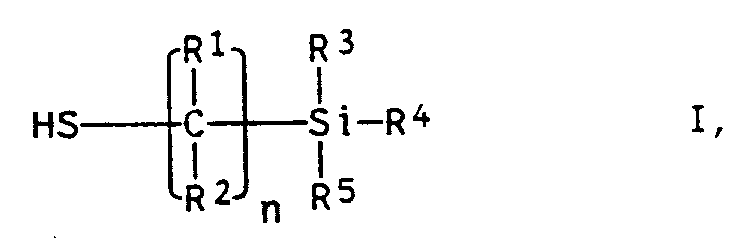
- n
- 1 bis 8
- R¹, R²
- unabhängig voneinander Wasserstoff oder C₁- bis C₄-Alkylgruppen
- R³,R⁴,R⁵
- unabhängig voneinander C₁- bis C₆-Alkylgruppen oder C₁- bis C₆-Alkoxygruppen, mit der Maßgabe, daß mindestens einer der Reste R³ bis R⁵ eine Alkoxygruppe ist
- f) 0 bis 10 Gew.% eines oder mehrerer sonstiger copolymerisierbarer Monomeren (Monomere VI),
- A2:
- a) 60 bis 100 Gew.% wenigstens eines Monomeren II,
- b) 0 bis 10 Gew.% eines oder mehrerer Monomeren III,
- c) 0 bis 30 Gew.% eines oder mehrerer Monomeren IV und VI und
- d) 0 bis 5 Gew.% einer oder mehrerer Verbindungen V,
- A1:
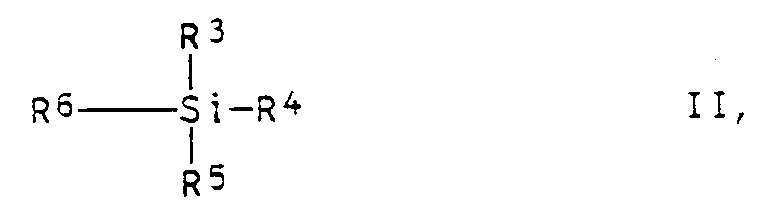
- B) bezogen auf das Kunstharz A, 0,05 bis 5 Gew.% wenigstens eines Silans der allgemeinen Formel II
- C) wirksamen Mengen mindestens einer Verbindung ausgewählt aus der Gruppe gebildet aus Ammoniak und organischem Amin, d.h. einer solchen Menge, daß der pH-Wert der erfindungsgemäßen Dispersion 6 bis 10 beträgt,
- D) 0 bis 5 Gew.% des organischen Lösungsmittels, in dem die Lösungspolymerisation durchgeführt wurde, und
- E) Wasser als Rest.
- Weiterhin betrifft die Erfindung die Herstellung dieser Kunstharzdispersionen und die Verwendung ihrer Verfilmungen als Haftklebstoffe für selbstklebende Artikel.
- Wäßrige Kunstharzdispersionen, deren Verfilmungen als Haftklebstoffe geeignet sind, werden gewöhnlich nach dem Verfahren der radikalischen Emulsionspolymerisation unter Verwendung hydrophiler Hilfsstoffsysteme (Emulgatoren und/oder Schutzkolloide), die u.a. eine ausreichende Lagerstabilität der Dispersion gewährleisten, hergestellt (vgl. US-A-4 077 932). Diese hydrophilen Hilfsstoffe verbleiben jedoch beim Verfilmen der Dispersionen im entstehenden Klebstoffilm und beeinträchtigen dessen Wasserbeständigkeit. Unter anderem laufen die Klebstoffilme bei Kontakt mit Wasser weiß an, was besonders bei der Anwendung selbstklebender transparenter Folien von Nachteil ist.
- Aus der DE-A 37 20 860 sind lagerstabile wäßrige Polymerdispersionen bekannt, die durch nachträgliche Dispergierung eines Gemisches zweier Copolymerisate, unter Zusatz von Ammoniak und Polyhydraziden, in Wasser erhältlich sind, wobei wenigstens eines der beiden Copolymerisate eine Carbonylverbindung einpolymerisiert enthält. Die Verfilmungen dieser Dispersionen werden als Haftklebstoffe mit erhöhter Wasserbeständigkeit empfohlen. Nachteilig an diesen Haftklebstoffen ist jedoch, daß sie Polyhydrazide enthalten, die häufig in unerwünschter Weise bei Einwirkung von Wasser Hydrazin freisetzen.
- Aufgabe der vorliegenden Erfindung war daher die Bereitstellung lagerstabiler wäßriger Kunstharzdispersionen, deren Verfilmungen den genannten Nachteil nicht aufweisen und insbesondere als Haftklebstoffe mit erhöhter Wasserbeständigkeit geeignet sind. Demgemäß wurden die eingangs definierten Kunstharzdispersionen gefunden.
- Besonders geeignete Monomere I sind die Monocarbonsäuren Acryl- und Methacrylsäure, die Dicarbonsäuren Malein- und Itaconsäure, die Anhydride dieser Dicarbonsäuren sowie ihre Halbester mit den Alkoholen Ethanol, Isopropanol, n-Butanol und Glycolmono-n-butylether, unter denen die Acryl- und Methacrylsäure bevorzugt sind. In vorteilhafter Weise beträgt der Gewichtsanteil der Monomeren I am Gemisch A1 5 bis 12 Ge.%. Die Halbester der Dicarbonsäuren können auch in indirekter Weise in die Kunstharze A eingeführt werden, indem zugehörige Anhydride enthaltende Kunstharze A in organischer Lösung bei erhöhter Temperatur, 50 bis 100°C, mit den entsprechenden Alkoholen umgesetzt werden. Als Monomere II kommen vor allem Methylacrylat, Methylmethacrylat, Ethylacrylat, Isopropylacrylat, n-Butylacrylat, n-Butylmethacrylat, Isobutylacrylat, Isobutylmethacrylat, tert.-Butylacrylat, 2-Ethylhexylacrylat sowie 2-Ethylhexylmethacrylat in Betracht, wobei n-Butylacrylat und Methylmethacrylat bevorzugt werden. Der Gewichtsanteil der Monomeren II an A1 beträgt bevorzugt 80 bis 95 Gew.%. Als Baustein III wird vorzugsweise n-Dodecylacrylat eingesetzt. Aus der Reihe der vinylaromatischen Monomeren (Monomere IV) sind Styrol, α-Methylstyrol, Vinyltoluole, tert.-Butylstyrole sowie Halogenstyrole wie die Chlorstyrole zu nennen. Die Monomeren IV sind in A1 bevorzugt mit einem Gewichtsanteil von 5 bis 15 Gew.% enthalten, wobei vorzugsweise Styrol eingesetzt wird.
- Als Verbindungen V enthält A1 in vorteilhafter Weise Mercaptosilane I mit n = 2 bis 4 einpolymerisiert. Bevorzugte Reste R¹, R² sind Wasserstoff und Methyl, während als Reste R³ bis R⁵ mit Vorteil Methyl, Ethyl, Methoxy und Ethoxy in Betracht kommen, wobei mindestens einer der Reste R³ bis R⁵ Methoxy oder Ethoxy sein muß. Besonders bevorzugt einpolymerisierte Mercaptosilane I sind 3-Mercaptopropyl-trimethoxysilan, 3-Mercaptopropyl-triethoxysilan sowie 3-Mercaptopropyl-methyl-dimethoxysilan. Die Mercaptosilane I sind bekannt und im Handel erhältlich. Die in A1 bevorzugte Einsatzmenge der Verbindungen V beträgt 0,2 bis 2 Gew.%.
- Als Monomere VI kommen u.a. Vinylether niederer Alkanole, Vinylester niederer Alkancarbonsäuren, Diester der Malein-, Fumar-, Itacon-, Citracon- oder Mesaconsäure mit 1 bis 20 C-Atome enthaltenden einwertigen Alkoholen, die gegebenenfalls Ether- und/oder Thioethergruppen enthalten, Monoester der Acryl- oder Methacrylsäure mit einfachen Alkandiolen wie 1,2-Ethandiol, 1,3-Propandiol oder 1,4-Butandiol, Acryl- und Methacrylamid, Acryl- und Methacrylnitril, Monoolefine mit 3 bis 20 C-Atomen wie Propen, 1-Buten, 2-Buten, Isobuten, Pentene, Hexene sowie Diolefine wie Butadien und Isopren in Betracht. Vorzugsweise sind in A1 jedoch keine Monomeren (VI) enthalten.
- Das Gemisch A2 enthält in vorteilhafter Weise 75 bis 98 Gew.% der Monomeren II, während der Gewichtsanteil der Monomeren IV und VI an A2 vorzugsweise 2 bis 25 Gew.% beträgt und die Verbindungen V in vorteilhafter Weise mit einem Gewichtsteil von 0,2 bis 2 Gew.% in A2 enthalten sind. Die Glastemperaturen der Homopolymerisate der Monomeren II sind beispielsweise in J. Brandrup, E.H. Immergut, Polymer Handbook 1st Ed. J. Wiley, New York 1966 und 2nd Ed. J. Wiley, New York, 1975 aufgeführt. Bevorzugt werden Kunstharze A, zu deren Herstellung 25 bis 45 Gew.-Teile A1 und 55 bis 75 Gew.-Teile A2 verwendet werden.
- Bevorzugte Silane II sind 3-Glycidyloxypropyl-trimethoxysilan, 2-(3,4-Epoxycyclohexyl)ethyltrimethoxysilan, 2-(3,4-Epoxy-4-methylcyclohexyl)proplmethyldiethoxysilan, 3-Glycidyloxypropyldimethylethoxysilan sowie 3-Glycidyloxypropylmethyldiethoxysilan. Bezogen auf die Menge des eingesetzten Kunstharzes A, enthalten die erfindungsgemäßen Dispersionen vorzugsweise 0,1 bis 2 Gew.% der Silane II.
- Zur Herstellung von Kunstharzen A können die Gemische A1 und A2 in Lösung räumlich getrennt polymerisiert und anschließend miteinander gemischt oder räumlich vereint, jedoch nacheinander polymerisiert werden. Bevorzugt sind Kunstharze A, die durch aufeinanderfolgende, jedoch räumlich vereint ausgeführte Lösungspolymerisation der Gemische A1 und A2 erhältlich sind, wobei die Zugabe des zweiten Gemisches erfolgt, wenn das zuerst eingesetzte Gemisch bis zu einem Umsatz von 95, vorzugsweise 99 % auspolymerisiert ist. Dabei ist es ohne Bedeutung ob zuerst A1 und dann A2 polymerisiert wird, oder ob man umgekehrt vorgeht. Im übrigen wird das Verfahren der radikalischen Lösungspolymerisation zur Herstellung der Kunstharze A in an sich bekannter Weise durchgeführt. Bevorzugt sind Kunstharze A, die in Aceton einen K-Wert von 20 bis 50, vorzugsweise von 30 bis 40 aufweisen. Der K-Wert ist eine relative Viskositätszahl, die in Analogie zur DIN 53 726 bei 25°C bestimmt wird. Gemessen wird hierbei die Fließgeschwindigkeit einer 3 gew.%igen Lösung des Kunstharzes A in Aceton, relativ zur Fließgeschwindigkeit von reinem Aceton. Er charakterisiert den mittleren Polymerisationsgrad des Polymerisates, der sich durch Steuerung der Polymerisationsbedingungen in bekannter Weise beeinflussen läßt. Zweckmäßigerweise erfolgt die Lösungspolymerisation in Gegenwart von 0,3 bis 5,0, vorzugsweise 0,5 bis 3,0 Gew.%, bezogen auf die Summe der Monomeren und der Verbindung V, radikalbildenden Initiatoren wie Azobiscarbonsäureamiden, Azobiscarbonsäurenitrilen oder Peroxiden wie tert.-Butyl-peroctoat. Die Polymerisationstemperatur beträgt in der Regel 50 bis 150, vorzugsweise 80 bis 130°C. Gegebenenfalls wird in Gegenwart von Reglern wie Mercaptoethanol, tert.-Dodecylmercaptan oder Diisopropylxanthogendisulfid polymerisiert, die üblicherweise in Mengen von 0 bis 3 Gew.%, bezogen auf die Summe der Monomeren und der Verbindung V, vorhanden sein können.
- Bezogen auf die Gesamtmenge an Monomeren und der Verbindung V beträgt die eingesetzte Menge Lösungsmittel üblicherweise 20 bis 35 Gew.%. Vorzugsweise werden Lösungsmittel verwendet, die sich aufgrund ihres Siedepunktes und/oder Azeotropbildung mit Wasser leicht aus den erfindungsgemäßen Dispersionen abdestillieren lassen. Besonders bevorzugt sind n-Butanol, iso-Butanol, Propanole, Ethanol und Toluol.
- Zur Herstellung der erfindungsgemäßen Kunstharzdispersionen werden üblicherweise die erhaltenen organischen Lösungen der Kunstharze A zweckmäßigerweise durch Einrühren einer konzentrierten, bevorzugt 25 gew.%igen wäßrigen Ammoniak-Lösung und anschließendes Einrühren von reinem Wasser, bei erhöhter Temperatur (60 bis 80, vorzugsweise 70°C) in eine Dispersion überführt und aus diesen Dispersionen das organische Lösungsmittel, z.B. destillativ, bis zu einem Gehalt von 5 Gew.% und darunter entfernt, wobei die dabei mitentfernte Menge an Wasser gegebenenfalls wieder zurückgeführt wird.
- In einer alternativen Herstellungsweise wird entsprechend verfahren, die Entfernung des organischen Lösungsmittels jedoch bereits vor der Ammoniakzugabe durchgeführt.
- Die zugegebene Menge an Ammoniak wird so bemessen, daß der pH-Wert der erfindungsgemäßen Dispersionen 6 bis 10, vorzugsweise 7 bis 9 beträgt. Ein Teil des neutralisierenden Ammoniaks, 0 bis 25 Mol.%, kann durch organische Amine, insbesondere Triethylamin, ersetzt werden. Vorzugsweise wird jedoch nur Ammoniak verwendet. Die Silane II werden bevorzugt nach Ammoniakzugabe und Entfernung des überschüssigen organischen Lösungsmittels zugerührt. Der Feststoffgehalt der erfindungsgemäßen Dispersionen wird durch Entfernen oder Zugeben von Wasser anwendungstechnisch vorteilhaft so gewählt, daß sich eine für die Verarbeitung günstige Viskosität ergibt. Er beträgt 35 bis 60, vorzugsweise 40 bis 55 Gew.%. Zusätzlich kann die Viskosität durch Zugabe von Verdickern modifiziert werden. Weitere mögliche Zusätze sind Harze oder Weichmacher, um die klebetechnischen Eigenschaften zu variieren. Die erfindungsgemäßen Kunstharzdispersionen sind im allgemeinen lagerstabil, d.h. sie zeigen bei längerer Lagerung in der Regel keine Zweiphasenbildung und kein verändertes Viskositäts-, Verfilmungs- oder Klebeverhalten. Ihre Verfilmungen weisen ein günstiges kohäsives und adhäsives Verhalten auf und eignen sich als Haftklebstoffe mit erhöhter Wasserbeständigkeit für selbstklebene Artikel, z.B. zur Herstellung von Klebebändern und Klebefolien, insbesondere von Schutzfolien und Dekorfolien. Als Trägermaterialien kommen u.a. Papier, Kunststoffolien oder Textilien in Betracht. Die Beschichtung der Trägermaterialien kann mit den an sich üblichen Auftragsaggregaten, z.B. mit Hilfe eines Walzenrakels, vorgenommen werden. Die Verfilmung der aufgetragenen dispersen Schicht wird im allgemeinen durch Erhitzen vorgenommen.
- Allgemeine Arbeitsvorschrift: Eine Lösung von 60 g eines Gemisches A1 in 60 g iso-Butanol wurden auf die Polymerisationstemperatur von 105°C erhitzt und auf einmal mit 8 g einer Lösung L von tert.-Butylperoctoat in iso-Butanol versetzt. Anschließend wurden unter Aufrecht-erhaltung der Polymerisationstemperatur innerhalb von 1,5 h weitere 25 g der Lösung L sowie die Restmenge an A1 über getrennte Zuläufe kontinuierlich zugeführt und nach beendeter Zufuhr 1 h nachpolymerisiert. Danach wurde das Reaktionsgemisch bei konstanter Polymerisationstemperatur über getrennte Zuläufe innerhalb von 3 h mit weiteren 80 g der Lösung L und eines Gemischs A2 versetzt. Im Anschluß daran wurde die Restmenge der Lösung L innerhalb von 2 h kontinuierlich zugegeben und 1,5 h nachpolymerisiert. In die erhaltene iso-butanolische Polymerlösung wurden bei 70°C 23,6 g einer 25 gew.%igen wäßrigen Ammoniaklösung und 1000 g Wasser eingerührt. Anschließend wurde das verwendete Lösungsmittel bis zu einem Gehalt von weniger als 1 Gew.% durch Vakuumdestillation abgetrennt, wobei die dabei mitentfernte Wassermenge wieder zugeführt wurde. Danach wurde zur Fertigstellung der erfindungsgemäßen Dispersion als Silan II 3-Glycidyloxopropyl-trimethoxysilan eingerührt. Die so erhaltenen Dispersionen weisen die in Tabelle 1 angegebenen Eigenschaften auf. Des weiteren enthält Tabelle 1 die quantitativen Angaben bezüglich der zu ihrer Herstellung eingesetzten Ausgangsstoffe.


-
- a) Herstellung von Prüfstreifen
Zur Herstellung von Prüfstreifen wurden die Dispersionen mit einer Trockenschichtdicke von 25 g/m² auf eine Polyesterfolie als Träger aufgetragen und 3 min bei 90°C im Trockenschrank getrocknet. Aus der so erhaltenen selbstklebenden Folie wurden Streifen von 2 cm Breite und 5 cm Länge ausgeschnitten. - b) Prüfung der Kohäsion (Scherfestigkeit)
Zur Prüfung der inneren Festigkeit des Klebstoffilms einer erfindungsgemäßen Dispersion wurden die Prüfstreifen (a) auf einer Länge von 2,5 cm, unter Anwendung eines Gewichtes der Masse 2,5 kg, auf ein chromiertes Stahlblech (V2A) aufgerollt und 24 h unter Normal-bedingungen gelagert. Anschließend wurde das nicht behaftete Ende des Stahlblechs zwischen 2 Klemmbacken befestigt und das gegenüberliegende überstehende Klebeband frei hängend bei Temperaturen von 25 und 50°C mit einem Gewicht der Masse 1 kg belastet. Maßstab für die innere Festigkeit des Klebstoffilms ist die Zeitdauer bis zum Aufbrechen des Klebstoffilms. - c) Anfangshaftung (Sofort-Schälfestigkeit oder Anfangs-Adhäsion)
Zur Bestimmung der Anfangshaftung der Prüfstreifen (a) auf der Oberfläche eines Substrates, wurden diese auf einer Länge von 2,5 cm, unter Anwendung eines Gewichtes der Masse 2,5 kg, auf ein chromiertes Stahlblech (V2A) aufgerollt. Unmittelbar danach wurde die Kraft bestimmt um die Prüfstreifen in einer Zugdehnungsprüfapparatur bei einem Abschälwinkel von 180°C mit einer Geschwindigkeit von 300 mm/min rückwärts abzuziehen, ohne den Klebstoffilm aufzubrechen. - d) Wasserbeständigkeit
Zur Bestimmung der Wasserbeständigkeit wurden die erfindungsgemäßen Dispersionen mit einer Trockenschichtdicke von 20 µm auf eine transparente Polyesterfolie aufgetragen und 3 min bei 90°C im Trockenschrank getrocknet. Anschließend wurde die Folie in einen Rahmen eingespannt und zur Bestimmung der Lichtdurchlässigkeit bei einer Temperatur von 20°C in die wassergefüllte Küvette eines Photometers eingetaucht. Unmittelbar nach dem Eintauchen wurde auf eine Lichtdurchlässigkeit von 100 % geeicht und dann die Abnahme der Lichtdurchlässigkeit als Funktion der Zeit registriert. Die Verfilmungen der erfindungsgemäßen Dispersionen zeigten nach 30 min eine Abnahme von 2 bis 10 %, während die Verfilmungen hydrophile Hilfsstoffsysteme enthaltender Dispersionen im gleichen Zeitraum eine Abnahme von mindestens 25 % aufweisen. - Die Prüfwerte der Untersuchungen b) bis d) zeigt Tabelle 2.
Tabelle 2 Dispersion aus Beispiel 1 2 3 4 5 Kohäsion (Stunden), 25°C 19,5 74 64,5 > 120 3,13 Kohäsion (Stunden), 50°C 1,9 6,0 4,9 10,0 0,4 Sofort-Schälfestigfkeit (N) 8,0 6,2 5,7 3,8 1,7 Lichtdurchlässigkeit nach 30 min (%) 96 97 98 91 95
Claims (3)
- Wäßrige Kunstharzdispersionen, bestehend ausA) 35 bis 60 Gew.% Kunstharz, erhältlich durch räumlich getrennt ausgeführte und/oder durch nacheinander, jedoch räumlich vereint ausgeführte radikalische Lösungspolymerisation in einem organischen Lösungsmittel von 15 bis 70 Gew.-Teilen eines Gemisches A1 und 30 bis 85 Gew.-Teilen eines Gemisches A2, zusammengesetzt ausA1:a) 1,5 bis 15 Gew.% wenigstens eines Monomeren aus der Gruppe gebildet aus 3 bis 5 C-Atome enthaltenden α,β-monoethylenisch ungesättigten Monocarbonsäuren, solchen Dicarbonsäuren, Anhydriden und Halbestern dieser Dicarbonsäuren mit 1 bis 8 C-Atome tragenden Alkanolen oder mit Glycolmonoethern (Monomere I)b) 65 bis 98,5 Gew.% wenigstens eines Monomeren aus der Gruppe gebildet aus Acryl- und Methacrylsäureestern von C₁- bis C₁₀-Alkanolen (Monomere II),c) 0 bis 10 Gew.% eines oder mehrerer Monomerer aus der Gruppe gebildet aus Acryl- und Methacrylsäureestern von C₁₁- bis C₂₀-Alkanolen (Monomere III),d) 0 bis 20 Gew.% eines oder mehrerer vinylaromatischer Monomeren (Monomere IV),e) 0 bis 5 Gew.% eines oder mehrerer Mercaptosilane der allgemeinen Formel I (Verbindung V)
 n 1 bis 8R¹, R² unabhängig voneinander Wasserstoff oder C₁- bis C₄-AlkylgruppenR³,R⁴,R⁵ unabhängig voneinander C₁- bis C₆-Alkylgruppen oder C₁- bis C₆-Alkoxygruppen, mit der Maßgabe, daß mindestens einer der Reste R³ bis R⁵ eine Alkoxygruppe istundf) 0 bis 10 Gew.% eines oder mehrerer sonstiger copolymerisierbarer Monomeren (Monomere VI),A2:mit der Maßgabe, daß die Summe aus A1 und A2 zu mehr als 65 % ihres Gewichtes solche Monomere II, deren Homopolymerisate eine Glastemperatur von 0 bis -70°C aufweisen, sowie eine von 0 verschiedene Menge an Verbindungen V enthält,a) 60 bis 100 Gew.% wenigstens eines Monomeren II,b) 0 bis 10 Gew.% eines oder mehrerer Monomeren III,c) 0 bis 30 Gew.% eines oder mehrerer Monomeren IV und VI undd) 0 bis 5 Gew.% einer oder mehrerer Verbindungen V,B) bezogen auf das Kunstharz A, 0,05 bis 5 Gew.% wenigstens eines Silans der allgemeinen Formel II
 C) solchen Mengen mindestens einer Verbindung ausgewählt aus der Gruppe gebildet aus Ammoniak und organischem Amin, daß der pH-Wert der Dispersion 6 bis 10 beträgt,D) 0 bis 5 Gew.% des organischen Lösungsmittels, in dem die Lösungspolymerisation durchgeführt wurde, undE) Wasser als Rest.
 - Verfahren zur Herstellung von wäßrigen Kunstharzdispersionen gemäß Anspruch 1, dadurch gekennzeichnet, daß man in die organische Lösung oder Schmelze eines Kunstharzes A, erhältlich durch räumlich getrennt ausgeführte und/oder durch nacheinander, jedoch räumlich vereint ausgeführte radikalische Lösungspolymerisation von 15 bis 70 Gew.-Teilen eines Gemisches A1 und 30 bis 85 Gew.-Teilen eines Gemisches A2, wirksame Mengen an Ammoniak und/oder eines organischen Amins, Wasser sowie, bezogen auf das Kunstharz A, 0,05 bis 5 Gew.% wenigstens eines Silans II einrührt und gegebenenfalls das organische Lösungsmittel bis auf einen Gehalt von 5 Gew.-% und darunter entfernt.
- Verwendung der Verfilmungen der Kunstharzdispersionen gemäß Anspruch 1 als Haftklebstoffe für selbstklebende Artikel.
Applications Claiming Priority (3)
| Application Number | Priority Date | Filing Date | Title |
|---|---|---|---|
| DE3911945 | 1989-04-12 | ||
| DE3911945A DE3911945A1 (de) | 1989-04-12 | 1989-04-12 | Waessrige kunstharzdispersionen |
| PCT/EP1990/000552 WO1990012065A1 (de) | 1989-04-12 | 1990-04-07 | Wässrige kunstharzdispersionen |
Publications (2)
| Publication Number | Publication Date |
|---|---|
| EP0467906A1 EP0467906A1 (de) | 1992-01-29 |
| EP0467906B1 true EP0467906B1 (de) | 1994-08-10 |
Family
ID=6378478
Family Applications (1)
| Application Number | Title | Priority Date | Filing Date |
|---|---|---|---|
| EP90905469A Expired - Lifetime EP0467906B1 (de) | 1989-04-12 | 1990-04-07 | Wässrige kunstharzdispersionen |
Country Status (4)
| Country | Link |
|---|---|
| US (1) | US5244950A (de) |
| EP (1) | EP0467906B1 (de) |
| DE (2) | DE3911945A1 (de) |
| WO (1) | WO1990012065A1 (de) |
Families Citing this family (8)
| Publication number | Priority date | Publication date | Assignee | Title |
|---|---|---|---|---|
| DE4233077A1 (de) * | 1992-10-01 | 1994-04-07 | Wacker Chemie Gmbh | Dichtungsmassen auf der Grundlage von Polymerisaten ethylenisch ungesättigter Monomeren |
| JP3386906B2 (ja) * | 1994-01-18 | 2003-03-17 | 大日本印刷株式会社 | コーティング用組成物、その製造方法、塗膜形成方法および塗膜 |
| DK0924250T3 (da) * | 1997-12-15 | 2006-12-27 | Gen Electric | Latexforseglingsmidler indeholdende epoxysilaner |
| US6414077B1 (en) * | 1999-07-29 | 2002-07-02 | Schnee-Morehead, Inc. | Moisture curable acrylic sealants |
| US7816003B1 (en) | 2001-12-19 | 2010-10-19 | Arrowhead Coating and Converting, Inc. | Adhesive film composition |
| DE602007012700D1 (de) * | 2006-06-02 | 2011-04-07 | Valspar Sourcing Inc | Wässrige hochleistungsbeschichtungszusammensetzungen |
| JP5221916B2 (ja) * | 2007-09-05 | 2013-06-26 | 株式会社貝印刃物開発センター | 手術用刃物 |
| EP2636714A1 (de) | 2012-03-09 | 2013-09-11 | Basf Se | Mehrstufige herstellung wässriger haftklebstoffdispersionen für die herstellung von selbstkle-benden artikeln |
Family Cites Families (8)
| Publication number | Priority date | Publication date | Assignee | Title |
|---|---|---|---|---|
| US4077932A (en) * | 1974-03-21 | 1978-03-07 | Borden, Inc. | Acrylate adhesive aqueous dispersions |
| US4057527A (en) * | 1974-06-17 | 1977-11-08 | Borden, Inc. | Aqueous acrylate contact adhesive dispersions |
| JPS5294346A (en) * | 1976-02-05 | 1977-08-08 | Toray Silicone Co Ltd | Compositions for resin treatments |
| JPS57195172A (en) * | 1981-05-25 | 1982-11-30 | Nitto Electric Ind Co Ltd | Pressure-sensitive adhesive composition |
| JPS617369A (ja) * | 1984-06-22 | 1986-01-14 | Toyo Ink Mfg Co Ltd | 粘着剤組成物 |
| NL8502463A (nl) * | 1985-09-10 | 1987-04-01 | Dsm Resins Bv | Samenstelling op basis van een waterige dispersie van een additiepolymeer. |
| JPH0784581B2 (ja) * | 1987-09-17 | 1995-09-13 | 東洋インキ製造株式会社 | 再剥離性感圧接着剤組成物 |
| US4961967A (en) * | 1988-08-08 | 1990-10-09 | Dow Corning Corporation | Primer compositions |
-
1989
- 1989-04-12 DE DE3911945A patent/DE3911945A1/de not_active Withdrawn
-
1990
- 1990-04-07 WO PCT/EP1990/000552 patent/WO1990012065A1/de not_active Ceased
- 1990-04-07 US US07/768,764 patent/US5244950A/en not_active Expired - Fee Related
- 1990-04-07 DE DE59006784T patent/DE59006784D1/de not_active Expired - Lifetime
- 1990-04-07 EP EP90905469A patent/EP0467906B1/de not_active Expired - Lifetime
Also Published As
| Publication number | Publication date |
|---|---|
| US5244950A (en) | 1993-09-14 |
| EP0467906A1 (de) | 1992-01-29 |
| DE59006784D1 (de) | 1994-09-15 |
| WO1990012065A1 (de) | 1990-10-18 |
| DE3911945A1 (de) | 1990-10-25 |
Similar Documents
| Publication | Publication Date | Title |
|---|---|---|
| EP0296491B1 (de) | Lagerstabile wässrige Polymerdispersionen | |
| DE3843421C2 (de) | Druckempfindliche Klebstoffzusammensetzung und deren Verwendung | |
| DE69313623T2 (de) | Druckempfindliche emulsionsklebstoffpolymere welche eine hervorragende papierschneidemaschineneignung aufweisen | |
| DE2360441C2 (de) | ||
| DE3444186C2 (de) | ||
| DE2649544B2 (de) | Druckempfindlicher Klebstoff auf Basis eines Acrylsäurealkylester-Copolymerisats und eines Metalloxidchelats | |
| DE2912513C2 (de) | Druckempfindliche Klebemasse sowie ein Verfahren zum Verbinden von Substraten | |
| EP0516074B1 (de) | Aminooxy-Vernetzer enthaltende wässrige Dispersionen von Carbonylgruppen enthaltenden Copolymerisaten | |
| EP0574803A2 (de) | Verwendung von wässrigen Dispersionen als Heisssiegelkleber | |
| DE2833842A1 (de) | Verbesserte klebstoffzubereitung auf basis von 2-cyanacrylaten und verfahren zur verbesserung der klebstoffeigenschaften derartiger zubereitungen | |
| EP0118726B1 (de) | Haftkleber auf Basis von wässrigen Polyacrylat-Dispersionen für abziehbare Papieretiketten | |
| EP0515719B1 (de) | Selbstklebende Acrylat-Copolymere, Verfahren zu deren Herstellung, und selbstklebende Flächengebilde, die diese enthalten | |
| EP0467906B1 (de) | Wässrige kunstharzdispersionen | |
| EP0352442B1 (de) | Wasserlöslicher Haftkleber auf Polyvinylcarbonsäurebasis seine Herstellung und seine Verwendung | |
| DE3720859A1 (de) | Lagerstabile waessrige polymerdispersionen | |
| EP0303207B1 (de) | Wässrige Beschichtungsstoffe auf Basis von Sekundärdispersionen Carboxylgruppen enthaltender Copolymerisate von Acrylsäure- oder Methacrylsäure-estern | |
| EP1225209B1 (de) | Verwendung von Phosphatgruppen enthaltenden Polymerdispersionen als Klebstoff | |
| EP0900651B1 (de) | Verwendung wässriger Polyacrylatdispersionen als Kaschierklebstoffe | |
| EP0088300A1 (de) | Verfahren zur Herstellung selbsthaftender Überzüge | |
| DE863413C (de) | Verfahren zur Herstellung von Mischpolymerisaten | |
| EP0118009A2 (de) | Verwendung einer wässrigen Poly(meth)acrylat-Sekundärdispersion als verdickendes Bindemittel für Buntsteinputz | |
| EP0130336B1 (de) | Wässrige Druckfarben für den Flexodruck und Tiefdruck | |
| EP0798357A1 (de) | Verwendung von wässrigen Dispersionen als Heisssiegellack | |
| EP0644213A1 (de) | Haftklebedispersionen | |
| EP0105134B1 (de) | Haftkleber auf Basis ethylenisch ungesättigter Verbindungen |
Legal Events
| Date | Code | Title | Description |
|---|---|---|---|
| PUAI | Public reference made under article 153(3) epc to a published international application that has entered the european phase |
Free format text: ORIGINAL CODE: 0009012 |
|
| 17P | Request for examination filed |
Effective date: 19910817 |
|
| AK | Designated contracting states |
Kind code of ref document: A1 Designated state(s): BE DE FR GB IT NL |
|
| 17Q | First examination report despatched |
Effective date: 19940104 |
|
| GRAA | (expected) grant |
Free format text: ORIGINAL CODE: 0009210 |
|
| AK | Designated contracting states |
Kind code of ref document: B1 Designated state(s): BE DE FR GB IT NL |
|
| REF | Corresponds to: |
Ref document number: 59006784 Country of ref document: DE Date of ref document: 19940915 |
|
| GBT | Gb: translation of ep patent filed (gb section 77(6)(a)/1977) |
Effective date: 19940819 |
|
| ITF | It: translation for a ep patent filed | ||
| ET | Fr: translation filed | ||
| PGFP | Annual fee paid to national office [announced via postgrant information from national office to epo] |
Ref country code: FR Payment date: 19950327 Year of fee payment: 6 |
|
| PGFP | Annual fee paid to national office [announced via postgrant information from national office to epo] |
Ref country code: GB Payment date: 19950403 Year of fee payment: 6 |
|
| PGFP | Annual fee paid to national office [announced via postgrant information from national office to epo] |
Ref country code: DE Payment date: 19950427 Year of fee payment: 6 |
|
| PGFP | Annual fee paid to national office [announced via postgrant information from national office to epo] |
Ref country code: NL Payment date: 19950430 Year of fee payment: 6 |
|
| PGFP | Annual fee paid to national office [announced via postgrant information from national office to epo] |
Ref country code: BE Payment date: 19950508 Year of fee payment: 6 |
|
| PLBE | No opposition filed within time limit |
Free format text: ORIGINAL CODE: 0009261 |
|
| STAA | Information on the status of an ep patent application or granted ep patent |
Free format text: STATUS: NO OPPOSITION FILED WITHIN TIME LIMIT |
|
| 26N | No opposition filed | ||
| PG25 | Lapsed in a contracting state [announced via postgrant information from national office to epo] |
Ref country code: GB Effective date: 19960407 |
|
| PG25 | Lapsed in a contracting state [announced via postgrant information from national office to epo] |
Ref country code: DE Effective date: 19960424 |
|
| PG25 | Lapsed in a contracting state [announced via postgrant information from national office to epo] |
Ref country code: BE Effective date: 19960430 |
|
| BERE | Be: lapsed |
Owner name: BASF A.G. Effective date: 19960430 |
|
| PG25 | Lapsed in a contracting state [announced via postgrant information from national office to epo] |
Ref country code: NL Effective date: 19961101 |
|
| GBPC | Gb: european patent ceased through non-payment of renewal fee |
Effective date: 19960407 |
|
| PG25 | Lapsed in a contracting state [announced via postgrant information from national office to epo] |
Ref country code: FR Effective date: 19961227 |
|
| NLV4 | Nl: lapsed or anulled due to non-payment of the annual fee |
Effective date: 19961101 |
|
| REG | Reference to a national code |
Ref country code: FR Ref legal event code: ST |
|
| PG25 | Lapsed in a contracting state [announced via postgrant information from national office to epo] |
Ref country code: IT Free format text: LAPSE BECAUSE OF NON-PAYMENT OF DUE FEES;WARNING: LAPSES OF ITALIAN PATENTS WITH EFFECTIVE DATE BEFORE 2007 MAY HAVE OCCURRED AT ANY TIME BEFORE 2007. THE CORRECT EFFECTIVE DATE MAY BE DIFFERENT FROM THE ONE RECORDED. Effective date: 20050407 |