EP0462500B2 - Carter pour un sas à roue cellulaire - Google Patents
Carter pour un sas à roue cellulaire Download PDFInfo
- Publication number
- EP0462500B2 EP0462500B2 EP91109642A EP91109642A EP0462500B2 EP 0462500 B2 EP0462500 B2 EP 0462500B2 EP 91109642 A EP91109642 A EP 91109642A EP 91109642 A EP91109642 A EP 91109642A EP 0462500 B2 EP0462500 B2 EP 0462500B2
- Authority
- EP
- European Patent Office
- Prior art keywords
- housing
- bush
- wear
- elastomer
- flange
- Prior art date
- Legal status (The legal status is an assumption and is not a legal conclusion. Google has not performed a legal analysis and makes no representation as to the accuracy of the status listed.)
- Expired - Lifetime
Links
- 239000000463 material Substances 0.000 claims abstract description 9
- 229920001971 elastomer Polymers 0.000 claims description 34
- 239000000806 elastomer Substances 0.000 claims description 34
- 238000007667 floating Methods 0.000 claims description 17
- 229910052751 metal Inorganic materials 0.000 claims description 14
- 239000002184 metal Substances 0.000 claims description 14
- 229920003023 plastic Polymers 0.000 claims description 11
- 239000004033 plastic Substances 0.000 claims description 11
- 229910000639 Spring steel Inorganic materials 0.000 claims description 2
- 230000002787 reinforcement Effects 0.000 claims description 2
- 238000007373 indentation Methods 0.000 claims 1
- 238000007493 shaping process Methods 0.000 claims 1
- 239000013536 elastomeric material Substances 0.000 abstract 1
- 230000001413 cellular effect Effects 0.000 description 26
- 239000013590 bulk material Substances 0.000 description 4
- 230000000694 effects Effects 0.000 description 3
- 238000004519 manufacturing process Methods 0.000 description 3
- 238000007789 sealing Methods 0.000 description 3
- 238000005299 abrasion Methods 0.000 description 2
- 238000009434 installation Methods 0.000 description 2
- 239000002245 particle Substances 0.000 description 2
- 229910000906 Bronze Inorganic materials 0.000 description 1
- 229910001060 Gray iron Inorganic materials 0.000 description 1
- 229910000831 Steel Inorganic materials 0.000 description 1
- 229910052782 aluminium Inorganic materials 0.000 description 1
- XAGFODPZIPBFFR-UHFFFAOYSA-N aluminium Chemical compound [Al] XAGFODPZIPBFFR-UHFFFAOYSA-N 0.000 description 1
- 230000015572 biosynthetic process Effects 0.000 description 1
- 239000010974 bronze Substances 0.000 description 1
- 239000000919 ceramic Substances 0.000 description 1
- VNNRSPGTAMTISX-UHFFFAOYSA-N chromium nickel Chemical compound [Cr].[Ni] VNNRSPGTAMTISX-UHFFFAOYSA-N 0.000 description 1
- 238000001816 cooling Methods 0.000 description 1
- KUNSUQLRTQLHQQ-UHFFFAOYSA-N copper tin Chemical compound [Cu].[Sn] KUNSUQLRTQLHQQ-UHFFFAOYSA-N 0.000 description 1
- 229910003460 diamond Inorganic materials 0.000 description 1
- 239000010432 diamond Substances 0.000 description 1
- 238000005516 engineering process Methods 0.000 description 1
- 238000010304 firing Methods 0.000 description 1
- 239000011810 insulating material Substances 0.000 description 1
- 238000009413 insulation Methods 0.000 description 1
- 238000003754 machining Methods 0.000 description 1
- 238000000034 method Methods 0.000 description 1
- 229910052759 nickel Inorganic materials 0.000 description 1
- PXHVJJICTQNCMI-UHFFFAOYSA-N nickel Substances [Ni] PXHVJJICTQNCMI-UHFFFAOYSA-N 0.000 description 1
- 239000003973 paint Substances 0.000 description 1
- 238000005096 rolling process Methods 0.000 description 1
- 239000010959 steel Substances 0.000 description 1
- 230000001360 synchronised effect Effects 0.000 description 1
- 238000003466 welding Methods 0.000 description 1
Images

Classifications
-
- B—PERFORMING OPERATIONS; TRANSPORTING
- B65—CONVEYING; PACKING; STORING; HANDLING THIN OR FILAMENTARY MATERIAL
- B65G—TRANSPORT OR STORAGE DEVICES, e.g. CONVEYORS FOR LOADING OR TIPPING, SHOP CONVEYOR SYSTEMS OR PNEUMATIC TUBE CONVEYORS
- B65G53/00—Conveying materials in bulk through troughs, pipes or tubes by floating the materials or by flow of gas, liquid or foam
- B65G53/34—Details
- B65G53/40—Feeding or discharging devices
- B65G53/46—Gates or sluices, e.g. rotary wheels
- B65G53/4608—Turnable elements, e.g. rotary wheels with pockets or passages for material
- B65G53/4625—Turnable elements, e.g. rotary wheels with pockets or passages for material with axis of turning perpendicular to flow
- B65G53/4633—Turnable elements, e.g. rotary wheels with pockets or passages for material with axis of turning perpendicular to flow the element having pockets, rotated from charging position to discharging position, i.e. discrete flow
Definitions
- the invention relates to a housing for a rotary valve with an inlet shaft, a bore for receiving the cellular wheel and an outlet shaft housing body and two end caps closing the bore on the front side, with an exchangeable cylindrical sleeve with openings in the height of the inlet and outlet shaft in the bore is used, which is designed as a wear sleeve and consists of several mutually symmetrical parts.
- a lock of this type is known from DE-A-3722913.
- the exchangeable bushes make it possible to use the same lock housing for a wide variety of purposes with regard to the type of bulk goods to be conveyed or metered.
- the bushing can be made of plastic if the bulk material in question must not come into contact with metal.
- bronze bushes are used if the formation of a friction spark between the cellular wheel webs and the housing wall must be avoided.
- cans made from very wear-resistant materials are of particular importance if the lock is to convey bulk material with an abrasive effect, because a rotary valve largely loses its functionality if the gap between the front edges of the cellular wheel webs and the wall of the bore of the lock housing is only reduced due to wear increases a few tenths of a millimeter, because depending on the pressure difference between the lock inlet and the lock outlet, a leakage air flow of high speed forms in the gap, which in turn increases the wear caused by the bulk material particles carried along.
- a disadvantage of the subject of DE-A-37 22 913 is, moreover, that a relatively large clearance between the cellular wheel and the housing bore must be used. Such a relatively large game is due to the design. The pressure difference between the inlet side and the outlet side on the cell wheel housing results in a deflection of the shaft of the cell speech, which must be absorbed by the game. For design reasons, a relatively large amount of play must therefore be provided in order to prevent the cellular wheel from running onto corresponding surfaces of the cellular wheel housing.
- the present invention has for its object to provide a lock housing of the type mentioned, in which the leakage currents are significantly minimized with better wear properties.
- the wear sleeve consists of essentially two lateral sleeve sleeves, both sleeve sleeves forming a rotationally symmetrical part and this rotationally symmetrical part in turn being integrally connected to a ring flange with a closed outer circumference, result in excellent dimensional stability of this part, so that this part is distorted is minimized during hardening or during installation.
- the wear resistance of the cellular wheel housing according to the invention is thus significantly improved compared to the prior art.
- wear bushings according to the invention which are joined in a form-fitting manner in their contact surface by means of corresponding connecting means, are floatingly mounted in the housing.
- the housing preferably consists of two symmetrical housing shells, with the parting line running on a horizontal plane. In this way, the wear bush with its two wear bush parts can be inserted very easily into the housing shell.
- the wear bushing is completely surrounded by an elastomeric plastic jacket.
- This plastic jacket must be so thick that sufficient movement of the wear bushing in the bore of the housing shells is ensured.
- a thickness of 3 - 8 mm will be chosen to compensate for a cell wheel deflection clearance of approximately 2 to 3/10 mm.
- a full cylinder jacket is not provided for the floating mounting of the wear bushing in the housing shell, but that this jacket is only present as a flange on some surfaces. The wear bushing on some support surfaces is then sufficient in a floating manner to store the housing shell.
- Such a "strip-shaped" mounting of the wear bushing in the housing shells of the housing is preferred when the process temperatures no longer allow a full insulating jacket. Instead, a high-temperature resistant, possibly metal-coated seal can be used. The only important thing with this seal is that it permits the previously required play of the wear bushing.
- This cavity acts as an insulating air sleeve.
- the shaft 4 is connected in a rotationally fixed manner to a cellular wheel 5, the cellular wheel 5 each having a side disk 6 on the end faces, which in turn is firmly connected axially outwardly to a support ring 7, which in turn is connected radially outward to a slide ring 8.
- the seal between the cellular wheel 5 and the associated housing shells 2, 22 takes place according to the invention by means of a wear bushing 12, which is firmly inserted in the housing shell 2 and there via axially front and rear O-rings 13, 14 in the area of a Housing groove is sealed.
- the wear bushing 12 is supported on the rotating shaft 4 in the region of the stub shaft 9 via bearings 10 and shaft sealing rings 11.
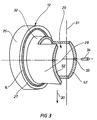
- the wear sleeve 12 consists of a cylindrical circumferential ring flange 25 which carries the O-ring 13 on its outer end face and the O-ring 14 on its inner end face.
- a lateral sleeve jacket 28 is connected to the ring flange 25, the sleeve jacket 28 consisting of a circular cylindrical part which has corresponding incisions to form an upper inlet 29 and a lower outlet 30.
- the parts 29, 30 are in alignment in the area of the inlet funnel 3 and the outlet funnel 51.
- the half wear bushing 12 shown in FIG. 3 is exactly symmetrical to the vertical center axis 31 of the lock.
- the two parts are butted against one another in the area of the plane surface 52 and connected to one another in a form-fitting manner.
- Such a positive connection is shown for example in Figure 3.
- 52 plug holes 33 are arranged in the plane surfaces, in each of which a connecting pin 34 engages.
- the connecting pin protrudes from the respective flat surface 52 and protrudes into the opposite plug hole 33 of the opposite, half-sided wear bushing 12, so that the two parts form a uniform, form-fittingly connected part.
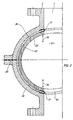
- FIG. 2 shows that this elastomer jacket 26 runs all around and is cut out only in the area of the inlet funnel 3 and the outlet funnel 51.
- the elastomer jacket has exactly the shape that the lateral sleeve jackets 28 of the wear bushing 12 have.
- the slide ring 8 which consists of a low-wear material, is interchangeably mounted on the support ring 7, in such a way that the slide ring 8 can be replaced without having to remove the cellular wheel 5.
- the surface of the slide ring 8 thus forms the counter-running surfaces, which define the leakage flow, in connection with the opposite inner wall of the wear bushing 12.
- the distance 18 between the surfaces mentioned can thus always be kept constant, regardless of whether the cellular wheel itself changes shape or not. If, for example, the cellular wheel 5 is adjusted in the direction of the arrow 24 according to FIG. 2, this adjustment movement is communicated to the wear bushing 12 via the bearing 10, 11 and the stub shaft 9.
- the cellular wheel 5 and the wear bushing 12 thus make exactly synchronous movements in the adjustment direction 24, as a result of which the adjustment movement of the wear bushing 12 is absorbed by the elastomeric floating jacket 26 located on the outside.
- the wear bushing 12 rests against the inside of the side cover 1.
- the housing consists of two halves divided in half, namely an upper housing shell 2 and a lower housing shell 22. This results in a parting line 20 in the horizontal plane.
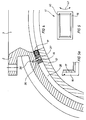
- FIG. 4 shows a further embodiment of the present invention, from which it follows that the elastomer sheath 26 is not fully present, but is replaced by an elastomer flange 16 according to the exemplary embodiment according to FIG.
- This elastomer flange 16 is therefore only in the area of the contact surface 32 of the wear bushing 12 according to FIG. 3.
- the metal jacket 17 in the form of, for example, a chromium-nickel material, which is suspended in the profile in the profile in the frame-shaped circumferential elastomer flange 16.
- the metal jacket 17 is joined at the corners via miter joints 40.
- the frame-shaped metal jacket 17 is fastened to the frame-shaped, circumferential elastomer flange 16 via metal clips.
- the frame part 41 As soon as the frame part 41 is produced, it must still be adapted to the spherical inner curvature of the housing shells 2, 22. This is done by rolling the entire frame part 41 in the direction of arrow 42.
- an intermediate space 35 is thus formed between the wear bushing 12 and the associated housing wall of the housing shells 2, 22.
- This space 35 can be filled with any insulating materials; it can also be filled with air or with a gas.
- This space 35 thus has a sound-insulating and temperature-insulating effect.
- the elastomer jacket 26 previously mentioned with reference to FIGS. 1 to 3 also has the same effect, albeit in lower temperature ranges.
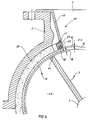
- a fully existing elastomer jacket 26 is shown as an example, which can just as well be replaced by the exemplary embodiment according to FIG. 4, namely by an elastomer flange 16.
- an insert part 45 is also present on the inlet side (and also in an analogous manner in the outlet duct), which essentially consists of an insert flange 46, e.g. consists of a chrome-nickel steel.
- This insert flange 46 thus completely covers the housing shells with respect to a sensitive or aggressive medium, so that it is possible to use relatively cheap materials for the housing shells 2, 23 e.g. To use cast aluminum or gray cast iron and still use highly wear-resistant, abrasion-resistant materials in the area of the entire flow path.
- the insert flange 46 abuts a flange 48 via a welding point 47.
- a groove is screwed into the flange 48, in which an O-ring 49 is inserted.
- the entire insert part 45 is thus supported on an extension 50 which is extended in the circumferential direction on the wear bushing 12, so that the insert part 45 is held in an excellent manner.
Landscapes
- Engineering & Computer Science (AREA)
- Mechanical Engineering (AREA)
- Sliding-Contact Bearings (AREA)
- Component Parts Of Construction Machinery (AREA)
- Sealing Devices (AREA)
- Rotary Pumps (AREA)
- Investigating Or Analysing Biological Materials (AREA)
- Electromechanical Clocks (AREA)
Claims (11)
- Carter destiné à un sas à roue cellulaire comportant une trémie d'alimentation, un alésage pour le logement de la roue cellulaire, un corps de carter comprenant une trémie d'évacuation et deux couvercles de palier obturant l'alésage sur les faces latérales, alésage dans lequel est insérée une douille cylindrique interchangeable conçue en tant que douille d'usure composée de plusieurs éléments symétriques les uns par rapport aux autres et comportant des découpes au niveau de la trémie d'alimentation et de la trémie d'évacuation, caractérisé en ce que la douille d'usure (12) est composée de deux éléments de construction d'une seule pièce, lesquels sont symétriques par rapport à un plan central vertical passant par l'axe central (31) du sas et comportent une surface circonférentielle extérieure fermée située hors des découpes, et en ce que la douille d'usure, au niveau de sa surface circonférentielle ainsi formée, est entourée au moins partiellement d'un corps en matière synthétique élastomère, réalisé sous la forme d'une collerette en élastomère (16) ou d'une gaine en élastomère (26) constituant un support élastique de la douille d'usure (12) par rapport à la coquille du carter (2).
- Carter selon la revendication 1, caractérisé en ce que le carter est composé de deux coquilles de carter (2, 22), le joint de séparation (20) se trouvant dans un plan horizontal.
- Carter selon la revendication 1, caractérisé en ce que la douille d'usure (12) est entourée sur toute sa circonférence par une gaine en matière synthétique élastomère (26) constituant une sorte de logement élastique, la forme de cette gaine en matière synthétique élastomère (26) correspondant à celle des enveloppes latérales (28) de la douille d'usure (12).
- Carter selon la revendication 1, caractérisé en ce que la douille d'usure (12) n'est logée élastiquement dans la coquille de carter (2, 22) que sur des surfaces d'appui partielles, le support élastomère aux surfaces d'appui étant réalisé sous forme de bride ou sous forme de bande par une collerette en élastomère (16) (figure 4).
- Carter selon la revendication 1, caractérisé en ce que la douille d'usure (12) est entourée d'une bride annulaire cylindrique (25) dont les surfaces latérales comportent des joints toriques (13, 14), et en ce qu'il est prévu une enveloppe de douille latérale (28) constituant une seule pièce avec la bride annulaire (25), cette enveloppe comportant des découpes destinées à constituer l'alimentation supérieure (29) et l'évacuation inférieure (30), et en ce qu'il est formé une surface d'appui (32) sur l'enveloppe de douille (28) supportant la gaine en élastomère (26) sur toute sa circonférence ou sous forme de bandes.
- Carter selon la revendication 1, caractérisé en ce que, afin de relier les deux douilles d'usure (12) entre elles, celles-ci comportent sur leurs parties latérales se faisant face des surfaces planes (52) équipées de trous (33), dans lesquels s'insère respectivement une goupille de liaison (34).
- Carter selon la revendication 1, caractérisé en ce que les faces latérales de la gaine en élastomère (26) qui bordent la zone de la trémie d'alimentation (3) et de la trémie d'évacuation (51) sont armées.
- Carter selon la revendication 7, caractérisé en ce que l'armature est réalisée sous forme d'une enveloppe métallique (17) agrafée ayant les caractéristiques d'un acier à ressorts.
- Carter selon la revendication 4, caractérisé en ce que la collerette en élastomère (16) est de forme rectangulaire vue du dessus, constituant ainsi un élément de cadre (41), sur la face intérieure duquel une enveloppe métallique (17) est clipsée sous forme d'agrafe sur le profil de la collerette en élastomère (16) (figure 5).
- Carter selon la revendication 4, caractérisé en ce que pour le positionnement de la collerette en élastomère (16) et/ou de l'élément de cadre (41), il est prévu des chevilles de positionnement (37) qui s'insèrent à travers la collerette en élastomère (16) dans des perçages associés (38) pratiqués côté carter (figure 4).
- Carter selon la revendication 1, caractérisé en ce que, dans la zone d'alimentation et d'évacuation de la roue cellulaire (5), il est prévu une pièce d'insertion (45) qui recouvre les coquilles de carter (2, 22) et assure la protection contre l'usure.
Priority Applications (1)
| Application Number | Priority Date | Filing Date | Title |
|---|---|---|---|
| AT91109642T ATE90307T1 (de) | 1990-06-20 | 1991-06-12 | Gehaeuse fuer eine zellenradschleuse. |
Applications Claiming Priority (2)
| Application Number | Priority Date | Filing Date | Title |
|---|---|---|---|
| DE4019627 | 1990-06-20 | ||
| DE4019627A DE4019627C3 (de) | 1990-06-20 | 1990-06-20 | Gehäuse für eine Zellenradschleuse |
Publications (3)
| Publication Number | Publication Date |
|---|---|
| EP0462500A1 EP0462500A1 (fr) | 1991-12-27 |
| EP0462500B1 EP0462500B1 (fr) | 1993-06-09 |
| EP0462500B2 true EP0462500B2 (fr) | 1995-09-06 |
Family
ID=6408719
Family Applications (1)
| Application Number | Title | Priority Date | Filing Date |
|---|---|---|---|
| EP91109642A Expired - Lifetime EP0462500B2 (fr) | 1990-06-20 | 1991-06-12 | Carter pour un sas à roue cellulaire |
Country Status (3)
| Country | Link |
|---|---|
| EP (1) | EP0462500B2 (fr) |
| AT (1) | ATE90307T1 (fr) |
| DE (2) | DE4019627C3 (fr) |
Families Citing this family (9)
| Publication number | Priority date | Publication date | Assignee | Title |
|---|---|---|---|---|
| DE4244655C2 (de) * | 1992-05-06 | 2000-05-31 | Reimelt Dietrich Kg | Zellenradschleuse |
| DE4214467C2 (de) * | 1992-05-06 | 2001-07-26 | Reimelt Dietrich Kg | Zellenradschleuse |
| NO180115C (no) * | 1993-12-07 | 1997-02-19 | Ameco International As | Roterende sluseapparat utstyrt med slitebelegg og fremgangsmåte for å fremstille slitebelegget |
| DE4405828A1 (de) * | 1994-02-23 | 1995-08-24 | Krupp Polysius Ag | Zellenradschleuse |
| DE4411811C2 (de) * | 1994-04-06 | 1998-08-27 | Motan Fuller Verfahrenstechnik | Gehäuseauskleidung für eine Zellenradschleuse |
| DE19738122A1 (de) * | 1997-09-01 | 1999-03-11 | Waeschle Maschf Gmbh | Zellenradschleuse zum Dosieren von Schüttgut |
| DE19802788A1 (de) * | 1998-01-26 | 1999-08-05 | Waeschle Gmbh | Verschleißschutzhülse für Zellenradschleuse und Verfahren zur Herstellung derselben |
| DE102005048734A1 (de) * | 2005-10-12 | 2007-04-19 | Coperion Waeschle Gmbh & Co. Kg | Gehäuse für eine Zellenrad-Schleuse |
| DE102006043252B4 (de) * | 2006-09-11 | 2019-06-19 | Coperion Gmbh | Zellenradschleuse |
Family Cites Families (5)
| Publication number | Priority date | Publication date | Assignee | Title |
|---|---|---|---|---|
| GB1161204A (en) * | 1965-09-17 | 1969-08-13 | Coal Industry Patents Ltd | Pneumatic Stowing Machines. |
| DE2350033C3 (de) * | 1973-10-05 | 1982-04-01 | Jaudt, Andreas, 8901 Königsbrunn | Zellenschleuse |
| DE2732199A1 (de) * | 1977-07-16 | 1979-01-25 | Andreas Jaudt | Zellenradschleuse mit ausblasbaren radtaschen |
| GB2192164B (en) * | 1986-07-04 | 1989-12-13 | Coal Ind | Improvements in or relating to rotary valves |
| DE3722913A1 (de) * | 1987-07-10 | 1989-01-26 | Waeschle Maschf Gmbh | Gehaeuse fuer eine zellenradschleuse |
-
1990
- 1990-06-20 DE DE4019627A patent/DE4019627C3/de not_active Expired - Fee Related
-
1991
- 1991-06-12 DE DE9191109642T patent/DE59100141D1/de not_active Expired - Fee Related
- 1991-06-12 EP EP91109642A patent/EP0462500B2/fr not_active Expired - Lifetime
- 1991-06-12 AT AT91109642T patent/ATE90307T1/de not_active IP Right Cessation
Also Published As
| Publication number | Publication date |
|---|---|
| DE4019627C2 (fr) | 1992-12-24 |
| DE4019627C3 (de) | 1998-04-23 |
| ATE90307T1 (de) | 1993-06-15 |
| DE4019627A1 (de) | 1992-01-09 |
| EP0462500A1 (fr) | 1991-12-27 |
| DE59100141D1 (de) | 1993-07-15 |
| EP0462500B1 (fr) | 1993-06-09 |
Similar Documents
| Publication | Publication Date | Title |
|---|---|---|
| DE19651112C2 (de) | Dichtungsvorrichtung für eine Motorkolbenstange | |
| EP0462500B2 (fr) | Carter pour un sas à roue cellulaire | |
| CH660407A5 (de) | Dichtring fuer kolbenstangen. | |
| EP0009269A1 (fr) | Piston en métal léger pour moteurs à combustion interne | |
| DE3718286A1 (de) | Rolle fuer foerdergut | |
| DE3213809C2 (de) | Kassettendichtung | |
| DE69309909T2 (de) | Waffendichtung mit radial komprimierbarem stützring | |
| DE2847252C3 (de) | Anordnung zur Abdichtung der Stoßstelle zwischen zwei Statorteilen einer. Turbomaschine | |
| DE3217118C1 (de) | Dichtungsanordnung für Wellen | |
| DE3321597C2 (de) | Gleitringdichtung | |
| EP0462501B1 (fr) | Ecluse à rotor cellulaire avec étanchéité de fentes pour écluser des matières en vrac dans un convoyeur pneumatique | |
| DE2853146C2 (de) | Foliengleitlager, insbesondere für Chemiepumpen | |
| EP3485185B1 (fr) | Joint etanche aux gaz | |
| DE4323470C2 (de) | Dichtungsanordnung für die Abdichtung einer Wellendurchführung an der Schottwand eines Schiffes | |
| EP4328026B1 (fr) | Bague d'étanchéité dure à surface de glissement et dispositif d'étanchéité à glissière | |
| DE3876343T2 (de) | Magnetische dichtungseinrichtung. | |
| DE19506683C2 (de) | Kolbenstangendichtung | |
| DE2925237A1 (de) | Klappenabsperrventil | |
| DE806077C (de) | Lager fuer Wellen mit aus Streifen bestehender Lagerflaeche | |
| DE20306899U1 (de) | Wälzlager mit wenigstens einem segmentierten Lagerring | |
| DE10034195C1 (de) | Baggerpumpe | |
| DE1914800C2 (de) | Dichtring zur Verwendung in Stopfbuchsen | |
| DE1012183B (de) | Kreiselpumpe, insbesondere zur Foerderung von schleissenden Trueben, Schlaemmen od. dgl. | |
| EP1655522A1 (fr) | Segment de piston | |
| DE821751C (de) | Anordnung an Dichtungen fuer Stangen, Wellen o. dgl. in Form eines Dichtungsringes |
Legal Events
| Date | Code | Title | Description |
|---|---|---|---|
| PUAI | Public reference made under article 153(3) epc to a published international application that has entered the european phase |
Free format text: ORIGINAL CODE: 0009012 |
|
| AK | Designated contracting states |
Kind code of ref document: A1 Designated state(s): AT BE CH DE DK FR GB IT LI LU NL SE |
|
| 17P | Request for examination filed |
Effective date: 19911203 |
|
| 17Q | First examination report despatched |
Effective date: 19921117 |
|
| GRAA | (expected) grant |
Free format text: ORIGINAL CODE: 0009210 |
|
| AK | Designated contracting states |
Kind code of ref document: B1 Designated state(s): AT BE CH DE DK FR GB IT LI LU NL SE |
|
| PG25 | Lapsed in a contracting state [announced via postgrant information from national office to epo] |
Ref country code: SE Effective date: 19930609 Ref country code: DK Free format text: LAPSE BECAUSE OF NON-PAYMENT OF DUE FEES Effective date: 19930609 Ref country code: BE Effective date: 19930609 |
|
| REF | Corresponds to: |
Ref document number: 90307 Country of ref document: AT Date of ref document: 19930615 Kind code of ref document: T |
|
| PG25 | Lapsed in a contracting state [announced via postgrant information from national office to epo] |
Ref country code: AT Effective date: 19930612 |
|
| PG25 | Lapsed in a contracting state [announced via postgrant information from national office to epo] |
Ref country code: LU Free format text: LAPSE BECAUSE OF NON-PAYMENT OF DUE FEES Effective date: 19930630 |
|
| PLBI | Opposition filed |
Free format text: ORIGINAL CODE: 0009260 |
|
| REF | Corresponds to: |
Ref document number: 59100141 Country of ref document: DE Date of ref document: 19930715 |
|
| ITF | It: translation for a ep patent filed | ||
| 26 | Opposition filed |
Opponent name: BUEHLER AG Effective date: 19930708 |
|
| GBT | Gb: translation of ep patent filed (gb section 77(6)(a)/1977) |
Effective date: 19930914 |
|
| ET | Fr: translation filed | ||
| NLR1 | Nl: opposition has been filed with the epo |
Opponent name: BUHLER AG. |
|
| PUAH | Patent maintained in amended form |
Free format text: ORIGINAL CODE: 0009272 |
|
| STAA | Information on the status of an ep patent application or granted ep patent |
Free format text: STATUS: PATENT MAINTAINED AS AMENDED |
|
| ITF | It: translation for a ep patent filed | ||
| 27A | Patent maintained in amended form |
Effective date: 19950906 |
|
| AK | Designated contracting states |
Kind code of ref document: B2 Designated state(s): AT BE CH DE DK FR GB IT LI LU NL SE |
|
| REG | Reference to a national code |
Ref country code: CH Ref legal event code: AEN |
|
| ET3 | Fr: translation filed ** decision concerning opposition | ||
| NLR2 | Nl: decision of opposition | ||
| GBTA | Gb: translation of amended ep patent filed (gb section 77(6)(b)/1977) |
Effective date: 19951025 |
|
| NLR3 | Nl: receipt of modified translations in the netherlands language after an opposition procedure | ||
| NLT1 | Nl: modifications of names registered in virtue of documents presented to the patent office pursuant to art. 16 a, paragraph 1 |
Owner name: MOTAN-FUELLER VERFAHRENSTECHNIK GMBH |
|
| PGFP | Annual fee paid to national office [announced via postgrant information from national office to epo] |
Ref country code: DE Payment date: 19970508 Year of fee payment: 7 |
|
| PGFP | Annual fee paid to national office [announced via postgrant information from national office to epo] |
Ref country code: GB Payment date: 19970605 Year of fee payment: 7 |
|
| PGFP | Annual fee paid to national office [announced via postgrant information from national office to epo] |
Ref country code: FR Payment date: 19970625 Year of fee payment: 7 Ref country code: CH Payment date: 19970625 Year of fee payment: 7 |
|
| PGFP | Annual fee paid to national office [announced via postgrant information from national office to epo] |
Ref country code: NL Payment date: 19970630 Year of fee payment: 7 |
|
| PG25 | Lapsed in a contracting state [announced via postgrant information from national office to epo] |
Ref country code: GB Free format text: LAPSE BECAUSE OF NON-PAYMENT OF DUE FEES Effective date: 19980612 |
|
| PG25 | Lapsed in a contracting state [announced via postgrant information from national office to epo] |
Ref country code: LI Free format text: LAPSE BECAUSE OF NON-PAYMENT OF DUE FEES Effective date: 19980630 Ref country code: CH Free format text: LAPSE BECAUSE OF NON-PAYMENT OF DUE FEES Effective date: 19980630 |
|
| PG25 | Lapsed in a contracting state [announced via postgrant information from national office to epo] |
Ref country code: NL Free format text: LAPSE BECAUSE OF NON-PAYMENT OF DUE FEES Effective date: 19990101 |
|
| GBPC | Gb: european patent ceased through non-payment of renewal fee |
Effective date: 19980612 |
|
| REG | Reference to a national code |
Ref country code: CH Ref legal event code: PL |
|
| PG25 | Lapsed in a contracting state [announced via postgrant information from national office to epo] |
Ref country code: FR Free format text: LAPSE BECAUSE OF NON-PAYMENT OF DUE FEES Effective date: 19990226 |
|
| NLV4 | Nl: lapsed or anulled due to non-payment of the annual fee |
Effective date: 19990101 |
|
| PG25 | Lapsed in a contracting state [announced via postgrant information from national office to epo] |
Ref country code: DE Free format text: LAPSE BECAUSE OF NON-PAYMENT OF DUE FEES Effective date: 19990401 |
|
| REG | Reference to a national code |
Ref country code: FR Ref legal event code: ST |
|
| PG25 | Lapsed in a contracting state [announced via postgrant information from national office to epo] |
Ref country code: IT Free format text: LAPSE BECAUSE OF NON-PAYMENT OF DUE FEES;WARNING: LAPSES OF ITALIAN PATENTS WITH EFFECTIVE DATE BEFORE 2007 MAY HAVE OCCURRED AT ANY TIME BEFORE 2007. THE CORRECT EFFECTIVE DATE MAY BE DIFFERENT FROM THE ONE RECORDED. Effective date: 20050612 |