EP0458136B1 - Verfahren zur Kompostierung von Abfällen - Google Patents
Verfahren zur Kompostierung von Abfällen Download PDFInfo
- Publication number
- EP0458136B1 EP0458136B1 EP19910107549 EP91107549A EP0458136B1 EP 0458136 B1 EP0458136 B1 EP 0458136B1 EP 19910107549 EP19910107549 EP 19910107549 EP 91107549 A EP91107549 A EP 91107549A EP 0458136 B1 EP0458136 B1 EP 0458136B1
- Authority
- EP
- European Patent Office
- Prior art keywords
- air
- content
- amount
- waste
- process according
- Prior art date
- Legal status (The legal status is an assumption and is not a legal conclusion. Google has not performed a legal analysis and makes no representation as to the accuracy of the status listed.)
- Expired - Lifetime
Links
Images


Classifications
-
- C—CHEMISTRY; METALLURGY
- C05—FERTILISERS; MANUFACTURE THEREOF
- C05F—ORGANIC FERTILISERS NOT COVERED BY SUBCLASSES C05B, C05C, e.g. FERTILISERS FROM WASTE OR REFUSE
- C05F9/00—Fertilisers from household or town refuse
- C05F9/04—Biological compost
-
- C—CHEMISTRY; METALLURGY
- C05—FERTILISERS; MANUFACTURE THEREOF
- C05F—ORGANIC FERTILISERS NOT COVERED BY SUBCLASSES C05B, C05C, e.g. FERTILISERS FROM WASTE OR REFUSE
- C05F17/00—Preparation of fertilisers characterised by biological or biochemical treatment steps, e.g. composting or fermentation
-
- C—CHEMISTRY; METALLURGY
- C05—FERTILISERS; MANUFACTURE THEREOF
- C05F—ORGANIC FERTILISERS NOT COVERED BY SUBCLASSES C05B, C05C, e.g. FERTILISERS FROM WASTE OR REFUSE
- C05F17/00—Preparation of fertilisers characterised by biological or biochemical treatment steps, e.g. composting or fermentation
- C05F17/70—Controlling the treatment in response to process parameters
-
- Y—GENERAL TAGGING OF NEW TECHNOLOGICAL DEVELOPMENTS; GENERAL TAGGING OF CROSS-SECTIONAL TECHNOLOGIES SPANNING OVER SEVERAL SECTIONS OF THE IPC; TECHNICAL SUBJECTS COVERED BY FORMER USPC CROSS-REFERENCE ART COLLECTIONS [XRACs] AND DIGESTS
- Y02—TECHNOLOGIES OR APPLICATIONS FOR MITIGATION OR ADAPTATION AGAINST CLIMATE CHANGE
- Y02A—TECHNOLOGIES FOR ADAPTATION TO CLIMATE CHANGE
- Y02A40/00—Adaptation technologies in agriculture, forestry, livestock or agroalimentary production
- Y02A40/10—Adaptation technologies in agriculture, forestry, livestock or agroalimentary production in agriculture
- Y02A40/20—Fertilizers of biological origin, e.g. guano or fertilizers made from animal corpses
-
- Y—GENERAL TAGGING OF NEW TECHNOLOGICAL DEVELOPMENTS; GENERAL TAGGING OF CROSS-SECTIONAL TECHNOLOGIES SPANNING OVER SEVERAL SECTIONS OF THE IPC; TECHNICAL SUBJECTS COVERED BY FORMER USPC CROSS-REFERENCE ART COLLECTIONS [XRACs] AND DIGESTS
- Y02—TECHNOLOGIES OR APPLICATIONS FOR MITIGATION OR ADAPTATION AGAINST CLIMATE CHANGE
- Y02P—CLIMATE CHANGE MITIGATION TECHNOLOGIES IN THE PRODUCTION OR PROCESSING OF GOODS
- Y02P20/00—Technologies relating to chemical industry
- Y02P20/141—Feedstock
- Y02P20/145—Feedstock the feedstock being materials of biological origin
-
- Y—GENERAL TAGGING OF NEW TECHNOLOGICAL DEVELOPMENTS; GENERAL TAGGING OF CROSS-SECTIONAL TECHNOLOGIES SPANNING OVER SEVERAL SECTIONS OF THE IPC; TECHNICAL SUBJECTS COVERED BY FORMER USPC CROSS-REFERENCE ART COLLECTIONS [XRACs] AND DIGESTS
- Y02—TECHNOLOGIES OR APPLICATIONS FOR MITIGATION OR ADAPTATION AGAINST CLIMATE CHANGE
- Y02W—CLIMATE CHANGE MITIGATION TECHNOLOGIES RELATED TO WASTEWATER TREATMENT OR WASTE MANAGEMENT
- Y02W30/00—Technologies for solid waste management
- Y02W30/40—Bio-organic fraction processing; Production of fertilisers from the organic fraction of waste or refuse
Definitions
- the invention relates to a method according to the preamble of claim 1.
- the production of compost from municipal waste is supposed to include a killing effect for organisms that can cause diseases in plants, animals and humans.
- This killing effect can be referred to as "hygienization”. Since climatic conditions can arise in the cavities of the waste or waste mixtures to be introduced into the container, in which certain disease-causing organisms multiply rapidly, the processes used for waste treatment should have all the features required for "hygiene”.
- the hygienization can take place by the following features: climate control taking into account the biological growth curve; this is explained in DE-PS 36 37 393. Germ killing by the influence of heat (see “Rubbish and Waste”, K.H. Knoll, E. Schmidt-Verlag, 5th delivery 1965, chapter 5112, or D. Strauch, chapter 5113). Germ killing by extreme climatic changes between high and low humidity and promotion of the formation of microorganisms that separate hygienic metabolic products (e.g. phenols, cresols or aldehydes).
- climate control taking into account the biological growth curve; this is explained in DE-PS 36 37 393. Germ killing by the influence of heat (see “Rubbish and Waste", K.H. Knoll, E. Schmidt-Verlag, 5th delivery 1965, chapter 5112, or D. Strauch, chapter 5113). Germ killing by extreme climatic changes between high and low humidity and promotion of the formation of microorganisms that separate hygienic metabolic products (e.g. phenols
- Hot steam has been used for a long time to pasteurize sewage sludge (Rödiger, urban hygiene 1958 H 9 S 178). In horticultural companies, it is customary to apply hot steam to the soil improvers for plant substrates manufactured in-house to kill phytopathogenic (plant-disease-causing) germs.
- the shortest hygienization times that can be achieved in practical composting operations are 4 weeks for pure rental processes, two weeks for combined processes made from rotten drums or silo silos followed by rent rot and one week for rotten silos with heat recovery from the exhaust air to the fresh air.
- the object of the invention is to enable the rotting material to be hygienized in a method of the type specified at the outset.
- this object is achieved in that the exhaust air emerging from the rotting material is fed to the rotting material again for the purpose of sanitizing it, this exhaust air return for the purpose of hygienization being started after the phase of the highest biological activity.
- the exhaust air return is preferably carried out several times and / or continuously.
- the exhaust air return is started after the phase of the highest biological activity.
- the exhaust air recirculation can be started after the phase with the highest release of metabolic products, in particular the highest water vapor release and / or the highest CO2 release.
- the determination of the phase with the highest release of metabolic products can thus serve to identify the phase with the highest biological activity.
- the phase of highest biological activity can also be determined by calorimetric methods.
- an amount of heat is determined, for example the amount of heat present in the reactor or the amount of heat generated by the reactor.
- the amount of heat generated by the reactor can be determined by determining the amount of heat from the exhaust air leaving the reactor and subtracting the amount of heat from the supply air introduced into the reactor.
- the present invention is based on the fact that, for the first time, "perfect" hygienization in a preferably closed rotting silo, preferably without rearrangement and also in the edge zones of the rotting material, is achieved in a direct manner by the exhaust air emerging from the rotting material is circulated.
- the circulation of the exhaust air in the cycle begins immediately after the phase of maximum biological activity. This phase of the highest biological activity can be identified from the release of water vapor. This means that the circulation of the exhaust air in the circuit can begin after the phase with the highest water vapor release.
- the hot exhaust air containing water vapor emerging from the rotting material is preferably recirculated several times, that is to say fed back to the rotting material.
- the exhaust air is circulated by fans which can be driven by electrical mains electricity and / or photovoltaic electricity. Safe hygiene can be achieved in just one day using the method according to the invention.
- the hot steam-exhaust air mixture is distributed in an air distribution system throughout the rotting mixture so that all particles to be hygienized come into contact with it.
- Another advantage of the method according to the invention is that it leads to hygienization relatively quickly.
- the rotting material does not have to be removed from the composting container; rather, the hygienization takes place in the same container. It is not necessary to rearrange the rotting material.
- Hygiene is also carried out in the marginal zones of the rotting mixture.
- Another advantage of the operation of temporary exhaust air recirculation in the recirculation mode for hygienization is that the carbon dioxide, which is toxic to many organisms in higher concentrations, is first enriched in the recirculation air and then in the condensate.
- the pH value of the condensate from the water vapor carried in the exhaust air drops, and the odorous substances carried in the recirculated air become - similar to one Suds washer - fixed in the condensate on the surfaces of the waste parts. If you switch to drying with fresh air after the recirculation mode, there are no more unpleasant smells in the exhaust air.
- the moisture present in the rotting material can be removed by supplying fresh air. This process is described in DE-PS 36 37 393.
- the composting is then brought to a standstill by drying when the biologically more easily decomposable organic constituents of the waste have been broken down and when the hygienization according to the invention has been carried out by returning the exhaust air. A dry, biologically inactive and storable compost is created.
- the amount of free water still present in the rotting material (rotting mixture) after the exhaust air return (hygienization) can be evaporated, preferably using the heat (condensation heat) still present in the rotting material (rotting mixture).
- the heat contained in the exhaust air can be transferred to the fresh air via a heat exchanger (air-air heat exchanger).
- the fresh air can be heated by another heat source after the exhaust air return (hygienization).
- Waste water for example liquid manure and / or leachate, preferably from biological processes, can be added to the rotting material.
- the waste water can be pumped through the container one or more times.
- the waste water can be distributed and / or sprinkled on the walls of the tank.
- the wastewater is preferably nutrient-rich, externally generated wastewater. This can be distributed and / or sprinkled over a large area on the walls of the container.
- the compost obtained after the process has been carried out or the organic compost-like residual substance formed after the process has been carried out can be compacted, which is preferably done under pressure. This compression serves to prevent the penetration of moisture. The penetration of moisture from the ambient air and / or water is prevented. This increases the shelf life. It is also possible for the compost and / or the compost-like residual substance to be provided with a moisture-repellent covering. This also improves the shelf life of the end product.
- the CO2 content in the air is measured during the recirculation mode and if the recirculation mode is interrupted if the CO2 content exceeds a certain limit. Instead, it is also possible to measure the O2 content and to interrupt the recirculation mode if the O2 content falls below a certain limit. Too high a CO2 content or a too low O2 content can jeopardize the feasibility of sanitation.
- the measurement of the CO2 content or the O2 content can be carried out continuously. However, it is also possible for the measurement to be carried out at certain time intervals. If the CO2 content or the O2 content is too low, the recirculation mode is interrupted. Fresh air is then supplied.
- the interruption of the recirculation mode can take a certain amount of time. This period can be determined based on experience. However, it is also possible to continue measuring the CO2 content and / or the O2 content during the interruption in the recirculation mode and to start recirculating mode as soon as the CO2 content has fallen below a certain further limit value and / or as soon as the O2 content one has exceeded a certain further limit value.
- the amount of circulating air is reduced in order to increase the temperature. It has been shown that a temperature increase can be generated if the amount of circulating air circulated in the reactor is reduced.
- a safe start-up i.e. starting the process, is not always possible. Under normal conditions, especially in summer, the temperature in the rotting material increases automatically after the reactor has been filled, so the reactor can be started up by itself without any problems. However, this is not always readily possible, especially at low temperatures. It can happen that the wastes brought into the reactor do not come up to temperature by themselves, that is to say that the temperature increase which otherwise occurs and which is also required for composting is not produced automatically in the rotting material.
- DE-OS 38 30 177 discloses a composting process for organic waste materials stored in rents, in which the air extracted from a rent is supplied to the remaining rents under pressure.
- DE-OS 34 20 732 discloses a composting process in which the excess amount of heat from a hot rotting and heat recovery system can be dissipated in a simple manner in that the circulating air is fed via lines to a heat exchanger system in which the excess heat is removed and used for other purposes becomes.
- the process aims to save energy, inoculate and preheat fresh air to accelerate degradation.
- the exhaust air emerging from the rotting material is fed back to the rotting material again and is switched to recirculation mode from the beginning or when the temperature in the rotting material after a certain time of preferably 1 to 5 hours has not risen.
- the composting can be started reliably, a The reactor carrying out composting can therefore be reliably "started up". It is possible to re-supply the exhaust air emerging from the rotting material to the rotting material from the beginning, that is to say to carry out the recirculation mode from the start. However, it is also possible to switch to recirculation mode only if the temperature in the rotting material has not risen after a certain time. This time is preferably 1 to 5 hours.
- the microbiological activity can be started more quickly, especially in cold winter months, by circulating air during the start-up phase.
- the hot exhaust air containing water vapor and emerging from the rotting material is fed to the rotting material again during the start-up phase.
- the transfer of the biological water vapor formation enthalpy contained in the exhaust air to a small extent as a result of back condensation onto the waste particles enables the composting reaction to be started safely.
- the inventive method enables a rapid transition from phase 1 (start-up phase) to phase 2 (exponential phase) of the "growth curve" shown in DE-PS 36 37 393 in FIG. 1.
- the exhaust air return can be carried out several times, depending on requirements. However, it is also possible to carry out the exhaust air return continuously.
- the temperature of the rotting material is preferably measured. If no temperature increase has occurred in the rotting crop after a certain time, for example 1 to 5 hours, the system switches to recirculating air. Instead of or in addition, it is also possible to supply the exhaust air from another reactor that is already in operation. This is exhaust air from another reactor also loaded with CO2 and water vapor, which has a favorable effect on the starting process.
- the CO2 content increases, for example measured in percent by volume.
- the CO2 content must not exceed a certain limit, since otherwise anaerobic conditions would occur.
- the air recirculation phase is ended when the CO2 content exceeds a predetermined limit. Fresh air is then supplied. It is also possible to reduce the circulating air operation in such a way that only a part of the circulating air is fed in and fresh air is mixed in at the same time.
- the air circulation phase can then be ended when the CO2 content exceeds a predetermined limit value of, for example, 3%.
- a CO2 content of less than 3% always leads to satisfactory results.
- a limit of 4% or 5% or more may still be permissible.
- the CO2 content can be measured directly. But it is also possible to measure the O2 content in the exhaust air. If the O2 content falls below a certain limit of, for example, 18% or less, the recirculation mode is ended and switched back to fresh air mode. Then fresh air is used again until a lower limit of the CO2 content is reached or a corresponding upper limit of the O2 content.
- the CO2 limit at which the fresh air mode is ended and switched back to recirculation mode could theoretically be that of the fresh air mode. However, since a certain amount of CO2 is already generated in the starting reactor, this limit value must be somewhat higher in practice. In addition, the CO2 content of the fresh air is only about 0.03%, which is very difficult to measure technically. In practice, a compromise has to be found. Is the limit for the CO2 content, when switching from fresh air to recirculated air too low, the fresh air phase takes too long and there is a risk that the desired temperature increase will not occur or that the temperature increase already generated by the previous recirculated air phase will be completely nullified. If the limit value for the CO2 content at which the switch is made from fresh air to recirculated air is too high, the fresh air phase is too short and the subsequent recirculated air phase is also very short.
- the water vapor content in the exhaust air can be used as a limit during the start-up phase to determine when it is necessary to switch from fresh air to fresh air and vice versa.
- the admixture of fresh air can be regulated in such a way that the limit value of the CO2 content or the limit value of the O2 content or the limit value of the water vapor content is observed.
- the method according to the invention is then carried out in an optimal manner.
- the amount of circulating air can be reduced. This is particularly advantageous if the temperature in the rotting material should not increase when the process steps already described are carried out. By reducing the amount of recirculated air, a temperature increase can then be achieved, ie the composting can be started reliably.
- the start-up phase is ended, that is, it is no longer switched to recirculating air if the temperature in the rotting material rises during the fresh air phase or during the admixing of fresh air, or if the temperature in the rotting material reached a limit value, which is preferably 30 ° C. The procedure was then successfully carried out.
- the rotting process is carried out or regulated in such a way that the largest possible amount of CO2 is generated per time.
- the amount of CO2 per time is the product of the CO2 content with the amount of air per time.
- the CO2 content in the rotting tank (reactor) is not too high.
- as much air as possible has been blown through the decomposition container (reactor) during the decomposition phase in order to supply the microorganisms which cause the composting well with oxygen and to ensure good ventilation of the reactor.
- the associated consequence of a relatively low CO2 content has been accepted or even considered desirable.
- the advantageous development is based on the knowledge that it is not a matter of the amount of air passed through the reactor per time or the CO2 content for the fastest and most intensive implementation of the composting process, but of the amount of CO2 degraded per time as the product of CO2 - Content and amount of air per time.
- the amount of CO2 mined per time should therefore be maximized.
- the aim of the process is to reduce the largest possible amount of Co2 per time, since the rotting process is then carried out the fastest and most intensively.
- the focus is therefore on the amount of CO2 mined per time that is to be maximized.
- the invention is therefore based on the knowledge that the desired fastest, most intense, maximum Degradation of waste is achieved when a maximum amount of CO2 is generated per time.
- the fastest possible composting of the waste corresponds to a maximum amount of CO2 generated per time.
- the reactor is first started up to the operating temperature, that is to say to a temperature of 40 ° to 50 ° C. Above a temperature of 50 ° C., certain organisms which cause composting die, so that it reaches 50 ° C. should not be exceeded.
- the process is carried out or regulated in such a way that the largest possible amount of CO2 is generated per time.
- the process can be carried out in a closed container.
- the rotting material does not have to be rearranged.
- DE-AS 22 53 009 discloses a method for composting organic waste, in which the waste continuously passes through an aeration reactor from top to bottom and air is continuously directed towards the waste from the bottom of the aeration reactor. So that sewage sludge can be composted directly in an aeration reactor so that it can be recycled, the rotting process of sewage sludge, which is mixed with peat, sawdust, straw or return material, is converted into waste in such an amount that the air is enriched with pure oxygen contradicted that the zone of highest temperature in the upper third and the zone of lowest temperature on the sole, the zone of lowest oxygen content in the top layer and the zone of highest oxygen content on the sole of the ventilation reactor.
- the reactor should receive sufficient oxygen to ensure composting as quickly as possible.
- air mixture samples are taken from different, preferably three, zones of the material pile enclosed by the ventilation reactor and the CO2 content of these samples is determined. Then the ventilation is directed. Also in DE-AS 22 53 009 the CO2 content is used as a control variable, but not the amount of CO2 generated in the composting reactor per time.
- the CO2 content in the exhaust air is preferably measured.
- the amount of air supplied per time can be adjusted so that the CO2 content increases.
- the amount of CO2 should be maximized per time. For this purpose, attempts must be made to obtain the highest possible CO2 content. A temporary reduction in the amount of air is accepted for this. It has been shown that an increase in the CO2 content can be obtained by a not too large reduction in the amount of air per time, which more than compensates for the decrease in the amount of air per time.
- the product of the CO2 content and the amount of air per time ie the amount of CO2 per time, increases when the amount of air per time is reduced and the CO2 content increases disproportionately. In other words: Although the amount of air supplied per time is reduced, the amount of CO2 per time increases, because of the disproportionate increase in the CO2 content. The amount of air supplied per time is thus reduced, so that the CO2 content in the exhaust air increases.
- the CO2 content must not exceed a certain upper limit.
- the amount of air supplied is increased again per time.
- An attempt is made to maintain the already high, high CO2 content in order to maximize the total amount of CO2.
- the amount of air supplied per time is increased when the CO2 content in the exhaust air reaches or exceeds an upper limit.
- the amount of air supplied per time is controlled so that the CO2 content is as close as possible to an upper limit. The following is therefore achieved:
- the CO2 content is as close as possible to an upper limit.
- the amount of air supplied increases over time. This then also increases - as desired - the amount of CO2 per time.
- the amount of CO2 per time can be determined by multiplying the CO2 content by the amount of exhaust air per time, which in turn corresponds to the supply air volume per time.
- the least complex measuring method in terms of device technology is the method of CO2 measurement.
- the CO2 content can be measured immediately.
- the amount of CO2 per time is not necessarily calculated only from the CO2 content and the amount of air per time. Rather, other variables can be included in the calculation, namely the pressure and temperature of both the exhaust air and the supply air. It is also possible to enrich the oxygen content of the supplied air, which must then also be taken into account in the calculation. If the CO2 content is measured in percent by volume, it may also be necessary to convert it into parts by weight. The corresponding conversion formulas are generally known.
- the amount of air supplied per time is set such that a maximum amount of heat per time is generated in the rotting material.
- the amount of heat generated per time can be calculated by multiplying the temperature by the amount of exhaust air per time or the amount of supply air per time, with additional factors such as the heat capacity of the air being included in the calculation.
- the temperature difference between extract air and supply air is also included in the calculation.
- the amount of heat per time can therefore be determined from the temperature of the exhaust air, the temperature of the supply air and the amount of exhaust air or supply air per time. In stationary operation, the amount of exhaust air per time is the same as the amount of supply air per time.
- the amount of air supplied per time is set such that a maximum oxygen consumption in the rotting material is generated per time.
- the oxygen content in the exhaust air can be measured directly by a probe.
- the oxygen content in the supply air can also be measured or, as ambient air is used, can be assumed to be known.
- the amount of oxygen consumed per time is determined by multiplying the oxygen content (or the difference between the oxygen content of the exhaust air and the oxygen content of the supply air) and the air volume per time.
- An additional advantage of the oxygen measurement is that the measurement of the oxygen content in the exhaust air can ensure that the oxygen content of the exhaust air does not drop below the limit value at which the aerobic reaction changes into an anaerobic reaction.
- This oxygen content is 10 to 17%. Toxicity is less than 10% for all organisms.
- the limit for the critical oxygen content depends on the CO2 content, which increases in the course of the process. It has been shown that the oxygen content in the exhaust air should not drop below 17%. This oxygen content has proven to be optimal. However, lower oxygen levels down to 10% are also possible.
- a further advantageous development of the method it is also possible to infer the amount of CO2 generated per time from the weight loss of the rotting material per time.
- a further advantageous development of the method accordingly consists in setting the amount of air supplied in such a way that a maximum weight loss of the rotting material is generated per time.
- the weight of the rotting material can be measured directly by measuring devices built into the container.
- CO2 measurement CO2 measurement
- Heat quantity measurement O2 measurement
- weight measurement O2 measurement
- the amount of air supplied per time can be set so that a predetermined temperature in the rotting material of preferably 50 ° C is not exceeded.
- the amount of air supplied can additionally be set such that the oxygen content does not fall below a predetermined level of 17%.
- the process is preferably ended when, despite optimal control, the amount of CO2 in the exhaust air no longer increases per time. Hygiene can then be carried out, for example by circulating air.
- the degradation phase can be regarded as complete. This makes sense from an economic point of view, since the maximum CO2 breakdown per time has been exceeded. So it is technically broken down as long as there is intensive CO2 consumption; the technical dismantling phase is then ended and, if necessary, the hygiene phase is started.
- a certain follow-up time of about a few hours or even a day can also be provided in order to take into account the fact that the measurement of biological processes is not entirely possible and can also be relatively slow.
- control of the method can be geared to the amount of heat generated per time, that is to say to maximize the total amount of heat generated by biodegradation per time.
- This amount of heat can be determined by the enthalpy difference between the exhaust air and the supply air. It is also possible to focus only on the energy or enthalpy contained in the water vapor.
- the waste rotting mixture is piled up on an air-permeable surface of a closed rotting container in such a way that an air-permeable structure of the waste parts to be composted arises.
- the oxygen required for aerobic degradation can be obtained by supplying fresh air or by supplying pure oxygen.
- Air transport is provided by one or more fans, the motors of which are driven by solar power or by the usual mains connection or both.
- the waste parts to be composted are the substrate on which the microorganisms live. It consists of easily biodegradable and less biodegradable carbon dioxide-hydrogen compounds.
- the large amount of energy released in a very short time (57 Kcal / mol) minus the amount of energy (4.8 Kcal / mol) required for the self-assembly of the microorganism cells leads to a build-up of heat and thus to the formation of steam in the microclimate. Since the heat can only be dissipated with a certain time delay, condensate forms on the surfaces of the colder surfaces that delimit the microclimate area, the temperature of which rises as the body warms below the surface.
- the warming is naturally limited by the fact that the organisms themselves can only withstand certain temperatures (a prerequisite for sanitation). Without “external influence”, they throttle their metabolism, thus releasing energy into the surrounding microclimate, thus ensuring their continued existence (e.g. spore formation).
- the system switches to recirculating air mode.
- the CO2 content in the exhaust air is measured during recirculation mode. If the CO2 content in the exhaust air exceeds a predetermined limit of 3%, the system switches back to fresh air mode. Instead, fresh air can be mixed in as required. The recirculation mode can therefore be maintained with the addition of fresh air. Temperature and CO2 content are still measured during fresh air operation or during recirculation mode with simultaneous addition of fresh air. If the temperature rises during fresh air operation or during the admixture of fresh air, the start-up phase can be ended. However, it is also possible to end the start-up phase when the temperature in the rotting material has reached a limit value of, for example, 30 ° C.
- the system switches back to recirculation mode when the CO2 content falls below a lower limit of 1%.
- the process steps described are then repeated until the temperature in the rotting mixture rises during fresh air operation or until a predetermined temperature of, for example, 30 ° C. has been reached. Then the start-up phase is finished.
- the amount of air supplied through the rotting container per time can be reduced. It has been shown that this enables a better start-up of the reactor.
- a rotting container with a volume of 50 m3 is supplied with 300 m3 / h in winter and 500 m3 / h in summer. From the beginning, the exhaust air emerging from the rotting material is fed to the rotting material again, that is to say circulating air operation is carried out. This increases the CO2 content. As soon as the CO2 content has reached the permissible maximum, fresh air is metered in such that the maximum permissible CO2 content is not exceeded, but is maintained as much as possible. If the temperature in the rotting material still does not rise, the amount of air passed through the reactor per time is reduced in steps of 20 to 30 m3 / h per hour, up to a lower limit of 150 m3 / h. It has been shown that the reactor always "starts up” in this process, so that the composting can always be started.
- the so-called dismantling phase is carried out.
- the waste is microbially broken down with the supply of air.
- the reactor is controlled so that the largest possible amount of CO2 is generated per time. At the same time, it is ensured that the temperature in the rotting material does not exceed 50 ° C. Furthermore, it is ensured that the mass in the reactor does not suffer from a lack of oxygen and that the oxygen content does not drop below 17%.
- the reactor is operated in this way under optimal conditions.
- the amount of CO2 generated per time as a product of the CO2 content and the amount of air per time increases.
- the climb is initially relatively steep and then gradually becomes flatter. From a certain point in time, the amount of CO2 generated per time drops despite the optimal regulation. At this point, the process is ended and sanitation is started by circulating air.
- the amount of CO2 broken down per time is calculated from the measured CO2 content and the amount of air passed through the reactor per time. This calculation is repeated every 0.5 hours.
- the change in the amount of CO2 per time can be determined from the difference between two successive measured values. If the amount of CO2 generated per time increases, the amount of air passed through the reactor is increased by 50 m3 / h. This happens up to a maximum air volume of 1200 m3 / h. From then on the amount of CO2 generated in the reactor is observed per time. If this drops, the breakdown phase is ended and the sanitation phase begins.
- the system switches from recirculating air mode to fresh air mode and the residual moisture remaining through recondensation is removed from the rotting material.
- an air-air heat exchanger is used to transfer a portion of the slowly decreasing exhaust air heat to the fresh air, which corresponds to the efficiency of the heat exchanger.
- the dehydration process can be accelerated by adding a further heat source, for example a rotting silo operated in parallel.
- a further heat source for example a rotting silo operated in parallel.
- the operation of the composting carried out in this way further enables the evaporation of nutrient-rich, externally falling waste water, for example liquid manure or leachate from biological processes.
- the liquids are pumped in a circuit through the red silo and sprinkled over a large area on the walls of the container (reactor) until the water has evaporated.
- the nutrients and solids then remain in the compost, no longer reacting biologically.
- the hygienization takes 1 to 3 days. If hygienization is to be carried out particularly quickly, it only takes one day. However, it can also be carried out over three days in order to carry it out particularly thoroughly and completely, in particular in order to record the entire pile and to kill the broadest possible spectrum of organisms. Hygiene can begin after two days. If the hygienization starts too early, organisms that are still needed for the hygienization can be killed. If you start the hygiene process too late, the required heat can no longer be generated by the reactor itself, so it has to be supplied from the outside in an energy-intensive manner.
- FIG. 1 shows the temperature curves of a rotten body cross section.
- Curve 1 represents the temperature of the exhaust air
- curve 2 the temperature prevailing in the top of the container
- curve 3 the temperature prevailing in the middle of the wall of the container
- curve 4 the temperature prevailing in the center of the container
- curve 5 the temperature at the Wall of the container prevailing temperature
- curve 6 the temperature prevailing at the bottom of the container.
- the time in days is plotted on the horizontal axis.
- the temperature is shown in ° C. It can be seen from FIG. 1 that even at the most critical point of the reactor, namely at the bottom (curve or measuring point 6), the temperature of 60 ° C. can be exceeded over several days. From FIG. 1, which shows the sanitation phase, it can be seen that this sanitation phase can actually be carried out over four days. In practice, however, usually only three days are required, possibly even less.
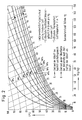
- the surface temperature of the waste parts follows the course of the saturation characteristic of the "ix diagram" for moist air according to the illustration in Figure 2.
- the heat content (enthalpy) i in kcal per kg dry air is above the absolute humidity (water content) x in grams applied per kg dry air.
- the air temperature (dry thermometer) T is given in degrees C.
- a barometer reading of 760 mm Hg is assumed.
- the entered point A denotes the state of the exhaust air when it leaves the rotting mixture.
- Point B which is also entered, describes the condition on the surface of the waste parts after the exhaust air has hit the air.
- the temperature is 69 ° C.
- the enthalpy i is about 98.5 kcal / kg
- the absolute humidity is about 132 g / kg.
- the enthalpy i is also approximately 98.5 kcal / kg.
- the amount of air that is passed through the rotting container can be reduced per time.
- the temperature then rises to over 60 ° C. It can be kept at this temperature via an air volume control.
- “easily decomposable waste components” are: vegetable mucilages with hemicelluloses as ingredients or the plasmatic liquid of animal cells and cellulose in the non-wooded state as cell walls of young plants.
- “Hardly decomposable waste components” are: cellulose in the woody state in older plants, cellulose / lignin compounds of animal cell walls, chitin shells from insects. The further the lignification or the lignin incorporation into the cell walls progresses, the firmer the waste components which are difficult to decompose and the higher their molecular weight becomes as an evaluation criterion. The degradation difference from hemicellulose to woodless cellulose can be clearly seen from FIG.
Landscapes
- Chemical & Material Sciences (AREA)
- Molecular Biology (AREA)
- Life Sciences & Earth Sciences (AREA)
- Health & Medical Sciences (AREA)
- Organic Chemistry (AREA)
- Engineering & Computer Science (AREA)
- Chemical Kinetics & Catalysis (AREA)
- General Chemical & Material Sciences (AREA)
- Microbiology (AREA)
- Biotechnology (AREA)
- Biochemistry (AREA)
- Fertilizers (AREA)
- Processing Of Solid Wastes (AREA)
Priority Applications (1)
| Application Number | Priority Date | Filing Date | Title |
|---|---|---|---|
| EP19940104434 EP0606119B1 (de) | 1990-05-09 | 1991-05-08 | Verfahren zur Kompostierung von Abfällen |
Applications Claiming Priority (8)
| Application Number | Priority Date | Filing Date | Title |
|---|---|---|---|
| DE4014895 | 1990-05-09 | ||
| DE4014895 | 1990-05-09 | ||
| DE4021865 | 1990-07-09 | ||
| DE4021865A DE4021865A1 (de) | 1990-05-09 | 1990-07-09 | Verfahren zur kompostierung von abfaellen und vorrichtung zur durchfuehrung dieses verfahrens |
| DE4021868 | 1990-07-09 | ||
| DE4021868A DE4021868C3 (de) | 1990-05-09 | 1990-07-09 | Verfahren zur Kompostierung von Rottegut |
| DE4021867 | 1990-07-09 | ||
| DE4021867A DE4021867C3 (de) | 1990-05-09 | 1990-07-09 | Verfahren zur Kompostierung von Abfällen |
Related Child Applications (2)
| Application Number | Title | Priority Date | Filing Date |
|---|---|---|---|
| EP19940104434 Division EP0606119B1 (de) | 1990-05-09 | 1991-05-08 | Verfahren zur Kompostierung von Abfällen |
| EP94104434.9 Division-Into | 1994-03-21 |
Publications (3)
| Publication Number | Publication Date |
|---|---|
| EP0458136A2 EP0458136A2 (de) | 1991-11-27 |
| EP0458136A3 EP0458136A3 (en) | 1991-12-18 |
| EP0458136B1 true EP0458136B1 (de) | 1995-01-04 |
Family
ID=27434931
Family Applications (2)
| Application Number | Title | Priority Date | Filing Date |
|---|---|---|---|
| EP19910107549 Expired - Lifetime EP0458136B1 (de) | 1990-05-09 | 1991-05-08 | Verfahren zur Kompostierung von Abfällen |
| EP19940104434 Expired - Lifetime EP0606119B1 (de) | 1990-05-09 | 1991-05-08 | Verfahren zur Kompostierung von Abfällen |
Family Applications After (1)
| Application Number | Title | Priority Date | Filing Date |
|---|---|---|---|
| EP19940104434 Expired - Lifetime EP0606119B1 (de) | 1990-05-09 | 1991-05-08 | Verfahren zur Kompostierung von Abfällen |
Country Status (7)
| Country | Link |
|---|---|
| EP (2) | EP0458136B1 (da) |
| JP (1) | JPH07943A (da) |
| AT (2) | ATE178303T1 (da) |
| DE (2) | DE59109118D1 (da) |
| DK (2) | DK0606119T3 (da) |
| ES (2) | ES2133435T3 (da) |
| GR (1) | GR3030670T3 (da) |
Families Citing this family (14)
| Publication number | Priority date | Publication date | Assignee | Title |
|---|---|---|---|---|
| DE4208390C2 (de) * | 1992-03-16 | 1994-03-31 | Herhof Umwelttechnik Gmbh | Verfahren und Vorrichtung zur Abkühlung feuchter und warmer Abluft aus einem Kompostierungsprozeß |
| DE4322688C2 (de) * | 1993-07-07 | 1995-07-27 | Herhof Umwelttechnik Gmbh | Verfahren zur Kompostierung von organischen Stoffen, insbesondere Abfällen |
| DE4345238C2 (de) * | 1993-10-08 | 1997-03-27 | Herhof Umwelttechnik Gmbh | Verfahren zur Ermittlung der Energie, die bei der Kompostierung von organischen Stoffen erzeugt wird |
| DE19503669A1 (de) * | 1995-01-27 | 1996-08-08 | Pelox Bioconversionstech Gmbh | Sekundärbrennstoff auf Basis von verrottetem Abfall |
| DE19513262C1 (de) * | 1995-04-07 | 1996-10-24 | Herhof Umwelttechnik Gmbh | Verfahren zur Kompostierung von organischen Stoffen, insbesondere von Abfällen |
| DE19724993C2 (de) * | 1997-06-13 | 2001-03-01 | Schwarting Uhde Gmbh | Verfahren zur Optimierung der Umsetzungsleistung beim Abbau organischer Substanz, insbesondere zur Regelung der Umsetzungsleistung bei der Verrottung von Bioabfall |
| AT408984B (de) * | 1997-10-17 | 2002-04-25 | Mut Maschinen Umwelttechnik | Kompostierungssystem |
| CA2226022C (en) | 1997-12-31 | 2003-10-07 | Gilles Beaulieu | Odor-free composting method and installation |
| AU2002328381A1 (en) * | 2001-07-04 | 2003-01-21 | Naturem Environnement | Method for treating waste, devices and compositions for carrying out said method |
| FR2826884B1 (fr) * | 2001-07-04 | 2004-06-25 | Philippe Brisset | Procede de traitement des dechets menagers ou industriels et installations d'application de ce procede |
| US20080206842A1 (en) * | 2005-11-16 | 2008-08-28 | Vaclav Holusa | Method of Conversion of Biodegradable Hygienically Non-Stabilized Substrate Into Hygienically Stabilized Product |
| RU2378234C1 (ru) * | 2005-11-16 | 2010-01-10 | Агро-Еко Спул. С Р.О. | Способ преобразования биологически разлагаемого гигиенически неустойчивого субстрата в гигиенически устойчивый продукт |
| DE102006015626A1 (de) * | 2006-03-31 | 2007-10-04 | Universität Kassel | Verfahren zur Bestimmung des Hygienisierungszustandes einer der Verrottung und/oder Vergärung unterworfenen, organischen Substanz und Verfahren zur Prozessführung bei Rotte- und Vergärungsprozessen |
| DE102010027542B4 (de) * | 2010-05-07 | 2013-01-31 | Budde Gmbh & Co. Kg | Verfahren zur Herstellung von Brennstoffbriketts aus nachwachsenden Rohstoffen |
Family Cites Families (3)
| Publication number | Priority date | Publication date | Assignee | Title |
|---|---|---|---|---|
| FR1089795A (fr) * | 1953-12-22 | 1955-03-22 | Procédé de traitement accéléré des ordures ménagères et autres déchets | |
| FR2482084B1 (fr) * | 1980-05-08 | 1985-07-12 | Weynandt Jean | Compost provenant de dechets organiques, procede pour son obtention et installation pour la mise en oeuvre du procede |
| DE3800201C1 (en) * | 1988-01-07 | 1989-08-10 | Herbert 6340 Dillenburg De Greeb | Method of composting organic waste and/or sewage sludge in closed containers |
-
1991
- 1991-05-08 ES ES94104434T patent/ES2133435T3/es not_active Expired - Lifetime
- 1991-05-08 EP EP19910107549 patent/EP0458136B1/de not_active Expired - Lifetime
- 1991-05-08 DE DE59109118T patent/DE59109118D1/de not_active Expired - Fee Related
- 1991-05-08 DE DE59104120T patent/DE59104120D1/de not_active Expired - Lifetime
- 1991-05-08 AT AT94104434T patent/ATE178303T1/de not_active IP Right Cessation
- 1991-05-08 DK DK94104434T patent/DK0606119T3/da active
- 1991-05-08 AT AT91107549T patent/ATE116630T1/de not_active IP Right Cessation
- 1991-05-08 EP EP19940104434 patent/EP0606119B1/de not_active Expired - Lifetime
- 1991-05-08 ES ES91107549T patent/ES2066261T3/es not_active Expired - Lifetime
- 1991-05-08 DK DK91107549T patent/DK0458136T3/da active
- 1991-05-09 JP JP13354691A patent/JPH07943A/ja active Pending
-
1999
- 1999-06-30 GR GR990401757T patent/GR3030670T3/el unknown
Also Published As
| Publication number | Publication date |
|---|---|
| EP0606119B1 (de) | 1999-03-31 |
| EP0458136A3 (en) | 1991-12-18 |
| DK0458136T3 (da) | 1995-03-13 |
| JPH07943A (ja) | 1995-01-06 |
| DE59109118D1 (de) | 1999-05-06 |
| EP0606119A2 (de) | 1994-07-13 |
| ES2133435T3 (es) | 1999-09-16 |
| EP0458136A2 (de) | 1991-11-27 |
| ES2066261T3 (es) | 1995-03-01 |
| DK0606119T3 (da) | 1999-10-11 |
| ATE116630T1 (de) | 1995-01-15 |
| ATE178303T1 (de) | 1999-04-15 |
| GR3030670T3 (en) | 1999-10-29 |
| EP0606119A3 (de) | 1995-04-12 |
| DE59104120D1 (de) | 1995-02-16 |
Similar Documents
| Publication | Publication Date | Title |
|---|---|---|
| DE4021868C3 (de) | Verfahren zur Kompostierung von Rottegut | |
| DE69632960T2 (de) | System und verfahren zur kompostierung | |
| EP2310343B1 (de) | Ökotechnische anlage und verfahren zur herstellung von kultursubstraten und bodenhilfsstoffen und organischen düngern mit eigenschaften anthropogener terra preta | |
| DE3637393C2 (da) | ||
| EP0606119B1 (de) | Verfahren zur Kompostierung von Abfällen | |
| DE69608279T2 (de) | Verfahren zur behandlung von abfallschlamm | |
| EP0445102B1 (de) | Verfahren zur geruchsarmen aeroben Behandlung von tierischen Exkrementen | |
| DE4034400C2 (de) | Verfahren und Vorrichtung zur Kompostierung von mikrobiell abbaubaren Abfallstoffen | |
| EP0776874B1 (de) | Verfahren zur Ermittlung der bei der Kompostierung erzeugten Energie | |
| DE4111121C2 (da) | ||
| DE3725988C2 (de) | Verfahren zum Humifizieren von Klärschlämmen | |
| DE1592729B1 (de) | Verfahren zur Entseuchung und Reifung von Kompostrohgut | |
| EP0576389A2 (de) | Verfahren zur Umwandlung von Gülle, Jauche und Hausabwässern in Düngerkompost | |
| DE3727408C2 (da) | ||
| DE4123798C1 (da) | ||
| CH687876A5 (de) | Verfahren zur Erzeugung von Erde. | |
| EP0026767B1 (de) | Verwendung von traubentrester zur einleitung und förderung aerober vorgänge an abfallstoffen | |
| EP0458738A2 (de) | Verfahren zum Kompostieren von mit Schadstoffen kontaminierten Abwasserschlamm und Abfallholz durch aerobes Verrotten sowie eine Anwendung | |
| DE2721349B2 (de) | Verfahren zur Kompostierung von Klärschlamm oder anderen organischen Abfallstoffen in einem aeroben Durchlaufbetrieb | |
| EP0936204B1 (de) | Verfahren zur Herstellung von Kompost enthaltenden Düngesubstraten | |
| DE19641291C1 (de) | Verfahren zur biologisch-thermischen Behandlung von Abfällen | |
| DE19547784C2 (de) | Verfahren und Vorrichtung zum Kompostieren von organischen Stoffen | |
| EP0859749B1 (de) | Verfahren zur biologisch-thermischen behandlung von abfällen | |
| DE19706148C2 (de) | Verfahren und Anlage zur Aufbereitung von kompostierfähigen Materialien | |
| CH636329A5 (en) | Process for the aerobic degradation of organic solids, and plant for carrying out this process |
Legal Events
| Date | Code | Title | Description |
|---|---|---|---|
| PUAI | Public reference made under article 153(3) epc to a published international application that has entered the european phase |
Free format text: ORIGINAL CODE: 0009012 |
|
| PUAL | Search report despatched |
Free format text: ORIGINAL CODE: 0009013 |
|
| AK | Designated contracting states |
Kind code of ref document: A2 Designated state(s): AT BE CH DE DK ES FR GB GR IT LI LU NL SE |
|
| AK | Designated contracting states |
Kind code of ref document: A3 Designated state(s): AT BE CH DE DK ES FR GB GR IT LI LU NL SE |
|
| 17P | Request for examination filed |
Effective date: 19920117 |
|
| 17Q | First examination report despatched |
Effective date: 19940113 |
|
| GRAA | (expected) grant |
Free format text: ORIGINAL CODE: 0009210 |
|
| AK | Designated contracting states |
Kind code of ref document: B1 Designated state(s): AT BE CH DE DK ES FR GB GR IT LI LU NL SE |
|
| REF | Corresponds to: |
Ref document number: 116630 Country of ref document: AT Date of ref document: 19950115 Kind code of ref document: T |
|
| XX | Miscellaneous (additional remarks) |
Free format text: TEILANMELDUNG 94104434.9 EINGEREICHT AM 08/05/91. |
|
| EAL | Se: european patent in force in sweden |
Ref document number: 91107549.7 |
|
| REF | Corresponds to: |
Ref document number: 59104120 Country of ref document: DE Date of ref document: 19950216 |
|
| GBT | Gb: translation of ep patent filed (gb section 77(6)(a)/1977) |
Effective date: 19950124 |
|
| REG | Reference to a national code |
Ref country code: ES Ref legal event code: FG2A Ref document number: 2066261 Country of ref document: ES Kind code of ref document: T3 |
|
| REG | Reference to a national code |
Ref country code: DK Ref legal event code: T3 |
|
| ITF | It: translation for a ep patent filed | ||
| REG | Reference to a national code |
Ref country code: GR Ref legal event code: FG4A Free format text: 3014811 |
|
| ET | Fr: translation filed | ||
| PLBI | Opposition filed |
Free format text: ORIGINAL CODE: 0009260 |
|
| 26 | Opposition filed |
Opponent name: WEISS BIO ANLAGEN GMBH Effective date: 19950921 |
|
| NLR1 | Nl: opposition has been filed with the epo |
Opponent name: WEISS BIO ANLAGEN GMBH |
|
| PLBF | Reply of patent proprietor to notice(s) of opposition |
Free format text: ORIGINAL CODE: EPIDOS OBSO |
|
| PLBF | Reply of patent proprietor to notice(s) of opposition |
Free format text: ORIGINAL CODE: EPIDOS OBSO |
|
| PLBF | Reply of patent proprietor to notice(s) of opposition |
Free format text: ORIGINAL CODE: EPIDOS OBSO |
|
| PLAB | Opposition data, opponent's data or that of the opponent's representative modified |
Free format text: ORIGINAL CODE: 0009299OPPO |
|
| PLBI | Opposition filed |
Free format text: ORIGINAL CODE: 0009260 |
|
| PLBQ | Unpublished change to opponent data |
Free format text: ORIGINAL CODE: EPIDOS OPPO |
|
| 26 | Opposition filed |
Opponent name: L. & C. STEINMUELLER GMBH Effective date: 19950921 |
|
| D26 | Opposition filed (deleted) | ||
| NLR1 | Nl: opposition has been filed with the epo |
Opponent name: L. & C. STEINMUELLER GMBH |
|
| PLBO | Opposition rejected |
Free format text: ORIGINAL CODE: EPIDOS REJO |
|
| PLBN | Opposition rejected |
Free format text: ORIGINAL CODE: 0009273 |
|
| STAA | Information on the status of an ep patent application or granted ep patent |
Free format text: STATUS: OPPOSITION REJECTED |
|
| 27O | Opposition rejected |
Effective date: 19970627 |
|
| NLR2 | Nl: decision of opposition | ||
| PGFP | Annual fee paid to national office [announced via postgrant information from national office to epo] |
Ref country code: LU Payment date: 20000529 Year of fee payment: 10 |
|
| PG25 | Lapsed in a contracting state [announced via postgrant information from national office to epo] |
Ref country code: LU Free format text: LAPSE BECAUSE OF NON-PAYMENT OF DUE FEES Effective date: 20010508 |
|
| REG | Reference to a national code |
Ref country code: GB Ref legal event code: IF02 |
|
| REG | Reference to a national code |
Ref country code: CH Ref legal event code: PUE Owner name: HERHOF VERWALTUNGSGESELLSCHAFT MBH Free format text: HERHOF UMWELTTECHNIK GMBH#RIEMANNSTRASSE 1#D-35606 SOLMS (DE) -TRANSFER TO- HERHOF VERWALTUNGSGESELLSCHAFT MBH#RIEMANNSTRASSE 3#35606 SOLMS-NIEDERBIEL (DE) |
|
| REG | Reference to a national code |
Ref country code: ES Ref legal event code: PC2A |
|
| NLS | Nl: assignments of ep-patents |
Owner name: HERHOF VERWALTUNGSGESELLSCHAFT MBH Effective date: 20080215 |
|
| REG | Reference to a national code |
Ref country code: FR Ref legal event code: TP |
|
| REG | Reference to a national code |
Ref country code: GB Ref legal event code: 732E |
|
| PGFP | Annual fee paid to national office [announced via postgrant information from national office to epo] |
Ref country code: ES Payment date: 20100518 Year of fee payment: 20 Ref country code: DK Payment date: 20100525 Year of fee payment: 20 Ref country code: FR Payment date: 20100617 Year of fee payment: 20 |
|
| PGFP | Annual fee paid to national office [announced via postgrant information from national office to epo] |
Ref country code: AT Payment date: 20100521 Year of fee payment: 20 Ref country code: NL Payment date: 20100526 Year of fee payment: 20 Ref country code: IT Payment date: 20100519 Year of fee payment: 20 Ref country code: DE Payment date: 20100528 Year of fee payment: 20 |
|
| PGFP | Annual fee paid to national office [announced via postgrant information from national office to epo] |
Ref country code: BE Payment date: 20100526 Year of fee payment: 20 Ref country code: CH Payment date: 20100525 Year of fee payment: 20 |
|
| PGFP | Annual fee paid to national office [announced via postgrant information from national office to epo] |
Ref country code: GB Payment date: 20100524 Year of fee payment: 20 Ref country code: SE Payment date: 20100520 Year of fee payment: 20 |
|
| PGFP | Annual fee paid to national office [announced via postgrant information from national office to epo] |
Ref country code: GR Payment date: 20100521 Year of fee payment: 20 |
|
| REG | Reference to a national code |
Ref country code: CH Ref legal event code: PFA Owner name: HERHOF VERWALTUNGSGESELLSCHAFT MBH Free format text: HERHOF VERWALTUNGSGESELLSCHAFT MBH#RIEMANNSTRASSE 3#35606 SOLMS-NIEDERBIEL (DE) -TRANSFER TO- HERHOF VERWALTUNGSGESELLSCHAFT MBH#RIEMANNSTRASSE 3#35606 SOLMS-NIEDERBIEL (DE) |
|
| REG | Reference to a national code |
Ref country code: DE Ref legal event code: R071 Ref document number: 59104120 Country of ref document: DE |
|
| REG | Reference to a national code |
Ref country code: CH Ref legal event code: PL |
|
| REG | Reference to a national code |
Ref country code: NL Ref legal event code: V4 Effective date: 20110508 |
|
| REG | Reference to a national code |
Ref country code: DK Ref legal event code: EUP |
|
| BE20 | Be: patent expired |
Owner name: HERHOF VERWALTUNGSGESELLSCHAFT M.B.H. Effective date: 20110508 |
|
| REG | Reference to a national code |
Ref country code: GB Ref legal event code: PE20 Expiry date: 20110507 |
|
| REG | Reference to a national code |
Ref country code: SE Ref legal event code: EUG |
|
| PG25 | Lapsed in a contracting state [announced via postgrant information from national office to epo] |
Ref country code: GB Free format text: LAPSE BECAUSE OF EXPIRATION OF PROTECTION Effective date: 20110507 Ref country code: NL Free format text: LAPSE BECAUSE OF EXPIRATION OF PROTECTION Effective date: 20110508 |
|
| REG | Reference to a national code |
Ref country code: ES Ref legal event code: FD2A Effective date: 20120110 |
|
| PG25 | Lapsed in a contracting state [announced via postgrant information from national office to epo] |
Ref country code: ES Free format text: LAPSE BECAUSE OF EXPIRATION OF PROTECTION Effective date: 20110509 |
|
| PG25 | Lapsed in a contracting state [announced via postgrant information from national office to epo] |
Ref country code: DE Free format text: LAPSE BECAUSE OF EXPIRATION OF PROTECTION Effective date: 20110508 |