EP0457291A2 - Syndiotaktisches Propylencopolymer, seine Herstellung und seine Anwendung - Google Patents
Syndiotaktisches Propylencopolymer, seine Herstellung und seine Anwendung Download PDFInfo
- Publication number
- EP0457291A2 EP0457291A2 EP91107837A EP91107837A EP0457291A2 EP 0457291 A2 EP0457291 A2 EP 0457291A2 EP 91107837 A EP91107837 A EP 91107837A EP 91107837 A EP91107837 A EP 91107837A EP 0457291 A2 EP0457291 A2 EP 0457291A2
- Authority
- EP
- European Patent Office
- Prior art keywords
- propylene
- copolymer
- homopolymer
- syndiotactic
- radical polymerizable
- Prior art date
- Legal status (The legal status is an assumption and is not a legal conclusion. Google has not performed a legal analysis and makes no representation as to the accuracy of the status listed.)
- Granted
Links
Images

Classifications
-
- C—CHEMISTRY; METALLURGY
- C08—ORGANIC MACROMOLECULAR COMPOUNDS; THEIR PREPARATION OR CHEMICAL WORKING-UP; COMPOSITIONS BASED THEREON
- C08F—MACROMOLECULAR COMPOUNDS OBTAINED BY REACTIONS ONLY INVOLVING CARBON-TO-CARBON UNSATURATED BONDS
- C08F255/00—Macromolecular compounds obtained by polymerising monomers on to polymers of hydrocarbons as defined in group C08F10/00
- C08F255/02—Macromolecular compounds obtained by polymerising monomers on to polymers of hydrocarbons as defined in group C08F10/00 on to polymers of olefins having two or three carbon atoms
-
- C—CHEMISTRY; METALLURGY
- C08—ORGANIC MACROMOLECULAR COMPOUNDS; THEIR PREPARATION OR CHEMICAL WORKING-UP; COMPOSITIONS BASED THEREON
- C08F—MACROMOLECULAR COMPOUNDS OBTAINED BY REACTIONS ONLY INVOLVING CARBON-TO-CARBON UNSATURATED BONDS
- C08F10/00—Homopolymers and copolymers of unsaturated aliphatic hydrocarbons having only one carbon-to-carbon double bond
-
- Y—GENERAL TAGGING OF NEW TECHNOLOGICAL DEVELOPMENTS; GENERAL TAGGING OF CROSS-SECTIONAL TECHNOLOGIES SPANNING OVER SEVERAL SECTIONS OF THE IPC; TECHNICAL SUBJECTS COVERED BY FORMER USPC CROSS-REFERENCE ART COLLECTIONS [XRACs] AND DIGESTS
- Y10—TECHNICAL SUBJECTS COVERED BY FORMER USPC
- Y10S—TECHNICAL SUBJECTS COVERED BY FORMER USPC CROSS-REFERENCE ART COLLECTIONS [XRACs] AND DIGESTS
- Y10S526/00—Synthetic resins or natural rubbers -- part of the class 520 series
- Y10S526/943—Polymerization with metallocene catalysts
Definitions
- the present invention relates to a copolymer having a substantially syndiotactic structure of propylene, a method for preparing it, and its use. More specifically, the present invention relates to a copolymer of propylene which is prepared by graft polymerizing a radical polymerizable unsaturated compound on a syndiotactic propylene homopolymer having a relatively high tacticity or a syndiotactic copolymer having a relatively high tacticity of propylene and a small amount of another olefin, a method for preparing the above-mentioned copolymer, and its use.
- An isotactic polypropylene is inexpensive and relatively excellent in the balance of physical properties, and thus it is utilized in various uses.
- a syndiotactic polypropylene has been known for a long period of time.
- such a syndiotactic polypropylene is prepared by polymerization at a low temperature in the presence of a conventional catalyst comprising a vanadium compound, an ether and organic aluminum, and the syndiotactic polypropylene prepared by this process is poor in syndiotacticity and has elastomer-like characteristics. Therefore, it is scarcely considered that the thus prepared syndiotactic polypropylene exerts its inherent characteristics.
- a syndiotactic polypropylene or a copolymer having a substantially syndiotactic structure of propylene and another olefin which is obtained by the above-mentioned method is relatively excellent in physical properties, but this kind of polypropylene or copolymer has a bad affinity for a polymer containing another polar group or a metal, i.e., it is poor in adhesive properties similarly to the isotactic polypropylene
- a polymer prepared by graft polymerizing a monomer containing a carboxyl group such as maleic anhydride on the isotactic polypropylene is utilized for the purpose of improving adhesive properties to another polyolefin or coating properties.
- this technique has problems that the radical decomposition of the polypropylene which is the base polymer occurs in a manufacturing step, with the result that the molecular weight of the resultant copolymer noticeably decreases, and that when manufactured in a liquid phase, it is difficult to separate the copolymer.
- a product containing a syndiotactic polypropylene as a base is prepared, physical properties which have not been heretofore present can be expected.
- An object of the present invention is to provide a novel propylene copolymer having a substantially syndiotactic structure and a method for preparing the same.
- Another object of the present invention is to provide a resin composition for adhesion containing this propylene copolymer.
- Still another object of the present invention is to provide a water-crosslinkable resin composition containing a novel water-crosslinkable propylene copolymer having a substantially syndiotactic structure.
- a further object of the present invention is to provide a method for preparing a crosslinked polypropylene from a polypropylene having a substantially syndiotactic structure and a hydrolyzable unsaturated silane.
- the propylene copolymer having a substantially syndiotactic structure of the present invention is a graft copolymer which can be obtained by heating a homopolymer having a substantially syndiotactic structure of propylene or a copolymer having a substantially syndiotactic structure of propylene and another ⁇ -olefin and a radical polymerizable unsaturated compound in the presence of a radical initiator up to the decomposition temperature or more of the radical initiator, and in this graft copolymer, the content of grafted unsaturated compound units is from 0.1 to 50% by weight of the propylene homopolymer or copolymer.
- a method for preparing the above-mentioned propylene copolymer is characterized by heating a homopolymer having a substantially syndiotactic structure of propylene or a copolymer of propylene and another ⁇ -olefin and a radical polymerizable unsaturated compound in the presence of a radical initiator up to the decomposition temperature or more of the radical initiator.
- a resin composition for adhesion of the present invention contains the above-mentioned propylene graft copolymer.
- a water-crosslinkable polypropylene resin composition of the present invention is composed of a graft copolymer having a substantially syndiotactic structure, a phenolic antioxidant, a sulfide hydroperoxide decomposer and a polyvalent amine, said graft copolymer can be obtained by heating a homopolymer having a substantially syndiotactic structure of propylene or a copolymer having a substantially syndiotactic structure of propylene and another ⁇ -olefin and a hydrolyzable unsaturated silane in the presence of a radical initiator up to the decomposition temperature or more of the radical initiator, and the content of grafted unsaturated silane units is from 0.1 to 50% by weight of the propylene polymer or copolymer.
- a method for preparing the crosslinked propylene homopolymer or copolymer of the present invention is characterized by heating, in the presence of water, a graft copolymer obtained by heating a homopolymer having a substantially syndiotactic structure of propylene or a copolymer having a substantially syndiotactic structure of propylene and another ⁇ -olefin and a hydrolyzable unsaturated silane in the presence of a radical initiator up to the decomposition temperature or more of the radical initiator.
- a homopolymer having a substantially syndiotactic structure of propylene or a copolymer having a substantially syndiotactic structure of propylene and a small amount of another ⁇ -olefin can be used as a base polymer on which a radical polymerizable unsaturated compound will be grafted.
- the intrinsic viscosity of this homopolymer or copolymer measured in a tetralin solution at 135°C is preferably from 0.01 to 5 dl/g.
- a crystalline polypropylene can be used which has such a highly syndiotactic structure that in the 13C-NMR spectrum of the polypropylene measured at 135°C in 1,2,4-trichlorobenzene, a peak intensity of methyl groups attributed to a syndiotactic pentad structure at about 20.2 ppm on the basis of tetramethylsilane is 0.5 or more, preferably 0.7 or more of the total peak intensity of all the methyl groups of propylene, and in the above-mentioned crystalline polypropylene, a portion which is soluble in toluene at room temperature is 10% by weight or less.
- the amount of the ⁇ -olefin is preferably from 0.1 to 20% by weight, more preferably 0.1 to 10% by weight.
- the amount of the ⁇ -olefin is in excess of 20% by weight, molded articles of the obtained copolymer deteriorate in stiffness.
- ⁇ -olefin examples include ethylene and ⁇ -olefins having 4 to 20 carbon atoms which may be branched, and typical examples thereof include straight-chain olefins such as butene-1, pentene-1, hexene-1, heptene-1, octene-1, nonene-1, decene-1, undecene-1, dodecene-1, tridecene-1, pentadecene-1, hexadecene-1, heptadecene-1 and octadecene-1 as well as branched olefins such as 3-methylbutene-1, 4-methylpentene-1 and 4,4-dimethylpentene-1.
- straight-chain olefins such as butene-1, pentene-1, hexene-1, heptene-1, octene-1, nonene-1, decene-1, undecene-1, dode
- the above-mentioned copolymer preferably has such a highly syndiotactic structure that in the 13C-NMR spectrum of the copolymer measured in the same manner as in the case of the propylene homopolymer, a peak intensity attributed to a syndiotactic structure at about 20.2 ppm is preferably 0.3 or more, more preferably 0.5 or more of the peak intensity attributed to all the methyl groups of propylene.
- the above-mentioned propylene homopolymer or copolymer can be obtained by (co)polymerizing propylene alone or propylene and a small amount of another ⁇ -olefin in the presence of a catalyst.
- a catalyst there is used a catalyst by which a polypropylene having a syndiotactic pentad fraction of 0.7 or more can be produced, when propylene alone is polymerized.
- the preferably usable catalyst is a combination of a transition metal compound represented by the formula (wherein A and B are mutually different cyclic unsaturated hydrocarbon residues, R is a hydrocarbon residue having 1 to 20 carbon atoms or a group containing silicon or germanium which connects A with B, X is a halogen atom or a hydrocarbon residue having 1 to 20 carbon atoms, and M is a metal atom selected from the group consisting of titanium, zirconium and hafnium) and a co-catalyst.
- a and B are mutually different cyclic unsaturated hydrocarbon residues
- R is a hydrocarbon residue having 1 to 20 carbon atoms or a group containing silicon or germanium which connects A with B
- X is a halogen atom or a hydrocarbon residue having 1 to 20 carbon atoms
- M is a metal atom selected from the group consisting of titanium, zirconium and hafnium
- Typical examples of the above-mentioned transition metal compound include isopropylidene(cyclopentadienylfluorenyl)zirconium dichloride and isopropylidene(cyclopentadienylfluorenyl)hafnium dichloride mentioned in the above J. A. Ewen et al.
- an aluminoxane is preferably used, and ionic compounds mentioned in EP 277003 and EP 277004 may also be used.
- aluminoxane examples include compounds represented by the formula (wherein R1 is a hydrocarbon residue having 1 to 3 carbon atoms, and m is an integer of from 1 to 50).
- R1 is a hydrocarbon residue having 1 to 3 carbon atoms
- m is an integer of from 1 to 50.
- R1 is a methyl group
- m is an integer of 5 or more.
- the amount of the aluminoxane is from 10 to 100000 mol times, usually from 50 to 10000 mol times as much as that of the transition metal compound, and in case that the ionic compound is used as the co-catalyst, the amount of the ionic compound is from 0.1 to 100000 mol times, usually from 0.5 to 5000 mol times as much as that of the transition metal compound.
- the polymerization temperature is from -100 to 200°C and the polymerization pressure is from atmospheric pressure to 100 kg/cm2.
- the temperature is from -50 to 100°C and the pressure is from atmospheric pressure to 50 kg/cm2.
- hydrocarbon medium used in the polymerization examples include saturated hydrocarbons such as butane, pentane, hexane, heptane, octane, nonane, decane, cyclopentane and cyclohexane as well as aromatic hydrocarbons such as benzene, toluene and xylene.
- the hydrocarbon solvent is a compound having 3 to 20 carbon atoms, and its examples include propylene, saturated hydrocarbon compounds such as propane, butane, pentane, hexane, heptane, octane and nonane, aromatic hydrocarbon compounds such as benzene, toluene, xylene and ethyl benzene, and similar compounds in which a part or all of hydrogen atoms thereof are substituted by fluorine, chlorine, bromine or iodine.
- the other usable solvents include alcohols having 1 to 20 carbon atoms and ethers and esters having 2 to 20 carbon atoms which can dissolve or disperse a low-molecular atactic component therein. No particular restriction is put on a washing manner, but the washing is usually carried out at a temperature of from 0°C to -100°C.
- examples of the radical polymerizable unsaturated compound which can be used in the graft copolymerization include unsaturated carboxylic acids, esters of the unsaturated carboxylic acids, aromatic vinyl compounds, hydrolyzable unsaturated silane compounds and unsaturated halogenated hydrocarbons.
- Examples of the unsaturated carboxylic acids include dicarboxylic anhydrides such as maleic anhydride, citraconic anhydride, 2-methylmaleic anhydride, 2-chloromaleic anhydride, 2,3-dimethylmaleic anhydride, bicyclo-[2,2,1]-5-heptene-2,3-dicarboxylic anhydride and 4-methyl-4-cyclohexene-1,2-dicarboxylic anhydride as well as monocarboxylic acids such as acrylic acid and methacrylic acid.
- dicarboxylic anhydrides such as maleic anhydride, citraconic anhydride, 2-methylmaleic anhydride, 2-chloromaleic anhydride, 2,3-dimethylmaleic anhydride, bicyclo-[2,2,1]-5-heptene-2,3-dicarboxylic anhydride and 4-methyl-4-cyclohexene-1,2-dicarboxylic anhydride as well as monocarboxylic acids such as acrylic acid and methacryl
- esters of the unsaturated carboxylic acids include methyl acrylate, ethyl acrylate, butyl acrylate, methyl methacrylate, ethyl methacrylate and butyl methacrylate.
- the hydrolyzable unsaturated silane compound is a compound having a radical polymerizable unsaturated group and an alkoxysilyl group or a silyl group in its molecule
- its example is a compound having a hydrolyzable silyl group bonded to a vinyl group and, in a certain case, having a hydrolyzable silyl group bonded to the vinyl group via an alkylene group, or a compound having a hydrolyzable silyl group bonded to an ester or an amide of acrylic acid, methacrylic acid or the like.
- Typical examples thereof include vinyltrichlorosilane, vinyltris( ⁇ -methoxyethoxy)silane, vinyltriethoxysilane, vinyltrimethoxysilane, ⁇ -methacryloxypropyltrimethoxysilane, monovinylsilane and monoallylsilane.
- Examples of the unsaturated halogenated hydrocarbon include vinyl chloride and vinylidene chloride.
- radical initiator used in the graft copolymerization are known various organic peroxides which can usually be used in the graft polymerization on the polyolefin, and typical utilizable examples of the organic peroxides include benzoyl peroxide, methyl ethyl ketone peroxide, cyclohexanone peroxide, t-butylperoxyisopropyl carbonate, di-t-butyl perphthalate, 2,5-dimethyl-2,5-di(t-butylperoxy)hexene, 2,5-dimethyl-2,5-di(t-butylperoxy)hexene-3, di-t-butyl peroxide, cumene hydroperoxide, t-butyl hydroperoxide, dilauryl peroxide and dicumyl peroxide.
- the graft copolymer of the present invention can be obtained by heating the above-mentioned propylene homopolymer or copolymer having a syndiotactic structure and the above-mentioned radical polymerizable unsaturated compound in the presence of a radical initiator at a temperature of the decomposition temperature or more of the radical initiator.
- the amount of the unsaturated compound to be used No particular restriction is put on the amount of the unsaturated compound to be used, and conventional conditions for an isotactic polypropylene can be utilized as they are. Since the efficiency of the copolymerization is relatively high, the amount of the unsaturated compound may be small. Usually, the amount of the unsaturated compound is preferably from 0.001 to 0.5 weight ratio with respect to the propylene homopolymer or copolymer having a syndiotactic structure.
- the radical initiator is preferably used in a ratio of from 0.00001 to 0.1 weight ratio with respect to the unsaturated compound.
- the heating temperature depends upon whether or not the reaction is carried out in the presence of a solvent, but it is usually from 50 to 350°C. When the heating temperature is less than 50°C, the reaction is slow and thus efficiency is low. When it is more than 350°C, a problem such as the decomposition of the polymer occurs.
- the reaction may be carried out using the propylene homopolymer or copolymer in the form of a solution or a slurry having a concentration of from 0.1 to 50% by weight in the presence of a halogenated hydrocarbon compound having 2 to 20 carbon atoms or a hydrocarbon compound having 6 to 20 carbon atoms which is stable to the radicals, or alternatively the reaction may be carried out in the absence of the solvent in a device such as an extruder which can sufficiently stir the highly viscous polymer. In the latter case, the reaction is usually effected at a relatively high temperature, as compared with the reaction in the state of the solution.
- the obtained graft copolymer preferably contains a desired amount of radical polymerizable unsaturated compound units in the range of from 0.1 to 50% by weight of the propylene homopolymer or copolymer having a syndiotactic structure in compliance with its use application.
- the content of the radical polymerizable unsaturated compound units is in excess of 50% by weight, the propylene homopolymer or copolymer having a syndiotactic structure does not exert its intrinsic physical properties, and when it is less than the above-mentioned lower limit, the physical properties as the graft copolymer cannot be obtained.
- the graft polymerization can be carried out in an aqueous medium.
- a dispersant can be used, and examples of the dispersant include a saponified polyvinyl acetate, modified celluloses such as hydroxyethyl cellulose and hydroxypropyl cellulose, and compounds containing an OH group such as polyacrylic acid and polymethacrylic acid.
- compounds which are used in a usual aqueous suspension polymerization can also be widely employed.
- the reaction is carried out by suspending the propylene homopolymer or copolymer having a syndiotactic structure, the water-insoluble radical polymerizable monomer, the water-insoluble radical initiator and the dispersant in water, and then heating the mixture.
- a ratio of water to the sum of the radical polymerizable monomer and the propylene homopolymer or copolymer having a syndiotactic structure is preferably 1:0.1 to 1:200, more preferably 1:1 to 1:100.
- the heating temperature is such that the half-life of the radical initiator is preferably from 0.1 to 100 hours, more preferably from 0.2 to 10 hours, and it is preferably from 30 to 200°C, more preferably from 40 to 150°C.
- the mixture is stirred sufficiently so as to become a suspension state. In this way, the graft polymer can be obtained in the form of good granules.
- a weight ratio of the water-insoluble monomer to the syndiotactic propylene homopolymer or copolymer is preferably from 1:0.1 to 1:10000, and a weight ratio of the radical initiator to the water-insoluble monomer is usually from 0.00001 to 0.1.
- the ratio of the water-insoluble monomer in the copolymer depends upon its use, but the amount of the monomer is usually from 0.1 to 200% by weight based on the propylene homopolymer or copolymer having a syndiotactic structure in the graft copolymer.
- the graft copolymer of the present invention can be mixed with an ⁇ -olefin homopolymer or copolymer preferably containing no graft component, so that it can be used as a resin composition for adhesion.
- the above-mentioned unsaturated carboxylic acid, its derivative and a hydrolyzable silane can be preferably used as the radical polymerizable unsaturated compound which is grafted on the propylene homopolymer or copolymer having a syndiotactic structure.
- ⁇ -olefin homopolymer or copolymer preferably containing no graft component there can be used, if desired, ⁇ -olefin homopolymers having various molecular weight and random and block copolymers of ⁇ -olefins themselves.
- ⁇ -olefin examples include ethylene and ⁇ -olefins having 4 to 20 carbon atoms in addition to propylene.
- the homopolymers and copolymers of these ⁇ -olefins can be manufactured by various known methods, and they are commercially available under various trade names on markets.
- a mixing ratio between the graft copolymer and the homopolymer or copolymer of the ⁇ -olefin is such that the radical polymerizable unsaturated compound units, preferably the unsaturated carboxylic acid units or the hydrolyzable unsaturated silane compound units in the graft copolymer are present in an amount of 0.01 to 1% by weight in the obtained resin composition.
- additives can be added to the above-mentioned composition, if necessary, and examples of the additives include an antioxidant, an ultraviolet absorber and the like which can be added to usual polyolefins.
- the homopolymer or copolymer of the ⁇ -olefin it is not essential to add the homopolymer or copolymer of the ⁇ -olefin to the resin composition for adhesion of the present invention.
- the above-mentioned additive e.g., a stabilizer alone can be added to the graft copolymer to obtain the resin composition for adhesion.
- the raw materials are mixed uniformly by means of a Henschel mixer or the like and then melted, mixed and molded into pellets by an extruder or the like. It is also possible to utilize a Brabender by which mixing and melting are carried out simultaneously, and after the melting, the material, needless to say, can be directly molded into films, sheets or the like.
- the copolymer in which the hydrolyzable unsaturated silane is grafted can be utilized as a starting material for the a crosslinked polypropylene or a crosslinked propylene copolymer.
- the hydrolyzable unsaturated silane units are present in the graft copolymer preferably in an amount of from 0.1 to 50% by weight, more preferably from 0.1 to 10% by weight based on the propylene homopolymer or copolymer having a syndiotactic structure.
- the graft copolymer is heated in the presence of water. It is a usual procedure to mold the graft copolymer into a desired shape prior to this treatment.
- a catalyst can be added. Examples of this kind of catalyst include hydroxides and oxides of alkaline metals and alkaline earth metals, ammonia, amines, organic and inorganic acids, salts thereof, alkoxysilicons and silicon hydride which are well known as catalysts for hydrolysis, and they can be directly used without any additional treatment.
- the amount of the catalyst is usually from 0.001 to 1% by weight of the graft copolymer.
- a polymer which is compatible with the above-mentioned graft copolymer may be added thereto about 10 times by weight or less as much as the graft polymer.
- a temperature at which the above-mentioned graft copolymer is heated in the presence of water is from 50 to 200°C, preferably from 80 to 120°C.
- Water may be used in the state of steam, but it is preferred that molded articles are immersed into boiling water.
- the ratio of the boiling xylene-insoluble component to this homopolymer or copolymer is preferably from 5 to 100% by weight.
- the copolymer on which the hydrolyzable unsaturated silane is grafted can be blended with a phenolic antioxidant, a sulfide hydroperoxide decomposer and a polyvalent amine to prepare a water-crosslinkable resin composition.
- phenolic antioxidants are known and commercially available.
- a preferably utilizable example of the phenolic antioxidant is a substituted phenol such as 2,6-di-t-butylphenol in which a hydrogen atom at 2 and/or 6 position is substituted by an alkyl residue.
- Typical examples of the phenolic antioxidant include 2,6-di-t-butyl-p-cresol, 2,4,6-tri-t-butylphenol, vitamin E, 2-t-butyl-6-(3'-t-butyl-5'-methyl-2'-hydroxybenzyl)-4-methylphenyl acrylate, 2,2'-methylene-bis(4-methyl-6-t-butylphenol), 2,2'-methylene-bis(4-ethyl-6-t-butyl-phenol), 2,2'-methylene-bis(6-cyclohexyl-4-methylphenol), 1,6-hexanediol-bis([3-(3,5-di-t-butyl[4-hydroxyphenyl])] propionate and pentaerythrityl-tetrakis-[3-(3,5-di-t-butyl-4-hydroxyphenyl)] propionate.
- a preferable example of the sulfide hydroperoxide decomposer is an ester of a thioether, and typical examples of the commercially available sulfide hydroperoxide decomposer include diesters of 3,3'-thiodipropionic acid and higher alcohols such as lauryl alcohol, tridecyl alcohol and stearyl alcohol.
- polyvalent amine examples include melamine, its derivatives, a hydrazide compound such as oxalic acid-bis(benzylidenehydrazide) and a triazole compound such as 3-(N-salicyloyl)amino-1,2,4-triazole.
- the amount of each of these additives to be added is such that the weight ratio of the additive to the graft copolymer is preferably 1/1000 to 1/100000, more preferably 1/500 to 1/10000.
- a neutralizing agent such as calcium stearate, magnesium hydroxide, aluminum hydroxide or hydrotalcite
- a nucleating agent such as a salt of benzoic acid, sodium-2,2'-methylene-bis(4,6-di-t-butylphenyl) phosphate and benzyl sorbitol, and the like, in addition to the above-mentioned stabilizer.
- the above-mentioned composition is subjected to heat treatment in the presence of water to form crosslinking.
- the composition is molded into a desired shape prior to the heat treatment.
- various catalysts can be added.
- the catalyst include hydroxides and oxides of alkaline metals and alkaline earth metals, ammonia, amines, organic and inorganic acids, salts thereof, and alkoxy-silicons and silicon hydride which are well known as catalysts for hydrolysis, and they can be directly used without any additional treatment.
- the amount of the catalyst is usually from 0.001 to 1% by weight of the graft copolymer.
- This isopropyl(cyclopentadienyl-1-fluorenyl)zirconium dichloride was obtained by converting, into a lithium salt, isopropylcyclopentadienyl-1-fluorene synthesized in an ordinary manner, reacting the same with zirconium tetrachloride, and then recrystallizing the resultant reaction product. Afterward, propylene was polymerized at 20°C under a polymerization pressure of 3 kg/cm2-G for 2 hours. Methanol and methyl acetoacetate were added to the resultant polymer mixture, and the solution was treated at 30°C and then washed with an aqueous hydrochloric acid solution.
- the washed mixture was filtered to obtain 5.6 kg of a syndiotactic polypropylene.
- the syndiotactic pentad fraction of this polypropylene was 0.935, and an intrinsic viscosity (hereinafter referred to simply as " ⁇ ") measured in a tetralin solution at 135°C was 1.45.
- ⁇ an intrinsic viscosity measured in a tetralin solution at 135°C
- Mw/Mn weight average molecular weight to the number average molecular weight of the polymer
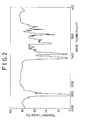
- the obtained powder was dried and weighed, and its amount was 142.5 g. According to an infrared absorption spectrum (Fig. 1), the content of the maleic anhydride in this powder was about 7.4% by weight. Furthermore, this powder was extracted with boiling acetone for 6 hours, and in this case, the content of the maleic anhydride similarly calculated was 6.8% by weight. In addition, according to 13C-NMR, the syndiotactic pentad fraction of propylene units was 0.928, which was not substantially changed, and ⁇ was 1.28.
- Izod impact strength (ASTM D256) was 14.5, which was not substantially changed, as compared with a value before the graft copolymerization.
- Example 2 The same procedure as in Example 1 was effected except that a commercially available isotactic polypropylene ( ⁇ was 1.62, isotactic pentad fraction measured by 13C-NMR was 0.954, and Mw/Mn was 6.7) was used as a polypropylene, so that a fine polymer powder was obtained. In consequence, it took 5 hours to perform filtration. The content of maleic anhydride in the powder was 3.1% by weight, and after extraction, it was 2.8% by weight. ⁇ was 0.35, which meant that it deteriorated noticeably. Izod impact strength which was measured in the same manner as in Example 1 deteriorated to 2.1 from a value of 3.1 before graft copolymerization.
- Example 2 To 2 parts of the graft copolymer obtained in Example 1 were added 98 parts by weight of a commercial copolymer (MFL 4.9 made by Mitsui Toatsu Chemicals, Inc.) of propylene and ethylene, 2,6-di-t-butyl-p-cresol (in a ratio of 10 to 10000 of the graft copolymer) and calcium stearate (in a ratio of 15 to 10000 of the graft copolymer), followed by granulation, thereby obtaining a resin composition for adhesion.
- MFL 4.9 made by Mitsui Toatsu Chemicals, Inc.
- 2,6-di-t-butyl-p-cresol in a ratio of 10 to 10000 of the graft copolymer
- calcium stearate in a ratio of 15 to 10000 of the graft copolymer
- Example 3 The same procedure as in Example 3 was effected except that the graft copolymer obtained in Example 2 was used, thereby obtaining a random copolymer of propylene and ethylene.
- a co-extruded sheet was prepared by the same procedure as in Example 3 except that the above-mentioned composition and a nylon (a 0.2-mm-thick film obtained from nylon 6 CM1021 made by Toray Industries, Inc.) were used and the extrusion temperature of the nylon was 260°C.
- adhesive strength was evaluated, and as a result, peel strength was 720 g/cm.
- Example 5 The same procedure as in Example 5 was effected except that the isotactic polypropylene used in Comparative Example 1 was employed, thereby obtaining a graft copolymer in which a small amount, 0.8% by weight, of trimethoxyvinylsilane was only contained. Furthermore, ⁇ was also noticeably low, 0.45.
- Example 5 The same procedure as in Example 5 was effected except that the syndiotactic polypropylene obtained in Example 2 was used (in this case, triethoxyvinylsilane was replaced with 30 g of trimethoxyvinylsilane).
- the content of trimethoxyvinylsilane was 2.6% by weight, and ⁇ was 0.74, which meant that it scarcely deteriorated.
- Example 5 0.15% by weight of dibutyltin laurate was added to the graft copolymer obtained in Example 5, and a sheet having a thickness of 1 mm was prepared and then treated for 10 hours with boiling water.
- the ratio of the resultant residue was 0.52% by weight, but after the treatment with boiling water, it was 52.5% by weight, which meant that crosslinking proceeded.
- the tensile strength (ASTM D638) of the sheet improved from 240 kg/cm2 before the crosslinking to 270 kg/cm2.
- Example 5 The same procedure as in Example 5 was effected except that the syndiotactic polypropylene obtained in Example 2 was used and triethoxyvinylsilane was replaced with 15 g of ⁇ -methacryloxypropyltrimethoxysilane, thereby obtaining a graft copolymer.
- the content of ⁇ -methacryloxypropyltrimethoxysilane was 1.40% by weight, and ⁇ scarcely deteriorated and it was 0.74.
- Example 9 the same procedure as in Example 9 was done except that sodium oxide was used as a catalyst, and in this case, the amount of a residue after the extraction of the polymer with xylene was 25.3% by weight, which meant that crosslinking proceeded.
- Hydrotalcite, 2,6-di-t-butyl-p-cresol, distearyl 3,3'-thiodipropionate and melamine were mixed with the graft copolymer obtained in Example 5 in weight ratios of 5/10000, 1/1000, 5/1000 and 1/1000 to the polymer, respectively.
- 0.15% by weight of dibutyltin laurate was added, followed by granulation, and a 1-mm-thick sheet in which a 0.2-mm-thick copper plate was buried was formed and then treated with boiling water for 10 hours.
- the ratio of the resultant residue was 0.65% by weight, but after the treatment with boiling water, it was 82.5% by weight, which meant that crosslinking proceeded.
- This sheet was treated at 300°C for 5 minutes, and the copper plate was then peeled off. The portion of the polymer which was brought into contact with the copper plate was observed, and it was confirmed that the contact portion was normal. In addition, the peeled copper plate was treated for 17 hours with water at 80°C, but any change was not observed.
- Example 9 The same procedure as in Example 9 was effected except that distearyl 3,3'-thiodipropionate was not used, and in this case, the amount of a residue after the extraction of the resultant polymer with boiling xylene was 81.6% by weight. However, after the resultant sheet was subjected to a heat treatment at 300°C, it was observed that the portion of the sheet which was brought into contact with a copper plate was colored light green, which meant that the polymer deteriorated.
- Example 9 The same procedure as in Example 9 was effected except that melamine was not used, and in this case, the amount of a residue after the extraction of the resultant sheet with boiling xylene was small, 48.5% by weight. After the sheet was subjected to a heat treatment at 300°C, it was confirmed that the portion of the sheet which was brought into contact with a copper plate was colored light green, which meant that the polymer deteriorated. In addition, a cloudy state was also observed on the copper plate.
- Example 9 The same procedure as in Example 9 was effected except that 2,6-di-t-butyl-p-cresol was not used, and in this case, the amount of a residue after the extraction of the resultant sheet with boiling xylene was small, 65.5% by weight. After the sheet was subjected to a heat treatment at 300°C, it was confirmed that the sheet was colored yellow all over, which meant that the polymer deteriorated.
- Example 9 The same procedure as in Example 9 was effected except that Iruganox H1010 (phenolic antioxidant), lauryl-stearyl 3,3'-thiodipropionate and melamine were mixed with the graft copolymer obtained in Example 8 in weight ratios of 1/1000, 3/1000 and 1/1000 to the copolymer, respectively, and in this case, the amount of a residue after the extraction of the resultant sheet with boiling xylene was 75.6% by weight. In addition, after a thermal treatment at 300°C, any change was not observed.
- Iruganox H1010 phenolic antioxidant
- lauryl-stearyl 3,3'-thiodipropionate and melamine
- Example 2 The same procedure as in Example 1 was effected except that the commercially available isotactic polypropylene used in Comparative Example 1 was used, and 345 g of an amorphous polymer was obtained.
- Example 11 Reaction was carried out by the same procedure as in Example 11 except that the syndiotactic polypropylene obtained in Example 2 was used, 100 g of styrene was used, an ethylhydroxy cellulose (Metolos 60SH50) made by The Shin-Etsu Chemical Co., Ltd. was used as a dispersant, and temperature was 100°C. In this case, 395 g of a polymer in the state of beads was obtained.
- Method 60SH50 ethylhydroxy cellulose
- a graft copolymer in which a radical polymerizable unsaturated compound is grafted on a propylene homopolymer or a copolymer of propylene and another ⁇ -olefin which has a substantially syndiotactic structure, is a useful polymer suitable for various uses. Furthermore, when the radical polymerizable unsaturated compound is grafted, the radical decomposition of the above-mentioned propylene homopolymer or copolymer does not occur substantially.
- a copolymer prepared by grafting an unsaturated carboxylic acid on the above-mentioned propylene homopolymer or copolymer is useful as a resin composition for adhesion.
- a copolymer prepared by grafting a hydrolyzable unsaturated silane on the above-mentioned propylene homopolymer or copolymer is useful as a resin composition for adhesion and can be used to prepare a crosslinkable resin composition.
Landscapes
- Chemical & Material Sciences (AREA)
- Health & Medical Sciences (AREA)
- Chemical Kinetics & Catalysis (AREA)
- Medicinal Chemistry (AREA)
- Polymers & Plastics (AREA)
- Organic Chemistry (AREA)
- Graft Or Block Polymers (AREA)
Applications Claiming Priority (14)
| Application Number | Priority Date | Filing Date | Title |
|---|---|---|---|
| JP12691490 | 1990-05-18 | ||
| JP126914/90 | 1990-05-18 | ||
| JP129021/90 | 1990-05-21 | ||
| JP12902190 | 1990-05-21 | ||
| JP18788190 | 1990-07-18 | ||
| JP187881/90 | 1990-07-18 | ||
| JP19072490 | 1990-07-20 | ||
| JP190724/90 | 1990-07-20 | ||
| JP193905/90 | 1990-07-24 | ||
| JP19390590 | 1990-07-24 | ||
| JP24716090 | 1990-09-19 | ||
| JP247160/90 | 1990-09-19 | ||
| JP52652/91 | 1991-03-18 | ||
| JP5265291 | 1991-03-18 |
Publications (3)
| Publication Number | Publication Date |
|---|---|
| EP0457291A2 true EP0457291A2 (de) | 1991-11-21 |
| EP0457291A3 EP0457291A3 (en) | 1992-05-27 |
| EP0457291B1 EP0457291B1 (de) | 1996-11-27 |
Family
ID=27564807
Family Applications (1)
| Application Number | Title | Priority Date | Filing Date |
|---|---|---|---|
| EP91107837A Expired - Lifetime EP0457291B1 (de) | 1990-05-18 | 1991-05-15 | Syndiotaktisches Propylencopolymer, seine Herstellung und seine Anwendung |
Country Status (5)
| Country | Link |
|---|---|
| US (3) | US5326824A (de) |
| EP (1) | EP0457291B1 (de) |
| KR (1) | KR940000277B1 (de) |
| CA (1) | CA2042744C (de) |
| DE (1) | DE69123287T2 (de) |
Cited By (6)
| Publication number | Priority date | Publication date | Assignee | Title |
|---|---|---|---|---|
| WO2001098386A1 (fr) * | 2000-06-20 | 2001-12-27 | Atofina | Polypropylene syndiotactique greffe et liants de coextrusion a base de polypropylene syndiotactique |
| US6437049B1 (en) | 2001-02-27 | 2002-08-20 | P. Group S.R.L. | Process for modifying polypropylene with maleic anhydride |
| EP1236749A1 (de) * | 2001-02-22 | 2002-09-04 | P.Group S.r.L. | Verfahren von modifizieren von Polypropylen mit Maleicsäureanhydrid |
| EP1375543A1 (de) * | 2002-06-28 | 2004-01-02 | Tonen Chemical Corporation | Propfmodifiziertes Polypropylen und dessen Herstellungsverfahren |
| EP1642931A4 (de) * | 2003-07-08 | 2007-07-25 | Tonen Sekiyukagaku Kk | Emulsionszusammensetzung von modifiziertem polypropylen |
| CN101541843B (zh) * | 2006-11-17 | 2011-05-04 | 三井化学株式会社 | 间规丙烯类聚合物的制造方法 |
Families Citing this family (30)
| Publication number | Priority date | Publication date | Assignee | Title |
|---|---|---|---|---|
| EP1408542A3 (de) * | 1994-07-14 | 2009-01-21 | STMicroelectronics S.r.l. | VDMOS-Leistungsbauteil und Verfahren zur Herstellung desselben |
| TW349967B (en) * | 1995-02-03 | 1999-01-11 | Novartis Ag | Process for producing contact lenses and a cross-linkable polyvinylalcohol used therefor |
| DE19538147A1 (de) * | 1995-10-13 | 1997-04-17 | Basf Lacke & Farben | Wasserverdünnbare Bindemittel, wäßrige Lacke, die diese Bindemittel enthalten, und Verfahren zur Grundierung oder einschichtigen Lackierung von Kunststoffen |
| US6635341B1 (en) | 2000-07-31 | 2003-10-21 | Ppg Industries Ohio, Inc. | Coating compositions comprising silyl blocked components, coating, coated substrates and methods related thereto |
| US6703134B1 (en) * | 2000-07-31 | 2004-03-09 | Exxonmobil Oil Corporation | Multi-layer film with grafted syndiotactic polypropylene adhesion promoting layer |
| FR2828198B1 (fr) * | 2001-07-31 | 2007-02-23 | Atofina | Polypropylene isotactique obtenu par catalyse metallocene greffe |
| US6803417B2 (en) * | 2001-10-11 | 2004-10-12 | Dupont Dow Elastomers L.L.C. | Polyolefin powder, processes for making and using slush molded articles made from the same |
| US7550528B2 (en) | 2002-10-15 | 2009-06-23 | Exxonmobil Chemical Patents Inc. | Functionalized olefin polymers |
| US7541402B2 (en) | 2002-10-15 | 2009-06-02 | Exxonmobil Chemical Patents Inc. | Blend functionalized polyolefin adhesive |
| CN101724110B (zh) | 2002-10-15 | 2013-03-27 | 埃克森美孚化学专利公司 | 用于烯烃聚合的多催化剂体系和由其生产的聚合物 |
| US7223822B2 (en) | 2002-10-15 | 2007-05-29 | Exxonmobil Chemical Patents Inc. | Multiple catalyst and reactor system for olefin polymerization and polymers produced therefrom |
| US7700707B2 (en) | 2002-10-15 | 2010-04-20 | Exxonmobil Chemical Patents Inc. | Polyolefin adhesive compositions and articles made therefrom |
| DE10316845A1 (de) | 2003-04-11 | 2004-11-11 | Rehau Ag + Co. | Polyolefinrohr |
| US7589145B2 (en) | 2004-04-15 | 2009-09-15 | Exxonmobil Chemical Patents Inc. | Syndiotactic rich polyolefins |
| US20060069209A1 (en) * | 2004-09-29 | 2006-03-30 | Klosiewicz Daniel W | Heat stable functionalized polyolefin emulsions |
| TWI391405B (zh) * | 2005-05-18 | 2013-04-01 | Mitsui Chemicals Inc | 丙烯系聚合體、丙烯系聚合體組成物及該等之用途 |
| JP5064662B2 (ja) * | 2005-06-15 | 2012-10-31 | 出光興産株式会社 | α−オレフィン重合体変性物及びその架橋体の製造方法 |
| WO2007002177A1 (en) | 2005-06-24 | 2007-01-04 | Exxonmobil Chemical Patents Inc. | Plasticized functionalized propylene copolymer adhesive composition |
| US7662895B2 (en) * | 2005-11-22 | 2010-02-16 | Exxonmobil Chemical Patents Inc. | Syndiotactic propylene elastomers |
| GB0812185D0 (en) * | 2008-07-03 | 2008-08-13 | Dow Corning | Polymers modified by silanes |
| GB0812187D0 (en) * | 2008-07-03 | 2008-08-13 | Dow Corning | Modified polyethylene |
| GB0812186D0 (en) * | 2008-07-03 | 2008-08-13 | Dow Corning | Modified polyolefins |
| GB201000128D0 (en) | 2010-01-06 | 2010-02-24 | Dow Corning | Modified polymers |
| GB201000121D0 (en) | 2010-01-06 | 2010-02-17 | Dow Corning | Modified polyolefins |
| GB201000120D0 (en) | 2010-01-06 | 2010-02-17 | Dow Corning | Process for forming crosslinked and branched polymers |
| GB201000117D0 (en) | 2010-01-06 | 2010-02-17 | Dow Corning | Organopolysiloxanes containing an unsaturated group |
| US10040888B1 (en) | 2013-06-14 | 2018-08-07 | Cooper-Standard Automotive Inc. | Composition including silane-grafted polyolefin |
| US10100139B2 (en) * | 2013-08-01 | 2018-10-16 | Cooper-Standard Automotive Inc. | Hose, composition including silane-grafted polyolefin, and process of making a hose |
| CN111853380A (zh) | 2014-07-02 | 2020-10-30 | 库博标准汽车配件有限公司 | 软管、耐磨组合物和软管制造工艺 |
| US10689470B2 (en) | 2016-12-10 | 2020-06-23 | Cooper-Standard Automotive, Inc. | Static seals, compositions, and methods of making the same |
Family Cites Families (8)
| Publication number | Priority date | Publication date | Assignee | Title |
|---|---|---|---|---|
| US3414551A (en) * | 1965-06-24 | 1968-12-03 | Hercules Inc | Modification of crystalline propylene polymers |
| FR1588502A (de) * | 1968-06-28 | 1970-04-17 | ||
| US4892851A (en) * | 1988-07-15 | 1990-01-09 | Fina Technology, Inc. | Process and catalyst for producing syndiotactic polyolefins |
| PT93853A (pt) * | 1989-04-28 | 1990-11-20 | Mitsui Toatsu Chemicals | Processo para a preparacao de um copolimero de polipropileno sindiotatico |
| US5077337A (en) * | 1990-02-22 | 1991-12-31 | Great Lakes Chemical Corporation | Flame retardant graft copolymers of polypropylene |
| US5124404A (en) * | 1990-08-21 | 1992-06-23 | Great Lakes Chemical Corp. | Flame retardant polypropylene molding compositions |
| IT1245846B (it) * | 1990-11-13 | 1994-10-25 | Himont Inc | Polipropilene sindiotattico aggraffato. |
| JP3162848B2 (ja) * | 1991-12-25 | 2001-05-08 | 三井化学株式会社 | 架橋ポリオレフィン成形体およびその製造法 |
-
1991
- 1991-05-14 US US07/699,632 patent/US5326824A/en not_active Expired - Lifetime
- 1991-05-15 EP EP91107837A patent/EP0457291B1/de not_active Expired - Lifetime
- 1991-05-15 DE DE69123287T patent/DE69123287T2/de not_active Expired - Lifetime
- 1991-05-16 CA CA002042744A patent/CA2042744C/en not_active Expired - Fee Related
- 1991-05-18 KR KR1019910008113A patent/KR940000277B1/ko not_active Expired - Lifetime
-
1994
- 1994-01-04 US US08/177,338 patent/US5374685A/en not_active Expired - Lifetime
- 1994-01-04 US US08/177,339 patent/US5373059A/en not_active Expired - Lifetime
Cited By (8)
| Publication number | Priority date | Publication date | Assignee | Title |
|---|---|---|---|---|
| WO2001098386A1 (fr) * | 2000-06-20 | 2001-12-27 | Atofina | Polypropylene syndiotactique greffe et liants de coextrusion a base de polypropylene syndiotactique |
| US7067196B2 (en) * | 2000-06-20 | 2006-06-27 | Arkema | Grafted syndiotactic polypropylene and coextruding binders based on syndiotactic polypropylene |
| EP1236749A1 (de) * | 2001-02-22 | 2002-09-04 | P.Group S.r.L. | Verfahren von modifizieren von Polypropylen mit Maleicsäureanhydrid |
| US6437049B1 (en) | 2001-02-27 | 2002-08-20 | P. Group S.R.L. | Process for modifying polypropylene with maleic anhydride |
| EP1375543A1 (de) * | 2002-06-28 | 2004-01-02 | Tonen Chemical Corporation | Propfmodifiziertes Polypropylen und dessen Herstellungsverfahren |
| US6887944B2 (en) | 2002-06-28 | 2005-05-03 | Tonen Chemical Corporation | Modified polypropylene and process for producing same |
| EP1642931A4 (de) * | 2003-07-08 | 2007-07-25 | Tonen Sekiyukagaku Kk | Emulsionszusammensetzung von modifiziertem polypropylen |
| CN101541843B (zh) * | 2006-11-17 | 2011-05-04 | 三井化学株式会社 | 间规丙烯类聚合物的制造方法 |
Also Published As
| Publication number | Publication date |
|---|---|
| US5373059A (en) | 1994-12-13 |
| US5326824A (en) | 1994-07-05 |
| US5374685A (en) | 1994-12-20 |
| KR940000277B1 (ko) | 1994-01-14 |
| EP0457291A3 (en) | 1992-05-27 |
| DE69123287T2 (de) | 1997-06-19 |
| CA2042744C (en) | 1995-08-01 |
| DE69123287D1 (de) | 1997-01-09 |
| KR910020045A (ko) | 1991-12-19 |
| EP0457291B1 (de) | 1996-11-27 |
Similar Documents
| Publication | Publication Date | Title |
|---|---|---|
| EP0457291B1 (de) | Syndiotaktisches Propylencopolymer, seine Herstellung und seine Anwendung | |
| EP2294101B1 (de) | Silanmodifizierte polymere | |
| JP3148245B2 (ja) | 架橋性ポリマー組成物 | |
| JPH0696628B2 (ja) | ポリオレフインへのモノマ−のグラフト方法 | |
| EP2578607A1 (de) | Terminal ungesättigtes polyolefin und herstellungsverfahren dafür | |
| KR100489222B1 (ko) | 그래프트공중합체와하이드록실아민화합물을포함하는조성물및폴리(메틸메타크릴레이트)의해중합지연방법 | |
| WO1994025498A1 (en) | Grafting of monomers onto polyolefins in presence of organic peroxides | |
| EP0300638B1 (de) | Verfahren zur Herstellung vom Hochkristallinem Poly-1-buten und in diesen Verfahren anzuwendender Katalysator | |
| JP3025553B2 (ja) | シンジオタクチックプロピレン共重合体、その製造方法およびその用途 | |
| US5534595A (en) | Syndiotactic propylene copolymer, preparation of the same, and resin composition containing the same | |
| JP2018104495A (ja) | 三次元網状構造体用変性ポリエチレン、変性ポリエチレン組成物及びそれらからなる成形体 | |
| US5216038A (en) | Process for producing plastic foam | |
| JP2007217625A (ja) | 変性熱可塑性樹脂組成物 | |
| DE69321284T2 (de) | Verfahren zur Herstellung von durch Pfropfung modifizierten Copolymerisaten | |
| JP2723254B2 (ja) | ポリオレフィン変性重合体 | |
| JP3312951B2 (ja) | オレフィン系熱可塑性樹脂組成物 | |
| JPH0288610A (ja) | ポリオレフィン変性重合体及びその製法 | |
| JP3281132B2 (ja) | 架橋ポリオレフィンの製造方法 | |
| JP3132764B2 (ja) | 接着性ポリオレフィン樹脂組成物 | |
| JP3521952B2 (ja) | 被覆電線およびその製造方法 | |
| JP3167480B2 (ja) | 架橋ポリオレフィンの製造方法 | |
| KR940004846B1 (ko) | 신디오탁틱 폴리프로필렌 수지 조성물 | |
| CN118119647A (zh) | 固化性树脂 | |
| JP3320561B2 (ja) | 架橋ポリオレフィンの製造方法 | |
| JPH05205535A (ja) | 被覆電線およびその製造方法 |
Legal Events
| Date | Code | Title | Description |
|---|---|---|---|
| PUAI | Public reference made under article 153(3) epc to a published international application that has entered the european phase |
Free format text: ORIGINAL CODE: 0009012 |
|
| AK | Designated contracting states |
Kind code of ref document: A2 Designated state(s): BE DE FR GB IT NL |
|
| 17P | Request for examination filed |
Effective date: 19911004 |
|
| PUAL | Search report despatched |
Free format text: ORIGINAL CODE: 0009013 |
|
| AK | Designated contracting states |
Kind code of ref document: A3 Designated state(s): BE DE FR GB IT NL |
|
| 17Q | First examination report despatched |
Effective date: 19940419 |
|
| GRAG | Despatch of communication of intention to grant |
Free format text: ORIGINAL CODE: EPIDOS AGRA |
|
| GRAH | Despatch of communication of intention to grant a patent |
Free format text: ORIGINAL CODE: EPIDOS IGRA |
|
| GRAH | Despatch of communication of intention to grant a patent |
Free format text: ORIGINAL CODE: EPIDOS IGRA |
|
| GRAA | (expected) grant |
Free format text: ORIGINAL CODE: 0009210 |
|
| AK | Designated contracting states |
Kind code of ref document: B1 Designated state(s): BE DE FR GB IT NL |
|
| REF | Corresponds to: |
Ref document number: 69123287 Country of ref document: DE Date of ref document: 19970109 |
|
| ET | Fr: translation filed | ||
| ITF | It: translation for a ep patent filed | ||
| PLBE | No opposition filed within time limit |
Free format text: ORIGINAL CODE: 0009261 |
|
| STAA | Information on the status of an ep patent application or granted ep patent |
Free format text: STATUS: NO OPPOSITION FILED WITHIN TIME LIMIT |
|
| 26N | No opposition filed | ||
| REG | Reference to a national code |
Ref country code: GB Ref legal event code: 732E |
|
| REG | Reference to a national code |
Ref country code: FR Ref legal event code: TP |
|
| NLS | Nl: assignments of ep-patents |
Owner name: MITSUI CHEMICALS, INC. |
|
| REG | Reference to a national code |
Ref country code: GB Ref legal event code: IF02 |
|
| PG25 | Lapsed in a contracting state [announced via postgrant information from national office to epo] |
Ref country code: IT Free format text: LAPSE BECAUSE OF NON-PAYMENT OF DUE FEES;WARNING: LAPSES OF ITALIAN PATENTS WITH EFFECTIVE DATE BEFORE 2007 MAY HAVE OCCURRED AT ANY TIME BEFORE 2007. THE CORRECT EFFECTIVE DATE MAY BE DIFFERENT FROM THE ONE RECORDED. Effective date: 20050515 |
|
| PGFP | Annual fee paid to national office [announced via postgrant information from national office to epo] |
Ref country code: GB Payment date: 20100329 Year of fee payment: 20 |
|
| PGFP | Annual fee paid to national office [announced via postgrant information from national office to epo] |
Ref country code: FR Payment date: 20100525 Year of fee payment: 20 |
|
| PGFP | Annual fee paid to national office [announced via postgrant information from national office to epo] |
Ref country code: DE Payment date: 20100512 Year of fee payment: 20 Ref country code: NL Payment date: 20100518 Year of fee payment: 20 |
|
| PGFP | Annual fee paid to national office [announced via postgrant information from national office to epo] |
Ref country code: BE Payment date: 20100423 Year of fee payment: 20 |
|
| REG | Reference to a national code |
Ref country code: DE Ref legal event code: R071 Ref document number: 69123287 Country of ref document: DE |
|
| REG | Reference to a national code |
Ref country code: NL Ref legal event code: V4 Effective date: 20110515 |
|
| BE20 | Be: patent expired |
Owner name: *MITSUI CHEMICALS INC. Effective date: 20110515 |
|
| REG | Reference to a national code |
Ref country code: GB Ref legal event code: PE20 Expiry date: 20110514 |
|
| PG25 | Lapsed in a contracting state [announced via postgrant information from national office to epo] |
Ref country code: GB Free format text: LAPSE BECAUSE OF EXPIRATION OF PROTECTION Effective date: 20110514 Ref country code: NL Free format text: LAPSE BECAUSE OF EXPIRATION OF PROTECTION Effective date: 20110515 |
|
| PG25 | Lapsed in a contracting state [announced via postgrant information from national office to epo] |
Ref country code: DE Free format text: LAPSE BECAUSE OF EXPIRATION OF PROTECTION Effective date: 20110515 |