EP0450066B1 - Carbostyril derivatives - Google Patents
Carbostyril derivatives Download PDFInfo
- Publication number
- EP0450066B1 EP0450066B1 EP89905166A EP89905166A EP0450066B1 EP 0450066 B1 EP0450066 B1 EP 0450066B1 EP 89905166 A EP89905166 A EP 89905166A EP 89905166 A EP89905166 A EP 89905166A EP 0450066 B1 EP0450066 B1 EP 0450066B1
- Authority
- EP
- European Patent Office
- Prior art keywords
- group
- groups
- alkyl
- alkyl group
- imidazolyl
- Prior art date
- Legal status (The legal status is an assumption and is not a legal conclusion. Google has not performed a legal analysis and makes no representation as to the accuracy of the status listed.)
- Expired - Lifetime
Links
- LISFMEBWQUVKPJ-UHFFFAOYSA-N quinolin-2-ol Chemical class C1=CC=C2NC(=O)C=CC2=C1 LISFMEBWQUVKPJ-UHFFFAOYSA-N 0.000 title claims abstract description 119
- 238000000034 method Methods 0.000 claims abstract description 68
- 229920006395 saturated elastomer Polymers 0.000 claims abstract description 21
- 230000008569 process Effects 0.000 claims abstract description 18
- 230000002401 inhibitory effect Effects 0.000 claims abstract description 17
- 239000004480 active ingredient Substances 0.000 claims abstract description 7
- -1 tetrahydropyranyloxy group Chemical group 0.000 claims description 745
- 150000001875 compounds Chemical class 0.000 claims description 383
- 125000004169 (C1-C6) alkyl group Chemical group 0.000 claims description 343
- 125000001424 substituent group Chemical group 0.000 claims description 72
- 125000002887 hydroxy group Chemical group [H]O* 0.000 claims description 48
- 125000004191 (C1-C6) alkoxy group Chemical group 0.000 claims description 43
- 125000003277 amino group Chemical group 0.000 claims description 35
- 150000001412 amines Chemical class 0.000 claims description 29
- 125000002252 acyl group Chemical group 0.000 claims description 28
- 125000001495 ethyl group Chemical group [H]C([H])([H])C([H])([H])* 0.000 claims description 28
- 125000001997 phenyl group Chemical group [H]C1=C([H])C([H])=C(*)C([H])=C1[H] 0.000 claims description 25
- 150000003839 salts Chemical class 0.000 claims description 25
- 125000000623 heterocyclic group Chemical group 0.000 claims description 24
- 125000003917 carbamoyl group Chemical group [H]N([H])C(*)=O 0.000 claims description 22
- 125000005530 alkylenedioxy group Chemical group 0.000 claims description 21
- 239000011203 carbon fibre reinforced carbon Substances 0.000 claims description 20
- 125000004423 acyloxy group Chemical group 0.000 claims description 19
- 239000003795 chemical substances by application Substances 0.000 claims description 18
- 125000003178 carboxy group Chemical group [H]OC(*)=O 0.000 claims description 17
- 125000004454 (C1-C6) alkoxycarbonyl group Chemical group 0.000 claims description 16
- 125000004149 thio group Chemical group *S* 0.000 claims description 15
- 125000003368 amide group Chemical group 0.000 claims description 13
- 125000004106 butoxy group Chemical group [*]OC([H])([H])C([H])([H])C(C([H])([H])[H])([H])[H] 0.000 claims description 13
- 125000002496 methyl group Chemical group [H]C([H])([H])* 0.000 claims description 13
- 208000010110 spontaneous platelet aggregation Diseases 0.000 claims description 13
- 125000005843 halogen group Chemical group 0.000 claims description 12
- 125000000882 C2-C6 alkenyl group Chemical group 0.000 claims description 9
- 125000006700 (C1-C6) alkylthio group Chemical group 0.000 claims description 8
- 125000003396 thiol group Chemical group [H]S* 0.000 claims description 8
- 125000006727 (C1-C6) alkenyl group Chemical group 0.000 claims description 7
- 125000006552 (C3-C8) cycloalkyl group Chemical group 0.000 claims description 7
- 229910052783 alkali metal Inorganic materials 0.000 claims description 6
- 150000001340 alkali metals Chemical group 0.000 claims description 6
- 229910052757 nitrogen Inorganic materials 0.000 claims description 6
- 125000004890 (C1-C6) alkylamino group Chemical group 0.000 claims description 5
- 125000005189 alkyl hydroxy group Chemical group 0.000 claims description 5
- 229910052796 boron Inorganic materials 0.000 claims description 5
- 125000003161 (C1-C6) alkylene group Chemical group 0.000 claims description 4
- 125000004433 nitrogen atom Chemical group N* 0.000 claims description 4
- 239000008194 pharmaceutical composition Substances 0.000 claims description 3
- WOWKQUSBGDGPAH-UHFFFAOYSA-N n-(cyclooctylmethyl)-n-[2-(2,6-dimethylpiperidin-1-yl)ethyl]-5-[(2-oxo-1h-quinolin-6-yl)oxy]pentanamide Chemical compound CC1CCCC(C)N1CCN(C(=O)CCCCOC=1C=C2C=CC(=O)NC2=CC=1)CC1CCCCCCC1 WOWKQUSBGDGPAH-UHFFFAOYSA-N 0.000 claims description 2
- HFSXVHOUWSRPSU-UHFFFAOYSA-N n-(cyclooctylmethyl)-n-[2-[2-(hydroxymethyl)piperidin-1-yl]ethyl]-5-[(2-oxo-1h-quinolin-6-yl)oxy]pentanamide Chemical compound OCC1CCCCN1CCN(C(=O)CCCCOC=1C=C2C=CC(=O)NC2=CC=1)CC1CCCCCCC1 HFSXVHOUWSRPSU-UHFFFAOYSA-N 0.000 claims description 2
- 125000002541 furyl group Chemical group 0.000 claims 2
- 125000004076 pyridyl group Chemical group 0.000 claims 2
- BERPCVULMUPOER-UHFFFAOYSA-N Quinolinediol Chemical class C1=CC=C2NC(=O)C(O)=CC2=C1 BERPCVULMUPOER-UHFFFAOYSA-N 0.000 claims 1
- 230000003301 hydrolyzing effect Effects 0.000 claims 1
- UGXUIZUMQPMZIJ-UHFFFAOYSA-N n-(cyclooctylmethyl)-n-[2-(diethylamino)ethyl]-5-[(2-oxo-1h-quinolin-6-yl)oxy]pentanamide Chemical compound C=1C=C2NC(=O)C=CC2=CC=1OCCCCC(=O)N(CCN(CC)CC)CC1CCCCCCC1 UGXUIZUMQPMZIJ-UHFFFAOYSA-N 0.000 claims 1
- 125000000217 alkyl group Chemical group 0.000 abstract description 82
- 125000000753 cycloalkyl group Chemical group 0.000 abstract description 8
- 238000002360 preparation method Methods 0.000 abstract description 4
- 125000002947 alkylene group Chemical group 0.000 abstract description 3
- 230000004520 agglutination Effects 0.000 abstract description 2
- 229910052799 carbon Inorganic materials 0.000 abstract 1
- 238000006243 chemical reaction Methods 0.000 description 126
- OKKJLVBELUTLKV-UHFFFAOYSA-N Methanol Chemical compound OC OKKJLVBELUTLKV-UHFFFAOYSA-N 0.000 description 114
- RTZKZFJDLAIYFH-UHFFFAOYSA-N Diethyl ether Chemical compound CCOCC RTZKZFJDLAIYFH-UHFFFAOYSA-N 0.000 description 91
- HEDRZPFGACZZDS-UHFFFAOYSA-N Chloroform Chemical compound ClC(Cl)Cl HEDRZPFGACZZDS-UHFFFAOYSA-N 0.000 description 78
- 125000004432 carbon atom Chemical group C* 0.000 description 77
- LFQSCWFLJHTTHZ-UHFFFAOYSA-N Ethanol Chemical compound CCO LFQSCWFLJHTTHZ-UHFFFAOYSA-N 0.000 description 74
- 239000002904 solvent Substances 0.000 description 71
- ZMXDDKWLCZADIW-UHFFFAOYSA-N N,N-Dimethylformamide Chemical compound CN(C)C=O ZMXDDKWLCZADIW-UHFFFAOYSA-N 0.000 description 60
- 239000000203 mixture Substances 0.000 description 53
- HEDRZPFGACZZDS-MICDWDOJSA-N Trichloro(2H)methane Chemical compound [2H]C(Cl)(Cl)Cl HEDRZPFGACZZDS-MICDWDOJSA-N 0.000 description 46
- XLYOFNOQVPJJNP-UHFFFAOYSA-N water Substances O XLYOFNOQVPJJNP-UHFFFAOYSA-N 0.000 description 41
- WYURNTSHIVDZCO-UHFFFAOYSA-N Tetrahydrofuran Chemical compound C1CCOC1 WYURNTSHIVDZCO-UHFFFAOYSA-N 0.000 description 40
- QTBSBXVTEAMEQO-UHFFFAOYSA-N Acetic acid Chemical compound CC(O)=O QTBSBXVTEAMEQO-UHFFFAOYSA-N 0.000 description 39
- 239000000243 solution Substances 0.000 description 34
- 239000000126 substance Substances 0.000 description 33
- VEXZGXHMUGYJMC-UHFFFAOYSA-N Hydrochloric acid Chemical compound Cl VEXZGXHMUGYJMC-UHFFFAOYSA-N 0.000 description 32
- 238000001704 evaporation Methods 0.000 description 31
- 230000008020 evaporation Effects 0.000 description 31
- YMWUJEATGCHHMB-UHFFFAOYSA-N Dichloromethane Chemical compound ClCCl YMWUJEATGCHHMB-UHFFFAOYSA-N 0.000 description 30
- 238000012360 testing method Methods 0.000 description 28
- UHOVQNZJYSORNB-UHFFFAOYSA-N Benzene Chemical compound C1=CC=CC=C1 UHOVQNZJYSORNB-UHFFFAOYSA-N 0.000 description 27
- YXFVVABEGXRONW-UHFFFAOYSA-N Toluene Chemical compound CC1=CC=CC=C1 YXFVVABEGXRONW-UHFFFAOYSA-N 0.000 description 27
- 239000007858 starting material Substances 0.000 description 25
- HEMHJVSKTPXQMS-UHFFFAOYSA-M Sodium hydroxide Chemical compound [OH-].[Na+] HEMHJVSKTPXQMS-UHFFFAOYSA-M 0.000 description 24
- 238000005160 1H NMR spectroscopy Methods 0.000 description 23
- 239000002253 acid Substances 0.000 description 23
- KFZMGEQAYNKOFK-UHFFFAOYSA-N Isopropanol Chemical compound CC(C)O KFZMGEQAYNKOFK-UHFFFAOYSA-N 0.000 description 21
- ZMANZCXQSJIPKH-UHFFFAOYSA-N Triethylamine Chemical compound CCN(CC)CC ZMANZCXQSJIPKH-UHFFFAOYSA-N 0.000 description 21
- 125000003545 alkoxy group Chemical group 0.000 description 21
- 150000001732 carboxylic acid derivatives Chemical class 0.000 description 21
- BWHMMNNQKKPAPP-UHFFFAOYSA-L potassium carbonate Chemical compound [K+].[K+].[O-]C([O-])=O BWHMMNNQKKPAPP-UHFFFAOYSA-L 0.000 description 20
- YLQBMQCUIZJEEH-UHFFFAOYSA-N tetrahydrofuran Natural products C=1C=COC=1 YLQBMQCUIZJEEH-UHFFFAOYSA-N 0.000 description 20
- CSCPPACGZOOCGX-UHFFFAOYSA-N Acetone Chemical compound CC(C)=O CSCPPACGZOOCGX-UHFFFAOYSA-N 0.000 description 19
- 230000000694 effects Effects 0.000 description 19
- OAKJQQAXSVQMHS-UHFFFAOYSA-N Hydrazine Chemical compound NN OAKJQQAXSVQMHS-UHFFFAOYSA-N 0.000 description 18
- JUJWROOIHBZHMG-UHFFFAOYSA-N Pyridine Chemical compound C1=CC=NC=C1 JUJWROOIHBZHMG-UHFFFAOYSA-N 0.000 description 18
- 238000002844 melting Methods 0.000 description 18
- 230000008018 melting Effects 0.000 description 18
- BDAGIHXWWSANSR-UHFFFAOYSA-N methanoic acid Natural products OC=O BDAGIHXWWSANSR-UHFFFAOYSA-N 0.000 description 18
- CSNNHWWHGAXBCP-UHFFFAOYSA-L Magnesium sulfate Chemical compound [Mg+2].[O-][S+2]([O-])([O-])[O-] CSNNHWWHGAXBCP-UHFFFAOYSA-L 0.000 description 17
- 239000003638 chemical reducing agent Substances 0.000 description 17
- 238000010898 silica gel chromatography Methods 0.000 description 17
- ZWEHNKRNPOVVGH-UHFFFAOYSA-N 2-Butanone Chemical compound CCC(C)=O ZWEHNKRNPOVVGH-UHFFFAOYSA-N 0.000 description 15
- XEKOWRVHYACXOJ-UHFFFAOYSA-N Ethyl acetate Chemical compound CCOC(C)=O XEKOWRVHYACXOJ-UHFFFAOYSA-N 0.000 description 15
- KWYUFKZDYYNOTN-UHFFFAOYSA-M Potassium hydroxide Chemical compound [OH-].[K+] KWYUFKZDYYNOTN-UHFFFAOYSA-M 0.000 description 15
- IAZDPXIOMUYVGZ-UHFFFAOYSA-N Dimethylsulphoxide Chemical compound CS(C)=O IAZDPXIOMUYVGZ-UHFFFAOYSA-N 0.000 description 14
- UIIMBOGNXHQVGW-UHFFFAOYSA-M Sodium bicarbonate Chemical compound [Na+].OC([O-])=O UIIMBOGNXHQVGW-UHFFFAOYSA-M 0.000 description 14
- 150000007514 bases Chemical class 0.000 description 14
- 230000002829 reductive effect Effects 0.000 description 14
- 235000011054 acetic acid Nutrition 0.000 description 13
- WFDIJRYMOXRFFG-UHFFFAOYSA-N Acetic anhydride Chemical compound CC(=O)OC(C)=O WFDIJRYMOXRFFG-UHFFFAOYSA-N 0.000 description 12
- QAOWNCQODCNURD-UHFFFAOYSA-N Sulfuric acid Chemical compound OS(O)(=O)=O QAOWNCQODCNURD-UHFFFAOYSA-N 0.000 description 12
- 239000003054 catalyst Substances 0.000 description 12
- 239000013078 crystal Substances 0.000 description 12
- 150000002170 ethers Chemical class 0.000 description 12
- 238000006722 reduction reaction Methods 0.000 description 12
- RYHBNJHYFVUHQT-UHFFFAOYSA-N 1,4-Dioxane Chemical compound C1COCCO1 RYHBNJHYFVUHQT-UHFFFAOYSA-N 0.000 description 11
- 150000001298 alcohols Chemical class 0.000 description 11
- 210000004623 platelet-rich plasma Anatomy 0.000 description 11
- 150000008065 acid anhydrides Chemical class 0.000 description 10
- 239000012280 lithium aluminium hydride Substances 0.000 description 10
- 125000001147 pentyl group Chemical group C(CCCC)* 0.000 description 10
- 229910000027 potassium carbonate Inorganic materials 0.000 description 10
- JOXIMZWYDAKGHI-UHFFFAOYSA-N toluene-4-sulfonic acid Chemical compound CC1=CC=C(S(O)(=O)=O)C=C1 JOXIMZWYDAKGHI-UHFFFAOYSA-N 0.000 description 10
- OSWFIVFLDKOXQC-UHFFFAOYSA-N 4-(3-methoxyphenyl)aniline Chemical compound COC1=CC=CC(C=2C=CC(N)=CC=2)=C1 OSWFIVFLDKOXQC-UHFFFAOYSA-N 0.000 description 9
- XTHFKEDIFFGKHM-UHFFFAOYSA-N Dimethoxyethane Chemical compound COCCOC XTHFKEDIFFGKHM-UHFFFAOYSA-N 0.000 description 9
- 210000001772 blood platelet Anatomy 0.000 description 9
- 125000000484 butyl group Chemical group [H]C([*])([H])C([H])([H])C([H])([H])C([H])([H])[H] 0.000 description 9
- 238000001816 cooling Methods 0.000 description 9
- 235000019253 formic acid Nutrition 0.000 description 9
- 238000010438 heat treatment Methods 0.000 description 9
- 235000011181 potassium carbonates Nutrition 0.000 description 9
- UMJSCPRVCHMLSP-UHFFFAOYSA-N pyridine Natural products COC1=CC=CN=C1 UMJSCPRVCHMLSP-UHFFFAOYSA-N 0.000 description 9
- FVAUCKIRQBBSSJ-UHFFFAOYSA-M sodium iodide Chemical compound [Na+].[I-] FVAUCKIRQBBSSJ-UHFFFAOYSA-M 0.000 description 9
- CTQNGGLPUBDAKN-UHFFFAOYSA-N O-Xylene Chemical compound CC1=CC=CC=C1C CTQNGGLPUBDAKN-UHFFFAOYSA-N 0.000 description 8
- 150000004945 aromatic hydrocarbons Chemical class 0.000 description 8
- XBDQKXXYIPTUBI-UHFFFAOYSA-N dimethylselenoniopropionate Natural products CCC(O)=O XBDQKXXYIPTUBI-UHFFFAOYSA-N 0.000 description 8
- 125000004051 hexyl group Chemical group [H]C([H])([H])C([H])([H])C([H])([H])C([H])([H])C([H])([H])C([H])([H])* 0.000 description 8
- HQKMJHAJHXVSDF-UHFFFAOYSA-L magnesium stearate Chemical compound [Mg+2].CCCCCCCCCCCCCCCCCC([O-])=O.CCCCCCCCCCCCCCCCCC([O-])=O HQKMJHAJHXVSDF-UHFFFAOYSA-L 0.000 description 8
- VLKZOEOYAKHREP-UHFFFAOYSA-N n-Hexane Chemical compound CCCCCC VLKZOEOYAKHREP-UHFFFAOYSA-N 0.000 description 8
- 150000007524 organic acids Chemical class 0.000 description 8
- 230000000144 pharmacologic effect Effects 0.000 description 8
- 239000002798 polar solvent Substances 0.000 description 8
- 235000011121 sodium hydroxide Nutrition 0.000 description 8
- VZGDMQKNWNREIO-UHFFFAOYSA-N tetrachloromethane Chemical compound ClC(Cl)(Cl)Cl VZGDMQKNWNREIO-UHFFFAOYSA-N 0.000 description 8
- 239000008096 xylene Substances 0.000 description 8
- KDLHZDBZIXYQEI-UHFFFAOYSA-N Palladium Chemical compound [Pd] KDLHZDBZIXYQEI-UHFFFAOYSA-N 0.000 description 7
- SBZXBUIDTXKZTM-UHFFFAOYSA-N diglyme Chemical compound COCCOCCOC SBZXBUIDTXKZTM-UHFFFAOYSA-N 0.000 description 7
- 150000002148 esters Chemical class 0.000 description 7
- 150000004678 hydrides Chemical class 0.000 description 7
- UKVIEHSSVKSQBA-UHFFFAOYSA-N methane;palladium Chemical compound C.[Pd] UKVIEHSSVKSQBA-UHFFFAOYSA-N 0.000 description 7
- 239000007800 oxidant agent Substances 0.000 description 7
- 125000001436 propyl group Chemical group [H]C([*])([H])C([H])([H])C([H])([H])[H] 0.000 description 7
- 239000011541 reaction mixture Substances 0.000 description 7
- 235000017557 sodium bicarbonate Nutrition 0.000 description 7
- 229910000030 sodium bicarbonate Inorganic materials 0.000 description 7
- 102000004861 Phosphoric Diester Hydrolases Human genes 0.000 description 6
- 108090001050 Phosphoric Diester Hydrolases Proteins 0.000 description 6
- NBIIXXVUZAFLBC-UHFFFAOYSA-N Phosphoric acid Chemical compound OP(O)(O)=O NBIIXXVUZAFLBC-UHFFFAOYSA-N 0.000 description 6
- CDBYLPFSWZWCQE-UHFFFAOYSA-L Sodium Carbonate Chemical compound [Na+].[Na+].[O-]C([O-])=O CDBYLPFSWZWCQE-UHFFFAOYSA-L 0.000 description 6
- FAPWRFPIFSIZLT-UHFFFAOYSA-M Sodium chloride Chemical compound [Na+].[Cl-] FAPWRFPIFSIZLT-UHFFFAOYSA-M 0.000 description 6
- 238000009835 boiling Methods 0.000 description 6
- MOOAHMCRPCTRLV-UHFFFAOYSA-N boron sodium Chemical compound [B].[Na] MOOAHMCRPCTRLV-UHFFFAOYSA-N 0.000 description 6
- 238000006460 hydrolysis reaction Methods 0.000 description 6
- 125000002768 hydroxyalkyl group Chemical group 0.000 description 6
- 150000002576 ketones Chemical class 0.000 description 6
- 239000000463 material Substances 0.000 description 6
- 235000005985 organic acids Nutrition 0.000 description 6
- 241000282472 Canis lupus familiaris Species 0.000 description 5
- XTUVJUMINZSXGF-UHFFFAOYSA-N N-methylcyclohexylamine Chemical compound CNC1CCCCC1 XTUVJUMINZSXGF-UHFFFAOYSA-N 0.000 description 5
- 230000010933 acylation Effects 0.000 description 5
- 238000005917 acylation reaction Methods 0.000 description 5
- 238000004821 distillation Methods 0.000 description 5
- 229940079593 drug Drugs 0.000 description 5
- 239000003814 drug Substances 0.000 description 5
- 239000000706 filtrate Substances 0.000 description 5
- 238000001914 filtration Methods 0.000 description 5
- 150000008282 halocarbons Chemical class 0.000 description 5
- 230000001965 increasing effect Effects 0.000 description 5
- YUTAVPQXVIIYDN-UHFFFAOYSA-N n-(cyclohexylmethyl)-5-[(2-oxo-1h-quinolin-6-yl)oxy]-n-(2-pyrrolidin-1-ylethyl)pentanamide Chemical compound C=1C=C2NC(=O)C=CC2=CC=1OCCCCC(=O)N(CC1CCCCC1)CCN1CCCC1 YUTAVPQXVIIYDN-UHFFFAOYSA-N 0.000 description 5
- BASFCYQUMIYNBI-UHFFFAOYSA-N platinum Chemical compound [Pt] BASFCYQUMIYNBI-UHFFFAOYSA-N 0.000 description 5
- 125000002924 primary amino group Chemical group [H]N([H])* 0.000 description 5
- WSFSSNUMVMOOMR-UHFFFAOYSA-N Formaldehyde Chemical compound O=C WSFSSNUMVMOOMR-UHFFFAOYSA-N 0.000 description 4
- GUBGYTABKSRVRQ-QKKXKWKRSA-N Lactose Natural products OC[C@H]1O[C@@H](O[C@H]2[C@H](O)[C@@H](O)C(O)O[C@@H]2CO)[C@H](O)[C@@H](O)[C@H]1O GUBGYTABKSRVRQ-QKKXKWKRSA-N 0.000 description 4
- LRHPLDYGYMQRHN-UHFFFAOYSA-N N-Butanol Chemical compound CCCCO LRHPLDYGYMQRHN-UHFFFAOYSA-N 0.000 description 4
- AYCPARAPKDAOEN-LJQANCHMSA-N N-[(1S)-2-(dimethylamino)-1-phenylethyl]-6,6-dimethyl-3-[(2-methyl-4-thieno[3,2-d]pyrimidinyl)amino]-1,4-dihydropyrrolo[3,4-c]pyrazole-5-carboxamide Chemical compound C1([C@H](NC(=O)N2C(C=3NN=C(NC=4C=5SC=CC=5N=C(C)N=4)C=3C2)(C)C)CN(C)C)=CC=CC=C1 AYCPARAPKDAOEN-LJQANCHMSA-N 0.000 description 4
- IOVCWXUNBOPUCH-UHFFFAOYSA-N Nitrous acid Chemical compound ON=O IOVCWXUNBOPUCH-UHFFFAOYSA-N 0.000 description 4
- SMWDFEZZVXVKRB-UHFFFAOYSA-N Quinoline Chemical class N1=CC=CC2=CC=CC=C21 SMWDFEZZVXVKRB-UHFFFAOYSA-N 0.000 description 4
- 239000007868 Raney catalyst Substances 0.000 description 4
- 229910000564 Raney nickel Inorganic materials 0.000 description 4
- NPXOKRUENSOPAO-UHFFFAOYSA-N Raney nickel Chemical compound [Al].[Ni] NPXOKRUENSOPAO-UHFFFAOYSA-N 0.000 description 4
- 208000007536 Thrombosis Diseases 0.000 description 4
- 230000002776 aggregation Effects 0.000 description 4
- 238000004220 aggregation Methods 0.000 description 4
- 230000003110 anti-inflammatory effect Effects 0.000 description 4
- 150000001540 azides Chemical class 0.000 description 4
- 230000036772 blood pressure Effects 0.000 description 4
- 230000004087 circulation Effects 0.000 description 4
- 239000012024 dehydrating agents Substances 0.000 description 4
- GNOIPBMMFNIUFM-UHFFFAOYSA-N hexamethylphosphoric triamide Chemical compound CN(C)P(=O)(N(C)C)N(C)C GNOIPBMMFNIUFM-UHFFFAOYSA-N 0.000 description 4
- 125000004435 hydrogen atom Chemical group [H]* 0.000 description 4
- 238000005984 hydrogenation reaction Methods 0.000 description 4
- 239000007924 injection Substances 0.000 description 4
- 238000002347 injection Methods 0.000 description 4
- 229910052500 inorganic mineral Inorganic materials 0.000 description 4
- 239000008101 lactose Substances 0.000 description 4
- 235000019359 magnesium stearate Nutrition 0.000 description 4
- LXCFILQKKLGQFO-UHFFFAOYSA-N methylparaben Chemical compound COC(=O)C1=CC=C(O)C=C1 LXCFILQKKLGQFO-UHFFFAOYSA-N 0.000 description 4
- 235000010755 mineral Nutrition 0.000 description 4
- 239000011707 mineral Substances 0.000 description 4
- 238000007911 parenteral administration Methods 0.000 description 4
- 125000003884 phenylalkyl group Chemical group 0.000 description 4
- TYJJADVDDVDEDZ-UHFFFAOYSA-M potassium hydrogencarbonate Chemical compound [K+].OC([O-])=O TYJJADVDDVDEDZ-UHFFFAOYSA-M 0.000 description 4
- 235000011118 potassium hydroxide Nutrition 0.000 description 4
- NLKNQRATVPKPDG-UHFFFAOYSA-M potassium iodide Chemical compound [K+].[I-] NLKNQRATVPKPDG-UHFFFAOYSA-M 0.000 description 4
- 235000019260 propionic acid Nutrition 0.000 description 4
- QELSKZZBTMNZEB-UHFFFAOYSA-N propylparaben Chemical compound CCCOC(=O)C1=CC=C(O)C=C1 QELSKZZBTMNZEB-UHFFFAOYSA-N 0.000 description 4
- IUVKMZGDUIUOCP-BTNSXGMBSA-N quinbolone Chemical compound O([C@H]1CC[C@H]2[C@H]3[C@@H]([C@]4(C=CC(=O)C=C4CC3)C)CC[C@@]21C)C1=CCCC1 IUVKMZGDUIUOCP-BTNSXGMBSA-N 0.000 description 4
- 230000009467 reduction Effects 0.000 description 4
- JPJALAQPGMAKDF-UHFFFAOYSA-N selenium dioxide Chemical compound O=[Se]=O JPJALAQPGMAKDF-UHFFFAOYSA-N 0.000 description 4
- 229910052708 sodium Inorganic materials 0.000 description 4
- 238000002834 transmittance Methods 0.000 description 4
- SCYULBFZEHDVBN-UHFFFAOYSA-N 1,1-Dichloroethane Chemical compound CC(Cl)Cl SCYULBFZEHDVBN-UHFFFAOYSA-N 0.000 description 3
- ABDDQTDRAHXHOC-QMMMGPOBSA-N 1-[(7s)-5,7-dihydro-4h-thieno[2,3-c]pyran-7-yl]-n-methylmethanamine Chemical compound CNC[C@@H]1OCCC2=C1SC=C2 ABDDQTDRAHXHOC-QMMMGPOBSA-N 0.000 description 3
- YOETUEMZNOLGDB-UHFFFAOYSA-N 2-methylpropyl carbonochloridate Chemical compound CC(C)COC(Cl)=O YOETUEMZNOLGDB-UHFFFAOYSA-N 0.000 description 3
- XTWYTFMLZFPYCI-KQYNXXCUSA-N 5'-adenylphosphoric acid Chemical compound C1=NC=2C(N)=NC=NC=2N1[C@@H]1O[C@H](COP(O)(=O)OP(O)(O)=O)[C@@H](O)[C@H]1O XTWYTFMLZFPYCI-KQYNXXCUSA-N 0.000 description 3
- WEVYAHXRMPXWCK-UHFFFAOYSA-N Acetonitrile Chemical compound CC#N WEVYAHXRMPXWCK-UHFFFAOYSA-N 0.000 description 3
- XTWYTFMLZFPYCI-UHFFFAOYSA-N Adenosine diphosphate Natural products C1=NC=2C(N)=NC=NC=2N1C1OC(COP(O)(=O)OP(O)(O)=O)C(O)C1O XTWYTFMLZFPYCI-UHFFFAOYSA-N 0.000 description 3
- 0 C[C@](CCc(cc([C@](*)*1)cc2)c2O)C1=O Chemical compound C[C@](CCc(cc([C@](*)*1)cc2)c2O)C1=O 0.000 description 3
- 102000008186 Collagen Human genes 0.000 description 3
- 108010035532 Collagen Proteins 0.000 description 3
- GQHTUMJGOHRCHB-UHFFFAOYSA-N DBU Substances C1CCCCN2CCCN=C21 GQHTUMJGOHRCHB-UHFFFAOYSA-N 0.000 description 3
- LYCAIKOWRPUZTN-UHFFFAOYSA-N Ethylene glycol Chemical compound OCCO LYCAIKOWRPUZTN-UHFFFAOYSA-N 0.000 description 3
- DGAQECJNVWCQMB-PUAWFVPOSA-M Ilexoside XXIX Chemical compound C[C@@H]1CC[C@@]2(CC[C@@]3(C(=CC[C@H]4[C@]3(CC[C@@H]5[C@@]4(CC[C@@H](C5(C)C)OS(=O)(=O)[O-])C)C)[C@@H]2[C@]1(C)O)C)C(=O)O[C@H]6[C@@H]([C@H]([C@@H]([C@H](O6)CO)O)O)O.[Na+] DGAQECJNVWCQMB-PUAWFVPOSA-M 0.000 description 3
- JLTDJTHDQAWBAV-UHFFFAOYSA-N N,N-dimethylaniline Chemical compound CN(C)C1=CC=CC=C1 JLTDJTHDQAWBAV-UHFFFAOYSA-N 0.000 description 3
- SJRJJKPEHAURKC-UHFFFAOYSA-N N-Methylmorpholine Chemical compound CN1CCOCC1 SJRJJKPEHAURKC-UHFFFAOYSA-N 0.000 description 3
- GRYLNZFGIOXLOG-UHFFFAOYSA-N Nitric acid Chemical compound O[N+]([O-])=O GRYLNZFGIOXLOG-UHFFFAOYSA-N 0.000 description 3
- MUBZPKHOEPUJKR-UHFFFAOYSA-N Oxalic acid Chemical compound OC(=O)C(O)=O MUBZPKHOEPUJKR-UHFFFAOYSA-N 0.000 description 3
- 206010050661 Platelet aggregation inhibition Diseases 0.000 description 3
- 239000002202 Polyethylene glycol Substances 0.000 description 3
- XBDQKXXYIPTUBI-UHFFFAOYSA-M Propionate Chemical compound CCC([O-])=O XBDQKXXYIPTUBI-UHFFFAOYSA-M 0.000 description 3
- RWRDLPDLKQPQOW-UHFFFAOYSA-N Pyrrolidine Chemical compound C1CCNC1 RWRDLPDLKQPQOW-UHFFFAOYSA-N 0.000 description 3
- 238000003436 Schotten-Baumann reaction Methods 0.000 description 3
- KXKVLQRXCPHEJC-UHFFFAOYSA-N acetic acid trimethyl ester Natural products COC(C)=O KXKVLQRXCPHEJC-UHFFFAOYSA-N 0.000 description 3
- 230000002378 acidificating effect Effects 0.000 description 3
- 150000007513 acids Chemical class 0.000 description 3
- 125000005041 acyloxyalkyl group Chemical group 0.000 description 3
- 125000003342 alkenyl group Chemical group 0.000 description 3
- 125000004453 alkoxycarbonyl group Chemical group 0.000 description 3
- 229910000147 aluminium phosphate Inorganic materials 0.000 description 3
- 229940121363 anti-inflammatory agent Drugs 0.000 description 3
- 239000002260 anti-inflammatory agent Substances 0.000 description 3
- 239000007864 aqueous solution Substances 0.000 description 3
- 239000002585 base Substances 0.000 description 3
- 239000002775 capsule Substances 0.000 description 3
- 125000001589 carboacyl group Chemical group 0.000 description 3
- 210000004027 cell Anatomy 0.000 description 3
- KRVSOGSZCMJSLX-UHFFFAOYSA-L chromic acid Substances O[Cr](O)(=O)=O KRVSOGSZCMJSLX-UHFFFAOYSA-L 0.000 description 3
- KRKNYBCHXYNGOX-UHFFFAOYSA-N citric acid Chemical compound OC(=O)CC(O)(C(O)=O)CC(O)=O KRKNYBCHXYNGOX-UHFFFAOYSA-N 0.000 description 3
- 229920001436 collagen Polymers 0.000 description 3
- 125000001511 cyclopentyl group Chemical group [H]C1([H])C([H])([H])C([H])([H])C([H])(*)C1([H])[H] 0.000 description 3
- 238000006356 dehydrogenation reaction Methods 0.000 description 3
- 239000002274 desiccant Substances 0.000 description 3
- 239000012153 distilled water Substances 0.000 description 3
- 239000003480 eluent Substances 0.000 description 3
- 238000000605 extraction Methods 0.000 description 3
- 238000009472 formulation Methods 0.000 description 3
- 239000007903 gelatin capsule Substances 0.000 description 3
- 239000008187 granular material Substances 0.000 description 3
- 230000026030 halogenation Effects 0.000 description 3
- 238000005658 halogenation reaction Methods 0.000 description 3
- 230000007062 hydrolysis Effects 0.000 description 3
- 239000004615 ingredient Substances 0.000 description 3
- OWFXIOWLTKNBAP-UHFFFAOYSA-N isoamyl nitrite Chemical compound CC(C)CCON=O OWFXIOWLTKNBAP-UHFFFAOYSA-N 0.000 description 3
- 229920000609 methyl cellulose Polymers 0.000 description 3
- 239000001923 methylcellulose Substances 0.000 description 3
- 235000010981 methylcellulose Nutrition 0.000 description 3
- 150000007522 mineralic acids Chemical class 0.000 description 3
- 238000002156 mixing Methods 0.000 description 3
- 229910017604 nitric acid Inorganic materials 0.000 description 3
- 150000007530 organic bases Chemical class 0.000 description 3
- 229920001223 polyethylene glycol Polymers 0.000 description 3
- 239000011736 potassium bicarbonate Substances 0.000 description 3
- 235000015497 potassium bicarbonate Nutrition 0.000 description 3
- 229910000028 potassium bicarbonate Inorganic materials 0.000 description 3
- 229940086066 potassium hydrogencarbonate Drugs 0.000 description 3
- 230000003449 preventive effect Effects 0.000 description 3
- 230000035484 reaction time Effects 0.000 description 3
- 239000011734 sodium Substances 0.000 description 3
- 229910000029 sodium carbonate Inorganic materials 0.000 description 3
- 235000017550 sodium carbonate Nutrition 0.000 description 3
- 239000011780 sodium chloride Substances 0.000 description 3
- 235000009518 sodium iodide Nutrition 0.000 description 3
- 229940083599 sodium iodide Drugs 0.000 description 3
- 239000007787 solid Substances 0.000 description 3
- 238000003756 stirring Methods 0.000 description 3
- 238000004809 thin layer chromatography Methods 0.000 description 3
- IMNIMPAHZVJRPE-UHFFFAOYSA-N triethylenediamine Chemical compound C1CN2CCN1CC2 IMNIMPAHZVJRPE-UHFFFAOYSA-N 0.000 description 3
- YUNAYYMTACPBTD-UHFFFAOYSA-N 1-methylpiperidine-3-carboxylic acid;hydrochloride Chemical compound [Cl-].C[NH+]1CCCC(C(O)=O)C1 YUNAYYMTACPBTD-UHFFFAOYSA-N 0.000 description 2
- HCDMJFOHIXMBOV-UHFFFAOYSA-N 3-(2,6-difluoro-3,5-dimethoxyphenyl)-1-ethyl-8-(morpholin-4-ylmethyl)-4,7-dihydropyrrolo[4,5]pyrido[1,2-d]pyrimidin-2-one Chemical compound C=1C2=C3N(CC)C(=O)N(C=4C(=C(OC)C=C(OC)C=4F)F)CC3=CN=C2NC=1CN1CCOCC1 HCDMJFOHIXMBOV-UHFFFAOYSA-N 0.000 description 2
- WNEODWDFDXWOLU-QHCPKHFHSA-N 3-[3-(hydroxymethyl)-4-[1-methyl-5-[[5-[(2s)-2-methyl-4-(oxetan-3-yl)piperazin-1-yl]pyridin-2-yl]amino]-6-oxopyridin-3-yl]pyridin-2-yl]-7,7-dimethyl-1,2,6,8-tetrahydrocyclopenta[3,4]pyrrolo[3,5-b]pyrazin-4-one Chemical compound C([C@@H](N(CC1)C=2C=NC(NC=3C(N(C)C=C(C=3)C=3C(=C(N4C(C5=CC=6CC(C)(C)CC=6N5CC4)=O)N=CC=3)CO)=O)=CC=2)C)N1C1COC1 WNEODWDFDXWOLU-QHCPKHFHSA-N 0.000 description 2
- GUBGYTABKSRVRQ-XLOQQCSPSA-N Alpha-Lactose Chemical compound O[C@@H]1[C@@H](O)[C@@H](O)[C@@H](CO)O[C@H]1O[C@@H]1[C@@H](CO)O[C@H](O)[C@H](O)[C@H]1O GUBGYTABKSRVRQ-XLOQQCSPSA-N 0.000 description 2
- IJGRMHOSHXDMSA-UHFFFAOYSA-N Atomic nitrogen Chemical compound N#N IJGRMHOSHXDMSA-UHFFFAOYSA-N 0.000 description 2
- WKBOTKDWSSQWDR-UHFFFAOYSA-N Bromine atom Chemical group [Br] WKBOTKDWSSQWDR-UHFFFAOYSA-N 0.000 description 2
- VTYYLEPIZMXCLO-UHFFFAOYSA-L Calcium carbonate Chemical compound [Ca+2].[O-]C([O-])=O VTYYLEPIZMXCLO-UHFFFAOYSA-L 0.000 description 2
- 229920002261 Corn starch Polymers 0.000 description 2
- XDTMQSROBMDMFD-UHFFFAOYSA-N Cyclohexane Chemical compound C1CCCCC1 XDTMQSROBMDMFD-UHFFFAOYSA-N 0.000 description 2
- PIICEJLVQHRZGT-UHFFFAOYSA-N Ethylenediamine Chemical compound NCCN PIICEJLVQHRZGT-UHFFFAOYSA-N 0.000 description 2
- VZCYOOQTPOCHFL-OWOJBTEDSA-N Fumaric acid Chemical compound OC(=O)\C=C\C(O)=O VZCYOOQTPOCHFL-OWOJBTEDSA-N 0.000 description 2
- YNAVUWVOSKDBBP-UHFFFAOYSA-N Morpholine Chemical compound C1COCCN1 YNAVUWVOSKDBBP-UHFFFAOYSA-N 0.000 description 2
- JGFZNNIVVJXRND-UHFFFAOYSA-N N,N-Diisopropylethylamine (DIPEA) Chemical compound CCN(C(C)C)C(C)C JGFZNNIVVJXRND-UHFFFAOYSA-N 0.000 description 2
- SECXISVLQFMRJM-UHFFFAOYSA-N N-Methylpyrrolidone Chemical compound CN1CCCC1=O SECXISVLQFMRJM-UHFFFAOYSA-N 0.000 description 2
- PCLIMKBDDGJMGD-UHFFFAOYSA-N N-bromosuccinimide Chemical compound BrN1C(=O)CCC1=O PCLIMKBDDGJMGD-UHFFFAOYSA-N 0.000 description 2
- JRNVZBWKYDBUCA-UHFFFAOYSA-N N-chlorosuccinimide Chemical compound ClN1C(=O)CCC1=O JRNVZBWKYDBUCA-UHFFFAOYSA-N 0.000 description 2
- ISWSIDIOOBJBQZ-UHFFFAOYSA-N Phenol Chemical compound OC1=CC=CC=C1 ISWSIDIOOBJBQZ-UHFFFAOYSA-N 0.000 description 2
- NQRYJNQNLNOLGT-UHFFFAOYSA-N Piperidine Chemical compound C1CCNCC1 NQRYJNQNLNOLGT-UHFFFAOYSA-N 0.000 description 2
- ZLMJMSJWJFRBEC-UHFFFAOYSA-N Potassium Chemical compound [K] ZLMJMSJWJFRBEC-UHFFFAOYSA-N 0.000 description 2
- PMZURENOXWZQFD-UHFFFAOYSA-L Sodium Sulfate Chemical compound [Na+].[Na+].[O-]S([O-])(=O)=O PMZURENOXWZQFD-UHFFFAOYSA-L 0.000 description 2
- WQDUMFSSJAZKTM-UHFFFAOYSA-N Sodium methoxide Chemical compound [Na+].[O-]C WQDUMFSSJAZKTM-UHFFFAOYSA-N 0.000 description 2
- 229920002472 Starch Polymers 0.000 description 2
- 229930006000 Sucrose Natural products 0.000 description 2
- CZMRCDWAGMRECN-UGDNZRGBSA-N Sucrose Chemical compound O[C@H]1[C@H](O)[C@@H](CO)O[C@@]1(CO)O[C@@H]1[C@H](O)[C@@H](O)[C@H](O)[C@@H](CO)O1 CZMRCDWAGMRECN-UGDNZRGBSA-N 0.000 description 2
- DTQVDTLACAAQTR-UHFFFAOYSA-N Trifluoroacetic acid Chemical compound OC(=O)C(F)(F)F DTQVDTLACAAQTR-UHFFFAOYSA-N 0.000 description 2
- 208000025865 Ulcer Diseases 0.000 description 2
- 125000005236 alkanoylamino group Chemical group 0.000 description 2
- 125000004183 alkoxy alkyl group Chemical group 0.000 description 2
- 125000005083 alkoxyalkoxy group Chemical group 0.000 description 2
- 125000004414 alkyl thio group Chemical group 0.000 description 2
- 125000004202 aminomethyl group Chemical group [H]N([H])C([H])([H])* 0.000 description 2
- 230000000767 anti-ulcer Effects 0.000 description 2
- WPYMKLBDIGXBTP-UHFFFAOYSA-N benzoic acid Chemical compound OC(=O)C1=CC=CC=C1 WPYMKLBDIGXBTP-UHFFFAOYSA-N 0.000 description 2
- 210000004369 blood Anatomy 0.000 description 2
- 239000008280 blood Substances 0.000 description 2
- 230000037396 body weight Effects 0.000 description 2
- 238000006664 bond formation reaction Methods 0.000 description 2
- WTEOIRVLGSZEPR-UHFFFAOYSA-N boron trifluoride Chemical compound FB(F)F WTEOIRVLGSZEPR-UHFFFAOYSA-N 0.000 description 2
- 125000002915 carbonyl group Chemical group [*:2]C([*:1])=O 0.000 description 2
- 150000001244 carboxylic acid anhydrides Chemical class 0.000 description 2
- 238000005119 centrifugation Methods 0.000 description 2
- 230000003727 cerebral blood flow Effects 0.000 description 2
- 230000002490 cerebral effect Effects 0.000 description 2
- 230000008859 change Effects 0.000 description 2
- 230000008602 contraction Effects 0.000 description 2
- 239000008120 corn starch Substances 0.000 description 2
- RWGFKTVRMDUZSP-UHFFFAOYSA-N cumene Chemical compound CC(C)C1=CC=CC=C1 RWGFKTVRMDUZSP-UHFFFAOYSA-N 0.000 description 2
- 125000001316 cycloalkyl alkyl group Chemical group 0.000 description 2
- 125000001995 cyclobutyl group Chemical group [H]C1([H])C([H])([H])C([H])(*)C1([H])[H] 0.000 description 2
- GQOIKWAYFXTZOK-UHFFFAOYSA-N cyclooctylmethanamine Chemical compound NCC1CCCCCCC1 GQOIKWAYFXTZOK-UHFFFAOYSA-N 0.000 description 2
- 230000018044 dehydration Effects 0.000 description 2
- 238000006297 dehydration reaction Methods 0.000 description 2
- 239000012973 diazabicyclooctane Substances 0.000 description 2
- 235000013681 dietary sucrose Nutrition 0.000 description 2
- 125000006534 ethyl amino methyl group Chemical group [H]N(C([H])([H])*)C([H])([H])C([H])([H])[H] 0.000 description 2
- 210000001105 femoral artery Anatomy 0.000 description 2
- 238000011049 filling Methods 0.000 description 2
- AWJWCTOOIBYHON-UHFFFAOYSA-N furo[3,4-b]pyrazine-5,7-dione Chemical compound C1=CN=C2C(=O)OC(=O)C2=N1 AWJWCTOOIBYHON-UHFFFAOYSA-N 0.000 description 2
- 239000011521 glass Substances 0.000 description 2
- 150000004820 halides Chemical class 0.000 description 2
- ZSIAUFGUXNUGDI-UHFFFAOYSA-N hexan-1-ol Chemical compound CCCCCCO ZSIAUFGUXNUGDI-UHFFFAOYSA-N 0.000 description 2
- IKDUDTNKRLTJSI-UHFFFAOYSA-N hydrazine hydrate Chemical compound O.NN IKDUDTNKRLTJSI-UHFFFAOYSA-N 0.000 description 2
- 229930195733 hydrocarbon Natural products 0.000 description 2
- 150000002430 hydrocarbons Chemical class 0.000 description 2
- 230000001077 hypotensive effect Effects 0.000 description 2
- 150000007529 inorganic bases Chemical class 0.000 description 2
- 229910052751 metal Inorganic materials 0.000 description 2
- 239000002184 metal Substances 0.000 description 2
- 150000002739 metals Chemical class 0.000 description 2
- 239000004292 methyl p-hydroxybenzoate Substances 0.000 description 2
- 235000010270 methyl p-hydroxybenzoate Nutrition 0.000 description 2
- 229960002216 methylparaben Drugs 0.000 description 2
- OYNGBOMGFDPFIL-UHFFFAOYSA-N n-(cyclohexylmethyl)-2-pyrrolidin-1-ylacetamide Chemical compound C1CCCCC1CNC(=O)CN1CCCC1 OYNGBOMGFDPFIL-UHFFFAOYSA-N 0.000 description 2
- UTYVWVFTCKORPN-UHFFFAOYSA-N n-(cyclohexylmethyl)-n-(1-hydroxy-4-methylsulfanylbutan-2-yl)-5-[(2-oxo-1h-quinolin-6-yl)oxy]pentanamide Chemical compound C=1C=C2NC(=O)C=CC2=CC=1OCCCCC(=O)N(C(CO)CCSC)CC1CCCCC1 UTYVWVFTCKORPN-UHFFFAOYSA-N 0.000 description 2
- IWKYSYDGRMHCAZ-UHFFFAOYSA-N n-(cyclohexylmethyl)-n-(2-oxopropyl)-5-[(2-oxo-1h-quinolin-6-yl)oxy]pentanamide Chemical compound C=1C=C2NC(=O)C=CC2=CC=1OCCCCC(=O)N(CC(=O)C)CC1CCCCC1 IWKYSYDGRMHCAZ-UHFFFAOYSA-N 0.000 description 2
- GLCXWAIQBUZZQO-UHFFFAOYSA-N n-(cyclooctylmethyl)-1-methylpiperidine-3-carboxamide Chemical compound C1N(C)CCCC1C(=O)NCC1CCCCCCC1 GLCXWAIQBUZZQO-UHFFFAOYSA-N 0.000 description 2
- HVMRSWKJVMSQNP-UHFFFAOYSA-N n-(cyclooctylmethyl)-n-[2-(4-hydroxypiperidin-1-yl)ethyl]-5-[(2-oxo-1h-quinolin-6-yl)oxy]pentanamide Chemical compound C1CC(O)CCN1CCN(C(=O)CCCCOC=1C=C2C=CC(=O)NC2=CC=1)CC1CCCCCCC1 HVMRSWKJVMSQNP-UHFFFAOYSA-N 0.000 description 2
- 231100000989 no adverse effect Toxicity 0.000 description 2
- 238000007254 oxidation reaction Methods 0.000 description 2
- MUMZUERVLWJKNR-UHFFFAOYSA-N oxoplatinum Chemical compound [Pt]=O MUMZUERVLWJKNR-UHFFFAOYSA-N 0.000 description 2
- 229910052763 palladium Inorganic materials 0.000 description 2
- VLTRZXGMWDSKGL-UHFFFAOYSA-N perchloric acid Chemical compound OCl(=O)(=O)=O VLTRZXGMWDSKGL-UHFFFAOYSA-N 0.000 description 2
- 239000008023 pharmaceutical filler Substances 0.000 description 2
- 229910052697 platinum Inorganic materials 0.000 description 2
- 229910003446 platinum oxide Inorganic materials 0.000 description 2
- 239000000244 polyoxyethylene sorbitan monooleate Substances 0.000 description 2
- 235000010482 polyoxyethylene sorbitan monooleate Nutrition 0.000 description 2
- 229920000053 polysorbate 80 Polymers 0.000 description 2
- 239000004405 propyl p-hydroxybenzoate Substances 0.000 description 2
- 235000010232 propyl p-hydroxybenzoate Nutrition 0.000 description 2
- 229960003415 propylparaben Drugs 0.000 description 2
- 125000005030 pyridylthio group Chemical group N1=C(C=CC=C1)S* 0.000 description 2
- 238000001953 recrystallisation Methods 0.000 description 2
- 238000000926 separation method Methods 0.000 description 2
- LPXPTNMVRIOKMN-UHFFFAOYSA-M sodium nitrite Chemical compound [Na+].[O-]N=O LPXPTNMVRIOKMN-UHFFFAOYSA-M 0.000 description 2
- JQWHASGSAFIOCM-UHFFFAOYSA-M sodium periodate Chemical compound [Na+].[O-]I(=O)(=O)=O JQWHASGSAFIOCM-UHFFFAOYSA-M 0.000 description 2
- 239000008107 starch Substances 0.000 description 2
- 235000019698 starch Nutrition 0.000 description 2
- 229960004793 sucrose Drugs 0.000 description 2
- 239000003826 tablet Substances 0.000 description 2
- 239000000454 talc Substances 0.000 description 2
- 229910052623 talc Inorganic materials 0.000 description 2
- UGNWTBMOAKPKBL-UHFFFAOYSA-N tetrachloro-1,4-benzoquinone Chemical compound ClC1=C(Cl)C(=O)C(Cl)=C(Cl)C1=O UGNWTBMOAKPKBL-UHFFFAOYSA-N 0.000 description 2
- DSNBHJFQCNUKMA-SCKDECHMSA-N thromboxane A2 Chemical compound OC(=O)CCC\C=C/C[C@@H]1[C@@H](/C=C/[C@@H](O)CCCCC)O[C@@H]2O[C@H]1C2 DSNBHJFQCNUKMA-SCKDECHMSA-N 0.000 description 2
- 231100000419 toxicity Toxicity 0.000 description 2
- 230000001988 toxicity Effects 0.000 description 2
- VZCYOOQTPOCHFL-UHFFFAOYSA-N trans-butenedioic acid Natural products OC(=O)C=CC(O)=O VZCYOOQTPOCHFL-UHFFFAOYSA-N 0.000 description 2
- GETQZCLCWQTVFV-UHFFFAOYSA-N trimethylamine Chemical compound CN(C)C GETQZCLCWQTVFV-UHFFFAOYSA-N 0.000 description 2
- 231100000397 ulcer Toxicity 0.000 description 2
- LNAZSHAWQACDHT-XIYTZBAFSA-N (2r,3r,4s,5r,6s)-4,5-dimethoxy-2-(methoxymethyl)-3-[(2s,3r,4s,5r,6r)-3,4,5-trimethoxy-6-(methoxymethyl)oxan-2-yl]oxy-6-[(2r,3r,4s,5r,6r)-4,5,6-trimethoxy-2-(methoxymethyl)oxan-3-yl]oxyoxane Chemical compound CO[C@@H]1[C@@H](OC)[C@H](OC)[C@@H](COC)O[C@H]1O[C@H]1[C@H](OC)[C@@H](OC)[C@H](O[C@H]2[C@@H]([C@@H](OC)[C@H](OC)O[C@@H]2COC)OC)O[C@@H]1COC LNAZSHAWQACDHT-XIYTZBAFSA-N 0.000 description 1
- NAWXUBYGYWOOIX-SFHVURJKSA-N (2s)-2-[[4-[2-(2,4-diaminoquinazolin-6-yl)ethyl]benzoyl]amino]-4-methylidenepentanedioic acid Chemical compound C1=CC2=NC(N)=NC(N)=C2C=C1CCC1=CC=C(C(=O)N[C@@H](CC(=C)C(O)=O)C(O)=O)C=C1 NAWXUBYGYWOOIX-SFHVURJKSA-N 0.000 description 1
- XJLSEXAGTJCILF-RXMQYKEDSA-N (R)-nipecotic acid zwitterion Chemical compound OC(=O)[C@@H]1CCCNC1 XJLSEXAGTJCILF-RXMQYKEDSA-N 0.000 description 1
- BJEPYKJPYRNKOW-REOHCLBHSA-N (S)-malic acid Chemical compound OC(=O)[C@@H](O)CC(O)=O BJEPYKJPYRNKOW-REOHCLBHSA-N 0.000 description 1
- ZXSQEZNORDWBGZ-UHFFFAOYSA-N 1,3-dihydropyrrolo[2,3-b]pyridin-2-one Chemical compound C1=CN=C2NC(=O)CC2=C1 ZXSQEZNORDWBGZ-UHFFFAOYSA-N 0.000 description 1
- ILROLYQPRYHHFG-UHFFFAOYSA-N 1-$l^{1}-oxidanylprop-2-en-1-one Chemical group [O]C(=O)C=C ILROLYQPRYHHFG-UHFFFAOYSA-N 0.000 description 1
- QLOKJRIVRGCVIM-UHFFFAOYSA-N 1-[(4-methylsulfanylphenyl)methyl]piperazine Chemical compound C1=CC(SC)=CC=C1CN1CCNCC1 QLOKJRIVRGCVIM-UHFFFAOYSA-N 0.000 description 1
- LLAPDLPYIYKTGQ-UHFFFAOYSA-N 1-aminoethyl Chemical group C[CH]N LLAPDLPYIYKTGQ-UHFFFAOYSA-N 0.000 description 1
- 125000006083 1-bromoethyl group Chemical group 0.000 description 1
- FCQSNWHINMOMNW-UHFFFAOYSA-N 1-chloro-3-(dicyclohexylmethylamino)propan-2-ol Chemical compound C1CCCCC1C(NCC(CCl)O)C1CCCCC1 FCQSNWHINMOMNW-UHFFFAOYSA-N 0.000 description 1
- PNQAYOZFDRUVGS-UHFFFAOYSA-N 1-cyclohexyl-n-(1,3-dioxan-4-ylmethyl)methanamine Chemical compound C1CCCCC1CNCC1CCOCO1 PNQAYOZFDRUVGS-UHFFFAOYSA-N 0.000 description 1
- MQWKOLAHCPSYRR-UHFFFAOYSA-N 1-cyclohexyl-n-(pyridin-3-ylmethyl)methanamine Chemical compound C1CCCCC1CNCC1=CC=CN=C1 MQWKOLAHCPSYRR-UHFFFAOYSA-N 0.000 description 1
- BEMCRMJNVKKHHB-UHFFFAOYSA-N 1-cyclohexyl-n-[(1-methylpiperidin-2-yl)methyl]methanamine Chemical compound CN1CCCCC1CNCC1CCCCC1 BEMCRMJNVKKHHB-UHFFFAOYSA-N 0.000 description 1
- MCNLCMHWWRCNAL-UHFFFAOYSA-N 1-cyclooctyl-n-[(1-methylpiperidin-3-yl)methyl]methanamine Chemical compound C1N(C)CCCC1CNCC1CCCCCCC1 MCNLCMHWWRCNAL-UHFFFAOYSA-N 0.000 description 1
- 125000004066 1-hydroxyethyl group Chemical group [H]OC([H])([*])C([H])([H])[H] 0.000 description 1
- PTXVSDKCUJCCLC-UHFFFAOYSA-N 1-hydroxyindole Chemical class C1=CC=C2N(O)C=CC2=C1 PTXVSDKCUJCCLC-UHFFFAOYSA-N 0.000 description 1
- 125000004343 1-phenylethyl group Chemical group [H]C1=C([H])C([H])=C(C([H])=C1[H])C([H])(*)C([H])([H])[H] 0.000 description 1
- KXZSVYHFYHTNBI-UHFFFAOYSA-N 1h-quinoline-2-thione Chemical class C1=CC=CC2=NC(S)=CC=C21 KXZSVYHFYHTNBI-UHFFFAOYSA-N 0.000 description 1
- HZNVUJQVZSTENZ-UHFFFAOYSA-N 2,3-dichloro-5,6-dicyano-1,4-benzoquinone Chemical compound ClC1=C(Cl)C(=O)C(C#N)=C(C#N)C1=O HZNVUJQVZSTENZ-UHFFFAOYSA-N 0.000 description 1
- 125000006184 2,5-dimethyl benzyl group Chemical group [H]C1=C(C([H])=C(C(=C1[H])C([H])([H])[H])C([H])([H])*)C([H])([H])[H] 0.000 description 1
- YOYAIZYFCNQIRF-UHFFFAOYSA-N 2,6-dichlorobenzonitrile Chemical compound ClC1=CC=CC(Cl)=C1C#N YOYAIZYFCNQIRF-UHFFFAOYSA-N 0.000 description 1
- XNWFRZJHXBZDAG-UHFFFAOYSA-N 2-METHOXYETHANOL Chemical compound COCCO XNWFRZJHXBZDAG-UHFFFAOYSA-N 0.000 description 1
- 125000000022 2-aminoethyl group Chemical group [H]C([*])([H])C([H])([H])N([H])[H] 0.000 description 1
- 125000004974 2-butenyl group Chemical group C(C=CC)* 0.000 description 1
- 125000000143 2-carboxyethyl group Chemical group [H]OC(=O)C([H])([H])C([H])([H])* 0.000 description 1
- XCBFUXBNWGQTOD-UHFFFAOYSA-N 2-chloro-n-(cyclohexylmethyl)acetamide Chemical compound ClCC(=O)NCC1CCCCC1 XCBFUXBNWGQTOD-UHFFFAOYSA-N 0.000 description 1
- RLFIWYGMZQJEFO-UHFFFAOYSA-N 2-chloro-n-cyclohexylacetamide Chemical compound ClCC(=O)NC1CCCCC1 RLFIWYGMZQJEFO-UHFFFAOYSA-N 0.000 description 1
- 125000001340 2-chloroethyl group Chemical group [H]C([H])(Cl)C([H])([H])* 0.000 description 1
- 125000006040 2-hexenyl group Chemical group 0.000 description 1
- 125000006290 2-hydroxybenzyl group Chemical group [H]OC1=C(C([H])=C([H])C([H])=C1[H])C([H])([H])* 0.000 description 1
- 125000000954 2-hydroxyethyl group Chemical group [H]C([*])([H])C([H])([H])O[H] 0.000 description 1
- 125000002927 2-methoxybenzyl group Chemical group [H]C1=C([H])C([H])=C(C(OC([H])([H])[H])=C1[H])C([H])([H])* 0.000 description 1
- 125000006179 2-methyl benzyl group Chemical group [H]C1=C([H])C(=C(C([H])=C1[H])C([H])([H])*)C([H])([H])[H] 0.000 description 1
- 125000006024 2-pentenyl group Chemical group 0.000 description 1
- 125000000094 2-phenylethyl group Chemical group [H]C1=C([H])C([H])=C(C([H])=C1[H])C([H])([H])C([H])([H])* 0.000 description 1
- 125000006325 2-propenyl amino group Chemical group [H]C([H])=C([H])C([H])([H])N([H])* 0.000 description 1
- 125000003903 2-propenyl group Chemical group [H]C([*])([H])C([H])=C([H])[H] 0.000 description 1
- 125000000175 2-thienyl group Chemical group S1C([*])=C([H])C([H])=C1[H] 0.000 description 1
- CMLFRMDBDNHMRA-UHFFFAOYSA-N 2h-1,2-benzoxazine Chemical class C1=CC=C2C=CNOC2=C1 CMLFRMDBDNHMRA-UHFFFAOYSA-N 0.000 description 1
- 125000005806 3,4,5-trimethoxybenzyl group Chemical group [H]C1=C(OC([H])([H])[H])C(OC([H])([H])[H])=C(OC([H])([H])[H])C([H])=C1C([H])([H])* 0.000 description 1
- 125000002774 3,4-dimethoxybenzyl group Chemical group [H]C1=C([H])C(=C([H])C(OC([H])([H])[H])=C1OC([H])([H])[H])C([H])([H])* 0.000 description 1
- 125000006185 3,4-dimethyl benzyl group Chemical group [H]C1=C(C([H])=C(C(=C1[H])C([H])([H])[H])C([H])([H])[H])C([H])([H])* 0.000 description 1
- JYLNVJYYQQXNEK-UHFFFAOYSA-N 3-amino-2-(4-chlorophenyl)-1-propanesulfonic acid Chemical compound OS(=O)(=O)CC(CN)C1=CC=C(Cl)C=C1 JYLNVJYYQQXNEK-UHFFFAOYSA-N 0.000 description 1
- BMYNFMYTOJXKLE-UHFFFAOYSA-N 3-azaniumyl-2-hydroxypropanoate Chemical compound NCC(O)C(O)=O BMYNFMYTOJXKLE-UHFFFAOYSA-N 0.000 description 1
- 125000004975 3-butenyl group Chemical group C(CC=C)* 0.000 description 1
- QOXOZONBQWIKDA-UHFFFAOYSA-N 3-hydroxypropyl Chemical group [CH2]CCO QOXOZONBQWIKDA-UHFFFAOYSA-N 0.000 description 1
- 125000006201 3-phenylpropyl group Chemical group [H]C1=C([H])C([H])=C(C([H])=C1[H])C([H])([H])C([H])([H])C([H])([H])* 0.000 description 1
- GKUCVLXFBHZZDE-UHFFFAOYSA-N 4-(chloromethyl)-1,3-dioxane Chemical compound ClCC1CCOCO1 GKUCVLXFBHZZDE-UHFFFAOYSA-N 0.000 description 1
- KVCQTKNUUQOELD-UHFFFAOYSA-N 4-amino-n-[1-(3-chloro-2-fluoroanilino)-6-methylisoquinolin-5-yl]thieno[3,2-d]pyrimidine-7-carboxamide Chemical compound N=1C=CC2=C(NC(=O)C=3C4=NC=NC(N)=C4SC=3)C(C)=CC=C2C=1NC1=CC=CC(Cl)=C1F KVCQTKNUUQOELD-UHFFFAOYSA-N 0.000 description 1
- 125000004042 4-aminobutyl group Chemical group [H]C([*])([H])C([H])([H])C([H])([H])C([H])([H])N([H])[H] 0.000 description 1
- SXIFAEWFOJETOA-UHFFFAOYSA-N 4-hydroxy-butyl Chemical group [CH2]CCCO SXIFAEWFOJETOA-UHFFFAOYSA-N 0.000 description 1
- AWBWAWIKNLBCCU-UHFFFAOYSA-N 5-[(2-oxo-1h-quinolin-6-yl)oxy]pentanoic acid Chemical compound N1C(=O)C=CC2=CC(OCCCCC(=O)O)=CC=C21 AWBWAWIKNLBCCU-UHFFFAOYSA-N 0.000 description 1
- XZJONDXJGVDQPU-UHFFFAOYSA-N 5-chloro-n-(cyclohexylmethyl)-n-(2-pyrrolidin-1-ylethyl)pentanamide Chemical compound C1CCCCC1CN(C(=O)CCCCCl)CCN1CCCC1 XZJONDXJGVDQPU-UHFFFAOYSA-N 0.000 description 1
- ZCYVEMRRCGMTRW-UHFFFAOYSA-N 7553-56-2 Chemical group [I] ZCYVEMRRCGMTRW-UHFFFAOYSA-N 0.000 description 1
- 244000215068 Acacia senegal Species 0.000 description 1
- 206010002091 Anaesthesia Diseases 0.000 description 1
- 229910015900 BF3 Inorganic materials 0.000 description 1
- 239000005711 Benzoic acid Substances 0.000 description 1
- BVKZGUZCCUSVTD-UHFFFAOYSA-M Bicarbonate Chemical class OC([O-])=O BVKZGUZCCUSVTD-UHFFFAOYSA-M 0.000 description 1
- LSNNMFCWUKXFEE-UHFFFAOYSA-M Bisulfite Chemical compound OS([O-])=O LSNNMFCWUKXFEE-UHFFFAOYSA-M 0.000 description 1
- AXFNMTIHAVOFIC-KYZUINATSA-N CN(C)C[C@H]1CC[C@H](C(O)=O)CC1 Chemical compound CN(C)C[C@H]1CC[C@H](C(O)=O)CC1 AXFNMTIHAVOFIC-KYZUINATSA-N 0.000 description 1
- DHVQTAKKAZRPGF-UUEFVBAFSA-N C[C@@H](CC(CC(C=C1)O)=C1N1)C1=O Chemical compound C[C@@H](CC(CC(C=C1)O)=C1N1)C1=O DHVQTAKKAZRPGF-UUEFVBAFSA-N 0.000 description 1
- AVGZIYKEXHBQQO-LURJTMIESA-N C[C@@H](Cc(cc(cc1)O)c1N1)C1=O Chemical compound C[C@@H](Cc(cc(cc1)O)c1N1)C1=O AVGZIYKEXHBQQO-LURJTMIESA-N 0.000 description 1
- RRXSYZFVDIRTFB-UHFFFAOYSA-N C[CH]C1=CC=C(OC)C=C1 Chemical group C[CH]C1=CC=C(OC)C=C1 RRXSYZFVDIRTFB-UHFFFAOYSA-N 0.000 description 1
- 241001631457 Cannula Species 0.000 description 1
- 208000031229 Cardiomyopathies Diseases 0.000 description 1
- VGCXGMAHQTYDJK-UHFFFAOYSA-N Chloroacetyl chloride Chemical compound ClCC(Cl)=O VGCXGMAHQTYDJK-UHFFFAOYSA-N 0.000 description 1
- FEWJPZIEWOKRBE-JCYAYHJZSA-N Dextrotartaric acid Chemical compound OC(=O)[C@H](O)[C@@H](O)C(O)=O FEWJPZIEWOKRBE-JCYAYHJZSA-N 0.000 description 1
- QOSSAOTZNIDXMA-UHFFFAOYSA-N Dicylcohexylcarbodiimide Chemical compound C1CCCCC1N=C=NC1CCCCC1 QOSSAOTZNIDXMA-UHFFFAOYSA-N 0.000 description 1
- BRLQWZUYTZBJKN-UHFFFAOYSA-N Epichlorohydrin Chemical compound ClCC1CO1 BRLQWZUYTZBJKN-UHFFFAOYSA-N 0.000 description 1
- QQZWEECEMNQSTG-UHFFFAOYSA-N Ethyl nitrite Chemical compound CCON=O QQZWEECEMNQSTG-UHFFFAOYSA-N 0.000 description 1
- 108010010803 Gelatin Proteins 0.000 description 1
- 229920000084 Gum arabic Polymers 0.000 description 1
- 241000282414 Homo sapiens Species 0.000 description 1
- UFHFLCQGNIYNRP-UHFFFAOYSA-N Hydrogen Chemical compound [H][H] UFHFLCQGNIYNRP-UHFFFAOYSA-N 0.000 description 1
- 239000002841 Lewis acid Substances 0.000 description 1
- 241001465754 Metazoa Species 0.000 description 1
- BPSLZWSRHTULGU-UHFFFAOYSA-N Methylpipecolic acid Chemical compound CN1CCCCC1C(O)=O BPSLZWSRHTULGU-UHFFFAOYSA-N 0.000 description 1
- FXHOOIRPVKKKFG-UHFFFAOYSA-N N,N-Dimethylacetamide Chemical compound CN(C)C(C)=O FXHOOIRPVKKKFG-UHFFFAOYSA-N 0.000 description 1
- SWURNOXEXLQHOK-UHFFFAOYSA-N N-(cyclohexylmethyl)-5-[(2-oxo-1H-quinolin-6-yl)oxy]-N-[(2-sulfanylidene-1,3-oxathiolan-4-yl)methyl]pentanamide Chemical compound O1C(SC(C1)CN(C(=O)CCCCOC=1C=C2C=CC(NC2=CC=1)=O)CC1CCCCC1)=S SWURNOXEXLQHOK-UHFFFAOYSA-N 0.000 description 1
- AMQJEAYHLZJPGS-UHFFFAOYSA-N N-Pentanol Chemical compound CCCCCO AMQJEAYHLZJPGS-UHFFFAOYSA-N 0.000 description 1
- WHNWPMSKXPGLAX-UHFFFAOYSA-N N-Vinyl-2-pyrrolidone Chemical compound C=CN1CCCC1=O WHNWPMSKXPGLAX-UHFFFAOYSA-N 0.000 description 1
- 238000005481 NMR spectroscopy Methods 0.000 description 1
- 241000283973 Oryctolagus cuniculus Species 0.000 description 1
- QGMRQYFBGABWDR-UHFFFAOYSA-M Pentobarbital sodium Chemical compound [Na+].CCCC(C)C1(CC)C(=O)NC(=O)[N-]C1=O QGMRQYFBGABWDR-UHFFFAOYSA-M 0.000 description 1
- 239000004372 Polyvinyl alcohol Substances 0.000 description 1
- OFOBLEOULBTSOW-UHFFFAOYSA-N Propanedioic acid Natural products OC(=O)CC(O)=O OFOBLEOULBTSOW-UHFFFAOYSA-N 0.000 description 1
- VYPSYNLAJGMNEJ-UHFFFAOYSA-N Silicium dioxide Chemical compound O=[Si]=O VYPSYNLAJGMNEJ-UHFFFAOYSA-N 0.000 description 1
- KEAYESYHFKHZAL-UHFFFAOYSA-N Sodium Chemical compound [Na] KEAYESYHFKHZAL-UHFFFAOYSA-N 0.000 description 1
- 239000004280 Sodium formate Substances 0.000 description 1
- FEWJPZIEWOKRBE-UHFFFAOYSA-N Tartaric acid Natural products [H+].[H+].[O-]C(=O)C(O)C(O)C([O-])=O FEWJPZIEWOKRBE-UHFFFAOYSA-N 0.000 description 1
- LXRZVMYMQHNYJB-UNXOBOICSA-N [(1R,2S,4R)-4-[[5-[4-[(1R)-7-chloro-1,2,3,4-tetrahydroisoquinolin-1-yl]-5-methylthiophene-2-carbonyl]pyrimidin-4-yl]amino]-2-hydroxycyclopentyl]methyl sulfamate Chemical compound CC1=C(C=C(S1)C(=O)C1=C(N[C@H]2C[C@H](O)[C@@H](COS(N)(=O)=O)C2)N=CN=C1)[C@@H]1NCCC2=C1C=C(Cl)C=C2 LXRZVMYMQHNYJB-UNXOBOICSA-N 0.000 description 1
- AZFNGPAYDKGCRB-XCPIVNJJSA-M [(1s,2s)-2-amino-1,2-diphenylethyl]-(4-methylphenyl)sulfonylazanide;chlororuthenium(1+);1-methyl-4-propan-2-ylbenzene Chemical compound [Ru+]Cl.CC(C)C1=CC=C(C)C=C1.C1=CC(C)=CC=C1S(=O)(=O)[N-][C@@H](C=1C=CC=CC=1)[C@@H](N)C1=CC=CC=C1 AZFNGPAYDKGCRB-XCPIVNJJSA-M 0.000 description 1
- FNXNCPNJJLKLSQ-UHFFFAOYSA-N [2-[cyclohexylmethyl-[5-[(2-oxo-1h-quinolin-6-yl)oxy]pentanoyl]amino]-4-methylsulfanylbutyl] acetate Chemical compound C=1C=C2NC(=O)C=CC2=CC=1OCCCCC(=O)N(C(COC(C)=O)CCSC)CC1CCCCC1 FNXNCPNJJLKLSQ-UHFFFAOYSA-N 0.000 description 1
- YZHDUOQWLXUKPQ-UHFFFAOYSA-N [2-acetyloxy-3-[cycloheptyl-[5-[(2-oxo-1h-quinolin-6-yl)oxy]pentanoyl]amino]propyl] acetate Chemical compound C=1C=C2NC(=O)C=CC2=CC=1OCCCCC(=O)N(CC(COC(=O)C)OC(C)=O)C1CCCCCC1 YZHDUOQWLXUKPQ-UHFFFAOYSA-N 0.000 description 1
- MFEOKFLMPJNKAC-UHFFFAOYSA-N [2-acetyloxy-3-[cyclohexylmethyl-[5-[(2-oxo-1h-quinolin-6-yl)oxy]pentanoyl]amino]propyl] acetate Chemical compound C=1C=C2NC(=O)C=CC2=CC=1OCCCCC(=O)N(CC(COC(=O)C)OC(C)=O)CC1CCCCC1 MFEOKFLMPJNKAC-UHFFFAOYSA-N 0.000 description 1
- ASRPLIZMDGXZQX-UHFFFAOYSA-N [2-acetyloxy-3-[oxan-2-ylmethyl-[5-[(2-oxo-1h-quinolin-6-yl)oxy]pentanoyl]amino]propyl] acetate Chemical compound C=1C=C2NC(=O)C=CC2=CC=1OCCCCC(=O)N(CC(COC(=O)C)OC(C)=O)CC1CCCCO1 ASRPLIZMDGXZQX-UHFFFAOYSA-N 0.000 description 1
- 239000000205 acacia gum Substances 0.000 description 1
- 235000010489 acacia gum Nutrition 0.000 description 1
- DPXJVFZANSGRMM-UHFFFAOYSA-N acetic acid;2,3,4,5,6-pentahydroxyhexanal;sodium Chemical compound [Na].CC(O)=O.OCC(O)C(O)C(O)C(O)C=O DPXJVFZANSGRMM-UHFFFAOYSA-N 0.000 description 1
- WETWJCDKMRHUPV-UHFFFAOYSA-N acetyl chloride Chemical compound CC(Cl)=O WETWJCDKMRHUPV-UHFFFAOYSA-N 0.000 description 1
- 239000012346 acetyl chloride Substances 0.000 description 1
- 125000002777 acetyl group Chemical group [H]C([H])([H])C(*)=O 0.000 description 1
- 125000003668 acetyloxy group Chemical group [H]C([H])([H])C(=O)O[*] 0.000 description 1
- 229910052784 alkaline earth metal Inorganic materials 0.000 description 1
- 239000012670 alkaline solution Substances 0.000 description 1
- BJEPYKJPYRNKOW-UHFFFAOYSA-N alpha-hydroxysuccinic acid Natural products OC(=O)C(O)CC(O)=O BJEPYKJPYRNKOW-UHFFFAOYSA-N 0.000 description 1
- WNROFYMDJYEPJX-UHFFFAOYSA-K aluminium hydroxide Chemical compound [OH-].[OH-].[OH-].[Al+3] WNROFYMDJYEPJX-UHFFFAOYSA-K 0.000 description 1
- 238000010640 amide synthesis reaction Methods 0.000 description 1
- 150000001408 amides Chemical class 0.000 description 1
- 230000037005 anaesthesia Effects 0.000 description 1
- 230000000202 analgesic effect Effects 0.000 description 1
- 150000008064 anhydrides Chemical class 0.000 description 1
- 230000003042 antagnostic effect Effects 0.000 description 1
- 230000008485 antagonism Effects 0.000 description 1
- 230000000844 anti-bacterial effect Effects 0.000 description 1
- 230000002421 anti-septic effect Effects 0.000 description 1
- 239000000924 antiasthmatic agent Substances 0.000 description 1
- 239000000010 aprotic solvent Substances 0.000 description 1
- 125000004429 atom Chemical group 0.000 description 1
- 239000003899 bactericide agent Substances 0.000 description 1
- RQPZNWPYLFFXCP-UHFFFAOYSA-L barium dihydroxide Chemical compound [OH-].[OH-].[Ba+2] RQPZNWPYLFFXCP-UHFFFAOYSA-L 0.000 description 1
- 229910001863 barium hydroxide Inorganic materials 0.000 description 1
- SRSXLGNVWSONIS-UHFFFAOYSA-N benzenesulfonic acid Chemical compound OS(=O)(=O)C1=CC=CC=C1 SRSXLGNVWSONIS-UHFFFAOYSA-N 0.000 description 1
- 229940092714 benzenesulfonic acid Drugs 0.000 description 1
- MYONAGGJKCJOBT-UHFFFAOYSA-N benzimidazol-2-one Chemical class C1=CC=CC2=NC(=O)N=C21 MYONAGGJKCJOBT-UHFFFAOYSA-N 0.000 description 1
- 235000010233 benzoic acid Nutrition 0.000 description 1
- 150000004054 benzoquinones Chemical class 0.000 description 1
- 125000001797 benzyl group Chemical group [H]C1=C([H])C([H])=C(C([H])=C1[H])C([H])([H])* 0.000 description 1
- UFKDESIUZHMUGL-UHFFFAOYSA-N boron;formonitrile;sodium Chemical compound [B].[Na].N#C UFKDESIUZHMUGL-UHFFFAOYSA-N 0.000 description 1
- GDTBXPJZTBHREO-UHFFFAOYSA-N bromine Substances BrBr GDTBXPJZTBHREO-UHFFFAOYSA-N 0.000 description 1
- 229910052794 bromium Inorganic materials 0.000 description 1
- 239000000872 buffer Substances 0.000 description 1
- 125000004744 butyloxycarbonyl group Chemical group 0.000 description 1
- 125000004063 butyryl group Chemical group O=C([*])C([H])([H])C([H])([H])C([H])([H])[H] 0.000 description 1
- 229910000019 calcium carbonate Inorganic materials 0.000 description 1
- AXCZMVOFGPJBDE-UHFFFAOYSA-L calcium dihydroxide Chemical compound [OH-].[OH-].[Ca+2] AXCZMVOFGPJBDE-UHFFFAOYSA-L 0.000 description 1
- 239000000920 calcium hydroxide Substances 0.000 description 1
- 229910001861 calcium hydroxide Inorganic materials 0.000 description 1
- 150000001718 carbodiimides Chemical class 0.000 description 1
- 150000004649 carbonic acid derivatives Chemical class 0.000 description 1
- PFKFTWBEEFSNDU-UHFFFAOYSA-N carbonyldiimidazole Chemical compound C1=CN=CN1C(=O)N1C=CN=C1 PFKFTWBEEFSNDU-UHFFFAOYSA-N 0.000 description 1
- 239000001768 carboxy methyl cellulose Substances 0.000 description 1
- 125000002057 carboxymethyl group Chemical group [H]OC(=O)C([H])([H])[*] 0.000 description 1
- 239000000496 cardiotonic agent Substances 0.000 description 1
- 230000003197 catalytic effect Effects 0.000 description 1
- 238000009903 catalytic hydrogenation reaction Methods 0.000 description 1
- 238000010531 catalytic reduction reaction Methods 0.000 description 1
- 239000001913 cellulose Substances 0.000 description 1
- 229920002678 cellulose Polymers 0.000 description 1
- 239000003153 chemical reaction reagent Substances 0.000 description 1
- 229910052801 chlorine Inorganic materials 0.000 description 1
- 125000001309 chloro group Chemical group Cl* 0.000 description 1
- 235000015165 citric acid Nutrition 0.000 description 1
- 239000003086 colorant Substances 0.000 description 1
- 238000004440 column chromatography Methods 0.000 description 1
- 238000009833 condensation Methods 0.000 description 1
- 230000005494 condensation Effects 0.000 description 1
- 239000012059 conventional drug carrier Substances 0.000 description 1
- 238000007796 conventional method Methods 0.000 description 1
- JGDFBJMWFLXCLJ-UHFFFAOYSA-N copper chromite Chemical compound [Cu]=O.[Cu]=O.O=[Cr]O[Cr]=O JGDFBJMWFLXCLJ-UHFFFAOYSA-N 0.000 description 1
- 238000002425 crystallisation Methods 0.000 description 1
- 230000008025 crystallization Effects 0.000 description 1
- 125000000582 cycloheptyl group Chemical group [H]C1([H])C([H])([H])C([H])([H])C([H])([H])C([H])(*)C([H])([H])C1([H])[H] 0.000 description 1
- 125000000113 cyclohexyl group Chemical group [H]C1([H])C([H])([H])C([H])([H])C([H])(*)C([H])([H])C1([H])[H] 0.000 description 1
- 125000004210 cyclohexylmethyl group Chemical group [H]C([H])(*)C1([H])C([H])([H])C([H])([H])C([H])([H])C([H])([H])C1([H])[H] 0.000 description 1
- 125000004113 cyclononanyl group Chemical group [H]C1([H])C([H])([H])C([H])([H])C([H])([H])C([H])([H])C([H])(*)C([H])([H])C([H])([H])C1([H])[H] 0.000 description 1
- 125000000640 cyclooctyl group Chemical group [H]C1([H])C([H])([H])C([H])([H])C([H])([H])C([H])(*)C([H])([H])C([H])([H])C1([H])[H] 0.000 description 1
- 125000004851 cyclopentylmethyl group Chemical group C1(CCCC1)C* 0.000 description 1
- 125000001559 cyclopropyl group Chemical group [H]C1([H])C([H])([H])C1([H])* 0.000 description 1
- 125000004186 cyclopropylmethyl group Chemical group [H]C([H])(*)C1([H])C([H])([H])C1([H])[H] 0.000 description 1
- 230000003247 decreasing effect Effects 0.000 description 1
- 238000006704 dehydrohalogenation reaction Methods 0.000 description 1
- 125000004915 dibutylamino group Chemical group C(CCC)N(CCCC)* 0.000 description 1
- HPNMFZURTQLUMO-UHFFFAOYSA-N diethylamine Chemical compound CCNCC HPNMFZURTQLUMO-UHFFFAOYSA-N 0.000 description 1
- 125000006264 diethylaminomethyl group Chemical group [H]C([H])([H])C([H])([H])N(C([H])([H])*)C([H])([H])C([H])([H])[H] 0.000 description 1
- 238000010790 dilution Methods 0.000 description 1
- 239000012895 dilution Substances 0.000 description 1
- NKDDWNXOKDWJAK-UHFFFAOYSA-N dimethoxymethane Chemical compound COCOC NKDDWNXOKDWJAK-UHFFFAOYSA-N 0.000 description 1
- 125000006222 dimethylaminomethyl group Chemical group [H]C([H])([H])N(C([H])([H])[H])C([H])([H])* 0.000 description 1
- 238000010494 dissociation reaction Methods 0.000 description 1
- 230000005593 dissociations Effects 0.000 description 1
- 230000002526 effect on cardiovascular system Effects 0.000 description 1
- CCIVGXIOQKPBKL-UHFFFAOYSA-M ethanesulfonate Chemical compound CCS([O-])(=O)=O CCIVGXIOQKPBKL-UHFFFAOYSA-M 0.000 description 1
- 125000003754 ethoxycarbonyl group Chemical group C(=O)(OCC)* 0.000 description 1
- ZOOODBUHSVUZEM-UHFFFAOYSA-N ethoxymethanedithioic acid Chemical compound CCOC(S)=S ZOOODBUHSVUZEM-UHFFFAOYSA-N 0.000 description 1
- XCPXPFNKTCFWTA-UHFFFAOYSA-N ethyl carbonobromidate Chemical compound CCOC(Br)=O XCPXPFNKTCFWTA-UHFFFAOYSA-N 0.000 description 1
- RIFGWPKJUGCATF-UHFFFAOYSA-N ethyl chloroformate Chemical compound CCOC(Cl)=O RIFGWPKJUGCATF-UHFFFAOYSA-N 0.000 description 1
- 229910052731 fluorine Inorganic materials 0.000 description 1
- 125000001153 fluoro group Chemical group F* 0.000 description 1
- 125000004216 fluoromethyl group Chemical group [H]C([H])(F)* 0.000 description 1
- 235000011194 food seasoning agent Nutrition 0.000 description 1
- 125000002485 formyl group Chemical group [H]C(*)=O 0.000 description 1
- FATAVLOOLIRUNA-UHFFFAOYSA-N formylmethyl Chemical group [CH2]C=O FATAVLOOLIRUNA-UHFFFAOYSA-N 0.000 description 1
- 238000004108 freeze drying Methods 0.000 description 1
- 239000001530 fumaric acid Substances 0.000 description 1
- 235000011087 fumaric acid Nutrition 0.000 description 1
- 230000000855 fungicidal effect Effects 0.000 description 1
- 239000000417 fungicide Substances 0.000 description 1
- 210000001035 gastrointestinal tract Anatomy 0.000 description 1
- 239000008273 gelatin Substances 0.000 description 1
- 229920000159 gelatin Polymers 0.000 description 1
- 235000019322 gelatine Nutrition 0.000 description 1
- 235000011852 gelatine desserts Nutrition 0.000 description 1
- 238000005469 granulation Methods 0.000 description 1
- 230000003179 granulation Effects 0.000 description 1
- 230000010247 heart contraction Effects 0.000 description 1
- 125000003104 hexanoyl group Chemical group O=C([*])C([H])([H])C([H])([H])C([H])([H])C([H])([H])C([H])([H])[H] 0.000 description 1
- 125000005935 hexyloxycarbonyl group Chemical group 0.000 description 1
- 229910052739 hydrogen Inorganic materials 0.000 description 1
- 239000001257 hydrogen Substances 0.000 description 1
- 125000004029 hydroxymethyl group Chemical group [H]OC([H])([H])* 0.000 description 1
- 206010020718 hyperplasia Diseases 0.000 description 1
- 239000000411 inducer Substances 0.000 description 1
- 230000005764 inhibitory process Effects 0.000 description 1
- 239000002198 insoluble material Substances 0.000 description 1
- 238000001990 intravenous administration Methods 0.000 description 1
- ICIWUVCWSCSTAQ-UHFFFAOYSA-N iodic acid Chemical class OI(=O)=O ICIWUVCWSCSTAQ-UHFFFAOYSA-N 0.000 description 1
- 229910052740 iodine Inorganic materials 0.000 description 1
- HVTICUPFWKNHNG-UHFFFAOYSA-N iodoethane Chemical compound CCI HVTICUPFWKNHNG-UHFFFAOYSA-N 0.000 description 1
- 125000001449 isopropyl group Chemical group [H]C([H])([H])C([H])(*)C([H])([H])[H] 0.000 description 1
- 125000005928 isopropyloxycarbonyl group Chemical group [H]C([H])([H])C([H])(OC(*)=O)C([H])([H])[H] 0.000 description 1
- 150000007517 lewis acids Chemical class 0.000 description 1
- 239000003589 local anesthetic agent Substances 0.000 description 1
- 229910052943 magnesium sulfate Inorganic materials 0.000 description 1
- 235000019341 magnesium sulphate Nutrition 0.000 description 1
- VZCYOOQTPOCHFL-UPHRSURJSA-N maleic acid Chemical compound OC(=O)\C=C/C(O)=O VZCYOOQTPOCHFL-UPHRSURJSA-N 0.000 description 1
- 239000011976 maleic acid Substances 0.000 description 1
- 239000001630 malic acid Substances 0.000 description 1
- 235000011090 malic acid Nutrition 0.000 description 1
- 229910001511 metal iodide Inorganic materials 0.000 description 1
- 125000001160 methoxycarbonyl group Chemical group [H]C([H])([H])OC(*)=O 0.000 description 1
- 125000004184 methoxymethyl group Chemical group [H]C([H])([H])OC([H])([H])* 0.000 description 1
- NLUMQOYMTIOTPE-UHFFFAOYSA-N methyl 2-[cyclohexylmethyl-[5-[(2-oxo-1h-quinolin-6-yl)oxy]pentanoyl]amino]-3-hydroxypropanoate Chemical compound C=1C=C2NC(=O)C=CC2=CC=1OCCCCC(=O)N(C(CO)C(=O)OC)CC1CCCCC1 NLUMQOYMTIOTPE-UHFFFAOYSA-N 0.000 description 1
- RMLBRBBCAFQIHY-UHFFFAOYSA-N methyl 2-[cyclohexylmethyl-[5-[(2-oxo-1h-quinolin-6-yl)oxy]pentanoyl]amino]-4-methylsulfanylbutanoate Chemical compound C=1C=C2NC(=O)C=CC2=CC=1OCCCCC(=O)N(C(CCSC)C(=O)OC)CC1CCCCC1 RMLBRBBCAFQIHY-UHFFFAOYSA-N 0.000 description 1
- 125000006533 methyl amino methyl group Chemical group [H]N(C([H])([H])[H])C([H])([H])* 0.000 description 1
- QQHNGZNHRRLNKI-UHFFFAOYSA-N methyl carbonobromidate Chemical compound COC(Br)=O QQHNGZNHRRLNKI-UHFFFAOYSA-N 0.000 description 1
- XMJHPCRAQCTCFT-UHFFFAOYSA-N methyl chloroformate Chemical compound COC(Cl)=O XMJHPCRAQCTCFT-UHFFFAOYSA-N 0.000 description 1
- 125000004092 methylthiomethyl group Chemical group [H]C([H])([H])SC([H])([H])* 0.000 description 1
- 239000011259 mixed solution Substances 0.000 description 1
- 239000012046 mixed solvent Substances 0.000 description 1
- 239000002808 molecular sieve Substances 0.000 description 1
- 125000001064 morpholinomethyl group Chemical group [H]C([H])(*)N1C([H])([H])C([H])([H])OC([H])([H])C1([H])[H] 0.000 description 1
- 230000002107 myocardial effect Effects 0.000 description 1
- BWNPPPLRJQXQCO-UHFFFAOYSA-N n',n'-bis(ethylamino)ethane-1,2-diamine Chemical compound CCNN(CCN)NCC BWNPPPLRJQXQCO-UHFFFAOYSA-N 0.000 description 1
- BCQBCVDLTDGXSD-UHFFFAOYSA-N n'-cyclohexyl-n-(2-pyrrolidin-1-ylethyl)methanediamine Chemical compound C1CCCCC1NCNCCN1CCCC1 BCQBCVDLTDGXSD-UHFFFAOYSA-N 0.000 description 1
- MASFLXSUUSLRQN-UHFFFAOYSA-N n-(2-acetamidoethyl)-n-(cyclooctylmethyl)-5-[(2-oxo-1h-quinolin-6-yl)oxy]pentanamide Chemical compound C=1C=C2NC(=O)C=CC2=CC=1OCCCCC(=O)N(CCNC(=O)C)CC1CCCCCCC1 MASFLXSUUSLRQN-UHFFFAOYSA-N 0.000 description 1
- YGWZPXSMOVGUOX-UHFFFAOYSA-N n-(3-chloro-2-hydroxypropyl)-n-(cyclohexylmethyl)-5-[(2-oxo-1h-quinolin-6-yl)oxy]pentanamide Chemical compound C=1C=C2NC(=O)C=CC2=CC=1OCCCCC(=O)N(CC(CCl)O)CC1CCCCC1 YGWZPXSMOVGUOX-UHFFFAOYSA-N 0.000 description 1
- QGBUXUMISNANLD-UHFFFAOYSA-N n-(cyclohexylmethyl)-2-pyrrolidin-1-ylethanamine Chemical compound C1CCCCC1CNCCN1CCCC1 QGBUXUMISNANLD-UHFFFAOYSA-N 0.000 description 1
- YKIDMNLBFRCFJL-UHFFFAOYSA-N n-(cyclohexylmethyl)-5-[(2-oxo-1h-quinolin-6-yl)oxy]-n-(2-pyridin-4-ylsulfanylethyl)pentanamide Chemical compound C=1C=C2NC(=O)C=CC2=CC=1OCCCCC(=O)N(CC1CCCCC1)CCSC1=CC=NC=C1 YKIDMNLBFRCFJL-UHFFFAOYSA-N 0.000 description 1
- PGNRUQXGXKJMKY-UHFFFAOYSA-N n-(cyclohexylmethyl)-5-[(2-oxo-1h-quinolin-6-yl)oxy]-n-(2-sulfanylethyl)pentanamide Chemical compound C=1C=C2NC(=O)C=CC2=CC=1OCCCCC(=O)N(CCS)CC1CCCCC1 PGNRUQXGXKJMKY-UHFFFAOYSA-N 0.000 description 1
- JJSYEOOWNVAKJB-UHFFFAOYSA-N n-(cyclohexylmethyl)-5-[(2-oxo-1h-quinolin-6-yl)oxy]-n-[2-(1,2,4-triazol-1-yl)ethyl]pentanamide Chemical compound C=1C=C2NC(=O)C=CC2=CC=1OCCCCC(=O)N(CC1CCCCC1)CCN1C=NC=N1 JJSYEOOWNVAKJB-UHFFFAOYSA-N 0.000 description 1
- VFIROOYSIJJJKI-UHFFFAOYSA-N n-(cyclohexylmethyl)-n-(2,3-dihydroxypropyl)-5-[(2-oxo-1h-quinolin-6-yl)oxy]pentanamide Chemical compound C=1C=C2NC(=O)C=CC2=CC=1OCCCCC(=O)N(CC(O)CO)CC1CCCCC1 VFIROOYSIJJJKI-UHFFFAOYSA-N 0.000 description 1
- WMIWYIIJXSQEPT-UHFFFAOYSA-N n-(cyclohexylmethyl)-n-(2-hydroxy-3-methoxypropyl)-5-[(2-oxo-1h-quinolin-6-yl)oxy]pentanamide Chemical compound C=1C=C2NC(=O)C=CC2=CC=1OCCCCC(=O)N(CC(O)COC)CC1CCCCC1 WMIWYIIJXSQEPT-UHFFFAOYSA-N 0.000 description 1
- ORKWSYUIWCMGOP-UHFFFAOYSA-N n-(cyclohexylmethyl)-n-(2-hydroxy-3-sulfanylpropyl)-5-[(2-oxo-1h-quinolin-6-yl)oxy]pentanamide Chemical compound C=1C=C2NC(=O)C=CC2=CC=1OCCCCC(=O)N(CC(CS)O)CC1CCCCC1 ORKWSYUIWCMGOP-UHFFFAOYSA-N 0.000 description 1
- NNTSUDQBLUOOHP-UHFFFAOYSA-N n-(cyclohexylmethyl)-n-(2-hydroxypropyl)-5-[(2-oxo-1h-quinolin-6-yl)oxy]pentanamide Chemical compound C=1C=C2NC(=O)C=CC2=CC=1OCCCCC(=O)N(CC(O)C)CC1CCCCC1 NNTSUDQBLUOOHP-UHFFFAOYSA-N 0.000 description 1
- RZXPLIXHSLJAEZ-UHFFFAOYSA-N n-(cyclohexylmethyl)-n-(2-imidazol-1-ylethyl)-5-[(2-oxo-1h-quinolin-6-yl)oxy]pentanamide Chemical compound C=1C=C2NC(=O)C=CC2=CC=1OCCCCC(=O)N(CC1CCCCC1)CCN1C=CN=C1 RZXPLIXHSLJAEZ-UHFFFAOYSA-N 0.000 description 1
- RDIVTMUQRJGEJZ-UHFFFAOYSA-N n-(cyclohexylmethyl)-n-[2-[4-(2-hydroxyethyl)piperazin-1-yl]ethyl]-5-[(2-oxo-1h-quinolin-6-yl)oxy]pentanamide Chemical compound C1CN(CCO)CCN1CCN(C(=O)CCCCOC=1C=C2C=CC(=O)NC2=CC=1)CC1CCCCC1 RDIVTMUQRJGEJZ-UHFFFAOYSA-N 0.000 description 1
- VZOIXSQMTGRVSJ-UHFFFAOYSA-N n-(cyclooctylmethyl)-2-(diethylamino)-3-hydroxypropanamide Chemical compound CCN(CC)C(CO)C(=O)NCC1CCCCCCC1 VZOIXSQMTGRVSJ-UHFFFAOYSA-N 0.000 description 1
- KELOGTPQBXMAJQ-UHFFFAOYSA-N n-(cyclooctylmethyl)-5-[(2-oxo-1h-quinolin-6-yl)oxy]-n-(2-pyrrolidin-1-ylethyl)pentanamide Chemical compound C=1C=C2NC(=O)C=CC2=CC=1OCCCCC(=O)N(CC1CCCCCCC1)CCN1CCCC1 KELOGTPQBXMAJQ-UHFFFAOYSA-N 0.000 description 1
- ZPVLRCHWDFQWQJ-UHFFFAOYSA-N n-(cyclooctylmethyl)-5-[(2-oxo-1h-quinolin-6-yl)oxy]-n-(pyridin-3-ylmethyl)pentanamide Chemical compound C=1C=C2NC(=O)C=CC2=CC=1OCCCCC(=O)N(CC=1C=NC=CC=1)CC1CCCCCCC1 ZPVLRCHWDFQWQJ-UHFFFAOYSA-N 0.000 description 1
- OFNBNWMWQVAUNT-UHFFFAOYSA-N n-(cyclooctylmethyl)-n',n'-diethylethane-1,2-diamine Chemical compound CCN(CC)CCNCC1CCCCCCC1 OFNBNWMWQVAUNT-UHFFFAOYSA-N 0.000 description 1
- OXOKHCJSNCETKH-UHFFFAOYSA-N n-(cyclooctylmethyl)-n-(2-morpholin-4-ylethyl)-5-[(2-oxo-1h-quinolin-6-yl)oxy]pentanamide Chemical compound C=1C=C2NC(=O)C=CC2=CC=1OCCCCC(=O)N(CC1CCCCCCC1)CCN1CCOCC1 OXOKHCJSNCETKH-UHFFFAOYSA-N 0.000 description 1
- IWIQLMLACJKRKT-UHFFFAOYSA-N n-(cyclooctylmethyl)-n-[(1-methylpiperidin-3-yl)methyl]-5-[(2-oxo-1h-quinolin-6-yl)oxy]pentanamide Chemical compound C1N(C)CCCC1CN(C(=O)CCCCOC=1C=C2C=CC(=O)NC2=CC=1)CC1CCCCCCC1 IWIQLMLACJKRKT-UHFFFAOYSA-N 0.000 description 1
- JUIMWTVHSOJIME-DEOSSOPVSA-N n-(cyclooctylmethyl)-n-[(2s)-1-(diethylamino)propan-2-yl]-5-[(2-oxo-1h-quinolin-6-yl)oxy]pentanamide Chemical compound C=1C=C2NC(=O)C=CC2=CC=1OCCCCC(=O)N([C@@H](C)CN(CC)CC)CC1CCCCCCC1 JUIMWTVHSOJIME-DEOSSOPVSA-N 0.000 description 1
- GIWLEFMWLRVOEO-UHFFFAOYSA-N n-(cyclooctylmethyl)-n-[2-(3-hydroxypyrrolidin-1-yl)ethyl]-5-[(2-oxo-1h-quinolin-6-yl)oxy]pentanamide;oxalic acid Chemical compound OC(=O)C(O)=O.C1C(O)CCN1CCN(C(=O)CCCCOC=1C=C2C=CC(=O)NC2=CC=1)CC1CCCCCCC1 GIWLEFMWLRVOEO-UHFFFAOYSA-N 0.000 description 1
- NWFRSAJWGIIXSV-UHFFFAOYSA-N n-(cyclooctylmethyl)-n-[2-(diethylamino)ethyl]-5-[(2-oxo-3,4-dihydro-1h-quinolin-6-yl)oxy]pentanamide;oxalic acid Chemical compound OC(=O)C(O)=O.C=1C=C2NC(=O)CCC2=CC=1OCCCCC(=O)N(CCN(CC)CC)CC1CCCCCCC1 NWFRSAJWGIIXSV-UHFFFAOYSA-N 0.000 description 1
- IOPCCNYMQWNVNB-UHFFFAOYSA-N n-(cyclooctylmethyl)-n-[2-[2-(3,4-dimethoxyphenyl)ethyl-ethylamino]ethyl]-5-[(2-oxo-1h-quinolin-6-yl)oxy]pentanamide;oxalic acid Chemical compound OC(=O)C(O)=O.C=1C=C(OC)C(OC)=CC=1CCN(CC)CCN(C(=O)CCCCOC=1C=C2C=CC(=O)NC2=CC=1)CC1CCCCCCC1 IOPCCNYMQWNVNB-UHFFFAOYSA-N 0.000 description 1
- MHOABCNEGNPACP-UHFFFAOYSA-N n-(cyclooctylmethyl)-n-[2-[4-(methoxymethoxy)piperidin-1-yl]ethyl]-5-[(2-oxo-1h-quinolin-6-yl)oxy]pentanamide Chemical compound C1CC(OCOC)CCN1CCN(C(=O)CCCCOC=1C=C2C=CC(=O)NC2=CC=1)CC1CCCCCCC1 MHOABCNEGNPACP-UHFFFAOYSA-N 0.000 description 1
- ORNGQFSSWVLIEB-UHFFFAOYSA-N n-(cyclooctylmethyl)-n-[3-(diethylamino)-2-hydroxypropyl]-5-[(2-oxo-1h-quinolin-6-yl)oxy]pentanamide Chemical compound C=1C=C2NC(=O)C=CC2=CC=1OCCCCC(=O)N(CC(O)CN(CC)CC)CC1CCCCCCC1 ORNGQFSSWVLIEB-UHFFFAOYSA-N 0.000 description 1
- WGDBQRALYJKKFW-UHFFFAOYSA-N n-(cyclooctylmethyl)-n-[3-(diethylamino)propyl]-5-[(2-oxo-1h-quinolin-6-yl)oxy]pentanamide;oxalic acid Chemical compound OC(=O)C(O)=O.C=1C=C2NC(=O)C=CC2=CC=1OCCCCC(=O)N(CCCN(CC)CC)CC1CCCCCCC1 WGDBQRALYJKKFW-UHFFFAOYSA-N 0.000 description 1
- FZBAOYOVGVDZSF-UHFFFAOYSA-N n-(cyclooctylmethyl)-n-[4-(diethylamino)butyl]-5-[(2-oxo-1h-quinolin-6-yl)oxy]pentanamide;oxalic acid Chemical compound OC(=O)C(O)=O.C=1C=C2NC(=O)C=CC2=CC=1OCCCCC(=O)N(CCCCN(CC)CC)CC1CCCCCCC1 FZBAOYOVGVDZSF-UHFFFAOYSA-N 0.000 description 1
- JZPKKTBQDDBHGP-UHFFFAOYSA-N n-[(1-methylpiperidin-3-yl)methyl]-2-(oxan-2-yloxy)ethanamine Chemical compound C1N(C)CCCC1CNCCOC1OCCCC1 JZPKKTBQDDBHGP-UHFFFAOYSA-N 0.000 description 1
- XHVDMLOJJHWEOO-UHFFFAOYSA-N n-cyclohexyl-n-(2-hydroxyethyl)-4-[(2-oxo-1h-quinolin-6-yl)oxy]butanamide Chemical compound C=1C=C2NC(=O)C=CC2=CC=1OCCCC(=O)N(CCO)C1CCCCC1 XHVDMLOJJHWEOO-UHFFFAOYSA-N 0.000 description 1
- 150000002826 nitrites Chemical class 0.000 description 1
- 239000003960 organic solvent Substances 0.000 description 1
- 235000006408 oxalic acid Nutrition 0.000 description 1
- 230000003647 oxidation Effects 0.000 description 1
- 229910003445 palladium oxide Inorganic materials 0.000 description 1
- JQPTYAILLJKUCY-UHFFFAOYSA-N palladium(ii) oxide Chemical compound [O-2].[Pd+2] JQPTYAILLJKUCY-UHFFFAOYSA-N 0.000 description 1
- 229960002275 pentobarbital sodium Drugs 0.000 description 1
- 125000001148 pentyloxycarbonyl group Chemical group 0.000 description 1
- 239000008024 pharmaceutical diluent Substances 0.000 description 1
- WVDDGKGOMKODPV-ZQBYOMGUSA-N phenyl(114C)methanol Chemical compound O[14CH2]C1=CC=CC=C1 WVDDGKGOMKODPV-ZQBYOMGUSA-N 0.000 description 1
- NMHMNPHRMNGLLB-UHFFFAOYSA-N phloretic acid Chemical compound OC(=O)CCC1=CC=C(O)C=C1 NMHMNPHRMNGLLB-UHFFFAOYSA-N 0.000 description 1
- 239000002504 physiological saline solution Substances 0.000 description 1
- 125000004193 piperazinyl group Chemical group 0.000 description 1
- 125000003386 piperidinyl group Chemical group 0.000 description 1
- 210000002381 plasma Anatomy 0.000 description 1
- 239000000106 platelet aggregation inhibitor Substances 0.000 description 1
- 239000003880 polar aprotic solvent Substances 0.000 description 1
- 229920002451 polyvinyl alcohol Polymers 0.000 description 1
- 229960003975 potassium Drugs 0.000 description 1
- 229910052700 potassium Inorganic materials 0.000 description 1
- 239000011591 potassium Substances 0.000 description 1
- 239000004304 potassium nitrite Substances 0.000 description 1
- 235000010289 potassium nitrite Nutrition 0.000 description 1
- 239000012286 potassium permanganate Substances 0.000 description 1
- 239000000843 powder Substances 0.000 description 1
- 238000001556 precipitation Methods 0.000 description 1
- 238000012746 preparative thin layer chromatography Methods 0.000 description 1
- 239000000047 product Substances 0.000 description 1
- BDERNNFJNOPAEC-UHFFFAOYSA-N propan-1-ol Chemical compound CCCO BDERNNFJNOPAEC-UHFFFAOYSA-N 0.000 description 1
- RIBFXMJCUYXJDZ-UHFFFAOYSA-N propanoyl bromide Chemical compound CCC(Br)=O RIBFXMJCUYXJDZ-UHFFFAOYSA-N 0.000 description 1
- 125000001501 propionyl group Chemical group O=C([*])C([H])([H])C([H])([H])[H] 0.000 description 1
- WGYKZJWCGVVSQN-UHFFFAOYSA-N propylamine Chemical group CCCN WGYKZJWCGVVSQN-UHFFFAOYSA-N 0.000 description 1
- 125000004742 propyloxycarbonyl group Chemical group 0.000 description 1
- 239000003586 protic polar solvent Substances 0.000 description 1
- HDOUGSFASVGDCS-UHFFFAOYSA-N pyridin-3-ylmethanamine Chemical compound NCC1=CC=CN=C1 HDOUGSFASVGDCS-UHFFFAOYSA-N 0.000 description 1
- AQLYZDRHNHZHIS-UHFFFAOYSA-N quinoline-2,6-diol Chemical compound N1C(=O)C=CC2=CC(O)=CC=C21 AQLYZDRHNHZHIS-UHFFFAOYSA-N 0.000 description 1
- 239000000700 radioactive tracer Substances 0.000 description 1
- 230000029058 respiratory gaseous exchange Effects 0.000 description 1
- 229940065287 selenium compound Drugs 0.000 description 1
- 150000003343 selenium compounds Chemical class 0.000 description 1
- 238000005055 short column chromatography Methods 0.000 description 1
- 239000000741 silica gel Substances 0.000 description 1
- 229910002027 silica gel Inorganic materials 0.000 description 1
- LKZMBDSASOBTPN-UHFFFAOYSA-L silver carbonate Substances [Ag].[O-]C([O-])=O LKZMBDSASOBTPN-UHFFFAOYSA-L 0.000 description 1
- 229910001958 silver carbonate Inorganic materials 0.000 description 1
- URGAHOPLAPQHLN-UHFFFAOYSA-N sodium aluminosilicate Chemical compound [Na+].[Al+3].[O-][Si]([O-])=O.[O-][Si]([O-])=O URGAHOPLAPQHLN-UHFFFAOYSA-N 0.000 description 1
- ODZPKZBBUMBTMG-UHFFFAOYSA-N sodium amide Chemical compound [NH2-].[Na+] ODZPKZBBUMBTMG-UHFFFAOYSA-N 0.000 description 1
- 125000004436 sodium atom Chemical group 0.000 description 1
- 235000019812 sodium carboxymethyl cellulose Nutrition 0.000 description 1
- 229920001027 sodium carboxymethylcellulose Polymers 0.000 description 1
- PXLIDIMHPNPGMH-UHFFFAOYSA-N sodium chromate Chemical compound [Na+].[Na+].[O-][Cr]([O-])(=O)=O PXLIDIMHPNPGMH-UHFFFAOYSA-N 0.000 description 1
- 239000001509 sodium citrate Substances 0.000 description 1
- NLJMYIDDQXHKNR-UHFFFAOYSA-K sodium citrate Chemical compound O.O.[Na+].[Na+].[Na+].[O-]C(=O)CC(O)(CC([O-])=O)C([O-])=O NLJMYIDDQXHKNR-UHFFFAOYSA-K 0.000 description 1
- QDRKDTQENPPHOJ-UHFFFAOYSA-N sodium ethoxide Chemical compound [Na+].CC[O-] QDRKDTQENPPHOJ-UHFFFAOYSA-N 0.000 description 1
- HLBBKKJFGFRGMU-UHFFFAOYSA-M sodium formate Chemical compound [Na+].[O-]C=O HLBBKKJFGFRGMU-UHFFFAOYSA-M 0.000 description 1
- 235000019254 sodium formate Nutrition 0.000 description 1
- 239000012312 sodium hydride Substances 0.000 description 1
- 229910000104 sodium hydride Inorganic materials 0.000 description 1
- 235000010288 sodium nitrite Nutrition 0.000 description 1
- 239000007901 soft capsule Substances 0.000 description 1
- 239000003381 stabilizer Substances 0.000 description 1
- 150000003460 sulfonic acids Chemical class 0.000 description 1
- 239000000725 suspension Substances 0.000 description 1
- 235000020357 syrup Nutrition 0.000 description 1
- 239000006188 syrup Substances 0.000 description 1
- 125000006253 t-butylcarbonyl group Chemical group [H]C([H])([H])C(C(*)=O)(C([H])([H])[H])C([H])([H])[H] 0.000 description 1
- 235000012222 talc Nutrition 0.000 description 1
- 239000011975 tartaric acid Substances 0.000 description 1
- 235000002906 tartaric acid Nutrition 0.000 description 1
- 125000000999 tert-butyl group Chemical group [H]C([H])([H])C(*)(C([H])([H])[H])C([H])([H])[H] 0.000 description 1
- 125000001412 tetrahydropyranyl group Chemical group 0.000 description 1
- RTKIYNMVFMVABJ-UHFFFAOYSA-L thimerosal Chemical compound [Na+].CC[Hg]SC1=CC=CC=C1C([O-])=O RTKIYNMVFMVABJ-UHFFFAOYSA-L 0.000 description 1
- 239000012929 tonicity agent Substances 0.000 description 1
- FAQYAMRNWDIXMY-UHFFFAOYSA-N trichloroborane Chemical compound ClB(Cl)Cl FAQYAMRNWDIXMY-UHFFFAOYSA-N 0.000 description 1
- YFTHZRPMJXBUME-UHFFFAOYSA-N tripropylamine Chemical compound CCCN(CCC)CCC YFTHZRPMJXBUME-UHFFFAOYSA-N 0.000 description 1
- 238000007738 vacuum evaporation Methods 0.000 description 1
- 125000003774 valeryl group Chemical group O=C([*])C([H])([H])C([H])([H])C([H])([H])C([H])([H])[H] 0.000 description 1
- 125000000391 vinyl group Chemical group [H]C([*])=C([H])[H] 0.000 description 1
- 229920002554 vinyl polymer Polymers 0.000 description 1
- 239000000080 wetting agent Substances 0.000 description 1
Classifications
-
- C—CHEMISTRY; METALLURGY
- C07—ORGANIC CHEMISTRY
- C07D—HETEROCYCLIC COMPOUNDS
- C07D215/00—Heterocyclic compounds containing quinoline or hydrogenated quinoline ring systems
- C07D215/02—Heterocyclic compounds containing quinoline or hydrogenated quinoline ring systems having no bond between the ring nitrogen atom and a non-ring member or having only hydrogen atoms or carbon atoms directly attached to the ring nitrogen atom
- C07D215/16—Heterocyclic compounds containing quinoline or hydrogenated quinoline ring systems having no bond between the ring nitrogen atom and a non-ring member or having only hydrogen atoms or carbon atoms directly attached to the ring nitrogen atom with hetero atoms or with carbon atoms having three bonds to hetero atoms with at the most one bond to halogen, e.g. ester or nitrile radicals, directly attached to ring carbon atoms
- C07D215/20—Oxygen atoms
- C07D215/22—Oxygen atoms attached in position 2 or 4
-
- C—CHEMISTRY; METALLURGY
- C07—ORGANIC CHEMISTRY
- C07D—HETEROCYCLIC COMPOUNDS
- C07D215/00—Heterocyclic compounds containing quinoline or hydrogenated quinoline ring systems
- C07D215/02—Heterocyclic compounds containing quinoline or hydrogenated quinoline ring systems having no bond between the ring nitrogen atom and a non-ring member or having only hydrogen atoms or carbon atoms directly attached to the ring nitrogen atom
- C07D215/16—Heterocyclic compounds containing quinoline or hydrogenated quinoline ring systems having no bond between the ring nitrogen atom and a non-ring member or having only hydrogen atoms or carbon atoms directly attached to the ring nitrogen atom with hetero atoms or with carbon atoms having three bonds to hetero atoms with at the most one bond to halogen, e.g. ester or nitrile radicals, directly attached to ring carbon atoms
- C07D215/20—Oxygen atoms
- C07D215/22—Oxygen atoms attached in position 2 or 4
- C07D215/227—Oxygen atoms attached in position 2 or 4 only one oxygen atom which is attached in position 2
-
- A—HUMAN NECESSITIES
- A61—MEDICAL OR VETERINARY SCIENCE; HYGIENE
- A61P—SPECIFIC THERAPEUTIC ACTIVITY OF CHEMICAL COMPOUNDS OR MEDICINAL PREPARATIONS
- A61P1/00—Drugs for disorders of the alimentary tract or the digestive system
- A61P1/04—Drugs for disorders of the alimentary tract or the digestive system for ulcers, gastritis or reflux esophagitis, e.g. antacids, inhibitors of acid secretion, mucosal protectants
-
- A—HUMAN NECESSITIES
- A61—MEDICAL OR VETERINARY SCIENCE; HYGIENE
- A61P—SPECIFIC THERAPEUTIC ACTIVITY OF CHEMICAL COMPOUNDS OR MEDICINAL PREPARATIONS
- A61P11/00—Drugs for disorders of the respiratory system
-
- A—HUMAN NECESSITIES
- A61—MEDICAL OR VETERINARY SCIENCE; HYGIENE
- A61P—SPECIFIC THERAPEUTIC ACTIVITY OF CHEMICAL COMPOUNDS OR MEDICINAL PREPARATIONS
- A61P29/00—Non-central analgesic, antipyretic or antiinflammatory agents, e.g. antirheumatic agents; Non-steroidal antiinflammatory drugs [NSAID]
-
- A—HUMAN NECESSITIES
- A61—MEDICAL OR VETERINARY SCIENCE; HYGIENE
- A61P—SPECIFIC THERAPEUTIC ACTIVITY OF CHEMICAL COMPOUNDS OR MEDICINAL PREPARATIONS
- A61P43/00—Drugs for specific purposes, not provided for in groups A61P1/00-A61P41/00
-
- A—HUMAN NECESSITIES
- A61—MEDICAL OR VETERINARY SCIENCE; HYGIENE
- A61P—SPECIFIC THERAPEUTIC ACTIVITY OF CHEMICAL COMPOUNDS OR MEDICINAL PREPARATIONS
- A61P7/00—Drugs for disorders of the blood or the extracellular fluid
- A61P7/02—Antithrombotic agents; Anticoagulants; Platelet aggregation inhibitors
-
- A—HUMAN NECESSITIES
- A61—MEDICAL OR VETERINARY SCIENCE; HYGIENE
- A61P—SPECIFIC THERAPEUTIC ACTIVITY OF CHEMICAL COMPOUNDS OR MEDICINAL PREPARATIONS
- A61P9/00—Drugs for disorders of the cardiovascular system
-
- A—HUMAN NECESSITIES
- A61—MEDICAL OR VETERINARY SCIENCE; HYGIENE
- A61P—SPECIFIC THERAPEUTIC ACTIVITY OF CHEMICAL COMPOUNDS OR MEDICINAL PREPARATIONS
- A61P9/00—Drugs for disorders of the cardiovascular system
- A61P9/04—Inotropic agents, i.e. stimulants of cardiac contraction; Drugs for heart failure
-
- C—CHEMISTRY; METALLURGY
- C07—ORGANIC CHEMISTRY
- C07D—HETEROCYCLIC COMPOUNDS
- C07D231/00—Heterocyclic compounds containing 1,2-diazole or hydrogenated 1,2-diazole rings
- C07D231/02—Heterocyclic compounds containing 1,2-diazole or hydrogenated 1,2-diazole rings not condensed with other rings
- C07D231/10—Heterocyclic compounds containing 1,2-diazole or hydrogenated 1,2-diazole rings not condensed with other rings having two or three double bonds between ring members or between ring members and non-ring members
- C07D231/12—Heterocyclic compounds containing 1,2-diazole or hydrogenated 1,2-diazole rings not condensed with other rings having two or three double bonds between ring members or between ring members and non-ring members with only hydrogen atoms, hydrocarbon or substituted hydrocarbon radicals, directly attached to ring carbon atoms
-
- C—CHEMISTRY; METALLURGY
- C07—ORGANIC CHEMISTRY
- C07D—HETEROCYCLIC COMPOUNDS
- C07D233/00—Heterocyclic compounds containing 1,3-diazole or hydrogenated 1,3-diazole rings, not condensed with other rings
- C07D233/54—Heterocyclic compounds containing 1,3-diazole or hydrogenated 1,3-diazole rings, not condensed with other rings having two double bonds between ring members or between ring members and non-ring members
- C07D233/56—Heterocyclic compounds containing 1,3-diazole or hydrogenated 1,3-diazole rings, not condensed with other rings having two double bonds between ring members or between ring members and non-ring members with only hydrogen atoms or radicals containing only hydrogen and carbon atoms, attached to ring carbon atoms
-
- C—CHEMISTRY; METALLURGY
- C07—ORGANIC CHEMISTRY
- C07D—HETEROCYCLIC COMPOUNDS
- C07D249/00—Heterocyclic compounds containing five-membered rings having three nitrogen atoms as the only ring hetero atoms
- C07D249/02—Heterocyclic compounds containing five-membered rings having three nitrogen atoms as the only ring hetero atoms not condensed with other rings
- C07D249/08—1,2,4-Triazoles; Hydrogenated 1,2,4-triazoles
-
- C—CHEMISTRY; METALLURGY
- C07—ORGANIC CHEMISTRY
- C07D—HETEROCYCLIC COMPOUNDS
- C07D401/00—Heterocyclic compounds containing two or more hetero rings, having nitrogen atoms as the only ring hetero atoms, at least one ring being a six-membered ring with only one nitrogen atom
- C07D401/02—Heterocyclic compounds containing two or more hetero rings, having nitrogen atoms as the only ring hetero atoms, at least one ring being a six-membered ring with only one nitrogen atom containing two hetero rings
- C07D401/12—Heterocyclic compounds containing two or more hetero rings, having nitrogen atoms as the only ring hetero atoms, at least one ring being a six-membered ring with only one nitrogen atom containing two hetero rings linked by a chain containing hetero atoms as chain links
-
- C—CHEMISTRY; METALLURGY
- C07—ORGANIC CHEMISTRY
- C07D—HETEROCYCLIC COMPOUNDS
- C07D401/00—Heterocyclic compounds containing two or more hetero rings, having nitrogen atoms as the only ring hetero atoms, at least one ring being a six-membered ring with only one nitrogen atom
- C07D401/14—Heterocyclic compounds containing two or more hetero rings, having nitrogen atoms as the only ring hetero atoms, at least one ring being a six-membered ring with only one nitrogen atom containing three or more hetero rings
-
- C—CHEMISTRY; METALLURGY
- C07—ORGANIC CHEMISTRY
- C07D—HETEROCYCLIC COMPOUNDS
- C07D405/00—Heterocyclic compounds containing both one or more hetero rings having oxygen atoms as the only ring hetero atoms, and one or more rings having nitrogen as the only ring hetero atom
- C07D405/02—Heterocyclic compounds containing both one or more hetero rings having oxygen atoms as the only ring hetero atoms, and one or more rings having nitrogen as the only ring hetero atom containing two hetero rings
- C07D405/12—Heterocyclic compounds containing both one or more hetero rings having oxygen atoms as the only ring hetero atoms, and one or more rings having nitrogen as the only ring hetero atom containing two hetero rings linked by a chain containing hetero atoms as chain links
-
- C—CHEMISTRY; METALLURGY
- C07—ORGANIC CHEMISTRY
- C07D—HETEROCYCLIC COMPOUNDS
- C07D405/00—Heterocyclic compounds containing both one or more hetero rings having oxygen atoms as the only ring hetero atoms, and one or more rings having nitrogen as the only ring hetero atom
- C07D405/14—Heterocyclic compounds containing both one or more hetero rings having oxygen atoms as the only ring hetero atoms, and one or more rings having nitrogen as the only ring hetero atom containing three or more hetero rings
-
- C—CHEMISTRY; METALLURGY
- C07—ORGANIC CHEMISTRY
- C07D—HETEROCYCLIC COMPOUNDS
- C07D411/00—Heterocyclic compounds containing two or more hetero rings, at least one ring having oxygen and sulfur atoms as the only ring hetero atoms
- C07D411/02—Heterocyclic compounds containing two or more hetero rings, at least one ring having oxygen and sulfur atoms as the only ring hetero atoms containing two hetero rings
- C07D411/12—Heterocyclic compounds containing two or more hetero rings, at least one ring having oxygen and sulfur atoms as the only ring hetero atoms containing two hetero rings linked by a chain containing hetero atoms as chain links
-
- C—CHEMISTRY; METALLURGY
- C07—ORGANIC CHEMISTRY
- C07D—HETEROCYCLIC COMPOUNDS
- C07D417/00—Heterocyclic compounds containing two or more hetero rings, at least one ring having nitrogen and sulfur atoms as the only ring hetero atoms, not provided for by group C07D415/00
- C07D417/02—Heterocyclic compounds containing two or more hetero rings, at least one ring having nitrogen and sulfur atoms as the only ring hetero atoms, not provided for by group C07D415/00 containing two hetero rings
- C07D417/12—Heterocyclic compounds containing two or more hetero rings, at least one ring having nitrogen and sulfur atoms as the only ring hetero atoms, not provided for by group C07D415/00 containing two hetero rings linked by a chain containing hetero atoms as chain links
Definitions
- the present invention relates to a novel carbostyril derivative, a salt thereof, a process for producing said derivative, and a pharmaceutical composition for inhibiting platelet aggregation which contains said novel carbostyril derivative as an active ingredient.
- carbostyril derivatives many of them have hitherto been known to have useful pharmacological activities.
- those carbostyril derivatives having a side chain similar to the side chain of the carbostyril derivative of the present application, represented by the formula and having a platelet aggregation inhibitory activity as the pharmacological activity are disclosed in U.S. Patent No. 4,070,470, U.S. Patent No. 4,216,220, U.S. Patent No. 4,313,947, U.S. Patent No. 4,298,739, U.S. Patent No. 4,435,404; British Patent No. 1,505,305, British Patent No. 2,002,745, British Patent No. 2,070,588; German Patent No.
- those compounds which have a side chain similar to the side chain of the carbostyril derivative of the present application, represented by the formula and have a platelet aggregation inhibitory activity as the pharmacological activity but are not carbostyril derivatives are disclosed in Japanese Patent Kokai (Laid-Open) No. 55-2655 (1980) (quinoline type compounds), Japanese Patent Kokai (Laid-Open) No. 54-115370 (1979) (oxyindole type compounds), Japanese Patent Kokai (Laid-Open) No. 57-14578 (1982) (benzimidazole-2-one type compounds), Japanese Patent Kokai (Laid-Open) No. 57-209281 (1982) (benzoxazine type compounds), Japanese Patent Kokai (Laid-Open) No. 55-36444 (1980) (thiocarbostyril type compounds), etc.
- those carbostyril derivatives having no side chain similar to the side chain of the carbostyril derivative of the present application, represented by the formula but having a platelet aggregation inhibitory activity as the pharmacological activity for example, tetrazole-substituted alkoxycarbostyril derivatives are disclosed in U.S. Patent No. 4,277,479, British Patent No. 2,033,893 and German Patent No. 2934747, and heterocycle-substituted alkoxycarbostyril derivatives are disclosed in European Patent Publication No. 0240015.
- those carbostyril derivatives having a side chain represented by the formula and having a platelet aggregation inhibitory activity are disclosed in Japanese Patent Kokai (Laid-Open) No. 57-14574 (1982).
- U.S. Patent No. 3,682,920 discloses 3,4-dihdyrocarbostyril derivatives having a substituent at the 1-position which are useful as an analgesic.
- the known carbostyril derivatives having a side chain represented by the formula have had a drawback in that they increase circulation activities such as heart rate increasing activity and the like.
- JP/55-79370 discloses a carbostyril derivative of the formula having improved blood platelet antiagglutinating, phosphodiesterase inhibitory and anti-inflammatory actions, so that it is useful as a preventive and treating agent for thrombosis, a drug for ulcers and an anti-inflammatory agent.
- R 1 in the above formula may be given by a hydroxyalkyl group, and R 2 may represent a cycloalkyl group.
- JP/55-79372 reveals a carbostyril derivative of the formula having improved blood platelet antiagglutinating, phosphodiesterase inhibitory, or anti-inflammatory actions, so that it is useful as a preventive and treating agent for thrombosis, a drug for ulcers, and an anti-inflammatory agent.
- R 4 may be represented by a cycloalkyl group or a cycloalkylalkyl group, and R 5 may be a lower alkyl group.
- JP/57-2274 refers to a carbostyril derivative of the formula having the activity for inhibiting platelet agglutination, activity for inhibiting phosphodiesterase, activity for increasing cardiac contraction, anti-ulcerative activity, anti-inflammatory activity, hypotensive activity, cerebral blood flow increasing activity, thrombus disssociation activity and thromboxane-A 2 antagonistic activity.
- R 2 in the above formula may be represented by a lower alkyl group having hydroxyl group(s) as the substituent(s), a lower alkanoyloxy-lower alkyl group; and R 1 may be a cycloalkyl group, a cycloalkyl-lower alkyl group or a tetrahydropyranyl-lower alkyl group.
- JP/57-175168 discloses a carbostyril derivative of the formula
- R 2 may be represented by a lower alkanoyloxy-lower alkyl group
- R 3 may be a cycloalkyl group, a cycloalkyl-lower alkyl group or a tetrahydropyranyl-lower alkyl group.
- the present inventors made extensive research in order to develop a novel carbostyril derivative which is low in side effects exhibited by the above known carbostyril derivatives, particularly side effects on circulation activities. As a result, the present invention has been completed. That is, the novel carbostyril derivative of the present invention has an excellent platelet aggregation inhibitory activity, a phosphodiesterase inhibitory activity, a venticular contraction activity (a positive contraction activity), an anti-ulcer activity, an anti-inflammatory activity, a cerebral blood flow increasing activity, a thrombus dissociation activity, a thromboxane A 2 antagonism activity, etc.
- the compound of the present invention is characterized in that it exhibits the above activities for a long time, is low in toxicity (particularly low in toxicity to hearts of cardiovascular hyperplasia, myocardiopathy, etc.), and is low in circulation activities such as heart rate increasing activity, blood pressure decreasing activity and the like. Also, the compound of the present invention has advantages in that it is easily absorbed by the intestinal tract and easily migrates into blood. Therefore, the carbostyril derivative of the present invention can be used most suitably as a preventive and remedy for thrombi such as apoplexia, cerebral infraction, myocardial infraction and the like, a cerebral circulation improving agent, an antiinflammatory agent, an antiasthmatic agent, a cardiotonic agent and a phosphodiesterase inhibitory agent.
- thrombi such as apoplexia, cerebral infraction, myocardial infraction and the like, a cerebral circulation improving agent, an antiinflammatory agent, an antiasthmatic agent, a cardiotonic agent and a phosphodiesterase inhibitory agent
- A represents a C 1 -C 6 alkylene group
- R 1 represents a C 3 -C 8 cycloalkyl-C 1 -C 6 alkyl group which may have, as a substituent, a group selected from the group consisting of C 1 -C 6 alkoxycarbonyl groups, a carboxy group, C 2 -C 6 alkanoyloxy C 1 -C 6 alkyl groups, amino-C 1 -C 6 -alkyl groups, C 1 -C 6 alkylamino-C 1 -C 6 alkyl groups and hydroxy-C 1 -C 6 alkyl groups, a C 3 -C 8 cycloalkyl group, a tetrahydropyranyl- C 1 -C 6 alkyl group, a C 1 -C 3 alkylene-dioxy group-substituted C 1 -C 6
- each of the group represented by R 1 , R 2 and A in the general formula (1) is specifically as follows.
- C 1 -C 6 alkylene group there can be mentioned straight chain or branched chain alkylene groups of 1-6 carbon atoms, such as methylene, ethylene, methylmethylene, trimethylene, 2-methyltrimethylene, 2,2-dimethyltrimethylene, tetramethylene, pentamethylene, hexamethylene, 2-ethyltrimethylene, 1-methyltrimethylene.
- alkoxycarbonyl groups whose alkoxy portions are each a straight chain or branched chain alkoxy group of 1-6 carbon atoms, such as methoxycarbonyl, ethoxycarbonyl, propoxycarbonyl, isopropoxycarbonyl, butoxycarbonyl, pentyloxycarbonyl, hexyloxycarbonyl.
- alkanoyloxyalkyl groups whose alkanoyl portions are each a straight chain or branched chain alkanoyl group of 2-6 carbon atoms and whose alkyl portions are each a straight chain or branched chain alkyl group of 1-6 carbon atoms, such as acetyloxymethyl, 2-acetyloxyethyl, 3-acetyloxypropyl, 4-acetyloxybutyl, 5-acetyloxypentyl, 6-acetyloxyhexyl, 1-methyl-2-acetyl-oxyethyl, 2-acetyloxypropyl, 1,1-dimethyl-2-acetyloxyethyl, 2-propionyloxyethyl, 3-propionyloxypropyl, 4-propionyloxy-butyl, 5-propionyloxypentyl, 6-propion
- amino-C 1 -C 6 alkyl group there can be mentioned straight chain or branched chain alkyl groups of 1-6 carbon atoms having an amino group as a substituent, such as aminomethyl, 1-aminoethyl, 2-aminoethyl, 3-aminopropyl, 4-aminobutyl, 5-aminopentyl, 6-aminohexyl, 1,1-dimethyl-2-aminoethyl, 2-methyl-3-aminopropyl.
- C 1 -C 6 alkylamino-C 1 -C 6 alkyl group there can be mentioned straight chain or branched chain alkyl groups of 1-6 carbon atoms having, as an substituent, an amino group substituted by 1-2 straight chain or branched chain alkyl groups of 1-6-carbon atoms, such as methylaminomethyl, ethylaminomethyl, propylaminomethyl, isopropylaminomethyl, butylaminomethyl, tert-butylamino-methyl, pentylaminomethyl, hexylaminomethyl, dimethylaminomethyl, diethylaminomethyl, dipropylaminomethyl, dibutylaminomethyl, dipentylaminomethyl, dihexylaminomethyl, N-methyl-N-ethylaminomethyl, N-methyl-N-butylaminomethyl, N-ethyl-N-propylaminomethyl, N-methyl-N-hexylamin
- hydroxy-C 1 -C 6 alkyl group there can be mentioned hydroxyalkyl groups whose alkyl portions are each a straight chain or branched chain alkyl group of 1-6 carbon atoms; for example, hydroxymethyl, 2-hydroxyethyl, 1-hydroxyethyl, 3-hydroxypropyl, 4-hydroxybutyl, 1,1-dimethyl-2-hydroxyethyl, 5-hydroxypentyl, 6-hydroxyhexyl, 2-methyl-3-hydroxypropyl.
- cycloalkyl groups of 3-8 carbon atoms such as cyclopropyl, cyclobutyl, cyclopentyl, cyclohexyl, cycloheptyl, cyclooctyl, cyclononanyl, cyclodecanyl.
- tetrahydropyranyl-C 1 -C 6 alkyl group there can be mentioned tetrahydropyranylalkyl groups whose alkyl portions are each a straight chain or branched chain alkyl group of 1-6 carbon atoms; for example, (2-tetrahydropyranyl)methyl, (3-tetrahydropyranyl)methyl, (4-tetrahydropyranyl)methyl, 2-(2-tetrahydropyranyl)-ethyl, 2-(3-tetrahydropyranyl)ethyl, 2-(4-tetrahydropyranyl)ethyl, 1-(2-tetrahydropyranyl)ethyl, 1-(3-tetrahydropyranyl)ethyl, 1-(4-tetrahydropyranyl)ethyl, 3-(2-tetrahydropyranyl)ethyl, 3-(3-tetrahydropyranyl)propyl, 3-(2-te
- C 1 -C 4 alkylenedioxy group there can be mentioned straight chain or branched chain alkylenedioxy groups of 1-4 carbon atoms, such as methylenedioxy, ethylenedioxy, trimethylenedioxy, tetramethylenedioxy.
- alkylenedioxy group-substituted alkyl groups whose alkylenedioxy portions are each a straight chain or branched chain alkylenedioxy group of 1-3 carbon atoms and whose alkyl portions are each a straight chain or branched chain alkyl group of 1-6 carbon atoms; for example, 2,3-dimethylmethylenedioxy-1-propyl, 2,4-methylenedioxy-1-butyl, 1,3-dimethylmethylenedioxy-2-propyl, 1,1-ethylene-dioxymethyl, l,2-methylenedioxy-1-ethyl, 4,5-trimethylene-dioxy-1-pentyl, 2,3-ethylenedioxy-1-hexyl.
- C 1 -C 6 alkyl group there can be mentioned straight chain or branched chain alkyl groups of 1-6 carbon atoms, such as methyl, ethyl, propyl, isopropyl, butyl, tert-butyl, pentyl, hexyl.
- phenyl-C 1 -C 6 alkyl group having, as substitutent(s) on the phenyl ring, 1-3 groups selected from the group consisting of C 1 -C 6 alkyl groups and a hydroxyl group
- phenylalkyl groups whose alkyl portions are each a straight chain or branched chain alkyl group of 1-6 carbon atoms and which have on each phenyl ring 1-3 groups selected from the group consisting of straight chain or branched chain alkyl groups of 1-6 carbon atoms and a hydroxyl group; for exmaple, 2-(3-methylphenyl)ethyl, 1-(4-methylphenyl)-ethyl, 2-methylbenzyl, 3-(2-ethylphenyl)propyl, 4-(3-ethylphenyl)butyl, 1,1-dimethyl-2-(4-ethylphenyl)ethyl, 5-(4-isopropyl
- piperidinyl-C 1 -C 6 alkyl group having a C 1 -C 6 alkyl group as a substituent there can be mentioned piperidinylalkyl groups which each have 1-3 straight chain or branched chain alkyl groups of 1-6 carbon atoms as substituent(s) and whose alkyl portions are each a straight chain or branched chain alkyl group of 1-6 carbon atoms; for example, (1-methyl-3-piperidinyl)-methyl, 2-(1-ethyl-4-piperidinyl)ethyl, 1-(1-propyl-2-piperidinyl)ethyl, 3-(1-isopropyl-3-piperidinyl)propyl, 4-(1-isopropyl-4-piperidinyl)butyl, 5-(1-butyl-3-piperidinyl)pentyl, 6-(1-pentyl-2-piperidinyl)hexyl, 1,1-d
- C 1 -C 6 alkoxy group there can be mentioned straight chain or branched chain alkoxy groups of 1-6 carbon atoms, such as methoxy, ethoxy, propoxy, isopropoxy, butoxy, tert-butoxy, pentyloxy, hexyloxy.
- alkoxyalkoxy groups whose alkoxy portions are each a straight chain or branched chain alkoxy group of 1-6 carbon atoms, such as methoxymethoxy, 3-methoxy-propoxy, 4-ethoxybutoxy, 6-propoxyhexyloxy, 5-isoporpoxypentyloxy, 1,1-dimethyl-2-butoxyethoxy, 2-mthyl-tert-butoxypropoxy, 2-pentyloxyethoxy, hexyloxy-methoxy.
- alkoxyalkyl groups whose alkoxy portions are each a straight chain or branched chain alkoxy group of 1-6 carbon atoms and whose alkyl portions are each a straight chain or branched chain alkoxy group of 1-6 carbon atoms; for example, methoxymethyl, hexyloxymethyl, 2-pentyloxyethyl, 3-methoxypropyl, 4-ethoxybutyl, 5-isopropoxypentyl, 6-propoxyhexyl, 1,1-dimethyl-2-butoxyethyl, 2-methyl-tert-butoxypropyl.
- amido groups each having 1-2 straight chain or branched chain alkyl groups of 1-6 carbon atoms, such as methylamido, ethylamido, propylamido, isopropylamido, butylamido, tertbutylamido, pentylamido, hexylamido, N-ethyl-N-hexylamido, N-methyl-N-ethylamido, N-methyl-N-propylamido, N-methyl-N-butylamido.
- tetrahydropyranylthio-C 1 -C 6 alkyl group there can be mentioned tetrahydropyranylthioalkyl groups whose alkyl portions are each a straight chain or branched chain alkyl group of 1-6 carbon atoms; for example, (2-tetrahydropyranylthio)methyl, (3-tetrahydropyranylthio)-methyl, (4-tetrahydropyranylthio)methyl, 2-(2-tetrahydropyranylthio)ethyl, 2-(3-tetrahydropyranylthio)ethyl, 2-(4-tetrahydropyranylthio)ethyl, 1-(2-tetrahydropyranylthio)ethyl, 1-(3-tetrahydropyranylthio)ethyl, 1-(4-tetrahydropyranylthio)ethyl, 3-(2-tetrahydrdpyranylthio)
- pyridylthio-C 1 -C 6 alkyl group there can be mentioned pyridylthioalkyl groups whose alkyl portions are each a straigh chain or branched chain alkyl group of 1-6 carbon atoms; for example, (2-pyridylthio)methyl, (3-pyridylthio)methyl, (4-pyridylthio)methyl, 2-(2-pyridylthio)ethyl, 2-(3-pyridylthio)ethyl, 2-(4-pyridylthio)ethyl, 1-(2-pyridylthio)ethyl, 1-(3-pyridyl-thio)ethyl, 1-(4-pyridylthio)ethyl, 3-(2-pyridykthio)-propyl, 3-(3-pyridylthio)propyl, 3-(4-pyridylthio)propyl,
- C 1 -C 6 alkylthio group there can be mentioned straight chain or branched chain alkylthio groups of 1-6 carbon atoms, such as methylthio, ethylthio, propylthio, isopropylthio, butylthio, tert-butylthio, pentylthio, hexylthio.
- C 2 -C 6 alkanoyloxy group there can be mentioned straight chain or branched chain alkanoyloxy groups of 2-6 carbon atoms, such as acetyloxy, proipionyloxy, butyryloxy, isobutyryloxy, pentanoyloxy, tert-butylcarbonyl-oxy, hexanoyloxy.
- halogen atom there can be mentioned, for example, a fluorine atom, a chlorine atom, a bromine atom and an iodine atom.
- C 1 -C 6 alkanoyl group there can be mentioned straight chain or branched chain alkanoyl groups of 1-6 carbon atoms, such as formyl, acetyl, propionyl, butyryl, iosbutyryl, pentanoyl, tert-butylcarbonyl, hexanoyl.
- phenyl-C 1 -C 6 alkyl group which may have a C 1 -C 6 alkoxy group as a substituent on the phenyl ring
- phenylalkyl groups whose alkyl portions are each a straight chain or branched chain alkyl group of 1-6 carbon atoms and which may have 1-3 straight chain or branched chain alkoxy groups of 1-6 carbon atoms on each phenyl ring; for example, benzyl, 2-phenylethyl, 1-phenylethyl, 3-phenylpropyl, 4-phenylbutyl, 1,1-dimethyl-2-phenylethyl, 5-phenylpentyl, 6-phenylhexyl, 2-methyl-3-phenylpropyl, 2-(3-methoxyphenyl)ethyl, 1-(4-methoxyphenyl)-ethyl, 2-methoxybenzyl, 3-(2-ethoxyphenyl)
- C 2 -C 6 alkenyl group there can be mentioned straight chain or branched chain alkenyl groups of 2-6 carbon atoms, such as vinyl, allyl, 2-butenyl, 3-butenyl, 1-methylallyl, 2-pentenyl, 2-hexenyl.
- cycloalkyl-C 1 -C 6 alkyl group which may have, as a substituent, a group selected from the group consisting of C 1 -C 6 alkoxycarbonyl groups, a carboxy group, C 2 -C 6 alkanoyloxy-C 1 -C 6 alkyl groups, amino-C 1 -C 6 alkyl groups, C 1 -C 6 alkylamino-C 1 -C 6 alkyl groups and hydroxy-C 1 -C 6 alkyl groups
- cycloalkylalkyl groups whose cycloalkyl portions are each a cycloalkyl group of 3-8 carbon atoms and whose alkyl portions are each a straight chain or branched chain alkyl group of 1-6 carbon atoms and which may each have, as a substituent, a group selected from the group consisting of alkoxycarbonyl groups whose alkoxy portions are each a straight chain or branched
- the substituent R 2 as given in the compound of the formula (1) is represented by specific 5-membered or 6-membered saturated or unsaturated heterocycle C 1 -C 6 alkyl groups which may have, as a substituent on the heterocycle, 1-3 groups selected from the group consisting of hydroxy-C 1 -C 6 alkyl groups, C 2 -C 6 alkanoyloxy-C 1 -C 6 alkyl groups, a hydroxyl group, C 1 -C 6 alkyl groups, amino-C 1 -C 6 alkyl groups, C 1 -C 6 -alkylamino-C 1 -C 6 alkyl groups, C 1 -C 6 alkoxy groups, C 1 -C 6 alkoxy-C 1 -C 6 alkoxy groups, C 1 -C 6 alkoxy-C 1 -C 6 alkyl groups, a thio group and C 1 -C 6 alkylamide groups.
- the substituent R 2 may have, as substituent(s) on the heterocycle, 1-3 groups selected from the group consisting of hydroxyalkyl groups whose alkyl portions are each a straight chain or branched chain alkyl group of 1-6 carbon atoms, alkanoyloxyalkyl groups whose alkanoyl portions are each a straight chain or branched chain alkanoyl group of of 2-6 carbon atoms and whose alkyl portions are each a straight chain or branched chain alkyl groups of 1-6 carbon atoms, a hydroxyl group, straight chain or branched chain alkyl groups of 1-6 carbon atoms, straight chain or branched chain alkyl groups of 1-6 carbon atoms having an amino group as a substituent, straight chain or branched chain alkyl groups of 1-6 carbon atoms substituted by an amino group having 1-2 straight chain or branched chain alkyl groups of 1-6 carbon atoms, straight chain or branched chain alkoxy groups of 1-6 carbon atom
- C 1 -C 6 alkyl group which may have, as substituent(s), 1-2 groups selected from the group consisting of an amino group (this amino group may be substituted by a C 1 -C 6 alkanoyl group, a phenyl-C 1 -C 6 alkyl group which may have a C 1 -C 6 alkoxy group as a substituent on the phenyl ring, a C 2 -C 6 alkenyl group, a hydroxy-C 1 -C 6 alkyl group or a C 1 -C 6 alkyl group), a hydroxyl group, C 1 -C 6 alkylthio groups, C 2 -C 6 alkanoyloxy groups, a tetrahydropyranyloxy group, halogen atoms, C 1 -C 6 alkanoyl groups, a mercapto group, C 1 -C 6 alkoxycarbonyl groups, a carboxy group, C 1 -C 6 alkoxy groups
- the carbostyril derivative represented by the general formula (1) according to the present invention can be produced by various processes. It can be easily produced by, for example, processes shown by the following reaction formuals.
- R 1 , R 2 and the carbon-carbon bond between 3- and 4-positions in the carbostyril skeleton have the same definitions as above.
- the process shown by the reaction formula 1 is a process wherein a carboxyalkoxycarbostyril derivative represented by the general formula (2) and an amine represented by the general formula (3) are reacted according to an ordinary reaction for amido bond formation.
- the compound of the general formula (2) may be used in a form in which the carboxyl group has been activated.
- reaction for amido bond formation known reaction conditions can be used easily.
- the alkyl halocarboxylate used in the mixed acid anhydride method there can be mentioned methyl chloroformate, methyl bromoformate, ethyl chloroformate, ethyl bromoformate, isobutyl chloroformate, etc.
- the mixed acid anhydride can be obtained by an ordinary Schotten-Baumann reaction and, it is reacted with an amine (3) usually without being isolated, to obtain a compound of the general formula (1) of the present invention.
- the Schotten-Baumann reaction is effected in the presence of a basic compound.
- the basic compound there can be used those compounds conventionally employed in the Schotten-Baumann reaction, and there can be mentioned organic bases such as triethylamine, trimethylamine, pyridine, dimethylaniline, N-methylmorpholine, 1,5-diazabicyclo[4,3,0]nonene-5 (DBN), 1,8-diazabicyclo[5,4,0]undecene-7 (DBU), 1,4-diazabicyclo[2,2,2]octane (DABCO) and the like, as well as inorganic bases such as potassium carbonate, sodium carbonate, potassium hydrogencarbonate, sodium hydrogencarbonate, potassium hydroxide, sodium hydroxide and the like.
- organic bases such as triethylamine, trimethylamine, pyridine, dimethylaniline, N-methylmorpholine, 1,5-diazabicyclo[4,3,0]nonene-5 (DBN), 1,8-diazabicyclo[5,4,0]undecene-7 (DBU), 1,4
- the reaction is effected usually at about -20° to 100°C, preferably at about 0° to 50°c, and the reaction time is about 5 minutes to 10 hours.
- the reaction of the resulting mixed acid anhydride with an amine (3) is effected usually at about -20° to 150°C, preferably at about 10° to 50°C, and the reaction time is about 5 minutes to 10 hours.
- the mixed acid anhydride method is effected generally in a solvent.
- the solvent there can be used any solvent conventionally used in the mixed acid anhydride method, and there can be specifically mentioned, for example, halogenated hydrocarbons such as dichloromethane, dichloroethane, chloroform and the like, aromatic hydrocarbons such as benzene, toluene, xylene and the like, ethers such as tetrahydrofuran, diethyl ether, dimethoxyethane and the like, esters such as ethyl acetate, methyl acetate and the like, and aprotic solvents such as N,N-dimethylformamide, dimethyl sulfoxide, hexamethylphosphoric triamide and the like.
- halogenated hydrocarbons such as dichloromethane, dichloroethane, chloroform and the like
- aromatic hydrocarbons such as benzene, toluene, xylene and the like
- ethers such as tetrahydrofuran, diethyl
- the carboxylic acid (2), the alkyl halocarboxylate and the amine (3) are used usually in an equimolar ratio, but it is preferable that the alkyl halocarboxylate and the amine (3) be used each in an amount of about 1-1.5 moles per 1 mole of the carboxylic acid (2).
- the carboxylic acid (2) is a known compound or a novel compound.
- the amine (3) can be produced by, for example, the processes shown by the reaction formulas 8-19.
- reaction formula-2 a hydroxycarbonstyril derivative represented by the gneral formula (4) is reacted with a haloalkaneamide derivative represented by the general formula (5) under the conditions of dehydrohalogenation reaction to obtain a compound (1) of the present invention.
- This dehydrogenation reaction is effected using a basic compound as a dehydrohalogenating agent.
- a basic compound there can be widely used those known conventionally, and there can be mentioned inorganic bases such as sodium hydroxide, potassium hydroxide, sodium carbonate, potassium carbonate, sodium hydrogencarbonate, potassium hydrogencarbonate, sodium hydride, silver carbonate and the like, alcoholates such as sodium methylate, sodium ethylate and the like, and organic bases such as diisopropylethylamine, triethylamine, pyridine, N,N-dimethylaniline, DBN, DBU, DABCO and the like. Said reaction is effected in the presence or absence of a solvent.
- the solvent there can be used any inactive solvent which gives no adverse effect on the reaction, and there can be mentioned, for example, alcohols such as methanol, ethanol, isoproipanol, butanol, ethylene glycol and the like, ethers such as dioxane, tetrahydrofuran, diethyl ether, monoglyme, diglyme and the like, halogenated hdyrocarbons such as dichloromethane, chloroform, carbon tetrachloride and the like, ketones such as acetone, methyl ketone and the like, aromatic hydrocarbons such as benzene, toluene, xylene and the like, esters such as ethyl acetate, methyl acetate and the like, and aprotic polar solvents such as acetonitrile, N,N-dimethylformamide, dimethyl sulfoxide, hexamethylphosphoric triamide and the like.
- alcohols such as
- Said reaction is advantageously effected in the presence of a metal iodide such as sodium iodide, potassium iodide or the like.
- a metal iodide such as sodium iodide, potassium iodide or the like.
- the amount of the compound of the general formula (5) used relative to the compound of the general formula (4) is not specified and can be appropriately selected in a wide range.
- the former when the reaction is effected using no solvent, the former is preferably used in a large excess amount relative to the latter; when the reaction is effected in a solvent, the former can be used in an amount of usually about 1-5 moles, preferably about 1-2 moles per 1 mole of the latter.
- the reaction temperature is not specified, either, but is usually about room temperature to 200°C, preferably about room temeprature to 160°C.
- the reaction time is usually about 1-30 hours.
- the catalyst used there can be mentioned, for example, metals such as palladium, palladium-carbon, platinum, Raney nickel and the like. These metals can be used in a usual catalyst amount.
- the solvent used there can be mentioned, for example, methanol, ethanol, isopropanol, dioxane, tetrahydrofruan, hexane, cyclohexane and ethyl acetate.
- the reduction reaction can be effected under normal pressure or applied pressure, but can be effected usually at about normal pressure ot 20 kg/cm 2 , preferaly at about normal pressure ot 10 kg/cm 2 .
- the reaction temperature can be usually at about 0° to 150°C, preferably at about room temperature to 100°C.
- the dehydrogenation reaction of the compound of the general formula (1c) is effected in an appropriate solvent, using an oxidizing agent.
- an oxidizing agent there can be mentioned, for example, benzoquinones such as 2,3-dichloro-5,6-dicyanobenzoquinone, chloranil (2,3,5,6-tetrachlorobenzoquinone) and the like, halogenation agents such as N-bromosuccinimide, N-chlorosuccinimide, bromine and the like, and hydrogenation catalysts such as selenium dioxide, palladium carbon palladium black, palladium oxide, Raney nickel and the like.
- the amount of the halogenation agent used is not specified and can be appropriately selected in a wide range.
- the amount can be usually about 1-5 moles, preferably about 1-2 moles per 1 mole of the compound of the general formula (1c).
- a hydrogenation catalyst used as the oxidizing agent, it can be used in a usual catalyst amount.
- the solvent there can be mentioned, for example, ethers such as dioxane, tetrahydrofuran, methoxyethanol, dimethoxymethane and the like, aromatic hydrocarbons such as benzene, toluene, xylene cumene and the like, halogenated hydrocarbons such as dichloromethane, dichloroethane, chloroform, carbon tetrachloride and the like, alcohols such as butanol, amyl alcohol, hexanol and the like, polar protic solvents such as acetic acid and the like, and polar aprotic solvents such as dimethylformamide, dimethyl sulfoxide, hexamethylphosphoric triamide and the like. Said reaction is
- R 3 represents the above-mentioned R 1 but excludes a C 1 -C 3 alkylenedioxy group-substituted C 1 -C 6 alkyl group
- R 4 represents a C 1 -C 3 alkylenedioxy group-substituted C 1 -C 6 alkyl group
- R 5 represents a C 1 -C 6 alkyl group having 2 hydroxyl groups
- R 6 represents a C 1 -C 6 alkyl group having 1-2 C 2 -C 6 alkanoyloxy groups
- R 7 represents a C 1 -C 6 alkylene group
- R 8 and R 9 each represent a C 1 -C 6 alkyl group.
- the compound of the general formula (1d) can be converted into a compound of the general formula (1e) by hydrolysis.
- any conditions employed in ordinary hydrolysis reactions can be applied.
- the hydrolysis reaction is effected usually in an appropriate solvent in the presence of a basic compound, a mineral acid, an organic acid or the like.
- a basic compound there can be mentioned, for exmaple, sodium hydroxide, potassium hydroxide, barium hydroxide, and potassium carbonate
- the mineral acid there can be mentioned, for example, sulfuric acid, hydrochloric acid and nitric acid
- the organic acid there can be mentioned, for example, acetic acid, aroamtic sulfonic acids (e.g.
- p-toluenesulfonicacid and Lewis acids (e.g. boron trichloride).
- Lewis acids e.g. boron trichloride
- the solvent there can be mentioned, for example, water; alcohols such as methanol, ethanol, isopropanol and the like; ketones such as acetone, methyl ethyl ketone and the like; ethers such as dioxane, tetrahydrofuran, ethylene glycol dimethyl ether and the like; acetic acid; and their mixtures. Said reaction proceeds usually at about room temperature to 200°C, preferably at about room temeprature to 150°C, and is completed generally in about 0.5-18 hours.
- the reaction for converting the compound of the general formula (1e) into a compound of the general formula (1f) is effected in the presence of a lower alkanoylating agent.
- a lower alkanoylating agent there can be used, for example, lower alkanolic acids such as formic acid, acetic acid, propionic acid and the like; lower alkanoic acid anhydrides such as acetic anhydride and the like; and lower alkanoic acid halides such as acetyl chloride, propionyl bromide and the like.
- a basic compound may be allowed to be present in the reaction system.
- alkali metals such as metallic sodium, metallic potassium and the like
- hydroxyides, carbonates and bicarbonates of said alkali metals and organic bases such as triethylamine, pyridine, piperidine and the like.
- the above reaction proceeds in the absence or presence of a solvent, but is effected usually in an appropriate solvent.
- ketones such as acetone, methyl ethyl ketone and the like
- ethers such as dioxane, diethyl ether and the like
- aromatic hydrocarbons such as benzene, toluene, xylene and the like
- halogenated hydrocarbons such as dichloromethane, chloroform, carbon tetrachloride and the like
- acetic acid acetic anhydride
- water and pyridine.
- the amount of the lower alkanoylating agent used can be at least about equimolar, generally equimolar to a large excess relative to the compound of the general formula (1e).
- the reaction temperature is usually about 0-150°C, preferably about 0-100°C, and the reaction is completed generally in about 5 minutes to 15 hours.
- the reaction system When a lower alkanoic acid is used as the lower alkanoylating agent, it is preferable that there be added to the reaction system an acid-removing agent such as a mineral acid (e.g. sulfuric acid, hydrochloric acid) or a sulfonic acid (e.g. p-toluenesulfonic acid, benzenesulfonic acid, ethanesulfonic acid).
- the reaction temeprature is particularly preferably about 50-120°C.
- the reaction of the compound of the general formula (1e) with the compound of the general formula (6) is effected in an appropriate solvent in the presence of an acid.
- the solvent used therein there can be mentioned, for example, halogenated hydrocarbons such as dichloromethane, chloroform, carbon tetrachloride and the like; aormatic hydrocarbons such as benzene, toluene, xylene and the like; ketones such as acetone, methyl ethyl ketone and the like; ethers such as dioxane, tetrahydrofuran, diethyl ether and the like; and aprotic polar solvents such as dimethylformamide, dimethyl sulfoxide and the like.
- the acid there can be mentioned, for example, inorganic acids such as hydrochloric acid, sulfuric acid, nitric acid, phosphoric acid, perchloric acid and the like; and organic acids such as acetic acid, propionic acid, p-toluenesulfonic acid and the like.
- the amount of the compound of the general formula (6) used can be usually at least about 1 mole, preferably about 2-5 mols per 1 mole of the compound of the general formula (1e). Said reaction is effected usually at about room temperature to 200°C, preferably at about 50-100°C, and is completed generally in about 30 minutes to 12 hours.
- the compound of the general formula (3) is a compound having, as R 2 , a C 1 -C 6 alkyl group having 2 hydroxyl groups
- the compound can be converted into a compound of the general formula (3) having, as R 2 , a C 1 -C 6 alkyl group substituted by a C 1 -C 3 alkylenedioxy group, by treating in the same manner as in the above reaction of the compound of the general fromula (1e) with the compound of the general formula (6).
- the compound of the general formula (3) having, as R 2 , a C 1 -C 6 alkyl group substituted by a C 1 -C 3 alkylenedioxy group can be converted into a compound of the general formula (3) having, as R 2 , a C 1 -C 6 alkyl group, by treating in the same manner as in the reaction for converting the compound of the general formula (1d) to the compound of the general formula (1e).
- R 1 , R 2 , X and the carbon-carbon bond between 3- and 4-positions in the carbostyril skeleton have the same definitions as above;
- B represents a C 1 -C 6 alkyl group;
- n represents 0 or 1;
- R 10 represents a phenylC 1 -C 6 alkyl group which may have a C 1 -C 6 alkoxy group as a substituent on the phenyl ring, a C 1 -C 6 alkenyl group, a hydroxy-C 1 -C 6 alkyl group, an amino group, a C 1 -C 6 alkylamino group, a group or a C 2 -C 6 alkanoyloxy group, wherein the group is an at least one nitrogen atom-containing 5-membered or 6-membered saturated or unsaturated heterocyclic group falling under the defintion of R 2 as given above, which may have, as substituent(s) on the heterocycle, 1-3 groups selected from the group
- reaction of a compound of the general formula (1g) with a compound of the general formula (7) is effected under the same conditions as in the reaction of the compound of the general formula (4) with the compound of the general formula (5).
- the alkali metal atom represented by M there can be mentioned, for example, a sodium atom and potassium atom.
- the reaction of a compound of the general formula (1i) with a compound of the general formula (8) is effected in an appropriate solvent.
- the solvent there can be used any solvent employed in the reaction of the compound of the general formula (4) with the compound of the general formula (5).
- the amount of the compound of the general formula (8) used can be usually at least about 1 mole, preferably about 1-1.5 moles per 1 mole of the compound of the general formula (1i).
- Said reaction is effected usually at about 0-150°C, preferably at about 0-100°C, and is complete generally in about 1-10 hours.
- the reaction for converting a compound of the general formula (1j) into a compound of the general formula (1k) is effected in a solventless state or in an appropriate solvent in the presence of an acid or a base.
- the solvent used therein there can be mentioned, for example, water; alcohols such as methanol, ethanol and the like; ketones such as acetone, methyl ethyl ketone and the like; ethrs such as dioxane, tetrahydrofuran and the like; aprotic polar solvents such as dimethylformamide, dimethyl sulfoxide and the like; and their mixtures.
- the acid there can be mentioned, for example, inorganic acids such as hydrochloric acid, sulfuric acid, phosphoric acid and the like; and organic acids such as acetic acid, propionic acid, p-toluenesulfonic acid and the like.
- the base there can be mentioned morpholine, ethylenediamine, etc. Said reaction proceeds usually at about room temperature to 200°C, preferably at about room temperature to 150°C, and is completed generally in about 0.5 to 18 hours.
- the compound of the general formula (3) and the compound of the general formula (11) are compounds having, as R 2 , a C 1 -C 6 alkyl group having at least one hydroxyl group, respectively, they can be converted, by oxidation, into a compound of the general formula (1), a compound of the general formula (3) and a compound of the general formula (11) each having, as R 2 , a C 1 -C 6 alkyl group having at least one C 2 -C 6 alkanoyl group.
- Said oxidation reaction is effected in an appropriate solvent in the presence of an oxidizing agent.
- the solvent can be any conventionally known solvent as long as it gives no adverse effect on the reaction, and there can be mentioned, for example, water; organic acids such as formic acid, acetic acid, trifluoroacetic acid and the like; alcohols such as methanol, ethanol, iropropanol and the like; halogenated hydrocarbons such as dichloroemthane, dichloroethane, chloroform and the like; and ketones such as acetone, methyl ethyl ketone and the like.
- the oxidizing agent there can be generally used any conventionally known oxidizing agent capable of converting a hydroxyl group to a carbonyl group, and there can be mentioned, for example, chromic acid, chromic acid salts such as sodium chromate; potassium chromate and the like; permanganic acid; permanganic acid salts such as sodium permanganate, potassium permanganate and the like; iodic acid salts such as sodium periodate and the like; and selenium compounds such as selenium dioxide and the like.
- the oxidizing agent can be used in an amount of usually about 1 mole, preferably about 1-1.5 moles per 1 mole of the material compound to be treated. said reaction is effected usually at about -70° to 40°C, preferably at about -70°C to room temperature, and is complete generally in about 5 minutes to 3 hours.
- the compound of the general formula (3) and the compound of the general formula (9) are compounds having, as R 1 , a C 3 -C 8 cycloalkyl-C 1 -C 6 alkyl group having a hydroxy-C 1 -C 6 alkyl group, respectively, they can be converted, by lower alkanoylation, into a compound of the general formula (1), a compound of the general formula (3) and a compound of the general formula (9) each having, as R 1 , a C 3 -C 8 cycloalkyl-C 1 -C 6 alkyl group having a C 2 -C 6 alkanoyloxy-C 1 -C 6 alkyl group.
- the lower alkanoylation can be effected under the same conditions as in the reaction for converting the compound of the general formula (1e) into the compound of the general formula (1f).
- the compound of the general formula (3) and the compound of the general formula, (11) are compounds having, as R 2 , the above specifically defined 5-membered or 6-membered saturated or unsaturated heterocycle-C 1 -C 6 alkyl groups having at least one hydroxy-C 1 -C 6 alkyl group, or compounds having, as R 2 , a C 1 -C 6 alkyl group having at least one hydroxyl group, respectively, they can be converted, by lower alkanoylation, to a compound of the general formula (1), a compound of the general formula (3) and a compound of the general formula (11) each having, as R 2 , the above 5-membered or 6-membered saturated or unsaturated heterocycle-C 1 -C 6 alkyl group having at least one C 2 -C 6 alkanoyloxy-C 1 -C 6 alkyl group, or a compound of the general formula (1), a compound of the general formula (3) and a compound of the general formula (11) each having, as R 2 , the above specifically defined 5-
- the compound of the general formula (3) and the compound of the general formula (11) are compounds having, as R 2 , a C 1 -C 6 alkyl group having at least one tetrahydropyranyloxy group, or compounds having, as R 2 , one of the above defined 5-membered or 6-membered saturated or unsaturated heterocycle-C 1 -C 6 alkyl group having at least one C 1 -C 6 alkoxy-C 1 -C 6 alkyl group, respectively, they can be converted, by hydrolysis, into a compound of the general formula (1), a compound of the general formula (3) and a compound of the general formula (11) each having, as R 2 , a C 1 -C 6 alkyl group having at least one hydroxyl group, or a compound of the general formula (1), a compound of the general formula (3) and a compound of the general formula (11) each having, as R 2 , one of the above defined 5-membered or 6-membered saturated or unsaturated heterocycle-C
- the compound of the general formula (1), the compound of the general formula (3), the compound of general formula (9) and the compound of the general formula (11) are compounds having, as R 1 , a C 3 -C 8 cycloalkyl-C 1 -C 6 alkyl group having a C 1 -C 6 alkoxycarbonyl group or a carboxy group, or compounds having, as R 2 , a C 1 -C 6 alkyl group having at least one C 1 -C 6 alkoxycarbonyl group, respectively, they can be converted, by reduction, into a compound of the general formula (1), a compound of the general formula (3), a compound of the general formula (9) and a compound of the general formula (11) each having, as R 1 , a C 3 -C 8 cycloalkyl-C 1 -C 6 alkyl group having a hydroxy-C 1 -C 6 alkyl group, or a compound of the general formula (1), a compound of the general formula (3), a compound of the general formula (9)
- Said reduction reaction is effected usually using a hydride reducing catalyst.
- a hydride reducing agent there can be mentioned, for example, sodium boron hydride, lithium aluminium hydride and diborane.
- the amount of the hydride reducing agent used can be usually 1 mole to a large excess, preferably about 1-25 moles per 1 mole of the material compound to be treated.
- This reduction reaction is effected usually at about -60° to 150°C, preferably at about -30° to 100°C for about 10 minutes to 5 hours, using an appropriate solvent, for example, water, a lower alcohol (e.g. methanol, ethanol, isopropanol) or an ether (e.g.
- lithium aluminum hydride or diborane there is preferably used an anhdyrous solvent such as tetrahydrofuran, diethyl ether, diglyme or the like.
- the compound of the general formula (3) as a starting material includes novel compounds and can be easily produced according to the processes shown by the following reaction formulas.
- R 1 , R 2 and X have the same definitions as above.
- reaction of a compound of the general formula (9) with a compound of the general formula (10) and the reaction of a compound of the general formula (11) with a compound of the general formula (12) can both be effected under the same conditions as in the reaction of the compound of the general formula (4) with the compound of the general formula (5).
- R 1 and X have the same definitions as above; X 1 represents a halogen atom; B' represents a lower alkylene group, with the proviso that the carbon atoms of a group -CO-B' - or a group -CH 2 -B'- are not more than 6; R 12 represents a group -NR 13 R 14 or a C 2 -C 6 alkanoyloxy group, wherein R 13 and R 14 may be the same or different and each represent a hydrogen atom, a phenyl-C 1 -C 6 alkyl group which may have a C 1 -C 6 alkoxy group as a substituent on the phenyl ring, a C 1 -C 6 alkenyl group, a hydroxy-C 1 -C 6 alkyl group or a C 1 -C 6 alkyl group, and R 13 and R 14 may further form, together with the nitrogen atom to which they bond, a 5-membered or 6-membered
- reaction of a compound of the general formula (9) with a compound of the general formula (13) can be effected in the same conditions as in the reaction of the compound of the general formula (4) with the compound of the general formula (5).
- reaction of a compound of the general formula (14) with a compound of the general formula (15) can be effected under the same conditions as in the reaction of the compound of the general formula (4) with the compound of the general formula (5).
- the reactions for converting into a compound of the general formula (16) and a compound of the general formula (3a) are effected in an appropriate solvent in the presence of a hydride reducing agent.
- a hydride reducing agent there can be mentioned, for example, sodium boron hydride, lithium aluminum hydride and diborane.
- the amount of the reducing agent used can be at least about 1 mole, preferably about 1-3 moles per 1 mole of the starting material to be treated.
- lithium aluminum hydride is used as the reducing agent, it can be used preferably in the same weight amount as the starting material.
- the solvent used there can be mentioned, for example, water; lower alcohols such as methanol, ethanol, isopropanol and the like; and ethers such as tetrahydrofuran, diethyl ether, diglyme and the like. Said reaction is effected usually at about -60° to 150°C, preferably at about -30° to 100°C, and is complete generally in about 10 minutes to 15 hours.
- the reducing agent lithium aluminum hydride or diborane
- an anhydrous solvent such as diethyl ether, tetrahydrofuran, diglyme or the like.
- R 15 represents a C 3 -C 8 cycloalkyl group which may have, as a substituent, a group selected from the group consisting of C 1 -C 6 alkoxycarbonyl groups, a carboxy group, C 2 -C 6 alkanoyloxy-C 1 -C 6 alkyl groups, amino-C 1 -C 6 alkyl groups, C 1 -C 6 alkylamino-C 1 -C 6 alkyl groups and hydroxy-C 1 -C 6 alkyl groups, a tetrahydropyranyl group, a C 1 -C 3 alkylene-dioxy group, a phenyl group having, as substituent(s) on the phenyl ring, 1-3 groups selected from the group consisting of C 1 -C 6 alky
- the reaction of a compound of the general formula (17) with a compound of the general formula (18) is effected in a solventless state or in an appropriate solvent in the absence or presence of a dehydrating agent.
- a solvent used there can be mentioned, for example, alcohols such as methanol, ethanol, isopropanol and the like; aromatic hydrocarbons such as benzene, toluene, xylene and the like; and aprotic polar solvents such as dimethylformamide, dimethylacetamide, N-methylpyrrolidone and the like.
- the dehydrating agent there can be mentioned, for example, desiccants usually used for dehydration of solvent, such as molecular sieve and the like; mineral acids such as hydrochloric acid, sulfuric acid, boron trifluoride and the like; and organic acids such as p-toluenesulfonic acid and the like.
- Said reaction is effected usually at about room temperature to 200°C, preferably at about room temperature to 150°C, and is complete generally in about 1-48 hours.
- the amount of the compound of the general formula (18) used is not specified but can be usually at least about 1 mole, preferably about 1-15 moles per 1 mole of the compound of the general formula (17).
- the amount of the dehydrating agent used can be usually a large excess when a desiccant is used, and a catalyst amount when an acid is used.
- the thus obtained compound of the general formula (19) is used for the subsequent reduction reaction without being isolated.
- a reduction method using a hydride reducing agent there can be mentioned, for example, lithium aluminum hydride, sodium boron hydride and diborane.
- the amount of the reducing agent used can be at least about 1 mole, preferably about 1-10 moles per 1 mole of the compound of the general formula (19).
- This reduction reaction is effected usually at about -60° to 50°C, preferably at about -30°C to room temeprature for about 10 minutes to 5 hours, usually using an appropriate solvent, for example, water, a lower alcohol (e.g.
- anhydrous solvent such as diethyl ether, tetrahydrofuran, diglyme or the like.
- the reduction of the compound of the general formula (19) can also be effected by subjecting the compound to catalytic hydrogenation in an appropriate solvent in the presence of a catalyst.
- a solvent used there can be mentioned, for example, water; acetic acid; alcohols such as methanol, ethanol, isopropanol and the like; hydrocarbons such as hexane, cyclohexane and the like; ethers such as dioxane, tetrahydrofuran, diethyl ether, ethylene glycol dimethyl ether and the like; esters such as ethyl acetate, methyl acetate and the like; and aprotic polar solvents such as dimethylformamide and the like.
- the amount of the catalyst used can generally be about 0.02-1 time that of the compound of the general formula (19).
- the reaction temperature can be usually about -20° to 150°C, preferably about 0° to 100°C; the hydrogen pressure can be usually about 1-10 atm.; said reaction is complete in about 0.5-10 hours.
- R 1 , n and B' have the same definitions as above; and R 16 represents a 5-membered or 6-membered saturated or unsaturated heterocyclic group as defined above which may have, an substituent(s) on the heterocycle, 1-3 groups selected from the group consisting of hydroxy-C 1 -C 6 alkyl groups, C 2 -C 6 alkanoyloxy-C 1 -C 6 alkyl groups, a hydroxyl group, C 1 -C 6 alkyl groups, amino-C 1 -C 6 alkyl groups, C 1 -C 6 alkylamino-C 1 -C 6 alkyl groups, C 1 -C 6 alkoxy groups, C 1 -C 6 alkoxy-C 1 -C 6 alkoxy groups, C 1 -C 6 alkoxy-C 1 -C 6 alkyl groups, a thio group and C 1 -C 6 alkylamido groups, a tetrahydropyranylthio group,
- the reactions for converting into a compound of the general formula (22) and a compound of the general formula (3c) can be effected in the same conditions as in the reaction for converting the compound of the general formula (19) to the compound of the general formula (3b).
- R 1 , B', n and X have the same definitions as above, with the proviso that the carbon atoms of the group are not more than 6; and R 17 represents a hydrogen atom, an amino group (this amino group may be substituted by a C 1 -C 6 alkanoyl group, a phenyl-C 1 -C 6 alkyl group which may have a C 1 -C 6 alkoxy group as a substituent on the phenyl ring, a C 1 -C 6 alkenyl group, a hydroxy-C 1 -C 6 alkyl group or a C 1 -C 6 alkyl group), a hydroxyl group, a C 1 -C 6 alkylthio group, a C 2 -C 6 alkanoyloxy group, a tetrahydropyranyloxy group, a halogen atom, a C 1 -C 6 alkanoyl group, a mercapto group,
- the reaction of a compound of the general formula (21) with a compound of the general formula (23) is effected in a solventless state or in an appropriate solvent in the presence or absence of a basic compound.
- a solvent there can be used singly or in combinations, for example, ethers such as dioxane, tetrahydrofuran, diethyl ether, ethylene glycol dimethyl ether and the like; aromatic hydrocarbons such as benzene, toluene, xylene and the like; lower alcohols such as methanol, ethanol, isopropanol and the like; and aprotic polar solvents such as dimethylformamide, dimethyl sulfoxide, hexamethylphosphoric triamide, N-methylpyrrolidone and the like.
- the basic compound there can be used, for example, inorganic basic compounds such as potassium carbonate, sodium carbonate, sodium hydroxide, sodium hydrogencarbonate, sodium amide and the like; and organic basic compounds such as triethylamine, tripropylamine, pyridine, quinoline and the like.
- the amount of the compound of the general formula (23) used can be usually at least about 1 mole, preferably about 1-5 moles per 1 mole of the compound of the general formula (21).
- Said reaction is effected usually at about room temeprature to 200°C, preferably at about room temperature to 120°C, and is complete generally in about 1-24 hours.
- R 1 , R 16 , B' and n have the same definitions as above, with the proviso that the carbon atoms of the group - (B') n - CH 2 - are not more than 6; and R 18 represents a hydrogen atom or a C 1 -C 6 alkyl group.
- reaction of a compound of the general formula (24) with hydrazine (25) can be effected under the same conditions as in the reaction of the compound of the general formula (2) with the compound of the general formula (3).
- hydrazine (25) when an ester of the compound of the general formula (24) with a lower alcohol is reacted with hydrazine (25), the reaction is effected in a solventless state or in an appropriate solvent.
- the solvent used there can be mentioned, for example, alcohols such as methanol, ethanol, propanol and the like; ethers such as tetrahydrofuran, diethyl ether, dimethoxyethane and the like; aromatic hydrocarbons such as benzene, toluene and the like; and aprotic polar solvents such as dimethyl formamide, dimethyl sulfoxide and the like.
- the amount of hydrazine used can be usually at least about 1 mole, preferably about 1.5-5 moels per 1 mole of the compound of the general formula (24). Said reaction is effected usually at about 0°-150°C, preferably about room temperature to 60°C, and is completed generally in about 5 minutes to 5 hours.
- the nitrous acid or its derivative of the general formula (27) there can be mentioned, for example, nitrous acid; nitrites such as sodium nitrite, potassium nitrite and the like; and alkyl nitrites such as ethyl nitrite, isoamyl nitrite and the like.
- the reaction for amide formation by the aside method is effected usually in a solvent.
- the solvent used there can be mentioned, for example, water; organic acids such as acetic acid, propionic acid and the like; ethers such as dioxane, tetrahydrofuran, diethyl ether and the like; and aprotic polar solvents such as dimethylformamide, N-methylpiperidionone and the like.
- the amounts of the nitrous acid or its derivative of the general formula (27) and the amine of the general formula (21) are each at least about equimolar and usually a large excess relative to the compound of the general formula (26).
- Said reaction is effected usually at about -50° to 150°C, preferably at about -20° to 100°C, and is complete generally in about 1 hour to 5 days.
- the acid azide which is formed as an intermediate in the reaction may be isolated but is usually used in the subsequent reaction without being isolated.
- reaction for reducing the compound of the general formula (28) to obtain a compound of the general formula (3c) can be effected in the same conditions as in the reaction for converting the compound (16) into the compound (3a).
- R 2 , R 15 , R 18 , B' and n have the same definitions as above, with the proviso that the carbon atoms of the group - (B') n - CH 2 - are not more than 6.
- reaction of a compound of the general formula (29) with hydrazine (25) can be effected in the same conditions as in the reaction of the compound of the general formula (24) with hydrazine (25).
- reaction for obtaining a compound of the general formula (31) from a compound of the general formula (30) can be effected in the same conditions as in the reaction for converting the compound of the general formula (26) into the compound of the general formula (28).
- reaction for obtaining a compound of the general formula (3b) from the compound of the general formula (31) can be effected in the same conditions as in the reaction for converting the compound (28) to the compound (3c).
- R 1 , R 16 , B' and n have the same definitions as above, with the proviso that the carbon atoms of the group - (B') n - CH 2 - are not more than 6.
- reaction of a compound of the general formula (24) with a compound of the general formula (21) can be effected in the same conditions as in the reaction of the compound of the general formula (2) with the compound of the general formula (3).
- R 2 , R 15 , B' and n have the same definitions as above, with the proviso that the carbon atoms of the group - (B') n - CH 2 - are nor more than 6.
- reaction of a compound of the general formula (29) with a compound of the general formula (18) can be effected in the same conditions as in the reaction of the compound of the general formula (2) with the compound of the general formula (3).
- R 1 has the same definition as above;
- R 19 represents a C 1 -C 6 alkanoyl group; and
- R 20 represents a C 1 -C 6 alkyl group.
- reaction for converting a compound of the general formula (9) into a compound of the general formula (32) can be effected in the same conditions as in the reaction for converting the compound of the general formula (1e) to the compound of the general formula (1f).
- reaction for reducing the compound of the general formula (32) to convert into a compound of the general formula (3e) can be effected under the same conditions as in the reaction for converting the compound of the general formula (16) into the compound of the general formula (3a).
- R 1 has the same definition as above; and R 21 and R 22 each represent a hydrogen atom or a C 1 -C 6 alkyl group.
- the reaction of a compound of the general formula (9) with a compound of the general formula (33) is effected in a solventless state or in an appropriate solvent in the presence of a reducing agent.
- a solvent used therein there can be mentioned, for example, water; alcohols such as methanol, ethanol, isopropanol and the like; lower alkanoic acids such as formic acid, acetic acid and the like; ethers such as dioxane, tetrahydrofuran, diethyl ether, diglyme and the like; and aromatic hydrocarbons such as benzene, toluene, xylene and the like.
- the reducing agent there can be mentioned, for example, formic acid; alkali metal or alkaline earth metal salts of formic acid such as sodium formate and the like; hydride reducing agents such as sodium boron hydride, sodium boron cyanohydride, lithium aluminum hydride and the like; and catalytic reducing agents such as palladium black, palladium carbon, platinum oxide, platinum black, Raney nickel and the like.
- formic acid is used as the reducing agent
- the appropriate reaction temperature is usually about room temperature to 200°C, preferably about 50-100°C, and the reaction is complete generally in about 0.5-10 hours.
- the amount of formic acid used can be about 0.1-20% by weight based on the compound of the general formula (9).
- the compound of the general formula (33) can be used usually in at least about an equimolar amount, preferably in an equimolar amount to a large excess relative to the compound of the general formula (9).
- the compound of the general formula (1), the compound of the general formula (3), the compound of the general formula (9) and the compound of the general formula (11) are respective compounds having, as R 1 , a C 3 -C 8 cycloalkyl-C 1 -C 6 alkyl group having an amino-C 1 -C 6 alkyl group, respective compounds having, as R 2 , a 5-membered or 6-membered saturated or unsaturated heterocycle-C 1 -C 6 alkyl group as defined above having at least one amino-C 1 -C 6 alkyl group, or respective compounds having, as R 2 , a C 1 -C 6 alkyl group having at least one amino group, they can be converted, by treating under the same conditions as in the reaction shown by the reaction formula 19 or under the same conditions or by reacting with a compound represented by the general formula R 23 X (R 23 represents a C 1 -C 6 alkyl group and X has the same definition as above) udner the same conditions as in the reaction of the compound of
- the compound of the general formula (3) and the compound of the general formula (11) are respective compounds having, as R 2 , a 5-membered or 6-membered saturated or unsaturated heterocycle-C 1 -C 6 alkyl group as defined above having a nitrogen atom in the heterocycle, they can be converted, by treating under the same conditions as in the reaction shown by the reaction formula 19 or by reacting with a compound represented by the general formula R 23 X (R 23 and X have the same definitions as above) under the same conditions as in the reaction of the compound of the general formula (4) with the compound of the general formula (5), to a compound of the general formula (1), a compound of the general formula (3) and a compound of the general formula (11) each having, as R 2 , a 5-membered or 6-membered heterocycle-C 1 -C 6 alkyl group as defined above having a C 1 -C 6 alkyl group on the nitorgen atom of the heterocycle.
- the compound of the general formula (3) and the compound of the general formula (11) are respective compounds having, as R 2 , a 5-membered or 6-membered saturated or unsaturated heterocycle-C 1 -C 6 alkyl as defined above having at least one C 1 -C 6 alkylamido group, respective compounds having, as R 2 , a C 1 -C 6 alkyl group having at least one amido or C 1 -C 6 alkylamido group, or respective compounds having, as R 2 , a C 1 -C 6 alkyl group having at least one C 1 -C 6 alkanoylamino group, they can be converted, by treating under the same conditions as in the reaction for converting the compound of the general formula (16) to the compound of the general formula (3a), to a compound of the general formula (1), a compound of the general formula (3) and a compound of the general formula (11) each having, as R 2 , a 5-membered or 6-membered saturated or unsaturated heterocycle
- R 2 a C 1 -C 6 alkyl group having at least one amino or C 1 -C 6 alkylamino group; or a compound of the general formula (1), a compound of the general formula (3) and a compound of the general formula (11) each having, as R 2 , a C 1 -C 6 alkyl group having at least one C 1 -C 6 alkylamino group.
- the compound of the general formula (3) and the compound of the general formula (11) are respective compounds having, as R 2 , a C 1 -C 6 alkyl group having at least one carboxy group, they can be converted, by treating under the same conditions as in the reaction of the compound of the general formula (2) with the compound of the general formula (3), into a compound of the general formula (1), a compound of the general formula (3) and a compound of the general formula (11) each having, as R 2 , a C 1 -C 6 alkyl group having at least one amido or lower alkylamido group.
- the compound of the general formula (3) and the compound of the general formula (11) are respective compounds having, as R 2 , a 5-membered or 6-membered saturated or unsaturated heterocycle-C 1 -C 6 alkyl group as defined above having at least one hydroxyl group, they can be converted, by treating with a compound represented by the general formula R 24 X (R 24 represents a C 1 -C 6 alkoxy-C 1 -C 6 alkyl group and X has the same definition as above) udner the same conditions as in the reaction of the compound of the general formula (4) with the compound of the general formula (5), to a compound of the general formula (1), a compound of the general formula (3) and a compound of the general formula (11) each having, as R 2 , a 5-membered or 6-membered saturated or unsaturated heterocycle-C 1 -C 6 alkyl group as defined above having at least one C 1 -C 6 alkoxy-C 1 -C 6 alkoxy group.
- the compound of the general formula (3) and the compound of the general formula (11) are respective compounds each having, as R 2 , a C 1 -C 6 alkyl group having at least one carboxyl or C 1 -C 6 alkoxycarbonyl group, they can be converted, by reacting with hydrazine (25) under the same conditions as in the reaction of the compound of the general formula (24) with hdyrazine (25) and then treating the resulting compound with the compound of the general formula (27) and an amine which may have a lower alkyl group in this order under the same conditions as in the reaction of the compound of the general formula (26) with the compound of the general formula (27) and the subsequent reaction with the amine of the general formula (21), to a compound of the general formula (1), a compound of the general formula (3) and a compound of the general formula (11) each having, as R 2 , a C 1 -C 6 alkyl group having at least one amido or C 1 -C 6 alkylamido group.
- the compound of the general formula (3) and the compound of the general formula (11) are respective compounds having, as R 2 , a 5-membered or 6-membered saturated or unsaturated heterocycle-C 1 -C 6 alkyl group as defined above having at least one hydroxy-C 1 -C 6 alkyl group or at least one.
- the compound of the general formula (3) and the compound of the general formula (11) are respective compounds having, as R 2 , a C 1 -C 6 alkyl group having at least one amino group, they can be converted, by subjecting to lower alkanoylation under the same conditions as in the reaction for converting the compound of the general formula (le) into the compound of the general formula (lf), to a compound of the general formula (1), a . compound-of the general formula (3) and a compound of the general formula (11) each having, as R 2 , a C 1 -C 6 alkyl group having at least one C 1 -C 6 alkanoylamino group.
- the compound of the general formula (11) used above can also be produced according to, for example, the process shown by the following reaction formula.
- reaction of a compound of the general formula (35) with a compound of the general formula (36) can be effected under the same conditions as in the reaction of the compound of the general formula (4) with the compound of the general formula (5).
- reaction of the compound of the general formula (35) with a compound of the general fromula (38) can also be effected under the same conditions as in the reaction of the compound of the general formula (4) with the compound of the general formula (5).
- the reduction reaction of a compound of the general formula (41) can be effected under the same conditions as in the reaction for converting the compound of the general formula (16) to the compound of the general formula (3a).
- the compound of the general formula (20) used above can be produced according to, for example, the process shown by the following reaction formula.
- R 25 represents a pyridylthio group or a tetrahydropyranylthio group
- R 26 and R 27 each represent a C 1 -C 6 alkyl group
- B' and X have the same definitions as above.
- reaction of a compound of the general formula (39) with a compound of the general formula (40) can be effected under the same conditions-as in the reaction of the compound of the general formula (4) with the compound of the general formula (5).
- reaction for converting a compound of the general formula (41) into a compound of the general formula (20a) can be effected under the same conditions as in the reaction for converting the compound of the general formula (1d) into the compound of the general formula (1e).
- those having an acidic group can form respective salts with a pharmaceutically acceptable basic compound.
- a pharmaceutically acceptable basic compound there can be specifically mentioned, for example, sodium hydroxide, potassium hydroxide, calcium hydroxide, calcium carbonate and potassium hydrogencarbonate.
- those having a basic group can form respective salts with a pharmaceutically acceptable acid.
- a pharmaceutically acceptable acid there can be mentioned specifically inorganic acids such as sulfuric acid, phosphoric acid, nitric acid, hydrochloric acid, hydrobromic acid and the like, as well as organic acids such as oxalic acid, maleic acid, fumaric acid, malic acid, tartaric acid, citric acid, benzoic acid and the like.
- the thus obtained compound of the present invention can be easily isolated and purified according to a separation means used generally.
- a separation means there can be mentioned, for example, a precipitation method, an extraction method, a recrystallization method, column chromatography, and preparative thin layer chromatography.
- the compound of the present invention can be administered to animals and human beings as it is or together with a conventional pharmaceutical carrier.
- the unit form for administering the present compound is not restricted and can be selected appropirately so as to meet the administration purpose.
- agents for oral administration such as tablet, granule, solution for oral administration and the like, and agents for parenteral administration such as injection and the like.
- the amount of the active ingredient to be administered is not restricted and can be appropirately selected in a wide range; however, the amount is preferably about 0.06-10 mg in order to obtain a desired effect. Further, the active ingredient is preferably contained in one administration unit form in an amount of about 1-100 mg.
- agents for oral administration such as tablet, capsule, solution for oral administration and the like can be prepared according to a conventional method. That is, tablets are prepared by mixing a compound of the present invention with pharmaceutical fillers such as gelatin, starch, lactose, magnesium stearate, talc, gum arabic and the like. Capsules are prepared by mixing a compound of the present invention with an inactive pharmaceutical filler or diluent and filling the mixture in a hard gelatin capsule, a soft capsule or the like. Medicated syrups or elixirs are prepared by mixing a compound of the present invention with a sweetening (e.g. saccharose), an antiseptic (e.g.
- a sweetening e.g. saccharose
- an antiseptic e.g.
- drugs for parenteral administration are prepared by dissolving a compound of the present invention in a sterilized carrier.
- a preferable carrier is water or salt water.
- Solutions having a desired transparency, stability and parenteral usability are prepared by dissolving about 1-500 mg of an active ingredient in water and an organic solvent and further in a polyethylene glycol having a molecular weight of 200-5,000. These solutions preferably contain a wetting agent such as sodium carboxymethyl cellulose, methyl cellulose, vinylpyrrolidone, polyvinyl alcohol and the like.
- These solutions may further contain a bactericide and fungicide (e.g.
- drugs for parenteral administration can be dehydrated by, after filling, subjecting to the freeze-drying technique which is known in the art. Thus, a freeze-dried powder can be reprepared right before use.
- Example 122 Using appropriate starting materials and by procedure similar to that employed in Example 122, there are obtained compounds of Examples 3, 42, 66, 69, 73, 76, 78, 80, 82, 85, 87, 89, 91, 96 and 103.
- Example 124 Using appropriates starting materials and by procedure similar to that employed in Example 124, there are obtained compounds of Examples 1-21, 23-30, 32-36, 38, 40, 43-49, 52, 56-63, 66-68, 71, 73, 76, 78, 80, 82, 85, 87, 89, 91 and 96.
- Example 13 Using appropriate starting materials and by a procedure similar to that employed in Example 128, there are obtained compounds of Examples 13, 23, 25, 27-30, 32-36, 38, 40, 44-48, 58-61, 71, 72, 75, 95, 97, 100, 102, 104 and 120.
- the residue is dissolved in 200 ml of chloroform and the solution is washed with diluted hydrochloric acid, a 1% aqueous sodium hydroxide solution and water in this order, and dried with anhydrous magnesium sulfate.
- the desiccant is removed by filtration and the filtrate is concentrated.
- the platelet aggregation inhibitory activities of test compounds were determined according to the method by Born et al. [J. Physiol., London, 162 , 67 (1962)] and by using Platelet Aggregation Tracer manufactured by Niko Bioscience Kabushiki Kaisha.
- a blood sampled from a rabbit was mixed with 3.8% sodium citrate at proportions of 9 volumes (the former) and 1 volume (the latter). This sample was subjected to centrifugation at 1,100 rpm for 10 minutes to obtain a platelet rich plasma (PRP). The remaining sample was subjected to further centrifugation at 3,000 rpm for 15 minutes to obtain a platelet poor plasma (PPP).
- PRP platelet rich plasma
- PPP platelet poor plasma
- the number of platelets in the PRP obtained above was counted by coulter Counter manufactured by Coulter Electronics Inc. Then, the PRP was diluted with the PPP so that the number of platelets in the PRP after dilution became 400,000 platelets/ ⁇ l, whereby a PRP solution was prepared.
- the mixture aggregation rate (MAR) of platelets was calculated from the platelet aggregation curve, using the following formula.
- MAR (b - a)/(c - a) x 100
- a a transmittance of the PRP obtained in a similar test
- b a transmittance of the PRP containing the test compound and the aggregation inducer, at the time of maximum change, obtained in the above test
- c represents a transmittance of the PPP obtained in a similar test.
- MAR was calculated also for a control containing no test compound.
- test compounds mentioned in the Pharmacological Test I were also used as test compounds in this Test-II. Each of them was dissolved in a mixed solution of N,N'-dimenthylformamide and a physiological saline solution, and each resulting solution was administered to the test dogs through the cannulas inserted into their femoral arteries, in an amount of 30 ⁇ g (test compound)/kg of body weight. The heart rate of each dog after the administration of test compound was measured as mentioned above, whereby the maximum increase in heart rate was obtained.
- test results obtained are shown in Table 11.
- Table 11 Test compound No. Maximum increase in heart rate (beats/min) (Administration amount 30 ⁇ g/kg) 1 7 3 12 4 6 5 5 6 5 8 5 9 0 12 12 14 4 16 7 18 5 20 4 21 7 23 4 29 2 32 8 33 12 44 11
- 6-[4- ⁇ N-cyclohexylmethyl-N-[2-(1-pyrrolidinyl)ethyliaminocarbonyl ⁇ butoxy]carbostyril, lactose, corn starch and crystalline cellulose are mixed thoroughly.
- the mixture is subjected to granulation with a 5% aqueous methyl cellulose solution.
- the resulting granules are passed through a 200-mesh sieve and then dried carefully.
- the dried granules are passed through a 200-mesh sieve, mixed with magnesium stearate and press molded into tablets.
- 1,000 two-piece type hard gelatin capsules for oral use each containing 10 mg of 6-[4- ⁇ N-cyclohexyl-methyl-N-[2-(1-pyrrolidinyl)ethyl]aminocarbonyl ⁇ butoxy]-carbostyril, are prepared according to the following formulation.
- each of the above components is ground finely and they are thoroughly stirred so as to give them into a uniform mixture.
- the mixture is then filled into gelatin capsules for oral administration, each having the desired dimensions.
- a sterilized aqueous solution suitable for parenteral administration is prepared according to the following formulation.
- Ingredients Amount (g) 6-[4- ⁇ N-cyclohexylmethyl-N-[2-(1- pyrolidinyl)ethyl]aminocarbonyl ⁇ butoxy]carbostyril 1 Polyethylene glycol (Japanese Pharmacopoeia grade) (molecular weight: 4,000) 0.3 Sodium chloride (Japanese Pharmacopoeia grade) 0.9 Polyoxyethylene sorbitan monooleate (Japanese Pharmacopoeia grade) 0.4 Sodium metabiphosphite 0.1 Methylparaben (Japanese Pharmacopoeia grade) 0.18 Propylparaben (Japanese Pharmacopoeia grade) 0.02 Distilled water for injection 100 ml
- the above parabens, sodium methbiphosphite and sodium chloride are dissolved in distilled water of an amount about half of the above shown amount, at 80°C with stirring.
- the resulting solution is cooled to 40°C.
- distilled water so to make them in a final volume.
- the thus prepared solution is sterilized and filtered by using a filter paper to prepare an injection.
Landscapes
- Chemical & Material Sciences (AREA)
- Organic Chemistry (AREA)
- Health & Medical Sciences (AREA)
- Life Sciences & Earth Sciences (AREA)
- General Health & Medical Sciences (AREA)
- Veterinary Medicine (AREA)
- Chemical Kinetics & Catalysis (AREA)
- General Chemical & Material Sciences (AREA)
- Medicinal Chemistry (AREA)
- Nuclear Medicine, Radiotherapy & Molecular Imaging (AREA)
- Bioinformatics & Cheminformatics (AREA)
- Pharmacology & Pharmacy (AREA)
- Engineering & Computer Science (AREA)
- Animal Behavior & Ethology (AREA)
- Public Health (AREA)
- Cardiology (AREA)
- Heart & Thoracic Surgery (AREA)
- Hematology (AREA)
- Diabetes (AREA)
- Hospice & Palliative Care (AREA)
- Pain & Pain Management (AREA)
- Rheumatology (AREA)
- Pulmonology (AREA)
- Plural Heterocyclic Compounds (AREA)
- Pharmaceuticals Containing Other Organic And Inorganic Compounds (AREA)
- Quinoline Compounds (AREA)
Abstract
Description
- The present invention relates to a novel carbostyril derivative, a salt thereof, a process for producing said derivative, and a pharmaceutical composition for inhibiting platelet aggregation which contains said novel carbostyril derivative as an active ingredient.
- Of carbostyril derivatives, many of them have hitherto been known to have useful pharmacological activities. For example, those carbostyril derivatives having a side chain similar to the side chain of the carbostyril derivative of the present application, represented by the formula

- Also, those compounds which have a side chain similar to the side chain of the carbostyril derivative of the present application, represented by the formula
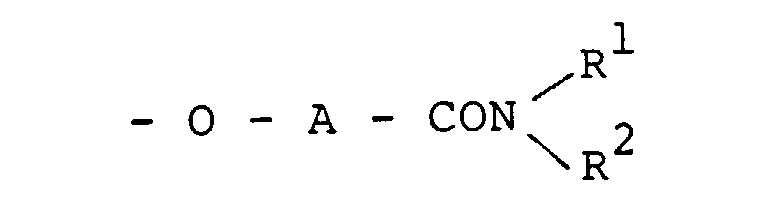
- Further, those carbostyril derivatives having no side chain similar to the side chain of the carbostyril derivative of the present application, represented by the formula


- Further, U.S. Patent No. 3,682,920 discloses 3,4-dihdyrocarbostyril derivatives having a substituent at the 1-position which are useful as an analgesic. However, the known carbostyril derivatives having a side chain represented by the formula

- Chem. & Pharm. Bulletin, vol. 31, no. 3, 1983, pages 852-860, reveals N-cyclohexyl-N-(2-hydroxyethyl)-4-(1,2-dihydro-2-oxo-6-quinolyloxy)-butyramide and related compounds and furthermore reports on the activity of these compounds as blood platelet aggregation inhibitors.
- JP/55-79370 discloses a carbostyril derivative of the formula

- JP/55-79372 reveals a carbostyril derivative of the formula

- In reference JP/54-163825 a carbostyril derivative of the formula

- JP/57-2274 refers to a carbostyril derivative of the formula

- JP/57-175168 discloses a carbostyril derivative of the formula
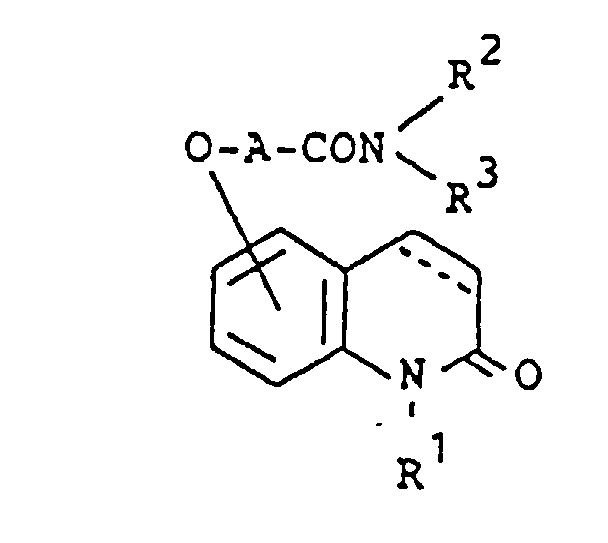
- The present inventors made extensive research in order to develop a novel carbostyril derivative which is low in side effects exhibited by the above known carbostyril derivatives, particularly side effects on circulation activities. As a result, the present invention has been completed. That is, the novel carbostyril derivative of the present invention has an excellent platelet aggregation inhibitory activity, a phosphodiesterase inhibitory activity, a venticular contraction activity (a positive contraction activity), an anti-ulcer activity, an anti-inflammatory activity, a cerebral blood flow increasing activity, a thrombus dissociation activity, a thromboxane A2 antagonism activity, etc. The compound of the present invention is characterized in that it exhibits the above activities for a long time, is low in toxicity (particularly low in toxicity to hearts of cardiovascular hyperplasia, myocardiopathy, etc.), and is low in circulation activities such as heart rate increasing activity, blood pressure decreasing activity and the like. Also, the compound of the present invention has advantages in that it is easily absorbed by the intestinal tract and easily migrates into blood. Therefore, the carbostyril derivative of the present invention can be used most suitably as a preventive and remedy for thrombi such as apoplexia, cerebral infraction, myocardial infraction and the like, a cerebral circulation improving agent, an antiinflammatory agent, an antiasthmatic agent, a cardiotonic agent and a phosphodiesterase inhibitory agent.
- According to the present invention, there are provided a novel carbostyril derivative represented by the following general formula (1)

- In the present specification, each of the group represented by R1, R2 and A in the general formula (1) is specifically as follows.
- As to the C1-C6 alkylene group, there can be mentioned straight chain or branched chain alkylene groups of 1-6 carbon atoms, such as methylene, ethylene, methylmethylene, trimethylene, 2-methyltrimethylene, 2,2-dimethyltrimethylene, tetramethylene, pentamethylene, hexamethylene, 2-ethyltrimethylene, 1-methyltrimethylene.
- As to the C1-C6 alkoxycarbonyl group, there can be mentioned alkoxycarbonyl groups whose alkoxy portions are each a straight chain or branched chain alkoxy group of 1-6 carbon atoms, such as methoxycarbonyl, ethoxycarbonyl, propoxycarbonyl, isopropoxycarbonyl, butoxycarbonyl, pentyloxycarbonyl, hexyloxycarbonyl.
- As to the C2-C6 alkanoyloxy-C1-C6 alkyl group, there can be mentioned alkanoyloxyalkyl groups whose alkanoyl portions are each a straight chain or branched chain alkanoyl group of 2-6 carbon atoms and whose alkyl portions are each a straight chain or branched chain alkyl group of 1-6 carbon atoms, such as acetyloxymethyl, 2-acetyloxyethyl, 3-acetyloxypropyl, 4-acetyloxybutyl, 5-acetyloxypentyl, 6-acetyloxyhexyl, 1-methyl-2-acetyl-oxyethyl, 2-acetyloxypropyl, 1,1-dimethyl-2-acetyloxyethyl, 2-propionyloxyethyl, 3-propionyloxypropyl, 4-propionyloxy-butyl, 5-propionyloxypentyl, 6-propionyloxyhexyl, 2-propionyloxypropyl, 2-butyryloxyethyl, 3-butyryloxypropyl, 4-butyryloxybutyl, 2-butyryloxypropyl, 2-diobutyryloxy-ethyl, 4-isobutyryloxybutyl, 2-pentanoyloxyethyl, 5-pentanoyloxypentyl, 2-tert-butylcarbonyloxyethyl, 2-hexanoyloxyethyl, 6-hexanoyloxyhexyl.
- As to the amino-C1-C6 alkyl group, there can be mentioned straight chain or branched chain alkyl groups of 1-6 carbon atoms having an amino group as a substituent, such as aminomethyl, 1-aminoethyl, 2-aminoethyl, 3-aminopropyl, 4-aminobutyl, 5-aminopentyl, 6-aminohexyl, 1,1-dimethyl-2-aminoethyl, 2-methyl-3-aminopropyl.
- As to the C1-C6 alkylamino-C1-C6 alkyl group, there can be mentioned straight chain or branched chain alkyl groups of 1-6 carbon atoms having, as an substituent, an amino group substituted by 1-2 straight chain or branched chain alkyl groups of 1-6-carbon atoms, such as methylaminomethyl, ethylaminomethyl, propylaminomethyl, isopropylaminomethyl, butylaminomethyl, tert-butylamino-methyl, pentylaminomethyl, hexylaminomethyl, dimethylaminomethyl, diethylaminomethyl, dipropylaminomethyl, dibutylaminomethyl, dipentylaminomethyl, dihexylaminomethyl, N-methyl-N-ethylaminomethyl, N-methyl-N-butylaminomethyl, N-ethyl-N-propylaminomethyl, N-methyl-N-hexylaminomethyl, 2-methylaminoethyl, 1-ethylaminoethyl, 3-propylaminopropyl, 4-butylaminobutyl, 1,1-dimethyl-2-pentylaminoethyl, 5-hexylaminopentyl, 6-dimethylaminohexyl, 2-diethylaminoethyl, 1-(N-methyl-N-hexylamino)ethyl, 3-dihexylamino-propyl, 4-dibutylaminobutyl, 2-(N-methyl-N-pentylamino)-ethyl.
- As to the hydroxy-C1-C6 alkyl group, there can be mentioned hydroxyalkyl groups whose alkyl portions are each a straight chain or branched chain alkyl group of 1-6 carbon atoms; for example, hydroxymethyl, 2-hydroxyethyl, 1-hydroxyethyl, 3-hydroxypropyl, 4-hydroxybutyl, 1,1-dimethyl-2-hydroxyethyl, 5-hydroxypentyl, 6-hydroxyhexyl, 2-methyl-3-hydroxypropyl.
- As to the C3-C8 cycloalkyl group, there can be mentioned cycloalkyl groups of 3-8 carbon atoms, such as cyclopropyl, cyclobutyl, cyclopentyl, cyclohexyl, cycloheptyl, cyclooctyl, cyclononanyl, cyclodecanyl.
- As to the tetrahydropyranyl-C1-C6 alkyl group, there can be mentioned tetrahydropyranylalkyl groups whose alkyl portions are each a straight chain or branched chain alkyl group of 1-6 carbon atoms; for example, (2-tetrahydropyranyl)methyl, (3-tetrahydropyranyl)methyl, (4-tetrahydropyranyl)methyl, 2-(2-tetrahydropyranyl)-ethyl, 2-(3-tetrahydropyranyl)ethyl, 2-(4-tetrahydropyranyl)ethyl, 1-(2-tetrahydropyranyl)ethyl, 1-(3-tetrahydropyranyl)ethyl, 1-(4-tetrahydropyranyl)ethyl, 3-(2-tetrahydropyranyl)ethyl, 3-(3-tetrahydropyranyl)propyl, 3-(4-tetrahydropyranyl)propyl, 4-(2-tetrahydropyranyl)-butyl, 4-(3-tetrahydropyranyl)butyl, 4-(4-tetrahydropyranyl)butyl, 1,1-dibutyl-2-(2-tetrahydropyranyl)ethyl, 1,1-dimethyl-2-(3-tetrahydropyranyl)ethyl, 1, 1-dimethyl-2-(4-tetrahydropyranyl)ethyl, 5-(2-tetrahydropyranyl)-pentyl, 5-(3-tetrahydropyranyl)pentyl, 5-(4-tetrahydropyranyl)pentyl, 6-(2-tetrahydropyranyl)hexyl, 6-(3-tetrahydropyranyl)hexyl, 6-(4-tetrahydropyranyl)hexyl, 2-methyl-3-(2-tetrahydropyranyl)propyl, 2-methyl-3-(3-tetrahydropyranyl)propyl, 2-methyl-3-(4-tetrahydropyranyl)propyl.
- As to the C1-C4 alkylenedioxy group, there can be mentioned straight chain or branched chain alkylenedioxy groups of 1-4 carbon atoms, such as methylenedioxy, ethylenedioxy, trimethylenedioxy, tetramethylenedioxy.
- As to the C1-C3 alkylenedioxy group-substituted C1-C6 alkyl group, there can be mentioned alkylenedioxy group-substituted alkyl groups whose alkylenedioxy portions are each a straight chain or branched chain alkylenedioxy group of 1-3 carbon atoms and whose alkyl portions are each a straight chain or branched chain alkyl group of 1-6 carbon atoms; for example, 2,3-dimethylmethylenedioxy-1-propyl, 2,4-methylenedioxy-1-butyl, 1,3-dimethylmethylenedioxy-2-propyl, 1,1-ethylene-dioxymethyl, l,2-methylenedioxy-1-ethyl, 4,5-trimethylene-dioxy-1-pentyl, 2,3-ethylenedioxy-1-hexyl.
- As to the C1-C6 alkyl group, there can be mentioned straight chain or branched chain alkyl groups of 1-6 carbon atoms, such as methyl, ethyl, propyl, isopropyl, butyl, tert-butyl, pentyl, hexyl.
- As to the phenyl-C1-C6 alkyl group having, as substitutent(s) on the phenyl ring, 1-3 groups selected from the group consisting of C1-C6 alkyl groups and a hydroxyl group, there can be mentioned phenylalkyl groups whose alkyl portions are each a straight chain or branched chain alkyl group of 1-6 carbon atoms and which have on each phenyl ring 1-3 groups selected from the group consisting of straight chain or branched chain alkyl groups of 1-6 carbon atoms and a hydroxyl group; for exmaple, 2-(3-methylphenyl)ethyl, 1-(4-methylphenyl)-ethyl, 2-methylbenzyl, 3-(2-ethylphenyl)propyl, 4-(3-ethylphenyl)butyl, 1,1-dimethyl-2-(4-ethylphenyl)ethyl, 5-(4-isopropylphenyl)pentyl, 6-(4-hexylphenyl)hexyl, 3,4-dimethylbenzyl, 3,4,5-trimethylbenzyl, 2,5-dimethylbenzyl, 2-hydroxybenzyl, 2-(3-hydroxyphenyl)-ethyl, 3-(2-hydroxyphenyl)propyl, 4-(3-(hydroxyphenyl)-butyl, 5-(4-hydroxyphenyl)pentyl, 6-(4-hydroxyphenyl)-hexyl, 3,5-di-tert-butyl-4-hydroxybenzyl, 2,4-dihydroxybenzyl, 2,4,6-trihydroxybenzyl, 2,6-dimethyl-4-hydroxybenzyl.
- As to the piperidinyl-C1-C6 alkyl group having a C1-C6 alkyl group as a substituent, there can be mentioned piperidinylalkyl groups which each have 1-3 straight chain or branched chain alkyl groups of 1-6 carbon atoms as substituent(s) and whose alkyl portions are each a straight chain or branched chain alkyl group of 1-6 carbon atoms; for example, (1-methyl-3-piperidinyl)-methyl, 2-(1-ethyl-4-piperidinyl)ethyl, 1-(1-propyl-2-piperidinyl)ethyl, 3-(1-isopropyl-3-piperidinyl)propyl, 4-(1-isopropyl-4-piperidinyl)butyl, 5-(1-butyl-3-piperidinyl)pentyl, 6-(1-pentyl-2-piperidinyl)hexyl, 1,1-dimethyl-2-(1-hexyl-2-piperidinyl)ethyl, 2-methyl-3-(1-methyl-3-piperidinyl)propyl, 2-(2,6-dimethyl-1-piperidinyl)ethyl, 3-(4-methyl-1-piperidinyl)propyl, (2,4,6-trimethyl-1-piperidinyl)methyl, 1-(2-ethyl-1-piperidinyl)ethyl, 4-(4-tert-butyl-1-piperidinyl)butyl, 5-(3-pentyl-1-piperdinyl)pentyl, 6-(4-hexyl-1-piperidinyl)-hexyl.
- As to the C1-C6 alkoxy group, there can be mentioned straight chain or branched chain alkoxy groups of 1-6 carbon atoms, such as methoxy, ethoxy, propoxy, isopropoxy, butoxy, tert-butoxy, pentyloxy, hexyloxy.
- As to the C1-C6 alkoxy-C1-C6 alkoxy group, there can be mentioned alkoxyalkoxy groups whose alkoxy portions are each a straight chain or branched chain alkoxy group of 1-6 carbon atoms, such as methoxymethoxy, 3-methoxy-propoxy, 4-ethoxybutoxy, 6-propoxyhexyloxy, 5-isoporpoxypentyloxy, 1,1-dimethyl-2-butoxyethoxy, 2-mthyl-tert-butoxypropoxy, 2-pentyloxyethoxy, hexyloxy-methoxy.
- As to the C1-C6 alkoxy-C1-C6 alkyl group, there can be mentioned alkoxyalkyl groups whose alkoxy portions are each a straight chain or branched chain alkoxy group of 1-6 carbon atoms and whose alkyl portions are each a straight chain or branched chain alkoxy group of 1-6 carbon atoms; for example, methoxymethyl, hexyloxymethyl, 2-pentyloxyethyl, 3-methoxypropyl, 4-ethoxybutyl, 5-isopropoxypentyl, 6-propoxyhexyl, 1,1-dimethyl-2-butoxyethyl, 2-methyl-tert-butoxypropyl. As to the C1-C6 alkylamideo group, there can be mentioned amido groups each having 1-2 straight chain or branched chain alkyl groups of 1-6 carbon atoms, such as methylamido, ethylamido, propylamido, isopropylamido, butylamido, tertbutylamido, pentylamido, hexylamido, N-ethyl-N-hexylamido, N-methyl-N-ethylamido, N-methyl-N-propylamido, N-methyl-N-butylamido.
- As to the tetrahydropyranylthio-C1-C6 alkyl group, there can be mentioned tetrahydropyranylthioalkyl groups whose alkyl portions are each a straight chain or branched chain alkyl group of 1-6 carbon atoms; for example, (2-tetrahydropyranylthio)methyl, (3-tetrahydropyranylthio)-methyl, (4-tetrahydropyranylthio)methyl, 2-(2-tetrahydropyranylthio)ethyl, 2-(3-tetrahydropyranylthio)ethyl, 2-(4-tetrahydropyranylthio)ethyl, 1-(2-tetrahydropyranylthio)ethyl, 1-(3-tetrahydropyranylthio)ethyl, 1-(4-tetrahydropyranylthio)ethyl, 3-(2-tetrahydrdpyranylthio)-propyl, 3-(3-tetrahydropyranylthio)propyl, 3-(4-tetrahydropyranylthio)propyl, 4-(2-tetrahydroipyranylthio)-butyl, 4-(3-tetrahydropyranylthio)butyl, 4-(4-tetrahydropyranylthio)butyl, 1,1-dimethyl-2-(2-tetrahydropyranylthio)ethyl, 1,1-dimethyl-2-(3-tetrahydropyranylthio)-ethyl, 1,1-dimethyl-2-(4-tetrahydropyranylthio)ethyl, 5-(2-tetrahydropyranylthio)pentyl, 5-(3-tetrahydropyranyl-thio)pentyl, 5-(4-tetrahydropyranylthio)pentyl, 6-(2-tetrahydropyranylthio)hexyl, 6-(3-tetrahydropyranylthio)-hexyl, 6-(4-tetrahydropyranylthio)hexyl, 2-methyl-3-(2-tetrahydropyranylthio)propyl, 2-methyl-3-(3-tetrahydropyranylthio)propyl, 2-methyl-3-(4-tetrahydropyranylthio) propyl.
- As to the pyridylthio-C1-C6 alkyl group, there can be mentioned pyridylthioalkyl groups whose alkyl portions are each a straigh chain or branched chain alkyl group of 1-6 carbon atoms; for example, (2-pyridylthio)methyl, (3-pyridylthio)methyl, (4-pyridylthio)methyl, 2-(2-pyridylthio)ethyl, 2-(3-pyridylthio)ethyl, 2-(4-pyridylthio)ethyl, 1-(2-pyridylthio)ethyl, 1-(3-pyridyl-thio)ethyl, 1-(4-pyridylthio)ethyl, 3-(2-pyridykthio)-propyl, 3-(3-pyridylthio)propyl, 3-(4-pyridylthio)propyl, 4-(2-pyrdidylthio)butyl, 4-(3-pyridylthio)butyl, 4-(4-4-(2-pyrdidylthio)butyl, 1,1-dimethyl-2-(2-pyridylthio)ethyl, 1,1-dimethyl-2-(3-pyridylthio)ethyl, 1,1-dimethyl-2-(4-pyridylthio)ethyl, 5-(2-pyridylthio)pentyl, 5-(3-pyridylthio)pentyl, 5-(4-pyrdidylthio)pentyl, 6-(2-pyridylthio)hexyl, 6-(3-pyridylthio)hexyl, 6-(4-pyridylthio)hexyl, 2-methyl-3-(2-pyridylthio)propyl, 2-methyl-3-(3-pyridylthio)propyl, 2-methyl-3-(4-pyridyl-thio)propyl.
- As to the C1-C6 alkylthio group, there can be mentioned straight chain or branched chain alkylthio groups of 1-6 carbon atoms, such as methylthio, ethylthio, propylthio, isopropylthio, butylthio, tert-butylthio, pentylthio, hexylthio.
- As to the C2-C6 alkanoyloxy group, there can be mentioned straight chain or branched chain alkanoyloxy groups of 2-6 carbon atoms, such as acetyloxy, proipionyloxy, butyryloxy, isobutyryloxy, pentanoyloxy, tert-butylcarbonyl-oxy, hexanoyloxy.
- As to the halogen atom, there can be mentioned, for example, a fluorine atom, a chlorine atom, a bromine atom and an iodine atom.
- As to the C1-C6 alkanoyl group, there can be mentioned straight chain or branched chain alkanoyl groups of 1-6 carbon atoms, such as formyl, acetyl, propionyl, butyryl, iosbutyryl, pentanoyl, tert-butylcarbonyl, hexanoyl.
- As to the phenyl-C1-C6 alkyl group which may have a C1-C6 alkoxy group as a substituent on the phenyl ring, there can be mentioned phenylalkyl groups whose alkyl portions are each a straight chain or branched chain alkyl group of 1-6 carbon atoms and which may have 1-3 straight chain or branched chain alkoxy groups of 1-6 carbon atoms on each phenyl ring; for example, benzyl, 2-phenylethyl, 1-phenylethyl, 3-phenylpropyl, 4-phenylbutyl, 1,1-dimethyl-2-phenylethyl, 5-phenylpentyl, 6-phenylhexyl, 2-methyl-3-phenylpropyl, 2-(3-methoxyphenyl)ethyl, 1-(4-methoxyphenyl)-ethyl, 2-methoxybenzyl, 3-(2-ethoxyphenyl)propyl, 4-(3-ethoxyphenyl)butyl, 1,1-dimethyl-2-(4-ethoxyphenyl)ethyl, 5-(4-isopropoxyphenyl)pentyl, 6-(4-hexyloxyphenyl)hexyl, 3,4-dimethoxybenzyl, 3,4,5-trimethoxybenzyl, 2,5-dimethoxybenzyl.
- As to the C2-C6 alkenyl group, there can be mentioned straight chain or branched chain alkenyl groups of 2-6 carbon atoms, such as vinyl, allyl, 2-butenyl, 3-butenyl, 1-methylallyl, 2-pentenyl, 2-hexenyl.
- As to the C3-C8 cycloalkyl-C1-C6 alkyl group which may have, as a substituent, a group selected from the group consisting of C1-C6 alkoxycarbonyl groups, a carboxy group, C2-C6 alkanoyloxy-C1-C6 alkyl groups, amino-C1-C6 alkyl groups, C1-C6 alkylamino-C1-C6 alkyl groups and hydroxy-C1-C6 alkyl groups, there can be mentioned cycloalkylalkyl groups whose cycloalkyl portions are each a cycloalkyl group of 3-8 carbon atoms and whose alkyl portions are each a straight chain or branched chain alkyl group of 1-6 carbon atoms and which may each have, as a substituent, a group selected from the group consisting of alkoxycarbonyl groups whose alkoxy portions are each a straight chain or branched chain alkoxy group of 1-6 carbon atoms, a carbonyl group, alkanoyloxyalkyl groups whose alkanoyl portions are each a straight chain or branched chain alkanoyl group of 2-6 carbon atoms and whose alkyl portions are each a straight chain or branched chain alkyl group of 1-6 carbon atoms, stright chain or branched chain alkyl groups of 1-6 carbon atoms each having an amino group as a substituent, straight chain or branched chain alkyl groups of 1-6 carbon atoms having, as a substituent, an amino group substituted by 1-2 straight chain or branched chain alkyl groups of 1-6 carbon atoms, and hydroxyalkyl groups whose alkyl portions are each a straight chain or branched chain alkyl group of 1-6 carbon atoms; for example, 4-cyclohexylbutyl, cyclopropylmethyl, 2-cyclopentylethyl, cyclohexylmethyl, 2-cyclopentylpropyl, 3-cyclohexylpropyl, cyclopentylmethyl, 2-cyclohexylethyl, 2-cyclohexylpropyl, 2-cycloheptylethyl, 3-cyclobutylpropyl, 1,1-dimethyl-2-cyclohexylethyl, 1-methyl-2-cyclopentylethyl, 2-cyclooctylethyl, 5-cyclohexylpentyl, 6-cyclohexylhexyl, 4-(3-methoxycarbonylcyclohexyl)butyl, (4-ethoxycarbonylcyclohexyl)methyl, (2-propoxycarbonylcyclopropyl)methyl, 2-(2-isopropoxycarbonylcyclopentyl)ethyl, 2-(3-butoxycarbonylcyclopentyl)propyl, 3-(2-pentyloxycarbonylcyclohexyl)propyl, 2-(4-hexyloxycarbonylcycloheptyl)ethyl, 3-(2-methoxycarbonylcyclobutyl)propyl, 1,1-dimethyl-2-(3-ethoxycarbonylcyclohexyl)ethyl, 1-methyl-2-(3-propoxycarbonylcyclopentyl)ethyl, 2-(3-isopropoxycarbonylcyclooctyl)ethyl, 5-(4-ethoxycarbonylcyclohexyl)pentyl, 6-(3-ethoxycarbonylcyclohexyl)hexyl, 4-(4-carboxycyclohexyl)butyl, (2-carboxycyclopentyl)methyl, 2-(2-carboxycyclopentyl)ethyl, (4-carboxycyclohexyl)methyl, 3-(2-carboxycyclohexyl)propyl, 2-(3-carboxycyclohexyl)ethyl, 2-(4-carboxycyclohexyl)ethyl, 2-(4-carboxycycloheptyl)ethyl, 3-(2-carboxycyclobutyl)propyl, 1,1-dimethyl-2-(4-carboxycyclohexyl)ethyl, 1-methyl-2-(3-carboxycyclopentyl)ethyl, 2-(3-carboxycyclooctyl)ethyl, 5-(4-carboxycyclohexyl)pentyl, 6-(2-carboxycyclohexyl)hexyl, (4-acetyloxycyclohexyl)methyl, 4-[3-(2-propionyloxyethyl)cyclohexyl]butyl, 2-[3-(3-butyryloxypropyl)cyclopentyl]ethyl, 3-[3-(4-isobutyryloxybutyl)cyclobutyl]propyl, 2-[4-(5-pentanoyloxypentyl)cycloheptyl]ethyl, 2-[3-(6-hexanoyloxyhexyl)cyclooctyl]ethyl, (4-dimethylaminomethylcyclohexyl)methyl, 4-(4-aminomethylcyclohexyl)butyl, (2-methylaminomethylcyclopropyl)methyl, 5-[3-(3-propylaminopropyl)cyclopentyl]pentyl, 6-[4-(4-butylaminobutyl)cyclopentyl]hexyl, 3-[4-(1,1-dimethyl-2-pentylaminoethyl)cyclopentyl]propyl, [3-(5-hexylaminopentyl)cyclopentyl]methyl, 2-[4-(6-dimethyl aminohexyl)-cyclohexyl}ethyl, 2-[3-(2-diethylaminoethyl)cyclohexyl]-propyl, 1,1-dimethyl-2-{4-[1-(N-methyl-N-hexylamino)ethyl]-cyclohexyl}etyl, 1-methyl-2-[4-(3-dihexylaminopropyl) cyclopentyl]ethyl, 2-[3-(4-dibutylaminobutyl)cyclooctyl]ethyl, 2-{3-[2-(N-methyl-N-pentylamino)ethylibycloheptyl}ethyl, 3-[2-(1-ethylaminoethyl)cyclobutyl]propyl, (4-hydroxymethyl-cyclohexyl)methyl, 4-[3-(2-hydroxyethyl)cyclohexyl]butyl, [2-(1-hydroxyethyl)cyclopropyl]methyl, 2-[3-(3-hydroxypropyl)cyclopentyl]ethyl, 3-[4-(4-hdyroxybutyl)cyclopentyl]-propyl, 3-[2-(1,1-dimethyl-2-hdyroxyethyl)cyclobutyl]propyl, 2-[3-(5-hydroxypentyl)cycloheptyl]ethyl, 2-[3-(6-hydroxyhexyl)cyclooctyl]ethyl, 6-[4-(2-methyl-3-hydroxypropyl)-cyclohexyl]hexyl, 5-(2-hydroxymethylcyclopentyl)pentyl.
- As to the amino group which may have, as a substituent, a C1-C6 alkanoyl group, a phenyl-C1-C6 alkyl group which may have a C1-C6 alkoxy group as a substituent on the phenyl ring, a C1-C6 alkenyl group, a hydroxy-C1-C6 alkyl group or a C1-C6 alkyl group, there can be mentioned amino group which may each have, as substituent(s), 1-2 groups selected from straight chain or branched chain alkanoyl groups of 1-6 carbon atoms, phenylalkyl groups which may each have 1-3 straight chain or branched chain alkoxy groups of 1-6 carbon atoms on the phenyl ring and whose alkyl portions are each straight chain or branched chain alkyl groups of 1-6 carbon atoms, straight chain or branched chain alkenyl groups of 2-6 carbon atoms, hydroxyalkyl groups whose alkyl portions are each a straight chain or branched chain alkyl group of 1-6 carbon atoms and straight chain or branched chain alkyl groups of 1-6 carbon atoms; for example, amino, formylamino, acetylamino, propionylamino, butyrylamino, isobutyrylamino, pentanoylamino, tert-butylcarbonylamino, hexanoylamino, [2-(3,4-dimethoxyphenyl)ethyl]amino, benzylamino, N-ethyl-N-benzylamino, N-ethyl-N-[2-(3,4-dimethoxyphenyl)ethyl]amino, (1-phenylethyl)amino, [3-(2-ethoxyphenyl)propyl]amino, (4-phenylbutyl)amino, [5-(4-isopropoxyphenyl)pentyl]amino, [6-(4-hexyloxyphenyl)hexyl]amino, (3,4,5-trimethoxybenzyl)amino, N-methyl-N-benzylamino, N-propyl-N-[2-(3,4-dimethoxy-phenyl)ethyl]amino, N-butyl-N-(2-phenylethyl)amino, N-pentyl-N-(3-phenylpropyl)amino, N-hexyl-N-(5-phenyl-pentyl)amino, allylamino, N-ethyl-N-allylamino, N-(2-butenyl)amino, N-methyl-N-(3-butenyl)amino, N-(1-methylallyl)amino, N-(2-pentenyl)-N-propylamino, N-butyl-N-(2-hexenyl)amino, hydroxyemthylamino, N-(2-hydroxyethyl)-N-ethylamino, (1-hydroxyethyl)amino, N-methyl-N-(3-hydroxypropyl)amino, N-propyl-N-(4-hydroxybutyl)amino, (1,1-dimethyl-2-hydroxyethyl)amino, N-butyl-N-(5-hydroxypentyl)amino, (6-hydroxyhexyl)amino, N-pentyl-N-(2-methyl-3-hydroxypropyl) amino, N-hexyl-N-(2-hydroxyethyl)amino, methylamino, ethylamino, propylamino, isopropylamino, butylamino, tert-butylamino, pentylamino, hexylamino, dimethylamino, diethylamino, diproipylamino, dibutylamino, dipentylamino, dihexylamino, N-methyl-N-ethylamino, N-ethyl-N-propylamino, N-methyl-N-butylamino, N-methyl-N-hexylamino. The substituent R2 as given in the compound of the formula (1) is represented by specific 5-membered or 6-membered saturated or unsaturated heterocycle C1-C6 alkyl groups which may have, as a substituent on the heterocycle, 1-3 groups selected from the group consisting of hydroxy-C1-C6 alkyl groups, C2-C6 alkanoyloxy-C1-C6 alkyl groups, a hydroxyl group, C1-C6 alkyl groups, amino-C1-C6 alkyl groups, C1-C6-alkylamino-C1-C6 alkyl groups, C1-C6 alkoxy groups, C1-C6 alkoxy-C1-C6 alkoxy groups, C1-C6 alkoxy-C1-C6 alkyl groups, a thio group and C1-C6 alkylamide groups.
- The substituent R2 may have, as substituent(s) on the heterocycle, 1-3 groups selected from the group consisting of hydroxyalkyl groups whose alkyl portions are each a straight chain or branched chain alkyl group of 1-6 carbon atoms, alkanoyloxyalkyl groups whose alkanoyl portions are each a straight chain or branched chain alkanoyl group of of 2-6 carbon atoms and whose alkyl portions are each a straight chain or branched chain alkyl groups of 1-6 carbon atoms, a hydroxyl group, straight chain or branched chain alkyl groups of 1-6 carbon atoms, straight chain or branched chain alkyl groups of 1-6 carbon atoms having an amino group as a substituent, straight chain or branched chain alkyl groups of 1-6 carbon atoms substituted by an amino group having 1-2 straight chain or branched chain alkyl groups of 1-6 carbon atoms, straight chain or branched chain alkoxy groups of 1-6 carbon atoms, alkoxyalkoxy groups whose alkoxy portions are each a straight chain or branched chain alkoxy group of 1-6 carbon atoms, alkoxyalkyl groups whose alkoxy portions are each a straight chain or branched chain alkoxy group of 1-6 carbon atoms and whose alkyl portions are each a straight chain or branched chain alkyl group of 1-6 carbon atoms, a thio group and alkylamido groups whose alkyl portions are each a straight chain or branched alkyl group of 1-6 carbon atoms; for example, (1-pyrrolidinyl)methyl, 2-(1-pyrrolidinyl)ethyl, 1-(1-pyrrolidinyl)ethyl, 3-(2-pyrrolidinyl)propyl, 4-(3-pyrrolidinyl)butyl, 1,1-dimethyl-2-(1-pyrrolidinyl)ethyl, 5-(2-pyrrolidinyl)pentyl, 6-(3-pyrrolidinyl)hexyl, 2-methyl-3-(1-pyrrolidinyl)propyl, 2-(2-hydroxyemthyl-1-pyrrolidinyl)ethyl, 2-(2-acetyloxymethyl-1-pyrrolidinyl)ethyl, 2-(3-hdyroxy-1-pyrrolidinyl)ethyl, morpholinomethyl, 2-morpholinoethyl, 1-morpholinoethyl, 3-morpholinopropyl, 4-morpholinobutyl, 1,1-dimethyl-2-morpholinoethyl, 5-morpholinopentyl, 6-morpholinohexyl, 2-methyl-3-morpholinopropyl, (1-piperidinyl)methyl, 2-(1-piperidinyl)ethyl, 1-(2-piperidinyl)ethyl, 3-(3-piperidinyl)propyl, 4-(1-piperidinyl)butyl, 1,1-dimethyl-2-(2-piperidinyl)ethyl, 5-(3-piperidinyl)pentyl, 6-(4-piperidinyl)hexyl, 2-methyl-3-(1-piperidinyl)propyl, 2-(4-hydroxy-1-piperidinyl)ethyl, 2-(2,6-dimethyl-1-piperidinyl)ethyl, 2-(2-dimethylaminomethyl-1-pyrrolidinyl)ethyl, 2-(4-methoxy-1-piperidinyl)ethyl, 2-(2-hydroxyemthyl-4-hdyroxy-l-pyrrolidinyl)ethyl, 2-(1-ethyl-4-hydroxy-2-pyrrolidinyl)-ethyl, 2-(2-methoxymethyl-1-pyrrolidinyl)ethyl, 2-(4-methoxymethoxy-1-piperidinyl)ethyl, (1-thiomorpholino)-methyl, 2-(2-thiomorpholino)ethyl, 1-(3-thiomorpholino)-ethyl, 3-(1-thiomorpholino)propyl, 4-(2-thiomorpholino)-butyl, 1,1-dimethyl-2-(1-thiomorpholino)ethyl, 5-(2-thiomorpholino)pentyl, 6-(3-thiomorpholino)hexyl, 2-methyl-3-(2-thiomorpholino)propyl, (1-imidazolyl)methyl, 2-(1-imidazolyl)ethyl, 1-(1-imidazolyl)ethyl, 3-(1-imidazolyl)propyl, 4-(1-imidazolyl)butyl, 1,1-dimethyl-2-(1-imidazolyl)ethyl, 5-(1-imidazolyl)pentyl, 6-(1-imidazolyl)hexyl, 2-methyl-3-(1-imidazolyl)propyl, (1,2,4-triazol-1-yl)methyl, 2-(1,2,4-triazol-1-yl)ethyl, 1-(1,2,4-triazol-1-yl)ethyl, 3-(l,2,4-triazol-1-yl)-propyl, 4-(1,2,4-triazol-1-yl)butyl, 1,1-dimethyl-2-(1,2,4-triazol-1-yl)ethyl, 5-(1,2,4-triazol-1-yl)pentyl, 6-(1,2,4-triazol-1-yl)hexyl, 2-methyl-3-(1,2,4-triazol-1-yl)propyl, (1,6-dimethyl-2-thiomorpholino)methyl, (2-furyl)methyl, 2-(2-furyl)ethyl, 1-(2-furyl)ethyl, 3-(3-furyl)propyl, 4-(2-furyl)butyl, 1,1-dimethyl-2-(3-furyl)ethyl, 5-(2-furyl)pentyl, 6-(3-furyl)hexyl, 2-methyl-3-(2-furyl)propyl, 2-(2-diethylamido-1-pyrrolidinyl)-ethyl, (1-methyl-3-piperidinyl)methyl, (1-methyl-2-piperidinyl)methyl, (1-piperazinyl)methyl, 2-(1-piperazinyl)ethyl, 1-(1-piperazinyl)ethyl, 3-(1-piperazinyl)propyl, 4-(1-piperazinyl)butyl, 1,1-dimethyl-2-(1-piperazinyl)ethyl, 5-(1-piperazinyl)pentyl, 6-(1-piperazinyl)hexyl, 2-methyl-3-(1-piperazinyl)propyl, 2-[4-(2-hydroxyethyl)-1-piperazinyl)ethyl, 2-(4-methyl-1-piperazinyl)ethyl, 2-[4-(2-acetyloxyethyl)-1-piperazinyl]ethyl, (1,2,3,4-tetrazol-1-yl)methyl, 2-(1,2,3,4-tetrazol-1-yl)ethyl, 1-(1,2,3,4-tetrazol-1-yl)ethyl, 3-(1,2,3,4-tetrazol-1-yl)propyl, 4-(1,2,3,4-tetrazol-1-yl)butyl, 5-(1,2,3,4-tetrazol-1-yl)pentyl, 6-(1,2,3,4-tetrazol-1-yl)hexyl, (2-pyridyl)methyl, 2-(2-pyridyl)ethyl, 1-(2-pyridyl)ethyl, 3-(2-pyridyl)propyl, 4-(2-pyridyl)butyl, 1,1-dimethyl-2-(2-pyridyl)ethyl, 5-(2-pyridyl)pentyl, 6-(2-pyridyl)hexyl, 2-methyl-3-(2-pyridyl)propyl, (3-pyridyl)methyl, 2-(3-pyridyl)ethyl, 1-(3-pyridyl)ethyl, 3-(3-pyridyl)propyl, 4-(3-pyridyl)butyl, 1,1-dimethyl-2-(3-pyridyl)ethyl, 5-(3-pyridyl)pentyl, 6-(3-pyridyl)hexyl, 2-methyl-3-(3-pyridyl)propyl, (4-pyridyl)methyl, 2-(4-pyridyl)ethyl, 1-(4-pyridyl)ethyl, 3-(4-pyridyl)propyl, 4-(4-pyridyl)butyl, 1,1-dimethyl-2-(4-pyridyl)ethyl, 5-(4-pyridyl)pentyl, 6-(4-pyridyl)hexyl, 2-methyl-3-(4-pyridyl)propyl, (3-pyrazyl)methyl, 2-(4-pyridazyl)ethyl, 1-(2-pyrimidyl)ethyl, 3-(2-pyrazyl)propyl, 4-(3-pyridazyl)butyl, 5-(4-pyrimidyl)pentyl, 6-(3-pyrazyl)hexyl, 2-methyl-3-(2-pyrimidyl)propyl, (2-tetrahydropyranyl)methyl, 2-(2-tetrahydropyranyl)ethyl, 1-(2-tetrahydropyranyl)-ethyl, 3-(2-tetrahydropyranyl)propyl, 4-(2-tetrahydropyranyl)butyl, 1,1-dimethyl-2-(2-tetrahydropyranyl)ethyl, 5-(2-tetrahydropyranyl)pentyl, 6-(2-tetrahydropyranyl)-hexyl, 2-methyl-3-(2-tetrahydropyranyl)propyl, (3-tetrahydropyranyl)methyl, 2-(3-tetrahydropyranyl)ethyl, 1-(3-tetrahydropyranyl)ethyl, 3-(3-tetrahydropyranyl)-propyl, 4-(3-tetrahydropyranyl)butyl, 1,1-dimethyl-2-(3-tetrahydropyranyl)ethyl, 5-(3-tetrahydropyranyl)-pentyl, 6-(3-tetrahydropyranyl)hexyl, 2-methyl-3-(3-tetrahydropyranyl)propyl, (4-tetrahydropyranyl)methyl, 2-(4-tetrahydropyranyl)ethyl, 1-(4-tetrahydropyranyl)-ethyl, 3-(4-tetrahydropyranyl)propyl, 4-(4-tetrahydropyranyl)butyl, 1,1-dimethyl-2-(4-tetrahydropyranyl)-ethyl, 5-(4-tetrahydropyranyl)pentyl, 6-(4-tetrahydropyranyl)hexyl, 2-methyl-3-(4-tetrahydropyranyl)propyl, (pyrrol-1-yl)methyl, 2-(pyrrol-2-yl)ethyl, 1-(pyrrol-3-yl)-ethyl, 3-(pyrrol-1-yl)propyl, 1,1-dimethyl-2-(pyrrol-1-yl)-ethyl, 6-(pyrrol-1-yl)hexyl, (2-thienyl)mehyl, 2-(3-thienyl)ethyl, 1-(2-thienyl)ethyl, 4-(2-thienyl)butyl, 5-(3-thienyl)pentyl, 2-methyl-3-(2-thienyl)propyl, [2-(2-hydroxyethyl)-1-pyrrolidinyl]methyl, 3-[3-(1-hydroxyethyl)morpholino]propyl, 4-[4-(3-hydroxypropyl)-l-piperidinyl]butyl, 5-[3-(4-hydroxybutyl)-2-thiomorpholino]pentyl, 6-[2-(5-hydroxypentyl)-1-imidazolyl]hexyl, 1,1-dimethyl-2-[2-(6-hydroxyhexyl)-1,2,4-triazol-1-yl]-ethyl, 2-methyl-3-(3-hydroxymethyl-2-furyl)propyl, 1-(4-hydroxymethyl-1-piperazinyl)ethyl, (4-hydroxymethyl-2-pyridyl)methyl, (3-hydroxy-1-pyrrolidinyl)methyl, 3-(3-hydroxymorpholino)propyl, 4-(4-hydroxy-1-piperidinyl)-butyl, 5-(3-hydroxy-2-thiomorpholino)pentyl, 6-(4-hydroxy-1-imidazolyl)hexyl, 1,1-dimethyl-2-(3-hydroxy-2-thienyl)ethyl, 2-methyl-3-(4-hydroxy-2-pyrimidyl)-propyl, 4-(5-hydroxy-3-pyridazyl)butyl, (2-hydroxy-3-pyrazyl)methyl, 3-[3-(2-propionyloxyethyl)-1-pyrrolidinyl]-propyl, 4-[3-(3-butyryloxypropyl)mropholino]butyl, 5-[4-(4-pentanoyloxtybutyl)-1-piperidinyl]pentyl, 6-[3-(5-hexanoyloxypentyl)-1-piperazinyl]hexyl, (4-acetyloxy-methyl-2-pyridyl)methyl, 2-(3-propionyloxymethyl-2-furyl)ethyl, 1-(2-acetyloxymethylpyrrol-1-yl)ethyl, 3-(4-acetyloxymethyl-1-imidazolyl)propyl, (2,4,6-trimethyl-l-piperidinyl)methyl, 2-(3-ethyl-1-pyrrolidinyl)ethyl, 1-(3-propyl-1-piperazinyl)ethyl, 3-(3-methylmorpholino)-propyl, 4-(5-butyl-2-thiomorpholino)butyl, 5-(5-methyl-2-imidazolyl)pentyl, 6-(3-pentyl-1,2,4-triazol-1-yl)hexyl, (3-methyl-2-tetrahydropyranyl)methyl, 2-(4-hexyl-3-pyridyl)ethyl, 2-(2-aminomethyl-1-pyrrolidinyl)ethyl, [3-(2-aminoethyl)-4-pyridazyl}methyl, 1-[4-(3-diethyl-aminoproipyl)-2-pyrimidyl}ethyl, 3-{3-[4-(N-methyl-N-propylamino)butyl]-2-pyrazyl}propyl, 4-[3-(5-dibutylamino-pentyl)-2-furyl]butyl, 5-{3-[6-(N-ethyl-N-pentylamino)-hexyl]-2-thienyl}pentyl, 6-(3-dihexylaminomethyl-1-5 piperazinyl)hexyl, (4-methylamino-1-imidazolyl)methyl, 2-(3-ethylamino-1,2,4-triazol-1-yl)ethyl, (4-ethoxy-1-piperidinyl)methyl, 3-(4-propoxy-2-pyridyl)propyl, 4-(3-butoxy-4-pyridazyl)butyl, 5-(4-pentyloxy-2-pyrimidyl)-pentyl, 6-(2-hexyloxy-3-pyrazyl)hexyl, (3-methoxy-2-thienyl)methyl, 2-(2-methoxypyrrol-1-yl)ethyl, 1-(3-methoxy-2-furyl)ethyl, 3-(2-methoxy-1-imidazolyl)propyl, 4-(3-methoxy-1,2,4-triazol-1-yl)butyl, [4-(2-ethoxyethdxy)-1-piperidinyl]methyl, 3-(3-propoxypropoxy-1-pyrrolidinyl)-propyl, 4-(4-butoxybutoxy-2-pyridyl)butyl, 5-[3-(5-pentyloxypentyloxy)-2-furyl]pentyl, 6-[2-(6-hexyloxy-hexyloxy)-1-imidazolyl]hexyl, (3-methoxyemthoxy-1,2,4-triazol-1-yl)methyl, (3-methoxymethoxy-2-tetrahydropyranyl)-methyl, [2-(2-ethoxyethyl)-1-pyrrolidinyl]methyl,-3-[4-(3-propoxypropyl)-1-piperidinyl]propyl, 4-[4-(4-butoxy-butyl)-1-piperazinyl]butyl, 5-[4-(5-pentyloxypentyl)-2-thiomorpholino]pentyl, 6-[1-(6-hexyloxyhexyl)-3-morpholino]hexyl, (2-methoxymethyl-1-imidazolyl)methyl, (3-ethxoymethyl-1,2,4-tetrazolyl)methyl, (4-methoxymethyl-2-tetrahydropyranyl)methyl, 2-(4-propoxymethyl-3-pyridyl)ethyl, 3-(3-butoxymethyl-2-furyl)propyl (3-dimethylamido-1-pyrrolidinyl)methyl, 3-(3-methylamido-1-piperidinyl)propyl, 4-(2-ethylamidomorpholino)butyl, 5-(3-propylamido-1-piperazinyl)pentyl, 6-(3-butylamido-2-thiomorpholino)hexyl, (3-pentylamido-2-pyridyl)methyl, 2-(4-hexylamido-1-imidazolyl)ethyl, 1-(3-dibutyiamido-1,2,4-tetrazol-1-yl)ethyl, [3-(N-methyl-N-ethylamido)-2-furyl]methyl, (4-hydroxy-2,6-dimethyl-1-piperidnyl)-methyl, 1,3-oxathiolran-4-ylmethyl, 1,3-oxathiolane-2-thion-4-ylmethyl, 2-(1,3-oxathiolane-2-thion-4-yl)ethyl, 3-(1,3-oxathiolane-2-thion-4-yl)propyl.
- As to the C1-C6 alkyl group which may have, as substituent(s), 1-2 groups selected from the group consisting of an amino group (this amino group may be substituted by a C1-C6 alkanoyl group, a phenyl-C1-C6 alkyl group which may have a C1-C6 alkoxy group as a substituent on the phenyl ring, a C2-C6 alkenyl group, a hydroxy-C1-C6 alkyl group or a C1-C6 alkyl group), a hydroxyl group, C1-C6 alkylthio groups, C2-C6 alkanoyloxy groups, a tetrahydropyranyloxy group, halogen atoms, C1-C6 alkanoyl groups, a mercapto group, C1-C6 alkoxycarbonyl groups, a carboxy group, C1-C6 alkoxy groups, an amido group and C1-C6 alkylamido groups, there can be mentioned, in addition to the above-mentioned C1-C6 alkyl groups, hydroxy-C1-C6 alkyl groups, C2-C6 alkanoyloxy-C1-C6 alkyl groups and C1-C6 alkoxy-C1-C6 alkyl groups, straight chain or branched chain alkyl groups of 1-6 carbon atoms which may have, as substituent(s), 1-2 groups selected from the group consisting of an amino group [this amino group may be substituted by a straight chain or branched chain alkanoyl group of 1-6 carbon atoms, a phenylalkyl group which may have 1-3 straight chain or branched chain alkoxy groups of 1-6 carbon atoms as substituent(s) on the phenyl ring and whose alkyl portion is a straight chain or branched chain alkyl group of 1-6 carbon atoms, a straight chain or branched chain alkenyl group of 2-6 carbon atoms, a hydroxyalkyl group whose alkyl portion is a straight chain or branched chain alkyl group of 1-6 carbon atoms, or a straight chain or branched chain alkyl group of 1-6 carbon atoms], a hydroxyl group, straight chain or branched chain alkylthio groups of 1-6 carbon atoms, straight chain or branched chain alkanoyloxy groups of 2-6 carbon atoms, a tetrahydropyranyloxy group, halogen atoms, straight chain or branched chain alkanoyl groups of 1-6 carbon atoms, a mercapto group, alkoxycarbonyl groups whose alkoxy portions are each a straight chain or branched chain alkoxy group of 1-6 carbon atoms, a carboxy group, straight chain or branched chain alkoxy groups of 1-6 carbon atoms, an amido group and amido groups having 1-2 straight chain or branched chain alkyl groups of 1-6 carbon atoms; for example, aminomethyl, 2-formylaminoethyl, 1-acetylaminoethyl, 3-propionylaminopropyl, 4-butyrylaminobutyl, 1,1-dimethyl-2-pentanoylaminoethyl, 5-hexanoylaminopentyl, 6-[2-(3,4-dimethoxyphenyl)ethyl]-aminohexyl, 2-methyl-3-benzylaminopropyl, (N-ethyl-N-benzylamino)methyl, 2-{N-ethyl-N-[2-(3,4-dimethoxyphenyl)-ethyl]amino}ethyl, 3-(1-phenylethyl)aminopropyl, 4-[3-(2-ethoxyphenyl)propyl]aminobutyl, 1,1-dimethyl-2-(4-phenylbutyl)aminoethyl, 5-[5-(4-isopropoxyphenyl)-pentyl]aminopentyl, 6-[6-(4-hexyloxyphenyl)hexyl]aminohexyl, (3,4,5-trimethoxybenzyl)aminomethyl, 2-(N-methyl-N-benzylamino)ethyl, 1-{N-propyl-N-3-[2-(3,4-dimethoxy-phenyl)ethyl]amino}propyl, 4-(N-methyl-N-hexylamino)-butyl,1,1-dimethyl-2-[N-butyl-N-(2-phenylethyl)-amino]ethyl, 5-[N-pentyl-N-(3-phenylpropyl)amino]pentyl, 6-[N-hexyl-N-(5-phenylpentyl)amino]hexyl, 2-methyl-3-allylaminopropyl, (N-ethyl-N-allylamino)methyl, 2-[N-(2-butenyl)amino]ethyl, 1-[N-methyl-N-(3-butenyl)-amino]ethyl, 3-[N-(1-methylallyl)amino]propyl, 4-[N-(2-pentenyl)-N-propylamino]butyl, 1,1-dimethyl-2-[N-butyl-N-(2-hexenylamino]ethyl, 5-(hydroxymethylamino)-pentyl, 6-[N-(2-hydroxyethyl)-N-ethylamino]hexyl, 2-methyl-3-[(1-hydroxyethyl)amino]propyl, [N-methyl-N-(3-hydroxypropyl)amino]methyl, 2-[N-propyl-N-(4-hydroxybutyl)amino]ethyl, 1-[(1,1-dimethyl-2-hydroxy-ethyl)amino]ethyl, 3-[N-butyl-N-(5-hydroxypentyl)amino]-propyl, 4-[(6-hydroxyhexyl)amino]butyl, 1,1-dimethyl-2-[N-pentyl-N-(2-methyl-3-hydroxypropyl)amino]ethyl, 5-[N-hexyl-N-(2-hydroxyethyl)amino]pentyl, 6-methylaminohexyl, ethylaminomethyl, 2-propylaminoethyl, 1-isopropylaminoethyl, 3-butylaminopropyl, 4-pentylamino-' butyl, 1,1-dimethyl-2-hexylaminoethyl, 5-dimethylamino-pentyl, 6-diethlaminohexyl, 2-methyl-3-dipropylamino-propyl, dibutylaminomethyl, 2-dipentylaminoethyl, 1-dihexylaminoethyl, 3-(N-methyl-N-ethylamino)propyl, 4-(N-ethyl-N-propylamino)butyl, 5-(N-methyl-N-butyl-amino)pentyl, methylthiomethyl, 2-ethylthioethyl, 1-propylthioethyl, 3-butylthiopropyl, 4-pentylthiobutyl, 5-hexylthiopentyl, 6-isopropylthiohexyl, (2-tetrahydropyranyloxy)methyl, (3-tetrahydropyranyloxy)methyl, (4-tetrahydropyranyloxy)methyl, 2-(2-tetrahydropyranyloxy)-ethyl, 2-(3-tetrahydropyranyloxy)ethyl, 2-(4-tetrahydropyranyloxy)ethyl, 1-(2-tetrahydropyranyloxy)ethyl, 1-(3-tetrahydropyranyloxy)ethyl, 1-(4-tetrahydropyranyloxy)ethyl, 3-(2-tetrahydropyranyloxy)propyl, 3-(3-tetrahydropyranyloxy)propyl, 3-(4-tetrahydropyranyloxy)propyl, 4-(2-tetrahydropyranyloxy)butyl, 4-(3-tetrahydropyranyloxy)butyl, 4-(4-tetrahydropyranyloxy)butyl, 5-(2-tetrahydropyranyloxy)pentyl, 5-(3-tetrahydropyranyloxy)pentyl, 5-(4-tetrahydropyranyloxy)pentyl, 6-(2-tetrahydropyranyloxy)hexyl, 6-(3-tetrahydropyranyloxy)hexyl, 6-(4-tetrahydropyranyloxy)hexyl, fluoromethyl, 2-chloroethyl, 1-bromoethyl, 3-iodopropyl, 3,3-dichloropropyl, 3,4-dibromobutyl, 5-chloropentyl, 3-bromohexyl, formylmethyl, acetylmethyl, 2-proipionylethyl, 3-butyrylpropyl, 4-isobutyrylbutyl, 1,1-dimethyl-2-pentanoylethyl, 5-tert-butylcarbonylpentyl, 6-hexanoylhexyl, mercaptomethyl, 2-mercaptoethyl, 1-mecaptoethyl, 3-mercaptopropyl, 4-mercaptobutyl, 5-mercaptopentyl, 6-mercaptohexyl, methoxycarbonylmethyl, 2-ethoxycarbonylethyl, 1-propoxycarbonylethyl, 3-tert-butoxycarbonylpropyl, 4-pentyloxycarbonylbutyl, 5-hexyloxycarbonylpentyl, carboxymethyl, 2-carboxyethyl, 1-carboxyethyl, 3-carboxypropyl, 4-carboxybutyl, 5-carboxypentyl, 6-carboxyhexyl, amidomethyl, methylamidomethyl, 2-ethylamidoethyl, 1-propylamidoethyl, 3-butylamidopropyl, 4-(N-ethyl-N-hexylamido)butyl, 1,1-dimethyl-2-(N-methyl-N-ethylamido)ethyl, 5-(N-methyl-N-propylamido)pentyl, 6-(N-methyl-N-butylamido)hexyl, 2-methyl-3-pentylamidopropyl, hexylamidomethyl, 2-diethylaminoethyl, 1-hydroxy-3-diethylamino-2-propyl, 3-diethylaminopropyl, 4-diethylaminobutyl, diethylamidomethyl, 2-diethylaminoisopropyl, 1-diethylamidoethyl, 2-hydroxy-1-diethlamido-1-ethyl, 4-methylthio-1-diethylamino-2-butyl, 3-methylthio-1-diethylamido-1-propyl, 2-acetylaminoethyl, 2-[N-(2-hydroxyethyl)-N-ethylamino]ethyl, 2-(N-allyl-N-ethylamino]ethyl, 3-diethtylamino-2-hydroxypropyl, 3-ethylamino-2-hydroxypropyl, 3-amino-2-hydroxypropyl, 2-(N-ethyl-N-benzylamino)ethyl, 2-diethylamino-3-hydroxypropyl, 2,3-diacetyloxypropyl, 3-methoxy-2-hydroxypropyl, 2,3-dimethoxypropyl, 2-hydroxy-1-methoxycarbonyl-1-ethyl, 3-chloro-2-hydroxypropyl, 2-hydroxypropyl, ethoxycarbonylmethyl, 3-mercapto-2-hydroxypropyl, 3-ethylthio-2-hydroxypropyl, 1-hydroxy-4-methylthio-2-butyl, 1-acetyloxy-4-methylthio-2-butyl, 1-methoxycarbonyl-3-methylthio-1-propyl.
- The carbostyril derivative represented by the general formula (1) according to the present invention can be produced by various processes. It can be easily produced by, for example, processes shown by the following reaction formuals.
-
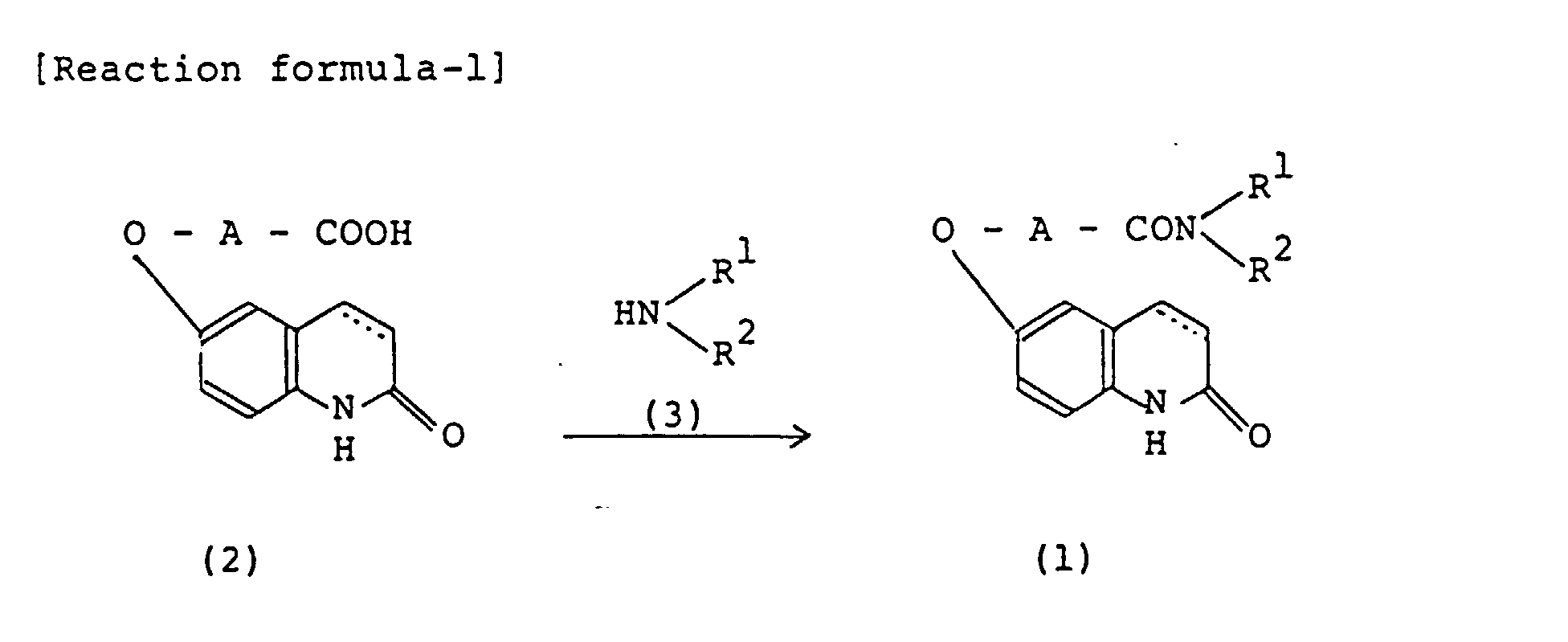
- The process shown by the reaction formula 1 is a process wherein a carboxyalkoxycarbostyril derivative represented by the general formula (2) and an amine represented by the general formula (3) are reacted according to an ordinary reaction for amido bond formation. In the present invention, the compound of the general formula (2) may be used in a form in which the carboxyl group has been activated.
- In the reaction for amido bond formation, known reaction conditions can be used easily.
- For example, there can be mentioned:
- (a) a mixed acid anhydride method, i.e. a method comprising reacting a carboxylic acid (2) with an alkyl halocarboxylate to obtain a mixed acid anhydride and then reacting the anhydride with an amine (3),
- (b) an active ester method, i.e. a method comprising converting a carboxylic acid (2) to a p-nitrophenyl ester, an N-hydroxysuccinimide ester, a 1-hydroxybenzotriazole ester or the like and then reacting the ester with an amine (3),
- (c) a carbodiimide method, i.e. a method comprising subjecting a carboxylic acid (2) and an amine (3) to dehydration and condensation in the presence of a dehydrogenating agent such as dicyclohexylcarbodiimide, carbonyldiimidazole or the like, and
- (d) other methods, i.e. a method comprising converting a carboxylic acid (2) to a carboxylic acid anhydride with a dehydrating agent such as acetic anhydride or the like and reacting the carboxylic anhydride with an amine (3), a method comprising reacting an ester of a carboxylic acid (2) with a lower alcohol, with an amine (3), and a method comprising reacting a halogenation product of a carboxylic acid (2), namely a carboxylic acid halide with an amine (3). Of the above methods, the mixed acid anhydride method is preferred.
- As to the alkyl halocarboxylate used in the mixed acid anhydride method, there can be mentioned methyl chloroformate, methyl bromoformate, ethyl chloroformate, ethyl bromoformate, isobutyl chloroformate, etc. The mixed acid anhydride can be obtained by an ordinary Schotten-Baumann reaction and, it is reacted with an amine (3) usually without being isolated, to obtain a compound of the general formula (1) of the present invention. The Schotten-Baumann reaction is effected in the presence of a basic compound. As to the basic compound, there can be used those compounds conventionally employed in the Schotten-Baumann reaction, and there can be mentioned organic bases such as triethylamine, trimethylamine, pyridine, dimethylaniline, N-methylmorpholine, 1,5-diazabicyclo[4,3,0]nonene-5 (DBN), 1,8-diazabicyclo[5,4,0]undecene-7 (DBU), 1,4-diazabicyclo[2,2,2]octane (DABCO) and the like, as well as inorganic bases such as potassium carbonate, sodium carbonate, potassium hydrogencarbonate, sodium hydrogencarbonate, potassium hydroxide, sodium hydroxide and the like. The reaction is effected usually at about -20° to 100°C, preferably at about 0° to 50°c, and the reaction time is about 5 minutes to 10 hours. The reaction of the resulting mixed acid anhydride with an amine (3) is effected usually at about -20° to 150°C, preferably at about 10° to 50°C, and the reaction time is about 5 minutes to 10 hours. The mixed acid anhydride method is effected generally in a solvent. As to the solvent, there can be used any solvent conventionally used in the mixed acid anhydride method, and there can be specifically mentioned, for example, halogenated hydrocarbons such as dichloromethane, dichloroethane, chloroform and the like, aromatic hydrocarbons such as benzene, toluene, xylene and the like, ethers such as tetrahydrofuran, diethyl ether, dimethoxyethane and the like, esters such as ethyl acetate, methyl acetate and the like, and aprotic solvents such as N,N-dimethylformamide, dimethyl sulfoxide, hexamethylphosphoric triamide and the like. In said method, the carboxylic acid (2), the alkyl halocarboxylate and the amine (3) are used usually in an equimolar ratio, but it is preferable that the alkyl halocarboxylate and the amine (3) be used each in an amount of about 1-1.5 moles per 1 mole of the carboxylic acid (2).
- In the reaction formula 1, the carboxylic acid (2) is a known compound or a novel compound. The amine (3) can be produced by, for example, the processes shown by the reaction formulas 8-19.
-

- According to the reaction formula-2, a hydroxycarbonstyril derivative represented by the gneral formula (4) is reacted with a haloalkaneamide derivative represented by the general formula (5) under the conditions of dehydrohalogenation reaction to obtain a compound (1) of the present invention.
- This dehydrogenation reaction is effected using a basic compound as a dehydrohalogenating agent. As to the basic compound, there can be widely used those known conventionally, and there can be mentioned inorganic bases such as sodium hydroxide, potassium hydroxide, sodium carbonate, potassium carbonate, sodium hydrogencarbonate, potassium hydrogencarbonate, sodium hydride, silver carbonate and the like, alcoholates such as sodium methylate, sodium ethylate and the like, and organic bases such as diisopropylethylamine, triethylamine, pyridine, N,N-dimethylaniline, DBN, DBU, DABCO and the like. Said reaction is effected in the presence or absence of a solvent. As to the solvent, there can be used any inactive solvent which gives no adverse effect on the reaction, and there can be mentioned, for example, alcohols such as methanol, ethanol, isoproipanol, butanol, ethylene glycol and the like, ethers such as dioxane, tetrahydrofuran, diethyl ether, monoglyme, diglyme and the like, halogenated hdyrocarbons such as dichloromethane, chloroform, carbon tetrachloride and the like, ketones such as acetone, methyl ketone and the like, aromatic hydrocarbons such as benzene, toluene, xylene and the like, esters such as ethyl acetate, methyl acetate and the like, and aprotic polar solvents such as acetonitrile, N,N-dimethylformamide, dimethyl sulfoxide, hexamethylphosphoric triamide and the like. Said reaction is advantageously effected in the presence of a metal iodide such as sodium iodide, potassium iodide or the like. In the above method, the amount of the compound of the general formula (5) used relative to the compound of the general formula (4) is not specified and can be appropriately selected in a wide range. However, when the reaction is effected using no solvent, the former is preferably used in a large excess amount relative to the latter; when the reaction is effected in a solvent, the former can be used in an amount of usually about 1-5 moles, preferably about 1-2 moles per 1 mole of the latter. The reaction temperature is not specified, either, but is usually about room temperature to 200°C, preferably about room temeprature to 160°C. The reaction time is usually about 1-30 hours.
- Those compounds of the general formula (1) according to the present invention wherein the carbon-carbon bond between 3- and 4-positions in the carbostyril skeleton is a double bond can each take lactam-lactim tautomers [(1a) and (1b)] as shown by the following reaction formula-3.
-

- The compound of the general formula (1c) according to the present invention wherein the carbon-carbon bond between 3- and 4-positions in the carbostyril skeleton is a single bond and the above-mentioned compound of the general formula (1a) according to the present invention are interchangeable by a reduction reaction or a dehydrogenation reaction, as shown by the following reaction formula-4.
-

- In the reduction of the compound of the general formula (1a), there can be applied conditions used in ordinary catalytic reduction reactions. As to the catalyst used, there can be mentioned, for example, metals such as palladium, palladium-carbon, platinum, Raney nickel and the like. These metals can be used in a usual catalyst amount. As to the solvent used, there can be mentioned, for example, methanol, ethanol, isopropanol, dioxane, tetrahydrofruan, hexane, cyclohexane and ethyl acetate. The reduction reaction can be effected under normal pressure or applied pressure, but can be effected usually at about normal pressure ot 20 kg/cm2, preferaly at about normal pressure ot 10 kg/cm2. The reaction temperature can be usually at about 0° to 150°C, preferably at about room temperature to 100°C.
- The dehydrogenation reaction of the compound of the general formula (1c) is effected in an appropriate solvent, using an oxidizing agent. As to the oxidizing agent, there can be mentioned, for example, benzoquinones such as 2,3-dichloro-5,6-dicyanobenzoquinone, chloranil (2,3,5,6-tetrachlorobenzoquinone) and the like, halogenation agents such as N-bromosuccinimide, N-chlorosuccinimide, bromine and the like, and hydrogenation catalysts such as selenium dioxide, palladium carbon palladium black, palladium oxide, Raney nickel and the like. The amount of the halogenation agent used is not specified and can be appropriately selected in a wide range. The amount can be usually about 1-5 moles, preferably about 1-2 moles per 1 mole of the compound of the general formula (1c). When a hydrogenation catalyst is used as the oxidizing agent, it can be used in a usual catalyst amount. As the solvent, there can be mentioned, for example, ethers such as dioxane, tetrahydrofuran, methoxyethanol, dimethoxymethane and the like, aromatic hydrocarbons such as benzene, toluene, xylene cumene and the like, halogenated hydrocarbons such as dichloromethane, dichloroethane, chloroform, carbon tetrachloride and the like, alcohols such as butanol, amyl alcohol, hexanol and the like, polar protic solvents such as acetic acid and the like, and polar aprotic solvents such as dimethylformamide, dimethyl sulfoxide, hexamethylphosphoric triamide and the like. Said reaction is effected usually at about room temeprature to 300°C, preferably at about room temperature to 200°C, and is completed generally in about 1-40 hours.
-

- The compound of the general formula (1d) can be converted into a compound of the general formula (1e) by hydrolysis. In the hydrolysis reaction, any conditions employed in ordinary hydrolysis reactions can be applied. The hydrolysis reaction is effected usually in an appropriate solvent in the presence of a basic compound, a mineral acid, an organic acid or the like. As to the basic compound, there can be mentioned, for exmaple, sodium hydroxide, potassium hydroxide, barium hydroxide, and potassium carbonate; as the mineral acid, there can be mentioned, for example, sulfuric acid, hydrochloric acid and nitric acid; as the organic acid, there can be mentioned, for example, acetic acid, aroamtic sulfonic acids (e.g. p-toluenesulfonicacid) and Lewis acids (e.g. boron trichloride). As to the solvent, there can be mentioned, for example, water; alcohols such as methanol, ethanol, isopropanol and the like; ketones such as acetone, methyl ethyl ketone and the like; ethers such as dioxane, tetrahydrofuran, ethylene glycol dimethyl ether and the like; acetic acid; and their mixtures. Said reaction proceeds usually at about room temperature to 200°C, preferably at about room temeprature to 150°C, and is completed generally in about 0.5-18 hours.
- The reaction for converting the compound of the general formula (1e) into a compound of the general formula (1f) is effected in the presence of a lower alkanoylating agent. As the lower alkanoylating agent, there can be used, for example, lower alkanolic acids such as formic acid, acetic acid, propionic acid and the like; lower alkanoic acid anhydrides such as acetic anhydride and the like; and lower alkanoic acid halides such as acetyl chloride, propionyl bromide and the like.
- When an acid anhydride or an acid halide is used as the lower alkanoylating agent, a basic compound may be allowed to be present in the reaction system. As to such a basic compound, there can be mentioned, for example, alkali metals such as metallic sodium, metallic potassium and the like; hydroxyides, carbonates and bicarbonates of said alkali metals; and organic bases such as triethylamine, pyridine, piperidine and the like. The above reaction proceeds in the absence or presence of a solvent, but is effected usually in an appropriate solvent. As to the solvent, there can be mentioned, for example, ketones such as acetone, methyl ethyl ketone and the like; ethers such as dioxane, diethyl ether and the like; aromatic hydrocarbons such as benzene, toluene, xylene and the like; halogenated hydrocarbons such as dichloromethane, chloroform, carbon tetrachloride and the like; acetic acid; acetic anhydride; water; and pyridine. The amount of the lower alkanoylating agent used can be at least about equimolar, generally equimolar to a large excess relative to the compound of the general formula (1e). The reaction temperature is usually about 0-150°C, preferably about 0-100°C, and the reaction is completed generally in about 5 minutes to 15 hours.
- When a lower alkanoic acid is used as the lower alkanoylating agent, it is preferable that there be added to the reaction system an acid-removing agent such as a mineral acid (e.g. sulfuric acid, hydrochloric acid) or a sulfonic acid (e.g. p-toluenesulfonic acid, benzenesulfonic acid, ethanesulfonic acid). In this case, the reaction temeprature is particularly preferably about 50-120°C.
- The reaction of the compound of the general formula (1e) with the compound of the general formula (6) is effected in an appropriate solvent in the presence of an acid. As to the solvent used therein, there can be mentioned, for example, halogenated hydrocarbons such as dichloromethane, chloroform, carbon tetrachloride and the like; aormatic hydrocarbons such as benzene, toluene, xylene and the like; ketones such as acetone, methyl ethyl ketone and the like; ethers such as dioxane, tetrahydrofuran, diethyl ether and the like; and aprotic polar solvents such as dimethylformamide, dimethyl sulfoxide and the like. As to the acid, there can be mentioned, for example, inorganic acids such as hydrochloric acid, sulfuric acid, nitric acid, phosphoric acid, perchloric acid and the like; and organic acids such as acetic acid, propionic acid, p-toluenesulfonic acid and the like. The amount of the compound of the general formula (6) used can be usually at least about 1 mole, preferably about 2-5 mols per 1 mole of the compound of the general formula (1e). Said reaction is effected usually at about room temperature to 200°C, preferably at about 50-100°C, and is completed generally in about 30 minutes to 12 hours.
- When the compound of the general formula (3) is a compound having, as R2, a C1-C6 alkyl group having 2 hydroxyl groups, the compound can be converted into a compound of the general formula (3) having, as R2, a C1-C6 alkyl group substituted by a C1-C3 alkylenedioxy group, by treating in the same manner as in the above reaction of the compound of the general fromula (1e) with the compound of the general formula (6).
- The compound of the general formula (3) having, as R2, a C1-C6 alkyl group substituted by a C1-C3 alkylenedioxy group can be converted into a compound of the general formula (3) having, as R2, a C1-C6 alkyl group, by treating in the same manner as in the reaction for converting the compound of the general formula (1d) to the compound of the general formula (1e).
-


- The reaction of a compound of the general formula (1g) with a compound of the general formula (7) is effected under the same conditions as in the reaction of the compound of the general formula (4) with the compound of the general formula (5).
-


- In the reaction formula (7), as the alkali metal atom represented by M, there can be mentioned, for example, a sodium atom and potassium atom.
- The reaction of a compound of the general formula (1i) with a compound of the general formula (8) is effected in an appropriate solvent. As the solvent, there can be used any solvent employed in the reaction of the compound of the general formula (4) with the compound of the general formula (5). The amount of the compound of the general formula (8) used can be usually at least about 1 mole, preferably about 1-1.5 moles per 1 mole of the compound of the general formula (1i). Said reaction is effected usually at about 0-150°C, preferably at about 0-100°C, and is complete generally in about 1-10 hours.
- The reaction for converting a compound of the general formula (1j) into a compound of the general formula (1k) is effected in a solventless state or in an appropriate solvent in the presence of an acid or a base. As to the solvent used therein, there can be mentioned, for example, water; alcohols such as methanol, ethanol and the like; ketones such as acetone, methyl ethyl ketone and the like; ethrs such as dioxane, tetrahydrofuran and the like; aprotic polar solvents such as dimethylformamide, dimethyl sulfoxide and the like; and their mixtures. As to the acid, there can be mentioned, for example, inorganic acids such as hydrochloric acid, sulfuric acid, phosphoric acid and the like; and organic acids such as acetic acid, propionic acid, p-toluenesulfonic acid and the like. As to the base, there can be mentioned morpholine, ethylenediamine, etc. Said reaction proceeds usually at about room temperature to 200°C, preferably at about room temperature to 150°C, and is completed generally in about 0.5 to 18 hours.
- When the compound of the general formula (1), the compound of the general formula (3) and the compound of the general formula (11) are compounds having, as R2, a C1-C6 alkyl group having at least one hydroxyl group, respectively, they can be converted, by oxidation, into a compound of the general formula (1), a compound of the general formula (3) and a compound of the general formula (11) each having, as R2, a C1-C6 alkyl group having at least one C2-C6 alkanoyl group.
- Said oxidation reaction is effected in an appropriate solvent in the presence of an oxidizing agent. The solvent can be any conventionally known solvent as long as it gives no adverse effect on the reaction, and there can be mentioned, for example, water; organic acids such as formic acid, acetic acid, trifluoroacetic acid and the like; alcohols such as methanol, ethanol, iropropanol and the like; halogenated hydrocarbons such as dichloroemthane, dichloroethane, chloroform and the like; and ketones such as acetone, methyl ethyl ketone and the like. As to the oxidizing agent, there can be generally used any conventionally known oxidizing agent capable of converting a hydroxyl group to a carbonyl group, and there can be mentioned, for example, chromic acid, chromic acid salts such as sodium chromate; potassium chromate and the like; permanganic acid; permanganic acid salts such as sodium permanganate, potassium permanganate and the like; iodic acid salts such as sodium periodate and the like; and selenium compounds such as selenium dioxide and the like. The oxidizing agent can be used in an amount of usually about 1 mole, preferably about 1-1.5 moles per 1 mole of the material compound to be treated. said reaction is effected usually at about -70° to 40°C, preferably at about -70°C to room temperature, and is complete generally in about 5 minutes to 3 hours.
- When the compound of the general formula (1), the compound of the general formula (3) and the compound of the general formula (9) are compounds having, as R1, a C3-C8 cycloalkyl-C1-C6 alkyl group having a hydroxy-C1-C6 alkyl group, respectively, they can be converted, by lower alkanoylation, into a compound of the general formula (1), a compound of the general formula (3) and a compound of the general formula (9) each having, as R1, a C3-C8 cycloalkyl-C1-C6 alkyl group having a C2-C6 alkanoyloxy-C1-C6 alkyl group. The lower alkanoylation can be effected under the same conditions as in the reaction for converting the compound of the general formula (1e) into the compound of the general formula (1f).
- When the compound of the general formula (1), the compound of the general formula (3) and the compound of the general formula, (11) are compounds having, as R2, the above specifically defined 5-membered or 6-membered saturated or unsaturated heterocycle-C1-C6 alkyl groups having at least one hydroxy-C1-C6 alkyl group, or compounds having, as R2, a C1-C6 alkyl group having at least one hydroxyl group, respectively, they can be converted, by lower alkanoylation, to a compound of the general formula (1), a compound of the general formula (3) and a compound of the general formula (11) each having, as R2, the above 5-membered or 6-membered saturated or unsaturated heterocycle-C1-C6 alkyl group having at least one C2-C6 alkanoyloxy-C1-C6 alkyl group, or a compound of the general formula (1), a compound of the general formula (3) and a compound of the general formula (11) each having, as R2, a C1-C6 alkyl group having at least one C2-C6 alkanoyloxy group. This lower alkanoylation can be effected under the same conditions as in the reaction for converting the compound of the general formula (1e) into the compound of the general formula (1f).
- When the compound of the general formula (1), the compound of the general formula (3) and the compound of the general formula (11) are compounds having, as R2, a C1-C6 alkyl group having at least one tetrahydropyranyloxy group, or compounds having, as R2, one of the above defined 5-membered or 6-membered saturated or unsaturated heterocycle-C1-C6 alkyl group having at least one C1-C6 alkoxy-C1-C6 alkyl group, respectively, they can be converted, by hydrolysis, into a compound of the general formula (1), a compound of the general formula (3) and a compound of the general formula (11) each having, as R2, a C1-C6 alkyl group having at least one hydroxyl group, or a compound of the general formula (1), a compound of the general formula (3) and a compound of the general formula (11) each having, as R2, one of the above defined 5-membered or 6-membered saturated or unsaturated heterocycle-C1-C6 alkyl group having at least one hydroxyl group. This hydrolysis can be effected under the same conditions as in the reaction for converting the compound of the general formula (1d) into the compound (1e).
- When the compound of the general formula (1), the compound of the general formula (3), the compound of general formula (9) and the compound of the general formula (11) are compounds having, as R1, a C3-C8 cycloalkyl-C1-C6 alkyl group having a C1-C6 alkoxycarbonyl group or a carboxy group, or compounds having, as R2, a C1-C6 alkyl group having at least one C1-C6 alkoxycarbonyl group, respectively, they can be converted, by reduction, into a compound of the general formula (1), a compound of the general formula (3), a compound of the general formula (9) and a compound of the general formula (11) each having, as R1, a C3-C8 cycloalkyl-C1-C6 alkyl group having a hydroxy-C1-C6 alkyl group, or a compound of the general formula (1), a compound of the general formula (3), a compound of the general formula (9) and a compound of the general formula (11) each having, as R2, a C1-C6 alkyl group having at.least one hydroxyl group.
- Said reduction reaction is effected usually using a hydride reducing catalyst. As to the hydride reducing agent, there can be mentioned, for example, sodium boron hydride, lithium aluminium hydride and diborane. The amount of the hydride reducing agent used can be usually 1 mole to a large excess, preferably about 1-25 moles per 1 mole of the material compound to be treated. This reduction reaction is effected usually at about -60° to 150°C, preferably at about -30° to 100°C for about 10 minutes to 5 hours, using an appropriate solvent, for example, water, a lower alcohol (e.g. methanol, ethanol, isopropanol) or an ether (e.g. tetrahydrofuran, diethyl ether, diglyme). When there is used, as the reducing agent, lithium aluminum hydride or diborane, there is preferably used an anhdyrous solvent such as tetrahydrofuran, diethyl ether, diglyme or the like.
- The compound of the general formula (3) as a starting material includes novel compounds and can be easily produced according to the processes shown by the following reaction formulas.
-

-

- The reaction of a compound of the general formula (9) with a compound of the general formula (10) and the reaction of a compound of the general formula (11) with a compound of the general formula (12) can both be effected under the same conditions as in the reaction of the compound of the general formula (4) with the compound of the general formula (5).
-

- The reaction of a compound of the general formula (9) with a compound of the general formula (13) can be effected in the same conditions as in the reaction of the compound of the general formula (4) with the compound of the general formula (5).
- The reaction of a compound of the general formula (14) with a compound of the general formula (15) can be effected under the same conditions as in the reaction of the compound of the general formula (4) with the compound of the general formula (5).
- The reactions for converting into a compound of the general formula (16) and a compound of the general formula (3a) are effected in an appropriate solvent in the presence of a hydride reducing agent. As the reducing agent used, there can be mentioned, for example, sodium boron hydride, lithium aluminum hydride and diborane. The amount of the reducing agent used can be at least about 1 mole, preferably about 1-3 moles per 1 mole of the starting material to be treated. When lithium aluminum hydride is used as the reducing agent, it can be used preferably in the same weight amount as the starting material. As the solvent used, there can be mentioned, for example, water; lower alcohols such as methanol, ethanol, isopropanol and the like; and ethers such as tetrahydrofuran, diethyl ether, diglyme and the like. Said reaction is effected usually at about -60° to 150°C, preferably at about -30° to 100°C, and is complete generally in about 10 minutes to 15 hours. When there is used, as the reducing agent, lithium aluminum hydride or diborane, there is preferably used an anhydrous solvent such as diethyl ether, tetrahydrofuran, diglyme or the like.
-
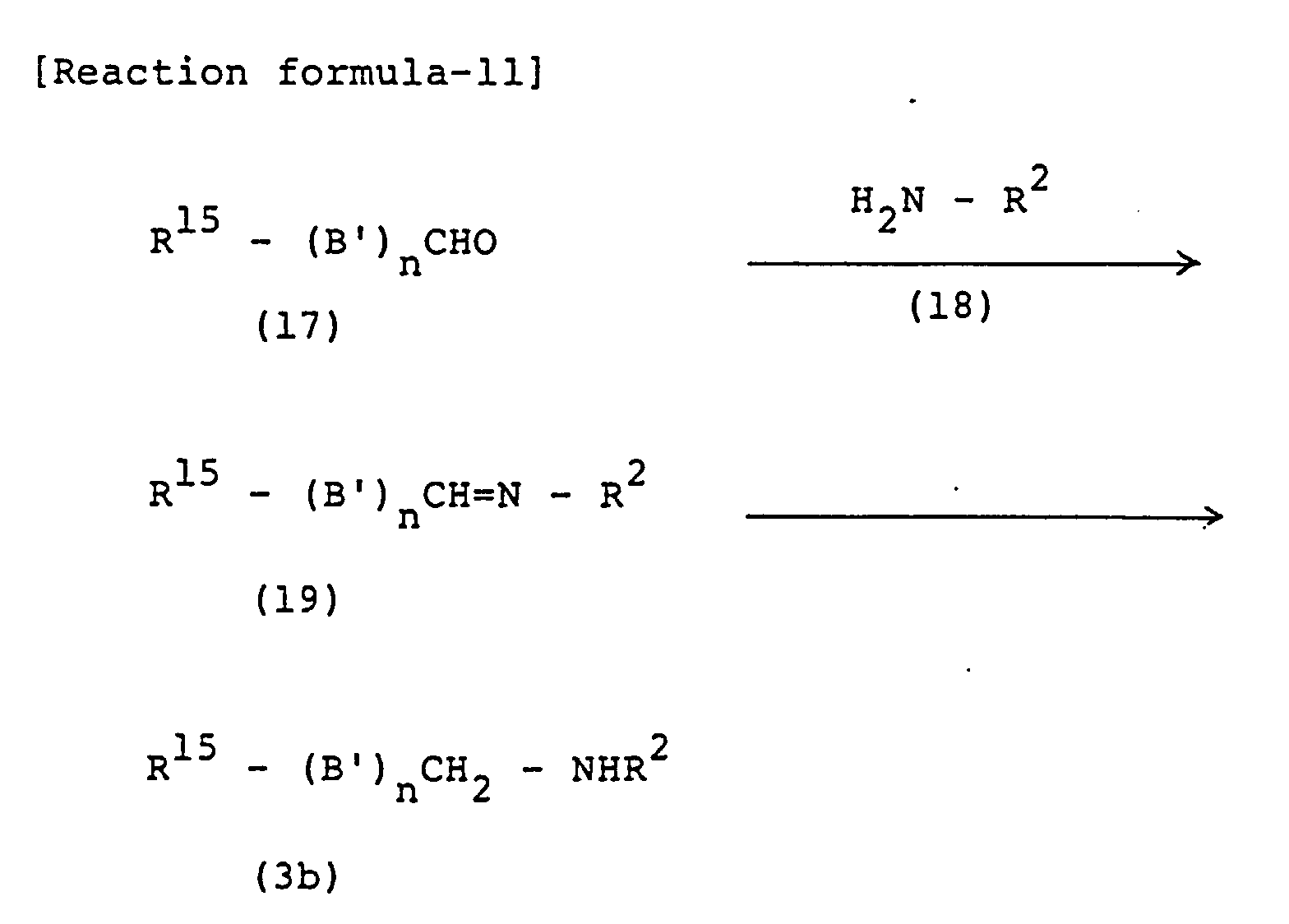
- The reaction of a compound of the general formula (17) with a compound of the general formula (18) is effected in a solventless state or in an appropriate solvent in the absence or presence of a dehydrating agent. As to the solvent used, there can be mentioned, for example, alcohols such as methanol, ethanol, isopropanol and the like; aromatic hydrocarbons such as benzene, toluene, xylene and the like; and aprotic polar solvents such as dimethylformamide, dimethylacetamide, N-methylpyrrolidone and the like. As to the dehydrating agent, there can be mentioned, for example, desiccants usually used for dehydration of solvent, such as molecular sieve and the like; mineral acids such as hydrochloric acid, sulfuric acid, boron trifluoride and the like; and organic acids such as p-toluenesulfonic acid and the like. Said reaction is effected usually at about room temperature to 200°C, preferably at about room temperature to 150°C, and is complete generally in about 1-48 hours. The amount of the compound of the general formula (18) used is not specified but can be usually at least about 1 mole, preferably about 1-15 moles per 1 mole of the compound of the general formula (17). The amount of the dehydrating agent used can be usually a large excess when a desiccant is used, and a catalyst amount when an acid is used. The thus obtained compound of the general formula (19) is used for the subsequent reduction reaction without being isolated.
- Various methods can be applied for the reduction reaction of the compound of the general formula (19). For example, there can be preferably used a reduction method using a hydride reducing agent. As to the hydride reducing agent used, there can be mentioned, for example, lithium aluminum hydride, sodium boron hydride and diborane. The amount of the reducing agent used can be at least about 1 mole, preferably about 1-10 moles per 1 mole of the compound of the general formula (19). This reduction reaction is effected usually at about -60° to 50°C, preferably at about -30°C to room temeprature for about 10 minutes to 5 hours, usually using an appropriate solvent, for example, water, a lower alcohol (e.g. methanol, ethanol, isopropanol), or an ether (e.g. tetrahydrofuran, diethyl ether, diaglyme). When lithium aluminum hydride or diborane is used as the reducing agent, there is preferably used an anhydrous solvent such as diethyl ether, tetrahydrofuran, diglyme or the like.
- The reduction of the compound of the general formula (19) can also be effected by subjecting the compound to catalytic hydrogenation in an appropriate solvent in the presence of a catalyst. As the solvent used, there can be mentioned, for example, water; acetic acid; alcohols such as methanol, ethanol, isopropanol and the like; hydrocarbons such as hexane, cyclohexane and the like; ethers such as dioxane, tetrahydrofuran, diethyl ether, ethylene glycol dimethyl ether and the like; esters such as ethyl acetate, methyl acetate and the like; and aprotic polar solvents such as dimethylformamide and the like. As the catalyst used, there can be mentioned, for example, palladium, palladium-black, palladium-carbon, platinum, platinum oxide, copper chromite and Raney nickel. The amount of the catalyst used can generally be about 0.02-1 time that of the compound of the general formula (19). The reaction temperature can be usually about -20° to 150°C, preferably about 0° to 100°C; the hydrogen pressure can be usually about 1-10 atm.; said reaction is complete in about 0.5-10 hours.
-


- The reactions for converting into a compound of the general formula (22) and a compound of the general formula (3c) can be effected in the same conditions as in the reaction for converting the compound of the general formula (19) to the compound of the general formula (3b).
-


- The reaction of a compound of the general formula (21) with a compound of the general formula (23) is effected in a solventless state or in an appropriate solvent in the presence or absence of a basic compound. As to the solvent, there can be used singly or in combinations, for example, ethers such as dioxane, tetrahydrofuran, diethyl ether, ethylene glycol dimethyl ether and the like; aromatic hydrocarbons such as benzene, toluene, xylene and the like; lower alcohols such as methanol, ethanol, isopropanol and the like; and aprotic polar solvents such as dimethylformamide, dimethyl sulfoxide, hexamethylphosphoric triamide, N-methylpyrrolidone and the like. As to the basic compound, there can be used, for example, inorganic basic compounds such as potassium carbonate, sodium carbonate, sodium hydroxide, sodium hydrogencarbonate, sodium amide and the like; and organic basic compounds such as triethylamine, tripropylamine, pyridine, quinoline and the like. The amount of the compound of the general formula (23) used can be usually at least about 1 mole, preferably about 1-5 moles per 1 mole of the compound of the general formula (21). Said reaction is effected usually at about room temeprature to 200°C, preferably at about room temperature to 120°C, and is complete generally in about 1-24 hours.
-


- The reaction of a compound of the general formula (24) with hydrazine (25) can be effected under the same conditions as in the reaction of the compound of the general formula (2) with the compound of the general formula (3). For example, when an ester of the compound of the general formula (24) with a lower alcohol is reacted with hydrazine (25), the reaction is effected in a solventless state or in an appropriate solvent. As to the solvent used, there can be mentioned, for example, alcohols such as methanol, ethanol, propanol and the like; ethers such as tetrahydrofuran, diethyl ether, dimethoxyethane and the like; aromatic hydrocarbons such as benzene, toluene and the like; and aprotic polar solvents such as dimethyl formamide, dimethyl sulfoxide and the like. The amount of hydrazine used can be usually at least about 1 mole, preferably about 1.5-5 moels per 1 mole of the compound of the general formula (24). Said reaction is effected usually at about 0°-150°C, preferably about room temperature to 60°C, and is completed generally in about 5 minutes to 5 hours.
- In the reaction for reacting an acid hydrazide of the general formula (26) with nitrous acid or its derivative of the general formula (27) to from an acid azide and then reacting the acid azide with an amine of the general formula (21) to obtain an acid amide of the general formula (28), there can be widely applied the conditions of the known azide method. As to the nitrous acid or its derivative of the general formula (27), there can be mentioned, for example, nitrous acid; nitrites such as sodium nitrite, potassium nitrite and the like; and alkyl nitrites such as ethyl nitrite, isoamyl nitrite and the like. The reaction for amide formation by the aside method is effected usually in a solvent. As to the solvent used, there can be mentioned, for example, water; organic acids such as acetic acid, propionic acid and the like; ethers such as dioxane, tetrahydrofuran, diethyl ether and the like; and aprotic polar solvents such as dimethylformamide, N-methylpiperidionone and the like. The amounts of the nitrous acid or its derivative of the general formula (27) and the amine of the general formula (21) are each at least about equimolar and usually a large excess relative to the compound of the general formula (26). Said reaction is effected usually at about -50° to 150°C, preferably at about -20° to 100°C, and is complete generally in about 1 hour to 5 days. The acid azide which is formed as an intermediate in the reaction may be isolated but is usually used in the subsequent reaction without being isolated.
- The reaction for reducing the compound of the general formula (28) to obtain a compound of the general formula (3c) can be effected in the same conditions as in the reaction for converting the compound (16) into the compound (3a).
-

- The reaction of a compound of the general formula (29) with hydrazine (25) can be effected in the same conditions as in the reaction of the compound of the general formula (24) with hydrazine (25).
- The reaction for obtaining a compound of the general formula (31) from a compound of the general formula (30) can be effected in the same conditions as in the reaction for converting the compound of the general formula (26) into the compound of the general formula (28).
- The reaction for obtaining a compound of the general formula (3b) from the compound of the general formula (31) can be effected in the same conditions as in the reaction for converting the compound (28) to the compound (3c).
-

- The reaction of a compound of the general formula (24) with a compound of the general formula (21) can be effected in the same conditions as in the reaction of the compound of the general formula (2) with the compound of the general formula (3).
- The reaction for reducing the compound of the general formula (28) to convert into a compound of the general formula (3c) was already described in the reaction formula 14.
-

- The reaction of a compound of the general formula (29) with a compound of the general formula (18) can be effected in the same conditions as in the reaction of the compound of the general formula (2) with the compound of the general formula (3).
- The reaction for converting a compound of the general formula (31) into a compound of the general formula (3b) was already described in the reaction formula 15.
-

- The reaction for converting a compound of the general formula (9) into a compound of the general formula (32) can be effected in the same conditions as in the reaction for converting the compound of the general formula (1e) to the compound of the general formula (1f).
- The reaction for reducing the compound of the general formula (32) to convert into a compound of the general formula (3e) can be effected under the same conditions as in the reaction for converting the compound of the general formula (16) into the compound of the general formula (3a).
-

- The reaction of a compound of the general formula (9) with a compound of the general formula (33) is effected in a solventless state or in an appropriate solvent in the presence of a reducing agent. As to the solvent used therein, there can be mentioned, for example, water; alcohols such as methanol, ethanol, isopropanol and the like; lower alkanoic acids such as formic acid, acetic acid and the like; ethers such as dioxane, tetrahydrofuran, diethyl ether, diglyme and the like; and aromatic hydrocarbons such as benzene, toluene, xylene and the like. As to the reducing agent, there can be mentioned, for example, formic acid; alkali metal or alkaline earth metal salts of formic acid such as sodium formate and the like; hydride reducing agents such as sodium boron hydride, sodium boron cyanohydride, lithium aluminum hydride and the like; and catalytic reducing agents such as palladium black, palladium carbon, platinum oxide, platinum black, Raney nickel and the like. When formic acid is used as the reducing agent, the appropriate reaction temperature is usually about room temperature to 200°C, preferably about 50-100°C, and the reaction is complete generally in about 0.5-10 hours. The amount of formic acid used can be about 0.1-20% by weight based on the compound of the general formula (9). The compound of the general formula (33) can be used usually in at least about an equimolar amount, preferably in an equimolar amount to a large excess relative to the compound of the general formula (9).
- When the compound of the general formula (1), the compound of the general formula (3), the compound of the general formula (9) and the compound of the general formula (11) are respective compounds having, as R1, a C3-C8 cycloalkyl-C1-C6 alkyl group having an amino-C1-C6 alkyl group, respective compounds having, as R2, a 5-membered or 6-membered saturated or unsaturated heterocycle-C1-C6 alkyl group as defined above having at least one amino-C1-C6 alkyl group, or respective compounds having, as R2, a C1-C6 alkyl group having at least one amino group, they can be converted, by treating under the same conditions as in the reaction shown by the reaction formula 19 or under the same conditions or by reacting with a compound represented by the general formula
R23X
(R23 represents a C1-C6 alkyl group and X has the same definition as above) udner the same conditions as in the reaction of the compound of the general formula (4) with the compound of the general formula (5), to a compound of the general formula (1), a compound of the general formula (3), a compound of the general formula (9) and a compound of the general formula (11) each having, as R1, a C3-C8 cycloalkyl-C1-C6 alkyl group having a C1-C6 alkylamino-C1-C6 alkyl group; a compound of the general formula (1), a compound of the general formula (3), a compound of the general formula (9) and a compound of the general formula (11) each having, as R2, a 5-membered or 6-membered saturated or unsaturated heterocycle-C1-C6 alkyl group as defined above having at least one C1-C6 alkyl-substituted amino-C1-C6 alkyl group; or a compound of the general formula (1), a compound of the general formula (3), a compound of the general formula (9) and a compound of the general formula (11) each having, as R2, a C1-C6 alkyl-substituted C1-C6 alkyl group. - When the compound of the general formula (1), the compound of the general formula (3) and the compound of the general formula (11) are respective compounds having, as R2, a 5-membered or 6-membered saturated or unsaturated heterocycle-C1-C6 alkyl group as defined above having a nitrogen atom in the heterocycle, they can be converted, by treating under the same conditions as in the reaction shown by the reaction formula 19 or by reacting with a compound represented by the general formula
R23X
(R23 and X have the same definitions as above) under the same conditions as in the reaction of the compound of the general formula (4) with the compound of the general formula (5), to a compound of the general formula (1), a compound of the general formula (3) and a compound of the general formula (11) each having, as R2, a 5-membered or 6-membered heterocycle-C1-C6 alkyl group as defined above having a C1-C6 alkyl group on the nitorgen atom of the heterocycle. - When the compound of the general formula (1), the compound of the general formula (3) and the compound of the general formula (11) are respective compounds having, as R2, a 5-membered or 6-membered saturated or unsaturated heterocycle-C1-C6 alkyl as defined above having at least one C1-C6 alkylamido group, respective compounds having, as R2, a C1-C6 alkyl group having at least one amido or C1-C6 alkylamido group, or respective compounds having, as R2, a C1-C6 alkyl group having at least one C1-C6 alkanoylamino group, they can be converted, by treating under the same conditions as in the reaction for converting the compound of the general formula (16) to the compound of the general formula (3a), to a compound of the general formula (1), a compound of the general formula (3) and a compound of the general formula (11) each having, as R2, a 5-membered or 6-membered saturated or unsaturated heterocycle-C1-C6 alkyl group as defined above having at least one C1-C6 alkylaminomethyl group; a compound of the general formula (1), a compound of the general formula (3) and a compound of the general formula (11) each having, as. R2, a C1-C6 alkyl group having at least one amino or C1-C6 alkylamino group; or a compound of the general formula (1), a compound of the general formula (3) and a compound of the general formula (11) each having, as R2, a C1-C6 alkyl group having at least one C1-C6 alkylamino group.
- When the compound of the general formula (1), the compound of the general formula (3) and the compound of the general formula (11) are respective compounds having, as R2, a C1-C6 alkyl group having at least one carboxy group, they can be converted, by treating under the same conditions as in the reaction of the compound of the general formula (2) with the compound of the general formula (3), into a compound of the general formula (1), a compound of the general formula (3) and a compound of the general formula (11) each having, as R2, a C1-C6 alkyl group having at least one amido or lower alkylamido group.
- When the compound of the general formula (1), the compound of the general formula (3) and the compound of the general formula (11) are respective compounds having, as R2, a 5-membered or 6-membered saturated or unsaturated heterocycle-C1-C6 alkyl group as defined above having at least one hydroxyl group, they can be converted, by treating with a compound represented by the general formula
R24X
(R24 represents a C1-C6 alkoxy-C1-C6 alkyl group and X has the same definition as above) udner the same conditions as in the reaction of the compound of the general formula (4) with the compound of the general formula (5), to a compound of the general formula (1), a compound of the general formula (3) and a compound of the general formula (11) each having, as R2, a 5-membered or 6-membered saturated or unsaturated heterocycle-C1-C6 alkyl group as defined above having at least one C1-C6 alkoxy-C1-C6 alkoxy group. - When the compound of the general formula (1), the compound of the general formula (3) and the compound of the general formula (11) are respective compounds each having, as R2, a C1-C6 alkyl group having at least one carboxyl or C1-C6 alkoxycarbonyl group, they can be converted, by reacting with hydrazine (25) under the same conditions as in the reaction of the compound of the general formula (24) with hdyrazine (25) and then treating the resulting compound with the compound of the general formula (27) and an amine which may have a lower alkyl group in this order under the same conditions as in the reaction of the compound of the general formula (26) with the compound of the general formula (27) and the subsequent reaction with the amine of the general formula (21), to a compound of the general formula (1), a compound of the general formula (3) and a compound of the general formula (11) each having, as R2, a C1-C6 alkyl group having at least one amido or C1-C6 alkylamido group.
- When the compound of the general formula (1), the compound of the general formula (3) and the compound of the general formula (11) are respective compounds having, as R2, a 5-membered or 6-membered saturated or unsaturated heterocycle-C1-C6 alkyl group as defined above having at least one hydroxy-C1-C6 alkyl group or at least one. hydroxyl group, or respective compounds having, as R2, a C1-C6 alkyl group having at least one hydroxyl group, they can be converted, by reacting with a compound represented by the general formula
R23X
(R23 and X have the same definitions as above) under the same conditions as in the reaction of the compound of the general formula (4) with the compound of the general formula (5), to a compound of the general formula (1), a compound of the general formula (3) and a compound of the general formula (11) each having, as R2, a 5-membered or 6-membered saturated or unsaturated heterocycle-C1-C6 alkyl group as defined above having at least one C1-C6 alkoxy-C1-C6 alkyl group or at least one C1-C6 alkoxy group, or a compound of the general formula (1), a compound of the general formula (3) and a compound of the general formula (11) each having, as R2, a C1-C6 alkyl group having at least one C1-C6 alkoxy group. - When the compound of the general formula (1), the compound of the general formula (3) and the compound of the general formula (11) are respective compounds having, as R2, a C1-C6 alkyl group having at least one amino group, they can be converted, by subjecting to lower alkanoylation under the same conditions as in the reaction for converting the compound of the general formula (le) into the compound of the general formula (lf), to a compound of the general formula (1), a . compound-of the general formula (3) and a compound of the general formula (11) each having, as R2, a C1-C6 alkyl group having at least one C1-C6 alkanoylamino group.
- The compound of the general formula (11) used above can also be produced according to, for example, the process shown by the following reaction formula.
-

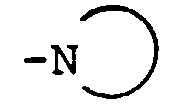
- The reaction of a compound of the general formula (35) with a compound of the general formula (36) can be effected under the same conditions as in the reaction of the compound of the general formula (4) with the compound of the general formula (5).
- The reaction of the compound of the general formula (35) with a compound of the general fromula (38) can also be effected under the same conditions as in the reaction of the compound of the general formula (4) with the compound of the general formula (5).
- The reduction reaction of a compound of the general formula (41) can be effected under the same conditions as in the reaction for converting the compound of the general formula (16) to the compound of the general formula (3a).
- The compound of the general formula (20) used above can be produced according to, for example, the process shown by the following reaction formula.
-

- The reaction of a compound of the general formula (39) with a compound of the general formula (40) can be effected under the same conditions-as in the reaction of the compound of the general formula (4) with the compound of the general formula (5).
- The reaction for converting a compound of the general formula (41) into a compound of the general formula (20a) can be effected under the same conditions as in the reaction for converting the compound of the general formula (1d) into the compound of the general formula (1e).
- Of the compounds represented by the general formula (1), those having an acidic group can form respective salts with a pharmaceutically acceptable basic compound. As to such a basic compound, there can be specifically mentioned, for example, sodium hydroxide, potassium hydroxide, calcium hydroxide, calcium carbonate and potassium hydrogencarbonate.
- Also, of the compounds represented by the general formula (1), those having a basic group can form respective salts with a pharmaceutically acceptable acid. As to such an acid, there can be mentioned specifically inorganic acids such as sulfuric acid, phosphoric acid, nitric acid, hydrochloric acid, hydrobromic acid and the like, as well as organic acids such as oxalic acid, maleic acid, fumaric acid, malic acid, tartaric acid, citric acid, benzoic acid and the like.
- The thus obtained compound of the present invention can be easily isolated and purified according to a separation means used generally. As to such a separation means, there can be mentioned, for example, a precipitation method, an extraction method, a recrystallization method, column chromatography, and preparative thin layer chromatography.
- The compound of the present invention can be administered to animals and human beings as it is or together with a conventional pharmaceutical carrier. The unit form for administering the present compound is not restricted and can be selected appropirately so as to meet the administration purpose. As to the unit form for administration, there can be mentioned, for example, agents for oral administration such as tablet, granule, solution for oral administration and the like, and agents for parenteral administration such as injection and the like. The amount of the active ingredient to be administered is not restricted and can be appropirately selected in a wide range; however, the amount is preferably about 0.06-10 mg in order to obtain a desired effect. Further, the active ingredient is preferably contained in one administration unit form in an amount of about 1-100 mg.
- In the present invention, agents for oral administration such as tablet, capsule, solution for oral administration and the like can be prepared according to a conventional method. That is, tablets are prepared by mixing a compound of the present invention with pharmaceutical fillers such as gelatin, starch, lactose, magnesium stearate, talc, gum arabic and the like. Capsules are prepared by mixing a compound of the present invention with an inactive pharmaceutical filler or diluent and filling the mixture in a hard gelatin capsule, a soft capsule or the like. Medicated syrups or elixirs are prepared by mixing a compound of the present invention with a sweetening (e.g. saccharose), an antiseptic (e.g. methylparaben, propylparaben), a coloring agent, a seasoning, etc. That is, drugs for parenteral administration are prepared by dissolving a compound of the present invention in a sterilized carrier. A preferable carrier is water or salt water. Solutions having a desired transparency, stability and parenteral usability are prepared by dissolving about 1-500 mg of an active ingredient in water and an organic solvent and further in a polyethylene glycol having a molecular weight of 200-5,000. These solutions preferably contain a wetting agent such as sodium carboxymethyl cellulose, methyl cellulose, vinylpyrrolidone, polyvinyl alcohol and the like. These solutions may further contain a bactericide and fungicide (e.g. benzyl alcohol, phenol, thimerosol) and, as necessary, a tonicity agent (e.g. saccharose, sodium chloride), a local anesthetic, a stabilizer, a buffer, etc. In order to increase the stability, drugs for parenteral administration can be dehydrated by, after filling, subjecting to the freeze-drying technique which is known in the art. Thus, a freeze-dried powder can be reprepared right before use.
- In order to describe the present invention in further details, there are mentioned below examples (reference examples) for preparing the material compounds for compounds of the present invention, examples for preparing compounds of the present invention, pharmacological tests conducted on compounds of the present invention, and examples of drugs containing compounds of the present invention.
- 5.66 Grams of cyclohexylmethylamine is dissolved in 200 ml of diethyl ether. Thereto is added 5.06 g of triethylamine. To the resulting mixture is dropwise added, with ice cooling, a solution of 5.65 g of chloroacetyl chloride dissolved in 150 ml of diethyl ether. The mixture is stirred for 1 hour at room temperature and then acidified with 5% hydrochloric acid. The mixture is extracted with diethyl ether. The extract is washed with water and dried with anhydrous magnesium sulfate. The solvent is removed by evaporation and the residue is recrystallized from n-hexane to obtain 6.7 g of N-cyclohexylmethyl-N-(α-chloroacetyl)amine.
- Properties:
- Colorless acicular crystals
- Melting point:
- 85-86°C
- 4.00 Grams of N-cyclohexyl-N-(α-chloroacetyl)amine is dissolved in 80 ml of ethanol. Thereto are added 1.50 g of pyrrolidine and further 4.37 g of potassium carbonate. The mixture is refluxed with heating. Then, the solvent is removed by evaporation. The resulting crude oily material is purified by a silica gel column chromatography (chloroform : methanol = 50 : 1) to obtain 4.78 g of N-cyclohexylmethyl-N-[α- (1-pyrrolidinyl)acetyl]-amine.
- Properties:
- Colorless oily substance
- 1H-NMR (CDCl3) δ ppm:
- 0.86 - 2.00 (15H, m)
2.56 - 2.76 (4H, m)
3.03 - 3.22 (2H, t, J=7Hz)
3.15 (2H, s) - 2.40 Grams of lithium aluminum hydride is suspended in 100 ml of anhydrous tetrahydrofuran. Thereto is dropwise added a solution of 4.78 g of N-cyclohexylmethyl N-[α- (1-pyrrolidinyl)acetyl]amine dissolved in 50 ml of anhdyrous tetrahydrofuran. The mixture is refluxed for 3 hours with heating. Thereto are added 8 ml of 10% aqueous potassium hydroxide solution and 8 ml of water, and the mixture is refluxed for 10 minutes with heating. Aluminum hydroxide is removed by filtration. The filtrate is dried with anhydrous magnesium sulfate and the solvent is removed by evaporation. The residue is purified by a thin layer chromatography to obtain 0.70 g of N-cyclohexylaminomethyl-N- [2- (1-pyrrolidinyl) ethyl]-amine.
- Properties:
- Colorless oily substance
- 1H-NMR (CDCl3) δ:
- 0.80 - 2.29 (16H, m)
2.44 (2H, d, J=7Hz)
2.49 - 2.56 (4H, m)
2.59 (2H, t, J=6Hz)
2.71 (2H, t, J=6Hz) - Using appropriate starting materials and in the same procedure as in Reference Example 1, there are obtained compounds shown in Table 1 given later.
- Using appropriate starting materials and in the same procedure as in Reference Example 2, there are obtained compounds shown in Table 2 given later.
- Using appropriate starting materials and in the same procedure as in Reference Example 3, there are obtained compounds shown in Table 3 given later.
- 1.13 Grams of cyclohexylmethylamine and 1.51 g of 1,2-isopropylidenedioxy-3-chloropropanediol are dissolved in 15 ml of dimethylformamide. To the solution are added 1.66 g of potassium carbonate and 3.00 g of sodium iodide, and the mxiture is refluxed for 4 hours with heating. Dimethylformamide is removed by evaporation under reduced pressure. The residue obtained is extracted with diethyl ether. The extract is washed with water, dried and subjected to solvent removal by evaporation. The resulting crude oily substance is subjected to distillation under reduced pressure to obtain 1.25 g of N-cyclohexylmethyl-N-(2,3-isopropylidenedioxypropyl)amine.
- Properties:
- Colorless oily substance
- Boiling point:
- 120°C/0.3 mmHg
- Using appropriate starting materials and in the same procedure as in Reference Example 57, there are obtained compounds shown in table 4 given later.
- To 100 ml of ethanol were added 7.0 g of cyclooctylaldehyde and 5.4 g of 3-aminomethylpyridine, and the mixture was subjected to a reaction for 4 hours at about 50°C. After cooling, 2.0 g of sodium boron hydride was added while 20°C or below was kept by ice cooling, and the mixture was subjected to a reaction for 1 hour at room temperature. The reaction mixture was acidified with 2 N hydrochloric acid and concentrated to dryness. To the residue was added an aqueous potassium carbonate solution to make the residue alkaline. The mixture was extracted with chloroform. The extract was washed with water and then dried with anhydrous sodium sulfate. The solvent was removed by evaporation. The residue was subjected to distillation under reduced pressure to obtain 6.4 g of N-(cyclohexylmethyl)-N-(3-pyridylmethyl)amine.
- Properties:
- Colorless oily substance
- Boiling point:
- 132-140°C/0.2 mmHg
- 5.81 Grams of N,N-diethylaminoethylenediamine and 7.01 g of cyclooctylaladehyde are dissolved in 50 ml of ethanol. The mixture is stirred for 8 hours at room temperature. Thereto is added 0.5 g of 10% palladium carbon (Pd-C). The mixture is subjected to hydrogenation for 2 hours at 50°C or below at 5 kg/cm2. The catalyst is removed by filtration. The filtrate is subjected to evaporation under reduced pressure to remove ethanol. The resulting crude oily substance is subjected to distillation under reduced pressure to obtain 6.5 g of N-(2-diethylaminoethyl)-N-(cyclooctylmethyl)amine.
- Properties:
- Colorless oily substance
- Boiling point:
- 113°C/2 mmHg
- Using appropriate starting materials and in the same procedure as in Reference Examples 65 and 66, there are obtained compounds shown in Table 5 given later.
- 6.7 Grams of epichlorohydrin and 10.2 g of cyclohexylmethylamine are dissolved in 50 ml of methanol. The mixture is stirred for 8 hours at room temperature. Methanol is removed by evaporation under reduced pressure. The resulting crude oily substance is purified by a silica gel column chromatography (chloroform : methanol = 8 : 1) to obtain 8.2 g of N-(dicyclohexylmethyl)-N-(3-chloro-2-hydroxypropyl) amine.
- Properties:
- Colorless oily substance
- 1H-NMR (CDCl3) δ ppm:
- 0.75 - 1.09 (2H, m)
1.09 - 1.37 (3H, m)
1.47 (1H, m)
1.61 - 1.92 (5H, m)
2.48 (2H, m)
2.68 (1H, dd, J=12Hz, 8Hz)
2.80 (1H, dd, J=12Hz, 4Hz)
3.16 (2H, s)
3.55 (2H, d, J=6Hz) - Using appropriate starting materials and in the same procedure as in Reference Example 107, there are obtained compounds shown in Table 6 given later.
- 6.35 Grams of 1-benzyloxycarbonyl-2β-methoxycarbonyl-4a-methoxymethoxypyrrolidine is dissolved in 120 ml of methanol. To the solution is dropwise added 1.89 g of 100% hydrazine with ice cooling. The mixture is stirred overnight at room temperature. The solvent is removed by evaporation under reduced pressure. The resulting residue is purified by a silica gel short column chromatography (chloroform : methanol = 8 : 1) to obtain 6.35 g of (1-benzyloxycarbonyl-4α-methoxymethyl-2β-pyrrolidinyl)hydrazide.
- Properties:
- Colorless oily substance
- 1H-NMR (CDCl3) δ ppm:
- 2.12 - 2.52 (2H, m)
3.31 (3H, s)
3.54 - 4.14 (4H, m)
4.29 - 4.45 (2H, m)
4.63 (2H, s)
4.99 - 5.28 (2H, m)
7.35 (5H, s)
8.03 (1H, s) - 6.80 Grams of (1-benzyloxycarbonyl-4α-methoxy-methoxy-2β-pyrrolidinyl)hydrazide is dissolved in 300 ml of dimethylformamide (DMF). Thereto is added a solution of 5 N hydrochloric acid dissolved in 10 ml of DMF. The mixture is cooled to -20°C and 2.46 g of isoamyl nitrite is added. In 5 minutes, triethylamine is added to the solution to make the pH of the solution 8. 2.38 g of cyclohexylmethylamine is added and the mixture is allowed to stand for 48 hours at 4°C. DMF is removed by distillation under reduced pressure. The residue is dissolved in diethyl ether. The solution is washed with water and dried with anhydrous magnesium sulfate. The solvent is removed by evaporation. The resulting residue is purified by a silica gel column chromatography (chloroform : methanol = 20 : 1) to obtain 6.60 g of 1-benzyloxycarbonyl-2β-cyclohexylmethylamido-4α-methoxy-methoxypyrrolidine.
- Properties:
- Colorless oily substance
- 1H-NMR (CDCl3) δ ppm:
- 0.71 - 1.80 (11H, m)
2.00 - 2.62 (2H, m)
2.88 - 3.18 (2H, m)
3.33 (3H, s)
3.48 - 3.72 (2H, m)
4.25 - 4.45 (2H, m)
4.63 (2H, s)
5.16 (2H, s)
6.76 (1H, s)
7.34 (5H, s) - 4.15 Grams of 1-benzyloxycarbonyl-2β-cyclohexyl-methylamido-4α-methoxymethoxypyrrolidine is dissolved in 100 ml of ethanol. Thereto is added 10% Pd-C. Hydrogenation is effected for 3 hours at room temperature at 3 kg/cm2. The catalyst is removed by filtration. The filtrate is subjected to vacuum evaporation to remove the solvent. The residue is purified by a thin layer chromatography to obtain 2.78 g of 2β-cyclohexylmethyl-amido-4α-methoxymethoxypyrrolidine.
- Properties:
- Colorless oily substance
- 1H-NMR (CDCl3) δ ppm:
- 0.84 - 1.90 (11H, m)
2.04 (1H, m), 2.60 (1H, m)
2.95 - 3.28 (3H, m)
3.37 (1H, m), 3.38 (1H, s)
4.30 - 4.52 (2H, m)
4.65 (2H, dd, J=12Hz, 7Hz)
8.23 (1H, s) - Using appropriate starting materials and in the same procedure as in Reference Example 3, there is obtained 1-ethyl-2β-cyclohexylmethylaminomethyl-4α-methoxymethoxypyrrolidine.
- Properties:
- Colorless oily substance
- 1H-NMR (CDCl3) δ ppm:
- 0.84 - 1.94 (12H, m)
1.94 - 3.05 (10H, m)
3.40 (3H, s)
3.30 - 3.53 (1H, m)
4.38 (1H, m)
4.68 (2H, m) - 1.50 Grams of 2β-cyclohexylmethylamido-4α-methoxy-methoxypyrrolidine is dissolved in 20 ml of ethanol. Thereto are added 0.43 g of ethyl iodide and 1.76 g of potassium carbonate. The mixture is refluxed for 2 hours with heating. The solvent is removed by evaporation. The resulting reaction mixture is purified by a silica gel column chromatography (chloroform : methanol = 20 : 1) to obtain 0.43 g of 1-ethyl-2β-cyclohexylmethylamido-4α-methoxymethoxypyrrolidine.
- Properties:
- Colorless oily substance
- 1H-NMR (CDCl3) δ ppm:
- 0.84 - 1.94 (12H, m)
1.94 - 3.05 (10H, m)
3.40 (3H, s)
3.30 - 3.53 (1H, m)
4.38 (1H, m) , 4.68 (2H, m) - 1.30 Grams of 1-ethyl-2β-cyclohexylmethylamino-methyl-4α-methoxymethoxypyrrolidine is dissolved in 6 N hydrochloric acid. The solution is stirred for 1 hour at room temperature. A 10% aqueous potassium hydroxide solution is added to the solution to make it alkaline. The alkaline solution is extracted with methylene chloride. The extract is washed with water and dried with anhydrous magnesium sulfate. The solvent is removed by evaporation. The residue is purified by a thin layer column chromatography to obtain 0.75 g of 1-ethyl-2β-cyclohexylmethylaminomethyl-4α-hydroxypyrrolidine. Properties: Colorless oily substance
- 1H-NMR (CDCl3) δ ppm:
- 1.07 (3H, t, J=7Hz)
0.76 - 2.10 (14H, m)
2.20 (1H, dd, J=10Hz, 5Hz)
2.31 (1H, dd, J=10Hz, 7Hz)
2.42 (2H, d, J=8Hz)
2.53 (1H, dd, J=13Hz, 8Hz)
2.72 (1H, dd, J=13Hz, 5Hz)
2.78 - 2.97 (2H, m)
3.37 - 3.55 (1H, m)
4.39 (1H, m) - There are mixed 1.60 g of 5β-methoxycarbonyl-3β-methylthiomorpholine, 2.22 g of a formalin solution and 45 ml of formic acid. The mixture is refluxed for 40 minutes with heating. The solvent is removed by evaporation. The residue is dissolved in water. The solution is neutralized with an aqueous solution saturated with sodium hydrogen carbonate. The resulting solution is extracted with ethyl acetate. The extract is dried with anhydrous magnesium sulfate. The solvent is removed by evaporation. The residue is purified by a silica gel column chromatography (dichloromethane : methanol = 40 : 1) to obtain 1.73 g of 3,4β-dimethyl-5β-methoxycarbonylthiomorpholine.
- Properties:
- Light brown and oily
- 1H-NMR (CDCl3) δ ppm:
- 1.24 (3H, t, J=6Hz)
2.24 (3H, s)
2.27 - 2.68 (3H, m)
2.74 (1H, dd, J=13Hz, 11Hz)
2.98 (1H, dd, J=13Hz, 11Hz)
3.36 (1H, dd, J=11Hz, 2Hz)
3.76 (3H, s) - Using 13.33 ml of hydrazine monohydrate and 1.73 g of 3,4β-dimethyl-5β-methoxycarbonylthiomorpholine and in the same procedure as in Reference Example 113, there is obtained 0.91 g of (3,4β-dimethyl-5β-thiomorpholinyl)hydrazide.
- Properties:
- Colorless solid
- Melting point:
- 118 - 119°C
- Using 0.91 g of (3,4β-dimethyl-5β-thiomorpholinyl) hydrazide, 0.64 ml of isoamyl nitrite and 1.02 g of cyclooctylmethylamine and in the same procedure as in Reference Example 114, there is obtained 0.95 g of 3,4β-dimethyl-5β-cyclooctylmethylamidothiomorpholine.
- Properties:
- Light purple acicular crystals
- Melting point:
- 72°C
- Using appropriate materials and in the same procedure as in Reference Example 3, there is obtained 3,4β-dimethyl-5β-cyclooctylmethylaminomethylthiomorpholine.
- Properties:
- Colorless solid
- 1H-NMR (CDCl3) δ ppm:
- 1.16 (3H, d, J=6Hz)
1.22 - 1.82 (16H, m)
1.94 - 2.10 (2H, m)
2.13 (3H, s)
2.44 (2H, dd, J=7Hz, 4Hz)
2.54-2.84 (4H, m)
3.15 (1H, m) - 70 Milliliters of formic acid and 70 ml of a 35% formalin solution are added to 20 g of nipecotic acid. The mixture is refluxed for 8 hours with stirring. The reaction mixture is concentrated. The residue is mixed with chloroform and the mixture is concentrated (this procedure is conducted twice). The residue is acidified with 2 N hdyrochloric acid and then concentrated. The residue is mixed with dichloromethane to effect crystallization to obtain 20.2 g of 1-methylnipecotic acid hydrochloride.
- Properties:
- White powdery crystals
- 1H-NMR (CDCl3) δ ppm:
- 1.30 - 2.00 (4H, m)
2.45 - 2.91 (4H, m)
2.61 (3H, s)
3.05 - 3.36 (2H, m)
9.01 (1H, s) - To 80 ml of chloroform were added 3.59 g of 1-methylnipecotic acid hydrochloride and 6.26 ml of triethylamine. Thereto was added 3.0 g of isobutyl chloroformate under ice cooling and stirring. The mixture was stirred for 30 minutes. Thereto was added 3.1 g of cyclooctylmethylamine, and the mixture was subjected to a reaction for 2 hours at room temperature. The reaction mixture was washed with an aqueous sodium hydrogen carbonate solution and with water, and dried with anhydrous sodium sulfate. The solvent was removed by evaporation. The residue was purified by a Silica gel column chromatography (dichloromethane : methanol = 10 : 1) to obtain 3.3 g of 1-methyl-3-cyclooctylmethylamino-carbonylpiperidine.
- Properties:
- Colorless solid
- 1H-NMR (CDCl3) δ ppm:
- 1.14 - 2.00 (19H, m)
2.00 - 2.84 (5H, m)
2.28 (3H, s)
3.09 (2H, t, J=6Hz)
8.00 (1H, s) - To 50 ml of distilled tetrahydrofuran were added 3.2 g of 1-methyl-3-cyclooctylmethylamino-carbonylpiperidine and 1.5 g of lithium aluminum hydride. The mixture was refluxed for 10 hours under a nitrogen current. After cooling, the reaction mixture was mixed with methanol and 2 N sodium hydroxide. The resulting mixture was stirred and then the insoluble materials were removed by filtration. The filtrate was concentrated. The residue was distilled in a glass tube over under reduced pressure to obtain 2.6 g of N-(1-methyl-3-piperidinylmethyl)-N-cyclooctylmethylamine.
- Properties:
- Colorless oily substance
- Boiling point:
- 150°C/0.2 mmHg
- Using appropriate starting materials and in the same procedure as in Reference Example 123, there are obtained the following compounds.
- (1) 1-Methyl-2-carboxypiperidine
- Properties:
- Colorless powdery crystals
- Melting point:
- 177-178°C
- (2) Trans-p-dimethylaminomethylcyclohexanecarboxylic acid
- Properties:
- Colorless scaly crystals
- Melting point:
- 236-238°C
- Using appropriate starting materials and in the same procedure as in Reference Example 124, there are obtained the following compounds.
- (1) 1-Methyl-2-cyclohexylmethylamidopiperidine
- Properties:
- Colorless and oily
- 1H-NMR (CDCl3) δ ppm:
- 0.83 - 1.87 (17H, m)
1.95 - 2.12 (2H, m)
2.20 (3H, s)
2.46 (1H, dd, J=11Hz, 3Hz)
2.90 (1H, s), 3.10 (2H, m)
- (2) 1-Methyl-3-(2-tetrahydropyranyloxyethylamido)-piperidine
- Properties:
- Light yellow oily substance
- 1H-NMR (CDCl3) δ ppm:
- 1.40 - 1.97 (11H, m)
2.27 (3H, s)
2.40 - 2.78 (6H, m)
3.25 (1H, m)
3.34 - 3.61 (4H, m)
3.74 - 3.93 (2H, m)
4.60 (1H, s)
- (3) N-(4α-dimethylaminomethyl-1β-cyclohexylcarbonyl)-N-ethoxycarbonylmethylamine
- Properties:
- Brown oily substance
- 1H-NMR (CDCl3) δ ppm:
- 0.83 - 2.06 (12H, m)
1.28 (3H, t, J=7Hz)
2.17 (1H, m)
2.42 (2H, d, J=7Hz)
2.47 (6H, s)
4.00 (2H, d, J=5Hz)
4.20 (2H, q, J=7Hz)
6.37 (1H, s)
- Using appropriate starting materials and in the same procedure as in Reference Example 125, there are obtained the following compounds.
- (1) N-cyclohexylmethyl-N-(1-methyl-2-piperidinyl-methyl)amine
- Properties:
- Colorless oily substance
- 1H-NMR (CDCl3) δ ppm:
- 0.80 - 2.17 (20H, m)
2.26 (3H, s)
2.41 (2H, dd, J=7Hz, 3Hz)
2.66 (2H, d, J=6Hz)
2.83 (1H, m)
- (2) N- (1-methyl-3-piperidinylmethyl)-N-(2-tetrahydropyranyloxyethyl)amine
- Properties:
- Colorless oily substance
- Boiling point:
- 180°C/0.2 mmHg
- (3) N-ethyl-N-(4α-hydroxymethyl-1β-cyclohexylmethyl)-amine
- Properties:
- Colorless acicular crystals
- Melting point:
- 85-86°C (recrystallized from diethyl ether)
- Using appropriate starting materials and in the same procedure as in Reference Example 113, there is obtained (2-hydroxy-1-diethylaminoethyl)hydrazide. Properties: Colorless oily substance
- 1H-NMR (CDCl3) δ ppm:
- 1.06 (6H, t, J=7Hz)
2.45 - 2.74 (4H, m)
3.37 - 4.48 (1H, m)
3.79 (1H, dd, J=11Hz, 4Hz)
3.98 (1H, dd, J=11Hz, 8Hz)
3.50 - 4.10 (3H, m)
8.38 (1H, s) - Using appropriate starting materials and in the same procedure as in Reference Example 114, there is obtained N-cyclooctylmethyl-N-(2-hydroxy-1-diethylamino-ethylcarbonyl)amine.
- Properties:
- Colorless oily substance
- 1H-NMR (CDCl3) δ ppm:
- 1.07 (6H, t, J=7Hz)
1.17 - 1.91 (15H, m)
2.41 - 2.73 (4H, m)
2.91 - 3.40 (3H, m)
3.64 - 4.04 (2H, m)
7.59 (1H, s) - Using appropriate starting materials and in the same procedure as in Reference Example 3, there is obtained N-cyclooctylmethyl-N-(3-hydroxy-2-diethyl-aminopropyl)amine.
- Properties:
- Colorless oily substance
- 1H-NMR (CDl3) δ ppm:
- 1.05 (6H, t, J=7Hz)
1.15 - 1.78 (16H, m)
2.24 - 3.03 (9H, m)
3.53 - 3.76 (2H, m) - A solution of 5.7 g of 4α-hydroxymethyl-1β-cyclohexylmethylamine, 8.3 ml of acetic anhdyride and 100 ml of pyridine is stirred for 30 minutes at room temperature. After the completion of the reaction, pyridine is removed by evaporation under reduced pressure. The residue is acidified with 5% hydrochloric acid. The resulting material is extracted with chloroform. The extract is washed with water and dried with anhydrous magnesium sulfate. The solvent is removed by evaporation. The resulting crystals are recrystallized from diethyl ether to obtain 7.0 g of N-(4α-acetyloxymethyl-1β-cyclohexylmethyl)-N-acetylamine.
- Properties:
- Colorless acicular crystals
- Melting point:
- 82-83°C
- Using appropriate starting materials and in the same procedure as in Reference Example 1, there is obtained N-diethyl-N-(α-chloroacetyl)amine.
- Properties:
- Light yellow oily substance
- 1H-NMR (CDCl3) δ ppm:
- 1.15 (3H, t, J=7Hz)
1.24 (3H, t, J=7Hz)
3.30 - 3.49 (4H, m)
4.06 (2H, s) - Using appropriate starting materials and in the same procedure as in Reference Example 2, there is obtained N-cyclooctylmethyl-N-diethylamidomethylamine. Properties: Light yellow and oily substance
- 1H-NMR (CDCl3) δ ppm:
- 1.12 (3H, t, J=7Hz)
1.18 (3H, t, J=7Hz)
1.23 - 1.85 (15H, m)
2.00 (1H, b)
2.42 (2H, d, J=7Hz)
3.26 (2H, q, J=7Hz)
3.35 - 3.44 (4H, m) - 7.7 Grams of 1-chloro-2,4-methylenedioxybutane and 6.4 g of cyclohexylmethylamine are dissolved in 80 ml of dimethylformamide (DMF). Thereto are added 9.4 g of potassium carbonate and 17.0 g of sodiumiodide. The mixture is refluxed for 3 hours with heating. DMF is removed by evaporation under reduced pressure. The residue is extracted with diethyl ether. The extract is washed with water and dried with anhdyrous magnesium sulfate. The solvent is removed by evaporation. The residue is purified by a silica gel column chromatography (chloroform : methanol = 20 : 1) and then subjected to distillation by glass tube oven to obtain 4.5 of N-(2,4-methylenedioxy-1-butyl)-N-cyclohexylmethylamine.
- Properties:
- Colorless oily substance
- Boiling point:
- 180°C/0.5 mmHg
- Using appropriate starting materials and in the same procedure as in Reference Example 135, there are obtained compounds shown in Table 7 given later.
- In the following tables 1-7 are shown the compounds obtained in the above Reference Examples 4-56, 58-64, 67-106, 108-112 and 136-139.
- The 1H-NMR (CDCl3) δ ppm data of the compounds shown in the above tables are shown in Table 8.


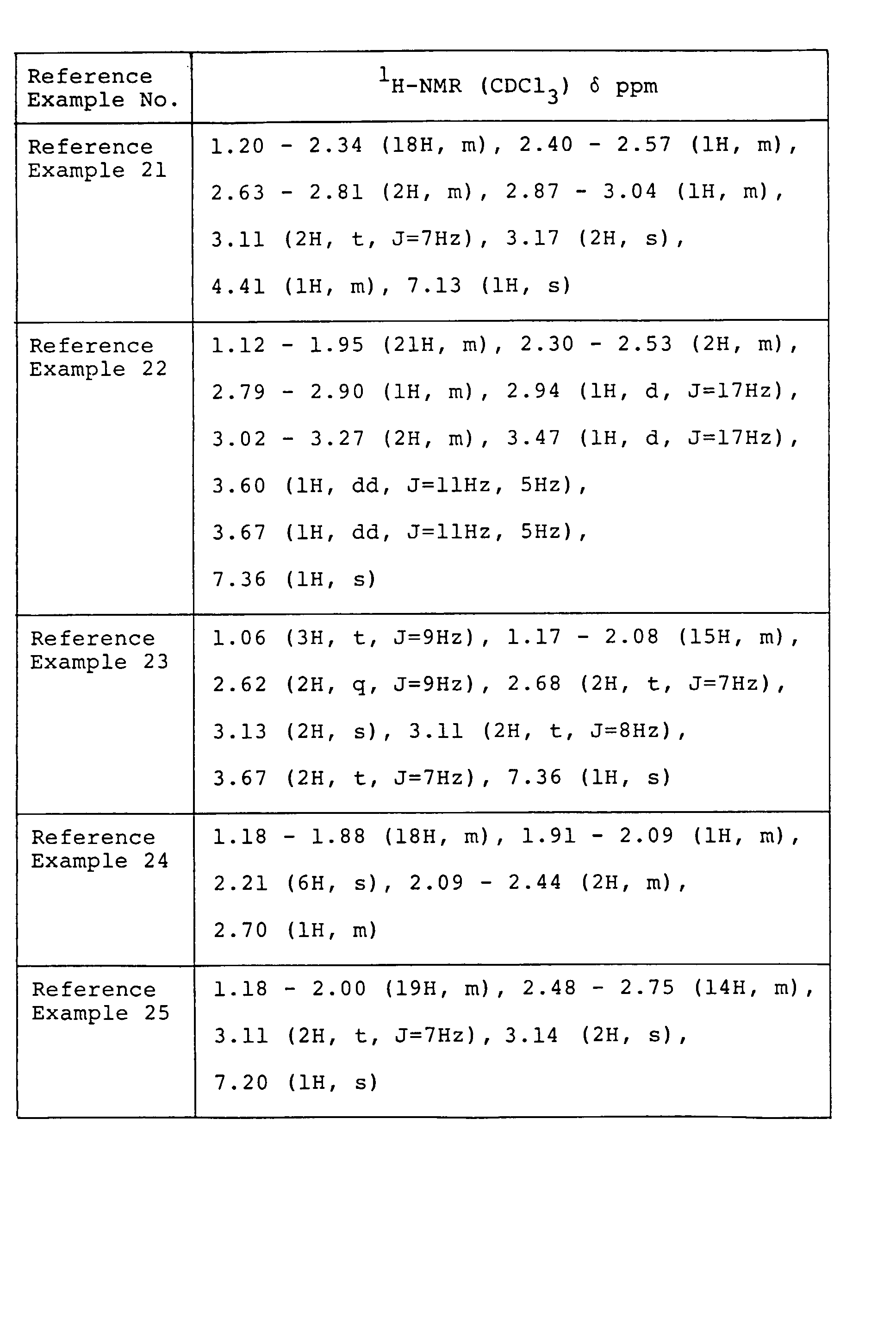


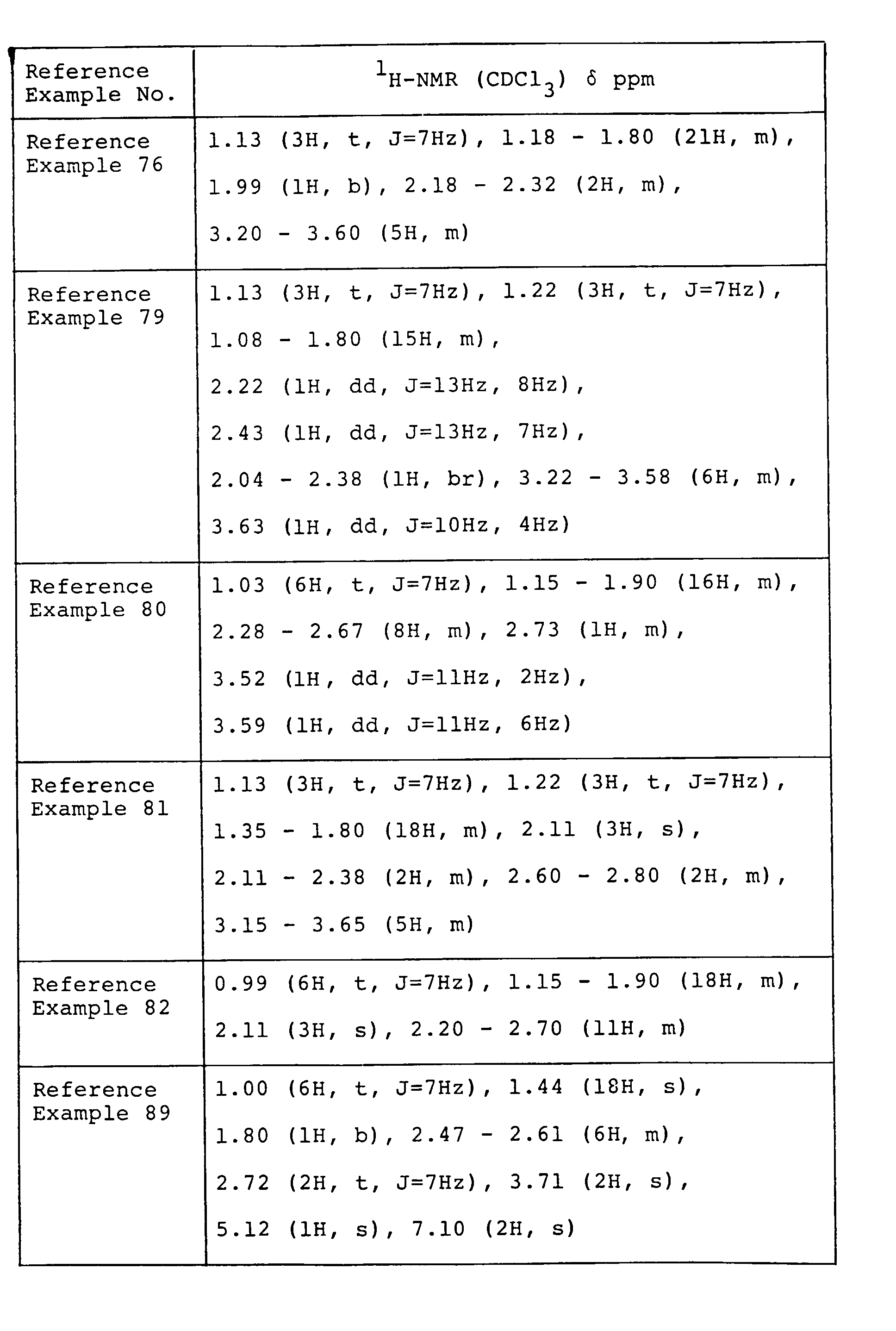


- 2.00 Grams of 6-(4-carboxybutoxy)carbostyril is suspended in 60 ml of chloroform. Thereto is added 1.40 g of DBu. The mixture is stirred for 30 minutes at room temperature. 1.05 g of isobutyl chloroformate is added with ice cooling. Then, there is dropwise added at room temperature 1.61 g of N-(cyclohexylmethyl)-N-[2-(1-pyrrolidinyl]ethyl]amine. The mixture is stirred for 3 hours at room temperature. Then, a 0.5 N aqueous sodium hydroxide solution is added, and the mixture is stirred for 10 minutes. Extraction with chloroform is effected. The extract is washed with water and dried with anhydrous magnesium sulfate. The solvent is removed by evaporation. The resulting residue is purified by a silica gel column chromatography (chloroform : methanol = 20 : 1) and recrystallized from diethyl ether to obtain 1.00 g of 6-[4-{N-cyclohexylmethyl-N-[2-(1-pyrrolidinyl)-ethyl]aminocarbonyl}butoxy]carbostyril.
- Properties:
- Colorless powdery crystals
- Melting point:
- 105 - 106°C
- Using appropriate starting materials and in the same procedure as in Example 1, there are obtained compounds shown in Table 9 given later.
- In Table 9 are also shown the properties (crystal form and solvent used for recrystallization) and melting point (°C) of each compound.
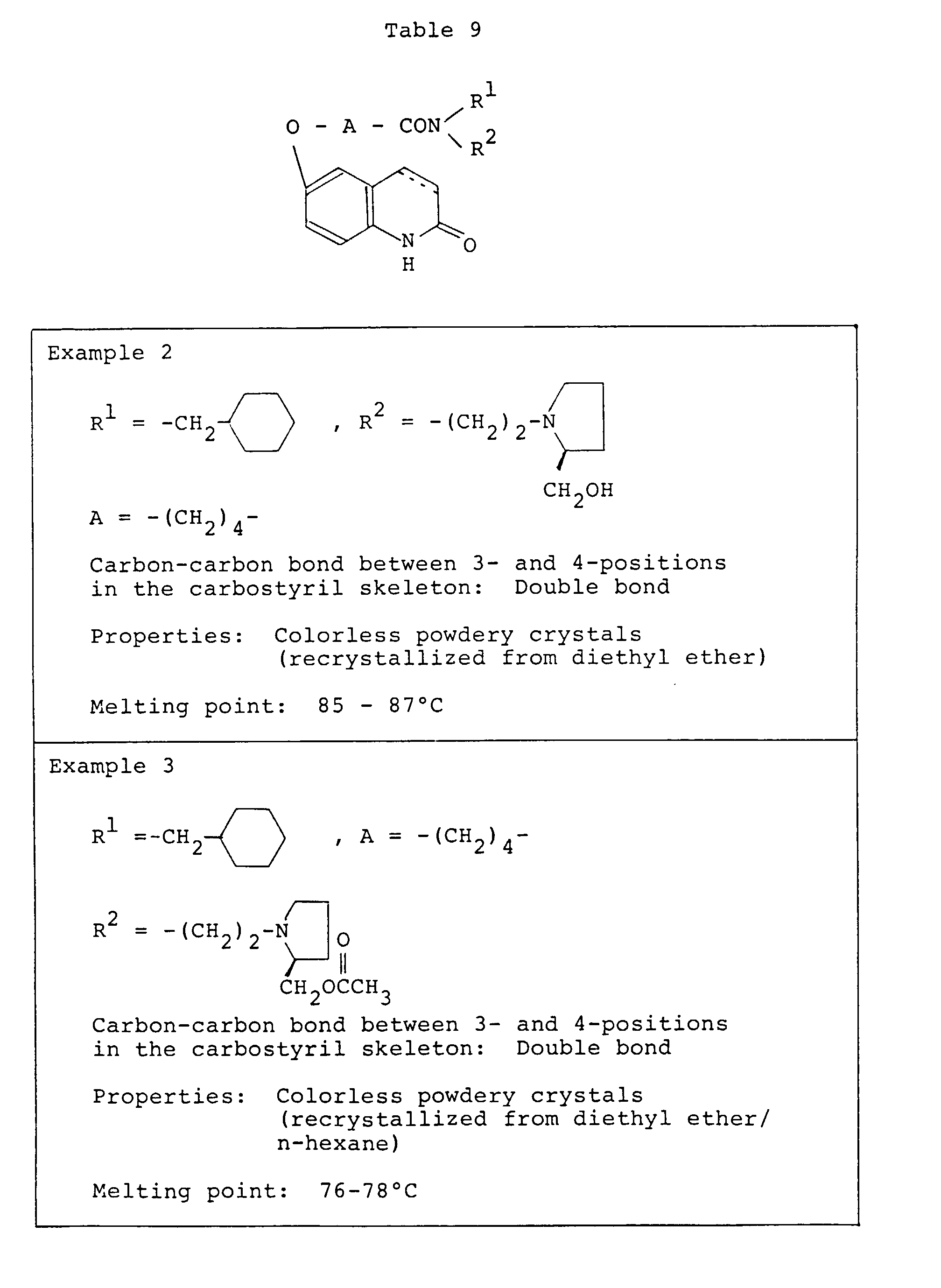

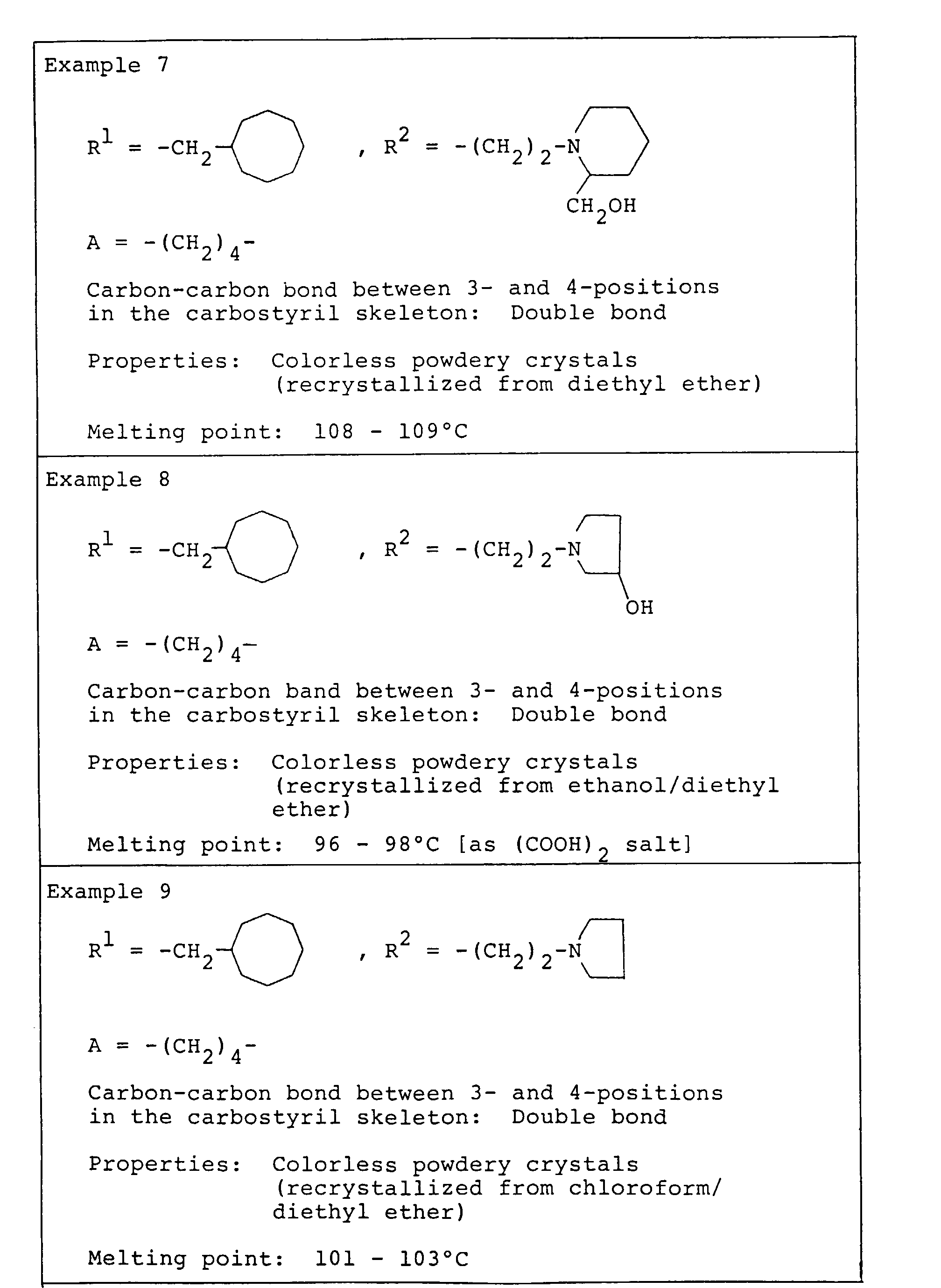


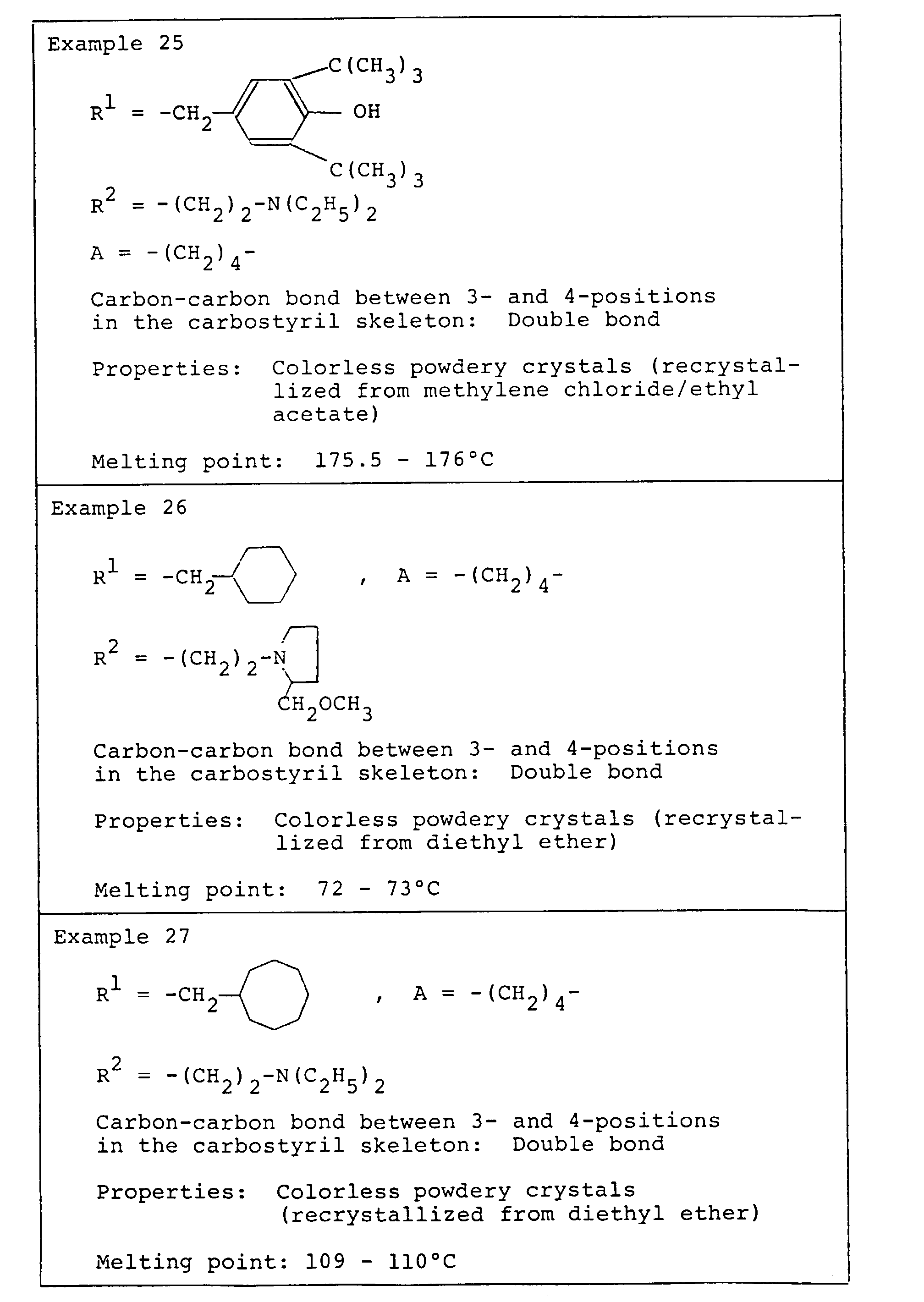


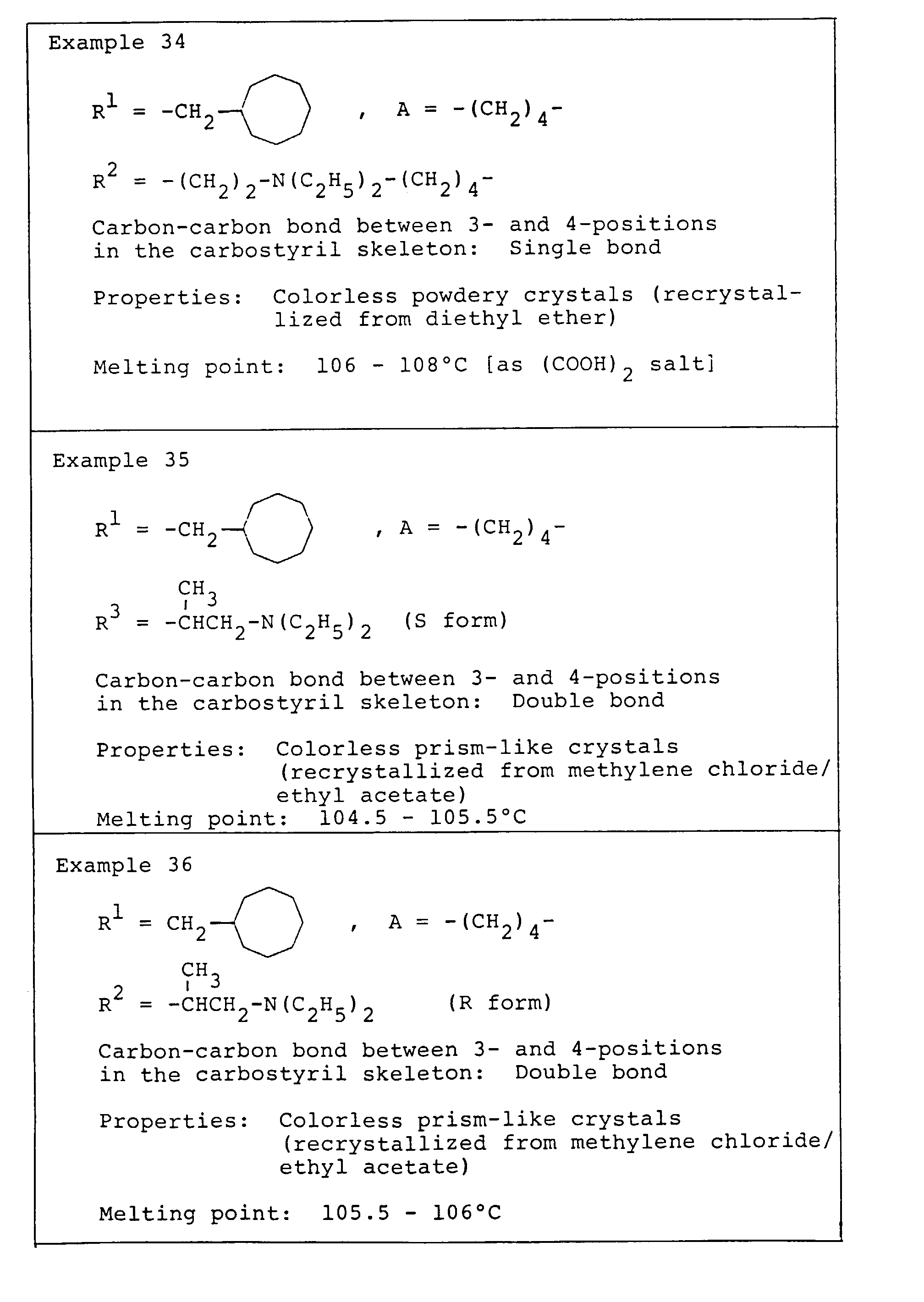


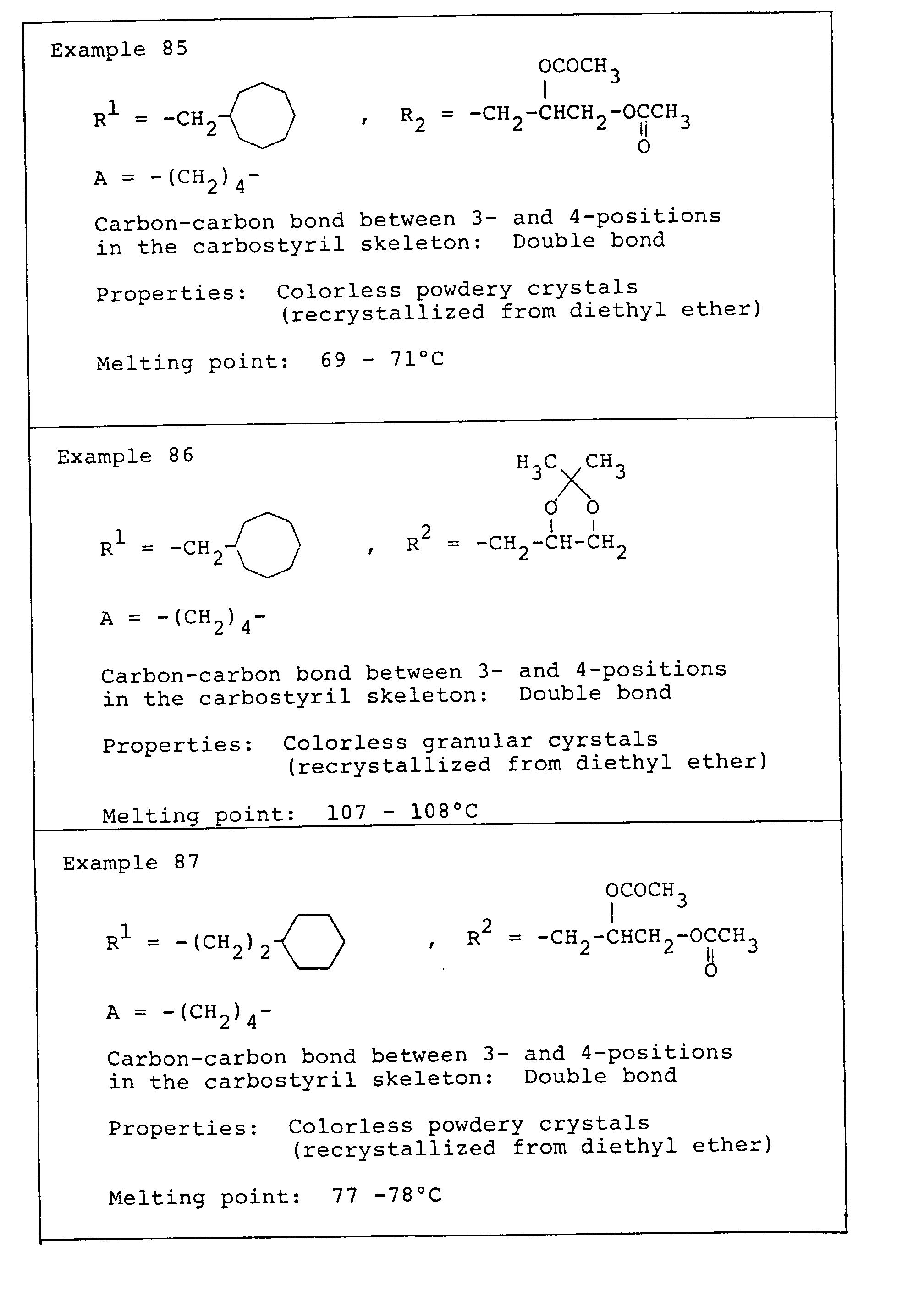


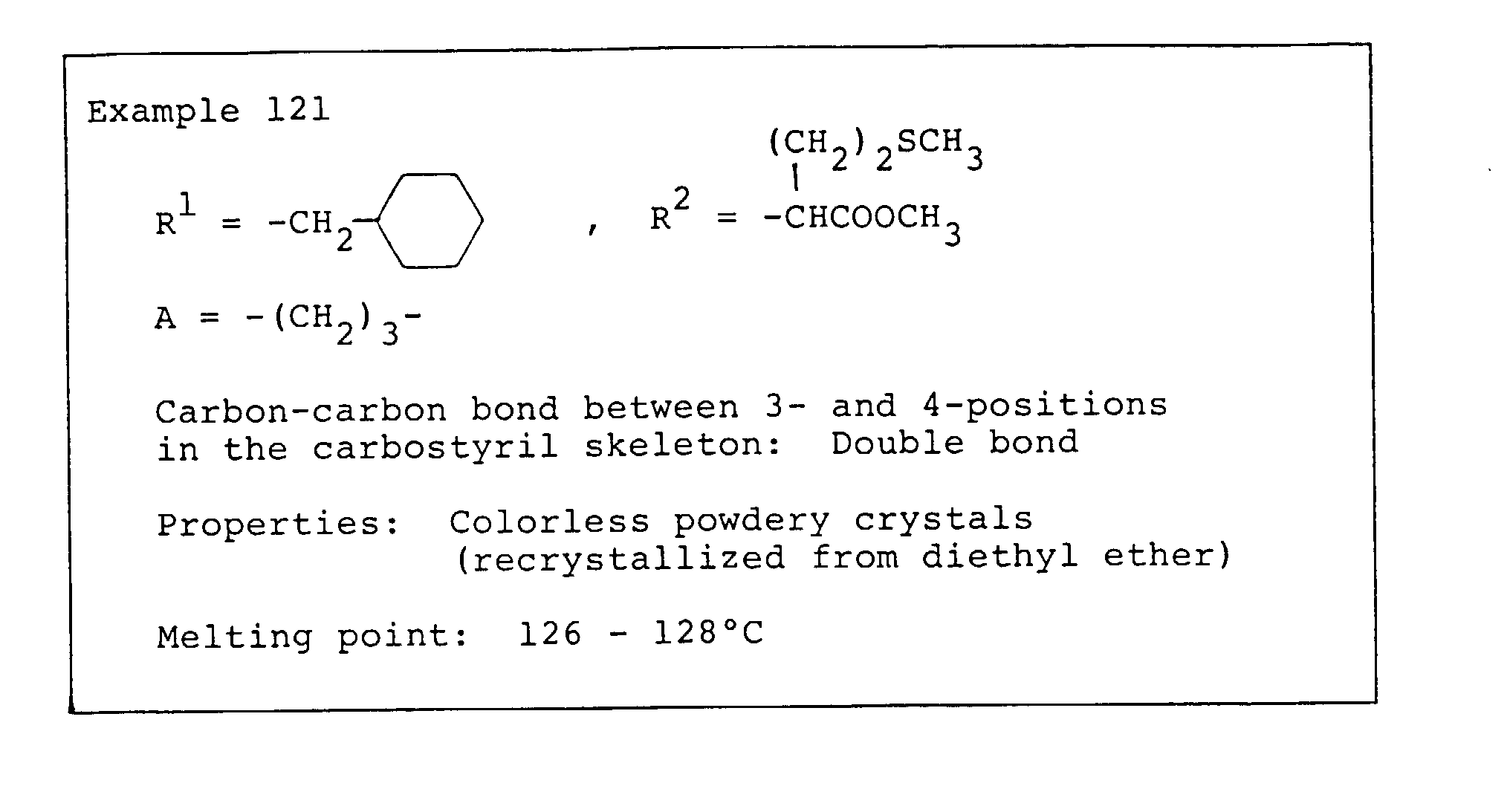
- Some of the compounds shown in the above Table 9 were determined by means of 1NMR (CDCl3, δ ppm). The data obtained are as follows.
-
- 1.00 - 2.01 (23H, m)
- 2.20 (2H, t, J=10Hz)
- 2.33 - 2.57 (4H, m)
- 2.67 - 2.90 (2H, m)
- 3.07 - 3.28 (2H, m)
- 3.36 (3H, s)
- 3.28 - 3.52 (2H, m)
- 3.57 (1H,m), 4.02 (2H, s)
- 4.67 (2H, s)
- 6.73 (1H, d, J=9Hz)
- 6.98 (1H, d, J=2Hz)
- 7.15 (1H, dd, J=9 and 2Hz)
- 7.38 (1H, d, J=9Hz)
- 7.74 (1H, d, J=9Hz)
-
- 1.00 - 2.00 (27H, m)
- 2.11 (3H, s)
- 2.20 - 2.70 (4H, m)
- 2.92 - 3.60 (6H, m)
- 4.03 (2H, m)
- 5.55 - 5.65 (1H, m)
- 6.73 (1H, d, J=9Hz)
- 6.98 (1H, d, J=3Hz)
- 7.15 (1H, dd, J=3 and 8Hz)
- 7.39 (1H, d, J=8Hz)
- 7.76 (1H, d, J=9Hz)
- 12.58 (1H, b)
-
- 0.79 - 2.22 (27H, m)
- 2.22 - 2.68 (4H, m)
- 2.68 - 2.88 (1H, m)
- 3.05 - 3.65 (8H, m)
- 4.02 (2H, s)
- 6.73 (1H, d, J=9Hz)
- 6.98 (1H, d, J=2Hz)
- 7.16 (1H, d, J=9Hz)
- 7.37 (1H, dd, J=2 and 9 Hz)
- 7.77 (1H, d, J=9Hz)
- 12.18 (1H, s)
-
- 0.80 - 2.10 (15H, m)
- 2.40 (2H, s)
- 3.05 - 3.30 (4H, m)
- 3.45 - 3.65 (2H, m)
- 4.04 (2H, s)
- 6.72 (1H, d, J=9Hz)
- 6.98 (1H, d, J=2.5Hz)
- 7.14 (1H, dd, J=2.5 and 9Hz)
- 7.27 - 7.41 (3H, m)
- 7.75 - (1H, d, J=9Hz)
- 8.42 (2H, d, J=6Hz)
- 12.60 (1H, b)
-
- 0.76 - 1.40 (5H, m)
- 1.48 - 1.92 (10H, m)
- 2.06 (3H, s)
- 2.30 - 2.70 (14H, m)
- 3.16 (2H, dd, J=7Hz and 10Hz)
- 3.43 (2H, m), 4.02 (2H, s)
- 4.18 (2H, t, J=7Hz)
- 6.71 (1H, d, J=9.5Hz)
- 6.98 (1H, d, J=2.5Hz)
- 7.14 (1H, dd, J=2.5Hz and 9Hz)
- 7.36 (1H, d, J=9Hz)
- 7.74 (1H, d, J=9.5Hz)
-
- 0.75 - 2.18 (9H, m)
- 2.24 (3H, s)
- 2.30 - 2.90 (6H, m)
- 3.10 - 3.40 (2H, m)
- 3.40 - 3.60 (2H, m)
- 3.70 - 3.90 (2H, m)
- 3.90 - 4.10 (2H, m)
- 6.69 (1H, d, J=9.5Hz)
- 6.97 (1H, s)
- 7.02 - 7.20 (1H, m)
- 7.30 - 7.36 (1H, m)
- 7.73 (1H, d, J=9.5Hz)
- 11.69 (1H, b)
-
- 0.75 - 2.22 (9H, m)
- 2.05 (3H, s)
- 2.24 - 2.60 (5H, m)
- 2.60 - 2.80 (1H, m)
- 2.80 - 3.06 (1H, m)
- 3.06 - 3.40 (2H, m)
- 3.40 - 3.80 (4H, m)
- 4.02 (2H, s)
- 4.01 - 4.30 (2H, m)
- 6.72 (1H, d, J=9.5Hz)
- 6.98 (1H, s)
- 7.13 (1H, d, J=9Hz)
- 7.39 (1H, d, J=9Hz)
- 7.75 (1H, d, J=9.5Hz)
-
- 0.80 - 2.10 (15H, m)
- 2.24 (3H, s)
- 2.33 - 2.57 (2H, m)
- 2.57 - 2.80 (2H, m)
- 3.10 - 3.95 (10H, m)
- 4.01 (2H, s), 4.56 (1H, s)
- 6.71 (1H, s, J=9.5Hz)
- 6.98 (1H, d, J=2.6Hz)
- 7.14 (1H, dd, J=2.6Hz and 9Hz)
- 7.33 (1H, d, J=9Hz)
- 7.24 (1H, d, J=9.5Hz)
-
- 1.72 - 2.20 (15H, m)
- 2.20 - 2.53 (2H, m)
- 2.53 - 3.83 (8H, m)
- 3.94 (2H, s)
- 6.64 (1H, d, J=10Hz)
- 6.90 (1H, d, J=2Hz)
- 7.06 (1H, dd, J=2Hz and 9Hz)
- 7.32 (1H, d, J=9Hz)
- 7.67 (1H, d, J=10Hz)
- 12.66 (1H, s)
-
- 0.82 - 1.95 (16H, m)
- 2.44 (2H, s), 3.20 (2H, m)
- 3.51 (1H, dd, J=8Hz and 14Hz)
- 3.67 (1H, dd, J=13Hz and 4Hz)
- 3.90 - 4.21 (4H, m)
- 4.85 (1H, m)
- 6.72 (1H, d, J=10Hz)
- 6.99 (1H, d, J=2Hz)
- 7.14 (1H, dd, J=9Hz and 2Hz)
- 7.37 (2H, d, J=9Hz)
- 7.75 (1H, d, J=10Hz)
- 12.31 (1H, s)
- In 100 ml of pyridine is dissolved 4.3 g of 6-{4-[N-(2,3-dihydroxypropyl)-N-cyclohexylmethylamino-carbonyl]butoxy}carbostyril. Thereto is added 4.3 g of acetic anhydride. The mixture is stirred for 8 hours at 50°C with heating. Pyridine and chloroform are removed by evaporation under reduced pressure. The residue is made acidic with 5% hydrochloric acid and extracted with chloroform. The extract is washed with water and dried with anhydrous magnesium sulfate. The solvent is removed by evaporation. The residue is purified by means of a silica gel column chromatography (eluant; chloroform : methanol = 50 : 1) to obtain 2.0 g of 6-{4[N-(2,3-diacetyloxypropyl)-N-cyclohexylmethylamino-carbonyl]butoxy}carbostyril.
- Properties:
- Colorless powdery substance
- Melting point:
- 98 - 100°C
- Using appropriate starting materials and by procedure similar to that employed in Example 122, there are obtained compounds of Examples 3, 42, 66, 69, 73, 76, 78, 80, 82, 85, 87, 89, 91, 96 and 103.
- In 4 ml of methanol is dissolved 0.21 g of 6-{4-[N-(2,3-isopropylidenedioxypropyl)-N-(4-trans-hydroxymethyl-1-cyclohexylmethyl)aminocarbonyl]butoxy}-carbostyril. Thereto is added 4 ml of 5% hydrochloric acid. The mixture is stirred for 2 hours at room temperature. To the reaction mixture is added 40 ml of chloroform. The mixture is made alkaline with an aqueous sodium hydrogen carbonate solution with ice cooling. The resulting mixture is extracted with chloroform. The extract is dried with anhydrous magnesium sulfate. The solvent is removed by evaporation. The residue is purified by means of a silica gel column chromatography (eluant; chloroform : methanol = 8 : 1) to obtain 0.15 g of 6-{4-[N-(2,3-dihydroxypropyl)-N-(4-trans-hydroxymethyl-1-cyclohexylmethyl)aminocarbonyl}-butoxy]carbostyril.
- Properties:
- colorless powdery substance
- Melting point:
- 156 - 159°C
- In 10 ml of anhydrous ethanol are dissolved 1.19 g of 6-{4-[N-(3-chloro-2-hydroxypropyl)-N-cyclo-octylemthylaminocarbonyl]butoxy}carbostyril and 10 ml of diethylamine. Thereto is added 0.7 g of potassium carbonate. The mixture is refluxed for 2 hours with heating and then extracted with chloroform. The extract is washed with water and dried with anhydrous magnesium sulfate. The solvent is removed by evaporation. The residue is purified by means of a silica gel column chromatography (eluant; chloroform : methanol = 8 : 1) and recrystallized from diethyl ether to obtain 0.40 g of 6-{4-[N-(3-diethylamino-2-hydroxypropyl)-N-cyclo-octylmethylaminocarbonyl]butoxy}carbostyril.
- Properties:
- Colorless powdery substance
- Melting point:
- 61 - 63°C
- Using appropriates starting materials and by procedure similar to that employed in Example 124, there are obtained compounds of Examples 1-21, 23-30, 32-36, 38, 40, 43-49, 52, 56-63, 66-68, 71, 73, 76, 78, 80, 82, 85, 87, 89, 91 and 96.
- In 20 ml of ethanol is dissolved 2.25 g of 6-{4-[N-(3-chloro-2-hydroxypropyl)-N-cyclohexylmethyl-aminocarbonyl]butoxy}carbostyril. Thereto is added 0.88 g of potasium O-ethyl dithiocarbonate. The mixture is stirred for 2 hours at room temperature. Ethanol is removed by evaporation under reduced pressure. The residue is extracted with chloroform. The extract is washed with water and dried with anhydrous magnesium sulfate. The solvent is removed by evaporation. The residue is purified by means of a silica gel column chromatography (eluent; chloroform : methanol = 20 : 1) and recrystallized from a mixture of chloroform and diethyl ether (1 : 3) to obtain 1.0 g of 6-{4-[N-(1,3-oxythiolane-2-thion-4-ylmethyl)-N-cyclohexylmethylaminocarbonyl]butoxy}carbostyril.
- Properties:
- Yellow granular crystals
- Melting point:
- 84°C or above (decomposed)
- In 6 ml of ethylenediamine is dissolved 0.2 g of 6-{4-[N-(1,3-oxathiolane-2-thion-4-ylmethyl)-N-cyclohexylmethylaminocarbonyl]butoxy}carbostyril. The solution is stirred for 8 hours at room temperature, then it is made acidic with 5% hydrochloric acid. Chloroform extraction is effected and the extract is washed with water and dried with anhydrous magnesium sulfate. The solvent is removed by evaporation. The residue is purified by means of a silica gel column chromatography (eluant; chloroform : methanol = 8 : 1) and recrystallized from diethyl ether to obtain 0.05 g of 6-{4-[N-(3-mercapto-2-hydroxypropyl)-N-cyclohexylmethylaminocarbonyl]butoxy}-carbostyril.
- Properties:
- Colorless powdery substance
- Melting point:
- 105°C or above (decomposed)
- In 30 ml of methanol is dissolved 12.10 g of 6-{4-[N-(4-methoxymethoxy-1-piperidinyl)ethyl-N-cyclooctylmethylaminocarbonyl]butoxy}carbostyril. Thereto is added 240 ml of 5% hydrochloric acid. The mixture is stirred for 8 hours at room temperature. To the mixture is added with a 10% aqueous potassium hydroxide solution under ice cooling to make the mixture alkaline. The resulting mixture is extracted with methylene chloride. The extract is washed with water and dried with anhydrous magnesium sulfate. The solvent is removed by evaporation. The residue is purified by means of a silica gel column chromatography (eluant; chloroform : methanol = 8 : 1) and recyrstallized from ethanol to obtain 6.50 g of 6-{4-[N-(4-hydroxy-1-piperidinyl)ethyl-N-cyclooctylmethylaminocarbonyl]-butoxy}carbostyril.
- Properties:
- Colorless powdery substance
- Melting point:
- 108 - 110°C
- Using appropriate starting materials and by procedure similar to that employed in Example 127, there are obtained compounds of Examples 8, 21, 22, 67 and 68.
- In 80 ml of ethanol is dissolved 1.6 g of 6-{4-[N-(3-methylthio-1-methoxycarbonylpropyl)-N-cyclohexylmethylaminocarbonyl]butoxy}carbostyril. Thereto is added 3.2 g of sodium boron hydride. The mixture is stirred for 2 hours at 50-60°C. The reaction mixture is neutralized with diluted hydrochloric acid and concentrated. The residue is extracted with a mixture of chloroform and methanol (10 : 1). The extract is purified by means of a silica gel column chromatography (eluant; chloroform : methanol = 20 : 1). The resulting residue is recrystallized from a mixed solvent of dichloromethane-ethyl acetate-diethyl ether to obtain 0.78 g of 6-{4-[N-(3-methylthio-1-hydroxy-methylpropyl)-N-cyclohexylmethylaminocarbonyl]butoxy}-carbostyril.
- Properties:
- Colorless prism-like crystals
- Melting point:
- 106.5 - 108°C
- Using appropriate starting materials and by a procedure similar to that employed in Example 128, there are obtained compounds of Examples 13, 23, 25, 27-30, 32-36, 38, 40, 44-48, 58-61, 71, 72, 75, 95, 97, 100, 102, 104 and 120.
- To 50 ml of dimethylformamide are added 1.73 g of 6-hydroxycarbostyril, 1.8 g of K2CO3 and 0.5 g of KI. To this mixture being stirred at 60-70°C is dropwise added 4.2 g of N-[2-(1-pyrrolidinyl)ethyl]-N-(5-chloro-pentanoyl)-cyclohexylmethylamine. Then, the mixture is stirred for 4 hours at the same temperature. The solvent is removed by evaporation. The residue is dissolved in 200 ml of chloroform and the solution is washed with diluted hydrochloric acid, a 1% aqueous sodium hydroxide solution and water in this order, and dried with anhydrous magnesium sulfate. The desiccant is removed by filtration and the filtrate is concentrated. The residue is purified by means of a silica gel column chromatography (eluent; chloroform : methanol = 20 : 1) and recrystallized from diethyl ether to obtain 0.5 g of 6-[4-{N-[2-(1-pyrrolidinyl)ethyl]-N-cyclohexylmethylaminocarbonyl}-butoxy]carbostyril.
- Properties:
- Colorless powdery substance
- Melting point:
- 105 - 106°C
- Using appropriate starting materials and by a procedure similar to that employed in Example 129, there are obtained compounds of Examples 2-121.
- In 3 ml of acetic acid is dissolved 0.2 g of 6-{4-[N-(2-hydroxypropyl)-N-cyclohexylmethylaminocarbonyl]-butoxy}carbostyril. Thereto is dropwise added 0.3 ml of an aqueous solution containing 0.07 g of chromic acid at room temperature. The mixture is stirred for 1 hour, and 0.3 ml of isopropyl alcohol is added. Acetic acid is removed by evaporation under reduced pressure. The residue is made alkaline with sodium bicarbonate and then extracted with chloroform. The extract is washed with water and dried with anhydrous magnesium sulfate. The solvent is removed by evaporation. The residue is purified by means of a silica gel column chromatography (eluent; chloroform : methanol = 20 : 1) and recrystallized from diethyl ether to obtain 0.07 g of 6-[4-(N-acetylmethyl-N-cyclohexylmethylaminocarbonyl)butoxy]carbostyril.
- Properties:
- Colorless powdery substance
- Melting point:
- 86-88°C
- The platelet aggregation inhibitory activities of test compounds were determined according to the method by Born et al. [J. Physiol., London, 162, 67 (1962)] and by using Platelet Aggregation Tracer manufactured by Niko Bioscience Kabushiki Kaisha.
- A blood sampled from a rabbit was mixed with 3.8% sodium citrate at proportions of 9 volumes (the former) and 1 volume (the latter). This sample was subjected to centrifugation at 1,100 rpm for 10 minutes to obtain a platelet rich plasma (PRP). The remaining sample was subjected to further centrifugation at 3,000 rpm for 15 minutes to obtain a platelet poor plasma (PPP).
- The number of platelets in the PRP obtained above was counted by coulter Counter manufactured by Coulter Electronics Inc. Then, the PRP was diluted with the PPP so that the number of platelets in the PRP after dilution became 400,000 platelets/µl, whereby a PRP solution was prepared.
- There were placed in a cell for aggregation determination, 2 µl of a solution containing a test compound at a given concentration and 200 µl of the PRP solution prepared above. The cell was heated at 37°C for 1 minute. Then, to the cell contents was added 20 µl of adenosine diphosphate (ADP, manufactured by Sigma Co.) or 20 µl of a collagen suspension (Collagen Reagent Horm, manufactured by Hormon-Chemie Co.) to induce aggregation of platelets. Then, the platelet aggregation was determined for change in transmittance, and a platelet aggregation curve was drawn. Incidentally, the concentrations of the ADP and collagen were controlled so as to be 7.5 µM and 20 µg/ml, respectively, in terms of final concentration.
- The mixture aggregation rate (MAR) of platelets was calculated from the platelet aggregation curve, using the following formula.

- In the above, MAR was calculated also for a control containing no test compound. Using this MAR as a base, the platelet aggregation inhibitions rate (%) of each test compound at various concentrations were calculated from the following formula.

- From the platelet aggregation inhibitions of each test compound at various concentrations, there was obtained the concentration (IC50) of each test compound giving a 50% platelet aggregation inhibition.
- The following compounds were used as test compounds, and the results of the above test for these compounds are shown in Table 10.
-
- 1:
- 6-[4-{N-cyclohexylmethyl-N-[2-(2β-hydroxymethyl-1-pyrrolidinyl)ethyl]aminocarbonyl}butoxy]carbostyril
- 2:
- 6-[4-{N-cyclohexylmethyl-N-[2-(2β-acetyloxymethyl-1-pyrrolidinyl)ethyl]aminocarbonyl}butoxy]carbostyril
- 3:
- 6-[4-{N-cyclooctylemthyl-N-2-(2β-hydroxymethyl-1-pyrrolidinyl)ethyl]aminocarbonyl}butoxy]carbostyril
- 4:
- 6-[4-{N-cyclooctylmethyl-N-[2-(2-hydroxymethyl-1-piperidinyl)ethyl]aminocarbonyl}butoxy]carbostyril
- 5:
- 6-{4-[N-cyclooctylmethyl-N-(2-pyrrolidinylethyl)-aminocarbonyl]butoxy}carbostyril
- 6:
- 6-[4-{N-cyclooctylmethyl-N-[2-(3-hydroxy-1-pyrrolidinyl)ethyl]aminocarbonyl}butoxy]carbostyril oxalate
- 7:
- 6-{4-[N-cyclooctylmethyl-N-(2-morpholinoethyl)-aminocarbonyl] butoxy}carbostyril
- 8:
- 6-[4-{N-cyclooctylmethyl-N-[2-(4-hydroxy-1-piperidinyl)ethyl]aminocarbonyl}butoxy]carbostyril
- 9:
- 6-[4-{N-cyclooctylmethyl-N-[2-(2,6-dimethyl-1-piperidinyl)ethyl]aminocarbonyl}butoxy]carbostyril
- 10:
- 6-[4-{N-cyclooctylmethyl-N-[2-(2β-dimethylamino-methyl-1-pyrrolidinyl)ethyl]aminocarbonyl}butoxy]-carbostyril difumarate.
- 11:
- 6-[4-{N-cyclohexyl-N-[2-(4-methoxy-1-piperidinyl)-ethyl]aminocarbonyl}butoxy]carbonstyril
- 12:
- 6-[4-{N-cyclohexylmethyl-N-[2-(1-imidazolyl)ethyl]-aminocarbonyl}butoxy]carbostyril
- 13:
- 6-[4-{N-cyclohexylmethyl-N-[2-(1,2,4-triazol-1-yl)-ethyl]aminocarbonyl}butoxy]carbostyril
- 14:
- 6-[4-{N-cyclohexylmethyl-N-[2-(1-ethyl-4α-hydroxy-2-pyrrolidinyl)ethyl]aminocarbonyl}butoxy]-carbostyril
- 15:
- 6-[4-{N-cyclohexylmethyl-N-[2-(2β-methoxymethyl-1-pyrrolidinyl)ethyl]aminocarbonyl}butoxy]carbostyril
- 16:
- 6-4-[N-cyclooctylmethyl-N-(2-diethylaminoethyl)-aminocarbonyl]butoxy}carbostyril
- 17:
- 6-{4-[N-cyclooctylmethyl-N-(3-diethylaminopropyl)-aminocarbonyl]butoxy}carbostyril oxalate
- 18:
- 6-{4-[N-cyclooctylmethyl-N-(4-diethylaminobutyl)-aminocarbonyl]butoxy}carbostyril oxalate
- 19:
- 6-[4-(N-cyclooctylmethyl-N-diethylamidomethyl)-aminocarbonyl]butoxy}carbostyril
- 20:
- 6-{4-[N-cyclooctylmethyl-N-(2-diethylaminoethyl)-aminocarbonyl]butoxy}3,4-dihydrocarbostyril oxalate
- 21:
- 6-{4-[N-cyclooctylmethyl-N-(3-diethylamino-2(S)-propyl)aminocarbonyl]butoxy}carbostyril
- 22:
- 6-{4-[N-cyclooctylmethyl-N-(1-hdyroxy-3-diethyl-amino-2(R)-propyl)aminocarbonylbutoxy}carbostyril
- 23:
- 6-{4-[N-cyclooctylmethyl-N-(4-methylthio-1-diethyl-amino-2(R)-butyl)aminocarbonyl]butoxy}carbostyril
- 24:
- 6-{4-[N-cyclooctylmethyl-N-(2-acetylaminoethyl)-aminocarbonyl]butoxy}carbostyril
- 25:
- 6-[4-[N-cyclooctylmethyl-N-{2-[N-ethyl-N-(2-hydroxyethyl)amino]ethyl}aminocarbonyl]butoy]-carbonstyril
- 26:
- 6-[4-{N-cyclooctylmethyl-N-{2-(N-ethyl-N-allylamino)-ethyl}aminocarbonyl}butoxy]carbostyril
- 27:
- 6-{4-[N-cyclooctylmethyl-N-(3,4(β)-dimethyl-5(β)-thiomoirpholinomethyl)aminocarbonyl] butoxy}-carbostyril
- 28:
- 6-[4-{N-cyclohexylmethyl-N-[2-(2β-diethyIamido-1-pyrrolidinyl)ethyl]aminocarbonyl}butoxy]carbostyril
- 29:
- 6-{4-[N-cyclooctylmethyl-N-(1-methyl-3-piperidinyl-methyl)aminocarbonyl]butoxy}carbostyril
- 30:
- 6-[4-{N-cyclohexylmethyl-N-[2-(4-pyridylthio)ethyl]-aminocarbonyl}butoxy]carbostyril
- 31:
- 6-[4-{N-cyclooctylmethyl-N-[(3-pyridyl)methyl]-aminocarbonyl}butoxy]carbostyril
- 32:
- 6-[4-[N-cyclohexylmethyl-N-{2-[4-(2-hydroxyethyl)-1-piperazinyl]ethyl}aminocarbonyl]butoxy]carbostyril
- 33:
- 6-[4-{N-cyclooctylmethyl-N-[2-{N-ethyl-N-[2-(3,4-dimethoxyphenyl)ethyl]amino}ethyl]aminocarbonyl}-butoxy]carbostyril oxalate
- 34:
- 6-{4-[N-cycloheptyl-N-(2,3-diacetyloxypropyl)amino-carbonyl]butoxy}carbostyril
- 35:
- 6-{4-[N-cycloheptyl-N-(2,3-isopropylidenedioxypropyl)-aminocarbonyl]butoxy}carbostyril
- 36:
- 6-{4-[N-(2-tetrahydropyranylmethyl)-N-(2,3-diacetyloxypropyl)aminocarbonyl]butoxy}carbostyril
- 37:
- 6-{4-N-cyclohexylmethyl-N-(2,4-diacetyloxybutyl)-aminocarbonyl]butoxy}carbostyril
- 38:
- 6-{4-[N-(4α-acetyloxymethyl-1β-cyclohexylmethyl-N-(2,3-diacetyloxypropyl)aminocarbonyl]butoxy}carbostyril
- 39:
- 6-{4-[N-(4α-hydroxymethyl-1β-cyclohexylmethyl-N-(2,3-isopropylidenedioxypropyl)aminocarbonyl]butoxy}-carbostyril
- 40:
- 6-{4-[N-cyclohexylmethyl-N-(2-hydroxy-3-methoxy-propyl)aminocarbonyl]butoxy}carbostyril
- 41:
- 6-{4-[N-cyclohexylmethyl-N-(2-hydroxy-1-methoxy-carbonylethyl)aminocarbonyl]butoxy}carbostyril
- 42:
- 6-{4-[N-ethyl-N-(4α-acetyloxymethyl-1β-cyclohexyl-methyl)aminocarbonyl]butoxy}carbostyril
- 43:
- 6-[4-(N-cyclohexylmethyl-N-acetylmethylamino-carbonyl)butoxy]carbostyril
- 44:
- 6-{4-[N-cyclohexylmethyl-N-(2-mercaptoethyl)amino-carbonyl]butoxy}carbostyril
- 45:
- 6-{4-[N-cyclohexylmethyl-N-[2-(2-tetrahydropyranylthio)-ethyl]aminocarbonyl}butoxy]carbostyril
- 46:
- 6-{4-[N-cyclohexylmethyl-N-(4-methylthio-1-hydroxy-2-butyl)aminocarbonyl]butoxy}carbostyril
- 47:
- 6-{4-[N-cyclohexylmethyl-N-(4-methylthio-1-acetyloxy-2-butyl)aminocarbonyl]butoxy}carbostyril
- Increase in heart rate as well as hypotensive activity of test compounds were measured as follows by using mongrel dogs (body weight = 10-20 kg). That is, mongrel dogs were put under anesthesia by intravenous administration of pentobarbital sodium, then fixed at the back position, and subjected to testing under artificial breathing condition. Blood pressure was measured by using a blood pressure transducer (P23XL, manufactured by Gould Statham Instruments, Inc.) via a cannula inserted into the femoral artery of the mongrel dog. Heart rate was measured via a tachometer, based on the pulse wave of the blood pressure. These signals were recorded on a thermal-pen type recorder (Recti-Horiz 8K, manufactured by Nihon Denki San-ei).
- The test compounds mentioned in the Pharmacological Test I were also used as test compounds in this Test-II. Each of them was dissolved in a mixed solution of N,N'-dimenthylformamide and a physiological saline solution, and each resulting solution was administered to the test dogs through the cannulas inserted into their femoral arteries, in an amount of 30 µg (test compound)/kg of body weight. The heart rate of each dog after the administration of test compound was measured as mentioned above, whereby the maximum increase in heart rate was obtained.
- The test results obtained are shown in Table 11.
Table 11 Test compound No. Maximum increase in heart rate (beats/min) (Administration amount = 30 µg/kg) 1 7 3 12 4 6 5 5 6 5 8 5 9 0 12 12 14 4 16 7 18 5 20 4 21 7 23 4 29 2 32 8 33 12 44 11 - 1,000 tablets for oral administration, each containing 5 mg of 6-[4-{N-cyclohexylmethyl-N-[2-(1-pyrrolidinyl)ethyl]aminocarbonyl}butoxy]carbostyril, as prepared according to the following formulation.
Ingredients Amount (g) 6-[4-{N-cyclohexylemthyl-N-[2-(1- pyrrolidinyl)ethyl]aminocarbonyl}butoxy]carbostyril 5 Lactose (Japanese Pharmacopoeia grade) 50 Corn starch (Japanese Pharmacopoeia grade) 25 Crystalline celluloe (Japanese Pharmacoipoeia grade) 25 Methyl cellulose (Japanese Pharmacopoeia grade) 1.5 Magnesium stearate (Japanese Pharmacopoeia grade) 1 - That is, 6-[4-{N-cyclohexylmethyl-N-[2-(1-pyrrolidinyl)ethyliaminocarbonyl}butoxy]carbostyril, lactose, corn starch and crystalline cellulose are mixed thoroughly. The mixture is subjected to granulation with a 5% aqueous methyl cellulose solution. The resulting granules are passed through a 200-mesh sieve and then dried carefully. The dried granules are passed through a 200-mesh sieve, mixed with magnesium stearate and press molded into tablets.
- 1,000 two-piece type hard gelatin capsules for oral use, each containing 10 mg of 6-[4-{N-cyclohexyl-methyl-N-[2-(1-pyrrolidinyl)ethyl]aminocarbonyl}butoxy]-carbostyril, are prepared according to the following formulation.
Ingredients Amount (g) 6-[4-{N-cyclohexylmethyl-N-[2-(1- pyrolidinyl)ethyl]aminocarbonyl}butoxy]carbostyril 10 Lactose (Japanese Pharmacopoeia grade) 80 Starch (Japanese Pharmacopoeia grade) 30 Talc (Japanese Pharmacoipoeia grade) 5 Magnesium stearate (Japanese Pharmacopoeia grade) 1 - That is, each of the above components is ground finely and they are thoroughly stirred so as to give them into a uniform mixture. The mixture is then filled into gelatin capsules for oral administration, each having the desired dimensions.
- A sterilized aqueous solution suitable for parenteral administration is prepared according to the following formulation.
Ingredients Amount (g) 6-[4-{N-cyclohexylmethyl-N-[2-(1- pyrolidinyl)ethyl]aminocarbonyl}butoxy]carbostyril 1 Polyethylene glycol (Japanese Pharmacopoeia grade) (molecular weight: 4,000) 0.3 Sodium chloride (Japanese Pharmacopoeia grade) 0.9 Polyoxyethylene sorbitan monooleate (Japanese Pharmacopoeia grade) 0.4 Sodium metabiphosphite 0.1 Methylparaben (Japanese Pharmacopoeia grade) 0.18 Propylparaben (Japanese Pharmacopoeia grade) 0.02 Distilled water for injection 100 ml - That is, the above parabens, sodium methbiphosphite and sodium chloride are dissolved in distilled water of an amount about half of the above shown amount, at 80°C with stirring. The resulting solution is cooled to 40°C. Therein are dissolved 6-[4-{N-cyclohexylmethyl-N-[2-(1-pyrrolidinyl)ethyl]aminocarbonyl}butoxy]carbostyril, polyethylene glycol and polyoxyethylene sorbitan monooleate in this order. Then, to the resulting solution is added distilled water so to make them in a final volume. The thus prepared solution is sterilized and filtered by using a filter paper to prepare an injection.


Claims (33)
- A carbostyril derivative and a salt thereof, represented by the general formula (1)

R2 is a pyrrolidinyl-C1-C6 alkyl group, morpholino-C1-C6 alkyl group, piperidinyl-C1-C6 alkyl group, thiomorpholino-C1-C6 alkyl group, 1,2,4-triazolyl-C1-C6 alkyl group, furyl-C1-C6 alkyl group, piperazinyl-C1-C6 alkyl group, pyridyl-C1-C6 alkyl group, tetrahydropyranyl-C1-C6 alkyl group, 1,3-oxathiolanyl-C1-C6 alkyl group which may have, as substituent(s) on the heterocyclic group, 1-3 groups selected from the group consisting of hydroxy-C1-C6 alkyl groups, C2-C6 alkanoyloxy-C1-C6 alkyl groups, a hydroxyl group, C1-C6 alkyl groups, amino-C1-C6 alkyl groups, C1-C6 alkylamino-C1-C6 alkyl groups, C1-C6 alkoxy groups, C1-C6 alkoxy-C1-C6 alkoxy groups, C1-C6 alkoxy-C1-C6 alkyl groups, a thio group and C1-C6 alkylamido groups, a tetrahydropyranylthio-C1-C6 alkyl group, a pyridylthio-C1-C6 alkyl group, a C1-C3 alkylenedioxy group-substituted C1-C6 alkyl group, or a C1-C6 alkyl group which may have, as substituent(s), 1-2 groups selected from the group consisting of an amino group, a hydroxyl group, C1-C6 alkylthio groups, C2-C6 alkanoyloxy groups, a tetrahydropyranyloxy group, halogen atoms, C1-C6 alkanoyl groups, a mercapto group, C1-C6 alkoxycarbonyl groups, a carboxy group, C1-C6 alkoxy groups, an amido group and C1-C6 alkylamido groups, wherein the amino group as a substituent for the C1-C6 alkyl group may have, as a substituent, a C1-C6 alkanoyl group, a phenyl-C1-C6 alkyl group which may have a C1-C6 alkoxy group as a substituent on the phenyl ring, a C2-C6 alkenyl group, a hydroxy-C1-C6 alkyl group or a C1-C6 alkyl group, or an imidazolyl-alkyl group selected from (1-imidazolyl)methyl, 2-(1-imidazolyl)ethyl, 1-(1-imidazolyl)ethyl, 3-(1-imidazolyl)propyl, 4-(1-imidazolyl)butyl, 1,1-dimethyl-2-(1-imidazolyl)ethyl, 5-(1-imidazolyl)pentyl, 6-(1-imidazolyl)hexyl, 2-methyl-3-(1-imidazolyl)propyl, 6-[2-(5-hydroxypentyl)-1-imidazolyl]hexyl, (2-methoxymethyl-1-imidazolyl)methyl, (4-methylamino-1-imidazolyl)methyl; where R2 represents a C1-C6 alkyl group which may have 1-2 hydroxyl groups, a C1-C6 alkyl group having a C2-C6 alkanoyloxy group, or a C1-C6 alkyl group having a C1-C6 alkoxy group, R1 must not be any of a C3-C8 cycloalkyl-C1-C6 alkyl group, a C3-C8 cycloalkyl group and a tetrahydropyranyl-C1-C6 alkyl group; the carbon-carbon bond between 3- and 4-positions in the carbostyril skeleton represents a single bond or a double bond]. - A carbostyril derivative and a salt thereof according to Claim 1, wherein R1 is a C3-C8 cycloalkyl-C1-C6 alkyl group which may have, as a substituent, a group selected from the group consisting of C1-C6 alkoxycarbonyl groups, a carboxy group, C2-C6 alkanoyloxy-C1-C6 alkyl groups, amino-C1-C6 alkyl groups, C1-C6 alkoxyamino-C1-C6 alkyl groups and hydroxy-C1-C6 alkyl groups, or a C3-C8 cycloalkyl group.
- A carbostyril derivative and a salt thereof according to Claim 1, wherein R1 is a tetrahydropyranyl-C1-C6 alkyl group, a C1-C3 alkylenedioxy group-substituted C1-C6 alkyl group, a phenyl-C1-C6 alkyl group having, as substituent(s) on the phenyl ring, 1-3 groups selected from the group consisting of C1-C6 alkyl groups and hydroxyl group, or a piperidinyl-C1-C6 alkyl group having a C1-C6 alkyl group as a substituent.
- A carbostyril derivative and a salt thereof according to Claim 2, wherein R2 is a pyrrolidinyl-C1-C6 alkyl group, morpholino-C1-C6 alkyl group, piperidinyl-C1-C6 alkyl group, thiomorpholino-C1-C6 alkyl group, 1,2,4-triazolyl-C1-C6 alkyl group, furyl-C1-C6 alkyl group, piperazinyl-C1-C6 alkyl group, pyridyl-C1-C6 alkyl group, tetrahydropyranyl-C1-C6 alkyl group, 1,3-oxathiolanyl-C1-C6 alkyl group which may have, as substituent(s) on the heterocyclic group, 1-3 groups selected from the group consisting of hydroxy-C1-C6 alkyl groups, C2-C6 alkanoyloxy-C1-C6 alkyl groups, a hydroxyl group, C1-C6 alkyl groups, amino-C1-C6 alkyl groups, C1-C6 alkylamino-C1-C6 alkyl groups, C1-C6 alkoxy groups, C1-C6 alkoxy-C1-C6 alkoxy groups, C1-C6 alkoxy-C1-C6 alkyl groups, a thio group and C1-C6 alkylamido groups, or an imidazolyl-alkyl group selected from (1-imidazolyl)methyl, 2-(1-imidazolyl)ethyl,1-(1-imidazolyl)-ethyl, 3-(1-imidazolyl)propyl, 4-(1-imidazolyl)butyl,1,1-dimethyl-2-(1-imidazolyl)ethyl, 5-(1-imidazolyl)pentyl,6-(1-imidazolyl)hexyl, 2-methyl-3-(1-imidazolyl)propyl, 6-[2-(5-hydroxypentyl)-1-imidazolyl]hexyl, (2-methoxymethyl-1-imidazolyl)methyl, (4-methylamino-1-imidazolyl)methyl.
- A carbostyril derivative and a salt thereof according to Claim 2, wherein R2 represents a C1-C6 alkyl group which may have, as substituent(s), 1-2 groups selected from the group consisting of an amino group, a hydroxyl group, C1-C6 alkylthio groups, C2-C6 alkanoyloxy groups, a tetrahydropyranyloxy group, halogen atoms, C1-C6 alkanoyl groups, a mercapto group, C1-C6 alkoxycarbonyl groups, a carboxy group, C1-C6 alkoxy groups, an amido group and C1-C6 alkylamido groups, the amino group being unsubstituted or substituted by a C1-C6 alkanoyl group, a phenyl-C1-C6 alkyl group which may have a C1-C6 alkoxy group as a substituent on the phenyl ring, a C2-C6 alkenyl group, a hydroxy-C1-C6 alkyl group or a C1-C6 alkyl group.
- A carbostyril derivative and a salt thereof according to Claim 2, wherein R2 is a tetrahydropyranyl-thio-C1-C6 alkyl group, a pyridylthio-C1-C6 alkyl group or a C1-C3 alkylenedioxy group-substituted C1-C6 alkyl group.
- A carbostyril derivative and a salt thereof according to Claim 3, wherein R2 is a pyrrolidinyl-C1-C6 alkyl group, morpholino-C1-C6 alkyl group, piperidinyl-C1-C6 alkyl group, thiomorpholino-C1-C6 alkyl group, 1,2,4-triazolyl-C1-C6 alkyl group, furyl-C1-C6 alkyl group, piperazinyl-C1-C6 alkyl group, pyridyl-C1-C6 alkyl group, tetrahydropyranyl-C1-C6 alkyl group, 1,3-oxathiolanyl-C1-C6 alkyl group which may have, as substituent(s) on the heterocyclic group, 1-3 groups selected from the group consisting of hydroxy-C1-C6 alkyl groups, C2-C6 alkanoyloxy-C1-C6 alkyl groups, a hydroxyl group, C1-C6 alkyl groups, amino-C1-C6 alkyl groups, C1-C6 alkylamino-C1-C6 alkyl groups, C1-C6 alkoxy groups, C1-C6 alkoxy-C1-C6 alkoxy groups, C1-C6 alkoxy-C1-C6 alkyl groups, a thio group and C1-C6 alkylamido groups, or an imidazolyl-alkyl group selected from (1-imidazolyl)methyl, 2-(1-imidazolyl)ethyl, 1-(1-imidazolyl)-ethyl, 3-(1-imidazolyl)propyl, 4-(1-imidazolyl)butyl, 1,1-dimethyl-2-(1-imidazolyl)ethyl, 5-(1-imidazolyl)pentyl, 6-(1-imidazolyl)hexyl, 2-methyl-3-(1-imidazolyl)propyl, 6-[2-(5-hydroxypentyl)-1-imidazolyl]hexyl, (2-methoxymethyl-1-imidazolyl)methyl, (4-methylamino-1-imidazolyl)methyl.
- A carbostyril derivative and a salt thereof according to Claim 3, wherein R2 represents a C1-C6 alkyl group which may have, as substituent(s), 1-2 groups selected from the group consisting of an amino group, a hdyroxyl group, C1-C6 alkylthio groups, C2-C6 alkanoyloxy groups, a tetrahydropyranyloxy group, halogen atoms, C1-C6 alkanoyl groups, a mercapto group, C1-C6 alkoxycarbonyl groups, a carboxy group, C1-C6 alkoxy groups, an amido group and C1-C6 alkylamido groups, the amino group being unsubstituted or substituted by a C1-C6 alkanoyl group, a phenyl-C1-C6 alkyl group which may have a C1-C6 alkoxy group as a substituent on the phenyl ring, a C2-C6 alkenyl group, a hydroxy-C1-C6 alkyl group or a C1-C6 alkyl group.
- A carbostyril derivative and a salt thereof according to Claim 3, wherein R2 is a tetrahydropyranyl-thio-C1-C6 alkyl group, a pyridylthio-C1-C6 alkyl group or a C1-C3 alkylenedioxy group-substituted C1-C6 alkyl group.
- A carbostyril derivative and a salt thereof according to Claim 4, wherein R2 is a piperazinyl-, pyrrolidinyl-, morpholino-, piperidinyl- or thiomorpholino-C1-C6 alkyl group which may have, as substituent(s) on the heterocyclic group, 1-3 groups selected from the group consisting of hydroxy-C1-C6 alkyl groups, C2-C6 alkanoyloxy-C1-C6 alkyl groups, a hydroxyl group, C1-C6 alkyl groups, amino-C1-C6 alkyl groups, C1-C6 alkylamino-C1-C6 alkyl groups, C1-C6 alkoxy groups, C1-C6 alkoxy-C1-C6 alkoxy groups, C1-C6 alkoxy-C1-C6 alkyl groups, a thio group and C1-C6 alkylamido groups.
- A carbostyril derivative and a salt thereof according to Claim 4, wherein R2 is a 1,2,4-triazolyl-, furyl-, pyridyl-, tetrahydropyranyl-, 1,3-oxathiolanyl-C1-C6 alkyl group which may have, as substituent(s)- on the heterocyclic group, 1-3 groups selected from the group consisting of hydroxy-C1-C6 alkyl groups, C2-C6 alkanoyloxy-C1-C6 alkyl groups, a hydroxyl group, C1-C6 alkyl groups, amino-C1-C6 alkyl groups, C1-C6 alkylarnino-C1-C6 alkyl groups, C1-C6 alkoxy groups, C1-C6 alkoxy-C1-C6 alkoxy groups, C1-C6 alkoxy-C1-C6 alkyl groups, a thio group and C1-C6 alkylamido groups, or an imidazolyl-alkyl group selected from (1-imidazolyl)methyl, 2-(1-imidazolyl)-ethyl, 1-(1-imidazolyl)ethyl, 3-(1-imidazolyl)propyl, 4-(1-imidazolyl)butyl, 1,1-dimethyl-2-(1-imidazolyl)ethyl, 5-(1-imidazolyl)pentyl, 6-(1-imidazolyl)hexyl, 2-methyl-3-(1-imidazolyl)propyl, 6-[2-(5-hydroxypentyl)-1-imidazolyl]hexyl, (2-methoxymethyl-1-imidazolyl)methyl,(4-methylamino-1-imidazolyl)methyl.
- A carbostyril derivative and a salt thereof according to Claim 5, wherein R2 represents a C1-C6 alkyl group which may have, as substituent(s), 1-2 groups selected from the group consisting of an amino group and a hydroxyl group, the amino group being unsubstituted or substituted by a C1-C6 alkanoyl group, a phenyl-C1-C6 alkyl group which may have a C1-C6 alkoxy group as a substituent on the phenyl ring, a C2-C6 alkenyl group, a hydroxy-C1-C6 alkyl group or a C1-C6 alkyl group.
- A carbostyril derivative and a salt thereof according to Claim 7, wherein R2 is a piperazinyl-, pyrrolidinyl-, morpholino-, piperidinyl- or thiomorpholino-C1-C6 alkyl group which may have, as substituent(s) on the heterocyclic group, 1-3 groups selected from the group consisting of hydroxy-C1-C6 alkyl groups, C2-C6 alkanoyloxy-C1-C6 alkyl groups, a hydroxyl group, C1-C6 alkyl groups, amino-C1-C6 alkyl groups, C1-C6 alkylamino-C1-C6 alkyl groups, C1-C6 alkoxy groups, C1-C6 alkoxy-C1-C6 alkoxy groups, C1-C6 alkoxy-C1-C6 alkyl groups, a thio group and C1-C6 alkylamido groups.
- A carbostyril derivative and a salt thereof according to Claim 7, wherein R2 is a 1,2,4-triazolyl-, furyl-, pyridyl-, tetrahydropyranyl-, 1,3-oxathiolanyl-C1-C6 alkyl group which may have, as substituent(s) on the heterocyclic group, 1-3 groups selected from the group consisting of hydroxy-C1-C6 alkyl groups, C2-C6 alkanoyloxy-C1-C6 alkyl groups, a hydroxyl group, C1-C6 alkyl groups, amino-C1-C6 alkyl groups, C1-C6 alkylamino-C1-C6 alkyl groups, C1-C6 alkoxy groups, C1-C6 alkoxy-C1-C6 alkoxy groups, C1-C6 alkoxy-C1-C6 alkyl groups, a thio group and C1-C6 alkylamido groups, or an imidazolyl-alkyl group selected from (1-imidazolyl)methyl, 2-(1-imidazolyl)-ethyl, 1-(1-imidazolyl)ethyl, 3-(1-imidazolyl)propyl, 4-(1-imidazolyl)butyl, 1,1-dimethyl-2-(1-imidazolyl)ethyl, 5-(1-imidazolyl)pentyl, 6- (1-imidazolyl)hexyl, 2-methyl-3-(1-imidazolyl)propyl, 6-[2-(5-hydroxypentyl)-1-imidazolyl]hexyl, (2-methoxymethyl-1-imidazolyl)methyl,(4-methylamino-1-imidazolyl)methyl.
- A carbostyril derivative and a salt thereof according to Claim 8, wherein R2 represents a C1-C6 alkyl group which may have, as substituent(s), 1-2 groups selected from the group consisting of an amino group and a hydroxyl group, the amino group being unsubstituted or substituted by a C1-C6 alkanoyl group, a phenyl-C1-C6 alkyl group which may have a C1-C6 alkoxy group as a substituent on the phenyl ring, a C2-C6 alkenyl group, a hydroxy-C1-C6 alkYl group or a C1-C6 alkyl group.
- A carbostyril derivative and a salt thereof according to Claim 10, wherein R2 is a pyrrolidinyl- or piperidinyl-C1-C6 alkyl group which may have, as substituent(s) on the heterocyclic group, 1-3 groups selected from the group consisting of hydroxy-C1-C6 alkyl groups, a hydroxyl group and C1-C6 alkyl groups.
- A carbostyril derivative and a salt thereof according to Claim 12 or 16, wherein the bond between the 3-position and 4-position carbons of the carbostyril skeleton is a single bond.
- A carbostyril derivative and a salt thereof according to Claim 12 or 16, wherein the bond between the 3-position and 4-position carbons of the carbostyril skeleton is a double bond.
- A carbostyril derivative and a salt thereof according to Claim 1, wherein R1 is an unsubstituted C3-C8 cycloalkyl-C1-C6 alkyl group; R2 is a pyrrolidinyl- or piperidinyl-C1-C6 alkyl group which may have, as substituent(s) on the heterocyclic group, 1-3 groups selected from the group consisting of hydroxy-C1-C6 alkyl groups, a hydroxyl group and C1-C6 alkyl groups; and a bond between the 3-position and 4-position carbons of the carbostyril skeleton is a double bond.
- A carbostyril derivative and a salt thereof according to Claim 1, wherein R1 represents an unsubstituted C3-C8 cycloalkyl-C1-C6 alkyl group; R2 represents a C1-C6 alkyl group which may have, as substitutent(s), 1-2 groups selected from the group consisting of an amino group and a hydroxyl group, the amino group having unsubstituted or substituted by a C1-C6 alkanoyl group, a phenyl-C1-C6 alkyl group which may have, as a substituent, a C1-C6 alkoxy group on the phenyl ring, a C2-C6 alkenyl group, a hydroxy-C1-C6 alkyl group or a C1-C6 alkyl group; and the bond between the 3-position and 4-position carbons of the carbostyril skeleton is a double bond.
- 6-[(4-{N-cyclohexylmethyl-N-[2-(2β-hydroxymethyl-1-pyrrolidinyl)ethyl]aminocarbonyl}butoxy)]carbostyril, according to Claim 1.
- 6-[(4-{N-cyclooctylmethyl-N-[2-(1-pyrrolidinyl)-ethyl]aminocarbonyl}butoxy)carbostyril, according to Claim 1.
- 6-[(4-{N-cyclooctylmethyl-N-[2-(4-hdyroxy-1-piperidinyl)ethyl]aminocarbonyl}butoxy)]carbostyril, according to Claim 1.
- 6-[(4-{N-cyclooctylmethyl-N-[2-(2,6-dimethyl-1-piperidinyl)ethyl]aminocarbonyl}butoxy)]carbostyril, according to Claim 1.
- 6-{4-[N-cyclooctylmethyl-N-(2-diethylamino-ethyl)aminocarbonyl]butoxy}carbostyril, according to Claim 1.
- 6-{4-[N-cyclooctylmethyl-N-(1-hdyroxy-3-diethylamino-2(R)-propyl)aminocarbonyl]butoxy}carbostyril, according to Claim 1.
- 6-(4-{N-cyclooctylmethyl-N-[2-(2-hydroxymethyl-1-piperidinyl)ethyl]aminocarbonyl}butoxy)carbostyril, according to Claim 1.
- A process for producing a carbostyril derivative represented by the general formula (1)


- A process for producing a carbostyril derivative represented by the general formula (1)
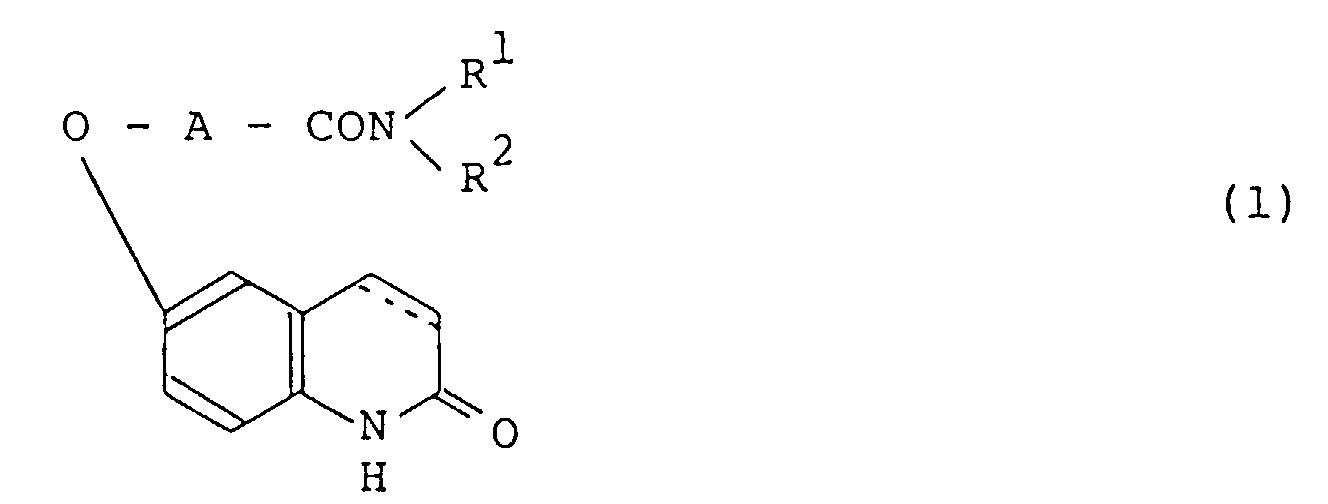


- A process for producing a carbostyril derivative represented by the general formula (1f)


- A process for producing a carbostyril derivative represented by the general formula (1f)


R10 - H (7)
[in the formula, R10 has the same definition as above]. - A process for producing a carbostyril derivative represented by the general formula (1k)


R11 - CSSM (8)
[in the formula, R11 represents a C1-C6 alkoxy group; M represents an alkali metal atom] to obtain a compound represented by the general formula (1j)
- A pharmaceutical composition for inhibiting platelet aggregation, which contains, as an active ingredient, a carbostyril derivative represented by the general formula (1) according to Claim 1.
Applications Claiming Priority (3)
| Application Number | Priority Date | Filing Date | Title |
|---|---|---|---|
| JP10953488 | 1988-05-02 | ||
| JP109534/88 | 1988-05-02 | ||
| PCT/JP1989/000464 WO1989010919A1 (en) | 1988-05-02 | 1989-05-02 | Carbostyril derivatives |
Publications (3)
| Publication Number | Publication Date |
|---|---|
| EP0450066A4 EP0450066A4 (en) | 1991-05-16 |
| EP0450066A1 EP0450066A1 (en) | 1991-10-09 |
| EP0450066B1 true EP0450066B1 (en) | 1996-09-11 |
Family
ID=14512687
Family Applications (1)
| Application Number | Title | Priority Date | Filing Date |
|---|---|---|---|
| EP89905166A Expired - Lifetime EP0450066B1 (en) | 1988-05-02 | 1989-05-02 | Carbostyril derivatives |
Country Status (5)
| Country | Link |
|---|---|
| EP (1) | EP0450066B1 (en) |
| JP (1) | JP2753622B2 (en) |
| KR (1) | KR0125919B1 (en) |
| DE (1) | DE68927179T2 (en) |
| WO (1) | WO1989010919A1 (en) |
Families Citing this family (4)
| Publication number | Priority date | Publication date | Assignee | Title |
|---|---|---|---|---|
| WO2001023350A1 (en) * | 1999-09-28 | 2001-04-05 | Nihon Nohyaku Co., Ltd. | Thioalkylamine derivatives and process for the preparation thereof |
| GB0515323D0 (en) | 2005-07-26 | 2005-08-31 | Electrophoretics Ltd | Mass labels |
| TWI481601B (en) | 2009-08-21 | 2015-04-21 | Otsuka Pharma Co Ltd | Nitrogen-containing compound and pharmaceutical composition |
| US8796447B2 (en) | 2009-08-21 | 2014-08-05 | Otsuka Pharmaceutical Co., Ltd. | Process for producing benzo[B][1,4]diazepine-2,4-dione compound |
Family Cites Families (30)
| Publication number | Priority date | Publication date | Assignee | Title |
|---|---|---|---|---|
| US3629266A (en) | 1969-03-03 | 1971-12-21 | Miles Lab | (phenyl piperidino alkyl)3 4-dihydrocarbostyrils |
| JPS604173B2 (en) | 1975-05-16 | 1985-02-01 | 大塚製薬株式会社 | Process for producing carbostyril derivatives |
| FI59246C (en) | 1974-06-24 | 1981-07-10 | Otsuka Pharma Co Ltd | FOERFARANDE FOER FRAMSTAELLNING AV BENSCYKLOAMIDDERIVAT ANVAENDBARA VID TROMBOS- OCH EMBOLITERAPIN |
| JPS5123271A (en) | 1974-08-16 | 1976-02-24 | Otsuka Pharma Co Ltd | KARUBAMOIRUARUKOKISHI 3 * 44 JIHIDOROKARUBOSUCHIRU JUDOTAISEIZOHO |
| JPS5123272A (en) | 1974-08-16 | 1976-02-24 | Otsuka Pharma Co Ltd | KARUBAMOIRUARUKOKISHI 3 * 44 JIHIDOROISOKARUBOSUCHIRIRUJUDOTAINO SEIZOHO |
| NZ187452A (en) | 1977-06-10 | 1980-05-27 | Otsuka Pharma Co Ltd | N- substituted-aminocarbonylpropoxy-carbostyrils and their preparation |
| JPS5412385A (en) | 1977-06-24 | 1979-01-30 | Otsuka Pharmaceut Co Ltd | Carbostyril derivative |
| JPS545981A (en) * | 1977-06-10 | 1979-01-17 | Otsuka Pharmaceut Co Ltd | Carbostyryl derivatives |
| JPS6059912B2 (en) * | 1978-02-28 | 1985-12-27 | 大塚製薬株式会社 | carbostyril derivatives |
| JPS5923307B2 (en) | 1978-02-24 | 1984-06-01 | 大塚製薬株式会社 | Oxindole derivative |
| JPS54163825A (en) | 1978-06-15 | 1979-12-26 | Otsuka Pharma Co Ltd | Phosphoesterase inhibitor |
| JPS552655A (en) | 1978-06-21 | 1980-01-10 | Otsuka Pharmaceut Co Ltd | Quinoline derivative |
| JPS5535019A (en) | 1978-09-01 | 1980-03-11 | Otsuka Pharmaceut Co Ltd | Carbostyryl derivative |
| JPS5535018A (en) | 1978-09-01 | 1980-03-11 | Otsuka Pharmaceut Co Ltd | Alkaneamide derivative |
| JPS5536444A (en) * | 1978-09-07 | 1980-03-14 | Otsuka Pharmaceut Co Ltd | Thiocarbostyril derivative |
| JPS5576864A (en) | 1978-12-06 | 1980-06-10 | Otsuka Pharmaceut Co Ltd | Carbostyril derivative |
| JPS5579371A (en) * | 1978-12-08 | 1980-06-14 | Otsuka Pharmaceut Co Ltd | Carbostyril derivative |
| JPS5579372A (en) * | 1978-12-08 | 1980-06-14 | Otsuka Pharmaceut Co Ltd | Preparation of carbostyril derivative |
| JPS5579370A (en) * | 1978-12-08 | 1980-06-14 | Otsuka Pharmaceut Co Ltd | Carbostyril derivative |
| JPS56122356A (en) * | 1980-02-29 | 1981-09-25 | Otsuka Pharmaceut Co Ltd | Carbostyril derivative |
| JPS572274A (en) * | 1980-06-06 | 1982-01-07 | Otsuka Pharmaceut Co Ltd | Carbostyril derivative |
| JPS5714574A (en) | 1980-06-27 | 1982-01-25 | Otsuka Pharmaceut Co Ltd | Carbostyril derivative |
| JPS5714578A (en) | 1980-06-27 | 1982-01-25 | Otsuka Pharmaceut Co Ltd | 2-benzimidazolinone derivative |
| JPS5793962A (en) | 1980-12-01 | 1982-06-11 | Otsuka Pharmaceut Co Ltd | Carbostyryl derivative |
| JPS57175168A (en) * | 1981-04-17 | 1982-10-28 | Otsuka Pharmaceut Co Ltd | Carbostyril derivative |
| JPS57183761A (en) | 1981-04-30 | 1982-11-12 | Otsuka Pharmaceut Co Ltd | Carbostyril derivative |
| JPS57209281A (en) | 1981-06-17 | 1982-12-22 | Otsuka Pharmaceut Co Ltd | Benzoxazine derivative |
| JPS6010008B2 (en) | 1982-07-12 | 1985-03-14 | 大塚製薬株式会社 | Platelet aggregation inhibitor |
| JPS5946202A (en) | 1982-09-09 | 1984-03-15 | Otsuka Pharmaceut Co Ltd | Antifungal agent |
| DK167187A (en) | 1986-04-02 | 1987-10-03 | Otsuka Pharma Co Ltd | CARBOSTYRIC DERIVATIVES AND SALTS THEREOF, PROCEDURE FOR THE PREPARATION OF SUCH COMPOUNDS AND MEDICINAL CONTAINING THESE |
-
1989
- 1989-04-28 JP JP1109466A patent/JP2753622B2/en not_active Expired - Lifetime
- 1989-05-02 KR KR1019890702502A patent/KR0125919B1/en not_active Expired - Fee Related
- 1989-05-02 WO PCT/JP1989/000464 patent/WO1989010919A1/en not_active Ceased
- 1989-05-02 EP EP89905166A patent/EP0450066B1/en not_active Expired - Lifetime
- 1989-05-02 DE DE68927179T patent/DE68927179T2/en not_active Expired - Fee Related
Also Published As
| Publication number | Publication date |
|---|---|
| JPH0249768A (en) | 1990-02-20 |
| DE68927179D1 (en) | 1996-10-17 |
| EP0450066A4 (en) | 1991-05-16 |
| KR0125919B1 (en) | 1997-12-26 |
| JP2753622B2 (en) | 1998-05-20 |
| WO1989010919A1 (en) | 1989-11-16 |
| KR900700456A (en) | 1990-08-13 |
| EP0450066A1 (en) | 1991-10-09 |
| DE68927179T2 (en) | 1997-04-10 |
Similar Documents
| Publication | Publication Date | Title |
|---|---|---|
| KR100238346B1 (en) | Peripheral vasodilators using piperidine derivatives as active ingredients | |
| JP3165867B2 (en) | Carbostyril derivatives and vasopressin antagonists | |
| CN102089290B (en) | Triazole derivatives useful for the treatment of diseases | |
| US8030502B2 (en) | Substituted 4-amino-1-(pyridylmethyl)piperidine and related compounds | |
| JPH03148223A (en) | Inhibitor of blood platelet aggregation | |
| EP0709375A2 (en) | Therapeutic heterocycles | |
| IE913571A1 (en) | Pyridine and pyridine N-oxide derivatives of diarylmethyl- piperidines or piperazines, compositions and use thereof | |
| US5998444A (en) | Piperidinyl compounds as NK1 or NK2 antagonists | |
| EP0569592A1 (en) | Carbostyril derivative and platelet agglutination inhibitor | |
| US4868193A (en) | Styryl tetrazoles and anti-allergic use thereof | |
| CH645892A5 (en) | CARBOSTYRIL DERIVATIVES, METHOD FOR THE PRODUCTION THEREOF AND ANTIHISTAMINICALLY ACTIVE AGENTS CONTAINING THESE COMPOUNDS. | |
| JPH06239858A (en) | Peripheral vasodilator | |
| JP2753622B2 (en) | Carbostyril derivative | |
| JPS62215582A (en) | Omega-((hetero)alkyl)benz(cd)indole-2-amines and manufacture | |
| EP1644356A1 (en) | Substituted 4-amino-1-benzylpiperidine compounds | |
| JPS644518B2 (en) | ||
| JPS6340429B2 (en) | ||
| CN100364990C (en) | Substituted 4-amino-1-(pyridylmethyl)piperidines and related compounds | |
| JPH05194405A (en) | Carbostyril derivative and platelet aggregation suppressing agent | |
| US5401740A (en) | Carbostyril derivative | |
| JPH06172317A (en) | Benzoheterocyclic compound | |
| JP2517309B2 (en) | Benzoheterocycle derivative | |
| JPS59157084A (en) | Carbostyryl derivative | |
| HU185790B (en) | Process for the preparation of new triazole derivatives | |
| HK1003708B (en) | Peripheral vasodilating agent containing n-acylated 4-amino piperidine derivatives as active ingredients |
Legal Events
| Date | Code | Title | Description |
|---|---|---|---|
| PUAI | Public reference made under article 153(3) epc to a published international application that has entered the european phase |
Free format text: ORIGINAL CODE: 0009012 |
|
| 17P | Request for examination filed |
Effective date: 19891229 |
|
| AK | Designated contracting states |
Kind code of ref document: A1 Designated state(s): CH DE FR GB IT LI NL SE |
|
| 17Q | First examination report despatched |
Effective date: 19930716 |
|
| GRAH | Despatch of communication of intention to grant a patent |
Free format text: ORIGINAL CODE: EPIDOS IGRA |
|
| GRAA | (expected) grant |
Free format text: ORIGINAL CODE: 0009210 |
|
| GRAH | Despatch of communication of intention to grant a patent |
Free format text: ORIGINAL CODE: EPIDOS IGRA |
|
| AK | Designated contracting states |
Kind code of ref document: B1 Designated state(s): CH DE FR GB IT LI NL SE |
|
| REG | Reference to a national code |
Ref country code: CH Ref legal event code: NV Representative=s name: A. BRAUN, BRAUN, HERITIER, ESCHMANN AG PATENTANWAE |
|
| ITF | It: translation for a ep patent filed | ||
| REF | Corresponds to: |
Ref document number: 68927179 Country of ref document: DE Date of ref document: 19961017 |
|
| ET | Fr: translation filed | ||
| ET | Fr: translation filed | ||
| PGFP | Annual fee paid to national office [announced via postgrant information from national office to epo] |
Ref country code: GB Payment date: 19970423 Year of fee payment: 9 |
|
| PGFP | Annual fee paid to national office [announced via postgrant information from national office to epo] |
Ref country code: CH Payment date: 19970424 Year of fee payment: 9 |
|
| PGFP | Annual fee paid to national office [announced via postgrant information from national office to epo] |
Ref country code: SE Payment date: 19970520 Year of fee payment: 9 |
|
| PGFP | Annual fee paid to national office [announced via postgrant information from national office to epo] |
Ref country code: FR Payment date: 19970530 Year of fee payment: 9 |
|
| PGFP | Annual fee paid to national office [announced via postgrant information from national office to epo] |
Ref country code: NL Payment date: 19970531 Year of fee payment: 9 |
|
| PGFP | Annual fee paid to national office [announced via postgrant information from national office to epo] |
Ref country code: DE Payment date: 19970612 Year of fee payment: 9 |
|
| PLBE | No opposition filed within time limit |
Free format text: ORIGINAL CODE: 0009261 |
|
| STAA | Information on the status of an ep patent application or granted ep patent |
Free format text: STATUS: NO OPPOSITION FILED WITHIN TIME LIMIT |
|
| 26N | No opposition filed | ||
| PG25 | Lapsed in a contracting state [announced via postgrant information from national office to epo] |
Ref country code: GB Free format text: LAPSE BECAUSE OF NON-PAYMENT OF DUE FEES Effective date: 19980502 |
|
| PG25 | Lapsed in a contracting state [announced via postgrant information from national office to epo] |
Ref country code: SE Free format text: LAPSE BECAUSE OF NON-PAYMENT OF DUE FEES Effective date: 19980503 |
|
| PG25 | Lapsed in a contracting state [announced via postgrant information from national office to epo] |
Ref country code: LI Free format text: LAPSE BECAUSE OF NON-PAYMENT OF DUE FEES Effective date: 19980531 Ref country code: FR Free format text: LAPSE BECAUSE OF NON-PAYMENT OF DUE FEES Effective date: 19980531 Ref country code: CH Free format text: LAPSE BECAUSE OF NON-PAYMENT OF DUE FEES Effective date: 19980531 |
|
| PG25 | Lapsed in a contracting state [announced via postgrant information from national office to epo] |
Ref country code: NL Free format text: LAPSE BECAUSE OF NON-PAYMENT OF DUE FEES Effective date: 19981201 |
|
| GBPC | Gb: european patent ceased through non-payment of renewal fee |
Effective date: 19980502 |
|
| REG | Reference to a national code |
Ref country code: CH Ref legal event code: PL |
|
| EUG | Se: european patent has lapsed |
Ref document number: 89905166.8 |
|
| NLV4 | Nl: lapsed or anulled due to non-payment of the annual fee |
Effective date: 19981201 |
|
| PG25 | Lapsed in a contracting state [announced via postgrant information from national office to epo] |
Ref country code: DE Free format text: LAPSE BECAUSE OF NON-PAYMENT OF DUE FEES Effective date: 19990302 |
|
| REG | Reference to a national code |
Ref country code: FR Ref legal event code: ST |
|
| PG25 | Lapsed in a contracting state [announced via postgrant information from national office to epo] |
Ref country code: IT Free format text: LAPSE BECAUSE OF NON-PAYMENT OF DUE FEES;WARNING: LAPSES OF ITALIAN PATENTS WITH EFFECTIVE DATE BEFORE 2007 MAY HAVE OCCURRED AT ANY TIME BEFORE 2007. THE CORRECT EFFECTIVE DATE MAY BE DIFFERENT FROM THE ONE RECORDED. Effective date: 20050502 |