EP0449613B1 - Pfropfcopolymere zur Verwendung als Hauptkomponente von der Beschichtungszusammensetzung - Google Patents
Pfropfcopolymere zur Verwendung als Hauptkomponente von der Beschichtungszusammensetzung Download PDFInfo
- Publication number
- EP0449613B1 EP0449613B1 EP91302696A EP91302696A EP0449613B1 EP 0449613 B1 EP0449613 B1 EP 0449613B1 EP 91302696 A EP91302696 A EP 91302696A EP 91302696 A EP91302696 A EP 91302696A EP 0449613 B1 EP0449613 B1 EP 0449613B1
- Authority
- EP
- European Patent Office
- Prior art keywords
- radical polymerizable
- graft copolymer
- derivatives
- group
- meth
- Prior art date
- Legal status (The legal status is an assumption and is not a legal conclusion. Google has not performed a legal analysis and makes no representation as to the accuracy of the status listed.)
- Expired - Lifetime
Links
- 229920000578 graft copolymer Polymers 0.000 title claims description 45
- 239000008199 coating composition Substances 0.000 title claims description 9
- 150000001875 compounds Chemical class 0.000 claims description 35
- 239000000178 monomer Substances 0.000 claims description 22
- 238000000034 method Methods 0.000 claims description 20
- 229920001577 copolymer Polymers 0.000 claims description 15
- 125000002887 hydroxy group Chemical group [H]O* 0.000 claims description 15
- 229920001296 polysiloxane Polymers 0.000 claims description 15
- 239000000470 constituent Substances 0.000 claims description 13
- 238000007334 copolymerization reaction Methods 0.000 claims description 13
- 235000013870 dimethyl polysiloxane Nutrition 0.000 claims description 12
- 229920000435 poly(dimethylsiloxane) Polymers 0.000 claims description 12
- 239000004205 dimethyl polysiloxane Substances 0.000 claims description 11
- 229920000642 polymer Polymers 0.000 claims description 8
- IJGRMHOSHXDMSA-UHFFFAOYSA-N Atomic nitrogen Chemical compound N#N IJGRMHOSHXDMSA-UHFFFAOYSA-N 0.000 claims description 6
- VZCYOOQTPOCHFL-OWOJBTEDSA-N Fumaric acid Chemical compound OC(=O)\C=C\C(O)=O VZCYOOQTPOCHFL-OWOJBTEDSA-N 0.000 claims description 6
- CERQOIWHTDAKMF-UHFFFAOYSA-N Methacrylic acid Chemical compound CC(=C)C(O)=O CERQOIWHTDAKMF-UHFFFAOYSA-N 0.000 claims description 6
- PPBRXRYQALVLMV-UHFFFAOYSA-N Styrene Chemical compound C=CC1=CC=CC=C1 PPBRXRYQALVLMV-UHFFFAOYSA-N 0.000 claims description 6
- 229920001610 polycaprolactone Polymers 0.000 claims description 6
- 239000004632 polycaprolactone Substances 0.000 claims description 6
- 238000006116 polymerization reaction Methods 0.000 claims description 6
- VZCYOOQTPOCHFL-UHFFFAOYSA-N trans-butenedioic acid Natural products OC(=O)C=CC(O)=O VZCYOOQTPOCHFL-UHFFFAOYSA-N 0.000 claims description 6
- 125000002496 methyl group Chemical group [H]C([H])([H])* 0.000 claims description 5
- 125000004432 carbon atom Chemical group C* 0.000 claims description 4
- 238000010528 free radical solution polymerization reaction Methods 0.000 claims description 4
- 150000002430 hydrocarbons Chemical group 0.000 claims description 4
- 125000004435 hydrogen atom Chemical group [H]* 0.000 claims description 4
- 150000002596 lactones Chemical class 0.000 claims description 4
- NLHHRLWOUZZQLW-UHFFFAOYSA-N Acrylonitrile Chemical compound C=CC#N NLHHRLWOUZZQLW-UHFFFAOYSA-N 0.000 claims description 3
- WHNWPMSKXPGLAX-UHFFFAOYSA-N N-Vinyl-2-pyrrolidone Chemical compound C=CN1CCCC1=O WHNWPMSKXPGLAX-UHFFFAOYSA-N 0.000 claims description 3
- OFOBLEOULBTSOW-UHFFFAOYSA-N Propanedioic acid Natural products OC(=O)CC(O)=O OFOBLEOULBTSOW-UHFFFAOYSA-N 0.000 claims description 3
- XTXRWKRVRITETP-UHFFFAOYSA-N Vinyl acetate Chemical compound CC(=O)OC=C XTXRWKRVRITETP-UHFFFAOYSA-N 0.000 claims description 3
- 125000005670 ethenylalkyl group Chemical group 0.000 claims description 3
- 239000001530 fumaric acid Substances 0.000 claims description 3
- VZCYOOQTPOCHFL-UPHRSURJSA-N maleic acid Chemical compound OC(=O)\C=C/C(O)=O VZCYOOQTPOCHFL-UPHRSURJSA-N 0.000 claims description 3
- 239000011976 maleic acid Substances 0.000 claims description 3
- 238000007142 ring opening reaction Methods 0.000 claims description 3
- OKTJSMMVPCPJKN-UHFFFAOYSA-N Carbon Chemical group [C] OKTJSMMVPCPJKN-UHFFFAOYSA-N 0.000 claims description 2
- 125000005907 alkyl ester group Chemical group 0.000 claims description 2
- 150000001408 amides Chemical class 0.000 claims description 2
- 239000003054 catalyst Substances 0.000 claims description 2
- 229910052757 nitrogen Inorganic materials 0.000 claims description 2
- 125000002524 organometallic group Chemical group 0.000 claims description 2
- 125000004430 oxygen atom Chemical group O* 0.000 claims description 2
- 229920002554 vinyl polymer Polymers 0.000 claims description 2
- 238000010559 graft polymerization reaction Methods 0.000 claims 2
- 229940117958 vinyl acetate Drugs 0.000 claims 2
- 150000003254 radicals Chemical class 0.000 description 27
- YXFVVABEGXRONW-UHFFFAOYSA-N Toluene Chemical compound CC1=CC=CC=C1 YXFVVABEGXRONW-UHFFFAOYSA-N 0.000 description 18
- 239000002904 solvent Substances 0.000 description 13
- KWYUFKZDYYNOTN-UHFFFAOYSA-M Potassium hydroxide Chemical compound [OH-].[K+] KWYUFKZDYYNOTN-UHFFFAOYSA-M 0.000 description 12
- 239000011248 coating agent Substances 0.000 description 11
- 239000007787 solid Substances 0.000 description 11
- NIXOWILDQLNWCW-UHFFFAOYSA-M Acrylate Chemical compound [O-]C(=O)C=C NIXOWILDQLNWCW-UHFFFAOYSA-M 0.000 description 10
- -1 acrylamide Chemical class 0.000 description 10
- 238000000576 coating method Methods 0.000 description 9
- 239000000463 material Substances 0.000 description 9
- XLYOFNOQVPJJNP-UHFFFAOYSA-N water Substances O XLYOFNOQVPJJNP-UHFFFAOYSA-N 0.000 description 9
- OZAIFHULBGXAKX-UHFFFAOYSA-N 2-(2-cyanopropan-2-yldiazenyl)-2-methylpropanenitrile Chemical compound N#CC(C)(C)N=NC(C)(C)C#N OZAIFHULBGXAKX-UHFFFAOYSA-N 0.000 description 6
- ZWEHNKRNPOVVGH-UHFFFAOYSA-N 2-Butanone Chemical compound CCC(C)=O ZWEHNKRNPOVVGH-UHFFFAOYSA-N 0.000 description 6
- QTBSBXVTEAMEQO-UHFFFAOYSA-N Acetic acid Chemical compound CC(O)=O QTBSBXVTEAMEQO-UHFFFAOYSA-N 0.000 description 6
- WFDIJRYMOXRFFG-UHFFFAOYSA-N Acetic anhydride Chemical compound CC(=O)OC(C)=O WFDIJRYMOXRFFG-UHFFFAOYSA-N 0.000 description 6
- UHOVQNZJYSORNB-UHFFFAOYSA-N Benzene Chemical compound C1=CC=CC=C1 UHOVQNZJYSORNB-UHFFFAOYSA-N 0.000 description 6
- LFQSCWFLJHTTHZ-UHFFFAOYSA-N Ethanol Chemical compound CCO LFQSCWFLJHTTHZ-UHFFFAOYSA-N 0.000 description 6
- XEKOWRVHYACXOJ-UHFFFAOYSA-N Ethyl acetate Chemical compound CCOC(C)=O XEKOWRVHYACXOJ-UHFFFAOYSA-N 0.000 description 6
- 239000000203 mixture Substances 0.000 description 6
- 238000001308 synthesis method Methods 0.000 description 6
- SOGAXMICEFXMKE-UHFFFAOYSA-N alpha-Methyl-n-butyl acrylate Natural products CCCCOC(=O)C(C)=C SOGAXMICEFXMKE-UHFFFAOYSA-N 0.000 description 5
- ZFSLODLOARCGLH-UHFFFAOYSA-N isocyanuric acid Chemical compound OC1=NC(O)=NC(O)=N1 ZFSLODLOARCGLH-UHFFFAOYSA-N 0.000 description 5
- PAPBSGBWRJIAAV-UHFFFAOYSA-N ε-Caprolactone Chemical compound O=C1CCCCCO1 PAPBSGBWRJIAAV-UHFFFAOYSA-N 0.000 description 5
- WOBHKFSMXKNTIM-UHFFFAOYSA-N Hydroxyethyl methacrylate Chemical compound CC(=C)C(=O)OCCO WOBHKFSMXKNTIM-UHFFFAOYSA-N 0.000 description 4
- VVQNEPGJFQJSBK-UHFFFAOYSA-N Methyl methacrylate Chemical compound COC(=O)C(C)=C VVQNEPGJFQJSBK-UHFFFAOYSA-N 0.000 description 4
- CTQNGGLPUBDAKN-UHFFFAOYSA-N O-Xylene Chemical compound CC1=CC=CC=C1C CTQNGGLPUBDAKN-UHFFFAOYSA-N 0.000 description 4
- JHIVVAPYMSGYDF-UHFFFAOYSA-N cyclohexanone Chemical compound O=C1CCCCC1 JHIVVAPYMSGYDF-UHFFFAOYSA-N 0.000 description 4
- DIOQZVSQGTUSAI-UHFFFAOYSA-N decane Chemical compound CCCCCCCCCC DIOQZVSQGTUSAI-UHFFFAOYSA-N 0.000 description 4
- TVMXDCGIABBOFY-UHFFFAOYSA-N octane Chemical compound CCCCCCCC TVMXDCGIABBOFY-UHFFFAOYSA-N 0.000 description 4
- DVKJHBMWWAPEIU-UHFFFAOYSA-N toluene 2,4-diisocyanate Chemical compound CC1=CC=C(N=C=O)C=C1N=C=O DVKJHBMWWAPEIU-UHFFFAOYSA-N 0.000 description 4
- 239000008096 xylene Substances 0.000 description 4
- YMWUJEATGCHHMB-UHFFFAOYSA-N Dichloromethane Chemical compound ClCCl YMWUJEATGCHHMB-UHFFFAOYSA-N 0.000 description 3
- OKKJLVBELUTLKV-UHFFFAOYSA-N Methanol Chemical compound OC OKKJLVBELUTLKV-UHFFFAOYSA-N 0.000 description 3
- NTIZESTWPVYFNL-UHFFFAOYSA-N Methyl isobutyl ketone Chemical compound CC(C)CC(C)=O NTIZESTWPVYFNL-UHFFFAOYSA-N 0.000 description 3
- UIHCLUNTQKBZGK-UHFFFAOYSA-N Methyl isobutyl ketone Natural products CCC(C)C(C)=O UIHCLUNTQKBZGK-UHFFFAOYSA-N 0.000 description 3
- ZMXDDKWLCZADIW-UHFFFAOYSA-N N,N-Dimethylformamide Chemical compound CN(C)C=O ZMXDDKWLCZADIW-UHFFFAOYSA-N 0.000 description 3
- 239000000654 additive Substances 0.000 description 3
- 238000004458 analytical method Methods 0.000 description 3
- 150000004945 aromatic hydrocarbons Chemical class 0.000 description 3
- 238000006243 chemical reaction Methods 0.000 description 3
- 230000000052 comparative effect Effects 0.000 description 3
- 239000003431 cross linking reagent Substances 0.000 description 3
- 239000012948 isocyanate Substances 0.000 description 3
- NIMLQBUJDJZYEJ-UHFFFAOYSA-N isophorone diisocyanate Chemical compound CC1(C)CC(N=C=O)CC(C)(CN=C=O)C1 NIMLQBUJDJZYEJ-UHFFFAOYSA-N 0.000 description 3
- 150000002576 ketones Chemical class 0.000 description 3
- 239000002932 luster Substances 0.000 description 3
- 229920005989 resin Polymers 0.000 description 3
- 239000011347 resin Substances 0.000 description 3
- 229920002818 (Hydroxyethyl)methacrylate Polymers 0.000 description 2
- FKTHNVSLHLHISI-UHFFFAOYSA-N 1,2-bis(isocyanatomethyl)benzene Chemical compound O=C=NCC1=CC=CC=C1CN=C=O FKTHNVSLHLHISI-UHFFFAOYSA-N 0.000 description 2
- ZXHZWRZAWJVPIC-UHFFFAOYSA-N 1,2-diisocyanatonaphthalene Chemical compound C1=CC=CC2=C(N=C=O)C(N=C=O)=CC=C21 ZXHZWRZAWJVPIC-UHFFFAOYSA-N 0.000 description 2
- UPMLOUAZCHDJJD-UHFFFAOYSA-N 4,4'-Diphenylmethane Diisocyanate Chemical compound C1=CC(N=C=O)=CC=C1CC1=CC=C(N=C=O)C=C1 UPMLOUAZCHDJJD-UHFFFAOYSA-N 0.000 description 2
- VTYYLEPIZMXCLO-UHFFFAOYSA-L Calcium carbonate Chemical compound [Ca+2].[O-]C([O-])=O VTYYLEPIZMXCLO-UHFFFAOYSA-L 0.000 description 2
- HEDRZPFGACZZDS-UHFFFAOYSA-N Chloroform Chemical compound ClC(Cl)Cl HEDRZPFGACZZDS-UHFFFAOYSA-N 0.000 description 2
- 239000004793 Polystyrene Substances 0.000 description 2
- JUJWROOIHBZHMG-UHFFFAOYSA-N Pyridine Chemical compound C1=CC=NC=C1 JUJWROOIHBZHMG-UHFFFAOYSA-N 0.000 description 2
- VYPSYNLAJGMNEJ-UHFFFAOYSA-N Silicium dioxide Chemical compound O=[Si]=O VYPSYNLAJGMNEJ-UHFFFAOYSA-N 0.000 description 2
- 206010040844 Skin exfoliation Diseases 0.000 description 2
- GWEVSGVZZGPLCZ-UHFFFAOYSA-N Titan oxide Chemical compound O=[Ti]=O GWEVSGVZZGPLCZ-UHFFFAOYSA-N 0.000 description 2
- UKLDJPRMSDWDSL-UHFFFAOYSA-L [dibutyl(dodecanoyloxy)stannyl] dodecanoate Chemical compound CCCCCCCCCCCC(=O)O[Sn](CCCC)(CCCC)OC(=O)CCCCCCCCCCC UKLDJPRMSDWDSL-UHFFFAOYSA-L 0.000 description 2
- NBJODVYWAQLZOC-UHFFFAOYSA-L [dibutyl(octanoyloxy)stannyl] octanoate Chemical compound CCCCCCCC(=O)O[Sn](CCCC)(CCCC)OC(=O)CCCCCCC NBJODVYWAQLZOC-UHFFFAOYSA-L 0.000 description 2
- 150000001338 aliphatic hydrocarbons Chemical class 0.000 description 2
- YHWCPXVTRSHPNY-UHFFFAOYSA-N butan-1-olate;titanium(4+) Chemical compound [Ti+4].CCCC[O-].CCCC[O-].CCCC[O-].CCCC[O-] YHWCPXVTRSHPNY-UHFFFAOYSA-N 0.000 description 2
- 238000003776 cleavage reaction Methods 0.000 description 2
- 238000013329 compounding Methods 0.000 description 2
- 239000012975 dibutyltin dilaurate Substances 0.000 description 2
- 125000005442 diisocyanate group Chemical group 0.000 description 2
- 229910001873 dinitrogen Inorganic materials 0.000 description 2
- 230000000694 effects Effects 0.000 description 2
- 150000002148 esters Chemical class 0.000 description 2
- 239000011521 glass Substances 0.000 description 2
- 230000009477 glass transition Effects 0.000 description 2
- VLKZOEOYAKHREP-UHFFFAOYSA-N n-Hexane Chemical compound CCCCCC VLKZOEOYAKHREP-UHFFFAOYSA-N 0.000 description 2
- 150000002902 organometallic compounds Chemical class 0.000 description 2
- 229920002223 polystyrene Polymers 0.000 description 2
- 239000000843 powder Substances 0.000 description 2
- 238000007151 ring opening polymerisation reaction Methods 0.000 description 2
- 230000007017 scission Effects 0.000 description 2
- 239000000126 substance Substances 0.000 description 2
- VZGDMQKNWNREIO-UHFFFAOYSA-N tetrachloromethane Chemical compound ClC(Cl)(Cl)Cl VZGDMQKNWNREIO-UHFFFAOYSA-N 0.000 description 2
- KUGVQHLGVGPAIZ-UHFFFAOYSA-N 1,1,1,2,3,3,4,4,5,5,6,6,7,7,8,8,9,9,10,10,10-henicosafluorodecan-2-yl 2-methylprop-2-enoate Chemical compound CC(=C)C(=O)OC(F)(C(F)(F)F)C(F)(F)C(F)(F)C(F)(F)C(F)(F)C(F)(F)C(F)(F)C(F)(F)C(F)(F)F KUGVQHLGVGPAIZ-UHFFFAOYSA-N 0.000 description 1
- RYHBNJHYFVUHQT-UHFFFAOYSA-N 1,4-Dioxane Chemical compound C1COCCO1 RYHBNJHYFVUHQT-UHFFFAOYSA-N 0.000 description 1
- 238000005160 1H NMR spectroscopy Methods 0.000 description 1
- SMZOUWXMTYCWNB-UHFFFAOYSA-N 2-(2-methoxy-5-methylphenyl)ethanamine Chemical compound COC1=CC=C(C)C=C1CCN SMZOUWXMTYCWNB-UHFFFAOYSA-N 0.000 description 1
- XMNIXWIUMCBBBL-UHFFFAOYSA-N 2-(2-phenylpropan-2-ylperoxy)propan-2-ylbenzene Chemical compound C=1C=CC=CC=1C(C)(C)OOC(C)(C)C1=CC=CC=C1 XMNIXWIUMCBBBL-UHFFFAOYSA-N 0.000 description 1
- GOXQRTZXKQZDDN-UHFFFAOYSA-N 2-Ethylhexyl acrylate Chemical compound CCCCC(CC)COC(=O)C=C GOXQRTZXKQZDDN-UHFFFAOYSA-N 0.000 description 1
- NIXOWILDQLNWCW-UHFFFAOYSA-N 2-Propenoic acid Natural products OC(=O)C=C NIXOWILDQLNWCW-UHFFFAOYSA-N 0.000 description 1
- OMIGHNLMNHATMP-UHFFFAOYSA-N 2-hydroxyethyl prop-2-enoate Chemical compound OCCOC(=O)C=C OMIGHNLMNHATMP-UHFFFAOYSA-N 0.000 description 1
- XDLMVUHYZWKMMD-UHFFFAOYSA-N 3-trimethoxysilylpropyl 2-methylprop-2-enoate Chemical compound CO[Si](OC)(OC)CCCOC(=O)C(C)=C XDLMVUHYZWKMMD-UHFFFAOYSA-N 0.000 description 1
- HRPVXLWXLXDGHG-UHFFFAOYSA-N Acrylamide Chemical compound NC(=O)C=C HRPVXLWXLXDGHG-UHFFFAOYSA-N 0.000 description 1
- 239000004925 Acrylic resin Substances 0.000 description 1
- 229920000178 Acrylic resin Polymers 0.000 description 1
- 239000004342 Benzoyl peroxide Substances 0.000 description 1
- OMPJBNCRMGITSC-UHFFFAOYSA-N Benzoylperoxide Chemical compound C=1C=CC=CC=1C(=O)OOC(=O)C1=CC=CC=C1 OMPJBNCRMGITSC-UHFFFAOYSA-N 0.000 description 1
- DKPFZGUDAPQIHT-UHFFFAOYSA-N Butyl acetate Natural products CCCCOC(C)=O DKPFZGUDAPQIHT-UHFFFAOYSA-N 0.000 description 1
- ZMVHRWPZFKGQRN-UHFFFAOYSA-N CCC(C)(CC)NC Chemical compound CCC(C)(CC)NC ZMVHRWPZFKGQRN-UHFFFAOYSA-N 0.000 description 1
- GAWIXWVDTYZWAW-UHFFFAOYSA-N C[CH]O Chemical group C[CH]O GAWIXWVDTYZWAW-UHFFFAOYSA-N 0.000 description 1
- 102100026735 Coagulation factor VIII Human genes 0.000 description 1
- 101000911390 Homo sapiens Coagulation factor VIII Proteins 0.000 description 1
- 239000005058 Isophorone diisocyanate Substances 0.000 description 1
- 238000000862 absorption spectrum Methods 0.000 description 1
- 239000012345 acetylating agent Substances 0.000 description 1
- 239000002253 acid Substances 0.000 description 1
- 230000000996 additive effect Effects 0.000 description 1
- 239000002390 adhesive tape Substances 0.000 description 1
- 230000032683 aging Effects 0.000 description 1
- 229920000180 alkyd Polymers 0.000 description 1
- PNEYBMLMFCGWSK-UHFFFAOYSA-N aluminium oxide Inorganic materials [O-2].[O-2].[O-2].[Al+3].[Al+3] PNEYBMLMFCGWSK-UHFFFAOYSA-N 0.000 description 1
- 239000003963 antioxidant agent Substances 0.000 description 1
- 230000003078 antioxidant effect Effects 0.000 description 1
- 239000002216 antistatic agent Substances 0.000 description 1
- 239000012298 atmosphere Substances 0.000 description 1
- 238000005452 bending Methods 0.000 description 1
- 235000019400 benzoyl peroxide Nutrition 0.000 description 1
- OHJMTUPIZMNBFR-UHFFFAOYSA-N biuret Chemical compound NC(=O)NC(N)=O OHJMTUPIZMNBFR-UHFFFAOYSA-N 0.000 description 1
- OBAMWENTFIOOIT-UHFFFAOYSA-N butan-2-one;ethyl acetate Chemical compound CCC(C)=O.CCOC(C)=O OBAMWENTFIOOIT-UHFFFAOYSA-N 0.000 description 1
- 125000000484 butyl group Chemical group [H]C([*])([H])C([H])([H])C([H])([H])C([H])([H])[H] 0.000 description 1
- 229910000019 calcium carbonate Inorganic materials 0.000 description 1
- 239000003795 chemical substances by application Substances 0.000 description 1
- KOPOQZFJUQMUML-UHFFFAOYSA-N chlorosilane Chemical class Cl[SiH3] KOPOQZFJUQMUML-UHFFFAOYSA-N 0.000 description 1
- 239000004927 clay Substances 0.000 description 1
- 229910052570 clay Inorganic materials 0.000 description 1
- 239000003086 colorant Substances 0.000 description 1
- 238000010276 construction Methods 0.000 description 1
- 230000007547 defect Effects 0.000 description 1
- 238000007033 dehydrochlorination reaction Methods 0.000 description 1
- AYOHIQLKSOJJQH-UHFFFAOYSA-N dibutyltin Chemical compound CCCC[Sn]CCCC AYOHIQLKSOJJQH-UHFFFAOYSA-N 0.000 description 1
- 238000004090 dissolution Methods 0.000 description 1
- 238000001035 drying Methods 0.000 description 1
- 238000010556 emulsion polymerization method Methods 0.000 description 1
- 239000003822 epoxy resin Substances 0.000 description 1
- NKSJNEHGWDZZQF-UHFFFAOYSA-N ethenyl(trimethoxy)silane Chemical compound CO[Si](OC)(OC)C=C NKSJNEHGWDZZQF-UHFFFAOYSA-N 0.000 description 1
- HJEFSNMQDPTWBH-UHFFFAOYSA-N ethyl acetate;pentan-3-one Chemical compound CCOC(C)=O.CCC(=O)CC HJEFSNMQDPTWBH-UHFFFAOYSA-N 0.000 description 1
- 239000000945 filler Substances 0.000 description 1
- 125000000524 functional group Chemical group 0.000 description 1
- LNEPOXFFQSENCJ-UHFFFAOYSA-N haloperidol Chemical compound C1CC(O)(C=2C=CC(Cl)=CC=2)CCN1CCCC(=O)C1=CC=C(F)C=C1 LNEPOXFFQSENCJ-UHFFFAOYSA-N 0.000 description 1
- FUZZWVXGSFPDMH-UHFFFAOYSA-M hexanoate Chemical compound CCCCCC([O-])=O FUZZWVXGSFPDMH-UHFFFAOYSA-M 0.000 description 1
- 125000002768 hydroxyalkyl group Chemical group 0.000 description 1
- 238000002329 infrared spectrum Methods 0.000 description 1
- 239000004615 ingredient Substances 0.000 description 1
- 239000003112 inhibitor Substances 0.000 description 1
- 239000011256 inorganic filler Substances 0.000 description 1
- 229910003475 inorganic filler Inorganic materials 0.000 description 1
- GJRQTCIYDGXPES-UHFFFAOYSA-N iso-butyl acetate Natural products CC(C)COC(C)=O GJRQTCIYDGXPES-UHFFFAOYSA-N 0.000 description 1
- FGKJLKRYENPLQH-UHFFFAOYSA-M isocaproate Chemical compound CC(C)CCC([O-])=O FGKJLKRYENPLQH-UHFFFAOYSA-M 0.000 description 1
- OQAGVSWESNCJJT-UHFFFAOYSA-N isovaleric acid methyl ester Natural products COC(=O)CC(C)C OQAGVSWESNCJJT-UHFFFAOYSA-N 0.000 description 1
- 239000000395 magnesium oxide Substances 0.000 description 1
- CPLXHLVBOLITMK-UHFFFAOYSA-N magnesium oxide Inorganic materials [Mg]=O CPLXHLVBOLITMK-UHFFFAOYSA-N 0.000 description 1
- AXZKOIWUVFPNLO-UHFFFAOYSA-N magnesium;oxygen(2-) Chemical compound [O-2].[Mg+2] AXZKOIWUVFPNLO-UHFFFAOYSA-N 0.000 description 1
- 230000014759 maintenance of location Effects 0.000 description 1
- 238000004519 manufacturing process Methods 0.000 description 1
- 239000010445 mica Substances 0.000 description 1
- 229910052618 mica group Inorganic materials 0.000 description 1
- 239000003607 modifier Substances 0.000 description 1
- 238000006386 neutralization reaction Methods 0.000 description 1
- 239000003973 paint Substances 0.000 description 1
- 150000002978 peroxides Chemical class 0.000 description 1
- 229920000058 polyacrylate Polymers 0.000 description 1
- 229920000647 polyepoxide Polymers 0.000 description 1
- 229920001225 polyester resin Polymers 0.000 description 1
- 239000004645 polyester resin Substances 0.000 description 1
- 239000005056 polyisocyanate Substances 0.000 description 1
- 229920001228 polyisocyanate Polymers 0.000 description 1
- 239000003505 polymerization initiator Substances 0.000 description 1
- HKJYVRJHDIPMQB-UHFFFAOYSA-N propan-1-olate;titanium(4+) Chemical compound CCCO[Ti](OCCC)(OCCC)OCCC HKJYVRJHDIPMQB-UHFFFAOYSA-N 0.000 description 1
- 238000000425 proton nuclear magnetic resonance spectrum Methods 0.000 description 1
- UMJSCPRVCHMLSP-UHFFFAOYSA-N pyridine Natural products COC1=CC=CN=C1 UMJSCPRVCHMLSP-UHFFFAOYSA-N 0.000 description 1
- 239000007870 radical polymerization initiator Substances 0.000 description 1
- 230000035484 reaction time Effects 0.000 description 1
- 239000013535 sea water Substances 0.000 description 1
- 150000003377 silicon compounds Chemical class 0.000 description 1
- 239000000377 silicon dioxide Substances 0.000 description 1
- 238000010183 spectrum analysis Methods 0.000 description 1
- 238000003756 stirring Methods 0.000 description 1
- 150000003440 styrenes Chemical class 0.000 description 1
- 238000010558 suspension polymerization method Methods 0.000 description 1
- 239000000454 talc Substances 0.000 description 1
- 229910052623 talc Inorganic materials 0.000 description 1
- 239000004408 titanium dioxide Substances 0.000 description 1
- 238000004448 titration Methods 0.000 description 1
- 238000001291 vacuum drying Methods 0.000 description 1
- 239000002966 varnish Substances 0.000 description 1
- 238000005406 washing Methods 0.000 description 1
- 239000010456 wollastonite Substances 0.000 description 1
- 229910052882 wollastonite Inorganic materials 0.000 description 1
Images
Classifications
-
- C—CHEMISTRY; METALLURGY
- C08—ORGANIC MACROMOLECULAR COMPOUNDS; THEIR PREPARATION OR CHEMICAL WORKING-UP; COMPOSITIONS BASED THEREON
- C08F—MACROMOLECULAR COMPOUNDS OBTAINED BY REACTIONS ONLY INVOLVING CARBON-TO-CARBON UNSATURATED BONDS
- C08F290/00—Macromolecular compounds obtained by polymerising monomers on to polymers modified by introduction of aliphatic unsaturated end or side groups
- C08F290/02—Macromolecular compounds obtained by polymerising monomers on to polymers modified by introduction of aliphatic unsaturated end or side groups on to polymers modified by introduction of unsaturated end groups
- C08F290/06—Polymers provided for in subclass C08G
- C08F290/061—Polyesters; Polycarbonates
-
- C—CHEMISTRY; METALLURGY
- C08—ORGANIC MACROMOLECULAR COMPOUNDS; THEIR PREPARATION OR CHEMICAL WORKING-UP; COMPOSITIONS BASED THEREON
- C08F—MACROMOLECULAR COMPOUNDS OBTAINED BY REACTIONS ONLY INVOLVING CARBON-TO-CARBON UNSATURATED BONDS
- C08F290/00—Macromolecular compounds obtained by polymerising monomers on to polymers modified by introduction of aliphatic unsaturated end or side groups
- C08F290/02—Macromolecular compounds obtained by polymerising monomers on to polymers modified by introduction of aliphatic unsaturated end or side groups on to polymers modified by introduction of unsaturated end groups
- C08F290/06—Polymers provided for in subclass C08G
- C08F290/068—Polysiloxanes
-
- C—CHEMISTRY; METALLURGY
- C09—DYES; PAINTS; POLISHES; NATURAL RESINS; ADHESIVES; COMPOSITIONS NOT OTHERWISE PROVIDED FOR; APPLICATIONS OF MATERIALS NOT OTHERWISE PROVIDED FOR
- C09D—COATING COMPOSITIONS, e.g. PAINTS, VARNISHES OR LACQUERS; FILLING PASTES; CHEMICAL PAINT OR INK REMOVERS; INKS; CORRECTING FLUIDS; WOODSTAINS; PASTES OR SOLIDS FOR COLOURING OR PRINTING; USE OF MATERIALS THEREFOR
- C09D155/00—Coating compositions based on homopolymers or copolymers, obtained by polymerisation reactions only involving carbon-to-carbon unsaturated bonds, not provided for in groups C09D123/00 - C09D153/00
- C09D155/005—Homopolymers or copolymers obtained by polymerisation of macromolecular compounds terminated by a carbon-to-carbon double bond
Definitions
- This invention relates to graft copolymers containing both organopolysiloxane and polylactone as branch components, a method for the production thereof, and coating compositions containing the graft copolymers as a main component.
- Organopolysiloxane has previously been used as an additive or modifier to impart various useful properties to paint and varnish. Moreover, there has been extensive interest in the proportion of silicone type graft copolymers ultilizing the recent advancement in macromonomer techniques. These copolymers have excited much interest as coating materials having excellent weather resistance, water repellency, stain resistance, mold releasability, lubricity, and so on [as disclosed in Japanese Kokai Nos. 154766/58, 20360/59, 126478/59, 151272/61 and 156172/62 (The term "Japanese Kokai" means an unexamined published Japanese Patent application)].
- graft copolymers are prepared from an organopolysiloxane containing radical polymerizable group and radical polymerizable monomer(s). More specifically, their major component is a graft copolymer which contains organopolysiloxane as the branch component and an acrylic polymer as the trunk component.
- the coat obtained is on the one hand hard and excellent in thermal resistance, but on the other hand fragile and devoid of flexibility.
- the trunk copolymer is chosen so as to have a low glass transition point with the intention of heightening the flexibility, the coat formed becomes tacky and soft.
- conventional silicone type graft copolymers have the defect that they cannot provide a satisfactory coat.
- a coating composition whose major component is a graft copolymer containing both organopolysiloxane and polylactone as branch components has not only excellent weather resistance, water repellency, stain resistance, mold releasability and lubricity but also has flexibility and impact resistance, so it is well suited for such applications as a weather resisting coating material for use in construction, a coating material for preventing the adherence of water and snow, a coating material for protection against fly-posting paper and graffiti, a coating material for protection from sea water stains, a water-proof coating material for concrete, a coating agent for backing ink ribbon used in heat-sensitive transfer recording or a coating agent for backing magnetic tapes.
- An aim of this invention is to provide a novel resin which can form a coat having not only thermal resistance but also hardness and flexibility.
- a graft copolymer which contains a vinyl polymer as its trunk polymer component, and both organopolysiloxane and polylactone as its branch polymer contents, wherein the proportion of the organopolysiloxane is from 5 to 80 wt% and the proportion of the polylactone is from 2 to 50 wt%.
- the coat formed therefrom has excellent characteristics which have so far not been attained.
- the graft copolymer of this invention preferably comprises the following constituent units (a) and (b): wherein R1 represents a hydrogen atom or a methyl group; R2 represents a divalent hydrocarbon residue containg 1 to 11 carbon atoms, whose carbon chain may be interrupted by an oxygen atom; m represents 0, 1 or 2; and n represents the average degree of polymerization, and is from 0 to 200; and wherein R3 represents a hydrogen atom or a methyl group; R4 represents a divalent hydrocarbon residue containing 2 to 4 carbon atoms; e represents the average degree of polymerization, and is from 3 to 20.
- This method consists of copolymerization of a radical polymerizable group-containing dimethylpolvsiloxane compound, a radical polymerizable group-containing polycaprolactone compound and radical polymerizable group-containing monomer(s).
- the compounds represented by the following general formula (A) are preferred as the radical polymerizable group-containing dimethylpolysiloxane compound.
- R1, R2, m and n have the same meanings as in the foregoing constituent unit (a).
- the compounds represented by the above-illustrated general formula (A) can be prepared from (meth-)acrylate-substituted chlorosilane compounds represented by the following general formula (B) and terminal hydroxyl group-substituted dimethylpolysiloxanes represented by the following general formula (C) by subjecting them to dehydrochlorination in a conventional manner: Wherein R1, R2, m and n have the same meanings as in the foregoing general formula (A).
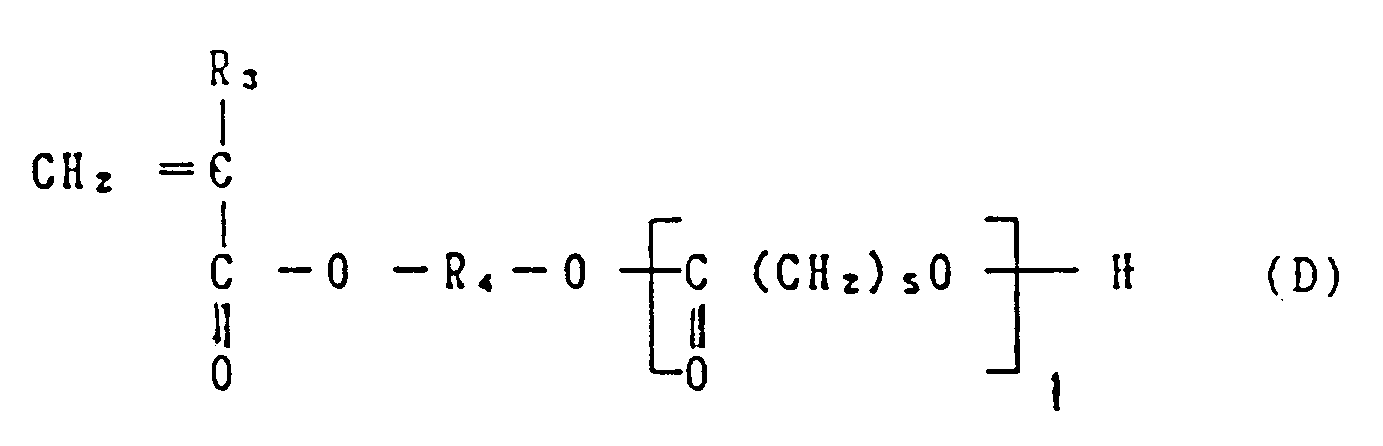
- the compounds represented by the above-illustrated general formula (D) can be obtained, e.g. by subjecting ⁇ -caprolactone having the following structural formula (E) to ring-opening polymerization using hydroxyl group-containing radical polymerizable monomers represented by the following general formula (F) as a polymerization initiator: wherein R3 and R4 have the same meanings as in the foregoing general formula (D).
- copolymers of this invention are obtained using a radical polymerizable monomer in addition to the above-described compounds (A) and (D), and subjecting them to copolymerization reaction.
- radical polymerizable monomers which can be copolymerized with the above-described compounds (A) and (D) include (metha)acrylic acid, various derivatives of (meth-)acrylic acid, including alkyl esters such as methyl(meth-)acrylate, butyl(meth) acrylate and 2 ethylhexyl(meth-)acrylate, hydroxyalkyl esters such as hydroxyethyl(meth-)acrylate, hydroxypropyl(meth)acrylate and hydroxybutyl(meth)acrylate, acid amides such as acrylamide, etc., perfluoroesters such as perfluorodecylethyl(meth-)acrylate, perfluorooctylethyl(meth-)acrylate, perfluorohexylethyl(meth-)acrylate and perfluorobutylethyl(meth-) acrylate; styrene or
- radical polymerizable monomers can be used alone, or as a combination of two or more thereof.
- the copolymerization can be effected in the presence of an ordinary radical polymerization initiator, e.g., peroxides such as benzoyl peroxide and dicumyl peroxide, and azocompounds such as azobisisobutyronitrile.
- an ordinary radical polymerization initiator e.g., peroxides such as benzoyl peroxide and dicumyl peroxide, and azocompounds such as azobisisobutyronitrile.
- Any of a solution polymerization method, an emulsion polymerization method, a suspension polymerization method and a block polymerization method may be utilized.
- a solution polymerization method is favored in particular, because it facilitates the adjustment of the molecular weight of the copolymer to be obtained to the optimal range.
- Suitable solvents for the solution polymerization include aromatic hydrocarbons such as benzene, toluene and xylene; ketones such as methyl ethyl ketone and methyl isobutyl ketone and esters such as ethyl acetate and isobutyl acetate. Such solvents may be used alone, or as a mixture of two or more thereof.
- the copolymerization reaction is preferably carried out at a temperature of from 50°C to 180°C, particularly from 60°C to 120°C. At these temperatures, the reaction can be completed in 5 to 10 hours.
- the second synthesis method consists in grafting a polymer obtained by subjecting a lactone,e.g. ⁇ -caprolactone, to ring-opening polymerization onto a copolymer obtained by copolymerizing a radical polymerizable group-containing dimethylpolysiloxane compound, a hydroxyl group-containing radical polymerizable monomer and radical polymerizable monomer(s) of the kind which can undergo copolymerization with the former two constituent monomers.
- the radical polymerizable group-containing dimethylpolysiloxane compound and the hydroxyl group-containing radical polymerizable monomer used herein are the same as the compounds (A) and (F), respectively, used in the foregoing Synthesis Method (1).
- radical polymerizable monomers which can be copolymerized with the compounds (A) and (F) and used in the above-described copolymerization, mention may be made of various derivatives of (meth-)acrylic acid etc., as previously exemplified.
- the ring-opening graft copolymerization between a lactone, such as ⁇ -caprolactone, and the silicone type graft copolymers obtained in the foregoing copolymerization can be effected in an atmosphere of nitrogen at a temperature of from 100°C to 200°C using an organometallic compound or organometallic oxide as a catalyst.
- An appropriate reaction time therein is from 2 to 10 hours.
- solvents preferably used therein mention may be made of aromatic hydrocarbons such as toluene and xylene; aliphatic hydrocarbons such as n-octane and n-decane; and ketones such as methyl isobutyl ketone and cyclohexanone.
- organometallic compounds examples include dibutyltin dioctoate, dibutyltin dilaurate, tetrapropyl titanate and tetrabutyl titanate.
- a graft copolymer comprising the constitutent units of the foregoing formulae (a) and (b) can be obtained directly.
- a suitable proportion of the constituent unit (a) is from 5 to 80 wt%, preferably 10 to 60 wt%, and that of the constituent unit (b) from 2 to 50 wt%, preferably from 5 to 30 wt%.
- the constituent unit (a) is contained in an amount of less than 5 wt%, the water repellency, stain resistance mold releasability and lubricity of the formed coat are insufficient, whereas if its amount is increased beyond 80 wt% the film forming ability is lowered.
- the constituent unit (b) is contained in an amount of less than 2 wt% the flexibility of the formed coat is insufficient, whereas when its amount is increased beyond 50 wt% the hardness and the appearance of the formed coat are unsatisfactory.
- the coating composition of this invention may contain an arbitrary combination of various additives including solvents, cross-linking agents, other resins, fillers and so on.
- Solvents are used for the purposes of viscosity adjustment of the composition thickness adjustment of the coat, and so on. Their choice is not particularly restricted as far as they are compatible with the graft copolymers of this invention.
- solvents which can be used for the above-described purposes include aromatic hydrocarbons such as benzene, toluene and xylene, aliphatic hydrocarbons such as n-hexane, n-octane and n-decane; chlorinated compounds such as methylene chloride, chloroform and carbon tetrachloride; ketones such as methyl ethyl ketone, methyl isobutyl ketone and cyclohexanone; esters such as ethyl acetate and butyl acetate; dioxane; and dimethylformamide. These solvents can be used alone or as a mixture of two or more thereof.
- the graft copolymers of this invention can be converted into an ardinary-temperature drying type coating material of high quality simply by dissolving them in the above-cited solvents. Also, it is feasible to convert the above-cited coating materials to ordinary-temperature ceurable coating materials which can provide a coat excellent in solvent resistance by further compounding with a polyfunctional isocyanate compound as a cross-linklng agent.
- Polyfunctional isocyanate compounds used as crosslinking agents in the foregoing case have no particular limitation, provided that they have two or more of functional groups.
- Specific examples thereof include diisocyanates such as tolylenediisocyanate (TDI), diphenylmethanediisocyanate (MDI), tolidine-diisocyanate (TODI)., naphthalenediisocyanate (NDI), hexamethylene-, diisocyanate (HDI), isophorone-diisocyanate (IPDI) and xylylenediisocyanate (XDI) and polyisocyanates such as trimetbylolpropane (TMP), modified TDI, isocyanurate combined TDI, TMP modified HDI, isocyanurate combined HDI, biuret combined HDI, TMP modified IPDI and isocyanurate combined IPDI.
- TMP trimetbylolpropane
- TMP trimet
- Such isocyanate compounds as cited above are preferably compounded in a proportion of 0.5 to 2.0 equivalents, particularly 0.8 to 1.5 equivalents, to one equivalent of hydroxyl group in the graft copolymer of this invention.
- organotin compound e.g., dibutyltin dioctoate or dibutyltin dilaurate as cross-linkage accelerator.
- the coating composition of this invention although containing the graft copolymer of this invention as its major component, may be compounded with other organic resins, e.g., acrylic resins, polyester resins, epoxy resins or alkyd resins if desired.
- organic resins e.g., acrylic resins, polyester resins, epoxy resins or alkyd resins if desired.
- an inorganic filler such as silica, alumina, glass powder, clay, talc, calcium carbonate, mica powder, titanium dioxide, wollastonite or magnesium oxide may be added for the purpose of improving the strength of the coat.
- other additives e.g., an antioxidant, an ageing inhibitor, an antistatic agent or a coloring agent may be incorporated.
- the organopolysiloxane branch component is concentrated at the coat surface to provide its particular characteristics, namely weather resistance, water repellency, stain resistance, mold releasability and lubricity, and the polylactone branch component remains inside the coat to enhance its flexibility. Consequently, the formed coat acquires excellent characteristics which has so far not been realized.
- hydroxyl equivalent used in the following Examples describes the numerical value calculated from the hydroxyl value of JIS (Japan Industrial Standard) K0070 described below.
- Hydoxyl Value JIS K0070: An acetylating agent consisting of acetic anhydride and pyridine was added to a sample, and then heated to acetylate the hydroxyl groups in the sample. Thereafter, excess acetic anhydride was decomposed to acetic acid by addition of water, and the resulting acetic acid was subjected to neutralization titration with a 0.5 N ethanol solution of potassium hydroxide.
- pts. wt. 35 parts by weight (abbreviated as pts. wt.) of the compound represented by the following chemical formula (A-1) (as the radical copolymerizable group-containing dimethylpolysiloxane compound of the foregoing general formula (A)), 5 pts. wt. of the compound represented by the following chemical formula (D-1) (as the radical polymerizable group-containing polycaprolactone compound of the foregoing general formula (D)), 50 pts.wt. of methylmethacrylate, 10 pts.wt. of hydroxylethylmethacrylate, 150 pts.wt. of toluene and 2 pts. wt.
- A-1 the radical copolymerizable group-containing dimethylpolysiloxane compound of the foregoing general formula (A)
- D-1 as the radical polymerizable group-containing polycaprolactone compound of the for
- the produced copolymer was precipitated from this solution by adding excess methyl alcohol, followed by washing. These procedures were repeated three times. Then, it was subjected to vacuum drying at 100 °C under a pressure of 10 mmHg. Thus, the intended copolymer was obtained as a white solid.
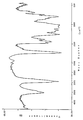
- This copolymer was identified as a dimethylpolysiloxane- and polycaprolactone-grafted copolymer from the results of IR spectrum analysis (See the accompanying drawings) and ′H-NMR spectrum analysis.
- Graft copolymers were produced in the same manner as in Example 1, except that the ingredients used in Example 1, that is, the radical polymerizable group-containing dimethylpolysiloxane compound, the radical polymerizable group-containing polycaprolactone compound, the radical polymerizable monomers and the solvent, were changed in kind and amount from those used in Example 1 to those shown in Table 1.
- the hydroxyl equivalent and the weight average molecular weight of the solids component at the conclusion of the reaction were determined by the same method as used in Example 1. These data are also set forth in Table 1. Additionally, R1, R2, m and n in Table 1 are the symbols used in the foregoing general formula (A), and R3, R4 and P are the symbols used in the foregoing general formula (D).
- MMA, BMA, 2HEA, HEMA and PHMA represent methyl methacrylate, butyl methacrylate, 2-ethylhexyl acrylate, hydroxyethyl methacrylate and perfluorooctylethyl methacrylate, respectively.
- a copolymerization reaction was carried out under the same condition as in Example 1 using 30 pts. wt. of the same radical polymerizable group-containing dimethylpolysiloxane compound as in Example 1, 1 pt.wt. of hydroxyethyl methacrylate, 50 pts.wt. of methyl methacrylate, 10 pts.wt. of butyl methacrylate, 150 pts. wt. of xylene and 2 pts. wt. of azobisisobutyronitrile, and thereby was obtained a viscous solution containing a solid component in a concentration of 38 wt %.
- a viscous solution having a solids concentration of 40 wt % was obtained.
- a hydroxyl equivalent of this solution was 13,000 (g/mol) on a solids basis.
- a white solid copolymer was taken out of this solution by performing the same operations as in Example 1, and identified as a dimethylpolystloxane- and polycaprolactone-grafted copolymer from the IR absorption spectrum analysis and the 1H-NMR spectrum analysis.
- a weight average molecular weight of the obtained copolymer determined by GPC was about 31,000, converted to a polystyrene basis.
- Graft copolymers were produced in the same manner as in Example 9, except that the radical polymerizable group-containing dimethylpolysiloxane compound, the hydroxyl group-containing radical polymerizable monomer, other copolymerizable monomers and solvents were changed in kind and amount from those in Example 9 to those shown in Table 2, respectively, and the amount of ⁇ -caprolactone was changed to those shown in Table 1.
- Data concerning hydroxyl equivalents of the obtained solutions on a solids basis, and weight average molecular weight of the produced copolymers are shown in Table 2 together with those obtained in Example 9. Additionally, HEA in Table 2 refers to hydroxylethyl acrylate, and other symbols have the same meanings as in Table 1, respectively.
- the graft copolymer solution obtained in Example 1 was diluted with a methyl ethyl ketone-ethyl acetate (1/1 by weight) mixture so that the resulting solids concentration became 20%, coated on an Al plate using a spinner, and air-dried for 24 hours at room temperature to form a transparent coat having a thickness of 20 ⁇ m.
- the thus formed coat was examined for appearance, contact angle of water, kinetic friction coefficient, adhesion, weather resistance, flexibility and solvent resistance. The results obtained are shown in Table 3. Appearance: whether the coat was sticky or not to the touch was observed. A sticky coat is indicated by a cross, while a non-sticky coat is indicated by a circle.
- a circle indicates that the coat had a luster retention rate of 90% or above, while a cross indicates that the coat had a luster rentention rate less than 90%.
- Flexibility bending test was carried out using a mandrel 3 mm in diameter under the condition of 20°C - 65% RH. A circle indicates that neither cleavage nor peeling was caused, while a cross indicates that there were some cleavages and peelings.
- Solvent resistance the coat was soaked in toluene. After 1-hour lapse, it was taken out of the toluene and its appearance was observed.
- a circle indicates that no change was observed, while a cross indicates that dissolution occurred.
- Example 14 The same operations as in Example 14 were performed, except that each of the graft copolymer solutions obtained in Examples 2 to 13 were used in the place of the graft copolymer solution obtained in Example 1, and the properties of each coat formed were evaluated in the same ways as adopted in Example 14.
- the revolts obtained are shown in Table 3.
- Example 14 Each of the formed coats was examined for properties by performing the same operations as in Example 14, except that each of the graft copolymer solutions obtained in Comparative Examples 1 and 2 were used in the place of the graft copolymer solution obtained in Example 1. The results shown in Table 3 were obtained.
- the graft copolymer solution obtained in Example 1 was diluted with amethyl ethyl ketone-ethyl acetate (1/1 by weight) mixture so that the resulting solids concentration became 20%.
- a 100 pts. wt. portion of this diluted solution was further mixed with 4.1 pts. wt. of isocyanurate combined HDI and 0.05 pt. wt. of dibutyltin dioctate, coated on an Al plate using a spinner, and air-dried for 3 days at room temperature to form a transparent coat having a thickness of 20 ⁇ m.
- the thus formed coat was examined for properties in the same ways as in Example 14, and the results shown in Table 3 were obtained.
- a coat was formed in the-same manner as in Example 14, except that the graft copolymer solution prepared in Example 2 was used instead of the graft copolymer solution prepared in Example 1 and the content of isocyanurate combined HDI was changed to 0.4 pt.wt.
- the thus formed coat was examined for properties, and the results shown in Table 3 were obtained.
Landscapes
- Chemical & Material Sciences (AREA)
- Chemical Kinetics & Catalysis (AREA)
- Organic Chemistry (AREA)
- Health & Medical Sciences (AREA)
- Medicinal Chemistry (AREA)
- Polymers & Plastics (AREA)
- Life Sciences & Earth Sciences (AREA)
- Engineering & Computer Science (AREA)
- Materials Engineering (AREA)
- Wood Science & Technology (AREA)
- Macromonomer-Based Addition Polymer (AREA)
- Paints Or Removers (AREA)
- Polyesters Or Polycarbonates (AREA)
Claims (13)
- Pfropfcopolymer, dadurch gekennzeichnet, daß es ein Vinylpolymer als Stammpolymer enthält und sowohl Organopolysiloxan und Polylacton als Zweigpolymere, wobei der Anteil von Organopolysiloxan zwischen 5 und 80 Gew.-% und der Anteil von Polylacton zwischen 2 und 50 Gew.-% liegt.
- Pfropfcopolymer nach Anspruch 1, bei dem das genannte Stammpolymer konstituierende Einheiten enthält, die abgeleitet sind von wenigstens einem Monomer, das ausgewählt wurde aus (Meth-) Acrylsäure oder Derivaten davon, Styren oder Styrenderivaten, Fumarsäure oder Derivaten davon, Maleinsäure oder Derivaten davon, radikale polymerisierbare Silikonverbindungen, Acrylnitril, Vinylpyrrolidon, Vinylacetat und Vinylalkylester.
- Pfropfcopolymer nach Anspruch 2, bei welchem die genannten (Meth-) Acrylsäurederivate Alkylester, Säureamide oder Fluorester von (Meth-) Acrylsäure sind.
- Pfropfcopolymer nach Anspruch 1, 2 oder 3, in welchem die Elementareinheiten der genannten Zweigpolymere wiedergegeben werden durch die folgenden allgemeinen Formeln (a) bzw. (b):


- Pfropfcopolyzner nach einem der vorhergehenden Ansprüche, bei welchem der Anteil der Elementareinheit (a) zwischen 10 und 60 Gew.% und der der Elementareinheit (b) zwischen 5 und 30 Gew.% liegt.
- Verfahren zur Herstellung eines Pfropfcopolymers nach Anspruch 1, dadurch gekennzeichnet, daß eine radikale polymerisierbare Gruppen enthaltende Dimethylpolysiloxanverbindung, eine radikal polymerisierbare Gruppen enthaltende Polycaprolactonverbindung und wenigstens ein radikal polymerisierbares Monomer, das in der Lage ist, mit diesen Verbindungen zu copolymerisieren, einer Copolymerisierreaktion unterworfen wird.
- Verfahren nach Anspruch 6, wobei die radikal polymerisierbare Gruppen enthaltende Dimethylpolysiloxanverbindung wiedergegeben ist durch die folgende allgemeine Formel:

- Verfahren nach Anspruch 6 oder 7, bei dem die Copolymerisationsreaktion durch Verwendung eines Lösungspolymerisationsverfahrens ausgeführt wird.
- Verfahren zur Herstellung eines Pfropfcopolymers nach Anspruch 1, dadurch gekennzeichnet, daß ein Lacton einer ringöffnenden Pfropfpolymerisationsreaktion mit einem silikon-gepfropften Polymer unterworfen wird, welches erhalten wurde durch Copolymerisierung einer radikal polymerisierbare Gruppen enthaltenden Dimethylpolysyloxanverbindung, einem Hydroxigruppen enthaltenden radikal polymerisierbaren Monomer und radikal polymerisierbarern Monomeren, die in der Lage sind, damit zu copolymerisieren.
- Verfahren nach Anspruch 9, bei dem die radikal polymerisierbare Gruppen enthaltende Dimethylplysiloxanverbindung wiedergegeben ist durch die allgemeine Formel (A), wie sie in Anspruch 7 definiert ist, und das genannte Hydroxigruppen enthaltende radikal polymerisierbare Monomer wiedergegeben ist durch die allgemeine Formel (F)

- Verfahren nach Anspruch 9 oder 10, wobei die ringöffnende Pfropfpolymerisationsreaktion zwischen dem genannten silikon-gepfropften Copolymer und einem Lacton ausgeführt wird unter Benutzung eines organometallischen Oxids als Katalysator in einem Strom von Stickstoff bei einer Temperatur zwischen 100 und 200°C.
- Verfahren nach einem der Ansprüche 6 bis 11, bei dem die genanten radikal polymerisierbaren copolymerisierbaren Monomere wenigstens ein Monomer umfassen, welches ausgewählt ist aus (Meth-) Acrylsäure oder deren Derivaten, Styren oder deren Derivaten, Fumarsäure oder deren Derivaten, Maleinsäure oder Derivaten davon, radikal polymerisierbaren Silikonverbindungen, Acrylnitril, Vinylpyrrolidon, Vinylacetat und Vinylalkyläther.
- Beschichtungszusammensetzung, die als Hauptkomponente ein Pfropfcopolymer enthält, wie es in einem der Ansprüche 1 bis 5 beansprucht ist und das durch ein Verfahren nach einem der Ansprüche 6 bis 12 hergestellt ist.
Applications Claiming Priority (2)
| Application Number | Priority Date | Filing Date | Title |
|---|---|---|---|
| JP82036/90 | 1990-03-28 | ||
| JP2082036A JPH0798850B2 (ja) | 1990-03-28 | 1990-03-28 | グラフト共重合体、その製造方法及びそれを主成分としてなる被覆組成物 |
Publications (3)
| Publication Number | Publication Date |
|---|---|
| EP0449613A2 EP0449613A2 (de) | 1991-10-02 |
| EP0449613A3 EP0449613A3 (en) | 1991-12-18 |
| EP0449613B1 true EP0449613B1 (de) | 1995-09-06 |
Family
ID=13763297
Family Applications (1)
| Application Number | Title | Priority Date | Filing Date |
|---|---|---|---|
| EP91302696A Expired - Lifetime EP0449613B1 (de) | 1990-03-28 | 1991-03-27 | Pfropfcopolymere zur Verwendung als Hauptkomponente von der Beschichtungszusammensetzung |
Country Status (4)
| Country | Link |
|---|---|
| US (1) | US5256739A (de) |
| EP (1) | EP0449613B1 (de) |
| JP (1) | JPH0798850B2 (de) |
| DE (1) | DE69112682T2 (de) |
Families Citing this family (13)
| Publication number | Priority date | Publication date | Assignee | Title |
|---|---|---|---|---|
| JP3287475B2 (ja) * | 1991-12-27 | 2002-06-04 | 日本ペイント株式会社 | 硬化性樹脂組成物 |
| JPH0657175A (ja) * | 1992-08-07 | 1994-03-01 | Nippon Oil & Fats Co Ltd | 塗料組成物 |
| DE4244386A1 (de) * | 1992-12-29 | 1994-06-30 | Basf Ag | Vinylpyrrolidon- und Vinylimidazol-Copolymerisate, Verfahren zur ihrer Herstellung und ihre Verwendung in Waschmitteln |
| JP2960304B2 (ja) * | 1993-06-30 | 1999-10-06 | 信越化学工業株式会社 | 繊維用撥水処理剤 |
| JPH07181737A (ja) * | 1993-12-24 | 1995-07-21 | Shin Etsu Chem Co Ltd | 電子写真トナー用バインダー |
| DE4439766C1 (de) * | 1994-11-07 | 1996-04-04 | Hoechst Ag | Formteile aus Polyacetal mit direkt angeformten Funktionselementen |
| DE19519807A1 (de) * | 1995-05-31 | 1997-02-13 | Basf Lacke & Farben | Beschichtungsmittel auf der Basis eines hydroxylgruppenhaltigen Polyacrylatharzes und seine Verwendung in Verfahren zur Herstellung einer Mehrschichtlackierung |
| US6280079B1 (en) * | 1998-12-24 | 2001-08-28 | United Microelectronics Corp. | Method of mixing slurries |
| JP4146221B2 (ja) | 2002-12-17 | 2008-09-10 | オリヱント化学工業株式会社 | 反応性ケイ素含有基を有する共重合体、及び有機・無機ハイブリッド高分子材料 |
| US8147728B2 (en) | 2004-04-01 | 2012-04-03 | Novartis Ag | Pad transfer printing of silicone hydrogel lenses using colored ink |
| US7420020B2 (en) * | 2004-05-14 | 2008-09-02 | Fuji Xerox Co., Ltd. | Resin particles and producing method thereof, toner for developing electrostatic latent image and producing method thereof, electrostatic latent image developer as well as image forming method |
| DE102009053879A1 (de) * | 2009-11-20 | 2011-05-26 | Voith Patent Gmbh | Gezeitenkraftwerk und Verfahren für dessen Erstellung |
| JP7559068B2 (ja) * | 2019-12-18 | 2024-10-01 | ワッカー ケミー アクチエンゲゼルシャフト | 架橋可能な反応性シリコーン有機コポリマー分散液 |
Family Cites Families (8)
| Publication number | Priority date | Publication date | Assignee | Title |
|---|---|---|---|---|
| JPS58154765A (ja) * | 1982-02-05 | 1983-09-14 | Daicel Chem Ind Ltd | 光硬化性樹脂組成物 |
| CA1224599A (en) * | 1982-11-02 | 1987-07-21 | Union Carbide Corporation | Process for the preparation of polymeric compositions |
| JPH0660128B2 (ja) * | 1983-04-13 | 1994-08-10 | ダイセル化学工業株式会社 | ラクトン変性したヒドロキシ(メタ)クリル酸エステル溶液 |
| JPS61151272A (ja) * | 1984-12-26 | 1986-07-09 | Toagosei Chem Ind Co Ltd | 高耐候性塗料 |
| JPH0617420B2 (ja) * | 1986-01-08 | 1994-03-09 | 日本ペイント株式会社 | ビニル樹脂エマルション |
| JPS62249992A (ja) * | 1986-04-24 | 1987-10-30 | Nippon Kayaku Co Ltd | 新規なシリコンウレタン(メタ)アクリレ−ト,これを用いた樹脂組成物およびコ−テイング剤 |
| JP2643353B2 (ja) * | 1988-09-09 | 1997-08-20 | 関西ペイント株式会社 | 塗膜形成方法 |
| JPH0651795B2 (ja) * | 1988-09-16 | 1994-07-06 | 信越化学工業株式会社 | メタクリル官能性ジメチルポリシロキサン |
-
1990
- 1990-03-28 JP JP2082036A patent/JPH0798850B2/ja not_active Expired - Lifetime
-
1991
- 1991-03-27 EP EP91302696A patent/EP0449613B1/de not_active Expired - Lifetime
- 1991-03-27 DE DE69112682T patent/DE69112682T2/de not_active Expired - Fee Related
- 1991-03-27 US US07/676,006 patent/US5256739A/en not_active Expired - Lifetime
Also Published As
| Publication number | Publication date |
|---|---|
| EP0449613A3 (en) | 1991-12-18 |
| US5256739A (en) | 1993-10-26 |
| JPH03281516A (ja) | 1991-12-12 |
| EP0449613A2 (de) | 1991-10-02 |
| DE69112682T2 (de) | 1996-05-02 |
| DE69112682D1 (de) | 1995-10-12 |
| JPH0798850B2 (ja) | 1995-10-25 |
Similar Documents
| Publication | Publication Date | Title |
|---|---|---|
| EP0449613B1 (de) | Pfropfcopolymere zur Verwendung als Hauptkomponente von der Beschichtungszusammensetzung | |
| JP2537806B2 (ja) | コ−テイングされたシ−ト材料 | |
| JP2611893B2 (ja) | グラフト共重合体及びそれを用いた被覆組成物 | |
| JP3094044B2 (ja) | 硬化性組成物 | |
| JP3287475B2 (ja) | 硬化性樹脂組成物 | |
| US4957808A (en) | Thermal stencil paper for mimeograph | |
| US5516868A (en) | Vinyl copolymer, method for making, and room temperature curing resin composition | |
| JPS6259672A (ja) | 離型用コ−テイング剤 | |
| US20080045631A1 (en) | Silicone Topcoat With Improved Dirt Repellency and Improved Bondability, With Core-Shell Particle | |
| JP3429524B2 (ja) | 水性シリコーン変性樹脂及び水性塗料 | |
| JPS63264675A (ja) | 塗料用組成物 | |
| JPH0391509A (ja) | ジメチルポリシロキサン―ビニル系ポリマーのブロック共重合体及びそれを用いた被覆組成物 | |
| JP3160869B2 (ja) | 含フッ素共重合体および該共重合体を主成分とする塗料用組成物 | |
| JPS61151272A (ja) | 高耐候性塗料 | |
| JPH10316726A (ja) | ベンゾフェノン基又はベンゾトリアゾール基を有するポリシロキサン系共重合体 | |
| JPH08231743A (ja) | 被覆用防汚性組成物 | |
| JP3957790B2 (ja) | 塗料用組成物 | |
| JP6933130B2 (ja) | 接着用樹脂組成物、プライマー、接着剤及び物品。 | |
| JPH02145665A (ja) | 室温硬化性塗料組成物 | |
| JPS62250017A (ja) | シリコン樹脂組成物 | |
| JPH03160049A (ja) | 塗料用樹脂組成物 | |
| JPH09309933A (ja) | 常温硬化型水系樹脂及びその製法 | |
| JPH08259645A (ja) | グラフト共重合体、その製造法及び塗料 | |
| JP2658200B2 (ja) | ブロッキング防止剤 | |
| JPH0551424A (ja) | グラフト共重合体の製造法、微水溶性樹脂組成物およびこれを用いた塗料 |
Legal Events
| Date | Code | Title | Description |
|---|---|---|---|
| PUAI | Public reference made under article 153(3) epc to a published international application that has entered the european phase |
Free format text: ORIGINAL CODE: 0009012 |
|
| AK | Designated contracting states |
Kind code of ref document: A2 Designated state(s): DE FR GB |
|
| PUAL | Search report despatched |
Free format text: ORIGINAL CODE: 0009013 |
|
| AK | Designated contracting states |
Kind code of ref document: A3 Designated state(s): DE FR GB |
|
| 17P | Request for examination filed |
Effective date: 19920611 |
|
| 17Q | First examination report despatched |
Effective date: 19941010 |
|
| GRAA | (expected) grant |
Free format text: ORIGINAL CODE: 0009210 |
|
| AK | Designated contracting states |
Kind code of ref document: B1 Designated state(s): DE FR GB |
|
| ET | Fr: translation filed | ||
| REF | Corresponds to: |
Ref document number: 69112682 Country of ref document: DE Date of ref document: 19951012 |
|
| PLBE | No opposition filed within time limit |
Free format text: ORIGINAL CODE: 0009261 |
|
| STAA | Information on the status of an ep patent application or granted ep patent |
Free format text: STATUS: NO OPPOSITION FILED WITHIN TIME LIMIT |
|
| 26N | No opposition filed | ||
| PGFP | Annual fee paid to national office [announced via postgrant information from national office to epo] |
Ref country code: FR Payment date: 20000310 Year of fee payment: 10 |
|
| PGFP | Annual fee paid to national office [announced via postgrant information from national office to epo] |
Ref country code: GB Payment date: 20000322 Year of fee payment: 10 |
|
| PGFP | Annual fee paid to national office [announced via postgrant information from national office to epo] |
Ref country code: DE Payment date: 20000327 Year of fee payment: 10 |
|
| PG25 | Lapsed in a contracting state [announced via postgrant information from national office to epo] |
Ref country code: GB Free format text: LAPSE BECAUSE OF NON-PAYMENT OF DUE FEES Effective date: 20010327 |
|
| GBPC | Gb: european patent ceased through non-payment of renewal fee |
Effective date: 20010327 |
|
| PG25 | Lapsed in a contracting state [announced via postgrant information from national office to epo] |
Ref country code: FR Free format text: LAPSE BECAUSE OF NON-PAYMENT OF DUE FEES Effective date: 20011130 |
|
| REG | Reference to a national code |
Ref country code: FR Ref legal event code: ST |
|
| PG25 | Lapsed in a contracting state [announced via postgrant information from national office to epo] |
Ref country code: DE Free format text: LAPSE BECAUSE OF NON-PAYMENT OF DUE FEES Effective date: 20020101 |