EP0357559A2 - Wässrige Formulierungen und deren Verwendung - Google Patents
Wässrige Formulierungen und deren Verwendung Download PDFInfo
- Publication number
- EP0357559A2 EP0357559A2 EP89810631A EP89810631A EP0357559A2 EP 0357559 A2 EP0357559 A2 EP 0357559A2 EP 89810631 A EP89810631 A EP 89810631A EP 89810631 A EP89810631 A EP 89810631A EP 0357559 A2 EP0357559 A2 EP 0357559A2
- Authority
- EP
- European Patent Office
- Prior art keywords
- methylbenzyl
- formulation according
- aqueous formulation
- seed
- phenyl
- Prior art date
- Legal status (The legal status is an assumption and is not a legal conclusion. Google has not performed a legal analysis and makes no representation as to the accuracy of the status listed.)
- Granted
Links
Classifications
-
- A—HUMAN NECESSITIES
- A01—AGRICULTURE; FORESTRY; ANIMAL HUSBANDRY; HUNTING; TRAPPING; FISHING
- A01N—PRESERVATION OF BODIES OF HUMANS OR ANIMALS OR PLANTS OR PARTS THEREOF; BIOCIDES, e.g. AS DISINFECTANTS, AS PESTICIDES OR AS HERBICIDES; PEST REPELLANTS OR ATTRACTANTS; PLANT GROWTH REGULATORS
- A01N25/00—Biocides, pest repellants or attractants, or plant growth regulators, characterised by their forms, or by their non-active ingredients or by their methods of application, e.g. seed treatment or sequential application; Substances for reducing the noxious effect of the active ingredients to organisms other than pests
- A01N25/02—Biocides, pest repellants or attractants, or plant growth regulators, characterised by their forms, or by their non-active ingredients or by their methods of application, e.g. seed treatment or sequential application; Substances for reducing the noxious effect of the active ingredients to organisms other than pests containing liquids as carriers, diluents or solvents
- A01N25/04—Dispersions, emulsions, suspoemulsions, suspension concentrates or gels
Definitions
- the present invention relates to new aqueous formulations of agrochemically active compounds which are sparingly soluble in water. These new formulations represent either water-in-oil or oil-in-water emulsions. The new formulations can advantageously be used as seed dressings.
- Emulsions that contain poorly soluble active ingredients of the type described above tend to crystallize or break (separate) the emulsion when standing for a longer time and are therefore only stable in storage and use to a limited extent.
- aqueous formulations of a conventional type in the case of the active ingredient furathiocarb O-butyl-O-2,3-dihydro-2,2-dimethylbenzofuran-7-yl-N, N'-dimethyl-N, N'-thiodicarbamate show one pronounced tendency to crystallize this active ingredient.
- the invention thus relates to aqueous formulations comprising 1 to 70, preferably 20 to 70% by weight of an agrochemically active substance which is poorly soluble in water, in addition to an amount of a compound of the formula I which inhibits the crystallization of the active substance or the breaking of the emulsion ROME (I), wherein R is C12-C20 alkyl; C12-C20 alkenyl; Phenyl; 4-biphenylyl; Phenyl substituted 2 to 3 times by ⁇ -methylbenzyl or ⁇ -methyl-4-methylbenzyl; or phenyl which is 1 to 3 times substituted by alkyl, the sum of the carbon atoms present in the alkyl groups being 1 to 18; and M hydrogen; a cation equivalent of an alkali or alkaline earth metal ion; or if R is phenyl, 4-biphenylyl, phenyl substituted by ⁇ -methylbenzyl, ⁇ -methyl-4-methylbenzyl or al
- formulation auxiliaries which are customary in agrochemical formulations are: emulsifiers, dispersants, thickeners, anti-foaming agents, stabilizers, dyes, adhesives, preservatives, buffers and cold stabilizers.
- Active agrochemicals are in particular herbicides, fungicides, insecticides, acaricides, gametoids, rodenticides, nematicides, growth regulators and safeners. Those agrochemical active ingredients which are less than 1% soluble in water at 20 ° C are to be regarded as sparingly soluble in water.
- the formulation type proposed according to the invention is advantageously suitable for agrochemical active substances which have a melting point in the range from -5 ° C. to + 70 ° C.
- both substances which are liquid at room temperature and substances which are solid at room temperature are suitable as active substances. Nevertheless, the problem of the crystallization of the active substance also occurs with the active substances which are liquid at room temperature (temperatures below 40 ° C.), since agrochemical formulations must also be stable at low temperatures (for example storage in unheated rooms).
- the insecticide furathiocarb (butyl 2,3-dihydro-2,2-dimethyl-benzofuran-7-yl-N, N'-dimethyl-N, N'-thiodicarbamate), which is described in "The Pesticide Manual, 7th Ed. The British Crop Prot. Counc. (Ed), 6850 ⁇ and in British patent specification 1 583 713.
- the insecticide methidathione (S-2,3-dihydro-5-methoxy- 2-oxo-1,3,4-thiadiazol-3-ylmethyl-O, O-dimethyldithiophosphate; Pesticide Manual, 8th Ed. 1987, page 546) and the herbicide trimexachlor (N-chloroacetyl-N-isopropyl-3,3, 5-trimethylcyclohex-1-enamine, described in EP-A-0 013 429).
- the compounds of formula I correspond to phenols, saturated or unsaturated alcohols.
- primary saturated or primary 1- to 3-fold unsaturated (C12-C20) alcohols are preferred, ie fatty alcohols such as oleyl alcohol, lauryl alcohol or stearyl alcohol.
- the fatty alcohols can also be present as a mixture of different alcohols; such as coconut fatty alcohol.
- the compounds of the formula I can, for example, also in the form of their alkali metal or alkaline earth metal salts (such as the Li, Na, K, Ca or Mg salts) or in the case of the phenols also in the form of their ammonium or other amine salts (such as the mono- or di-ethanol ammonium salts).
- their alkali metal or alkaline earth metal salts such as the Li, Na, K, Ca or Mg salts
- ammonium or other amine salts such as the mono- or di-ethanol ammonium salts
- the salts of the formula I can also be present in mixtures with other salts of compounds of the formula I or in a mixture with alcohols or phenols of the formula I (in which M is hydrogen).
- the minimum amount of compounds 1 required to prevent the crystallization of the agrochemical active ingredients can be determined by simple experiments.
- the weight ratio of agrochemical active ingredient to the compound of the formula I is advantageously 20: 1 to 3: 1, in particular 10: 1 to 5: 1.
- the agrochemical active ingredients can advantageously be dissolved with the compounds of the formula I and then dispersed in the aqueous phase. Active ingredients that are solid at room temperature are liquefied by heating (before or after admixing the compound of formula I).
- this has the effect that when using compounds of the formula I, the proportion of formulation auxiliaries in agrochemical formulations can be reduced.
- the formulations according to the invention can also contain emulsifiers.
- emulsifiers are preferred in amounts of 0.1-10% by weight, preferably 0.5-5% by weight.
- Suitable anionic emulsifiers can be both so-called water-soluble soaps and water-soluble synthetic surface-active compounds.
- soaps are the alkali, alkaline earth or optionally substituted ammonium salts of higher fatty acids (C10-C22), such as the Na or K salts of oleic or stearic acid, or of natural fatty acid mixtures, e.g. can be obtained from coconut or tallow oil.
- C10-C22 the alkali, alkaline earth or optionally substituted ammonium salts of higher fatty acids (C10-C22), such as the Na or K salts of oleic or stearic acid, or of natural fatty acid mixtures, e.g. can be obtained from coconut or tallow oil.
- synthetic emulsifiers are used more frequently, in particular fatty sulfonates, fatty sulfates, sulfonated benzimidazole derivatives or alkylarylsulfonates, such as calcium dodecylbenzenesulfonate.
- Suitable nonionic emulsifiers are primarily polyglycol ether derivatives of aliphatic or cycloaliphatic alcohols, saturated or unsaturated fatty acids and alkylphenols, which can contain 3 to 10 glycol ether groups and 8 to 20 carbon atoms in the (aliphatic) hydrocarbon radical and 6 to 18 carbon atoms in the alkyl radical of the alkylphenols .
- nonionic emulsifiers are nonylphenol polyethoxyethanols, castor oil polyglycol ethers, polypropylene-polyethylene oxide adducts, tributylphenoxypolyethoxyethanol, polyethylene glycol and octylphenoxypolyethoxyethanol.
- Preservatives, dyes, buffers, cold stabilizers and agents for improving the chemical stability of the active substance can also be considered as additives which can be contained in the formulations according to the invention.
- preservatives are 2-hydroxybiphenyl and sorbic acid.
- dyes are azo dyes and phthalocyanine dyes.
- buffer Substance should be mentioned here sodium dihydrogen phosphate, ammonium acetate, diammonium phosphate.
- cold stabilizers are preferably glycerol, but also urea, ethylene glycol, propylene glycol, polyglycols, various sugars and salts, such as ammonium sulfate and sodium oleate.
- cold stabilizers can be present in the emulsion according to the invention in amounts of 2 to 20, preferably 5 to 15,% by weight.
- the crystallization inhibitors are added to aqueous formulations to improve the low-temperature stability of the aqueous phase, whereas the compounds of the formula I, inter alia, improve the low-temperature stability of the emulsified organic phase.
- adhesives include aqueous polymer suspensions, such as latex suspensions.
- the formulations according to the invention are prepared in their general form in such a way that a mixture of active ingredient and compound of the formula (I) is emulsified in the required amount of water with stirring.
- the water-soluble substances are generally first dissolved in the required amount of water.
- the mixture of all the non-water-soluble components is then emulsified with stirring.
- Such active substances which are in solid form, can first be liquefied together with the compound of the formula I. All other non-water-soluble components are then added to this solution and this mixture is then emulsified in water.
- the various phases are expediently added to one another slowly with uniform stirring at room temperature or at elevated temperature, e.g. at temperatures between 10 and 60 ° C, with conventional stirrers.
- a fine-particle emulsion is formed. Aftertreatment of the resulting emulsion is not necessary, but can be carried out if desired.
- the formulations according to the invention can be applied either in the prepared form or after prior dilution.
- the application rate depends on the concentration of the active ingredients in the emulsion and on the respective indication.
- emulsions according to the invention are used according to the customary methods, e.g. by spraying, spraying or pouring.
- the formulations according to the invention are particularly suitable for those agrochemical preparations in which the aqueous formulation is used undiluted or only moderately diluted with water.
- the formulations according to the invention are distinguished by a number of advantages: - no crystal formation - With long-term storage, these emulsions remain physically unchanged between -10 ° C to + 54 ° C, - no organic solvents, - high flash point of the emulsions, - no odors caused by organic solvents, simple method of preparation of the emulsions, - high plant and seed tolerance, - No adverse influence on the potency of the agrochemical active ingredient.
- the seed treated with the formulation according to the invention has good germination capacity compared to the untreated control.
- the formulations according to the invention can therefore be used in a particularly advantageous manner as seed dressings.
- seed is understood to mean all generative parts of plants which can be used to multiply the crop. These include e.g. Grains (seeds in the narrower sense), roots, fruits or tubers.
- Seed dressings are primarily used to treat seeds. Seeds of the following plant species are of particular importance:
- Cereals wheat, barley, rye, oats, rice, sorghum and relatives
- Beets saliva and fodder beets
- Legumes beans, lentils, peas, soybeans
- Oil crops rapeseed, mustard, poppy seeds, olives, sunflowers, coconut, castor bean, peanuts
- Cucumber plants prmpkin, cucumber, melons
- Fiber plants cotton, flax, hemp, jute
- Vegetables spinach, lettuce, asparagus, cabbage, carrots, onions, tomatoes, potatoes, peppers
- Corn and sugar beet seeds are preferably treated.
- the invention also relates to a method for seed dressing using the aqueous formulations according to the invention and the treated seed.
- the formulations listed in the following tables are prepared by mixing the active ingredient furathiocarb at 40 to 50 ° C. with the compounds of the formula I and, if appropriate, further emulsifiers. The resulting homogeneous solution is then emulsified in the required amount of water within 2 to 4 minutes with stirring. After the addition is complete, stirring is continued for 5 minutes. Slightly colored, viscous emulsions are obtained. These emulsions are stored at 20 ° C or -5 ° C to + 54 ° C and their stability is monitored.
- Formulation examples 1 to 29 give recipes which show no crystallization of the active ingredient during six months of storage. If the compound of the formula I is omitted in the formulations according to Examples 1 to 29, the active ingredient crystallizes out after only a few days.
- KWS Kawevera beet seeds 1 kg are also included 40 g of an aqueous formulation stained as follows: 50% furathiocarb 15% tri-sec-butylphenol 5% 1,2-propylene glycol 30% water
- the formulation is applied to the seeds in a dressing device using a centrifugal disc and mixed for 2 minutes so that an even distribution is achieved.
- aqueous formulation composed as follows: 30% furathiocarb 6% tri-sec-butylphenol 33% adhesive (aqueous latex suspensions) 1.5% emulsifier (non-ionic surfactant) 0.3% anti-foam (silicone oil) 0.2% dye ( ® Irgalit red) 29% water
- the product is poured onto the seeds in a drum mixer and immediately mixed intensively for 3 minutes. Then 18 g of a mixture of talc and Na-Al-silicate in a ratio of 2: 1 and 1% dye are added and mixed for a further 5 minutes.
- the treated seed is tested for germination as described in Example 2.
Landscapes
- Life Sciences & Earth Sciences (AREA)
- General Health & Medical Sciences (AREA)
- Health & Medical Sciences (AREA)
- Dentistry (AREA)
- Zoology (AREA)
- Dispersion Chemistry (AREA)
- Pest Control & Pesticides (AREA)
- Plant Pathology (AREA)
- Toxicology (AREA)
- Engineering & Computer Science (AREA)
- Chemical & Material Sciences (AREA)
- Wood Science & Technology (AREA)
- Agronomy & Crop Science (AREA)
- Environmental Sciences (AREA)
- Agricultural Chemicals And Associated Chemicals (AREA)
- Organic Low-Molecular-Weight Compounds And Preparation Thereof (AREA)
- Medicinal Preparation (AREA)
- Pretreatment Of Seeds And Plants (AREA)
- Medicines Containing Plant Substances (AREA)
- Medicines That Contain Protein Lipid Enzymes And Other Medicines (AREA)
- Acyclic And Carbocyclic Compounds In Medicinal Compositions (AREA)
- Compositions Of Macromolecular Compounds (AREA)
- Nitrogen And Oxygen Or Sulfur-Condensed Heterocyclic Ring Systems (AREA)
Abstract
R-O-M (I),
worin
R C₁₂-C₂₀-Alkyl; C₁₂-C₂₀-Alkenyl; Phenyl; 4-Biphenylyl; 2- bis 3-fach durch α-Methylbenzyl oder α-Methyl-4-methylbenzyl substituiertes Phenyl; oder 1- bis 3-fach durch Alkyl substituiertes Phenyl bedeutet, wobei die Summe der in den Alkylgruppen vorliegenden Kohlenstoffatome 1 bis 18 beträgt; und
M Wasserstoff; ein Kationenäquivalent eines Alkali- oder Erdalkaliions; oder falls R Phenyl, 4-Biphenylyl, durch α-Methylbenzyl, α-Methyl-4-methylbenzyl oder Alkyl substituiertes Phenyl ist und auch für Ammonium, mono- oder di-Ethanolammonium stehen kann;
sowie gewünschtenfalls weitere Formulierungshilfsstoffe und/oder weitere agrochemische Wirkstoffe, sowie deren Verwendung als Saatbeizmittel.
Description
- Die vorliegende Erfindung betrifft neue wässrige Formulierungen von in Wasser schwer löslichen agrochemischen Wirkstoffen. Diese neuen Formulierungen stellen entweder Wasser-in-Oel oder Oel-in-Wasser Emulsionen dar. Die neuen Formulierungen können in vorteilhafter Weise als Saatbeizmittel Verwendung finden.
- Emulsionen, die in Wasser nur schwer lösliche Wirkstoffe der oben bezeichneten Art enthalten, neigen beim längeren Stehen zum Auskristallisieren oder zum Brechen (Entmischen) der Emulsion und sind damit nur begrenzt lager- und anwendungsstabil.
- Es wurde nun gefunden, dass bei in Wasser schwer löslichen Wirkstoffen die Ausbildung von Kristallen oder auch das Brechen wässriger Emulsionen verhindert und damit die Lagerfähigkeit verbessert werden kann, wenn man diese Wirkstoffe mit Hilfe der im folgenden beschriebenen Verbindungen in wässrige Formulierungen überführt. So zeigen zum Beispiel wässrige Formulierungen herkömmlicher Art im Falle des Wirkstoffs Furathiocarb O-Butyl-O-2,3-dihydro-2,2-dimethylbenzofuran-7-yl-N,N′-dimethyl-N,N′-thiodicarbamat) eine ausgeprägte Tendenz zum Auskristallisieren dieses Wirkstoffs.
- Gegenstand der Erfindung sind somit wässrige Formulierungen enthaltend 1 bis 70, vorzugsweise 20 bis 70 Gew.-% eines in Wasser schwer löslichen agrochemischen Wirkstoffs neben einer die Kristallisation der Aktivsubstanz oder das Brechen der Emulsion inhibierenden Menge einer Verbindung der Formel I
R-O-M (I),
worin
R C₁₂-C₂₀-Alkyl; C₁₂-C₂₀-Alkenyl; Phenyl; 4-Biphenylyl; 2- bis 3-fach durch α-Methylbenzyl oder α-Methyl-4-methylbenzyl substituiertes Phenyl; oder 1- bis 3-fach durch Alkyl substituiertes Phenyl bedeutet, wobei die Summe der in den Alkylgruppen vorliegenden Kohlenstoffatome 1 bis 18 beträgt; und
M Wasserstoff; ein Kationenäquivalent eines Alkali- oder Erdalkaliions; oder falls R Phenyl, 4-Biphenylyl, durch α-Methylbenzyl, α-Methyl-4-methylbenzyl oder Alkyl substituiertes Phenyl ist und auch für ein Ammonium, mono- oder di-Ethanolammonium stehen kann;
sowie gewünschtenfalls weitere Formulierungshilfsstoffe und/oder weitere agrochemische Wirkstoffe. - Als bei agrochemischen Formulierungen gebräuchliche Formulierungshilfsstoffe sind unter anderem zu nennen: Emulgatoren, Dispergatoren, Verdicker, Antischaummittel, Stabilisatoren, Farbstoffe, Haftmittel, Konservierungsmittel, Puffer und Kältestabilisatoren.
- Agrochemische Wirkstoffe sind insbesondere Herbizide, Fungizide, Insektizide, Akarizide, Gametozide, Rodentizide, Nematizide, Wachstumsregulatoren und Safener. Als in Wasser schwerlöslich sind diejenigen agrochemischen Wirkstoffe anzusehen, welche bei 20°C zu weniger als 1 % in Wasser löslich sind.
- In vorteilhafter Weise ist der erfindungsgemäss vorgeschlagene Formulierungstyp für agrochemische Wirkstoffe geeignet, die einen Schmelzpunkt im Bereich von -5°C bis +70°C aufweisen.
- Somit kommen als Wirkstoffe sowohl Substanzen in Frage, die bei Raumtemperatur flüssig sind, als auch Substanzen, die bei Raumtemperatur fest sind. Gleichwohl tritt das Problem des Auskristallisierens der Aktivsubstanz auch bei den bei Raumtemperatur (Temperaturen unter 40°C) flüssigen Aktivsubstanzen auf, da agrochemische Formulierungen auch bei tieferen Temperaturen (z.B. Lagerung in ungeheizten Räumen) kältestabil sein müssen.
- Als agrochemischer Wirkstoff ist insbesondere das Insektizid Furathiocarb (Butyl 2,3-Dihydro-2,2-dimethyl-benzofuran-7-yl-N,N′-dimethyl-N,N′-thiodicarbamat) zu nennen, welches in "The Pesticide Manual, 7th Ed. The British Crop Prot. Counc. (Ed), 6850˝ und in der britischen Patentschrift 1 583 713 beschrieben ist. Als weitere geeignete Wirkstoffe sind das Insektizid Methidathion (S-2,3-Dihydro-5-methoxy-2-oxo-1,3,4-thiadiazol-3-ylmethyl-O,O-dimethyldithiophosphat; Pesticide Manual, 8th Ed. 1987, Seite 546) und das Herbizid Trimexachlor (N-Chloracetyl-N-isopropyl-3,3,5-trimethylcyclohex-1-enamin, beschrieben in EP-A-0 013 429) zu nennen.
- Die Verbindungen der Formel I entsprechen aufgrund ihrer chemischen Struktur Phenolen, gesättigten oder ungesättigten Alkoholen.
- Aus der Gruppe der Phenole sind die nachstehend genannten Untergruppen bevorzugt:
- a) Phenol
- b) 4-Hydroxybiphenylyl
- c) 1- bis 3-fach durch (C₁-C₆)-Alkylgruppen substituierte Phenole; wie etwa Mono-butylphenol, Di-butylphenol, Tri-butylphenol; besonders bevorzugt sind die sek-Butylphenole wie Mono-sek-butylphenol, Di-sek-butylphenol, Tri-sek-butylphenol,
- d) 1-fach durch eine (C₆-C₁₈)-Alkylgruppe substituierte Phenole; wie etwa Nonylphenol, Octylphenol, Dodecylphenol,
- e) 2-fach durch (C₄-C₉)-Alkylgruppen substituierte Phenole; wie etwa Di-nonylphenol, Di-octylphenol,
- f) 2- bis 3-fach durch α-Methylbenzyl oder α-Methyl-4-methylbenzyl substituierte Phenole; wie etwa 2,4,6-Tris-[α-methylbenzyl]-phenol; 2,4,6-Tris-[α-methyl-4-methylbenzyl]-phenol.
- Aus der Gruppe der gesättigten und ungesättigten Alkohole sind primäre gesättigte oder primäre 1- bis 3-fach ungesättigte (C₁₂-C₂₀)-Alkohole bevorzugt, also Fettalkohole wie z.B. Oleylalkohol, Laurylalkohol oder Stearylalkohol.
- Die Fettalkohole können, bedingt durch ihr Herstellungsverfahren auch als Gemisch unterschiedlicher Alkohole vorliegen; wie etwa Cocosfettalkohol.
- Die Verbindungen der Formel I können beispielsweise auch in Form ihrer Alkali- oder Erdalkalisalze (wie etwa der Li-, Na-, K-, Ca- oder Mg-Salze) oder im Falle der Phenole auch in Form ihrer Ammonium- oder anderer Aminsalze (wie etwa der mono- oder di-Ethanolammoniumsalze) vorliegen.
- Die Salze der Formel I (in denen M nicht für Wasserstoff steht) können auch in Mischungen mit anderen Salzen von Verbindungen der Formel I oder auch in Mischung mit Alkoholen oder Phenolen der Formel I (in denen M für Wasserstoff steht) vorliegen.
- Die zur Verhinderung der Kristallisation der agrochemischen Wirkstoffe mindestens erforderliche Menge an Verbindungen 1 kann durch einfache Versuche ermittelt werden. In vorteilhafter Weise beträgt das Gewichtsverhältnis von agrochemischen Wirkstoff zu der Verbindung der Formel I 20:1 bis 3:1, insbesondere 10:1 bis 5:1.
- In vorteilhafter Weise können die agrochemischen Wirkstoffe mit den Verbindungen der Formel I angelöst und danach in der wässrigen Phase dispergiert werden. Wirkstoffe, die bei Raumtemperatur fest sind werden durch Erwärmen (vor oder nach dem Zumischen der Verbindung der Formel I) verflüssigt.
- Es wurde gefunden, dass die Verbindungen der Formel I in wässrigen agrochemischen Formulierungen auch eine gewisse Emulgierwirkung aufweisen.
- Dies bewirkt als weiteren vorteilhaften Effekt, dass bei Verwendung von Verbindungen der Formel I der Anteil an Formulierungshilfsstoffen in agrochemischen Formulierungen verringert werden kann.
- Neben den eingangs aufgeführten Verbindungen der Formel (I) können die erfindungsgemässen Formulierungen aber auch noch Emulgatoren enthalten. Bevorzugt sind nichtionische oder anionische Emulgatoren in Mengen von 0,1 - 10 Gew.%, vorzugsweise 0,5 - 5 Gew.%.
- Geeignete anionische Emulgatoren können sowohl sog. wasserlösliche Seifen als auch wasserlösliche synthetische oberflächenaktive Verbindungen sein.
- Als Seifen seien die Alkali-, Erdalkali- oder gegebenenfalls substituierte Ammoniumsalze von höheren Fettsäuren (C₁₀-C₂₂), wie z.B. die Na- oder K-Salze der Oel- oder Stearinsäure, oder von natürlichen Fettsäuregemischen, die z.B. aus Kokosnuss- oder Talgöl gewonnen werden können, genannt.
- Häufiger werden jedoch sogenannte synthetische Emulgatoren verwendet, insbesondere Fettsulfonate, Fettsulfate, sulfonierte Benzimidazolderivate oder Alkylarylsulfonate, wie etwa das Calciumdodecylbenzolsulfonat.
- Als nicht ionische Emulgatoren kommen in erster Linie Polyglykoletherderivate von aliphatischen oder cycloaliphatischen Alkoholen, gesättigten oder ungesättigten Fettsäuren und Alkylphenolen in Frage, die 3 bis 10 Glykolethergruppen und 8 bis 20 Kohlenstoffatome im (aliphatischen) Kohlenwasserstoffrest und 6 bis 18 Kohlenstoffatome im Alkylrest der Alkylphenole enthalten können.
- Als Beispiele nichtionischer Emulgatoren seien Nonylphenolpolyethoxyethanole, Ricinusölpolyglykolether, Polypropylen-Polyethylenoxidaddukte, Tributylphenoxypolyethoxyethanol, Polyethylenglykol und Octylphenoxypolyethoxyethanol erwähnt.
- Als Zusatzstoffe, die in den erfindungsgemässen Formulierungen enthalten sein können, kommen auch Konservierungsmittel, Farbstoffe, Puffer, Kältestabilisatoren und Mittel zur Verbesserung der chemischen Stabilität des Wirkstoffs in Betracht. Als Beispiele für Konservierungsmittel seien 2-Hydroxybiphenyl und Sorbinsäure genannt. Als Beispiele für Farbstoffe seien Azofarbstoffe und Phthalocyanin-Farbstoffe angeführt. Als Puffer substanz sei hier Natriumdihydrogenphosphat, Ammoniumacetat, Diammoniumphosphat erwähnt. Als Beispiele für Kältestabilisatoren seien vorzugsweise Glyzerin, aber auch Harnstoff, Ethylenglykol, Propylenglykol, Polyglykole, verschiedene Zucker und Salze, wie Ammoniumsulfat und Natriumoleat genannt. Diese Kältestabilisatoren können in der erfindungsgemässen Emulsion in Mengen von 2 bis 20, vorzugsweise 5 bis 15 Gew.-% anwesend sein. Die Kristallisationsinhibitoren werden wässrigen Formulierungen zur Verbesserung der Kältestabilität der wässrigen Phase zugesetzt, wogegen die Verbindungen der Formel I unter anderem eine Verbesserung der Kältestabilität der emulgierten organischen Phase bewirken. Als Haftmittel zu nennen sind unter anderem wässrige Polymersuspensionen, wie etwa Latexsuspensionen.
- Die erfindungsgemässen Formulierungen werden in ihrer allgemeinen Form so hergestellt, dass man eine Mischung aus Wirkstoff und Verbindung der Formel (I) unter Rühren in der erforderlichen Menge Wasser emulgiert. Soll die Formulierung noch weitere Substanzen der oben aufgeführten Art enthalten, so werden im allgemeinen die wasserlöslichen Substanzen zunächst in der erforderlichen Menge Wasser gelöst. Hierzu wird dann unter Rühren das Gemisch aller nicht in Wasser löslichen Komponenten emulgiert. Solche Wirkstoffe, die in fester Form vorliegen, können zunächst zusammen mit der Verbindung der Formel I verflüssigt werden. Zu dieser Lösung werden dann alle anderen nicht in Wasser löslichen Komponenten gegeben und diese Mischung wird dann in Wasser emulgiert.
- Die Zugabe der verschiedenen Phasen zueinander erfolgt zweckmässigerweise langsam unter gleichmässigem Rühren bei Raumtemperatur oder bei erhöhter Temperatur, z.B. bei Temperaturen zwischen 10 und 60°C, mit üblichen Rührgeräten. Dabei bildet sich eine feinteilige Emulsion. Eine Nachbehandlung der entstehenden Emulsion ist nicht notwendig, kann aber vorgenommen werden, sofern diese gewünscht wird.
- Die erfindungsgemässen Formulierungen können entweder in der zubereiteten Form oder nach vorheriger Verdünnung appliziert werden. Die Aufwandmenge richtet sich dabei nach der Konzentration der Wirkstoffe in der Emulsion und nach der jeweiligen Indikation.
- Die Anwendung der erfindungsgemässen Emulsionen erfolgt nach den üblichen Methoden, also z.B. durch Spritzen, Sprühen oder Giessen.
- Die erfindungsgemässen Formulierungen sind insbesondere für solche agrochemischen Zubereitungen geeignet, in denen die wässrige Formulierung unverdünnt oder nur mässig mit Wasser verdünnt angewendet wird.
- Dies sind insbesondere Saatbeizmittel von Herbiziden, Fungiziden, Insektiziden, Akariziden, Gametoziden, Nematiziden, Rodentizide, Wachstumsregulatoren oder von Safenern (Safener sind Stoffe mit kulturpflanzenprotektiver Wirkung).
- Insgesamt zeichnen sich die erfindungsgemässen Formulierungen durch eine Reihe von Vorteilen aus:
- keine Kristallbildung
- bei Langzeitlagerung bleiben diese Emulsionen zwischen -10°C bis +54°C physikalisch unverändert,
- keine organische Lösemittel,
- hoher Flammpunkt der Emulsionen,
- keine Geruchsbelästigung durch organische Lösemittel,
- einfache Herstellungsweise der Emulsionen,
- hohe Pflanzen- und Saatgutverträglichkeit,
- keine nachteilige Beeinflussung der Wirkungsstärke des agrochemischen Wirkstoffs. - Für die Anwendungen als Saatbeizmittel sind die vorstehend genannten und generell für den erfindungsgemässen Formulierungstyp angegebenen Vorteile von besonderer Bedeutung.
- Insbesondere hat sich gezeigt, dass das mit der erfindungsgemässen Formulierung behandelte Saatgut eine, im Vergleich zur unbehandelten Kontrolle, gute Keimfähigkeit besitzt. Daher können die erfindungsgemässen Formulierungen in besonders vorteilhafter Weise als Saatbeizmittel eingesetzt werden.
- Unter dem Begriff Saatgut sind alle generativen Pflanzenteile zu verstehen, die zum Vermehrung der Kulturpflanze eingesetzt werden können. Dazu zählen z.B. Samenkörner (Saatgut im engeren Sinne), Wurzeln, Früchte oder Knollen.
- In erster Linie werden Saatbeizmittel aber zur Behandlung von Samenkörnern verwendet. Von besonderer Bedeutung sind dabei Samenkörner der folgenden Pflanzenarten:
- Getreide (Weizen, Gerste, Roggen, Hafer, Reis, Sorghum und Verwandte); Rüben (Zucker- und Futterrüben); Hülsenfrüchte (Bohnen, Linsen, Erbsen, Soja); Oelkulturen (Raps, Senf, Mohn, Oliven, Sonnenblumen, Kokos, Rizinus, Erdnüsse); Gurkengewächse (Kürbis, Gurken, Melonen); Fasergewächse (Baumwolle, Flachs, Hanf, Jute); Gemüsesorten (Spinat, Kopfsalat, Spargel, Kohlarten, Möhren, Zwiebeln, Tomaten, Kartoffeln, Paprika); oder Mais; sowie Zierpflanzen und Gräser. Bevorzugt werden Mais- und Zuckerrübensaatgut behandelt.
- Die Erfindung betrifft auch ein Verfahren zur Saatbeizung unter Verwendung der erfindungsgemässen wässrigen Formulierungen und das behandelte Saatgut.
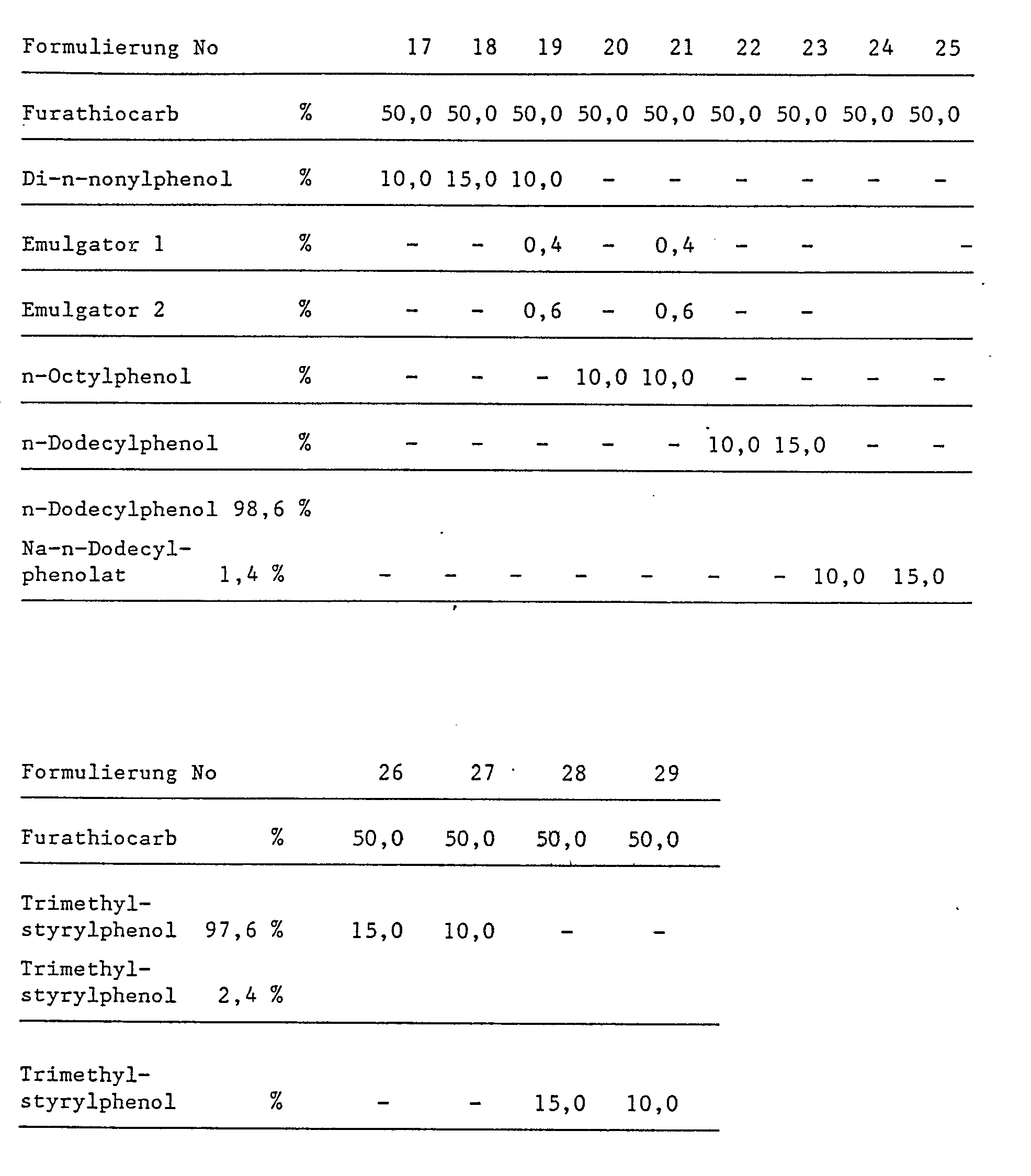
- Die in den folgenden Tabellen aufgeführten Formulierungen werden hergestellt, indem der Wirkstoff Furathiocarb bei 40 bis 50°C mit den Verbindungen der Formel I und gegebenenfalls weiteren Emulgatoren vermischt wird. Die dabei entstehende homogene Lösung wird dann innerhalb von 2 bis 4 Minuten unter Rühren in der erforderlichen Menge Wasser emulgiert. Nach beendeter Zugabe wird noch 5 Minuten nachgerührt. Man erhält leicht gefärbte, viskose Emulsionen. Diese Emulsionen werden bei 20°C bzw. -5°C bis +54°C gelagert und deren Stabilität überwacht.
- In den Formulierungsbeispielen 1 bis 29 sind Rezepturen angegeben, die während sechmonatiger Lagerung keine Kristallisation des Wirkstoffs zeigen. Lässt man in den Formulierungen gemäss Beispiel 1 bis 29 die Verbindung der Formel I weg, kristallisiert der Wirkstoff bereits nach wenigen Tagen aus.
- Alle Formulierungen 1 bis 29 enthalten Wasser in der jeweils sich zu 100 Gew.-% ergänzenden Menge.
- Emulgator 1 ist Calcium-Dodecylbenzolsulfonat,
- Emulgator 2 ist ein n-Butanol-Propylenoxid-Ethylenoxid Blockpolymer; Gewichtsanteil Propylenoxid 44 %, Gewichtanteil Ethylenoxid 54 %.
- 1 kg Zuckerrübensamen der Sorte KWS Kawevera werden mit
40 g einer wässerigen wie folgt zusammengesetzten Formulierung gebeizt:
50 % Furathiocarb
15 % Tri-sek-butylphenol
5 % 1,2-Propylenglykol
30 % Wasser - Die Formulierung wird in einem Beizgerät mittels Schleuderscheibe auf das Saatgut aufgebracht und 2 Minuten nachgemischt, so dass eine gleichmässige Verteilung erreicht wird.
- In Vergleichsversuchen werden analoge Formulierungen, die jedoch anstelle von 15 % Tri-sek-butylphenol, Xylol oder Adipinsäuredioctylester enthalten, in gleicher Weise auf die Zuckerrübensamen aufgebracht.
- Das behandelte Saatgut wird folgendermassen auf Keimfähigkeit geprüft. 4 x je 25 Körner werden in einen angefeuchteten Faltenfilter gegeben, der 7 Tage in einem Keimschrank (Temp. = 25°C, rel. LF = 95 %, Licht 8 Std./Tag) gestellt wird. Darauf zählt man, wie viele der pro Test insgesamt 100 Körner gekeimt sind.
- Der in diesem Beispiel beschriebene Versuch ergibt folgendes Resultat:
Keimzahl in % Kontrolle 95 Formulierung mit Tri-sek-butylphenol 93 Formulierung mit Xylol 53 Formulierung mit Adipinsäuredioctylester 15 - 1 kg Mais der Sorte Blizzard werden mit 33 g einer wässerigen wie folgt zusammengesetzten Formulierung gebeizt:
30 % Furathiocarb
6 % Tri-sek-butylphenol
33 % Haftmittel (wässrige Latexsuspensionen)
1,5 % Emulgator (nichtionisches Tensid)
0,3 % Antischaum (Siliconöl)
0,2 % Farbstoff (®Irgalit rot)
29 % Wasser - Das Produkt wird in einem Trommelmischer auf das Saatgut aufgegossen und sofort 3 Minuten intensiv gemischt. Anschliessend werden 18 g einer Mischung von Talk und Na-Al-Silicat im Verhältnis 2:1 und 1 % Farbstoff zugegeben und weitere 5 Minuten gemischt.
- In Vergleichsversuchen werden analoge Formulierungen, die jedoch anstelle von 6 % Tri-sec. Butylphenol, Cyclohexanon, Xylol oder Dimethylphthalat enthalten, in gleicher Weise auf das Mais-Saatgut aufgebracht.
- Das behandelte Saatgut wird wie in Beispiel 2 beschrieben auf Keimfähigkeit geprüft.
- Der in diesem Beispiel beschriebene Versuch ergibt folgendes Resultat:
Keimzahl in % Kontrolle 96 Formulierung mit Tri-sek-butylphenol 99 Formulierung mit Cyclohexanon 54 Formulierung mit Xylol 31 Formulierung mit Dimethylphthalat 23

Claims (18)
R-O-M (I),
worin
R C₁₂-C₂₀-Alkyl; C₁₂-C₂₀-Alkenyl; Phenyl; 4-Biphenylyl; 2- bis 3-fach durch α-Methylbenzyl oder α-Methyl-4-methylbenzyl substituiertes Phenyl; oder 1- bis 3-fach durch Alkyl substituiertes Phenyl bedeutet, wobei die Summe der in den Alkylgruppen vorliegenden Kohlenstoffatome 1 bis 18 beträgt; und
M Wasserstoff; ein Kationenäquivalent eines Alkali- oder Erdalkaliions; oder falls R Phenyl, 4-Biphenylyl, durch α-Methylbenzyl, α-Methyl-4-methylbenzyl oder Alkyl substituiertes Phenyl ist und auch für ein Ammonium, mono- oder di-Ethanolammonium stehen kann;
sowie gewünschtenfalls weitere Formulierungshilfsstoffe und/oder weitere agrochemische Wirkstoffe.
Applications Claiming Priority (2)
| Application Number | Priority Date | Filing Date | Title |
|---|---|---|---|
| CH328288 | 1988-09-02 | ||
| CH3282/88 | 1988-09-02 |
Publications (3)
| Publication Number | Publication Date |
|---|---|
| EP0357559A2 true EP0357559A2 (de) | 1990-03-07 |
| EP0357559A3 EP0357559A3 (de) | 1992-01-22 |
| EP0357559B1 EP0357559B1 (de) | 1994-10-19 |
Family
ID=4252613
Family Applications (1)
| Application Number | Title | Priority Date | Filing Date |
|---|---|---|---|
| EP89810631A Expired - Lifetime EP0357559B1 (de) | 1988-09-02 | 1989-08-24 | Wässrige Formulierungen und deren Verwendung |
Country Status (16)
| Country | Link |
|---|---|
| US (1) | US5371105A (de) |
| EP (1) | EP0357559B1 (de) |
| JP (1) | JPH0784361B2 (de) |
| AT (1) | ATE112933T1 (de) |
| AU (1) | AU627218B2 (de) |
| BG (1) | BG51333A3 (de) |
| BR (1) | BR8904420A (de) |
| CA (1) | CA1337505C (de) |
| DE (1) | DE58908525D1 (de) |
| DK (1) | DK434489A (de) |
| ES (1) | ES2064484T3 (de) |
| HU (1) | HU206585B (de) |
| IE (1) | IE65971B1 (de) |
| NZ (1) | NZ230515A (de) |
| PT (1) | PT91596B (de) |
| ZA (1) | ZA896711B (de) |
Cited By (13)
| Publication number | Priority date | Publication date | Assignee | Title |
|---|---|---|---|---|
| EP0505053A1 (de) * | 1991-03-19 | 1992-09-23 | AgrEvo UK Limited | Fungizide Zusammensetzungen |
| WO1993015605A3 (en) * | 1992-02-18 | 1993-11-25 | Schering Agrochemicals Ltd | Liquid pesticidal formulations |
| EP0592880A1 (de) * | 1992-10-13 | 1994-04-20 | Hoechst Schering AgrEvo GmbH | Wässriges Dispersionskonzentrat, enthaltend Linuron als Wirkstoff |
| WO1995007614A1 (en) * | 1993-09-15 | 1995-03-23 | Dowelanco | Storage and dilution of stable aqueous dispersions |
| EP1036492A1 (de) | 1999-03-13 | 2000-09-20 | Aventis Research & Technologies GmbH & Co. KG | Zusammensetzung zur Saatgutbehandlung |
| WO2003075657A1 (en) * | 2002-03-14 | 2003-09-18 | Makhteshim Chemical Works Ltd. | Pesticidal composition comprising a lactate ester as crystal growth inhibitor |
| WO2009124920A3 (en) * | 2008-04-08 | 2010-04-08 | Basf Se | Emulsifiable concentrate |
| WO2012143686A2 (en) | 2011-04-20 | 2012-10-26 | Exosect Limited | Compositions for growth and vigour in cotton |
| WO2012143685A2 (en) | 2011-04-20 | 2012-10-26 | Exosect Limited | Composition for seed growth and vigour in monocots |
| WO2012143683A2 (en) | 2011-04-20 | 2012-10-26 | Exosect Limited | Compositions for growth and vigour in ornamentals |
| WO2012143684A2 (en) | 2011-04-20 | 2012-10-26 | Exosect Limited | Compositions for growth and vigour from oilseeds |
| WO2012143682A2 (en) | 2011-04-20 | 2012-10-26 | Exosect Limited | Compositions for growth and vigour in soybean |
| WO2012143681A2 (en) | 2011-04-20 | 2012-10-26 | Exosect Limited | Compositions for growth and vigour in vegetables |
Families Citing this family (7)
| Publication number | Priority date | Publication date | Assignee | Title |
|---|---|---|---|---|
| KR100587198B1 (ko) * | 1997-08-28 | 2006-10-19 | 신젠타 파티서페이션즈 아게 | 곤충 또는 대표적 진드기 목의 방제용 물질 |
| GB2331703B (en) * | 1997-11-28 | 2002-01-23 | Reckitt & Colman Inc | Disinfectant compositions |
| GB2331760B (en) * | 1997-11-28 | 2002-05-15 | Reckitt & Colman Inc | Hard surface cleaning compositions |
| US9155306B2 (en) * | 2006-10-26 | 2015-10-13 | Oms Investments, Inc. | Methods for the production of granular composite pesticidal compositions and the compositions produced thereby |
| GB201615711D0 (en) | 2016-09-15 | 2016-11-02 | Exosect Ltd | Coated Product form |
| US10662151B1 (en) | 2017-12-30 | 2020-05-26 | Amsa, Inc. | Process for preparing DTEA HCl |
| CN108552168A (zh) * | 2018-06-02 | 2018-09-21 | 允发化工(上海)有限公司 | 一种高稳定性吡虫啉液剂 |
Family Cites Families (13)
| Publication number | Priority date | Publication date | Assignee | Title |
|---|---|---|---|---|
| US3317612A (en) * | 1962-12-18 | 1967-05-02 | Gen Aniline & Film Corp | Biodegradable surface active agents |
| US3681348A (en) * | 1969-11-20 | 1972-08-01 | Texaco Inc | Oil-solubilizing nitrogen-containing pesticidal compounds |
| US4044118A (en) * | 1974-05-16 | 1977-08-23 | Texaco Inc. | Solubilizing process for oil insoluble pesticides |
| PH13916A (en) * | 1977-03-25 | 1980-11-04 | Ciba Geigy Ag | Pesticidal compositions |
| TR20508A (tr) * | 1978-12-29 | 1981-09-03 | Ruhr Stickstoff Ag | Ikameli n-(trimetil-sikloalkenil)n-alkilasetamid'ler ve bunlarin fitatoksik mamullerde kullanilmalari |
| JPS5675409A (en) * | 1979-11-26 | 1981-06-22 | Sumitomo Chem Co Ltd | Emulsion composition for herbicidal use |
| US4460406A (en) * | 1982-04-19 | 1984-07-17 | Monsanto Company | Herbicidal concentrated emulsions |
| GB2138798A (en) * | 1983-04-25 | 1984-10-31 | Dearborn Chemicals Ltd | Biocide |
| JPS6137707A (ja) * | 1984-07-31 | 1986-02-22 | Otsuka Chem Co Ltd | 農業用水中油型分散性殺虫剤組成物 |
| US4624679A (en) * | 1985-01-03 | 1986-11-25 | Morton Thiokol, Inc. | Compositions containing antimicorbial agents in combination with stabilizers |
| WO1986004214A1 (fr) * | 1985-01-24 | 1986-07-31 | Takeda Chemical Industries, Ltd. | Preparation chimique agricole a toxicite reduite pour les poissons |
| FR2577141B1 (fr) * | 1985-02-13 | 1993-11-12 | Elf France | Protection des hydrocarbures contre l'action de microorganismes |
| JPS649901A (en) * | 1987-06-30 | 1989-01-13 | Toho Chem Ind Co Ltd | Emulsion of agricultural chemical having high emulsion stability |
-
1989
- 1989-08-24 ES ES89810631T patent/ES2064484T3/es not_active Expired - Lifetime
- 1989-08-24 EP EP89810631A patent/EP0357559B1/de not_active Expired - Lifetime
- 1989-08-24 DE DE58908525T patent/DE58908525D1/de not_active Expired - Fee Related
- 1989-08-24 AT AT89810631T patent/ATE112933T1/de not_active IP Right Cessation
- 1989-08-28 BG BG089633A patent/BG51333A3/bg unknown
- 1989-08-31 PT PT91596A patent/PT91596B/pt not_active IP Right Cessation
- 1989-08-31 NZ NZ230515A patent/NZ230515A/xx unknown
- 1989-08-31 CA CA000610070A patent/CA1337505C/en not_active Expired - Fee Related
- 1989-09-01 IE IE282589A patent/IE65971B1/en not_active IP Right Cessation
- 1989-09-01 AU AU41005/89A patent/AU627218B2/en not_active Ceased
- 1989-09-01 JP JP1227287A patent/JPH0784361B2/ja not_active Expired - Lifetime
- 1989-09-01 DK DK434489A patent/DK434489A/da not_active Application Discontinuation
- 1989-09-01 BR BR898904420A patent/BR8904420A/pt not_active Application Discontinuation
- 1989-09-01 HU HU894549A patent/HU206585B/hu not_active IP Right Cessation
- 1989-09-01 ZA ZA896711A patent/ZA896711B/xx unknown
-
1992
- 1992-08-27 US US07/936,817 patent/US5371105A/en not_active Expired - Fee Related
Cited By (21)
| Publication number | Priority date | Publication date | Assignee | Title |
|---|---|---|---|---|
| EP0505053A1 (de) * | 1991-03-19 | 1992-09-23 | AgrEvo UK Limited | Fungizide Zusammensetzungen |
| WO1992016105A1 (en) * | 1991-03-19 | 1992-10-01 | Schering Agrochemicals Limited | Fungicidal formulations |
| TR25992A (tr) * | 1991-03-19 | 1993-11-01 | Schering Agrochemicals Ltd | Taninan bir fungisid olan proklarazin yeni formilasyonlari. |
| US5389665A (en) * | 1991-03-19 | 1995-02-14 | Schering Agrochemicals Limited | Fungicidal formulations |
| CN1054024C (zh) * | 1991-03-19 | 2000-07-05 | 先灵农业化学品公司 | 杀真菌制剂 |
| WO1993015605A3 (en) * | 1992-02-18 | 1993-11-25 | Schering Agrochemicals Ltd | Liquid pesticidal formulations |
| EP0592880A1 (de) * | 1992-10-13 | 1994-04-20 | Hoechst Schering AgrEvo GmbH | Wässriges Dispersionskonzentrat, enthaltend Linuron als Wirkstoff |
| AU663004B2 (en) * | 1992-10-13 | 1995-09-21 | Bayer Cropscience Ag | Aqueous dispersible concentrate containing linuron as active ingredient |
| WO1995007614A1 (en) * | 1993-09-15 | 1995-03-23 | Dowelanco | Storage and dilution of stable aqueous dispersions |
| US6074986A (en) * | 1993-09-15 | 2000-06-13 | Mulqueen; Patrick Joseph | Storage and dilution of stable aqueous dispersions |
| EP1036492A1 (de) | 1999-03-13 | 2000-09-20 | Aventis Research & Technologies GmbH & Co. KG | Zusammensetzung zur Saatgutbehandlung |
| WO2000054568A1 (de) | 1999-03-13 | 2000-09-21 | Aventis Cropscience Gmbh | Seed treatment composition |
| WO2003075657A1 (en) * | 2002-03-14 | 2003-09-18 | Makhteshim Chemical Works Ltd. | Pesticidal composition comprising a lactate ester as crystal growth inhibitor |
| WO2009124920A3 (en) * | 2008-04-08 | 2010-04-08 | Basf Se | Emulsifiable concentrate |
| EA017661B1 (ru) * | 2008-04-08 | 2013-02-28 | Басф Се | Эмульгируемый концентрат |
| WO2012143686A2 (en) | 2011-04-20 | 2012-10-26 | Exosect Limited | Compositions for growth and vigour in cotton |
| WO2012143685A2 (en) | 2011-04-20 | 2012-10-26 | Exosect Limited | Composition for seed growth and vigour in monocots |
| WO2012143683A2 (en) | 2011-04-20 | 2012-10-26 | Exosect Limited | Compositions for growth and vigour in ornamentals |
| WO2012143684A2 (en) | 2011-04-20 | 2012-10-26 | Exosect Limited | Compositions for growth and vigour from oilseeds |
| WO2012143682A2 (en) | 2011-04-20 | 2012-10-26 | Exosect Limited | Compositions for growth and vigour in soybean |
| WO2012143681A2 (en) | 2011-04-20 | 2012-10-26 | Exosect Limited | Compositions for growth and vigour in vegetables |
Also Published As
| Publication number | Publication date |
|---|---|
| US5371105A (en) | 1994-12-06 |
| IE892825L (en) | 1990-03-02 |
| EP0357559A3 (de) | 1992-01-22 |
| AU627218B2 (en) | 1992-08-20 |
| ES2064484T3 (es) | 1995-02-01 |
| JPH02115101A (ja) | 1990-04-27 |
| PT91596A (pt) | 1990-03-30 |
| HUT50576A (en) | 1990-03-28 |
| CA1337505C (en) | 1995-11-07 |
| DK434489D0 (da) | 1989-09-01 |
| DE58908525D1 (de) | 1994-11-24 |
| ZA896711B (en) | 1990-05-30 |
| JPH0784361B2 (ja) | 1995-09-13 |
| BG51333A3 (bg) | 1993-04-15 |
| EP0357559B1 (de) | 1994-10-19 |
| BR8904420A (pt) | 1990-04-17 |
| DK434489A (da) | 1990-03-03 |
| AU4100589A (en) | 1990-03-08 |
| HU206585B (en) | 1992-12-28 |
| NZ230515A (en) | 1991-01-29 |
| PT91596B (pt) | 1995-05-04 |
| IE65971B1 (en) | 1995-11-29 |
| ATE112933T1 (de) | 1994-11-15 |
Similar Documents
| Publication | Publication Date | Title |
|---|---|---|
| EP0357559B1 (de) | Wässrige Formulierungen und deren Verwendung | |
| DE69607743T3 (de) | Insektizide Kombinationen enthaltend ein Insektizid der Chloronikotinyl-Reihe und ein Insektizid mit einer Pyrazol-, Pyrrol- oder Phenylimidazol-Gruppe | |
| DE10118076A1 (de) | Verwendung von Fettalkoholethoxylaten als Penetrationsförderer | |
| DE3034039A1 (de) | Synthetische pyrethroide enthaltende insektizide | |
| DE1108978B (de) | Pflanzenvertilgungsmittel | |
| DE69324250T2 (de) | Verfahren und Zusammensetzungen zum Ausdünnenvon Fruchten | |
| EP0107023B1 (de) | Homogene wässrige Formulierungen | |
| DE69423456T2 (de) | Fungizide Zusammensetzungen aus einem 3,5-Dichloranilid wie dem Iprodion und Bromocunazol | |
| EP0076470A1 (de) | Herbizide Mittel | |
| DE2512641A1 (de) | Acetylenische 2,6-dichlorbenzoate und ihre verwendung als wachstumsregulatoren fuer pflanzen | |
| DE2354467C3 (de) | Fungizide Dispersionen auf Basis von Benzimidazolmethylcarbamat | |
| DE69627682T2 (de) | Insektizidhilfsmittel | |
| DE3643246A1 (de) | Mittel zur abszission von pflanzenteilen | |
| DE2343985A1 (de) | Herbizide kombinationen | |
| EP0005227B1 (de) | Akarizide und insektizide Mittel sowie deren Verwendung zur Schädlingsbekämpfung | |
| DE69109119T2 (de) | Streckungsmittelformulierung mit unterstützenden eigenschaften für landwirtschaftliche produkte. | |
| DE951181C (de) | Unkrautvertilgungsmittel | |
| DE2021822A1 (de) | Acylierte Triflourmethylharnstoffcarbamate und deren Verwendung als Herbizide | |
| DE1567012C (de) | Herbizides Mittel | |
| DE2031311A1 (de) | Schädlingsbekämpfungsmittel, Verfah ren zu deren Herstellung und deren Ver wendung | |
| AT243567B (de) | Bekämpfung des Wachstums von Pilsen | |
| DE1767249C3 (de) | Herbizides Gemisch auf Basis von Isopropyl-aryl-carbamaten | |
| DD229298A5 (de) | Herbizide zusammensetzung | |
| DE1567166C3 (de) | Schädlingsbekämpfungsmittel | |
| DE4020499A1 (de) | Hemmung des austreibens bei kartoffeln |
Legal Events
| Date | Code | Title | Description |
|---|---|---|---|
| PUAI | Public reference made under article 153(3) epc to a published international application that has entered the european phase |
Free format text: ORIGINAL CODE: 0009012 |
|
| 17P | Request for examination filed |
Effective date: 19890826 |
|
| AK | Designated contracting states |
Kind code of ref document: A2 Designated state(s): AT BE CH DE ES FR GB GR IT LI LU NL SE |
|
| PUAL | Search report despatched |
Free format text: ORIGINAL CODE: 0009013 |
|
| AK | Designated contracting states |
Kind code of ref document: A3 Designated state(s): AT BE CH DE ES FR GB GR IT LI LU NL SE |
|
| 17Q | First examination report despatched |
Effective date: 19920820 |
|
| RAP1 | Party data changed (applicant data changed or rights of an application transferred) |
Owner name: HOECHST AKTIENGESELLSCHAFT |
|
| GRAA | (expected) grant |
Free format text: ORIGINAL CODE: 0009210 |
|
| AK | Designated contracting states |
Kind code of ref document: B1 Designated state(s): AT BE CH DE ES FR GB GR IT LI LU NL SE |
|
| REF | Corresponds to: |
Ref document number: 112933 Country of ref document: AT Date of ref document: 19941115 Kind code of ref document: T |
|
| REF | Corresponds to: |
Ref document number: 58908525 Country of ref document: DE Date of ref document: 19941124 |
|
| ITF | It: translation for a ep patent filed | ||
| EAL | Se: european patent in force in sweden |
Ref document number: 89810631.5 |
|
| REG | Reference to a national code |
Ref country code: GR Ref legal event code: FG4A Free format text: 3014182 |
|
| REG | Reference to a national code |
Ref country code: ES Ref legal event code: FG2A Ref document number: 2064484 Country of ref document: ES Kind code of ref document: T3 |
|
| GBT | Gb: translation of ep patent filed (gb section 77(6)(a)/1977) |
Effective date: 19950106 |
|
| ET | Fr: translation filed | ||
| RAP2 | Party data changed (patent owner data changed or rights of a patent transferred) |
Owner name: AGREVO UK LIMITED |
|
| PLBE | No opposition filed within time limit |
Free format text: ORIGINAL CODE: 0009261 |
|
| STAA | Information on the status of an ep patent application or granted ep patent |
Free format text: STATUS: NO OPPOSITION FILED WITHIN TIME LIMIT |
|
| REG | Reference to a national code |
Ref country code: CH Ref legal event code: PUE Owner name: AGREVO UK LIMITED |
|
| NLT2 | Nl: modifications (of names), taken from the european patent patent bulletin |
Owner name: AGREVO UK LIMITED |
|
| GBCC | Gb: corrected translation (of claims) filed (gb section 80(3)/1977) | ||
| 26N | No opposition filed | ||
| NLS | Nl: assignments of ep-patents |
Owner name: AGREVO UK LIMITED |
|
| PGFP | Annual fee paid to national office [announced via postgrant information from national office to epo] |
Ref country code: AT Payment date: 19960813 Year of fee payment: 8 |
|
| PGFP | Annual fee paid to national office [announced via postgrant information from national office to epo] |
Ref country code: SE Payment date: 19960815 Year of fee payment: 8 |
|
| PGFP | Annual fee paid to national office [announced via postgrant information from national office to epo] |
Ref country code: LU Payment date: 19960901 Year of fee payment: 8 |
|
| PGFP | Annual fee paid to national office [announced via postgrant information from national office to epo] |
Ref country code: CH Payment date: 19960906 Year of fee payment: 8 |
|
| PGFP | Annual fee paid to national office [announced via postgrant information from national office to epo] |
Ref country code: FR Payment date: 19970811 Year of fee payment: 9 |
|
| PGFP | Annual fee paid to national office [announced via postgrant information from national office to epo] |
Ref country code: GB Payment date: 19970815 Year of fee payment: 9 |
|
| PGFP | Annual fee paid to national office [announced via postgrant information from national office to epo] |
Ref country code: GR Payment date: 19970822 Year of fee payment: 9 |
|
| PG25 | Lapsed in a contracting state [announced via postgrant information from national office to epo] |
Ref country code: LU Free format text: LAPSE BECAUSE OF NON-PAYMENT OF DUE FEES Effective date: 19970824 Ref country code: AT Free format text: LAPSE BECAUSE OF NON-PAYMENT OF DUE FEES Effective date: 19970824 |
|
| PG25 | Lapsed in a contracting state [announced via postgrant information from national office to epo] |
Ref country code: SE Free format text: LAPSE BECAUSE OF NON-PAYMENT OF DUE FEES Effective date: 19970825 |
|
| PGFP | Annual fee paid to national office [announced via postgrant information from national office to epo] |
Ref country code: NL Payment date: 19970826 Year of fee payment: 9 |
|
| PGFP | Annual fee paid to national office [announced via postgrant information from national office to epo] |
Ref country code: ES Payment date: 19970828 Year of fee payment: 9 |
|
| PG25 | Lapsed in a contracting state [announced via postgrant information from national office to epo] |
Ref country code: LI Free format text: LAPSE BECAUSE OF NON-PAYMENT OF DUE FEES Effective date: 19970831 Ref country code: CH Free format text: LAPSE BECAUSE OF NON-PAYMENT OF DUE FEES Effective date: 19970831 |
|
| PGFP | Annual fee paid to national office [announced via postgrant information from national office to epo] |
Ref country code: DE Payment date: 19970901 Year of fee payment: 9 |
|
| PGFP | Annual fee paid to national office [announced via postgrant information from national office to epo] |
Ref country code: BE Payment date: 19971013 Year of fee payment: 9 |
|
| REG | Reference to a national code |
Ref country code: CH Ref legal event code: PL |
|
| EUG | Se: european patent has lapsed |
Ref document number: 89810631.5 |
|
| PG25 | Lapsed in a contracting state [announced via postgrant information from national office to epo] |
Ref country code: GB Free format text: LAPSE BECAUSE OF NON-PAYMENT OF DUE FEES Effective date: 19980824 |
|
| PG25 | Lapsed in a contracting state [announced via postgrant information from national office to epo] |
Ref country code: ES Free format text: LAPSE BECAUSE OF EXPIRATION OF PROTECTION Effective date: 19980825 |
|
| PG25 | Lapsed in a contracting state [announced via postgrant information from national office to epo] |
Ref country code: GR Free format text: LAPSE BECAUSE OF NON-PAYMENT OF DUE FEES Effective date: 19980831 Ref country code: BE Free format text: LAPSE BECAUSE OF NON-PAYMENT OF DUE FEES Effective date: 19980831 |
|
| BERE | Be: lapsed |
Owner name: AGREVO UK LTD Effective date: 19980831 |
|
| PG25 | Lapsed in a contracting state [announced via postgrant information from national office to epo] |
Ref country code: NL Free format text: LAPSE BECAUSE OF NON-PAYMENT OF DUE FEES Effective date: 19990301 |
|
| GBPC | Gb: european patent ceased through non-payment of renewal fee |
Effective date: 19980824 |
|
| PG25 | Lapsed in a contracting state [announced via postgrant information from national office to epo] |
Ref country code: FR Free format text: LAPSE BECAUSE OF NON-PAYMENT OF DUE FEES Effective date: 19990430 |
|
| NLV4 | Nl: lapsed or anulled due to non-payment of the annual fee |
Effective date: 19990301 |
|
| REG | Reference to a national code |
Ref country code: FR Ref legal event code: ST |
|
| PG25 | Lapsed in a contracting state [announced via postgrant information from national office to epo] |
Ref country code: DE Free format text: LAPSE BECAUSE OF NON-PAYMENT OF DUE FEES Effective date: 19990701 |
|
| REG | Reference to a national code |
Ref country code: ES Ref legal event code: FD2A Effective date: 20010201 |
|
| PG25 | Lapsed in a contracting state [announced via postgrant information from national office to epo] |
Ref country code: IT Free format text: LAPSE BECAUSE OF NON-PAYMENT OF DUE FEES;WARNING: LAPSES OF ITALIAN PATENTS WITH EFFECTIVE DATE BEFORE 2007 MAY HAVE OCCURRED AT ANY TIME BEFORE 2007. THE CORRECT EFFECTIVE DATE MAY BE DIFFERENT FROM THE ONE RECORDED. Effective date: 20050824 |