EP0344542A2 - Gesinterter Nd-Fe-B-Magnet und sein Herstellungsverfahren - Google Patents
Gesinterter Nd-Fe-B-Magnet und sein Herstellungsverfahren Download PDFInfo
- Publication number
- EP0344542A2 EP0344542A2 EP89109037A EP89109037A EP0344542A2 EP 0344542 A2 EP0344542 A2 EP 0344542A2 EP 89109037 A EP89109037 A EP 89109037A EP 89109037 A EP89109037 A EP 89109037A EP 0344542 A2 EP0344542 A2 EP 0344542A2
- Authority
- EP
- European Patent Office
- Prior art keywords
- phase
- magnet
- coercive force
- compound
- ihc
- Prior art date
- Legal status (The legal status is an assumption and is not a legal conclusion. Google has not performed a legal analysis and makes no representation as to the accuracy of the status listed.)
- Granted
Links
Images



Classifications
-
- H—ELECTRICITY
- H01—ELECTRIC ELEMENTS
- H01F—MAGNETS; INDUCTANCES; TRANSFORMERS; SELECTION OF MATERIALS FOR THEIR MAGNETIC PROPERTIES
- H01F1/00—Magnets or magnetic bodies characterised by the magnetic materials therefor; Selection of materials for their magnetic properties
- H01F1/01—Magnets or magnetic bodies characterised by the magnetic materials therefor; Selection of materials for their magnetic properties of inorganic materials
- H01F1/03—Magnets or magnetic bodies characterised by the magnetic materials therefor; Selection of materials for their magnetic properties of inorganic materials characterised by their coercivity
- H01F1/032—Magnets or magnetic bodies characterised by the magnetic materials therefor; Selection of materials for their magnetic properties of inorganic materials characterised by their coercivity of hard-magnetic materials
- H01F1/04—Magnets or magnetic bodies characterised by the magnetic materials therefor; Selection of materials for their magnetic properties of inorganic materials characterised by their coercivity of hard-magnetic materials metals or alloys
- H01F1/047—Alloys characterised by their composition
- H01F1/053—Alloys characterised by their composition containing rare earth metals
- H01F1/055—Alloys characterised by their composition containing rare earth metals and magnetic transition metals, e.g. SmCo5
- H01F1/057—Alloys characterised by their composition containing rare earth metals and magnetic transition metals, e.g. SmCo5 and IIIa elements, e.g. Nd2Fe14B
- H01F1/0571—Alloys characterised by their composition containing rare earth metals and magnetic transition metals, e.g. SmCo5 and IIIa elements, e.g. Nd2Fe14B in the form of particles, e.g. rapid quenched powders or ribbon flakes
- H01F1/0575—Alloys characterised by their composition containing rare earth metals and magnetic transition metals, e.g. SmCo5 and IIIa elements, e.g. Nd2Fe14B in the form of particles, e.g. rapid quenched powders or ribbon flakes pressed, sintered or bonded together
- H01F1/0577—Alloys characterised by their composition containing rare earth metals and magnetic transition metals, e.g. SmCo5 and IIIa elements, e.g. Nd2Fe14B in the form of particles, e.g. rapid quenched powders or ribbon flakes pressed, sintered or bonded together sintered
Definitions
- the present invention relates to a permanent magnet, more particularly an Nd-Fe-B sintered magnet, as well as to a method for producing the same.
- melt-quenched magnets In the Nd-Fe-B magnets there are melt-quenched magnets and sintered magnets. Essentially, the melt-quenched magnet is magnetically isotropic. There is a proposed method for rendering the melt-quenched magnet anisotropic, residing in crushing a strip obtained by melt-quenching to produce powder, hot-pressing and then die-upsetting the powder. This method is however not yet industrially carried out, since the production steps are complicated.
- Nd-Fe-B sintered magnet is developed by the present inventor et al. It has outstanding characteristics in that it exhibits excellent magnetic property in terms of 50 MGOe (Please see conversion table, attached) of maximum energy product (BH)max in a laboratory scale and 40 MGOe even in a mass production scale; and, the cost of raw materials is remarkably cheaper than the rare-earth cobalt magnet, since the main components are such cheap elements as Fe and B, and Nd (neodymium) and Pr (praseodymium), whose yielding amount is relatively high in the rare earth elements.
- Representative patents of the Nd-Fe-B sintered magnet are Japanese Unexamined Patent Publication No. 59-89401, Japanese Unexamined Patent Publication No.
- a permanent magnet is exposed, after magnetization, to an inverse magnetic field due to various reasons.
- a permanent magnet must have a high coercive force in order that irreversal demagnetization does not occur even after exposure to a strong reverse magnetic field.
- Recently, along with size reduction of and efficiency-increase of appliances, inverse magnetic field applied to the appliances is increasing more and more.
- a magnet is exposed after its magnetization to a strong self demagnetization, until it is mounted in a yoke. After mounting, the magnet is exposed, during energization, to an inverse magnetic field from a coil and to a magnetic field which corresponds to the permeance of a magnetic circuit. The inverse magnetic field from the coil reaches the maximum at start.
- a permanent magnet In order to withstand this and suppress the irreversible demagnetization field, a permanent magnet must have a coercive force as high as possible.
- the coercive force also has a relationship with the stability of a permanent magnet.
- irreversible demagnetization occurs little by little.
- coercive force should be as higher as possible than the inverse magnetic field under using state. Accordingly, there are more and more requests for permanent magnets having a high coercive force.
- Temperature coefficient of coercive force which exerts an influence upon the temperature-characteristics of coercive force, is from 0.3 to 0.4 %/°C for the melt-quenched strip magnet, and is slightly lower than this value for the melt-quenched and then anisotropically treated strip magnet. Temperature coefficient of coercive force is 0.5%/°C or more for the sintered magnet.
- the temperature-coefficient of a sintered magnet varies depending upon a measurement temperature range and is greater at a lower temperature.
- the temperature coefficient ( ⁇ ) of the coercive force herein is determined by the following formula. ⁇ iHc: difference (kOe) in the intrinsic coercive force (iHc) in the temperature change of from 20°C to 120°C iHc: intrinsic coercive force at 20°C (kOe) ⁇ T: temperature difference (100°C)
- the measuring interval of temperature coefficient of coercive force (iHc) is set from 20 to 120°C, since the temperature interval becomes 100°C.
- the temperature coefficient of coercive force (iHc) is 0.5%/°C and is very high for the Nd-Fe-B sintered magnet
- the intrinsic coercive force (iHc) hereinafter referred to as the coercive force (iHc)
- the coercive force (iHc) is lowered at a high temperature to make the magnet unusable.
- permeance coefficient 1
- the limiting usable temperature of the Nd-Fe-B sintered magnet is approximately 80 °C.
- the Nd-Fe-B sintered magnet whose temperature coefficient of coercive force (iHc) is 0.5 %/°C or more and is very high irrespective of the composition, could therefore not be used at a high temperature and as parts of automobiles and motors used at temperature raising to 120 -130 °C during use.
- Japanese Unexamined Patent Publication No. 61-295355 disclosed a Nd-Fe-B sintered magnet containing a boride phase of BN, ZrB2, CrB, MoB2, TaB2, NbB2, and the like. According to the explanation in this publication: it is effective for providing a high coercive force to lessen the grain size of a sintered body as possible; the boride particles added to the main raw materials incur suppression of grain growth during sintering; and, the coercive force (iHc) increases by 1 - 2 kOe due to the suppressed grain growth. In addition, according to the above publication, it is indispensable for obtaining a permanent magnet having improved magnetic properties that the R2Fe14B phases be surrounded along their boundary by R rich phases and B rich phases.
- Japanese Unexamined Patent Publication No. 62-23960 discloses to suppress the grain growth by using such borides as TiB2, BN, ZrB2, HfB2, VB2, NbB, NbB2, TaB, TaB2, CrB2, MoB, MoB2, Mo2B, WB, WB2, and the like. Nevertheless, only slight enhancement of coercive force is attained by the technique of suppressing the grain-growth due to addition of these borides. Such borides incur generation of Nd2Fe17 phase which is magnetically detrimental. The addition amount of borides is therefore limited to a relatively small amount. Most of the borides, such as BN and TiB, impede the sintering and densification of the sintered product.
- Dy provides excellent coercive-force characteristics, the abundance of Dy in ores is approximately 1/20 times of Sm and is very small. If Nd-Fe-B sintered magnets with Dy additive are mass-produced, Dy is used in amount greater than the amounts of respective elements balanced in the rare-earth resources. There is a danger that the balance is destroyed and the supplying amount of Dy soon becomes tight.
- Tb and Ho which belong to rare-earth elements as Dy, have the same effects as Dy, but, Tb is even more rare than Dy and is used for many applications such as opto-magnetic recording material.
- the effects of Ho for enhancing the coercive force (iHc) is exceedingly smaller than that of Dy.
- the resource of Ho is poorer than Dy. Tb and Ho therefore practically speaking cannot be used.
- melt-quenching method alloy melt is blown through a nozzle and impinged upon a roll rotating at a high speed to melt-quench the same.
- a high coercive force is obtained by this method by means of adjusting the rotation number of a roll and the conditions of post-heat treatment after the melt-quenching.
- the melt-quenched magnet has a grain size of 0.1 ⁇ m or less and is fine. Therefore, even if a melt-quenched magnet has the same composition as the Nd-Fe-B sintered magnet, the former magnet is characterized by a higher coercive force than the latter magnet.
- mechanism of coercive force of the melt-quenched magnet is pinning type and hence is different from the nucleation type of sintered magnet.
- the temperature coefficient of coercive force (iHc) of melt-quenched magnet is 0.3 - 0.4 %/°C and is hence lower than 0.5 %/°C or more of the sintered magnet. This is also a feature of the melt-quenched magnet.
- the melt-quenched magnet involves a problem in the properties other than the coercive force. That is, the melt-quenched magnet is isotropic in the state as it is. Special technique is necessary for rendering the melt-quenched magnet to anisotropic.
- the isotropic magnet exhibits Br approximately 1/2 times and (BH) max approximately 1/4 times those of anisotropic magnet and cannot provide high performance.
- the hot-pressing and then die upsetting method causes a deformation work which aligns the crystal orientation. Although a high performance is obtained by this method, the process is complicated.
- the production method of sintered magnet is for example as follows.
- An alloy ingot having a target composition or alloy ingots having a few kinds of the compositions are obtained.
- Roughly crushed powder under 35- 100 mesh is obtained by a jaw crusher and a disc mill or the like.
- Fine powder having an average grain size of 3 ⁇ m or less is obtained by a jet mill or the like.
- Compressing is carried out for example in a magnetic field of 13 kOe with a pressure of 2 ton/cm2.
- Sintering is carried out in vacuum or Ar gas at 1000 to 1160 °C for 1 - 5 hours.
- Heat treatment is carried out at 600 °C for 1 hour.
- Nd-Fe-B sintered magnets produced by such methods as described above have already been industrially produced in large amounts and have been used in magnetic resonance imaging (MRI), office automation (OA) and factory automation (FA) appliances, such as MRI, various motors, actuators (VCM), a driving part of the printer head.
- MRI magnetic resonance imaging
- OA office automation
- FA factory automation
- Nd-Fe-B magnet In the sintering process of Nd-Fe-B magnet (hereinafter simply referred to as Nd-Fe-B magnet), the green compact powder is densified.
- An aim of the densification is as follows.
- Nd-rich alloy powder whose melting point is far lower than that of the Nd2Fe14B main phase, is uniformly dispersed, and the Nd-rich phase functions so that the liquid-phase sintering is realized.
- the liquid phase of Nd rich phase is distributed over the surface of the main-phase powder.
- the liquid-phase sintering enables densification at a relatively low temperature, without incurring grain growth appreciably.
- Nd rich phase Another important function of the Nd rich phase is to repair defects on the surface of the main-phase powder, which defects generate during the pulvering step.
- the most serious defects on the surface of main-phase powder are Nd-deficient layer formed due to preferential oxidation of Nd.
- the Nd rich phase supplies, from its liquid phase, Nd to this layer, thereby repairing the defects on the main-phase powder and hence enhancing the coercive force.
- High densification of the sintered body is attained at a relatively low temperature by the liquid-phase sintering. However, it is desirable that the sintering temperature be high and close to the melting point of main phase and sintering be carried out for a long time.
- the conventional Nd-Fe-B magnets are applied for such appliances of OA and FA, where environment is relatively moderate and of low-temperature and low-humidity.
- Nd-Fe-B magnets are less liable to rust in dry air than the SmCo magnets (R. Blank and E. Adler: The effect of surface oxidation on the demagnetization curve of sintered Nd-Fe-B permanent magnets, 9th International Workshop on Rare Earth Magnets and Their Applications, Bad Soden, FRG. 1987).
- the Nd-Fe-B magnet is liable to rust in water or in a high humidity environment.
- various surface-treatment methods such as plating and resin-coating, are employed.
- plating and resin-coating are employed.
- every coating by the surface treatment has defects, such as pinholes and cracks, water can intrude through the defects of coating to the surface of an Nd-Fe-B magnet and then vigorously oxidize the magnet.
- rust which floats on the surface of a magnet, impedes the functions of an appliance.
- the corrosion resistance of Nd-Fe-B magnet is studied also from the view point of structure.
- Nd2Fe14B phase 2 is Nd rich-phase (e.g., Nd-10 wt%Fe)
- 3 is NdFe4B4 phase (B rich phase)
- phases constitute the sintered alloy having a standard composition of 33.3 wt% of Nd, 65.0 wt% of Fe, 1.4 wt% of B, and 0.3 wt% of Al.
- the Nd-Fe-B magnet with addition of approximately 1.5 % of Dy exhibits at room temperature 17 kOe or more of coercive force (iHc) and approximately 5 kOe of coercive force (iHc) at 120 - 140 °C.
- the temperature coefficient of coercive force (iHc) i.e., 0.5 %/°C or more, is not improved by the Dy addition, it is satisfactory that the coercive force (iHc) which can overcome inverse magnetic field, is obtained even at high temperature.
- Most of rare-earth magnets has approximately 10 kG of residual magnetization. Magnetic circuit is therefore designed in the using condition of magnet being B/H ⁇ 1 and targetting iHc ⁇ 5kOe.
- Nd15Fe8B77 magnet has 14.8 kOe of coercive force (iHc).
- coercive force (iHc) becomes 15.2 kOe.
- This coercive force (iHc) is very high.
- the coercive force (iHc) obtained without the addition of MoB2 is 14.8 kOe and is also very high. Over this value only 0.4 kOe of coercive force is hence increased.
- the grain growth during sintering is suppressed and hence the coercive force (iHc) can be enhanced by utilizing borides.
- the enhancement of coercive force (iHc) by the suppression of grain growth is 2 kOe at the maximum. Therefore, if the technique for suppressing the grain growth is applied to a magnet (15 at%Nd-77at%Fe-8at%B) heat-treated at 600 °C (coercive force (iHc) is 12 kOe as described above), the coercive force (iHc) obtained is presumably 14 kOe. This value is however unsatisfactory.
- the present invention starts from the fact that the coercive force (iHc) of the sintered and then heat-treated Nd-Fe-B magnet, whose temperature coefficient of the coercive force (iHc) is 0.5 %/°C or more, is enhanced by 3 kOe or more, by means of using another element than Dy in order to facilitate industrial production, the coercive force (iHc) of such sintered magnet decreases 60% or more upon the temperature rise of 120°C, thereby incurring decrease of the coercive force (iHc) or from for example 12 kOe to 4.8kOe or less, while contrary to this, in the melt-quenched magnet, whose temperature coefficient of the coercive force (iHc) is approximately 0.3 %
- the inventor has, therefore, recognized that it is essential to enhance
- the present invention also provides an Nd-Fe-B sintered magnet having an improved corrosion resistance.
- This object is solved by the method of independent claim 10. Further advantageous features of the method are evident from the dependent claims.
- the present invention is related to the structure of Nd-Fe-B magnet.
- the matrix or main phase is the R2Fe14B compound-phase (R is Nd and the other rare-earth elements). It has been ascertained that, because of strong magnetic anisotropy of this phase, excellent magnetic properties are obtained.
- the magnetic properties are enhanced at a compositional range, in which both Nd and B are greater than the stoichiometrical composition of R2 Fe14B compound (11.76 at% of Nd, 5.88 at% of B, and balance of Fe).
- Nd1Fe4B4 compound phase which is referred to as the B rich phase.
- the B rich phase is reported as Nd2Fe7B6 or Nd 1.1 Fe4B4. It has been made clear that every one of these compounds indicates the identical tetragonal compound.
- B in an amount greater than the stoichiometric composition of R2Fe14B compound-phase forms RFe4B4 compound phase.
- NdFe4B4 compound phase calculated on the phase diagram is approximately 5 %. Enhancement of coercive force by the B rich phase is slight. Dy as well as Tb and Ho enhance the magnetic anisotropy of R2Fe14B compound-phase, thereby enhancing the coercive force (iHc) and stability at high temperature compared with the case free of Dy and the like.
- the present inventor further researched and discovered the following. That is, in a V-added Nd-Fe-B magnet having a specified composition the NdFe4B4 phase (B rich phase) is suppressed to the minimum amount, and a compound phase other than the NdFe4B4 phase, i.e., a V-Fe-B compound phase, whose presence is heretofore unknown, is formed and replaces for the NdFe4B4 phase.
- the absolute value of the coercive force (iHc) is exceedingly enhanced and the stability at high temperature is improved due to the functions of both V-Fe-B compound phase and particular composition.
- a method for producing and Nd-Fe-B series sintered magnet (Nd-Fe-B magnet) according to the present invention is characterized by carrying out liquid-phase sintering while dispersing among the particles of R2Fe14B compound-phase (R is one or more rare-earth elements whose main component(s) is Nd and/or Pr), fine particles of V-T-B compound phase in such an amount that V in the sintered body amounts to 2-6 at%.
- R2Fe14B compound-phase R is one or more rare-earth elements whose main component(s) is Nd and/or Pr
- fine particles of V-T-B compound phase in such an amount that V in the sintered body amounts to 2-6 at%.
- an excess B more than the stoichiometric composition of R2Fe14B compound-phase virtually does not form the RFe4B4 phase.
- V-T-B compound (phase) may hereinafter referred to as V-Fe-B compound (phase).
- the V-Fe-B compound phase is formed in the constitutional structure of sintered body, as long as Nd, Pr, (Dy), B, Fe and V are within the above described range.
- the constitutional phases of sintered magnet are R2Fe14B compound-phase, Nd rich phase and B rich phase as in the conventional Nd-Fe-B magnet, and hence the V-T-B compound phase is not formed.
- the formation amount of V-T-B compound is very small, or Nd2Fe17 phase which is detrimental to the magnetic properties is formed.
- the V-Fe-B compound phase is the sample of No.1 in Table 1 described below turned out, as a result of the EPMA measurement, to have a composition of 29.5 at% of V, 24.5 at% of Fe, 46 at% of B, and trace of Nd.
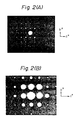
- An electron diffraction-photograph used for analysis of the crystal structure of V-Fe-B compound is shown in Figs. 2(A) and (B). For identification of crystal structure, it is now compared with those of already known compounds.
- V3B2 is the most probable. Presumably, a part of V of this compound is replaced with Fe. Elements other than the above mentioned can be dissolved in solid solution of that compound. Depending upon the composition, additive elements, and impurities of sintered bodies, V of that compound can be replaced with various elements having similar property to V. B of that compound can be replaced with C which has a similar property to B. Even in these cases, improved coercive force (iHc) is obtained, as long as in the sintered body is present the phase (possibly, (V 1-x Fe x )3B2 phase) of binary V-B compound, part of which V is replaced with Fe and is occasionally additionally replaced with Co and the M elements described hereinbelow.
- iHc improved coercive force
- the B rich phase which is contained in the most of the conventional Nd-Fe-B magnets, is gradually lessened and finally becomes zero with the increase in the formation amount of V-Fe-B compound phase.
- the B rich phase which contains approximately 11 at% of Nd
- V-Fe-B compound in which virtually no Nd is dissolved as solid solution
- remainder of Nd constitutes the Nd rich phase, which is essential for the liquid-phase sintering, with the result that Nd is effectively used for improving the magnetic properties.
- the Nd-Fe-B magnet according to the present invention which is essentially free of the B rich phase, exhibits a higher coercive force (iHc) than the conventional Nd-Fe-B magnet having the same composition as the former magnet and containing B more than the stoichiometric composition of R2Fe14B.
- Nd-Fe-B magnet The properties of Nd-Fe-B magnet are better in the case where the V-Fe-B compound phase is dispersed mainly in the grain boundaries, than the case where the V-Fe-B compound phase is dispersed mainly within the grains. Ideally, almost all of the crystal grains of R2Fe14B compound-phase are in contact at their boundaries with a few or more of the particles of V-Fe-B compound phase.
- V-T-B compound phase According to the method of the present invention, particles of the V-T-B compound phase are dispersed uniformly and finely during the liquid-phase sintering.
- the V-T-B compound phase dispersed as mentioned above exerts a strong influence upon the distribution, amount and presence (absence) of the various minority phases contained in the sintered body.
- the Nd-Fe-B magnet having the characterizing structure is obtained.
- the V-Fe-B compound phase must be an inter-metallic compound, in which an approximate integer ratio is established in the atom numbers of V+Fe to B.
- the V-Fe-B compound which is present during sintering according to the present invention, may be such borides as V3B2, V5B6, V3B4, V2B3, VB2 or the like, in which preferably 5 at% or more of V is replaced with Fe.
- the atom ratio between V+B and B occasionally deviates from the strict integer ratio.
- the resultant mixture as a whole does not provide integer ratio.
- Even such V-Fe-B compound(s) may be used in the present invention, provided that the constitutional atoms of the respective compound(s) have approximate integer ratio.
- the particles of V-Fe-B compound used as an additive before sintering must be fine. If such particles are considerably coarser than the main phase particles, then the former particles do not disperse well in the latter particles, with the result that reactions of V-Fe-B compound-phase with the other phases become unsatisfactory and hence its influence upon the various minority phases is weakened.
- the particles of V-Fe-B compound must therefore be as fine as, or finer, than the main-phase particles. It is also important that the particles of V-Fe-B compound are satisfactorily uniformly dispersed in the powder as a whole. The grain boundaries are improved at the most, when the particles of V-Fe-B compound are dispersed in such a manner that at least one of these particles is brought into contact with every one of the sintered particles of the main phase.
- V-Fe-B compound-particles must be such that V is contained for 2 to 6 at% in the sintered body. If the amount is less than 2 at%, it is impossible to realize an effect that V-Fe-B phase satisfactorily replaces the RFe4B4 phase. On the other hand, if the amount is more than 6 at%, the residual magnetization is lessened and detrimental Nd2Fe17 phase, which impairs the magnetic properties, is formed.
- V-Fe-B compound is uniformly and finely dispersed. Since the V-Fe-B compound is harder and hence more difficult to pulverize than the R2Fe14B compound-phase, V-Fe-B compound is not satisfactorily refined even when the R2Fe14B is pulverized to fine particles of predetermined size. Longer pulverizing time is therefore necessary for obtaining the V-Fe-B compound particles than that for obtaining the R2Fe14B particles.
- the powder, in which the respective phases reach a predetermined average size, is mixed for a satisfactorily long time, so as to attain uniform dispersion of the respective phases.
- the pulverizing time is varied depending upon the hardness, so that the respective phases are size-reduced to a predetermined average grain-diameter.
- the resultant powder is then uniformly mixed satisfactorily to obtain the starting powder of sintering according to the present invention.
- composite particles may be obtained, in which the particles of V-Fe-B and R2Fe14B are not separated from but adhere to each other. Such composite particles may also be used as the starting material of sintering according to the present invention.
- Possible alloy or combinations of alloys used in the present invention are for example as follows.
- the constitutional phases are, depending upon the composition, three of R2Fe14B, R2Fe17, Fe and Fe2B.
- the constitutional phases of the R-rich alloy above are R2Fe14B, R-rich phase and R1Fe4B4.
- the phases, whose pulverizing easinesses is different from one another, are pulverized simultaneously by means of an attritor or the like, the resultant powder has a broad distribution of the grain size and the magnetic properties are poor.
- the constitutional phases of cast alloys according to (4) and (5) are particles of the R2Fe14B, R rich and V-Fe-B phases having a size of several hundreds ⁇ m.
- the pulverizing time is therefore automatically adjusted in accordance with the hardness and toughness of the respective phases.
- the powder of respective phases which is suitable for the present invention, is therefore prepared even from the alloys according to (4) and (5) having the mixed phases. Due to the difference in the pulverizing property of the respective phases, the respective phases tend to separate from each other and are collected separately.
- the powder of alloys according to (4) and (5), as they are pulverized by a jet mill, is therefore undesirable, because a sintered Nd-Fe-B magnet produced by using such powder contains a significant amount of the B rich phase remained.
- the crystal grains of V-Fe-B compound-phase in the alloy-ingots of (4) and (5) are desirably fine. That is, since the particles of V-Fe-B compound is difficult to pulverize, it is desirable that the fine particles are already formed in an ingot.
- the alloy melt is therefore desirably rapidly cooled during solidification by means of using a small ingot or a water-cooled mold at casting of alloy after melting. It is then possible to disperse the V-Fe-B compound-particles in the powder of R2Fe14B compound-phase having grain-diameter of 1 - 5 ⁇ m in average.
- the average grain-diameter of R2Fe14B compound-particles is less than 1 ⁇ m, chemical activity is so high as to render their handling difficult.
- the average grain diameter is more than 5 ⁇ m, a high coercive force is difficult to obtain after sintering.
- a Fisher sub-sieve sizer was used for measuring average grain diameter of powder. It is necessary for obtaining high coercive force that the R rich phase is uniformly dispersed in the powder.
- the sintering must be liquid-phase sintering in order to obtain the effect for repairing the R2Fe14B compound-phase by R-rich liquid phase.
- the known sintering temperature, time and atmosphere may be used in the present invention.
- Heat treatment is carried out at a temperature of from 600 to 800 °C after sintering. This treatment causes an appreciable change in the crystal grain-boundaries and hence enhancement of coercive force (iHc) at room temperature by 7-11 kOe, and at 140 °C by 2-5 kOe.
- iHc coercive force
- the above described inventive method is carried out irrespective of the composition of Nd-Fe-B magnet, as long as the excess B more than the stoichiometric composition of R2Fe14B compound is present in the Nd-Fe-B magnet.
- the R content is desirably 10 at% or more in the final alloy composition, in the light of liquid-phase sintering.
- the B content of 6 at% or more is necessary for obtaining a high coercive force.
- the coercive force (iHc) obtained by the present invention is enough for using the inventive magnet for various appliances at a high temperature
- the coercive force (iHc) of permanent magnet according to the present invention is hereinafter described.
- the coercive force (iHc) of Nd-Fe-B magnet according to claim 1 is 15 kOe or more. Since the coercive force (iHc) is enhanced by 3 kOe by addition of 1 at% of Dy, the coercive force (iHc) is ⁇ 15 + 3x (kOe) (x is Dy content by atomic %) in Nd-Fe-B magnet, in which Dy is added. However, since the applied maximum magnetic field of an electromagnet used in the experiments for measuring the demagnetizing curves until the completion of the present invention was 21 kOe, actual values could not be measured, when the coercive force (iHc) exceeded 21 kOe. Therefore, when the coercive force (iHc) calculated following the above formula exceeds 21 kOe, the inventive coercive force (iHc) is set at least 21 kOe or more.
- Aluminum which may be added to the Nd-Pr-(Dy)-Fe-B magnet having the composition according to the present invention, furthermore enhances the coercive force (iHc), presumably because aluminum in a small amount promotes fine dispersion of the V-T-B compound phases.
- the coercive force (iHc) at room temperature must be 17.8 kOe or more.
- This value of coercive force (iHc) is fulfilled by a compositional range according to claim 1 except for vicinities of the upper and lower limits, provided that aluminum is added to claim 1's composition.
- the temperature coefficient of coercive force (iHc) is 0.7 %/°C or more, 5 kOe or more of the coercive force (iHc) is obtained at 140 °C by a composition with Dy addition.
- the coercive force (iHc) at 200 °C amounting to 5 kOe or more is obtained by a composition containing 3 to approximately 5.5 at% of V, 13 at % or more of R, more than 1 at% of Dy and aluminum addition.
- Nd and Pr are mainly used for the rare-earth elements (R), because both Nd2Fe14B and Pr2Fe14B have higher saturation magnetization and higher uniaxial crystal- and magnetic-anisotropies together than the R2Fe14B compound-phase of the other rare-earth elements
- Nd+Pr/R is ⁇ 80 at%, because high saturation magnetization and high coercive force (iHc) are obtained by setting high contents of Nd and Pr except for Dy.
- Dy enhances coercive force (iHc) at 140 °C and 200 °C by approximately 2 kOe/% and 1 kOe/%, respectively.
- the content of Dy is 4 at% or less, because Dy is a rare resource and further the residual magnetization considerably lowers at more than 4 at%.
- rare-earth elements not only highly refined rare-earth elements but also mixed raw-materials, such as dydimium, in which Nd and Pr remain unseparated, and Ce-dydimium, in which Ce remains unseparated, can be used as the raw material for rare-earth elements.
- Co which may partly replace Fe, enhances the Curie point and improves the temperature-coefficient of residual magnetization. If, however, Co amounts to 25 at% or more of the total of Co and Fe, the coercive force (iHc) is lessened due to the minority phase described hereinafter. The amount of Co must therefore be 25 at% or less of the total of Co and Fe.
- Nd2Fe14B compound and V-Fe-B compound are changed to R2(FeCo)14B compound and V-(FeCo)-B compound, respectively.
- (Co ⁇ Fe)-Nd phase generates as a new minority phase, which lowers the coercive force (iHc).
- the present inventor added various elements to the above described Nd-Fe-B magnet and investigated influences of the additive elements on the coercive force (iHc). It turned out as a result that the coercive force (iHc) is slightly improved or is virtually not improved, but not incurring the decrease.
- M1 enhances the coercive force (iHc), as V does but not outstandingly as V does.
- M2 and M3 have slight effect for enhancing the coercive force (iHc).
- M2 and M3 may be incorporated in the refining process of rare-earth elements and Fe. It is advantageous therefore from the cost of raw materials when the addition of M1 , M2 and M3 may be permitted.
- Transition elements among the above elements replace for a part of T of V-T-B compound.
- the addition amount of M1, M2 and M3 exceeds the upper limits, the Curie point and residual magnetization are lowered.
- ferroboron which is frequently used as the raw material of boron, contains aluminum.
- Aluminum also dissolves from a crucible. Aluminum is therefore contained in 0.4 wt% (0.8 at%) at the maximum in the Nd-Fe-B magnet, even if aluminum is not added as an alloy element.
- Nd-Fe-B magnet there are other elements which are reported to add to Nd-Fe-B magnet.
- Ga is alleged to enhance the coercive force (iHc), when it is added together with cobalt. Ga can also be added in the Nd-Fe-B magnet of the present invention.
- Cu in an amount less than 0.01 % is also an impurity. Oxygen is incorporated in the Nd-Fe-B sintered magnet during the alloy-pulverizing step, the post-pulverizing, pressing step, and the sintering step.
- a large amount of Ca is incorporated in the Nd-Fe-B magnet as a residue of the leaching step (rinsing step for separating CaO) of the co-reducing method for directly obtaining the alloy powder of Nd-Fe-B alloy by reduction with the use of Ca.
- Oxygen is incorporated in the Nd-Fe-B magnet in an amount of 10000 ppm (weight ratio) at the maximum. Such oxygen improves neither magnetic properties nor the other properties.
- Nd-Fe-B magnet Into the Nd-Fe-B magnet are incorporated carbon from the raw materials of for rare-earth and Fe-B, as well as carbon, phosphorus and sulfur from the lubricant used in the pressing step. Under the present technique, carbon is incorporated in the Nd-Fe-B magnet in an amount of 5000 ppm (weight ratio) at the maximum. Also, this carbon improves neither the magnetic properties nor the other properties.
- a high coercive force is obtained by means of heat treating the above inventive Nd-Fe-B magnet in the temperature range of from 500 to 1000 °C, as follows.
- the range of heat treatment indicates the temperature range, in which the coercive force (iHc) lower than the maximum coercive force (iHc) by 1 kOe is obtained. If not specified, aluminum is contained as an impurity.
- the B rich phase which has the lowest corrosion resistance
- V forms with B a very stable compound and suppresses the formation of Nd1Fe4B4.
- the corrosion resistance of V-T-B compound is higher than the B rich phase and even higher than both the main phase and Nd-rich phase.
- the corrosion resistance of Nd-Fe-B magnet according to the present invention is twice as high as the conventional one, when evaluated in terms of weight increase by oxidation under a high-temperature and high-humidity condition of 80 °C and 80 % of RH (Relative Humidity) (test for 120 hours). That is, the weight increase of the inventive magnet is half of the conventional magnet. Since the corrosion resistance is improved as described above, it appears that problems of rust, which occur heretofore when magnets are used in appliances, can be drastically lessened.
- the coercive force (iHc) is 15 kOe or more. This value is higher than 12 kOe of the coercive force (iHc) of the heat-treated standard composition by 3 kOe. In addition, as is described in the examples hereinbelow, 18 kOe of the coercive force (iHc) is obtained.
- the enhancement of coercive force (iHc) by the same comparison is 6 kOe and hence is extremely high.
- the powder of main phase in which the R2Fe14B compound-phase particles have an average diameter of 1 to 5 ⁇ m, is liquid-phase sintered, until the average diameter falls within a range of 5 to 15 ⁇ m.
- Fig. 4 graphically illustrates dependence of the coercive force (iHc) and average particle-diameter of R2Fe14B compound-phase upon the sintering temperature, with regard to the inventive composition of Example 4, in which 6 wt% of V-Fe-B compound is added, and comparative composition without the addition.
- the sintering time is 4 hours.
- the coercive force (iHc) is 13 kOe or less in the comparative case but is more than 15 kOe and hence high in the inventive case.
- sintering is carried out at T2 and the sintering temperature is suppressed by 10 °C in terms of the temperature ( ⁇ T), given below.
- ⁇ T is T2 - T1.
- T1 is sintering temperature, at which the average grain-diameter (d1) is obtained under the absence of V-T-B compound.
- Table 2 Average Grain-Diameter of Sintered Body (d1, d2, ⁇ m) Suppressing Effects of Grain Growth ( ⁇ T,°C) Sintering Temperature (T2, °C) 6 40 1060 7 45 1090 8 50 1130 9 53 1140 10 52 1145 12 50 1160
- the coercive force is closely related with the micro structure of the grain boundaries.
- the V-Fe-B compound functions in the inventive magnet to modify the grain boundaries.
- Nd-Fe-Mo-B or Nd-Fe-Cr-B is used instead of V-Fe-B, improvement is not attained at all.
- a function of V-Fe-B compound other than the suppression of grain growth is important.
- the inventive magnet is fundamentally different from the conventional sintered Nd-Fe-B series magnet in the nature and morphology of minority phases, that is, RFe4B4 phase is present in the latter magnet but is essentially not present in the former magnet.
- V-Fe-B compound phase is more appropriate as the phase around the R2Fe14B compound-phase (main phase) than the RFe4B4 phase for obtaining a high coercive force. Because of addition of V, the grain boudaries are presumably modified such that nuclei for inversion of the magnetization are difficult to generate.
- the maximum energy product of Nd-Fe-B magnet according the present invention is 20MGOe or more. This value is the minimum one required for rare-earth magnets having a high-performance. Under this value, the rare-earth magnets cannot compete with the other magnets.
- Alloys were melted in a high-frequency induction furnace and cast in an iron mold.
- the starting materials the following materials were used: for Fe an electrolytic iron having purity of 99.9 wt%; for B a ferro-boron alloy and boron having purity of 99 wt%; Pr having purity of 99 wt%; Dy having purity of 99 wt%; for V a ferrovanadium containing 50wt% of V; and, Al having purity of 99.9 wt%. Melt was stirred thoroughly during melting and casting so as to provide uniform amount of V in the melt.
- the thickness of ingots was made 10 mm or less and thin, and cooling was carried out quickly, so as to finely disperse the V-Fe-B compound phase in the ingots.
- the resultant ingots were pulverized by a stamp mill to 35 mesh. A fine pulverizing was then carried out by a jet mill with the use of nitrogen gas. As a result, the powder having grain diameter of 2.5 - 3.5 ⁇ m was obtained. This powder was shaped under the pressure of 1.5 kg/cm2 and in the magnetic field of 10 kOe.
- the powder was thoroughly stirred so as to uniformly and finely disperse the V-Fe-B compound in the sintered body.
- the green compact obtained by the pressing under magnetic field was then sintered at 1050 to 1120 °C for 1 to 5 hours in argon atmosphere.
- the sintered body was heat-treated at 800 °C for 1 hour, followed by rapid cooling by blowing argon gas. Heat treatment was subsequently carried out at 600 - 700 °C for 1 hour, followed by rapid cooling by blowing argon gas.
- compositions and magnetic properties of samples are shown in Table 3.
- the V-T-B phase is 90 % relative to the total of V-T-B phase and B rich phase.
- V-addition amount exceeds 3 at%, V-T-B phase is nearly 100 %.
- fine RFe4B4 phase is partly seen due to compositional non-uniformity and the like.
- the average value (area percentage) of EPMA was converted to volume, which is the percentage of phase mentioned above.
- Sheets 10x10x1 mm in size, consisting of Nd14Fe bal B8V x were prepared by the same method as Example 1. These sheets were heated at 80 °C in air having 90 % of RH up to 120 hours, and the weight increase by oxidation was measured. The results are shown in Fig. 5. It is apparent from Fig. 5 that the corrosion resistance is considerably improved by the addition of V.
- composition is Nd16Fe72V4B8 or (Nd 0.9 Dy 0.1 )16Fe72V4B8.
- a : Nd10Fe86B4, B: Nd30Fe66B4, and C: (V 0.6 Fe 0.4 )3B2 were melted in a high-frequency induction furnace, and ingots were formed.
- the ingots were pulverized by a jaw crusher and a disc mill to obtain powder through 35 mesh.
- a and B were then pulverized by a ball mill to an average particle diameter of 3 ⁇ m.
- C was pulverized by a ball mill to an average particle diameter of 1 ⁇ m.
- the powder A consisted of particles of Nd2Fe14B, Fe2B, and ⁇ -Fe.
- the powder B consisted of particles of Nd2Fe14B, Nd2Fe17, and Nd-rich phase.
- the average particle-diameter of the sintered body was 5.9 ⁇ m.
- the B rich phase was inappreciable by measurement of the sintered body by EPMA.
- Nd18Fe77B4 and B: (V 0.6 Fe 0.4 )3B2 were pulverized by the same methods as in Example 4 to 3.7 ⁇ m and 1.5 ⁇ m, respectively.
- the powder A consisted of particles of the Nd2Fe14B, Nd rich phase and Nd2Fe17 phase
- the powder B consisted of the particles of single (V 0.6 Fe 0.4 )3B2 phase.
- a sintered magnet was produced under the same conditions as in Example 4.
- the magnetic properties were as follows.
- the residual magnetization Br 11.7 kG
- the coercive force (iHc) 17.9 kOe
- the maximum energy product (BH)max 31.7 MGOe
- the average particle-diameter of the sintered body was 6.1 ⁇ m.
- the B rich phase was inappreciable by measurement of the sintered body by EPMA.
- Nd16Fe72V4B8 alloy was pulverized by a jet mill with the use of nitrogen gas to 2.5 ⁇ m in average.
- powder consisted of particles of the respective single Nd2Fe14B, Nd rich alloy, and V-Fe-B phases.
- the dispersion state of particles of V-Fe-B compound were however not uniform.
- the crushing by a rocking mixer was carried out for 2 hours.
- a sintered magnet was produced under the same conditions as in Example 4.
- the magnetic properties were as follows.
- the residual magnetization Br 11.6 kG
- the coercive force (iHc) 17.3 kOe
- BH)max 31.7 MGOe
- the average particle-diameter of the sintered body was 6.8 ⁇ m.
- the B rich phase was inappreciable by measurement of the sintered body by EPMA.
- Nd16Fe80B4 and B: Nd16Fe70V5B9 were pulverized by a jet mill and a ball mill to 2.8 ⁇ m and 1.9 ⁇ m, respectively.
- the powder A consisted of particles of the Nd2Fe14B, Nd rich phase and Nd2Fe17 phase
- the powder B consisted of the particles of Nd2Fe14B phase, Nd rich phase, V-Fe-B compound, and Nd2Fe17 phase.
- a sintered magnet was produced under the same conditions as in Example 4.
- the magnetic properties were as follows.
- the residual magnetization Br 11.5 kG
- the coercive force (iHc) 17.6 kOe
- the maximum energy product (BH)max 31.5 MGOe
- the average particle-diameter of the sintered body was 6.3 ⁇ m.
- the B rich phase was inappreciable by measurement of the sintered body by EPMA.
- A: Nd 16.4 Dy 1.8 Fe 79.5 B 2.3 and B: V33Fe22B45 were pulverized by a jet mill and a ball mill to 2.6 ⁇ m and 1.5 ⁇ m, respectively.
- the powder A consisted of particles of the R2Fe14B, R rich phase and R2Fe17 phase
- the powder B consisted of the particles of (V 0.6 Fe 0.4 )3B2 and (V 0.6 Fe 0.4 )B phases.
- a sintered magnet was produced under the same conditions as in Example 3.
- the magnetic properties were as follows.
- the residual magnetization Br 11.0 kG
- the coercive force (iHc) 21 kOe or more
- the maximum energy product (BH)max 28.5 MGOe
- the average particle-diameter of the sintered body was 6.0 ⁇ m.
- the B rich phase was inappreciable by measurement of the sintered body by EPMA.
- Example 5 The same methods as in Example 5 were carried out except that the mixing by a rocking mixer was omitted.
- the magnetic properties were as follows.
- the residual magnetization Br 11.5 kG
- the coercive force (iHc) 12.8 kOe
- the maximum energy product (BH)max 30.7 MGOe
Landscapes
- Chemical & Material Sciences (AREA)
- Crystallography & Structural Chemistry (AREA)
- Inorganic Chemistry (AREA)
- Engineering & Computer Science (AREA)
- Power Engineering (AREA)
- Hard Magnetic Materials (AREA)
- Permanent Field Magnets Of Synchronous Machinery (AREA)
- Soft Magnetic Materials (AREA)
- Manufacturing Cores, Coils, And Magnets (AREA)
- Organic Low-Molecular-Weight Compounds And Preparation Thereof (AREA)
- Diaphragms For Electromechanical Transducers (AREA)
Applications Claiming Priority (8)
| Application Number | Priority Date | Filing Date | Title |
|---|---|---|---|
| JP135419/88 | 1988-06-03 | ||
| JP13541988 | 1988-06-03 | ||
| JP175087/88 | 1988-07-15 | ||
| JP17508788 | 1988-07-15 | ||
| JP250850/88 | 1988-10-06 | ||
| JP63250850A JPH02119105A (ja) | 1988-06-03 | 1988-10-06 | Nd−Fe−B系焼結磁石 |
| JP63326225A JP2704745B2 (ja) | 1988-07-15 | 1988-12-26 | 永久磁石の製造方法 |
| JP326225/88 | 1988-12-26 |
Publications (3)
| Publication Number | Publication Date |
|---|---|
| EP0344542A2 true EP0344542A2 (de) | 1989-12-06 |
| EP0344542A3 EP0344542A3 (de) | 1991-07-17 |
| EP0344542B1 EP0344542B1 (de) | 1994-08-03 |
Family
ID=27471916
Family Applications (1)
| Application Number | Title | Priority Date | Filing Date |
|---|---|---|---|
| EP89109037A Expired - Lifetime EP0344542B1 (de) | 1988-06-03 | 1989-05-19 | Gesinterter Nd-Fe-B-Magnet und sein Herstellungsverfahren |
Country Status (10)
| Country | Link |
|---|---|
| US (1) | US5000800A (de) |
| EP (1) | EP0344542B1 (de) |
| AT (1) | ATE109588T1 (de) |
| DE (1) | DE68917213T2 (de) |
| ES (1) | ES2057018T3 (de) |
| FI (1) | FI102988B1 (de) |
| FR (1) | FR2632766B1 (de) |
| GB (1) | GB2219309B (de) |
| IE (1) | IE891582L (de) |
| IT (1) | IT1230181B (de) |
Cited By (11)
| Publication number | Priority date | Publication date | Assignee | Title |
|---|---|---|---|---|
| EP0499600A1 (de) * | 1991-02-11 | 1992-08-19 | BÖHLER YBBSTALWERKE G.m.b.H. | Gesinterter Permanentmagnet(-werkstoff) sowie Verfahren zu dessen Herstellung |
| US5200001A (en) * | 1989-12-01 | 1993-04-06 | Sumitomo Special Metals Co., Ltd. | Permanent magnet |
| EP0601943A1 (de) * | 1992-12-08 | 1994-06-15 | Ugimag S.A. | Se-Fe-B typ Magnetpuder, Sintermagnete daraus und Herstellungsverfahren |
| FR2707421A1 (fr) * | 1993-07-07 | 1995-01-13 | Ugimag Sa | Poudre additive pour la fabrication d'aimants frittés type Fe-Nd-B, méthode de fabrication et aimants correspondants. |
| EP0983831A3 (de) * | 1998-09-01 | 2002-09-04 | Sumitomo Special Metals Company Limited | Verfahren zum Schneiden von Seltenerdlegierungen, Verfahren zum Herstellen von Platten aus Seltenerdlegierungen und Verfahren zum Herstellen von Seltenerdlegierungsmagneten mittels Drahtsägen, und Schwingspulenmotor |
| US6527874B2 (en) | 2000-07-10 | 2003-03-04 | Sumitomo Special Metals Co., Ltd. | Rare earth magnet and method for making same |
| EP1420418A1 (de) * | 2002-11-14 | 2004-05-19 | Shin-Etsu Chemical Co., Ltd. | Gesinterter R-Fe-B Magnet |
| EP1460652A4 (de) * | 2002-09-30 | 2005-04-20 | Tdk Corp | R-t-b-seltenerd-permanentmagnet |
| WO2014101247A1 (zh) * | 2012-12-26 | 2014-07-03 | 宁波韵升股份有限公司 | 一种制备烧结钕铁硼磁体的方法 |
| CN107453568A (zh) * | 2016-05-30 | 2017-12-08 | Tdk株式会社 | 电动机 |
| TWI609368B (zh) * | 2012-08-31 | 2017-12-21 | Jx日鑛日石金屬股份有限公司 | Fe-based magnetic material sintered body |
Families Citing this family (15)
| Publication number | Priority date | Publication date | Assignee | Title |
|---|---|---|---|---|
| US5167914A (en) * | 1986-08-04 | 1992-12-01 | Sumitomo Special Metals Co., Ltd. | Rare earth magnet having excellent corrosion resistance |
| US5190684A (en) * | 1988-07-15 | 1993-03-02 | Matsushita Electric Industrial Co., Ltd. | Rare earth containing resin-bonded magnet and its production |
| US6415048B1 (en) | 1993-10-12 | 2002-07-02 | Schneider Medical Technologies, Inc. | Compositional analysis system |
| JP3233359B2 (ja) * | 2000-03-08 | 2001-11-26 | 住友特殊金属株式会社 | 希土類合金磁性粉末成形体の作製方法および希土類磁石の製造方法 |
| US7018487B2 (en) * | 2001-11-22 | 2006-03-28 | Nissan Motor Co., Ltd. | Magnet containing low rare earth element and method for manufacturing the same |
| CN1261260C (zh) * | 2001-11-28 | 2006-06-28 | 株式会社新王磁材 | 稀土类合金造粒粉的制法及稀土类合金烧结体的制法 |
| BRPI0506147B1 (pt) * | 2004-10-19 | 2020-10-13 | Shin-Etsu Chemical Co., Ltd | método para preparar um material de ímã permanente de terra rara |
| US20110074530A1 (en) * | 2009-09-30 | 2011-03-31 | General Electric Company | Mixed rare-earth permanent magnet and method of fabrication |
| KR20140067689A (ko) * | 2012-11-27 | 2014-06-05 | 삼성전기주식회사 | 무접점 전력 전송 장치 및 그 제조 방법 |
| WO2014205002A2 (en) | 2013-06-17 | 2014-12-24 | Miha Zakotnik | Magnet recycling to create nd-fe-b magnets with improved or restored magnetic performance |
| US9336932B1 (en) | 2014-08-15 | 2016-05-10 | Urban Mining Company | Grain boundary engineering |
| WO2016086398A1 (zh) * | 2014-12-04 | 2016-06-09 | 浙江大学 | 一种高矫顽力烧结钕铁硼的制备方法及产品 |
| CN105761925A (zh) * | 2016-04-18 | 2016-07-13 | 中钢集团安徽天源科技股份有限公司 | 一种钬铁镓共晶掺杂制备高性能钕铁硼磁体的方法 |
| CN110875110A (zh) * | 2018-08-29 | 2020-03-10 | 射洪福临磁材有限公司 | 含vn粒子的钕铁硼磁性材料及其制备方法 |
| CN113223801B (zh) * | 2021-05-21 | 2024-08-30 | 慈溪市兴发磁业科技有限公司 | 一种高硼钕铁硼永磁体及其制备方法 |
Family Cites Families (16)
| Publication number | Priority date | Publication date | Assignee | Title |
|---|---|---|---|---|
| CA1316375C (en) * | 1982-08-21 | 1993-04-20 | Masato Sagawa | Magnetic materials and permanent magnets |
| US4792368A (en) * | 1982-08-21 | 1988-12-20 | Sumitomo Special Metals Co., Ltd. | Magnetic materials and permanent magnets |
| DE3379084D1 (en) * | 1982-09-27 | 1989-03-02 | Sumitomo Spec Metals | Permanently magnetizable alloys, magnetic materials and permanent magnets comprising febr or (fe,co)br (r=vave earth) |
| CA1280013C (en) * | 1983-05-06 | 1991-02-12 | Setsuo Fujimura | Isotropic magnets and process for producing same |
| US4684406A (en) * | 1983-05-21 | 1987-08-04 | Sumitomo Special Metals Co., Ltd. | Permanent magnet materials |
| US4601875A (en) * | 1983-05-25 | 1986-07-22 | Sumitomo Special Metals Co., Ltd. | Process for producing magnetic materials |
| JPS6032306A (ja) * | 1983-08-02 | 1985-02-19 | Sumitomo Special Metals Co Ltd | 永久磁石 |
| JPS6034005A (ja) * | 1983-08-04 | 1985-02-21 | Sumitomo Special Metals Co Ltd | 永久磁石 |
| JPS6077960A (ja) * | 1983-10-03 | 1985-05-02 | Sumitomo Special Metals Co Ltd | 永久磁石材料の製造方法 |
| EP0153744B1 (de) * | 1984-02-28 | 1990-01-03 | Sumitomo Special Metals Co., Ltd. | Verfahren zur Herstellung von permanenten Magneten |
| JPH068488B2 (ja) * | 1985-06-21 | 1994-02-02 | 住友特殊金属株式会社 | 永久磁石合金 |
| JPS6274054A (ja) * | 1985-09-27 | 1987-04-04 | Hitachi Metals Ltd | 永久磁石合金 |
| JPH07105289B2 (ja) * | 1986-03-06 | 1995-11-13 | 信越化学工業株式会社 | 希土類永久磁石の製造方法 |
| DE3783975T2 (de) * | 1986-07-23 | 1993-05-27 | Hitachi Metals Ltd | Dauermagnet mit guter thermischer stabilitaet. |
| JPS6362842A (ja) * | 1986-09-04 | 1988-03-19 | Tdk Corp | 希土類永久磁石材料 |
| EP0261579B1 (de) * | 1986-09-16 | 1993-01-07 | Tokin Corporation | Verfahren zur Herstellung eines Seltenerd-Eisen-Bor-Dauermagneten mit Hilfe eines abgeschreckten Legierungspuders |
-
1989
- 1989-03-09 US US07/321,183 patent/US5000800A/en not_active Expired - Lifetime
- 1989-03-13 GB GB8905754A patent/GB2219309B/en not_active Expired - Lifetime
- 1989-03-22 IT IT8919862A patent/IT1230181B/it active
- 1989-05-16 IE IE891582A patent/IE891582L/xx unknown
- 1989-05-19 DE DE68917213T patent/DE68917213T2/de not_active Expired - Fee Related
- 1989-05-19 AT AT89109037T patent/ATE109588T1/de active
- 1989-05-19 ES ES89109037T patent/ES2057018T3/es not_active Expired - Lifetime
- 1989-05-19 EP EP89109037A patent/EP0344542B1/de not_active Expired - Lifetime
- 1989-05-23 FR FR8906710A patent/FR2632766B1/fr not_active Expired - Fee Related
- 1989-06-02 FI FI892716A patent/FI102988B1/fi not_active IP Right Cessation
Cited By (14)
| Publication number | Priority date | Publication date | Assignee | Title |
|---|---|---|---|---|
| US5200001A (en) * | 1989-12-01 | 1993-04-06 | Sumitomo Special Metals Co., Ltd. | Permanent magnet |
| EP0499600A1 (de) * | 1991-02-11 | 1992-08-19 | BÖHLER YBBSTALWERKE G.m.b.H. | Gesinterter Permanentmagnet(-werkstoff) sowie Verfahren zu dessen Herstellung |
| EP0601943A1 (de) * | 1992-12-08 | 1994-06-15 | Ugimag S.A. | Se-Fe-B typ Magnetpuder, Sintermagnete daraus und Herstellungsverfahren |
| FR2707421A1 (fr) * | 1993-07-07 | 1995-01-13 | Ugimag Sa | Poudre additive pour la fabrication d'aimants frittés type Fe-Nd-B, méthode de fabrication et aimants correspondants. |
| EP0983831A3 (de) * | 1998-09-01 | 2002-09-04 | Sumitomo Special Metals Company Limited | Verfahren zum Schneiden von Seltenerdlegierungen, Verfahren zum Herstellen von Platten aus Seltenerdlegierungen und Verfahren zum Herstellen von Seltenerdlegierungsmagneten mittels Drahtsägen, und Schwingspulenmotor |
| US6505394B2 (en) | 1998-09-01 | 2003-01-14 | Sumitomo Special Metals Co., Ltd. | Method for cutting rare earth alloy, method for manufacturing rare earth alloy plates and method for manufacturing rare earth alloy magnets using wire saw, and voice coil motor |
| US6527874B2 (en) | 2000-07-10 | 2003-03-04 | Sumitomo Special Metals Co., Ltd. | Rare earth magnet and method for making same |
| EP1460652A4 (de) * | 2002-09-30 | 2005-04-20 | Tdk Corp | R-t-b-seltenerd-permanentmagnet |
| US7311788B2 (en) | 2002-09-30 | 2007-12-25 | Tdk Corporation | R-T-B system rare earth permanent magnet |
| EP1420418A1 (de) * | 2002-11-14 | 2004-05-19 | Shin-Etsu Chemical Co., Ltd. | Gesinterter R-Fe-B Magnet |
| US7090730B2 (en) | 2002-11-14 | 2006-08-15 | Shin-Etsu Chemical Co., Ltd. | R-Fe-B sintered magnet |
| TWI609368B (zh) * | 2012-08-31 | 2017-12-21 | Jx日鑛日石金屬股份有限公司 | Fe-based magnetic material sintered body |
| WO2014101247A1 (zh) * | 2012-12-26 | 2014-07-03 | 宁波韵升股份有限公司 | 一种制备烧结钕铁硼磁体的方法 |
| CN107453568A (zh) * | 2016-05-30 | 2017-12-08 | Tdk株式会社 | 电动机 |
Also Published As
| Publication number | Publication date |
|---|---|
| EP0344542B1 (de) | 1994-08-03 |
| IT8919862A0 (it) | 1989-03-22 |
| ES2057018T3 (es) | 1994-10-16 |
| FR2632766B1 (fr) | 1995-04-21 |
| IT1230181B (it) | 1991-10-18 |
| FI102988B (fi) | 1999-03-31 |
| GB2219309B (en) | 1992-11-18 |
| DE68917213D1 (de) | 1994-09-08 |
| IE891582L (en) | 1989-12-03 |
| DE68917213T2 (de) | 1995-03-23 |
| FI892716L (fi) | 1989-12-04 |
| FI102988B1 (fi) | 1999-03-31 |
| ATE109588T1 (de) | 1994-08-15 |
| GB2219309A (en) | 1989-12-06 |
| EP0344542A3 (de) | 1991-07-17 |
| GB8905754D0 (en) | 1989-04-26 |
| US5000800A (en) | 1991-03-19 |
| FI892716A0 (fi) | 1989-06-02 |
| FR2632766A1 (fr) | 1989-12-15 |
Similar Documents
| Publication | Publication Date | Title |
|---|---|---|
| EP0344542B1 (de) | Gesinterter Nd-Fe-B-Magnet und sein Herstellungsverfahren | |
| US5011552A (en) | Method for producing a rare earth metal-iron-boron permanent magnet by use of a rapidly-quenched alloy powder | |
| EP1884574B1 (de) | R-T-B-System-Seltenerd-Dauermagnet | |
| EP0801402B1 (de) | Gusslegierung für die Herstellung von Dauermagneten mit seltenen Erden und Verfahren zur Herstellung dieser Legierung und dieser Dauermagneten | |
| US5565043A (en) | Rare earth cast alloy permanent magnets and methods of preparation | |
| JP2751109B2 (ja) | 熱安定性の良好な焼結型永久磁石 | |
| EP0177371B1 (de) | Verfahren zur Herstellung eines Permanentmagneten | |
| JPH0531807B2 (de) | ||
| EP0430278B1 (de) | Seltenerd-Eisen-Bor-Dauermagnet | |
| JPH06275414A (ja) | Nd−Fe−B系永久磁石 | |
| EP0302947B1 (de) | Seltene-erden-eisen-typ-dauermagnet und sein herstellungsverfahren | |
| EP0237416A1 (de) | Permanentmagnet auf Basis seltener Erden | |
| US5213631A (en) | Rare earth-iron system permanent magnet and process for producing the same | |
| JP2787580B2 (ja) | 熱処理性がすぐれたNd−Fe−B系焼結磁石 | |
| JPH07122413A (ja) | 希土類永久磁石およびその製造方法 | |
| JPH10289813A (ja) | 希土類磁石 | |
| JP2001217112A (ja) | R−t−b系焼結磁石 | |
| EP0288637B1 (de) | Dauermagnet und sein Herstellungsverfahren | |
| JPH06124812A (ja) | 窒化物磁性粉とその合成方法 | |
| US12592330B2 (en) | R-T-B based permanent magnet | |
| JP2704745B2 (ja) | 永久磁石の製造方法 | |
| JP3053344B2 (ja) | 希土類磁石の製造方法 | |
| JPH06112019A (ja) | 窒化物磁性材料 | |
| JPH02119105A (ja) | Nd−Fe−B系焼結磁石 | |
| JPH06283318A (ja) | 希土類永久磁石の製造方法 |
Legal Events
| Date | Code | Title | Description |
|---|---|---|---|
| PUAI | Public reference made under article 153(3) epc to a published international application that has entered the european phase |
Free format text: ORIGINAL CODE: 0009012 |
|
| 17P | Request for examination filed |
Effective date: 19890519 |
|
| AK | Designated contracting states |
Kind code of ref document: A2 Designated state(s): AT CH DE ES LI NL SE |
|
| PUAL | Search report despatched |
Free format text: ORIGINAL CODE: 0009013 |
|
| AK | Designated contracting states |
Kind code of ref document: A3 Designated state(s): AT CH DE ES LI NL SE |
|
| 17Q | First examination report despatched |
Effective date: 19930428 |
|
| GRAA | (expected) grant |
Free format text: ORIGINAL CODE: 0009210 |
|
| AK | Designated contracting states |
Kind code of ref document: B1 Designated state(s): AT CH DE ES LI NL SE |
|
| PG25 | Lapsed in a contracting state [announced via postgrant information from national office to epo] |
Ref country code: AT Effective date: 19940803 |
|
| REF | Corresponds to: |
Ref document number: 109588 Country of ref document: AT Date of ref document: 19940815 Kind code of ref document: T |
|
| REF | Corresponds to: |
Ref document number: 68917213 Country of ref document: DE Date of ref document: 19940908 |
|
| REG | Reference to a national code |
Ref country code: ES Ref legal event code: FG2A Ref document number: 2057018 Country of ref document: ES Kind code of ref document: T3 |
|
| EAL | Se: european patent in force in sweden |
Ref document number: 89109037.5 |
|
| PG25 | Lapsed in a contracting state [announced via postgrant information from national office to epo] |
Ref country code: SE Effective date: 19950520 Ref country code: ES Free format text: LAPSE BECAUSE OF NON-PAYMENT OF DUE FEES Effective date: 19950520 |
|
| PLBE | No opposition filed within time limit |
Free format text: ORIGINAL CODE: 0009261 |
|
| STAA | Information on the status of an ep patent application or granted ep patent |
Free format text: STATUS: NO OPPOSITION FILED WITHIN TIME LIMIT |
|
| 26N | No opposition filed | ||
| PG25 | Lapsed in a contracting state [announced via postgrant information from national office to epo] |
Ref country code: NL Effective date: 19951201 |
|
| NLV4 | Nl: lapsed or anulled due to non-payment of the annual fee |
Effective date: 19951201 |
|
| EUG | Se: european patent has lapsed |
Ref document number: 89109037.5 |
|
| REG | Reference to a national code |
Ref country code: ES Ref legal event code: FD2A Effective date: 19990503 |
|
| PGFP | Annual fee paid to national office [announced via postgrant information from national office to epo] |
Ref country code: DE Payment date: 20060526 Year of fee payment: 18 |
|
| PGFP | Annual fee paid to national office [announced via postgrant information from national office to epo] |
Ref country code: CH Payment date: 20060530 Year of fee payment: 18 |
|
| REG | Reference to a national code |
Ref country code: CH Ref legal event code: PL |
|
| PG25 | Lapsed in a contracting state [announced via postgrant information from national office to epo] |
Ref country code: CH Free format text: LAPSE BECAUSE OF NON-PAYMENT OF DUE FEES Effective date: 20070531 Ref country code: LI Free format text: LAPSE BECAUSE OF NON-PAYMENT OF DUE FEES Effective date: 20070531 |
|
| PG25 | Lapsed in a contracting state [announced via postgrant information from national office to epo] |
Ref country code: DE Free format text: LAPSE BECAUSE OF NON-PAYMENT OF DUE FEES Effective date: 20071201 |