EP0341202B1 - Transdermale Monolithsysteme - Google Patents
Transdermale Monolithsysteme Download PDFInfo
- Publication number
- EP0341202B1 EP0341202B1 EP89810285A EP89810285A EP0341202B1 EP 0341202 B1 EP0341202 B1 EP 0341202B1 EP 89810285 A EP89810285 A EP 89810285A EP 89810285 A EP89810285 A EP 89810285A EP 0341202 B1 EP0341202 B1 EP 0341202B1
- Authority
- EP
- European Patent Office
- Prior art keywords
- adhesive layer
- methyl
- weight
- pyrrolidone
- transdermal therapeutic
- Prior art date
- Legal status (The legal status is an assumption and is not a legal conclusion. Google has not performed a legal analysis and makes no representation as to the accuracy of the status listed.)
- Expired - Lifetime
Links
- 239000010410 layer Substances 0.000 claims abstract description 61
- WEEGYLXZBRQIMU-UHFFFAOYSA-N 1,8-cineole Natural products C1CC2CCC1(C)OC2(C)C WEEGYLXZBRQIMU-UHFFFAOYSA-N 0.000 claims abstract description 40
- 230000001225 therapeutic effect Effects 0.000 claims abstract description 25
- 239000000463 material Substances 0.000 claims abstract description 15
- 239000012790 adhesive layer Substances 0.000 claims abstract description 14
- BPZSYCZIITTYBL-UHFFFAOYSA-N formoterol Chemical compound C1=CC(OC)=CC=C1CC(C)NCC(O)C1=CC=C(O)C(NC=O)=C1 BPZSYCZIITTYBL-UHFFFAOYSA-N 0.000 claims abstract description 12
- 229960002848 formoterol Drugs 0.000 claims abstract description 12
- 229940079593 drug Drugs 0.000 claims abstract description 11
- 239000003814 drug Substances 0.000 claims abstract description 11
- 230000001681 protective effect Effects 0.000 claims abstract description 11
- 239000000546 pharmaceutical excipient Substances 0.000 claims abstract 3
- 229940124531 pharmaceutical excipient Drugs 0.000 claims abstract 3
- SECXISVLQFMRJM-UHFFFAOYSA-N N-Methylpyrrolidone Chemical compound CN1CCCC1=O SECXISVLQFMRJM-UHFFFAOYSA-N 0.000 claims description 41
- VOXZDWNPVJITMN-ZBRFXRBCSA-N 17β-estradiol Chemical compound OC1=CC=C2[C@H]3CC[C@](C)([C@H](CC4)O)[C@@H]4[C@@H]3CCC2=C1 VOXZDWNPVJITMN-ZBRFXRBCSA-N 0.000 claims description 31
- RJKFOVLPORLFTN-LEKSSAKUSA-N Progesterone Chemical compound C1CC2=CC(=O)CC[C@]2(C)[C@@H]2[C@@H]1[C@@H]1CC[C@H](C(=O)C)[C@@]1(C)CC2 RJKFOVLPORLFTN-LEKSSAKUSA-N 0.000 claims description 26
- 229960005309 estradiol Drugs 0.000 claims description 16
- 239000003795 chemical substances by application Substances 0.000 claims description 14
- 239000000203 mixture Substances 0.000 claims description 13
- 229920002367 Polyisobutene Polymers 0.000 claims description 12
- 238000000034 method Methods 0.000 claims description 12
- 239000000186 progesterone Substances 0.000 claims description 12
- 229960003387 progesterone Drugs 0.000 claims description 11
- 239000011505 plaster Substances 0.000 claims description 10
- 230000035515 penetration Effects 0.000 claims description 9
- STECJAGHUSJQJN-UHFFFAOYSA-N N-Methyl-scopolamin Natural products C1C(C2C3O2)N(C)C3CC1OC(=O)C(CO)C1=CC=CC=C1 STECJAGHUSJQJN-UHFFFAOYSA-N 0.000 claims description 7
- SNIOPGDIGTZGOP-UHFFFAOYSA-N Nitroglycerin Chemical compound [O-][N+](=O)OCC(O[N+]([O-])=O)CO[N+]([O-])=O SNIOPGDIGTZGOP-UHFFFAOYSA-N 0.000 claims description 7
- 239000000006 Nitroglycerin Substances 0.000 claims description 7
- 229960003711 glyceryl trinitrate Drugs 0.000 claims description 7
- 230000008569 process Effects 0.000 claims description 7
- 229930000680 A04AD01 - Scopolamine Natural products 0.000 claims description 6
- STECJAGHUSJQJN-GAUPFVANSA-N Hyoscine Natural products C1([C@H](CO)C(=O)OC2C[C@@H]3N([C@H](C2)[C@@H]2[C@H]3O2)C)=CC=CC=C1 STECJAGHUSJQJN-GAUPFVANSA-N 0.000 claims description 6
- NNJVILVZKWQKPM-UHFFFAOYSA-N Lidocaine Chemical compound CCN(CC)CC(=O)NC1=C(C)C=CC=C1C NNJVILVZKWQKPM-UHFFFAOYSA-N 0.000 claims description 6
- 238000002360 preparation method Methods 0.000 claims description 6
- STECJAGHUSJQJN-FWXGHANASA-N scopolamine Chemical compound C1([C@@H](CO)C(=O)O[C@H]2C[C@@H]3N([C@H](C2)[C@@H]2[C@H]3O2)C)=CC=CC=C1 STECJAGHUSJQJN-FWXGHANASA-N 0.000 claims description 6
- 229960002646 scopolamine Drugs 0.000 claims description 6
- IMONTRJLAWHYGT-ZCPXKWAGSA-N Norethindrone Acetate Chemical compound C1CC2=CC(=O)CC[C@@H]2[C@@H]2[C@@H]1[C@@H]1CC[C@](C#C)(OC(=O)C)[C@@]1(C)CC2 IMONTRJLAWHYGT-ZCPXKWAGSA-N 0.000 claims description 5
- 229960004194 lidocaine Drugs 0.000 claims description 5
- 229960001652 norethindrone acetate Drugs 0.000 claims description 3
- 239000000890 drug combination Substances 0.000 claims 1
- WEEGYLXZBRQIMU-WAAGHKOSSA-N Eucalyptol Chemical compound C1C[C@H]2CC[C@]1(C)OC2(C)C WEEGYLXZBRQIMU-WAAGHKOSSA-N 0.000 abstract description 24
- 239000011159 matrix material Substances 0.000 abstract description 7
- 229960005233 cineole Drugs 0.000 abstract description 5
- 239000003623 enhancer Substances 0.000 abstract description 4
- 230000001070 adhesive effect Effects 0.000 abstract description 3
- 230000004907 flux Effects 0.000 abstract description 3
- 239000000853 adhesive Substances 0.000 abstract description 2
- 239000004820 Pressure-sensitive adhesive Substances 0.000 description 27
- PSMFFFUWSMZAPB-UHFFFAOYSA-N Eukalyptol Natural products C1CC2CCC1(C)COCC2(C)C PSMFFFUWSMZAPB-UHFFFAOYSA-N 0.000 description 19
- 239000004480 active ingredient Substances 0.000 description 19
- RFFOTVCVTJUTAD-UHFFFAOYSA-N cineole Natural products C1CC2(C)CCC1(C(C)C)O2 RFFOTVCVTJUTAD-UHFFFAOYSA-N 0.000 description 19
- 210000003491 skin Anatomy 0.000 description 19
- 239000013543 active substance Substances 0.000 description 16
- -1 polyethylene Polymers 0.000 description 10
- 238000004519 manufacturing process Methods 0.000 description 8
- 244000166124 Eucalyptus globulus Species 0.000 description 5
- 229920001296 polysiloxane Polymers 0.000 description 5
- 229920005987 OPPANOL® Polymers 0.000 description 4
- 238000010521 absorption reaction Methods 0.000 description 4
- BQJCRHHNABKAKU-KBQPJGBKSA-N morphine Chemical compound O([C@H]1[C@H](C=C[C@H]23)O)C4=C5[C@@]12CCN(C)[C@@H]3CC5=CC=C4O BQJCRHHNABKAKU-KBQPJGBKSA-N 0.000 description 4
- 230000035699 permeability Effects 0.000 description 4
- 231100000245 skin permeability Toxicity 0.000 description 4
- 239000000243 solution Substances 0.000 description 4
- 230000000699 topical effect Effects 0.000 description 4
- ZMXDDKWLCZADIW-UHFFFAOYSA-N N,N-Dimethylformamide Chemical compound CN(C)C=O ZMXDDKWLCZADIW-UHFFFAOYSA-N 0.000 description 3
- DPXJVFZANSGRMM-UHFFFAOYSA-N acetic acid;2,3,4,5,6-pentahydroxyhexanal;sodium Chemical compound [Na].CC(O)=O.OCC(O)C(O)C(O)C(O)C=O DPXJVFZANSGRMM-UHFFFAOYSA-N 0.000 description 3
- 239000000470 constituent Substances 0.000 description 3
- 239000003995 emulsifying agent Substances 0.000 description 3
- 238000009472 formulation Methods 0.000 description 3
- 238000002156 mixing Methods 0.000 description 3
- 229920000728 polyester Polymers 0.000 description 3
- IIZPXYDJLKNOIY-JXPKJXOSSA-N 1-palmitoyl-2-arachidonoyl-sn-glycero-3-phosphocholine Chemical compound CCCCCCCCCCCCCCCC(=O)OC[C@H](COP([O-])(=O)OCC[N+](C)(C)C)OC(=O)CCC\C=C/C\C=C/C\C=C/C\C=C/CCCCC IIZPXYDJLKNOIY-JXPKJXOSSA-N 0.000 description 2
- QTBSBXVTEAMEQO-UHFFFAOYSA-M Acetate Chemical compound CC([O-])=O QTBSBXVTEAMEQO-UHFFFAOYSA-M 0.000 description 2
- GJSURZIOUXUGAL-UHFFFAOYSA-N Clonidine Chemical compound ClC1=CC=CC(Cl)=C1NC1=NCCN1 GJSURZIOUXUGAL-UHFFFAOYSA-N 0.000 description 2
- IAZDPXIOMUYVGZ-UHFFFAOYSA-N Dimethylsulphoxide Chemical compound CS(C)=O IAZDPXIOMUYVGZ-UHFFFAOYSA-N 0.000 description 2
- DNXHEGUUPJUMQT-CBZIJGRNSA-N Estrone Chemical compound OC1=CC=C2[C@H]3CC[C@](C)(C(CC4)=O)[C@@H]4[C@@H]3CCC2=C1 DNXHEGUUPJUMQT-CBZIJGRNSA-N 0.000 description 2
- LFQSCWFLJHTTHZ-UHFFFAOYSA-N Ethanol Chemical compound CCO LFQSCWFLJHTTHZ-UHFFFAOYSA-N 0.000 description 2
- IMNFDUFMRHMDMM-UHFFFAOYSA-N N-Heptane Chemical compound CCCCCCC IMNFDUFMRHMDMM-UHFFFAOYSA-N 0.000 description 2
- 239000004372 Polyvinyl alcohol Substances 0.000 description 2
- XUIMIQQOPSSXEZ-UHFFFAOYSA-N Silicon Chemical group [Si] XUIMIQQOPSSXEZ-UHFFFAOYSA-N 0.000 description 2
- FAPWRFPIFSIZLT-UHFFFAOYSA-M Sodium chloride Chemical compound [Na+].[Cl-] FAPWRFPIFSIZLT-UHFFFAOYSA-M 0.000 description 2
- 229940058934 aminoquinoline antimalarials Drugs 0.000 description 2
- 230000004888 barrier function Effects 0.000 description 2
- 229960002896 clonidine Drugs 0.000 description 2
- OROGSEYTTFOCAN-DNJOTXNNSA-N codeine Chemical compound C([C@H]1[C@H](N(CC[C@@]112)C)C3)=C[C@H](O)[C@@H]1OC1=C2C3=CC=C1OC OROGSEYTTFOCAN-DNJOTXNNSA-N 0.000 description 2
- 229920001577 copolymer Polymers 0.000 description 2
- 229940011871 estrogen Drugs 0.000 description 2
- 239000000262 estrogen Substances 0.000 description 2
- 239000010642 eucalyptus oil Substances 0.000 description 2
- 230000002349 favourable effect Effects 0.000 description 2
- 239000011888 foil Substances 0.000 description 2
- 210000001035 gastrointestinal tract Anatomy 0.000 description 2
- 239000000787 lecithin Substances 0.000 description 2
- 235000010445 lecithin Nutrition 0.000 description 2
- 229940067606 lecithin Drugs 0.000 description 2
- 239000007788 liquid Substances 0.000 description 2
- 229910052751 metal Inorganic materials 0.000 description 2
- 239000002184 metal Substances 0.000 description 2
- 239000001788 mono and diglycerides of fatty acids Substances 0.000 description 2
- 229960005181 morphine Drugs 0.000 description 2
- 239000006072 paste Substances 0.000 description 2
- 239000011118 polyvinyl acetate Substances 0.000 description 2
- 229920002689 polyvinyl acetate Polymers 0.000 description 2
- 229920002451 polyvinyl alcohol Polymers 0.000 description 2
- AQHHHDLHHXJYJD-UHFFFAOYSA-N propranolol Chemical compound C1=CC=C2C(OCC(O)CNC(C)C)=CC=CC2=C1 AQHHHDLHHXJYJD-UHFFFAOYSA-N 0.000 description 2
- 229940125723 sedative agent Drugs 0.000 description 2
- 239000000932 sedative agent Substances 0.000 description 2
- 239000011780 sodium chloride Substances 0.000 description 2
- 239000002904 solvent Substances 0.000 description 2
- 238000002560 therapeutic procedure Methods 0.000 description 2
- VZCYOOQTPOCHFL-UHFFFAOYSA-N trans-butenedioic acid Natural products OC(=O)C=CC(O)=O VZCYOOQTPOCHFL-UHFFFAOYSA-N 0.000 description 2
- XLYOFNOQVPJJNP-UHFFFAOYSA-N water Substances O XLYOFNOQVPJJNP-UHFFFAOYSA-N 0.000 description 2
- DNXHEGUUPJUMQT-UHFFFAOYSA-N (+)-estrone Natural products OC1=CC=C2C3CCC(C)(C(CC4)=O)C4C3CCC2=C1 DNXHEGUUPJUMQT-UHFFFAOYSA-N 0.000 description 1
- CEMAWMOMDPGJMB-UHFFFAOYSA-N (+-)-Oxprenolol Chemical compound CC(C)NCC(O)COC1=CC=CC=C1OCC=C CEMAWMOMDPGJMB-UHFFFAOYSA-N 0.000 description 1
- SNICXCGAKADSCV-JTQLQIEISA-N (-)-Nicotine Chemical compound CN1CCC[C@H]1C1=CC=CN=C1 SNICXCGAKADSCV-JTQLQIEISA-N 0.000 description 1
- DNXIKVLOVZVMQF-UHFFFAOYSA-N (3beta,16beta,17alpha,18beta,20alpha)-17-hydroxy-11-methoxy-18-[(3,4,5-trimethoxybenzoyl)oxy]-yohimban-16-carboxylic acid, methyl ester Natural products C1C2CN3CCC(C4=CC=C(OC)C=C4N4)=C4C3CC2C(C(=O)OC)C(O)C1OC(=O)C1=CC(OC)=C(OC)C(OC)=C1 DNXIKVLOVZVMQF-UHFFFAOYSA-N 0.000 description 1
- AZUYLZMQTIKGSC-UHFFFAOYSA-N 1-[6-[4-(5-chloro-6-methyl-1H-indazol-4-yl)-5-methyl-3-(1-methylindazol-5-yl)pyrazol-1-yl]-2-azaspiro[3.3]heptan-2-yl]prop-2-en-1-one Chemical compound ClC=1C(=C2C=NNC2=CC=1C)C=1C(=NN(C=1C)C1CC2(CN(C2)C(C=C)=O)C1)C=1C=C2C=NN(C2=CC=1)C AZUYLZMQTIKGSC-UHFFFAOYSA-N 0.000 description 1
- AXTGDCSMTYGJND-UHFFFAOYSA-N 1-dodecylazepan-2-one Chemical compound CCCCCCCCCCCCN1CCCCCC1=O AXTGDCSMTYGJND-UHFFFAOYSA-N 0.000 description 1
- IXPNQXFRVYWDDI-UHFFFAOYSA-N 1-methyl-2,4-dioxo-1,3-diazinane-5-carboximidamide Chemical compound CN1CC(C(N)=N)C(=O)NC1=O IXPNQXFRVYWDDI-UHFFFAOYSA-N 0.000 description 1
- CJPDBKNETSCHCH-UHFFFAOYSA-N 1-methylsulfinyldodecane Chemical compound CCCCCCCCCCCCS(C)=O CJPDBKNETSCHCH-UHFFFAOYSA-N 0.000 description 1
- SMZOUWXMTYCWNB-UHFFFAOYSA-N 2-(2-methoxy-5-methylphenyl)ethanamine Chemical compound COC1=CC=C(C)C=C1CCN SMZOUWXMTYCWNB-UHFFFAOYSA-N 0.000 description 1
- NIXOWILDQLNWCW-UHFFFAOYSA-N 2-Propenoic acid Natural products OC(=O)C=C NIXOWILDQLNWCW-UHFFFAOYSA-N 0.000 description 1
- DRLLEHPFGRESBT-UHFFFAOYSA-N 2-[4-[3-(2-chlorophenothiazin-10-yl)propyl]piperazin-1-yl]ethyl acetate;hydron;dichloride Chemical compound Cl.Cl.C1CN(CCOC(=O)C)CCN1CCCN1C2=CC(Cl)=CC=C2SC2=CC=CC=C21 DRLLEHPFGRESBT-UHFFFAOYSA-N 0.000 description 1
- CFWRDBDJAOHXSH-SECBINFHSA-N 2-azaniumylethyl [(2r)-2,3-diacetyloxypropyl] phosphate Chemical compound CC(=O)OC[C@@H](OC(C)=O)COP(O)(=O)OCCN CFWRDBDJAOHXSH-SECBINFHSA-N 0.000 description 1
- CMCCHHWTTBEZNM-UHFFFAOYSA-N 2-bromo-N-carbamoyl-3-methylbutanamide Chemical compound CC(C)C(Br)C(=O)NC(N)=O CMCCHHWTTBEZNM-UHFFFAOYSA-N 0.000 description 1
- 125000003903 2-propenyl group Chemical group [H]C([*])([H])C([H])=C([H])[H] 0.000 description 1
- AKUVRZKNLXYTJX-UHFFFAOYSA-N 3-benzylazetidine Chemical compound C=1C=CC=CC=1CC1CNC1 AKUVRZKNLXYTJX-UHFFFAOYSA-N 0.000 description 1
- BSYNRYMUTXBXSQ-FOQJRBATSA-N 59096-14-9 Chemical compound CC(=O)OC1=CC=CC=C1[14C](O)=O BSYNRYMUTXBXSQ-FOQJRBATSA-N 0.000 description 1
- LPMXVESGRSUGHW-UHFFFAOYSA-N Acolongiflorosid K Natural products OC1C(O)C(O)C(C)OC1OC1CC2(O)CCC3C4(O)CCC(C=5COC(=O)C=5)C4(C)CC(O)C3C2(CO)C(O)C1 LPMXVESGRSUGHW-UHFFFAOYSA-N 0.000 description 1
- 229930003347 Atropine Natural products 0.000 description 1
- CPELXLSAUQHCOX-UHFFFAOYSA-M Bromide Chemical compound [Br-] CPELXLSAUQHCOX-UHFFFAOYSA-M 0.000 description 1
- VEXZGXHMUGYJMC-UHFFFAOYSA-M Chloride anion Chemical compound [Cl-] VEXZGXHMUGYJMC-UHFFFAOYSA-M 0.000 description 1
- 206010012335 Dependence Diseases 0.000 description 1
- WDJUZGPOPHTGOT-OAXVISGBSA-N Digitoxin Natural products O([C@H]1[C@@H](C)O[C@@H](O[C@@H]2C[C@@H]3[C@@](C)([C@@H]4[C@H]([C@]5(O)[C@@](C)([C@H](C6=CC(=O)OC6)CC5)CC4)CC3)CC2)C[C@H]1O)[C@H]1O[C@@H](C)[C@H](O[C@H]2O[C@@H](C)[C@@H](O)[C@@H](O)C2)[C@@H](O)C1 WDJUZGPOPHTGOT-OAXVISGBSA-N 0.000 description 1
- 241000196324 Embryophyta Species 0.000 description 1
- BFPYWIDHMRZLRN-SLHNCBLASA-N Ethinyl estradiol Chemical compound OC1=CC=C2[C@H]3CC[C@](C)([C@](CC4)(O)C#C)[C@@H]4[C@@H]3CCC2=C1 BFPYWIDHMRZLRN-SLHNCBLASA-N 0.000 description 1
- IAYPIBMASNFSPL-UHFFFAOYSA-N Ethylene oxide Chemical compound C1CO1 IAYPIBMASNFSPL-UHFFFAOYSA-N 0.000 description 1
- 244000004281 Eucalyptus maculata Species 0.000 description 1
- 235000010705 Eucalyptus maculata Nutrition 0.000 description 1
- VZCYOOQTPOCHFL-OWOJBTEDSA-N Fumaric acid Chemical compound OC(=O)\C=C\C(O)=O VZCYOOQTPOCHFL-OWOJBTEDSA-N 0.000 description 1
- WQZGKKKJIJFFOK-GASJEMHNSA-N Glucose Natural products OC[C@H]1OC(O)[C@H](O)[C@@H](O)[C@@H]1O WQZGKKKJIJFFOK-GASJEMHNSA-N 0.000 description 1
- RKUNBYITZUJHSG-UHFFFAOYSA-N Hyosciamin-hydrochlorid Natural products CN1C(C2)CCC1CC2OC(=O)C(CO)C1=CC=CC=C1 RKUNBYITZUJHSG-UHFFFAOYSA-N 0.000 description 1
- DGAQECJNVWCQMB-PUAWFVPOSA-M Ilexoside XXIX Chemical compound C[C@@H]1CC[C@@]2(CC[C@@]3(C(=CC[C@H]4[C@]3(CC[C@@H]5[C@@]4(CC[C@@H](C5(C)C)OS(=O)(=O)[O-])C)C)[C@@H]2[C@]1(C)O)C)C(=O)O[C@H]6[C@@H]([C@H]([C@@H]([C@H](O6)CO)O)O)O.[Na+] DGAQECJNVWCQMB-PUAWFVPOSA-M 0.000 description 1
- JVTAAEKCZFNVCJ-UHFFFAOYSA-M Lactate Chemical compound CC(O)C([O-])=O JVTAAEKCZFNVCJ-UHFFFAOYSA-M 0.000 description 1
- CERQOIWHTDAKMF-UHFFFAOYSA-N Methacrylic acid Chemical compound CC(=C)C(O)=O CERQOIWHTDAKMF-UHFFFAOYSA-N 0.000 description 1
- OHLUUHNLEMFGTQ-UHFFFAOYSA-N N-methylacetamide Chemical compound CNC(C)=O OHLUUHNLEMFGTQ-UHFFFAOYSA-N 0.000 description 1
- 229920002402 Oppanol® B 100 Polymers 0.000 description 1
- LPMXVESGRSUGHW-GHYGWZAOSA-N Ouabain Natural products O([C@@H]1[C@@H](O)[C@@H](O)[C@@H](O)[C@H](C)O1)[C@H]1C[C@@H](O)[C@@]2(CO)[C@@](O)(C1)CC[C@H]1[C@]3(O)[C@@](C)([C@H](C4=CC(=O)OC4)CC3)C[C@@H](O)[C@H]21 LPMXVESGRSUGHW-GHYGWZAOSA-N 0.000 description 1
- 239000005662 Paraffin oil Substances 0.000 description 1
- 235000019483 Peanut oil Nutrition 0.000 description 1
- 229930182555 Penicillin Natural products 0.000 description 1
- 239000004698 Polyethylene Substances 0.000 description 1
- 239000002202 Polyethylene glycol Substances 0.000 description 1
- 239000004743 Polypropylene Substances 0.000 description 1
- LCQMZZCPPSWADO-UHFFFAOYSA-N Reserpilin Natural products COC(=O)C1COCC2CN3CCc4c([nH]c5cc(OC)c(OC)cc45)C3CC12 LCQMZZCPPSWADO-UHFFFAOYSA-N 0.000 description 1
- QEVHRUUCFGRFIF-SFWBKIHZSA-N Reserpine Natural products O=C(OC)[C@@H]1[C@H](OC)[C@H](OC(=O)c2cc(OC)c(OC)c(OC)c2)C[C@H]2[C@@H]1C[C@H]1N(C2)CCc2c3c([nH]c12)cc(OC)cc3 QEVHRUUCFGRFIF-SFWBKIHZSA-N 0.000 description 1
- 244000166550 Strophanthus gratus Species 0.000 description 1
- 241000779819 Syncarpia glomulifera Species 0.000 description 1
- 239000004098 Tetracycline Substances 0.000 description 1
- 230000037374 absorbed through the skin Effects 0.000 description 1
- TUQLBJAHRWROHB-UHFFFAOYSA-N acetic acid;1-(1h-indol-3-yl)butan-2-amine Chemical compound CC(O)=O.C1=CC=C2C(CC(N)CC)=CNC2=C1 TUQLBJAHRWROHB-UHFFFAOYSA-N 0.000 description 1
- 239000002253 acid Substances 0.000 description 1
- 150000007513 acids Chemical class 0.000 description 1
- 150000001252 acrylic acid derivatives Chemical class 0.000 description 1
- 239000000654 additive Substances 0.000 description 1
- 125000001931 aliphatic group Chemical group 0.000 description 1
- 125000003342 alkenyl group Chemical group 0.000 description 1
- 125000002877 alkyl aryl group Chemical group 0.000 description 1
- 125000000217 alkyl group Chemical group 0.000 description 1
- 229910052782 aluminium Inorganic materials 0.000 description 1
- XAGFODPZIPBFFR-UHFFFAOYSA-N aluminium Chemical compound [Al] XAGFODPZIPBFFR-UHFFFAOYSA-N 0.000 description 1
- 150000005010 aminoquinolines Chemical class 0.000 description 1
- 229940035676 analgesics Drugs 0.000 description 1
- 230000001548 androgenic effect Effects 0.000 description 1
- 239000000730 antalgic agent Substances 0.000 description 1
- 239000003242 anti bacterial agent Substances 0.000 description 1
- 230000001754 anti-pyretic effect Effects 0.000 description 1
- 229940065524 anticholinergics inhalants for obstructive airway diseases Drugs 0.000 description 1
- 229940030600 antihypertensive agent Drugs 0.000 description 1
- 239000002220 antihypertensive agent Substances 0.000 description 1
- 239000003963 antioxidant agent Substances 0.000 description 1
- 230000003078 antioxidant effect Effects 0.000 description 1
- 239000002221 antipyretic Substances 0.000 description 1
- 229940125716 antipyretic agent Drugs 0.000 description 1
- 239000008346 aqueous phase Substances 0.000 description 1
- 125000003710 aryl alkyl group Chemical group 0.000 description 1
- 125000003118 aryl group Chemical group 0.000 description 1
- RKUNBYITZUJHSG-SPUOUPEWSA-N atropine Chemical compound O([C@H]1C[C@H]2CC[C@@H](C1)N2C)C(=O)C(CO)C1=CC=CC=C1 RKUNBYITZUJHSG-SPUOUPEWSA-N 0.000 description 1
- 229960000396 atropine Drugs 0.000 description 1
- 230000008901 benefit Effects 0.000 description 1
- 239000002876 beta blocker Substances 0.000 description 1
- 229940097320 beta blocking agent Drugs 0.000 description 1
- WQZGKKKJIJFFOK-VFUOTHLCSA-N beta-D-glucose Chemical compound OC[C@H]1O[C@@H](O)[C@H](O)[C@@H](O)[C@@H]1O WQZGKKKJIJFFOK-VFUOTHLCSA-N 0.000 description 1
- 230000001813 broncholytic effect Effects 0.000 description 1
- 239000001768 carboxy methyl cellulose Substances 0.000 description 1
- 150000001735 carboxylic acids Chemical class 0.000 description 1
- 229940097217 cardiac glycoside Drugs 0.000 description 1
- 239000002368 cardiac glycoside Substances 0.000 description 1
- 239000004359 castor oil Substances 0.000 description 1
- 235000019438 castor oil Nutrition 0.000 description 1
- 229920002301 cellulose acetate Polymers 0.000 description 1
- WIIZWVCIJKGZOK-RKDXNWHRSA-N chloramphenicol Chemical compound ClC(Cl)C(=O)N[C@H](CO)[C@H](O)C1=CC=C([N+]([O-])=O)C=C1 WIIZWVCIJKGZOK-RKDXNWHRSA-N 0.000 description 1
- 229960005091 chloramphenicol Drugs 0.000 description 1
- 229960001657 chlorpromazine hydrochloride Drugs 0.000 description 1
- 239000000812 cholinergic antagonist Substances 0.000 description 1
- 229960001747 cinchocaine Drugs 0.000 description 1
- IVHBBMHQKZBJEU-UHFFFAOYSA-N cinchocaine hydrochloride Chemical compound [Cl-].C1=CC=CC2=NC(OCCCC)=CC(C(=O)NCC[NH+](CC)CC)=C21 IVHBBMHQKZBJEU-UHFFFAOYSA-N 0.000 description 1
- 238000004140 cleaning Methods 0.000 description 1
- 229960004126 codeine Drugs 0.000 description 1
- 239000002131 composite material Substances 0.000 description 1
- 239000007859 condensation product Substances 0.000 description 1
- 238000001816 cooling Methods 0.000 description 1
- 239000002285 corn oil Substances 0.000 description 1
- 235000005687 corn oil Nutrition 0.000 description 1
- 239000006071 cream Substances 0.000 description 1
- 230000001186 cumulative effect Effects 0.000 description 1
- 239000008121 dextrose Substances 0.000 description 1
- 235000014113 dietary fatty acids Nutrition 0.000 description 1
- 238000009792 diffusion process Methods 0.000 description 1
- 229960000648 digitoxin Drugs 0.000 description 1
- WDJUZGPOPHTGOT-XUDUSOBPSA-N digitoxin Chemical compound C1[C@H](O)[C@H](O)[C@@H](C)O[C@H]1O[C@@H]1[C@@H](C)O[C@@H](O[C@@H]2[C@H](O[C@@H](O[C@@H]3C[C@@H]4[C@]([C@@H]5[C@H]([C@]6(CC[C@@H]([C@@]6(C)CC5)C=5COC(=O)C=5)O)CC4)(C)CC3)C[C@@H]2O)C)C[C@@H]1O WDJUZGPOPHTGOT-XUDUSOBPSA-N 0.000 description 1
- 235000019961 diglycerides of fatty acid Nutrition 0.000 description 1
- 201000010099 disease Diseases 0.000 description 1
- 208000037265 diseases, disorders, signs and symptoms Diseases 0.000 description 1
- 239000002270 dispersing agent Substances 0.000 description 1
- 239000002552 dosage form Substances 0.000 description 1
- 230000000694 effects Effects 0.000 description 1
- 230000002708 enhancing effect Effects 0.000 description 1
- 210000002615 epidermis Anatomy 0.000 description 1
- 229930182833 estradiol Natural products 0.000 description 1
- 229960003399 estrone Drugs 0.000 description 1
- 229960002568 ethinylestradiol Drugs 0.000 description 1
- 125000001495 ethyl group Chemical group [H]C([H])([H])C([H])([H])* 0.000 description 1
- 229940044949 eucalyptus oil Drugs 0.000 description 1
- 238000001704 evaporation Methods 0.000 description 1
- 230000008020 evaporation Effects 0.000 description 1
- 239000000194 fatty acid Substances 0.000 description 1
- 229930195729 fatty acid Natural products 0.000 description 1
- 150000004665 fatty acids Chemical class 0.000 description 1
- ZEMPKEQAKRGZGQ-XOQCFJPHSA-N glycerol triricinoleate Natural products CCCCCC[C@@H](O)CC=CCCCCCCCC(=O)OC[C@@H](COC(=O)CCCCCCCC=CC[C@@H](O)CCCCCC)OC(=O)CCCCCCCC=CC[C@H](O)CCCCCC ZEMPKEQAKRGZGQ-XOQCFJPHSA-N 0.000 description 1
- 239000008240 homogeneous mixture Substances 0.000 description 1
- 229940088597 hormone Drugs 0.000 description 1
- 239000005556 hormone Substances 0.000 description 1
- 229930195733 hydrocarbon Natural products 0.000 description 1
- 150000002430 hydrocarbons Chemical class 0.000 description 1
- OROGSEYTTFOCAN-UHFFFAOYSA-N hydrocodone Natural products C1C(N(CCC234)C)C2C=CC(O)C3OC2=C4C1=CC=C2OC OROGSEYTTFOCAN-UHFFFAOYSA-N 0.000 description 1
- 230000007062 hydrolysis Effects 0.000 description 1
- 238000006460 hydrolysis reaction Methods 0.000 description 1
- 229920001477 hydrophilic polymer Polymers 0.000 description 1
- 239000003326 hypnotic agent Substances 0.000 description 1
- 230000000147 hypnotic effect Effects 0.000 description 1
- MOYKHGMNXAOIAT-JGWLITMVSA-N isosorbide dinitrate Chemical compound [O-][N+](=O)O[C@H]1CO[C@@H]2[C@H](O[N+](=O)[O-])CO[C@@H]21 MOYKHGMNXAOIAT-JGWLITMVSA-N 0.000 description 1
- 229960000201 isosorbide dinitrate Drugs 0.000 description 1
- 238000004898 kneading Methods 0.000 description 1
- 239000003589 local anesthetic agent Substances 0.000 description 1
- 229960005015 local anesthetics Drugs 0.000 description 1
- 230000007774 longterm Effects 0.000 description 1
- 239000006210 lotion Substances 0.000 description 1
- VZCYOOQTPOCHFL-UPHRSURJSA-N maleic acid Chemical compound OC(=O)\C=C/C(O)=O VZCYOOQTPOCHFL-UPHRSURJSA-N 0.000 description 1
- LZCOQTDXKCNBEE-IKIFYQGPSA-N methscopolamine Chemical compound C1([C@@H](CO)C(=O)O[C@H]2C[C@@H]3[N+]([C@H](C2)[C@@H]2[C@H]3O2)(C)C)=CC=CC=C1 LZCOQTDXKCNBEE-IKIFYQGPSA-N 0.000 description 1
- 125000002496 methyl group Chemical group [H]C([H])([H])* 0.000 description 1
- 229960001383 methylscopolamine Drugs 0.000 description 1
- 229960002237 metoprolol Drugs 0.000 description 1
- IUBSYMUCCVWXPE-UHFFFAOYSA-N metoprolol Chemical compound COCCC1=CC=C(OCC(O)CNC(C)C)C=C1 IUBSYMUCCVWXPE-UHFFFAOYSA-N 0.000 description 1
- 239000002480 mineral oil Substances 0.000 description 1
- 235000010446 mineral oil Nutrition 0.000 description 1
- 235000019960 monoglycerides of fatty acid Nutrition 0.000 description 1
- 229920003052 natural elastomer Polymers 0.000 description 1
- 229920001194 natural rubber Polymers 0.000 description 1
- 229960002715 nicotine Drugs 0.000 description 1
- SNICXCGAKADSCV-UHFFFAOYSA-N nicotine Natural products CN1CCCC1C1=CC=CN=C1 SNICXCGAKADSCV-UHFFFAOYSA-N 0.000 description 1
- 229940053934 norethindrone Drugs 0.000 description 1
- VIKNJXKGJWUCNN-XGXHKTLJSA-N norethisterone Chemical compound O=C1CC[C@@H]2[C@H]3CC[C@](C)([C@](CC4)(O)C#C)[C@@H]4[C@@H]3CCC2=C1 VIKNJXKGJWUCNN-XGXHKTLJSA-N 0.000 description 1
- MOYZEMOPQDTDHA-UHFFFAOYSA-N norscopolamine Natural products C1C(C2OC22)NC2CC1OC(=O)C(CO)C1=CC=CC=C1 MOYZEMOPQDTDHA-UHFFFAOYSA-N 0.000 description 1
- 239000003921 oil Substances 0.000 description 1
- 235000019198 oils Nutrition 0.000 description 1
- 239000002674 ointment Substances 0.000 description 1
- 229920000620 organic polymer Polymers 0.000 description 1
- 229960003343 ouabain Drugs 0.000 description 1
- LPMXVESGRSUGHW-HBYQJFLCSA-N ouabain Chemical compound O[C@@H]1[C@H](O)[C@@H](O)[C@H](C)O[C@H]1O[C@@H]1C[C@@]2(O)CC[C@H]3[C@@]4(O)CC[C@H](C=5COC(=O)C=5)[C@@]4(C)C[C@@H](O)[C@@H]3[C@@]2(CO)[C@H](O)C1 LPMXVESGRSUGHW-HBYQJFLCSA-N 0.000 description 1
- 229960004570 oxprenolol Drugs 0.000 description 1
- 235000019366 oxytetracycline Nutrition 0.000 description 1
- 239000000312 peanut oil Substances 0.000 description 1
- 150000002960 penicillins Chemical class 0.000 description 1
- DDBREPKUVSBGFI-UHFFFAOYSA-N phenobarbital Chemical compound C=1C=CC=CC=1C1(CC)C(=O)NC(=O)NC1=O DDBREPKUVSBGFI-UHFFFAOYSA-N 0.000 description 1
- 229960002695 phenobarbital Drugs 0.000 description 1
- 125000001997 phenyl group Chemical group [H]C1=C([H])C([H])=C(*)C([H])=C1[H] 0.000 description 1
- 239000008055 phosphate buffer solution Substances 0.000 description 1
- 150000008103 phosphatidic acids Chemical class 0.000 description 1
- 239000001739 pinus spp. Substances 0.000 description 1
- 229920002587 poly(1,3-butadiene) polymer Polymers 0.000 description 1
- 229920000191 poly(N-vinyl pyrrolidone) Polymers 0.000 description 1
- 229920001515 polyalkylene glycol Polymers 0.000 description 1
- 229920006267 polyester film Polymers 0.000 description 1
- 229920000573 polyethylene Polymers 0.000 description 1
- 229920001223 polyethylene glycol Polymers 0.000 description 1
- 229920000139 polyethylene terephthalate Polymers 0.000 description 1
- 239000005020 polyethylene terephthalate Substances 0.000 description 1
- 229920002338 polyhydroxyethylmethacrylate Polymers 0.000 description 1
- 229920001195 polyisoprene Polymers 0.000 description 1
- 229920000642 polymer Polymers 0.000 description 1
- 238000006116 polymerization reaction Methods 0.000 description 1
- 229920001155 polypropylene Polymers 0.000 description 1
- 229920000915 polyvinyl chloride Polymers 0.000 description 1
- 239000004800 polyvinyl chloride Substances 0.000 description 1
- 239000001253 polyvinylpolypyrrolidone Substances 0.000 description 1
- 235000013809 polyvinylpolypyrrolidone Nutrition 0.000 description 1
- 229920000523 polyvinylpolypyrrolidone Polymers 0.000 description 1
- 235000015277 pork Nutrition 0.000 description 1
- 239000003755 preservative agent Substances 0.000 description 1
- 230000002265 prevention Effects 0.000 description 1
- 239000000583 progesterone congener Substances 0.000 description 1
- 150000003146 progesterones Chemical class 0.000 description 1
- 230000000069 prophylactic effect Effects 0.000 description 1
- 229960003712 propranolol Drugs 0.000 description 1
- 239000011241 protective layer Substances 0.000 description 1
- WKSAUQYGYAYLPV-UHFFFAOYSA-N pyrimethamine Chemical compound CCC1=NC(N)=NC(N)=C1C1=CC=C(Cl)C=C1 WKSAUQYGYAYLPV-UHFFFAOYSA-N 0.000 description 1
- 229960000611 pyrimethamine Drugs 0.000 description 1
- 150000003254 radicals Chemical class 0.000 description 1
- BJOIZNZVOZKDIG-MDEJGZGSSA-N reserpine Chemical compound O([C@H]1[C@@H]([C@H]([C@H]2C[C@@H]3C4=C([C]5C=CC(OC)=CC5=N4)CCN3C[C@H]2C1)C(=O)OC)OC)C(=O)C1=CC(OC)=C(OC)C(OC)=C1 BJOIZNZVOZKDIG-MDEJGZGSSA-N 0.000 description 1
- 229960003147 reserpine Drugs 0.000 description 1
- MDMGHDFNKNZPAU-UHFFFAOYSA-N roserpine Natural products C1C2CN3CCC(C4=CC=C(OC)C=C4N4)=C4C3CC2C(OC(C)=O)C(OC)C1OC(=O)C1=CC(OC)=C(OC)C(OC)=C1 MDMGHDFNKNZPAU-UHFFFAOYSA-N 0.000 description 1
- 150000003839 salts Chemical class 0.000 description 1
- 229960003141 secobarbital sodium Drugs 0.000 description 1
- 239000008159 sesame oil Substances 0.000 description 1
- 235000011803 sesame oil Nutrition 0.000 description 1
- 229920002379 silicone rubber Polymers 0.000 description 1
- 239000004945 silicone rubber Substances 0.000 description 1
- 231100000274 skin absorption Toxicity 0.000 description 1
- 230000037384 skin absorption Effects 0.000 description 1
- 230000000391 smoking effect Effects 0.000 description 1
- 229940083542 sodium Drugs 0.000 description 1
- 229910052708 sodium Inorganic materials 0.000 description 1
- 239000011734 sodium Substances 0.000 description 1
- 239000000661 sodium alginate Substances 0.000 description 1
- 235000010413 sodium alginate Nutrition 0.000 description 1
- 229940005550 sodium alginate Drugs 0.000 description 1
- 235000019812 sodium carboxymethyl cellulose Nutrition 0.000 description 1
- 229920001027 sodium carboxymethylcellulose Polymers 0.000 description 1
- QGMRQYFBGABWDR-UHFFFAOYSA-N sodium;5-ethyl-5-pentan-2-yl-1,3-diazinane-2,4,6-trione Chemical compound [Na+].CCCC(C)C1(CC)C(=O)NC(=O)NC1=O QGMRQYFBGABWDR-UHFFFAOYSA-N 0.000 description 1
- AXXJTNXVUHVOJW-UHFFFAOYSA-M sodium;5-pentan-2-yl-5-prop-2-enylpyrimidin-3-ide-2,4,6-trione Chemical compound [Na+].CCCC(C)C1(CC=C)C(=O)NC(=O)[N-]C1=O AXXJTNXVUHVOJW-UHFFFAOYSA-M 0.000 description 1
- 239000007787 solid Substances 0.000 description 1
- 239000003381 stabilizer Substances 0.000 description 1
- 229930002534 steroid glycoside Natural products 0.000 description 1
- 150000008143 steroidal glycosides Chemical class 0.000 description 1
- 150000003431 steroids Chemical class 0.000 description 1
- 210000000434 stratum corneum Anatomy 0.000 description 1
- 238000006467 substitution reaction Methods 0.000 description 1
- KDYFGRWQOYBRFD-UHFFFAOYSA-L succinate(2-) Chemical compound [O-]C(=O)CCC([O-])=O KDYFGRWQOYBRFD-UHFFFAOYSA-L 0.000 description 1
- 229940124530 sulfonamide Drugs 0.000 description 1
- 150000003456 sulfonamides Chemical class 0.000 description 1
- 238000004381 surface treatment Methods 0.000 description 1
- 230000008961 swelling Effects 0.000 description 1
- 229920003051 synthetic elastomer Polymers 0.000 description 1
- 239000005061 synthetic rubber Substances 0.000 description 1
- 230000009885 systemic effect Effects 0.000 description 1
- 229960002372 tetracaine Drugs 0.000 description 1
- GKCBAIGFKIBETG-UHFFFAOYSA-N tetracaine Chemical compound CCCCNC1=CC=C(C(=O)OCCN(C)C)C=C1 GKCBAIGFKIBETG-UHFFFAOYSA-N 0.000 description 1
- 235000019364 tetracycline Nutrition 0.000 description 1
- 150000003522 tetracyclines Chemical class 0.000 description 1
- 229940040944 tetracyclines Drugs 0.000 description 1
- 125000003944 tolyl group Chemical group 0.000 description 1
- 229940100640 transdermal system Drugs 0.000 description 1
- 229940036248 turpentine Drugs 0.000 description 1
- 229940124549 vasodilator Drugs 0.000 description 1
- 239000003071 vasodilator agent Substances 0.000 description 1
- 125000000391 vinyl group Chemical group [H]C([*])=C([H])[H] 0.000 description 1
- 229920002554 vinyl polymer Polymers 0.000 description 1
- 239000000341 volatile oil Substances 0.000 description 1
- 230000004580 weight loss Effects 0.000 description 1
- 239000000080 wetting agent Substances 0.000 description 1
- 125000005023 xylyl group Chemical group 0.000 description 1
Classifications
-
- A—HUMAN NECESSITIES
- A61—MEDICAL OR VETERINARY SCIENCE; HYGIENE
- A61K—PREPARATIONS FOR MEDICAL, DENTAL OR TOILETRY PURPOSES
- A61K47/00—Medicinal preparations characterised by the non-active ingredients used, e.g. carriers or inert additives; Targeting or modifying agents chemically bound to the active ingredient
-
- A—HUMAN NECESSITIES
- A61—MEDICAL OR VETERINARY SCIENCE; HYGIENE
- A61K—PREPARATIONS FOR MEDICAL, DENTAL OR TOILETRY PURPOSES
- A61K9/00—Medicinal preparations characterised by special physical form
- A61K9/70—Web, sheet or filament bases ; Films; Fibres of the matrix type containing drug
- A61K9/7023—Transdermal patches and similar drug-containing composite devices, e.g. cataplasms
- A61K9/703—Transdermal patches and similar drug-containing composite devices, e.g. cataplasms characterised by shape or structure; Details concerning release liner or backing; Refillable patches; User-activated patches
- A61K9/7038—Transdermal patches of the drug-in-adhesive type, i.e. comprising drug in the skin-adhesive layer
- A61K9/7046—Transdermal patches of the drug-in-adhesive type, i.e. comprising drug in the skin-adhesive layer the adhesive comprising macromolecular compounds
- A61K9/7053—Transdermal patches of the drug-in-adhesive type, i.e. comprising drug in the skin-adhesive layer the adhesive comprising macromolecular compounds obtained by reactions only involving carbon to carbon unsaturated bonds, e.g. polyvinyl, polyisobutylene, polystyrene
Definitions
- the invention relates to a pharmaceutical patch for the transdermal administration of active substances permeable to the skin, a method for producing this patch and the therapeutic use of this patch in the prevention and treatment of various conditions and diseases.
- the topical application of active substances using transdermal therapeutic systems is considered to be a particularly advantageous form of application for those cases in which the oral or another parenteral form of application would be disadvantageous and lead, for example, to intolerance or side effects of the administered active substance.
- the application with transdermal therapeutic systems is particularly favorable when a continuous release of the active ingredient component is intended over a longer period of time, or active ingredients are to act systemically bypassing the gastrointestinal tract, the stability of which in the gastrointestinal tract would be insufficient.
- flux enhancers e.g. with dimethyl sulfoxide, dimethylformamide or methyl n-dodecyl sulfoxide, see U.S. Patent 3,257,864, 1-n-dodecylazacycloheptan-2-one, see U.S. Patent 4,316,893, or ethanol, see German Offenlegungsschrift 32 05 258, can increase.
- the object of the present invention is to produce an improved dosage form for the topical application of active substances in the form of a transdermal therapeutic system with the skin penetration agent eucalyptol.
- transdermal therapeutic system with chemically pure 1,8-cineol as skin penetration agent in a solid matrix and favorable stability and release properties.
- the cover layer (a) consists of a material or a combination of materials which must be impermeable to the components of the PSA layer (b), in particular liquid components of the formulation. It serves as the outer protective layer of the system.
- High or low pressure polymers such as polyethylene, polypropylene, polyvinyl chloride, polyethylene terephthalate or also cellulose acetate or vinyl acetate-vinyl chloride copolymers and combinations, in particular composite films thereof, can be used to produce this cover layer.
- Preference is given to an impermeable, flexible covering layer which adapts to the shape of the relevant part of the body, to which the plaster is applied.
- the pressure-sensitive adhesive layer b) is located between the cover layer a) and the film c) and consists of a skin-compatible, polymeric material in the form of a matrix which contains the active ingredient or a combination of active ingredients and a combination of chemically pure 1,8-cineol to enhance skin permeability and contains N-methyl-2-pyrrolidone as an additional skin penetration agent and optionally further auxiliaries.
- Suitable polymeric materials are permeable to both the active ingredient and the combination of 1,8-cineol with the additional penetrant and, in addition to being tolerated by the skin, have sufficient adhesiveness so that the therapeutic system remains attached to the skin for at least one day and thereafter without removes increased effort.
- suitable polymeric materials are dimensionally stable despite the solvent properties of the chemically pure 1,8-cineol.
- Such polymeric materials are e.g. Silicone rubber, e.g. linear polysiloxanes, in which the silicon atoms in the siloxane chain are replaced by two identical or different alkyl, e.g. Methyl or ethyl, aryl, e.g. Phenyl, alkenyl, e.g. Vinyl or allyl, alkylaryl, e.g. Tolyl or xylyl, or aralkyl, e.g. Benzyl radicals, and the terminal silicon atoms are substituted by three of the organic radicals mentioned.
- the manufacture of these silicones is described in the U.S. Patents 2,541,137, 2,723,966, 2,863,846, 2,890,188, 2,927,907, 3,002,951 and 3,035,016, silicones vulcanizable at room temperature being preferred.
- Suitable polymeric materials are also hydrophilic polymers of monoesters of unsaturated carboxylic acids such as acrylic acid or methacrylic acid, for example their polyhydroxyethyl acrylates or polyhydroxyethyl methacrylates, the preparation of which is described in US Pat. Nos. 2,976,576 and 3,220,960, and copolymers of water-soluble aliphatic or cyclic vinylamides, for example poly-N-vinylamides.
- poly- N-vinylpyrrolidone with an average molecular weight of 10,000 - 360,000, with water-soluble polyvinyl acetate or polyvinyl alcohol with different acetate content, e.g. polyvinyl acetate with a molecular weight of 5,000 to 400,000 or polyvinyl alcohol with a degree of hydrolysis of 85-98% and a degree of polymerization of 500 - 2,500.
- Natural or synthetic rubber e.g. Polyisoprene, 1,4-butadiene polymer or polyisobutylene and mixtures thereof.
- mixtures of different polyisobutylenes with different molecular weight ranges from 1.0 x 10³ to 5.0 x 10⁴ and 1.0 x 10⁵ to 5.0 x 10⁶ are preferred.
- the active substance to be applied transdermally is absorbed through the skin in a therapeutically effective dose by the transdermal system according to the invention.
- All systemically effective, permeable drugs can be used, which are absorbed by the surface of the body provided with the plaster, while observing known dose information and instructions for use. Dose amounts to be used depend on the active ingredient to be applied.
- Suitable systemically active drugs are, for example, antibacterial agents such as penicillins, tetracyclines, oxytetracyclines, chlorotetracyclines, chloramphenicol or sulfonamides, sedatives and / or hypnotics such as pentabarbital sodium, phenobarbital, secobarbital sodium, codeine, alpha-bromoisovalerylurea, carbromanzaline, or sodium phenolimulobenzaline, or sodium phenol - (2-aminopropyl) indole acetate or 3- (2-aminobutyl) indole acetate, antihypertensives such as reserpine or clonidine, sedatives such as chlorpromazine hydrochloride or thiopropazate hydrochloride, hormones such as adrenocorticosteroids, for example 6 ⁇ -methylprednisols, androgenic steroids and estrogen, for example methylox
- 17 ⁇ -oestradiol with norethisterone-17-acetate or 17 ⁇ -oestradiol with progesterone antipyretics such as acetylsalicylic acid, morphine and other morphine-based analgesics, vasodilators, e.g.
- nitroglycerin or isosorbide dinitrate cardiac glycosides such as digitoxin or ouabain, beta-blockers such as propranolol, oxprenolol or metoprolol, anticholinergics such as atropine, methscopolamine bromide, scopolamine, hyitalamine combined with phenolamino, or methobarolamino-methamobarolamole, such as phenolamino or methamobolamid Aminoquinolines, 9-aminoquinolines or pyrimethamine, weaning agents to eliminate addiction hazards, eg nicotine to quit smoking, broncholytics such as formoterol, local anesthetics such as tetracaine, nupercaine or lidocaine.
- broncholytics such as formoterol
- local anesthetics such as tetracaine, nupercaine or lidocaine.
- the pressure-sensitive adhesive layer b) contains nitroglycerin, scopolamine, formoterol, 17 ⁇ -oestradiol, progesterone, 17 ⁇ -oestradiol combined with norethisterone acetate or progesterone or lidocaine as permeable active ingredients.
- the active substances mentioned, in particular the preferred active substances, can be present in the pressure-sensitive adhesive layer b) in free form, e.g. as acids or as bases, or as a pharmaceutically acceptable salt, e.g. as chloride, bromide, acetate, fumarate, maleate, succinate or lactate.
- a pharmaceutically acceptable salt e.g. as chloride, bromide, acetate, fumarate, maleate, succinate or lactate.
- 1,8-Cineol is contained in eucalyptus oils, turpentine-containing essential oils, as the main component (more than 70%) and from leaves, roots or bark of eucalyptus plants of the species Eucalyptus globulus (common eucalyptus tree), eucalyptus maculata, eucalyptus cladocalyxider or eucalyptus siderable.
- this eucalyptus oil can be processed into chemically pure 1,8-cineol (content more than 99%).
- This chemically pure 1,8-cineol with an additional skin penetration agent is contained in the pressure-sensitive adhesive layer b).
- Skin penetration agents have become known in the specialist literature under terms such as permeation enhancers, dermal absorption agents or as agents for enhancing skin permeability (flux enhancers). Such agents have the property of permitting the passage of active substances which are inherently impervious to the skin through the skin, in particular the corneal layer (stratum corneum) acting as a barrier To increase the permeation ability of active ingredients and thereby enable the permeation and absorption of therapeutically effective amounts of the active ingredient to be applied.
- the amount and rate of release (amount released per unit of time) of the active ingredient contained in the pressure-sensitive adhesive layer b) or of an active ingredient combination present there Skin and the corresponding absorption (or absorption speed) through the skin increased considerably.
- largely constant amounts of the active ingredient to be applied are released to the skin within a period of up to 24 hours after the system has been attached.
- sufficient amounts of the penetrant contained in the system are released, so that the main permeability of the active substance and skin permeability are strengthened and the absorption of sufficient quantities of active substance is ensured.
- N-methyl-2-pyrrolidone The combination of 5-9.5 parts by weight of 1,8-cineol and correspondingly 5-0.5 parts by weight (based on 10 parts by weight) of N-methyl-2-pyrrolidone is preferred. Such combinations have the advantage over pure N-methyl-2-pyrrolidone or 1,8-cineol in that they combine with the polymeric material of the pressure-sensitive adhesive layer b), e.g. Have polyisobutylene mixtures processed into homogeneous and dispensable matrix systems with sufficient adhesive properties.
- auxiliaries can be added to the PSA layer b).
- auxiliaries such as water, isotonic aqueous saline, dextrose in water or saline, liquid glyceryl triesters with low molecular weight fatty acids, lower alkanols, natural oils such as corn oil, peanut oil, sesame oil, castor oil and their condensation products with ethylene oxide and the like, hydrocarbons such as pharmaceutical grade mineral oil, silicones, are suitable.
- Emulsifiers such as mono- or diglycerides of fatty acids, phosphatidic acid derivatives such as lecithin or cephalin, polyalkylene glycols such as polyethylene glycol, aqueous phases mixed with a swelling agent such as sodium carboxymethyl cellulose, sodium alginate or polyvinyl polypyrrolidone, to which dispersing agents or emulsifiers such as lecithin and added, and similar polyoxyethene.
- These auxiliaries can also contain other additives such as preservatives, stabilizers, wetting agents and emulsifiers.
- the protective film c) which can be removed from the PSA layer b) is removed before application. It consists of materials that are impermeable to the components of the adhesive layer b). The same materials that can be used to produce the cover layer a) and metal foils, for example thin aluminum foil, can be used. Organic polymers are made removable from the pressure-sensitive adhesive layer b) by suitable surface treatment, for example silicone treatment.
- the transdermal therapeutic system according to the present invention is produced by applying the pressure-sensitive adhesive layer b) with its constituents and then the cover layer a) to the removable protective film c) or by reversing the procedure and the pressure-sensitive adhesive layer on the cover layer a) b) and then apply the protective film c) and, after carrying out one of the two process variants, connects the different layers to one another and brings the plaster into the desired shape.
- the plaster is punched out of the template.
- the pressure-sensitive adhesive layer b) is connected to the cover layer a) using additional adhesive.
- the different layers can also be hot welded.
- the constituents of the pressure-sensitive adhesive layer are each formulated into a uniform mass in amounts of 30 g by mixing with a kneader which can process highly viscous pastes, for example of the EAV 153 type, Brabender, at 60 ° working temperature.
- a kneader which can process highly viscous pastes, for example of the EAV 153 type, Brabender, at 60 ° working temperature.
- 7.5 g of polyisobutylene with an average molecular weight of approximately 1.3 ⁇ 106 of the Oppanol® (BASF) B-100 type are kneaded for five minutes, and 7.5 g of polyisobutylene with an average molecular weight of approximately 4.0 are used x 104 of type OPPANOL B-10 added.
- the viscous mixture is kneaded for five minutes.
- monolith systems can be manufactured at a working temperature of 60-80 ° C.
- 3.2 g of the formulation produced according to Example 1a) with formoterol base are applied to a sheet of aluminized polyester which is stretched in a metal frame with an opening of 3 ⁇ 8 cm and a thickness of 0.1-1.0 mm.
- the constituents of the pressure-sensitive adhesive layer are dissolved in heptane and the solution is sprayed onto the cover layer made of aluminized polyester in such a way that a monolith layer of the desired thickness results after evaporation of the solvent.
- the remaining process steps are analogous.
- a laminate can be produced whose pressure-sensitive adhesive layer contains the following components:
- the components of the PSA layer are each in amounts of 300 g by mixing in a kneader e.g. Brabender PLE 651 processed. At a temperature of 60 °, 60.2 g of polyisobutylene with an average molecular weight of about 1.3 x 10⁶ of the type OPPANOL B-100 is kneaded. After 5 minutes of kneading, 76.0 g of polyisobutylene with an average molecular weight of about 4.0 ⁇ 104 of the type OPPANOL B-10 are added.
- the mixture is again kneaded for 5 minutes and 66.4 g of polyisobutylene with an average molecular weight of approximately 8.0 ⁇ 10 2 of the OPPANOL B-3 type are added. This mixture is kneaded for 5 minutes.
- a solution of 30 g of lidocaine base in 5.5 g of N-methyl-2-pyrrolidone, 49.1 g of 1,8-cineol and 12.8 g of paraffin oil is then added and the whole is processed into a homogeneous mixture over 25 minutes Dimensions.
- plasters in different sizes are e.g. 14 cm2, 26 cm2, 37 cm2 and 85 cm2.
- a polyester film is used.
Landscapes
- Health & Medical Sciences (AREA)
- Engineering & Computer Science (AREA)
- Bioinformatics & Cheminformatics (AREA)
- Dermatology (AREA)
- Life Sciences & Earth Sciences (AREA)
- Public Health (AREA)
- Pharmacology & Pharmacy (AREA)
- Epidemiology (AREA)
- Chemical & Material Sciences (AREA)
- Animal Behavior & Ethology (AREA)
- General Health & Medical Sciences (AREA)
- Medicinal Chemistry (AREA)
- Veterinary Medicine (AREA)
- Medicinal Preparation (AREA)
- Acyclic And Carbocyclic Compounds In Medicinal Compositions (AREA)
- Pharmaceuticals Containing Other Organic And Inorganic Compounds (AREA)
- Medicines That Contain Protein Lipid Enzymes And Other Medicines (AREA)
- Medicines Containing Material From Animals Or Micro-Organisms (AREA)
- Electrotherapy Devices (AREA)
Description
- Die Erfindung betrifft ein pharmazeutisches Pflaster für die transdermale Verabreichung von hautpermeationsfähigen Wirkstoffen, ein Verfahren zur Herstellung dieses Pflasters sowie die therapeutische Verwendung dieses Pflasters bei der Prävention und Behandlung diverser Zustände und Krankheiten.
- Die topische Applikation von Wirkstoffen unter Verwendung von transdermalen therapeutischen Systemen gilt als besonders vorteilhafte Applikationsform für solche Fälle, in denen die orale bzw. eine andere parenterale Applikationsform nachteilig wäre und beispielsweise zu Unverträglichkeiten oder Nebenwirkungen des verabreichten Wirkstoffs führt. Insbesondere ist die Applikation mit transdermalen therapeutischen Systemen vor allem dann günstig, wenn eine kontinuierliche Freisetzung der Wirkstoffkomponente über einen längeren Zeitraum beabsichtigt ist, oder Wirkstoffe unter Umgehung des gastrointestinalen Trakts systemisch wirken sollen, deren Stabilität im gastrointestinalen Trakt unzureichend wäre.
- Wegen der geringen Durchlässigkeit der Haut, insbesondere der äusseren Hornhautschicht, müssen die transdermal zu applizierenden Wirkstoffe folgendes Anforderungsprofil erfüllen:
- 1. Sie müssen trotz der Sperrfunktion der äusseren Hornschicht ausreichende Hautpermeabilität besitzen, um in den Blutkreislauf zu gelangen;
- 2. Sie müssen gute Hautverträglichkeit aufweisen;
- 3. Sie müssen ausserdem für eine prophylaktische oder therapeutische Daueranwendung oder eine Substitutionstherapie geeignet sein (siehe auch H. Asche Pharma International 4 (P), 1984, S. 162).
- Dieses Anforderungsprofil begrenzt die Auswahl der zur Verfügung stehenden transdermal applizierbaren Wirkstoffe, so dass entsprechende therapeutische Systeme nur mit wenigen Wirkstoffen bisher Verwendung in der Therapie gefunden haben, z.B. mit den Wirkstoffen Scopolamin, Nitroglycerin, Estradiol oder Clonidin.
- Es ist bekannt, dass man die Permeationsfähigkeit von systemischen Wirkstoffen mit bestimmten Hautpenetrationsmitteln ("flux enhancer"), z.B. mit Dimethylsulfoxid, Dimethylformamid oder Methyl-n-dodecylsulfoxid, siehe U.S. Patentschrift 3,257,864, 1-n-Dodecylazacycloheptan-2-on, siehe U.S. Patentschrift 4,316,893, oder Aethanol, siehe Deutsche Offenlegungsschrift 32 05 258, steigern kann. Die Eignung von Eucalyptol und Gemischen von Eucalyptol mit anderen Penetrationsmitteln, wie N-Methyl-2-pyrrolidon, insbesondere im Mischungsverhältnis von 1:1, zur Steigerung der Permeationsfähigkeit von Wirkstoffen in topischen Präparaten wie Cremen, Salben, Pasten und Lotionen ist in der Europäischen Patentanmeldung 69 385 beschrieben.
- In solchen topischen Präparaten kann das geruchsintensive Eucalyptol, welches 70-100% 1,8-Cineal enthält, offen austreten. Ausserdem sind diese nur kurze Zeit applizierbar, müssen daher häufig erneuert werden und erlauben generell nur eine ungenaue Dosierung des Wirkstoffs.
- Der vorliegenden Erfindung liegt die Aufgabe zugrunde, eine verbesserte Darreichungsform für die topische Applikation von Wirkstoffen in Form eines transdermalen therapeutischen Systems mit dem Hautpenetrationsmittel Eucalyptol herzustellen.
- Diese Aufgabe wird durch die vorliegende Erfindung gelöst, welche ein transdermales therapeutisches System mit chemisch reinem 1,8-Cineol als Hautpenetrationsmittel in einer festen Matrix und günstigen Stabilitäts- und Abgabeeigenschaften betrifft.
- Das erfindungsgemässe transdermale therapeutische System hat die Form eines mehrschichtigen Pflasters mit folgenden Bestandteilen:
- a) eine für die Bestandteile der Haftklebeschicht b) undurchlässige Deckschicht;
- b) eine Wirkstoff-abgabefähige Haftklebeschicht aus permeablem, hautverträglichem, polymerem Material, welche mindestens einen permeationsfähigen Wirkstoff, eine Kombination aus chemisch reinem 1,8-Cineol (Reinheitsgrad höher als 99 %) und N-Methyl-2-pyrrolidon als zusätzliches Hautpenetrationsmittel und gegebenenfalls weitere pharmazeutische Hilfsstoffe enthält, und
- c) eine von der Haftklebeschicht b) abziehbare Schutzfolie.
- Die weiter vorn und im folgenden verwendeten Begriffe und Definitionen haben im Rahmen der Beschreibung der vorliegenden Erfindung vorzugsweise die folgenden Bedeutungen:
- Die Deckschicht (a) besteht aus einem Material oder einer Kombination von Materialien, die für die Bestandteile der Haftklebeschicht (b), insbesondere flüssige Bestandteile der Formulierung, undurchlässig sein müssen. Sie dient als äussere Schutzschicht des Systems. Zur Herstellung dieser Deckschicht können Hoch- oder Niederdruckpolymere wie polyäthylen, polypropylen, polyvinylchlorid, polyäthylenterephthalat oder auch Celluloseacetat oder Vinylacetat-Vinylchlorid-Copolymere und Kombinationen, insbesondere Verbundfolien daraus, verwendet werden. Bevorzugt ist eine undurchlässige, flexible Deckschicht, welche sich der Ausformung der betreffenden Körperpartie anpasst, worauf das Pflaster angebracht ist.
- Die Haftklebeschicht b) befindet sich zwischen der Deckschicht a) und der Folie c) und besteht aus einem hautverträglichen, polymeren Material in Form einer Matrix, welche den Wirkstoff oder eine Wirkstoffkombination und zur Verstärkung der Hautdurchlässigkeit eine Kombination aus chemisch reinem 1,8-Cineol und N-Methyl-2-pyrrolidon als zusätzlichem Hautpenetrationsmittel und gegebenenfalls weitere Hilfsstoffe enthält.
- Geeignete polymere'Materialien sind sowohl für den Wirkstoff als auch für die Kombination aus 1,8-Cineol mit dem zusätzlichen penetrationsmittel permeabel und besitzen neben Hautverträglichkeit ausreichende Klebefähigkeit, so dass das therapeutische System mindestens einen Tag lang auf der Haut befestigt bleibt und sich danach ohne erhöhten Kraftaufwand entfernen lässt. Ausserdem sind geeignete polymere Materialien trotz der Lösungsmitteleigenschaften des chemisch reinen 1,8-Cineols formstabil.
- Solche polymeren Materialien sind z.B. Siliconkautschuk (Silicone), z.B. lineare Polysiloxane, worin die Siliciumatome in der Siloxankette durch zwei gleiche oder verschiedene Alkyl-, z.B. Methyl- oder Aethyl-, Aryl-, z.B. Phenyl-, Alkenyl-, z.B. Vinyl- oder Allyl-, Alkylaryl-, z.B. Tolyl- oder Xylyl-, oder Aralkyl-, z.B. Benzylreste, und die terminalen Siliciumatome durch drei der genannten organischen Reste substituiert sind. Die Herstellung dieser Silicone ist in den U.S. Patentschriften 2,541,137, 2,723,966, 2,863,846, 2,890,188, 2,927,907, 3,002,951 und 3,035,016 beschrieben, wobei bei Raumtemperatur vulkanisierbare Silicone bevorzugt sind.
- Geeignete polymere Materialien sind ferner hydrophile Polymerisate von Monoestern ungesättigter Carbonsäuren wie Acrylsäure oder Methacrylsäure, z.B. deren Polyhydroxyäthylacrylate oder Polyhydroxyäthylmethacrylate, deren Herstellung in den U.S. Patentschriften 2,976,576 und 3,220,960 beschrieben ist, sowie Copolymere aus wasserlöslichen aliphatischen oder zyklischen Vinylamiden, z.B. Poly-N-vinyl-methylacetamid, -äthylacetamid, -methylpropionamid, -äthylpropionamid, -methylisobutyramid, -2-pyrrolidon, -2-piperidon, -epsilon-caprolactam, -5-methyl-2-pyrrolidon oder -3-methyl-2-pyrrolidon, insbesondere poly-N-vinylpyrrolidon mit einer mittleren Molmasse von 10 000 - 360 000, mit wasserlöslichem Polyvinylacetat oder Polyvinylalkohol mit unterschiedlichem Acetatgehalt, z.B. Polyvinylacetat mit einer Molmasse von 5 000 bis 400 000 oder Polyvinylalkohol mit einem Hydrolysegrad von 85-98 % und einem Polymerisationsgrad von 500 - 2 500.
- Bevorzugt sind natürlicher oder synthetischer Kautschuk, z.B. Polyisopren, Butadien-1,4-Polymerisat oder Polyisobutylen und Gemische davon. Insbesondere sind Gemische aus verschiedenen Polyisobutylenen mit unterschiedlichen Molekulargewichtsbereichen von 1,0 x 10³ bis 5,0 x 10⁴ und 1,0 x 10⁵ bis 5,0 x 10⁶ bevorzugt.
- Der transdermal zu applizierende Wirkstoff wird vom erfindungsgemässen transdermalen System in therapeutisch wirksamer Dosis durch die Haut aufgenommen. Dabei lassen sich sämtliche systemisch wirksame, permeationsfähige Arzneimittel verwenden, welche von der mit dem Pflaster versehenen Körperoberfläche absorbiert werden, wobei man bekannte Dosisangaben und Anwendungsvorschriften einhält. Zu verwendende Dosismengen hängen vom zu applizierenden Wirkstoff ab. Geeignete systemisch wirksame Arzneimittel sind beispielsweise antibakterielle Wirkstoffe wie Penicilline, Tetracycline, Oxytetracycline, Chlortetracycline, Chloramphenicol oder Sulfonamide, Sedativa und/oder Hypnotika wie Pentabarbital-Natrium, Phenobarbital, Secobarbital-Natrium, Codein, Alpha-Bromisovalerylharnstoff, Carbromal oder Natriumphenobarbital, Psychostimulanzien wie 3-(2-Aminopropyl)indolacetat oder 3-(2-Aminobutyl)indolacetat, Antihypertensiva wie Reserpin oder Clonidin, Beruhigungsmittel wie Chlorpromazinhydrochlorid oder Thiopropazathydrochlorid, Hormone wie Adrenocorticosteroide, z.B. 6α-Methylprednisolen, androgene Steroide, z.B. Methyltestosteron und Fluoxymesteron, östrogene Steroide, z.B. Oestron, 17β-Oestradiol und Aethinylöstradiol, Progesteron oder Norethindron, Kombinationen aus Oestrogenen mit synthetischen Gestagenen oder Progesteronen z.B. 17β-Oestradiol mit Norethisteron-17-acetat oder 17β-Oestradiol mit Progesteron, Antipyretika wie Acetylsalicylsäure, Morphin und andere Analgetika auf Morphinbasis, gefässerweiternde Mittel, z.B. Nitroglycerin oder Isosorbiddinitrat, Herzglycoside wie Digitoxin oder Ouabain, Beta-Blocker wie Propranolol, Oxprenolol oder Metoprolol, Anticholinergika wie Atropin, Methscopolaminbromid, Scopolamin, Hyoscyamin oder Methscopolamin kombiniert mit Phenobarbital, Antimalariamittel wie 4-Aminochinoline, 9-Aminochinoline oder Pyrimethamin, Entwöhnungsmittel zur Beseitigung von Suchtgefahren, z.B. Nicotin zur Raucherentwöhnung, Broncholytika wie Formoterol, Lokalanästhetika wie Tetracain, Nupercain oder Lidocain.
- Besonders bevorzugt sind in der Haftklebeschicht b) Nitroglycerin, Scopolamin, Formoterol, 17β-Oestradiol, Progesteron, 17β-Oestradiol kombiniert mit Norethisteronacetat oder Progesteron oder Lidocain als permeationsfähige Wirkstoffe vorhanden.
- Die genannten Wirkstoffe, insbesondere die bevorzugten Wirkstoffe, können in der Haftklebeschicht b) in freier Form, z.B. als Säuren oder als Basen, oder als pharmazeutisch annehmbares Salz, z.B. als Chlorid, Bromid, Acetat, Fumarat, Maleat, Succinat oder Lactat, vorhanden sein.
- 1,8-Cineol ist in Eukalyptusölen, terpentinhaltigen ätherischen Oelen, als Hauptbestandteil enthalten (mehr als 70 %) und aus Blättern, Wurzeln oder Rinde von Eukalyptuspflanzen der Spezies Eucalyptus globulus (Gemeiner Eukalyptusbaum), Eucalyptus maculata, Eucalyptus cladocalyx oder Eucalyptus sideroxylon isolierbar. Durch übliche Reinigungsverfahren, z.B. Rektifizierung, kann dieses Eukalyptusöl zu chemisch reinem 1,8-Cineol (Gehalt mehr als 99 %) weiterverarbeitet werden. In der Haftklebeschicht b) ist dieses chemisch reine 1,8-Cineol mit einem zusätzlichen Hautpenetrationsmittel enthalten.
- Hautpenetrationsmittel sind in der Fachliteratur u.a. auch unter Begriffen wie Permeationsverbesserer, dermale Absorptionsmittel oder als Mittel zur Verstärkung der Hautdurchlässigkeit (flux enhancer) bekannt geworden. Solche Mittel haben die Eigenschaft, den Durchfluss von an sich hautundurchlässigen Wirkstoffen durch die Haut, insbesondere die als Barriere wirkende Hornhautschicht (stratum corneum), zu ermöglichen bzw. die Permeationsfähigkeit von Wirkstoffen zu verstärken und dabei die permeation und Aufnahme von therapeutisch wirksamen Mengen des zu applizierenden Wirkstoffs zu ermöglichen.
- Durch Verwendung der Kombination von chemisch reinem 1,8-Cineol, mit dem zusätzlichen Hautpenetrationsmittel N-Methyl-2-pyrrolidon wird die Abgabemenge und Abgabegeschwindigkeit (Abgabemenge pro Zeiteinheit) des in der Haftklebeschicht b) enthaltenen Wirkstoffs bzw. einer dort vorhandenen Wirkstoffkombination an die Haut und die entsprechende Aufnahme (bzw. Aufnahmegeschwindigkeit) durch die Haut beträchtlich gesteigert. So werden in einem Zeitraum bis zu 24 Stunden nach Anbringen des Systems weitgehend konstante Mengen des zu applizierenden Wirkstoffs an die Haut abgegeben. Neben dem Wirkstoff selbst bzw. einer Wirkstoffkombination werden ausreichende Mengen der im System enthaltenen penetrationsmittel abgegeben, so dass eine Verstärkung der Hauptpermeabilität des Wirkstoffs und Durchlässigkeit der Haut erfolgt und so die Aufnahme ausreichender Wirkstoffmengen gewährleistet ist.
- Bevorzugt ist die Kombination aus 5-9,5 Gewichtsteilen 1,8-Cineol und entsprechend 5-0,5 Gewichtsteilen (bezogen auf 10 Gewichtsteile) N-Methyl-2-pyrrolidon. Solche Kombinationen haben gegenüber reinem N-Methyl-2-pyrrolidon oder 1,8-Cineol den Vorteil, dass diese sich mit dem polymeren Material der Haftklebeschicht b), z.B. polyisobutylengemischen, zu homogenen und abgabefähigen Matrixsystemen mit ausreichender Klebeeigenschaft verarbeiten lassen.
- Besonders bevorzugt ist die Kombination von ca. 9 Gewichtsteilen chemisch reinem 1,8-Cineol und 1 Gewichtsteil N-Methyl-2-pyrrolidon.
- Der Haftklebeschicht b) können gegebenenfalls weitere Hilfsstoffe zugesetzt werden. Geeignet sind Hilfsstoffe wie Wasser, isotonische wässrige Kochsalzlösung, Dextrose in Wasser oder Kochsalzlösung, flüssige Glyceryltriester mit niedermolekularen Fettsäuren, Niederalkanole, natürliche Oele wie Maisöl, Erdnussöl, Sesamöl, Castoröl sowie deren Kondensationsprodukte mit Aethlyenoxid und ähnliche, Kohlenwasserstoffe wie Mineralöl pharmazeutischer Qualität, Silicone, Emulgatoren wie Mono- oder Diglyceride von Fettsäuren, Phosphatidsäurederivate wie Lecithin oder Kephalin, Polyalkylenglycole wie Polyäthylenglycol, wässrige Phasen versetzt mit einem Quellmittel wie Natriumcarboxymethylcellulose, Natriumalginat oder Polyvinylpolypyrrolidon, denen noch Dispersionsmittel oder Emulgatoren wie Lecithin zugesetzt sein können, Polyoxyäthylen und ähnliche. Diese Hilfsstoffe können ferner weitere Zusätze wie Konservierungsmittel, Stabilisatoren, Benetzungsmittel und Emulgatoren enthalten.
- Die von der Haftklebeschicht b) abziehbare Schutzfolie c) wird vor der Applikation entfernt. Sie besteht aus Materialien, die für die Bestandteile der Haftklebeschicht b) undurchlässig sind. Dabei lassen sich dieselben Materialien, die zur Herstellung der Deckschicht a) dienen können, sowie Metallfolien, z.B. dünne Aluminiumfolie, verwenden. Organische polymere werden durch geeignete Oberflächenbehandlung, z.B. Siliconbehandlung, von der Haftklebeschicht b) abziehbar gemacht.
- Die vorliegende Erfindung betrifft bevorzugt ein transdermales therapeutisches System in Form eines Pflasters enthaltend mindestens drei Schichten:
- a) eine für die Bestandteile der Haftklebeschicht b) undurchlässige Deckschicht;
- b) eine Wirkstoff-abgabefähige Haftklebeschicht aus verschiedenen Polyisobutylenen mit unterschiedlichen Molekulargewichtsbereichen von 1,0 x 10³ bis 5,0 x 10⁴ und 1,0 x 10⁵ bis 5,0 x 10⁶, welche einen permeationsfähigen Wirkstoff, eine Kombination aus 5-9,5 Gewichtsteilen 1,8-Cineol und entsprechend 0,5-5 Gewichtsteilen N-Methyl-2-pyrrolidon und gegebenenfalls weitere pharmazeutische Hilfsstoffe enthält, und
- c) eine von der Haftklebeschicht b) abziehbare Schutzfolie.
- Die vorliegende Erfindung betrifft vor allem ein transdermales therapeutisches System in Form eines Pflasters für die transdermale Verabreichung von Formoterol enthaltend mindestens drei Schichten:
- a) eine für die Bestandteile der Haftklebeschicht b) undurchlässige Deckschicht;
- b) eine Wirkstoff-abgabefähige Haftklebeschicht aus verschiedenen Polyisobutylenen mit unterschiedlichen Molekulargewichtsbereichen von 1,0 x 10³ bis 5,0 x 10⁴ und 1,0 x 10⁵ bis 5,0 x 10⁶, welche Nitroglycerin, Scopolamin, Formoterol, 17β-Oestradiol, Progesteron, 17β-Oestradiol kombiniert mit Norethisteronacetat oder Progesteron oder Lidocain als permeationsfähige Wirkstoffe oder Wirkstoffkombinationen, eine Kombination aus 9 Gewichtsteilen 1,8-Cineol und einem Gewichtsteil N-Methyl-2-pyrrolidon und gegebenenfalls weitere pharmazeutische Hilfsstoffe enthält, und
- c) eine von der Haftklebeschicht b) abziehbare Schutzfolie.
- Das transdermale therapeutische System gemäss vorliegender Erfindung wird hergestellt, indem man auf der abziehbaren Schutzfolie c) die Haftklebeschicht b) mit ihren Bestandteilen und darauf die Deckschicht a) aufträgt oder indem man umgekehrt verfährt und auf der Deckschicht a) die Haftklebeschicht b) und darauf die Schutzfolie c) aufträgt und nach Durchführung einer der beiden Verfahrensvarianten die verschiedenen Schichten miteinander verbindet und das Pflaster in die gewünschte Form bringt. Dabei wird das Pflaster aus der Vorlage ausgestanzt. Gegebenenfalls wird die Haftklebeschicht b) unter Verwendung von zusätzlichem Klebstoff mit der Deckschicht a) verbunden. Ebenso können die verschiedenen Schichten heiss verschweisst werden.
- Die Herstellungsverfahren und Anwendungen sind in den U.S. Patentschriften Nr. 3,598,122, 3,598,123, 3,797,494 und 4,060,084 beschrieben, vorzugsweise in der DE-A-26 04 718 und DE-A-32 05 258 bzw. in den U.S. Patentschriften 4,031,894 und 4,262,003 oder in der Publikation von H. Asche in Schweiz. Rundschau Med. (Praxis) 74, Nr. 11, 257-260 (1985) für die Herstellung von Matrix- oder Monolith-Systemen, wobei die erfindungsgemässe Anwendung nicht auf die in diesen Publikationen beschriebenen transdermalen therapeutischen Systeme beschränkt ist.
- Die Bestandteile der Haftklebeschicht werden jeweils in Mengen von 30 g durch Vermischen mit einem Knetwerk, welches hochviskose Pasten verarbeiten kann, z.B. vom Typ EAV 153, Brabender, bei 60° Arbeitstemperatur, zu einer einheitlichen Masse formuliert. Man lässt 7,5 g Polyisobutylen mit einem durchschnittlichen Molekulargewicht von ca. 1,3 x 10⁶ vom Typ Oppanol® (BASF) B-100 fünf Minuten lang durchkneten und setzt 7,5 g Polyisobutylen mit einem durchschnittlichen Molekulargewicht von ca. 4,0 x 10⁴ vom Typ OPPANOL B-10 hinzu. Das viskose Gemisch wird fünf Minuten lang geknetet. Anschliessend setzt man eine Lösung von 60 mg Formoterol in 1,5 g N-Methyl-2-pyrrolidon und 13,5 g 1,8-Cineol unter fakultativer Zugabe eines Antioxydationsmittels vom Typ Irganox® (Ciba-Geigy) 1010 hinzu und verarbeitet 30 Minuten lang weiter. Die Formulierung wird nach ihrem Abkühlen auf mögliche Gewichtsverluste gewogen.
- Mit Hilfe einer heizbaren Laborpresse vom Typ Jauch lassen sich bei einer Arbeitstemperatur von 60-80°C Monolithsysteme herstellen. Dabei werden jeweils 3,2 g der gemäss Beispiel 1a) hergestellten Formulierung mit Formoterolbase auf eine Folie aus aluminisiertem Polyester aufgetragen, welche in einen Metallrahmen mit 3 x 8 cm Oeffnung und einer Stärke von 0,1-1,0 mm gespannt ist.
- Man deckt mit einer Folie aus silikonisiertem Polyester ab und verbindet das so gebildete Laminat durch Druck von ca. 6 bar etwa dreissig Sekunden lang bei Temperaturen unter 60°C. Anschliessend kann man Pflaster geeigneter Grösse, z.B. von ca. 2,6 cm Durchmesser, aus dem Laminat ausstanzen.
- Zur Herstellung von Pflastern mit besonders dünner Haftklebeschicht (weniger als 50 µm Stärke) werden die Bestandteile der Haftklebeschicht in Heptan gelöst und die Lösung auf die Deckschicht aus aluminisiertem Polyester so aufgesprüht, dass nach Verdampfen des Lösungsmittels eine Monolithschicht der gewünschten Stärke resultiert. Die übrigen Verfahrensschritte sind analog.
- Ein ca. 3 x 3 cm² grosses Stück Epidermis vom Schwein wurde in einer Diffusionszelle nach der von Franz T.J. J. Invest. Dermatol. 64, 190-195 (1975) angegebenen Methode montiert. Im unteren Akzeptorkompartiment wurde isotonische Phosphatpufferlösung vom pH 7,4 und im oberen Donorkompartiment das transdermale therapeutische System gemäss Beispiel 1 in direkten Kontakt mit der zwischen Donor- und Akzeptorkompartiment eingespannten Schweinehaut (ca. 5 cm²) gebracht. Aus dem Akzeptorkompartiment wird nach 24 Stunden ein Aliquot der wässrigen Akzeptorlösung auf den Gehalt von Formoterol untersucht und daraus die Durchflussgeschwindigkeit des Formoterols [ng/cm²·h] innerhalb der Zeiträume von 0-4 Stunden, 7-24 Stunden und 24-48 Stunden sowie die gesamten vom System abgegebenen Mengen (= kumulierte Durchflussmengen) [µg/cm²] nach jeweils 24 und 48 Stunden berechnet.

- Analog dem in Beispiel 1a) und 1b) beschriebenen Verfahren lässt sich ein Laminat herstellen, dessen Haftklebeschicht folgende Komponenten enthält:
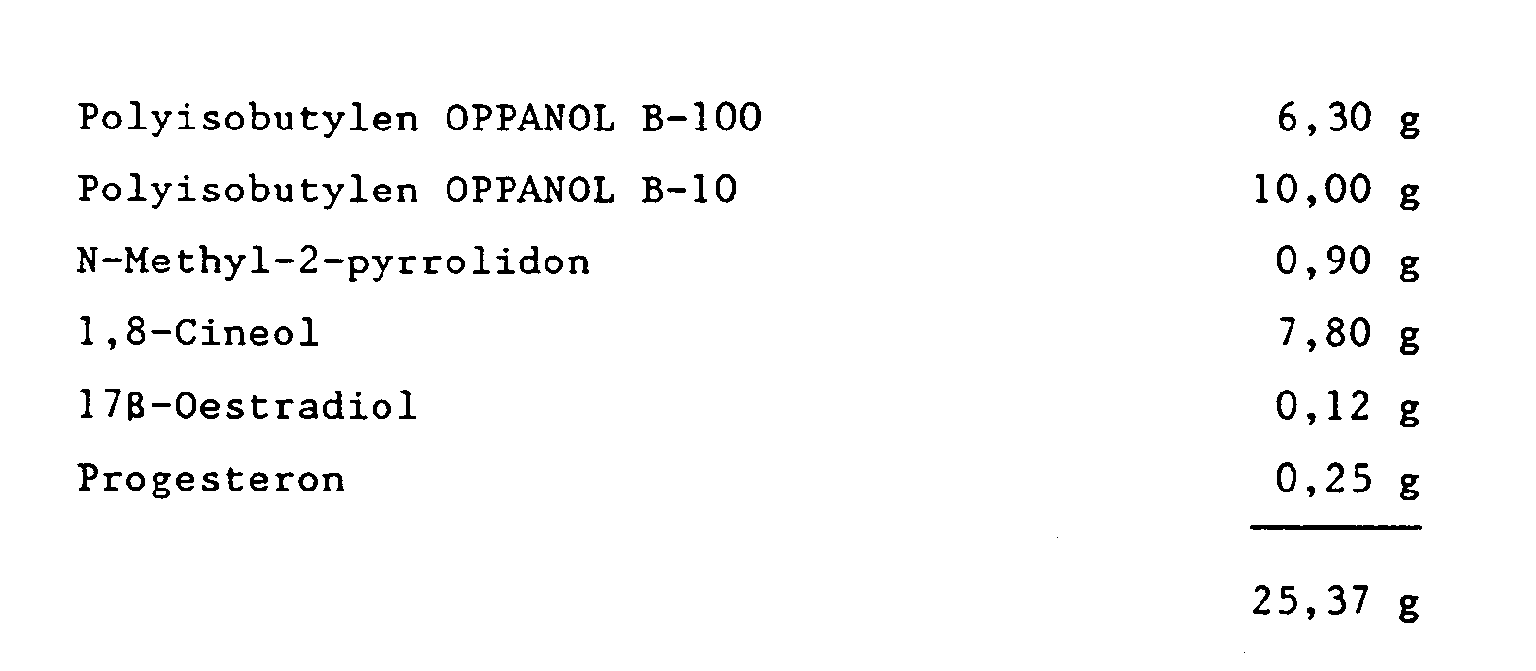
- Es werden scheibenförmige Pflaster von ca. 2,8 cm Durchmesser aus dem Laminat ausgestanzt.
-
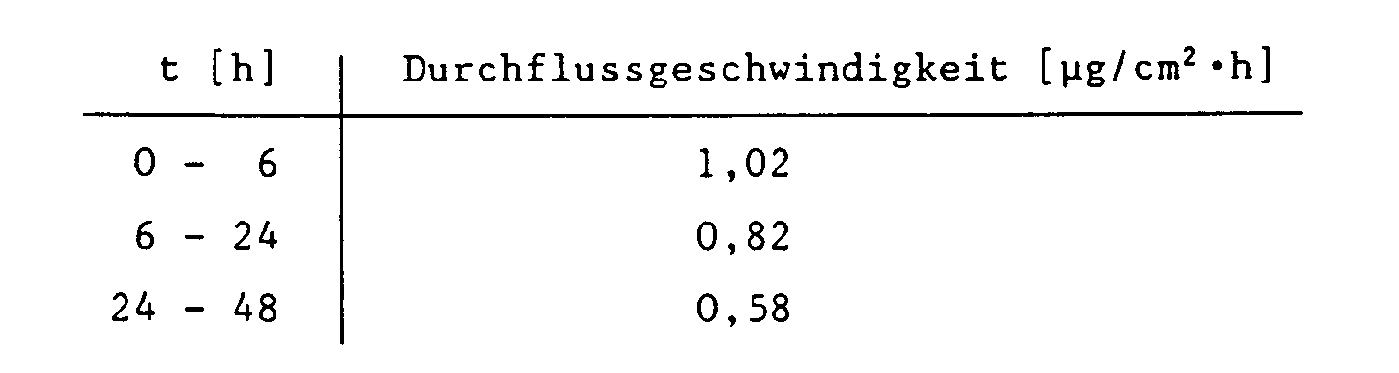
- a) Analog dem in Beispiel 1a) und 1b) beschriebenen Verfahren lässt sich ein Laminat herstellen, dessen Haftklebeschicht folgende Komponenten enthält:

- b) Analog dem in Beispiel 2) beschriebenen Verfahren wird für das Matrixsystem die Durchflussgeschwindigkeit des 17β-Oestradiols innerhalb der Zeiträume von 0-6, 6-24 und 24-48 Stunden gemessen:
-
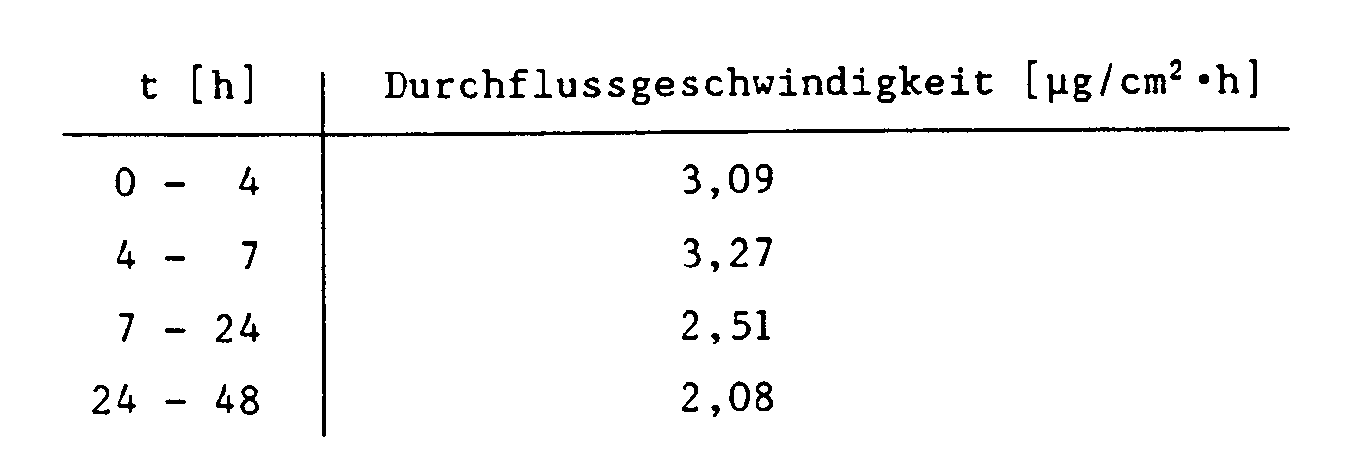
- a) Analog dem in Beispiel 1a) und 1b) beschriebenen Verfahren wird ein Laminat hergestellt, dessen Haftklebeschicht folgende Komponenten enthält:Es werden scheibenförmige Pflaster von ca. 2,8 cm Durchmesser aus dem Laminat augestanzt.

- b) Analog dem in Beispiel 2) beschriebenen Verfahren wird für das Matrixsystem die Durchflussgeschwindigkeit des Progesterons innerhalb der Zeiträume von 0-4, 4-7, 7-24 und 24-48 Stunden gemessen:
- Die Bestandteile der Haftklebeschicht werden jeweils in Mengen von 300 g durch Vermischen in einem Kneter z.B. Brabender PLE 651 verarbeitet. Bei einer Temperatur von 60° wird 60,2 g Polyisobutylen mit einem durchschnittlichen Molekulargewicht von ca. 1,3 x 10⁶ vom Typ OPPANOL B-100 geknetet. Nach 5 Minuten Knetzeit fügt man 76,0 g Polyisobutylen mit einem durchschnittlichen Molekulargewicht von ca. 4,0 x 10⁴ vom Typ OPPANOL B-10 hinzu. Man lässt wiederum 5 Minuten kneten und setzt 66,4 g Polyisobutylen mit einem durchschnittlichen Molekulargewicht von ca. 8,0 x 10² vom Typ OPPANOL B-3 hinzu. Dieses Gemisch wird 5 Minuten geknetet. Anschliessend fügt man eine Lösung von 30 g Lidocain-Base in 5,5 g N-Methyl-2-pyrrolidon, 49,1 g 1,8-Cineol und 12,8 g Paraffinöl hinzu und verarbeitet das Ganze während 25 Minuten zu einer homogenen Masse.
- Analog Beispiel 1 werden Pflaster in verschiedenen Grössen z.B. 14 cm², 26 cm², 37 cm² und 85 cm² hergestellt. Als Abdeckfolie wird z.B. eine Polyesterfolie verwendet.
Claims (11)
3. Transdermales therapeutisches System gemäss Anspruch 2, dadurch gekennzeichnet, dass die Kombination aus 1,8-Cineol und N-Methyl-2-pyrrolidon-9 Gewichtsteile 1,8-Cineol und 1 Gewichtsteil N-Methyl-2-pyrrolidon enthält.
Priority Applications (1)
| Application Number | Priority Date | Filing Date | Title |
|---|---|---|---|
| AT89810285T ATE78704T1 (de) | 1988-04-22 | 1989-04-13 | Transdermale monolithsysteme. |
Applications Claiming Priority (2)
| Application Number | Priority Date | Filing Date | Title |
|---|---|---|---|
| CH1524/88 | 1988-04-22 | ||
| CH152488 | 1988-04-22 |
Publications (2)
| Publication Number | Publication Date |
|---|---|
| EP0341202A1 EP0341202A1 (de) | 1989-11-08 |
| EP0341202B1 true EP0341202B1 (de) | 1992-07-29 |
Family
ID=4212460
Family Applications (1)
| Application Number | Title | Priority Date | Filing Date |
|---|---|---|---|
| EP89810285A Expired - Lifetime EP0341202B1 (de) | 1988-04-22 | 1989-04-13 | Transdermale Monolithsysteme |
Country Status (16)
| Country | Link |
|---|---|
| US (1) | US5079008A (de) |
| EP (1) | EP0341202B1 (de) |
| JP (1) | JPH01311017A (de) |
| KR (1) | KR900015761A (de) |
| AT (1) | ATE78704T1 (de) |
| AU (1) | AU622162B2 (de) |
| DE (1) | DE58901919D1 (de) |
| DK (1) | DK193389A (de) |
| ES (1) | ES2044206T3 (de) |
| GR (1) | GR3005902T3 (de) |
| IE (1) | IE60109B1 (de) |
| IL (1) | IL89940A0 (de) |
| NZ (1) | NZ228826A (de) |
| PH (1) | PH27001A (de) |
| PT (1) | PT90322B (de) |
| ZA (1) | ZA892899B (de) |
Families Citing this family (38)
| Publication number | Priority date | Publication date | Assignee | Title |
|---|---|---|---|---|
| DE58906975D1 (de) * | 1988-08-02 | 1994-03-24 | Ciba Geigy | Mehrschichtiges Pflaster. |
| EP0486529A1 (de) * | 1989-08-17 | 1992-05-27 | Schering Corporation | Transdermales nitroglycerinpflaster mit permeationsförderer |
| US5262165A (en) * | 1992-02-04 | 1993-11-16 | Schering Corporation | Transdermal nitroglycerin patch with penetration enhancers |
| AU633733B2 (en) * | 1990-05-17 | 1993-02-04 | Hisamitsu Pharmaceutical Co., Inc. | Percutaneous preparation containing estradiol |
| US5434304A (en) * | 1990-09-26 | 1995-07-18 | Aktiebolaget Astra | Process for preparing formoterol and related compounds |
| US5633009A (en) * | 1990-11-28 | 1997-05-27 | Sano Corporation | Transdermal administration of azapirones |
| CA2097182C (en) * | 1990-11-28 | 1999-04-27 | James N. Kenealy | Method and device for treating tobacco addiction |
| IT1251469B (it) * | 1991-07-15 | 1995-05-15 | Zambon Spa | Sistema terapeutico transdermale per la somministrazione di farmaci ad attivita' broncodilatante. |
| US5705185A (en) * | 1991-09-25 | 1998-01-06 | Beta Pharmaceuticals Co. | Transdermal delivery of estradiol and process for manufacturing said device |
| US5518734A (en) * | 1991-09-25 | 1996-05-21 | Beta Pharmaceuticals Co. | Transdermal delivery system for estradiol and process for manufacturing said device |
| US5827245A (en) * | 1992-07-16 | 1998-10-27 | Lts Lohmann Therapie-Systeme Gmbh & Co. Kg | Transdermal therapeutic system comprising the active subtance 17-β-Estradiol (Anhydrous) |
| US5807571A (en) * | 1993-05-06 | 1998-09-15 | Lts Lohmann Therapie-Systeme Gmbh | Transdermal therapeutic systems for administering indole serotonin agonists |
| US5380760A (en) * | 1993-11-19 | 1995-01-10 | Minnesota Mining And Manufacturing Company | Transdermal prostaglandin composition |
| JPH0827003A (ja) * | 1994-07-22 | 1996-01-30 | Sekisui Chem Co Ltd | 経皮吸収製剤 |
| US5780050A (en) * | 1995-07-20 | 1998-07-14 | Theratech, Inc. | Drug delivery compositions for improved stability of steroids |
| US5667799A (en) * | 1995-10-30 | 1997-09-16 | Caldwell; Larry J. | Method for treating headache pain with topical local anesthetic compositions |
| US5730721A (en) * | 1996-01-25 | 1998-03-24 | Vesture Corporation | Medical applicator and method |
| DE19629468A1 (de) * | 1996-07-11 | 1998-01-15 | Schering Ag | Transdermale therapeutische Systeme |
| EP0943330A4 (de) * | 1996-10-04 | 2001-08-16 | Saitama Daiichi Seiyaku Kabush | Pflaster |
| ATE293960T1 (de) * | 1997-02-28 | 2005-05-15 | Minnesota Mining & Mfg | Transdermale vorrichtung zur verabreichungvon von testosteron |
| US5939477A (en) * | 1998-02-02 | 1999-08-17 | Dow Corning Corporation | Silicone pressure sensitive adhesive composition containing functionalized polyisobutylene |
| US6103771A (en) * | 1998-03-20 | 2000-08-15 | Caldwell Galer Incorporated | Method of treating neuroma pain |
| DE19908787A1 (de) * | 1999-03-01 | 2000-09-14 | Labtec Gmbh | Transdermale Applikation von ß2-Sympathomimetika zur Behandlung obstruktiver Atemwegserkrankungen |
| FR2793689B1 (fr) * | 1999-05-19 | 2001-08-24 | Pf Medicament | Dispositif transdermique pour l'administration de testosterone ou d'un de ses derives |
| DE19923427A1 (de) * | 1999-05-21 | 2000-11-23 | Lohmann Therapie Syst Lts | Vorrichtung und Verfahren zur Steigerung der transdermalen Permeation von Arzneistoffen |
| DE10001096A1 (de) * | 2000-01-13 | 2001-07-26 | Lohmann Therapie Syst Lts | TTS mit Reservoirschicht zur Aufnahme und Abgabe von Duftstoffen |
| DE10056010A1 (de) * | 2000-11-11 | 2002-05-16 | Beiersdorf Ag | Pflaster mit hautpflegenden Substanzen |
| DE10056011A1 (de) * | 2000-11-11 | 2002-05-16 | Beiersdorf Ag | Hautfreundliches Wirkstoffpflaster zur insbesondere transdermalen Verabreichung ätherischer Öle |
| KR100469995B1 (ko) * | 2002-05-20 | 2005-02-05 | 안국약품 주식회사 | 천식치료제를 함유한 매트릭스형 패취 |
| US8252320B2 (en) | 2004-10-21 | 2012-08-28 | Durect Corporation | Transdermal delivery system for sufentanil |
| ATE551995T1 (de) | 2004-10-21 | 2012-04-15 | Durect Corp | Transdermale abgabesysteme |
| US20090098191A1 (en) * | 2007-10-16 | 2009-04-16 | Anderson Christopher G | Use of bases to stabilize transdermal formulations |
| JP4934163B2 (ja) * | 2009-03-18 | 2012-05-16 | オカモト株式会社 | 皮膚貼付積層体 |
| EP2456839A1 (de) * | 2009-07-21 | 2012-05-30 | Mylan Inc. | Verfahren zur kontinuierlichen herstellung eines transdermalen pflasters auf polyisobutylenbasis |
| CN102160857A (zh) * | 2010-02-24 | 2011-08-24 | 日东电工株式会社 | 哌甲酯贴剂 |
| FR2992325B1 (fr) | 2012-06-26 | 2015-05-22 | Ab7 Innovation | Matrice sequencee multifonctionnelle monopolymerique en polyurethane coule et procede de fabrication |
| US9962340B2 (en) | 2015-06-09 | 2018-05-08 | Life Tech Global, Llc | Device and method for the transdermal delivery of cannabidiol |
| US10272125B2 (en) * | 2015-09-14 | 2019-04-30 | Life Tech Global, Llc | Transdermal delivery of cannabidiol with other active moieties including cannabinoids |
Family Cites Families (14)
| Publication number | Priority date | Publication date | Assignee | Title |
|---|---|---|---|---|
| US4440770A (en) * | 1980-07-28 | 1984-04-03 | Mochida Seiyaku Kabushiki Kaisha | Diuretic, hypotensive and antiedemic quinoline oximes |
| US4440777A (en) * | 1981-07-07 | 1984-04-03 | Merck & Co., Inc. | Use of eucalyptol for enhancing skin permeation of bio-affecting agents |
| US4560553A (en) * | 1981-07-07 | 1985-12-24 | Merck & Co., Inc. | Use of eucalyptol for enhancing skin permeation of bio-affecting agents |
| DE3344691A1 (de) * | 1983-12-10 | 1985-06-20 | Bayer Ag, 5090 Leverkusen | Wirkstoffabgasesysteme |
| GR81250B (en) * | 1983-12-22 | 1985-11-19 | American Home Prod | Menthol enhancement of transdermal drug delivery |
| DE3347278A1 (de) * | 1983-12-28 | 1985-07-11 | Bayer Ag, 5090 Leverkusen | Wirkstoffabgabesysteme |
| JPS60174716A (ja) * | 1984-02-21 | 1985-09-09 | Yamanouchi Pharmaceut Co Ltd | パツチ剤 |
| EP0169364B1 (de) * | 1984-06-23 | 1988-08-03 | Beiersdorf Aktiengesellschaft | Selbstklebendes Pflaster |
| DE3423328A1 (de) * | 1984-06-23 | 1986-01-02 | Beiersdorf Ag, 2000 Hamburg | Selbstklebendes pflaster |
| EP0186019B1 (de) * | 1984-12-22 | 1993-10-06 | Schwarz Pharma Ag | Wirkstoffpflaster |
| EP0204968B1 (de) * | 1985-05-24 | 1989-09-27 | Beiersdorf Aktiengesellschaft | Nitro-Pflaster |
| DE3518707A1 (de) * | 1985-05-24 | 1986-11-27 | Beiersdorf Ag, 2000 Hamburg | Nitro-pflaster |
| US4816258A (en) * | 1987-02-26 | 1989-03-28 | Alza Corporation | Transdermal contraceptive formulations |
| US4943435A (en) * | 1987-10-05 | 1990-07-24 | Pharmetrix Corporation | Prolonged activity nicotine patch |
-
1989
- 1989-04-11 AU AU32686/89A patent/AU622162B2/en not_active Ceased
- 1989-04-13 DE DE8989810285T patent/DE58901919D1/de not_active Expired - Lifetime
- 1989-04-13 EP EP89810285A patent/EP0341202B1/de not_active Expired - Lifetime
- 1989-04-13 AT AT89810285T patent/ATE78704T1/de not_active IP Right Cessation
- 1989-04-13 IL IL89940A patent/IL89940A0/xx not_active IP Right Cessation
- 1989-04-13 ES ES89810285T patent/ES2044206T3/es not_active Expired - Lifetime
- 1989-04-17 PH PH38518A patent/PH27001A/en unknown
- 1989-04-20 PT PT90322A patent/PT90322B/pt not_active IP Right Cessation
- 1989-04-20 ZA ZA892899A patent/ZA892899B/xx unknown
- 1989-04-20 NZ NZ228826A patent/NZ228826A/en unknown
- 1989-04-20 DK DK193389A patent/DK193389A/da not_active Application Discontinuation
- 1989-04-20 KR KR1019890005187A patent/KR900015761A/ko not_active Ceased
- 1989-04-21 IE IE129589A patent/IE60109B1/en not_active IP Right Cessation
- 1989-04-21 JP JP1100384A patent/JPH01311017A/ja active Pending
-
1990
- 1990-06-29 US US07/547,538 patent/US5079008A/en not_active Expired - Fee Related
-
1992
- 1992-10-08 GR GR920401586T patent/GR3005902T3/el unknown
Also Published As
| Publication number | Publication date |
|---|---|
| ES2044206T3 (es) | 1994-01-01 |
| KR900015761A (ko) | 1990-11-10 |
| IL89940A0 (en) | 1989-12-15 |
| PH27001A (en) | 1993-02-01 |
| AU622162B2 (en) | 1992-04-02 |
| PT90322A (pt) | 1989-11-10 |
| DK193389A (da) | 1989-10-23 |
| IE891295L (en) | 1989-10-22 |
| DE58901919D1 (en) | 1992-09-03 |
| US5079008A (en) | 1992-01-07 |
| ZA892899B (en) | 1989-12-27 |
| JPH01311017A (ja) | 1989-12-15 |
| NZ228826A (en) | 1990-10-26 |
| DK193389D0 (da) | 1989-04-20 |
| AU3268689A (en) | 1989-10-26 |
| ATE78704T1 (de) | 1992-08-15 |
| IE60109B1 (en) | 1994-06-01 |
| GR3005902T3 (de) | 1993-06-07 |
| PT90322B (pt) | 1994-11-30 |
| EP0341202A1 (de) | 1989-11-08 |
Similar Documents
| Publication | Publication Date | Title |
|---|---|---|
| EP0341202A1 (de) | Transdermale Monolithsysteme | |
| EP0356382B1 (de) | Mehrschichtiges Pflaster | |
| DE3751447T2 (de) | Transdermale östrogen-/progestin-Einheitsdosis, Kit zur Fertilitätskontrolle enthaltend diese Einheitsdosis. | |
| DE69430917T2 (de) | 3-l-MENTHOXY-PROPANE-1, 2-DIOL ALS LÖSUNGSVERMITTLER UND EXTERNE ZUBEREITUNG, DIE DIESEN ENTHÄLT | |
| DE69615399T2 (de) | Triacetin zur erhöhung der transdermalen penetration | |
| DE68926122T2 (de) | Transdermale estrogen/progestin-dosiereinheit und system. | |
| DE69326461T2 (de) | Verwendung von glyzerin zur dämpfung der transdermalen arzneimittelverabreichung | |
| US5641504A (en) | Skin permeation enhancer compositions using glycerol monolinoleate | |
| DE69715049T2 (de) | Tranilast enthaltendes externum und verfahren zu dessen herstellung | |
| DE3750327T2 (de) | Dosierungseinheit zur transdermalen absorbierung für estradiol und sonstige estrogene steroide. | |
| AT395815B (de) | Therapeutisches abgabesystem zur verabreichung eines wirkstoffes durch die haut | |
| EP0697860B1 (de) | Estradiolhaltiges transdermales therapeutisches system | |
| DE69401945T2 (de) | Einarbeitung eines poly-n-vinylamids in ein transdermales system | |
| DE69130232T2 (de) | Transdermale verhütungsmittelformulierung, verfahren und vorrichtung | |
| DE68911920T2 (de) | Transdermales arzneimittelabgabesytem auf der grundlage eines multipolymers. | |
| DE69129632T2 (de) | Vorrichtung zum transdermalen verabreichen von medikamenten unter verwendung von sorbitanestern zum verbessern der hautdurchlässigkeit | |
| DE69524436T2 (de) | Verbesserte transdermale vorrichtung mit verringerter delaminierung | |
| DE69524614T2 (de) | Arzneimittelbestandteile einschliesslich eines n-substituierten o-toluidinderivats und transdermal absorbierbare zubereitung | |
| AT393624B (de) | Mehrschichtiges transdermales therapeutisches system fuer die kombinierte applikation von oestrogen bzw. synthetischen oestrogen-wirksamen verbindungen mit synthetischen gestagenen | |
| DE60018797T2 (de) | Hydroxide freisetzende verbindungen zum verbessern der hautdurchlässigkeit | |
| DE69916492T2 (de) | Pflaster zur transdermalen applikation von flüchtigen, flüssigen wirkstoffen | |
| JP4841781B2 (ja) | 改良された経皮的避妊薬送達系および方法 | |
| DE68917292T2 (de) | Transdermales estradiol als therapeutisches sytem. | |
| EP0744944A1 (de) | Transdermale therapeutische systeme enthaltend sexualsteroide | |
| DE10212864B4 (de) | Polymermatrizes umfassend ein Mischsystem zur Löslichkeitsvermittlung von pharmazeutischen Wirkstoffen, Verfahren zu deren Herstellung und deren Verwendung |
Legal Events
| Date | Code | Title | Description |
|---|---|---|---|
| PUAI | Public reference made under article 153(3) epc to a published international application that has entered the european phase |
Free format text: ORIGINAL CODE: 0009012 |
|
| 17P | Request for examination filed |
Effective date: 19890415 |
|
| AK | Designated contracting states |
Kind code of ref document: A1 Designated state(s): AT BE CH DE ES FR GB GR IT LI LU NL SE |
|
| 17Q | First examination report despatched |
Effective date: 19910701 |
|
| GRAA | (expected) grant |
Free format text: ORIGINAL CODE: 0009210 |
|
| AK | Designated contracting states |
Kind code of ref document: B1 Designated state(s): AT BE CH DE ES FR GB GR IT LI LU NL SE |
|
| REF | Corresponds to: |
Ref document number: 78704 Country of ref document: AT Date of ref document: 19920815 Kind code of ref document: T |
|
| REF | Corresponds to: |
Ref document number: 58901919 Country of ref document: DE Date of ref document: 19920903 |
|
| ET | Fr: translation filed | ||
| ITF | It: translation for a ep patent filed | ||
| GBT | Gb: translation of ep patent filed (gb section 77(6)(a)/1977) | ||
| REG | Reference to a national code |
Ref country code: GR Ref legal event code: FG4A Free format text: 3005902 |
|
| PLBE | No opposition filed within time limit |
Free format text: ORIGINAL CODE: 0009261 |
|
| STAA | Information on the status of an ep patent application or granted ep patent |
Free format text: STATUS: NO OPPOSITION FILED WITHIN TIME LIMIT |
|
| 26N | No opposition filed | ||
| REG | Reference to a national code |
Ref country code: ES Ref legal event code: FG2A Ref document number: 2044206 Country of ref document: ES Kind code of ref document: T3 |
|
| EPTA | Lu: last paid annual fee | ||
| EAL | Se: european patent in force in sweden |
Ref document number: 89810285.0 |
|
| PGFP | Annual fee paid to national office [announced via postgrant information from national office to epo] |
Ref country code: FR Payment date: 19950313 Year of fee payment: 7 |
|
| PGFP | Annual fee paid to national office [announced via postgrant information from national office to epo] |
Ref country code: AT Payment date: 19950315 Year of fee payment: 7 |
|
| PGFP | Annual fee paid to national office [announced via postgrant information from national office to epo] |
Ref country code: GB Payment date: 19950321 Year of fee payment: 7 |
|
| PGFP | Annual fee paid to national office [announced via postgrant information from national office to epo] |
Ref country code: ES Payment date: 19950322 Year of fee payment: 7 Ref country code: DE Payment date: 19950322 Year of fee payment: 7 |
|
| PGFP | Annual fee paid to national office [announced via postgrant information from national office to epo] |
Ref country code: LU Payment date: 19950401 Year of fee payment: 7 |
|
| PGFP | Annual fee paid to national office [announced via postgrant information from national office to epo] |
Ref country code: GR Payment date: 19950407 Year of fee payment: 7 |
|
| PGFP | Annual fee paid to national office [announced via postgrant information from national office to epo] |
Ref country code: SE Payment date: 19950426 Year of fee payment: 7 |
|
| PGFP | Annual fee paid to national office [announced via postgrant information from national office to epo] |
Ref country code: NL Payment date: 19950430 Year of fee payment: 7 |
|
| PGFP | Annual fee paid to national office [announced via postgrant information from national office to epo] |
Ref country code: BE Payment date: 19950510 Year of fee payment: 7 |
|
| PGFP | Annual fee paid to national office [announced via postgrant information from national office to epo] |
Ref country code: CH Payment date: 19950629 Year of fee payment: 7 |
|
| PG25 | Lapsed in a contracting state [announced via postgrant information from national office to epo] |
Ref country code: LU Free format text: LAPSE BECAUSE OF NON-PAYMENT OF DUE FEES Effective date: 19960413 Ref country code: GB Effective date: 19960413 Ref country code: AT Effective date: 19960413 |
|
| PG25 | Lapsed in a contracting state [announced via postgrant information from national office to epo] |
Ref country code: SE Effective date: 19960414 |
|
| PG25 | Lapsed in a contracting state [announced via postgrant information from national office to epo] |
Ref country code: ES Free format text: LAPSE BECAUSE OF NON-PAYMENT OF DUE FEES Effective date: 19960415 |
|
| PG25 | Lapsed in a contracting state [announced via postgrant information from national office to epo] |
Ref country code: LI Effective date: 19960430 Ref country code: CH Effective date: 19960430 Ref country code: BE Effective date: 19960430 |
|
| BERE | Be: lapsed |
Owner name: CIBA-GEIGY A.G. Effective date: 19960430 |
|
| PG25 | Lapsed in a contracting state [announced via postgrant information from national office to epo] |
Ref country code: GR Free format text: THE PATENT HAS BEEN ANNULLED BY A DECISION OF A NATIONAL AUTHORITY Effective date: 19961031 |
|
| PG25 | Lapsed in a contracting state [announced via postgrant information from national office to epo] |
Ref country code: NL Effective date: 19961101 |
|
| REG | Reference to a national code |
Ref country code: GR Ref legal event code: MM2A Free format text: 3005902 |
|
| GBPC | Gb: european patent ceased through non-payment of renewal fee |
Effective date: 19960413 |
|
| REG | Reference to a national code |
Ref country code: CH Ref legal event code: PL |
|
| PG25 | Lapsed in a contracting state [announced via postgrant information from national office to epo] |
Ref country code: FR Effective date: 19961227 |
|
| PG25 | Lapsed in a contracting state [announced via postgrant information from national office to epo] |
Ref country code: DE Effective date: 19970101 |
|
| NLV4 | Nl: lapsed or anulled due to non-payment of the annual fee |
Effective date: 19961101 |
|
| EUG | Se: european patent has lapsed |
Ref document number: 89810285.0 |
|
| REG | Reference to a national code |
Ref country code: FR Ref legal event code: ST |
|
| REG | Reference to a national code |
Ref country code: ES Ref legal event code: FD2A Effective date: 19990405 |
|
| PG25 | Lapsed in a contracting state [announced via postgrant information from national office to epo] |
Ref country code: IT Free format text: LAPSE BECAUSE OF NON-PAYMENT OF DUE FEES Effective date: 20050413 |