EP0331975B1 - Thermoplastische Harzmischung - Google Patents
Thermoplastische Harzmischung Download PDFInfo
- Publication number
- EP0331975B1 EP0331975B1 EP89103107A EP89103107A EP0331975B1 EP 0331975 B1 EP0331975 B1 EP 0331975B1 EP 89103107 A EP89103107 A EP 89103107A EP 89103107 A EP89103107 A EP 89103107A EP 0331975 B1 EP0331975 B1 EP 0331975B1
- Authority
- EP
- European Patent Office
- Prior art keywords
- monomer
- maleimide
- acrylate
- anhydride
- meth
- Prior art date
- Legal status (The legal status is an assumption and is not a legal conclusion. Google has not performed a legal analysis and makes no representation as to the accuracy of the status listed.)
- Expired - Lifetime
Links
Images

Classifications
-
- C—CHEMISTRY; METALLURGY
- C08—ORGANIC MACROMOLECULAR COMPOUNDS; THEIR PREPARATION OR CHEMICAL WORKING-UP; COMPOSITIONS BASED THEREON
- C08L—COMPOSITIONS OF MACROMOLECULAR COMPOUNDS
- C08L77/00—Compositions of polyamides obtained by reactions forming a carboxylic amide link in the main chain; Compositions of derivatives of such polymers
Definitions
- the present invention relates to a thermoplastic resin composition having good mechanical properties and moldability and capable of providing a molded product having excellent appearance. More particularly, it relates to a thermoplastic resin composition comprising a polyamide and a specific maleimide copolymer and having the moisture absorptivity, heat resistance and moldability of a polyamide improved and yet capable of providing a molded product having excellent outer appearance.
- Polyamides are excellent in such properties as the mechanical properties, chemical resistance, abrasion resistance and electrical properties.
- they have drawbacks that they are poor in the impact resistance and heat resistance, and they have a large molding shrinkage, whereby the molded products tend to be defective with sink marks or warpage.
- they have high moisture absorptivity, whereby not only the molded products tend to have a defective appearance during the molding operation, but also there will be a substantial change in the dimension or the shape of the molded products.
- the mechanical properties of the molded products are likely to change.
- the viscosity of the molten resin is low, and a drooling phenomenon is likely to occur whereby the molten resin flows out of the nozzle of a molding machine during the injection molding.
- they have a drawback that the molding operation tends to be cumbersome.
- a three-component composition was known wherein a copolymer of styrene with an unsaturated dicarboxylic acid anhydride monomer was used as a compatibilizing agent for a styrene resin and a polyamide for the purpose of improving the compatibility (Japanese Unexamined Patent Publication No. 195157/1985). Although the compatibility and the heat stability were improved with the composition, but the effects were still inadequate.
- a copolymer was known which was produced by melt-mixing a polyamide with a copolymer containing an imide compound of an unsaturated dicarboxylic acid so that the two polymer chains were bonded to each other (Japanese Unexamined Patent Publications No. 57719/1982 and No.
- a three-component composition comprising a copolymer of a maleimide monomer, a polyamide and a modified polyolefin (Japanese Unexamined Patent Publications No. 59647/1987 and No. 179546/1987) was proposed.
- a molded product prepared from this composition showed a defect on the surface near the gate and had an interlaminar peeling tendency, and it was inadequate in the balance of the impact resistance, elongation and rigidity.
- a resin composition comprising an imidated copolymer and an amorphous polyamide as essential components and optionally, another thermoplastic resin having improved compartability with said essential components is disclosed in JP-A-62161853.
- thermoplastic resin composition comprising:
- the above composition has an excellent balance of the impact resistance, elongation, rigidity, heat resistance, and it is excellent in the moldability, has a low moisture absorptivity, and yet is capable of providing a molded product having excellent appearance.
- the modified polyolefin polymer is also in the form of dispersed particles having a non-specific shape having a size of not larger than a few ⁇ m and is substantially uniformly dispersed.
- the maleimide copolymer to be used in the present invention may be produced by radical copolymerization of the aromatic vinyl monomer, the maleimide monomer, the unsaturated dicarboxylic anhydride monomer and other copolymerizable monomer which is preferably an acrylate monomer.
- aromatic vinyl monomer examples include styrene, ⁇ -methylstyrene, vinyl toluene and t-butylstyrene.
- maleimide monomer examples include maleimide, N-methylmaleimide, N-ethylmaleimide, N-propylmaleimide, N-hexylmaleimide, N-cyclohexylmaleimide, N-phenylmaleimide and N-tolylmaleimide.
- unsaturated dicarboxylic anhydride monomer include maleic anhydride, methylmaleic anhydride, 1,2-dimethylmaleic anhydride, ethylmaleic anhydride and phenylmaleic anhydride.
- the acrylate monomer examples include methyl (meth)acrylate, ethyl (meth)acrylate, butyl (meth)acrylate, hexyl (meth)acrylate, cyclohexyl (meth)acrylate, decyl (meth)acrylate, octadecyl (meth)acrylate, hydroxyethyl (meth)acrylate, methoxyethyl (meth)acrylate and glycidyl (meth)acrylate. These materials may be used alone or in combination.
- (meth)acrylate is meant for acrylate and methacrylate.
- methyl (meth)acrylate is meant for methyl acrylate and methyl methacrylate.
- a method for producing the maleimide copolymer to be used in the present invention a method may be mentioned wherein a copolymer of an aromatic vinyl monomer, an unsaturated dicarboxylic anhydride monomer and an acrylate monomer, is reacted with ammonia or with a primary amine to convert the acid anhydride group to an imido.
- the imido conversion reaction of a polymer material having an acid anhydride group in the polymer chain, with an amine compound is known.
- a polymer material and an amine compound are reacted in accordance with a method disclosed in Japanese Examined Patent Publication No. 26936/1986 or No. 8456/1987, to obtain a desired maleimide copolymer having an imido group.
- the primary amine useful for the imido-conversion reaction include methylamine, ethylamine, propylamine, butylamine, hexylamine, cyclohexylamine, decylamine, aniline, toluidine, naphthylamine, chlorophenylamine, dichlorophenylamine, bromophenylamine and dibromophenylamine.
- the imido conversion reaction may be conducted in a solution state, in a bulk molten state or in a suspension state by using an autoclave. Further, the reaction may be conducted in a molten state by using a melt kneading apparatus such as a screw extruder.
- the solvent may be a ketone such as acetone, methyl ethyl ketone, methyl isobutyl ketone or cyclohexanone, an ether such as tetrahydrofuran or 1,4-dioxane, an aromatic hydrocarbon such as toluene or xylene, dimethylformamide, dimethylsulfoxide or n-methyl-2-pyrrolidone.
- ketone such as acetone, methyl ethyl ketone, methyl isobutyl ketone or cyclohexanone
- an ether such as tetrahydrofuran or 1,4-dioxane
- an aromatic hydrocarbon such as toluene or xylene
- dimethylformamide dimethylsulfoxide or n-methyl-2-pyrrolidone.
- the reaction temperature for imido-conversion is preferably within a range of from 50 to 350°C, more preferably within a range of from 100 to 300°C.
- a catalyst is not necessarily required for the imido-conversion reaction. However, if a catalyst is to be used, a tertiary amine such as trimethylamine, triethylamine, tributylamine, N,N-dimethylaniline or N,N-diethylaniline is preferred.
- the maleimide copolymer to be used in the present invention comprises ⁇ 30 mol% of an aromatic vinyl monomer group, from 30 to 50 mol% of a maleimide monomer group, from 3 to 20 mol% of an unsaturated dicarboxylic anhydride monomer group and from 0 to 50 mol% of an acrylate monomer group.
- it comprises from 50 to 60 mol% of an aromatic vinyl monomer group, from 40 to 50 mol% of a maleimide monomer group, from 3 to 10 mol% of an unsaturated dicarboxylic anhydride monomer group and from 0 to 30 mol% of an acrylate monomer group.
- the aromatic vinyl monomer group is less than 30 mol%, it tends to be difficult to produce a polymer having a uniform composition on an industrial scale with good reproducibility, and a composition obtainable by mixing such a maleimide copolymer to an polyamide tends to be poor in such properties as the heat stability, moldability and mechanical strength. If the maleimide monomer group is less than 30 mol%, the resulting composition tends to be poor in the heat resistance. If the maleimide monomer group exceeds 50 mol%, the resulting composition tends to be poor in the moldability.
- the unsaturated dicarboxylic anhydride monomer group is less than 3 mol%, a composition obtained by mixing such a maleimide copolymer with the polyamide tends to be poor in the compatibility, and the dispersed particles of the maleimide copolymer tend to have a large particle size, whereby the mechanical strength tends to be poor, and a molded product of such a composition tends to show an interlaminar peeling phenomenon.
- the particle size of the dispersed particles of the maleimide copolymer in the composition tends to be too small, whereby the moldability tends to be poor, and the heat stability of the molded product tends to be poor, and the surface is likely to be roughened showing a shark skin.
- the polyamide to be used in the present invention may be a polyamide obtained from an aliphatic, aromatic or alicyclic dicarboxylic acid with a diamine, or a polyamide obtained from an aminocarboxylic acid or a cyclic lactam.
- Specific examples include alicyclic polyamides such as 6-nylon, 6,6-nylon, 6,9-nylon, 6,10-nylon, 6,12-nylon, 4,6 nylon, 11-nylon and 12-nylon, and polyamides having aromatic rings, such as poly(hexamethylene terephthalamide), poly(hexamethylene isophthalamide) and poly(m-xylyleneadipamide). These polyamides may be used alone or in combination.
- the composition of the present invention is prepared by mixing from 10 to 50% by weight of the maleimide copolymer, from 40 to 80% by weight of the polyamide and from 3 to 40% by weight of the modified polyolefin polymer. If the maleimide copolymer is less than 10% by weight, or if the polyamide exceeds 80% by weight, the resulting composition tends to be inadequate in the degree of improvement in the heat resistance, in the moldability or in the moisture resistance. If the maleimide copolymer exceeds 50% by weight, or if the polyamide is less than 40% by weight, the resulting composition tends to be poor in the mechanical strength, in the chemical resistance or in the abrasion resistance.
- the modified polyolefin polymer is less than 3% by weight, the degree of improvement in the impact resistance tends to be low, and if it exceeds 40% by weight, the rigidity tends to substantially decrease.
- the modified polyolefin polymer to be used in the present invention is a polyolefin polymer modified by an unsaturated dicarboxylic anhydride monomer and/or an unsaturated carboxylic acid monomer and preferably has a rubber elasticity.
- the modified polyolefin polymer is meant for a modified product of a polymer or copolymer of an olefin monomer.
- an olefin monomer includes ethylene, propylene, 1-butene, isobutylene, 2-butene, cyclobutene, 3 methyl-1-butene, 4-methyl-1-butene, 4-methyl-1-pentene, cyclopentene, 1-hexene, cyclohexene, 1-octene, 1-decene and 1-dodecene.
- the modified polyolefin polymer may, as the case requires, be copolymerized with a non-conjugated diene monomer such as 4-ethylidenenorbornane or dicyclopentadiene, or with an acrylate monomer as mentioned above, as a copolymerizable monomer useful for the preparation of the maleimide copolymer, within a range where rubber elasticity is maintained,
- a preferred composition in this respect may, for example, comprise from 20 to 90 mol% of ethylene, from 10 to 80 mol% of an ⁇ -olefin monomer and from 0 to 10 mol% of other monomer.
- the ethylene content is more preferably from 50 to 85 mol%.
- Tg of such a modified polyolefin polymer is preferably at most -10°C, more preferably at most -30°C.
- unsaturated dicarboxylic anhydride monomer constituting the modified polyolefin polymer those mentioned above as the monomer useful for the maleimide copolymer, may be employed. Among them, maleic anhydride is particularly preferred.
- the unsaturated carboxylic acid monomer may be acrylic acid or methacrylic acid.
- the content of the unsaturated dicarboxylic anhydride monomer group or the unsaturated carboxylic acid group in the modified polyolefin pclymer is preferably from 0.1 to 10% by weight, more preferably from 0.1 to 5% by weight. If the amount is less than 0.1% by weight, the mechanical strength of the resulting composition tends to be inadequate, and an interlaminar peeling phenomenon is like to be observed in the molded product. If the content exceeds 10% by weight, the mechanical strength or the thermal stability is likely to be impaired.
- modified in the present invention means that a monomer group used for modification, such as a maleic anhydride group, is present in the main chain or in the side chain of the polyolefin polymer.
- the modification can be conducted by a conventional technique such as random copolymerization or graft copolymerization. There is no particular restriction as to the manner for the modification.
- the modification can be conducted in accordance with the methods disclosed in e.g. Japanese Examined Patent Publications No. 6810/1964, No. 43677/1977, No. 5716/1978, No. 9925/1981 and No. 445/1983.
- the graft product modified by the introduction of such a monomer group to the main chain is preferred from the viewpoint of low temperature impact resistance.
- the amount of the remaining unreacted monomer should preferably be small at a level of not more than 0.5% by weight.
- the molecular weight of the modified polyolefin polymer is preferably from 50,000 to 500,000, more preferably from 100,000 to 300,000, in view of the balance of the impact resistance and the moldability.
- Tafuma MP-0620 (manufactured by Mitsui Petrochemical) may be mentioned as a commercial product of such a modified polyolefin polymer.
- the maleimide copolymer is in the form of dispersed particles, and the particle size of such dispersed particles is from 0.01 to 1.0 ⁇ m.
- a particularly preferred particle size is from 0.04 to 0.5 ⁇ m. More preferably, the particle size is from 0.05 to 0.3 ⁇ m.
- the particle size of such dispersed partciles is a value measured by the transmission type electron microscopic observation of a super thin specimen cut out from a sample obtained by the treatment with hydrazine monohydrate, followed by dyeing with osmic acid.
- the particle size of dispersed particles is less than 0.01 ⁇ m, the composition obtained by mixing them with the polyamide tends to have a high melt viscosity, whereby a defective phenomenon such as shark skin tends to appear on the surface of the molded product. If the size of dispersed particles exceeds 1.0 ⁇ m, the mechanical strength of the composition tends to be low.
- the modified polyolefin polymer is also in the form of dispersed particles which are independent and have a non-specific shape, and it is substantially uniformly dispersed.
- the present inventors have found that when the same polyamide is used in the same amount, particularly important as a factor for determining the size of dispersed particles in the composition, is the content of the unsaturated dicarboxylic anhydride monomer group in the maleimide copolymer. When the content is low, the particle size is large, and when the content is high, the particle size is small. Further, the content of the organic acid group in the modified polyolefin polymer, is likewise important, and it exhibits the same effects as the unsaturated dicarboxylic anhydride monomer group in the maleimide copolymer.
- composition of the present invention preferably contains a metal salt of an organic acid and/or an fatty acid amide compound. When these compounds are incorporated, the impact strength of the composition is improved.
- the metal salt of an organic acid used in the present invention is a salt of a fatty acid such as lauric acid, myristic acid, palmitic acid, stearic acid, behenic acid, oleic acid, linolic acid, ricinolic acid or hydroxystearic acid, or an aromatic carboxylic acid such as phthalic acid, with a metal such as sodium, potassium, lithium, magnesium, calcium, strontium, barium, zinc, cadmium, aluminum, tin or lead.
- a bivalent metal salt such as magnesium, calcium, barium or zinc is preferred.
- the fatty acid amide is a primary amide or a secondary amide of the above fatty acid.
- the secondary amide may be a bisamide such as methylenebisstearyl amide or ethylenebisstearyl amide.
- the content of the metal salt of an organic acid and/or the aliphatic acid amide in the composition of the present invention is usually within a range of from 0.01 to 5% by weight, preferably from 0.05 to 2% by weight, more preferably from 0.2 to 1% by weight. If the content is less than 0.001% by weight, no adequate effect of the addition will be obtained. If the amount exceeds 5% by weight, the properties such as the heat resistance and rigidity, tend to deteriorate, and the degree of improvement in the impact resistance is likely to be small.
- Such a metal salt of an organic acid and the fatty acid amide is particularly preferred.
- the proportions are not critical so long as the amounts are within the above-mentioned range, but the proportions are preferably about 1 : 1.
- composition of the present invention may contain an antioxidant. It is preferred to use a phenol type antioxidant with a view to preventing discoloration.
- the phenol type antioxidant includes octadecyl-3-(3,5-di-t-butyl-4-hydroxyphenyl)propionate (such as Irganox 1076), N,N-hexamethylenebis(3,5-di-t-butyl-4-hydroxycinnamamide (such as Irganox 1098), 3,5-di-t-butyl-4-hydroxytoluene, 2,2′-methylenebis(4-methyl-6-t-butylphenol), 4,4′-methylenebis(2,6-di-t-butylphenol), 4,4′-butylidene-bis-6-t-butyl-m-cresol, 2,6-bis-(2′-hydroxyl-3′-t-butyl-5′-methylbenzyl)-4-methylphenol, 1,1,3-tris(2′-methyl-5′-t
- the size of dispersed particles is dependent also on the method of mixing the maleimide copolymer with the polyamide and the modified polyolefin polymer.
- the mixing of the maleimide copolymer with the polyamide and the modified polyolefin polymer can be conducted by using a usual melt kneading apparatus.
- Useful melt kneading apparatus include a screw extruder, a Banbury mixer, a cokneader and a mixing roll.
- composition of the present invention other additives or modifiers may be added depending upon the particular use.
- reinforcing fibers such as glass fibers, carbon fibers or aramide fibers, fillers such as talc, silica, clay, mica or calcium carbonate, ultraviolet absorbers, flame retardants, lubricants and colorants, may be mentioned.
- the resin composition of the present invention may be formed into a molded product by a usual plastic molding machine.
- the molded products include, for example, automobile parts such as a meter hood, a defroster garnish, a resistor bezel, a cluster, an instrument panel, a speaker grill and a fitting ceiling, household electric appliances, office equipments, parts of other industrial products such as casings, radiator covers, switches, buttons, handles, arms, air discharge outlets, air inlets, reel tables, reel shafts and bobbins. Further, it is useful for applications where heat resistance and impact resistance are desired.
- Size of dispersed particles in the composition A preliminarily trimmed sample was immersed in hydrazine monohydrate and left to stand at 60°C for 48 hours. After washing with water, this sample was immersed in a 1% osmic acid aqueous solution and left to stand at room temperature for 24 hours for dyeing. A super thin specimen was cut out from the dyed sample, and a photograph was taken by a transmission type electron microscope. The image thus obtained was analyzed to obtain the particle size.
- melt flow rate was measured under a load of 10 kg at a temperature of 265°C.
- a molded product having a boss and a rib on the rear side and an opening was molded by a 5 ounce injection molding machine, and the appearance of the molded product was visually obsersed and evaluated.
- the molding temperature was 260°C.
- 6-nylon, 12-nylon and 6,6-nylon obtained by melt polymerization were used.
- a maleimide copolymer 100 parts of styrene was charged into an autoclave equipped with a stirrer, and after flushing the system with nitrogen gas, the autoclave was heated to 80°C. Then, a solution obtained by dissolving 67 parts of maleic anhydride and 0.2 part of benzoin peroxide in 300 parts of methyl ethyl ketone, was dropwise added over a period of 8 hours. After the addition, the temperature was maintained at 80°C for further 4 hours.
- 270°C As the molding temperature, 270°C was used as standard, and some adjustment was made depending upon the condition of the molded product.
- Example 2 From the comparison between Example 2 and Comparative Example 1, it is evident that if the unsaturated dicarboxylic anhydride monomer group is not contained in the maleimide copolymer, the degree of improvement in the impact resistance is small and the elongation is also low, such being not practical. Further, the dispersion of the maleimide copolymer in this case was also poor, and the size of dispersed particles was large.
- Example 2 From the comparision between Example 2 and Comparative Example 3, it is evident that the content of the dicarboxylic anhydride in the polyolefin polymer is important, and if it is not contained, the degree of improvement in the impact resistance is small, and the outer appearance tends to be poor.
- the dispersed state of the maleimide copolymer is important to the physical properties, and no good results will be obtained if the particle size is either too large or too small.
- the particle size of the maleimide copolymer in the resin composition of the present invention is 0.1 ⁇ m, and the modified polyolefin polymer is substantially uniformly dispersed as a semi-continuous phase.
- Comparative Example 1 the size of dispersed particles of the maleimide copolymer is large, and the dispersed particle size of the modified polyolefin polymer is also different from Example 1 and is poor.
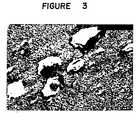
- Figures 1, 2 and 3 are electron microscopic photographs showing the dispersed states of the maleimide copolymer particles in the resin compositions obtained in Example 2 and Comparative Examples 1 and 3, respectively.
- the length of 15 mm corresponds to 1 ⁇ m.
Landscapes
- Chemical & Material Sciences (AREA)
- Health & Medical Sciences (AREA)
- Chemical Kinetics & Catalysis (AREA)
- Medicinal Chemistry (AREA)
- Polymers & Plastics (AREA)
- Organic Chemistry (AREA)
- Compositions Of Macromolecular Compounds (AREA)
Claims (8)
- Thermoplastische Harzzusammensetzung umfassend:(A) 10 bis 50 Gew.-% eines Maleimidcopolymers von ≧ 30 Mol-% eines aromatischen Vinylmonomers, 30 bis 50 Mol-% eines Maleimidmonomers, 3 bis 20 Mol-% eines ungesättigten Dicarbonsäureanhydridmonomers und 0 bis 50 Mol-% eines anderen copolymerisierbaren Monomers;(B) 40 bis 80 Gew.-% eines Polyamids; und(C) 3 bis 40 Gew.-% eines Polyolefinpolymers, modifiziert durch 0,1 bis 10 Gew.-% eines ungesättigten Dicarbonsäureanhydridmonomers und/oder eines ungesättigten Carbonsäuremonomers, worin das Maleimidcopolymer in Form von dispergierten Teilchen von 0,01 bis 1,0 µm vorliegt, gemessen durch Eintauchen einer zurechtgemachten Probe in Hydrazinmonohydrat bei 60°C für 48 Stunden, Färben der Proben nach Waschen mit Wasser durch Eintauchen in 1 %-ige wässerige Osmiumsäurelösung und Belassen bei Raumtemperatur für 24 Stunden, Fotografieren eines superdünnen Probestücks, geschnitten aus der gefärbten Probe unter Verwendung eines Transmissionselektronenmikroskopes und Analysieren des erhaltenen Bildes.
- Thermoplastische Harzmasse nach Anspruch 1, wobei das modifizierte Polyolefinpolymer in Form von Teilchen mit nicht spezifischer Form vorliegt und im wesentlichen gleichförmig dispergiert ist.
- Thermoplastische Harzmasse nach Anspruch 1, zusätzlich ein Metallsalz einer organischen Säure und/oder ein Fettsäureamid enthaltend.
- Thermoplastische Harzmasse nach Anspruch 1, wobei das andere copolymerisierbare Monomer ein Acrylatmonomer ist.
- Thermoplastische Harzmasse nach Anspruch 1, wobei das aromatische Vinylmonomer ein Mitglied ausgewählt ist aus der Gruppe bestehend aus Styrol, α-Methylstyrol, Vinyltoluol, t-Butylstyrol und einem Gemisch davon; das Maleimidmonomer ist ein Mitglieds ausgewählt aus der Gruppe bestehend aus Maleimid, N-Methylmaleimid, N-Ethylmaleimid, N-Propylmaleimid, N-Hexylmaleimid, N-Cyclohexylmaleimid, N-Phenylmaleimid, N-Tolylmaleimid und einem Gemisch davon; das ungesättigte Dicarbonsäureanhydridmonomer ist ein Mitglied ausgewählt aus der Gruppe bestehend aus Maleinsäureanhydrid, Methylmaleinsäureanhydrid, 1,2-Dimethylmaleinsäureanhydrid, Ethylmaleinsäureanhydrid, Phenylmaleinsäureanhydrid und einem Gemisch davon; und das andere copolymerisierbare Monomer ist ein Mitglied ausgewählt aus der Gruppe bestehend aus Methyl(meth)acrylat, Ethyl(meth)acrylat, Butyl(meth)acrylat, Hexyl(meth)acrylat, Cyclohexyl(meth)acrylat, Decyl(meth)acrylat, Octadecyl(meth)acrylat, Hydroxyethyl(meth)acrylat, Methoxyethyl(meth)acrylat, Glycidyl(meth)acrylat und einem Gemisch davon.
- Thermoplastische Harzmasse nach Anspruch 1, wobei das Polyamid ein Mitglied ist ausgewählt aus der Gruppe bestehend aus 6-Nylon, 6,6-Nylon, 6,9-Nylon, 6,10-Nylon, 6,12-Nylon, 4,6-Nylon, 11-Nylon, 12-Nylon, Poly(hexamethylenterephthalamid), Poly(hexamethylenisophthalamid), Poly(m-xylylenadipamid) und einem Gemisch davon.
- Thermoplastische Harzmasse nach Anspruch 1, wobei das modifizierte Polyolefinpolymer ein Polymer oder Copolymer eines Olefinmonomers ist, ausgewählt aus der Gruppe bestehend aus Ethylen, Propylen, 1-Buten, Isobutylen, 2-Buten, Cyclobuten, 3-Methyl-1-buten, 4-Methyl-1-buten, 4-Methyl-1-penten, Cyclopenten, 1-Hexen, Cyclohexen, 1-Octen, 1-Decen, 1-Dodecen und einem Gemisch davon, modifiziert durch 0,1 bis 10 Gew.-% eines Monomers, ausgewählt aus der Gruppe bestehend aus Maleinsäureanhydrid, Methylmaleinsäureanhydrid, 1,2-Methylmaleinsäureanhydrid, Ethylmaleinsäureanhydrid, Phenylmaleinsäureanhydrid, Acrylsäure, Methacrylsäure und einem Gemisch davon.
- Formprodukt, hergestellt aus einer thermoplastischen Harzmasse nach Anspruch 1.
Applications Claiming Priority (4)
| Application Number | Priority Date | Filing Date | Title |
|---|---|---|---|
| JP4101588A JPH01215843A (ja) | 1988-02-24 | 1988-02-24 | 樹脂組成物およびその成形体 |
| JP41015/88 | 1988-02-24 | ||
| JP283720/88 | 1988-11-11 | ||
| JP63283720A JP2782518B2 (ja) | 1988-11-11 | 1988-11-11 | 樹脂組成物 |
Publications (2)
| Publication Number | Publication Date |
|---|---|
| EP0331975A1 EP0331975A1 (de) | 1989-09-13 |
| EP0331975B1 true EP0331975B1 (de) | 1993-05-05 |
Family
ID=26380540
Family Applications (1)
| Application Number | Title | Priority Date | Filing Date |
|---|---|---|---|
| EP89103107A Expired - Lifetime EP0331975B1 (de) | 1988-02-24 | 1989-02-22 | Thermoplastische Harzmischung |
Country Status (3)
| Country | Link |
|---|---|
| US (1) | US5049613A (de) |
| EP (1) | EP0331975B1 (de) |
| DE (1) | DE68906292T2 (de) |
Families Citing this family (9)
| Publication number | Priority date | Publication date | Assignee | Title |
|---|---|---|---|---|
| NL8801593A (nl) * | 1988-06-23 | 1990-01-16 | Stamicarbon | Polyamidesamenstellingen. |
| DE4100912A1 (de) * | 1991-01-15 | 1992-07-16 | Bayer Ag | Verfahren zur herstellung hochmolekularer polyamide |
| DE4100913A1 (de) * | 1991-01-15 | 1992-07-16 | Bayer Ag | Verfahren zur herstellung hochmolekularer polyamide |
| US5729250A (en) * | 1995-05-08 | 1998-03-17 | International Business Machines Corporation | Front cover assembly for a touch sensitive device |
| DE10046772A1 (de) * | 2000-09-21 | 2002-04-18 | Bayer Ag | Additivmischungen enthaltende thermoplastische Formmassen |
| DE10046774A1 (de) | 2000-09-21 | 2002-04-18 | Bayer Ag | Thermoplastische Formmassen mit speziellen Additivmischungen |
| WO2003087218A1 (en) * | 2002-04-16 | 2003-10-23 | Idemitsu Petrochemical Co., Ltd. | Thermoplastic resin composition |
| FR2913023B1 (fr) | 2007-02-23 | 2009-04-10 | Rhodia Operations Sas | Composition polymere thermoplastique a base de polyamide |
| US9777092B2 (en) * | 2014-06-09 | 2017-10-03 | Jx Nippon Oil & Energy Corporation | Ionomer resin composition, optical film, polarizing plate, and liquid crystal display apparatus |
Family Cites Families (17)
| Publication number | Priority date | Publication date | Assignee | Title |
|---|---|---|---|---|
| US4174358A (en) * | 1975-05-23 | 1979-11-13 | E. I. Du Pont De Nemours And Company | Tough thermoplastic nylon compositions |
| US4339376A (en) * | 1980-08-13 | 1982-07-13 | Asahi-Dow Limited | Highly heat-resistant thermoplastic resin composition having high oil-resistance |
| JPS5757719A (en) * | 1980-09-25 | 1982-04-07 | Asahi Chem Ind Co Ltd | High-molecular material, novel copolymer and their production |
| CA1172789A (en) * | 1980-09-25 | 1984-08-14 | Hideo Kasahara | POLYMERIC MATERIAL COMPRISING A POLYAMIDE BONDED TO A COPOLYMER CONTAINING AN IMIDE OF AN .alpha.,.beta. UNSATURATED CARBOXYLIC ACID |
| JPS5871952A (ja) * | 1981-10-23 | 1983-04-28 | Asahi Chem Ind Co Ltd | 新規なる熱可塑性樹脂組成物 |
| US4528326A (en) * | 1983-06-30 | 1985-07-09 | Atlantic Richfield Company | Polyamide-impact modified styrenic polyblends |
| JPH0611829B2 (ja) * | 1985-01-28 | 1994-02-16 | 東レ株式会社 | 熱可塑性樹脂組成物 |
| JPH083012B2 (ja) * | 1985-07-23 | 1996-01-17 | 電気化学工業株式会社 | 滞留熱安定性に優れる樹脂組成物 |
| JPH0639549B2 (ja) * | 1985-09-11 | 1994-05-25 | 東レ株式会社 | 熱可塑性樹脂組成物 |
| JP2532377B2 (ja) * | 1986-01-13 | 1996-09-11 | 電気化学工業株式会社 | 熱可塑性樹脂組成物 |
| JPS62179546A (ja) * | 1986-02-03 | 1987-08-06 | Japan Synthetic Rubber Co Ltd | 熱可塑性樹脂組成物 |
| DE3604348A1 (de) * | 1986-02-12 | 1987-08-13 | Basf Ag | Thermoplastische formmassen |
| US4740552A (en) * | 1986-02-14 | 1988-04-26 | Borg-Warner Chemicals, Inc. | Alloys of styrenic resins and polyamides |
| JP2581675B2 (ja) * | 1986-07-11 | 1997-02-12 | 電気化学工業株式会社 | 耐熱性樹脂組成物 |
| JPH083018B2 (ja) * | 1986-10-21 | 1996-01-17 | 電気化学工業株式会社 | 熱可塑性樹脂組成物 |
| JPS63193955A (ja) * | 1987-02-06 | 1988-08-11 | Japan Synthetic Rubber Co Ltd | ポリアミド樹脂組成物 |
| JPS63193947A (ja) * | 1987-02-06 | 1988-08-11 | Japan Synthetic Rubber Co Ltd | 熱可塑性樹脂組成物 |
-
1989
- 1989-02-16 US US07/310,903 patent/US5049613A/en not_active Expired - Lifetime
- 1989-02-22 DE DE89103107T patent/DE68906292T2/de not_active Expired - Lifetime
- 1989-02-22 EP EP89103107A patent/EP0331975B1/de not_active Expired - Lifetime
Also Published As
| Publication number | Publication date |
|---|---|
| DE68906292T2 (de) | 1993-12-16 |
| DE68906292D1 (de) | 1993-06-09 |
| US5049613A (en) | 1991-09-17 |
| EP0331975A1 (de) | 1989-09-13 |
Similar Documents
| Publication | Publication Date | Title |
|---|---|---|
| KR950009756B1 (ko) | 열가소성 수지 조성물 | |
| US5073590A (en) | Themoplastic resin composition and process for producing the same | |
| EP0331975B1 (de) | Thermoplastische Harzmischung | |
| US6117942A (en) | Semiaromatic polyamide resin composition | |
| JP2820956B2 (ja) | 熱可塑性樹脂組成物 | |
| JP3405478B2 (ja) | 熱可塑性樹脂組成物 | |
| JP3652788B2 (ja) | 熱可塑性樹脂成形体の製造方法 | |
| JP2782518B2 (ja) | 樹脂組成物 | |
| JP2735571B2 (ja) | 熱可塑性樹脂組成物 | |
| JP2735606B2 (ja) | 繊維強化樹脂組成物 | |
| JP2688237B2 (ja) | 樹脂組成物 | |
| JP2882833B2 (ja) | 樹脂組成物 | |
| JP2569296B2 (ja) | ポリアミド樹脂組成物 | |
| JP2726469B2 (ja) | 耐熱性樹脂組成物 | |
| JPH06116461A (ja) | 樹脂組成物 | |
| JP2688239B2 (ja) | 耐熱性プラスチック成形物 | |
| JP2878301B2 (ja) | 熱可塑性樹脂組成物 | |
| JP3293898B2 (ja) | 樹脂組成物 | |
| JP3237148B2 (ja) | 樹脂組成物 | |
| JP2987975B2 (ja) | 低光沢熱可塑性樹脂組成物 | |
| JP3952521B2 (ja) | 熱可塑性樹脂組成物 | |
| JPH01149855A (ja) | 静電塗装用非帯電性ポリアミド樹脂組成物 | |
| JP3170306B2 (ja) | ポリアミド・ポリオレフィン樹脂組成物 | |
| JPS59145241A (ja) | 熱可塑性樹脂組成物 | |
| JPH0770395A (ja) | ポリアミド樹脂組成物 |
Legal Events
| Date | Code | Title | Description |
|---|---|---|---|
| PUAI | Public reference made under article 153(3) epc to a published international application that has entered the european phase |
Free format text: ORIGINAL CODE: 0009012 |
|
| AK | Designated contracting states |
Kind code of ref document: A1 Designated state(s): DE FR GB IT NL |
|
| 17P | Request for examination filed |
Effective date: 19891204 |
|
| 17Q | First examination report despatched |
Effective date: 19911014 |
|
| GRAA | (expected) grant |
Free format text: ORIGINAL CODE: 0009210 |
|
| AK | Designated contracting states |
Kind code of ref document: B1 Designated state(s): DE FR GB IT NL |
|
| ITF | It: translation for a ep patent filed | ||
| REF | Corresponds to: |
Ref document number: 68906292 Country of ref document: DE Date of ref document: 19930609 |
|
| ET | Fr: translation filed | ||
| PLBE | No opposition filed within time limit |
Free format text: ORIGINAL CODE: 0009261 |
|
| STAA | Information on the status of an ep patent application or granted ep patent |
Free format text: STATUS: NO OPPOSITION FILED WITHIN TIME LIMIT |
|
| 26N | No opposition filed | ||
| REG | Reference to a national code |
Ref country code: GB Ref legal event code: IF02 |
|
| PGFP | Annual fee paid to national office [announced via postgrant information from national office to epo] |
Ref country code: NL Payment date: 20080217 Year of fee payment: 20 Ref country code: DE Payment date: 20080214 Year of fee payment: 20 Ref country code: IT Payment date: 20080226 Year of fee payment: 20 Ref country code: GB Payment date: 20080220 Year of fee payment: 20 |
|
| PGFP | Annual fee paid to national office [announced via postgrant information from national office to epo] |
Ref country code: FR Payment date: 20080208 Year of fee payment: 20 |
|
| REG | Reference to a national code |
Ref country code: GB Ref legal event code: PE20 Expiry date: 20090221 |
|
| NLV7 | Nl: ceased due to reaching the maximum lifetime of a patent |
Effective date: 20090222 |
|
| PG25 | Lapsed in a contracting state [announced via postgrant information from national office to epo] |
Ref country code: NL Free format text: LAPSE BECAUSE OF EXPIRATION OF PROTECTION Effective date: 20090222 |
|
| PG25 | Lapsed in a contracting state [announced via postgrant information from national office to epo] |
Ref country code: GB Free format text: LAPSE BECAUSE OF EXPIRATION OF PROTECTION Effective date: 20090221 |