EP0323232A2 - Aufzeichnungs- und Wiedergabeanordnung für magnetooptische Karte - Google Patents
Aufzeichnungs- und Wiedergabeanordnung für magnetooptische Karte Download PDFInfo
- Publication number
- EP0323232A2 EP0323232A2 EP88312367A EP88312367A EP0323232A2 EP 0323232 A2 EP0323232 A2 EP 0323232A2 EP 88312367 A EP88312367 A EP 88312367A EP 88312367 A EP88312367 A EP 88312367A EP 0323232 A2 EP0323232 A2 EP 0323232A2
- Authority
- EP
- European Patent Office
- Prior art keywords
- magneto
- optical
- card
- optical card
- magnetic field
- Prior art date
- Legal status (The legal status is an assumption and is not a legal conclusion. Google has not performed a legal analysis and makes no representation as to the accuracy of the status listed.)
- Granted
Links
- 230000003287 optical effect Effects 0.000 claims abstract description 109
- 230000007246 mechanism Effects 0.000 claims abstract description 76
- 230000001678 irradiating effect Effects 0.000 claims abstract description 4
- 230000005855 radiation Effects 0.000 claims 1
- 238000010276 construction Methods 0.000 description 6
- 238000003860 storage Methods 0.000 description 4
- 230000015572 biosynthetic process Effects 0.000 description 2
- 238000001514 detection method Methods 0.000 description 2
- 238000006073 displacement reaction Methods 0.000 description 2
- 230000000694 effects Effects 0.000 description 2
- 238000000034 method Methods 0.000 description 2
- 230000001133 acceleration Effects 0.000 description 1
- 230000002452 interceptive effect Effects 0.000 description 1
- 230000005415 magnetization Effects 0.000 description 1
- 230000014759 maintenance of location Effects 0.000 description 1
- 230000001681 protective effect Effects 0.000 description 1
- 239000004065 semiconductor Substances 0.000 description 1
- 230000035939 shock Effects 0.000 description 1
- 230000006641 stabilisation Effects 0.000 description 1
- 238000011105 stabilization Methods 0.000 description 1
Images


Classifications
-
- G—PHYSICS
- G11—INFORMATION STORAGE
- G11B—INFORMATION STORAGE BASED ON RELATIVE MOVEMENT BETWEEN RECORD CARRIER AND TRANSDUCER
- G11B11/00—Recording on or reproducing from the same record carrier wherein for these two operations the methods are covered by different main groups of groups G11B3/00 - G11B7/00 or by different subgroups of group G11B9/00; Record carriers therefor
- G11B11/10—Recording on or reproducing from the same record carrier wherein for these two operations the methods are covered by different main groups of groups G11B3/00 - G11B7/00 or by different subgroups of group G11B9/00; Record carriers therefor using recording by magnetic means or other means for magnetisation or demagnetisation of a record carrier, e.g. light induced spin magnetisation; Demagnetisation by thermal or stress means in the presence or not of an orienting magnetic field
- G11B11/105—Recording on or reproducing from the same record carrier wherein for these two operations the methods are covered by different main groups of groups G11B3/00 - G11B7/00 or by different subgroups of group G11B9/00; Record carriers therefor using recording by magnetic means or other means for magnetisation or demagnetisation of a record carrier, e.g. light induced spin magnetisation; Demagnetisation by thermal or stress means in the presence or not of an orienting magnetic field using a beam of light or a magnetic field for recording by change of magnetisation and a beam of light for reproducing, i.e. magneto-optical, e.g. light-induced thermomagnetic recording, spin magnetisation recording, Kerr or Faraday effect reproducing
- G11B11/1055—Disposition or mounting of transducers relative to record carriers
- G11B11/10556—Disposition or mounting of transducers relative to record carriers with provision for moving or switching or masking the transducers in or out of their operative position
- G11B11/10563—Access of indexed parts
- G11B11/10565—Marks for track change, e.g. prepits, gray codes
-
- G—PHYSICS
- G11—INFORMATION STORAGE
- G11B—INFORMATION STORAGE BASED ON RELATIVE MOVEMENT BETWEEN RECORD CARRIER AND TRANSDUCER
- G11B11/00—Recording on or reproducing from the same record carrier wherein for these two operations the methods are covered by different main groups of groups G11B3/00 - G11B7/00 or by different subgroups of group G11B9/00; Record carriers therefor
- G11B11/10—Recording on or reproducing from the same record carrier wherein for these two operations the methods are covered by different main groups of groups G11B3/00 - G11B7/00 or by different subgroups of group G11B9/00; Record carriers therefor using recording by magnetic means or other means for magnetisation or demagnetisation of a record carrier, e.g. light induced spin magnetisation; Demagnetisation by thermal or stress means in the presence or not of an orienting magnetic field
- G11B11/105—Recording on or reproducing from the same record carrier wherein for these two operations the methods are covered by different main groups of groups G11B3/00 - G11B7/00 or by different subgroups of group G11B9/00; Record carriers therefor using recording by magnetic means or other means for magnetisation or demagnetisation of a record carrier, e.g. light induced spin magnetisation; Demagnetisation by thermal or stress means in the presence or not of an orienting magnetic field using a beam of light or a magnetic field for recording by change of magnetisation and a beam of light for reproducing, i.e. magneto-optical, e.g. light-induced thermomagnetic recording, spin magnetisation recording, Kerr or Faraday effect reproducing
- G11B11/1055—Disposition or mounting of transducers relative to record carriers
- G11B11/10556—Disposition or mounting of transducers relative to record carriers with provision for moving or switching or masking the transducers in or out of their operative position
-
- G—PHYSICS
- G11—INFORMATION STORAGE
- G11B—INFORMATION STORAGE BASED ON RELATIVE MOVEMENT BETWEEN RECORD CARRIER AND TRANSDUCER
- G11B11/00—Recording on or reproducing from the same record carrier wherein for these two operations the methods are covered by different main groups of groups G11B3/00 - G11B7/00 or by different subgroups of group G11B9/00; Record carriers therefor
- G11B11/10—Recording on or reproducing from the same record carrier wherein for these two operations the methods are covered by different main groups of groups G11B3/00 - G11B7/00 or by different subgroups of group G11B9/00; Record carriers therefor using recording by magnetic means or other means for magnetisation or demagnetisation of a record carrier, e.g. light induced spin magnetisation; Demagnetisation by thermal or stress means in the presence or not of an orienting magnetic field
- G11B11/105—Recording on or reproducing from the same record carrier wherein for these two operations the methods are covered by different main groups of groups G11B3/00 - G11B7/00 or by different subgroups of group G11B9/00; Record carriers therefor using recording by magnetic means or other means for magnetisation or demagnetisation of a record carrier, e.g. light induced spin magnetisation; Demagnetisation by thermal or stress means in the presence or not of an orienting magnetic field using a beam of light or a magnetic field for recording by change of magnetisation and a beam of light for reproducing, i.e. magneto-optical, e.g. light-induced thermomagnetic recording, spin magnetisation recording, Kerr or Faraday effect reproducing
- G11B11/1055—Disposition or mounting of transducers relative to record carriers
- G11B11/10556—Disposition or mounting of transducers relative to record carriers with provision for moving or switching or masking the transducers in or out of their operative position
- G11B11/1056—Switching or mechanically reversing the magnetic field generator
-
- G—PHYSICS
- G11—INFORMATION STORAGE
- G11B—INFORMATION STORAGE BASED ON RELATIVE MOVEMENT BETWEEN RECORD CARRIER AND TRANSDUCER
- G11B11/00—Recording on or reproducing from the same record carrier wherein for these two operations the methods are covered by different main groups of groups G11B3/00 - G11B7/00 or by different subgroups of group G11B9/00; Record carriers therefor
- G11B11/10—Recording on or reproducing from the same record carrier wherein for these two operations the methods are covered by different main groups of groups G11B3/00 - G11B7/00 or by different subgroups of group G11B9/00; Record carriers therefor using recording by magnetic means or other means for magnetisation or demagnetisation of a record carrier, e.g. light induced spin magnetisation; Demagnetisation by thermal or stress means in the presence or not of an orienting magnetic field
- G11B11/105—Recording on or reproducing from the same record carrier wherein for these two operations the methods are covered by different main groups of groups G11B3/00 - G11B7/00 or by different subgroups of group G11B9/00; Record carriers therefor using recording by magnetic means or other means for magnetisation or demagnetisation of a record carrier, e.g. light induced spin magnetisation; Demagnetisation by thermal or stress means in the presence or not of an orienting magnetic field using a beam of light or a magnetic field for recording by change of magnetisation and a beam of light for reproducing, i.e. magneto-optical, e.g. light-induced thermomagnetic recording, spin magnetisation recording, Kerr or Faraday effect reproducing
- G11B11/1055—Disposition or mounting of transducers relative to record carriers
- G11B11/10556—Disposition or mounting of transducers relative to record carriers with provision for moving or switching or masking the transducers in or out of their operative position
- G11B11/10563—Access of indexed parts
-
- G—PHYSICS
- G11—INFORMATION STORAGE
- G11B—INFORMATION STORAGE BASED ON RELATIVE MOVEMENT BETWEEN RECORD CARRIER AND TRANSDUCER
- G11B17/00—Guiding record carriers not specifically of filamentary or web form, or of supports therefor
- G11B17/34—Guiding record carriers during transducing operation, e.g. for track following
-
- G—PHYSICS
- G11—INFORMATION STORAGE
- G11B—INFORMATION STORAGE BASED ON RELATIVE MOVEMENT BETWEEN RECORD CARRIER AND TRANSDUCER
- G11B7/00—Recording or reproducing by optical means, e.g. recording using a thermal beam of optical radiation by modifying optical properties or the physical structure, reproducing using an optical beam at lower power by sensing optical properties; Record carriers therefor
- G11B7/002—Recording, reproducing or erasing systems characterised by the shape or form of the carrier
- G11B7/0033—Recording, reproducing or erasing systems characterised by the shape or form of the carrier with cards or other card-like flat carriers, e.g. flat sheets of optical film
Definitions
- the present invention relates to a recording and reproducing device for a magneto-optical card, comprising a layer of rewritable magneto-optical recording medium on a card, intended for recording information in the magneto-optical card and reproducing it therefrom.
- Such magnetic cards have their uses rather limited due to their small storage capacity. This small capacity also limited their identifying capability, hence there was something to be desired about their usefulness and safety.
- the aforesaid optical card is extremely large in storage capacity, being capable of recording information of 1-200 M bytes, which is more than enough for a personal data memory.
- the magneto-optical card as a kind of the optical card is capable of rewriting information unlike the optical card exclusively for reproduction or of the additional storage type, and is expected to be useful in wider and more diversified fields.
- This magneto-optical card is composed of a card and a layer of magneto-optical recording medium formed thereon, the latter consisting of a vertically magnetized film.
- recording of information is done by irradiation with laser beam with a biased magnetic field being applied from outside.
- the magneto-optical recording medium irradiated with the laser beam is heated to a predetermined temperature, this magneto-optical recording medium is magnetized in the direction of the biased magnetic field as it is cooled thereafter.
- recording of a given information becomes feasible when a given spot of magneto-optical recording medium is inverted by magnetization with respect to the direction of initialization by laser beam irradiation and application of the biased magnetic field.
- reproduction of the stored information is feasible by detection of magneto-optical effect of the reflected laser beam which has irradiated the magneto-optical recording medium.
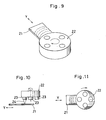
- a conventional recording and reproducing device for the aforesaid magneto-optical card is described below, with reference being made to Figs. 8-11. Here, however, illustration of a magnetic field generator for application of a biased magnetic field is omitted.
- a magneto-optical card 21 is taken in under an optical head 22 and is let to move reciprocally in the direction of the arrow Y at a high speed. And the optical head 22 is properly moved in the direction perpendicular thereto (direction indicated by the arrow X). Then a laser beam 24 having passed an objective lens 23 of the optical head 22 moves super-fast along Y-direction, irradiating the magneto-optical recording medium of of the magneto-optical card 21, and also moves properly along X-direction for two-dimensional scanning to be made thereby.
- the magneto-optical card 21 is taken in under the optical head 22 and is properly moved along the direction indicated by the arrow Y.
- the optical head 22 is rotating at a high speed.
- this optical head 22 has four objective lenses 23... arranged equidistantly inward of its periphery, and the optical system is switched successively for the magneto-optical recording medium to be irradiated continuously or uninterruptedly with the laser beam 24 emitted through the objective lens 23 located above thereof at a given moment.
- the laser beam 24 is moving above the magneto-optical recording medium 23 in a circular path, while the magneto-optical card 21 moves properly in Y-direction for two-dimensional scanning to be accomplished thereby.
- the magneto-optical recording medium On the magneto-optical recording medium there are formed a plurality of tracks in the form of parallel arcs and information is recorded along these tracks. Needless to say, recording and reproducing of information by irradiation with the laser beam 24 are feasible on any spot on the magneto-optical recording medium.
- the information recording and reproducing speed is determined by the rotary speed of the optical head 22.
- the acceleration is equilibrated as it rotates and the small mechanical loss allows increase of the access speed.
- frequent switching of the optical system is needed so that the irradiation of the magneto-optical card 21 is done with the laser beam 24 emitted through the objective lens 23 located above the magneto-optical card 21 and there is a problem of the way of controlling the optical system being rather complicated.
- the object lens 23 used to be provided with an optical system manipulating mechanism by the use of a method of varying the position of the objective lens 23 within a small range or of a light deflector for fine adjustment of the spot to be irradiated by the laser beam 24.
- This optical system manipulation mechanism enables moving the laser beam 24 on the magneto-optical recording medium in a range of several hundreds microns.
- the resulting shock causes the objective lens 23 to vibrate and the accessing by means of the optical system manipulating mechanism is infeasible until stabilization thereof. It is possible to use an actuator-locking mechanism for forcibly fixing the optical head 22 as it is stopped, but this means further complication of the mechanical control mechanism.
- the magneto-optical card Since there is a certain limit to the scope of laser beam scanning feasible by means of an optical system manipulating mechanism, however, it is necessary to do some degree of positioning through rough searching for a data region on the magneto-optical card. Although there is a limit to the manipulability of the optical system manipulating mechanism, too, the magneto-optical card is known to be quite high in recording density, hence it is possible to record a relatively large volume of information in a two-dimensional region when the optical system manipulating mechanism so constructed or modified to enable two-dimensional movement of the laser beam.
- the optical head is fixed with respect to the optical head.
- the present invention includes provision of a magnetic field generator moving mechanism for thus moving the magnetic field generator.
- the magneto-optical card moving mechanism suffices if it can do positioning at a certain precision, vibration during movement et cetera being of no concern, hence it is possible to simplify its construction and yet increase its working speed.
- the magnetic field generator moving mechanism is solely intended to bring the magnetic field generator into contact with the magneto-optical card, hence this, too, may be of simple construction, yet can be highly dependable.
- Another object of the present invention is to make applicable a conventional, known optical system manipulating mechanism to laser beam scanning by additional use of a mechanism for displacing the objective lens or a photo-deflector.
- Still another object of the present invention is to dispose the optical head above the magneto-optical card and the magnetic field generator thereunder so that movement of the magnetic field generator moving mechanism does not interfere with irradiation with the laser beam.
- a further object of the present invention is to make construction of the magnetic field generator moving mechanism simpler to construct by having the upper end face of the core generally used as a part of the magnetic generator and disposed closest to the magneto-optical card come into contact with the magneto-optical card through shifting of the magnetic field generator.
- Still a further object of the present invention is to further simplify the construction of the magnetic field generator moving mechanism by making the core of the magnetic field generator alone to come into contact with the magneto-optical card.
- Another object of the present invention is to further simplify the construction of the magneto-optical card moving mechanism by enabling lengthwise and sidewise movement of the magneto-optical card for rough searching of a given spot to be made feasible.
- Still another object of the present invention is to accomplish the above object of the present invention by providing a control mechanism for controlling the magnetic field generating mechanism and the optical system moving mechanism.
- Still further object of the present invention is to further facilitate control by means of a mechanism for controlling provided for the purpose of controlling the magnetic field generator moving mechanism and the optical system moving mechanism through formation of rows of pits and/or grooves to divide the surface of the magneto-optical recording medium of the magneto-optical card into defined regions.
- a further object of the present invention is to cope with circular movement of the laser beam locus by the optical system control mechanism by arranging the rows of pits and/or grooves for dividing the surface of the magneto-optical recording medium of the magneto-optical card in the form of parallel arcs.
- Still a further object of the present invention is to further facilitate the control by means of a mechanism for controlling provided for the purpose of controlling the magnetic field generator moving mechanism and optical system moving mechanism by arranging the pits in each row for dividing the surface of the magneto-optical recording medium of the magneto-optical card in a zigzag fashion.
- a recording and reproducing device for a magneto-optical card of this embodiment is so arranged that the magneto-optical card 1 is taken in under an optical head 2 to have it supported by a magneto-optical card moving mechanism (not shown).
- the magneto-optical card moving mechanism is designed to be capable of moving the magneto-optical card 1 it supports horizontally, lengthwise as well as sidewise.
- a magneto-optical recording medium 5 on the magneto-optical card 1 is formed as a layer between a transparent sheet exposed on the card's surface and a protective sheet on the backside thereof.
- the magneto-optical card 1 is supported by the magneto-optical card moving mechanism with the side on which the transparent sheet is exposed facing upward.
- the optical head 2 is fixed securely to the device's main frame. And this optical head 2 has housed therein a semi-conductor laser emitter and a laser beam 4 emitted thereby is led to pass through an optical system and an objective lens 3 as a part thereof to irradiate a spot on the magneto-optical recording medium 5 of the magneto-optical card 1.
- This optical head 2 is provided with an optical system displacing mechanism (not shown), which is capable of displacing the objective lens 3 horizontally for fine adjustment of the spot to be irradiated.
- This optical head 2 has housed therein an optical system for taking in this laser beam 4 and a photo-detector so that the pits and grooves as portions changed physically in the form on the magneto-optical recording medium 5 can be sensitively detected as well as magnetically recorded bits of data.
- This magnetic field generator 6 is composed of a core 7 and a coil 8 surrounding it. It is so arranged that a biased magnetic field can be applied to the magneto-optical recording medium 5 when the coil 8 is energized.
- This magnetic field generator 6 is so arranged that the upper end face of the core 7 is opposed to the backside of the magneto-optical card 1 with a small gap therebetween, and this magnetic field generator 6 is secured to a magnetic field generator moving mechanism 9 disposed thereunder.
- This magnetic field generator moving mechanism 9 serves to move the magnetic generator 6 vertically so that the upper end face of the core 7 can be pushed against the backside of the magneto-optical card 1.
- the recording and reproducing device for the magneto-optical card constituted as described above first has the taken-in magneto-optical card 1 moved lengthwise and sidewise by the magneto-optical card moving mechanism for rough searching.
- This rough searching is done by properly moving the magneto-optical card 1 so that the any region of the magneto-optical recording medium may be irradiated by the laser beam 4 emitted by the fixed optical head 2.
- the positional precision of (tolerance for) the aforesaid rough searching is set to be not more than 80 microns.
- the magnetic field generator 6 Upon completion of rough searching, the magnetic field generator 6 is moved up immediately by the magnetic field generator moving mechanism 9 and, as shown in Fig. 2, the upper end face of the core 7 is pressed against the backside of the magneto-optical card 1. Then, the magneto-optical card 1 is stopped as it is supported by the magneto-optical card moving mechanism and the vibration resulting from rough searching is thus forcibly stopped.
- the optical head 2 then has its objective lens 3 displaced horizontally by the optical system manipulating mechanism systematically for the magneto-optical recording medium 5 to be properly scanned by the laser beam 4 for recording, reproducing and erasing of information.
- the coil 8 is energized for the biased magnetic field from the magnetic field generator 6 to be applied to the magneto-optical recording medium 5.
- magneto-optical recording medium 5 On the magneto-optical recording medium 5 a plurality of rows of pits 11..., each thereof consisting of a large number of pits arranged in X-direction are formed 126 microns apart. On this magneto-optical recording medium 5 also formed are a plurality of grooves 12... in Y-direction also 126 microns apart. The individual pits of the row of pits 11 and the grooves 12 are both portions changed physically in the form. And the region defined by two rows of pits 11/11 and two grooves 12/12 is a sector, in which 4,096 bits (512 bytes) of data are magnetically stored.
- two-dimensional scanning is undertaken by the laser beam 4 by means of the optical system manipulating mechanism.
- the laser beam 4 is first moved reciprocally and repeatedly along X-direction at a given amplitude of not less than 143 microns.
- this laser beam 4 is bound to cross the two grooves 12/12 defining the two sides of a given sector, and the output waveform of optical intensity detected by the optical head 2 reveals the signals showing the two grooves 12 as seen from Fig. 4 (a).
- This signal is formed by lowering of the optical intensity of the reflected light due to optical interference between the grooves 12 and the land region adjacent thereto.
- this two-dimensional scanning is done with the laser beam 4 being slightly displaced in Y-direction each time it reciprocates in X-direction.
- This distance of displacement in Y-direction of the laser beam 4 equals the pitch between the adjacent data bits 13/13 in Y-direction, and this pitch is 1.6 micron.
- the scanning width in Y-direction is to be set to be not less than 143 microns.
- the scanning range in Y-direction necessarily includes two rows of pits 11/11 defining the given sector on two sides.
- the output waveform of the optical intensity detected by the optical head 2 has appearing therein the signal indicating the row of pits 11 twice as seen from Fig. 4 (b) besides the signal shown in Fig. 4 (a).
- This signal is formed by lowering of the optical intensity of the reflected light due to optical interference between the individual pits of the row of pits and the land portions around them.
- the given region in Y-direction is defined by the first appearance of the signal for the row of pits 11 shown in Fig. 4 (b) after start of the two-dimensional scanning until the second appearance of the same signal. And within these limits the distance between the grooves 12 and 12 in Fig. 4 (a) represents the region in X-direction.
- the laser beam 4 As it scans the predetermined region in X- and Y-direction, should do proper access, recording, reproducing and erasing of data are feasible in the predetermined sector.
- the laser beam 4 carrying the erasing signal or the data signal may be used for scanning with simultaneous application of the biased magnetic field.
- the data signal has to be sent to the magnetic field generator 6 when recording is to be made by magnetic field modulation.
- the data stored in the individual data bits 13 can be reproduced if the magneto-optical effect of the laser beam 4 reflected in the given sector can be detected.
- Figs. 5 and 6 shows another mode of formatting on the magneto-optical recording medium 5.
- Fig. 7 shows still another mode of formatting on the magneto-optical recording medium 5.
- the recording and reproducing device for the magneto-optical card of the present invention comprises an optical head for irradiating a magneto-optical recording medium of a magneto-optical card taken into the device, a magnetic field generator applying a biased magnetic field to the magneto-optical recording medium and an optical system manipulating mechanism for the optical system of the aforesaid optical head to change the spot to be irradiated by the laser beam, a magneto-optical card moving mechanism for supporting the magneto-optical card where it is irradiated with the laser beam emitted from the optical head which is fixedly secured to the main frame of the device and also for moving the magneto-optical card horizontally in a plane parallel to the card's surface, and a magnetic field generator moving mechanism for moving a part or the whole of the magnetic field generator and bringing the part or the whole of magnetic field generator into contact with the magneto-optical card supported by the magneto-optical card moving mechanism.
- the recording and reproducing device for the magneto-optical card of the present invention is, as described in the appended claim 2, in addition to the feature disclosed in claim 1, further characterized in that the optical system manipulating mechanism is so arranged that the laser beam irradiation spot can be varied by displacing an objective lens of the optical head.
- the recording and reproducing device for the magneto-optical card of the present invention is, as described in the appended claim 3, in addition to the feature disclosed in claim 1, further characterized in that the optical system manipulating mechanism is so arranged that the laser beam irradiation spot can be varied by means of an optical deflector in the optical head.
- the recording and reproducing device for the magneto-optical card of the present invention is, as described in the appended claim 4, in addition to the feature disclosed in claim 1, further characterized in that the optical head is disposed above the magneto-optical card supported by the magneto-optical card moving mechanism, and the magnetic field generator is disposed below this magneto-optical card.
- the recording and reproducing device for the magneto-optical card of the present invention is, as described in the appended claim 5, in addition to the feature disclosed in claim 1, further characterized in that the magnetic field generator has a core and is so arranged that the upper end face of the core of the magnetic field generator can be brought into contact with the magneto-optical card by properly moving the magnetic field generator by the magnetic field generator moving mechanism.
- the recording and reproducing device for the magneto-optical card of the present invention is, as described in the appended claim 6, in addition to the feature disclosed in claim 5, further characterized in that the core of the magnetic field generator alone can be moved by the magnetic field generator moving mechanism so that the upper end face of the core can be brought into contact with the magneto-optical card.
- the recording and reproducing device for the magneto-optical card of the present invention is, as described in the appended claim 7, in addition to the feature disclosed in claim 1, further characterized in that the magneto-optical card moving mechanism is movable lengthwise as well as sidewise horizontally in a plane parallel to the surface of the card.
- the recording and reproducing device for the magneto-optical card of the present invention is, as described in the appended claim 8, in addition to the feature disclosed in claim 1, further provided with a control mechanism which serves, after bringing the magnet field generator into contact with the magneto-optical card by means of the magnetic field generator moving mechanism, to control the optical system manipulation mechanism so as to vary the spot to be irradiated with the laser beam emitted from the optical head for recording, reproducing or erasing information.
- the recording and reproducing device for the magneto-optical card of the present invention is, as described in the appended claim 9, in addition to the feature disclosed in claim 8, further characterized in that the surface of the magneto-optical recording medium of the magneto-optical card is divided lengthwise and sidewise in rough proportions by rows of pits and/or grooves as portions changed physically in the form into regions and recording, reproducing and erasing of information is carried out regionwise.
- the recording and reproducing device for the magneto-optical card of the present invention is, as described in the appended claim 10, in addition to the feature disclosed in claim 9, further characterized in that the rows of pits and/or grooves are arranged in arc form in each region defined thereby.
- the recording and reproducing device for the magneto-optical card of the present invention is, as described in the appended claim 11, in addition to the feature disclosed in claim 9, further characterized in that the individual pits of each row of pits are arranged in a zigzag fashion.
- the construction described above enables the magnetic field generator moving mechanism to bring a part or the whole of the magnetic field generator into contact with the magneto-optical card to stop it instantaneously upon completion of rough searching. Hence, vibration resulting from sudden stopping of the magneto-optical card can be securely prevented and the laser beam scanning by means of the optical system manipulating mechanism can be started without delay.
- the present invention allows start of laser beam scanning without waiting for dampening of the vibration of the magneto-optical card, hence high-speed access to information is feasible.
- the present invention it is possible to securely stop the magneto-optical card with the magnetic field generator at the time of recording, reproducing and erasing information to/from the magneto-optical card, hence the variation of the relative distance between the optical head and the magneto-optical card is reduced, and, therefore, also the necessity of focus adjustment. Hence, the focus servo control by the optical system manipulating mechanism is facilitated and the control system can be simplified.
- the magnetic field generator is brought into direct contact with the magneto-optical card at the time of recording and erasing information, the temperature of the magnetic field generator can be directly transmitted to the magneto-optical recording medium.
- the temperature of the magnetic field generator it is possible to have the temperature of the magneto-optical recording medium kept constant regardless of the ambient conditions and, by having this temperature somewhat raised in advance, recording and erasing of information are feasible even if the laser beam intensity is somewhat low.
Applications Claiming Priority (2)
| Application Number | Priority Date | Filing Date | Title |
|---|---|---|---|
| JP332251/87 | 1987-12-26 | ||
| JP62332251A JP2647877B2 (ja) | 1987-12-26 | 1987-12-26 | 光磁気カード記録再生装置 |
Publications (3)
| Publication Number | Publication Date |
|---|---|
| EP0323232A2 true EP0323232A2 (de) | 1989-07-05 |
| EP0323232A3 EP0323232A3 (en) | 1990-12-05 |
| EP0323232B1 EP0323232B1 (de) | 1993-09-08 |
Family
ID=18252862
Family Applications (1)
| Application Number | Title | Priority Date | Filing Date |
|---|---|---|---|
| EP88312367A Expired - Lifetime EP0323232B1 (de) | 1987-12-26 | 1988-12-28 | Aufzeichnungs- und Wiedergabeanordnung für magnetooptische Karte |
Country Status (5)
| Country | Link |
|---|---|
| US (1) | US5053611A (de) |
| EP (1) | EP0323232B1 (de) |
| JP (1) | JP2647877B2 (de) |
| CA (1) | CA1316599C (de) |
| DE (1) | DE3883951T2 (de) |
Families Citing this family (4)
| Publication number | Priority date | Publication date | Assignee | Title |
|---|---|---|---|---|
| US5966457A (en) * | 1955-06-14 | 1999-10-12 | Lemelson; Jerome H. | Method for inspecting, coding and sorting objects |
| JPH0340250A (ja) * | 1989-07-06 | 1991-02-21 | Matsushita Electric Ind Co Ltd | 光磁気ディスクおよび光磁気ディスク装置 |
| US6775080B2 (en) * | 1998-04-09 | 2004-08-10 | Dcard, Inc. | Data access device implemented with open and closed control loops to access data stored in discrete stepwise segments |
| WO2007058179A1 (ja) * | 2005-11-16 | 2007-05-24 | Kyodo Printing Co., Ltd. | 非接触icカード |
Family Cites Families (16)
| Publication number | Priority date | Publication date | Assignee | Title |
|---|---|---|---|---|
| US3624623A (en) * | 1969-05-05 | 1971-11-30 | Du Pont | Thermoremanent magnetic memory system |
| US3736385A (en) * | 1971-06-01 | 1973-05-29 | Du Pont | Storage and retrieval of analog information with magnetooptic readout |
| US4680456A (en) * | 1981-02-27 | 1987-07-14 | Drexler Technology Corporation | Data system employing wallet-size optical card |
| US4810868A (en) * | 1985-08-06 | 1989-03-07 | Drexler Technology Corporation | Frasable optical wallet-size data card |
| JPS5814306A (ja) * | 1981-07-20 | 1983-01-27 | Omron Tateisi Electronics Co | 磁気カ−ド装置 |
| JPS5817505A (ja) * | 1981-07-22 | 1983-02-01 | Sony Corp | 光熱磁気トラツク移動方法 |
| US4534031A (en) * | 1982-08-02 | 1985-08-06 | News Log International | Coded data on a record carrier and method for encoding same |
| US4786792A (en) * | 1983-10-12 | 1988-11-22 | Drexler Technology Corporation | Transmissively read quad density optical data system |
| JPS60150202A (ja) * | 1984-01-18 | 1985-08-07 | Canon Inc | 再生方法および装置 |
| JP2571205B2 (ja) * | 1985-02-20 | 1997-01-16 | キヤノン株式会社 | 情報記録担体 |
| US4782221A (en) * | 1985-04-01 | 1988-11-01 | Cauzin Systems, Incorporated | Printed data strip including bit-encoded information and scanner control |
| EP0485359B1 (de) * | 1985-04-29 | 1998-06-17 | Sony Corporation | Externes Magnetfeld-Umpolungsgerät für magneto-optisches Plattengerät |
| US4957580A (en) * | 1986-04-23 | 1990-09-18 | Drexler Technology Corp. | Method for making an optical data card |
| JPS62273638A (ja) * | 1986-05-21 | 1987-11-27 | Mitsubishi Electric Corp | 光磁気記録装置 |
| US4730293A (en) * | 1986-09-15 | 1988-03-08 | Drexler Technology Corporation | Dual beam optical data system |
| US4812633A (en) * | 1988-04-08 | 1989-03-14 | Minnesota Mining And Manufacturing Company | Optical data card |
-
1987
- 1987-12-26 JP JP62332251A patent/JP2647877B2/ja not_active Expired - Lifetime
-
1988
- 1988-12-20 CA CA000586507A patent/CA1316599C/en not_active Expired - Fee Related
- 1988-12-21 US US07/287,053 patent/US5053611A/en not_active Expired - Lifetime
- 1988-12-28 DE DE88312367T patent/DE3883951T2/de not_active Expired - Fee Related
- 1988-12-28 EP EP88312367A patent/EP0323232B1/de not_active Expired - Lifetime
Also Published As
| Publication number | Publication date |
|---|---|
| DE3883951T2 (de) | 1994-04-28 |
| JP2647877B2 (ja) | 1997-08-27 |
| JPH01173346A (ja) | 1989-07-10 |
| DE3883951D1 (de) | 1993-10-14 |
| CA1316599C (en) | 1993-04-20 |
| EP0323232B1 (de) | 1993-09-08 |
| EP0323232A3 (en) | 1990-12-05 |
| US5053611A (en) | 1991-10-01 |
Similar Documents
| Publication | Publication Date | Title |
|---|---|---|
| US5199022A (en) | Disk having data memorizing portion including land-shaped and groove-shaped areas, and writing/reading apparatus for the same | |
| KR920704268A (ko) | 세개의 레이저 광 디스크 드라이브장치 | |
| EP0340221B1 (de) | Speichersystem mit mehreren karten | |
| US5043960A (en) | Overwritable magneto-optic recording and reproducing apparatus | |
| KR100454452B1 (ko) | 광학정보기록/판독매체및기록방법 | |
| EP0323232B1 (de) | Aufzeichnungs- und Wiedergabeanordnung für magnetooptische Karte | |
| EP0358775B1 (de) | Photomagnetisches aufzeichnungsverfahren | |
| EP0195227A2 (de) | Magnetooptischer Plattenspeicher | |
| JPH04252425A (ja) | 情報記録装置 | |
| EP0327033A2 (de) | Informationsverarbeitungsvorrichtung | |
| EP0341965A2 (de) | Optische Karte und Aufnahme/Wiedergabegerät dafür | |
| JP2786659B2 (ja) | 光メモリ原盤のサーボパターン記録方法および装置 | |
| JPH03276424A (ja) | 光カードの記録再生装置 | |
| JPH0517613B2 (de) | ||
| US5136574A (en) | Optical card and a recording/reproduction apparatus for the same | |
| JP2752430B2 (ja) | 光デイスク装置 | |
| JP2705692B2 (ja) | 光ディスク装置 | |
| JP3337292B2 (ja) | マルチビーム記録再生装置 | |
| KR100291422B1 (ko) | 열자기 기록 방식을 이용한 디스크 기록장치 | |
| JPH03280228A (ja) | カード状光記録媒体およびその記録再生装置 | |
| JPS61273744A (ja) | 光カ−ド情報記録再生装置 | |
| JPS62270026A (ja) | カ−ド状光情報記録媒体およびその光情報記録再生装置 | |
| JPS63213125A (ja) | 光カ−ド記録再生方法 | |
| JPH01208766A (ja) | 情報記録再生装置 | |
| JPS61269229A (ja) | 光テ−プ情報記録再生装置 |
Legal Events
| Date | Code | Title | Description |
|---|---|---|---|
| PUAI | Public reference made under article 153(3) epc to a published international application that has entered the european phase |
Free format text: ORIGINAL CODE: 0009012 |
|
| AK | Designated contracting states |
Kind code of ref document: A2 Designated state(s): DE FR GB IT NL |
|
| PUAL | Search report despatched |
Free format text: ORIGINAL CODE: 0009013 |
|
| AK | Designated contracting states |
Kind code of ref document: A3 Designated state(s): DE FR GB IT NL |
|
| 17P | Request for examination filed |
Effective date: 19901228 |
|
| 17Q | First examination report despatched |
Effective date: 19920518 |
|
| GRAA | (expected) grant |
Free format text: ORIGINAL CODE: 0009210 |
|
| AK | Designated contracting states |
Kind code of ref document: B1 Designated state(s): DE FR GB IT NL |
|
| REF | Corresponds to: |
Ref document number: 3883951 Country of ref document: DE Date of ref document: 19931014 |
|
| ET | Fr: translation filed | ||
| ITF | It: translation for a ep patent filed | ||
| PLBE | No opposition filed within time limit |
Free format text: ORIGINAL CODE: 0009261 |
|
| STAA | Information on the status of an ep patent application or granted ep patent |
Free format text: STATUS: NO OPPOSITION FILED WITHIN TIME LIMIT |
|
| 26N | No opposition filed | ||
| PGFP | Annual fee paid to national office [announced via postgrant information from national office to epo] |
Ref country code: FR Payment date: 19971209 Year of fee payment: 10 |
|
| PGFP | Annual fee paid to national office [announced via postgrant information from national office to epo] |
Ref country code: GB Payment date: 19971219 Year of fee payment: 10 |
|
| PGFP | Annual fee paid to national office [announced via postgrant information from national office to epo] |
Ref country code: NL Payment date: 19971223 Year of fee payment: 10 |
|
| PG25 | Lapsed in a contracting state [announced via postgrant information from national office to epo] |
Ref country code: GB Free format text: LAPSE BECAUSE OF NON-PAYMENT OF DUE FEES Effective date: 19981228 |
|
| PG25 | Lapsed in a contracting state [announced via postgrant information from national office to epo] |
Ref country code: NL Free format text: LAPSE BECAUSE OF NON-PAYMENT OF DUE FEES Effective date: 19990701 |
|
| GBPC | Gb: european patent ceased through non-payment of renewal fee |
Effective date: 19981228 |
|
| PG25 | Lapsed in a contracting state [announced via postgrant information from national office to epo] |
Ref country code: FR Free format text: LAPSE BECAUSE OF NON-PAYMENT OF DUE FEES Effective date: 19990831 |
|
| NLV4 | Nl: lapsed or anulled due to non-payment of the annual fee |
Effective date: 19990701 |
|
| REG | Reference to a national code |
Ref country code: FR Ref legal event code: ST |
|
| PGFP | Annual fee paid to national office [announced via postgrant information from national office to epo] |
Ref country code: DE Payment date: 20041223 Year of fee payment: 17 |
|
| PG25 | Lapsed in a contracting state [announced via postgrant information from national office to epo] |
Ref country code: IT Free format text: LAPSE BECAUSE OF NON-PAYMENT OF DUE FEES;WARNING: LAPSES OF ITALIAN PATENTS WITH EFFECTIVE DATE BEFORE 2007 MAY HAVE OCCURRED AT ANY TIME BEFORE 2007. THE CORRECT EFFECTIVE DATE MAY BE DIFFERENT FROM THE ONE RECORDED. Effective date: 20051228 |
|
| PG25 | Lapsed in a contracting state [announced via postgrant information from national office to epo] |
Ref country code: DE Free format text: LAPSE BECAUSE OF NON-PAYMENT OF DUE FEES Effective date: 20060701 |