EP0303540B1 - Analogue du facteur VIII, procédé de préparation, et composition pharmaceutique le contenant - Google Patents
Analogue du facteur VIII, procédé de préparation, et composition pharmaceutique le contenant Download PDFInfo
- Publication number
- EP0303540B1 EP0303540B1 EP88402078A EP88402078A EP0303540B1 EP 0303540 B1 EP0303540 B1 EP 0303540B1 EP 88402078 A EP88402078 A EP 88402078A EP 88402078 A EP88402078 A EP 88402078A EP 0303540 B1 EP0303540 B1 EP 0303540B1
- Authority
- EP
- European Patent Office
- Prior art keywords
- factor viii
- fviii
- cells
- analog
- viii analog
- Prior art date
- Legal status (The legal status is an assumption and is not a legal conclusion. Google has not performed a legal analysis and makes no representation as to the accuracy of the status listed.)
- Expired - Lifetime
Links
Images

Classifications
-
- C—CHEMISTRY; METALLURGY
- C07—ORGANIC CHEMISTRY
- C07K—PEPTIDES
- C07K14/00—Peptides having more than 20 amino acids; Gastrins; Somatostatins; Melanotropins; Derivatives thereof
- C07K14/435—Peptides having more than 20 amino acids; Gastrins; Somatostatins; Melanotropins; Derivatives thereof from animals; from humans
- C07K14/745—Blood coagulation or fibrinolysis factors
- C07K14/755—Factors VIII, e.g. factor VIII C (AHF), factor VIII Ag (VWF)
-
- A—HUMAN NECESSITIES
- A61—MEDICAL OR VETERINARY SCIENCE; HYGIENE
- A61P—SPECIFIC THERAPEUTIC ACTIVITY OF CHEMICAL COMPOUNDS OR MEDICINAL PREPARATIONS
- A61P7/00—Drugs for disorders of the blood or the extracellular fluid
- A61P7/04—Antihaemorrhagics; Procoagulants; Haemostatic agents; Antifibrinolytic agents
-
- A—HUMAN NECESSITIES
- A61—MEDICAL OR VETERINARY SCIENCE; HYGIENE
- A61P—SPECIFIC THERAPEUTIC ACTIVITY OF CHEMICAL COMPOUNDS OR MEDICINAL PREPARATIONS
- A61P7/00—Drugs for disorders of the blood or the extracellular fluid
- A61P7/06—Antianaemics
-
- A—HUMAN NECESSITIES
- A61—MEDICAL OR VETERINARY SCIENCE; HYGIENE
- A61K—PREPARATIONS FOR MEDICAL, DENTAL OR TOILETRY PURPOSES
- A61K38/00—Medicinal preparations containing peptides
Definitions
- the cloning of factor VIII cDNA (FVIII) (1-3) has made it possible to better understand the structure and functions of this complex molecule.
- the first mRNA translation product is a molecule of 2,351 amino acids, comprising a signal peptide of 19 amino acids. Internal homologies are observed in the amino acid sequences which make it possible to define domains: a triplet of domains A, a single domain B and a doublet of domains C, arranged in the following order: A1-A2-B-A3- C1-C2 (2, 4).
- the single B domain is encoded by an exon of 3,100 bp (exon 14 of the FVIII gene) (5) and contains 19 of the 25 potential glycosylation sites (Asn); this part of the molecule is cleaved and lost during activation by thrombin (2, 4, 6).
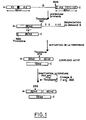
- the current model of the factor VIII maturation mechanism is shown schematically in Figure 1.
- the first activation is due to a cleavage of the molecule between the amino acids Arg1648 and Glu1649 which gives a precursor of the light chain of 80 Kd and a precursor of the heavy chain of> 200 Kd.
- the 2 chains are probably linked by a metal ion (Ca++?) Before the cleavage is achieved.
- domain B is degraded by several proteolytic cleavages, then activation by thrombin takes place by a cleavage between the amino acids Arg739 and Ser740 and between Arg1689 and Ser1690 which gives a heavy chain of 90 Kd and a light chain of 73 Kd.
- activation by thrombin takes place by a cleavage between the amino acids Arg739 and Ser740 and between Arg1689 and Ser1690 which gives a heavy chain of 90 Kd and a light chain of 73 Kd.
- the need for additional cleavage between Arg371 and Ser372 to obtain maximum activity is still controversial; on the contrary, this cleavage could destabilize the molecule (6, 7).
- factor VIII such as activated protein C and factor Xa which cleaves the molecule at several points, in particular at Arg336 / Met337 (7).
- domain B does not play a role in the activity of the mature molecule since it is lost after activation by thrombin.
- Toole et al. (8) compared the nucleotide sequences of the human and porcine factor VIII genes and showed that the 2 B domains are very divergent while the heavy and light chains are very conserved. This suggests (8, 9, 10, 11) that a molecule devoid of B domain would not lose its procoagulant function.
- Factor VIII circulating in plasma is associated with von Willebrand factor (fvW) which seems to stabilize it; in fact the half-life of FVIII in vivo decreases very strongly in the absence of fvW (16).
- Eaton et al. (9) have described a factor VIII derivative deleted in domain B, which effectively binds fvW, which makes it possible to expect a normal half-life in vivo for the molecule deleted from domain B.
- the present invention relates to the analog of factor VIII from which amino acids 771 to 1666 have been deleted. It will also be called throughout the description and examples FVIII ⁇ II.
- the factor VIII analog according to the present invention is preferably prepared from a culture of eukaryotic cells producing said analog on an appropriate culture medium and from the separation of the factor VIII obtained.
- the cells have, preferably according to the invention, been infected with a recombinant viral vector such as the vaccinia virus which ensures the expression of the cDNA of the factor VIII analog in the cells.
- a recombinant viral vector such as the vaccinia virus which ensures the expression of the cDNA of the factor VIII analog in the cells.
- These are preferably BHK21 cells.
- the cells can also be transfected with an integration vector comprising the cDNA of the factor VIII analog surrounded by the elements necessary for its expression in eukaryotic cells and a DNA segment promoting integration of the vector into cellular DNA.
- the cDNA encoding the factor VIII analog is preferably inserted in front of a gene encoding a selection marker to give a bicistronic transcript.
- the transfected cells are preferably CHO cells.
- the present invention relates to a pharmaceutical composition
- a pharmaceutical composition comprising, as active principle, the analog of factor VIII of the present invention.
- Such a composition may additionally contain von Willebrand factor.
- the pharmaceutical composition of the present invention is preferably in sterile injectable form.
- Example 1 Construction of plasmids carrying cDNA derivatives of factor VIII, deleted in the region corresponding to domain B.
- the starting plasmid is the plasmid pTG1080 which carries the factor VIII cDNA, nucleotides -64 to 8230, cloned in the SalI site of pUC8 (This plasmid was described in French patent 86.08258).
- Example 2 Expression of the FVIII ⁇ I and ⁇ II sequences by recombinant vaccinia viruses.
- a derivative of the plasmid pTG1016, pTG1030 (identical to the previous one except a Bg1II-PstI deletion in the 5 ′ region not translated of the FVIII sequence) was used to integrate the deleted constructs, FVIII ⁇ I and ⁇ II, in place of the native sequence , in the vector designed to allow integration into the genome of the vaccinia virus.
- the BamHI-BglI fragment (corresponding to nucleotides 1864 to 6050) of the native sequence of pTG1030 is excised and replaced by the BamHI-BglI fragment from pTG1501 (FVIII ⁇ I) to give pTG1506 or by the BamHI-BglI fragment from M13TG1510 (FVIII ⁇ II) to give pTG1507.
- the DNA blocks comprising the vaccinia TK gene interrupted by the cDNA FVIII ⁇ placed under the 7.5 K vaccinia promoter, are integrated into the genome of the vaccinia virus, by homologous recombination, according to the conventional technique (18).
- VV.TG.FVIII1506 FVIII ⁇ I
- VV.TG.FVIII1507 VVIII ⁇ II
- Recombinant viruses are used to infect BHK21 cell mats (2.106 cells) with 1 pfu / cell. After 1 hour of adsorption, the cultures are washed and renewed in a fresh medium without serum, supplemented with 1% BSA and 1 mM CaCl2. Media samples are taken after 24 and 48 hours and assayed for the amount of factor VIII present, determined by radioimmunometric assay (FVIII: Ag) and for the procoagulant activity of factor VIII (FVIII: C).
- the FVIII or FVIII ⁇ antigen is assayed "sandwiched" between immunoglobulin G from the serum of an inhibiting hemophiliac patient, adsorbed on the wall of the test tube, and an anti-factor VIII monoclonal antibody, specific for an epitope of the light chain, radioactive, according to a method described by Lee et al. (21).
- factor VIII Factor VIII
- TPTA part-time activated thromboplastin
- FVIII C activity does not drop between 24 and 48 hours while it drops with the molecule intact. We know that it must be stabilized by von Willebrand factor to keep its activity (French patent 86.08258).
- Example 3 Establishment of cell lines expressing factor VIII or factor VIII ⁇ II.
- the FVIII coding sequences were inserted into the vector pTG384, in the unique HindIII site (upstream of the XGPRT gene). The ends released by HindIII digestion are made blunt by treatment with the Klenow fragment of DNA polymerase I.
- FVIII The complete sequence of FVIII is recovered from the plasmid pTG1080 (see example 1) in the form of a SmaI-HpaI fragment (the SmaI site is located in the "polylinker" upstream of the initiating ATG and the HpaI site is located at the nucleotide 7434). Ligation of this fragment into the vector pTG384 opened with HindIII and treated with Klenow gives the plasmid pTG1020.
- the BamHI-BglI fragment (nucleotides 1864 and 6050 of FVIII) is exchanged in pTG1020 with the FVIII ⁇ II, BamHI-BglI fragment of M13TG1510, according to the same principle as for the construction of pTG1507.
- the vector pTG304 having inserted the FVIII ⁇ II is called pTG1509.
- CHO cell mats were transfected with the DNA of plasmids pTG1020 (FVIII) or pTG1509 (FVIII ⁇ II) by the calcium phosphate precipitate method (19), with 5 or 10 ⁇ g of DNA per 8.5 box cm in diameter. 48 hours after transfection, the cells are trypsinized, diluted and inoculated in a selective MEM ⁇ 2000 medium supplemented with hypoxanthine (15 mg / l), thymidine (10 mg / l), xanthine (250 mg / l), aminopterin (0.2 mg / l), mycophenolic acid (25 mg / l) and 10% dialyzed fetal calf serum.
- hypoxanthine 15 mg / l
- thymidine 10 mg / l
- xanthine 250 mg / l
- aminopterin 0.2 mg / l
- mycophenolic acid 25 mg / l
- the clones of cells resistant to the selective medium are removed, cultured in 1 ml and then 2 ml wells. When the cells reach 70% confluence, the medium is removed, the cell mats are washed and renewed in a fresh medium containing 5% inactivated serum (to avoid significant background noise in coagulation tests). After 24 hours, the medium is harvested and analyzed for the presence (FVIII: Ag) and the activity (FVIII: C) of factor VIII. Several clones were obtained. In the first analysis, it appears that most of the clones expressing complete FVIII produce less material than the clones expressing factor VIII ⁇ II.
- Example 4 Activation by thrombin of various native and recombinant factor VIII molecules.
- Activation is measured in a standard coagulation test (TPTA) after incubation in the presence of a catalytic amount of thrombin.
- TPTA standard coagulation test
- FIG. 4 shows that the recombinant FVIII and the plasma FVIII are activated in the same way (by a factor of 20) and according to very similar kinetics. FVIII ⁇ II is activated much stronger (by a factor of 80 after 5 minutes of incubation with thrombin).
- factor VIII ⁇ II is much more activated, it is not activated more quickly than the other 2 molecules (contrary to what has been observed by others (9) with their factor VIII ⁇ constructions) which shows that the factor VIII ⁇ II is not pre-activated, which is important for its therapeutic use.
- FVIII ⁇ II is not pre-activated is confirmed by the good correlation between the levels of FVIII: Ag and FVIII: C, both in the vaccine model and in the CHO lines.
Landscapes
- Health & Medical Sciences (AREA)
- Chemical & Material Sciences (AREA)
- Life Sciences & Earth Sciences (AREA)
- Organic Chemistry (AREA)
- General Health & Medical Sciences (AREA)
- Hematology (AREA)
- Medicinal Chemistry (AREA)
- General Chemical & Material Sciences (AREA)
- Zoology (AREA)
- Nuclear Medicine, Radiotherapy & Molecular Imaging (AREA)
- Diabetes (AREA)
- Pharmacology & Pharmacy (AREA)
- Bioinformatics & Cheminformatics (AREA)
- Animal Behavior & Ethology (AREA)
- Engineering & Computer Science (AREA)
- Public Health (AREA)
- Veterinary Medicine (AREA)
- Toxicology (AREA)
- Chemical Kinetics & Catalysis (AREA)
- Gastroenterology & Hepatology (AREA)
- Biochemistry (AREA)
- Biophysics (AREA)
- Genetics & Genomics (AREA)
- Molecular Biology (AREA)
- Proteomics, Peptides & Aminoacids (AREA)
- Medicines That Contain Protein Lipid Enzymes And Other Medicines (AREA)
- Preparation Of Compounds By Using Micro-Organisms (AREA)
- Peptides Or Proteins (AREA)
- Micro-Organisms Or Cultivation Processes Thereof (AREA)
Description
- Le clonage du cADN du facteur VIII (FVIII) (1-3) a permis de mieux comprendre la structure et les fonctions de cette molécule complexe.
Le premier produit de traduction du mARN est une molécule de 2.351 acides aminés, comprenant un peptide signal de 19 acides aminés. On observe des homologies internes dans les séquences en acides aminés qui permettent de définir des domaines : un triplet de domaines A, un domaine B unique et un doublet de domaines C, disposés dans l'ordre suivant : A1-A2-B-A3-C1-C2 (2, 4).
Le domaine B unique est codé par un exon de 3.100 pb (exon 14 du gène FVIII) (5) et contient 19 des 25 sites potentiels de glycosylation (Asn) ; cette partie de la molécule est clivée et perdue lors de l'activation par la thrombine (2, 4, 6). - Le modèle actuel du mécanisme de maturation du facteur VIII est schématisé dans la figure 1.
Dans ce modèle, la première activation est due à un clivage de la molécule entre les acides aminés Arg¹⁶⁴⁸ et Glu¹⁶⁴⁹ ce qui donne un précurseur de la chaîne légère de 80 Kd et un précurseur de la chaîne lourde de > 200 Kd.
Les 2 chaînes sont probablement reliées par un ion métallique (Ca⁺⁺ ?) avant que le clivage ne soit réalisé. - Ensuite le domaine B est dégradé par plusieurs clivages protéolytiques, puis l'activation par la thrombine s'effectue par un clivage entre les acides aminés Arg⁷³⁹ et Ser⁷⁴⁰ et entre Arg¹⁶⁸⁹ et Ser¹⁶⁹⁰ ce qui donne une chaîne lourde de 90 Kd et une chaîne légère de 73 Kd. La nécessité d'un clivage supplémentaire entre Arg³⁷¹ et Ser³⁷² pour obtenir une activité maximale est encore controversée ; ce clivage pourrait au contraire déstabiliser la molécule (6, 7).
- Il est généralement admis qu'une incubation prolongée en présence de thrombine entraîne une rapide diminution d'activité. D'autres facteurs peuvent également inactiver le facteur VIII comme la protéine C activée et le facteur Xa qui clive la molécule en plusieurs points, en particulier à Arg³³⁶/Met³³⁷ (7).
- Dans ce processus de maturation, en remarque que le domaine B ne joue pas de rôle dans l'activité de la molécule mature puisqu'il est perdu après activation par la thrombine. De plus, Toole et al. (8) ont comparé les séquences nucléotidiques des gènes du facteur VIII humain et porcin et ont montré que les 2 domaines B sont très divergents alors que les chaînes lourde et légère sont très conservées.
Ceci suggère (8, 9, 10, 11) qu'une molécule dépourvue de domaine B ne perdrait pas sa fonction procoagulante. - Deux approches ont été suivies pour tester cette hypothèse : soit la délétion, dans le cADN, de grands fragments d'ADN correspondant au domaine B ce qui donne des dérivés du facteur VIII plus courts (8, 9), soit la co-expression dans des cellules de mammifères de fragments d'ADN correspondant aux chaînes lourde et légère (10, 11).
- La co-expression dans des cellules de mammifères des chaînes lourde et légère résulte en une production détectable de FVIII:C mais à un niveau 5 fois inférieur à celui obtenu par l'expression de la molécule complète. Ceci suggère que l'association des 2 chaînes est inefficace ce qui diminue l'activité de la molécule (10, 11).
- Ces expériences ont montré qu'une molécule dépourvue de la plus grande partie du domaine B mais qui a conservé les sites de maturation correspondant aux acides aminés 740, 1649 et 1690 (qui semblent nécessaires à l'activation) présente une activité procoagulante normale et de plus, a l'avantage d'être exprimée 10 fois plus efficacement dans les cellules de mammifères (8). Cette molécule peut être activée par la thrombine de la même manière que la molécule naturelle entière (9).
- Le facteur VIII circulant dans le plasma est associé au facteur von Willebrand (fvW) qui semble le stabiliser ; en effet la demi-vie du FVIII in vivo diminue très fort en absence de fvW (16).
Eaton et al. (9) ont décrit un dérivé du facteur VIII délété dans le domaine B, qui lie efficacement le fvW, ce qui permet d'attendre une demi-vie normale in vivo pour la molécule délétée du domaine B. - La présente invention concerne l'analogue du facteur VIII dont les acides aminés 771 à 1666 ont été délétés. On l'appellera aussi tout au long de la description et des exemples FVIIIΔII.
- L'analogue du facteur VIII selon la présente invention est, de préférence, préparé à partir d'une culture de cellules eucaryotes produisant ledit analogue sur un milieu de culture approprié et de la séparation du facteur VIII obtenu.
- Les cellules ont, de préférence selon l'invention, été infectées par un vecteur viral recombinant tel que le virus de la vaccine qui assure l'expression du cADN de l'analogue du facteur VIII dans les cellules. Il s'agit, de préférence des cellules BHK21.
- Mais, dans le cadre de la présente invention, on peut aussi transfecter les cellules par un vecteur d'intégration comportant le cADN de l'analogue du facteur VIII entouré des éléments nécessaires à son expression dans les cellules eucaryotes et un segment d'ADN favorisant l'intégration du vecteur dans l'ADN cellulaire.
- Dans ce cas, le cADN codant pour l'analogue du facteur VIII est, de préférence, inséré devant un gène codant pour un marqueur de sélection pour donner un produit de transcription bicistronique.
- Les cellules transfectées sont, de préférence, des cellules CHO.
- Enfin, la présente invention concerne une composition pharmaceutique comportant, à titre de principe actif, l'analogue du facteur VIII de la présente invention.
- Une telle composition peut contenir, en outre, le facteur von Willebrand.
- La composition pharmaceutique de la présente invention se présente de préférence, sous forme stérile injectable.
- La présente invention sera mieux comprise à la lecture des exemples illustrés à l'aide des figures suivantes :
- Figure 1 :
- Schéma de la maturation de la molécule du facteur VIII par clivages protéolytiques successifs (d'après Toole et al. 1984 (2) et Eaton et al. 1986 (7).
- Figure 2 :
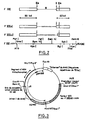
- Schéma de la molécule du facteur VIII et des 2 délétions ΔI (aa 868 à 1562) et ΔII (aa 771 à 1666).
Les sites de clivage par la thrombine (IIa) et par une protéase inconnue (X₁ en position 1649) sont indiqués par des flèches.
La ligne inférieure représente la séquence du cADN avec les sites de restriction utilisés dans les diverses constructions. - Figure 3 :
- Schéma du vecteur d'expression du rFVIII utilisé pour transformer les cellules CHO.
- Figure 4 :
- Cinétique d'activation par la thrombine des différentes molécules de facteur VIII :
pd = dérivé du plasma
r = molécule recombinante intacte
ΔII = molécule délétée ΔII - Note :
- La numérotation des nucléotides et des acides aminés est celle de Wood et al. (1).
- Le plasmide de départ est le plasmide pTG1080 qui porte le cADN de facteur VIII, des nucléotides -64 à 8230, cloné dans le site SalI de pUC8 (Ce plasmide a été décrit dans le brevet français 86.08258).
- A partir de ce plasmide, 2 dérivés ont été préparés, l'un (ΔI) comprenant une délétion dans le domaine B correspondant aux acides aminés 868 à 1562 ; l'autre (ΔII) correspondant à une délétion des acides aminés 771 à 1666. La construction ΔII abolit donc le site de clivage en position 1649.
- Les 2 constructions sont schématisées dans la figure 2.
- a) Le plasmide pTG1080 a été digéré par l'enzyme PstI pour libérer un fragment de 2.7 kb comprenant l'extrémité 5′ correspondant aux nucléotides -64 à 2641 du cADN du facteur VIII.
Ce fragment PstI a été cloné dans le vecteur pTG1POLY (vecteur de clonage dérive de pML2 comportant une origine de réplication active dans E. coli et le gène de la β. lactamase, dans lequel on a inséré un "polylinker" présentant 12 sites de restriction uniques. Ce vecteur est identique au vecteur pTG14 décrit dans le brevet PCT-FR85/00096, à l'exception du "polylinker" qui remplace le "linker" HindIII. Dans cette construction, le site Bg1II du polylinker se trouve adjacent du site PstI (nucléotide 2641) de la séquence FVIII.
Ensuite on introduit dans ce site Bg1II, la position 3′ de la séquence codante du FVIII (nucléotides 4801 à 8230) sous forme de fragment BamHI également isolé à partir du pTG1080.
La construction présentant les 2 segments du FVIII dans l'orientation correcte est appellée pTG1501. La séquence du cADN FVIII portée par cette construction est appelée FVIIIΔI. La jonction PstI/Bg1II/BamHI ainsi formée préserve la phase de lecture du FVIII. - b) A partir du pTG1501, on récupère un fragment KpnI-SphI (correspondant aux nucléotides 1811 à 6580) pour l'introduire dans le vecteur M13TG131 (20) et le déléter des nucléotides 2367 à 5056, par la technique dite de "loop out mutagenesis" (17), avec un oligonucléotide de synthèse ayant la séquence suivante :
5′TCATTTCAACTGATATGGTGTCAGTCTT3′
Le vecteur délété est appelé M13TG1510 ; la séquence de cADN FVIII délétée est appelée FVIIIΔII. L'analyse par séquençage confirme que la séquence est correcte. - Dans le brevet français 86.08258 on a décrit le plasmide pTG1016 qui porte la séquence de cADN du facteur VIII en aval du promoteur du gène codant pour la protéine 7.5 K du virus de la vaccine et ce bloc d'expression est inséré dans le gène TK du virus de la vaccine.
- Un dérivé du plasmide pTG1016, le pTG1030 (identique au précédent sauf une délétion Bg1II-PstI dans la région 5′ non traduite de la séquence FVIII) a été utilisé pour intégrer les constructions délétées, FVIIIΔI et ΔII, à la place de la séquence native, dans le vecteur conçu pour permettre l'intégration dans le génome du virus de la vaccine.
- Le fragment BamHI-BglI (corespondant aux nucléotides 1864 à 6050) de la séquence native du pTG1030 est excisé et remplacé par le fragment BamHI-BglI du pTG1501 (FVIIIΔI) pour donner le pTG1506 ou par le fragment BamHI-BglI du M13TG1510 (FVIIIΔII) pour donner le pTG1507.
- Les blocs d'ADN comprenant le gène TK de la vaccine interrompu par le cADN FVIIIΔ placé sous le promoteur 7.5 K de la vaccine, sont intégrés dans le génome du virus de la vaccine, par recombinaison homologue, selon la technique classique (18).
- Les virus recombinants correspondants sont appelés VV.TG.FVIII1506 (FVIIIΔI) et VV.TG.FVIII1507 (FVIIIΔII).
- Les virus recombinants sont utilisés pour infecter des tapis cellulaires de BHK21 (2.10⁶ cellules) avec 1 ufp/cellule. Après 1 heure d'adsorption, les cultures sont lavées et renouvelées en milieu frais sans sérum, additionné de 1 % BSA et 1 mM CaCl₂. Des échantillons de milieu sont prélevés après 24 et 48 heures et dosés pour la quantité de facteur VIII présent, déterminée par dosage radioimmunométrique (FVIII:Ag) et pour l'activité procoagulante du facteur VIII (FVIII:C).
- L'antigène FVIII ou FVIIIΔ est dosé "en sandwich" entre de l'immunoglobuline G du sérum de patient hémophile inhibiteur, adsorbée sur la paroi du tube à essai, et un anticorps monoclonal anti-facteur VIII, spécifique d'un épitope de la chaîne légère, radioactif, selon une méthode décrite par Lee et al. (21).
- La mesure de l'activité du facteur VIII (FVIII:C) est réalisée classiquement par le temps partiel de thromboplastine activée (TPTA) (22).
- Les résultats sont présentés dans le tableau suivant.

- Les résultats montrent que les 2 molécules délétées sont biologiquement actives dans un test de coagulation sanguine et qu'on obtient une plus grande quantité de protéine avec les constructions FVIIIΔ qu'avec le FVIII intact (augmentation de 2 fois avec FVIIIΔI et de 5 fois avec FVIIIΔII).
- De plus l'activité FVIII:C ne chute pas entre 24 et 48 heures alors qu'elle chute avec la molécule intacte. On sait que celle-ci doit être stabilisée par du facteur von Willebrand pour garder son activité (brevet français 86.08258).
-
- Les séquences codantes du facteur VIII et du facteur VIIIΔII ont été introduites dans un vecteur, pTG384, conçu pour favoriser son intégration dans le génome de cellules de mammifères sous forme de multicopies. Ce vecteur a été décrit dans le brevet français 86.09043. Les éléments importants de ce vecteur (voir figure 3) sont :
- a) un segment d'ADN mitochondrial murin qui favorise l'intégration des séquences exogènes d'ADN sous forme de plusieurs copies en tandem (15).
- (b) une cassette d'expression comprenant les séquences "enhancer" (activateur de transcription) du SV40 (séquences répétitives de 72 pb), le promoteur majeur tardif (MLP) de l'Adénovirus 2, le gène codant pour le marqueur de sélection XGPRT (xanthine-guanine phosphoriboxyl transférase). Le vecteur est conçu pour permettre l'insertion en 5 ′ du gène XGPRT d'un cADN choisi, de manière à obtenir un produit de transcription bicistronique. Le vecteur comprend encore, en 3′ du XGPRT, l'intron du petit antigène t de SV40 et ses séquences de polyadénylation.
- c) la propagation du vecteur dans E. coli est assurée par l'origine de réplication ColEl.
- Les séquences codantes du FVIII ont été insérées dans le vecteur pTG384, dans le site unique HindIII (en amont du gène XGPRT). Les extrémités libérées par la digestion HindIII sont rendues franches par traitement au fragment Klenow de l'ADN polymérase I.
- On récupère la séquence complète du FVIII à partir du plasmide pTG1080 (voir exemple 1) sous forme de fragment SmaI-HpaI (le site SmaI est situé dans le "polylinker" en amont de l'ATG initiateur et le site HpaI est situé au nucléotide 7434). La ligation de ce fragment dans le vecteur pTG384 ouvert par HindIII et traité à la Klenow donne le plasmide pTG1020.
- Pour faire la construction analogue avec le gène délété du facteur VIII, on échange, dans le pTG1020, le fragment BamHI-BglI (nucléotides 1864 et 6050 du FVIII) avec le fragment FVIIIΔII, BamHI-BglI du M13TG1510, selon le même principe que pour la construction de pTG1507. Le vecteur pTG304 ayant inséré le FVIIIΔII est appelé pTG1509.
- Des tapis de cellules CHO ont été transfectés avec l'ADN des plasmides pTG1020 (FVIII) ou pTG1509 (FVIIIΔII) par la méthode du précipité au phosphate de calcium (19), avec 5 ou 10 µg d'ADN par boîte de 8,5 cm de diamètre. 48 heures après la transfection, les cellules sont trypsinées, diluées et inoculées en milieu sélectif MEM α 2000 supplémenté avec de l'hypoxanthine (15 mg/l), de la thymidine (10 mg/l), de la xanthine (250 mg/l), de l'aminoptérine (0.2 mg/l), de l'acide mycophénolique (25 mg/l) et 10 % de sérum de veau foetal dialysé.
Après 2 semaines, les clones de cellules résistantes au milieu sélectif sont prélevés, mis en cultures en cupules de 1 ml puis de 2 ml. Quand les cellules atteignent 70 % de confluence, le milieu est enlevé, les tapis cellulaires sont lavés et renouvelés en milieu frais contenant 5 % de sérum inactivé (pour éviter un important bruit de fond dans les tests de coagulation ).
Après 24 heures le milieu est récolté et analysé pour la présence (FVIII:Ag) et l'activité (FVIII:C) du facteur VIII.
Plusieurs clones ont été obtenus. En première analyse, il apparaît que la plupart des clones exprimant le FVIII complet produisent moins de matériel que les clones exprimant le facteur VIIIΔII.
Deux clones ont été sélectionnés :
CHO-TG1020-22-12 qui exprime le FVIII complet
et CHO-TG1509-18 qui exprime le FVIIIΔII.
Les niveaux d'expression et d'activité FVIII sont présentés dans le tableau suivant :Tableau 2 Détermination de FVIII:Ag et FVIII:C (en mU) dans le surnageant des clones de CHO (10⁶ cellules), récolté après 24 heures. FVIII:Ag FVIII:C CHO-TG1020-22-12 63 60 CHO-TG1509-18 504 500
On observe une production de facteur VIIIΔII 10 fois supérieure à celle du facteur VIII complet, ce qui confirme les résultats observés dans le modèle vaccine. - Différentes molécules de facteur VIII ont été comparées dans une cinétique d'activation par la thrombine : le facteur VIII natif dérivé du plasma et le facteur VIII recombinant, complet et ΔII, exprimés dans les clones CHO.
- L'activation est mesurée dans un test classique de coagulation (TPTA) après incubation en présence de quantité catalytique de thrombine.
- La figure 4 montre que le FVIII recombinant et le FVIII plasmatique sont activés de la même façon (d'un facteur 20) et suivant des cinétiques très voisines. Le FVIIIΔII est activé beaucoup plus fort (d'un facteur 80 après 5 minutes d'incubation avec la thrombine).
- Bien que le facteur VIIIΔII soit beaucoup plus activé, il n'est pas activé plus rapidement que les 2 autres molécules (contrairement à ce qui à été observé par d'autres (9) avec leurs constructions facteur VIIIΔ) ce qui montre que le facteur VIIIΔII n'est pas préactivé, ce qui est important en vue de son utilisation thérapeutique.
- Le fait que le FVIIIΔII n'est pas préactivé est confirmé par la bonne corrélation entre les niveaux de FVIII:Ag et de FVIII:C, à la fois dans le modèle vaccine et dans les lignées CHO.
- Les souches suivantes ont été déposées à la Collection Nationale de Culture des Microorganismes, 25 Rue du Docteur Roux, Paris, le 24 juillet 1987 :
E. coli BJ5183/pTG1020, sous le no I-679
E. coli 5K/pTG1507, sous le no I-680
E. coli BJ5183/pTG1509, sous le no I-681. -
- 1) Wood, W.I. et al. Nature 312, 330 (1984).
- 2) Toole, J.J. et al. Nature 312, 342 (1984).
- 3) Truett, M.A. et al. DNA 4, 333 (1985).
- 4) Vehar, G.A. et al. Nature 312, 337 (1984).
- 5) Gitschier, J. et al. Nature 312, 326 (1984).
- 6) Fulcher, C.A. et al. Blood 61, 807 (1983).
- 7) Eaton, D.L. et al. Biochemistry 25, 505 (1986).
- 8) Toole, J.J. et al. Proc. Natl. Acad. Sci. USA 83, 5939 (1986).
- 9) Eaton, D.L. et al. Biochemistry 25, 8343 (1986).
- 10) Burke, R.L. et al. Biol. Chem. 261, 12574 (1986).
- 11) Pavirani, A. et al. In press.
- 12) Pavirani, A. et al. Bio/Technology (1987).
- 13) Mulligen, R.C. and Berg, P. Proc. Natl. Acad. Sci. USA 78, 2072-2076 (1981).
- 14) De La Salle, H. and Elkaim, R. Brevet Français No 86.09043.
- 15) Lutfalla et al. Somatic cell and Mol. Genet. 11, 223-238.
- 16) Brinkhous, K.M. et al. Proc. Natl. Acad. Sci. USA 82, 8752-8756 (1985).
- 17) Zoller, M.J. and Smith, M. Methods Enzymol. 100B, 408-500 (1983).
- 18) Kieny, M.P. et al Nature 312, 163-166 (1984).
- 19) Graham, F.L. and van der Eb, A.J. Virology 52, 456-467 (1973).
- 20) Kieny, M.P., Lathe, R. and Lecocq, J.P. Gene 26, 91-99 (1983).
- 21) Lee, M.L., Maghalang, E.A. and Kingdon, M.J. Thromb, Res. 30, 511-519 (1983).
- 22) Girma, J.P., Lavergne, J.M., Meyer, D. and Larrien, M.J. Br. J. Haematol. 47, 269-282 (1981).
Claims (11)
- Analogue du facteur VIII caractérisé en ce qu'il s'agit du composé délété des acides aminés 771 à 1666.
- Procédé de préparation de l'analogue du facteur VIII selon la revendication 1, caractérisé en ce qu'on cultive des cellules eucaryotes produisant ledit analogue sur un milieu de culture approprié, et en ce qu'on sépare l'analogue du facteur VIII obtenu.
- Procédé selon la revendication 2, caractérisé en ce que les cellules eucaryotes ont été infectées par un vecteur viral recombinant assurant l'expression du cADN codant pour l'analogue du facteur VIII.
- Procédé selon la revendication 3, caractérisé en ce que le vecteur viral est le virus de la vaccine.
- Procédé selon l'une quelconque des revendications 3 ou 4, caractérisé en ce que les cellules infectées sont des cellules BHK21.
- Procédé selon la revendication 2, caractérisé en ce que les cellules eucaryotes ont été transfectées par un vecteur d'intégration comportant le cADN de l'analogue du facteur VIII et les éléments nécessaires à son expression dans lesdites cellules eucaryotes ainsi qu'un segment d'ADN favorisant l'intégration du vecteur dans l"ADN cellulaire.
- Procédé selon la revendication 6, caractérisé en ce que le cADN codant pour l'analogue du facteur VIII est inséré devant un gène codant pour un marqueur de sélection pour donner un produit de transcription bicistronique.
- Procédé selon les revendications 6 et 7, caractérisé en ce que les cellules eucaryotes sont des cellules CHO.
- Composition pharmaceutique comportant à titre de principe actif l'analogue du facteur VIII selon la revendication 1.
- Composition pharmaceutique selon la revendication 9, caractérisée en ce qu'elle contient en outre le facteur von Willebrand.
- Composition pharmaceutique selon l'une quelconque des revendications 9 ou 10, caractérisée en ce qu'il s'agit d'une composition sous forme stérile injectable.
Priority Applications (1)
| Application Number | Priority Date | Filing Date | Title |
|---|---|---|---|
| AT88402078T ATE89315T1 (de) | 1987-08-11 | 1988-08-10 | Faktor viii-analog, verfahren zu dessen herstellung und dieses enthaltende zusammensetzung. |
Applications Claiming Priority (2)
| Application Number | Priority Date | Filing Date | Title |
|---|---|---|---|
| FR8711415 | 1987-08-11 | ||
| FR8711415A FR2619314B1 (fr) | 1987-08-11 | 1987-08-11 | Analogue du facteur viii, procede de preparation et composition pharmaceutique le contenant |
Publications (2)
| Publication Number | Publication Date |
|---|---|
| EP0303540A1 EP0303540A1 (fr) | 1989-02-15 |
| EP0303540B1 true EP0303540B1 (fr) | 1993-05-12 |
Family
ID=9354094
Family Applications (1)
| Application Number | Title | Priority Date | Filing Date |
|---|---|---|---|
| EP88402078A Expired - Lifetime EP0303540B1 (fr) | 1987-08-11 | 1988-08-10 | Analogue du facteur VIII, procédé de préparation, et composition pharmaceutique le contenant |
Country Status (8)
| Country | Link |
|---|---|
| US (1) | US5112950A (fr) |
| EP (1) | EP0303540B1 (fr) |
| JP (1) | JP2694280B2 (fr) |
| AT (1) | ATE89315T1 (fr) |
| CA (1) | CA1341169C (fr) |
| DE (1) | DE3880922T2 (fr) |
| ES (1) | ES2054842T3 (fr) |
| FR (1) | FR2619314B1 (fr) |
Cited By (2)
| Publication number | Priority date | Publication date | Assignee | Title |
|---|---|---|---|---|
| US6780614B2 (en) | 2001-02-09 | 2004-08-24 | Aventis Behring Gmbh | Modified factor VIII cDNA and its use for the production of factor VIII |
| US6800461B2 (en) | 1999-03-17 | 2004-10-05 | Aventis Behring Gmbh | Modified factor VIII cDNA |
Families Citing this family (97)
| Publication number | Priority date | Publication date | Assignee | Title |
|---|---|---|---|---|
| US5422260A (en) * | 1986-05-29 | 1995-06-06 | Genetics Institute, Inc. -Legal Affairs | Human factor VIII:c muteins |
| IE69026B1 (en) | 1987-06-12 | 1996-08-07 | Immuno Ag | Novel proteins with factor VIII activity process for their preparation using genetically-engineered cells and pharmaceutical compositions containing them |
| US6346513B1 (en) | 1987-06-12 | 2002-02-12 | Baxter Trading Gmbh | Proteins with factor VIII activity: process for their preparation using genetically-engineered cells and pharmaceutical compositions containing them |
| SE465222C5 (sv) * | 1989-12-15 | 1998-02-10 | Pharmacia & Upjohn Ab | Ett rekombinant, humant faktor VIII-derivat och förfarande för dess framställning |
| DE69101634T4 (de) * | 1990-01-26 | 1994-12-01 | Immuno Ag | Rekombinant hergestellte blutfaktoren, verfahren zur exprimierung besagter blutfaktoren sowie in besagtem prozess verwendeter rekombinanter vaccina-virus. |
| FR2657884B1 (fr) | 1990-02-05 | 1994-09-02 | Tm Innovation | Procede pour la preparation du facteur viii humain et d'analogues du facteur viii. |
| US5833982A (en) | 1991-02-28 | 1998-11-10 | Zymogenetics, Inc. | Modified factor VII |
| US5997864A (en) | 1995-06-07 | 1999-12-07 | Novo Nordisk A/S | Modified factor VII |
| US5661008A (en) * | 1991-03-15 | 1997-08-26 | Kabi Pharmacia Ab | Recombinant human factor VIII derivatives |
| DE69229390T2 (de) * | 1991-08-26 | 1999-11-11 | Immuno Ag, Wien | Direkt molekuläre Klonierung eines modifizierten Genoms eines Chordopocken-Virus |
| DK53792D0 (da) * | 1992-04-24 | 1992-04-24 | Novo Nordisk As | Fremgangsmaade til fremstilling af proteiner |
| CA2149212A1 (fr) * | 1992-11-17 | 1994-05-26 | Mirella Ezban Rasmussen | Production accrue de proteines recombinantes a activite facteur viii:c |
| SE504074C2 (sv) * | 1993-07-05 | 1996-11-04 | Pharmacia Ab | Proteinberedning för subkutan, intramuskulär eller intradermal administrering |
| DE4437544A1 (de) * | 1994-10-20 | 1996-04-25 | Behringwerke Ag | Einsatz von vWF-enthaltenden Konzentraten als Kombinationstherapie bei Therapie mit Antithrombotika und Fibrinolytika |
| US6221349B1 (en) | 1998-10-20 | 2001-04-24 | Avigen, Inc. | Adeno-associated vectors for expression of factor VIII by target cells |
| US6200560B1 (en) * | 1998-10-20 | 2001-03-13 | Avigen, Inc. | Adeno-associated virus vectors for expression of factor VIII by target cells |
| US20040023292A1 (en) * | 2001-10-19 | 2004-02-05 | Mcswiggen James | Method and reagent for the detection of proteins and peptides |
| EP1284290A1 (fr) * | 2001-08-08 | 2003-02-19 | Aventis Behring GmbH | Augmentation de l'expression de facteur VIII par l'insertion des séquences nucleotidiques d'épissage dans l'ADNc de facteur VIII |
| EP1424344A1 (fr) * | 2002-11-29 | 2004-06-02 | Aventis Behring Gesellschaft mit beschränkter Haftung | ADNc modifié du facteur VIII et dérivés |
| US7041635B2 (en) | 2003-01-28 | 2006-05-09 | In2Gen Co., Ltd. | Factor VIII polypeptide |
| TWI353991B (en) | 2003-05-06 | 2011-12-11 | Syntonix Pharmaceuticals Inc | Immunoglobulin chimeric monomer-dimer hybrids |
| HUE054805T2 (hu) | 2003-09-30 | 2021-09-28 | Univ Pennsylvania | Adeno-asszociált vírus (AAV) kládok, szekvenciák, az azokat tartalmazó vektorok és alkalmazásaik |
| JP2008512098A (ja) * | 2004-09-07 | 2008-04-24 | アーケミックス コーポレイション | フォン・ビルブラント因子に対するアプタマー、および血栓性疾患の処置剤としてのその使用 |
| JP2008512097A (ja) * | 2004-09-07 | 2008-04-24 | アーケミックス コーポレイション | アプタマー医薬品化学 |
| US7566701B2 (en) * | 2004-09-07 | 2009-07-28 | Archemix Corp. | Aptamers to von Willebrand Factor and their use as thrombotic disease therapeutics |
| EP1707634A1 (fr) | 2005-03-29 | 2006-10-04 | Octapharma AG | Procédé pour l'isolation de protéines recombinantes |
| EP3085389A1 (fr) | 2005-04-07 | 2016-10-26 | The Trustees Of The University Of Pennsylvania | Procédé d'augmentation de la fonction d'un vecteur aav |
| EP1739179A1 (fr) | 2005-06-30 | 2007-01-03 | Octapharma AG | Transfection stable exempt de sérum et production des protéines recombinantes humaines dans des lignées cellulaires humaines |
| US7855279B2 (en) | 2005-09-27 | 2010-12-21 | Amunix Operating, Inc. | Unstructured recombinant polymers and uses thereof |
| KR101389376B1 (ko) | 2007-02-23 | 2014-04-29 | 에스케이케미칼주식회사 | 제 8 인자 및 그의 유도체의 제조 및 정제 방법 |
| WO2008150495A2 (fr) * | 2007-06-01 | 2008-12-11 | Archemix Corp. | Formulations d'aptamère vwf et procédés d'utilisation |
| CN108530543B (zh) | 2009-02-03 | 2023-06-23 | 阿穆尼克斯制药公司 | 延伸重组多肽和包含该延伸重组多肽的组合物 |
| CN102741275B (zh) | 2009-08-24 | 2016-08-03 | 阿穆尼克斯运营公司 | 凝血因子ix组合物及其制备和使用方法 |
| WO2011069164A2 (fr) | 2009-12-06 | 2011-06-09 | Biogen Idec Ma Inc. | Polypeptides chimériques et hybrides de facteur viii-fc, et procédés d'utilisation de ceux-ci |
| WO2011095604A1 (fr) | 2010-02-04 | 2011-08-11 | Octapharma Biopharmaceuticals Gmbh | Prolongation de la demi-vie de protéines |
| KR20130040844A (ko) | 2010-03-29 | 2013-04-24 | 더 트러스티스 오브 더 유니버시티 오브 펜실바니아 | 약학적으로 유발된 전이유전자 제거 시스템 |
| US9315825B2 (en) | 2010-03-29 | 2016-04-19 | The Trustees Of The University Of Pennsylvania | Pharmacologically induced transgene ablation system |
| EP3508573A1 (fr) | 2010-07-09 | 2019-07-10 | Bioverativ Therapeutics Inc. | Systèmes de traitement de facteur viii et procédés associés |
| HRP20191305T1 (hr) | 2010-07-09 | 2019-10-18 | Bioverativ Therapeutics Inc. | Preradive jednolančane molekule i polipeptidi izrađeni koristeći iste |
| SG10202007803QA (en) | 2011-02-17 | 2020-09-29 | Univ Pennsylvania | Compositions and methods for altering tissue specificity and improving aav9-mediated gene transfer |
| CA2838833A1 (fr) | 2011-06-10 | 2012-12-13 | Biogen Idec Ma Inc. | Composes pro-coagulants et leurs procedes d'utilisation |
| AU2012282875B2 (en) | 2011-07-08 | 2016-04-21 | Bioverativ Therapeutics Inc. | Factor VIII chimeric and hybrid polypeptides, and methods of use thereof |
| WO2013016454A1 (fr) | 2011-07-25 | 2013-01-31 | Biogen Idec Hemophilia Inc. | Dosages pour la surveillance de troubles hémostatiques |
| CA2850579A1 (fr) | 2011-10-18 | 2013-04-25 | Carsten Horn | Procede pour l'amelioration de la stabilite du facteur viii purifie apres la reconstitution |
| SMT201800586T1 (it) | 2012-01-12 | 2019-01-11 | Bioverativ Therapeutics Inc | Riduzione dell'immunogenicita' contro il fattore viii negli individui che si sottopongono alla terapia con fattore viii |
| EP2804623B1 (fr) | 2012-01-12 | 2019-08-07 | Bioverativ Therapeutics Inc. | Facteur viii chimérique et polypeptides et leurs utilisations |
| LT3564260T (lt) | 2012-02-15 | 2023-01-10 | Bioverativ Therapeutics Inc. | Viii faktoriaus kompozicijos ir jų gamybos bei panaudojimo būdai |
| EP2822577B1 (fr) | 2012-02-15 | 2019-02-06 | Bioverativ Therapeutics Inc. | Protéines de facteur viii de recombinaison |
| AU2013270682A1 (en) | 2012-06-08 | 2014-12-11 | Biogen Ma Inc. | Procoagulant compounds |
| EP2863940A4 (fr) | 2012-06-08 | 2016-08-10 | Biogen Ma Inc | Facteurs de coagulation chimériques |
| EP3404105A1 (fr) | 2012-07-06 | 2018-11-21 | Bioverativ Therapeutics Inc. | Lignée cellulaire exprimant des polypeptides du facteur viii à chaîne unique et ses utilisations |
| CN110054699A (zh) | 2012-07-11 | 2019-07-26 | 比奥贝拉蒂治疗公司 | 具有xten和血管性血友病因子蛋白的因子viii复合物、及其用途 |
| US10001495B2 (en) | 2012-07-25 | 2018-06-19 | Bioverativ Therapeutics Inc. | Blood factor monitoring assay and uses thereof |
| US10391152B2 (en) | 2012-10-18 | 2019-08-27 | Bioverativ Therapeutics Inc. | Methods of using a fixed dose of a clotting factor |
| EP3446700A1 (fr) | 2012-10-30 | 2019-02-27 | Bioverativ Therapeutics Inc. | Procédé d'utilisation de polypeptide du facteur viii |
| FI3889173T3 (fi) | 2013-02-15 | 2023-10-02 | Bioverativ Therapeutics Inc | Optimoitu tekijä viii:n geeni |
| TWI828269B (zh) | 2013-03-15 | 2024-01-01 | 美商百歐維拉提夫治療公司 | 因子ix多肽調配物 |
| ES2926798T3 (es) | 2013-03-15 | 2022-10-28 | Bioverativ Therapeutics Inc | Formulaciones de polipéptido de factor VIII |
| WO2015012924A2 (fr) | 2013-04-29 | 2015-01-29 | The Trustees Of The University Of Pennsylvania | Cassettes d'expression préférentielle pour tissus modifiées par un codon, vecteurs les contenant, et utilisation |
| MX2015016567A (es) | 2013-06-28 | 2016-03-31 | Biogen Ma Inc | Enlazador escindible por trombina con xten y usos del mismo. |
| WO2015021423A2 (fr) | 2013-08-08 | 2015-02-12 | Biogen Idec Ma Inc. | Purification de molécules chimères du facteur viii |
| TWI667255B (zh) | 2013-08-14 | 2019-08-01 | 美商生物化學醫療公司 | 因子viii-xten融合物及其用途 |
| WO2015070014A1 (fr) | 2013-11-08 | 2015-05-14 | Biogen Idec Ma Inc. | Composé de fusion procoagulant |
| EP3082848B1 (fr) | 2013-12-06 | 2023-10-18 | Bioverativ Therapeutics Inc. | Outils pharmacocinétiques de population et leurs utilisations |
| SG11201605242YA (en) | 2014-01-10 | 2016-07-28 | Biogen Ma Inc | Factor viii chimeric proteins and uses thereof |
| AU2015207472B2 (en) | 2014-01-20 | 2018-11-22 | Octapharma Ag | A process for manufacturing factor VIII having an improved ratio of FVIII:C/FVIII:Ag |
| EP3102589A1 (fr) | 2014-02-04 | 2016-12-14 | Biogen MA Inc. | Chromatographie par échange cationique utilisée dans le mode de fixation par écoulement pour enrichir les modifications post-traductionnelles |
| WO2016004113A1 (fr) | 2014-06-30 | 2016-01-07 | Biogen Ma Inc. | Gène du facteur ix optimisé |
| MA40864A (fr) | 2014-10-31 | 2017-09-05 | Biogen Ma Inc | Hypotaurine, gaba, bêta-alanine et choline pour la régulation de l'accumulation de sous-produits résiduaires dans des procédés de culture de cellules mammifères |
| EP3283126B1 (fr) | 2015-04-16 | 2019-11-06 | Emory University | Promoteurs et vecteurs recombinés pour l'expression de protéines dans le foie et utilisation associée |
| IL257231B (en) | 2015-08-03 | 2022-09-01 | Bioverativ Therapeutics Inc | Factor ix fusion proteins and methods of making and using same |
| TWI823830B (zh) | 2015-11-13 | 2023-12-01 | 日商武田藥品工業股份有限公司 | 用於a型血友病基因治療之編碼表現增加之重組fviii變異體之病毒載體 |
| CN116479001A (zh) | 2015-11-13 | 2023-07-25 | 武田药品工业株式会社 | 用于血友病a的基因治疗的具有增加的表达的编码重组fviii变体的病毒载体 |
| KR20180118659A (ko) | 2016-02-01 | 2018-10-31 | 바이오버라티브 테라퓨틱스 인크. | 최적화된 viii 인자 유전자 |
| JP6877469B2 (ja) | 2016-06-24 | 2021-05-26 | モガム・インスティテュート・フォー・バイオメディカル・リサーチMogam Institute For Biomedical Research | Fviiiおよびvwf因子を含むキメラタンパク質、ならびにそれらの使用 |
| MX2019006444A (es) | 2016-12-02 | 2019-10-30 | Bioverativ Therapeutics Inc | Métodos de tratamiento de artropatía hemofílica utilizando factores de coagulación quiméricos. |
| JP2019536794A (ja) | 2016-12-02 | 2019-12-19 | バイオベラティブ セラピューティクス インコーポレイテッド | 凝固因子に対する免疫寛容を誘導する方法 |
| BR112020002394A2 (pt) | 2017-08-09 | 2020-07-28 | Bioverativ Therapeutics Inc. | moléculas de ácidos nucleicos e usos das mesmas |
| CA3082043A1 (fr) | 2017-11-07 | 2019-05-16 | Rani Therapeutics, Llc | Preparations de facteurs de coagulation a administrer dans un tissu du tractus intestinal au moyen d'un dispositif d'administration de medicament a avaler |
| AU2019215063B2 (en) | 2018-02-01 | 2025-10-16 | Bioverativ Therapeutics, Inc. | Use of lentiviral vectors expressing Factor VIII |
| WO2019195055A1 (fr) | 2018-04-04 | 2019-10-10 | Sigilon Therapeutics, Inc. | Particules implantables et procédés associés |
| SI3793588T1 (sl) | 2018-05-18 | 2025-07-31 | Bioverativ Therapeutics Inc. | Postopki zdravljenja hemofilije A |
| KR20210034013A (ko) | 2018-07-16 | 2021-03-29 | 박스알타 인코퍼레이티드 | 발현이 증가된 재조합 fviii 변이체들을 인코딩하는 바이러스 벡터를 이용한 혈우병의 유전적 치료법 |
| KR102925832B1 (ko) | 2018-08-09 | 2026-02-11 | 바이오버라티브 테라퓨틱스 인크. | 핵산 분자 및 비바이러스 유전자 치료를 위한 이의 용도 |
| UY38389A (es) | 2018-09-27 | 2020-04-30 | Sigilon Therapeutics Inc | Dispositivos implantables para terapia celular y métodos relacionados |
| TWI851647B (zh) | 2019-01-16 | 2024-08-11 | 日商武田藥品工業股份有限公司 | 用於a型血友病基因治療之編碼表現增加之重組fviii變異體的病毒載體 |
| KR20220004148A (ko) | 2019-05-03 | 2022-01-11 | 라니 테라퓨틱스, 엘엘씨 | 삼킬 수 있는 약물 전달 장치를 사용하여 장관 조직으로 전달하기 위한 응고인자 제제 |
| BR112021025426A2 (pt) | 2019-06-19 | 2022-06-21 | Bioverativ Therapeutics Inc | Fator recombinante viii-fc para tratamento de hemofilia e baixa densidade mineral óssea |
| US12403164B2 (en) | 2019-09-30 | 2025-09-02 | Bioverativ Therapeutics Inc. | Lentiviral vector formulations |
| CN114981299A (zh) | 2019-12-12 | 2022-08-30 | 武田药品工业株式会社 | 使用编码具有增加的表达的重组fviii变体的病毒载体的a型血友病的基因疗法 |
| KR20230074703A (ko) | 2020-06-24 | 2023-05-31 | 바이오버라티브 테라퓨틱스 인크. | 유리 인자 viii을 상기 단백질이 발현되도록 변형된 렌티바이러스 벡터의 제제로부터 제거하는 방법 |
| KR20230042754A (ko) | 2020-08-07 | 2023-03-29 | 아미쿠스 세라퓨틱스, 인코포레이티드 | 소포 표적화 단백질 및 이의 용도 |
| US20240269241A1 (en) | 2021-06-14 | 2024-08-15 | Takeda Pharmaceutical Company Limited | Gene therapy of hemophilia a using viral vectors encoding recombinant fviii variants with increased expression |
| IL310997A (en) | 2021-08-23 | 2024-04-01 | Bioverativ Therapeutics Inc | Factor VIII gene optimization |
| EP4408874A1 (fr) | 2021-09-30 | 2024-08-07 | Bioverativ Therapeutics Inc. | Acides nucléiques codant pour des polypeptides du facteur viii à immunogénicité réduite |
| CN120035657A (zh) | 2022-10-11 | 2025-05-23 | 西吉隆医疗股份有限公司 | 用于治疗疾病的经工程化的细胞和可植入元件 |
| TW202517669A (zh) | 2023-07-05 | 2025-05-01 | 日商武田藥品工業股份有限公司 | 用於A型血友病之基因療法的編碼表現增加之重組FVlll變異體的病毒載體 |
Family Cites Families (5)
| Publication number | Priority date | Publication date | Assignee | Title |
|---|---|---|---|---|
| AU5772886A (en) * | 1985-04-12 | 1986-11-05 | Genetics Institute Inc. | Novel procoagulant proteins |
| KR910006424B1 (ko) * | 1985-08-21 | 1991-08-24 | 인코텍스 비.브이 | 편성브리프(brief) 제조방법 |
| US5451521A (en) * | 1986-05-29 | 1995-09-19 | Genetics Institute, Inc. | Procoagulant proteins |
| IL83192A (en) * | 1986-07-18 | 1992-11-15 | Gist Brocades Nv | Method for the preparation of proteins with factor viii activity by microbial host cells;expression vectors,host cells,antibodies |
| IL84168A0 (en) * | 1986-10-15 | 1988-03-31 | Rorer Int Overseas | Human factor viii-c analogs,process for the preparation thereof and pharmaceutical compositions containing the same |
-
1987
- 1987-08-11 FR FR8711415A patent/FR2619314B1/fr not_active Expired - Fee Related
-
1988
- 1988-08-08 CA CA000574115A patent/CA1341169C/fr not_active Expired - Fee Related
- 1988-08-10 EP EP88402078A patent/EP0303540B1/fr not_active Expired - Lifetime
- 1988-08-10 ES ES88402078T patent/ES2054842T3/es not_active Expired - Lifetime
- 1988-08-10 JP JP63201003A patent/JP2694280B2/ja not_active Expired - Lifetime
- 1988-08-10 AT AT88402078T patent/ATE89315T1/de not_active IP Right Cessation
- 1988-08-10 DE DE8888402078T patent/DE3880922T2/de not_active Expired - Fee Related
-
1991
- 1991-06-26 US US07/723,666 patent/US5112950A/en not_active Expired - Fee Related
Cited By (2)
| Publication number | Priority date | Publication date | Assignee | Title |
|---|---|---|---|---|
| US6800461B2 (en) | 1999-03-17 | 2004-10-05 | Aventis Behring Gmbh | Modified factor VIII cDNA |
| US6780614B2 (en) | 2001-02-09 | 2004-08-24 | Aventis Behring Gmbh | Modified factor VIII cDNA and its use for the production of factor VIII |
Also Published As
| Publication number | Publication date |
|---|---|
| JP2694280B2 (ja) | 1997-12-24 |
| ATE89315T1 (de) | 1993-05-15 |
| US5112950A (en) | 1992-05-12 |
| CA1341169C (fr) | 2001-01-16 |
| DE3880922D1 (de) | 1993-06-17 |
| DE3880922T2 (de) | 1993-08-26 |
| FR2619314A1 (fr) | 1989-02-17 |
| FR2619314B1 (fr) | 1990-06-15 |
| EP0303540A1 (fr) | 1989-02-15 |
| JPS6479124A (en) | 1989-03-24 |
| ES2054842T3 (es) | 1994-08-16 |
Similar Documents
| Publication | Publication Date | Title |
|---|---|---|
| EP0303540A1 (fr) | Analogue du facteur VIII, procédé de préparation, et composition pharmaceutique le contenant | |
| AU692196B2 (en) | Translational enhancer DNA | |
| JP2525438B2 (ja) | ファクタ―8:cの製造方法 | |
| JP3148121B2 (ja) | 安定化配列を有するベクターおよび真核宿主細胞 | |
| EP0786474B1 (fr) | Dérivé du facteur humain VIII de récombinaison | |
| US5683905A (en) | Vectors and cell lines capable of correctly splicing exon regions | |
| CN109072214B (zh) | 优化的因子viii基因 | |
| US6218179B1 (en) | Tissue specific hypoxia regulated constructs | |
| JP2681000B2 (ja) | 新規ペプチドのプラスミノーゲンアクチベーターをコードする核酸 | |
| JPH02500484A (ja) | 因子8活性をもつ新規タンパク質、遺伝子工学で作った細胞を用いた、それらの製法及びそれらを含む医薬組成物 | |
| KR20200118089A (ko) | 인자 viii을 발현하는 렌티바이러스 벡터의 용도 | |
| CZ283648B6 (cs) | Způsob výroby proapolipoproteinu A-I lidského původu | |
| EP0373012B1 (fr) | ADN codant pour le facteur IX ou protéine analogue | |
| NZ211824A (en) | Human factor viii protein, its production via recombinant technology and pharmaceutical compositions | |
| JPH08511423A (ja) | 血友病治療のためのアデノウイルスベクター | |
| KR100705996B1 (ko) | 변형된 인자 Ⅷ cDNA | |
| KR20210100661A (ko) | 인자 ix를 발현하는 렌티바이러스 벡터의 용도 | |
| JPH11130800A (ja) | 第viii:c因子タンパク質を含む組成物 | |
| EP0437427A1 (fr) | Dimeres clives de polypeptides semblables a substance d'inhibition mullerienne | |
| CA2039153A1 (fr) | Lignees cellulaires exprimant un facteur ix biologiquement actif | |
| EP0251843A1 (fr) | Procédé de préparation de facteur VIII à partir de cellules de mammifères | |
| US5439824A (en) | Increased expression of α-1-antitrypsin in expression vectors through the inclusion of intron II | |
| JP2693361B2 (ja) | 組織プラスミノーゲン活性化因子の生産方法 | |
| EP0251874A1 (fr) | Vecteurs d'integration dans les cellules eucaryotes assurant l'expression du facteur IX, lignées cellulaires obtenues et procédé pour leur préparation | |
| FR2642767A1 (fr) | Vecteurs d'expression de proteines heterologues dans les cellules eucaryotes, lignees cellulaires obtenues et procede pour leur preparation |
Legal Events
| Date | Code | Title | Description |
|---|---|---|---|
| PUAI | Public reference made under article 153(3) epc to a published international application that has entered the european phase |
Free format text: ORIGINAL CODE: 0009012 |
|
| AK | Designated contracting states |
Kind code of ref document: A1 Designated state(s): AT BE CH DE ES FR GB GR IT LI LU NL SE |
|
| 17P | Request for examination filed |
Effective date: 19890807 |
|
| 17Q | First examination report despatched |
Effective date: 19920629 |
|
| RAP1 | Party data changed (applicant data changed or rights of an application transferred) |
Owner name: TRANSGENE S.A. |
|
| GRAA | (expected) grant |
Free format text: ORIGINAL CODE: 0009210 |
|
| RAP1 | Party data changed (applicant data changed or rights of an application transferred) |
Owner name: TRANSGENE S.A. |
|
| AK | Designated contracting states |
Kind code of ref document: B1 Designated state(s): AT BE CH DE ES FR GB GR IT LI LU NL SE |
|
| REF | Corresponds to: |
Ref document number: 89315 Country of ref document: AT Date of ref document: 19930515 Kind code of ref document: T |
|
| REF | Corresponds to: |
Ref document number: 3880922 Country of ref document: DE Date of ref document: 19930617 |
|
| GBT | Gb: translation of ep patent filed (gb section 77(6)(a)/1977) |
Effective date: 19930525 |
|
| ITF | It: translation for a ep patent filed | ||
| REG | Reference to a national code |
Ref country code: GR Ref legal event code: FG4A Free format text: 3008284 |
|
| EPTA | Lu: last paid annual fee | ||
| PLBI | Opposition filed |
Free format text: ORIGINAL CODE: 0009260 |
|
| 26 | Opposition filed |
Opponent name: IMMUNO AKTIENGESELLSCHAFT Effective date: 19940211 |
|
| NLR1 | Nl: opposition has been filed with the epo |
Opponent name: IMMUNO AKTIENGESELLSCHAFT |
|
| REG | Reference to a national code |
Ref country code: ES Ref legal event code: FG2A Ref document number: 2054842 Country of ref document: ES Kind code of ref document: T3 |
|
| EAL | Se: european patent in force in sweden |
Ref document number: 88402078.5 |
|
| PLBN | Opposition rejected |
Free format text: ORIGINAL CODE: 0009273 |
|
| STAA | Information on the status of an ep patent application or granted ep patent |
Free format text: STATUS: OPPOSITION REJECTED |
|
| 27O | Opposition rejected |
Effective date: 19950514 |
|
| NLR2 | Nl: decision of opposition | ||
| PGFP | Annual fee paid to national office [announced via postgrant information from national office to epo] |
Ref country code: SE Payment date: 20010718 Year of fee payment: 14 |
|
| PGFP | Annual fee paid to national office [announced via postgrant information from national office to epo] |
Ref country code: NL Payment date: 20010719 Year of fee payment: 14 Ref country code: AT Payment date: 20010719 Year of fee payment: 14 |
|
| PGFP | Annual fee paid to national office [announced via postgrant information from national office to epo] |
Ref country code: ES Payment date: 20010720 Year of fee payment: 14 |
|
| PGFP | Annual fee paid to national office [announced via postgrant information from national office to epo] |
Ref country code: GR Payment date: 20010731 Year of fee payment: 14 |
|
| PGFP | Annual fee paid to national office [announced via postgrant information from national office to epo] |
Ref country code: GB Payment date: 20010803 Year of fee payment: 14 |
|
| PGFP | Annual fee paid to national office [announced via postgrant information from national office to epo] |
Ref country code: LU Payment date: 20010810 Year of fee payment: 14 |
|
| PGFP | Annual fee paid to national office [announced via postgrant information from national office to epo] |
Ref country code: CH Payment date: 20010814 Year of fee payment: 14 |
|
| PGFP | Annual fee paid to national office [announced via postgrant information from national office to epo] |
Ref country code: DE Payment date: 20010816 Year of fee payment: 14 |
|
| PGFP | Annual fee paid to national office [announced via postgrant information from national office to epo] |
Ref country code: FR Payment date: 20010820 Year of fee payment: 14 |
|
| PGFP | Annual fee paid to national office [announced via postgrant information from national office to epo] |
Ref country code: BE Payment date: 20010907 Year of fee payment: 14 |
|
| REG | Reference to a national code |
Ref country code: GB Ref legal event code: IF02 |
|
| PG25 | Lapsed in a contracting state [announced via postgrant information from national office to epo] |
Ref country code: LU Free format text: LAPSE BECAUSE OF NON-PAYMENT OF DUE FEES Effective date: 20020810 Ref country code: GB Free format text: LAPSE BECAUSE OF NON-PAYMENT OF DUE FEES Effective date: 20020810 Ref country code: AT Free format text: LAPSE BECAUSE OF NON-PAYMENT OF DUE FEES Effective date: 20020810 |
|
| PG25 | Lapsed in a contracting state [announced via postgrant information from national office to epo] |
Ref country code: SE Free format text: LAPSE BECAUSE OF NON-PAYMENT OF DUE FEES Effective date: 20020811 Ref country code: ES Free format text: LAPSE BECAUSE OF NON-PAYMENT OF DUE FEES Effective date: 20020811 |
|
| PG25 | Lapsed in a contracting state [announced via postgrant information from national office to epo] |
Ref country code: LI Free format text: LAPSE BECAUSE OF NON-PAYMENT OF DUE FEES Effective date: 20020831 Ref country code: CH Free format text: LAPSE BECAUSE OF NON-PAYMENT OF DUE FEES Effective date: 20020831 Ref country code: BE Free format text: LAPSE BECAUSE OF NON-PAYMENT OF DUE FEES Effective date: 20020831 |
|
| BERE | Be: lapsed |
Owner name: S.A. *TRANSGENE Effective date: 20020831 |
|
| PG25 | Lapsed in a contracting state [announced via postgrant information from national office to epo] |
Ref country code: NL Free format text: LAPSE BECAUSE OF NON-PAYMENT OF DUE FEES Effective date: 20030301 Ref country code: DE Free format text: LAPSE BECAUSE OF NON-PAYMENT OF DUE FEES Effective date: 20030301 |
|
| PG25 | Lapsed in a contracting state [announced via postgrant information from national office to epo] |
Ref country code: GR Free format text: LAPSE BECAUSE OF NON-PAYMENT OF DUE FEES Effective date: 20030305 |
|
| EUG | Se: european patent has lapsed | ||
| GBPC | Gb: european patent ceased through non-payment of renewal fee |
Effective date: 20020810 |
|
| REG | Reference to a national code |
Ref country code: CH Ref legal event code: PL |
|
| PG25 | Lapsed in a contracting state [announced via postgrant information from national office to epo] |
Ref country code: FR Free format text: LAPSE BECAUSE OF NON-PAYMENT OF DUE FEES Effective date: 20030430 |
|
| NLV4 | Nl: lapsed or anulled due to non-payment of the annual fee |
Effective date: 20030301 |
|
| REG | Reference to a national code |
Ref country code: FR Ref legal event code: ST |
|
| REG | Reference to a national code |
Ref country code: ES Ref legal event code: FD2A Effective date: 20030912 |
|
| PG25 | Lapsed in a contracting state [announced via postgrant information from national office to epo] |
Ref country code: IT Free format text: LAPSE BECAUSE OF NON-PAYMENT OF DUE FEES Effective date: 20050810 |