EP0301774B1 - Polymerelektrolyt - Google Patents
Polymerelektrolyt Download PDFInfo
- Publication number
- EP0301774B1 EP0301774B1 EP88306771A EP88306771A EP0301774B1 EP 0301774 B1 EP0301774 B1 EP 0301774B1 EP 88306771 A EP88306771 A EP 88306771A EP 88306771 A EP88306771 A EP 88306771A EP 0301774 B1 EP0301774 B1 EP 0301774B1
- Authority
- EP
- European Patent Office
- Prior art keywords
- polymer
- electrolyte
- solid
- alkali metal
- electrode material
- Prior art date
- Legal status (The legal status is an assumption and is not a legal conclusion. Google has not performed a legal analysis and makes no representation as to the accuracy of the status listed.)
- Expired - Lifetime
Links
- 239000005518 polymer electrolyte Substances 0.000 title claims description 18
- 229920000642 polymer Polymers 0.000 claims description 21
- 239000003792 electrolyte Substances 0.000 claims description 16
- 238000000034 method Methods 0.000 claims description 13
- 239000007772 electrode material Substances 0.000 claims description 9
- 239000007787 solid Substances 0.000 claims description 9
- -1 alkali metal salt Chemical class 0.000 claims description 8
- 239000000017 hydrogel Substances 0.000 claims description 7
- 229910052783 alkali metal Inorganic materials 0.000 claims description 6
- 239000007864 aqueous solution Substances 0.000 claims description 6
- 238000003780 insertion Methods 0.000 claims description 6
- 230000037431 insertion Effects 0.000 claims description 6
- 239000002243 precursor Substances 0.000 claims description 6
- 230000005855 radiation Effects 0.000 claims description 6
- 239000002131 composite material Substances 0.000 claims description 5
- 230000001678 irradiating effect Effects 0.000 claims description 5
- 229910001413 alkali metal ion Inorganic materials 0.000 claims description 4
- 229910052744 lithium Inorganic materials 0.000 claims description 4
- 238000004519 manufacturing process Methods 0.000 claims description 4
- 150000001340 alkali metals Chemical class 0.000 claims description 3
- 238000010894 electron beam technology Methods 0.000 claims description 3
- IAYPIBMASNFSPL-UHFFFAOYSA-N Ethylene oxide Chemical compound C1CO1 IAYPIBMASNFSPL-UHFFFAOYSA-N 0.000 claims description 2
- WHXSMMKQMYFTQS-UHFFFAOYSA-N Lithium Chemical compound [Li] WHXSMMKQMYFTQS-UHFFFAOYSA-N 0.000 claims description 2
- 230000009466 transformation Effects 0.000 claims description 2
- 239000010406 cathode material Substances 0.000 claims 1
- 229910052720 vanadium Inorganic materials 0.000 claims 1
- LEONUFNNVUYDNQ-UHFFFAOYSA-N vanadium atom Chemical compound [V] LEONUFNNVUYDNQ-UHFFFAOYSA-N 0.000 claims 1
- 210000004027 cell Anatomy 0.000 description 16
- 229920003171 Poly (ethylene oxide) Polymers 0.000 description 13
- 239000010408 film Substances 0.000 description 13
- 239000000243 solution Substances 0.000 description 5
- 150000001450 anions Chemical class 0.000 description 4
- WEVYAHXRMPXWCK-UHFFFAOYSA-N Acetonitrile Chemical compound CC#N WEVYAHXRMPXWCK-UHFFFAOYSA-N 0.000 description 3
- 238000004132 cross linking Methods 0.000 description 3
- 239000000499 gel Substances 0.000 description 3
- 239000000463 material Substances 0.000 description 3
- 150000003839 salts Chemical class 0.000 description 3
- VYPSYNLAJGMNEJ-UHFFFAOYSA-N Silicium dioxide Chemical compound O=[Si]=O VYPSYNLAJGMNEJ-UHFFFAOYSA-N 0.000 description 2
- 238000001816 cooling Methods 0.000 description 2
- 238000010438 heat treatment Methods 0.000 description 2
- 229910003002 lithium salt Inorganic materials 0.000 description 2
- 159000000002 lithium salts Chemical class 0.000 description 2
- 239000000741 silica gel Substances 0.000 description 2
- 229910002027 silica gel Inorganic materials 0.000 description 2
- XLYOFNOQVPJJNP-UHFFFAOYSA-N water Substances O XLYOFNOQVPJJNP-UHFFFAOYSA-N 0.000 description 2
- OKTJSMMVPCPJKN-UHFFFAOYSA-N Carbon Chemical compound [C] OKTJSMMVPCPJKN-UHFFFAOYSA-N 0.000 description 1
- 229910000552 LiCF3SO3 Inorganic materials 0.000 description 1
- HBBGRARXTFLTSG-UHFFFAOYSA-N Lithium ion Chemical compound [Li+] HBBGRARXTFLTSG-UHFFFAOYSA-N 0.000 description 1
- 229920002873 Polyethylenimine Polymers 0.000 description 1
- 229910003092 TiS2 Inorganic materials 0.000 description 1
- 230000004913 activation Effects 0.000 description 1
- QVGXLLKOCUKJST-UHFFFAOYSA-N atomic oxygen Chemical compound [O] QVGXLLKOCUKJST-UHFFFAOYSA-N 0.000 description 1
- 230000009286 beneficial effect Effects 0.000 description 1
- 230000008901 benefit Effects 0.000 description 1
- 210000003850 cellular structure Anatomy 0.000 description 1
- 230000008859 change Effects 0.000 description 1
- 230000000052 comparative effect Effects 0.000 description 1
- 239000000470 constituent Substances 0.000 description 1
- 229920001577 copolymer Polymers 0.000 description 1
- 238000007599 discharging Methods 0.000 description 1
- 238000009826 distribution Methods 0.000 description 1
- 238000007606 doctor blade method Methods 0.000 description 1
- 238000001704 evaporation Methods 0.000 description 1
- 238000002474 experimental method Methods 0.000 description 1
- 239000011521 glass Substances 0.000 description 1
- 229910002804 graphite Inorganic materials 0.000 description 1
- 239000010439 graphite Substances 0.000 description 1
- 150000002500 ions Chemical class 0.000 description 1
- 229910001416 lithium ion Inorganic materials 0.000 description 1
- MCVFFRWZNYZUIJ-UHFFFAOYSA-M lithium;trifluoromethanesulfonate Chemical compound [Li+].[O-]S(=O)(=O)C(F)(F)F MCVFFRWZNYZUIJ-UHFFFAOYSA-M 0.000 description 1
- 239000012528 membrane Substances 0.000 description 1
- 239000000203 mixture Substances 0.000 description 1
- 239000003960 organic solvent Substances 0.000 description 1
- 229910052760 oxygen Inorganic materials 0.000 description 1
- 239000001301 oxygen Substances 0.000 description 1
- 230000008569 process Effects 0.000 description 1
- 230000036647 reaction Effects 0.000 description 1
- 238000005096 rolling process Methods 0.000 description 1
- 239000002904 solvent Substances 0.000 description 1
- 238000003756 stirring Methods 0.000 description 1
- 239000010409 thin film Substances 0.000 description 1
- 230000007704 transition Effects 0.000 description 1
- 125000001814 trioxo-lambda(7)-chloranyloxy group Chemical group *OCl(=O)(=O)=O 0.000 description 1
Images
Classifications
-
- H—ELECTRICITY
- H01—ELECTRIC ELEMENTS
- H01M—PROCESSES OR MEANS, e.g. BATTERIES, FOR THE DIRECT CONVERSION OF CHEMICAL ENERGY INTO ELECTRICAL ENERGY
- H01M6/00—Primary cells; Manufacture thereof
- H01M6/14—Cells with non-aqueous electrolyte
- H01M6/18—Cells with non-aqueous electrolyte with solid electrolyte
- H01M6/181—Cells with non-aqueous electrolyte with solid electrolyte with polymeric electrolytes
Definitions
- This invention relates to polymer electrolytes suitable for use in solid state electrochemical cells.
- a solid state electrochemical cell for use in a secondary battery and comprising a Li or Li-based anode, a lithium ion-conducting polymeric electrolyte, and a cathode based on an insertion electrode material such as V6O13, V2O5 and TiS2 is known and is described in, for example European Patent Application Publication No 0 013 199 (corresponding to US Patent No 4 303 748) and UK Patent Specification No 2 139 410A (corresponding to US Patent No 4 547 440).
- An insertion electrode material is a material capable of acting as a cathode in such a cell by virtue of its ability to allow certain ions to be physically inserted into its structure during discharging of the cell and to be subsequently removed therefrom during charging thereof.
- the overall cell reaction when the electrode material is V6O13 is as follows: for x in the range 0 to 8.
- the cathode may be constructed as a composite structure comprising the insertion electrode material, polymer electrolyte material and, if required, an electronically conducting medium such as graphite. This is to achieve high active cathode utilisations at realistic current densities.
- polymeric electrolyte in the known are complexes of macromolecular materials such as poly(ethene oxide), commonly known as poly(ethylene oxide), and referred to herein as PEO, with a lithium salt, the anion of which may, for example be I ⁇ , Br ⁇ , ClO4 ⁇ , SCN ⁇ or F3CSO3 ⁇ .
- a lithium salt the anion of which may, for example be I ⁇ , Br ⁇ , ClO4 ⁇ , SCN ⁇ or F3CSO3 ⁇ .
- the above cells have the problem, however that, for high rate applications, they work satisfactorily at elevated temperatures only, e.g. 100°C to 130°C. This is because the polymer in the polymer electrolyte changes from an amorphous form to a crystalline form as its temperature is lowered, the amorphous form being primarily responsible for its ability to conduct lithium ions. Hence, the ionic conductivity of the polymeric electrolyte is not high enough for the cell to operate satisfactorily at high rates at ambient or near ambient temperatures whereas the ionic conductivity is sufficient at elevated temperatures.
- EP-A-0 078 505 (US 4 556 614 (Le Méhauté et al)
- PEO and a lithium salt are mixed with a second polymer
- a film is produced by dissolving this mixture in an organic solvent and evaporating the solvent, and the film is irradiated with X-rays while being heated to about 100°C.
- the presence of the second polymer is essential to the process.
- the irradiation of the membrane causes cross-linking of the polymers.
- This invention too is concerned with ameliorating the above problem by cross-linking the polymer in the electrolyte to inhibit its tendency to become crystalline as its temperature is lowered. Also, the polymer electrolyte is then in a form that facilitates its use in subsequent fabrication of a solid state electrochemical cell, and further, the ionic conductivity of the electrolyte at any temperature may be improved.
- the present invention accordingly provides a method of making a solid polymer electrolyte suitable for use as the electrolyte of a solid-state electrochemical cell comprising irradiating a precursor comprising a complex of a polymer and an alkali metal salt, which polymer is capable of forming donor-acceptor type bonds with alkali metal ions and is capable of conducting alkali metal ions, characterised in that the only polymer in the precursor is poly (ethene) oxide, the precursor is irradiated in aqueous solution, the conditions and type of irradiation being such as to cause the polymer itself to cross-link and to form a hydrogel thereby to inhibit transformation of the polymer from an amorphous form to a crystalline form, and the hydrogel is then dried to form a solid polymer electrolyte.
- a precursor comprising a complex of a polymer and an alkali metal salt, which polymer is capable of forming donor-acceptor type bonds with alkali metal ions and is capable of
- the present invention also provides a solid-state electrochemical cell incorporating an electrolyte, either as the cell electrolyte or forming a constituent of a composite cathode, made by the method of the invention.
- GB-A-2 143 539 describes irradiating polymer-salt complexes under dry conditions; also the ionic conductivity figures given therein are inferior to those obtained for the electrolytes of the present invention.
- EP-A-0 078 505 describes irradiating a polymer-electrolyte film, after it has been cast, and in the presence of a co-polymer, as mentioned above.
- the solution may be irradiated by any form of radiation and of such a dose as to cause the polymer to cross-link.
- irradiation examples of kinds of irradiation that have been found useful are gamma-irradiation and electron beam irradiation. The latter has the advantage of providing a large amount of energy in a concentrated region and therefore reducing treatment times.
- radiation doses examples of radiation doses that have been used in the present method are doses of up to 10 Mrad, for example in the range from 1 Mrad to 9 Mrad.
- the dose may be optimised to achieve best ionic conductivity values.
- the molecular weight and the molecular weight distribution of the polymer may be significant in determining its usefulness in the practice of the invention. For example, it has been found that certain lower molecular weight forms of PEO, namely 200, 1000 and 10,000, did not form gels using the present method, whereas a higher molecular weight form, namely 2.0 x 10⁶ did form gels.
- the above figures are average molecular weights, and it has been further found that the narrower the range of molecular weights of the PEO, the more successful is the practice of the invention.
- the alkali metal salt is preferably a Li salt and the anion of the salt may be one of the above-mentioned anions such as CF3SO3 ⁇ or ClO4 ⁇ .
- concentration of the salt and the particular anion thereof may influence the cross-linking behaviour of the polymer in the practice of the invention and hence the properties of the solid polymer electrolyte.
- the electrolyte of the invention may be fabricated into a solid-state electrochemical cell comprising an alkali metal (e.g. Li) or alkali metal-based anode, the electrolyte of the invention, and a cathode (e.g. based on an insertion electrode material), wherein the cathode may be a composite including the electrolyte of the invention.
- the cell may, for example, be made in the form of a sandwich arrangement of its components, for example by stacking, rolling or folding into the required configuration and then containing in a cell casing and providing terminals so that the cell can be used.
- the components may be in the form of thin films; the existence of the electrolyte of this invention in hydrogel form makes it easy and simple to convert it to a film and to contact the other cell components in cell fabrication.
- PEO average molecular weight 2.0 x 10⁶
- LiCF3SO3 LiCF3SO3
- PEO complex
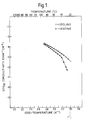
- Aliquots of the solution were placed in small plastic pots and exposed to gamma radiation at 25°C in the presence of oxygen at a dose rate of 0.10 M rad/hour to a total dose of 6.0 M rad using a Co60 source. This gave a hydrogel which was subsequently dried in a vacuum oven containing silica gel for a number of days.
- the ionic conductivity of the resulting film was measured over a range of temperatures, both heating and cooling, using the standard complex impedance method using impedance data collected using a Solartron 1174 FRA.
- the films were then sandwiched between layers of release paper and placed in identical glass tubes.
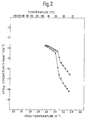
- the tubes were then evacuated, placed in a constant temperature water bath at 78°C and exposed to gamma radiation at a dose rate of 0.25 M rad/hour to a total dose of 6.0 M rad.
- the polymer has recrystallised at 45°-40°C, whereas, in the polymer electrolyte of the invention, the gamma radiation has caused the polymer to gel thereby trapping it in its amorphous form.
- Example 1 The ionic conductivities of the resulting films were measured as described in Example 1 and found to be similar to those of the films obtained in Example 1.
Landscapes
- Engineering & Computer Science (AREA)
- Manufacturing & Machinery (AREA)
- Chemical & Material Sciences (AREA)
- Chemical Kinetics & Catalysis (AREA)
- Electrochemistry (AREA)
- General Chemical & Material Sciences (AREA)
- Conductive Materials (AREA)
- Secondary Cells (AREA)
- Compositions Of Macromolecular Compounds (AREA)
- Primary Cells (AREA)
Claims (8)
- Verfahren zur Herstellung eines festen Polymerelektrolyten, der für die Verwendung als Elektrolyt einer elektrochemischen Feststoffzelle geeignet ist, bei dem man eine Vorstufe, umfassend einen Komplex eines Polymers und Alkalimetallsalzes, bestrahlt, wobei das Polymer die Eigenschaft hat, mit Alkalimetallionen Donor/Akzeptorbindungen auszubilden und Alkalimetallionen zu leiten, dadurch gekennzeichnet, daß das einzige Polymer in der Vorstufe Poly-(Ethen)oxid ist, die Vorstufe in wäßriger Lösung bestrahlt wird, wobei die Bedingungen und die Art der Bestrahlung so gewählt wird, daß das Polymer vernetzt wird und ein Hydrogel bildet, so daß die Umwandlung des Polymers aus einer amorphen Form in eine kristalline Form verhindert wird, und das Hydrogel dann unter Bildung eines festen Polymerelektrolyten getrocknet wird.
- Verfahren nach Anspruch 1, bei dem die Bestrahlung durch Gamma-Strahlung oder einen Elektronenstrahl durchgeführt wird.
- Verfahren nach Anspruch 1 oder 2, bei dem das Alkalimetall Lithium ist.
- Verfahren nach einem der vorhergehenden Ansprüche, wobei die bestrahlte wäßrige Lösung auch ein kathodisches Elektrodenmaterial enthält, so daß ein festes, zusammengesetztes Kathodenmaterial gebildet wird.
- Verfahren nach Anspruch 4, wobei daß Elektrodenmaterial ein Einsatzelektrodenmaterial ist.
- Verfahren nach Anspruch 5, wobei das Einsatzelektrodenmaterial ein Vanadiumoxid ist.
- Verfahren nach Anspruch 6, wobei das Oxid V₆O₁₃ ist.
- Elektrochemische Feststoffzelle enthaltend einen Elektrolyt oder eine zusammengesetzte Kathode, hergestellt nach dem Verfahren gemäß einem der vorhergehenden Ansprüche.
Applications Claiming Priority (2)
| Application Number | Priority Date | Filing Date | Title |
|---|---|---|---|
| GB878717799A GB8717799D0 (en) | 1987-07-28 | 1987-07-28 | Polymer electrolytes |
| GB8717799 | 1987-07-28 |
Publications (3)
| Publication Number | Publication Date |
|---|---|
| EP0301774A2 EP0301774A2 (de) | 1989-02-01 |
| EP0301774A3 EP0301774A3 (de) | 1991-03-20 |
| EP0301774B1 true EP0301774B1 (de) | 1993-03-24 |
Family
ID=10621390
Family Applications (1)
| Application Number | Title | Priority Date | Filing Date |
|---|---|---|---|
| EP88306771A Expired - Lifetime EP0301774B1 (de) | 1987-07-28 | 1988-07-22 | Polymerelektrolyt |
Country Status (5)
| Country | Link |
|---|---|
| US (1) | US5009970A (de) |
| EP (1) | EP0301774B1 (de) |
| JP (1) | JP2807998B2 (de) |
| DE (1) | DE3879574T2 (de) |
| GB (2) | GB8717799D0 (de) |
Families Citing this family (38)
| Publication number | Priority date | Publication date | Assignee | Title |
|---|---|---|---|---|
| US5037712A (en) * | 1987-10-30 | 1991-08-06 | Ultracell, Inc. | Preparation of radiation cured solid electrolytes and electrochemical devices employing the same |
| EP0356261A3 (de) * | 1988-08-26 | 1991-03-13 | Mhb Joint Venture | Elektroden und diese Elektroden verwendende elektrochemische Zellen |
| US5217827A (en) * | 1988-09-12 | 1993-06-08 | Mhb Joint Venture | Ultrathin polymer electrolyte having high conductivity |
| CA1321617C (en) * | 1988-09-12 | 1993-08-24 | Mhb Joint Venture (A Partnership) | Ultrathin polymer electrolyte having high conductivity |
| US5030527A (en) * | 1990-01-08 | 1991-07-09 | Ultracell Incorporated | Radiation cured solid aqueous electrolytes and electrochemical devices employing the same |
| US5634943A (en) * | 1990-07-12 | 1997-06-03 | University Of Miami | Injectable polyethylene oxide gel implant and method for production |
| GB9121117D0 (en) * | 1991-10-03 | 1991-11-13 | Nat Res Dev | Ionically conductive polymer gels |
| IT1254491B (it) * | 1992-03-04 | 1995-09-25 | Eniricerche Spa | Procedimento per la preparazione di un elettrolita polimerico solido abase di polivinileteri |
| US5786110A (en) * | 1992-06-22 | 1998-07-28 | Arizona Board Of Regents | Alkali-metal-ion conducting electrolytes |
| US5414025A (en) * | 1992-09-30 | 1995-05-09 | The Penn State Research Foundation | Method of crosslinking of solid state battery electrolytes by ultraviolet radiation |
| US5409786A (en) * | 1993-02-05 | 1995-04-25 | Eveready Battery Company, Inc. | Inactive electrochemical cell having an ionically nonconductive polymeric composition activated by electrolyte salt solution |
| US5296318A (en) * | 1993-03-05 | 1994-03-22 | Bell Communications Research, Inc. | Rechargeable lithium intercalation battery with hybrid polymeric electrolyte |
| US5302474A (en) * | 1993-04-02 | 1994-04-12 | Valence Technology, Inc. | Fullerene-containing cathodes for solid electrochemical cells |
| US5349312A (en) * | 1993-05-28 | 1994-09-20 | Raytheon Company | Voltage variable attenuator |
| EP0638950B1 (de) * | 1993-08-13 | 1997-03-12 | ENIRICERCHE S.p.A. | Verfahren zur Herstellung von festem Polymerelektrolyt auf Basis von Polyvinylethern |
| EP0823744B1 (de) * | 1996-08-07 | 2005-10-12 | Mitsui Chemicals, Inc. | Ionenleitender gelierter Polymerelektrolyt und diesen Elektrolyt enthaltende Feststoffbatterie |
| KR100378004B1 (ko) * | 1997-06-10 | 2003-06-09 | 삼성에스디아이 주식회사 | 유리-고분자복합전해질및그제조방법 |
| JP3394172B2 (ja) * | 1997-12-09 | 2003-04-07 | シャープ株式会社 | 電 池 |
| DE19839217C2 (de) * | 1998-08-28 | 2001-02-08 | Fraunhofer Ges Forschung | Pastöse Massen, Schichten und Schichtverbände, Zellen und Verfahren zur Herstellung |
| DE19964159B4 (de) | 1998-10-20 | 2005-08-11 | Fraunhofer-Gesellschaft zur Förderung der angewandten Forschung e.V. | Verfahren zum Herstellen selbsttragender oder auf einem Substrat aufliegender, in elektrochemischen Bauelementen verwendbarer Schichten und Zwischenprodukte hierfür |
| US6358651B1 (en) * | 1999-02-26 | 2002-03-19 | Reveo, Inc. | Solid gel membrane separator in rechargeable electrochemical cells |
| US6849702B2 (en) | 1999-02-26 | 2005-02-01 | Robert W. Callahan | Polymer matrix material |
| US6605391B2 (en) * | 1999-02-26 | 2003-08-12 | Reveo, Inc. | Solid gel membrane |
| US20020012848A1 (en) * | 1999-02-26 | 2002-01-31 | Callahan Robert W. | Electrochemical cell incorporating polymer matrix material |
| DE19948548B4 (de) | 1999-04-19 | 2006-04-13 | Fraunhofer-Gesellschaft zur Förderung der angewandten Forschung e.V. | Pastöse Massen mit nanokristallinen Materialien für elektrochemische Bauelemente und daraus hergestellte Schichten und elektrochemische Bauelemente |
| DE19952335B4 (de) | 1999-10-29 | 2007-03-29 | Fraunhofer-Gesellschaft zur Förderung der angewandten Forschung e.V. | In elektrochemischen Bauelementen verwendbare pastöse Masse, damit gebildete Schichten, Folien, Schichtverbünde und wiederaufladbare elektrochemische Zellen sowie Verfahren zur Herstellung der Schichten, Folien und Schichtverbünde |
| KR100647565B1 (ko) * | 1999-11-09 | 2006-11-17 | 삼성에스디아이 주식회사 | 리튬 2차 전지의 제조방법 |
| DE19957285A1 (de) | 1999-11-29 | 2001-06-21 | Fraunhofer Ges Forschung | Folien für elektrochemische Bauelemente sowie Verfahren zu deren Herstellung |
| CA2422212A1 (en) * | 2000-09-14 | 2003-03-13 | Ulf Zum Felde | Electrochemically activatable layer or film |
| KR100419864B1 (ko) * | 2001-11-15 | 2004-03-04 | 한국화학연구원 | 신규 가교제와 이를 함유하는 가교형 고체 고분자 전해질 |
| WO2005078834A1 (en) * | 2004-02-16 | 2005-08-25 | Chebotarev Valery Panteleimono | Chemical current source |
| US8592090B2 (en) * | 2004-08-18 | 2013-11-26 | Central Research Institute Of Electric Power Industry | Solid polymer electrolyte battery and method for manufacturing positive electrode sheet used therein |
| US7864397B2 (en) * | 2006-12-04 | 2011-01-04 | 3M Innovative Properties Company | Curable electrolyte |
| DE102007031477A1 (de) | 2007-03-12 | 2008-09-18 | Fraunhofer-Gesellschaft zur Förderung der angewandten Forschung e.V. | Elektrolyte für elektrochemische Bauelemente |
| EP2287945A1 (de) | 2009-07-23 | 2011-02-23 | Fraunhofer-Gesellschaft zur Förderung der angewandten Forschung e.V. | Leistungs- und energiedichteoptimierte Flächenelektroden für elektrochemische Energiespeicher |
| TWI589610B (zh) | 2013-12-31 | 2017-07-01 | 財團法人工業技術研究院 | 聚電解質與儲能元件 |
| CN107532837A (zh) | 2015-05-06 | 2018-01-02 | 真实制造有限公司 | 具有用以维持清洁冷凝器的反向冷凝器风扇电动机的制冰机 |
| CN109810225B (zh) * | 2019-03-13 | 2020-11-27 | 同济大学 | 一种结晶型复合凝胶电解质及其制备方法和应用 |
Family Cites Families (15)
| Publication number | Priority date | Publication date | Assignee | Title |
|---|---|---|---|---|
| US2964455A (en) * | 1956-11-05 | 1960-12-13 | Du Pont | Electron irradiation of organic polyethers |
| BE646199A (de) * | 1963-04-17 | 1964-07-31 | ||
| US3429794A (en) * | 1964-04-13 | 1969-02-25 | Grace W R & Co | Solvent shrinkable polymeric material |
| US4192727A (en) * | 1976-08-24 | 1980-03-11 | Union Carbide Corporation | Polyelectrolyte hydrogels and methods of their preparation |
| FR2493609A1 (fr) * | 1980-10-30 | 1982-05-07 | Comp Generale Electricite | Electrolyte solide macromoleculaire pour generateur electrochimique |
| EP0078505B1 (de) * | 1981-11-03 | 1987-12-09 | COMPAGNIE GENERALE D'ELECTRICITE Société anonyme dite: | Verfahren zur Herstellung eines polymeren Festelektrolyten für elektrochemische Generatoren |
| GB2143539B (en) * | 1983-07-18 | 1986-10-01 | Secr Defence | Polymeric electrolyte materials |
| JPS6141129A (ja) * | 1984-08-02 | 1986-02-27 | Asahi Glass Co Ltd | エレクトロクロミツク装置の製造方法 |
| FR2570224B1 (fr) * | 1984-09-11 | 1987-03-20 | Elf Aquitaine | Electrolyte solide polymere constitue par un copolymere reticule |
| JPS61214364A (ja) * | 1985-03-19 | 1986-09-24 | Hitachi Maxell Ltd | 薄型リチウム電池 |
| FR2582662B1 (fr) * | 1985-05-31 | 1988-05-27 | Centre Nat Rech Scient | Nouvelles compositions a base de derives de silice modifiee par des groupements organiques, leur preparation et leur application |
| JPS6266235A (ja) * | 1985-09-18 | 1987-03-25 | Hitachi Maxell Ltd | エレクトロクロミツク表示素子 |
| FR2593321B1 (fr) * | 1986-01-23 | 1990-11-16 | Giers | Materiau conducteur ionique utilisable comme electrolyte solide de type gel |
| US4706680A (en) * | 1986-06-30 | 1987-11-17 | Nepera Inc. | Conductive adhesive medical electrode assemblies |
| FR2616969B1 (fr) * | 1987-06-18 | 1989-09-08 | Elf Aquitaine | Procede de fabrication d'un ensemble electrochimique comprenant une electrode et un electrolyte et ensemble ainsi realise |
-
1987
- 1987-07-28 GB GB878717799A patent/GB8717799D0/en active Pending
-
1988
- 1988-07-22 DE DE8888306771T patent/DE3879574T2/de not_active Expired - Fee Related
- 1988-07-22 EP EP88306771A patent/EP0301774B1/de not_active Expired - Lifetime
- 1988-07-22 GB GB8817539A patent/GB2207547B/en not_active Expired
- 1988-07-25 US US07/223,648 patent/US5009970A/en not_active Expired - Lifetime
- 1988-07-28 JP JP63189536A patent/JP2807998B2/ja not_active Expired - Fee Related
Also Published As
| Publication number | Publication date |
|---|---|
| US5009970A (en) | 1991-04-23 |
| GB8717799D0 (en) | 1987-09-03 |
| JP2807998B2 (ja) | 1998-10-08 |
| GB2207547B (en) | 1990-08-22 |
| EP0301774A2 (de) | 1989-02-01 |
| DE3879574D1 (de) | 1993-04-29 |
| GB8817539D0 (en) | 1988-08-24 |
| JPS6454602A (en) | 1989-03-02 |
| DE3879574T2 (de) | 1993-07-01 |
| GB2207547A (en) | 1989-02-01 |
| EP0301774A3 (de) | 1991-03-20 |
Similar Documents
| Publication | Publication Date | Title |
|---|---|---|
| US5009970A (en) | Polymer electrolytes | |
| US6284412B1 (en) | Hybrid polymeric electrolyte and non-aqueous electrochemical device comprising the same | |
| CA2206207C (en) | Ion-conductive polymers | |
| US4471037A (en) | Solid state electrochemical cell | |
| CN100343330C (zh) | 可充电聚合物电池用的高离子电导率凝胶聚合物电解质 | |
| EP0437309B1 (de) | Wässrige Elektrolyte und ihre Verwendung in elektrochemischen Einrichtungen | |
| HK1043876A1 (zh) | 固体胶膜片 | |
| EP0294495B1 (de) | Allylgruppe enthaltende oligoäthylenoxypolyphosphazene, verfahren zur herstellung und sekundär batterien unter verwendung derselben. | |
| US4722877A (en) | Long cycle life solid-state solid polymer electrolyte cells | |
| JP2000281737A (ja) | 架橋型高分子固体電解質の製造方法 | |
| WO1993014529A1 (fr) | Pile | |
| Aihara et al. | Investigation on solvent-free solid polymer electrolytes for advanced lithium batteries and their performance | |
| US7517615B2 (en) | Gel electrolyte, process for producing the same, and use thereof | |
| JPS62249361A (ja) | 有機固体電解質 | |
| JP3843505B2 (ja) | 高分子電解質及び電池 | |
| Doeff et al. | The use of redox polymerization electrodes in lithium batteries with liquid electrolytes | |
| EP0638950A1 (de) | Verfahren zur Herstellung von festem Polymerelektrolyt auf Basis von Polyvinylethern | |
| JP3321201B2 (ja) | イオン伝導性ポリマー電解質 | |
| Kono et al. | Chemical and electrochemical characterization of polymer gel electrolytes based on a poly (alkylene oxide) macromonomer for application to lithium batteries | |
| JP3942232B2 (ja) | ゲル状固体電解質および電池 | |
| JP3235157B2 (ja) | イオン伝導性高分子電解質 | |
| JPH0567475A (ja) | 固体電解質二次電池 | |
| JPH02105855A (ja) | イオン伝導性組成物 | |
| KR100297923B1 (ko) | 폴리아크릴로니트릴 이오노머 고분자 전해질 및 그의 제조방법 | |
| JPH04357606A (ja) | 高分子固体電解質 |
Legal Events
| Date | Code | Title | Description |
|---|---|---|---|
| PUAI | Public reference made under article 153(3) epc to a published international application that has entered the european phase |
Free format text: ORIGINAL CODE: 0009012 |
|
| AK | Designated contracting states |
Kind code of ref document: A2 Designated state(s): DE FR IT NL |
|
| PUAL | Search report despatched |
Free format text: ORIGINAL CODE: 0009013 |
|
| AK | Designated contracting states |
Kind code of ref document: A3 Designated state(s): DE FR IT NL |
|
| 17P | Request for examination filed |
Effective date: 19910523 |
|
| 17Q | First examination report despatched |
Effective date: 19911218 |
|
| RAP1 | Party data changed (applicant data changed or rights of an application transferred) |
Owner name: UNITED KINGDOM ATOMIC ENERGY AUTHORITY |
|
| GRAA | (expected) grant |
Free format text: ORIGINAL CODE: 0009210 |
|
| AK | Designated contracting states |
Kind code of ref document: B1 Designated state(s): DE FR IT NL |
|
| ITF | It: translation for a ep patent filed | ||
| ET | Fr: translation filed | ||
| REF | Corresponds to: |
Ref document number: 3879574 Country of ref document: DE Date of ref document: 19930429 |
|
| PLBE | No opposition filed within time limit |
Free format text: ORIGINAL CODE: 0009261 |
|
| STAA | Information on the status of an ep patent application or granted ep patent |
Free format text: STATUS: NO OPPOSITION FILED WITHIN TIME LIMIT |
|
| 26N | No opposition filed | ||
| REG | Reference to a national code |
Ref country code: FR Ref legal event code: TP |
|
| NLS | Nl: assignments of ep-patents |
Owner name: AEA TECHNOLOGY PLC |
|
| NLS | Nl: assignments of ep-patents |
Owner name: ACCENTUS PLC |
|
| PGFP | Annual fee paid to national office [announced via postgrant information from national office to epo] |
Ref country code: NL Payment date: 20030528 Year of fee payment: 16 |
|
| PGFP | Annual fee paid to national office [announced via postgrant information from national office to epo] |
Ref country code: FR Payment date: 20030620 Year of fee payment: 16 |
|
| PGFP | Annual fee paid to national office [announced via postgrant information from national office to epo] |
Ref country code: DE Payment date: 20030623 Year of fee payment: 16 |
|
| NLS | Nl: assignments of ep-patents |
Owner name: AEA TECHNOLOGY BATTERY SYSTEMS LTD |
|
| REG | Reference to a national code |
Ref country code: FR Ref legal event code: TP |
|
| PG25 | Lapsed in a contracting state [announced via postgrant information from national office to epo] |
Ref country code: NL Free format text: LAPSE BECAUSE OF NON-PAYMENT OF DUE FEES Effective date: 20050201 Ref country code: DE Free format text: LAPSE BECAUSE OF NON-PAYMENT OF DUE FEES Effective date: 20050201 |
|
| PG25 | Lapsed in a contracting state [announced via postgrant information from national office to epo] |
Ref country code: FR Free format text: LAPSE BECAUSE OF NON-PAYMENT OF DUE FEES Effective date: 20050331 |
|
| NLV4 | Nl: lapsed or anulled due to non-payment of the annual fee |
Effective date: 20050201 |
|
| REG | Reference to a national code |
Ref country code: FR Ref legal event code: ST |
|
| PG25 | Lapsed in a contracting state [announced via postgrant information from national office to epo] |
Ref country code: IT Free format text: LAPSE BECAUSE OF NON-PAYMENT OF DUE FEES Effective date: 20050722 |