EP0300311A2 - Verfahren zur Herstellung von Chinoloncarbonsäuren - Google Patents
Verfahren zur Herstellung von Chinoloncarbonsäuren Download PDFInfo
- Publication number
- EP0300311A2 EP0300311A2 EP88111034A EP88111034A EP0300311A2 EP 0300311 A2 EP0300311 A2 EP 0300311A2 EP 88111034 A EP88111034 A EP 88111034A EP 88111034 A EP88111034 A EP 88111034A EP 0300311 A2 EP0300311 A2 EP 0300311A2
- Authority
- EP
- European Patent Office
- Prior art keywords
- formula
- compounds
- fluorine
- chlorine
- compound
- Prior art date
- Legal status (The legal status is an assumption and is not a legal conclusion. Google has not performed a legal analysis and makes no representation as to the accuracy of the status listed.)
- Granted
Links
- 0 CC(C1*)=C(*)C(*)C(*)C1C(Cl)=O Chemical compound CC(C1*)=C(*)C(*)C(*)C1C(Cl)=O 0.000 description 1
Classifications
-
- C—CHEMISTRY; METALLURGY
- C07—ORGANIC CHEMISTRY
- C07D—HETEROCYCLIC COMPOUNDS
- C07D215/00—Heterocyclic compounds containing quinoline or hydrogenated quinoline ring systems
- C07D215/02—Heterocyclic compounds containing quinoline or hydrogenated quinoline ring systems having no bond between the ring nitrogen atom and a non-ring member or having only hydrogen atoms or carbon atoms directly attached to the ring nitrogen atom
- C07D215/16—Heterocyclic compounds containing quinoline or hydrogenated quinoline ring systems having no bond between the ring nitrogen atom and a non-ring member or having only hydrogen atoms or carbon atoms directly attached to the ring nitrogen atom with hetero atoms or with carbon atoms having three bonds to hetero atoms with at the most one bond to halogen, e.g. ester or nitrile radicals, directly attached to ring carbon atoms
- C07D215/48—Carbon atoms having three bonds to hetero atoms with at the most one bond to halogen
- C07D215/54—Carbon atoms having three bonds to hetero atoms with at the most one bond to halogen attached in position 3
- C07D215/56—Carbon atoms having three bonds to hetero atoms with at the most one bond to halogen attached in position 3 with oxygen atoms in position 4
Definitions
- the invention relates to a new process for the preparation of 4-oxo-3-quinoline-carboxylic acids which are used as intermediates for the production of known pharmaceutically active quinolonecarboxylic acids.
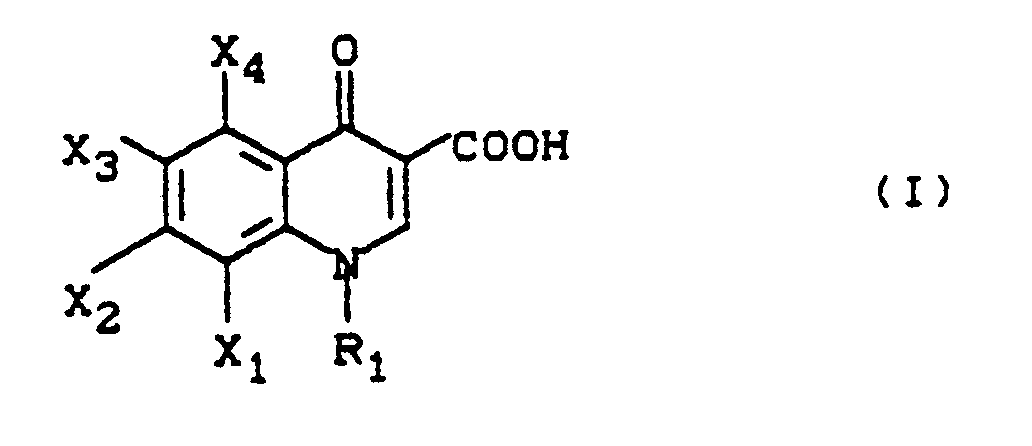
- the invention relates to a process for the preparation of quinolonecarboxylic acids of the general formula I.
- the R1 represents propyl, cyclopropyl, isopropyl or vinyl
- X1 is fluorine, chlorine, Br, CN, NO2 or hydrogen
- X2 X3 and X4 represent fluorine, chlorine, NO2 or hydrogen, which is characterized in that without isolation of intermediates in a so-called one-pot reaction
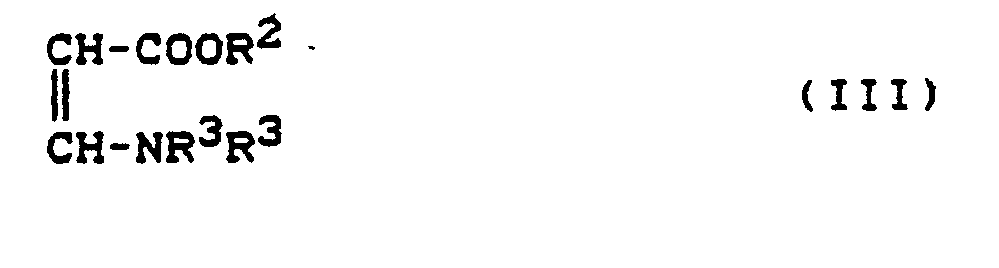
- a compound of the formula (III) in the R2 and R3 are the same or different and represent C1-C4 alkyl, in the presence of a solvent and a base, optionally with heating to 50 ° C to 150 ° C to the compounds of formula IV implements these compounds IV at temperatures from 50 ° C to 120 ° C in the presence of the abovementioned solvents and in
- R 1 in formula I represents a cyclopropyl radical.
- R1 is cyclopropyl
- X2 is chlorine and X1 and X3 are fluorine
- X4 is hydrogen
- X3 is fluorine and X1 and X2 are chlorine, while X4 is hydrogen.
- the temperatures during the acylation of the dimethylaminoacrylic ester are between 50 ° C and 150 ° C, preferably between 80 ° C and 120 ° C.
- Hydrochloride of the auxiliary base which has precipitated during the reaction can be separated off by means of a filter or removed by stirring with water.
- the org. Phase with the Aroylacrylester is further reacted with cyclopropylamine.
- the reaction can be carried out in the same solvent or after evaporation (i. Vacuum or at normal pressure) in another solvent.
- Possible solvents are: Toluene, Xylene, Cyclohexane, open chain hydrocarbons (mixtures), Alcohols, DMF, DMSO, Butyl glycol.
- the amine exchange temperatures are 50 ° C to 120 ° C, preferably 65 ° C to 85 ° C.
- reaction mixture is kept at the elevated temperature until gas evolution (dimethylamine) has ceased.
- the solvent is evaporated before the cyclization (i.Vacuum, or at normal pressure) and by a higher boiling diluent, such as. Butyl glycol replaced.
- Possible solvents are: higher alcohols like Butyl glycol i-propyl alcohol, Ethylene glycol butanol, Triethylene glycol, Polyethylene glycol, Amino alcohols such as diethylaminoethanol, DMF, DMSO, Dioxane, N-methylpyrrolidone.
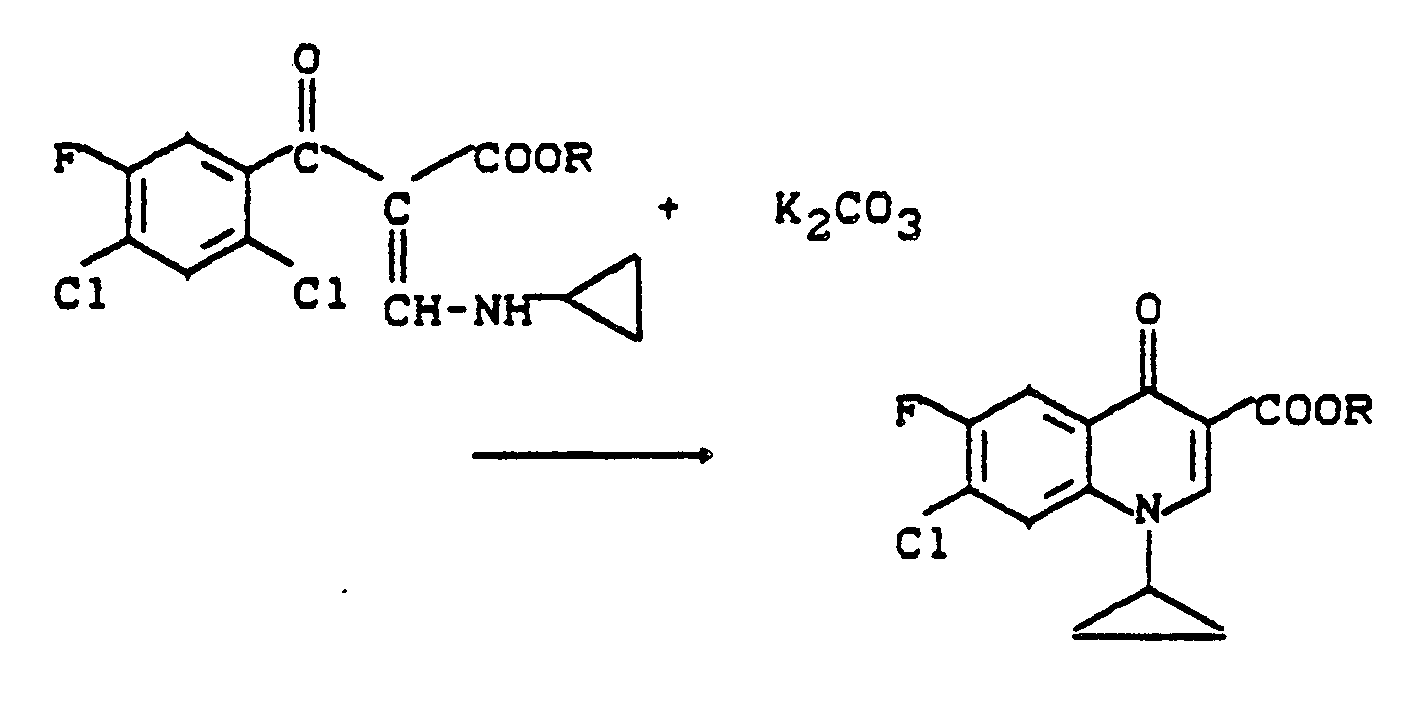
- the cyclization to the quinolone system takes place at temperatures between 80 ° C and 180 ° C, preferably at 130 ° C to 160 ° C in the presence of a base.
- the following bases can be used: Sodium tert-butoxide, Close, K2CO3.
- the base is used in equimolar amounts up to an excess of 3 molar equivalents, preferably in an excess of 0.1 to 0.5 molar equivalents.
- reaction mixture is cooled to about 100 ° C. and water is added.
- the excess of base during the cyclization ends the saponification at temperatures from 50 ° C. to 100 ° C. in a short time.
- the quinolonecarboxylic acid is by adding a mineral acid or an organic. Acid precipitated and isolated.
- Preferred acids are: Sulfuric acid, Hydrochloric acid, Acetic acid.
- the mixture is then stirred for a further 15 minutes and the precipitated N, N-dimethylbenzylamine hydrochloride is separated off using a suction filter.
- the temperature is held for 1.5 hours.
- the mixture is then cooled to 100-120 ° C. and 130 ml of water are added to the reaction mixture.
- the mixture is subsequently stirred at 90 ° C. for 15 minutes and 27 ml of acetic acid are added dropwise at this temperature in 15 minutes.
- the contents of the flask are cooled and the solids are separated off using a suction filter.
- the mixture is heated to 100 ° C. until the evolution of gas has ended.
- the precipitated dimethylbenzylamine hydrochloride is separated off on a suction filter and the filtrate i. Vacuum evaporated to dryness.
- the solvent becomes i.Vak. distilled off, 130 ml of butyl glycol were added and 20.2 g of cyclopropylamine were added dropwise at 90 ° C. in 20 minutes.
- tributylamine 55.6 g are added to 44.7 g of N, N-dimethylamino-acrylic acid ethyl ester in 95 ml of cyclohexane, and 62 g of 2,4-dichloro-5-fluorobenzoyl chloride are added dropwise at 85-95 ° C.
- aqueous phase is stirred once more with 50 ml of cyclohexane and the combined org. Phases evaporated to dryness in a water jet vacuum.
- the precipitate is isolated on a suction filter and washed with water and isopropanol.
- reaction mixture After the reaction mixture has cooled to 50 ° C., it is extracted twice with 250 ml of water each time.
- the organic phase is largely concentrated in a water jet vacuum and 37.5 g of cyclopropylamine are added dropwise to the residue at an internal temperature of 70-75 ° C. Gaseous dimethylamine escapes until the end of the reaction.
- reaction mixture is mixed with 86.8 g of potash and 500 ml of butyl glycol and slowly heated to 135-145 ° C. Small amounts of low-boiling solvents distill off.
- the resulting suspension is cooled to room temperature, the solid is separated off using a suction filter and washed with 175 ml of water and 200 ml of 80% isopropanol.
Landscapes
- Chemical & Material Sciences (AREA)
- Organic Chemistry (AREA)
- Pharmaceuticals Containing Other Organic And Inorganic Compounds (AREA)
- Quinoline Compounds (AREA)
- Nitrogen Condensed Heterocyclic Rings (AREA)
- Plural Heterocyclic Compounds (AREA)
- Organic Low-Molecular-Weight Compounds And Preparation Thereof (AREA)
Abstract
R¹ für Propyl, Cyclopropyl, Isopropyl oder Vinyl steht,
X¹ Fluor, Chlor, Br, CN, NO₂ oder Wasserstoff bedeutet und
X², X³ und X⁴ für Fluor, Chlor, NO₂ oder Wasserstoff stehen.
Description
- Die Erfindung betrifft ein neues Verfahren zur Herstellung von 4-Oxo-3-chinolin-carbonsäuren, die als Zwischenprodukte für die Herstellung bekannter pharmazeutisch wirksamer Chinoloncarbonsäuren Verwendung finden.
- Es ist bekannt, daß man 1-Cyclopropyl-7-chlor-6-fluor-1,4-dihydro-4-oxo-3-chinolin-carbonsäuren auf folgendem Wege erhält:

- Es ist auch bekannt geworden, die Verbindung (7) auf folgendem Wege herzustellen:

- Die bekannten Verfahren wiesen jedoch alle den Nachteil auf, über viele Zwischenstufen die Zielverbindung herzustellen.
- Dabei müssen aufwendige Trenn- und Trockenoperationen durchgeführt werden.
- Durch die dabei notwendigen Waschvorgänge müssen große Mengen an Lösungsmitteln verbrannt oder wieder aufbereitet werden.
- Es muß eine aufwendige Analytik zur Charakterisierung der Zwischenstufen getrieben werden.
- Die Erfindung betrifft ein Verfahren zur Herstellung von Chinoloncarbonsäuren der allgemeinen Formel I

R¹ für Propyl, Cyclopropyl, Isopropyl oder Vinyl steht,
X¹ Fluor, Chlor, Br, CN, NO₂ oder Wasserstoff bedeutet und
X², X³ und X⁴ für Fluor, Chlor, NO₂ oder Wasserstoff stehen,
das dadurch gekennzeichnet ist, daß man ohne Isolierung von Zwischenstufen in einer sogenannten Eintopfreaktion eine Verbindung der Formel II

R² und R³ gleich oder verschieden sind und für C₁-C₄-Alkyl stehen,
in Gegenwart eines Lösungsmittels und einer Base, gegebenenfalls unter Erwärmung auf 50°C bis 150°C zu den Verbindungen der Formel IV
diese Verbindungen IV bei Temperaturen von 50°C bis 120°C in Gegenwart der obengenannten Lösungsmittel und in Gegenwart eines Amins der Formel R₁NH₂, worin R¹ die obengenannte Bedeutung hat, einem Aminaustausch unterwirft, wobei die Verbindungen der Formel
- Insbesondere werden erfindungsgemäß solche Verbindungen hergestellt, in denen R¹ in Formel I für einen Cyclopropylrest steht.
Bevorzugt:
X¹ und X⁴ = Wasserstoff
X² = Chlor
X³ = Fluor. - Bevorzugt sind auch Verbindungen der Formel I, in denen R¹ Cyclopropyl bedeutet, X² für Chlor steht und X¹ und X³ Fluor bedeuten, während X⁴ für Wasserstoff steht.
- Weiterhin bevorzugt sind Verbindungen, in denen X³ für Fluor und X¹ und X² für Chlor stehen, während X⁴ Wasserstoff bedeutet.
- Bei dem komplizierten Reaktionsverlauf ist es als ausgesprochen überraschend zu bezeichnen, daß man die Verbindung 1-Cyclopropyl-7-chlor-6-fluor-1,4-dihydro-4-oxo-3-chinolin-carbonsäure ohne Isolierung von Zwischenstufen in einer "Eintopf"-Reaktion in ausgezeichneten Ausbeuten auf folgendem Wege herstellen kann:
-

- Als org. Lösungsmittel kommen in Frage:
Toluol,
Xylol,
Cyclohexan,
offenkettige Kohlenwasserstoffe (Gemische)
DMF,
DMSO, - Als Basen können eingesetzt werden:
tert. org. Amine wie
R₃N mit R = C₁-C₁₄-Alkyl, Benzyl
cycl. Amine
- Die Temperaturen bei der Acylierung des Dimethylaminoacrylesters liegen zwischen 50°C und 150°C, vorzugsweise bei 80°C bis 120°C.
- Während der Reaktion ausgefallenes Hydrochlorid der Hilfsbase kann über ein Filter abgetrennt werden oder durch Ausrühren mit Wasser entfernt werden.
- Die org. Phase mit dem Aroylacrylester wird weiter mit Cyclopropylamin umgesetzt.
- Dabei kann die Umsetzung im gleichen Lösungsmittel, oder nach Eindampfen (i. Vakuum oder bei Normaldruck) in einem anderen Lösungsmittel erfolgen.
-

- Als Lösungsmittel kommen in Frage:
Toluol,
Xylol,
Cyclohexan,
offenkettige Kohlenwasserstoffe (Gemische),
Alkohole,
DMF,
DMSO,
Butylglykol. - Die Temperaturen beim Aminaustausch liegen bei 50°C bis 120°C, vorzugsweise bei 65°C bis 85°C.
- Die Reaktionsmischung wird weiter bei der erhöhten Temperatur gehalten, bis die Gasentwicklung (Dimethylamin) beendet ist.
- Falls der Aminaustausch in einem niedrigsiedenden Verdünnungsmittel wie z.B. Cyclohexan erfolgt ist, wird das Lösungsmittel vor der Cyclisierung (i. Vakuum, oder bei Normaldruck) abgedampft und durch ein höhersiedendes Verdünnungsmittel, wie z.B. Butylglykol ersetzt.
-
- Als Lösungsmittel kommen in Frage:
höhere Alkohole wie
Butylglykol i-Propylalkohol,
Ethylenglykol Butanol,
Triethylenglykol,
Polyethylenglykol,
Aminoalkohole wie Diethylaminoethanol,
DMF,
DMSO,
Dioxan,
N-Methylpyrrolidon. - Die Cyclisierung zum Chinolonsystem erfolgt bei Temperaturen zwischen 80°C und 180°C, vorzugsweise bei 130°C bis 160°C in Gegenwart einer Base.
- Als Basen können eingesetzt werden:
Na-tert.-butylat,
NaH,
K₂CO₃. - Die Base wird äquimolar bis zu einen Überschuß von 3 Moläquivalenten, vorzugsweise in einem Überschuß von 0,1 bis 0,5 Moläquivalenten eingesetzt.
-

- Zur Verseifung wird die Reaktionsmischung abgekühlt auf ca. 100°C und mit Wasser versetzt.
- Durch den Überschuß an Base bei der Cyclisierung ist die Verseifung bei Temperaturen von 50°C bis 100°C in kurzer Zeit beendet.
- Die Chinoloncarbonsäure wird durch Zugabe einer Mineralsäure oder einer org. Säure ausgefällt und isoliert.
- Als Säuren kommen bevorzugt in Frage:
Schwefelsäure,
Salzsäure,
Essigsäure. - 28,8 g N,N-Dimethylamino-acrylsäureethylester und 26 g N,N-Dimethylbenzylamin werden in 71 ml Toluol auf 90°C erhitzt und bei dieser Temperatur 40 g 2,4-Dichlor-5-fluorbenzoylchlorid in 60 Min zugetropft.
- Anschließend wird 15 Min. nachgerührt und das ausgefallene N,N-Dimethylbenzylamin-hydrochlorid über eine Filternutsche abgetrennt.
- Das Filtrat wird im Vakuum weitgehend eingedampft und der Rückstand mit 80 ml Butylglykol versetzt.
- Bei 70°-75°C läßt man in 30 Min. 13 g Cyclopropylamin zutropfen und hält nach dem Ende der Zugabe den Ansatz 1 Stunde bei 100°C bis zum Ende der Gasentwicklung.
- Zu der Reaktionsmischung gibt man 27,9 g Pottasche und 100 ml Butylglykol und erhitzt langsam auf 135-145°C.
- Dabei destillieren ca. 40 ml leichtsiedende Anteile ab.
- Die Temperatur wird 1,5 Std. gehalten.
- Anschließend kühlt man auf 100-120°C ab und gibt 130 ml Wasser zum Reaktionsgemisch.
- Man rührt 15 Min. bei 90°C nach und tropft bei dieser Temperatur 27 ml Essigsäure in 15 Min. zu. Der Kolbeninhalt wird abgekühlt und der Feststoff über eine Filternutsche abgetrennt.
- Das Produkt wird mit 27 ml Wasser und 50 ml Methanol gewaschen, gut trocken gesaugt und 24 Std. bei 70°C i.Vak. getrocknet.
Ausbeute: 37 g = 74,9 % d.Th. - 43,2 g N,N-Dimethylamino-acrylsäureethylester werden in 84 ml Toluol auf 100°C aufgeheizt und 40 ml Triethylamin zugegeben.
- Bei Rückflußtemperatur läßt man in 30 Min. 60 g 2,4-Dichlor-5-fluorbenzoylchlorid zutropfen und trennt anschließend das ausgefallene Triethylamin-hydrochlorid über eine Filternutsche ab.
- Man wäscht mit 65 ml Toluol nach und tropft zum Filtrat bei 70°C 16,2 g Cyclopropylamin in 20 Min. zu.
- Man erhitzt auf 100°C bis zum Ende der Gasentwicklung.
- Anschließend werden 42 g Pottasche und 270 ml Butylglykol zugegeben und langsam auf 135-145°C aufgeheizt. Dabei destillieren ca. 180 ml Toluol und niedrigsiedende Anteile ab.
- 135 - 145°C werden 1,5 Std. gehalten und nach Abkühlen der Reaktionsmischung auf 100°C werden 200 ml Wasser zugegeben.
- Nach 15 Min. werden bei 90°C 40,5 ml Essigsäure zugetropft und der ausgefallene Feststoff über eine Filternutsche abgesaugt.
- Das Produkt wird mit 140 ml Wasser und 75 ml Methanol nachgewaschen, gut trockengesaugt und 24 Std. bei 70°C i. Vakuum getrocknet.
Ausbeute: 58,5 g = 79 % d.Th. - 44,7 g N,N-Dimethylaminoacrylsäureethylester und 17,1 g N,N′-Dimethylpiperazin werden in 95 ml Cyclohexan zum Rückfluß erhitzt.
- In 1 Std. werden 62 g 2,4-Dichlor-5-fluor-benzoylchlorid zugetropft.
- Das ausgefallene Dimethylbenzylaminhydrochlorid wird über eine Filternutsche abgetrennt und das Filtrat i. Vakuum zur Trockne eingedampft.
- Der Rückstand wird in 125 ml Butylglykol gelöst und zu der Lösung werden bei 90°C 20,2 g Cyclopropylamin zugetropft.
- Nach dem Ende der Gasentwicklung gibt man 43,4 g Pottasche und 165 ml Butylglykol zu und erwärmt 1,5 Std. auf 145°C. Dabei destillieren anfangs geringe Mengen leichtsiedende Anteile ab.
- Nach 1,5 Std. wird auf 100°C abgekühlt, mit 205 ml Wasser versetzt und 15 Min. bei 95°C nachgerührt.
- Anschließend läßt man 42 g Essigsäure in 15 Min. zutropfen, kühlt ab auf 30°C und trennt den aufgefallenen Feststoff auf einer Filternutsche ab.
- Der Filterkuchen wird mit 180 ml Wasser und 80 ml 80 %igem Isopropanol gewaschen und bei 70°C über Nacht i.Vak. getrocknet.
Ausbeute: 60,1 g = 78,1 % d.Th. - 33,7 g N,N-Dimethylamino-acrylsäuremethylester werden mit 40,5 g N,N-Dimethylbenzylamin in 95 ml Toluol auf 110°C erhitzt.
- Bei Rückflußtemperatur werden 62 g 2,4-Dichlor-5-fluorbenzoylchlorid in 1 Std. zugetropft und anschließend das ausgefallene Dimethylbenzylamin-hydrochlorid über eine Filternutsche abgetrennt.
- Das Lösungsmittel wird i.Vak. abdestilliert, 130 ml Butylglykol zugegeben und bei 90°C 20,2 g Cyclopropylamin in 20 Min. zugetropft.
- Nach dem Ende der Gasentwicklung versetzt man die Reaktionsmischung mit 43,4 g Pottasche und 150 ml Butylglykol, erhitzt langsam auf 140°C. Dabei destillieren geringe Mengen niedrigsiedender Lösungsmittel ab.
- 1,5 Std. werden bei 140°C nachgerührt. Nach Abkühlen auf 100°C gibt man 205 ml Wasser zum Reaktionsgemisch und läßt 15 Min. bei 90°C rühren.
- Unter leichter Kühlung werden 100 ml 30 %ige Schwefelsäure zugegeben und der Feststoff auf einer Filternutsche abgesaugt, mit 200 ml Wasser und 200 ml Isopropanol gewaschen.
- Der Feststoff wird i.Vak. über Nacht bei 70°C getrocknet.
Ausbeute: 59.4 g = 77,2 % d.Th. - Zu 44,7 g N,N-Dimethylamino-acrylsäureethylester in 95 ml Cyclohexan gibt man 55,6 g Tributylamin und tropft bei 85-95°C 62 g 2,4-Dichlor-5-fluorbenzoylchlorid in 1 h zu.
- Zur Reaktionsmischung gibt man anschließend 250 ml Wasser zu und trennt die wäßrige Salzphase ab.
- Die wäßrige Phase wird noch 1 x mit 50 ml Cyclohexan ausgerührt und die vereinigten org. Phasen im Wasserstrahlvakuum zur Trockne eingedampft.
- Den Rückstand nimmt man mit 125 ml Butylglykol auf, erwärmt auf 70°C und tropft in 15 Min. 20.2 g Cyclopropylamin zu.
- Nach dem Ende der Gasentwicklung werden weitere 160 ml Butylglykol und 44 g Pottasche zugegeben und der Ansatz langsam auf 140°C aufgeheizt.
- Nach Erreichen von 140°C wird 1,5 Std. nachgerührt, anschließend auf 100°C abgekühlt und 205 ml Wasser zum Ansatz hinzugegeben.
- Nach 15 Min. tropft man in 10 Min 42 g Essigsäure zu und kühlt auf Raumtemperatur ab.
- Der Niederschlag wird über eine Filternutsche isoliert und mit Wasser und Isopropanol gewaschen.
- Nach Trocknen bei 50°C i. Vak. über Nacht erhält man 54,6 g = 71 % d. Th. Ausbeute.
- In 148 ml Toluol werden 105 g Tributylamin und 86 g N,N-Dimethylamino-acrylsäuremethylester auf 105°C erhitzt und in 1 Std. 124 g 2,4-Dichlor-5-fluor-benzoylchlorid zugetropft.
- Nach dem Abkühlen des Reaktionsgemisches auf 50 °C wird 2 x mit je 250 ml Wasser extrahiert.
- Die organische Phase wird im Wasserstrahlvacuum weitgehend eingeengt und in den Rückstand bei 70 -75°C Innentemperatur 37,5 g Cyclopropylamin zugetropft. Dabei entweicht bis zum Ende der Reaktion gasförmiges Dimethylamin.
- Die Reaktionsmischung wird mit 86,8 g Pottasche und 500 ml Butylglykol versetzt und langsam bis auf 135 - 145°C erhitzt. Dabei destillieren geringe Mengen niedrigsiedender Lösungsmittel ab.
- 135 - 145°C werden 1,5 Stdn. gehalten, dann auf 100°C abgekühlt und 535 ml einer 10%-igen Essigsäure zugetropft.
- Die entstandene Suspension wird auf Raumtemperatur abgekühlt, der Feststoff über eine Filternutsche abgetrennt und mit 175 ml Wasser und 200 ml 80%-igem Isopropanol gewaschen.
- Das Produkt wird im Vakuum über Nacht bei 70°C getrocknet.
Ausbeute: 220 g = 78.1 % d. Th.
Claims (5)

R¹ für Propyl, Cyclopropyl, Isopropyl oder Vinyl steht,
X¹ Fluor, Chlor, Br, CN, NO₂ oder Wasserstoff bedeutet und
X², X³ und X⁴ für Fluor, Chlor, NO₂ oder Wasserstoff stehen,
dadurch gekennzeichnet, daß man ohne Isolierung von Zwischenstufen in einer sogenannten Eintopfreaktion eine Verbindung der Formel II

X⁵ für Halogen, insbesondere Chlor oder Fluor steht, mit einer Verbindung der Formel (III)

R² und R³ gleich oder verschieden sind und für C₁-C₄-Alkyl stehen,
in Gegenwart eines Lösungsmittels und einer Base, gegebenenfalls unter Erwärmung auf 50°C bis 150°C zu den Verbindungen der Formel IV

diese Verbindungen IV bei Temperaturen von 50°C bis 120°C in Gegenwart der obengenannten Lösungsmittel und in Gegenwart eines Amins der Formel R₁NH₂, worin R¹ die obengenannte Bedeutung hat, einem Aminaustausch unterwirft, wobei die Verbindungen der Formel

R¹ für Cyclopropyl steht,
X¹ Fluor, Chlor, Br, CN, NO₂ oder Wasserstoff bedeutet und
X², X³ und X⁴ für Fluor, Chlor, NO₂ oder Wasserstoff stehen,
dadurch gekennzeichnet, daß man ohne Isolierung von Zwischenstufen in einer sogenanten Eintopfreaktion eine Verbindung der Formel II

X⁵ für Halogen, insbesondere Chlor oder Fluor steht, mit einer Verbindung der Formel (III)

R² und R³ gleich oder verschieden sind und für C₁-C₄-Alkyl stehen,
in Gegenwart eines Lösungsmittels und einer Base, gegebenenfalls unter Erwärmung auf 50°C bis 150°C zu den Verbindungen der Formel IV

diese Verbindungen IV bei Temperaturen von 50°C bis 120°C in Gegenwart der obengenannten Lösungsmittel und in Gegenwart von Cyclopropylamin einem Aminaustausch unterwirft, wobei die Verbindungen der Formel


R¹ für Cyclopropyl steht,
X¹, X² und X³ gleich oder verschieden sind und für Fluor oder Chlor stehen und
X⁴ für Wasserstoff steht,
dadurch gekennzeichnet, daß man ohne Isolierung von Zwischenstufen in einer sogenannten Eintopfreaktion eine Verbindung der Formel II

X⁵ für Halogen, insbesondere Chlor oder Fluor steht, mit einer Verbindung der Formel (III)

R² und R³ gleich oder verschieden sind und für C₁-C₄-Alkyl stehen,
in Gegenwart eines Lösungsmittels und einer Base, gegebenenfalls unter Erwärmung auf 50°C bis 150°C zu den Verbindungen der Formel IV

diese Verbindungen IV bei Temperaturen von 50°C bis 120°C in Gegenwart der obengenannten Lösungsmittel und in Gegenwart von Cyclopropylamin einem Aminaustausch unterwirft, wobei die Verbindungen der Formel


R¹ für Cyclopropyl steht,
X¹ und X⁴ Wasserstoff bedeuten,
X₃ für Fluor steht und
X² Chlor bedeutet,
dadurch gekennzeichnet, daß man ohne Isolierung von Zwischenstufen in einer sogenannten Eintopfreaktion eine Verbindung der Formel II

X⁵ für Halogen, insbesondere Chlor oder Fluor steht, mit einer Verbindung der Formel (III)

R² und R³ gleich oder verschieden sind und für C₁-C₄-Alkyl stehen,
in Gegenwart eines Lösungsmittels und einer Base, gegebenenfalls unter Erwärmung auf 50°C bis 150°C zu den Verbindungen der Formel IV

diese Verbindungen IV bei Temperaturen von 50°C bis 120°C in Gegenwart der obengenannten Lösungsmittel und in Gegenwart von Cyclopropylamin einem Aminaustausch unterwirft, wobei die Verbindungen der Formel


R¹ für Cyclopropyl steht,
X¹ und X² für Chlor steht und
X³ Fluor bedeutet und
X⁴ für Wasserstoff steht,
das dadurch gekennzeichnet ist, daß man ohne Isolierung von Zwischenstufen in einer sogenannten Eintopfreaktion eine Verbindung der Formel II

X⁵ für Halogen, insbesondere Chlor oder Fluor steht, mit einer Verbindung der Formel (III)
R² und R³ gleich oder verschieden sind und für C₁-C₄-Alkyl stehen,
in Gegenwart eines Lösungsmittels und einer Base, gegebenenfalls unter Erwärmung auf 50°C bis 150°C zu den Verbindungen der Formel IV

diese Verbindungen IV bei Temperaturen von 50°C bis 120°C in Gegenwart der obengenannten Lösungsmittel und in Gegenwart von Cyclopropylamin einem Aminaustausch unterwirft, wobei die Verbindungen der Formel

Applications Claiming Priority (2)
| Application Number | Priority Date | Filing Date | Title |
|---|---|---|---|
| DE3724466 | 1987-07-24 | ||
| DE19873724466 DE3724466A1 (de) | 1987-07-24 | 1987-07-24 | Verfahren zur herstellung von chinoloncarbonsaeuren |
Publications (3)
| Publication Number | Publication Date |
|---|---|
| EP0300311A2 true EP0300311A2 (de) | 1989-01-25 |
| EP0300311A3 EP0300311A3 (en) | 1990-12-19 |
| EP0300311B1 EP0300311B1 (de) | 1994-09-21 |
Family
ID=6332237
Family Applications (1)
| Application Number | Title | Priority Date | Filing Date |
|---|---|---|---|
| EP88111034A Expired - Lifetime EP0300311B1 (de) | 1987-07-24 | 1988-07-11 | Verfahren zur Herstellung von Chinoloncarbonsäuren |
Country Status (23)
| Country | Link |
|---|---|
| EP (1) | EP0300311B1 (de) |
| JP (1) | JP2812956B2 (de) |
| KR (1) | KR970010175B1 (de) |
| CN (1) | CN1030911A (de) |
| AR (1) | AR243509A1 (de) |
| AT (1) | ATE111898T1 (de) |
| AU (1) | AU602226B2 (de) |
| CA (1) | CA1333715C (de) |
| DD (1) | DD281806A5 (de) |
| DE (2) | DE3724466A1 (de) |
| DK (1) | DK174855B1 (de) |
| ES (1) | ES2058186T3 (de) |
| FI (1) | FI883452A7 (de) |
| HU (1) | HU205082B (de) |
| IE (1) | IE63654B1 (de) |
| IL (1) | IL87185A (de) |
| NO (1) | NO174773C (de) |
| NZ (1) | NZ225502A (de) |
| PH (1) | PH25098A (de) |
| PT (1) | PT88078B (de) |
| SU (1) | SU1660582A3 (de) |
| UA (1) | UA8018A1 (de) |
| ZA (1) | ZA885332B (de) |
Cited By (8)
| Publication number | Priority date | Publication date | Assignee | Title |
|---|---|---|---|---|
| US5093515A (en) * | 1987-08-14 | 1992-03-03 | Asahi Glass Company Ltd. | Fluorinated benzoyl compounds |
| EP0457090A3 (en) * | 1990-05-12 | 1992-11-25 | Bayer Ag | Process for the preparation of 3-amino-2 (het)aroyl-acrylic acid derivatives |
| ES2039301A1 (es) * | 1991-11-20 | 1993-09-16 | Genesis Para La Investigacion | Procedimiento de obtencion de nuevos intermedios de sintesis utiles para la preparacion de fluoroquinolonas. |
| EP0657448A1 (de) | 1993-12-10 | 1995-06-14 | Bayer Ag | Eintopfverfahren zur Herstellung von 3-Chinoloncarbonsäurederivaten |
| WO1996004247A1 (en) * | 1994-08-02 | 1996-02-15 | The Procter & Gamble Company | Process for making antimicrobial compounds |
| EP0963977A1 (de) * | 1998-06-12 | 1999-12-15 | Bayer Aktiengesellschaft | Verfahren zur Herstellung von Chinolon-und Naphthyridoncarbonsäuren und deren Ester |
| US6531624B1 (en) | 1998-11-18 | 2003-03-11 | Asahi Glass Company Ltd. | Aminoacrylic acid derivatives and process for producing the same |
| EP1927589A1 (de) | 2006-11-30 | 2008-06-04 | Cadila Healthcare Ltd. | Chinolinderivate |
Families Citing this family (5)
| Publication number | Priority date | Publication date | Assignee | Title |
|---|---|---|---|---|
| US6803469B2 (en) * | 2002-08-05 | 2004-10-12 | The Procter & Gamble Company | Process for preparing quinolone antibiotic intermediates |
| CN101781299B (zh) * | 2010-01-13 | 2012-06-27 | 杭州师范大学 | 一种喹诺酮类药物关键中间体的一锅法合成方法 |
| CN104292159B (zh) * | 2014-10-10 | 2016-12-07 | 浙江同丰医药化工有限公司 | 一种诺氟沙星、环丙沙星及恩诺沙星的制备方法 |
| CN111269131B (zh) * | 2020-03-12 | 2021-12-28 | 江苏飞宇医药科技股份有限公司 | 以三正丙胺为吸酸剂制备环丙乙酯胺化物的工艺 |
| CN115385856A (zh) * | 2022-09-05 | 2022-11-25 | 常州大学 | 一锅法合成诺氟沙星中间体的方法 |
Family Cites Families (8)
| Publication number | Priority date | Publication date | Assignee | Title |
|---|---|---|---|---|
| DE2808070A1 (de) * | 1978-02-24 | 1979-08-30 | Bayer Ag | Verfahren zur herstellung von 4-pyridon-3-carbonsaeuren und/oder deren derivaten |
| DE3142854A1 (de) * | 1981-10-29 | 1983-05-11 | Bayer Ag, 5090 Leverkusen | 1-cyclopropyl-6-fluor-1,4-dihydro-4-oxo-7-piperazino-chinolin-3-carbonsaeuren, verfahren zu ihrer herstellung sowie diese enthaltende antibakterielle mittel |
| DE3318145A1 (de) * | 1983-05-18 | 1984-11-22 | Bayer Ag, 5090 Leverkusen | 7-amino-1-cyclopropyl-6,8-difluor-1,4-dihydro-4-oxo-3-chinolincarbonsaeuren, verfahren zu ihrer herstellung sowie diese enthaltende antibakterielle mittel |
| DE3426486A1 (de) * | 1984-07-18 | 1986-01-30 | Bayer Ag, 5090 Leverkusen | Verfahren zur herstellung von chinolon- und naphthyridoncarbonsaeuren |
| SU1395139A3 (ru) * | 1984-09-29 | 1988-05-07 | Байер Аг (Фирма) | Способ получени производных акриловой кислоты |
| DE3502935A1 (de) * | 1984-09-29 | 1986-04-10 | Bayer Ag, 5090 Leverkusen | 3-amino-2-benzoyl-acrylsaeurederivate und ein verfahren zu ihrer herstellung |
| DE3441788A1 (de) * | 1984-11-15 | 1986-05-15 | Bayer Ag, 5090 Leverkusen | Alkyl-1-cyclopropyl-1,4-dihydro-4-oxo-3-chinolincarbonsaeuren, verfahren zu ihrer herstellung sowie diese enthaltende antibakterielle mittel |
| JPS6259263A (ja) * | 1985-09-10 | 1987-03-14 | Kyorin Pharmaceut Co Ltd | キノロンカルボン酸誘導体 |
-
1987
- 1987-07-24 DE DE19873724466 patent/DE3724466A1/de not_active Withdrawn
-
1988
- 1988-07-01 PH PH37150A patent/PH25098A/en unknown
- 1988-07-07 NO NO883046A patent/NO174773C/no not_active IP Right Cessation
- 1988-07-11 EP EP88111034A patent/EP0300311B1/de not_active Expired - Lifetime
- 1988-07-11 AT AT88111034T patent/ATE111898T1/de not_active IP Right Cessation
- 1988-07-11 DE DE3851588T patent/DE3851588D1/de not_active Expired - Lifetime
- 1988-07-11 ES ES88111034T patent/ES2058186T3/es not_active Expired - Lifetime
- 1988-07-14 AU AU19024/88A patent/AU602226B2/en not_active Expired
- 1988-07-20 UA UA4356111A patent/UA8018A1/uk unknown
- 1988-07-20 SU SU88A patent/SU1660582A3/ru active
- 1988-07-21 FI FI883452A patent/FI883452A7/fi not_active Application Discontinuation
- 1988-07-21 JP JP63180478A patent/JP2812956B2/ja not_active Expired - Lifetime
- 1988-07-21 IL IL87185A patent/IL87185A/xx not_active IP Right Cessation
- 1988-07-21 NZ NZ225502A patent/NZ225502A/xx unknown
- 1988-07-21 AR AR88311472A patent/AR243509A1/es active
- 1988-07-22 ZA ZA885332A patent/ZA885332B/xx unknown
- 1988-07-22 PT PT88078A patent/PT88078B/pt not_active IP Right Cessation
- 1988-07-22 IE IE225588A patent/IE63654B1/en not_active IP Right Cessation
- 1988-07-22 DK DK198804124A patent/DK174855B1/da not_active IP Right Cessation
- 1988-07-22 HU HU883878A patent/HU205082B/hu unknown
- 1988-07-22 CA CA000572825A patent/CA1333715C/en not_active Expired - Lifetime
- 1988-07-22 DD DD88318209A patent/DD281806A5/de not_active IP Right Cessation
- 1988-07-23 KR KR88009300A patent/KR970010175B1/ko not_active Expired - Lifetime
- 1988-07-23 CN CN88104633A patent/CN1030911A/zh active Pending
Cited By (10)
| Publication number | Priority date | Publication date | Assignee | Title |
|---|---|---|---|---|
| US5093515A (en) * | 1987-08-14 | 1992-03-03 | Asahi Glass Company Ltd. | Fluorinated benzoyl compounds |
| EP0457090A3 (en) * | 1990-05-12 | 1992-11-25 | Bayer Ag | Process for the preparation of 3-amino-2 (het)aroyl-acrylic acid derivatives |
| ES2039301A1 (es) * | 1991-11-20 | 1993-09-16 | Genesis Para La Investigacion | Procedimiento de obtencion de nuevos intermedios de sintesis utiles para la preparacion de fluoroquinolonas. |
| EP0657448A1 (de) | 1993-12-10 | 1995-06-14 | Bayer Ag | Eintopfverfahren zur Herstellung von 3-Chinoloncarbonsäurederivaten |
| US5639886A (en) * | 1993-12-10 | 1997-06-17 | Bayer Aktiengesellschaft | One-pot process for the preparation of 3-quinolonecarboxylic acid derivatives |
| WO1996004247A1 (en) * | 1994-08-02 | 1996-02-15 | The Procter & Gamble Company | Process for making antimicrobial compounds |
| US5703231A (en) * | 1994-08-02 | 1997-12-30 | The Procter & Gamble Company | Process for making antimicrobial compounds |
| EP0963977A1 (de) * | 1998-06-12 | 1999-12-15 | Bayer Aktiengesellschaft | Verfahren zur Herstellung von Chinolon-und Naphthyridoncarbonsäuren und deren Ester |
| US6531624B1 (en) | 1998-11-18 | 2003-03-11 | Asahi Glass Company Ltd. | Aminoacrylic acid derivatives and process for producing the same |
| EP1927589A1 (de) | 2006-11-30 | 2008-06-04 | Cadila Healthcare Ltd. | Chinolinderivate |
Also Published As
Similar Documents
| Publication | Publication Date | Title |
|---|---|---|
| EP0300311B1 (de) | Verfahren zur Herstellung von Chinoloncarbonsäuren | |
| EP0112987B1 (de) | Imidazolylalkylthienyl-tetrahydropyridazine und Verfahren zu ihrer Herstellung | |
| EP0963977B1 (de) | Verfahren zur Herstellung von Chinolon-und Naphthyridoncarbonsäuren und deren Ester | |
| EP0657448A1 (de) | Eintopfverfahren zur Herstellung von 3-Chinoloncarbonsäurederivaten | |
| CH645100A5 (de) | Substituierte 3-aryl-pyrazole und 5-aryl-isoxazole und verfahren zu ihrer herstellung. | |
| CH638514A5 (de) | Arylthiophendioxidverbindungen. | |
| DE60021286T2 (de) | Verfahren zur herstellung von pyrazolo[1,5-b]pyridazin-derivaten | |
| DE69930940T2 (de) | Synthese von verbindungen die zur herstellung von ketorolac dienen | |
| DE4015299A1 (de) | Verfahren zur herstellung von 3-amino-2-(het)-aroyl-acrylsaeurederivaten | |
| CH696542A5 (de) | Verfahren zur Herstellung von substituierten 2,6-Dioxopiperidin-3-yl-Verbindungen. | |
| EP0705815B1 (de) | Verfahren zur Herstellung von N-Arylaminoacrylsäurederivaten | |
| EP0247222A1 (de) | Carbazolderivate | |
| WO2001036405A1 (de) | Verfahren zur herstellung von benzofuranonoximen | |
| EP0439766A2 (de) | Verfahren zur Herstellung von N-Acyl-4-phenyl-pyrrolidin-2-onen mit cerebroprotektiver Wirkung | |
| CH605922A5 (en) | Quinazolines prepn. | |
| EP0315902B1 (de) | Bis-indolyl-ethylen-aldehyde | |
| EP1169289B1 (de) | Verfahren zur herstellung von derivaten der biphenyl-2-carbonsäure | |
| EP3784656B1 (de) | Verfahren zur hydrolyse von chinoloncarbonsäureestern | |
| EP1167459B1 (de) | Verfahren zur Herstellung von trans-Thiazinindigo-Pigmenten | |
| DE1670946C3 (de) | Verfahren zur Herstellung von im Furylrest halogenierten 2-Furyl-benzimidazolen | |
| DE69821757T2 (de) | Verfahren zur herstellung von 6-0-monoestern von castanospermine | |
| DE1802079C3 (de) | Verfahren zur Herstellung von in 3-Stellung substituierten Nitrochinazolin-2,4-dionen | |
| DE2718976A1 (de) | Neue 6-(m-aminophenyl)-2,3,5,6-tetrahydroimidazo eckige klammer auf 2,1-b eckige klammer zu thiazol-derivate, verfahren zu ihrer herstellung und diese enthaltende arzneimittel | |
| AT360537B (de) | Verfahren zur herstellung neuer 1,4-dihydro- pyridinderivate | |
| AT317214B (de) | Verfahren zur Herstellung von neuen 3-Aminoalkyl-4-phenyl-2(1H)-chinolonderivaten sowie deren Salzen |
Legal Events
| Date | Code | Title | Description |
|---|---|---|---|
| PUAI | Public reference made under article 153(3) epc to a published international application that has entered the european phase |
Free format text: ORIGINAL CODE: 0009012 |
|
| 17P | Request for examination filed |
Effective date: 19880711 |
|
| AK | Designated contracting states |
Kind code of ref document: A2 Designated state(s): AT BE CH DE ES FR GB GR IT LI NL SE |
|
| PUAL | Search report despatched |
Free format text: ORIGINAL CODE: 0009013 |
|
| AK | Designated contracting states |
Kind code of ref document: A3 Designated state(s): AT BE CH DE ES FR GB GR IT LI NL SE |
|
| 17Q | First examination report despatched |
Effective date: 19930730 |
|
| GRAA | (expected) grant |
Free format text: ORIGINAL CODE: 0009210 |
|
| AK | Designated contracting states |
Kind code of ref document: B1 Designated state(s): AT BE CH DE ES FR GB GR IT LI NL SE |
|
| REF | Corresponds to: |
Ref document number: 111898 Country of ref document: AT Date of ref document: 19941015 Kind code of ref document: T |
|
| GBT | Gb: translation of ep patent filed (gb section 77(6)(a)/1977) |
Effective date: 19940928 |
|
| REF | Corresponds to: |
Ref document number: 3851588 Country of ref document: DE Date of ref document: 19941027 |
|
| REG | Reference to a national code |
Ref country code: ES Ref legal event code: FG2A Ref document number: 2058186 Country of ref document: ES Kind code of ref document: T3 |
|
| ITF | It: translation for a ep patent filed | ||
| REG | Reference to a national code |
Ref country code: GR Ref legal event code: FG4A Free format text: 3013708 |
|
| ET | Fr: translation filed | ||
| EAL | Se: european patent in force in sweden |
Ref document number: 88111034.0 |
|
| PLBE | No opposition filed within time limit |
Free format text: ORIGINAL CODE: 0009261 |
|
| STAA | Information on the status of an ep patent application or granted ep patent |
Free format text: STATUS: NO OPPOSITION FILED WITHIN TIME LIMIT |
|
| 26N | No opposition filed | ||
| REG | Reference to a national code |
Ref country code: GB Ref legal event code: IF02 |
|
| REG | Reference to a national code |
Ref country code: CH Ref legal event code: PUE Owner name: BAYER HEALTHCARE AG Free format text: BAYER AKTIENGESELLSCHAFT##D-51368 LEVERKUSEN (DE) -TRANSFER TO- BAYER HEALTHCARE AG##51368 LEVERKUSEN (DE) |
|
| REG | Reference to a national code |
Ref country code: GB Ref legal event code: 732E |
|
| NLS | Nl: assignments of ep-patents |
Owner name: BAYER HEALTHCARE AG |
|
| REG | Reference to a national code |
Ref country code: FR Ref legal event code: TP |
|
| PGFP | Annual fee paid to national office [announced via postgrant information from national office to epo] |
Ref country code: DE Payment date: 20070626 Year of fee payment: 20 |
|
| PGFP | Annual fee paid to national office [announced via postgrant information from national office to epo] |
Ref country code: ES Payment date: 20070824 Year of fee payment: 20 |
|
| REG | Reference to a national code |
Ref country code: CH Ref legal event code: PFA Owner name: BAYER HEALTHCARE AG Free format text: BAYER HEALTHCARE AG# #51368 LEVERKUSEN (DE) -TRANSFER TO- BAYER HEALTHCARE AG# #51368 LEVERKUSEN (DE) |
|
| PGFP | Annual fee paid to national office [announced via postgrant information from national office to epo] |
Ref country code: AT Payment date: 20070711 Year of fee payment: 20 Ref country code: CH Payment date: 20070713 Year of fee payment: 20 |
|
| PGFP | Annual fee paid to national office [announced via postgrant information from national office to epo] |
Ref country code: GB Payment date: 20070711 Year of fee payment: 20 |
|
| PGFP | Annual fee paid to national office [announced via postgrant information from national office to epo] |
Ref country code: SE Payment date: 20070704 Year of fee payment: 20 Ref country code: NL Payment date: 20070624 Year of fee payment: 20 Ref country code: IT Payment date: 20070727 Year of fee payment: 20 |
|
| PGFP | Annual fee paid to national office [announced via postgrant information from national office to epo] |
Ref country code: BE Payment date: 20071008 Year of fee payment: 20 |
|
| PGFP | Annual fee paid to national office [announced via postgrant information from national office to epo] |
Ref country code: FR Payment date: 20070710 Year of fee payment: 20 |
|
| PGFP | Annual fee paid to national office [announced via postgrant information from national office to epo] |
Ref country code: GR Payment date: 20070628 Year of fee payment: 20 |
|
| REG | Reference to a national code |
Ref country code: GB Ref legal event code: PE20 Expiry date: 20080710 |
|
| BE20 | Be: patent expired |
Owner name: *BAYER HEALTHCARE A.G. Effective date: 20080711 |
|
| REG | Reference to a national code |
Ref country code: CH Ref legal event code: PL |
|
| NLV7 | Nl: ceased due to reaching the maximum lifetime of a patent |
Effective date: 20080711 |
|
| EUG | Se: european patent has lapsed | ||
| REG | Reference to a national code |
Ref country code: ES Ref legal event code: FD2A Effective date: 20080712 |
|
| PG25 | Lapsed in a contracting state [announced via postgrant information from national office to epo] |
Ref country code: NL Free format text: LAPSE BECAUSE OF EXPIRATION OF PROTECTION Effective date: 20080711 |
|
| PG25 | Lapsed in a contracting state [announced via postgrant information from national office to epo] |
Ref country code: GB Free format text: LAPSE BECAUSE OF EXPIRATION OF PROTECTION Effective date: 20080710 |
|
| PG25 | Lapsed in a contracting state [announced via postgrant information from national office to epo] |
Ref country code: ES Free format text: LAPSE BECAUSE OF EXPIRATION OF PROTECTION Effective date: 20080712 |