EP0299239A2 - Verfahren zur Reinigung von Phenol - Google Patents
Verfahren zur Reinigung von Phenol Download PDFInfo
- Publication number
- EP0299239A2 EP0299239A2 EP88109906A EP88109906A EP0299239A2 EP 0299239 A2 EP0299239 A2 EP 0299239A2 EP 88109906 A EP88109906 A EP 88109906A EP 88109906 A EP88109906 A EP 88109906A EP 0299239 A2 EP0299239 A2 EP 0299239A2
- Authority
- EP
- European Patent Office
- Prior art keywords
- phenol
- contaminants
- water
- organic
- acid
- Prior art date
- Legal status (The legal status is an assumption and is not a legal conclusion. Google has not performed a legal analysis and makes no representation as to the accuracy of the status listed.)
- Granted
Links
Images
Classifications
-
- C—CHEMISTRY; METALLURGY
- C07—ORGANIC CHEMISTRY
- C07C—ACYCLIC OR CARBOCYCLIC COMPOUNDS
- C07C37/00—Preparation of compounds having hydroxy or O-metal groups bound to a carbon atom of a six-membered aromatic ring
- C07C37/68—Purification; separation; Use of additives, e.g. for stabilisation
- C07C37/70—Purification; separation; Use of additives, e.g. for stabilisation by physical treatment
- C07C37/74—Purification; separation; Use of additives, e.g. for stabilisation by physical treatment by distillation
- C07C37/80—Purification; separation; Use of additives, e.g. for stabilisation by physical treatment by distillation by extractive distillation
-
- C—CHEMISTRY; METALLURGY
- C07—ORGANIC CHEMISTRY
- C07C—ACYCLIC OR CARBOCYCLIC COMPOUNDS
- C07C37/00—Preparation of compounds having hydroxy or O-metal groups bound to a carbon atom of a six-membered aromatic ring
- C07C37/68—Purification; separation; Use of additives, e.g. for stabilisation
- C07C37/685—Processes comprising at least two steps in series
-
- C—CHEMISTRY; METALLURGY
- C07—ORGANIC CHEMISTRY
- C07C—ACYCLIC OR CARBOCYCLIC COMPOUNDS
- C07C37/00—Preparation of compounds having hydroxy or O-metal groups bound to a carbon atom of a six-membered aromatic ring
- C07C37/68—Purification; separation; Use of additives, e.g. for stabilisation
- C07C37/70—Purification; separation; Use of additives, e.g. for stabilisation by physical treatment
- C07C37/72—Purification; separation; Use of additives, e.g. for stabilisation by physical treatment by liquid-liquid treatment
-
- C—CHEMISTRY; METALLURGY
- C07—ORGANIC CHEMISTRY
- C07C—ACYCLIC OR CARBOCYCLIC COMPOUNDS
- C07C37/00—Preparation of compounds having hydroxy or O-metal groups bound to a carbon atom of a six-membered aromatic ring
- C07C37/68—Purification; separation; Use of additives, e.g. for stabilisation
- C07C37/86—Purification; separation; Use of additives, e.g. for stabilisation by treatment giving rise to a chemical modification
-
- Y—GENERAL TAGGING OF NEW TECHNOLOGICAL DEVELOPMENTS; GENERAL TAGGING OF CROSS-SECTIONAL TECHNOLOGIES SPANNING OVER SEVERAL SECTIONS OF THE IPC; TECHNICAL SUBJECTS COVERED BY FORMER USPC CROSS-REFERENCE ART COLLECTIONS [XRACs] AND DIGESTS
- Y10—TECHNICAL SUBJECTS COVERED BY FORMER USPC
- Y10S—TECHNICAL SUBJECTS COVERED BY FORMER USPC CROSS-REFERENCE ART COLLECTIONS [XRACs] AND DIGESTS
- Y10S203/00—Distillation: processes, separatory
- Y10S203/06—Reactor-distillation
Definitions
- Phenol and acetone have been mutually prepared by the cumene basic process for almost forty (40) years as disclosed in U.S.P. 4,567,304, hereinafter incorporated by reference. Cumene is peroxidized to give cumene hydroperoxide which is then acid cleaved to provide phenol and acetone. The phenol and acetone are then split by a distillation column via their separate boiling points followed by various purification proceedures for both the phenol and acetone. Obviously by-products are formed as well as the desired products of phenol and acetone. Particularly detrimental to phenol quality are color embodying impurities generally of the carbonyl family.
- alpha-hydroxycarbonyls as typified by the main contaminant, alpha-hydroxyacetone. These particular compounds are deleterious to the quality of phenol, particularly in the coloring of end products from phenol.
- One of the quality tests utilized is the sulfonation color test wherein very small amounts of alpha-hydroxyacetone can provide very poor product implications to phenol. It is therefore very important to remove as much of these carbonyl contaminants from the phenol stream as possible.
- Great Britain 1,381,398 also separates the carbonyl impurities from the phenol composition wherein the phenol is substantially anhydrous by contacting the mixture with a solid acidic ion exchange resin insoluble in the mixture which converts the carbonyl containing impurities to products having boiling points higher than the boiling point of said phenol and distilling the phenol therefrom.
- a solid acidic ion exchange resin insoluble in the mixture which converts the carbonyl containing impurities to products having boiling points higher than the boiling point of said phenol and distilling the phenol therefrom.
- This patent removed the carbonyl contaminants from the phenol stream by contacting the carbonyl compounds with general catalysts including mineral acids, strong organic acids and solid surface active catalysts in order to convert the carbonyl compounds to substituted benzofurans by recondensing phenol with the carbonyl compounds and thereafter hydroextractively removing the benzofuran from the phenol as an overhead fraction.
- the organic acid is exemplified in U.S.P. 3,029,294 at column 2, lines 34- 35 as a strong organic acid such as paratoluene sulfonic acid.
- Phenol and acetone have been prepared from the oxidation of cumene industrially for a long period of time.
- the basic process involves oxidizing cumene to its hydroperoxide and then splitting the cumene hydroperoxide to acetone and phenol.
- the phenol and acetone are then purified in separate distillation trains and utilized commercially.
- One of the significant factors involved in phenol application is its carbonyl content.
- Various tests have been utilized for measuring the carbonyls in phenols. Among these is the sulfonation tests which involves the contacting of the phenol with concentrated sulfuric acid. The amount of color produced by such a reaction is a measurement of carbonyl impurities and the phenol purity. If the color is high, the phenol is impure.
- the phenol quality is considered to be high and can be utilized in various applications wherein a phenol having a high sulfonation color cannot be employed.
- the color is produced by a reaction between organic carbonyl impurities present in the phenol and concentrated sulfuric acid.
- Alpha-hydroxyacetone is the most prevalent of these organic carbonyl impurities and accounts for a significant amount of the color.
- the alpha-hydroxyacetone is formed by oxidation of acetone by cumene hydroperoxide during the step of splitting the cumene hydroperoxide to phenol and acetone.
- Alpha-hydroxyacetone is known to be soluble in water and therefore very difficult to remove from phenol by a hydroextractive process.
- alpha-hydroxyacetone or other alpha-hydroxy carbonyl impurities can be made to react with the phenol, a benzofuran type molecule is prepared which is very susceptible to removal by hydro-extractive processes, i.e. steam distillation.
- a further contaminant which is present in the phenol stream because of the processing techniques is organic acids such as, for example, carboxylic acids such as formic acid acetic and sulfur containing organic acids.
- organic acids such as, for example, carboxylic acids such as formic acid acetic and sulfur containing organic acids.
- One of the significant organic acids which is known to be present is acetic acid.
- the acetic acid appears as a contaminant because the raw material cumene present initially is somewhat impure and contains small quantities of ethylbenzene. Cumene is made by the alkylation of benzene with propylene.
- Propylene is generally obtained by distillation of petroleum. Along with the propylene in the propylene cut from the distillation column must be some ethylene.
- the ethylene also alkylates the benzene thereby providing ethylbenzene, which contaminates the cumene.
- the ethylbenzene is oxidized to its peroxide compound during the oxidation process.
- the ethylbenzene peroxide is split to phenol and acetaldehyde.
- the acetaldehyde is oxidized to acetic acid. This pathway is outlined below.
- the organic acid contaminants and organic carbonyl contaminants flow through the phenol purification scheme and are present in the distillation tower in the phenol purification train wherein a hydroextractive distillation occurs.
- a phenol stream carrying the organic acid and organic carbonyl contaminants are introduced into a distillation tower together with a stream of water.
- the phenol stream is usually obtained from a prior distillation tower wherein the phenol stream is separated as overhead from the heavy ends.
- the water can be introduced separately from the phenol stream or may be added specifically to the phenol stream prior to introduction into the distillation tower.
- the water is employed so that under the temperature present in the distillation tower the hydroextraction process occurs wherein contaminant oils present in the phenol stream are removed from the phenol as an azeotrope.
- oils include 2-methylbenzofuran, alphamethylstyrene, 2-phenyl-butene and C6-C9 ketones, such as 3-methylcyclopentenone. Although some of these "oils” may have boiling points significantly different than phenol, they have an affinity and a tendency to group together with phenol in the distillation towers. Generally also present in the tower, although not necessarily desired, is a water/phenol azeotrope which is also removed.
- the carbonyl contaminants are soluble in the water and are therefore not removed to a great extent by the hydroextractive distillation. Rather these carbonyl contaminants make their way further down the tower into the higher temperature regions. Also present in these higher temperature regions are grouped the acid contaminants where they are collected in the dynamic equilibrium occurring on the plates of the column.
- the general instructions for operating this purification column in the phenol industry is that a side draw be employed at the plates wherein the organic acids tend to accumulate. The organic acid contaminants are drawn off periodically so as to not allow the organic acid contaminants to build up to an acidic concentration which would be corrosive to the column.
- the organic acids are not allowed to build up to a concentration where they can be effective to catalyze the reaction between the carbonyl contaminants, specifically alpha-hydroxyacetone, and the phenol to produce a new compound which can be readily hydroextracted.
- a corrosion resistant alloy at the tower section wherein the organic acid contaminants are allowed to build up in concentration. Without such an acid corrosion resistant alloy, the usual types of materials used in a column, such as stainless steel, would become damaged.
- the acids are still preferably withdrawn by the side draws but at a much higher concentration than the general teachings.
- the quality of the phenol prepared in the manner of this invention and as measured by the sulfonation test is very high. In fact the phenol appearing at the bottom of the tower generally has no measurable alpha-hydroxyacetone concentration.
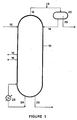
- the process includes the distillation tower 10 in which the impure phenol feed stream 12 is introduced near the top of the tower.
- the phenol stream is at least 95 weight percent phenol, preferably above about 97 weight percent phenol, and more preferably above 98 weight percent phenol.
- the calculation of the phenol weight is on the dry basis.
- Also present in the phenol stream are carbonyl contaminants and organic acid contaminants.
- the phenol stream entering the distillation tower at this point is frequently the overhead of a previous distillation tower which separates phenol and its companion materials from higher boiling materials. Water may be introduced into the distillation tower 10 together with the phenol stream or apart from the phenol stream as in line 14.
- the water source enters from line 8, the phenol stream, 12, and water enter the distillation tower and the phenol stream is held generally at a temperature of from about 180 to about 210°F, generally from about 195 to about 205°F.
- line 22 brings off anhydrous liquid purified phenol at a temperature of from about 400 to about 420°F and moderate pressure.
- Line 24 takes an amount of the liquid phenol and recycles it to the column after going through a reboiler, 28 which is heated with steam. It is this heated phenol which provides the increased temperature in the distillation tower and brings about azeotropes and continuous boiling and liquification of the substances on the various internal plates of the distillation tower so that fractional separations may occur.
- the phenol feed works its way down the distillation tower wherein it is undergoing an azeotrope with the water present, the azeotrope constantly being drawn off overhead by line 18. Together with the water phenol azeotrope there is also a water contaminant oil azeotrope also being drawn off which further purifies the phenol.
- some of the carbonyl contaminants do not easily azeotrope off with water and thereby would go down the column with the phenol and be brought out of the column at line 22 under ordinary circumstances.
- the carbonyl contaminants are of a relatively small concentration, however they do produce a significant change in the sulfonation color test.
- Contamination with alpha-hydroxyacetone in phenol product can vary from about 10 to about 100 parts per million in general.
- the temperature of the column grows higher in its downward phenol progression, most of the water and phenol azeotrope and water and oil azeotropes that are readily drawn off as overhead has occurred at about two-thirds of the column length as measured from the top.
- the organic acid contaminants start building up due to their boiling points.
- the specific means of operating the column as presently operated in the art is to draw off the organic acid contaminants by the side draws shown, 16, so as to avoid an organic acid buildup which would be highly corrosive to the distill ation tower materials.
- the process of this invention differs in that the acid concentration is allowed to buildup until it reaches a level that catalyzes the reaction between the carbonyl contaminants, particularly alpha-hydroxyacetone and the phenol, thereby producing a compound which is readily volatilizable with water in an azeotropic fashion and leaves at the top of the column via line 18 together with the water/oil azeotrope and water/phenol azeotrope.
- Line 18 goes to drum 20 wherein the phenol and water is separated from the carbonyl contaminant phenol reaction product and the other extracted oil contaminants and the phenol and water recycled to the distillation tower in line 14.
- the extracted oil contaminants are removed from drum 20 by line 36.
- the general acid level which can acceptably catalyze the reaction is below a pH of about 2.5, preferably below a pH of about 2.0.
Landscapes
- Chemical & Material Sciences (AREA)
- Organic Chemistry (AREA)
- Chemical Kinetics & Catalysis (AREA)
- General Chemical & Material Sciences (AREA)
- Organic Low-Molecular-Weight Compounds And Preparation Thereof (AREA)
Applications Claiming Priority (2)
| Application Number | Priority Date | Filing Date | Title |
|---|---|---|---|
| US74214 | 1987-07-16 | ||
| US07/074,214 US4832796A (en) | 1987-07-16 | 1987-07-16 | Process for purifying phenol |
Publications (3)
| Publication Number | Publication Date |
|---|---|
| EP0299239A2 true EP0299239A2 (de) | 1989-01-18 |
| EP0299239A3 EP0299239A3 (en) | 1989-10-18 |
| EP0299239B1 EP0299239B1 (de) | 1992-05-13 |
Family
ID=22118362
Family Applications (1)
| Application Number | Title | Priority Date | Filing Date |
|---|---|---|---|
| EP88109906A Expired EP0299239B1 (de) | 1987-07-16 | 1988-06-22 | Verfahren zur Reinigung von Phenol |
Country Status (4)
| Country | Link |
|---|---|
| US (1) | US4832796A (de) |
| EP (1) | EP0299239B1 (de) |
| JP (1) | JPH07112992B2 (de) |
| DE (1) | DE3871001D1 (de) |
Cited By (1)
| Publication number | Priority date | Publication date | Assignee | Title |
|---|---|---|---|---|
| EP0505146A1 (de) * | 1991-03-19 | 1992-09-23 | General Electric Company | Verfahren zur Reinigung von Phenol |
Families Citing this family (5)
| Publication number | Priority date | Publication date | Assignee | Title |
|---|---|---|---|---|
| JPH05117184A (ja) * | 1991-08-28 | 1993-05-14 | Mitsubishi Petrochem Co Ltd | フエノール類混合物の蒸留分離方法 |
| US5131984A (en) * | 1991-09-23 | 1992-07-21 | Allied-Signal Inc. | High quality phenol rectification with energy recovery |
| US5617236A (en) * | 1994-08-15 | 1997-04-01 | Actisys Corporation | Infrared communication device for multistandard operations |
| DE10060505A1 (de) * | 2000-12-06 | 2003-01-30 | Phenolchemie Gmbh & Co Kg | Verfahren zur Abtrennung von Phenol aus einem Gemisch, welches zumindest Hydroxyaceton, Cumol, Wasser und Phenol aufweist |
| JP2015178476A (ja) * | 2014-03-19 | 2015-10-08 | 三菱化学株式会社 | フェノールの製造方法 |
Family Cites Families (19)
| Publication number | Priority date | Publication date | Assignee | Title |
|---|---|---|---|---|
| CA621040A (en) * | 1961-05-30 | Hercules Powder Company | Phenol purification | |
| US2992169A (en) * | 1961-07-11 | Inven | ||
| GB873604A (en) * | 1957-05-08 | 1961-07-26 | Ruetgerswerke Ag | Separation of substantially pure phenol from reaction mixtures by distillation |
| BE576352A (de) * | 1958-03-04 | |||
| US3029294A (en) * | 1959-02-27 | 1962-04-10 | Hercules Powder Co Ltd | Purification of phenol |
| US3265594A (en) * | 1963-01-04 | 1966-08-09 | Eastman Kodak Co | Process for recovering refined ethyl alcohol by plural distillation |
| GB1021759A (en) * | 1963-03-27 | 1966-03-09 | Mitsui Petrochemical Ind | A process for the manufacture of highly pure phenol |
| GB1108584A (en) * | 1964-08-03 | 1968-04-03 | Universal Oil Prod Co | Process for the purification of phenols |
| GB1148907A (en) * | 1965-11-26 | 1969-04-16 | Ici Ltd | Purification of phenol |
| DE1668952A1 (de) * | 1968-01-13 | 1969-11-27 | Phenolchemie Gmbh | Verfahren zur Gewinnung von Reinphenolen aus Rohphenolen,die bei der Spaltung von Hydroperoxiden alkylaromatischer Kohlenwasserstoffe erhalten worden sind |
| US3692845A (en) * | 1969-03-12 | 1972-09-19 | Allied Chem | Purification of phenol |
| GB1394452A (en) * | 1972-05-18 | 1975-05-14 | Bp Chem Int Ltd | Purification of phenol |
| GB1394454A (en) * | 1972-06-01 | 1975-05-14 | Bp Chem Int Ltd | Process for the production of high-purity phenol |
| US3896006A (en) * | 1972-06-01 | 1975-07-22 | Bp Chem Int Ltd | Mesityl oxide removal from high-purity phenol |
| US4251325A (en) * | 1978-03-04 | 1981-02-17 | Bp Chemicals Limited | Process for the removal of hydroxyacetone from phenol |
| JPS5814411B2 (ja) * | 1979-11-02 | 1983-03-18 | 三井化学株式会社 | フエノ−ル類の精製法 |
| JPS6050169B2 (ja) * | 1979-11-05 | 1985-11-07 | 三井化学株式会社 | フエノ−ル類の製造方法 |
| US4504364A (en) * | 1982-06-28 | 1985-03-12 | The Lummus Company | Phenol purification |
| US4567304A (en) * | 1983-04-05 | 1986-01-28 | General Electric Company | Process for preparing acetone and phenol |
-
1987
- 1987-07-16 US US07/074,214 patent/US4832796A/en not_active Expired - Lifetime
-
1988
- 1988-06-22 EP EP88109906A patent/EP0299239B1/de not_active Expired
- 1988-06-22 DE DE8888109906T patent/DE3871001D1/de not_active Expired - Lifetime
- 1988-07-13 JP JP63172806A patent/JPH07112992B2/ja not_active Expired - Lifetime
Cited By (1)
| Publication number | Priority date | Publication date | Assignee | Title |
|---|---|---|---|---|
| EP0505146A1 (de) * | 1991-03-19 | 1992-09-23 | General Electric Company | Verfahren zur Reinigung von Phenol |
Also Published As
| Publication number | Publication date |
|---|---|
| EP0299239A3 (en) | 1989-10-18 |
| JPS6490146A (en) | 1989-04-06 |
| US4832796A (en) | 1989-05-23 |
| EP0299239B1 (de) | 1992-05-13 |
| JPH07112992B2 (ja) | 1995-12-06 |
| DE3871001D1 (de) | 1992-06-17 |
Similar Documents
| Publication | Publication Date | Title |
|---|---|---|
| US3230156A (en) | Purification of synthetic methanol by plural stage distillation | |
| EP0764146B1 (de) | Phenol mit einem niedrigen gehalt an methylbenzofuran | |
| EP1042284B1 (de) | Verfahren zur reinigung durch depolymerisation polymidhaltiger bodenbelaege erhaltenen caprolactams | |
| RU99103632A (ru) | Способ обработки сырого ацетонитрила, способ получения ацетонитрила марки жидкостной хроматографии высокого разрешения | |
| HRP960601A2 (en) | Process for separating medium boiling substances from a mixture of low, medium and high boiling substances | |
| KR100670881B1 (ko) | 고순도 모노에틸렌 글리콜의 제조 방법 | |
| US4400553A (en) | Recovery of BPA and phenol from aqueous effluent streams | |
| EP0299239B1 (de) | Verfahren zur Reinigung von Phenol | |
| US5276235A (en) | Residual stream upgrading in a propylene oxide-styrene monomer process | |
| KR20030060979A (ko) | 알킬아릴 하이드로퍼옥사이드의 개열시 생성된 개열생성물 혼합물의 증류에 의한 후처리 방법 및 후처리용 장치 | |
| JP2002526463A (ja) | 高濃度モノエチレングリコールの製造方法 | |
| CA1149822A (en) | Process for producing phenolic compounds | |
| US4567304A (en) | Process for preparing acetone and phenol | |
| US4349418A (en) | Production of methylnaphthalenes and tar bases including indole | |
| US4480134A (en) | Process for preparing phenol and acetone from cumene | |
| US4857151A (en) | Phenol purification | |
| JPH11302224A (ja) | メタクリル酸メチルの精製法 | |
| US432198A (en) | Gaston guignard | |
| RU2120334C1 (ru) | Способ регенерации отработанного катализатора на основе фторированной сульфокислоты для алкилирования углеводородов | |
| KR20000053661A (ko) | 하이드록시아세톤-함유 페놀로부터 하이드록시아세톤을제거하는 방법 | |
| GB1577560A (en) | Process for the purification of a phenol obtained by the oxidation of an alkyl benzene compound | |
| JP2510645B2 (ja) | コ―クス工場からの廃水の脱フエノ―ル法 | |
| JPH0240050B2 (de) | ||
| JPS6050170B2 (ja) | クレゾ−ルの分離方法 | |
| JPS5865234A (ja) | フエノ−ル類の精製方法 |
Legal Events
| Date | Code | Title | Description |
|---|---|---|---|
| PUAI | Public reference made under article 153(3) epc to a published international application that has entered the european phase |
Free format text: ORIGINAL CODE: 0009012 |
|
| AK | Designated contracting states |
Kind code of ref document: A2 Designated state(s): DE FR GB IT NL |
|
| PUAL | Search report despatched |
Free format text: ORIGINAL CODE: 0009013 |
|
| AK | Designated contracting states |
Kind code of ref document: A3 Designated state(s): DE FR GB IT NL |
|
| 17P | Request for examination filed |
Effective date: 19900322 |
|
| 17Q | First examination report despatched |
Effective date: 19911004 |
|
| GRAA | (expected) grant |
Free format text: ORIGINAL CODE: 0009210 |
|
| AK | Designated contracting states |
Kind code of ref document: B1 Designated state(s): DE FR GB IT NL |
|
| ITF | It: translation for a ep patent filed | ||
| REF | Corresponds to: |
Ref document number: 3871001 Country of ref document: DE Date of ref document: 19920617 |
|
| ET | Fr: translation filed | ||
| PLBE | No opposition filed within time limit |
Free format text: ORIGINAL CODE: 0009261 |
|
| STAA | Information on the status of an ep patent application or granted ep patent |
Free format text: STATUS: NO OPPOSITION FILED WITHIN TIME LIMIT |
|
| 26N | No opposition filed | ||
| ITTA | It: last paid annual fee | ||
| PGFP | Annual fee paid to national office [announced via postgrant information from national office to epo] |
Ref country code: FR Payment date: 19980520 Year of fee payment: 11 |
|
| PGFP | Annual fee paid to national office [announced via postgrant information from national office to epo] |
Ref country code: GB Payment date: 19980526 Year of fee payment: 11 |
|
| PGFP | Annual fee paid to national office [announced via postgrant information from national office to epo] |
Ref country code: NL Payment date: 19980527 Year of fee payment: 11 Ref country code: DE Payment date: 19980527 Year of fee payment: 11 |
|
| PG25 | Lapsed in a contracting state [announced via postgrant information from national office to epo] |
Ref country code: GB Free format text: LAPSE BECAUSE OF NON-PAYMENT OF DUE FEES Effective date: 19990622 |
|
| PG25 | Lapsed in a contracting state [announced via postgrant information from national office to epo] |
Ref country code: FR Free format text: THE PATENT HAS BEEN ANNULLED BY A DECISION OF A NATIONAL AUTHORITY Effective date: 19990630 |
|
| PG25 | Lapsed in a contracting state [announced via postgrant information from national office to epo] |
Ref country code: NL Free format text: LAPSE BECAUSE OF NON-PAYMENT OF DUE FEES Effective date: 20000101 |
|
| GBPC | Gb: european patent ceased through non-payment of renewal fee |
Effective date: 19990622 |
|
| NLV4 | Nl: lapsed or anulled due to non-payment of the annual fee |
Effective date: 20000101 |
|
| PG25 | Lapsed in a contracting state [announced via postgrant information from national office to epo] |
Ref country code: DE Free format text: LAPSE BECAUSE OF NON-PAYMENT OF DUE FEES Effective date: 20000503 |
|
| REG | Reference to a national code |
Ref country code: FR Ref legal event code: ST |
|
| PG25 | Lapsed in a contracting state [announced via postgrant information from national office to epo] |
Ref country code: IT Free format text: LAPSE BECAUSE OF NON-PAYMENT OF DUE FEES;WARNING: LAPSES OF ITALIAN PATENTS WITH EFFECTIVE DATE BEFORE 2007 MAY HAVE OCCURRED AT ANY TIME BEFORE 2007. THE CORRECT EFFECTIVE DATE MAY BE DIFFERENT FROM THE ONE RECORDED. Effective date: 20050622 |