EP0297397B1 - Herstellung von Diazo-und Azoverbindungen - Google Patents
Herstellung von Diazo-und Azoverbindungen Download PDFInfo
- Publication number
- EP0297397B1 EP0297397B1 EP88109835A EP88109835A EP0297397B1 EP 0297397 B1 EP0297397 B1 EP 0297397B1 EP 88109835 A EP88109835 A EP 88109835A EP 88109835 A EP88109835 A EP 88109835A EP 0297397 B1 EP0297397 B1 EP 0297397B1
- Authority
- EP
- European Patent Office
- Prior art keywords
- preparation
- diazo
- compounds
- alkyl
- denotes
- Prior art date
- Legal status (The legal status is an assumption and is not a legal conclusion. Google has not performed a legal analysis and makes no representation as to the accuracy of the status listed.)
- Expired - Lifetime
Links
- 125000000664 diazo group Chemical group [N-]=[N+]=[*] 0.000 title claims description 23
- 238000002360 preparation method Methods 0.000 title claims description 16
- -1 activated methylene compound Chemical class 0.000 claims description 28
- FRVOXOGJJXLSSY-UHFFFAOYSA-N 1-diazoguanidine Chemical class NC(=N)N=[N+]=[N-] FRVOXOGJJXLSSY-UHFFFAOYSA-N 0.000 claims description 16
- 238000005859 coupling reaction Methods 0.000 claims description 15
- 238000006243 chemical reaction Methods 0.000 claims description 14
- 230000008878 coupling Effects 0.000 claims description 14
- 238000010168 coupling process Methods 0.000 claims description 14
- 125000000217 alkyl group Chemical group 0.000 claims description 10
- 125000003710 aryl alkyl group Chemical group 0.000 claims description 10
- 125000000753 cycloalkyl group Chemical group 0.000 claims description 10
- 125000003118 aryl group Chemical group 0.000 claims description 9
- 125000000751 azo group Chemical group [*]N=N[*] 0.000 claims description 9
- 150000008049 diazo compounds Chemical class 0.000 claims description 9
- 125000004433 nitrogen atom Chemical group N* 0.000 claims description 7
- LCGWXMONLSJYQR-UHFFFAOYSA-N 5-[(2,4,6-trioxo-1,3-diazinan-5-yl)diazenyl]-1,3-diazinane-2,4,6-trione Chemical compound O=C1NC(=O)NC(=O)C1N=NC1C(=O)NC(=O)NC1=O LCGWXMONLSJYQR-UHFFFAOYSA-N 0.000 claims description 6
- 239000001257 hydrogen Substances 0.000 claims description 6
- 229910052739 hydrogen Inorganic materials 0.000 claims description 6
- 150000001450 anions Chemical class 0.000 claims description 5
- 239000003795 chemical substances by application Substances 0.000 claims description 5
- HDHQZCHIXUUSMK-UHFFFAOYSA-N 4-hydroxy-2-quinolone Chemical class C1=CC=C2C(O)=CC(=O)NC2=C1 HDHQZCHIXUUSMK-UHFFFAOYSA-N 0.000 claims description 4
- OAZDCJVJMWHYPJ-UHFFFAOYSA-N 5-diazonio-2,4-dioxo-1h-pyrimidin-6-olate Chemical compound [O-]C=1NC(=O)NC(=O)C=1[N+]#N OAZDCJVJMWHYPJ-UHFFFAOYSA-N 0.000 claims description 4
- 239000004215 Carbon black (E152) Substances 0.000 claims description 4
- JUJWROOIHBZHMG-UHFFFAOYSA-N Pyridine Chemical compound C1=CC=NC=C1 JUJWROOIHBZHMG-UHFFFAOYSA-N 0.000 claims description 4
- 239000012736 aqueous medium Substances 0.000 claims description 4
- 229930195733 hydrocarbon Natural products 0.000 claims description 4
- CZPWVGJYEJSRLH-UHFFFAOYSA-N Pyrimidine Chemical compound C1=CN=CN=C1 CZPWVGJYEJSRLH-UHFFFAOYSA-N 0.000 claims description 3
- 239000000987 azo dye Substances 0.000 claims description 3
- WTKZEGDFNFYCGP-UHFFFAOYSA-N Pyrazole Chemical compound C=1C=NNC=1 WTKZEGDFNFYCGP-UHFFFAOYSA-N 0.000 claims description 2
- UMJSCPRVCHMLSP-UHFFFAOYSA-N pyridine Natural products COC1=CC=CN=C1 UMJSCPRVCHMLSP-UHFFFAOYSA-N 0.000 claims description 2
- 125000004435 hydrogen atom Chemical class [H]* 0.000 claims 2
- 125000000325 methylidene group Chemical group [H]C([H])=* 0.000 claims 1
- XLYOFNOQVPJJNP-UHFFFAOYSA-N water Substances O XLYOFNOQVPJJNP-UHFFFAOYSA-N 0.000 description 19
- 125000004169 (C1-C6) alkyl group Chemical group 0.000 description 16
- 125000001570 methylene group Chemical group [H]C([H])([*:1])[*:2] 0.000 description 15
- HNYOPLTXPVRDBG-UHFFFAOYSA-N barbituric acid Chemical compound O=C1CC(=O)NC(=O)N1 HNYOPLTXPVRDBG-UHFFFAOYSA-N 0.000 description 14
- 239000002253 acid Substances 0.000 description 11
- 150000001875 compounds Chemical class 0.000 description 11
- 125000001997 phenyl group Chemical group [H]C1=C([H])C([H])=C(*)C([H])=C1[H] 0.000 description 10
- 229910052794 bromium Inorganic materials 0.000 description 9
- 239000000460 chlorine Substances 0.000 description 9
- 229910052801 chlorine Inorganic materials 0.000 description 9
- 229910052731 fluorine Inorganic materials 0.000 description 9
- 125000000449 nitro group Chemical group [O-][N+](*)=O 0.000 description 9
- 150000003839 salts Chemical class 0.000 description 9
- 239000000243 solution Substances 0.000 description 9
- 125000004191 (C1-C6) alkoxy group Chemical group 0.000 description 8
- 125000004093 cyano group Chemical group *C#N 0.000 description 8
- 239000000203 mixture Substances 0.000 description 8
- 125000001624 naphthyl group Chemical group 0.000 description 8
- 239000002904 solvent Substances 0.000 description 8
- 238000000034 method Methods 0.000 description 7
- QTBSBXVTEAMEQO-UHFFFAOYSA-N Acetic acid Chemical compound CC(O)=O QTBSBXVTEAMEQO-UHFFFAOYSA-N 0.000 description 6
- WEVYAHXRMPXWCK-UHFFFAOYSA-N Acetonitrile Chemical compound CC#N WEVYAHXRMPXWCK-UHFFFAOYSA-N 0.000 description 6
- YMWUJEATGCHHMB-UHFFFAOYSA-N Dichloromethane Chemical compound ClCCl YMWUJEATGCHHMB-UHFFFAOYSA-N 0.000 description 6
- OKKJLVBELUTLKV-UHFFFAOYSA-N Methanol Chemical compound OC OKKJLVBELUTLKV-UHFFFAOYSA-N 0.000 description 6
- 230000015572 biosynthetic process Effects 0.000 description 5
- 239000000047 product Substances 0.000 description 5
- 0 C1CC*CC1 Chemical compound C1CC*CC1 0.000 description 4
- HEDRZPFGACZZDS-UHFFFAOYSA-N Chloroform Chemical compound ClC(Cl)Cl HEDRZPFGACZZDS-UHFFFAOYSA-N 0.000 description 4
- LFQSCWFLJHTTHZ-UHFFFAOYSA-N Ethanol Chemical compound CCO LFQSCWFLJHTTHZ-UHFFFAOYSA-N 0.000 description 4
- VEXZGXHMUGYJMC-UHFFFAOYSA-N Hydrochloric acid Chemical compound Cl VEXZGXHMUGYJMC-UHFFFAOYSA-N 0.000 description 4
- UFHFLCQGNIYNRP-UHFFFAOYSA-N Hydrogen Chemical compound [H][H] UFHFLCQGNIYNRP-UHFFFAOYSA-N 0.000 description 4
- NQRYJNQNLNOLGT-UHFFFAOYSA-N Piperidine Chemical compound C1CCNCC1 NQRYJNQNLNOLGT-UHFFFAOYSA-N 0.000 description 4
- 150000001540 azides Chemical class 0.000 description 4
- 150000001768 cations Chemical class 0.000 description 4
- 125000001495 ethyl group Chemical group [H]C([H])([H])C([H])([H])* 0.000 description 4
- 150000002431 hydrogen Chemical class 0.000 description 4
- 125000002496 methyl group Chemical group [H]C([H])([H])* 0.000 description 4
- LPXPTNMVRIOKMN-UHFFFAOYSA-M sodium nitrite Chemical compound [Na+].[O-]N=O LPXPTNMVRIOKMN-UHFFFAOYSA-M 0.000 description 4
- 238000003786 synthesis reaction Methods 0.000 description 4
- CSCPPACGZOOCGX-UHFFFAOYSA-N Acetone Chemical compound CC(C)=O CSCPPACGZOOCGX-UHFFFAOYSA-N 0.000 description 3
- ZMXDDKWLCZADIW-UHFFFAOYSA-N N,N-Dimethylformamide Chemical compound CN(C)C=O ZMXDDKWLCZADIW-UHFFFAOYSA-N 0.000 description 3
- IOVCWXUNBOPUCH-UHFFFAOYSA-M Nitrite anion Chemical compound [O-]N=O IOVCWXUNBOPUCH-UHFFFAOYSA-M 0.000 description 3
- IOVCWXUNBOPUCH-UHFFFAOYSA-N Nitrous acid Chemical compound ON=O IOVCWXUNBOPUCH-UHFFFAOYSA-N 0.000 description 3
- HEMHJVSKTPXQMS-UHFFFAOYSA-M Sodium hydroxide Chemical compound [OH-].[Na+] HEMHJVSKTPXQMS-UHFFFAOYSA-M 0.000 description 3
- OOCQMFQBTYUMEN-UHFFFAOYSA-N [amino(azido)methylidene]azanium;chloride Chemical compound [Cl-].NC(=N)[NH+]=[N+]=[N-] OOCQMFQBTYUMEN-UHFFFAOYSA-N 0.000 description 3
- HAMNKKUPIHEESI-UHFFFAOYSA-N aminoguanidine Chemical compound NNC(N)=N HAMNKKUPIHEESI-UHFFFAOYSA-N 0.000 description 3
- 239000007864 aqueous solution Substances 0.000 description 3
- 150000007656 barbituric acids Chemical class 0.000 description 3
- 125000001797 benzyl group Chemical group [H]C1=C([H])C([H])=C(C([H])=C1[H])C([H])([H])* 0.000 description 3
- 239000006227 byproduct Substances 0.000 description 3
- 150000003254 radicals Chemical class 0.000 description 3
- SPAJGBOXQITFMS-UHFFFAOYSA-N (4-hydroxy-6-oxo-1h-pyrimidin-2-yl)cyanamide Chemical compound OC1=CC(=O)NC(NC#N)=N1 SPAJGBOXQITFMS-UHFFFAOYSA-N 0.000 description 2
- OTXHZHQQWQTQMW-UHFFFAOYSA-N (diaminomethylideneamino)azanium;hydrogen carbonate Chemical compound OC([O-])=O.N[NH2+]C(N)=N OTXHZHQQWQTQMW-UHFFFAOYSA-N 0.000 description 2
- XNWFRZJHXBZDAG-UHFFFAOYSA-N 2-METHOXYETHANOL Chemical compound COCCO XNWFRZJHXBZDAG-UHFFFAOYSA-N 0.000 description 2
- 125000000094 2-phenylethyl group Chemical group [H]C1=C([H])C([H])=C(C([H])=C1[H])C([H])([H])C([H])([H])* 0.000 description 2
- VXIXUWQIVKSKSA-UHFFFAOYSA-N 4-hydroxycoumarin Chemical compound C1=CC=CC2=C1OC(=O)C=C2O VXIXUWQIVKSKSA-UHFFFAOYSA-N 0.000 description 2
- IJGRMHOSHXDMSA-UHFFFAOYSA-N Atomic nitrogen Chemical compound N#N IJGRMHOSHXDMSA-UHFFFAOYSA-N 0.000 description 2
- IAZDPXIOMUYVGZ-UHFFFAOYSA-N Dimethylsulphoxide Chemical compound CS(C)=O IAZDPXIOMUYVGZ-UHFFFAOYSA-N 0.000 description 2
- LYCAIKOWRPUZTN-UHFFFAOYSA-N Ethylene glycol Chemical compound OCCO LYCAIKOWRPUZTN-UHFFFAOYSA-N 0.000 description 2
- ZRALSGWEFCBTJO-UHFFFAOYSA-N Guanidine Chemical class NC(N)=N ZRALSGWEFCBTJO-UHFFFAOYSA-N 0.000 description 2
- XEEYBQQBJWHFJM-UHFFFAOYSA-N Iron Chemical compound [Fe] XEEYBQQBJWHFJM-UHFFFAOYSA-N 0.000 description 2
- KFZMGEQAYNKOFK-UHFFFAOYSA-N Isopropanol Chemical compound CC(C)O KFZMGEQAYNKOFK-UHFFFAOYSA-N 0.000 description 2
- PXHVJJICTQNCMI-UHFFFAOYSA-N Nickel Chemical compound [Ni] PXHVJJICTQNCMI-UHFFFAOYSA-N 0.000 description 2
- 150000007513 acids Chemical class 0.000 description 2
- 150000001298 alcohols Chemical class 0.000 description 2
- 239000003513 alkali Substances 0.000 description 2
- 125000002490 anilino group Chemical group [H]N(*)C1=C([H])C([H])=C([H])C([H])=C1[H] 0.000 description 2
- 125000001769 aryl amino group Chemical group 0.000 description 2
- 125000004432 carbon atom Chemical group C* 0.000 description 2
- OPTASPLRGRRNAP-UHFFFAOYSA-N cytosine Chemical compound NC=1C=CNC(=O)N=1 OPTASPLRGRRNAP-UHFFFAOYSA-N 0.000 description 2
- 150000002148 esters Chemical class 0.000 description 2
- 125000004494 ethyl ester group Chemical group 0.000 description 2
- 238000001704 evaporation Methods 0.000 description 2
- 230000008020 evaporation Effects 0.000 description 2
- 238000002474 experimental method Methods 0.000 description 2
- 230000007062 hydrolysis Effects 0.000 description 2
- 238000006460 hydrolysis reaction Methods 0.000 description 2
- 238000004519 manufacturing process Methods 0.000 description 2
- 125000005184 naphthylamino group Chemical group C1(=CC=CC2=CC=CC=C12)N* 0.000 description 2
- 229910052757 nitrogen Inorganic materials 0.000 description 2
- PXQPEWDEAKTCGB-UHFFFAOYSA-N orotic acid Chemical compound OC(=O)C1=CC(=O)NC(=O)N1 PXQPEWDEAKTCGB-UHFFFAOYSA-N 0.000 description 2
- 239000002244 precipitate Substances 0.000 description 2
- 125000002924 primary amino group Chemical group [H]N([H])* 0.000 description 2
- 150000003222 pyridines Chemical class 0.000 description 2
- 150000003230 pyrimidines Chemical class 0.000 description 2
- 235000010288 sodium nitrite Nutrition 0.000 description 2
- 239000000758 substrate Substances 0.000 description 2
- HSVFKFNNMLUVEY-UHFFFAOYSA-N sulfuryl diazide Chemical class [N-]=[N+]=NS(=O)(=O)N=[N+]=[N-] HSVFKFNNMLUVEY-UHFFFAOYSA-N 0.000 description 2
- MANYVBUGTRHKES-UHFFFAOYSA-N (4-hydroxy-6-oxo-1h-pyrimidin-2-yl)urea Chemical compound NC(=O)NC1=NC(O)=CC(O)=N1 MANYVBUGTRHKES-UHFFFAOYSA-N 0.000 description 1
- JQZJMILBKZUKLV-UHFFFAOYSA-N (6-amino-4-oxo-1h-pyrimidin-2-yl)cyanamide Chemical compound NC1=CC(=O)N=C(NC#N)N1 JQZJMILBKZUKLV-UHFFFAOYSA-N 0.000 description 1
- VVSASNKOFCZVES-UHFFFAOYSA-N 1,3-dimethyl-1,3-diazinane-2,4,6-trione Chemical compound CN1C(=O)CC(=O)N(C)C1=O VVSASNKOFCZVES-UHFFFAOYSA-N 0.000 description 1
- QFILRFCCYHXDNW-UHFFFAOYSA-N 1-(1,3-benzothiazol-2-yl)propan-2-one Chemical compound C1=CC=C2SC(CC(=O)C)=NC2=C1 QFILRFCCYHXDNW-UHFFFAOYSA-N 0.000 description 1
- WLHRMWLGSKOZSJ-UHFFFAOYSA-N 1-ethyl-5-hydroxy-4-methyl-2-oxopyridine-3-carbonitrile Chemical compound CCN1C=C(O)C(C)=C(C#N)C1=O WLHRMWLGSKOZSJ-UHFFFAOYSA-N 0.000 description 1
- BZVOIJWRUSGKER-UHFFFAOYSA-N 1-methyl-2h-quinoline-2,4-diol Chemical compound C1=CC=C2N(C)C(O)C=C(O)C2=C1 BZVOIJWRUSGKER-UHFFFAOYSA-N 0.000 description 1
- BKQXVXDIFSBPNF-UHFFFAOYSA-N 10h-pyrimido[1,2-a]benzimidazole-2,4-dione Chemical compound C1=CC=C2N3C(=O)CC(=O)N=C3NC2=C1 BKQXVXDIFSBPNF-UHFFFAOYSA-N 0.000 description 1
- SWELIMKTDYHAOY-UHFFFAOYSA-N 2,4-diamino-6-hydroxypyrimidine Chemical compound NC1=CC(=O)N=C(N)N1 SWELIMKTDYHAOY-UHFFFAOYSA-N 0.000 description 1
- HKZMNMRPNHXMJK-UHFFFAOYSA-N 2,4-dihydroxy-6-oxo-1h-pyridine-3-carboxamide Chemical compound NC(=O)C1=C(O)C=C(O)N=C1O HKZMNMRPNHXMJK-UHFFFAOYSA-N 0.000 description 1
- HKFHIZASFFTQOK-UHFFFAOYSA-N 2,4-dioxo-1h-pyrimidine-6-carboxamide Chemical compound NC(=O)C1=CC(=O)NC(=O)N1 HKFHIZASFFTQOK-UHFFFAOYSA-N 0.000 description 1
- UJJGEMHUPNDRPK-UHFFFAOYSA-N 2-(2,4-dimethylanilino)-4-hydroxy-1h-pyrimidin-6-one Chemical compound CC1=CC(C)=CC=C1NC1=NC(O)=CC(O)=N1 UJJGEMHUPNDRPK-UHFFFAOYSA-N 0.000 description 1
- UUQCNFNFBCKMGN-UHFFFAOYSA-N 2-(2,5-dichloroanilino)-4-hydroxy-1h-pyrimidin-6-one Chemical compound OC1=CC(O)=NC(NC=2C(=CC=C(Cl)C=2)Cl)=N1 UUQCNFNFBCKMGN-UHFFFAOYSA-N 0.000 description 1
- FCWUFSJRTXLBTH-UHFFFAOYSA-N 2-(2,5-dichlorophenyl)-5-methyl-4h-pyrazol-3-one Chemical compound O=C1CC(C)=NN1C1=CC(Cl)=CC=C1Cl FCWUFSJRTXLBTH-UHFFFAOYSA-N 0.000 description 1
- CWESERWNUIUBJU-UHFFFAOYSA-N 2-(2-chlorophenyl)-5-methyl-4h-pyrazol-3-one Chemical compound O=C1CC(C)=NN1C1=CC=CC=C1Cl CWESERWNUIUBJU-UHFFFAOYSA-N 0.000 description 1
- QGIWLFRXNZRKTH-UHFFFAOYSA-N 2-(2-hydroxy-4-methyl-6-oxo-1h-pyridin-3-yl)acetic acid Chemical compound CC1=CC(O)=NC(O)=C1CC(O)=O QGIWLFRXNZRKTH-UHFFFAOYSA-N 0.000 description 1
- SZKUPPPBEHFTOA-UHFFFAOYSA-N 2-(4-chloroanilino)-4-hydroxy-1h-pyrimidin-6-one Chemical compound OC1=CC(O)=NC(NC=2C=CC(Cl)=CC=2)=N1 SZKUPPPBEHFTOA-UHFFFAOYSA-N 0.000 description 1
- WHIXQFSPEDIMGL-UHFFFAOYSA-N 2-(4-chlorophenyl)-5-methyl-4h-pyrazol-3-one Chemical compound O=C1CC(C)=NN1C1=CC=C(Cl)C=C1 WHIXQFSPEDIMGL-UHFFFAOYSA-N 0.000 description 1
- NHKQFLAKTUCGQX-UHFFFAOYSA-N 2-(4-hydroxy-6-oxo-1h-pyrimidin-2-yl)guanidine Chemical compound NC(=N)NC1=NC(O)=CC(O)=N1 NHKQFLAKTUCGQX-UHFFFAOYSA-N 0.000 description 1
- AXTBQJTVHZUDRJ-UHFFFAOYSA-N 2-(dimethylamino)-6-hydroxy-2-(methylamino)-1,3-dihydropyrimidin-4-one Chemical compound CNC1(NC(=CC(=N1)O)O)N(C)C AXTBQJTVHZUDRJ-UHFFFAOYSA-N 0.000 description 1
- AUFJTVGCSJNQIF-UHFFFAOYSA-N 2-Amino-4,6-dihydroxypyrimidine Chemical compound NC1=NC(O)=CC(=O)N1 AUFJTVGCSJNQIF-UHFFFAOYSA-N 0.000 description 1
- JPOZPGMNCPDNSI-UHFFFAOYSA-N 2-anilino-4-hydroxy-1h-pyrimidin-6-one Chemical compound OC1=CC(O)=NC(NC=2C=CC=CC=2)=N1 JPOZPGMNCPDNSI-UHFFFAOYSA-N 0.000 description 1
- HQNSWBRZIOYGAW-UHFFFAOYSA-N 2-chloro-n,n-dimethylpyridin-4-amine Chemical compound CN(C)C1=CC=NC(Cl)=C1 HQNSWBRZIOYGAW-UHFFFAOYSA-N 0.000 description 1
- PEHCVWCMOQNDGA-UHFFFAOYSA-N 2-diazonioimino-3-ethyl-1,3-benzothiazole Chemical compound C1=CC=C2[N+](CC)=C(N=[N+]=[N-])SC2=C1 PEHCVWCMOQNDGA-UHFFFAOYSA-N 0.000 description 1
- ZNQVEEAIQZEUHB-UHFFFAOYSA-N 2-ethoxyethanol Chemical compound CCOCCO ZNQVEEAIQZEUHB-UHFFFAOYSA-N 0.000 description 1
- YRGYYQCOWUULNF-UHFFFAOYSA-N 2-hydroxy-4-methyl-6-oxo-1h-pyridine-3-carbonitrile Chemical compound CC1=CC(=O)NC(O)=C1C#N YRGYYQCOWUULNF-UHFFFAOYSA-N 0.000 description 1
- OTEBTSPEXWSPLD-UHFFFAOYSA-N 2-hydroxy-4-methyl-6-oxo-1h-pyridine-3-carboxamide Chemical compound CC1=CC(=O)NC(O)=C1C(N)=O OTEBTSPEXWSPLD-UHFFFAOYSA-N 0.000 description 1
- 125000000954 2-hydroxyethyl group Chemical group [H]C([*])([H])C([H])([H])O[H] 0.000 description 1
- LBLYYCQCTBFVLH-UHFFFAOYSA-M 2-methylbenzenesulfonate Chemical compound CC1=CC=CC=C1S([O-])(=O)=O LBLYYCQCTBFVLH-UHFFFAOYSA-M 0.000 description 1
- ULRPISSMEBPJLN-UHFFFAOYSA-N 2h-tetrazol-5-amine Chemical compound NC1=NN=NN1 ULRPISSMEBPJLN-UHFFFAOYSA-N 0.000 description 1
- 125000004189 3,4-dichlorophenyl group Chemical group [H]C1=C([H])C(Cl)=C(Cl)C([H])=C1* 0.000 description 1
- FKUUNEWAZBLWDV-UHFFFAOYSA-N 3-(2-hydroxy-4-methyl-6-oxo-1h-pyridin-3-yl)propanoic acid Chemical compound CC1=CC(O)=NC(O)=C1CCC(O)=O FKUUNEWAZBLWDV-UHFFFAOYSA-N 0.000 description 1
- WKBPMOYEEALWAL-UHFFFAOYSA-N 3-hydroxy-1,4-dimethylpyridin-2-one Chemical compound CC=1C=CN(C)C(=O)C=1O WKBPMOYEEALWAL-UHFFFAOYSA-N 0.000 description 1
- QOXOZONBQWIKDA-UHFFFAOYSA-N 3-hydroxypropyl Chemical group [CH2]CCO QOXOZONBQWIKDA-UHFFFAOYSA-N 0.000 description 1
- NHLAPJMCARJFOG-UHFFFAOYSA-N 3-methyl-1,4-dihydropyrazol-5-one Chemical compound CC1=NNC(=O)C1 NHLAPJMCARJFOG-UHFFFAOYSA-N 0.000 description 1
- OKSVBJJXPDBPKN-UHFFFAOYSA-N 4,6-diamino-1h-pyrimidin-2-one Chemical compound NC=1C=C(N)NC(=O)N=1 OKSVBJJXPDBPKN-UHFFFAOYSA-N 0.000 description 1
- DUFGYCAXVIUXIP-UHFFFAOYSA-N 4,6-dihydroxypyrimidine Chemical compound OC1=CC(O)=NC=N1 DUFGYCAXVIUXIP-UHFFFAOYSA-N 0.000 description 1
- ICIGGDXLLCGGEW-UHFFFAOYSA-N 4-amino-10h-pyrimido[1,2-a]benzimidazol-2-one Chemical compound C1=CC=C2N3C(N)=CC(O)=NC3=NC2=C1 ICIGGDXLLCGGEW-UHFFFAOYSA-N 0.000 description 1
- CBSMETHUFLDMLR-UHFFFAOYSA-N 4-hydroxy-10h-pyrimido[1,2-a]benzimidazol-2-one Chemical compound C1=CC=C2N3C(O)=CC(=O)N=C3NC2=C1 CBSMETHUFLDMLR-UHFFFAOYSA-N 0.000 description 1
- NNEUQMAZYBISAC-UHFFFAOYSA-N 4-hydroxy-2-(4-methylanilino)-1h-pyrimidin-6-one Chemical compound C1=CC(C)=CC=C1NC1=NC(O)=CC(O)=N1 NNEUQMAZYBISAC-UHFFFAOYSA-N 0.000 description 1
- AVQFRJYXYGFAMA-UHFFFAOYSA-N 4-hydroxy-2-(4-nitroanilino)-1h-pyrimidin-6-one Chemical compound OC1=CC(O)=NC(NC=2C=CC(=CC=2)[N+]([O-])=O)=N1 AVQFRJYXYGFAMA-UHFFFAOYSA-N 0.000 description 1
- WTDXDRUHQKVYKO-UHFFFAOYSA-N 4-hydroxy-2-phenyl-1h-pyrimidin-6-one Chemical compound OC1=CC(=O)NC(C=2C=CC=CC=2)=N1 WTDXDRUHQKVYKO-UHFFFAOYSA-N 0.000 description 1
- SNFPSSBYDIFPOX-UHFFFAOYSA-N 4-oxo-2-phenyl-1h-pyrimidine-6-carboxylic acid Chemical compound N1C(C(=O)O)=CC(=O)N=C1C1=CC=CC=C1 SNFPSSBYDIFPOX-UHFFFAOYSA-N 0.000 description 1
- 125000002373 5 membered heterocyclic group Chemical group 0.000 description 1
- IOQOLGUXWSBWHR-UHFFFAOYSA-N 5-methyl-2-(4-methylphenyl)-4h-pyrazol-3-one Chemical compound O=C1CC(C)=NN1C1=CC=C(C)C=C1 IOQOLGUXWSBWHR-UHFFFAOYSA-N 0.000 description 1
- MYPAMGFTHVEING-UHFFFAOYSA-N 5-methyl-2-(4-nitrophenyl)-4h-pyrazol-3-one Chemical compound O=C1CC(C)=NN1C1=CC=C([N+]([O-])=O)C=C1 MYPAMGFTHVEING-UHFFFAOYSA-N 0.000 description 1
- VOQQGERWJRIHIK-UHFFFAOYSA-N 5-methyl-2-phenyl-4h-pyrazol-3-imine Chemical compound N=C1CC(C)=NN1C1=CC=CC=C1 VOQQGERWJRIHIK-UHFFFAOYSA-N 0.000 description 1
- PLBAPESPVBOCDW-UHFFFAOYSA-N 6-amino-2-phenyl-1h-pyrimidin-4-one Chemical compound N1C(N)=CC(=O)N=C1C1=CC=CC=C1 PLBAPESPVBOCDW-UHFFFAOYSA-N 0.000 description 1
- LNDZXOWGUAIUBG-UHFFFAOYSA-N 6-aminouracil Chemical compound NC1=CC(=O)NC(=O)N1 LNDZXOWGUAIUBG-UHFFFAOYSA-N 0.000 description 1
- JJHVYGVVMBYCMQ-UHFFFAOYSA-N 6-hydroxy-4-methyl-1h-pyridin-2-one Chemical compound CC=1C=C(O)NC(=O)C=1 JJHVYGVVMBYCMQ-UHFFFAOYSA-N 0.000 description 1
- VOSRESBYHLVUSD-UHFFFAOYSA-N 7-amino-2-methyl-1h-[1,2,4]triazolo[1,5-a]pyrimidin-5-one Chemical compound O=C1C=C(N)N2NC(C)=NC2=N1 VOSRESBYHLVUSD-UHFFFAOYSA-N 0.000 description 1
- MGSUQXAMLTWXCB-UHFFFAOYSA-N 7-hydroxy-1h-[1,2,4]triazolo[1,5-a]pyrimidin-5-one Chemical compound OC1=CC(=O)N=C2N=CNN12 MGSUQXAMLTWXCB-UHFFFAOYSA-N 0.000 description 1
- KOAFVBHDSPLAAD-UHFFFAOYSA-N 7-hydroxy-2-methyl-1h-[1,2,4]triazolo[1,5-a]pyrimidin-5-one Chemical compound N1=C(O)C=C(O)N2N=C(C)N=C21 KOAFVBHDSPLAAD-UHFFFAOYSA-N 0.000 description 1
- LSNNMFCWUKXFEE-UHFFFAOYSA-M Bisulfite Chemical compound OS([O-])=O LSNNMFCWUKXFEE-UHFFFAOYSA-M 0.000 description 1
- WKBOTKDWSSQWDR-UHFFFAOYSA-N Bromine atom Chemical compound [Br] WKBOTKDWSSQWDR-UHFFFAOYSA-N 0.000 description 1
- NOGFQYQQGBWCRF-UHFFFAOYSA-N C(#N)C1=C(C=C(N2C1=NC1=C2C=CC=C1)O)C Chemical compound C(#N)C1=C(C=C(N2C1=NC1=C2C=CC=C1)O)C NOGFQYQQGBWCRF-UHFFFAOYSA-N 0.000 description 1
- RTTKVNNZRGYCTK-UHFFFAOYSA-N CC=1C=C(O)N(C)C(=O)C=1C#N Chemical compound CC=1C=C(O)N(C)C(=O)C=1C#N RTTKVNNZRGYCTK-UHFFFAOYSA-N 0.000 description 1
- CSGQJHQYWJLPKY-UHFFFAOYSA-N CITRAZINIC ACID Chemical compound OC(=O)C=1C=C(O)NC(=O)C=1 CSGQJHQYWJLPKY-UHFFFAOYSA-N 0.000 description 1
- OYPRJOBELJOOCE-UHFFFAOYSA-N Calcium Chemical compound [Ca] OYPRJOBELJOOCE-UHFFFAOYSA-N 0.000 description 1
- VEXZGXHMUGYJMC-UHFFFAOYSA-M Chloride anion Chemical compound [Cl-] VEXZGXHMUGYJMC-UHFFFAOYSA-M 0.000 description 1
- ZAMOUSCENKQFHK-UHFFFAOYSA-N Chlorine atom Chemical compound [Cl] ZAMOUSCENKQFHK-UHFFFAOYSA-N 0.000 description 1
- RYGMFSIKBFXOCR-UHFFFAOYSA-N Copper Chemical compound [Cu] RYGMFSIKBFXOCR-UHFFFAOYSA-N 0.000 description 1
- PXGOKWXKJXAPGV-UHFFFAOYSA-N Fluorine Chemical compound FF PXGOKWXKJXAPGV-UHFFFAOYSA-N 0.000 description 1
- DGAQECJNVWCQMB-PUAWFVPOSA-M Ilexoside XXIX Chemical compound C[C@@H]1CC[C@@]2(CC[C@@]3(C(=CC[C@H]4[C@]3(CC[C@@H]5[C@@]4(CC[C@@H](C5(C)C)OS(=O)(=O)[O-])C)C)[C@@H]2[C@]1(C)O)C)C(=O)O[C@H]6[C@@H]([C@H]([C@@H]([C@H](O6)CO)O)O)O.[Na+] DGAQECJNVWCQMB-PUAWFVPOSA-M 0.000 description 1
- 238000005684 Liebig rearrangement reaction Methods 0.000 description 1
- PWHULOQIROXLJO-UHFFFAOYSA-N Manganese Chemical compound [Mn] PWHULOQIROXLJO-UHFFFAOYSA-N 0.000 description 1
- AFVFQIVMOAPDHO-UHFFFAOYSA-N Methanesulfonic acid Chemical compound CS(O)(=O)=O AFVFQIVMOAPDHO-UHFFFAOYSA-N 0.000 description 1
- YNAVUWVOSKDBBP-UHFFFAOYSA-N Morpholine Chemical group C1COCCN1 YNAVUWVOSKDBBP-UHFFFAOYSA-N 0.000 description 1
- ZLMJMSJWJFRBEC-UHFFFAOYSA-N Potassium Chemical compound [K] ZLMJMSJWJFRBEC-UHFFFAOYSA-N 0.000 description 1
- RWRDLPDLKQPQOW-UHFFFAOYSA-N Pyrrolidine Chemical group C1CCNC1 RWRDLPDLKQPQOW-UHFFFAOYSA-N 0.000 description 1
- KEAYESYHFKHZAL-UHFFFAOYSA-N Sodium Chemical class [Na] KEAYESYHFKHZAL-UHFFFAOYSA-N 0.000 description 1
- VMHLLURERBWHNL-UHFFFAOYSA-M Sodium acetate Chemical compound [Na+].CC([O-])=O VMHLLURERBWHNL-UHFFFAOYSA-M 0.000 description 1
- ISAKRJDGNUQOIC-UHFFFAOYSA-N Uracil Chemical compound O=C1C=CNC(=O)N1 ISAKRJDGNUQOIC-UHFFFAOYSA-N 0.000 description 1
- 239000000370 acceptor Substances 0.000 description 1
- DYRDKSSFIWVSNM-UHFFFAOYSA-N acetoacetanilide Chemical compound CC(=O)CC(=O)NC1=CC=CC=C1 DYRDKSSFIWVSNM-UHFFFAOYSA-N 0.000 description 1
- WDJHALXBUFZDSR-UHFFFAOYSA-N acetoacetic acid Chemical class CC(=O)CC(O)=O WDJHALXBUFZDSR-UHFFFAOYSA-N 0.000 description 1
- 150000003863 ammonium salts Chemical class 0.000 description 1
- 239000007900 aqueous suspension Substances 0.000 description 1
- 125000000852 azido group Chemical group *N=[N+]=[N-] 0.000 description 1
- 229910052788 barium Inorganic materials 0.000 description 1
- DSAJWYNOEDNPEQ-UHFFFAOYSA-N barium atom Chemical compound [Ba] DSAJWYNOEDNPEQ-UHFFFAOYSA-N 0.000 description 1
- SRSXLGNVWSONIS-UHFFFAOYSA-M benzenesulfonate Chemical compound [O-]S(=O)(=O)C1=CC=CC=C1 SRSXLGNVWSONIS-UHFFFAOYSA-M 0.000 description 1
- 229940077388 benzenesulfonate Drugs 0.000 description 1
- GDTBXPJZTBHREO-UHFFFAOYSA-N bromine Substances BrBr GDTBXPJZTBHREO-UHFFFAOYSA-N 0.000 description 1
- 239000011575 calcium Substances 0.000 description 1
- 229910052791 calcium Inorganic materials 0.000 description 1
- BLNJZMQZYXWQGM-UHFFFAOYSA-N carbamoyl azide Chemical compound NC(=O)N=[N+]=[N-] BLNJZMQZYXWQGM-UHFFFAOYSA-N 0.000 description 1
- 229910052799 carbon Inorganic materials 0.000 description 1
- 125000005521 carbonamide group Chemical group 0.000 description 1
- ZUIVNYGZFPOXFW-UHFFFAOYSA-N chembl1717603 Chemical compound N1=C(C)C=C(O)N2N=CN=C21 ZUIVNYGZFPOXFW-UHFFFAOYSA-N 0.000 description 1
- 239000007795 chemical reaction product Substances 0.000 description 1
- 239000003153 chemical reaction reagent Substances 0.000 description 1
- 239000010941 cobalt Substances 0.000 description 1
- 229910017052 cobalt Inorganic materials 0.000 description 1
- GUTLYIVDDKVIGB-UHFFFAOYSA-N cobalt atom Chemical compound [Co] GUTLYIVDDKVIGB-UHFFFAOYSA-N 0.000 description 1
- 229910052802 copper Inorganic materials 0.000 description 1
- 239000010949 copper Substances 0.000 description 1
- MLIREBYILWEBDM-UHFFFAOYSA-N cyanoacetic acid Chemical class OC(=O)CC#N MLIREBYILWEBDM-UHFFFAOYSA-N 0.000 description 1
- HJSLFCCWAKVHIW-UHFFFAOYSA-N cyclohexane-1,3-dione Chemical compound O=C1CCCC(=O)C1 HJSLFCCWAKVHIW-UHFFFAOYSA-N 0.000 description 1
- 229940104302 cytosine Drugs 0.000 description 1
- BADXJIPKFRBFOT-UHFFFAOYSA-N dimedone Chemical compound CC1(C)CC(=O)CC(=O)C1 BADXJIPKFRBFOT-UHFFFAOYSA-N 0.000 description 1
- YRIUSKIDOIARQF-UHFFFAOYSA-N dodecyl benzenesulfonate Chemical compound CCCCCCCCCCCCOS(=O)(=O)C1=CC=CC=C1 YRIUSKIDOIARQF-UHFFFAOYSA-N 0.000 description 1
- 229940071161 dodecylbenzenesulfonate Drugs 0.000 description 1
- 238000001035 drying Methods 0.000 description 1
- QELUYTUMUWHWMC-UHFFFAOYSA-N edaravone Chemical compound O=C1CC(C)=NN1C1=CC=CC=C1 QELUYTUMUWHWMC-UHFFFAOYSA-N 0.000 description 1
- CCIVGXIOQKPBKL-UHFFFAOYSA-M ethanesulfonate Chemical compound CCS([O-])(=O)=O CCIVGXIOQKPBKL-UHFFFAOYSA-M 0.000 description 1
- 235000019439 ethyl acetate Nutrition 0.000 description 1
- 230000007717 exclusion Effects 0.000 description 1
- 239000011737 fluorine Substances 0.000 description 1
- XLYOFNOQVPJJNP-ZSJDYOACSA-N heavy water Substances [2H]O[2H] XLYOFNOQVPJJNP-ZSJDYOACSA-N 0.000 description 1
- WGCNASOHLSPBMP-UHFFFAOYSA-N hydroxyacetaldehyde Natural products OCC=O WGCNASOHLSPBMP-UHFFFAOYSA-N 0.000 description 1
- 238000011065 in-situ storage Methods 0.000 description 1
- 229910052500 inorganic mineral Inorganic materials 0.000 description 1
- 229910052742 iron Inorganic materials 0.000 description 1
- 238000002955 isolation Methods 0.000 description 1
- 125000001449 isopropyl group Chemical group [H]C([H])([H])C([H])(*)C([H])([H])[H] 0.000 description 1
- 229910052748 manganese Inorganic materials 0.000 description 1
- 239000011572 manganese Substances 0.000 description 1
- 239000002609 medium Substances 0.000 description 1
- 229910052751 metal Inorganic materials 0.000 description 1
- 239000002184 metal Substances 0.000 description 1
- 150000002739 metals Chemical class 0.000 description 1
- 239000011707 mineral Substances 0.000 description 1
- OEQGMPSQZNJJBM-UHFFFAOYSA-N n-(4-hydroxy-6-oxo-1h-pyrimidin-2-yl)acetamide Chemical compound CC(=O)NC1=NC(O)=CC(O)=N1 OEQGMPSQZNJJBM-UHFFFAOYSA-N 0.000 description 1
- RGMOFCUIALYERN-UHFFFAOYSA-N n-(4-hydroxy-6-oxo-1h-pyrimidin-2-yl)benzamide Chemical compound OC1=CC(O)=NC(NC(=O)C=2C=CC=CC=2)=N1 RGMOFCUIALYERN-UHFFFAOYSA-N 0.000 description 1
- ZAKMOHYYFMKCTR-UHFFFAOYSA-N n-(4-hydroxy-6-oxo-1h-pyrimidin-2-yl)benzenesulfonamide Chemical compound OC1=CC(O)=NC(NS(=O)(=O)C=2C=CC=CC=2)=N1 ZAKMOHYYFMKCTR-UHFFFAOYSA-N 0.000 description 1
- ZKCUZHITSHCPES-UHFFFAOYSA-N n-(4-hydroxy-6-oxo-1h-pyrimidin-2-yl)methanesulfonamide Chemical compound CS(=O)(=O)NC1=NC(O)=CC(O)=N1 ZKCUZHITSHCPES-UHFFFAOYSA-N 0.000 description 1
- YJMNLPRMBFMFDL-UHFFFAOYSA-N n-diazo-2-methylbenzenesulfonamide Chemical compound CC1=CC=CC=C1S(=O)(=O)N=[N+]=[N-] YJMNLPRMBFMFDL-UHFFFAOYSA-N 0.000 description 1
- 229910052759 nickel Inorganic materials 0.000 description 1
- 150000002826 nitrites Chemical class 0.000 description 1
- 229960005010 orotic acid Drugs 0.000 description 1
- 125000004430 oxygen atom Chemical group O* 0.000 description 1
- 125000003170 phenylsulfonyl group Chemical group C1(=CC=CC=C1)S(=O)(=O)* 0.000 description 1
- 239000011591 potassium Substances 0.000 description 1
- 229910052700 potassium Inorganic materials 0.000 description 1
- BDERNNFJNOPAEC-UHFFFAOYSA-N propan-1-ol Chemical compound CCCO BDERNNFJNOPAEC-UHFFFAOYSA-N 0.000 description 1
- 125000001436 propyl group Chemical group [H]C([*])([H])C([H])([H])C([H])([H])[H] 0.000 description 1
- 150000003217 pyrazoles Chemical class 0.000 description 1
- WLFXSECCHULRRO-UHFFFAOYSA-N pyridine-2,6-diol Chemical compound OC1=CC=CC(O)=N1 WLFXSECCHULRRO-UHFFFAOYSA-N 0.000 description 1
- 229940083082 pyrimidine derivative acting on arteriolar smooth muscle Drugs 0.000 description 1
- ZJYUVWMAGBHKSR-UHFFFAOYSA-N pyrimido[2,1-b][1,3]benzothiazole-2,4-dione Chemical compound C1=CC=C2N3C(=O)CC(=O)N=C3SC2=C1 ZJYUVWMAGBHKSR-UHFFFAOYSA-N 0.000 description 1
- 239000011541 reaction mixture Substances 0.000 description 1
- 230000036633 rest Effects 0.000 description 1
- 125000002914 sec-butyl group Chemical group [H]C([H])([H])C([H])([H])C([H])(*)C([H])([H])[H] 0.000 description 1
- 230000035939 shock Effects 0.000 description 1
- 239000011734 sodium Substances 0.000 description 1
- 229910052708 sodium Inorganic materials 0.000 description 1
- 239000001632 sodium acetate Substances 0.000 description 1
- 235000017281 sodium acetate Nutrition 0.000 description 1
- 159000000000 sodium salts Chemical class 0.000 description 1
- 229910052712 strontium Inorganic materials 0.000 description 1
- CIOAGBVUUVVLOB-UHFFFAOYSA-N strontium atom Chemical compound [Sr] CIOAGBVUUVVLOB-UHFFFAOYSA-N 0.000 description 1
- IIACRCGMVDHOTQ-UHFFFAOYSA-N sulfamic acid Chemical compound NS(O)(=O)=O IIACRCGMVDHOTQ-UHFFFAOYSA-N 0.000 description 1
- 229940124530 sulfonamide Drugs 0.000 description 1
- 150000003456 sulfonamides Chemical class 0.000 description 1
- 125000004434 sulfur atom Chemical group 0.000 description 1
- 239000000725 suspension Substances 0.000 description 1
Classifications
-
- C—CHEMISTRY; METALLURGY
- C09—DYES; PAINTS; POLISHES; NATURAL RESINS; ADHESIVES; COMPOSITIONS NOT OTHERWISE PROVIDED FOR; APPLICATIONS OF MATERIALS NOT OTHERWISE PROVIDED FOR
- C09B—ORGANIC DYES OR CLOSELY-RELATED COMPOUNDS FOR PRODUCING DYES, e.g. PIGMENTS; MORDANTS; LAKES
- C09B27/00—Preparations in which the azo group is formed in any way other than by diazotising and coupling, e.g. oxidation
Definitions
- Diazo group transfer is a well known reaction in organic chemistry that has found industrial application.
- an N2 group is transferred from an azide to a CH-acid activated methylene compound, forming a diazo compound which can react with another molecule of the same or another (CH-acidic) activated methylene compound to form an azo compound (see e.g. : M. Regitz and G. Maas in "Diazo Compounds; Properties and Synthesis”; pp. 326-435; Academic Press; 1986).
- Preferred diazo group transfer agents are sulfonyl azides, in particular toluenesulfonyl azide and benzenesulfonyl azide. These azides have the disadvantage of being sensitive to shock and impact (see, for example, Synth. Commun. 11 pp. 947-956 (1981).
- N, N-dimethylamino-azido-chloromethylenimonium chloride as another diazo group carrier (Angew. Chemie 62 , pp. 754-755 (1980).
- the stability of this compound is not known, but it is also only cumbersome and to the exclusion of Moisture accessible and sensitive to hydrolysis.
- azidoformamidinium salts are extremely suitable as diazo group transfer agents to activated methylene compounds.
- the invention thus relates to a process for the preparation of diazo compounds by transferring diazo groups to activated methylene compounds, which is characterized in that azidoformamidinium salts are used as diazo group transfer agents.
- Examples of compounds of the formula I are: Is particularly preferred very particularly preferably used azidoformamidinium hydrochloride.
- a ⁇ preferably represents the anion of a mineral acid or a sulfonic acid, e.g. for Br ⁇ , H2PO4 ⁇ , methanesulfonate, ethanesulfonate, benzenesulfonate, toluenesulfonate, dodecylbenzenesulfonate and particularly preferably for Cl ⁇ , SO4 ⁇ , HSO4 ⁇ and NO3 ⁇ .
- Activated methylene compounds are understood to mean, in particular, those compounds which, in one of their tautomeric forms, have a methylene group H2C ⁇ have one or two adjacent atomic groups that favor the formation of a carbanion on the carbon atom of the methylene group. Such compounds have also been referred to as CH-acidic.
- methylene compounds which are customary in the chemistry of azo dyes, for example the acetoacetic arylide, pyrimidine, pyridine, pyrazole, 2,4-dihydroxyquinoline series or barbituric acid series, preferably of the formulas, have been used as activated methylene compounds used.
- Suitable activated methylene compounds are e.g. the pyrimidine derivatives listed below as examples of compounds of the formulas (II) and (III).
- Suitable activated methylene compounds of the acetoacetic arylide series are, for example: acetoacetic anilide, -2-chloroanilide, -2-methoxyanilide, -2-methylanilide, -2,4-dimethylanilide, -2,5-dimethoxy-4-chloroanilide, 5-acetoacetylamino-benzimidazolone- ( 2).
- Suitable activated methylene compounds of the pyridine series are, for example: 2,6-dihydroxypyridine, 2,6-dihydroxy-3-carbamoyl-4-methylpyridine, 2,6-dihydroxy-3-carboxymethyl-4-methylpyridine, 2,6-dihydroxy-3 carboxyethyl-4-methylpyridine, 1,2-dihydro-6-hydroxy-1,4-dimethyl-3-cyano-2-oxopyridine, 1,2-dihydro-hydroxy-1-ethyl-4-methyl-3-cyano -2-oxopyridine, 2,4,6-trihydroxy-3-carbamoylpyridine, 2,6-dihydroxy-pyridine-4-carboxylic acid, 2,6-dihydroxy-pyridine-4-carbonamide, 2,4-dihydroxy-pyridine-5 carbonamide, 1,2-dihydro-hydroxy-1,4-dimethyl-2-oxopyridine, 1-hydroxy-3-methyl-4-cyano-pyrido [1,2-a] benzimidazole and in
- Suitable activated methylene compounds of the pyrazole series are, for example: 3-methyl-1-phenyl-5-pyrazolone, 1- (2-chlorophenyl) -3-methyl-5-pyrazolone, 1- (4-chlorophenyl) -3-methyl-5- pyrazolone, 1- (2,5-dichlorophenyl) -3-methyl-5-pyrazolone, 3-methyl-1- (4-methylphenyl) -5-pyrazolone, 3-methyl-1- (4-nitrophenyl) -5- pyrazolon, 3-methyl-1-phenyl-5-pyrazolonimide, 3-methyl-5-pyrazolon, 1-phenyl-5-pyrazolon-3-carboxylic acid, 1-phenyl-5-pyrazolon-3-carboxamide, 1- (4th -Chlorophenyl) -5-pyrazolone-3-carboxylic acid, 1- (2,5-dichlorophenyl) -5-pyrazolone-3-carboxylic acid,
- Suitable activated methylene compounds are, for example: 2,4-dihydroxyquinoline, 1-methyl-2,4-dihydroxyquinoline, 4-hydroxycoumarin, 2-acetonylbenzothiazole, 2,4-dihydroxycoumarin, dimedone, 2-hydroxy-3-naphtholic acid, 1,3 -Cyclohexanedione, acetoacetic acid esters, cyanoacetic acid esters, malonic esters, benzenesulfonyl acetic esters and others
- Suitable activated methylene compounds of the barbituric acid series are, for example: barbituric acid and its derivatives such as 2-amino-4,6-dihydroxypyrimidine, 2-cyanamino-4,6-dihydroxypyrimidine, 2-ureido-4,6-dihydroxypyrimidine, 2-acetylamino-4,6-dihydroxypyrimidine, 2-benzoylamino-4,6-dihydroxypyrimidine, 2-methylsulfonylamino-4,6-dihydroxypyrimidine.
- barbituric acid and its derivatives such as 2-amino-4,6-dihydroxypyrimidine, 2-cyanamino-4,6-dihydroxypyrimidine, 2-ureido-4,6-dihydroxypyrimidine, 2-acetylamino-4,6-dihydroxypyrimidine, 2-benzoylamino-4,6-dihydroxypyrimidine, 2-methylsulfonylamino-4,6-dihydroxypyrimidine.
- the compounds listed above contain phenyl radicals or fused benzene rings, these can be further substituted, for example by 1-3 Residues from the series fluorine, chlorine, bromine, methyl, ethyl, methoxy, ethoxy, carboxy, sulfo, cyan, nitro, carbamoyl, the carboxylic acid methyl or ethyl ester residue.
- the resulting diazo compounds can continue to couple to azo compounds;
- the activated methylene compounds already listed are suitable as coupling components.
- Suitable coupling components of the pyrimidine series are, for example: 4-amino-2,6-dihydroxypyrimidine, 2,4-diamino-6-hydroxypyrimidine, 4,6-diamino-2-hydroxypyrimidine, 4-amino-2-cyanimino-6-hydroxypyrimidine, 2-phenyl-4-amino-6-hydroxypyrimidine, cytosine, orotic acid, 4-carbamoyl-2,6-dihydroxypyrimidine, 4-carboxy-6-hydroxy-2-phenylpyrimidine, 7-hydroxy-5-methyl-s-triazolo [1,5-a] pyrimidine, 2,5-dimethyl-7-hydroxy-s-triazolo- [1,4-a] pyrimidine, 5,7-dihydroxy-s-triazolo [1,5-a] pyrimidine, 5,7-dihydroxy-2-methyl-s-triazolo [1,5-a] pyrimidine, 7-amino-5-hydroxy-2-methyl-s
- nitrous acids which are e.g. can generate in situ from alkali and alkaline earth nitrites and strong acids or from esters of nitrous acid.
- solvents for this reaction are in question: water, lower alcohols such as Methanol, ethanol, methyl glycol, acetonitrile, methylene chloride, chloroform, acetic acid, etc., but preferably water.
- the azidoformamidinium salts are generally stable to heat up to well over 100 ° C and largely insensitive to impact. You can therefore easily isolate them e.g. by suction or evaporation of the solvent. However, they are preferably reacted further directly in the medium in which they were produced.
- Suitable solvents for the diazo group transfer are, for example, water, lower alcohols such as methanol, ethanol, propanol, isopropanol, glycol, methylglycol, ethylglycol, and also acetone, acetonitrile, methylene chloride, chloroform, acetic acid, dimethylformamide, dimethylsulfoxide and others, as far as these solvents are miscible with water they can also be used as mixtures with water.
- the preferred solvent is water.
- the azidoformamidinium salt is brought together with a suitable substrate in the solvent and is kept at temperatures preferably between 0 and 100 ° C., particularly preferably between 20 and 80 ° C. for a while.
- the azidoformamidinium salt is used at least in equivalent amounts or in excess. If a coupling to the same substrate is to be connected to the diazo group transfer, this can be used immediately in a double equivalent amount or in an excess beyond that.
- reaction products can be isolated in a conventional manner, e.g. by suction or evaporation of the solvent. It is advantageous here that the guanidinium salts formed as by-products in the reaction are readily water-soluble and can therefore be easily separated off.
- azidoformamidinium salts as diazo group transfer agents was not to be foreseen because it is known from the literature that azidoformamidine rearranges easily to aminotetrazole. In addition, many azido compounds are unsuitable as diazo groups.
- azidoformamidinium salts are their simple and inexpensive preparation, their high thermal stability, their water solubility with high hydrolysis stability and the water solubility of the guanidinium salts formed as a by-product.
- Suitable coupling components and activated methylene compounds are preferably the compounds mentioned above as examples.
- the preparation of compounds IV or V is preferably carried out in an aqueous medium at a pH ⁇ 7, preferably ⁇ 5.
- the reaction conditions mentioned above for the diazo group transfer can also be applied to the preparation of the compounds (IV) and (V), especially since one preferably works without intermediate isolation of the diazo compounds.
- the process is ideal for the synthesis of azobarbituric acid. This synthesis is exemplified below: To synthesize the azobarbituric acid, it is advantageous to work in aqueous solution or suspension.
- the azidoformamidinium salt can be prepared directly in the reaction vessel by reacting a salt of the aminoguanidine with nitrous acid, which can be prepared in the reaction solution from a nitrite, for example an alkali nitrite, and slightly more than the equivalent amount of an acid.
- a salt of aminoguanidine and suitable acids are those whose anions correspond to those mentioned under A ⁇ .
- the azidoformamidinium salt thus prepared in aqueous solution can be further reacted directly with barbituric acid.
- the azide initially reacts with the barbituric acid with diazo group transfer to diazobarbituric acid, which can then be reacted with a further molecule of barbituric acid to form a salt of azobarbituric acid in a second step.
- the two reaction steps can be carried out separately in succession or simultaneously, the course of the reaction essentially depending on the pH of the solution.
- a pH below 3 preferably between 0.5 and 2.5 and at temperatures between 0 ° and 100 °, preferably between 30 ° and 80 °
- the diazo group transfer proceeds much faster than the subsequent coupling, which is expediently in one pH range from 3-7, preferably from 4-6 at temperatures of 30 ° -100 °, preferably from 50 ° -100 ° is carried out.
- a ratio of azidoformamidinium salt to barbituric acid of 1 to 1.2: 1 is expediently selected, or coupling is carried out after the addition of further barbituric acid in the higher pH range.
- the coupling produces the azobarbarbituric acid in the form of its salts, for example as the sodium salt. If other cations are present, salts of these cations or mixed salts can also be formed. Suitable cations are, for example, those derived from the metals sodium, potassium, calcium, strontium, barium, iron, cobalt, nickel, manganese or copper. These cations can be present from the start, or they can be added in the form of suitable salts before, during or after the coupling reaction.
Landscapes
- Chemical & Material Sciences (AREA)
- Organic Chemistry (AREA)
- Nitrogen Condensed Heterocyclic Rings (AREA)
- Organic Low-Molecular-Weight Compounds And Preparation Thereof (AREA)
- Plural Heterocyclic Compounds (AREA)
- Pharmaceuticals Containing Other Organic And Inorganic Compounds (AREA)
Description
- Die Diazogruppenübertragung ist eine wohlbekannte Reaktion der organischen Chemie, die technische Anwendung gefunden hat. Bei dieser Reaktion wird eine N₂-Gruppe von einem Azid auf eine CH-acide aktivierte Methylenverbindung übertragen, wobei eine Diazoverbindung entsteht, die mit einem weiteren Molekül der gleichen oder einer anderen (CH-aciden) aktivierten Methylenverbindung zu einer Azoverbindung reagieren kann (siehe z.B.: M. Regitz u. G. Maas in "Diazo Compounds; Properties and Synthesis"; S. 326-435; Academic Press; 1986).
- Bevorzugte Diazogruppenüberträger sind Sulfonylazide, insbesondere Toluolsulfonylazid und Benzolsulfonylazid. Diese Azide haben den Nachteil, stoß- und schlagempfindlich zu sein (s. z.B. Synth. Commun. 11 S. 947-956 (1981). Außerdem kann es Schwierigkeiten bereiten, die bei der Umsetzung aus den Sulfonylaziden in äquimolekularen Mengen entstehende Sulfonamide aus dem Reaktionsgemisch zu entfernen. Weiterhin sind z.B. Azidinium-tetrafluoroborate vom Typus des 2-Azido-3-ethylbenzthiazolium als Reagentien für die Azogruppenübertragung vorgeschlagen worden (Helv.Chim. Acta 61, S. 97-103 (1978)). Diese sind jedoch nur umständlich zugänglich und verpuffen bereits bei Temperaturen um 100°C.
- Als weiteren Diazogruppenüberträger nennt die Literatur N,N-Dimethylamino-azido-chlormethylenimonium-chlorid (Angew. Chemie 62, S. 754-755 (1980). Die Stabilität dieser Verbindung ist nicht bekannt; jedoch ist sie ebenfalls nur umständlich und unter Ausschluß von Feuchtigkeit zugänglich und ist hydrolyse-empfindlich.
- Aus Liebigs Ann. Chem. 729, S. 119-123 (1969) ist es bekannt, daß Azobarbitursäure als Nebenprodukt bei der Reaktion zwischen Barbitursäure und Carbamoylazid auftritt.
- Überraschenderweise wurde nun gefunden, daß sich Azidoformamidiniumsalze ausgezeichnet als Diazogruppenüberträger auf aktivierte Methylenverbindungen eignen. Die Erfindung betrifft somit ein Verfahren zur Herstellung von Diazoverbindungen durch Diazogruppenübertragung auf aktivierte Methylenverbindungen, das dadurch gekennzeichnet ist, daß man Azidoformamidiniumsalze als Diazogruppenüberträger verwendet.
- Bevorzugte Azidoformamidiniumsalze entsprechen der Formel

in der - R¹, R², R³, R⁴
- Wasserstoff, Alkyl, vorzugsweise C₁-C₆-Alkyl, z.B. Methyl, Ethyl, Cycloalkyl, vorzugsweise C₃-C₇-Cycloalkyl, Aralkyl, vorzugsweise Benzyl, Phenethyl bezeichnen und
- R¹ + R²
- und/oder R³ + R⁴ oder R² + R³ unter Einschluß des N-Atoms bzw. der N-Atome und des C-Atoms einen 5-oder 6-gliedrigen Ring, z.B. einen Piperidin- oder Pyrrolidinring bilden können und A⁻ für ein Anion steht.
- Beispiele für Verbindungen der Formel I sind:

Besonders bevorzugt wird
ganz besonders bevorzugt Azidoformamidiniumhydrochlorid, eingesetzt. - A⁻ steht bevorzugt für das Anion einer Mineralsäure oder einer Sulfonsäure, z.B. für Br⁻, H₂PO₄⁻, Methansulfonat, Ethansulfonat, Benzolsulfonat, Toluolsulfonat, Dodecylbenzolsulfonat und besonders bevorzugt für Cl⁻, SO₄⁻⁻, HSO₄⁻ und NO₃⁻.
- Unter aktivierten Methylenverbindungen wurden insbesondere solche Verbindungen verstanden, die in einer ihrer tautomeren Formen eine Methylengruppe
H₂C〈
besitzen, die eine oder zwei benachbarte Atomgruppen aufweist, welche die Bildung eines Carbanions am C-Atom der Methylengruppe begünstigen. Solche Verbindungen wurden auch als CH-acide bezeichnet. Beispiele für geeignete nachbarständige Atomgruppen sind:
-NO₂, -CN, -SO₂-, 〉C = C〈
Im Rahmen der vorliegenden Erfindung wurden als aktivierte Methylenverbindungen vorzugsweise in der Chemie der Azofarbstoffe übliche methylenaktive Kupplungskomponenten, z.B. der Acetessigarylid-, Pyrimidin-, Pyridin-, Pyrazol-, 2,4-Dihydroxychinolin-Reihe oder Barbitursäure-Reihe, vorzugsweise der Formeln
eingesetzt. - In Formel II bezeichnen
- X
- =O, =N-CN oder =NR⁵,
- R⁵
- R
- R,R′
- Wasserstoff, Alkyl, vorzugsweise C₁-C₆-Alkyl, Cycloalkyl, vorzugsweise C₃-C₇-Cycloalkyl, Aryl, vorzugsweise Phenyl und Naphthyl oder Aralkyl, vorzugsweise Phenyl-C₁-C₄-alkyl, wobei die für R genannten Kohlenwasserstoffreste, z.B. durch -OH, F, Cl, Br, C₁-C₆-Alkyl, C₁-C₆-Alkoxy, -NO₂, -CN, -SO₂NR⁶R⁷ oder -CONR⁸R⁹ substituiert sein können, wobei
- R⁶,R⁷,R⁸,R⁹
- Wasserstoff, Alkyl, vorzugsweise C₁-C₆-Alkyl, Cycloalkyl, vorzugsweise C₃-C₇-Cycloalkyl, Aryl, vorzugsweise Phenyl und Naphthyl oder Aralkyl, vorzugsweise Phenyl-C₁-C₄-alkyl, wobei die für R⁶,R⁷, R⁸, R⁹ genannten Kohlenwasserstoffreste, z.B. durch -OH, F, Cl, Br, C₁-C₆-Alkyl, C₁-C₆-Alkoxy, -NO₂, -CN substituiert sein können, bedeuten oder die Reste R⁶ + R⁷ bzw. R⁸ + R⁹ gemeinsam mit dem N-Atom einen 5- oder 6-gliedrigen Ring, vorzugsweise einen Piperidin- oder Morpholin-Ring, bilden.
- In Formel III hat
- Y
- die vorstehend für R angegebene Bedeutungen oder steht für einen heterocyclischen Rest oder einen Rest

- R¹⁰
- die vorstehend für R angegebenen Bedeutungen hat oder für einen Acylrest, insbesondere einen Rest R¹²-CO- oder R¹³-SO₂- steht, mit
- R¹²
- = Wasserstoff, Amino, Arylamino, vorzugsweise Phenylamino oder Naphthylamino, Alkyl, vorzugsweise C₁-C₆-Alkyl, Cycloalkyl, vorzugsweise C₃-C₇-Cycloalkyl, Aryl, vorzugsweise Phenyl und Naphthyl oder Aralkyl, vorzugsweise Phenyl-C₁-C₄-alkyl, wobei die Kohlenwasserstoffreste, z.B. durch -OH, F, Cl, Br, C₁-C₆-Alkyl, C₁-C₆-Alkoxy, -NO₂, -CN substituiert sein können,
- R¹³
- = Aryl, vorzugsweise Phenyl oder Naphthyl, das z.B. durch -OH, F, Cl, Br, C₁-C₆-Alkyl, C₁-C₆-Alkoxy, -NO₂, -CN substituiert sein kann.
- Y
- in der Bedeutung eines heterocyclischen Restes steht bevorzugt für einen 5- oder 6-gliedrigen heterocyclischen Rest, der 1,2 oder 3 N-, O- und/oder S-Atome enthalten kann, besonders bevorzugt für einen Pyridylrest.
- Geeignete aktivierte Methylenverbindungen sind z.B. die unten als Beispiele für Verbindungen der Formeln (II) und (III) aufgeführten Pyrimidinderivate.
- Geeignete aktivierte Methylenverbindungen der Acetessigarylidreihe sind z.B: Acetessigsäureanilid, -2-chloranilid, -2-methoxyanilid, -2-methylanilid, -2,4-dimethylanilid, -2,5-dimethoxy-4-chloranilid, 5-Acetoacetylamino-benzimidazolon-(2).
- Geeignete aktivierte Methylenverbindungen der Pyridinreihe sind zB.: 2,6-Dihydroxypyridin, 2,6-Dihydroxy-3-carbamoyl-4-methylpyridin, 2,6-Dihydroxy-3-carboxymethyl-4-methylpyridin, 2,6-Dihydroxy-3-carboxyethyl-4-methylpyridin, 1,2-Dihydro-6-hydroxy-1,4-dimethyl-3-cyano-2-oxopyridin, 1,2-Dihydro-hydroxy-1-ethyl-4-methyl-3-cyano-2-oxopyridin, 2,4,6-Trihydroxy-3-carbamoylpyridin, 2,6-Dihydroxy-pyridin-4-carbonsäure, 2,6-Dihydroxy-pyridin-4-carbonamid, 2,4-Dihydroxy-pyridin-5-carbonamid, 1,2-Dihydro-hydroxy-1,4-dimethyl-2-oxo-pyridin, 1-Hydroxy-3-methyl-4-cyan-pyrido[1,2-a]benzimidazol sowie insbesondere 2,6-Dihydroxy-4-methylpyridin und 2,6-Dihydroxy-3-cyan-4-methylpyridin, wobei die genannten Pyridinderivate gegebenenfalls auch am Ringstickstoff weiter substituiert sein können, z.B. durch Methyl, Ethyl, Propyl, 2-Hydroxyethyl, 2- oder 3-Hydroxypropyl, Benzyl, Phenyl.
- Geeignete aktivierte Methylenverbindungen der Pyrazolreihe sind z.B.: 3-Methyl-1-phenyl-5-pyrazolon, 1-(2-Chlorphenyl)-3-methyl-5-pyrazolon, 1-(4-Chlorphenyl)-3-methyl-5-pyrazolon, 1-(2,5-Dichlorphenyl)-3-methyl-5-pyrazolon, 3-Methyl-1-(4-methylphenyl)-5-pyrazolon, 3-Methyl-1-(4-nitrophenyl)-5-pyrazolon, 3-Methyl-1-phenyl-5-pyrazolonimid, 3-Methyl-5-pyrazolon, 1-Phenyl-5-pyrazolon-3-carbonsäure, 1-Phenyl-5-pyrazolon-3-carbonsäureamid, 1-(4-Chlorphenyl)-5-pyrazolon-3-carbonsäure, 1-(2,5-Dichlorphenyl)-5-pyrazolon-3-carbonsäure, 1-(3,4-Dichlorphenyl)-5-pyrazolon-3-carbonsäure, 1-Phenyl-5-pyrazolon-3-carbonsäure-methyl- oder ethylester.
- Weitere geeignete aktivierte Methylenverbindungen sind z.B.: 2,4-Dihydroxychinolin, 1-Methyl-2,4-dihydroxychinolin, 4-Hydroxycumarin, 2-Acetonylbenzthiazol, 2,4-Dihydroxycumarin, Dimedon, 2-Hydroxy-3-naphtholsäure, 1,3-Cyclohexandion, Acetessigsäureester, Cyanessigsäureester, Malonester, Benzolsulfonylessigester u.a.
- Geeignete aktivierte Methylenverbindungen der Barbitursäure-Reihe, insbesondere der Formeln (II) und (III) sind z.B.: Barbitursäure und ihre Derivate wie 2-Amino-4,6-dihydroxypyrimidin, 2-Cyanamino-4,6-dihydroxypyrimidin, 2-Ureido-4,6-dihydroxypyrimidin, 2-Acetylamino-4,6-dihydroxypyrimidin, 2-Benzoylamino-4,6-dihydroxypyrimidin, 2-Methylsulfonylamino-4,6-dihydroxypyrimidin. 2-Guanidino-4,6-dihydroxypyrimidin, 2-Phenylsulfonylamino-4,6-dihydroxypyrimidin, 2-Anilino-4,6-dihydroxypyrimidin; 2-(2-Chloranilino)-, 2-(3-Chloranilino)-, 2-(4-Chloranilino)-4,6-dihydroxypyrimidin; 2-(3,4-Dichloranilino)-, 2-(2,5-Dichloranilino)-4,6-dihydroxypyrimidin; 2-(2-Nitroanilino)-, 2-(3-Nitroanilino)-, 2-(4-Nitroanilino)-4,6-dihydroxypyrimidin; 2-(2-Methoxyanilino)-, 2-(4-Methoxyanilino)-, 2-(2-Methylanilino)-, 2-(4-Methylanilino)-4,6-dihydroxypyrimidin; 2-(2,4-Dimethylanilino)-4,6-dihydroxypyrimidin; 2-Methylamino-, 2-Dimethylamino-4,6-dihydroxypyrimidin; 4,6-Dihydroxypyrimidin; 2-Butyl-, 2-Ethyl-, 2-Propyl-, 2-Hexyl-, 2-Benzyl-, 2-Phenyl-4,6-dihydroxypyrimidin; 1-Methyl-, 1-Ethyl-, 1-Benzyl-, 1-Phenyl-, 1-(4-Chlorphenyl)-, 1-(2-Chlorphenyl)-, 1-(3,4-Dichlorphenyl)-, 1-(4-Methylphenyl)-, 1-(2,4-Dimethylphenyl)-, 1-(3-Nitrophenyl)-, 1,3-Dimethyl-, 2-Imino-, 2-Guanimino-, 2-Phenylimino-oder 2-Benzimidazol-2-ylaminobarbitursäure; ebenfalls gut geeignet sind Barbitursäurederivate mit ankondensierten Ringen, z.B. 1H-Benz[4,5]-imidazo[1,2-a]pyrimidin-2,4-dion oder 8H-[1,2,4]triazolo[4,3-a]pyrimidin-2,4-dion sowie dessen 3-Methyl-Derivat.
- Soweit die im Vorhergehenden aufgeführten Verbindungen Phenylreste oder annelierte Benzolringe enthalten, können diese weiter substituiert sein, z.B. durch 1-3 Reste aus der Reihe Fluor, Chlor, Brom, Methyl, Ethyl, Methoxy, Ethoxy, Carboxy, Sulfo, Cyan, Nitro, Carbamoyl, den Carbonsäuremethyl- oder ethylester-Rest.
- Weitere erfindungsgemäß einsetzbare Diazogruppenakzeptoren sind z.B. aus den Literaturstellen EP-A1-93 306; M. Regitz, G. Maas in "Diazo Compounds; Properties and Synthesis", S. 326-435, Academic Press, 1986; Angew. Chemie 92, S. 754-755 (1980); Angew; Chemie 79, S. 786-801 (1967) und Helv. Chim. Acta 61, S. 97-117 (1978) bekannt.
- Im Anschluß an die Azogruppenübertragung können die entstandenen Diazoverbindungen zu Azoverbindungen weiterkuppeln; als Kupplungskomponenten eignen sich die bereits aufgeführten aktivierten Methylenverbindungen.
- Weitere geeignete Kupplungskomponenten der Pyrimidinreihe sind z.B.: 4-Amino-2,6-dihydroxypyrimidin, 2,4-Diamino-6-hydroxypyrimidin, 4,6-Diamino-2-hydroxypyrimidin, 4-Amino-2-cyanimino-6-hydroxypyrimidin, 2-Phenyl-4-amino-6-hydroxypyrimidin, Cytosin, Orotsäure, 4-Carbamoyl-2,6-dihydroxypyrimidin, 4-Carboxy-6-hydroxy-2-phenylpyrimidin, 7-Hydroxy-5-methyl-s-triazolo-[1,5-a] pyrimidin, 2,5-Dimethyl-7-hydroxy-s-triazolo-[1,4-a] pyrimidin, 5,7-Dihydroxy-s-triazolo[1,5-a]pyrimidin, 5,7-Dihydroxy-2-methyl-s-triazolo[1,5-a]pyrimidin, 7-Amino-5-hydroxy-2-methyl-s-triazolo[1,5-a]pyrimidin, 2,4-Dihydroxy-pyrimido[1,2-a]benzimidazol, 4-Amino-2-hydroxy-pyrimido[1,2-a]benzimidazol, 2H-Pyrimido[2,1-b]benzothiazol-2,4(3H)-dion.
- Die Salze der Formel (I) sind bekannt oder können in Analogie zu literaturbekannten Verfahren hergestellt werden (vgl. z.B. Chem. Ber. 100, S. 3725-3735 (1967); Annalen 270, 1 ff.).
- Sie sind z.B. in einfacher Weise durch Umsetzen von Salzen des technisch leicht zugänglichen Aminoguanidins mit salpetriger Säure erhältlich, die man z.B. in situ aus Alkali- und Erdalkalinitriten und starken Säuren oder aber aus Estern der salpetrigen Säure erzeugen kann. Als Lösungsmittel für diese Reaktion kommen z.B. in Frage: Wasser, niedere Alkohole wie z.B. Methanol, Ethanol, Methylglykol, Acetonitril, Methylenchlorid, Chloroform, Essigsäure w.o., bevorzugt jedoch Wasser.
- Die Azidoformamidiniumsalze sind in der Regel gegen Wärme bis deutlich über 100°C stabil, sowie weitgehend schlagunempfindlich. Man kann sie daher ohne weiteres isolieren z.B. durch Absaugen oder Abdampfen des Lösungsmittels. Bevorzugt werden sie jedoch unmittelbar in dem Medium, in dem sie hergestellt wurden, weiter umgesetzt.
- Die Diazogruppenübertragung verläuft nach folgendem Schema:

Geeignete Lösungsmittel für die Diazogruppenübertragung sind z.B. Wasser, niedere Alkohole wie Methanol, Ethanol, Propanol, Isopropanol, Glykol, Methylglykol, Ethylglykol, sowie Aceton, Acetonitril, Methylenchlorid, Chloroform, Essigsäure, Dimethylformamid, Dimethylsulfoxid u.a. Soweit diese Lösungsmittel mit Wasser mischbar sind, können sie auch als Mischungen mit Wasser eingesetzt werden. Bevorzugtes Lösungsmittel ist jedoch Wasser. - Für eine Diazogruppenübertragung bringt man das Azidoformamidiniumsalz mit einem geeigneten Substrat in dem Lösungsmittel zusammen und hält eine Zeit lang auf Temperaturen vorzugsweise zwischen 0 und 100°C, besonders bevorzugt zwischen 20 und 80°C.
- Strebt man eine einfache Diazogruppenübertragung an, so setzt man das Azidoformamidiniumsalz wenigtens in äquivalenten Mengen oder in Überschuß ein. Soll sich an die Diazogruppenübertragung eine Kupplung auf das gleiche Substrat anschließen, so kann man dieses sofort in doppelt äquivalenter Menge oder in einem darüber hinausgehenden Überschuß einsetzen.
- Arbeitet man im wäßrigen Medium, d.h. in Wasser oder in Mischungen aus Wasser und einem anderen Lösungsmittel, so hält man während der Reaktion zweckmäßigerweise einen pH-Wert von ≦ 7, bevorzugt ≦ 5, ein.
- Die Reaktionsprodukte können in üblicher Weise isoliert werden, z.B. durch Absaugen oder Abdampfen des Lösungsmittels. Vorteilhaft ist dabei, daß die bei der Reaktion als Nebenprodukte entstehenden Guanidiniumsalze leicht wasserlöslich sind und daher leicht abgetrennt werden können.
- Die Ausbeuten sind in der Regel gut. Die ausgezeichnete Verwendbarkeit von Azidoformamidiniumsalzen als Diazogruppenüberträger war nicht vorauszusehen, weil aus der Literatur bekannt ist, daß Azidoformamidin leicht zu Aminotetrazol umlagert. Darüberhinaus sind viele Azidoverbindungen als Diazogruppenüberträger ungeeignet.
- Besondere Vorzüge der Azidoformamidiniumsalze sind ihre einfache und billige Herstellung, ihre hohe thermische Stabilität, ihre Wasserlöslichkeit bei gleichzeitiger hoher Hydrolysenstabilität sowie die Wasserlöslichkeit der als Nebenprodukt entstehenden Guanidiniumsalze.
- Die Erfindung betrifft weiterhin die Herstellung von Azoverbindungen der Formel
D - N = N - A IV
in der - A
- den Rest einer Kupplungskomponente, vorzugsweise eine in der Chemie der Azofarbstoffe übliche methylenaktive Kupplungskomponente, und
- D
- den Rest einer aktivierten Methylenverbindung bezeichnet, dadurch gekennzeichnet, daß man eine aktivierte Methylenverbindung D-H mit einem Azidoformamidiniumsalz, vorzugsweise einer Verbindung der Formel (I), unter Azogruppenübertragung zu einer Diazoverbindung umsetzt, und man diese anschließend mit einer Kupplungskomponente der Formel H-A zu Azoverbindungen der Formel (IV) umsetzt.
- Als Kupplungskomponenten und aktivierte Methylenverbindungen kommen vorzugsweise die oben beispielhaft genannten Verbindungen in Betracht.
- Insbesondere eignet sich das Verfahren auch zur Herstellung von symmetrischen Verbindungen der Formel
A - N = N - A V
bevorzugt zur Herstellung von Azobarbitursäure. - Vorzugsweise arbeitet man bei der Herstellung der Verbindungen IV bzw. V in einem wäßrigen Medium, bei einem pH-Wert ≦7, bevorzugt ≦5. Die oben für die Diazogrupppenübertragung genannten Reaktionsbedingungen lassen sich auch auf die Herstellung der Verbindungen (IV) und (V) übertragen, zumal man vorzugsweise ohne Zwischenisolierung der Diazoverbindungen arbeitet.
- Das Verfahren eignet sich ausgezeichnet zur Synthese der Azobarbitursäure. Diese Synthese wird im folgenden beispielhaft erläutert:
Zur Synthese der Azobarbitursäure arbeitet man zweckmäßigerweise in wäßriger Lösung oder Suspension. - Das Azidoformamidiniumsalz kann unmittelbar im Reaktionsgefäß hergestellt werden, indem man ein Salz des Aminoguanidins mit salpetriger Säure umsetzt, die man in der Reaktionslösung aus einem Nitrit, z.B. einem Alkalinitrit, und etwas mehr als der äquivalenten Menge einer Säure herstellen kann. Geeignete Salze des Aminoguanidins und geeignete Säuren sind dabei solche, deren Anionen den unter A⁻ genannten entsprechen. Das so in wäßriger Lösung hergestellte Azidoformamidiniumsalz kann unmittelbar mit Barbitursäure weiter umgesetzt werden. Das Azid reagiert zunächst mit der Barbitursäure unter Diazogruppenübertragung zu Diazobarbitursäure, die dann in einem zweiten Schritt mit einem weiteren Molekül Barbitursäure zu einem Salz der Azobarbitursäure umgesetzt werden kann. Die beiden Reaktionsschritte können getrennt nacheinander oder auch gleichzeitig durchgeführt werden, wobei der Reaktionsverlauf im Wesentlichen von dem pH-Wert der Lösung abhängt. Bei einem pH-Wert unterhalb von 3, bevorzugt zwischen 0,5 und 2,5 und bei Temperaturen zwischen 0° und 100°, bevorzugt zwischen 30° und 80°, verläuft die Diazogruppenübertragung wesentlich rascher als die anschließende Kupplung, die zweckmäßigerweise in einem pH-Bereich von 3-7, bevorzugt von 4-6 bei Temperaturen von 30°-100°, bevorzugt von 50°-100° durchgeführt wird. Man kann demnach so verfahren, daß man zunächst im niedrigeren pH-Bereich eine Diazogruppenübertragung zur Diazobarbitursäure durchführt. Diese kann man auch zwischenisolieren, wobei man in diesem Fall zweckmäßigerweise ein Verhältnis von Azidoformamidiniumsalz zu Barbitursäure von 1 bis 1,2:1 wählt, oder aber man kuppelt nach Zugabe von weiterer Barbitursäure in dem höheren pH-Bereich. Man kann auch von Anfang an eine höhere Barbitursäuremenge zugeben und zunächst bei niedrigen pH-Werten die Diazogruppenübertragung durchführen und anschließend durch einfaches Erhöhen des pH-Wertes kuppeln. In diesem Fall wählt man zweckmäßigerweise ein Verhältnis von Azid zu Barbitursäure von 1:2-2,2. Schließlich ist es auch möglich Diazogruppenübertragung und Kupplung in dem höheren pH-Bereich gleichzeitig durchzuführen. Selbstverständlich ist es auch möglich, gemischte Verfahrensweisen anzuwenden oder den pH-Wert in mehreren Stufen heraufzusetzen oder die Barbitursäure in mehreren Portionen zuzufügen.
- Bei der Kupplung entsteht die Azobarbarbitursäure in Form ihrer Salze z.B. als Natriumsalz. Sind andere Kationen zugegen, so können auch Salze diser Kationen oder auch gemischte Salze entstehen. Geeignete Kationen sind z.B. solche, die sich von den Metallen Natrium, Kalium, Calcium, Strontium, Barium, Eisen, Kobalt, Nickel, Mangan oder Kupfer herleiten. Diese Kationen können von Anfang an zugegen sein, oder aber in Form geeigneter Salze vor, während oder nach der Kupplungsreaktion zugegeben werden.
- 29,9 g (0,22 Mol) Aminoguanidinbicarbonat werden in einer Mischung von 150 ml Wasser und 54 ml 10 N Salzsäure gelöst und die Lösung durch Einwerfen von Eis auf 0°C abgekühlt. Zu dieser Mischung tropft man in ca. 15 Minuten 50 ml einer wäßrigen Lösung von Natriumnitrit, die in 100 ml 30 g Natriumnitrit gelöst enthält. Nach 5 Minuten entfernt man einen eventuell vorhandenen Nitritüberschuß mit Amidosulfonsäure. In die so erhaltene Lösung von Azidoformamidiniumhydrochlorid streut man 25,6 g (0,2 Mol) Barbitursäure und erhitzt 4 Stunden auf 70°C und 1 Stunde auf 95°. Danach kühlt man die Lösung auf 0-5° ab, saugt den Niederschlag ab und wäscht ihn mit eiskaltem Wasser. Nach dem Trocknen im Umluftschrank bei 70° erhält man 27,8 g (90,2%) Diazobarbitursäure der Formel

Schmp. 271-273° - Zu einer analog zu Beispiel 1 ausgehend von 27,2 g (0,2 Mol) Aminoguanidinbicarbonat hergestellten Lösung aus Azidoformamidiniumhydrochlorid gibt man 53,8 g (0,42 Mol) Barbitursäure und erhitzt zunächst 1,5 Stunden auf 50° , gibt 6 g Natriumacetat hinzu und hält weitere 0,5 Stunden auf 50°. Man erhält eine gelbliche Suspension von Diazobarbitursäure in Mischung mit überschüssiger Barbitursäure. Nunmehr bringt man den pH-Wert mit ca. 24 ml 10 N Natronlauge auf ca. 4,5 - 4,7 und erhitzt noch 3 Stunden auf 95°. Der rote Niederschlag wird abgesaugt, mit Wasser gewaschen und im Umluftschrank bei 70° getrocknet.
- Man erhält 66,7 g (98%) des Mononatriumsalzes der Azobarbitsäure der Formel

Das Produkt kristallisiert mit 2 Mol Wasser C₈H₅N₆NaO₆·2H₂O (340,2); Ber. N 24,7%; Gef. N 24,7%. - Verfährt man wie bei Beispiel 2, setzt jedoch statt Barbitursäure eine äquivalente Menge 2-Cyanimino-4,6-dihydroxypyrimidin ein, so erhält man 77,7 g eines Produktes der Formel
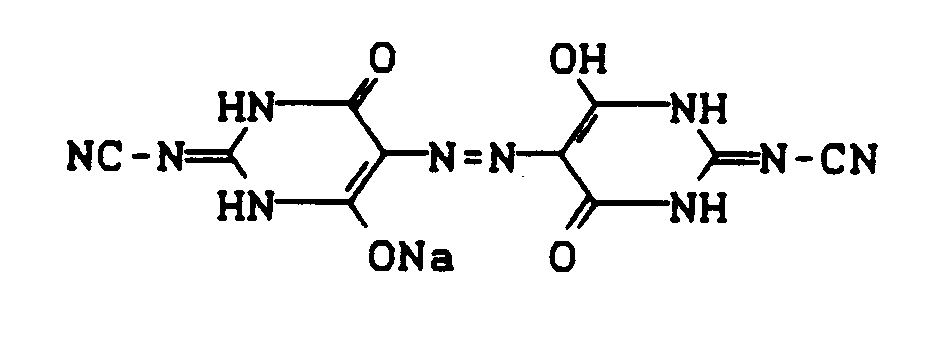
Das Produkt kristallisiert mit 2,5 Mol Wasser C₁₀H₅N₁₀NaO₄·2,5 H₂O (397,3)
Ber. N 35,3%; Gef. N 35,4%; Ber. C 30,2%; Gef. C 30,4% - Man erhitzt 68,7 g 1,3-Dimethyl-4-imino-barbitursäure mit 200 ml Wasser und 70 ml 10 N Salzsäure 1 Stunde auf 80°C und stellt den Ansatz danach auf einen pH von 3. Zu der so erhaltenen Lösung von 1,3-Dimethyl-barbitursäure gibt man eine analog zu Versuch 1 hergestellte Lösung von Azidoformamidiniumhydrochlorid und verfährt weiter wie bei Versuch 1. Man erhält 67,6 g eines Produktes der Formel

Das Produkt liegt als Ammoniumsalz vor. C₁₂H₁₇N₇O·0,5 H₂O (364,3)
Ber. N 26,9%; Gef. N 27,1% Ber. C 39,6%; Gef. C 39,8%
Claims (10)
- Herstellung von Diazoverbindungen durch Diazogruppenübertragung auf aktivierte Methylenverbindungen, dadurch gekennzeichnet, daß man ein Azidoformamidiniumsalz als Diazogruppenüberträger verwendet.
- Herstellung gemäß Anspruch 1, dadurch gekennzeichnet, daß man ein Azidoformamidiniumsalz der Formel

in derR¹, R², R³, R⁴ Wasserstoff, Alkyl, Cycloalkyl, Aralkyl bezeichnen und R¹ + R² und/oder R³ + R⁴ oder R² + R³ unter Einschluß des N-Atoms bzw. der N-Atome einen 5- oder 6-gliedrigen Ring bilden undA⁻ für ein Anion steht. - Herstellung gemäß den Ansprüchen 1 und 2, dadurch gekennzeichnet, daß man

- Herstellung gemäß den Ansprüchen 1-3, dadurch gekennzeichnet, daß man als aktivierte Methylenverbindung eine in der Chemie der Azofarbstoffe übliche methylenaktive Kupplungskomponente einsetzt.
- Herstellung gemäß Anspruch 4, dadurch gekennzeichnet, daß die aktivierte Methylenverbindung der Acetessigarylid-, Pyrimidin-, Pyridin-, Pyrazol- oder 2,4-Dihydroxychinolin-Reihe entstammt oder den Formeln
 X =O, =N-CN oder =NR⁵,R⁵ RR,R′ Wasserstoff, Alkyl, Cycloalkyl, Aryl, Aralkyl, wobei die genannten Kohlenwasserstoffreste substituiert sein können undY R, einen heterocyclischen Rest oder einen Rest -NR¹⁰R¹¹ bezeichen mitR¹⁰, R¹¹ = R.
 - Herstellung von Diazobarbitursäure gemäß den Ansprüchen 1-5.
- Herstellung gemäß den Ansprüchen 1-6, dadurch gekennzeichnet, daß man im wäßrigen Medium bei einem pH-Wert ≦7 arbeitet.
- Herstellung gemäß den Ansprüchen 1-7, dadurch gekennzeichnet, daß man im wäßrigen Medium bei einem pH-Wert ≦5 arbeitet.
- Herstellung von Azoverbindungen der Formel
D-N=N-A (IV)
in derA den Rest einer Kupplungskomponente undD den Rest einer aktivierten Methylenverbindung bezeichnet, dadurch gekennzeichnet, daß man eine aktivierte Methylenverbindung mit einem Azidoformamidiniumsalz unter Azogruppenübertragung zu einer Diazoverbindung umsetzt, und man diese anschließend mit einer Kupplungskomponente H-A zu Azoverbindungen der Formel IV umsetzt. - Herstellung von Azobarbitursäure gemäß Anspruch 5.
Applications Claiming Priority (2)
| Application Number | Priority Date | Filing Date | Title |
|---|---|---|---|
| DE3721851 | 1987-07-02 | ||
| DE19873721851 DE3721851A1 (de) | 1987-07-02 | 1987-07-02 | Herstellung von diazo- und azoverbindungen |
Publications (3)
| Publication Number | Publication Date |
|---|---|
| EP0297397A2 EP0297397A2 (de) | 1989-01-04 |
| EP0297397A3 EP0297397A3 (de) | 1991-08-21 |
| EP0297397B1 true EP0297397B1 (de) | 1993-08-04 |
Family
ID=6330750
Family Applications (1)
| Application Number | Title | Priority Date | Filing Date |
|---|---|---|---|
| EP88109835A Expired - Lifetime EP0297397B1 (de) | 1987-07-02 | 1988-06-21 | Herstellung von Diazo-und Azoverbindungen |
Country Status (4)
| Country | Link |
|---|---|
| US (1) | US4942225A (de) |
| EP (1) | EP0297397B1 (de) |
| JP (1) | JP2538997B2 (de) |
| DE (2) | DE3721851A1 (de) |
Families Citing this family (9)
| Publication number | Priority date | Publication date | Assignee | Title |
|---|---|---|---|---|
| GB8827160D0 (en) * | 1988-11-21 | 1988-12-29 | Apothekernes Lab | Detection & quantitative determination of rna & dna |
| US5354656A (en) * | 1989-10-02 | 1994-10-11 | Stratagene | Method of DNA sequencing |
| US5726296A (en) * | 1997-03-07 | 1998-03-10 | Hoechst Celanese Corp. | Process for preparing photoactive coumarin derivatives |
| US5726295A (en) * | 1997-03-07 | 1998-03-10 | Hoechst Celanese Corp. | Photoactive coumarin derivatives |
| US5739295A (en) * | 1997-03-07 | 1998-04-14 | Hoechst Celanese Corporation | Photoactive coumarin sulfonate compounds |
| US5773591A (en) * | 1997-03-07 | 1998-06-30 | Hoechst Celanese Corp. | Process for preparing coumarin sulfonates |
| DE19945245A1 (de) | 1999-09-21 | 2001-03-22 | Bayer Ag | Mono- und Dikaliumsalze von Azoverbindungen |
| DE10035494A1 (de) * | 2000-07-21 | 2002-01-31 | Bayer Ag | Pigmentpräparationen |
| CN101560334B (zh) * | 2009-05-13 | 2012-09-19 | 湘潭华莹精化有限公司 | 偶氮巴比妥酸钾钠混合盐制备颜料黄150的方法 |
Family Cites Families (5)
| Publication number | Priority date | Publication date | Assignee | Title |
|---|---|---|---|---|
| DD96076A5 (de) * | 1970-12-28 | 1973-03-05 | ||
| JPS5934707B2 (ja) * | 1976-02-27 | 1984-08-24 | 財団法人相模中央化学研究所 | 3−シアノメチルシクロペンタノン誘導体 |
| DE3215875A1 (de) * | 1981-09-02 | 1983-03-17 | Bayer Ag, 5090 Leverkusen | Azobarbitursaeure-derivate, ihre festen loesungen, einschlussverbindungen und interkalationsverbindungen |
| DE3215876A1 (de) * | 1981-09-02 | 1983-03-17 | Bayer Ag, 5090 Leverkusen | Einschlussverbindungen, interkalationsverbindungen und feste loesungen farbiger organischer metallverbindungen |
| DE3307508A1 (de) * | 1982-04-29 | 1983-11-03 | Bayer Ag, 5090 Leverkusen | Verfahren zur herstellung von azoverbindungen und neue azoverbindungen |
-
1987
- 1987-07-02 DE DE19873721851 patent/DE3721851A1/de not_active Withdrawn
-
1988
- 1988-06-20 US US07/209,254 patent/US4942225A/en not_active Expired - Lifetime
- 1988-06-21 EP EP88109835A patent/EP0297397B1/de not_active Expired - Lifetime
- 1988-06-21 DE DE8888109835T patent/DE3882829D1/de not_active Expired - Lifetime
- 1988-06-27 JP JP63157009A patent/JP2538997B2/ja not_active Expired - Lifetime
Also Published As
| Publication number | Publication date |
|---|---|
| DE3721851A1 (de) | 1989-01-12 |
| JP2538997B2 (ja) | 1996-10-02 |
| EP0297397A3 (de) | 1991-08-21 |
| EP0297397A2 (de) | 1989-01-04 |
| US4942225A (en) | 1990-07-17 |
| DE3882829D1 (de) | 1993-09-09 |
| JPS6429323A (en) | 1989-01-31 |
Similar Documents
| Publication | Publication Date | Title |
|---|---|---|
| EP0074515B1 (de) | Azobarbitursäure-Derivate, ihre festen Lösungen, Einschlussverbindungen und Interkalationsverbindungen | |
| EP0713488B1 (de) | [1,3,4]triazolo[1,5-al]pyridine als zwischenprodukte für die synthese von farbstoffen | |
| DE3215876A1 (de) | Einschlussverbindungen, interkalationsverbindungen und feste loesungen farbiger organischer metallverbindungen | |
| DD210038A5 (de) | Verfahren zur herstellung neuer n-phenylpyrazolderivate | |
| DE69605746T2 (de) | Naphtholderivate und ein verfahren zu ihrer herstellung | |
| EP0297397A2 (de) | Herstellung von Diazo-und Azoverbindungen | |
| DE2817780C2 (de) | Reaktivfarbstoffe | |
| EP0314852A2 (de) | Verfahren zur Synthese von 1-substituierten Imidazol-5-carbonsäuren und -carbonsäure-derivaten | |
| DE2727268A1 (de) | Verfahren zur herstellung von azofarbstoffen | |
| EP0093306B1 (de) | Verfahren zur Herstellung von Azoverbindungen und neue Azoverbindungen | |
| DE19535501A1 (de) | Pyridonmethidazofarbstoffe | |
| DE3035056A1 (de) | Verfahren zur herstellung von 1,3,4-thiadiazolazofarbstoffen | |
| DE69720475T2 (de) | 1:2 eisenkomplex-azofarbstoffe | |
| EP0056574B1 (de) | Naphtholsulfonsäureverbindungen, ihre Herstellung und Verwendung als Kupplungskomponenten | |
| EP0183151A1 (de) | Monoazofarbstoffe | |
| DE3241886A1 (de) | Verfahren zur herstellung eines 2-aequivalent-purpurrotkupplers | |
| CH675420A5 (de) | ||
| DD160060A5 (de) | Verfahren zur herstellung von 6-hydrazonopyrido(2,1-b)chinazolin-11-on-derivaten | |
| DE2058501A1 (de) | Verfahren zur Herstellung von neuen N-verbrueckten bicyclischen Heteroaromaten | |
| DE1817791C3 (de) | 2-Aminomethyl-3-phenylindole und ihre Salze mit Säuren | |
| DE2436032A1 (de) | Neue aromatische o-hydroxyaldehyde, verfahren zu ihrer herstellung und ihre verwendung | |
| DE2803104C2 (de) | ||
| DE1769589A1 (de) | Verfahren zur Herstellung von Cyclammoniumazofarbstoffen | |
| DE1814332C3 (de) | Verfahren zur Herstellung von 1,5-Benzo-diazocinen oder 1,6-Benzodiazoninen | |
| DE2208972C3 (de) | Reaktive Azotriazolylfarbstoffe und ihre Verwendung zum Färben und Bedrucken OH- und NH- haltiger Fasermaterialien |
Legal Events
| Date | Code | Title | Description |
|---|---|---|---|
| PUAI | Public reference made under article 153(3) epc to a published international application that has entered the european phase |
Free format text: ORIGINAL CODE: 0009012 |
|
| 17P | Request for examination filed |
Effective date: 19880621 |
|
| AK | Designated contracting states |
Kind code of ref document: A2 Designated state(s): CH DE FR GB LI |
|
| PUAL | Search report despatched |
Free format text: ORIGINAL CODE: 0009013 |
|
| AK | Designated contracting states |
Kind code of ref document: A3 Designated state(s): CH DE FR GB LI |
|
| 17Q | First examination report despatched |
Effective date: 19921209 |
|
| GRAA | (expected) grant |
Free format text: ORIGINAL CODE: 0009210 |
|
| AK | Designated contracting states |
Kind code of ref document: B1 Designated state(s): CH DE FR GB LI |
|
| REF | Corresponds to: |
Ref document number: 3882829 Country of ref document: DE Date of ref document: 19930909 |
|
| GBT | Gb: translation of ep patent filed (gb section 77(6)(a)/1977) |
Effective date: 19930816 |
|
| ET | Fr: translation filed | ||
| PLBE | No opposition filed within time limit |
Free format text: ORIGINAL CODE: 0009261 |
|
| STAA | Information on the status of an ep patent application or granted ep patent |
Free format text: STATUS: NO OPPOSITION FILED WITHIN TIME LIMIT |
|
| 26N | No opposition filed | ||
| REG | Reference to a national code |
Ref country code: GB Ref legal event code: IF02 |
|
| REG | Reference to a national code |
Ref country code: GB Ref legal event code: 732E |
|
| PGFP | Annual fee paid to national office [announced via postgrant information from national office to epo] |
Ref country code: CH Payment date: 20070614 Year of fee payment: 20 Ref country code: DE Payment date: 20070614 Year of fee payment: 20 |
|
| REG | Reference to a national code |
Ref country code: CH Ref legal event code: PFA Owner name: BAYER AKTIENGESELLSCHAFT Free format text: BAYER AKTIENGESELLSCHAFT# #D-51368 LEVERKUSEN (DE) -TRANSFER TO- BAYER AKTIENGESELLSCHAFT# #D-51368 LEVERKUSEN (DE) |
|
| REG | Reference to a national code |
Ref country code: CH Ref legal event code: PUE Owner name: LANXESS DEUTSCHLAND GMBH Free format text: BAYER AKTIENGESELLSCHAFT# #D-51368 LEVERKUSEN (DE) -TRANSFER TO- LANXESS DEUTSCHLAND GMBH# #51369 LEVERKUSEN (DE) |
|
| PGFP | Annual fee paid to national office [announced via postgrant information from national office to epo] |
Ref country code: GB Payment date: 20070620 Year of fee payment: 20 |
|
| PGFP | Annual fee paid to national office [announced via postgrant information from national office to epo] |
Ref country code: FR Payment date: 20070608 Year of fee payment: 20 |
|
| REG | Reference to a national code |
Ref country code: GB Ref legal event code: PE20 Expiry date: 20080620 |
|
| REG | Reference to a national code |
Ref country code: CH Ref legal event code: PL |
|
| REG | Reference to a national code |
Ref country code: FR Ref legal event code: TP |
|
| PG25 | Lapsed in a contracting state [announced via postgrant information from national office to epo] |
Ref country code: GB Free format text: LAPSE BECAUSE OF EXPIRATION OF PROTECTION Effective date: 20080620 |