EP0292786A2 - Stabilisiertes Neopentylglykol-Polycarbonat - Google Patents
Stabilisiertes Neopentylglykol-Polycarbonat Download PDFInfo
- Publication number
- EP0292786A2 EP0292786A2 EP88107553A EP88107553A EP0292786A2 EP 0292786 A2 EP0292786 A2 EP 0292786A2 EP 88107553 A EP88107553 A EP 88107553A EP 88107553 A EP88107553 A EP 88107553A EP 0292786 A2 EP0292786 A2 EP 0292786A2
- Authority
- EP
- European Patent Office
- Prior art keywords
- aliphatic
- weight
- alkyl
- polycarbonates according
- radical
- Prior art date
- Legal status (The legal status is an assumption and is not a legal conclusion. Google has not performed a legal analysis and makes no representation as to the accuracy of the status listed.)
- Granted
Links
- 0 CCC1C*CCC1 Chemical compound CCC1C*CCC1 0.000 description 2
Classifications
-
- C—CHEMISTRY; METALLURGY
- C08—ORGANIC MACROMOLECULAR COMPOUNDS; THEIR PREPARATION OR CHEMICAL WORKING-UP; COMPOSITIONS BASED THEREON
- C08K—Use of inorganic or non-macromolecular organic substances as compounding ingredients
- C08K5/00—Use of organic ingredients
- C08K5/49—Phosphorus-containing compounds
- C08K5/51—Phosphorus bound to oxygen
- C08K5/52—Phosphorus bound to oxygen only
- C08K5/524—Esters of phosphorous acids, e.g. of H3PO3
-
- C—CHEMISTRY; METALLURGY
- C08—ORGANIC MACROMOLECULAR COMPOUNDS; THEIR PREPARATION OR CHEMICAL WORKING-UP; COMPOSITIONS BASED THEREON
- C08K—Use of inorganic or non-macromolecular organic substances as compounding ingredients
- C08K5/00—Use of organic ingredients
- C08K5/49—Phosphorus-containing compounds
- C08K5/51—Phosphorus bound to oxygen
-
- C—CHEMISTRY; METALLURGY
- C08—ORGANIC MACROMOLECULAR COMPOUNDS; THEIR PREPARATION OR CHEMICAL WORKING-UP; COMPOSITIONS BASED THEREON
- C08K—Use of inorganic or non-macromolecular organic substances as compounding ingredients
- C08K5/00—Use of organic ingredients
- C08K5/49—Phosphorus-containing compounds
- C08K5/51—Phosphorus bound to oxygen
- C08K5/52—Phosphorus bound to oxygen only
- C08K5/527—Cyclic esters
Definitions
- the invention relates to aliphatic polycarbonates including sequenced copolymers of cyclic, aliphatic carbonates and esters or vinyl compounds which are stabilized with compounds of trivalent phosphorus.
- aliphatic polycarbonates are not very thermally stable and suffer molecular weight degradation even at temperatures of approximately 200 ° C., with the "back-biting" reactions of the free hydroxyl groups being given significant importance [p. Inoue, T. Tsuruta, Appl. Polym. Sym. 26 : 257-67 (1975) et al. DD Dixon et. al. J. Polym. Sci., Lett. Ed. 18 , 131-34 (1980)]. They are therefore unsuitable for applications that require thermal stability. They are also practically impossible to process by injection molding and extrusion.
- aliphatic polycarbonates In contrast to aromatic polycarbonates, aliphatic polycarbonates have therefore not yet been of any technical importance.
- copolymers of cyclic, aliphatic carbonates and esters with sequenced structures have properties ranging from elastic thermoplastics to thermoplastic elastomers.
- copolymers are determined by the polymerized monomers themselves, their mixing ratios, the sequence lengths and sequence length distributions. By varying these sizes, copolymers with crystalline or amorphous or brittle or tough properties can be obtained.
- such polymers must meet a number of requirements, e.g. E.g .: at higher processing temperatures, be stable so that they can e.g. B. can be processed by injection molding, extrusion or calendering.
- the thermal stability of a Polymers are not only determined by their basic chemical structure, but also by the number of their chemical and structural defects, by the stability of the polymer-increasing structures, end groups, the molecular weight distribution and its chemical non-uniformity.
- the thermal stability of copolymers of cyclic aliphatic carbonates and esters with a sequential structure is also determined by the stability of the aliphatic carbonate sequences and ester sequences.
- aliphatic polycarbonates also as carbonate sequences in copolymers, are not thermally stable and are degraded at temperatures of around 200 ° C [p. Inoue, T. Tsuruta, Appl. Polym. Syn. 26 , 257-67 (1975) DD Dixon et. al. J. Polymer Sci. Lett. Et. 18 , 131-34 (1980)].
- polyesters from cyclic, aliphatic esters depends on the structure of the monomers. Degradation is already observed at temperatures of 170 to 230 ° C [K. C. Frisch, S.L. Reegan “Ring-Opening Polymerization” Marcel-Dekker, Inc. (1969)].
- Copolymers of cyclic, aliphatic carbonates and esters with a sequential structure are therefore not suitable for applications which require high thermal stability of the materials.
- Sequenced copolymers or block copolymers from blocks of polymerized cyclic, aliphatic carbonates and blocks of polymerized vinyl compounds also have - depending on the structure, structure and chemical composition - properties from elastic thermoplastics to thermoplastic elastomers.
- thermal stability of a polymer is determined not only by its basic chemical structure, but also by the number of its chemical and structural defects, by the stability of the polymer-increasing structures, end groups, the molecular weight distribution and its chemical non-uniformity.
- the thermal stability of block copolymers also depends on the thermal stability of the polymer blocks contained therein.
- aliphatic polycarbonates also as polymer blocks in block copolymers made of carbonates and vinyl compounds, are not very thermally stable. Already at temperatures of approx. 200 ° C, they tend to lose molecular weight, with the "backtiting" reactions of the free hydroxyl groups being given significant importance [cf. DD Dixon et. al. J. Polym. Sci. Lett. Ed. 18 , 131-134 (1980)]. According to U.S. Patents 4,066,630, 4,066,640, 4,104,264 and 4,145,525, is by the reaction of the free hydroxyl groups with z. B. hydroxyl-reactive sulfur compounds, hydroxyl-reactive phosphorus compounds, acid anhydrides, acid chlorides or isocyanates causes a "lock" of the chain. This improves the thermal stability of the polymers.
- aliphatic polycarbonate means the aliphatic polycarbonate itself and the block or sequence copolymers with esters and with vinyl compounds - is far greater than that of aromatic polycarbonates and polycarbonate mixtures ( see EP 00 23 291). This improves the thermal stability and processing range of aliphatic polycarbonates so that thermally stressful processing methods such as injection molding or extrusion can also be used.
- the compounds of trivalent phosphorus with known antioxidants such as sterically hindered Phenols can be combined in amounts of 0.05-3.0% by weight.
- antioxidants such as sterically hindered Phenols
- suitable anti-oxidants see Ullmann's Encyclopedia of Industrial Chemistry, Volume 8, p. 19, Verlag Chemie, Weinheim, Bergstrasse.
- compounds of trivalent phosphorus can contain phosphites of the general formula I are used in which mean: X is hydrogen, an optionally substituted aliphatic, cycloaliphatic or aromatic radical with 1 to 18 carbon atoms or an alkaryl or aralkyl radical with 7 to 24 carbon atoms, which can also contain olefinic double bonds and heteroatoms (preferably O, S and non-basic nitrogen), n is an integer from 1 to 4, preferably 1 to 2, corresponding to the binding nature of X, R1 and R2 independently of one another are C1-C18-alkyl, C5 to C15-cycloalkyl, C7 to C24-aralkyl or alkaryl or C6 to C24-aryl, R1 and X together represent an optionally substituted C2 to C4 alkylene chain R1, R2 and X together form a straight-chain or branched C1 to C9-alkyl or C5 to C7-cycloalkyl radical, which can be
- R3 represents a C1-C9-alkyl radical, a C5-C6-cycloalkyl radical, a C7-C9-aralkyl radical or a C6-C10 aryl radical
- R4 represents a benzyl, ⁇ -methylbenzyl, ⁇ , ⁇ '-dimethylbenzyl, methyl, ethyl, isopropyl, tert-butyl, tert-amyl, isononyl, cyclopentyl or cyclohexyl radical and stands.
- Stabilizers to be used according to the invention are also phosphites of the formulas III-IIIe according to DE-OS 2 034 887: wherein B is hydrogen, hydroxyl, halogen, C-C22-alkyl, C1-C22-alkoxy, C1-C22-alkylthio, aryloxy or arylthio, A1 and A2, which may be the same or different, hydrogen, halogen, C1-C18-alkyl , C1-C18 alkyloxy, aryl, aryloxy, acyl, cyan, where the radicals A1 and A2 together with the biphenyl ring can also form a phenanthrene ring, Z is oxygen or sulfur, m and r are integers from 0 to 4 and p and q represent integers from 0 to 3.
- Preferred compounds of the formulas III-IIIe are those in which B H, OH, C1-C18 alkyl, C1-C18 alkoxy, aryloxy, arylthio A1 and A2 H, C1-C9-alkyl, C1-C9-alkoxy, aryl, aryloxy, Z O m and r 0, 1, 2 p and q 0, 1, 2 mean: those in which B H, OH, C1-C4-alkyl, C1-C4-alkoxy, aryloxy, A1 and A2 H, C1-C4 alkyl Z O m and r 0, 1 p and q is 0.1.
- Stabilizers to be used according to the invention are also phosphites of the formula (IV), which are obtainable from pentaerythritol, perhydrobisphenol A, monoalcohols and phosphorous acid esters. They are prepared by transesterifying the components trialkyl or triphenyl phosphite, pentaerythritol, perhydrobisphenol and optionally a monoalcohol in the required molar ratios and thereby the alcohol from the trialkylphosphite or phenol from the triphenylphosphite by distillation, if appropriate in vacuo, to a bottom temperature of no more than 200 ° out of balance.
- phosphites of the formula (IV) which are obtainable from pentaerythritol, perhydrobisphenol A, monoalcohols and phosphorous acid esters. They are prepared by transesterifying the components trialkyl or triphenyl phosphite, pentaerythrito
- pentaerythritol is first reacted with the phosphite while distilling off a first fraction of about 2 moles of hydroxy compound per mole of phosphite, then perhydrobisphenol A is added and further hydroxy compound is distilled during the reaction from up to a bottom temperature of preferably 180 °, particularly preferably 170 ° .
- a C6-C18 monoalcohol is used, this is preferably added after the second Frak tion of the hydroxy compound was distilled off. After addition of this monoalcohol, a third fraction of the hydroxy compound is removed by distillation from the phosphite originally used up to a bottom temperature of preferably 180 °, particularly preferably 170 °, if appropriate in vacuo.
- Suitable phosphites are triphenyl phosphite, preferably trialkyl phosphites from C1-C4 alcohols, particularly preferably trimethyl and triethyl phosphite.
- Suitable monoalcohols are aliphatic alcohols with 6-18 C atoms, especially primary alcohols. Examples include isooctanol, decanol, dodecanol, tetradecanol and octadecanol.
- transesterification does not produce uniform compounds, but rather mixtures of oligomeric phosphites, which predominantly have the following structure IV: wherein R1, R2 and R3 may be the same or different and C1-C18 alkyl, aryl, a radical of structure V, R1 is also a radical of structure VI, R2 and R3 also together represent a radical of structure VII and m is an integer from 1-20.
- phosphites can also be used for the purposes of the present invention, where X is preferably oxygen.
- the present invention thus relates to aliphatic polycarbonates or mixtures of aliphatic polycarbonates stabilized against thermal degradation, the compounds of trivalent phosphorus in amounts of 0.01-3.0% by weight, preferably 0.05-2.0% by weight, particularly preferably 0.2-1.8% by weight, optionally in combination with known antioxidants, based on aliphatic polycarbonates.
- the aliphatic polycarbonates can by conventional methods, for. B. by reaction or phosgenation of diols (DE-OS 20 01 091, FR-PS 13 91 512, DE-OS 10 31 512, DE-OS 24 46 107, DE-OS 26 05 024, EP 002 641, DE- OS 24 47 349) but better by ring-opening bulk and solution polymerization of cyclic, aliphatic carbonates (DE-OS 15 45 116, 15 45 117, 31 03 135, 32 04 078).
- the preferred production process is the anionic ring-opening solution polymerization of cyclic aliphatic carbonates at low temperatures (DE-OS 36 07 625).
- Carbonates of the formula IX are preferably used.
- the carbonate with R7 is particularly preferred
- the molecular weights of the polycarbonates can be 2,000 g / mol to 500,000 g / mol, preferably 5,000 g / mol to 400,000 g / mol, particularly preferably 5,000 to 120,000 g / mol.
- R10, R11, R12, R13 H, C1-C6-alkyl, C3-C6-alkenyl, C1-C6-alkoxy, C1-C6-alkenoxy-C1-C6-alkyl, especially H, CH3, C2H5 m, n independently of one another 0, 1, 2, 3, 4, 5 or 6 and in what X center piece, containing both the cyclic carbonate of the formula IX and / or X and the cyclic ester of the formula XII in polymerized form, the concentration of the radicals IX and / or X in the direction of -B- and the concentration of the radicals XII in Direction to -A-continuously decreases ("tapered structure”) means.
- Particularly preferred cyclic carbonates (IX) and (X) are trimethylene glycol carbonate, neopentyl glycol carbonate, 1,4-butanediol carbonate and dimeric carbonates of pentanediol or hexanediol.
- Preferred lactones (XII) are ⁇ -caprolactone and pivalolactone
- the average molecular weights of blocks A and B and of center pieces X can be different or almost the same size.
- the polymers contain blocks A and B in amounts of 5 to 95% by weight (based on total amount A + B), but preferably in amounts of 5 to 20% by weight A and 95 to 80% by weight B (based on A + B), and 5 to 20 wt .-% B and 95 to 80 wt .-% A (based on A + B); the content of centerpieces X with a "tapered structure" is 5 to 95% by weight (based on A + B + X), preferably 20 to 80% by weight (based on A + B + X).
- the copolymers can be prepared from the cyclic carbonates and esters by anionic ring-opening solution polymerization. A sequential structure of the copolymers is achieved by gradually adding the carbonate / ester mixture to the polymerization-active solution.
- the carbonate of the formula is particularly preferred
- the average molecular weights of blocks A and B are greater than 800, preferably greater than 1000 and particularly preferably greater than 10,000.
- the average molecular weights of blocks A and B can be different or almost the same size.
- the block copolymers contain block A in amounts of 5 to 95% by weight and block B in amounts of 95 to 5% by weight, but preferably in amounts of 5 to 20% by weight of A and 95 to 80% by weight. % B and 5 to 20% by weight and 95 to 80% by weight A; i.e. in the preferred block copolymers, either component A or B predominates by weight
- the block copolymers can be prepared by anionic polymerization according to the earlier patent application P 3 607 627.9.
- the stabilizers according to the invention and optionally antioxidants can be prepared by known processes, e.g. Mix into the polymers in kneaders or extruders.
- the processing of the polymers depends on their properties; Polymers with thermoplastic properties can be converted into moldings like other thermoplastics.
- the stabilizers according to the invention optionally in combination with known antioxidants, the polymers by known methods, for. B. in kneaders or screw machines.
- the stabilized polymers can be pigmented in a known manner, made antistatic and / or flame-retardant and filled with fillers.
- the processing of the polymers depends on their properties, for example: can polymerize with thermoplastic properties such as thermoplastics are deformed.
- copolymers according to the invention are preferably suitable for the production of films, seals, coatings, in particular where improved long-term behavior is required and for the production of packaging, in particular for foodstuffs.
- the polymers according to the invention can be stabilized, pigmented and given antistatic, better processable or flame-resistant properties or filled with fillers using conventional additives.
- the respective degree of thermal damage results from the comparison with the viscosity of the unheated sample.
- a polyneopentyl glycol carbonate with a relative viscosity ⁇ rel of 1.58 was with 0.4 wt .-% of this Phos phit compound and mixed with 0.2 wt .-% 2,6-di-tert-butyl-4-methyl-phenol.
- the thermal stability was determined as indicated above and compared to that of an unstabilized sample.
- a polyneopentyl glycol carbonate, the hydroxyl end groups of which are sealed with 1.3.5-benzenetricarboxylic acid chloride, with a relative viscosity ⁇ rel of 1.21 was obtained with 0.4% by weight of the phosphite compound from Example 1 and with 0.2% by weight 2.6 -Di-tert-butyl-4-methylphenol added.
- the thermal stability was determined as indicated above and compared to that of an unstabilized sample.
- a polyneopentyl glycol carbonate obtained by anionic solution polymerization with a relative viscosity ⁇ rel of 2.13 was produced as follows:
- the respective degree of thermal damage results from the comparison with the viscosity of the unheated sample.
- the respective degree of thermal damage results from the comparison with the viscosity of the unheated sample.
- n-butyllithium 2.5 molar solution in hexane
- the polymerization time was 3 hours at this temperature.
- n-butyllithium (2.5 molar solution in hexane) was added to nitrogen at 40 ° C. to a solution of 27 g of styrene in 400 ml of toluene. The polymerization time at this temperature was 3 hours. The solution of polystyryllithium was then brought to room temperature and treated with ethylene oxide until decolorized. 28 g of neopentyl glycol carbonate were added to the lithium alcoholate solution now formed and the solution was brought to -10 ° C. After a polymerization time of 4 hours at this temperature, the reaction mixture was decomposed with 5 ml of methanol / hydrochloric acid (8: 2), the reaction product was isolated by precipitation in methanol and dried. The turnover was 100%.
Landscapes
- Chemical & Material Sciences (AREA)
- Health & Medical Sciences (AREA)
- Chemical Kinetics & Catalysis (AREA)
- Medicinal Chemistry (AREA)
- Polymers & Plastics (AREA)
- Organic Chemistry (AREA)
- Compositions Of Macromolecular Compounds (AREA)
- Polyesters Or Polycarbonates (AREA)
- Addition Polymer Or Copolymer, Post-Treatments, Or Chemical Modifications (AREA)
Abstract
Description
- Die Erfindung betrifft aliphatische Polycarbonate einschließlich sequenziert aufgebauter Copolymerer aus cyclischen, aliphatischen Carbonaten und Estern oder Vinylverbindungen, die mit Verbindungen des dreiwertigen Phosphors stabilisiert sind.
- Aliphatische Polycarbonate sind im Gegensatz zu aromatischen Polycarbonaten thermisch wenig stabil und erleiden bereits bei Temperaturen von ca. 200°C einen Molekulargewichtsabbau, wobei den "back-biting"-Reaktionen der freien Hydroxylgruppen eine wesentliche Bedeutung beigemessen wird [S. Inoue, T. Tsuruta, Appl. Polym. Sym. 26, 257-67(1975) u. D. D. Dixon et. al. J. Polym. Sci., Lett. Ed. 18, 131-34 (1980)]. Sie sind daher ungeeignet für Anwendungen, die thermische Stabilität voraussetzen. Auch sind sie praktisch nicht durch Spritzgießen und Extrusion verarbeitbar.
- Aliphatische Polycarbonate haben deshalb im Gegensatz zu aromatischen Polycarbonaten bisher keine technische Bedeutung.
- Nach U.S.-PS 4 066 630, 4 066 640, 4 104 264 und 4 145 525 wird durch die Reaktion der freien Hydroxylgruppen mit geeigneten Reagenzien wie hydroxylreaktive Schwefelverbindungen, hydroxylreaktive Phosphorverbindungen, Säureanhydride, Säurechloride oder Isocyanate ein "Verschluß" der Kette bewirkt. "Back-biting"-Reaktionen werden dadurch weitgehend unterdrückt. Durch den Endgruppenverschluß des Polymers allein wird jedoch noch nicht eine für technische Handhabung ausreichende thermische Stabilität erreicht, da der thermische Abbau durch Kettenspaltung weiter auftritt.
- Sequenziert aufgebaute Copolymere aus cyclischen, aliphatischen Carbonaten und Estern besitzen - je nach Struktur, Aufbau und chemischer Zusammensetzung - Eigenschaften von elastischen Thermoplasten bis thermoplastischen Elastomeren.
- Die Eigenschaften dieser Copolymeren werden durch die polymerisierten Monomeren selbst, deren Mischungsverhältnisse, die Sequenzlängen und Sequenzlängenverteilungen bestimmt. Durch Variation dieser Größen lassen sich Copolymere mit Kristallinen oder amorphen bzw. spröden oder zähen Eigenschaften erhalten.
- Für eine praktische Anwendung müssen solche Polymeren eine Reihe von Anforderungen erfüllen, z. B.: bei höheren Verarbeitungstemperaturen, stabil sein, damit sie z. B. durch Spritzguß, Extrusion oder Kalandrierung verarbeitet werden können. Die thermische Stabilität eines Polymeren wird nicht nur durch seine chemische Grundstruktur bestimmt, sondern auch durch die Zahl seiner chemischen und strukturellen Fehlstellen, durch die Stabilität des Polymeren erhöhende Strukturen, Endgruppen, die Molekulargewichtsverteilung und seine chemische Uneinheitlichkeit.
- Die thermische Stabilität von sequenziert aufgebauten Copolymeren aus cyclischen aliphatischen Carbonaten und Estern wird auch durch die Stabilität der aliphatischen Carbonatsequenzen und Estersequenzen bestimmt.
- Aliphatische Polycarbonate, auch als Carbonatsequenzen in Copolymeren, sind im Gegensatz zu aromatischen Polycarbonaten thermisch wenig stabil und werden bereits bei Temperaturen von ca. 200°C abgebaut [S. Inoue, T. Tsuruta, Appl. Polym. Syn. 26, 257-67 (1975) D. D. Dixon et. al. J. Polymer Sci. Lett. Et. 18, 131-34 (1980)].
- Die thermische Stabilität von Polyestern aus cyclischen, aliphatischen Estern ist abhängig von der Struktur der Monomeren. Bereits bei Temperaturen von 170 bis 230°C wird ein Abbau beobachtet [K. C. Frisch, S. L. Reegan "Ring-Opening Polymerisation" Marcel-Dekker, Inc. (1969)].
- Sequenziert aufgebaute Copolymere aus cyclischen, aliphatischen Carbonaten und Estern sind daher für Anwendungen, die eine hohe thermische Stabilität der Materialien erfordern, nicht geeignet.
- Sequenziert aufgebaute Copolymere oder Blockcopolymere aus Blöcken polymerisierter cyclischer, aliphatischer Carbonate und Blöcken polymerisierter Vinylverbindungen, besitzen ebenfalls - je nach Struktur, Aufbau und chemischer Zusammensetzung - Eigenschaften von elastischen Thermoplasten bis thermoplastischen Elastomeren.
- Für die praktische Anwendung müssen sie eine Reihe von Anforderungen erfüllen, z. B. bei höheren Verarbeitungstemperaturen stabil sein, damit sie z. B. durch Spritzguß, Extrusion oder Kalandrierung verarbeitet werden können. Die thermische Stabilität eines Polymeren wird nicht nur durch seine cehmische Grundstruktur bestimmt, sondern auch durch die Zahl seiner chemischen und strukturellen Fehlstellen, durch die Stabilität des Polymeren erhöhende Strukturen, Endgruppen, die Molekulargewichtsverteilung und seine chemische Uneinheitlichkeit.
- Die thermische Stabilität von Blockcopolymeren ist auch abhängig von der thermischen Stabilität der darin enthaltenen Polymerblöcke.
- Aliphatische Polycarbonate, auch als Polymerblöcke in Blockcopolymeren aus Carbonaten und Vinylverbindungen, sind im Gegensatz zu Vinylpolymeren thermisch wenig stabil. Sie neigen bereits bei Temperaturen von ca. 200°C zu Molekulargewichtsabbau, wobei den "backtiting"-Reaktionen der freien Hydroxylgruppen eine wesentliche Bedeutung beigemessen wird [vergl. D. D. Dixon et. al. J. Polym. Sci. Lett. Ed. 18, 131-134 (1980)]. Nach US-PS 4 066 630, 4,066 640, 4 104 264 und 4,145 525 wird durch die Reaktion der freien Hydroxylgruppen mit z. B. hydroxylreaktiven Schwefelverbindungen, hydroxylreaktiven Phosphorverbindungen, Säureanhydriden, Säurechloriden oder Isocyanaten ein "Verschluß" der Kette bewirkt. Die thermische Stabilität der Polymeren wird dadurch verbessert.
- Es wurde gefunden, daß durch Zugabe von 0,01 - 3,0 Gew.-%, vorzugsweise 0,05 - 2,0 Gew.-%, besonders bevorzugt 0,2 - 1,8 Gew.-%, bezogen auf aliphatisches Polycarbonat beziehungsweise sequenziert aufgebautes Copolymer, einer Verbindung des dreiwertigen Phosphors, dessen thermische Stabilität verbessert und thermischer Abbau weitgehend vermieden wird.
- Die mit Verbindungen des dreiwertigen Phosphors erreichte Stabilitätszunahme der aliphatischen Polycarbonate - unter aliphatischem Polycarbonat wird hier und im folgenden das aliphatische Polycarbonat selbst sowie die Block- oder Sequenzcopolymeren mit Estern und mit Vinylverbindungen verstanden - ist weitaus größer als die von aromatischen Polycarbonaten und Polycarbonat-Mischungen (vgl. EP 00 23 291). Damit wird die thermische Stabilität und die Verarbeitungsbreite aliphatischer Polycarbonate so verbessert, daß auch thermisch belastende Verarbeitungsverfahren, wie Spritzgießend oder Extrudieren, angewendet werden können.
- Zur Vermeidung eines oxidativen thermischen Abbaus können die Verbindungen des dreiwertigen Phosphors mit bekannten Antioxidantien, wie sterisch gehinderten Phenolen in Mengen von 0,05-3,0 Gew.-% kombiniert werden. Für geeignete Anitoxidantien siehe Ullmanns Encyclopädie der technischen Chemie, Band 8, S. 19, Verlag Chemie, Weinheim, Bergstraße.
- Erfindungsgemäß können als Verbindungen des dreiwertigen Phosphors Phosphite der allgemeinen Formel I

X Wasserstoff, einen gegebenenfalls substituierten aliphatischen, cycloaliphatischen oder aromatischen Rest mit 1 bis 18 C-Atomen oder einen Alkaryl oder Aralkylrest mit 7 bis 24 C-Atomen, die auch olefinische Doppelbindungen und Heteroatome (bevorzugt O, S und nichtbasische Stickstoffe) enthalten können,
n eine ganze Zahl von 1 bis 4, vorzugsweise 1 bis 2, entsprechend der Bindigkeit von X,
R¹ und R² unabhängig voneinander C₁-C₁₈-Alkyl, C₅ bis C₁₅-Cycloalkyl, C₇ bis C₂₄-Aralkyl bzw. Alkaryl oder C₆ bis C₂₄-Aryl,
R¹ und X gemeinsam eine gegebenenfalls substituierte C₂ bis C₄ Alkylenkette
R¹, R² und X zusammen einen geradkettigen oder verzweigten C₁ bis C₉-Alkyl oder C₅ bis C₇-Cycloalkylrest, der mit 3-6-gliedrigen cyclischen Resten, die als Heteroatome O und S enthalten, substituiert sein kann. - Solche Phosphite sind in EP 023 291 beschrieben.
- Bevorzugt sind Stabilisatoren der Formel I mit X = Aromat, vorzugsweise substituiert mit C₁-C₉-Alkylresten und R¹ und R² = Aromat, vorzugsweise substituiert mit C₁-C₉-Alkylreste in o- und/oder p-Stellung zur Esterbindung.
- Besonders bevorzugt sind Verbindungen der Formel I mit n = 1 und R₁ = R₂ = X = Aromat, substituiert mit C₉-Alkyl.
- Geeignet sind ferner Phosphite der allgemeinen Formel II

X und n die oben angegebene Bedeutung haben,
R³ und R⁴ gleiche oder verschiedene C₁-C₉ aliphatische C₅-C₆ cycloaliphatische, C₇-C₉-Aralkyl oder C₆-C₁₀-Arylreste bedeuten,
Y für S oder HCR⁵ steht, wobei R⁵ = H, C₁-C₆-Alkyl-, Cyclohexenyl- oder Cyclohexyl. - Besonders bevorzugt sind Verbindungen der Formel (II), in denen
X Wasserstoff,
R³ einen C₁-C₉-Alkylrest, einen C₅-C₆-Cycloalkylrest, einen C₇-C₉-Aralkylrest oder einen C₆-C₁₀ Arylrest bedeutet,
R⁴ einen Benzyl-, α-Methylbenzyl-, α,α′-Dimethylbenzyl-, Methyl-, Ethyl-, Isopropyl-, tert.-Butyl-, tert.-Amyl-, Isononyl-, Cyclopentyl- oder Ccylohexylrest darstellt und

- Diese Phosphite sind in EP 232 901 beschrieben.
- Erfindungsgemäß einzusetzende Stabilisatoren sind ferner Phosphite der Formeln III-IIIe gemäß DE-OS 2 034 887:


- Die systematischen Bezeichnungen dieser Organophosphorverbindungen sind sehr kompliziert. Sie besitzen beispielsweise folgende Strukturformeln:


B H, OH, C₁-C₁₈-Alkyl, C₁-C₁₈-Alkoxy, Aryloxy, Arylthio
A₁ und A₂ H, C₁-C₉-Alkyl, C₁-C₉-Alkoxy, Aryl, Aryloxy,
Z O
m und r 0, 1, 2
p und q 0, 1, 2 bedeuten:
besonders bevorzugt sind solche, in denen
B H, OH, C₁-C₄-Alkyl, C₁-C₄-Alkoxy, Aryloxy,
A₁ und A₂ H, C₁-C₄-Alkyl
Z O
m und r 0, 1
p und q 0, 1 ist. - Erfindungsgemäß einzusetzende Stabilisatoren sind ferner Phosphite der Formel (IV), die aus Pentaerythrit, Perhydrobisphenol A, Monoalkoholen und Phosphorigsäureester zugänglich sind. Sie werden hergestellt, indem man die Komponenten Trialkyl- oder Triphenylphosphit, Pentaerythrit, Perhydrobisphenol und gegebenenfalls einen Monoalkohol in den erforderlichen Molverhältnissen miteinander umestert und dabei den Alkohol aus dem Trialkylphosphit oder Phenol aus dem Triphenylphosphit durch Destillation, gegebenenfalls im Vakuum, bis zu einer Sumpftemperatur von maximal 200° aus dem Gleichgewicht entfernt.
- Zweckmäßig setzt man zuerst Pentaerythrit mit dem Phosphit um unter Abdestillieren einer ersten Fraktion von etwa 2 Mol Hydroxyverbindung pro Mol Phosphit, dann gibt man Perhydrobisphenol A hinzu und destilliert während der Umsetzung weitere Hydroxyverbindung ab bis zu einer Sumpftemperatur von vorzugsweise 180°, besonders bevorzugt 170°.
- Soll ein C₆-C₁₈-Monoalkohol mit verwendet werden, so wird dieser vorzugsweise zugegeben, nachdem die zweite Frak tion der Hydroxyverbindung abdestilliert wurde. Nach Zugabe dieses Monoalkohols wird eine dritte Fraktion der Hydroxyverbindung aus dem ursprünglich eingesetzten Phosphit destillativ bis zu einer Sumpftemperatur von vorzugsweise 180°, besonders bevorzugt 170°, gegebenenfalls im Vakuum entfernt.
- Arbeiten im Vakuum ist besonders dann erforderlich, wenn mit Triphenylphosphit gearbeitet wird, oder wenn im Endstadium der Umesterung die letzten Rest eines niedrigen Akohols aus dem Reaktionsgemisch entfernt werden sollen.
- Die genannten Komponenten werden in folgenden Molverhältnissen miteinander umgesetzt:

- Geeignete Phosphite sind Triphenylphosphit, bevorzugt Trialkylphosphite aus C₁-C₄-Alkoholen, besonders bevorzugt Trimethyl- und Triethylphosphit.
- Geeignete Monoalkohole sind aliphatische Alkohole mit 6-18 C-Atomen, besonders primäre Alkohole, Genannt seien beispielsweise Isooctanol, Decanol, Dodecanol, Tetradecanol und Octadecanol.
- Naturgemäß entstehen bei dieser Synthese durch Umesterung keine einheitlichen Verbindungen, sondern Gemische von oligomeren Phosphiten, denen überwiegend die folgende Struktur IV zukommt:


- Bevorzugt stellen dar R¹, R² und R³ Methyl, Ethyl, Propyl, Butyl, Isooctyl, Decyl, Dodecyl, Tetradecyl, Octadecyl, R¹ außerdem den Rest V und VI und R² und R³ zusammen den Rest VII, m = 2-15. Besonders bevorzugt sind R¹, R² und R³ Methyl, Ethyl, Octadecyl (Stearyl), R¹ außerdem Rest V und VI, R² und R³ zusammen außerdem Rest VII, m = 2-10.
- Ähnliche Stabilisatoren wie unter IV beschrieben sind in der US-PS 3 571 251 offenbart.
- Auch diese Phosphite können im Sinne der vorliegenden Erfindung verwendet werden, wobei X bevorlzugt Sauerstoff ist.
- Gegenstand der vorliegenden Erfindung sind somit gegen thermischen Abbau stabilisierte aliphatische Polycarbonate oder Mischungen von aliphatischen Polycarbonaten, die Verbindungen des dreiwertigen Phosphors in Mengen von 0,01 - 3,0 Gew.-%, vorzugsweise 0,05 - 2,0 Gew-%, besonders bevorzugt 0,2 - 1,8 Gew.-%, gegebenenfalls in Kombination mit bekannten Antioxidantien, bezogen auf aliphatische Polycarbonate, enthalten.
- Aliphatische Polycarbonate im Sinne der Erfindung sind Verbindungen der allgemeinen Formel VIII

R⁶ = -(CH₂)n - mit n = 3 - 12,
-CH₂CH₂CH(CH₃)-
-CH₂CH₂OCH₂CH₂OCH₂CH₂-
-CH₂CH(CH₃)CH₂CH₂C(CH₃)₂CH₂-
- Die aliphatischen Polycarbonate können nach üblichen Methoden, z. B. durch Umsetzung oder Phosgenierung von Diolen (DE-OS 20 01 091, FR-PS 13 91 512, DE-OS 10 31 512, DE-OS 24 46 107, DE-OS 26 05 024, EP 002 641, DE-OS 24 47 349) besser aber durch ringöffnende Masse- und Lösungspolymerisation von cyclischen, aliphatischen Carbonaten hergestellt werden (DE-OS 15 45 116, 15 45 117, 31 03 135, 32 04 078).
- Das bevorzugte Herstellungsverfahren ist die anionische ringöffnende Lösungspolymerisation von cylischen aliphatischen Carbonaten bei tiefen Temperaturen (DE-OS 36 07 625).
- Cyclische aliphatische Carbonate für die Herstellung der erfindungsgemäßen Polycarbonate sind Verbindungen der Formel IX

R⁷ = -(CH₂)n - mit n = 3 - 12,
-CH₂CH₂CH(CH₃)-
-CH₂CH₂OCH₂CH₂OCH₂CH₂-
-CH₂CH(CH₃)CH₂CH₂C(CH₃)₂CH₂-


R⁸ = -(CH₂)n - mit n = 4 - 12
-CH₂CH₂OCH₂CH₂-
-CH₂CH₂OCH₂CH₂OCH₂CH₂-
bedeutet. - Bevorzugt werden Carbonate der Formel IX verwendet. Besonders bevorzugt ist das Carbonat mit R⁷ =

- Geeignete Copolymere mit sequenzartigem Aufbau enthalten Ester entsprechen der idealisierten Formel XI
―(―A-X-B―)―n (XI)
mit n = 1 bis 20, insbesondere 1 bis 10, worin
-A- = Polymerisat eines cyclischen Carbonats der Formel IX (bevorzugt) oder der allgemeinen Formel X. ("Block A"). - Besonders bevorzugt ist das Carbonat der Formel IX mit


R¹⁰, R¹¹, R¹², R¹³ = H, C₁-C₆-Alkyl, C₃-C₆-Alkenyl, C₁-C₆-Alkoxy, C₁-C₆-Alkenoxy-C₁-C₆-alkyl, insbesondere H, CH₃, C₂H₅
m, n unabhängig voneinander 0, 1, 2, 3, 4, 5 oder 6
und worin
X Mittelstück, enthaltend sowohl das cyclische Carbonat der Formel IX und/oder X als auch den cyclischen Ester der Formel XII in polymerisierter Form, wobei die Konzentration der Reste IX und/oder X in Richtung auf -B- und die Konzentration der Reste XII in Richtung auf -A-kontinuierlich abnimmt ("tapered structure") bedeutet. - Besonders bevorzugte cyclische Carbonate (IX) und (X) sind Trimethylenglykolcarbonat, Neopentylglykolcarbonat, 1,4-Butandiolcarbonat sowie dimere Carbonate des Pentandiols oder des Hexandiols.
- Bevorzugte Lactone (XII) sind ε-Caprolacton und Pivalolacton
- In den erfindungsgemäßen Polymeren können die mittleren Molekulargewichte der Blöcke A und B sowie der Mittelstücke X verschieden oder nahezu gleich groß sein.
- Die Polyermisate enthalten die Blöcke A bzw. B in Mengen von 5 bis 95 Gew.-% (bezogen auf Gesamtmenge A + B), vorzugsweise aber in Mengen von 5 bis 20 Gew.-% A und 95 bis 80 Gew.-% B (bezogen auf A + B), sowie 5 bis 20 Gew.-% B und 95 bis 80 Gew.-% A (bezogen auf A + B); der Gehalt an Mittelstücken X mit einer "tapered-structure" beträgt 5 bis 95 Gew.-% (bezogen auf A + B + X), vorzugsweise 20 bis 80 Gew.-% (bezogen auf A + B + X).
- Die Copolymeren lassen sich aus den cyclischen Carbonaten und Estern durch anionische ringöffnende Lösungspolymerisation herstellen. Ein sequentieller Aufbau der Copolymeren wird durch eine stufenweise Zugabe der Carbonat/Ester-Mischung zur polymerisationsaktiven Lösung erreicht.
- Geeignete Blockcopolymere enthaltend Vinylverbindungen entsprechend der idealisierten Formel XIII
A-B-A; B-A-B oder (A-B)x (XIII)
mit x = 1 bis 20, insbesondere x = 1 bis 10,
worin
A = Rest eines Homoplymerisats von Styrol, Vinylnaphthalin, Isopropenylnaphthalin oder Butadien-1,3, oder Isopren, insbesondere von Styrol oder Butadien-1,3, und
B = Rest eines Homopolymeren eines cyclischen, aliphatischen Carbonats (bevorzugt) der allgemeinen Formel IX (bevorzugt) oder der allgemeinen Formel X. - Besonders bevorzugt ist das Carbonat der Formel

- In den erfindungsgemäßen Blockcopolymeren können die mittleren Molekulargewichte der Blöcke A und B verschieden oder nahezu gleich groß sein.
- Die Blockcopolymeren enthalten den Block A in Mengen von 5 bis 95 Gew.-% und den Block B in Mengen von 95 bis 5 Gew.-%, vorzugsweise aber in Mengen von 5 bis 20 Gew.-% A und 95 bis 80 Gew.-% B sowie 5 bis 20 Gew.-% und 95 bis 80 Gew.-% A; d.h. in den bevorzugten Blockcopolymeren überwiegt gewichtsmäßig entweder die Komponente A oder B.
- Die Blockcopolymeren können durch anionische Polymerisation gemäß der älteren Patentanmeldung P 3 607 627.9 hergestellt werden. Die erfindungsgemäßen Stabilisatoren, und gegebenenfalls Antioxidantien lassen sich nach bekannten Verfahren, z.B. in Knetern oder Extrudern in die Polymeren einmischen.
- Die Verarbeitung der Polymerisate richtet sich nach ihren Eigenschaften; Polymerisate mit thermoplastischen Eigenschaften können wie andere Thermoplasten in Formkörper überführt werden.
- Die erfindungsgemäßen Stabilisatoren, gegebenenfalls in Kombination mit bekannten Antioxidantien, können den Polymerisaten nach bekannten Verfahren z. B. in Knetern oder Schneckenmaschinen zugegeben werden. Die stabilisierten Polymerisate lassen sich in bekannter Weise pigmentieren, antistatisch und/oder flammwidrig ausrüsten und mit Füllstoffen füllen.
- Die Verarbeitung der Polymerisate richtet sich nach ihren Eigenschaften, z.B: können Polymerisate mit thermoplastischen Eigenschaften wie Thermoplasten verformt werden.
- Die erfindungsgemäßen Copolymerisate eignen sich vorzugsweise zur Herstellung von Folien, Dichtungen, Beschichtungen, insbesondere dort, wo verbessertes Langzeitverhalten gebraucht wird und zur Herstellung von Verpackungen, insbesondere für Lebensmittel.
- Die erfindungsgemäßen Polymerisate lassen sich nach bekannter Weise stabilisieren, pigmentieren und mittels üblicher Additive antistatisch, besser verarbeitbar oder flammfest ausrüsten oder mit Füllstoffen füllen.
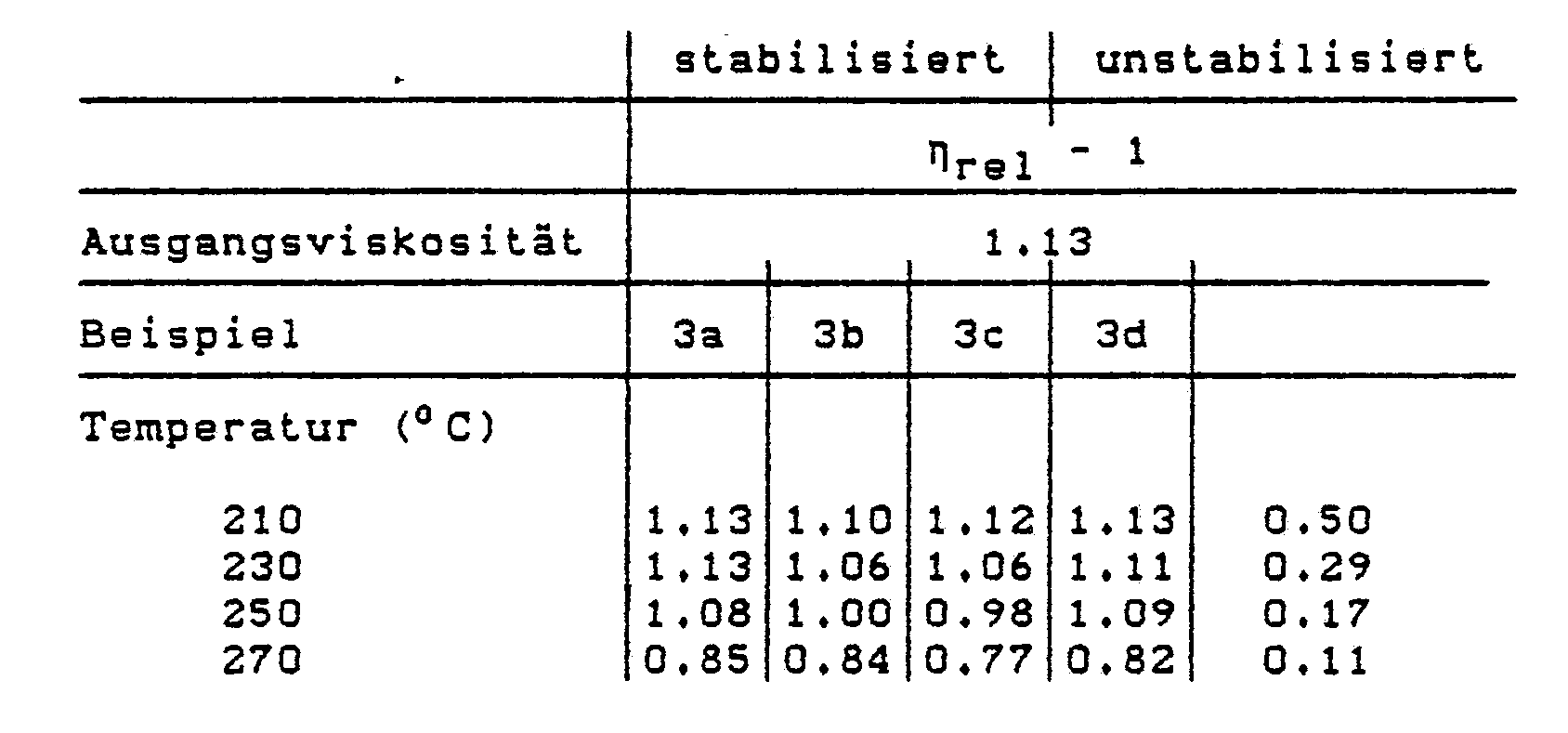
- Das thermische Abbauverhalten von aliphatischen Polycarbonaten wurde wie folgt bestimmt:
- In einem Reagenzglas wurden 2 g des Polymeren 40 Minuten auf 210°C bis 270°C erhitzt. Die relative Viskosität (ηrel) dieses Polymeren wurde an einer 2 gew.-%igen Lösung in Methylenchlorid ermittelt und der entsprechenden Viskosität einer unbehandelten Probe gegenübergestellt.
- Aus dem Vergleich mit der Viskosität der nicht erhitzten Probe ergibt sich der jeweilige Grad der thermischen Schädigung.
- 36,6 g (0,27 Mol) Pentaerythrit und 89,6 g (0,54 Mol) Triethylphosphit werden miteinander umgesetzt, wobei unter Normaldruck bis zu einer Sumpftemperatur von 170°C 44 g Ethanol über eine Kolonne abdestillieren. Dann gibt man 72 g (0,3 Mol) Perhydrobisphenol A hinzu und destilliert bis zu einer Sumpftemperatur von 170°C weitere 20 g Ethanol ab. Man erhält 130 g eines farblosen spröden Harzes:
- Ein Polyneopentylglykolcarbonat mit einer relativen Viskosität ηrel von 1,58 wurde mit 0,4 Gew.-% dieser Phos phitverbindung und mit 0,2 Gew.-% 2,6-Di-tert.-butyl-4-methyl-phenol versetzt. Die thermische Stabilität wurde wie oben angegeben bestimmt und mit der einer nicht stabilisierten Probe verglichen.

- Ein Polyneopentylglykolcarbonat, dessen HYdroxylendgruppen mit 1.3.5-Benzoltricarbonsäurechlorid verschlossen sind, mit einer relativen Viskosität ηrel von 1,21 wurde mit 0,4 Gew.-% der Phosphitverbindung aus Beispiel 1 und mit 0,2 Gew.-% 2,6-Di-tert.-butyl-4-methyl-phenol versetzt. Die thermische Stabilität wurde wie oben angegeben bestimmt und mit der einer nicht stabilisierten Probe verglichen.

- Ein durch anionisch Lösungspolymerisation gewonnenes Polyneopentylglykolcarbonat mit einer relativen Viskosität ηrel von 2.13 wurde wie folgt hergestellt:
- Zu einer Lösung von 350 g Neopentylglykolcarbonat in 3.900 g Toluol wurden bei 0°C 2 ml n-Butyllithium (2.5 molare Lösung in Hexan) unter Stickstoff gegeben. Die Polymerisationszeit betrug bei dieser Temperatur 4 Stunden. Das Reaktionsgemisch wurde dann mit 80 ml Methanol/Salzsäure (9:1) zersetzt, in Methanol gefällt, durch Filtration isoliert und getrocknet. Der Umsatz betrug 93 %.
- Das Polyneopentylglykolcarbonat wurde mit den in 3a - 3d angegebenen Stabilisatoren versetzt. Die thermische Stabilität wurde wie oben bestimmt und mit der einer nicht stabilisierten Probe verglichen.
- 3a. 0,6 Gew.-% Tris-(nonyl-phenyl)-phosphit
- 3b. 0,4 Gew.-% Tris-(nonyl-phenyl)-phosphit und 0,2 Gew.-% 2,6-Di-tert.-butyl-4-methylphenol
- 3c. 0,6 Gew.-% Phosphorigsäureester des Bis (2-hydroxy-3-cyclohexyl-5-methyl-phenyl)-methans
- 3d. 0,6 Gew.-% Phosphorigsäureester des Bis(2-hydroxy-3-tert.-butyl-5-methyl-phenyl)-methans
- Das thermische Abbauverhalten von sequenziert aufgebauten Copolymeren auf Basis cyclislcher, aliphatischer Carbonate und Ester wurde wie folgt bestimmt:
- In einem Reagenzglas wurden 2 g des Polymeren 40 Minuten lang auf 210°C bis 270°C erhitzt. Die relativ Viskosität (ηrel) dieses Polymeren wurde an einer 2 gew.-%igen Lösung im Methylenchlorid ermittelt und der entsprechenden Viskosität einer unbehandelten Probe gegenübergestellt.
- Aus dem Vergleich mit der Viskosität der nicht erhitzten Probe ergibt sich der jeweilige Grad der thermischen Schädigung.
- Sequenziert aufgebautes Copolymer aus Neopentylglykolcarbonat (50 Mol-%) und ε-Caprolacton (50 Mol-%).
- Zu einer Lösung von 260 g Neopentylglykolcarbonat und 228 g ε-Caprolacton in 5 l Toluol wurden bei 0°C 6 ml n-Butyllithium (2,5 molare Lösung in Hexan) unter Stickstoff gegeben. Die Polymerisationszeit betrug bei dieser Temperatur 6 Stunden. Das Reaktionsgemisch wurde dann mit 80 ml Methanol/Salzsäure (8:2) zersetzt, in Methanol gefällt, durch Filtration isoliert und getrocknet. Der Umsatz betrug 95 %.
- Das sequenziert aufgebaute Copolymer aus Neopentylglykolcarbonat und ε-Caprolacton wurde mit den in 1a-1c angegebenen Stabilisatoren versetzt. Die Stabilität wurde wie oben beschrieben bestimmt und mit der einer nichtstabilisierten Probe verglichen.
- 1a) 0,4 % des nach der folgenden Vorschrift erhaltenen Stabilisators und 0,2 Gew.-% 2,6-Di-tert.-butyl-4-methylphenol
36,6 g (0,27 Mol) Pentaerythrit und 89,6 g (0,54 Mol) Triethylphosphit werden miteinander umgesetzt, wobei unter Normaldruck bis zu einer Sumpftemperatur von 170°C 44 g Ethanol über eine Kolonne abdestillieren. Dann gibt man 72 g (0,3 Mol) Perhydrobisphenol A hinzu und destilliert bis zu einer Sumpftemperatur von 170°C weitere 20 g Ethanol ab. Man erhält 130 g eines farblosen spröden Harzes. - 1b) 0,6 Gew.-% Tris-(nonyl-phenyl)-phosphit
- 1c) 0,6 Gew.-% Phosphorigsäureester des Bis-(2-hydroxy-3-tert.-butyl-5-methyl-penyl)-methans.
- Sequenziert aufgebautes Copolymer aus Neopentylglykolcarbonat (70 Gew.-%) und ε-Caprolacton (30 Gew.-%)
- Zu einer Lösung von 1.050 g Neopentylglykolcarbonat und 450 g ε-Caprolacton in 10 l Toluol wurden bei 0°C 15 ml n-Butyllithium (2,5 molare Lösung in Hexan) unter Stickstoff gegeben. Die Polymerisationszeit betrug bei dieser Temperatur 5 h. Das Reaktionsgemisch wurde dann mit 250 ml Methanol/Salzsäure (8·2) zersetzt in Methanol gefällt, durch Filtration isoliert und getrocknet. Der Umsatz betrug 96,7 %.
- Das sequenziert aufgebaute Copolymer aus Neopentylglykolcarbonat und ε-Caprolacton wurde mit den in 2a-2c angegebenen Stabilisatoren versetzt. Die thermische Stabilität wurde wie oben bestimmt und mit der einer nichtstabilisierten Probe verglichen.
- 2a) 0,6 Gew.-% Tris-(nonyl-phenyl)-phosphit und 0,2 Gew.-% 2,6-Di-tert.-butyl-4-methylphenol
- 2b) 0,6 Gew.-% Phosphorigsäureester des Bis-(2-hydroxy-3-tert.-butyl-5-methyl-phenyl)-methans und 0,2 Gew.-% 2,6-Di-tert.-butyl-4-methylphenol
- 2c) 0,6 Gew.-% Phosphorigsäureester des Bis-(2-hydroxy-3-cyclohexyl-5-methyl-phenyl)-methans und 0,2 Gew.-% 2,6-Di-tert.-butyl-4-methylphenol
- Der thermische Abbau von sequenziert aufgebauten Copolymeren aus cyclischen, aliphatischen Carbonaten und Vinylverbindungen Polycarbonaten wurde wie folgt bestimmt:
- In einem Reagenzglas wurden 2 g des Polymeren 40 Minuten auf 210°C bis 270°C erhitzt. Die relative Viskosität (ηrel) dieses Polymeren wurde in einer 2 gew.-%igen Lösung in Methylenchlorid ermittelt und der entsprechenden Viskosität einer unbehandelten Probe gegenübergestellt.
- Aus dem Vergleich mit der Viskosität der nicht erhitzten Probe ergibt sich der jeweilige Grad der thermischen Schädigung.
- Zu einer Lösung von 30 g Styrol in 535 ml Toluol wurden bei 40°C 0,6 ml n-Butyllithium (2,5 molare Lösung in Hexan) unter Stickstoff zugegeben. Die Polymerisationszeit betrug bei dieser Temperatur 3h.
- Die Lösung von Polystyryllithium wurde dann auf Zimmertemperatur gebracht und bis zur Entfärbung mit Ethylenoxid behandelt. Zu der nun gebildeten Lithiumalkoholat lösung wurden 28 g Neopentylglykolcarbonat gegeben und die Lösung auf -10°C gebracht. Nach einer Polymerisationszeit von 4,5h bei dieser Temperatur wurde das Reaktionsgemisch mit 5 ml Methanol/Salzsäure (8:2) zersetzt, das Reaktionsprodukt durch Fällung in Methanol isoliert und getrocknet. Der Umsatz betrug 100 %.
- Das Blockcopolymer aus Styrol und Neopentylglykolcarbonat wurde mit den in 1a und 1b angegebenen Stabilisatoren versetzt. Die thermische Stabilität wurde wie oben beschrieben bestimmt und mit der einer nicht stabilisierten Probe verglichen.
- 1a 0,6 % des nach folgender Vorschrift erhaltenen Stabilisators.
36,6 g (0,27 Mol) Pentaerythrit und 89,6 g (0,54 Mol) Triethylphosphit werden miteinander umgesetzt, wobei unter Normaldruck bis zu einer Sumpftemperatur von 170° 44 g Ethanol über eine Kolonne abdestillieren. Dann gibt man 72 g (0,3 Mol) Perhydrobisphenol A hinzu und destilliert bis zu einer Sumpftemperatur von 170° weitere 20 g Ethanol ab. Man erhält 130 g eines farblosen spröden Harzes. - 1b. 0,6 % Phosphorigsäureester des Bis (2-hydroxy-3-cyclohexyl-5-methyl-phenyl)methans
- Zu einer Lösung von 27 g Styrol in 400 ml Toluol wurden bei 40°C 0,6 ml n-Butyllithium (2,5 molare Lösung in Hexan) unter Stickstoff gegeben. Die Polymerisationszeit betrug bei dieser Temperatur 3 Stunden. Die Lösung von Polystyryllithium wurde dann auf Zimmertemperatur gebracht und bis zur Entfärbung mit Ethylenoxid behandelt. Zu der nun gebildeten Lithiumalkoholatlösung wurden 28 g Neopentylglykolcarbonat gegeben und dit Lösung auf -10°C gebracht. Nach einer Polymerisationszeit von 4 Stunden bei dieser Temperatur wurde das Reaktionsgemisch mit 5 ml Methanol/Salzsäure (8:2) zersetzt, das Reaktionsprodukt durch Fällung in Methanol isoliert und getrocknet. Der Umsatz betrug 100 %.
- Das Blockcopolymerisat aus Styrol und Neopentylglykolcarbonat wurde mit den in 2a-2d angegebenen Stabilisatoren versetzt. Die thermische Stabilität wurde wie oben beschrieben bestimmt und mit der einer nicht stabilisierten Probe verglichen.
- 2a. 0,6 Gew.-% Tris-(nonyl-phenyl)-phosphit
- 2b. 0,6 Gew.-% des Phosphits gemäß Beispiel 1a und 0,2 Gew.-% 2,6-Di-tert.-butyl-4-methylphenol
- 2c. 0,6 Gew.-% Phosphorigsäureester des Bis-(2-hydroxy-3-cyclohexyl-5-methyl-phenyl)-methans und 0,2 Gew.-% 2,6-Di-tert.-butyl-4-methylphenol
- 2d. 0,6 Gew.-% Phosphorigsäureester des Bis-(2-hydroxy-3-tert.-butyl-5-methyl-phenyl)-methans und 0,2 Gew.-% 2,6-Di-tert.-butyl-4-methylphenol


Claims (8)

X Wasserstoff, einen gegebenenfalls substituierten aliphatischen, cycloaliphatischen oder aromatischen Rest mit 1 bis 18 C-Atomen oder einen Alkaryl oder Aralkylrest mit 7 bis 24 C-Atomen, der auch olefinische Doppelbindungen und Heteroatome enthalten kann,
n eine ganze Zahl von 1 bis 4, entsprechend der Bindigkeit von X,
R¹ und R² unabhängig voneinander C₁-C₁₈-Alkyl, C₅ bis C₁₅-Cycloalkyl, C₇ bis C₂₄-Aralkyl oder Alkaryl oder C₆ bis C₂₄-Aryl,
R¹ und X gemeinsam eine gegebenenfalls substituierte C₂ bis C₄ Alkylenkette
R¹, R² und X zusammen einen geradkettigen oder verzweigten C₁ bis C₉-Alkyl oder C₅ bis C₇-Cycloalkylrest, der mit 3-6-gliedrigen cyclischen Resten, die als Heteroatome O und S enthalten, substituiert sein kann.

X Wasserstoff, einen gegebenenfalls substituierten aliphatischen, cycloaliphatischen oder aromatischen Rest mit 1 bis 18 C-Atomen oder einen Alkaryl oder Aralkylrest mit 7 bis 24 C-Atomen, die auch olefinische Doppelbindungen und Heteroatome (bevorzugt O, S und nichtbasische Stickstoffe) enthalten können,
n eine ganze Zahl von 1 bis 4, entsprechend der Bindigkeit von X,
R³ und R⁴ gleiche oder verschiedene C₁₋₉ aliphatische C₅₋₆ cycloaliphatische und C₇₋₉-Aralkyl oder C₆₋₁₀-Arylreste,
Y für S oder HCR⁵ steht, wobei R⁵ = H, C₁₋₆-Alkyl-, Cyclohexenyl- oder Cyclohexyl.


Applications Claiming Priority (6)
| Application Number | Priority Date | Filing Date | Title |
|---|---|---|---|
| DE3717451 | 1987-05-23 | ||
| DE19873717451 DE3717451A1 (de) | 1987-05-23 | 1987-05-23 | Stabilisierte blockcopolymere aus cyclischen, aliphatischen carbonaten und vinylverbindungen |
| DE3717453 | 1987-05-23 | ||
| DE19873717453 DE3717453A1 (de) | 1987-05-23 | 1987-05-23 | Stabilisierte sequenziert aufgebaute copolymere aus cyclischen, aliphatischen carbonaten und estern |
| DE3717452 | 1987-05-23 | ||
| DE19873717452 DE3717452A1 (de) | 1987-05-23 | 1987-05-23 | Stabilisierte aliphatische polycarbonate |
Publications (3)
| Publication Number | Publication Date |
|---|---|
| EP0292786A2 true EP0292786A2 (de) | 1988-11-30 |
| EP0292786A3 EP0292786A3 (en) | 1989-10-04 |
| EP0292786B1 EP0292786B1 (de) | 1992-08-26 |
Family
ID=27195981
Family Applications (1)
| Application Number | Title | Priority Date | Filing Date |
|---|---|---|---|
| EP88107553A Expired - Lifetime EP0292786B1 (de) | 1987-05-23 | 1988-05-11 | Stabilisiertes Neopentylglykol-Polycarbonat |
Country Status (5)
| Country | Link |
|---|---|
| US (1) | US5064885A (de) |
| EP (1) | EP0292786B1 (de) |
| JP (1) | JPS63309554A (de) |
| DE (1) | DE3873986D1 (de) |
| ES (1) | ES2051794T3 (de) |
Cited By (3)
| Publication number | Priority date | Publication date | Assignee | Title |
|---|---|---|---|---|
| EP0373465A3 (de) * | 1988-12-15 | 1992-03-04 | Bayer Ag | Stabilisierte thermoplastische Formmassen |
| EP0522340A1 (de) * | 1991-07-02 | 1993-01-13 | Bayer Ag | Verfahren zur Herstellung thermoplastischer Polyurethan-Elastomere |
| EP0787738A1 (de) | 1996-02-01 | 1997-08-06 | Hoechst Aktiengesellschaft | Verfahren zur Herstellung von 6-Alkoxy-(6H)-dibenz[c, e][1,2]-oxaphosphorinen |
Families Citing this family (17)
| Publication number | Priority date | Publication date | Assignee | Title |
|---|---|---|---|---|
| US5231124A (en) * | 1988-12-15 | 1993-07-27 | Bayer Aktiengesellschaft | Stabilized thermoplastic molding compositions |
| JP2731601B2 (ja) * | 1989-09-06 | 1998-03-25 | 旭電化工業株式会社 | ポリカーボネート樹脂組成物 |
| DE10360367A1 (de) * | 2003-12-22 | 2005-07-21 | Bayer Materialscience Ag | Stabilisierte thermoplastische Zusammensetzungen |
| US8802792B2 (en) | 2010-09-17 | 2014-08-12 | Empire Technology Development Llc | Partially hydrogenated bisphenol-A-based polymers as substitutes for bisphenol-A-based polymers |
| US9290618B2 (en) | 2011-08-05 | 2016-03-22 | Sabic Global Technologies B.V. | Polycarbonate compositions having enhanced optical properties, methods of making and articles comprising the polycarbonate compositions |
| US8962117B2 (en) | 2011-10-27 | 2015-02-24 | Sabic Global Technologies B.V. | Process for producing bisphenol A with reduced sulfur content, polycarbonate made from the bisphenol A, and containers formed from the polycarbonate |
| CN104205376B (zh) | 2012-02-03 | 2018-04-27 | 沙特基础全球技术有限公司 | 发光二极管器件及用于生产其的包括转换材料化学的方法 |
| US9287471B2 (en) | 2012-02-29 | 2016-03-15 | Sabic Global Technologies B.V. | Polycarbonate compositions containing conversion material chemistry and having enhanced optical properties, methods of making and articles comprising the same |
| EP2819981B1 (de) | 2012-02-29 | 2016-12-21 | SABIC Global Technologies B.V. | Polycarbonat aus bisphenol a mit niedrigem schwefelgehalt und mit umwandlungsmaterialchemie sowie daraus hergestellte artikel |
| US9346949B2 (en) | 2013-02-12 | 2016-05-24 | Sabic Global Technologies B.V. | High reflectance polycarbonate |
| FR2995311B3 (fr) * | 2012-09-13 | 2015-04-03 | Ptt Global Chemical Public Co Ltd | Composition de carbonate de polyalkylene a stabilite thermique amelioree et procede de preparation |
| US9821523B2 (en) | 2012-10-25 | 2017-11-21 | Sabic Global Technologies B.V. | Light emitting diode devices, method of manufacture, uses thereof |
| WO2014186548A1 (en) | 2013-05-16 | 2014-11-20 | Sabic Innovative Plastics Ip B.V. | Branched polycarbonate compositions having conversion material chemistry and articles thereof |
| EP3004234B1 (de) | 2013-05-29 | 2021-08-18 | SABIC Global Technologies B.V. | Beleuchtungsvorrichtungen mit farbstabilen thermoplastischen lichtdurchlässigen gegenständen |
| EP3004233B1 (de) | 2013-05-29 | 2018-02-14 | SABIC Global Technologies B.V. | Farbstabile thermoplastische zusammensetzung |
| ES2758076T3 (es) * | 2013-08-02 | 2020-05-04 | Covestro Deutschland Ag | Procedimiento para la preparación de polietercarbonatopolioles |
| US20190284217A1 (en) * | 2016-10-26 | 2019-09-19 | Adeka Corporation | Novel compound, composition including same, olefin-based resin composition, molded article thereof, and method for improving impact resistance of molded article |
Family Cites Families (19)
| Publication number | Priority date | Publication date | Assignee | Title |
|---|---|---|---|---|
| NL98325C (de) * | 1959-04-10 | |||
| US3177179A (en) * | 1960-05-31 | 1965-04-06 | Dow Chemical Co | Chain terminated polycarbonates |
| US3053878A (en) * | 1961-05-23 | 1962-09-11 | Weston Chemical Corp | Pentaerythritol phosphite esters |
| US3305520A (en) * | 1965-04-06 | 1967-02-21 | Bayer Ag | Polycarbonates stabilized by phosphites |
| DE1643978C3 (de) * | 1967-07-12 | 1975-05-07 | Bayer Ag, 5090 Leverkusen | Verfahren zur Herstellung von Neopentylglykol-carbonsäure-kohlensäure-Mischestern |
| US3702878A (en) * | 1969-12-31 | 1972-11-14 | Sanko Chemical Co Ltd | Cyclic organophosphorus compounds and process for making same |
| US4066630A (en) * | 1977-01-10 | 1978-01-03 | Air Products And Chemicals, Inc. | End capped polyalkylene carbonates having improved thermal stability |
| US4104264A (en) * | 1977-05-05 | 1978-08-01 | Air Products & Chemicals, Inc. | End capped polyalkylene carbonates having improved thermal stablity |
| EP0000352B1 (de) * | 1977-07-07 | 1982-05-05 | Ciba-Geigy Ag | Aromatische cyclische Phosphonigsäure-diester und mit diesen Verbindungen stabilisiertes organisches Material |
| US4145525A (en) * | 1977-10-03 | 1979-03-20 | Air Products And Chemicals, Inc. | End capped polyalkylene carbonates |
| DE2837027A1 (de) * | 1978-08-24 | 1980-03-06 | Bayer Ag | Neue phosphorigsaeureester und ihre verwendung zur stabilisierung von polyamiden |
| US4276233A (en) * | 1978-11-02 | 1981-06-30 | General Electric Company | Hindered phenol phosphites |
| DE2929229A1 (de) * | 1979-07-19 | 1981-02-12 | Bayer Ag | Stabilisierte thermoplastische formmassen |
| JPS5650956A (en) * | 1979-10-02 | 1981-05-08 | Mitsubishi Gas Chem Co Inc | Fire-retardant polycabonate resin composition |
| US4461567A (en) * | 1979-12-20 | 1984-07-24 | Censor Patent- Und Versuchs-Anstalt | Method of and apparatus for the positioning of disk-shaped workpieces, particularly semiconductor wafers |
| US4303759A (en) * | 1980-09-12 | 1981-12-01 | Air Products And Chemicals, Inc. | Polyalkylenecarbonate compositions with improved thermal stability and method for making same |
| US4381358A (en) * | 1981-10-16 | 1983-04-26 | General Electric Co. | Copolyester-carbonates containing aliphatic diol co-monomers |
| JPS61151264A (ja) * | 1984-12-24 | 1986-07-09 | Hitachi Ltd | 熱硬化性樹脂組成物 |
| JPS61151263A (ja) * | 1984-12-24 | 1986-07-09 | Nippon Polyurethan Kogyo Kk | ポリカ−ポネ−トポリオ−ルの安定化方法 |
-
1988
- 1988-05-11 EP EP88107553A patent/EP0292786B1/de not_active Expired - Lifetime
- 1988-05-11 DE DE8888107553T patent/DE3873986D1/de not_active Expired - Lifetime
- 1988-05-11 ES ES88107553T patent/ES2051794T3/es not_active Expired - Lifetime
- 1988-05-17 JP JP63118406A patent/JPS63309554A/ja active Pending
-
1991
- 1991-02-11 US US07/655,204 patent/US5064885A/en not_active Expired - Fee Related
Cited By (4)
| Publication number | Priority date | Publication date | Assignee | Title |
|---|---|---|---|---|
| EP0373465A3 (de) * | 1988-12-15 | 1992-03-04 | Bayer Ag | Stabilisierte thermoplastische Formmassen |
| EP0522340A1 (de) * | 1991-07-02 | 1993-01-13 | Bayer Ag | Verfahren zur Herstellung thermoplastischer Polyurethan-Elastomere |
| EP0787738A1 (de) | 1996-02-01 | 1997-08-06 | Hoechst Aktiengesellschaft | Verfahren zur Herstellung von 6-Alkoxy-(6H)-dibenz[c, e][1,2]-oxaphosphorinen |
| US5698729A (en) * | 1996-02-01 | 1997-12-16 | Hoechst Aktiengesellschaft | Process for preparing 6-alkoxy-(6H)-dibenzo C,E! 1,2!-oxaphosphorines |
Also Published As
| Publication number | Publication date |
|---|---|
| JPS63309554A (ja) | 1988-12-16 |
| US5064885A (en) | 1991-11-12 |
| DE3873986D1 (de) | 1992-10-01 |
| ES2051794T3 (es) | 1994-07-01 |
| EP0292786A3 (en) | 1989-10-04 |
| EP0292786B1 (de) | 1992-08-26 |
Similar Documents
| Publication | Publication Date | Title |
|---|---|---|
| EP0292786B1 (de) | Stabilisiertes Neopentylglykol-Polycarbonat | |
| DE2454124C3 (de) | Stabilisierte Polyphenylenäther-Harzmassen | |
| DE3850143T2 (de) | Antioxydante aromatische Fluorophosphite. | |
| EP0422437A2 (de) | Hochverzweigte Polyphosphonate | |
| DE1569032C3 (de) | Flammschutzmittel für synthetische organische Polymere | |
| CH456142A (de) | Verformbare Masse aus Polycarbonat und Polyalkylen-terephthalat | |
| DE2829237B2 (de) | Stabilisierte synthetische Polymerzusammensetzung | |
| DE69214718T2 (de) | 4,4'-Biphenylendiphosphonit Verbindungen und ihre Verwendung | |
| DE69019131T2 (de) | Elastomerische thermoplastische Copolyetherester-Zusammensetzungen mit verbesserter Widerstandsfähigkeit gegen Thermooxidation. | |
| DE69032397T2 (de) | Stabilisierte aromatische polykarbonatzusammensetzung und herstellung | |
| DE3780350T2 (de) | Stabilisatoren und verfahren zu ihrer herstellung. | |
| DE2421309A1 (de) | Veresterte isopropanolamine, verfahren zu ihrer herstellung und verwendung derselben | |
| DE3118797A1 (de) | Polyester und verfahren zu seiner herstellung | |
| DE69907050T2 (de) | Verbesserter Stabilisator zur Verarbeitung biologisch abbaubarer Polyester | |
| EP0943654B1 (de) | Oligomeres Stabilisatorgemisch | |
| DE3786567T2 (de) | Stabilisierte aromatische polyesterzusammensetzungen. | |
| DE69012929T2 (de) | Phosphitverbindung und deren anwendung. | |
| EP0351626B1 (de) | Stabilisierte Formmassen | |
| DE3717453A1 (de) | Stabilisierte sequenziert aufgebaute copolymere aus cyclischen, aliphatischen carbonaten und estern | |
| DE3717451A1 (de) | Stabilisierte blockcopolymere aus cyclischen, aliphatischen carbonaten und vinylverbindungen | |
| WO2013064253A1 (de) | Verfahren zur herstellung von flexibilisierten und flammgeschützten, thermoplastischen kunststoffen | |
| DE68905175T2 (de) | Verfahren zur stabilisierung von zyklischen carbonaten. | |
| DE3717452A1 (de) | Stabilisierte aliphatische polycarbonate | |
| DE68911207T2 (de) | Verfahren zum Stabilisieren von Polymeren, Stabilisatorzusammensetzung und stabilisiertes Polymermaterial. | |
| DE69012477T2 (de) | Elastomere thermoplastische Copolyesterzusammensetzungen. |
Legal Events
| Date | Code | Title | Description |
|---|---|---|---|
| PUAI | Public reference made under article 153(3) epc to a published international application that has entered the european phase |
Free format text: ORIGINAL CODE: 0009012 |
|
| 17P | Request for examination filed |
Effective date: 19880511 |
|
| AK | Designated contracting states |
Kind code of ref document: A2 Designated state(s): DE ES FR GB IT |
|
| PUAL | Search report despatched |
Free format text: ORIGINAL CODE: 0009013 |
|
| AK | Designated contracting states |
Kind code of ref document: A3 Designated state(s): DE ES FR GB IT |
|
| 17Q | First examination report despatched |
Effective date: 19910701 |
|
| RTI1 | Title (correction) | ||
| GRAA | (expected) grant |
Free format text: ORIGINAL CODE: 0009210 |
|
| AK | Designated contracting states |
Kind code of ref document: B1 Designated state(s): DE ES FR GB IT |
|
| REF | Corresponds to: |
Ref document number: 3873986 Country of ref document: DE Date of ref document: 19921001 |
|
| ITF | It: translation for a ep patent filed | ||
| ET | Fr: translation filed | ||
| GBT | Gb: translation of ep patent filed (gb section 77(6)(a)/1977) |
Effective date: 19921130 |
|
| ITTA | It: last paid annual fee | ||
| PLBE | No opposition filed within time limit |
Free format text: ORIGINAL CODE: 0009261 |
|
| STAA | Information on the status of an ep patent application or granted ep patent |
Free format text: STATUS: NO OPPOSITION FILED WITHIN TIME LIMIT |
|
| 26N | No opposition filed | ||
| REG | Reference to a national code |
Ref country code: ES Ref legal event code: FG2A Ref document number: 2051794 Country of ref document: ES Kind code of ref document: T3 |
|
| PGFP | Annual fee paid to national office [announced via postgrant information from national office to epo] |
Ref country code: DE Payment date: 19960412 Year of fee payment: 9 |
|
| PGFP | Annual fee paid to national office [announced via postgrant information from national office to epo] |
Ref country code: GB Payment date: 19960502 Year of fee payment: 9 |
|
| PGFP | Annual fee paid to national office [announced via postgrant information from national office to epo] |
Ref country code: ES Payment date: 19960510 Year of fee payment: 9 |
|
| PGFP | Annual fee paid to national office [announced via postgrant information from national office to epo] |
Ref country code: FR Payment date: 19960515 Year of fee payment: 9 |
|
| PG25 | Lapsed in a contracting state [announced via postgrant information from national office to epo] |
Ref country code: GB Effective date: 19970511 |
|
| PG25 | Lapsed in a contracting state [announced via postgrant information from national office to epo] |
Ref country code: ES Free format text: LAPSE BECAUSE OF NON-PAYMENT OF DUE FEES Effective date: 19970512 |
|
| GBPC | Gb: european patent ceased through non-payment of renewal fee |
Effective date: 19970511 |
|
| PG25 | Lapsed in a contracting state [announced via postgrant information from national office to epo] |
Ref country code: FR Free format text: LAPSE BECAUSE OF NON-PAYMENT OF DUE FEES Effective date: 19980130 |
|
| PG25 | Lapsed in a contracting state [announced via postgrant information from national office to epo] |
Ref country code: DE Free format text: LAPSE BECAUSE OF NON-PAYMENT OF DUE FEES Effective date: 19980203 |
|
| REG | Reference to a national code |
Ref country code: FR Ref legal event code: ST |
|
| REG | Reference to a national code |
Ref country code: ES Ref legal event code: FD2A Effective date: 19990301 |
|
| PG25 | Lapsed in a contracting state [announced via postgrant information from national office to epo] |
Ref country code: IT Free format text: LAPSE BECAUSE OF NON-PAYMENT OF DUE FEES;WARNING: LAPSES OF ITALIAN PATENTS WITH EFFECTIVE DATE BEFORE 2007 MAY HAVE OCCURRED AT ANY TIME BEFORE 2007. THE CORRECT EFFECTIVE DATE MAY BE DIFFERENT FROM THE ONE RECORDED. Effective date: 20050511 |