EP0274346A1 - Neue Substituiertaminomethandiphosphonsäuren - Google Patents
Neue Substituiertaminomethandiphosphonsäuren Download PDFInfo
- Publication number
- EP0274346A1 EP0274346A1 EP87810665A EP87810665A EP0274346A1 EP 0274346 A1 EP0274346 A1 EP 0274346A1 EP 87810665 A EP87810665 A EP 87810665A EP 87810665 A EP87810665 A EP 87810665A EP 0274346 A1 EP0274346 A1 EP 0274346A1
- Authority
- EP
- European Patent Office
- Prior art keywords
- substituted
- lower alkyl
- halogen
- ylamino
- unsubstituted
- Prior art date
- Legal status (The legal status is an assumption and is not a legal conclusion. Google has not performed a legal analysis and makes no representation as to the accuracy of the status listed.)
- Granted
Links
- 0 C*C(*)C1CC(*)C(C)C1 Chemical compound C*C(*)C1CC(*)C(C)C1 0.000 description 5
- ILYGNAYAUOOTAB-BUJNUYNZSA-N CN(C)[C@H](C(C1)CC1C1)C1[U] Chemical compound CN(C)[C@H](C(C1)CC1C1)C1[U] ILYGNAYAUOOTAB-BUJNUYNZSA-N 0.000 description 1
Classifications
-
- C—CHEMISTRY; METALLURGY
- C07—ORGANIC CHEMISTRY
- C07F—ACYCLIC, CARBOCYCLIC OR HETEROCYCLIC COMPOUNDS CONTAINING ELEMENTS OTHER THAN CARBON, HYDROGEN, HALOGEN, OXYGEN, NITROGEN, SULFUR, SELENIUM OR TELLURIUM
- C07F9/00—Compounds containing elements of Groups 5 or 15 of the Periodic Table
- C07F9/02—Phosphorus compounds
- C07F9/28—Phosphorus compounds with one or more P—C bonds
- C07F9/38—Phosphonic acids [RP(=O)(OH)2]; Thiophosphonic acids ; [RP(=X1)(X2H)2(X1, X2 are each independently O, S or Se)]
-
- C—CHEMISTRY; METALLURGY
- C07—ORGANIC CHEMISTRY
- C07F—ACYCLIC, CARBOCYCLIC OR HETEROCYCLIC COMPOUNDS CONTAINING ELEMENTS OTHER THAN CARBON, HYDROGEN, HALOGEN, OXYGEN, NITROGEN, SULFUR, SELENIUM OR TELLURIUM
- C07F9/00—Compounds containing elements of Groups 5 or 15 of the Periodic Table
- C07F9/02—Phosphorus compounds
- C07F9/547—Heterocyclic compounds, e.g. containing phosphorus as a ring hetero atom
- C07F9/6536—Heterocyclic compounds, e.g. containing phosphorus as a ring hetero atom having nitrogen and sulfur atoms with or without oxygen atoms, as the only ring hetero atoms
- C07F9/6539—Five-membered rings
- C07F9/6541—Five-membered rings condensed with carbocyclic rings or carbocyclic ring systems
-
- A—HUMAN NECESSITIES
- A61—MEDICAL OR VETERINARY SCIENCE; HYGIENE
- A61P—SPECIFIC THERAPEUTIC ACTIVITY OF CHEMICAL COMPOUNDS OR MEDICINAL PREPARATIONS
- A61P29/00—Non-central analgesic, antipyretic or antiinflammatory agents, e.g. antirheumatic agents; Non-steroidal antiinflammatory drugs [NSAID]
-
- A—HUMAN NECESSITIES
- A61—MEDICAL OR VETERINARY SCIENCE; HYGIENE
- A61P—SPECIFIC THERAPEUTIC ACTIVITY OF CHEMICAL COMPOUNDS OR MEDICINAL PREPARATIONS
- A61P3/00—Drugs for disorders of the metabolism
- A61P3/02—Nutrients, e.g. vitamins, minerals
-
- A—HUMAN NECESSITIES
- A61—MEDICAL OR VETERINARY SCIENCE; HYGIENE
- A61P—SPECIFIC THERAPEUTIC ACTIVITY OF CHEMICAL COMPOUNDS OR MEDICINAL PREPARATIONS
- A61P3/00—Drugs for disorders of the metabolism
- A61P3/12—Drugs for disorders of the metabolism for electrolyte homeostasis
- A61P3/14—Drugs for disorders of the metabolism for electrolyte homeostasis for calcium homeostasis
-
- A—HUMAN NECESSITIES
- A61—MEDICAL OR VETERINARY SCIENCE; HYGIENE
- A61P—SPECIFIC THERAPEUTIC ACTIVITY OF CHEMICAL COMPOUNDS OR MEDICINAL PREPARATIONS
- A61P35/00—Antineoplastic agents
-
- A—HUMAN NECESSITIES
- A61—MEDICAL OR VETERINARY SCIENCE; HYGIENE
- A61P—SPECIFIC THERAPEUTIC ACTIVITY OF CHEMICAL COMPOUNDS OR MEDICINAL PREPARATIONS
- A61P43/00—Drugs for specific purposes, not provided for in groups A61P1/00-A61P41/00
-
- A—HUMAN NECESSITIES
- A61—MEDICAL OR VETERINARY SCIENCE; HYGIENE
- A61P—SPECIFIC THERAPEUTIC ACTIVITY OF CHEMICAL COMPOUNDS OR MEDICINAL PREPARATIONS
- A61P9/00—Drugs for disorders of the cardiovascular system
- A61P9/10—Drugs for disorders of the cardiovascular system for treating ischaemic or atherosclerotic diseases, e.g. antianginal drugs, coronary vasodilators, drugs for myocardial infarction, retinopathy, cerebrovascula insufficiency, renal arteriosclerosis
-
- C—CHEMISTRY; METALLURGY
- C07—ORGANIC CHEMISTRY
- C07F—ACYCLIC, CARBOCYCLIC OR HETEROCYCLIC COMPOUNDS CONTAINING ELEMENTS OTHER THAN CARBON, HYDROGEN, HALOGEN, OXYGEN, NITROGEN, SULFUR, SELENIUM OR TELLURIUM
- C07F9/00—Compounds containing elements of Groups 5 or 15 of the Periodic Table
- C07F9/02—Phosphorus compounds
- C07F9/547—Heterocyclic compounds, e.g. containing phosphorus as a ring hetero atom
- C07F9/645—Heterocyclic compounds, e.g. containing phosphorus as a ring hetero atom having two nitrogen atoms as the only ring hetero atoms
- C07F9/6503—Five-membered rings
- C07F9/6506—Five-membered rings having the nitrogen atoms in positions 1 and 3
-
- C—CHEMISTRY; METALLURGY
- C07—ORGANIC CHEMISTRY
- C07F—ACYCLIC, CARBOCYCLIC OR HETEROCYCLIC COMPOUNDS CONTAINING ELEMENTS OTHER THAN CARBON, HYDROGEN, HALOGEN, OXYGEN, NITROGEN, SULFUR, SELENIUM OR TELLURIUM
- C07F9/00—Compounds containing elements of Groups 5 or 15 of the Periodic Table
- C07F9/02—Phosphorus compounds
- C07F9/547—Heterocyclic compounds, e.g. containing phosphorus as a ring hetero atom
- C07F9/645—Heterocyclic compounds, e.g. containing phosphorus as a ring hetero atom having two nitrogen atoms as the only ring hetero atoms
- C07F9/6503—Five-membered rings
- C07F9/6506—Five-membered rings having the nitrogen atoms in positions 1 and 3
- C07F9/65068—Five-membered rings having the nitrogen atoms in positions 1 and 3 condensed with carbocyclic rings or carbocyclic ring systems
-
- C—CHEMISTRY; METALLURGY
- C07—ORGANIC CHEMISTRY
- C07F—ACYCLIC, CARBOCYCLIC OR HETEROCYCLIC COMPOUNDS CONTAINING ELEMENTS OTHER THAN CARBON, HYDROGEN, HALOGEN, OXYGEN, NITROGEN, SULFUR, SELENIUM OR TELLURIUM
- C07F9/00—Compounds containing elements of Groups 5 or 15 of the Periodic Table
- C07F9/02—Phosphorus compounds
- C07F9/547—Heterocyclic compounds, e.g. containing phosphorus as a ring hetero atom
- C07F9/6524—Heterocyclic compounds, e.g. containing phosphorus as a ring hetero atom having four or more nitrogen atoms as the only ring hetero atoms
-
- C—CHEMISTRY; METALLURGY
- C07—ORGANIC CHEMISTRY
- C07F—ACYCLIC, CARBOCYCLIC OR HETEROCYCLIC COMPOUNDS CONTAINING ELEMENTS OTHER THAN CARBON, HYDROGEN, HALOGEN, OXYGEN, NITROGEN, SULFUR, SELENIUM OR TELLURIUM
- C07F9/00—Compounds containing elements of Groups 5 or 15 of the Periodic Table
- C07F9/02—Phosphorus compounds
- C07F9/547—Heterocyclic compounds, e.g. containing phosphorus as a ring hetero atom
- C07F9/6527—Heterocyclic compounds, e.g. containing phosphorus as a ring hetero atom having nitrogen and oxygen atoms as the only ring hetero atoms
- C07F9/653—Five-membered rings
-
- C—CHEMISTRY; METALLURGY
- C07—ORGANIC CHEMISTRY
- C07F—ACYCLIC, CARBOCYCLIC OR HETEROCYCLIC COMPOUNDS CONTAINING ELEMENTS OTHER THAN CARBON, HYDROGEN, HALOGEN, OXYGEN, NITROGEN, SULFUR, SELENIUM OR TELLURIUM
- C07F9/00—Compounds containing elements of Groups 5 or 15 of the Periodic Table
- C07F9/02—Phosphorus compounds
- C07F9/547—Heterocyclic compounds, e.g. containing phosphorus as a ring hetero atom
- C07F9/6527—Heterocyclic compounds, e.g. containing phosphorus as a ring hetero atom having nitrogen and oxygen atoms as the only ring hetero atoms
- C07F9/653—Five-membered rings
- C07F9/65324—Five-membered rings condensed with carbocyclic rings or carbocyclic ring systems
-
- C—CHEMISTRY; METALLURGY
- C07—ORGANIC CHEMISTRY
- C07F—ACYCLIC, CARBOCYCLIC OR HETEROCYCLIC COMPOUNDS CONTAINING ELEMENTS OTHER THAN CARBON, HYDROGEN, HALOGEN, OXYGEN, NITROGEN, SULFUR, SELENIUM OR TELLURIUM
- C07F9/00—Compounds containing elements of Groups 5 or 15 of the Periodic Table
- C07F9/02—Phosphorus compounds
- C07F9/547—Heterocyclic compounds, e.g. containing phosphorus as a ring hetero atom
- C07F9/6536—Heterocyclic compounds, e.g. containing phosphorus as a ring hetero atom having nitrogen and sulfur atoms with or without oxygen atoms, as the only ring hetero atoms
- C07F9/6539—Five-membered rings
-
- C—CHEMISTRY; METALLURGY
- C07—ORGANIC CHEMISTRY
- C07F—ACYCLIC, CARBOCYCLIC OR HETEROCYCLIC COMPOUNDS CONTAINING ELEMENTS OTHER THAN CARBON, HYDROGEN, HALOGEN, OXYGEN, NITROGEN, SULFUR, SELENIUM OR TELLURIUM
- C07F9/00—Compounds containing elements of Groups 5 or 15 of the Periodic Table
- C07F9/02—Phosphorus compounds
- C07F9/547—Heterocyclic compounds, e.g. containing phosphorus as a ring hetero atom
- C07F9/6536—Heterocyclic compounds, e.g. containing phosphorus as a ring hetero atom having nitrogen and sulfur atoms with or without oxygen atoms, as the only ring hetero atoms
- C07F9/6539—Five-membered rings
- C07F9/65392—Five-membered rings containing two nitrogen atoms
- C07F9/65397—Five-membered rings containing two nitrogen atoms having the two nitrogen atoms in positions 1 and 3
Definitions
- the invention relates to new substituted aminomethane diphosphonic acids, in particular heteroaryl aminomethane diphosphonic acids of the formula wherein R 1 is phenyl, lower alkoxy and / or hydroxy, di-lower alkylamino, lower alkylthio and / or halogen C-substituted and / or substituted by lower alkyl or unsubstituted or by lower alkyl, lower alkoxy and / or / or by lower alkyl, unsubstituted or by lower alkyl, lower alkoxy and / or halogen or halogen-substituted phenyl-lower alkyl, N-substituted, optionally benzo or cyclohexeno-fused, 5-membered heteroaryl radical having 2 to 4 N atoms or 1 or 2 N atoms and 1 O or S atom as hetero atom (s) and R 2 Hydrogen or lower alkyl means with the proviso that R 2 is different
- benzo or cyclohexenocondensed 5-membered heteroaryl radicals having 2 to 4 N atoms or 1 or 2 N atoms and 1 O or S atom as heteroatom (s) are, for example, imidazolyl, for example imidazol-2-yl or 4 -yl, thiazolyl, for example thiazol-2-yl, furthermore thiazol-5-yl or -4-yl, oxazolyl, for example oxazol-2-yl, furthermore oxazol-4-yl, triazolyl, for example 4H-1,2,4 Triazol-3-yl or 2H-1,2,3-triazol-4-yl, tetrazolyl, for example tetrazol-5-yl, thiadiazolyl, for example 1,2,5-thiadiazol-3-yl, oxadiazolyl, for example 1, 3,4-oxadiazol-2-yl, benzimidazolyl, for example
- R 1 radicals with substitutable N atoms are preferably N-substituted as indicated.
- R 1 are, for example, 1-C 1 -C 4 -alkylimidazol-2-yl, such as 1-methylimidazol-2-yl, 1-phenyl-Ci-C 4 -alkylimidazol-2-yl, such as 1-benzylimidazol-2- yl, oxazol-2-yl, thiazol-2-yl, 4- and 5-Ci-C4-alkylthiazol-2-yl radicals, such as 4- or 5-methylthiazol-2-yl, 5-phenylthiazol-2-yl, 1 , 2,4-thiadiazol-5-yl, 3-phenyl-1,2,4-thiadiazol-5-yl, 1,3,4-thiadiazol-2-yl, 5-methyl-1,3,4-thiouracil, 5-methyl-1,3,4-thiouracil, 5-methyl-1,3,4-thiouracil, 5-
- Phenyl lower alkyl is, for example, phenyl. especially 1-phenyl-C 1 -C 4 alkyl, such as benzyl.
- Lower alkoxy is, for example, C 1 -C 4 alkoxy, such as methoxy, ethoxy, propyloxy, isopropyloxy, butyloxy, isobutyloxy, secondary butyloxy or tertiary butyloxy.
- the lower alkylamino is, for example, di-C 1 -C 4 -alkylamino, such as dimethylamino, diethylamino, N-ethyl-N-methylamino, dipropylamino, N-methyl-N-propylamino or dibutylamino.
- Lower alkylthio is, for example, C 1 -C 4 -alkylthio, such as methylthio, ethylthio, propylthio or butylthio, and also iso-, secondary or tertiary butylthio.
- Halogen is, for example, halogen of atomic number up to and including 35, such as fluorine, chlorine or bromine.
- Salts of compounds of formula 1 are in particular their salts with pharmaceutically usable bases, such as non-toxic metal salts derived from metals from groups la, Ib, Ila and IIb, e.g. Alkali metal, especially sodium or potassium salts, alkaline earth metal, especially calcium or magnesium salts, copper, aluminum or zinc salts, as well as ammonium salts with ammonia or organic amines or quaternary ammonium bases, such as optionally C-hydroxylated aliphatic amines, especially mono-, di or tri-lower alkylamines, for example Methyl, ethyl, dimethyl or diethylamine, mono-, di- or tri- (hydroxynederalyl) amines, such as ethanol-, diethanol- or triethanolamine, tris (hydroxymethyl) -aminomethane or 2-hydroxy tertiary butylamine, or N- (Hydroxy-lower alkyl) -N, N-di-lower
- the compounds of the formula in the form of internal salts for example of the formula can be present. Accordingly, the compounds mentioned can also be treated with a strong protonic acid, such as with a hydrohalic acid, sulfuric acid, sulfonic acid, for example methane or p-toluenesulfonic acid, or sulfamic acid, for example N-cyclohexylsulfamic acid, in the corresponding acid addition salts of the formula are transferred, wherein A ⁇ is the anion of protonic acid.
- a strong protonic acid such as with a hydrohalic acid, sulfuric acid, sulfonic acid, for example methane or p-toluenesulfonic acid, or sulfamic acid, for example N-cyclohexylsulfamic acid
- the compounds of formula I and their salts have valuable pharmacological properties. In particular, they have a pronounced regulating effect on the calcium metabolism of warm-blooded animals. In particular, they cause a pronounced inhibition of bone resorption in the rat, which can be seen both in the experimental setup according to Acta Endocrinol. 78, 613-24 (1975) 'on the basis of the PTH-induced increase in the serum calcium level after subcutaneous application in doses of about 0.01 to about 1.0 mg / kg, and also in the TPTX (Thyroparathyroidectomised) rat model based on the vitamin D 3 triggered experimental hypercalcemia after administration of doses of approximately 0.001 to 1.0 mg sc.
- Tumor hypercalcemia induced by Walker-256 tumors is likewise inhibited after oral administration from approximately 1.0 to approximately 100 mg / kg. Furthermore, they show in the adjuvant arthritis of the rat in the experimental arrangement according to Newbould, Brit. J. Pharmacology 21, 127 (1963) and according to Kaibara et al., J. Exp. Med. 159, 1388-96 (1984) in doses of about 0.01 to 1.0 mg / kg sc a clear inhibition of that Progression of chronic arthritic processes. They are therefore particularly suitable as active pharmaceutical ingredients for the treatment of diseases that can be associated with disorders of calcium metabolism, e.g.
- inflammatory processes in joints degenerative processes in articular cartilage, osteoporosis, periodontitis, hyperparathyroidism and calcium deposits in blood vessels or on prosthetic implants .
- Diseases in which an abnormal deposition of poorly soluble calcium salts can be determined are favorably influenced those in which the anomalous dissolution of hard body tissue is in the foreground, such as hereditary hypophosphatasia, degenerative processes in the articular cartilage osteoporoses of various origins, Paget's disease and osteodystrophia fibrosa, as well as osteolytic processes triggered by tumors.
- the invention relates primarily to compounds of formula 1, wherein R 1 is a C-unsubstituted or phenyl, hydroxyl, di-lower alkylamino, lower alkylthio and / or halogen C which is mono- or disubstituted by lower alkyl, lower alkoxy, unsubstituted or by lower alkyl, lower alkoxy and / or halogen -mono- or C-disubstituted phenyl-lower alkyl which is unsubstituted or optionally substituted by lower alkyl or unsubstituted or by lower alkyl, lower alkoxy and / or halogen by an optionally substitutable N atom, N-mono-substituted imidazolyl-, benzimidazolyl-, 2H- 1,2,3- or 4H-1,2,4-triazolyl, tetrazolyl, oxazolyl, benzoxazolyl, o
- the invention primarily relates, for example, to compounds of the formula in which R 1 is phenyl, hydroxy, di-lower alkylamino, lower alkylthio and / or halogen mono- or disubstituted or unsubstituted or substituted by lower alkyl, lower alkoxy, unsubstituted or by lower alkyl, lower alkoxy and / or halogen Imidazolyl, benzimidazolyl, 2H-1,2,3 or 4H-1,2,4-triazolyl, tetrazolyl, oxazolyl, benzoxazolyl, oxadiazolyi, thiazolyl, benzthiazolyl or thiadiazolyl radical and R 2 denotes Is hydrogen or lower alkyl, and their salts, in particular their inner salts and pharmaceutically usable salts with bases.
- R 1 is an unsubstituted or substituted by Ci-C 4 alkyl, such as methyl, or an unsubstituted or C 1 -C 4 alkyl such as methyl, C 1 -C 4 alkoxy, such as methoxy, and / or halogen, such as chlorine, mono- or disubstituted phenyl radical, C-substituted thiazolyl radical, such as thiazol-2-yl radical, benzothiazol-2-yl radical, thiadiazolyl radical, such as 1,2,4-thiadiazol-5-yl - or 1,3,4-Thiadiazol-2-ylrest, oxazolyl, such as oxazol-2-ylrest, or benzoxazol-2-ylrest and / or by C 1 -C 4 alkyl, such as methyl, or an unsubstituted or by C 1 -C 4 -alkyl,
- the invention relates in particular to compounds of the formula 1 in which R 1 is an unsubstituted or substituted by C 1 -C 4 -alkyl, such as methyl, C 1 -C 4 -alkoxy, such as methoxy, phenyl, hydroxy, di-C 1 -C 4 Alkylamino, such as dimethylamino or diethylamino, C 1 -C 4 -alkylthio, such as methylthio, or halogen of atom number up to and including 35, such as chlorine, substituted thiazolyl, such as thiazol-2-yl or -4-yl radical, and R 2 represents hydrogen, and their salts, especially their internal salts and pharmaceutically usable salts and bases.
- C 1 -C 4 -alkyl such as methyl, C 1 -C 4 -alkoxy, such as methoxy, phenyl, hydroxy, di-C 1 -C 4 Alkylamino, such as dimethyla
- the invention relates in particular to compounds of the formula 1 in which R 1 is an unsubstituted or substituted by C 1 -C 4 -alkyl, such as methyl, C 1 -C 4 -alkoxy, such as methoxy, phenyl, hydroxy, D i -C 1 -C 4 -Alkylamino, such as dimethylamino or diethylamino, C 1 -C 4 -alkylthio, such as methylthio, or halogen of atom number up to and including 35, such as chlorine, C-substituted thiazolyl, such as thiazol-2-yl residue or 1-C 1 -C 4- alkyl, such as methylimidazol-2-yl or -4-yl residue, or phenyl-C 1 -C 4 -alkyl, such as benzylimidazol-2-yl or -4-yl residue and R 2 is hydrogen, and their salts , especially their
- the invention relates first and foremost to compounds of the formula 1 in which R 1 is an unsubstituted or, in particular in the 4- and / or 5-position, C 1 -C 4 -alkyl, such as methyl, or phenyl mono- or disubstituted thiazole-2 -yl radical, an unsubstituted or in the 1-position by C 1 -C 4 -alkyl, such as methyl, or phenyl-C 1 -C 4 -alkyl, such as benzyl, monosubstituted imidazol-2-yl or benzimidazol-2-yl radical or an unsubstituted benzothiazol-2-yl or benzoxazol-2-yl radical and R 2 represents hydrogen, and their salts, in particular their internal salts and pharmaceutically usable salts with bases.
- C 1 -C 4 -alkyl such as methyl, or phenyl mono- or disubstituted thiazole-2
- the invention relates in particular to the compounds of the formula I mentioned in the examples and their salts, in particular their internal salts and pharmaceutically usable salts with bases.
- the conversion of a functionally modified into the free phosphono group takes place in the usual way by hydrolysis, for example in the presence of a mineral acid, such as hydrochloric or hydrobromic acid or sulfuric acid, or by reaction with a tri-lower alkyl halosilane, e.g. with trimethylchlorosilane or in particular trimethyliodosilane or trimethylbromosilane, preferably with cooling, e.g. in the temperature range from about 0 ° to about 25 ° C.
- a mineral acid such as hydrochloric or hydrobromic acid or sulfuric acid
- a tri-lower alkyl halosilane e.g. with trimethylchlorosilane or in particular trimethyliodosilane or trimethylbromosilane, preferably with cooling, e.g. in the temperature range from about 0 ° to about 25 ° C.
- the starting materials of formula II can be prepared, for example, by using a compound of the formula with the at least equimolecular amount of an orthoformate of the formula wherein OR, for example, lower alkoxy or an optionally by lower alkyl, lower alkoxy.
- the N-substituent can be split off, lower alkyl for example by treatment with a halogen formate, such as a bromine or Lower alkyl chloroformate, and then silk hydrolysis of the carbamate formed and a-fhenyl-lower alkyl radicals, for example by hydrolysis, for example treatment with hydrogen in the presence of a hydrogenation catalyst, for example palladium on carbon and / or platinum oxide, or by metallic reduction, for example treatment with an alkali metal in ammonia.
- a halogen formate such as a bromine or Lower alkyl chloroformate
- the starting material IIb can also be reacted in a manner known per se in the presence of an ortomate formate IIc with the phosphoric acid diester IIe without isolating the intermediate stage.
- the corresponding compound IIb is reacted at the boiling point in the presence of the at least equimolecular amount of an ortomate formate IIc with the at least double molar amount of the phosphorous diester IIe, without the intermediate stage, e.g. of the formula IId1 or IId2, and hydrolyses the primary product II by treatment with aqueous hydrochloric acid at the boiling point.
- reaction of compounds III with phosphorus trioxide according to process variant b) is preferably carried out with the in-situ formation of the latter, for example by reaction of phosphorus trichloride and phosphorous acid at elevated temperature, for example at about 50 to 65 ° C., addition of reaction component III, further heating and Hydrolytic work-up of the primary product, a 1: 1 adduct of the aldehyde of the formula with previously unknown structure of phosphorus trioxide, preferably by treatment with water.
- orthophosphoric acid is reacted at about 50 ° C. to 70 ° C. with an excess of about 1.1 to about 2 times, preferably about 1.5 times, excess of phosphorus trichloride, adds the reaction component III added, heated for a long time to about 50 ° C to 70 ° C, diluted with 80% phosphoric acid and worked up hydrolytically.
- Starting materials III can be prepared in a conventional manner, for example by reacting an amine of the formula with formic acid or a functional carboxy derivative thereof, for example with a formic acid ester of the formula wherein OR means for example a phenyloxy group optionally substituted by lower alkyl, lower alkoxy, halogen, trifluoromethyl and / or hydroxy, or with formamide
- the customary N-protecting groups and their introduction and cleavage methods are suitable, for example 2,2,2-trihalo, such as 2,2,2-triiodo, 2,2,2 Tribromo or 2,2,2-trichloroethoxycarbonyl residues, which can be split off, for example by treatment with zinc in acetic acid, a-phenyl-lower alkoxycarbonyl residues, such as carbobenzoxy, which can be split off, for example, by catalytic hydrogenation, and lower alkanesulfonyl groups, such as methanesulfonyl, which can be split off, for example, by treatment with Bis (2-methoxyethoxy) sodium aluminum hydride can be eliminated, but also a-phenylalkyl or alkyl groups, the elimination of which is dealt with below.
- 2,2,2-trihalo such as 2,2,2-triiodo, 2,2,2 Tribromo or 2,2,2-trichloroethoxycarbonyl residues
- compounds of the formula I obtained by the process or by another process known per se can be converted into other compounds of the formula I in a manner known per se.
- compounds of the formula 1 in which R 2 is hydrogen can be introduced by reaction with a reactive ester, such as a hydrohalic acid ester or organic sulfonic acid ester, of a lower alkanol, lower alkyl R 2 .
- a reactive ester such as a hydrohalic acid ester or organic sulfonic acid ester
- an aliphatic radical for example methyl
- an aliphatic aldehyde for example with formaldehyde and formic acid.
- the N-substituent can be eliminated, lower alkyl for example by treatment with a halogen formate, such as one Lower alkyl bromo- or chloroformate, and subsequent hydrolysis of the carbamate formed and a-phenyl-lower alkyl radicals, for example by hydrogenolysis, for example treatment with hydrogen in the presence of a hydrogenation catalyst, for example palladium on carbon or / and platinum oxide or by metallic reduction, for example treatment with a Alkali metal in ammonia.
- a halogen formate such as one Lower alkyl bromo- or chloroformate
- Free compounds of the formula obtained can be converted into base salts by partial or complete neutralization with one of the bases mentioned at the beginning.
- acid addition salts of the formula I can also be converted into the corresponding free compounds of the formula I or internal salts of the formula I '.
- Salts obtained can be converted into the free compounds in a manner known per se, e.g. by treatment with an acidic reagent such as a mineral acid or a base, e.g. Alkaline solution.
- an acidic reagent such as a mineral acid or a base, e.g. Alkaline solution.
- the compounds, including their salts, can also be obtained in the form of their hydrates or include the solvent used for the crystallization.
- the inventions also relate to those embodiments of the process according to which one starts from a compound obtainable as an intermediate at any stage of the process and carries out the missing steps or uses a starting material in the form of a salt and / or racemate or antipode, or in particular forms under the reaction conditions .
- the invention also relates to known compounds of the formula 1 in which R 1 is an unsubstituted pyrazol-3-yl radical or isoxazol-3-yl radical which is mono- or disubstituted by lower alkyl and / or halogen and R 2 is hydrogen, namely 1- (pyrazole- 3-ylamino) methane-1,1-diphosphonic acid, 1- (4-methylpyrazol-3-ylamino) methane-1,1-diphosphonic acid, 1- (5-methylpyrazol-3-ylamino) methane-1,1-diphosphonic acid , 1- (Isoxazol-3-ylamino) methane-1,1-diphosphonic acid, 1- (4-methylisoxazol-3-ylamino) methane-1,1-diphosphonic acid or 1- (5-methylisoxazol-3-ylamino- methane-1,1-diphosphonic acid, or in each case a pharmaceutically usable salt thereof for
- the invention further relates to pharmaceutical preparations containing a compound of formula I including those referred to above as known or a pharmaceutically acceptable salt thereof.
- the pharmaceutical preparations according to the invention which contain compounds of the formula or pharmaceutically usable salts thereof, are those for enteral, such as oral or rectal, and parenteral administration, which contain the pharmacologically active ingredient alone or together with a pharmaceutically usable carrier material.
- the dosage of the active ingredient depends on the warm-blooded species, the age and the individual condition, as well as on the mode of administration. In the normal case, an approximate daily dose of approximately 20 to 1000 mg, preferably approximately 30 to 300 mg, or approximately 1 to 25 mg, preferably approximately 1 to 10 mg, for intravenous administration is advantageous in oral administration spread over several equal partial doses.
- the new pharmaceutical preparations contain e.g. from about 10% to about 80%, preferably from about 20% to about 60% of the active ingredient.
- Pharmaceutical preparations according to the invention for enteral or parenteral administration are e.g. those in unit dosage forms such as coated tablets, tablets, capsules or suppositories, and also ampoules. These are made in a manner known per se, e.g. produced by conventional mixing, granulating, coating, solution or lyophilization processes.
- pharmaceutical preparations for oral use can be obtained by combining the active ingredient with solid carriers, optionally granulating a mixture obtained, and processing the mixture or granules, if desired or necessary, into tablets or coated tablets after adding suitable auxiliaries .
- Suitable carriers are in particular fillers such as sugar, e.g. Lactose, sucrose, mannitol or sorbitol, cellulose preparations and / or calcium phosphates, e.g. Tricalcium phosphate or calcium hydrogen phosphate, further binders such as starch paste using e.g. from corn, wheat, rice or potato starch, gelatin, tragacanth, methyl cellulose and / or polyvinylpyrrolidone, and / or, if desired, disintegrants, such as the above-mentioned starches, also carboxymethyl starch, crosslinked polyvinylpyrrolidone, agar, alginic acid or a salt thereof, like sodium alginate.
- fillers such as sugar, e.g. Lactose, sucrose, mannitol or sorbitol, cellulose preparations and / or calcium phosphates, e.g. Tricalcium phosphate or calcium hydrogen phosphate, further
- Drageee kernels are provided with suitable, possibly gastric juice-resistant coatings, whereby one of the things Concentrated sugar solutions, which may contain arabic gum, talc, polyvinylpyrrolidone, polyethylene glycol and / or titanium dioxide, lacquer solutions in suitable organic solvents or solvent mixtures or, for the production of gastric juice-resistant coatings, solutions of suitable cellulose preparations, such as acetyl cellulose phthalate or hydroxypropylmethyl cellulose phthalate. Colorants or pigments, e.g. sur identification or to label different doses of active ingredient.
- lubricants e.g. Silicic acid, talc, stearic acid or salts thereof, such as magnesium or calcium stearate, and / or polyethylene glycol.
- Drageee kernels are provided with suitable, possibly gastric juice-resistant coatings, whereby one of the things Concentrated sugar solutions, which may contain arabic gum, talc, polyvinylpyrrolidone, polyethylene glycol and
- suppositories into consideration consist of a combination of the active ingredient with a supossitorial base.
- Suitable suppository bases are e.g. natural or synthetic triglycerides, paraffin hydrocarbons, polyethylene glycols or higher alkanols.
- Gelatin rectal capsules can also be used, which contain a combination of the active ingredient with a base material; as basic materials come e.g. liquid triglycerides, polyethylene glycols or paraffin hydrocarbons in question.
- aqueous solutions of an active ingredient in water-soluble form e.g. a water-soluble salt
- further suspensions of the active ingredient such as corresponding oily injection suspensions
- suitable lipophilic solvents or vehicles such as fatty oils, e.g. Sesame oil, or synthetic fatty acid esters, e.g. Ethyl oleate or triglycerides, or aqueous injection suspensions containing viscosity-increasing substances, e.g. Contain sodium carboxymethyl cellulose, sorbitol and / or dextran and optionally also stabilizers.
- the present invention also relates to the use of the compounds of the formulas and their salts, preferably for the treatment of disorders due to calcium metabolism disorders, e.g. of the rheumatic range, and especially of osteoporosis.
- Dosages below 0.01 mg / kg body weight have only a minor influence on the pathological calcification or the dissolution of hard tissues. Long-term toxic side effects can occur with doses of over 100 mg / kg body weight.
- the compounds of formula I and their salts can be administered both orally and hypertonic solution subcutaneously, intramuscularly or intravenously.
- the preferred daily doses for these applications are about 0.1 to 5 mg / kg for oral use, about 0.1 to 1 mg / kg for subcutaneous and intramuscular administration and about 0.01 to for intravenous application 2 mg / kg.
- the dosage of the compounds used is variable and depends on the respective conditions such as the type and severity of the disease, the duration of the treatment and the particular compound.
- Single doses contain, for example, from 0.01 to 10 mg, dosage unit forms for parenteral, such as intravenous administration, for example from 0.01 to 0.1 mg, preferably 0.02 to 0.08 mg, oral dosage unit forms, for example from 0.2 to 2.5 mg, preferably 0 , 3 to 1.5 mg per kg of body weight.
- the preferred single dose is 10 to 100 mg for oral application and 0.5 to 5 mg for intravenous application and can be administered in up to 4 single doses per day. The higher doses for oral administration are necessary due to the limited absorption.
- the starting material can e.g. are manufactured as follows.
- Tablets containing 50 mg of active ingredient e.g. 1- (thiazol-2-ylamino) methane-1,1-diphosphonic acid or a salt, e.g. the sodium salt, of which can be produced as follows:
- Tablets containing 100 mg of active ingredient for example 1- (thiazol-2-ylamino) methane-1,1-diphosphonic acid or a salt, for example the sodium salt, can be produced as follows: Components (for 1000 tablets)
- tablets containing 100 mg or 50 mg of another of the compounds of the formula 1 mentioned in Examples 1 to 10 can also be prepared, these also in the form of salts and bases, e.g. as disodium salt.
- Chewable tablets containing 75 mg of active ingredient for example 1- (thiazol-2-ylamino) methane-1,1-diphosphonic acid or a salt, for example the sodium salt thereof, can be produced, for example, as follows: Composition: (for 1000 tablets)
- All solid ingredients are first passed through a sieve with a 0.25 mm mesh size.
- the mannitol and lactose are mixed, granulated with the addition of gelatin solution, passed through a sieve with a mesh size of 2 mm, dried at 50 ° and again passed through a sieve with a mesh size of 1.7 mm.
- the active ingredient, the glycine and the saccharin are carefully mixed, the mannitol, the lactose granules, the stearic acid and the talc are added, the whole is mixed thoroughly and pressed into concave sides of about 10 mm in diameter with a breaking groove on the top.
- Tablets containing 75 mg each of another of the compounds of the formula I mentioned in Examples 1 to 10 can also be prepared in an analogous manner, these also in the form of salts with bases, e.g. as disodium salt.
- Tablets containing 10 mg of active ingredient e.g. 1- (thiazol-2-ylamino) methane-1,1-diphosphonic acid or a salt, e.g. the sodium salt thereof can be prepared as follows: composition (for 1000 tablets)
- the solid ingredients are first passed through a sieve with a mesh size of 0.6 mm. Then the active ingredient, lactose, talc, magnesium stearate and half of the starch are intimately mixed. The other half of the starch is suspended in 65 ml of water and this suspension is added to a boiling solution of the polyethylene glycol in 260 ml of water. The paste obtained is added to the powdery substances, the whole is mixed and granulated, if necessary with the addition of water. The granules are dried overnight at 35 °, passed through a sieve with a mesh size of 1.2 mm and pressed to give concave tablets of about 10 mm in diameter with a notch on the top.
- Tablets containing 10 mg of another compound of the formula I according to Examples 1 to 10 can also be prepared in an analogous manner, these also in the form of salts with bases, e.g. as disodium salt.
- Gelatin capsules containing 100 mg of active ingredient e.g. 1- (thiazol-2-ylamino) methane-1,1-diphosphonic acid or a salt, e.g. the sodium salt thereof can be prepared as follows:
- Composition for 1000 capsules
- the sodium lauryl sulfate is sieved through a sieve with a mesh size of 0.2 mm to the active ingredient (lyophilized) and the two components are mixed intimately for 10 minutes. Then the microcrystalline cellulose is passed through a sieve with a Ma sieve width of 0.9 mm and thoroughly mixed again for 10 minutes. Finally, the magnesium stearate is sieved in through a sieve with a mesh size of 0.8 mm and after 3 minutes of further mixing, each 390 mg of the mixture is filled into size 0 gelatin capsules (elongated).
- Capsules containing 100 mg of another compound of the formula according to Examples 1 to 10 can also be prepared in an analogous manner, these also in the form of salts with bases, e.g. as disodium salt.
- a 0.2% solution for injection or infusion can be prepared as follows, for example.
- the active ingredient is dissolved in 1000 ml of water and filtered through a microfilter.
- the buffer solution is added and the volume is made up to 2500 ml with water.
- 1.0 or 2.5 ml are filled into glass ampoules (containing 2.0 or 5.0 mg of active ingredient each).
Landscapes
- Chemical & Material Sciences (AREA)
- Health & Medical Sciences (AREA)
- Organic Chemistry (AREA)
- Life Sciences & Earth Sciences (AREA)
- General Health & Medical Sciences (AREA)
- Molecular Biology (AREA)
- Biochemistry (AREA)
- Animal Behavior & Ethology (AREA)
- General Chemical & Material Sciences (AREA)
- Nuclear Medicine, Radiotherapy & Molecular Imaging (AREA)
- Medicinal Chemistry (AREA)
- Public Health (AREA)
- Veterinary Medicine (AREA)
- Chemical Kinetics & Catalysis (AREA)
- Pharmacology & Pharmacy (AREA)
- Bioinformatics & Cheminformatics (AREA)
- Engineering & Computer Science (AREA)
- Diabetes (AREA)
- Obesity (AREA)
- Hematology (AREA)
- Rheumatology (AREA)
- Urology & Nephrology (AREA)
- Endocrinology (AREA)
- Pain & Pain Management (AREA)
- Heart & Thoracic Surgery (AREA)
- Nutrition Science (AREA)
- Cardiology (AREA)
- Vascular Medicine (AREA)
- Pharmaceuticals Containing Other Organic And Inorganic Compounds (AREA)
- Detergent Compositions (AREA)
- Medicines Containing Antibodies Or Antigens For Use As Internal Diagnostic Agents (AREA)
- Saccharide Compounds (AREA)
- Medicinal Preparation (AREA)
- Organic Low-Molecular-Weight Compounds And Preparation Thereof (AREA)
- Diaphragms For Electromechanical Transducers (AREA)
- Ultra Sonic Daignosis Equipment (AREA)
- Emulsifying, Dispersing, Foam-Producing Or Wetting Agents (AREA)
Abstract
Description
- Die Erfindung betrifft neue Substituiertaminomethandiphosphonsäuren, insbesondere Heteroarylaminomethandiphosphonsäuren der Formel

- Gegebenenfalls benzo- oder cyclohexenokondensierte 5-gliedrige, als Heteroatom(e) 2 bis 4 N-Atome oder 1 oder 2-N-Atome sowie 1 O- oder S-Atom aufweisende Heteroarylreste sind beispielsweise Imidazolyl, z.B. Imidazol-2-yl oder 4-yl, Thiazolyl, z.B. Thiazol-2-yl, ferner Thiazol-5-yl oder -4-yl, Oxazolyl, z.B. Oxazol-2-yl, ferner Oxazol-4-yl, Triazolyl, z.B. 4H-1,2,4-Triazol-3-yl oder 2H-1,2,3-Triazol-4-yl, Tetrazolyl, z.B. Tetrazol-5-yl, Thiadiazolyl, z.B. 1,2,5-Thiadiazol-3-yl, Oxadiazolyl, z.B. 1,3,4-Oxadiazol-2-yl, Benzimidazolyl, z.B. Benzimidazol-2-yl, Benzoxazolyl, z.B. Benzoxazol-2-yl, oder Benzthiazolyl, z.B. Benzthiazol-2-yl. Die genannten Reste können einen oder mehrere gleiche oder verschiedene, insbesondere einen der zwei gleiche oder verschiedene, der eingangs genannten Substituenten aufweisen. Reste R1 mit substituierbaren N-Atomen sind vorzugsweise wie angegeben N-substituiert. Reste R1 sind beispielsweise 1-C1-C4-Alkylimidazol-2-ylreste, wie 1-Methylimidazol-2-yl, 1-Phenyl-Ci-C4-alkylimidazol-2-ylreste, wie 1-Benzylimidazol-2-yl, Oxazol-2-yl, Thiazol-2-yl, 4-und 5-Ci-C4-Alkylthiazol-2-ylreste, wie 4- oder 5-Methylthiazol-2-yl, 5-Phenylthiazol-2-yl, 1,2,4-Thiadiazol-5-yl, 3-Phenyl-1,2,4-thiadiazol-5-yl, 1,3,4-Thiadiazol-2-yl, 5-Methyl-1,3,4-thiadiazol-2-yl, Benzoxazol-2-yl und Benzthiazol-2-yl.
- Nachstehend sind unter niederen Resten und Verbindungen beispielsweise solche zu verstehen, die bis und mit 7, insbesondere bis und mit 4, C-Atome aufweisen. Ferner haben die Allgemeinbegriffe beispielsweise folgende Bedeutungen:
- Niederalkyl ist beispielsweise Ci-C4-Alkyl, wie Methyl, Aethyl, Propyl oder Butyl, ferner lso-, Sekundär- oder Tertiärbutyl, kann aber auch eine C5-C7-Alkyl-, wie Pentyl-, Hexyl- oder Heptylgruppe sein.
- Phenylniederalkyl ist beispielsweise Phenyl-. vor allem 1-Phenyl-C1-C4-alkyl, wie Benzyl.
- Niederalkoxy ist beispielsweise C1-C4-Alkoxy, wie Methoxy, Aethoxy, Propyloxy, Isopropyloxy, Butyloxy, Isobutyloxy, Sekundärbutyloxy oder Tertiärbutyloxy.
- Diniederalkylamino ist beispielsweise Di-Ci-C4-Alkylamino, wie Dimethylamino, Diäthylamino, N-Aethyl-N-methyl-amino, Dipropylamino, N-Methyl-N-propyl-amino oder Dibutylamino.
- Niederalkylthio ist beispielsweise C1-C4-Alkylthio, wie Methylthio, Aethylthio, Propylthio oder Butylthio, ferner Iso-, Sekundär- oder Tertiärbutylthio.
- Halogen ist beispielsweise Halogen der Atomnummer bis und mit 35, wie Fluor, Chlor oder Brom.
- Salze von Verbindungen der Formel 1 sind insbesondere deren Salze mit pharmazeutisch verwendbaren Basen, wie nicht-toxische, von Metallen der Gruppen la, Ib, Ila und IIb abgeleitete Metallsalze, z.B. Alkalimetall-, insbesondere Natrium- oder Kaliumsalze, Erdalkalimetall-, insbesondere Calcium-oder Magnesiumsalze, Kupfer-, Aluminium- oder Zinksalze, ebenso Ammoniumsalze mit Ammoniak oder organischen Aminen oder quaternären Ammoniumbasen, wie gegebenenfalls C-hydroxylierten aliphatischen Aminen, insbesondere Mono-, Di-oder Triniederalkylaminen, z.B. Methyl-, Aethyl-, Dimethyl-oder Diäthylamin, Mono-, Di- oder Tri-(hydroxynie- deralyl)-aminen, wie Aethanol-, Diäthanol- oder Triäthanolamin, Tris(hydroxymethyl)-amino-methan oder 2-Hydroxytertiärbutylamin, oder N-(Hydrox- yniederalkyl)-N,N-diniederalkylaminen bzw. N-(Po- lyhydroxyniederalkyl)-N-niederalkylaminen, wie 2-(Dimethylamino)-äthanol oder D-Glucamin, oder quaternären aliphatischen Ammoniumhydroxiden, z.B. mit Tetrabutylammoniumhydroxid.
- In diesem Zusammenhang ist auch zu erwähnen, dass die Verbindungen der Formel in Form innerer Salze, beispielsweise der Formel


- Die Verbindungen der Formel I und ihre Salze weisen wertvolle pharmakologische Eigenschaften auf. Insbesondere besitzen sie eine ausgeprägte regulierende Wirkung auf den Calcium-Stoffwechsel von Warmblütern. Insbesondere bewirken.sie an der Ratte eine ausgeprägte Hemmung der Knochenresorption, die sich sowohl in der Versuchsanordnung gemäss Acta Endocrinol. 78, 613-24 (1975)'anhand des PTH-induzierten Anstieges des Serumcalciumspiegels nach subcutaner Applikation in Dosen von etwa 0,01 bis etwa 1,0 mg/kg, als auch im TPTX (Thyroparathyroidectomised) - Rattenmodell anhand der durch Vitamin D3 ausgelösten experimentellen Hypercalcämie nach Gabe von Dosen von etwa 0,001 bis 1.0 mg s.c. zeigen lässt. Ebenso wird die durch Walker-256-Tumore induzierte Tumorhyperkalzämie nach peroraler Verabreichung von etwa 1,0 bis etwa 100 mg/kg gehemmt. Ferner zeigen sie in der Adjuvansarthritis der Ratte in der Versuchsanordnung nach Newbould, Brit. J. Pharmacology 21, 127 (1963) sowie nach Kaibara et al., J. Exp. Med. 159, 1388-96 (1984) in Dosen von etwa 0,01 bis 1,0 mg/kg s.c. eine deutliche Hemmung auf das Fortschreiten chronisch-arthritischer Prozesse. Sie sind deshalb vorzüglich geeignet als Arzneimitteiwirkstoffe für die Behandlung von Erkrankungen, die mit Störungen des Calciumstoffwechsels in Verbindung gebracht werden können, beispielsweise entzündlicher Prozesse in Gelenken, degenerativer Prozesse im Gelenkknorpel, von Osteoporosis, Periodontitis, Hyperparathyreoidismus und von Calciumablagerungen in Blutgefässen oder an prothetischen Implantaten. Günstig beeinflusst werden sowohl Erkrankungen, bei denen eine anomale Ablagerung schwerlöslicher Calciumsalze festzustellen ist, wie solcher aus den Formenkreisen der Arthritis, z.B. Morbus Bechterew, der Neuritis, der Bursitis, Periodontitis und der Tendinitis, der Fibrodysplasie, der Osteoarthrose oder der Artereosklerose, als auch solche, bei denen eine anomale Auflösung harter Körpergewebe im Vordergrund steht, wie die hereditäre Hypophosphatasie, degenerative Prozesse im Gelenkknorpel Osteoporosen verschiedener Genese, morbus Paget und die Osteodystrophia fibrosa, ebenso durch Tumore ausgelöste osteolytische Prozesse.
- Die Erfindung betrifft in erster Linie Verbindungen der Formel 1, worin R1 einen C-unsubstituierten oder durch Niederalkyl, Niederalkoxy, unsubstituiertes oder durch Niederalkyl, Niederalkoxy und/oder Halogen mono- oder disubstituiertes Phenyl, Hydroxy, Diniederalkylamino, Niederalkylthio und/oder Halogen C-mono- oder C-disubstituierten, an einem gegebenenfalls vorhandenen substituierbaren N-Atom unsubstituiertes oder vorzugsweise durch Niederalkyl oder unsubstituiertes oder durch Niederalkyl, Niederalkoxy und/oder Halogen mono- oder disubstituiertes Phenylniederalkyl N-mono-substituierten Imidazolyl-, Benzimidazolyl-, 2H-1,2,3- oder 4H-1,2,4-Triazolyl-, Tetrazolyl-, Oxazolyl-, Benzoxazolyl-, Oxadiazolyl-, Thiazolyl-, Benzthiazolyl- oder Thiadiazolylrest bedeutet und R2 für Wasserstoff oder Niederalkyl steht, und ihre Salze, insbesondere ihre inneren Salze und pharmazeutisch verwendbaren Salze mit Basen.
- Die Erfindung betrifft in erster Linie beispielsweise Verbindungen der Formel worin R1 einen unsubstituierten oder durch Niederalkyl, Niederalkoxy, unsubstituiertes oder durch Niederalkyl, Niederalkoxy und/oder Halogen mono- oder disubstituiertes Phenyl, Hydroxy, Diniederalkylamino, Niederalkylthio und/oder Halogen mono-oder disubstituierten Imidazolyl-, Benzimidazolyl-, 2H-1,2,3- oder 4H-1,2,4-Triazolyl-, Tetrazolyl-, Oxazolyl-, Benzoxazolyl-, Oxadiazolyi-, Thiazolyl-, Benzthiazolyl- oder Thiadiazolylrest bedeutet und R2 für Wasserstoff oder Niederalkyl steht, und ihre Salze, insbesondere ihre inneren Salze und pharmazeutisch verwendbaren Salze mit Basen.
- Die Erfindung betrifft Insbesondere Verbindungen der Formel I, worin R1 einen unsubstituierten oder durch Ci-C4-Alkyl, wie Methyl, oder einen unsubstituierten oder durch C1-C4-Alkyl, wie Methyl, C1-C4-Alkoxy, wie Methoxy, und/oder Halogen, wie Chlor, mono- oder disubstituierten Phenylrest C-substituierten Thiazolyl-, wie Thiazol-2-ylrest, Benzthiazol-2-ylrest, Thiadiazolyl-, wie 1,2,4-Thiadiazol-5-yl- oder 1,3,4-Thiadiazol-2-ylrest, Oxazolyl-, wie Oxazol-2-ylrest, oder Benzoxazol-2-ylrest und/ oder durch C1-C4-Alkyl, wie Methyl, oder einen unsubstituierten oder durch C1-C4-Alkyl, wie Methyl, C1-C4-Alkoxy, wie Methoxy, und/oder Halogen, wie Chlor, mono-oder disubstituierten Phenyl-C1-C4-alkyl-, wie Benzylrest N-substituierten Imldazol-, wie Imidazol-2-ylrest oder Imidazol-4-ylrest, oder Benzimidazol-2-ylrest, bedeutet und R2 für Wasserstoff steht, und ihre Salze, insbesondere ihre inneren Salze und pharmazeutisch verwendbaren Salze mit Basen.
- Die Erfindung betrifft vor allem Verbindungen der Formel 1, worin R1 einen unsubstituierten oder durch C1-C4-Alkyl, wie Methyl, C1-C4-Alkoxy, wie Methoxy, Phenyl, Hydroxy, Di-C1-C4-Alkylamino, wie Dimethylamino oder Diäthylamino, C1-C4-Alkylthio, wie Methylthio, oder Halogen der Atomnummer bis und mit 35, wie Chlor, substituierten Thiazolyl-, wie Thiazol-2-yl- oder -4-ylrest, bedeutet und R2 für Wasserstoff steht, und ihre Salze, insbesondere ihre inneren Salze und pharmazeutisch verwendbaren Salze und Basen.
- Die Erfindung betrifft insbesondere Verbindungen der Formel 1, worin R1 einen unsubstituierten oder durch C1-C4-Alkyl, wie Methyl, C1-C4-Alkoxy, wie Methoxy, Phenyl, Hydroxy, Di-C1-C4-Alkylamino, wie Dimethylamino oder Diäthylamino, C1-C4-Alkylthio, wie Methylthio, oder Halogen der Atomnummer bis und mit 35, wie Chlor, C-substituierten Thiazolyl-, wie Thiazol-2-ylrest oder 1-C1-C4-Alkyl, wie Methylimidazol-2-yl- oder -4-ylrest, oder Phenyl-C1-C4-alkyl, wie Benzylimidazol-2-yl- oder -4-ylrest bedeutet und R2 für Wasserstoff steht, und ihre Salze, insbesondere ihre inneren Salze und pharmazeutisch verwendbaren Salze mit Basen.
- Die Erfindung betrifft in allererster Linie Verbindungen der Formel 1, worin R1 einen unsubstituierten oder, insbesondere in 4-und/oder 5-Stellung, durch C1-C4-Alkyl, wie Methyl, oder Phenyl mono-oder disubstituierten Thiazol-2-ylrest, einen unsubstituierten oder in 1-Stellung durch Ci-C4-Alkyl, wie Methyl, bzw. Phenyl-Ci-C4-alkyl, wie Benzyl, monosubstituierten Imidazol-2-yl- oder Benzimidazol-2-yl- rest oder einen unsubstituierten Benzthiazol-2-yl-oder Benzoxazol-2-ylrest bedeutet und R2 für Wasserstoff steht, und ihre Salze, insbesondere ihre inneren Salze und pharmazeutisch verwendbaren Salze mit Basen.
- Die Erfindung betrifft namentlich die in den Beispielen genannten Verbindungen der Formel I und ihre Salze, insbesondere ihre inneren Salze und pharmazeutisch verwendbaren Salze mit Basen.
- Die Erfindung betrifft ferner ein auf an sich bekannten Methoden beruhendes Verfahren zur Herstellung von Verbindungen der Formel 1 und ihrer Salze. Dieses ist dadurch gekennzeichnet, dass man
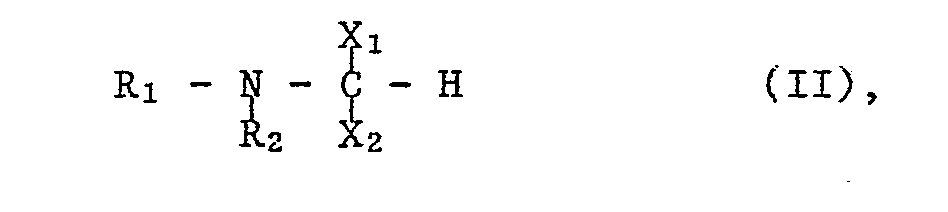
- a) in einer an einem substituierbaren N-Atom des Restes Ri gegebenenfalls intermediär geschützten Verbindung der Formel
- b) eine an einem substituierbaren N-Atom des Restes R1 gegebenenfalls intermediär geschützte Verbindung der Formel

- Gemäss der Verfahrensvariante a) in Phosphono zu überführende funktionell abgewandelte Phosphonogruppen X liegen beispielsweise in einer Esterform, insbesondere einer Diesterform der Formel -P(=O)(OR)2 (Ila)
vor, worin OR beispielsweise Nideralkoxy oder eine gegebenenfalls durch Niederalkyl, Niederalkoxy, Halogen, Trifluormethyl und/oder Hydroxy substituierte Phenyloxygruppe bedeutet. - Die Ueberführung einer funktionell abgewandelten in die freie Phosphonogruppe erfolgt in üblicher Weise durch Hydrolyse, beispielsweise in Gegenwart einer Mineralsäure, wie Chlor- bzw. Bromwasserstoffsäure oder Schwefelsäure, oder durch Umsetzung mit einem Triniederalkyl-halogensilan, z.B. mit Trimethylchlorsilan oder insbesondere Trimethyljodsilan oder Trimethylbromsilan, vorzugsweise unter Kühlen, z.B. im Temperaturbereich von etwa 0° bis etwa 25°C.
- Die Ausgangsstoffe der Formel II können beispielsweise hergestellt werden, indem man eine Verbindung der Formel




- In Zwischenprodukten II, worin der Rest R1 durch Niederalkyl oder unsubstituiertes oder durch Niederalkyl, Niederalkoxy und/oder Halogen substituiertes Phenylniederalkyl N-substituiert ist, kann man den N-Substituenten abspalten, Niederalkyl beispielsweise durch Behandeln mit einem Halogenameisensäureester, wie einem Brom- oder Chlorameisensäureniederalkylester, und anschliesseide Hydrolyse des gebildeten Carbamates und a-Fhenylniederalkylreste beispielsweise durch Hydrcgenolyse, z.B. Behandeln mit Wasserstoff in Gegenwart eines Hydrierungs-Katalysators, z.B. von Palladium auf Kohle oder/und Platinoxid, oder durch metallische Reduktion, z.B. Behandlung mit einem Alkalimetall in Ammoniak.
- Man kann den Ausgangsstoff IIb aber auch ir an sich bekannter Weise in Gegenwart eines Ortroameisensäuretriesters IIc mit dem Phosphorigsäurediesters IIe umsetzen, ohne die Zwischenstufe zu isolieren. So setzt man gemäss einer besoncers bevorzugten Ausführungsform in der Siedehitze die entsprechende Verbindung IIb in Gegenwart der mindestens äquimolekularen Menge eines Ortroameisensäuretriesters IIc mit der mindest doppeltmolaren Menge des Phosphorig säurediesters IIe um, ohne die Zwischenstufe, z.B. der Formel IId1 bzw. IId2, zu isolieren, und hydrolysiert das Primärprocukt II durch Behandeln mit wässriger Salzsäure in der Siedehitze.
- Die Umsetzung von Verbindungen III mit Phosphortrioxid gemäss Verfahrensvariante b) erfolgt vorzugsweise unter in-situ Bildung des letzteren, beispielsweise durch Umsetzung von Phosphortrichlorid und phosphoriger Säure bei erhöhter Temperatur, z.B. bei etwa 50 bis 65°C, Hinzufügen der Reaktionskomponente III, weiteres Erwärmen und hydrolytische Aufarbeitung des Primärproduktes, eines 1:1-Adduktes des Aldehydes der Formel

- In einer Abwandlung dieser bevorzugten Ausführungsform der Verfahrensvariante b) setzt man bei etwa 50° C bis 70" C Orthophosphorsäure mit einem etwa 1,1- bis etwa 2-fachen, vorzugsweise etwa 1,5-fachen Ueberschuss an Phosphortrichlorid um, fügt die Reaktionskomponente III hinzu, erwärmt längere Zeit auf etwa 50°C bis 70°C, verdünnt mit 80 %-iger Phosphorsäure und arbeitet hydrolytisch auf.
- Ausgangsstoffe III können in üblicher Weise hergestellt werden, beispielsweise durch Umsetzung eines Amins der Formel


- Für den intermediären Schutz eines substituierbaren N-Atoms des Restes R1 eignen sich die üblichen N-Schutzgruppen und Einführungsund Abspaltungsverfahren derselben, beispielsweise 2,2,2-Trihalogen-, wie 2,2,2-Trijod-, 2,2,2-Tribrom- oder 2,2,2-Trichloräthoxycarbonylreste, die z.B. durch Behandeln mit Zink in Essigsäure abgespalten werden können, a-Phenylniederalkoxycarbonylreste, wie Carbobenzoxy, die z.B. durch Katalytische Hydrierung abgespalten werden können, sowie Niederalkansulfonylgruppen wie Methansulfonyl, die z.B. durch Behandeln mit Bis(2-Methoxyäthoxy)-na- triumaluminiumhydrid abgespalten werden können, ebenso aber auch a-Phenylalkyl- oder Alkylgruppen, deren Abspaltung nachstehend behandelt wird. Verfahrensgemäss oder nach einem anderen an sich bekannten Verfahren erhaltene Verbindungen der Formel I können in an sich bekannter Weise in andere Verbindungen der Formel I überführt werden. So kann man Verbindungen der Formel 1, worin R2 Wasserstoff bedeutet, durch Umsetzung mit einem reaktiven Ester, wie einem Halogenwasserstoffsäureester oder organischen Sulfonsäureester, eines Niederalkanols Niederalkyl R2 einführen. Man kann aber auch durch Umsetzung mit einem aliphatischen Aldehyd, z.B. mit Formaldehyd und Ameisensäure, einen aliphatischen Rest, z.B. Methyl, einführen. Ferner kann man in Verbindungen der Formel I, worin der Rest R1 durch Niederalkyl oder unsubstituiertes oder durch Niederalkyl, Niederalkoxy und/ oder Halogen substituiertes Phenylniederalkyl N-substituiert ist, den N-Substituenten abspalten, Niederalkyl beispielsweise durch Behandeln mit einem Halogenameisensäureester, wie einem Brom-oder Chlorameisensäureniederalkylester, und anschliessende Hydrolyse des gebildeten Carbamates und a-Phenyl-Niederalkylreste beispielsweise durch Hydrogenolyse, z.B. Behandeln mit Wasserstoff in Gegenwart eines Hydrierungs-Katalysators, z.B. von Palladium auf Kohle oder/und Platinoxid oder durch metallische Reduktion, z.B. Behandlung mit einem Alkalimetall in Ammoniak.
- Erhaltene freie Verbindungen der Formel einschliesslich ihrer inneren Salze der Formel 1 können durch partielle oder vollständige Neutralisation mit einer der eingangs genannten Basen in Basesalze überführt werden. In analoger Weise kann man auch Säureadditionssalze der Formel I" in die entsprechenden freien Verbindungen der Formel I bzw. inneren Salze der Formel I' überführen.
- Umgekehrt kann man erhaltene freie Verbindungen der Formel I durch Behandlung mit einer der eingangs genannten Protonensäuren in Säureadditionssalze der Formel I" überführen.
- Erhaltene Salze können in an sich bekannter Weise in die freien Verbindungen umgewandelt werden, z.B. durch Behandeln mit einem sauren Reagens, wie einer Mineralsäure, bzw. einer Base, z.B. Alkalilauge.
- Die Verbindungen einschliesslich ihrer Salze können auch in Form ihrer Hydrate erhalten werden oder das zur Krisallisation verwendete Lösungsmittel einschliessen.
- Infolge der engen Beziehung zwischen den neuen Verbindungen in freier Form und in Form ihrer Salze sind in vorausgegangenen und nachfolgend unter den freien Verbindungen oder ihren Salzen sinn-und zweckgemäss gegebenenfalls auch die entsprechenden Salze bzw. freien Verbindungen zu verstehen.
- Die Erfindungen betrifft auch diejenigen Ausführungsformen des Verfahrens, nach denen man von einer auf irgendeiner Stufe des Verfahrens als Zwischenprodukt erhältlichen Verbindungen ausgeht und die fehlenden Schritte durchführt oder einen Ausgangsstoff in Form eines Salzes und/oder Racemates bzw. Antipoden verwendet oder insbesondere unter den Reaktionsbedingungen bildet.
- Die Erfindung betrifft ebenfalls bekannte Verbindungen der Formel 1, worin R1 einen unsubstituierten oder durch Niederalkyl und/oder Halogen mono-oder disubstituierten Pyrazol-3-ylrest oder Isoxazol-3-ylrest bedeutet und R2 Wasserstoff darstellt, namentlich 1-(Pyrazol-3-ylamino)methan-1,1-diphosphonsäure, 1-(4-Methylpyrazol-3-ylamino)methan-1,1-diphosphonsäure, 1-(5-Methylpyrazol-3-ylamino)-methan-1,1-diphosphonsäure, 1-(Isoxa- zol-3-ylamino)methan-1,1-diphosphonsäure, 1-(4-Methylisoxazol-3-ylamino) methan-1,1-diphosphonsäure oder 1-(5-Methylisoxazol-3-ylamino- methan-1,1-diphosphonsäure, oder jeweils ein pharmazeutisch verwendbares Salz davon zur Anwendung In einem Verfahren zur Behandlung des menschlichen oder tierischen Körpers bzw. der Verwendung zur Herstellung eines den Calcium- stoffwechsel regulierenden Arzneimittels.
- Die Erfindung betrifft weiterhin pharmazeutische Präparate enthaltend eine Verbindung der Formel I einschliesslich der vorstehend als bekannt bezeichneten oder ein pharmazeutisch verwendbares Salz davon.
- Beim Verfahren der vorliegenden Erfindung werden vorzugsweise solche Ausgangsstoffe verwendet, welche zu den eingangs als besonders wertvoll geschilderten Verbindungen führen. Neue Ausgangsstoffe und Verfahren zu deren Herstellung bilden ebenfalls einen Gegenstand der Erfindung. Bei den erfindungsgemässen pharmazeutischen Präparaten, welche Verbindungen der Formel oder pharmazeutisch verwendbare Salze davon enthalten, handelt es sich um solche zur enteralen, wie oralen oder rektalen, und parenteralen Verabreichung, welche den pharmakologischen Wirkstoff allein oder zusammen mit einem pharmazeutisch anwendbaren Trägermaterial enthalten. Die Dosierung des Wirkstoffs hängt von der Warmblüter-Spezies, dem Alter und dem individuellen Zustand, sowie von der Applikationsweise ab. Im Normalfall ist für einen etwa 75 kg schweren Warmblüter bei oraler Applikation eine ungefähre Tagesdosis von etwa 20 bis 1000 mg, vorzugsweise etwa 30 bis 300 mg, bzw. bei intravenöser Verabreichung etwa 1 bis 25 mg, vorzugsweise etwa 1 bis 10 mg, vorteilhaft in mehreren gleichen Teildosen verteilt, zu veranschlagen.
- Die neuen pharmazeutischen Präparate enthalten z.B. von etwa 10 % bis etwa 80 o/o, vorzugsweise von etwa 20 % bis etwa 60 % des Wirkstoffs. Erfindungsgemässe pharmazeutische Präparate zur enteralen bzw. parenteralen Verabreichung sind z.B. solche in Dosiseinheitsformen wie Dragees, Tabletten, Kapseln oder Suppositorien, ferner Ampullen. Diese werden in an sich bekannter Weise, z.B. mittels konventioneller Misch-, Granulier-, Dragier-, Lösungs- oder Lyophilisierungsverfahren hergestellt. So kann man pharmazeutische Präparate zur oralen Anwendung erhalten, indem man den Wirkstoff mit festen Trägerstoffen kombiniert, ein erhaltenes Gemisch gegebenenfalls granuliert, und das Gemisch bzw. Granulat, wenn erwünscht oder notwendig, nach Zugabe von geeigneten Hilfsstoffen, zu Tabletten oder Drageee-Kernen verarbeitet.
- Geeignete Trägerstoffe sind insbesondere Füllstoffe, wie Zucker, z.B. Lactose, Saccharose, Mannit oder Sorbit, Cellulosepräparate und/oder Calciumphosphate, z.B. Tricalciumphosphat oder Calciumhydrogenphosphat, ferner Bindemittel, wie Stärkekleister unter Verwendung z.B. vom Mais-, Weizen-, Reis- oder Kartoffelstärke, Gelatine, Tragaganth, Methylcellulose und/oder Polyvinylpyrrolidon, und/ oder, wenn erwünscht, Sprengmittel, wie die obgenannten Stärken, ferner Carboxymethylstärke, quervernetztes Polyvinylpyrrolidon, Agar, Alginsäure oder ein Salz davon, wie Natriumalginat. Hilfsmittel sind in erster Linie Fliessregulier- und Schmiermittel, z.B. Kieselsäure, Talk, Stearinsäure oder Salze davon, wie Magnesium- oder Calciumstearat, und/ oder Polyäthylenglykol. Drageee-Kerne werden mit geeigneten, gegebenenfalls Magensaft-resistenten Ueberzügen versehen, wobei man u.a. konzentrierte Zuckerlösungen, welche gegebenenfalls arabischen Gummi, Talk, Polyvinylpyrrolidon, Polyäthylenglykol und/oder Titandioxid enthalten, Lacklösungen in geeigneten organischen Lösungsmitteln oder Lösungsmittelgemischen oder, zur Herstellung von Magensaft-resistenten Ueberzügen, Lösungen von geeigneten Cellulosepräparaten, wie Acetylcellulosephthalat oder Hydroxypropylmethylcellulosephthalat, verwendet. Den Tabletten oder Dragee-Ueberzügen können Farbstoffe oder Pigmente, z.B. sur Identifizierung oder zur Kennzeichnung verschiedener Wirkstoffdosen, beigefügt werden.
- Weitere oral anwendbare pharmazeutische Präparate sind Steckkapseln aus Gelatine, sowie weiche, geschlossene Kapseln aus Gelatine und einem Weichmacher, wie Glycerin oder Sorbitol. Die Steckkapseln können den Wirkstoff in Form eines Granulats, z.B. im Gemisch mit Füllstoffen, wie Lactose, Bindemitteln, wie Stärken, und/oder Gleitmitteln, wie Talk oder Magnesiumstearat, und gegebenenfalls von Stabilisatoren, enthalten. In weichen Kapseln ist der Wirkstoff vorzugsweise in geeigneten Flüssigkeiten, wie fetten Oelen, Paraffinöl oder flüssigen Polyäthylenglykolen, gelöst oder suspendiert, wobei ebenfalls Stabilisatoren zugefügt sein können.
- Als rektal anwendbare pharmazeutische Präparate kommen z.B. Suppositorien in Betracht, welche aus einer Kombination des Wirkstoffs mit einer Supossitoriengrundmasse bestehen. Als Suppositoriengrundmasse eignen sich z.B. natürliche oder synthetische Triglyceride, Paraffinkohlenwasserstoffe, Polyäthylenglykole oder höhere Alkanole. Ferner können auch Gelatine-Rektalkapseln verwendet werden, die eine Kombination des Wirkstoffs mit einer Grundmasse enthalten; als Grundmassenstoffe kommen z.B. flüssige Triglyceride, Polyäthylenglykole oder Paraffinkohlenwasserstoffe in Frage.
- Zur parenteralen Verabreichung eignen sich in erster Linie wässrige Lösungen eines Wirkstoffs in wasserlöslicher Form, z.B. eines wasserlöslichen Salzes, ferner Suspensionen des Wirkstoffs, wie entsprechende ölige Injektionssuspensionen, wobei man geeignete lipophile Lösungsmittel oder Vehikel, wie fette Oele, z.B. Sesamöl, oder synthetische Fettsäureester, z.B. Aethyloleat oder Triglyceride, verwendet, oder wässrige Injektionssuspensionen, welche viskositätserhöhende Stoffe, z.B. Natriumcarboxymethylcellulose, Sorbit und/oder Dextran und gegebenenfalls auch Stabilisatoren enthalten.
- Die vorliegende Erfindung betrifft ebenfalls die Verwendung der Verbindungen der Formeln und ihrer Salze, vorzugsweise zur Behandlung von auf Störungen des Calciumstoffwechsels zurückzuführende Erkrankungen, z.B. des rheumatischen Formenkreises, und besonders von Osteoporosen.
- Dosierungen unter 0,01 mg/kg Körpergewicht beeinflussen die pathologische Verkalkung bzw. die Auflösung von harten Geweben nur unerheblich. Bei Dosierungen von über 100 mg/kg Körpergewicht können langfristig toxische Nebenwirkungen auftreten. Die Verbindungen der Formel I und ihre Salze können sowohl oral als auch hypertonischer Lösung subkutan, intramuskulär oder intravenös appliziert werden. Die bevorzugten Tagesdosen für diese Anwendungen liegen bei oraler Anwendung im Bereich von etwa 0,1 bis 5 mg/kg, bei subkutaner und intramuskulärer Applikation im Bereich von etwa 0.1 bis 1 mg/kg und bei intravenöser Applikation im Bereich von etwa 0,01 bis 2 mg/kg.
- Die Dosierung der verwendeten Verbindungen ist jedoch variabel und hängt von den jeweiligen Konditionen wie Art und Schwere der Erkrankung, Dauer der Behandlung und der jeweiligen Verbindung ab. Einzeldosen enthalten beispielsweise von 0,01 bis 10 mg, Dosiseinheitsformen für parenterale, wie intravenöse Applikation z.B. von 0,01 bis 0,1 mg, vorzugsweise 0,02 bis 0,08 mg, orale Dosiseinheitsformen z.B. von 0,2 bis 2,5 mg, vorzugsweise 0,3 bis 1,5 mg pro kg Körpergewicht. Die bevorzugte Einzeldosierung beträgt bei oraler Applikatlon 10 bis 100 mg und bei intravenöser Applikation 0,5 bis 5 mg und kann in bis zu 4 Einzeldosen täglich verabreicht werden. Die höheren Dosierungen bei oraler Applikation sind infolge der begrenzten Resorption erforderlich. Bei längerdauernden Behandlungen kann nach anfänglich höherer Dosierung normalerweise auf niedrige Dosierungen umgestellt werden, um den gewünschten Effekt aufrechtzuerhalten. Die nachfolgenden Beispiele illustrieren die oben beschriebene Erfindung: sie sollen jedoch diese in ihrem Umfang in keiner Weise einschränken. Temperaturen sind in Celsiusgraden angegeben.
- 6,57 g (17 mMol) 1-(Thiazol-2-ylamino)methan-1,1-diphosphonsäuretetraäthylester werden in 70 ml n-Salzsäure gelöst und 6 Stunden zum Rückfluss erhitzt. Im Verlaufe der Reaktion fällt das Produkt in Form eines feinen weissen Niederschlags aus. Nach Kühlen auf Raumtemperatur wird filtriert und mit wässrigem Methanol gewaschen. Man erhält 4,33 g (93 % d.Th.) 1-(Thiazol-2-ylamino)-methan-1,1-diphosphonsäure vom Smp. 275° (Zers.).
- Das Ausgangsmaterial kann z.B. folgendermassen hergestellt werden:
- Eine Mischung, bestehend aus 10.0 g (0.1 Mol) 2-Aminothiazol, 20.0 ml (0.12 Mol) Orthoameisensäuretriäthylester und 26.6 ml (0.2 Mol) Diäthylphosphit wird 1 Stunde zum Rückfluss erhitzt. Das freigesetzte Aethanol wird abdestilliert, wobei die Innentemperatur allmählich auf etwa 150° ansteigt. Der Rückstand wird in Chloroform aufgenommen und über Kieselgel filtriert. Das Rohprodukt wird durch Säulenchromatographie (Kieselgel/Essigester) gereinigt. Man erhält 4.37 g (11 % d.Th.) 1-(Thiazol-2-ylamino)methan-1,1-diphosphonsäure- tetraäthylester vom Smp. 103-104°.
- In analoger Weise wie in Beispiel 1 beschrieben kann man auch 1-(Oxazol-2-ylamino)methan-1,1-diphosphonsäure und Smp. 245° (Zers.) und 1-(Benzoxazol-2-ylamino)methan-1,1-diphosphonsäure, Smp. 270" (Zers.), herstellen.
- 4,36 g (10 mMol) 1-(Benzthiazol-2-ylamino)methan-1,1-diphosphonsäure-tetraäthylester werden in 40 ml n-Salzsäure 6 Stunden auf 110` -120° erhitzt. Im Verlaufe der Reaktion fällt das Produkt in Form eines weissen Niederschlags aus. Nach Kühlen auf Raumtemperatur wird filtriert und mit wässrigem Methanol gewaschen. Man erhält 3,09 g (95% d.Th.) 1-(Benzthiazol-2-ylamino)methan-1,1-diphosphonsäure vom Smp. 290° (Zers.).
- Das Ausgangsmaterial kann z.B. folgendermassen hergestellt werden:
- Eine Mischung, bestehend aus 3,0 g (20 mMol) 1-Aminobenzthiazol, 4,0 ml (24 mMol) Orthoameisensäuretriäthylester und 5,3 ml (40 mMol) Diäthylphosphit wird 5 Stunden auf 120"-125° erhitzt. Der zu Beginn der Reaktion ausfallende gelbe Niederschlag geht allmählich wieder in Lösung. Das freigesetzte Aethanol wird während der Reaktion abdestilliert. Das beim Stehenlassen fest werdende Rohprodukt wird durch Säulenchromatographie (Kieselgel/Essigester/Methanol) gereinigt. Man erhält 5,62 g (64% d.Th.) 1-(Benzthiazol-2-ylami- no)methan-1,1-diphosphonsäure-tetraäthylester vom Smp. 165-167°.
- 1,30 g (3,2 mMol) 1-(4-Methylthiazol-2-ylami- no)methan-1,1-diphosphonsäure-tetraäthylester werden in 20 ml In-Salzsäure während 20 h auf 100° erhitzt. Nach dem Abkühlen wurden 20 ml Methanol zugegeben. Während dem anschliessenden Rühren fällt das Produkt in Form feiner weisser Kristalle aus. Das Filtrat wird mit Methanol und Petroläther nachgewaschen. Ausbeute: 615 mg (67 % d.Th.) 1-(4-Methylthiazol-2-ylamino)methan-1,1-diphosphonsäure vom Smp. 294° (Zers.).
- Das Ausgangsmaterial kann z.B. folgehdermassen hergestellt werden:
- Eine Mischung, bestehend aus 2,33 g (20 mMol) 2-Amino-4-methylthiazol, 4,0 ml (24 mMol) Orthoameisensäuretriäthylester und 5,3 ml (40 mmol) Diäthylphosphit wird 4 Stunden auf 120-125° erhitzt. Das freigesetzte Aethanol wird abdestilliert. Der Rückstand wird durch Säulenchromatographie (Kieselgel/Essigester/Methanol) gereinigt. Man erhält 1,32 g (17 % d.Th.) 1-(4-Methylthiazol-2-ylami- no)methan-1,1-diphosphonsäure-tetraäthylester in Form eines viskosen Oels.
- 1,97 g (4,9 mMol) 1-(5-Methylthiazol-2-ylami- no)methan1,1-diphosphonsäure-tetraäthylester werden in 20 ml n-Salzsäure 6 Stunden zum Rückfluss erhitzt. Beim Abkühlen und Stehenlassen bei Raumtemperatur kristallisiert das Produkt. Es wurde filtriert und mit Aceton und Petroläther gewaschen. Ausbeute: 0,64 g (45 % d.Th.) 1-(5-Me- thylthiazol-2-ylamino)methan-1,1-diphosphonsäure vom Smp. 208° (Zers.).
- Das Ausgangsmaterial kann z.B. folgendermassen hergestellt werden:
- Eine Mischung, bestehend aus 1,14 g (10 mMol) 2-Amino-5-methylthiazol, 2,0 ml (12 mMol) Örthoameisensäuretriäthyiester und 2,65 ml (20 mMol) Diäthylphosphit wird 4 1/2 Stunden auf 120-125° erhitzt. Das freigesetzte Aethanol wird abdestilliert. Der Rückstand wird durch Säulenchromatographie (Kieselgel/Essigester/Methanol) gereinigt. Man erhält 1,97 g (49% d.Th.) 1-(5-Methylthiazol-2-ylami- no)methan-1,1-diphosphonsäure-tetraäthylesfer in Form eines viskosen Oels.
- 4,02 g (8,7 mMol) 1-(5-Phenylthiazol-2-ylami- no)methan-1,1-diphosphonsäuretetraäthylesfer werden in 30 ml n-Salzsäure 18 Stunden zum Rückfluss erhitzt. Nach Abkühlen auf Raumtemperatur wird etwas Methanol zugegeben und filtriert. Das Filtrat wird 1 Stunde in Methanol zum Rückfluss erhitzt, heiss filtriert und 2-mal mit heissem Methanol gewaschen. Ausbeute: 2,90 g (95 % d.Th.) 1-(5-Phe- nylthiazol-2-ylamino)methan-1,1-diphosphonsäure vom Smp. 290° (Zers.).
- Das Ausgangsmaterial kann z.B. folgendermassen hergestellt werden:
- Eine Mischung, bestehend aus 2,93 g (16,6 mMol) 2-Amino-5-phenylthiazol, 3,3 ml (19,9 mMol) Orthoameisensäuretriäthylester und 4,4 ml (33,5 mMol) Diäthylphosphit wird zunächst während 2 Stunden auf 120°, dann 2 Stunden auf 130° erhitzt. Freigesetztes Aethanol wird im Verlaufe der Reaktion abdestilliert. Das sich beim Abkühlen verfestigende Produkt wird durch Chromatographie (Kieselgel/Essigester/Methanol) gereinigt. Man erhält 4.12 g (54 % d.Th) 1-(5-Phenylthiazol-2-ylamino)methan-1,1-diphosphorsäure-tetraäthylester vom Smp. 151-153°.
- 2,5 g (5,96 mMol) 1-(1-Benzimidazol-2-ylami- no)methan-1,1-diphosphonsäuretetraäthylester werden in 25 ml 1 n-Salzsäure gelöst und 26 Stunden auf 100-110° erwärmt. Im Verlauf der Reaktion fällt das Produkt in Form eines feinen, weissen Niederschlags aus. Es wird heiss filtriert und mit Wasser und anschliessend mit Methanol gewaschen. Man erhält 0,23 g (13% d.Th.) 1-(1-Benzimidazol-2-ylami- no)methan-1,1-diphosphonsäure vom Smp. 265° (Zers.).
- Das Ausgangsmaterial kann z.B. folgendermassen hergestellt werden.
- 6,66 g (50 mMol) 2-Aminobenzimidazol, 10,0 ml (60 mMol) Orthoameisensäuretriäthylester und 13,3 ml (101 mMol) Diäthylphosphit werden vermischt und 2 Stunden bei 125-130° gerührt, bis kein Aethanol mehr abdestilliert. Der Rückstand wird durch Säulenchromatographie (Kieselgel/Essigester/Methanol, 9:1) gereinigt. Man erhält 2,89 g (14 % d.Th.) 1-(1-Benzimidazol-2-ylamino)methan-1,1-diphosphonsäuretetraäthylester vom Smp. 169-170°.
- 7 g Phosphortrichlorid werden mit 4,0 g phosphoriger Säure vermischt und eine Stunde unter Rühren auf 60° erwärmt. Man fügt 6,12 g N-(Thiazol-2-yl)formamid hinzu und erwärmt weitere 6 Stunden auf etwa 60°. Dann verrührt man mit 30 ml Wasser, saugt ab, wäscht mit wässrigem Methanol nach und trocknet unter vermindertem Druck. Man erhält 2,0 g 1-(Thiazol-2-ylamino)methan-1,i-diphosphonsäure vom Smp. 275° (Zers.).
- 2,0 g (20,4 mMol) kristalline Orthophosphorsäure werden mit 3,5 g (25,5 mMol) Phosphortrichlorid 1 Stunde bei 55-60° gerührt. Danach gibt man 4,08 g (20,0 mMol) N-(4-Phenylthiazol-2-yl)formamid hinzu. Die Reaktionsmischung wird etwa 24 Stunden bei 60° stehengelassen. Zur Verdünnung gibt man 10 ml 80 %-ige Phosphor säure 80 %ig hinzu und lässt über Nacht bei Raumtemperatur stehen. Darauf erhitzt man erneut auf 60-70° und gibt weitere 1,37 g (10 mMol) Phosphortrichlorid hinzu, lässt 2 Stunden 60-70° weiterrühren, fügt 30 ml Wasser und 20 ml Aceton hinzu und lässt 2 Stunden bei 60° ausrühren. Man lässt auf Raumtemperatur abkühlen, filtriert den feinen, blassgelben Niederschlag ab und wäscht mit Wasser/Aceton 3:2. Der Rückstand wird gereinigt, indem man 1- mal mit Wasser/Aceton 1:1 und 2- mal mit Methanol auskocht. Man erhält 180 mg (2,6 o/o d.Th.) 1-(4-Phenylthiazol-2-ylamino)methan-1-diphosphonsäure vom Smp. 298° (Zers.)
- Das Ausgangsmaterial kann folgendermassen hergestellt werden:
- 13,22 g (75 mMol) 2-Amino-4-phenylthiazol werden 5 Stunden mit 40 ml Ameisensäure auf 110° erwärmt. Man lässt auf Raumtemperatur abkühlen und giesst auf Eis. Es fällt ein weisser Niederschlag aus, der abfiltriert und mit Eiswasser nachgewaschen wird. Man kristallisiert aus Petrolether um und erhält 7,01 g (45,8 % d.Th) 4-(Phenylthiazol-2-amino)formamid vom Smp. 161-164°.
- In an sich bekannter Weise, z.B. wie in den Beispielen 1 bis 7 beschrieben, kann man ferner herstellen:
- 1-(Imidazol-2-ylamino)methan-1,1-diphosphonsäure,
- 1-(lmidazol-4-ylamino )methan-1,1-diphosphonsäure,
- 1-(1-Methylimidazol-2-ylamino)methan-1,1-diphosphonsäure,
- 1-(Tetrazol-5-ylamino)methan-1,1-diphosphonsäure,
- 1-(Oxazol-2-ylamino)methan-1,1-diphosphonsäure,
- 1-(1,3,4-Thiadiazol-2-ylamino)methan-1,1-diphosphonsäure,
- 1-(5-Methyl-1,3,4-thiadiazol-2-ylamino)methan-1,1-diphosphonsäure,
- Smp. 260° (Zers.),
- 1-(3-Phenyl-1.2,4-thiadiazol-5-ylamino)methan-1,1-diphosphonsäure,
- Tabletten, enthaltend 50 mg Wirkstoff, z.B. 1-(Thiazol-2-ylamino)methan-1,1-diphosphonsäure oder ein Salz, z.B. das Natriumsalz, davon, können folgendermassen hergestellt werden:
- Bestandteile (für 1000 Tabletten)

- Sämtliche festen Ingredienzien werden zunächst durch ein Sieb mit 0,6 mm Maschenweite getrieben. Dann wird der Wirkstoff, die Lactose, das Talkum, das Magnesiumstearat und die Hälfte der Stärke vermischt. Die andere Hälfte der Stärke wird in 40 ml Wasser suspendiert und diese Suspension zu einer siedenden Lösung des Polyäthylenglykols in 100 ml Wasser hinzugegeben und das Gemisch, wenn nötig unter Hinzufügen von Wasser, granuliert. Das Granulat wird über Nacht bei 35° getrocknet, durch ein Sieb mit 1,2 mm Maschenweite getrieben und zu beidseitig konkaven Tabletten von etwa 6 mm Durchmesser verpresst.
- Tabletten, enthaltend 100 mg Wirkstoff, z.B. 1-(Thiazol-2-ylamino)methan-1,1-diphosphonsäure oder ein Salz, z.B. das Natriumsalz, davon können folgendermassen hergestellt werden: Bestandteile (für 1000 Tabletten)

- Sämtliche festen Ingredienzien werden zunächst durch ein Sieb mit 0,6 mm Maschenweite getrieben. Dann wird der Wirkstoff, die Lactose, das Talkum, das Magnesiumstearat und die Hälfte der Stärke vermischt. Die andere Hälfte der Stärke wird in 40 ml Wasser suspendiert und diese Suspension zu einer siedenden Lösung des Polyäthylenglykols in 100 ml Wasser hinzugegeben und das Gemisch, wenn nötig unter Hinzufügen von Wasser, granuliert. Das Granulat wird über Nacht bei 35° getrocknet, durch ein Sieb mit 1,2 mm Maschenweite getrieben und zu beidseitig konkaven Tabletten von etwa 6 mm Durchmesser verpresst.
- In analoger Weise wie in den Beispielen 11 und 12 beschrieben können auch Tabletten, enthaltend jeweils 100 mg bzw. 50 mg einer anderen der in den Beispielen 1 bis 10 genannten Verbindungen der Formel 1 hergestellte werden, wobei diese auch in Form von Salzen und Basen, z.B. als Dinatriumsalz, vorliegen können.
- Kautabletten, enthaltend 75 mg Wirkstoff, z.B. 1-(Thiazol-2-ylamino)methan-1,1-diphosphonsäure oder ein Salz, z.B. das Natriumsalz davon, können z.B. folgendermassen hergestellt werden: Zusammensetzung: (für 1000 Tabletten)
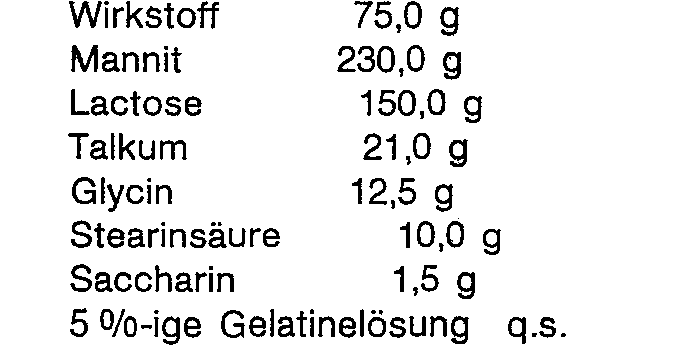
- Alle festen Ingredienzien werden zunächst durch ein Sieb mit 0,25 mm Maschenweite getrieben. Der Mannit und die Lactose werden gemischt, unter Hinzufügen von Gelatinelösung granuliert, durch ein Sieb mit 2 mm Maschenweite getrieben, bei 50° getrocknet und nochmals durch ein Sieb mit 1,7 mm Maschenweite getrieben. Der Wirkstoff, das Glycin und das Saccharin werden sorgfältig vermischt, der Mannit, das Lactosegranulat, die Stearinsäure und das Talkum hinzugegeben, das Ganze gründlich vermischt und zu beidseitig konkaven Tabeitten von etwa 10 mm Durchmesser mit Bruchrille auf der Oberseite verpresst.
- In analoger Weise können auch Tabletten, enthaltend jeweils 75 mg einer anderen der in den Beispielen 1 bis 10 genannten Verbindungen der Formel I hergestellt werden, wobei diese auch in Form von Salzen mit Basen, z.B. als Dinatriumsalz, vorliegen können.
- Tabletten, enthaltend 10 mg Wirkstoff, z.B. 1-(Thiazol-2-ylamino)methan-1,1-diphosphonsäure oder ein Salz, z.B. das Natriumslaz davon, können folgendermassen hergestellt werden: Zusammensetzung (für 1000 Tabletten)
-

- Die festen Ingredienzien werden zunächst durch ein Sieb mit 0,6 mm Maschenweite getrieben. Dann werden Wirkstoff, Lactose, Talkum, Magnesiumstearat und die Hälfte der Stärke innig vermischt. Die andere Hälfte der Stärke wird in 65 ml Wasser suspendiert und diese Suspension zu einer siedenden Lösung des Polyäthylenglykols in 260 ml Wasser hinzugegeben. Der erhaltene Kleister wird zu den pulverförmigen Substanzen hinzugefügt, das Ganze vermischt und granuliert, erforderlichenfalls unter Zugabe von Wasser. Das Granulat wird über Nacht bei 35° getrocknet, durch ein Sieb mit 1,2 mm Maschenweite getrieben und zu beidseitig konkaven Tabletten von etwa 10 mm Durchmesser mit Bruchkerbe auf der Oberseite verpresst.
- In analoger Weise können auch Tabletten, enthaltend 10 mg einer anderen Verbindung der Formel I gemäss den Beispielen 1 bis 10 hergestellt werden, wobei diese auch in Form von Salzen mit Basen, z.B. als Dinatriumsalz, vorliegen können.
- Gelatinesteckkapseln, enthaltend 100 mg Wirkstoff, z.B. 1-(Thiazol-2-ylamino)methan-1,1-diphosphonsäure oder ein Salz, z.B. das Natriumsalz davon, können folgendermassen hergestellt werden:
- Zusammensetzuna (für 1000 Kapseln)

- Das Natriumlaurylsulfat wird durch ein Sieb mit einer Maschenweite von 0,2 mm zu dem Wirkstoff (Iyophilisiert) gesiebt und beide Komponenten 10 Minuten lang innig vermischt. Dann wird die mikrokristalline Cellulose durch ein Sieb mit einer Maschenweite von 0,9 mm hinzugesiebt und erneut 10 Minuten innig vermischt. Zuletzt wird das Magnesiumstearat durch ein Sieb mit einer Maschenweite von 0,8 mm hinzugesiebt und nach 3 Minuten weiteren Mischens je 390 mg der Mischung in Gelatinesteckkapseln der Grösse 0 (elongated) abgefüllt.
- In analoger Weise können auch Kapseln, enthaltend 100 mg einer anderen Verbindung der Formel gemäss den Beispielen 1 bis 10 hergestellt werden, wobei diese auch in Form von Salzen mit Basen, z.B. als Dinatriumsalz, vorliegen können.
- Eine 0,2%ige Injektions- bzw. Infusionslösung kann beispielsweise folgendermassen hergestellt werden.
- Wirkstoff, z.B. 1-(Thiazol-2-ylamino)methan-1,1-diphosphonsäure oder ein Salz, z.B. das Natriumsalz davon 5,0 g Natriumchlorid 22,5 g Phosphatpuffer pH = 7,4 300,0 g Wasser, entmin. ad 2500,0 ml
- Der Wirkstoff wird in 1000 ml Wasser gelöst und durch ein Mikrofilter filtriert. Man versetzt mit der Pufferlösung und füllt mit Wasser auf 2500 ml auf. Zur Herstellung von Dosiseinheitsformen werden je 1,0 oder 2,5 ml in Glasampullen (enthaltend je 2,0 bzw. 5,0 mg Wirkstoff abgefüllt.
Smp. 198°.
Claims (24)




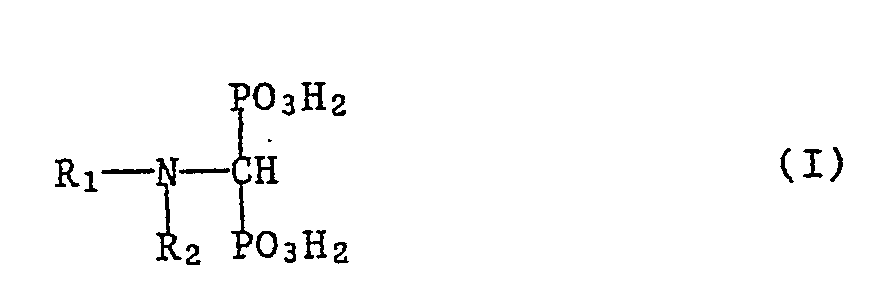

Priority Applications (1)
| Application Number | Priority Date | Filing Date | Title |
|---|---|---|---|
| AT87810665T ATE61371T1 (de) | 1986-11-21 | 1987-11-16 | Neue substituiertaminomethandiphosphonsaeuren. |
Applications Claiming Priority (2)
| Application Number | Priority Date | Filing Date | Title |
|---|---|---|---|
| CH466586 | 1986-11-21 | ||
| CH4665/86 | 1986-11-21 |
Publications (2)
| Publication Number | Publication Date |
|---|---|
| EP0274346A1 true EP0274346A1 (de) | 1988-07-13 |
| EP0274346B1 EP0274346B1 (de) | 1991-03-06 |
Family
ID=4280333
Family Applications (1)
| Application Number | Title | Priority Date | Filing Date |
|---|---|---|---|
| EP87810665A Expired - Lifetime EP0274346B1 (de) | 1986-11-21 | 1987-11-16 | Neue Substituiertaminomethandiphosphonsäuren |
Country Status (21)
| Country | Link |
|---|---|
| EP (1) | EP0274346B1 (de) |
| JP (1) | JPS63150290A (de) |
| KR (1) | KR880006217A (de) |
| AT (1) | ATE61371T1 (de) |
| AU (1) | AU605203B2 (de) |
| CA (1) | CA1324383C (de) |
| DD (1) | DD265900A5 (de) |
| DE (1) | DE3768463D1 (de) |
| DK (1) | DK168869B1 (de) |
| ES (1) | ES2038693T3 (de) |
| FI (1) | FI87653C (de) |
| GR (1) | GR3001611T3 (de) |
| HU (1) | HU201087B (de) |
| IE (1) | IE60148B1 (de) |
| IL (1) | IL84494A (de) |
| MY (1) | MY103191A (de) |
| NO (1) | NO170283C (de) |
| NZ (1) | NZ222608A (de) |
| PH (1) | PH23959A (de) |
| PT (1) | PT86166B (de) |
| ZA (1) | ZA878656B (de) |
Cited By (7)
| Publication number | Priority date | Publication date | Assignee | Title |
|---|---|---|---|---|
| EP0282309A3 (de) * | 1987-03-11 | 1990-03-14 | Yamanouchi Pharmaceutical Co. Ltd. | Azolaminomethylenbiphosphonsäurederivate |
| EP0566535A1 (de) * | 1992-04-15 | 1993-10-20 | Ciba-Geigy Ag | Methandiphosphonsäure-Formulierungen mit Ionenaustauschern |
| US5270365A (en) * | 1991-12-17 | 1993-12-14 | Merck & Co., Inc. | Prevention and treatment of periodontal disease with alendronate |
| EP0600834A1 (de) * | 1992-11-30 | 1994-06-08 | Ciba-Geigy Ag | Verwendung von Methanbiphosphonsäurederivaten zur Herstellung eines Arzneimittels zur Behandlung von Knochenbrüchen |
| WO1997012619A1 (en) * | 1995-09-29 | 1997-04-10 | Novartis Ag | Method of treating the navicular disease in horses |
| EP0831869A4 (de) * | 1995-06-07 | 1999-04-21 | Elizanor Biopharmaceuticals In | Diphosphonat derivate von therapeutisch wirksamen stoffen |
| DE10226420A1 (de) * | 2002-06-13 | 2004-01-15 | Eucro European Contract Research Gmbh & Co Kg | Verfahren zur Behandlung der Artherosklerose |
Citations (2)
| Publication number | Priority date | Publication date | Assignee | Title |
|---|---|---|---|---|
| JPS54135724A (en) * | 1978-04-11 | 1979-10-22 | Nissan Chem Ind Ltd | Preparation of amino-methylenedisulfonic acid derivative |
| EP0186405B1 (de) * | 1984-12-21 | 1991-03-06 | The Procter & Gamble Company | Pharmazeutische Zusammensetzungen, die geminale Diphosphonate enthalten |
-
1987
- 1987-11-16 ES ES198787810665T patent/ES2038693T3/es not_active Expired - Lifetime
- 1987-11-16 IL IL84494A patent/IL84494A/xx not_active IP Right Cessation
- 1987-11-16 DE DE8787810665T patent/DE3768463D1/de not_active Expired - Lifetime
- 1987-11-16 AT AT87810665T patent/ATE61371T1/de not_active IP Right Cessation
- 1987-11-16 EP EP87810665A patent/EP0274346B1/de not_active Expired - Lifetime
- 1987-11-18 FI FI875095A patent/FI87653C/fi not_active IP Right Cessation
- 1987-11-18 CA CA000552085A patent/CA1324383C/en not_active Expired - Fee Related
- 1987-11-18 PH PH36078A patent/PH23959A/en unknown
- 1987-11-19 NZ NZ222608A patent/NZ222608A/xx unknown
- 1987-11-19 DD DD87309213A patent/DD265900A5/de not_active IP Right Cessation
- 1987-11-19 PT PT86166A patent/PT86166B/pt not_active IP Right Cessation
- 1987-11-19 ZA ZA878656A patent/ZA878656B/xx unknown
- 1987-11-20 DK DK609387A patent/DK168869B1/da not_active IP Right Cessation
- 1987-11-20 MY MYPI87003074A patent/MY103191A/en unknown
- 1987-11-20 KR KR1019870013062A patent/KR880006217A/ko not_active Ceased
- 1987-11-20 IE IE314787A patent/IE60148B1/en not_active IP Right Cessation
- 1987-11-20 HU HU875159A patent/HU201087B/hu not_active IP Right Cessation
- 1987-11-20 NO NO874855A patent/NO170283C/no unknown
- 1987-11-20 JP JP62292196A patent/JPS63150290A/ja active Pending
- 1987-11-20 AU AU81452/87A patent/AU605203B2/en not_active Ceased
-
1991
- 1991-03-15 GR GR90401110T patent/GR3001611T3/el unknown
Patent Citations (2)
| Publication number | Priority date | Publication date | Assignee | Title |
|---|---|---|---|---|
| JPS54135724A (en) * | 1978-04-11 | 1979-10-22 | Nissan Chem Ind Ltd | Preparation of amino-methylenedisulfonic acid derivative |
| EP0186405B1 (de) * | 1984-12-21 | 1991-03-06 | The Procter & Gamble Company | Pharmazeutische Zusammensetzungen, die geminale Diphosphonate enthalten |
Cited By (7)
| Publication number | Priority date | Publication date | Assignee | Title |
|---|---|---|---|---|
| EP0282309A3 (de) * | 1987-03-11 | 1990-03-14 | Yamanouchi Pharmaceutical Co. Ltd. | Azolaminomethylenbiphosphonsäurederivate |
| US5270365A (en) * | 1991-12-17 | 1993-12-14 | Merck & Co., Inc. | Prevention and treatment of periodontal disease with alendronate |
| EP0566535A1 (de) * | 1992-04-15 | 1993-10-20 | Ciba-Geigy Ag | Methandiphosphonsäure-Formulierungen mit Ionenaustauschern |
| EP0600834A1 (de) * | 1992-11-30 | 1994-06-08 | Ciba-Geigy Ag | Verwendung von Methanbiphosphonsäurederivaten zur Herstellung eines Arzneimittels zur Behandlung von Knochenbrüchen |
| EP0831869A4 (de) * | 1995-06-07 | 1999-04-21 | Elizanor Biopharmaceuticals In | Diphosphonat derivate von therapeutisch wirksamen stoffen |
| WO1997012619A1 (en) * | 1995-09-29 | 1997-04-10 | Novartis Ag | Method of treating the navicular disease in horses |
| DE10226420A1 (de) * | 2002-06-13 | 2004-01-15 | Eucro European Contract Research Gmbh & Co Kg | Verfahren zur Behandlung der Artherosklerose |
Also Published As
| Publication number | Publication date |
|---|---|
| DK168869B1 (da) | 1994-06-27 |
| NZ222608A (en) | 1990-09-26 |
| NO874855D0 (no) | 1987-11-20 |
| KR880006217A (ko) | 1988-07-22 |
| AU605203B2 (en) | 1991-01-10 |
| JPS63150290A (ja) | 1988-06-22 |
| ES2038693T3 (es) | 1993-08-01 |
| FI87653B (fi) | 1992-10-30 |
| DD265900A5 (de) | 1989-03-15 |
| FI87653C (fi) | 1993-02-10 |
| IL84494A0 (en) | 1988-04-29 |
| FI875095A0 (fi) | 1987-11-18 |
| HUT46329A (en) | 1988-10-28 |
| FI875095A7 (fi) | 1988-05-22 |
| NO170283C (no) | 1992-09-30 |
| PT86166B (pt) | 1990-11-20 |
| EP0274346B1 (de) | 1991-03-06 |
| PH23959A (en) | 1990-01-23 |
| MY103191A (en) | 1993-05-29 |
| PT86166A (en) | 1987-12-01 |
| IE60148B1 (en) | 1994-06-01 |
| NO874855L (no) | 1988-05-24 |
| ZA878656B (en) | 1988-08-31 |
| AU8145287A (en) | 1988-05-26 |
| IE873147L (en) | 1988-05-21 |
| IL84494A (en) | 1992-08-18 |
| DK609387A (da) | 1988-05-22 |
| DK609387D0 (da) | 1987-11-20 |
| GR3001611T3 (en) | 1992-11-23 |
| ATE61371T1 (de) | 1991-03-15 |
| CA1324383C (en) | 1993-11-16 |
| NO170283B (no) | 1992-06-22 |
| DE3768463D1 (de) | 1991-04-11 |
| HU201087B (en) | 1990-09-28 |
Similar Documents
| Publication | Publication Date | Title |
|---|---|---|
| EP0275821B1 (de) | Neue substituierte Alkandiphosphonsäuren | |
| EP0258618B1 (de) | Neue Diphosphonsäurederivate, Verfahren zu deren Herstellung und diese Verbindungen enthaltende Arzneimittel | |
| EP0170228B1 (de) | Neue Diphosphonsäurederivate, Verfahren zu deren Herstellung und diese Verbindungen enthaltende Arzneimittel | |
| EP0272208B1 (de) | Aromatisch substituierte Azacyclo-alkylalkandiphosphonsäuren | |
| DE3623397A1 (de) | Neue diphosphonsaeurederivate, verfahren zu deren herstellung und diese verbindungen enthaltende arzneimittel | |
| CS216927B2 (en) | Method of making the new aminothiazole derivatives | |
| CH677794A5 (de) | ||
| EP0371921B1 (de) | Phenylaliphatylaminoalkandi-phosphonsäuren | |
| EP0320455B1 (de) | Araliphatylaminoalkandiphosphonsäuren | |
| EP0274346B1 (de) | Neue Substituiertaminomethandiphosphonsäuren | |
| EP0387194B1 (de) | N-substituierte Aminoalkandiphosphonsäuren | |
| US5057505A (en) | Substituted aminomethanediphosphonic acids and use in medicaments | |
| DE4011777A1 (de) | N-trisubstituierte aminoalkandiphosphonsaeuren | |
| EP0317505A1 (de) | Neue Azacycloalkylalkandiphosphonsäuren | |
| EP0473626B1 (de) | Neue diphosphonsäurederivate, verfahren zu deren herstellung und diese verbindungen enthaltende arzneimittel | |
| US5110807A (en) | Araliphatylaminoalkanediphosphonic acids | |
| EP0481920B1 (de) | Neue Benzoheterocyclylalkylaminoalkandiphosphonsäuren |
Legal Events
| Date | Code | Title | Description |
|---|---|---|---|
| PUAI | Public reference made under article 153(3) epc to a published international application that has entered the european phase |
Free format text: ORIGINAL CODE: 0009012 |
|
| 17P | Request for examination filed |
Effective date: 19871119 |
|
| AK | Designated contracting states |
Kind code of ref document: A1 Designated state(s): AT BE CH DE ES FR GB GR IT LI LU NL SE |
|
| 17Q | First examination report despatched |
Effective date: 19891030 |
|
| GRAA | (expected) grant |
Free format text: ORIGINAL CODE: 0009210 |
|
| ITF | It: translation for a ep patent filed | ||
| AK | Designated contracting states |
Kind code of ref document: B1 Designated state(s): AT BE CH DE ES FR GB GR IT LI LU NL SE |
|
| REF | Corresponds to: |
Ref document number: 61371 Country of ref document: AT Date of ref document: 19910315 Kind code of ref document: T |
|
| REF | Corresponds to: |
Ref document number: 3768463 Country of ref document: DE Date of ref document: 19910411 |
|
| ET | Fr: translation filed | ||
| GBT | Gb: translation of ep patent filed (gb section 77(6)(a)/1977) | ||
| PLBE | No opposition filed within time limit |
Free format text: ORIGINAL CODE: 0009261 |
|
| STAA | Information on the status of an ep patent application or granted ep patent |
Free format text: STATUS: NO OPPOSITION FILED WITHIN TIME LIMIT |
|
| 26N | No opposition filed | ||
| REG | Reference to a national code |
Ref country code: GR Ref legal event code: FG4A Free format text: 3001611 |
|
| REG | Reference to a national code |
Ref country code: ES Ref legal event code: FG2A Ref document number: 2038693 Country of ref document: ES Kind code of ref document: T3 |
|
| EPTA | Lu: last paid annual fee | ||
| PGFP | Annual fee paid to national office [announced via postgrant information from national office to epo] |
Ref country code: FR Payment date: 19941003 Year of fee payment: 8 |
|
| PGFP | Annual fee paid to national office [announced via postgrant information from national office to epo] |
Ref country code: AT Payment date: 19941010 Year of fee payment: 8 |
|
| PGFP | Annual fee paid to national office [announced via postgrant information from national office to epo] |
Ref country code: DE Payment date: 19941013 Year of fee payment: 8 |
|
| PGFP | Annual fee paid to national office [announced via postgrant information from national office to epo] |
Ref country code: GB Payment date: 19941018 Year of fee payment: 8 |
|
| PGFP | Annual fee paid to national office [announced via postgrant information from national office to epo] |
Ref country code: ES Payment date: 19941026 Year of fee payment: 8 |
|
| PGFP | Annual fee paid to national office [announced via postgrant information from national office to epo] |
Ref country code: LU Payment date: 19941101 Year of fee payment: 8 |
|
| PGFP | Annual fee paid to national office [announced via postgrant information from national office to epo] |
Ref country code: GR Payment date: 19941125 Year of fee payment: 8 |
|
| PGFP | Annual fee paid to national office [announced via postgrant information from national office to epo] |
Ref country code: NL Payment date: 19941130 Year of fee payment: 8 |
|
| PGFP | Annual fee paid to national office [announced via postgrant information from national office to epo] |
Ref country code: SE Payment date: 19941205 Year of fee payment: 8 |
|
| PGFP | Annual fee paid to national office [announced via postgrant information from national office to epo] |
Ref country code: BE Payment date: 19941208 Year of fee payment: 8 |
|
| EAL | Se: european patent in force in sweden |
Ref document number: 87810665.7 |
|
| PGFP | Annual fee paid to national office [announced via postgrant information from national office to epo] |
Ref country code: CH Payment date: 19950214 Year of fee payment: 8 |
|
| PG25 | Lapsed in a contracting state [announced via postgrant information from national office to epo] |
Ref country code: LU Free format text: LAPSE BECAUSE OF NON-PAYMENT OF DUE FEES Effective date: 19951116 Ref country code: GB Effective date: 19951116 Ref country code: AT Effective date: 19951116 |
|
| PG25 | Lapsed in a contracting state [announced via postgrant information from national office to epo] |
Ref country code: SE Effective date: 19951117 Ref country code: ES Free format text: LAPSE BECAUSE OF EXPIRATION OF PROTECTION Effective date: 19951117 |
|
| PG25 | Lapsed in a contracting state [announced via postgrant information from national office to epo] |
Ref country code: LI Effective date: 19951130 Ref country code: CH Effective date: 19951130 Ref country code: BE Effective date: 19951130 |
|
| BERE | Be: lapsed |
Owner name: CIBA-GEIGY A.G. Effective date: 19951130 |
|
| PG25 | Lapsed in a contracting state [announced via postgrant information from national office to epo] |
Ref country code: GR Free format text: THE PATENT HAS BEEN ANNULLED BY A DECISION OF A NATIONAL AUTHORITY Effective date: 19960531 |
|
| PG25 | Lapsed in a contracting state [announced via postgrant information from national office to epo] |
Ref country code: NL Effective date: 19960601 |
|
| GBPC | Gb: european patent ceased through non-payment of renewal fee |
Effective date: 19951116 |
|
| REG | Reference to a national code |
Ref country code: CH Ref legal event code: PL |
|
| PG25 | Lapsed in a contracting state [announced via postgrant information from national office to epo] |
Ref country code: FR Effective date: 19960731 |
|
| REG | Reference to a national code |
Ref country code: GR Ref legal event code: MM2A Free format text: 3001611 |
|
| NLV4 | Nl: lapsed or anulled due to non-payment of the annual fee |
Effective date: 19960601 |
|
| PG25 | Lapsed in a contracting state [announced via postgrant information from national office to epo] |
Ref country code: DE Effective date: 19960801 |
|
| EUG | Se: european patent has lapsed |
Ref document number: 87810665.7 |
|
| REG | Reference to a national code |
Ref country code: FR Ref legal event code: ST |
|
| REG | Reference to a national code |
Ref country code: ES Ref legal event code: FD2A Effective date: 20010301 |
|
| PG25 | Lapsed in a contracting state [announced via postgrant information from national office to epo] |
Ref country code: IT Free format text: LAPSE BECAUSE OF NON-PAYMENT OF DUE FEES;WARNING: LAPSES OF ITALIAN PATENTS WITH EFFECTIVE DATE BEFORE 2007 MAY HAVE OCCURRED AT ANY TIME BEFORE 2007. THE CORRECT EFFECTIVE DATE MAY BE DIFFERENT FROM THE ONE RECORDED. Effective date: 20051116 |