EP0250865B1 - Schneidwerkzeug - Google Patents
Schneidwerkzeug Download PDFInfo
- Publication number
- EP0250865B1 EP0250865B1 EP87107635A EP87107635A EP0250865B1 EP 0250865 B1 EP0250865 B1 EP 0250865B1 EP 87107635 A EP87107635 A EP 87107635A EP 87107635 A EP87107635 A EP 87107635A EP 0250865 B1 EP0250865 B1 EP 0250865B1
- Authority
- EP
- European Patent Office
- Prior art keywords
- titanium
- nitride
- cutting
- cutting tool
- layer
- Prior art date
- Legal status (The legal status is an assumption and is not a legal conclusion. Google has not performed a legal analysis and makes no representation as to the accuracy of the status listed.)
- Expired - Lifetime
Links
- 238000005520 cutting process Methods 0.000 title claims abstract description 35
- 238000000576 coating method Methods 0.000 claims abstract description 22
- 229910052719 titanium Inorganic materials 0.000 claims abstract description 22
- 239000010936 titanium Substances 0.000 claims abstract description 22
- RTAQQCXQSZGOHL-UHFFFAOYSA-N Titanium Chemical compound [Ti] RTAQQCXQSZGOHL-UHFFFAOYSA-N 0.000 claims abstract description 21
- 239000011248 coating agent Substances 0.000 claims abstract description 19
- ZVWKZXLXHLZXLS-UHFFFAOYSA-N zirconium nitride Chemical compound [Zr]#N ZVWKZXLXHLZXLS-UHFFFAOYSA-N 0.000 claims abstract description 19
- NRTOMJZYCJJWKI-UHFFFAOYSA-N Titanium nitride Chemical compound [Ti]#N NRTOMJZYCJJWKI-UHFFFAOYSA-N 0.000 claims abstract description 17
- MTPVUVINMAGMJL-UHFFFAOYSA-N trimethyl(1,1,2,2,2-pentafluoroethyl)silane Chemical compound C[Si](C)(C)C(F)(F)C(F)(F)F MTPVUVINMAGMJL-UHFFFAOYSA-N 0.000 claims abstract description 15
- 229910052751 metal Inorganic materials 0.000 claims abstract description 8
- 239000002184 metal Substances 0.000 claims abstract description 8
- 238000000034 method Methods 0.000 claims description 7
- XEEYBQQBJWHFJM-UHFFFAOYSA-N Iron Chemical group [Fe] XEEYBQQBJWHFJM-UHFFFAOYSA-N 0.000 claims 1
- UONOETXJSWQNOL-UHFFFAOYSA-N tungsten carbide Chemical compound [W+]#[C-] UONOETXJSWQNOL-UHFFFAOYSA-N 0.000 claims 1
- 239000007789 gas Substances 0.000 description 8
- 238000012360 testing method Methods 0.000 description 8
- IJGRMHOSHXDMSA-UHFFFAOYSA-N Atomic nitrogen Chemical compound N#N IJGRMHOSHXDMSA-UHFFFAOYSA-N 0.000 description 6
- 239000000463 material Substances 0.000 description 6
- 229910000831 Steel Inorganic materials 0.000 description 4
- 238000006243 chemical reaction Methods 0.000 description 4
- 238000005229 chemical vapour deposition Methods 0.000 description 4
- 238000003754 machining Methods 0.000 description 4
- VNWKTOKETHGBQD-UHFFFAOYSA-N methane Chemical compound C VNWKTOKETHGBQD-UHFFFAOYSA-N 0.000 description 4
- 239000000203 mixture Substances 0.000 description 4
- 239000010959 steel Substances 0.000 description 4
- 102220642147 Lipoma-preferred partner_C60N_mutation Human genes 0.000 description 3
- 238000000151 deposition Methods 0.000 description 3
- 230000008021 deposition Effects 0.000 description 3
- 239000001257 hydrogen Substances 0.000 description 3
- 229910052739 hydrogen Inorganic materials 0.000 description 3
- 229910052757 nitrogen Inorganic materials 0.000 description 3
- 229910000851 Alloy steel Inorganic materials 0.000 description 2
- UFHFLCQGNIYNRP-UHFFFAOYSA-N Hydrogen Chemical compound [H][H] UFHFLCQGNIYNRP-UHFFFAOYSA-N 0.000 description 2
- 229910052782 aluminium Inorganic materials 0.000 description 2
- -1 aluminum halide Chemical class 0.000 description 2
- 230000000694 effects Effects 0.000 description 2
- 150000002431 hydrogen Chemical class 0.000 description 2
- 150000002739 metals Chemical class 0.000 description 2
- 150000004767 nitrides Chemical class 0.000 description 2
- XJDNKRIXUMDJCW-UHFFFAOYSA-J titanium tetrachloride Chemical compound Cl[Ti](Cl)(Cl)Cl XJDNKRIXUMDJCW-UHFFFAOYSA-J 0.000 description 2
- OKTJSMMVPCPJKN-UHFFFAOYSA-N Carbon Chemical compound [C] OKTJSMMVPCPJKN-UHFFFAOYSA-N 0.000 description 1
- 239000000654 additive Substances 0.000 description 1
- 230000000996 additive effect Effects 0.000 description 1
- XAGFODPZIPBFFR-UHFFFAOYSA-N aluminium Chemical compound [Al] XAGFODPZIPBFFR-UHFFFAOYSA-N 0.000 description 1
- 229910052799 carbon Inorganic materials 0.000 description 1
- 239000000919 ceramic Substances 0.000 description 1
- 230000000052 comparative effect Effects 0.000 description 1
- 238000009792 diffusion process Methods 0.000 description 1
- 238000002474 experimental method Methods 0.000 description 1
- 230000014759 maintenance of location Effects 0.000 description 1
- 238000004519 manufacturing process Methods 0.000 description 1
- 150000001247 metal acetylides Chemical class 0.000 description 1
- 229910001092 metal group alloy Inorganic materials 0.000 description 1
- 229910052758 niobium Inorganic materials 0.000 description 1
- 230000003647 oxidation Effects 0.000 description 1
- 238000007254 oxidation reaction Methods 0.000 description 1
- TWNQGVIAIRXVLR-UHFFFAOYSA-N oxo(oxoalumanyloxy)alumane Chemical compound O=[Al]O[Al]=O TWNQGVIAIRXVLR-UHFFFAOYSA-N 0.000 description 1
- 230000000737 periodic effect Effects 0.000 description 1
- 230000002250 progressing effect Effects 0.000 description 1
- 238000000926 separation method Methods 0.000 description 1
- 238000013112 stability test Methods 0.000 description 1
- 239000000126 substance Substances 0.000 description 1
- 229910052715 tantalum Inorganic materials 0.000 description 1
- 229910052721 tungsten Inorganic materials 0.000 description 1
- 229910052845 zircon Inorganic materials 0.000 description 1
- DUNKXUFBGCUVQW-UHFFFAOYSA-J zirconium tetrachloride Chemical compound Cl[Zr](Cl)(Cl)Cl DUNKXUFBGCUVQW-UHFFFAOYSA-J 0.000 description 1
- GFQYVLUOOAAOGM-UHFFFAOYSA-N zirconium(iv) silicate Chemical compound [Zr+4].[O-][Si]([O-])([O-])[O-] GFQYVLUOOAAOGM-UHFFFAOYSA-N 0.000 description 1
Classifications
-
- B—PERFORMING OPERATIONS; TRANSPORTING
- B23—MACHINE TOOLS; METAL-WORKING NOT OTHERWISE PROVIDED FOR
- B23B—TURNING; BORING
- B23B27/00—Tools for turning or boring machines; Tools of a similar kind in general; Accessories therefor
- B23B27/14—Cutting tools of which the bits or tips or cutting inserts are of special material
- B23B27/148—Composition of the cutting inserts
-
- C—CHEMISTRY; METALLURGY
- C23—COATING METALLIC MATERIAL; COATING MATERIAL WITH METALLIC MATERIAL; CHEMICAL SURFACE TREATMENT; DIFFUSION TREATMENT OF METALLIC MATERIAL; COATING BY VACUUM EVAPORATION, BY SPUTTERING, BY ION IMPLANTATION OR BY CHEMICAL VAPOUR DEPOSITION, IN GENERAL; INHIBITING CORROSION OF METALLIC MATERIAL OR INCRUSTATION IN GENERAL
- C23C—COATING METALLIC MATERIAL; COATING MATERIAL WITH METALLIC MATERIAL; SURFACE TREATMENT OF METALLIC MATERIAL BY DIFFUSION INTO THE SURFACE, BY CHEMICAL CONVERSION OR SUBSTITUTION; COATING BY VACUUM EVAPORATION, BY SPUTTERING, BY ION IMPLANTATION OR BY CHEMICAL VAPOUR DEPOSITION, IN GENERAL
- C23C16/00—Chemical coating by decomposition of gaseous compounds, without leaving reaction products of surface material in the coating, i.e. chemical vapour deposition [CVD] processes
- C23C16/22—Chemical coating by decomposition of gaseous compounds, without leaving reaction products of surface material in the coating, i.e. chemical vapour deposition [CVD] processes characterised by the deposition of inorganic material, other than metallic material
- C23C16/30—Deposition of compounds, mixtures or solid solutions, e.g. borides, carbides, nitrides
- C23C16/32—Carbides
-
- C—CHEMISTRY; METALLURGY
- C23—COATING METALLIC MATERIAL; COATING MATERIAL WITH METALLIC MATERIAL; CHEMICAL SURFACE TREATMENT; DIFFUSION TREATMENT OF METALLIC MATERIAL; COATING BY VACUUM EVAPORATION, BY SPUTTERING, BY ION IMPLANTATION OR BY CHEMICAL VAPOUR DEPOSITION, IN GENERAL; INHIBITING CORROSION OF METALLIC MATERIAL OR INCRUSTATION IN GENERAL
- C23C—COATING METALLIC MATERIAL; COATING MATERIAL WITH METALLIC MATERIAL; SURFACE TREATMENT OF METALLIC MATERIAL BY DIFFUSION INTO THE SURFACE, BY CHEMICAL CONVERSION OR SUBSTITUTION; COATING BY VACUUM EVAPORATION, BY SPUTTERING, BY ION IMPLANTATION OR BY CHEMICAL VAPOUR DEPOSITION, IN GENERAL
- C23C16/00—Chemical coating by decomposition of gaseous compounds, without leaving reaction products of surface material in the coating, i.e. chemical vapour deposition [CVD] processes
- C23C16/22—Chemical coating by decomposition of gaseous compounds, without leaving reaction products of surface material in the coating, i.e. chemical vapour deposition [CVD] processes characterised by the deposition of inorganic material, other than metallic material
- C23C16/30—Deposition of compounds, mixtures or solid solutions, e.g. borides, carbides, nitrides
- C23C16/34—Nitrides
-
- C—CHEMISTRY; METALLURGY
- C23—COATING METALLIC MATERIAL; COATING MATERIAL WITH METALLIC MATERIAL; CHEMICAL SURFACE TREATMENT; DIFFUSION TREATMENT OF METALLIC MATERIAL; COATING BY VACUUM EVAPORATION, BY SPUTTERING, BY ION IMPLANTATION OR BY CHEMICAL VAPOUR DEPOSITION, IN GENERAL; INHIBITING CORROSION OF METALLIC MATERIAL OR INCRUSTATION IN GENERAL
- C23C—COATING METALLIC MATERIAL; COATING MATERIAL WITH METALLIC MATERIAL; SURFACE TREATMENT OF METALLIC MATERIAL BY DIFFUSION INTO THE SURFACE, BY CHEMICAL CONVERSION OR SUBSTITUTION; COATING BY VACUUM EVAPORATION, BY SPUTTERING, BY ION IMPLANTATION OR BY CHEMICAL VAPOUR DEPOSITION, IN GENERAL
- C23C16/00—Chemical coating by decomposition of gaseous compounds, without leaving reaction products of surface material in the coating, i.e. chemical vapour deposition [CVD] processes
- C23C16/22—Chemical coating by decomposition of gaseous compounds, without leaving reaction products of surface material in the coating, i.e. chemical vapour deposition [CVD] processes characterised by the deposition of inorganic material, other than metallic material
- C23C16/30—Deposition of compounds, mixtures or solid solutions, e.g. borides, carbides, nitrides
- C23C16/36—Carbonitrides
-
- C—CHEMISTRY; METALLURGY
- C23—COATING METALLIC MATERIAL; COATING MATERIAL WITH METALLIC MATERIAL; CHEMICAL SURFACE TREATMENT; DIFFUSION TREATMENT OF METALLIC MATERIAL; COATING BY VACUUM EVAPORATION, BY SPUTTERING, BY ION IMPLANTATION OR BY CHEMICAL VAPOUR DEPOSITION, IN GENERAL; INHIBITING CORROSION OF METALLIC MATERIAL OR INCRUSTATION IN GENERAL
- C23C—COATING METALLIC MATERIAL; COATING MATERIAL WITH METALLIC MATERIAL; SURFACE TREATMENT OF METALLIC MATERIAL BY DIFFUSION INTO THE SURFACE, BY CHEMICAL CONVERSION OR SUBSTITUTION; COATING BY VACUUM EVAPORATION, BY SPUTTERING, BY ION IMPLANTATION OR BY CHEMICAL VAPOUR DEPOSITION, IN GENERAL
- C23C30/00—Coating with metallic material characterised only by the composition of the metallic material, i.e. not characterised by the coating process
- C23C30/005—Coating with metallic material characterised only by the composition of the metallic material, i.e. not characterised by the coating process on hard metal substrates
-
- Y—GENERAL TAGGING OF NEW TECHNOLOGICAL DEVELOPMENTS; GENERAL TAGGING OF CROSS-SECTIONAL TECHNOLOGIES SPANNING OVER SEVERAL SECTIONS OF THE IPC; TECHNICAL SUBJECTS COVERED BY FORMER USPC CROSS-REFERENCE ART COLLECTIONS [XRACs] AND DIGESTS
- Y10—TECHNICAL SUBJECTS COVERED BY FORMER USPC
- Y10T—TECHNICAL SUBJECTS COVERED BY FORMER US CLASSIFICATION
- Y10T428/00—Stock material or miscellaneous articles
- Y10T428/12—All metal or with adjacent metals
- Y10T428/12493—Composite; i.e., plural, adjacent, spatially distinct metal components [e.g., layers, joint, etc.]
- Y10T428/12535—Composite; i.e., plural, adjacent, spatially distinct metal components [e.g., layers, joint, etc.] with additional, spatially distinct nonmetal component
- Y10T428/12576—Boride, carbide or nitride component
Definitions
- the invention relates to a cutting tool, on the edge of which is coated with titanium carbide, titanium carbonitride and / or titanium nitride, an outer cover layer of zirconium nitride is applied.
- cutting tools in particular those made of hard metal
- layers of titanium carbide, titanium carbonitride and / or titanium nitride and the wear resistance of these tools can thereby be considerably improved.
- a subgroup of the periodic table for wear protection of tools made of hard metals has become known, for example, from German patent specification 1 959 690, and hard materials based on the element titanium have proven particularly effective in practice from the group of hard materials mentioned.
- a further increase in performance of cutting tools made of hard metals can be achieved according to the proposal of the German patent specification 2 263 210 by a multi-layer coating of titanium carbide, titanium carbonitride and titanium nitride.
- Carbide indexable inserts with a coating of several layers of titanium carbide, titanium carbonitride and titanium nitride are particularly suitable for turning steel at medium cutting speeds.
- higher cutting speeds cause high temperatures at the cutting corners of the cutting tools, which leads to rapidly progressing diffusion and oxidation wear. It has therefore already been proposed to increase the service life of corresponding cutting tools for this application by applying thin layers of aluminum oxide to them.
- JP 531 112 a cutting tool with a zirconium nitride layer as a cover layer on a base coating made of titanium carbide is known, in which the thickness of the cover layer is 25 to 66% of the base coating.
- the present invention aims to provide cutting tools with an even longer service life.
- a cutting tool on the edge of which is coated with titanium carbide, titanium carbonitride and / or titanium nitride, an outer cover layer made of zirconium nitride is applied, which is characterized in that the thickness of the outer cover layer is 1% to 10% of the at least 6 ⁇ m thick base coating Titanium carbide, titanium carbonitride and / or titanium nitride is a maximum of 1 ⁇ m.
- Such cutting bodies according to the invention have a considerably increased service life at medium to high cutting speeds.
- An indexable insert made of hard metal with the composition 82.5% W, 11% (Ti, Ta, Nb) C and 6.5% Co (mass percent) was made using the chemical vapor deposition (CVD) method in a corresponding manner Equipment coated with two successive layers of titanium carbonitride.
- the gas mixtures of titanium tetrachloride, hydrogen, methane and nitrogen required for the deposition were chosen so that the inner layer of titanium carbonitride had a higher carbon concentration than the outer layer.
- the heat-resistant steel reaction vessel of the CVD apparatus had a volume of about 30 l and was heated to a temperature of 1000 ° C. by means of an electric furnace placed over it.
- a gas mixture which contains the gases listed in the table below has been introduced into the reactor vessel.
- the table also shows the selected gas quantities, pressures and temperatures.
- a catalytically active aluminum halide additive has been introduced into the gas atmosphere.
- the thickness of the two layers of titanium carbonitride was depending on the location of the sample in the reaction vessel between 9 microns and 12 Ilm, while the outer zirconium nitride, which can be well distinguished from the titanium carbonitride because of its characteristic yellow color, a thickness of about 0.7 to 1 Il m showed.
- indexable inserts of the same plate shape and made of the same hard metal alloy have been investigated, which have been coated by known manufacturing processes and which have not had the zirconium nitride cover layer according to the invention.
- Two variants were selected for processing the material C60N, namely as coating A a coating made of titanium carbide, titanium carbonitride with an outwardly increasing nitrogen content and with a further layer made of titanium nitride with a total layer thickness of 10 ⁇ m, and as coating B a coating made of titanium carbide, titanium carbonitride and Titanium nitride with four approximately 2 ⁇ m thick ceramic layers made of aluminum oxide nitride, which were delimited by thin intermediate layers made of titanium nitride.
- the total thickness of this multi-layer coating was 11 ⁇ m.
- Indexable inserts with coating A have proven their worth at medium cutting speeds and large chip cross-sections, while those with coating B have excellent service lives at high cutting speeds.
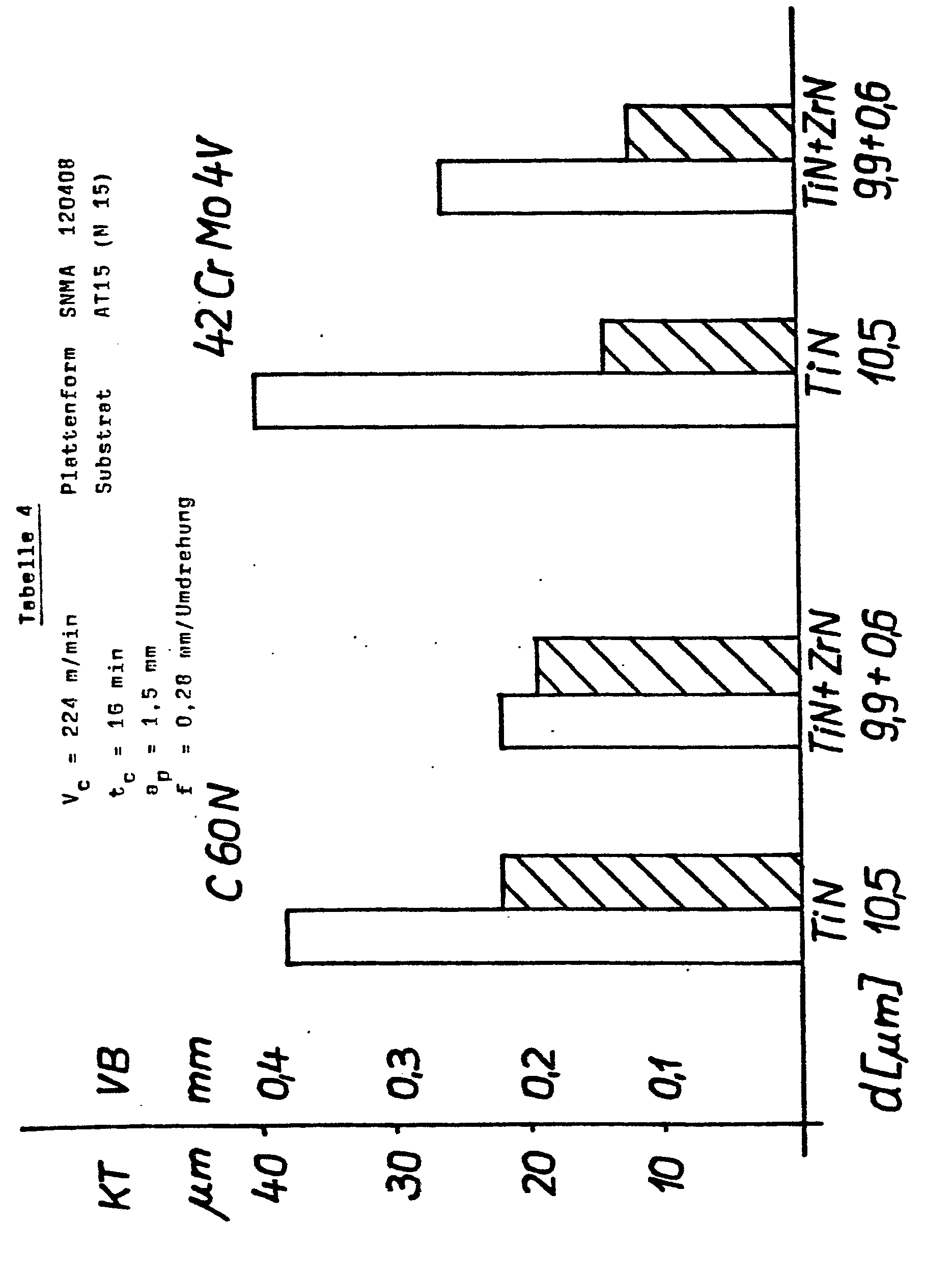
- the cutting bodies with the cover layer according to the invention after a rotation time of 16 minutes, have crater depths K T which are 30 to 40% lower than for the titanium nitride layer of the same thickness without a cover layer made of zirconium nitride.
- This advantage is evident both when machining the C60N steel and when machining the 42CrMo4V alloy steel.
- the so-called PVD process is also suitable as a process for the deposition of the zirconium nitride cover layer.
Landscapes
- Chemical & Material Sciences (AREA)
- Mechanical Engineering (AREA)
- Engineering & Computer Science (AREA)
- Metallurgy (AREA)
- Organic Chemistry (AREA)
- Chemical Kinetics & Catalysis (AREA)
- Materials Engineering (AREA)
- Inorganic Chemistry (AREA)
- General Chemical & Material Sciences (AREA)
- Chemical Vapour Deposition (AREA)
- Cutting Tools, Boring Holders, And Turrets (AREA)
- Physical Vapour Deposition (AREA)
- Auxiliary Devices For Machine Tools (AREA)
Description
- Die Erfindung betrifft ein Schneidwerkzeug, auf dessen mit Titancarbid, Titancarbonitrid und/oder Titannitrid beschichtete Schneide eine äußere Deckschicht aus Zirkoniumnitrid aufgebracht ist.
- Es ist bekannt, daß man Schneidwerkzeuge, insbesondere solche aus Hartmetall mit Schichten aus Titancarbid, Titancarbonitrid und/oder Titannitrid versehen und dadurch eine Verschleißfestigkeit dieser Werkzeuge erheblich verbessern kann. Die Verwendung bindemetallfreier Hartstoffschichten aus Nitriden und Carbonitriden der Elemente der IV. bis VI. Nebengruppe des Periodensystems zum Verschleißschutz von Werkzeugen aus Hartmetallen ist beispielsweise aus der deutschen Patentschrift 1 959 690 bekanntgeworden und es haben sich aus der genannten Gruppe der Hartstoffe besonders die Hartstoffe auf der Basis des Elementes Titan gut in der Praxis bewährt. Eine weitere Leistungssteigerung von Schneidwerkzeugen aus Hartmetallen kann nach dem Vorschlag der deutschen Patentschrift 2 263 210 durch eine Mehrlagenbeschichtung aus Titancarbid, Titancarbonitrid und Titannitrid erzielt werden. Wendeschneidplatten aus Hartmetallen mit einem Überzug von mehreren Schichten aus Titancarbid, Titancarbonitrid und Titannitrid sind besonders für die Drehbearbeitung von Stählen bei mittleren Schnittgeschwindigkeiten geeignet. Höhere Schnittgeschwindigkeiten verursachen aber hohe Temperaturen an den Schneidecken der Schneidwerkzeuge, wodurch ein rasch fortschreitender Diffusions-und Oxidationsverschleiß eintritt. Es ist deshalb bereits vorgeschlagen worden, für diesen Anwendungsfall die Lebensdauer entsprechender Schneidwerkzeuge dadurch zu erhöhen, daß auf ihnen dünne Schichten aus Aluminiumoxid aufgebracht werden. Beim derzeitigen Stand der Technik haben sich für mittlere Schnittgeschwindigkeiten und große Spanquerschnitte mit Titancarbid, Titancarbonitrid und Titannitrid beschichtete Schneideinsätze durchgesetzt, bei hohen Schnittgeschwindigkeiten kommen Beschichtungen aus Oxiden der Elemente Aluminium oder Zirkon, vielfach auch in Kombination mit einer Beschichtung mit den Nitriden und Carbiden des Titans bevorzugt zum Einsatz.
- Nach der JP 531 112 ist ein Schneidwerkzeug mit einer Zirkonnitridschicht als Deckschicht auf einer Basisbeschichtung aus Titancarbid bekannt, bei der die Dicke der Deckschicht 25 bis 66% der Basisbeschichtung beträgt.
- Die vorliegende Erfindung bezweckt Schneidwerkzeuge mit noch höherer Gebrauchsdauer zu schaffen.
- Diese Aufgabe wird durch ein Scheidwerkzeug, auf dessen mit Titancarbid, Titancarbonitrid und/oder Titannitrid beschichtete Schneide eine äußere Deckschicht aus Zirkoniumnitrid aufgebracht ist, welches dadurch gekennzeichnet ist, daß die Dicke der äußeren Deckschicht 1% bis 10% der mindestens 6 µm dicken Basisbeschichtung aus Titancarbid, Titancarbonitrid und/oder Titannitrid maximal aber 1 µm beträgt, gelöst.
- Solche Schneidkörper nach der Erfindung weisen eine erheblich erhöhte Gebrauchsdauer bei mittleren bis hohen Schnittgeschwindigkeiten auf.
- Die Erfindung wird nachfolgend anhand von Ausführungsbeispielen näher erläutert.
- Eine Wendeschneidplatte aus Hartmetall mit der Zusammensetzung 82,5 % W, 11 % (Ti, Ta, Nb)C und 6,5 % Co (Massenprozente) wurde nach dem Verfahren der chemischen Abscheidung aus der Gasphase (CVD-Verfahren) in einer entsprechenden Apparatur mit zwei aufeinanderfolgenden Lagen aus Titancarbonitrid beschichtet. Die für die Abscheidung benötigten Gasgemische aus Titantetrachlorid, Wasserstoff, Methan und Stickstoff wurden so gewählt, daß die innere Schicht aus Titancarbonitrid eine höhere Kohlenstoffkonzentration als die äußere Schicht aufwies.
- Das Reaktionsgefäß aus hitzebeständigem Stahl der CVD-Apparatur besaß ein Volumen von etwa 30 I und wurde durch einen übergestülpten elektrischen Ofen auf eine Temperatur von 1000 °C erhitzt. Zur Durchführung der chemischen Abscheidung aus der Gasphase ist in das Reaktorgefäß ein Gasgemisch eingeleitet worden, welches die in der nachfolgenden Tabelle aufgeführten Gase enthielt. In dieser Tabelle sind außerdem die gewählten Gasmengen, Drucke und Temperaturen aufgeführt.

- Zur Beschleunigung der Abscheidung und zur Erzielung eines feinkörnigen Schichtgefüges ist ein katalytisch wirkendes Aluminiumhalogenid-Additiv in die Gasatmosphäre eingeleitet worden.
- Nach einer Zeitdauer von insgesamt 300 Minuten ist die Zufuhr des Titantetrachlorids und des Methans abgestellt worden. Zur Abscheidung einer Schicht aus Zirkonnitrid ist anschließend ein Gasgemisch aus 370 I/h Wasserstoff, 330 I/h Stickstoff und 5 I/h Zirkontetrachlorid in das Reaktionsgefäß eingeleitet worden, wobei die Temperatur während dieses Prozeßschrittes auf 1010 °C erhöht worden ist. Der Druck im Gefäßinnern betrug 700 hPa. Nach Ablauf von 60 Minuten wurde die Zufuhr aller Gase mit Ausnahme des Wasserstoffs abgestellt und das Reaktionsgefäß abgekühlt. Nach Entfernen des Wasserstoffgases wurde das Gefäß belüftet und geöffnet, und die nunmehr beschichteten Hartmetallkörper entnommen. Die Dicke der beiden Schichten aus Titancarbonitrid lag je nach Lage der Proben im Reaktionsgefäß zwischen 9 µm und 12 Ilm, während die äußere Zirkonnitridschicht, die wegen ihrer charakteristischen gelben Farbe gut vom Titancarbonitrid unterschieden werden kann, eine Dicke von etwa 0,7 bis 1 Ilm aufwies.
- Zur Prüfung der Verschleißbeständigkeit der erfindungsgemäß beschichteten Wendeschneidplatten wurde deren Standzeit durch die Zerspanung der Stahlwerkstoffe C60N und 42CrMo4 durch Drehen im glatten Schnitt bei verschiedenen Schnittgeschwindigkeiten bestimmt. Der Drehtest wurde nach bestimmten Zeitintervallen unterbrochen und die Zunahme des Verschleißes der Schneidecke durch Messung der Kolktiefe Kt und der Verschleißmarkenbreite Vb bestimmt. Danach wurde der Versuch fortgesetzt. Als Kriterium für das Standzeitende der Wendeschneidplatten ist die Schnittzeit bis zum Erreichen einer Kolktiefe von Kt = 60 µm bzw. einer Verschleißmarkenbreite von Vb = 0,2 mm festgesetzt worden. Die Schnitttiefe ap= 1,5 mm und der Vorschub f = 0,28 mm/U sowie die übrigen geometrischen Einstellungen wurden während der Versuche konstant gehalten. Zum Vergleich und zur Beurteilung dieser Versuche sind handelsübliche Wendeschneidplatten gleicher Plattenform und aus der gleichen Hartmetallegierung untersucht worden, die nach bekannten Fertigungs verfahren beschichtet worden sind und die die erfindungsgemäße Deckschicht aus Zirkonnitrid nicht aufgewiesen haben. Zur Bearbeitung des Werkstoffes C60N wurden zwei Varianten ausgewählt, und zwar als Beschichtung A eine Beschichtung aus Titancarbid, Titancarbonitrid mit nach außen zunehmendem Stickstoffgehalt und mit einer weiteren Schicht aus Titannitrid mit einer Gesamtschichtdicke von 10 µm sowie als Beschichtung B eine Beschichtung aus Titancarbid, Titancarbonitrid und Titannitrid mit vier etwa 2 µm dicken keramischen Schichten aus Aluminiumoxidnitrid, die durch dünne Zwischenschichten aus Titannitrid abgegrenzt waren. Die Gesamtdicke dieser Viellagenbeschichtung betrug 11 µm. Wendeschneidplatten mit der Beschichtung A haben sich bei mittleren Schnittgeschwindigkeiten und großen Spanungsquerschnitten bewährt, während solche mit der Beschichtung B bei hohen Schnittgeschwindigkeiten ausgezeichnte Standzeiten aufgewiesen haben.
- Das Ergebnis der Schneidhaltigkeitsuntersuchung ist in nachfolgender Tabelle 2 angegeben.

- Bei einer Schnittgeschwindigkeit von 180 m/Minuten sind die Standzeiten der beiden Beschichtungen A und B nach dem Stand der Technik von der Standzeit der Beschichtung C nach der Erfindung weit übertroffen worden. Bei der höheren Schnittgeschwindigkeit von 224 m/Minuten sind die Standzeiten als Folge der höheren Schneidentemperatur niedriger, aber auch in diesem Falle erreichte die erfindungsgemäß beschichtete Schneidplatte die höchste Standzeit der untersuchten Schneidplatten. Bei der Bearbeitung des legierten Stahles 42CrMo4V wurden die in nachfolgender Tabelle 3 dargestellten Ergebnisse erzielt.

- Um den Effekt der dünnen äußeren Schicht aus Zirkonnitrid besser erkennen zu können, sind in der oben beschriebenen Weise in zwei weiteren Beschichtungszyklen etwa 10 µm dicke Einzelschichten aus Titannitrid abgeschieden worden, wobei in einem Falle auf das Aufbringen der dünnen Deckschicht aus Zirkonnitrid verzichtet worden ist. Aus der Menge der beschichteten Wendeschneidplatten der beiden Versuche wurde Paare herausgesucht, die jeweils exakt die gleiche Gesamtschichtdicke besaßen und es wurden mit diesen Platten wiederum vergleichende Schneidhaltigkeitsversuche angestellt, deren Versuchsparameter sowie Ergebnisse in der dieser Beschreibung am Ende angefügten Tabelle 4 dargestellt sind. Es zeigt sich aus dieser Tabelle, daß die Schneidkörper mit der erfindungsgemäßen Deckschicht nach einer Drehzeit von 16 Minuten Kolktiefen KT aufweisen, die um 30 bis 40 % niedriger als bei der gleich dicken Titannitridschicht ohne Deckschicht aus Zirkonnitrid liegen. Dieser Vorteil zeigt sich sowohl beim Zerspanen des Stahles C60N als auch beim Zerspanen des legierten Stahles 42CrMo4V.
- Es sind schließlich auch noch Versuche mit einer dickeren ca. 2 bis 3 Jlm dicken Deckschicht aus Zirkonnitrid auf Titancarbonitridbeschichtungen von 9 µm Dicke unternommen worden. Auch hier haben sich Verbesserungen im Schneidhaltigkeitsverhalten gezeigt, die in ihrem Ausmaß die Effekte einer dünnen Deckschicht jedoch nicht wesentlich übertroffen haben. Es kommt also in erster Linie nicht so sehr auf die Dicke der äußeren Schicht aus Zirkonnitrid, sondern darauf an, daß diese Schicht die Basisbeschichtung vollständig bedeckt.
- Weitere Versuche haben im übrigen die Annahme bestätigt, daß nicht die Verwendung einer Beschichtung aus Zirkonnitrid allein den von der Erfindung erzielten Erfolg erreicht, sondern die Kombination einer relativ dicken Beschichtung mit anderen Hartstoffen wie Titancarbid, Titancarbonitrid und/oder Titannitrid mit der dünnen äußeren Deckschicht aus Zirkonnitrid.
- Als Verfahren zur Abscheidung der Zirkonnitriddeckschicht eignet sich neben dem CVD-Verfahren auch das sogenannte PVD-Verfahren.
Claims (4)
Priority Applications (1)
| Application Number | Priority Date | Filing Date | Title |
|---|---|---|---|
| AT87107635T ATE54954T1 (de) | 1986-06-21 | 1987-05-26 | Schneidwerkzeug. |
Applications Claiming Priority (2)
| Application Number | Priority Date | Filing Date | Title |
|---|---|---|---|
| DE3620901 | 1986-06-21 | ||
| DE19863620901 DE3620901A1 (de) | 1986-06-21 | 1986-06-21 | Schneidwerkzeug |
Publications (2)
| Publication Number | Publication Date |
|---|---|
| EP0250865A1 EP0250865A1 (de) | 1988-01-07 |
| EP0250865B1 true EP0250865B1 (de) | 1990-07-25 |
Family
ID=6303464
Family Applications (1)
| Application Number | Title | Priority Date | Filing Date |
|---|---|---|---|
| EP87107635A Expired - Lifetime EP0250865B1 (de) | 1986-06-21 | 1987-05-26 | Schneidwerkzeug |
Country Status (6)
| Country | Link |
|---|---|
| US (1) | US4776863A (de) |
| EP (1) | EP0250865B1 (de) |
| JP (1) | JP2663968B2 (de) |
| AT (1) | ATE54954T1 (de) |
| DE (2) | DE3620901A1 (de) |
| IN (1) | IN167101B (de) |
Families Citing this family (36)
| Publication number | Priority date | Publication date | Assignee | Title |
|---|---|---|---|---|
| JPS61170559A (ja) * | 1985-01-21 | 1986-08-01 | Sumitomo Electric Ind Ltd | 被覆超硬合金 |
| US5230718A (en) * | 1987-10-21 | 1993-07-27 | Takeo Oki | Coated abrasive grains and a manufacturing method therefor |
| GB8801366D0 (en) * | 1988-01-21 | 1988-02-17 | Secr Defence | Infra red transparent materials |
| DE3830525A1 (de) * | 1988-09-08 | 1990-03-22 | Beck August Gmbh Co | Mit hartstoff beschichtete hartmetallschneidplatte und verfahren zu ihrer herstellung |
| US5024680A (en) * | 1988-11-07 | 1991-06-18 | Norton Company | Multiple metal coated superabrasive grit and methods for their manufacture |
| CA1327277C (en) * | 1989-03-17 | 1994-03-01 | William A. Bryant | Multilayer coated cemented carbide cutting insert |
| US4984940A (en) * | 1989-03-17 | 1991-01-15 | Kennametal Inc. | Multilayer coated cemented carbide cutting insert |
| US5066553A (en) * | 1989-04-12 | 1991-11-19 | Mitsubishi Metal Corporation | Surface-coated tool member of tungsten carbide based cemented carbide |
| US5075181A (en) * | 1989-05-05 | 1991-12-24 | Kennametal Inc. | High hardness/high compressive stress multilayer coated tool |
| US5061294A (en) * | 1989-05-15 | 1991-10-29 | Minnesota Mining And Manufacturing Company | Abrasive article with conductive, doped, conjugated, polymer coat and method of making same |
| US5266389A (en) * | 1989-09-29 | 1993-11-30 | Sumitomo Electric Industries, Ltd. | Surface-coated hard material for cutting tools or wear resistance tools |
| US5049164A (en) * | 1990-01-05 | 1991-09-17 | Norton Company | Multilayer coated abrasive element for bonding to a backing |
| US5085671A (en) * | 1990-05-02 | 1992-02-04 | Minnesota Mining And Manufacturing Company | Method of coating alumina particles with refractory material, abrasive particles made by the method and abrasive products containing the same |
| US5126207A (en) * | 1990-07-20 | 1992-06-30 | Norton Company | Diamond having multiple coatings and methods for their manufacture |
| CA2090854C (en) * | 1990-09-17 | 1998-10-06 | Anakkavur T. Santhanam | Cvd and pvd coated cutting tools |
| US5325747A (en) * | 1990-09-17 | 1994-07-05 | Kennametal Inc. | Method of machining using coated cutting tools |
| US5266388A (en) * | 1990-09-17 | 1993-11-30 | Kennametal Inc. | Binder enriched coated cutting tool |
| US5250367A (en) * | 1990-09-17 | 1993-10-05 | Kennametal Inc. | Binder enriched CVD and PVD coated cutting tool |
| US5232318A (en) * | 1990-09-17 | 1993-08-03 | Kennametal Inc. | Coated cutting tools |
| DE4111238A1 (de) * | 1991-04-08 | 1992-10-15 | Hilti Ag | Werkzeug zur zerspanung von werkstoffen |
| US5139537A (en) * | 1991-06-13 | 1992-08-18 | Julien D Lynn | Titanium-nitride coated grinding wheel and method therefor |
| DE4209307C2 (de) * | 1992-03-21 | 1995-05-11 | Albrecht Josef Bohrfutter | Bohrfutter |
| EP0592986B1 (de) * | 1992-10-12 | 1998-07-08 | Sumitomo Electric Industries, Limited | Ultradünnes Filmlaminat |
| EP0695731B1 (de) * | 1994-08-01 | 2000-11-08 | Sumitomo Electric Industries, Limited | Überharter Verbundwerkstoff für Werkzeuge |
| US5750207A (en) * | 1995-02-17 | 1998-05-12 | Si Diamond Technology, Inc. | System and method for depositing coating of modulated composition |
| US5681653A (en) * | 1995-05-11 | 1997-10-28 | Si Diamond Technology, Inc. | Diamond cutting tools |
| US5588975A (en) * | 1995-05-25 | 1996-12-31 | Si Diamond Technology, Inc. | Coated grinding tool |
| DE59606970D1 (de) | 1996-10-09 | 2001-06-28 | Widia Gmbh | Verbundkörper, verfahren zu seiner herstellung und verwendung des verbundkörpers |
| CA2207579A1 (fr) * | 1997-05-28 | 1998-11-28 | Paul Caron | Piece frittee a surface anti-abrasive et procede pour sa realisation |
| JP4185172B2 (ja) * | 1997-06-19 | 2008-11-26 | 住友電工ハードメタル株式会社 | 被覆硬質工具 |
| US6660133B2 (en) | 2002-03-14 | 2003-12-09 | Kennametal Inc. | Nanolayered coated cutting tool and method for making the same |
| WO2005122942A1 (en) | 2004-06-08 | 2005-12-29 | Neil Hamilton Luebke | Dental and medical instruments comprising titanium |
| DE102004029065A1 (de) | 2004-06-16 | 2006-01-26 | Siemens Ag | Kurbelwellensynchrone ERfassung analoger Signale |
| JP4483533B2 (ja) * | 2004-11-04 | 2010-06-16 | コニカミノルタビジネステクノロジーズ株式会社 | 現像器および画像形成装置 |
| US7373997B2 (en) * | 2005-02-18 | 2008-05-20 | Smith International, Inc. | Layered hardfacing, durable hardfacing for drill bits |
| EP2688471B1 (de) | 2011-03-22 | 2023-06-21 | The Johns Hopkins University | System und verfahren zur durchführung einer magnetresonanz-spektroskopischen bildgebung |
Family Cites Families (16)
| Publication number | Priority date | Publication date | Assignee | Title |
|---|---|---|---|---|
| CA959004A (en) * | 1970-11-02 | 1974-12-10 | Gene F. Wakefield | Low temperature metal carbonitride coatings |
| US4101703A (en) * | 1972-02-04 | 1978-07-18 | Schwarzkopf Development Corporation | Coated cemented carbide elements |
| JPS533906A (en) * | 1976-06-30 | 1978-01-14 | Sumitomo Electric Ind Ltd | Double-coated super hard alloy part and production thereof |
| JPS531112A (en) * | 1976-06-18 | 1978-01-07 | Sumitomo Electric Ind Ltd | Multiple coated super hard alloy and its production |
| FR2370551A1 (fr) * | 1976-11-10 | 1978-06-09 | Eurotungstene | Outil de coupe revetu de boronitrure de titane et procede de revetement |
| US4131530A (en) * | 1977-07-05 | 1978-12-26 | Airco, Inc. | Sputtered chromium-alloy coating for plastic |
| DE2851584B2 (de) * | 1978-11-29 | 1980-09-04 | Fried. Krupp Gmbh, 4300 Essen | Verbundkörper |
| US4296178A (en) * | 1979-05-18 | 1981-10-20 | Varian Associates, Inc. | Article comprising a substrate and chromium alloy coating |
| GB2110246B (en) * | 1981-02-23 | 1985-02-06 | Vni Instrument Inst | Multilayer coating for metal-cutting tool |
| DE3152761C2 (de) * | 1981-03-02 | 1988-11-10 | Vsesojuznyj naučno-issledovatel'skij instrumental'nyj institut, Moskau/Moskva | Beschichtung für ein Schneidwerkzeug |
| US4406667A (en) * | 1982-05-20 | 1983-09-27 | Gte Laboratories Incorporated | Nitride coated composite silicon nitride cutting tools |
| US4406670A (en) * | 1982-05-20 | 1983-09-27 | Gte Laboratories Incorporated | Nitride coated composite modified silicon aluminum oxynitride cutting tools |
| CA1204638A (en) * | 1982-05-20 | 1986-05-20 | Vinod K. Sarin | Coated composite silicon nitride cutting tools |
| US4406668A (en) * | 1982-05-20 | 1983-09-27 | Gte Laboratories Incorporated | Nitride coated silicon nitride cutting tools |
| US4428812A (en) * | 1983-04-04 | 1984-01-31 | Borg-Warner Corporation | Rapid rate reactive sputtering of metallic compounds |
| FI854000L (fi) * | 1985-10-25 | 1987-04-16 | Vsesojuzny Nauchno-Issledovatelsky Instrumentalny Institut | Skaerverktyg med en slitbestaendig belaeggning. |
-
1986
- 1986-06-21 DE DE19863620901 patent/DE3620901A1/de active Granted
-
1987
- 1987-05-26 AT AT87107635T patent/ATE54954T1/de not_active IP Right Cessation
- 1987-05-26 DE DE8787107635T patent/DE3763915D1/de not_active Expired - Lifetime
- 1987-05-26 EP EP87107635A patent/EP0250865B1/de not_active Expired - Lifetime
- 1987-06-16 IN IN468/CAL/87A patent/IN167101B/en unknown
- 1987-06-18 JP JP62150359A patent/JP2663968B2/ja not_active Expired - Fee Related
- 1987-07-09 US US07/071,656 patent/US4776863A/en not_active Expired - Lifetime
Also Published As
| Publication number | Publication date |
|---|---|
| ATE54954T1 (de) | 1990-08-15 |
| JP2663968B2 (ja) | 1997-10-15 |
| EP0250865A1 (de) | 1988-01-07 |
| DE3620901C2 (de) | 1988-08-04 |
| IN167101B (de) | 1990-09-01 |
| JPS634070A (ja) | 1988-01-09 |
| DE3620901A1 (de) | 1988-01-14 |
| DE3763915D1 (de) | 1990-08-30 |
| US4776863A (en) | 1988-10-11 |
Similar Documents
| Publication | Publication Date | Title |
|---|---|---|
| DE3620901C2 (de) | ||
| DE19980940B4 (de) | Beschichtetes Hartmetall-Schneidwerkzeug | |
| DE69738341T2 (de) | Aluminiumoxid-beschichtetes Werkzeug und Verfahren zu seiner Herstellung | |
| EP0668938B1 (de) | Werkzeug und verfahren zur beschichtung eines werkzeuggrundkörpers | |
| DE19546357C2 (de) | Harte Beschichtung mit ausgezeichneter Abriebsbeständigkeit zur Substratbeschichtung | |
| DE102007039193B4 (de) | Hartschicht und Werkzeug mit dieser Schicht | |
| DE19962056A1 (de) | Schneidwerkzeug mit mehrlagiger, verschleissfester Beschichtung | |
| EP0373412A1 (de) | Verfahren zur Beschichtung eines Werkzeuggrundkörpers und nach diesem Verfahren hergestelltes Werkzeug | |
| WO1993004015A1 (de) | Werkzeug mit verschleissfester schneide aus kubischem bornitrid oder polykristallinem kubischem bornitrid, verfahren zu dessen herstellung sowie dessen verwendung | |
| EP1231295B1 (de) | Hartmetallverschleissteil mit Mischoxidschicht | |
| DE2727250A1 (de) | Oberflaechenbeschichtete sinterhartmetallgegenstaende und ein verfahren zu deren herstellung | |
| DE3346873A1 (de) | Metallkeramik fuer schneidwerkzeuge und daraus hergestellte schneidplaettchen | |
| DE19957671A1 (de) | Werkzeug mit einer Molybdänsulfid enthaltenden Beschichtung und Verfahren zu dessen Herstellung | |
| DE19825572A1 (de) | Werkzeug aus einem Grundkörper und mindestens einer hierauf abgeschiedenen Schicht sowie Verfahren zur Herstellung einer Molybdänsulfidschicht auf einem Substratkörper | |
| EP0143889A2 (de) | Beschichteter Hartmetallkörper | |
| DE112016002130T5 (de) | Hartbeschichtung und Element, das mit der Hartbeschichtung bedeckt ist | |
| EP0229282B1 (de) | Verfahren zur Herstellung eines beschichteten Formkörpers | |
| DE69710461T2 (de) | Sinterverfahren | |
| CH615852A5 (en) | Use of coated tools | |
| DE112022004810T5 (de) | Schneidwerkzeug mit Hartbeschichtung mit ausgezeichneter Verschleißfestigkeit und Zähigkeit | |
| EP0454686B2 (de) | Schneideinsatz und verfahren zu seiner herstellung | |
| CH681083A5 (de) | ||
| EP0643152B1 (de) | Schneidwerkstoff | |
| DE19815677C2 (de) | Verbundkörper und Verfahren zu dessen Herstellung | |
| DE2317447C2 (de) | Schneideinsätze |
Legal Events
| Date | Code | Title | Description |
|---|---|---|---|
| PUAI | Public reference made under article 153(3) epc to a published international application that has entered the european phase |
Free format text: ORIGINAL CODE: 0009012 |
|
| AK | Designated contracting states |
Kind code of ref document: A1 Designated state(s): AT DE FR GB |
|
| 17P | Request for examination filed |
Effective date: 19880216 |
|
| 17Q | First examination report despatched |
Effective date: 19890314 |
|
| GRAA | (expected) grant |
Free format text: ORIGINAL CODE: 0009210 |
|
| AK | Designated contracting states |
Kind code of ref document: B1 Designated state(s): AT DE FR GB |
|
| REF | Corresponds to: |
Ref document number: 54954 Country of ref document: AT Date of ref document: 19900815 Kind code of ref document: T |
|
| GBT | Gb: translation of ep patent filed (gb section 77(6)(a)/1977) | ||
| ET | Fr: translation filed | ||
| REF | Corresponds to: |
Ref document number: 3763915 Country of ref document: DE Date of ref document: 19900830 |
|
| PLBI | Opposition filed |
Free format text: ORIGINAL CODE: 0009260 |
|
| 26 | Opposition filed |
Opponent name: SIEMENS AKTIENGESELLSCHAFT, BERLIN UND MUENCHEN Effective date: 19910423 Opponent name: SANDVIK AKTIEBOLAG Effective date: 19910418 |
|
| PLBN | Opposition rejected |
Free format text: ORIGINAL CODE: 0009273 |
|
| STAA | Information on the status of an ep patent application or granted ep patent |
Free format text: STATUS: OPPOSITION REJECTED |
|
| 27O | Opposition rejected |
Effective date: 19920906 |
|
| REG | Reference to a national code |
Ref country code: FR Ref legal event code: TP |
|
| REG | Reference to a national code |
Ref country code: GB Ref legal event code: 732E |
|
| REG | Reference to a national code |
Ref country code: FR Ref legal event code: CD |
|
| REG | Reference to a national code |
Ref country code: GB Ref legal event code: IF02 |
|
| PGFP | Annual fee paid to national office [announced via postgrant information from national office to epo] |
Ref country code: AT Payment date: 20030520 Year of fee payment: 17 |
|
| PGFP | Annual fee paid to national office [announced via postgrant information from national office to epo] |
Ref country code: FR Payment date: 20030528 Year of fee payment: 17 |
|
| PGFP | Annual fee paid to national office [announced via postgrant information from national office to epo] |
Ref country code: DE Payment date: 20030630 Year of fee payment: 17 |
|
| PGFP | Annual fee paid to national office [announced via postgrant information from national office to epo] |
Ref country code: GB Payment date: 20040427 Year of fee payment: 18 |
|
| PG25 | Lapsed in a contracting state [announced via postgrant information from national office to epo] |
Ref country code: AT Free format text: LAPSE BECAUSE OF NON-PAYMENT OF DUE FEES Effective date: 20040526 |
|
| PG25 | Lapsed in a contracting state [announced via postgrant information from national office to epo] |
Ref country code: DE Free format text: LAPSE BECAUSE OF NON-PAYMENT OF DUE FEES Effective date: 20041201 |
|
| PG25 | Lapsed in a contracting state [announced via postgrant information from national office to epo] |
Ref country code: FR Free format text: LAPSE BECAUSE OF NON-PAYMENT OF DUE FEES Effective date: 20050131 |
|
| REG | Reference to a national code |
Ref country code: FR Ref legal event code: ST |
|
| PG25 | Lapsed in a contracting state [announced via postgrant information from national office to epo] |
Ref country code: GB Free format text: LAPSE BECAUSE OF NON-PAYMENT OF DUE FEES Effective date: 20050526 |
|
| GBPC | Gb: european patent ceased through non-payment of renewal fee |
Effective date: 20050526 |