EP0247320A2 - 5-Arylalkyl-4-alkoxy-2(5H)-furanone, Zwischenprodukte und Verfahren zu ihrer Herstellung sowie ihre Anwendung als therapeutische Wirkstoffe - Google Patents
5-Arylalkyl-4-alkoxy-2(5H)-furanone, Zwischenprodukte und Verfahren zu ihrer Herstellung sowie ihre Anwendung als therapeutische Wirkstoffe Download PDFInfo
- Publication number
- EP0247320A2 EP0247320A2 EP87104404A EP87104404A EP0247320A2 EP 0247320 A2 EP0247320 A2 EP 0247320A2 EP 87104404 A EP87104404 A EP 87104404A EP 87104404 A EP87104404 A EP 87104404A EP 0247320 A2 EP0247320 A2 EP 0247320A2
- Authority
- EP
- European Patent Office
- Prior art keywords
- general formula
- threo
- methoxy
- furanone
- methyl
- Prior art date
- Legal status (The legal status is an assumption and is not a legal conclusion. Google has not performed a legal analysis and makes no representation as to the accuracy of the status listed.)
- Granted
Links
- 0 *C(C1)(CCC2)C(CCCC3)C3C1(*)C[C@@]2C=C(*)C(O)=CC(O)=O Chemical compound *C(C1)(CCC2)C(CCCC3)C3C1(*)C[C@@]2C=C(*)C(O)=CC(O)=O 0.000 description 2
- RVGAVHSZKADCBS-QMMMGPOBSA-N CC(C)C(C)(C)[C@@H](C)C[O]=[F] Chemical compound CC(C)C(C)(C)[C@@H](C)C[O]=[F] RVGAVHSZKADCBS-QMMMGPOBSA-N 0.000 description 1
- HJTWYZQOVAXFGJ-UHFFFAOYSA-N CC1(C)OCC(C)=C1C Chemical compound CC1(C)OCC(C)=C1C HJTWYZQOVAXFGJ-UHFFFAOYSA-N 0.000 description 1
Classifications
-
- C—CHEMISTRY; METALLURGY
- C07—ORGANIC CHEMISTRY
- C07C—ACYCLIC OR CARBOCYCLIC COMPOUNDS
- C07C59/00—Compounds having carboxyl groups bound to acyclic carbon atoms and containing any of the groups OH, O—metal, —CHO, keto, ether, groups, groups, or groups
- C07C59/40—Unsaturated compounds
- C07C59/58—Unsaturated compounds containing ether groups, groups, groups, or groups
- C07C59/64—Unsaturated compounds containing ether groups, groups, groups, or groups containing six-membered aromatic rings
-
- A—HUMAN NECESSITIES
- A61—MEDICAL OR VETERINARY SCIENCE; HYGIENE
- A61P—SPECIFIC THERAPEUTIC ACTIVITY OF CHEMICAL COMPOUNDS OR MEDICINAL PREPARATIONS
- A61P25/00—Drugs for disorders of the nervous system
- A61P25/08—Antiepileptics; Anticonvulsants
-
- C—CHEMISTRY; METALLURGY
- C07—ORGANIC CHEMISTRY
- C07D—HETEROCYCLIC COMPOUNDS
- C07D307/00—Heterocyclic compounds containing five-membered rings having one oxygen atom as the only ring hetero atom
- C07D307/02—Heterocyclic compounds containing five-membered rings having one oxygen atom as the only ring hetero atom not condensed with other rings
- C07D307/34—Heterocyclic compounds containing five-membered rings having one oxygen atom as the only ring hetero atom not condensed with other rings having two or three double bonds between ring members or between ring members and non-ring members
- C07D307/56—Heterocyclic compounds containing five-membered rings having one oxygen atom as the only ring hetero atom not condensed with other rings having two or three double bonds between ring members or between ring members and non-ring members with hetero atoms or with carbon atoms having three bonds to hetero atoms with at the most one bond to halogen, e.g. ester or nitrile radicals, directly attached to ring carbon atoms
- C07D307/60—Two oxygen atoms, e.g. succinic anhydride
Definitions
- the invention further relates to intermediates and processes for the preparation of the abovementioned compounds and the use of these compounds as therapeutic active substances and thus also medicaments which contain the abovementioned compounds or the compounds excluded from chemical protection by disclaimer.
- the invention is concerned exclusively with the two threo-enantiomers, which can be in the form of their racemate or their two left-hand and right-handed optical antipodes, and with processes which lead stereoselectively to the threo-enantiomers.
- methyl tetronate is mixed with lithium diisopropylamide to form a carbanion and then reacted at -78 ° C with benzaldehyde or dihydrocinnamaldehyde.
- reaction conditions -78 ° C
- benzaldehyde or dihydrocinnamaldehyde Apart from the fact that the reaction conditions (-78 ° C!) are unsuitable for economical production on a large scale, mixtures of the threo- and erythro-diastereomers are always produced in this process, so that complex cleaning operations are required to remove the threo compounds in pure form are necessary if the separation is successful at all.
- the organolithium compound used is self-igniting and the hexamethylphorphoric acid triamide (HMPA) added as a solubilizer is carcinogenic.
- HMPA hexamethylphorphoric acid triamide
- the object on which the invention is based is to satisfy this need for the provision of new compounds with anticonvulsive / antiepileptic activity.
- the invention is also based on the object of providing processes for the preparation of such compounds having anticonvulsive / antiepileptic activity which enable the threo-enantiomers to be stereoselectively synthesized either in the form of their racemates or in the form of their individual optical antipodes.
- the solution to this problem consists in the creation and provision of the substances according to the invention with anticonvulsant epileptic activity and the medicaments containing these compounds and in the creation of the methods according to the invention for the production of the new substances.
- the invention thus initially relates to the 5-arylalkyl-4-alkoxy-2 (5H) -furanones of the general formula I mentioned at the outset, both in the form of their DL-racemates and in the form of the two optical antipodes (D- and L-form), which can be produced from the racemates in optically pure form by methods of racemate resolution familiar to the person skilled in the art.
- 5H 5-arylalkyl-4-alkoxy-2
- the compounds of the threo series according to the invention have a surprisingly good anticonvulsant / antiepileptic activity, while the corresponding compounds of the erythro series are ineffective in comparable doses.
- the compounds according to the invention are suitable for the treatment of human epilepsy.
- R 7 is a hydrogen atom, a straight-chain or branched alkyl group having 1 to 4 carbon atoms or a benzyl group.
- the benzaldehydes of the general formula VI are condensed with the 3-alkoxy- 2 (E) -alkenoic acid lower alkyl esters of the general formula VII, preferably in a dipolar aprotic solvent, in particular dimethyl sulfoxide, at elevated temperature and with the addition of alkali metal hydroxides and quaternary ammonium bases or their aqueous solutions and, after the condensation and cooling of the reaction mixture has ended, the 3- Alkoxy-5- (R 3 , R 4- subst.) Phenyl-2 (E), 4 (E) -pentadienoic acids by dilution with water and acidification.
- a dipolar aprotic solvent in particular dimethyl sulfoxide
- the reaction mixture is heated to a temperature between about 70 and 140 ° C, preferably about 90 to 110 ° C, and at least one amount of alkali metal hydroxide, optionally equal to the amount of ester of formula VII used, is added in the form of a concentrated aqueous solution, and the mixture is preferably stirred at said temperature for about 2 to 12 hours.
- the pentadienoic acids of the formula VIII are precipitated by dilution with water and acidification to a pH of about 1 to 4, filtered off, washed with water and then with a lower alcohol and optionally dried.
- Benzaldehyde and those monosubstituted benzaldehydes which carry one of the radicals R 3 or R 4 in the 2-position are preferably used.
- benzaldehydes of the general formula VI are known or can be prepared by known methods (cf. Methodicumzium, Vol. 5, pp. 203-336, Georg Thieme Verlag, Stuttgart, 1975).
- Preferred esters of the general formula VII are those methyl or ethyl esters in which R 1 denotes an alkyl group having 1 to 3 carbon atoms, that is to say, for example, methyl or ethyl 3-methoxy-2 (E) -butenate, 3- Ethoxy-2 (E) -butenic acid, methyl or ethyl ester, 3-propoxy-2 (E) -butenic acid, methyl or ethyl ester, 3-isopropoxy-2 (E) -butenic acid, methyl or ethyl ester and the homologous 3-alkoxy-2 (E) -pentene, -hexene or -heptenic acid ester.
- 3-Methoxy-2 (E) -dbutenoic acid ethyl ester and 3-ethoxy-2- (E) -butenoic acid ethyl ester are particularly preferred.
- quaternary ammonium bases are added as catalysts in the condensation in stage A of the process according to the invention.
- phase transfer catalysts for example tetraethyl or tetrabutylammonium hydroxide, benzyltriethyl or trimethylammonium hydroxide or dodecyltrimethylammonium hydroxide, are particularly suitable for this purpose.
- their salts with mineral acids for example their chlorides, sulfates, hydrogen sulfates or bromides, with the addition of equivalent amounts of concentrated potassium or sodium hydroxide solution, can also be used
- stage A of the process according to the invention always leads, with simultaneous ester hydrolysis, to the 4,5-trans-configured pentadienoic acid derivatives of the general formula VIII, which could be demonstrated using the usual physical methods.
- R O is -H
- the coupling constants of the H-4 and H-5 protons in the 1 H-NMR spectrum are about 15 to 17 Hz.
- the pentadienoic esters of the general formula IX are reacted with an oxidizing agent in the presence of catalytic amounts of osmium tetroxide in a suitable inert solvent.
- an oxidizing agent in the presence of catalytic amounts of osmium tetroxide in a suitable inert solvent.
- alkyl hydroperoxide or an aliphatic, cycloaliphatic or heterocycloaliphatic amine N-oxide for example N-methylmorpholine-N-oxide, preferably in the form of a concentrated aqueous solution, is preferably used as the oxidizing agent.
- Tertiary alkanols, lower alkanones, lower alkyl alkanoates or lower chlorinated hydrocarbons can be used as inert solvents for the oxidation reaction.
- the threo-4-alkoxy-5- can be obtained by intramolecular ⁇ -lactone formation with elimination of the alcohols R 7 0H, in which R 7 has the abovementioned meanings.
- the lactone formation can take place in whole or in part even during the reaction in stage C-1 or when working up the reaction mixture of stage C-1. in a weakly acidic environment, the lactone ring closes particularly easily with elimination of the alcohol R 7 OH.
- the acids of the general formula VIII can also be subjected directly to the cis-dihydroxylation catalyzed by osmium tetroxide. The reaction then leads directly to the 4.5 (threo) -dihydroxy-2 (E) -pentenic acid derivatives of the general formula X, in which R °, R 1 , R 3 and R 4 have the meanings mentioned.
- the compounds described in step C-1 can be used as the oxidizing agent.
- the oxidation reaction is preferably carried out with alkyl hydroperoxide in the presence of quaternary ammonium bases, for example in the presence of tetraethyl or tetrabutylammonium hydroxide;
- quaternary ammonium bases increase the solubility of the inherently poorly soluble pentadienoic acids of the general formula VIII in an aqueous medium and increase the catalytic effect of the osmium tetroxide.
- step C-1 the 4,5 (threo) dihydroxy compounds are always obtained stereoselectively in step C-2.
- stage D-1 Analogous to the ⁇ -lactone formation in stage D-1, the intramolecular ring closure of the 4,5 (threo) -dihydroxy acids of the general formula X obtained in stage C-2 takes place with elimination of water to give the corresponding 2 (5H) -furanone derivatives of the general formula XII at least in part already during the course of the oxidation reaction in stage C-2, but especially when the reaction mixture of stage C-2 is worked up in a neutral or acidic medium.
- the compounds of the general formula XII are in a lower alkanone, preferably in acetone or butanone, at a temperature between about 50 and 100 ° C. or under reflux with a C 1 to C 3 alkyl iodide, preferably with methyl iodide, in the presence of an at least equimolar amount of silver (I) oxide.
- Preferred acetal derivatives of the general formula XIII are those in which R 2 is methoxymethyl, ethoxymethyl, methoxyethoxymethyl, a-ethoxypropyl or ⁇ , ⁇ -dimethoxyethyl.
- step E for the preparation of the ethers and acetals are only exemplary methods; Of course, any other etherification or acetalization method familiar to the person skilled in the art can also be used for this.
- alkyl tetronates of the general formula XVII are either known in the literature or can be prepared by known processes (cf. for example EP-PS 10 288; J. Org. Chem. 49, 927-928 (1984); Tetrahedron 35, 2181-2185 (1979) ; Tetrahedron 34, 1453-1455 (1978); Synth. Commun. 10.805-811 (1980); Angew. Chem. 94, 651-652 (1982)).
- the base-catalyzed transalkoxylation of 4-methoxy-2- (5H) -furanones was found as a further method for producing the alkyl tetronates of the general formula XVII used as starting material in this process.
- the effective dose at which the compounds can be administered is between about 0.05 and 3 mg / kg in both human and veterinary medicine. 5 - 200 mg of the active substance can be administered po once or several times a day. be applied.
- Examples of pharmacologically inert, conventional carriers and additives are water, vegetable oils, polyethylene glycols, glycerol esters, gelatin, carbohydrates such as lactose or starch, magnesium stearate, talc, petroleum jelly @, preservatives, stabilizers, lubricants, wetting agents, emulsifiers, physiologically acceptable salts, buffer substances , Coloring, flavoring and flavoring agents can be used.
- the choice of pharmacologically inert excipient depends on whether the active ingredients are to be administered enterally, parenterally or topically.
- the new and known compounds of general formula I can also be administered in a mixture with other active substances, for example vitamins or other known anticonvulsants or antiepileptics.
- the mixture After cooling to about 20 ° C, the mixture is poured into 50 liters of water and impurities are extracted with 10 liters of dichloromethane.
- the filter cake is suspended in 6 liters of ethanol, filtered again and, after blowing dry in a vacuum, dried to the final temperature of 85 ° C. 3071 g (15.04 mol) of pure product with a melting point of 159 ° -160 ° C. are obtained. Yield: 60.1%.
- the aqueous phase is stirred into the mixture of 3 liters of 33% hydrochloric acid and 50 liters of water, after which the pH is 3.5 to 4.
- the precipitated crude product after filtering, washing with water until free of chloride and blowing dry in 20 liters of ethanol, is suctioned off again, blown dry and dried to a final temperature of 85 ° C. at 20 mbar. 5045 g (21.14 mol) of pure product with a melting point of 202 ° C. are obtained.
- the organic phase contains a mixture of threo-sec-butyl-5- (2-chlorophenyl) -4.5-dihydroxy-3-methoxy-2 (E) -penteneoate and threo-5- (2-chlorophenylhydroxymethyl) -4-methoxy- 2 (5H) furanon.
- the ring closure is completed by adding 0.1 ml of 32% hydrochloric acid and evaporating the organic phase, and 10.66 g (41.9 mmol) of threo-5- (2-chlorophenylhydroxymethyl) -4-methoxy-2 (5H) -furanone are obtained after recrystallization from ether. Yield: 52.3%.
- the corresponding methyl, isopropyl or tert-butyl ester can be used instead of the sec. Butyl ester.
- the oily crude product consisting of the mixture of threo and erythro isomer, becomes crystalline after trituration with carbon tetrachloride.
- the product is identical to that prepared in Example No. 64 by thin layer chromatography, NMR and IR spectroscopy.
- mice Male mice (NMRI) with a body weight of 20 - 25 g are applied an alternating current of 50 Hz and 50 mA over corneal electrodes for 0.2 seconds (HSE shock stimulator; type 207).
- HSE shock stimulator type 207.
- the maximal electroshock cramp consists of a tonic extension of the hind limbs, clonic twitches and a loss of consciousness.
- the effectiveness criterion is considered to be the inhibition of extensor cramp by the substances according to the invention.
- the mice had free access to food and water prior to the experiments.
- the test substances were suspended in 0.2% agar p.o. applied by gavage; the control animals received adequate volumes of agar.
- the protective effect test against MES was carried out 1 hour after application.
- Table 14 shows the results of the MES test at doses of 50 to 150 mg of the compounds according to the invention per kg of body weight in comparison with conventional antiepileptics. The percentage of those animals that were 100% protected against extensor spasm in the MES test is given as% action.
- the ED 50 values listed are those dosages of the substances according to the invention and of common antiepileptics which, in the MES test, were able to completely protect 50% of the animals from the extensor spasm 1 hour after application.
- the ED 50 values and the confidence limits (5% probability of error) were determined according to Lichtfield and Wilcoxon [J. Pharmacol.exp. Therapist. 96, 99 (1949)] each with 4 to 5 groups of animals to 8-10 animals per dose level.
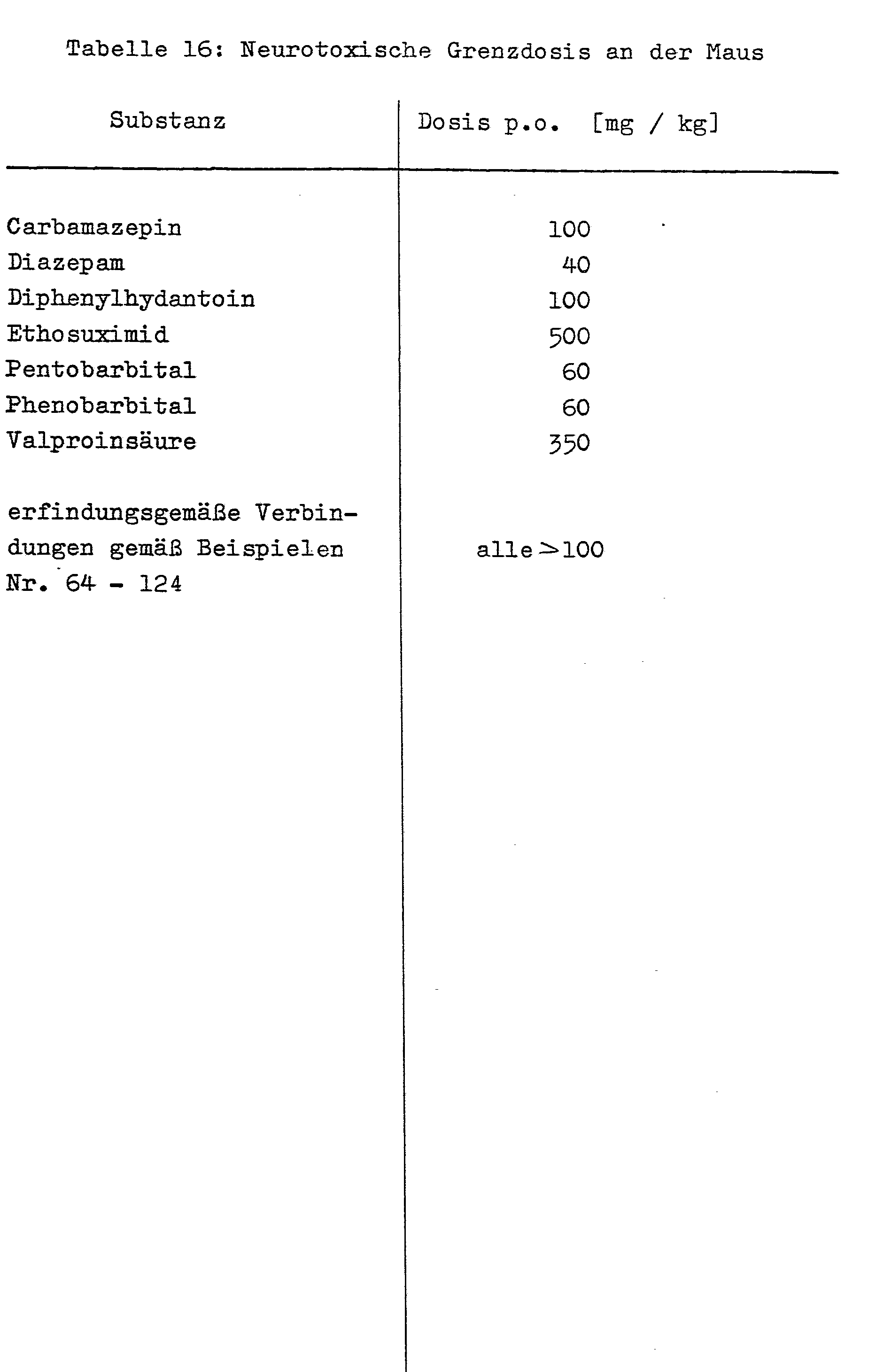
- mice were observed for the entire duration of the experiment (up to 4 hours) for signs of substance-related behavior changes and neurotoxicity (motility, muscle tone, respiratory rate, body temperature and general behavior). Up to a dose of 100 mg / kg, no neurotoxicity symptoms could be found in any of the tested substances according to the invention. In comparison, the lower limit doses of common anticonvulsants are listed in Table 16, which according to p.o. Application Induce neurotoxicity symptoms in mice.
Landscapes
- Organic Chemistry (AREA)
- Chemical & Material Sciences (AREA)
- Health & Medical Sciences (AREA)
- Neurosurgery (AREA)
- Life Sciences & Earth Sciences (AREA)
- Neurology (AREA)
- Bioinformatics & Cheminformatics (AREA)
- Engineering & Computer Science (AREA)
- Chemical Kinetics & Catalysis (AREA)
- General Chemical & Material Sciences (AREA)
- Medicinal Chemistry (AREA)
- Nuclear Medicine, Radiotherapy & Molecular Imaging (AREA)
- Pain & Pain Management (AREA)
- Pharmacology & Pharmacy (AREA)
- Biomedical Technology (AREA)
- Animal Behavior & Ethology (AREA)
- General Health & Medical Sciences (AREA)
- Public Health (AREA)
- Veterinary Medicine (AREA)
- Pharmaceuticals Containing Other Organic And Inorganic Compounds (AREA)
- Organic Low-Molecular-Weight Compounds And Preparation Thereof (AREA)
- Furan Compounds (AREA)
- Heterocyclic Carbon Compounds Containing A Hetero Ring Having Oxygen Or Sulfur (AREA)
- Heterocyclic Compounds Containing Sulfur Atoms (AREA)
- Separation Using Semi-Permeable Membranes (AREA)
- Water Treatment By Electricity Or Magnetism (AREA)
Abstract
Description
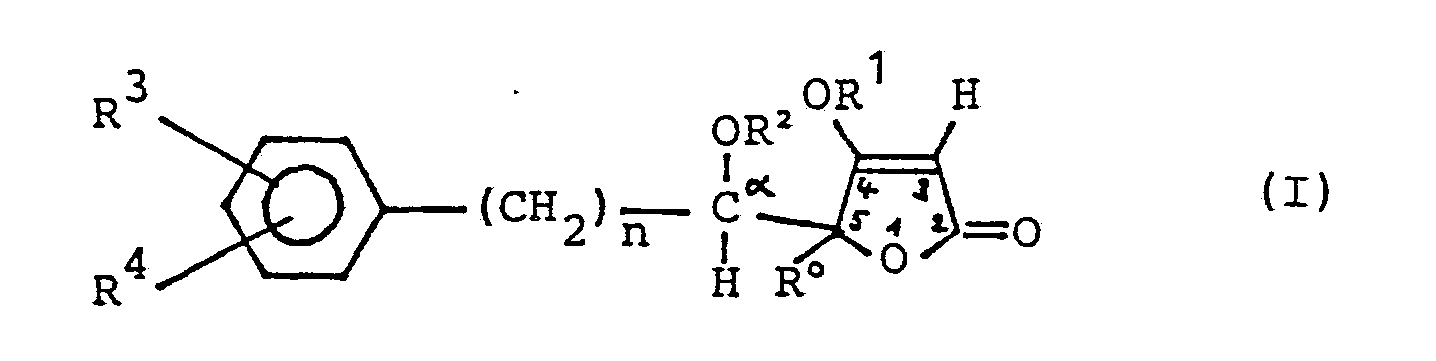
- Die Erfindung betrifft 5-Arylalkyl-4-alkoxy-2(5H)-furanone der allgemeinen Formel I

- n die Zahl 0, 1 oder 2,
- R0 ein Wasserstoffatom oder eine Niederalkylgruppe mit 1 bis 3 C-Atomen,
- R1 eine geradkettige oder verzweigte Alkylgruppe mit 1 bis 5 C-Atomen,
- R2 ein Wasserstoffatom, eine Niederalkylgruppe mit 1 bis 3 C-Atomen oder den Rest
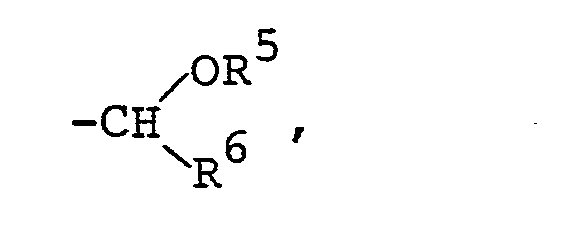
- R5 eine Niederalkylgruppe mit 1 bis 5 C-Atomen, die Ethoxyethyl-oder Methoxyethylgruppe und
- R6 ein Wasserstoffatom, eine Niederalkylgruppe mit 1 bis 5 C-Atomen oder die Methoxymethylgruppe bedeuten,
- R3 und R4 unabhängig voneinander ein Wasserstoff-, Fluor-, Chlor-oder Bromatom, eine Niederalkylgruppe
- mit 1 bis 3 C-Atomen, eine Perfluorniederalkylgruppe mit 1 bis 3 C-Atomen, die Difluormethoxy-oder
- Nitrogruppe
- bedeuten, unter Ausschluß derjenigen Verbindungen der allgemeinen Formel I, worin
- R2 H oder CH3 bedeutet, wenn
- n = 0 oder 2, RO = H, R1 = CH3, R3 = H und R4 -H ist.
- Die Erfindung betrifft ferner Zwischenprodukte und Verfahren zur Herstellung der vorgenannten Verbindungen sowie die Anwendung dieser Verbindungen als therapeutische Wirkstoffe und damit auch Arzneimittel, die die genannten Verbindungen oder die durch Disclaimer vom Stoffschutz ausgenommenen Verbindungen enthalten.
- Da die Verbindungen der allgemeinen Formel I mit den asymmetrischen Kohlenstoffatomen C-5 und Ca zwei Chiralitätszentren in ihrem Molekül enthalten, gibt es zwei Diastereomerenpaare, nämlich die beiden threo-Enantiomeren:

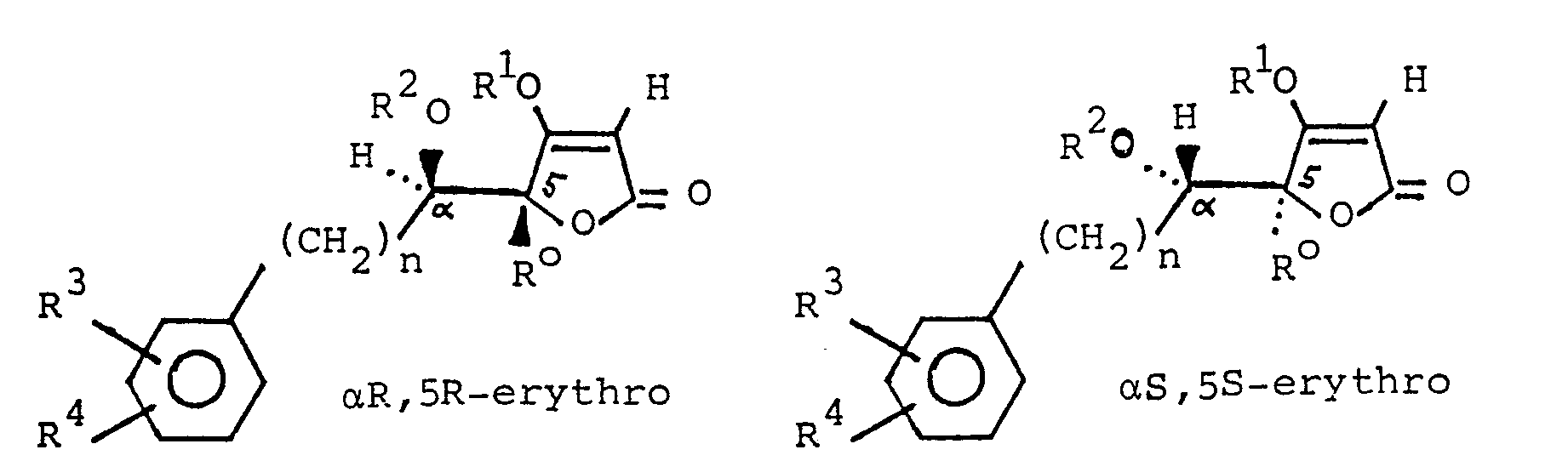
- Die Erfindung befaßt sich ausschließlich mit den beiden threo-Enantiomeren, die in Form ihres Racemats oder ihrer beiden links-und rechtsdrehenden optischen Antipoden vorliegen können, sowie mit Verfahren, die stereoselektiv zu den threo-Enantiomeren führen.
- Die durch Disclaimer vom Stoffschutz ausgenommenen Verbindungen sind bekannt:
- 4-Methoxy-5-phenylhydroxymethyl-2(5H)-furanon wurde von A. Pelter et al., Tetrahedron Lett, 1979, S. 1627-1630, und
- 4-Methoxy-5-[methoxy-(phenyl)-methyl)]-2(5H)furanon von A. Pelfer et al., Tetrahedron Lett. 1982, S. 5229-5232, beschrieben;
- 4-Methoxy-5-(a-hydroxy-y-phenylpropyl)-2(5H)-furanon und 4-Methoxy-5-(a-methoxy-y-phenylpropyl)-2(5H)-furanon wurden von R. Hänsel et al., Z. Naturforsch. 33b, S. 1020-1025 (1978), beschrieben.
- Über eine pharmakologische Wirksamkeit oder gar eine therapeutische Anwendbarkeit der bekannten Verbindungen berichten die genannten Autoren jedoch nichts.
- Zur Herstellung der bekannten Verbindungen schlagen R. Hänsel et al. a.a.O. vor, aus der in Mexiko beheimateten Art piper sanctum 5,6-Z-Piperoiid zu isolieren, das durch Photonenbestrahlung in das stereoisomere 5,6-E-Piperolid übergeführt werden kann. Durch katalytische Hydrierung läßt sich 5,6-E-Piperolid zu 5,6-threo-Tetrahydropiperolid (= 4-Methoxγ-5-(a-methoxγ-γ-phenylpropyl)-2(5H)-furanon) umsetzen. Die Gewinnung des Ausgangsmaterials, also des Naturstoffs 5,6-Z-Piperolid und dessen Umwandlung in 5,6-E-Piperolid ist jedoch sehr teuer und daher für eine kommerzielle Nutzung ungeeignet.
- Ein anderes bekanntes Verfahren zur Herstellung der bekannten Verbindungen (vgl. A. Pelter et al., Tetrahedron Lett. 1979, S. 1627-1630) geht von Methyltetronat aus, dessen Herstellung aus der EP-PS 10 288 bekannt ist.
- Hierbei wird Methyltetronat mit Lithiumdiisopropylamid unter Bildung eines Carbanions versetzt und dann bei -78°C mit Benzaldehyd oder Dihydrozimtaldehyd umgesetzt. Abgesehen davon, daß die Reaktionsbedingungen (-78°C!) für eine wirtschaftliche Herstellung in großem Maßstab ungeeignet sind, entstehen bei diesem Verfahren stets Gemische der threo-und erythro-Diastereomeren, so daß zur Abtrennung der threo-Verbindungen in reiner Form aufwendige Reinigungsoperationen erforderlich sind, sofern die Auftrennung überhaupt gelingt. Darüber hinaus ist die eingesetzte lithiumorganische Verbindung selbstentzündlich und das als Lösungsvermittler zugesetzte Hexamethylphorphorsäuretriamid (HMPA) kanzerogen.
- Es sind noch eine Reihe von Varianten des von A. Pelter et al. beschriebenen Verfahrens bekannt, die jedoch alle die gleichen prinzipiellen Nachteile besitzen, da sie nicht stereoselektiv zu einem der beiden Diastereomerenpaare führen und wegen der erforderlichen tiefen Temperaturen sehr energieaufwendig sind.
- Schließlich sind auch schon eine ganze Reihe von Verbindungen unterschiedlichster chemischer Konstitution mit anticonvulsiver und antiepileptischer Wirksamkeit bekannt (vgl. z.B. Ehrhart/Ruschig, Arzneimittel, Bd. 1, S. 177 ff., Verlag Chemie, Weinheim, 1972), zu denen insbesondere die Wirkstoffe Carbamazepin, Diazepam, Diphenylhydantoin, Ethosuximid, Phenobarbital und Valproinsäure gehören. Alle diese bekannten Anticonvulsiva/Antiepileptika weisen chronisch-toxische Nebenwirkungen in unterschiedlichem Maße auf, zu denen Exantheme, depressive Verstimmungen, Paranoia, Megaloblasten-Anämie, Schädigungen des blutbildenden Knochenmarks, Leberschädigungen u.a. gehören.
- Es bestand deshalb ein Bedürfnis nach der Bereitstellung neuer pharmazeutischer Mittel mit anticonvulsiver und antiepileptischer Wirksamkeit, weil der Arzt nur so in die Lage versetzt wird, aus einem größeren Arzneimittelschatz Mittel auszuwählen, deren Wirkungs-und Nebenwirkungsspektren den physischen und psychischen Bedürfnissen des Patienten am ehesten gerecht werden.
- Die der Erfindung zugrunde liegende Aufgabe besteht darin, dieses Bedürfnis nach der Bereitstellung neuer Verbindungen mit anticonvulsiver/antiepileptischer Wirksamkeit zu befriedigen. Der Erfindung liegt ferner die Aufgabe zugrunde, Verfahren zur Herstellung solcher Verbindungen mit antikonvulsiver/antiepileptischer Wirksamkeit zu schaffen, mit denen es gelingt, stereoselektiv die threo-Enantiomeren entweder in Form ihrer Racemate oder in Form ihrer einzelnen optischen Antipoden zu synthetisieren.
- Die Lösung dieser Aufgabe besteht in der Schaffung und Bereitstellung der erfindungsgemäßen Stoffe mit antikonvulsiveriantiepileptischer Wirksamkeit sowie der diese Verbindungen enthaltenden Arzneimittel und in der Schaffung der erfindungsgemäßen Verfahren zur Herstellung der neuen Stoffe.
- Gegenstand der Erfindung sind somit zunächst die eingangs genannten 5-Arylalkyl-4-alkoxy-2(5H)-furanone der allgemeinen Formel I im Umfang des Patentanspruchs 1, und zwar sowohl in Form ihrer DL-Racemate als auch in Form der beiden optischen Antipoden (D-und L-Form), die sich aus den Racematen nach dem Fachmann geläufigen Methoden der Racematspaltung in optisch reiner Form herstellen lassen.
- Die erfindungsgemäßen Verbindungen der threo-Reihe weisen eine überraschend gute antikonvulsive/antiepileptische Wirksamkeit auf, während die entsprechenden Verbindungen de erythro-Reihe in vergleichbarer Dosierung unwirksam sind. Die erfindungsgemäßen Verbindungen sind zur Behandlung der Epilepsie des Menschen geeignet.
- Gegenstand der Erfindung sind insbesondere:
- -4-Methoxy-5-(phenylhydroxymethyl)-2(5H)-furanone der allgemeinen Formel II

- -4-Methoxy-5-(phenylhydroxymethyl)-2(5H)-furanone der allgemeinen Formel 11, worin die Sauerstoffatome an C-5 und C-a relativ zueinander die threo-Position einnehmen und worin einer der beiden Reste R3 und R4
- -ein Fluor-, Chlor-oder Bromatom oder eine Trifluormethylgruppe, jeweils in 2'-Stellung, und der andere
- -ein Chlor-oder Bromatom oder eine Trifluormethylgruppe, jeweils in 4'-, 5'-oder 6'-Stellung,
- -4-Methoxy-5-[methoxy-(phenyl)-methyl]-2(5H)-furanone der allgemeinen Formel III

- -4-Methoxy-5-(phenylmethyl)-2(5H)-furanone der allgemeinen Formel IV

- Wegen ihrer guten antikonvulsiven/antiepileptischen Wirksamkeit werden die folgenden erfindungsgemäßen Verbindungen besonders bevorzugt:
- threo-5-(2'-Chlorphenylhydroxymethyl)-4-methoxy-2(5H)-furanon;
- threo-5-(2'-Bromphenylhydroxymethyl)-4-methoxy-2(5H)-furanon;
- threo-5-(2'-Fluorphenylhydroxymethyl)-4-methoxy-2(5H)-furanon;
- threo-5-(2'-Trifluormethyl-phenyl-hydroxymethyl)-4-methoxy-2(5H)-furanon;
- threo-5-(2',5'-Dichlorphenyl)-4-methoxy-2(5H)-furanon;
- threo-5(2',4'-Dichlorphenyl)-4-methoxy-2(5H)-furanon;
- threo-4-Methoxy-5-[methoxymethoxy-(2'-chlorphenyl)-methyl]-2(5H)-furanon;
- threo-4-Methoxy-5-[methoxymethoxy-(2'-bromphenyl)-methyl]-2(5H)-furanon;
- threo-4-Methoxy-5-[methoxymethoxy-(2'-fluorphenyl)-methyl]-2(5H)-furanon;
- threo-4-Methoxy-5-[methoxymethoxy-(2'-trifluormethylphenyl)-methyl]-2(5H)-furanon;
- threo-4-Methoxy-5-[methoxy-(2'-chlorphenyl)-methyl]-2(5H)-furanon.
- Gegenstand der Erfindung sind ferner 3-Alkoxy-5-(subst.)-phenyl-2(E),4(E)-pentadienoate der allgemeinen Formel IX
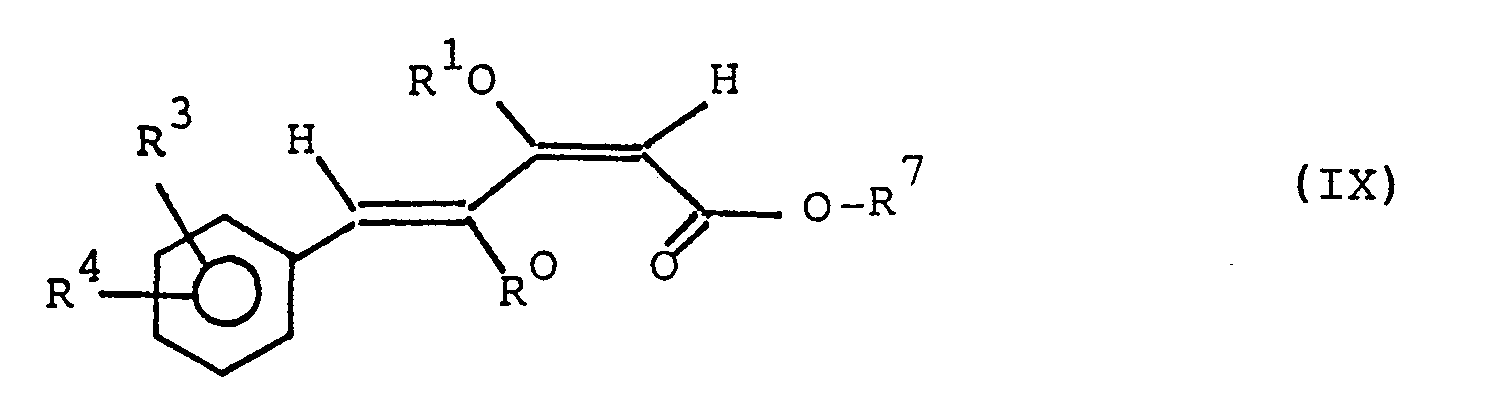
- RO, Rl, R3 und R4 die in Anspruch 1 angegebenen Bedeutungen besitzen und
- R7 ein Wasserstoffatom, eine geradkettige oder verzweigte Alkylgruppe mit 1 bis 10 C-Atomen oder eine Aralkylgruppe mit 7 bis 10 C-Atomen ist.
- Dise neuen Verbindungen der allgemeinen Formel IX sind reaktive Zwischenprodukte, die zur Herstellung der erfindungsgemäßen Verbindungen der allgemeinen Formel verwendet werden können.
- Bei einer bevorzugten Gruppe der vorgenannten reaktiven Zwischenprodukte der allgemeinen Formel IX ist R7 ein Wasserstoffatom, eine geradkettige oder verzweigte Alkylgruppe mit 1 bis 4 C-Atomen oder eine Benzylgruppe.
- Gegenstand der Erfindung ist schließlich ein Verfahren zur Herstellung derjenigen Verbindungen der allgemeinen Formel I, worin n = 0 ist, das durch die Kombination folgender Verfahrensstufen gekennzeichnet ist:
- (A) Ein Benzaldehyd der allgemeinen Formel VI


- (B) die so entstandene Pentadiensäure wird in einen Ester der allgemeinen Formel IX

- (C) der Ester der allgemeinen Formel IX wird durch cis-Dihydroxylierung mittels katalytischer Mengen OsO4 und eines Oxidationsmittels zum entsprechenden 3-Alkoxy-4,5(threo)-dihydroxy-5-(R3,R4-subst.)-phenyl-2(E)-pentensäureester der allgemeinen Formel XI umgesetzt

- (D) woraus unter 1.4-Eliminierung des Alkohols R7OH das entsprechende threo-4-Alkoxy-5-[(R3,R4- subst)phenylhydroxymethyl]-2(5H)-furanon der allgemeinen Formel I mit R2 = H gebildet wird,
- (E) welches anschließend gegebenenfalls mit einer reaktiven Verbindung der allgemeinen Formel R2- X, worin R2 die im Zusammenhang mit der Erläuterung der allgemeinen Formel I genannte Bedeutung, mit Ausnahme von Wasserstoff, besitzt und X eine reaktive Gruppe ist, z.B. Halogen oder Alkoxy, unter Abspaltung von X-H zur entsprechenden Verbindung der allgemeinen Formel I mit R2 ≠ H umgesetzt wird.
- Vorteilhafte Ausführungsformen des erfindungsgemäßen Verfahrens bestehen darin,
- -daß die Kondensation der Stufe (A) in einem dipolaren aprotischen Lösungsmittel und in basischem Milieu durchgeführt wird;
- -daß die Kondensation in Dimethylsulfoxid/Wasser unter Zugabe von Alkalimetallhydroxid, quartären Ammoniumbasen oder deren Gemischen durchgeführt wird;
- -daß die Kondensation unter Inertgasatmosphäre bei einer Temperatur zwischen etwa 70 und 140°C durchgeführt wird.
- -daß in Stufe (C) Alkylhydroperoxide, tertiäre Amin-N-oxide oder Chlorate als Oxidationsmittel verwendet werden;
- -daß die Dihydroxylierung in Stufe (C) in Gegenwart einer quartären Ammoniumbase oder eines quartären Ammoniumsalzes durchgeführt wird.
- Eine weitere Ausführungsform des erfindungsgemäßen Verfahrens ist dadurch gekennzeichnet, daß die in Stufe (A) gebildete Pentadiensäure der allgemeinen Formel VIII der cis-Dihydroxylierung gemäß Stufe (C) unter Bildung der entsprechend substituierten Pentensäure der allgemeinen Formel XI mit R7 = H unterworfen wird, wonach die Pentensäure gemäß Stufe (D) unter 1.5-Eliminierung von H20 zum entsprechend substituierten Furanon der allgemeinen Formel I mit R2 = H umgesetzt wird, welches anschließend gegebenenfalls gemäß Stufe (E) zu einer Verbindung der allgemeinen Formel I mit R2 *- H umgesetzt wird.
- Das erfindungsgemäße Verfahren zur Herstellung derjenigen Verbindungen der allgemeinen Formel 1, worin n = 0 ist, wird nachstehend noch näher anhand der Zeichnung (Formelschema) erläutert:
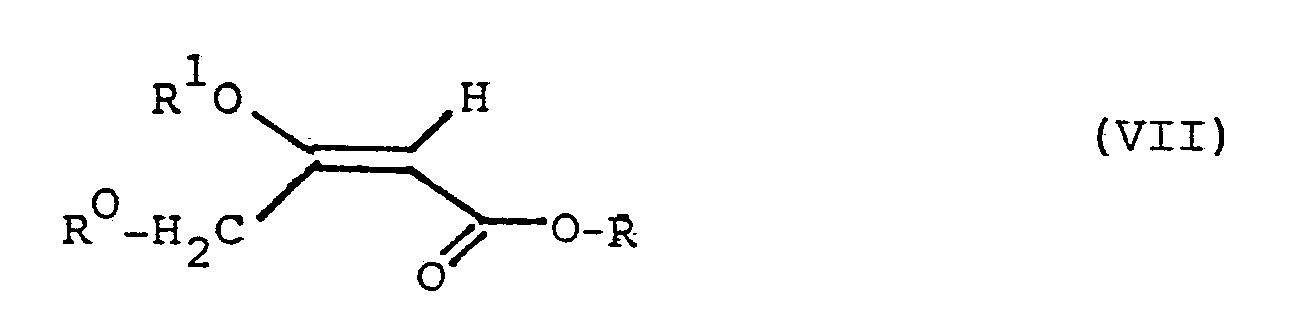
- Zur Synthese der 3-Alkoxy-5-(R3,R4-subst.)phenyl-2(E), 4(E)-pentadiensäuren der allgemeinen Formel VIII kondensiert man die Benzaldehyde der allgemeinen Formel VI mit den 3-Alkoxy-2(E)-alkensäure- niederalkylestern der allgemeinen Formel VII, vorzugsweise in einem dipolaren aprotischen Lösungsmittel, insbesondere Dimethylsulfoxid, bei erhöhter Temperatur und unter Zugabe von Alkalimetallhydroxiden und quartären Ammoniumbasen oder deren wäßrigen Lösungen und fällt nach beendeter Kondensation und Abkühlung des Reaktionsgemischs die 3-Alkoxy-5-(R3,R4-subst.)phenyl-2(E),4(E)-pentadiensäuren durch Verdünnen mit Wasser und Ansäuern aus.
- Besonders gute Ausbeuten werden bei Einhaltung folgender Reaktionsbedingungen erzielt: Zu 1 Mol Aldehyd der Formel VI fügt man 100 bis 500 ml Dimethylsulfoxid und 0,5 bis 2 Mol 3-Alkoxy-2(E)-alkensäure-niederalkylester der Formel VII sowie 0,01 bis 1 Mol einer quartären Ammoniumbase oder eines quartären Ammoniumsalzes, gegebenenfalls in Form einer wäßrigen Lösung, hinzu.
- Unter einer Inertgasatmosphäre, beispielsweise unter Stickstoff oder Argon, erhitzt man das Reaktionsgemisch auf eine Temperatur zwischen etwa 70 und 140°C, vorzugsweise etwa 90 bis 110°C, und fügt mindestens eine der Menge des eingesetzten Esters der Formel VII äquimolare Menge Alkalimetallhydroxid, gegebenenfalls in Form einer konzentrierten wäßrigen Lösung, hinzu und rührt das Gemisch vorzugsweise etwa 2 bis 12 Stunden lang bei der genannten Temperatur.
- Nach Abkühlen auf Raumtemperatur werden die Pentadiensäuren der Formel VIII durch Verdünnen mit Wasser und Ansäuern auf einen pH-Wert von etwa 1 bis 4 ausgefällt, abfiltriert, mit Wasser und anschießend mit einem niederen Alkohol gewaschen und gegebenenfalls getrocknet.
- Als Benzaldehyde der allgemeinen Formel VI, worin R3 und R4 unabhängig voneinander Wasserstoff, Fluor, Chlor, Brom, Ci-bis C3-Niederalkyl, Ci-bis C3-Perfluorniederalkyl, Difluormethoxy oder Nitro bedeuten, können beispielsweise die folgenden Verbindungen eingesetzt werden:
- Benzaldehyd,in 2-, 3-oder 4-Stellung durch Fluor, Chlor, Brom, Methyl, Trifluormethyl, Difluormethoxy oder Nitro substituierte Benzaldehyde, 2,4-, 2,5-, 2,6-, 3,4-oder 3,5-Dichlorbenzaldehyd, 2,4-oder 2,5-Dibrombenzaldehyd, 2,4-, 2,5-oder 3,5-bis-(Trifluormethyl)-benzaldehyd, 2-Chlor-4-brombenzaldehyd, 2-Chlor-5-brombenzaldehyd, 2-Chlor-4-trifluormethylbenzaldehyd, 2-Chlor-5-trifluormethylbenzaldehyd, 2-Brom-5-trifluormethylbenzaldehyd, 2-Trifluormethyl-4-chlorbenzaldehyd, 2-Trifluormethyl-5-chlorbenzaldehyd, 2-Fluor-4-chlorbenzaldehyd, 2-Fluor-5-trifluormethylbenzaldehyd etc.
- Bevorzugt werden Benzaldehyd und solche monosubstituierten Benzaldehyde verwendet, die in 2-Stellung einen der Rest R3 bzw. R4 tragen. Bevorzugt werden außerdem solche disubstituierten Benzaldehyde verwendet, die in 2-Stellung den Rest Fluor, Chlor, Brom oder Perfluoralkyl und in 4-oder 5-Stellung den Rest Chlor, Brom oder Trifluormethyl tragen.
- Die Benzaldehyde der allgemeinen Formel VI sind bekannt oder können nach bekannten Methoden hergestellt werden (vgl. Methodicum chimicum, Bd. 5, S. 203-336, Georg Thieme Verlag, Stuttgart, 1975).
- Die 3-Alkoxy-2(E)-alkensäure-niederalkylester der allgemeinen Formel VII, worin "Niederalkyl" einen Alkylrest mit 1 bis 5 C-Atomen und R1 eine geradkettige oder verzweigte Alkylgruppe mit 1 bis 5 C-Atomen bedeutet, sind ebenfalls bekannt oder können nach bekannten Methoden hergestellt werden. Bevorzugte Ester der allgemeinen Formel VII sind diejenigen Methyl-oder Ethylester, in denen R1 eine Alkylgruppe mit 1 bis 3 C-Atomen bedeutet, also beispielsweise 3-Methoxy-2(E)-butensäuremethyl-oder -ethylester, 3-Ethoxy-2(E)-butensäuremethyl-oder -ethylester, 3-Propoxy-2(E)-butensäuremethyl-oder -ethylester, 3-Isopropoxy-2(E)-butensäuremethyl-oder -ethylester sowie die homologen 3-Alkoxy-2(E)-penten-, -hexen-oder -heptensäureester. Besonders bevorzugt sind 3-Methoxy-2(E)-dbutensäureethylester und 3-Ethoxy-2-(E)-butensäureethylester.
- Zur Erzielung hoher Ausbeuten werden bei der Kondensation in Stufe A des erfindungsgemäßen Verfahrens quartäre Ammoniumbasen, gegebenenfalls in Form wäßriger Lösungen, als Katalysatoren zugesetzt. Hierzu eignen sich besonders die als Phasentransferkatalysatoren bekannten quartären Tetraalkyl-oder Trialkylphenyl-oder Trialkylbenzylammoniumhydroxide, beispielsweise Tetraethyl-oder Tetrabutylammoniumhydroxid, Benzyltriethyl-oder -trimethylammoniumhydroxid oder Dodecyltrimethylammoniumhydroxid. Anstelle der quartären Ammoniumbasen können auch deren Salze mit Mineralsäuren, beispielsweise deren Chloride, Sulfate, Hydrogensulfate oder Bromide, unter Zusatz äquivalenter Mengen konzentrierter Kali-oder Natronlauge, eingesetzt werden.
- Die Kondensation in Stufe A des erfindungsgemäßen Verfahrens führt unter gleichzeitiger Esterhydrolyse stets zu den 4,5-trans-konfigurierten Pentadiensäurederivaten der allgemeinen Formel VIII, was mit Hilfe der üblichen physikalischen Methoden nachgewiesen werden konnte. Wenn RO -H ist, betragen beispielsweise die Kopplungskonstanten der H-4-und H-5-Protonen im 1H-NMR-Spektrum etwa 15 bis 17 Hz.
- Die Pentadiensäurederivate der allgemeinen Formel VIII werden in an sich bekannter Weise in die Ester der allgemeinen Formel IX, worin R7 einen Ci-bis C10-Alkylrest oder einen Crbis C10-Arylalkylrest bedeutet, übergeführt (vgl. beispielsweise Methodicum Chemicum, a.a.O., Bd. 5, S. 637-677 (1975)).
- Zur selektiven cis-Dihydroxylierung der C-4/C-5-Doppelbindung werden die Pentadiensäureester der allgemeinen Formel IX in Gegenwart katalytischer Mengen Osmiumtetroxid in einem geeigneten inerten Lösungsmittel mit einem Oxidationsmittel umgesetzt. Eine Übersicht über derartige, an sich bekannte Oxidationsverfahren findet sich bei M. Schröder, Chem. Rev. 80, S. 187-213(1980).
- Als Oxidationsmittel wird vorzugsweise ein Alkylhydroperoxid oder ein aliphatisches, cycloaliphatisches oder heterocycloaliphatisches Amin-N-oxid, beispielsweise N-Methylmorpholin-N-oxid, vorzugsweise in Form einer konzentrierten wäßrigen Lösung, verwendet. Als inerte Lösungsmittel für die Oxidationsreaktion können tertiäre Alkanole, niedere Alkanone, niedere Alkylalkanoate oder niedere Chlorkohlenwasserstoffe verwendet werden.
- Aus den in Stufe C-1 erhaltenen Verbindungen der allgemeinen Formel-XI lassen sich durch intramolekulare γ-Lactonbildung unter Abspaltung der Alkohole R70H, worin R7 die vorgenannten Bedeutungen besitzt, die threo-4-Alkoxy-5-(phenylhydroxymethyl)-2(5H)-furanone der allgemeinen Formel XII, worin RO, R1, R3 und R4 die genannten Bedeutungen besitzen, herstellen. In Abhängig keit von den Reaktionsbedingungen und der Art des Restes R7, kann die Lactonbildung schon während der Reaktion in Stufe C-1 oder bei der Aufarbeitung des Reaktionsgemisches der Stufe C-1 ganz oder teilweise vor sich gehen. in schwach saurem Milieu schließt sich der Lactonring unter Eliminierung des Alkohols R7OH besonders leicht.
- Anstelle der Ester der allgemeinen Formel IX können auch die Säuren der allgemeinen Formel VIII direkt der durch Osmiumtetroxid katalysierten cis-Dihydroxylierung unterworfen werden. Die Reaktion führt dann direkt zu den 4.5(threo)-Dihydroxy-2(E)-pentensäure-Derivaten der allgemeinen Formel X, worin R°, R1, R3 und R4 die genannten Bedeutungen besitzen. Als Oxidationsmittel können die in Stufe C-1 beschriebenen Verbindungen verwendet werden.
- Auch in diesem Falle wird die Oxidationsreaktion vorzugsweise mit Alkylhydroperoxid in Gegenwart quartärer Ammoniumbasen, beispielsweise in Gegenwart von Tetraethyl-oder Tetrabutylammoniumhydroxid, durchgeführt; die quartären Ammoniumbasen erhöhen die Löslichkeit der an sich schwer löslichen Pentadiensäuren der allgemeinen Formel VIII in wäßrigem Medium und verstärken die katalytische Wirkung des Osmiumtetroxids.
- Ebenso wie in Stufe C-1 werden auch in Stufe C-2 stets die 4,5(threo)-Dihydroxy-Verbindungen stereoselektiv erhalten.
- Analog zur γ-Lactonbildung in Stufe D-1 findet der intramolekulare Ringschluß der in Stufe C-2 erhaltenen 4,5(threo)-Dihydroxysäuren der allgemeinen Formel X unter Wasserabspaltung zu den entsprechenden 2(5H)-Furanon-Derivaten der allgemeinen Formel XII mindestens teilweise schon während des Ablaufs der Oxidationsreaktion in Stufe C-2 statt, insbesondere jedoch dann, wenn due Aufarbeitung des Reaktionsgemischs der Stufe C-2 in neutralem oder saurem Milieu erfolgt.
- Zur Herstellung derjenigen erfindungsgemäßen Verbindungen der allgemeinen Formel I, worin n = 0 und R2 * H ist, werden die in Stufe D-1 oder D-2 erhaltenen threo-4-Alkoxy-5-phenylhydroxymethyl-2(5H)-furanone der allgemeinen Formel XII, worin R0, R1, R3 und R4 die genannten Bedeutungen besitzen, in die entsprechend substituierten R2-Derivate der allgemeinen Formel XIII, die Ether oder Acetale darstellen, in an sich bekannter Weise umgesetzt.
- Zur Herstellung der Ether, in denen R2 eine Alkylgruppe mit 1 bis 3 C-Atomen ist, werden die Verbindungen der allgemeinen Formel XII in einem niederen Alkanon, vorzugsweise in Aceton oder Butanon, bei einer Temperatur zwischen etwa 50 und 100°C bzw. unter Rückfluß mit einem Ci-bis C3-Alkyljodid, vorzugsweise mit Methyljodid, in Gegenwart einer mindestens äquimolaren Menge an Silber(I)-oxid umgesetzt.
- Zur Herstellung der Acetale, in denen R2 den Rest


- Bevorzugte Acetal-Derivate der allgemeinen Formel XIII sind diejenigen, in denen R2 Methoxymethyl, Ethoxymethyl, Methoxyethoxymethyl, a-Ethoxypropyl oder α,β-Dimethoxyethyl bedeutet.
- Die zur Herstellung der Ether und Acetale in Stufe E beschriebenen Verfahren stellen nur beispielhafte Methoden dar; selbstverständlich kann hierfür auch jede andere, dem Fachmann geläufige Methode der Veretherung oder Acetalisierung angewandt werden.
- Zur Herstellung derjenigen erfindungsgemäßen Verbindungen der allgemeinen Formel I, worin n = 0, 1 oder 2 ist, wird das von A. Pelter et al. in Tetrahedron Lett. 1979, S. 1627-1630, beschriebene Verfahren analog angewandt. Hierzu werden die 4-Alkoxy-5(2H)-furanone, die, abgeleitet von der Tetronsäure, auch als Alkyltetronate bezeichnet werden können und der allgemeinen Formel XVII entsprechen, worin R0 und R1 die oben genannten Bedeutungen besitzen, mittels geeigneter iithiumorganischer Verbindungen in die Lithium-Derivate der allgemeinen Formel XVIII übergeführt:


- Bei diesem Analogieverfahren entstehen stets Gemische der threo-und erythro-Diastereomeren, weshalb die threo-Verbindungen anschließend in an sich bekannter, aufwendiger Weise, beispielsweise durch fraktionierte Kristallisation oder chromatographische Verfahren, isoliert werden müssen. Man erhält dann die threo-Verbindungen der allgemeinen Formel I mir R2 = H, die gege benenfalls anschließend gemäß Stufe E einer Veretherung oder Acetalisierung unterworfen werden können.
- Die Alkyltetronate der allgemeinen Formel XVII sind entweder Literaturbekannt oder können nach bekannten Verfahren hergestellt werden (vgl. z.B. EP-PS 10 288; J. Org. Chem. 49, 927-928 (1984); Tetrahedron 35, 2181-2185 (1979); Tetrahedron 34, 1453-1455 (1978); Synth. Commun. 10,805-811 (1980); Angew. Chem. 94, 651-652 (1982)).
- Als weitere Methode zur Herstellung der bei diesem Verfahren als Ausgangsmaterial eingesetzten Alkyltetronate der allgemeinen Formel XVII wurde die basenkatalysierte Umalkoxylierung von 4-Methoxy-2-(5H)-furanonen gefunden. Hierzu werden die Methoxyfuranone der allgemeinen Formel XVII mit R1 = CH3 mit überschüssigen Niederalkanolen R1OH mit R1 = C2-bis C5-Niederalkyl unter Zusatz katalytischer Mengen des entsprechenden Alkalialkoholats R1 ONa oder R1OK in der Siedehitze umgesetzt, wobei unter Abspaltung von Methanol die gewünschten 4-Alkoxy-2(5H)-furanone der allgemeinen Formel XVII entstehen, bei denen R1 eine Niederalkylgruppe mit 2 bis 5 C-Atomen bedeutet.
- Gegenstand der Erfindung sind ferner Arzneimittel, die gegebenenfalls zusammen mit einem pharmazeutisch inerten Excipiens eine oder mehrere der Verbindungen der allgemeinen Formel I, einschließlich derjenigen, worin R2 = H oder CH3 bedeutet, wenn n = 0 oder 2, R0 = H, R1 = CH3, R3 = H und R4 = H ist, enthalten.
- Diese Arzneimittel und pharmazeutischen Zubereitungen können als Antikonvulsiva in der Human-und Veterinärmedizin und als Antiepileptika in der Humanmedizin verwendet werden. Die wirksame Dosis, in der die Verbindungen verabreicht werden können, liegt sowohl in der Humanmedizin als auch in der Veterinärmedizin zwischen etwa 0,05 und 3 mg/kg. Es können 5 - 200 mg der Wirksubstanz ein-oder mehrmals täglich p.o. appliziert werden.
- Als pharmakologisch inerte, übliche Träger-und Zusatzstoffe können beispielsweise Wasser, pflanzliche Öle, Polyethylenglykole, Glycerinester, Gelatine, Kohlenhydrate wie Lactose oder Stärke, Magnesiumstearat, Talk, Vaseline@, Konservierungsmittel, Stabilisatoren, Gleitmittel, netzmittel, Emulgatoren, physiologisch unbedenkliche Salze, Puffersubstanzen, Farbstoffe, Geschmacksstoffe und Aromastoffe verwendet werden. Die Auswahl des pharmakologisch inerten Excipiens hängt davon ab, ob die Wirkstoffe enteral, parenteral oder topikal appliziert werden sollen. Die neuen und bekannten Verbindungen der allgemeinen Formel I können auch im Gemisch mit anderen Wirkstoffen, beispielsweise Vitaminen oder anderen bekannten Antikonvulsiva oder Antiepileptika, verabreicht werden.
- Jede der in den nachfolgenden Beispielen genannten erfindungsgemäßen Verbindungen und Zwischenprodukte stellt ein zur Herstellung pharmazeutischer Zubereitungen besonders geeignetes Mittel dar.
- In den folgenden Beispielen werden folgende Abkürzungen verwendet:
- Schmp. = Schmelzpunkt (unkorrigiert)
- Kp. = Siedepunkt (unkorrigiert)
- (Z) = Zersetzung
- Temperaturen sind in °C angegeben
- Drücke sind in bar (mbar) angegeben, wobei 1 bar (mbar) 105 (102) Pa.
- Die 300 MHz-1H-und 75,46 MHZ-13C-Kernresonanzspektren wurden auf dem NMR-Spektrometer WH 300 der Firma Bruker aufgenommen. Als Lösungsmittel wurde hierfür, sofern nicht anders angegeben, DMSO-D6 verwendet. Die chemischen Verschiebungen 5 sind relativ zum Tetramethylsilan-Signal (innerer Standard) in ppm angegeben.
- Das Gemisch aus 520 g (4 Mol) Ethylacetoacetat, 400 ml Methanol und 2 ml 36 %iger Salzsäure (oder 1 ml konz. Schwefelsäure) wird auf 50°C erwärmt. Unter Rühren tropft man 425 g (4 Mol) Trimethylorthoformiat so zu, daß die Mischung bei ca. 50°C gehalten wird. Anschliessend destilliert man gebildetes Methylformiat und überschüssiges Methanol ab und fraktioniert den Rückstand über eine Vigreux-Kolonne. Zwischen 184° und 186°C destillieren 548 g (3.8 Mol) reines Ethyl-3-methoxy-2(E)-butenoat über. Ausbeute: 95 %.
- Herstellung analog Beispiel Nr. 1 durch Umsetzung von Methyl-3-oxopentanoat mit Trimethylorthoformiat in Methanol und Schwefelsäure als Katalysator. Ausbeute: 87.7 %. Kp = 76° - 78°C (20 mbar).
- Herstellung analog Beispiel Nr. 1 durch Umsetzung von Ethyl-3-oxohexanoat mit Trimethylorthoformiat in Methanol und Schwefelsäure als Katalysator. Ausbeute: 95.8 %. Kp = 87°-89°C (20 mbar).
- Herstellung analog Beispiel Nr. 1 durch Umsetzung von Ethyl-5-methyl-3-oxohexanoat mit Trimethylorthoformiat in Methanol und Schwefelsäure als Katalysator. Ausbeute: ca. 50 % Kp = 91 ° - 97°C (16-19 mbar)
- Unter Rühren und Stickstoffatmosphäre werden zu der Mischung aus 53 g (0.5 Mol) Benzaldehyd, 100 ml Dimethylsulfoxid und 72 g (0.5 Mol) Ethyl-3-methoxy-2(E)-butenoat 11.6 g (0.05 Mol) Benzyltriethylammoniumchlorid zugefügt und danach die Lösung von 33.6 g (0.6 Mol) Kaliumhydroxid in 35 ml Wasser zugetropft. Man erwärmt ca. 16 Stdn. lang auf 110°C, evaporiert die Lösung, löst den Rückstand in 400 ml Wasser und extrahiert Ausgangs-und Nebenprodukte mit 100 ml Dichlormethan. Aus der wäßrigen Phase fällt nach Ansäuern mit 70 ml 10M-Salzsäure das Rohprodukt aus, das nach Absaugen, säurefrei Waschen mit Wasser, Umkristallisation aus Ethanol und Trocknen bei 100°C im Vakuum 34.9 g (0.171 Mol) Reinprodukt mit Schmp. = 154 - 155°C ergibt. Ausbeute 34.2 %. Literatur Schmp. = 157,5 - 158°C [ E.E. Smissman und A.N. Voldeng, J. Org. Chem. 29 , 3161 (1964)]. Analyse: C12H1203 (204.23) Ber.: C (70.57), H (5.92) Gef:: C (70.49), H (6.16)
- Unter Rühren und Stickstoffatmosphäre werden zu der Lösung von 3785 g (26.25 Mol) Ethyl-3-methoxy-2(E)-butenoat in 6 Litern Dimethylsulfoxid nacheinander 2653 g (25 Mol) Benzaldehyd und 926 ml (2.5 Mol) 40 %iges wäßriges Tetraethylammoniumhydroxid zugetropft. Nach Erhitzen auf 100°C tropft man die Lösung von 1470 g (26.25 Mol) Kaliumhdyroxid in 1500 ml Wasser zu und rührt 4 Stdn. bei 100°C. Nach Abkühlen auf ca. 20°C gießt man die Mischung in 50 Liter Wasser und extrahiert Verunreinigungen mit 10 Litern Dichlormethan. Die Wasserphase wird unter kräftigem Rühren mit ca. 3 Litern 33 %iger Salzsäure auf pH = 2 angesäuert und das ausgefällte Rohprodukt über einen Druckfilter abfiltriert, mit Wasser chloridfrei gewaschen und mit Stickstoff trocken geblasen. Der Filterkuchen wird in 6 Litern Ethanol suspendiert, erneut filtriert und nach Trockenblasen im Vakuum bis zur Endtemperatur von 85°C getrocknet. Man erhält 3071 g (15.04 Mol) Reinprodukt mit Schmp. 159°-160°C. Ausbeute: 60.1 %.
- 3785 g (26.25 Mol) Ethyl-3-methoxy-2(E)-butenoat werden analog Beispiel Nr. 6 b in 6 Litern Dimethylsulfoxid mit 3515 g (25 Mol) 2-Chlorbenzaldehyd, 926 ml (2.5 Mol) 40 %igem Tetraethylammoniumhydroxid und 2940g(26.25 Mol) 50 %iger Kalilauge umgesetzt und- 4 Stdn. bei 100°C nachgerührt. Nach dem Abkühlen vedünnt man mit 10 Litern Wasser und extrahiert Nebenprodukte mit 10 Litern Dichlormethan. Die wäßrige Phase wird in die Mischung aus 3 Litern 33 %iger Salzsäure und 50 Litern Waser eingerührt, wonach der pH-Wert 3,5 bis 4 beträgt. Das ausgefällte Rohprodukt wird nach Filtrieren, Waschen mit Wasser bis zur Chloridfreiheit und Trockenblasen in 20 Litern Ethanol suspendiert erneut abgesaugt, trockengeblasen und bis zur Endtemperatur von 85°C bei 20 mbar getrocknet. Man erhält 5045 g (21.14 Mol) Reinprodukt mit Schmp. 202°C. Ausbeute: 84.55 % Analyse: C12H11ClO3 (238.67) Ber.: C (60.39), H (4.65), CI (14.85) Gef.: C (60.33), H (4.85), CI (14.72) 300 MHz-1H-NMR: 11.8 - 12.2 (1 H, br.m, COOH), 8.08 (1 H, d, J5/4= 16 Hz, H-5), 7.54 (1 H, d, J4/5 = 16 Hz, H-4), 5.29 ( 1 H,s, H-2), 3.785 (3 H, s, OCH3), 7.35 - 7.75 (4 H, m, aromat. Protonen).
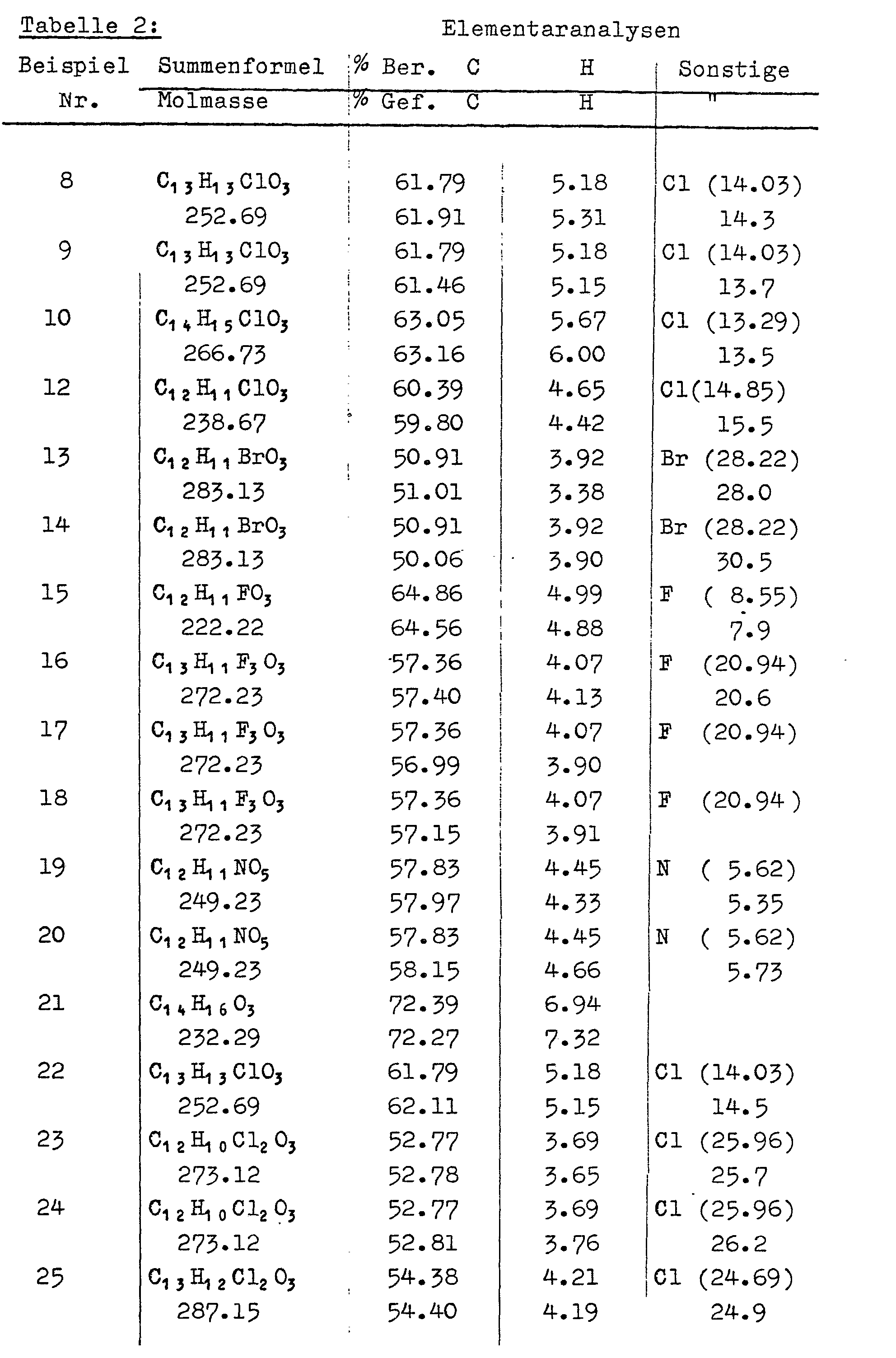
- Analog zu den in Beispielen Nr. 6 a, b und 7 verwendeten Synthese-Methoden werden durch Kondensation von Benzaldehyd bzw. substituierten Benzaldehyden mit den in Beispielen Nr. 1 bis 5 beschriebenen 3-Alkoxy-2(E)-alkenoaten folgende 3-Alkoxy-5-(subst.)phenyl-2(E),4(E)-pentadiensäuren hergestellt: siehe Tabelle 1. In den Tabellen 2 und 3 sind die analytischen und 1H-NMR-spektroskopischen Daten aufgelistet.




- Zu der Mischung aus 48 g (0.2 Mol) 5-(2-Chlorphenyl)-3-methoxy-2(E),4(E)-pentadiensäure, 600 ml Aceton und 60 g (0,43 Mol) Kaliumcarbonat tropft man unter Rühren 34.2 g (0.2 Mol) Benzylbromid und erhitzt 16 Stdn. zum Rückfluß. Nach Abfiltrieren anorganischer Rückstände, Evaporieren des Filtrats und Umkristallisation aus tert. Butylmethylether erhält man 56.1 g (0.17 Mo reinen Benzylester mit Schmp. 83 - 86°C. Ausbeute: 85 %. Analyse: C19H17ClO3 (328.80) Ber.: C (69.41), H (5.21), CI (10.78) Gef.: C (69.42), H (5.08), CI (10.9 ).
-
- a) Die Mischung aus 31 g (0.13 Mol) 5-(2-Chlorphenyl)-3-methoxy-2(E),4(E)-pentadiensäure, 400 ml Aceton, 36g(0.26 Mol) Kaliumcarbonat und 2o.8 g (0.13 Mol) Jodethan wird 18 Stdn. unter Rückfluß zum Sieden erhitzt. Nach dem Abkühlen, Filtrieren und Evaporieren des Filtrats nimmt man das ölige Rohprodukt in 100 ml n-Pentan auf, filtriert unlösliches Kaliumjodid ab, evaporiert das Filtrat und trocknet bei 45°C und 20 mbar nach. Man erhält 33.3 g (0.125 Mol) reinen Ethylester mit Schmp. 49 - 51°C, Ausbeute: 96 % Analyse: C14N15ClO3 (266.73) Ber.: C (63.05), H (5.67), CI(13.29) Gef.: C (63.37), H (5.69), CI(13.3)
- b) Unter Rühren tropft man zu dem Gemisch aus 35 Litern Butanon, 2386 g (10 Mol) 5-(2-Chlorphenyl)-3-methoxy-2(E),4(E)-pentadiensäure, 2073g(15 Mol) Kaliumcarbonat und 16.6 g (0.1 Mol) Kaliumjodid bei 56°C 1635 g (15 Mol) Bromethan und rührt 24 Stdn. bei 56°C nach. Nach dem Abkühlen und Abfiltrieren anorganischer Bestanteile wäscht man das Filtrat mit 2 mal 10 Litern Wasser und evaporiert die Butanonphase. Man erhält 2348 g (8.80 Mol) Ethylester, der beim Erkalten kristallisiert. Dünnschichtchromatographie und Infrarotspektrum zeigen die Identität mit dem zuvor beschriebenen Produkt (35 a) an. Schmp. 45°C. Ausbeute: 88 %
- Das Gemisch aus 23.9 g (0.1 Mol) 5-(2-Chlorphenyl)-3-methoxy-2(E),4(E)-pentadiensäure, 500 ml Aceton und 30.4 g (0.22 Mol) Kaliumcarbonat wird unter Rühren mit 9.5 ml (0.1 Mol) Dimethylsulfat versetzt und 4 Stdn. lang zum Rückfluß erhitzt. Nach dem Abkühlen und Filtrieren evaporiert man das Filtrat, löst das Rohprodukt in 100 ml Chloroform, wäscht mit 2 mal 30 ml Wasser, evaporiert die Chloroformphase und kristallisiert aus Isopropanol/Wasser um. Nach Trocknen bei 50°C / 20 mbar erhält man 22.18 g (87.8 mmol) reinen Methylester mit Schmp. 50 -52°C. Ausbeute: 87.8 % Analyse: C13H13ClO3 (252.69) Ber.: C (61.79), H (5.18), CI(14.03) Gef.: C (61.30), H (5.07), CI(13.7)
- Analog zu den in Beispielen Nr. 34 bis 36 beschriebenen Methoden wurden die in Tabelle 4 aufgeführten 3-Alkoxy-5-phenyl-2(E),4(E)-pentadiensäureester hergestellt. Ergebnisse der Elementaranalysen sind in Tabelle 5 zusammengefaßt.


- Anhand der Synthese dieser Zielverbindung werden die verschiedenen Ausführungsformen der durch Osmiumtetroxid katalysierten Oxidation der 3-Alkoxy-5-phenyl-2(E)-4(E)-pentadiensäure-Derivate zu den threo-4-Alkoxy-5-phenylhydroxymethyl-2(5H)-furanonen dargestellt (s. Schema 1, Stufen C-1, C-2, D-1 und D-2).
- Zu der Mischung aus 48.0 g (201 mmol) 5-(2-Chlorphenyl)-3-methoxy-2(E),4(E)-pentadiensäure, 400 ml Wasser und 400 ml (566 mmol) 20 %igem wäßrigen Tetraethylammoniumhydroxid gibt man unter Rühren und Kühlen auf 0°C 50 ml einer 0.02M-Lösung von Osmiumtetroxid in Aceton oder tert. Butanol und 56 ml (403 mmol) 70 %iges wäßriges tert. Butylhydroperoxid. Nach 6 Stdn. Rühren bei 0°C läßt man 8 Tage bei 0-5°C stehen und reduziert danach überschüssiges Hydroperoxid durch Verrühren mit 10 %iger wäßriger Natriumsulfit-Lösung. Durch Zugabe von 1 M-Schwefelsäure stellt man auf pH =2, wobei nicht umgesetztes Ausgangsprodukt auskristallisiert. Dieses wird abgesaugt (10.1 g=42.3 mmol). Das Filtrat wird mit 3 mal 100 ml Chloroform extrahiert und der Extrakt mit 50 ml 1 M-Salzsäure frei von quartären Ammoniumsalzen gewaschen. Der Extrakt enthält ein Gemisch aus threo-5-(2-Chlorphenyl)-4,5-dihydroxy-3-methoxy-2(E)-pentensäure und threo-5-(2-Chlorphenylhydroxymethyl)-4-methoxy-2(5H)-furanon. Durch Evaporieren vervollständigt man den Ringschluß und erhält nach Umkristallisation aus Ethylacetat 18.12 g (71.2 mmol) reines threo-5-(2-Chlorphenylhydroxymethyl)-4-methoxy-2(5H)-furanon mit Schmp. 149-151 °C. Ausbeute bezogen auf umgesetztes Ausgangsprodukt: 45.1 % .
- Analyse: C12H11ClO4 (254.67)
- Ber.: C (56.59), H (4.35), CI (13.92)
- Gef.: C (56.27), H (4.35), CI (14.0)
- 300 MHz-1-NMR: 7.3-7.7 (4 H, m, aromatische Protonen),
- 5.96 ( 1 H, d, JOH/Eα = 5.5 Hz, a-OH),
- 5.440 ( H, d, JH-3/H-5 = 1.3 Hz, H-3),
- 5.225 ( H, dd, JHα/H-5 = 2 Hz, Ha),
- 5.008 ( H, s, H-5),
- 3.923 (3 H, s, OCH3).
- 75.46 MHz-13C-NMR (breitbandentkoppelt):
- C-2 (172.530), C-3 (90.268), C-4 (180.229) C-5 (79.872), C-a (66.721), CAr-1' (138.409), CAr-2' bis 6'(130.650, 129.571, 129.421, 129.032 und 127.265), OCH3 (60.071).
- Die Zuordnung der 13C-Signale wurde durch Offresonanz-und Gated-Spektrum sowie durch SFORD-Experimente gesichert.
- Zur Lösung von 26.7 g (100 mmol) Ethyl-5-(2-Chlorphenyl)-3-methoxy-2(E),4(E)-pentadienoat in 450 ml Aceton gibt man 6.5 g (25 mmol) Tetraäthylammoniumacetat-Tetrahydrat und tropft unter Rühren und Kühlen auf 0°C nacheinander 25 ml 0.02M-Osmiumtetroxid-Lösung in tert. Butanol und 23.6 ml (170 mmol) 70 %iges wäßriges tert. Butylhydroperoxid zu. Man läßt 12 Tage bei 4°C stehen, gibt 200 ml Dichlormethan und 140 ml 10 %ige wäßrige Natriumsulfitlösung zu, rührt, bis kein Hydroperoxid mehr nachweisbar ist, trennt die organische Phase ab, extrahiert die wäßrige Phase mit 2 x 100 ml Dichlormethan und wäscht die vereinigten organ. Phasen mit wäßriger Kochsalzlösung. Die organische Phase enthält ein Gemisch von threo-Ethyl-5-(2-chlorphenyl)-4,5-dihydroxy-3-methoxy-2(E)-pentenoat und threo-5-(2-Chlorphenylhydroxy- methyl)-4-methoxy-2(5H)-furanon. Durch Evaporieren vervollständigt man den Ringschluß und erhält nach Umkristallisation aus tert. Butylmethyläther 19.4 g (76.2 mmol) Reinprodukt mit Schmp. 149-151 °C, das mit dem nach Beispiel Nr. 63 a gewonnenen Produkt dünnschichtchromatographisch und IR-spektroskopisch identisch ist. Ausbeute: 72.6 %
- Wie bei Variante b, jedoch wird statt des Ethylesters das Benzyl-5-(2-chlorphenyl)-3-methoxy-2(E),4(E)-pentadienoat eingesetzt. Ausbeute an threo-5-(2-Chlorphenylhydroxymethyl)-4-methoxy-2(5H)-furanon nach Umkristallisation aus Ethanol: 67.5 %. Schmp. 149 - 151 °C.
- Zur Lösung von 26.7 g (100 mmol) Ethyl-5-(2-Chlorphenyl)-3-methoxy-2(E),4(E)-pentadienoat in 360 ml Aceton gibt man unter Rühren 10 ml 0.02molare Osmiumtetroxid-Lösung in tert. Butanol und die Lösung von 14.9 g (110 mmol) N-Methylmorpholin-N-oxid-Hydrat in 30 m Wasser und rührt 4 Tage bei Raumtemperatur. Durch Verrühren mit 5.2 g (50 mmol) Natriumbisulfit gelöst in 50 ml Wasser reduziert man überschüssiges N-Oxid, stellt mit 1 M-Schwefelsäure auf pH =4 ein, zieht im Vakuum das Aceton ab und extrahiert die verbleibende wäßrige Mischung mit 2 x 200 ml dichlormethan. Der Extrakt wird mit verdünnter Schwefelsäure und Wasser frei von N-Methylmorpholin gewaschen und nach Trocknen über wasserfreiem Natriumsulfat im Vakuum konzentriert. Es kristallisieren 18.13 g threo-5-(2-Chlorphenylhydroxymethyl)-4- mthoxy-2(5H)-furanon aus. Evaporieren des Filtrats und Umkristallisation aus Ethylacetat ergeben weitere 1.20 g Reinprodukt. Ausbeute: 19.33 g (75.9 mmol) ≏ 75.9 %.
- Wie bei Variante d, jedoch wird die Reaktion statt in Aceton im 2-Phasensystem Butanon / Wasser durchgeführt und statt 110 mmol 160 mmol N-Methylmorpholin-N-oxid eingesetzt. Ausbeute: 76.2 %
- Wie bei Variante d, jedoch im 2-Phasensystem Dichlormethan / Wasser. Ausbeute: 66.7 %
- Das Gemisch aus 23.6 g (80 mmol) sec. Butyl-5-(2-chlorphenyl)-3-methoxy-2(E),4(E)-pentadienoat, 200 ml Butanon, 15 ml 0.02M-Osmiumtetroxid-Lösung in tert. Butanol, 17.6 g (160 mmol) N-Methylmorpholin-N-oxid-Hydrat und 50 ml Wasser wird 7 Tage bei Raumtemperatur gerührt. Nach Zugabe von 100 ml Dichlormethan, verrührt man mit 100 ml 2 %iger wäßriger Natriumbisulfit-Lösung, trennt die organische Phase ab und wäscht sie mit 2 mal 100 ml 0.5M-Salzsäure und 5 mal mit 100 ml Wasser. Die organische Phase enthält ein Gemisch von threo-sec.Butyl-5-(2-chlorphenyl)-4.5-dihydroxy-3-methoxy-2(E)-pentenoat und threo-5-(2-Chlorphenylhydroxymethyl)-4-methoxy-2(5H)-furanon. Durch Zugabe von 0.1 ml 32 % Salzsäure und Evaporieren der organischen Phase vervollständigt man den Ringschluß und erhält nach Umkristallisieren aus Ether 10.66 g (41.9 mmol) threo-5-(2-Chlorphenylhydroxymethyl)-4-methoxy-2(5H)-furanon. Ausbeute: 52.3 %. In gleicher Weise kann man statt des sec. Butylesters die entsprechenden Methyl-, Isopropyl-oder tert.Butylester einsetzen.
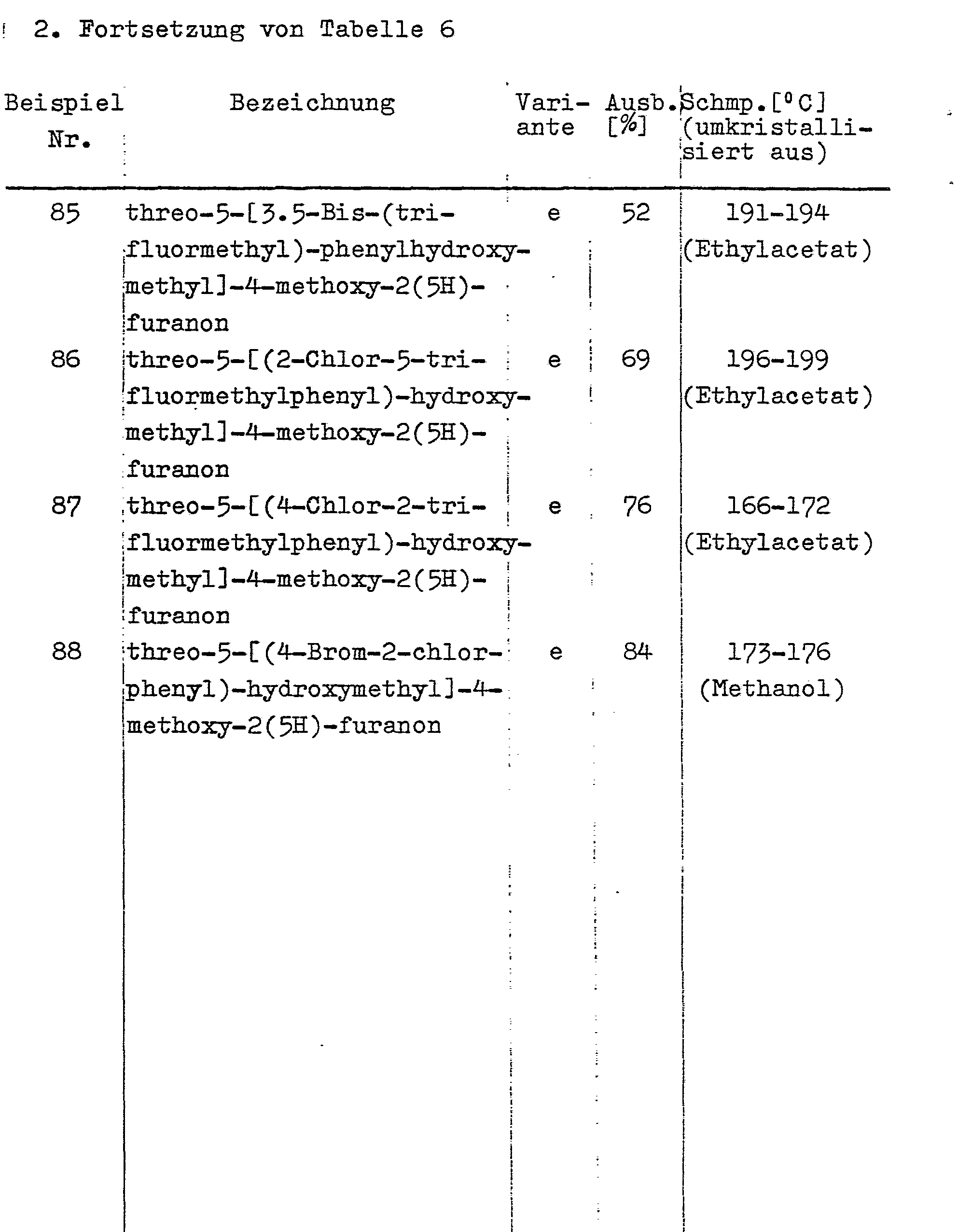
- Analog zu den in Beispiel 64 beschriebenen Verfahrensvarianten a bis g werden durch Oxidation der in den Beispielen Nr. 6 bis Nr. 63 beschriebenen 3-Alkoxy-5-phenyl-2(E),4(E)-pentadiensäure-Derivate folgende threo-4-Alkoxy-5-phenylhydroxymethyl-2(5H)-furanon-Derivate hergestellt: siehe Tabelle 6. Tabelle 7 enthält die Ergebnisse der Elementaranalysen, Tabelle 8 die IH-NMR-spektroskopischen Daten.




- Das Gemisch aus 28 g Ethyl-5-(2-Chlorphenyl)-3-methoxy-4-methyl-2(E),4(E)-pentadienoat (Rohprodukt aus Beispiel Nr. 61), 250 ml Tetrahydrofuran und 50 ml Wasser wird mit 25 ml 0.02M-Osmiumtetroxid-Lösung in tert. Butanol und 10.7 g Natriumchlorat versetzt und 4 Tage unter Rühren zum Rückfluß erhitzt. Man gibt erneut 25 ml 0.02M-Osmiumtetroxid-Lösung und 10.7 g Natriumchlorat zu und kocht weitere 3 Tage unter Rückfluß. Trotz unvollständiger Oxidation arbeitet man auf. Nach Abkühlen und Zugabe von 100 ml Dichlormethan wäscht man anorganische Bestandteile mit Wasser heraus, trocknet die Dichlormethanphase über Natriumsulfat, evaporiert und kristallisiert aus Ethylacetat um. Man erhält 1.463 g reines threo-5-(2-Chlorphenylhydroxymethyl)-4-methoxy-5-methyl-2(5H)-furanon mit Schmp. 181 - 184°C. Das DC an Kieselgel F 254 mit Chloroform / Methanol 95 / 5 ergibt Rf = 0.37. Analyse: C13H13CIO4: (268.69) Ber.: C (58.11 ), H (4.88), CI (13.19) Gef.: C (57.52), H (4.67), CI (12.9)
- Unter Rühren, Kühlen auf -77°C und Stickstoffatmosphäre tropft man zu der Lösung aus 8.30 g (82 mmol) Diisopropylamin in 150 ml Tetrahydrofuran 50 ml einer 1.64-molaren Lösung von n-Butyllithium in Hexan und 10.52 g (82 mmol) 1.3-Dimethyl-3.4.5.6-tetrahydro-2(1 H)-pyrimidinon (DMPU). Anschließend tropft man die Lösung von 10.5 g (82 mmol) 4-Methoxy-5-methyl-2(5H)-furanon in 80 ml Tetrahydrofuran zu, rührt 30 Min. und tropft die Lösung von 11.84 g (82 mmol) 2-Chlorbenzaldehyd in 50 ml Tetrahydrofuran zu. Unter Rühren läßt man innerhalb 16 Stdn. auf 0°C kommen, hydrolysiert durch Zutropfen von 50 ml Wasser und stellt mit 2M-Salzsäure auf pH = 5.5 ein. Die organische Phase wird abgetrennt und evaporiert, die wäßrige Phase 3 mal mit 100 ml Ether extrahiert. Evaporat und Etherphasen werden vereinigt, mit Wasser frei von DMPU gewaschen, über Natriumsulfat getrocknet und evaporiert. Der Rückstand wird an 400 g Kieselgel mit Chloroform / Methanol 98 / 2 als Eluens säulenchromatographisch aufgetrennt. Die Fraktionen mit Rf (Chloroform / Methanol 95 / 5) = 0.37 ergeben nach Evaporieren und Umkristallisation aus tert. Butylmethylether / Dichlormethan 5.3 g (19.7 mmol) reines threo-5-(2-Chlorphenyl- hydroxymethyl)-4-methoxy-5-methyl-2(5H)-furanon mit Schmp. 192 - 194°C, das dünnschichtchromatographisch und IR-spektroskopisch identisch mit dem nach Verfahren A erhaltenen Produkt ist. analyse: C13H13ClO4 (268.69) Ber.: C (58.11), H (4.88), CI (13.19) Gef.: C (58.05), H (4.81), Cl (13.2)
- Die Fraktionen mit Rf = 0.48 ergeben nach Evaporieren und Umkristallisation aus Toluol 2.64 g (9.84 mmol) reines erythro-5-(2-Chlorphenylhydroxymethyl)-4-methoxy-5-methyl-2(5H)-furanon mit Schmp. 153-155°C. Analyse: C13H13ClO4 (268.69) Ber.: C (58.11), H (4.88), CI (13.19) C (58.02), H (4.87), CI (13.3)
- Unter Kühlen auf -70°C, Rühren und Stickstoffatmosphäre tropft man zu der Lösung von 49.9 ml (327 mmol) Diisopropylamin in 500 ml wasserfreiem Tetrahydrofuran 200 mi 1.64-molare Lösung von n-Butyllithium in Hexan, 84 g (655 mmol) 1.3-Dimethyl-3.4.5.6-tetrahydro-2(1 H)-pyrimidinon und die Lösung von 37.4 g (327 mmol) 4-Methoxy-2(5H)-furanon in 300 ml Tetrahydrofuran. Man rührt 30 Min. bei -55°C nach, tropft die Lösung von 46 g (327 mmol) 2-Chlorbenzaldehyd und 5.8 ml Wasser in 100 ml Tetrahydrofuran zu und rührt 16 Stdn. unter allmählicher Erwärmung auf 0°C nach. Nach Hydrolyse mit 200 ml Wasser, Einstellung auf pH = 5.5 mit 2M-Salzsäure und Phasentrennung evaporiert man die organische Phase, extrahiert die wäßrige Phase mit 2 mal 300 ml Ether, vereinigt Evaporat und Etherphasen, wäscht mit 3 mal 300 ml Wasser und evaporiert. Das ölige Rohprodukt, bestehend aus dem Gemisch von threo-und erythro-Isomer, wird nach Verreiben mit Tetrachlormethan kristallin. Mehrfach fraktionierte Umkristallisation aus Ethylacetat ergibt 41.5 g (163 mmol) reines threo-5-(2-Chlorphenylhydroxymethyl)-4-methoxy-2-(5H)-furanon mit Schmp. 140 - 145°C und Rf = 0.35 (DC, Kieselgel F 254; Chlorform / Methanol 95 / 5). Das Produkt ist dünnschichtchromatographisch, NMR-und IR-spektroskopisch identisch mit dem in Beispiel Nr. 64 hergestellten. Aus den Mutterlaugen der Kristallisation erhält man 5.0 g (20 mmol) reines erythro-5-(2-Chlorphenylhydro- xymethyl)-4-methoxy-2(5H)-furanon mit Schmp. 159 - 161 °C (Ethylacetat) und Rf = 0.45. Analyse: C12H11ClO4 (254.67) Ber.: C (56.59), H (4.35), CI (13.92) Gef.: C (56.80), H (4.50), CI (13.9 ) 300 MHz-1H-NMR: 7.27 - 7.67 (4 H, m, aromat.Protonen), 6.205 (1 H, d, JOH/Hα = 5.0 Hz, a-OH) 5.310 (1 H, s, H-3), 5.292 (1 H, dd, JHα/H-5 = 2.7 Hz, Ha) 5.113 (1 H, d, H-5), 3.73 (3 H, s, OCH3)
- Weitere Konzentration der Mutterlaugen ergibt noch 18.7 g (73 mmol) kristallines Gemisch aus threo-und erythro-Isomer, das nicht mehr aufgetrennt wurde.
- Das Gemisch aus 34.2 g (300 mmol) 4-Methoxy-2(5H)-furanon, 200 ml Ethanol und 30 mmol Natriumethoxid wird im Autoklaven unter Stickstoffatmosphäre 24 Stdn. bei 120°C gerührt. Nach dem Abkühlen filtriert man über 100 g Kieselgel, evaporiert das Filtrat und destilliert 2 mal bei 10 mbar über eine Vigreux-Kolonne. Man erhält 21.6 g (169 mmol ) 4-Ethoxy-2(5H)-furanon mit Kp10 = 135-137°C. Ausbeute: 56 %
- Herstellung analog Beispiel Nr. 91 aus 4-Methoxy-2(5H)-furanon und Propanol. Kpio = 143 - 145°C. Ausbeute: 39 %
- Analyse: C7H10O3 (142.16)
- Ber.: C (59.14), H (7.09)
- Gef.: C (59.18), H (7.36)
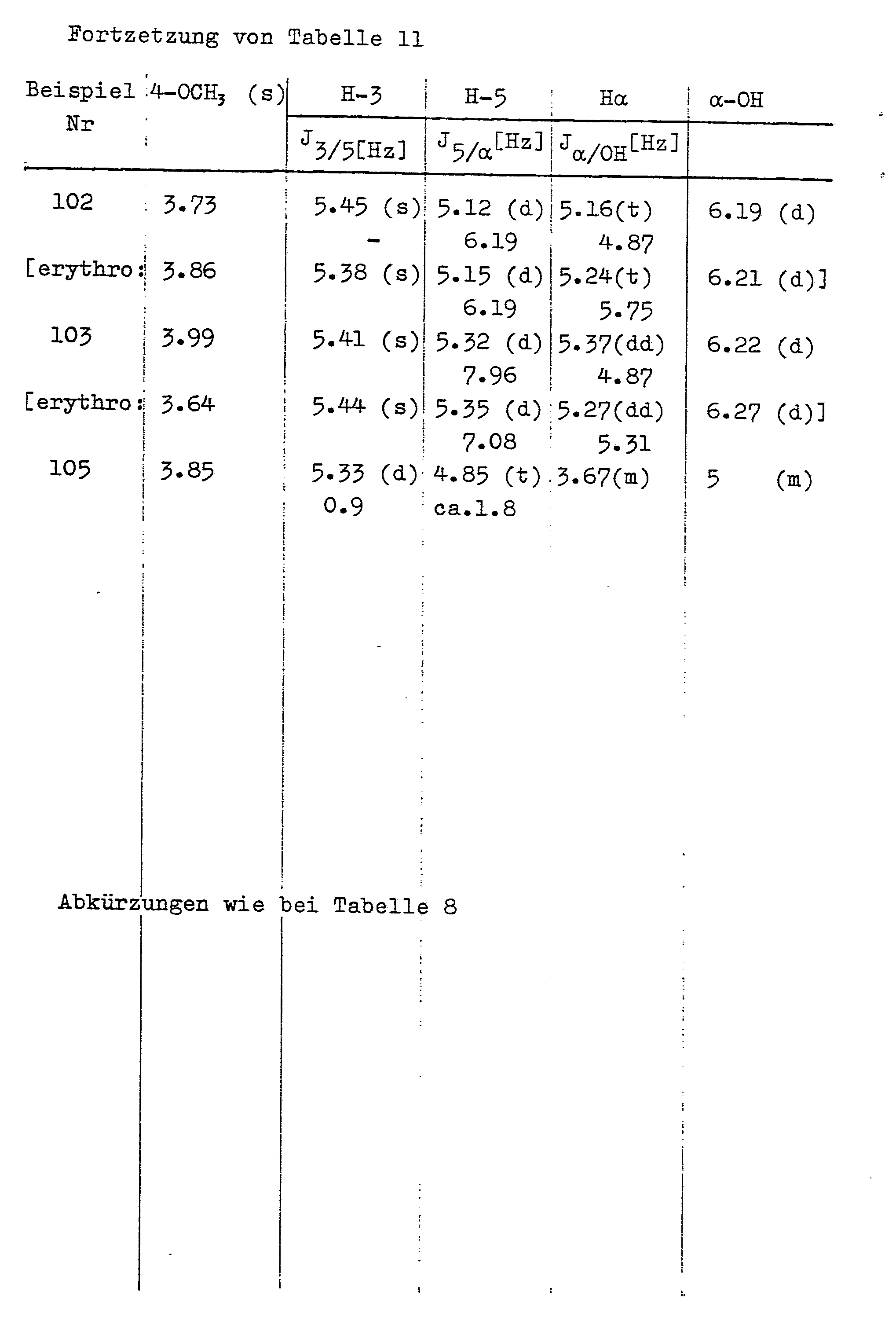
- Analog zu den in Beispielen Nr.89 B u.90 angegebenen Verfahren wurden weitere threo-4-Alkoxy-5-[a-hydroxy-ω-(subst.)phenylalkyl]-2(5H)-furanone hergestellt und von den sie begleitenden erythro-Isomeren getrennt. Bezeichnung, Schmelzpunkte und dünnschichtchromatographisch an Kieselgel F 254 ermittelte Rf-Werte sind in Tabelle 9, analytische Daten in Tabelle 10 und 1H-NMR-spektroskopische Daten in Tabelle 11 zusammengefaßt. Die Daten der erythro-Isomeren sind, soweit vorhanden, mit aufgeführt.


- Das Gemisch aus 3.0 g (9.9 mmol) threo-5-(2.4-Dichlorphenylhydroxymethyl)-4-ethoxy-2(5H)-furanon, 50 ml Butanon, 9.23 g (39.8 mmol) Silber(I)oxid und 5 ml (80 mmol) Jodmethan wird 24 Stdn. unter Rühren zum Sieden unter Rückfluß erhitzt. Man filtriert, evaporiert das Filtrat und kristallisiert das ölige Rohprodukt 2 mal aus Ether / Petrolether um. Man erhält 2.03 g (6.4 mmol) threo-4-Ethoxy-5-[methoxy-(2.4-dichlorphenyl)-methyl]-2(5H)-furanon mit Schmp. 110 - 114°C.
- Ausbeute: 64.6 %.
- Analyse: C14H14Cl2O4 (317.18)
- Ber.: C (53.02), H (4.45), CI (22.35)
- Gef.: C (53.16), H (4.60), CI (22.4 )
- 300 MHz-1H-NMR: 7.45-7.7 (3 H, m, aromat.Protonen)
- 5.40 (1 H, d, JH-3/H-5 = 0.88 Hz,H-3)
- 5.05 (1 H, dd, JH-5/Hα =3.10 Hz; H-5),
- 4.86 (1 H, d, Ha),
- 4.17 (2 H, ABX3-System, 4-OCHr),
- 3.20 ( 3 H, s, α-OCH3),
- 1.30 (3 H, JCH3/OCH2 = 7.07 Hz, CH3). ,
- Das Gemisch aus 12.7 g (50 mmol) threo-5-(2-Chlorphenylhydroxymethyl)-4-methoxy-2(5H)-furanon, 100 ml Dimethoxymethan, 1.7 g (20 mmol) Lithiumbromid und 0.95 g (5 mmol) p-Toluolsulfonsäure-Hydrat wird 4 Tage unter Rühren zum Sieden unter Rückfluß erhitzt. Man evaporiert, versetzt mit 50 ml Dichlormethan, wäscht mit Wasser frei von Lithiumbromid und p-Toluolsulfonsäure, evaporiert die organische Phase und kristallisiert das Rohprodukt 2 mal aus Methanol um. Man erhält 10.68 g (35.75 mmol) des Methoxymethylethers mit Schmp. 141 - 143°C.
- Ausbeute: 71.7 %
- Analyse: C14H15ClO5 (298.73)
- Ber.: C (56.29), H (5.06), CI (11.87)
- Gef.: C (56.52), H (5.10), CI (11.9)
- 300 MHz-1NMR: 7.3-7.6 (4 H, m, aromat. Protonen),
- 5.47 (1 H, d. JH-3/H-5 = 0.88 Hz, H-3)
- 5.32 (1 H, d, HHα/H-5 = 2.65 Hz, H =a)
- 5.09 Hz (1 H, dd, H-5),
- 4.55 und 4.42 (2 H, AB-System, JAB = 7.08 Hz, O-CHrO),
- 3.94 (3 H, s, 4-OCH3),
- 3.20 (3 H, s, ω-OCH3)
- Die Lösung von 10.2 g (40 mmol) threo-5-(2-Chlorphenylhydroxymethyl)-4-methoxy-2(5H)-furanon in 250 ml Dichlormethan wird nacheinander mit 27 ml (238 mmol) Methoxyethoxymethylchlorid und 40 ml (234 mmol) N-Ethyldiisopropylamin versetzt und 30 Stdn. zum Sieden unter Rückfluß erhitzt. Nach dem Abkühlen wäscht man mit insgesamt 260 ml 1M-Salzsäure und mit 2 x 50 ml Wasser, trocknet über wasserfreiem Natriumsulfat, evaporiert und kristallisiert das ölige Rohprodukt 2 mal aus Ethanol um. Man erhält 9.86 g (28.8 mmol) des Methoxyethoxymethylethers mit Schmp. 102 - 104°C.
- Ausbeute: 72 %
- Analyse: C16H19ClO6 (342.78)
- Ber.: C (56.07), H (5.59), CI (10.34)
- Gef.: C (55.72), H (5.60), Cl (10.2)
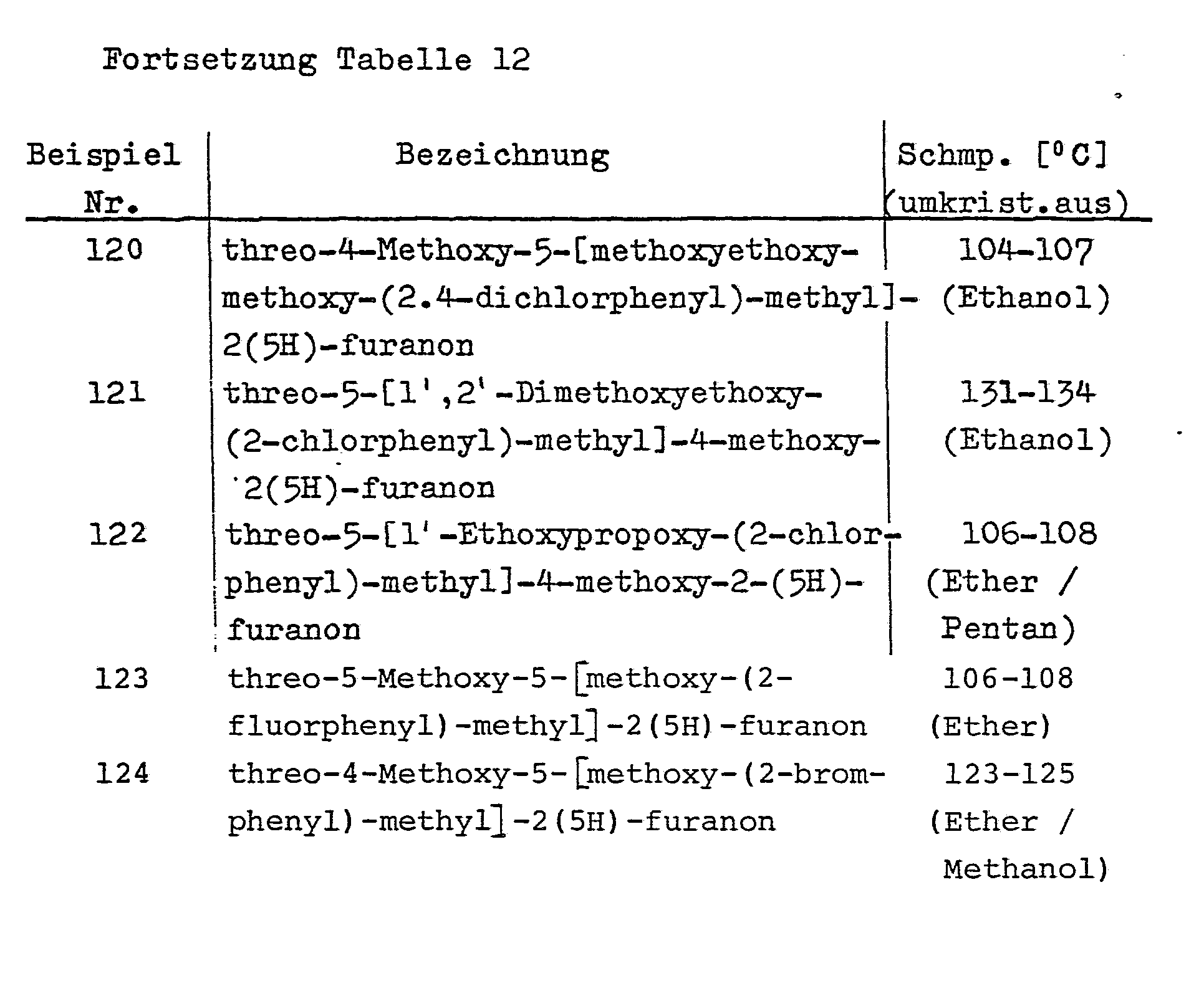
- Nach den in Beispielen Nr. 106 bis 108 beschriebenen Methoden zur Veretherung und Umacetalisierung werden die in Tabelle 12 aufgeführten Ether-und Acetal-Derivate der zuvor beschriebenen threo-4-Alkoxy-5-[(subst.)phenylhydroxymethyl]-2(5H)-furanone hergestellt. Die analytischen Daten sind in Tabelle 13 zusammengefaßt.


- Zur Ermittlung der anticonvulsiven / antiepileptischen Aktivität der erfindungsgemäßen Substanzen wurde die von E.A. Swinyard et al., J. PharmacoLexp.Therapeut. 106 , 319-330 (1952) und von L.A. Woodbury et. al.,Arch. int. Pharacodyn. 92, 97-107 (1952) beschriebene Methodik verwendet. Männlichen Mäusen (NMRI) mit einem Körpergewicht von 20 - 25 g wird über Corneal-Elektroden ein Wechselstrom von 50 Hz und 50 mA während 0.2 sec. appliziert (HSE-Schock-Reizgerät; Typ 207). Der Maximal-Elektroschock-Krampf (MES) besteht aus einer tonischen Streckung der Hinterextremitäten, klonischen Zuckungen und einem Bewußtseinverlust. Als Wirksamkeitskriterium wird die Hemmung des Extensorenkrampfes durch die erfindungsgemäßen Substanzen betrachtet. Die Mäuse hatten vor den Experimenten freien Zugang zu Futter und Wasser. Die Testsubstanzen wurden als Suspension in 0.2 % Agar p.o. durch Schlundsonde appliziert; die Kontrolltiere erhielten adäquate Volumina Agar. 1 Stunde nach Applikation wurde der Test auf Schutzwirkung gegen MES durchgeführt.
- In Tabelle 14 sind die Ergebnisse des MES-Tests bei Dosierungen von 50 bis 150 mg der erfindungsgemäßen Verbindungen pro kg Körpergewicht im Vergleich zu gebräuchlichen Antiepileptika aufgeführt. Als % Wirkung ist der prozentuale Anteil derjenigen Tiere angegeben, die bei dem MES-Test zu 100 % gegen den Extensorenkrampf geschützt waren.
- In Tabelle 15 sind als ED 50-Werte diejenigen Dosierungen der erfindungsgemäßen Substanzen und von gebräuchlichen Antiepileptika aufgeführt, die im MES-Test 1 Stunde nach Applikation 50 % der Tiere vollständig vor dem Extensorenkrampf zu schützen vermochten. Die Bestimmung der ED 50-Werte und der Vertrauensgrenzen (5 % Irrtumswahrscheinlichkeit) erfolgte nach Lichtfield und Wilcoxon [J. Pharmacol.exp. Therapeut. 96, 99 (1949)] jeweils mit 4 bis 5 Tiergruppen zu 8 - 10 Tieren je Dosisstufe.
- Während der oben beschriebenen Experimente wurden die Tiere innerhalb der gesamten Versuchsdauer (bis zu 4 Stunden) auf Anzeichen substanzbedingter Verhaltensänderungen und Neurotoxizität (Motilität, Muskeltonus, Atemfrequenz, Körpertempertur und Allgemeinverhalten) beobachtet. Bis zu einer Dosierung von 100 mg / kg konnten bei allen geprüften erfindungsgemäßen Substanzen keinerlei Neurotoxizitäts-Symptome festgestellt werden. Im Vergleich hierzu sind in Tabelle 16 die unteren Grenzdosierungen gebräuchlicher Anticonvulsiva angeführt, die nach p.o. Applikation Neurotoxizitätssymptome bei Mäusen hervorrufen.
- Bei sämtlichen erfindungsgemäßen Verbindungen wurde in Dosierungen bis zu 300 mg / kg p.o. keinerlei Mortalität der Mäuse festgestellt. Orientierende toxikologische Untersuchungen der Substanzen gemäß Beispielen Nr. 64, 65, 79 und 81 an Ratten zeigten bis zur Dosierung von 1000 mg / kg p.o. keinerlei Mortalität der Tiere.
- Die vorliegenden Untersuchungen zeigen im Ergebnis eine gute antikonvulsive Wirkung und hervorragende therapeutische Breite der erfindungsgemäßen Verbindungen.


- Zur Herstellung von Tabletten a 250 mg Einzelgewicht, die je nach gewünschter Wirkungsstärke 5 bis 100 mg Wirkstoff enthalten, benötigt man
- erfindungsgemäße Substanz 200 bis 4 000 g
- Zellulosepulver 2 000 g
- Maisstärke 1 200 g
- kolloide Kieselsäure 80 g
- Magnesiumstearat 20 g
- Milchzucker ad 10 000 g
- Wirkstoff und Hilfsstoffe werden homogen vermischt und in der üblichen Weise zu Tabletten von je 250 mg Gewicht und 9 mm Durchmesser verpreßt. Falls gewünscht, werden die Tabletten mit einem Filmüberzug versehen.
- Zur Herstellung von Kapseln, die je nach gewünschter Wirkungsstärke 5 bis 100 mg Wirkstoff enthalten, benötigt man erfindungsgemäße Substanz 500 bis 10 000 g
- Maisstärke 2 000 g
- kolloide Kieselsäure 300 g
- Magnesiumstearat 50 g
- Zellulosepulver ad 20 000 g
- Die feingepulverten Stoffe werden homogen gemischt und in Hartgelatinekapseln der Größe 2 in der Menge von 200 mg pro Kapsel abgefüllt.
- Zur Herstellung eines Saftes mit einem Gehalt von 0.035 bis 0.7 Gew.% Wirkstoff, je nach gewünschter Wirkungsstärke, benötigt man
- erfindungsgemäße Substanz 35 bis 700 g
- Propylenglykol 20 000 g
- Glycerin 20 000 g
- Methylzellulose 1 000 g
- Natriumcyclamat 500 g
- Saccharin-Natrium 50 g
- demineralisiertes Wasser ad 100 000 g
- Der Wirkstoff wird fein gemahlen und homogen in die Lösung der Hilfsstoffe eingerührt.
- Zur Herstellung von Zäpfchen a 3 g Einzelgewicht, enthaltend 5 bis 100 mg Wirkstoff pro Zäpfchen, je nach gewünschter Wirkungsstärke, benötigt man
- erfindungsgemäße Substanz 50 bis 1 000 g
- kolloide Kieselsäure 60 g
- Lecithin 150 g
- Hartfett ad 30 000 g
- Der feingemahlene Wirkstoff wird in die Schmelze der Hilfsstoffe homogen eingerührt und zu Zäpfchen von 3 g Eigengewicht vergossen.
R3, R4 und R6 die in Anspruch 1 angegebene Bedeutung besitzen.
Claims (28)


Priority Applications (1)
| Application Number | Priority Date | Filing Date | Title |
|---|---|---|---|
| AT87104404T ATE59386T1 (de) | 1986-05-05 | 1987-03-25 | 5-arylalkyl-4-alkoxy-2(5h)-furanone, zwischenprodukte und verfahren zu ihrer herstellung sowie ihre anwendung als therapeutische wirkstoffe. |
Applications Claiming Priority (2)
| Application Number | Priority Date | Filing Date | Title |
|---|---|---|---|
| DE19863615157 DE3615157A1 (de) | 1986-05-05 | 1986-05-05 | 5-arylalkyl-4-alkoxy-2(5h)-furanone, zwischenprodukte und verfahren zu ihrer herstellung sowie ihre anwendung als therapeutische wirkstoffe |
| DE3615157 | 1986-05-05 |
Publications (3)
| Publication Number | Publication Date |
|---|---|
| EP0247320A2 true EP0247320A2 (de) | 1987-12-02 |
| EP0247320A3 EP0247320A3 (en) | 1989-06-14 |
| EP0247320B1 EP0247320B1 (de) | 1990-12-27 |
Family
ID=6300199
Family Applications (1)
| Application Number | Title | Priority Date | Filing Date |
|---|---|---|---|
| EP87104404A Expired - Lifetime EP0247320B1 (de) | 1986-05-05 | 1987-03-25 | 5-Arylalkyl-4-alkoxy-2(5H)-furanone, Zwischenprodukte und Verfahren zu ihrer Herstellung sowie ihre Anwendung als therapeutische Wirkstoffe |
Country Status (24)
| Country | Link |
|---|---|
| US (1) | US4855320A (de) |
| EP (1) | EP0247320B1 (de) |
| JP (1) | JPH0764835B2 (de) |
| KR (1) | KR950001790B1 (de) |
| CN (1) | CN1016868B (de) |
| AR (1) | AR247203A1 (de) |
| AT (1) | ATE59386T1 (de) |
| AU (1) | AU596175B2 (de) |
| CA (1) | CA1270256A (de) |
| CS (1) | CS274728B2 (de) |
| DD (1) | DD260699A5 (de) |
| DE (2) | DE3615157A1 (de) |
| DK (1) | DK166725B1 (de) |
| EG (1) | EG18151A (de) |
| ES (1) | ES2003293A6 (de) |
| FI (1) | FI871946A7 (de) |
| HU (1) | HU206105B (de) |
| MX (1) | MX27046A (de) |
| NO (1) | NO171273C (de) |
| NZ (1) | NZ220188A (de) |
| PT (1) | PT84824B (de) |
| SU (1) | SU1650009A3 (de) |
| YU (1) | YU46422B (de) |
| ZA (1) | ZA872867B (de) |
Cited By (2)
| Publication number | Priority date | Publication date | Assignee | Title |
|---|---|---|---|---|
| EP0409147A3 (en) * | 1989-07-20 | 1991-07-31 | Lonza Ag | Process for the preparation of tetronic acid esters |
| EP0492347A1 (de) * | 1990-12-20 | 1992-07-01 | Lonza Ag | Verfahren zur Herstellung von threo-4-Alkoxy-5-(arylhydroxymethyl)-2(5H)-furanonen |
Families Citing this family (96)
| Publication number | Priority date | Publication date | Assignee | Title |
|---|---|---|---|---|
| US5149705A (en) * | 1987-03-13 | 1992-09-22 | Allergan, Inc. | Acetylenes disubstituted with a heteroaromatic group and a tetralin group and having retinoid like activity |
| US5234926A (en) * | 1987-03-20 | 1993-08-10 | Allergan, Inc. | Disubstituted acetylenes bearing heteroaromatic and heterobicyclic groups having retinoid like activity |
| US5602130A (en) * | 1987-03-20 | 1997-02-11 | Allergan | Disubstituted acetylenes bearing heteroaromatic and heterobicyclic groups having retinoid like activity |
| US5264578A (en) | 1987-03-20 | 1993-11-23 | Allergan, Inc. | Disubstituted acetylenes bearing heterobicyclic groups and heteroaromatic or phenyl groups having retinoid like activity |
| US5037811A (en) * | 1990-04-17 | 1991-08-06 | Allergan, Inc. | 4-(oxygen, sulfur or nitrogen substituted)-methyl 5-hydroxy-2(5H)-furanones as anti-inflammatory agents |
| US5089485A (en) * | 1988-11-18 | 1992-02-18 | Allergan, Inc. | Anti-inflammatory furanones |
| US5134128A (en) * | 1987-06-08 | 1992-07-28 | Allergan, Inc. | Anti-inflammatory furanones |
| US5171863A (en) * | 1987-06-08 | 1992-12-15 | Allergan, Inc. | Intermediates for preparing 4-substituted 2-5(H)-furanones as anti-inflammatory agents |
| US5081147A (en) * | 1990-03-15 | 1992-01-14 | Allergan, Inc. | 4-(1-hydroxy-2-substituted amino)ethyl-5-hydroxy-2(5H)-furanones as anti-inflammatory agents |
| US5059611A (en) * | 1988-11-18 | 1991-10-22 | Allergan, Inc. | Anti-inflammatory 5-hydroxy-2-furanones |
| US5043457A (en) * | 1990-04-17 | 1991-08-27 | Allergan, Inc. | 2(5H)-furanones substituted in the 3 position, as Ca2+ channel antagonists and anti-inflammatory agents |
| US4777288A (en) * | 1987-06-11 | 1988-10-11 | Pfizer Inc. | Process for preparing a 4,4-diphenylbutanoic acid derivative |
| DE3737399A1 (de) * | 1987-11-04 | 1989-05-18 | Schwabe Willmar Gmbh & Co | Aminosaeureester, verfahren zu ihrer herstellung und ihre verwendung |
| KR0139216B1 (ko) * | 1988-04-11 | 1998-05-01 | 제임스 엠. 캐내지 | 레티노이드 유사활성을 갖는 페놀 또는 벤조산의 테트랄린 에스테르 |
| US5231113A (en) * | 1988-04-11 | 1993-07-27 | Allergan, Inc. | Tetralin esters of phenols or benzoic acids having retinoid like activity |
| US5045564A (en) * | 1988-12-07 | 1991-09-03 | Allergan, Inc. | Anti-inflammatory 2-furanones |
| US5162546A (en) * | 1989-09-19 | 1992-11-10 | Allergan, Inc. | Acetylenes disubstituted with a phenyl group and a 2-substituted chromanyl, thiochromanyl or 1,2,3,4-tetrahydroquinolinyl group having retinoid-like activity |
| US5248777A (en) * | 1989-09-19 | 1993-09-28 | Allergan, Inc. | Process and intermediates for preparing compounds having a disubstituted acetylene moiety and retinoic acid-like biological activity |
| US5399561A (en) * | 1989-09-19 | 1995-03-21 | Allergan, Inc. | Acetylenes disubstituted with a phenyl or heteroaryl group and a 2-oxochromanyl, 2-oxothiochromanyl or 2-oxo-1,2,3,4-tetrahydro-quinolinyl group having retinoid-like biological activity |
| US5053523A (en) * | 1989-09-19 | 1991-10-01 | Allergan, Inc. | Ethynyl-chroman compounds |
| US5272156A (en) * | 1989-09-19 | 1993-12-21 | Allergan, Inc. | Acetylenes disubstituted with a heteroaromatic group and a 2-substituted 1,2,3,4-tetrahydroquinolinyl group having retinoid-like activity |
| US5183827A (en) * | 1989-09-19 | 1993-02-02 | Allergan, Inc. | Acetylenes disubstituted with a heteroaromatic group and a 2-substituted chromanyl, thiochromanyl or 1,2,3,4-tetrahydroquinolinyl group having retinoid-like activity |
| US5258400A (en) * | 1989-11-20 | 1993-11-02 | Allergan, Inc. | Anti-inflammatory furanone compounds |
| US5112853A (en) * | 1989-11-20 | 1992-05-12 | Allergan, Inc. | Anti-inflammatory furanone compounds |
| US5264456A (en) * | 1989-12-29 | 1993-11-23 | Allergan, Inc. | Acetylenes disubstituted with a furyl group and a substituted phenyl group having retinoid like activity |
| US5175185A (en) * | 1989-12-29 | 1992-12-29 | Allergan, Inc. | Acetylenes disubstituted with a heteroaromatic group and a substituted phenyl group having retinoid like activity |
| US5202471A (en) * | 1990-02-06 | 1993-04-13 | Allergan, Inc. | Alkyl, alkoxy and thioalkoxy substituted diphenyl acetylenes having retinoid like activity |
| US5081261A (en) * | 1990-03-23 | 1992-01-14 | Allergan, Inc. | 4-(1-hydroxy-2-N-substituted sulfonamido) ethyl-5-hydroxy-2(5H)-furanones and 4-(N-substituted sulfonamido)-2-ethenyl-5-hydroxy-2(5H)-furanones as anti-inflammatory agents |
| US5013850A (en) * | 1990-03-30 | 1991-05-07 | Allergan, Inc. | 4-ethyl and 4-ethenyl-5-hydroxy-2(5H)-furanones substituted on alpha carbon of the ethyl or ethenyl side chain with a long chain alkyl group and on the beta carbon with a polar group, as anti-inflammatory agents |
| WO1992014725A1 (en) * | 1991-02-13 | 1992-09-03 | Allergan, Inc. | Chroman and thiochromans with phenylethynyl substituents at the 7-position having retinoid-like biological activity |
| US5134159A (en) * | 1991-03-26 | 1992-07-28 | Allergan, Inc. | 7-chromanyl esters of phenols and benzoic acids having retinoid-like activity |
| AU652830B2 (en) * | 1991-03-26 | 1994-09-08 | Allergan, Inc. | Chromans and thiochromans with heteroarylethynyl substituents at the 7-position having retinoid-like biological activity |
| US5183906A (en) * | 1991-04-30 | 1993-02-02 | Allergan, Inc. | 2- and 5-alkyl and phenyl substituted 4-(1-hydroxy, 1-acyloxy or 1-carbamoyloxy)-5-hydroxy-2 (5h)-furanones as anti-inflammatory agents |
| US5225571A (en) * | 1991-04-30 | 1993-07-06 | Allergan, Inc. | Substituted dihydroxy-bis-[5-hydroxy-2(5H)-furanone-4-yl]-alkanes as anti-inflammatory agents |
| US5169963A (en) * | 1991-08-30 | 1992-12-08 | Allergan, Inc. | Di-(5-hydroxy-2(5H)2-oxo-4-furyl)alkylmethyl-alpha,omega alkanedioates and N,N-bis-(5-hydroxy-2(5H)2-oxo-4-furyl)alkylmethyl-alpha,omega-dialkanoic acid amides as anti-inflammatory agents |
| US5171864A (en) * | 1991-08-30 | 1992-12-15 | Allergan, Inc. | Di-(5-hydroxy-2(5H)-2-oxo-4-furyl)methyl-alpha,omega alkane-dioates and N,N-bis-(5-hydroxy-2(5H)-2-oxo-4-furyl)methyl-alpha,omega-dialkanoic acid amides as anti-inflammatory agents |
| WO1993016067A1 (en) * | 1992-02-11 | 1993-08-19 | Allergan, Inc. | Heteroaryl substituted phenylethenyl compounds having retinoid-like biological activity |
| US5326898A (en) * | 1992-02-11 | 1994-07-05 | Allergan, Inc. | Substituted phenylethenyl compounds having retinoid-like biological activity |
| US5268387A (en) * | 1992-04-24 | 1993-12-07 | Allergan, Inc. | Pharmaceutical compositions and method for administering 3 and 4-substituted 2(5H)-furanones to a mammal for inhibiting bone loss |
| US5324840A (en) | 1992-06-11 | 1994-06-28 | Allergan, Inc. | Method of treatment with compounds having retinoid-like activity and reduced skin toxicity and lacking teratogenic effects |
| US6492413B2 (en) | 1993-01-15 | 2002-12-10 | G.D. Searle & Co. | 3.4-diaryl thiophenes and analogs thereof having use as antiinflammatory agents |
| US5455265A (en) * | 1993-02-11 | 1995-10-03 | Allergan, Inc. | Method of treatment with compounds having selective agonist-like activity on RXR retinoid receptors |
| US6172115B1 (en) | 1993-02-11 | 2001-01-09 | Allergan Sales, Inc. | Method for preventing onset of restenosis after angioplasty employing an RXR-specific retinoid |
| US5399586A (en) * | 1993-03-11 | 1995-03-21 | Allergan, Inc. | Treatment of mammals afflicted with tumors with compounds having RXR retinoid receptor agonist activity |
| US5344959A (en) * | 1993-05-18 | 1994-09-06 | Allergan, Inc. | Tetrahydronaphthyl and cyclopropyl substituted 1,3-butadienes having retinoid-like activity |
| US5474995A (en) * | 1993-06-24 | 1995-12-12 | Merck Frosst Canada, Inc. | Phenyl heterocycles as cox-2 inhibitors |
| US5475022A (en) * | 1993-10-18 | 1995-12-12 | Allergan, Inc. | Phenyl or heteroaryl and tetrahydronaphthyl substituted diene compounds having retinoid like biological activity |
| US5470999A (en) * | 1993-12-30 | 1995-11-28 | Allergan, Inc. | Cyclohexene and bicyclic aromatic substituted ethyne compounds having retinoid-like biological activity |
| US5451605A (en) * | 1993-12-30 | 1995-09-19 | Allergan, Inc. | 1,2-epoxycyclohexanyl and bicyclic aromatic substituted ethyne compounds having retinoid-like biological activity |
| US5426118A (en) * | 1993-12-30 | 1995-06-20 | Allergan, Inc. | [4-(1,2-epoxycyclohexanyl)but-3-en-1-ynyl]aromatic and heteroaromatic acids and derivatives having retinoid-like biological activity |
| US5451686A (en) * | 1994-04-15 | 1995-09-19 | Allergan, Inc. | 3 and 5 alkyl and phenyl 4-(hydroxy or acyloxy)-alkyl substituted 2(5H)-furanones as anti-inflammatory agents |
| US5498755A (en) * | 1994-08-23 | 1996-03-12 | Chandraratna; Roshantha A. | Disubstituted aryl and heteroaryl imines having retinoid-like biological activity |
| US5534641A (en) * | 1994-12-29 | 1996-07-09 | Allergan | Acetylenes disubstituted with 2-tetrahydropyranoxyaryl and aryl or heteroaryl groups having retinoid-like biological activity |
| US5618931A (en) * | 1994-12-29 | 1997-04-08 | Allergan | Acetylenes disubstituted with a 5 substituted dihydronaphthyl group and with an aryl or heteroaryl group having retinoid-like biological activity |
| US5599967A (en) * | 1994-12-29 | 1997-02-04 | Allergan | Acetylenes disubstituted with a 5 substituted tetrahydronaphthyl group and with an aryl of heteroaryl group having retinoid-like biological activity |
| US5543534A (en) * | 1994-12-29 | 1996-08-06 | Allergan | Acetylenes disubstituted with a 5 substituted tetrahydronaphthyl group and with an aryl or heteroaryl groups having retinoid-like biological activity |
| US5648514A (en) * | 1994-12-29 | 1997-07-15 | Allergan | Substituted acetylenes having retinoid-like biological activity |
| US5556996A (en) * | 1994-12-29 | 1996-09-17 | Allergan | Oxiranyls disubstituted with a phenyl group and a substituted chromanyl or tetrahydroquinolinyl group having retinoid like activity |
| US5514825A (en) * | 1994-12-29 | 1996-05-07 | Allergan, Inc. | Acetylenes disubstituted with a 5 substituted tetrahydronaphthyl group and with an aryl or heteroaryl group having retinoid-like biological activity |
| US5489584A (en) * | 1994-12-29 | 1996-02-06 | Allergan, Inc. | Acetylenes disubstituted with a 5-amino or substituted 5-amino substituted tetrahydronaphthyl group and with an aryl or heteroaryl group having retinoid-like biological activity |
| US5618943A (en) * | 1994-12-29 | 1997-04-08 | Allergan | Acetylenes disubstituted with a 5 OXO substituted tetrahydronaphthyl group and with an aryl or heteroaryl group having retinoid-like biological activity |
| US6025388A (en) | 1995-04-26 | 2000-02-15 | Allergan Sales, Inc. | Method for inhibiting gene expression promoted by AP1 protein with RARβ selective retinoids and method for treatment of diseases and conditions with such retinoids |
| US5616712A (en) * | 1995-05-16 | 1997-04-01 | Allergan | Acetylenes disubstituted with a phenyl or heteroaryl group and a 2-thio-1,2,3,4-tetrahdroquinolinyl, 2-alkylthio-3,4-dihydroquinolinyl or 2-alkoxy-3,4-dihydroquinolinyl group having retinoid-like biological activity |
| US5917082A (en) * | 1995-06-06 | 1999-06-29 | Allergan Sales, Inc. | 2,4-pentadienoic acid derivatives having retinoid-like biological activity |
| US5675033A (en) * | 1995-06-06 | 1997-10-07 | Allergan | 2,4-pentadienoic acid derivatives having retinoid-like biological activity |
| US5958954A (en) * | 1995-09-01 | 1999-09-28 | Allergan Sales, Inc. | Synthesis and use of retinoid compounds having negative hormone and/or antagonist activities |
| US6942980B1 (en) | 1995-09-01 | 2005-09-13 | Allergan, Inc. | Methods of identifying compounds having nuclear receptor negative hormone and/or antagonist activities |
| US6008204A (en) | 1995-09-01 | 1999-12-28 | Allergan Sales, Inc. | Synthesis and use of retinoid compounds having negative hormone and/or antagonist activities |
| US6218128B1 (en) | 1997-09-12 | 2001-04-17 | Allergan Sales, Inc. | Methods of identifying compounds having nuclear receptor negative hormone and/or antagonist activities |
| US5952345A (en) * | 1995-09-01 | 1999-09-14 | Allergan Sales, Inc. | Synthesis and use of retinoid compounds having negative hormone and/or antagonist activities |
| AU7598596A (en) * | 1995-11-01 | 1997-05-22 | Allergan, Inc. | Sulfides, sulfoxides and sulfones disubstituted with a tetrahydronaphthalenyl, chromanyl, thiochromanyl or tetrahydroquinolinyl and substituted phenyl or heteroaryl group, having retinoid-like biological activity |
| US5663357A (en) * | 1995-11-22 | 1997-09-02 | Allergan | Substituted heteroarylamides having retinoid-like biological activity |
| US5675024A (en) | 1995-11-22 | 1997-10-07 | Allergan | Aryl or heteroaryl amides of tetrahydronaphthalene, chroman, thiochroman and 1,2,3,4,-tetrahydroquinoline carboxylic acids, having an electron withdrawing substituent in the aromatic or heteroaromatic moiety, having retinoid-like biological activity |
| US5688957A (en) * | 1995-12-29 | 1997-11-18 | Allergan | (3"-thioxacyclohex-1"-enyl)!-but-3'-ene-1'-ynyl!aryl and (3"-thioxacyclohex-1"-enyl)!-but-3'-ene-1'-ynyl!heteroaryl carboxylic acids and esters having retinoid-like biological activity |
| US5965606A (en) | 1995-12-29 | 1999-10-12 | Allergan Sales, Inc. | Methods of treatment with compounds having RAR.sub.α receptor specific or selective activity |
| US20030219832A1 (en) * | 1996-03-11 | 2003-11-27 | Klein Elliott S. | Synthesis and use of retinoid compounds having negative hormone and/or antagonist activities |
| US5808124A (en) * | 1996-06-21 | 1998-09-15 | Allergan | O- or S-substituted dihydronaphthalene derivatives having retinoid and/or retinoid antagonist-like biological activity |
| US5723666A (en) * | 1996-06-21 | 1998-03-03 | Allergan | Oxime substituted tetrahydronaphthalene derivatives having retinoid and/or retinoid antagonist-like biological activity |
| US5773594A (en) | 1996-06-21 | 1998-06-30 | Allergan | Alkyl or aryl substituted dihydronaphthalene derivatives having retinoid and/or retinoid antagonist-like biological activity |
| US6555690B2 (en) | 1996-06-21 | 2003-04-29 | Allergan, Inc. | Alkyl or aryl substituted dihydronaphthalene derivatives having retinoid and/or retinoid antagonist-like biological activity |
| US5741896A (en) | 1996-06-21 | 1998-04-21 | Allergan | O- or S- substituted tetrahydronaphthalene derivatives having retinoid and/or retinoid antagonist-like biological activity |
| US5763635A (en) * | 1996-06-21 | 1998-06-09 | Allergan | Tetrahydronaphthalene derivatives substituted in the 8 position with alkyhidene groups having retinoid and/or retinoid antagonist-like biological activity |
| US5747542A (en) * | 1996-06-21 | 1998-05-05 | Allergan | Oxo-substituted tetrahydronaphthalene derivatives having retinold and/or retinoid antagonist-like biological activity |
| GB9615867D0 (en) * | 1996-07-03 | 1996-09-11 | Merck & Co Inc | Process of preparing phenyl heterocycles useful as cox-2 inhibitors |
| US5739338A (en) * | 1996-11-05 | 1998-04-14 | Allergan | N-aryl substituted tetrahydroquinolines having retinoid agonist, retinoid antagonist or retinoid inverse agonist type biological activity |
| US5728846A (en) * | 1996-12-12 | 1998-03-17 | Allergan | Benzo 1,2-g!-chrom-3-ene and benzo 1,2-g!-thiochrom-3-ene derivatives |
| US5760276A (en) * | 1997-03-06 | 1998-06-02 | Allergan | Aryl-and heteroarylcyclohexenyl substituted alkenes having retinoid agonist, antagonist or inverse agonist type biological activity |
| US6037488A (en) | 1997-04-19 | 2000-03-14 | Allergan Sales, Inc. | Trisubstituted phenyl derivatives having retinoid agonist, antagonist or inverse agonist type biological activity |
| US5919970A (en) * | 1997-04-24 | 1999-07-06 | Allergan Sales, Inc. | Substituted diaryl or diheteroaryl methanes, ethers and amines having retinoid agonist, antagonist or inverse agonist type biological activity |
| US6756414B2 (en) * | 1999-07-30 | 2004-06-29 | Sanyo Chemical Industries, Ltd. | Polymer polyol composition, process for producing the same, and process for producing polyurethane resin |
| CN1182127C (zh) * | 2000-06-28 | 2004-12-29 | 中国医学科学院药物研究所 | 新的取代的2-苯并[c]呋喃酮化合物,其制备方法以及包含它们的药物组合物 |
| US6387951B1 (en) | 2000-08-29 | 2002-05-14 | Allergan Sales, Inc. | Compounds having activity as inhibitors of cytochrome P450RAI |
| US6313107B1 (en) * | 2000-08-29 | 2001-11-06 | Allergan Sales, Inc. | Methods of providing and using compounds having activity as inhibitors of cytochrome P450RAI |
| US6369261B1 (en) | 2000-08-29 | 2002-04-09 | Allergan Sales, Inc. | Compounds having activity as inhibitors of cytochrome P450RAI |
| CN1106393C (zh) * | 2000-12-19 | 2003-04-23 | 中国科学院上海有机化学研究所 | 一种具有光学活性的β-芳基取代-2(5H)-呋喃酮及其合成方法 |
| FR2845087B1 (fr) * | 2002-10-01 | 2004-12-24 | Merck Sante Sas | Nouveaux acides arylhexadienoiques substitues et leurs esters,utilisables dans le traitement et la prevention du diabete, des dyslipidemies,de l'atherosclerose, compositions pharmaceutiques les contenant et procedes de preparation |
Family Cites Families (3)
| Publication number | Priority date | Publication date | Assignee | Title |
|---|---|---|---|---|
| DE1920176A1 (de) * | 1969-04-21 | 1970-10-22 | Thomae Gmbh Dr K | Neues Verfahren zur Herstellung von Hydroxycrotonsaeurelaktonen |
| JPS5916884A (ja) * | 1982-07-19 | 1984-01-28 | Fujisawa Pharmaceut Co Ltd | 新規フラン化合物 |
| JPS6058973A (ja) * | 1983-09-13 | 1985-04-05 | Mitsubishi Yuka Yakuhin Kk | γ−プチロラクトン誘導体及びそれを有効成分とする免疫調節剤 |
-
1986
- 1986-05-05 DE DE19863615157 patent/DE3615157A1/de not_active Withdrawn
-
1987
- 1987-03-25 EP EP87104404A patent/EP0247320B1/de not_active Expired - Lifetime
- 1987-03-25 AT AT87104404T patent/ATE59386T1/de not_active IP Right Cessation
- 1987-03-25 DE DE8787104404T patent/DE3767029D1/de not_active Expired - Fee Related
- 1987-04-23 ZA ZA872867A patent/ZA872867B/xx unknown
- 1987-04-29 YU YU77687A patent/YU46422B/sh unknown
- 1987-04-30 DD DD87302294A patent/DD260699A5/de not_active IP Right Cessation
- 1987-05-01 JP JP62108751A patent/JPH0764835B2/ja not_active Expired - Fee Related
- 1987-05-03 EG EG256/87A patent/EG18151A/xx active
- 1987-05-04 CN CN87103274A patent/CN1016868B/zh not_active Expired
- 1987-05-04 SU SU874202523A patent/SU1650009A3/ru active
- 1987-05-04 NO NO871845A patent/NO171273C/no unknown
- 1987-05-04 US US07/046,586 patent/US4855320A/en not_active Expired - Lifetime
- 1987-05-04 MX MX2704687A patent/MX27046A/es unknown
- 1987-05-04 CS CS313687A patent/CS274728B2/cs not_active IP Right Cessation
- 1987-05-04 AU AU72466/87A patent/AU596175B2/en not_active Ceased
- 1987-05-04 HU HU871995A patent/HU206105B/hu not_active IP Right Cessation
- 1987-05-04 CA CA000536318A patent/CA1270256A/en not_active Expired - Fee Related
- 1987-05-04 FI FI871946A patent/FI871946A7/fi not_active Application Discontinuation
- 1987-05-04 NZ NZ220188A patent/NZ220188A/xx unknown
- 1987-05-04 DK DK226287A patent/DK166725B1/da not_active IP Right Cessation
- 1987-05-04 KR KR1019870004376A patent/KR950001790B1/ko not_active Expired - Fee Related
- 1987-05-04 ES ES8701330A patent/ES2003293A6/es not_active Expired
- 1987-05-05 PT PT84824A patent/PT84824B/pt unknown
- 1987-05-05 AR AR87307464A patent/AR247203A1/es active
Non-Patent Citations (7)
| Title |
|---|
| ANGEWANDTE CHEMIE, Band 93, nr. 6/7, 1981, Seiten 587-593, Weinheim; H.J. BESTMANN: "Ein neuer Weg zu 2-Ethoxybutadienen; Diels-Alder-Reaktion von 1,2-lambda5-Oxaphosphorinen" * |
| BURGER'S MEDICINAL CHEMISTRY, 4. Ausgabe, Teil III, Kapitel 55, 1981, Wiley-Intersciene, Seiten 829-858; M.E. WOLFF: "Anticonvulsants" * |
| CHEMICAL ABSTRACTS, Band 90, nr. 3, 15. Januar 1979, Seite 619, Columbus, Ohio, USA; R. HAEUSEL et al.: "Behavior of 5-hydroxykawain derivatives against alkalis", Spalte 2, Zusammenfassung 227054; & Z. NATURFORSCH. B: ANORG. CHEM., ORG. CHEM., Band 33 B, nr. 9, 1978, Seite 1020-5 (Kat. D) * |
| JOURNAL OF THE CHEMICAL SOCIETY, Perkin Transactions I, nr. 4, April 1981, Seiten 1173-1179, London; A. PELTER et al.: "The Carbon-13 Nuclear Magnetic Resonance Spectra of Tetronate and 2-Pyrone Derivatives" * |
| TETRAHEDRON LETTERS, Band 23, nr. 10, März 1982, Seiten 1793-1796, London; R.R. SCHMIDT: "Beta-and Alpha-Lithiation of Methyl-Beta-Methoxyacrylate: Efficient Synthesis of Alpha, Gamma-Substituted Methyl Tetronates-Structure of Aspertetronins and Gregatins" * |
| TETRAHEDRON LETTERS, Band 23, nr. 49, December 1982, Seiten 5229-5232, London; A. PELTER et al.: "Carbon-Carbon Bond Formation by "Double Activation", The Synthesis of Piperolide and Fadyenolide Intermediates" * |
| TETRAHEDRON LETTERS, nr. 18, April 1979, Seiten 1627-1630, London; A. PELTER: "The synthesis of piperolide and related Compounds" * |
Cited By (2)
| Publication number | Priority date | Publication date | Assignee | Title |
|---|---|---|---|---|
| EP0409147A3 (en) * | 1989-07-20 | 1991-07-31 | Lonza Ag | Process for the preparation of tetronic acid esters |
| EP0492347A1 (de) * | 1990-12-20 | 1992-07-01 | Lonza Ag | Verfahren zur Herstellung von threo-4-Alkoxy-5-(arylhydroxymethyl)-2(5H)-furanonen |
Also Published As
Similar Documents
| Publication | Publication Date | Title |
|---|---|---|
| EP0247320B1 (de) | 5-Arylalkyl-4-alkoxy-2(5H)-furanone, Zwischenprodukte und Verfahren zu ihrer Herstellung sowie ihre Anwendung als therapeutische Wirkstoffe | |
| DE68923250T2 (de) | Chalcon-Derivate und Verfahren zu deren Herstellung. | |
| DE2915037C3 (de) | Neue N-substituierte Moranolinderivate | |
| EP0124009B1 (de) | Verfahren zur Herstellung von Oxiranen | |
| DD209455A5 (de) | Verfahren zur herstellung von ascorbinsaeureethern | |
| EP0237963A2 (de) | 2-Azolylmethyl-2-aryl-1,3-dioxolane und deren Salze, Verfahren zu ihrer Herstellung, sie enthaltende Mittel und ihre Verwendung | |
| DE3138397A1 (de) | "arzneimittel, darin enthaltene vicinale dihydroxyalkylxanthine und herstellungsverfahren fuer diese xanthinverbindungen" | |
| EP0025192B1 (de) | Substituierte Oxirancarbonsäuren, Verfahren zu ihrer Herstellung, ihre Verwendung und sie enthaltende Arzneimittel | |
| DE3902031A1 (de) | Substituierte azolylmethylcycloalkan-derivate, ihre herstellung und verwendung sowie diese enthaltende arzneimittel | |
| EP0046243B1 (de) | Cytostatisch wirkende Arzneimittel, neue Isocyanursäurederivate und Verfahren zu ihrer Herstellung | |
| EP0349609B1 (de) | Aminosäureester, verfahren zu ihrer herstellung und ihre verwendung | |
| DE2359891A1 (de) | Verfahren zur herstellung von furanonderivaten | |
| DE2242454A1 (de) | 1-aethyl-imidazole, verfahren zu ihrer herstellung sowie ihre verwendung als arzneimittel | |
| DE2750553C2 (de) | Verfahren zur Herstellung von gamma-Pyronen | |
| DE3028289C2 (de) | 2-O- und 5-O-substituierte 1.4;3.6-Dianhydro-hexit-mononitrate, Verfahren zu ihrer Herstellung und diese Verbindungen enthaltende pharmazeutische Zubereitungen | |
| EP0237964A2 (de) | 2-Azolylmethyl-2-aryl-1,3-dioxolane und deren Salze,Verfahren zu ihrer Herstellung, sie enthaltende Mittel und ihre Verwendung | |
| DE68905361T2 (de) | Trienische Derivate mit chromenischer Struktur, Verfahren zu deren Herstellung und diese enthaltende pharmazeutische Zusammenstellungen. | |
| EP0313935A2 (de) | Enolether von 6-Chlor-4-hydroxy-2-methyl-N-(2-pyridyl)-2H-thieno(2,3-e)-1,2-thiazin-3-carbonsäureamid-1,1-dioxid, ein Verfahren zu ihrer Herstellung sowie ihre Verwendung | |
| DD213437A5 (de) | Verfahren zur herstellung von cyclopentenderivaten | |
| DE3123177C2 (de) | ||
| EP0492347B1 (de) | Verfahren zur Herstellung von threo-4-Alkoxy-5-(arylhydroxymethyl)-2(5H)-furanonen | |
| DE69107484T2 (de) | Azoxy-Verbindungen. | |
| EP0037062A2 (de) | Substituierte 3-Aryl-2-cycloalken-1-one, Verfahren zu ihrer Herstellung und ihre Verwendung als Arzneimittel | |
| EP0090353A1 (de) | Pyridon-2-derivate, Verfahren zu ihrer Herstellung und sie enthaltende Arzneimittel | |
| CH648018A5 (de) | Verfahren zur herstellung von omega-indol-3-yl-alkanol-verbindungen. |
Legal Events
| Date | Code | Title | Description |
|---|---|---|---|
| PUAI | Public reference made under article 153(3) epc to a published international application that has entered the european phase |
Free format text: ORIGINAL CODE: 0009012 |
|
| AK | Designated contracting states |
Kind code of ref document: A2 Designated state(s): AT BE CH DE FR GB IT LI NL SE |
|
| PUAL | Search report despatched |
Free format text: ORIGINAL CODE: 0009013 |
|
| AK | Designated contracting states |
Kind code of ref document: A3 Designated state(s): AT BE CH DE FR GB IT LI NL SE |
|
| 17P | Request for examination filed |
Effective date: 19890517 |
|
| 17Q | First examination report despatched |
Effective date: 19900215 |
|
| GRAA | (expected) grant |
Free format text: ORIGINAL CODE: 0009210 |
|
| AK | Designated contracting states |
Kind code of ref document: B1 Designated state(s): AT BE CH DE FR GB IT LI NL SE |
|
| REF | Corresponds to: |
Ref document number: 59386 Country of ref document: AT Date of ref document: 19910115 Kind code of ref document: T |
|
| ET | Fr: translation filed | ||
| REF | Corresponds to: |
Ref document number: 3767029 Country of ref document: DE Date of ref document: 19910207 |
|
| ITF | It: translation for a ep patent filed | ||
| GBT | Gb: translation of ep patent filed (gb section 77(6)(a)/1977) | ||
| K2C2 | Correction of patent specification (partial reprint) published |
Effective date: 19901227 |
|
| PLBE | No opposition filed within time limit |
Free format text: ORIGINAL CODE: 0009261 |
|
| STAA | Information on the status of an ep patent application or granted ep patent |
Free format text: STATUS: NO OPPOSITION FILED WITHIN TIME LIMIT |
|
| 26N | No opposition filed | ||
| EAL | Se: european patent in force in sweden |
Ref document number: 87104404.6 |
|
| REG | Reference to a national code |
Ref country code: GB Ref legal event code: IF02 |
|
| PGFP | Annual fee paid to national office [announced via postgrant information from national office to epo] |
Ref country code: SE Payment date: 20040304 Year of fee payment: 18 |
|
| PGFP | Annual fee paid to national office [announced via postgrant information from national office to epo] |
Ref country code: FR Payment date: 20040309 Year of fee payment: 18 |
|
| PGFP | Annual fee paid to national office [announced via postgrant information from national office to epo] |
Ref country code: NL Payment date: 20040310 Year of fee payment: 18 |
|
| PGFP | Annual fee paid to national office [announced via postgrant information from national office to epo] |
Ref country code: AT Payment date: 20040311 Year of fee payment: 18 |
|
| PGFP | Annual fee paid to national office [announced via postgrant information from national office to epo] |
Ref country code: GB Payment date: 20040324 Year of fee payment: 18 |
|
| PGFP | Annual fee paid to national office [announced via postgrant information from national office to epo] |
Ref country code: CH Payment date: 20040329 Year of fee payment: 18 |
|
| PGFP | Annual fee paid to national office [announced via postgrant information from national office to epo] |
Ref country code: DE Payment date: 20040401 Year of fee payment: 18 |
|
| PGFP | Annual fee paid to national office [announced via postgrant information from national office to epo] |
Ref country code: BE Payment date: 20040518 Year of fee payment: 18 |
|
| PG25 | Lapsed in a contracting state [announced via postgrant information from national office to epo] |
Ref country code: IT Free format text: LAPSE BECAUSE OF NON-PAYMENT OF DUE FEES;WARNING: LAPSES OF ITALIAN PATENTS WITH EFFECTIVE DATE BEFORE 2007 MAY HAVE OCCURRED AT ANY TIME BEFORE 2007. THE CORRECT EFFECTIVE DATE MAY BE DIFFERENT FROM THE ONE RECORDED. Effective date: 20050325 Ref country code: GB Free format text: LAPSE BECAUSE OF NON-PAYMENT OF DUE FEES Effective date: 20050325 Ref country code: AT Free format text: LAPSE BECAUSE OF NON-PAYMENT OF DUE FEES Effective date: 20050325 |
|
| PG25 | Lapsed in a contracting state [announced via postgrant information from national office to epo] |
Ref country code: SE Free format text: LAPSE BECAUSE OF NON-PAYMENT OF DUE FEES Effective date: 20050326 |
|
| PG25 | Lapsed in a contracting state [announced via postgrant information from national office to epo] |
Ref country code: LI Free format text: LAPSE BECAUSE OF NON-PAYMENT OF DUE FEES Effective date: 20050331 Ref country code: CH Free format text: LAPSE BECAUSE OF NON-PAYMENT OF DUE FEES Effective date: 20050331 Ref country code: BE Free format text: LAPSE BECAUSE OF NON-PAYMENT OF DUE FEES Effective date: 20050331 |
|
| BERE | Be: lapsed |
Owner name: WILLMAR *SCHWABE G.M.B.H. & CO. Effective date: 20050331 |
|
| PG25 | Lapsed in a contracting state [announced via postgrant information from national office to epo] |
Ref country code: NL Free format text: LAPSE BECAUSE OF NON-PAYMENT OF DUE FEES Effective date: 20051001 Ref country code: DE Free format text: LAPSE BECAUSE OF NON-PAYMENT OF DUE FEES Effective date: 20051001 |
|
| EUG | Se: european patent has lapsed | ||
| REG | Reference to a national code |
Ref country code: CH Ref legal event code: PL |
|
| GBPC | Gb: european patent ceased through non-payment of renewal fee |
Effective date: 20050325 |
|
| PG25 | Lapsed in a contracting state [announced via postgrant information from national office to epo] |
Ref country code: FR Free format text: LAPSE BECAUSE OF NON-PAYMENT OF DUE FEES Effective date: 20051130 |
|
| NLV4 | Nl: lapsed or anulled due to non-payment of the annual fee |
Effective date: 20051001 |
|
| REG | Reference to a national code |
Ref country code: FR Ref legal event code: ST Effective date: 20051130 |
|
| BERE | Be: lapsed |
Owner name: WILLMAR *SCHWABE G.M.B.H. & CO. Effective date: 20050331 |