EP0245771B1 - Verfahren zur Herstellung von Ethylenglykol - Google Patents
Verfahren zur Herstellung von Ethylenglykol Download PDFInfo
- Publication number
- EP0245771B1 EP0245771B1 EP87106591A EP87106591A EP0245771B1 EP 0245771 B1 EP0245771 B1 EP 0245771B1 EP 87106591 A EP87106591 A EP 87106591A EP 87106591 A EP87106591 A EP 87106591A EP 0245771 B1 EP0245771 B1 EP 0245771B1
- Authority
- EP
- European Patent Office
- Prior art keywords
- rhodium
- radicals
- hydrogen
- porphyrin
- ethylene glycol
- Prior art date
- Legal status (The legal status is an assumption and is not a legal conclusion. Google has not performed a legal analysis and makes no representation as to the accuracy of the status listed.)
- Expired
Links
- LYCAIKOWRPUZTN-UHFFFAOYSA-N Ethylene glycol Chemical compound OCCO LYCAIKOWRPUZTN-UHFFFAOYSA-N 0.000 title claims description 31
- 238000000034 method Methods 0.000 title claims description 11
- 238000004519 manufacturing process Methods 0.000 title claims description 4
- 150000004032 porphyrins Chemical class 0.000 claims description 16
- 239000010948 rhodium Substances 0.000 claims description 14
- 239000003054 catalyst Substances 0.000 claims description 13
- MHOVAHRLVXNVSD-UHFFFAOYSA-N rhodium atom Chemical compound [Rh] MHOVAHRLVXNVSD-UHFFFAOYSA-N 0.000 claims description 13
- 229910052703 rhodium Inorganic materials 0.000 claims description 12
- 229910052739 hydrogen Inorganic materials 0.000 claims description 10
- 239000001257 hydrogen Substances 0.000 claims description 10
- 229910052751 metal Inorganic materials 0.000 claims description 8
- 239000002184 metal Substances 0.000 claims description 8
- UFHFLCQGNIYNRP-UHFFFAOYSA-N Hydrogen Chemical compound [H][H] UFHFLCQGNIYNRP-UHFFFAOYSA-N 0.000 claims description 7
- 229910017052 cobalt Inorganic materials 0.000 claims description 6
- 239000010941 cobalt Substances 0.000 claims description 6
- GUTLYIVDDKVIGB-UHFFFAOYSA-N cobalt atom Chemical compound [Co] GUTLYIVDDKVIGB-UHFFFAOYSA-N 0.000 claims description 6
- UGFAIRIUMAVXCW-UHFFFAOYSA-N Carbon monoxide Chemical compound [O+]#[C-] UGFAIRIUMAVXCW-UHFFFAOYSA-N 0.000 claims description 5
- 125000003118 aryl group Chemical group 0.000 claims description 5
- 229910002091 carbon monoxide Inorganic materials 0.000 claims description 5
- 125000000217 alkyl group Chemical group 0.000 claims description 4
- 239000011541 reaction mixture Substances 0.000 claims description 4
- 125000003710 aryl alkyl group Chemical group 0.000 claims description 3
- 125000000753 cycloalkyl group Chemical group 0.000 claims description 3
- 239000007791 liquid phase Substances 0.000 claims description 3
- 239000000203 mixture Substances 0.000 claims description 3
- 125000003342 alkenyl group Chemical group 0.000 claims description 2
- 125000001477 organic nitrogen group Chemical group 0.000 claims description 2
- 125000000168 pyrrolyl group Chemical group 0.000 claims description 2
- 150000004700 cobalt complex Chemical class 0.000 claims 1
- -1 Nitrogen-containing Lewis bases Chemical class 0.000 description 17
- 238000006243 chemical reaction Methods 0.000 description 9
- 230000015572 biosynthetic process Effects 0.000 description 7
- 238000003786 synthesis reaction Methods 0.000 description 7
- LFQSCWFLJHTTHZ-UHFFFAOYSA-N Ethanol Chemical compound CCO LFQSCWFLJHTTHZ-UHFFFAOYSA-N 0.000 description 6
- OKKJLVBELUTLKV-UHFFFAOYSA-N Methanol Chemical compound OC OKKJLVBELUTLKV-UHFFFAOYSA-N 0.000 description 6
- 150000001875 compounds Chemical class 0.000 description 4
- 238000000605 extraction Methods 0.000 description 4
- 150000002739 metals Chemical class 0.000 description 4
- XLYOFNOQVPJJNP-UHFFFAOYSA-N water Substances O XLYOFNOQVPJJNP-UHFFFAOYSA-N 0.000 description 4
- YRKCREAYFQTBPV-UHFFFAOYSA-N acetylacetone Chemical compound CC(=O)CC(C)=O YRKCREAYFQTBPV-UHFFFAOYSA-N 0.000 description 3
- 125000004432 carbon atom Chemical group C* 0.000 description 3
- 150000002431 hydrogen Chemical class 0.000 description 3
- 150000003254 radicals Chemical class 0.000 description 3
- 239000002904 solvent Substances 0.000 description 3
- IJGRMHOSHXDMSA-UHFFFAOYSA-N Atomic nitrogen Chemical compound N#N IJGRMHOSHXDMSA-UHFFFAOYSA-N 0.000 description 2
- XEEYBQQBJWHFJM-UHFFFAOYSA-N Iron Chemical compound [Fe] XEEYBQQBJWHFJM-UHFFFAOYSA-N 0.000 description 2
- PXHVJJICTQNCMI-UHFFFAOYSA-N Nickel Chemical compound [Ni] PXHVJJICTQNCMI-UHFFFAOYSA-N 0.000 description 2
- KDLHZDBZIXYQEI-UHFFFAOYSA-N Palladium Chemical compound [Pd] KDLHZDBZIXYQEI-UHFFFAOYSA-N 0.000 description 2
- KAESVJOAVNADME-UHFFFAOYSA-N Pyrrole Chemical compound C=1C=CNC=1 KAESVJOAVNADME-UHFFFAOYSA-N 0.000 description 2
- 125000002915 carbonyl group Chemical group [*:2]C([*:1])=O 0.000 description 2
- WGCNASOHLSPBMP-UHFFFAOYSA-N hydroxyacetaldehyde Natural products OCC=O WGCNASOHLSPBMP-UHFFFAOYSA-N 0.000 description 2
- 239000003446 ligand Substances 0.000 description 2
- 125000002496 methyl group Chemical group [H]C([H])([H])* 0.000 description 2
- 239000012074 organic phase Substances 0.000 description 2
- BASFCYQUMIYNBI-UHFFFAOYSA-N platinum Chemical compound [Pt] BASFCYQUMIYNBI-UHFFFAOYSA-N 0.000 description 2
- UBQKCCHYAOITMY-UHFFFAOYSA-N pyridin-2-ol Chemical compound OC1=CC=CC=N1 UBQKCCHYAOITMY-UHFFFAOYSA-N 0.000 description 2
- 125000001424 substituent group Chemical group 0.000 description 2
- 238000010626 work up procedure Methods 0.000 description 2
- CYSGHNMQYZDMIA-UHFFFAOYSA-N 1,3-Dimethyl-2-imidazolidinon Chemical compound CN1CCN(C)C1=O CYSGHNMQYZDMIA-UHFFFAOYSA-N 0.000 description 1
- FILVIKOEJGORQS-UHFFFAOYSA-N 1,5-dimethylpyrrolidin-2-one Chemical compound CC1CCC(=O)N1C FILVIKOEJGORQS-UHFFFAOYSA-N 0.000 description 1
- SLRMQYXOBQWXCR-UHFFFAOYSA-N 2154-56-5 Chemical compound [CH2]C1=CC=CC=C1 SLRMQYXOBQWXCR-UHFFFAOYSA-N 0.000 description 1
- BGKUSKRVLZVMKA-UHFFFAOYSA-N 7-benzo[a]anthracen-1-yl-21,23-dihydroporphyrin Chemical compound C1(=CC=CC2=CC=C3C=C4C=CC=CC4=CC3=C12)C1=CC2=CC3=CC=C(N3)C=C3C=CC(C=C4C=CC(=CC1=N2)N4)=N3 BGKUSKRVLZVMKA-UHFFFAOYSA-N 0.000 description 1
- WPVJYEAXRJWFPS-UHFFFAOYSA-N CC=1C2=C(C3=C(C(=C(N3C)C(=C3C=CC(C(=C4C=CC(=C(C(C=1)=N2)CC)N4)CC)=N3)CC)C)C)CC Chemical compound CC=1C2=C(C3=C(C(=C(N3C)C(=C3C=CC(C(=C4C=CC(=C(C(C=1)=N2)CC)N4)CC)=N3)CC)C)C)CC WPVJYEAXRJWFPS-UHFFFAOYSA-N 0.000 description 1
- 239000002879 Lewis base Substances 0.000 description 1
- SECXISVLQFMRJM-UHFFFAOYSA-N N-Methylpyrrolidone Chemical compound CN1CCCC1=O SECXISVLQFMRJM-UHFFFAOYSA-N 0.000 description 1
- KJTLSVCANCCWHF-UHFFFAOYSA-N Ruthenium Chemical compound [Ru] KJTLSVCANCCWHF-UHFFFAOYSA-N 0.000 description 1
- CIUQDSCDWFSTQR-UHFFFAOYSA-N [C]1=CC=CC=C1 Chemical compound [C]1=CC=CC=C1 CIUQDSCDWFSTQR-UHFFFAOYSA-N 0.000 description 1
- 239000007864 aqueous solution Substances 0.000 description 1
- 150000005840 aryl radicals Chemical class 0.000 description 1
- 125000004429 atom Chemical group 0.000 description 1
- 230000009286 beneficial effect Effects 0.000 description 1
- 125000000484 butyl group Chemical group [H]C([*])([H])C([H])([H])C([H])([H])C([H])([H])[H] 0.000 description 1
- 239000006227 byproduct Substances 0.000 description 1
- 125000004367 cycloalkylaryl group Chemical group 0.000 description 1
- 125000001511 cyclopentyl group Chemical group [H]C1([H])C([H])([H])C([H])([H])C([H])(*)C1([H])[H] 0.000 description 1
- 238000004821 distillation Methods 0.000 description 1
- 238000005516 engineering process Methods 0.000 description 1
- 125000001495 ethyl group Chemical group [H]C([H])([H])C([H])([H])* 0.000 description 1
- 238000005194 fractionation Methods 0.000 description 1
- 238000004817 gas chromatography Methods 0.000 description 1
- 239000002815 homogeneous catalyst Substances 0.000 description 1
- 238000011065 in-situ storage Methods 0.000 description 1
- 229910052741 iridium Inorganic materials 0.000 description 1
- GKOZUEZYRPOHIO-UHFFFAOYSA-N iridium atom Chemical compound [Ir] GKOZUEZYRPOHIO-UHFFFAOYSA-N 0.000 description 1
- 229910052742 iron Inorganic materials 0.000 description 1
- 125000000959 isobutyl group Chemical group [H]C([H])([H])C([H])(C([H])([H])[H])C([H])([H])* 0.000 description 1
- 125000001972 isopentyl group Chemical group [H]C([H])([H])C([H])(C([H])([H])[H])C([H])([H])C([H])([H])* 0.000 description 1
- 125000001449 isopropyl group Chemical group [H]C([H])([H])C([H])(*)C([H])([H])[H] 0.000 description 1
- 150000002596 lactones Chemical class 0.000 description 1
- 238000010327 methods by industry Methods 0.000 description 1
- 150000002780 morpholines Chemical class 0.000 description 1
- 229910052759 nickel Inorganic materials 0.000 description 1
- 229910052757 nitrogen Inorganic materials 0.000 description 1
- QJGQUHMNIGDVPM-UHFFFAOYSA-N nitrogen group Chemical group [N] QJGQUHMNIGDVPM-UHFFFAOYSA-N 0.000 description 1
- HCIIFBHDBOCSAF-UHFFFAOYSA-N octaethylporphyrin Chemical compound N1C(C=C2C(=C(CC)C(C=C3C(=C(CC)C(=C4)N3)CC)=N2)CC)=C(CC)C(CC)=C1C=C1C(CC)=C(CC)C4=N1 HCIIFBHDBOCSAF-UHFFFAOYSA-N 0.000 description 1
- 239000003960 organic solvent Substances 0.000 description 1
- 229910052763 palladium Inorganic materials 0.000 description 1
- 125000001147 pentyl group Chemical group C(CCCC)* 0.000 description 1
- 239000012071 phase Substances 0.000 description 1
- 125000001997 phenyl group Chemical group [H]C1=C([H])C([H])=C(*)C([H])=C1[H] 0.000 description 1
- 229910052697 platinum Inorganic materials 0.000 description 1
- 239000000047 product Substances 0.000 description 1
- 125000001436 propyl group Chemical group [H]C([*])([H])C([H])([H])C([H])([H])[H] 0.000 description 1
- 150000003222 pyridines Chemical class 0.000 description 1
- 125000004076 pyridyl group Chemical group 0.000 description 1
- 239000012429 reaction media Substances 0.000 description 1
- 229910052707 ruthenium Inorganic materials 0.000 description 1
- 150000003839 salts Chemical class 0.000 description 1
- 238000000926 separation method Methods 0.000 description 1
- 239000000243 solution Substances 0.000 description 1
- 230000000087 stabilizing effect Effects 0.000 description 1
- 125000000391 vinyl group Chemical group [H]C([*])=C([H])[H] 0.000 description 1
- 229920002554 vinyl polymer Polymers 0.000 description 1
Classifications
-
- C—CHEMISTRY; METALLURGY
- C07—ORGANIC CHEMISTRY
- C07C—ACYCLIC OR CARBOCYCLIC COMPOUNDS
- C07C29/00—Preparation of compounds having hydroxy or O-metal groups bound to a carbon atom not belonging to a six-membered aromatic ring
- C07C29/15—Preparation of compounds having hydroxy or O-metal groups bound to a carbon atom not belonging to a six-membered aromatic ring by reduction of oxides of carbon exclusively
- C07C29/151—Preparation of compounds having hydroxy or O-metal groups bound to a carbon atom not belonging to a six-membered aromatic ring by reduction of oxides of carbon exclusively with hydrogen or hydrogen-containing gases
- C07C29/153—Preparation of compounds having hydroxy or O-metal groups bound to a carbon atom not belonging to a six-membered aromatic ring by reduction of oxides of carbon exclusively with hydrogen or hydrogen-containing gases characterised by the catalyst used
- C07C29/156—Preparation of compounds having hydroxy or O-metal groups bound to a carbon atom not belonging to a six-membered aromatic ring by reduction of oxides of carbon exclusively with hydrogen or hydrogen-containing gases characterised by the catalyst used containing iron group metals, platinum group metals or compounds thereof
- C07C29/157—Preparation of compounds having hydroxy or O-metal groups bound to a carbon atom not belonging to a six-membered aromatic ring by reduction of oxides of carbon exclusively with hydrogen or hydrogen-containing gases characterised by the catalyst used containing iron group metals, platinum group metals or compounds thereof containing platinum group metals or compounds thereof
- C07C29/158—Preparation of compounds having hydroxy or O-metal groups bound to a carbon atom not belonging to a six-membered aromatic ring by reduction of oxides of carbon exclusively with hydrogen or hydrogen-containing gases characterised by the catalyst used containing iron group metals, platinum group metals or compounds thereof containing platinum group metals or compounds thereof containing rhodium or compounds thereof
-
- Y—GENERAL TAGGING OF NEW TECHNOLOGICAL DEVELOPMENTS; GENERAL TAGGING OF CROSS-SECTIONAL TECHNOLOGIES SPANNING OVER SEVERAL SECTIONS OF THE IPC; TECHNICAL SUBJECTS COVERED BY FORMER USPC CROSS-REFERENCE ART COLLECTIONS [XRACs] AND DIGESTS
- Y02—TECHNOLOGIES OR APPLICATIONS FOR MITIGATION OR ADAPTATION AGAINST CLIMATE CHANGE
- Y02P—CLIMATE CHANGE MITIGATION TECHNOLOGIES IN THE PRODUCTION OR PROCESSING OF GOODS
- Y02P20/00—Technologies relating to chemical industry
- Y02P20/50—Improvements relating to the production of bulk chemicals
- Y02P20/52—Improvements relating to the production of bulk chemicals using catalysts, e.g. selective catalysts
Definitions
- the present invention relates to an improved process for the production of ethylene glycol from carbon monoxide and hydrogen in a homogeneous liquid phase under elevated pressure and at elevated temperature in the presence of catalysts containing rhodium and in the presence of promoters containing organic nitrogen.
- methanol and ethanol are generally known, e.g. from EP 0 012 924 or DE-OS 26 43 897.
- Nitrogen-containing Lewis bases e.g. Pyridines such as 2-hydroxypyridine or N-alkyl substituted morpholines are used.
- the separation of the ethylene glycol from the crude reaction mixture is usually carried out by aqueous extraction.
- Many of the promoters preferred according to the prior art have the disadvantage of being soluble in aqueous solution, so that problems arise during workup.
- the invention was therefore based on the object of providing novel promoters for the direct synthesis of ethylene glycol which stabilize the rhodium-containing homogeneous catalyst and at the same time activate it and are largely insoluble in water, so that there are no processing problems. By stabilizing the catalyst system, it should be possible to reuse it for further implementations without having to accept significant losses in productivity.
- Porphyrins include, for example, compounds of the general formula into consideration, in which the radicals R a to R 8 are hydrogen, alkyl, cycloalkyl, aryl, aralkyl or heterocyclic radicals, R 1 to R8 are hydrogen, alkyl, alkenyl, cycloalkyl aryl, aralkyl radicals or are heterocyclic radicals and two adjacent radicals of a pyrrole unit can also be linked together to form a 5- or optionally aromatic 6-ring.
- the organic radicals can still carry substituents which are inert under the reaction conditions, and for process engineering reasons those substituents which are not very hydrophilic, for example C 1 -C 4 -alkoxy radicals, will be chosen.
- the alkyl radicals can advantageously be those having 1 to 20, preferably 1 to 10, in particular 1 to 5, carbon atoms, for example the methyl, ethyl, propyl, isopropyl, butyl, isobutyl, pentyl or isopentyl group.
- Alkenyl radicals are, for example, vinyl or allyl radicals
- cycloalkyl radicals are, for example, cyclopentyl or cyclohexyl radicals.
- An example of an aryl radical is the phenyl radical, which can be substituted by one or more alkyl radicals, for example C 1 -C 4 -alkyl radicals.
- Aralkyl radicals are in particular those with 7 to 12 carbon atoms, for example the benzyl radical.
- Particularly suitable heterocyclic radicals are nitrogen-containing 5- or 6-membered rings, for example the pyridyl radical.
- porphyrin-stabilized catalysts For the purpose of simple work-up and reuse of the porphyrin-stabilized catalysts for a new reaction, largely water-insoluble porphyrins are preferably used. Because of their easy accessibility, those porphyrins are preferred in which R 1 to R B represent identical or different alkyl radicals having 1 to 4 carbon atoms, in particular methyl or ethyl radicals, and R a to Rs are hydrogen or in which R 1 to R 8 are hydrogen and R a to Rs are phenyl, pyridyl or tolyl radicals.
- Examples include octaethylporphyrin, tetramethyltetraethylporphyrin, a, ⁇ , y, 8-tetraphenylporphyrin or a, ⁇ , y, 8-tetrapyridylporphyrin.
- the porphyrins can be prepared by known methods, e.g. as in B.D. Berezin: Coordination Compounds of Porphyrins and Phthalocyanines John Wiley & Sons, chap. 2, 1981 or Albert Gossauer: Chemie der Pyrrole, Springer-Verlag, 1974, pp. 117/118.
- the catalysts used are either rhodium alone or together with other carbonyl-forming metals such as ruthenium, palladium, platinum, iridium, iron, nickel and especially cobalt, the proportion of rhodium being at least 5 mol%.
- the catalysts can be used in metallic form or preferably in the form of their salts or complex compounds such as the carbonyl complexes or complexes with, for example, acetylacetone or porphyrin.
- the mixed catalysts or catalyst mixtures with rhodium and cobalt as active metals described in DE-OS 34 27 138 are particularly preferably used, in which the molar ratio of rhodium to cobalt is about 20: 1 to 60: 1, in particular 25: 1 to 30: 1 , is.
- the rhodium concentration or the total concentration of the carbonyl-forming metals in the reaction medium can be arbitrary, since it essentially only has an influence on the reaction rate and thus on the space-time yield. Satisfactory space-time yields are generally achieved in the concentration range from 0.01 to 0.5% by weight of metal; Higher concentrations no longer bring any significant economic advantages, and at lower concentrations - down to about 0.005% by weight, the reaction slows down accordingly.
- a range of 300-3000, preferably 600-2000 bar is recommended for the total pressure, the partial pressure of carbon monoxide preferably being between 20 and 80%, particularly between 30 and 60% of the total pressure.
- Suitable solvents for glycol synthesis are the organic solvents known for direct synthesis, such as n- and iso-alkanols. Of these solvents, C 2 -C 2 -alkanols, in particular C 2 -C 8 -alkanols, preferably the water-insoluble Cs-Cs-alkanols are particularly suitable.
- the addition of compounds such as tetraalkylureas, lactones, and N-aryl- and N-alkylpyrrolidones and -imidazolidones, especially N-methylpyrrolid-2-one, 1,5-dimethylpyrrolid-2-one and 1,3-dimethylimidazolid-2-one can have a beneficial effect on the reaction.
- the amount of the porphyrin is preferably 0.1 to 10 mol, in particular 0.5 to 5 mol, per mol of the central metals.
- complexes are formed consisting of a central atom, e.g. Rhodium or cobalt, which carries one or more porphyrins as a ligand.
- a central atom e.g. Rhodium or cobalt
- the separately prepared complexes advantageously consist of one or more rhodium atoms and generally 0.5 to 1 porphyrin ligands per central metal.
- the reaction can be carried out batchwise or continuously using the customary techniques.
- the reaction mixtures can be worked up by distillation or advantageously by extraction with water and subsequent fractionation of the extract phase.
- the catalyst-containing organic phase remaining after aqueous extraction can be reused for a further reaction batch, so that this procedure is particularly well suited for continuous operation in terms of process technology.
Landscapes
- Chemical & Material Sciences (AREA)
- Organic Chemistry (AREA)
- Chemical Kinetics & Catalysis (AREA)
- Organic Low-Molecular-Weight Compounds And Preparation Thereof (AREA)
- Low-Molecular Organic Synthesis Reactions Using Catalysts (AREA)
- Catalysts (AREA)
Description
- Die vorliegende Erfindung betrifft ein verbessertes Verfahren zur Herstellung von Ethylenglykol aus Kohlenmonoxid und Wasserstoff in homogener flüssiger Phase unter erhöhtem Druck und bei erhöhter Temperatur in Gegenwart Rhodium enthaltender Katalysatoren sowie in Gegenwart organischen Stickstoff enthaltender Promotoren.
- Diese Direktsynthese von Ethylenglykol aus Kohlenmonoxid und Wasserstoff, bei der als Nebenprodukt u.a. Methanol und Ethanol anfallen, ist, abgesehen von der erfindungsgemäßen Verbesserung, allgemein bekannt, z.B. aus der EP 0 012 924 oder der DE-OS 26 43 897. Als Promotoren werden dort stickstoffhaltige Lewis-Basen, z.B. Pyridine wie 2-Hydroxypyridin oder N-alkylsubstituierte Morpholine verwendet.
- Die Abtrennung des Ethylenglykols aus dem rohen Reaktionsgemisch wird in der Regel durch wäßrige Extraktion vorgenommen. Dabei zeigen viele der gemäß dem Stand der Technik bevorzugten Promotoren den Nachteil, in wäßriger Lösung löslich zu sein, so daß bei der Aufarbeitung Probleme auftreten. Weiterhin läßt die Stabilität der aus Katalysatormetall und Promotor gebildeten Komplexe, insbesondere bei niedrigen Drucken zu wünschen übrig.
- Der Erfindung lag daher die Aufgabe zugrunde, neuartige Promotoren für die Direktsynthese von Ethylenglykol bereitzustellen, die den Rhodium enthaltenden homogenen Katalysator stabilisieren und zugleich aktivieren und in Wasser weitgehend unlöslich sind, so daß keine Aufarbeitungsprobleme auftreten. Durch die Stabilisierung des Katalysatorsystems sollte es möglich sein, dieses für weitere Umsetzungen wiederzuverwenden, ohne starke Produktivitätseinbußen hinnehmen zu müssen.
- Demgemäß wurde ein Verfahren zur Herstellung von Ethylenglykol aus Kohlenmonoxid und Wasserstoff in homogener flüssiger Phase unter erhöhtem Druck und bei erhöhter Temperatur in Gegenwart Rhodium enthaltender Katalysatoren sowie in Gegenwart organischer, Stickstoff enthaltender Promotoren gefunden, das dadurch gekennzeichnet ist, daß man als Promotoren Porphyrine verwendet.
- Als Porphyrine kommen z.B. Verbindungen der allgemeinen Formel

- Als Alkylreste können vorteilhaft solche mit 1 bis 20, vorzugsweise 1 bis 10, insbesondere 1 bis 5 Kohlenstoffatomen vorliegen, z.B. die Methyl-, Ethyl-, Propyl-, Isopropyl-, Butyl-, Isobutyl-, Pentyl oder Isopentylgruppe. Alkenylreste sind z.B. Vinyl- oder Allylreste, Cycloalkylreste sind z.B. Cyclopentyl-oder Cyclohexylreste. Als Arylrest wäre beispielsweise der Phenylrest zu nennen, der durch einen oder mehrere Alkylreste, z.B. C1- bis C4-Alkylreste substituiert sein kann. Aralkylreste sind insbesondere solche mit 7 bis 12 C-Atomen, z.B. der Benzylrest. Als hetrocyclische Reste kommen vor allem Stickstoff enthaltende 5- oder 6-gliedrige Ringe in Betracht, z.B. der Pyridylrest.
- Zwecks einfacher Aufarbeitung und Wiederverwendung der porphyrinstabilisierten Katalysatoren für eine erneute Umsetzung, werden vorzugsweise weitgehend wasserunlösliche Porphyrine verwendet. Wegen ihrer leichten Zugänglichkeit sind solche Porphyrine bevorzugt, in denen Rl bis RB gleiche oder verschiedene Alkylreste mit 1 bis 4 Kohlenstoffatomen, insbesondere Methyl- oder Ethylreste darstellen und Ra bis Rs für Wasserstoff stehen oder in denen R1 bis R8 Wasserstoff bedeuten und Ra bis Rs Phenyl-, Pyridyl- oder Tolylreste sind. Beispielsweise seien Octaethylporphyrin, Tetramethyltetraethylporphyrin, a ,ß, y, 8-Tetraphenylporphyrin oder a, β, y,8-Tetrapyridylporphyrin genannt.
- Die Herstellung der Porphyrine kann nach dafür bekannten Methoden, z.B. wie in B.D. Berezin: Coordination Compounds of Porphyrins and Phthalocyanines John Wiley & Sons, Kap. 2, 1981 oder Albert Gossauer: Chemie der Pyrrole, Springer-Verlag, 1974, S. 117/118, beschrieben, erfolgen.
- Die nach folgender Reaktionsgleichung ablaufende Direktsynthese von Ethylenglykol

- Als Katalysatoren verwendet man entweder Rhodium allein oder zusammen mit anderen carbonylbildenden Metallen wie Ruthenium, Palladium, Platin, Iridium, Eisen, Nickel und besonders Cobalt, wobei der Anteil des Rhodiums mindestens 5 Mol% betragen sollte.
- Da sich die aktiven Carbonylkomplexe während der Reaktion von selber bilden, kann man die Katalysatoren in metallischer Form oder vorzugsweise in Form ihrer Salze oder Komplexverbindungen wie den Carbonylkomplexen oder Komplexen mit beispielsweise Acetylaceton oder Porphyrin einsetzen.
- Besonders bevorzugt werden die in der DE-OS 34 27 138 beschriebenen Mischkatalysatoren oder Katalysatorgemische mit Rhodium und Cobalt als aktiven Metallen verwendet, in denen das Molverhältnis von Rhodium zu Cobalt etwa 20:1 bis 60:1, insbesondere 25:1 bis 30:1, beträgt.
- Die Rhodiumkonzentration bzw. die Gesamtkonzentration der carbonylbildenden Metalle im Reaktionsmedium kann im Prinzip beliebig sein, da sie im wesentlichen nur einen Einfluß auf die Reaktionsgeschwindigkeit und damit auf die Raum-Zeit-Ausbeute hat. Befriedigende Raum-Zeit-Ausbeuten werden in der Regel im Konzentrationsbereich von 0,01 - 0,5 Gew.-% Metall erzielt; höhere Konzentrationen bringen keine nennenswerten wirtschaftlichen Vorteile mehr, und bei geringeren Konzentrationen - etwa bis herab zu 0,005 Gew.-% verlangsamt sich die Reaktion entsprechend.
- Für den Gesamtdruck empfiehlt sich ein Bereich von 300 - 3000, vorzugsweise 600 - 2000 bar, wobei der Partialdruck des Kohlenmonoxids vorzugsweise zwischen 20 und 80 %, besondere zwischen 30 und 60 % des Gesamtdruckes liegt.
- Gute Ergebnisse erzielt man bei Temperaturen von 180 - 280°C, wobei der Bereich von 200 - 240°C im allgemeinen zu bevorzugen ist.
- Als Lösungsmittel für die Glykolsynthese eignen sich die für die Direktsynthese bekannten organischen Lösungsmitteln wie n- und iso-Alkanole. Von diesen Lösungsmitteln sind C2-C2on-Alkanole, insbesondere C2-C8-Alkanole, vorzugsweise die in Wasser wenig löslichen Cs-Cs-Alkanole besonders gut geeignet. Der Zusatz von Verbindungen wie Tetraalkylharnstoffen, Lactonen, sowie N-Aryl- und N-Alkylpyrrolidonen und -imidazolidonen, besonders N-Methylpyrrolid-2-on, 1,5-Dimethylpyrrolid-2-on und 1,3-Dimethylimidazolid-2-on kann sich vorteilhaft auf die Reaktion auswirken. Die Verwendung von Lösungsmitteln mit geringer Wasserlöslichkeit gestattet es, die gebildeten Syntheseprodukte Ethylenglykol, Methanol und Ethanol durch einfache Extraktion mit Wasser aus dem Reaktionsgemisch zu gewinnen. Der weitgehend wasserunlösliche durch Porphyrin stabilisierte Katalysator verbleibt in der organischen Phase, die sich unmittelbar für eine weitere Glykolsynthese wiederverwenden läßt.
- Die Menge des Porphyrins liegt vorzugsweise bei 0,1 bis 10 mol, insbesondere 0,5 bis 5 mol, pro Mol der Zentralmetalle. Durch Zugabe der Porphyrinpromotoren entstehen Komplexe, bestehend aus Zentralatom, z.B. Rhodium oder Cobalt, das ein oder mehrere Porphyrine als Ligand trägt. Anstatt diese Komplexe in situ herzustellen, ist es auch möglich, diese vorab zu synthetisieren, z.B. nach der von H. Ogoshi et al in J. of Amer. Chem. Soc. 97, 6461-6465, 1975 beschriebenen Methode. Vorteilhaft bestehen die getrennt hergestellten Komplexe aus einem oder mehreren Rhodiumatomen und im allgemeinen 0,5 bis 1 Porphyrin-Liganden je Zentralmetall.
- Die Durchführung der Reaktion kann diskontinuierlich oder kontinuierlich nach den dafür üblichen Techniken erfolgen. Die Aufarbeitung der Reaktionsgemische kann man destillativ oder vorteilhaft durch Extraktion mit Wasser und anschließende Fraktionierung der Extraktphase vornehmen. Die nach wäßriger Extraktion zurückbleibende katalysatorhaltige organische Phase läßt sich für einen weiteren Reaktionsansatz wiederverwenden, so daß sich diese Arbeitsweise verfahrenstechnisch besonders gut für den kontinuierlichen Betrieb eignet.
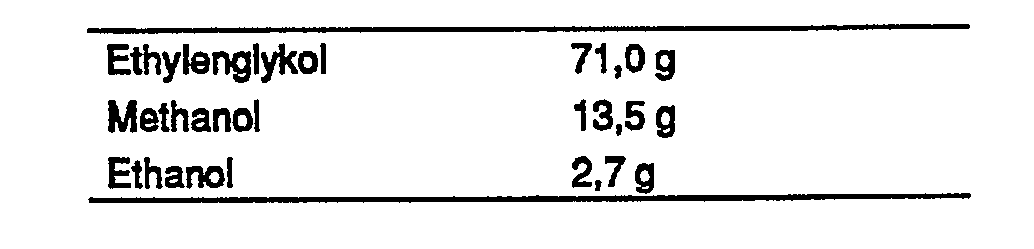
- Eine Lösung aus 1,0 g Rh(CO)2 (CH3COCH2COCH3) = 0,4 g Rh, 0,026 g Co2(CO)8 = 0,009 g Co und 0,11 g a ,j3,y,ä -Tetraphenylporphyrin in 179,0 g Hexanol-1 und 19,8 g 1,5-Dimethylpyrrolidon-2 wurde 5 Stunden bei 230°C und einem Gesamtdruck von 1500 bar mit einem äquimolaren CO/H2-Gemisch zur Reaktion gebracht. Die gaschromatographisch ermittelten Ausbeuten betrugen:
Claims (4)

Applications Claiming Priority (2)
| Application Number | Priority Date | Filing Date | Title |
|---|---|---|---|
| DE19863615835 DE3615835A1 (de) | 1986-05-10 | 1986-05-10 | Verfahren zur herstellung von ethylenglykol |
| DE3615835 | 1986-05-10 |
Publications (3)
| Publication Number | Publication Date |
|---|---|
| EP0245771A2 EP0245771A2 (de) | 1987-11-19 |
| EP0245771A3 EP0245771A3 (en) | 1988-08-10 |
| EP0245771B1 true EP0245771B1 (de) | 1989-11-23 |
Family
ID=6300587
Family Applications (1)
| Application Number | Title | Priority Date | Filing Date |
|---|---|---|---|
| EP87106591A Expired EP0245771B1 (de) | 1986-05-10 | 1987-05-07 | Verfahren zur Herstellung von Ethylenglykol |
Country Status (5)
| Country | Link |
|---|---|
| US (1) | US4724241A (de) |
| EP (1) | EP0245771B1 (de) |
| JP (1) | JPS62267244A (de) |
| DE (2) | DE3615835A1 (de) |
| ES (1) | ES2011784B3 (de) |
Families Citing this family (1)
| Publication number | Priority date | Publication date | Assignee | Title |
|---|---|---|---|---|
| CA2289790C (en) * | 1999-11-16 | 2005-02-08 | Larry Perrault | Roof truss |
Family Cites Families (4)
| Publication number | Priority date | Publication date | Assignee | Title |
|---|---|---|---|---|
| NL7610785A (nl) * | 1975-09-30 | 1977-04-01 | Union Carbide Corp | Werkwijze ter bereiding van veelwaardige al- coholen. |
| US4224235A (en) * | 1978-12-11 | 1980-09-23 | Union Carbide Corporation | Rhodium catalyst regeneration by thermal treatment |
| DE3427138A1 (de) * | 1984-07-24 | 1986-02-06 | Basf Ag, 6700 Ludwigshafen | Verfahren zur herstellung von ethylenglycol |
| DE3532877A1 (de) * | 1985-09-14 | 1987-03-26 | Basf Ag | Verfahren zur herstellung von ethylenglycol |
-
1986
- 1986-05-10 DE DE19863615835 patent/DE3615835A1/de not_active Withdrawn
-
1987
- 1987-04-24 US US07/042,158 patent/US4724241A/en not_active Expired - Lifetime
- 1987-05-07 DE DE8787106591T patent/DE3761020D1/de not_active Expired
- 1987-05-07 ES ES87106591T patent/ES2011784B3/es not_active Expired - Lifetime
- 1987-05-07 EP EP87106591A patent/EP0245771B1/de not_active Expired
- 1987-05-08 JP JP62110892A patent/JPS62267244A/ja active Pending
Also Published As
| Publication number | Publication date |
|---|---|
| DE3615835A1 (de) | 1987-11-12 |
| EP0245771A3 (en) | 1988-08-10 |
| JPS62267244A (ja) | 1987-11-19 |
| EP0245771A2 (de) | 1987-11-19 |
| DE3761020D1 (en) | 1989-12-28 |
| US4724241A (en) | 1988-02-09 |
| ES2011784B3 (es) | 1990-02-16 |
Similar Documents
| Publication | Publication Date | Title |
|---|---|---|
| DE1668244C3 (de) | ||
| DE2658216B2 (de) | Verfahren zur Herstellung von Monocarbonsäureanhydriden | |
| DE2901347A1 (de) | Hydroformylierungsverfahren | |
| EP0051859B1 (de) | Verfahren zur Herstellung von Ethanol aus Methanol | |
| EP0759420B1 (de) | Verfahren zur Herstellung von Carbonsäuren durch Carbonylierung von Olefinen | |
| DE2554524C3 (de) | Rhodiumhaitiger Katalysator und dessen Verwendung zur Hydrierung von e-Deoxy-e-demethyl-e-methylen-S-oxYtetracyclin | |
| DE3875281T2 (de) | Herstellung von pseudoiononen. | |
| DE2447069C2 (de) | Verfahren zur Herstellung von Carbonsäureestern | |
| EP0245771A2 (de) | Verfahren zur Herstellung von Ethylenglykol | |
| EP0027501B1 (de) | Verfahren zur Herstellung von 1,1-Diacetoxiethan | |
| EP0215378B1 (de) | Verfahren zur Herstellung von Ethylenglycol | |
| DE3034019C2 (de) | Verfahren zur gleichzeitigen Herstellung von Estern von Alkanolen und vicinalen Glykolen | |
| DE2037782A1 (de) | Verfahren zur Herstellung von Adipinsäure | |
| EP0359118B1 (de) | Verfahren zur Herstellung von 1,1,2-Trialkoxyethanen | |
| EP0181618B1 (de) | Verfahren zur Herstellung von Substituierten Piperidinen | |
| DE2061538C3 (de) | Verfahren zur Herstellung von Kobalt (III)-bis-salicylaldehydäthylendiiminat -Komplexen | |
| EP0171632B1 (de) | Verfahren zur Herstellung von Ethylenglycol | |
| DE2327437C2 (de) | Verfahren zur Herstellung von Cumarin und 6-Methylcumarin | |
| DE2451473C2 (de) | Verfahren zur Herstellung von Formylpropylacetaten | |
| DE2404306B2 (de) | Optisch aktive Pinanderivate | |
| EP0447758B1 (de) | Verfahren zur Herstellung von ungesättigten und gesättigten Carbonylverbindungen | |
| DE2219168C3 (de) | 2-Phenyl-butanale und Verfahren zu deren Herstellung | |
| EP0374416A1 (de) | Verfahren zur Herstellung von 2,6,6-Trimethyl-cyclohex-2-en-1,4-dion | |
| DE1913123C (de) | Verfahren zur Herstellung eines Gemisches aus einem aromatischen Aldehyd und einem aromatischen Alkohol mit über wiegendem Aldehydanteil | |
| DE2645845B2 (de) | Verfahren zur Herstellung von Oxalsäureestern |
Legal Events
| Date | Code | Title | Description |
|---|---|---|---|
| PUAI | Public reference made under article 153(3) epc to a published international application that has entered the european phase |
Free format text: ORIGINAL CODE: 0009012 |
|
| AK | Designated contracting states |
Kind code of ref document: A2 Designated state(s): BE DE ES FR GB IT NL |
|
| PUAL | Search report despatched |
Free format text: ORIGINAL CODE: 0009013 |
|
| AK | Designated contracting states |
Kind code of ref document: A3 Designated state(s): BE DE ES FR GB IT NL |
|
| 17P | Request for examination filed |
Effective date: 19880625 |
|
| 17Q | First examination report despatched |
Effective date: 19890113 |
|
| GRAA | (expected) grant |
Free format text: ORIGINAL CODE: 0009210 |
|
| AK | Designated contracting states |
Kind code of ref document: B1 Designated state(s): BE DE ES FR GB IT NL |
|
| ITF | It: translation for a ep patent filed | ||
| GBT | Gb: translation of ep patent filed (gb section 77(6)(a)/1977) | ||
| REF | Corresponds to: |
Ref document number: 3761020 Country of ref document: DE Date of ref document: 19891228 |
|
| ET | Fr: translation filed | ||
| PLBE | No opposition filed within time limit |
Free format text: ORIGINAL CODE: 0009261 |
|
| STAA | Information on the status of an ep patent application or granted ep patent |
Free format text: STATUS: NO OPPOSITION FILED WITHIN TIME LIMIT |
|
| 26N | No opposition filed | ||
| ITTA | It: last paid annual fee | ||
| PGFP | Annual fee paid to national office [announced via postgrant information from national office to epo] |
Ref country code: FR Payment date: 19940422 Year of fee payment: 8 |
|
| PGFP | Annual fee paid to national office [announced via postgrant information from national office to epo] |
Ref country code: GB Payment date: 19940505 Year of fee payment: 8 |
|
| PGFP | Annual fee paid to national office [announced via postgrant information from national office to epo] |
Ref country code: BE Payment date: 19940516 Year of fee payment: 8 |
|
| PGFP | Annual fee paid to national office [announced via postgrant information from national office to epo] |
Ref country code: DE Payment date: 19940518 Year of fee payment: 8 |
|
| PGFP | Annual fee paid to national office [announced via postgrant information from national office to epo] |
Ref country code: ES Payment date: 19940519 Year of fee payment: 8 |
|
| PGFP | Annual fee paid to national office [announced via postgrant information from national office to epo] |
Ref country code: NL Payment date: 19940531 Year of fee payment: 8 |
|
| PG25 | Lapsed in a contracting state [announced via postgrant information from national office to epo] |
Ref country code: GB Effective date: 19950507 |
|
| PG25 | Lapsed in a contracting state [announced via postgrant information from national office to epo] |
Ref country code: ES Free format text: LAPSE BECAUSE OF NON-PAYMENT OF DUE FEES Effective date: 19950508 |
|
| PG25 | Lapsed in a contracting state [announced via postgrant information from national office to epo] |
Ref country code: DE Effective date: 19950523 |
|
| PG25 | Lapsed in a contracting state [announced via postgrant information from national office to epo] |
Ref country code: BE Effective date: 19950531 |
|
| BERE | Be: lapsed |
Owner name: BASF A.G. Effective date: 19950531 |
|
| PG25 | Lapsed in a contracting state [announced via postgrant information from national office to epo] |
Ref country code: NL Effective date: 19951201 |
|
| GBPC | Gb: european patent ceased through non-payment of renewal fee |
Effective date: 19950507 |
|
| NLV4 | Nl: lapsed or anulled due to non-payment of the annual fee |
Effective date: 19951201 |
|
| PG25 | Lapsed in a contracting state [announced via postgrant information from national office to epo] |
Ref country code: FR Effective date: 19960229 |
|
| REG | Reference to a national code |
Ref country code: FR Ref legal event code: ST |
|
| REG | Reference to a national code |
Ref country code: FR Ref legal event code: ST |
|
| REG | Reference to a national code |
Ref country code: ES Ref legal event code: FD2A Effective date: 19990301 |
|
| PG25 | Lapsed in a contracting state [announced via postgrant information from national office to epo] |
Ref country code: IT Free format text: LAPSE BECAUSE OF NON-PAYMENT OF DUE FEES;WARNING: LAPSES OF ITALIAN PATENTS WITH EFFECTIVE DATE BEFORE 2007 MAY HAVE OCCURRED AT ANY TIME BEFORE 2007. THE CORRECT EFFECTIVE DATE MAY BE DIFFERENT FROM THE ONE RECORDED. Effective date: 20050507 |