EP0245509B1 - Immuntestverfahren - Google Patents
Immuntestverfahren Download PDFInfo
- Publication number
- EP0245509B1 EP0245509B1 EP86906453A EP86906453A EP0245509B1 EP 0245509 B1 EP0245509 B1 EP 0245509B1 EP 86906453 A EP86906453 A EP 86906453A EP 86906453 A EP86906453 A EP 86906453A EP 0245509 B1 EP0245509 B1 EP 0245509B1
- Authority
- EP
- European Patent Office
- Prior art keywords
- antigen
- antibody
- immobilized
- buffer solution
- assayed
- Prior art date
- Legal status (The legal status is an assumption and is not a legal conclusion. Google has not performed a legal analysis and makes no representation as to the accuracy of the status listed.)
- Expired
Links
Images
Classifications
-
- G—PHYSICS
- G01—MEASURING; TESTING
- G01N—INVESTIGATING OR ANALYSING MATERIALS BY DETERMINING THEIR CHEMICAL OR PHYSICAL PROPERTIES
- G01N33/00—Investigating or analysing materials by specific methods not covered by groups G01N1/00 - G01N31/00
- G01N33/48—Biological material, e.g. blood, urine; Haemocytometers
- G01N33/50—Chemical analysis of biological material, e.g. blood, urine; Testing involving biospecific ligand binding methods; Immunological testing
- G01N33/53—Immunoassay; Biospecific binding assay; Materials therefor
- G01N33/543—Immunoassay; Biospecific binding assay; Materials therefor with an insoluble carrier for immobilising immunochemicals
- G01N33/544—Immunoassay; Biospecific binding assay; Materials therefor with an insoluble carrier for immobilising immunochemicals the carrier being organic
-
- G—PHYSICS
- G01—MEASURING; TESTING
- G01N—INVESTIGATING OR ANALYSING MATERIALS BY DETERMINING THEIR CHEMICAL OR PHYSICAL PROPERTIES
- G01N33/00—Investigating or analysing materials by specific methods not covered by groups G01N1/00 - G01N31/00
- G01N33/48—Biological material, e.g. blood, urine; Haemocytometers
- G01N33/50—Chemical analysis of biological material, e.g. blood, urine; Testing involving biospecific ligand binding methods; Immunological testing
- G01N33/53—Immunoassay; Biospecific binding assay; Materials therefor
- G01N33/543—Immunoassay; Biospecific binding assay; Materials therefor with an insoluble carrier for immobilising immunochemicals
- G01N33/544—Immunoassay; Biospecific binding assay; Materials therefor with an insoluble carrier for immobilising immunochemicals the carrier being organic
- G01N33/549—Immunoassay; Biospecific binding assay; Materials therefor with an insoluble carrier for immobilising immunochemicals the carrier being organic with antigen or antibody entrapped within the carrier
Definitions
- This invention relates to an immunoassay method wherein fibroin-entrapped, immobilized antibodies or antigens are repeatedly used in the assay.
- Radioimmunoassays and enzyme immunoassays find ever-increasing utility as a microassay technique in various clinical tests.
- these assays are generally performed by the so-called "solid phase method" in which an antibody (or antigen) specific to an antigen (or antibody) to be assayed is immobilized by chemically binding, adsorbing or entrapping to a suitable insoluble carrier and the resulting immobilized antibody (or antigen) is complexed with the antigen (or antibody) to be assayed.
- US-A-3970429 Updike
- US-A-4009005 describe radioimmunoassay systems which may be suitable for continuous use in repeated cycles where immobilised antibody is regenerated for repeated use by rising with a suitable solvent or eluting solution. In both cases the regeneration systems described comprise the use of organic solvents.
- the antibody is immobilised in particles of acrylamide gel
- US-A-4009005 the antibody is covalently bound to a solid support.
- a fibroin film-entrapped, immobilized antibody or antigen specific to an antigen or antibody to be assayed may be repeatedly used in the immunoassay of said antigen or antibody by complexing said antigen or antibody and a labelled antibody or antigen, determining the amount of said antigen or antibody to be assayed based on the amount of labelled antibody or antigen so complexed, and immersing the immobilized antibody or antigen in a buffer solution having a pH of about 2 to 4 to remove complexed antigens or antibodies from the immobilized antibody or antigen.
- the immunoreactivity of the immobilized antibody or antigen is not lost significantly by this treatment so that the immobilized antibody or antigen may be used in the same immunoassay repeatedly.
- the present invention has been accomplished based on the above findings.
- Immobilized antibodies or antigens entrapped in fibroin films used in the present invention may be prepared by the method disclosed in Japanese Patent Publication (Kokai) 60-142259 or 60-155129 (see, Production Examples below). Both publications describe methods for entrapment of antigens or antibodies in fibroin films and how such films may be prepared.
- Examples of substances which may be assayed by the method of the present invention include:
- an immobilized antibody or antigen specific to an antigen or antibody to be assayed is used by entrapping the specific antibody or antigen in a fibroin film.
- the assay may be carried out either by the competitive method or the non-competitive method, i.e. the sandwich method.
- the antibody or antigen may be labeled with an enzyme, a fluorescent marker or a radioisotope.
- buffer solutions having a pH of about 2 to 4 include glycine-hydrochloric acid buffer and tartaric acid-sodium hydroxide buffer each having a concentration of 0.05 to 0.2 moles/liter.
- the above dissociation reaction may be facilitated further by incorporating 0.5 to 10 weight % of a neutral salt such as sodium chloride, potassium chloride or sodium sulfate to the buffer.
- a neutral salt such as sodium chloride, potassium chloride or sodium sulfate
- the immobilized antibodies or antigens may be used repeatedly in various immunoassays as shown in the test results below.
- the valuable antibodies or antigens may be recycled but also they may be easily adapted for use in an automated continuous assay system for handling a great number of samples easily.
- the fibroin film prepared in hereinafter-described Production Example 1 was cut to a segment of 7 x 12 mm size.
- the film was bonded at a short edge to one end of a polyester strip having a thickness of 200 ⁇ m (2 mm width x 10 cm length) with a cyanoacrylate adhesive.
- test tube having an inner diameter of 10 mm was added 0.5 ml of normal saline containing 0.5 weight % of bovine serum albumin (BSA).
- BSA bovine serum albumin
- the film removed from the tube was immersed in the buffer (a) shown in Table I for 5 minutes, washed with water and used in a blank test by repeating the above procedure without adding standard AFP. This cycle was repeated successively.
- the fibroin film prepared in hereinafter-described Production Example 2 was cut to a segment of 1.2 x 0.7 cm size and bonded to a polyester strip as in Experiment 1.
- the films removed from respective tubes were immersed in the buffer (a) shown in Table II for 5 minutes, washed with water and reused in the next run repeatedly. Each film was used at random for the series of solutions of standard hCG.
- 100 g of silk fiber was soaked in 5 liters of a 1.0 weight % aqueous solution of marseilles soap and degummed at 80°C for three hours. After washing with water, the fiber was soaked in 5 liters of a 0.5 weight % aqueous solution of marseilles soap and degummed at 80°C for three hours to obtain 72 g of fibroin material substantially free from sericin etc.
- 150 g of calcium chloride was dissolved in a mixture of 100 g of water and 80 g of ethanol in a kneader and the solution was heated at 75°C.
- 70 g of the above fibroin material was dissolved in the above solution with stirring for 1 hour and then diluted with 180 g of hot water (75°C). After cooling, the resulting fibroin solution was dialyzed in a hollow fiber dialyzer against tap water to give 1200 ml of a 5.7 weight % solution of fibroin.
- the residual calcium chloride concentration was 0.08 weight %.
- Monoclonal anti-human AFP antibody (raised in mice) dissolved in normal saline at a concentration of 250 ⁇ m/ml was applied on a glass plate surrounded by a square frame in an amount of 10 ⁇ g of the antibody/cm2 and dried at 15°C for 3 hours. After adding an amount of glycerine corresponding to 30 weight % of fibroin, the fibroin solution prepared in step (1) was cast on the antibody layer and dried at 20°C for 10 hours to give a fibroin film entrapping monoclonal anti-human AFP antibody having a thickness of 60 ⁇ m.
- Monoclonal anti-hCG antibody (raised in mice) dissolved in normal saline at a concentration of 250 ⁇ g/ml was applied on a glass plate surrounded by a square frame in an amount of 10 ⁇ g of the antibody/cm2 and dried at 20°C for 3 hours.
- the fibroin solution produced in Production Example 1 was concentrated to 15.7 weight % and mixed with an amount of glycerine corresponding to 30 weight % of fibroin.
- the fibroin film entrapping monoclonal anti-human AFP antibody prepared in Production Example 1 was cut to a strip of 0.25 x 10 cm size.
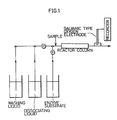
- a flow type assay system shown in Fig. 1 of the accompanying drawings was assembled by placing the film strip in a glass tube having an inner diameter of 0.3 cm and a length of 11 cm to form a reactor column.
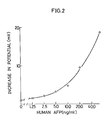
- the reactor column was filled with distilled water. Then 0.7 ml of a series of solutions of 0, 1.25, 2.5, 5, 10, 20, and 40 ng/ml of standard AFP in normal saline containing 0.8 ⁇ g/ml of catalase-labelled anti-human AFP antibody as described below and 0.1 weight % of BSA was introduced into the reactor column and incubated for 20 minutes. The reactor column was washed by passing distilled water at a flow rate of 20 ml/minute for 1 minute. Then 0.7 ml of 0.1 M phosphate buffer, pH 7.0, containing 17.6 mM of hydrogen peroxide was introduced into the reactor column and allowed to react for 5 minutes.
- the reaction mixture was then displaced to a galvanic type oxygen electrode cell (Model AN, manufactured by Oriental Electric Co., Ltd.) by introducing distilled water at a flow rate of 0.5 ml/minute. Increase in potential was determined from the readings of electric current which were proportional to the oxygen concentration in the reaction mixture.
- a galvanic type oxygen electrode cell Model AN, manufactured by Oriental Electric Co., Ltd.
- the film was freed of bound antibody and antigen by passing 0.1 M glycine-HCl buffer (pH 2.5, containing 2% NaCl) through the reactor column at a flow rate of 0.5 ml/minute for 3 minutes. The column was then washed with distilled water at a flow rate of 20 ml/minute for 10 seconds.
- 0.1 M glycine-HCl buffer pH 2.5, containing 2% NaCl
- the catalase-labelled anti-human AFP antibody was produced as follows: 1 mg of the above antibody and 3 mg of catalase (sigma, bovine liver origin) were dissolved in 1 ml of 0.1 M phosphate buffer, pH 8.0. 10 ⁇ l of 10 weight % aqueous solution of glutaraldehyde was added to the solution. The mixture was allowed to react at 15°C for 3 hours. Then 2 mg of sodium borohydride was added. After allowing to react for 30 minutes, the reaction mixture was dialyzed in a dialysis membrane tube against 0.1 M phosphate buffer, pH 7.0, for 4 hours. This reaction mixture was purified using a TSK gel G-3000SW column (registered Trade Mark of TOKYO SODA MFG., Inc.) and a fraction containing the desired labelled antibody was collected.
- TSK gel G-3000SW column registered Trade Mark of TOKYO SODA MFG., Inc.
Landscapes
- Health & Medical Sciences (AREA)
- Immunology (AREA)
- Life Sciences & Earth Sciences (AREA)
- Engineering & Computer Science (AREA)
- Molecular Biology (AREA)
- Biomedical Technology (AREA)
- Chemical & Material Sciences (AREA)
- Hematology (AREA)
- Urology & Nephrology (AREA)
- Food Science & Technology (AREA)
- Biochemistry (AREA)
- Cell Biology (AREA)
- Biotechnology (AREA)
- Medicinal Chemistry (AREA)
- Physics & Mathematics (AREA)
- Analytical Chemistry (AREA)
- Microbiology (AREA)
- General Health & Medical Sciences (AREA)
- General Physics & Mathematics (AREA)
- Pathology (AREA)
- Peptides Or Proteins (AREA)
- Medicines Containing Antibodies Or Antigens For Use As Internal Diagnostic Agents (AREA)
- Medicines Containing Plant Substances (AREA)
- Preparation Of Compounds By Using Micro-Organisms (AREA)
- Steroid Compounds (AREA)
Claims (9)
- Immuntestverfahren, wobei man einen Antikörper oder ein Antigen, immobilisiert durch Einschluß in einen Fibroinfilm und spezifisch für ein Antigen oder einen Antikörper,das oder der zu testen ist, mit dem zu testenden Antigen oder Antikörper komplexiert,
dadurch gekennzeichnet, daß man
nach beendeter Verwendung des immobilisierten Antikörpers oder des immobilisierten Antigens im Test diesen oder dieses mit einer Pufferlösung in Kontakt bringt, die einen pH von etwa 2 bis 4 aufweist, um komplexierte Antigene oder Antikörper davon durch Dissoziation zu entfernen, so daß der immobilisierte Antikörper oder das immobilisierte Antigen für einen weiteren solchen Test verwendet werden kann. - Verfahren nach Anspruch 1 zur Bestimmung eines Antigens, wobei man einen in einen Fibroinfilm eingeschlossenen, immobilisierten Antikörper gegen das Antigen anwendet.
- Verfahren nach Anspruch 1 oder Anspruch 2, worin der immobilisierte Antikörper oder das immobilisierte Antigen mit der Pufferlösung bei einer Temperatur von 10°C bis 40°C in Kontakt gebracht wird.
- Verfahren nach einem der Ansprüche 1 bis 3, worin der immobilisierte Antikörper oder das immobilisierte Antigen mit der Pufferlösung 3 bis 10 Minuten in Kontakt gebracht wird.
- Verfahren nach einem der Ansprüche 1 bis 4, worin die Pufferlösung ein Glycin-HCl-Puffer oder ein Weinsäure-Natriumhydroxid-Puffer mit einer Konzentration von 0,05 bis 0,02M ist.
- Verfahren nach einem der Ansprüche 1 bis 5, worin die Pufferlösung 0,5 - 10 Gew.-% eines Salzes enthält, ausgewählt unter Natriumchlorid, Kaliumchlorid und Natriumsulfat.
- Verfahren nach Anspruch 6, worin die Pufferlösung 0,1M Glycin-HCl ist, und 1 - 5 Gew.-% NaCl oder KCl bei pH 2,2 bis 2,9 enthält.
- Verfahren nach einem der Ansprüche 2 bis 7, worin das zu testende Antigen zusätzlich mit einem markierten Antikörper komplexiert wird.
- Verfahren nach Anspruch 8, wobei man:(a) einen Fibroinfilm mit einem eingeschlossenen, immobilisierten Antikörper, der für das zu testende Antigen spezifisch ist, mit dem Antigen und dem markierten Antikörper in einem Durchflußreaktionsgefäß inkubiert;(b) aus dem Gefäß die Flüssigphase des Komplexierungsgemisches entfernt und den nicht-komplexierten Label bestimmt;(c) durch das Reaktionsgefäß mit einer Flußgeschwindigkeit von 0,5 ml/min 0,1M Glycin-HCl mit einem Gehalt von 2 Gew.-% NaCl 3 Minuten bei pH 2,5 durchleitet; und(d) den Fibroinfilm mit destilliertem Wasser wäscht.
Priority Applications (1)
| Application Number | Priority Date | Filing Date | Title |
|---|---|---|---|
| AT86906453T ATE80467T1 (de) | 1985-11-05 | 1986-10-30 | Immuntestverfahren. |
Applications Claiming Priority (2)
| Application Number | Priority Date | Filing Date | Title |
|---|---|---|---|
| JP60248329A JPS62106369A (ja) | 1985-11-05 | 1985-11-05 | 免疫測定法 |
| JP248329/85 | 1985-11-05 |
Publications (3)
| Publication Number | Publication Date |
|---|---|
| EP0245509A1 EP0245509A1 (de) | 1987-11-19 |
| EP0245509A4 EP0245509A4 (de) | 1989-07-11 |
| EP0245509B1 true EP0245509B1 (de) | 1992-09-09 |
Family
ID=17176460
Family Applications (1)
| Application Number | Title | Priority Date | Filing Date |
|---|---|---|---|
| EP86906453A Expired EP0245509B1 (de) | 1985-11-05 | 1986-10-30 | Immuntestverfahren |
Country Status (5)
| Country | Link |
|---|---|
| EP (1) | EP0245509B1 (de) |
| JP (1) | JPS62106369A (de) |
| AT (1) | ATE80467T1 (de) |
| DE (1) | DE3686717T2 (de) |
| WO (1) | WO1987002780A1 (de) |
Families Citing this family (8)
| Publication number | Priority date | Publication date | Assignee | Title |
|---|---|---|---|---|
| EP2650112B1 (de) | 2006-11-03 | 2016-08-24 | Trustees Of Tufts College | Biopolymer-lichtwellenleiter und herstellungsverfahren dafür |
| CA2704768A1 (en) * | 2006-11-03 | 2008-10-23 | Trustees Of Tufts College | Biopolymer sensor and method of manufacturing the same |
| US20100096763A1 (en) | 2006-11-03 | 2010-04-22 | Trustees Of Tufts College | Biopolymer optofluidic device and method of manufacturing the same |
| US20100046902A1 (en) | 2006-11-03 | 2010-02-25 | Trustees Of Tufts College | Biopolymer photonic crystals and method of manufacturing the same |
| EP2206017B1 (de) | 2007-11-05 | 2019-02-20 | Trustees Of Tufts College | Herstellung von photonischen strukturen aus seiden-fibroin mittels nano- kontaktdruckverfahren |
| EP2396276B1 (de) | 2009-02-12 | 2016-08-31 | Trustees Of Tufts College | Nanoprägung von seidenfibroinstrukturen für biomedizinische und biophotonische anwendungen |
| US9016875B2 (en) | 2009-07-20 | 2015-04-28 | Tufts University/Trustees Of Tufts College | All-protein implantable, resorbable reflectors |
| WO2011026101A2 (en) | 2009-08-31 | 2011-03-03 | Trustees Of Tufts College | Silk transistor devices |
Family Cites Families (8)
| Publication number | Priority date | Publication date | Assignee | Title |
|---|---|---|---|---|
| CA1036935A (en) * | 1973-03-19 | 1978-08-22 | Lavell R. Johnson | Method and apparatus for radioimmunoassay with regeneration of immunadsorbent |
| JPS58176547A (ja) * | 1982-04-12 | 1983-10-17 | Denki Kagaku Kogyo Kk | イムノアフイニテイ−クロマトグラフイ−用担体 |
| JPS60108755A (ja) * | 1983-11-18 | 1985-06-14 | Olympus Optical Co Ltd | 免疫学的分析方法 |
| DE3347092A1 (de) * | 1983-12-24 | 1985-07-18 | MTU Motoren- und Turbinen-Union München GmbH, 8000 München | Verfahren und vorrichtung zur optischen messung der stroemung eines fluids |
| JPS60142259A (ja) * | 1983-12-29 | 1985-07-27 | Kanebo Ltd | 固定化抗体 |
| JPS60155129A (ja) * | 1984-01-24 | 1985-08-15 | Kanebo Ltd | 固定化抗原または抗体の製造方法 |
| JPS63209605A (ja) * | 1987-02-24 | 1988-08-31 | 尾崎 公造 | 扇子の製造方法 |
| JPH0513525A (ja) * | 1991-07-05 | 1993-01-22 | Mitsubishi Electric Corp | Icソケツト |
-
1985
- 1985-11-05 JP JP60248329A patent/JPS62106369A/ja active Pending
-
1986
- 1986-10-30 DE DE8686906453T patent/DE3686717T2/de not_active Expired - Fee Related
- 1986-10-30 WO PCT/JP1986/000552 patent/WO1987002780A1/ja not_active Ceased
- 1986-10-30 AT AT86906453T patent/ATE80467T1/de not_active IP Right Cessation
- 1986-10-30 EP EP86906453A patent/EP0245509B1/de not_active Expired
Also Published As
| Publication number | Publication date |
|---|---|
| EP0245509A1 (de) | 1987-11-19 |
| WO1987002780A1 (fr) | 1987-05-07 |
| JPS62106369A (ja) | 1987-05-16 |
| DE3686717T2 (de) | 1993-01-28 |
| ATE80467T1 (de) | 1992-09-15 |
| DE3686717D1 (de) | 1992-10-15 |
| EP0245509A4 (de) | 1989-07-11 |
Similar Documents
| Publication | Publication Date | Title |
|---|---|---|
| DK160108C (da) | Fremgangsmåde og udstyr til direkte eller indirekte påvisning af reaktion mellem et specifikt bindingsmiddel og den tilsvarende acceptorsubstans | |
| US5958790A (en) | Solid phase transverse diffusion assay | |
| DE3115115C2 (de) | Immunologisches Verfahren | |
| EP0149168B1 (de) | Immuntest | |
| CA1098032A (en) | Solid phase assay of non-human antibody | |
| CH642458A5 (en) | Immunological method | |
| US4894347A (en) | Erythrocyte agglutination assay | |
| EP0207152B1 (de) | Festphasendiffusionstextverfahren | |
| US4350760A (en) | Method for the separation of a protein substance from a solution containing the same by affinity filtration and application of said method to enzymatic assays | |
| HK1000970B (en) | Solid phase diffusion assay | |
| EP0089806B1 (de) | Bestimmung des freien Anteils von Substanzen in biologischen Flüssigkeiten | |
| JPH0543600A (ja) | 抗体または抗原固定化絹フイブロイン膜および免疫測定用センサー | |
| EP0245509A1 (de) | Immuntestverfahren | |
| JPS60218071A (ja) | 抗体、抗原、リセプター又はリガンド検出用の、色原体応答機能を有する固相支持複合体 | |
| CA1334507C (en) | Simple method for immunological assay | |
| JP2736058B2 (ja) | 免疫検定用器具の製造方法 | |
| US5639627A (en) | Method for assaying specific antibody | |
| US5196349A (en) | Immunoassays for thyroid hormones using thyroglobulin | |
| JPH0694716A (ja) | 免疫測定法 | |
| EP0308242B1 (de) | Agglutinationstest | |
| AU703940B2 (en) | Regenerable solid phase for carrying out specific binding reactions | |
| JPS63106561A (ja) | 免疫分析試薬 | |
| JPS61122223A (ja) | 抗体の精製方法 | |
| JP4013270B2 (ja) | 尿中生理活性ペプチドの測定法及び測定用試薬 | |
| JPS63101754A (ja) | カタラ−ゼ標識抗体の製造法 |
Legal Events
| Date | Code | Title | Description |
|---|---|---|---|
| PUAI | Public reference made under article 153(3) epc to a published international application that has entered the european phase |
Free format text: ORIGINAL CODE: 0009012 |
|
| 17P | Request for examination filed |
Effective date: 19870717 |
|
| AK | Designated contracting states |
Kind code of ref document: A1 Designated state(s): AT BE CH DE FR GB IT LI LU NL SE |
|
| A4 | Supplementary search report drawn up and despatched |
Effective date: 19890711 |
|
| 17Q | First examination report despatched |
Effective date: 19910417 |
|
| GRAA | (expected) grant |
Free format text: ORIGINAL CODE: 0009210 |
|
| AK | Designated contracting states |
Kind code of ref document: B1 Designated state(s): AT BE CH DE FR GB IT LI LU NL SE |
|
| REF | Corresponds to: |
Ref document number: 80467 Country of ref document: AT Date of ref document: 19920915 Kind code of ref document: T |
|
| PGFP | Annual fee paid to national office [announced via postgrant information from national office to epo] |
Ref country code: LU Payment date: 19920924 Year of fee payment: 7 |
|
| PGFP | Annual fee paid to national office [announced via postgrant information from national office to epo] |
Ref country code: AT Payment date: 19920925 Year of fee payment: 7 |
|
| ITF | It: translation for a ep patent filed | ||
| REF | Corresponds to: |
Ref document number: 3686717 Country of ref document: DE Date of ref document: 19921015 |
|
| ET | Fr: translation filed | ||
| PGFP | Annual fee paid to national office [announced via postgrant information from national office to epo] |
Ref country code: BE Payment date: 19921229 Year of fee payment: 7 |
|
| EPTA | Lu: last paid annual fee | ||
| PLBE | No opposition filed within time limit |
Free format text: ORIGINAL CODE: 0009261 |
|
| STAA | Information on the status of an ep patent application or granted ep patent |
Free format text: STATUS: NO OPPOSITION FILED WITHIN TIME LIMIT |
|
| 26N | No opposition filed | ||
| PGFP | Annual fee paid to national office [announced via postgrant information from national office to epo] |
Ref country code: SE Payment date: 19931005 Year of fee payment: 8 |
|
| PGFP | Annual fee paid to national office [announced via postgrant information from national office to epo] |
Ref country code: CH Payment date: 19931012 Year of fee payment: 8 |
|
| PGFP | Annual fee paid to national office [announced via postgrant information from national office to epo] |
Ref country code: GB Payment date: 19931026 Year of fee payment: 8 |
|
| PGFP | Annual fee paid to national office [announced via postgrant information from national office to epo] |
Ref country code: FR Payment date: 19931027 Year of fee payment: 8 |
|
| PG25 | Lapsed in a contracting state [announced via postgrant information from national office to epo] |
Ref country code: LU Free format text: LAPSE BECAUSE OF NON-PAYMENT OF DUE FEES Effective date: 19931030 Ref country code: AT Effective date: 19931030 |
|
| PG25 | Lapsed in a contracting state [announced via postgrant information from national office to epo] |
Ref country code: BE Effective date: 19931031 |
|
| PGFP | Annual fee paid to national office [announced via postgrant information from national office to epo] |
Ref country code: NL Payment date: 19931031 Year of fee payment: 8 |
|
| PGFP | Annual fee paid to national office [announced via postgrant information from national office to epo] |
Ref country code: DE Payment date: 19931230 Year of fee payment: 8 |
|
| BERE | Be: lapsed |
Owner name: KANEBO LTD Effective date: 19931031 |
|
| PG25 | Lapsed in a contracting state [announced via postgrant information from national office to epo] |
Ref country code: GB Effective date: 19941030 |
|
| PG25 | Lapsed in a contracting state [announced via postgrant information from national office to epo] |
Ref country code: SE Effective date: 19941031 Ref country code: LI Effective date: 19941031 Ref country code: CH Effective date: 19941031 |
|
| EAL | Se: european patent in force in sweden |
Ref document number: 86906453.5 |
|
| PG25 | Lapsed in a contracting state [announced via postgrant information from national office to epo] |
Ref country code: NL Effective date: 19950501 |
|
| NLV4 | Nl: lapsed or anulled due to non-payment of the annual fee | ||
| GBPC | Gb: european patent ceased through non-payment of renewal fee |
Effective date: 19941030 |
|
| PG25 | Lapsed in a contracting state [announced via postgrant information from national office to epo] |
Ref country code: FR Effective date: 19950630 |
|
| REG | Reference to a national code |
Ref country code: CH Ref legal event code: PL |
|
| PG25 | Lapsed in a contracting state [announced via postgrant information from national office to epo] |
Ref country code: DE Effective date: 19950701 |
|
| EUG | Se: european patent has lapsed |
Ref document number: 86906453.5 |
|
| REG | Reference to a national code |
Ref country code: FR Ref legal event code: ST |
|
| PG25 | Lapsed in a contracting state [announced via postgrant information from national office to epo] |
Ref country code: IT Free format text: LAPSE BECAUSE OF NON-PAYMENT OF DUE FEES;WARNING: LAPSES OF ITALIAN PATENTS WITH EFFECTIVE DATE BEFORE 2007 MAY HAVE OCCURRED AT ANY TIME BEFORE 2007. THE CORRECT EFFECTIVE DATE MAY BE DIFFERENT FROM THE ONE RECORDED. Effective date: 20051030 |