EP0206544B1 - Sofort vernetzbare Zusammensetzung - Google Patents
Sofort vernetzbare Zusammensetzung Download PDFInfo
- Publication number
- EP0206544B1 EP0206544B1 EP86304030A EP86304030A EP0206544B1 EP 0206544 B1 EP0206544 B1 EP 0206544B1 EP 86304030 A EP86304030 A EP 86304030A EP 86304030 A EP86304030 A EP 86304030A EP 0206544 B1 EP0206544 B1 EP 0206544B1
- Authority
- EP
- European Patent Office
- Prior art keywords
- isocyanatocarbonyl
- group
- polymer
- groups
- containing polymer
- Prior art date
- Legal status (The legal status is an assumption and is not a legal conclusion. Google has not performed a legal analysis and makes no representation as to the accuracy of the status listed.)
- Expired - Lifetime
Links
Classifications
-
- C—CHEMISTRY; METALLURGY
- C08—ORGANIC MACROMOLECULAR COMPOUNDS; THEIR PREPARATION OR CHEMICAL WORKING-UP; COMPOSITIONS BASED THEREON
- C08L—COMPOSITIONS OF MACROMOLECULAR COMPOUNDS
- C08L79/00—Compositions of macromolecular compounds obtained by reactions forming in the main chain of the macromolecule a linkage containing nitrogen with or without oxygen or carbon only, not provided for in groups C08L61/00 - C08L77/00
-
- C—CHEMISTRY; METALLURGY
- C08—ORGANIC MACROMOLECULAR COMPOUNDS; THEIR PREPARATION OR CHEMICAL WORKING-UP; COMPOSITIONS BASED THEREON
- C08F—MACROMOLECULAR COMPOUNDS OBTAINED BY REACTIONS ONLY INVOLVING CARBON-TO-CARBON UNSATURATED BONDS
- C08F8/00—Chemical modification by after-treatment
Definitions
- the present invention relates to an instantaneously curable composition. More particularly, it relates to an instantaneously curable composition useful as a coating composition, an adhesive agent, a molding material or the like, and an isocyanate group-containing polymer to be used as an essential component therein.
- curable and cured may be taken substantially in the name meanings as the terms “hardenable” and “hardened” or the terms “crosslinkable” or “crosslinked”.
- lower alkyl is intended to mean alkyl having 1 to 5 carbon atoms, preferably 1 to 3 carbon atoms, more preferably methyl.
- halogen is intended to mean chlorine, bromine, iodine and fluorine, inclusively. Among them, preferred are chlorine and bromine, particularly chlorine.
- inert solvent may be understood to mean any solvent which does not afford any unfavorable influence on achievement of the purpose as aimed at during the reaction or operation in which the solvent is used.
- a highly reactive isocyanatocarbonyl group and/or a compound or polymer having such isocyanatocarbonyl group are created and/or handled so that, in general, any solvent which has an active hydrogen atom in the molecule or contain any substantial amount of moisture is not usable.
- the inert solvent may be chosen, for instance, from aliphatic hydrocarbons (e.g. pentane, hexane, heptane), aromatic hydrocarbons (e.g.
- benzene, toluene, xylene alicyclic hydrocarbons (e.g. cyclohexane, methylcyclohexane, decalin), petrolic hydrocarbons (e.g. petroleum ether, petroleum benzin), halogenated hydrocarbons (e.g. carbon tetrachloride, chloroform, 1,2-dichloroethane), ethers (e.g. diethyl ether, diisopropyl ether, anisole, dioxane, tetrahydrofuran), esters (e.g. methyl acetate, ethyl acetate, butyl acetate), ketones (e.g. acetone, methylethylketone, methylisobutylketone, cyclohexanone, acetophenone, isophorone), acetonitrile, dimethylformamide, dimethylsulfoxide, etc.
- alicyclic hydrocarbons e
- a curable composition there is known a polyol-curable polyurethane composition which comprises as the essential components a polyisocyanate and an alkyd resin.
- This polyol-curable polyurethane composition is based on utilization of the room temperature reactivity between the isocyanate groups in the polyisocynate and the active hydrogen atoms in the alkyd resin.
- a catalyst e.g. dibutyltin dilaurate
- Such polymer having a blocked isocyanatocarbonyl group (-CO-NHCO-B wherein B is a blocking group such as the residue of an alkanol excluding a hydrogen atom therefrom) can be readily convered into a non-blocked isocyanatocarbonyl group-containing polymer at a relatively low temperature in comparison with the conversion of the corresponding blocked isocyanato group-containing polymer into a non-blocked isocyanato group-containing polymer.
- the instantaneous curability can be approptiately controlled by blocking a portion or all of the isocyanatocarbonyl groups in the polymer.
- Said polymer having an isocyanatocarbonyl group in a free or blocked state has been provided by thin invention for the first time.
- a basic object of the present invention is to provide an instantaneously curable composition, which is useful as a coating composition, an adhesive agent, a molding material, etc.
- Another object of the invention is to provide a curable composition of which the curing rate is appropriately controlled.
- a further object of the invention is to provide a polymer having a free or blocked isocyanatocarbonyl group as a pendant, which is used as an essential component in a curable composition.
- a still further object of the invention is to provide a process for preparing a free or blocked isocyanatocarbonyl group-containing polymer.
- the instantaneous curable composition of the invention comprises as the essential components (A) a polymer having a main chain comprising carbon-carbon bonds and an isocyanatocarbonyl group as a pendant to the main chain, the content of the isocyanatocarbonyl groups present in the molecule of the polymer being from 0.1 to 72.2 % by weight, and (B) an active hydrogen atom-containing compound which has one or more, preferably at least two, active hydrogen atoms in the molecule.
- the proportion of the isocyanatocarbonyl group-containing polymer (A) and the active hydrogen atom-containing compound (B) may be such that the equivalent ratio of the isocyanatocarbonyl group in the former and the active hydrogen atom in the latter is 1 : 0.1 - 100, preferably 1 : 0.5 - 5.
- the isocyanatocarbonyl group-containing polymer (A) as one of the essential components in the curable composition of the invention may comprise units of an isocyanatocarbonyl group-containing monomer, optionally with units of one or more of other polymerizable monomers.
- it should have a main chain comprising carbon-carbon bonds and contain isocyanatocarbonyl groups in an amount of 0.1 to 72.2 % by weight in the molecule. It is preferred to have a molecular weight of 1,000 to several hundred thousands, especially of 1,000 to 100,000.
- the isocyanatocarbonyl group-containing polymer (A) can be manufactured by various procedures.
- One typical procedure is polymerization of an alkenoyl isocyanate of the formula: wherein R is a hydrogen atom or a lower alkyl group (e.g. methyl, ethyl, propyl), optionally blocked at the isocyanatocarbonyl group, or an alkenyloxazolinedione hydrohalide of the formula; wherein X is a halogen atom (e.g. chlorine, bromine) and R is as defined above, optionally with one or more of other polymerizable monomers having no active hydrogen atom.
- R is a hydrogen atom or a lower alkyl group (e.g. methyl, ethyl, propyl), optionally blocked at the isocyanatocarbonyl group, or an alkenyloxazolinedione hydrohalide of the formula
- X is a halogen atom (e.g. chlorine, bromine
- the alkenoyl isocyanate (I) can be produced by reacting an alkenylamide of the formula: wherein R is as defined above and an oxalyl halide of the formula: (COX)2 (IV) wherein X is as defined above, optionally followed by dehydrohalogenation of the by-produced haloalkanoyl isocyanate of the formula: wherein R and X are each as defined above. More advantageously, the alkenoyl isocyanate (I) can be produced by reacting the alkenylamide (III) with the oxalyl halide (IV) to produce the alkenyloxazolinedione hydrohalide (II) and subjecting the latter to decomposition.
- the oxalyl halide (IV) is first charged into a reactor and then the alkenylamide (III) is portionwise added thereto, whereby the reaction proceeds.
- the molar ratio of the alkenylamide (III) and the oxalyl halide (IV) may be usually about 1 : 1 - 3, preferably about 1 : 1 - 1.5.
- the use of an inert solvent as the reaction medium is not essential but is usually preferred.
- either one or both of the alkenylamide (III) and the oxalyl halide (IV) may be previously dissolved or suspended therein.
- the reaction temperature is normally higher than -50°C and lower than the decomposition temperature of the alkenyloxazolinedione hydrohalide (II), preferably from about 0 to 40°C. From the industrial viewpoint, the temperature around room temperature or under ice cooling is favorable.
- any per so conventional separation procedure such as filtration or distillation under reduced pressure.
- Addition of seed crystals of the alkenyloxazolinedione hydrohalide (II) to the reaction mixture may be sometimes favorable to accelerate the precipitation of the alkenyloxazolinedione hydrohalide (II).
- separation of the alkenyloxazolinedione hydrohalide (II) from the reaction mixture is not necessarily required.
- the alkenyloxazolinedione hydrohalide (II) is then subjected to decomposition under the condition affording the alkenoyl isocyanate (I) predominantly or suppressing by-production of the haloalkanoyl isocyanate (V).
- One typical example of such condition is to carry out the decomposition under an ordinary pressure (atmospheric or autogenic). Namely, the alkenyloxazolinedione hydrohalide (II) as charged in a reactor is heated under an ordinary pressure until the decomposition proceeds sufficiently. When a reaction medium is used, the heat decomposition can take place at such a low temperature as about 40°C.
- decomposition of the alkenyloxazoline hydrohalide (II) in the presence of a hydrogen halide-eliminating agent at a temperature of -50 to200°C, preferably from 0 to 150°C under an ordinary or reduced pressure gives predominantly the alkenoyl isocyanate (I).
- a hydrogen halide-eliminating agent such as not having an active hydrogen atom or as being reacted with a hydrogen halide not to produe an active hydrogen atom is favorably used.
- Amines which are the most popular hydrogen halide-eliminating agents are hardly usable in the process of this invention.
- Specific examples of the preferred hydrogen halide-eliminating agent are metal complex compounds (e.g.
- the hydrogen halide-eliminating agent is used normally in an amount of about 0.1 to 100 mol, preferably of about 0.1 to 10 mol to 1 mol of the alkenyloxazolinedione hydrohalide (II). Any reaction medium is not necessarily required to use. When used, an inert solvent may be employed.
- Another example of the conditition is to carry out the decomposition in the presence of a liquid medium having a dielectric constant of not more than 4.
- Such liquid medium may be constituted with one or more of inert solvents chosen from aliphatic or alicyclic hydrocarbons (e.g. pentane, hexane, heptane, octane, decalin, cyclohexane), aromatic hydrocarbons (e.g. benzene, toluene, xylene, naphthalene), ethers (e.g. propyl ether, butyl ether, dioxane, isopropyl ether), esters, halogenated hydrocarbons (e.g. carbon tetrachloride), etc.
- inert solvents chosen from aliphatic or alicyclic hydrocarbons (e.g. pentane, hexane, heptane, octane, decalin, cyclohexane), aromatic hydrocarbons (e.g. benzene, toluene, xylene, na
- a dielectric constant of not more than 4 may be attained by the use of a single solvent or by the use of two or more solvents in combination.
- the decomposition may be carried out by keeping the alkenyloxazolinedione hydrohalide (II) in a liquid medium of not more than 4 in dielectric constant at a temperature higher than the decomposition temperature of the alkenyloxazolinedione (II), usually from about 40 to 150°C, preferably from about 60 to 120°C, whereby the alkenoyl isocyanate (I) is predominantly produced.
- Recovery of the alkenoyl isocyanate (I) from the reaction mixture may be accomplished by a per se conventional separation procedure such as distillation under atmospheric or reduced pressure.
- the alkenoyl isocyanate (I) blocked at the isocyanatocarbonyl group may be produced, for instance, by reacting the alkenoyl isocyanate (I) with a blocking agent in an inert solvent at a temperature of -20 to 100°C, preferably at room temperature or under cooling with ice.
- a blocking agent are aliphatic alcohols (e.g.
- methylethylketone oxime e.g. imidazole
- triazoles e.g. 1,2,3-benzotriazole
- amines e.g. dicyclohexylamine
- a small amount of a polymerization inhibitor may be incorporated into the reaction system or the reaction mixture for prevention of the unnecessary polymerization on the double bond.
- the polymerization inhibitor are hydroquinone, p-methoxyphenol, 2,6-di-t-butyl-4-methylphenol, 4-t-butylcatechol, bisdihydroxybenzylbenzene, 2,2'-methylenebis(6-t-butyl-3-methylphenol), 4,4'-butylidenebis(6-t-butyl-3-methylphenol), 4,4'-thiobis(6-t-butyl-3-methylphenol), p-nitrosophenol, diisopropylxanthogenesulfide, N-nitrosophenylhydroxylamine ammonium salt, 1,1-diphenyl-2-picrylhydrazyl (free radical), dithiobenzoyl sulfide, p,p'-ditolyl trisul
- alkenoyl isocyanates (I) are, in general, stable liquids at room temperature and therefore can be handled with ease. They are soluble in various organic solvents and can be used in their solution form.
- Polymerisation of the alkenoyl isocyanate (I), optionally blocked at the isocyanatocarbonyl group, or the alkenoyloxazolinedione (II) optionally with one or more other polymerisable monomers having no active hydrogen atom, may be carried out by a per se conventional procedure for solution polymerisation.
- examples are monoolefinic or diolefinic hydrocarbons (e.g. styrene, alpha-methylstyrene, alpha-ethylstyrene, 2-methylpropene-1, 2-methylbutene-1, 2-methylpentene-1, 2,3-dimethylbutene-1, 2,3-dimethylpentene-1, 2,4-dimethylpentene-1, 2,3,3-trimethylheptene-1, 2,3-dimethylhexene-1, 2,4-dimethylhexene-1, 2,5-dimethylhexene-1, 2-methyl-3-ethylpentene-1, 2,3,3-trimethylpentene-1, 2,3,4-trimethylpentene-1, 2-methyloctene-1, 2,6-dimethylheptene-1, 2,6-dimethyloctene-1, 2,3-dimethyldecene-1, 2-methylnonadecene-1, ethylene
- alpha-chlorostyrene alpha-bromostyrene, 2,5-dichlorostyrene, 2,5-dibromostyrene, 2,6-dichlorostyrene, 3,4-dichlorostyrene, o-, m- or p-fluorostyrene, 2,6-difluorostyrene, 3-fluoro-4-chlorostyrene, 3-chloro-4-fluorostyrene, 2,4,5-trichlorostyrene, dichloromonofluorostyrene, 2-chloropropene, 2-chlorobutene, 2-chloropentene, 2-chlorohexene, 2-chloroheptene, 2-bromobutene, 2-bromoheptene, 2-fluorohexene, 2-fluorobutene, 2-iodopropene, 2-iodopentene, 4-bromoheptene, 4-chloroheptene, 4-fluor
- unsaturated nitriles e.g. acrylonitrile, methacrylonitrile, ethacrylonitrile, 3-octenenitrile, crotonitrile, oleonitrile, etc.
- a mixture comprising the alkenoyl isocyanate (I), optionally blocked at the isocyanatocarbonyl group, or the alkenyloxazolinedione (II) optionally with one or more of the other polymerizable monomers having no active hydrogen atom in an inert solvent is subjected to polymerization, for instance, at a temperature of 20 to 200°C, preferably of 60 to 150°C, more preferably of 80 to 110°C.
- the content of the alkenoyl isocyanate (I), optionally blocked at the isocyanatocarbonyl group, or the alkenyloxazolinedione (II) in tea mixture is normally not less than 0.1 % by weight.
- an inert solvent and, if desired, a portion of the monomeric components are charged in a reactor, and the temperature is retained at 50 to 140°C, preferably 80 to 110°C. Then, solutions of the monomeric components and of the polymerization initiator are dropwise added thereto in about 0.5 to 5 hours, preferably about 1.5 to 3 hours, optionally followed by aging for 0.5 to 2 hours.
- a polymerization initiator is present in the reaction system.
- the polymerization initiator are organic peroxides (e.g. benzoyl peroxide, t-butyl perbenzoate, t-butyl peroxide, cumene hydroperoxide, di-t-butyl peroxide,t-butyl peroctoate), azo compounds (e.g. 2,2'-azobisisobutyronitrile, dimethyl azodiisobutyrate, 2,2'-azobis(2,4-dimethylvaleronitrile), 2,2'-azobis(4-methoxy-2,4-dimethylvaleronitrile), etc.
- organic peroxides e.g. benzoyl peroxide, t-butyl perbenzoate, t-butyl peroxide, cumene hydroperoxide, di-t-butyl peroxide,t-butyl peroctoate
- azo compounds e.g. 2,2'-
- the amount of the polymerization initiator is usually from 0.1 to 10 % by weight, preferably from 0.5 to 5 % by weight, based on the total weight of the monomeric components.
- a chain transfer agent may be also present in the reaction system.
- the chain transfer agent there may be used any conventional one having no active hydrogen atom. Specific examples include alpha-methylstyrene dimer.
- the amount of the chain transfer agent is usually from 5 to 20 % by weight based on the total weight of the monomeric components.
- the alkenyl isocyanato (I) When the alkenyl isocyanato (I) is used as the starting monomer, the above polymerization affords the isocyanatocarbonyl group-containing polymer (A) as the direct product, the content of the isocyanatocarbonyl groups being 0.1 to 72.2 % by weight and the molecular weight being about 1,000 to 100,000.
- the alkenyl isocyanate (I) is blocked at the isocyanatocarbonyl group, the direct product is the blocked isocyanatocarbonyl group-containing polymer (A'), i.e.
- the polymer which has a blocked isocyanatocarbonyl group as a pendant the content of the blocked isocyanatocarbonyl groups being from 0.1 to 99.9 % by weight, and a molecular weight of about 1,000 to 100,000.
- This blocked isocyanatocarbonyl group-containing polymer can be readily converted into the isocyanatocarbonyl group-containing polymer (A) by application of a per se conventional blocking group-eliminating procedure to the former, e.g. treatment of the former with heat, light, a catalyst or the like.
- the direct product is a polymer having an oxazolinedione hydrohalide group as an pendant, the content of such groups in the molecule being usually from 0.1 to 83.3 %, especially from 5 to 83.3 %, and having normally a molecular weight of about 1,000 to 100,000, especially of about 1,000 to 50,000.
- This polymer can be easily converted into the isocyanatocarbonyl group-containing polymer (A) by treatment of the former in substantially the same manner as explained on the conversion of the alkenyloxazolinedione hydrohalide (II) into the alkenoyl isocyanate.
- the isocyanatocarbonyl group-containing polymer (A) thus obtained as an essential component in the composition of the invention, it may be used in the form of the reaction mixture containing the same or in its dilute or concentrated form obtainable by diluting the reaction mixture with an inert solvent or concentrating the reaction mixture to evaporate volatile components therefrom.
- the other essential component in the curable composition of the invention is the active hydrogen atom-containing compound (B) having one or more, preferably at least two, active hydrogen atoms.
- active hydrogen atom-containing compound (B) may be chosen from a wide scope of compounds having an active hydrogen atom, which may be present in functional groups such as hydroxyl, mercapto, carboxyl, amino, imino and active methylene. Thus, it may be chosen preferably from compounds having two or more of said functional groups in their molecules.
- resins e.g. acryl resins, epoxy resins, polyester resins, alkyd resins, polyamide resins, amino resins
- polyhydroxy compounds e.g.
- ethanedithiol 2-mercaptoethanol, 2-aminoethanethiol, toluenedithiol
- active methylene compounds e.g. dimethyl malonate, tetracyanopropane, 1,3-cyclohexanedione, etc.
- the reactivity of the isocyanatocarbonyl group in the polymer (A) is extremely higher (i.e. more than 104 times) than that of an isocyanato group in the corresponding polymer. Therefore, curing of the composition of the invention, i.e. the reaction between the isocyanatocarbonyl group in the polymer (A) and the active hydrogen atom in the compound (B), proceeds instantaneously at room temperature to give a cured product.
- One typical example of the reaction between an icocyanatocarbonyl group-containing polymer and a triol on curing as presently assumed is schematically shown below.
- the cured product has a bond of -CO-NH-COO- and shows high elasticity and toughness. wherein R is as defined above.
- the isocyanatocarbonyl group-containing polymer (A) therein may be partly or wholly substituted with the blocked isocyanatocarbonyl group-containing polymer (A').
- the blocked isocyanatocarbonyl group-containing polymer (A') can be produced directly by polymerization of the alkenoyl isocyanate (I) blocked at the isocyanatocarbonyl group.
- the once-produced isocyanatocarbonyl group-containing polymer (A) may be reacted with a blocking agent in the same manner as explained on the blocking of the alkenoyl isocyanate (I) to give the blocked isocyanatocarbonyl group-containing polymer (A').
- the curable composition of the invention may be provided in a single component form or in a two component form depending upon the curing rate. With the blocking degree of the isocyanatocarbonyl groups, the curing rate is varied, and the composition form may be decided thereon. When all the isocyanatocarbonyl groups are free and the curing rate is so high as instantaneous, the curable composition is normally presented in a two component form, i.e. a kit comprising two separate packs, of which one contains the isocyanatocarbonyl group-containing polymer (A) and the other contains the active hydrogen atom-containing compound (B). On the use, they may be mixed together, or one of them is first applied and the other may be applied thereon.
- the curable composition may be presented in a single component form, i.e. a single composition comprising the blocked isocyanatocarbonyl group-containing polymer (A') and the active hydrogen atom-containing compound (B).
- a single composition comprising the blocked isocyanatocarbonyl group-containing polymer (A') and the active hydrogen atom-containing compound (B).
- at least one of the blocked isocyanatocarbonyl group-containing polymer (A') and the active hydrogen atom-containing compound (B) may be provided in the form of a solution in an inert solvent.
- the concentration of the essential component in the solution may be usally from not less than 0.1 % by weight.
- the active hydrogen atom-containing compound (B) in a gaseous or vapor form may be contacted onto the isocyanatocarbonyl group-containing polymer (A) for curing.
- active hydrogen atom-containing compound examples include water, ammonia, ethanolamine, etc.
- the curable composition may optionally comprise conventional additives such as pigments and fillers. These additives may be also incorporated into either one or both of the isocyanatocarbonyl group-containing polymer (A) and the active hydrogen atom-containing compound (B). Any catalyst is usually not required to use, although it may be incorporated if desired.
- a liquid or solution containing the active hydrogen atom-containing compound (B) is usually first applied onto a substrate, and during the liquid or solution is still not completely dried, a liquid or solution containing the isocyanatocarbonyl group-containing polymer (A) is applied thereon in the drying atmosphere, optionally followed by drying at room temperature or under heating.
- a liquid or solution containing the isocyanatocarbonyl group-containing polymer (A) is applied to a substrate, and a liquid or solution containing the active hydrogen atom-containing compound (B) is applied to another substrate. Then, both of the substrates may be joined together, optionally followed by heating.
- a liquid or solution containing the isocyanatocarbonyl group-containing polymer (A) and a liquid or solution containing the active hydrogen atom-containing compound (B) are combined together in a mold, followed by curing.
- said combination may be carried out at a low temperature avoiding curing, and then the resultant mixture is admitted into a mold and brought to room temperature for curing. If necessary, heating may be applied on curing. Paticularly when the content of the blocked isocyanatocarbonyl group-containing polymer is great, heating will be desirable or necessary for curing.
- the isocyanatocarbonyl group-containing polymer (A) shows a high reactivity attributed to the isocyanatocarbonyl group.
- the reactivity of the blocked isocyanatocarbonyl group-containing polymer (A') is somewhat suppressed, but the blocking group can be readily eliminated, for instance, by heating so that the free isocyanatocarbonyl group is recovered and exerts a high reactivity. Therefore, those can be used not only as the essential component in the curable composition of the invention but also as a resinous component in various fields such as coating compositions, adhesive agents, industrial plastics, etc.
- Oxalyl chloride 130 g; 1.02 mol was charged in a reactor, and a warm solution of acrylamide (71 g; 1.0 mol) in dichloroethane (250 ml) was dropwise added thereto (reaction temperature, 10 to 30°C). After completion of the dropwise addition, the solvent and excess of the oxalyl chloride were removed by distillation under reduced pressure to obtain 2-vinyloxazoline-4,5-dione hydrochloride (161 g) as a yellow oil, Viscosity, 102 Pa.s (100,000 cp).
- Oxalyl chloride (139.6 g) and o-dichlorobenzene (400 g; dielectric constant, 9.88) were mixed together and cooled to a temperature of 0 to 10°C.
- Methacrylamide (85.1 g) was portionwise added thereto in 40 minutes, followed by stirring at 35 to 40°C for 2 hours.
- a small amount of seed crystals of 2-isopropenyloxazoline-4,5-dione hydrochloride was added thereto, and the resultant mixture was allowed to stand whereby 2-isopropenyloxazoline-4,5-dione hydrochloride was crystallized out.
- Oxalyl chloride (139.6 g; 1.1 mol) and o-dichlorobenzene (400 g; dielectric constant, 9.88) were mixed together and cooled to a temperature of 0 to 10°C.
- Methacrylamide (85.1 g; 1.0 mol) was portionwise added thereto in 40 minutes.
- a small amount of seed crystals of 2-isopropenyloxazoline-4,5-dione hydrochloride was added thereto, and the resultant mixture was allowed to stand whereby 2-isopropenyloxazoline-4,5-dione hydrochloride was crystallized out.
- Hexane (600 g; dielectric constant, 1.88) was added thereto. Precipitated crystals were collected by filtration to obtain 2-isopropenyloxazoline-4,5-dione hydrochloride in a yield of 98.6 %.
- the reaction mixture comprising the produced active hydrogen atom-containing compound has the following physical properties: viscosity (determined by Gardner bubble viscometer), C; non-volatile content, 45 %; number average molecular weight of resin, 10,720; hydroxyl value of resin (mg number of KOH corresponding to the equivalent of hydroxyl groups in 1 g of the solid component of resin), 75.
- the materials under (a) were charged, and heating under reflux was effected for 1 hour to remove water.
- the materials under (b) were dropwise added thereto at 100°C in 3 hours under nitrogen stream, and the resultant mixture was aged for 30 minutes.
- the materials under (c) were dropwise added thereto in 30 minutes, followed by aging at 100°C for 1.5 hours.
- the reaction mixture comprising the produced isocyanatocarbonyl group-containing polymer has the physical properties as shown in Table 1.
- the reaction mixture comprising the produced isocyanatocarbonyl group-containing polymer has the physical properties as shown in Table 1.
- the reaction mixture comprising the produced isocyanatocarbonyl group-containing polymer has the physical properties as shown in Table 1.
- the reaction mixture comprising the produced isocyanatocarbonyl group-containing polymer has the physical properties as shown in Table 1.
- the reaction mixture comprising the produced isocyanatocarbonyl group-containing polymer has the physical properties as shown in Table 1.
- the reaction mixture comprising the produced isocyanatocarbonyl group-containing polymer has the physical properties as shown in Table 1.
- Example 8 In the same manner as in Example 8 but replacing the mixture of trimethylolethane and tetrahydroquinone by a mixture of diethanolamine (0.06 part) and tetrahydroquinone (4 parts), that of 1,6-hexanediol (0.10 part) and tetrahydroquinone (4 parts), that of azelaic acid (0.16 part) and tetrahydroquinone (4 parts), that of N-methyl-1,3-propanediamine (0.05 part) and tetrahydroquinone (4 parts) or that of the active hydrogen atom-containing compound as obtained in Reference Example 7 (2.8 parts) and tetrahydroquione (4 parts), mixing was conducted, whereby the contents in the flask was hardened immediately.
- dioxane (20.0 parts) was charged and heated to 80°C.
- Number average molecular weight of resin 9,900.
- Non-volatile content 30 %.
- the reaction mixture comprising the 2,6-di-t-butyl-p-cresol-blocked methacryloyl isocyanate/styrene copolymer as above obtained was heated at 110°C with an infrared heating cell, whereby the blocking group was eliminated and a methacryloyl isocyanate/styrene copolymer was produced.
- methacryloyl isocyanate/styrene copolymer was treated with a mixture of trimethylolethane and tetrahydroquinone in the same manner as in Example 8, whereby instantaneous curing was observed.
- dioxane (10.0 parts) and 2,6-di-t-butyl-p-cresol-blocked acryloyl isocyanate (6.0 parts) were charged and heated.
- Number average molecular weight of resin 6,400.
- Non-volatile content 33 %.
- the reaction mixture comprising the 2,6-di-t-butyl-p-cresol-blocked acryloyl isocyanate homopolymer as above obtained was heated, whereby the blocking group was eliminated and an acryloyl isocyanate homopolymer was produced.
- the materials under (a) were charged and heated to 90°C.
- the materials under (b) were dropwise added thereto in 2 hours under nitrogen stream, and the resultant mixture was aged for 30 minutes.
- the materials under (c) were dropwise added thereto in 30 minutes, followed by aging for 2 hours.
- the reaction mixture comprising the produced isocyanatocarbonyl group-containing polymer has the physical properties as shown in Table 2.
- the reaction mixture comprising the produced isocyanatocarbonyl group-containing polymer has the physical properties as shown in Table 2.
- the reaction mixture comprising the produced isocyanatocarbonyl group-containing polymer has the physical properties as shown in Table 2.
- the reaction mixture comprising the produced isocyanatocarbonyl group-containing polymer has the physical properties as shown in Table 2.
- the reaction mixture comprising the produced isocyanatocarbonyl group-containing polymer has the physical properties as shown in Table 2.
- 2-Methyl-2-propanol-blocked methacryloyl isocyanate (6.70 g) was dissolved in a mixture of methyl methacrylate (6.66 g), ethyl acrylate (6.64 g) and dioxane (35 g) at 110°C.
- a solution of 2,2'-azobis(2,4-dimethylvaleronitrile) (400 mg) in butyl acetate (25 g) was dropwise added thereto in 2.5 hours, followed by aging for 1.5 hours to give a copolymer of 2-methyl-2-propanol-blocked methacryloyl isocyanate with methyl methacrylate and ethyl acrylate.
- Non-volatile content 22 %. Mn, 6800.
- the reaction mixture comprising the methacryloyl isocyanate/methyl methacrylate/styrene/butyl acrylate copolymer as above obtained was cooled to 10°C, and a solution of methylethylketoxime (3.2 g) in toluene (22 g) was dropwise added thereto, whereby a copolymer of methylethylketoxime-blocked methacryloyl isocyanate with methyl methacrylate, styrene and butyl acrylate was produced. Mn, 6500.
- the reaction mixture comprising the methacryloyl isocyanate/styrene copolymer as above obtained was cooled to 25°C, and a solution of 2,6-di-t-butyl-p-cresol (15.8 g) in butyl acetate (28 g) was dropwise added thereto.
- Dibutyltin diacetate 250 mg was added to the resulting mixture, which was then heated at 60°C for 5 hours to produce a copolymer of 2,6-d-t-butyl-p-cresol-blocked methacryloyl isocyanate with styrene.
- Mn 9900.
- Methacryloyl isocyanate (8.9 g), butyl acetate (9 g), dichloroethane (7 g) and 2,2'-azobis(2,4-dimethylvaleronitrile) (166 mg) were mixed together, and the resultant mixture was dropwise added to butyl acetate (4 g) heated at 110°C in 1 hour, followed by aging for 3.0 hours to give a homopolymer of methacryloyl isocyanate.
- Non-volatile content 26%.
- the reaction mixture comprising the methacryloyl isocyanate homopolymer as obtained above was allowed to cool to room temperature.
- a homopolymer of methyl ethyl ketoxime-blocked methacryloyl isocyanate was obtained. Mn. 1600.
- alkenyl isocyanates (I) and oxazolinedione hydrohalides (II), and the conversion of the latter to the former, are described in EP-A-0202840 (European Patent Application No. 86303601.8).
Landscapes
- Chemical & Material Sciences (AREA)
- Health & Medical Sciences (AREA)
- Chemical Kinetics & Catalysis (AREA)
- Medicinal Chemistry (AREA)
- Polymers & Plastics (AREA)
- Organic Chemistry (AREA)
- General Chemical & Material Sciences (AREA)
- Polyurethanes Or Polyureas (AREA)
- Addition Polymer Or Copolymer, Post-Treatments, Or Chemical Modifications (AREA)
- Agricultural Chemicals And Associated Chemicals (AREA)
- Macromonomer-Based Addition Polymer (AREA)
Claims (14)
- Vernetzbare Masse, die (A) ein Polymer, dessen Moleküle eine Hauptkette, die Kohlenstoff-Kohlenstoff-Bindungen aufweist, und eine oder mehr Isocyanatocarbonylgruppen als Seitenketten an der Hauptkette haben, wobei der Gehalt an Isocyanatocarbonylgruppen pro Polymermolekül 0,1 bis 72,2 Gew.-% beträgt, und (B) eine aktiven Wasserstoff enthaltende Verbindung aufweist.
- Masse nach Anspruch 1, worin das Aequivalentverhältnis der Isocyanatocarbonylgruppen zu den aktiven Wasserstoffatomen 1:0,1 bis 1:100, vorzugsweise 1:0,5 bis 1:5, ist.
- Vernetzbare Masse nach Anspruch 1 oder Anspruch 2, worin die aktiven Wasserstoff enthaltende Verbindung mindestens zwei aktive Wasserstoffatome pro Molekül hat.
- Isocyanatocarbonylgruppen enthaltendes Polymer, das Einheiten eines Alkenoylisocyanats der Formel
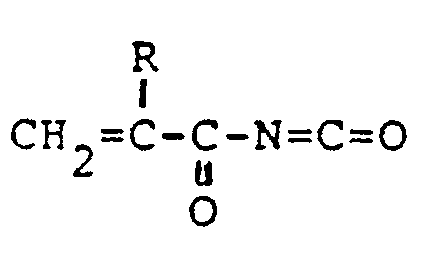
- Isocyanatocarbonylgruppen enthaltendes Polymer mit einem Molekulargewicht von 1 000 bis 100 000, dessen Moleküle eine Hauptkette, die Kohlenstoff-Kohlenstoff-Bindungen aufweist, und eine oder mehr Isocyanatocarbonylgruppen als Seitenketten haben, wobei der Gehalt an Isocyanatocarbonylgruppen 0,1 bis 72,2 Gew.-% beträgt.
- Blockierte Isocyanatocarbonylgruppen enthaltendes Polymer mit einem Molekulargewicht von 1 000 bis 100 000, dessen Moleküle eine Hauptkette, die Kohlenstoff-Kohlenstoff-Bindungen aufweist, und eine oder mehr blockierte Isocyanatocarbonylgruppen als Seitenketten haben, wobei der Gehalt an blockierten Isocyanatocarbonylgruppen 0,1 bis 99,9 Gew.-% beträgt.
- Oxazolindionhydrohalogenidgruppen enthaltendes Polymer mit einem Molekulargewicht von 1 000 bis 100 000, dessen Moleküle eine Hauptkette, die Kohlenstoff-Kohlenstoff-Bindungen aufweist, und eine oder mehr Oxazolindionhydrohalogenidgruppen als Seitenketten haben, wobei der Gehalt an Oxazolindionhydrohalogenidgruppen 0,1 bis 99,9 Gew.-% beträgt.
- Isocyanatocarbonylgruppen enthaltendes Polymer, dessen Moleküle eine Hauptkette, die Kohlenstoff-Kohlenstoff-Bindungen aufweist, eine oder mehr Isocyanatocarbonylgruppen als Seitenketten und eine oder mehr Isocyanatogruppen als Seitenketten haben.
- Polymer nach Anspruch 8, worin der Gehalt an Isocyanatocarbonylgruppen und an Isocyanatogruppen jeweils unabhängig voneinander 5 bis 30 Gew.-% beträgt.
- Polymer nach Anspruch 8 oder Anspruch 9, das ein Molekulargewicht von 3 000 bis 100 000 hat.
- Verfahren zur Herstellung eines Polymeren mit (gegebenenfalls blockierten) Isocyanatocarbonylgruppen als Seitenketten und/oder Oxazolindionhydrohalogenidgruppen als Seitenketten, z.B. eines Polymeren nach einem der Ansprüche 4 bis 10, dadurch gekennzeichnet, dass man das in Anspruch 4 definierte Alkenoylisocyanat, das gegebenenfalls an der Isocyanatocarbonylgruppe blockiert ist, oder ein Alkenyloxazolindionhydrohalogenid der Formel

- Verfahren zur Herstellung eines Polymeren, dessen Moleküle eine blockierte Isocyanatocarbonylgruppe als Seitenkette haben, dadurch gekennzeichnet, dass man das entsprechende eine Isocyanatocarbonylgruppe enthaltende Polymer mit einem Blockierungsmittel umsetzt.
- Masse nach einem der Ansprüche 1 bis 3, worin das Polymer wie in einem der Ansprüche 4 bis 10 beansprucht ist.
- Masse nach einem der Ansprüche 1, 2, 3 und 13, worin das Polymer ein Molekulargewicht von mindestens 1 000, vorzugsweise 1 000 bis 100 000, hat.
Priority Applications (1)
| Application Number | Priority Date | Filing Date | Title |
|---|---|---|---|
| AT86304030T ATE71388T1 (de) | 1985-05-28 | 1986-05-27 | Sofort vernetzbare zusammensetzung. |
Applications Claiming Priority (12)
| Application Number | Priority Date | Filing Date | Title |
|---|---|---|---|
| JP117312/85 | 1985-05-28 | ||
| JP11731285A JPH0643466B2 (ja) | 1985-05-28 | 1985-05-28 | ポリイソシアネ−ト樹脂 |
| JP117306/85 | 1985-05-28 | ||
| JP117311/85 | 1985-05-28 | ||
| JP117301/85 | 1985-05-28 | ||
| JP60117302A JPS61272211A (ja) | 1985-05-28 | 1985-05-28 | アシルイソシアネ−ト基含有ポリマ−の製造方法 |
| JP60117309A JPH0627175B2 (ja) | 1985-05-28 | 1985-05-28 | 速硬化性樹脂組成物 |
| JP117309/85 | 1985-05-28 | ||
| JP60117301A JPS61272210A (ja) | 1985-05-28 | 1985-05-28 | 反応性オキサゾリンジオン基を有するポリマ−およびその製法 |
| JP117302/85 | 1985-05-28 | ||
| JP11731185A JPH0627157B2 (ja) | 1985-05-28 | 1985-05-28 | アシルイソシアネ−ト基含有樹脂 |
| JP60117306A JPH0629296B2 (ja) | 1985-05-28 | 1985-05-28 | ブロツク化アシルイソシアネ−ト基含有ポリマ−およびその製法 |
Publications (3)
| Publication Number | Publication Date |
|---|---|
| EP0206544A2 EP0206544A2 (de) | 1986-12-30 |
| EP0206544A3 EP0206544A3 (en) | 1989-02-15 |
| EP0206544B1 true EP0206544B1 (de) | 1992-01-08 |
Family
ID=27552498
Family Applications (1)
| Application Number | Title | Priority Date | Filing Date |
|---|---|---|---|
| EP86304030A Expired - Lifetime EP0206544B1 (de) | 1985-05-28 | 1986-05-27 | Sofort vernetzbare Zusammensetzung |
Country Status (7)
| Country | Link |
|---|---|
| US (1) | US4788256A (de) |
| EP (1) | EP0206544B1 (de) |
| KR (1) | KR940001715B1 (de) |
| AT (1) | ATE71388T1 (de) |
| AU (1) | AU583624B2 (de) |
| CA (1) | CA1270994A (de) |
| DE (1) | DE3683322D1 (de) |
Families Citing this family (12)
| Publication number | Priority date | Publication date | Assignee | Title |
|---|---|---|---|---|
| DE3534874A1 (de) * | 1985-09-30 | 1987-04-02 | Basf Lacke & Farben | Loesliches, vernetzbares acrylatcopolymerisat, verfahren zu seiner herstellung und ueberzugsmittel auf der basis des acrylatcopolymerisats |
| US5034156A (en) * | 1988-04-18 | 1991-07-23 | Mallinckrodt Specialty Chemicals Company | Method for inhibiting the polymerization of acrylic acid |
| CA2023230A1 (en) * | 1989-08-17 | 1991-02-18 | Satoshi Urano | Solvent based coating composition |
| JP2513918B2 (ja) * | 1989-08-17 | 1996-07-10 | 日本ペイント株式会社 | 水分散型塗料組成物 |
| US5418288A (en) * | 1991-07-18 | 1995-05-23 | Mitsui Toatsu Chemicals, Inc. | Isocyanate resin compositions and hot melt and pressure sensitive adhesives based thereon |
| DE4237639A1 (de) * | 1992-11-07 | 1994-05-11 | Basf Ag | Verfahren zur Herstellung von Polymeren mit NLO-aktiven Seitengruppen und deren Verwendung |
| CA2086047C (en) * | 1992-12-22 | 1999-11-09 | Clint W. Carpenter | A process for the preparation of a modified copolymer as a pigment dispersant for aqueous coating compositions |
| US5378762A (en) * | 1993-12-22 | 1995-01-03 | Basf Corporation | Polymeric pigment dispersants for use in coating compositions |
| EP0680994A1 (de) * | 1994-05-02 | 1995-11-08 | Nippon Paint Co., Ltd. | Re-vernetzbare Zusammensetzungen und Verfahren zur Wiederverwertung unter Verwendung derselben |
| DE19653631A1 (de) * | 1996-12-20 | 1998-06-25 | Basf Coatings Ag | Verfahren zum Herstellen von durch Strahlung vernetzbaren polymeren Acryl- oder Methacrylsäureestern |
| DE10047290A1 (de) * | 2000-09-25 | 2002-04-11 | Bayer Ag | Verfahren zur Herstellung einer Beschichtung auf porösen und/oder saugfähigen Materialien |
| JP3984488B2 (ja) | 2001-03-27 | 2007-10-03 | 日本ペイント株式会社 | 硬化性塗料組成物および塗膜形成方法 |
Family Cites Families (11)
| Publication number | Priority date | Publication date | Assignee | Title |
|---|---|---|---|---|
| BE468669A (de) * | 1945-10-23 | |||
| IT454356A (de) * | 1948-07-29 | |||
| US4001191A (en) * | 1959-01-07 | 1977-01-04 | Rohm And Haas Company | Combustible monomers and polymers therefrom |
| BE635843A (de) * | 1962-08-06 | |||
| DE1249426B (de) * | 1964-08-24 | 1967-09-07 | Farbenfabriken Bayer Aktiengesellschaft, Leverkusen | Verfahren zur Herstellung von Überzügen Anstrichen, Imprägnierungen, Verklebungen oder Embrennlackierungen |
| DE2161645A1 (de) * | 1971-12-11 | 1973-06-14 | Roehm Gmbh | Beschlagverhinderndes beschichtungsmittel |
| ATE74349T1 (de) * | 1984-07-03 | 1992-04-15 | Nippon Paint Co Ltd | Acrylamid-derivate. |
| AU584195B2 (en) | 1985-05-13 | 1989-05-18 | Nippon Paint Co., Ltd. | Isocyanate compounds and their production |
| EP0207621B1 (de) * | 1985-05-27 | 1995-04-05 | Nippon Paint Co., Ltd. | Funktionelle Polymere und deren Herstellung |
| CA1289571C (en) * | 1986-04-25 | 1991-09-24 | Satoshi Urano | Acrylamide derivatives and their polymers |
| FR2598963B1 (fr) | 1986-05-21 | 1988-12-23 | Prepac Sarl | Dispositif de soudage d'un embout sur un film thermoplastique |
-
1986
- 1986-05-27 DE DE8686304030T patent/DE3683322D1/de not_active Expired - Lifetime
- 1986-05-27 AT AT86304030T patent/ATE71388T1/de active
- 1986-05-27 US US06/867,022 patent/US4788256A/en not_active Expired - Fee Related
- 1986-05-27 EP EP86304030A patent/EP0206544B1/de not_active Expired - Lifetime
- 1986-05-28 CA CA000510187A patent/CA1270994A/en not_active Expired - Lifetime
- 1986-05-28 KR KR1019860004200A patent/KR940001715B1/ko not_active Expired - Lifetime
- 1986-05-28 AU AU58027/86A patent/AU583624B2/en not_active Ceased
Also Published As
| Publication number | Publication date |
|---|---|
| EP0206544A3 (en) | 1989-02-15 |
| ATE71388T1 (de) | 1992-01-15 |
| US4788256A (en) | 1988-11-29 |
| KR860009077A (ko) | 1986-12-20 |
| AU583624B2 (en) | 1989-05-04 |
| EP0206544A2 (de) | 1986-12-30 |
| AU5802786A (en) | 1986-12-04 |
| KR940001715B1 (ko) | 1994-03-05 |
| CA1270994A (en) | 1990-06-26 |
| DE3683322D1 (de) | 1992-02-20 |
Similar Documents
| Publication | Publication Date | Title |
|---|---|---|
| US4788256A (en) | Instantaneously curable composition | |
| US4504635A (en) | Process for the preparation of polymeric compositions | |
| US6346591B1 (en) | Monomer and polymerization process | |
| CN101048432B (zh) | 制备可交联性低聚物的方法 | |
| KR930008924B1 (ko) | (n-치환된 카바모일옥시)알카노일옥시알킬 아크릴레이트 중합체 및 이로부터 제조된 조성물 | |
| US4939213A (en) | Triazine crosslinking agents and curable compositions containing the same | |
| EP0207621B1 (de) | Funktionelle Polymere und deren Herstellung | |
| CA1290765C (en) | .alpha.-ALKYLACRYLAMIDE DERIVATIVES AND THEIR POLYMERS | |
| CA2062194C (en) | Self-crosslinkable resin | |
| JP3980120B2 (ja) | 重合性マロン酸誘導体および硬化性組成物 | |
| EP0243160B2 (de) | Polymere, die blockierte Isocyanatocarbonylgruppen enthalten | |
| JPH08502529A (ja) | N−ヒドロキシスクシンイミドでブロックされたイソプロペニル−α,α−ジメチルベンジルイソシアネート及びその自己橋かけ性コポリマー | |
| US5627240A (en) | Low-temperature curable composition | |
| JPH0735420B2 (ja) | 活性水素含有基およびブロツク化イソシアナトカルボニル基を含有するポリマ−およびその製法 | |
| EP0294237B1 (de) | Peroxidmonomer und ein Polymer daraus | |
| EP0630921A2 (de) | Funktionelle Polymere und deren Herstellung | |
| JPS61272207A (ja) | ブロツク化アシルイソシアネ−ト基含有ポリマ−およびその製法 | |
| JPS6346203A (ja) | 水分散性樹脂 | |
| JPS62250013A (ja) | 架橋性重合体およびその製法 | |
| JPS62169831A (ja) | 熱硬化性塗料組成物 | |
| CA1267487A (en) | Acrylic and acrylic/epoxy copolymer composition | |
| JPH09309931A (ja) | マロネート基含有ペンダント基を有するアクリル重合体 | |
| JPH0627175B2 (ja) | 速硬化性樹脂組成物 | |
| JPH0680723A (ja) | ヘテロファンクショナルマクロマー、その重合体 | |
| JPH0429964A (ja) | ヘテロファンクショナル重合性化合物、その製法ならびに重合体 |
Legal Events
| Date | Code | Title | Description |
|---|---|---|---|
| PUAI | Public reference made under article 153(3) epc to a published international application that has entered the european phase |
Free format text: ORIGINAL CODE: 0009012 |
|
| AK | Designated contracting states |
Kind code of ref document: A2 Designated state(s): AT BE CH DE FR GB IT LI NL |
|
| PUAL | Search report despatched |
Free format text: ORIGINAL CODE: 0009013 |
|
| AK | Designated contracting states |
Kind code of ref document: A3 Designated state(s): AT BE CH DE FR GB IT LI NL |
|
| 17P | Request for examination filed |
Effective date: 19890726 |
|
| 17Q | First examination report despatched |
Effective date: 19901217 |
|
| GRAA | (expected) grant |
Free format text: ORIGINAL CODE: 0009210 |
|
| AK | Designated contracting states |
Kind code of ref document: B1 Designated state(s): AT BE CH DE FR GB IT LI NL |
|
| REF | Corresponds to: |
Ref document number: 71388 Country of ref document: AT Date of ref document: 19920115 Kind code of ref document: T |
|
| REF | Corresponds to: |
Ref document number: 3683322 Country of ref document: DE Date of ref document: 19920220 |
|
| ITF | It: translation for a ep patent filed | ||
| ET | Fr: translation filed | ||
| PLBE | No opposition filed within time limit |
Free format text: ORIGINAL CODE: 0009261 |
|
| STAA | Information on the status of an ep patent application or granted ep patent |
Free format text: STATUS: NO OPPOSITION FILED WITHIN TIME LIMIT |
|
| 26N | No opposition filed | ||
| ITTA | It: last paid annual fee | ||
| PGFP | Annual fee paid to national office [announced via postgrant information from national office to epo] |
Ref country code: FR Payment date: 19960510 Year of fee payment: 11 |
|
| PGFP | Annual fee paid to national office [announced via postgrant information from national office to epo] |
Ref country code: AT Payment date: 19960514 Year of fee payment: 11 |
|
| PGFP | Annual fee paid to national office [announced via postgrant information from national office to epo] |
Ref country code: GB Payment date: 19960520 Year of fee payment: 11 |
|
| PGFP | Annual fee paid to national office [announced via postgrant information from national office to epo] |
Ref country code: DE Payment date: 19960528 Year of fee payment: 11 |
|
| PGFP | Annual fee paid to national office [announced via postgrant information from national office to epo] |
Ref country code: CH Payment date: 19960606 Year of fee payment: 11 |
|
| PGFP | Annual fee paid to national office [announced via postgrant information from national office to epo] |
Ref country code: BE Payment date: 19960711 Year of fee payment: 11 |
|
| PG25 | Lapsed in a contracting state [announced via postgrant information from national office to epo] |
Ref country code: GB Effective date: 19970527 Ref country code: AT Effective date: 19970527 |
|
| PGFP | Annual fee paid to national office [announced via postgrant information from national office to epo] |
Ref country code: NL Payment date: 19970529 Year of fee payment: 12 |
|
| PG25 | Lapsed in a contracting state [announced via postgrant information from national office to epo] |
Ref country code: LI Free format text: LAPSE BECAUSE OF NON-PAYMENT OF DUE FEES Effective date: 19970531 Ref country code: CH Free format text: LAPSE BECAUSE OF NON-PAYMENT OF DUE FEES Effective date: 19970531 Ref country code: BE Effective date: 19970531 |
|
| BERE | Be: lapsed |
Owner name: NIPPON PAINT CO. LTD Effective date: 19970531 |
|
| REG | Reference to a national code |
Ref country code: CH Ref legal event code: PL |
|
| GBPC | Gb: european patent ceased through non-payment of renewal fee |
Effective date: 19970527 |
|
| PG25 | Lapsed in a contracting state [announced via postgrant information from national office to epo] |
Ref country code: FR Free format text: LAPSE BECAUSE OF NON-PAYMENT OF DUE FEES Effective date: 19980130 |
|
| PG25 | Lapsed in a contracting state [announced via postgrant information from national office to epo] |
Ref country code: DE Free format text: LAPSE BECAUSE OF NON-PAYMENT OF DUE FEES Effective date: 19980203 |
|
| REG | Reference to a national code |
Ref country code: FR Ref legal event code: ST |
|
| PG25 | Lapsed in a contracting state [announced via postgrant information from national office to epo] |
Ref country code: NL Free format text: LAPSE BECAUSE OF NON-PAYMENT OF DUE FEES Effective date: 19981201 |
|
| NLV4 | Nl: lapsed or anulled due to non-payment of the annual fee |
Effective date: 19981201 |
|
| PG25 | Lapsed in a contracting state [announced via postgrant information from national office to epo] |
Ref country code: IT Free format text: LAPSE BECAUSE OF NON-PAYMENT OF DUE FEES Effective date: 20050527 |