EP0197404A2 - Verfahren zur Herstellung von Ketonen - Google Patents
Verfahren zur Herstellung von Ketonen Download PDFInfo
- Publication number
- EP0197404A2 EP0197404A2 EP86103943A EP86103943A EP0197404A2 EP 0197404 A2 EP0197404 A2 EP 0197404A2 EP 86103943 A EP86103943 A EP 86103943A EP 86103943 A EP86103943 A EP 86103943A EP 0197404 A2 EP0197404 A2 EP 0197404A2
- Authority
- EP
- European Patent Office
- Prior art keywords
- phase transfer
- phenyl
- ketones
- ketone
- formula
- Prior art date
- Legal status (The legal status is an assumption and is not a legal conclusion. Google has not performed a legal analysis and makes no representation as to the accuracy of the status listed.)
- Withdrawn
Links
- 150000002576 ketones Chemical class 0.000 title claims abstract description 28
- 238000000034 method Methods 0.000 title claims description 24
- 230000008569 process Effects 0.000 title claims description 11
- 238000004519 manufacturing process Methods 0.000 title description 6
- 239000003153 chemical reaction reagent Substances 0.000 claims abstract description 12
- 150000008044 alkali metal hydroxides Chemical class 0.000 claims abstract description 11
- HEMHJVSKTPXQMS-UHFFFAOYSA-M Sodium hydroxide Chemical compound [OH-].[Na+] HEMHJVSKTPXQMS-UHFFFAOYSA-M 0.000 claims description 18
- 125000000217 alkyl group Chemical group 0.000 claims description 10
- 125000004432 carbon atom Chemical group C* 0.000 claims description 10
- RTZKZFJDLAIYFH-UHFFFAOYSA-N Diethyl ether Chemical compound CCOCC RTZKZFJDLAIYFH-UHFFFAOYSA-N 0.000 claims description 9
- 125000003118 aryl group Chemical group 0.000 claims description 8
- 229920001223 polyethylene glycol Polymers 0.000 claims description 7
- XMLYCEVDHLAQEL-UHFFFAOYSA-N 2-hydroxy-2-methyl-1-phenylpropan-1-one Chemical compound CC(C)(O)C(=O)C1=CC=CC=C1 XMLYCEVDHLAQEL-UHFFFAOYSA-N 0.000 claims description 6
- DTPCFIHYWYONMD-UHFFFAOYSA-N decaethylene glycol Chemical compound OCCOCCOCCOCCOCCOCCOCCOCCOCCOCCO DTPCFIHYWYONMD-UHFFFAOYSA-N 0.000 claims description 6
- 229910052801 chlorine Inorganic materials 0.000 claims description 5
- 238000002360 preparation method Methods 0.000 claims description 5
- 150000003856 quaternary ammonium compounds Chemical class 0.000 claims description 5
- 125000004861 4-isopropyl phenyl group Chemical group [H]C1=C([H])C(=C([H])C([H])=C1*)C([H])(C([H])([H])[H])C([H])([H])[H] 0.000 claims description 4
- 239000002202 Polyethylene glycol Substances 0.000 claims description 4
- 150000001450 anions Chemical class 0.000 claims description 4
- 229910052794 bromium Inorganic materials 0.000 claims description 4
- 125000006552 (C3-C8) cycloalkyl group Chemical group 0.000 claims description 3
- 125000006763 (C3-C9) cycloalkyl group Chemical group 0.000 claims description 3
- XKBGEWXEAPTVCK-UHFFFAOYSA-M methyltrioctylammonium chloride Chemical compound [Cl-].CCCCCCCC[N+](C)(CCCCCCCC)CCCCCCCC XKBGEWXEAPTVCK-UHFFFAOYSA-M 0.000 claims description 3
- QNODIIQQMGDSEF-UHFFFAOYSA-N (1-hydroxycyclohexyl)-phenylmethanone Chemical compound C=1C=CC=CC=1C(=O)C1(O)CCCCC1 QNODIIQQMGDSEF-UHFFFAOYSA-N 0.000 claims description 2
- 125000001797 benzyl group Chemical group [H]C1=C([H])C([H])=C(C([H])=C1[H])C([H])([H])* 0.000 claims description 2
- 125000004122 cyclic group Chemical group 0.000 claims description 2
- BMFYCFSWWDXEPB-UHFFFAOYSA-N cyclohexyl(phenyl)methanone Chemical compound C=1C=CC=CC=1C(=O)C1CCCCC1 BMFYCFSWWDXEPB-UHFFFAOYSA-N 0.000 claims description 2
- MTHSVFCYNBDYFN-UHFFFAOYSA-N diethylene glycol Chemical compound OCCOCCO MTHSVFCYNBDYFN-UHFFFAOYSA-N 0.000 claims description 2
- NHGXDBSUJJNIRV-UHFFFAOYSA-M tetrabutylammonium chloride Chemical compound [Cl-].CCCC[N+](CCCC)(CCCC)CCCC NHGXDBSUJJNIRV-UHFFFAOYSA-M 0.000 claims 2
- NDKBVBUGCNGSJJ-UHFFFAOYSA-M benzyltrimethylammonium hydroxide Chemical compound [OH-].C[N+](C)(C)CC1=CC=CC=C1 NDKBVBUGCNGSJJ-UHFFFAOYSA-M 0.000 claims 1
- NCUCRVKJQWJFIE-UHFFFAOYSA-M butyl(triethyl)azanium;hydrogen sulfate Chemical compound OS([O-])(=O)=O.CCCC[N+](CC)(CC)CC NCUCRVKJQWJFIE-UHFFFAOYSA-M 0.000 claims 1
- 229920000642 polymer Polymers 0.000 claims 1
- 238000006243 chemical reaction Methods 0.000 description 16
- YXFVVABEGXRONW-UHFFFAOYSA-N Toluene Chemical compound CC1=CC=CC=C1 YXFVVABEGXRONW-UHFFFAOYSA-N 0.000 description 15
- VZGDMQKNWNREIO-UHFFFAOYSA-N tetrachloromethane Chemical compound ClC(Cl)(Cl)Cl VZGDMQKNWNREIO-UHFFFAOYSA-N 0.000 description 14
- KWYUFKZDYYNOTN-UHFFFAOYSA-M Potassium hydroxide Chemical compound [OH-].[K+] KWYUFKZDYYNOTN-UHFFFAOYSA-M 0.000 description 12
- 239000012071 phase Substances 0.000 description 10
- -1 hydroxide ions Chemical class 0.000 description 7
- LCGLNKUTAGEVQW-UHFFFAOYSA-N Dimethyl ether Chemical compound COC LCGLNKUTAGEVQW-UHFFFAOYSA-N 0.000 description 6
- 150000001875 compounds Chemical class 0.000 description 6
- 239000000203 mixture Substances 0.000 description 6
- 125000001997 phenyl group Chemical group [H]C1=C([H])C([H])=C(*)C([H])=C1[H] 0.000 description 5
- BSMGLVDZZMBWQB-UHFFFAOYSA-N 2-methyl-1-phenylpropan-1-one Chemical compound CC(C)C(=O)C1=CC=CC=C1 BSMGLVDZZMBWQB-UHFFFAOYSA-N 0.000 description 4
- 239000006227 byproduct Substances 0.000 description 4
- 239000000460 chlorine Substances 0.000 description 4
- 238000004821 distillation Methods 0.000 description 4
- 239000011541 reaction mixture Substances 0.000 description 4
- 239000002904 solvent Substances 0.000 description 4
- CKQAOGOZKZJUGA-UHFFFAOYSA-N 1-nonyl-4-(4-nonylphenoxy)benzene Chemical compound C1=CC(CCCCCCCCC)=CC=C1OC1=CC=C(CCCCCCCCC)C=C1 CKQAOGOZKZJUGA-UHFFFAOYSA-N 0.000 description 3
- UHOVQNZJYSORNB-UHFFFAOYSA-N Benzene Chemical compound C1=CC=CC=C1 UHOVQNZJYSORNB-UHFFFAOYSA-N 0.000 description 3
- 235000014510 cooky Nutrition 0.000 description 3
- 229910052736 halogen Inorganic materials 0.000 description 3
- 239000000047 product Substances 0.000 description 3
- 238000003756 stirring Methods 0.000 description 3
- XLYOFNOQVPJJNP-UHFFFAOYSA-N water Substances O XLYOFNOQVPJJNP-UHFFFAOYSA-N 0.000 description 3
- XNWFRZJHXBZDAG-UHFFFAOYSA-N 2-METHOXYETHANOL Chemical compound COCCO XNWFRZJHXBZDAG-UHFFFAOYSA-N 0.000 description 2
- LYCAIKOWRPUZTN-UHFFFAOYSA-N Ethylene glycol Chemical compound OCCO LYCAIKOWRPUZTN-UHFFFAOYSA-N 0.000 description 2
- DGAQECJNVWCQMB-PUAWFVPOSA-M Ilexoside XXIX Chemical compound C[C@@H]1CC[C@@]2(CC[C@@]3(C(=CC[C@H]4[C@]3(CC[C@@H]5[C@@]4(CC[C@@H](C5(C)C)OS(=O)(=O)[O-])C)C)[C@@H]2[C@]1(C)O)C)C(=O)O[C@H]6[C@@H]([C@H]([C@@H]([C@H](O6)CO)O)O)O.[Na+] DGAQECJNVWCQMB-PUAWFVPOSA-M 0.000 description 2
- LRHPLDYGYMQRHN-UHFFFAOYSA-N N-Butanol Chemical compound CCCCO LRHPLDYGYMQRHN-UHFFFAOYSA-N 0.000 description 2
- ZLMJMSJWJFRBEC-UHFFFAOYSA-N Potassium Chemical compound [K] ZLMJMSJWJFRBEC-UHFFFAOYSA-N 0.000 description 2
- WYURNTSHIVDZCO-UHFFFAOYSA-N Tetrahydrofuran Chemical compound C1CCOC1 WYURNTSHIVDZCO-UHFFFAOYSA-N 0.000 description 2
- 125000004414 alkyl thio group Chemical group 0.000 description 2
- 125000004429 atom Chemical group 0.000 description 2
- 230000015572 biosynthetic process Effects 0.000 description 2
- 125000000113 cyclohexyl group Chemical group [H]C1([H])C([H])([H])C([H])([H])C([H])(*)C([H])([H])C1([H])[H] 0.000 description 2
- 239000012442 inert solvent Substances 0.000 description 2
- 239000003999 initiator Substances 0.000 description 2
- 239000000543 intermediate Substances 0.000 description 2
- 229910052700 potassium Inorganic materials 0.000 description 2
- 239000011591 potassium Substances 0.000 description 2
- 230000009257 reactivity Effects 0.000 description 2
- 230000008707 rearrangement Effects 0.000 description 2
- 229910052708 sodium Inorganic materials 0.000 description 2
- 239000011734 sodium Substances 0.000 description 2
- 239000007787 solid Substances 0.000 description 2
- 239000007858 starting material Substances 0.000 description 2
- 238000010626 work up procedure Methods 0.000 description 2
- HRSFRSLKOPFWMZ-UHFFFAOYSA-N (3,4,5-trifluorophenyl)methanol Chemical compound OCC1=CC(F)=C(F)C(F)=C1 HRSFRSLKOPFWMZ-UHFFFAOYSA-N 0.000 description 1
- 125000004400 (C1-C12) alkyl group Chemical group 0.000 description 1
- 125000000229 (C1-C4)alkoxy group Chemical group 0.000 description 1
- 125000005913 (C3-C6) cycloalkyl group Chemical group 0.000 description 1
- RYHBNJHYFVUHQT-UHFFFAOYSA-N 1,4-Dioxane Chemical compound C1COCCO1 RYHBNJHYFVUHQT-UHFFFAOYSA-N 0.000 description 1
- LTSWUFKUZPPYEG-UHFFFAOYSA-N 1-decoxydecane Chemical compound CCCCCCCCCCOCCCCCCCCCC LTSWUFKUZPPYEG-UHFFFAOYSA-N 0.000 description 1
- CUDPPTPIUWYGFI-UHFFFAOYSA-N 2-(2-{2-[2-(2-{2-[2-(2-ethoxy-ethoxy)-ethoxy]-ethoxy}-ethoxy)-ethoxy]-ethoxy}-ethoxy)-ethanol, polyethyleneglycol peg400 Chemical group CCOCCOCCOCCOCCOCCOCCOCCOCCO CUDPPTPIUWYGFI-UHFFFAOYSA-N 0.000 description 1
- DJPHBXSFUOFPSJ-UHFFFAOYSA-N 2-[2-[2-[2-[2-[2-[2-[2-[2-(2-decoxyethoxy)ethoxy]ethoxy]ethoxy]ethoxy]ethoxy]ethoxy]ethoxy]ethoxy]ethanol Chemical group CCCCCCCCCCOCCOCCOCCOCCOCCOCCOCCOCCOCCOCCO DJPHBXSFUOFPSJ-UHFFFAOYSA-N 0.000 description 1
- KJOFMRLNOMBWIM-UHFFFAOYSA-N 2-methyl-1-(4-propan-2-ylphenyl)propan-1-one Chemical compound CC(C)C(=O)C1=CC=C(C(C)C)C=C1 KJOFMRLNOMBWIM-UHFFFAOYSA-N 0.000 description 1
- RYDOQJPDRXMRRP-UHFFFAOYSA-N 2-methylpropan-1-one Chemical compound CC(C)[C]=O RYDOQJPDRXMRRP-UHFFFAOYSA-N 0.000 description 1
- 125000004860 4-ethylphenyl group Chemical group [H]C1=C([H])C(=C([H])C([H])=C1*)C([H])([H])C([H])([H])[H] 0.000 description 1
- 125000004172 4-methoxyphenyl group Chemical group [H]C1=C([H])C(OC([H])([H])[H])=C([H])C([H])=C1* 0.000 description 1
- 125000000590 4-methylphenyl group Chemical group [H]C1=C([H])C(=C([H])C([H])=C1*)C([H])([H])[H] 0.000 description 1
- WKBOTKDWSSQWDR-UHFFFAOYSA-N Bromine atom Chemical compound [Br] WKBOTKDWSSQWDR-UHFFFAOYSA-N 0.000 description 1
- ZAMOUSCENKQFHK-UHFFFAOYSA-N Chlorine atom Chemical compound [Cl] ZAMOUSCENKQFHK-UHFFFAOYSA-N 0.000 description 1
- XDTMQSROBMDMFD-UHFFFAOYSA-N Cyclohexane Chemical compound C1CCCCC1 XDTMQSROBMDMFD-UHFFFAOYSA-N 0.000 description 1
- 238000003747 Grignard reaction Methods 0.000 description 1
- WHXSMMKQMYFTQS-UHFFFAOYSA-N Lithium Chemical compound [Li] WHXSMMKQMYFTQS-UHFFFAOYSA-N 0.000 description 1
- 150000001338 aliphatic hydrocarbons Chemical class 0.000 description 1
- 150000004945 aromatic hydrocarbons Chemical class 0.000 description 1
- 150000005840 aryl radicals Chemical class 0.000 description 1
- YBQCZIKWFFYEEM-UHFFFAOYSA-M benzyl(trimethyl)azanium;hydrogen sulfate Chemical compound OS([O-])(=O)=O.C[N+](C)(C)CC1=CC=CC=C1 YBQCZIKWFFYEEM-UHFFFAOYSA-M 0.000 description 1
- GDTBXPJZTBHREO-UHFFFAOYSA-N bromine Substances BrBr GDTBXPJZTBHREO-UHFFFAOYSA-N 0.000 description 1
- 125000000484 butyl group Chemical group [H]C([*])([H])C([H])([H])C([H])([H])C([H])([H])[H] 0.000 description 1
- 229910052792 caesium Inorganic materials 0.000 description 1
- TVFDJXOCXUVLDH-UHFFFAOYSA-N caesium atom Chemical compound [Cs] TVFDJXOCXUVLDH-UHFFFAOYSA-N 0.000 description 1
- 229910052799 carbon Inorganic materials 0.000 description 1
- BVKZGUZCCUSVTD-UHFFFAOYSA-N carbonic acid Chemical class OC(O)=O BVKZGUZCCUSVTD-UHFFFAOYSA-N 0.000 description 1
- 238000004587 chromatography analysis Methods 0.000 description 1
- 150000003983 crown ethers Chemical class 0.000 description 1
- 238000002425 crystallisation Methods 0.000 description 1
- 230000008025 crystallization Effects 0.000 description 1
- 125000000753 cycloalkyl group Chemical group 0.000 description 1
- YSSSPARMOAYJTE-UHFFFAOYSA-N dibenzo-18-crown-6 Chemical compound O1CCOCCOC2=CC=CC=C2OCCOCCOC2=CC=CC=C21 YSSSPARMOAYJTE-UHFFFAOYSA-N 0.000 description 1
- 229940028820 didecyl ether Drugs 0.000 description 1
- 230000000694 effects Effects 0.000 description 1
- 230000008030 elimination Effects 0.000 description 1
- 238000003379 elimination reaction Methods 0.000 description 1
- 150000002170 ethers Chemical class 0.000 description 1
- 125000001495 ethyl group Chemical group [H]C([H])([H])C([H])([H])* 0.000 description 1
- 238000000605 extraction Methods 0.000 description 1
- 229910052731 fluorine Inorganic materials 0.000 description 1
- 238000004508 fractional distillation Methods 0.000 description 1
- 238000004817 gas chromatography Methods 0.000 description 1
- 239000008187 granular material Substances 0.000 description 1
- 238000010438 heat treatment Methods 0.000 description 1
- FHHGCKHKTAJLOM-UHFFFAOYSA-N hexaethylene glycol monomethyl ether Chemical group COCCOCCOCCOCCOCCOCCO FHHGCKHKTAJLOM-UHFFFAOYSA-N 0.000 description 1
- 230000007062 hydrolysis Effects 0.000 description 1
- 238000006460 hydrolysis reaction Methods 0.000 description 1
- XLYOFNOQVPJJNP-UHFFFAOYSA-M hydroxide Chemical compound [OH-] XLYOFNOQVPJJNP-UHFFFAOYSA-M 0.000 description 1
- 150000004679 hydroxides Chemical class 0.000 description 1
- WGCNASOHLSPBMP-UHFFFAOYSA-N hydroxyacetaldehyde Natural products OCC=O WGCNASOHLSPBMP-UHFFFAOYSA-N 0.000 description 1
- 238000005805 hydroxylation reaction Methods 0.000 description 1
- 238000006317 isomerization reaction Methods 0.000 description 1
- 239000007788 liquid Substances 0.000 description 1
- 239000007791 liquid phase Substances 0.000 description 1
- 229910052744 lithium Inorganic materials 0.000 description 1
- 229910052751 metal Inorganic materials 0.000 description 1
- 239000002184 metal Substances 0.000 description 1
- 125000002496 methyl group Chemical group [H]C([H])([H])* 0.000 description 1
- 238000002156 mixing Methods 0.000 description 1
- 238000006384 oligomerization reaction Methods 0.000 description 1
- 239000012074 organic phase Substances 0.000 description 1
- 239000003960 organic solvent Substances 0.000 description 1
- 125000003854 p-chlorophenyl group Chemical group [H]C1=C([H])C(*)=C([H])C([H])=C1Cl 0.000 description 1
- 239000003444 phase transfer catalyst Substances 0.000 description 1
- 230000008092 positive effect Effects 0.000 description 1
- 125000001436 propyl group Chemical group [H]C([*])([H])C([H])([H])C([H])([H])[H] 0.000 description 1
- 238000000746 purification Methods 0.000 description 1
- 150000003254 radicals Chemical class 0.000 description 1
- 230000035484 reaction time Effects 0.000 description 1
- 230000009467 reduction Effects 0.000 description 1
- 229910052701 rubidium Inorganic materials 0.000 description 1
- IGLNJRXAVVLDKE-UHFFFAOYSA-N rubidium atom Chemical compound [Rb] IGLNJRXAVVLDKE-UHFFFAOYSA-N 0.000 description 1
- 239000007790 solid phase Substances 0.000 description 1
- 239000000126 substance Substances 0.000 description 1
- 125000001424 substituent group Chemical group 0.000 description 1
- 239000000758 substrate Substances 0.000 description 1
- YLQBMQCUIZJEEH-UHFFFAOYSA-N tetrahydrofuran Natural products C=1C=COC=1 YLQBMQCUIZJEEH-UHFFFAOYSA-N 0.000 description 1
- 230000007704 transition Effects 0.000 description 1
- 238000002604 ultrasonography Methods 0.000 description 1
Classifications
-
- C—CHEMISTRY; METALLURGY
- C07—ORGANIC CHEMISTRY
- C07C—ACYCLIC OR CARBOCYCLIC COMPOUNDS
- C07C49/00—Ketones; Ketenes; Dimeric ketenes; Ketonic chelates
- C07C49/76—Ketones containing a keto group bound to a six-membered aromatic ring
- C07C49/82—Ketones containing a keto group bound to a six-membered aromatic ring containing hydroxy groups
- C07C49/83—Ketones containing a keto group bound to a six-membered aromatic ring containing hydroxy groups polycyclic
-
- C—CHEMISTRY; METALLURGY
- C07—ORGANIC CHEMISTRY
- C07C—ACYCLIC OR CARBOCYCLIC COMPOUNDS
- C07C323/00—Thiols, sulfides, hydropolysulfides or polysulfides substituted by halogen, oxygen or nitrogen atoms, or by sulfur atoms not being part of thio groups
-
- C—CHEMISTRY; METALLURGY
- C07—ORGANIC CHEMISTRY
- C07C—ACYCLIC OR CARBOCYCLIC COMPOUNDS
- C07C45/00—Preparation of compounds having >C = O groups bound only to carbon or hydrogen atoms; Preparation of chelates of such compounds
- C07C45/61—Preparation of compounds having >C = O groups bound only to carbon or hydrogen atoms; Preparation of chelates of such compounds by reactions not involving the formation of >C = O groups
- C07C45/64—Preparation of compounds having >C = O groups bound only to carbon or hydrogen atoms; Preparation of chelates of such compounds by reactions not involving the formation of >C = O groups by introduction of functional groups containing oxygen only in singly bound form
-
- C—CHEMISTRY; METALLURGY
- C07—ORGANIC CHEMISTRY
- C07C—ACYCLIC OR CARBOCYCLIC COMPOUNDS
- C07C49/00—Ketones; Ketenes; Dimeric ketenes; Ketonic chelates
- C07C49/76—Ketones containing a keto group bound to a six-membered aromatic ring
- C07C49/82—Ketones containing a keto group bound to a six-membered aromatic ring containing hydroxy groups
Definitions
- the invention relates to a method for producing a-hydroxylated ketones from ketones with a tetrahalomethane and alkali metal hydroxide under phase transfer conditions.
- a-Hydroxylated ketones are suitable as initiators for the photopolymerization of unsaturated compounds such. B. described in DE-PS 27 22 264.
- a-Halogen ketones can be hydrolyzed under basic conditions directly to a-hydroxylated ketones, which often undergo base-catalyzed isomerizations or Faworsky rearrangements.
- By-products created in this way also lead to reductions in yield and quality losses in the process product.
- EP-OS 0 094 347 discloses a process for the preparation of a-hydroxylated ketones, in which ⁇ -halogen ketones are reacted with compounds generating hydroxide ions in the presence of a phase transfer catalyst.
- the required halogen ketones must first be prepared from the ketones of the formula II in an additional process step.
- the production of the a-haloketones is often associated with by-product formation and the resulting lower yield due to substituents of the starting compounds which do not tolerate the reaction conditions.
- the implementation of the reaction is simple.
- the ketones of formula II to be used as starting material are known or can be prepared by methods known per se, such as those described in the literature (e.g. in standard works such as Houben-Weyl, Methods of Organic Chemistry, Georg-Thieme-Verlag, Stuttgart, Vol. VII ) are described, namely under reaction conditions as are known and suitable for the reactions mentioned, are prepared. Use can also be made of variants which are known per se and are not mentioned here in any more detail.
- Ar preferably denotes phenyl or substituted phenyl, in particular phenyl, 4-methylphenyl, 4-ethylphenyl, 4-isopropylphenyl, 4-dodecylphenyl, 3,4-dimethylphenyl, 4-methoxyphenyl or 4-chlorophenyl.
- R 1 and R 2 are preferably C l -C 4 alkyl, C 3 -C 6 C y CLO alkyl or together with the C-atom to which they are attached form C 3 -C 6 cycloalkyl, especially methyl, ethyl, Propyl, butyl, cyclohexyl or together with the carbon atom to which they are attached, cyclohexyl.
- Suitable alkali metal hydroxides are the hydroxides of lithium, sodium, potassium, rubidium and cesium, preferably those of sodium and potassium, in particular sodium hydroxide.
- Two-phase reactions with a solid-liquid phase transition usually require the largest possible surface area of the solid phase in order to achieve acceptable conversion rates.
- dibenzyl sulfone can only be eliminated in the potassium hydroxide / carbon tetrachloride system with finely powdered potassium hydroxide and not with commercially available cookies. It was therefore all the more surprising that very good results are also achieved with the cookie, granule or scale forms of the alkali metal hydroxides, which are much easier to handle.
- the alkali metal hydroxides can also be powdered or applied to solid supports.
- the compounds used as phase transfer reagents are selected from the groups of the quaternary ammonium compounds, the oligo- or polyethylene glycols or their mono- or bisether or the cyclic polyethylene glycol ether (“crown ether”).
- the radicals R 3 , R 4 , R 5 and R 6 are the same or different and mean straight-chain or branched alkyl with a total of 4 to 30 carbon atoms or benzyl.
- X means a suitable anion such as F, Cl, CN, OH, HS0 4 or CH 3 0S0 3 .
- the choice of the anion is not critical; it can contain all single or multiple charged anions be used. Benzyltrimethylammonium hydrogen sulfate and methyltrioctylammonium chloride are particularly preferred.
- the quaternary ammonium compounds of the formula IV can also be immobilized by chemical bonding to a polymeric liquid or solid carrier.
- phase transfer reagents are the oligo- and polyethylene glycols and their mono- or bisethers, which correspond to the general formula R 7 0- (CH 2 -CH 2 O-) n R 8 , in which n 'is equal to or greater than 2 is and R 7 and R 8 are the same or different and are H, alkyl, aryl and / or cycloalkyl groups.
- R 7 and / or R 8 can be H and / or branched and unbranched alkyl radicals with 1 to 20, preferably 1 to 10 C atoms, cycloalkyl radicals with 3 to 15, preferably with 5 to 10 C atoms, and / or aryl radicals with 6 to 14, preferably having 6 to 10 carbon atoms, in particular phenyl and substituted phenyl.
- B. hexaethylene glycol mono and dimethyl ether, octaethylene glycol mono and diethyl ether and decaethylene glycol mono and didecyl ether as well as mixtures of ethers with different degrees of oligomerization and corresponding average molecular weights can be used as solvents, such as.
- Aromatic oligoethylene glycol monoethers in particular decaethylene glycol monoaryl ether and substituted decaethylene glycol monoaryl ether, are particularly advantageous.
- a particularly suitable compound is decaethylene glycol mono- (4-nonylphenyl) ether, which is therefore a preferred phase transfer reagent in the process according to the invention for the preparation of ketones.
- the molar ratio of tetrahalomethane and alkali metal hydroxide, based on the ketone of the formula II used as the substrate, is at least 1: 1, preferably 1 to 2: 1.
- phase transfer reagent can be chosen within wide limits, preferably 10 to 100% by weight, based on the ketone used.
- the reaction is carried out by mixing the components ketone of the formula II, tetrahalomethane of the formula III and alkali metal hydroxide and heating the stirred reaction mixture to the temperature required for the reaction, although it may be advantageous to slowly add the alkali metal hydroxide to the other components already presented .
- the reaction temperatures are usually from 0 to 100 °, preferably from 10 to 50 °.
- the reaction times are 1 to 60 hours, preferably 12 to 48 hours.
- a further inert organic solvent can be added to the reaction mixture to reduce the viscosity of the reaction mixture, to reduce the reactivity of components which are particularly sales-friendly, or to reduce the amount of phase transfer reagent.
- the choice is advantageously made from the inert solvents which are stable under the chosen reaction conditions, such as, for example, aliphatic or aromatic hydrocarbons, in particular cyclohexane, benzene or toluene, and aliphatic ethers, in particular tetrahydrofuran or dioxane. Mixtures of these solvents can also be added.
- the reaction mixture After the reaction has been carried out, water is expediently added to the reaction mixture for workup and the desired product is isolated by extraction with subsequent distillation, chromatography or crystallization. In this way, the ketones used can be a-hydroxylated easily and in high yields.
- the work-up residue which mainly consists of an unchanged phase transfer reagent, can be reused for a new reaction batch if the reactivity remains unchanged.
- the present invention thus provides a very advantageous process for the simple and high-yield production of a-hydroxylated ketones.
- a total of 552 are added to the mixture of 895 g of 1-phenyl-2-methylpropan-1-one, 900 ml of carbon tetrachloride, 1.8 toluene and 300 ml of decaethylene glycol mono (4-nonylphenyl) ether at 15 ° with stirring within 48 hours g of sodium hydroxide are added in portions.
- the distillation residue containing the phase transfer reagent can be reused in a further reaction batch with unchanged activity.
Landscapes
- Chemical & Material Sciences (AREA)
- Organic Chemistry (AREA)
- Chemical Kinetics & Catalysis (AREA)
- Organic Low-Molecular-Weight Compounds And Preparation Thereof (AREA)
- Low-Molecular Organic Synthesis Reactions Using Catalysts (AREA)
Abstract
Description
- Die Erfindung betrifft ein Verfahren zur Herstellung a-hydroxylierter Ketone aus Ketonen mit einem Tetrahalogenmethan und Alkalimetallhydroxid unter Phasentransferbedingungen.
- a-Hydroxylierte Ketone eignen sich als Initiatoren für die Photopolymerisation ungesättigter Verbindungen wie z. B. in der DE-PS 27 22 264 beschrieben.
- Es ist eine Reihe von Verfahren zur Herstellung α-hydroxylierter Ketone bekannt. Eine Übersicht findet sich in Houben-Weyl, Methoden der Organischen Chemie, Georg-Thieme-Verlag, Stuttgart, Bd. VIII 2c und in der oben aufgeführten Patentschrift.
- Die bisher bekannten Verfahren weisen eine Reihe von Nachteilen auf. So werden Ketone der Formel II mit z. B. Chlor oder Brom in die entsprechenden a-Halogenketone überführt. Diese lassen sich mit Metallalkoholaten zu a-Alkoxyepoxiden umsetzen, deren Hydrolyse die gewünschten a-hydroxylierten Ketone der Formel I liefert. Dabei entstehende vielfältige Nebenprodukte verringern jedoch die Ausbeute an gewünschtem Produkt.
- a-Halogenketone können unter basischen Bedingungen direkt zu a-hydroxylierten Ketonen hydrolysiert werden, wobei diese vielfach basenkatalysierte Isomerisierungen oder Faworsky-Umlagerungen erleiden. Solcherart entstandene Nebenprodukte führen ebenfalls zu Ausbeuteminderungen und Qualitätseinbußen beim Verfahrensprodukt.
- Aus der EP-OS 0 094 347 ist-ein Verfahren zur Herstellung von a-hydroxylierten Ketonen bekannt, bei dem α-Halogenketone mit Hydroxidionen erzeugenden Verbindungen in Gegenwart eines Phasentransferkatalysators umgesetzt werden. Die erforderlichen Halogenketone müssen zuvor in einem zusätzlichen Verfahrensschritt aus den Ketonen der Formel II bereitet werden. Neben vermehrtem Arbeits- und Kostenaufwand ist die Herstellung der a-Halogenketone häufig aufgrund von die Reaktionsbedingungen nicht tolerierenden Substituenten der Ausgangsverbindungen mit Nebenproduktbildung und daraus resultierender Minderausbeute verbunden.
- V. M. Kolb, Dissertation Southern Illinois University, Carbondale, 1976, beschreibt ein Verfahren zur direkten a-Hydroxylierung von Ketonen durch Umsetzung mit Tetrachlorkohlenstoff und gepulvertem Kaliumhydroxid in tert. Butanol als Lösungsmittel. Neben meist nur mäßigen Ausbeuten erleiden Hydroxyketone der Formel I unter den beschriebenen Reaktionsbedingungen leicht Umlagerungen. So wird anstelle von 1-Phenyl-2-hydroxy-2-methylpropan-1-on über die Zwischenstufe des cis-2,2,5,5-Tetramethyl-3,6-dihydroxy-3,6-diphenyl-1,4-dioxans unter Wasserabspaltung gebildetes 3,3,6,6-Tetramethyl-1,4-diphenyl-2,5,7- trioxabicyclo[2.2.llheptan isoliert. Nachteilig ist auch die Erfordernis, auf die Verwendung gepulverten und damit teuren und schlecht zu handhabenden Kaliumhydroxids als Hydroxidionen erzeugender Verbindung beschränkt zu sein.
- Es besteht somit ein Bedürfnis nach einem Verfahren, welches die Herstellung a-hydroxylierter Ketone der Formel I aus Ketonen der Formel II ohne zusätzliche Zwischenstufen in hohen Ausbeuten ohne Nebenproduktbildung in stabiler Form und unter Verwendung wohlfeiler Hilfsstoffe erlaubt.
- Diese Aufgabe wird gelöst durch das erfindungsgemäße Verfahren zur Herstellung von Ketonen.
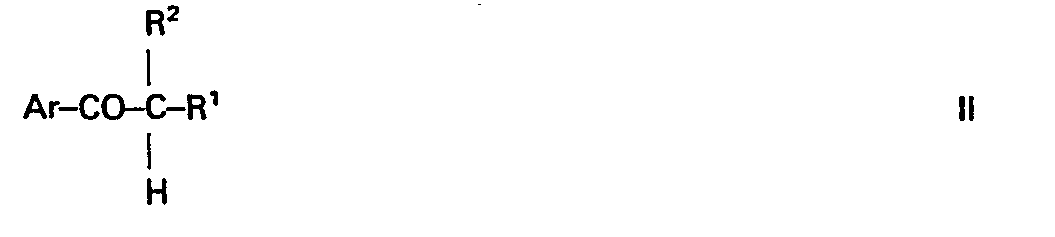
- Gegenstand der Erfindung ist daher ein Verfahren zur Herstellung von Ketonen der allgemeinen Formel I,

- Ar Aryl mit 6-14 C-Atomen oder durch C1-C12 Alkyl, C1-C4 Alkoxy, C1-C4 Alkylthio, Cl, Br oder CN substituiertes Aryl,
- R 1 gleich oder verschieden sind und jeweils C1-C7 und Alkyl, C3-C8 Cycloalkyl, oder zusammen mit dem C-R 2 Atom, an das sie gebunden sind, C3-C9 Cycloalkyl bedeuten, dadurch gekennzeichnet, daß man ein Keton der allgemeinen Formel II,


- Die Durchführung der Reaktion gestaltet sich einfach. Die als Ausgangsmaterial einzusetzenden Ketone der Formel II sind bekannt oder können nach an sich bekannten Methoden wie sie in der Literatur (z. B. in Standardwerken wie Houben-Weyl, Methoden der Organischen Chemie, Georg-Thieme-Verlag, Stuttgart, Bd. VII) beschrieben sind, und zwar unter Reaktionsbedingungen, wie sie für die genannten Umsetzungen bekannt und geeignet sind, hergestellt werden. Dabei kann auch von an sich bekannten, hier nicht näher erwähnten Varianten Gebrauch gemacht werden. In den zu hydroxylierenden Ketonen der Formel II bedeutet Ar vorzugsweise Phenyl oder substituiertes Phenyl, insbesondere Phenyl, 4-Methylphenyl, 4-Ethylphenyl, 4-Isopropylphenyl, 4-Dodecylphenyl, 3,4-Dimethylphenyl, 4-Methoxyphenyl oder 4-Chlorphenyl. R 1 und R 2 bedeuten vorzugsweise Cl-C4 Alkyl, C3-C6 Cyclo- alkyl oder zusammen mit dem C-Atom, an das sie gebunden sind, C3-C6 Cycloalkyl, insbesondere Methyl, Ethyl, Propyl, Butyl, Cyclohexyl oder zusammen mit dem C-Atom, an das sie gebunden sind, Cyclohexyl.
- In den Tetrahalogenmethanen der Formel III ist a vorzugsweise 0, insbesondere a = c = 0, b = 4 oder a = b = 0, c = 4; ganz besonders bevorzugt ist Tetrachlorkohlenstoff.
- Geeignete Alkalimetallhydroxide sind die Hydroxide des Lithiums, Natriums, Kaliums, Rubidiums und Cesiums, vorzugsweise die des Natriums und Kaliums, insbesondere Natriumhydroxid. Zwei-Phasen-Reaktionen mit einem Phasenübergang fest-flüssig erfordern zur Erzielung annehmbarer Umsatzraten üblicherweise eine möglichst große Oberfläche der festen Phase. Beispielsweise gelingt nach der U.S.-Patentschrift 3 830 862 die Eliminierung von Dibenzylsulfon im System Kaliumhydroxid/Tetrachlorkohlenstoff nur mit fein gepulvertem Kaliumhydroxid und nicht mit handelsüblichen Plätzchen. Es war daher umso überraschender, daß auch mit den wesentlich leichter zu handhabenden Plätzchen-, Granulat- oder Schuppenformen der Alkalimetallhydroxide sehr gute Ergebnisse erzielt werden. Weiterhin können die Alkalimetallhydroxide auch gepulvert oder auf feste Träger aufgebracht sein.
- Die als Phasentransferreagenzien eingesetzten Verbindungen werden aus den Gruppen der quartären Ammoniumverbindungen, der Oligo- oder Polyethylenglykole oder deren Mono- oder Bisether oder der cyclischen Polyethylenglykolether ("Kronenether") ausgewählt.
- In den quartären Ammoniumverbindungen der Formel IV sind die Reste R 3, R 4, R5 und R6 gleich oder verschieden und bedeuten geradkettiges oder verzweigtes Alkyl mit zusammen 4 bis 30 C-Atomen oder Benzyl. X bedeutet ein geeignetes Anion wie beispielsweise F, Cl, CN, OH, HS04 oder CH30S03. Die Wahl des Anions ist nicht kritisch; es können alle ein- oder mehrfach geladenen Anionen eingesetzt werden. Besonders bevorzugt sind Benzyltrimethylammoniumhydrogensulfat und Methyltrioctylammoniumchlorid. Gegebenenfalls können die quartären Ammoniumverbindungen der Formel IV auch durch chemische Bindung an einen polymeren flüssigen oder festen Träger immobilisiert sein.
- Eine bevorzugte Gruppe von Phasentransferreagenzien stellen die Oligo- und Polyethylenglykole und deren Mono-oder Bisether dar, die der allgemeinen Formel R70-(CH2-CH2O-)nR8 entsprechen, in der n'gleich oder größer als 2 ist und R7 und R8 gleich oder verschieden sind und H, Alkyl-, Aryl- und/oder Cycloalkylgruppen bedeuten.
- R7 und/oder R8 können H und/oder verzweigte und unverzweigte Alkylreste mit 1 bis 20, vorzugsweise 1 bis 10 C-Atomen, Cycloalkylreste mit 3 bis 15, vorzugsweise mit 5 bis 10 C-Atomen, und/oder Arylreste mit 6 bis 14, vorzugsweise mit 6 bis 10 C-Atomen, insbesondere Phenyl und substituiertes Phenyl sein.
- Es können sowohl einheitliche Verbindungen wie z. B. Hexaethylenglykolmono- und -dimethylether, Octaethylenglykolmono- und -diethylether und Decaethylenglykolmono-und -didecylether als auch Mischungen von Ethern mit verschiedenem Oligomerisationsgrad und entsprechenden mittleren Molekulargewichten als Lösungsmittel verwendet werden, wie z. B. Polyethylenglykolmono- und -dimethylether (n = 7,9; mittleres Molekulargewicht 400) und Polyethylenglykolmono- und -dimethylether (n = 22,3; mittleres Molekulargewicht 1000).
- Besonders vorteilhaft sind aromatische Oligoethylenglykolmonoether, insbesondere Decaethylenglykolmonoarylether und substituierte Decaethylenglykolmonoarylether. Eine besonders geeignete Verbindung ist Decaethylengly- kolmono-(4-nonyl-phenyl)-ether, die damit ein bevorzugtes Phasentransferreagenz im erfindungsgemäßen Verfahren zur Herstellung von Ketonen darstellt.
- Das molare Verhältnis von Tetrahalogenmethan und Alkalimetallhydroxid bezogen auf das als Substrat eingesetzte Keton der Formel II beträgt mindestens jeweils 1 : 1, vorzugsweise 1 bis 2 : 1.
- Die Menge an Phasentransferreagenz kann in weiten Grenzen beliebig gewählt werden, vorzugsweise liegt sie bei 10 bis 100 Gew. % bezogen auf eingesetztes Keton.
- Die Ausführung der Reaktion erfolgt durch Vermischen der Komponenten Keton der Formel II, Tetrahalogenmethan der Formel III und Alkalimetallhydroxid sowie Erwärmen des gerührten Reaktionsgemisches auf die zur Umsetzung erforderliche Temperatur, wobei es jedoch von Vorteil sein kann, das Alkalimetallhydroxid langsam zu den bereits vorgelegten anderen Komponenten zuzugeben. Üblicherweise liegen die Reaktionstemperaturen bei 0 bis 100°, vorzugsweise bei 10 bis 50°. Die Reaktionszeiten betragen 1 bis 60 Stunden, vorzugsweise 12 bis 48 Stunden.
- Die Anwendung von Ultraschall, wie z.B. von Lücke und Damiano, J.Amer.Chem.Soc. 102 (1980) 7926 für die Grignardreaktion beschrieben, kann den Reaktionsverlauf positiv beeinflussen.
- Zur Verringerung der Viskosität des Reaktionsgemisches, zur Verminderung der Reaktivität besonders umsatzfreudiger Komponenten oder auch zur Reduktion der Menge an Phasentransferreagenz kann dem Reaktionsgemisch ein weiteres inertes organisches Lösungsmittel zugesetzt werden. Zweckmäßigerweise trifft man die Auswahl aus den inerten, unter den gewählten Reaktionsbedingungen stabilen Lösungsmitteln, wie z.B. aliphatische oder aromatische Kohlenwasserstoffe, insbesondere Cyclohexan, Benzol oder Toluol, und aliphatische Ether, insbesondere Tetrahydrofuran oder Dioxan. Es können auch Gemische dieser Lösungsmittel zugesetzt werden.
- Nach Durchführung der Reaktion fügt man dem Reaktionsgemisch zur Aufarbeitung zweckmäßig Wasser zu und isoliert das gewünschte Produkt durch Extraktion mit anschließender Destillation, Chromatographie oder Kristallisation. Auf diese Weise können die eingesetzten Ketone einfach und in hohen Ausbeuten a-hydroxyliert werden. Der hauptsächlich aus unverändertem Phasentransferreagenz bestehende Aufarbeitungsrückstand kann bei Entfaltung unveränderter Reaktivität für einen erneuten Reaktionsansatz wiederverwendet werden.
- In einer besonders bevorzugten Ausführungsform der Erfindung werden aus 1-Phenyl-2-methylpropan-1-on, 1-(4-Isopropylphenyl)-2-methylpropan-l-on oder Cyclohexylphenylketon mit Tetrachlorkohlenstoff, Natriumhydroxid und Decaethylenglykolmono-(4-nonyl-phenyl)-ether, gegebenenfalls unter Zusatz eines inerten Lösungsmittels, als Initiator für die Photopolymerisation ungesättigter Verbindungen verwendbares 1-Phenyl-2-hydroxy-2-methyl-propan-1-on, 1-(4-Isopropylphenyl)-2-hydroxy-2-methyl-propan-1-on und (1-Hydroxycyclohexyl)-phenylketon hergestellt.
- In der vorliegenden Erfindung steht somit ein sehr vorteilhaftes Verfahren zur einfachen und in hohen Ausbeuten verlaufenden Herstellung von a-hydroxylierten Ketonen zur Verfügung.
- Zu dem Gemisch von 895 g 1-Phenyl-2-methylpropan-1-on, 900 ml Tetrachlorkohlenstoff, 1,8 Toluol und 300 ml Decaethylenglykolmono-(4-nonylphenyl)-ether werden bei 15° unter Rühren innerhalb von 48 Stunden insgesamt 552 g Natriumhydroxid portionsweise zugegeben.
- Zur Aufarbeitung wird mit 3 Toluol versetzt und mit 1,8 Wasser ausgerührt. Man trennt die organische Phase ab und befreit unter vermindertem Druck vom Lösungsmittel. Der Rückstand wird der fraktionierenden Destillation unterworfen. Nach einem geringen Vorlauf gehen bei 50bis 100 Pa und 75 - 85° 877 g (89 % d. Th.) praktisch farbloses 1-Phenyl-2-hydroxy-2-methylpropan-1-on mit einem gaschromatographisch ermittelten Gehalt von 98,5 % über.
- Der das Phasentransferreagenz enthaltende Destillationsrückstand kann in einem weiteren Reaktionsansatz mit unveränderter Aktivität erneut verwendet werden.
- Zu dem Gemisch aus 74,5 g 1-Phenyl-2-methylpropan-1-on, 75 ml Tetrachlorkohlenstoff, 150 ml Toluol und 1 g Di- benzo-18-krone-6 (Octahydrodibenzo[b,k]-1,4,7,10,13,16-hexaoxacyclooctadecen) werden bei 15° unter Rühren innerhalb von 40 Stunden insgesamt 44 g Natriumhydroxid in Plätzchenform zugegeben.
- Man arbeitet analog zu Beispiel 1 auf und erhält nach Destillation 65,3 g (78 % d. Th.) reines 1-Phenyl-2-hydroxy-2-methylpropan-1-on.
- In das Gemisch aus 74,5 g 1-Phenyl-2-methylpropan-1-on, 75 ml Tetrachlorkohlenstoff, 150 ml Toluol und 25 ml Methyltrioctylammoniumchlorid werden bei 15° unter Rühren innerhalb von 20 Stunden insgesamt 44 g granuliertes Natriumhydroxid eingetragen.
- Nach Aufarbeitung wie in Beispiel 1 beschrieben und destillativer Reinigung werden 62,1 g (74 % d. Th.) reines 1-Phenyl-2-hydroxy-2-methylpropan-1-on erhalten.
Claims (8)


Applications Claiming Priority (2)
| Application Number | Priority Date | Filing Date | Title |
|---|---|---|---|
| DE3512541 | 1985-04-06 | ||
| DE19853512541 DE3512541A1 (de) | 1985-04-06 | 1985-04-06 | Verfahren zur herstellung von ketonen |
Publications (2)
| Publication Number | Publication Date |
|---|---|
| EP0197404A2 true EP0197404A2 (de) | 1986-10-15 |
| EP0197404A3 EP0197404A3 (de) | 1987-02-04 |
Family
ID=6267431
Family Applications (1)
| Application Number | Title | Priority Date | Filing Date |
|---|---|---|---|
| EP86103943A Withdrawn EP0197404A3 (de) | 1985-04-06 | 1986-03-22 | Verfahren zur Herstellung von Ketonen |
Country Status (4)
| Country | Link |
|---|---|
| US (1) | US4740624A (de) |
| EP (1) | EP0197404A3 (de) |
| JP (1) | JPS61236744A (de) |
| DE (1) | DE3512541A1 (de) |
Families Citing this family (6)
| Publication number | Priority date | Publication date | Assignee | Title |
|---|---|---|---|---|
| US5138107A (en) * | 1991-07-12 | 1992-08-11 | E. I. Du Pont De Nemours And Company | Phase transfer catalyzed halogenation of carbon acids |
| US5132475A (en) * | 1991-07-12 | 1992-07-21 | E. I. Du Pont De Nemours And Company | Quaternary ammonium fluoride catalyzed halogenation of carbon acids |
| EP3395806B1 (de) | 2017-04-24 | 2020-04-08 | IGM Group B.V. | Einfache oxidative funktionalisierung von alkylarylketonen |
| ES2867807T3 (es) | 2017-04-24 | 2021-10-20 | Igm Group B V | Proceso para la preparación de cetonas a-funcionalizadas |
| CN109096083B (zh) * | 2018-07-04 | 2021-12-10 | 大丰鑫源达化工有限公司 | 一种光引发剂185的制备工艺 |
| CN108892605B (zh) * | 2018-07-04 | 2021-09-10 | 大丰鑫源达化工有限公司 | 一种光引发剂1173的制备工艺 |
Family Cites Families (4)
| Publication number | Priority date | Publication date | Assignee | Title |
|---|---|---|---|---|
| US3953494A (en) * | 1970-12-14 | 1976-04-27 | Southern Illinois University Foundation | Reactions involving carbon tetrahalides and α-methyl ketones or ketones having α,α'-hydrogens |
| GB1568999A (en) * | 1976-10-06 | 1980-06-11 | Int Flavors & Fragrances Inc | Process for producing 4-(4'-methyl-3'pentenyl) cyclohexenecarboxaldehyde and products produced thereby |
| DE3008411A1 (de) * | 1980-03-05 | 1981-09-10 | Merck Patent Gmbh, 6100 Darmstadt | Neue aromatisch-aliphatische ketone, ihre verwendung als photoinitiatoren sowie photopolymerisierbare systeme enthaltend solche ketone |
| DE3360384D1 (en) * | 1982-05-07 | 1985-08-14 | Ciba Geigy Ag | Process for the preparation of 1-hydroxyketones |
-
1985
- 1985-04-06 DE DE19853512541 patent/DE3512541A1/de not_active Withdrawn
-
1986
- 1986-03-22 EP EP86103943A patent/EP0197404A3/de not_active Withdrawn
- 1986-04-04 JP JP61076841A patent/JPS61236744A/ja active Pending
- 1986-04-07 US US06/848,546 patent/US4740624A/en not_active Expired - Fee Related
Also Published As
| Publication number | Publication date |
|---|---|
| DE3512541A1 (de) | 1986-10-16 |
| EP0197404A3 (de) | 1987-02-04 |
| JPS61236744A (ja) | 1986-10-22 |
| US4740624A (en) | 1988-04-26 |
Similar Documents
| Publication | Publication Date | Title |
|---|---|---|
| DE2801908A1 (de) | Cyclohexenderivate | |
| EP0708081A2 (de) | Verfahren zur Herstellung von N,N'- disubstituierten p-Chinondiiminen, deren Verwendung und Methacryloxy- oder Acryloxy-Gruppen enthaltende Organosilane, Verfahren zu deren Stabilisierung und deren Herstellung | |
| EP0330058B1 (de) | Verfahren zur Herstellung von Perfluoralkylgruppen enthaltenden Silyläthern und Alkoholen | |
| DE3512541A1 (de) | Verfahren zur herstellung von ketonen | |
| EP0124002B1 (de) | Verfahren zur Herstellung von aromatischen Verbindungen, die über ein Heteroatom gebundene perfluorierte Seitenketten enthalten | |
| DE69009369T2 (de) | Verfahren zur Herstellung von Alkynylverbindungen. | |
| DE2538310C3 (de) | Verfahren zur Herstellung von O.O-Dialkylthionophosphorsäurechloriden | |
| DE2952719A1 (de) | Verfahren zur herstellung von p-substituierten phenylpropanolen und deren estern | |
| EP0031875B1 (de) | Verfahren zur Herstellung von Cyclohexenderivaten | |
| DE10121058A1 (de) | Neues Verfahren zur Herstellung von ungesättigten Ketonen | |
| EP0565826B1 (de) | Verfahren zur Herstellung von substituiertem oder unsubstituiertem Chlormethylcyclopropan und Brommethylcyclopropan | |
| DE2708210C2 (de) | Verfahren zur Herstellung von Sulfonacetalen | |
| DE2708281C2 (de) | Verfahren zur Herstellung von Halogenacetalen aus Enoxysilanen | |
| EP0045425B1 (de) | Verfahren zur Halogenierung von gegebenenfalls substituierten 4-tert.-Butyltoluolen sowie die daraus erhaltenen Gemische aus gegebenenfalls substituierten 4-tert.-Butylbenzalhalogeniden, 4-tert.-Butylbenzylhalogeniden und 4-tert.-Butylbenzotrihalogeniden | |
| EP0929505A1 (de) | Verfahren zur herstellung von alkindiolen oder gemischen von alkindiolen mit alkinmonoolen | |
| EP0302331B1 (de) | Ester von Arylbisperfluoralkylcarbinolen, Verfahren zur Herstellung dieser Verbindungen und der zugrundeliegenden Arylbisperfluoralkylcarbinole | |
| EP0166490A2 (de) | Verfahren zur Herstellung von alpha-methylsubstituierten Ketonen | |
| EP0266544B1 (de) | Verfahren zur Herstellung von Halogenalkoholen | |
| EP0542780B1 (de) | Verfahren zur herstellung von weitgehend fluorierten alkylbromiden | |
| EP0000554A1 (de) | Verfahren zur Herstellung von halogenalkylsubstituierten Oxiranen | |
| DE3411242A1 (de) | Alkylchlorsulfat-zwischenverbindungen und verfahren zu deren herstellung | |
| DE1243677B (de) | Verfahren zur Herstellung von Sulfonsaeureestern | |
| DE2459546A1 (de) | Verfahren zur umlagerung von tertiaeren vinylcarbinolen | |
| DE1643899C3 (de) | Verfahren zur Herstellung von Acetalen bzw. Ketalen a-chlorierter Aldehyde bzw. Ketone | |
| DE2708282C2 (de) | α-Halogenacetale von äthylenischen Aldehyden und Verfahren zu ihrer Herstellung |
Legal Events
| Date | Code | Title | Description |
|---|---|---|---|
| PUAI | Public reference made under article 153(3) epc to a published international application that has entered the european phase |
Free format text: ORIGINAL CODE: 0009012 |
|
| AK | Designated contracting states |
Kind code of ref document: A2 Designated state(s): AT BE CH DE FR GB IT LI NL SE |
|
| PUAL | Search report despatched |
Free format text: ORIGINAL CODE: 0009013 |
|
| AK | Designated contracting states |
Kind code of ref document: A3 Designated state(s): AT BE CH DE FR GB IT LI NL SE |
|
| 17P | Request for examination filed |
Effective date: 19870606 |
|
| 17Q | First examination report despatched |
Effective date: 19881221 |
|
| STAA | Information on the status of an ep patent application or granted ep patent |
Free format text: STATUS: THE APPLICATION HAS BEEN WITHDRAWN |
|
| 18W | Application withdrawn |
Withdrawal date: 19890816 |
|
| RIN1 | Information on inventor provided before grant (corrected) |
Inventor name: ROEMER, MICHAEL, DR. Inventor name: KOEHLER, MANFRED, DR. Inventor name: HERZ, CLAUS P., DR. |