EP0187676A2 - Verfahren zur Herstellung von Vinylchloridpolymeren - Google Patents
Verfahren zur Herstellung von Vinylchloridpolymeren Download PDFInfo
- Publication number
- EP0187676A2 EP0187676A2 EP86100285A EP86100285A EP0187676A2 EP 0187676 A2 EP0187676 A2 EP 0187676A2 EP 86100285 A EP86100285 A EP 86100285A EP 86100285 A EP86100285 A EP 86100285A EP 0187676 A2 EP0187676 A2 EP 0187676A2
- Authority
- EP
- European Patent Office
- Prior art keywords
- polymerization
- water
- vinyl chloride
- monomer
- auxiliary blade
- Prior art date
- Legal status (The legal status is an assumption and is not a legal conclusion. Google has not performed a legal analysis and makes no representation as to the accuracy of the status listed.)
- Granted
Links
Images

Classifications
-
- C—CHEMISTRY; METALLURGY
- C08—ORGANIC MACROMOLECULAR COMPOUNDS; THEIR PREPARATION OR CHEMICAL WORKING-UP; COMPOSITIONS BASED THEREON
- C08F—MACROMOLECULAR COMPOUNDS OBTAINED BY REACTIONS ONLY INVOLVING CARBON-TO-CARBON UNSATURATED BONDS
- C08F2/00—Processes of polymerisation
- C08F2/12—Polymerisation in non-solvents
- C08F2/16—Aqueous medium
- C08F2/18—Suspension polymerisation
-
- B—PERFORMING OPERATIONS; TRANSPORTING
- B01—PHYSICAL OR CHEMICAL PROCESSES OR APPARATUS IN GENERAL
- B01J—CHEMICAL OR PHYSICAL PROCESSES, e.g. CATALYSIS OR COLLOID CHEMISTRY; THEIR RELEVANT APPARATUS
- B01J19/00—Chemical, physical or physico-chemical processes in general; Their relevant apparatus
- B01J19/18—Stationary reactors having moving elements inside
-
- B—PERFORMING OPERATIONS; TRANSPORTING
- B01—PHYSICAL OR CHEMICAL PROCESSES OR APPARATUS IN GENERAL
- B01F—MIXING, e.g. DISSOLVING, EMULSIFYING OR DISPERSING
- B01F27/00—Mixers with rotary stirring devices in fixed receptacles; Kneaders
- B01F27/05—Stirrers
- B01F27/07—Stirrers characterised by their mounting on the shaft
- B01F27/072—Stirrers characterised by their mounting on the shaft characterised by the disposition of the stirrers with respect to the rotating axis
- B01F27/0726—Stirrers characterised by their mounting on the shaft characterised by the disposition of the stirrers with respect to the rotating axis having stirring elements connected to the stirrer shaft each by a single radial rod, other than open frameworks
-
- C—CHEMISTRY; METALLURGY
- C08—ORGANIC MACROMOLECULAR COMPOUNDS; THEIR PREPARATION OR CHEMICAL WORKING-UP; COMPOSITIONS BASED THEREON
- C08F—MACROMOLECULAR COMPOUNDS OBTAINED BY REACTIONS ONLY INVOLVING CARBON-TO-CARBON UNSATURATED BONDS
- C08F14/00—Homopolymers and copolymers of compounds having one or more unsaturated aliphatic radicals, each having only one carbon-to-carbon double bond, and at least one being terminated by a halogen
- C08F14/02—Monomers containing chlorine
- C08F14/04—Monomers containing two carbon atoms
- C08F14/06—Vinyl chloride
-
- B—PERFORMING OPERATIONS; TRANSPORTING
- B01—PHYSICAL OR CHEMICAL PROCESSES OR APPARATUS IN GENERAL
- B01J—CHEMICAL OR PHYSICAL PROCESSES, e.g. CATALYSIS OR COLLOID CHEMISTRY; THEIR RELEVANT APPARATUS
- B01J2219/00—Chemical, physical or physico-chemical processes in general; Their relevant apparatus
- B01J2219/00049—Controlling or regulating processes
- B01J2219/00051—Controlling the temperature
- B01J2219/00074—Controlling the temperature by indirect heating or cooling employing heat exchange fluids
- B01J2219/00087—Controlling the temperature by indirect heating or cooling employing heat exchange fluids with heat exchange elements outside the reactor
- B01J2219/00101—Reflux columns
Definitions
- the present invention relates to a process for producing vinyl chloride resin, and more particularly to a process for producing vinyl chloride resin high in polymerization productivity, high in bulk density and with less fish eye by the use of a polymerization reactor equipped with a reflux condenser.
- PVC vinyl chloride resin
- gas generating from the monomer droplets are contained in the polymer suspension to result in lower homogeneity attainable by stirring and results in aggravation of fish eye through bubbling phenomenon in which polymer particles form a floating creamy layer on the polymer suspension in the middle stage of polymerization and thereafter.
- the object of the present invention is to provide a process for producing PVC by the use of a polymerization reactor equipped with a reflux condenser safe from the above-mentioned problems of the conventional process, higher in bulk density and with less fish eye.
- Another object of the present invention is to provide a process for producing PVC with less fish eye by the use of a high polymer plasticizer.
- Still another object of the present invention is to provide a process for producing PVC with less bubbling phenomenon, being capable of increasing the monomer charge without risk of suspension overflowing into the piping and the interior of reflux condenser and shortened in the time required for polymerization, these together resulting in a high productivity of PVC.
- the present invention relates to a process for producing PVC wherein in suspension polymerization of vinyl chloride monomer and other monomers capable of copolymerizing therewith by the use of a polymerization reactor equipped with a reflux condenser in the gas phase portion of the polymerization reactor or outside the polymerization reactor stirring blades are used, each thereof being a brumagine-type impeller with an auxiliary blade inclined with respect to the level rotary direction standing on the outer surface of a main blade attached to the tip thereof, the water/monomer ratio of initial charging is controlled in a range of 0.8-1.0, polymerization is c conducted in the first stage of polymerization to not more 0 than 50 weight percent in polymer conversion, then the second stage of polymerization polymerization is conducted at a temperature 3-10°C higher than the polymerization temperature in the first stage, with water being added continuously or intermittently in the course of polymerization not more than making up for the volumetrical contraction resulting from the progress of polymerization so that upon completion of polymerization the water
- Brumagine-type impellers are rational means of stirring for use in suspension polymerization of vinyl chloride being capable of high-speed spinning requiring no large driving force and high in shearing effect but it was supposed to be relatively less capable of producing a vertical flow and problematic for homogeneous stirring of the system desired.
- the marked improvement of PVC with regard to fish eye by the use of the stirring blades of the present invention is attributable to not only improved stirring efficiency and resultant dispersion-coalescence frequency in the early stage of polymerization and improved homogeneity of particles in the polymerization system but also to the stirring blades' capability to produce vertical flow and vortex suction effect which is effective for preventing the bubbling phenomenon characteristic owing to use of the reflux condenser as well as for improving homogeneity of polymer suspension.
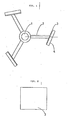
- FIG 1 is a plane view of the stirring blades of the present invention and Figure 2 is a front view of the main blade thereof.
- the main blade 3 is attached to the supporting portion 2 extending in the normal direction from the vertical shaft 1 (Brumagine-type impeller is normally in such a construction.).
- Brumagine-type impeller is normally in such a construction.
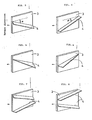
- Figures 3 through 14 are perspective views showing the alternative embodiments of the main blade 3 and auxiliary blade 4 of the present invention.
- the auxiliary blade 4 is set at a given angle of inclination to the level rotary direction, that is, an angle of elevation or depression (a ).
- the angle of inclination is not particularly specified but generally preferred range is 5-30°. If it is less than 5° no sufficient vertical flow can be generated to result in insufficient general stirring effect, while when it is more than 30°, it is likely to result in generation of too vigorous vertical flow, this causing too much power consumption and also an excessive dispersion with a risk of abnormal polymerization.
- each auxiliary blade 4 is preferred to be.in a range of 20-60% of the area of the main blade 3. If it is less than 20% the effect produced by the use,of the 0 auxiliary blade (shearing effect, stirring effect) is insufficient, whereas when it is more than 60%, too much power consumption results as well as an excessive dispersion with a risk of abnormal polymerization. Furthermore, scales are likely to deposit and a lot of effort and time are required for removal thereof.
- the auxiliary blade 4 is not necessarily set perpendicular to the main blade 3 and inclined attachment within a range of 45-135° is acceptable.
- the number of auxiliary blades is not specified either. It may be properly decided according to the size of the main blade 3 but normally 1-2 of them per one main blade will give a favorable result.
- the shape of the auxiliary blade 4 is not particularly specified either, and as shown in the drawings it may be rectangular, rhombic or triangular if it has a specified surface area. It need not be formed to cover the entire width of the main blade 3 and may as well be interrupted. Its thickness, too, is not particularly specified and may be properly decided according to the sizes of the main blade 3 and auxiliary blade 4 etc. When more than one auxiliary blade are set to one main blade, they are not necessarily of the same shape and dimensions and those of different shapes and dimensions may as well be used.
- the auxiliary blade 4 may be welded to the main blade 3 to be monoblock therewith or prepared separately and secured together by mechanical means such as bolting.
- the present invention features setting the water/monomer ratio at the time of initial charging within a range of 0.8-1.0 and controlling the water/monomer ratio upon completion of polymerization within a range of 1.0-1.4, preferably within a range of 1.0-1.2, by adding water continuously or intermittently in the course of polymerization with care not to exceed the volumetrical contraction resulting from the progress of polymerization.
- the addition of water is to be done continuously or intermittently to make up for the volumetrical contraction resulting from progress of polymerization, but it is preferred to be done continuously when stability of the product's quality, controllability of inside temperature and desired prevention of bubbling etc. are taken into consideration.
- volumetrical contraction resulting from progress of polymerization ( 6 V) is the quantity calculated by the following formula.
- the water/monomer ratio upon completion of polymerization should be not more than 1.4, preferably not exceeding 1.2.
- the present invention features that polymerization is conducted in the first stage to not more than 50 weight percent in terms of polymer conversion and polymerization in the second stage is conducted at a temperature 3-10°C higher than in the first stage.
- the conversion when the polymerization temperature is changed is not more than 50 weight percent, preferably 10-50 weight percent and more preferably 15-50 weight percent. If it is less than 10 weight percent, fish eye tends to increase, while, when it is in excess of 50 weight percent, bulk density increasing effect is reduced.
- olefins such as ethylene and propylene
- vinyl esters such as vinyl acetate and vinyl stearate
- (meth)acrylate esters such as methyl acrylate and methyl methacrylate
- esters or anhydrides of acids such as maleic acid and fumaric acid
- nitrile compounds such as acrylonitrile and vinylidene compounds
- vinylidene chloride olefins
- olefins such as ethylene and propylene
- vinyl esters such as vinyl acetate and vinyl stearate
- (meth)acrylate esters such as methyl acrylate and methyl methacrylate
- esters or anhydrides of acids such as maleic acid and fumaric acid
- nitrile compounds such as acrylonitrile and vinylidene compounds
- vinylidene chloride such as vinylidene chloride.
- initiators normally used for suspension polymerization of vinyl chloride namely organic peroxides such as lauroyl peroxide, 3,5,5-trimethylhexanoyl peroxide, t-butyl peroxypivalate, t-butyl peroxyneodecanoate, di-isopropyl peroxydicarbonate, di-2-ethylhexyl peroxydicarbonate and acetyl cyclohexylsulfonyl peroxide, and azo compounds such as a, a'-azobis -isobutylonitrile and a, a'-azobis-2,4-dimethyl valeronitrile. These are used signly or in combination with two or more.
- organic peroxides such as lauroyl peroxide, 3,5,5-trimethylhexanoyl peroxide, t-butyl peroxypivalate, t-butyl peroxyneodecanoate, di-isopropy
- suspending agents used in the process of the present invention are cited known suspending agents such as partially saponified polyvinyl alcohol, vinyl acetate-male-ic anhydride copolymer, styrene-maleic anhydride copolymer, polyvinyl pyrolidone, gelatine, starch, methyl cellulose, hydroxypropyl methylcellulose and polyethylene oxide either alone or in combination but of these, preferred are partially saponified polyvinyl alcohol and/or hydroxypropyl methylcellulose in quality, polymerization stability etc.
- Preferred dose of the above-mentioned suspending agent is 0.01-1 weight part per 100 weight parts of vinyl chloride monomer, although there is no particular limit to it.
- the initiator, suspending agent and molecular weight adjusting agent etc. may be added at once to the polymerization system at the beginning of polymerization and it is as well possible to add them in portions in the course of polymerization.
- the polymerization temperature in the process of the present invention may normally be in a range of 40-75° C , although there is no particular limit to it.
- the present invention it is possible to conduct suspension polymerization by the use of a polymerization reactor equipped with a reflux condenser for production of PVC high in bulk density with less fish eye and it is also possible to increase the monomer charge without risk of suspension overflowing into the piping or E the interior of reflux condenser, which along with shortening of the polymerization time enables sizable improvement of productivity, the industrial significance of the present invention being thus remarkable.
- the polymerization temperature was raised to 59°C (polymerization temperature in the 2nd stage) and polymerization was continued with Qrc readjusted to 40,000 kcal/hr, the operation of the reflux condenser was stopped when the inside pressure lowered 1 kg/cm 2 from the steady pressure corresponding to the polymerization temperature in the 2nd stage to recover the unpolymerized monomer, the slurry was then dehydrated and dried in a fluidized bed drier for PVC to be obtained.
- the resulting PVC was quite satisfactory with regard to bulk density and fish eye as shown in Table 1 with no indication of polymer suspension overflowing into the reflux condenser.
- the resulting PVC was satisfactory with regard to bulk density and fish eye as shown in Table 1 with no indication of polymer suspension overflowing into the reflux condenser.
- Polymerization was conducted in the same way as Example 1 except that the polymerization temperature was changed when the conversion reached 50% and the polymer was dehydrated and dried.
- the resulting PVC was satisfactory with regard to bulk density and fish eye as shown in Table 1 with no indication of overflowing of polymer suspension into the reflux condenser.
- Polymerization was conducted in the same way as Example 1 except that the polymerization temperature in the first stage was adjusted to 52°C and that in the second stage to 62°C and the Qrc of the reflux condenser at the polymerizing temperatures in the first and second stages were adjusted to 22,500 kcal/hr and 47,500 kcal/hr respectively and the polymer was dehydrated and dried.
- the resulting PVC was satisfactory with regard to bulk density and fish eye as shown in Table 1 with no indication of overflowing of polymer suspension into the reflux condenser.
- Polymerization was conducted in the same way as Example 1 except that the water/monomer ratio at the time of initial charging was adjusted to 1.0 without changing total charging volume and 651 kg of vinyl chloride monomer was charged and water was added so that the water/monomer ratio at the time of starting recovery of unpolymerized monomer was adjusted to 1.4 (total amount of water added: 40 weight parts) and Qrc at the polymerization temperatures in the first and second stages were adjusted to 26,500 kcal/hr and 38,000 kcal/hr respectively and the polymer was dehydrated and dried.
- the resulting PVC was satisfactory with regard to bulk density and fish eye as shown in Table 1 with no indication of overflowing of polymer suspension into the reflux condenser.
- Example 1 Polymerization was conducted in the same way as Example 1 except that ordinary brumagine-type impeller was used with no auxiliary blade.
- the resulting PVC contained a , lot of fish eyes. The result is shown in Table 1.
- Polymerization was conducted in the same way as Example 1 except that the polymerization temperature was changed when the conversion reached 60%.
- the resulting PVC was low in bulk density.
- Polymerization was conducted in the same way as Example 1 except that the polymerization temperature was set at 57°C for both first and second stages and Qrc was adjusted to 34,000 kcal/hr. The resulting PVC was low in bulk density.
- Polymerization was conducted in the same way as Example 1 except that the polymerization temperature in the first stage was set at 49.5°C and that in the second stage at 65°C and Qrc at the polymerization temperatures in the first and second stages was adjusted to 17,000 kcal/hr and 51,000 kcal/hr respectively.
- the resulting PVC had a lot of fish eyes.
- Polymerization was.conducted in the same way as Example 1 except that the water/monomer ratio at the time of initial charging was adjusted to 0.7 without changing total charging volume rate and 755 kg of vinyl chloride monomer was charged and water was added so that the water/monomer ratio at the time of starting recovery was adjusted to 1.1 (total amount of water added: 40 weight parts) and Qrc at the polymerization temperatures in the first and second stages were adjusted to 30,000 kcal/hr and 44.000 kcal/hr respectively.
- the resulting PVC contained a lot of coarse particles.
- Example 2 Polymerization was conducted in the same way as Example 1 except that the water/monomer ratio at the time of initial charging was adjusted to 1.1 without changing total charging volume (charged quantity of vinyl chloride monomer: 622 kg) and water was added so that the water/monomer ratio at the time of starting recovery was adjusted to 1.4 (total amount of water added: 30 weight parts) and Qrc at the polymerization temperatures in the first and second stages were adjusted to 25,400 kcal/hr and.36,000 kcal/hr respectively. The resulting PVC was low in bulk density.
- Example 8 Polymerization was conducted in the same way as Example 1 except that ordinary brumagine-type impeller without any auxiliary blade were used, the water/monomer ratio at the time of initial charging was adjusted to 1.2 without changing total charging volume (charged quantity of vinyl chloride monomer: 600 kg) and no water was added in the course of polymerization and Qrc was adjusted to 30,000 kcal/hr throughout the polymerization. The resulting PVC was low in bulk density and had a lot of fish eyes. Control Example 8
Landscapes
- Chemical & Material Sciences (AREA)
- Chemical Kinetics & Catalysis (AREA)
- Organic Chemistry (AREA)
- Health & Medical Sciences (AREA)
- Medicinal Chemistry (AREA)
- Polymers & Plastics (AREA)
- Polymerisation Methods In General (AREA)
- Addition Polymer Or Copolymer, Post-Treatments, Or Chemical Modifications (AREA)
Applications Claiming Priority (2)
| Application Number | Priority Date | Filing Date | Title |
|---|---|---|---|
| JP60003115A JPH0665688B2 (ja) | 1985-01-10 | 1985-01-10 | 塩化ビニル系樹脂の製造方法 |
| JP3115/85 | 1985-01-10 |
Publications (3)
| Publication Number | Publication Date |
|---|---|
| EP0187676A2 true EP0187676A2 (de) | 1986-07-16 |
| EP0187676A3 EP0187676A3 (en) | 1987-06-03 |
| EP0187676B1 EP0187676B1 (de) | 1991-08-07 |
Family
ID=11548350
Family Applications (1)
| Application Number | Title | Priority Date | Filing Date |
|---|---|---|---|
| EP86100285A Expired - Lifetime EP0187676B1 (de) | 1985-01-10 | 1986-01-10 | Verfahren zur Herstellung von Vinylchloridpolymeren |
Country Status (7)
| Country | Link |
|---|---|
| US (1) | US4849482A (de) |
| EP (1) | EP0187676B1 (de) |
| JP (1) | JPH0665688B2 (de) |
| KR (1) | KR930004272B1 (de) |
| CN (1) | CN1003174B (de) |
| DE (1) | DE3680678D1 (de) |
| IN (1) | IN166609B (de) |
Cited By (1)
| Publication number | Priority date | Publication date | Assignee | Title |
|---|---|---|---|---|
| EP0802201A3 (de) * | 1996-04-19 | 1999-04-28 | Kuraray Co., Ltd. | Verfahren zur Herstellung eines Vinyl-Harzes |
Families Citing this family (4)
| Publication number | Priority date | Publication date | Assignee | Title |
|---|---|---|---|---|
| JP3284722B2 (ja) * | 1993-12-21 | 2002-05-20 | 信越化学工業株式会社 | 塩化ビニル系重合体の製造方法 |
| KR0146676B1 (ko) * | 1994-11-14 | 1998-08-17 | 박원배 | 염화비닐 수지의 현탁 중합용 교반기 및 이를 이용한 염화비닐 비닐 수지의 현탁 중합 방법 |
| DE19711022A1 (de) * | 1997-03-17 | 1998-09-24 | Basf Ag | Verwendung eines Mehrstufenrührers zur Herstellung von Polymerisaten |
| JP2003246808A (ja) | 2002-02-26 | 2003-09-05 | Shin Etsu Chem Co Ltd | 塩化ビニル系重合体の製造方法 |
Family Cites Families (8)
| Publication number | Priority date | Publication date | Assignee | Title |
|---|---|---|---|---|
| US3183208A (en) * | 1961-08-22 | 1965-05-11 | Koppers Co Inc | Incorporating finely divided particles during suspension polymerization |
| US3692718A (en) * | 1966-06-22 | 1972-09-19 | Solvay | Gas phase polymerization of vinyl chloride |
| US3956251A (en) * | 1968-08-29 | 1976-05-11 | Stauffer Chemical Company | Method for preparing vinyl halide homopolymers having improved processing characteristics |
| US3926910A (en) * | 1973-02-12 | 1975-12-16 | Goodyear Tire & Rubber | Reduction of reactor fouling and improvement in the thermal stability of pvc using nitrites |
| GB1489866A (en) * | 1973-12-26 | 1977-10-26 | Bp Chem Int Ltd | Polymerisation process |
| US4217444A (en) * | 1975-03-28 | 1980-08-12 | Rhone-Poulenc Industries | Method of degassing polymers prepared by mass polymerizing a monomeric composition based on vinyl chloride |
| US4058495A (en) * | 1975-06-13 | 1977-11-15 | Exxon Research & Engineering Co. | Preparation of high bulk density/low porosity PVC resins |
| KR860001114B1 (ko) * | 1981-06-22 | 1986-08-13 | 다까다 다까시 | 염화비닐 수지의 제조방법 |
-
1985
- 1985-01-10 JP JP60003115A patent/JPH0665688B2/ja not_active Expired - Lifetime
- 1985-12-23 KR KR1019850009702A patent/KR930004272B1/ko not_active Expired - Lifetime
- 1985-12-31 IN IN1036/MAS/85A patent/IN166609B/en unknown
-
1986
- 1986-01-10 DE DE8686100285T patent/DE3680678D1/de not_active Expired - Lifetime
- 1986-01-10 EP EP86100285A patent/EP0187676B1/de not_active Expired - Lifetime
- 1986-01-10 CN CN86100106A patent/CN1003174B/zh not_active Expired
-
1987
- 1987-06-30 US US07/068,711 patent/US4849482A/en not_active Expired - Fee Related
Cited By (1)
| Publication number | Priority date | Publication date | Assignee | Title |
|---|---|---|---|---|
| EP0802201A3 (de) * | 1996-04-19 | 1999-04-28 | Kuraray Co., Ltd. | Verfahren zur Herstellung eines Vinyl-Harzes |
Also Published As
| Publication number | Publication date |
|---|---|
| KR930004272B1 (ko) | 1993-05-22 |
| CN1003174B (zh) | 1989-02-01 |
| EP0187676A3 (en) | 1987-06-03 |
| EP0187676B1 (de) | 1991-08-07 |
| JPH0665688B2 (ja) | 1994-08-24 |
| DE3680678D1 (de) | 1991-09-12 |
| CN86100106A (zh) | 1986-08-20 |
| US4849482A (en) | 1989-07-18 |
| JPS61162504A (ja) | 1986-07-23 |
| KR860005840A (ko) | 1986-08-13 |
| IN166609B (de) | 1990-06-09 |
Similar Documents
| Publication | Publication Date | Title |
|---|---|---|
| EP0623632A2 (de) | Verfahren zur Herstellung von Vinylchloride-Polymeren | |
| EP0193952B1 (de) | Verfahren zur Herstellung von Polyvinylchlorid | |
| EP0187676B1 (de) | Verfahren zur Herstellung von Vinylchloridpolymeren | |
| EP0377533A2 (de) | Verfahren zur Herstellung eines Polymers auf Vinylchloridbasis | |
| US5686048A (en) | Agitator for suspension polymerization of vinyl chloride and suspension polymerization method using the same | |
| EP0177956B1 (de) | Herstellung von Vinylhalogenid-/Vinylestercopolymeren mit niedrigem Molekulargewicht durch Polymerisation in wässrigem Medium | |
| JPH0371441B2 (de) | ||
| KR0139852B1 (ko) | 염화비닐 수지의 현탁중합용 교반기 및 이를 이용한 염화비닐 수지의 현탁중합방법 | |
| JP3239613B2 (ja) | 塩化ビニル系重合体の製造方法 | |
| EP0177974B1 (de) | Verfahren zur Herstellung eines Polyvinylchloridharzes | |
| JP3115919B2 (ja) | 塩化ビニル系重合体の製造方法 | |
| JP2878874B2 (ja) | 塩化ビニル系重合体の製造方法 | |
| JP2648246B2 (ja) | 塩化ビニル系単量体の懸濁重合法 | |
| JP3414026B2 (ja) | 塩化ビニル系重合体の製造方法 | |
| JPH05295008A (ja) | 塩化ビニル系単量体の懸濁重合方法 | |
| JPH08231614A (ja) | 塩化ビニル系重合体の製造方法 | |
| JPH0534366B2 (de) | ||
| JPH06136010A (ja) | 塩化ビニル系単量体の懸濁重合法 | |
| JPH09278806A (ja) | 塩化ビニル系単量体の懸濁重合方法 | |
| JPH07110881B2 (ja) | 塩化ビニル系単量体の懸濁重合方法 | |
| JPH066605B2 (ja) | 塩化ビニル系樹脂の製造方法 | |
| JPS61127706A (ja) | 塩化ビニル系樹脂の製造法 | |
| JPH034561B2 (de) | ||
| JPH05255410A (ja) | ビニル系化合物の懸濁重合用分散安定剤 | |
| JPH05301908A (ja) | 塩化ビニル単量体の懸濁重合方法 |
Legal Events
| Date | Code | Title | Description |
|---|---|---|---|
| PUAI | Public reference made under article 153(3) epc to a published international application that has entered the european phase |
Free format text: ORIGINAL CODE: 0009012 |
|
| AK | Designated contracting states |
Kind code of ref document: A2 Designated state(s): BE DE GB |
|
| PUAL | Search report despatched |
Free format text: ORIGINAL CODE: 0009013 |
|
| AK | Designated contracting states |
Kind code of ref document: A3 Designated state(s): BE DE GB |
|
| 17P | Request for examination filed |
Effective date: 19871130 |
|
| 17Q | First examination report despatched |
Effective date: 19890328 |
|
| GRAA | (expected) grant |
Free format text: ORIGINAL CODE: 0009210 |
|
| AK | Designated contracting states |
Kind code of ref document: B1 Designated state(s): BE DE GB |
|
| REF | Corresponds to: |
Ref document number: 3680678 Country of ref document: DE Date of ref document: 19910912 |
|
| PG25 | Lapsed in a contracting state [announced via postgrant information from national office to epo] |
Ref country code: GB Effective date: 19920110 |
|
| PG25 | Lapsed in a contracting state [announced via postgrant information from national office to epo] |
Ref country code: BE Effective date: 19920131 |
|
| PLBE | No opposition filed within time limit |
Free format text: ORIGINAL CODE: 0009261 |
|
| STAA | Information on the status of an ep patent application or granted ep patent |
Free format text: STATUS: NO OPPOSITION FILED WITHIN TIME LIMIT |
|
| 26N | No opposition filed | ||
| BERE | Be: lapsed |
Owner name: KANEGAFUCHI KAGAKU KOGYO K.K. Effective date: 19920131 |
|
| GBPC | Gb: european patent ceased through non-payment of renewal fee | ||
| PG25 | Lapsed in a contracting state [announced via postgrant information from national office to epo] |
Ref country code: DE Effective date: 19921001 |