EP0187362A2 - Garn aus Polyester und daraus hergestelltes Gewebe - Google Patents
Garn aus Polyester und daraus hergestelltes Gewebe Download PDFInfo
- Publication number
- EP0187362A2 EP0187362A2 EP85116428A EP85116428A EP0187362A2 EP 0187362 A2 EP0187362 A2 EP 0187362A2 EP 85116428 A EP85116428 A EP 85116428A EP 85116428 A EP85116428 A EP 85116428A EP 0187362 A2 EP0187362 A2 EP 0187362A2
- Authority
- EP
- European Patent Office
- Prior art keywords
- yarn
- filaments
- fabric
- filament
- bulged
- Prior art date
- Legal status (The legal status is an assumption and is not a legal conclusion. Google has not performed a legal analysis and makes no representation as to the accuracy of the status listed.)
- Granted
Links
- 239000004744 fabric Substances 0.000 title claims abstract description 98
- 229920000728 polyester Polymers 0.000 title claims abstract description 59
- 238000004519 manufacturing process Methods 0.000 claims abstract description 8
- 238000010438 heat treatment Methods 0.000 claims description 24
- 238000009987 spinning Methods 0.000 claims description 15
- 238000000034 method Methods 0.000 claims description 11
- 239000003513 alkali Substances 0.000 claims description 10
- XLYOFNOQVPJJNP-UHFFFAOYSA-N water Substances O XLYOFNOQVPJJNP-UHFFFAOYSA-N 0.000 claims description 10
- 238000009835 boiling Methods 0.000 claims description 8
- 230000009477 glass transition Effects 0.000 claims description 8
- 208000016261 weight loss Diseases 0.000 claims description 7
- 239000013585 weight reducing agent Substances 0.000 claims description 7
- 239000008041 oiling agent Substances 0.000 claims description 6
- 238000004804 winding Methods 0.000 claims description 5
- 238000012360 testing method Methods 0.000 claims description 4
- 239000003795 chemical substances by application Substances 0.000 claims 1
- 230000000694 effects Effects 0.000 description 34
- 239000002759 woven fabric Substances 0.000 description 22
- 238000010586 diagram Methods 0.000 description 13
- 239000000835 fiber Substances 0.000 description 13
- 230000000704 physical effect Effects 0.000 description 8
- 230000006866 deterioration Effects 0.000 description 7
- 230000008569 process Effects 0.000 description 6
- 238000007796 conventional method Methods 0.000 description 5
- 230000007547 defect Effects 0.000 description 5
- 230000036314 physical performance Effects 0.000 description 5
- 239000000470 constituent Substances 0.000 description 4
- 230000006872 improvement Effects 0.000 description 4
- 229920000642 polymer Polymers 0.000 description 4
- GWEVSGVZZGPLCZ-UHFFFAOYSA-N Titan oxide Chemical compound O=[Ti]=O GWEVSGVZZGPLCZ-UHFFFAOYSA-N 0.000 description 3
- -1 and therefore Polymers 0.000 description 3
- OGIDPMRJRNCKJF-UHFFFAOYSA-N titanium oxide Inorganic materials [Ti]=O OGIDPMRJRNCKJF-UHFFFAOYSA-N 0.000 description 3
- MMINFSMURORWKH-UHFFFAOYSA-N 3,6-dioxabicyclo[6.2.2]dodeca-1(10),8,11-triene-2,7-dione Chemical group O=C1OCCOC(=O)C2=CC=C1C=C2 MMINFSMURORWKH-UHFFFAOYSA-N 0.000 description 2
- 230000001154 acute effect Effects 0.000 description 2
- 238000005452 bending Methods 0.000 description 2
- 230000008859 change Effects 0.000 description 2
- 230000002950 deficient Effects 0.000 description 2
- 238000004043 dyeing Methods 0.000 description 2
- 238000009940 knitting Methods 0.000 description 2
- 239000000463 material Substances 0.000 description 2
- 230000003287 optical effect Effects 0.000 description 2
- 230000002093 peripheral effect Effects 0.000 description 2
- 238000011160 research Methods 0.000 description 2
- 238000009941 weaving Methods 0.000 description 2
- 210000002268 wool Anatomy 0.000 description 2
- 229920000742 Cotton Polymers 0.000 description 1
- 241000892681 Erigenia bulbosa Species 0.000 description 1
- 208000007101 Muscle Cramp Diseases 0.000 description 1
- 239000004677 Nylon Substances 0.000 description 1
- PNEYBMLMFCGWSK-UHFFFAOYSA-N aluminium oxide Inorganic materials [O-2].[O-2].[O-2].[Al+3].[Al+3] PNEYBMLMFCGWSK-UHFFFAOYSA-N 0.000 description 1
- 150000001462 antimony Chemical class 0.000 description 1
- 229910052787 antimony Inorganic materials 0.000 description 1
- 230000006399 behavior Effects 0.000 description 1
- 230000015572 biosynthetic process Effects 0.000 description 1
- 125000002091 cationic group Chemical group 0.000 description 1
- 230000000295 complement effect Effects 0.000 description 1
- 230000008094 contradictory effect Effects 0.000 description 1
- 238000001816 cooling Methods 0.000 description 1
- 239000013078 crystal Substances 0.000 description 1
- 239000006185 dispersion Substances 0.000 description 1
- 238000007730 finishing process Methods 0.000 description 1
- 210000003127 knee Anatomy 0.000 description 1
- 238000005259 measurement Methods 0.000 description 1
- 238000002074 melt spinning Methods 0.000 description 1
- 230000005012 migration Effects 0.000 description 1
- 238000013508 migration Methods 0.000 description 1
- 210000005036 nerve Anatomy 0.000 description 1
- 229920001778 nylon Polymers 0.000 description 1
- TWNQGVIAIRXVLR-UHFFFAOYSA-N oxo(oxoalumanyloxy)alumane Chemical compound O=[Al]O[Al]=O TWNQGVIAIRXVLR-UHFFFAOYSA-N 0.000 description 1
- 229920001707 polybutylene terephthalate Polymers 0.000 description 1
- 229920000139 polyethylene terephthalate Polymers 0.000 description 1
- 239000005020 polyethylene terephthalate Substances 0.000 description 1
- 238000002360 preparation method Methods 0.000 description 1
- 230000002265 prevention Effects 0.000 description 1
- 238000012545 processing Methods 0.000 description 1
- 238000011084 recovery Methods 0.000 description 1
- 230000009467 reduction Effects 0.000 description 1
- 230000002040 relaxant effect Effects 0.000 description 1
- 230000000630 rising effect Effects 0.000 description 1
- 238000010850 salt effect Methods 0.000 description 1
- 238000010025 steaming Methods 0.000 description 1
- 239000004753 textile Substances 0.000 description 1
Images








Classifications
-
- D—TEXTILES; PAPER
- D02—YARNS; MECHANICAL FINISHING OF YARNS OR ROPES; WARPING OR BEAMING
- D02J—FINISHING OR DRESSING OF FILAMENTS, YARNS, THREADS, CORDS, ROPES OR THE LIKE
- D02J1/00—Modifying the structure or properties resulting from a particular structure; Modifying, retaining, or restoring the physical form or cross-sectional shape, e.g. by use of dies or squeeze rollers
- D02J1/22—Stretching or tensioning, shrinking or relaxing, e.g. by use of overfeed and underfeed apparatus, or preventing stretch
-
- D—TEXTILES; PAPER
- D02—YARNS; MECHANICAL FINISHING OF YARNS OR ROPES; WARPING OR BEAMING
- D02G—CRIMPING OR CURLING FIBRES, FILAMENTS, THREADS, OR YARNS; YARNS OR THREADS
- D02G3/00—Yarns or threads, e.g. fancy yarns; Processes or apparatus for the production thereof, not otherwise provided for
- D02G3/22—Yarns or threads characterised by constructional features, e.g. blending, filament/fibre
- D02G3/34—Yarns or threads having slubs, knops, spirals, loops, tufts, or other irregular or decorative effects, i.e. effect yarns
-
- D—TEXTILES; PAPER
- D03—WEAVING
- D03D—WOVEN FABRICS; METHODS OF WEAVING; LOOMS
- D03D15/00—Woven fabrics characterised by the material, structure or properties of the fibres, filaments, yarns, threads or other warp or weft elements used
- D03D15/40—Woven fabrics characterised by the material, structure or properties of the fibres, filaments, yarns, threads or other warp or weft elements used characterised by the structure of the yarns or threads
- D03D15/49—Woven fabrics characterised by the material, structure or properties of the fibres, filaments, yarns, threads or other warp or weft elements used characterised by the structure of the yarns or threads textured; curled; crimped
-
- D—TEXTILES; PAPER
- D10—INDEXING SCHEME ASSOCIATED WITH SUBLASSES OF SECTION D, RELATING TO TEXTILES
- D10B—INDEXING SCHEME ASSOCIATED WITH SUBLASSES OF SECTION D, RELATING TO TEXTILES
- D10B2331/00—Fibres made from polymers obtained otherwise than by reactions only involving carbon-to-carbon unsaturated bonds, e.g. polycondensation products
- D10B2331/04—Fibres made from polymers obtained otherwise than by reactions only involving carbon-to-carbon unsaturated bonds, e.g. polycondensation products polyesters, e.g. polyethylene terephthalate [PET]
-
- Y—GENERAL TAGGING OF NEW TECHNOLOGICAL DEVELOPMENTS; GENERAL TAGGING OF CROSS-SECTIONAL TECHNOLOGIES SPANNING OVER SEVERAL SECTIONS OF THE IPC; TECHNICAL SUBJECTS COVERED BY FORMER USPC CROSS-REFERENCE ART COLLECTIONS [XRACs] AND DIGESTS
- Y10—TECHNICAL SUBJECTS COVERED BY FORMER USPC
- Y10S—TECHNICAL SUBJECTS COVERED BY FORMER USPC CROSS-REFERENCE ART COLLECTIONS [XRACs] AND DIGESTS
- Y10S57/00—Textiles: spinning, twisting, and twining
- Y10S57/908—Jet interlaced or intermingled
-
- Y—GENERAL TAGGING OF NEW TECHNOLOGICAL DEVELOPMENTS; GENERAL TAGGING OF CROSS-SECTIONAL TECHNOLOGIES SPANNING OVER SEVERAL SECTIONS OF THE IPC; TECHNICAL SUBJECTS COVERED BY FORMER USPC CROSS-REFERENCE ART COLLECTIONS [XRACs] AND DIGESTS
- Y10—TECHNICAL SUBJECTS COVERED BY FORMER USPC
- Y10T—TECHNICAL SUBJECTS COVERED BY FORMER US CLASSIFICATION
- Y10T428/00—Stock material or miscellaneous articles
- Y10T428/29—Coated or structually defined flake, particle, cell, strand, strand portion, rod, filament, macroscopic fiber or mass thereof
- Y10T428/2913—Rod, strand, filament or fiber
- Y10T428/2973—Particular cross section
-
- Y—GENERAL TAGGING OF NEW TECHNOLOGICAL DEVELOPMENTS; GENERAL TAGGING OF CROSS-SECTIONAL TECHNOLOGIES SPANNING OVER SEVERAL SECTIONS OF THE IPC; TECHNICAL SUBJECTS COVERED BY FORMER USPC CROSS-REFERENCE ART COLLECTIONS [XRACs] AND DIGESTS
- Y10—TECHNICAL SUBJECTS COVERED BY FORMER USPC
- Y10T—TECHNICAL SUBJECTS COVERED BY FORMER US CLASSIFICATION
- Y10T428/00—Stock material or miscellaneous articles
- Y10T428/29—Coated or structually defined flake, particle, cell, strand, strand portion, rod, filament, macroscopic fiber or mass thereof
- Y10T428/2913—Rod, strand, filament or fiber
- Y10T428/2973—Particular cross section
- Y10T428/2976—Longitudinally varying
-
- Y—GENERAL TAGGING OF NEW TECHNOLOGICAL DEVELOPMENTS; GENERAL TAGGING OF CROSS-SECTIONAL TECHNOLOGIES SPANNING OVER SEVERAL SECTIONS OF THE IPC; TECHNICAL SUBJECTS COVERED BY FORMER USPC CROSS-REFERENCE ART COLLECTIONS [XRACs] AND DIGESTS
- Y10—TECHNICAL SUBJECTS COVERED BY FORMER USPC
- Y10T—TECHNICAL SUBJECTS COVERED BY FORMER US CLASSIFICATION
- Y10T442/00—Fabric [woven, knitted, or nonwoven textile or cloth, etc.]
- Y10T442/30—Woven fabric [i.e., woven strand or strip material]
- Y10T442/3065—Including strand which is of specific structural definition
Definitions
- the present invention relates to a novel polyester multi-filament yarn and a unique fabric made of the same. Particularly, it relates to an improvement of a polyester multi-filament yarn having thickness unevenness and to a fabric made thereof having appearance and touch just like a spun silk fabric.
- a fabric made of a polyester yarn having an improved touch resembling that of natural fibers, such as a silky touch, wooly touch, a cotton-like touch or a linen-like touch has been developed.
- a satisfactory product, especially, one having a raw silk touch has not been obtained.
- FIG. 2 is a microscope photograph showing in an enlarged manner the arrangement of filaments on the surface of this known fabric made of plain polyester yarns. As shown in Fig. 2, this fabric has an artificial touch of so-called synthetic fiber-like and has no bulkiness, and the fabric is slippery. Accordingly, the fabric is used for sport wears in which only the toughness is important or in the field of umbrellas or sheets.
- this fabric is characterized in that filaments having a high shrinkability and filaments having a low shrinkability are mixed together and the woven fabric is made bulky by utilizing the difference of the shrinkability at the finishing step of the woven fabric, whereby softness and drape resembling those of silk are imparted to the fabric.
- Fig. 3 is a microscope photograph showing in an enlarged manner the arrangement of filaments on the surface of the silky woven fabric formed by the above mixed yarn. As shown in Fig. 3, the single filaments on the surface are slightly bulky, but the individual single filaments are substantially in parallel to one another, and the fabric is still close to the fabric made of a plain filament yarn.
- a textured fabric As the product in which manifestation of a wooly touch is intended, there can be mentioned a textured fabric. In this fabric, by imparting fine crimps to respective filaments, wool-like bulkiness and voluminousness are manifested. Since an artificial touch is still left in this fabric, there has been proposed a technique according to which two filament yarns differing in the elongation are simultaneously subjected to the texturizing treatment to form a false-twisted two-layer yarn and a woven fabric is formed by using such yarns. In this fabric, since respective filaments have crimps and they are meandering (migrating), the artificial rubbery touch inherent to the filament woven fabric is eliminated and the touch is made closer to the touch of wool.
- Fig. 4 is a microscope photograph showing in an enlarged manner the arrangement of single filaments on the surface of the woven fabric formed by using the above-mentioned false-twisted two-layer yarns.
- a woven fabric made of a Taslan (a registered trade mark of Du pont) yarn formed by compressed air texturizing has been developed.
- This woven fabric is characterized in that loops (closed loops) are formed in single filaments to impart a crispy feel and a cotton-like touch.
- loops closed loops
- Fig. 5 is a microscope photograph showing in an enlarged manner the arrangement of single filaments on the surface of a woven fabric of Taslan yarns. As shown in Fig. 5, loops formed in the single filaments are present on the surface of the woven fabric.
- the raw silk touch fabric can be obtained by further improving a polyester uneven yarn of the abovesaid type.
- a first aspect of the present invention is a polyester multi-filament yarn of uneven thickness, comprising a single filament having such a thickness evenness that a denier ratio of a thicker portion to a thinner portion is more than 2.0 along the length thereof, wherein said yarn has a ratio of P50 to Pmax of less than 1/2, a primary yield strength of more than 1.2 g/d, and a breakage elongation of less than 33%, while P50 stands for a value corresponding to a period 50 cm on a spectrogram of the yarn obtained from a normal test of a Uster spectrograph, and Pmax stand.-for the maximum value thereof.
- Such the yarn is obtainable by a method for producing a polyester multi-filament yarn of uneven thickness, according to the present invention, comprising steps of bringing a side of a polyester undrawn multi-filament yarn into frictional contact with a guiding member under a tension of a range from 0.2 g/d to 1.0 g/d to paral- lelize single filaments composing said undrawn yarn to each other, said undrawn yarn being spun under a spinning speed of 2000 m/min so as to have a double refraction of less than 13 x 10 and an oil pick-up of less than 1.5 % ; drawing said undrawn yarn while heating it at a temperature of more than 55°C above the glass transition temperature of the undrawn yarn and with a draw ratio of less than the natural draw ratio thereof, while avoiding that the stretching force and the heat are not concentrated to a particular point on said undrawn yarn; and winding the resultant yarn.
- a second aspect of the present invention is a fabric having appearance and touch like those of a fabric made of a spun silk yarn, wherein filaments composing said yarn are arranged in various orientations within the yarn structure so that a part thereof are crossed with each other, and wherein a part thereof have a longer entire length relative to the other so that the former part filaments are bulged out from the surface of said fabric and almost of said bulged filaments have no crimp and form no loop nor cut end fluff on the surface of said fabric, but undulate thereon with various orientation angles and curvatures, while a ratio of the number of said bulged filaments to that of the total filaments forming the fabric surface is within a range of from 3 to 5%.
- a suitable yarn for composing the above fabric is a polyester multi-filament yarn of uneven thickness comprising a bulked portion, wherein a part of filaments is separated or bulged out from the yarn surface, and wherein at least a part of said filament composing said bulged portion has wrinkled areas disposed intermittently along the lengthwise direction, each area being formed of a plurality of corrugations created by or upheaval of the surface of the filament, each corrugation encircling substantially the entire periphery of said filament perpendicular to the axis of said filament.
- a first aspect of the present invention is represented by a yarn as defined by claim 1.
- a polyester uneven multifilament yarn comprising single filaments having a thickness unevenness in the longitudinal direction and a thick-to-thin ratio of at least 2.0, wherein the value (P50) obtained at a period of 50 cm on a spectrogram at the normal test of the yarn is less than 1/2 of the maximum value (Pmax), the primary yield strength is at least 1.2 g/d and the elongation at break is not higher than 33%, and (2) a process for the preparation of a polyester uneven yarn, which comprises rubbing along the length under a tension of 0.2 to 1.0 g/d an undrawn polyester yarn melt-spun at a spinning speed lower than 2000 m/min, which has a double refraction lower than 13 x 10 -3 and an oiling agent pick-up (OPU) less than 1.5%, subjecting the undrawn yarn to uneven drawing at a draw ratio lower than the natural draw ratio without concentrated application of stress or concentrated heating while heating the yarn entirely at
- spectrogram By the term “spectrogram” referred to herein is meant one obtained by Uster's Spectrograph developed by Zelweger Ltd., Switzerland, and the measurement conditions are (1) the normal test, (2) the chart feed speed of 8 m/min and (3) the chart range of 25%.
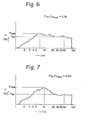
- Fig. 6 is chart of an uneven yarn obtained by tracing Example 1 of Japanese Examined Patent Publication No. 51-7207
- Fig. 7 is a chart of an uneven yarn obtained by tracing the Example of Japanese Unexamined Patent Publication No. 58-70711
- Fig. 8 is a chart of an uneven yarn obtained in Example 1 of the present invention given hereinafter
- Fig. 9 is a chart of an uneven yarn obtained in Example 2 of the present invention given hereinafter.
- the yarn includes a long period unevenness, in case of Figs. 8 and 9 (P50/Pmax ⁇ 1/2), the yarn does not substantially contain such a long period uneveness but thick portions are uniformly dispersed along the length.
- This polyester uneven yarn can be obtained by adopting a special drawing manner of an undrawn polyester yarn. Namely, the drawing is performed in such a manner that the draw point is not concentrated in a particular portion of the respective filaments of the yarn so that the draw points on the individual single filaments are allowed to move independently. More specifically, the following cares are necessary for accomplishing this drawing:
- the spinning speed should be lower than 2000 m/min, preferably lower than 1500 m/min.
- a sufficient thick-to-thin ratio can be obtained if the orientation degree of the starting yarn is such that the double refraction is lower than 13 x 10 -3 , preferably lower than 10 x 10
- the pick-up of the oiling agent applied during the spinning be less than 1.5%, more preferably less than 0.7%, and the denier and sectional shape are made different among the single filaments.
- the cooling effect on the as spun filaments by cold air be changed.
- sufficient frictional contact of the yarn with a guiding member before drawing is effective.
- the tension in this step should be at least 0.2 g/d. Otherwise, the yarn is effectively drawn in the contact portion and speck-like unevennesses poor in the dispersibility are preliminarily given at this point, which unevenness are left to the end. Accordingly, it is important that the yarn should be in contact with the member so that substantial drawing should not be performed. From this viewpoint, it is preferred that the tension be up to 1.0 g/d. Moreover, during the drawing operation, concentrated application of the stress or concentrated heating should be avoided as much as possible so that the constant drawing point is not formed.
- the yarn being drawn be heated as a whole in the state as flat as possible along a longer length, and that the heating temperature be higher than the level higher by 55°C than the glass transition point of the starting yarn. If this temperature is too low, the effect of dispersing the neck point in a broad range during the drawing operation is reduced. Pre-heating of the starting yarn enhances the prevention of yarn wrapping around the roller. When the starting yarn is preliminarily heated, however, the pre-heating temperature should not greatly exceed this temperature so that the drawing points of the respective filaments are not concentrated.
- the drawing should be carried out at a draw ratio lower than the natural draw ratio of the starting yarn so that portions drawn at a low ratio are sufficiently left, whereby thick uneven portions are effectively formed also by dint of the low orientation degree of the starting yarn. If this unevenness-producing effect is insufficient, even when the performance is increased by improving the dispersibility, this increase becomes insignificant.
- the thick portions should be contained in such a manner that the thick-to-thin ratio (the ratio of the largest denier to the smallest denier) should be at least 2.0, preferably at least 3.0.
- an interlacing degree is preferably higher than that sufficient to impart cohesiveness to an ordinary yarn, that is, to be, for example, at least 40, preferably 60 interlaced points per meter.
- the polyester that is used in the present invention is not limited to a pure polyester, and even in case of a modified polyester containing a third component, the effects of the present invention can be sufficiently exerted.
- a cationic dye dyable polyester is preferably usable for manufacturing even dyed products.
- the polyester may contain titanium oxide of more than 1.0% by weight therein for improving the draping ability of the product.
- polybutylene terephthalate may be preferably utilized as a material polymer.
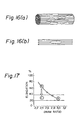
- Fig. 14-(a) is a diagram illustrating an undrawn polyester filament. If this undrawn filament is drawn at a draw ratio higher than the natural draw ratio of the undrawn filament, a uniform fine drawn filament shown in Fig. 14-(b) is obtained. If the undrawn filament yarn is drawn at a draw ratio lower than the natural draw ratio, there is obtained an incompletely drawn filament which comprises completely drawn portions (a) and incompletely drawn portions (b) as shown in Fig. 14-(c). These incompletely drawn portions are densely dyed or have physical properties different from those of other portions, with the result that a special feel effect can be obtained. This effect has been known from old as the effect of a so-called thick-and-thin yarn.
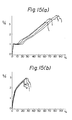
- Fig. 15-(a) is a stress-strain curve of an example of the conventional thick-and-thin yarn obtained by incomplete drawing at a low draw ratio. This curve flatly lies and the elongation is ordinarily very high.
- the elongation of a polyester filament yarn is about 20 to about 30% at highest, but if this yarn is incompletely drawn at the above-mentioned low draw, the elongation becomes higher than 35%, and as compared with the ordinary yarn, this incompletely drawn yarn is readily elongated during the use and the dimensional stability is degraded.
- the incompletely drawn yarn is inferior in the handling property and physical performance.
- this elongation may be reduced by increasing the draw ratio, but increase of the draw ratio results in loss of the desirable characteristics inherent to the incompletely drawn yarn.
- the incompletely drawn yarn inevitably has a fatal defect of a high elongation.
- this incompletely drawn yarn is low in the primary yield strength and definite yielding appears, and therefore, the elastic recovery limit is readily exceeded by a small force and the handling property is further degraded. According to the present invention, these disadvantages can be overcome, and an uneven yarn which is satisfactory in the abovesaid effect caused by the incomplete drawing can be obtained without increase of the elongation.
- this conventional uneven yarn still has a high elongation and the problem caused by the high elongation is still left unsolved.
- the present invention by greatly increasing the dispersion degree of the incompletely drawn portions and controlling the content of long-period unevennesses below a certain level, it becomes possible to produce a heretofore unexpected, novel yarn structure in which the elongation can be controlled to a level comparable to that of an ordinary drawn yarn even though incompletely drawn portions are contained.
- the uneven yarn of the present invention if the draw ratio is increased or the obtained yarn is further stretched, the elongation can be reduced.
- the desirable effect of incomplete drawing is lost and performance peculiar to the incomplete drawing yarn also vanishes.
- One of the prominent characteristics of the present invention resides in that the elongation of the entire yarn can be reduced as described above even though incompletely drawn portions are contained.
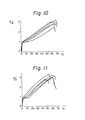
- the resultant yarn (B) has a much higher elongation than the completely drawn yarn (A), as shown in Fig. 17.
- the elongation of a yarn that can be easily handled is generally about 20 to about 33%. Accordingly, the elongation of the yarn (B) is too high and handling of this yarn is difficult.
- the uneven yarn (C) of the present invention the elongation is not different from that of the ordinary drawn yarn, even though uneven drawing is carried out at a low draw ratio.
- the primary yield strength of the uneven yarn of the present invention is at least 1.2 g/d, and no definite yielding point appears and the handling property is highly improved.
- the conventional uneven yarn is used only for the production of a fabric having a special appearance effect.
- unevennesses do not definitely appear even though it contains lowly oriented portions, but only a special feel effect is prominently manifested. Accordingly, a material excellent in general-purpose properties can be provided according to the present invention.
- the primary yield strength is indicated by the strength (indicated by an arrow in Fig. 20) at the bending point on the stress-strain curve as shown in Fig. 20, that is, the first point where the curve is bent at a minimum curvature.
- the stress-strain curve is determined under conditions of a sample length of 20 cm, a stretching speed of 100%/min and a sample number of 10 by using a Universal Tensile Tester (supplied by Instron Co.), and the elongation is determined based on the fracture point (the point where the strength is abruptly reduced), as in the conventional method.
- the natural draw ratio is meant the draw ratio at the point where abrupt rising from the flow state takes place when an undrawn yarn is stretched.
- undrawn portions are not completely identified from completely drawn portions, but the yarn is gradually changed between these portions. Accordingly, the thick-to-thin ratio may be changed according to the definition of the undrawn portions.
- the denier ratio of the maximum thickness filament to the minimum thickness filament in the yarn is adopted as the thick-to-thin ratio, as described hereinbefore, the value is clearly defined.
- a fiber-forming polymer (having an intrinsic viscosity of 0.64) comprising ethylene terephthalate units as main recurring units was spun at a speed of 1270 m/min to obtain an undrawn yarn of 220 d/36 f having a double refraction of 8 x 10 3 , a natural draw ratio of 2.6 and a glass transition temperature of 67°C.
- This undrawn yarn was oiled at an OPU of 0.4% and was wound.
- the undrawn yarn was forcibly brought into contact with aluminum oxide rods, while running, having a diameter of 5 mm in a zigzag manner under a tension of 0.5 g/d, and subsequently, the yarn was pre-heated by a hot roller maintained at 50°C and was drawn at a draw ratio of 2.5 by contacting it straightly and uniformly with a heating plate 6 having a flat surface and maintained at 160°C carefully so that an acute contact angle was not produced.
- the resulting uneven yarn of 90 d/36 f was wound.
- the spectrogram and stress-strain curve of the obtained uneven yarn are shown in Figs. 8 and 12, respectively (the physical properties are shown in No. 3 of Table 1).
- a twill fabric was prepared by using the so-obtained uneven yarn as warps and wefts and subjected to 20% alkali weight-reduction treatment to obtain a Viyella fabric. Such troubles as falling at knees and creeping were not caused in the obtained fabric, and the resistance to the strength deterioration by the alkali weight-reduction treatment was high and the wet friction fastness was class 3 to 4. Thus, it was confirmed that the obtained uneven yarn was comparable to an ordinary drawn yarn in the performance.
- the feel characteristics such as warm feel, crispiness and drapy feel were very excellent because incompletely drawn filaments having a thick-to-thin ratio of at least 3 were contained in large quantities.
- the defects of the conventional products concerning the handling property and performance were not observed and simultaneously, the product had very natural feel characteristics. Accordingly, it was confirmed that the uneven yarn could fully satisfy the two contradictory requirements simultaneously.
- the obtained yarn had a P50/Pmax value of 0.41, an elongation of 29.5% and a primary yield strength of 1.4 g/d. If the OPU value was increased to 0.8%, the P50/Pmax value was 0.55, the elongation was 42.3% and the primary yield strength was 1.1 g/d, and the wet friction fastness was degraded to class 2 by the strength deterioration brought about the alkali weight-reduction treatment.
- the drawing operation was carried out while strongly rubbing the yarn against a plate at an acute angle, the P50/Pmax value was 0.78, the elongation was 54% and the primary yield strength was 1.0 g/d, and many kinks and cramps were observed in the obtained fabric and there was obtained a fancy fabric where a pattern of unevennesses was prominent.
- a voile fabric was prepared by using the obtained yarn. Since the elongation of the yarn was low and the shrinkage in boiling water was not high, none of kinks, setting unevenness and weave bar were found on the fabric. Furthermore, a slub pattern owing to the uneven drawing was not found on the surface of the woven fabric. Moreover, since the filaments having a low molecular orientation were contained in large quantities, the woven fabric was conspicuously excellent over a conventional polyester voile fabric in feel characteristics such as repulsiveness, drape ability and bulkiness.
- a second aspect of the present invention is represented by a fabric as defined by claim 7.
- a characteristic feature of the woven or knitted fabric of the present invention is in that the fabric has an anisotropic property which is due to a kind of migration where constituent single filaments have different orientation angles and some of them intersect one another. If the constituent single filaments have substantially equal orientation angles, the fabric comes to have a monotonous feel resembling that of the conventional silky fabric and the fabric becomes too gentle, as shown in Fig. 3. What is more important is that parts of the single filaments have a length larger than that of other filaments and they are bulged on the surface of the fabric. Because of the presence of these bulged filaments, the touch of this portion of the fabric is delicately different from the touch of the ground yarn portion, resulting in manifestation of a coarse feel.
- the proportion of the bulged filaments should not be too large. If the proportion of the bulged filaments is too large, the fabric becomes too soft and the intended feel and touch cannot be obtained.
- the bulged filaments occupy a part of the surface of the fabric, and the remaining majority of the filaments are kept in the state of non-bulged filaments, whereby a raw silk touch, that is, a combination of a coarse touch and a silky touch, can be manifested. It is indispensable that the proportion of the bulged filaments should be up to 25%. Of course, if the proportion of the bulged filaments is too small, the intended effect cannot be attained. Accordingly, the proportion of the bulged filaments should be at least 3%.
- the bulged filaments are loopy, a crispy feel begins to appear. Although it is permissible that some of the bulged filaments have such loops, such loops should not be formed in the majority of the bulged filaments. If these filaments are bulged in the fluffy state, a warm feel is manifested, but the intended cool raw silk touch cannot be manifested. Accordingly, most of the single filaments should not be in the fluffy state where the filaments are broken and they have free ends. If the bulged filaments are crimped, a rubbery touch is manifested and the elegancy of the raw silk touch is lost. Accordingly, it is indispensable that the single filaments should not have crimps, but it is only permissible that they meander on the surface of the fabric at various orientation angles and curvatures.
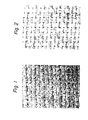
- Fig. 1 is a microscope photograph showing in an enlarged manner the arrangement of single filaments on the surface of a woven fabric according to one embodiment of the present invention.
- the respective filaments are arranged at different angles and parts of the filaments are bulged on the surface of the fabric and the majority of the bulged filaments have not loops or fluffs and are not crimped.
- the yarn according to the first aspect of the present invention is suitably utilized for the fabric of the second aspect.
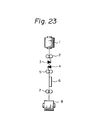
- Fig. 23 is a diagram showing the steps of this embodiment of the process for preparing the abovesaid yarn.
- Reference numeral 1 represents an undrawn polyester yarn of 120 d/36 f, which has been obtained by performing melt spinning at a speed of 1100 m/min, and this undrawn yarn is taken out by a roller 2 and lightly brought into frictional contact with members 3 and 4. Then, the undrawn yarn is lowly heated by a roller 5 and strongly heated by a heater 6 and is drawn at a low draw ratio between rollers 5 and 7 under heating to obtain a drawn yarn of 50 d/36 f in which filaments differing in the physical properties are mingled. The drawn yarn is wound on a winder 8.
- the undrawn yarn 1 is brought into contact with the members 3 and 4 before drawing.
- Very small amounts of an oligomer and an oiling agent adhere to the respective filaments of the undrawn yarn. Because of these oligomer and oiling agent or for other reason, the single filaments are bonded to one another, and when the undrawn yarn is brought into contact with the members 3 and 4, the single filaments are separated from one another. Accordingly, slight rictional contact is sufficient at this step.
- the tension in the contact be up to 1.0 g/d. In contrast, if the tension is too low, the intended effect cannot be attained. Therefore, it is preferred that the tension be at least 0.2 g/d in this step.
- the undrawn yarn in which the single filaments have thus been separated is drawn between the rollers 5 and 7. Since the heating temperature of the roller 5 is low and the heating temperature of the heater 6 is high and since the draw ratio is low, the neck point (the point where the undrawn filaments are constricted and converted to drawn filaments) at the drawing step appears on the heater 6. If the temperature of the roller 5 is high, the undrawn yarn is greatly plasticized on the roller 5, and therefore, the neck point is concentrated on the roller 5. Accordingly, it is indispensable that the temperature of the roller 5 should not be too high and it is preferred that the temperature of the roller 5 be lower than the level higher by 20°C than the glass transition point of the yarn.
- the temperature of the heater 6 be maintained at a level higher by at least 50°C than the glass transition temperature. If the draw ratio is increased at the drawing step, the neck point is advanced forward and arrives at the roller 5. Therefore, the draw ratio should be lower than the ordinary draw ratio so that the neck point is located just on the heater 6 as stated before. Ordinarily, drawing is carried out at a draw ratio much higher than the natural draw ratio. However, in the present invention, it is preferred that the draw ratio be lower than the natural draw ratio. By this drawing operation, the neck point is allowed to be located just on the heater 6.
- the position of the neck point is unstable and shifts around on the heater 6. Since the undrawn yarn of the separated filaments is supplied to this heater 6, the neck point exerts different behaviors to the respective single filaments, and the neck points are formed at different portions on the heater 6 and these neck points vary among the filaments. Accordingly, in the obtained yarns, the single filaments having undrawn parts randomly come to have different physical properties, and the obtained yarn has a complicated structure as described before. If the drawn yarn is subjected to an air jetting interlacing treatment, the structure becomes more complicated.
- respective filaments have different orientation angles on the fabric surface, some of the filaments intersect one another, some of the filaments are bulged out from the surface of the fabric, and these bulged filaments have no loops or fluffs and are not crimped and they meander at various orientation angles and curvatures.
- fabric composed solely of the above-mentioned special-configuration yarns is most preferred because the intended touch can be manifested most easily.
- mix-weaving or mix-knitting may be carried out according to need.
- ordinary polyester yarns can be used as the wefts.
- appropriate combinations of yarns may be used according to intended uses.
- the greig fabric should be sufficiently rubbed under heating.
- the fabric be once rubbed with hot water and rubbed again under elevated temperature and elevated pressure conditions. If a high-pressure jet stream is used at the rubbing step, the effect is enhanced.
- the touch and feel effect of the present invention can be most easily manifested in a woven fabric, but a high effect is similarly attained also in a knitted fabric.
- the polyester yarn incorporated into the fabric exhibits a unique change of appearance after the fabric has treated by the finishing processes including heat treatment. Due to this change, the touch of the polyester fabric can be improved.
- the yarn has a characteristic as defined in claim 8.
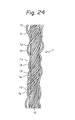
- FIG. 24 a side view of this yarn is illustrated.
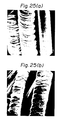
- Reference numeral 1 represents a polyester multifilament yarn (Z-twisted yarn in the present embodiment), and among constituent filaments, filaments fl through f5 are wound in the state free or derived from an ordinary twisted core portion 12. Furthermore, wrinkle-like corrugations 13 are present on the filaments fl through f5. As shown in Figs. 25-(a) and 25-(b) (electron microscope photographs; 1500 magnifications), these corrugations 13 are formed by ridges sequentially formed in the direction substantially orthogonal to the fiber axis. In this embodiment, the yarn is characterized in that the ridges are formed substantially around the entire periphery.
- the effect of improving the surface touch can be attained by the wrinkle-like corrugations present in the filaments in addition to the touch and feel effect (improvement of the bulkiness) by the presence of the free or bulged filaments.
- the number of the free or bulged filaments be 3 to 25% of the total filament number. It is ideal that wrinkle-like corrugations will be formed on all of the filaments of the multifilament yarn, but this is practically difficult and it is not always possible to form corrugations on all the filaments.
- the surface touch of the yarn is drastically changed by imparting wrinkle-like corrugations to parts of filaments present on the peripheral portion of the yarn.
- the depth of the corrugations should be at least 0.08 ⁇ m.
- the depth of the corrugation is up to 5 ⁇ m.
- the pitch of the corrugation is too fine, the corrugation cannot be felt by the hand, and if the pitch is too coarse, convexties and concavities cannot be felt. Accordingly, it is preferred that the pitch of the corrugation be 0.4 to 25 ⁇ m.
- a circular cross-sectional filament is preferred for the corrugation, and sharp corrugation or deeply cut corrugation are not preferred because the durability is reduced.
- Fig. 26 illustrates an example of a woven fabric formed by using the polyester multifilament yarn of the present invention as warps and wefts (optical microscope photograph; 40 manifications). Free or bulged filaments are apparently present on the respective filament yarns.
- the yarn is subjected to a heat treatment while incorporated in a fabric.
- this heat treatment may be carried out before the yarn is incorporated into the fabric.
- This heat treatment is 130°C steaming for 30 min. and relaxing in boiling water following to the former.
- parts of the constituent filaments are set free or bulged out from the yarn surface, and simultaneously, the above-mentioned corrugations are manifested in the free or bulged filaments.
- the yarn may be twisted and/or interlaced before formation into a woven or knitted fabric.
- the filaments are readily separated in the yarn. Accordingly, it is preferred that the.yarn be twisted.
- the reason for occurrence of the corrugation on the filament surface is assumed as follows: If a yarn is not completely drawn as in the case where the yarn is drawn at a draw ratio lower than the natural draw ratio, the freedom of the movement of the molecules is large and therefore, the molecules are strongly shrunk by heating and the yarn comes to have a high shrinkage property uniformly. However, if the yarn is drawn at a draw ratio lower than the natural draw ratio at such a high temperature that this high shrinkage property is not produced, as in the case of the present invention, parts not completely oriented, like crystal nuclei, are formed in the fibers, and by subsequent strong heating or repetition thereof in some cases, these parts are grown to cause the upheaval. By the presence of these corrugations, the surface of the polyester yarn becomes hardly slippery, though the conventional polyester yarn is too smooth. That is, in the polyester yarn of the present invention, the slippery feel is reduced and a preferred touch is obtained.
- the surface touch As means for improving the surface touch, there have been developed a process, such as alkali treatment in which small holes are opened on the fiber surfaces.
- these processes are defective in that filaments are broker during the processing and dirts are intruded in holes or grooves to render the yarn blackish.
- the surface touch can be improved without such defects. Therefore, the polyester yarn of the present invention is very tough, and handling is very easy. Moreover, the manufacturing cost can be reduced and the problem of poor hand inherent to the alkali weight-reduction treatment is not caused at all.
- the alkali treatment may be adopted in the present invention.
- the alkali weight-reduction treatment since the alkali weight-reduction treatment is not necessary, the effect is especially high when the surface touch of a product having a strong nerve is improved.
- the undrawn yarn was passed zigzag through three alumina guides under a tension of 0.5 g/d, and was then drawn at a draw ratio of 2.3 while it was heated at 180°C, whereby a drawn yarn of about 200 d/48 f was obtained.
- the yarn was divided into 2 parts, and they were twisted at 800 t/m in the directions S and Z and heated by steam super-heated at 130°C for about 30 minutes. Then, the two S- and Z-twisted yarns were alternately plain-woven.
- the woven fabric was heated while it was rubbed strongly by a boiling jet stream and the fabric was dry-heated and set at 160°C. Then, the fabric was dyed under 3 kg/cm 2 by a high-pressure dyeing machine and set at 160°C to obtain a finished fabric.
- the yarns of the obtained fabric were examined, it was found that about 5 filaments on the average (about 10% of all the filaments) were greatly bulged in the peripheral portion and they were free from the fiber surfaces as shown in Fig.
Landscapes
- Engineering & Computer Science (AREA)
- Textile Engineering (AREA)
- Mechanical Engineering (AREA)
- Yarns And Mechanical Finishing Of Yarns Or Ropes (AREA)
- Artificial Filaments (AREA)
Applications Claiming Priority (6)
| Application Number | Priority Date | Filing Date | Title |
|---|---|---|---|
| JP27063384A JPS61152814A (ja) | 1984-12-24 | 1984-12-24 | ポリエステル斑糸及びその製造方法 |
| JP270633/84 | 1984-12-24 | ||
| JP22015385A JPS6285040A (ja) | 1985-10-04 | 1985-10-04 | ポリエステルマルチフィラメント糸条 |
| JP220153/85 | 1985-10-04 | ||
| JP60222664A JPS6285046A (ja) | 1985-10-08 | 1985-10-08 | ロ−シルク調ポリエステル織編物 |
| JP222664/85 | 1985-10-08 |
Publications (3)
| Publication Number | Publication Date |
|---|---|
| EP0187362A2 true EP0187362A2 (de) | 1986-07-16 |
| EP0187362A3 EP0187362A3 (en) | 1987-11-25 |
| EP0187362B1 EP0187362B1 (de) | 1991-12-18 |
Family
ID=27330407
Family Applications (1)
| Application Number | Title | Priority Date | Filing Date |
|---|---|---|---|
| EP19850116428 Expired - Lifetime EP0187362B1 (de) | 1984-12-24 | 1985-12-21 | Garn aus Polyester und daraus hergestelltes Gewebe |
Country Status (3)
| Country | Link |
|---|---|
| US (2) | US4684566A (de) |
| EP (1) | EP0187362B1 (de) |
| DE (1) | DE3584960D1 (de) |
Cited By (1)
| Publication number | Priority date | Publication date | Assignee | Title |
|---|---|---|---|---|
| WO2002022931A1 (en) * | 2000-09-13 | 2002-03-21 | Teijin Limited | Thick and thin polyester multifilament yarn |
Families Citing this family (10)
| Publication number | Priority date | Publication date | Assignee | Title |
|---|---|---|---|---|
| CA2091477C (en) * | 1993-03-11 | 1998-02-10 | Claude Barbeau | Textile material for inner lining of firefighter protective garment |
| DE19640405C2 (de) * | 1996-09-30 | 2000-08-24 | Zinser Textilmaschinen Gmbh | Verfahren und Vorrichtung zum Herstellen von Dickstellen in einem Filamentgarn |
| ATE299195T1 (de) * | 1999-05-18 | 2005-07-15 | Hyosung Corp | Industrielle polyesterfaser und verfahren zu seiner herstellung |
| JP3545749B2 (ja) * | 2002-05-02 | 2004-07-21 | 帝人ファイバー株式会社 | 梳毛調布帛及びその製造方法 |
| US20030233810A1 (en) * | 2002-06-21 | 2003-12-25 | Martin Wildeman | Office panel and fabric covering therefor |
| US7406818B2 (en) * | 2004-11-10 | 2008-08-05 | Columbia Insurance Company | Yarn manufacturing apparatus and method |
| US20090121376A1 (en) * | 2007-11-09 | 2009-05-14 | Yen-Lin Tsai | Method for making a polyester fabric |
| US9869412B2 (en) | 2014-09-30 | 2018-01-16 | Highland Industries, Inc. | Anisotropic pipe liner |
| US9664310B2 (en) * | 2014-09-30 | 2017-05-30 | Highland Industries, Inc. | Anisotropic pipe liner |
| US10192655B2 (en) | 2014-09-30 | 2019-01-29 | Highland Industries, Inc. | Anisotropic wire harness |
Family Cites Families (11)
| Publication number | Priority date | Publication date | Assignee | Title |
|---|---|---|---|---|
| FR1521013A (fr) * | 1966-04-27 | 1968-04-12 | Glanzstoff Ag | Fils avec variation de titre et procédé de fabrication de tels fils |
| FR1583697A (de) * | 1968-02-19 | 1969-11-28 | ||
| JPS50335A (de) * | 1973-05-09 | 1975-01-06 | ||
| US4489543A (en) * | 1977-08-17 | 1984-12-25 | Celanese Corporation | Self-crimping yarn |
| CA1101178A (en) * | 1978-03-13 | 1981-05-19 | Takao Negishi | Bundle of fibrous elements, method and apparatus for producing thereof |
| US4209559A (en) * | 1978-03-27 | 1980-06-24 | Teijin Limited | Linear crystalline terephthalate polyester yarn and textile goods made therefrom |
| EP0030566B1 (de) * | 1979-12-06 | 1986-07-30 | Toray Industries, Inc. | Polgewebe |
| JPS56144237A (en) * | 1980-04-07 | 1981-11-10 | Teijin Ltd | Polyester type fiber woven and knitted fabric |
| US4414276A (en) * | 1980-07-29 | 1983-11-08 | Teijin Limited | Novel assembly of composite fibers |
| US4600644A (en) * | 1982-06-10 | 1986-07-15 | Monsanto Company | Polyester yarn, self-texturing in fabric form |
| US4529655A (en) * | 1984-05-23 | 1985-07-16 | E. I. Du Pont De Nemours And Company | Interlaced polyester industrial yarns |
-
1985
- 1985-12-21 EP EP19850116428 patent/EP0187362B1/de not_active Expired - Lifetime
- 1985-12-21 DE DE8585116428T patent/DE3584960D1/de not_active Expired - Lifetime
- 1985-12-23 US US06/812,246 patent/US4684566A/en not_active Expired - Lifetime
-
1986
- 1986-09-05 US US06/904,177 patent/US4698260A/en not_active Expired - Lifetime
Cited By (1)
| Publication number | Priority date | Publication date | Assignee | Title |
|---|---|---|---|---|
| WO2002022931A1 (en) * | 2000-09-13 | 2002-03-21 | Teijin Limited | Thick and thin polyester multifilament yarn |
Also Published As
| Publication number | Publication date |
|---|---|
| EP0187362B1 (de) | 1991-12-18 |
| US4684566A (en) | 1987-08-04 |
| EP0187362A3 (en) | 1987-11-25 |
| DE3584960D1 (de) | 1992-01-30 |
| US4698260A (en) | 1987-10-06 |
Similar Documents
| Publication | Publication Date | Title |
|---|---|---|
| US6276121B1 (en) | Crimped yarn, textile fabric, and process for preparing the same | |
| EP0187362B1 (de) | Garn aus Polyester und daraus hergestelltes Gewebe | |
| JP4497648B2 (ja) | 複合弾性糸及びその製造方法 | |
| JP3946042B2 (ja) | ポリエステル複合加工糸 | |
| JP2885493B2 (ja) | 混繊糸織物とその製造方法 | |
| JP4073578B2 (ja) | ポリエステル複合仮撚糸の製造方法 | |
| JPH0711531A (ja) | スパン複合嵩高糸 | |
| JPS6113013B2 (de) | ||
| JP2857718B2 (ja) | 潜在嵩高糸とその製造方法 | |
| JP2867245B2 (ja) | 嵩高織物 | |
| JP2003119640A (ja) | ポリエステル混繊加工糸およびその製造方法 | |
| JP3140822B2 (ja) | 極細濃淡染着性糸及び高収縮性濃淡染着性糸 | |
| JP3285019B2 (ja) | ポリエステル複合加工糸交織織物 | |
| JP3401373B2 (ja) | カットパイル布帛の製造方法 | |
| JPH09132834A (ja) | 梳毛調複合混繊糸 | |
| JP3140836B2 (ja) | 柄効果をもった立毛調織物及びその製造方法 | |
| JP7199803B2 (ja) | ポリエステル複合仮撚糸 | |
| JP2930606B2 (ja) | イラツキの解消された、超ソフト特殊混繊糸の製造方法 | |
| JPH03167333A (ja) | 仮撚複合糸、およびその製造方法 | |
| JP3059656B2 (ja) | ポリエステル系混繊糸 | |
| JPS6399340A (ja) | 異繊度異収縮混繊糸 | |
| CA1117286A (en) | Bulkable filamentary yarn, a method and an apparatus for the preparation of the same | |
| JP2002249937A (ja) | 仮撚加工糸 | |
| JP2004149940A (ja) | 流体複合加工糸及びその製造方法並びに同加工糸を含む織編物 | |
| JP2002249936A (ja) | 仮撚加工糸 |
Legal Events
| Date | Code | Title | Description |
|---|---|---|---|
| PUAI | Public reference made under article 153(3) epc to a published international application that has entered the european phase |
Free format text: ORIGINAL CODE: 0009012 |
|
| AK | Designated contracting states |
Kind code of ref document: A2 Designated state(s): DE FR GB IT |
|
| PUAL | Search report despatched |
Free format text: ORIGINAL CODE: 0009013 |
|
| AK | Designated contracting states |
Kind code of ref document: A3 Designated state(s): DE FR GB IT |
|
| 17P | Request for examination filed |
Effective date: 19880217 |
|
| 17Q | First examination report despatched |
Effective date: 19890609 |
|
| GRAA | (expected) grant |
Free format text: ORIGINAL CODE: 0009210 |
|
| AK | Designated contracting states |
Kind code of ref document: B1 Designated state(s): DE FR GB IT |
|
| ITF | It: translation for a ep patent filed | ||
| ET | Fr: translation filed | ||
| REF | Corresponds to: |
Ref document number: 3584960 Country of ref document: DE Date of ref document: 19920130 |
|
| PLBI | Opposition filed |
Free format text: ORIGINAL CODE: 0009260 |
|
| 26 | Opposition filed |
Opponent name: AKZO FASER AKTIENGESELLSCHAFT Effective date: 19920910 |
|
| PLBN | Opposition rejected |
Free format text: ORIGINAL CODE: 0009273 |
|
| STAA | Information on the status of an ep patent application or granted ep patent |
Free format text: STATUS: OPPOSITION REJECTED |
|
| 27O | Opposition rejected |
Effective date: 19931025 |
|
| REG | Reference to a national code |
Ref country code: GB Ref legal event code: IF02 |
|
| PGFP | Annual fee paid to national office [announced via postgrant information from national office to epo] |
Ref country code: GB Payment date: 20041125 Year of fee payment: 20 |
|
| PGFP | Annual fee paid to national office [announced via postgrant information from national office to epo] |
Ref country code: FR Payment date: 20041202 Year of fee payment: 20 |
|
| PGFP | Annual fee paid to national office [announced via postgrant information from national office to epo] |
Ref country code: DE Payment date: 20041206 Year of fee payment: 20 |
|
| PG25 | Lapsed in a contracting state [announced via postgrant information from national office to epo] |
Ref country code: GB Free format text: LAPSE BECAUSE OF EXPIRATION OF PROTECTION Effective date: 20051220 |
|
| REG | Reference to a national code |
Ref country code: GB Ref legal event code: PE20 |