EP0185618A2 - Isoindoline, Verfahren zu deren Herstellung und Verwendung - Google Patents
Isoindoline, Verfahren zu deren Herstellung und Verwendung Download PDFInfo
- Publication number
- EP0185618A2 EP0185618A2 EP19850810594 EP85810594A EP0185618A2 EP 0185618 A2 EP0185618 A2 EP 0185618A2 EP 19850810594 EP19850810594 EP 19850810594 EP 85810594 A EP85810594 A EP 85810594A EP 0185618 A2 EP0185618 A2 EP 0185618A2
- Authority
- EP
- European Patent Office
- Prior art keywords
- formula
- amino
- methyl
- unsubstituted
- substituted
- Prior art date
- Legal status (The legal status is an assumption and is not a legal conclusion. Google has not performed a legal analysis and makes no representation as to the accuracy of the status listed.)
- Withdrawn
Links
- GWVMLCQWXVFZCN-UHFFFAOYSA-N isoindoline Chemical class C1=CC=C2CNCC2=C1 GWVMLCQWXVFZCN-UHFFFAOYSA-N 0.000 title claims abstract description 15
- 238000000034 method Methods 0.000 title claims description 10
- 238000004519 manufacturing process Methods 0.000 title 1
- 125000001997 phenyl group Chemical group [H]C1=C([H])C([H])=C(*)C([H])=C1[H] 0.000 claims abstract description 15
- 239000011368 organic material Substances 0.000 claims abstract description 9
- CIUQDSCDWFSTQR-UHFFFAOYSA-N [C]1=CC=CC=C1 Chemical compound [C]1=CC=CC=C1 CIUQDSCDWFSTQR-UHFFFAOYSA-N 0.000 claims abstract description 5
- 230000000485 pigmenting effect Effects 0.000 claims abstract description 3
- 239000000049 pigment Substances 0.000 claims description 53
- -1 N-methylcarbamyl Chemical group 0.000 claims description 37
- 150000001875 compounds Chemical class 0.000 claims description 22
- 125000002496 methyl group Chemical group [H]C([H])([H])* 0.000 claims description 19
- 125000001309 chloro group Chemical group Cl* 0.000 claims description 12
- 229910052801 chlorine Inorganic materials 0.000 claims description 9
- 230000003381 solubilizing effect Effects 0.000 claims description 9
- RZVCEPSDYHAHLX-UHFFFAOYSA-N 3-iminoisoindol-1-amine Chemical compound C1=CC=C2C(N)=NC(=N)C2=C1 RZVCEPSDYHAHLX-UHFFFAOYSA-N 0.000 claims description 8
- 125000003917 carbamoyl group Chemical group [H]N([H])C(*)=O 0.000 claims description 6
- 229910052799 carbon Inorganic materials 0.000 claims description 6
- 125000001424 substituent group Chemical group 0.000 claims description 6
- 125000003545 alkoxy group Chemical group 0.000 claims description 5
- 125000000217 alkyl group Chemical group 0.000 claims description 5
- 229910052736 halogen Inorganic materials 0.000 claims description 5
- 150000002367 halogens Chemical class 0.000 claims description 5
- 125000000956 methoxy group Chemical group [H]C([H])([H])O* 0.000 claims description 5
- 125000002023 trifluoromethyl group Chemical group FC(F)(F)* 0.000 claims description 5
- 125000000738 acetamido group Chemical group [H]C([H])([H])C(=O)N([H])[*] 0.000 claims description 4
- 150000001555 benzenes Chemical class 0.000 claims description 4
- 125000000951 phenoxy group Chemical group [H]C1=C([H])C([H])=C(O*)C([H])=C1[H] 0.000 claims description 4
- 125000003754 ethoxycarbonyl group Chemical group C(=O)(OCC)* 0.000 claims description 3
- 125000004435 hydrogen atom Chemical group [H]* 0.000 claims description 3
- 125000001160 methoxycarbonyl group Chemical group [H]C([H])([H])OC(*)=O 0.000 claims description 3
- XCTQPMCULSZKLT-UHFFFAOYSA-N 2-cyano-n-phenylacetamide Chemical compound N#CCC(=O)NC1=CC=CC=C1 XCTQPMCULSZKLT-UHFFFAOYSA-N 0.000 claims description 2
- 238000002360 preparation method Methods 0.000 claims description 2
- DGJMPUGMZIKDRO-UHFFFAOYSA-N cyanoacetamide Chemical compound NC(=O)CC#N DGJMPUGMZIKDRO-UHFFFAOYSA-N 0.000 claims 1
- 125000004178 (C1-C4) alkyl group Chemical group 0.000 abstract description 4
- QTBSBXVTEAMEQO-UHFFFAOYSA-N Acetic acid Chemical compound CC(O)=O QTBSBXVTEAMEQO-UHFFFAOYSA-N 0.000 description 96
- ZMXDDKWLCZADIW-UHFFFAOYSA-N N,N-Dimethylformamide Chemical compound CN(C)C=O ZMXDDKWLCZADIW-UHFFFAOYSA-N 0.000 description 78
- OKKJLVBELUTLKV-UHFFFAOYSA-N Methanol Chemical compound OC OKKJLVBELUTLKV-UHFFFAOYSA-N 0.000 description 57
- MLIREBYILWEBDM-UHFFFAOYSA-N cyanoacetic acid Chemical compound OC(=O)CC#N MLIREBYILWEBDM-UHFFFAOYSA-N 0.000 description 34
- LFQSCWFLJHTTHZ-UHFFFAOYSA-N Ethanol Chemical compound CCO LFQSCWFLJHTTHZ-UHFFFAOYSA-N 0.000 description 33
- 239000000047 product Substances 0.000 description 21
- 239000003086 colorant Substances 0.000 description 19
- 229920003023 plastic Polymers 0.000 description 19
- 239000004033 plastic Substances 0.000 description 19
- RFFLAFLAYFXFSW-UHFFFAOYSA-N 1,2-dichlorobenzene Chemical compound ClC1=CC=CC=C1Cl RFFLAFLAYFXFSW-UHFFFAOYSA-N 0.000 description 18
- 239000004922 lacquer Substances 0.000 description 14
- 239000000203 mixture Substances 0.000 description 10
- 238000006243 chemical reaction Methods 0.000 description 8
- 230000005012 migration Effects 0.000 description 8
- 238000013508 migration Methods 0.000 description 8
- 239000004800 polyvinyl chloride Substances 0.000 description 8
- 229920000915 polyvinyl chloride Polymers 0.000 description 8
- 239000002253 acid Substances 0.000 description 7
- 238000000227 grinding Methods 0.000 description 7
- WSFSSNUMVMOOMR-UHFFFAOYSA-N Formaldehyde Chemical compound O=C WSFSSNUMVMOOMR-UHFFFAOYSA-N 0.000 description 6
- 239000000460 chlorine Substances 0.000 description 6
- 238000004040 coloring Methods 0.000 description 6
- 239000003960 organic solvent Substances 0.000 description 6
- 239000003973 paint Substances 0.000 description 6
- 239000002966 varnish Substances 0.000 description 6
- HDHQZCHIXUUSMK-UHFFFAOYSA-N 4-hydroxy-2-quinolone Chemical compound C1=CC=C2C(O)=CC(=O)NC2=C1 HDHQZCHIXUUSMK-UHFFFAOYSA-N 0.000 description 5
- 125000004432 carbon atom Chemical group C* 0.000 description 5
- DSCFIYWTQBJIDM-UHFFFAOYSA-N 5-amino-6-chlorobenzimidazol-2-one Chemical compound C1=C(Cl)C(N)=CC2=NC(=O)N=C21 DSCFIYWTQBJIDM-UHFFFAOYSA-N 0.000 description 4
- QOMNJPSRBRDQSU-UHFFFAOYSA-N 5-aminobenzimidazol-2-one Chemical compound C1=C(N)C=CC2=NC(=O)N=C21 QOMNJPSRBRDQSU-UHFFFAOYSA-N 0.000 description 4
- MHEBKJBEJUTXJQ-UHFFFAOYSA-N 6-amino-3-methyl-1h-benzimidazol-2-one Chemical compound C1=C(N)C=C2NC(=O)N(C)C2=C1 MHEBKJBEJUTXJQ-UHFFFAOYSA-N 0.000 description 4
- KFZMGEQAYNKOFK-UHFFFAOYSA-N Isopropanol Chemical compound CC(C)O KFZMGEQAYNKOFK-UHFFFAOYSA-N 0.000 description 4
- LRHPLDYGYMQRHN-UHFFFAOYSA-N N-Butanol Chemical compound CCCCO LRHPLDYGYMQRHN-UHFFFAOYSA-N 0.000 description 4
- HNYOPLTXPVRDBG-UHFFFAOYSA-N barbituric acid Chemical compound O=C1CC(=O)NC(=O)N1 HNYOPLTXPVRDBG-UHFFFAOYSA-N 0.000 description 4
- 239000000975 dye Substances 0.000 description 4
- BDAGIHXWWSANSR-UHFFFAOYSA-N methanoic acid Natural products OC=O BDAGIHXWWSANSR-UHFFFAOYSA-N 0.000 description 4
- 239000000126 substance Substances 0.000 description 4
- 238000005406 washing Methods 0.000 description 4
- ZAMOUSCENKQFHK-UHFFFAOYSA-N Chlorine atom Chemical compound [Cl] ZAMOUSCENKQFHK-UHFFFAOYSA-N 0.000 description 3
- OFOBLEOULBTSOW-UHFFFAOYSA-N Malonic acid Chemical compound OC(=O)CC(O)=O OFOBLEOULBTSOW-UHFFFAOYSA-N 0.000 description 3
- XSQUKJJJFZCRTK-UHFFFAOYSA-N Urea Chemical compound NC(N)=O XSQUKJJJFZCRTK-UHFFFAOYSA-N 0.000 description 3
- 229920000180 alkyd Polymers 0.000 description 3
- 150000002148 esters Chemical class 0.000 description 3
- 125000001495 ethyl group Chemical group [H]C([H])([H])C([H])([H])* 0.000 description 3
- 239000000976 ink Substances 0.000 description 3
- 238000000465 moulding Methods 0.000 description 3
- 125000004123 n-propyl group Chemical group [H]C([H])([H])C([H])([H])C([H])([H])* 0.000 description 3
- 239000004014 plasticizer Substances 0.000 description 3
- 239000002244 precipitate Substances 0.000 description 3
- 239000001052 yellow pigment Substances 0.000 description 3
- DNIAPMSPPWPWGF-GSVOUGTGSA-N (R)-(-)-Propylene glycol Chemical compound C[C@@H](O)CO DNIAPMSPPWPWGF-GSVOUGTGSA-N 0.000 description 2
- JPBLHOJFMBOCAF-UHFFFAOYSA-N 1,3-benzoxazol-2-amine Chemical compound C1=CC=C2OC(N)=NC2=C1 JPBLHOJFMBOCAF-UHFFFAOYSA-N 0.000 description 2
- VVSASNKOFCZVES-UHFFFAOYSA-N 1,3-dimethyl-1,3-diazinane-2,4,6-trione Chemical compound CN1C(=O)CC(=O)N(C)C1=O VVSASNKOFCZVES-UHFFFAOYSA-N 0.000 description 2
- BJHJQYAOKVCTBQ-UHFFFAOYSA-N 1-(4-chlorophenyl)-1,3-diazinane-2,4,6-trione Chemical compound C1=CC(Cl)=CC=C1N1C(=O)NC(=O)CC1=O BJHJQYAOKVCTBQ-UHFFFAOYSA-N 0.000 description 2
- DCGGMHIZEAHUJL-UHFFFAOYSA-N 1-methyl-1,3-diazinane-2,4,6-trione Chemical compound CN1C(=O)CC(=O)NC1=O DCGGMHIZEAHUJL-UHFFFAOYSA-N 0.000 description 2
- KJKZGZSNQWFLDC-UHFFFAOYSA-N 1-methyl-3-phenyl-1,3-diazinane-2,4,6-trione Chemical compound O=C1N(C)C(=O)CC(=O)N1C1=CC=CC=C1 KJKZGZSNQWFLDC-UHFFFAOYSA-N 0.000 description 2
- XDFZKQJLNGNJAN-UHFFFAOYSA-N 1-methylbenzimidazol-2-amine Chemical compound C1=CC=C2N(C)C(N)=NC2=C1 XDFZKQJLNGNJAN-UHFFFAOYSA-N 0.000 description 2
- MECMQZBUZCGXQW-UHFFFAOYSA-N 1-phenyl-1,3-diazinane-2,4,6-trione Chemical compound O=C1NC(=O)CC(=O)N1C1=CC=CC=C1 MECMQZBUZCGXQW-UHFFFAOYSA-N 0.000 description 2
- JWYUFVNJZUSCSM-UHFFFAOYSA-N 2-aminobenzimidazole Chemical compound C1=CC=C2NC(N)=NC2=C1 JWYUFVNJZUSCSM-UHFFFAOYSA-N 0.000 description 2
- UHGULLIUJBCTEF-UHFFFAOYSA-N 2-aminobenzothiazole Chemical compound C1=CC=C2SC(N)=NC2=C1 UHGULLIUJBCTEF-UHFFFAOYSA-N 0.000 description 2
- OSWFIVFLDKOXQC-UHFFFAOYSA-N 4-(3-methoxyphenyl)aniline Chemical compound COC1=CC=CC(C=2C=CC(N)=CC=2)=C1 OSWFIVFLDKOXQC-UHFFFAOYSA-N 0.000 description 2
- JXMIIUZBDWKSBK-UHFFFAOYSA-N 4-amino-10h-acridin-9-one Chemical compound N1C2=CC=CC=C2C(=O)C2=C1C(N)=CC=C2 JXMIIUZBDWKSBK-UHFFFAOYSA-N 0.000 description 2
- GJXXUHGUCBUXSL-UHFFFAOYSA-N 5-amino-3h-1,3-benzoxazol-2-one Chemical compound NC1=CC=C2OC(=O)NC2=C1 GJXXUHGUCBUXSL-UHFFFAOYSA-N 0.000 description 2
- RZQAYVRZCXUGKI-UHFFFAOYSA-N 5-amino-6-bromobenzimidazol-2-one Chemical compound C1=C(Br)C(N)=CC2=NC(=O)N=C21 RZQAYVRZCXUGKI-UHFFFAOYSA-N 0.000 description 2
- IVSZBMXOWCDRLB-UHFFFAOYSA-N 5-amino-6-methoxybenzimidazol-2-one Chemical compound C1=C(N)C(OC)=CC2=NC(=O)N=C21 IVSZBMXOWCDRLB-UHFFFAOYSA-N 0.000 description 2
- GLNHLEPOIVXMQF-UHFFFAOYSA-N 5-amino-7-chloro-3h-1,3-benzoxazol-2-one Chemical compound NC1=CC(Cl)=C2OC(=O)NC2=C1 GLNHLEPOIVXMQF-UHFFFAOYSA-N 0.000 description 2
- FIUMZEFFFNBFNQ-UHFFFAOYSA-N 5-chloro-1-oxo-1,3-benzothiazol-6-amine Chemical compound C1=C(Cl)C(N)=CC2=C1N=CS2=O FIUMZEFFFNBFNQ-UHFFFAOYSA-N 0.000 description 2
- DINIKMKWGNTYRM-UHFFFAOYSA-N 5-methyl-1-oxo-1,3-benzothiazol-6-amine Chemical compound C1=C(N)C(C)=CC2=C1S(=O)C=N2 DINIKMKWGNTYRM-UHFFFAOYSA-N 0.000 description 2
- DNCKPMPEGDANJK-UHFFFAOYSA-N 6-amino-1,4-dihydroquinoxaline-2,3-dione Chemical compound N1C(=O)C(=O)NC2=CC(N)=CC=C21 DNCKPMPEGDANJK-UHFFFAOYSA-N 0.000 description 2
- QKLFONKGBAEBGA-UHFFFAOYSA-N 6-amino-1-hydroxy-2h-isoquinolin-3-one Chemical compound OC1=NC(O)=CC2=CC(N)=CC=C21 QKLFONKGBAEBGA-UHFFFAOYSA-N 0.000 description 2
- SDUUYVWJDAEWSE-UHFFFAOYSA-N 6-amino-1h-quinazoline-2,4-dione Chemical compound N1C(=O)NC(=O)C2=CC(N)=CC=C21 SDUUYVWJDAEWSE-UHFFFAOYSA-N 0.000 description 2
- QGJIUXRWUUTVNK-UHFFFAOYSA-N 6-amino-3-butyl-1h-benzimidazol-2-one Chemical compound C1=C(N)C=C2NC(=O)N(CCCC)C2=C1 QGJIUXRWUUTVNK-UHFFFAOYSA-N 0.000 description 2
- XLWYFLUAYKPZSE-UHFFFAOYSA-N 6-amino-3-phenyl-1h-benzimidazol-2-one Chemical compound O=C1NC2=CC(N)=CC=C2N1C1=CC=CC=C1 XLWYFLUAYKPZSE-UHFFFAOYSA-N 0.000 description 2
- STLPJYGZOIEDAJ-UHFFFAOYSA-N 6-amino-3h-1,3-benzoxazol-2-one Chemical compound NC1=CC=C2NC(=O)OC2=C1 STLPJYGZOIEDAJ-UHFFFAOYSA-N 0.000 description 2
- PYVUIEPFAOUBMG-UHFFFAOYSA-N 6-amino-4-hydroxy-1h-quinolin-2-one Chemical compound N1=C(O)C=C(O)C2=CC(N)=CC=C21 PYVUIEPFAOUBMG-UHFFFAOYSA-N 0.000 description 2
- XGYICSXQOIEICF-UHFFFAOYSA-N 6-amino-5-chloro-3h-1,3-benzoxazol-2-one Chemical compound C1=C(Cl)C(N)=CC2=C1NC(=O)O2 XGYICSXQOIEICF-UHFFFAOYSA-N 0.000 description 2
- YVDQZFKTMIYDOK-UHFFFAOYSA-N 6-amino-5-methyl-3h-1,3-benzoxazol-2-one Chemical compound C1=C(N)C(C)=CC2=C1OC(=O)N2 YVDQZFKTMIYDOK-UHFFFAOYSA-N 0.000 description 2
- WZLOZDLWLRCUBQ-UHFFFAOYSA-N 6-amino-7-chloro-3h-1,3-benzoxazol-2-one Chemical compound NC1=CC=C2NC(=O)OC2=C1Cl WZLOZDLWLRCUBQ-UHFFFAOYSA-N 0.000 description 2
- WTAOQBUMRJTXDE-UHFFFAOYSA-N 7-amino-1h-quinazolin-2-one Chemical compound C1=NC(=O)NC2=CC(N)=CC=C21 WTAOQBUMRJTXDE-UHFFFAOYSA-N 0.000 description 2
- WKBOTKDWSSQWDR-UHFFFAOYSA-N Bromine atom Chemical compound [Br] WKBOTKDWSSQWDR-UHFFFAOYSA-N 0.000 description 2
- KAKZBPTYRLMSJV-UHFFFAOYSA-N Butadiene Chemical compound C=CC=C KAKZBPTYRLMSJV-UHFFFAOYSA-N 0.000 description 2
- VZCYOOQTPOCHFL-OWOJBTEDSA-N Fumaric acid Chemical compound OC(=O)\C=C\C(O)=O VZCYOOQTPOCHFL-OWOJBTEDSA-N 0.000 description 2
- 229920000877 Melamine resin Polymers 0.000 description 2
- 239000000020 Nitrocellulose Substances 0.000 description 2
- NBIIXXVUZAFLBC-UHFFFAOYSA-N Phosphoric acid Chemical compound OP(O)(O)=O NBIIXXVUZAFLBC-UHFFFAOYSA-N 0.000 description 2
- FAPWRFPIFSIZLT-UHFFFAOYSA-M Sodium chloride Chemical compound [Na+].[Cl-] FAPWRFPIFSIZLT-UHFFFAOYSA-M 0.000 description 2
- QAOWNCQODCNURD-UHFFFAOYSA-N Sulfuric acid Chemical compound OS(O)(=O)=O QAOWNCQODCNURD-UHFFFAOYSA-N 0.000 description 2
- 150000001412 amines Chemical class 0.000 description 2
- 125000003118 aryl group Chemical group 0.000 description 2
- GDTBXPJZTBHREO-UHFFFAOYSA-N bromine Substances BrBr GDTBXPJZTBHREO-UHFFFAOYSA-N 0.000 description 2
- 229910052794 bromium Inorganic materials 0.000 description 2
- 239000004927 clay Substances 0.000 description 2
- 239000007859 condensation product Substances 0.000 description 2
- 229920001577 copolymer Polymers 0.000 description 2
- 239000012043 crude product Substances 0.000 description 2
- JXTHNDFMNIQAHM-UHFFFAOYSA-N dichloroacetic acid Chemical compound OC(=O)C(Cl)Cl JXTHNDFMNIQAHM-UHFFFAOYSA-N 0.000 description 2
- 238000001035 drying Methods 0.000 description 2
- 229920001971 elastomer Polymers 0.000 description 2
- 239000000945 filler Substances 0.000 description 2
- 235000019253 formic acid Nutrition 0.000 description 2
- 125000001841 imino group Chemical group [H]N=* 0.000 description 2
- JVTAAEKCZFNVCJ-UHFFFAOYSA-N lactic acid Chemical compound CC(O)C(O)=O JVTAAEKCZFNVCJ-UHFFFAOYSA-N 0.000 description 2
- UHOVQNZJYSORNB-UHFFFAOYSA-N monobenzene Natural products C1=CC=CC=C1 UHOVQNZJYSORNB-UHFFFAOYSA-N 0.000 description 2
- 125000004108 n-butyl group Chemical group [H]C([H])([H])C([H])([H])C([H])([H])C([H])([H])* 0.000 description 2
- LQNUZADURLCDLV-UHFFFAOYSA-N nitrobenzene Chemical compound [O-][N+](=O)C1=CC=CC=C1 LQNUZADURLCDLV-UHFFFAOYSA-N 0.000 description 2
- 229920001220 nitrocellulos Polymers 0.000 description 2
- 239000003791 organic solvent mixture Substances 0.000 description 2
- XNGIFLGASWRNHJ-UHFFFAOYSA-N phthalic acid Chemical compound OC(=O)C1=CC=CC=C1C(O)=O XNGIFLGASWRNHJ-UHFFFAOYSA-N 0.000 description 2
- 238000006068 polycondensation reaction Methods 0.000 description 2
- 229920000728 polyester Polymers 0.000 description 2
- 125000001436 propyl group Chemical group [H]C([*])([H])C([H])([H])C([H])([H])[H] 0.000 description 2
- 229920005989 resin Polymers 0.000 description 2
- 239000011347 resin Substances 0.000 description 2
- 239000005060 rubber Substances 0.000 description 2
- 150000003839 salts Chemical class 0.000 description 2
- CXMXRPHRNRROMY-UHFFFAOYSA-N sebacic acid Chemical compound OC(=O)CCCCCCCCC(O)=O CXMXRPHRNRROMY-UHFFFAOYSA-N 0.000 description 2
- 239000000243 solution Substances 0.000 description 2
- 239000002904 solvent Substances 0.000 description 2
- 239000000725 suspension Substances 0.000 description 2
- UMGDCJDMYOKAJW-UHFFFAOYSA-N thiourea Chemical compound NC(N)=S UMGDCJDMYOKAJW-UHFFFAOYSA-N 0.000 description 2
- XLYOFNOQVPJJNP-UHFFFAOYSA-N water Substances O XLYOFNOQVPJJNP-UHFFFAOYSA-N 0.000 description 2
- 125000000229 (C1-C4)alkoxy group Chemical group 0.000 description 1
- RELMFMZEBKVZJC-UHFFFAOYSA-N 1,2,3-trichlorobenzene Chemical class ClC1=CC=CC(Cl)=C1Cl RELMFMZEBKVZJC-UHFFFAOYSA-N 0.000 description 1
- RRQYJINTUHWNHW-UHFFFAOYSA-N 1-ethoxy-2-(2-ethoxyethoxy)ethane Chemical compound CCOCCOCCOCC RRQYJINTUHWNHW-UHFFFAOYSA-N 0.000 description 1
- XNWFRZJHXBZDAG-UHFFFAOYSA-N 2-METHOXYETHANOL Chemical group COCCO XNWFRZJHXBZDAG-UHFFFAOYSA-N 0.000 description 1
- ILBPUZXMCVMKJS-UHFFFAOYSA-N 5-amino-2-carbamoylbenzoic acid Chemical compound NC(=O)C1=CC=C(N)C=C1C(O)=O ILBPUZXMCVMKJS-UHFFFAOYSA-N 0.000 description 1
- ZCXIPVIGYBHUTQ-UHFFFAOYSA-N 5-amino-6-methyl-1,3-dihydrobenzimidazol-2-one Chemical compound C1=C(N)C(C)=CC2=C1NC(=O)N2 ZCXIPVIGYBHUTQ-UHFFFAOYSA-N 0.000 description 1
- MEVPRMYSNBGYJU-UHFFFAOYSA-N 5-amino-6-methylbenzimidazol-2-one Chemical compound C1=C(N)C(C)=CC2=NC(=O)N=C21 MEVPRMYSNBGYJU-UHFFFAOYSA-N 0.000 description 1
- PXRKCOCTEMYUEG-UHFFFAOYSA-N 5-aminoisoindole-1,3-dione Chemical compound NC1=CC=C2C(=O)NC(=O)C2=C1 PXRKCOCTEMYUEG-UHFFFAOYSA-N 0.000 description 1
- CEJRCDKSGFPKGL-UHFFFAOYSA-N 6-amino-3-(4-chlorophenyl)-1h-benzimidazol-2-one Chemical compound O=C1NC2=CC(N)=CC=C2N1C1=CC=C(Cl)C=C1 CEJRCDKSGFPKGL-UHFFFAOYSA-N 0.000 description 1
- KCOMIGIXLPTNBH-UHFFFAOYSA-N 6-amino-3-(4-methoxyphenyl)-1h-benzimidazol-2-one Chemical compound C1=CC(OC)=CC=C1N1C(=O)NC2=CC(N)=CC=C21 KCOMIGIXLPTNBH-UHFFFAOYSA-N 0.000 description 1
- SMRULTWULHTNNR-UHFFFAOYSA-N 6-amino-3-(4-methylphenyl)-1h-benzimidazol-2-one Chemical compound C1=CC(C)=CC=C1N1C(=O)NC2=CC(N)=CC=C21 SMRULTWULHTNNR-UHFFFAOYSA-N 0.000 description 1
- ZCYVEMRRCGMTRW-UHFFFAOYSA-N 7553-56-2 Chemical compound [I] ZCYVEMRRCGMTRW-UHFFFAOYSA-N 0.000 description 1
- 239000004925 Acrylic resin Substances 0.000 description 1
- 229920000178 Acrylic resin Polymers 0.000 description 1
- FEWJPZIEWOKRBE-JCYAYHJZSA-N Dextrotartaric acid Chemical compound OC(=O)[C@H](O)[C@@H](O)C(O)=O FEWJPZIEWOKRBE-JCYAYHJZSA-N 0.000 description 1
- RTZKZFJDLAIYFH-UHFFFAOYSA-N Diethyl ether Chemical compound CCOCC RTZKZFJDLAIYFH-UHFFFAOYSA-N 0.000 description 1
- BRLQWZUYTZBJKN-UHFFFAOYSA-N Epichlorohydrin Chemical compound ClCC1CO1 BRLQWZUYTZBJKN-UHFFFAOYSA-N 0.000 description 1
- PXGOKWXKJXAPGV-UHFFFAOYSA-N Fluorine Chemical compound FF PXGOKWXKJXAPGV-UHFFFAOYSA-N 0.000 description 1
- FXHOOIRPVKKKFG-UHFFFAOYSA-N N,N-Dimethylacetamide Chemical compound CN(C)C(C)=O FXHOOIRPVKKKFG-UHFFFAOYSA-N 0.000 description 1
- SECXISVLQFMRJM-UHFFFAOYSA-N N-Methylpyrrolidone Chemical compound CN1CCCC1=O SECXISVLQFMRJM-UHFFFAOYSA-N 0.000 description 1
- 229920002845 Poly(methacrylic acid) Polymers 0.000 description 1
- 239000004952 Polyamide Substances 0.000 description 1
- 239000005062 Polybutadiene Substances 0.000 description 1
- 239000004698 Polyethylene Substances 0.000 description 1
- 229920002367 Polyisobutene Polymers 0.000 description 1
- 239000004743 Polypropylene Substances 0.000 description 1
- 239000004793 Polystyrene Substances 0.000 description 1
- 229920000297 Rayon Polymers 0.000 description 1
- 229920002125 Sokalan® Polymers 0.000 description 1
- 229910000831 Steel Inorganic materials 0.000 description 1
- FEWJPZIEWOKRBE-UHFFFAOYSA-N Tartaric acid Natural products [H+].[H+].[O-]C(=O)C(O)C(O)C([O-])=O FEWJPZIEWOKRBE-UHFFFAOYSA-N 0.000 description 1
- 229920001807 Urea-formaldehyde Polymers 0.000 description 1
- SMEGJBVQLJJKKX-HOTMZDKISA-N [(2R,3S,4S,5R,6R)-5-acetyloxy-3,4,6-trihydroxyoxan-2-yl]methyl acetate Chemical compound CC(=O)OC[C@@H]1[C@H]([C@@H]([C@H]([C@@H](O1)O)OC(=O)C)O)O SMEGJBVQLJJKKX-HOTMZDKISA-N 0.000 description 1
- 229940081735 acetylcellulose Drugs 0.000 description 1
- 150000007513 acids Chemical class 0.000 description 1
- 239000000654 additive Substances 0.000 description 1
- 150000001298 alcohols Chemical class 0.000 description 1
- 229910052783 alkali metal Inorganic materials 0.000 description 1
- 125000005236 alkanoylamino group Chemical group 0.000 description 1
- 125000004453 alkoxycarbonyl group Chemical group 0.000 description 1
- 125000004448 alkyl carbonyl group Chemical group 0.000 description 1
- 125000004390 alkyl sulfonyl group Chemical group 0.000 description 1
- 229910000147 aluminium phosphate Inorganic materials 0.000 description 1
- 125000006615 aromatic heterocyclic group Chemical group 0.000 description 1
- 125000005129 aryl carbonyl group Chemical group 0.000 description 1
- 125000005161 aryl oxy carbonyl group Chemical group 0.000 description 1
- 125000004391 aryl sulfonyl group Chemical group 0.000 description 1
- 125000000043 benzamido group Chemical group [H]N([*])C(=O)C1=C([H])C([H])=C([H])C([H])=C1[H] 0.000 description 1
- PASDCCFISLVPSO-UHFFFAOYSA-N benzoyl chloride Chemical compound ClC(=O)C1=CC=CC=C1 PASDCCFISLVPSO-UHFFFAOYSA-N 0.000 description 1
- 239000011230 binding agent Substances 0.000 description 1
- 238000009835 boiling Methods 0.000 description 1
- 230000001680 brushing effect Effects 0.000 description 1
- 238000003490 calendering Methods 0.000 description 1
- 239000004202 carbamide Substances 0.000 description 1
- 238000005266 casting Methods 0.000 description 1
- 229920002678 cellulose Polymers 0.000 description 1
- 239000001913 cellulose Substances 0.000 description 1
- 229920002301 cellulose acetate Polymers 0.000 description 1
- 239000007795 chemical reaction product Substances 0.000 description 1
- FOCAUTSVDIKZOP-UHFFFAOYSA-N chloroacetic acid Chemical compound OC(=O)CCl FOCAUTSVDIKZOP-UHFFFAOYSA-N 0.000 description 1
- MVPPADPHJFYWMZ-UHFFFAOYSA-N chlorobenzene Chemical compound ClC1=CC=CC=C1 MVPPADPHJFYWMZ-UHFFFAOYSA-N 0.000 description 1
- 238000004140 cleaning Methods 0.000 description 1
- 239000011248 coating agent Substances 0.000 description 1
- 238000000576 coating method Methods 0.000 description 1
- 238000009833 condensation Methods 0.000 description 1
- 230000005494 condensation Effects 0.000 description 1
- 239000000470 constituent Substances 0.000 description 1
- 238000001816 cooling Methods 0.000 description 1
- 125000004093 cyano group Chemical group *C#N 0.000 description 1
- 150000003950 cyclic amides Chemical class 0.000 description 1
- 238000010586 diagram Methods 0.000 description 1
- 229960005215 dichloroacetic acid Drugs 0.000 description 1
- 229940019778 diethylene glycol diethyl ether Drugs 0.000 description 1
- 150000002009 diols Chemical class 0.000 description 1
- 239000003822 epoxy resin Substances 0.000 description 1
- ZIUSEGSNTOUIPT-UHFFFAOYSA-N ethyl 2-cyanoacetate Chemical compound CCOC(=O)CC#N ZIUSEGSNTOUIPT-UHFFFAOYSA-N 0.000 description 1
- LYCAIKOWRPUZTN-UHFFFAOYSA-N ethylene glycol Natural products OCCO LYCAIKOWRPUZTN-UHFFFAOYSA-N 0.000 description 1
- 238000001125 extrusion Methods 0.000 description 1
- 238000001914 filtration Methods 0.000 description 1
- 229910052731 fluorine Inorganic materials 0.000 description 1
- 239000011737 fluorine Substances 0.000 description 1
- 239000001530 fumaric acid Substances 0.000 description 1
- 235000011087 fumaric acid Nutrition 0.000 description 1
- 239000011521 glass Substances 0.000 description 1
- 150000002334 glycols Chemical class 0.000 description 1
- 125000005843 halogen group Chemical group 0.000 description 1
- LNEPOXFFQSENCJ-UHFFFAOYSA-N haloperidol Chemical compound C1CC(O)(C=2C=CC(Cl)=CC=2)CCN1CCCC(=O)C1=CC=C(F)C=C1 LNEPOXFFQSENCJ-UHFFFAOYSA-N 0.000 description 1
- 238000010438 heat treatment Methods 0.000 description 1
- 230000007062 hydrolysis Effects 0.000 description 1
- 238000006460 hydrolysis reaction Methods 0.000 description 1
- WGCNASOHLSPBMP-UHFFFAOYSA-N hydroxyacetaldehyde Natural products OCC=O WGCNASOHLSPBMP-UHFFFAOYSA-N 0.000 description 1
- 238000001746 injection moulding Methods 0.000 description 1
- 229910052740 iodine Inorganic materials 0.000 description 1
- 239000011630 iodine Substances 0.000 description 1
- 238000004898 kneading Methods 0.000 description 1
- 239000004310 lactic acid Substances 0.000 description 1
- 235000014655 lactic acid Nutrition 0.000 description 1
- 235000021388 linseed oil Nutrition 0.000 description 1
- 239000000944 linseed oil Substances 0.000 description 1
- 239000000463 material Substances 0.000 description 1
- JDSHMPZPIAZGSV-UHFFFAOYSA-N melamine Chemical compound NC1=NC(N)=NC(N)=N1 JDSHMPZPIAZGSV-UHFFFAOYSA-N 0.000 description 1
- 229910052751 metal Inorganic materials 0.000 description 1
- 239000002184 metal Substances 0.000 description 1
- 238000002156 mixing Methods 0.000 description 1
- 239000000178 monomer Substances 0.000 description 1
- 125000006606 n-butoxy group Chemical group 0.000 description 1
- 125000001624 naphthyl group Chemical group 0.000 description 1
- 239000005445 natural material Substances 0.000 description 1
- 230000007935 neutral effect Effects 0.000 description 1
- 125000000449 nitro group Chemical group [O-][N+](*)=O 0.000 description 1
- 239000003921 oil Substances 0.000 description 1
- 235000019198 oils Nutrition 0.000 description 1
- 229920001568 phenolic resin Polymers 0.000 description 1
- 150000002989 phenols Chemical class 0.000 description 1
- 125000005543 phthalimide group Chemical group 0.000 description 1
- 230000019612 pigmentation Effects 0.000 description 1
- 239000004584 polyacrylic acid Substances 0.000 description 1
- 229920002239 polyacrylonitrile Polymers 0.000 description 1
- 229920002647 polyamide Polymers 0.000 description 1
- 229920002857 polybutadiene Polymers 0.000 description 1
- 229920000647 polyepoxide Polymers 0.000 description 1
- 229920000573 polyethylene Polymers 0.000 description 1
- 238000006116 polymerization reaction Methods 0.000 description 1
- 150000008442 polyphenolic compounds Chemical class 0.000 description 1
- 235000013824 polyphenols Nutrition 0.000 description 1
- 229920001155 polypropylene Polymers 0.000 description 1
- 229920002223 polystyrene Polymers 0.000 description 1
- 229920002689 polyvinyl acetate Polymers 0.000 description 1
- 239000011118 polyvinyl acetate Substances 0.000 description 1
- 239000000843 powder Substances 0.000 description 1
- 238000003825 pressing Methods 0.000 description 1
- 238000001226 reprecipitation Methods 0.000 description 1
- 238000005096 rolling process Methods 0.000 description 1
- 229920006395 saturated elastomer Polymers 0.000 description 1
- 239000011780 sodium chloride Substances 0.000 description 1
- 238000009987 spinning Methods 0.000 description 1
- 238000001256 steam distillation Methods 0.000 description 1
- 239000010959 steel Substances 0.000 description 1
- 239000000758 substrate Substances 0.000 description 1
- 239000011975 tartaric acid Substances 0.000 description 1
- 235000002906 tartaric acid Nutrition 0.000 description 1
- 229920001169 thermoplastic Polymers 0.000 description 1
- 239000004416 thermosoftening plastic Substances 0.000 description 1
- VZCYOOQTPOCHFL-UHFFFAOYSA-N trans-butenedioic acid Natural products OC(=O)C=CC(O)=O VZCYOOQTPOCHFL-UHFFFAOYSA-N 0.000 description 1
- 239000012463 white pigment Substances 0.000 description 1
- 238000010626 work up procedure Methods 0.000 description 1
Classifications
-
- C—CHEMISTRY; METALLURGY
- C07—ORGANIC CHEMISTRY
- C07D—HETEROCYCLIC COMPOUNDS
- C07D209/00—Heterocyclic compounds containing five-membered rings, condensed with other rings, with one nitrogen atom as the only ring hetero atom
- C07D209/02—Heterocyclic compounds containing five-membered rings, condensed with other rings, with one nitrogen atom as the only ring hetero atom condensed with one carbocyclic ring
- C07D209/44—Iso-indoles; Hydrogenated iso-indoles
- C07D209/48—Iso-indoles; Hydrogenated iso-indoles with oxygen atoms in positions 1 and 3, e.g. phthalimide
-
- C—CHEMISTRY; METALLURGY
- C07—ORGANIC CHEMISTRY
- C07D—HETEROCYCLIC COMPOUNDS
- C07D401/00—Heterocyclic compounds containing two or more hetero rings, having nitrogen atoms as the only ring hetero atoms, at least one ring being a six-membered ring with only one nitrogen atom
- C07D401/14—Heterocyclic compounds containing two or more hetero rings, having nitrogen atoms as the only ring hetero atoms, at least one ring being a six-membered ring with only one nitrogen atom containing three or more hetero rings
-
- C—CHEMISTRY; METALLURGY
- C07—ORGANIC CHEMISTRY
- C07D—HETEROCYCLIC COMPOUNDS
- C07D403/00—Heterocyclic compounds containing two or more hetero rings, having nitrogen atoms as the only ring hetero atoms, not provided for by group C07D401/00
- C07D403/14—Heterocyclic compounds containing two or more hetero rings, having nitrogen atoms as the only ring hetero atoms, not provided for by group C07D401/00 containing three or more hetero rings
-
- C—CHEMISTRY; METALLURGY
- C08—ORGANIC MACROMOLECULAR COMPOUNDS; THEIR PREPARATION OR CHEMICAL WORKING-UP; COMPOSITIONS BASED THEREON
- C08K—Use of inorganic or non-macromolecular organic substances as compounding ingredients
- C08K5/00—Use of organic ingredients
- C08K5/16—Nitrogen-containing compounds
- C08K5/34—Heterocyclic compounds having nitrogen in the ring
- C08K5/3412—Heterocyclic compounds having nitrogen in the ring having one nitrogen atom in the ring
- C08K5/3415—Five-membered rings
- C08K5/3417—Five-membered rings condensed with carbocyclic rings
-
- C—CHEMISTRY; METALLURGY
- C09—DYES; PAINTS; POLISHES; NATURAL RESINS; ADHESIVES; COMPOSITIONS NOT OTHERWISE PROVIDED FOR; APPLICATIONS OF MATERIALS NOT OTHERWISE PROVIDED FOR
- C09B—ORGANIC DYES OR CLOSELY-RELATED COMPOUNDS FOR PRODUCING DYES, e.g. PIGMENTS; MORDANTS; LAKES
- C09B57/00—Other synthetic dyes of known constitution
- C09B57/04—Isoindoline dyes
Definitions
- the invention relates to new isoindolines containing a phthalimide residue, a process for the preparation of these isoindolines and their use for pigmenting high molecular weight organic material.
- Isoindolines containing a phthalimidoaniline residue are known and are described, for example, in German Offenlegungsschrift No. 2814526 as pigments for coloring high molecular weight organic material.
- R 1 is C 1 -C 4 -alkyl, it is, for example, methyl, ethyl, n-propyl or n-butyl, but especially methyl.
- Non-solubilizing substituents for the phenyl radical as R 1 are understood to mean those which do not bring about a solution of the pigment either in water or in organic solvents, for example halogen atoms, alkyl or alkoxy groups having 1 to 6 carbon atoms, nitro, trifluoromethyl, Carbamyl, ureido, sulfamyl or cyano groups, alkoxycarbonyl, alkylcarbonyl, N-alkylcarbamyl, N-alkylureido or alkanoylamino groups with 2 -6 carbon atoms, alkylsulfonyl or N-alkylsulfamyl groups with 1 - 6 carbon atoms, Aryloxycarbonyl, arylcarbonyl, aroyiamino, arylsulfonyl, N-arylcarbamyl, N-arylsulfamyl, aryl, N-arylureido or aryl
- X is a heterocyclic radical which may have a fused-on benzene radical, it is, for example, a 5- or 6-membered radical of the formulas or in particular of the formulas or preferred where B 1 is substituted by chlorine, methyl or methoxy or in particular unsubstituted phenyl, B 2 is methyl, phenyl or in particular carbamyl or acetylamino and R 3 and R 4 independently of one another are -H, C 1 -C 4 -alkyl, unsubstituted or by halogen, C 1 -C 4 alkyl, C 1 -C 4 alkoxy or phenoxy substituted phenyl.
- C 1 -C 4 alkyl and C 1 -C 4 alkoxy as phenyl substituents for R 3 and R 4 are, for example, methyl, ethyl, n-propyl, n-butyl groups or methoxy, ethoxy, n-propoxy - and n-butoxy groups.
- R 2 is an isocyclic aromatic radical, it is, for example, phenyl or naphthyl, but in particular phenyl substituted by non-solubilizing groups.
- Non-solubilizing groups are understood to be those groups which have already been given above for the definition of R 1 .
- the groups indicated above, which represent halogen, are chlorine, bromine, iodine and fluorine, but especially chlorine and bromine, but very preferably chlorine.
- the compounds of the formula I are preferably prepared by monocondensation of the diiminoisoindoline of the formula VI with a compound of the formula XH 2 and subsequent reaction of the monocondensation product thus obtained with a compound of the formula VII.
- the condensation of the diiminoisoindoline with the compound of the formula XH 2 and the compound of the formula VII is preferably carried out in an organic solvent, for example an aliphatic alcohol with 1-4 C atoms, such as methanol, ethanol, isopropanol, n-butanol, furthermore glycols or Glycol ethers such as ethylene glycol monomethyl or monoethyl ether, open-chain or cyclic amides, such as dimethylformamide, dimethylacetamide or N-methylpyrrolidone, a halogenated benzene, such as monochlorobenzene, di- or trichlorobenzenes, nitrobenzene or an aliphatic mono- or dicarboxylic acid, propyl acid, acid, dicarboxylic acid, propyl acid, dicarboxylic acid, Mono- or dichloroacetic acid, fumaric acid, lactic acid or tartaric acid, it also being possible to use mixture
- the conversion to the monocondensation products is advantageously carried out in neutral organic solvents, for example an aliphatic alcohol with 1-4 C atoms, such as methanol, ethanol, isopropanol or n-butanol, an excess of diiminoisoindoline being used. If necessary, they can be isolated and cleaned.
- the first imino group of diiminoisoindoline is usually replaced at temperatures below 100 ° C.
- the exchange of the second imino group requires temperatures between 100-200 ° C.
- the products obtained usually precipitate out in the heat and can be isolated in pure form by filtration and, if appropriate, washing with organic solvents.
- the isoindolines of the formula I according to the invention are valuable pigments which generally have a good texture and can mostly be used as raw products. If necessary or if desired, the raw products can be converted into a finely dispersed form by grinding or kneading.
- grinding aids such as glass, plastic, steel or metal grinding media, inorganic and / or organic salts are expediently used in the presence or absence of organic solvents.
- auxiliaries are removed as usual, soluble inorganic salts, for example with water, and water-insoluble organic auxiliaries, for example by steam distillation.
- An improvement in pigment properties can often also be achieved by treating the raw pigments with organic solvents.
- the crude pigments can be converted into a fine pigment form by reprecipitation from sulfuric acid or hydrolysis of an alkali metal salt produced in an organic medium.
- the compounds according to the invention are suitable as pigments for coloring high molecular weight organic material of natural or artificial origin.
- organic material can be natural, drying. Trade oils or rubber.
- they can also be modified natural substances, for example chlorinated rubber, oil-modified alkyd resins or cellulose derivatives such as viscose, acetyl cellulose and nitrocellulose, and in particular fully synthetic organic polyplastics, i.e. plastics that are produced by polymerization, polycondensation and polyaddition.
- polyesters especially high molecular esters of aromatic polycarboxylic acids with polyfunctional alcohols, polyamides; the condensation products of formaldehyde with phenols, the so-called phenoplasts, and the condensation products of formaldehyde with urea, thiourea and melamine, the so-called aminoplastics; the polyesters used as coating resins, both saturated, for example alkyd resins, and unsaturated, for example maleinate resins, and further the polyaddition or polycondensation products of epichlorohydrin with diols or polyphenols known under the name "epoxy resins"
- non-curable polyplastics not only the uniform compounds, but also mixtures of polyplastics, as well as mixed condensates and copolymers, such as, for example, those based on butadiene, can be pigmented according to the invention.
- the high molecular weight organic materials to be pigmented with the compounds according to the invention can also be present in the polymerized state in dissolved form as film formers or binders for lacquers or printing inks, such as e.g. Linseed oil varnish, nitrocellulose, alkyd resins, melamine resins and urea-formaldehyde resins or acrylic resins.
- film formers or binders for lacquers or printing inks such as e.g. Linseed oil varnish, nitrocellulose, alkyd resins, melamine resins and urea-formaldehyde resins or acrylic resins.
- the pigmentation of the high molecular weight, organic substances with the compounds of the formula I is carried out, for example, by admixing such a product, if appropriate in the form of masterbatches, with these substrates using rolling mills, mixing or grinding apparatus.
- the pigmented material is then brought into the desired final shape by processes known per se, such as calendering, pressing, extrusion, brushing, casting, spinning or by injection molding.
- plasticizers e.g. Serve esters of phosphoric acid, phthalic acid or sebacic acid.
- the plasticizers can be incorporated into the polyplastics before or after the pigment dye has been incorporated. It is also possible to add fillers or other coloring constituents such as white, colored or black pigments to the high molecular weight, organic substances in addition to the compounds of the formula I in order to achieve different colors.
- the high molecular weight organic materials and the compounds of the formula I if appropriate together with additives such as fillers, other pigments, siccatives or plasticizers, are finely dispersed or dissolved in a common organic solvent or solvent mixture.
- additives such as fillers, other pigments, siccatives or plasticizers
- the pigmented high-molecular organic materials generally contain amounts of 0.001 to 30% by weight of pigment, based on the high-molecular organic substance, polyplastics and lacquers to be pigmented, preferably 0.1 to 5%, printing inks preferably 10 to 30%.
- the amount of pigment to be selected depends primarily on the desired color strength, also on the layer thickness of the molding and finally, if appropriate, also on the content of white pigment in the polyplast.
- the compounds of formula 1 have very real pure, yellow to red shades in the high molecular weight organic substances and are characterized by good color strength, light, weather, migration, overpainting, solvent and heat resistance in the application. Furthermore, they have a high opacity in the application with an optimal grain size.
- Example 1 3.22 g of 1- (cyan-3'-chlorophenylcarbamylmethylene) -3-imino-isoindoline and 2.7 g of 4-cyanoacetylaminophthalic acid-N-methylimide are mixed in a mixture of 50 g of o-dichlorobenzene and 20 g of acetic acid 4 Stirred at 125 ° C for hours. The precipitated product is filtered off and washed with cold o-dichlorobenzene, then cold methanol. For cleaning, the still methanol-moist crude product is stirred for two hours with 60 ml of dimethylformamide at 120 ° C., the product is then filtered off at 100 ° C.
- a pigment dye of the formula is obtained by grinding, for example in diethylene glycol diethyl ether using sodium chloride as the grinding media which colors PVC and paints in bright yellow tones with good migration and excellent light and weather resistance.
- Examples 2-12 The products listed in Table I are obtained in a manner analogous to that described in Example 1. They are characterized by a good color strength and migration resistance in the application, they have excellent overcoating, light and weather resistance and in many cases show a high opacity.
- Example 13 3.7 g of 1-cyan-N-methylphthalimid- (4 '-) ylcarbamylmethylene-3-iminoisoindoline and 2.1 g of N-4'-methoxyphenylbarbituric acid are mixed in 90 g of acetic acid for 4 hours at 110 ° C stirred. The resulting product is filtered off hot and washed with cold acetic acid then cold ethanol. The solvent-moist product is stirred with 60 g of dimethylformamide for 2 hours at 120 ° C., the resulting product is filtered off, washed with cold dimethylformamide then cold ethanol and dried at 80 ° C. under vacuum. 4.4 g of a product of the formula are obtained which, after being converted into a finely divided form in plastics and paints, gives reddish-yellow colors with excellent resistance to migration, light, weather and overpainting.
- Example 25 3.57 g of 1-cyano-phthalimid- (4 '-) ylcarbamylmethylene-3-iminoisoindoline and 3.05 g of N-3'-chlorophenyl-N'-methylbarbituric acid are stirred in 60 g of acetic acid for 4 hours at the boiling point. The yellow-orange suspension obtained is filtered hot. After washing with acetic acid and methanol, the isolated product is stirred with 60 g of dimethylformamide for 2 hours at 120 ° C., filtered again hot, then washed with dimethylformamide and then with methanol and dried. After conversion into a finely dispersed form, the pigment of the formula dyes
- Example 32 3.7 g of l-cyan-N-methylphthalimid- (4 '-) ylcarbamylmethylene-3-iminoisoindoline and 1.93 g of 2,4-dihydroxyquinoline are mixed with 105 g of o-dichlorobenzene and 12.5 g of benzoyl chloride stirred at 120-125 ° C for 3 hours. After adding 40 g of acetic acid, the suspension obtained is kept at 115 ° C. for a further 3 hours. The resulting product is filtered off and washed with o-dichlorobenzene and then with ethanol. The crude product is stirred with 120 g of dimethylformamide at 120 ° C. for 1 hour, filtered hot, washed with dimethylformamide and then with methanol and dried. After conversion into a finely dispersed form, the product of the formula colors
- Example 33 7.3 g of 1-cyano-phthalimid- (4 '-) ylcarbamylmethylene-3-iminoisoindoline and 3.2 g of barbituric acid are stirred in 160 g of acetic acid at 110 ° C. for 4 hours. The precipitated pigment is filtered off hot, washed with acetic acid and methanol and dried. This gives 9.1 g (97% of theory) of a pigment which, after being converted into a finely divided form, colors plastics and lacquers in a pure greenish-yellow tone with very good fastness to light and migration.
- the pigment obtained is treated in dimethylformamide for two hours at 120 ° C. and then ground in a sodium chloride-diethylene glycol diethyl ether mixture using a disk stirrer, so the reddish yellow pigment described in Example 16 is obtained.
- the two pigment forms show different X-ray powder diagrams.
- Example 34 2.9 g of 1-cyano-phenylcarbamylmethylene-3-iminoisoindoline and 3.5 g of 4-cyanoacetylamino-N-phenylphthalimide are mixed in a mixture of 25 g of acetic acid and 65 g of o-dichlorobenzene at 120-125 ° C. for four hours stirred. The precipitated pigment is filtered off, washed with o-dichlorobenzene and methanol and dried. The pigment of the formula: colors plastics and lacquers in reddish yellow tone with very good fastness properties.
- Example 35 3.22 g of 1-cyano-4'-chlorophenylcarbamylmethylene-3-imino-isoindoline and 3.5 g of 4-cyanoacetylamino-N-phenylphthalimide are stirred in 60 g of acetic acid at 110 ° C. for four hours. The precipitated pigment is filtered off hot and washed with acetic acid and ethanol. The alcohol-moist product is stirred with 100 g of dimethylformamide for two hours at 120 ° C., filtered hot, washed with dimethylformamide and methanol and dried. The pigment obtained dyes plastics and paints in a reddish yellow tone with very good fastness properties.
- Example 36 The mixture of 3.0 g of 1-cyano-N-phenylphthalimid- (4 ') ylcarbamylmethylene-3-iminoisoindoline, 1.3 g of barbituric acid and 70 g of acetic acid is stirred at 114 ° C. for four hours. The precipitated pigment is filtered off hot, with acetic acid as well Washed and dried ethanol. This gives 3.7 g of a pigment which, after being converted into a finely divided form, colors plastics and lacquers in a yellow tone with good fastness properties.
- Example 37 3.22 g of 1-cyano-4'-chlorophenylcarbamylmethylene-3-imino-isoindoline and 3.5 g of 3-cyanoacetylamino-N-phenylphthalimimide are added in a mixture of 65 g of o-dichlorobenzene and 25 g of acetic acid for four hours Stirred 120 ° C. The resulting pigment is filtered off hot, washed with o-dichlorobenzene and ethanol and then mixed with 80 g of dimethylformamide at 120 ° C. for two hours. The pigment is filtered off hot, washed with dimethylformamide and methanol and dried. After conversion into a finely divided form, a plastic and varnish in yellow tone with very good fastness properties are obtained, coloring pigment of the formula:
- Example 38 From 1-cyan-3 ', 4'-dichlorophenylearbamylmethylene-3-iminoisoindoline and 3-cyanoacetylamino-N-phenylphthalimide, a pigment is obtained analogously to Example 37, which colors plastics and lacquers in a very real yellow tone.
- Example 39 2.8 g of I-cyano-N-phenylphthalimid- (4 ') ylcarbamylmethylene-3-iminoisoindoline and 1.8 g of 1-phenyl-3-acetylaminopyrazolone (5) are mixed in 70 g of acetic acid at 110 ° C. for 15 hours stirred.
- the product which is separated off in the customary manner, is stirred in 70 g of dimethylformamide at 120 ° C. for two hours. After cooling to 70 ° C, the dark pigment is filtered off with dimethylformamide and methanol washed and dried. After being converted into a finely divided form, a pigment is obtained which colors plastics and lacquers in brown tone with very good fastness properties.
- Example 40 2.32 g of 1-cyano-phenylcarbamylmethylene-3-iminoisoindoline and 2.3 g of 3-cyanoacetylaminophthalimide are stirred in a mixture of 65 g of o-dichlorobenzene and 25 g of acetic acid at 120 ° C. for four hours.
- the pigment isolated in the customary manner is then stirred with 70 g of dimethylformamide for two hours at 120 ° C., isolated and converted into a finely divided form. It colors plastics and paints in a light and migration-resistant yellow tone.
- Example 41 If 1-cyano-3'-chlorophenyl-carbamylmethylene-3-iminoisoindoline is used as the semi-condensate and the procedure is otherwise analogous to that of Example 40, a pigment coloring in greenish yellow clay is obtained.
- Example 42 If the semi-condensate used in Example 40 is replaced by 1-cyano-4'-chlorophenylcarbamylmethylene-3-imino-isoindoline, a pigment is obtained which colors plastics and lacquers in yellow clay with very good fastness properties.
- Example 43 By implementing where R is ethyl, with N-4'-methoxyphenylbarbituric acid in acetic acid for four hours at 112 ° C., a reddish-yellow pigment is obtained. If the semi-condensate of the above formula is used, in which R is n-propyl, the result is a plastics and lacquers yellow pigment.
- Example 44 2.4 g of 1-cyano-Nn-propylphthalimide (4 ') ylcarbamylmethylene-3-iminoisoindoline and 1.56 g of 1-phenyl-3-acetylamino-pyrazolone (5) are mixed in a mixture of 60 g of acetic acid and 10 g of formic acid 98 X stirred for one hour at 110 ° C. The resulting dark pigment is filtered off hot, washed with acetic acid and ethanol and then stirred in 40 g of dimethylformamide at 120 ° C. for 15 minutes. The solution is allowed to cool to 20 ° C., the precipitated pigment is filtered off and washed with dimethylformamide and methanol. After being converted into a finely divided form, the pigment colors plastics and varnishes in a brown tone with very good migration and light fastness.
- Example 45 The mixture of 2.8 g of 1-cyano-1 ', 2', 4'-triazolyl- (3 ') -carbamylmethylene-3-iminoisoindoline, 2.92 g of 4-cyanoacetylamino-N-methylphthalimide, 60 g Acetic acid and 10 g of 98% formic acid are stirred at 110 ° C. for four hours. The resulting pigment is filtered off hot, washed with acetic acid and ethanol and stirred with 70 g of dimethylformamide at 120 ° C. for two hours. The pigment is filtered off, washed with dimethylformamide and methanol and dried. After conversion into a finely divided form, a pigment is obtained which colors plastics and lacquers in yellow tone with good fastness properties.
- Example 46 2.25 g of 1- [cyan- (4'methylene-N-phthalimide) phenylcarbamylmethylene] -3-isoindoline and 1.4 g of 4-cyanoacetylaminophthalimide are stirred in 60 g of acetic acid at 115 ° for four hours C. heated. The resulting pigment is filtered off, washed with acetic acid and ethanol and then mixed with 60 g of dimethylformamide at 120 ° C. for 2 hours. After being converted into a finely divided form, the isolated pigment colors plastics and lacquers in a reddish yellow tone and shows good fastness properties.
- Example 47 If 1.5 g of 4-cyanoacetylamino-N-methylphthalimide are used and the procedure is otherwise analogous to that of Example 46, a pigment is obtained which is very similar in properties to that of Example 46.
- Example 48 2.25 g of 1- [cyan- (4'-methylene-N-phthalimide) phenylcarbamylmethylene] -3-isoindoline and 1.4 g of 3-cyanoacetylaminophthalimide are mixed in 60 g of acetic acid for four hours at 115 ° C. stirred.
- Working up according to Example 46 provides a pigment which colors plastics and paints in a reddish yellow tone with good fastness properties. It corresponds to the formula
- Example 49 3.3 g of 1-cyano-Nn-butylphthalimid- (4 '-) ylcarbamylmethylene-3-iminoisoindoline and 2.85 g of 3-cyanoacetylamino-4-chlorobenzamide are added in 40 g of acetic acid for 4 hours 110-115 ° C stirred.
- the reaction product filtered off at 90 ° C., after washing with acetic acid and methanol, is stirred with 40 g of dimethylformamide for one hour at 90 ° C.
- a pigment is obtained which colors PVC and lacquers in a pure greenish yellow tone.
- the PVC coloring shows a very good migration resistance. It corresponds to the formula:
- Example 50 3.1 g of 1-cyano-Nn-butylphthalimid- (4 '-) ylcarbamylmethylene-3-iminoisoindoline and 3.0 g of 2-chloro-4-cyanoacetylamino-benzoic acid ethyl ester are mixed in 40 g of acetic acid for 4 hours 110-115 ° C stirred. The precipitate is filtered off at 90 ° C. and, after washing with acetic acid and methanol, stirred with 40 g of dimethylformamide at 120 ° C. for 2 hours. The purified pigment is filtered off at 100 ° C, washed with dimethylformamide and methanol. After drying and conversion into a finely divided form, the pigment of the formula is obtained
- Example 51 2.6 g of 1-cyano-4'carbomethoxyphenylcarbamylmethylene-3-iminoisoindoline and 2.3 g of 4-cyanoacetylaminophthalimide are stirred in 40 g of acetic acid at 110-115 ° C. for 4 hours. The resulting pigment is filtered off at 90 ° C, washed with acetic acid and methanol and dried. 3.3 g of the pigment of the formula:
- the pigment After being converted into a finely divided form, the pigment colors plastics and lacquers in a reddish yellow tone.
- Example 52 3.3 g of 1-cyano-Nn-butylphthalimid- (4 '-) ylcarbamylmethylene-3-iminoisoindoline and 3.0 g of 1-cyanoacetylamino-2-chloro-5-trifluoromethylbenzene are mixed in 40 g of acetic acid for 4 hours stirred at 110-115 ° C. The precipitate is filtered off at 90 ° C, washed with acetic acid and methanol, then stirred with 80 g of dimethylformamide at 80 ° C for 2 hours. The pigment, which is filtered off at 80 ° C. and washed and dried in the customary manner, colors PVC and varnishes in a greenish yellow tone after being converted into a finely divided form. It corresponds to the formula:
Landscapes
- Chemical & Material Sciences (AREA)
- Organic Chemistry (AREA)
- Health & Medical Sciences (AREA)
- Chemical Kinetics & Catalysis (AREA)
- Medicinal Chemistry (AREA)
- Polymers & Plastics (AREA)
- Plural Heterocyclic Compounds (AREA)
- Compositions Of Macromolecular Compounds (AREA)
Abstract
Isoindoline der Formel I <IMAGE> worin A für eine Gruppe der Formel II <IMAGE> worin R1 -H, C1-C4-Alkyl oder einen unsubstituierten oder durch nicht löslichmachende Gruppen substituierten Phenylrest bedeutet, X eine Gruppe der Formel III NC-?-CONHR2 (III) worin R2 einen unsubtituierten oder durch nichtlöslichmachenda Substituenten substituierten isocyclischen oder einen heterocyclischen aromatischen Rest bedeutet, oder X ein heterocyclischer Rest, der einen ankondensierten Benzolkern aufweisen kann, ist, eignen sich zum Pigmentieren von hochmolekularem organischem Material.
Description
- Die Erfindung betrifft neue Isoindoline enthaltend einen Phthalsäureimidrest, ein Verfahren zur Herstellung dieser Isoindoline sowie ihre Verwendung zum Pigmentieren von hochmolekularem organischem Material.
- Isoindoline enthaltend einen Phthalimidoanilinrest sind bekannt und beispielsweise in der Deutschen Offenlegungsschrift Nr. 2814526 als Pigmente zum Färben von hochmolekularem organischem Material beschrieben.
- Gegenstand der vorliegenden Erfindung sind Isoindoline der Formel 1

- worin A für eine Gruppe der Formel II
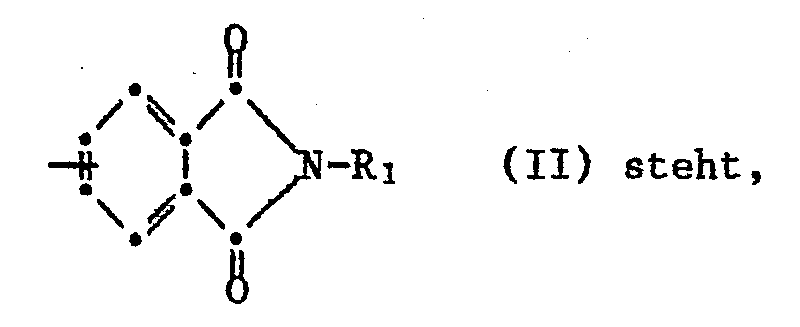
- worin R1 -H, C1-C4-Alkyl oder einen unsubstituierten oder durch nicht löslichmachende Gruppen substituierten Phenylrest bedeutet, X eine Gruppe der Formel III

- worin R2 einen unsubstituierten oder durch nichtlöslichmachende Substituenten substituierten isocyclischen oder einen heterocyclischen aromatischen Rest bedeutet, oder X ein heterocyclischer Rest, der einen ankondensierten Benzolkern aufweisen kann, ist.
- Bedeutet R1 Cl-C4-Alkyl, so handelt es sich dabei beispielsweise um Methyl, Aethyl, n-Propyl oder n-Butyl, insbesonders aber um Methyl.
- Unter nicht löslichmachenden Substituenten für den Phenylrest als R1 versteht man solche, die weder in Wasser noch in organischen Lösungsmitteln eine Lösung des Pigmentes bewirken, also beispielsweise Halogenatome, Alkyl- oder Alkoxygruppen mit 1 - 6 C-Atomen, Nitro-, Trifluormethyl-, Carbamyl-, Ureido-, Sulfamyl- oder Cyangruppen, Alkoxycarbonyl-, Alkylcarbonyl-, N-Alkylcarbamyl-, N-Alkylureido- oder Alkanoylaminogruppen mit 2 -6 C-Atomen, Alkylsulfonyl-oder N-Alkylsulfamylgruppen mit 1 - 6 C-Atomen, Aryloxycarbonyl-, Arylcarbonyl-, Aroyiamino-, Arylsulfonyl-, N-Arylcarbamyl-, N-Arylsulfamyl-, Aryl-, N-Arylureido- oder Arylazogruppen.
- Bedeutet X einen heterocyclischen Rest, der einen ankondensierten Benzolrest aufweisen kann, so handelt es sich dabei beispielsweise um einen 5- oder 6-gliedrigen Rest der Formeln


oder insbesondere der Formeln
oder bevorzugt
wobei B1 durch Chlor, Methyl oder Methoxy substituiertes oder insbesondere unsubstituiertes Phenyl, B2 Methyl, Phenyl, oder insbesondere Carbamyl oder Acetylamino und R3 und R4 unabhängig voneinander -H, C1-C4-Alkyl, unsubstituiertes oder durch Halogen, C1-C4-Alkyl, C1-C4-Alkoxy oder Phenoxy substituiertes Phenyl bedeuten. - C1-C4-Alkyl und C1-C4-Alkoxy als Phenylsubstituenten für R3 und R4 sind beispielsweise Methyl-, Aethyl-, n-Propyl-, n-Butylgruppen bzw. Methoxy-, Aethoxy-, n-Propoxy- und n-Butoxygruppen.
- Bedeutet R2 einen isocyclischen aromatischen Rest, so handelt es sich dabei beispielsweise um Phenyl oder Naphthyl, insbesonders aber um durch nicht löslichmachende Gruppen substituiertes Phenyl. Unter nicht löslichmachenden Gruppen versteht man diejenigen Gruppen, die für die Definition von R1 bereits oben angegeben worden sind.
- Stellt R2 einen heterocyclischen aromatischen Rest dar, so leitet sich dieser beispielsweise von folgenden heterocyclischen Aminen ab:
- 5-Amino-benzimidazolon, 5-Amino-l-methyl-benzimidazolon, 5-Amino-1-n-butyl-benzimidazolon, 5-Amino-l-phenyl-benzimidazolon, 5-Amino-l-p-chlorphenyl-benzimidazolon, 5-Amino-l-p-methylphenyl-benzimidazolon, 5-Amino-l-p-methoxyphenyl-benzimidazolon, 5-Amino-6-chlor-benzimidazolon, 5-Amino-6-brom-benzimidazolon, 5-Amino-6-methyl-benzimidazolon, 5-Amino-6-methoxy-benzimidazolon, 6-Aminobenzoxazolon, 5-Aminobenzoxazolon, 5-Amino-7-chlor-benzoxazolon, 6-Amino-7-chlor-benzoxazolon, 6-Amino-5-chlor-benzoxazolon, 6-Amino-5-methyl-benzoxazolon, 6-Amino-5-chlor-benzthiazolon, 6-Amino-5-methyl-benzthiazolon, 6-Aminochinazolon-4, 6-Amino-2-methyl-chinazolon-4, 6-Amino-2-methoxy-chinazolon-4, 6-Amino-7-chlor-2-methyl- chinazolon-4, 7-Aminochinazolon-4, 2-(4'-Aminophenyl)-chinazolon-4, 2-(3'-Aminophenyl)-chinazolon-4, 2-(4'-Amino-3'-methoxyphenyl)-chinazolon-4, 2-(4'-Amino-3'-chlorphenyl)-chinazolon-4, 2-(3'-Amino-4'-methylphenyl)-chinazolon-4, 6-Amino-2,4-dihydroxychinazolin, 7-Amino-phenmorpholon-3, 6-Amino-phenmorpholon-3, 7-Amino-6-chlor- phenmorpholon-3, 7-Amino-6-methyl-phenmorpholon-3, 7-Amino-6-methoxy-phenmorpholon-3, 6-Amino-chinolon-2, 6-Amino-4-methyl- chinolon-2, 7-Amino-4-methyl-chinolon-2, 7-Amino-4,6-dimethyl- chinolon-2, 6-Amino-7-chlor-4-methyl-chinolon-2, 7-Amino-4-methyl-6-methoxy-chinolon-2, 6-Amino-1,3-dihydroxy-isochinolin, 6-Amino-2,4-dihydroxy-chinolin, 6-Amino-2,3-dihydroxychinoxalin, 4-Amino-phthalsäureimid, 3- oder 4-Aminoacridon und 3- oder 4-Amino-naphthostyryl, ferner 2-Aminothiazol-1,3, 3-Amino-triazol-1,2,4, 3-Amino-5-phenyl- triazol-1,2,4, 2-Aminobenzimidazol, 2-Amino-3-N-methyl-benzimidazol, 2-Aminobenzthiazol, 2-Aminobenzoxazol, 2-Amino-chinazolon-4 und 2-Amino-chinoxalinon-3. Bevorzugt ist der Rest, der sich von 3-Amino-triazol-1,2,4 ableitet.
- Bei den oben angegebenen Gruppen, welche Halogen darstellen, handelt es sich um Chlor, Brom, Jod und Fluor, insbesonders aber um Chlor und Brom, ganz bevorzugt aber um Chlor.
- Bevorzugt sind Isoindoline der Formel IV

- worin R1' -H oder Methyl bedeutet und X1 für einen heterocyclischen aromatischen Rest, ausgewählt aus der Gruppe bestehend aus den Resten der Formeln

steht, - worin B2 eine Gruppe -CONH2 oder -NHCOCH3 ist und R3 und R4 unabhängig voneinander -H, C1-C4-Alkyl, unsubstituiertes oder durch Halogen, C1-C4-Alkyl, C1-C4-Alkoxy oder Phenoxy substituiertes Phenyl bedeuten, oder X1 für den Rest der Formel
- Besonders bevorzugt sind Isoindoline der Formel V

worin - Xz für einen Rest der Formeln

steht, und - R1' -H oder Methyl bedeutet, Y1 und Y2 unabhängig voneinander ein H-oder Chloratom, eine Alkyl-, Alkoxy-, Trifluormethyl-, Carbamyl-, N-Methylcarbamyl-, Methoxycarbonyl-, Aethoxycarbonyl-, Acetylamino-, unsubstituierte oder durch ein oder zwei Chloratome, Methyl- oder Methoxygruppen substituierte Benzoylaminogruppe und Rs und R6 unabhängig voneinander -H, -CH3 oder unsubstituiertes oder durch -Cl, -CH3 oder -OCH3 substituiertes Phenyl bedeuten. Besonders bevorzugt sind Y1 und Y2 unabhängig voneinander H, Cl, CH3 oder OCH3.
- Zu den erfindungsgemässen Verbindungen der Formel I gelangt man, wenn man das Diiminoisoindolin der Formel VI
-


und einer Verbindung der Formel XH2, worin A und X die angegebene Bedeutung haben, kondensiert. - Als Verbindungen der Formel VII werden insbesondere Verbindungen der Formel
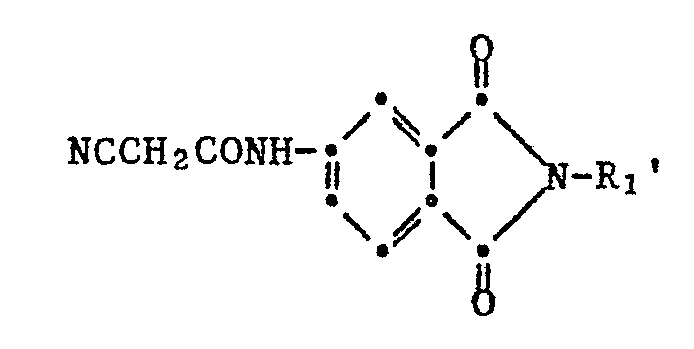
verwendet, worin R1' die oben angegebene Bedeutung hat. - Als Beispiele von Cyanacetylaminoderivaten der Formel VII seien genannt:
- 4-Cyanacetylaminophthalimid
- 3-Cyanacetylaminophthalimid
- 4-Cyanacetylaminophthal-N-methylimid
- 3-Cyanacetylaminophthal-N-methylimid
- 4-Cyanacetylaminophthal-N-äthylimid
- 4-Cyanacetylaminophthal-N-phenylimid
- 3-Cyanacetylaminophthal-N-phenylimid
- 4-Cyanacetylaminophthal-N-parachlorphenylimid
- 4-Cyanacetylaminophthal-N-paramethylphenylimid
- 4-Cyanacetylaminophthal-N-paramethoxyphenylimid
- 4-Cyanacetylaminophthal-N-4'-acetylaminophenylimid
- 4-Cyanacetylaminophthal-N-4'-methoxycarbonylphenylimid
- 4-Cyanacetylaminophthal-N-2',5'-dichlorphenylimid
- 4-Cyanacetylaminophthal-N-2'-methoxyphenylimid
- Als Beispiele von Verbindungen der Formel XH2 seien genannt: Cyanessigsäureanilid
- Cyanessigsäure-2'-, 3'- oder 4'-chloranilid
- Cyanessigsäure-2',4'-dichloranilid
- Cyanessigsäure-2',5'-dichloranilid
- Cyanessigsäure-2',3'-dichloranilid
- Cyanessigsäure-3',4'-dichloranilid
- Cyanessigsäure-3',5'-dichloranilid
- Cyanessigsäure-2',4',5'-trichloranilid
- Cyanessigsäure-3',4',5'-trichloranilid *
- Cyanessigsäure-4'-bromanilid
- Cyanessigsäure-3',4'-dibromanilid
- Cyanessigsäure-3'-chlor-4'-bromanilid
- Cyanessigsäure-3'-brom-4'-chloranilid
- Cyanessigsäure-2'-, 3'- oder 4'-methylanilid
- Cyanessigsäure-2',4'-dimethylanilid
- Cyanessigsäure-2',4',6'-trimethylanilid
- Cyanessigsäure-2'-, 3'- oder 4'-methoxyanilid
- Cyanessigsäure-4'-acetylaminoanilid
- Cyanessigsäure-4'-benzoylaminoanilid
- Cyanessigsäure-4'-p-chlor-benzoylamino-anilid
- Cyanessigsäure-4'-phthalimido-anilid
- Cyanessigsäure-2',5'-dichlor-4'-benzoylamino-anilid
- Cyanessigsäure-2',5'-dichlor-4'-p-chlorbenzoylamino-anilid
- Cyanessigsäure-2',5'-dichlor-4'-methoxy-anilid
- Cyanessigsäure-2',5'-dimethoxy-4'-benzoylamino-anilid
- Cyanessigsäure-4'-nitroanilid
- Cyanessigsäure-3'-chlor-4'-methyl-anilid
- Cyanessigsäure-2'-, 3'- oder 4'-methoxycarbonyl-anilid
- ,Cyanessigsäure-2'-, 3'- oder 4'-äthoxycarbonyl-anilid
- Cyanessigsäure-3'-trifluormethyl-anilid
- Cyanessigsäure-2',5'-diäthoxy-4'-benzoylamino-anilid
- Cyanessigsäure-2',5'-dimethoxy-4'-chloranilid
- Cyanessigsäure-4'-carbamyl-anilid
- Cyanessigsäure-3'-chlor-4'-carbamyl-anilid und
- Cyanessigsäure-2'-methyl-4'-carbamyl-anilid,
- sowie die Cyanacetylverbindungen folgender heterocyclischer aromatischer Amine:
- 5-Amino-benzimidazolon
- 5-Amino-1-methyl-benzimidazolon
- 5-Amino-6-chlor-benzimidazolon
- 5-Amino-6-methyl-banzimidazolon
- 6-Amino-chinazolon-4
- 6-Amino-2-methyl-chinazolon-4
- 7-Amino-chinazolon
- 2-(4'-Aminophenyl)-chinazolon-4
- 6-Amino-2,4-dihydroxychinazolin
- 7-Amino-phenmorpholon-3
- 6-Amino-phenmorpholon-3
- 7-Amino-6-methyl-phenmorpholon-3
- 6-Amino-chinolon-2
- 7-Aminn-4-methyl-chinnlon-2
- 6-Amino-7-chlor-4-methyl-chinolon-2 und
- 7-Amino-4,8-dimethyl-thinoion-2.
- Es handelt sich dabei um bekannte Verbindungen, die durch Erhitzen von Cyanessigester mit den entsprechenden Aminen erhalten werden.
- Weitere Beispiele von Verbindungen der Formel XHz sind: Barbitursäure
- 1,3-Dimethyl-barbitursäure
- 1,3-Diaethyl-barbitursäure
- 1-Methyl-3-phenyl-barbitursäure
- 1-Phenyl-barbitursäure
- 1-p-Chlorphenylbarbitursäure
- 1-p-Methoxyphenplbarbitursäure
- 1-Methyl-barbitursäure
- 1-Phenyl-3-acetylamino-pyrazolon(5)
- 1-Phenyl-3-carbamyl-pyrazolon(5)
- 3-phenyl-pyrazolon(5)
- 2,4-Dihydroxychinolin
- Die Herstellung der Verbindungen der Formel I erfolgt vorzugsweise durch Monokondensation des Diiminoisoindolins der Formel VI mit einer Verbindung der Formel XH2 und anschliessende Umsetzung des so erhaltenen Monokondensationsprodukts mit einer Verbindung der Formel VII.
- Die Kondensation des Diiminoisoindolins mit der Verbindung der Formel XH2 und der Verbindung der Formel VII erfolgt vorzugsweise in einem organischen Lösungsmittel, beispielsweise einem aliphatischen Alkohol mit 1-4 C-Atomen, wie Methanol, Aethanol, Isopropanol, n-Butanol, ferner Glykolen oder Glykoläthern wie Aethylenglykolmonomethyl- oder -monoäthyläther, offenkettigen oder cyclischen Amiden, wie Dimethylformamid, Dimethylacetamid oder N-Methylpyrrolidon, einem halogenierten Benzol, wie Monochlorbenzol, Di- oder Trichlorbenzole, Nitrobenzol oder einer aliphatischen Mono- oder Dicarbonsäure, wie Ameisensäure, Essigsäure, Propionsäure, Mono- oder Dichloressigsäure, Fumarsäure, Milchsäure oder Weinsäure, wobei auch Mischungen der genannten Lösungsmittel verwendet werden können. Die Umsetzung zu den Monokondensationsprodukten erfolgt vorteilhaft in neutralen organischen Lösungsmitteln, beispielsweise einem aliphatischen Alkohol mit 1-4 C-Atomen, wie Methanol, Aethanol, Isopropanol oder n-Butanol, wobei ein Ueberschuss an Diiminoisoindolin verwendet wird. Falls nötig, können sie isoliert und gereinigt werden. Der Ersatz der ersten Iminogruppe des Diiminoisoindolins erfolgt in der Regel schon bei Temperaturen unter 100°C. Der Austausch der zweiten Iminogruppe hingegen erfordert Temperaturen zwischen 100-200°C.
- Die erhaltenen Produkte fallen zumeist schon in der Hitze aus und können durch Abfiltrieren und gegebenenfalls durch Waschen mit organischen Lösungsmitteln in reiner Form isoliert werden.
- Die erfindungsgemässen Isoindoline der Formel I stellen wertvolle Pigmente dar, welche im allgemeinen eine gute Textur besitzen und meistens als Rohprodukte verwendet werden können. Falls nötig oder erwünscht, kann man die Rohprodukte durch Mahlen oder Kneten in eine feindisperse Form überführen. Dabei werden zweckmässig Mahlhilfsmittel, wie Glas-, Kunststoff-, Stahl- oder Metallmahlkörper, anorganische und/oder organische Salze in Gegenwart oder Abwesenheit organischer Lösungsmittel verwendet. Nach dem Mahlen werden Hilfsmittel wie üblich entfernt, lösliche anorganische Salze z.B. mit Wasser und wasserunlösliche organische Hilfsmittel beispielsweise durch Wasserdampfdestillation. Auch durch Behandeln der Rohpigmente mit organischen Lösungsmitteln kann oft eine Verbesserung der Pigmenteigenschaften erreicht werden.
- Ferner können die Rohpigmente durch Umfällen aus Schwefelsäure oder Hydrolyse eines in organischem Medium erzeugten Alkalimetallsalzes in eine feine Pigmentform übergeführt werden.
- Die erfindungsgemässen Verbindungen eignen sich als Pigmente zum Färben von hochmolekularem organischem Material natürlicher oder künstlicher Herkunft. Es kann sich z.B. um Naturharze, trocknende . Oele oder Kautschuk handeln. Es kann sich aber auch um abgewandelte Naturstoffe handeln, beispielsweise um Chlorkautschuk, um ölmodifizierte Alkydharze oder um Cellulosederivate, wie Viskose, Acetylcellulose und Nitrocellulose, und besonders um vollsynthetische organische Polyplaste, das heisst um Kunststoffe, die durch Polymerisation, Polykondensation und Polyaddition hergestellt sind. Aus der Klasse dieser Kunststoffe seien besonders folgende genannt: Polyäthylen, Polypropylen, Polyisobutylen, Polystyrol, Polyvinylchlorid, Polyvinylacetat, Polyacrylnitril, Polyacrylsäure-und Polymethacrylsäureester oder Polybutadien, sowie Kopolymerisate der erwähnten Monomeren, insbesonders ABS oder EVA; Polyester, insbesondere hochmolekulare Ester aromatischer Polycarbonsäuren mit polyfunktionellen Alkoholen, Polyamide; die Kondensationsprodukte von Formaldehyd mit Phenolen, die sogenannten Phenoplaste, und die Kondensationsprodukte von Formaldehyd mit Harnstoff, Thioharnstoff und Melamin, die sogenannten Aminoplaste; die als Lackharze verwendeten Polyester, und zwar sowohl gesättigte, wie z.B. Alkydharze, als auch ungesättigte, wie beispielsweise Maleinatharze, und ferner die unter dem Namen "Epoxyharze" bekannten Polyadditions- bzw. Polykondensationsprodukte von Epichlorhydrin mit Diolen oder Polyphenolen; ferner die sogenannten Thermoplasten, dh. die nicht härtbaren Polyplaste. Es sei betont, dass nicht nur die einheitlichen Verbindungen, sondern auch Gemische von Polyplasten, sowie Mischkondensate und Mischpolymerisate, wie ,z.B. solche auf Basis von Butadien, erfindungsgemäss pigmentiert werden können.
- Die mit den erfindungsgemässen Verbindungen zu pigmentierenden hochmolekularen organischen Materialien können auch im polymerisierten Zustand in gelöster Form als Filmbildnern oder Bindemitteln für Lacke oder Druckfarben vorliegen, wie z.B. Leinölfirnis, Nitrocellulose, Alkydharze, Melaminharze und Harnstoff-Formaldehydharze oder Acrylharze.
- Die Pigmentierung der hochmolekularen, organischen Substanzen mit den Verbindungen der Formel I erfolgt beispielsweise derart, dass man ein solches Produkt gegebenenfalls in Form von Masterbatches, diesen Substraten unter Verwendung von Walzwerken, Misch- oder Mahlapparaturen zumischt. Das pigmentierte Material wird hierauf nach an sich bekannten Verfahren wie Kalandrieren, Pressen, Strangpressen, Streichen, Giessen, Spinnen oder durch Spritzguss in die gewünschte endgültige Form gebracht. Oft ist es erwünscht, zur Herstellung von nicht starren Formlingen oder zur Verringerung ihrer Sprödigkeit den hochmolekularen Verbindungen vor der Verformung sogenannte Weichmacher einzuverleiben. Als solche können z.B. Ester der Phosphorsäure, Phthalsäure oder Sebacinsäure dienen. Die Weichmacher können im erfindungsgemässen Verfahren vor oder nach der Einverleibung des Pigmentfarbstoffes in die Polyplasten eingearbeitet werden. Es ist ferner möglich, zwecks Erzielung verschiedener Farbtöne den hochmolekularen, organischen Stoffen neben den Verbindungen der Formel I noch Füllstoffe bzw. andere farbgebende Bestandteile wie Weiss-, Bunt- oder Schwarzpigmente in beliebigen Mengen zuzufügen.
- Zum Pigmentieren von Lacken und Druckfarben werden die hochmolekularen organischen Materialien und die Verbindungen der Formel I gegebenenfalls zusammen mit Zusatzstoffen wie Füllmitteln, anderen Pigmenten, Siccativen oder Weichmachern, in einem gemeinsamen organischen Lösungsmittel oder Lösungsmittelgemisch fein dispergiert bzw. gelöst. Man kann dabei so verfahren, dass man die einzelnen Komponenten für sich oder auch mehrere gemeinsam dispergiert bzw. löst, und erst hierauf alle Komponenten zusammenbringt.
- Die pigmentierten hochmolekularen organischen Materialien enthalten im allgemeinen Mengen von 0,001 bis 30 Gew.-% Pigment, bezogen auf den zu pigmentierenden hochmolekularen organischen Stoff, Polyplasten und Lacke vorzugsweise 0,1 bis 5 %, Druckfarben vorzugsweise 10 bis 30 %. Die zu wählende Menge an Pigment richtet sich in erster Linie nach der gewünschten Farbstärke, ferner nach der Schichtdicke des Formlings und schliesslich gegebenenfalls auch nach dem Gehalt an Weisspigment im Polyplast.
- Die Verbindungen der Formel 1 weisen in den hochmolekularen organischen Substanzen sehr echte reine, gelbe bis rote Farbtöne auf und zeichnen sich in der Applikation durch gute Farbstärke, Licht-, Wetter-, Migrations-, Ueberlackier-, Lösungsmittel- und Hitzebeständigkeit aus. Ferner besitzen sie bei optimaler Korngrösse ein hohes Deckvermögen in der Applikation.
- Die folgenden Beispiele veranschaulichen die Erfindung.
- Beispiel 1: 3,22 g 1-(Cyan-3'-chlorphenylcarbamylmethylen)-3-imino- isoindolin und 2,7 g 4-Cyanacetylaminophthalsäure-N-methylimid werden in einem Gemisch von 50 g o-Dichlorbenzol und 20 g Essigsäure 4 Stunden bei 125°C gerührt. Das ausgefallene Produkt wird abfiltriert und mit kaltem o-Dichlorbenzol dann kaltem Methanol gewaschen. Zur Reinigung wird das noch methanolfeuchte Rohprodukt während zwei Stunden mit 60 ml Dimethylformamid bei 120°C verrührt, darauf das Produkt bei 100°C abfiltriert, mit kaltem Dimethylformamid und anschliessend kaltem Methanol gewaschen und getrocknet. Durch Mahlung beispielsweise in Diäthylenglykoldiäthyläther unter Verwendung von Natriumchlorid als Mahlkörper enthält man einen Pigmentfarbstoff der Formel

welcher PVC und Lacke in farbstarken gelben Tönen mit guter Migrations- und vorzüglicher Licht- und Wetterbeständigkeit färbt. - Beispiele 2-12: Auf analoge Weise wie in Beispiel 1 beschrieben werden die in Tabelle I aufgeführten Produkte erhalten. Sie zeichnen sich in der Applikation durch eine gute Farbstärke und Migrationsbeständigkeit aus, besitzen vorzügliche Ueberlackier-, Licht- und Wetterbeständigkeit und zeigen in mehreren Fällen ein hohes Deckvermögen.

- Beispiel 13: 3,7 g 1-Cyan-N-methylphthalimid-(4'-)ylcarbamyl- methylen-3-iminoisoindolin und 2,1 g N-4'-Methoxyphenylbarbitur- säure werden in 90 g Essigsäure während 4 Stunden bei 110°C verrührt. Das entstandene Produkt wird heiss abfiltriert und mit kalter Essigsäure dann kaltem Aethanol gewaschen. Das lösungsmittelfeuchte Produkt wird mit 60 g Dimethylformamid während 2 Stunden bei 120°C verrührt, das entstandene Produkt abfiltriert, mit kaltem Dimethylformamid dann kaltem Aethanol gewaschen und bei 80°C unter Vakuum getrocknet. Man erhält 4,4 g eines Produktes der Formel
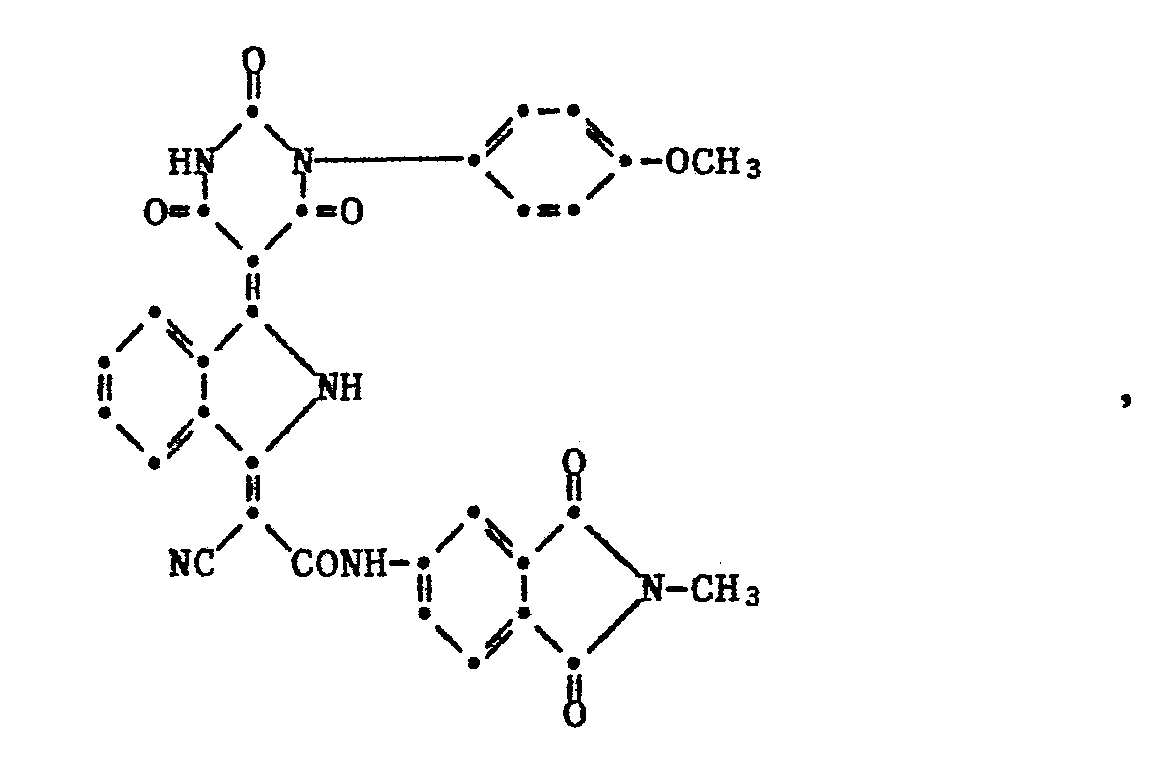
das nach Ueberführung in eine feinteilige Form in Kunststoffen und Lacken rotstichig gelbe Färbungen mit vorzüglicher Migrations-, Licht-, Wetter- und Ueberlackierbeständigkeit ergibt. - Beispiel 14-24: In analoger, gemäss Beispiel 13 beschriebener Weise werden die in Tabelle II angeführten Produkte erhalten:


- Beispiel 25: 3,57 g 1-Cyan-phthalimid-(4'-)ylcarbamylmethylen-3- iminoisoindolin und 3,05 g N-3'-Chlorphenyl-N'-methylbarbitursäure werden in 60 g Essigsäure 4 Stunden bei Siedetemperatur gerührt. Die erhaltene, gelborange Suspension wird heiss filtriert. Das isolierte Produkt wird nach Waschen mit Essigsäure und Methanol mit 60 g Dimethylformamid 2 Stunden bei 120°C verrührt, wiederum heiss abfiltriert, dann mit Dimethylformamid und anschliessend mit Methanol gewaschen und getrocknet. Nach Ueberführung in eine feindisperse Form färbt das erhaltene Pigment der Formel

- PVC und Lacke in reinen gelben Tönen.
- Beispiele 26-31: In analoger Weise wie in Beispiel 25 beschrieben, werden die in Tabelle III angeführten Produkte der nachstehenden Formel (X) erhalten:


- Beispiel 32: 3,7 g l-Cyan-N-methylphthalimid-(4'-)ylcarbamyl- methylen-3-iminoisoindolin und 1,93 g 2,4-Dihydroxychinolin werden mit 105 g o-Dichlorbenzol und 12,5 g Benzoylchlorid während 3 Stunden bei 120-125°C verrührt. Nach Zugabe von 40 g Essigsäure wird die erhaltene Suspension weitere 3 Stunden bei 115°C gehalten. Das entstandene Produkt wird abfiltriert und mit o-Dichlorbenzol und anschliessend mit Aethanol gewaschen. Das Rohprodukt wird mit 120 g Dimethylformamid 1 Stunde bei 120°C verrührt, heiss abfiltriert, mit Dimethylformamid und anschliessend mit Methanol gewaschen und getrocknet. Nach Ueberführung in eine feindisperse Form färbt das Produkt der Formel
-

- Beispiel 33: 7,3 g 1-Cyan-phthalimid-(4'-)ylcarbamylmethylen-3- iminoisoindolin und 3,2 g Barbitursäure werden in 160 g Essigsäure während 4 Stunden bei 110°C verrührt. Das ausgefallene Pigment wird heiss abfiltriert, mit Essigsäure sowie Methanol gewaschen und getrocknet. Man erhält 9.1 g (97 % d.Th.) eines Pigmentes, das nach Ueberführung in eine feinteilige Form Kunststoffe und Lacke in reinem grünstichig gelbem Ton mit sehr guter Licht- und Migrationsechtheit färbt.
- Wird das erhaltene Pigment in Dimethylformamid zwei Stunden bei 120°C behandelt und anschliessend mittels Scheibenrührer in einem Natriumchlorid-Diäthylenglykoldiäthylather-Gemisch gemahlen, so erhält man das in Beispiel 16 beschriebene rotstichig gelb färbende Pigment. Die beiden Pigmentformen zeigen unterschiedliche Röntgenpulverdiagramme.
- Beispiel 34: 2,9 g 1-Cyan-phenylcarbamylmethylen-3-iminoisoindolin und 3,5 g 4-Cyanacetylamino-N-phenylphthalimid werden in einem Gemisch von 25 g Essigsäure und 65 g o-Dichlorbenzol vier Stunden bei 120-125°C verrührt. Das ausgefallene Pigment wird abfiltriert, mit o-Dichlorbenzol sowie Methanol gewaschen und getrocknet. Das Pigment der Formel:

färbt Kunststoffe und Lacke in rotstichig gelbem Ton mit sehr guten Echtheitseigenschaften. - Beispiel 35: 3,22 g 1-Cyan-4'-chlorphenylcarbamylmethylen-3-imino- isoindolin und 3,5 g 4-Cyanacetylamino-N-phenylphthalimid werden in 60 g Essigsäure vier Stunden bei 110°C verrührt. Das ausgefallene Pigment wird heiss abfiltriert und mit Essigsäure sowie Aethanol gewaschen. Das alkoholfeuchte Produkt wird mit 100 g Dimethylformamid zwei Stunden bei 120°C verrührt, heiss abfiltriert, mit Dimethylformamid sowie Methanol gewaschen und getrocknet. Das erhaltene Pigment färbt Kunststoffe und Lacke in rotstichig gelbem Ton mit sehr guten Echtheitseigenschaften.
- Beispiel 36: Die Mischung von 3,0 g 1-Cyan-N-phenylphthalimid-(4')ylcarbamylmethylen-3-iminoisoindolin, 1,3 g Barbitursäure und 70 g Essigsäure wird vier Stunden bei 114°C verrührt. Das ausgefallene Pigment wird heiss abfiltriert, mit Essigsäure sowie Aethanol gewaschen und getrocknet. Man erhält 3,7 g eines Pigmentes, das nach Ueberführung in eine feinteilige Form Kunststoffe und Lacke in gelbem Ton mit guten Echtheitseigenschaften färbt.
- Beispiel 37: 3,22 g 1-Cyan-4'-chlorphenylcarbamylmethylen-3-imino- isoindolin und 3,5 g 3-Cyanacetylamino-N-phenylphtalimid werden in einem Gemisch von 65 g o-Dichlorbenzol und 25 g Essigsäure vier Stunden bei 120°C gerührt. Das entstandene Pigment wird heiss abfiltriert, mit o-Dichlorbenzol sowie Aethanol gewaschen und darauf mit 80 g Dimethylformamid während zwei Stunden bei 120°C verrührt. Das Pigment wird heiss abfiltriert, mit Dimethylformamid sowie Methanol gewaschen und getrocknet. Nach Ueberführung in eine feinteilige Form erhält man ein Kunststoffe und Lacke in gelbem Ton mit sehr guten Echtheitseigenschaften färbendes Pigment der Formel:

- Beispiel 38: Aus 1-Cyan-3',4'-dichlorphenylearbamylmethylen-3- iminoisoindolin und 3-Cyanacetylamino-N-phenylphthalimid erhält man analog Beispiel 37 ein Pigment, das Kunststoffe und Lacke in sehr echtem gelben Ton färbt.
- Beispiel 39: 2,8 g I-Cyan-N-phenylphthalimid-(4')ylcarbamylmethylen-3-iminoisoindolin und 1,8 g 1-Phenyl-3-acetylaminopyrazolon(5) werden in 70 g Essigsäure 15 Stunden bei 110°C verrührt. Das in üblicher Weise abgetrennte Produkt wird in 70 g Dimethylformamid zwei Stunden bei 120°C verrührt. Nach Abkühlen auf 70°C wird das dunkle Pigment abfiltriert, mit Dimethylformamid sowie Methanol gewaschen und getrocknet. Nach Ueberführen in eine feinteilige Form erhält man ein Pigment, das Kunststoffe und Lacke in braunem Ton mit sehr guten Echtheitseigenschaften färbt.
- Beispiel 40: 2,32 g 1-Cyan-phenylcarbamylmethylen-3-iminoisoindolin und 2,3 g 3-Cyanacetylaminophthalimid werden in einem Gemisch von 65 g o-Dichlorbenzol und 25 g Essigsäure vier Stunden bei 120°C verrührt. Das in üblicher Weise isolierte Pigment wird anschliessend mit 70 g Dimethylformamid zwei Stunden bei 120°C verrührt, isoliert und in eine feinteilige Form übergeführt. Es färbt Kunststoffe und Lacke in licht- und migrationsechtem gelben Ton.
- Beispiel 41: Verwendet man als Halbkondensat 1-Cyan-3'-chlorphenyl- carbamylmethylen-3-iminoisoindolin und verfährt im übrigen analog Beispiel 40, so erhält man ein Kunstoffe und Lacke in grünstichig gelbem Ton färbendes Pigment.
- Beispiel 42: Ersetzt man in Beispiel 40 das dort verwendete Halbkondensat durch l-Cyan-4'-chlorphenylcarbamylmethylen-3-imino- isoindolin, so erhält man ein Pigment, das Kunststoffe und Lacke in gelbem Ton mit sehr guten Echtheitseigenschaften färbt.
- Beispiel 43: Durch Umsetzung von

- Beispiel 44: 2,4 g 1-Cyan-N-n-propylphthalimid(4')ylcarbamyl- methylen-3-iminoisoindolin und 1,56 g 1-Phenyl-3-acetylamino- pyrazolon(5) werden in einem Gemisch von 60 g Essigsäure und 10 g Ameisensäure 98 X eine Stunde bei 110°C verrUhrt. Das entstandene dunkle Pigment wird heiss abfiltriert, mit Essigsäure sowie Aethanol gewaschen und darauf in 40 g Dimethylformamid bei 120°C 15 Min. verrührt. Man lässt die Lösung auf 20°C abkühlen, filtriert das ausgefallene Pigment ab und wäscht es mit Dimethylformamid sowie Methanol. Nach Ueberführung in eine feinteilige Form färbt das Pigment Kunststoffe und Lacke in braunem Ton von sehr guter Migrations- und guter Lichtechtheit.
- Beispiel 45: Die Mischung von 2,8 g 1-Cyan-1',2',4'-triazolyl-(3')-carbamylmethylen-3-iminoisoindolin, 2,92 g 4-Cyanacetylamino-N-methylphthalimid, 60 g Essigsäure und 10 g Ameisensäure 98 % wird vier Stunden bei 110°C verrührt. Das entstandene Pigment wird heiss abfiltriert, mit Essigsäure sowie Aethanol gewaschen und mit 70 g Dimethylformamid zwei Stunden bei 120°C gerührt. Das Pigment wird abfiltriert, mit Dimethylformamid sowie Methanol gewaschen und getrocknet. Nach Ueberführung in eine feinteilige Form erhält man ein Pigment, das Kunststoffe und Lacke in gelbem Ton mit guten Echtheitseigenschaften färbt.
- Beispiel 46: 2,25 g 1-[Cyan-(4'methylen-N-phthalimid)-phenyl- carbamylmethylen]-3-isoindolin und 1,4 g 4-Cyanacetylaminophthalimid werden in 60 g Essigsäure unter Rühren vier Stunden auf 115°C erhitzt. Das entstandene Pigment wird abfiltriert, mit Essigsäure sowie Aethanol gewaschen und darauf mit 60 g Dimethylformamid 2 Stunden bei 120°C verrührt. Das isolierte Pigment färbt nach Ueberführung in eine feinteilige Form Kunststoffe und Lacke in rotstichig gelbem Ton und zeigt gute Echtheitseigenschaften.
- Beispiel 47: Verwendet man 1,5 g 4-Cyanacetylamino-N-methylphthalimid und verfährt im Übrigen analog Beispiel 46, so erhält man ein Pigment, das in seinen Eigenschaften jenem gemäss Beispiel 46 sehr ähnlich ist.
- Beispiel 48: 2,25 g 1-[Cyan-(4'-methylen-N-phthalimid)-phenyl- carbamylmethylen]-3-isoindolin und 1,4 g 3-Cyanacetylaminophthalimid werden in 60 g Essigsäure vier Stunden bei 115°C verrührt. Die Aufarbeitung gemäss Beispiel 46 liefert ein Pigment, das Kunststoffe und Lacke in rotstichig gelbem Ton mit guten Echtheitseigenschaften färbt. Es entspricht'der Formel
-

-
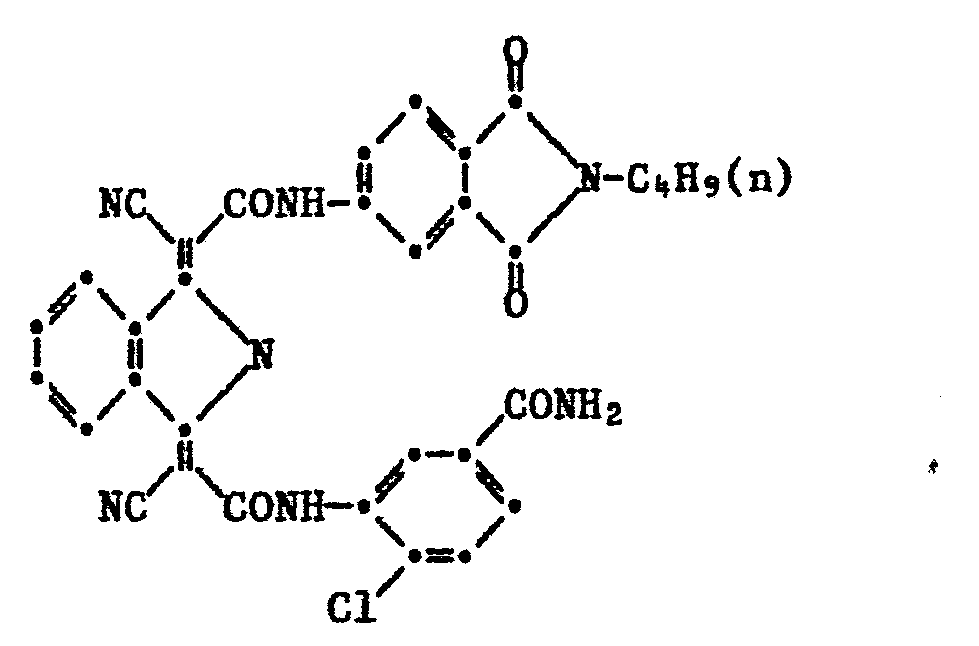
-
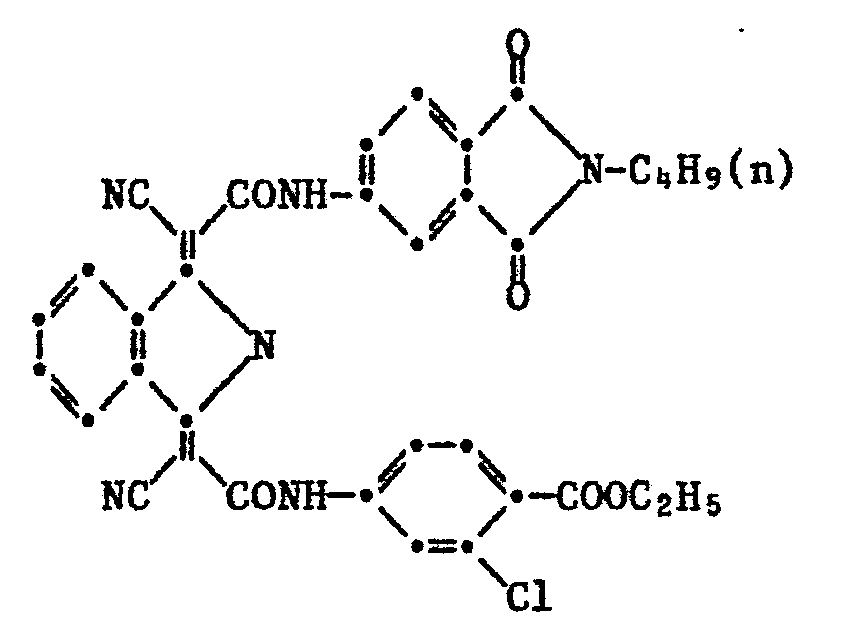
- Beispiel 51: 2,6 g 1-Cyan-4'carbomethoxyphenylcarbamylmethylen-3- iminoisoindolin und 2,3 g 4-Cyanacetylaminophthalimid werden in 40 g Essigsäure während 4 Stunden bei 110-115°C verrührt. Das entstandene Pigment wird bei 90°C abfiltriert, mit Essigsäure sowie Methanol gewaschen und getrocknet. Man erhält 3,3 g des Pigmentes der Formel:

- Das Pigment färbt nach Ueberführung in eine feinteilige Form Kunststoffe und Lacke in rotstichig gelbem Ton.
- Beispiel 52: 3,3 g 1-Cyan-N-n-butylphthalimid-(4'-)ylcarbamyl- methylen-3-iminoisoindolin und 3,0 g 1-Cyanacetylamino-2-chlor-5-trifluormethylbenzol werden in 40 g Essigsäure 4 Stunden bei 110-115°C verrührt. Der Niederschlag wird bei 90°C abfiltriert, mit Essigsäure sowie Methanol gewaschen, alsdann mit 80 g Dimethylformamid 2 Stunden bei 80°C verrührt. Das bei 80°C abfiltrierte und in üblicher Weise gewaschene und getrocknete Pigment färbt nach Ueberführung in eine feinteilige Form PVC und Lacke in grünstichig gelbem Ton. Es entspricht der Formel:


steht, worin R5 unsubstituiertes oder durch eine oder zwei nichtlöslich machende Substituenten substituiertes Phenyl oder eine Gruppe

bedeutet.
Claims (9)
1. Isoindoline der Formel I

worin A für eine Gruppe der Formel II
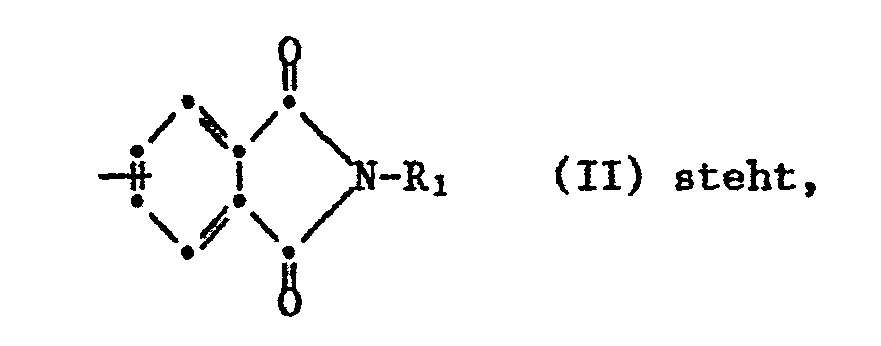
worin R1 -H, C1-C4-Alkyl oder einen unsubstituierten oder durch nicht löslichmachende Gruppen substituierten Phenylrest bedeutet, X eine Gruppe der Formel III

worin R2 einen unsubstituierten oder durch nichtlöslichmachende Substituenten substituierten isocyclischen oder einen heterocyclischen aromatischen Rest bedeutet, oder X ein heterocyclischer Rest, der einen ankondensierten Benzolkern aufweisen kann, ist.
2. Isoindoline gemäss Anspruch 1 der Formel IV

steht, worin R5 unsubstituiertes oder durch eine oder zwei nicht löslichmachende Substituenten substituiertes Phenyl oder eine Gruppe 
bedeutet.
worin R1' -H oder Methyl bedeutet und X1 für einen heterocyclischen Rest, ausgewählt aus der Gruppe bestehend aus den Restes der Formeln

steht,
steht,
worin B2 eine Gruppe -CONH2 oder -NHCOCH3 ist und R3 und R4 unabhängig voneinander -H, C1-C4-Alkyl, unsubstituiertes oder durch Halogen, C1-C4-Alkyl, C1-C4-Alkoxy oder Phenoxy substituiertes Phenyl bedeuten, oder X1 für den Rest der Formel

steht, worin R5 unsubstituiertes oder durch eine oder zwei nicht löslichmachende Substituenten substituiertes Phenyl oder eine Gruppe
bedeutet.
3. Isoindoline gemäss Anspruch 1 der Formel V

worin
X2 für einen Rest der Formeln 
steht und R1' -H oder Methyl bedeutet, Y3 und Y2 unabhängig voneinander ein H- oder Chloratom, eine Alkyl-, Alkoxy-, Trifluormethyl-, Carbamyl-, N-Methylcarbamyl-, Methoxycarbonyl-, Aethoxycarbonyl-, Acetylamino, unsubstituierte oder durch ein oder zwei Chloratome, Methyl- oder Methoxygruppen substituierte Benzoylaminogruppe und R5 und R6 unabhängig voneinander -H, -CH3 oder unsubstituiertes oder durch -Cl, -CH3 oder -OCH3 substituiertes Phenyl bedeuten.
worin
X2 für einen Rest der Formeln
steht und R1' -H oder Methyl bedeutet, Y3 und Y2 unabhängig voneinander ein H- oder Chloratom, eine Alkyl-, Alkoxy-, Trifluormethyl-, Carbamyl-, N-Methylcarbamyl-, Methoxycarbonyl-, Aethoxycarbonyl-, Acetylamino, unsubstituierte oder durch ein oder zwei Chloratome, Methyl- oder Methoxygruppen substituierte Benzoylaminogruppe und R5 und R6 unabhängig voneinander -H, -CH3 oder unsubstituiertes oder durch -Cl, -CH3 oder -OCH3 substituiertes Phenyl bedeuten.
4. Isoindolin gemäss Anspruch 3, dadurch gekennzeichnet, dass Y1 und Y2 unabhängig voneinander -H, -Cl, -CH3 oder -OCH3 bedeuten.
5. Verfahren zur Herstellung von Isoindolinen der Formel I

worin A für eine Gruppe der Formel II 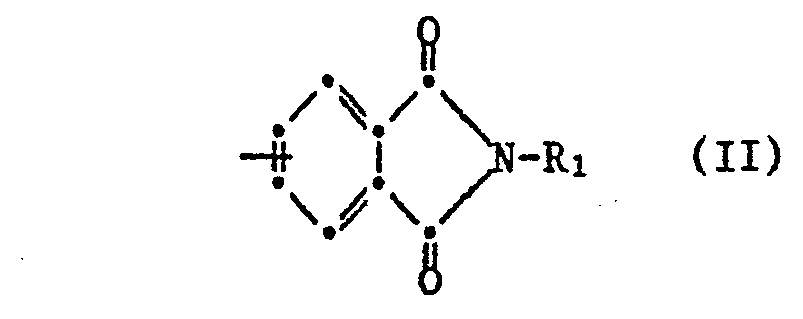
steht, 
worin R2 einen unsubstituierten oder durch nichtlöslichmachende Substituenten substituierten isocyclischen oder einen heterocyclischen aromatischen Rest bedeutet, oder X ein heterocyclischer Rest, der einen ankondensierten Benzolkern aufweisen kann, ist, dadurch gekennzeichnet, dass man in beliebiger Reihenfolge Diiminoisoindolin der Formel VI

mit je einem Mol eines Cyanacetanilides der Formel NC-CH2CONHA und der Verbindung der Formel XH2 kondensiert, wobei A und X die oben in diesem Anspruch angegebene Bedeutung haben.
worin A für eine Gruppe der Formel II
steht,
worin R1 -H, C1-C4-Alkyl oder einen unsubstituierten oder durch nichtlöslichmachende Gruppen substituierten Phenylrest bedeutet, X eine Gruppe der Formel III
mit je einem Mol eines Cyanacetanilides der Formel NC-CH2CONHA und der Verbindung der Formel XH2 kondensiert, wobei A und X die oben in diesem Anspruch angegebene Bedeutung haben.
6. Verfahren gemäss Anspruch 5, dadurch gekennzeichnet, dass man Diiminoisoindolin mit je einem Mol eines Cyanacetamides der Formeln

und 
kondensiert, wobei R1' -H oder Methyl, Y1 und Yz unabhängig voneinander ein H- oder Chloratom, eine Alkyl-, Alkoxy-, Trifluormethyl-, Carbamyl-, N-Methylcarbamyl-, Methoxycarbonyl-, Aethoxycarbonyl-, Acetylamino, unsubstituierte oder durch ein oder zwei Chloratome, Methyl- oder Methoxygruppen substituierte Benzoylaminogruppe bedeuten.
und
kondensiert, wobei R1' -H oder Methyl, Y1 und Yz unabhängig voneinander ein H- oder Chloratom, eine Alkyl-, Alkoxy-, Trifluormethyl-, Carbamyl-, N-Methylcarbamyl-, Methoxycarbonyl-, Aethoxycarbonyl-, Acetylamino, unsubstituierte oder durch ein oder zwei Chloratome, Methyl- oder Methoxygruppen substituierte Benzoylaminogruppe bedeuten.
7. Verfahren gemäss Anspruch 5, dadurch gekennzeichnet, dass man Diiminoisoindolin mit je einem Mol der Verbindungen der Formeln

und 
kondensiert, wobei
und
kondensiert, wobei
R1' -H oder Methyl und R5 und R6 unabhängig voneinander -H oder unsubstituiertes oder durch -Cl, -CH3 oder -OCH3 substituiertes Phenyl bedeuten.
8. Verfahren zum Pigmentieren von hochmolekularem organischem Material, dadurch gekennzeichnet, dass Isoindoline der Formel I gemäss Anspruch 1 verwendet werden.
9. Hochmolekulares organisches Material enthaltend als Pigment ein Isoindolin der Formel I gemäss Anspruch 1.
Applications Claiming Priority (2)
| Application Number | Priority Date | Filing Date | Title |
|---|---|---|---|
| CH601484 | 1984-12-19 | ||
| CH6014/84 | 1984-12-19 |
Publications (1)
| Publication Number | Publication Date |
|---|---|
| EP0185618A2 true EP0185618A2 (de) | 1986-06-25 |
Family
ID=4302858
Family Applications (1)
| Application Number | Title | Priority Date | Filing Date |
|---|---|---|---|
| EP19850810594 Withdrawn EP0185618A2 (de) | 1984-12-19 | 1985-12-13 | Isoindoline, Verfahren zu deren Herstellung und Verwendung |
Country Status (2)
| Country | Link |
|---|---|
| EP (1) | EP0185618A2 (de) |
| JP (1) | JPS61151268A (de) |
Cited By (2)
| Publication number | Priority date | Publication date | Assignee | Title |
|---|---|---|---|---|
| EP0322359A3 (en) * | 1987-12-21 | 1990-08-22 | Ciba-Geigy Ag | Isoindoline pigments containing at least a triazolopyrimidone rest |
| WO2025230124A1 (ko) * | 2024-04-30 | 2025-11-06 | 삼성에스디아이 주식회사 | 화합물 및 이를 포함하는 안료분산액 |
Families Citing this family (3)
| Publication number | Priority date | Publication date | Assignee | Title |
|---|---|---|---|---|
| JP3174244B2 (ja) * | 1995-06-15 | 2001-06-11 | 矢崎総業株式会社 | 点火プラグ用プラグキャップ |
| JP7676976B2 (ja) * | 2021-06-10 | 2025-05-15 | artience株式会社 | インキセット、印刷物、及び包装材料 |
| JP7552935B2 (ja) * | 2022-06-13 | 2024-09-18 | Dic株式会社 | イソインドリン化合物 |
-
1985
- 1985-12-13 EP EP19850810594 patent/EP0185618A2/de not_active Withdrawn
- 1985-12-19 JP JP28682985A patent/JPS61151268A/ja active Pending
Cited By (2)
| Publication number | Priority date | Publication date | Assignee | Title |
|---|---|---|---|---|
| EP0322359A3 (en) * | 1987-12-21 | 1990-08-22 | Ciba-Geigy Ag | Isoindoline pigments containing at least a triazolopyrimidone rest |
| WO2025230124A1 (ko) * | 2024-04-30 | 2025-11-06 | 삼성에스디아이 주식회사 | 화합물 및 이를 포함하는 안료분산액 |
Also Published As
| Publication number | Publication date |
|---|---|
| JPS61151268A (ja) | 1986-07-09 |
Similar Documents
| Publication | Publication Date | Title |
|---|---|---|
| DE2814526C2 (de) | ||
| EP0133156B1 (de) | Neue 1,4-Diketopyrrolo-(3,4-c)-pyrrole | |
| CH488786A (de) | Verfahren zur Herstellung von Disazopigmenten | |
| EP0029007A1 (de) | Isoindolinpigmente, Verfahren zu deren Herstellung und Verwendung | |
| DE2425594A1 (de) | Iminoisoindolinpigmente und verfahren zu deren herstellung | |
| EP0051560B1 (de) | Heterocyclen enthaltende Monoazopigmente, Verfahren zu deren Herstellung und deren Verwendung | |
| EP0020299A1 (de) | Nickelkomplexe von Azinen, Verfahren zu deren Herstellung, Verfahren zum Pigmentieren hochmolekularen organischen Materials sowie das so enthaltene Material | |
| EP0162806B1 (de) | Monoazoverbindungen enthaltend mindestens eine Carbonamidgruppe | |
| US4525591A (en) | 2,4-Dioxotetrahydropyrimido-(1,2-a)-benzimidazole substituted isoindoline dyes and their use | |
| US4052410A (en) | Iminoisoindoline pigments | |
| EP0169167A2 (de) | Verfahren zum Färben von hochmolekularem organischem Material und neue Metallkomplexe | |
| DE2247009C3 (de) | Iminoisoindolinonfarbstoffe und Verwendung zum Pigmentieren von hochmolekularem organischem Material | |
| EP0006154B1 (de) | Monoazopigmente und deren Verwendung zum Pigmentieren von hochmolekularem organischem Material | |
| EP0015570B1 (de) | Isoindolinpigmente und deren Verwendung | |
| DE2728864A1 (de) | Metallkomplexpigmente | |
| CH617450A5 (de) | ||
| CH627200A5 (en) | Process for preparing new monoazo pigments and use thereof for pigmenting macromolecular organic material | |
| EP0036835A1 (de) | Verfahren zur Herstellung von Metallkomplexen von Isoindolinazinen | |
| DE2145422B2 (de) | Neue Disazopigmente | |
| EP0442846A2 (de) | Disazoverbindungen mit langkettigen Alkylester- oder Alkylamidresten | |
| DE2447228A1 (de) | Perinon-verbindungen, verfahren zu deren herstellung und ihre verwendung als farbmittel | |
| DE1569768C (de) | Pigmente, deren Herstellung und Ver Wendung | |
| DE1544429A1 (de) | Verfahren zur Herstellung neuer Disazopigmente | |
| EP0183651A2 (de) | Neue Metallkomplexe, Verfahren zu deren Herstellung und Verwendung | |
| US4966930A (en) | Process for coloring high molecular weight organic material with pigments based on iminoisoindoline |
Legal Events
| Date | Code | Title | Description |
|---|---|---|---|
| PUAI | Public reference made under article 153(3) epc to a published international application that has entered the european phase |
Free format text: ORIGINAL CODE: 0009012 |
|
| 17P | Request for examination filed |
Effective date: 19851216 |
|
| AK | Designated contracting states |
Kind code of ref document: A2 Designated state(s): CH DE FR GB IT LI |
|
| STAA | Information on the status of an ep patent application or granted ep patent |
Free format text: STATUS: THE APPLICATION IS DEEMED TO BE WITHDRAWN |
|
| 18D | Application deemed to be withdrawn |
Effective date: 19880705 |
|
| RIN1 | Information on inventor provided before grant (corrected) |
Inventor name: JOST, MAX Inventor name: VON DER CRONE, JOST, DR. |