EP0006154B1 - Monoazopigmente und deren Verwendung zum Pigmentieren von hochmolekularem organischem Material - Google Patents
Monoazopigmente und deren Verwendung zum Pigmentieren von hochmolekularem organischem Material Download PDFInfo
- Publication number
- EP0006154B1 EP0006154B1 EP79101651A EP79101651A EP0006154B1 EP 0006154 B1 EP0006154 B1 EP 0006154B1 EP 79101651 A EP79101651 A EP 79101651A EP 79101651 A EP79101651 A EP 79101651A EP 0006154 B1 EP0006154 B1 EP 0006154B1
- Authority
- EP
- European Patent Office
- Prior art keywords
- amino
- methyl
- carbonsäure
- carboxylic acid
- group
- Prior art date
- Legal status (The legal status is an assumption and is not a legal conclusion. Google has not performed a legal analysis and makes no representation as to the accuracy of the status listed.)
- Expired
Links
- 239000000049 pigment Substances 0.000 title claims description 31
- 239000011368 organic material Substances 0.000 title claims description 5
- NYGZLYXAPMMJTE-UHFFFAOYSA-M metanil yellow Chemical group [Na+].[O-]S(=O)(=O)C1=CC=CC(N=NC=2C=CC(NC=3C=CC=CC=3)=CC=2)=C1 NYGZLYXAPMMJTE-UHFFFAOYSA-M 0.000 title claims description 4
- 238000004040 coloring Methods 0.000 title description 4
- 125000000217 alkyl group Chemical group 0.000 claims description 8
- 238000000034 method Methods 0.000 claims description 7
- 125000004432 carbon atom Chemical group C* 0.000 claims description 6
- 125000002496 methyl group Chemical group [H]C([H])([H])* 0.000 claims description 5
- 125000003545 alkoxy group Chemical group 0.000 claims description 4
- 229910052736 halogen Inorganic materials 0.000 claims description 4
- 150000002367 halogens Chemical class 0.000 claims description 4
- 230000008569 process Effects 0.000 claims description 4
- 125000001495 ethyl group Chemical group [H]C([H])([H])C([H])([H])* 0.000 claims description 3
- 125000001997 phenyl group Chemical group [H]C1=C([H])C([H])=C(*)C([H])=C1[H] 0.000 claims description 3
- ZAMOUSCENKQFHK-UHFFFAOYSA-N Chlorine atom Chemical compound [Cl] ZAMOUSCENKQFHK-UHFFFAOYSA-N 0.000 claims description 2
- 125000001797 benzyl group Chemical group [H]C1=C([H])C([H])=C(C([H])=C1[H])C([H])([H])* 0.000 claims description 2
- 239000000460 chlorine Substances 0.000 claims description 2
- 229910052801 chlorine Inorganic materials 0.000 claims description 2
- 125000004093 cyano group Chemical group *C#N 0.000 claims description 2
- 239000001257 hydrogen Substances 0.000 claims description 2
- 229910052739 hydrogen Inorganic materials 0.000 claims description 2
- 125000004435 hydrogen atom Chemical class [H]* 0.000 claims description 2
- 239000000463 material Substances 0.000 claims description 2
- 125000002023 trifluoromethyl group Chemical group FC(F)(F)* 0.000 claims description 2
- 230000000485 pigmenting effect Effects 0.000 claims 1
- ZMXDDKWLCZADIW-UHFFFAOYSA-N N,N-Dimethylformamide Chemical compound CN(C)C=O ZMXDDKWLCZADIW-UHFFFAOYSA-N 0.000 description 18
- 239000000243 solution Substances 0.000 description 18
- XKFIFYROMAAUDL-UHFFFAOYSA-N 3-amino-4-methylbenzoic acid Chemical compound CC1=CC=C(C(O)=O)C=C1N XKFIFYROMAAUDL-UHFFFAOYSA-N 0.000 description 12
- OKKJLVBELUTLKV-UHFFFAOYSA-N Methanol Chemical compound OC OKKJLVBELUTLKV-UHFFFAOYSA-N 0.000 description 9
- 230000008878 coupling Effects 0.000 description 9
- 238000010168 coupling process Methods 0.000 description 9
- 238000005859 coupling reaction Methods 0.000 description 9
- XLYOFNOQVPJJNP-UHFFFAOYSA-N water Substances O XLYOFNOQVPJJNP-UHFFFAOYSA-N 0.000 description 9
- DMGFVJVLVZOSOE-UHFFFAOYSA-N 3-amino-4-chlorobenzoic acid Chemical compound NC1=CC(C(O)=O)=CC=C1Cl DMGFVJVLVZOSOE-UHFFFAOYSA-N 0.000 description 8
- LRHPLDYGYMQRHN-UHFFFAOYSA-N N-Butanol Chemical compound CCCCO LRHPLDYGYMQRHN-UHFFFAOYSA-N 0.000 description 8
- MVPPADPHJFYWMZ-UHFFFAOYSA-N chlorobenzene Chemical compound ClC1=CC=CC=C1 MVPPADPHJFYWMZ-UHFFFAOYSA-N 0.000 description 8
- YTPLMLYBLZKORZ-UHFFFAOYSA-N Thiophene Chemical compound C=1C=CSC=1 YTPLMLYBLZKORZ-UHFFFAOYSA-N 0.000 description 7
- GWEVSGVZZGPLCZ-UHFFFAOYSA-N Titan oxide Chemical compound O=[Ti]=O GWEVSGVZZGPLCZ-UHFFFAOYSA-N 0.000 description 7
- -1 2-Amino-3-cyan-4-methyl-thiophenecarboxylic acid ethyl ester Chemical compound 0.000 description 6
- WSFSSNUMVMOOMR-UHFFFAOYSA-N Formaldehyde Chemical compound O=C WSFSSNUMVMOOMR-UHFFFAOYSA-N 0.000 description 6
- HEMHJVSKTPXQMS-UHFFFAOYSA-M Sodium hydroxide Chemical compound [OH-].[Na+] HEMHJVSKTPXQMS-UHFFFAOYSA-M 0.000 description 6
- YXFVVABEGXRONW-UHFFFAOYSA-N Toluene Chemical compound CC1=CC=CC=C1 YXFVVABEGXRONW-UHFFFAOYSA-N 0.000 description 6
- 239000000975 dye Substances 0.000 description 6
- 238000002156 mixing Methods 0.000 description 6
- 239000003960 organic solvent Substances 0.000 description 6
- 238000007639 printing Methods 0.000 description 6
- 239000000047 product Substances 0.000 description 6
- LPXPTNMVRIOKMN-UHFFFAOYSA-M sodium nitrite Chemical compound [Na+].[O-]N=O LPXPTNMVRIOKMN-UHFFFAOYSA-M 0.000 description 6
- LFQSCWFLJHTTHZ-UHFFFAOYSA-N Ethanol Chemical compound CCO LFQSCWFLJHTTHZ-UHFFFAOYSA-N 0.000 description 5
- XSQUKJJJFZCRTK-UHFFFAOYSA-N Urea Chemical compound NC(N)=O XSQUKJJJFZCRTK-UHFFFAOYSA-N 0.000 description 5
- 150000001412 amines Chemical class 0.000 description 5
- 150000001875 compounds Chemical class 0.000 description 5
- 125000000664 diazo group Chemical group [N-]=[N+]=[*] 0.000 description 5
- 239000004922 lacquer Substances 0.000 description 5
- FDGAEAYZQQCBRN-UHFFFAOYSA-N 3-amino-4-methoxybenzoic acid Chemical compound COC1=CC=C(C(O)=O)C=C1N FDGAEAYZQQCBRN-UHFFFAOYSA-N 0.000 description 4
- VEXZGXHMUGYJMC-UHFFFAOYSA-N Hydrochloric acid Chemical compound Cl VEXZGXHMUGYJMC-UHFFFAOYSA-N 0.000 description 4
- JUJWROOIHBZHMG-UHFFFAOYSA-N Pyridine Chemical compound C1=CC=NC=C1 JUJWROOIHBZHMG-UHFFFAOYSA-N 0.000 description 4
- 229920000180 alkyd Polymers 0.000 description 4
- 150000002148 esters Chemical class 0.000 description 4
- 238000000227 grinding Methods 0.000 description 4
- LQNUZADURLCDLV-UHFFFAOYSA-N nitrobenzene Chemical compound [O-][N+](=O)C1=CC=CC=C1 LQNUZADURLCDLV-UHFFFAOYSA-N 0.000 description 4
- 229920000915 polyvinyl chloride Polymers 0.000 description 4
- 239000004800 polyvinyl chloride Substances 0.000 description 4
- 229920005989 resin Polymers 0.000 description 4
- 239000011347 resin Substances 0.000 description 4
- 239000000725 suspension Substances 0.000 description 4
- 229930192474 thiophene Natural products 0.000 description 4
- 239000008096 xylene Substances 0.000 description 4
- ZWEHNKRNPOVVGH-UHFFFAOYSA-N 2-Butanone Chemical compound CCC(C)=O ZWEHNKRNPOVVGH-UHFFFAOYSA-N 0.000 description 3
- CSCPPACGZOOCGX-UHFFFAOYSA-N Acetone Chemical compound CC(C)=O CSCPPACGZOOCGX-UHFFFAOYSA-N 0.000 description 3
- UHOVQNZJYSORNB-UHFFFAOYSA-N Benzene Chemical compound C1=CC=CC=C1 UHOVQNZJYSORNB-UHFFFAOYSA-N 0.000 description 3
- 229920000877 Melamine resin Polymers 0.000 description 3
- CTQNGGLPUBDAKN-UHFFFAOYSA-N O-Xylene Chemical compound CC1=CC=CC=C1C CTQNGGLPUBDAKN-UHFFFAOYSA-N 0.000 description 3
- 239000011248 coating agent Substances 0.000 description 3
- 238000000576 coating method Methods 0.000 description 3
- 150000008049 diazo compounds Chemical class 0.000 description 3
- 238000001035 drying Methods 0.000 description 3
- 239000000944 linseed oil Substances 0.000 description 3
- 235000021388 linseed oil Nutrition 0.000 description 3
- 230000005012 migration Effects 0.000 description 3
- 238000013508 migration Methods 0.000 description 3
- 239000000203 mixture Substances 0.000 description 3
- 238000000465 moulding Methods 0.000 description 3
- 239000003921 oil Substances 0.000 description 3
- 235000019198 oils Nutrition 0.000 description 3
- 239000004014 plasticizer Substances 0.000 description 3
- 238000006068 polycondensation reaction Methods 0.000 description 3
- 239000002244 precipitate Substances 0.000 description 3
- 150000003839 salts Chemical class 0.000 description 3
- 235000010288 sodium nitrite Nutrition 0.000 description 3
- 239000000126 substance Substances 0.000 description 3
- 239000004408 titanium dioxide Substances 0.000 description 3
- 239000002966 varnish Substances 0.000 description 3
- RFFLAFLAYFXFSW-UHFFFAOYSA-N 1,2-dichlorobenzene Chemical compound ClC1=CC=CC=C1Cl RFFLAFLAYFXFSW-UHFFFAOYSA-N 0.000 description 2
- TURRCFYSJTWMPE-UHFFFAOYSA-N 3-amino-4-chloro-n-[2-chloro-5-(trifluoromethyl)phenyl]benzamide Chemical compound C1=C(Cl)C(N)=CC(C(=O)NC=2C(=CC=C(C=2)C(F)(F)F)Cl)=C1 TURRCFYSJTWMPE-UHFFFAOYSA-N 0.000 description 2
- JKDBEPYYWWSPKJ-UHFFFAOYSA-N 3-amino-4-chloro-n-phenylbenzamide Chemical compound C1=C(Cl)C(N)=CC(C(=O)NC=2C=CC=CC=2)=C1 JKDBEPYYWWSPKJ-UHFFFAOYSA-N 0.000 description 2
- HDUINBMMWMTTLC-UHFFFAOYSA-N 3-amino-4-ethoxybenzoic acid Chemical compound CCOC1=CC=C(C(O)=O)C=C1N HDUINBMMWMTTLC-UHFFFAOYSA-N 0.000 description 2
- GWQAKTJQXQZZNO-UHFFFAOYSA-N 5-amino-2,4-dichlorobenzoic acid Chemical compound NC1=CC(C(O)=O)=C(Cl)C=C1Cl GWQAKTJQXQZZNO-UHFFFAOYSA-N 0.000 description 2
- QTBSBXVTEAMEQO-UHFFFAOYSA-N Acetic acid Chemical compound CC(O)=O QTBSBXVTEAMEQO-UHFFFAOYSA-N 0.000 description 2
- KAKZBPTYRLMSJV-UHFFFAOYSA-N Butadiene Chemical compound C=CC=C KAKZBPTYRLMSJV-UHFFFAOYSA-N 0.000 description 2
- IAZDPXIOMUYVGZ-UHFFFAOYSA-N Dimethylsulphoxide Chemical compound CS(C)=O IAZDPXIOMUYVGZ-UHFFFAOYSA-N 0.000 description 2
- KFZMGEQAYNKOFK-UHFFFAOYSA-N Isopropanol Chemical compound CC(C)O KFZMGEQAYNKOFK-UHFFFAOYSA-N 0.000 description 2
- 239000000020 Nitrocellulose Substances 0.000 description 2
- NBIIXXVUZAFLBC-UHFFFAOYSA-N Phosphoric acid Chemical compound OP(O)(O)=O NBIIXXVUZAFLBC-UHFFFAOYSA-N 0.000 description 2
- SMWDFEZZVXVKRB-UHFFFAOYSA-N Quinoline Chemical compound N1=CC=CC2=CC=CC=C21 SMWDFEZZVXVKRB-UHFFFAOYSA-N 0.000 description 2
- 239000002253 acid Substances 0.000 description 2
- 239000004202 carbamide Substances 0.000 description 2
- 239000003795 chemical substances by application Substances 0.000 description 2
- 239000007859 condensation product Substances 0.000 description 2
- JHIVVAPYMSGYDF-UHFFFAOYSA-N cyclohexanone Chemical compound O=C1CCCCC1 JHIVVAPYMSGYDF-UHFFFAOYSA-N 0.000 description 2
- JNLHLSOENLVUIJ-UHFFFAOYSA-N dimethyl 5-amino-3-methylthiophene-2,4-dicarboxylate Chemical compound COC(=O)C=1SC(N)=C(C(=O)OC)C=1C JNLHLSOENLVUIJ-UHFFFAOYSA-N 0.000 description 2
- 239000006185 dispersion Substances 0.000 description 2
- 229920001971 elastomer Polymers 0.000 description 2
- 239000000945 filler Substances 0.000 description 2
- 239000000976 ink Substances 0.000 description 2
- 229920001220 nitrocellulos Polymers 0.000 description 2
- 239000003791 organic solvent mixture Substances 0.000 description 2
- XNGIFLGASWRNHJ-UHFFFAOYSA-N phthalic acid Chemical compound OC(=O)C1=CC=CC=C1C(O)=O XNGIFLGASWRNHJ-UHFFFAOYSA-N 0.000 description 2
- 229920003023 plastic Polymers 0.000 description 2
- 239000004033 plastic Substances 0.000 description 2
- 229920000728 polyester Polymers 0.000 description 2
- 239000000843 powder Substances 0.000 description 2
- UMJSCPRVCHMLSP-UHFFFAOYSA-N pyridine Natural products COC1=CC=CN=C1 UMJSCPRVCHMLSP-UHFFFAOYSA-N 0.000 description 2
- 239000005060 rubber Substances 0.000 description 2
- RCTGMCJBQGBLKT-PAMTUDGESA-N scarlet red Chemical compound CC1=CC=CC=C1\N=N\C(C=C1C)=CC=C1\N=N\C1=C(O)C=CC2=CC=CC=C12 RCTGMCJBQGBLKT-PAMTUDGESA-N 0.000 description 2
- 229960005369 scarlet red Drugs 0.000 description 2
- CXMXRPHRNRROMY-UHFFFAOYSA-N sebacic acid Chemical compound OC(=O)CCCCCCCCC(O)=O CXMXRPHRNRROMY-UHFFFAOYSA-N 0.000 description 2
- 239000002904 solvent Substances 0.000 description 2
- VZGDMQKNWNREIO-UHFFFAOYSA-N tetrachloromethane Chemical compound ClC(Cl)(Cl)Cl VZGDMQKNWNREIO-UHFFFAOYSA-N 0.000 description 2
- FYSNRJHAOHDILO-UHFFFAOYSA-N thionyl chloride Chemical compound ClS(Cl)=O FYSNRJHAOHDILO-UHFFFAOYSA-N 0.000 description 2
- GLQWRXYOTXRDNH-UHFFFAOYSA-N thiophen-2-amine Chemical class NC1=CC=CS1 GLQWRXYOTXRDNH-UHFFFAOYSA-N 0.000 description 2
- UMGDCJDMYOKAJW-UHFFFAOYSA-N thiourea Chemical compound NC(N)=S UMGDCJDMYOKAJW-UHFFFAOYSA-N 0.000 description 2
- OCJBOOLMMGQPQU-UHFFFAOYSA-N 1,4-dichlorobenzene Chemical compound ClC1=CC=C(Cl)C=C1 OCJBOOLMMGQPQU-UHFFFAOYSA-N 0.000 description 1
- PKJBRKTYYNRVSN-UHFFFAOYSA-N 10-(aminomethyl)-9,10-dihydroanthracene-1,2-diol Chemical compound OC1=CC=C2C(CN)C3=CC=CC=C3CC2=C1O PKJBRKTYYNRVSN-UHFFFAOYSA-N 0.000 description 1
- XNWFRZJHXBZDAG-UHFFFAOYSA-N 2-METHOXYETHANOL Chemical group COCCO XNWFRZJHXBZDAG-UHFFFAOYSA-N 0.000 description 1
- NGNBDVOYPDDBFK-UHFFFAOYSA-N 2-[2,4-di(pentan-2-yl)phenoxy]acetyl chloride Chemical compound CCCC(C)C1=CC=C(OCC(Cl)=O)C(C(C)CCC)=C1 NGNBDVOYPDDBFK-UHFFFAOYSA-N 0.000 description 1
- MMEDJBFVJUFIDD-UHFFFAOYSA-N 2-[2-(carboxymethyl)phenyl]acetic acid Chemical compound OC(=O)CC1=CC=CC=C1CC(O)=O MMEDJBFVJUFIDD-UHFFFAOYSA-N 0.000 description 1
- ZNQVEEAIQZEUHB-UHFFFAOYSA-N 2-ethoxyethanol Chemical compound CCOCCO ZNQVEEAIQZEUHB-UHFFFAOYSA-N 0.000 description 1
- BSKHPKMHTQYZBB-UHFFFAOYSA-N 2-methylpyridine Chemical compound CC1=CC=CC=N1 BSKHPKMHTQYZBB-UHFFFAOYSA-N 0.000 description 1
- ALKYHXVLJMQRLQ-UHFFFAOYSA-N 3-Hydroxy-2-naphthoate Chemical compound C1=CC=C2C=C(O)C(C(=O)O)=CC2=C1 ALKYHXVLJMQRLQ-UHFFFAOYSA-N 0.000 description 1
- LHMQDVIHBXWNII-UHFFFAOYSA-N 3-amino-4-methoxy-n-phenylbenzamide Chemical compound C1=C(N)C(OC)=CC=C1C(=O)NC1=CC=CC=C1 LHMQDVIHBXWNII-UHFFFAOYSA-N 0.000 description 1
- DGILUAOMQWZUKA-UHFFFAOYSA-N 3-amino-4-methyl-n-phenylbenzamide Chemical compound C1=C(N)C(C)=CC=C1C(=O)NC1=CC=CC=C1 DGILUAOMQWZUKA-UHFFFAOYSA-N 0.000 description 1
- DFPQSXUFHNSJHD-UHFFFAOYSA-N 3-amino-n-benzyl-4-methylbenzamide Chemical compound C1=C(N)C(C)=CC=C1C(=O)NCC1=CC=CC=C1 DFPQSXUFHNSJHD-UHFFFAOYSA-N 0.000 description 1
- KPSPULPPMWHXGE-UHFFFAOYSA-N 3-amino-n-phenylbenzamide Chemical compound NC1=CC=CC(C(=O)NC=2C=CC=CC=2)=C1 KPSPULPPMWHXGE-UHFFFAOYSA-N 0.000 description 1
- RLCZBUOZNFAZLK-UHFFFAOYSA-N 3-hydroxynaphthalene-2-carbonyl chloride Chemical compound C1=CC=C2C=C(C(Cl)=O)C(O)=CC2=C1 RLCZBUOZNFAZLK-UHFFFAOYSA-N 0.000 description 1
- ZZHFNMHFLSLRKU-UHFFFAOYSA-N 5-amino-2,4-dichloro-n-phenylbenzamide Chemical compound C1=C(Cl)C(N)=CC(C(=O)NC=2C=CC=CC=2)=C1Cl ZZHFNMHFLSLRKU-UHFFFAOYSA-N 0.000 description 1
- DKPFZGUDAPQIHT-UHFFFAOYSA-N Butyl acetate Natural products CCCCOC(C)=O DKPFZGUDAPQIHT-UHFFFAOYSA-N 0.000 description 1
- BVKZGUZCCUSVTD-UHFFFAOYSA-L Carbonate Chemical compound [O-]C([O-])=O BVKZGUZCCUSVTD-UHFFFAOYSA-L 0.000 description 1
- 0 Cc1c(*)cc(*)c(*=*c(c2ccccc2cc2*)c2O*)c1 Chemical compound Cc1c(*)cc(*)c(*=*c(c2ccccc2cc2*)c2O*)c1 0.000 description 1
- 235000013162 Cocos nucifera Nutrition 0.000 description 1
- 244000060011 Cocos nucifera Species 0.000 description 1
- MQIUGAXCHLFZKX-UHFFFAOYSA-N Di-n-octyl phthalate Natural products CCCCCCCCOC(=O)C1=CC=CC=C1C(=O)OCCCCCCCC MQIUGAXCHLFZKX-UHFFFAOYSA-N 0.000 description 1
- RTZKZFJDLAIYFH-UHFFFAOYSA-N Diethyl ether Chemical compound CCOCC RTZKZFJDLAIYFH-UHFFFAOYSA-N 0.000 description 1
- BRLQWZUYTZBJKN-UHFFFAOYSA-N Epichlorohydrin Chemical compound ClCC1CO1 BRLQWZUYTZBJKN-UHFFFAOYSA-N 0.000 description 1
- 239000004640 Melamine resin Substances 0.000 description 1
- SECXISVLQFMRJM-UHFFFAOYSA-N N-Methylpyrrolidone Chemical compound CN1CCCC1=O SECXISVLQFMRJM-UHFFFAOYSA-N 0.000 description 1
- IOVCWXUNBOPUCH-UHFFFAOYSA-N Nitrous acid Chemical compound ON=O IOVCWXUNBOPUCH-UHFFFAOYSA-N 0.000 description 1
- 229920002845 Poly(methacrylic acid) Polymers 0.000 description 1
- 239000004952 Polyamide Substances 0.000 description 1
- 239000004698 Polyethylene Substances 0.000 description 1
- 229920002367 Polyisobutene Polymers 0.000 description 1
- 239000004743 Polypropylene Substances 0.000 description 1
- 239000004793 Polystyrene Substances 0.000 description 1
- 229920000297 Rayon Polymers 0.000 description 1
- 229920002125 Sokalan® Polymers 0.000 description 1
- XSTXAVWGXDQKEL-UHFFFAOYSA-N Trichloroethylene Chemical group ClC=C(Cl)Cl XSTXAVWGXDQKEL-UHFFFAOYSA-N 0.000 description 1
- 229920001807 Urea-formaldehyde Polymers 0.000 description 1
- SMEGJBVQLJJKKX-HOTMZDKISA-N [(2R,3S,4S,5R,6R)-5-acetyloxy-3,4,6-trihydroxyoxan-2-yl]methyl acetate Chemical compound CC(=O)OC[C@@H]1[C@H]([C@@H]([C@H]([C@@H](O1)O)OC(=O)C)O)O SMEGJBVQLJJKKX-HOTMZDKISA-N 0.000 description 1
- UKLDJPRMSDWDSL-UHFFFAOYSA-L [dibutyl(dodecanoyloxy)stannyl] dodecanoate Chemical compound CCCCCCCCCCCC(=O)O[Sn](CCCC)(CCCC)OC(=O)CCCCCCCCCCC UKLDJPRMSDWDSL-UHFFFAOYSA-L 0.000 description 1
- 229960000583 acetic acid Drugs 0.000 description 1
- 229940081735 acetylcellulose Drugs 0.000 description 1
- 239000003929 acidic solution Substances 0.000 description 1
- 230000002378 acidificating effect Effects 0.000 description 1
- 150000007513 acids Chemical class 0.000 description 1
- 239000013543 active substance Substances 0.000 description 1
- 239000000654 additive Substances 0.000 description 1
- 150000001298 alcohols Chemical class 0.000 description 1
- 239000012670 alkaline solution Substances 0.000 description 1
- 125000002947 alkylene group Chemical group 0.000 description 1
- 229910000147 aluminium phosphate Inorganic materials 0.000 description 1
- 150000001408 amides Chemical class 0.000 description 1
- 150000004945 aromatic hydrocarbons Chemical class 0.000 description 1
- 125000003118 aryl group Chemical group 0.000 description 1
- 239000012752 auxiliary agent Substances 0.000 description 1
- 150000001555 benzenes Chemical group 0.000 description 1
- 239000011230 binding agent Substances 0.000 description 1
- BJQHLKABXJIVAM-UHFFFAOYSA-N bis(2-ethylhexyl) phthalate Chemical compound CCCCC(CC)COC(=O)C1=CC=CC=C1C(=O)OCC(CC)CCCC BJQHLKABXJIVAM-UHFFFAOYSA-N 0.000 description 1
- 230000001680 brushing effect Effects 0.000 description 1
- 125000000484 butyl group Chemical group [H]C([*])([H])C([H])([H])C([H])([H])C([H])([H])[H] 0.000 description 1
- 238000003490 calendering Methods 0.000 description 1
- 238000005266 casting Methods 0.000 description 1
- 239000004359 castor oil Substances 0.000 description 1
- 235000019438 castor oil Nutrition 0.000 description 1
- 229920002678 cellulose Polymers 0.000 description 1
- 239000001913 cellulose Substances 0.000 description 1
- 229920002301 cellulose acetate Polymers 0.000 description 1
- 238000006243 chemical reaction Methods 0.000 description 1
- 239000000084 colloidal system Substances 0.000 description 1
- 239000003086 colorant Substances 0.000 description 1
- 239000000470 constituent Substances 0.000 description 1
- 229920001577 copolymer Polymers 0.000 description 1
- 239000013078 crystal Substances 0.000 description 1
- 239000012954 diazonium Substances 0.000 description 1
- 150000001989 diazonium salts Chemical class 0.000 description 1
- 238000006193 diazotization reaction Methods 0.000 description 1
- 239000012975 dibutyltin dilaurate Substances 0.000 description 1
- 229940117389 dichlorobenzene Drugs 0.000 description 1
- DGVXLHAJVRRLGV-UHFFFAOYSA-N diethyl 5-amino-3-methylthiophene-2,4-dicarboxylate Chemical compound CCOC(=O)C=1SC(N)=C(C(=O)OCC)C=1C DGVXLHAJVRRLGV-UHFFFAOYSA-N 0.000 description 1
- 239000002270 dispersing agent Substances 0.000 description 1
- YRIUSKIDOIARQF-UHFFFAOYSA-N dodecyl benzenesulfonate Chemical compound CCCCCCCCCCCCOS(=O)(=O)C1=CC=CC=C1 YRIUSKIDOIARQF-UHFFFAOYSA-N 0.000 description 1
- 229940071161 dodecylbenzenesulfonate Drugs 0.000 description 1
- 238000004043 dyeing Methods 0.000 description 1
- 239000003822 epoxy resin Substances 0.000 description 1
- 150000002170 ethers Chemical class 0.000 description 1
- 238000001125 extrusion Methods 0.000 description 1
- 230000002349 favourable effect Effects 0.000 description 1
- 239000010408 film Substances 0.000 description 1
- 238000001914 filtration Methods 0.000 description 1
- 239000007789 gas Substances 0.000 description 1
- 239000012362 glacial acetic acid Substances 0.000 description 1
- ZEMPKEQAKRGZGQ-XOQCFJPHSA-N glycerol triricinoleate Natural products CCCCCC[C@@H](O)CC=CCCCCCCCC(=O)OC[C@@H](COC(=O)CCCCCCCC=CC[C@@H](O)CCCCCC)OC(=O)CCCCCCCC=CC[C@H](O)CCCCCC ZEMPKEQAKRGZGQ-XOQCFJPHSA-N 0.000 description 1
- 238000007646 gravure printing Methods 0.000 description 1
- 125000005843 halogen group Chemical group 0.000 description 1
- LNEPOXFFQSENCJ-UHFFFAOYSA-N haloperidol Chemical compound C1CC(O)(C=2C=CC(Cl)=CC=2)CCN1CCCC(=O)C1=CC=C(F)C=C1 LNEPOXFFQSENCJ-UHFFFAOYSA-N 0.000 description 1
- 238000010438 heat treatment Methods 0.000 description 1
- FUZZWVXGSFPDMH-UHFFFAOYSA-N hexanoic acid Chemical compound CCCCCC(O)=O FUZZWVXGSFPDMH-UHFFFAOYSA-N 0.000 description 1
- 230000006872 improvement Effects 0.000 description 1
- 238000001746 injection moulding Methods 0.000 description 1
- 150000002576 ketones Chemical class 0.000 description 1
- 238000004898 kneading Methods 0.000 description 1
- DSSXKBBEJCDMBT-UHFFFAOYSA-M lead(2+);octanoate Chemical compound [Pb+2].CCCCCCCC([O-])=O DSSXKBBEJCDMBT-UHFFFAOYSA-M 0.000 description 1
- 239000007788 liquid Substances 0.000 description 1
- VZCYOOQTPOCHFL-UPHRSURJSA-N maleic acid Chemical compound OC(=O)\C=C/C(O)=O VZCYOOQTPOCHFL-UPHRSURJSA-N 0.000 description 1
- JDSHMPZPIAZGSV-UHFFFAOYSA-N melamine Chemical compound NC1=NC(N)=NC(N)=N1 JDSHMPZPIAZGSV-UHFFFAOYSA-N 0.000 description 1
- 238000002844 melting Methods 0.000 description 1
- 230000008018 melting Effects 0.000 description 1
- 229910052751 metal Inorganic materials 0.000 description 1
- 239000002184 metal Substances 0.000 description 1
- 229920000609 methyl cellulose Polymers 0.000 description 1
- 150000004702 methyl esters Chemical class 0.000 description 1
- 239000001923 methylcellulose Substances 0.000 description 1
- 235000010981 methylcellulose Nutrition 0.000 description 1
- 230000004048 modification Effects 0.000 description 1
- 238000012986 modification Methods 0.000 description 1
- CSDTZUBPSYWZDX-UHFFFAOYSA-N n-pentyl nitrite Chemical compound CCCCCON=O CSDTZUBPSYWZDX-UHFFFAOYSA-N 0.000 description 1
- RMHJJUOPOWPRBP-UHFFFAOYSA-N naphthalene-1-carboxamide Chemical compound C1=CC=C2C(C(=O)N)=CC=CC2=C1 RMHJJUOPOWPRBP-UHFFFAOYSA-N 0.000 description 1
- 239000005445 natural material Substances 0.000 description 1
- 239000000025 natural resin Substances 0.000 description 1
- 125000000449 nitro group Chemical group [O-][N+](*)=O 0.000 description 1
- 238000007645 offset printing Methods 0.000 description 1
- 239000003973 paint Substances 0.000 description 1
- 239000000123 paper Substances 0.000 description 1
- 229920001568 phenolic resin Polymers 0.000 description 1
- 150000002989 phenols Chemical class 0.000 description 1
- XNGIFLGASWRNHJ-UHFFFAOYSA-L phthalate(2-) Chemical compound [O-]C(=O)C1=CC=CC=C1C([O-])=O XNGIFLGASWRNHJ-UHFFFAOYSA-L 0.000 description 1
- 230000019612 pigmentation Effects 0.000 description 1
- 239000004584 polyacrylic acid Substances 0.000 description 1
- 229920002239 polyacrylonitrile Polymers 0.000 description 1
- 229920002647 polyamide Polymers 0.000 description 1
- 229920000647 polyepoxide Polymers 0.000 description 1
- 229920000573 polyethylene Polymers 0.000 description 1
- 238000006116 polymerization reaction Methods 0.000 description 1
- 229920005862 polyol Polymers 0.000 description 1
- 150000003077 polyols Chemical class 0.000 description 1
- 150000008442 polyphenolic compounds Chemical class 0.000 description 1
- 235000013824 polyphenols Nutrition 0.000 description 1
- 229920001155 polypropylene Polymers 0.000 description 1
- 229920002223 polystyrene Polymers 0.000 description 1
- 229920002689 polyvinyl acetate Polymers 0.000 description 1
- 239000011118 polyvinyl acetate Substances 0.000 description 1
- 238000002360 preparation method Methods 0.000 description 1
- 238000003825 pressing Methods 0.000 description 1
- 230000001681 protective effect Effects 0.000 description 1
- 239000002994 raw material Substances 0.000 description 1
- 238000001953 recrystallisation Methods 0.000 description 1
- 230000000630 rising effect Effects 0.000 description 1
- 229920006395 saturated elastomer Polymers 0.000 description 1
- 238000005507 spraying Methods 0.000 description 1
- 238000001256 steam distillation Methods 0.000 description 1
- 239000000758 substrate Substances 0.000 description 1
- HXJUTPCZVOIRIF-UHFFFAOYSA-N sulfolane Chemical compound O=S1(=O)CCCC1 HXJUTPCZVOIRIF-UHFFFAOYSA-N 0.000 description 1
- 229920001169 thermoplastic Polymers 0.000 description 1
- 239000004416 thermosoftening plastic Substances 0.000 description 1
- 239000010409 thin film Substances 0.000 description 1
- VZCYOOQTPOCHFL-UHFFFAOYSA-N trans-butenedioic acid Natural products OC(=O)C=CC(O)=O VZCYOOQTPOCHFL-UHFFFAOYSA-N 0.000 description 1
- SWGJCIMEBVHMTA-UHFFFAOYSA-K trisodium;6-oxido-4-sulfo-5-[(4-sulfonatonaphthalen-1-yl)diazenyl]naphthalene-2-sulfonate Chemical compound [Na+].[Na+].[Na+].C1=CC=C2C(N=NC3=C4C(=CC(=CC4=CC=C3O)S([O-])(=O)=O)S([O-])(=O)=O)=CC=C(S([O-])(=O)=O)C2=C1 SWGJCIMEBVHMTA-UHFFFAOYSA-K 0.000 description 1
- 239000012463 white pigment Substances 0.000 description 1
- 210000002268 wool Anatomy 0.000 description 1
- 150000003738 xylenes Chemical class 0.000 description 1
Classifications
-
- C—CHEMISTRY; METALLURGY
- C09—DYES; PAINTS; POLISHES; NATURAL RESINS; ADHESIVES; COMPOSITIONS NOT OTHERWISE PROVIDED FOR; APPLICATIONS OF MATERIALS NOT OTHERWISE PROVIDED FOR
- C09B—ORGANIC DYES OR CLOSELY-RELATED COMPOUNDS FOR PRODUCING DYES, e.g. PIGMENTS; MORDANTS; LAKES
- C09B43/00—Preparation of azo dyes from other azo compounds
- C09B43/32—Preparation of azo dyes from other azo compounds by reacting carboxylic or sulfonic groups, or derivatives thereof, with amines; by reacting keto-groups with amines
-
- C—CHEMISTRY; METALLURGY
- C09—DYES; PAINTS; POLISHES; NATURAL RESINS; ADHESIVES; COMPOSITIONS NOT OTHERWISE PROVIDED FOR; APPLICATIONS OF MATERIALS NOT OTHERWISE PROVIDED FOR
- C09B—ORGANIC DYES OR CLOSELY-RELATED COMPOUNDS FOR PRODUCING DYES, e.g. PIGMENTS; MORDANTS; LAKES
- C09B29/00—Monoazo dyes prepared by diazotising and coupling
- C09B29/10—Monoazo dyes prepared by diazotising and coupling from coupling components containing hydroxy as the only directing group
- C09B29/18—Monoazo dyes prepared by diazotising and coupling from coupling components containing hydroxy as the only directing group ortho-Hydroxy carbonamides
- C09B29/20—Monoazo dyes prepared by diazotising and coupling from coupling components containing hydroxy as the only directing group ortho-Hydroxy carbonamides of the naphthalene series
Definitions
- the present invention relates to new valuable monoazo pigments of the formula I. wherein R 2 is a methyl group, R 1 is a cyano group or a group -COOR 6 and R 3 is a group -COOR 6 , where R 6 is methyl or ethyl, X 1 and X 2 are hydrogen, halogen, alkyl or alkoxy with 1-4 C.
- X 3 is optionally one, two or three times the same or different by chlorine, alkyl or alkoxy with 1-4 C atoms, trifluoromethyl or a group of the formulas -COOX 4 , -CONHX 4 , -NHCOX 4 or -CONH 2 substituted phenyl group and X 4 alkyl with 1-4 C atoms or optionally substituted with halogen or alkyl with 1-4 C atoms phenyl or benzyl.
- the monoazo pigments of the formula I are obtained if the diazo compound of an amine of the formula with a naphthoamide of formula III couples.
- the amines of the formula II, the diazo compounds of which serve as diazo components for the preparation of the pigments according to the invention, are generally known and can be prepared by known methods.
- the diazotization is carried out according to known methods.
- the coupling preferably takes place in a weakly acidic medium, expediently in the presence of customary agents which promote the coupling.
- Dispersants such as aralkyl sulfonates such as dodecylbenzenesulfonate or 1,1'-dinaphthylmethane-2,2'-disulfonic acid or polycondensation products of alkylene oxides may be mentioned as such.
- the dispersion of the coupling component can also advantageously contain protective colloids, for example methyl cellulose or smaller amounts of inert organic solvents which are sparingly soluble or insoluble in water, for example halogenated or nitrated aromatic hydrocarbons, such as benzene, toluene, xylene, chlorobenzene, dichlorobenzene or nitrobenzene, and aliphatic halogenated hydrocarbons , such as Carbon tetrachloride or trichlorethylene, and also water-miscible organic solvents, such as acetone, methyl ethyl ketone, methanol, ethanol or isopropanol or preferably dimethylformamide.
- protective colloids for example methyl cellulose or smaller amounts of inert organic solvents which are sparingly soluble or insoluble in water, for example halogenated or nitrated aromatic hydrocarbons, such as benzene, toluene, xylene, chlorobenzene
- the coupling can also advantageously be carried out by continuously combining an acidic solution of the diazonium salt with an alkaline solution of the coupling component in a mixing nozzle, the components being coupled immediately. It is important to ensure that the diazo component and coupling component are present in the mixing nozzle in equimolecular amounts, it proving advantageous to use a small excess of the diazo component. The easiest way to do this is to check the pH of the liquid in the mixing nozzle. It is also important to ensure that the two solutions are whirled in the mixing nozzle. The resulting dye dispersion is continuously removed from the mixing nozzle and the dye is separated off by filtration.
- the coupling can also be carried out by suspending the amine with the coupling component in a molar ratio of 1: 1 in an organic solvent and with a diazotizing agent, in particular an ester of nitrous acid, such as methyl, ethyl, butyl or amyl - or octyl nitrite or treated with aqueous sodium nitrite solution.
- a diazotizing agent in particular an ester of nitrous acid, such as methyl, ethyl, butyl or amyl - or octyl nitrite or treated with aqueous sodium nitrite solution.
- the pigments according to the invention can, for. B. used as raw products. If desired, however, the raw products can be converted into a finely dispersed form by grinding or kneading. It is useful to use grinding aids such as inorganic and / or organic salts in the presence or absence of organic solvents. After grinding, auxiliary agents are removed as usual, soluble inorganic salts e.g. with water and water-insoluble organic auxiliaries, for example by steam distillation. By treating the raw pigments with organic solvents, preferably those that boil above 100 ° C., an improvement in the properties can often be achieved, if desired.
- organic solvents preferably those that boil above 100 ° C.
- benzenes substituted by halogen atoms, alkyl or nitro groups such as xylenes, chlorobenzene, o-dichlorobenzene or nitrobenzene, and pyridine bases, such as pyridine, picoline or quinoline, and also ketones, such as cyclohexanone, ethers, such as ethylene glycol monomethyl or monoethyl ether, Amides, such as dimethylformamide or N-methyl-pyrrolidone, as well as dimethyl sulfoxide, sulfolane or water alone, optionally under pressure.
- the aftertreatment can also be carried out in water in the presence of organic solvents and / or with the addition of surface-active substances.
- the aftertreatment is preferably carried out by heating the pigment in water or solvent to 100 to 200 ° C., in some cases coarsening of the grain and possibly a crystal modification conversion occurring, which has a favorable effect on the fastness to light and migration of the pigments obtained.
- the pigments obtained according to the invention are suitable for dyeing high molecular weight organic material of natural or artificial origin.
- organic material can be natural resins, drying oils or rubber.
- they can also be modified natural substances, for example chlorinated rubber, oil-modified alkyd resins or viscose or cellulose derivatives such as acetyl cellulose and nitrocellulose, and especially fully synthetic organic polyplastics, i.e. plastics that are produced by polymerization, polycondensation and polyaddition .
- polyesters especially high molecular esters of aromatic polycarboxylic acids with polyfunctional alcohols; Polyamides; the condensation products of formaldehyde with phenols, the so-called phenoplasts, and the condensation products of formaldehyde with urea, thiourea and melamine, the so-called aminoplastics; the polyesters used as coating resins, both saturated, such as.
- alkyd resins as well as unsaturated, such as maleate resins, and also the polyaddition or polycondensation products of epichlorohydrin with polyols or polyphenols known under the name “epoxy resins”; furthermore the so-called called thermoplastics, ie the non-curable polyplastics.
- epoxy resins polyaddition or polycondensation products of epichlorohydrin with polyols or polyphenols known under the name “epoxy resins”; furthermore the so-called called thermoplastics, ie the non-curable polyplastics.
- thermoplastics ie the non-curable polyplastics.
- the pigments according to the invention are particularly suitable for coloring polyoplastics, such as film formers or binders known as coating raw materials, especially linseed oil varnish, nitrocellulose, alkyd resins, melamine resins and urea-formaldehyde resins.
- the pigmentation of the high molecular weight, organic substances with the pigments of the formula (I) takes place, for example, in such a way that such a pigment, if appropriate in the form of masterbatches, is added to these substrates using roller mills, mixing or grinding apparatus.
- the pigmented material is then brought into the desired final shape by methods known per se, such as calendering, pressing, extrusion, brushing, casting or by injection molding.
- plasticizers into the high-molecular compounds before the molding in order to produce non-rigid moldings or to reduce their brittleness.
- plasticizers can be incorporated into the polyplastics before or after the pigment dye has been incorporated. It is also possible, in order to achieve different colors, to add fillers or other coloring constituents such as white, colored or black pigments to the high molecular weight, organic substances in addition to the compounds of the formula (1).
- the high molecular weight organic materials and the compounds of the formula (I), if appropriate together with additives such as fillers, other pigments, siccatives or plasticizers, are finely dispersed or dissolved in a common organic solvent or solvent mixture.
- additives such as fillers, other pigments, siccatives or plasticizers
- the pigmented high molecular weight organic materials generally contain amounts of 0.001 to 30% by weight of a compound of formula (1), based on the high molecular weight organic substance to be pigmented; polyplastics and varnishes preferably contain 0.1 to 5% by weight of printing inks, preferably 10-30% by weight.
- the amount of pigment to be selected depends primarily on the desired color strength, also on the layer thickness of the molding and finally, if appropriate, also on the content of white pigment in the polyplast.
- the dyes according to the invention are distinguished by easy accessibility, good fastness to heat, light, overpainting, migration and weather, and in particular by high color purity. Despite the high molecular weight of the diazobases used and in comparison with diazobases of smaller molecular weight, the pigments according to the invention show a high color strength.
- the inventive pigments differ from the pigments of US Pat. No. 2,625,542 in that they are based on an m-aminobenzoic acid anilide and not on a monoacyldialkoxyphenylenediamine and that the thiophenyl radical is substituted in the 3-, 4- and 5-positions.
- the pigment aftertreated in dimethylformamide (1 hour at 151 °) produces real, strong and brilliant scarlet colorations in polyvinyl chloride.
- the 3,5-dicarbäthoxy-4-methyl-2- (2'-hydroxy-2'-naphthoylamino) thiophene can be prepared as follows: the suspension of 19 parts of 2-hydroxy-3-naphthoic acid in 100 parts by volume of dried Chlorobenzene is mixed with 12.6 parts of thionyl chloride and 3 drops of dimethylformamide, heated to 74 ° in 15 minutes and stirred at this temperature for 1 hour. A lively gas evolution is observed and a yellow solution is formed.
- the melting point of the product is 190-192 °.
- 0.6 g of the pigment prepared according to Example 1 are mixed together with 67 g of polyvinyl chloride, 33 g of dioctyl phthalate, 2 g of dibutyltin dilaurate and 2 g of titanium dioxide and processed on a roller mill for 15 minutes at 160 "to form a thin film.
- the scarlet color produced in this way is strong in color, migration and lightfast.
- the pigment is also suitable for other printing processes, such as gravure printing, offset printing, flexo printing and also gives very good results here.
- a stoving lacquer consisting of 58.5g of a 60% solution of a coconut alkyd resin (Beckosol 27/320) in xylene, 23g of a 65% solution of a melamine resin (Super Bekkamin 13/501) in butanol, 17g xylene and 1.5g Butanol exists, 1 g of the dye according to Example 1 and 5 g of titanium dioxide are added. The mixture is ground for 48 hours in a ball mill and the lacquer pigmented in this way is sprayed onto a cleaned metal surface. After baking at 120 °, a scarlet color of good light and overcoating fastness is obtained.
Landscapes
- Chemical & Material Sciences (AREA)
- Organic Chemistry (AREA)
- Coloring (AREA)
- Compositions Of Macromolecular Compounds (AREA)
- Organic Low-Molecular-Weight Compounds And Preparation Thereof (AREA)
- Plural Heterocyclic Compounds (AREA)
Description
- Die vorliegende Erfindung betrifft neue wertvolle Monoazopigmente der Formel I

- Zu den Monoazopigmenten der Formel I gelangt man, wenn man die Diazoverbindung eines Amins der Formel


- Die Amine der Formel II, deren Diazoverbindungen als Diazokomponenten zur Herstellung der erfindungsgemässen Pigmente dienen, sind allgemein bekannt und können nach bekannten Methoden hergestellt werden.
- Folgende Beispiele für solche Amine seien genannt:
- 1-Amino-2-chlorbenzol-5-carbonsäure-phenyl- amid
- 1-Amino-2,4-dichlorbenzol-5-carbonsäure-phe- nylamid
- 1-Amino-2,4-dichlorbenzol-5-carbonsäure-4'-chlor-2'-methylphenylamid
- 1-Amino-2,4-dichlorbenzol-5-carbonsäure-2'-chlor-5'-trifluormethylphenylamid
- 1-Amino-2-methylbenzol-5-carbonsäure-phe- nylamid
- 1-Amino-2-methylbenzol-5-carbonsäure-ben- zylamid
- 1-Amino-2-methylbenzol-5-carbonsäure-2'- chlorphenylamid
- 1-Amino-2-methylbenzol-5-carbonsäure-4'- chlorphenylamid
- 1-Amino-2-methylbenzol-5-carbonsäure-2',4'-dichlorphenylamid
- 1-Amino-2-methylbenzol-5-earbonsäure-2'.me- thylphenylamid
- 1-Amino-2-methylbenzol-5-carbonsäure-4'-me- thylphenylamid
- 1-Amino-2-methylbenzol-5-carbonsäure-4'-me- thoxy-phenylamid
- 1-Amino-2-methylbenzol-5-carbonsäure-4'-chlor-2'-methylphenylamid
- 1-Amino-2-methylbenzol-5-carbonsäure-4'-chlor-3'-methylphenylamid
- 1-Amino-2-methylbenzol-5-carbonsäure-3'-tri- fluormethylphenylamid
- 1-Amino-2-methoxybenzol-5-carbonsäure-phe- nylamid
- 1-Amino-2-methoxybenzol-5-carbonsäure-2'-methyl-5'-chlor-phenylamid
- 1-Amino-2-methoxybenzol-5-carbonsäure-2'-methyl-3'-chlorphenylamid
- 1-Amino-2-methoxybenzol-5-carbonsäure-2'-chlor-5'-trifluormethyl-phenylamid
- 1-Amino-2-methoxybenzol-5-carbonsäure-2',5'-dichlor-phenylamid
- 1-Amino-2-chlorbenzol-5-carbonsäure-2',4'-dichlor-phenylamid
- 1-Amino-2-chlorbenzol-5-carbonsäure-2'-chlor- phenylamid
- 1-Amino-2-chlorbenzol-5-carbonsäure-2'-chlor-5'-methoxycarbonyl-phenylamid
- 1-Amino-2-chlorbenzol-5-carbonsäure-2'-methyl-phenylamid
- 1-Amino-2-chlorbenzol-5-carbonsäure-3'-trifluormethyl-phenylamid
- 1-Amino-2-chlorbenzol-5-carbonsäure-2'-chlor-5'-trifluormethyl-phenylamid
- 1-Amino-2-chlorbenzol-5-carbonsäure-2'-methyl-3'-chlor-phenylamid
- 1-Amino-2-chlorbenzol-5-carbonsäure-2'-methyl-5'-chlor-phenylamid
- 1-Amino-2-methylbenzol-5-carbonsäure-2'-,5'-dichlor-phenylamid
- 1-Amino-2-methylbenzol-5-carbonsäure-3'-chlor-phenylamid
- 1-Amino-2-methylbenzol-5-earbonsäure-2'-chlor-5'-trifluormethyl-phenylamid
- 1-Amino-2-methylbenzol-5-carbonsäure-2'-me- thoxy-phenylamid
- 1-Amino-2-methylbenzol-5-carbonsäure-2'-trifluormethyl-4'-chlor-phenylamid
- 1-Amino-2-äthoxybenzol-5-carbonsäure-3'-chlor-phenylamid
- 1-Amino-2-äthoxybenzol-5-carbonsäure-4'-methyl-phenylamid
- 1-Amino-2-äthoxybenzot-5-carbonsäure-2'-methyl-5'-chlor-phenylamid.
- Die Kupplungskomponenten entsprechen der allgemeinen Formel 111. Sie können nach bekannten Verfahren, beispielsweise durch Umsetzung des 2-Hydroxy-3-naphthoesäurechlorids mit dem entsprechenden Aminothiophenderivat hergestellt werden. Als Beispiele seien folgende Aminothiophene genannt:
- 2-Amino-3,5-dicarbäthoxy-4-methyl-thiophen
- 2-Amino-3,5-dicarbmethoxy-4-methyl-thiophen
- 2-Amino-3-cyan-4-methyl-5-thiophencarbon- säuremethylester
- 2-Amino-3-cyan-4-methyt-thiophencarbonsäu- reäthylester.
- Die Diazotierung erfolgt nach bekannten Methoden.
- Die Kupplung findet vorzugsweise in schwach saurem Medium statt, zweckmässig in Gegenwart gebräuchlicher, die Kupplung fördernder Mittel. Als solche seien insbesondere Dispergiermittel genannt, beispielsweise Aralkylsulfonate, wie Dodecylbenzolsulfonat, oder 1,1'-Dinaphthylmethan-2,2'-disulfonsäure oder Polykondensationsprodukte von Alkylenoxiden. Die Dispersion der Kupplungskomponente kann auch vorteilhaft Schutzkolloide, beispielsweise Methylcellulose oder kleinere Mengen inerter, in Wasser schwer löslicher oder unlöslicher organischer Lösungsmittel enthalten, beispielsweise gegebenenfalls halogenierte oder nitrierte aromatische Kohlenwasserstoffe, wie Benzol, Toluol, Xylol, Chlorbenzol, Dichlorbenzol oder Nitrobenzol, sowie aliphatische Halogenkohlenwasserstoffe, wie z.B. Tetrachlorkohlenstoff oder Trichloräthylen, ferner mit Wasser mischbare organische Lösungsmittel, wie Aceton, Methyläthylketon, Methanol, Aethanol oder Isopropanol oder vorzugsweise Dimethylformamid.
- Man kann die Kupplung auch vorteilhaft in der Weise durchführen, dass man eine saure Lösung des Diazoniumsalzes mit einer alkalischen Lösung der Kupplungskomponente in einer Mischdüse kontinuierlich vereinigt, wobei eine sofortige Kupplung der Komponenten erfolgt. Es ist darauf zu achten, dass Diazokomponente und Kupplungskomponente in äquimolekularen Mengen in der Mischdüse vorhanden sind, wobei es sich als vorteilhaft erweist, einen geringen Überschuss der Diazokomponente zu verwenden. Dies wird am einfachsten durch Kontrolle des pH-Wertes der Flüssigkeit in der Mischdüse bewirkt. Auch ist in der Mischdüse für eine starke Durchwirbelung der beiden Lösungen zu sorgen. Die entstandene Farbstoffdispersion wird der Mischdüse laufend entzogen und der Farbstoff durch Filtration abgetrennt.
- Schliesslich kann die Kupplung auch so vollzogen werden, dass man das Amin mit der Kupplungskomponente im Molverhältnis 1:1 in einem organischen Lösungsmittel suspendiert und mit einem diazotierenden Mittel, insbesondere einem Ester der salpetrigen Säure, wie Methyl-, Aethyl-, Butyl-, Amyl- oder Oktylnitrit oder aber mit wässriger Natriumnitritlösung behandelt.
- Die erfindungsgemässen Pigmente können z. B. als Rohprodukte verwendet werden. Falls erwünscht, kann man jedoch die Rohprodukte durch Mahlen oder Kneten in eine feindisperse Form überführen. Dabei werden zweckmässig Mahlhilfsmittel, wie anorganische und/oder organische Salze in Gegenwart oder Abwesenheit organischer Lösungsmittel verwendet. Nach dem Mahlen werden Hilfsmittel wie üblich entfernt, lösliche anorganische Salze z.B. mit Wasser und wasserunlösliche organische Hilfsmittel beispielsweise durch Wasserdampfdestillation. Auch durch Behandeln der Rohpigmente mit organischen Lösungsmitteln, vorzugsweise solche, die über 100° C sieden, kann, wenn erwünscht, oft eine Verbesserung der Eigenschaften erreicht werden. Als besonders geeignet erweisen sich, durch Halogenatome, Alkyl- oder Nitrogruppen substituierte Benzole, wie Xylole, Chlorbenzol, o-Dichlorbenzol oder Nitrobenzol sowie Pyridinbasen, wie Pyridin, Picolin oder Chinolin, ferner Ketone, wie Cyclohexanon, Aether, wie Aethylenglykolmonomethyl- oder Monoäthyläther, Amide, wie Dimethylformamid oder N-Methyl-pyrrolidon, sowie Dimethylsulfoxyd, Sulfolan oder Wasser allein, gegebenenfalls unter Druck. Man kann die Nachbehandlung auch in Wasser in Gegenwart von organischen Lösungsmitteln und/oder mit Zusatz von oberflächenaktiven Substanzen durchführen.
- Die Nachbehandlung erfolgt vorzugsweise durch Erhitzen des Pigmentes im Wasser oder Lösungsmittel auf 100 bis 200° C, wobei in gewissen Fällen eine Kornvergröberung und gegebenenfalls eine Kristallmodifikationsumwandlung eintritt, was sich günstig auf die Licht- und Migrationsechtheit der erhaltenen Pigmente auswirkt.
- Die erfindungsgemäss erhaltenen Pigmente eignen sich zum Färben von hochmolekularem organischem Material natürlicher oder künstlicher Herkunft. Es kann sich z.B. um Naturharze, trocknende Oele oder Kautschuk handeln. Es kann sich aber auch um abgewandelte Naturstoffe handeln, beispielsweise um Chlorkautschuk, um ölmodifizierte Alkydharze oder um Viskose oder um Cellulosederivate wie Acetylcellulose und Nitrocellulose, und besonders um vollsynthetische organische Polyplaste, das heisst, um Kunststoffe, die durch Polymerisation, Polykondensation und Polyaddition hergestellt sind. Aus der Klasse dieser Kunststoffe seien besonders folgende genannt: Polyäthylen, Polypropylen, Polyisobutylen, Polystyrol, Polyvinylchlorid, Polyvinylacetat, Polyacrylnitril, Polyacrylsäure- und Polymethacrylsäureester; Polyester, insbesondere hochmolekulare Ester aromatischer Polycarbonsäuren mit polyfunktionellen Alkoholen; Polyamide; die Kondensationsprodukte von Formaldehyd mit Phenolen, die sogenannten Phenoplaste, und die Kondensationsprodukte von Formaldehyd mit Harnstoff, Thioharnstoff und Melamin, die sogenannten Aminoplaste; die als Lackharze verwendeten Polyester, und zwar sowohl gesättigte, wie z. B. Alkydharze, als auch ungesättigte, wie beispielsweise Maleinatharze, und ferner die unter den Namen «Epoxydharze» bekannten Polyadditions- bzw. Polykondensationsprodukte von Epichlorhydrin mit Polyolen oder Polyphenolen; ferner die sogenannten Thermoplaste, d.h. die nicht härtbarer Polyplaste. Es sei betont, dass nicht nur die einheitlichen Verbindungen, sondern auch Gemische von Polyplasten, sowie Mischkondensate und Mischpolymerisate, wie z. B. solche auf Basis von Butadien, erfindungsgemäss pigmentiert werden können.
- Die erfindungsgemässen Pigmente sind für das Färben von Polyplasten, wie von als Lackrohstoffe bekannten, sogenannten Filmbildnern oder Bindemitteln, besonders von Leinölfirnis, Nitrocellulose, Alkydharzen, Melaminharzen und Harnstoff-Formaldehydharzen besonders geeignet. Die Pigmentierung der hochmolekularen, organischen Substanzen mit den Pigmenten der Formel (I) erfolgt beispielsweise derart, dass man ein solches Pigment gegebenenfalls in Form von Masterbatches, diesen Substraten unter Verwendung von Walzwerken, Misch- oder Mahlapparaten zumischt. Das pigmentierte Material wird hierauf nach an sich bekannten Verfahren wie Kalandrieren, Pressen, Strangpressen, Streichen, Giessen oder durch Spritzguss in die gewünschte endgültige Form gebracht. Oft ist es erwünscht, zur Herstellung von nicht starren Formlingen oder zur Verringerung ihrer Sprödigkeit den hochmolekularen Verbindungen vor der Verformung sogenannte Weichmacher einzuverleiben. Als solche können z. B. Ester der Phosphorsäure, Phthalsäure oder Sebacinsäure dienen. Die Weichmacher können im erfindungsgemässen Verfahren vor oder nach der Einverleibung des Pigmentfarbstoffes in die Polyplasten eingearbeitet werden. Es ist ferner möglich, zwecks Erzielung verschiedener Farbtöne den hochmolekularen, organischen Stoffen neben den Verbindungen der Formel (1) noch Füllstoffe bzw. andere farbgebende Bestandteile wie Weiss-, Bunt- oder Schwarzpigmente in beliebigen Mengen zuzufügen.
- Zum Pigmentieren von Lacken und Druckfarben werden die hochmolekularen organischen Materialien und die Verbindungen der Formel (I) gegebenenfalls zusammen mit Zusatzstoffen wie Füllmitteln, anderen Pigmenten, Siccativen oder Weichmachern, in einem gemeinsamen organischen Lösungsmittel oder Lösungsmittelgemisch fein dispergiert bzw. gelöst. Man kann dabei so verfahren, dass man die einzelnen Komponenten für sich oder auch mehrere gemeinsam dispergiert bzw. löst, und erst hierauf alle Komponenten zusammenbringt.
- Die pigmentierten hochmolekularen organischen Materialien enthalten im allgemeinen Mengen von 0,001 bis 30 Gew.-% einer Verbindung der Formel (1), bezogen auf den zu pigmentierenden hochmolekularen organischen Stoff; dabei enthalten Polyplaste und Lacke vorzugsweise 0,1 bis 5 Gew.-% Druckfarben, vorzugsweise 10-30 Gew.-%. Die zu wählende Menge an Pigment richtet sich in erster Linie nach der gewünschten Farbstärke, ferner nach der Schichtdicke des Formlings und schliesslich gegebenenfalls auch nach dem Gehalt an Weisspigment im Polyplast.
- Die erfindungsgemässen Farbstoffe zeichnen sich durch leichte Zugänglichkeit, gute Hitze-, Licht-, Überlackier-, Migrations- und Wetterechtheit und insbesondere durch hohe Farbtonreinheit aus. Trotz hohem Molekulargewicht der verwendeten Diazobasen und im Vergleich mit Diazobasen von kleinerem Molekulargewicht zeigen die erfindungsgemässen Pigmente eine hohe Farbstärke.
- Von den Pigmenten der US-A-2625542 unterscheiden sich die erfindungsgemässen dadurch, dass ihnen als Diazokomponente kein Monoacyldialkoxyphenylendiamin, sondern ein m-Aminobenzoesäureanilid zugrundeliegt und dass der Thiophenylrest in 3-,4- und 5-Stellung substituiert ist.
- In den nachfolgenden Beispielen bedeuten die Teile, sofern nichts anderes angegeben wird, Gewichtsteile, die Prozente Gewichtsprozente und die Temperaturen sind in Celsiusgraden angegeben.
- 4,9 Teile 3-Amino-4,2'-dichlor-5'-trifluormethyl- benzanilid werden in 65 Vol.-Teilen Eisessig bei 56° gelöst. Die hellgelbe Lösung wird mit 7,5 Vol.-Teilen 37%iger Salzsäure verrührt, die entstehende weisse Suspension (Chlorhydrat) mit 15 Teilen Wasser verdünnt, auf 5° abgekühlt, in 8 Minuten und bei 5° mit 3,8 Vol.-Teilen 4 N-Natriumnitritlösung tropfenweise versetzt und die erhaltene Diazolösung klarfiltriert. Man löst danach 6 Teile 3,5-Dicarbäthoxy-4-methy-2-(2'-hy- droxy-3'-naphthoylamino)-thiophen mit 5 Vol.-Teilen 30%iger Natronlauge in 110 Teilen Wasser und 250 Vol.-Teilen Alkohol bei 42°. Die orange Lösung wird filtriert, auf 8° abgekühlt und bei dieser Temperatur in 10 Minuten mit der Diazolösung tropfenweise versetzt. Es entsteht dabei ein roter Niederschlag. Die erhaltene Suspension wird durch Zugabe von 40 Vol.-Teilen 30%iger wässriger Natriumhydroxydlösung auf einen pH-Wert von 5 eingestellt, während 4 Stunden bei bis auf 20° steigender Temperatur gerührt, dann im Laufe einer Stunde auf 75° erhitzt und schliesslich heiss abgenutscht. Der Rückstand wird salzfrei gewaschen und im Vakuum bei 60° getrocknet. Man erhält 10 Teile, entsprechend 91% d.Th., eines roten Pulvers der Formel
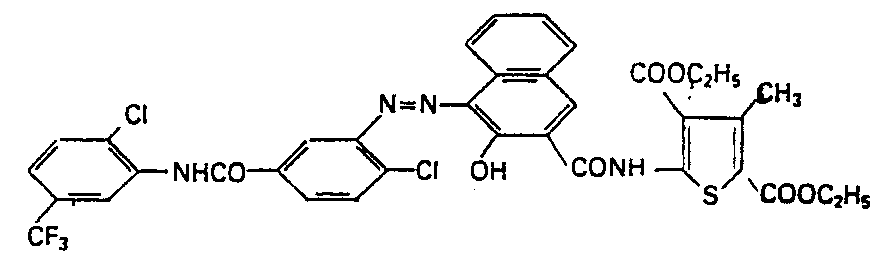
- Das in Dimethylformamid nachbehandelte Pigment (1 Std. bei 151°) erzeugt in Polyvinylchlorid echte, farbstarke und brillante scharlachrote Färbungen.
- Analyse:
- Ber.: C 54.90, H 3.46, CI 9.00, F 7.24, N 7.11, S 4.07%
- Gef.: C 54.7, H 3.5, CI 8.6, F 7.2, N 7.2, S 4.2%
- Das 3,5-Dicarbäthoxy-4-methyl-2-(2'-hydroxy-2'-naphthoylamino)-thiophen kann folgenderweise hergestellt werden: die Suspension von 19 Teilen 2-Hydroxy-3-naphthoesäure in 100 Vol.-Teilen getrocknetem Chlorbenzol wird mit 12,6 Teilen Thionylchlorid und 3 Tropfen Dimethylformamid versetzt, in 15 Minuten auf 74° erhitzt und 1 Std. bei dieser Temperatur gerührt. Man beobachtet eine lebhafte Gasentwicklung und es entsteht eine gelbe Lösung.
- Man löst danach 25,7 Teile 2-Amino-3,5-dicarb- äthoxy-4-methylthiophen in 175 Vol.-Teilen getrocknetem Chlorbenzol bei 60° auf und lässt die Lösung innerhalb 1 Min. in die Säurechloridlösung zutropfen. Die entstehende Lösung wird in 30 Min. auf 128° erhitzt, 15 Std. bei dieser Temperatur gerührt und anschliessend erkalten lassen. Der ausgefallene gelbe Niederschlag wird abgenutscht und nacheinander mit Methanol und heissem Wasser gewaschen. Nach dem Trocknen im Vakuum bei 60° erhält man 31,5 Teile (73,7% d.Th.) eines blassgelben Pulvers.
- Der Schmelzpunkt des Produktes beträgt 190-192°.

- In der nachfolgenden Tabelle sind weitere Pigmente aufgeführt, die man erhält, wenn man die Diazoverbindungen der in Kolonne II genannten Amine nach den Angaben des Beispiels 1 mit 3,5-Dicarbäthoxy-4-methyl-2-(2'-hydroxy-3'-naph- thoylamino)-thiophen kuppelt. Kolonne 111 gibt das bei der Rekristallisation verwendete Lösungsmittel und Kolonne IV die Nuance des mit dem Pigment gefärbten Polyvinylchlorids an.

-

-

-

- 5,2 Teile 3-Amino-4,2'-dichlor-5'-trifluormethyl- benzanilid und 6,4 Teile 3,5-Dicarbäthoxy-4-methyl-2-(2'-hydroxy-3'-naphthoylamino)-thiophen werden in 150 Vol.-Teilen Dimethylformamid bei 62° gelöst. Die klare grünliche Lösung wird mit 1,3 Vol.-Teilen 37%iger Salzsäure vermischt und danach in 10 Minuten mit 4,1 Vol.-Teilen 4 N-Natriumnitritlösung tropfenweise versetzt. Es fällt ein dicker roter Niederschlag aus, die Temperatur steigt auf 76° an. Die rote Suspension wird 30 Minuten bei 76° gerührt, auf 136° erhitzt, weitere 30 Minuten bei dieser Temperatur gerührt, auf 90° abgekühlt und heiss abgenutscht. Der Rückstand wird schliesslich nacheinander mit Dimethylformamid, heissem Wasser und heissem Methanol gewaschen und im Vakuum bei 60° getrocknet. Man erhält 9,4 Teile Produkt (79% d.Th.), das die gleiche Formel und die gleichen färberischen Eigenschaften aufweist, wie das im Beispiel 1 beschriebene Pigment.
- 0,6g des nach Beispiel 1 hergestellten Pigments werden mit 67g Polyvinylchlorid, 33g Dioctylphthalat, 2g Dibutylzinndilaurat und 2g Titandioxyd zusammengemischt und auf einem Walzenstuhl während 15 Minuten bei 160" zu einer dünnen Folie verarbeitet. Die so erzeugte scharlachrote Färbung ist farbstark, migrations- und lichtecht.
- 1,00g des nach Beispiel 1 hergestellten Pigments wird mit 4,00g Druckfirnis der Zusammensetzung
- 29,4% Leinöl-Standöl (300 Poise: 30 Pas)
- 67,2% Leinöl-Standöl (20 Poise: 2 Pas)
- 2,1 % Kobaltoctoat (8% Co) und
- 1,3% Bleioctoat (25% Pb)
- auf einer Engelsmann-Anreibmaschine fein angerieben und hierauf mit Hilfe eines Klischees im Buchdruckverfahren mit 1 g/m2 auf Kunstdruckpapier gedruckt. Man erhält einen starken, reinen scharlachroten Ton mit guter Transparenz und gutem Glanz.
- Das Pigment eignet sich auch für andere Druckverfahren, wie Tiefdruck, Offsetdruck, Flexodruck und ergibt hier ebenfalls sehr gute Resultate.
- 15g einer 35% Butanol enthaltenden Kollodiumwolle, 15g eines mit Ricinusöl modifizierten Phthalatharzes, 15g einer 70%igen butanolischen Lösung eines Harnstofflackharzes, 20g Butylacetat, 10g Glykolmonoäthyläther, 20g Toluol und 5g Alkohol werden zu einem Lack verarbeitet. Dieser wird anschliessend mit 2g des Farbstoffes gemäss Beispiel 1 und 2g des Titandioxyd (Rutil) pigmentiert und gemahlen. Nach dem Spritzen auf Karton und Trocknen des Lackes erhält man einen scharlachroten Überzug von sehr guter Licht- und Überlackierechtheit.
- Zu 100g eines Einbrennlackes, der aus 58,5g einer 60%igen Lösung eines Kokosalkydharzes (Beckosol 27/320) in Xylol, 23g einer 65%igen Lösung eines Melaminlackharzes (Super Bekkamin 13/501) in Butanol, 17g Xylol und 1,5g Butanol besteht, gibt man 1 g des Farbstoffes gemäss Beispiel 1 und 5g Titandioxyd. Man mahlt das Gemisch 48 Stunden in einer Kugelmühle und spritzt den so pigmentierten Lack auf eine gereinigte Metalloberfläche. Nach dem Einbrennen bei 120° erhält man eine scharlachrote Färbung von guter Licht- und Überlackierechtheit.
Claims (3)

Applications Claiming Priority (2)
| Application Number | Priority Date | Filing Date | Title |
|---|---|---|---|
| CH6319/78 | 1978-06-09 | ||
| CH631978 | 1978-06-09 |
Publications (2)
| Publication Number | Publication Date |
|---|---|
| EP0006154A1 EP0006154A1 (de) | 1980-01-09 |
| EP0006154B1 true EP0006154B1 (de) | 1982-11-10 |
Family
ID=4307671
Family Applications (1)
| Application Number | Title | Priority Date | Filing Date |
|---|---|---|---|
| EP79101651A Expired EP0006154B1 (de) | 1978-06-09 | 1979-05-30 | Monoazopigmente und deren Verwendung zum Pigmentieren von hochmolekularem organischem Material |
Country Status (5)
| Country | Link |
|---|---|
| US (1) | US4263205A (de) |
| EP (1) | EP0006154B1 (de) |
| JP (1) | JPS54162728A (de) |
| CA (1) | CA1113459A (de) |
| DE (1) | DE2964006D1 (de) |
Families Citing this family (2)
| Publication number | Priority date | Publication date | Assignee | Title |
|---|---|---|---|---|
| US4341701A (en) * | 1979-11-07 | 1982-07-27 | Ciba-Geigy Corporation | Production of pigments |
| US6037340A (en) * | 1997-05-28 | 2000-03-14 | Cadus Pharmaceutical Corporation | Synthesis and use of thiophene- and pyrrole-based heteroaromatic compounds |
Family Cites Families (9)
| Publication number | Priority date | Publication date | Assignee | Title |
|---|---|---|---|---|
| US1758385A (en) * | 1926-11-15 | 1930-05-13 | Gen Aniline Works Inc | Azo dyestuffs and process of making same |
| US2144219A (en) * | 1933-08-15 | 1939-01-17 | Du Pont | Azo dyes and methods for their preparation |
| US2149236A (en) * | 1936-02-21 | 1939-02-28 | Gen Aniline Works Inc | Azodyestuffs insoluble in water and fiber dyed therewith |
| US2443598A (en) * | 1944-12-23 | 1948-06-22 | Parke Davis & Co | 3-amino-4-carbethoxy-2-alkyl derivatives of thiophene |
| US2468457A (en) * | 1947-09-16 | 1949-04-26 | American Cyanamid Co | Water-insoluble azo dyestuffs |
| US2625552A (en) * | 1950-10-19 | 1953-01-13 | American Cyanamid Co | 2-(2'-hydroxy-3'-naphthoylamino)-thiophene |
| US2625542A (en) * | 1950-10-19 | 1953-01-13 | American Cyanamid Co | Azo dyes from 2-aminothiophene |
| US2703319A (en) * | 1950-10-20 | 1955-03-01 | Hoechst Ag | Manufacture of water-insoluble monoazo-dyestuffs |
| CH481183A (de) * | 1967-03-06 | 1969-11-15 | Ciba Geigy | Verfahren zur Herstellung neuer Monoazofarbstoffpigmente |
-
1979
- 1979-05-30 DE DE7979101651T patent/DE2964006D1/de not_active Expired
- 1979-05-30 EP EP79101651A patent/EP0006154B1/de not_active Expired
- 1979-05-31 US US06/044,123 patent/US4263205A/en not_active Expired - Lifetime
- 1979-06-07 CA CA329,247A patent/CA1113459A/en not_active Expired
- 1979-06-09 JP JP7295179A patent/JPS54162728A/ja active Pending
Non-Patent Citations (1)
| Title |
|---|
| Colour Index, Volume 3, pages 3267-3268 * |
Also Published As
| Publication number | Publication date |
|---|---|
| EP0006154A1 (de) | 1980-01-09 |
| JPS54162728A (en) | 1979-12-24 |
| DE2964006D1 (en) | 1982-12-16 |
| CA1113459A (en) | 1981-12-01 |
| US4263205A (en) | 1981-04-21 |
Similar Documents
| Publication | Publication Date | Title |
|---|---|---|
| DE2814526C2 (de) | ||
| EP0029007A1 (de) | Isoindolinpigmente, Verfahren zu deren Herstellung und Verwendung | |
| DE2749734A1 (de) | Monoazopigmente, verfahren zu deren herstellung und verwendung | |
| EP0168343B1 (de) | Neue Metallkomplexe, Verfahren zu ihrer Herstellung ihre Verwendung zum Färben von hochmolekularem organischem Material | |
| EP0051560B1 (de) | Heterocyclen enthaltende Monoazopigmente, Verfahren zu deren Herstellung und deren Verwendung | |
| EP0151393A2 (de) | Azinpigmente, Verfahren zu ihrer Herstellung sowie ihre Verwendung | |
| DE2823930A1 (de) | Neue monoazopigmente und verfahren zu deren herstellung | |
| DE2244035C3 (de) | Disazopigmente, Verfahren zu deren Herstellung und ihre Verwendung zum Pigmentieren von hochmolekularem organischen Material | |
| DE1544453A1 (de) | Verfahren zur Herstellung von Disazopigmenten | |
| EP0006154B1 (de) | Monoazopigmente und deren Verwendung zum Pigmentieren von hochmolekularem organischem Material | |
| DE2800765C2 (de) | Neue Monoazopigmente, Verfahren zu deren Herstellung und deren Verwendung | |
| EP0169167B1 (de) | Verfahren zum Färben von hochmolekularem organischem Material und neue Metallkomplexe | |
| DE2733506A1 (de) | Neue isoindolinpigmente und verfahren zu deren herstellung | |
| EP0162806B1 (de) | Monoazoverbindungen enthaltend mindestens eine Carbonamidgruppe | |
| EP0138761B1 (de) | Verfahren zum Pigmentieren von hochmolekularem organischem Material | |
| DE2429286C2 (de) | Neue Disazopigmente, Verfahren zu deren Herstellung und deren Verwendung | |
| DE2728864A1 (de) | Metallkomplexpigmente | |
| DE2739041A1 (de) | Verfahren zum pigmentieren von hochmolekularem organischem material | |
| EP0015570B1 (de) | Isoindolinpigmente und deren Verwendung | |
| DE2832456A1 (de) | Neue monoazopigmente und verfahren zu deren herstellung | |
| EP0031798A2 (de) | Neue Monoazopigmente und Verfahren zu deren Herstellung | |
| DE2821347A1 (de) | Azopigmente und verfahren zu deren herstellung | |
| EP0183651A2 (de) | Neue Metallkomplexe, Verfahren zu deren Herstellung und Verwendung | |
| EP0185618A2 (de) | Isoindoline, Verfahren zu deren Herstellung und Verwendung | |
| DE1569768C (de) | Pigmente, deren Herstellung und Ver Wendung |
Legal Events
| Date | Code | Title | Description |
|---|---|---|---|
| PUAI | Public reference made under article 153(3) epc to a published international application that has entered the european phase |
Free format text: ORIGINAL CODE: 0009012 |
|
| 17P | Request for examination filed | ||
| AK | Designated contracting states |
Designated state(s): CH DE FR GB IT |
|
| ITF | It: translation for a ep patent filed | ||
| GRAA | (expected) grant |
Free format text: ORIGINAL CODE: 0009210 |
|
| AK | Designated contracting states |
Designated state(s): CH DE FR GB IT |
|
| REF | Corresponds to: |
Ref document number: 2964006 Country of ref document: DE Date of ref document: 19821216 |
|
| ET | Fr: translation filed | ||
| PGFP | Annual fee paid to national office [announced via postgrant information from national office to epo] |
Ref country code: CH Payment date: 19830331 Year of fee payment: 5 |
|
| PGFP | Annual fee paid to national office [announced via postgrant information from national office to epo] |
Ref country code: DE Payment date: 19830406 Year of fee payment: 5 |
|
| PGFP | Annual fee paid to national office [announced via postgrant information from national office to epo] |
Ref country code: FR Payment date: 19830407 Year of fee payment: 5 |
|
| PG25 | Lapsed in a contracting state [announced via postgrant information from national office to epo] |
Ref country code: CH Effective date: 19840531 |
|
| GBPC | Gb: european patent ceased through non-payment of renewal fee | ||
| PG25 | Lapsed in a contracting state [announced via postgrant information from national office to epo] |
Ref country code: FR Free format text: LAPSE BECAUSE OF NON-PAYMENT OF DUE FEES Effective date: 19850131 |
|
| REG | Reference to a national code |
Ref country code: CH Ref legal event code: PL |
|
| PG25 | Lapsed in a contracting state [announced via postgrant information from national office to epo] |
Ref country code: DE Effective date: 19850201 |
|
| REG | Reference to a national code |
Ref country code: FR Ref legal event code: ST |
|
| PG25 | Lapsed in a contracting state [announced via postgrant information from national office to epo] |
Ref country code: GB Effective date: 19881118 |
|
| PLBE | No opposition filed within time limit |
Free format text: ORIGINAL CODE: 0009261 |
|
| STAA | Information on the status of an ep patent application or granted ep patent |
Free format text: STATUS: NO OPPOSITION FILED WITHIN TIME LIMIT |