EP0029007A1 - Isoindolinpigmente, Verfahren zu deren Herstellung und Verwendung - Google Patents
Isoindolinpigmente, Verfahren zu deren Herstellung und Verwendung Download PDFInfo
- Publication number
- EP0029007A1 EP0029007A1 EP80810337A EP80810337A EP0029007A1 EP 0029007 A1 EP0029007 A1 EP 0029007A1 EP 80810337 A EP80810337 A EP 80810337A EP 80810337 A EP80810337 A EP 80810337A EP 0029007 A1 EP0029007 A1 EP 0029007A1
- Authority
- EP
- European Patent Office
- Prior art keywords
- group
- formula
- pigment
- pigments
- carbon atoms
- Prior art date
- Legal status (The legal status is an assumption and is not a legal conclusion. Google has not performed a legal analysis and makes no representation as to the accuracy of the status listed.)
- Withdrawn
Links
- 239000000049 pigment Substances 0.000 title claims abstract description 46
- GWVMLCQWXVFZCN-UHFFFAOYSA-N isoindoline Chemical compound C1=CC=C2CNCC2=C1 GWVMLCQWXVFZCN-UHFFFAOYSA-N 0.000 title claims abstract description 9
- 238000000034 method Methods 0.000 title claims description 13
- 238000002360 preparation method Methods 0.000 title claims 2
- -1 cyano, phenyl Chemical group 0.000 claims abstract description 8
- 125000003545 alkoxy group Chemical group 0.000 claims abstract description 7
- 239000002904 solvent Substances 0.000 claims abstract description 5
- 125000000217 alkyl group Chemical group 0.000 claims abstract description 4
- 125000004423 acyloxy group Chemical group 0.000 claims abstract description 3
- 125000005236 alkanoylamino group Chemical group 0.000 claims abstract description 3
- 125000004453 alkoxycarbonyl group Chemical group 0.000 claims abstract description 3
- 125000005115 alkyl carbamoyl group Chemical group 0.000 claims abstract description 3
- 125000005239 aroylamino group Chemical group 0.000 claims abstract description 3
- 125000005333 aroyloxy group Chemical group 0.000 claims abstract description 3
- 125000005161 aryl oxy carbonyl group Chemical group 0.000 claims abstract description 3
- 125000004104 aryloxy group Chemical group 0.000 claims abstract description 3
- 125000003917 carbamoyl group Chemical group [H]N([H])C(*)=O 0.000 claims abstract description 3
- 125000000753 cycloalkyl group Chemical group 0.000 claims abstract description 3
- 125000005544 phthalimido group Chemical group 0.000 claims abstract description 3
- HNYOPLTXPVRDBG-UHFFFAOYSA-N barbituric acid Chemical compound O=C1CC(=O)NC(=O)N1 HNYOPLTXPVRDBG-UHFFFAOYSA-N 0.000 claims description 9
- DGJMPUGMZIKDRO-UHFFFAOYSA-N cyanoacetamide Chemical compound NC(=O)CC#N DGJMPUGMZIKDRO-UHFFFAOYSA-N 0.000 claims description 7
- RZVCEPSDYHAHLX-UHFFFAOYSA-N 3-iminoisoindol-1-amine Chemical compound C1=CC=C2C(N)=NC(=N)C2=C1 RZVCEPSDYHAHLX-UHFFFAOYSA-N 0.000 claims description 5
- BERPCVULMUPOER-UHFFFAOYSA-N Quinolinediol Chemical compound C1=CC=C2NC(=O)C(O)=CC2=C1 BERPCVULMUPOER-UHFFFAOYSA-N 0.000 claims description 5
- 239000011368 organic material Substances 0.000 claims description 5
- 125000001495 ethyl group Chemical group [H]C([H])([H])C([H])([H])* 0.000 claims description 3
- 125000002496 methyl group Chemical group [H]C([H])([H])* 0.000 claims description 3
- 238000009833 condensation Methods 0.000 claims description 2
- 230000005494 condensation Effects 0.000 claims description 2
- 125000005843 halogen group Chemical group 0.000 claims description 2
- 125000004435 hydrogen atom Chemical group [H]* 0.000 claims description 2
- 230000000485 pigmenting effect Effects 0.000 claims 1
- 238000001953 recrystallisation Methods 0.000 claims 1
- 230000005012 migration Effects 0.000 abstract description 4
- 238000013508 migration Methods 0.000 abstract description 4
- 238000004040 coloring Methods 0.000 abstract description 2
- 229910052736 halogen Inorganic materials 0.000 abstract description 2
- 150000002367 halogens Chemical class 0.000 abstract description 2
- 125000004432 carbon atom Chemical group C* 0.000 abstract 5
- 125000002887 hydroxy group Chemical group [H]O* 0.000 abstract 1
- 150000002894 organic compounds Chemical class 0.000 abstract 1
- QTBSBXVTEAMEQO-UHFFFAOYSA-N Acetic acid Chemical compound CC(O)=O QTBSBXVTEAMEQO-UHFFFAOYSA-N 0.000 description 14
- OKKJLVBELUTLKV-UHFFFAOYSA-N Methanol Chemical compound OC OKKJLVBELUTLKV-UHFFFAOYSA-N 0.000 description 12
- XLYOFNOQVPJJNP-UHFFFAOYSA-N water Substances O XLYOFNOQVPJJNP-UHFFFAOYSA-N 0.000 description 10
- MLIREBYILWEBDM-UHFFFAOYSA-N cyanoacetic acid Chemical compound OC(=O)CC#N MLIREBYILWEBDM-UHFFFAOYSA-N 0.000 description 8
- 239000000203 mixture Substances 0.000 description 8
- 238000007639 printing Methods 0.000 description 7
- 239000000047 product Substances 0.000 description 7
- CSCPPACGZOOCGX-UHFFFAOYSA-N Acetone Chemical compound CC(C)=O CSCPPACGZOOCGX-UHFFFAOYSA-N 0.000 description 6
- LYCAIKOWRPUZTN-UHFFFAOYSA-N Ethylene glycol Chemical group OCCO LYCAIKOWRPUZTN-UHFFFAOYSA-N 0.000 description 6
- WSFSSNUMVMOOMR-UHFFFAOYSA-N Formaldehyde Chemical compound O=C WSFSSNUMVMOOMR-UHFFFAOYSA-N 0.000 description 6
- 239000004922 lacquer Substances 0.000 description 6
- HDHQZCHIXUUSMK-UHFFFAOYSA-N 4-hydroxy-2-quinolone Chemical compound C1=CC=C2C(O)=CC(=O)NC2=C1 HDHQZCHIXUUSMK-UHFFFAOYSA-N 0.000 description 5
- 229960000583 acetic acid Drugs 0.000 description 5
- 150000001875 compounds Chemical class 0.000 description 5
- 238000004043 dyeing Methods 0.000 description 5
- 239000003960 organic solvent Substances 0.000 description 5
- 229920003023 plastic Polymers 0.000 description 5
- 239000004033 plastic Substances 0.000 description 5
- RFFLAFLAYFXFSW-UHFFFAOYSA-N 1,2-dichlorobenzene Chemical compound ClC1=CC=CC=C1Cl RFFLAFLAYFXFSW-UHFFFAOYSA-N 0.000 description 4
- LRHPLDYGYMQRHN-UHFFFAOYSA-N N-Butanol Chemical compound CCCCO LRHPLDYGYMQRHN-UHFFFAOYSA-N 0.000 description 4
- GWEVSGVZZGPLCZ-UHFFFAOYSA-N Titan oxide Chemical compound O=[Ti]=O GWEVSGVZZGPLCZ-UHFFFAOYSA-N 0.000 description 4
- 229920000180 alkyd Polymers 0.000 description 4
- 238000000227 grinding Methods 0.000 description 4
- BDAGIHXWWSANSR-UHFFFAOYSA-N methanoic acid Natural products OC=O BDAGIHXWWSANSR-UHFFFAOYSA-N 0.000 description 4
- 238000010992 reflux Methods 0.000 description 4
- 239000000126 substance Substances 0.000 description 4
- LIHUTSFYFGCWQP-UHFFFAOYSA-N 2-cyano-n-methylacetamide Chemical compound CNC(=O)CC#N LIHUTSFYFGCWQP-UHFFFAOYSA-N 0.000 description 3
- WEVYAHXRMPXWCK-UHFFFAOYSA-N Acetonitrile Chemical compound CC#N WEVYAHXRMPXWCK-UHFFFAOYSA-N 0.000 description 3
- LFQSCWFLJHTTHZ-UHFFFAOYSA-N Ethanol Chemical compound CCO LFQSCWFLJHTTHZ-UHFFFAOYSA-N 0.000 description 3
- 229920000877 Melamine resin Polymers 0.000 description 3
- ZMXDDKWLCZADIW-UHFFFAOYSA-N N,N-Dimethylformamide Chemical compound CN(C)C=O ZMXDDKWLCZADIW-UHFFFAOYSA-N 0.000 description 3
- XSQUKJJJFZCRTK-UHFFFAOYSA-N Urea Chemical compound NC(N)=O XSQUKJJJFZCRTK-UHFFFAOYSA-N 0.000 description 3
- 238000006243 chemical reaction Methods 0.000 description 3
- 150000002148 esters Chemical class 0.000 description 3
- 239000000976 ink Substances 0.000 description 3
- 239000003973 paint Substances 0.000 description 3
- 239000004014 plasticizer Substances 0.000 description 3
- 229920005989 resin Polymers 0.000 description 3
- 239000011347 resin Substances 0.000 description 3
- 239000000243 solution Substances 0.000 description 3
- OSWFIVFLDKOXQC-UHFFFAOYSA-N 4-(3-methoxyphenyl)aniline Chemical compound COC1=CC=CC(C=2C=CC(N)=CC=2)=C1 OSWFIVFLDKOXQC-UHFFFAOYSA-N 0.000 description 2
- OXSZQTDCCMODLE-UHFFFAOYSA-N 4-hydroxy-6-methyl-1h-quinolin-2-one Chemical compound N1C(O)=CC(=O)C2=CC(C)=CC=C21 OXSZQTDCCMODLE-UHFFFAOYSA-N 0.000 description 2
- IRFFYWMJTQTJSY-UHFFFAOYSA-N 6,8-dibromo-4-hydroxy-1h-quinolin-2-one Chemical compound C1=C(Br)C=C2C(O)=CC(=O)NC2=C1Br IRFFYWMJTQTJSY-UHFFFAOYSA-N 0.000 description 2
- IYMLPNJEWQYNOK-UHFFFAOYSA-N 6,8-dichloro-4-hydroxy-1h-quinolin-2-one Chemical compound C1=C(Cl)C=C2C(O)=CC(=O)NC2=C1Cl IYMLPNJEWQYNOK-UHFFFAOYSA-N 0.000 description 2
- XLRWZGHILAGXMB-UHFFFAOYSA-N 6-chloro-4-hydroxy-1h-quinolin-2-one Chemical compound ClC1=CC=C2NC(O)=CC(=O)C2=C1 XLRWZGHILAGXMB-UHFFFAOYSA-N 0.000 description 2
- HMMXGPYSWYXNNQ-UHFFFAOYSA-N 7,8-dichloro-4-hydroxy-1h-quinolin-2-one Chemical compound ClC1=CC=C2C(O)=CC(=O)NC2=C1Cl HMMXGPYSWYXNNQ-UHFFFAOYSA-N 0.000 description 2
- KAKZBPTYRLMSJV-UHFFFAOYSA-N Butadiene Chemical compound C=CC=C KAKZBPTYRLMSJV-UHFFFAOYSA-N 0.000 description 2
- IAZDPXIOMUYVGZ-UHFFFAOYSA-N Dimethylsulphoxide Chemical compound CS(C)=O IAZDPXIOMUYVGZ-UHFFFAOYSA-N 0.000 description 2
- KFZMGEQAYNKOFK-UHFFFAOYSA-N Isopropanol Chemical compound CC(C)O KFZMGEQAYNKOFK-UHFFFAOYSA-N 0.000 description 2
- 239000000020 Nitrocellulose Substances 0.000 description 2
- CTQNGGLPUBDAKN-UHFFFAOYSA-N O-Xylene Chemical compound CC1=CC=CC=C1C CTQNGGLPUBDAKN-UHFFFAOYSA-N 0.000 description 2
- NBIIXXVUZAFLBC-UHFFFAOYSA-N Phosphoric acid Chemical compound OP(O)(O)=O NBIIXXVUZAFLBC-UHFFFAOYSA-N 0.000 description 2
- PPBRXRYQALVLMV-UHFFFAOYSA-N Styrene Chemical compound C=CC1=CC=CC=C1 PPBRXRYQALVLMV-UHFFFAOYSA-N 0.000 description 2
- 239000002253 acid Substances 0.000 description 2
- 125000003118 aryl group Chemical group 0.000 description 2
- 239000007859 condensation product Substances 0.000 description 2
- 230000003750 conditioning effect Effects 0.000 description 2
- JXTHNDFMNIQAHM-UHFFFAOYSA-N dichloroacetic acid Chemical compound OC(=O)C(Cl)Cl JXTHNDFMNIQAHM-UHFFFAOYSA-N 0.000 description 2
- XBDQKXXYIPTUBI-UHFFFAOYSA-N dimethylselenoniopropionate Natural products CCC(O)=O XBDQKXXYIPTUBI-UHFFFAOYSA-N 0.000 description 2
- 229920001971 elastomer Polymers 0.000 description 2
- 239000000945 filler Substances 0.000 description 2
- 235000019253 formic acid Nutrition 0.000 description 2
- ZXEKIIBDNHEJCQ-UHFFFAOYSA-N isobutanol Chemical compound CC(C)CO ZXEKIIBDNHEJCQ-UHFFFAOYSA-N 0.000 description 2
- 238000004519 manufacturing process Methods 0.000 description 2
- JDSHMPZPIAZGSV-UHFFFAOYSA-N melamine Chemical compound NC1=NC(N)=NC(N)=N1 JDSHMPZPIAZGSV-UHFFFAOYSA-N 0.000 description 2
- 238000000465 moulding Methods 0.000 description 2
- LQNUZADURLCDLV-UHFFFAOYSA-N nitrobenzene Chemical compound [O-][N+](=O)C1=CC=CC=C1 LQNUZADURLCDLV-UHFFFAOYSA-N 0.000 description 2
- 229920001220 nitrocellulos Polymers 0.000 description 2
- 239000003791 organic solvent mixture Substances 0.000 description 2
- XNGIFLGASWRNHJ-UHFFFAOYSA-N phthalic acid Chemical compound OC(=O)C1=CC=CC=C1C(O)=O XNGIFLGASWRNHJ-UHFFFAOYSA-N 0.000 description 2
- 238000006068 polycondensation reaction Methods 0.000 description 2
- 229920000728 polyester Polymers 0.000 description 2
- 229920000915 polyvinyl chloride Polymers 0.000 description 2
- 239000004800 polyvinyl chloride Substances 0.000 description 2
- 239000000843 powder Substances 0.000 description 2
- 239000005060 rubber Substances 0.000 description 2
- 150000003839 salts Chemical class 0.000 description 2
- CXMXRPHRNRROMY-UHFFFAOYSA-N sebacic acid Chemical compound OC(=O)CCCCCCCCC(O)=O CXMXRPHRNRROMY-UHFFFAOYSA-N 0.000 description 2
- 239000000725 suspension Substances 0.000 description 2
- UMGDCJDMYOKAJW-UHFFFAOYSA-N thiourea Chemical compound NC(N)=S UMGDCJDMYOKAJW-UHFFFAOYSA-N 0.000 description 2
- 239000004408 titanium dioxide Substances 0.000 description 2
- 239000002966 varnish Substances 0.000 description 2
- 239000008096 xylene Substances 0.000 description 2
- 239000001052 yellow pigment Substances 0.000 description 2
- RYHBNJHYFVUHQT-UHFFFAOYSA-N 1,4-Dioxane Chemical compound C1COCCO1 RYHBNJHYFVUHQT-UHFFFAOYSA-N 0.000 description 1
- TTWNNFKVLVPQDZ-UHFFFAOYSA-N 2-(3-aminoisoindol-1-ylidene)-n-cyanoacetamide Chemical compound C1=CC=C2C(=N)NC(=CC(=O)NC#N)C2=C1 TTWNNFKVLVPQDZ-UHFFFAOYSA-N 0.000 description 1
- YCGSMOIWEZRTSG-UHFFFAOYSA-N 2-cyano-n-(2-methylpropyl)acetamide Chemical compound CC(C)CNC(=O)CC#N YCGSMOIWEZRTSG-UHFFFAOYSA-N 0.000 description 1
- RURWLUVLDBYUEN-UHFFFAOYSA-N 2-cyano-n-cyclohexylacetamide Chemical compound N#CCC(=O)NC1CCCCC1 RURWLUVLDBYUEN-UHFFFAOYSA-N 0.000 description 1
- VARXTXAOJGBDDV-UHFFFAOYSA-N 2-cyano-n-ethylacetamide Chemical compound CCNC(=O)CC#N VARXTXAOJGBDDV-UHFFFAOYSA-N 0.000 description 1
- LOAHXFVORLJMML-UHFFFAOYSA-N 2-cyano-n-propan-2-ylacetamide Chemical compound CC(C)NC(=O)CC#N LOAHXFVORLJMML-UHFFFAOYSA-N 0.000 description 1
- QXWFLDZVDBAJAG-UHFFFAOYSA-N 2-cyano-n-propylacetamide Chemical compound CCCNC(=O)CC#N QXWFLDZVDBAJAG-UHFFFAOYSA-N 0.000 description 1
- ZNQVEEAIQZEUHB-UHFFFAOYSA-N 2-ethoxyethanol Chemical compound CCOCCO ZNQVEEAIQZEUHB-UHFFFAOYSA-N 0.000 description 1
- ZAMOUSCENKQFHK-UHFFFAOYSA-N Chlorine atom Chemical compound [Cl] ZAMOUSCENKQFHK-UHFFFAOYSA-N 0.000 description 1
- 235000013162 Cocos nucifera Nutrition 0.000 description 1
- 244000060011 Cocos nucifera Species 0.000 description 1
- MQIUGAXCHLFZKX-UHFFFAOYSA-N Di-n-octyl phthalate Natural products CCCCCCCCOC(=O)C1=CC=CC=C1C(=O)OCCCCCCCC MQIUGAXCHLFZKX-UHFFFAOYSA-N 0.000 description 1
- BRLQWZUYTZBJKN-UHFFFAOYSA-N Epichlorohydrin Chemical compound ClCC1CO1 BRLQWZUYTZBJKN-UHFFFAOYSA-N 0.000 description 1
- FXHOOIRPVKKKFG-UHFFFAOYSA-N N,N-Dimethylacetamide Chemical compound CN(C)C(C)=O FXHOOIRPVKKKFG-UHFFFAOYSA-N 0.000 description 1
- SECXISVLQFMRJM-UHFFFAOYSA-N N-Methylpyrrolidone Chemical compound CN1CCCC1=O SECXISVLQFMRJM-UHFFFAOYSA-N 0.000 description 1
- AMQJEAYHLZJPGS-UHFFFAOYSA-N N-Pentanol Chemical compound CCCCCO AMQJEAYHLZJPGS-UHFFFAOYSA-N 0.000 description 1
- 229920002845 Poly(methacrylic acid) Polymers 0.000 description 1
- 239000004952 Polyamide Substances 0.000 description 1
- 239000004698 Polyethylene Substances 0.000 description 1
- 229920002367 Polyisobutene Polymers 0.000 description 1
- 239000004743 Polypropylene Substances 0.000 description 1
- 239000004793 Polystyrene Substances 0.000 description 1
- 229920000297 Rayon Polymers 0.000 description 1
- 229920002125 Sokalan® Polymers 0.000 description 1
- 229920001807 Urea-formaldehyde Polymers 0.000 description 1
- SMEGJBVQLJJKKX-HOTMZDKISA-N [(2R,3S,4S,5R,6R)-5-acetyloxy-3,4,6-trihydroxyoxan-2-yl]methyl acetate Chemical compound CC(=O)OC[C@@H]1[C@H]([C@@H]([C@H]([C@@H](O1)O)OC(=O)C)O)O SMEGJBVQLJJKKX-HOTMZDKISA-N 0.000 description 1
- CIUQDSCDWFSTQR-UHFFFAOYSA-N [C]1=CC=CC=C1 Chemical class [C]1=CC=CC=C1 CIUQDSCDWFSTQR-UHFFFAOYSA-N 0.000 description 1
- UKLDJPRMSDWDSL-UHFFFAOYSA-L [dibutyl(dodecanoyloxy)stannyl] dodecanoate Chemical compound CCCCCCCCCCCC(=O)O[Sn](CCCC)(CCCC)OC(=O)CCCCCCCCCCC UKLDJPRMSDWDSL-UHFFFAOYSA-L 0.000 description 1
- 235000011054 acetic acid Nutrition 0.000 description 1
- 229940081735 acetylcellulose Drugs 0.000 description 1
- 150000007513 acids Chemical class 0.000 description 1
- 239000000654 additive Substances 0.000 description 1
- 150000001298 alcohols Chemical class 0.000 description 1
- 150000007933 aliphatic carboxylic acids Chemical class 0.000 description 1
- 229910000147 aluminium phosphate Inorganic materials 0.000 description 1
- 239000012752 auxiliary agent Substances 0.000 description 1
- 239000011230 binding agent Substances 0.000 description 1
- BJQHLKABXJIVAM-UHFFFAOYSA-N bis(2-ethylhexyl) phthalate Chemical compound CCCCC(CC)COC(=O)C1=CC=CC=C1C(=O)OCC(CC)CCCC BJQHLKABXJIVAM-UHFFFAOYSA-N 0.000 description 1
- 230000001680 brushing effect Effects 0.000 description 1
- 238000003490 calendering Methods 0.000 description 1
- 239000004202 carbamide Substances 0.000 description 1
- 238000005266 casting Methods 0.000 description 1
- 229920002678 cellulose Polymers 0.000 description 1
- 239000001913 cellulose Substances 0.000 description 1
- 229920002301 cellulose acetate Polymers 0.000 description 1
- 239000007795 chemical reaction product Substances 0.000 description 1
- 229910052801 chlorine Inorganic materials 0.000 description 1
- 239000000460 chlorine Substances 0.000 description 1
- FOCAUTSVDIKZOP-UHFFFAOYSA-N chloroacetic acid Chemical compound OC(=O)CCl FOCAUTSVDIKZOP-UHFFFAOYSA-N 0.000 description 1
- 239000011248 coating agent Substances 0.000 description 1
- 238000000576 coating method Methods 0.000 description 1
- 239000003086 colorant Substances 0.000 description 1
- 239000000470 constituent Substances 0.000 description 1
- 229920001577 copolymer Polymers 0.000 description 1
- 239000013078 crystal Substances 0.000 description 1
- 239000012975 dibutyltin dilaurate Substances 0.000 description 1
- 229960005215 dichloroacetic acid Drugs 0.000 description 1
- 150000002009 diols Chemical class 0.000 description 1
- 238000001035 drying Methods 0.000 description 1
- 239000003822 epoxy resin Substances 0.000 description 1
- YQUWHLDULQLNDK-UHFFFAOYSA-N ethyl 2-[(2-cyanoacetyl)amino]acetate Chemical compound CCOC(=O)CNC(=O)CC#N YQUWHLDULQLNDK-UHFFFAOYSA-N 0.000 description 1
- 238000001125 extrusion Methods 0.000 description 1
- 239000010408 film Substances 0.000 description 1
- 238000001914 filtration Methods 0.000 description 1
- 239000012362 glacial acetic acid Substances 0.000 description 1
- 238000007646 gravure printing Methods 0.000 description 1
- LNEPOXFFQSENCJ-UHFFFAOYSA-N haloperidol Chemical compound C1CC(O)(C=2C=CC(Cl)=CC=2)CCN1CCCC(=O)C1=CC=C(F)C=C1 LNEPOXFFQSENCJ-UHFFFAOYSA-N 0.000 description 1
- 238000010438 heat treatment Methods 0.000 description 1
- 238000001746 injection moulding Methods 0.000 description 1
- 238000004898 kneading Methods 0.000 description 1
- 235000021388 linseed oil Nutrition 0.000 description 1
- 239000000944 linseed oil Substances 0.000 description 1
- 239000000463 material Substances 0.000 description 1
- 229910052751 metal Inorganic materials 0.000 description 1
- 239000002184 metal Substances 0.000 description 1
- 238000002156 mixing Methods 0.000 description 1
- JQVMRGYDSQFFJC-UHFFFAOYSA-N n-benzyl-2-cyanoacetamide Chemical compound N#CCC(=O)NCC1=CC=CC=C1 JQVMRGYDSQFFJC-UHFFFAOYSA-N 0.000 description 1
- MGZNARROBKPUST-UHFFFAOYSA-N n-butyl-2-cyanoacetamide Chemical compound CCCCNC(=O)CC#N MGZNARROBKPUST-UHFFFAOYSA-N 0.000 description 1
- 229930014626 natural product Natural products 0.000 description 1
- 239000000025 natural resin Substances 0.000 description 1
- 238000007645 offset printing Methods 0.000 description 1
- 239000003921 oil Substances 0.000 description 1
- 235000019198 oils Nutrition 0.000 description 1
- 239000002245 particle Substances 0.000 description 1
- 229920001568 phenolic resin Polymers 0.000 description 1
- 150000002989 phenols Chemical class 0.000 description 1
- 230000019612 pigmentation Effects 0.000 description 1
- 239000004584 polyacrylic acid Substances 0.000 description 1
- 229920002239 polyacrylonitrile Polymers 0.000 description 1
- 229920002647 polyamide Polymers 0.000 description 1
- 229920000647 polyepoxide Polymers 0.000 description 1
- 229920000573 polyethylene Polymers 0.000 description 1
- 229920000642 polymer Polymers 0.000 description 1
- 238000006116 polymerization reaction Methods 0.000 description 1
- 229920000098 polyolefin Polymers 0.000 description 1
- 150000008442 polyphenolic compounds Chemical class 0.000 description 1
- 235000013824 polyphenols Nutrition 0.000 description 1
- 229920001155 polypropylene Polymers 0.000 description 1
- 229920002223 polystyrene Polymers 0.000 description 1
- 229920002689 polyvinyl acetate Polymers 0.000 description 1
- 239000011118 polyvinyl acetate Substances 0.000 description 1
- 239000002244 precipitate Substances 0.000 description 1
- 238000003825 pressing Methods 0.000 description 1
- 235000019260 propionic acid Nutrition 0.000 description 1
- IUVKMZGDUIUOCP-BTNSXGMBSA-N quinbolone Chemical compound O([C@H]1CC[C@H]2[C@H]3[C@@H]([C@]4(C=CC(=O)C=C4CC3)C)CC[C@@]21C)C1=CCCC1 IUVKMZGDUIUOCP-BTNSXGMBSA-N 0.000 description 1
- 239000002994 raw material Substances 0.000 description 1
- 239000011541 reaction mixture Substances 0.000 description 1
- 238000005096 rolling process Methods 0.000 description 1
- 229920006395 saturated elastomer Polymers 0.000 description 1
- 238000001256 steam distillation Methods 0.000 description 1
- 238000003756 stirring Methods 0.000 description 1
- 125000001424 substituent group Chemical group 0.000 description 1
- 239000000758 substrate Substances 0.000 description 1
- 229920001169 thermoplastic Polymers 0.000 description 1
- 239000004416 thermosoftening plastic Substances 0.000 description 1
- 239000010409 thin film Substances 0.000 description 1
- 125000000391 vinyl group Chemical group [H]C([*])=C([H])[H] 0.000 description 1
- 229920002554 vinyl polymer Polymers 0.000 description 1
- 238000005406 washing Methods 0.000 description 1
- 239000012463 white pigment Substances 0.000 description 1
Classifications
-
- C—CHEMISTRY; METALLURGY
- C09—DYES; PAINTS; POLISHES; NATURAL RESINS; ADHESIVES; COMPOSITIONS NOT OTHERWISE PROVIDED FOR; APPLICATIONS OF MATERIALS NOT OTHERWISE PROVIDED FOR
- C09B—ORGANIC DYES OR CLOSELY-RELATED COMPOUNDS FOR PRODUCING DYES, e.g. PIGMENTS; MORDANTS; LAKES
- C09B57/00—Other synthetic dyes of known constitution
- C09B57/04—Isoindoline dyes
Definitions
- the present invention relates to isoindoline pigments of the formula in which R is an alkyl radical with 1-4 C, which is substituted by a hydroxy, cyano, phenyl or carbamoyl group, an alkoxy group with 1-4 C, an aryloxy, aryloxycarbonyl, aroyloxy or aroylamino group, an alkoxycarbonyl, alkanoyloxy, Alkylcarbamoyl or alkanoylamino group can be substituted with 2-6 C or a phthalimido group or a cycloalkyl group with 5-8 C and X is a radical of the formula means where Y and Z are H or halogen atoms, alkyl or alkoxy groups with 1-4 C.
- aryl stands for example for a- or ⁇ -naphthyl or diphenylyl, but preferably for an optionally substituted phenyl radical.
- substituents halogen, in particular chlorine, alkyl or alkoxy with 1-4 C.
- Preferred pigments of the formula given are those in which R is a methyl or ethyl group and X is the rest of the formula means.
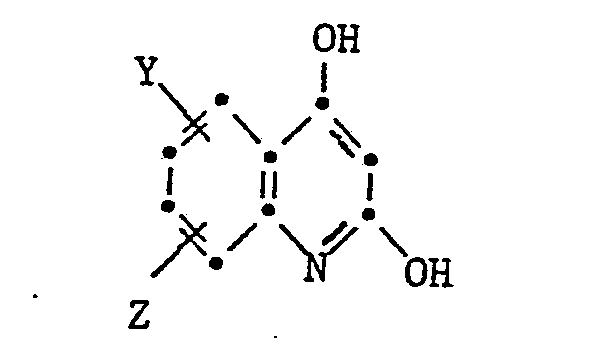
- the pigments according to the invention are obtained if 1,3-diiminoisoindoline is added in any order with one mole of a cyanoacetamide of the formula NCCH 2 CONHR and barbituric acid or a dihydroxyquinoline of the formula condensed.
- the diiminoiscindoline is expediently first reacted with the cyanoacetamide to give the 1-cyano-carbamoylmethylene-3-imino-isoindoline.
- This reaction is conveniently carried out in water or an organic solvent at elevated temperature, preferably at 4o-120 ° C.
- Suitable organic solvents are, for example, aliphatic alcohols, such as methanol, ethanol, isopropanol, isobutanol, amyl alcohol or ethylene glycol monoethyl ether, o-dichlorobenzene, dimethylformamide, dimethylacetamide, dimethyl sulfoxide, N-methylpyrrolidone, acetonitrile, dioxane, or nitrobenzene.
- aliphatic alcohols such as methanol, ethanol, isopropanol, isobutanol, amyl alcohol or ethylene glycol monoethyl ether, o-dichlorobenzene, dimethylformamide, dimethylacetamide, dimethyl sulfoxide, N-methylpyrrolidone, acetonitrile, dioxane, or nitrobenzene.
- the reaction of 1-cyanocarbamoylmethylene-3-iminoisoindoline with barbituric acid or dihydroxyquinoline is preferably carried out in the presence of an aliphatic carboxylic acid such as formic acid, acetic acid, propionic acid, mono- or dichloroacetic acid.
- an aliphatic carboxylic acid such as formic acid, acetic acid, propionic acid, mono- or dichloroacetic acid.
- This reaction is conveniently carried out at temperatures between 60-180 °.
- the two stages can also be carried out in the same vessel without isolating the intermediate.
- the preferred solvent is ethylene glycol and water.
- the pigments obtained usually precipitate out already in the heat and can be isolated in pure form by filtering off and, if necessary, washing with organic solvents.
- the pigments obtained can mostly be used as raw products. If necessary or desired, the raw products can be converted into a finely dispersed form by grinding or kneading. It is useful to use grinding aids such as inorganic and / or organic salts in the presence or absence of organic solvents. The properties can often also be improved by treating the raw pigments with organic solvents. After grinding, auxiliary agents are removed as usual, soluble inorganic salts e.g. with water and water-insoluble organic auxiliaries, for example by steam distillation.
- the particle shape can be greatly influenced by the choice of solvents and the conditioning temperature during the production of the pigments. So it is possible to produce from the same pigment a strongly colored, glazing and a somewhat redder, more opaque form in light and weather fastness. In order to achieve the coarser, more opaque form, after the condensation has ended, conditioning in water or eiram water-acid mixture at temperatures of preferably 100-150 ° under pressure is particularly suitable. The crystal coarsening takes place under technically simple conditions and is therefore also interesting from an economic point of view.
- the opaque and the glazing form of the pigments according to the invention are notable for good application properties, in particular good rheological behavior, good spreadability and high color strength. Both forms are suitable for dyeing high-molecular organic material of natural or artificial origin.
- it can be natural resins, drying oils or rubber. But it can also be modified natural products, for example chlorinated rubber, oil-modified alkyd resins or cellulose derivatives such as viscose, acetyl cellulose and nitrocellulose, and in particular fully synthetic organic poly plastics, ie plastics made by polymerization, polycondensation and polyaddition.
- polyesters used as coating resins, both saturated, for example alkyd resins, and unsaturated, for example maleinate resins, and also the polyaddition or polycondensation products of epichlorohydrin with diols or polyphenols known under the name "epoxy resins"; furthermore the so-called thermoplastics, ie the non-curable polyplastics.
- vinyl, polyolefin and styrene polymers such as polyplastics, in particular the so-called film formers or binders known as lacquer raw materials, especially linseed oil varnish, nitrocellulose, alkyd resins, melamine resins and urea-formaldehyde resins.
- the pigmentation of the high molecular weight organic substances with the pigments takes place, for example, in such a way that the pigment, if appropriate in the form of masterbatches, is mixed into these substrates using rolling mills, mixing or grinding apparatus.
- the pigmented material is then brought into the desired final shape by methods known per se, such as calendering, pressing, extrusion, brushing, casting or by injection molding. It is often desirable for the production of non-rigid moldings or for ver reducing their brittleness to incorporate so-called plasticizers into the high-molecular compounds before they are deformed.
- plasticizers for example, esters of phosphoric acid, phthalic acid or sebacic acid can be used as such.
- the plasticizers can be incorporated into the polyplastics before or after the pigment dye has been incorporated. It is also possible to add fillers or other coloring constituents, such as white, colored or black pigments, to the high molecular weight, organic substances in addition to the pigments according to the invention in order to achieve different colors.
- the high molecular weight organic materials and the pigments are finely dispersed or dissolved in a common organic solvent or solvent mixture.
- additives such as fillers, other pigments, sicatives or plasticizers.
- the pigmented high molecular weight organic materials generally contain amounts of 0.001 to 30% by weight of pigment, based on the high molecular weight organic substance to be pigmented, preferably plastics and lacquers 0.1 to 5%, printing inks preferably 10 to 30%.
- the amount of pigment to be selected depends primarily on the desired color strength, also on the layer thickness of the molding and finally, if appropriate, also on the content of white pigment in the polyplast.
- Both the high-molecular organic substances colored with glazing and the opaque pigments have very real, yellow tones and are characterized by purity of the color tone, good light, weather, migration, overpainting and solvent fastness and heat resistance.
- the pigments also have such a good color strength that even after being converted into an opaque form, they still produce strong colorations.
- Example 1 14.5 g of 1-amino-3-imino-isoindolenine and 4.9 g of cyanoacetic acid methyl amide are heated to reflux temperature in 50 ml of methanol for 2 hours. The reaction product formed is suction filtered while hot and dried. 10 g of light yellow colored monocondensation product are obtained. 4.52 g of this compound and 2.52 g of barbituric acid are heated to reflux temperature in 80 ml of acetic acid. The pigment formed is suction filtered after 1 hour, washed with methanol, acetone and water and dried. 6.6 g of a yellow color powder are obtained, which in this form can be incorporated directly as a pigment into paints and plastics. The dyeings thus obtained are characterized by a pure, yellow color with excellent migration and overpainting fastness.
- Example 2-13 Analogously to Example 1, the monocondensation products of cyanoacetamides of the formula NCCH 2 CONHR are reacted with barbituric acid.
- the pigments obtained can be incorporated directly into paints.
- the dyeings achieved are strong in color and are characterized by a pure, yellow color and good fastness properties.
- the meaning of the radical R is evident from columns 2 and 4 of the table below.
- Examples 14 and 15 The procedure is as in Example 1, but the moist crude pigment is suspended in a mixture of 20 ml of glacial acetic acid and 80 ml of water. The suspension is then heated to 120 ° under pressure for 3 hours. 6.4 g of a greenish, opaque yellow pigment with improved light and weather fastness are obtained. If, instead of the pigment from Example 1, the moist raw pigment from Example 3 is used, the same procedure also gives a greenish, opaque yellow pigment with improved light and weather fastness by heating to 110 °.
- Example 16 A solution of 7.25 g of aminoiminoisoindolenine and 40 ml of ethylene glycol is run in to a suspension of 4.9 g of cyanoacetic acid methylamide and 6.4 g of barbituric acid in 75 ml of water.
- the reaction mixture is stirred at 60 ° for 2 hours and then acidified with 15 ml of formic acid. After a further 2 hours of stirring, the mixture is heated to 90 °, filtered off and dried. 14.5 g of the pigment described in Example 1 are obtained.
- Example 17 4.52 g of the monocondensation product described in Example 1 and 2.52 g of barbituric acid are heated to reflux temperature in a mixture of 80 ml of water and 20 ml of acetic acid for 5 hours. The pigment formed is filtered off with suction, washed with water and dried. 6.2 g of pigment are obtained, which in this form can be incorporated directly into printing inks with good dispersibility. The dyeings achieved are characterized by high color strength and a brilliant yellow color, which have a high light fastness.
- Example 18 2.26 of the monocondensation product prepared according to Example 1 and 1.61 g of 2,4-dihydroxyquinoline are heated to reflux temperature in 50 ml of acetic acid. The mixture is diluted with 20 ml of o-dichlorobenzene and the pigment formed is filtered off hot after 2 hours. It is washed with methanol, acetone and water and dried. 2.5 g of an orange color powder are obtained, which in this form can be incorporated directly as a pigment into paints. The dyeings thus obtained are characterized by a pure color and good fastness to overcoating.
- Example 19-29 In Example 18, the monocondensate is replaced by equimolar amounts of the compounds of the formula: where R has the meaning given in column 2 of the table below, and uses the dioxyquinoline given in column 3 in equimolar amounts, pigments with similarly good properties are likewise obtained.
- Example 30 0.6 g of the pigment prepared according to Example 17 is mixed together with 67 g of polyvinyl chloride, 33 g of dioctyl phthalate, 2 g of dibutyltin dilaurate and 2 g of titanium dioxide and processed on a roller mill at 160 ° C. for 15 minutes to form a thin film.
- the yellow color produced in this way is strong in color, resistant to migration, heat and light.
- Example 31 1.00 g of the pigment produced according to Example 17 is mixed with 4.00 g of printing varnish of the composition finely grated on an Engelsmann grinder and then printed with 1 g / m 2 on art paper with the help of a printing block. Strong, yellow prints with good transparency and good gloss and good light fastness are obtained.
- the pigment is also suitable for other printing processes, such as gravure printing, offset printing, flexographic printing and also gives very good results here.
- Example 32 to 100 g of a stoving lacquer which consists of 58.5 g of a 60% solution of a coconut alkyd resin in xylene, 23 g of a 65% solution of a melamine lacquer resin in butanol, 17 g of xylene and 1.5 g of butanol, 1 g of the pigment according to Example 1 and 5 g of titanium dioxide are added.
- the mixture is ground for 48 hours in a ball mill and the lacquer pigmented in this way is sprayed onto a cleaned metal surface. After baking at 120 °, a yellow color of good color strength, lightfastness, overcoating and weather fastness is obtained.
Landscapes
- Chemical & Material Sciences (AREA)
- Organic Chemistry (AREA)
- Paints Or Removers (AREA)
- Compositions Of Macromolecular Compounds (AREA)
Abstract
Isoindolinpigmente der Formel

worin R einen Alkylrest mit 1-4 C, der durch eine Hydroxy-, Cyan-, Phenyl- oder Carbamoylgruppe eine Alkoxygruppe mit 1-4 C, eine Aryloxy-, Aryloxycarbonyl-, Aroyloxy- oder Aroylaminogruppe eine Alkoxycarbonyl-, Alkanoyloxy-, Alkylcarbamoyl- oder Alkanoylaminogruppe mit 2-6 C oder eine Phthalimidogruppe substituiert sein kann, oder eine Cycloalkylgruppe mit 5-8 C und X einen Rest der Formel
bedeutet, worin Y und Z für H oder Halogenatome, Alkyl- oder Alkoxygruppen mit 1 - 4 C bedeuten. Diese Pigmente eignen sich zum Färben hochmolekularer organischer Verbindungen und zeichen sich durch Reinheit des Farbtones, gute Licht-, Wetter-, Migrations-, Ueberlackier- und Lösungsmittelechtheit sowie Hitzebeständigkeit aus.
Description
- Die vorliegende Erfindung betrifft Isoindolinpigmente der Formel
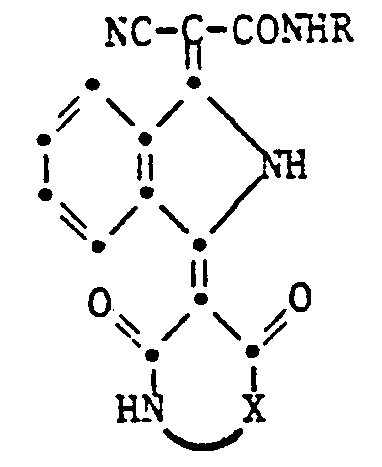

- In obiger Definition steht die Bezeichnung "Aryl" beispielsweise für a- oder β-Naphthyl oder Diphenylyl vorzugsweise aber für einen gegebenenfalls substituierten Phenylrest.Als Substituenten seien genannt: Halogen, insbesondere Chlor, Alkyl- oder Alkoxy- mit 1-4 C.
- Bevorzugt sind jene Pigmente der angegebenen Formel, worin R eine Methyl- oder Aethylgruppe und X den Rest der Formel

- Zu den erfindungsgemässen Pigmenten gelangt man, wenn man 1,3-Diiminoisoindolin in beliebiger Reihenfolge mit je einem Mol eines Cyanacetamid der Formel NCCH2CONHR und Barbitursäure oder einem Dihydroxychinolin der Formel
- Als Beispiele von Cyanacetamiden seinen genannt:
- Cyanessigsäure- methylamid
- Cyanessigsäure-äthylamid
- Cyanessigsäure-n-propylamid
- Cyanessigsäure-isopropylamid
- Cyanessigsäure-n-butylamid
- Cyanessigsäure-ß-methoxyäthylamid
- Cyanessigsäure-ß-äthoxyäthylamid
- Cyanessigsäure-ß-methoxy-n-propylamid
- Cyanessigsäure-ß-cyanäthylamid
- Cyanessigsäure-benzylamid
- Cyanessigsäure-a-phenyläthylamid
- Cyanessigsäure-ß-phenyläthylamid.
- Cyanessigsäure-isobutylamid
- Cyanessigsäure-cyclohexylamid
- Cyanessigsäure-ß-hydroxyäthylamid
- Cyanessigsäure-ß-acetyloxyathylamid
- Cyanessigsäure-ß-benzoyloxyäthylamid
- Cyanessigsäure-äthoxycarbonylmethylamid
- Als Beispiele von Dihydroxychinolinen seien genannt:
- 2,4-Dihydroxychinolin
- 2,4-Dihydroxy-6-chlor-chinolin
- 2,4-Dihydroxy-6-methyl-chinolin
- 2,4-Dihydroxy-7,8-dichlor-chinolin
- 2,4-Dihydroxy-6,8-dichlor-chinolin
- 2,4-Dihydroxy-6,8-dibrom-chinolin.
- Das Diiminoiscindolin wird zweckmässig zuerst mit dem Cyanacetamid zum l-Cyan-carbamoylmethylen-3-imino-isoindolin umgesetzt. Diese Reaktion erfolgt zweckmässig in Wasser oder einem organischen Lösungsmittel bei erhöhter Temperatur vorzugsweise bei 4o-120°C. Als organische Lösungsmittel eignen sich beispielsweise aliphatische Alkohole, wie Methanol, Aethanol, Isopropanol, Isobutanol, Amylalkohol oder Aethylenglykolmonoäthyläther, o-Dichlorbenzol, Dimethylformamid, Dimethylacetamid, Dimethylsulfoxyd, N-Methylpyrrolidon, Acetonitril, Dioxan, Nitrobenzol oder Sulfolan.
- Die Umsetzung des 1-Cyancarbamoylmethylen-3-iminoisoindolin mit der Barbitursäure oder dem Dihydroxychinolin wird vorzugsweise in Gegenwart einer aliphatischen Carbonsäure wie Ameisensäure, Essigsäure, Propionsäure, Mono- oder Dichloressigsäure durchgeführt.
- Diese Reaktion wird zweckmässig bei Temperaturen zwischen 60 - 180° durchgeführt.
- Die beiden Stufen können auch ohne Isolierung des Zwischenproduktes im gleichen Gefäss durchgeführt werden. In diesem Falle wählt man als Lösungsmittel zweckmässig Aethylenglykol und Wasser.
- Die erhaltenen Pigmente fallen zumeist schon in der Hitze aus und können durch Abfiltrierenund gegebenenfalls durch Waschen mit organischen Lösungsmitteln in reiner Form isoliert werden.
- Die erhaltenen Pigmente können meistens als Rohprodukte verwendet werden. Falls nötig oder erwünscht, kann man die Rohprodukte durch Mahlen oder Kneten in eine feindisperse Form überführen. Dabei werden zweckmässig Mahlhilfsmittel, wie anorganische und/oder organische Salze in Gegenwart oder Abwesenheit organischer Lösungsmittel verwendet. Auch durch Behandeln der Rohpigmente mit organischen Lösungsmitteln kann oft eine Verbesserung der Eigenschaften erreicht werden. Nach dem Mahlen werden Hilfsmittel wie üblich entfernt, lösliche anorganische Salze z.B. mit Wasser und wasserunlösliche organische Hilfsmittel beispielsweise durch Wasserdampfdestillation.
- Durch die Wahl der Lösungsmittel und der Konditioniertemperatur lässt sich bei der Herstellung der Pigmente die Partikelform stark beeinflussen. So ist es möglich vom gleichen Pigment eine farbstarke, lasierende und eine im Farbton etwas rötere, deckende in der Licht- und Wetterechtheit verbesserte Form herzustellen. Um die gröbere, deckendere Form zu erreichen ist nach der beendeten Kondensation vor allem der Konditionierung in Wasser oder eiram Wasser-Säure Gemisch bei Temperaturen von vorzugsweise 100-150° unter Druck geeignet. Die Kristallvergröberung verläuft unter technisch einfachen Bedingungen und ist daher auch vom wirtschaftlichen Standpunkt aus interessant.
- Die deckende wie auch die lasierende Form der erfindungsgemässen Pigmente zeichnen sich durch gute Anwendungseigenschaften, insbesondere gutes rheologisches Verhalten,gute Verteilbarkeit und hohe Farbstärke aus. Beide Formen eignen sich zum Färben von hochmolekularem organischem Material natürlicher oder künstlicher Herkunft. Es kann sich z.B. um Naturharze, trocknende Oele oder Kautschuk handeln. Es kann sich aber auch um abgewandelte Naturstoffe handeln, beispielsweise um Chlorkautschuk, um ölmodifizierte Alkydharze oder um Cellulosederivate, wie Viskose, Acetylcellulose und Nitrocellulose, und besonders um vollsynthetische organische Polyplaste, d.h. um Kunststoffe, die durch Polymerisation, Polykondensation und Polyaddition hergestellt sind. Aus der Klasse dieser Kunststoffe seien besonders folgende genannt: Polyäthylen, Polypropylen, Polyisobutylen, Polystyrol, Polyvinylchlorid, Polyvinylacetat, Polyacrylnitril, Polyacrylsäure- und Polymethacrylsäureester; Polyester, insbesondere hochmolekulare Ester aromatischer Polycarbonsäuren mit polyfunktionellen Alkoholen; Polyamide; die Kondensationsprodukte von Formaldehyd mit Phenolen, die sogenannten Phenoplaste, und die Kondensationsprodukte von Formaldehyd mit Harnstoff, Thioharnstoff und Melamin, die sogenannten Aminoplaste; die als Lackharze verwendeten Polyester, und zwar sowohl gesättigte, wie z.B. Alkydharze, als auch ungesättigte, wie beispielsweise Maleinatharze, und ferner die unter dem Namen "Epoxydharze" bekannten Polyadditions- bzw. Polykondensationsprodukte von Epichlorhydrin mit Diolen oder Polyphenolen; ferner die sogenannten Thermoplasten, d.h. die nicht härtbaren Polyplaste. Es sei betont, dass nicht nur die einheitlichen Verbindungen, sondern auch Gemische von Polyplasten, sowie Mischkondensate und Mischpolymerisate, wie z.B. solche auf Basis von Butadien, erfindungsgemäss pigmentiert werden können.
- Als weitere hochmolekulare Verbindung seien genannt: Vinyl-, Polyolefin- und Styrolpolymerisate, wie Polyplaste, insbesondere die als Lackrohstoffe bekannten, sogenannten Filmbildnern oder Bindemittel, besonders Leinölfirnis, Nitrocellulose, Alkydharze, Melaminharze und Harnstoff- Formaldehydharze.
- Die Pigmentierung der hochmolekularen, organischen Substanzen mit den Pigmenten erfolgt beispielsweise derart, dass das Pigment gegebenenfalls in Form von Masterbatches, diesen Substraten unter Verwendung von Walzwerken, Misch- oder Mahlapparaten zumischt. Das pigmentierte Material wird hierauf nach an sich bekannten Verfahren wie Kalandrieren, Pressen, Strangpressen, Streichen, Giessen oder durch Spritzguss in die gewünschte endgültige Form gebracht. Oft ist es erwünscht, zur Herstellung von nicht starren Formlingen oder zur Verringerung ihrer Sprödigkeit den hochmolekularen Verbindungen vor der Verformung sogenannte Weichmacher einzuverleiben. Als solche können z.B. Ester der Phosphorsäure, Phthalsäure oder Sebacinsäure dienen. Die Weichmacher können im erfindungsgemässen Verfahren vor oder nach der Einverleibung des Pigmentfarbstoffes in die Polyplasten eingearbeitet werden. Es ist ferner möglich, zwecks Erzielung verschiedener Farbtöne den hochmolekularen, organischen Stoffen neben den erfindungsgemässen Pigmenten noch Füllstoffe bzw. andere farbgebende Bestandteile wie Weiss-, Bunt- oder Schwarzpigmente in beliebigen Mengen zuzufügen.
- Zum Pigmentieren von Lacken und Druckfarben werden die hochmolekularen organischen Materialien und die Pigmente gegebenenfalls zusammen mit Zusatzstoffen wie Füllmitteln, andern Pigmenten, Siccativen oder Weichmachern, in einem gemeinsamen organischen Lösungsmittel oder Lösungsmittelgemisch fein dispergiert bzw. gelöst. Man kann dabei so verfahren, dass man die einzelnen Komponenten für sich oder auch mehrere gemeinsam dispergiert bzw. löst, und erst hierauf alle Komponenten zusammenbringt.
- Die pigmentierten hochmolekularen organischen Materialien enthalten im allgemeinen Mengen von 0,001 bis 30 Gew.-Z Pigment, bezogen auf den zu pigmentierenden hochmolekularen organischen Stoff, Polyplasten und Lacke vorzugsweise 0,1 bis 5%, Druckfarben vorzugsweise 10 bis 30%. Die zu wählende Menge an Pigment richtet sich in erster Linie nach der gewünschten Farbstärke, ferner nach der Schichtdicke des Formlings und schliesslich gegebenenfalls auch nach dem Gehalt an Weisspigment im Polyplast.
- Sowohl die mit lasierenden als auch die mit deckenden Pigmenten gefärbten hochmolekularen organischen Substanzen weisen sehr echte, gelbe Farbtöne auf und zeichnen sich durch Reinheit des Farbtones, gute Licht-, Wetter-, Migrations-, Ueberlackier- und Lösungsmittelechtheit sowie Hitzebeständigkeit aus. Die Pigmente weisen auch eine derart gute Farbstärke auf, dass sie selbst nach Ueberführung in eine deckende Form noch farbstarke Färbungen ergeben.
- Die folgenden Beispiele veranschaulichen die Erfindung. Darin sind die Temperaturen in Celsiusgraden angegeben.
- Beispiel 1: 14,5 g 1-Amino-3-imino-isoindolenin und 4,9 g Cyanessigsäuremethylamid werden in 50 ml Methanol 2 Stunden auf Rückflusstemperatur erwärmt. Das gebildete Reaktionsprodukt wird heiss abgenutscht und getrocknet. Man erhält 10 g hellgelb gefärbtes Monokondensationsprodukt. 4,52 g dieser Verbindung und 2,52 g Barbitursäure werden in 80 ml Essigsäure auf Rückflusstemperatur erwärmt. Das gebildete Pigment wird nach 1 Stunde heiss abgenutscht, mit Methanol, Aceton und Wasser gewaschen und getrocknet. Man erhält 6,6 g eines gelben Farbpulvers, das sich in dieser Form direkt als Pigment in Anstrich- und Kunststoffe einarbeiten lässt. Die damit erzielten Färbungen zeichnen sich durch einen reinen, gelben Farbton aus mit hervorragender Migrations- und Ueberlackierechtheit.
- Beispiel 2-13: Analog Beispiel 1 werden die Monokondensationsprodukte aus Cyanacetamiden der Formel NCCH2CONHR mit Barbitursäure umgesetzt. Die erhaltenen Pigmente lassen sich direkt in Anstrichstoffe einarbeiten. Die damit erzielten Färbungen sind farbstark und zeichnen sich durch einen reinen, gelben Farbton und gute Echtheiten aus. Die Bedeutung des Restes R geht aus den Kolonnen 2 und 4 der nachfolgenden Tabelle hervor.

- Beispiel 16: Zu einer Suspension von 4,9 g Cyanessigsäuremethylamid und 6,4 g Barbitursäure in 75 ml Wasser lässt man eine auf 60° erwärmte Lösung aus 7,25 g Amino-iminoisoindolenin und 40 ml Aethylenglykol zulaufen.
- Das Reaktionsgemisch wird 2 Stunden bei 60° gerührt und anschliessend mit 15 ml Ameisensäure angesäuert. Nach weiteren 2 Stunden Rührzeit heizt man auf 90°, nutscht ab und trocknet. Man erhält 14,5 g des in Beispiel 1 beschriebenen Pigmentes.
- Beispiel 17: 4,52 g des in Beispiel 1 beschriebenen Monokondensationsproduktes und 2,52 g Barbitursäure werden in einer Mischung aus 80 ml Wasser und 20 ml Essigsäure während 5 Stunden auf Rückflusstemperatur erhitzt Das gebildete Pigment wird heiss abgenutscht, mit Wasser gewaschen und getrocknet. Man erhält 6,2 g Pigment, das sich in dieser Form direkt mit guter Verteilbarkeit in Drucktinten einarbeiten lässt. Die damit erzielten Färbungen zeichnen sich durch hohe Farbstärke und einen brillianten gelben Farbton aus, die eine hohe Lichtechtheit aufweisen.
- Beispiel 18: 2,26 des nach Beispiel 1 hergestellten Monokondensationsproduktes und 1,61 g 2,4-Dihydroxychinolin werden in 50 ml Essigsäure auf Rückflusstemperatur erwärmt. Man verdünnt mit 20 ml o-Dichlorbenzol und nutscht nach 2 Stunden das gebildete Pigment heiss ab. Es wird mit Methanol, Aceton und Wasser gewaschen und getrocknet. Man erhält 2,5 g eines orangen Farbpulvers, das sich in dieser Form direkt als Pigment in Anstrichstoffe einarbeiten lässt. Die damit erzielten Färbungen zeichnen sich durch einen reinen Farbton und gute Ueberlackierechtheit aus.
- Beispiel 19-29: Ersetzt man in Beispiel 18 das Monokondensat durch äquimolare Mengen der Verbindungen der Formel:


- Beispiel 30: 0,6 g des nach Beispiel 17 hergestellten Pigments werden mit 67 g Polyvinylchlorid, 33 g Dioctylphthalat, 2 g Dibutylzinndilaurat und 2 g Titandioxyd zusammengemischt und auf einem Walzenstuhl während 15 Minuten bei 160°C zu einer dünnen Folie verarbeitet. Die so erzeugte gelbe Färbung ist farbstark, migrations-, hitze- und lichtecht.
- Beispiel 31: 1,00 g des nach Beispiel 17 hergestellten Pigments wird mit 4,00 g Druckfirnis der Zusammensetzung

- Das Pigment eignet sich auch für andere Druckverfahren, wie Tiefdruck, Offsetdruck, Flexodruck und ergibt hier ebenfalls sehr gute Resultate.
- _Beispiel 32: Zu 100 g eines Einbrennlackes, der aus 58,5 g einer 60%-igen Lösung eines Kokosalkydharzes in Xylol, 23 g einer 65%-igen Lösung eines Melaminlackharzes in Butanol, 17 g Xylol und 1,5 g Butanol besteht, gibt man 1 g des Pigmentes gemäss Beispiel 1 und 5 g Titandioxyd. Man mahlt das Gemisch 48 Stunden in einer Kugelmühle und spritzt den so pigmentierten Lack auf eine gereinigte Metalloberfläche. Nach dem Einbrennen bei 120° erhält man eine gelbe Färbung von guterFarbstärke, Licht-, Ueberlackier- und Wetterechtheit.
Claims (11)
1. Isoindolinpigmente der Formel

worin R einen Alkylrest mit 1-4 C,der durch eine Hydroxy-, Cyan-, Phenyl- oder Carbamoylgruppe eine Alkoxygruppe mit 1-4 C, eine Aryloxy-, Aryloxycarbonyl-, Aroyloxy- oder Aroylaminogruppe eine Alkoxycarbonyl-, Alkanoyloxy-, Alkylcarbamoyl- oder Alkanoylaminogruppe mit 2-6 C oder eine Phthalimidogruppe substituiert sein kann, oder eine Cycloalkylgruppe mit 5-8 C und X einen Rest der Formel
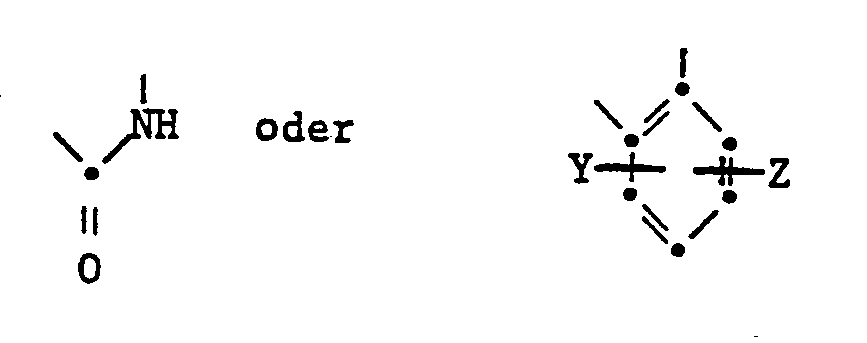
bedeutet, worin Y und Z für H oder Halogenatome, Alkyl- oder Alkoxygruppen mit 1 - 4 C bedeuten.
2. Isoindolinpigmente gemäss Anspruch 1, worin R die Methyl-oder Aethylgruppe bedeutet.
3. Isoindolinpigmente gemäss Anspruch l,worin X den Rest der Formel

bedeutet.
4. Verfahren zur Herstellung von Isoindolinpigmenten gemäss Anspruch 1, dadurch gekennzeichnet, dass man 1,3-Diiminoisoindolin in beliebiger Reihenfolge mit je einem Mol eines Cyanacetamides der Formel NCCH2CONHR und Barbitursäure oder einem Dihydroxychinolin der Formel

kondensiert.
5. Verfahren gemäss Anspruch 4, dadurch gekennzeichnet, dass man in erster Stufe das Diiminoisoindolin mit dem Cyanacetamid und in zweiter Stufe mit der Barbitursäure oder dem Dihydroxychinolin kondensiert.
6. Verfahren gemäss Anspruch 4, dadurch gekennzeichnet, dass man ein Cyanacetamid der angegebenen Formel verwendet, worin R die Methyl- oder Aethylgruppe bedeutet.
7. Verfahren gemäss Anspruch 5, dadurch gekennzeichnet, dass man in zweiter Stufe mit Barbitursäure kondensiert.
8. Verfahren gemäss Anspruch 5, dadurch gekennzeichnet, dass man die Kondensation der zweiten Stufe bei Temperatur zwischen 60° und 140° durchführt.
9. Verfahren gemäss Anspruch 4, dadurch gekennzeichnet, dass man das erhaltene Pigment zwecks Rekristallisation einer Lösungsmittelbehandlung bei 100-150° unterwirft.
10. Verfahren zum Pigmentieren von hochmolekularem organischem Material, gekennzeichnet durch die Verwendung der Isoindoline gemäss Anspruch 1.
11. Hochmolekulares organisches Material enthaltend als Pigment ein Isoindolin gemäss Anspruch 1.
Applications Claiming Priority (2)
| Application Number | Priority Date | Filing Date | Title |
|---|---|---|---|
| CH1004679 | 1979-11-09 | ||
| CH10046/79 | 1979-11-09 |
Publications (1)
| Publication Number | Publication Date |
|---|---|
| EP0029007A1 true EP0029007A1 (de) | 1981-05-20 |
Family
ID=4358728
Family Applications (1)
| Application Number | Title | Priority Date | Filing Date |
|---|---|---|---|
| EP80810337A Withdrawn EP0029007A1 (de) | 1979-11-09 | 1980-11-03 | Isoindolinpigmente, Verfahren zu deren Herstellung und Verwendung |
Country Status (3)
| Country | Link |
|---|---|
| EP (1) | EP0029007A1 (de) |
| JP (1) | JPS5681369A (de) |
| CA (1) | CA1140130A (de) |
Cited By (4)
| Publication number | Priority date | Publication date | Assignee | Title |
|---|---|---|---|---|
| US4719300A (en) * | 1985-07-09 | 1988-01-12 | Basf Aktiengesellschaft | Isoindoline colorants |
| WO1999038920A1 (en) * | 1998-01-28 | 1999-08-05 | Ciba Specialty Chemicals Holding Inc. | Isoindoline pigment having improved low shear dispersibility |
| WO2008009597A3 (de) * | 2006-07-18 | 2008-03-20 | Basf Ag | Isoindolinpigmente |
| WO2009074533A3 (en) * | 2007-12-10 | 2010-01-28 | Basf Se | Isometric isoindoline yellow pigment |
Families Citing this family (9)
| Publication number | Priority date | Publication date | Assignee | Title |
|---|---|---|---|---|
| CH665650A5 (de) * | 1985-07-22 | 1988-05-31 | Basf Ag | Isoindolinfarbstoffe. |
| CH668976A5 (de) * | 1985-09-20 | 1989-02-15 | Basf Ag | Chinophthalonfarbstoffe. |
| US5177209A (en) * | 1991-04-22 | 1993-01-05 | Miles Inc. | Process for preparation of asymmetric isoindoline pigments |
| US5326872A (en) * | 1991-04-22 | 1994-07-05 | Miles Inc. | Process for preparation of asymmetric isoindoline pigments |
| JP6051706B2 (ja) * | 2012-09-11 | 2016-12-27 | 東洋インキScホールディングス株式会社 | 活性エネルギー線硬化型インクジェットインキ組成物 |
| EP2706099B1 (de) | 2012-09-11 | 2018-01-31 | Toyo Ink SC Holdings Co., Ltd. | Mit aktiven Energiestrahlen härtbare Tintenzusammensetzung |
| TWI754733B (zh) * | 2017-03-29 | 2022-02-11 | 日商住友化學股份有限公司 | 異吲哚啉色素及其製造方法 |
| JP7055677B2 (ja) * | 2017-03-29 | 2022-04-18 | 住友化学株式会社 | イソインドリン色素の製造方法 |
| JP7105024B1 (ja) | 2021-08-03 | 2022-07-22 | 東洋インキScホールディングス株式会社 | 顔料組成物、着色組成物、塗料、インキ、インキセット、印刷物、及び包装材料 |
Citations (7)
| Publication number | Priority date | Publication date | Assignee | Title |
|---|---|---|---|---|
| FR1537299A (fr) * | 1966-09-09 | 1968-08-23 | Bayer Ag | Procédé de préparation de nouveaux dérivés de l'isoindoline |
| DE2121524A1 (de) * | 1971-05-03 | 1972-11-16 | Badische Anilin- & Soda-Fabrik Ag, 6700 Ludwigshafen | Dispersionsfarbstoffe aus o-Phthalodinitril |
| DE1670748A1 (de) * | 1966-09-09 | 1973-05-30 | Bayer Ag | Verfahren zur herstellung neuer isoindolinderivate |
| DE2615394A1 (de) * | 1975-04-11 | 1976-10-21 | Ciba Geigy Ag | Verfahren zum faerben thermoplastischer kunststoffe in der schmelze |
| DE2800815A1 (de) * | 1978-01-10 | 1979-07-12 | Basf Ag | Verfahren zur herstellung leicht verteilbarer und deckender isoindolinpigmentfarbstoffe |
| DE2831673A1 (de) * | 1978-07-19 | 1980-02-07 | Basf Ag | Heterocyclische verbindungen |
| EP0017214A1 (de) * | 1979-04-07 | 1980-10-15 | BASF Aktiengesellschaft | Neue Isoindolinfarbstoffe und deren Verwendung |
-
1980
- 1980-11-03 EP EP80810337A patent/EP0029007A1/de not_active Withdrawn
- 1980-11-07 CA CA000364234A patent/CA1140130A/en not_active Expired
- 1980-11-08 JP JP15755380A patent/JPS5681369A/ja active Pending
Patent Citations (9)
| Publication number | Priority date | Publication date | Assignee | Title |
|---|---|---|---|---|
| FR1537299A (fr) * | 1966-09-09 | 1968-08-23 | Bayer Ag | Procédé de préparation de nouveaux dérivés de l'isoindoline |
| DE1670748A1 (de) * | 1966-09-09 | 1973-05-30 | Bayer Ag | Verfahren zur herstellung neuer isoindolinderivate |
| DE2121524A1 (de) * | 1971-05-03 | 1972-11-16 | Badische Anilin- & Soda-Fabrik Ag, 6700 Ludwigshafen | Dispersionsfarbstoffe aus o-Phthalodinitril |
| FR2135259A1 (de) * | 1971-05-03 | 1972-12-15 | Basf Ag | |
| DE2615394A1 (de) * | 1975-04-11 | 1976-10-21 | Ciba Geigy Ag | Verfahren zum faerben thermoplastischer kunststoffe in der schmelze |
| FR2307008A1 (fr) * | 1975-04-11 | 1976-11-05 | Ciba Geigy Ag | Procede de coloration de matieres thermoplastiques a l'etat fondu |
| DE2800815A1 (de) * | 1978-01-10 | 1979-07-12 | Basf Ag | Verfahren zur herstellung leicht verteilbarer und deckender isoindolinpigmentfarbstoffe |
| DE2831673A1 (de) * | 1978-07-19 | 1980-02-07 | Basf Ag | Heterocyclische verbindungen |
| EP0017214A1 (de) * | 1979-04-07 | 1980-10-15 | BASF Aktiengesellschaft | Neue Isoindolinfarbstoffe und deren Verwendung |
Cited By (8)
| Publication number | Priority date | Publication date | Assignee | Title |
|---|---|---|---|---|
| US4719300A (en) * | 1985-07-09 | 1988-01-12 | Basf Aktiengesellschaft | Isoindoline colorants |
| WO1999038920A1 (en) * | 1998-01-28 | 1999-08-05 | Ciba Specialty Chemicals Holding Inc. | Isoindoline pigment having improved low shear dispersibility |
| US6143067A (en) * | 1998-01-28 | 2000-11-07 | Ciba Specialty Chemicals Corporation | Isoindoline pigment having improved low shear dispersibility |
| WO2008009597A3 (de) * | 2006-07-18 | 2008-03-20 | Basf Ag | Isoindolinpigmente |
| US8026361B2 (en) | 2006-07-18 | 2011-09-27 | Basf Aktiengesellschaft | Isoindoline pigments |
| CN101490178B (zh) * | 2006-07-18 | 2014-01-08 | 巴斯夫欧洲公司 | 异吲哚啉颜料 |
| WO2009074533A3 (en) * | 2007-12-10 | 2010-01-28 | Basf Se | Isometric isoindoline yellow pigment |
| US8075683B2 (en) | 2007-12-10 | 2011-12-13 | BASF SE Ludwigshafen | Isometric isoindoline yellow pigment |
Also Published As
| Publication number | Publication date |
|---|---|
| JPS5681369A (en) | 1981-07-03 |
| CA1140130A (en) | 1983-01-25 |
Similar Documents
| Publication | Publication Date | Title |
|---|---|---|
| DE2814526C2 (de) | ||
| EP0029007A1 (de) | Isoindolinpigmente, Verfahren zu deren Herstellung und Verwendung | |
| CH510088A (de) | Verfahren zur Herstellung transparenter Pigmente der Isoindolinreihe | |
| EP0088729B1 (de) | Verwendung von Metallkomplexen von Hydrazonen als Pigmente | |
| EP0035174B1 (de) | Neue Isoindolinfarbstoffe und deren Verwendung | |
| DE2425594A1 (de) | Iminoisoindolinpigmente und verfahren zu deren herstellung | |
| EP0020299B1 (de) | Nickelkomplexe von Azinen, Verfahren zu deren Herstellung, Verfahren zum Pigmentieren hochmolekularen organischen Materials sowie das so enthaltene Material | |
| EP0051560B1 (de) | Heterocyclen enthaltende Monoazopigmente, Verfahren zu deren Herstellung und deren Verwendung | |
| EP0035672A1 (de) | Neue Isoindolinfarbstoffe und deren Verwendung | |
| DE2800765C2 (de) | Neue Monoazopigmente, Verfahren zu deren Herstellung und deren Verwendung | |
| EP0019588A1 (de) | Verfahren zum Pigmentieren von Lacken aus hochmolekularem organischem Material mittels eines Pigmentes der Isoindolinreihe | |
| DE2247009C3 (de) | Iminoisoindolinonfarbstoffe und Verwendung zum Pigmentieren von hochmolekularem organischem Material | |
| EP0763538B1 (de) | Verfahren zum Färben von hochmolekularem Material mit polycyclischen Verbindungen | |
| CH617450A5 (de) | ||
| EP0183651B1 (de) | Neue Metallkomplexe, Verfahren zu deren Herstellung und Verwendung | |
| DE3927028A1 (de) | Neue isoindolinpigmente | |
| EP0185618A2 (de) | Isoindoline, Verfahren zu deren Herstellung und Verwendung | |
| EP0006154B1 (de) | Monoazopigmente und deren Verwendung zum Pigmentieren von hochmolekularem organischem Material | |
| DE1569773B1 (de) | Pigment der Bis-(tetrachlor-isoindolin-l-on-3-ylidenimino)-aryl-reihe und Verfahren zu dessen Herstellung | |
| CH623069A5 (en) | Process for pigmenting high molecular-weight organic material | |
| DE1569768C (de) | Pigmente, deren Herstellung und Ver Wendung | |
| DE2842469A1 (de) | Bis-n-dialkylcarbamoyl-chinacridone, verfahren zu ihrer herstellung und ihre verwendung | |
| EP0322359B1 (de) | Neue Isoindolinpigmente enthaltend mindestens einen Triazolopyrimidonrest | |
| DE1569773C (de) | Pigment der Bis (tetrachlor isoindo Im 1 on 3 yhdenimino) aryl reihe und Verfahren zu dessen Herstellung | |
| EP0298037A2 (de) | Neue unsymmetrische Isoindolinpigmente enthaltend eine Estergruppe |
Legal Events
| Date | Code | Title | Description |
|---|---|---|---|
| PUAI | Public reference made under article 153(3) epc to a published international application that has entered the european phase |
Free format text: ORIGINAL CODE: 0009012 |
|
| 17P | Request for examination filed |
Effective date: 19801105 |
|
| AK | Designated contracting states |
Designated state(s): CH DE FR GB IT |
|
| STAA | Information on the status of an ep patent application or granted ep patent |
Free format text: STATUS: THE APPLICATION HAS BEEN WITHDRAWN |
|
| 18W | Application withdrawn |
Withdrawal date: 19820910 |
|
| RIN1 | Information on inventor provided before grant (corrected) |
Inventor name: VON DER CRONE, JOST, DR. |