EP0176500A2 - Material und Verfahren zur Bildung flüssigkeitsdurchlässiger Schichten - Google Patents
Material und Verfahren zur Bildung flüssigkeitsdurchlässiger Schichten Download PDFInfo
- Publication number
- EP0176500A2 EP0176500A2 EP85890237A EP85890237A EP0176500A2 EP 0176500 A2 EP0176500 A2 EP 0176500A2 EP 85890237 A EP85890237 A EP 85890237A EP 85890237 A EP85890237 A EP 85890237A EP 0176500 A2 EP0176500 A2 EP 0176500A2
- Authority
- EP
- European Patent Office
- Prior art keywords
- material according
- polyvinyl chloride
- pvc
- plastic
- plastic powder
- Prior art date
- Legal status (The legal status is an assumption and is not a legal conclusion. Google has not performed a legal analysis and makes no representation as to the accuracy of the status listed.)
- Granted
Links
- 239000000463 material Substances 0.000 title claims abstract description 24
- 238000000034 method Methods 0.000 title claims description 9
- 239000007788 liquid Substances 0.000 title description 3
- 239000004800 polyvinyl chloride Substances 0.000 claims abstract description 28
- 229920000915 polyvinyl chloride Polymers 0.000 claims abstract description 28
- 239000000843 powder Substances 0.000 claims abstract description 23
- 239000002245 particle Substances 0.000 claims abstract description 18
- 229920003023 plastic Polymers 0.000 claims abstract description 16
- 239000004033 plastic Substances 0.000 claims abstract description 16
- 238000005245 sintering Methods 0.000 claims abstract description 15
- 239000011148 porous material Substances 0.000 claims abstract description 7
- 239000000203 mixture Substances 0.000 claims abstract description 5
- 239000004793 Polystyrene Substances 0.000 claims abstract description 4
- 150000001805 chlorine compounds Chemical class 0.000 claims abstract description 3
- 229920000578 graft copolymer Polymers 0.000 claims abstract description 3
- 229920000098 polyolefin Polymers 0.000 claims abstract description 3
- 229920002223 polystyrene Polymers 0.000 claims abstract description 3
- 239000000758 substrate Substances 0.000 claims abstract 2
- 229920000642 polymer Polymers 0.000 claims description 7
- 239000004604 Blowing Agent Substances 0.000 claims description 6
- 238000005342 ion exchange Methods 0.000 claims description 4
- -1 polyethylene Polymers 0.000 claims description 4
- 230000005855 radiation Effects 0.000 claims description 4
- 239000000725 suspension Substances 0.000 claims description 3
- 239000004698 Polyethylene Substances 0.000 claims description 2
- 239000004743 Polypropylene Substances 0.000 claims description 2
- 125000005396 acrylic acid ester group Chemical group 0.000 claims description 2
- 229920003229 poly(methyl methacrylate) Polymers 0.000 claims description 2
- 229920000573 polyethylene Polymers 0.000 claims description 2
- 239000004926 polymethyl methacrylate Substances 0.000 claims description 2
- 229920001155 polypropylene Polymers 0.000 claims description 2
- 238000002604 ultrasonography Methods 0.000 claims description 2
- 239000004908 Emulsion polymer Substances 0.000 claims 2
- 238000001311 chemical methods and process Methods 0.000 claims 1
- 238000010438 heat treatment Methods 0.000 claims 1
- 238000009751 slip forming Methods 0.000 claims 1
- 230000015572 biosynthetic process Effects 0.000 abstract description 3
- 238000010521 absorption reaction Methods 0.000 description 3
- 239000003792 electrolyte Substances 0.000 description 3
- QAOWNCQODCNURD-UHFFFAOYSA-N Sulfuric acid Chemical compound OS(O)(=O)=O QAOWNCQODCNURD-UHFFFAOYSA-N 0.000 description 2
- 239000002253 acid Substances 0.000 description 2
- 239000003795 chemical substances by application Substances 0.000 description 2
- 238000009826 distribution Methods 0.000 description 2
- 230000000694 effects Effects 0.000 description 2
- 239000000839 emulsion Substances 0.000 description 2
- 238000005516 engineering process Methods 0.000 description 2
- 239000008187 granular material Substances 0.000 description 2
- 238000004519 manufacturing process Methods 0.000 description 2
- 239000011159 matrix material Substances 0.000 description 2
- 239000004014 plasticizer Substances 0.000 description 2
- 239000007787 solid Substances 0.000 description 2
- BVKZGUZCCUSVTD-UHFFFAOYSA-M Bicarbonate Chemical compound OC([O-])=O BVKZGUZCCUSVTD-UHFFFAOYSA-M 0.000 description 1
- 241000282994 Cervidae Species 0.000 description 1
- 229920002307 Dextran Polymers 0.000 description 1
- 229910000831 Steel Inorganic materials 0.000 description 1
- 238000005299 abrasion Methods 0.000 description 1
- QVGXLLKOCUKJST-UHFFFAOYSA-N atomic oxygen Chemical compound [O] QVGXLLKOCUKJST-UHFFFAOYSA-N 0.000 description 1
- 238000010276 construction Methods 0.000 description 1
- 229920001577 copolymer Polymers 0.000 description 1
- 238000007599 discharging Methods 0.000 description 1
- 238000005868 electrolysis reaction Methods 0.000 description 1
- 238000004945 emulsification Methods 0.000 description 1
- 230000014759 maintenance of location Effects 0.000 description 1
- 230000003647 oxidation Effects 0.000 description 1
- 238000007254 oxidation reaction Methods 0.000 description 1
- 229910052760 oxygen Inorganic materials 0.000 description 1
- 239000001301 oxygen Substances 0.000 description 1
- 238000005192 partition Methods 0.000 description 1
- 239000011049 pearl Substances 0.000 description 1
- 238000006116 polymerization reaction Methods 0.000 description 1
- 150000003839 salts Chemical class 0.000 description 1
- 230000001235 sensitizing effect Effects 0.000 description 1
- 238000000926 separation method Methods 0.000 description 1
- 239000002904 solvent Substances 0.000 description 1
- 238000002336 sorption--desorption measurement Methods 0.000 description 1
- 239000010959 steel Substances 0.000 description 1
- 238000003860 storage Methods 0.000 description 1
- 239000000126 substance Substances 0.000 description 1
- 238000010557 suspension polymerization reaction Methods 0.000 description 1
- 238000005979 thermal decomposition reaction Methods 0.000 description 1
Images
Classifications
-
- B—PERFORMING OPERATIONS; TRANSPORTING
- B01—PHYSICAL OR CHEMICAL PROCESSES OR APPARATUS IN GENERAL
- B01D—SEPARATION
- B01D67/00—Processes specially adapted for manufacturing semi-permeable membranes for separation processes or apparatus
- B01D67/0002—Organic membrane manufacture
- B01D67/0004—Organic membrane manufacture by agglomeration of particles
- B01D67/00041—Organic membrane manufacture by agglomeration of particles by sintering
-
- B—PERFORMING OPERATIONS; TRANSPORTING
- B01—PHYSICAL OR CHEMICAL PROCESSES OR APPARATUS IN GENERAL
- B01D—SEPARATION
- B01D69/00—Semi-permeable membranes for separation processes or apparatus characterised by their form, structure or properties; Manufacturing processes specially adapted therefor
- B01D69/14—Dynamic membranes
- B01D69/141—Heterogeneous membranes, e.g. containing dispersed material; Mixed matrix membranes
-
- B—PERFORMING OPERATIONS; TRANSPORTING
- B01—PHYSICAL OR CHEMICAL PROCESSES OR APPARATUS IN GENERAL
- B01D—SEPARATION
- B01D71/00—Semi-permeable membranes for separation processes or apparatus characterised by the material; Manufacturing processes specially adapted therefor
- B01D71/06—Organic material
- B01D71/30—Polyalkenyl halides
- B01D71/301—Polyvinylchloride
-
- C—CHEMISTRY; METALLURGY
- C08—ORGANIC MACROMOLECULAR COMPOUNDS; THEIR PREPARATION OR CHEMICAL WORKING-UP; COMPOSITIONS BASED THEREON
- C08J—WORKING-UP; GENERAL PROCESSES OF COMPOUNDING; AFTER-TREATMENT NOT COVERED BY SUBCLASSES C08B, C08C, C08F, C08G or C08H
- C08J3/00—Processes of treating or compounding macromolecular substances
- C08J3/12—Powdering or granulating
-
- C—CHEMISTRY; METALLURGY
- C08—ORGANIC MACROMOLECULAR COMPOUNDS; THEIR PREPARATION OR CHEMICAL WORKING-UP; COMPOSITIONS BASED THEREON
- C08J—WORKING-UP; GENERAL PROCESSES OF COMPOUNDING; AFTER-TREATMENT NOT COVERED BY SUBCLASSES C08B, C08C, C08F, C08G or C08H
- C08J3/00—Processes of treating or compounding macromolecular substances
- C08J3/12—Powdering or granulating
- C08J3/16—Powdering or granulating by coagulating dispersions
-
- C—CHEMISTRY; METALLURGY
- C25—ELECTROLYTIC OR ELECTROPHORETIC PROCESSES; APPARATUS THEREFOR
- C25B—ELECTROLYTIC OR ELECTROPHORETIC PROCESSES FOR THE PRODUCTION OF COMPOUNDS OR NON-METALS; APPARATUS THEREFOR
- C25B13/00—Diaphragms; Spacing elements
- C25B13/04—Diaphragms; Spacing elements characterised by the material
- C25B13/08—Diaphragms; Spacing elements characterised by the material based on organic materials
-
- H—ELECTRICITY
- H01—ELECTRIC ELEMENTS
- H01M—PROCESSES OR MEANS, e.g. BATTERIES, FOR THE DIRECT CONVERSION OF CHEMICAL ENERGY INTO ELECTRICAL ENERGY
- H01M50/00—Constructional details or processes of manufacture of the non-active parts of electrochemical cells other than fuel cells, e.g. hybrid cells
- H01M50/40—Separators; Membranes; Diaphragms; Spacing elements inside cells
- H01M50/409—Separators, membranes or diaphragms characterised by the material
- H01M50/411—Organic material
- H01M50/414—Synthetic resins, e.g. thermoplastics or thermosetting resins
-
- H—ELECTRICITY
- H01—ELECTRIC ELEMENTS
- H01M—PROCESSES OR MEANS, e.g. BATTERIES, FOR THE DIRECT CONVERSION OF CHEMICAL ENERGY INTO ELECTRICAL ENERGY
- H01M50/00—Constructional details or processes of manufacture of the non-active parts of electrochemical cells other than fuel cells, e.g. hybrid cells
- H01M50/40—Separators; Membranes; Diaphragms; Spacing elements inside cells
- H01M50/409—Separators, membranes or diaphragms characterised by the material
- H01M50/411—Organic material
- H01M50/414—Synthetic resins, e.g. thermoplastics or thermosetting resins
- H01M50/417—Polyolefins
-
- H—ELECTRICITY
- H01—ELECTRIC ELEMENTS
- H01M—PROCESSES OR MEANS, e.g. BATTERIES, FOR THE DIRECT CONVERSION OF CHEMICAL ENERGY INTO ELECTRICAL ENERGY
- H01M50/00—Constructional details or processes of manufacture of the non-active parts of electrochemical cells other than fuel cells, e.g. hybrid cells
- H01M50/40—Separators; Membranes; Diaphragms; Spacing elements inside cells
- H01M50/489—Separators, membranes, diaphragms or spacing elements inside the cells, characterised by their physical properties, e.g. swelling degree, hydrophilicity or shut down properties
- H01M50/491—Porosity
-
- H—ELECTRICITY
- H01—ELECTRIC ELEMENTS
- H01M—PROCESSES OR MEANS, e.g. BATTERIES, FOR THE DIRECT CONVERSION OF CHEMICAL ENERGY INTO ELECTRICAL ENERGY
- H01M50/00—Constructional details or processes of manufacture of the non-active parts of electrochemical cells other than fuel cells, e.g. hybrid cells
- H01M50/40—Separators; Membranes; Diaphragms; Spacing elements inside cells
- H01M50/489—Separators, membranes, diaphragms or spacing elements inside the cells, characterised by their physical properties, e.g. swelling degree, hydrophilicity or shut down properties
- H01M50/494—Tensile strength
-
- B—PERFORMING OPERATIONS; TRANSPORTING
- B01—PHYSICAL OR CHEMICAL PROCESSES OR APPARATUS IN GENERAL
- B01D—SEPARATION
- B01D2323/00—Details relating to membrane preparation
- B01D2323/34—Use of radiation
-
- B—PERFORMING OPERATIONS; TRANSPORTING
- B01—PHYSICAL OR CHEMICAL PROCESSES OR APPARATUS IN GENERAL
- B01D—SEPARATION
- B01D2325/00—Details relating to properties of membranes
- B01D2325/26—Electrical properties
-
- B—PERFORMING OPERATIONS; TRANSPORTING
- B01—PHYSICAL OR CHEMICAL PROCESSES OR APPARATUS IN GENERAL
- B01D—SEPARATION
- B01D2325/00—Details relating to properties of membranes
- B01D2325/42—Ion-exchange membranes
-
- C—CHEMISTRY; METALLURGY
- C08—ORGANIC MACROMOLECULAR COMPOUNDS; THEIR PREPARATION OR CHEMICAL WORKING-UP; COMPOSITIONS BASED THEREON
- C08J—WORKING-UP; GENERAL PROCESSES OF COMPOUNDING; AFTER-TREATMENT NOT COVERED BY SUBCLASSES C08B, C08C, C08F, C08G or C08H
- C08J2323/00—Characterised by the use of homopolymers or copolymers of unsaturated aliphatic hydrocarbons having only one carbon-to-carbon double bond; Derivatives of such polymers
- C08J2323/02—Characterised by the use of homopolymers or copolymers of unsaturated aliphatic hydrocarbons having only one carbon-to-carbon double bond; Derivatives of such polymers not modified by chemical after treatment
- C08J2323/04—Homopolymers or copolymers of ethene
- C08J2323/06—Polyethene
-
- C—CHEMISTRY; METALLURGY
- C08—ORGANIC MACROMOLECULAR COMPOUNDS; THEIR PREPARATION OR CHEMICAL WORKING-UP; COMPOSITIONS BASED THEREON
- C08J—WORKING-UP; GENERAL PROCESSES OF COMPOUNDING; AFTER-TREATMENT NOT COVERED BY SUBCLASSES C08B, C08C, C08F, C08G or C08H
- C08J2327/00—Characterised by the use of homopolymers or copolymers of compounds having one or more unsaturated aliphatic radicals, each having only one carbon-to-carbon double bond, and at least one being terminated by a halogen; Derivatives of such polymers
- C08J2327/02—Characterised by the use of homopolymers or copolymers of compounds having one or more unsaturated aliphatic radicals, each having only one carbon-to-carbon double bond, and at least one being terminated by a halogen; Derivatives of such polymers not modified by chemical after-treatment
- C08J2327/04—Characterised by the use of homopolymers or copolymers of compounds having one or more unsaturated aliphatic radicals, each having only one carbon-to-carbon double bond, and at least one being terminated by a halogen; Derivatives of such polymers not modified by chemical after-treatment containing chlorine atoms
- C08J2327/08—Homopolymers or copolymers of vinylidene chloride
-
- H—ELECTRICITY
- H01—ELECTRIC ELEMENTS
- H01M—PROCESSES OR MEANS, e.g. BATTERIES, FOR THE DIRECT CONVERSION OF CHEMICAL ENERGY INTO ELECTRICAL ENERGY
- H01M2300/00—Electrolytes
- H01M2300/0002—Aqueous electrolytes
- H01M2300/0005—Acid electrolytes
-
- Y—GENERAL TAGGING OF NEW TECHNOLOGICAL DEVELOPMENTS; GENERAL TAGGING OF CROSS-SECTIONAL TECHNOLOGIES SPANNING OVER SEVERAL SECTIONS OF THE IPC; TECHNICAL SUBJECTS COVERED BY FORMER USPC CROSS-REFERENCE ART COLLECTIONS [XRACs] AND DIGESTS
- Y02—TECHNOLOGIES OR APPLICATIONS FOR MITIGATION OR ADAPTATION AGAINST CLIMATE CHANGE
- Y02E—REDUCTION OF GREENHOUSE GAS [GHG] EMISSIONS, RELATED TO ENERGY GENERATION, TRANSMISSION OR DISTRIBUTION
- Y02E60/00—Enabling technologies; Technologies with a potential or indirect contribution to GHG emissions mitigation
- Y02E60/10—Energy storage using batteries
Definitions
- the invention relates to a material for forming liquid-permeable layers, in particular separating layers, preferably for use in ion exchange or in electrochemical processes, particularly preferably for forming separators for lead accumulators.
- separating layers which on the one hand e.g. Separating phases of different compositions from one another or also as separating agents for preferably specifically retaining certain phase components or for separating phases into their components by means of a special adsorption / desorption behavior is widely used in technology.
- the separating layers lie as special shaped bodies or components, e.g. as diaphragms or separators, or as essentially unshaped layers, e.g. Column fillings, which are made up of powders or pearls.
- separators for lead accumulators i.e. separating plates arranged between the electrode plates, it has also become known to produce these shaped articles from PVC powder by sintering in strip form, e.g. after AT-Psen 309 795 and 321 567.
- microporous plastic material in powder form is used for their construction, which may optionally be sintered and the particles of which each have at least constant pores.
- plastics which are selected from the group comprising polyvinyl chloride, polyvinyl chloride copolymers such as, for example, PVC-ABS or PVC / acrylic acid esters, especially PVC / PMMA, polyvinyl chloride graft polymers, perchlorinated polyvinyl chloride derivatives, polyolefins, especially polyethylene and polypropylene, as well as polystyrene and mixtures of these components.
- the porosity of the separating layers is between 0.1 and 95% t, expediently between 10 and 95% and preferably over 50%, the grain sizes in the range from 0.01 pm to 200 pm, the proportion of grains ⁇ 10 ⁇ m preferably being less than 10 mass %, in particular ⁇ 5 mass% of the plastic powder.
- the plastic particles have pores with diameters from 5 nm to 20 ⁇ m, preferably from 10 nm to 1 ⁇ m.
- the plastics advantageously have K values in the range from 50 to 80.
- Aggregates formed by sintering can advantageously be used in the production of the separating layer material.
- E.g. can be different - or just a plastic powder
- the shaped bodies - preferably in the shape - are sintered at least superficially so that the desired stability is achieved.
- the main purpose of sintering is to achieve a mechanical cohesion between the powder particles with the formation of pore-shaped passages between the particles; In order to maintain the microporosity of the individual sintered particles, the sintering must not go so far that the micropores are closed Sintering temperature are sintered, the lower sintering temperature being used.
- Solids or liquids are suitable as blowing agents in a known manner.
- volatile solvents can be built into the polymer granules, which expand the granules when the suspension is worked up.
- emulsion poly Water-soluble substances, for example deer horn salt or Na bicarbonate, can be used in the polymerization, which superficially coat the primary polymers and are incorporated into them when the secondary polymers are formed. The desired porosity is obtained in the case of a temperature treatment for the thermal decomposition of the blowing agent.
- the preferably compact binding material of a multicomponent powder can advantageously be treated on the surface with sensitizing agents for converting the energy of short-wave radiation into thermal energy, so that particularly low overall temperatures are achieved in the matrix to be partially sintered and it is ensured that the microporous particles in the matrix when Sintering down to the bond areas. remain unchanged.
- sensitizers are known.
- separating layers can be produced which, compared to the previous ones, have a significantly better liquid absorption and retention capacity and mass transfer capacity.
- Shaped bodies made from these materials with at least surface sintering allow these properties, in particular high porosity, to be combined with high flexibility and corresponding strength.
- Separators in lead collectors are used on the one hand to separate the individual electrode plates electrochemically and mechanically, and on the other hand they serve to support the plate pack.
- they should have high mechanical strength, including abrasion resistance, and, on the other hand, they should have good ionic conductivity and a good insulating effect.
- the separators should be acid-resistant separators (when the battery is charged, the separators are in aqueous 4.5 M sulfuric acid), oxidation-resistant (the separators are in direct contact with Pbo 2 and oxygen in status nascendi) and thermally resistant , since the temperature of the electrolyte rises sharply during charging or discharging with a high current density and the separators are also thermally stressed during manufacture.
- separators obtained by sintering conventional, compact PVC powder have only a maximum porosity of / 40%, so that the performance of batteries equipped in this way is limited.
- these known sintered separators have only a limited capacity for the electrolyte, so that an undesirable, relatively large distance between separators and plates must always be maintained.
- these compact separators contribute significantly to the total weight of the batteries.
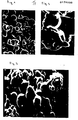
- FIGS. 1 to 3 show electron microscopic raster images of the surfaces of sintered separator plates.
- a microporous PVC powder based on the Vestalit Bi 3421 PVC type with a tamped density according to DIN 53194 of 0.34, a particle size distribution between 1 and 60 ⁇ m (average particle size 20 ⁇ m) and a plasticizer absorption capacity (DOP) of 59% was sintered on a band sintering machine according to the method according to AT-PS 309 795 for 5 min at 210 ° C.
- the surface of the plate can be seen in Fig. 1 in 680 times magnification, in Fig. 2 in 1640 times magnification.
- the plate has an open framework structure made of particles sintered together, at least the larger of the particles themselves showing sack pores and continuous micropores.
- the weight of the plate was about 2/3 the weight of a plate sintered from compact PVC powder; the tensile strength was 72 kp.cm -2 (705 N.cm -2 ).
- the electrical resistance is only in the order of 0.8 m ⁇ .dm -2 .
- the surface of the plate can be seen in FIG. 3 in a magnification of 4600 times.
- the plate has an open framework structure: particles sintered together, the particles from the suspension polymer showing continuous micropores.
- the weight of the plate corresponded to the weight of the plate according to Example 1, the tensile strength was 100 kp.cm -2 (90 8 N .cm- 2 )
- the electrical resistance was only about 0.9 m ⁇ .dm -2 .
- the plates according to Examples 1 and 2 can be used to form separators for lead acid batteries, which only have to have a thickness of 0.4 to 0.8 mm in order to bring about the required effect.
- the electrode plates are packed close to the separators with a corresponding space and weight savings.
- Such plates can also advantageously be used as diaphragm material in electrolysis cells.
- the materials according to the invention can generally be used to build up poured or shaped liquid-permeable layers, in particular also for use in ion exchange.
Landscapes
- Chemical & Material Sciences (AREA)
- Chemical Kinetics & Catalysis (AREA)
- Electrochemistry (AREA)
- General Chemical & Material Sciences (AREA)
- Engineering & Computer Science (AREA)
- Dispersion Chemistry (AREA)
- Organic Chemistry (AREA)
- Medicinal Chemistry (AREA)
- Manufacturing & Machinery (AREA)
- Health & Medical Sciences (AREA)
- Thermal Sciences (AREA)
- Polymers & Plastics (AREA)
- Physics & Mathematics (AREA)
- Materials Engineering (AREA)
- Metallurgy (AREA)
- Manufacture Of Porous Articles, And Recovery And Treatment Of Waste Products (AREA)
- Ceramic Products (AREA)
- Separation Using Semi-Permeable Membranes (AREA)
- Laminated Bodies (AREA)
- Cell Separators (AREA)
Abstract
Description
- Die Erfindung betrifft ein Material zur Bildung flüssigkeitsdurchlässiger Schichten, insbesondere Trennschichten, vorzugsweise zur Anwendung beim Ionenaustausch oder bei elektrochemischen Prozessen, besonders bevorzugt zur Bildung von Separatoren für Blei-Akkumulatoren.
- Die Anwendung von Trennschichten, die einerseits z.B. Phasen verschiedener Zusammensetzung voneinander trennen sollen oder auch als Trennmittel zum vorzugsweise spezifischen Zurückhalten bestimmter Phasenbestandteile oder zum Auftrennen von Phasen in ihre Bestandteile durch ein besonderes Adsorptions/Desorptionsverhalten dienen, ist in der Technik vielfach verbreitet. Die Trennschichten liegen dabei als besondere Formkörper oder Bauteile, z.B. als Diaphragmen oder Separatoren, oder als im wesentlichen ungeformte Schichten, z.B. Säulenfüllungen, vor, die aus Pulvern oder Perlen aufgebaut sind. Im Zusammenhang mit Separatoren für Bleiakkumulatoren, d.h. zwischen den Elektrodenplatten angeordnetenTrennplatten, ist es auch bereits bekannt geworden, diese Formkörper aus PVC-Pulver durch Sintern in Bandform herzustellen, z.B. nach den AT-Psen 309 795 und 321 567.
- Besonders aus der Ionentauschertechnik ist bekannt, die Trennmateralien mit Innenstruktur zu bilden, so z.B. Gitterstrukturen aus quervernetzten Copolymeren oder Dextranen zu bilden.
- Es wurde nunmehr gefunden, daß man die Eigenschaften derartigerTrennschichten weitgehend verbessern kann, wenn man zu deren Aufbau ein mikroporöses Kunststoffmaterial in Pulverform einsetzt, das gegebenenfalls gesintert sein kann und dessen Partikel jeweils mindestensteiveise durchgehende Poren aufweisen.
- Als Kunststoffe kommen dabei vor allem solche in Frage, die ausgewählt sind aus der Gruppe enthaltend Polyvinylchlorid, Polyvinylchloridcopolymere wie z.B. PVC-ABS oder PVC/Acrylsäureester, insbesondere PVC/PMMA, Polyvinylchloridpfropfpolymere, perchlorierte Polyvinylchloridabkömmlinge, Polyolefine, insbesondere Polyäthylen und Polypropylen, sowie Polystyrol und Mischungen aus diesen Komponenten.
- Die Porosität der Trennschichten beträgt dabei zwischen 0,1 und 95 %t zweckmäßig zwischen 10 und 95 % und vorzugsweise über 50 % die Korngrößen im Bereich von 0,01 pm bis 200 pm, wobei vorzugsweise der Anteil von Körnungen ≤ 10 µm unter 10 Masse%, insbesondere ≤ 5 Masse % des Kunststoffpulvers beträgt.
- In Abhängigkeit von der Korngröße weisen die Kunststoffpartikel Poren mit Durchmessern von 5 nm bis 20 µm, vorzugsweise von 10 nm bis 1 µm auf.
- Die Kunststoffe haben vorteilhaft K-Werte im Bereich von 50 bis 80.
- Bei der Herstellung des Trennschichtmaterials können vorteilhaft durch Sintern gebildete Aggregate eingesetzt werden. Z.B. kann man verschiedene - oder auch nur ein Kunststoffpulver
- sintern und die dabei gebildeten Aggregate wieder auf die gewünschte Korngröße brechen oder mahlen.
- Insbesondere bei der Bildung von Formkörpern, wie Trennwänden, Diaphragmen oder Filtereinsätzen, werden die Formkörper - vorzugsweise in der Form - zumindest oberflächlich so angesintert, daß die gewünschte Stabilität erzielt wird.
- Im Inneren der Formkörper kann dann eine ungesinterte Pulverphase vorliegen, sodaß im Formkörper Zonen verschiedener Struktur und dementsprechend verschiedener Eigenschaften aufeinanderfolgen.
- Die Sinterung hat vor allem den Zweck der Erzielung eines mechanischen Zusammenhalts zwischen den Pulverpartikeln unter Bildung von porenförmigen Durchgängen zwischen den Partikeln; zur Beibehaltung der Mikroporosität der einzelnen zusammengesinterten Partikel darf das Sintern nicht so weit gehen, daß dabei die Mikroporen geschlossen werden, Dies kann einerseits dadurch erzielt werden, daß Kunststoffpulver, die keineMikroporosität besitzen müssen und eine niedrigere Sintertemperatur aufweisen, als Binderphase zusammen mit mikroporösen Kunststoffpulvern höherer Sintertemperatur gesintert werden, wobei die niedrigere Sintertemperatur zur Anwendung kommt.
- Anderseits kann man Kunststoffpulver sintern, die ein - üblicherweise festes - Treibmittel enthalten, daS bei Sintertemperatur thermisch zerfällt und so die Poren in den zusammengesinterten Partikeln erzeugt.
- Man kann auch z.B. durch Emulsionspolymerisation gebildete Primärpolymerisate sehr kleinen Durchmessers an deren Oberflächen mit einer Treibmittelschicht überziehen und dann zu Sekundäraggregaten zusammensintern, die dann auch Mikroporen aufweisen und als solche weiterverarbeitet oder eingesetzt werden.
- Als Treibmittel kommen in bekannter Weise Feststoffe oder Flüssigkeiten in Frage. So können z.B. bei der Suspensionspolymerisation von PVC leichtflüchtige Lösungsmittel in die Polymerisatkörnchen eingebaut werden, die beim Aufarbeiten der Suspension die Körnchen blähen. Bei der Emulsionspolymerisation können wasserlösliche Substanzen, z.B. Hirschhornsalz oder Na-bicarbonat eingesetzt werden, die die Primärpolymerisate oberflächlich überziehen und bei der Bildung der Sekundärpolymerisaten in diese eingebaut werden. Bei einer Temperaturbehandlung zum thermischen Zerfall des Treibmittels wird die gewünschte Porosität erhalten.
- Es istiblich, zur Sinterung von Polymerpulvern Heißluft einzusetzen oder eine Wärmeübertragung durch direkte Berührung mit einem Stahlband herbeizuführen. Im vorliegenden Zusammenhang ist auch daran gedacht, Wärmestrahlung, Hochfrequenz oder Ultraschall einzusetzen.
- Vorteilhaft kann bei Anwendung von Wärmestrahlung das vorzugsweise kompakte Bindematerial eines Mehrkomponentenpulvers oberflächlich mit Sensibilisierungsmitteln zur Umwandlung der Energie kurzwelliger Strahlung in Wärmeenergie behandelt werden, sodaß besonders niedrige Gesamttemperaturen in der teilweise zu sinternden Matrix erzielt werden und sichergestellt wird, daß die mikroporösen Partikel in der Matrix beim Sintern bis auf die Bindungsbereiche. unverändert bleiben. Derartige Sensibilisierungsmittel sind bekannt.
- Unter Verwendung der erfindungsgemäßen Materialien können Trennschichten hergestellt werden, die gegenüber den bisherigen ein wesentlich besseres Flüssigkeitsaufnahme- und rückhaltevermögen sowie Stoffaustauschvermögen aufweisen. Aus diesen Materialien hergestellte Formkörper mit zumindest Oberflächensinterung gestatten es, diese Eigenschaften, insbesondere hohe Porosität, mit hoher Flexibilität bei entsprechender Festigkeit zu vereinen.
- Dies eei am Anwendungsbeispiel der Verarbeitung zu Sepa- ) ratoren für Bleiakkumulatoren veranschaulicht.
- Separatoren bei Bleisammlern haben einerseits die Aufgabe, die einzelnen Elektrodenplatten elektrochemisch und mechanisch voneinander zu trennen, anderseits dienen sie zur Stützung des Plattenpakets. Dazu sollten sie einerseits hohe mechanische Festigkeit, unter anderem auch Abriebfestigkeit aufweisen, anderseits eine gute Ionenleitfähigkeit bei gleichzeitig guter Isolierwirkung zeigen. Veiters sollen sie Separatoren säurebeständig sein (im geladenen Zustand der Batterie befin den sich die Separatoren in wässeriger 4,5 M Schwefelsäure), oxydationsbeständig sein (die Separatoren sind im Betrieb in direktem Kontakt mit Pbo2 und Sauerstoff im status nascendi) sowie thermisch beständig sein, da bei der Ladung bzw. Entladung mit hoher Stromdichte die Temperatur des Elektrolyten stark ansteigt und die Separatoren auch bei der Herstellung thermisch belastet werden.
- Es hat sich gezeigt, daß die gleichzeitige Erzielung dieser angestrebten Eigenschaften bis jetzt bei Separatoren nicht erzielt werden konnte. So weisen bisher durch Sinterung von üblichem, kompaktem PVC-Pulver erhaltene Separatoren ledigetwa lich eine Porosität von maximal/40 % auf, sodaß die Leistungsfähigkeit so bestückter Batterien begrenzt ist. Weiterhin weisen diese bekannten Sinterseparatoren nur eine begrenzte Aufnahmefähigkeit für den Elektrolyten auf, sodaß immer ein unerwünschter, relativ großer Abstand zwischen Separatoren und Platten eingehalten werden muß. Endlich tragen diese kompakten Separatoren auf Grund ihrer Masse nicht unerheblich zum Gesamtgewicht der Batterien bei.
- Es bestand somit die Aufgabe, Separatoren zu schaffen, die bei guten mechanischen Eigenschaften vor allem höhere Porosität und Speicherfähigkeit für den Elektrolyten, sowie geringeres Gewicht aufweisen, im Sinne einer höheren Energiedichte, einem möglichst abstandlosen Zusammenbau von Separatoren und Elektrodenplatten, sowie verringertem Gewicht und Volumen der Batterien bei gleichzeitig erhöhter Lebensdauer.
- Diese Aufgabe wird durch den Einsatz des erfindungsgemäßen Materials gelöst.
- Im folgenden wird die Erfindung an Hand von Beispielen unter Bezugnahme auf die Zeichnung näher beschrieben, in denen die Figuren 1 bis 3 elektronenmikroskopische Rasteraufnahmen der Oberflächen von gesinterten Separatorenplatten zeigen.
- Ein im Suspensionsverfahren hergestelltes mikroporöses PVC-Pulver auf Basis des PVC-Typs Vestalit Bi 3421 mit einer Stampfdichte nach DIN 53194 von 0,34, einer Korngrößenverteilung zwischen 1 und 60 um (mittlere Korngröße 20 µm) und einer Weichmacheraufnahmefähigkeit (DOP) von 59 % wurde auf einer Bandsintermaschine nach dem Verfahren gemäß der AT-PS 309 795 5 min lang bei 210°C gesintert.
- Dabei wurde eine Platte mit einer Porosität von 59,26 %,gemessen nach der Carlo Erba-Methode, erhalten. Die Oberfläche der Platte ist in Fig. 1 in 680-facher Vergrößerung, in Fig. 2 in 1640-facher Vergrößerung zu erkennen. Die Platte weist eine offene Gerüststruktur aus aneinander gesinterten Partikeln auf, wobei zumindest die größeren der Partikel selbst Sackporen und durchgehendeMikroporen zeigen.
- Das Gewicht der Platte betrug etwa 2/3 des Gewichts einer aus kompaktem PVC-Pulver gesinterten Platte; die Zugfestigkeit betrug 72 kp.cm-2 (705 N.cm -2).
- Der elektrische Widerstand liegt nur in der Größenordnung von 0,8 mΩ .dm -2.
- 30 Massenteile eines im Suspensionsverfahren hergestellten, mikroporösen PVC-Pulvers auf Basis des Typs Vestalit Bi 3095 mit einem K-Wert von 71, mit einer Stampfdichte nach DIN 53194 von 0,29, einer Korngrößenverteilung zwischen 1 und 60 um (mittlere Korngröße 20 µm) und einer Weichmacheraufnahmefähigkeit (DOP) von 87 bis 89 % wurden mit 70 Massenteilen eines kompakten, im Emulsionsverfahren hergestellten PVC-Pulvers(Solvic-Sinter PVC) mit einem K-Wert von 66 und einer Stampfdichte von 0,7,gemischt und die Mischung wie in Beispiel 1 gesintert.
- Dabei wurde eine Platte mit einer Porosität von 56,43 %, gemessen nach der Carlo Erba-Methode, erhalten. Die Oberfläche der Platte ist in Fig. 3 in 4600-facher Vergrößerung zu erkennen. Die Platte weist eine offene Gerüststruktur aus : zusammengesinterten Partikeln auf, wobei die Partikel aus dem Suspensionspolymerisat durchgehende Mikroporen zeigen.
- Das Gewicht der Platte entsprach dem Gewicht der Platte nach Beispiel 1, die Zugfestigkeit betrug 100 kp.cm-2 (908 N.cm-2)
- Der elektrische Widerstand betrug nur etwa 0,9 mΩ .dm-2.
- Die Platten nach den Beispielen 1 und 2 können zur Bildung von Separatoren für Bleiakkumulatoren eingesetzt werden, die lediglich eine Stärke von 0,4 bis 0,8 mm aufweisen müssen, um die erforderliche Wirkung zu bringen. Weiterhin könnel mit derartigen Separatoren die Elektrodenplatten dicht an die Separatoren gepackt werden bei entsprechender Raum- und Gewichtsersparnis.
- Auch als Diaphragmamaterial in Elektrolysezellen sind derartige Platten vorteilhaft verwendbar.
- Die Erfindung ist nicht auf die Beispiele beschränkt. Wie bereits erwähnt, können die erfindungsgemäßen Materialien allgemein zum Aufbau geschütteter oder geformter flüssigkeitsdurchlässiger Schichten herangezogen werden, insbesondere auch zur Anwendung beim Ionenaustausch.
Claims (12)
Applications Claiming Priority (2)
| Application Number | Priority Date | Filing Date | Title |
|---|---|---|---|
| AT0304884A AT383815B (de) | 1984-09-26 | 1984-09-26 | Mikroporoeses sintermaterial, verfahren zu seiner herstellung und seine verwendung |
| AT3048/84 | 1984-09-26 |
Publications (3)
| Publication Number | Publication Date |
|---|---|
| EP0176500A2 true EP0176500A2 (de) | 1986-04-02 |
| EP0176500A3 EP0176500A3 (en) | 1986-10-08 |
| EP0176500B1 EP0176500B1 (de) | 1990-08-08 |
Family
ID=3544498
Family Applications (1)
| Application Number | Title | Priority Date | Filing Date |
|---|---|---|---|
| EP85890237A Expired - Lifetime EP0176500B1 (de) | 1984-09-26 | 1985-09-26 | Material und Verfahren zur Bildung flüssigkeitsdurchlässiger Schichten |
Country Status (3)
| Country | Link |
|---|---|
| EP (1) | EP0176500B1 (de) |
| AT (2) | AT383815B (de) |
| DE (1) | DE3579086D1 (de) |
Cited By (2)
| Publication number | Priority date | Publication date | Assignee | Title |
|---|---|---|---|---|
| US5342708A (en) * | 1990-10-12 | 1994-08-30 | Saft | Separator for an alkaline storage cell |
| WO2004035299A1 (de) * | 2002-10-16 | 2004-04-29 | Pfleiderer Water Systems Gmbh | Vorfiltermaterial |
Family Cites Families (9)
| Publication number | Priority date | Publication date | Assignee | Title |
|---|---|---|---|---|
| DE746381C (de) * | 1938-05-17 | 1944-08-05 | Wacker Chemie Gmbh | Poroese Formkoerper |
| DE1125152B (de) * | 1958-05-28 | 1962-03-08 | Jungfer Akkumulatoren | Vorrichtung zur kontinuierlichen Herstellung einer mikroporoesen Kunststoffbahn |
| US3285864A (en) * | 1963-05-08 | 1966-11-15 | Rogers Corp | Permeable microporous plastic sheet and the method of making the same |
| GB1059229A (en) * | 1963-11-22 | 1967-02-15 | Sumitomo Chemical Co | Method of making porous sheet of polyvinyl chloride resin and products of that method |
| US3551210A (en) * | 1969-02-03 | 1970-12-29 | Gen Motors Corp | Process for the high-speed manufacture of pvc battery separators |
| JPS4911259B1 (de) * | 1970-06-04 | 1974-03-15 | ||
| US3784490A (en) * | 1971-09-23 | 1974-01-08 | Philip Morris Inc | Microporous vinyl chloride polymers and method of making the same |
| DE3018922A1 (de) * | 1980-05-17 | 1981-12-03 | Hoechst Ag, 6000 Frankfurt | Sinterfaehige, feinteilige polyvinylchlorid-formmasse |
| CA1165385A (en) * | 1981-05-04 | 1984-04-10 | Earl L. Vetor | Sintered ethylene vinyl acetate vinyl chloride battery separator |
-
1984
- 1984-09-26 AT AT0304884A patent/AT383815B/de not_active IP Right Cessation
-
1985
- 1985-09-26 DE DE8585890237T patent/DE3579086D1/de not_active Expired - Fee Related
- 1985-09-26 AT AT85890237T patent/ATE55512T1/de not_active IP Right Cessation
- 1985-09-26 EP EP85890237A patent/EP0176500B1/de not_active Expired - Lifetime
Cited By (2)
| Publication number | Priority date | Publication date | Assignee | Title |
|---|---|---|---|---|
| US5342708A (en) * | 1990-10-12 | 1994-08-30 | Saft | Separator for an alkaline storage cell |
| WO2004035299A1 (de) * | 2002-10-16 | 2004-04-29 | Pfleiderer Water Systems Gmbh | Vorfiltermaterial |
Also Published As
| Publication number | Publication date |
|---|---|
| ATA304884A (de) | 1987-01-15 |
| EP0176500B1 (de) | 1990-08-08 |
| DE3579086D1 (de) | 1990-09-13 |
| AT383815B (de) | 1987-08-25 |
| ATE55512T1 (de) | 1990-08-15 |
| EP0176500A3 (en) | 1986-10-08 |
Similar Documents
| Publication | Publication Date | Title |
|---|---|---|
| DE3512326C2 (de) | ||
| DE2902645A1 (de) | Batteriepaste und verfahren zu ihrer herstellung | |
| DE3718921C2 (de) | Verfahren zur Herstellung einer Kathode, eine nach diesem Verfahren erhältliche Kathode und Verwendung der Kathode in einer elektrochemischen Zelle | |
| DE2129470A1 (de) | Gemisch aus Polytetrafluoraethylen und feinteiligen anorganischen Feststoffen | |
| DE102021130262A1 (de) | Verfahren zur Herstellung von lösungsmittelfreien mehrschichtigen Elektroden | |
| DE112013002219T5 (de) | Festelektrolyt und Sekundärbatterie | |
| DE4342039A1 (de) | Elektrochemisches Sekundärelement | |
| DE102010001631A1 (de) | Verfahren zur Herstellung einer Kathodenstruktur für Li-Batterien mit gerichteten, zyklenfesten Strukturen | |
| DE69727787T2 (de) | Gitter für Bleiakkumulator | |
| DE2137900A1 (de) | Separator fur eine elektrochemische Zelle | |
| DE102011003746A1 (de) | Ionenleitender Festkörperseparator | |
| DE3023618C2 (de) | Positive Elektrode für ein galvanisches Element sowie Verfahren zu ihrer Herstellung | |
| DE1496364B2 (de) | Negative zinkelektrode fuer gasdichte alkalische akkumulatoren | |
| DE112007000434B4 (de) | Stapel aus elektrochemischen Zellen und elektrochemisches Reaktionssystem mit porösem Träger zur Integration von elektrochemischen Zellen mit hoher Dichte | |
| DE2854042A1 (de) | Separator und verfahren zu seiner herstellung | |
| DE3415328A1 (de) | Ueberzogenes pulver fuer die elektrolytmatrix fuer eine carbonat-brennstoffzelle | |
| DE4116052A1 (de) | Elektrochemische zelle | |
| DE69838209T2 (de) | Nichtgesinterte Positivelektrode für alkalische Speicherbatterie und diese verwendende alkalische Speicherbatterie | |
| EP0176500B1 (de) | Material und Verfahren zur Bildung flüssigkeitsdurchlässiger Schichten | |
| DE1596027A1 (de) | Elektrischer Sammler | |
| DE2054994A1 (de) | Verfahren zum Herstellen einer dichten Batterie | |
| DE2445096B2 (de) | Wiederaufladbare galvanische Zelle, Kadmiumelektrode und Verfahren zu deren Herstellung | |
| WO2017108620A1 (de) | Elektrode und galvanische zelle mit einem formkörper aus kohlenstoffschaum und verfahren zu deren herstellung | |
| DE1144357B (de) | Verfahren zur Herstellung von Separatoren fuer elektrische Akkumulatoren | |
| DE102022116107A1 (de) | Festkörperelektrode mit integriertem sulfidseparator |
Legal Events
| Date | Code | Title | Description |
|---|---|---|---|
| PUAI | Public reference made under article 153(3) epc to a published international application that has entered the european phase |
Free format text: ORIGINAL CODE: 0009012 |
|
| AK | Designated contracting states |
Kind code of ref document: A2 Designated state(s): AT BE CH DE FR GB IT LI LU NL SE |
|
| PUAL | Search report despatched |
Free format text: ORIGINAL CODE: 0009013 |
|
| AK | Designated contracting states |
Kind code of ref document: A3 Designated state(s): AT BE CH DE FR GB IT LI LU NL SE |
|
| 17P | Request for examination filed |
Effective date: 19870406 |
|
| 17Q | First examination report despatched |
Effective date: 19880329 |
|
| GRAA | (expected) grant |
Free format text: ORIGINAL CODE: 0009210 |
|
| AK | Designated contracting states |
Kind code of ref document: B1 Designated state(s): AT BE CH DE FR GB IT LI LU NL SE |
|
| PG25 | Lapsed in a contracting state [announced via postgrant information from national office to epo] |
Ref country code: IT Free format text: LAPSE BECAUSE OF FAILURE TO SUBMIT A TRANSLATION OF THE DESCRIPTION OR TO PAY THE FEE WITHIN THE PRESCRIBED TIME-LIMIT;WARNING: LAPSES OF ITALIAN PATENTS WITH EFFECTIVE DATE BEFORE 2007 MAY HAVE OCCURRED AT ANY TIME BEFORE 2007. THE CORRECT EFFECTIVE DATE MAY BE DIFFERENT FROM THE ONE RECORDED. Effective date: 19900808 Ref country code: SE Free format text: THE PATENT HAS BEEN ANNULLED BY A DECISION OF A NATIONAL AUTHORITY Effective date: 19900808 Ref country code: NL Effective date: 19900808 |
|
| REF | Corresponds to: |
Ref document number: 55512 Country of ref document: AT Date of ref document: 19900815 Kind code of ref document: T |
|
| REF | Corresponds to: |
Ref document number: 3579086 Country of ref document: DE Date of ref document: 19900913 |
|
| PG25 | Lapsed in a contracting state [announced via postgrant information from national office to epo] |
Ref country code: LU Free format text: LAPSE BECAUSE OF NON-PAYMENT OF DUE FEES Effective date: 19900930 |
|
| ET | Fr: translation filed | ||
| GBT | Gb: translation of ep patent filed (gb section 77(6)(a)/1977) | ||
| NLV1 | Nl: lapsed or annulled due to failure to fulfill the requirements of art. 29p and 29m of the patents act | ||
| PLBE | No opposition filed within time limit |
Free format text: ORIGINAL CODE: 0009261 |
|
| STAA | Information on the status of an ep patent application or granted ep patent |
Free format text: STATUS: NO OPPOSITION FILED WITHIN TIME LIMIT |
|
| 26N | No opposition filed | ||
| PGFP | Annual fee paid to national office [announced via postgrant information from national office to epo] |
Ref country code: GB Payment date: 19950925 Year of fee payment: 11 |
|
| PGFP | Annual fee paid to national office [announced via postgrant information from national office to epo] |
Ref country code: AT Payment date: 19950929 Year of fee payment: 11 Ref country code: CH Payment date: 19950929 Year of fee payment: 11 Ref country code: FR Payment date: 19950929 Year of fee payment: 11 |
|
| PGFP | Annual fee paid to national office [announced via postgrant information from national office to epo] |
Ref country code: BE Payment date: 19951009 Year of fee payment: 11 |
|
| PGFP | Annual fee paid to national office [announced via postgrant information from national office to epo] |
Ref country code: DE Payment date: 19951114 Year of fee payment: 11 |
|
| PG25 | Lapsed in a contracting state [announced via postgrant information from national office to epo] |
Ref country code: AT Effective date: 19960926 Ref country code: GB Effective date: 19960926 |
|
| PG25 | Lapsed in a contracting state [announced via postgrant information from national office to epo] |
Ref country code: FR Effective date: 19960930 Ref country code: CH Effective date: 19960930 Ref country code: BE Effective date: 19960930 Ref country code: LI Effective date: 19960930 |
|
| BERE | Be: lapsed |
Owner name: AKKUMULATORENFABRIK LEOPOLD JUNGFER Effective date: 19960930 |
|
| GBPC | Gb: european patent ceased through non-payment of renewal fee |
Effective date: 19960926 |
|
| REG | Reference to a national code |
Ref country code: CH Ref legal event code: PL |
|
| PG25 | Lapsed in a contracting state [announced via postgrant information from national office to epo] |
Ref country code: DE Effective date: 19970603 |
|
| REG | Reference to a national code |
Ref country code: FR Ref legal event code: ST |
|
| REG | Reference to a national code |
Ref country code: FR Ref legal event code: ST |