EP0158141A2 - Platin, Organopolysiloxan und Füllstoff enthaltende Pasten - Google Patents
Platin, Organopolysiloxan und Füllstoff enthaltende Pasten Download PDFInfo
- Publication number
- EP0158141A2 EP0158141A2 EP85102850A EP85102850A EP0158141A2 EP 0158141 A2 EP0158141 A2 EP 0158141A2 EP 85102850 A EP85102850 A EP 85102850A EP 85102850 A EP85102850 A EP 85102850A EP 0158141 A2 EP0158141 A2 EP 0158141A2
- Authority
- EP
- European Patent Office
- Prior art keywords
- weight
- platinum
- paste
- constituents
- percent
- Prior art date
- Legal status (The legal status is an assumption and is not a legal conclusion. Google has not performed a legal analysis and makes no representation as to the accuracy of the status listed.)
- Granted
Links
- BASFCYQUMIYNBI-UHFFFAOYSA-N platinum Chemical compound [Pt] BASFCYQUMIYNBI-UHFFFAOYSA-N 0.000 title claims abstract description 102
- 229910052697 platinum Inorganic materials 0.000 title claims abstract description 43
- 239000000945 filler Substances 0.000 title claims abstract description 17
- 229920001296 polysiloxane Polymers 0.000 title claims abstract description 17
- 239000000203 mixture Substances 0.000 claims abstract description 30
- 239000000470 constituent Substances 0.000 claims abstract description 27
- VYPSYNLAJGMNEJ-UHFFFAOYSA-N Silicium dioxide Chemical compound O=[Si]=O VYPSYNLAJGMNEJ-UHFFFAOYSA-N 0.000 claims abstract description 20
- 125000000391 vinyl group Chemical group [H]C([*])=C([H])[H] 0.000 claims abstract description 18
- 229920005645 diorganopolysiloxane polymer Polymers 0.000 claims abstract description 16
- 239000002978 dental impression material Substances 0.000 claims abstract description 11
- 238000002360 preparation method Methods 0.000 claims abstract description 10
- 239000000377 silicon dioxide Substances 0.000 claims abstract description 9
- 125000004435 hydrogen atom Chemical group [H]* 0.000 claims abstract description 8
- 239000007788 liquid Substances 0.000 claims abstract description 7
- 235000012239 silicon dioxide Nutrition 0.000 claims abstract description 7
- 125000001931 aliphatic group Chemical group 0.000 claims abstract description 5
- 239000000126 substance Substances 0.000 claims abstract description 5
- CREMABGTGYGIQB-UHFFFAOYSA-N carbon carbon Chemical compound C.C CREMABGTGYGIQB-UHFFFAOYSA-N 0.000 claims abstract description 4
- 239000011203 carbon fibre reinforced carbon Substances 0.000 claims abstract description 4
- 229930195733 hydrocarbon Natural products 0.000 claims abstract description 4
- 230000002209 hydrophobic effect Effects 0.000 claims abstract description 4
- 150000002430 hydrocarbons Chemical class 0.000 claims abstract description 3
- 241001136792 Alle Species 0.000 abstract 1
- 239000006072 paste Substances 0.000 description 40
- -1 hydrocarbon radicals Chemical class 0.000 description 16
- UHOVQNZJYSORNB-UHFFFAOYSA-N Benzene Chemical compound C1=CC=CC=C1 UHOVQNZJYSORNB-UHFFFAOYSA-N 0.000 description 6
- 230000000052 comparative effect Effects 0.000 description 6
- 238000012360 testing method Methods 0.000 description 5
- 239000004205 dimethyl polysiloxane Substances 0.000 description 4
- 235000013870 dimethyl polysiloxane Nutrition 0.000 description 4
- 238000012986 modification Methods 0.000 description 4
- 230000004048 modification Effects 0.000 description 4
- 229920000435 poly(dimethylsiloxane) Polymers 0.000 description 4
- UFHFLCQGNIYNRP-UHFFFAOYSA-N Hydrogen Chemical compound [H][H] UFHFLCQGNIYNRP-UHFFFAOYSA-N 0.000 description 3
- 239000003795 chemical substances by application Substances 0.000 description 3
- 238000004132 cross linking Methods 0.000 description 3
- 239000003085 diluting agent Substances 0.000 description 3
- 238000002474 experimental method Methods 0.000 description 3
- 229910052739 hydrogen Inorganic materials 0.000 description 3
- 239000001257 hydrogen Substances 0.000 description 3
- 238000002156 mixing Methods 0.000 description 3
- 239000000049 pigment Substances 0.000 description 3
- 150000003254 radicals Chemical class 0.000 description 3
- XLYOFNOQVPJJNP-UHFFFAOYSA-N water Substances O XLYOFNOQVPJJNP-UHFFFAOYSA-N 0.000 description 3
- IJGRMHOSHXDMSA-UHFFFAOYSA-N Atomic nitrogen Chemical compound N#N IJGRMHOSHXDMSA-UHFFFAOYSA-N 0.000 description 2
- LFQSCWFLJHTTHZ-UHFFFAOYSA-N Ethanol Chemical compound CCO LFQSCWFLJHTTHZ-UHFFFAOYSA-N 0.000 description 2
- 239000005662 Paraffin oil Substances 0.000 description 2
- 239000003054 catalyst Substances 0.000 description 2
- LIKFHECYJZWXFJ-UHFFFAOYSA-N dimethyldichlorosilane Chemical compound C[Si](C)(Cl)Cl LIKFHECYJZWXFJ-UHFFFAOYSA-N 0.000 description 2
- BITPLIXHRASDQB-UHFFFAOYSA-N ethenyl-[ethenyl(dimethyl)silyl]oxy-dimethylsilane Chemical compound C=C[Si](C)(C)O[Si](C)(C)C=C BITPLIXHRASDQB-UHFFFAOYSA-N 0.000 description 2
- 230000007717 exclusion Effects 0.000 description 2
- 239000000706 filtrate Substances 0.000 description 2
- FFUAGWLWBBFQJT-UHFFFAOYSA-N hexamethyldisilazane Chemical compound C[Si](C)(C)N[Si](C)(C)C FFUAGWLWBBFQJT-UHFFFAOYSA-N 0.000 description 2
- 238000004898 kneading Methods 0.000 description 2
- 238000000034 method Methods 0.000 description 2
- 239000003208 petroleum Substances 0.000 description 2
- HNUALPPJLMYHDK-UHFFFAOYSA-N C[CH]C Chemical compound C[CH]C HNUALPPJLMYHDK-UHFFFAOYSA-N 0.000 description 1
- 101100116570 Caenorhabditis elegans cup-2 gene Proteins 0.000 description 1
- 239000004215 Carbon black (E152) Substances 0.000 description 1
- 101100116572 Drosophila melanogaster Der-1 gene Proteins 0.000 description 1
- DGAQECJNVWCQMB-PUAWFVPOSA-M Ilexoside XXIX Chemical compound C[C@@H]1CC[C@@]2(CC[C@@]3(C(=CC[C@H]4[C@]3(CC[C@@H]5[C@@]4(CC[C@@H](C5(C)C)OS(=O)(=O)[O-])C)C)[C@@H]2[C@]1(C)O)C)C(=O)O[C@H]6[C@@H]([C@H]([C@@H]([C@H](O6)CO)O)O)O.[Na+] DGAQECJNVWCQMB-PUAWFVPOSA-M 0.000 description 1
- 239000005909 Kieselgur Substances 0.000 description 1
- WGLPBDUCMAPZCE-UHFFFAOYSA-N Trioxochromium Chemical compound O=[Cr](=O)=O WGLPBDUCMAPZCE-UHFFFAOYSA-N 0.000 description 1
- YUDRVAHLXDBKSR-UHFFFAOYSA-N [CH]1CCCCC1 Chemical compound [CH]1CCCCC1 YUDRVAHLXDBKSR-UHFFFAOYSA-N 0.000 description 1
- CIUQDSCDWFSTQR-UHFFFAOYSA-N [C]1=CC=CC=C1 Chemical compound [C]1=CC=CC=C1 CIUQDSCDWFSTQR-UHFFFAOYSA-N 0.000 description 1
- 125000002877 alkyl aryl group Chemical group 0.000 description 1
- 125000003710 aryl alkyl group Chemical group 0.000 description 1
- 150000005840 aryl radicals Chemical class 0.000 description 1
- 125000004429 atom Chemical group 0.000 description 1
- 238000009835 boiling Methods 0.000 description 1
- 125000004432 carbon atom Chemical group C* 0.000 description 1
- 238000006243 chemical reaction Methods 0.000 description 1
- 229910000423 chromium oxide Inorganic materials 0.000 description 1
- 150000001875 compounds Chemical class 0.000 description 1
- 239000000975 dye Substances 0.000 description 1
- RSIHJDGMBDPTIM-UHFFFAOYSA-N ethoxy(trimethyl)silane Chemical compound CCO[Si](C)(C)C RSIHJDGMBDPTIM-UHFFFAOYSA-N 0.000 description 1
- 125000001495 ethyl group Chemical group [H]C([H])([H])C([H])([H])* 0.000 description 1
- 239000003205 fragrance Substances 0.000 description 1
- 229910021485 fumed silica Inorganic materials 0.000 description 1
- 229910052736 halogen Inorganic materials 0.000 description 1
- 150000002367 halogens Chemical class 0.000 description 1
- 238000004519 manufacturing process Methods 0.000 description 1
- 125000002496 methyl group Chemical group [H]C([H])([H])* 0.000 description 1
- 125000004123 n-propyl group Chemical group [H]C([H])([H])C([H])([H])C([H])([H])* 0.000 description 1
- 229910052757 nitrogen Inorganic materials 0.000 description 1
- 239000003921 oil Substances 0.000 description 1
- 150000003961 organosilicon compounds Chemical class 0.000 description 1
- 239000012188 paraffin wax Substances 0.000 description 1
- 229920001843 polymethylhydrosiloxane Polymers 0.000 description 1
- 239000000843 powder Substances 0.000 description 1
- 238000001556 precipitation Methods 0.000 description 1
- 238000010992 reflux Methods 0.000 description 1
- 229910052708 sodium Inorganic materials 0.000 description 1
- 239000011734 sodium Substances 0.000 description 1
- 238000001179 sorption measurement Methods 0.000 description 1
- 238000003756 stirring Methods 0.000 description 1
- 125000003944 tolyl group Chemical group 0.000 description 1
- 239000000606 toothpaste Substances 0.000 description 1
- 229940034610 toothpaste Drugs 0.000 description 1
- 229920002554 vinyl polymer Polymers 0.000 description 1
- 239000012463 white pigment Substances 0.000 description 1
Classifications
-
- C—CHEMISTRY; METALLURGY
- C08—ORGANIC MACROMOLECULAR COMPOUNDS; THEIR PREPARATION OR CHEMICAL WORKING-UP; COMPOSITIONS BASED THEREON
- C08K—Use of inorganic or non-macromolecular organic substances as compounding ingredients
- C08K3/00—Use of inorganic substances as compounding ingredients
- C08K3/34—Silicon-containing compounds
- C08K3/36—Silica
-
- A—HUMAN NECESSITIES
- A61—MEDICAL OR VETERINARY SCIENCE; HYGIENE
- A61K—PREPARATIONS FOR MEDICAL, DENTAL OR TOILETRY PURPOSES
- A61K6/00—Preparations for dentistry
- A61K6/90—Compositions for taking dental impressions
-
- C—CHEMISTRY; METALLURGY
- C08—ORGANIC MACROMOLECULAR COMPOUNDS; THEIR PREPARATION OR CHEMICAL WORKING-UP; COMPOSITIONS BASED THEREON
- C08K—Use of inorganic or non-macromolecular organic substances as compounding ingredients
- C08K5/00—Use of organic ingredients
- C08K5/01—Hydrocarbons
-
- C—CHEMISTRY; METALLURGY
- C08—ORGANIC MACROMOLECULAR COMPOUNDS; THEIR PREPARATION OR CHEMICAL WORKING-UP; COMPOSITIONS BASED THEREON
- C08K—Use of inorganic or non-macromolecular organic substances as compounding ingredients
- C08K9/00—Use of pretreated ingredients
- C08K9/04—Ingredients treated with organic substances
- C08K9/06—Ingredients treated with organic substances with silicon-containing compounds
-
- C—CHEMISTRY; METALLURGY
- C08—ORGANIC MACROMOLECULAR COMPOUNDS; THEIR PREPARATION OR CHEMICAL WORKING-UP; COMPOSITIONS BASED THEREON
- C08L—COMPOSITIONS OF MACROMOLECULAR COMPOUNDS
- C08L83/00—Compositions of macromolecular compounds obtained by reactions forming in the main chain of the macromolecule a linkage containing silicon with or without sulfur, nitrogen, oxygen or carbon only; Compositions of derivatives of such polymers
- C08L83/04—Polysiloxanes
Definitions
- Pastes containing platinum, organopolysiloxane and filler for the preparation of dental impression materials made from diorganopolysiloxane, each with triorganosiloxy groups containing SiC-bonded vinyl groups as terminal units, at least 3 Si-bonded hydrogen atoms per molecule-containing organopolysiloxane, platinum as catalyst for the addition of Si-bonded hydrogen to the vinyl groups and filler as essential components are already known.
- Pastes of this type have hitherto been added to the other constituents of the masses in a weight ratio of 7: 1 to 1: 1.
- US 4,273,902 issued June 16, 1981, Kentanova Tomioka et al., G-C Dental Industrial Corp.
- the effort for testing large amounts of platinum, organopolysiloxane and Pastes containing filler to avoid or testing the other components of the mass to simplify to provide pastes containing platinum, organopolysiloxane and filler, which can be mixed particularly quickly and easily with the other constituents of the masses and at the same time to provide pastes containing platinum, organopolysiloxane and filler which leave no or practically no traces on the hands when the Pastes are mixed with the other constituents of the masses with the bare hands with kneading.
- the platinum (a) can be in any form in which it promotes the attachment of Si-bonded hydrogen to SiC-bonded vinyl groups in the patient's mouth in the satisfactorily short time required for dental impression materials.
- These are in general compounds or complexes of platinum, such as platinum-vinylsiloxane complexes, in particular platinum-1,3-1,1,3,3-divinyltetramethyldisiloxane complexes with or without detectable inorganic halogen, or from H 2 Pt.Cl 6 .6H 2 O and an alkanol complexes.
- the diorganopolysiloxanes (b) with at least 2 SiC-bonded vinyl groups per molecule are preferably those of the formula wherein R is the same or different, from aliphatic carbon-carbon multiple bonds, SiC-bonded organic radicals, R 'is a vinyl group or has the same meaning as R and n is an integer with a value such that the viscosity of these diorganopolysiloxanes 25 ° C is 100 to 300,000 mPa.s, preferably 1000 to 100,000 mPa.s.
- organic radicals R hydrocarbon radicals having 1 to carbon atoms per radical are preferred.
- organic radicals R hydrocarbon radicals having 1 to carbon atoms per radical are preferred.
- alkyl radicals such as the methyl, ethyl, n-propyl and isopropyl radical and octadecyl radicals: cycloalkyl radicals, such as the cyclohexyl radical and methylcyclohexyl radicals: aryl radicals, such as the phenyl radical; Alkaryl groups such as tolyl groups; and aralkyl residues, such as
- the free from aliphatic multiple bonds which are liquid or spreadable at room temperature, have a boiling point of at least 250 ° C. at 1000 mbar (abs.).
- Paraffin oils and petroleum or the use of both paraffin oil and petroleum are preferred
- silica from which the hydrophobic silica (d) is made pyrogenic silica is preferred. But it can also be generated by precipitation.
- the hydrophobization can be carried out by reacting the silicon dioxide with organohalosilanes, such as dimethyldichlorosilane, organoalkyloxysilanes, such as trimethylethoxysilane, or hexaorganodisilazanes, such as hexamethyldisilazane.
- organohalosilanes such as dimethyldichlorosilane, organoalkyloxysilanes, such as trimethylethoxysilane, or hexaorganodisilazanes, such as hexamethyldisilazane.
- this reaction can have taken place in the presence of the diorganopolysiloxane (b).
- Preferred is gaseous organosilicon compound hydrophobicized silicon dioxide.
- the pastes according to the invention can optionally contain further substances.
- further substances are pigments, soluble dyes, fragrances and the rate of the addition of Si-bonded hydrogen to SiC-bonded vinyl groups-regulating agents promoted by platinum catalyst, such as diorgano (poly) siloxanes containing at least 2 SiC-bonded vinyl groups with a viscosity of at most 50 mm 2 / s at 25 ° C, such as 1,3-divinyl-1,1,3,3-tetra-methyldisiloxane.
- the pastes according to the invention are preferably used in amounts of 0.5 to 10 percent by weight, in particular 1 to 5 percent by weight, based in each case on the total weight of the constituents other than the paste, are mixed.
- constituents other than those of the paste i.e. the remaining constituents of the dental impression materials made of diorganopolysiloxane, each with triorganosiloxy groups containing an SiC-bonded vinyl group, and at least 3 Si-bonded hydrogen atoms per molecule containing organopolysiloxane, platinum and filler as essential constituents Except for the content of platinum, calculated as an element, in an amount of at least 100 ppm by weight, the same and in the same amounts as in the others, for example in US 3,950,300 (issued April 13, 1956, P.
- the dental impression materials have a dough-like consistency before crosslinking, ie contain 1.5 to 2.5 parts of filler per part of the total organopolysiloxane, and that before adding the pastes according to the invention, which contain the platinum, the at least 3 Si -bonded hydrogen atoms per molecule containing organopolysiloxane and diorganopolysiloxane, each with a SiC-bonded vinyl group containing triorganosiloxy groups as terminal units together with the other constituents than those of the pastes in an e can be stored in mixture, which also simplifies the quality check.
- Dental impression materials with a dough-like consistency made of diorganopolysiloxane with triorganosiloxy groups each having an SiC-bonded vinyl group as terminal units, organopolysiloxane containing at least 3 Si-bonded water atoms per molecule, platinum and filler as essential constituents which were prepared using the pastes according to the invention are particularly suitable as dental impression materials.
- the residue was mixed with dimethylvinylsiloxane units as terminal units-containing dimethylpolysiloxane with a viscosity of 1400 mPa.s at 25 ° C. as a diluent in such an amount that the mixture contains 1 percent by weight of platinum, calculated as the element.
- a part of the mixture, the production of which was described above under 2., is mixed with 2%, based on its weight, of the paste prepared according to a), so that the finished mass contains 12 ppm Pt. It takes only 35 seconds to mix 32 g of the mixture, the preparation of which was described above, with the 0.64 g of the platinum-containing paste until a uniform color is obtained from the green and wine pigment. The mass obtained in this way is allowed to crosslink at room temperature.
- Example 1 under b) The measure described in Example 1 under b) is repeated with the modification that 1% of the paste produced according to Example 1 a) is used instead of the 2% of this paste, so that the finished mass contains 6 ppm Pt.
- Example 1 under b) 3 The measure described in Example 1 under b) 3 is repeated with the modification that 0.5% of the paste produced according to Example 1 a) is used instead of the 2% of this paste, so that the finished mass contains 3 ppm Pt.
- step a) The procedure described in comparative experiment (a) is repeated with the modification that in step a) 0.871 parts of the mixture of the components (A), (B) and (C) are used instead of the 2.763 parts, so that the finished mass 12, Contains 5 ppm Pt.
- the following table proves that the amount of platinum which is difficult to access can be reduced by using the pastes according to the invention and that there is less change in the crosslinking behavior of the mass when the paste is stored with the other constituents of the mass.
Landscapes
- Chemical & Material Sciences (AREA)
- Health & Medical Sciences (AREA)
- Organic Chemistry (AREA)
- Polymers & Plastics (AREA)
- Medicinal Chemistry (AREA)
- Chemical Kinetics & Catalysis (AREA)
- Oral & Maxillofacial Surgery (AREA)
- Life Sciences & Earth Sciences (AREA)
- Veterinary Medicine (AREA)
- Public Health (AREA)
- General Health & Medical Sciences (AREA)
- Animal Behavior & Ethology (AREA)
- Epidemiology (AREA)
- Dental Preparations (AREA)
- Compositions Of Macromolecular Compounds (AREA)
Abstract
- (a) Platin, berechnet als Element, in einer Menge von mindestens 100 Gewichts-ppm,
- (b) 35 bis 75 Gewichtsprozent Diorganopolysiloxan mit mindestens 2 SiC-gebundenen Vinylgruppen je Molekül und einer Viskosität von mindestens 100 mPa.s bei 25°C,
- (c) 10 bis 25 Gewichtsprozent von aliphatischen Kohlenstoff-Kohlenstoff-Mehrfachbindungen freie, bei Raumtemperaturflüssige oder verstreichbare Kohlenwasserstoffe und
- (d) 3 bis 15 Gewichtsprozent hydrophobes Siliciumdioxyd mit einer Oberfläche von mindestens 50 m2/g enhalten, wobei alle oben angegebenen Mengen jeweils auf das Gesamtgewicht der jeweiligen Platin enhaltenden und mit den übrigen Bestandteilen der Masse zu vermischenden Paste bezogen sind und die Summe der jeweils innerhalb der
Description
- Platin, Organopolysiloxan und Füllstoff enthaltende Pasten für die Bereitung von Zahnabdruckmassen aus Diorganopolysiloxan mit jeweils eine SiC-gebundene Vinylgruppe aufweisenden Triorganosiloxygruppen als endständigen Einheiten, mindestens 3 Si-gebundene Wasserstoffatome je Molekül enthaltendem Organopolysiloxan, Platin als Katalysator für die Anlagerung von Si-gebundenem Wasserstoff an die Vinylgruppen und Füllstoff als wesentlichen Bestandteilen sind bereits bekannt. Derartige Pasten wurden bisher den übrigen Bestandteilen der Massen im.Gewichtsverhältnis von 7:1 bis 1:1 zugesetzt. Hierzu wird beispielsweise auf US 4 273 902, ausgegeben 16. Juni 1981, Kentanova Tomioka et al., G-C Dental Industrial Corp., verwiesen.
- Es bestanden nun die Aufgaben, bei der Bereitung von Zahnabdruckmassen aus Diorganopolysiloxan mit jeweils eine Si-gebundene Vinylgruppen aufweisenden Triorganosiloxygruppen als endständigen Einheiten, mindestens 3 Si-gebundene Wasserstoffatome je Molekül enthaltendem Organopolysiloxan, Platin und Füllstoff als wesentlichen Bestandteilen insbesondere
- die Menge an schwer zugänglichem Platin zu senken, trotzdem aber bei Lagerung der Paste vor dem Vermischen der Paste mit den übrigen Bestandteilen der Masse eine geringere Änderung der Vernetzungsverhaltens der Masse als bisher zu erzielen, den Aufwand für die Prüfung großer Mengen von Platin, Organopolysiloxan und Füllstoff enthaltenden Pasten zu vermeiden bzw. die Prüfung der weiteren Bestandteile der Masse zu vereinfachen, Platin, Organopolysiloxan und Füllstoff enthaltende Pasten bereitzustellen, die sich besonders rasch und leicht mit den übrigen Bestandteilen der Massen vermischen lassen und gleichzeitig Platin, Organopolysiloxan und Füllstoff enthaltende Pasten bereitzustellen, die auf den Händen keine oder praktisch keine Spuren hinterlassen, wenn die Pasten mit den übrigen Bestandteilen der Massen mit den bloßen Händen unter Kneten vermischt werden.
- Diese Aufgaben werden durch die Erfindung gelöst.
- Gegenstand der Erfindung sind Platin, Organopolysiloxan und Füllstoff enthaltende Pasten für die Bereitung von Zahnabdruckmassen aus Diorganopolysiloxan mit jeweils eine SiC-gebundener Vinylgruppe aufweisenden Triorganosiloxygruppen als endständigen Einheiten, mindestens 3 Si-gebundene Wasserstoffatome je Molekül enthaltendem Organopolysiloxan, Platin und Füllstoff als wesentlichen Bestandteilen, dadurch gekennzeichnet, daß sie %
- (a) Platin, berechnet als Element und bezogen auf das Gesamtgewicht der jeweiligen Platin enthaltenden und mit den übrigen Bestandteilen der Masse zu vermischenden Paste, in einer Menge von mindestens 100 Gewichts-ppm,
- (b) 35 bis 75 Gewichtsprozent, bezogen auf das Gesamtgewicht der jeweiligen Platin enthaltenden und mit den übrigen Bestandteilen der Masse zu vermischenden Paste, Diorganopolysiloxan mit mindestens 2 SiC-gebundenen Vinylgruppen je Molekül und einer Viskosität von mindestens 100 mPa.s bei 25°C,
- (c) 10 bis 25 Gewichtsprozent, bezogen auf das Gesamtgewicht der jeweiligen Platin enthaltenden und mit den übrigen Bestandteilen der Masse zu vermischenden Paste, von aliphatischen Kohlenstoff-Kohlenstoff-Mehrfachbindungen freie, bei Raumtemperatur flüssige oder verstreichbare Kohlenwasserstoffe und
- (d) 3 bis 15 Gewichtsprozent, bezogen auf das Gesamtgewicht der jeweiligen Platin enthaltenden und mit den übrigen Bestandteilen der Masse zu vermischenden Paste, hydrophobes Siliciumdioxyd mit einer Oberfläche von mindestens 50 m2/g enthalten, wobei die Summe der jeweils innerh'alb der oben unter (a) bis (d) angegebenen Bereiche gewählten Prozentsätze einschließlich der Prozentsätze von gegebenenfalls zusätzlich in der Paste vorliegenden Stoffen 100 Gewichtsprozent beträgt.
- Das Platin (a) kann in beliebiger Form vorliegen, in der es in der bei Zahnabdruckmassen erforderlichen befriedigend kurzen Zeit im Munde des Patienten die Anlagerung von Si-gebundenem Wasserstoff an SiC-gebundene Vinylgruppen fördert. Es handelt sich dabei im allgemeinen um Verbindungen oder Komplexe von Platin, wie Platin-Vinylsiloxan-Komplexe, insbesondere Platin-1,3-1,1,3,3-Divinyltetramethyldisiloxan-Komplexe mit oder ohne Gehalt an nachweisbarem anorganischem Halogen, oder um aus H2Pt.Cl6.6H2O und einem Alkanol hergestellte Komplexe.
- Vorzugsweise enthalten die erfindungsgemäßen Pasten Platin, berechnet als Element und bezogen auf das Gesamtgewicht der jeweiligen Platin enthaltenden und mit den übrigen Bestandteilen der Masse zu vermischenden Paste, in Mengen von 500 Gewichts-ppm (=Gewichtsteil je Million Gewichtsteile) bis 1500 Gewichts-ppm.
- Die Diorganopolysiloxane (b) mit mindestens 2 SiC-gebundenen Vinylgruppen je Molekül sind vorzugsweise solche der Formel

- Als organische Reste R sind Kohlenwasserstoffreste mit 1 bis Kohlenstoffatomen je Rest bevorzugt. Beispiele für solche Re: sind Alkylreste, wie der Methyl-, Ethyl-, n-Propyl- und Isopropylrest sowie Octadecylreste: Cycloalkylreste, wie der Cyclohexylrest und Methylcyclohexylreste: Arylreste, wie der Phenylrest; Alkarylreste, wie Tolylreste; und Aralkylreste, wie

- Vorzugsweise haben die von aliphatischen Mehrfachbindungen freien, bei Raumtemperatur flüssigen oder verstreichbaren Ko lenwasserstoffe einen Siedepunkt von mindestens 250°C bei 1000 mbar (abs.). Bevorzugt sind Paraffinöle und Petroleum oder die Verwendung von sowohl Paraffinöl als auch Petroleum
- Die hier in der Beschreibung und mindestens einem der Patentansprüche angegebenen Werte für die Oberfläche von Siliciumdioxyd sind BET-Werte, also Werte, die durch Stickstof adsorption gemäß ASTM Special Technical Publication No. 51, 1941, Seite 95 ff. bestimmt wurden.
- Als Siliciumdioxyd aus dem das hydrophobe Siliciumdioxyd (d) hergestellt wird, ist pyrogen erzeugtes Siliciumdioxyd bevor zugt. Es kann aber auch durch Fällung erzeugt sein. Die Hydrophobierung kann durch Umsetzung des Siliciumdioxyds mit Organohalogensilanen, wie Dimethyldichlorsilan, Organoalkyloxysilanen, wie Trimethylethoxysilan, oder Hexaorganodisilazanen, wie Hexamethyldisilazan, erfolgt sein. Insbesondere, wenn ein Hexaorganodisilazan als Hydrophobiermittel verwendet wurde, kann diese Umsetzung in Gegenwart vom Diorganopolysiloxan (b) erfolgt sein. Bevorzugt ist mit gasförmiger Organo siliciumverbindung hydrophobiertes Siliciumdioxyd.
- Zusätzlich zu den bisher benannten Bestandteilen (a) bis (d) können die erfindungsgemäßen Pasten gegebenenfalls weitere Stoffe enthalten. Beispiele für solche weiteren Stoffe sind Pigmente, lösliche Farbstoffe, Duftstoffe und die Geschwindigkeit der durch Platinkatalysator geförderte Anlagerung von Si-gebundenem Wasserstoff an SiC-gebundene Vinylgruppen regelnde Mittel, wie mindestens 2 SiC-bundene Vinylgruppen aufweisende Diorgano(poly)siloxane mit einer Viskosität von höchstens 50 mm2/s bei 25°C, wie 1,3-Divinyl-1,1,3,3-tetra- methyldisiloxan.
- Mit den übrigen Bestandteilen der Zahnabdruckmassen aus Diorganopolysiloxan mit jeweils eine SiC-gebundene Vinylgruppe aufweisenden Triorganosiloxygruppen als endständigen Einheiten, mindestens 3 Si-gebundene Wasserstoffatome je Molekül enthaltendem Organopolysiloxan, Platin und Füllstoff als wesentlichen Bestandteilen werden die erfindungsgemäßen Pasten vorzugsweise in Mengen von 0,5 bis 10 Gewichtsprozent, insbesondere 1 bis 5 Gewichtsprozent, jeweils bezogen auf das Gesamtgewicht der anderen Bestandteile als der Paste, vermischt.
- Die anderen Bestandteile als diejenigen der Paste, also die übrigen Bestandteile der Zahnabdruckmassen aus Diorganopolysiloxan mit jeweils eine SiC-gebundene Vinylgruppe aufweisenden Triorganosiloxygruppen als endständigen Einheiten, mindestens 3 Si-gebundene Wasserstoffatome je Molekül enthaltendem Organopolysiloxan, Platin und Füllstoff als wesentlichen Bestandteilen können, natürlich mit Ausnahme des Gehalts an Platin, berechnet als Element, in einer Menge von mindestens 100 Gewichts-ppm, die gleichen sein und in den gleichen Mengen vorliegen wie in den anderen, beispielsweise in US 3 950 300 (ausgegeben 13. April 1956, P. Hittmair et al., Wacker-Chemie GmbH), DE-OS 25 08 56 (ausgegeben 11. September 1975, Dow Corning Ltd.), EP-OS 00 46 907 (veröffentlicht 10. '" März 1982, Bayer AG), der eingangs genannten US 4 273 902 oder in US 4 096 159 (ausgegeben 20. Juni 1978, W. Hechtl, Wacker-Chemie GmbH) beschriebenen Zahnabdruckmassen. Es erübrigt sich daher, sie hier erneut zu beschreiben. Es sei hier lediglich bemerkt, daß die meisten Vorteile mit dem Gegenstand der Erfindung erzielt werden, wenn die Zahnabdruckmassen vor der Vernetzung teigartige Konsistenz haben, also 1,5 bis 2,5 Teile Füllstoff je Teil des insgesamt enthaltenen Organopolysiloxans enthalten, und daß vor Zusatz der erfindungsgemäßen Pasten, welche das Platin enthalten, das mindestens 3 Si-gebundene Wasserstoffatome je Molekül enthaltende Organopolysiloxan und Diorganopolysiloxan mit jeweils eine SiC-gebundene Vinylgruppe aufweisenden Triorganosiloxygruppen als endständigen Einheiten zusammen mit den anderen Bestandteilen als denjenigen der Pasten in einem einzigen Gemisch gelagert werden können, was die Qualitätsprüfung ebenfalls vereinfacht.
- Zahnabdruckmassen mit teigartiger Konsistenz aus Diorganopolysiloxan mit jeweils eine SiC-gebundene Vinylgruppe aufweisenden Triorganosiloxygruppen als endständigen Einheiten, mindestens 3 Si-gebundene Wasseratome je Molekül enthaltendem Organopolysiloxan, Platin und Füllstoff als wesentlichen Bestandteilen, die unter Verwendung der erfindungsgemäßen Pasten bereitet wurden, eignen sich besonders gut als Dentalvorabdruckmassen.
- In den folgenden Beispielen beziehen sich alle Angaben von Teilen und Prozentsätzen bzw. ppm auf das Gewicht, soweit nichts anderes angegeben ist.
- Die in den folgenden Beispielen und Vergleichsversuchen verwendete Mischung aus Platin-Vinylsiloxan-Komplex und Verdünnungsmittel wurde hergestellt wie folgt:
- Zu einer Mischung aus 10 Gewichtsteilen H2PtCl6.6H2O, 20 Ge- wichtsteilen 1,3-Divinyl-1,1,3,3-tetramethyldisiloxan und 50 Gewichtsteilen Ethanol wurden 20 Gewichtsteile Natriumbicarbo-. nat gegeben. Das Gemisch wurde 30 Minuten unter Rühren zum Sieden unter Rückfluß erwärmt, dann 15 Stunden stehen gelassen und danach filtriert. Aus dem Filtrat wurden bei etwa 16 hPa (abs.) die flüchtigen Bestandteile abdestilliert. Als Rückstand wurden 17 Gewichtsteile einer Flüssigkeit erhalten, die in Benzol gelöst wurde. Die Lösung wurde filtriert und aus dem Filtrat das Benzol abdestilliert. Der Rückstand wurde mit Dimethylvinylsiloxaneinheiten als endständige Einheiten aufweisendem Dimethylpolysiloxan mit einer Viskosität von 1400 mPa.s bei 25°C als Verdünnungsmittel in solcher Menge vermischt, daß die Mischung 1 Gewichtsprozent Platin, berechnet als Element, enthält.
- a) In einem Planetenmischrührwerk werden bei Raumtemperatur und dem Druck der umgebenden Atmosphäre, also etwa 1000 hPa (abs.), 360 Teile wasserfreies, Dimethylvinylsiloxygruppen als endständige Einheiten aufweisendes Dimethylpolysiloxan mit einer Viskosität von 18 000 mPa.s bei 25°C mit 105 Teilen Paraffinöl (pro analayse), 30 Teilen in Pulverform vorliegendem und mit bei Raumtemperatur flüssigem, durch Trimethylsiloxygruppen endblockiertem Dimethylpolysiloxan angeteigtem, handelsüblichem Weißpigment, 42 Teilen handelsüblichem mit Dimethyldichlorsilan hydrophobiertem Siliciumdioxyd mit einer Oberfläche von 120 + 30 m2/g (vgl. Chemiker-Zeitung, 1965, Seite 437 bis 440) und 43 Teilen einer Mischung, die ihrerseits durch Vermischen von
- (A) 35 Teilen der 1 % Platin, berechnet als Element, enthaltenden Mischung aus Platin-Vinylsiloxan-Komplex und Verdünnungsmittel
- (B) 4 Teilen eines durch Trimethylsiloxygruppen endhlockierten Diorganopolysiloxans aus 66,66 Molprozent Dimethylsiloxaneinheiten und 33,33 Molprozent Methylvinylsiloxaneinheiten mit einer Viskosität von 10 mm2/s und
- (C) 4 Teilen des Dimethylvinylsiloxygruppen als endständige Einheiten aufweisenden Dimethylpolysiloxans mit einer Viskosität von 18 000 mPh.s bei 25°C bereitet wurde, vermischt. Es wird eine weiche, cramige, weiße, Platin in einer Menge von 600 ppm, berechnet als Element und bezogen auf das Gesamtgewicht der Paste,und Füllstoff enthaltende Paste erhalten. Sie wird vor ihrer endgültigen Verwendung 7 Tage bei Raumtemper tur bzw. 70°C gelagert.

-
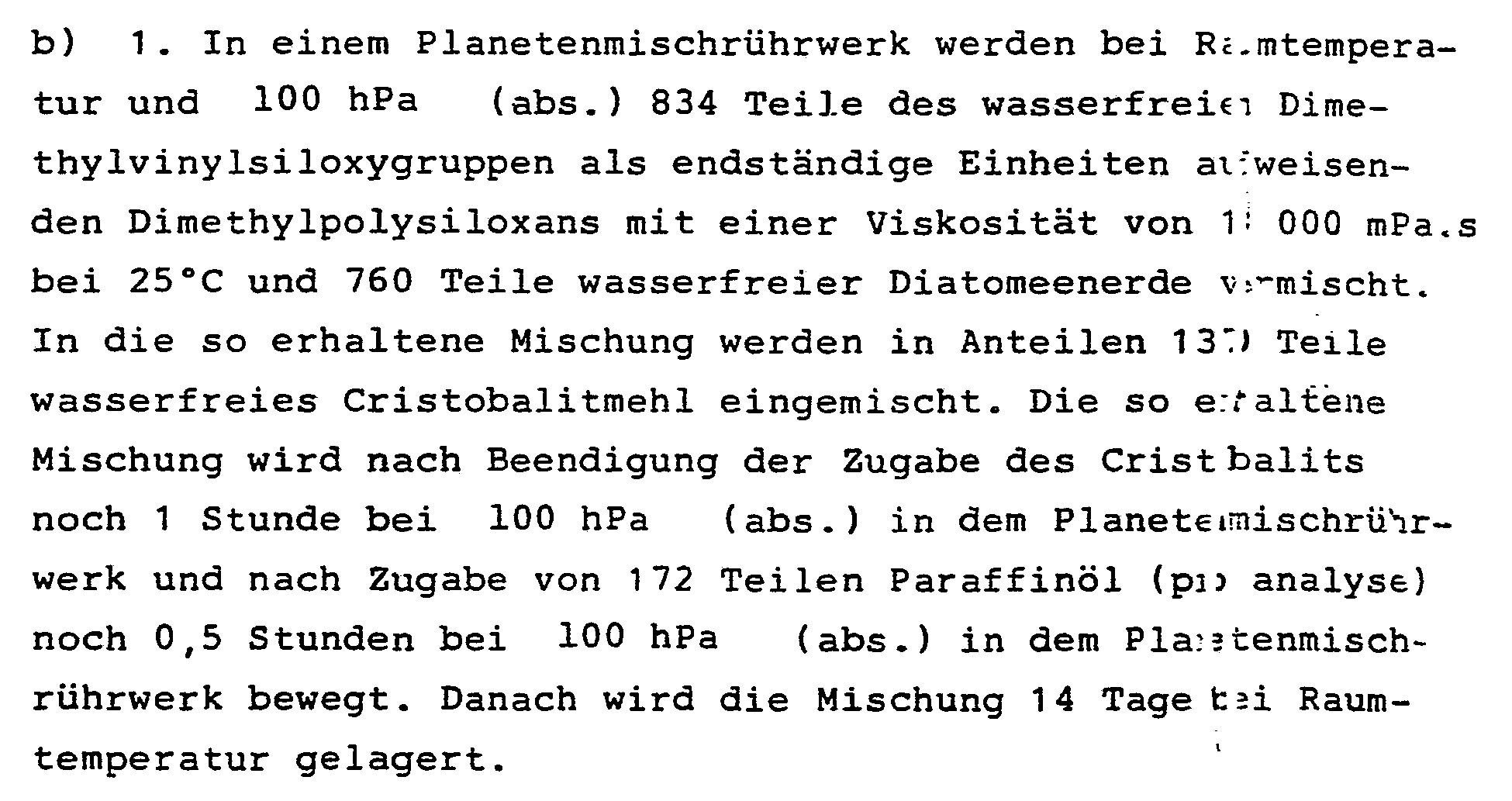
- worin 10 Dimethylsiloxaneinheiten je Methylhydrogensiloxaneinheit vorliegen, mit einer Viskosität von 150 mPa.s bei 25°C und 15 Teilen Chromoxid-Grün vermischt. Dann wird eingeschlossene Luft durch Kneten bei 100 hPa (abs.) entfernt. Danach wird die Mischung 7 Tage bei Raumtemperatur bzw. bei 70°C unter Ausschluß von Luft und Wasser gelagert.

- 3. Ein Teil der Mischung, deren Herstellung vorstehend unter 2. beschrieben wurde, wird mit 2 %, bezogen auf sein Gewicht, der gemäß a) hergestellten Paste vermischt, sodaß die fertige Masse 12 ppm Pt enthält. Dabei werden zum Vermischen von 32 g der Mischung, deren Herstellung vorstehend beschrieben wurde, mit den 0,64 g der Platin enthaltenden Paste bis zur Erzielung einer einheitlichen Farbe aus dem Grün- und Wein pigment nur 35 Sekunden benötigt. Die so erhaltene Masse wird bei Raumtemperatur vernetzen gelassen.
- Die in Beispiel 1 unter b) beschriebene Maßnahme wird wiederholt mit der Abänderung, daß 1 % der gemäß Beispiel 1 a) hergestellten Paste anstelle der 2 % dieser Paste verwendet werden, sodaß die fertige Masse 6 ppm Pt enthält.
- Die in Beispiel 1 unter b) 3. beschriebene Maßnahme wird wiederholt mit der Abänderung, daß 0,5 % der gemäß Beispiel 1 a) hergestellten Paste anstelle der 2 % dieser Paste verwendet werden, sodaß die fertige Masse 3 ppm Pt enthält.
- a) 290 Teile der Mischung, deren Herstellung in Beispiel 1 unter b) 1. beschrieben wurde, werden mit 2,763 Teilen einer Mischung, die ihrerseits durch Vermischen der Bestandteile (A), (B) und (C) wie in Beispiel 1 angegeben, bereitet wurde, 60 Teilen wasserfreier Diatomeenerde und 15 Teilen in Pulverform vorliegendem und in bei Raumtemperatur flüssigem, durch Trimethylsiloxygruppen endblockiertem Dimethylpolysiloxan angeteigtem, handelsüblichem Weißpigment bei 100 .' hPa (abs.) verknetet. Die so erhaltene, 75 ppm Pt enthaltende Mischung wird 7 Tage bei Raumtemperatur bzw. 70°C unter Ausschluß von Luft und Wasser gelagert. ;
- b) 1 Teil der Mischung, deren Herstellung vorstehend unter a) beschrieben wurde, wird mit 1 Teil der Mischung, deren Herstellung in Beispiel 1 unter b) 2. beschrieben wurde, vermischt, sodaß die fertige Masse 37,5 ppm Platin enthält. Dabei werden zum Vermischen von 16 g der Mischung, deren Herstellung vorstehend unter a) beschrieben wurde, mit 16 g der anderen Mischung 50 Sekunden benötigt. Die so erhaltene Masse wird bei Raumtemperatur vernetzen gelassen.
- Die in Vergleichsversuch (a) beschriebene Arbeitsweise wird wiederholt mit der Abänderung, daß bei Stufe ä) 1,843 Teile der Mischung aus den Bestandteilen (A), (B) und (C) anstelle der 2,763 Teile verwendet werden, sodaß die fertige Masse 25 ppm Pt enthält.
- Die in Vergleichsversuch (a) beschriebene Arbeitsweise wird wiederholt mit der Abänderung, daß bei Stufe a) 0,871 Teile der Mischung aus den Bestandteilen (A), (B) und (C) anstelle der 2,763 Teile verwendet werden, sodaß die fertige Masse 12,5 ppm Pt enthält.
- Die folgende Tabelle beweist, daß durch Verwendung der erfindungsgemäßen Pasten die Menge an schwer zugänglichem Platin gesenkt werden kann und eine geringere Änderung des Vernetzungsverhaltens der Masse bei Lagerung der Paste mit den übrigen Bestandteilen der Masse erzielt wird.

Claims (2)
enthalten, wobei die Summe der jeweils innerhalb der oben unter (a) bis (d) angegebenen Bereiche gewählten Prozentsätze einschleißlich der Prozentsätze von gegebenenfalls zusätzlich in der Paste vorliegenden Stoffen 100 Gewichtsprozent beträgt.
Applications Claiming Priority (2)
| Application Number | Priority Date | Filing Date | Title |
|---|---|---|---|
| DE3409139 | 1984-03-13 | ||
| DE19843409139 DE3409139A1 (de) | 1984-03-13 | 1984-03-13 | Platin, organopolysiloxan und fuellstoff enthaltende pasten |
Publications (3)
| Publication Number | Publication Date |
|---|---|
| EP0158141A2 true EP0158141A2 (de) | 1985-10-16 |
| EP0158141A3 EP0158141A3 (en) | 1987-01-07 |
| EP0158141B1 EP0158141B1 (de) | 1989-10-18 |
Family
ID=6230334
Family Applications (1)
| Application Number | Title | Priority Date | Filing Date |
|---|---|---|---|
| EP85102850A Expired EP0158141B1 (de) | 1984-03-13 | 1985-03-13 | Platin, Organopolysiloxan und Füllstoff enthaltende Pasten |
Country Status (5)
| Country | Link |
|---|---|
| US (1) | US4600731A (de) |
| EP (1) | EP0158141B1 (de) |
| JP (1) | JPS60208903A (de) |
| CA (1) | CA1277794C (de) |
| DE (2) | DE3409139A1 (de) |
Cited By (14)
| Publication number | Priority date | Publication date | Assignee | Title |
|---|---|---|---|---|
| EP0225843A1 (de) * | 1985-11-22 | 1987-06-16 | Coltène AG | Härtbares Silikonabformmaterial, welches beim Mischen eine optische Kontrolle des ausreichenden Durchmischens erlaubt |
| EP0219660A3 (en) * | 1985-09-13 | 1987-09-02 | Bayer Ag | Polysiloxane compositions for taking dental impressions |
| EP0383540A3 (de) * | 1989-02-15 | 1991-09-11 | Shin-Etsu Chemical Co., Ltd. | Ölige Pasten-Zusammensetzung |
| GB2292153A (en) * | 1994-07-29 | 1996-02-14 | Gc Kk | Silicone composition for dental impressions |
| BE1009853A4 (fr) * | 1995-04-17 | 1997-10-07 | G C Dental Ind Corp | Composition souple pour modeler les protheses dentaires. |
| FR2750598A1 (fr) * | 1996-07-03 | 1998-01-09 | G C Dental Ind Corp | Composition a base de silicone pour empreintes dentaires |
| EP0807667A3 (de) * | 1996-05-18 | 1998-01-21 | B & F Formulier- und Abfüll GmbH | Aushärtbare Silicondichtungsmasse |
| BE1011688A5 (fr) * | 1996-12-11 | 1999-12-07 | G C Dental Ind Corp | Composition a base de silicone pour scellements provisoires en dentisterie. |
| WO2002078647A1 (de) * | 2001-03-30 | 2002-10-10 | 3M Espe Ag | Dentale abformmassen auf silikonbasis |
| US7968645B2 (en) | 2003-05-09 | 2011-06-28 | 3M Espe Ag | Curable silicone impression materials with high tear strength and low consistency |
| WO2013016642A2 (en) | 2011-07-28 | 2013-01-31 | 3M Innovative Properties Company | Device for dispensing a dental substance and method of dispensing |
| WO2013016645A1 (en) | 2011-07-28 | 2013-01-31 | 3M Innovative Properties Company | Cartridge for dispensing a dental substance and method of assembling the cartridge |
| EP2742900A1 (de) | 2012-12-17 | 2014-06-18 | 3M Innovative Properties Company | Vorrichtung zur Ausgabe von Dentalsubstanz |
| US9474697B2 (en) | 2011-03-01 | 2016-10-25 | Voco Gmbh | Dental elastomeric impression material with high viscosity, dimensional stability and storage durability |
Families Citing this family (11)
| Publication number | Priority date | Publication date | Assignee | Title |
|---|---|---|---|---|
| US4806575A (en) * | 1986-11-19 | 1989-02-21 | Kerr Manufacturing Company | Prevention of outgassing in polyvinylsiloxane elastomers by the use of finely divided platinum black |
| EP0767809B1 (de) * | 1994-06-30 | 2004-01-21 | Minnesota Mining And Manufacturing Company | Die härtung anzeigende form- und beschichtungsmasse |
| US5596025A (en) * | 1994-06-30 | 1997-01-21 | Minnesota Mining And Manufacturing Company | Dental impression material with cure-indicating dye |
| US5955513A (en) * | 1995-04-13 | 1999-09-21 | Dentsply Research & Development Corp. | Very high viscosity polyvinylsiloxane impression material |
| US6552104B1 (en) | 1995-04-13 | 2003-04-22 | Dentsply Research & Development Corp. | Method of making hydrophilic non-sweating polymerizable dental impression material |
| US5661222A (en) * | 1995-04-13 | 1997-08-26 | Dentsply Research & Development Corp. | Polyvinylsiloxane impression material |
| US5830951A (en) * | 1995-04-13 | 1998-11-03 | Dentsply Detrey G.M.B.H. | Polyvinylsiloxane impression material |
| US6561807B2 (en) | 1998-05-27 | 2003-05-13 | Dentsply Research & Development Corp. | Polyvinylsiloxane impression material |
| US20050181324A1 (en) * | 2004-02-13 | 2005-08-18 | Hare Robert V. | Polyorganosiloxane dental impression materials with improved wetting and stability |
| EP1502572B1 (de) * | 2003-08-01 | 2012-03-07 | 3M Deutschland GmbH | Automischbare Kitt-Abformmasse |
| US20190110960A1 (en) | 2014-12-16 | 2019-04-18 | 3M Innovative Properties Company | Hardenable dental impression composition comprising a polymeric filler particles and use thereof |
Family Cites Families (9)
| Publication number | Priority date | Publication date | Assignee | Title |
|---|---|---|---|---|
| AT209484B (de) * | 1955-07-27 | 1960-06-10 | Wacker Chemie Gmbh | Abdruckmasse für dentale Zwecke |
| US3950300A (en) * | 1972-10-11 | 1976-04-13 | Wacker-Chemie Gmbh | Dental impression materials |
| DE2508560C2 (de) * | 1974-03-07 | 1983-06-09 | Dow Corning Ltd., London | Verfahren zur Herstellung von Dentalabdrücken |
| US4035453A (en) * | 1974-05-28 | 1977-07-12 | Wacker-Chemie Gmbh | Dental impression materials |
| DE2646726C2 (de) * | 1976-10-15 | 1988-07-28 | Wacker-Chemie GmbH, 8000 München | Die Anlagerung verzögerndes Mittel bei der durch Platinkatalysator geförderten und bei Raumtemperatur erfolgenden Anlagerung von Si-gebundenem Wasserstoff an mindestens 50 Si-Atome je Molekul und aliphatische Mehrfachbindungen enthaltendes Organopolysiloxan |
| DE2736421A1 (de) * | 1977-08-12 | 1979-02-22 | Wacker Chemie Gmbh | Verfahren zum erzeugen von abdruecken und anwendung des verfahrens zum herstellen von abdruckloeffeln |
| AT355199B (de) * | 1978-02-21 | 1980-02-25 | Kettenbach Fab Chem A | Silicon-abformmasse fuer zahnaerztliche zwecke |
| JPS591241B2 (ja) * | 1978-06-30 | 1984-01-11 | 而至歯科工業株式会社 | 歯科用シリコ−ン組成物およびその使用法 |
| US4468484A (en) * | 1982-05-17 | 1984-08-28 | Laclede Professional Products, Inc. | Settable alignate compositions containing polyacrylamide |
-
1984
- 1984-03-13 DE DE19843409139 patent/DE3409139A1/de not_active Withdrawn
-
1985
- 1985-02-25 US US06/705,163 patent/US4600731A/en not_active Expired - Fee Related
- 1985-02-28 CA CA000475429A patent/CA1277794C/en not_active Expired - Lifetime
- 1985-03-13 JP JP60048478A patent/JPS60208903A/ja active Pending
- 1985-03-13 DE DE8585102850T patent/DE3573722D1/de not_active Expired
- 1985-03-13 EP EP85102850A patent/EP0158141B1/de not_active Expired
Cited By (24)
| Publication number | Priority date | Publication date | Assignee | Title |
|---|---|---|---|---|
| EP0219660A3 (en) * | 1985-09-13 | 1987-09-02 | Bayer Ag | Polysiloxane compositions for taking dental impressions |
| US4891400A (en) * | 1985-09-13 | 1990-01-02 | Bayer Aktiengesellschaft | Silicone molding compounds |
| EP0225843A1 (de) * | 1985-11-22 | 1987-06-16 | Coltène AG | Härtbares Silikonabformmaterial, welches beim Mischen eine optische Kontrolle des ausreichenden Durchmischens erlaubt |
| EP0383540A3 (de) * | 1989-02-15 | 1991-09-11 | Shin-Etsu Chemical Co., Ltd. | Ölige Pasten-Zusammensetzung |
| GB2292153B (en) * | 1994-07-29 | 1998-04-29 | Gc Kk | Silicone composition for dental impressions |
| GB2292153A (en) * | 1994-07-29 | 1996-02-14 | Gc Kk | Silicone composition for dental impressions |
| BE1009853A4 (fr) * | 1995-04-17 | 1997-10-07 | G C Dental Ind Corp | Composition souple pour modeler les protheses dentaires. |
| EP0807667A3 (de) * | 1996-05-18 | 1998-01-21 | B & F Formulier- und Abfüll GmbH | Aushärtbare Silicondichtungsmasse |
| US5863976A (en) * | 1996-05-18 | 1999-01-26 | B & F Formulier- und Abfuell GmbH | Hardenable sealing compound |
| FR2750598A1 (fr) * | 1996-07-03 | 1998-01-09 | G C Dental Ind Corp | Composition a base de silicone pour empreintes dentaires |
| GB2314849A (en) * | 1996-07-03 | 1998-01-14 | Gc Kk | Dental impression polysiloxane composition |
| DE19728271B4 (de) * | 1996-07-03 | 2005-11-10 | Gc Corporation | Dentalabdruck-Siliconmasse |
| BE1011683A4 (fr) * | 1996-07-03 | 1999-12-07 | G C Dental Ind Corp | Composition au silicone pour empreintes dentaires. |
| GB2314849B (en) * | 1996-07-03 | 1999-12-22 | Gc Kk | Dental impression silicone composition |
| BE1011688A5 (fr) * | 1996-12-11 | 1999-12-07 | G C Dental Ind Corp | Composition a base de silicone pour scellements provisoires en dentisterie. |
| WO2002078647A1 (de) * | 2001-03-30 | 2002-10-10 | 3M Espe Ag | Dentale abformmassen auf silikonbasis |
| US7186758B2 (en) | 2001-03-30 | 2007-03-06 | 3M Espe Ag | Silicone-based dental impression compounds |
| US7968645B2 (en) | 2003-05-09 | 2011-06-28 | 3M Espe Ag | Curable silicone impression materials with high tear strength and low consistency |
| US8067496B2 (en) | 2003-05-09 | 2011-11-29 | 3M Innovative Properties Company | Curable silicone impression materials with high tear strength and low consistency |
| US9474697B2 (en) | 2011-03-01 | 2016-10-25 | Voco Gmbh | Dental elastomeric impression material with high viscosity, dimensional stability and storage durability |
| WO2013016642A2 (en) | 2011-07-28 | 2013-01-31 | 3M Innovative Properties Company | Device for dispensing a dental substance and method of dispensing |
| WO2013016645A1 (en) | 2011-07-28 | 2013-01-31 | 3M Innovative Properties Company | Cartridge for dispensing a dental substance and method of assembling the cartridge |
| EP2742900A1 (de) | 2012-12-17 | 2014-06-18 | 3M Innovative Properties Company | Vorrichtung zur Ausgabe von Dentalsubstanz |
| WO2014099511A1 (en) | 2012-12-17 | 2014-06-26 | 3M Innovative Properties Company | Device for dispensing a dental substance |
Also Published As
| Publication number | Publication date |
|---|---|
| JPS60208903A (ja) | 1985-10-21 |
| DE3409139A1 (de) | 1985-09-19 |
| EP0158141A3 (en) | 1987-01-07 |
| DE3573722D1 (en) | 1989-11-23 |
| EP0158141B1 (de) | 1989-10-18 |
| US4600731A (en) | 1986-07-15 |
| CA1277794C (en) | 1990-12-11 |
Similar Documents
| Publication | Publication Date | Title |
|---|---|---|
| EP0158141B1 (de) | Platin, Organopolysiloxan und Füllstoff enthaltende Pasten | |
| DE3788966T2 (de) | Silikonelastomer-Dichtungsmaterial mit verbersserter Haltbarkeit. | |
| DE2646726C2 (de) | Die Anlagerung verzögerndes Mittel bei der durch Platinkatalysator geförderten und bei Raumtemperatur erfolgenden Anlagerung von Si-gebundenem Wasserstoff an mindestens 50 Si-Atome je Molekul und aliphatische Mehrfachbindungen enthaltendes Organopolysiloxan | |
| EP0162211B1 (de) | Dimensionsstabile Abformmassen | |
| DE2433697A1 (de) | Verfahren zum herstellen von zu elastomeren vernetzbaren massen | |
| DE1270809B (de) | Mittel zur Verzoegerung und/oder Verhinderung der Haertung von Gemischen aus Organosiliciumverbindungen | |
| DE4010281A1 (de) | Abdruckzusammensetzung | |
| DE69316815T2 (de) | Fluorosilikon-Kautschuk-Zusammensetzungen | |
| DE2535334B2 (de) | Verfahren zur homogenen Verteilung hochdisperser aktiver Füllstoffe in Poly organosiloxanen | |
| DE2628975A1 (de) | Faellungskieselsaeure | |
| EP0025096B1 (de) | Hydrophobe Füllstoff-Mischung, Verfahren zu deren Herstellung und deren Verwendung | |
| DE69702370T2 (de) | Härtbare Fluorosiloxanzusammensetzung und Verfahren zur Steuerung der Initiierung und der Dauer der Härtung | |
| DE2423531A1 (de) | Verfahren zur herstellung von zu elastomeren haertbaren massen | |
| EP0170287A1 (de) | Verfahren zum Stabilisieren von Organopolysiloxan | |
| EP0544318A2 (de) | Einkomponenten-RTV-Massen | |
| DE2313218B2 (de) | Vernetzungsmittel und kondensationskatalysator enthaltende pasten fuer zweikomponenten-organopolysiloxanmassen | |
| DE69016298T2 (de) | Härtbare Organopolysiloxanzusammensetzungen. | |
| DE2724822C2 (de) | ||
| EP0299450A2 (de) | Durch Strahlung zu Elastomeren vernetzbare Massen | |
| EP0123321B1 (de) | Verfahren zum Vernetzen von Organopolysiloxanmassen | |
| DE1910014A1 (de) | Verfahren zur Herstellung von bei Raumtemperatur zu Elastomeren haertenden Organopolysiloxan-Massen | |
| DE2554498C2 (de) | Organopolysiloxanzubereitung und deren Verwendung | |
| DE1808669B2 (de) | Bei Raumtemperatur unter Bildung von Elastomeren härtende Abdruckmasse | |
| DE69505197T2 (de) | Feuchtigkeitshärtende Organosiloxan-Zusammensetzungen mit verlängerter Verarbeitungszeit | |
| DE3737458A1 (de) | Unter ausschluss von wasser lagerfaehige, bei zutritt von wasser bei raumtemperatur zu elastomeren vernetzende massen |
Legal Events
| Date | Code | Title | Description |
|---|---|---|---|
| PUAI | Public reference made under article 153(3) epc to a published international application that has entered the european phase |
Free format text: ORIGINAL CODE: 0009012 |
|
| 17P | Request for examination filed |
Effective date: 19850313 |
|
| AK | Designated contracting states |
Designated state(s): CH DE FR GB LI |
|
| PUAL | Search report despatched |
Free format text: ORIGINAL CODE: 0009013 |
|
| AK | Designated contracting states |
Kind code of ref document: A3 Designated state(s): CH DE FR GB LI |
|
| 17Q | First examination report despatched |
Effective date: 19880825 |
|
| GRAA | (expected) grant |
Free format text: ORIGINAL CODE: 0009210 |
|
| AK | Designated contracting states |
Kind code of ref document: B1 Designated state(s): CH DE FR GB LI |
|
| REF | Corresponds to: |
Ref document number: 3573722 Country of ref document: DE Date of ref document: 19891123 |
|
| ET | Fr: translation filed | ||
| GBT | Gb: translation of ep patent filed (gb section 77(6)(a)/1977) | ||
| PLBE | No opposition filed within time limit |
Free format text: ORIGINAL CODE: 0009261 |
|
| STAA | Information on the status of an ep patent application or granted ep patent |
Free format text: STATUS: NO OPPOSITION FILED WITHIN TIME LIMIT |
|
| 26N | No opposition filed | ||
| PGFP | Annual fee paid to national office [announced via postgrant information from national office to epo] |
Ref country code: FR Payment date: 19930215 Year of fee payment: 9 |
|
| PGFP | Annual fee paid to national office [announced via postgrant information from national office to epo] |
Ref country code: CH Payment date: 19930217 Year of fee payment: 9 |
|
| PGFP | Annual fee paid to national office [announced via postgrant information from national office to epo] |
Ref country code: GB Payment date: 19930226 Year of fee payment: 9 |
|
| PGFP | Annual fee paid to national office [announced via postgrant information from national office to epo] |
Ref country code: DE Payment date: 19930330 Year of fee payment: 9 |
|
| PG25 | Lapsed in a contracting state [announced via postgrant information from national office to epo] |
Ref country code: GB Effective date: 19940313 |
|
| PG25 | Lapsed in a contracting state [announced via postgrant information from national office to epo] |
Ref country code: LI Effective date: 19940331 Ref country code: CH Effective date: 19940331 |
|
| GBPC | Gb: european patent ceased through non-payment of renewal fee |
Effective date: 19940313 |
|
| PG25 | Lapsed in a contracting state [announced via postgrant information from national office to epo] |
Ref country code: FR Effective date: 19941130 |
|
| REG | Reference to a national code |
Ref country code: CH Ref legal event code: PL |
|
| PG25 | Lapsed in a contracting state [announced via postgrant information from national office to epo] |
Ref country code: DE Effective date: 19941201 |
|
| REG | Reference to a national code |
Ref country code: FR Ref legal event code: ST |