EP0155097A2 - Verfahren zur Herstellung von Methyl-Ethyl-Keton - Google Patents
Verfahren zur Herstellung von Methyl-Ethyl-Keton Download PDFInfo
- Publication number
- EP0155097A2 EP0155097A2 EP85301132A EP85301132A EP0155097A2 EP 0155097 A2 EP0155097 A2 EP 0155097A2 EP 85301132 A EP85301132 A EP 85301132A EP 85301132 A EP85301132 A EP 85301132A EP 0155097 A2 EP0155097 A2 EP 0155097A2
- Authority
- EP
- European Patent Office
- Prior art keywords
- complex
- oxygen
- group
- butene
- methyl ethyl
- Prior art date
- Legal status (The legal status is an assumption and is not a legal conclusion. Google has not performed a legal analysis and makes no representation as to the accuracy of the status listed.)
- Granted
Links
Images
Classifications
-
- C—CHEMISTRY; METALLURGY
- C07—ORGANIC CHEMISTRY
- C07C—ACYCLIC OR CARBOCYCLIC COMPOUNDS
- C07C49/00—Ketones; Ketenes; Dimeric ketenes; Ketonic chelates
- C07C49/04—Saturated compounds containing keto groups bound to acyclic carbon atoms
- C07C49/10—Methyl-ethyl ketone
-
- C—CHEMISTRY; METALLURGY
- C07—ORGANIC CHEMISTRY
- C07F—ACYCLIC, CARBOCYCLIC OR HETEROCYCLIC COMPOUNDS CONTAINING ELEMENTS OTHER THAN CARBON, HYDROGEN, HALOGEN, OXYGEN, NITROGEN, SULFUR, SELENIUM OR TELLURIUM
- C07F15/00—Compounds containing elements of Groups 8, 9, 10 or 18 of the Periodic Table
- C07F15/0006—Compounds containing elements of Groups 8, 9, 10 or 18 of the Periodic Table compounds of the platinum group
- C07F15/0086—Platinum compounds
- C07F15/0093—Platinum compounds without a metal-carbon linkage
-
- B—PERFORMING OPERATIONS; TRANSPORTING
- B01—PHYSICAL OR CHEMICAL PROCESSES OR APPARATUS IN GENERAL
- B01J—CHEMICAL OR PHYSICAL PROCESSES, e.g. CATALYSIS OR COLLOID CHEMISTRY; THEIR RELEVANT APPARATUS
- B01J31/00—Catalysts comprising hydrides, coordination complexes or organic compounds
- B01J31/16—Catalysts comprising hydrides, coordination complexes or organic compounds containing coordination complexes
- B01J31/18—Catalysts comprising hydrides, coordination complexes or organic compounds containing coordination complexes containing nitrogen, phosphorus, arsenic or antimony as complexing atoms, e.g. in pyridine ligands, or in resonance therewith, e.g. in isocyanide ligands C=N-R or as complexed central atoms
- B01J31/1845—Catalysts comprising hydrides, coordination complexes or organic compounds containing coordination complexes containing nitrogen, phosphorus, arsenic or antimony as complexing atoms, e.g. in pyridine ligands, or in resonance therewith, e.g. in isocyanide ligands C=N-R or as complexed central atoms the ligands containing phosphorus
-
- B—PERFORMING OPERATIONS; TRANSPORTING
- B01—PHYSICAL OR CHEMICAL PROCESSES OR APPARATUS IN GENERAL
- B01J—CHEMICAL OR PHYSICAL PROCESSES, e.g. CATALYSIS OR COLLOID CHEMISTRY; THEIR RELEVANT APPARATUS
- B01J31/00—Catalysts comprising hydrides, coordination complexes or organic compounds
- B01J31/16—Catalysts comprising hydrides, coordination complexes or organic compounds containing coordination complexes
- B01J31/18—Catalysts comprising hydrides, coordination complexes or organic compounds containing coordination complexes containing nitrogen, phosphorus, arsenic or antimony as complexing atoms, e.g. in pyridine ligands, or in resonance therewith, e.g. in isocyanide ligands C=N-R or as complexed central atoms
- B01J31/1845—Catalysts comprising hydrides, coordination complexes or organic compounds containing coordination complexes containing nitrogen, phosphorus, arsenic or antimony as complexing atoms, e.g. in pyridine ligands, or in resonance therewith, e.g. in isocyanide ligands C=N-R or as complexed central atoms the ligands containing phosphorus
- B01J31/1875—Phosphinites (R2P(OR), their isomeric phosphine oxides (R3P=O) and RO-substitution derivatives thereof)
- B01J31/188—Amide derivatives thereof
-
- B—PERFORMING OPERATIONS; TRANSPORTING
- B01—PHYSICAL OR CHEMICAL PROCESSES OR APPARATUS IN GENERAL
- B01J—CHEMICAL OR PHYSICAL PROCESSES, e.g. CATALYSIS OR COLLOID CHEMISTRY; THEIR RELEVANT APPARATUS
- B01J31/00—Catalysts comprising hydrides, coordination complexes or organic compounds
- B01J31/16—Catalysts comprising hydrides, coordination complexes or organic compounds containing coordination complexes
- B01J31/24—Phosphines, i.e. phosphorus bonded to only carbon atoms, or to both carbon and hydrogen atoms, including e.g. sp2-hybridised phosphorus compounds such as phosphabenzene, phosphole or anionic phospholide ligands
-
- C—CHEMISTRY; METALLURGY
- C07—ORGANIC CHEMISTRY
- C07C—ACYCLIC OR CARBOCYCLIC COMPOUNDS
- C07C45/00—Preparation of compounds having >C = O groups bound only to carbon or hydrogen atoms; Preparation of chelates of such compounds
- C07C45/27—Preparation of compounds having >C = O groups bound only to carbon or hydrogen atoms; Preparation of chelates of such compounds by oxidation
- C07C45/28—Preparation of compounds having >C = O groups bound only to carbon or hydrogen atoms; Preparation of chelates of such compounds by oxidation of CHx-moieties
-
- C—CHEMISTRY; METALLURGY
- C07—ORGANIC CHEMISTRY
- C07C—ACYCLIC OR CARBOCYCLIC COMPOUNDS
- C07C45/00—Preparation of compounds having >C = O groups bound only to carbon or hydrogen atoms; Preparation of chelates of such compounds
- C07C45/27—Preparation of compounds having >C = O groups bound only to carbon or hydrogen atoms; Preparation of chelates of such compounds by oxidation
- C07C45/30—Preparation of compounds having >C = O groups bound only to carbon or hydrogen atoms; Preparation of chelates of such compounds by oxidation with halogen containing compounds, e.g. hypohalogenation
-
- C—CHEMISTRY; METALLURGY
- C07—ORGANIC CHEMISTRY
- C07C—ACYCLIC OR CARBOCYCLIC COMPOUNDS
- C07C45/00—Preparation of compounds having >C = O groups bound only to carbon or hydrogen atoms; Preparation of chelates of such compounds
- C07C45/27—Preparation of compounds having >C = O groups bound only to carbon or hydrogen atoms; Preparation of chelates of such compounds by oxidation
- C07C45/32—Preparation of compounds having >C = O groups bound only to carbon or hydrogen atoms; Preparation of chelates of such compounds by oxidation with molecular oxygen
- C07C45/33—Preparation of compounds having >C = O groups bound only to carbon or hydrogen atoms; Preparation of chelates of such compounds by oxidation with molecular oxygen of CHx-moieties
- C07C45/34—Preparation of compounds having >C = O groups bound only to carbon or hydrogen atoms; Preparation of chelates of such compounds by oxidation with molecular oxygen of CHx-moieties in unsaturated compounds
-
- C—CHEMISTRY; METALLURGY
- C07—ORGANIC CHEMISTRY
- C07F—ACYCLIC, CARBOCYCLIC OR HETEROCYCLIC COMPOUNDS CONTAINING ELEMENTS OTHER THAN CARBON, HYDROGEN, HALOGEN, OXYGEN, NITROGEN, SULFUR, SELENIUM OR TELLURIUM
- C07F15/00—Compounds containing elements of Groups 8, 9, 10 or 18 of the Periodic Table
- C07F15/0006—Compounds containing elements of Groups 8, 9, 10 or 18 of the Periodic Table compounds of the platinum group
- C07F15/006—Palladium compounds
- C07F15/0066—Palladium compounds without a metal-carbon linkage
-
- B—PERFORMING OPERATIONS; TRANSPORTING
- B01—PHYSICAL OR CHEMICAL PROCESSES OR APPARATUS IN GENERAL
- B01J—CHEMICAL OR PHYSICAL PROCESSES, e.g. CATALYSIS OR COLLOID CHEMISTRY; THEIR RELEVANT APPARATUS
- B01J2531/00—Additional information regarding catalytic systems classified in B01J31/00
- B01J2531/10—Complexes comprising metals of Group I (IA or IB) as the central metal
- B01J2531/16—Copper
-
- B—PERFORMING OPERATIONS; TRANSPORTING
- B01—PHYSICAL OR CHEMICAL PROCESSES OR APPARATUS IN GENERAL
- B01J—CHEMICAL OR PHYSICAL PROCESSES, e.g. CATALYSIS OR COLLOID CHEMISTRY; THEIR RELEVANT APPARATUS
- B01J2531/00—Additional information regarding catalytic systems classified in B01J31/00
- B01J2531/40—Complexes comprising metals of Group IV (IVA or IVB) as the central metal
- B01J2531/46—Titanium
-
- B—PERFORMING OPERATIONS; TRANSPORTING
- B01—PHYSICAL OR CHEMICAL PROCESSES OR APPARATUS IN GENERAL
- B01J—CHEMICAL OR PHYSICAL PROCESSES, e.g. CATALYSIS OR COLLOID CHEMISTRY; THEIR RELEVANT APPARATUS
- B01J2531/00—Additional information regarding catalytic systems classified in B01J31/00
- B01J2531/50—Complexes comprising metals of Group V (VA or VB) as the central metal
- B01J2531/56—Vanadium
-
- B—PERFORMING OPERATIONS; TRANSPORTING
- B01—PHYSICAL OR CHEMICAL PROCESSES OR APPARATUS IN GENERAL
- B01J—CHEMICAL OR PHYSICAL PROCESSES, e.g. CATALYSIS OR COLLOID CHEMISTRY; THEIR RELEVANT APPARATUS
- B01J2531/00—Additional information regarding catalytic systems classified in B01J31/00
- B01J2531/80—Complexes comprising metals of Group VIII as the central metal
- B01J2531/82—Metals of the platinum group
- B01J2531/824—Palladium
Definitions
- This invention relates to a process for producing methyl ethyl ketone and more particularly it relates to a process for producing methyl ethyl ketone by oxidizing 1-butene by means of an oxygen complex.
- Methyl ethyl ketone (hereinafter referred to often as M EK) is used as the solvent for nitrocellulose, acetylcellulose, etc. and also used in the process for dewaxing lubricating oils and further used as a raw material for methyl ethyl ketone peroxide which has been produced in a large amount as a curing agent for unsaturated polyester resins and as a polymerization initiator; thus MEK is an important intermediate product in chemical industries.
- the processes for producing MEK are roughly classified into (1) a sec-butanol dehydrogenation process and (2) a n-butane oxidation process.
- the dehydrogeneation process MEK is produced according a two- stage process wherein from n-butene is prepared sec-butanol, which is then dehydrogenated at 430 - 450°C and 3 atm by means of a Zn-Cu catalyst, and the yield of MEK is 80 %.
- the n-butane oxidation process wherein acetic acid is produced at the same time includes a non-catalyst type oxidation process and a process by means of cobalt acetate.
- Wacker process As a process for oxidizing a terminal olefin utilizing the oxidative force of palladium chloride (Pd(2)C1 2 ), Wacker process has been well known. According to this process, a redox system aqueous solution of Pd(2)/Pd(0) and Cu(2)/Cu(1) is employed and propylene oxidation is relatively easy, but in the case of 1-butene and higher olefins of 5 or more carbon atoms, since these olefins are hardly soluble in water, the reaction rate is notably retarded (see J.
- the thus combined oxygen molecule is activated through its coordination with the metal ions to oxidize many organic substances at as low temperatures as the body temperatures of living bodies, and the reaction heat constitutes the energy source of living bodies.
- the reaction heat constitutes the energy source of living bodies.
- protein complexes when such protein complexes are separated from living bodies, they are so unstable that the metal ions are readily oxygen-oxidized; hence the complexes cannot be a practical oxidizing agent.
- the object of the present invention is to provide, in view of the above prior art, a process for producing methyl ethyl ketone wherein 1-butene is subjected to oxygen-oxidation under mild conditions whereby MEK can be produced selectively and with a high yield.
- the present invention is directed to a process wherein there is used a composite catalyst containing as at least one component, a transition metal complex capable of forming an oxygen complex by coordination of oxygen molecule with the transition metal of the transition metal complex, and as another component, a transition metal complex capable of forming a 1-butene complex by coordination of 1-butene with the transition metal of the transition metal complex, and 1-butene activated by the complex formation is oxidized by the combined oxygen activated by the complex formation, to produce MEK under mild conditions in a non-aqueous solvent system.
- the present invention resides in a process for producing methyl ethyl ketone by oxygen-oxidizing 1-butene in the presence of a metal complex catalyst, which process comprises using as the metal complex catalyst, a composite catalyst containing a complex (MmXn ⁇ Ll) capable of forming an oxygen complex by coordination of the complex with oxygen and a complex (M'm'Xn' ⁇ L'l') capable of forming a 1-butene complex by coordination of the complex catalyst with 1-butene, wherein M represents a transition metal belonging to the group I, the groups IV to VII or iron group of the group VIII of the Periodic Table; X, an anion such as halogens; L, an organic phosphorus compound as a ligand; M', a transition metal belonging to platinum group of the group VIII of the Periodic Table; L', a nitrile, an organic fluorine compound or an organic phosphorus compound; m, m', n and n', each a number determined by the valence
- m, m', n , n', l and l' each represent an integer in the range of 1 to 4.
- the present inventors have made extensive research on the oxygen complex functioning as an oxidizing agent which effectively functions for the 1-butene oxidation reaction, and as a result have found that as a representative example thereof, a complex of cuprous chloride (hereinafter referred to as CuCl(1)) with tris (dimethylamino) phosphine oxide (other name: hexamethylphosphoramide; hereinafter referred to as hmpa) which is a phosphoric acid derivative can form a stable oxygen complex, and also a complex of palladium chloride (hereinafter referred to as Pd(2)Cl 2 ) with acetonitrile (hereinafter referred to as CH 3 CN) also can Eorm a stable 1-butene complex. Further, we have found that the combined oxygen in the above oxygen complex functions as an effective oxidizing agent for the thus coordinated and activated 1-butene, to produce MEK under a nild condition of normal pressures, selectively and with a high yield.
- the solution of monovalent copper compounds (e.g. Cu(1)Cl) has a specific feature of absorbing CO through coordination of CO with Cu(1).
- Cu(1) compounds are difficultly soluble, it has been difficult to make the concentration of their solution higher.
- the present inventors added Cu(1)Cl to liquid hmpa (m.p. 7°C, b.p. 230°C/760mmHg) to form the following complex: whereby we could make the concentration of the solution of Cu(1)Cl higher, and proposed an absorbing solution improved notably in the amount of CO absorbed and a process for separating and concentrating CO by the use of the solution (Japanese patent application laid-open Nos. Sho 56-118720 (1981) and Sho 57-19013 (1982)).
- the present complex can be expressed by the general formula MnXn ⁇ Ll.
- the solution of this Cu(1)Cl ⁇ hmpa which is a CO- absorbing solution also absorbs oxygen as well as CO and exhibits a deep green color.
- the solution of Cu(1) compounds absorbs oxygen, monovalent copper in a lower valency state is oxygen-oxidized into divalent copper in a higher valency state; hence the present inventors initially considered that a similar oxidation reaction might occur also in the Cu(1)Cl ⁇ hmpa solution and as a result the color changed to green color.
- the complex solution of the divalent copper compound (Cu(2)Cl 2 ) and hmpa exhibits a red-brown color.
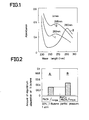
- the colorless Cu(1) ⁇ hmpa solution and a green color solution obtained by passing oxygen through the above solution to have oxygen absorbed therein the respective ethyl alcohol solutions of the above solutions were subjected to measurement of their ultraviolet absorption spectra. The results are shown in Fig. 1.
- the spectra of the Cu(1) complex solution 1 and the complex solution 2 obtained by having oxygen absorbed in the former solution are entirely different from the spectra of the Cu(2) complex solution 3, and the complex compound solution 2 having oxygen absorbed therein and exhibiting a green color has a maximum absorption at 265 nm, which evidences formation of the so-called oxygen complex wherein oxygen molecule is coordinated.
- the amount of oxygen absorbed was measured.
- the molar ratio of absorbed oxygen to Cu(1) was 1:2 and the compound having a maximum absorption at 265 nm and exhibiting a green color was an oxygen complex formed according to the following equation, and such an oxygen complex has never been reported:
- this oxygen is not consumed for oxidizing Cu(1) in the solution into Cu(2), but existent in the form of the so-called oxygen complex wherein oxygen molucle is coordinated with Cu(1).
- the specific feature of this oxygen complex is that the coordinated oxygen is not eliminated from the complex even when it is heated so that the absorption is irreversible.
- the above oxygen complex is so stable that it requires even boiling at 100°C e.g. for oxidation of Cu(1) into Cu(2) by means of the canbined oxygen.
- the complex selectively absorbs oxygen from air to form all the same oxygen complex as that by means of pure oxygen, air is sufficient as the oxygen source in the reaction.
- the substrate When a small molecule such as an oxygen is coordinated with a metal ion, the substrate is polarized and activated through electron transfer, and in the case of the above oxygen complex, too, found by the present inventors, the coordinated oxygen, of course, is activated. Further, in the case of the Cu(1)Cl ⁇ hmpa solution, the concentration of Cu(1)Cl therein can be easily raised up to 2 mols/t or more, and for example, when the cncentration is one mol/t, it is possible to dissolve 10 t or more of oxygen in one liter of the solution.
- the formed 1-butene complex contains a notably activated 1-butene.
- M in MmXn ⁇ Ll as the complex catalyst capable of forming the oxygen complex, transition metals of Cu and Ag of the group I, Ti and Zr of the group IV, V and Nb of the group V, Cr, Mo and W of the group VI, Mn of the group VII and Fe, Co and Ni of the group VIII, each of the Periodic Table are preferable, and Cu(1), Ti(3) and V(3) are more preferable.
- X halogens such as Cl - , Br and I and anions such as BF 4 - , PF 6 - , S0 3 2- and CH 3 COO - are preferable and C1 - , Br and I are more preferable.
- phosphorous acid derivatives such as mono-, di- or triesters formed from reaction of phosphorous acid and methanol, ethanol, etc. and phenylphosphinous acid esters, dimethylphosphinic acid esters, triethylphosphine, triphenylphosphine, etc. and further phosphoric acid derivatives such as triphenylphosphine oxide, hexamethylphosphoramide and mono-, di- and triesters formed by reaction of phosphoric acid and methanol, ethanol, etc., and further organic phosphorus compounds represented by dimethyl methylphosphonate and methyl dimethylphosphinate are preferable, and hexamethylphosphoramide (hmpa) is particularly preferable.
- M' in the complex catalyst (M'm'Xn' ⁇ Ll') capable of forming 1-butene complex lower valence ions among transition metals belonging to platinum group of the group VIII of the Periodic Table are preferable, and Pd and Pt are particularly preferable.
- the ligand L' nitriles such as acetonitrile, propionitrile, benzonitrile, tolunitrile, etc. and the above organic phosphorus compounds and further organic fluorine compounds such as fluorinated toluene, benzotrifluoride, etc. are preferable, and among these, nitriles or mixtures of nitrile and hmpa are particularly preferable.
- a solvent used when the reaction of the present invention is carried out in solution state those which dissolves the composite catalyst, and also is easily separated from the resulting MEK (b.p. 79.5°C/760mmHg) and further reduces the viscosity of the catalyst solution to promote the material transfer are preferable, and at least one solvent selected from various solvents such as heptane, toluene, methylcyclohexane, methyl isobutyl ketone, cyclohexanone, ethanol, ethylene glycol, dioxane, ethylene carbonate, chlorobenzene, N-methylpyrrolidone, tetrahydrofuran, etc., or mixtures thereof are used, and further, when the ligand L or L' is liquid, it is also possible to use these as the solvent at the same time.
- solvents such as heptane, toluene, methylcyclohexane, methyl isobutyl ketone, cyclohexanone,
- a basic (electron-donating) compound such as sulfolane, dimethylsulfolane, dimethylsulfoxide, dimethylformamide, trimethylmethane, dimethylsulfone, water, etc.
- a basic (electron-donating) compound such as sulfolane, dimethylsulfolane, dimethylsulfoxide, dimethylformamide, trimethylmethane, dimethylsulfone, water, etc.
- the composite complex supported on a porous carrier such as active carbon, silicates, porous glass, and further polymers having a macro-reticular structure, etc. to produce MEK by means of oxygen-oxidation of 1-butene.
- a porous carrier such as active carbon, silicates, porous glass, and further polymers having a macro-reticular structure, etc.
- cuprous chloride hereinafter referred to as .
- Cu(1)Cl 5 g, 50 mmols
- hmpa 340 g
- Pd(2)Cl 2 palladium chloride
- PhCN benzonitrile
- Reaction was carried out in the same manner as in Example 1 except that the reaction temperature was 80°C.
- MEK was formed in 2.2 g (31 mmols) after one hour and in 2.5 g (35 mmols) after 2 hours, and the yield of MEK was 82 % and 90 % based on the oxygen complex.
- the reaction temperature is elevated, the oxidation rate of 1-butene becomes higher, but the solubility lowers; hence the concentration of 1-butene in the solution lowers and the MEK yield decreases.
- Example 3 was repeated except that Cu(1)Cl was replaced by Ti(3)Cl 3 (15.4 g, 0.1 mol), to form an oxygen complex (36 mmols/2). The yield based the oxygen complex after one hour was 34 % and that after 2 hours was 40 %.
- Example 4 was repeated except that Ti(3)Cl 3 was replaced by V(3)Cl 3 (15.7 g, 0.1 mol), to form an oxygen complex (7 mmols/l).
- the yield based on the oxygen yield after one hour was 52 % and that after 2 hours was 59 %.
- Example 4 was repeated except that Pd(2)Cl 2 was replaced by Pt(2)Cl 2 (7.98 g, 0.03 mol). As a result, the yield of MEK based on the oxygen complex was 45 % after one hour and 52 % after 2 hours. The same procedure was also carried out in Example 5. As a result, the yield was 63 % after one hour and 70 % after 2 hours.
- Example 3 was repeated except that Pd(2)Cl 2 was replaced by Pt(2)Cl 2 (7.98 g, 0.03 mol). As a result, the yield of MEK was 96 % after one hour and 98 % after 2 hours.
- Example 3 The same operation as in Example 3 was carried out except that benzonitrile was replaced by benzotrifluoride. The yield was 92 %.
- Beads of a macro-reticular type styrene-divinylbenzene copolymer (particle diameter, about 1 mm ⁇ ; specific surface area, 700 - 800 m/g; Amberlite XAD-4 (trademark, manufactured by Organo Co.) (50 ml) were impregnated with a catalyst solution containing an oxygen complex of a composition shown in Example 3, followed by filtering by suction to prepare a particulate catalyst.
- the resulting product was MEK, alone, and the yield based on the main component was 3 % after the reaction started till the succeeding two hours.
- the exit gas was then recycled to seek the MEK yield based on the combined oxygen in the oxygen complex, which reached 85 %.
- 1-butene feed was once stopped, followed by passing air to regenerate the combined oxygen consumed by the reaction, and again carrying out the oxidation experiment under the above conditions, to obtain similar results.
- porous carriers such as silicates, active carbon, porous glass, etc. were usable and as the treating method after the impregnation, methods such as passing of heated gas, lower temperature calcination, etc. were employable besides filtering by suction.
- Example 2 Into the same reactor as in Example 1 were fed Pd(2)C1 2 (1.3 g) and hmpa (340 g) to prepare a hmpa solution of Pd(2)Cl 2 ⁇ (hmpa) 2 complex.
- 1-butene was passed through the solution by the same operation as in Example 1 except that no oxygen was passed, followed by reaction under the same conditions (60°C, 2 hours) as in Example 1, but 1-butene was not oxidized at all. Further, no precipitate of metal paradium was formed. Thus, this evidences that oxidation by way of Pd(2) ion did not occur in a non-aqueous solvent of hmpa, etc.
- the present invention is a novel production process different from the prior art, wherein the combined 1-butene activated by forming a 1-butene complex is oxidized by the combined oxygen activated by forming an oxygen complex to produce MEK.
- 1-butene and oxygen are not directly contacted each in the form of free oxygen, but they are coordinated with transition metal ions in a specified composite catalyst system and reacted together each in an activated state; hence it is possible to carry out a highly efficient reaction at as low temperatures as those in the vicinity of room temperature, under the atmospheric pressure and with a high yield. Further, since, the reaction is carried out under mild conditions, the amount of by-products is small and the production steps including subsequent purification are simplified. Furthermore, since oxygen is selectively absorbed even when air is used as the oxygen source, all the same effectiveness as in the case where pure oxygen is used is obtained. Still further, since the oxygen absorption is irreversible, it is possible to easily remove excess free oxygen after the oxygen complex has been formed; hence the present invention is very advantageous even in the aspect of safety.
Landscapes
- Chemical & Material Sciences (AREA)
- Organic Chemistry (AREA)
- Inorganic Chemistry (AREA)
- Engineering & Computer Science (AREA)
- Materials Engineering (AREA)
- Chemical Kinetics & Catalysis (AREA)
- Organic Low-Molecular-Weight Compounds And Preparation Thereof (AREA)
- Low-Molecular Organic Synthesis Reactions Using Catalysts (AREA)
Applications Claiming Priority (2)
| Application Number | Priority Date | Filing Date | Title |
|---|---|---|---|
| JP38138/84 | 1984-02-29 | ||
| JP59038138A JPS60181046A (ja) | 1984-02-29 | 1984-02-29 | メチルエチルケトンの合成法 |
Publications (3)
| Publication Number | Publication Date |
|---|---|
| EP0155097A2 true EP0155097A2 (de) | 1985-09-18 |
| EP0155097A3 EP0155097A3 (en) | 1986-05-07 |
| EP0155097B1 EP0155097B1 (de) | 1989-05-03 |
Family
ID=12517062
Family Applications (1)
| Application Number | Title | Priority Date | Filing Date |
|---|---|---|---|
| EP85301132A Expired EP0155097B1 (de) | 1984-02-29 | 1985-02-20 | Verfahren zur Herstellung von Methyl-Ethyl-Keton |
Country Status (6)
| Country | Link |
|---|---|
| US (1) | US4620038A (de) |
| EP (1) | EP0155097B1 (de) |
| JP (1) | JPS60181046A (de) |
| KR (1) | KR920001789B1 (de) |
| DE (1) | DE3569922D1 (de) |
| DK (1) | DK88285A (de) |
Cited By (3)
| Publication number | Priority date | Publication date | Assignee | Title |
|---|---|---|---|---|
| EP0189312A3 (en) * | 1985-01-21 | 1987-09-16 | Babcock-Hitachi Kabushiki Kaisha | Process for producing an oxygen-containing organic compound from olefins |
| EP0277194A4 (de) * | 1986-08-15 | 1988-11-23 | Chevron Res | Olefinoligomerizierungsverfahren und katalysator. |
| EP0576191A3 (de) * | 1992-06-16 | 1994-11-02 | Scotia Holdings Plc | Abtrennung von ungesättigten Produkten. |
Families Citing this family (3)
| Publication number | Priority date | Publication date | Assignee | Title |
|---|---|---|---|---|
| US4847421A (en) * | 1986-02-04 | 1989-07-11 | Catalytica, Associates | Palladium-nitrile ligand catalyst system and oxidation processes |
| WO1990000536A1 (en) * | 1988-07-13 | 1990-01-25 | Catalytica, Inc. | Process for obtaining substantially aldehyde-free ketone products |
| FR2822459B1 (fr) * | 2001-03-22 | 2004-07-09 | Solvay | Procede de preparation d'une olefine halogenee |
Family Cites Families (7)
| Publication number | Priority date | Publication date | Assignee | Title |
|---|---|---|---|---|
| DE1190451B (de) * | 1958-06-24 | 1965-04-08 | Hoechst Ag | Verfahren zur Oxydation von Olefinen zu Aldehyden, Ketonen oder den Aldehyden entsprechenden Saeuren |
| GB1206166A (en) * | 1967-09-04 | 1970-09-23 | British Petroleum Co | Oxidation of olefins |
| US3932521A (en) * | 1971-02-08 | 1976-01-13 | Kraftco Corporation | Process for manufacture of ketones from olefins |
| FR2310988A1 (fr) * | 1975-05-13 | 1976-12-10 | Inst Francais Du Petrole | Procede de preparation de cetones par oxydation de composes olefiniques par l'oxygene moleculaire, en presence de catalyseurs bimetalliques solubles ou supportes |
| FR2310987A1 (fr) * | 1975-05-16 | 1976-12-10 | Anvar | Procede d'oxydation directe d'olefines |
| JPS5353601A (en) * | 1976-09-30 | 1978-05-16 | Johnson Matthey Co Ltd | Oxidizing process of organic compounds |
| US4195039A (en) * | 1976-09-30 | 1980-03-25 | Institut Francais Du Petrole | Heterogeneous phase oxidation of olefins to ketones |
-
1984
- 1984-02-29 JP JP59038138A patent/JPS60181046A/ja active Pending
-
1985
- 1985-02-04 KR KR1019850000682A patent/KR920001789B1/ko not_active Expired
- 1985-02-20 EP EP85301132A patent/EP0155097B1/de not_active Expired
- 1985-02-20 DE DE8585301132T patent/DE3569922D1/de not_active Expired
- 1985-02-27 DK DK88285A patent/DK88285A/da not_active Application Discontinuation
- 1985-02-27 US US06/706,263 patent/US4620038A/en not_active Expired - Fee Related
Cited By (3)
| Publication number | Priority date | Publication date | Assignee | Title |
|---|---|---|---|---|
| EP0189312A3 (en) * | 1985-01-21 | 1987-09-16 | Babcock-Hitachi Kabushiki Kaisha | Process for producing an oxygen-containing organic compound from olefins |
| EP0277194A4 (de) * | 1986-08-15 | 1988-11-23 | Chevron Res | Olefinoligomerizierungsverfahren und katalysator. |
| EP0576191A3 (de) * | 1992-06-16 | 1994-11-02 | Scotia Holdings Plc | Abtrennung von ungesättigten Produkten. |
Also Published As
| Publication number | Publication date |
|---|---|
| EP0155097A3 (en) | 1986-05-07 |
| DE3569922D1 (en) | 1989-06-08 |
| US4620038A (en) | 1986-10-28 |
| DK88285A (da) | 1985-08-30 |
| KR850006000A (ko) | 1985-09-28 |
| JPS60181046A (ja) | 1985-09-14 |
| KR920001789B1 (ko) | 1992-03-02 |
| DK88285D0 (da) | 1985-02-27 |
| EP0155097B1 (de) | 1989-05-03 |
Similar Documents
| Publication | Publication Date | Title |
|---|---|---|
| JP2963528B2 (ja) | ブタンをメチルエチルケトンへ酸化する為のクロムハロゲン化された配位錯体 | |
| EP0155097B1 (de) | Verfahren zur Herstellung von Methyl-Ethyl-Keton | |
| US4521631A (en) | Process for producing acetaldehyde | |
| EP0150982B1 (de) | Verfahren zur Herstellung von Aceton | |
| US4322562A (en) | Oxidation process using metal nitro or nitrosyl complex | |
| EP0156498B1 (de) | Verfahren zur Herstellung von Essigsäure | |
| EP0189312B1 (de) | Verfahren zur Herstellung einer Sauerstoff enthaltenden organischen Verbindung aus Olefinen | |
| US4691053A (en) | Process for producing organic compounds by utilizing oxygenic complexes | |
| JPS63115836A (ja) | シクロヘキサノールとシクロヘキサノンとの混合物の改良製造方法 | |
| JPS60181032A (ja) | 酸素錯体を利用する有機化合物の合成法 | |
| KR870001164B1 (ko) | 산소착체를 이용하는 유기화합물의 합성법 | |
| US6075170A (en) | Process for preparing cyclohexanol and cyclohexanone | |
| JPS611635A (ja) | メチルエチルケトンの合成法 | |
| JPH0436142B2 (de) | ||
| JPS6143131A (ja) | メチルエチルケトンの製造法 | |
| JPS5822453B2 (ja) | ブチルアルデヒドの製造方法 | |
| JPS62149345A (ja) | 酸素錯体を用いるパラジウムの酸化再生法 | |
| JPS6191148A (ja) | アセトンの合成法 | |
| JPS6330327A (ja) | 酸素錯体によるパラジウムの酸化再生法 | |
| JPS60185740A (ja) | アセトアルデヒドの合成法 | |
| JPS61167627A (ja) | オレフイン類から含酸素化合物を合成する方法 | |
| JPS62225251A (ja) | パラジウムの酸化再生法 | |
| JPS60188342A (ja) | アセトンの合成法 | |
| JPS63154627A (ja) | 芳香族化合物のカツプリング生成物の合成方法 | |
| GB2112780A (en) | Preparation of aldehydes and ketones by oxidation of alcohols |
Legal Events
| Date | Code | Title | Description |
|---|---|---|---|
| PUAI | Public reference made under article 153(3) epc to a published international application that has entered the european phase |
Free format text: ORIGINAL CODE: 0009012 |
|
| AK | Designated contracting states |
Designated state(s): BE CH DE FR GB IT LI |
|
| PUAL | Search report despatched |
Free format text: ORIGINAL CODE: 0009013 |
|
| AK | Designated contracting states |
Kind code of ref document: A3 Designated state(s): BE CH DE FR GB IT LI |
|
| 17P | Request for examination filed |
Effective date: 19860718 |
|
| 17Q | First examination report despatched |
Effective date: 19870625 |
|
| GRAA | (expected) grant |
Free format text: ORIGINAL CODE: 0009210 |
|
| AK | Designated contracting states |
Kind code of ref document: B1 Designated state(s): BE CH DE FR GB IT LI |
|
| ITF | It: translation for a ep patent filed | ||
| REF | Corresponds to: |
Ref document number: 3569922 Country of ref document: DE Date of ref document: 19890608 |
|
| ET | Fr: translation filed | ||
| PGFP | Annual fee paid to national office [announced via postgrant information from national office to epo] |
Ref country code: FR Payment date: 19900125 Year of fee payment: 6 |
|
| PGFP | Annual fee paid to national office [announced via postgrant information from national office to epo] |
Ref country code: CH Payment date: 19900219 Year of fee payment: 6 |
|
| PGFP | Annual fee paid to national office [announced via postgrant information from national office to epo] |
Ref country code: BE Payment date: 19900223 Year of fee payment: 6 |
|
| ITTA | It: last paid annual fee | ||
| PGFP | Annual fee paid to national office [announced via postgrant information from national office to epo] |
Ref country code: GB Payment date: 19900228 Year of fee payment: 6 |
|
| PGFP | Annual fee paid to national office [announced via postgrant information from national office to epo] |
Ref country code: DE Payment date: 19900326 Year of fee payment: 6 |
|
| PLBE | No opposition filed within time limit |
Free format text: ORIGINAL CODE: 0009261 |
|
| STAA | Information on the status of an ep patent application or granted ep patent |
Free format text: STATUS: NO OPPOSITION FILED WITHIN TIME LIMIT |
|
| 26N | No opposition filed | ||
| PG25 | Lapsed in a contracting state [announced via postgrant information from national office to epo] |
Ref country code: GB Effective date: 19910220 |
|
| PG25 | Lapsed in a contracting state [announced via postgrant information from national office to epo] |
Ref country code: LI Effective date: 19910228 Ref country code: CH Effective date: 19910228 Ref country code: BE Effective date: 19910228 |
|
| PG25 | Lapsed in a contracting state [announced via postgrant information from national office to epo] |
Ref country code: DE Effective date: 19910419 |
|
| GBPC | Gb: european patent ceased through non-payment of renewal fee | ||
| PG25 | Lapsed in a contracting state [announced via postgrant information from national office to epo] |
Ref country code: FR Effective date: 19911031 |
|
| REG | Reference to a national code |
Ref country code: CH Ref legal event code: PL |
|
| REG | Reference to a national code |
Ref country code: FR Ref legal event code: ST |