EP0152006B1 - Verwendung von Chinolyloxy-Verbindungen als Antidots für Fenoxapropethyl (Ethyl-2[4-(6-chlorbenzoxazolyloxy)-phenoxy]-propionat) - Google Patents
Verwendung von Chinolyloxy-Verbindungen als Antidots für Fenoxapropethyl (Ethyl-2[4-(6-chlorbenzoxazolyloxy)-phenoxy]-propionat) Download PDFInfo
- Publication number
- EP0152006B1 EP0152006B1 EP85100866A EP85100866A EP0152006B1 EP 0152006 B1 EP0152006 B1 EP 0152006B1 EP 85100866 A EP85100866 A EP 85100866A EP 85100866 A EP85100866 A EP 85100866A EP 0152006 B1 EP0152006 B1 EP 0152006B1
- Authority
- EP
- European Patent Office
- Prior art keywords
- ethyl
- compounds
- plants
- denotes
- formula
- Prior art date
- Legal status (The legal status is an assumption and is not a legal conclusion. Google has not performed a legal analysis and makes no representation as to the accuracy of the status listed.)
- Expired
Links
- -1 quinolinyloxy compounds Chemical class 0.000 title description 7
- 239000000729 antidote Substances 0.000 title description 6
- PHQBUVFHEYNURT-UHFFFAOYSA-N C1=CC(OC(C)(CC)C(=O)OCC)=CC=C1OC1=NC2=CC=C(Cl)C=C2O1 Chemical compound C1=CC(OC(C)(CC)C(=O)OCC)=CC=C1OC1=NC2=CC=C(Cl)C=C2O1 PHQBUVFHEYNURT-UHFFFAOYSA-N 0.000 title 1
- 229940075522 antidotes Drugs 0.000 title 1
- 150000001875 compounds Chemical class 0.000 claims description 14
- 241000196324 Embryophyta Species 0.000 claims description 12
- 229910052736 halogen Inorganic materials 0.000 claims description 6
- 150000002367 halogens Chemical class 0.000 claims description 6
- 240000005979 Hordeum vulgare Species 0.000 claims description 5
- 235000007340 Hordeum vulgare Nutrition 0.000 claims description 5
- 240000007594 Oryza sativa Species 0.000 claims description 5
- 235000007164 Oryza sativa Nutrition 0.000 claims description 5
- 241000209140 Triticum Species 0.000 claims description 5
- 235000021307 Triticum Nutrition 0.000 claims description 5
- 239000003795 chemical substances by application Substances 0.000 claims description 5
- 244000038559 crop plants Species 0.000 claims description 5
- 230000000694 effects Effects 0.000 claims description 5
- 235000009566 rice Nutrition 0.000 claims description 5
- 240000006394 Sorghum bicolor Species 0.000 claims description 4
- 235000011684 Sorghum saccharatum Nutrition 0.000 claims description 4
- 235000013339 cereals Nutrition 0.000 claims description 4
- 238000000034 method Methods 0.000 claims description 4
- 125000004178 (C1-C4) alkyl group Chemical group 0.000 claims description 3
- 125000000229 (C1-C4)alkoxy group Chemical group 0.000 claims description 3
- 125000004209 (C1-C8) alkyl group Chemical group 0.000 claims description 3
- ZAMOUSCENKQFHK-UHFFFAOYSA-N Chlorine atom Chemical compound [Cl] ZAMOUSCENKQFHK-UHFFFAOYSA-N 0.000 claims description 3
- 150000001768 cations Chemical class 0.000 claims description 3
- 240000008042 Zea mays Species 0.000 claims description 2
- 235000002017 Zea mays subsp mays Nutrition 0.000 claims description 2
- 239000000460 chlorine Substances 0.000 claims description 2
- 229910052801 chlorine Inorganic materials 0.000 claims description 2
- 125000001495 ethyl group Chemical group [H]C([H])([H])C([H])([H])* 0.000 claims description 2
- 150000007529 inorganic bases Chemical class 0.000 claims description 2
- 150000007530 organic bases Chemical class 0.000 claims description 2
- HTSGKJQDMSTCGS-UHFFFAOYSA-N 1,4-bis(4-chlorophenyl)-2-(4-methylphenyl)sulfonylbutane-1,4-dione Chemical compound C1=CC(C)=CC=C1S(=O)(=O)C(C(=O)C=1C=CC(Cl)=CC=1)CC(=O)C1=CC=C(Cl)C=C1 HTSGKJQDMSTCGS-UHFFFAOYSA-N 0.000 claims 1
- 235000016383 Zea mays subsp huehuetenangensis Nutrition 0.000 claims 1
- 235000009973 maize Nutrition 0.000 claims 1
- 231100000208 phytotoxic Toxicity 0.000 claims 1
- 230000000885 phytotoxic effect Effects 0.000 claims 1
- 239000002689 soil Substances 0.000 claims 1
- 239000004480 active ingredient Substances 0.000 description 10
- 230000002363 herbicidal effect Effects 0.000 description 10
- 239000004009 herbicide Substances 0.000 description 8
- 239000000203 mixture Substances 0.000 description 7
- XLYOFNOQVPJJNP-UHFFFAOYSA-N water Substances O XLYOFNOQVPJJNP-UHFFFAOYSA-N 0.000 description 7
- 239000003995 emulsifying agent Substances 0.000 description 6
- 238000009472 formulation Methods 0.000 description 6
- 230000009931 harmful effect Effects 0.000 description 6
- DGAQECJNVWCQMB-PUAWFVPOSA-M Ilexoside XXIX Chemical compound C[C@@H]1CC[C@@]2(CC[C@@]3(C(=CC[C@H]4[C@]3(CC[C@@H]5[C@@]4(CC[C@@H](C5(C)C)OS(=O)(=O)[O-])C)C)[C@@H]2[C@]1(C)O)C)C(=O)O[C@H]6[C@@H]([C@H]([C@@H]([C@H](O6)CO)O)O)O.[Na+] DGAQECJNVWCQMB-PUAWFVPOSA-M 0.000 description 5
- 239000002253 acid Substances 0.000 description 5
- JHIVVAPYMSGYDF-UHFFFAOYSA-N cyclohexanone Chemical compound O=C1CCCCC1 JHIVVAPYMSGYDF-UHFFFAOYSA-N 0.000 description 5
- 229920000151 polyglycol Polymers 0.000 description 5
- 239000010695 polyglycol Substances 0.000 description 5
- 239000011734 sodium Substances 0.000 description 5
- 229910052708 sodium Inorganic materials 0.000 description 5
- RTZKZFJDLAIYFH-UHFFFAOYSA-N Diethyl ether Chemical compound CCOCC RTZKZFJDLAIYFH-UHFFFAOYSA-N 0.000 description 4
- PQKBPHSEKWERTG-UHFFFAOYSA-N Fenoxaprop ethyl Chemical group C1=CC(OC(C)C(=O)OCC)=CC=C1OC1=NC2=CC=C(Cl)C=C2O1 PQKBPHSEKWERTG-UHFFFAOYSA-N 0.000 description 4
- 125000000217 alkyl group Chemical group 0.000 description 4
- 239000004495 emulsifiable concentrate Substances 0.000 description 4
- 239000008187 granular material Substances 0.000 description 4
- 238000002156 mixing Methods 0.000 description 4
- 239000000843 powder Substances 0.000 description 4
- 239000002904 solvent Substances 0.000 description 4
- 239000000126 substance Substances 0.000 description 4
- ZMXDDKWLCZADIW-UHFFFAOYSA-N N,N-Dimethylformamide Chemical compound CN(C)C=O ZMXDDKWLCZADIW-UHFFFAOYSA-N 0.000 description 3
- VYPSYNLAJGMNEJ-UHFFFAOYSA-N Silicium dioxide Chemical compound O=[Si]=O VYPSYNLAJGMNEJ-UHFFFAOYSA-N 0.000 description 3
- 239000012141 concentrate Substances 0.000 description 3
- 235000014113 dietary fatty acids Nutrition 0.000 description 3
- 239000002270 dispersing agent Substances 0.000 description 3
- 239000006185 dispersion Substances 0.000 description 3
- 150000002170 ethers Chemical class 0.000 description 3
- 239000000194 fatty acid Substances 0.000 description 3
- 229930195729 fatty acid Natural products 0.000 description 3
- 238000000227 grinding Methods 0.000 description 3
- NLYAJNPCOHFWQQ-UHFFFAOYSA-N kaolin Chemical compound O.O.O=[Al]O[Si](=O)O[Si](=O)O[Al]=O NLYAJNPCOHFWQQ-UHFFFAOYSA-N 0.000 description 3
- 239000000463 material Substances 0.000 description 3
- 239000000080 wetting agent Substances 0.000 description 3
- 239000005995 Aluminium silicate Substances 0.000 description 2
- LRHPLDYGYMQRHN-UHFFFAOYSA-N N-Butanol Chemical compound CCCCO LRHPLDYGYMQRHN-UHFFFAOYSA-N 0.000 description 2
- ZLMJMSJWJFRBEC-UHFFFAOYSA-N Potassium Chemical compound [K] ZLMJMSJWJFRBEC-UHFFFAOYSA-N 0.000 description 2
- 239000013543 active substance Substances 0.000 description 2
- 235000012211 aluminium silicate Nutrition 0.000 description 2
- 238000009835 boiling Methods 0.000 description 2
- 239000000969 carrier Substances 0.000 description 2
- 239000007859 condensation product Substances 0.000 description 2
- 150000002191 fatty alcohols Chemical class 0.000 description 2
- 239000003337 fertilizer Substances 0.000 description 2
- 239000000945 filler Substances 0.000 description 2
- 239000007788 liquid Substances 0.000 description 2
- 238000004519 manufacturing process Methods 0.000 description 2
- 239000002480 mineral oil Substances 0.000 description 2
- SNQQPOLDUKLAAF-UHFFFAOYSA-N nonylphenol Chemical compound CCCCCCCCCC1=CC=CC=C1O SNQQPOLDUKLAAF-UHFFFAOYSA-N 0.000 description 2
- 238000002360 preparation method Methods 0.000 description 2
- 239000007787 solid Substances 0.000 description 2
- 238000009331 sowing Methods 0.000 description 2
- 239000000454 talc Substances 0.000 description 2
- 229910052623 talc Inorganic materials 0.000 description 2
- GPRLSGONYQIRFK-MNYXATJNSA-N triton Chemical compound [3H+] GPRLSGONYQIRFK-MNYXATJNSA-N 0.000 description 2
- XUJLWPFSUCHPQL-UHFFFAOYSA-N 11-methyldodecan-1-ol Chemical compound CC(C)CCCCCCCCCCO XUJLWPFSUCHPQL-UHFFFAOYSA-N 0.000 description 1
- FOGYNLXERPKEGN-UHFFFAOYSA-N 3-(2-hydroxy-3-methoxyphenyl)-2-[2-methoxy-4-(3-sulfopropyl)phenoxy]propane-1-sulfonic acid Chemical compound COC1=CC=CC(CC(CS(O)(=O)=O)OC=2C(=CC(CCCS(O)(=O)=O)=CC=2)OC)=C1O FOGYNLXERPKEGN-UHFFFAOYSA-N 0.000 description 1
- 241000743985 Alopecurus Species 0.000 description 1
- 241001621841 Alopecurus myosuroides Species 0.000 description 1
- QGZKDVFQNNGYKY-UHFFFAOYSA-O Ammonium Chemical compound [NH4+] QGZKDVFQNNGYKY-UHFFFAOYSA-O 0.000 description 1
- 241000209761 Avena Species 0.000 description 1
- 235000007320 Avena fatua Nutrition 0.000 description 1
- 241000209764 Avena fatua Species 0.000 description 1
- 0 CCCCC(CCC*1)C1C(C)ONN Chemical compound CCCCC(CCC*1)C1C(C)ONN 0.000 description 1
- 239000005977 Ethylene Substances 0.000 description 1
- 239000005909 Kieselgur Substances 0.000 description 1
- 241000209510 Liliopsida Species 0.000 description 1
- IGFHQQFPSIBGKE-UHFFFAOYSA-N Nonylphenol Natural products CCCCCCCCCC1=CC=C(O)C=C1 IGFHQQFPSIBGKE-UHFFFAOYSA-N 0.000 description 1
- CTQNGGLPUBDAKN-UHFFFAOYSA-N O-Xylene Chemical compound CC1=CC=CC=C1C CTQNGGLPUBDAKN-UHFFFAOYSA-N 0.000 description 1
- 241000209504 Poaceae Species 0.000 description 1
- RVGRUAULSDPKGF-UHFFFAOYSA-N Poloxamer Chemical compound C1CO1.CC1CO1 RVGRUAULSDPKGF-UHFFFAOYSA-N 0.000 description 1
- 229920003171 Poly (ethylene oxide) Polymers 0.000 description 1
- 239000004372 Polyvinyl alcohol Substances 0.000 description 1
- XBDQKXXYIPTUBI-UHFFFAOYSA-M Propionate Chemical compound CCC([O-])=O XBDQKXXYIPTUBI-UHFFFAOYSA-M 0.000 description 1
- KEAYESYHFKHZAL-UHFFFAOYSA-N Sodium Chemical compound [Na] KEAYESYHFKHZAL-UHFFFAOYSA-N 0.000 description 1
- 229920002125 Sokalan® Polymers 0.000 description 1
- 244000061456 Solanum tuberosum Species 0.000 description 1
- 235000002595 Solanum tuberosum Nutrition 0.000 description 1
- 235000005824 Zea mays ssp. parviglumis Nutrition 0.000 description 1
- 241001148683 Zostera marina Species 0.000 description 1
- HYEUANVTNJSALJ-UHFFFAOYSA-N [4-[(6-chloro-1,3-benzoxazol-2-yl)oxy]phenyl] propaneperoxoate Chemical compound C(CC)(=O)OOC1=CC=C(C=C1)OC=1OC2=C(N=1)C=CC(=C2)Cl HYEUANVTNJSALJ-UHFFFAOYSA-N 0.000 description 1
- 239000000853 adhesive Substances 0.000 description 1
- 230000001070 adhesive effect Effects 0.000 description 1
- 239000003905 agrochemical Substances 0.000 description 1
- 239000003513 alkali Substances 0.000 description 1
- 125000003342 alkenyl group Chemical group 0.000 description 1
- 125000002877 alkyl aryl group Chemical group 0.000 description 1
- 125000000304 alkynyl group Chemical group 0.000 description 1
- 229940027991 antiseptic and disinfectant quinoline derivative Drugs 0.000 description 1
- 239000002585 base Substances 0.000 description 1
- 239000000440 bentonite Substances 0.000 description 1
- 229910000278 bentonite Inorganic materials 0.000 description 1
- SVPXDRXYRYOSEX-UHFFFAOYSA-N bentoquatam Chemical compound O.O=[Si]=O.O=[Al]O[Al]=O SVPXDRXYRYOSEX-UHFFFAOYSA-N 0.000 description 1
- 239000011230 binding agent Substances 0.000 description 1
- 159000000007 calcium salts Chemical class 0.000 description 1
- 150000001732 carboxylic acid derivatives Chemical class 0.000 description 1
- 235000005822 corn Nutrition 0.000 description 1
- 239000003085 diluting agent Substances 0.000 description 1
- 229940071161 dodecylbenzenesulfonate Drugs 0.000 description 1
- 238000010410 dusting Methods 0.000 description 1
- 239000000839 emulsion Substances 0.000 description 1
- 241001233957 eudicotyledons Species 0.000 description 1
- 150000004665 fatty acids Chemical class 0.000 description 1
- 238000005469 granulation Methods 0.000 description 1
- 230000003179 granulation Effects 0.000 description 1
- 229930195733 hydrocarbon Natural products 0.000 description 1
- 150000002430 hydrocarbons Chemical class 0.000 description 1
- 125000002768 hydroxyalkyl group Chemical group 0.000 description 1
- 230000005764 inhibitory process Effects 0.000 description 1
- 150000002500 ions Chemical class 0.000 description 1
- 229910052622 kaolinite Inorganic materials 0.000 description 1
- 235000010446 mineral oil Nutrition 0.000 description 1
- 235000015097 nutrients Nutrition 0.000 description 1
- 239000003960 organic solvent Substances 0.000 description 1
- 239000008188 pellet Substances 0.000 description 1
- 239000004584 polyacrylic acid Substances 0.000 description 1
- 229920001522 polyglycol ester Polymers 0.000 description 1
- 229920002451 polyvinyl alcohol Polymers 0.000 description 1
- 239000011591 potassium Substances 0.000 description 1
- 229910052700 potassium Inorganic materials 0.000 description 1
- 235000012015 potatoes Nutrition 0.000 description 1
- 239000010453 quartz Substances 0.000 description 1
- 125000002943 quinolinyl group Chemical class N1=C(C=CC2=CC=CC=C12)* 0.000 description 1
- 239000004576 sand Substances 0.000 description 1
- 229920005552 sodium lignosulfonate Polymers 0.000 description 1
- 239000007921 spray Substances 0.000 description 1
- 238000005507 spraying Methods 0.000 description 1
- 239000004563 wettable powder Substances 0.000 description 1
- 238000009736 wetting Methods 0.000 description 1
- 239000008096 xylene Substances 0.000 description 1
Classifications
-
- A—HUMAN NECESSITIES
- A01—AGRICULTURE; FORESTRY; ANIMAL HUSBANDRY; HUNTING; TRAPPING; FISHING
- A01N—PRESERVATION OF BODIES OF HUMANS OR ANIMALS OR PLANTS OR PARTS THEREOF; BIOCIDES, e.g. AS DISINFECTANTS, AS PESTICIDES OR AS HERBICIDES; PEST REPELLANTS OR ATTRACTANTS; PLANT GROWTH REGULATORS
- A01N25/00—Biocides, pest repellants or attractants, or plant growth regulators, characterised by their forms, or by their non-active ingredients or by their methods of application, e.g. seed treatment or sequential application; Substances for reducing the noxious effect of the active ingredients to organisms other than pests
- A01N25/32—Ingredients for reducing the noxious effect of the active substances to organisms other than pests, e.g. toxicity reducing compositions, self-destructing compositions
Definitions
- “Cation equivalents” are to be understood in the above in particular as alkali or alkaline earth ions and ammonium which is mono- to trisubstituted by lower alkyl and hydroxyalkyl.
- the compounds of the formula I are largely known or can be prepared by generally known processes (cf. EP-A-94349).
- the compounds of general formula I are characterized in that they are present in low, i.e. sub-toxic concentrations associated with fenoxaprop-ethyl (II) and are then able to antagonize harmful side effects thereof, i.e. to completely repeal without affecting its herbicidal activity.
- the present invention therefore also relates to a method for protecting crop plants against phytotrophs.
- 11 is mainly used to control grass-like harmful plants in dicotyledon crops, e.g. Soy and potatoes.
- dicotyledon crops e.g. Soy and potatoes.
- monocot cultures such as Cereals, rice and corn can only be used to a limited extent with Fenoxaprop-ethyl.
- the herbicide can also be used as a selective grass weed in monocotyledonous crop plants, in particular cereals such as wheat, barley, rice and sorghum.
- the quantitative ratio of antidote: herbicide can vary within wide limits between 0.1 and 5 parts of antidote to 1 part of herbicide.
- the optimal quantity ratio depends on the antidote and the type of crop to be treated.
- Antidote and herbicide are preferably used in the ratio (0.2-2): 1.
- the safeners can be used for the pretreatment of the seeds of the crop (dressing of the seeds) or introduced into the seeds before sowing or can be used together with the herbicide before or after emergence of the plants.
- Pre-emergence treatment includes both the treatment of the cultivated area before sowing and the treatment of the sown but not yet overgrown cultivated areas.
- the antidote can be used before, after or at the same time as the herbicide, but preference is given to simultaneous use in the form of tank mixes or ready-to-use formulations.
- the compounds of the formula I can be prepared with customary formulation auxiliaries to give dusts, wettable powders, dispersions, emulsion concentrates, granules or microgranules which contain the active compound in a concentration of 2-80% and are used either as such (dusts, pellets) or be dissolved or dispersed in a solvent (water) before use.
- Spray powders are preparations which are uniformly dispersible in water and which, in addition to the active ingredient, in addition to, if appropriate, a diluent or inert substance, are also wetting agents, for.
- the production takes place in the usual way, for. B. by grinding and mixing the components.
- Emulsifiable concentrates can e.g. by dissolving the active ingredient in an inert organic solvent, e.g. B. butanol, cyclohexanone, dimethylformamide, xylene or higher-boiling aromatics or hydrocarbons with the addition of one or more emulsifiers.
- an inert organic solvent e.g. B. butanol, cyclohexanone, dimethylformamide, xylene or higher-boiling aromatics or hydrocarbons.
- the solvent content can also be omitted entirely or in part.
- alkyl arylsulfonic acid calcium salts such as Ca-dodecylbenzenesulfonate or nonionic emulsifiers
- fatty acid polyglycol esters alkylaryl polyglycol ethers, fatty alcohol polyglycol ethers, propylene oxide-ethylene oxide condensation products, fatty alcohol-propylene oxide-ethylene. oxide condensation products, alkyl polyglycol ethers, sorbitan fatty acid esters, polyoxethylene sorbitan fatty acid esters or polyoxyethylene sorbitol esters.
- Dusts can be obtained by grinding the active ingredient with finely divided, solid substances, e.g. B. talc, natural clays such as kaolin, bentonite, pyrophillite or diatomaceous earth.
- finely divided, solid substances e.g. B. talc, natural clays such as kaolin, bentonite, pyrophillite or diatomaceous earth.
- Granules can either be produced by spraying the active ingredient onto adsorbable, granulated inert material or by applying active ingredient concentrations by means of binders, e.g. Polyvinyl alcohol, sodium polyacrylic acid or mineral oils on the surface of carriers such as sand, kaolinite or granulated inert material. Suitable active ingredients can also be granulated in the manner customary for the production of fertilizer granules, if desired in a mixture with fertilizers.
- binders e.g. Polyvinyl alcohol, sodium polyacrylic acid or mineral oils
- the active substance concentration in wettable powders is e.g. about 10 to 90 wt .-%, the rest of 100 wt .-% consists of conventional formulation components. In the case of emulsifiable concentrates, the active substance concentration can be approximately 10 to 80% by weight. Dust-like formulations usually contain 5 to 20 wt .-% of active ingredient, sprayable solutions about 2 to 20 wt .-%. In the case of granules, the active ingredient content depends in part on whether the active compound is in liquid or solid form and which granulation aids, fillers, etc. are used.
- the active ingredient formulations mentioned optionally contain the customary adhesives, wetting agents, dispersants, emulsifiers, penetrants, solvents, fillers or carriers.
Landscapes
- Life Sciences & Earth Sciences (AREA)
- General Health & Medical Sciences (AREA)
- Health & Medical Sciences (AREA)
- Toxicology (AREA)
- Pest Control & Pesticides (AREA)
- Plant Pathology (AREA)
- Agronomy & Crop Science (AREA)
- Engineering & Computer Science (AREA)
- Dentistry (AREA)
- Wood Science & Technology (AREA)
- Zoology (AREA)
- Environmental Sciences (AREA)
- Agricultural Chemicals And Associated Chemicals (AREA)
- Heterocyclic Carbon Compounds Containing A Hetero Ring Having Nitrogen And Oxygen As The Only Ring Hetero Atoms (AREA)
Description
- Aus EP-A-94349 ist bereits bekannt, dass u.a. Chinolinoxyalkancarbonsäurederivate zum Schützen von Kulturpflanzen gegen schädigende Nebenwirkungen von Agrarchemikalien, insbesondere Herbiziden, verwendet werden können.
- Es wurde nun gefunden, dass die genannten Verbindungen hervorragend geeignet sind, um das Anwendungsspektrum von Fenoxaprop-ethyl
- (Ethyl-2[4-(6-chlorbenzoxazolyloxy)-phenoxy]-propionat) zu erweitern.
- Gegenstand der vorliegenden Erfindung ist daher die Verwendung von Chinolyloxyverbindungen der Formel
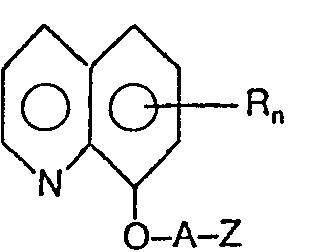
- A = -CH2- oder -CH(CH3)-,
- R = Halogen, insbesondere Chlor,
- Z = COOR, oder COSR2,
- R' = H, (C1-C8)-Alkyl, das durch Halogen oder (C1-C4)-Alkoxy substituiert sein kann; (C3 C6)-Alkenyl, (C3-C6)-Alkinyl oder ein Kationäquivalent einer anorganischen oder organischen Base;
- R2 = (C1-C4)-Alkyl und
- n = eine Zahl von null bis zwei bedeuten, als Safener für das Herbizid Ethyl-2[4-(6-chlorbenzoxazolyloxy)-phenoxy]-
- propionat(II).
- Unter «Kationäquivalenten» sind im Vorstehenden insbesondere Alkali- oder Erdalkali-ionen sowie gegebenenfalls durch niederes Alkyl und Hydroxyalkyl ein- bis dreifach substituiertes Ammonium zu verstehen.
- Die Verbindungen der Formel I sind grossenteils bekannt oder lassen sich nach allgemein bekannten Verfahren herstellen (vgl. EP-A-94349).
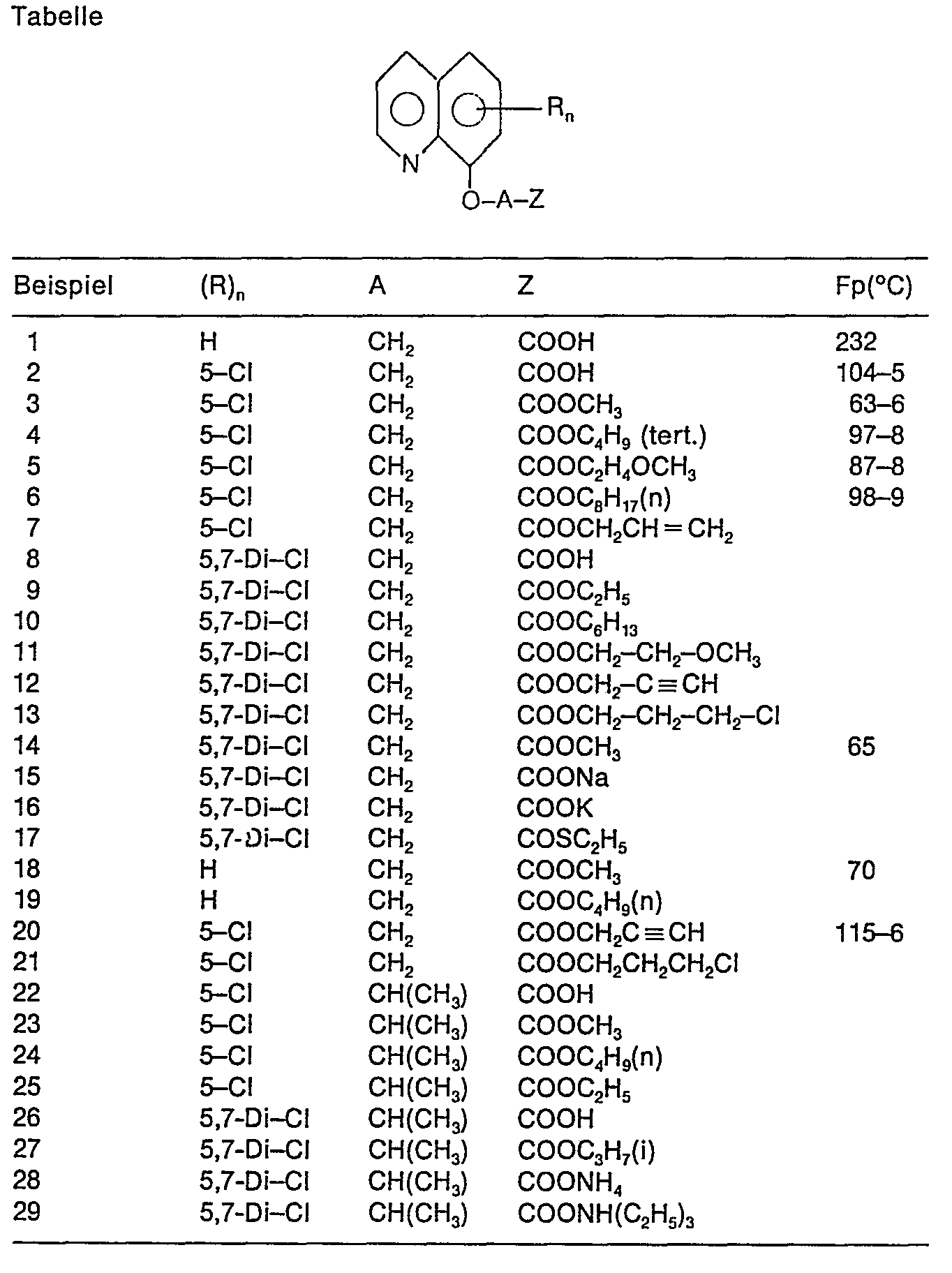
- In der nachfolgenden Tabelle sind beispielhaft eine Reihe von Verbindungen der Formel aufgeführt:
- Die Verbindungen der allgemeinen Formel I zeichnen sich dadurch aus, dass sie in niedrigen, d.h. subtoxischen Konzentrationen in Verbindung mit Fenoxaprop-ethyl(II) ausgebracht werden und dann in der Lage sind, schädliche Nebenwirkungen desselben zu antagonisieren, d.h. völlig aufzuheben, ohne seine herbizide Wirksamkeit zu beeinträchtigen.
- Hierdurch kann das Einsatzgebiet des Mittels erheblich vergrössert werden. Gegenstand der vorliegenden Erfindung ist daher auch ein Verfahren zum Schutz von Kulturpflanzen gegen phytoto-. xische Nebenwirkungen von 11, das dadurch gekennzeichnet ist, dass man die Pflanzen, Pflanzenteile oder Pflanzennährböden mit einer Verbindung der Formel 1 vor, nach oder gleichzeitig mit II behandelt.
- 11 wird vor allem zur Bekämpfung von grasartigen Schadpflanzen in dikotylen Kulturen, z.B. Soja und Kartoffeln, angewendet. In monokotylen Kulturen wie z.B. Getreide, Reis und Mais ist Fenoxaprop-ethyl jedoch nur beschränkt einsetzbar.
- Durch die erfindungsgemässe Kombination mit einem Safener der Formel I lässt sich das Herbizid auch in monokotylen Kulturpflanzen, insbesondere Getreidearten wie Weizen, Gerste, Reis und-Sorghum, als selektives Ungrasmittel verwenden.
- Das Mengenverhältnis Antidot: Herbizid kann innerhalb weiter Grenzen zwischen 0,1 und 5 Teilen Antidot auf 1 Teil Herbizid schwanken. Das optimale Mengenverhältnis ist abhängig vom Antidot sowie von der Art der zu behandelnden Pflanzenkultur. Vorzugsweise verwendet man Antidot und Herbizid im Verhältnis (0,2-2):1.
- Die Safener können je nach ihren Eigenschaften zur Vorbehandlung des Saatgutes der Kulturpflanze (Beizung der Samen) verwendet oder vor der Saat in die Saatfruchten eingebracht werden oder zusammen mit dem Herbizid vor oder nach dem Auflaufen der Pflanzen angewendet werden. Vorauflaufbehandlung schliesst sowohl die Behandlung der Anbaufläche vor der Aussaat als auch die Behandlung der angesäten, aber noch nicht bewachsenen Anbauflächen ein.
- Grundsätzlich kann das Antidot vor, nach oder gleichzeitig mit dem Herbizid angewendet werden, bevorzugt ist jedoch die gleichzeitige Anwendung in Form von Tankmischungen oder Fertigformulierungen.
- Für die Anwendung können die Verbindungen der Formel I mit üblichen Formulierungshilfen zu Stäubemitteln, Spritzpulvern, Dispersionen, Emulsionskonzentraten, Granulaten oder Mikrogranulaten zubereitet werden, die den Wirkstoff in Konzentration von 2-80% enthalten und entweder als solche angewendet werden (Stäubemittel, Pellets) oder vor der Anwendung in einem Lösungsmittel (Wasser) gelöst oder dispergiert werden.
- Spritzpulver sind in Wasser gleichmässig dispergierbare Präparate, die neben dem Wirkstoff ausser gegebenenfalls einem Verdünnungs- oder Inertstoff noch Netzmittel, z. B. polyoxethylierte Alkylphenole, polyoxethylierte Fettalkohole, Alkyl- oder Alkylphenylsulfonate und Dispergiermittel, z.B. ligninsulfonsaures Natrium, 2,2'-dinaph- thylmethan-6,6'-disulfonsaures Natrium, dibutylnaphthalinsulfonsaures Natrium oder auch oleoylmethyltaurinsaures Natrium enthalten. Die Herstellung erfolgt in üblicher Weise, z. B. durch Mahlen und Vermischen der Komponenten.
- Emulgierbare Konzentrate können z.B. durch Auflösen des Wirkstoffes in einem inerten organischen Lösungsmittel, z. B. Butanol, Cyclohexanon, Dimethylformamid, Xylol oder auch höhersiedenden Aromaten oder Kohlenwasserstoffen unter Zusatz von einem oder mehreren Emulgatoren hergestellt werden. Bei flüssigen Wirkstoffen kann der Lösungsmittelanteil auch ganz oder teilweise entfallen. Als Emulgatoren können beispielsweise verwendet werden: Alkyl-arylsulfonsaure Calciumsalze wie Ca-dodecylbenzolsulfonat oder nichtionische Emulgatoren wie Fettsäurepolyglykolester, Alkylarylpolyglykolether, Fettalkoholpolyglykolether, Propylenoxid-Ethylenoxid-Kondensationsprodukte, Fettalkohol-Propylenoxid-Ethylen- . oxid-Kondensationsprodukte, Alkylpolyglykolether, Sorbitanfettsäureester, Polyoxethylensorbitanfettsäureester oder Polyoxyethylensorbitester.
- Stäubemittel kann man durch Vermahlen des Wirkstoffes mit fein verteilten, festen Stoffen, z. B. Talkum, natürlichen Tonen wie Kaolin, Bentonit, Pyrophillit oder Diatomeenerde erhalten.
- Granulate können entweder durch Verdüsen des Wirkstoffes auf adsorptionsfähiges, granuliertes Inertmaterial hergestellt werden oder durch Aufbringen von Wirkstoffkonzentrationen mittels Bindemitteln, z.B. Polyvinylalkohol, polyacrylsaurem Natrium oder auch Mineralölen auf die Oberfläche von Trägerstoffen wie Sand, Kaolinite oder von granuliertem Inertmaterial. Auch können geeignete Wirkstoffe in der für die Herstellung von Düngemittelgranulaten üblichen Weise, gewünschtenfalls in Mischung mit Düngemitteln, granuliert werden.
- In Spritzpulvern beträgt die Wirkstoffkonzentration z.B. etwa 10 bis 90 Gew.-%, der Rest zu 100 Gew.-% besteht aus üblichen Formulierungsbestandteilen. Bei emulgierbaren Konzentraten kann die Wirkstoffkonzentration etwa 10 bis 80 Gew.-% betragen. Staubförmige Formulierungen enthalten meistens 5 bis 20 Gew.-% an Wirkstoff, versprühbare Lösungen etwa 2 bis 20 Gew.- %. Bei Granulaten hängt der Wirkstoffgehalt zum Teil davon ab, ob die wirksame Verbindung flüssig oder fest vorliegt und welche Granulierhilfsmittel, Füllstoffe usw. verwendet werden.
- Daneben enthalten die genannten Wirkstofformulierungen gegebenenfalls die jeweils üblichen Haft-, Netz-, Dispergier-, Emulgier-, Penetrations-, Lösungsmittel, Füll- oder Trägerstoffe.
- Zur Anwendung werden die in handelsüblicher Form vorliegenden Konzentrate gegebenenfalls in üblicher Weise verdünnt, z. B. bei Spritzpulvern, emulgierbaren Konzentraten, Dispersionen und teilweise auch bei Mikrogranulaten mittels Wasser. Staubförmige und granulierte Zubereitungen sowie versprühbare Lösungen werden vor der Anwendung üblicherweise nicht mehr mit weiteren inerten Stoffen verdünnt. A. Formulierungsbeispiele
- a. Ein Stäubemittel wird erhalten, indem man 10 Gew.-Teile Safener und 90 Gewichtsteile Talkum oder Inertstoff mischt und in einer Schlagmühle zerkleinert.
- b. Ein in Wasser leicht dispergierbares, benetzbares Pulver wird erhalten, indem man 25 Gewichtsteile Safener, 64 Gewichtsteile kaolinhaltigen Quarz als Inertstoff, 10 Gewichtsteile ligninsulfonsaures Kalium und 1 Gewichtsteil oleoylmethyltaurinsaures Natrium als Netz- und Dispergiermittel mischt und in einer Stiftmühle mahlt.
- c. Ein in Wasser leicht dispergierbares Dispersionskonzentrat wird erhalten, indem man 20 Gewichtsteile Safener mit 6 Gewichtsteilen Alkylphenolpolyglykolether (Tritono X 207), 3 Gewichtsteilen Isotridecanolpolyglykolether (8 AeO) und 71 Gewichtsteilen paraffinischem Mineralöl (Siedebereich z. B. ca. 255 bis über 377 °C) mischt und in einer Reibkugelmühle auf eine Feinheit von unter 5 Mikron vermahlt.
- d. Ein emulgierbares Konzentrat wird erhalten aus 15 Gewichtsteilen Safener, 75 Gewichtsteilen Cyclohexanon als Lösungsmittel und 10 Gewichtsteilen oxethyliertes Nonylphenol als Emulgator.
- Weizen, Gerste und 2 wichtige Schadgräser (Avena fatua und Alopecurus myosuroides) wurden ausgesät und unter Gewächshausbedingungen bis zum 4-Blattstadium angezogen. Sodann wurden erfindungsgemässe Safener und Fenoxaprop-ethyl(11) in verschiedenen Dosierungen auf die Versuchspflanzen gesprüht. Nach 4 weiteren Wochen Standzeit im Gewächshaus wurden die Pflanzen auf jede Art von Hemmung oder Schädigung im Vergleich zu nicht mit Safenern behandelten Versuchspflanzen untersucht. Die Ergebnisse zeigen, dass die Safener die herbiziden Schadwirkungen an Weizen und Gerste sehr stark reduzieren bzw. vollständig ausschalten, ohne die herbizide Wirksamkeit gegen die Schadgräser Avena und Alopecurus zu beeinträchtigen.
- Safenerwirkung der Chinolin-Derivate in verschiedenen Getreidekulturen:

Claims (7)

Priority Applications (1)
| Application Number | Priority Date | Filing Date | Title |
|---|---|---|---|
| AT85100866T ATE40632T1 (de) | 1984-02-08 | 1985-01-29 | Verwendung von chinolyloxy-verbindungen als antidots fuer fenoxapropethyl (ethyl-2(4-(6chlorbenzoxazolyloxy)-phenoxy>-propionat). |
Applications Claiming Priority (2)
| Application Number | Priority Date | Filing Date | Title |
|---|---|---|---|
| DE3404401A DE3404401C2 (de) | 1984-02-08 | 1984-02-08 | Verwendung von Aryloxy-Verbindungen als Antidots |
| DE3404401 | 1984-02-08 |
Publications (2)
| Publication Number | Publication Date |
|---|---|
| EP0152006A1 EP0152006A1 (de) | 1985-08-21 |
| EP0152006B1 true EP0152006B1 (de) | 1989-02-08 |
Family
ID=6227111
Family Applications (2)
| Application Number | Title | Priority Date | Filing Date |
|---|---|---|---|
| EP85100866A Expired EP0152006B1 (de) | 1984-02-08 | 1985-01-29 | Verwendung von Chinolyloxy-Verbindungen als Antidots für Fenoxapropethyl (Ethyl-2[4-(6-chlorbenzoxazolyloxy)-phenoxy]-propionat) |
| EP85100867A Expired - Lifetime EP0154153B1 (de) | 1984-02-08 | 1985-01-29 | Verwendung von Aryloxy-Verbindungen als Antidots |
Family Applications After (1)
| Application Number | Title | Priority Date | Filing Date |
|---|---|---|---|
| EP85100867A Expired - Lifetime EP0154153B1 (de) | 1984-02-08 | 1985-01-29 | Verwendung von Aryloxy-Verbindungen als Antidots |
Country Status (15)
| Country | Link |
|---|---|
| US (2) | US4668276A (de) |
| EP (2) | EP0152006B1 (de) |
| JP (2) | JPS60188303A (de) |
| AR (2) | AR240974A1 (de) |
| AT (2) | ATE40632T1 (de) |
| AU (2) | AU575906B2 (de) |
| BR (2) | BR8500548A (de) |
| CA (2) | CA1242092A (de) |
| DD (2) | DD231278A5 (de) |
| DE (3) | DE3404401C2 (de) |
| DK (2) | DK166367C (de) |
| HU (2) | HU200077B (de) |
| NZ (1) | NZ211065A (de) |
| TR (1) | TR22332A (de) |
| ZA (2) | ZA85932B (de) |
Cited By (1)
| Publication number | Priority date | Publication date | Assignee | Title |
|---|---|---|---|---|
| LT3372B (en) | 1989-11-30 | 1995-08-25 | Hoechst Ag | Remedies for phytotoxic side-effect |
Families Citing this family (18)
| Publication number | Priority date | Publication date | Assignee | Title |
|---|---|---|---|---|
| ATE103902T1 (de) * | 1982-05-07 | 1994-04-15 | Ciba Geigy Ag | Verwendung von chinolinderivaten zum schuetzen von kulturpflanzen. |
| ATE47001T1 (de) * | 1984-03-15 | 1989-10-15 | Ciba Geigy Ag | Verwendung von chinolinderivaten zum schuetzen von kulturpflanzen. |
| EP0191736B1 (de) * | 1985-02-14 | 1991-07-17 | Ciba-Geigy Ag | Verwendung von Chinolinderivaten zum Schützen von Kulturpflanzen |
| DE3624859A1 (de) * | 1986-07-23 | 1988-01-28 | Hoechst Ag | Neue chinolinoxy-verbindungen, verfahren zu ihrer herstellung und ihre verwendung als antidots |
| GB8702613D0 (en) * | 1987-02-05 | 1987-03-11 | Ici Plc | Compositions |
| JPS63249461A (ja) * | 1987-04-02 | 1988-10-17 | Mitsuba Electric Mfg Co Ltd | 磁気結合構造 |
| GB8726735D0 (en) * | 1987-11-14 | 1987-12-16 | Wellcome Found | Pesticidal compounds |
| DE3808896A1 (de) * | 1988-03-17 | 1989-09-28 | Hoechst Ag | Pflanzenschuetzende mittel auf basis von pyrazolcarbonsaeurederivaten |
| US4904295A (en) * | 1988-06-15 | 1990-02-27 | Hoechst Roussel Pharmaceuticals, Inc. | Selective weed control in cereal grain crops |
| US5364832A (en) * | 1990-08-10 | 1994-11-15 | Hoechst Aktiengesellschaft | Water-dispersible granules comprising fenoxaprop-ethyl and/or fenchlorazole |
| US5700758A (en) * | 1989-11-30 | 1997-12-23 | Hoechst Aktiengesellschaft | Pyrazolines for protecting crop plants against herbicides |
| WO1992009587A1 (en) * | 1990-11-26 | 1992-06-11 | E.I. Du Pont De Nemours And Company | Herbicidal oxazine ethers |
| DK0509433T3 (da) * | 1991-04-15 | 2000-11-06 | Aventis Cropscience Gmbh | Plantebeskyttelsesmidler indeholdende isoxazoliner eller isothiazoliner, nye isoxazoliner og isothiazoliner samt fremgangsm |
| DE4217928A1 (de) * | 1992-05-30 | 1993-12-02 | Hoechst Ag | Neue Mischungen aus Herbiziden und Antidots, neue (Hetero-)Aryloxy-Verbindungen, Verfahren zu deren Herstellung, diese enthaltenden Mittel und deren Verwendung |
| TW259690B (de) * | 1992-08-01 | 1995-10-11 | Hoechst Ag | |
| DE19638233A1 (de) * | 1996-09-19 | 1998-03-26 | Hoechst Schering Agrevo Gmbh | Kombinationen aus Sulfonylharnstoff-Herbiziden und Safenern |
| AU4782099A (en) | 1998-07-16 | 2000-02-07 | Aventis Cropscience Gmbh | Herbicides |
| GB9922830D0 (en) | 1999-09-27 | 1999-11-24 | Novartis Ag | Processes |
Family Cites Families (16)
| Publication number | Priority date | Publication date | Assignee | Title |
|---|---|---|---|---|
| US3133810A (en) * | 1961-04-19 | 1964-05-19 | Monsanto Chemicals | Herbicidal compositions |
| US3929452A (en) * | 1971-03-25 | 1975-12-30 | Kumiai Chemical Industry Co | Herbicidal composition |
| DE2546845A1 (de) * | 1975-10-18 | 1977-04-28 | Basf Ag | Substituierte 2-(chinolyl-xy)- und 2-(isochinolyl-oxy)-carbonsaeurederivate |
| US4019892A (en) * | 1975-12-31 | 1977-04-26 | Shell Oil Company | Herbicidal heterocyclic compounds |
| DE2617804C2 (de) * | 1976-04-23 | 1985-01-24 | Hoechst Ag, 6230 Frankfurt | 2-(4-Phenoxy phenoxy)-propionsäurederivate und ihre Verwendung als Herbizide |
| JPS5814354B2 (ja) * | 1976-06-23 | 1983-03-18 | 株式会社小松製作所 | 装軌車両の駆動装置 |
| DE2640730C2 (de) * | 1976-09-10 | 1983-08-25 | Hoechst Ag, 6230 Frankfurt | Benzoxazolyloxy- und Benzothiazolyloxy-phenoxy-Verbindungen und diese enthaltende herbizide Mittel |
| DE2967486D1 (en) * | 1978-03-01 | 1985-08-29 | Ici Plc | Mixtures of herbicidal pyridyloxyphenoxypropanoic acid derivatives with other herbicides, and processes of killing unwanted plants therewith |
| DE2914300A1 (de) * | 1979-04-09 | 1980-11-13 | Hoechst Ag | Heterocyclische phenylether und diese enthaltende herbizide mittel |
| DE3000076A1 (de) * | 1980-01-03 | 1981-09-03 | Hoechst Ag, 6000 Frankfurt | Wachstumsfoerdernde und pflanzenschuetzende mittel |
| US4416687A (en) * | 1982-02-01 | 1983-11-22 | Monsanto Company | 3,5-Bis (trifluoromethyl)phenoxy carboxylic acids and derivatives thereof |
| MA19709A1 (fr) * | 1982-02-17 | 1983-10-01 | Ciba Geigy Ag | Application de derives de quinoleine a la protection des plantes cultivees . |
| ATE103902T1 (de) * | 1982-05-07 | 1994-04-15 | Ciba Geigy Ag | Verwendung von chinolinderivaten zum schuetzen von kulturpflanzen. |
| EP0112799A1 (de) * | 1982-12-06 | 1984-07-04 | Ciba-Geigy Ag | Herbizides Mittel zur selektiven Unkrautbekämpfung in Getreide |
| GB2137092A (en) * | 1983-02-28 | 1984-10-03 | Ici Plc | Phenoxypropionic Acid Derivatives for Selective Herbicides in Rice Crops |
| DE3483081D1 (de) * | 1983-10-18 | 1990-10-04 | Ciba Geigy Ag | Verwendung von chinolinderivaten zum schuetzen von kulturpflanzen. |
-
1984
- 1984-02-08 DE DE3404401A patent/DE3404401C2/de not_active Expired - Lifetime
-
1985
- 1985-01-29 EP EP85100866A patent/EP0152006B1/de not_active Expired
- 1985-01-29 EP EP85100867A patent/EP0154153B1/de not_active Expired - Lifetime
- 1985-01-29 AT AT85100866T patent/ATE40632T1/de not_active IP Right Cessation
- 1985-01-29 DE DE8585100867T patent/DE3578923D1/de not_active Expired - Lifetime
- 1985-01-29 DE DE8585100866T patent/DE3568126D1/de not_active Expired
- 1985-01-29 AT AT85100867T patent/ATE55039T1/de not_active IP Right Cessation
- 1985-02-01 HU HU85394A patent/HU200077B/hu unknown
- 1985-02-04 HU HU85414A patent/HU198604B/hu unknown
- 1985-02-05 TR TR5328/85A patent/TR22332A/xx unknown
- 1985-02-06 AR AR299444A patent/AR240974A1/es active
- 1985-02-06 US US06/698,553 patent/US4668276A/en not_active Expired - Lifetime
- 1985-02-06 AR AR299443A patent/AR240975A1/es active
- 1985-02-06 US US06/698,559 patent/US4602932A/en not_active Expired - Lifetime
- 1985-02-07 CA CA000473734A patent/CA1242092A/en not_active Expired
- 1985-02-07 CA CA000473735A patent/CA1250151A/en not_active Expired
- 1985-02-07 NZ NZ211065A patent/NZ211065A/xx unknown
- 1985-02-07 JP JP60021009A patent/JPS60188303A/ja active Granted
- 1985-02-07 AU AU38538/85A patent/AU575906B2/en not_active Expired
- 1985-02-07 ZA ZA85932A patent/ZA85932B/xx unknown
- 1985-02-07 DD DD85273122A patent/DD231278A5/de unknown
- 1985-02-07 DK DK057385A patent/DK166367C/da not_active IP Right Cessation
- 1985-02-07 DK DK57285A patent/DK57285A/da not_active Application Discontinuation
- 1985-02-07 ZA ZA85931A patent/ZA85931B/xx unknown
- 1985-02-07 DD DD85273120A patent/DD232418A5/de unknown
- 1985-02-07 JP JP60021008A patent/JPH0696482B2/ja not_active Expired - Lifetime
- 1985-02-07 BR BR8500548A patent/BR8500548A/pt unknown
- 1985-02-07 BR BR8500547A patent/BR8500547A/pt unknown
- 1985-02-07 AU AU38539/85A patent/AU575907B2/en not_active Expired
Cited By (1)
| Publication number | Priority date | Publication date | Assignee | Title |
|---|---|---|---|---|
| LT3372B (en) | 1989-11-30 | 1995-08-25 | Hoechst Ag | Remedies for phytotoxic side-effect |
Also Published As
Similar Documents
| Publication | Publication Date | Title |
|---|---|---|
| EP0152006B1 (de) | Verwendung von Chinolyloxy-Verbindungen als Antidots für Fenoxapropethyl (Ethyl-2[4-(6-chlorbenzoxazolyloxy)-phenoxy]-propionat) | |
| DE3817192A1 (de) | 1,2,4-triazolderivate enthaltende pflanzenschuetzende mittel sowie neue derivate des 1,2,4-triazols | |
| DD283995A5 (de) | Verfahren zur herstellung eines benzamid-derivats | |
| EP0191736A2 (de) | Verwendung von Chinolinderivaten zum Schützen von Kulturpflanzen | |
| EP0083556A2 (de) | Alpha-(4-(3'-Fluor-5'-halogen-pyridyl-2'-oxy)-phenoxy)-propionsäure derivate mit herbizider Wirkung | |
| EP0003805B1 (de) | Pyridazonverbindungen und diese enthaltende herbizide Zusammensetzungen | |
| EP0236273A2 (de) | Synergistisches Mittel und Verfahren zur selektiven Unkrautbekämpfung in Getreide | |
| DD142643A5 (de) | Herbizide mittel | |
| EP0159287A1 (de) | Verwendung von Chinolinderivaten zum Schützen von Kulturpflanzen | |
| EP0147365A2 (de) | Herbizides Mittel | |
| EP0296319B1 (de) | Herbizide Mittel auf der Basis von Heteroaryloxyphenoxycarbonsäure-Derivaten | |
| EP0614608B1 (de) | Synergistische Mischungen zur Bekämpfung von Ackerfuchsschwanz | |
| DE3238958A1 (de) | Phosphorhaltige funktionelle essigsaeurederivate, verfahren zu ihrer herstellung und sie enthaltende heribizide und wachstumsregulierende mittel | |
| DE3018003C2 (de) | ||
| EP0018585B1 (de) | Parabansäurederivate, Herbizide, die diese Verbindungen enthalten, und Verfahren zur Herstellung der Herbizide | |
| EP0075249B1 (de) | Herbizide Mittel | |
| EP0009091B1 (de) | Verfahren zur selektiven Bekämpfung von unerwünschtem Pflanzenwachstum mit herbiziden Mitteln auf Basis von Acetaniliden und N-Dichloracetyl-2,2-dimethyl-1,3-oxazolidin | |
| EP0407341B1 (de) | Selektiv-herbizides Mittel | |
| DE4428982C1 (de) | Neue synergistische Herbizide, insbesondere zur Bekämpfung von Ackerfuchsschwanz | |
| EP0585199A1 (de) | Selektiv-herbizides Mittel | |
| EP0067381B1 (de) | Anilide, Verfahren zu ihrer Herstellung und diese enthaltende Herbizide | |
| EP0258184A2 (de) | Chinolinderivate als Herbizid- antagonisten für Kulturpflanzen | |
| EP0110236B1 (de) | Herbizide Mittel | |
| EP0027915B1 (de) | Herbizide Mittel auf der Basis von Diphenyläthern und Benzothiadiazinondioxiden bzw. Pyridinothiadiazinondioxiden und deren Verwendung | |
| DE3502629A1 (de) | Phenoxybenzoesaeurederivate, verfahren zu ihrer herstellung sowie ihre verwendung im pflanzenschutz |
Legal Events
| Date | Code | Title | Description |
|---|---|---|---|
| PUAI | Public reference made under article 153(3) epc to a published international application that has entered the european phase |
Free format text: ORIGINAL CODE: 0009012 |
|
| AK | Designated contracting states |
Designated state(s): AT BE DE FR GB IT NL SE |
|
| 17P | Request for examination filed |
Effective date: 19851210 |
|
| 17Q | First examination report despatched |
Effective date: 19870623 |
|
| GRAA | (expected) grant |
Free format text: ORIGINAL CODE: 0009210 |
|
| AK | Designated contracting states |
Kind code of ref document: B1 Designated state(s): AT BE DE FR GB IT NL SE |
|
| REF | Corresponds to: |
Ref document number: 40632 Country of ref document: AT Date of ref document: 19890215 Kind code of ref document: T |
|
| REF | Corresponds to: |
Ref document number: 3568126 Country of ref document: DE Date of ref document: 19890316 |
|
| ITF | It: translation for a ep patent filed | ||
| GBT | Gb: translation of ep patent filed (gb section 77(6)(a)/1977) | ||
| ET | Fr: translation filed | ||
| PLBE | No opposition filed within time limit |
Free format text: ORIGINAL CODE: 0009261 |
|
| STAA | Information on the status of an ep patent application or granted ep patent |
Free format text: STATUS: NO OPPOSITION FILED WITHIN TIME LIMIT |
|
| ITTA | It: last paid annual fee | ||
| 26N | No opposition filed | ||
| EAL | Se: european patent in force in sweden |
Ref document number: 85100866.4 |
|
| REG | Reference to a national code |
Ref country code: GB Ref legal event code: IF02 |
|
| PGFP | Annual fee paid to national office [announced via postgrant information from national office to epo] |
Ref country code: DE Payment date: 20031203 Year of fee payment: 20 |
|
| PGFP | Annual fee paid to national office [announced via postgrant information from national office to epo] |
Ref country code: SE Payment date: 20040107 Year of fee payment: 20 |
|
| PGFP | Annual fee paid to national office [announced via postgrant information from national office to epo] |
Ref country code: FR Payment date: 20040108 Year of fee payment: 20 |
|
| PGFP | Annual fee paid to national office [announced via postgrant information from national office to epo] |
Ref country code: AT Payment date: 20040113 Year of fee payment: 20 |
|
| PGFP | Annual fee paid to national office [announced via postgrant information from national office to epo] |
Ref country code: NL Payment date: 20040121 Year of fee payment: 20 |
|
| PGFP | Annual fee paid to national office [announced via postgrant information from national office to epo] |
Ref country code: GB Payment date: 20040128 Year of fee payment: 20 |
|
| PGFP | Annual fee paid to national office [announced via postgrant information from national office to epo] |
Ref country code: BE Payment date: 20040409 Year of fee payment: 20 |
|
| PG25 | Lapsed in a contracting state [announced via postgrant information from national office to epo] |
Ref country code: GB Free format text: LAPSE BECAUSE OF EXPIRATION OF PROTECTION Effective date: 20050128 |
|
| PG25 | Lapsed in a contracting state [announced via postgrant information from national office to epo] |
Ref country code: NL Free format text: LAPSE BECAUSE OF EXPIRATION OF PROTECTION Effective date: 20050129 |
|
| BE20 | Be: patent expired |
Owner name: *HOECHST A.G. Effective date: 20050129 |
|
| REG | Reference to a national code |
Ref country code: GB Ref legal event code: PE20 |
|
| EUG | Se: european patent has lapsed | ||
| NLV7 | Nl: ceased due to reaching the maximum lifetime of a patent |
Effective date: 20050129 |
|
| BE20 | Be: patent expired |
Owner name: *HOECHST A.G. Effective date: 20050129 |