EP0146501B1 - Polymerisierbare Zusammensetzungen - Google Patents
Polymerisierbare Zusammensetzungen Download PDFInfo
- Publication number
- EP0146501B1 EP0146501B1 EP84810574A EP84810574A EP0146501B1 EP 0146501 B1 EP0146501 B1 EP 0146501B1 EP 84810574 A EP84810574 A EP 84810574A EP 84810574 A EP84810574 A EP 84810574A EP 0146501 B1 EP0146501 B1 EP 0146501B1
- Authority
- EP
- European Patent Office
- Prior art keywords
- composition according
- salt
- iodosyl
- resin
- groups
- Prior art date
- Legal status (The legal status is an assumption and is not a legal conclusion. Google has not performed a legal analysis and makes no representation as to the accuracy of the status listed.)
- Expired
Links
- 239000000203 mixture Substances 0.000 title claims description 95
- -1 aromatic radical Chemical class 0.000 claims description 64
- 229920005989 resin Polymers 0.000 claims description 48
- 239000011347 resin Substances 0.000 claims description 48
- ISWSIDIOOBJBQZ-UHFFFAOYSA-N Phenol Chemical compound OC1=CC=CC=C1 ISWSIDIOOBJBQZ-UHFFFAOYSA-N 0.000 claims description 41
- 239000000463 material Substances 0.000 claims description 36
- 150000001875 compounds Chemical class 0.000 claims description 27
- 150000003839 salts Chemical class 0.000 claims description 23
- 239000003054 catalyst Substances 0.000 claims description 19
- 150000002440 hydroxy compounds Chemical class 0.000 claims description 19
- 125000004432 carbon atom Chemical group C* 0.000 claims description 18
- 230000005855 radiation Effects 0.000 claims description 18
- 238000010438 heat treatment Methods 0.000 claims description 15
- 125000002887 hydroxy group Chemical group [H]O* 0.000 claims description 15
- 150000003254 radicals Chemical class 0.000 claims description 15
- 229920000647 polyepoxide Polymers 0.000 claims description 14
- 150000001450 anions Chemical class 0.000 claims description 13
- 239000003822 epoxy resin Substances 0.000 claims description 13
- 125000001812 iodosyl group Chemical group O=I[*] 0.000 claims description 12
- 239000002253 acid Substances 0.000 claims description 11
- 229920001568 phenolic resin Polymers 0.000 claims description 11
- 229920003987 resole Polymers 0.000 claims description 11
- XEEYBQQBJWHFJM-UHFFFAOYSA-N Iron Chemical compound [Fe] XEEYBQQBJWHFJM-UHFFFAOYSA-N 0.000 claims description 10
- 125000003118 aryl group Chemical group 0.000 claims description 10
- 238000000034 method Methods 0.000 claims description 10
- RTZKZFJDLAIYFH-UHFFFAOYSA-N Diethyl ether Chemical compound CCOCC RTZKZFJDLAIYFH-UHFFFAOYSA-N 0.000 claims description 9
- 125000001997 phenyl group Chemical group [H]C1=C([H])C([H])=C(*)C([H])=C1[H] 0.000 claims description 9
- QYKIQEUNHZKYBP-UHFFFAOYSA-N Vinyl ether Chemical compound C=COC=C QYKIQEUNHZKYBP-UHFFFAOYSA-N 0.000 claims description 8
- HCHKCACWOHOZIP-UHFFFAOYSA-N Zinc Chemical compound [Zn] HCHKCACWOHOZIP-UHFFFAOYSA-N 0.000 claims description 8
- 230000001476 alcoholic effect Effects 0.000 claims description 8
- XXROGKLTLUQVRX-UHFFFAOYSA-N allyl alcohol Chemical compound OCC=C XXROGKLTLUQVRX-UHFFFAOYSA-N 0.000 claims description 8
- 125000005843 halogen group Chemical group 0.000 claims description 8
- 230000007704 transition Effects 0.000 claims description 8
- 229910052725 zinc Inorganic materials 0.000 claims description 8
- 239000011701 zinc Substances 0.000 claims description 8
- 229910052723 transition metal Inorganic materials 0.000 claims description 7
- 150000003624 transition metals Chemical class 0.000 claims description 7
- 229920002554 vinyl polymer Polymers 0.000 claims description 6
- 229910052793 cadmium Inorganic materials 0.000 claims description 5
- BDOSMKKIYDKNTQ-UHFFFAOYSA-N cadmium atom Chemical compound [Cd] BDOSMKKIYDKNTQ-UHFFFAOYSA-N 0.000 claims description 5
- 229920001577 copolymer Polymers 0.000 claims description 5
- 229910052751 metal Inorganic materials 0.000 claims description 5
- 239000002184 metal Substances 0.000 claims description 5
- RYGMFSIKBFXOCR-UHFFFAOYSA-N Copper Chemical compound [Cu] RYGMFSIKBFXOCR-UHFFFAOYSA-N 0.000 claims description 4
- 229910019142 PO4 Inorganic materials 0.000 claims description 4
- DTQVDTLACAAQTR-UHFFFAOYSA-M Trifluoroacetate Chemical compound [O-]C(=O)C(F)(F)F DTQVDTLACAAQTR-UHFFFAOYSA-M 0.000 claims description 4
- 125000001931 aliphatic group Chemical group 0.000 claims description 4
- 229910052802 copper Inorganic materials 0.000 claims description 4
- 239000010949 copper Substances 0.000 claims description 4
- 229910052742 iron Inorganic materials 0.000 claims description 4
- 230000001678 irradiating effect Effects 0.000 claims description 4
- 150000001451 organic peroxides Chemical class 0.000 claims description 4
- 238000002360 preparation method Methods 0.000 claims description 4
- 229910052706 scandium Inorganic materials 0.000 claims description 4
- SIXSYDAISGFNSX-UHFFFAOYSA-N scandium atom Chemical compound [Sc] SIXSYDAISGFNSX-UHFFFAOYSA-N 0.000 claims description 4
- 125000000391 vinyl group Chemical group [H]C([*])=C([H])[H] 0.000 claims description 4
- QTBSBXVTEAMEQO-UHFFFAOYSA-M Acetate Chemical compound CC([O-])=O QTBSBXVTEAMEQO-UHFFFAOYSA-M 0.000 claims description 3
- 239000004342 Benzoyl peroxide Substances 0.000 claims description 3
- OMPJBNCRMGITSC-UHFFFAOYSA-N Benzoylperoxide Chemical compound C=1C=CC=CC=1C(=O)OOC(=O)C1=CC=CC=C1 OMPJBNCRMGITSC-UHFFFAOYSA-N 0.000 claims description 3
- VEXZGXHMUGYJMC-UHFFFAOYSA-M Chloride anion Chemical compound [Cl-] VEXZGXHMUGYJMC-UHFFFAOYSA-M 0.000 claims description 3
- 235000019400 benzoyl peroxide Nutrition 0.000 claims description 3
- 125000004122 cyclic group Chemical group 0.000 claims description 3
- 150000002118 epoxides Chemical group 0.000 claims description 3
- SLGWESQGEUXWJQ-UHFFFAOYSA-N formaldehyde;phenol Chemical compound O=C.OC1=CC=CC=C1 SLGWESQGEUXWJQ-UHFFFAOYSA-N 0.000 claims description 3
- 150000007522 mineralic acids Chemical class 0.000 claims description 3
- 239000000178 monomer Substances 0.000 claims description 3
- VLTRZXGMWDSKGL-UHFFFAOYSA-N perchloric acid Chemical compound OCl(=O)(=O)=O VLTRZXGMWDSKGL-UHFFFAOYSA-N 0.000 claims description 3
- 229920000642 polymer Polymers 0.000 claims description 3
- 229910052727 yttrium Inorganic materials 0.000 claims description 3
- VWQVUPCCIRVNHF-UHFFFAOYSA-N yttrium atom Chemical compound [Y] VWQVUPCCIRVNHF-UHFFFAOYSA-N 0.000 claims description 3
- XMNIXWIUMCBBBL-UHFFFAOYSA-N 2-(2-phenylpropan-2-ylperoxy)propan-2-ylbenzene Chemical compound C=1C=CC=CC=1C(C)(C)OOC(C)(C)C1=CC=CC=C1 XMNIXWIUMCBBBL-UHFFFAOYSA-N 0.000 claims description 2
- CPELXLSAUQHCOX-UHFFFAOYSA-M Bromide Chemical compound [Br-] CPELXLSAUQHCOX-UHFFFAOYSA-M 0.000 claims description 2
- VYZAMTAEIAYCRO-UHFFFAOYSA-N Chromium Chemical compound [Cr] VYZAMTAEIAYCRO-UHFFFAOYSA-N 0.000 claims description 2
- KRHYYFGTRYWZRS-UHFFFAOYSA-M Fluoride anion Chemical compound [F-] KRHYYFGTRYWZRS-UHFFFAOYSA-M 0.000 claims description 2
- 229920002153 Hydroxypropyl cellulose Polymers 0.000 claims description 2
- AFVFQIVMOAPDHO-UHFFFAOYSA-M Methanesulfonate Chemical compound CS([O-])(=O)=O AFVFQIVMOAPDHO-UHFFFAOYSA-M 0.000 claims description 2
- 229910002651 NO3 Inorganic materials 0.000 claims description 2
- NHNBFGGVMKEFGY-UHFFFAOYSA-N Nitrate Chemical compound [O-][N+]([O-])=O NHNBFGGVMKEFGY-UHFFFAOYSA-N 0.000 claims description 2
- 125000004429 atom Chemical group 0.000 claims description 2
- SRSXLGNVWSONIS-UHFFFAOYSA-M benzenesulfonate Chemical compound [O-]S(=O)(=O)C1=CC=CC=C1 SRSXLGNVWSONIS-UHFFFAOYSA-M 0.000 claims description 2
- 229910052804 chromium Inorganic materials 0.000 claims description 2
- 239000011651 chromium Substances 0.000 claims description 2
- 229910017052 cobalt Inorganic materials 0.000 claims description 2
- 239000010941 cobalt Substances 0.000 claims description 2
- GUTLYIVDDKVIGB-UHFFFAOYSA-N cobalt atom Chemical compound [Co] GUTLYIVDDKVIGB-UHFFFAOYSA-N 0.000 claims description 2
- QAOWNCQODCNURD-UHFFFAOYSA-M hydrogensulfate Chemical compound OS([O-])(=O)=O QAOWNCQODCNURD-UHFFFAOYSA-M 0.000 claims description 2
- 239000001863 hydroxypropyl cellulose Substances 0.000 claims description 2
- 235000010977 hydroxypropyl cellulose Nutrition 0.000 claims description 2
- ICIWUVCWSCSTAQ-UHFFFAOYSA-M iodate Chemical compound [O-]I(=O)=O ICIWUVCWSCSTAQ-UHFFFAOYSA-M 0.000 claims description 2
- 229910052752 metalloid Inorganic materials 0.000 claims description 2
- 150000002738 metalloids Chemical class 0.000 claims description 2
- VLTRZXGMWDSKGL-UHFFFAOYSA-M perchlorate Inorganic materials [O-]Cl(=O)(=O)=O VLTRZXGMWDSKGL-UHFFFAOYSA-M 0.000 claims description 2
- NBIIXXVUZAFLBC-UHFFFAOYSA-K phosphate Chemical compound [O-]P([O-])([O-])=O NBIIXXVUZAFLBC-UHFFFAOYSA-K 0.000 claims description 2
- 239000010452 phosphate Substances 0.000 claims description 2
- 229920002755 poly(epichlorohydrin) Polymers 0.000 claims description 2
- 229920001610 polycaprolactone Polymers 0.000 claims description 2
- 229920002451 polyvinyl alcohol Polymers 0.000 claims description 2
- 150000005846 sugar alcohols Polymers 0.000 claims description 2
- GJBRNHKUVLOCEB-UHFFFAOYSA-N tert-butyl benzenecarboperoxoate Chemical compound CC(C)(C)OOC(=O)C1=CC=CC=C1 GJBRNHKUVLOCEB-UHFFFAOYSA-N 0.000 claims description 2
- ITMCEJHCFYSIIV-UHFFFAOYSA-M triflate Chemical compound [O-]S(=O)(=O)C(F)(F)F ITMCEJHCFYSIIV-UHFFFAOYSA-M 0.000 claims description 2
- LYCAIKOWRPUZTN-UHFFFAOYSA-N Ethylene glycol Chemical compound OCCO LYCAIKOWRPUZTN-UHFFFAOYSA-N 0.000 claims 2
- IUTCEZPPWBHGIX-UHFFFAOYSA-N tin(2+) Chemical class [Sn+2] IUTCEZPPWBHGIX-UHFFFAOYSA-N 0.000 claims 2
- PAOHAQSLJSMLAT-UHFFFAOYSA-N 1-butylperoxybutane Chemical compound CCCCOOCCCC PAOHAQSLJSMLAT-UHFFFAOYSA-N 0.000 claims 1
- BUDQDWGNQVEFAC-UHFFFAOYSA-N Dihydropyran Chemical group C1COC=CC1 BUDQDWGNQVEFAC-UHFFFAOYSA-N 0.000 claims 1
- NBIIXXVUZAFLBC-UHFFFAOYSA-L Phosphate ion(2-) Chemical compound OP([O-])([O-])=O NBIIXXVUZAFLBC-UHFFFAOYSA-L 0.000 claims 1
- 239000004372 Polyvinyl alcohol Substances 0.000 claims 1
- QAOWNCQODCNURD-UHFFFAOYSA-L Sulfate Chemical compound [O-]S([O-])(=O)=O QAOWNCQODCNURD-UHFFFAOYSA-L 0.000 claims 1
- XSTXAVWGXDQKEL-UHFFFAOYSA-N Trichloroethylene Chemical compound ClC=C(Cl)Cl XSTXAVWGXDQKEL-UHFFFAOYSA-N 0.000 claims 1
- DHKHKXVYLBGOIT-UHFFFAOYSA-N acetaldehyde Diethyl Acetal Natural products CCOC(C)OCC DHKHKXVYLBGOIT-UHFFFAOYSA-N 0.000 claims 1
- 125000002777 acetyl group Chemical class [H]C([H])([H])C(*)=O 0.000 claims 1
- 150000001732 carboxylic acid derivatives Chemical class 0.000 claims 1
- WGCNASOHLSPBMP-UHFFFAOYSA-N hydroxyacetaldehyde Natural products OCC=O WGCNASOHLSPBMP-UHFFFAOYSA-N 0.000 claims 1
- 239000004632 polycaprolactone Substances 0.000 claims 1
- BDHFUVZGWQCTTF-UHFFFAOYSA-N sulfonic acid Chemical compound OS(=O)=O BDHFUVZGWQCTTF-UHFFFAOYSA-N 0.000 claims 1
- 229910021653 sulphate ion Inorganic materials 0.000 claims 1
- WSFSSNUMVMOOMR-UHFFFAOYSA-N Formaldehyde Chemical compound O=C WSFSSNUMVMOOMR-UHFFFAOYSA-N 0.000 description 21
- IISBACLAFKSPIT-UHFFFAOYSA-N bisphenol A Chemical compound C=1C=C(O)C=CC=1C(C)(C)C1=CC=C(O)C=C1 IISBACLAFKSPIT-UHFFFAOYSA-N 0.000 description 18
- PPBRXRYQALVLMV-UHFFFAOYSA-N Styrene Chemical compound C=CC1=CC=CC=C1 PPBRXRYQALVLMV-UHFFFAOYSA-N 0.000 description 14
- 238000000576 coating method Methods 0.000 description 11
- CURLTUGMZLYLDI-UHFFFAOYSA-N Carbon dioxide Chemical compound O=C=O CURLTUGMZLYLDI-UHFFFAOYSA-N 0.000 description 10
- 239000000243 solution Substances 0.000 description 10
- 239000011248 coating agent Substances 0.000 description 9
- CIWBSHSKHKDKBQ-JLAZNSOCSA-N Ascorbic acid Chemical compound OC[C@H](O)[C@H]1OC(=O)C(O)=C1O CIWBSHSKHKDKBQ-JLAZNSOCSA-N 0.000 description 8
- 125000000217 alkyl group Chemical group 0.000 description 8
- 238000001723 curing Methods 0.000 description 8
- 238000006116 polymerization reaction Methods 0.000 description 8
- 239000005028 tinplate Substances 0.000 description 8
- QTBSBXVTEAMEQO-UHFFFAOYSA-N Acetic acid Chemical compound CC(O)=O QTBSBXVTEAMEQO-UHFFFAOYSA-N 0.000 description 7
- 125000003580 L-valyl group Chemical group [H]N([H])[C@]([H])(C(=O)[*])C(C([H])([H])[H])(C([H])([H])[H])[H] 0.000 description 7
- 238000000354 decomposition reaction Methods 0.000 description 7
- 239000007788 liquid Substances 0.000 description 7
- 238000004519 manufacturing process Methods 0.000 description 7
- 239000000126 substance Substances 0.000 description 7
- 229960000834 vinyl ether Drugs 0.000 description 7
- HEMHJVSKTPXQMS-UHFFFAOYSA-M Sodium hydroxide Chemical compound [OH-].[Na+] HEMHJVSKTPXQMS-UHFFFAOYSA-M 0.000 description 6
- XSQUKJJJFZCRTK-UHFFFAOYSA-N Urea Chemical compound NC(N)=O XSQUKJJJFZCRTK-UHFFFAOYSA-N 0.000 description 6
- 238000002844 melting Methods 0.000 description 6
- 230000008018 melting Effects 0.000 description 6
- XLYOFNOQVPJJNP-UHFFFAOYSA-N water Substances O XLYOFNOQVPJJNP-UHFFFAOYSA-N 0.000 description 6
- ZCYVEMRRCGMTRW-UHFFFAOYSA-N 7553-56-2 Chemical compound [I] ZCYVEMRRCGMTRW-UHFFFAOYSA-N 0.000 description 5
- 239000004971 Cross linker Substances 0.000 description 5
- 150000007513 acids Chemical class 0.000 description 5
- WERYXYBDKMZEQL-UHFFFAOYSA-N butane-1,4-diol Chemical compound OCCCCO WERYXYBDKMZEQL-UHFFFAOYSA-N 0.000 description 5
- 239000001569 carbon dioxide Substances 0.000 description 5
- 229910002092 carbon dioxide Inorganic materials 0.000 description 5
- 238000006243 chemical reaction Methods 0.000 description 5
- GYZLOYUZLJXAJU-UHFFFAOYSA-N diglycidyl ether Chemical compound C1OC1COCC1CO1 GYZLOYUZLJXAJU-UHFFFAOYSA-N 0.000 description 5
- 238000013007 heat curing Methods 0.000 description 5
- 229910052740 iodine Inorganic materials 0.000 description 5
- 239000011630 iodine Substances 0.000 description 5
- 239000011368 organic material Substances 0.000 description 5
- 239000004848 polyfunctional curative Substances 0.000 description 5
- 239000000047 product Substances 0.000 description 5
- OPRHFGGPAJOHSF-UHFFFAOYSA-N 3,4-dihydro-2h-pyran-2-ylmethyl 3,4-dihydro-2h-pyran-2-carboxylate Chemical compound C1CC=COC1C(=O)OCC1CCC=CO1 OPRHFGGPAJOHSF-UHFFFAOYSA-N 0.000 description 4
- BVKZGUZCCUSVTD-UHFFFAOYSA-L Carbonate Chemical compound [O-]C([O-])=O BVKZGUZCCUSVTD-UHFFFAOYSA-L 0.000 description 4
- WYURNTSHIVDZCO-UHFFFAOYSA-N Tetrahydrofuran Chemical compound C1CCOC1 WYURNTSHIVDZCO-UHFFFAOYSA-N 0.000 description 4
- 150000001299 aldehydes Chemical class 0.000 description 4
- 235000010323 ascorbic acid Nutrition 0.000 description 4
- 239000011668 ascorbic acid Substances 0.000 description 4
- 229910052799 carbon Inorganic materials 0.000 description 4
- MTHSVFCYNBDYFN-UHFFFAOYSA-N diethylene glycol Chemical compound OCCOCCO MTHSVFCYNBDYFN-UHFFFAOYSA-N 0.000 description 4
- 239000000706 filtrate Substances 0.000 description 4
- 238000001914 filtration Methods 0.000 description 4
- 239000011521 glass Substances 0.000 description 4
- XMBWDFGMSWQBCA-UHFFFAOYSA-N hydrogen iodide Chemical class I XMBWDFGMSWQBCA-UHFFFAOYSA-N 0.000 description 4
- 239000002244 precipitate Substances 0.000 description 4
- HZNVUJQVZSTENZ-UHFFFAOYSA-N 2,3-dichloro-5,6-dicyano-1,4-benzoquinone Chemical compound ClC1=C(Cl)C(=O)C(C#N)=C(C#N)C1=O HZNVUJQVZSTENZ-UHFFFAOYSA-N 0.000 description 3
- OKTJSMMVPCPJKN-UHFFFAOYSA-N Carbon Chemical compound [C] OKTJSMMVPCPJKN-UHFFFAOYSA-N 0.000 description 3
- 239000004593 Epoxy Substances 0.000 description 3
- LRHPLDYGYMQRHN-UHFFFAOYSA-N N-Butanol Chemical compound CCCCO LRHPLDYGYMQRHN-UHFFFAOYSA-N 0.000 description 3
- ATJFFYVFTNAWJD-UHFFFAOYSA-N Tin Chemical class [Sn] ATJFFYVFTNAWJD-UHFFFAOYSA-N 0.000 description 3
- 229910021626 Tin(II) chloride Inorganic materials 0.000 description 3
- DTQVDTLACAAQTR-UHFFFAOYSA-N Trifluoroacetic acid Chemical class OC(=O)C(F)(F)F DTQVDTLACAAQTR-UHFFFAOYSA-N 0.000 description 3
- 239000000853 adhesive Substances 0.000 description 3
- 230000001070 adhesive effect Effects 0.000 description 3
- 229920003180 amino resin Polymers 0.000 description 3
- 239000007864 aqueous solution Substances 0.000 description 3
- 229960005070 ascorbic acid Drugs 0.000 description 3
- 238000009835 boiling Methods 0.000 description 3
- 150000001721 carbon Chemical group 0.000 description 3
- 239000011203 carbon fibre reinforced carbon Substances 0.000 description 3
- 239000003795 chemical substances by application Substances 0.000 description 3
- 238000004132 cross linking Methods 0.000 description 3
- 239000011353 cycloaliphatic epoxy resin Substances 0.000 description 3
- 239000000975 dye Substances 0.000 description 3
- 150000002148 esters Chemical class 0.000 description 3
- 150000002334 glycols Chemical class 0.000 description 3
- LNEPOXFFQSENCJ-UHFFFAOYSA-N haloperidol Chemical compound C1CC(O)(C=2C=CC(Cl)=CC=2)CCN1CCCC(=O)C1=CC=C(F)C=C1 LNEPOXFFQSENCJ-UHFFFAOYSA-N 0.000 description 3
- 125000004435 hydrogen atom Chemical group [H]* 0.000 description 3
- 230000007935 neutral effect Effects 0.000 description 3
- 235000021317 phosphate Nutrition 0.000 description 3
- 229920000098 polyolefin Polymers 0.000 description 3
- 239000007787 solid Substances 0.000 description 3
- 239000000758 substrate Substances 0.000 description 3
- JOXIMZWYDAKGHI-UHFFFAOYSA-N toluene-4-sulfonic acid Chemical compound CC1=CC=C(S(O)(=O)=O)C=C1 JOXIMZWYDAKGHI-UHFFFAOYSA-N 0.000 description 3
- 150000004072 triols Chemical class 0.000 description 3
- MFEWNFVBWPABCX-UHFFFAOYSA-N 1,1,2,2-tetraphenylethane-1,2-diol Chemical compound C=1C=CC=CC=1C(C(O)(C=1C=CC=CC=1)C=1C=CC=CC=1)(O)C1=CC=CC=C1 MFEWNFVBWPABCX-UHFFFAOYSA-N 0.000 description 2
- KBPLFHHGFOOTCA-UHFFFAOYSA-N 1-Octanol Chemical compound CCCCCCCCO KBPLFHHGFOOTCA-UHFFFAOYSA-N 0.000 description 2
- KWVGIHKZDCUPEU-UHFFFAOYSA-N 2,2-dimethoxy-2-phenylacetophenone Chemical compound C=1C=CC=CC=1C(OC)(OC)C(=O)C1=CC=CC=C1 KWVGIHKZDCUPEU-UHFFFAOYSA-N 0.000 description 2
- ZOXJGFHDIHLPTG-UHFFFAOYSA-N Boron Chemical compound [B] ZOXJGFHDIHLPTG-UHFFFAOYSA-N 0.000 description 2
- QUSNBJAOOMFDIB-UHFFFAOYSA-N Ethylamine Chemical compound CCN QUSNBJAOOMFDIB-UHFFFAOYSA-N 0.000 description 2
- IAYPIBMASNFSPL-UHFFFAOYSA-N Ethylene oxide Chemical compound C1CO1 IAYPIBMASNFSPL-UHFFFAOYSA-N 0.000 description 2
- PEDCQBHIVMGVHV-UHFFFAOYSA-N Glycerine Chemical compound OCC(O)CO PEDCQBHIVMGVHV-UHFFFAOYSA-N 0.000 description 2
- DGAQECJNVWCQMB-PUAWFVPOSA-M Ilexoside XXIX Chemical compound C[C@@H]1CC[C@@]2(CC[C@@]3(C(=CC[C@H]4[C@]3(CC[C@@H]5[C@@]4(CC[C@@H](C5(C)C)OS(=O)(=O)[O-])C)C)[C@@H]2[C@]1(C)O)C)C(=O)O[C@H]6[C@@H]([C@H]([C@@H]([C@H](O6)CO)O)O)O.[Na+] DGAQECJNVWCQMB-PUAWFVPOSA-M 0.000 description 2
- OFOBLEOULBTSOW-UHFFFAOYSA-N Malonic acid Chemical compound OC(=O)CC(O)=O OFOBLEOULBTSOW-UHFFFAOYSA-N 0.000 description 2
- BAPJBEWLBFYGME-UHFFFAOYSA-N Methyl acrylate Chemical compound COC(=O)C=C BAPJBEWLBFYGME-UHFFFAOYSA-N 0.000 description 2
- PXHVJJICTQNCMI-UHFFFAOYSA-N Nickel Chemical compound [Ni] PXHVJJICTQNCMI-UHFFFAOYSA-N 0.000 description 2
- KFSLWBXXFJQRDL-UHFFFAOYSA-N Peracetic acid Chemical compound CC(=O)OO KFSLWBXXFJQRDL-UHFFFAOYSA-N 0.000 description 2
- XYFCBTPGUUZFHI-UHFFFAOYSA-N Phosphine Chemical compound P XYFCBTPGUUZFHI-UHFFFAOYSA-N 0.000 description 2
- NBIIXXVUZAFLBC-UHFFFAOYSA-N Phosphoric acid Chemical class OP(O)(O)=O NBIIXXVUZAFLBC-UHFFFAOYSA-N 0.000 description 2
- 229920003171 Poly (ethylene oxide) Polymers 0.000 description 2
- GOOHAUXETOMSMM-UHFFFAOYSA-N Propylene oxide Chemical compound CC1CO1 GOOHAUXETOMSMM-UHFFFAOYSA-N 0.000 description 2
- VYPSYNLAJGMNEJ-UHFFFAOYSA-N Silicium dioxide Chemical compound O=[Si]=O VYPSYNLAJGMNEJ-UHFFFAOYSA-N 0.000 description 2
- XLOMVQKBTHCTTD-UHFFFAOYSA-N Zinc monoxide Chemical compound [Zn]=O XLOMVQKBTHCTTD-UHFFFAOYSA-N 0.000 description 2
- 150000001242 acetic acid derivatives Chemical class 0.000 description 2
- YRKCREAYFQTBPV-UHFFFAOYSA-N acetylacetone Chemical compound CC(=O)CC(C)=O YRKCREAYFQTBPV-UHFFFAOYSA-N 0.000 description 2
- 230000003213 activating effect Effects 0.000 description 2
- 125000003342 alkenyl group Chemical group 0.000 description 2
- 125000003545 alkoxy group Chemical group 0.000 description 2
- 229910052782 aluminium Inorganic materials 0.000 description 2
- XAGFODPZIPBFFR-UHFFFAOYSA-N aluminium Chemical compound [Al] XAGFODPZIPBFFR-UHFFFAOYSA-N 0.000 description 2
- 150000001412 amines Chemical class 0.000 description 2
- 125000006615 aromatic heterocyclic group Chemical group 0.000 description 2
- 239000010425 asbestos Substances 0.000 description 2
- DJUWPHRCMMMSCV-UHFFFAOYSA-N bis(7-oxabicyclo[4.1.0]heptan-4-ylmethyl) hexanedioate Chemical compound C1CC2OC2CC1COC(=O)CCCCC(=O)OCC1CC2OC2CC1 DJUWPHRCMMMSCV-UHFFFAOYSA-N 0.000 description 2
- 229910052796 boron Inorganic materials 0.000 description 2
- WTEOIRVLGSZEPR-UHFFFAOYSA-N boron trifluoride Chemical compound FB(F)F WTEOIRVLGSZEPR-UHFFFAOYSA-N 0.000 description 2
- 239000004202 carbamide Substances 0.000 description 2
- 150000001735 carboxylic acids Chemical class 0.000 description 2
- 150000001805 chlorine compounds Chemical class 0.000 description 2
- 239000007376 cm-medium Substances 0.000 description 2
- YEOCHZFPBYUXMC-UHFFFAOYSA-L copper benzoate Chemical compound [Cu+2].[O-]C(=O)C1=CC=CC=C1.[O-]C(=O)C1=CC=CC=C1 YEOCHZFPBYUXMC-UHFFFAOYSA-L 0.000 description 2
- ZYGHJZDHTFUPRJ-UHFFFAOYSA-N coumarin Chemical compound C1=CC=C2OC(=O)C=CC2=C1 ZYGHJZDHTFUPRJ-UHFFFAOYSA-N 0.000 description 2
- MWKFXSUHUHTGQN-UHFFFAOYSA-N decan-1-ol Chemical compound CCCCCCCCCCO MWKFXSUHUHTGQN-UHFFFAOYSA-N 0.000 description 2
- 150000002009 diols Chemical class 0.000 description 2
- 229920001971 elastomer Polymers 0.000 description 2
- 125000003700 epoxy group Chemical group 0.000 description 2
- 150000002170 ethers Chemical class 0.000 description 2
- 229940052303 ethers for general anesthesia Drugs 0.000 description 2
- 239000003733 fiber-reinforced composite Substances 0.000 description 2
- 239000000945 filler Substances 0.000 description 2
- 125000002541 furyl group Chemical group 0.000 description 2
- VKYKSIONXSXAKP-UHFFFAOYSA-N hexamethylenetetramine Chemical compound C1N(C2)CN3CN1CN2C3 VKYKSIONXSXAKP-UHFFFAOYSA-N 0.000 description 2
- SRPSOCQMBCNWFR-UHFFFAOYSA-N iodous acid Chemical compound OI=O SRPSOCQMBCNWFR-UHFFFAOYSA-N 0.000 description 2
- 125000001449 isopropyl group Chemical group [H]C([H])([H])C([H])(*)C([H])([H])[H] 0.000 description 2
- 150000002576 ketones Chemical class 0.000 description 2
- QSHDDOUJBYECFT-UHFFFAOYSA-N mercury Chemical compound [Hg] QSHDDOUJBYECFT-UHFFFAOYSA-N 0.000 description 2
- 229910052753 mercury Inorganic materials 0.000 description 2
- 125000000449 nitro group Chemical group [O-][N+](*)=O 0.000 description 2
- 229920003986 novolac Polymers 0.000 description 2
- 229920000620 organic polymer Polymers 0.000 description 2
- AHHWIHXENZJRFG-UHFFFAOYSA-N oxetane Chemical compound C1COC1 AHHWIHXENZJRFG-UHFFFAOYSA-N 0.000 description 2
- 125000001037 p-tolyl group Chemical group [H]C1=C([H])C(=C([H])C([H])=C1*)C([H])([H])[H] 0.000 description 2
- 239000000123 paper Substances 0.000 description 2
- 150000002978 peroxides Chemical group 0.000 description 2
- 150000003013 phosphoric acid derivatives Chemical class 0.000 description 2
- 239000003504 photosensitizing agent Substances 0.000 description 2
- IVDFJHOHABJVEH-UHFFFAOYSA-N pinacol Chemical compound CC(C)(O)C(C)(C)O IVDFJHOHABJVEH-UHFFFAOYSA-N 0.000 description 2
- 229920000728 polyester Polymers 0.000 description 2
- 230000000379 polymerizing effect Effects 0.000 description 2
- 229920001451 polypropylene glycol Polymers 0.000 description 2
- 125000003226 pyrazolyl group Chemical group 0.000 description 2
- 229910052895 riebeckite Inorganic materials 0.000 description 2
- 239000005060 rubber Substances 0.000 description 2
- 229920006395 saturated elastomer Polymers 0.000 description 2
- 239000011734 sodium Substances 0.000 description 2
- 229910052708 sodium Inorganic materials 0.000 description 2
- 239000002904 solvent Substances 0.000 description 2
- 230000003595 spectral effect Effects 0.000 description 2
- 238000003756 stirring Methods 0.000 description 2
- 125000001424 substituent group Chemical group 0.000 description 2
- 150000003460 sulfonic acids Chemical class 0.000 description 2
- YLQBMQCUIZJEEH-UHFFFAOYSA-N tetrahydrofuran Natural products C=1C=COC=1 YLQBMQCUIZJEEH-UHFFFAOYSA-N 0.000 description 2
- DLYUQMMRRRQYAE-UHFFFAOYSA-N tetraphosphorus decaoxide Chemical compound O1P(O2)(=O)OP3(=O)OP1(=O)OP2(=O)O3 DLYUQMMRRRQYAE-UHFFFAOYSA-N 0.000 description 2
- 125000001544 thienyl group Chemical group 0.000 description 2
- VOVUARRWDCVURC-UHFFFAOYSA-N thiirane Chemical compound C1CS1 VOVUARRWDCVURC-UHFFFAOYSA-N 0.000 description 2
- 150000003553 thiiranes Chemical class 0.000 description 2
- GETQZCLCWQTVFV-UHFFFAOYSA-N trimethylamine Chemical compound CN(C)C GETQZCLCWQTVFV-UHFFFAOYSA-N 0.000 description 2
- QNODIIQQMGDSEF-UHFFFAOYSA-N (1-hydroxycyclohexyl)-phenylmethanone Chemical compound C=1C=CC=CC=1C(=O)C1(O)CCCCC1 QNODIIQQMGDSEF-UHFFFAOYSA-N 0.000 description 1
- LZRCVDRYTAYYPI-UHFFFAOYSA-N (1-hydroxycyclopentyl)-phenylmethanone Chemical compound C=1C=CC=CC=1C(=O)C1(O)CCCC1 LZRCVDRYTAYYPI-UHFFFAOYSA-N 0.000 description 1
- WAKULDFIIMQNIP-UHFFFAOYSA-N (4-methyl-2-phenyl-1,3-dioxolan-2-yl)-phenylmethanone Chemical compound O1C(C)COC1(C=1C=CC=CC=1)C(=O)C1=CC=CC=C1 WAKULDFIIMQNIP-UHFFFAOYSA-N 0.000 description 1
- 239000005968 1-Decanol Substances 0.000 description 1
- APQXWKHOGQFGTB-UHFFFAOYSA-N 1-ethenyl-9h-carbazole Chemical compound C12=CC=CC=C2NC2=C1C=CC=C2C=C APQXWKHOGQFGTB-UHFFFAOYSA-N 0.000 description 1
- CVBUKMMMRLOKQR-UHFFFAOYSA-N 1-phenylbutane-1,3-dione Chemical compound CC(=O)CC(=O)C1=CC=CC=C1 CVBUKMMMRLOKQR-UHFFFAOYSA-N 0.000 description 1
- IMDBDTAXIPHGFQ-UHFFFAOYSA-N 2,2-bis(2-chloroethoxy)-1,2-diphenylethanone Chemical compound C=1C=CC=CC=1C(OCCCl)(OCCCl)C(=O)C1=CC=CC=C1 IMDBDTAXIPHGFQ-UHFFFAOYSA-N 0.000 description 1
- GHTVHGGJFHMYBA-UHFFFAOYSA-N 2-(7-oxabicyclo[4.1.0]heptane-4-carbonyloxy)ethyl 7-oxabicyclo[4.1.0]heptane-4-carboxylate Chemical compound C1CC2OC2CC1C(=O)OCCOC(=O)C1CC2OC2CC1 GHTVHGGJFHMYBA-UHFFFAOYSA-N 0.000 description 1
- XNWFRZJHXBZDAG-UHFFFAOYSA-N 2-METHOXYETHANOL Chemical compound COCCO XNWFRZJHXBZDAG-UHFFFAOYSA-N 0.000 description 1
- SHKUUQIDMUMQQK-UHFFFAOYSA-N 2-[4-(oxiran-2-ylmethoxy)butoxymethyl]oxirane Chemical compound C1OC1COCCCCOCC1CO1 SHKUUQIDMUMQQK-UHFFFAOYSA-N 0.000 description 1
- RILZRCJGXSFXNE-UHFFFAOYSA-N 2-[4-(trifluoromethoxy)phenyl]ethanol Chemical compound OCCC1=CC=C(OC(F)(F)F)C=C1 RILZRCJGXSFXNE-UHFFFAOYSA-N 0.000 description 1
- POAOYUHQDCAZBD-UHFFFAOYSA-N 2-butoxyethanol Chemical compound CCCCOCCO POAOYUHQDCAZBD-UHFFFAOYSA-N 0.000 description 1
- ZNQVEEAIQZEUHB-UHFFFAOYSA-N 2-ethoxyethanol Chemical compound CCOCCO ZNQVEEAIQZEUHB-UHFFFAOYSA-N 0.000 description 1
- 229940093475 2-ethoxyethanol Drugs 0.000 description 1
- VGHVTQWZMQIXFC-UHFFFAOYSA-N 2-hydroxy-2-methyl-1-(4-phenoxyphenyl)propan-1-one Chemical compound C1=CC(C(=O)C(C)(O)C)=CC=C1OC1=CC=CC=C1 VGHVTQWZMQIXFC-UHFFFAOYSA-N 0.000 description 1
- KXGFMDJXCMQABM-UHFFFAOYSA-N 2-methoxy-6-methylphenol Chemical compound [CH]OC1=CC=CC([CH])=C1O KXGFMDJXCMQABM-UHFFFAOYSA-N 0.000 description 1
- 125000004200 2-methoxyethyl group Chemical group [H]C([H])([H])OC([H])([H])C([H])([H])* 0.000 description 1
- GJKDBNKWXNFCLC-UHFFFAOYSA-N 2-methyl-1-phenyl-2-phenylmethoxypropan-1-one Chemical compound C=1C=CC=CC=1C(=O)C(C)(C)OCC1=CC=CC=C1 GJKDBNKWXNFCLC-UHFFFAOYSA-N 0.000 description 1
- KTALPKYXQZGAEG-UHFFFAOYSA-N 2-propan-2-ylthioxanthen-9-one Chemical compound C1=CC=C2C(=O)C3=CC(C(C)C)=CC=C3SC2=C1 KTALPKYXQZGAEG-UHFFFAOYSA-N 0.000 description 1
- PWGVOCGNHYMDLS-UHFFFAOYSA-N 3-(2-methoxyethoxy)propan-1-amine Chemical compound COCCOCCCN PWGVOCGNHYMDLS-UHFFFAOYSA-N 0.000 description 1
- OECTYKWYRCHAKR-UHFFFAOYSA-N 4-vinylcyclohexene dioxide Chemical compound C1OC1C1CC2OC2CC1 OECTYKWYRCHAKR-UHFFFAOYSA-N 0.000 description 1
- OXQXGKNECHBVMO-UHFFFAOYSA-N 7-oxabicyclo[4.1.0]heptane-4-carboxylic acid Chemical compound C1C(C(=O)O)CCC2OC21 OXQXGKNECHBVMO-UHFFFAOYSA-N 0.000 description 1
- GJNKQJAJXSUJBO-UHFFFAOYSA-N 9,10-diethoxyanthracene Chemical compound C1=CC=C2C(OCC)=C(C=CC=C3)C3=C(OCC)C2=C1 GJNKQJAJXSUJBO-UHFFFAOYSA-N 0.000 description 1
- 229910015900 BF3 Inorganic materials 0.000 description 1
- 229930185605 Bisphenol Natural products 0.000 description 1
- 239000004641 Diallyl-phthalate Substances 0.000 description 1
- MYMOFIZGZYHOMD-UHFFFAOYSA-N Dioxygen Chemical compound O=O MYMOFIZGZYHOMD-UHFFFAOYSA-N 0.000 description 1
- CERQOIWHTDAKMF-UHFFFAOYSA-M Methacrylate Chemical compound CC(=C)C([O-])=O CERQOIWHTDAKMF-UHFFFAOYSA-M 0.000 description 1
- AFVFQIVMOAPDHO-UHFFFAOYSA-N Methanesulfonic acid Chemical compound CS(O)(=O)=O AFVFQIVMOAPDHO-UHFFFAOYSA-N 0.000 description 1
- QQEDYUHGZYMULN-UHFFFAOYSA-N Nc1ccc2Nc3ccccc3Oc2c1 Chemical compound Nc1ccc2Nc3ccccc3Oc2c1 QQEDYUHGZYMULN-UHFFFAOYSA-N 0.000 description 1
- 229930040373 Paraformaldehyde Natural products 0.000 description 1
- OAICVXFJPJFONN-UHFFFAOYSA-N Phosphorus Chemical compound [P] OAICVXFJPJFONN-UHFFFAOYSA-N 0.000 description 1
- 239000004698 Polyethylene Substances 0.000 description 1
- 239000004743 Polypropylene Substances 0.000 description 1
- WTCBONOLBHEDIL-UHFFFAOYSA-M Sodium iodate Chemical compound [Na+].[O-]I(=O)=O WTCBONOLBHEDIL-UHFFFAOYSA-M 0.000 description 1
- 229910000831 Steel Inorganic materials 0.000 description 1
- 235000000126 Styrax benzoin Nutrition 0.000 description 1
- 244000028419 Styrax benzoin Species 0.000 description 1
- QAOWNCQODCNURD-UHFFFAOYSA-N Sulfuric acid Chemical class OS(O)(=O)=O QAOWNCQODCNURD-UHFFFAOYSA-N 0.000 description 1
- 235000008411 Sumatra benzointree Nutrition 0.000 description 1
- 150000001241 acetals Chemical class 0.000 description 1
- 150000008065 acid anhydrides Chemical class 0.000 description 1
- 239000003377 acid catalyst Substances 0.000 description 1
- DPKHZNPWBDQZCN-UHFFFAOYSA-N acridine orange free base Chemical compound C1=CC(N(C)C)=CC2=NC3=CC(N(C)C)=CC=C3C=C21 DPKHZNPWBDQZCN-UHFFFAOYSA-N 0.000 description 1
- BGLGAKMTYHWWKW-UHFFFAOYSA-N acridine yellow Chemical compound [H+].[Cl-].CC1=C(N)C=C2N=C(C=C(C(C)=C3)N)C3=CC2=C1 BGLGAKMTYHWWKW-UHFFFAOYSA-N 0.000 description 1
- NIXOWILDQLNWCW-UHFFFAOYSA-M acrylate group Chemical group C(C=C)(=O)[O-] NIXOWILDQLNWCW-UHFFFAOYSA-M 0.000 description 1
- 125000002252 acyl group Chemical group 0.000 description 1
- 239000002313 adhesive film Substances 0.000 description 1
- WNLRTRBMVRJNCN-UHFFFAOYSA-L adipate(2-) Chemical compound [O-]C(=O)CCCCC([O-])=O WNLRTRBMVRJNCN-UHFFFAOYSA-L 0.000 description 1
- 229910052783 alkali metal Inorganic materials 0.000 description 1
- 150000008044 alkali metal hydroxides Chemical class 0.000 description 1
- 150000001340 alkali metals Chemical class 0.000 description 1
- 150000001346 alkyl aryl ethers Chemical class 0.000 description 1
- 125000003277 amino group Chemical group 0.000 description 1
- 150000003863 ammonium salts Chemical class 0.000 description 1
- 125000005428 anthryl group Chemical group [H]C1=C([H])C([H])=C2C([H])=C3C(*)=C([H])C([H])=C([H])C3=C([H])C2=C1[H] 0.000 description 1
- 229910052787 antimony Inorganic materials 0.000 description 1
- WATWJIUSRGPENY-UHFFFAOYSA-N antimony atom Chemical compound [Sb] WATWJIUSRGPENY-UHFFFAOYSA-N 0.000 description 1
- 239000004760 aramid Substances 0.000 description 1
- 229920003235 aromatic polyamide Polymers 0.000 description 1
- 229910052785 arsenic Inorganic materials 0.000 description 1
- RQNWIZPPADIBDY-UHFFFAOYSA-N arsenic atom Chemical compound [As] RQNWIZPPADIBDY-UHFFFAOYSA-N 0.000 description 1
- 125000003710 aryl alkyl group Chemical group 0.000 description 1
- 229940072107 ascorbate Drugs 0.000 description 1
- 239000002585 base Substances 0.000 description 1
- 229940077388 benzenesulfonate Drugs 0.000 description 1
- SRSXLGNVWSONIS-UHFFFAOYSA-N benzenesulfonic acid Chemical class OS(=O)(=O)C1=CC=CC=C1 SRSXLGNVWSONIS-UHFFFAOYSA-N 0.000 description 1
- WURBFLDFSFBTLW-UHFFFAOYSA-N benzil Chemical compound C=1C=CC=CC=1C(=O)C(=O)C1=CC=CC=C1 WURBFLDFSFBTLW-UHFFFAOYSA-N 0.000 description 1
- DZBUGLKDJFMEHC-UHFFFAOYSA-N benzoquinolinylidene Natural products C1=CC=CC2=CC3=CC=CC=C3N=C21 DZBUGLKDJFMEHC-UHFFFAOYSA-N 0.000 description 1
- QUDWYFHPNIMBFC-UHFFFAOYSA-N bis(prop-2-enyl) benzene-1,2-dicarboxylate Chemical compound C=CCOC(=O)C1=CC=CC=C1C(=O)OCC=C QUDWYFHPNIMBFC-UHFFFAOYSA-N 0.000 description 1
- 229910052797 bismuth Inorganic materials 0.000 description 1
- JCXGWMGPZLAOME-UHFFFAOYSA-N bismuth atom Chemical compound [Bi] JCXGWMGPZLAOME-UHFFFAOYSA-N 0.000 description 1
- 150000001649 bromium compounds Chemical class 0.000 description 1
- 150000004649 carbonic acid derivatives Chemical class 0.000 description 1
- 125000002915 carbonyl group Chemical group [*:2]C([*:1])=O 0.000 description 1
- 150000003857 carboxamides Chemical class 0.000 description 1
- 125000003178 carboxy group Chemical group [H]OC(*)=O 0.000 description 1
- 230000003197 catalytic effect Effects 0.000 description 1
- 125000002091 cationic group Chemical group 0.000 description 1
- 238000010538 cationic polymerization reaction Methods 0.000 description 1
- 239000001913 cellulose Substances 0.000 description 1
- 229920002678 cellulose Polymers 0.000 description 1
- 239000000919 ceramic Substances 0.000 description 1
- 239000003610 charcoal Substances 0.000 description 1
- 229910052801 chlorine Inorganic materials 0.000 description 1
- 125000001309 chloro group Chemical group Cl* 0.000 description 1
- 239000008199 coating composition Substances 0.000 description 1
- 238000001816 cooling Methods 0.000 description 1
- 150000001879 copper Chemical class 0.000 description 1
- DNRBMFBLOYODNO-UHFFFAOYSA-L copper;2,2,2-trichloroacetate Chemical compound [Cu+2].[O-]C(=O)C(Cl)(Cl)Cl.[O-]C(=O)C(Cl)(Cl)Cl DNRBMFBLOYODNO-UHFFFAOYSA-L 0.000 description 1
- ZKXWKVVCCTZOLD-UHFFFAOYSA-N copper;4-hydroxypent-3-en-2-one Chemical compound [Cu].CC(O)=CC(C)=O.CC(O)=CC(C)=O ZKXWKVVCCTZOLD-UHFFFAOYSA-N 0.000 description 1
- 235000001671 coumarin Nutrition 0.000 description 1
- 229960000956 coumarin Drugs 0.000 description 1
- 150000004292 cyclic ethers Chemical class 0.000 description 1
- 125000002993 cycloalkylene group Chemical group 0.000 description 1
- HPXRVTGHNJAIIH-UHFFFAOYSA-N cyclohexanol Chemical compound OC1CCCCC1 HPXRVTGHNJAIIH-UHFFFAOYSA-N 0.000 description 1
- VSSAZBXXNIABDN-UHFFFAOYSA-N cyclohexylmethanol Chemical compound OCC1CCCCC1 VSSAZBXXNIABDN-UHFFFAOYSA-N 0.000 description 1
- LSXWFXONGKSEMY-UHFFFAOYSA-N di-tert-butyl peroxide Chemical compound CC(C)(C)OOC(C)(C)C LSXWFXONGKSEMY-UHFFFAOYSA-N 0.000 description 1
- PXBRQCKWGAHEHS-UHFFFAOYSA-N dichlorodifluoromethane Chemical compound FC(F)(Cl)Cl PXBRQCKWGAHEHS-UHFFFAOYSA-N 0.000 description 1
- QGBSISYHAICWAH-UHFFFAOYSA-N dicyandiamide Chemical compound NC(N)=NC#N QGBSISYHAICWAH-UHFFFAOYSA-N 0.000 description 1
- BQQUFAMSJAKLNB-UHFFFAOYSA-N dicyclopentadiene diepoxide Chemical compound C12C(C3OC33)CC3C2CC2C1O2 BQQUFAMSJAKLNB-UHFFFAOYSA-N 0.000 description 1
- OKZIUSOJQLYFSE-UHFFFAOYSA-N difluoroboron Chemical compound F[B]F OKZIUSOJQLYFSE-UHFFFAOYSA-N 0.000 description 1
- 239000003085 diluting agent Substances 0.000 description 1
- 238000003618 dip coating Methods 0.000 description 1
- NJLLQSBAHIKGKF-UHFFFAOYSA-N dipotassium dioxido(oxo)titanium Chemical compound [K+].[K+].[O-][Ti]([O-])=O NJLLQSBAHIKGKF-UHFFFAOYSA-N 0.000 description 1
- 238000003912 environmental pollution Methods 0.000 description 1
- XYIBRDXRRQCHLP-UHFFFAOYSA-N ethyl acetoacetate Chemical compound CCOC(=O)CC(C)=O XYIBRDXRRQCHLP-UHFFFAOYSA-N 0.000 description 1
- 239000000835 fiber Substances 0.000 description 1
- 239000002657 fibrous material Substances 0.000 description 1
- 125000003983 fluorenyl group Chemical group C1(=CC=CC=2C3=CC=CC=C3CC12)* 0.000 description 1
- 229910052731 fluorine Inorganic materials 0.000 description 1
- 150000002222 fluorine compounds Chemical class 0.000 description 1
- 125000001153 fluoro group Chemical group F* 0.000 description 1
- IVJISJACKSSFGE-UHFFFAOYSA-N formaldehyde;1,3,5-triazine-2,4,6-triamine Chemical compound O=C.NC1=NC(N)=NC(N)=N1 IVJISJACKSSFGE-UHFFFAOYSA-N 0.000 description 1
- 238000009472 formulation Methods 0.000 description 1
- 238000001879 gelation Methods 0.000 description 1
- 230000009477 glass transition Effects 0.000 description 1
- 235000011187 glycerol Nutrition 0.000 description 1
- 235000019382 gum benzoic Nutrition 0.000 description 1
- 229940093915 gynecological organic acid Drugs 0.000 description 1
- 150000004820 halides Chemical class 0.000 description 1
- 239000004312 hexamethylene tetramine Substances 0.000 description 1
- 235000010299 hexamethylene tetramine Nutrition 0.000 description 1
- 229910052739 hydrogen Inorganic materials 0.000 description 1
- 230000007062 hydrolysis Effects 0.000 description 1
- 238000006460 hydrolysis reaction Methods 0.000 description 1
- XLYOFNOQVPJJNP-UHFFFAOYSA-M hydroxide Chemical compound [OH-] XLYOFNOQVPJJNP-UHFFFAOYSA-M 0.000 description 1
- 150000004679 hydroxides Chemical class 0.000 description 1
- 125000004356 hydroxy functional group Chemical group O* 0.000 description 1
- 239000005457 ice water Substances 0.000 description 1
- 150000002460 imidazoles Chemical class 0.000 description 1
- 238000010348 incorporation Methods 0.000 description 1
- 229910052500 inorganic mineral Chemical class 0.000 description 1
- ICIWUVCWSCSTAQ-UHFFFAOYSA-N iodic acid Chemical class OI(=O)=O ICIWUVCWSCSTAQ-UHFFFAOYSA-N 0.000 description 1
- DUGVYRSSYLKQIO-UHFFFAOYSA-N iodosyl acetate Chemical compound CC(=O)OI=O DUGVYRSSYLKQIO-UHFFFAOYSA-N 0.000 description 1
- 150000002596 lactones Chemical class 0.000 description 1
- 239000003446 ligand Substances 0.000 description 1
- VZCYOOQTPOCHFL-UPHRSURJSA-N maleic acid Chemical compound OC(=O)\C=C/C(O)=O VZCYOOQTPOCHFL-UPHRSURJSA-N 0.000 description 1
- 239000011976 maleic acid Substances 0.000 description 1
- 229940056960 melamin Drugs 0.000 description 1
- JDSHMPZPIAZGSV-UHFFFAOYSA-N melamine Chemical compound NC1=NC(N)=NC(N)=N1 JDSHMPZPIAZGSV-UHFFFAOYSA-N 0.000 description 1
- 150000002734 metacrylic acid derivatives Chemical class 0.000 description 1
- 150000002739 metals Chemical class 0.000 description 1
- 125000002496 methyl group Chemical group [H]C([H])([H])* 0.000 description 1
- 239000011707 mineral Chemical class 0.000 description 1
- 235000010755 mineral Nutrition 0.000 description 1
- 125000002950 monocyclic group Chemical group 0.000 description 1
- 150000004682 monohydrates Chemical class 0.000 description 1
- NALMPLUMOWIVJC-UHFFFAOYSA-N n,n,4-trimethylbenzeneamine oxide Chemical compound CC1=CC=C([N+](C)(C)[O-])C=C1 NALMPLUMOWIVJC-UHFFFAOYSA-N 0.000 description 1
- UQKAOOAFEFCDGT-UHFFFAOYSA-N n,n-dimethyloctan-1-amine Chemical compound CCCCCCCCN(C)C UQKAOOAFEFCDGT-UHFFFAOYSA-N 0.000 description 1
- KKFHAJHLJHVUDM-UHFFFAOYSA-N n-vinylcarbazole Chemical compound C1=CC=C2N(C=C)C3=CC=CC=C3C2=C1 KKFHAJHLJHVUDM-UHFFFAOYSA-N 0.000 description 1
- 125000005609 naphthenate group Chemical group 0.000 description 1
- 238000006386 neutralization reaction Methods 0.000 description 1
- 229910052759 nickel Inorganic materials 0.000 description 1
- 150000002823 nitrates Chemical class 0.000 description 1
- SBOJXQVPLKSXOG-UHFFFAOYSA-N o-amino-hydroxylamine Chemical compound NON SBOJXQVPLKSXOG-UHFFFAOYSA-N 0.000 description 1
- 125000005474 octanoate group Chemical class 0.000 description 1
- 150000007524 organic acids Chemical class 0.000 description 1
- 235000005985 organic acids Nutrition 0.000 description 1
- 150000003891 oxalate salts Chemical class 0.000 description 1
- TWNQGVIAIRXVLR-UHFFFAOYSA-N oxo(oxoalumanyloxy)alumane Chemical compound O=[Al]O[Al]=O TWNQGVIAIRXVLR-UHFFFAOYSA-N 0.000 description 1
- 229910052760 oxygen Inorganic materials 0.000 description 1
- 239000001301 oxygen Substances 0.000 description 1
- 229920002866 paraformaldehyde Polymers 0.000 description 1
- 239000002245 particle Substances 0.000 description 1
- 125000002080 perylenyl group Chemical group C1(=CC=C2C=CC=C3C4=CC=CC5=CC=CC(C1=C23)=C45)* 0.000 description 1
- CSHWQDPOILHKBI-UHFFFAOYSA-N peryrene Natural products C1=CC(C2=CC=CC=3C2=C2C=CC=3)=C3C2=CC=CC3=C1 CSHWQDPOILHKBI-UHFFFAOYSA-N 0.000 description 1
- 125000005561 phenanthryl group Chemical group 0.000 description 1
- 239000005011 phenolic resin Substances 0.000 description 1
- 150000002989 phenols Chemical class 0.000 description 1
- LHDMBYWDIBGTAR-UHFFFAOYSA-N phenyl hypoiodite Chemical compound IOC1=CC=CC=C1 LHDMBYWDIBGTAR-UHFFFAOYSA-N 0.000 description 1
- FHCBPRVMBDQDDI-UHFFFAOYSA-N phenyl-(2-phenyl-1,3-dioxan-2-yl)methanone Chemical compound O1CCCOC1(C=1C=CC=CC=1)C(=O)C1=CC=CC=C1 FHCBPRVMBDQDDI-UHFFFAOYSA-N 0.000 description 1
- 229910052698 phosphorus Inorganic materials 0.000 description 1
- 239000011574 phosphorus Substances 0.000 description 1
- 229910000073 phosphorus hydride Inorganic materials 0.000 description 1
- 230000000704 physical effect Effects 0.000 description 1
- 239000000049 pigment Substances 0.000 description 1
- 229920003190 poly( p-benzamide) Polymers 0.000 description 1
- 229920000889 poly(m-phenylene isophthalamide) Polymers 0.000 description 1
- 229920003366 poly(p-phenylene terephthalamide) Polymers 0.000 description 1
- 229920002037 poly(vinyl butyral) polymer Polymers 0.000 description 1
- 229920000768 polyamine Polymers 0.000 description 1
- 229920000412 polyarylene Polymers 0.000 description 1
- 150000004291 polyenes Chemical class 0.000 description 1
- 229920000573 polyethylene Polymers 0.000 description 1
- 229920001155 polypropylene Polymers 0.000 description 1
- 229920001296 polysiloxane Polymers 0.000 description 1
- 235000019422 polyvinyl alcohol Nutrition 0.000 description 1
- XAEFZNCEHLXOMS-UHFFFAOYSA-M potassium benzoate Chemical compound [K+].[O-]C(=O)C1=CC=CC=C1 XAEFZNCEHLXOMS-UHFFFAOYSA-M 0.000 description 1
- 239000000843 powder Substances 0.000 description 1
- 238000001556 precipitation Methods 0.000 description 1
- 150000003139 primary aliphatic amines Chemical class 0.000 description 1
- 125000002924 primary amino group Chemical group [H]N([H])* 0.000 description 1
- 230000001681 protective effect Effects 0.000 description 1
- 125000004076 pyridyl group Chemical group 0.000 description 1
- 238000010526 radical polymerization reaction Methods 0.000 description 1
- 230000009257 reactivity Effects 0.000 description 1
- 238000011084 recovery Methods 0.000 description 1
- 239000012783 reinforcing fiber Substances 0.000 description 1
- 239000011342 resin composition Substances 0.000 description 1
- 125000000467 secondary amino group Chemical group [H]N([*:1])[*:2] 0.000 description 1
- HBMJWWWQQXIZIP-UHFFFAOYSA-N silicon carbide Chemical compound [Si+]#[C-] HBMJWWWQQXIZIP-UHFFFAOYSA-N 0.000 description 1
- 229910010271 silicon carbide Inorganic materials 0.000 description 1
- 239000000377 silicon dioxide Substances 0.000 description 1
- 125000004469 siloxy group Chemical group [SiH3]O* 0.000 description 1
- 239000011697 sodium iodate Substances 0.000 description 1
- 229940032753 sodium iodate Drugs 0.000 description 1
- 235000015281 sodium iodate Nutrition 0.000 description 1
- JMHCCAYJTTWMCX-QWPJCUCISA-M sodium;(2s)-2-amino-3-[4-(4-hydroxy-3,5-diiodophenoxy)-3,5-diiodophenyl]propanoate;pentahydrate Chemical compound O.O.O.O.O.[Na+].IC1=CC(C[C@H](N)C([O-])=O)=CC(I)=C1OC1=CC(I)=C(O)C(I)=C1 JMHCCAYJTTWMCX-QWPJCUCISA-M 0.000 description 1
- 238000007711 solidification Methods 0.000 description 1
- 230000008023 solidification Effects 0.000 description 1
- 238000009987 spinning Methods 0.000 description 1
- 229910001220 stainless steel Inorganic materials 0.000 description 1
- 239000010935 stainless steel Substances 0.000 description 1
- 235000011150 stannous chloride Nutrition 0.000 description 1
- 239000010959 steel Substances 0.000 description 1
- 229910052717 sulfur Inorganic materials 0.000 description 1
- 125000004434 sulfur atom Chemical group 0.000 description 1
- 150000003467 sulfuric acid derivatives Chemical class 0.000 description 1
- 239000000454 talc Substances 0.000 description 1
- 229910052623 talc Inorganic materials 0.000 description 1
- 125000000999 tert-butyl group Chemical group [H]C([H])([H])C(*)(C([H])([H])[H])C([H])([H])[H] 0.000 description 1
- 150000003510 tertiary aliphatic amines Chemical class 0.000 description 1
- 229920001187 thermosetting polymer Polymers 0.000 description 1
- JADVWWSKYZXRGX-UHFFFAOYSA-M thioflavine T Chemical compound [Cl-].C1=CC(N(C)C)=CC=C1C1=[N+](C)C2=CC=C(C)C=C2S1 JADVWWSKYZXRGX-UHFFFAOYSA-M 0.000 description 1
- 125000003396 thiol group Chemical group [H]S* 0.000 description 1
- 229910052718 tin Inorganic materials 0.000 description 1
- AXZWODMDQAVCJE-UHFFFAOYSA-L tin(II) chloride (anhydrous) Chemical compound [Cl-].[Cl-].[Sn+2] AXZWODMDQAVCJE-UHFFFAOYSA-L 0.000 description 1
- 231100000331 toxic Toxicity 0.000 description 1
- 230000002588 toxic effect Effects 0.000 description 1
- VZCYOOQTPOCHFL-UHFFFAOYSA-N trans-butenedioic acid Natural products OC(=O)C=CC(O)=O VZCYOOQTPOCHFL-UHFFFAOYSA-N 0.000 description 1
- YNJBWRMUSHSURL-UHFFFAOYSA-N trichloroacetic acid Chemical class OC(=O)C(Cl)(Cl)Cl YNJBWRMUSHSURL-UHFFFAOYSA-N 0.000 description 1
- FAQYAMRNWDIXMY-UHFFFAOYSA-N trichloroborane Chemical compound ClB(Cl)Cl FAQYAMRNWDIXMY-UHFFFAOYSA-N 0.000 description 1
- CYRMSUTZVYGINF-UHFFFAOYSA-N trichlorofluoromethane Chemical compound FC(Cl)(Cl)Cl CYRMSUTZVYGINF-UHFFFAOYSA-N 0.000 description 1
- 125000002827 triflate group Chemical class FC(S(=O)(=O)O*)(F)F 0.000 description 1
- WFKWXMTUELFFGS-UHFFFAOYSA-N tungsten Chemical compound [W] WFKWXMTUELFFGS-UHFFFAOYSA-N 0.000 description 1
- 229910052721 tungsten Inorganic materials 0.000 description 1
- 239000010937 tungsten Substances 0.000 description 1
- 239000002023 wood Substances 0.000 description 1
- 239000011787 zinc oxide Substances 0.000 description 1
Classifications
-
- C—CHEMISTRY; METALLURGY
- C08—ORGANIC MACROMOLECULAR COMPOUNDS; THEIR PREPARATION OR CHEMICAL WORKING-UP; COMPOSITIONS BASED THEREON
- C08G—MACROMOLECULAR COMPOUNDS OBTAINED OTHERWISE THAN BY REACTIONS ONLY INVOLVING UNSATURATED CARBON-TO-CARBON BONDS
- C08G85/00—General processes for preparing compounds provided for in this subclass
-
- G—PHYSICS
- G03—PHOTOGRAPHY; CINEMATOGRAPHY; ANALOGOUS TECHNIQUES USING WAVES OTHER THAN OPTICAL WAVES; ELECTROGRAPHY; HOLOGRAPHY
- G03F—PHOTOMECHANICAL PRODUCTION OF TEXTURED OR PATTERNED SURFACES, e.g. FOR PRINTING, FOR PROCESSING OF SEMICONDUCTOR DEVICES; MATERIALS THEREFOR; ORIGINALS THEREFOR; APPARATUS SPECIALLY ADAPTED THEREFOR
- G03F7/00—Photomechanical, e.g. photolithographic, production of textured or patterned surfaces, e.g. printing surfaces; Materials therefor, e.g. comprising photoresists; Apparatus specially adapted therefor
- G03F7/004—Photosensitive materials
- G03F7/027—Non-macromolecular photopolymerisable compounds having carbon-to-carbon double bonds, e.g. ethylenic compounds
- G03F7/028—Non-macromolecular photopolymerisable compounds having carbon-to-carbon double bonds, e.g. ethylenic compounds with photosensitivity-increasing substances, e.g. photoinitiators
- G03F7/029—Inorganic compounds; Onium compounds; Organic compounds having hetero atoms other than oxygen, nitrogen or sulfur
Definitions
- the present invention relates to compositions containing cationically polymerizable material, a hydroxy compound and an aromatic iodosyl salt. It also extends to the polymerization of such compositions by means of actinic radiation or heat. These compositions can be used as surface coatings, in the manufacture of printing plates and printed circuits, and as adhesives.
- Photopolymerizable compositions containing a cationically polymerizable material, a hydroxy compound and an aromatic iodonium salt as a photopolymerization catalyst are already known.
- the presence of the hydroxy compound improves the flexibility of the photopolymerized composition.
- From US-A-4 090 936 are light curable liquid compositions containing organic material with an average epoxy functionality of 1 to 1.3, a compatible organic polymer with a glass transition point in the range of -20 ° C to 105 ° C, wherein the organic polymer is an acrylate or methacrylate polymer, a copolymer of styrene and allyl alcohol or a polyvinyl butyral and an aromatic complex salt as a photoinitiator, for example an aromatic iodonium salt of formula 1, known.
- aromatic iodonium salts as heat-activated hardeners for cationically polymerizable materials in the presence of certain catalysts is known, for example, from US Pat. No. 4,192,924, according to which the catalyst is a mixture of a copper salt and ascorbic acid, an ascorbate, tin salt or an activated a-hydroxy compound is also from US-A-4,374,751, according to which the catalyst is a peroxide.
- aromatic iodosyl salts act as photoinitiators for the polymerization of compositions containing epoxides or other cationically polymerizable materials and hydroxy compounds, and that the salts act as heat-activatable polymerization agents for such compositions in the presence of certain catalysts. None of the prior art publications mentioned above suggested that an iodosyl salt would have such valuable properties.
- compositions according to the invention are generally much more accessible than the aromatic iodonium salts of the previously known compositions, the preparation of the iodonium salts generally requiring complicated preparative steps under strict conditions.
- compositions containing certain types of cationically polymerizable material, in particular cycloaliphatic epoxy resins the compositions according to the invention can be photopolymerized more quickly than the corresponding compositions containing iodonium salts and give polymerized products of comparable flexibility.
- compositions that have been cationically polymerized using iodonium salts those containing cycloaliphatic epoxy resins are usually more reactive than bisphenol-based epoxy resins. This difference in reactivity is even more pronounced in the compositions polymerized using aromatic iodosyl salts.
- the hydroxy compound (B) is generally an epoxy-free organic material with one or more primary or secondary alcoholic hydroxy groups, which is not activated by other groups so that it forms free radicals when heated to above 50 ° C. Mixtures of hydroxy compounds can also be used. Monohydroxy compounds, especially those with a molecular weight of 60 to 250, are useful in certain applications, for example in the formulation of low viscosity coating compositions.
- suitable monohydroxy compounds are alkanols such as 1-butanol, 1-octanol, 1-decanol, cyclohexanol and Cyclohexylmethanol, aralkyl alcohols such as benzyl alcohol, monoalkyl ethers of alkylene glycols such as 2-methoxyethanol, 2-ethoxyethanol and 2-butoxyethanol as well as monoalkyl ethers of polyoxyalkylene glycols such as methylland ethyl ether of polyoxyethylene and polyoxypropylene glycols.
- alkanols such as 1-butanol, 1-octanol, 1-decanol, cyclohexanol and Cyclohexylmethanol
- aralkyl alcohols such as benzyl alcohol
- monoalkyl ethers of alkylene glycols such as 2-methoxyethanol, 2-ethoxyethanol and 2-butoxyethanol
- hydroxy compounds having 2 or more alcoholic hydroxy groups which may be primary or secondary, are preferred.
- Suitable polyhydroxy compounds are diols such as 1,4-butanediol and triols such as glycerin.
- Preferred polyhydroxy compounds have a molecular weight of at least 100 and in particular more than 500.
- suitable compounds with a molecular weight in this range are polyoxyalkylene glycols and triols such as polyoxyethylene, polyoxypropylene and polyoxytetramethylene glycols and triols, polyepichlorohydrins, polycaprolactones with terminal hydroxyl groups, polymers of hydroxyalkyl acrylates and methacrylates, copolymers of allyl alcohol with a vinyl monomer such as styrene, polyvinyl alcohols, hydroxypropyl cellulose and polyvinyl acetals containing hydroxyl groups.
- polyoxyalkylene glycols and triols such as polyoxyethylene, polyoxypropylene and polyoxytetramethylene glycols and triols, polyepichlorohydrins, polycaprolactones with terminal hydroxyl groups, polymers of hydroxyalkyl acrylates and methacrylates, copolymers of allyl alcohol with a vinyl monomer such as styrene, polyviny
- suitable polyhydroxy compounds are substances containing secondary alcoholic hydroxyl groups, which can be obtained by reacting an epoxy resin (which may be obtained by pre-extending an epoxy resin of low molecular weight, in particular a polyglycidyl ether of a polyhydric phenol, for example by reaction with a dihydric phenol or a dicarboxylic acid) Excess of a compound carrying one or more groups reactive with epoxy groups, such as e.g. B. phenolic hydroxyl, carboxyl, primary or secondary amino or mercapto groups can be obtained.
- suitable polyhydroxy compounds are phenolic resoles, i.e.
- phenol formaldehyde resol a phenol formaldehyde resol is used as the cationically polymerizable material (A) in a composition according to the invention, the hydroxy compound (B) must be present in the form of a different resol or a compound other than a resol.
- Particularly preferred hydroxy compounds are styrene / allyl alcohol copolymers, phenol / formaldehyde resoles and resins containing secondary alcoholic hydroxyl groups, which are obtained by reaction of a diglycidyl ether of 2,2-bis (4-hydroxyphenyl) propane, which in turn may be mixed with 2,2-bis (4 -hydroxyphenyl) propane can be pre-extended with an excess of a mono- or dihydric phenol, especially phenol or 2,2-bis (4-hydroxyphenyl) propane.
- the content of hydroxy compound (B) in the compositions according to the invention can vary within a wide range, depending on how compatible the hydroxy compound is with the cationically polymerizable material and the type of physical properties required in the polymerized product. If monohyoroxy compounds are used, their content is generally such that it corresponds to 0.001 to 0.2 equivalents of the hydroxy compound per equivalent of the epoxide or another cationically polymerizable material, and if polyhydroxy compounds are used, the latter are present in an amount of 0.001 to Corresponds to 10 equivalents of the hydroxy compound per equivalent of the cationically polymerizable material. Particularly suitable compositions containing preferred polyhydroxy compounds have 0.8 to 1.2 equivalents of the hydroxy compound per equivalent of the cationically polymerizable material.
- the radicals R 3 and R 4 are preferably the same and optionally substituted mono-, di- or trihomocyclic or heterocyclic aromatic groups.
- suitable heterocyclic aromatic groups are thienyl, furyl, pyridyl and pyrazolyl groups.
- suitable tricyclic aromatic groups are anthryl, phenanthryl and fluorenyl groups, suitable mono- and dicyclic aromatic groups being phenyl and naphthyl radicals and groups of the formula wherein Y l a carbon-carbon bond, an ether oxygen atom or a group of formula -CH 2 or -C (CH 3) 2 - radical.
- Each of these aromatic groups can optionally be substituted by one or more atoms or groups which do not impair the release of an acid type when the salt is irradiated or heated.
- Typical representatives of these substituents are alkyl and alkoxy groups with 1 to 4 carbon atoms, nitro groups and halogen atoms.
- R 3 and R 4 are each optionally substituted phenyl, in particular phenyl or phenyl substituted by an alkyl group having 1 to 4 carbon atoms, in particular a methyl or isopropyl group, a halogen atom, in particular a fluorine atom or a nitro group.
- Suitable anions Z x - are derived from organic carboxylic acids, such as acetate and trifluoroacetate, or from organic sulfonic acids Y-S0 3 H, in which Y is an aliphatic, aromatic or aliphatic-substituted aromatic group which is optionally mono- or polysubstituted by halogen atoms, preferably 1 to 20 Is carbon atoms, such as methanesulfonate, benzenesulfonate, toluene-p-sulfonate or trifluoromethanesulfonate and in particular of inorganic acids, typically of halides such as fluoride, chloride and bromide, halogenates such as iodate,.
- Perhalogenates such as perchlorate, and also nitrate, sulfate, hydrogen sulfate, phosphates, hydrogen phosphates and complex anions such as pentafluorohydroxoantimonate and those of the formula MQ w -, where M is a metal or metalloid atom and Q is a halogen atom and w is an integer from 4 to 6 and one greater than the valence of M.
- the anions of the formula MQ w - are preferably polyhalides of antimony, arsenic, bismuth, iron, tin, boron and phosphorus, such as hexafluoroantimonate, hexachloroantimonate, hexafluoroarsenate, pentachlorobismutate, tetrachloroferrate, hexachlorostannate, the latter being particularly preferred, with tetrafluoroborate or hexafluoroborate, or hexafluoroborate or hexafluoroborate, with particular preference being given to tetrafluoroborate or hexafluoroborate or hexafluoroborate, with hexafluoroborate or hexafluoroborate being particularly preferred.
- Any cationically polymerizable material can be polymerized by irradiation or heating in the presence of a suitable diaryl iodosyl salt of the formula II.
- a suitable diaryl iodosyl salt of the formula II not every such material is polymerized by each of these salts; the exact nature of the material and that of the anion Z X- is critical and must be selected in order to achieve effective polymerization results.
- the coordination of a cationically polymerizable material with a suitable anion is definitely part of the specialist knowledge in the field of curing or polymerizing cationically polymerizable compositions.
- Examples include salts with anions that are derived from organic carboxylic acids, organic sulfonic acids and inorganic acids, in particular acetates, trifluoroacetates, methanesulfonates, benzenesulfonates, toluene-p-sulfonates, trifluoromethanesulfonates, fluorides, chlorides, bromides, iodates, perchlorates, nitrates , Sulfates, hydrogen sulfates, phosphates or hydrogen phosphates, capable of curing phenoplasts such as phenol / formaldehyde resins and aminoplasts such as urea / formaldehyde and melamine / formaldehyde resins.
- phenoplasts such as phenol / formaldehyde resins and aminoplasts such as urea / formaldehyde and melamine / formaldehyde resins.
- Salts containing a metal or metalloid halide anion are capable of curing epoxy or episulfide resins or of polymerizing mono-1,2-epoxides, monoepisulfides or vinyl ethers. Further materials polymerizable in the presence of an iodonium salt by heating or radiation can be polymerized by radiation in the presence of a suitable diaryl iodosyl salt of the formula or by heating in the presence of such a salt and a catalyst (D) therefor.
- the amount of the diaryl iodosyl salt in the compositions is usually not critical since only catalytic amounts are required to initiate curing or photopolymerization. In general, 0.01 to 10 to 10% by weight, preferably 0.5 to 5% by weight, based on the weight of the cationically polymerizable material (A), is used.
- Diaryl iodosyl salts of the formula 11 can be prepared analogously to a process as described by FM Beringer and P. Bodlaender, loc. Cit.
- An iodarene of formula IV is oxidized to the corresponding iodine oxyarene of formula V using peracetic acid.
- Treatment of iodine oxyarenes or a mixture of two iodine oxarenes with an alkali metal hydroxide gives the iodosyl hydroxide of the formula VI, which can be converted into the carbonate of the formula VII by treatment with carbon dioxide.
- This hydroxide or carbonate is treated with an acid of the formula H x Z (if such acids exist) to form the desired salt.
- the hydroxide or carbonate can be treated, for example, with acetic or trifluoroacetic acid to form the corresponding acetate of the formula VIII or trifluoroacetate of the formula IX.
- a salt is mixed with an alkali metal or ammonium salt of the acid H x Z, e.g. B. a phosphate, hexafluorophosphate, tetrachloroferrate or hexafluoroantimonate treated to achieve the desired product of formula II with double decomposition.
- compositions according to the invention are to be photopolymerized, they may also contain a photochemical free radical generator or a photosensitizer. It has now been found that the incorporation of such suitable accelerators further increases the speed of curing, which allows the use of shorter exposure times and / or weaker radiation sources.
- Aromatic carbonyl compounds are particularly preferred radical formers. Although these have already been used for the radical polymerization of ethylenically unsaturated compounds, it is surprising that they accelerate the cationic polymerization.
- Suitable aromatic carbonyl compounds include ketals of aromatic diketones, especially compounds of the formula a wherein R 5 is a hydrogen atom, an alkyl group having 1 to 5 carbon atoms, an alkenyl group having 2 or 3 carbon atoms, an aralkyl group having 7 to 9 carbon atoms or one.
- R 6 denotes a group of the formula -CH 2 CH (R 9 ) - or -CH 2 CH (R 9 ) CH 2 -
- R 7 is a halogen atom or a group of the formula -OR B , -SR B , -OR 12 , -SR 12 , -OCOR B or -COOR 8 , m 1, 2 or 3
- R 8 is an alkyl group with 1 to 4 carbon atoms
- R 9 is a hydrogen atom or an alkyl group with 1 to 18 carbon atoms
- R 10 , R 11 and R 12 each independently, optionally substituted with up to 3 substituents from the series of halogen atoms, alkyl or alkoxy groups with 1 to 4 carbon atoms and phenyl groups Phenyl group mean.
- Examples of compounds of the formula X are benzil dimethyl ketal, benzil diethyl ketal, benzil di (2-methoxyethyl) ketal and benzil di (2-chloroethyl) ketal.
- Examples of compounds of the formula XI are 2-phenyl-2- benzoyl-4-methyl-1,3-dioxolane and 2-phenyl-2-benzoyl-1,3-dioxane.
- a particularly preferred aromatic carbonyl compound of this type is benzil dimethyl ketal.
- R 10 aromatic-aliphatic ketones of one of the formulas and one in which R 10 has the meaning indicated above
- R 13 and R 14 each represent a monovalent aliphatic, cycloaliphatic or araliphatic group or together with the carbon atom linking them form a cycloalkylene group
- R 15 is a carbon-carbon bond or a divalent organic radical
- R 16 represents a hydroxy or amino group or a monovalent etherified or silylated such group
- R 17 represents a divalent amino, ether or siloxy group
- R 18 represents a direct chemical bond or -CH 2 - and R 19 -O-, -S- , -S0 2 -, -CH 2 or -C (CH 3) 2 - mean.
- Other compounds which can optionally be used to increase the rate of photopolymerization of the salts of the formula II are 2-substituted thioxanthones of the formula wherein R 2 is either a chlorine atom or an alkyl group having 1 to 6 carbon atoms, such as an isopropyl or tert-butyl group.
- R 2 is either a chlorine atom or an alkyl group having 1 to 6 carbon atoms, such as an isopropyl or tert-butyl group.
- Compounds of the formula XVI, in particular the 2-chloro compound are used industrially as photopolymerization catalysts for ethylenically unsaturated compounds and as light crosslinkers for polyolefins.
- compositions may also contain photosensitizers such as polyarylene (e.g. perylene and 9,10-di-ethoxyanthracene), polyaryl polyenes, 2,5-diarylisobenzofurans, 2,5-diarylfurans, 2,5-diarylthiofurans, -2,5-diarylpyrroles, 2,5- Contain diarylcyclopentadienes, polyarylphenylenes, coumarin or polyaryl-2-pyrazolines.
- photosensitizers such as polyarylene (e.g. perylene and 9,10-di-ethoxyanthracene), polyaryl polyenes, 2,5-diarylisobenzofurans, 2,5-diarylfurans, 2,5-diarylthiofurans, -2,5-diarylpyrroles, 2,5- Contain diarylcyclopentadienes, polyarylphenylenes, cou
- compositions according to the invention are to be polymerized essentially by heat alone, they also contain (D) a salt or a complex of a transition metal, the first transition series from scandium to zinc or the second transition series from ytterium to cadmium, a tin salt, an organic one Peroxide or an activated a-hydroxy compound which forms free radicals when heated to a temperature above 50 ° C. as a catalyst for the iodosyl salt.
- Organic peroxides which can optionally be used as catalyst (D) in the curable compositions according to the invention include Dicumyl peroxide, tert-butyl perbenzoate, tert-butyl peroxide and in particular benzoyl peroxide.
- a preferred tin-II salt is tin-II chloride.
- the catalyst (D) is preferably a salt or complex of a transition metal of the first transition series from scandium to zinc or the second transition series from yttrium to cadmium or an activated a-hydroxy compound.
- Zinc, cobalt, chromium, iron and particularly preferred copper are the preferred transition metals, the salts or complexes of which are used as catalyst (D).
- the salts can optionally be derived from organic acids or mineral acids, such as. B. chlorides, acetates, trichloroacetates, naphthenates, octanoates and oxalates.
- Suitable complexes are n-orbital complexes and those which are formed from ligands forming internal complexes, such as aldehydes, ketones, carboxamides or aliphatic aminomono- and polycarboxylic acids.
- Particularly preferred complexes are those which are formed from 1,3-diketones such as acetylacetone or its homologues such as benzoylacetone and its derivatives such as ethyl acetoacetate.
- the activated a-hydroxy compound is a compound having a hydroxy group attached to a carbon atom in the a-position to an activating group such as. B. a carbonyl group or a hydroxyl-bearing carbon atom, the compound provides free radicals when heated.
- Suitable activated a-hydroxy compounds include ascorbic acid, ketones such as acyloins and benzoins as well as activated diols such as pinacol and its homologues, especially benzpinacol.
- certain catalysts (D) can be used together, such as a salt or a complex of a transition metal such as copper acetylacetonate or copper benzoate together with ascorbic acid or benzpinacol.
- the amount of catalyst (D) is not critical, but will generally be in the range from 10 to 150% by weight, based on the weight of the diaryl iodosyl salt used.
- compositions according to the invention include Diluents and fillers such as silica, talc, glass microballoons clays, metal powder or zinc oxide, viscosity regulators such as As asbestos, rubbers, tackifiers and pigments.
- Diluents and fillers such as silica, talc, glass microballoons clays, metal powder or zinc oxide, viscosity regulators such as As asbestos, rubbers, tackifiers and pigments.
- the iodosyl salt acting as a photoinitiator is obviously activated by releasing a type of acidic compound, which causes the polymerization and, if the composition contains a curable cationically polymerizable material such as an epoxy or phenolic resin, the crosslinking of the composition brings about.
- the radiation used in the method according to the invention can be exclusively ultraviolet radiation or, if appropriate, also radiation with wavelengths both in the ultraviolet and in the visible spectral range.
- the compositions can also contain dyes to respond to visible spectral ranges.
- Suitable dyes are known for example from US-A-4 026 705; these are generally cationic dyes such as acridine yellow, acridine orange, phosphine R, benzoflavin, setoflavin T and their mixtures.
- the preferred wavelength of the radiation used in the process according to the invention is in the range from 200 to 600 nm, in particular 200 to 400 nm.
- the choice of the suitable radiation source from the commercially available devices which emit radiation within the above-mentioned wavelength range is a routine measure for those skilled in the art Field of photopolymerization.
- compositions according to the invention containing a catalyst (D) are rapidly polymerized when heated to a temperature above 50 ° C., preferably to a temperature in the range from 80 ° to 180 ° C.
- the compositions are optionally heated for 1 to 200, preferably 1 to 30, minutes.
- compositions according to the invention contain a curable, cationically polymerizable material, in particular an epoxy resin or a phenoplast, they can be pre-cured by irradiation and then by heating.
- the composition either contains a catalyst (D) which accelerates the hot curing by means of the iodosyl salt or another heat-activatable hardener for the curable material.
- a catalyst D
- Such heat-activated hardeners are known, and it is part of the routine knowledge of the person skilled in the art in the field of hardening processes to select a hardener suitable for the specific hardenable material in each case. If it is desired to store the precured material for a subsequent heat curing process, it is of course important to carry out the exposure at a temperature which is below the temperature at which substantial heat curing of the photopolymerized product would occur using the heat curing agent.
- compositions according to the invention containing epoxy resins or phenoplasts can be hardened in two stages. If the phenoplast is not under the influence of the iodosyl salt is polymerizable novolak, it is used together with a polymerizable material under its influence, such as an epoxy resin or a cyclic vinyl ether.
- the composition is first brought into the pre-cured B-state by actinic radiation in the presence of a latent, heat-activated crosslinker for the epoxy resin or phenoplast (optionally if the phenolic is a resole), and in a second step the pre-cured composition is used to complete the curing warmed. Accordingly, a liquid or semi-liquid preparation can be produced, which can then be shaped or used to impregnate a substrate to be solidified under exposure; the solidified body can then, if desired, be heated to cure the resin.
- Suitable heat-activated crosslinkers for epoxy resins include polycarboxylic acid anhydrides, amine complexes, in particular those of primary or tertiary aliphatic amines such as ethylamine, trimethylamine or n-octyldimethylamine with boron trifluoride or boron trichloride, and latent boron difluoride chelates.
- Aromatic polyamines and imidazoles are generally not preferred because mediocre results are obtained, possibly due to a reaction between the acid catalyst released and the amine.
- Dicyandiamide can be used successfully, provided that it is in relatively large particles.
- Suitable heat activated crosslinkers for novolaks include hexamethylenetetramine and paraformaldehyde.
- the temperature and heating duration required for the heat curing after the photopolymerization, as well as the proportions of heat-activable hardener, can easily be found out by routine testing and can be derived in a simple manner from the prior art in the field of heat curing epoxy and phenol / aldehyde resins.
- compositions containing resins containing epoxy groups or phenolic hydroxy groups are particularly useful in the manufacture of multilayer printed circuits.
- compositions according to the invention can be used as surface coatings. They can be applied to a base such as steel, aluminum, copper, cadmium, zinc, paper or wood, preferably as a liquid, and then exposed or heated. In sections photopolymerizing the coating such. B when exposed through a mask, the unexposed areas can be washed out with a solvent to remove the unpolymerized portions, the photopolymerized insoluble portions remaining in place. Accordingly, the compositions according to the invention can be used in the production of printing plates and printed circuits. The processes for making printing plates and printed circuits from photopolymerizable compositions are well known.
- compositions can also be used as adhesives.
- a layer of the composition can be placed between two surfaces of articles and then the assembly can be exposed and / or heated to complete polymerization.
- photopolymerization it is of course necessary that at least one of the objects be made of glass or another material that is transparent to actinic radiation.
- compositions are also useful in the manufacture of fiber reinforced composites including layering compounds.
- reinforcing fibers including spinning or continuous filaments and whiskers
- fibers which are woven or non-woven, unidirectional lengths, cut filaments, in particular made of glass, boron, stainless steel, tungsten, aluminum oxide, silicon carbide, Asbestos, potassium titanate whiskers, aromatic polyamides such as poly (m-phenylene isophthalamide), poly (p-phenylene terephthalamide) or poly (p-benzamide), polyethylene, polypropylene or carbon may be present.
- the impregnated fiber material can be exposed for photopolymerization and in this way solidifies the composition to form a prepreg and optionally heated under pressure, optionally together with other prepregs or fiber layers, to produce a hardened fiber-reinforced composite will.
- a thermosetting material such as an epoxy resin
- compositions according to the invention can be used in the production of putties and fillers. They can be used for dip coatings, in which an object to be coated is immersed in the liquid composition, removed again and then the adhering coating is irradiated for photopolymerization (and thus for solidification) and then optionally heated.
- a layer of the composition is irradiated in liquid form until it solidifies to form an adhesive film, which is then placed between two surfaces to be bonded and in contact therewith, whereupon the structure is heated to completely crosslink the composition.
- the film can be provided on one side with a removable protective film, for example made from a polyolefin or polyester or from cellulose-containing paper with a silicone release agent coating.
- a removable protective film for example made from a polyolefin or polyester or from cellulose-containing paper with a silicone release agent coating.
- the structure is often easier to handle if the film has a sticky surface. This can be achieved by coating the film with a substance which is tacky at room temperature, but which crosslinked to give a hard, insoluble and infusible resin under the heating conditions used for complete crosslinking.
- Suitable adhesive substrates are including metals such as iron, zinc, copper, nickel and aluminum, ceramics, glass and types of rubber.
- the monohydrate (1.87 g) thus obtained is dissolved in boiling water (25 ml).
- the solution is treated with decolorizing charcoal and filtered hot.
- a saturated aqueous potassium hexafluorophosphate solution is then slowly added until no further precipitation occurs.
- the mixture is then cooled and filtered.
- the residue is dried over phosphorus pentoxide in vacuo at room temperature and diphenyl iodosyl hexafluorophosphate (0.87 g) having a melting point of 120-130 ° C. (decomposition) is obtained.
- Iodine oxybenzene (35.4 g) is added at 0 ° C. to 1 normal sodium hydroxide solution (300 ml) with vigorous stirring. After 2 hours the mixture is filtered and carbon dioxide is bubbled through the filtrate until the solution is neutral. Part of this carbonate solution (100 ml) is slowly mixed with fluoroboric acid (40%) until the evolution of carbon dioxide stops. A further amount of acid (2 ml) is then added and the precipitate is filtered off. This is washed with ice water and then dried; diphenyl iodosyl tetrafluoroborate (2.4 g) with a melting point range of 110-120 ° C. (decomposition) is obtained.
- Bis- (4-methylphenyl) iodosyl trifluoroacetate (1.16 g; prepared according to the instructions of F.M. Beringer and P. Bodlaender, op. Cit.) Is dissolved in boiling water (10 ml) and filtered; the filtrate is treated with potassium hexafluorophosphate (0.49 g) as a saturated aqueous solution. The mixture is concentrated to about half its volume and the precipitate is filtered off. This is then dried and gives bis (4-methylphenyl) iodosylhexafluorophosphate (0.68 g) with a melting point of 125 ° C (decomposition).
- Bis- (2-methylphenyl) iodosyl trifluoroacetate (0.7 g; prepared according to the instructions of FM Beringer and P. Bodlaender loc. Cit.) Is dissolved in boiling water (25 ml) and with potassium hexafluorophosphate (0.45 g) in water (5 ml ) offset. The solution thus obtained is cooled, and the precipitate that forms is collected by filtration and dried; bis (2-methylphenyl) iodosyl hexafluorophosphate (0.4 g) with a melting point of 148-150 ° C. (decomposition) is obtained.
- Diphenyl iodosyl trifluoroacetate (1.2 g; manufactured according to F.M. Beringer and P. Bodlaender, loc. Cit.) Is dissolved in hot water, treated with activated carbon and filtered hot. An aqueous solution of potassium hexafluoroarsenate (0.7 g) is added to the filtrate and the solution obtained is cooled. The white precipitate that forms is collected by filtration and air dried; diphenyl iodosyl hexafluoroarsenate (0.64 g) with a melting point of 135-138 ° C. (decomposition) is obtained.
- Tinplate is coated with a mixture of resin 1 (100 parts), resin 2 (100 parts) and diphenyl iodosyl hexafluorophosphate (6 parts) in a layer thickness of 8-10 ⁇ m. Irradiation of the film for 2 seconds with an 80 W / cm medium pressure mercury lamp at a distance of 20 cm resulted in a tack-free coating.
- Resin 1 (30 parts), resin 2 (100 parts), resin 4 (50 parts), resin 5 (20 parts) and diphenyl iodosyl hexafluorophosphate (6 parts) are mixed and the mixture is coated on tinplate in a layer thickness of 6-8. It is irradiated as indicated in Example 1 and a tack-free coating is obtained within 3 seconds.
- Tinplate is coated with a mixture of resin 2 (100 parts), resin 3 (100 parts) and bis (4-methylphenyl) iodosyl hexafluorophosphate (6 parts) in a layer thickness of 6-8 ⁇ m. It is irradiated as indicated in Example 1 and a tack-free surface is obtained within 25 seconds.
- Tinplate is coated with a mixture of resin 6 (37.5 parts), resin 1 (62.5 parts) and diphenyl iodosyl hexafluoroarsenate (2 parts) in a layer thickness of 8-10 ⁇ m. It is irradiated as indicated in Example 1 and a tack-free coating is obtained within 3 seconds.
- Tinplate is coated with a mixture of resin 6 (50 parts), resin 7 (50 parts) and diphenyl iodosyl tetrafluoroborate (5 parts) in a layer thickness of 6-8 ⁇ m. It is irradiated as indicated in Example 1 and a tack-free coating is obtained within 30 seconds.
- Tinplate is coated with a mixture of resin 7 (50 parts), resin 8 (50 parts) and diphenyl iodosyl hexafluorophosphate (3 parts) in a layer thickness of 6-8 ⁇ m and irradiated in the same manner as described in Example 1.
- a tack-free coating is obtained within 8 seconds.
- a mixture of resin 1 (100 parts), resin 2 (100 parts), diphenyl iodosyl hexafluorophosphate (6 parts) and copper (II) trichloroacetate (2 parts) is heated on the Kofler bench. It takes 15 minutes at a temperature of 120 ° C until gelation occurs.
- a mixture of resin 2 (100 parts), resin 4 (50 parts), resin 1 (30 parts) and resin 5 (20 parts) with diphenyl iodosyl hexafluorophosphate (3 parts) and copper-II-acetylacetonate (1 part) is on the Kofler heating bench heated at 120 ° C. A gel time of 3 1/2 minutes is observed.
- a mixture of resin 6 (50 parts), resin 7 (50 parts), diphenyl iodosyl tetrafluoroborate (5 parts) and benzoyl peroxide (1 part) is heated on a Kofler heating bench at 150 ° C.
- the gel time is 90 seconds.
- Tinplate is coated with a mixture of resin 2 (50 parts) and resin 3 (50 parts) with bis- (4-methylphenyl) iodosylhexafluorophosphate (3 parts) and 2-isopropyl-thioxanthone (1 part) in a film thickness of 6-8 ⁇ m. Irradiation of the film with an 80 W / cm medium pressure mercury lamp at a distance of 20 cm results in a tack-free surface within 15 seconds.
- Tinplate is coated with a mixture of resin 2 (50 parts), resin 3 (50 parts), bis (2-methylphenyliodosylhexafluorophosphate (3 parts) and 2-isopropylthioxainthone (1 part) in a layer thickness of 6-8 ⁇ m. It is irradiated as indicated in Example 11 and a tack-free surface is obtained within 20 seconds.
Landscapes
- Chemical & Material Sciences (AREA)
- Physics & Mathematics (AREA)
- Polymers & Plastics (AREA)
- Organic Chemistry (AREA)
- General Physics & Mathematics (AREA)
- Health & Medical Sciences (AREA)
- Chemical Kinetics & Catalysis (AREA)
- Medicinal Chemistry (AREA)
- Inorganic Chemistry (AREA)
- Spectroscopy & Molecular Physics (AREA)
- Epoxy Resins (AREA)
- Polymerization Catalysts (AREA)
- Paints Or Removers (AREA)
- Polyethers (AREA)
- Addition Polymer Or Copolymer, Post-Treatments, Or Chemical Modifications (AREA)
- Adhesives Or Adhesive Processes (AREA)
- Polymerisation Methods In General (AREA)
- Other Resins Obtained By Reactions Not Involving Carbon-To-Carbon Unsaturated Bonds (AREA)
Description
- Die vorliegende Erfindung betrifft Zusammensetzungen mit einem Gehalt an kationisch polymerisierbarem Material, einer Hydroxyverbindung und einem aromatischen Jodosylsalz. Sie erstreckt sich auch auf die Polymerisation derartiger Zusammensetzungen mittels aktinischer Strahlung oder Wärme. Diese Zusammensetzungen können als Oberflächenbeschichtungen, bei der Herstellung von Druckplatten und gedruckten Schaltungen, sowie als Klebstoffe, verwendet werden.
- Bekanntlich ist es wünschenswert, die Polymerisation in organischen Materialien mittels aktinischer Strahlung einzuleiten. Mit solchen Verfahren lässt sich beispielsweise die Verwendung toxischer und/oder brennbarer Lösungsmittel mit ihren Folgeproblemen der Umweltbelastung und Kosten für ihre Rückgewinnung vermeiden. Die Photopolymerisation ermöglicht es, das Unlöslichmachen von Harzzusammensetzungen auf bestimmte Zonen zu beschränken, d.h. auf die bestrahlten Stellen, und erlaubt so die Herstellung gedruckter Schaltungen und Druckplatten bzw. ermöglicht es, die Haftung an Substraten auf eng umrissene Zonen zu begrenzen. Ferner sind Bestrahlungsverfahren häufig schneller als solche, bei denen Erhitzen und folglich eine Abkühlungsstufe erforderlich sind.
- Photopolymerisierbare Zusammensetzungen mit einem Gehalt an kationisch polymerisierbarem Material, einer Hydroxyverbindung und einem aromatischen Jodoniumsalz als Photopolymerisationskatalysator sind schon bekannt. Die Anwesenheit der Hydroxyverbindung verbessert die Flexibilität der photopolymerisierten Zusammensetzung.
- So beschreibt die US-A-4 256 828 (= FR-A-2 322 897) photopolymerisierbare Zusammensetzungen mit einem Gehalt an Polyepoxid, einem organischen Material mit einer Hydroxyfunktionalität von wenigstens 1 und einem aromatischen Jodoniumsalz der Formel



- Aus der US-A-4 090 936 sind lichthärtbare flüssige Zusammensetzungen mit einem Gehalt an organischem Material mit einer durchschnittlichen Epoxidfunktionalität von 1 bis 1,3, einem verträglichen organischen Polymer mit einem Glasumwandlungspunkt im Bereich von -20°C bis 105°C, wobei das organische Polymer ein Acrylat- oder Methacrylatpolymer darstellt, einem Copolymer aus Styrol und Allylalkohol oder einem Polyvinylbutyral und einem aromatischen Komplexsalz als Photoinitiator, beispielsweise einem aromatischen Jodoniumsalz der Formel 1, bekannt.
- Der Gebrauch von aromatischen Jodoniumsalzen als hitzeaktivierbare Härter für kationisch polymerisierbare Materialien in Gegenwart von bestimmten Katalysatoren ist beispielsweise aus US-A-4 192 924 bekannt, wonach der Katalysator ein Gemisch aus einem Kupfersalz und Ascorbinsäure, einem Ascorbat, Zinnsalz oder einer aktivierten a-Hydroxyverbindung ist, ebenso aus US-A-4 374 751, wonach der Katalysator ein Peroxyd ist.
- In einem Artikel von F.M. Beringer und P. Bodlaender, J. Org. Chem., 1968, 33, 2981-4 sind eine Reihe von Diaryljodosylsalzen und ihre Herstellung beschrieben. Dieser Artikel vermittelt jedoch keinen Hinweis darüber, wie sich solche Salze unter aktinischer Bestrahlung oder bei Erhitzung in Anwesenheit anderer organischer Materialien verhalten, oder wie sie sich verwenden lassen.
- Überraschenderweise wurde nun gefunden, dass aromatische Jodosylsalze als Photoinitiatoren für die Polymerisation von Zusammensetzungen mit einem Gehalt an Epoxiden oder anderen kationisch polymerisierbaren Materialien und Hydroxyverbindungen wirken, und dass die Salze als hitzeaktivierbare Polymerisationsmittel für derartige Zusammensetzungen in Anwesenheit gewisser Katalysatoren fungieren. Keine der obenstehend genannten Veröffentlichungen des Standes der Technik legte es nahe, dass ein Jodosylsalz solche wertvollen Eigenschaften besitzen würde.
- Die aromatischen Jodosylsalze der erfindungsgemässen Zusammensetzungen sind im allgemeinen viel leichter zugänglich als die aromatischen Jodoniumsalze der vorbekannten Zusammensetzungen, wobei die Herstellung der Jodoniumsalze im allgemeinen komplizierte präparative Schritte unter Einhaltung strenger Bedingungen verlangt. Im Falle von Zusammensetzungen mit einem Gehalt an bestimmten Typen von kationisch polymerisierbarem Material, insbesondere cycloaliphatischen Epoxidharzen, sind die erfindungsgemässen Zusammensetzungen schneller photopolymerisierbar als die entsprechenden Zusammensetzungen mit einem Gehalt an Jodoniumsalzen und ergeben polymerisierte Produkte vergleichbarer Flexibilität. Was Zusammensetzungen anbelangt, welche unter Verwendung von Jodoniumsalzen kationisch polymerisiert wurden, sind solche mit einem Gehalt an cycloaliphatischen Epoxidharzen gewöhnlich reaktionsfähiger als Epoxidharze auf Bisphenolbasis. Dieser Unterschied in der Reaktionsfähigkeit ist noch ausgeprägter bei den unter Verwendung von aromatischen Jodosylsalzen polymerisierten Zusammensetzungen.
- Gegenstand vorliegender Erfindung sind dementsprechend polymerisierbare Zusammensetzungen mit einem Gehalt an (A) kationisch polymerisierbarem Material,
- (B) einer epoxidfreien organischen Hydroxyverbindung mit mindestens einer alkoholischen-Hydroxygruppe, ausschliesslich solcher Hydroxyverbindungen, welche beim Erhitzen auf eine Temperatur Über 50'C freie Radikale bilden, und
- (C) einem aromatischen Jodosylsalz der Formel

- Ein weiterer Gegenstand der Erfindung ist ein Verfahren zur Herstellung eines polymeren Materials, welches folgende Schritte umfasst:
- (i) Bestrahlen einer (A) ein kationisch polymerisierbares Material, (B) eine epoxidfreie organische Hydroxyverbindung mit mindestens einer alkoholischen Hydroxygruppe, ausschliesslich solcher Hydroxyverbindungen, welche beim Erhitzen auf eine Temperatur über 50° C freie Radikale bilden und (C) ein Jodosylsalz der Formel 11 enthaltenden Zusammensetzung mit Strahlung einer das Jodosylsalz aktivierenden Wellenlänge, vorzugsweise im Bereich von 200 bis 600 nm, und/oder (ii) Erhitzen auf über 50°C der erfindungsmässen Zusammensetzung oder der Zusammensetzung erhalten durch Bestrahlen der erfindungsgemässen Zusammensetzung in Anwesenheit von (D) eines Salzes oder Komplexes eines Übergangsmetalls (3), eines Zinn-II-salzes, eines organischen Peroxyds oder einer aktivierten, beim Erhitzen auf eine Temperatur über 50° C freie Radikale bildenden a-Hydroxyverbindung, als Katalysator für das Jodosylsalz, bis die Zusammensetzung polymerisiert ist. Das kationisch polymerisierbare Material (A) kann beispielsweise ein cyclischer Ether wie ein Oxetan oder Tetrahydrofuran, ein cyclischer Ester wie ein Lacton oder Episulfid wie Ethylensulfid, ein Vinylmonomer wie ein Vinylether, Styrol, Vinylcarbazol oder ein Vinylpräpolymer sein. Bei (A) handelt es sich vorzugsweise um ein 1,2-Epoxid wie Ethylenoxyd, Propylenoxyd oder ein Epoxidharz, ein Phenoplast, Aminoplast, wie ein Harnstoff/Formaldehyd- oder Melamin/Formaldehydharz oder einen cyclischen Vinylether. Besonders bevorzugte kationisch polymerisierbare Materialien sind cycloaliphatische Epoxidharze wie 3,4-Epoxycyclohexan-carbonsäure-3',4'-epoxycyclohexylmethylester und dessen 6,6'-Dimethylderivat, Ethylenglykolbis -(3,4-epoxycyclohexancar- boxylat), Bis-(3,4-epoxycyclohexylmethyl)adipat, Dicyclopentadiendioxid und Vinylcyclohexendioxid, gegebenenfalls vorverlängerte Polyglycidylether von mehrwertigen Alkoholen wie 1,4-Butandiol und Diethylenglykol und mehrwertigen Phenolen wie 2,2-Bis-(4-hydroxyphenyl)propan und Phenol/Aldehydnovolaken, cyclische Vinylether mit einem Dihydropyranrest wie 3,4-Dihydro-2H-pyran-2-carbonsäure-3,4-dihydro-2H-pyran-2-ylmethylester und Phenol/Formaldehydresole. Mischungen aus zwei oder mehr kationisch polymerisierbaren Materialien können ebenfalls Verwendung finden.
- Die Hydroxyverbindung (B) ist im allgemeinen ein epoxidfreies organisches Material mit einer oder mehreren primären oder sekundären alkoholischen Hydroxygruppen, welches nicht durch andere Gruppen so aktiviert wird, dass es beim Erhitzen auf über 50°C freie Radikale bildet. Es sind auch Mischungen von Hydroxyverbindungen verwendbar. Monohydroxyverbindungen, insbesondere solche mit einem Molekulargewicht von 60 bis 250 sind bei bestimmten Anwendungen brauchbar, zum Beispiel bei der Formulierung niedrigviskoser Beschichtungszusammensetzungen. Beispiele für geeignete Monohydroxyverbindungen sind Alkanole wie 1-Butanol, 1-Octanol, 1-Decanol, Cyclohexanol und Cyclohexylmethanol, Aralkylalkohole wie Benzylalkohol, Monoalkylether von Alkylenglykolen wie 2-Methoxyethanol, 2-Ethoxyethanol und 2-Butoxyethanol sowie Monoalkylether von Polyoxyalkylenglykolen wie Methyland Ethylether von Polyoxyethylen- und Polyoxypropylenglykolen.
- Im allgemeinen sind Hydroxyverbindungen mit 2 oder mehr alkoholischen Hydroxygruppen, die primär oder sekundär sein können, bevorzugt. Geeignete Polyhydroxyverbindungen sind Diole wie 1,4-Butandiol und Triole wie Glycerin. Bevorzugte Polyhydroxyverbindungen haben ein Molekulargewicht von mindestens 100 und insbesondere von mehr als 500. Beispiele für geeignete Verbindungen mit einem Molekulargewicht in diesem Bereich sind Polyoxyalkylenglykole und -triole wie Polyoxyethylen-, Polyoxypropylen- sowie Polyoxytetramethylenglykole und -triole, Polyepichlorhydrine, Polycaprolactone mit endständigen Hydroxylgruppen, Polymere von Hydroxyalkylacrylaten und -methacrylaten, Copolymere von Allylalkohol mit einem Vinylmonomer wie Styrol, Polyvinylalkohole, Hydroxypropylcellulose und Hydroxygruppen enthaltende Polyvinylacetale.
- Andere geeignete Polyhydroxyverbindungen sind Stoffe mit einem Gehalt an sekundären alkoholischen Hydroxygruppen, die durch Umsetzung eines Epoxidharzes (welches gegebenenfalls durch Vorverlängern eines Epoxidharzes niedrigen Molekulargewichts, insbesondere eines Polyglycidylethers eines mehrwertigen Phenols, beispielsweise durch Umsetzung mit einem zweiwertigen Phenol oder einer Dicarbonsäure erhältlich ist) mit einem Überschuss einer ein oder mehrere mit Epoxidgruppen reaktionsfähige Gruppen tragenden Verbindung, wie z. B. phenolische Hydroxyl-, Carboxyl-, primäre oder sekundäre Amino- oder Merkaptogruppen, erhalten werden. Weitere geeignete Polyhydroxyverbindungen sind phenolische Resole, d.h. durch die Reaktion eines Phenols mit einem Überschuss an Aldehyd hergestellte Harze, wie Phenolformaldehydresole. Soweit ein Phenolformaldehydresol als kationisch polymerisierbares Material (A) in einer erfindungsgemässen Zusammensetzung verwendet wird, muss die Hydroxyverbindung (B) in Form eines anderen Resols oder eine andere Verbindung als ein Resol anwesend sein.
- Besonders bevorzugte Hydroxyverbindungen sind Styrol/Allylalkoholcopolymere, Phenol/Formaldehydresole und sekundäre alkoholische Hydroxygruppen enthaltende Harze, welche durch Reaktion eines Diglycidylethers des 2,2-Bis-(4-hydroxyphenyl)-propans, der seinerseits gegebenenfalls mit 2,2-Bis-(4-hydroxyphenyl)-propan vorverlängert sein kann, mit einem Überschuss eines ein- oder zweiwertigen Phenols, insbesondere Phenol oder 2,2-Bis-(4-hydroxyphenyl)propan, hergestellt werden.
- Der Gehalt an Hydroxyverbindung (B) in den erfindungsgemässen Zusammensetzungen kann in einem weiten Bereich schwanken, je nachdem, wie verträglich die Hydroxyverbindung mit dem kationisch polymerisierbaren Material ist und welcher Art die geforderten physikalischen Eigenschaften im polymerisierten Produkt sind. Sofern Monohyoroxyverbindungen eingesetzt werden, ist ihr Gehalt im allgemeinen so bemessen, dass er 0,001 bis 0,2 Äquivalenten der Hydroxyverbindung pro Äquivalent des Epoxids oder eines anderen kationisch polymerisierbaren Materials entspricht, und bei Verwendung von Polyhydroxyverbindungen sind letztere in einer Menge vorhanden, die 0,001 bis 10 Äquivalenten der Hydroxyverbindung pro Äquivalent des kationisch polymerisierbaren Materials entspricht. Besonders geeignete Zusammensetzungen mit einem Gehalt an bevorzugten Polyhydroxyverbindungen weisen 0,8 bis 1,2 Aquivalente der Hydroxyverbindung pro Äquivalent des kationisch polymerisierbaren Materials auf.
- In den Diaryljodosylsalzen gemäss Formel II sind die Reste R3 und R4 vorzugsweise gleich und gegebenenfalls substituierte mono-, di- oder trihomocyclische oder heterocyclische aromatische Gruppen. Beispiele für geeignete heterocyclische aromatische Gruppen sind Thienyl, Furyl, Pyridyl und Pyrazolylgruppen. Beispiele für geeignete tricyclische aromatische Gruppen sind Anthryl-, Phenanthryl- und Fluorenylgruppen, wobei geeignete mono- und dicyclische aromatische Gruppen Phenyl- und Naphthylreste und Gruppen der Formel

- Geeignete Anionen Zx- leiten sich ab von organischen Carbonsäuren, wie Acetat und Trifluoracetat oder von organischen Sulfonsäuren Y-S03H, worin Y eine gegebenenfalls einfach oder mehrfach durch Halogenatome substituierte aliphatische, aromatische oder aliphatisch-substituierte aromatische Gruppe mit vorzugsweise 1 bis 20 Kohlenstoffatomen ist, wie Methänsulfonat, Benzolsulfonat, Toluol-p-sulfonat oder Trifluormethansulfonat und insbesondere von anorganischen Säuren, typischerweise von Halogeniden wie Fluorid, Chlorid und Bromid, Halogenaten wie Jodat, .Perhalogenaten wie Perchlorat, sowie Nitrat, Sulfat, Hydrogensulfat, Phosphate, Hydrogenphosphate und komplexe Anionen wie Pentafluorohydroxoantimonat und solche der Formel MQw-, worin M für ein Metall- oder Metalloidatom und Q für ein Halogenatom stehen und w eine ganze Zahl von 4 bis 6 und um eins grösser als die Wertigkeit von M ist.
- Die Anionen der Formel MQw- sind vorzugsweise Polyhalogenide des Antimons, Arsens, Bismuts, Eisens, Zinns, Bors und Phosphors, wie Hexafluoroantimonat, Hexachloroantimonat, Hexafluoroarsenat, Pentachlorobismutat, Tetrachloroferrat, Hexachlorostannat, Tetrafluoroborat oder Hexafluorophosphat, wobei die beiden letztgenannten besonders bevorzugt sind.
- Jedes kationisch polymerisierbare Material lässt sich durch Bestrahlung oder Erhitzen in Gegenwart eines geeigneten Diaryljodosylsalzes der Formel II polymerisieren. Es wird jedoch nicht jedes solches Material durch jedes dieser Salze polymerisiert; die genaue Art des Materials und die des Anions ZX- ist dabei kritisch und muss zur Erzielung wirksamer Polymerisationsergebnisse ausgewählt werden. Die Abstimmung eines kationisch polymerisierbaren Materials mit einem geeigneten Anion gehört durchaus zum fachmännischen Wissen auf dem Gebiet der Härtung oder Polymerisierung kationisch polymerisierbarer Zusammensetzungen. Beispielsweise sind Salze mit einem Gehalt an Anionen, die sich von organischen Carbonsäuren, organischen Sulfonsäuren und anorganischen Säuren ableiten, insbesondere Acetate, Trifluoroacetate, Methansulfonate, Benzolsulfonate, Toluol-p-sulfonate, Trifluormethansulfonate, Fluoride, Chloride, Bromide, Jodate, Perchlorate, Nitrate, Sulfate, Hydrogensulfate, Phosphate oder Hydrogenphosphate, zur Härtung von Phenoplasten wie Phenol/Formaldehydharzen und Aminoplasten wie Harnstoff/Formaldehyd- und Melamin/Formaldehydharzen befähigt. Ein Metall- oder Metalloidhalogenidanion enthaltende Salze sind in der Lage, Epoxid- oder Episulfidharze zu härten oder Mono-1,2-epoxide, Monoepisulfide oder Vinylether zu polymerisieren. Weitere in Gegenwart eines Jodoniumsalzes durch Erhitzen oder Bestrahlung polymerisierbare Materialien lassen sich durch Bestrahlung in Anwesenheit eines geeigneten Diaryljodosylsalzes der Formel oder durch Erwärmen in Anwesenheit eines solchen Salzes und eines Katalysators (D) dafür polymerisieren.
- Die Menge des Diaryljodosylsalzes in den Zusammensetzungen ist gewöhnlich nicht kritisch, da lediglich katalytische Mengen notwendig sind, um Härtung oder Photopolymerisation einzuleiten. Im allgemeinen wird man 0,01 bis 10 bis 10 Gew.-%, vorzugsweise 0,5 bis 5 Gew.-%, bezogen auf das Gewicht des kationisch polymerisierbaren Materials (A), einsetzen.
- Diaryljodosylsalze der Formel 11 sind analog einem Verfahren herstellbar, wie es von F.M. Beringer und P. Bodlaender, a.a.O. beschrieben ist. Ein Jodaren der Formel IV wird zum entsprechenden Jodoxyaren der Formel V unter Verwendung von Peressigsäure oxydiert. Das Behandeln von Jodoxyaren oder einem Gemisch aus zwei Jodoxyarenen, mit einem Alkalimetallhydroxid ergibt das Jodosylhydroxid der Formel VI, welches durch Behandlung mit Kohlendioxid in das Carbonat der Formel VII überführt werden kann. Dieses Hydroxid oder Carbonat wird mit einer Säure der Formel HxZ (soweit solche Säuren existieren) zur Bildung des gewünschten Salzes behandelt. (Unmittelbare Neutralisation des Jodosylhydroxids führt manchmal zu niedrigeren Ausbeuten des gewünschten Salzes als wenn es zuerst in das Carbonat überführt wird). Soweit solche Säuren nicht im freien Zustand existieren oder schwierig zu handhaben sind, kann das Hydroxid oder Carbonat beispielsweise mit Essig- oder Trifluoressigsäure zur Bildung des entsprechenden Acetats der Formel VIII oder Trifluoracetats der Formel IX behandelt werden. Ein solches Salz wird mit einem Alkalimetall oder Ammoniumsalz der Säure HxZ, z. B. einem Phosphat, Hexafluorophosphat, Tetrachloroferrat oder Hexafluoroantimonat zur Erzielung des gewünschten Produkts der Formel II unter doppelter Zersetzung behandelt.
- Diese Reaktionen werden durch das folgende Schema verdeutlicht:

- Sofern die erfindungsgemässen Zusammensetzungen photopolymerisiert werden sollen, enthalten sie gegebenenfalls noch einen photochemischen Radikalbildner oder einen Photosensibilisator. Es wurde nun gefunden, dass durch Einarbeitung solcher geeigneter Beschleuniger die Geschwindigkeit des Aushärtens weiter zunimmt, was die Anwendung kürzerer Belichtungszeiten und/oder schwächerer Strahlungsquellen gestattet. Besonders bevorzugte Radikalbildner sind aromatische Carbonylverbindungen. Diese sind zwar bereits für die Radikalpolymerisation von ethylenisch ungesättigten Verbindungen eingesetzt worden, doch ist es überraschend, dass sie die kationische Polymerisation beschleunigen.
- Geeignete aromatische Carbonylverbindungen schliessen Ketale von aromatischen Diketonen, insbesondere Verbindungen der Formel

- Beispiele für Verbindungen der Formel X sind Benzildimethylketal, Benzildiethylketal, Benzildi-(2-methoxyethyl)ketal und Benzildi-(2-chlorethyl)-ketal. Beispiele für Verbindungen der Formel XI sind 2-Phenyl-2-benzoyl-4-methyl-1,3-dioxolan und 2-Phenyl-2-benzoyl-1,3-dioxan. Eine besonders bevorzugte aromatische Carbonylverbindung dieser Art is Benzildimethylketal.
- Verbindungen der Formel X oder der Formel XI sind aus US-A-4 190 602 bekannt, wo sie für die Photopolymerisation und Photovernetzung von ethylenisch ungesättigten Verbindungen wie Methylacrylat, styrolhaltigen Polyestern auf Maleinsäurebasis und Diallylphthalatpräpolymeren eingesetzt werden.
- Weitere als Photobeschleuniger geeignete Stoffe schliessen aromatisch-aliphatische Ketone einer der Formeln


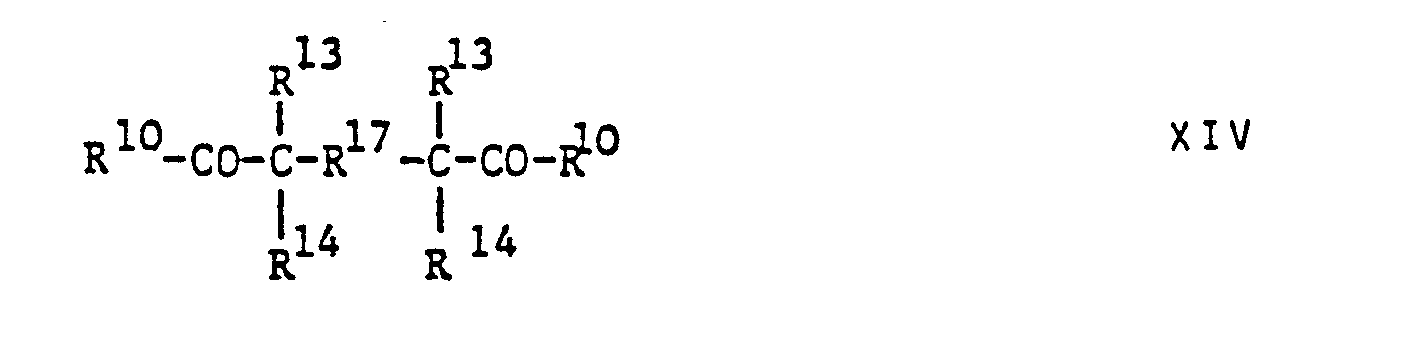

- Diese Verbindungen, von denen bevorzugte Vertreter u.a. 2-Allyloxy-2-methylpropiophenon, 2-Benzyloxy-2-methylpropiophenon, 2-Hydroxy-2-methyl-p-phenoxypropiophenon, 1-Benzoylcyclohexanol, 1-Benzoylcyclopentanol und Bis-(4-(a-hydroxyisobutyryl)-phenyl)-ether darstellen, sind ebenfalls als Photopolymerisationskatalysatoren für ethylenisch ungesättigte Verbindungen und als Lichtvernetzer für Polyolefine aus US-A-4 308 400 bekannt.
- Weitere Verbindungen, welche gegebenenfalls zur Erhöhung der Photopolymerisationsgeschwindigkeit der Salze der Formel II eingesetzt werden können, sind 2-substituierte Thioxanthone der Formel

- Wir setzen vorzugsweise 30 bis 125 Gew.-%, insbesondere 50 bis-100 Gew.%, an Photobeschleuniger, bezogen auf das Gewicht des Diaryljodosylsalzes der Formel 11, ein.
- Die Zusammensetzungen können auch Photosensibilisatoren wie Polyarylen (beispielsweise Perylen und 9,10-Di-ethoxyanthracen), Polyarylpolyene, 2,5-Diarylisobenzofurane 2,5-Diarylfurane, 2,5-Diarylthiofurane,-2,5-Diarylpyrrole, 2,5-Diarylcyclopentadiene, Polyarylphenylene, Cumarin oder Polyaryl-2-pyrazoline enthalten.
- Sofern die erfindungsgemässen Zusammensetzungen im wesentlichen durch Wärme allein polymerisiert werden solle, enthalten sie noch (D) ein Salz oder einen Komplex eines Übergangsmetalls, der ersten Übergangsreihe von Scandium bis Zink oder der zweiten Übergangsreihe von Ytterium bis Cadmium, ein Zinnll-salz, ein organisches Peroxid oder eine aktivierte, beim Erhitzen auf eine Temperatur über 50° C freie Radikale bildende a-Hydroxyverbindung als Katalysator für das Jodosylsalz.
- Als gegebenenfalls als Katalysator (D) in den erfindungsgemässen härtbaren Zusammensetzungen einsetzbare organische Peroxyde kommen u.a. Dicumylperoxyd, tert.-Butylperbenzoat, tert.-Butylperoxyd und insbesondere Benzoylperoxyd in Betracht. Ein bevorzugtes Zinn-II-salz ist Zinn-II-chlorid.
- Der Katalysator (D) ist vorzugsweise ein Salz oder Komplex eines Übergangsmetalls der ersten Übergangsreihe von Scandium bis Zink oder der zweiten Übergangsreihe von Yttrium bis Cadmium oder eine aktivierte a-Hydroxyverbindung. Als bevorzugte Übergangsmetalle, deren Salze oder Komplexe als Katalysator (D) eingesetzt werden, sind Zink, Kobalt, Chrom, Eisen und als besonders bevorzugt Kupfer zu nennen. Die Salze können gegebenenfalls von organischen säuren oder Mineralsäuren hergeleitet sein, wie z. B. Chloride, Acetate Trichloracetate, Naphthenate, Octanoate und Oxalate. Geeignete Komplexe sind n-Orbitalkomplexe und solche, die aus innere Komplexe bildenden Liganden gebildet sind, wie Aldehyde, Ketone, Carboxamide oder aliphatische Aminomono- und -polycarbonsäuren. Besonders bevorzugte Komplexe sind solche, die aus 1,3-Diketonen wie Acetylaceton, oder dessen Homologen wie Benzoylaceton und seinen Derivaten wie Ethylacetoacetat gebildet sind.
- Die aktivierte a-Hydroxyverbindung ist eine Verbindung mit einer Hydroxygruppe, die an ein Kohlenstoffatom in a-Stellung zu einer aktivierenden Gruppe wie z. B. einer Carbonylgruppe oder einem eine Hydroxygruppe tragenden Kohlenstoffatom gebunden ist, wobei die Verbindung beim Erhitzen freie Radikale liefert. Geeignete aktivierte a-Hydroxyverbindungen umfassen Ascorbinsäure, Ketone wie Acyloine und Benzoine sowie aktivierte Diole wie Pinakol und seine Homologen, insbesondere Benzpinakol.
- Falls gewünscht, können bestimmte Katalysatoren (D) zusammen eingesetzt werden, wie zum Beispiel ein Salz oder Komplex eines Übergangsmetalls wie Kupferacetylacetonat oder Kupferbenzoat zusammen mit Ascorbinsäure oder Benzpinakol.
- Die Menge an Katalysator (D) ist nicht kritisch, wird aber im allgemeinen im Bereich von 10 bis 150 Gew.-%, bezogen auf das Gewicht des verwendeten Diaryljodosylsalzes, liegen.
- Weitere gegebenenfalls in die erfindungsgemässen Zusammensetzungen einarbeitbare Stoffe sind u.a. Verdünnungsmittel und Füllstoffe, wie Kieselsäure, Talkum, Glasmicroballoons Tone, Metallpulver oder Zinkoxyd, Viskositätsregler wie z. B. Asbest, Kautschuksorten, Klebrigmacher und Pigmente.
- Bei Belichtung einer erfindungsgemässen Zusammensetzung mit Strahlung geeigneter Wellenlänge wird das als Photoinitiator agierende Jodosylsalz offensichtlich durch Freisetzen einer Art saurer Verbindung aktiviert, was die Polymerisation und, sofern die Zusammensetzung ein härtbares kationisch polymerisierbares Material wie ein Epoxid- oder Phenolharz enthält, auch die Vernetzung der Zusammensetzung herbeiführt. Bei der im erfindungsgemässen Verfahren verwendeten Strahlung kann es sich ausschliesslich um Ultraviolettstrahlung oder gegebenenfalls auch um Strahlung mit Wellenlängen sowohl im ultravioletten als auch im sichtbaren Spektralbereich handeln. Die Zusammensetzungen können auch Farbstoffe enthalten, damit sie auf sichtbare Spektralbereiche ansprechen. Geeignete Farbstoffe sind zum Beispiel aus US-A-4 026 705 bekannt; es handelt sich dabei im allgemeinen um kationische Farbstoffe wie Acridingelb, Acridinorange, Phosphin R, Benzoflavin, Setoflavin T und ihre Gemische.
- Die bevorzugte Wellenlänge der im erfindungsgemässen Verfahren angewandten Strahlung liegt im Bereich von 200 bis 600 nm, insbesondere 200 bis 400 nm. Die Wahl der geeigneten Strahlungsquelle unter den handelsüblichen Geräten, welche Strahlung innerhalb des vorstehend genannten Wellenlängenbereichs aussenden, ist eine Routinemassnahme für Fachleute auf dem Gebiet der Photopolymerisation.
- Die einen Katalysator (D) enthaltenden erfindungsgemässen Zusammensetzungen werden beim Erhitzen auf eine Temperatur über 50°C, vorzugsweise auf eine Temperatur im Bereich von 80° bis 180°C, rasch polymerisiert. Die Zusammensetzungen werden gegebenenfalls 1 bis 200, vorzugsweise 1 bis 30, Minuten lang erhitzt.
- Wenn die erfindungsgemässen Zusammensetzungen ein härtbares kationisch polymerisierbares Material, inbesondere ein Epoxidharz oder ein Phenoplast enthalten, können sie durch Bestrahlung vor- und dann durch Erhitzen ausgehärtet werden. Für einen zweistufigen Härtungsprozess enthält die Zusammensetzung entweder einen die Heisshärtung durch das Jodosylsalz beschleunigenden Katalysator (D) oder einen anderen hitzeaktivierbaren Härter für das härtbare Material. Derartige hitzeaktivierbare Härter sind bekannt, und es gehört zum Routinewissen des Fachmanns auf dem Gebiet der Härtungsverfahren, einen für das jeweils spezifische härtbare Material geeigneten Härter auszuwählen. Falls es erwünscht ist, das vorgehärtete Material für einen nachfolgenden Heisshärtungsprozess aufzubewahren, ist es selbstverständlich von Bedeutung, die Belichtung bei einer Temperatur auszuführen, die unterhalb der Temperatur liegt, bei welcher wesentliche Heisshärtung des photopolymerisierten Produkts mittels des Heisshärters eintreten würde.
- Somit sind die erfindungsgemässen Zusammensetzungen mit einem Gehalt an Epoxidharzen oder Phenoplasten in zwei Stufen härtbar. Falls das Phenoplast ein nicht unter der Einwirkung des Jodosylsalzes polymerisierbarer Novolak ist, wird es zusammen mit einem unter dessen Einwirkung poymerisierbaren Material wie einem Epoxidharz oder einem cyclischen Vinylether eingesetzt. Die Zusammensetzung wird zunächst durch aktinische Bestrahlung in Gegenwart eines latenten, hitzeaktivierbaren Vernetzers für das Epoxidharz oder Phenoplast (wahlweise, wenn das Phenoplast ein Resol ist) in den vorgehärteten B-Zustand gebracht, und in einer zweiten Stufe wird die vorgehärtete Zusammensetzung zur Vervollständigung der Härtung erwärmt. Demgemäss ist eine flüssige oder halbflüssige Zubereitung herstellbar, die anschliessend geformt oder zur Tränkung eines unter Belichtung zu verfestigenden Substrats verwendet werden kann; der verfestigte Körper kann danach gewünschtenfalls zur Aushärtung des Harzes erhitzt werden.
- Geeignete hitzeaktivierbare Vernetzer für Epoxidharze schliessen Polycarbonsäureanhydride, Aminkomplexe, insbesondere solche von primären oder tertiären aliphatischen Aminen wie Ethylamin, Trimethylamin oder n-Octyldimethylamin mit Bortrifluorid oder Bortrichlorid sowie latente Bordifluoridchelate ein. Aromatische Polyamine und Imidazole sind im allgemeinen nicht bevorzugt, da mässige Resultate erhalten werden, möglicherweise aufgrund einer Reaktion zwischen dem freigesetzten sauren Katalysator und dem Amin. Dicyandiamid lässt sich erfolgreich einsetzen, vorausgesetzt, dass es in verhältnismässig groben Teilchen vorliegt.
- Geeignete hitzeaktivierbare Vernetzer für Novolake umfassen Hexamethylentetramin und Paraformaldehyd.
- Die für die Heisshärtung nach der Photopolymerisation benötigte Temperatur und Erhitzungsdauer sowie die Anteile an hitzeaktivierbarem Härter sind leicht durch routinemässiges Ausprobieren herauszufinden und in einfacher Weise vom Stand der Technik auf dem Gebiet der Heisshärtung von Epoxid- und Phenol/Aldehydharzen abzuleiten.
- Zusammensetzungen mit einem Gehalt an Harzen mit Epoxidgruppen oder phenolischen Hydroxygruppen, durch welche sie nach der Photopolymerisation heissgehärtet werden können, sind besonders bei der Herstellung von mehrschichtigen gedruckten Schaltungen brauchbar.
- Die erfindungsmässen Zusammensetzungen sind als Oberflächenbeschichtungen verwendbar. Sie können auf eine Unterlage wie Stahl, Aluminium, Kupfer, Cadmium, Zink, Papier oder Holz, vorzugsweise als Flüssigkeit, aufgebracht und danach belichtet oder erhitzt werden. Beim abschnittsweisen Photopolymeriseren der Beschichtung wie z. B bei Belichtung durch eine Maske hindurch, können die unbelichteten Stellen mit einem Lösungsmittel zur Entfernung der nichtpolymerisierten Anteile ausgewaschen werden, wobei die photopolymerisierten unlöslichen Anteile an Ort und Stelle verbleiben. Demgemäss können die erfindungsgemässen Zusammensetzungen bei der Herstellung von Druckplatten und gedruckten Schaltungen Verwendung finden. Die Verfahren zur Herstellung von Druckplatten und gedruckten Schaltungen aus photopolymerisierbaren Zusammensetzungen sind wohlbekannt.
- Die Zusammensetzungen sind auch als Klebstoffe einsetzbar. Eine Schicht der Zusammensetzung kann zwischen zwei Oberflächen von Gegenständen eingebracht werden und danach kann der Aufbau zur vollständigen Polymerisation belichtet und/oder erhitzt werden. Beim Photopolymerisieren ist es selbstverständlich notwendig, dass wenigstens einer der Gegenstände aus Glas oder einem anderen für aktinische Strahlung durchlässigen Material besteht.
- Die Zusammensetzungen sind auch bei der Herstellung faserverstärkter Verbundstoffe einschliesslich Schichtformmassen brauchbar.
- Sie können direkt, kontinuierlich oder chargenweise in flüssiger Form auf Verstärkungsfasern (einschliesslich Spinn- oder Endlosfäden und Whisker) aufgebracht werden, die als Gewebe oder Vlies, unidirektionelle Längen, geschnittene Spinnfäden, insbesondere aus Glas, Bor, Edelstahl, Wolfram, Aluminiumoxid, Siliciumcarbid, Asbest, Kaliumtitanatwhisker, aromatischem Polyamid wie Poly-(m-phenylenisophthalamid), Poly(p-phenylenterephthalamid) oder Poly-(p-benzamid), Polyethylen, Polypropylen oder Kohlenstoff vorliegen können. Wenn die Zusammensetzung ein heisshärtbares Material wie ein Epoxidharz enthält, kann das getränkte Fasermaterial zur Photopolymerisation belichtet werden und auf diese Weise die Zusammensetzung unter Bildung eines Präpregs verfestigt und dieser gegebenenfalls unter Druck wahlweise zusammen mit anderen Präpregs oder Faserschichten, zur Herstellung eines gehärteten faserverstärkten Verbundstoffs erhitzt werden.
- Die erfindungsgemässen Zusammensetzungen sind bei der Herstellung von Kitten und Füllstoffen verwendbar. Man kann sie für Tauchbeschichtungen einsetzen, wobei ein zu beschichtender Gegenstand in die flüssige Zusammensetzung eingetaucht, wieder herausgenommen und danach die anhaftende Beschichtung zur Photopolymerisation (und somit zur Verfestigung) bestrahlt und daran anschliessend gegebenenfalls erhitzt wird.
- Bei einer weiteren Anwendung wird eine Schicht der Zusammensetzung in flüssiger Form bestrahlt, bis sie sich unter Bildung eines Klebfilms verfestigt, welcher dann zwischen zwei zu verklebende Flächen und in Berührung mit diesen eingelegt wird, worauf man den Aufbau zur vollständigen Vernetzung der Zusammensetzung erhitzt. Der Film kann dabei auf einer Seite mit einer abziehbaren Schutzfolie, beispielsweise aus einem Polyolefin oder Polyester oder aus cellulosehaltigem Papier mit einer Silicontrennmittelbeschichtung versehen sein. Der Aufbau ist häufig leichter zu handhaben, wenn der Film eine klebrige Oberfläche aufweist. Dies lässt sich dadurch erreichen, dass man den Film mit einer bei Raumtemperatur klebrigen Substanz beschichtet, welche jedoch unter den zur vollständigen Vernetzung angewandten Erhitzungsbedingungen zu einem harten, unlöslichen und unschmelzbaren Harz vernetzt. Ein hinreichendes Mass an Klebrigkeit besteht jedoch häufig ohne zusätzliche Behandlung, insbesondere dann, wenn die Polymerisation der Zusammensetzung nicht zu weit fortgeschritten ist. Geeignete Klebsubstrate sind unter anderem Metalle wie Eisen, Zink, Kupfer, Nickel und Aluminium, Keramik, Glas und Kautschukarten.
- Die nachfolgenden Beispiele erläutern die Erfindung, wobei Teile stets Gewichtsteile sind.
- Jodosylsalze werden wie folgt hergestellt:
- Jodoxybenzol (4,72 g) wird unter kräftigem Rühren zu 1-normaler wässriger Natronlauge (40 ml) bei 0°C hinzugefügt. Nach 2 Stunden wird das ausgefallene Natriumjodat durch Filtration entfernt, und man lässt Kohlendioxid durch das Filtrat hindurchperlen, bis die Lösung neutral ist. Man fügt langsam 1-normale Essigsäure zum Freisetzen des Kohlendioxyds in geringem Überschuss hinzu. Diphenyljodosylacetatmonohydrat wird als weisser Feststoff mit einem Schmelzpunkt von 105-110°C (Zersetzung) abfiltriert; man erhält 2,76 g.
- Das so erhaltene Monohydrat (1,87 g) wird in siedendem Wasser (25 ml) aufgelöst. Die Lösung wird mit Entfärbungskohle behandelt und heiss filtriert. Eine gesättigte wässrige Kaliumhexafluorophosphatlösung wird dann langsam hinzugefügt, bis keine weitere Fällung mehr erfolgt. Danach wird die Mischung gekühlt und filtriert. Der Rückstand wird über Phosphorpentoxyd im Vakuum bei Raumtemperatur getrocknet und man erhält Diphenyljodosylhexafluorophosphat (0,87 g) mit einem Schmelzpunkt von 120-130°C (Zersetzung).
- Man gibt Jodoxybenzol (35,4g) bei 0°C unter kräftigem Rühren zu 1-normaler Natronlauge (300 ml). Nach 2 Stunden wird das Gemisch filtriert und Kohlendioxyd durch das Filtrat so lange hindurchgeperlt, bis die Lösung neutral ist. Ein Teil dieser Carbonatlösung (100 ml) wird langsam mit Fluorborsäure (40 %) versetzt, bis die Entwicklung von Kohlendioxyd aufhört. Eine weitere Menge an Säure (2 ml) wird danach hinzugefügt und der Niederschlag abfiltriert. Dieser wird mit Eiswasser gewaschen und dann getrocknet; man erhält Diphenyljodosyltetrafluoroborat (2,4 g) mit einem Schmelzpunktbereich von 110-120°C (Zersetzung).
- Bis-(4-methylphenyl)jodosyltrifluoracetat (1,16 g; nach der Vorschrift von F.M. Beringer und P. Bodlaender, a.a.O. hergestellt) wird in siedendem Wasser (10 ml) aufgelöst und filtriert; das Filtrat wird mit Kaliumhexafluorophosphat (0,49 g) als gesättigte wässrige Lösung behandelt. Das Gemisch wird auf etwa die Hälfte seines Volumens eingeengt und der Niederschlag abfiltriert. Dieser wird darauf getrocknet und ergibt Bis-(4-methylphenyl)jodosylhexafluorophosphat (0,68 g) mit einem Schmelzpunkt von 125°C (Zersetzung).
- Bis-(2-methylphenyl)jodosyltrifluoroacetat (0,7 g; nach der Vorschrift von F.M. Beringer und P. Bodlaender a.a.O. hergestellt) wird in siedendem Wasser (25 ml) aufgelöst und mit Kaliumhexafluorophosphat (0,45 g) in Wasser (5 ml) versetzt. Die so erhaltene Lösung wird abgekühlt, und der sich bildende Niederschlag durch Filtrieren gesammelt und getrocknet; man erhält Bis-(2-methylphenyl)jodosylhexafluorophosphat (0,4 g) mit einem Schmelzpunkt von 148-150°C (Zersetzung).
- Diphenyljodosyltrifluoracetat (1,2 g; gemäss F.M. Beringer und P. Bodlaender a.a.O., hergestellt) wird in heissem Wasser aufgelöst, mit Aktivkohle behandelt und heiss abfiltriert. Eine wässrige Lösung von Kaliumhexafluoroarsenat (0,7 g) wird zum Filtrat hinzugegeben und die erhaltene Lösung abgekühlt. Der weisse sich bildende Niederschlag wird durch Filtrieren gesammelt un an der Luft getrocknet; man erhält Diphenyljodosylhexafluoroarsenat (0,64 g) mit einem Schmelzpunkt von 135-138° C (Zersetzung).
- Die in den Beispielen verwendeten Harze sind die folgenden:
- Harz 1 ist 3,4-Epoxicyclohexancarbonsäure-3',4'-epoxicyclohexylmethylester mit einem 1,2-Epoxidgehalt von 7,3 val/kg.
- Harz 2 ist ein Styrol/Allylalkoholcopolymer mit einem Molekulargewicht von 2340 und einem Hydroxygehalt von 3,56 val/kg; letzteres ist im Handel als "RJ 100" von Monsanto Chemical Company erhältlich.
- Harz 3 ist 3,4-Dihydro-2H-pyran-2-carbonsäure-3,4-dihydro-2H-pyran-2-ylmethylester.
- Harz 4 ist ein Diglycidylether des 2,2-Bis-(4-hydroxyphenyl)-propans mit einem 1,2-Epoxidgehalt von 5,2 val/kg.
- Harz 5 ist ein 1,4-Butandioldiglycidylether mit einem 1,2-Epoxidgehalt von 9,3 val/kg.
- Harz 6 ist ein Harz mit Bisphenolendgruppen, welches durch Umsetzung eines Diglycidylethers des 2,2-Bis-(4-hydroxyphenyl)propans mit 2,2-Bis-(4-hydroxyphenyl)propan bis zu einem durchschnittlichen Molekulargewicht von 1820 erhalten wird.
- Harz 7 ist Bis-(3,4-epoxicyclohexylmethyl)adipat mit einem 1,2-Epoxidgehalt von 4,8 val/kg.
- Harz 8 ist ein mit 4-Toluolsulfonsäure neutralisiertes Phenol/Formaldehydresol mit einem Phenol: Formaldehydverhältnis von 1 : 1,14, einer Viskosität von 0,7 Pa.s bei 25°C und einem Feststoffgehalt von 76 %.
- Man beschichtet Weissblech mit einem Gemisch aus Harz 1 (100 Teile), Harz 2 (100 Teile) und Diphenyljodosylhexafluorophosphat (6 Teile) in einer Schichtdicke von 8-10 um. 2 Sekunden Bestrahlung des Films mit einer 80 W/cm Mitteldruckquecksilberlampe in einem Abstand von 20 cm ergitt eine klebfreie Beschichtung.
- Man vermischt Harz 1 (30 Teile), Harz 2 (100 Teile), Harz 4 (50 Teile), Harz 5 (20 Teile) und Diphenyljodosylhexafluorophosphat (6 Teile) und streicht das Gemisch auf Weissblech in einer Schichtdicke von 6-8 um. Man bestrahlt wie in Beispiel 1 angegeben und erhält innerhalb von 3 Sekunden eine klebfreie Beschichtung.
- Man beschichtet Weissblech mit einer Mischung aus Harz 2 (100 Teile), Harz 3 (100 Teile) und Bis-(4-methylphenyl)jodosylhexafluorophosphat (6 Teile) in einer Schichtdicke von 6-8 µm. Man bestrahlt wie in Beispiel 1 angegeben und erhält innerhalb von 25 Sekunden eine klebfreie Oberfläche.
- Man beschichtet Weissblech mit einem Gemisch aus Harz 6 (37,5 Teile), Harz 1 (62,5 Teile) und Diphenyljodosylhexafluoroarsenat (2 Teile) in einer Schichtdicke von 8-10 µm. Man bestrahlt wie in Beispiel 1 angegeben und erhält innerhalb von 3 Sekunden eine klebfreie Beschichtung.
- Man beschichtet Weissblech mit einer Mischung aus Harz 6 (50 Teile), Harz 7 (50 Teile) und Diphenyljodosyltetrafluoroborat (5 Teile) in einer Schichtdicke von 6-8 µm. Man bestrahlt wie in Beispiel 1 angegeben und erhält innerhalb von 30 Sekunden eine klebfreie Beschichtung.
- Man beschichtet Weissblech mit einem Gemisch aus Harz 7 (50 Teile), Harz 8 (50 Teile) und Diphenyljodosylhexafluorophosphat (3 Teile) in einer Schichtdicke von 6-8 µm und bestrahlt in derselben Weise wie in Beispiel 1 angegeben. Innerhalb von 8 Sekunden wird eine klebfreie Beschichtung erhalten.
- Auf der Koflerbank wird eine Mischung aus Harz 1 (100 Teile), Harz 2 (100 Teile), Diphenyljodosylhexafluorophosphat (6 Teile) und Kupfer-II-trichloracetat (2 Teile) erhitzt. Es vergehen 15 Minuten bei einer Temperatur von 120° C, bis Gelierung eintritt.
- Eine Mischung aus Harz 2 (100 Teile), Harz 4 (50 Teile), Harz 1 (30 Teile) und Harz 5 (20 Teile) mit Diphenyljodosylhexafluorophosphat (3 Teile) und Kupfer-II-acetylacetonat (1 Teil) wird auf der Koflerheizbank bei 120°C erhitzt. Es wird eine Gelierungszeit von 3 1/2 Minuten beobachtet.
- Es wird auf der Koflerheizbank ein Gemisch aus Harz 1 (62,5 Teile) und Harz 6 (37,5 Teile) mit Diphenyljodosylhexafluoroarsenat (3 Teile) und Zinn-II-chlorid bei 180°C erhitzt. Es wird eine Gelierungszeit von 6 Minuten beobachtet.
- Man erhitzt ein Gemisch aus Harz 6 (50 Teile), Harz 7 (50 Teile), Diphenyljodosyltetrafluoroborat (5 Teile) und Benzoylperoxyd (1 Teil) auf der Koflerheizbank bei 150°C. Es ergibt sich eine Gelierungszeit von 90 Sekunden.
- Man beschichtet Weissblech mit einem Gemisch aus Harz 2 (50 Teile) und Harz 3 (50 Teile) mit Bis-(4-methylphenyl)jodosylhexafluorophosphat (3 Teile) und 2-lsopropyl-thioxanthon (1 Teil) in einer Filmdicke von 6-8 µm. Bestrahlung des Films mit einer 80 W/cm Mitteldruckquecksilberlampe in einem Abstand von 20 cm ergibt innerhalb von 15 Sekunden eine klebfreie Oberfläche.
- Man beschichtet Weissblech mit einem Gemisch aus Harz 2 (50 Teile), Harz 3 (50 Teile), Bis-(2-methylphenyl- jodosylhexafluorophosphat (3 Teile) und 2-Isopropylthioxainthon (1 Teil) in einer Schichtdicke von 6-8 µm. Man bestrahlt wie in Beispiel 11 angegeben und erhält innerhalb von 20 Sekunden eine klebfreie Oberfläche.
Claims (12)

Applications Claiming Priority (2)
| Application Number | Priority Date | Filing Date | Title |
|---|---|---|---|
| GB8332073 | 1983-12-01 | ||
| GB838332073A GB8332073D0 (en) | 1983-12-01 | 1983-12-01 | Polymerisable compositions |
Publications (3)
| Publication Number | Publication Date |
|---|---|
| EP0146501A2 EP0146501A2 (de) | 1985-06-26 |
| EP0146501A3 EP0146501A3 (en) | 1985-11-21 |
| EP0146501B1 true EP0146501B1 (de) | 1988-03-16 |
Family
ID=10552663
Family Applications (1)
| Application Number | Title | Priority Date | Filing Date |
|---|---|---|---|
| EP84810574A Expired EP0146501B1 (de) | 1983-12-01 | 1984-11-26 | Polymerisierbare Zusammensetzungen |
Country Status (7)
| Country | Link |
|---|---|
| US (1) | US4593052A (de) |
| EP (1) | EP0146501B1 (de) |
| JP (1) | JPS60135402A (de) |
| CA (1) | CA1257441A (de) |
| DE (1) | DE3469905D1 (de) |
| ES (1) | ES8608549A1 (de) |
| GB (1) | GB8332073D0 (de) |
Families Citing this family (27)
| Publication number | Priority date | Publication date | Assignee | Title |
|---|---|---|---|---|
| US4952612A (en) * | 1987-08-28 | 1990-08-28 | Minnesota Mining And Manufacturing Company | Energy-induced curable compositions |
| US5147900A (en) * | 1987-08-28 | 1992-09-15 | Minnesosta Mining And Manufacturing Company | Energy-induced dual curable compositions |
| US5086086A (en) * | 1987-08-28 | 1992-02-04 | Minnesota Mining And Manufacturing Company | Energy-induced curable compositions |
| US4950696A (en) * | 1987-08-28 | 1990-08-21 | Minnesota Mining And Manufacturing Company | Energy-induced dual curable compositions |
| US5028984A (en) * | 1988-11-04 | 1991-07-02 | International Business Machines Corporation | Epoxy composition and use thereof |
| US5041358A (en) * | 1989-04-17 | 1991-08-20 | International Business Machines Corporation | Negative photoresist and use thereof |
| US5395913A (en) * | 1990-03-09 | 1995-03-07 | Rutgerswerke Ag | Polymerizable epoxide mixtures and process using Lewis base complexes |
| US4960634A (en) * | 1990-03-14 | 1990-10-02 | International Business Machines Corporation | Epoxy composition of increased thermal conductivity and use thereof |
| US5157080A (en) * | 1990-05-15 | 1992-10-20 | Monsanto Company | Coating composition |
| US5102771A (en) * | 1990-11-26 | 1992-04-07 | Minnesota Mining And Manufacturing Company | Photosensitive materials |
| TW357180B (en) * | 1994-07-19 | 1999-05-01 | Sumitomo Chemical Co | An epoxy resin composition and semiconductor device sealed with the above epoxy resin composition |
| US5426222A (en) * | 1994-08-17 | 1995-06-20 | Dow Corning Corporation | Method for the preparation of iodonium salts |
| JPH08193188A (ja) * | 1995-01-18 | 1996-07-30 | Mitsui Mining & Smelting Co Ltd | 銅箔用接着剤および該接着剤付き銅箔 |
| TW460509B (en) * | 1996-07-12 | 2001-10-21 | Ciba Sc Holding Ag | Curing process for cationically photocurable formulations |
| US6492092B1 (en) * | 1999-03-12 | 2002-12-10 | Arch Specialty Chemicals, Inc. | Hydroxy-epoxide thermally cured undercoat for 193 NM lithography |
| DE19927949A1 (de) * | 1999-06-18 | 2000-12-21 | Delo Industrieklebstoffe Gmbh | Kationisch härtende Masse, ihre Verwendung sowie Verfahren zur Herstellung gehärteter Polymermassen |
| WO2001009075A1 (en) * | 1999-08-02 | 2001-02-08 | Nippon Soda Co., Ltd. | Photocurable composition containing iodonium salt compound |
| DE19943149A1 (de) * | 1999-09-09 | 2001-04-05 | Siemens Ag | Verfahren zur Verkapselung von Bauelementen |
| US6245827B1 (en) * | 1999-10-12 | 2001-06-12 | Elementis Specialties, Inc. | Ultraviolet curable resin compositions having enhanced shadow cure properties |
| WO2003076491A1 (en) * | 2002-03-08 | 2003-09-18 | Rensselaer Polytechnic Institute | Accelerators for cationic photopolymerization |
| AT500298A1 (de) * | 2002-06-14 | 2005-11-15 | Agrolinz Melamin Gmbh | Verfahren zur härtung von aminoplasten |
| US7378455B2 (en) * | 2005-06-30 | 2008-05-27 | General Electric Company | Molding composition and method, and molded article |
| US7429800B2 (en) * | 2005-06-30 | 2008-09-30 | Sabic Innovative Plastics Ip B.V. | Molding composition and method, and molded article |
| US20090288771A1 (en) * | 2008-05-23 | 2009-11-26 | Loctite (R&D) Limited | Surface-promoted cure of one-part radically curable compositions |
| US20090288770A1 (en) * | 2008-05-23 | 2009-11-26 | Loctite (R&D) Limited | Surface-promoted cure of one-part cationically curable compositions |
| US8399099B1 (en) * | 2008-05-23 | 2013-03-19 | Henkel Ireland Limited | Coating compositions |
| WO2010094634A1 (en) | 2009-02-17 | 2010-08-26 | Loctite (R & D) Limited | Cationically curable compositions and a primer therefor |
Family Cites Families (13)
| Publication number | Priority date | Publication date | Assignee | Title |
|---|---|---|---|---|
| US4256828A (en) * | 1975-09-02 | 1981-03-17 | Minnesota Mining And Manufacturing Company | Photocopolymerizable compositions based on epoxy and hydroxyl-containing organic materials |
| US4307177A (en) * | 1975-12-09 | 1981-12-22 | General Electric Company | Method of using polymerizable compositions containing onium salts |
| US4090936A (en) * | 1976-10-28 | 1978-05-23 | Minnesota Mining And Manufacturing Company | Photohardenable compositions |
| US4192924A (en) * | 1977-12-16 | 1980-03-11 | General Electric Company | Method of foaming curable organic resin compositions |
| GB2034317B (en) * | 1978-10-27 | 1983-05-11 | Ici Ltd | Photopolymerisable compositions derived coatings and other polymerised products |
| ATE6002T1 (de) * | 1978-10-27 | 1984-02-15 | Imperial Chemical Industries Plc | Polymerisierbare zusammensetzungen, daraus hergestellte beschichtungen und andere polymerisierte produkte. |
| US4383025A (en) * | 1980-07-10 | 1983-05-10 | Ciba-Geigy Corporation | Photopolymerization by means of sulfoxonium salts |
| US4374751A (en) * | 1980-08-08 | 1983-02-22 | General Electric Company | Polymerization initiator compositions |
| JPS58214152A (ja) * | 1982-06-05 | 1983-12-13 | Konishiroku Photo Ind Co Ltd | カラ−写真感光材料 |
| US4482679A (en) * | 1982-09-18 | 1984-11-13 | Ciba-Geigy Corporation | Heat-curable epoxy compositions containing diaryliodosyl salts |
| US4518676A (en) * | 1982-09-18 | 1985-05-21 | Ciba Geigy Corporation | Photopolymerizable compositions containing diaryliodosyl salts |
| CA1240439A (en) * | 1983-02-07 | 1988-08-09 | Union Carbide Corporation | Photocopolymerizable compositions based on epoxy and hydroxyl-containing organic materials having primary hydroxyl content |
| GB8307220D0 (en) * | 1983-03-16 | 1983-04-20 | Ciba Geigy Ag | Production of images |
-
1983
- 1983-12-01 GB GB838332073A patent/GB8332073D0/en active Pending
-
1984
- 1984-11-19 US US06/672,990 patent/US4593052A/en not_active Expired - Fee Related
- 1984-11-26 DE DE8484810574T patent/DE3469905D1/de not_active Expired
- 1984-11-26 EP EP84810574A patent/EP0146501B1/de not_active Expired
- 1984-11-29 CA CA000468912A patent/CA1257441A/en not_active Expired
- 1984-11-30 ES ES538118A patent/ES8608549A1/es not_active Expired
- 1984-12-01 JP JP59254927A patent/JPS60135402A/ja active Pending
Also Published As
| Publication number | Publication date |
|---|---|
| EP0146501A2 (de) | 1985-06-26 |
| DE3469905D1 (de) | 1988-04-21 |
| ES8608549A1 (es) | 1986-07-16 |
| EP0146501A3 (en) | 1985-11-21 |
| JPS60135402A (ja) | 1985-07-18 |
| ES538118A0 (es) | 1986-07-16 |
| CA1257441A (en) | 1989-07-11 |
| GB8332073D0 (en) | 1984-01-11 |
| US4593052A (en) | 1986-06-03 |
Similar Documents
| Publication | Publication Date | Title |
|---|---|---|
| EP0104143B1 (de) | Diaryljodosylsalze enthaltende photopolymerisierbare Zusammensetzungen | |
| EP0022081B1 (de) | Sulphoxoniumsalze enthaltende polymerisierbare Mischungen sowie Verfahren zur Herstellung hochmolekularer Produkte aus diesen Mischungen durch Bestrahlung | |
| EP0094914B1 (de) | Photopolymerisation mittels organometallischer Salze | |
| EP0146501A2 (de) | Polymerisierbare Zusammensetzungen | |
| EP0054509B1 (de) | Sulfoxoniumsalzpolymerisationskatalysatoren | |
| EP0035969B1 (de) | Zusammensetzung aus kationisch polymerisierbarem Material und einem Katalysator | |
| DE2559718C2 (de) | Verfahren zur kationischen Polymerisation von Epoxyharz | |
| DE2518656C3 (de) | Härtbare Zusammensetzungen | |
| EP0233567B1 (de) | Härtbare Mischungen, enthaltend N-Sulfonylaminosulfoniumsalze als kationisch wirksame Katalysatoren | |
| EP0151372B1 (de) | Verfahren zur Bilderzeugung | |
| EP0044274B1 (de) | Photopolymerisation mittels Carbamoylsulfoxoniumsalzen | |
| DE2602574C2 (de) | Photopolymerisierbare Zusammensetzungen | |
| DE69404147T2 (de) | Stabilisierte härtbare klebstoffe | |
| DE2618897C2 (de) | Durch sichtbares Licht härtbare Zusammensetzung und deren Verwendung | |
| EP0164314B1 (de) | Sulfoxoniumsalze | |
| EP0085024B1 (de) | Verfahren zur Erzeugung von Abbildungen in Photoresistschichten | |
| DE2518639A1 (de) | Haertbare zusammensetzungen | |
| DE3604581A1 (de) | 4-acylbenzylsulfoniumsalze, ihre herstellung sowie sie enthaltende photohaertbare gemische und aufzeichnungsmaterialien | |
| DE2904626A1 (de) | Triarylsulfoniumkomplexsalze, verfahren zu ihrer herstellung und diese salze enthaltende photopolymerisierbare gemische | |
| EP0119959B1 (de) | Verfahren zur Bilderzeugung | |
| DE3902114A1 (de) | Strahlungsempfindliche, ethylenisch ungesaettigte, copolymerisierbare sulfoniumsalze und verfahren zu deren herstellung | |
| EP0115471B1 (de) | Verfahren zur Bilderzeugung | |
| DE2541709A1 (de) | Photopolymerisierbare zusammensetzungen und verfahren zur herstellung derselben | |
| EP0214930B1 (de) | Geformte Verbundstoffe | |
| EP0145653B1 (de) | Photopolymerisierbare Zusammensetzungen |
Legal Events
| Date | Code | Title | Description |
|---|---|---|---|
| PUAI | Public reference made under article 153(3) epc to a published international application that has entered the european phase |
Free format text: ORIGINAL CODE: 0009012 |
|
| 17P | Request for examination filed |
Effective date: 19841128 |
|
| AK | Designated contracting states |
Designated state(s): BE CH DE FR GB IT LI NL SE |
|
| PUAL | Search report despatched |
Free format text: ORIGINAL CODE: 0009013 |
|
| AK | Designated contracting states |
Designated state(s): BE CH DE FR GB IT LI NL SE |
|
| 17Q | First examination report despatched |
Effective date: 19861211 |
|
| GRAA | (expected) grant |
Free format text: ORIGINAL CODE: 0009210 |
|
| AK | Designated contracting states |
Kind code of ref document: B1 Designated state(s): BE CH DE FR GB IT LI NL SE |
|
| REF | Corresponds to: |
Ref document number: 3469905 Country of ref document: DE Date of ref document: 19880421 |
|
| ITF | It: translation for a ep patent filed | ||
| GBT | Gb: translation of ep patent filed (gb section 77(6)(a)/1977) | ||
| ET | Fr: translation filed | ||
| PLBE | No opposition filed within time limit |
Free format text: ORIGINAL CODE: 0009261 |
|
| STAA | Information on the status of an ep patent application or granted ep patent |
Free format text: STATUS: NO OPPOSITION FILED WITHIN TIME LIMIT |
|
| 26N | No opposition filed | ||
| PGFP | Annual fee paid to national office [announced via postgrant information from national office to epo] |
Ref country code: FR Payment date: 19890929 Year of fee payment: 6 |
|
| PGFP | Annual fee paid to national office [announced via postgrant information from national office to epo] |
Ref country code: DE Payment date: 19891018 Year of fee payment: 6 |
|
| PGFP | Annual fee paid to national office [announced via postgrant information from national office to epo] |
Ref country code: SE Payment date: 19891031 Year of fee payment: 6 Ref country code: GB Payment date: 19891031 Year of fee payment: 6 |
|
| PGFP | Annual fee paid to national office [announced via postgrant information from national office to epo] |
Ref country code: BE Payment date: 19891117 Year of fee payment: 6 |
|
| ITTA | It: last paid annual fee | ||
| PGFP | Annual fee paid to national office [announced via postgrant information from national office to epo] |
Ref country code: NL Payment date: 19891130 Year of fee payment: 6 |
|
| PGFP | Annual fee paid to national office [announced via postgrant information from national office to epo] |
Ref country code: CH Payment date: 19891204 Year of fee payment: 6 |
|
| PG25 | Lapsed in a contracting state [announced via postgrant information from national office to epo] |
Ref country code: GB Effective date: 19901126 |
|
| PG25 | Lapsed in a contracting state [announced via postgrant information from national office to epo] |
Ref country code: SE Effective date: 19901127 |
|
| PG25 | Lapsed in a contracting state [announced via postgrant information from national office to epo] |
Ref country code: LI Effective date: 19901130 Ref country code: CH Effective date: 19901130 Ref country code: BE Effective date: 19901130 |
|
| BERE | Be: lapsed |
Owner name: CIBA-GEIGY A.G. Effective date: 19901130 |
|
| PG25 | Lapsed in a contracting state [announced via postgrant information from national office to epo] |
Ref country code: NL Effective date: 19910601 |
|
| NLV4 | Nl: lapsed or anulled due to non-payment of the annual fee | ||
| GBPC | Gb: european patent ceased through non-payment of renewal fee | ||
| PG25 | Lapsed in a contracting state [announced via postgrant information from national office to epo] |
Ref country code: FR Effective date: 19910731 |
|
| REG | Reference to a national code |
Ref country code: CH Ref legal event code: PL |
|
| PG25 | Lapsed in a contracting state [announced via postgrant information from national office to epo] |
Ref country code: DE Effective date: 19910801 |
|
| REG | Reference to a national code |
Ref country code: FR Ref legal event code: ST |
|
| EUG | Se: european patent has lapsed |
Ref document number: 84810574.8 Effective date: 19910705 |