EP0144648B1 - Flüssigkristalline Cyclohexylbenzol- und Cyclohexylbiphenylderivate - Google Patents
Flüssigkristalline Cyclohexylbenzol- und Cyclohexylbiphenylderivate Download PDFInfo
- Publication number
- EP0144648B1 EP0144648B1 EP84112552A EP84112552A EP0144648B1 EP 0144648 B1 EP0144648 B1 EP 0144648B1 EP 84112552 A EP84112552 A EP 84112552A EP 84112552 A EP84112552 A EP 84112552A EP 0144648 B1 EP0144648 B1 EP 0144648B1
- Authority
- EP
- European Patent Office
- Prior art keywords
- trans
- compounds
- formula
- cyanophenyl
- denotes
- Prior art date
- Legal status (The legal status is an assumption and is not a legal conclusion. Google has not performed a legal analysis and makes no representation as to the accuracy of the status listed.)
- Expired
Links
- 0 *C1C=CC(c2ccc(C=C)cc2)=CC1 Chemical compound *C1C=CC(c2ccc(C=C)cc2)=CC1 0.000 description 1
Images

Classifications
-
- C—CHEMISTRY; METALLURGY
- C07—ORGANIC CHEMISTRY
- C07D—HETEROCYCLIC COMPOUNDS
- C07D239/00—Heterocyclic compounds containing 1,3-diazine or hydrogenated 1,3-diazine rings
- C07D239/02—Heterocyclic compounds containing 1,3-diazine or hydrogenated 1,3-diazine rings not condensed with other rings
- C07D239/24—Heterocyclic compounds containing 1,3-diazine or hydrogenated 1,3-diazine rings not condensed with other rings having three or more double bonds between ring members or between ring members and non-ring members
- C07D239/26—Heterocyclic compounds containing 1,3-diazine or hydrogenated 1,3-diazine rings not condensed with other rings having three or more double bonds between ring members or between ring members and non-ring members with only hydrogen atoms, hydrocarbon or substituted hydrocarbon radicals, directly attached to ring carbon atoms
-
- C—CHEMISTRY; METALLURGY
- C07—ORGANIC CHEMISTRY
- C07C—ACYCLIC OR CARBOCYCLIC COMPOUNDS
- C07C255/00—Carboxylic acid nitriles
-
- C—CHEMISTRY; METALLURGY
- C09—DYES; PAINTS; POLISHES; NATURAL RESINS; ADHESIVES; COMPOSITIONS NOT OTHERWISE PROVIDED FOR; APPLICATIONS OF MATERIALS NOT OTHERWISE PROVIDED FOR
- C09K—MATERIALS FOR MISCELLANEOUS APPLICATIONS, NOT PROVIDED FOR ELSEWHERE
- C09K19/00—Liquid crystal materials
- C09K19/04—Liquid crystal materials characterised by the chemical structure of the liquid crystal components, e.g. by a specific unit
- C09K19/06—Non-steroidal liquid crystal compounds
- C09K19/08—Non-steroidal liquid crystal compounds containing at least two non-condensed rings
- C09K19/30—Non-steroidal liquid crystal compounds containing at least two non-condensed rings containing saturated or unsaturated non-aromatic rings, e.g. cyclohexane rings
- C09K19/3001—Cyclohexane rings
- C09K19/3028—Cyclohexane rings in which at least two rings are linked by a carbon chain containing carbon to carbon single bonds
-
- C—CHEMISTRY; METALLURGY
- C09—DYES; PAINTS; POLISHES; NATURAL RESINS; ADHESIVES; COMPOSITIONS NOT OTHERWISE PROVIDED FOR; APPLICATIONS OF MATERIALS NOT OTHERWISE PROVIDED FOR
- C09K—MATERIALS FOR MISCELLANEOUS APPLICATIONS, NOT PROVIDED FOR ELSEWHERE
- C09K19/00—Liquid crystal materials
- C09K19/04—Liquid crystal materials characterised by the chemical structure of the liquid crystal components, e.g. by a specific unit
- C09K19/06—Non-steroidal liquid crystal compounds
- C09K19/08—Non-steroidal liquid crystal compounds containing at least two non-condensed rings
- C09K19/30—Non-steroidal liquid crystal compounds containing at least two non-condensed rings containing saturated or unsaturated non-aromatic rings, e.g. cyclohexane rings
- C09K19/3001—Cyclohexane rings
- C09K19/3066—Cyclohexane rings in which the rings are linked by a chain containing carbon and oxygen atoms, e.g. esters or ethers
- C09K19/3068—Cyclohexane rings in which the rings are linked by a chain containing carbon and oxygen atoms, e.g. esters or ethers chain containing -COO- or -OCO- groups
-
- C—CHEMISTRY; METALLURGY
- C07—ORGANIC CHEMISTRY
- C07C—ACYCLIC OR CARBOCYCLIC COMPOUNDS
- C07C2601/00—Systems containing only non-condensed rings
- C07C2601/12—Systems containing only non-condensed rings with a six-membered ring
- C07C2601/14—The ring being saturated
-
- C—CHEMISTRY; METALLURGY
- C07—ORGANIC CHEMISTRY
- C07C—ACYCLIC OR CARBOCYCLIC COMPOUNDS
- C07C2603/00—Systems containing at least three condensed rings
- C07C2603/02—Ortho- or ortho- and peri-condensed systems
- C07C2603/04—Ortho- or ortho- and peri-condensed systems containing three rings
- C07C2603/22—Ortho- or ortho- and peri-condensed systems containing three rings containing only six-membered rings
- C07C2603/24—Anthracenes; Hydrogenated anthracenes
-
- C—CHEMISTRY; METALLURGY
- C07—ORGANIC CHEMISTRY
- C07C—ACYCLIC OR CARBOCYCLIC COMPOUNDS
- C07C2603/00—Systems containing at least three condensed rings
- C07C2603/02—Ortho- or ortho- and peri-condensed systems
- C07C2603/04—Ortho- or ortho- and peri-condensed systems containing three rings
- C07C2603/22—Ortho- or ortho- and peri-condensed systems containing three rings containing only six-membered rings
- C07C2603/26—Phenanthrenes; Hydrogenated phenanthrenes
-
- C—CHEMISTRY; METALLURGY
- C07—ORGANIC CHEMISTRY
- C07C—ACYCLIC OR CARBOCYCLIC COMPOUNDS
- C07C2603/00—Systems containing at least three condensed rings
- C07C2603/02—Ortho- or ortho- and peri-condensed systems
- C07C2603/40—Ortho- or ortho- and peri-condensed systems containing four condensed rings
- C07C2603/42—Ortho- or ortho- and peri-condensed systems containing four condensed rings containing only six-membered rings
- C07C2603/48—Chrysenes; Hydrogenated chrysenes
-
- C—CHEMISTRY; METALLURGY
- C07—ORGANIC CHEMISTRY
- C07C—ACYCLIC OR CARBOCYCLIC COMPOUNDS
- C07C2603/00—Systems containing at least three condensed rings
- C07C2603/02—Ortho- or ortho- and peri-condensed systems
- C07C2603/40—Ortho- or ortho- and peri-condensed systems containing four condensed rings
- C07C2603/42—Ortho- or ortho- and peri-condensed systems containing four condensed rings containing only six-membered rings
- C07C2603/50—Pyrenes; Hydrogenated pyrenes
Definitions
- the present invention relates to new liquid-crystalline compounds, namely the 4 '- (trans-4-alkylcyclohexyl) -4-biphenylyl derivatives and 4- (trans-4-alkylcyclohexyl) phenyl derivatives of the general formula wherein n represents the number 1 and X represents the group ⁇ COO ⁇ , ⁇ OOC ⁇ or ⁇ CH 2 CH 2 ⁇ , or n represents the number O'and X represents the group -CH 2 CH z -; Ring A denotes p-phenylene or trans-1,4-cyclohexylene; R 2 is cyano, p-cyanophenyl or, if X is -COO- or -OOC-, also pR 3- phenyl or trans-4-R 3- cyclohexyl; and R 1 and R 3 is straight-chain C l -C lo -alkyl.
- the invention further relates to the preparation of the compounds of the above formula I, liquid-crystalline mixtures which contain compounds of the above formula I and the use for electro-optical and chromatographic purposes.
- Liquid crystals are used primarily as dielectrics in display devices, since the optical properties of such substances can be influenced by electrical fields. Electro-optical devices based on liquid crystals are well known to the person skilled in the art and can be based on various effects, such as, for example, the dynamic scattering, the deformation of aligned phases (DAP type), the Schadt-Helfrich effect (rotary cell), the guest / Host effect (“guest / host cell •) or a cholesteric-nematic phase transition.
- EP-A-0 044 646 discloses 4- (trans-4-alkylcyclohexyl) -benzoic acid 4'-cyano-4-biphenylyl esters as clearing point-increasing additives for liquid crystal mixtures.
- Liquid crystals have also been used as stationary phases in gas chromatography.
- the previously known, liquid-crystalline, stationary phases generally have the disadvantage that they can only be used up to temperatures of about 180 ° C.
- the compounds according to the invention form very large mesophase regions with high clearing points and that they generally have a nematic mesophase in all or at least in the major part of the liquid-crystalline region. They have good chemical and photochemical stability and are colorless. The viscosity values are comparatively low considering the high clearing points.
- Those compounds of the formula I in which R 2 is cyano or p-cyanophenyl have positive dielectric anisotropy; the other compounds of formula 1 (ie those in which R 2 is p-alkylphenyl or trans-4-alkylcyclohexyl) have small absolute values of dielectric anisotropy.
- the compounds according to the invention are particularly suitable for or as stationary phases in gas chromatography and can also be used at very high working temperatures.
- the compounds according to the invention are particularly suitable for the separation of isomer mixtures which cannot be separated or can only be separated with difficulty using conventional stationary phases, such as, for example, cis / trans-isomeric cyclopentanes and cyclohexanes (e.g.
- 1,4-disubstituted cyclohexanes 1,4-disubstituted cyclohexanes
- isomeric aromatic hydrocarbons e.g., o-, m- and p-disubstituted benzenes, anthracene / phenanthrene
- double bond isomers e.g. unsaturated fatty acid esters
- the compounds according to the invention are also particularly suitable for use in capillary columns.
- the compounds of the formula I in which X is the group ⁇ CH 2 CH 2 - are also particularly suitable for separating silylated samples. Such samples of silyl derivatives (e.g. trimethylsilyl derivatives) are often made when mixtures of compounds with acidic hydrogen atoms (e.g. acids, alcohols, phenols, amines, amides) are present to facilitate the separation.
- acidic hydrogen atoms e.g. acids, alcohols, phenols, amines, amide
- the compounds according to the invention are suitable as substances which increase the clearing point for liquid-crystalline dielectrics.
- the main advantage of this is that either very large clearing point increases can be achieved or, on the other hand, only comparatively small amounts have to be added to achieve a certain clearing point increase, so that the other properties of the mixture are generally changed only insignificantly.
- the compounds according to the invention are tetracyclic, pentacyclic or hexacyclic compounds with 1 or 2 polar groups, namely an ester group and / or a cyano group.
- the alkyl radicals R 1 and R 3 independently of one another denote methyl, ethyl, propyl, butyl, pentyl, hexyl, heptyl, octyl, nonyl and decyl.
- R 2 in formula I above preferably denotes cyano, p-cyanophenyl or pR 3- phenyl when ring A is trans-1,4-cyclohexylene and trans-4-R 3- cyclohexyl when ring A is p-phenylene.
- X preferably represents the group -COO- or ⁇ CH 2 CH 2 -.
- the alkyl groups R 1 and R 3 are, independently of one another, preferably straight-chain C 1 -C 7 alkyl and in particular propyl, butyl or pentyl.
- N is preferably the number 1.
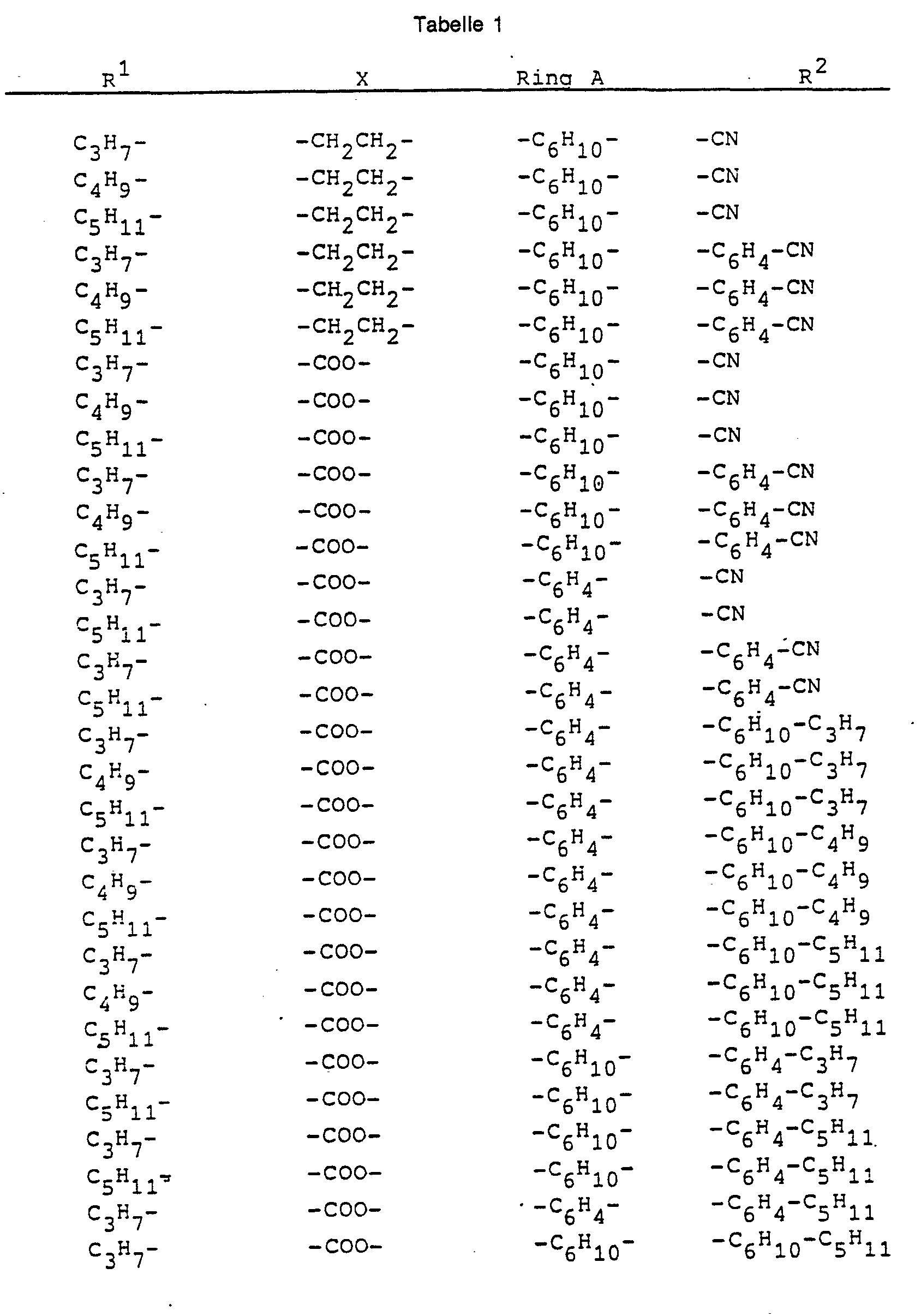
- Examples of preferred compounds according to the invention are the compounds of the above formula I, in which R 1 , X, ring A and R 2 have the meanings given in table 1 (—C 6 H 4 - denotes p-phenylene and ⁇ C 6 H 10 - denotes trans -1,4-cyclohexylene) and n stands for the number 1, and also the other compounds of the formula I mentioned in the synthesis examples.
- esterification of the compounds of the formulas. II and III can be carried out in a manner known per se by esterification of the carboxylic acid or a reactive derivative (e.g. acid chloride, bromide or anhydride) with the hydroxy compound or a suitable salt (e.g. the sodium salt).
- a preferred method is the reaction of the acid chloride (which can be obtained from the carboxylic acid, for example by heating with thionyl chloride) with the hydroxy compound.
- This reaction is conveniently carried out in an inert organic solvent, for example an ether (such as diethyl ether or tetrahydrofuran) or dimethylformamide, benzene, toluene, cyclohexane, carbon tetrachloride and the like.
- the released hydrogen chloride can be bound with an acid binder (e.g. a tertiary amine or pyridine).
- the acid binder can also serve as a solvent.
- Further preferred methods are the reaction of the carboxylic acid with the hydroxyverbin tion in the presence of 4- (dimethylamino) pyridine and dicyclohexylcarbodiimide or in the presence of oxalyl chloride and dimethylformamide.
- the temperature and pressure of the above esterification reaction are not critical. In general, however, atmospheric pressure and a temperature between about -30 ° C and the boiling temperature of the reaction mixture are used.
- the catalytic hydrogenation of the compounds of the formula IV can be carried out in a manner known per se and with customary hydrogenation catalysts, for example with palladium, platinum, Raney nickel and the like, preferably with palladium.
- Any inert organic solvent such as saturated alcohols, ethers, esters, carboxylic acids, hydrocarbons and the like, for example ethanol, dioxane, tetrahydrofuran, ethyl acetate, glacial acetic acid, toluene or hexane, can be used as the solvent.
- Temperature and pressure are not critical. In general, however, a temperature between room temperature and the boiling temperature of the reaction mixture and a pressure of about 1 to about 5 atmospheres are used.
- the compounds of formula IV are new and also a subject of the present invention.
- the trans isomers of the compounds of Formula IV i.e. the compounds with the double bond in the trans position
- the compounds of the formula IV can be prepared from [(4 '- (trans-4-alkylcyclohexyl) -4-biphenylyl) methyl] triphenylphosphonium bromide or [p- (trans-4-alkylcyclohexyl ) benzyl] -triphenylphosphonium bromide and an aldehyde of the general formula in which ring A denotes p-phenylene or trans-1,4-cyclohexylene and R 4 represents cyano or p-cyanophenyl, be preserved.
- the aldehydes of the formula V are new and also a subject of the invention.
- the compounds of the formula V, in which ring A denotes p-phenylene, can be obtained, for example, by reacting biphenyl-4,4'-dicarboxylic acid or p-terphenyl-4,4 "-dicarboxylic acid to give the monoester (e.g. with diazomethane), this with thionyl chloride, ammonia and phosphorus oxychloride via the acid chloride and amide into the cyanoester, the cyanoester saponified with sodium hydroxide solution and the cyano acid converted into the cyanoaldehyde by reaction with thionyl chloride and Rosenmund reduction.
- the monoester e.g. with diazomethane
- the compounds of formula V, in which ring A denotes trans-1,4-cyclohexylene, can, for example, by Wittig reaction of 4- (p-cyanophenyl) cyclohexanone or 4- (4'-cyano-4-biphenylyl) cyclohexanone with triphenylmethoxymethylphosphonium chloride and subsequent hydrolysis of the enol ether.
- the compounds of the formula 111 in which Z 2 denotes the carboxyl group and R 2 denotes cyano or p-cyanophenyl, can be prepared, for example, from the compounds of the formula V by Jones oxidation or by oxidation with pyridinium dichromate.
- the compounds of the formula 111, in which Z 2 denotes the hydroxyl group and R 2 denotes cyano or p-cyanophenyl can, for example, by reducing 4- (p-cyanophenyl) cyclohexanone or 4- (4'-cyano-4-biphenylyl) cyclohexanone can be obtained with sodium borohydride.
- the other compounds of the formulas II and III are known or analogs of known compounds and can be prepared by known methods.
- the compounds according to the invention can be used for or as liquid-crystalline stationary phases in gas chromatography in a manner known per se and on customary carrier materials.
- the compounds according to the invention can be used in pure form or as mixtures of two or more compounds of the formula 1 with one another or as mixtures of one or more compounds of the formula I with one or more further suitable substances.
- the invention therefore also relates to liquid-crystalline mixtures with at least 2 components, which are characterized in that at least one component is a compound of the formula I above.
- the proportion of compounds of the formula in the liquid-crystalline mixtures for chromatographic purposes can vary within wide limits and be about 1-100% by weight. In general, however, the proportion of compounds of the formula I is at least about 50% by weight.
- the compounds according to the invention are also suitable for electro-optical applications and can be used in the form of mixtures with other substances suitable for liquid-crystalline dielectrics, such as, for. B. with substances from the classes of Schiff bases, azobenzenes, azoxybenzenes, phenylbenzoates, cyclohexanecarboxylic acid phenyl esters, cyclohexanecarboxylic acid cyclohexyl esters, biphenyls, terphenyls, phenylcyclohexanes, cyclohexylbiphenyls, phenylpyrimidines, phenyldioxa ne, 2-cyclohexyl-1-phenylethane, pyridazines, 2,3-dicyano-1,4-phenylene derivatives and the like.
- Such substances are known to the person skilled in the art and many of them are also commercially available.
- the compounds according to the invention are particularly suitable for liquid-crystalline dielectrics which contain substances with relatively small mesophase regions or even monotropic or non-liquid-crystalline substances.
- Those mixtures are particularly preferred which contain one or more compounds of the formula 1 and one or more of the compounds of the following general formulas in which ring A represents p-phenylene or trans-1,4-cyclohexylene, R 5 and R 6 represent straight-chain C 1 -C 7 alkyl, R 7 cyano, straight-chain C 1 -C 7 alkyl or straight-chain C 1 -C 7 - Denotes alkoxy and R 8 denotes straight-chain C 1 -C 7 alkyl or straight-chain C 1 -C 7 alkoxy, contain.
- the dielectrics according to the invention can also contain suitable, optically active compounds (e.g. contain optically active biphenyls) and / or dichroic dyes (e.g. azo, azoxy or anthraquinone dyes).
- suitable, optically active compounds e.g. contain optically active biphenyls
- dichroic dyes e.g. azo, azoxy or anthraquinone dyes.
- the proportion of such compounds is determined by the solubility and the desired pitch, color, extinction and the like.
- the proportion of optically active compounds is preferably at most about 4% by weight and the proportion of dichroic dyes is at most about 10% by weight.
- liquid-crystalline mixtures and the electro-optical devices can be produced in a manner known per se.
- C denotes a crystalline phase
- S a smectic phase N a nematic phase
- I the isotropic phase
- the colorless, solid product obtained first (3.057 g was suspended together with the mother liquors from the above recrystallizations in dichloromethane and chromatographed on silica gel in dichloromethane. Dichloromethane and dichloromethane / 2% acetone eluted 2.467 g of yellowish, crystalline ester. Repeated recrystallization of this crude product Dichloromethane / hexane and drying in a high vacuum A further 1,916 pure product and 0.502 g resulted from phosphorus pentoxide. slightly contaminated product.
- the carrier gas served Nitrogen (30 ml / min.)
- Nitrogen 35 ml / min. was used as the carrier gas.
- the retention time was 13.5 minutes for methyl oleic acid and 15 minutes for methyl oleic acid.
Landscapes
- Chemical & Material Sciences (AREA)
- Organic Chemistry (AREA)
- Crystallography & Structural Chemistry (AREA)
- Engineering & Computer Science (AREA)
- Materials Engineering (AREA)
- Organic Low-Molecular-Weight Compounds And Preparation Thereof (AREA)
Description
- . Die vorliegende Erfindung betrifft neue flüssigkristalline Verbindungen, nämlich die 4'-(trans-4-Alkylcyclohexyl)-4-biphenylyl-Derivate und 4-(trans-4-Alkylcyclohexyl) phenyl-Derivate der allgemeinen Formel

- Die Erfindung betrifft ferner die Herstellung der Verbindungen der obigen Formel I, flüssigkristalline Gemische, welche Verbindungen der obigen Formel I enthalten, sowie die Verwendung für elektro-optische und chromatographische Zwecke.
- Flüssige Kristalle finden vor allem als Dielektrika in Anzeigevorrichtungen Verwendung, da sich die optischen Eigenschaften solcher Substanzen durch elektrische Felder beeinflussen lassen. Elektro-optische Vorrichtungen auf der Basis von Flüssigkristallen sind dem Fachmann gut bekannt und können auf verschiedenen Effekten beruhen, wie beispielsweise der dynamischen Streuung, der Deformation aufgerichteter Phasen (DAP-Typ), dem Schadt-Helfrich-Effekt (Drehzelle), dem Gast/Wirt-Effekt (« Guest/-Host-Zelle •) oder einem cholesterisch-nematischen Phasenübergang.
- Da es im allgemeinen nicht möglich ist, alle gewünschten Eigenschaften, wie beispielsweise hohe chemische und photochemische Stabilität, niedere Viskosität, grosse nematische bzw. cholesterische Mesophasenbereiche, kurze Ansprechzeiten und dergleichen, mit einer einzigen Verbindung zu erreichen, werden meist Mischungen mehrerer Komponenten verwendet. Derartige Mischungen enthalten in der Regel hauptsächlich niederviskose Verbindungen, welche aber anderseits meist auch niedrige Klärpunkte aufweisen. Aus diesem Grunde müssen den Mischungen oft klärpunktserhöhende Substanzen zugesetzt werden.
- EP-A-0 044 646 offenbart 4-(trans-4-Alkylcyclohexyl)-benzoesäure-4'-cyano-4-biphenylylester als klärpunktserhöhende Zusätze für Flüssigkristallmischungen.
- Flüssige Kristalle wurden bereits auch als stationäre Phasen in der Gaschromatographie eingesetzt. Die bisher bekannten, flüssigkristallinen, stationären Phasen haben aber im allgemeinen den Nachteil, dass sie nur bis zu Temperaturen von etwa 180 °C verwendet werden können.
- Es wurde nun gefunden, dass die erfindungsgemässen Verbindungen sehr grosse Mesophasenbereiche mit hohen Klärpunkten ausbilden, und dass sie im allgemeinen im ganzen oder zumindest im überwiegenden Teil des flüssigkristallinen Bereichs eine nematische Mesophase aufweisen. Sie besitzen eine gute chemische und photochemische Stabilität und sind farblos. Die Viskositätswerte sind unter Berücksichtigung der hohen Klärpunkte vergleichsweise niedrig. Diejenigen Verbindungen der Formel I, worin R2 Cyano oder p-Cyanophenyl bedeutet, besitzen eine positive dielektrische Anisotropie ; die übrigen Verbindungen der Formel 1 (d. h. diejenigen, worin R2 p-Alkylphenyl oder trans-4-Alkylcyclohexyl bedeutet) besitzen kleine absolute Werte der dielektrischen Anisotropie.
- Aufgrund ihrer sehr guten Trennfähigkeit und ihrer hohen Klärpunkte und Siedepunkte eignen sich die erfindungsgemässen Verbindungen vorzüglich für oder als stationäre Phasen in der Gaschromatographie und können auch bei sehr hohen Arbeitstemperaturen angewendet werden. Besonders geeignet sind die erfindungsgemässen Verbindungen zur Trennung von Isomerengemischen, welche mit konventionellen stationären Phasen nicht oder nur schlecht trennbar sind, wie beispielsweise cis/trans-isomere Cyclopentane und Cyclohexane (z. B. 1,4-disubstituierte Cyclohexane), isomere aromatische Kohlenwasserstoffe (z. B. o-, m- und p-disubstituierte Benzole, Anthracen/Phenanthren), Doppelbindungsisomere (z. B. ungesättigte Fettsäureester) und dergleichen. Die erfindungsgemässen Verbindungen eignen sich insbesondere auch zur Anwendung in Kapillarsäulen. Ferner eignen sich insbesondere die Verbindungen der Formel I, worin X die Gruppe ―CH2CH2― bedeutet, auch zur Trennung von silylierten Proben. Derartige Proben von Silylderivaten (z. B. Trimethylsilylderivate) werden oft hergestellt, wenn Gemische von Verbindungen mit aciden Wasserstoffatomen (z. B. Säuren, Alkohole, Phenole, Amine, Amide) vorliegen, um die Trennung zu erleichtern.
- Weiterhin sind die erfindungsgemässen Verbindungen als klärpunktserhöhende Substanzen für flüssigkristalline Dielektrika geeignet. Hierbei haben sie vor allem den Vorteil, dass entweder sehr grosse Klärpunktserhöhungen erreicht werden können oder anderseits zur Erzielung einer bestimmten Klärpunktserhöhung nur vergleichsweise geringe Mengen zugesetzt werden müssen und damit die übrigen Eigenschaften des Gemisches im allgemeinen nur unwesentlich verändert werden.
- Die erfindungsgemässen Verbindungen sind tetracyclische, pentacyclische oder hexacyclische Verbindungen mit 1 oder 2 polaren Gruppen, nämlich einer Estergruppe und/oder einer Cyanogruppe. Die Alkylreste R1 und R3 bedeuten unabhängig voneinander Methyl, Aethyl, Propyl, Butyl, Pentyl, Hexyl, Heptyl, Octyl, Nonyl und Decyl.
- Rest R2 in obiger Formel I bezeichnet vorzugsweise Cyano, p-Cyanophenyl oder p-R3-Phenyl, wenn Ring A trans-1,4-Cyclohexylen bedeutet, und trans-4-R3-Cyclohexyl, wenn Ring A p-Phenylen bedeutet. X steht vorzugsweise für die Gruppe -COO- oder ―CH2CH2―. Die Alkylgruppen R1 und R3 bedeuten unabhängig voneinander vorzugsweise geradkettiges C1-C7-Alkyl und insbesondere Propyl, Butyl oder Pentyl. Vorzugsweise steht n für die Zahl 1.
- Beispiele bevorzugter erfindungsgemässer Verbindungen sind die Verbindungen der obigen Formel I, worin R1, X, Ring A und R2 die in Tabelle 1 gegebenen Bedeutungen haben (-C6H4- bezeichnet p-Phenylen und ―C6H10― bezeichnet trans-1,4-Cyclohexylen) und n für die Zahl 1 steht, sowie die weiteren in den Synthesebeispielen genannten Verbindungen der Formel I.

- Die Verbindungen der Formel I können erfindungsgemäss dadurch hergestellt werden, dass man
- (a) zur Herstellung der Verbindungen der Formel I, worin X die Gruppe ―COO― oder -OOCbedeutet, eine Verbindung der allgemeinen Formel


oder reaktionsfähige Derivate dieser Verbindungen verestert, oder - b) zur Herstellung der Verbindungen der Formel I, worin X die Gruppe ―CH2CH2― bedeutet, eine Verbindung der allgemeinen Formel

katalytisch hydriert. - Die Veresterung der Verbindungen der Formeln. II und III kann in an sich bekannter Weise durch Veresterung der Carbonsäure oder eines reaktionsfähigen Derivates (z. B. Säurechlorid, -bromid oder -anhydrid) mit der Hydroxyverbindung oder eines geeigneten Salzes (z. B. des Natriumsalzes) erfolgen. Eine bevorzugte Methode ist die Umsetzung des Säurechlorids (welches aus der Carbonsäure z. B. durch Erhitzen mit Thionylchlorid erhaltlich ist) mit der Hydroxyverbindung. Diese Umsetzung wird zweckmässig in einem inerten organischen Lösungsmittel, beispielsweise einem Aether (wie Diäthyläther oder Tetrahydrofuran) oder Dimethylformamid, Benzol, Toluol, Cyclohexan, Tetrachlorkohlenstoff und dergleichen durchgeführt. Der frei werdende Chlorwasserstoff kann mit einem Säurebindemittel (z. B. einem tertiären Amin oder Pyridin) gebunden werden. Das Säurebindemittel kann auch zugleich als Lösungsmittel dienen. Weitere bevorzugte Methoden sind die Umsetzung der Carbonsäure mit der Hydroxyverbindung in Gegenwart von 4-(Dimethylamino) pyridin und Dicyclohexylcarbodiimid oder in Gegenwart von Oxalylchlorid und Dimethylformamid. Temperatur und Druck der obigen Veresterungsreaktion sind nicht kritisch. Im allgemeinen werden jedoch Atmosphärendruck und eine Temperatur zwischen etwa - 30 °C und der Siedetemperatur des Reaktions-gemisches angewendet.
- Die katalytische Hydrierung der Verbindungen der Formel IV kann in an sich bekannter Weise und mit gebräuchlichen Hydrierkatalysatoren erfolgen, beispielsweise mit Palladium, Platin, Raney-Nickel und dergleichen, vorzugsweise mit Palladium. Als Lösungsmittel können irgendwelche inerte organische Lösungsmittel, wie gesättigte Alkohole, Aether, Ester, Carbonsäuren, Kohlenwasserstoffe und dergleichen, beispielsweise Aethanol, Dioxan, Tetrahydrofuran, Essigsäureäthylester, Eisessig, Toluol oder Hexan, verwendet werden. Temperatur und Druck sind nicht kritisch. Im allgemeinen werden jedoch eine Temperatur zwischen Raumtemperatur und der Siedetemperatur des Reaktionsgemisches und ein Druck von etwa 1 bis etwa 5 Atmosphären angewendet.
- Die Verbindungen der Formel IV sind neu und ebenfalls Gegenstand der vorliegenden Erfindung. Die trans-Isomere der Verbindungen der Formel IV (d. h. die Verbindungen mit trans-ständiger Doppelbindung) sind flüssigkristalline Verbindungen mit sehr grossen Mesophasenbereichen.
- Die Verbindungen der Formel IV können nach den an sich bekannten Methoden der Wittig-Reaktion aus [(4'-(trans-4-Alkylcyclohexyl)-4-biphenylyl) methyl] triphenyl-phosphoniumbromid bzw. [p-(trans-4-Alkylcyclohexyl) benzyl]-triphenylphosphoniumbromid und einem Aldehyd der allgemeinen Formel

erhalten werden. - Die Aldehyde der Formel V sind neu und ebenfalls Gegenstand der Erfindung.
- Die Verbindungen der Formel V, worin Ring A p-Phenylen bezeichnet, können beispielsweise dadurch erhalten werden, dass man Biphenyl-4,4'-dicarbonsäure bzw. p-Terphenyl-4,4"-dicarbonsäure zum Monoester umsetzt (z. B. mit Diazomethan), diesen mit Thionylchlorid, Ammoniak und Phosphoroxychlorid über das Säurechlorid und Amid in den Cyanoester überführt, den Cyanoester mit Natronlauge verseift und die Cyanosäure durch Umsetzung mit Thionylchlorid und Rosenmund-Reduktion in den Cyanoaldehyd überführt.
- Die Verbindungen der Formel V, worin Ring A trans-1,4-Cyclohexylen bezeichnet, können beispielsweise durch Wittig-Reaktion von 4-(p-Cyanophenyl) cyclohexanon bzw. 4-(4'-Cyano-4-biphenylyl) cyclohexanon mit Triphenylmethoxymethylphosphoniumchlorid und anschliessende Hydrolyse des Enoläthers hergestellt werden.
- Die Verbindungen der Formel 111, worin Z2 die Carboxylgruppe bezeichnet und R2 Cyano oder p-Cyanophenyl bedeutet, können beispielsweise aus den Verbindungen der Formel V durch Jones-Oxidation oder durch Oxidation mit Pyridiniumdichromat hergestellt werden. Die Verbindungen der Formel 111, worin Z2 die Hydroxygruppe bezeichnet und R2 Cyano oder p-Cyanophenyl bedeutet, können beispielsweise durch Reduktion von 4-(p-Cyanophenyl) cyclohexanon bzw. 4-(4'-Cyano-4-biphenylyl) cyclohexanon mit Natriumborhydrid erhalten werden. Die übrigen Verbindungen der Formeln II und III sind bekannte oder Analoge bekannter Verbindungen und können nach bekannten Methoden hergestellt werden.
- Die Verwendung der erfindungsgemässen Verbindungen für oder als flüssigkristalline stationäre Phasen in der Gaschromatographie kann in an sich bekannter Weise und auf üblichen Trägermaterialien erfolgen. Die erfindungsgemässen Verbindungen können in reiner Form oder auch als Mischungen von 2 oder mehreren- Verbindungen der Formel 1 untereinander oder als Mischungen von einer oder mehreren Verbindungen der Formel I mit einer oder mehreren weiteren geeigneten Substanzen eingesetzt werden.
- Die Erfindung betrifft daher auch flüssigkristalline Gemische mit mindestens 2 Komponenten, welche dadurch gekennzeichnet sind, dass mindestens eine Komponente eine Verbindung der obigen Formel I ist.
- Um eine allmähliche Aenderung der Zusammensetzung bei längerem Gebrauch zu vermeiden. werden für chromatographische Anwendungen vorzugsweise nur Verbindungen mit vergleichbar niedrigen Dampfdrücken gemischt. Der Anteil an Verbindungen der Formel in den flüssigkristallinen Gemischen für chromatographische Zwecke kann in breiten Grenzen variieren und etwa 1-100 Gew.-% betragen. Im allgemeinen beträgt der Anteil an Verbindungen der Formel I jedoch mindestens etwa 50 Gew.-%.
- Die erfindungsgemässen Verbindungen eignen sich ebenfalls für elektro-optische Anwendungen und können in Form von Gemischen mit anderen, für flüssigkristalline Dielektrika geeigneten Substanzen verwendet werden, wie z. B. mit Substanzen aus den Klassen der Schiffschen Basen, Azobenzole, Azoxybenzole, Phenylbenzoate, Cyclohexancarbonsäurephenylester, Cyclohexancarbonsäurecyclohexylester, Biphenyle, Terphenyle, Phenylcyclohexane, Cyclohexylbiphenyle, Phenylpyrimidine, Phenyldioxane, 2-Cyclohexyl-1-phenyläthane, Pyridazine, 2,3-Dicyano-1,4-phenylen-Derivate und dergleichen. Derartige Substanzen sind dem Fachmann bekannt und viele davon sind zudem im Handel erhältlich. Der Anteil an Verbindungen der Formel I in flüssigkristallinen Mischungen für elektro-optische Anwendungen beträgt bevorzugt etwa 1-30 Gew.-% und besonders bevorzugt etwa 2-15 Gew.-%.
- Wegen der stark klärpunktserhöhenden Wirkung der erfindungsgemässen Verbindungen eignen sich diese vor allem für flüssigkristalline Dielektrika, welche Substanzen mit relativ kleinen Mesophasenbereichen oder sogar monotrope oder nicht-flüssigkristalline Substanzen enthalten. Bevorzugt sind insbesondere diejenigen Gemische, welche eine oder mehrere Verbindungen der Formel 1 und eine oder mehrere der Verbindungen der folgenden allgemeinen Formeln






enthalten. - Die erfindungsgemässen Dielektrika können ferner geeignete, optisch aktive Verbindungen (z. B. optisch aktive Biphenyle) und/oder dichroitische Farbstoffe (z. B. Azo-, Azoxy- oder AnthrachinonFarbstoffe) enthalten. Der Anteil solcher Verbindungen wird durch die Löslichkeit und die gewünschte Ganghöhe (pitch), Farbe, Extinktion und dergleichen bestimmt. Vorzugsweise beträgt der Anteil optisch aktiver Verbindungen höchstens etwa 4 Gew.-% und der Anteil dichroitischer Farbstoffe höchstens etwa 10 Gew.-%.
- Die Herstellung der flüssigkristallinen Mischungen und der elektro-optischen Vorrichtungen kann in an sich bekannter Weise erfolgen.
- Die Herstellung der erfindungsgemässen Verbindungen und deren Verwendung in der Chromatographie wird anhand der nachstehenden Beispiele weiter veranschaulicht. C bezeichnet eine kristalline, S eine smektische, N eine nematische und I die isotrope Phase.
- 2,029 g p-[trans-4-[2-(4'-(trans-4-Pentylcyclohexyl)-4-biphenylyl) vinyl] cyclohexyl] benzonitril wurden in 150 ml Toluol/Aethanol (Vol. 4 : 1) gelöst, mit 0,3 g Palladium/Kohle (10 %) versetzt und bei Raumtemperatur hydriert, bis die Wasserstoffaufnahme zum Stillstand kam. Anschliessend wurde das Reaktionsgemisch genutscht, der Rückstand mit Dichlormethan nachgewaschen und das Filtrat eingedampft. Das erhaltene, farblose, feste Rohprodukt wurde in Toluol gelöst und an Kieselgel mit Toluol chromatographiert. Hierbei wurden 1,255 g Substanz isoliert, welche aus Dichlormethan/Hexan umkristallisiert und im Hochvakuum bei 20 °C über Phosphorpentoxid getrocknet wurde. Ausbeute : 0,894 g reines p-[trans-4-[2-(4'-(trans-4-Pentylcyclohexyl)-4-biphenylyl) äthyl] cyclohexyl] benzonitril : (C-C) 134,5-135 °C, Smp. (C-S) 147-147,5 °C, (S-N) 167,5-169 °C, Klp. (N-I) 370 °C.
- Das als Ausgangsmaterial verwendete p-[trans-4-[2-(4'-(trans-4-Pentylcyclohexyl)-4-biphenylyl) vinyl] cyclohexyl] benzonitril wurde wie folgt hergestellt :
- a) Eine Suspension von 10,4 g Triphenyl-methoxymethylphosphoniumchlorid in 60 ml t-Butylmethyläther wurde bei -10 °C unter Argonbegasung vorgelegt und innert 10 Minuten mit 3,6 g festem Kalium-t-butylat versetzt. Nach beendeter Zugabe wurde das Reaktionsgemisch noch 30 Minuten bei -10 °C bis 0 °C gerührt und dann bei 0 °C tropfenweise mit einer Lösung von 4,2 g 4-(p-Cyanophenyl) cyclohexanon in 50 ml absolutem Tetrahydrofuran versetzt. Anschliessend wurde das Reaktionsgemisch noch 2 Stunden bei Raumtemperatur gerührt, dann auf 500 ml Hexan gegossen und filtriert. Niederdruckchromatographie (0,5 bar) des eingeengten Rückstandes (7,1 g) an Kieselgel mit Essigester/Petroläther (Vol. 1 : 19) ergab 4,5 (94%) p-[4-(Methoxymethylen) cyclohexyl] benzonitril als farbloses, allmählich kristallisierendes Oel (Reinheit 95 %) ; Rf-Wert (Essigester/Petroläther Vol. 1 : 9) = 0,30.
- b) Ein Gemisch von 14,25 g p-[4-(Methoxymethylen) cyclohexyl] benzonitril (Reinheit 96,1 %) und 200 ml Tetrahydrofuran/2N Salzsäure (Vol. 4 : 1) wurde 30 Minuten zum Rückfluss erhitzt. Anschliessend wurde das Reaktionsgemisch auf 300 ml Wasser gegossen und dreimal mit je 200 ml Diäthyläther extrahiert. Die organischen Phasen wurden mit 200 ml Wasser gewaschen, über Magnesiumsulfat getrocknet und eingeengt. Hierbei wurden 13,75 g (103 %) Rohprodukt von 4-(p-Cyanophenyl) cyclohexancarboxaldehyd (trans/cis-Verhältnis ca. 3 : 1) als farbloses, langsam kristallisierendes Oel erhalten. Umkristallisation dieses Materials aus 1,3 I Hexan ergab 3,71 g (29 %) trans-4-(p-Cyanophenyl) cyclohexancarboxaldehyd (Reinheit 99,5 %) als lange, farblose Nadeln mit Smp. 57,1 °C. Die Mutterlauge wurde auf ein Volumen von 1 I eingeengt und nochmals zur Kristallisation angesetzt, wobei als 2. Kristallisat 1,20 g farblose Nadeln enthaltend 97 % trans-Aldehyd und 3 % cis-Aldehyd erhalten wurden. Die anfallende Mutterlauge wurde nun eingeengt, der Rückstand nochmals in 100 ml Tetrahydrofuran/2N Salzsäure (Vol. 4 : 1) 30 Minuten zum Rückfluss erhitzt und dann das Gemisch wie beim ersten Mal aufgearbeitet. Das erhaltene Rohprodukt wurde mit dem 2. Kristallisat (1,2 g) vereinigt und aus 900 ml Hexan umkristallisiert, wobei nochmals 3,56 g (28 %) trans-4-(p-Cyanophenyl) cyclohexancarboxaldehyd (Reinheit 99,7 %) als lange, farblose Nadeln isoliert werden konnten. Die Mutterlauge (enthaltend 4,2 g Rohprodukt) wurde nicht mehr aufgearbeitet. Gesamtausbeute nach 2 Zyklen : 7,27 g (57 %) trans-4-(p-Cyanophenyl) cyclohexancarboxaldehyd ; Smp. 57,1 °C.
- c) 4,652 g [(4'-(trans-4-Pentylcyclohexyl)-4-biphenylyl)-methyl]-triphenylphosphoniumbromid wurden unter Rühren und Stickstoffbegasung in 40 ml absolutem t-Butylmethyläther suspendiert, dann das Gemisch mit 0,789 g Kalium-t-butylat versetzt und noch 1 Stunde bei Raumtemperatur gerührt. Anschliessend wurde die orange Suspension auf ―60 °C abgekühlt und innert 15 Minuten tropfenweise mit einer Lösung von 1,0 g trans-4-(p-Cyanophenyl) cyclohexancarboxaldehyd in 8 ml absolutem t-Butylmethyläther versetzt. Durch den Tropftrichter wurden 5 ml absoluter t-Butylmethyläther nachgespült und dann die Temperaturdes Reaktionsgemisches innert 1,25 Stunden auf - 25 °C ansteigen gelassen. Anschliessend wurde das Reaktionsgemisch auf 75 ml Wasser gegossen und dreimal mit Toluol extrahiert. Die organischen Extrakte wurden einmal mit Wasser gewaschen, über Natriumsulfat getrocknet und im Vakuum eingedampft. Das zurückbleibende, feste, farblose Produkt (5,0 g) wurde in Hexan suspendiert und an Kieselgel chromatographiert. Hexan und Hexan/Toluol (Vol. 9 : 1) eluierten 0,653 g farbloses 4-Methyl-4'-(trans-4-pentylcyclohexyl) biphenyl [Smp. (C-N) 98,9 °C, Klp. (N-I) 175,3 °C] und Hexan/Toluol (Vol. 1 : 1), Toluol und Toluol/Aceton (enthaltend 1-10 Vol-% Aceton) eluierten schliesslich 2,029 g p-[trans-4-[2-(4'-(trans-4-Pentylcyclohexyl)-4-biphenylyl) vinyl] cyclohexyl] benzonitril als farbloses bis gelbliches Reaktionsprodukt, welches ohne weitere Reinigung für die anschliessende Hydrierung verwendet wurde.
- In analoger Weise wurden folgende Verbindungen hergestellt :
- p-[trans-4-[2-(4-(trans-4-Pentylcyclohexyl) phenyl)-äthyl] cyclohexyl] benzonitril ; Smp. (C-N) 99,6 °C, Klp. (N-I) 265,0 °C, (S-N) 76,5 °C,
- p-[trans-4-[2-(4'-(trans-4-Butylcyclohexyl)-4-biphenylyl) äthyl] cyclohexyl] benzonitril ; Smp. (C-N) 174,6°C, Klp. (N-I) 378,5°C.
- Ein Gemisch von 1,0 g trans-4-(p-Cyanophenyl) cyclohexanol, 1,75 g 4'-(trans-4-Pentylcyclohexyl)-4-biphenylcarbonsäure, 1,2 g Dicyclohexylcarbodiimid und 98 mg 4-(Dimethylamino) pyridin in 60 ml Dichlormethan wurde bei Raumtemperatur unter Argonbegasung 18 Stunden gerührt. Anschliessend wurde die beige Suspension filtriert (Nachwaschen mit Dichlormethan) und das Filtrat eingeengt. Niederdruckchromatographie (0,5 bar) des Rückstandes (3,1 g) an Kieselgel mit Toluol lieferte 1,2 g (45 %) reinen 4'-(trans-4-Pentylcyclohexyl)-4-biphenylcarbonsäure-trans-4-(p-cyanophenyl) cyclohexylester. Umkristallisation aus Essigester/Aceton (Vol. 1 : 4) ergab weisse Kristalle mit Smp. (C-N) 148,6°C und Klp. (N-I) 347 °C ; Reinheit 99,6 %.
- Das als Ausgangsmaterial verwendete trans-4-(p-Cyanophenyl) cyclohexanol wurde wie folgt hergestellt :
- 51,0 g 4-(p-Cyanophenyl) cyclohexanon wurden in 1,5 1 Aethanol/Wasser (Vol. 4 : 1) fast völlig gelöst und dann innert 10 Minuten mit 9,68 g Natriumborhydrid versetzt. Das Gemisch wurde noch 30 Minuten gerührt und dann über Nacht stehen gelassen. Anschliessend wurde das Reaktionsgemisch vorsichtig mit 350 ml verdünnter, eiskalter Salzsäure (1 Teil konzentrierte Salzsäure auf 4 Teile Wasser) versetzt, dann mit 2 I Wasser und 1 I Diäthyläther versetzt und geschüttelt. Die wässrige Phase wurde abgetrennt und viermal mit je 0,5 I Diäthyläther extrahiert. Die vereinigten organischen Phasen wurden mit 100 ml gesättigter Natriumhydrogencarbonat-Lösung und mit 100 ml gesättigter Kochsalzlösung gewaschen, über Natriumsulfat getrocknet und eingeengt. Das noch wasserhaltige Rohprodukt wurde durch Lösen in Toluol und Aceton und Einengen weiter getrocknet. Der beige, feste Rückstand (48,9 g) wurde in 300 ml Toluol heiss gelöst und von einem feinen, ungelösten Rückstand heiss abfiltriert. Das Filtrat wurde auf ―20 °C gekühlt und das erhaltene Kristallisat abgenutscht, mit 50 ml Toluol/Hexan (Vol. 9:1) gewaschen und getrocknet. Hierbei wurden 31,72 g (61,6 %) reines, hellbeiges trans-4-(p-Cyanophenyl)-cyclohexanol mit Smp. 119,5-122,4 °C erhalten. Aus der Mutterlauge wurden durch Kristallisation aus 60 ml Toluol bei - 20 °C weitere 3,21 g (6,2 %) trans-4-(p-Cyanophenyl)-cyclohexanol mit Smp. 116,5-122,1 °C gewonnen.
- In analoger Weise wurden folgende Verbindungen hergestellt :
- 4'-(trans-4-Propylcyclohexyl)-4-biphenylcarbonsäure-trans-4-(p-cyanophenyl) cyclohexylester; Smp. (C-N) 189,6 °C, Klp. (N-I) 350 °C,
- 4'-(trans-4-Butylcyclohexyl)-4-biphenylcarbonsäure-trans-4-(p-cyanophenyl) cyclohexylester; Smp. (C-N) 168,6 °C bzw. 169,8 °C (2 Modifikationen), Klp. (N-I) 348,5 °C.
- Eine Lösung von 2,40 g 4-Hydroxy-4'-(trans-4-pentylcyclohexyl) biphenyl und 0,149 g 4-(Dimethylami- no) pyridin in 125 ml absolutem Dichlormethan wurde unter Rühren mit 2,40 g 4'-(trans-4-Propylcyclohexyl)-4-biphenylcarbonsäure versetzt. Die gelbliche Suspension wurde mit 25 ml absolutem Dichlormethan verdünnt, mit 1,843 g festem Dicyclohexylcarbodiimid und nochmals mit 35 ml absolutem Dichlormethan (Nachspülen) versetzt, dann 24 Stunden bei Raumtemperatur gerührt und anschliessend 4 Stunden zum Rückfluss erhitzt. Nach Abkühlen auf Raumtemperatur wurde der Niederschlag genutscht, mit Dichlormethan gewaschen und getrocknet, wobei 3,057 g farbloses, festes Produkt erhalten wurden. Einengen des Filtrates im Vakuum bis zur Trockene ergab 3,7 g gelbe, feste Substanz, welche in Dichlormethan suspendiert und zusammen mit 15 g Kieselgel im Vakuum eingedampft wurde. Der Rückstand wurde in Toluol suspendiert und auf eine Säule von Kieselgel in Toluol gegeben. Toluol, Toluol/1 % Aceton und Toluol/2 % Aceton eluierten 1,823 g rohen Ester. Nach mehrmaliger Umkristallisation aus Dichlormethan/Hexan und Trocknung im Hochvakuum über Phosphorpentoxid während 16 Stunden wurden 0,762 g reiner 4'-(trans-4-Propylcyclohexyl)-4-biphenylcarbonsäure-4'-(trans-4-pentylcyclohexyl)-4-biphenylyles- ter erhalten, (C-C) 132 °C, Smp. (C-S) 200 °C, (S-S) 219 °C, (S-N) 224 °C, Klp. (N-I) 462 °C. Das zuerst erhaltene, farblose, feste Produkt (3,057 g wurde zusammen mit den Mutterlaugen aus den obigen Umkristallisationen in Dichlormethan suspendiert und an Kieselgel in Dichlormethan chromatographiert. Dichlormethan und Dichlormethan/2 % Aceton eluierten 2,467 g gelblichen, kristallinen Ester. Mehrmalige Umkristallisation dieses Rohproduktes aus Dichlormethan/Hexan und Trocknung im Hochvakuum über Phosphorpentoxid ergaben weitere 1,916 reines Produkt und 0,502 g. leicht verunreinigtes Produkt.
-
- a) Eine Suspension von 1,07 g Aluminiumchlorid in 10 ml 1,2-Dichioräthan wurde bei Raumtemperatur unter Argonbegasung vorgelegt, innert 10 Minuten mit einer Lösung von 2,0 g 4-(4-Biphenylyl) cyclohexanon in 10 ml 1,2-Dichloräthan versetzt und noch 30 Minuten nachgerührt. Die entstandene braun-violette Suspension wurde bei Raumtemperatur innert 10 Minuten zu einem Gemisch von 1,07 g Aluminiumchlorid in 10 ml 1,2-Dichloräthan, welches vorgängig bei Raumtemperatur mit 1,37 ml Oxalylchlorid versetzt worden war; zugetropft. Das Reaktionsgemisch wurde noch 30 Minuten bei Raumtemperatur gerührt und dann unter Abkühlung auf ca. 0 °C innert 25 Minuten vorsichtig mit 30 ml einer 30 %-igen (Gew.Nol.) Kalziumchlorid-Lösung versetzt (stark exotherme Reaktion). Die entstandene, beige Suspension wurde auf 200 ml Eiswasser gegossen und dreimal mit je 200 ml Methylenchlorid extrahiert. Die organischen Phasen wurden zweimal mit je 100 ml Eiswasser gewaschen, über Magnesiumsulfat getrocknet und auf ein Volumen von ca. 35 ml eingeengt. Diese Lösung wurde in einem Sulfierkolben mit Tropftrichter und mechanischem Rührer innert'10 Minuten zu einem bei ca. 15 °C vorgelegten Gemisch von 4,5 ml 25 %-iger (Gew.Nol.) wässriger Ammoniak-Lösung und 3 ml Wasser zugegeben. Das heterogene Reaktionsgemisch wurde noch 1,75 Stunden bei Raumtemperatur gerührt. Dann wurde der entstandene, beige Niederschlag abfiltriert und mit Wasser gut gewaschen. Nach Trocknung am Hochvakuum wurden 1,66 g (71 %) 4'-(4-Oxocyclohexyl)-4-biphenylcarboxamid als beiges, amorphes Pulver erhalten ; Rf-Wert (Chloroform/Methanol Vol. 19 : 1) = 0,36.
- b) Ein Gemisch von 1,50 g 4'-(4-Oxocyclohexyl)-4-biphenylcarboxamid und 20 ml Pyridin wurde unter Argonbegasung bei 0 °C vorgelegt und mit 463 µl Mesylchlorid versetzt. Das Kühlbad wurde entfernt und die gelbe Suspension 19 Stunden bei Raumtemperatur gerührt. Anschliessend wurden nochmals 1,4 ml Mesylchlorid bei Raumtemperatur zum Reaktionsgemisch zugegeben und das Gemisch bei 60 °C 67 Stunden gerührt. Das abgekühlte, dunkelbraune Reaktionsgemisch wurde mit 40 ml eiskalter, 25 %-iger (Gew./Vol.) Salzsäure sauer gestellt und dreimal mit je 100 ml Methylenchlorid extrahiert. Die organischen Phasen wurden dreimal mit je 50 ml Wasser gewaschen, über Magnesiumsulfat getrocknet und eingeengt. Niederdruckchromatographie (0,5 bar) des rotbraunen, kristallinen Rückstandes (0,9 g) an Kieselgel mit Chloroform ergab im Hauptlauf nach zusätzlicher Behandlung mit Aktivkohle in Chloroform bei 60 °C 300 mg (21 %) 4-(4'-Cyano-4-biphenylyl) cyclohexanon als leicht gelbe Kristalle ; Rf-Wert (Chloroform) = 0,43.
- c) 4-(4'-Cyano-4-biphenylyl) cyclohexanon kann in analoger Weise zu Beispiel 1 in trans-4-(4'-Cyano-4-biphenylyl)-cyclohexancarboxaldehyd und 4'-[trans-4-[2-(4'-(trans-4-Alkylcyclohexyl)-4-biphenylyl) äthyl] cyclohexyl]-4-biphenylcarbonitril übergeführt werden. In analoger Weise zu Beispiel 2 kann ferner 4-(4'-Cyano-4-biphenylyl) cyclohexanon zu trans-4-(4'-Cyanobiphenylyl) cyclohexanol und 4'-(trans-4-Alkylcyclohexyl)-4-biphenylcarbonsäure-trans-4-(4'-cyanobiphenylyl) cyclohexylester weiter umgesetzt werden.
- Eine Lösung von 0,214 g 4'-[trans-4-[2-(4'-(trans-4-Pentylcyclohexyl)-4-biphenylyl) vinyl] cyclohexyl]-4-biphenylcarbonitril in 200 ml Tetrahydrofuran wurde mit 52,5 mg Palladium/Kohle (5 %) versetzt und bei Raumtemperatur hydriert, bis die Wasserstoffaufnahme zum Stillstand kam (1,75 Stunden). Das Reaktionsgemisch wurde anschliessend mit Stickstoff begast und genutscht (Nachspülen mit heissem Tetrahydrofuran). Nach Einengen des Filtrats im Vakuum und Trocknen bei 50 °C unter Wasserstrahlvakuum wurden 0,310 farbloses, festes 4'-[trans-4-[2-(4'-(trans-4-Pentylcyclohexyl)-4-biphenylyl) äthyl] cyclohexyl]-4-biphenylcarbonitril erhalten, welches noch Lösungsmittel enthielt. Umkristallisation aus Tetrahydrofuran ergab farblose Nadeln mit Smp. (C-N) 194,5 °C, Klp. (N-I) 440 °C.
- Das als Ausgangsmaterial verwendete 4'-[trans-4-[2-(4'-(trans-4-Pentylcyclohexyl)-4-biphenylyl) vinyl] cyclohexyl]-4-biphenylcarbonitril wurde wie folgt hergestellt:
- In einem Sulfierkolben mit Stickstoffbegasung wurde unter Rühren eine Suspension von 2,337 g [(4'-(trans-4-Pentylcyclohexyl)-4-biphenylyl) methyl] triphenylphosphoniumbromid in 35 ml trockenem Tetrahydrofuran mit 0,394 g Kalium-t-butylat versetzt (Nachspülen mit 20 ml absolutem Tetrahydrofuran) und das Gemisch noch 1 Stunde bei Raumtemperatur gerührt. Nach dem Abkühlen auf -60 °C wurde das Gemisch innert 25 Minuten tropfenweise mit einer Lösung von 0,928 g trans-4-(4'-Cyano-4-biphenylyl) cyclohexancarboxaldehyd [hergestellt aus 4-(4'-Cyano-4-biphenylyl) cyclohexanon in analoger Weise zu Beispiel 1 a) und b)] in 50 ml absolutem Tetrahydrofuran versetzt (Nachspülen mit 10 ml absolutem Tetrahydrofuran), dann die Suspension innert 3 Stunden auf 7°C erwärmen gelassen und schliesslich über Nacht bei Raumtemperatur weitergerührt. Danach wurde die Suspension auf 100 ml Wasser gegossen. Der Niederschlag wurde abgenutscht, gut mit Wasser gewaschen und getrocknet, wobei 1.805 g festes, fast farbloses Produkt erhalten wurden. Aus dem Filtrat fiel ein feiner Niederschlag aus, welcher nach Verdünnen mit Wasser auf 500 ml ebenfalls abgenutscht, mit Wasser gewaschen und getrocknet wurde (0,222 g gelbliche, feste Substanz). Die beiden Niederschläge (2,027 g) wurden mit 75 ml Diäthyläther während 10 Minuten bei Raumtemperatur verrührt und anschliessend genutscht, mit Diäthyläther gewaschen und getrocknet. Die erhaltene farblose Festsubstanz (1,074g) wurde in 75 ml Methylenchlorid suspendiert und dann der Niederschlag abgenutscht, mit Methylenchlorid gewaschen und getrocknet. Hierbei wurden 0,871 g rohes 4'-[trans-4-[2-(4'-(trans-4-Pentylcyclohexyl)-4-biphenylyl)-vinyl] cyclohexyl]-4-biphenylcarboriitril als farblose Festsubstanz (Rf-Wert = 0,46 iri Toluol) erhalten, welche ohne zusätzliche Reinigung weiter umgesetzt wurde.
- Auf einer 2 m langen, gepackten Säule (innerer Durchmesser 2,2 mm), welche mit 2 Gew.-% 4'-(trans-4-Propylcyctohexyl)-4-biphenylcarbonsäure-4'-(trans-4-pentylcyclohexyl)-4-biphenylylester auf Gaschrom Ql (Applied Science Labs), 120/140 mesh, gefüllt war, wurde bei einer Analysentemperatur von 290 °C ein Isomerengemisch von p-[5-(cis/trans-4-Pentylcyclohexyl)-2-pyrimidinyl] benzonitril getrennt. Als Trägergas diente Stickstoff (30 ml/Min.). Die Retentionszeit betrug für das cis-Isomere 4,3 Minuten und für das trans-Isomere 16 Minuten. Die relative. Retention a für das trans-Isomere betrug somit 3,7 (a = 1,0 für das cis-isomere).
- Auf einer 2 m langen, gepackten Säule (innerer Durchmesser 2,2 mm), weiche mit 2 Gew.-% 4'-(trans-4-Pentylcyclohexyl)-4-biphenylcarbonsäure-trans-4-(p-cyanophenyl-cyclohexylester auf Gaschrom Q® (Applied Science Labs), 120/140 mesh, gefüllf war, wurde bei einer Analysentemperatur von 150 °C ein Gemisch von Oleinsäuremethylester [(Z)-Isomer] und Elaidinsäuremethylester [(E)-Isomer] getrennt. Als Trägergas diente Stickstoff (30 ml/Min.). Die Retentionszeit betrug für den Oleinsäuremethylester 18,5 Minuten und für den Elaidinsäuremethylester 20,8 Minuten. Die relative Retention a für Elaidinsäuremethylester betrug somit 1,13 (α = 1,0 für Oleinsäuremethylester).
- Auf einer 2 m langen, gepackten Säule (innerer Durchmesser 2,2 mm), welche mit 2 Gew.-% p-[trans-4-[2-(4'-(trans-4-Pentylcyclohexyl)-4-biphenylyl) äthyl] cyclohexyl]-benzonitril auf Gaschrom Q® (Applied Science Labs), 120/140 mesh, gefüllt war, wurde bei einer Analysentemperatur von 180 °C ein Gemisch von a-Naphthol und β-Naphthol getrennt. Als Trägergas diente Stickstoff (30 ml/Min.). Die Retentionszeit betrug für α-Naphthol 5,2 Minuten und für β-Naphthol 6,6 Minuten. Die relative Retention α für β-Naphthol betrug somit 1,2 (a = 1,0 für α-Naphthol).
- Auf einer 2 m langen, gepackten Säule (innerer Durchmesser 2,2 mm), welche mit 2 Gew.-% 4'-[trans-4-[2-(4'-(trans-4-Pentylcyclohexyl)-4-biphenylyl) äthyl] cyclohexyl]-4-biphenylcarbonitril auf Gaschrom Ql (Applied Science Labs), 120/140 mesh, gefüllt war, wurde bei einer analysentemperatur von 230-300°C und einer Aufheizrate von 4°C/Minute ein Gemisch von Phenanthren (1), Anthracen (2), Fluoranthen (3), Pyren (4), Benz(a) anthracen (5), Chrysen (6), Benz(b) fluoranthen (7), Benz(k) fluoranthen (8) und Benz(a) pyren (9) getrennt. Als Trägergas diente Stickstoff (35 mi/Min.). Das Chromatogramm ist in Figur 1 dargestellt. Die Retentionszeit für Benz(a) pyren betrug 28 Minuten.
- Auf einer 2 m langen, gepackten Säule (innerer Durchmesser 2,2 mm), welche mit 2 Gew.-% p-[trans-4-[2-(4-(trans-4-Pentylcyclohexyl) phenyl) äthyl] cyclohexyl]-benzonitril auf Gaschrom Q® (Applied Science Labs), 120/140 mesh, gefüllt war, wurde bei einer Analysentemperatur von 170 °C ein Gemisch enthaltend Oleinsäuremethylester [(Z)-Isomer] und Elaidinsäuremethylester [(E)-Isomer] getrennt. (Neben den beiden isomeren Estern enthielt das Gemisch noch Stearinsäuremethylester). Als Trägergas diente Stickstoff (35 ml/Min.). Die Retentionszeit betrug für Oleinsäuremethylester 13,5 Minuten und für Elaidinsäuremethylester 15 Minuten. Die relative Retention a für Elaidinsäuremethylester betrug somit 1,11 (α = 1,0 für Oleinsäuremethylester).
- Auf einer 2 m langen, gepackten Säule (innerer Durchmesser 2,2 mm), welche mit 2 Gew.-% p-[trans-4-[2-(4-trans-4-Pentylcyclohexyl) phenyl) äthyl] cyclohexyl] benzonitril auf Gaschrom Q" (Applied Science Labs), 120/140 mesh, gefüllt war, wurde bei einer Analysentemperatur von 160 °C ein Isomerengemisch von 1-(p-Tolyl)-cis/trans-4-propylcyclohexan getrennt. Als Trägergas diente Stickstoff (35 ml/Min.). Die Retentionszeit betrug für das cis Isomere 6 Minuten und für das trans-Isomere 13,5 Minuten. Die relative Retention a für 1-(p-Tolyl)-trans-4-propylcyclohexan betrug somit 2,4 [α = 1,0 für 1-(p-Tolyl)-cis-4-propyl-cyclohexan].
Claims (10)



oder reaktionsfähige Derivate dieser Verbindungen verestert, oder

katalytisch hydriert.
Priority Applications (1)
| Application Number | Priority Date | Filing Date | Title |
|---|---|---|---|
| AT84112552T ATE30319T1 (de) | 1983-11-02 | 1984-10-18 | Fluessigkristalline cyclohexylbenzol- und cyclohexylbiphenylderivate. |
Applications Claiming Priority (4)
| Application Number | Priority Date | Filing Date | Title |
|---|---|---|---|
| CH591283 | 1983-11-02 | ||
| CH5912/83 | 1983-11-02 | ||
| CH3970/84 | 1984-08-20 | ||
| CH397084 | 1984-08-20 |
Publications (3)
| Publication Number | Publication Date |
|---|---|
| EP0144648A2 EP0144648A2 (de) | 1985-06-19 |
| EP0144648A3 EP0144648A3 (en) | 1985-10-30 |
| EP0144648B1 true EP0144648B1 (de) | 1987-10-21 |
Family
ID=25694302
Family Applications (1)
| Application Number | Title | Priority Date | Filing Date |
|---|---|---|---|
| EP84112552A Expired EP0144648B1 (de) | 1983-11-02 | 1984-10-18 | Flüssigkristalline Cyclohexylbenzol- und Cyclohexylbiphenylderivate |
Country Status (3)
| Country | Link |
|---|---|
| US (1) | US4652089A (de) |
| EP (1) | EP0144648B1 (de) |
| DE (1) | DE3466878D1 (de) |
Families Citing this family (12)
| Publication number | Priority date | Publication date | Assignee | Title |
|---|---|---|---|---|
| US4550981A (en) * | 1982-09-30 | 1985-11-05 | Hoffmann-La Roche Inc. | Liquid crystalline esters and mixtures |
| DE3317597A1 (de) * | 1983-05-14 | 1984-11-15 | Merck Patent Gmbh, 6100 Darmstadt | Bicyclohexylethane |
| CH660003A5 (de) * | 1984-04-16 | 1987-03-13 | Merck Patent Gmbh | Anisotrope verbindungen und fk-mischungen mit diesen. |
| JPS61282328A (ja) * | 1985-06-10 | 1986-12-12 | Chisso Corp | シクロヘキサン誘導体 |
| PL147864B1 (en) * | 1985-12-16 | 1989-08-31 | Wojskowa Akad Tech | A method of liquid crystal compounds with a terminal izotiocyanate group getting |
| US4740328A (en) * | 1986-02-14 | 1988-04-26 | Casio Computer Co., Ltd. | Liquid crystal composition |
| PL151370B1 (en) * | 1986-12-24 | 1990-08-31 | Liquidcrystalline cyclohexylbenzene derivatives their manufacturing and novel nematic admixtures containing same. | |
| DE4027315A1 (de) * | 1989-08-30 | 1991-03-07 | Merck Patent Gmbh | Halogenierte benzolderivate und fluessigkristallines medium |
| CA2426110C (en) * | 2000-10-16 | 2010-06-29 | Foster-Miller, Inc. | A method of manufacturing a fabric article to include electronic circuitry and an electrically active textile article |
| KR101541138B1 (ko) | 2008-12-16 | 2015-08-03 | 주식회사 동진쎄미켐 | 액정 화합물 및 그 제조방법 |
| CN106596752B (zh) * | 2016-11-11 | 2019-01-22 | 中节能万润股份有限公司 | 一种液晶中间体环己基甲醛及其衍生物的顺反异构体的分离分析方法 |
| CN119661402B (zh) * | 2024-12-13 | 2025-12-19 | 深圳大学 | 一种发光液晶外消旋体、手性发光分子及其制备方法 |
Family Cites Families (32)
| Publication number | Priority date | Publication date | Assignee | Title |
|---|---|---|---|---|
| GB1551043A (en) * | 1975-04-22 | 1979-08-22 | Secr Defence | Biphenyl compounds containing a cyano group and liquid crystal materials and devices containing such compounds |
| GB1596012A (en) * | 1976-08-16 | 1981-08-19 | Secr Defence | Optically active liquid crystal materials and liquid crystal devices containing them |
| US4261651A (en) * | 1978-05-31 | 1981-04-14 | The Secretary Of State For Defence In Her Britannic Majesty's Government Of The United Kingdom Of Great Britain And Northern Ireland | Liquid crystal compounds |
| US4261652A (en) * | 1978-08-04 | 1981-04-14 | The Secretary Of State For Defence In Her Britannic Majesty's Government Of The United Kingdom Of Great Britain And Northern Ireland | Liquid crystal compounds and materials and devices containing them |
| JPS574960A (en) * | 1980-06-09 | 1982-01-11 | Chisso Corp | 4'''-cyanobiphenyl trans-4-(trans-4'-alkylcyclohexyl)- cyclohexanecarboxylate |
| JPS579742A (en) * | 1980-06-20 | 1982-01-19 | Chisso Corp | 4'-(trans-4"-alkylcyclohexyl)4-biphenylcarboxylic acid ester |
| JPS5721359A (en) * | 1980-07-15 | 1982-02-04 | Chisso Corp | 4'''-cyano-4"-biphenylyl 4-(trans-4'-alkylcyclohexyl)benzoate |
| JPS57159743A (en) * | 1981-03-28 | 1982-10-01 | Chisso Corp | Trans-4-(4'alkylphenyl)cyclohexanol benzoic acid ester derivative |
| US4487954A (en) * | 1980-09-19 | 1984-12-11 | Chisso Corporation | Carboxylic acid cyclohexyl ester derivatives |
| JPS57209252A (en) * | 1981-06-18 | 1982-12-22 | Chisso Corp | Trans-4-substituted cyclohexanecarboxylic ester derivative of trans-4-(4'-substituted alkylphenyl) cyclohexanol |
| DE3040632A1 (de) * | 1980-10-29 | 1982-05-27 | Merck Patent Gmbh, 6100 Darmstadt | Cyclohexylphenylderivate, diese enthaltende dielektrika und elektrooptisches anzeigeelement |
| CH645664A5 (de) * | 1980-12-16 | 1984-10-15 | Merck Patent Gmbh | Fluessigkristallmischung. |
| DE3201721A1 (de) * | 1981-01-30 | 1982-08-19 | F. Hoffmann-La Roche & Co. AG, 4002 Basel | Disubstituierte aethane |
| JPS5822254B2 (ja) * | 1981-07-03 | 1983-05-07 | 株式会社 久保田製作所 | 遠心分離機用ロ−タ |
| JPS5933565B2 (ja) * | 1981-07-09 | 1984-08-16 | 大日本インキ化学工業株式会社 | 1−シクロヘキシル−2−シクロヘキシルビフエニルエタン誘導体 |
| JPS588023A (ja) * | 1981-07-09 | 1983-01-18 | Dainippon Ink & Chem Inc | 1,2−ジ−(シクロヘキシルフエニル)エタン誘導体 |
| US4583826A (en) * | 1981-10-14 | 1986-04-22 | Hoffmann-La Roche Inc. | Phenylethanes |
| DE3141040C1 (de) * | 1981-10-15 | 1983-03-31 | Hermann Hemscheidt Maschinenfabrik Gmbh & Co, 5600 Wuppertal | Hydraulisches Ausbaugestell |
| US4477369A (en) * | 1982-01-22 | 1984-10-16 | Chisso Corporation | New high temperature liquid-crystalline substances consisting of 4 or 5 six-member-rings and liquid-crystalline compositions containing same |
| JPS58136680A (ja) * | 1982-02-05 | 1983-08-13 | Chisso Corp | ネマチツク液晶組成物 |
| JPS58140045A (ja) * | 1982-02-15 | 1983-08-19 | Kanto Kagaku Kk | 液晶化合物,液晶組成物並びに液晶表示素子 |
| DE3206269A1 (de) * | 1982-02-20 | 1983-09-01 | Merck Patent Gmbh, 6100 Darmstadt | Bicyclohexylderivate |
| DE3211601A1 (de) * | 1982-03-30 | 1983-10-06 | Merck Patent Gmbh | Hydroterphenyle |
| US4502974A (en) * | 1982-03-31 | 1985-03-05 | Chisso Corporation | High temperature liquid-crystalline ester compounds |
| DE3360300D1 (en) * | 1982-03-31 | 1985-07-25 | Chisso Corp | Carbocylic esters having liquid-crystal properties at high temperatures |
| US4393258A (en) * | 1982-06-10 | 1983-07-12 | Dainippon Mk & Chemicals Inc. | 1-Cyclohexyl-2-cyclohexylphenylethane derivatives |
| US4472592A (en) * | 1982-07-09 | 1984-09-18 | Dainippon Ink And Chemicals, Inc. | Nematic liquid crystalline compounds |
| DE3364938D1 (en) * | 1982-07-28 | 1986-09-04 | Hoffmann La Roche | Tetra- and pentacyclic monoesters |
| US4550981A (en) * | 1982-09-30 | 1985-11-05 | Hoffmann-La Roche Inc. | Liquid crystalline esters and mixtures |
| DE3317597A1 (de) * | 1983-05-14 | 1984-11-15 | Merck Patent Gmbh, 6100 Darmstadt | Bicyclohexylethane |
| US4630896A (en) * | 1983-06-17 | 1986-12-23 | Hoffmann-La Roche Inc. | Benzonitriles |
| DE3401320A1 (de) * | 1984-01-17 | 1985-07-25 | Merck Patent Gmbh, 6100 Darmstadt | Ethanderivate |
-
1984
- 1984-10-18 EP EP84112552A patent/EP0144648B1/de not_active Expired
- 1984-10-18 DE DE8484112552T patent/DE3466878D1/de not_active Expired
- 1984-10-22 US US06/663,652 patent/US4652089A/en not_active Expired - Fee Related
Also Published As
| Publication number | Publication date |
|---|---|
| EP0144648A3 (en) | 1985-10-30 |
| EP0144648A2 (de) | 1985-06-19 |
| DE3466878D1 (en) | 1987-11-26 |
| US4652089A (en) | 1987-03-24 |
Similar Documents
| Publication | Publication Date | Title |
|---|---|---|
| EP0103681B1 (de) | Tetra- und pentacyclische Monoester | |
| EP0107759B1 (de) | Cyclohexanderivate und ihre Verwendung als Komponenten Flüssigkristalliner-Dielektrika | |
| EP0172360B1 (de) | Cyclohexancarbonitrile und deren Verwendung als Komponenten für flüssigkristalline Gemische | |
| DE3335550C2 (de) | ||
| EP0094487B1 (de) | Hydroterphenyle, ihre Herstellung und Verwendung für flüssigkristalline Dielektrika | |
| EP0125563B1 (de) | Bicyclohexylethane | |
| DE3246440C2 (de) | Acetylene | |
| EP0215120B1 (de) | Cyclohexanderivate | |
| EP0216880B1 (de) | Cyclohexanderivate | |
| DE3221462C2 (de) | ||
| EP0104327B1 (de) | Verwendung von Ringverbindungen als Komponenten-Flüssigkristallinen-Dielektrika | |
| EP0047817A2 (de) | Hydrierte Naphthaline, deren Herstellung und Verwendung sowie derartige Naphthaline enthaltende Gemische | |
| DE3006666A1 (de) | Phenylcyclohexenderivate, verfahren zu ihrer herstellung, diese enthaltende fluessigkristalline dielektrika und elektrooptisches anzeieelement | |
| DE2701591A1 (de) | Hexahydroterphenylderivate | |
| DE3140868A1 (de) | Disubstituierte pyrimidine | |
| EP0129177A2 (de) | Flüssigkristalline Benzonitrile | |
| EP0111695A2 (de) | Pyridazinderivate | |
| EP0458176B1 (de) | Bicyclohexylderivate | |
| EP0144648A2 (de) | Flüssigkristalline Cyclohexylbenzol- und Cyclohexylbiphenylderivate | |
| EP0623102A1 (de) | Cyclobutan-benzol-derivate | |
| EP0107116A1 (de) | Dicyanobenzole | |
| CH651025A5 (de) | Pyridazine und ihre verwendung als komponenten fluessigkristalliner gemische. | |
| CH648338A5 (en) | Polycyclic acetylene derivatives and the use thereof as components of liquid-crystalline mixtures | |
| DD156258A5 (de) | Fluessigkristalline gemische | |
| EP0480008A1 (de) | Phenylcyclohexane und flüssigkristallines medium. |
Legal Events
| Date | Code | Title | Description |
|---|---|---|---|
| PUAI | Public reference made under article 153(3) epc to a published international application that has entered the european phase |
Free format text: ORIGINAL CODE: 0009012 |
|
| 17P | Request for examination filed |
Effective date: 19841018 |
|
| AK | Designated contracting states |
Designated state(s): AT BE CH DE FR GB IT LI NL |
|
| RTI1 | Title (correction) | ||
| PUAL | Search report despatched |
Free format text: ORIGINAL CODE: 0009013 |
|
| AK | Designated contracting states |
Designated state(s): AT BE CH DE FR GB IT LI NL |
|
| 17Q | First examination report despatched |
Effective date: 19860711 |
|
| GRAA | (expected) grant |
Free format text: ORIGINAL CODE: 0009210 |
|
| AK | Designated contracting states |
Kind code of ref document: B1 Designated state(s): AT BE CH DE FR GB IT LI NL |
|
| REF | Corresponds to: |
Ref document number: 30319 Country of ref document: AT Date of ref document: 19871115 Kind code of ref document: T |
|
| ITF | It: translation for a ep patent filed | ||
| REF | Corresponds to: |
Ref document number: 3466878 Country of ref document: DE Date of ref document: 19871126 |
|
| ET | Fr: translation filed | ||
| GBT | Gb: translation of ep patent filed (gb section 77(6)(a)/1977) | ||
| PLBE | No opposition filed within time limit |
Free format text: ORIGINAL CODE: 0009261 |
|
| STAA | Information on the status of an ep patent application or granted ep patent |
Free format text: STATUS: NO OPPOSITION FILED WITHIN TIME LIMIT |
|
| 26N | No opposition filed | ||
| ITPR | It: changes in ownership of a european patent |
Owner name: CESSIONE;F. HOFFMANN - LA ROCHE AG |
|
| NLS | Nl: assignments of ep-patents |
Owner name: F. HOFFMANN-LA ROCHE AG TE BAZEL, ZWITSERLAND. |
|
| REG | Reference to a national code |
Ref country code: FR Ref legal event code: TP |
|
| REG | Reference to a national code |
Ref country code: CH Ref legal event code: PUE Owner name: F. HOFFMANN-LA ROCHE AG |
|
| REG | Reference to a national code |
Ref country code: GB Ref legal event code: 732 |
|
| PGFP | Annual fee paid to national office [announced via postgrant information from national office to epo] |
Ref country code: BE Payment date: 19910812 Year of fee payment: 8 |
|
| PGFP | Annual fee paid to national office [announced via postgrant information from national office to epo] |
Ref country code: FR Payment date: 19910904 Year of fee payment: 8 |
|
| PGFP | Annual fee paid to national office [announced via postgrant information from national office to epo] |
Ref country code: GB Payment date: 19910916 Year of fee payment: 8 |
|
| PGFP | Annual fee paid to national office [announced via postgrant information from national office to epo] |
Ref country code: DE Payment date: 19911023 Year of fee payment: 8 |
|
| PGFP | Annual fee paid to national office [announced via postgrant information from national office to epo] |
Ref country code: CH Payment date: 19911030 Year of fee payment: 8 Ref country code: AT Payment date: 19911030 Year of fee payment: 8 |
|
| ITTA | It: last paid annual fee | ||
| PGFP | Annual fee paid to national office [announced via postgrant information from national office to epo] |
Ref country code: NL Payment date: 19911031 Year of fee payment: 8 |
|
| PG25 | Lapsed in a contracting state [announced via postgrant information from national office to epo] |
Ref country code: GB Effective date: 19921018 Ref country code: AT Effective date: 19921018 |
|
| PG25 | Lapsed in a contracting state [announced via postgrant information from national office to epo] |
Ref country code: LI Effective date: 19921031 Ref country code: CH Effective date: 19921031 Ref country code: BE Effective date: 19921031 |
|
| BERE | Be: lapsed |
Owner name: F. HOFFMANN-LA ROCHE A.G. Effective date: 19921031 |
|
| PG25 | Lapsed in a contracting state [announced via postgrant information from national office to epo] |
Ref country code: NL Effective date: 19930501 |
|
| GBPC | Gb: european patent ceased through non-payment of renewal fee |
Effective date: 19921018 |
|
| NLV4 | Nl: lapsed or anulled due to non-payment of the annual fee | ||
| PG25 | Lapsed in a contracting state [announced via postgrant information from national office to epo] |
Ref country code: FR Effective date: 19930630 |
|
| REG | Reference to a national code |
Ref country code: CH Ref legal event code: PL |
|
| PG25 | Lapsed in a contracting state [announced via postgrant information from national office to epo] |
Ref country code: DE Effective date: 19930701 |
|
| REG | Reference to a national code |
Ref country code: FR Ref legal event code: ST |