EP0138245B1 - Vorrichtung zum Lesen eines scheibenförmigen Aufzeichnungsträgers - Google Patents
Vorrichtung zum Lesen eines scheibenförmigen Aufzeichnungsträgers Download PDFInfo
- Publication number
- EP0138245B1 EP0138245B1 EP84201240A EP84201240A EP0138245B1 EP 0138245 B1 EP0138245 B1 EP 0138245B1 EP 84201240 A EP84201240 A EP 84201240A EP 84201240 A EP84201240 A EP 84201240A EP 0138245 B1 EP0138245 B1 EP 0138245B1
- Authority
- EP
- European Patent Office
- Prior art keywords
- signal
- jump
- address code
- light beam
- record carrier
- Prior art date
- Legal status (The legal status is an assumption and is not a legal conclusion. Google has not performed a legal analysis and makes no representation as to the accuracy of the status listed.)
- Expired
Links
- 230000003466 anti-cipated effect Effects 0.000 claims abstract description 3
- 230000003287 optical effect Effects 0.000 claims description 3
- 230000009191 jumping Effects 0.000 description 9
- 238000010586 diagram Methods 0.000 description 4
- 230000002452 interceptive effect Effects 0.000 description 2
- 230000001960 triggered effect Effects 0.000 description 2
- 238000006243 chemical reaction Methods 0.000 description 1
- 230000007423 decrease Effects 0.000 description 1
- 238000001514 detection method Methods 0.000 description 1
- 238000007689 inspection Methods 0.000 description 1
- 230000001360 synchronised effect Effects 0.000 description 1
Images


Classifications
-
- G—PHYSICS
- G11—INFORMATION STORAGE
- G11B—INFORMATION STORAGE BASED ON RELATIVE MOVEMENT BETWEEN RECORD CARRIER AND TRANSDUCER
- G11B7/00—Recording or reproducing by optical means, e.g. recording using a thermal beam of optical radiation by modifying optical properties or the physical structure, reproducing using an optical beam at lower power by sensing optical properties; Record carriers therefor
- G11B7/08—Disposition or mounting of heads or light sources relatively to record carriers
-
- G—PHYSICS
- G11—INFORMATION STORAGE
- G11B—INFORMATION STORAGE BASED ON RELATIVE MOVEMENT BETWEEN RECORD CARRIER AND TRANSDUCER
- G11B7/00—Recording or reproducing by optical means, e.g. recording using a thermal beam of optical radiation by modifying optical properties or the physical structure, reproducing using an optical beam at lower power by sensing optical properties; Record carriers therefor
- G11B7/08—Disposition or mounting of heads or light sources relatively to record carriers
- G11B7/085—Disposition or mounting of heads or light sources relatively to record carriers with provision for moving the light beam into, or out of, its operative position or across tracks, otherwise than during the transducing operation, e.g. for adjustment or preliminary positioning or track change or selection
- G11B7/08505—Methods for track change, selection or preliminary positioning by moving the head
- G11B7/08517—Methods for track change, selection or preliminary positioning by moving the head with tracking pull-in only
-
- G—PHYSICS
- G11—INFORMATION STORAGE
- G11B—INFORMATION STORAGE BASED ON RELATIVE MOVEMENT BETWEEN RECORD CARRIER AND TRANSDUCER
- G11B7/00—Recording or reproducing by optical means, e.g. recording using a thermal beam of optical radiation by modifying optical properties or the physical structure, reproducing using an optical beam at lower power by sensing optical properties; Record carriers therefor
- G11B7/08—Disposition or mounting of heads or light sources relatively to record carriers
- G11B7/085—Disposition or mounting of heads or light sources relatively to record carriers with provision for moving the light beam into, or out of, its operative position or across tracks, otherwise than during the transducing operation, e.g. for adjustment or preliminary positioning or track change or selection
- G11B7/08505—Methods for track change, selection or preliminary positioning by moving the head
- G11B7/08529—Methods and circuits to control the velocity of the head as it traverses the tracks
- G11B7/08535—Methods and circuits to control the velocity of the head as it traverses the tracks to maintain constant velocity during the traverse
-
- G—PHYSICS
- G11—INFORMATION STORAGE
- G11B—INFORMATION STORAGE BASED ON RELATIVE MOVEMENT BETWEEN RECORD CARRIER AND TRANSDUCER
- G11B7/00—Recording or reproducing by optical means, e.g. recording using a thermal beam of optical radiation by modifying optical properties or the physical structure, reproducing using an optical beam at lower power by sensing optical properties; Record carriers therefor
- G11B7/08—Disposition or mounting of heads or light sources relatively to record carriers
- G11B7/085—Disposition or mounting of heads or light sources relatively to record carriers with provision for moving the light beam into, or out of, its operative position or across tracks, otherwise than during the transducing operation, e.g. for adjustment or preliminary positioning or track change or selection
- G11B7/08547—Arrangements for positioning the light beam only without moving the head, e.g. using static electro-optical elements
- G11B7/08564—Arrangements for positioning the light beam only without moving the head, e.g. using static electro-optical elements using galvanomirrors
-
- H—ELECTRICITY
- H04—ELECTRIC COMMUNICATION TECHNIQUE
- H04N—PICTORIAL COMMUNICATION, e.g. TELEVISION
- H04N5/00—Details of television systems
- H04N5/76—Television signal recording
- H04N5/7605—Television signal recording on discs or drums
-
- Y—GENERAL TAGGING OF NEW TECHNOLOGICAL DEVELOPMENTS; GENERAL TAGGING OF CROSS-SECTIONAL TECHNOLOGIES SPANNING OVER SEVERAL SECTIONS OF THE IPC; TECHNICAL SUBJECTS COVERED BY FORMER USPC CROSS-REFERENCE ART COLLECTIONS [XRACs] AND DIGESTS
- Y10—TECHNICAL SUBJECTS COVERED BY FORMER USPC
- Y10S—TECHNICAL SUBJECTS COVERED BY FORMER USPC CROSS-REFERENCE ART COLLECTIONS [XRACs] AND DIGESTS
- Y10S358/00—Facsimile and static presentation processing
- Y10S358/907—Track skippers, i.e. "groove skippers"
Definitions
- the invention relates to an apparatus for reading a disc-shaped record carrier in which video signals are recorded in substantially spiral tracks in such a way that corresponding picture elements of consecutive video pictures are situated at substantially the same circumferential position on said record carrier, an address code being contained in at least one of the two fields of the video signal representing a video picture at a predetermined position in the field blanking interval after the field-synchronizing pulse, which apparatus comprises:
- Such apparatus is inter alia the video-disc player which is commercially available from N. V. Philips' Gloeilampenfabrieken under the designation "Laservision” and which is described inter alia in the magazine “Philips Technical Review", Vol. 33, 1973, No. 7, pages 177-193 and United States Patent Specification No. RE 29,963.
- a jump of one or a few tracks is made in order to obtain still picture, slow motion etc.
- a predetermined signal is applied via the field synchronizing pulse during the field-blanking interval in order to obtain a jump of the positioning means over a specific distance.
- the steps in accordance with the invention ensure that the jumps always terminate prior to the read-out of the address code.
- Maximum jumps longer than the field blanking interval are permissible without the picture being disturbed significantly because the video signal of the preceding field is disturbed only and not to more than the necessary extent if the jumps are longer than the field blanking intervals, said disturbance then appearing in the lower lines of the picture in only one field during a change of scene.
- the apparatus may further be characterized in that said means for generating the first signal comprise counting means which are started each time that an address code appears.
- Fig. 1 shows an apparatus in accordance with the invention for reading a rotating optically readable record carrier 1.
- a light beam emitted by a laser 2 is projected on the record carrier via a pivotal mirror 3 and an objective 4, the beam which is reflected by this record carrier being projected on a detector 6 via a semi-transparent mirror 5.
- the laser beam comprises one main beam two sub-beams and the detector comprises 3 sub-detectors, so that by means of one tracking-error signal generator 15 a signal can be obtained which is a measure of the position of the landing spot of the laser beam relative to information tracks on the record carrier 1.
- the position of said spot is controlled in that the entire optical system 16 can be moved in a radial direction by means of a mechanism 22, shown symbolically, and in that the mirror 3 can be tilted by means of a motor 7, enabling the landing spot of the beam to be moved over a limited number of tracks in a rapid and accurate manner.
- Fig. 2a schematically represents the structure of a video signal which has been read from the record carrier 1.
- said signal comprises two field synchronizing pulses S 1 and S 2 , which after 16 picture lines are each followed by two picture lines (17 and 18) containing an address code (in principle it is also possible to use only one address code per picture).
- the visible part of the picture extends from line 21 up to line 262.5 (NTSC).
- the maximum number of tracks to be jumped can be selected in such a way that the maximum jump starts a specific number of lines before the last line of the visible video picture and terminates just before line 17 of the next field.
- the instant at which the jump begins is always selected so that a minimal number of lines of the visible video picture is disturbed, jumping being effected in such a way that, if possible, a jump is made before the next address code after receipt of a jump command. This is possible by continuously measuring the time still available until the next address code appears.
- a detection circuit 8 derives a signal, for example shown in Fig. 2b, which is synchronous with the address code, or with line 17, from the video signal recovered by means of the detector 6. This signal each time starts a counter 9, which counts a counting signal supplied by a clock-signal generator 10. This counter 9 then supplies a signal which is a continuous measure of the time which has elapsed after the read-out of the last address code and consequently of the time available until the appearance of the next address code.
- the jump command is applied to an input 11 as a signal which is a measure of the number of tracks to be jumped, for example in the form of a digital signal.
- this signal is converted into a signal which is a measure of the time required for this jump.
- a comparator 13 the time required is compared with the running time and a signal is generated when the time available until the appearance of the next address code corresponds to the time required.
- Fig. 2c shows an example of such a signal.
- This signal a jump-signal generator 14 is started.
- This jump-signal generator 14 controls a swittch 23 which interrupts the connection between the tracking-error signal generator 15 and the motor 7, so that the motor 7 is controlled by this jump-signal generator 14 until a jump of the desired number of tracks is obtained.
- the jump-signal generator 14 receives a signal indicating the number of tracks to be jumped from input 11 and a signal which indicates the passage of the tracks and which is supplied by a tracking-signal generator 15, of which examples are described in the publications referred to.
- the circuit 12 for generating a signal which is a measure of the time required for the jump can establish a linear relationship between the time required and the number of tracks to be jumped. If a more accurate relationship is required, the circuit 12 may perform an algorithm which defines said relationship or may contain a conversion table based on this relationship. For example, allowance can be made for the non-linearity of this relationship as a result of starting and braking the movement of the pivotal mirror 3.
- the tracking-signal generator 15 in known manner, supplies a control signal to the drive motor via the switch 23, in order to keep the laser beam aimed at the track to be followed when no jump is performed.
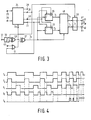
- Fig. 3 shows a version of the jump-signal generator 14. It comprises a control-signal generator 24 on whose input 25 a signal appears which via input 11 indicates the number of tracks to be jumped and on whose input 26 a starting signal from a comparator 13 (Fig. 1) appears. On an output 28 a signal appears which sets the switch 23 to the position shown in Fig. 1 for the duration of the jump. On an output 29 a signal appears which indicates the direction of the jump.
- the radial tracking-error signal generator 15 is applied to an input 27.
- the signal is converted into a squarewave signal which when the laser beam moves over the tracks in the radial direction exhibits a period corresponding to the time interval between the consecutive track passages and has edges appearing in the centre of the tracks and midway between the tracks.
- an exclusive-OR-circuit 33 the signal is logically combined with the direction signal on output 29, so that a signal is obtained which is independent of the direction of the jump. This signal is applied to input 34 of the control-signal generator 24 which counts the number of tracks passed by means of this signal.
- control-signal generator 24 supplies a logic signal from an instant which appears a fixed time, for example 350 psecs after the start of the jump until the end of the jump, and on output 31 the control-signal generator supplies a logic signal from the beginning of the jump until an instant at which the number of tracks to be jumped (n) minus a predetermined number of tracks (x) has been passed.
- the jump-signal generator further comprises a first monostable multivibrator circuit 35 which receives a trigger signal T s on an inverted trigger input T, and a second monostable multivibrator circuit 36 which receives the trigger signal T s on the trigger input T. Via an exclusive-or-gate 37 this trigger signal T s is supplied by the output of the exclusive-or-gate 33, the gate 37 transferring this signal when a logic "1" appears on the other input of this gate 37.
- the monostable multivibrator circuits 35 and 36 are triggered by the signal on output 30 of the control-signal generator 24 and their time constant, i.e. the length of the pulse supplied, is changed over by the signal on the output 31 of the control circuit.
- the monostable multivibrators 35 and 36 supply signals T 1 and T 2 , respectively, which are combined with the trigger signal T s in the logic circuit 48 to form the signals T h and T l in conformity with the relationships:
- the two multivibrators 35 and 36 and the circuit 48 will be described with reference to Fig. 4, which shows the signals T s , T 1 , T 2 , T l and T h .
- the signal T s is the limited tracking signal whose period is inversely proportional to the jumping speed.
- the multivibrator 35 supplies pulses of a fixed duration each starting at the trailing edges of the signal T s , whilst the multivibrator 36 supplies the same pulses starting at the leading edges.
- the resulting signal T then has a relative pulse width which is proportional to the positive difference between the pulse width of the signal T s and the pulse width of the signals T 1 and T 2 , determined by the time constant of the multivibrators, or a relative pulse width which is a measure of the extent to which the jumping speed deviates in a negative sense from a nominal speed defined by the time constant of the multivibrators.
- the relative pulse width of the signal T h is a measure of the extent to which the jumping speed deviates from said nominal speed in a positive sense.
- the signals T h and T are applied to a commutator 38, which exchanges these signals depending on the jump direction indicated by the signal on output 29.
- Said signals Th and T, control switches 33 and 40 which supply a positive or a negative supply voltage to output 29 or which makes the output floating, so that the motor 7 accelerates, decelerates and freewheels, respectively.
- Fig. 5a represents the jumping speed v as a function of time.
- Figs. 5b, 5c and 5d represent the signals on outputs 28, 30 and 31 of the control-signal generator 24,
- Fig. 5e shows the limited radial tracking-error signal,
- Fig. 5f shows a control signal for the motor 7 on output 29.
- the comparator 13 supplies the starting command to input 26. Via output 28 (signal shown in Fig. 5b) switch 23 is changed over. Via output 31 (signal shown in Fig. 5d) the time constant of the multivibrators 35 and 36 is set to a small value corresponding to a high nominal jumping speed. Until an instant t 1 the signal on output 30 (signal shown in Fig. 5c) remains low, so that the two multivibrators are inoperative, the signals T, and T 2 are low, the signal T h is high and the signal T, is low. During the period to to t 1 the motor 7 is then accelerated continuously (see Fig. 5a).
- the two multivibrators are started and the signals T h and T, corresponding to the diagram shown in Fig. 4 are generated.
- the jump is then performed with a substantially constant speed.
- the signal on output 31 (Fig. 5d) switches the time constant of the multivibrators to a high value corresponding to a low nominal speed.
- the circuit then also generates a train of braking pulses T, until at instant t 3 this lower nominal speed is reached.
- the jump continues with said constant lower speed until at the instant t 4 the number of tracks to be jumped minus half a track is reached.
- the signal on output 28 resets the switch 23 (Fig. 1) and locking- in to the desired track is effected via the tracking mechanism.
- a signal on an input 42 is combined with the output signal of the exclusive-or-gate 33 by means of the signal on output 31 via an or-gate 41 and an exclusive-or-gate 37.
- a signal which is 90° phase-shifted relative to the limited radial error signal is applied to this input 42.
- the signal on output 31 is low, which is the case at the lower nominal speed, this signal is added to the limited radial tracking-error signal in the exclusive-or-gate 37, yielding a signal of twice the repetition frequency.
- the device shown in Fig. 3 may be designed so that for a jump of less than a predetermined number of tracks (for example 25) the signal on output 31 (Fig. 5d) is kept low throughout jumping period, so that the mirror is controlled directly towards the lower of the two speeds.
- the apparatus described herein may be formed partly, in particularly parts 9, 12, 13 and 24, by a microprocessor.
Landscapes
- Engineering & Computer Science (AREA)
- Multimedia (AREA)
- Signal Processing (AREA)
- Moving Of The Head For Recording And Reproducing By Optical Means (AREA)
- Optical Recording Or Reproduction (AREA)
- Processing And Handling Of Plastics And Other Materials For Molding In General (AREA)
- Indexing, Searching, Synchronizing, And The Amount Of Synchronization Travel Of Record Carriers (AREA)
- Television Signal Processing For Recording (AREA)
- Moving Of Head For Track Selection And Changing (AREA)
Claims (2)
Priority Applications (1)
| Application Number | Priority Date | Filing Date | Title |
|---|---|---|---|
| AT84201240T ATE40486T1 (de) | 1983-09-01 | 1984-08-28 | Vorrichtung zum lesen eines scheibenfoermigen aufzeichnungstraegers. |
Applications Claiming Priority (2)
| Application Number | Priority Date | Filing Date | Title |
|---|---|---|---|
| NL8303046A NL8303046A (nl) | 1983-09-01 | 1983-09-01 | Inrichting voor het uitlezen van een schijfvormige registratiedrager. |
| NL8303046 | 1983-09-01 |
Publications (2)
| Publication Number | Publication Date |
|---|---|
| EP0138245A1 EP0138245A1 (de) | 1985-04-24 |
| EP0138245B1 true EP0138245B1 (de) | 1989-01-25 |
Family
ID=19842334
Family Applications (1)
| Application Number | Title | Priority Date | Filing Date |
|---|---|---|---|
| EP84201240A Expired EP0138245B1 (de) | 1983-09-01 | 1984-08-28 | Vorrichtung zum Lesen eines scheibenförmigen Aufzeichnungsträgers |
Country Status (12)
| Country | Link |
|---|---|
| US (1) | US4567534A (de) |
| EP (1) | EP0138245B1 (de) |
| JP (1) | JPH0783461B2 (de) |
| KR (1) | KR920005261B1 (de) |
| AT (1) | ATE40486T1 (de) |
| AU (1) | AU572885B2 (de) |
| CA (1) | CA1235500A (de) |
| DE (1) | DE3476480D1 (de) |
| ES (1) | ES535485A0 (de) |
| HK (1) | HK82991A (de) |
| NL (1) | NL8303046A (de) |
| SG (1) | SG51190G (de) |
Families Citing this family (13)
| Publication number | Priority date | Publication date | Assignee | Title |
|---|---|---|---|---|
| JPS61104337A (ja) * | 1984-10-24 | 1986-05-22 | Hitachi Ltd | 光学的情報記録再生装置 |
| JPS6273430A (ja) * | 1985-09-26 | 1987-04-04 | Canon Inc | 光情報記録再生装置 |
| US5166805A (en) * | 1985-06-18 | 1992-11-24 | Pioneer Electronic Corporation | Disk player with a blanking during fast scanning |
| US4819219A (en) * | 1986-03-25 | 1989-04-04 | Kabushiki Kaisha Toshiba | Track jump control system for optical disk apparatus |
| US4862291A (en) * | 1986-11-14 | 1989-08-29 | Pioneer Electronic Corporation | Scanning system in information reproducing apparatus |
| EP0332708B1 (de) * | 1987-08-29 | 1994-01-12 | Fujitsu Limited | Methoden zum zugang einer optischen aufzeichnungsspur |
| US4897827A (en) * | 1987-12-12 | 1990-01-30 | U.S. Philips Corporation | Video disc player with rapid track access means |
| NL9002108A (nl) * | 1990-09-19 | 1992-04-16 | Koninkl Philips Electronics Nv | Registratiedrager waarop een hoofddatabestand en een besturingsdatabestand is opgetekend, een werkwijze en inrichting voor het optekenen van het hoofddatabestand en het besturingsbestand alsmede een inrichting voor het uitlezen van de registratiedrager. |
| EP0500927B1 (de) * | 1990-09-19 | 2001-05-02 | Koninklijke Philips Electronics N.V. | Bildwiederauffindungssystem |
| USRE40957E1 (en) | 1992-01-29 | 2009-11-10 | Panasonic Corporation | Medium, apparatus, and method related to encryption resultant information |
| US5473584A (en) * | 1992-01-29 | 1995-12-05 | Matsushita Electric Industrial Co., Ltd. | Recording and reproducing apparatus |
| EP0637016B1 (de) * | 1993-07-27 | 2001-03-07 | Matsushita Electric Industrial Co., Ltd. | Aufzeichnungs- und Wiedergabegerät |
| JP3826856B2 (ja) * | 2002-08-05 | 2006-09-27 | ソニー株式会社 | 再生制御装置と再生制御方法および再生制御プログラム |
Family Cites Families (13)
| Publication number | Priority date | Publication date | Assignee | Title |
|---|---|---|---|---|
| FR2349191A1 (fr) * | 1976-04-23 | 1977-11-18 | Thomson Brandt | Lecteur optique de disque d'information comportant un dispositif d'acces automatique aux informations |
| FR2396379A1 (fr) * | 1977-07-01 | 1979-01-26 | Thomson Brandt | Lecteur optique de disque d'information muni d'un dispositif d'acces automatique aux informations |
| JPS576443A (en) * | 1980-06-13 | 1982-01-13 | Matsushita Electric Ind Co Ltd | Recorder and reproducer |
| JPS5753880A (en) * | 1980-09-12 | 1982-03-31 | Victor Co Of Japan Ltd | Detector of periodic signal |
| JPS5765075A (en) * | 1980-10-08 | 1982-04-20 | Trio Kenwood Corp | High speed reproduction method of video disc |
| JPS57104386A (en) * | 1980-12-19 | 1982-06-29 | Trio Kenwood Corp | Video disc playback device |
| JPS57120272A (en) * | 1981-01-14 | 1982-07-27 | Victor Co Of Japan Ltd | Reproducing device for discoid information recording medium |
| JPS57150173A (en) * | 1981-03-12 | 1982-09-16 | Victor Co Of Japan Ltd | Reproducer for disc shape information recording medium |
| JPS5862868A (ja) * | 1981-10-09 | 1983-04-14 | Pioneer Video Corp | 情報再生装置における高速アドレス情報探索方式 |
| JPS5896474A (ja) * | 1981-12-04 | 1983-06-08 | Matsushita Electric Ind Co Ltd | ビデオデイスク再生装置 |
| JPS58171730A (ja) * | 1982-03-31 | 1983-10-08 | Sony Corp | デイスク再生装置 |
| US4536863A (en) * | 1982-04-15 | 1985-08-20 | Discovision Associates | Method and apparatus for recovering information from a videodisc |
| JPS58196047U (ja) * | 1982-06-18 | 1983-12-27 | 日立精機株式会社 | 減速装置 |
-
1983
- 1983-09-01 NL NL8303046A patent/NL8303046A/nl not_active Application Discontinuation
- 1983-12-07 US US06/559,064 patent/US4567534A/en not_active Expired - Fee Related
-
1984
- 1984-08-28 EP EP84201240A patent/EP0138245B1/de not_active Expired
- 1984-08-28 DE DE8484201240T patent/DE3476480D1/de not_active Expired
- 1984-08-28 AT AT84201240T patent/ATE40486T1/de active
- 1984-08-29 ES ES535485A patent/ES535485A0/es active Granted
- 1984-08-30 CA CA000462123A patent/CA1235500A/en not_active Expired
- 1984-08-31 AU AU32585/84A patent/AU572885B2/en not_active Ceased
- 1984-08-31 JP JP59182520A patent/JPH0783461B2/ja not_active Expired - Lifetime
- 1984-09-01 KR KR1019840005382A patent/KR920005261B1/ko not_active Expired
-
1990
- 1990-07-04 SG SG511/90A patent/SG51190G/en unknown
-
1991
- 1991-10-24 HK HK829/91A patent/HK82991A/xx unknown
Also Published As
| Publication number | Publication date |
|---|---|
| US4567534A (en) | 1986-01-28 |
| AU572885B2 (en) | 1988-05-19 |
| AU3258584A (en) | 1985-03-07 |
| HK82991A (en) | 1991-11-01 |
| EP0138245A1 (de) | 1985-04-24 |
| ES8505486A1 (es) | 1985-05-16 |
| JPS6090480A (ja) | 1985-05-21 |
| DE3476480D1 (en) | 1989-03-02 |
| ATE40486T1 (de) | 1989-02-15 |
| CA1235500A (en) | 1988-04-19 |
| ES535485A0 (es) | 1985-05-16 |
| JPH0783461B2 (ja) | 1995-09-06 |
| KR920005261B1 (ko) | 1992-06-29 |
| KR850002535A (ko) | 1985-05-13 |
| SG51190G (en) | 1990-08-31 |
| NL8303046A (nl) | 1985-04-01 |
Similar Documents
| Publication | Publication Date | Title |
|---|---|---|
| US4338682A (en) | Tracking servo system of video disc player | |
| EP0138245B1 (de) | Vorrichtung zum Lesen eines scheibenförmigen Aufzeichnungsträgers | |
| JPH0519356B2 (de) | ||
| US4397009A (en) | Device for locating a desired information track | |
| US4539664A (en) | Control system for optical information signal reproduction device | |
| EP0236944B1 (de) | Verfahren und Vorrichtung zur Wiedergabe von auf eine Speicherdiskette gespeicherte Daten | |
| JP2781683B2 (ja) | 記録情報の再生装置 | |
| KR880001001B1 (ko) | 디스크 플레이어 | |
| US5097365A (en) | Automatic tracking apparatus for magnetic disk playback head | |
| US5105406A (en) | Track-jumping servo apparatus for disc-shaped optical record medium | |
| EP0152141B1 (de) | System zum Abspielen eines Programms aufgenommen auf einem scheibenförmigen Aufnahmeträger | |
| KR910006076B1 (ko) | 디스크 재생장치 | |
| JPS6047274A (ja) | 情報信号の高速サ−チ方法 | |
| JPH0197076A (ja) | フレームインデツクス磁気記録再生装置 | |
| JP2725278B2 (ja) | ビデオディスクプレーヤ | |
| JPS60160274A (ja) | スロ−再生方法 | |
| JPH039554B2 (de) | ||
| JP3028871B2 (ja) | 光ディスクの記録再生装置 | |
| KR890004244B1 (ko) | 슬로우 재생방법 | |
| JP2725277B2 (ja) | ビデオディスクプレーヤ | |
| KR100520945B1 (ko) | 광픽업장치의트랙이동방법 | |
| KR900002880Y1 (ko) | 비디오 디스크 플레이어의 스캔시 트랙스위치제어회로 | |
| JP2639601B2 (ja) | 光ディスク装置における速度検出装置 | |
| JPS5883369A (ja) | 記録情報の再生方法 | |
| JPH0664747B2 (ja) | 光デイスク装置のトラツクジヤンプ回路 |
Legal Events
| Date | Code | Title | Description |
|---|---|---|---|
| PUAI | Public reference made under article 153(3) epc to a published international application that has entered the european phase |
Free format text: ORIGINAL CODE: 0009012 |
|
| AK | Designated contracting states |
Designated state(s): AT BE DE FR GB IT SE |
|
| 17P | Request for examination filed |
Effective date: 19851016 |
|
| 17Q | First examination report despatched |
Effective date: 19861218 |
|
| D17Q | First examination report despatched (deleted) | ||
| GRAA | (expected) grant |
Free format text: ORIGINAL CODE: 0009210 |
|
| AK | Designated contracting states |
Kind code of ref document: B1 Designated state(s): AT BE DE FR GB IT SE |
|
| REF | Corresponds to: |
Ref document number: 40486 Country of ref document: AT Date of ref document: 19890215 Kind code of ref document: T |
|
| REF | Corresponds to: |
Ref document number: 3476480 Country of ref document: DE Date of ref document: 19890302 |
|
| ITF | It: translation for a ep patent filed | ||
| ET | Fr: translation filed | ||
| PLBE | No opposition filed within time limit |
Free format text: ORIGINAL CODE: 0009261 |
|
| STAA | Information on the status of an ep patent application or granted ep patent |
Free format text: STATUS: NO OPPOSITION FILED WITHIN TIME LIMIT |
|
| 26N | No opposition filed | ||
| ITTA | It: last paid annual fee | ||
| PGFP | Annual fee paid to national office [announced via postgrant information from national office to epo] |
Ref country code: GB Payment date: 19940728 Year of fee payment: 11 |
|
| PGFP | Annual fee paid to national office [announced via postgrant information from national office to epo] |
Ref country code: BE Payment date: 19940808 Year of fee payment: 11 |
|
| PGFP | Annual fee paid to national office [announced via postgrant information from national office to epo] |
Ref country code: AT Payment date: 19940824 Year of fee payment: 11 |
|
| PGFP | Annual fee paid to national office [announced via postgrant information from national office to epo] |
Ref country code: FR Payment date: 19940825 Year of fee payment: 11 |
|
| PGFP | Annual fee paid to national office [announced via postgrant information from national office to epo] |
Ref country code: SE Payment date: 19940826 Year of fee payment: 11 |
|
| PGFP | Annual fee paid to national office [announced via postgrant information from national office to epo] |
Ref country code: DE Payment date: 19941026 Year of fee payment: 11 |
|
| EAL | Se: european patent in force in sweden |
Ref document number: 84201240.3 |
|
| ITPR | It: changes in ownership of a european patent |
Owner name: CAMBIO RAGIONE SOCIALE;PHILIPS ELECTRONICS N.V. |
|
| PG25 | Lapsed in a contracting state [announced via postgrant information from national office to epo] |
Ref country code: GB Effective date: 19950828 Ref country code: AT Effective date: 19950828 |
|
| PG25 | Lapsed in a contracting state [announced via postgrant information from national office to epo] |
Ref country code: SE Effective date: 19950829 |
|
| PG25 | Lapsed in a contracting state [announced via postgrant information from national office to epo] |
Ref country code: BE Effective date: 19950831 |
|
| BERE | Be: lapsed |
Owner name: PHILIPS ELECTRONICS N.V. Effective date: 19950831 |
|
| GBPC | Gb: european patent ceased through non-payment of renewal fee |
Effective date: 19950828 |
|
| PG25 | Lapsed in a contracting state [announced via postgrant information from national office to epo] |
Ref country code: FR Effective date: 19960430 |
|
| PG25 | Lapsed in a contracting state [announced via postgrant information from national office to epo] |
Ref country code: DE Effective date: 19960501 |
|
| EUG | Se: european patent has lapsed |
Ref document number: 84201240.3 |
|
| REG | Reference to a national code |
Ref country code: FR Ref legal event code: ST |