EP0133674A1 - Neue Nitroxylverbindungen, Verfahren zu deren Herstellung und diese enthaltende diagnostische Mittel - Google Patents
Neue Nitroxylverbindungen, Verfahren zu deren Herstellung und diese enthaltende diagnostische Mittel Download PDFInfo
- Publication number
- EP0133674A1 EP0133674A1 EP84108900A EP84108900A EP0133674A1 EP 0133674 A1 EP0133674 A1 EP 0133674A1 EP 84108900 A EP84108900 A EP 84108900A EP 84108900 A EP84108900 A EP 84108900A EP 0133674 A1 EP0133674 A1 EP 0133674A1
- Authority
- EP
- European Patent Office
- Prior art keywords
- carboxylic acid
- oxyl
- amide
- tetramethyl
- pyrroline
- Prior art date
- Legal status (The legal status is an assumption and is not a legal conclusion. Google has not performed a legal analysis and makes no representation as to the accuracy of the status listed.)
- Granted
Links
- 239000000032 diagnostic agent Substances 0.000 title claims description 13
- 229940039227 diagnostic agent Drugs 0.000 title claims description 13
- 238000000034 method Methods 0.000 title claims description 10
- 238000002360 preparation method Methods 0.000 title claims description 8
- ODUCDPQEXGNKDN-UHFFFAOYSA-N nitroxyl Chemical class O=N ODUCDPQEXGNKDN-UHFFFAOYSA-N 0.000 title description 2
- 150000001875 compounds Chemical class 0.000 claims abstract description 26
- 125000002887 hydroxy group Chemical group [H]O* 0.000 claims abstract description 10
- 125000004435 hydrogen atom Chemical group [H]* 0.000 claims abstract description 4
- -1 2,2-dimethyl-1,3-dioxolan-4-ylmethyl Chemical group 0.000 claims description 59
- SADYUZSTFFUBBP-UHFFFAOYSA-N 1-hydroxy-2,2,5,5-tetramethyl-1h-pyrrol-1-ium-3-carboxylate Chemical compound CC1(C)C=C(C(O)=O)C(C)(C)N1O SADYUZSTFFUBBP-UHFFFAOYSA-N 0.000 claims description 29
- 150000001408 amides Chemical class 0.000 claims description 15
- KDYFGRWQOYBRFD-UHFFFAOYSA-N succinic acid Chemical compound OC(=O)CCC(O)=O KDYFGRWQOYBRFD-UHFFFAOYSA-N 0.000 claims description 14
- KJJPLEZQSCZCKE-UHFFFAOYSA-N 2-aminopropane-1,3-diol Chemical compound OCC(N)CO KJJPLEZQSCZCKE-UHFFFAOYSA-N 0.000 claims description 13
- QTBSBXVTEAMEQO-UHFFFAOYSA-N Acetic acid Chemical compound CC(O)=O QTBSBXVTEAMEQO-UHFFFAOYSA-N 0.000 claims description 12
- BXRMFUZPBYHYSM-UHFFFAOYSA-N 6-amino-2,2-dimethyl-1,3-dioxepan-5-ol Chemical compound CC1(C)OCC(N)C(O)CO1 BXRMFUZPBYHYSM-UHFFFAOYSA-N 0.000 claims description 11
- KQIGMPWTAHJUMN-UHFFFAOYSA-N 3-aminopropane-1,2-diol Chemical compound NCC(O)CO KQIGMPWTAHJUMN-UHFFFAOYSA-N 0.000 claims description 8
- 150000001735 carboxylic acids Chemical class 0.000 claims description 8
- 108090000623 proteins and genes Proteins 0.000 claims description 7
- 102000004169 proteins and genes Human genes 0.000 claims description 7
- 239000001384 succinic acid Substances 0.000 claims description 7
- MKDRHMDHWIBVRH-UHFFFAOYSA-N 2-amino-1-(2,2-dimethyl-1,3-dioxolan-4-yl)ethanol Chemical compound CC1(C)OCC(C(O)CN)O1 MKDRHMDHWIBVRH-UHFFFAOYSA-N 0.000 claims description 6
- WOMTYMDHLQTCHY-UHFFFAOYSA-N 3-methylamino-1,2-propanediol Chemical compound CNCC(O)CO WOMTYMDHLQTCHY-UHFFFAOYSA-N 0.000 claims description 6
- 150000001412 amines Chemical class 0.000 claims description 6
- 150000002632 lipids Chemical group 0.000 claims description 6
- PMLGQXIKBPFHJZ-UHFFFAOYSA-N 3-aminobutane-1,2,4-triol Chemical compound OCC(N)C(O)CO PMLGQXIKBPFHJZ-UHFFFAOYSA-N 0.000 claims description 5
- WIFPJDJJFUSIFP-UHFFFAOYSA-N 4-aminobutane-1,2,3-triol Chemical compound NCC(O)C(O)CO WIFPJDJJFUSIFP-UHFFFAOYSA-N 0.000 claims description 5
- OAKJQQAXSVQMHS-UHFFFAOYSA-N Hydrazine Chemical compound NN OAKJQQAXSVQMHS-UHFFFAOYSA-N 0.000 claims description 5
- 125000001495 ethyl group Chemical group [H]C([H])([H])C([H])([H])* 0.000 claims description 5
- ZBCBWPMODOFKDW-UHFFFAOYSA-N diethanolamine Chemical compound OCCNCCO ZBCBWPMODOFKDW-UHFFFAOYSA-N 0.000 claims description 4
- 239000002502 liposome Substances 0.000 claims description 4
- HXOYWCSTHVTLOW-UHFFFAOYSA-N (2,2-dimethyl-1,3-dioxolan-4-yl)methanamine Chemical compound CC1(C)OCC(CN)O1 HXOYWCSTHVTLOW-UHFFFAOYSA-N 0.000 claims description 3
- QILCUDCYZVIAQH-UHFFFAOYSA-N 1-$l^{1}-oxidanyl-2,2,5,5-tetramethylpyrrole-3-carboxylic acid Chemical compound CC1(C)C=C(C(O)=O)C(C)(C)N1[O] QILCUDCYZVIAQH-UHFFFAOYSA-N 0.000 claims description 2
- 230000000269 nucleophilic effect Effects 0.000 claims description 2
- HZAXFHJVJLSVMW-UHFFFAOYSA-N 2-Aminoethan-1-ol Chemical compound NCCO HZAXFHJVJLSVMW-UHFFFAOYSA-N 0.000 claims 2
- 125000002252 acyl group Chemical group 0.000 claims 1
- 125000000217 alkyl group Chemical group 0.000 abstract description 7
- 125000004423 acyloxy group Chemical group 0.000 abstract description 2
- RTZKZFJDLAIYFH-UHFFFAOYSA-N Diethyl ether Chemical compound CCOCC RTZKZFJDLAIYFH-UHFFFAOYSA-N 0.000 description 96
- 239000000243 solution Substances 0.000 description 59
- WYURNTSHIVDZCO-UHFFFAOYSA-N Tetrahydrofuran Chemical compound C1CCOC1 WYURNTSHIVDZCO-UHFFFAOYSA-N 0.000 description 52
- YMWUJEATGCHHMB-UHFFFAOYSA-N Dichloromethane Chemical compound ClCCl YMWUJEATGCHHMB-UHFFFAOYSA-N 0.000 description 50
- ZMANZCXQSJIPKH-UHFFFAOYSA-N Triethylamine Chemical compound CCN(CC)CC ZMANZCXQSJIPKH-UHFFFAOYSA-N 0.000 description 42
- XLYOFNOQVPJJNP-UHFFFAOYSA-N water Substances O XLYOFNOQVPJJNP-UHFFFAOYSA-N 0.000 description 38
- LFQSCWFLJHTTHZ-UHFFFAOYSA-N Ethanol Chemical compound CCO LFQSCWFLJHTTHZ-UHFFFAOYSA-N 0.000 description 36
- 239000000203 mixture Substances 0.000 description 32
- 238000003756 stirring Methods 0.000 description 27
- YLQBMQCUIZJEEH-UHFFFAOYSA-N tetrahydrofuran Natural products C=1C=COC=1 YLQBMQCUIZJEEH-UHFFFAOYSA-N 0.000 description 26
- 229960004132 diethyl ether Drugs 0.000 description 24
- 235000020357 syrup Nutrition 0.000 description 22
- JUJWROOIHBZHMG-UHFFFAOYSA-N Pyridine Chemical compound C1=CC=NC=C1 JUJWROOIHBZHMG-UHFFFAOYSA-N 0.000 description 20
- 238000002844 melting Methods 0.000 description 19
- 230000008018 melting Effects 0.000 description 19
- 238000001816 cooling Methods 0.000 description 17
- 239000006188 syrup Substances 0.000 description 17
- QAOWNCQODCNURD-UHFFFAOYSA-N Sulfuric acid Chemical compound OS(O)(=O)=O QAOWNCQODCNURD-UHFFFAOYSA-N 0.000 description 16
- XEKOWRVHYACXOJ-UHFFFAOYSA-N Ethyl acetate Chemical compound CCOC(C)=O XEKOWRVHYACXOJ-UHFFFAOYSA-N 0.000 description 15
- XKRFYHLGVUSROY-UHFFFAOYSA-N Argon Chemical compound [Ar] XKRFYHLGVUSROY-UHFFFAOYSA-N 0.000 description 12
- 239000012153 distilled water Substances 0.000 description 11
- NHQDETIJWKXCTC-UHFFFAOYSA-N 3-chloroperbenzoic acid Chemical compound OOC(=O)C1=CC=CC(Cl)=C1 NHQDETIJWKXCTC-UHFFFAOYSA-N 0.000 description 10
- KFZMGEQAYNKOFK-UHFFFAOYSA-N Isopropanol Chemical compound CC(C)O KFZMGEQAYNKOFK-UHFFFAOYSA-N 0.000 description 10
- MBBZMMPHUWSWHV-BDVNFPICSA-N N-methylglucamine Chemical compound CNC[C@H](O)[C@@H](O)[C@H](O)[C@H](O)CO MBBZMMPHUWSWHV-BDVNFPICSA-N 0.000 description 10
- PMZURENOXWZQFD-UHFFFAOYSA-L Sodium Sulfate Chemical compound [Na+].[Na+].[O-]S([O-])(=O)=O PMZURENOXWZQFD-UHFFFAOYSA-L 0.000 description 10
- RIFGWPKJUGCATF-UHFFFAOYSA-N ethyl chloroformate Chemical compound CCOC(Cl)=O RIFGWPKJUGCATF-UHFFFAOYSA-N 0.000 description 10
- VLKZOEOYAKHREP-UHFFFAOYSA-N n-Hexane Chemical compound CCCCCC VLKZOEOYAKHREP-UHFFFAOYSA-N 0.000 description 10
- 229910052938 sodium sulfate Inorganic materials 0.000 description 10
- 235000011152 sodium sulphate Nutrition 0.000 description 10
- 150000002500 ions Chemical class 0.000 description 9
- 239000007787 solid Substances 0.000 description 9
- KFSLWBXXFJQRDL-UHFFFAOYSA-N Peracetic acid Chemical compound CC(=O)OO KFSLWBXXFJQRDL-UHFFFAOYSA-N 0.000 description 8
- 229920001429 chelating resin Polymers 0.000 description 8
- 239000003921 oil Substances 0.000 description 8
- 235000019198 oils Nutrition 0.000 description 8
- 239000002253 acid Substances 0.000 description 7
- 150000008064 anhydrides Chemical class 0.000 description 7
- UMJSCPRVCHMLSP-UHFFFAOYSA-N pyridine Natural products COC1=CC=CN=C1 UMJSCPRVCHMLSP-UHFFFAOYSA-N 0.000 description 7
- HQOIHPZSNFLRRG-UHFFFAOYSA-N 2,2,5,5-tetramethyl-1h-pyrrole-3-carboxylic acid Chemical compound CC1(C)NC(C)(C)C(C(O)=O)=C1 HQOIHPZSNFLRRG-UHFFFAOYSA-N 0.000 description 6
- IAZDPXIOMUYVGZ-UHFFFAOYSA-N Dimethylsulphoxide Chemical compound CS(C)=O IAZDPXIOMUYVGZ-UHFFFAOYSA-N 0.000 description 6
- OKKJLVBELUTLKV-UHFFFAOYSA-N Methanol Chemical compound OC OKKJLVBELUTLKV-UHFFFAOYSA-N 0.000 description 6
- ZMXDDKWLCZADIW-UHFFFAOYSA-N N,N-Dimethylformamide Chemical compound CN(C)C=O ZMXDDKWLCZADIW-UHFFFAOYSA-N 0.000 description 6
- HEMHJVSKTPXQMS-UHFFFAOYSA-M Sodium hydroxide Chemical compound [OH-].[Na+] HEMHJVSKTPXQMS-UHFFFAOYSA-M 0.000 description 6
- 229910052786 argon Inorganic materials 0.000 description 6
- 125000004432 carbon atom Chemical group C* 0.000 description 6
- 239000012074 organic phase Substances 0.000 description 6
- 125000001424 substituent group Chemical group 0.000 description 6
- VMHVSXXACDJVRL-UHFFFAOYSA-N 3,5-dibromo-2,2,6,6-tetramethylpiperidin-4-one;hydron;bromide Chemical compound Br.CC1(C)NC(C)(C)C(Br)C(=O)C1Br VMHVSXXACDJVRL-UHFFFAOYSA-N 0.000 description 5
- 101100476962 Drosophila melanogaster Sirup gene Proteins 0.000 description 5
- UIIMBOGNXHQVGW-UHFFFAOYSA-M Sodium bicarbonate Chemical compound [Na+].OC([O-])=O UIIMBOGNXHQVGW-UHFFFAOYSA-M 0.000 description 5
- GZCGUPFRVQAUEE-SLPGGIOYSA-N aldehydo-D-glucose Chemical compound OC[C@@H](O)[C@@H](O)[C@H](O)[C@@H](O)C=O GZCGUPFRVQAUEE-SLPGGIOYSA-N 0.000 description 5
- YWHVVZAJJYNTFN-UHFFFAOYSA-N n-[2-(2,2-dimethyl-1,3-dioxolan-4-yl)-2-hydroxyethyl]-2,2,5,5-tetramethyl-1h-pyrrole-3-carboxamide Chemical compound O1C(C)(C)OCC1C(O)CNC(=O)C1=CC(C)(C)NC1(C)C YWHVVZAJJYNTFN-UHFFFAOYSA-N 0.000 description 5
- 239000000047 product Substances 0.000 description 5
- UZWBDSQDACNUFX-UHFFFAOYSA-N 2-(1-hydroxy-2,2,6,6-tetramethylpiperidin-4-yl)acetic acid Chemical compound CC1(C)CC(CC(O)=O)CC(C)(C)N1O UZWBDSQDACNUFX-UHFFFAOYSA-N 0.000 description 4
- 241000212977 Andira Species 0.000 description 4
- IJGRMHOSHXDMSA-UHFFFAOYSA-N Atomic nitrogen Chemical compound N#N IJGRMHOSHXDMSA-UHFFFAOYSA-N 0.000 description 4
- MHAJPDPJQMAIIY-UHFFFAOYSA-N Hydrogen peroxide Chemical compound OO MHAJPDPJQMAIIY-UHFFFAOYSA-N 0.000 description 4
- VYPSYNLAJGMNEJ-UHFFFAOYSA-N Silicium dioxide Chemical compound O=[Si]=O VYPSYNLAJGMNEJ-UHFFFAOYSA-N 0.000 description 4
- VMHLLURERBWHNL-UHFFFAOYSA-M Sodium acetate Chemical compound [Na+].CC([O-])=O VMHLLURERBWHNL-UHFFFAOYSA-M 0.000 description 4
- 239000007864 aqueous solution Substances 0.000 description 4
- 230000015572 biosynthetic process Effects 0.000 description 4
- HPSIPBFCPDOZHT-UHFFFAOYSA-N methyl 2,2,5,5-tetramethylpyrrolidine-3-carboxylate Chemical compound COC(=O)C1CC(C)(C)NC1(C)C HPSIPBFCPDOZHT-UHFFFAOYSA-N 0.000 description 4
- LPNYRYFBWFDTMA-UHFFFAOYSA-N potassium tert-butoxide Chemical compound [K+].CC(C)(C)[O-] LPNYRYFBWFDTMA-UHFFFAOYSA-N 0.000 description 4
- 239000001632 sodium acetate Substances 0.000 description 4
- 235000017281 sodium acetate Nutrition 0.000 description 4
- FSPTUZZVVXTEON-UHFFFAOYSA-N 2,2,5,5-tetramethylpyrrolidine-3-carboxylic acid Chemical compound CC1(C)CC(C(O)=O)C(C)(C)N1 FSPTUZZVVXTEON-UHFFFAOYSA-N 0.000 description 3
- QOSSAOTZNIDXMA-UHFFFAOYSA-N Dicylcohexylcarbodiimide Chemical compound C1CCCCC1N=C=NC1CCCCC1 QOSSAOTZNIDXMA-UHFFFAOYSA-N 0.000 description 3
- DGAQECJNVWCQMB-PUAWFVPOSA-M Ilexoside XXIX Chemical compound C[C@@H]1CC[C@@]2(CC[C@@]3(C(=CC[C@H]4[C@]3(CC[C@@H]5[C@@]4(CC[C@@H](C5(C)C)OS(=O)(=O)[O-])C)C)[C@@H]2[C@]1(C)O)C)C(=O)O[C@H]6[C@@H]([C@H]([C@@H]([C@H](O6)CO)O)O)O.[Na+] DGAQECJNVWCQMB-PUAWFVPOSA-M 0.000 description 3
- 239000003054 catalyst Substances 0.000 description 3
- KRKNYBCHXYNGOX-UHFFFAOYSA-N citric acid Chemical compound OC(=O)CC(O)(C(O)=O)CC(O)=O KRKNYBCHXYNGOX-UHFFFAOYSA-N 0.000 description 3
- 239000007924 injection Substances 0.000 description 3
- 238000002347 injection Methods 0.000 description 3
- XFCLEYXFQGOMCT-UHFFFAOYSA-N methyl 2,2,5,5-tetramethyl-1h-pyrrole-3-carboxylate Chemical compound COC(=O)C1=CC(C)(C)NC1(C)C XFCLEYXFQGOMCT-UHFFFAOYSA-N 0.000 description 3
- 239000002504 physiological saline solution Substances 0.000 description 3
- 238000001953 recrystallisation Methods 0.000 description 3
- 229910052708 sodium Inorganic materials 0.000 description 3
- 239000011734 sodium Substances 0.000 description 3
- 239000000126 substance Substances 0.000 description 3
- USGBLEMQARVRDC-UHFFFAOYSA-N 1-hydroxy-2,2,5,5-tetramethylpyrrolidin-3-amine Chemical compound CC1(C)CC(N)C(C)(C)N1O USGBLEMQARVRDC-UHFFFAOYSA-N 0.000 description 2
- FALRKNHUBBKYCC-UHFFFAOYSA-N 2-(chloromethyl)pyridine-3-carbonitrile Chemical compound ClCC1=NC=CC=C1C#N FALRKNHUBBKYCC-UHFFFAOYSA-N 0.000 description 2
- FERIUCNNQQJTOY-UHFFFAOYSA-N Butyric acid Chemical compound CCCC(O)=O FERIUCNNQQJTOY-UHFFFAOYSA-N 0.000 description 2
- OKTJSMMVPCPJKN-UHFFFAOYSA-N Carbon Chemical compound [C] OKTJSMMVPCPJKN-UHFFFAOYSA-N 0.000 description 2
- 241000699670 Mus sp. Species 0.000 description 2
- OFBQJSOFQDEBGM-UHFFFAOYSA-N Pentane Chemical compound CCCCC OFBQJSOFQDEBGM-UHFFFAOYSA-N 0.000 description 2
- 239000007868 Raney catalyst Substances 0.000 description 2
- NPXOKRUENSOPAO-UHFFFAOYSA-N Raney nickel Chemical compound [Al].[Ni] NPXOKRUENSOPAO-UHFFFAOYSA-N 0.000 description 2
- 229910000564 Raney nickel Inorganic materials 0.000 description 2
- CDBYLPFSWZWCQE-UHFFFAOYSA-L Sodium Carbonate Chemical compound [Na+].[Na+].[O-]C([O-])=O CDBYLPFSWZWCQE-UHFFFAOYSA-L 0.000 description 2
- PXIPVTKHYLBLMZ-UHFFFAOYSA-N Sodium azide Chemical compound [Na+].[N-]=[N+]=[N-] PXIPVTKHYLBLMZ-UHFFFAOYSA-N 0.000 description 2
- WQDUMFSSJAZKTM-UHFFFAOYSA-N Sodium methoxide Chemical compound [Na+].[O-]C WQDUMFSSJAZKTM-UHFFFAOYSA-N 0.000 description 2
- 150000007513 acids Chemical class 0.000 description 2
- 229910052799 carbon Inorganic materials 0.000 description 2
- PFKFTWBEEFSNDU-UHFFFAOYSA-N carbonyldiimidazole Chemical compound C1=CN=CN1C(=O)N1C=CN=C1 PFKFTWBEEFSNDU-UHFFFAOYSA-N 0.000 description 2
- FZFAMSAMCHXGEF-UHFFFAOYSA-N chloro formate Chemical compound ClOC=O FZFAMSAMCHXGEF-UHFFFAOYSA-N 0.000 description 2
- HVYWMOMLDIMFJA-DPAQBDIFSA-N cholesterol Chemical compound C1C=C2C[C@@H](O)CC[C@]2(C)[C@@H]2[C@@H]1[C@@H]1CC[C@H]([C@H](C)CCCC(C)C)[C@@]1(C)CC2 HVYWMOMLDIMFJA-DPAQBDIFSA-N 0.000 description 2
- 238000004587 chromatography analysis Methods 0.000 description 2
- 239000013078 crystal Substances 0.000 description 2
- 238000002425 crystallisation Methods 0.000 description 2
- 230000008025 crystallization Effects 0.000 description 2
- XBDQKXXYIPTUBI-UHFFFAOYSA-N dimethylselenoniopropionate Natural products CCC(O)=O XBDQKXXYIPTUBI-UHFFFAOYSA-N 0.000 description 2
- 238000001035 drying Methods 0.000 description 2
- 239000003480 eluent Substances 0.000 description 2
- 150000002148 esters Chemical class 0.000 description 2
- DLLJVQNYBYOKGS-UHFFFAOYSA-N ethoxyethane;pentane Chemical compound CCCCC.CCOCC DLLJVQNYBYOKGS-UHFFFAOYSA-N 0.000 description 2
- 239000007789 gas Substances 0.000 description 2
- FUZZWVXGSFPDMH-UHFFFAOYSA-N hexanoic acid Chemical compound CCCCCC(O)=O FUZZWVXGSFPDMH-UHFFFAOYSA-N 0.000 description 2
- KQNPFQTWMSNSAP-UHFFFAOYSA-N isobutyric acid Chemical compound CC(C)C(O)=O KQNPFQTWMSNSAP-UHFFFAOYSA-N 0.000 description 2
- 125000001449 isopropyl group Chemical group [H]C([H])([H])C([H])(*)C([H])([H])[H] 0.000 description 2
- 210000004185 liver Anatomy 0.000 description 2
- XMJHPCRAQCTCFT-UHFFFAOYSA-N methyl chloroformate Chemical compound COC(Cl)=O XMJHPCRAQCTCFT-UHFFFAOYSA-N 0.000 description 2
- 125000002496 methyl group Chemical group [H]C([H])([H])* 0.000 description 2
- CTXPMKBXTRECDE-UHFFFAOYSA-N n-[(2,2-dimethyl-1,3-dioxolan-4-yl)methyl]-n,2,2,5,5-pentamethyl-1h-pyrrole-3-carboxamide Chemical compound C=1C(C)(C)NC(C)(C)C=1C(=O)N(C)CC1COC(C)(C)O1 CTXPMKBXTRECDE-UHFFFAOYSA-N 0.000 description 2
- 230000007935 neutral effect Effects 0.000 description 2
- 229910052757 nitrogen Inorganic materials 0.000 description 2
- 125000001436 propyl group Chemical group [H]C([*])([H])C([H])([H])C([H])([H])[H] 0.000 description 2
- 239000000741 silica gel Substances 0.000 description 2
- 229910002027 silica gel Inorganic materials 0.000 description 2
- 210000000952 spleen Anatomy 0.000 description 2
- 229940014800 succinic anhydride Drugs 0.000 description 2
- QAEDZJGFFMLHHQ-UHFFFAOYSA-N trifluoroacetic anhydride Chemical compound FC(F)(F)C(=O)OC(=O)C(F)(F)F QAEDZJGFFMLHHQ-UHFFFAOYSA-N 0.000 description 2
- NQPDZGIKBAWPEJ-UHFFFAOYSA-N valeric acid Chemical compound CCCCC(O)=O NQPDZGIKBAWPEJ-UHFFFAOYSA-N 0.000 description 2
- 238000005406 washing Methods 0.000 description 2
- SLKDGVPOSSLUAI-PGUFJCEWSA-N 1,2-dihexadecanoyl-sn-glycero-3-phosphoethanolamine zwitterion Chemical compound CCCCCCCCCCCCCCCC(=O)OC[C@H](COP(O)(=O)OCCN)OC(=O)CCCCCCCCCCCCCCC SLKDGVPOSSLUAI-PGUFJCEWSA-N 0.000 description 1
- FVHAWXWFPBPFOS-UHFFFAOYSA-N 1,2-dimethyl-3-nitrobenzene Chemical group CC1=CC=CC([N+]([O-])=O)=C1C FVHAWXWFPBPFOS-UHFFFAOYSA-N 0.000 description 1
- RYHBNJHYFVUHQT-UHFFFAOYSA-N 1,4-Dioxane Chemical compound C1COCCO1 RYHBNJHYFVUHQT-UHFFFAOYSA-N 0.000 description 1
- 125000004066 1-hydroxyethyl group Chemical group [H]OC([H])([*])C([H])([H])[H] 0.000 description 1
- SIJBDWPVNAYVGY-UHFFFAOYSA-N 2,2-dimethyl-1,3-dioxolane Chemical compound CC1(C)OCCO1 SIJBDWPVNAYVGY-UHFFFAOYSA-N 0.000 description 1
- NGNBDVOYPDDBFK-UHFFFAOYSA-N 2-[2,4-di(pentan-2-yl)phenoxy]acetyl chloride Chemical compound CCCC(C)C1=CC=C(OCC(Cl)=O)C(C(C)CCC)=C1 NGNBDVOYPDDBFK-UHFFFAOYSA-N 0.000 description 1
- CDAWCLOXVUBKRW-UHFFFAOYSA-N 2-aminophenol Chemical compound NC1=CC=CC=C1O CDAWCLOXVUBKRW-UHFFFAOYSA-N 0.000 description 1
- 125000000954 2-hydroxyethyl group Chemical group [H]C([*])([H])C([H])([H])O[H] 0.000 description 1
- YNJSNEKCXVFDKW-UHFFFAOYSA-N 3-(5-amino-1h-indol-3-yl)-2-azaniumylpropanoate Chemical compound C1=C(N)C=C2C(CC(N)C(O)=O)=CNC2=C1 YNJSNEKCXVFDKW-UHFFFAOYSA-N 0.000 description 1
- QOXOZONBQWIKDA-UHFFFAOYSA-N 3-hydroxypropyl Chemical compound [CH2]CCO QOXOZONBQWIKDA-UHFFFAOYSA-N 0.000 description 1
- XUXUHDYTLNCYQQ-UHFFFAOYSA-N 4-amino-TEMPO Chemical group CC1(C)CC(N)CC(C)(C)N1[O] XUXUHDYTLNCYQQ-UHFFFAOYSA-N 0.000 description 1
- QWMFKVNJIYNWII-UHFFFAOYSA-N 5-bromo-2-(2,5-dimethylpyrrol-1-yl)pyridine Chemical compound CC1=CC=C(C)N1C1=CC=C(Br)C=N1 QWMFKVNJIYNWII-UHFFFAOYSA-N 0.000 description 1
- NQRLWRODNCDUHY-UHFFFAOYSA-N 6-n,6-n,2-trimethylacridine-3,6-diamine Chemical compound C1=C(C)C(N)=CC2=NC3=CC(N(C)C)=CC=C3C=C21 NQRLWRODNCDUHY-UHFFFAOYSA-N 0.000 description 1
- 102000009027 Albumins Human genes 0.000 description 1
- 108010088751 Albumins Proteins 0.000 description 1
- BVKZGUZCCUSVTD-UHFFFAOYSA-M Bicarbonate Chemical compound OC([O-])=O BVKZGUZCCUSVTD-UHFFFAOYSA-M 0.000 description 1
- KCXVZYZYPLLWCC-UHFFFAOYSA-N EDTA Chemical compound OC(=O)CN(CC(O)=O)CCN(CC(O)=O)CC(O)=O KCXVZYZYPLLWCC-UHFFFAOYSA-N 0.000 description 1
- WQZGKKKJIJFFOK-GASJEMHNSA-N Glucose Natural products OC[C@H]1OC(O)[C@H](O)[C@@H](O)[C@@H]1O WQZGKKKJIJFFOK-GASJEMHNSA-N 0.000 description 1
- UFHFLCQGNIYNRP-UHFFFAOYSA-N Hydrogen Chemical compound [H][H] UFHFLCQGNIYNRP-UHFFFAOYSA-N 0.000 description 1
- CPELXLSAUQHCOX-UHFFFAOYSA-N Hydrogen bromide Chemical compound Br CPELXLSAUQHCOX-UHFFFAOYSA-N 0.000 description 1
- 108060003951 Immunoglobulin Proteins 0.000 description 1
- 206010061216 Infarction Diseases 0.000 description 1
- 241001465754 Metazoa Species 0.000 description 1
- FXHOOIRPVKKKFG-UHFFFAOYSA-N N,N-Dimethylacetamide Chemical compound CN(C)C(C)=O FXHOOIRPVKKKFG-UHFFFAOYSA-N 0.000 description 1
- NQTADLQHYWFPDB-UHFFFAOYSA-N N-Hydroxysuccinimide Chemical compound ON1C(=O)CCC1=O NQTADLQHYWFPDB-UHFFFAOYSA-N 0.000 description 1
- 206010028980 Neoplasm Diseases 0.000 description 1
- 235000019502 Orange oil Nutrition 0.000 description 1
- RPDUDBYMNGAHEM-UHFFFAOYSA-N PROXYL Chemical group CC1(C)CCC(C)(C)N1[O] RPDUDBYMNGAHEM-UHFFFAOYSA-N 0.000 description 1
- 208000004880 Polyuria Diseases 0.000 description 1
- ZLMJMSJWJFRBEC-UHFFFAOYSA-N Potassium Chemical compound [K] ZLMJMSJWJFRBEC-UHFFFAOYSA-N 0.000 description 1
- UIIMBOGNXHQVGW-DEQYMQKBSA-M Sodium bicarbonate-14C Chemical compound [Na+].O[14C]([O-])=O UIIMBOGNXHQVGW-DEQYMQKBSA-M 0.000 description 1
- XYQRXRFVKUPBQN-UHFFFAOYSA-L Sodium carbonate decahydrate Chemical compound O.O.O.O.O.O.O.O.O.O.[Na+].[Na+].[O-]C([O-])=O XYQRXRFVKUPBQN-UHFFFAOYSA-L 0.000 description 1
- SIIHCIXCQJPDGU-UHFFFAOYSA-N [CH2]C(O)CO Chemical compound [CH2]C(O)CO SIIHCIXCQJPDGU-UHFFFAOYSA-N 0.000 description 1
- 239000000654 additive Substances 0.000 description 1
- 230000001476 alcoholic effect Effects 0.000 description 1
- 210000004204 blood vessel Anatomy 0.000 description 1
- 239000000872 buffer Substances 0.000 description 1
- 150000001721 carbon Chemical group 0.000 description 1
- 238000005119 centrifugation Methods 0.000 description 1
- 238000006243 chemical reaction Methods 0.000 description 1
- 150000001805 chlorine compounds Chemical class 0.000 description 1
- 235000012000 cholesterol Nutrition 0.000 description 1
- 239000003245 coal Substances 0.000 description 1
- 239000002872 contrast media Substances 0.000 description 1
- 238000007257 deesterification reaction Methods 0.000 description 1
- 239000012024 dehydrating agents Substances 0.000 description 1
- 238000006567 deketalization reaction Methods 0.000 description 1
- 230000001882 diuretic effect Effects 0.000 description 1
- 239000003814 drug Substances 0.000 description 1
- 238000002474 experimental method Methods 0.000 description 1
- 238000011010 flushing procedure Methods 0.000 description 1
- 238000004108 freeze drying Methods 0.000 description 1
- 239000000499 gel Substances 0.000 description 1
- 239000008103 glucose Substances 0.000 description 1
- 150000002303 glucose derivatives Chemical class 0.000 description 1
- 238000010438 heat treatment Methods 0.000 description 1
- 239000001257 hydrogen Substances 0.000 description 1
- 229910052739 hydrogen Inorganic materials 0.000 description 1
- 238000005984 hydrogenation reaction Methods 0.000 description 1
- 125000004029 hydroxymethyl group Chemical group [H]OC([H])([H])* 0.000 description 1
- 239000000819 hypertonic solution Substances 0.000 description 1
- 229940021223 hypertonic solution Drugs 0.000 description 1
- 238000003384 imaging method Methods 0.000 description 1
- 125000002883 imidazolyl group Chemical group 0.000 description 1
- 102000018358 immunoglobulin Human genes 0.000 description 1
- 238000001727 in vivo Methods 0.000 description 1
- 230000007574 infarction Effects 0.000 description 1
- 150000002540 isothiocyanates Chemical class 0.000 description 1
- 231100001231 less toxic Toxicity 0.000 description 1
- 239000007788 liquid Substances 0.000 description 1
- 238000004519 manufacturing process Methods 0.000 description 1
- 229960003194 meglumine Drugs 0.000 description 1
- 239000000155 melt Substances 0.000 description 1
- 239000004530 micro-emulsion Substances 0.000 description 1
- PRTIIHXACVVNFQ-UHFFFAOYSA-N n-(6-hydroxy-2,2-dimethyl-1,3-dioxepan-5-yl)-2,2,5,5-tetramethyl-1h-pyrrole-3-carboxamide Chemical compound CC1(C)NC(C)(C)C(C(=O)NC2C(COC(C)(C)OC2)O)=C1 PRTIIHXACVVNFQ-UHFFFAOYSA-N 0.000 description 1
- BBOHDZKNSFYAAN-UHFFFAOYSA-N n-[(2,2-dimethyl-1,3-dioxolan-4-yl)methyl]-2,2,5,5-tetramethyl-1h-pyrrole-3-carboxamide Chemical compound CC1(C)NC(C)(C)C(C(=O)NCC2OC(C)(C)OC2)=C1 BBOHDZKNSFYAAN-UHFFFAOYSA-N 0.000 description 1
- 239000010502 orange oil Substances 0.000 description 1
- 150000004967 organic peroxy acids Chemical class 0.000 description 1
- 230000003204 osmotic effect Effects 0.000 description 1
- 230000003647 oxidation Effects 0.000 description 1
- 238000007254 oxidation reaction Methods 0.000 description 1
- 238000007911 parenteral administration Methods 0.000 description 1
- 239000012071 phase Substances 0.000 description 1
- WTJKGGKOPKCXLL-RRHRGVEJSA-N phosphatidylcholine Chemical compound CCCCCCCCCCCCCCCC(=O)OC[C@H](COP([O-])(=O)OCC[N+](C)(C)C)OC(=O)CCCCCCCC=CCCCCCCCC WTJKGGKOPKCXLL-RRHRGVEJSA-N 0.000 description 1
- IUGYQRQAERSCNH-UHFFFAOYSA-N pivalic acid Chemical compound CC(C)(C)C(O)=O IUGYQRQAERSCNH-UHFFFAOYSA-N 0.000 description 1
- 235000021395 porridge Nutrition 0.000 description 1
- 229910052700 potassium Inorganic materials 0.000 description 1
- 239000011591 potassium Substances 0.000 description 1
- 239000002244 precipitate Substances 0.000 description 1
- 235000019260 propionic acid Nutrition 0.000 description 1
- 125000006239 protecting group Chemical group 0.000 description 1
- IUVKMZGDUIUOCP-BTNSXGMBSA-N quinbolone Chemical compound O([C@H]1CC[C@H]2[C@H]3[C@@H]([C@]4(C=CC(=O)C=C4CC3)C)CC[C@@]21C)C1=CCCC1 IUVKMZGDUIUOCP-BTNSXGMBSA-N 0.000 description 1
- 229920005989 resin Polymers 0.000 description 1
- 239000011347 resin Substances 0.000 description 1
- 150000003839 salts Chemical class 0.000 description 1
- 229910000030 sodium bicarbonate Inorganic materials 0.000 description 1
- 235000017557 sodium bicarbonate Nutrition 0.000 description 1
- 229940001593 sodium carbonate Drugs 0.000 description 1
- 229910000029 sodium carbonate Inorganic materials 0.000 description 1
- 229940018038 sodium carbonate decahydrate Drugs 0.000 description 1
- 239000012475 sodium chloride buffer Substances 0.000 description 1
- 239000001509 sodium citrate Substances 0.000 description 1
- NLJMYIDDQXHKNR-UHFFFAOYSA-K sodium citrate Chemical compound O.O.[Na+].[Na+].[Na+].[O-]C(=O)CC(O)(CC([O-])=O)C([O-])=O NLJMYIDDQXHKNR-UHFFFAOYSA-K 0.000 description 1
- 229910000162 sodium phosphate Inorganic materials 0.000 description 1
- 239000012064 sodium phosphate buffer Substances 0.000 description 1
- XMVONEAAOPAGAO-UHFFFAOYSA-N sodium tungstate Chemical compound [Na+].[Na+].[O-][W]([O-])(=O)=O XMVONEAAOPAGAO-UHFFFAOYSA-N 0.000 description 1
- 239000002904 solvent Substances 0.000 description 1
- 239000007858 starting material Substances 0.000 description 1
- 238000003860 storage Methods 0.000 description 1
- 230000004083 survival effect Effects 0.000 description 1
- 239000000725 suspension Substances 0.000 description 1
- 238000003786 synthesis reaction Methods 0.000 description 1
- DLYUQMMRRRQYAE-UHFFFAOYSA-N tetraphosphorus decaoxide Chemical compound O1P(O2)(=O)OP3(=O)OP1(=O)OP2(=O)O3 DLYUQMMRRRQYAE-UHFFFAOYSA-N 0.000 description 1
- 125000003396 thiol group Chemical group [H]S* 0.000 description 1
- 210000001519 tissue Anatomy 0.000 description 1
- 231100000331 toxic Toxicity 0.000 description 1
- 230000002588 toxic effect Effects 0.000 description 1
- LENZDBCJOHFCAS-UHFFFAOYSA-N tris Chemical compound OCC(N)(CO)CO LENZDBCJOHFCAS-UHFFFAOYSA-N 0.000 description 1
- RYFMWSXOAZQYPI-UHFFFAOYSA-K trisodium phosphate Chemical compound [Na+].[Na+].[Na+].[O-]P([O-])([O-])=O RYFMWSXOAZQYPI-UHFFFAOYSA-K 0.000 description 1
- 229960000281 trometamol Drugs 0.000 description 1
- PBYZMCDFOULPGH-UHFFFAOYSA-N tungstate Chemical compound [O-][W]([O-])(=O)=O PBYZMCDFOULPGH-UHFFFAOYSA-N 0.000 description 1
- 238000002525 ultrasonication Methods 0.000 description 1
- 229940005605 valeric acid Drugs 0.000 description 1
- 210000003462 vein Anatomy 0.000 description 1
- 238000005303 weighing Methods 0.000 description 1
Classifications
-
- C—CHEMISTRY; METALLURGY
- C07—ORGANIC CHEMISTRY
- C07D—HETEROCYCLIC COMPOUNDS
- C07D405/00—Heterocyclic compounds containing both one or more hetero rings having oxygen atoms as the only ring hetero atoms, and one or more rings having nitrogen as the only ring hetero atom
- C07D405/02—Heterocyclic compounds containing both one or more hetero rings having oxygen atoms as the only ring hetero atoms, and one or more rings having nitrogen as the only ring hetero atom containing two hetero rings
- C07D405/12—Heterocyclic compounds containing both one or more hetero rings having oxygen atoms as the only ring hetero atoms, and one or more rings having nitrogen as the only ring hetero atom containing two hetero rings linked by a chain containing hetero atoms as chain links
-
- A—HUMAN NECESSITIES
- A61—MEDICAL OR VETERINARY SCIENCE; HYGIENE
- A61K—PREPARATIONS FOR MEDICAL, DENTAL OR TOILETRY PURPOSES
- A61K49/00—Preparations for testing in vivo
- A61K49/06—Nuclear magnetic resonance [NMR] contrast preparations; Magnetic resonance imaging [MRI] contrast preparations
- A61K49/20—Nuclear magnetic resonance [NMR] contrast preparations; Magnetic resonance imaging [MRI] contrast preparations containing free radicals, e.g. trityl radical for overhauser
-
- C—CHEMISTRY; METALLURGY
- C07—ORGANIC CHEMISTRY
- C07D—HETEROCYCLIC COMPOUNDS
- C07D207/00—Heterocyclic compounds containing five-membered rings not condensed with other rings, with one nitrogen atom as the only ring hetero atom
- C07D207/02—Heterocyclic compounds containing five-membered rings not condensed with other rings, with one nitrogen atom as the only ring hetero atom with only hydrogen or carbon atoms directly attached to the ring nitrogen atom
- C07D207/04—Heterocyclic compounds containing five-membered rings not condensed with other rings, with one nitrogen atom as the only ring hetero atom with only hydrogen or carbon atoms directly attached to the ring nitrogen atom having no double bonds between ring members or between ring members and non-ring members
- C07D207/10—Heterocyclic compounds containing five-membered rings not condensed with other rings, with one nitrogen atom as the only ring hetero atom with only hydrogen or carbon atoms directly attached to the ring nitrogen atom having no double bonds between ring members or between ring members and non-ring members with hetero atoms or with carbon atoms having three bonds to hetero atoms with at the most one bond to halogen, e.g. ester or nitrile radicals, directly attached to ring carbon atoms
- C07D207/16—Carbon atoms having three bonds to hetero atoms with at the most one bond to halogen, e.g. ester or nitrile radicals
-
- C—CHEMISTRY; METALLURGY
- C07—ORGANIC CHEMISTRY
- C07D—HETEROCYCLIC COMPOUNDS
- C07D207/00—Heterocyclic compounds containing five-membered rings not condensed with other rings, with one nitrogen atom as the only ring hetero atom
- C07D207/02—Heterocyclic compounds containing five-membered rings not condensed with other rings, with one nitrogen atom as the only ring hetero atom with only hydrogen or carbon atoms directly attached to the ring nitrogen atom
- C07D207/18—Heterocyclic compounds containing five-membered rings not condensed with other rings, with one nitrogen atom as the only ring hetero atom with only hydrogen or carbon atoms directly attached to the ring nitrogen atom having one double bond between ring members or between a ring member and a non-ring member
- C07D207/22—Heterocyclic compounds containing five-membered rings not condensed with other rings, with one nitrogen atom as the only ring hetero atom with only hydrogen or carbon atoms directly attached to the ring nitrogen atom having one double bond between ring members or between a ring member and a non-ring member with hetero atoms or with carbon atoms having three bonds to hetero atoms with at the most one bond to halogen, e.g. ester or nitrile radicals, directly attached to ring carbon atoms
-
- C—CHEMISTRY; METALLURGY
- C07—ORGANIC CHEMISTRY
- C07D—HETEROCYCLIC COMPOUNDS
- C07D207/00—Heterocyclic compounds containing five-membered rings not condensed with other rings, with one nitrogen atom as the only ring hetero atom
- C07D207/46—Heterocyclic compounds containing five-membered rings not condensed with other rings, with one nitrogen atom as the only ring hetero atom with hetero atoms directly attached to the ring nitrogen atom
-
- C—CHEMISTRY; METALLURGY
- C07—ORGANIC CHEMISTRY
- C07D—HETEROCYCLIC COMPOUNDS
- C07D211/00—Heterocyclic compounds containing hydrogenated pyridine rings, not condensed with other rings
- C07D211/92—Heterocyclic compounds containing hydrogenated pyridine rings, not condensed with other rings with a hetero atom directly attached to the ring nitrogen atom
- C07D211/94—Oxygen atom, e.g. piperidine N-oxide
-
- G—PHYSICS
- G01—MEASURING; TESTING
- G01N—INVESTIGATING OR ANALYSING MATERIALS BY DETERMINING THEIR CHEMICAL OR PHYSICAL PROPERTIES
- G01N33/00—Investigating or analysing materials by specific methods not covered by groups G01N1/00 - G01N31/00
- G01N33/48—Biological material, e.g. blood, urine; Haemocytometers
- G01N33/50—Chemical analysis of biological material, e.g. blood, urine; Testing involving biospecific ligand binding methods; Immunological testing
- G01N33/53—Immunoassay; Biospecific binding assay; Materials therefor
- G01N33/531—Production of immunochemical test materials
- G01N33/532—Production of labelled immunochemicals
-
- G—PHYSICS
- G01—MEASURING; TESTING
- G01N—INVESTIGATING OR ANALYSING MATERIALS BY DETERMINING THEIR CHEMICAL OR PHYSICAL PROPERTIES
- G01N33/00—Investigating or analysing materials by specific methods not covered by groups G01N1/00 - G01N31/00
- G01N33/48—Biological material, e.g. blood, urine; Haemocytometers
- G01N33/50—Chemical analysis of biological material, e.g. blood, urine; Testing involving biospecific ligand binding methods; Immunological testing
- G01N33/58—Chemical analysis of biological material, e.g. blood, urine; Testing involving biospecific ligand binding methods; Immunological testing involving labelled substances
- G01N33/60—Chemical analysis of biological material, e.g. blood, urine; Testing involving biospecific ligand binding methods; Immunological testing involving labelled substances involving radioactive labelled substances
-
- Y—GENERAL TAGGING OF NEW TECHNOLOGICAL DEVELOPMENTS; GENERAL TAGGING OF CROSS-SECTIONAL TECHNOLOGIES SPANNING OVER SEVERAL SECTIONS OF THE IPC; TECHNICAL SUBJECTS COVERED BY FORMER USPC CROSS-REFERENCE ART COLLECTIONS [XRACs] AND DIGESTS
- Y10—TECHNICAL SUBJECTS COVERED BY FORMER USPC
- Y10T—TECHNICAL SUBJECTS COVERED BY FORMER US CLASSIFICATION
- Y10T436/00—Chemistry: analytical and immunological testing
- Y10T436/24—Nuclear magnetic resonance, electron spin resonance or other spin effects or mass spectrometry
Definitions
- the invention relates to the subject matter characterized in the claims.
- the compounds of general formula 1 according to claim 1 carry as substituent B either the residue of a protein such as albumin, immunoglobulin or monoclonal antibodies or that of a sugar such as glucose or a glucose derivative or that of a lipid such as dipalmitoylphosphatidylethanolamine or the group - NR 1 R 2 .
- R denotes an alkyl radical substituted by hydroxyl groups, acyloxy groups or alkylidenedioxy groups and preferably having 2 to 8 and in particular 2 to 6 carbon atoms. All carbon atoms of these alkyl radicals can carry hydroxyl groups, except for the carbon atom, which is attached to the amide nitrogen.
- Suitable substituents R 1 are, for example: the 2-hydroxyethyl radical, the 2-hydroxypropyl radical, the 2-hydroxy-l-methylethyl radical, the 3-hydroxypropyl radical, the 2,3-dihydroxypropyl radical, the 2-hydroxy-l- (hydroxymethyl) -ethyl radical, the 2-hydroxybutyl radical, the 2,3-dihydroxybutyl radical, the 2,3,4-trihydroxybutyl radical, the 2,3-dihydroxy-l-hydroxymethylpropyl radical, the 2,3,4,5-tetrahydroxypentyl radical or the 2,3 , 4,5,6-Pentahydroxyhexylrest.
- the hydroxy groups can be in free, esterified or ketalized form.
- Suitable esters are preferably those which are derived from an alkane carboxylic acid having 2 to 6 carbon atoms, such as, for example, acetic acid, propionic acid, butyric acid, isobutyric acid, trimethyl acetic acid, valeric acid or caproic acid.
- Acetalides are especially ketalized hydroxy groups.
- the substituent R 2 can have the same meaning as the substituent R 1 . However, it is preferably a hydrogen atom or an alkyl group having up to 4 carbon atoms, such as the ethyl group, the propyl group, the isopropyl group or in particular the methyl group.
- the substituents R 3 and R 4 represent lower alkyl groups having 1 to 4 carbon atoms, such as the ethyl group, the propyl group, the isopropyl group or in particular the
- the substituents R 5 and R 6 preferably have the same meaning as R 3 and R 4 . However, they can also be substituted by alkyl groups with up to 4 carbon atoms, such as the hydroxymethyl group, the 1-hydroxyethyl group, the 2-hydroxyethyl group, the 1,2-dihydroxyethyl group, the 1-hydroxypropyl group, the 1,2-dihydroxypropyl group or the Represent 1,2,3-trihydroxypropyl group.
- m preferably denotes the number 0 or 1.
- n preferably has the meaning of 0 or 1; in the grouping -NHCO (CH 2 ) n - n preferably has the meaning of 3 or 4 and in particular the meaning of 2.
- the compounds of the general formula I bound to proteins are particularly suitable for tumor and infarct diagnostics.
- Lipid conjugates or inclusion compounds with liposomes which are present, for example, as uni- or multilamellar phosphatidylcholine-cholesterol vesicles, are particularly suitable for liver and spleen examinations.
- the claimed diagnostic agents can be administered enterally or parenterally, in particular intravenously, intraarterially or intralumbally.
- the compounds of the general formula II are carried out under conditions which are well known to the person skilled in the art.
- the compounds of general formula II can be oxidized with hydrogen peroxide in the presence of tungstate catalysts, such as sodium tungstate. Oxidation with organic peracids such as perbenzoic acid, 3-chloroperbenzoic acid and peracetic acid is particularly successful.
- the formation of the amides from the corresponding carboxylic acids and amines is also carried out in a conventional manner.
- the carboxylic acids can be converted into the corresponding acid chloride or mixed anhydride (e.g. with trifluoroacetic anhydride or methyl chloroformate) and reacted with the amine.
- a dehydrating agent such as N, N'-carbonyldiimidazole or dicyclohexylcarbodiimide.
- Any subsequent splitting off of the protective groups is also carried out in a conventional manner.
- the ketal cleavage using acids and the ester cleavage using alcoholic acids or bases may be mentioned.
- the new hydroxyalkylamides are also particularly valuable diagnostics because of their high in vivo stability with regard to their nitroxyl function.
- the formation of the conjugates with biomolecules likewise takes place according to methods known per se, for example by reaction of the nucleophilic group of a biomolecule, such as the amino, phenol, sulfhydryl or imidazole group, with an activated derivative of the general formula III.
- suitable derivatives which can be activated are acid chlorides, mixed anhydrides (see, for example, G.E. Krejcarek and K.L. Tucker, Biochem, Biophys.Res.Commun. 1977, 581), activated esters, nitrenes or isothiocyanates.
- the starting compounds for the process according to the invention are known or can be prepared in a manner known per se. It has been found that the synthesis of the known compounds can often be carried out in a much simpler way than described in the literature, as the following preparation instructions show.
- the compound is 92.3% pure and is sufficiently pure for further processing.
- the organic phase is separated off, dried over sodium sulfate and evaporated to dryness in vacuo.
- the 2,2,5,5-tetramethyl-3-pyrroline-1-oxyl-3-carboxylic acid methyl ester crystallizes from diethyl ether in needles with a melting point of 87 to 89 ° C.
- the compounds of formula I according to the invention are valuable diagnostic agents. For practical use, they are dissolved or suspended in water or physiological saline and, if necessary, converted into a form suitable for intravascular or oral administration with the additives customary in galenics, so that their concentrations are in a range from 1 ⁇ Mo1 / 1 to 1 Mo1 / 1 lie.
- the tolerance of the new diagnostic agents is clearly superior to that of the known comparable compounds. Toxic effects of the ions previously required for salt formation, such as sodium, potassium, meglumine, etc., are completely or largely eliminated. The osmotic pressure of the concentrated solutions of these diagnostic agents is drastically reduced. This also significantly improves tolerance after oral and parenteral administration, since highly hypertonic solutions damage blood vessels and tissues, affect the heart and circulatory system and have undesirable diuretic effects.
- the compounds according to the invention favorably influence the relaxation times of the protons.
- the 2,2,5,5-tetramethylpyrrolidine-l-oxyl-3- (2,3,4-trihydroxybutyl) amide is crystallized from ethanol, and 10.97 g (89.3% of theory) of yellow crystals are obtained melting point 172 ° C. By recrystallization from water, yellow needles melting point 189-91 ° C are obtained.
- the solid is filtered off and washed with dimethylformamide and absolute tetrahydrofuran.
- the combined solutions are concentrated in vacuo, lastly using the oil pump.
- the residue is taken up in absolute tetrahydrofuran and decanted from diethyl ether.
- the precipitated ⁇ 1 is dissolved in water and obtained ion-410 O OH form by treatment with ion exchangers Amberlite®IR H0Form 120 and IRA.
- the yellow solution is evaporated to dryness in vacuo.
- the remaining syrup is kept in vacuum over diphosphorus pentoxide because it is very hygroscopic.
- lipid mixture of 50 parts of egg phosphatidylcholine and 50 parts of cholesterol is prepared as a dry substance. 500 mg of this are dissolved in 30 ml of peroxide-free diethyl ether and added dropwise in an ultrasonic bath with 3 ml of a one-molar solution of 2,2,5,5-tetramethylpyrrolidine-1-oxyl-3-carboxylic acid (2,3-dihydroxypropyl) amide in water per injectione. When the addition is complete, the ultrasonication is continued for 5 minutes and then concentrated in a rotavapor.
- the microemulsion is diluted with physiological saline solution at 0 ° C repeatedly by centrifugation (2000 0 g / 20 minutes) freed from non-encapsulated contrast agent proportions. Then the liposomes are freeze-dried in a multivial.
- the application is carried out as a suspension in physiological saline, which, when injected intravenously in a dose of 2.5-5.0 ml / kg, provides a good contrast display of the liver and spleen.
Landscapes
- Chemical & Material Sciences (AREA)
- Organic Chemistry (AREA)
- Health & Medical Sciences (AREA)
- Life Sciences & Earth Sciences (AREA)
- Immunology (AREA)
- Engineering & Computer Science (AREA)
- Molecular Biology (AREA)
- Biomedical Technology (AREA)
- Hematology (AREA)
- Urology & Nephrology (AREA)
- General Health & Medical Sciences (AREA)
- Analytical Chemistry (AREA)
- Microbiology (AREA)
- Food Science & Technology (AREA)
- Medicinal Chemistry (AREA)
- Physics & Mathematics (AREA)
- Cell Biology (AREA)
- Biochemistry (AREA)
- Biotechnology (AREA)
- General Physics & Mathematics (AREA)
- Pathology (AREA)
- Radiology & Medical Imaging (AREA)
- Nuclear Medicine, Radiotherapy & Molecular Imaging (AREA)
- Epidemiology (AREA)
- Animal Behavior & Ethology (AREA)
- Public Health (AREA)
- Veterinary Medicine (AREA)
- Hydrogenated Pyridines (AREA)
- Medicines Containing Antibodies Or Antigens For Use As Internal Diagnostic Agents (AREA)
- Pyrrole Compounds (AREA)
- Organic Low-Molecular-Weight Compounds And Preparation Thereof (AREA)
- Plural Heterocyclic Compounds (AREA)
- Pharmaceuticals Containing Other Organic And Inorganic Compounds (AREA)
Abstract
Description
- Die Erfindung betrifft den in den Patentansprüchen gekennzeichneten Gegenstand.
- Die Verbindungen der allgemeinen Formel 1 gemäß Patentanspruch 1 tragen als Substituenten B entweder den Rest eines Proteins wie beispielsweise Albumin, Immunglobulin oder monoklonale Antikörper oder den eines Zuckers wie beispielsweise Glucose oder ein Glucosederivat oder den eines Lipids wie beispielsweise Dipalmitoylphosphatidyl-ethanolamin bzw. die Gruppe -NR1R2. Hierin bedeutet R einen durch Hydroxygruppen, Acyloxygruppen oder Alkylidendioxygruppen substituierten Alkylrest mit vorzugsweise 2 bis 8 und insbesondere 2 bis 6 Kohlenstoffatomem. Alle Kohlenstoffatome dieser Alkylreste können Hydroxygruppen tragen, ausgenommen das C-Atom, welches an den Amidstickstoff gebunden ist. Geeignete Substituenten Rl sind beispielsweise: der 2-Hydroxyethylrest, der 2-Hydroxypropylrest, der 2-Hydroxy-l-methyl-ethylrest, der 3-Hydroxypropylrest, der 2,3-Dihydroxypropylrest, der 2-Hydroxy-l-(hydroxymethyl)-ethylrest, der 2-Hydroxybutylrest, der 2,3-Dihydroxybutylrest, der 2,3,4-Trihydroxybutylrest, der 2,3-Dihydroxy-l-hydroxymethylpropylrest, der 2,3,4,5-Tetrahydroxypentylrest oder der 2,3,4,5,6-Pentahydroxyhexylrest. Die Hydroxygruppen können in freier, veresterter oder ketalisierter Form vorliegen. Geeignete Ester sind vorzugsweise solche, die sich von einer Alkancarbonsäure mit 2 bis 6 Kohlenstoffatomen, wie zum Beispiel der Essigsäure, Propionsäure, Buttersäure, Isobuttersäure, Trimethylessigsäure, Valeriansäure oder Capronsäure ableiten. Ketalisierte Hydroxygruppen sind insbesondere die Acetonide.
- Der Substituent R2 kann die gleiche Bedeutung wie der Substituent R1 haben. Vorzugsweise ist er aber ein Wasserstoffatom oder eine Alkylgruppe mit bis zu 4 Kohlenstoffatomen, wie die Ethylgruppe, die Propylgruppe, die Isopropylgruppe oder insbesondere die Methylgruppe.
- Die Substituenten R3 und R4 stellen niedere Alkylgruppen mit 1 bis 4 Kohlenstoffatome, wie die Ethylgruppe, die Propylgruppe, die Isopropylgruppe oder insbesondere die
- Methylgruppe dar.
- Die Substituenten R5 und R6 haben vorzugsweise die gleiche Bedeutung wie R3 und R4. Sie können aber auch durch Hydroxygruppen substituierte Alkylreste mit bis zu 4 Kohlenstoffatomen, wie zum Beispiel die Hydroxymethylgruppe, die 1-Hydroxyethylgruppe, die 2-Hydroxyethylgruppe, die 1,2-Dihydroxyethylgruppe, die 1-Hydroxypropylgruppe, die 1,2-Dihydroxypropylgruppe oder die 1,2,3-Trihydroxypropylgruppe darstellen.
- m bedeutet vorzugsweise die Ziffer 0 oder 1.
- In der Gruppierung (CH2)n hat n vorzugsweise die Bedeutung von 0 oder 1; in der Gruppierung -NHCO(CH2)n- hat n vorzugsweise die Bedeutung von 3 oder 4 und insbesondere die Bedeutung von 2.
- Die in den Patentansprüchen 4 und 5 genannten Verbindungen sind vorbekannt. (Tetrahedron 33, 1977, 2969 ff).
- Es wurde nun gefunden, daß diese Substanzen und die übrigen nicht vorbekannten Verbindungen des Patentanspruchs 1 überraschenderweise hervorragend zur Herstellung diagnostischer Mittel geeignet sind, welche bei der NMR-Diagnostik Anwendung finden. Es besteht für vielfältige Zwecke ein Bedarf vor allem an gut verträglichen, aber auch stabilen, gut löslichen und hinreichend selektiven NMR-Diagnostika. Die neuen, hier beschriebenen Verbindungen der allgemeinen Formel I - insbesondere diejenigen, in denen die Hydroxygruppen nicht in veresterter oder ketalisierter Form vorliegen- entsprechen diesen Anforderungen.
- Beispielsweise eignen sich die an Proteine gebundenen Verbindungen der allgemeinen Formel I insbesondere für die Tumor- und Infarkt-Diagnostik. Für Leber- und Milz-Untersuchungen sind beispielsweise Lipidkonjugate oder Einschlußverbindungen mit Liposomen, die beispielsweise als uni- oder multilamellare Phosphatidylcholin-Cholesterol-Vesikel vorliegen, besonders geeignet.
- Die beanspruchten diagnostischen Mittel können enteral oder parenteral, insbesondere intravenös, intraarteriall oder intralumbal, appliziert werden.
- Sie können in an sich bekannter Weise nach dem in den Patentansprüchen 10 und 11 gekennzeichneten Verfahren hergestellt werden.
- Die Herstellung der Nitroxyle der allgemeinen Formel I mit B in der Bedeutung einer -NR1R2-Gruppe aus den Verbindungen der allgemeinen Formel II erfolgt unter Bedingungen, wie sie dem Fachmann wohlbekannt sind. So kann man die Verbindungen der allgemeinen Formel II beispielsweise mit Wasserstoffperoxid in Gegenwart von Wolframatkatalysatoren, wie zum Beispiel Natriumwolframat oxydieren. Besonders gut gelingt die Oxidation mit organischen Persäuren wie Perbenzoesäure, 3-Chlorperbenzoesäure und Peressigsäure.
- Die Bildung der Amide aus den entsprechenden Carbonsäuren und Aminen erfolgt ebenfalls in konventioneller Weise. (Houben-Weyl, Methoden der Organischen Chemie, Band 15/2, 1974, Seite 1 ff). So kann man beispielsweise die Carbonsäuren in das entsprechende Säurechlorid oder gemischte Anhydrid (z.B. mit Trifluoressigsäureanhydrid oder Chlorameisensäuremethylester) überführen und dieses mit dem Amin umsetzen. Ferner ist es auch möglich, beide Komponenten in Gegenwart eines wasserentziehenden Mittels (wie N,N'-Carbonyldiimidazol oder Dicyclohexylcarbodiimid) zu kondensieren.
- Die sich gegebenenfalls anschließende Abspaltung der Schutzgruppen erfolgt ebenfalls in konventioneller Weise. Genannt sei die Ketalspaltung mittels Säuren und die Esterspaltung mittels alkoholischer Säuren oder Basen.
- Die neuen Hydroxyalkylamide sind auch besonders wegen ihrer hohen in-vivo-Stabilität bezüglich ihrer Nitroxylfunktion wertvolle Diagnostika.
- Die Bildung der K'onjugate mit Biomolekülen erfolgt ebenfalls nach an sich bekannten Methoden beispielsweise durch Reaktion der nucleophilen Gruppe eines Biomoleküls, wie der Amino-, Phenol-, Sulfhydryl- oder Imidazolgruppe mit einem aktivierten Derivat der allgemeinen Formel III. Als aktivierte Derivate kommen beispielsweise Säurechloride, gemischte Anhydride (siehe zum Beispiel G.E. Krejcarek u. K.L. Tucker, Biochem,Biophys.Res.Commun. 1977, 581), aktivierte Ester, Nitrene oder Isothiocyanate in Betracht.
- Die Ausgangsverbindungen für das erfindungsgemäße Verfahren sind bekannt oder können in an sich bekannter Weise hergestellt werden. Es wurde gefunden, daß die Synthese der bekannten Verbindungen oft auf einem wesentlich einfacheren Weg durchgeführt werden kann, als in der Literatur beschrieben, wie die nachfolgenden Herstellungsvorschriften zeigen.
- 2,2,5,5-Tetramethyl-pyrrolin-3-carbonsäuremethylester.
- Zu 1200 ml Natriummethylatlösung in der 20,69 g (900 m mol) Natrium enthalten sind, werden unter Rühren und Kühlung bei 10 bis 15° C anteilweise 118,19 g (300 m mol) 3,5-Dibrom-2,2,6,6-tetramethylpiperidin-4-on Hydrobromid gegeben. Nach 30 Minuten Rühren engt man im Vakuum ein, nimmt den Rückstand in trockenem Diethylether auf, filtriert vom Feststoff ab, engt die Lösung erneut im Vakuum ein und destilliert den Rückstand im Wasserstrahlvakuum.
- Der 2,2,5,5-Tetramethyl-3-pyrrolin-3-carbonsäuremethylester geht bei 88 bis 89/15 mm als farblose Flüssigkeit über. Man erhält 54,2 g (91 % der Theorie).
- Die Verbindung ist gemäß Gaschromatogramm 92,3 %ig, sie ist für die Weiterverarbeitung genügend rein.
- 2,2,5,5-Tetramethyl-3-pyrrolin-l-oxyl-3-carbonsäuremethylester.
- In 70 ml Dichlormethan werden 13,38 g (73 m mol) 2,2,5,5-Tetramethyl-3-pyrrolin-3-carbonsäuremethylester gelöst, mit 0,1 g (1,2 m mol) Natriumacetat versetzt, auf -10° C gekühlt und unter Rühren mit der gekühlten Lösung von 30 g (146 m mol) 37 %iger Peressigsäure, die weitere 0,8 g (9,6 m mol) Natriumacetat enthält. anteilweise versetzt. Nach beendeter Zugabe wird 4 Stunden nachgerührt. Dann verdünnt man mit Dichlormethan und rührt in Natriumbikarbonatlösung ein um die Essigsäure zu neutralisieren. Die organische Phase wird abgetrennt, über Natriumsulfat getrocknet und im Vakuum zur Trockene eingeengt. Der 2,2,5,5-Tetramethyl-3-pyrrolin-l-oxyl-3-carbonsäuremethylester kristallisiert aus Diethylether in Nadeln vom Schmelzpunkt 87 bis 89°C.
- Die Ausbeute beträgt 12,63 g (87,3 ö der Theorie).
- 2,2,5,5-Tetramethyl-3-pyrrolin-l-oxyl-3-carbonsäure.
- Zu einer Lösung von 15,10 g (76,17 m mol) 2,2,5,5-Tetramethyl-3-pyrrolin-l-oxyl-3-carbonsäuremethylester in 40 ml destilliertem Wasser und 10 ml Ethanol wurden 4,57 g (114,26 m mol) Natriumhydroxid in 40 ml destilliertem Wasser gegeben. Man erwärmt 1,5 Stunden unter Rühren auf 60° C, verdünnt mit 200 ml Wasser, säuert mit 4 N Schwefelsäure auf einen pH-Wert von 3 an und extrahiert die Säure mit Methylenchlorid. Die organische Phase wird über Natriumsulfat getrocknet und im Vakuum zur Trockne eingeengt. Die 2,2,5,5-Tetramethyl-3-pyrrolin-l-oxyl-3-carbonsäure kristallisiert aus Ethanol/Diethylether (Schmelzpunkt 221 bis 223°.-C)
- Die Ausbeute beträgt 13,82 g (98,5 % der Theorie).
- 2,2,5,5-Tetramethylpyrrolidin-3-carbonsäuremethylester.
- 87,80 g (479 m mol) 2,2,5,5-Tetramethyl-3-pyrrolin-3-carbonsäuremethylester werden in 1000 ml Methanol gelöst und in Gegenwart von 11 g Raney-Nickel und einem Anfangsdruck von 180 bar bei Raumtemperatur hydriert. Man saugt vom Katalysator ab, behandelt die Lösung mit Aktivkohle, engt im Vakuum ein und destilliert den Rückstand im Wasserstrahlvakuum. Der 2,2,5,5-Tetramethylpyrrolidin-3-carbonsäuremethylester geht bei 86 bis 87°/14 mm über. Man erhält 77,1 g (88 K der Theorie). Die Verbindung ist gemäß Gaschronatogramm 98,7 %ig.
- C10H19NO2 (185,27)
- Ber.: 64,83 C 10,34 H 7,56 N
- Gef.: 64,71 C 10,44 H 7,44 N
- 2,2,5,5-Tetramethylpyrrolidin-1-oxyl-3-carbonsäuremethylester.
- Zu einer Lösung von 20,30 g (108,15 m mol) 2,2,5,5-Tetra- methylpyrrolidin-3-carbonsäuremethylester (98,7 %ig) in 200 ml Dichlormethan werden 0,14 g (1,6 m mol) Natriumacetat gegeben, und die Lösung wird auf -10° C abgekühlt. Zu der gerührten Lösung werden 45,2 g (220 m mol) Peressigsäure, (37 %ig, 1 % Schwefelsäure), ebenfalls gekühlt, sowie 1,22 g (14,7 m mol) Natriumacetat, in der Peressigsäure suspendiert, getropft. Man läßt über Nacht rühren, neutralisiert die Essigsäure mit Natriumbikarbonat, trennt die organische Phase ab, trocknet sie über Natriumsulfat und engt sie im Vakuum ein. Der Rückstand wird an der Ölpumpe destilliert. Bei 76°/0,01 torr gehen 20,23 g (93,4 % der Theorie) eines orange gefärbten Öles über.
- C10H18NO3 (200,26)
- Ber.: 59,98 C 9,06 H 6,99 N
- Gef.: 59,89 C 9,17 H 6,93 N
- 2,2,5,5-Tetramethylpyrrolidin-l-oxyl-3-carbonsäure.
- In 120 ml destilliertem Wasser werden 8,75 g (218,87 m mol) Natriumhydroxid gelöst und mit der Lösung von 29,22 g (145,91 m mol) 2,2,5,5-Tetramethylpyrrolidin-l-oxyl-3-carbonsäuremethylester in 20 ml Ethanol versetzt. Man erwärmt unter Rühren 90 Minuten auf 60° C, verdünnt mit 200 ml Wasser und säuert mit 4 N Schwefelsäure auf einen pH-Wert von 3 an. Die Säure wird in Dichlormethan aufgenommen, die organische Lösung über Natriumsulfat getrocknet und im Vakuum zur Trockene eingeengt. Der Rückstand wird aus Dichlormethan/Diethylether kristallisiert. Man erhält so 26,12 g (96,1 % der Theorie) 2,2,5,5-Tetramethyl-pyrrolidin-1-oxyl-3-carbonsäure vom Schmelzpunkt 197 bis 199° C.
- C9H16NO3 (186,23)
- Ber.: 58,05 C 8,66 H 7,52 N
- Gef.: 58,11 C 8,72 H 7,35 N
- Bernsteinsäure-(2,2,6,6-tetramethyl-1-oxyl-4-piperidyl)-monoamid.
- 55 g (=321 m mol) 4-Amino-2,2,6,6-tetramethylpiperidin-1-oxyl werden in 55 ml Pyridin gelöst. Hierzu tropft man unter Rühren eine Lösung von 40,7 g (407 m mol) Bernsteinsäureanhydrid in 500 ml Tetrahydrofuran. Man läßt 12 Stunden bei Raumtemperatur nachrühren und engt im Vakuum zur Trockne ein. Der Rückstand wird mit 1000 ml Wasser versetzt und die wässrige Lösung zur Entfernung des Pyridins mit Ether extrahiert. Dann engt man im Vakuum auf ca. 200 ml ein und saugt den gebildeten Niederschlag nach mehrstündigem Rühren im Eisbad ab. Nach Waschen mit wenig eiskaltem Wasser und Trocknen bei 40° C im Vakuum erhält man 81,3 g (=93 % der Theorie) als orangefarbene Kristalle vom Schmelzpunkt 108 bis 110° C.
- C13H23N2O4 (271,34)
- Ber.: 57,54 C 8,54 H 10,33 N
- Gef.: 57,48 C 8,60 H 10,41 N
- Die erfindungsgemäßen Verbindungen der Formel I sind wertvolle Diagnostika. Zur praktischen Anwendung werden sie in Wasser oder physiologischer Salzlösung gelöst oder suspendiert und gegebenenfalls mit den in der Galenik üblichen Zusätzen in eine für die intravasale oder orale Applikation geeignete Form überführt, so daß ihre Konzentrationen in einem Bereich von 1µMo1/1 bis 1 Mo1/1 liegen.
- Die Verträglichkeit der neuen diagnostischen Mittel ist denen der bekannten vergleichbaren Verbindungen eindeutig überlegen. Toxische Wirkungen der bisher zur Salzbildung benötigten Ionen wie Natrium, Kalium, Meglumin usw. entfallen völlig oder größtenteils. Der osmotische Druck der konzentrierten Lösungen dieser diagnostischen Mittel ist drastisch reduziert. Auch dadurch wird die Verträglichkeit nach oraler und parenteraler Gabe wesentlich verbessert, da stark hypertone Lösungen Blutgefäße und Gewebe schädigen, Herz und Kreislauf beeinflussen und unerwünschte diuretische Wirkungen entfalten.
- Die erfindungsgemäßen Verbindungen beeinflussen in günstiger Weise die Relaxationszeiten der Protonen.
- Sie weisen im Vergleich zu den bekannten Nitroxylradikalen eine bessere Bioverfügbarkeit auf und sind - wie folgende Versuche zeigen - wesentlich weniger toxisch als diese:
- Mäusen im Gewicht von 18 bis 22 g werden unterschiedliche Mengen Substanz als 0,5 m mol wässrige Lösung pro kg, eingestellt auf pH 7 bis 7,5 - intravenös in die Schwanzvene injiziert. Nach 7 Tagen wird die Überlebensrate der Mäuse ermittelt und aus dieser in üblicher Weise die LD50 in m mol/kg Tier ermittelt.
- Die nachfolgende Tabelle zeigt die hierbei erhaltenen Ergebnisse im Vergleich zu den vorbekannten Verbindungen 1 und 2. (J. Comput. Assist. Tomogr. 7, 1983, 184.)

- Insgesamt ist es damit gelungen, neue diagnostische Mittel bereitzustellen, die neue Möglichkeiten in der diagnostischen Medizin erschließen. Vor allem die Entwicklung neuartiger bildgebender Verfahren in der medizinischen Diagnostik läßt diese Entwicklung als äußerst wünschenswert und notwendig erscheinen.
- Die nachfolgenden Ausführungsbeispiele dienen zur näheren Erläuterung des erfindungsgemäßen Verfahrens und der Verwendung der Verfahrensprodukte.
- Zu einer Lösung von 14,82 g (79,58 m mol) 2,2,5,5-Tetramethyl- pyrrolidin-l-oxyl-3-carbonsäure in 200 ml absolutem Tetrahydrofuran werden unter Rühren, Kühlung und Abdeckung mit Argon 8.053 g (79.58 m mol) Triethylamin gegeben. Nach Abkühlen auf -5° werden innerhalb 45 Minuten 8.638 g (79.59 m mol) Chlorameisensäureethylester in 10 ml absolutem Tetrahydrofuran unter Rühren zugetropft. Es wird 30 Minuten bei -5° gerührt. Dann werden 12,83 g (79,59 m mol) 2-Amino-1-(2,2-dimethyl-1,3-dioxolan-4-yl)-ethanol anteilweise zugegeben. Nach 30 Minuten wird die Kühlung entfernt und es wird 3 Stunden bei Raumtemperatur gerührt. Dann wird mit 200 ml absolutem Ether verdünnt, vom Feststoff abgesaugt, der mit absolutem Ether gewaschen wird. Die organische Lösung wird im Vakuum zur Trockene eingeengt. Der Rückstand wird in Dichlormethan aufgenommen, mit halbgesättigter Natriumbikarbonatlösung gewaschen, über Natriumsulfat getrocknet und im Vakuum zur Trockene eingeengt. Das verbleibende gelbe Öl kristallisiert nach Zusatz von Diethylether. Das 2,2,5,5-Tetramethylpyrrolidin-l-oxyl-3-carbonsäure-[2-hydroxy-2-(2,2-dimethyl-l,3-dioxolan-4-yl)-ethyl]-amid schmilzt nach Umkristallisation aus Essigester bei 144°, und man erhält 14,79 g (56,4 % der Theorie) der Verbindung. Aus der Bikarbonatlösung werden 4,0 g Ausgangssäure zurückgewonnen.
- In 150 ml Wasser, in dem 0,1 ml (3,6 m mol) konzentrierte Schwefelsäure enthalten sind, werden 13,9 g (42,46 mol) 2,2, 5,5-Tetramethylpyrrolidin-l-oxyl-3-carbonsäure-[2-hydroxy -2-(2,2-dimethyl-1,3-dioxolan-4-yl)-ethyl]-amid suspendiert. Unter Rühren wird 3 Stunden auf 40-50° erwärmt. Die Lösung wird abgekühlt, und die Schwefelsäure mit Ionenaustauscher Amberlite IRA 410 OH -Form neutralisiert. Der Austauscher wird abfiltriert und mit Wasser gewaschen. Die vereinigten Lösungen werden im Vakuum zur Trockene eingeengt. Das 2,2, 5,5-Tetramethylpyrrolidin-l-oxyl-3-(2,3,4-trihydroxybutyl)-amid wird aus Ethanol kristallisiert, und man erhält 10,97 g (89,3 % der Theorie) gelbe Kristalle vom Schmelzpunkt 172°C Durch Umkristallisation aus Wasser erhält man gelbe Nadeln vom Schmelzpunkt 189-91°C.
- Zu einer Lösung von 19,93 g (107 m mol)2,2,5,5-Tetramethyl- pyrrolidin-1-oxyl-3-carbonsäure in 300 ml Dimethylformamid werden unter Rühren, Kühlung und Abdeckung mit Argon 12,05 g (119 m mol) Triethylamin gegeben. Nach Abkühlen auf -10°C werden innerhalb 30 Minuten 12,92 g (119 m mol) Chlorameisensäureethylester in 30 ml absolutem Tetrahydrofuran gelöst gegeben. Nach 10 Minuten werden 10,89 g (107 m mol) N-Methylglucamin anteilweise zugegeben. Man läßt 2 Stunden bei 0°C rühren, entfernt die Kühlung und rührt über Nacht bei Raumtemperatur. Es wird vom Feststoff abfiltriert, der mit Dimethylformamid und absolutem Tetrahydrofuran gewaschen wird. Die vereinigten Lösungen werden im Vakuum, zuletzt an der Ölpumpe, eingeengt. Der Rückstand wird in absolutem Tetrahydrofuran aufgenommen und aus Diethylether umgefüllt. Das ausgefallene Ö1 wird in Wasser gelöst und durch Behandeln mit Ionenaustauscher Amberlite®IR 120 H0Form und IRA 410 OHO-Form ionenfrei erhalten. Die gelbe Lösung wird im Vakuum zur Trockene eingeengt. Der verbleibende Sirup wird im Vakuum über Diphosphorpentoxid aufbewahrt, da er stark hygroskopisch ist. Es werden 24,8 g (63,8 % der Theorie) 2,2,5,5-Tetramethylpyrro-Iidin-1-oxyl-carbonsäure-[N-(2,3,4,5,6-pentahydroxyhexyl)-N-methyl]-amid als gelb-oranger Sirup erhalten.
- C16H31N2O7 MG 363,43
- Ber.: 52,88 C 8,60 H 7,71 N
- Gef.: 52,61 C 8,78 H 7,59 N
- Zu einer Lösung von 13,61 g (73,1 m mol) 2,2,5,5-Tetramethyl- pyrrolidin-l-oxyl-3-carbonsäure in 150 ml Dichlormethan werden unter Rühren, Kühlung und Abdeckung mit Argon 8,13 g (80,3 m mol) Triethylamin gegeben. Nach Abkühlen auf -10°C werden 8,72 g (80,3 m mol) Chlorameisensäureethylester in 10 ml Dichlormethan zugetropft, und nach 20 Minuten Rühren bei -50C wurden 6,66 g (73,1 m mol) 2,3-Dihydroxypropylamin in 40 ml Dimethylacetamid zugetropft. Man entfernt die Kühlung und läßt eine Stunde nachrühren, saugt vom Feststoff ab, wäscht mit absolutem Tetrahydrofuran nach und engt im Vakuum, zuletzt an der Ölpumpe, zur Trockene ein. Der Rückstand wird mit absolutem Ether ausgezogen, im Wasser gelöst und durch Behandeln mit Ionenaustauscher Amberlite®IR 120 H+-Form und IRA 410 OH--Form ionenfrei erhalten. Die gelbe Lösung wird im Vakuum zur Trockene eingeengt, und man erhält 12,4 g (65,5 der Theorie) 2,2,5,5-Tetramethylpyrrolidin-l-oxyl-3-carbonsäure-(2,3-dihydroxypropyl)-amid als gelb-orangen Sirup.
- C12H23N2O4 MG 259,33
- Ber.: 55,58 C 8,94 H 10,80 N Gef.: 55,33 C 9,19 H 10,62 N
- Zu einer Lösung von 12,91 g (69,32 m mol) 2,2,5,5-Tetramethyl- pyrrolidin-l-oxyl-3-carbonsäure in 150 ml absolutem Tetrahydrofuran werden unter Rühren, Kühlung und Abdeckung mit Argon 7,69 g (76,0 m mol) Triethylamin gegeben. Nach Abkühlen auf -10°C werden 8,25 g (76,0 m mol) Chlorameisensäureethylester in 10 ml absolutem Tetrahydrofuran zugetropft, und nach 20 Minuten Rühren bei -5°C werden 7,2 g (69,32 m mol) Diethanolamin in 40 ml Dioxan zugetropft. Man entfernt die Kühlung und läßt 1 Stunde nachrühren. Dann wird mit 200 ml absolutem Ether verdünnt, vom Feststoff abgesaugt, mit Ether nachgewaschen und im Vakuum eingeengt. Der Rückstand wird in Wasser aufgenommen und durch Behandeln mit Ionenaustauscher Amberlite® IR 120 H+-Form und IRA 410 OH--Form ionenfrei erhalten. Die gelbe neutrale Lösung wird im Vakuum zur Trockene eingeengt und man erhält 11,64 g (61,4 % der Theorie) 2,2,5,5-Tetra- methylpyrrolidin-1-oxyl-3-carbonsäure-bis(2-hydroxyethyl)-amid als gelb-orangen Sirup.
- C13H25N2O4 MG 273,36
- Ber.: 57,12 C 9,22 H 10,25 N
- Gef.: 57,01 C 9,38 H 10,10 N
- Zu einer Lösung aus 11,41 g (61,27 m mol) 2,2,5,5-Tetramethyl- pyrrolidin-1-oxyl-3-carbonsäure und 6,20 g (61,27 m mol) Triethylamin in 200 ml absolutem Tetrahydrofuran werden bei -5°C unter Rühren und Abdeckung mit Argon 6,65 g (61,27 m mol) Chlorameisensäureethylester in 10 ml Tetrahydrofuran getropft. Nach 30 Minuten werden anteilweise 5,59 g (61,3 m mol) gepulvertes 2-Amino-1,3-propandiol zugegeben. Man entfernt das Kältebad und läßt 5 Stunden nachrühren. Dann wird mit 200 ml absolutem Diethylether verdünnt, vom Feststoff abgesaugt, mit Ether nachgewaschen und im Vakuum eingeengt. Der Rückstand wird in Wasser aufgenommen und durch Behandeln mit Ionenaustauscher Amberlite IR 120 H+-Form und IRA 410 OH--Form ionenfrei erhalten. Die neutrale gelbe Lösung wird im Vakuum zur Trockene eingeengt und man erhält 10,1 g (64,4 % der Theorie) 2,2,5,5-Tetramethylpyrrolidin-l-oxyl-3-carbonsäure-(1,3-dihydroxyprop-2-yl)-amid als dunkelgelben Sirup.
- C12H23N2O4 (259,33)
- Ber.: 55,58 C 8,94 H 10,80 N
- Gef.: 55,37 C 9,19 H 10,64 N
- Zu einer Lösung aus 22,93 g (175 m mol) (2,2-Dimethyl-1,3-dioxolan-4-yl)-methylamin und 58,9 g (525 m mol) Kalium-tert-butylat in 700 ml Isopropanol werden unter Rühren, Kühlung zwischen -5 bis -0°C und Argonabdeckung anteilweise 68,94 g (175 m mol) 3,5-Dibrom-2,2,6,6-tetramethyl-piperidin-4-on Hydrobromid gegeben. Es bildet sich ein weißer Brei. Man läßt 1 Stunde ohne Kühlung nachrühren, saugt vom Feststoff ab und engt im Vakuum zur Trockene ein. Der Rückstand wird zwischen Dichlormethan und Wasser verteilt. Die organische Phase wird über Natriumsulfat getrocknet und im Vakuum zur Trockene eingeengt. Der Rückstand kristallisiert. Nach Umkristallisation aus Pentan erhält man 30,1 g (60,9 % der Theorie) 2,2,5,5-Tetramethyl-3-pyrrolin-3-carbonsäure-(2,2-dimethyl-1,3-diox- lan-4-ylmethyl)-amid vom Schmelzpunkt 55-57°C.
- C15H26N2O3 (282,40)
- Ber.: 63,35 C 9,92 H 9,82 N
- Gef.: 63,11 C 9,72 H 9,99 N
- In 200 ml absolutem Diethylether werden 15,88 g (56,23 m mol) 2,2,5,5-Tetramethyl-3-pyrrolin-3-carbonsäure-(2,2-dimethyl-1,3-dioxolan-4-ylmethyl)-amid gelöst, auf -5°C gekühlt und mit der Lösung von 23,92 g (112,4 m mol) 3-Chlorperbenzoesäure, 80 %, in 150 ml absolutem Ether anteilweise unter Rühren versetzt. Man entfernt das Kältebad, läßt 2 Stunden nachrühren, rührt in 200 ml Sodalösung in der 29 g Natriumkarbonat-Dekahydrat enthalten sind, und nimmt das Produkt in Diethylether auf. Die Etherlösung wird über Natriumsulfat getrocknet und im Vakuum zu Trockene eingeengt. Man erhält so 16,46 g (98,4 % der Theorie) 2,2,5,5-Tetramethyl-3-pyrrolin-l-oxyl-3-carbonsäure-(2,2-dimethyl-1,3-dioxolan-4-ylmethyl)-amid als orange gefärbten Sirup.
- C 15 H 25 N 2 0 4 (297,38)
- Ber.: 60,59 C 8,47 H 9,42 N
- Gef.: 60,33 C 8,68 H 9,30 N
- 14,2 g (47,8 m mol) 2,2,5,5-Tetramethyl-3-pyrrolin-l-oxyl-3-carbonsäure-(2,2-dimethyl-1,3-dioxolan-4-ylmethyl)-amid werden in 100 ml destilliertem Wasser, in dem 0,1 ml (3,6 m mol) konzentrierte Schwefelsäure enthalten sind, suspendiert und 3 Stunden bei 50°C gerührt. Nach dem Abkühlen wird mit Ionenaustauscher Amberlite®IRA 410 OH--Form neutralisiert. Man wäscht das Harz mit Wasser und engt die vereinigten Lösungen im Vakuum ein. Der Rückstand wird an der Ölpumpe bei Raumtemperatur getrocknet. Man erhält so 10,48 g (85,3 % der Theorie) kristallines 2,2,5,5-Tetramethyl-3-pyrrolin-l-oxyl-3-carbonsäure-(2,3-dihydroxypropyl)-amid mit einem Schmelzpunkt von 131 bis 133°C.
- C12H21N2O4 (257,31)
- Ber.: 56,02 C 8,23 H 10,89 N
- Gef.: 55,87 C 8,39 H 10,74 N
- In Analogie zu Beispiel 7 werden umgesetzt: 68,94 g (175 m mol) 3,5-Dibrom-2,2,6,6-tetramethylpiperidin-4-on Hydrobromid, 58 g (525 m mol) Kalium-tert-butylat und 25,41 g (115 m mol) N-Methyl-N-(2,2-dimethyl-1,3-dioxolan-4-ylmethyl)-amin in 600 ml Isopropanol.
- Man erhält so 39,43 g (76 % der Theorie) 2,2,5,5-Tetramethyl-3-pyrrolin-3-carbonsäure-[N-(2,2-dimethyl-l,3dioxolan-4-yl- methyl)-N-methyl]-amid als orange gefärbten Sirup.
- C10H28N2O3 (296,41)
- Ber.: 64,84 C 9,52 H 9,45 N
- Gef.: 64,59 C 9,73 H 9,27 N
- In Analogie zu Beispiel 8 werden umgesetzt:
- 14,97 g (50,50 m mol) 2,2,5,5-Tetramethyl-3-pyrrolin-3-carbonsäure-N-[(2,2-dimethyl-1,3-dioxolan-4-yl)-methyl]-N-methyl- amid mit 22,0 g (101 m mol) 3-Chlorperbenzoesäure, 80 %, in 300 ml absolutem Diethylether. Man erhält so 13,12 g (83,5 % der Theorie) 2,2,5,5-Tetramethyl-3-pyrrolin-1-oxyl-3-carbonsäure-(N-(2,2-dimethyl-1,3-dioxolan-4-ylmethyl]-N-methyl]-amid, das nach Kristallisation aus Essigester einen Schmelzpunkt von 69 bis 71°C zeigt.
- C 16 H 28 N 2 0 3 (296,41)
- Ber.: 61,51 C 9,03 H 8,97 N
- Gef.: 61,80 C 8,98 H 8,87 N
- In Analogie zu Beispiel 9 werden 11,49 g (36,9 m mol) 2,2,5,5-Tetramethyl-3-pyrrolin-l-oxyl-3-carbonsäure-[N-(2,2-dimethyl-1,3-dixolan-4-ylmethyl)-N-methylj-amid in 100 ml destilliertem Wasser, in dem 0,05 ml (1,8 m mol) konzentrierte Schwefelsäure enthalten sind, verseift. Man erhält so 9,18 g (91,7 % der Theorie) 2,2,5,5-Tetramethyl-3-pyrrolin-1-oxyl-3-carbonsäureN-(2,3-dihydroxypropyl)-N-methyl-amid als orange gefärbten Sirup.
- C13H23N2O4 (271,34)
- Ber.: 57,55 C 8,54 H 10,32 N
- Gef.: 57,33 C 8,75 H 10,18 N
- Zu einer Lösung von 22,58 g (76,18 m mol) 2,2,5,5-Tetramethyl-3-pyrrolin-3-carbonsäure-[-(2,2-dimethyl-1,3-dioxolan-4-yl- methyl]-amid in 400 ml Methanol werden 2 g Raney-Nickel B 115 Z geben, und es wird bei einem Anfangsdruck von 180 Bar hydriert. Es wird genau 1 Mol Wasserstoff aufgenommen. Man saugt vom Katalysator ab, behandelt die Lösung mit Kohle und engt im Vakuum zur Trockene ein. Man erhält so 21,0 g (92,4 % der Theorie) 2,2,5,5-Tetramethylpyrrolidin-3-carbonsäure-[N-(2,2-dimethyl-1,3-dioxolan-4-ylmethyl]-N-methyl]-amid als blaßgelbes Ö1.
- C16H30N2O3 (298,43)
- Ber.: 64,40 C 10,13 H 9,39 N
- Gef.: 64,66 C 10,21 H 9,57 N
- In Analogie zu Beispiel 8 werden umgesetzt:
- 20,78 g(69,63 m mol) 2,2,5,5-Tetramethylpyrrolidin-3-carbonsäure-N-((2,2-dimethyl-1,3-dioxolan-4-ylmethyl)-N-methyl]-amid mit 30 g (140 m mol) 3-Chlorperbenzoesäure, 80 %, in 400 ml absolutem Diethylether. Man erhält 17,52 g (80,3 % der Theorie) 2,2,5,5-Tetramethylpyrrolidin-1-oxyl-3-carbonsäure-N-[(2,2-dimethyl-1,3-dioxolan-4-ylmethyl)-N-methyl]-amid als orange gefärbten Sirup.
- C16H29N2O4 (313,42)
- Ber.: 61,32 C 9,33 H 8,94 N
- Gef.: 61,61 C 9,40 H 8,83 N
- In Analogie zu Beispiel 9 werden 16,60 g (53 m mol) 2,2,5,5-Tetramethylpyrrolidin-1-oxyl-3-carbonsäure-[N-(2,2-dimethyl-1,3-dioxolan-4-ylmethyl)-N-methyl]-amid in 150 ml destilliertem Wasser, in dem 0,05 ml (1,8 m mol) konzentrierte Schwefelsäure gelöst wird, verseift. Man erhält so 13,28 g (91,7 % der Theorie) 2,2,5,5-Tetramethylpyrrolidin-1-oxyl-3-carbonsäure-N-(2,3-dihydroxypropyl)-N-methyl-amid als orange gefärbten Sirup.
- C13H25N2O4 (273,36)
- Ber.: 57,12 C 9,22 H 10,25 N
- Gef.: 56,86 C 9,39 H 10,06 N
- In Analogie zu Beispiel 7 werden umgesetzt:
- 51,22 g (130 m mol) 3,5-Dibrom-2,2,6,6-Tetramethylpiperidin-4-on Hydrobromid 45,05 g (390 m mol) Kalium-tert-butylat und 20,96 g (130 m mol) 2-Amino-1-(2,2-dimethyl-1,3-dioxolan-4-yl)-ethanol in 500 ml Isopropanol. Man erhält so 22,93 g (56,5 % der Theorie) 2,2,5,5-Tetramethyl-3-pyrrolin-3-carbonsäure-[2-hydroxy-2-(2,2-dimethyl-1,3-dioxolan-4-yl)-ethyl]-amid, das aus Diethylether Pentan kristallisiert, einen Schmelzpunkt von 99 bis 101°C zeigt.
- C16H28N2O4 (312,41)
- Ber.: 61,51 C 9,03 H 8,97 N
- Gef.: 61,57 C 9,33 H 8,90 N
- In Analogie zu Beispiel 8 werden umgesetzt:
- 2,81 g (9 m mol) 2,2,5,5-Tetramethyl-3-pyrrolin-3-carbonsäure- [2-hydroxy-2-(2,2-dimethyl-1,3-dioxolan-4-yl)-ethyl]-amid mit 4,72 g (18 m mol) 3-Chlorperbenzoesäure in 100 ml absolutem Diethylether. Man erhält so 2,43 g (83,5 % der Theorie) 2,2, 5,5-Tetramethyl-3-pyrrolin-l-oxyl-3-carbonsäure-[2-hydroxy-2-(2,2-dimethyl-l,3-dioxolan-4-yl)-ethyl]-amid vom Schmelzpunkt 104 bis 105°C.
- C16H27N2O5 (327,40)
- Ber.: 58,70 C 8,31 H 24,43 N
- Gef.: 58,46 C 9,57 H 24,28 N
- 15,98 g (51,15 m mol) 2,2,5,5-Tetramethyl-3-pyrrolin-3-carbonsäure-[2-hydroxy-2-(2,2-dimethyl-1,3-dioxolan-4-)-ethyl]-amid werden in 100 ml destilliertem Wasser gelöst und mit 500 mg (1,34 m mol) Titriplex(R) III, 500 mg (1,52 m mol) Natriumwolframat Dihydrat sowie 10 ml (88,2 mol) 30% Wasserstoffperoxid versetzt. Man rührt 5 Tage bei Raumtemperatur in einem dunklen Kolben, säuert mit Zitronensäure auf einen pH-Wert von 3 an und extrahiert das Produkt mit Dichlormethan. Die organische Lösung wird mit Wasser gewaschen, über Natriumsulfat getrocknet und im Vakuum zur Trockene eingeengt. Das orange gefärbte Ö1 wird in Dieethylether aufgenommen und zur Kristallisation angesetzt. Man erhält so 12,79 g (76,4 % der Theorie) 2,2,5,5-Tetramethyl-3-pyrrolinl-oxyl-3-carbonsäure-[2-hydroxy-2-(2,2--dimethyl-l,3-dioxolan-4-yl)-ethyl]-amid zum Schmelzpunkt 105 bis 106°C.
- In Analogie zu Beispiel 9 werden 15,56 g (47,53 m mol) 2,2,5,5-Tetramethyl-3-pyrrolin-1-oxyl-3-carbonsäure-[2-hydroxy-2-(2,2-dimethyl-1,3-dioxolan-4-yl)-ethyl]-amid in 200 ml destilliertem Wasser, in dem 0,15 ml (5,4 m mol) konzentrierte Schwefelsäure enthalten sind, verseift. Das Produkt kristallisiert aus Wasser. Man erhält 12,87 g (94,2 % der Theorie) 2,2,5,5-Tetramethyl-3-pyrrolin-l-oxyl-3-carbonsäure-(2,3,4-trihydroxybutyl)-amid vom Schmelzpunkt 183 bis 185°C.
- C13H23N2O5 (287,34)
- Ber.: 54,34 C 8,07 H 9,75 N
- Gef.: 54,21 C 8,28 H 9,58 N
- In Analogie zu Beispiel 7 werden 78,79 g (200 m mol) 3,5-Dibrom-2,2,6,6-Tetramethylpiperidin-4-on Hydrobromid, 69,34 g Kalium-tert-butylat und 35,47 g (220 m mol) 6-Amino-2,2-dimethyl-1,3-dioxepan-5-ol in 800 ml Isopropanol umgesetzt und anschließend mit Dichlormethan extrahiert. Man erhält so 37,66 g (60,3 % der Theorie) 2,2,5,5-Tetramethyl-3-pyrrolin-3-carbon- säure-(5-hydroxy-2,2-dimethyl-1,3-dioxepan-6-yl)-amid, das aus Diethylether / Hexan kristallisiert, einen Schmelzpunkt von 125 bis 1270C zeigt.
- C16H28N2O4 (312,41)
- Ber.: 61,51 C 9,03 H 8,97 N
- Gef.: 61,32 C 9,20 H 8,83 N
- In Analogie zu Beispiel 8 werden umgesetzt:
- 13,0 g (41,61 m mol) 2,2,5,5-Tetramethyl-3-pyrrolin-3-carbonsäure-(5-hydroxy-2,2-dimethyl-l,3-dioxepan-6-yl)-amid mit 19,15 g (90,0 m mol) 3-Chlorperbenzoesäure, 80%, in 130 ml Dichlormethan. Man erhält so 11,23 g (82,5 % der Theorie) 2,2, 5,5-Tetramethyl-3-pyrrolin-1-oxyl-3-carbonsäure-(5-hydroxy-2,2-dimethyl-1,3-dioxepan-6-yl)-amid, das aus Diethylether/Hexan kristallisiert, einen Schmelzpunkt von 132 bis 133°C zeigt.
- C16H27N2O5 (327,40)
- Ber.: 58,70 C 8,31 H 8,56 N
- Gef.: 58,04 C 8,59 H 8,34 N
- In Analogie zu Beispiel 9 werden 12,53 g (38,27 m mol) 2,2, 5,5-Tetramethyl-3-pyrrolin-1-oxyl-3-carbonsäure-(5-hydroxy-2,2-dimethyl-1,3-dioxepan-6-yl)-amid in 100 ml destilliertem Wasser, in dem 0,1 ml (3,6 m mol) konzentrierte Schwefelsäure enthalten sind, verseift. Das Produkt kristallisiert aus der eingeengten wäßrigen Lösung. Man erhält so 9,60 g (87,3 % der Theorie) 2,2, 5,5-Tetramethyl-3-pyrrolin-1-oxyl-3-carbonsäure-(1,3,4-trihy- droxybut-2-yl)-amid vom Schmelzpunkt 75 bis 77°C.
- C13H23N2O5 (287,34)
- Ber.: 54,34 C 8,07 H 9,75 N
- Gef.: 54,36 C 8,32 H 9,60 N
- In Analogie zu Beispiel 4 werden umgesetzt:
- 24,23 g (130,11 m mol) 2,2,5,5-Tetramethylpyrrolidin-l-oxyl-3-carbonsäure, 13,59 g (133,0 m mol) Triethylamin, 14,87 g (133,0 m mol) Chlorameisensäureethylester, 21,44 g (133 m mol) 6-Amino2,2-dimethyl-1,3-dioxepan-5-ol in 350 ml absolutem Tetrahydrofuran. Man erhält so 24,83 g (56,7 % der Theorie) 2,2, 5,5-Tetramethylpyrrolidin-1-oxyl-3-carbonsäure-(5-hydroxy-2,2-dimethyl-1,3-dioxepan-6-yl)-amid, das aus Diethylether kristallisiert, einen Schmelzpunkt von 190 bis 191°C zeigt.
- C16H29N2O5 (329,42)
- Ber.: 58,34 C 8,87 H 8,50 N
- Gef.: 58,20 C 8,99 H 8,39 N
- In Analogie zu Beispiel 9 werden 6,0 g (18,21 m mol) 2,2,5,5-Tetramethylpyrrolidin-1-oxyl-3-carbonsäure-(5-hydroxy-2,2-di- metyl-1,3-dioxepan-6-yl)-amid in 100 ml destilliertem Wasser, in dem 0,05 ml (1,8 m mol) konzentrierte Schwefelsäure enthalten sind, verseift. Man erhält so 4,83 g (91,7 % der Theorie) 2,2, 5,5-Tetramethylpyrrolidin-1-oxyl-3-carbonsäure-(1,3, 4-trihydro- oxybut-2-yl)-amid als orange gefärbten Sirup.
- C13H25N2O5 (289,35)
- Ber.: 53,96 C 8,71 H 9,68 N
- Gef.: 53,98 C 8,91 H 9,57 N
- In Analogie zu Beispiel 4 werden umgesetzt:
- 12,90 g (70 m mol) 2,2,5,5-Tetramethyl-3-pyrrolin-l-oxyl-3-carbonsäure mit 7,51 g (73,5 m mol) Triethylamin, 8,22 g 73,5 m mol) Chlorameisensäureethylester in 150 ml absolutem Tetrahydrofuran zum Anhydrid, das zu 14,35 g (73,5 m mol) N-Methylglucamin in 80 ml absolutem Pyridin über eine Fritte gesaugt wird. Man läßt über Nacht rühren, engt im Vakuum ein, entfernt Pyridinreste durch Kodestillation mit Ethanol und reinigt durch Chromatografie an 800 g Kieselgel mit Essigester/Ethanol 2:1 als Elutionsmittel. Man erhält so 16,11 g (63,7 % der Theorie) 2,2,5,5-Tetramethyl-3-pyrrolin-1-oxyl-3-carbonsäure-[N-(Z,3,4,5,6-pentahydroxyhexyl)-N-methyl]-amid als orangen Sirup.
- C16H29N2O7 (361,42)
- Ber.: 53,17 C 8,09 H 7,75 N
- Gef.: 52,93 C 8,22 H 7,58 N
- In Analogie zu Beispiel 4 werden umgesetzt:
- 5,50 g (29,86 m mol) 2,2,5,5-Tetramethyl-3-pyrrolin-l-oxyl-3-carbonsäure, 3,27 g (32 m mol) Triethylamin, 3,58 g (32 m mol) Chlorameisensäureethylester und 2,92 g (32 m mol) 2-Amino-1,3-propandiol in 100 ml absolutem Tetrahydrofuran. Man erhält so 5,27 g (68,6 % der Theorie) 2,2,5,5-Tetramethyl-3-pyrrolin-l-oxyl-3-carbonsäure (1,3-dihydroxyprop-2-yl)-amid, das beim Stehen kristallin wird und einen Schmelzpunkt von 151 bis 1530C zeigt.
- C12H21N2O4 (257,31)
- Ber.: 56,01 C 8,23 H 10,89 N
- Gef.: 55,80 C 8,49 H 10,71 N
- Ein Gemisch aus 1,00 g (5 m mol) 2,2,5,5-Tetramethylpyrroli- din-1-oxyl-3-carbonsäuremethylester und 0,68 g (7,5 m mol)_ 2-Amino-1,3-propandiol wird 6 Stunden unter Argon auf 120°C erwärmt. Nach dem Abkühlen wird in destilliertem Wasser aufgenommen, mit Diethylether extrahiert und durch Behandeln mit Ionenaustauscher Amberlite IR 120 H+-Form überschüssiges Amin gebunden. Der Austauscher wird abfiltriert, mit Wasser gewaschen, und die vereinigten Wasserphasen werden im Vakuum zur Trockene eingeengt. Man erhält so 790 mg (60,8 % der Theorie) 2,2,5,5-Tetramethylpyrrolidin-1-oxyl-3-carbonsäure-(1,3-dihydroxyprop-2-yl)-amid als orange gefärbtes Ö1.
- C12H23N2O4 (259,33)
- Ber.: 55,58 C 8,94 H 10,80 N
- Gef.: 55,29 C 9,22 H 10,72 N
- Zu Einer Lösung von 1,61 g (10 m mol) 6-Amino-2-2-Dimethyl-1,3-dioxepan-5-ol in 100 ml Dichlormethan wird unter Rühren bei 0°C die Lösung von 2,563 g (10 m mol) gemischtes Anhydrid aus 2,2,5,5-Tetramethyl-3-pyrrolin-1-oxyl-3-carbonsäure und Chlorameisensäureethylester in 20 ml Dichlormethan getropft. Man läßt 60 Minuten nachrühren, wäscht die Lösung mit gesättigter Natriumbikarbonatlösung, trennt die organische Phase ab, trocknet sie über Natriumsulfat und engt sie im Vakuum ein. Der Rückstand wird aus Diethylether/Hexan kristallisiert. Man erhält so 2,27 g (69,3 % der Theorie) 2,2,5,5-Tetramethyl-3-pyrrolin-1-oxyl-3-carbonsäure-(5-hydroxy-2,2-dimethyl-l,3-dioxepan-6-yl)-amid vom Schmelzpunkt 132 bis 133°C
- Bernsteinsäure-{N-[2-hydroxy-2-(2,2-dimethyl-1,3-dioxolan-4-yl)-ethyl]-N'-(2,2,6,6-tetramethyl-1-oxylpiperidin-4-yl)} diamid.
- Zu einer Lösung von 2,71 g (= 10 m mol) Bernsteinsäure-(2,2 6,6-tetramethyl-1-oxido-4-piperidyl) monoamid in 200 ml absolutem Tetrahydrofuran werden unter Rühren, Kühlung und unter Stickstoffspülung 1,01 g (= 10 m mol) Triethylamin gegeben. Man kühlt auf -5°C ab und tropft innerhalb 20 Minuten 1,09 g (= 10 m mol) Chlorameisensäuremethylester, gelöst in 10 ml absolutem Tetrahydrofuran unter Rühren zu. Es wird 30 Minuten bei -5°C gerührt. Dann werden 1,61 g (= 10 m mol) 2-Amino-1-(2,2-dimethyl-1,3-dioxolan-4-yl)-ethanol anteilweise zugegeben. Nach 30 Minuten wird die Kühlung entfernt, und es wird 3 Stunden bei Raumtemperatur gerührt. Dann wird mit 200 ml absolutem Ether verdünnt, vom Feststoff abgesaugt, der nach Waschen mit absolutem Ether verworfen wird. Die organische Lösung wird im Vakuum zur Trockne eingeengt, der Rückstand wird in Dichlormethan aufgenommen, mit wenig eiskalten, halbgesättigten Natriumbikarbonatlösung, gewaschen und nach Trocknen über Natriumsulfat die organische Phase erneut im Vakuum zur Trockne eingeengt. Man erhält 2,6 g
- (= 63 % der Theorie) eines orangen farbenen Sirups.
- C20H36N3O6 (414,520)
- Ber.: 57,95 C 8,75 H 10,14 N
- Gef.: 57,86 C 9,00 H 10,20 N
- In 50 ml Wasser, in dem 0,1 ml konzentrierte Schwefelsäure enthalten sind, werden 2,05 g (= 5m mol) Bernsteinsäure- {-[2-hydroxy-2-(2,2-dimethyl-1,3-dioxolan-4-yl)-ethyl]-N'-(2,2,6,6-tetramethyl-1-oxylpiperidin-4-yl)}diamid suspendiert. Unter Rühren wird 3 Stunden auf 50°C erwärmt. Dann kühlt man auf Raumtemperatur ab und neutralisiert die Lösung mit Ionenaustauscher Amberlite IRA 410 (OH--Form). Der Austauscher wird abfiltriert und die Lösung im Vakuum zur Trockne eingeengt. Man erhält 1,67 g (= 90 % der Theorie).eines orange-farbenen Sirups.
- C17H32N3O6 (374,456)
- Ber.: 54,53 C 8,61 H 11,22 N
- Gef.: 54,44 C 8,80 H 11,02 N
- In Analogie zu Beispiel 4 werden umgesetzt:
- 7,93 g (40 m mol) 2,2,6,6-Tetrametyl-1,2,5,6-tetrahydropy- ridin-l-oxyl-4-carbonsäure mit 4,3 g (42,5 m mol) Triethylamin, 4,61 g (42,5 m mol) Chlorameisensäureethylester in 100 ml absolutem Tetrahydrofuran zum gemischten Anhydrid, das zu 8,3 g (42,5 m mol) N-Methylglucamin in 50 ml absolutem Pyridin über eine Fritte gesaugt wird. Man läßt über Nacht rühren, engt im Vakuum ein, entfernt Pyridinreste durch Kodestillation mit Ethanol und reinigt durch Chromatografie an 500 g Kieselgel mit Essigester/Ethanol 2:1 als Elutionsmittel. Man erhält so 9,19 g (61,2 % der Theorie) 2,2,6,6-Tetramethyl-1,2,5,6-tetrahydropyridin-1-oxyl-4-carbonsäure-[N-(2,3,4,5,6-pentahydroxyhexyl)-N-methyl]-amid als orangen Sirup.
- C17H31N2O7 (375,45)
- Ber.: 54,39 C 8,32 H 7,46 N
- Gef.: 54,12 C 8,51 H 7,30 N
- In Analogie zu Beispiel 4 werden umgesetzt:
- 8,57 g (40 m mol) (1-Oxyl-2,2,6,6-tetramethyl-piperidin-4-yl)-essigsäure mit 4,3 g (42,5, m mol) Triethylamin, 4,61 g (4,25 m mol) Chlorameisensäureethylester in 100 ml absolutem Tetrahydrofuran zum gemischten Anhydrid, das zu 8,3 g (42,5 m mol) N-Methylglucamin in 50 ml absolutem Pyridin über eine Fritte gesaugt wird. Man arbeitet wie in Beispiel 25 beschrieben auf und erhält so 9,36 g (59,8 % der Theorie) (1-Oxyl-2,2,6,6-tetramethylpiperidin-4-yl)-essigsäure-[N-(2,3,4,5,6-pentahydroxyhexyl)-N-methyl]-amid als orangen Sirup.
- C18H35N2O7 (391,49)
- Ber.: 55,23 C 9,01 H 7,16 N
- Gef.: 55,44 C 9,18 H 7,02 N
- Zu einer Lösung von 7,86 g (50 m mol) 2,2,5,5-Tetramethyl- pyrrolidin-l-oxyl-3-amin in 10 ml Pyridin wird unter Kühlung eine Lösung von 6,20 g (62 m mol) Bernsteinsäureanhydrid in 65 ml absolutem Tetrahydrofuran zugetropft. Nach Rühren über Nacht wird das Lösungsmittel im Vakuum abgezogen, der Rückstand in 250 ml Wasser eingerührt und die Lösung mit Diethylether extrahiert. Die wäßrige Lösung wird im Vakuum auf 30 ml eingeengt und gekühlt. Der ausgeschiedene Feststoff wird abgesaugt und im Vakuum getrocknet. Man erhält so 9,62 g (74,8 % der Theorie) Bernsteinsäure-(1-oxyl-2,2,5,5-tetra- methylpyrrolidin-3-yl)-monoamid.
- C12N21N2O4 (257,31)
- Ber.: 56,02 C 8,23 H 10,89 N
- Gef.: 56,18 C 8,22 H 11,00 N
- In Analogie zu Beispiel 4 werden umgesetzt:
- 10,29 g (40 m mol) Bernsteinsäure-(1-oxyl-2,2,5,5-tetramethyl- pyrrolidin-3-yl)-monoamid mit 4,3 g (42,5 m mol) Triethylamin und 4,61 g (42,5 m mol) Chlorameisensäureethylester in 100 ml absolutem Tetrahydrofuran zum Anhydrid, das zu 8,3 g (42,5 m mol) N-Methylglucamin in 50 ml absolutem Pyridin über eine Fritte gesaugt wird. Man arbeitet wie in Beispiel 25 beschrieben auf und erhält so 10,53 g (62,6 % der Theorie) (Bernsteinsäure [N-(1-oxyl-2,2,5,5-tetramethylpyr- rolidin-3-)-N'-methyl-N'-(2,3,4,5,6-pentahydroxyhexyl)]-diamid als orange gefärbten Sirup.
- C19H36N2O8 (420,51)
- Ber.: 54,27 C 8,63 H 6,66 N
- Gef.: 54,09 C 8,47 H 6,49 N
- 258,317 g (=1 mol) 2,2,5,5-Tetramethyl-3-pyrrolin-1-oxyl-3-carbonsäure-2,3-dihydroxypropylamid werden unter Erwärmen in 600 ml Wasser pro injectione gelöst. Man gibt 1,2 g Tromethamin zu, füllt mit Wasser pro injectione auf 1000 ml auf und füllt die steril filtrierte neutrale Lösung in Flaschen ab.
- Mittel für die NMR-Diagnostik.
- Nach der in Proc. Nat. Acad. Sci. USA 75, 4194 beschriebenen Vorgehensweise wird ein Lipidgemisch aus 50 Teilen Ei-Phosphatidylcholin und 50 Teilen Cholesterol als Trockensubstanz hergestellt. Hiervon werden 500 mg in 30 ml peroxidfreiem Diethylether gelöst und im Ultraschallbad tropfenweise mit 3 ml einer einmolaren Lösung von 2,2,5,5-Tetramethylpyrrolidin-1-oxyl-3-carbonsäure-(2,3-dihydroxypropyl)-amid in Wasser pro injectione versetzt. Nach beendeter Zugabe setzt man die Ultrabeschallung noch 5 Minuten fort und engt dann im Rotavapor ein. Die erhaltene Mikroemulsion wird mit physiologischer Kochsalzlösung verdünnt und bei 0°C wiederholt durch Zentrifugieren (20000g/20 Minuten) von nicht verkapselten Kontrastmittelanteilen befreit. Dann werden die Liposomen im Multivial gefriergetrocknet. Die Applikation erfolgt als Dispension in physiologischer Kochsalzlösung, die bei intravenöser Injektion in einer Dosis von 2,5-5,0 ml/kg eine gute Kontrastdarstellung der Leber und Milz bewirkt.
- 144,5 mg (=0,5 mmol) 2,2,5,5-Tetramethylpyrrolidin-l-oxyl-3-carbonsäure-(1,2,4-trihydroxybut-3-yl)-amid werden in 10 ml Dimethylsulfoxid gelöst. Die Lösung wird gekühlt und unter Rühren tropfenweise mit einer Lösung von 57,6 mg (0,5 mMol) N-Hydroxysuccinimid in 2,0ml Dimethylsulfoxid, darauf tropfenweise mit einer Lösung von 92,9 mg (0,45 mMol) Dicyclohexylcarbodiimid in 2,5 ml Dimethylsulfoxid versetzt. Nach Rühren über Nacht wird filtriert und ein adäquater Teil der Lösung mit dem gewünschten Molverhältnis langsam zu einer Lösung von IgG in 0,1 molarem Natriumphosphat/ Natriumchloridpuffer (pH 8.0), IgG-Konzentration:2,6-3,4mg/ml zugefügt. Man läßt 2 Stunden bei Raumtemperatur rühren, trennt die Proteinfraktion über eine Bio-Gel P 30-Säule ab und dialysiert sie nacheinander bei 4°C 24 Stunden gegen 800 ml 0,9% Natriumchlorid-0,02 % Natriumazid-Lösung und gegen 800ml eines 0,1 m Natriumcitrat-Puffers (pH 5.0). Durch Gefriertrocknung und Lagerung bei tiefer Temperatur wird ein stabiles Trockenpräparat erhalten, das bei Bedarf in Wasser pro injectione gelöst wird.
Claims (11)
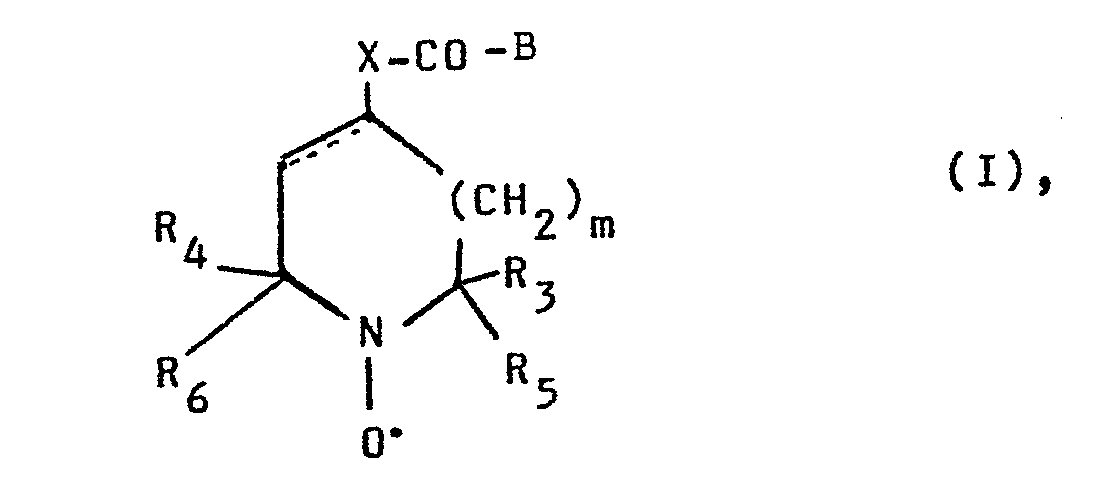


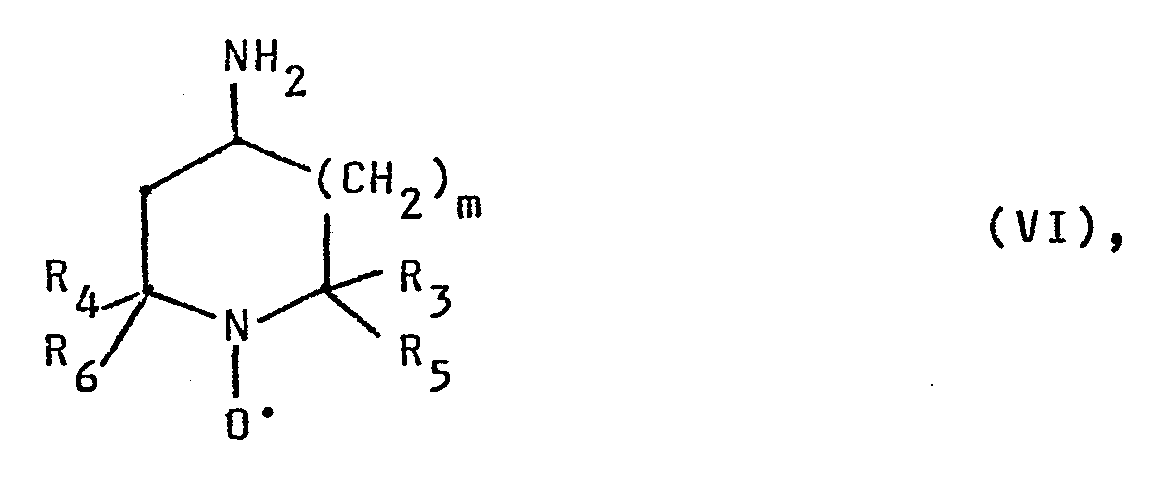
Priority Applications (1)
| Application Number | Priority Date | Filing Date | Title |
|---|---|---|---|
| AT84108900T ATE46445T1 (de) | 1983-08-03 | 1984-07-27 | Neue nitroxylverbindungen, verfahren zu deren herstellung und diese enthaltende diagnostische mittel. |
Applications Claiming Priority (2)
| Application Number | Priority Date | Filing Date | Title |
|---|---|---|---|
| DE3328365 | 1983-08-03 | ||
| DE19833328365 DE3328365A1 (de) | 1983-08-03 | 1983-08-03 | Neue diagnostische mittel |
Publications (2)
| Publication Number | Publication Date |
|---|---|
| EP0133674A1 true EP0133674A1 (de) | 1985-03-06 |
| EP0133674B1 EP0133674B1 (de) | 1989-09-20 |
Family
ID=6205912
Family Applications (1)
| Application Number | Title | Priority Date | Filing Date |
|---|---|---|---|
| EP84108900A Expired EP0133674B1 (de) | 1983-08-03 | 1984-07-27 | Neue Nitroxylverbindungen, Verfahren zu deren Herstellung und diese enthaltende diagnostische Mittel |
Country Status (8)
| Country | Link |
|---|---|
| US (2) | US4925652A (de) |
| EP (1) | EP0133674B1 (de) |
| JP (1) | JPH0657694B2 (de) |
| AT (1) | ATE46445T1 (de) |
| CA (1) | CA1230114A (de) |
| DE (2) | DE3328365A1 (de) |
| DK (1) | DK172065B1 (de) |
| IE (1) | IE57665B1 (de) |
Cited By (5)
| Publication number | Priority date | Publication date | Assignee | Title |
|---|---|---|---|---|
| US4834964A (en) * | 1986-03-07 | 1989-05-30 | M.R.I., Inc. | Use of charged nitroxides as NMR image enhancing agents for CSF |
| WO1991012024A1 (en) * | 1990-02-12 | 1991-08-22 | Hafslund Nycomed Innovation Ab | Triarylmethyl radicals and the use of inert carbon free radicals in mri |
| WO1992001673A1 (en) * | 1990-07-17 | 1992-02-06 | Medical Research Council | Synthesis and uses of spin labelled ribonucleosides and ribonucleotides |
| US5314681A (en) * | 1988-12-23 | 1994-05-24 | Nycomed Innovation Ab | Composition of positive and negative contrast agents for electron spin resonance enhanced magnetic resonance imaging |
| US10532104B2 (en) | 2012-08-31 | 2020-01-14 | The General Hospital Corporation | Biotin complexes for treatment and diagnosis of Alzheimer'S disease |
Families Citing this family (24)
| Publication number | Priority date | Publication date | Assignee | Title |
|---|---|---|---|---|
| DE3328365A1 (de) * | 1983-08-03 | 1985-02-21 | Schering AG, 1000 Berlin und 4709 Bergkamen | Neue diagnostische mittel |
| IE61448B1 (en) * | 1987-06-23 | 1994-11-02 | Hafslund Nycomed Innovation | Improvements in and relating to magnetic resonance imaging |
| GB8817137D0 (en) * | 1988-07-19 | 1988-08-24 | Nycomed As | Compositions |
| US5730954A (en) * | 1988-08-23 | 1998-03-24 | Schering Aktiengesellschaft | Preparation comprising cavitate- or clathrate-forming host/guest complexes as contrast agent |
| US5264204A (en) * | 1992-04-30 | 1993-11-23 | Mallinckrodt Medical, Inc. | Hydrophilic free radicals for magnetic resonance imaging |
| US5593688A (en) * | 1993-06-25 | 1997-01-14 | Nexstar Pharmaceuticals, Inc. | Liposomal targeting of ischemic tissue |
| US5741893A (en) * | 1993-08-16 | 1998-04-21 | Hsia; Jen-Chang | Compositions and methods utilizing nitroxides in combination with biocompatible macromolecules |
| US5767089A (en) * | 1993-08-16 | 1998-06-16 | Hsia; Jen-Chang | Compositions and methods utilizing nitroxides in combination with biocompatible macromolecules |
| US5817632A (en) * | 1993-08-16 | 1998-10-06 | Hsia; Jen-Chang | Compositions and methods utilizing nitroxides in combination with biocompatible macromolecules |
| TW381022B (en) | 1993-08-16 | 2000-02-01 | Hsia Jen Chang | Compositions and methods utilizing nitroxides to avoid oxygen toxicity, particularly in stabilized, polymerized, conjugated, or encapsulated hemoglobin used as a red cell substitute |
| US5725839A (en) * | 1993-08-16 | 1998-03-10 | Hsia; Jen-Chang | Compositions and methods utilizing nitroxides in combination with biocompatible macromolecules for ERI or MRI |
| US5807831A (en) * | 1993-08-16 | 1998-09-15 | Hsia; Jen-Chang | Compositions and methods utilizing nitroxides in combination with biocompatible macromolecules |
| US5840701A (en) * | 1993-08-16 | 1998-11-24 | Hsia; Jen-Chang | Compositions and methods utilizing nitroxides in combination with biocompatible macromolecules |
| US5804561A (en) * | 1993-08-16 | 1998-09-08 | Hsia; Jen-Chang | Compositions and methods utilizing nitroxides in combination with biocompatible macromolecules |
| US5824781A (en) * | 1993-08-16 | 1998-10-20 | Hsia; Jen-Chang | Compositions and methods utilizing nitroxides in combination with biocompatible macromolecules |
| AU1208697A (en) * | 1995-12-28 | 1997-07-28 | Daiichi Radioisotope Laboratories, Ltd. | Diagnostic drugs |
| WO1999000365A1 (en) * | 1997-06-27 | 1999-01-07 | Daiichi Radioisotope Laboratories, Ltd. | Novel nitroxyl compounds and drugs and reagents containing the same as the active ingredient |
| GB9801398D0 (en) * | 1998-01-22 | 1998-03-18 | Anggard Erik E | Chemical compounds |
| FR2788272B1 (fr) * | 1999-01-08 | 2001-03-16 | Atochem Elf Sa | Procede de preparation de nitroxydes |
| JP2004524259A (ja) * | 1999-12-10 | 2004-08-12 | ローゼン、ジェラルド エム. | 関節のmri画像診断における造影増強剤としてポリニトロシル官能基を有するデンドリマーの利用 |
| US8669236B2 (en) * | 2005-05-12 | 2014-03-11 | The General Hospital Corporation | Biotinylated compositions |
| US10202342B2 (en) * | 2008-06-27 | 2019-02-12 | University Of Maryland, Baltimore | Targeted delivery of imaging probes for in vivo cellular imaging |
| JP5581012B2 (ja) * | 2009-06-15 | 2014-08-27 | 住友精化株式会社 | 3−ホルミル−2,2,5,5−テトラメチルピロリン−1−オキシルの製造方法 |
| US10144707B2 (en) * | 2017-03-07 | 2018-12-04 | Organic Energy Devices (Oed) | Tritiated nitroxides and uses thereof |
Citations (3)
| Publication number | Priority date | Publication date | Assignee | Title |
|---|---|---|---|---|
| FR1501115A (fr) * | 1965-10-15 | 1967-11-10 | Synvar Ass | Marquage de molécules biologiques par résonance de spin électronique |
| FR1570560A (de) * | 1967-06-09 | 1969-06-13 | ||
| FR2235103A1 (en) * | 1973-06-29 | 1975-01-24 | Commissariat Energie Atomique | Marked nitroxide derivatives of saccharides - by reaction of acid nitroxide with halogenated saccharides |
Family Cites Families (6)
| Publication number | Priority date | Publication date | Assignee | Title |
|---|---|---|---|---|
| SE353504B (de) * | 1967-05-15 | 1973-02-05 | Gd Soc Accomandita Semplice Di | |
| US3959287A (en) * | 1972-07-10 | 1976-05-25 | Syva Company | Ligand determination of spin labeled compounds by receptor displacement |
| DE3129906C3 (de) * | 1981-07-24 | 1996-12-19 | Schering Ag | Paramagnetische Komplexsalze, deren Herstellung und Mittel zur Verwendung bei der NMR-Diagnostik |
| DE3328365A1 (de) * | 1983-08-03 | 1985-02-21 | Schering AG, 1000 Berlin und 4709 Bergkamen | Neue diagnostische mittel |
| US4656026A (en) * | 1984-12-10 | 1987-04-07 | University Of Iowa Research Foundation | Magnetic resonance (MR) image enhancement compounds for specific areas of the brain |
| US4834964A (en) * | 1986-03-07 | 1989-05-30 | M.R.I., Inc. | Use of charged nitroxides as NMR image enhancing agents for CSF |
-
1983
- 1983-08-03 DE DE19833328365 patent/DE3328365A1/de not_active Withdrawn
-
1984
- 1984-07-27 DE DE8484108900T patent/DE3479787D1/de not_active Expired
- 1984-07-27 AT AT84108900T patent/ATE46445T1/de not_active IP Right Cessation
- 1984-07-27 EP EP84108900A patent/EP0133674B1/de not_active Expired
- 1984-07-30 DK DK370484A patent/DK172065B1/da not_active IP Right Cessation
- 1984-08-02 CA CA000460280A patent/CA1230114A/en not_active Expired
- 1984-08-02 IE IE1992/84A patent/IE57665B1/en not_active IP Right Cessation
- 1984-08-03 JP JP59163025A patent/JPH0657694B2/ja not_active Expired - Lifetime
- 1984-08-03 US US06/637,085 patent/US4925652A/en not_active Expired - Fee Related
-
1985
- 1985-09-24 US US06/779,760 patent/US4845090A/en not_active Expired - Fee Related
Patent Citations (3)
| Publication number | Priority date | Publication date | Assignee | Title |
|---|---|---|---|---|
| FR1501115A (fr) * | 1965-10-15 | 1967-11-10 | Synvar Ass | Marquage de molécules biologiques par résonance de spin électronique |
| FR1570560A (de) * | 1967-06-09 | 1969-06-13 | ||
| FR2235103A1 (en) * | 1973-06-29 | 1975-01-24 | Commissariat Energie Atomique | Marked nitroxide derivatives of saccharides - by reaction of acid nitroxide with halogenated saccharides |
Non-Patent Citations (5)
| Title |
|---|
| BIOCHEMISTRY, Band 14, Nr. 12, 17. Juli 1975, Seiten 2754-2760, Columbus, Ohio, US; L.S. JOHNSTON u.a.: "Initial membrane reaction in the biosynthesis of peptidoglycan. Spin-labeled intermediates as receptors for vancomycin and ristocetin" * |
| CHEMICAL ABSTRACTS, Band 88, Nr. 19, 8. Mai 1978, Seite 371, Nr. 134654s, Columbus, Ohio, US; F.M. POULSEN u.a.: "Structural properties of the combining site of anti streptococcus group A antibodies: spin label-hapten studies" & CARLSBERG RES. COMMUN. 1977, 42(5), 369-78 * |
| CHEMICAL ABSTRACTS, Band 90, Nr. 17, 23. April 1979, Seite 494, Nr. 137610b, Columbus, Ohio, US; H.O. HANKOVSZKY u.a.: "Nitroxides. II. 1-Oxyl-2,2,5,5-tetramethylpyrroline-3-carboxylic acid derivatives" & ACTA CHIM. ACAD. SCI. HUNG. 1978, 98(3), 339-48 * |
| DIE PHARMAZIE, Band 35, Heft 1, Januar 1980, Seiten 10-14, Berlin, DD; P. KERTSCHER u.a.: "Synthese einiger spinmarkierter Glycerophospholipide" * |
| SYNTHESIS, Nr. 7, Juli 1975, Seiten 462-463, Stuttgart, DE; B.T. GOLDING u.a.: "A short-cut to spin-labelled amides" * |
Cited By (6)
| Publication number | Priority date | Publication date | Assignee | Title |
|---|---|---|---|---|
| US5599522A (en) * | 1899-02-12 | 1997-02-04 | Nycomed Imaging As | Triarylmethyl radicals and the use of inert carbon free radicals in MRI |
| US4834964A (en) * | 1986-03-07 | 1989-05-30 | M.R.I., Inc. | Use of charged nitroxides as NMR image enhancing agents for CSF |
| US5314681A (en) * | 1988-12-23 | 1994-05-24 | Nycomed Innovation Ab | Composition of positive and negative contrast agents for electron spin resonance enhanced magnetic resonance imaging |
| WO1991012024A1 (en) * | 1990-02-12 | 1991-08-22 | Hafslund Nycomed Innovation Ab | Triarylmethyl radicals and the use of inert carbon free radicals in mri |
| WO1992001673A1 (en) * | 1990-07-17 | 1992-02-06 | Medical Research Council | Synthesis and uses of spin labelled ribonucleosides and ribonucleotides |
| US10532104B2 (en) | 2012-08-31 | 2020-01-14 | The General Hospital Corporation | Biotin complexes for treatment and diagnosis of Alzheimer'S disease |
Also Published As
| Publication number | Publication date |
|---|---|
| DE3328365A1 (de) | 1985-02-21 |
| IE841992L (en) | 1985-02-03 |
| US4845090A (en) | 1989-07-04 |
| IE57665B1 (en) | 1993-02-24 |
| JPS6094960A (ja) | 1985-05-28 |
| DE3479787D1 (en) | 1989-10-26 |
| EP0133674B1 (de) | 1989-09-20 |
| US4925652A (en) | 1990-05-15 |
| DK172065B1 (da) | 1997-10-13 |
| CA1230114A (en) | 1987-12-08 |
| JPH0657694B2 (ja) | 1994-08-03 |
| DK370484D0 (da) | 1984-07-30 |
| ATE46445T1 (de) | 1989-10-15 |
| DK370484A (da) | 1985-02-04 |
Similar Documents
| Publication | Publication Date | Title |
|---|---|---|
| EP0133674B1 (de) | Neue Nitroxylverbindungen, Verfahren zu deren Herstellung und diese enthaltende diagnostische Mittel | |
| EP0255471B1 (de) | 1,4,7,10-Tetraazacyclododecan-Derivate | |
| DE69733353T2 (de) | Immunsuppressive wirkstoffe und verfahren | |
| DE69635231T2 (de) | Selektive Inhibitoren viraler oder bakterieller Neuraminidase | |
| EP0770613B1 (de) | Substituierte Imidazolidin-2,4-dion-Verbindungen als Immunodulatoren | |
| DE69119668T2 (de) | Hemmungsstoff für Aldosereduktase | |
| DE2914842A1 (de) | Reagenzien zur verwendung bei bindungsproben beim nachweis von diphenylhydantoin | |
| DE60013818T2 (de) | Quaternäre ammoniumverbindungen, verfahren zu deren herstellung und deren pharmazeutische verwendung | |
| DE60009063T2 (de) | Liganden für den ip3 rezeptor | |
| DE3789395T2 (de) | Alkylendiamin-Derivate. | |
| EP0072531A1 (de) | Neue Cyclophosphamid-Derivate, Verfahren zu ihrer Herstellung und ihre Verwendung | |
| DE2431561C2 (de) | Cycloalkylphenoxycarbonsäuren, Verfahren zu ihrer Herstellung und Arzneimittel | |
| DE3512629C2 (de) | s-Triazolo[1,5-a]pyrimidine und Verfahren zu ihrer Herstellung | |
| DE2521523A1 (de) | Lactamverbindungen und konjugate | |
| DE3634496C2 (de) | Glukosylmoranolinderivate und ihre Herstellung | |
| DE60132570T2 (de) | Abbaufragmente des bilirubins oder des biliverdins | |
| DE69328945T2 (de) | Pyridiniumderivate | |
| DE2914793A1 (de) | Pyrrolidincarboxaldehyd- und piperidincarboxaldehyd-derivate, verfahren zu ihrer herstellung und ihre verwendung als blutdrucksenkende wirkstoffe | |
| DE2843136C3 (de) | 6-O-Mono- und 1,6-O-Di-acylierte 2-[3-(2-Chloräthyl)-3-nitroscureido]-2-desoxy-D-glukopyranosen sowie Gemische aus 1,3,6-O-Tri und 1,4,6-O-Tri-acylierten 2-[3-(2-Chloräthyl)-3-nitrosoureido]-2-desoxy-D-glukopyranosen | |
| DE2725732C2 (de) | Bestatin-Analoga, Verfahren zu ihrer Herstellung und diese Verbindungen enthaltende pharmazeutische Präparate | |
| DE69112785T2 (de) | Phthalidylidenderivate von Carnitin und Alkanoylcarnitinen sowie diese enthaltende pharmazeutische Mittel. | |
| DE69600780T2 (de) | 15-deoxyspergualin-analoge verbindungen, ihre verwendung als therapeutika und verfahren zu ihrer herstellung | |
| DE3501961C2 (de) | ||
| CH687001A5 (de) | Pharmazeutisches Praeparat zur Modulierung der Immunreaktion. | |
| DE102004002885B4 (de) | Neue medizinisch einsetzbare Pyrrolalkaloide: Verfahren zu ihrer Isolierung, Synthese, sie enthaltende Arzneimittel und deren Verwendung |
Legal Events
| Date | Code | Title | Description |
|---|---|---|---|
| PUAI | Public reference made under article 153(3) epc to a published international application that has entered the european phase |
Free format text: ORIGINAL CODE: 0009012 |
|
| 17P | Request for examination filed |
Effective date: 19840727 |
|
| AK | Designated contracting states |
Designated state(s): AT BE CH DE FR GB IT LI LU NL SE |
|
| 17Q | First examination report despatched |
Effective date: 19870529 |
|
| ITF | It: translation for a ep patent filed | ||
| GRAA | (expected) grant |
Free format text: ORIGINAL CODE: 0009210 |
|
| AK | Designated contracting states |
Kind code of ref document: B1 Designated state(s): AT BE CH DE FR GB IT LI LU NL SE |
|
| REF | Corresponds to: |
Ref document number: 46445 Country of ref document: AT Date of ref document: 19891015 Kind code of ref document: T |
|
| REF | Corresponds to: |
Ref document number: 3479787 Country of ref document: DE Date of ref document: 19891026 |
|
| ET | Fr: translation filed | ||
| GBT | Gb: translation of ep patent filed (gb section 77(6)(a)/1977) | ||
| PLBE | No opposition filed within time limit |
Free format text: ORIGINAL CODE: 0009261 |
|
| STAA | Information on the status of an ep patent application or granted ep patent |
Free format text: STATUS: NO OPPOSITION FILED WITHIN TIME LIMIT |
|
| 26N | No opposition filed | ||
| ITTA | It: last paid annual fee | ||
| EPTA | Lu: last paid annual fee | ||
| EAL | Se: european patent in force in sweden |
Ref document number: 84108900.6 |
|
| PGFP | Annual fee paid to national office [announced via postgrant information from national office to epo] |
Ref country code: FR Payment date: 19980611 Year of fee payment: 15 |
|
| PGFP | Annual fee paid to national office [announced via postgrant information from national office to epo] |
Ref country code: AT Payment date: 19980616 Year of fee payment: 15 |
|
| PGFP | Annual fee paid to national office [announced via postgrant information from national office to epo] |
Ref country code: SE Payment date: 19980622 Year of fee payment: 15 |
|
| PGFP | Annual fee paid to national office [announced via postgrant information from national office to epo] |
Ref country code: GB Payment date: 19980623 Year of fee payment: 15 |
|
| PGFP | Annual fee paid to national office [announced via postgrant information from national office to epo] |
Ref country code: NL Payment date: 19980629 Year of fee payment: 15 Ref country code: DE Payment date: 19980629 Year of fee payment: 15 |
|
| PGFP | Annual fee paid to national office [announced via postgrant information from national office to epo] |
Ref country code: LU Payment date: 19980701 Year of fee payment: 15 Ref country code: CH Payment date: 19980701 Year of fee payment: 15 |
|
| PGFP | Annual fee paid to national office [announced via postgrant information from national office to epo] |
Ref country code: BE Payment date: 19980713 Year of fee payment: 15 |
|
| PG25 | Lapsed in a contracting state [announced via postgrant information from national office to epo] |
Ref country code: DE Free format text: LAPSE BECAUSE OF THE APPLICANT RENOUNCES Effective date: 19990607 |
|
| PG25 | Lapsed in a contracting state [announced via postgrant information from national office to epo] |
Ref country code: LU Free format text: LAPSE BECAUSE OF NON-PAYMENT OF DUE FEES Effective date: 19990727 Ref country code: GB Free format text: LAPSE BECAUSE OF NON-PAYMENT OF DUE FEES Effective date: 19990727 Ref country code: AT Free format text: LAPSE BECAUSE OF NON-PAYMENT OF DUE FEES Effective date: 19990727 |
|
| PG25 | Lapsed in a contracting state [announced via postgrant information from national office to epo] |
Ref country code: SE Free format text: THE PATENT HAS BEEN ANNULLED BY A DECISION OF A NATIONAL AUTHORITY Effective date: 19990730 |
|
| PG25 | Lapsed in a contracting state [announced via postgrant information from national office to epo] |
Ref country code: LI Free format text: LAPSE BECAUSE OF NON-PAYMENT OF DUE FEES Effective date: 19990731 Ref country code: FR Free format text: THE PATENT HAS BEEN ANNULLED BY A DECISION OF A NATIONAL AUTHORITY Effective date: 19990731 Ref country code: CH Free format text: LAPSE BECAUSE OF NON-PAYMENT OF DUE FEES Effective date: 19990731 Ref country code: BE Free format text: LAPSE BECAUSE OF NON-PAYMENT OF DUE FEES Effective date: 19990731 |
|
| BERE | Be: lapsed |
Owner name: SCHERING A.G. BERLIN UND BERGKAMEN Effective date: 19990731 |
|
| PG25 | Lapsed in a contracting state [announced via postgrant information from national office to epo] |
Ref country code: NL Free format text: LAPSE BECAUSE OF NON-PAYMENT OF DUE FEES Effective date: 20000201 |
|
| GBPC | Gb: european patent ceased through non-payment of renewal fee |
Effective date: 19990727 |
|
| REG | Reference to a national code |
Ref country code: CH Ref legal event code: PL |
|
| EUG | Se: european patent has lapsed |
Ref document number: 84108900.6 |
|
| NLV4 | Nl: lapsed or anulled due to non-payment of the annual fee |
Effective date: 20000201 |
|
| REG | Reference to a national code |
Ref country code: FR Ref legal event code: ST |