EP0129813B1 - Verfahren zur Herstellung von Überzügen - Google Patents
Verfahren zur Herstellung von Überzügen Download PDFInfo
- Publication number
- EP0129813B1 EP0129813B1 EP84106929A EP84106929A EP0129813B1 EP 0129813 B1 EP0129813 B1 EP 0129813B1 EP 84106929 A EP84106929 A EP 84106929A EP 84106929 A EP84106929 A EP 84106929A EP 0129813 B1 EP0129813 B1 EP 0129813B1
- Authority
- EP
- European Patent Office
- Prior art keywords
- weight
- hydroxyl
- groups
- carbon atoms
- alkyl
- Prior art date
- Legal status (The legal status is an assumption and is not a legal conclusion. Google has not performed a legal analysis and makes no representation as to the accuracy of the status listed.)
- Expired
Links
- 238000000576 coating method Methods 0.000 title claims abstract description 28
- 239000011248 coating agent Substances 0.000 title claims abstract description 8
- 238000002360 preparation method Methods 0.000 title description 7
- 239000005056 polyisocyanate Substances 0.000 claims abstract description 84
- 229920001228 polyisocyanate Polymers 0.000 claims abstract description 84
- -1 unsaturated nitrogen-containing heterocyclic compounds Chemical class 0.000 claims abstract description 64
- 238000000034 method Methods 0.000 claims abstract description 56
- 239000000203 mixture Substances 0.000 claims abstract description 50
- 230000008569 process Effects 0.000 claims abstract description 47
- ZFSLODLOARCGLH-UHFFFAOYSA-N isocyanuric acid Chemical compound OC1=NC(O)=NC(O)=N1 ZFSLODLOARCGLH-UHFFFAOYSA-N 0.000 claims abstract description 43
- NIXOWILDQLNWCW-UHFFFAOYSA-N 2-Propenoic acid Natural products OC(=O)C=C NIXOWILDQLNWCW-UHFFFAOYSA-N 0.000 claims abstract description 41
- IQPQWNKOIGAROB-UHFFFAOYSA-N isocyanate group Chemical group [N-]=C=O IQPQWNKOIGAROB-UHFFFAOYSA-N 0.000 claims abstract description 40
- CERQOIWHTDAKMF-UHFFFAOYSA-N Methacrylic acid Chemical compound CC(=C)C(O)=O CERQOIWHTDAKMF-UHFFFAOYSA-N 0.000 claims abstract description 36
- 239000011347 resin Substances 0.000 claims abstract description 35
- 229920005989 resin Polymers 0.000 claims abstract description 35
- 229920005906 polyester polyol Polymers 0.000 claims abstract description 33
- SMZOUWXMTYCWNB-UHFFFAOYSA-N 2-(2-methoxy-5-methylphenyl)ethanamine Chemical compound COC1=CC=C(C)C=C1CCN SMZOUWXMTYCWNB-UHFFFAOYSA-N 0.000 claims abstract description 31
- 239000000178 monomer Substances 0.000 claims abstract description 22
- OHJMTUPIZMNBFR-UHFFFAOYSA-N biuret Chemical group NC(=O)NC(N)=O OHJMTUPIZMNBFR-UHFFFAOYSA-N 0.000 claims abstract description 20
- 125000005907 alkyl ester group Chemical group 0.000 claims abstract description 14
- 238000004519 manufacturing process Methods 0.000 claims abstract description 14
- 239000007795 chemical reaction product Substances 0.000 claims abstract description 9
- 229910052751 metal Inorganic materials 0.000 claims abstract description 8
- 239000002184 metal Substances 0.000 claims abstract description 8
- 125000002768 hydroxyalkyl group Chemical group 0.000 claims abstract description 5
- 125000004432 carbon atom Chemical group C* 0.000 claims description 61
- 125000002887 hydroxy group Chemical group [H]O* 0.000 claims description 61
- 229910052736 halogen Inorganic materials 0.000 claims description 39
- 150000002367 halogens Chemical class 0.000 claims description 39
- 125000002496 methyl group Chemical group [H]C([H])([H])* 0.000 claims description 31
- 229920001577 copolymer Polymers 0.000 claims description 29
- 125000000449 nitro group Chemical group [O-][N+](*)=O 0.000 claims description 27
- 125000000217 alkyl group Chemical group 0.000 claims description 24
- 150000002148 esters Chemical class 0.000 claims description 17
- 239000001257 hydrogen Substances 0.000 claims description 17
- 229910052739 hydrogen Inorganic materials 0.000 claims description 17
- 239000002253 acid Substances 0.000 claims description 16
- 229920005862 polyol Polymers 0.000 claims description 16
- 150000003077 polyols Chemical class 0.000 claims description 16
- 239000005057 Hexamethylene diisocyanate Substances 0.000 claims description 15
- 125000001495 ethyl group Chemical group [H]C([H])([H])C([H])([H])* 0.000 claims description 15
- RRAMGCGOFNQTLD-UHFFFAOYSA-N hexamethylene diisocyanate Chemical compound O=C=NCCCCCCN=C=O RRAMGCGOFNQTLD-UHFFFAOYSA-N 0.000 claims description 15
- NIMLQBUJDJZYEJ-UHFFFAOYSA-N isophorone diisocyanate Chemical compound CC1(C)CC(N=C=O)CC(C)(CN=C=O)C1 NIMLQBUJDJZYEJ-UHFFFAOYSA-N 0.000 claims description 15
- 239000005058 Isophorone diisocyanate Substances 0.000 claims description 12
- 125000004435 hydrogen atom Chemical group [H]* 0.000 claims description 12
- 125000003118 aryl group Chemical group 0.000 claims description 11
- 125000005442 diisocyanate group Chemical group 0.000 claims description 11
- 229920000728 polyester Polymers 0.000 claims description 11
- 230000009477 glass transition Effects 0.000 claims description 10
- 229920001519 homopolymer Polymers 0.000 claims description 10
- 229910052760 oxygen Inorganic materials 0.000 claims description 10
- 239000001301 oxygen Substances 0.000 claims description 10
- 239000002981 blocking agent Substances 0.000 claims description 9
- 239000002904 solvent Substances 0.000 claims description 9
- RTZKZFJDLAIYFH-UHFFFAOYSA-N ether Substances CCOCC RTZKZFJDLAIYFH-UHFFFAOYSA-N 0.000 claims description 8
- 239000000047 product Substances 0.000 claims description 8
- DNIAPMSPPWPWGF-GSVOUGTGSA-N (R)-(-)-Propylene glycol Chemical compound C[C@@H](O)CO DNIAPMSPPWPWGF-GSVOUGTGSA-N 0.000 claims description 7
- 239000012948 isocyanate Substances 0.000 claims description 7
- 239000003960 organic solvent Substances 0.000 claims description 7
- NINIDFKCEFEMDL-UHFFFAOYSA-N Sulfur Chemical compound [S] NINIDFKCEFEMDL-UHFFFAOYSA-N 0.000 claims description 6
- 150000002391 heterocyclic compounds Chemical class 0.000 claims description 6
- 125000000623 heterocyclic group Chemical group 0.000 claims description 6
- 150000002513 isocyanates Chemical class 0.000 claims description 6
- 125000001997 phenyl group Chemical group [H]C1=C([H])C([H])=C(*)C([H])=C1[H] 0.000 claims description 6
- 229920005903 polyol mixture Polymers 0.000 claims description 6
- OSSNTDFYBPYIEC-UHFFFAOYSA-N 1-ethenylimidazole Chemical class C=CN1C=CN=C1 OSSNTDFYBPYIEC-UHFFFAOYSA-N 0.000 claims description 5
- OMIGHNLMNHATMP-UHFFFAOYSA-N 2-hydroxyethyl prop-2-enoate Chemical compound OCCOC(=O)C=C OMIGHNLMNHATMP-UHFFFAOYSA-N 0.000 claims description 5
- PXAJQJMDEXJWFB-UHFFFAOYSA-N acetone oxime Chemical compound CC(C)=NO PXAJQJMDEXJWFB-UHFFFAOYSA-N 0.000 claims description 5
- 150000002431 hydrogen Chemical class 0.000 claims description 5
- 229910052757 nitrogen Inorganic materials 0.000 claims description 5
- 239000011877 solvent mixture Substances 0.000 claims description 5
- 125000000391 vinyl group Chemical group [H]C([*])=C([H])[H] 0.000 claims description 5
- 229920002818 (Hydroxyethyl)methacrylate Polymers 0.000 claims description 4
- HRPVXLWXLXDGHG-UHFFFAOYSA-N Acrylamide Chemical compound NC(=O)C=C HRPVXLWXLXDGHG-UHFFFAOYSA-N 0.000 claims description 4
- CERQOIWHTDAKMF-UHFFFAOYSA-M Methacrylate Chemical compound CC(=C)C([O-])=O CERQOIWHTDAKMF-UHFFFAOYSA-M 0.000 claims description 4
- 150000007933 aliphatic carboxylic acids Chemical class 0.000 claims description 4
- QVGXLLKOCUKJST-UHFFFAOYSA-N atomic oxygen Chemical compound [O] QVGXLLKOCUKJST-UHFFFAOYSA-N 0.000 claims description 4
- 125000002915 carbonyl group Chemical group [*:2]C([*:1])=O 0.000 claims description 4
- 125000000843 phenylene group Chemical group C1(=C(C=CC=C1)*)* 0.000 claims description 4
- 229910052717 sulfur Inorganic materials 0.000 claims description 4
- 239000011593 sulfur Substances 0.000 claims description 4
- KFDVPJUYSDEJTH-UHFFFAOYSA-N 4-ethenylpyridine Chemical compound C=CC1=CC=NC=C1 KFDVPJUYSDEJTH-UHFFFAOYSA-N 0.000 claims description 3
- WOBHKFSMXKNTIM-UHFFFAOYSA-N Hydroxyethyl methacrylate Chemical compound CC(=C)C(=O)OCCO WOBHKFSMXKNTIM-UHFFFAOYSA-N 0.000 claims description 3
- FQPSGWSUVKBHSU-UHFFFAOYSA-N methacrylamide Chemical compound CC(=C)C(N)=O FQPSGWSUVKBHSU-UHFFFAOYSA-N 0.000 claims description 3
- WHIVNJATOVLWBW-UHFFFAOYSA-N n-butan-2-ylidenehydroxylamine Chemical compound CCC(C)=NO WHIVNJATOVLWBW-UHFFFAOYSA-N 0.000 claims description 3
- OCIFJWVZZUDMRL-UHFFFAOYSA-N 6-hydroxyhexyl prop-2-enoate Chemical compound OCCCCCCOC(=O)C=C OCIFJWVZZUDMRL-UHFFFAOYSA-N 0.000 claims description 2
- LFQSCWFLJHTTHZ-UHFFFAOYSA-N Ethanol Chemical compound CCO LFQSCWFLJHTTHZ-UHFFFAOYSA-N 0.000 claims description 2
- 125000000468 ketone group Chemical group 0.000 claims description 2
- YKXAYLPDMSGWEV-UHFFFAOYSA-N 4-hydroxybutyl 2-methylprop-2-enoate Chemical compound CC(=C)C(=O)OCCCCO YKXAYLPDMSGWEV-UHFFFAOYSA-N 0.000 claims 1
- XFOFBPRPOAWWPA-UHFFFAOYSA-N 6-hydroxyhexyl 2-methylprop-2-enoate Chemical compound CC(=C)C(=O)OCCCCCCO XFOFBPRPOAWWPA-UHFFFAOYSA-N 0.000 claims 1
- VGGSQFUCUMXWEO-UHFFFAOYSA-N Ethene Chemical group C=C VGGSQFUCUMXWEO-UHFFFAOYSA-N 0.000 claims 1
- 239000005977 Ethylene Chemical group 0.000 claims 1
- 125000002947 alkylene group Chemical group 0.000 claims 1
- 125000000325 methylidene group Chemical group [H]C([H])=* 0.000 claims 1
- 239000000376 reactant Substances 0.000 claims 1
- 150000003926 acrylamides Chemical class 0.000 abstract 1
- 239000003973 paint Substances 0.000 description 37
- 239000010408 film Substances 0.000 description 28
- DKPFZGUDAPQIHT-UHFFFAOYSA-N butyl acetate Chemical compound CCCCOC(C)=O DKPFZGUDAPQIHT-UHFFFAOYSA-N 0.000 description 26
- 239000004922 lacquer Substances 0.000 description 25
- 239000007787 solid Substances 0.000 description 23
- 239000000243 solution Substances 0.000 description 21
- 230000000052 comparative effect Effects 0.000 description 18
- 239000011230 binding agent Substances 0.000 description 17
- NIXOWILDQLNWCW-UHFFFAOYSA-M Acrylate Chemical compound [O-]C(=O)C=C NIXOWILDQLNWCW-UHFFFAOYSA-M 0.000 description 16
- CTQNGGLPUBDAKN-UHFFFAOYSA-N O-Xylene Chemical compound CC1=CC=CC=C1C CTQNGGLPUBDAKN-UHFFFAOYSA-N 0.000 description 14
- 125000001931 aliphatic group Chemical group 0.000 description 13
- MTHSVFCYNBDYFN-UHFFFAOYSA-N diethylene glycol Chemical compound OCCOCCO MTHSVFCYNBDYFN-UHFFFAOYSA-N 0.000 description 13
- 239000008096 xylene Substances 0.000 description 13
- LYCAIKOWRPUZTN-UHFFFAOYSA-N Ethylene glycol Chemical compound OCCO LYCAIKOWRPUZTN-UHFFFAOYSA-N 0.000 description 12
- 229920000058 polyacrylate Polymers 0.000 description 12
- 239000003054 catalyst Substances 0.000 description 11
- WNLRTRBMVRJNCN-UHFFFAOYSA-N adipic acid Chemical compound OC(=O)CCCCC(O)=O WNLRTRBMVRJNCN-UHFFFAOYSA-N 0.000 description 10
- PPBRXRYQALVLMV-UHFFFAOYSA-N Styrene Chemical compound C=CC1=CC=CC=C1 PPBRXRYQALVLMV-UHFFFAOYSA-N 0.000 description 9
- 238000006243 chemical reaction Methods 0.000 description 9
- 239000004925 Acrylic resin Substances 0.000 description 8
- IJGRMHOSHXDMSA-UHFFFAOYSA-N Atomic nitrogen Chemical compound N#N IJGRMHOSHXDMSA-UHFFFAOYSA-N 0.000 description 8
- PEDCQBHIVMGVHV-UHFFFAOYSA-N Glycerine Chemical compound OCC(O)CO PEDCQBHIVMGVHV-UHFFFAOYSA-N 0.000 description 8
- UFHFLCQGNIYNRP-UHFFFAOYSA-N Hydrogen Chemical compound [H][H] UFHFLCQGNIYNRP-UHFFFAOYSA-N 0.000 description 8
- VVQNEPGJFQJSBK-UHFFFAOYSA-N Methyl methacrylate Chemical compound COC(=O)C(C)=C VVQNEPGJFQJSBK-UHFFFAOYSA-N 0.000 description 8
- ZMXDDKWLCZADIW-UHFFFAOYSA-N N,N-Dimethylformamide Chemical compound CN(C)C=O ZMXDDKWLCZADIW-UHFFFAOYSA-N 0.000 description 8
- ZJCCRDAZUWHFQH-UHFFFAOYSA-N Trimethylolpropane Chemical compound CCC(CO)(CO)CO ZJCCRDAZUWHFQH-UHFFFAOYSA-N 0.000 description 8
- 150000001408 amides Chemical class 0.000 description 8
- 238000001035 drying Methods 0.000 description 8
- XNGIFLGASWRNHJ-UHFFFAOYSA-N phthalic acid Chemical compound OC(=O)C1=CC=CC=C1C(O)=O XNGIFLGASWRNHJ-UHFFFAOYSA-N 0.000 description 8
- 229920001610 polycaprolactone Polymers 0.000 description 8
- 239000004632 polycaprolactone Substances 0.000 description 8
- 150000001298 alcohols Chemical class 0.000 description 7
- 230000008439 repair process Effects 0.000 description 7
- 239000007921 spray Substances 0.000 description 7
- 125000001302 tertiary amino group Chemical group 0.000 description 7
- GWEVSGVZZGPLCZ-UHFFFAOYSA-N Titan oxide Chemical compound O=[Ti]=O GWEVSGVZZGPLCZ-UHFFFAOYSA-N 0.000 description 6
- CIUQDSCDWFSTQR-UHFFFAOYSA-N [C]1=CC=CC=C1 Chemical group [C]1=CC=CC=C1 CIUQDSCDWFSTQR-UHFFFAOYSA-N 0.000 description 6
- 238000006116 polymerization reaction Methods 0.000 description 6
- 238000005829 trimerization reaction Methods 0.000 description 6
- 229920002554 vinyl polymer Polymers 0.000 description 6
- XLYOFNOQVPJJNP-UHFFFAOYSA-N water Substances O XLYOFNOQVPJJNP-UHFFFAOYSA-N 0.000 description 6
- 238000004383 yellowing Methods 0.000 description 6
- SVONRAPFKPVNKG-UHFFFAOYSA-N 2-ethoxyethyl acetate Chemical compound CCOCCOC(C)=O SVONRAPFKPVNKG-UHFFFAOYSA-N 0.000 description 5
- OFOBLEOULBTSOW-UHFFFAOYSA-N Malonic acid Chemical compound OC(=O)CC(O)=O OFOBLEOULBTSOW-UHFFFAOYSA-N 0.000 description 5
- YIMQCDZDWXUDCA-UHFFFAOYSA-N [4-(hydroxymethyl)cyclohexyl]methanol Chemical compound OCC1CCC(CO)CC1 YIMQCDZDWXUDCA-UHFFFAOYSA-N 0.000 description 5
- 239000001361 adipic acid Substances 0.000 description 5
- 235000011037 adipic acid Nutrition 0.000 description 5
- 238000004132 cross linking Methods 0.000 description 5
- 150000002734 metacrylic acid derivatives Chemical class 0.000 description 5
- DNIAPMSPPWPWGF-UHFFFAOYSA-N monopropylene glycol Natural products CC(O)CO DNIAPMSPPWPWGF-UHFFFAOYSA-N 0.000 description 5
- 235000013772 propylene glycol Nutrition 0.000 description 5
- 230000003678 scratch resistant effect Effects 0.000 description 5
- 238000012360 testing method Methods 0.000 description 5
- ZIBGPFATKBEMQZ-UHFFFAOYSA-N triethylene glycol Chemical compound OCCOCCOCCO ZIBGPFATKBEMQZ-UHFFFAOYSA-N 0.000 description 5
- PUPZLCDOIYMWBV-UHFFFAOYSA-N (+/-)-1,3-Butanediol Chemical compound CC(O)CCO PUPZLCDOIYMWBV-UHFFFAOYSA-N 0.000 description 4
- VZCYOOQTPOCHFL-OWOJBTEDSA-N Fumaric acid Chemical compound OC(=O)\C=C\C(O)=O VZCYOOQTPOCHFL-OWOJBTEDSA-N 0.000 description 4
- UQSXHKLRYXJYBZ-UHFFFAOYSA-N Iron oxide Chemical compound [Fe]=O UQSXHKLRYXJYBZ-UHFFFAOYSA-N 0.000 description 4
- 229910000831 Steel Inorganic materials 0.000 description 4
- DKGAVHZHDRPRBM-UHFFFAOYSA-N Tert-Butanol Chemical compound CC(C)(C)O DKGAVHZHDRPRBM-UHFFFAOYSA-N 0.000 description 4
- 150000008064 anhydrides Chemical class 0.000 description 4
- 230000008901 benefit Effects 0.000 description 4
- IISBACLAFKSPIT-UHFFFAOYSA-N bisphenol A Chemical compound C=1C=C(O)C=CC=1C(C)(C)C1=CC=C(O)C=C1 IISBACLAFKSPIT-UHFFFAOYSA-N 0.000 description 4
- CQEYYJKEWSMYFG-UHFFFAOYSA-N butyl acrylate Chemical compound CCCCOC(=O)C=C CQEYYJKEWSMYFG-UHFFFAOYSA-N 0.000 description 4
- QSAWQNUELGIYBC-UHFFFAOYSA-N cyclohexane-1,2-dicarboxylic acid Chemical compound OC(=O)C1CCCCC1C(O)=O QSAWQNUELGIYBC-UHFFFAOYSA-N 0.000 description 4
- QQVIHTHCMHWDBS-UHFFFAOYSA-N isophthalic acid Chemical compound OC(=O)C1=CC=CC(C(O)=O)=C1 QQVIHTHCMHWDBS-UHFFFAOYSA-N 0.000 description 4
- CYIDZMCFTVVTJO-UHFFFAOYSA-N pyromellitic acid Chemical compound OC(=O)C1=CC(C(O)=O)=C(C(O)=O)C=C1C(O)=O CYIDZMCFTVVTJO-UHFFFAOYSA-N 0.000 description 4
- 239000010959 steel Substances 0.000 description 4
- ISXSCDLOGDJUNJ-UHFFFAOYSA-N tert-butyl prop-2-enoate Chemical compound CC(C)(C)OC(=O)C=C ISXSCDLOGDJUNJ-UHFFFAOYSA-N 0.000 description 4
- VZCYOOQTPOCHFL-UHFFFAOYSA-N trans-butenedioic acid Natural products OC(=O)C=CC(O)=O VZCYOOQTPOCHFL-UHFFFAOYSA-N 0.000 description 4
- IMNIMPAHZVJRPE-UHFFFAOYSA-N triethylenediamine Chemical compound C1CN2CCN1CC2 IMNIMPAHZVJRPE-UHFFFAOYSA-N 0.000 description 4
- ARCGXLSVLAOJQL-UHFFFAOYSA-N trimellitic acid Chemical compound OC(=O)C1=CC=C(C(O)=O)C(C(O)=O)=C1 ARCGXLSVLAOJQL-UHFFFAOYSA-N 0.000 description 4
- CDMDQYCEEKCBGR-UHFFFAOYSA-N 1,4-diisocyanatocyclohexane Chemical compound O=C=NC1CCC(N=C=O)CC1 CDMDQYCEEKCBGR-UHFFFAOYSA-N 0.000 description 3
- NLHHRLWOUZZQLW-UHFFFAOYSA-N Acrylonitrile Chemical compound C=CC#N NLHHRLWOUZZQLW-UHFFFAOYSA-N 0.000 description 3
- 0 C*C(*C1*)N(*)C1=* Chemical compound C*C(*C1*)N(*)C1=* 0.000 description 3
- XEKOWRVHYACXOJ-UHFFFAOYSA-N Ethyl acetate Chemical compound CCOC(C)=O XEKOWRVHYACXOJ-UHFFFAOYSA-N 0.000 description 3
- GYCMBHHDWRMZGG-UHFFFAOYSA-N Methylacrylonitrile Chemical compound CC(=C)C#N GYCMBHHDWRMZGG-UHFFFAOYSA-N 0.000 description 3
- YXFVVABEGXRONW-UHFFFAOYSA-N Toluene Chemical compound CC1=CC=CC=C1 YXFVVABEGXRONW-UHFFFAOYSA-N 0.000 description 3
- UKLDJPRMSDWDSL-UHFFFAOYSA-L [dibutyl(dodecanoyloxy)stannyl] dodecanoate Chemical compound CCCCCCCCCCCC(=O)O[Sn](CCCC)(CCCC)OC(=O)CCCCCCCCCCC UKLDJPRMSDWDSL-UHFFFAOYSA-L 0.000 description 3
- YRKCREAYFQTBPV-UHFFFAOYSA-N acetylacetone Chemical compound CC(=O)CC(C)=O YRKCREAYFQTBPV-UHFFFAOYSA-N 0.000 description 3
- IYABWNGZIDDRAK-UHFFFAOYSA-N allene Chemical group C=C=C IYABWNGZIDDRAK-UHFFFAOYSA-N 0.000 description 3
- NDWWLJQHOLSEHX-UHFFFAOYSA-L calcium;octanoate Chemical compound [Ca+2].CCCCCCCC([O-])=O.CCCCCCCC([O-])=O NDWWLJQHOLSEHX-UHFFFAOYSA-L 0.000 description 3
- 101150038956 cup-4 gene Proteins 0.000 description 3
- VEZUQRBDRNJBJY-UHFFFAOYSA-N cyclohexanone oxime Chemical compound ON=C1CCCCC1 VEZUQRBDRNJBJY-UHFFFAOYSA-N 0.000 description 3
- 239000012975 dibutyltin dilaurate Substances 0.000 description 3
- KORSJDCBLAPZEQ-UHFFFAOYSA-N dicyclohexylmethane-4,4'-diisocyanate Chemical compound C1CC(N=C=O)CCC1CC1CCC(N=C=O)CC1 KORSJDCBLAPZEQ-UHFFFAOYSA-N 0.000 description 3
- 235000011187 glycerol Nutrition 0.000 description 3
- 125000003055 glycidyl group Chemical group C(C1CO1)* 0.000 description 3
- 231100000016 inhalation toxicity Toxicity 0.000 description 3
- 239000003999 initiator Substances 0.000 description 3
- 125000005397 methacrylic acid ester group Chemical group 0.000 description 3
- 238000002156 mixing Methods 0.000 description 3
- 239000000049 pigment Substances 0.000 description 3
- 238000003756 stirring Methods 0.000 description 3
- 125000001424 substituent group Chemical group 0.000 description 3
- 239000000758 substrate Substances 0.000 description 3
- 150000005846 sugar alcohols Polymers 0.000 description 3
- PAPBSGBWRJIAAV-UHFFFAOYSA-N ε-Caprolactone Chemical group O=C1CCCCCO1 PAPBSGBWRJIAAV-UHFFFAOYSA-N 0.000 description 3
- DNIAPMSPPWPWGF-VKHMYHEASA-N (+)-propylene glycol Chemical compound C[C@H](O)CO DNIAPMSPPWPWGF-VKHMYHEASA-N 0.000 description 2
- YPFDHNVEDLHUCE-UHFFFAOYSA-N 1,3-propanediol Substances OCCCO YPFDHNVEDLHUCE-UHFFFAOYSA-N 0.000 description 2
- BDHGFCVQWMDIQX-UHFFFAOYSA-N 1-ethenyl-2-methylimidazole Chemical compound CC1=NC=CN1C=C BDHGFCVQWMDIQX-UHFFFAOYSA-N 0.000 description 2
- HAWZITGJTUAVQW-UHFFFAOYSA-N 1-ethenyl-2-phenylimidazole Chemical compound C=CN1C=CN=C1C1=CC=CC=C1 HAWZITGJTUAVQW-UHFFFAOYSA-N 0.000 description 2
- OZAIFHULBGXAKX-UHFFFAOYSA-N 2-(2-cyanopropan-2-yldiazenyl)-2-methylpropanenitrile Chemical compound N#CC(C)(C)N=NC(C)(C)C#N OZAIFHULBGXAKX-UHFFFAOYSA-N 0.000 description 2
- ZNQVEEAIQZEUHB-UHFFFAOYSA-N 2-ethoxyethanol Chemical compound CCOCCO ZNQVEEAIQZEUHB-UHFFFAOYSA-N 0.000 description 2
- XLLIQLLCWZCATF-UHFFFAOYSA-N 2-methoxyethyl acetate Chemical compound COCCOC(C)=O XLLIQLLCWZCATF-UHFFFAOYSA-N 0.000 description 2
- CFVWNXQPGQOHRJ-UHFFFAOYSA-N 2-methylpropyl prop-2-enoate Chemical compound CC(C)COC(=O)C=C CFVWNXQPGQOHRJ-UHFFFAOYSA-N 0.000 description 2
- DPZYLEIWHTWHCU-UHFFFAOYSA-N 3-ethenylpyridine Chemical compound C=CC1=CC=CN=C1 DPZYLEIWHTWHCU-UHFFFAOYSA-N 0.000 description 2
- QJLYVCMEBJYLQD-UHFFFAOYSA-N 4-(1-hydroxyethyl)cyclohexan-1-ol Chemical compound CC(O)C1CCC(O)CC1 QJLYVCMEBJYLQD-UHFFFAOYSA-N 0.000 description 2
- YWVFNWVZBAWOOY-UHFFFAOYSA-N 4-methylcyclohexane-1,2-dicarboxylic acid Chemical compound CC1CCC(C(O)=O)C(C(O)=O)C1 YWVFNWVZBAWOOY-UHFFFAOYSA-N 0.000 description 2
- WKBOTKDWSSQWDR-UHFFFAOYSA-N Bromine atom Chemical group [Br] WKBOTKDWSSQWDR-UHFFFAOYSA-N 0.000 description 2
- SOGAXMICEFXMKE-UHFFFAOYSA-N Butylmethacrylate Chemical compound CCCCOC(=O)C(C)=C SOGAXMICEFXMKE-UHFFFAOYSA-N 0.000 description 2
- ZAMOUSCENKQFHK-UHFFFAOYSA-N Chlorine atom Chemical group [Cl] ZAMOUSCENKQFHK-UHFFFAOYSA-N 0.000 description 2
- MYMOFIZGZYHOMD-UHFFFAOYSA-N Dioxygen Chemical compound O=O MYMOFIZGZYHOMD-UHFFFAOYSA-N 0.000 description 2
- 235000009161 Espostoa lanata Nutrition 0.000 description 2
- 240000001624 Espostoa lanata Species 0.000 description 2
- JOYRKODLDBILNP-UHFFFAOYSA-N Ethyl urethane Chemical compound CCOC(N)=O JOYRKODLDBILNP-UHFFFAOYSA-N 0.000 description 2
- YNQLUTRBYVCPMQ-UHFFFAOYSA-N Ethylbenzene Chemical compound CCC1=CC=CC=C1 YNQLUTRBYVCPMQ-UHFFFAOYSA-N 0.000 description 2
- XEEYBQQBJWHFJM-UHFFFAOYSA-N Iron Chemical compound [Fe] XEEYBQQBJWHFJM-UHFFFAOYSA-N 0.000 description 2
- BAPJBEWLBFYGME-UHFFFAOYSA-N Methyl acrylate Chemical compound COC(=O)C=C BAPJBEWLBFYGME-UHFFFAOYSA-N 0.000 description 2
- LGRFSURHDFAFJT-UHFFFAOYSA-N Phthalic anhydride Natural products C1=CC=C2C(=O)OC(=O)C2=C1 LGRFSURHDFAFJT-UHFFFAOYSA-N 0.000 description 2
- KDYFGRWQOYBRFD-UHFFFAOYSA-N Succinic acid Natural products OC(=O)CCC(O)=O KDYFGRWQOYBRFD-UHFFFAOYSA-N 0.000 description 2
- KKEYFWRCBNTPAC-UHFFFAOYSA-N Terephthalic acid Chemical compound OC(=O)C1=CC=C(C(O)=O)C=C1 KKEYFWRCBNTPAC-UHFFFAOYSA-N 0.000 description 2
- WYURNTSHIVDZCO-UHFFFAOYSA-N Tetrahydrofuran Chemical compound C1CCOC1 WYURNTSHIVDZCO-UHFFFAOYSA-N 0.000 description 2
- ATJFFYVFTNAWJD-UHFFFAOYSA-N Tin Chemical compound [Sn] ATJFFYVFTNAWJD-UHFFFAOYSA-N 0.000 description 2
- HCHKCACWOHOZIP-UHFFFAOYSA-N Zinc Chemical compound [Zn] HCHKCACWOHOZIP-UHFFFAOYSA-N 0.000 description 2
- BWVAOONFBYYRHY-UHFFFAOYSA-N [4-(hydroxymethyl)phenyl]methanol Chemical compound OCC1=CC=C(CO)C=C1 BWVAOONFBYYRHY-UHFFFAOYSA-N 0.000 description 2
- 150000007513 acids Chemical class 0.000 description 2
- 230000009471 action Effects 0.000 description 2
- 125000003158 alcohol group Chemical group 0.000 description 2
- 229920000180 alkyd Polymers 0.000 description 2
- 229910052782 aluminium Inorganic materials 0.000 description 2
- XAGFODPZIPBFFR-UHFFFAOYSA-N aluminium Chemical compound [Al] XAGFODPZIPBFFR-UHFFFAOYSA-N 0.000 description 2
- 125000003277 amino group Chemical group 0.000 description 2
- 229910052789 astatine Inorganic materials 0.000 description 2
- GDTBXPJZTBHREO-UHFFFAOYSA-N bromine Chemical group BrBr GDTBXPJZTBHREO-UHFFFAOYSA-N 0.000 description 2
- 229910052794 bromium Chemical group 0.000 description 2
- WERYXYBDKMZEQL-UHFFFAOYSA-N butane-1,4-diol Chemical compound OCCCCO WERYXYBDKMZEQL-UHFFFAOYSA-N 0.000 description 2
- KDYFGRWQOYBRFD-NUQCWPJISA-N butanedioic acid Chemical compound O[14C](=O)CC[14C](O)=O KDYFGRWQOYBRFD-NUQCWPJISA-N 0.000 description 2
- JHIWVOJDXOSYLW-UHFFFAOYSA-N butyl 2,2-difluorocyclopropane-1-carboxylate Chemical compound CCCCOC(=O)C1CC1(F)F JHIWVOJDXOSYLW-UHFFFAOYSA-N 0.000 description 2
- 125000003178 carboxy group Chemical group [H]OC(*)=O 0.000 description 2
- 239000000460 chlorine Substances 0.000 description 2
- 229910052801 chlorine Inorganic materials 0.000 description 2
- MVPPADPHJFYWMZ-UHFFFAOYSA-N chlorobenzene Chemical compound ClC1=CC=CC=C1 MVPPADPHJFYWMZ-UHFFFAOYSA-N 0.000 description 2
- HNEGQIOMVPPMNR-IHWYPQMZSA-N citraconic acid Chemical compound OC(=O)C(/C)=C\C(O)=O HNEGQIOMVPPMNR-IHWYPQMZSA-N 0.000 description 2
- 229940018557 citraconic acid Drugs 0.000 description 2
- IFDVQVHZEKPUSC-UHFFFAOYSA-N cyclohex-3-ene-1,2-dicarboxylic acid Chemical compound OC(=O)C1CCC=CC1C(O)=O IFDVQVHZEKPUSC-UHFFFAOYSA-N 0.000 description 2
- HPXRVTGHNJAIIH-UHFFFAOYSA-N cyclohexanol Chemical compound OC1CCCCC1 HPXRVTGHNJAIIH-UHFFFAOYSA-N 0.000 description 2
- DIOQZVSQGTUSAI-UHFFFAOYSA-N decane Chemical compound CCCCCCCCCC DIOQZVSQGTUSAI-UHFFFAOYSA-N 0.000 description 2
- 238000010790 dilution Methods 0.000 description 2
- 239000012895 dilution Substances 0.000 description 2
- 150000002009 diols Chemical class 0.000 description 2
- 150000002170 ethers Chemical class 0.000 description 2
- 230000002349 favourable effect Effects 0.000 description 2
- 238000009472 formulation Methods 0.000 description 2
- 239000001530 fumaric acid Substances 0.000 description 2
- 239000007789 gas Substances 0.000 description 2
- 229930195733 hydrocarbon Natural products 0.000 description 2
- LZKLAOYSENRNKR-LNTINUHCSA-N iron;(z)-4-oxoniumylidenepent-2-en-2-olate Chemical compound [Fe].C\C(O)=C\C(C)=O.C\C(O)=C\C(C)=O.C\C(O)=C\C(C)=O LZKLAOYSENRNKR-LNTINUHCSA-N 0.000 description 2
- VZCYOOQTPOCHFL-UPHRSURJSA-N maleic acid Chemical compound OC(=O)\C=C/C(O)=O VZCYOOQTPOCHFL-UPHRSURJSA-N 0.000 description 2
- 239000011976 maleic acid Substances 0.000 description 2
- 150000002736 metal compounds Chemical class 0.000 description 2
- BDAGIHXWWSANSR-UHFFFAOYSA-N methanoic acid Natural products OC=O BDAGIHXWWSANSR-UHFFFAOYSA-N 0.000 description 2
- 150000002763 monocarboxylic acids Chemical class 0.000 description 2
- PULCKIYKBGOTTG-UHFFFAOYSA-N n-(2,4-dimethylpentan-3-ylidene)hydroxylamine Chemical compound CC(C)C(=NO)C(C)C PULCKIYKBGOTTG-UHFFFAOYSA-N 0.000 description 2
- DNYZBFWKVMKMRM-UHFFFAOYSA-N n-benzhydrylidenehydroxylamine Chemical compound C=1C=CC=CC=1C(=NO)C1=CC=CC=C1 DNYZBFWKVMKMRM-UHFFFAOYSA-N 0.000 description 2
- 125000002560 nitrile group Chemical group 0.000 description 2
- 239000003791 organic solvent mixture Substances 0.000 description 2
- 150000002923 oximes Chemical class 0.000 description 2
- WXZMFSXDPGVJKK-UHFFFAOYSA-N pentaerythritol Chemical compound OCC(CO)(CO)CO WXZMFSXDPGVJKK-UHFFFAOYSA-N 0.000 description 2
- UWJJYHHHVWZFEP-UHFFFAOYSA-N pentane-1,1-diol Chemical compound CCCCC(O)O UWJJYHHHVWZFEP-UHFFFAOYSA-N 0.000 description 2
- 229920000166 polytrimethylene carbonate Polymers 0.000 description 2
- 239000004814 polyurethane Substances 0.000 description 2
- 229920002635 polyurethane Polymers 0.000 description 2
- 230000002035 prolonged effect Effects 0.000 description 2
- HNJBEVLQSNELDL-UHFFFAOYSA-N pyrrolidin-2-one Chemical compound O=C1CCCN1 HNJBEVLQSNELDL-UHFFFAOYSA-N 0.000 description 2
- 150000003254 radicals Chemical class 0.000 description 2
- 229920006395 saturated elastomer Polymers 0.000 description 2
- CXMXRPHRNRROMY-UHFFFAOYSA-N sebacic acid Chemical compound OC(=O)CCCCCCCCC(O)=O CXMXRPHRNRROMY-UHFFFAOYSA-N 0.000 description 2
- 239000007858 starting material Substances 0.000 description 2
- TYFQFVWCELRYAO-UHFFFAOYSA-N suberic acid Chemical compound OC(=O)CCCCCCC(O)=O TYFQFVWCELRYAO-UHFFFAOYSA-N 0.000 description 2
- 239000000126 substance Substances 0.000 description 2
- UFDHBDMSHIXOKF-UHFFFAOYSA-N tetrahydrophthalic acid Natural products OC(=O)C1=C(C(O)=O)CCCC1 UFDHBDMSHIXOKF-UHFFFAOYSA-N 0.000 description 2
- 229910052718 tin Inorganic materials 0.000 description 2
- 239000004408 titanium dioxide Substances 0.000 description 2
- QXJQHYBHAIHNGG-UHFFFAOYSA-N trimethylolethane Chemical compound OCC(C)(CO)CO QXJQHYBHAIHNGG-UHFFFAOYSA-N 0.000 description 2
- 229910052725 zinc Inorganic materials 0.000 description 2
- 239000011701 zinc Substances 0.000 description 2
- MUTGBJKUEZFXGO-OLQVQODUSA-N (3as,7ar)-3a,4,5,6,7,7a-hexahydro-2-benzofuran-1,3-dione Chemical compound C1CCC[C@@H]2C(=O)OC(=O)[C@@H]21 MUTGBJKUEZFXGO-OLQVQODUSA-N 0.000 description 1
- ZWVMLYRJXORSEP-UHFFFAOYSA-N 1,2,6-Hexanetriol Chemical compound OCCCCC(O)CO ZWVMLYRJXORSEP-UHFFFAOYSA-N 0.000 description 1
- LZDKZFUFMNSQCJ-UHFFFAOYSA-N 1,2-diethoxyethane Chemical compound CCOCCOCC LZDKZFUFMNSQCJ-UHFFFAOYSA-N 0.000 description 1
- XAHUVBCUGZZLND-UHFFFAOYSA-N 1,3-diisocyanato-1,3,5,5-tetramethylcyclohexane Chemical compound CC1(C)CC(C)(N=C=O)CC(C)(N=C=O)C1 XAHUVBCUGZZLND-UHFFFAOYSA-N 0.000 description 1
- RYHBNJHYFVUHQT-UHFFFAOYSA-N 1,4-Dioxane Chemical compound C1COCCO1 RYHBNJHYFVUHQT-UHFFFAOYSA-N 0.000 description 1
- PXGZQGDTEZPERC-UHFFFAOYSA-N 1,4-cyclohexanedicarboxylic acid Chemical compound OC(=O)C1CCC(C(O)=O)CC1 PXGZQGDTEZPERC-UHFFFAOYSA-N 0.000 description 1
- 150000005208 1,4-dihydroxybenzenes Chemical class 0.000 description 1
- CXUAEBDTJFKMBV-UHFFFAOYSA-N 1-(chloromethyl)-2,3,4,5,6-pentamethylbenzene Chemical compound CC1=C(C)C(C)=C(CCl)C(C)=C1C CXUAEBDTJFKMBV-UHFFFAOYSA-N 0.000 description 1
- OSNILPMOSNGHLC-UHFFFAOYSA-N 1-[4-methoxy-3-(piperidin-1-ylmethyl)phenyl]ethanone Chemical compound COC1=CC=C(C(C)=O)C=C1CN1CCCCC1 OSNILPMOSNGHLC-UHFFFAOYSA-N 0.000 description 1
- KTZVZZJJVJQZHV-UHFFFAOYSA-N 1-chloro-4-ethenylbenzene Chemical compound ClC1=CC=C(C=C)C=C1 KTZVZZJJVJQZHV-UHFFFAOYSA-N 0.000 description 1
- AOASSVOXEUIYQK-UHFFFAOYSA-N 1-ethenyl-2-ethyl-4-methylimidazole Chemical compound CCC1=NC(C)=CN1C=C AOASSVOXEUIYQK-UHFFFAOYSA-N 0.000 description 1
- HFCLUHMYABQVOG-UHFFFAOYSA-N 1-ethenyl-2-ethylimidazole Chemical compound CCC1=NC=CN1C=C HFCLUHMYABQVOG-UHFFFAOYSA-N 0.000 description 1
- MMFCEMSIUPCRLD-UHFFFAOYSA-N 1-ethenyl-4-methylimidazole Chemical compound CC1=CN(C=C)C=N1 MMFCEMSIUPCRLD-UHFFFAOYSA-N 0.000 description 1
- YYHNAWBIRYBJMV-UHFFFAOYSA-N 1-ethenyl-4-nitroimidazole Chemical compound [O-][N+](=O)C1=CN(C=C)C=N1 YYHNAWBIRYBJMV-UHFFFAOYSA-N 0.000 description 1
- JWYVGKFDLWWQJX-UHFFFAOYSA-N 1-ethenylazepan-2-one Chemical compound C=CN1CCCCCC1=O JWYVGKFDLWWQJX-UHFFFAOYSA-N 0.000 description 1
- KBICSUODQLDGFE-UHFFFAOYSA-N 1-ethenylbenzimidazole Chemical compound C1=CC=C2N(C=C)C=NC2=C1 KBICSUODQLDGFE-UHFFFAOYSA-N 0.000 description 1
- RTBFRGCFXZNCOE-UHFFFAOYSA-N 1-methylsulfonylpiperidin-4-one Chemical compound CS(=O)(=O)N1CCC(=O)CC1 RTBFRGCFXZNCOE-UHFFFAOYSA-N 0.000 description 1
- HQLVRJJDJGNYQW-UHFFFAOYSA-N 1-prop-1-enylimidazole Chemical compound CC=CN1C=CN=C1 HQLVRJJDJGNYQW-UHFFFAOYSA-N 0.000 description 1
- QEDJMOONZLUIMC-UHFFFAOYSA-N 1-tert-butyl-4-ethenylbenzene Chemical compound CC(C)(C)C1=CC=C(C=C)C=C1 QEDJMOONZLUIMC-UHFFFAOYSA-N 0.000 description 1
- YAJYJWXEWKRTPO-UHFFFAOYSA-N 2,3,3,4,4,5-hexamethylhexane-2-thiol Chemical compound CC(C)C(C)(C)C(C)(C)C(C)(C)S YAJYJWXEWKRTPO-UHFFFAOYSA-N 0.000 description 1
- BPRJQFIHEGORJE-UHFFFAOYSA-N 2-(1-hydroxypropan-2-yloxy)propan-1-ol 1-(2-hydroxypropoxy)propan-2-ol Chemical compound CC(O)COCC(C)O.CC(CO)OC(C)CO BPRJQFIHEGORJE-UHFFFAOYSA-N 0.000 description 1
- JAHNSTQSQJOJLO-UHFFFAOYSA-N 2-(3-fluorophenyl)-1h-imidazole Chemical compound FC1=CC=CC(C=2NC=CN=2)=C1 JAHNSTQSQJOJLO-UHFFFAOYSA-N 0.000 description 1
- OEPOKWHJYJXUGD-UHFFFAOYSA-N 2-(3-phenylmethoxyphenyl)-1,3-thiazole-4-carbaldehyde Chemical compound O=CC1=CSC(C=2C=C(OCC=3C=CC=CC=3)C=CC=2)=N1 OEPOKWHJYJXUGD-UHFFFAOYSA-N 0.000 description 1
- RWLALWYNXFYRGW-UHFFFAOYSA-N 2-Ethyl-1,3-hexanediol Chemical compound CCCC(O)C(CC)CO RWLALWYNXFYRGW-UHFFFAOYSA-N 0.000 description 1
- GOXQRTZXKQZDDN-UHFFFAOYSA-N 2-Ethylhexyl acrylate Chemical compound CCCCC(CC)COC(=O)C=C GOXQRTZXKQZDDN-UHFFFAOYSA-N 0.000 description 1
- LCZVSXRMYJUNFX-UHFFFAOYSA-N 2-[2-(2-hydroxypropoxy)propoxy]propan-1-ol Chemical compound CC(O)COC(C)COC(C)CO LCZVSXRMYJUNFX-UHFFFAOYSA-N 0.000 description 1
- NQBXSWAWVZHKBZ-UHFFFAOYSA-N 2-butoxyethyl acetate Chemical compound CCCCOCCOC(C)=O NQBXSWAWVZHKBZ-UHFFFAOYSA-N 0.000 description 1
- ISRGONDNXBCDBM-UHFFFAOYSA-N 2-chlorostyrene Chemical compound ClC1=CC=CC=C1C=C ISRGONDNXBCDBM-UHFFFAOYSA-N 0.000 description 1
- BFSVOASYOCHEOV-UHFFFAOYSA-N 2-diethylaminoethanol Chemical compound CCN(CC)CCO BFSVOASYOCHEOV-UHFFFAOYSA-N 0.000 description 1
- MUDUIBWNUSZOCL-UHFFFAOYSA-N 2-ethenyl-1h-isoquinoline Chemical compound C1=CC=C2C=CN(C=C)CC2=C1 MUDUIBWNUSZOCL-UHFFFAOYSA-N 0.000 description 1
- CQJLZFWJGKQGRU-UHFFFAOYSA-N 2-ethenyl-1h-pyridazine Chemical compound C=CN1NC=CC=C1 CQJLZFWJGKQGRU-UHFFFAOYSA-N 0.000 description 1
- YQUDMNIUBTXLSX-UHFFFAOYSA-N 2-ethenyl-5-ethylpyridine Chemical compound CCC1=CC=C(C=C)N=C1 YQUDMNIUBTXLSX-UHFFFAOYSA-N 0.000 description 1
- ZDHWTWWXCXEGIC-UHFFFAOYSA-N 2-ethenylpyrimidine Chemical compound C=CC1=NC=CC=N1 ZDHWTWWXCXEGIC-UHFFFAOYSA-N 0.000 description 1
- XUGNJOCQALIQFG-UHFFFAOYSA-N 2-ethenylquinoline Chemical compound C1=CC=CC2=NC(C=C)=CC=C21 XUGNJOCQALIQFG-UHFFFAOYSA-N 0.000 description 1
- XLHFQWCMIWOPGG-UHFFFAOYSA-N 2-ethenylquinoxaline Chemical compound C1=CC=CC2=NC(C=C)=CN=C21 XLHFQWCMIWOPGG-UHFFFAOYSA-N 0.000 description 1
- WDQMWEYDKDCEHT-UHFFFAOYSA-N 2-ethylhexyl 2-methylprop-2-enoate Chemical compound CCCCC(CC)COC(=O)C(C)=C WDQMWEYDKDCEHT-UHFFFAOYSA-N 0.000 description 1
- VHSHLMUCYSAUQU-UHFFFAOYSA-N 2-hydroxypropyl methacrylate Chemical compound CC(O)COC(=O)C(C)=C VHSHLMUCYSAUQU-UHFFFAOYSA-N 0.000 description 1
- GWZMWHWAWHPNHN-UHFFFAOYSA-N 2-hydroxypropyl prop-2-enoate Chemical compound CC(O)COC(=O)C=C GWZMWHWAWHPNHN-UHFFFAOYSA-N 0.000 description 1
- YKRMCOQETMVISF-UHFFFAOYSA-N 2-methyl-1-prop-1-enylimidazole Chemical compound CC=CN1C=CN=C1C YKRMCOQETMVISF-UHFFFAOYSA-N 0.000 description 1
- RUMACXVDVNRZJZ-UHFFFAOYSA-N 2-methylpropyl 2-methylprop-2-enoate Chemical compound CC(C)COC(=O)C(C)=C RUMACXVDVNRZJZ-UHFFFAOYSA-N 0.000 description 1
- KGIGUEBEKRSTEW-UHFFFAOYSA-N 2-vinylpyridine Chemical compound C=CC1=CC=CC=N1 KGIGUEBEKRSTEW-UHFFFAOYSA-N 0.000 description 1
- WUPHOULIZUERAE-UHFFFAOYSA-N 3-(oxolan-2-yl)propanoic acid Chemical compound OC(=O)CCC1CCCO1 WUPHOULIZUERAE-UHFFFAOYSA-N 0.000 description 1
- RDFQSFOGKVZWKF-UHFFFAOYSA-N 3-hydroxy-2,2-dimethylpropanoic acid Chemical compound OCC(C)(C)C(O)=O RDFQSFOGKVZWKF-UHFFFAOYSA-N 0.000 description 1
- ALRHLSYJTWAHJZ-UHFFFAOYSA-N 3-hydroxypropionic acid Chemical compound OCCC(O)=O ALRHLSYJTWAHJZ-UHFFFAOYSA-N 0.000 description 1
- OSWFIVFLDKOXQC-UHFFFAOYSA-N 4-(3-methoxyphenyl)aniline Chemical compound COC1=CC=CC(C=2C=CC(N)=CC=2)=C1 OSWFIVFLDKOXQC-UHFFFAOYSA-N 0.000 description 1
- JLBJTVDPSNHSKJ-UHFFFAOYSA-N 4-Methylstyrene Chemical compound CC1=CC=C(C=C)C=C1 JLBJTVDPSNHSKJ-UHFFFAOYSA-N 0.000 description 1
- UMKWZZPKADNTRP-UHFFFAOYSA-N 4-ethenylpyrimidine Chemical compound C=CC1=CC=NC=N1 UMKWZZPKADNTRP-UHFFFAOYSA-N 0.000 description 1
- ACDLXYARRFXBTQ-UHFFFAOYSA-N 4-ethenylquinazoline Chemical compound C1=CC=C2C(C=C)=NC=NC2=C1 ACDLXYARRFXBTQ-UHFFFAOYSA-N 0.000 description 1
- DZGGGLJOCYPKHN-UHFFFAOYSA-N 4-ethenylquinoline Chemical compound C1=CC=C2C(C=C)=CC=NC2=C1 DZGGGLJOCYPKHN-UHFFFAOYSA-N 0.000 description 1
- 229940090248 4-hydroxybenzoic acid Drugs 0.000 description 1
- NDWUBGAGUCISDV-UHFFFAOYSA-N 4-hydroxybutyl prop-2-enoate Chemical compound OCCCCOC(=O)C=C NDWUBGAGUCISDV-UHFFFAOYSA-N 0.000 description 1
- VJOWMORERYNYON-UHFFFAOYSA-N 5-ethenyl-2-methylpyridine Chemical compound CC1=CC=C(C=C)C=N1 VJOWMORERYNYON-UHFFFAOYSA-N 0.000 description 1
- OAOABCKPVCUNKO-UHFFFAOYSA-N 8-methyl Nonanoic acid Chemical compound CC(C)CCCCCCC(O)=O OAOABCKPVCUNKO-UHFFFAOYSA-N 0.000 description 1
- 229920000178 Acrylic resin Polymers 0.000 description 1
- 239000004215 Carbon black (E152) Substances 0.000 description 1
- 229920000742 Cotton Polymers 0.000 description 1
- JIGUQPWFLRLWPJ-UHFFFAOYSA-N Ethyl acrylate Chemical compound CCOC(=O)C=C JIGUQPWFLRLWPJ-UHFFFAOYSA-N 0.000 description 1
- 229910001335 Galvanized steel Inorganic materials 0.000 description 1
- QIGBRXMKCJKVMJ-UHFFFAOYSA-N Hydroquinone Chemical compound OC1=CC=C(O)C=C1 QIGBRXMKCJKVMJ-UHFFFAOYSA-N 0.000 description 1
- WHNWPMSKXPGLAX-UHFFFAOYSA-N N-Vinyl-2-pyrrolidone Chemical compound C=CN1CCCC1=O WHNWPMSKXPGLAX-UHFFFAOYSA-N 0.000 description 1
- ALQSHHUCVQOPAS-UHFFFAOYSA-N Pentane-1,5-diol Chemical compound OCCCCCO ALQSHHUCVQOPAS-UHFFFAOYSA-N 0.000 description 1
- ISWSIDIOOBJBQZ-UHFFFAOYSA-N Phenol Chemical compound OC1=CC=CC=C1 ISWSIDIOOBJBQZ-UHFFFAOYSA-N 0.000 description 1
- 239000004952 Polyamide Substances 0.000 description 1
- 239000002202 Polyethylene glycol Substances 0.000 description 1
- GOOHAUXETOMSMM-UHFFFAOYSA-N Propylene oxide Chemical compound CC1CO1 GOOHAUXETOMSMM-UHFFFAOYSA-N 0.000 description 1
- WGLPBDUCMAPZCE-UHFFFAOYSA-N Trioxochromium Chemical compound O=[Cr](=O)=O WGLPBDUCMAPZCE-UHFFFAOYSA-N 0.000 description 1
- 238000006887 Ullmann reaction Methods 0.000 description 1
- XTXRWKRVRITETP-UHFFFAOYSA-N Vinyl acetate Chemical compound CC(=O)OC=C XTXRWKRVRITETP-UHFFFAOYSA-N 0.000 description 1
- BZHJMEDXRYGGRV-UHFFFAOYSA-N Vinyl chloride Chemical compound ClC=C BZHJMEDXRYGGRV-UHFFFAOYSA-N 0.000 description 1
- LUSFFPXRDZKBMF-UHFFFAOYSA-N [3-(hydroxymethyl)cyclohexyl]methanol Chemical compound OCC1CCCC(CO)C1 LUSFFPXRDZKBMF-UHFFFAOYSA-N 0.000 description 1
- ISKQADXMHQSTHK-UHFFFAOYSA-N [4-(aminomethyl)phenyl]methanamine Chemical compound NCC1=CC=C(CN)C=C1 ISKQADXMHQSTHK-UHFFFAOYSA-N 0.000 description 1
- ZBXORLIRQOOGAP-UHFFFAOYSA-N [4-(hydroxymethyl)cyclohexyl]methanol;2-methylprop-2-enoic acid Chemical compound CC(=C)C(O)=O.OCC1CCC(CO)CC1 ZBXORLIRQOOGAP-UHFFFAOYSA-N 0.000 description 1
- WYHOVAISQHVONS-UHFFFAOYSA-N [4-(hydroxymethyl)cyclohexyl]methanol;prop-2-enoic acid Chemical compound OC(=O)C=C.OCC1CCC(CO)CC1 WYHOVAISQHVONS-UHFFFAOYSA-N 0.000 description 1
- GTDPSWPPOUPBNX-UHFFFAOYSA-N ac1mqpva Chemical compound CC12C(=O)OC(=O)C1(C)C1(C)C2(C)C(=O)OC1=O GTDPSWPPOUPBNX-UHFFFAOYSA-N 0.000 description 1
- 150000001242 acetic acid derivatives Chemical class 0.000 description 1
- WDJHALXBUFZDSR-UHFFFAOYSA-M acetoacetate Chemical compound CC(=O)CC([O-])=O WDJHALXBUFZDSR-UHFFFAOYSA-M 0.000 description 1
- 150000001252 acrylic acid derivatives Chemical class 0.000 description 1
- 125000005396 acrylic acid ester group Chemical group 0.000 description 1
- 239000000654 additive Substances 0.000 description 1
- 239000000443 aerosol Substances 0.000 description 1
- 150000004703 alkoxides Chemical class 0.000 description 1
- XYLMUPLGERFSHI-UHFFFAOYSA-N alpha-Methylstyrene Chemical compound CC(=C)C1=CC=CC=C1 XYLMUPLGERFSHI-UHFFFAOYSA-N 0.000 description 1
- 235000011114 ammonium hydroxide Nutrition 0.000 description 1
- JFCQEDHGNNZCLN-UHFFFAOYSA-N anhydrous glutaric acid Natural products OC(=O)CCCC(O)=O JFCQEDHGNNZCLN-UHFFFAOYSA-N 0.000 description 1
- 150000004945 aromatic hydrocarbons Chemical class 0.000 description 1
- 239000003849 aromatic solvent Substances 0.000 description 1
- 150000001541 aziridines Chemical class 0.000 description 1
- 239000002585 base Substances 0.000 description 1
- 230000001680 brushing effect Effects 0.000 description 1
- CDQSJQSWAWPGKG-UHFFFAOYSA-N butane-1,1-diol Chemical compound CCCC(O)O CDQSJQSWAWPGKG-UHFFFAOYSA-N 0.000 description 1
- 229910052980 cadmium sulfide Inorganic materials 0.000 description 1
- 239000006229 carbon black Substances 0.000 description 1
- 150000004649 carbonic acid derivatives Chemical class 0.000 description 1
- 150000001732 carboxylic acid derivatives Chemical class 0.000 description 1
- 230000003197 catalytic effect Effects 0.000 description 1
- 238000010538 cationic polymerization reaction Methods 0.000 description 1
- 229910000423 chromium oxide Inorganic materials 0.000 description 1
- 229910017052 cobalt Inorganic materials 0.000 description 1
- 239000010941 cobalt Substances 0.000 description 1
- 239000004567 concrete Substances 0.000 description 1
- 238000007796 conventional method Methods 0.000 description 1
- 238000007334 copolymerization reaction Methods 0.000 description 1
- XCJYREBRNVKWGJ-UHFFFAOYSA-N copper(II) phthalocyanine Chemical compound [Cu+2].C12=CC=CC=C2C(N=C2[N-]C(C3=CC=CC=C32)=N2)=NC1=NC([C]1C=CC=CC1=1)=NC=1N=C1[C]3C=CC=CC3=C2[N-]1 XCJYREBRNVKWGJ-UHFFFAOYSA-N 0.000 description 1
- 238000002425 crystallisation Methods 0.000 description 1
- 230000008025 crystallization Effects 0.000 description 1
- WYHYNUWZLKTEEY-UHFFFAOYSA-N cyclobutane-1,3-dicarboxylic acid Chemical compound OC(=O)C1CC(C(O)=O)C1 WYHYNUWZLKTEEY-UHFFFAOYSA-N 0.000 description 1
- XBZSBBLNHFMTEB-UHFFFAOYSA-N cyclohexane-1,3-dicarboxylic acid Chemical compound OC(=O)C1CCCC(C(O)=O)C1 XBZSBBLNHFMTEB-UHFFFAOYSA-N 0.000 description 1
- KWWBHCXWSVLTBF-UHFFFAOYSA-N decane;prop-2-enoic acid Chemical compound OC(=O)C=C.CCCCCCCCCC KWWBHCXWSVLTBF-UHFFFAOYSA-N 0.000 description 1
- LSXWFXONGKSEMY-UHFFFAOYSA-N di-tert-butyl peroxide Chemical compound CC(C)(C)OOC(C)(C)C LSXWFXONGKSEMY-UHFFFAOYSA-N 0.000 description 1
- 150000001991 dicarboxylic acids Chemical class 0.000 description 1
- ZBCBWPMODOFKDW-UHFFFAOYSA-N diethanolamine Chemical compound OCCNCCO ZBCBWPMODOFKDW-UHFFFAOYSA-N 0.000 description 1
- 239000003085 diluting agent Substances 0.000 description 1
- 238000007598 dipping method Methods 0.000 description 1
- SZXQTJUDPRGNJN-UHFFFAOYSA-N dipropylene glycol Chemical compound OCCCOCCCO SZXQTJUDPRGNJN-UHFFFAOYSA-N 0.000 description 1
- GMSCBRSQMRDRCD-UHFFFAOYSA-N dodecyl 2-methylprop-2-enoate Chemical compound CCCCCCCCCCCCOC(=O)C(C)=C GMSCBRSQMRDRCD-UHFFFAOYSA-N 0.000 description 1
- 230000000694 effects Effects 0.000 description 1
- 238000005516 engineering process Methods 0.000 description 1
- 230000032050 esterification Effects 0.000 description 1
- 238000005886 esterification reaction Methods 0.000 description 1
- YCUBDDIKWLELPD-UHFFFAOYSA-N ethenyl 2,2-dimethylpropanoate Chemical compound CC(C)(C)C(=O)OC=C YCUBDDIKWLELPD-UHFFFAOYSA-N 0.000 description 1
- IGBZOHMCHDADGY-UHFFFAOYSA-N ethenyl 2-ethylhexanoate Chemical compound CCCCC(CC)C(=O)OC=C IGBZOHMCHDADGY-UHFFFAOYSA-N 0.000 description 1
- GLVVKKSPKXTQRB-UHFFFAOYSA-N ethenyl dodecanoate Chemical compound CCCCCCCCCCCC(=O)OC=C GLVVKKSPKXTQRB-UHFFFAOYSA-N 0.000 description 1
- UIWXSTHGICQLQT-UHFFFAOYSA-N ethenyl propanoate Chemical compound CCC(=O)OC=C UIWXSTHGICQLQT-UHFFFAOYSA-N 0.000 description 1
- SUPCQIBBMFXVTL-UHFFFAOYSA-N ethyl 2-methylprop-2-enoate Chemical compound CCOC(=O)C(C)=C SUPCQIBBMFXVTL-UHFFFAOYSA-N 0.000 description 1
- 230000007717 exclusion Effects 0.000 description 1
- 235000019253 formic acid Nutrition 0.000 description 1
- 150000004675 formic acid derivatives Chemical class 0.000 description 1
- 125000000524 functional group Chemical group 0.000 description 1
- 239000008397 galvanized steel Substances 0.000 description 1
- 229940083124 ganglion-blocking antiadrenergic secondary and tertiary amines Drugs 0.000 description 1
- 239000011521 glass Substances 0.000 description 1
- 150000002334 glycols Chemical class 0.000 description 1
- 150000008282 halocarbons Chemical class 0.000 description 1
- XXMIOPMDWAUFGU-UHFFFAOYSA-N hexane-1,6-diol Chemical compound OCCCCCCO XXMIOPMDWAUFGU-UHFFFAOYSA-N 0.000 description 1
- 150000002430 hydrocarbons Chemical class 0.000 description 1
- 229910052742 iron Inorganic materials 0.000 description 1
- JMMWKPVZQRWMSS-UHFFFAOYSA-N isopropanol acetate Natural products CC(C)OC(C)=O JMMWKPVZQRWMSS-UHFFFAOYSA-N 0.000 description 1
- 229940011051 isopropyl acetate Drugs 0.000 description 1
- GWYFCOCPABKNJV-UHFFFAOYSA-N isovaleric acid Chemical compound CC(C)CC(O)=O GWYFCOCPABKNJV-UHFFFAOYSA-N 0.000 description 1
- 150000002596 lactones Chemical class 0.000 description 1
- PBOSTUDLECTMNL-UHFFFAOYSA-N lauryl acrylate Chemical compound CCCCCCCCCCCCOC(=O)C=C PBOSTUDLECTMNL-UHFFFAOYSA-N 0.000 description 1
- 239000011133 lead Substances 0.000 description 1
- VQPKAMAVKYTPLB-UHFFFAOYSA-N lead;octanoic acid Chemical compound [Pb].CCCCCCCC(O)=O VQPKAMAVKYTPLB-UHFFFAOYSA-N 0.000 description 1
- 239000007788 liquid Substances 0.000 description 1
- 229920002521 macromolecule Polymers 0.000 description 1
- FPYJFEHAWHCUMM-UHFFFAOYSA-N maleic anhydride Chemical compound O=C1OC(=O)C=C1 FPYJFEHAWHCUMM-UHFFFAOYSA-N 0.000 description 1
- HNEGQIOMVPPMNR-NSCUHMNNSA-N mesaconic acid Chemical compound OC(=O)C(/C)=C/C(O)=O HNEGQIOMVPPMNR-NSCUHMNNSA-N 0.000 description 1
- LVHBHZANLOWSRM-UHFFFAOYSA-N methylenebutanedioic acid Natural products OC(=O)CC(=C)C(O)=O LVHBHZANLOWSRM-UHFFFAOYSA-N 0.000 description 1
- HNEGQIOMVPPMNR-UHFFFAOYSA-N methylfumaric acid Natural products OC(=O)C(C)=CC(O)=O HNEGQIOMVPPMNR-UHFFFAOYSA-N 0.000 description 1
- 150000002762 monocarboxylic acid derivatives Chemical class 0.000 description 1
- WFKDPJRCBCBQNT-UHFFFAOYSA-N n,2-dimethylprop-2-enamide Chemical compound CNC(=O)C(C)=C WFKDPJRCBCBQNT-UHFFFAOYSA-N 0.000 description 1
- YHOSNAAUPKDRMI-UHFFFAOYSA-N n,n-di(propan-2-yl)prop-2-enamide Chemical compound CC(C)N(C(C)C)C(=O)C=C YHOSNAAUPKDRMI-UHFFFAOYSA-N 0.000 description 1
- DLJMSHXCPBXOKX-UHFFFAOYSA-N n,n-dibutylprop-2-enamide Chemical compound CCCCN(C(=O)C=C)CCCC DLJMSHXCPBXOKX-UHFFFAOYSA-N 0.000 description 1
- OVHHHVAVHBHXAK-UHFFFAOYSA-N n,n-diethylprop-2-enamide Chemical compound CCN(CC)C(=O)C=C OVHHHVAVHBHXAK-UHFFFAOYSA-N 0.000 description 1
- 229940088644 n,n-dimethylacrylamide Drugs 0.000 description 1
- YLGYACDQVQQZSW-UHFFFAOYSA-N n,n-dimethylprop-2-enamide Chemical compound CN(C)C(=O)C=C YLGYACDQVQQZSW-UHFFFAOYSA-N 0.000 description 1
- OMNKZBIFPJNNIO-UHFFFAOYSA-N n-(2-methyl-4-oxopentan-2-yl)prop-2-enamide Chemical compound CC(=O)CC(C)(C)NC(=O)C=C OMNKZBIFPJNNIO-UHFFFAOYSA-N 0.000 description 1
- SWPMNMYLORDLJE-UHFFFAOYSA-N n-ethylprop-2-enamide Chemical compound CCNC(=O)C=C SWPMNMYLORDLJE-UHFFFAOYSA-N 0.000 description 1
- YPHQUSNPXDGUHL-UHFFFAOYSA-N n-methylprop-2-enamide Chemical compound CNC(=O)C=C YPHQUSNPXDGUHL-UHFFFAOYSA-N 0.000 description 1
- BPCNEKWROYSOLT-UHFFFAOYSA-N n-phenylprop-2-enamide Chemical compound C=CC(=O)NC1=CC=CC=C1 BPCNEKWROYSOLT-UHFFFAOYSA-N 0.000 description 1
- QNILTEGFHQSKFF-UHFFFAOYSA-N n-propan-2-ylprop-2-enamide Chemical compound CC(C)NC(=O)C=C QNILTEGFHQSKFF-UHFFFAOYSA-N 0.000 description 1
- DFFZOPXDTCDZDP-UHFFFAOYSA-N naphthalene-1,5-dicarboxylic acid Chemical compound C1=CC=C2C(C(=O)O)=CC=CC2=C1C(O)=O DFFZOPXDTCDZDP-UHFFFAOYSA-N 0.000 description 1
- 125000005609 naphthenate group Chemical group 0.000 description 1
- 239000012299 nitrogen atmosphere Substances 0.000 description 1
- CBLGECFNLBWONR-UHFFFAOYSA-N oxiran-2-ylmethyl 2,2-dimethylpropanoate Chemical compound CC(C)(C)C(=O)OCC1CO1 CBLGECFNLBWONR-UHFFFAOYSA-N 0.000 description 1
- RPQRDASANLAFCM-UHFFFAOYSA-N oxiran-2-ylmethyl prop-2-enoate Chemical compound C=CC(=O)OCC1CO1 RPQRDASANLAFCM-UHFFFAOYSA-N 0.000 description 1
- FJKROLUGYXJWQN-UHFFFAOYSA-N papa-hydroxy-benzoic acid Natural products OC(=O)C1=CC=C(O)C=C1 FJKROLUGYXJWQN-UHFFFAOYSA-N 0.000 description 1
- 239000000123 paper Substances 0.000 description 1
- PNJWIWWMYCMZRO-UHFFFAOYSA-N pent‐4‐en‐2‐one Natural products CC(=O)CC=C PNJWIWWMYCMZRO-UHFFFAOYSA-N 0.000 description 1
- 150000002989 phenols Chemical class 0.000 description 1
- IEQIEDJGQAUEQZ-UHFFFAOYSA-N phthalocyanine Chemical compound N1C(N=C2C3=CC=CC=C3C(N=C3C4=CC=CC=C4C(=N4)N3)=N2)=C(C=CC=C2)C2=C1N=C1C2=CC=CC=C2C4=N1 IEQIEDJGQAUEQZ-UHFFFAOYSA-N 0.000 description 1
- 229920003023 plastic Polymers 0.000 description 1
- 239000004033 plastic Substances 0.000 description 1
- 229920002647 polyamide Polymers 0.000 description 1
- 229920001223 polyethylene glycol Polymers 0.000 description 1
- 239000004848 polyfunctional curative Substances 0.000 description 1
- 229920000642 polymer Polymers 0.000 description 1
- 230000000379 polymerizing effect Effects 0.000 description 1
- 229920000193 polymethacrylate Polymers 0.000 description 1
- 229920001451 polypropylene glycol Polymers 0.000 description 1
- 239000011527 polyurethane coating Substances 0.000 description 1
- 125000001453 quaternary ammonium group Chemical class 0.000 description 1
- 239000007870 radical polymerization initiator Substances 0.000 description 1
- 238000010526 radical polymerization reaction Methods 0.000 description 1
- 238000010992 reflux Methods 0.000 description 1
- 230000000717 retained effect Effects 0.000 description 1
- 238000005096 rolling process Methods 0.000 description 1
- 150000003384 small molecules Chemical class 0.000 description 1
- 238000001228 spectrum Methods 0.000 description 1
- 238000005507 spraying Methods 0.000 description 1
- 238000010186 staining Methods 0.000 description 1
- 238000003860 storage Methods 0.000 description 1
- 150000003440 styrenes Chemical class 0.000 description 1
- 229920003002 synthetic resin Polymers 0.000 description 1
- 239000000057 synthetic resin Substances 0.000 description 1
- YLQBMQCUIZJEEH-UHFFFAOYSA-N tetrahydrofuran Natural products C=1C=COC=1 YLQBMQCUIZJEEH-UHFFFAOYSA-N 0.000 description 1
- 230000008646 thermal stress Effects 0.000 description 1
- 239000010409 thin film Substances 0.000 description 1
- JOUDBUYBGJYFFP-FOCLMDBBSA-N thioindigo Chemical compound S\1C2=CC=CC=C2C(=O)C/1=C1/C(=O)C2=CC=CC=C2S1 JOUDBUYBGJYFFP-FOCLMDBBSA-N 0.000 description 1
- 125000005270 trialkylamine group Chemical group 0.000 description 1
- 150000004072 triols Chemical class 0.000 description 1
- 238000005292 vacuum distillation Methods 0.000 description 1
- KOZCZZVUFDCZGG-UHFFFAOYSA-N vinyl benzoate Chemical compound C=COC(=O)C1=CC=CC=C1 KOZCZZVUFDCZGG-UHFFFAOYSA-N 0.000 description 1
- 229920001567 vinyl ester resin Polymers 0.000 description 1
- 239000002023 wood Substances 0.000 description 1
- DRDVZXDWVBGGMH-UHFFFAOYSA-N zinc;sulfide Chemical class [S-2].[Zn+2] DRDVZXDWVBGGMH-UHFFFAOYSA-N 0.000 description 1
Classifications
-
- C—CHEMISTRY; METALLURGY
- C08—ORGANIC MACROMOLECULAR COMPOUNDS; THEIR PREPARATION OR CHEMICAL WORKING-UP; COMPOSITIONS BASED THEREON
- C08G—MACROMOLECULAR COMPOUNDS OBTAINED OTHERWISE THAN BY REACTIONS ONLY INVOLVING UNSATURATED CARBON-TO-CARBON BONDS
- C08G18/00—Polymeric products of isocyanates or isothiocyanates
- C08G18/06—Polymeric products of isocyanates or isothiocyanates with compounds having active hydrogen
- C08G18/70—Polymeric products of isocyanates or isothiocyanates with compounds having active hydrogen characterised by the isocyanates or isothiocyanates used
- C08G18/72—Polyisocyanates or polyisothiocyanates
- C08G18/77—Polyisocyanates or polyisothiocyanates having heteroatoms in addition to the isocyanate or isothiocyanate nitrogen and oxygen or sulfur
- C08G18/78—Nitrogen
- C08G18/79—Nitrogen characterised by the polyisocyanates used, these having groups formed by oligomerisation of isocyanates or isothiocyanates
- C08G18/791—Nitrogen characterised by the polyisocyanates used, these having groups formed by oligomerisation of isocyanates or isothiocyanates containing isocyanurate groups
- C08G18/792—Nitrogen characterised by the polyisocyanates used, these having groups formed by oligomerisation of isocyanates or isothiocyanates containing isocyanurate groups formed by oligomerisation of aliphatic and/or cycloaliphatic isocyanates or isothiocyanates
-
- C—CHEMISTRY; METALLURGY
- C08—ORGANIC MACROMOLECULAR COMPOUNDS; THEIR PREPARATION OR CHEMICAL WORKING-UP; COMPOSITIONS BASED THEREON
- C08G—MACROMOLECULAR COMPOUNDS OBTAINED OTHERWISE THAN BY REACTIONS ONLY INVOLVING UNSATURATED CARBON-TO-CARBON BONDS
- C08G18/00—Polymeric products of isocyanates or isothiocyanates
- C08G18/06—Polymeric products of isocyanates or isothiocyanates with compounds having active hydrogen
- C08G18/28—Polymeric products of isocyanates or isothiocyanates with compounds having active hydrogen characterised by the compounds used containing active hydrogen
- C08G18/40—High-molecular-weight compounds
- C08G18/4009—Two or more macromolecular compounds not provided for in one single group of groups C08G18/42 - C08G18/64
- C08G18/4063—Mixtures of compounds of group C08G18/62 with other macromolecular compounds
-
- C—CHEMISTRY; METALLURGY
- C08—ORGANIC MACROMOLECULAR COMPOUNDS; THEIR PREPARATION OR CHEMICAL WORKING-UP; COMPOSITIONS BASED THEREON
- C08G—MACROMOLECULAR COMPOUNDS OBTAINED OTHERWISE THAN BY REACTIONS ONLY INVOLVING UNSATURATED CARBON-TO-CARBON BONDS
- C08G18/00—Polymeric products of isocyanates or isothiocyanates
- C08G18/06—Polymeric products of isocyanates or isothiocyanates with compounds having active hydrogen
- C08G18/28—Polymeric products of isocyanates or isothiocyanates with compounds having active hydrogen characterised by the compounds used containing active hydrogen
- C08G18/40—High-molecular-weight compounds
- C08G18/62—Polymers of compounds having carbon-to-carbon double bonds
- C08G18/6283—Polymers of nitrogen containing compounds having carbon-to-carbon double bonds
-
- C—CHEMISTRY; METALLURGY
- C08—ORGANIC MACROMOLECULAR COMPOUNDS; THEIR PREPARATION OR CHEMICAL WORKING-UP; COMPOSITIONS BASED THEREON
- C08G—MACROMOLECULAR COMPOUNDS OBTAINED OTHERWISE THAN BY REACTIONS ONLY INVOLVING UNSATURATED CARBON-TO-CARBON BONDS
- C08G18/00—Polymeric products of isocyanates or isothiocyanates
- C08G18/06—Polymeric products of isocyanates or isothiocyanates with compounds having active hydrogen
- C08G18/70—Polymeric products of isocyanates or isothiocyanates with compounds having active hydrogen characterised by the isocyanates or isothiocyanates used
- C08G18/72—Polyisocyanates or polyisothiocyanates
- C08G18/721—Two or more polyisocyanates not provided for in one single group C08G18/73 - C08G18/80
-
- C—CHEMISTRY; METALLURGY
- C09—DYES; PAINTS; POLISHES; NATURAL RESINS; ADHESIVES; COMPOSITIONS NOT OTHERWISE PROVIDED FOR; APPLICATIONS OF MATERIALS NOT OTHERWISE PROVIDED FOR
- C09D—COATING COMPOSITIONS, e.g. PAINTS, VARNISHES OR LACQUERS; FILLING PASTES; CHEMICAL PAINT OR INK REMOVERS; INKS; CORRECTING FLUIDS; WOODSTAINS; PASTES OR SOLIDS FOR COLOURING OR PRINTING; USE OF MATERIALS THEREFOR
- C09D133/00—Coating compositions based on homopolymers or copolymers of compounds having one or more unsaturated aliphatic radicals, each having only one carbon-to-carbon double bond, and at least one being terminated by only one carboxyl radical, or of salts, anhydrides, esters, amides, imides, or nitriles thereof; Coating compositions based on derivatives of such polymers
- C09D133/04—Homopolymers or copolymers of esters
- C09D133/14—Homopolymers or copolymers of esters of esters containing halogen, nitrogen, sulfur or oxygen atoms in addition to the carboxy oxygen
Definitions
- the present invention relates to a process for the production of coatings using coating agents which, as binders, contain reaction products of selected polyhydroxypolyacrylate resins and polyesterols as a polyol mixture with isocyanurate and optionally biuret groups, optionally partially or completely with CH-.
- NH- or OH-acidic blocking agents contain blocked polyisocyanates with a functionality between 2.5 and 6, with predominantly cycloaliphatically bound isocyanate groups.
- DE-A 17 20 265 describes a process for the preparation of light-resistant coatings based on reaction products of polyhydroxypolyacrylate resins, prepared by copolymerizing monoesters of acrylic acid and / or methacrylic acid with polyfunctional aliphatic alcohols, esters of acrylic acid and / or methacrylic acid with monofunctional aliphatic Alcohols and / or other copolymerizable olefinically unsaturated monomers in organic solution are described.
- the binder combinations given here consisting of hydroxyl-containing acrylate resins with biuretized triisocyanate, result in high-gloss, elastic, pigmented paint films that cure quickly at low temperatures and have excellent weather resistance.
- DE-B 1669008 describes the use of a mixture of a hydroxyl-containing copolymer based on methyl methacrylate, vinyl aromatics, monoacrylates and / or methacrylates of alkanols, other copolymerizable olefinically unsaturated monomers, monomers with at least one hydroxyl group in the molecule and a tertiary amino group Monomers and at least one polyisocyanate in organic solution known as lacquer.
- These paint mixtures result in hard, scratch-resistant, impact-resistant, weather-stable, well-adhering, high-gloss films that are resistant to water, solvents and chemicals.
- a hardener u. a.
- aromatic or aliphatic polyisocyanates containing urethane, isocyanurate and biuret groups there is no indication of polyisocyanates containing isocyanurate and largely harmless to industrial hygiene with predominantly cycloaliphatically bound isocyanate groups.
- monomers containing tertiary amino groups those with high basicity aliphatic tertiary amino groups are mentioned. Although this accelerates the reaction between polyisocyanate and polyol, on the other hand a relatively low acid resistance and a strong tendency to yellowing of the paint films when weathering is to be expected.
- DE-B 1668510 In DE-B 1668510.
- DE-B 26 59 853 and DE-A 28 51 613 are also methods for Production of copolymers containing hydroxyl groups in organic solution and for the production of coatings from binders based on these copolymers in combination with aliphatic biuretized triisocyanates.
- reaction products of acrylic acid and / or methacrylic acid with the glycidyl ester of a branched aliphatic carboxylic acid with 4 to 26 carbon atoms and optionally hydroxyalkyl acrylates or methacrylates with 2 to 4 carbon atoms in the alkyl chain come as hydroxyl group-containing acrylate monomers, as comonomers acrylic acid and / or methacrylic acid esters of alkanols with 1 to 12 carbon atoms and styrene or alkylstyrene.
- the lateral hydroxyl groups are introduced via the glycidyl ester by polymerizing acrylic acid and / or methacrylic acid and at the same time esterifying the carboxyl groups with the glycidyl compound.
- DE-A 28 36 612 describes a process for the production of coatings based on binders from paint polyisocyanates containing biuret, urethane or isocyanurate groups and acrylate copolymers containing hydroxyl groups from hydroxyalkyl acrylates or methacrylates having 2 to 4 carbon atoms in the hydroxyalkyl radical, optionally substituted styrene and / or methyl methacrylate, acrylic acid and / or methacrylic acid ester with 1 to 12 carbon atoms in the alcohol residue, optionally a, ⁇ -monoolefinically unsaturated mono- or dicarboxylic acid and acrylonitrile and / or methacrylonitrile.
- one of the preferred lacquer polyisocyanates is, inter alia, a polyisocyanate containing isocyanurate groups anat based on IPDI. ie with predominantly cycloaliphatic isocyanate groups, can be used in combination with the acrylate resins.
- Such binder combinations are neither described in the examples, nor are there any indications in the description of DE-A 28 36 612 of the elasticity, the increase in hardness depending on the time, and in particular the super gasoline strength which is extremely important for use in automotive refinishing Paint films after a certain curing time.
- DE-A 29 00 592 shows reaction products of glycidyl-containing acrylate resins and hydroxyl-containing secondary monoamines, the acrylate resins consisting of glycidyl acrylate and / or methacrylate, vinyl aromatics.
- the acrylate resin component claimed in this application thus contains, as functional groups, in addition to predominantly secondary hydroxyl groups, tertiary amino groups.
- binders have copolymers which contain strongly basic amino groups. the disadvantages of a lower - e.g. B. for automotive repair topcoats but urgently required - acid resistance, and strong yellowing with prolonged weathering compared to systems free of amino groups.
- DE-A 30 10 719 relates to a process for the production of metallic effect coatings with improved weathering stability using clearcoats as topcoats, the binders of which, as polyol component, essentially contain low-aromatic polyesterols and optionally polyacrylate polyols, as polyisocyanate component containing biuret and / or isocyanurate group adducts with aliphatic, optionally blocked Contain isocyanate groups.
- the clear coats described here are particularly characterized by their high resistance to staining when weathered. However, it can be seen from the description that the mixtures should preferably be used when the paint is cured under the action of heat, since homogeneous, clear paint films are obtained under these conditions (cf.
- Example 6 baking temperature: 80 ° C.
- paints that are particularly suitable for the automotive repair sector must also be easily curable at room temperature and in this case result in homogeneous coatings.
- Another general disadvantage of the combinations of low-aromatic polyester polyols and polyisocyanates described in this application is the relatively slow drying and thorough drying of such systems at room temperature in comparison to the polyacrylate polyol / polyisocyanate combinations which dry quickly and are resistant to super gasoline.
- the paint mixtures listed in the examples of DE-OS 30 10 719 are therefore all only at 80 ° C, d. H. at elevated temperature, hardened.
- DE-A 30 27 776 relates to a process for the preparation of hydroxyl-containing, modified with E- caprolactone and crosslinkable with polyisocyanates (meth) acrylate resins.
- polyisocyanates methacrylate resins.
- isocyanurate group-containing polyisocyanate based on isophorone diisocyanate - with predominantly cycloaliphatically bound isocyanate groups - these copolymers also result in hard, weather-stable, elastic, water and chemical-resistant coatings that adhere well to metal.
- the systems described here have the disadvantage, however, that if cycloaliphatic polyisocyanates are used, they have to be baked at high temperatures (between 110 and 150 ° C.), ie they are out of the question for automotive refinishing.
- the polyisocyanates mentioned all result in paint films of high weathering stability and yellowing resistance.
- hydroxyl group-containing polyacrylate resins such as those described in the above-mentioned applications DE-B 16 69 008, DE-B 16 68 510, DE-A 24 60 329, DE-B 20 54 239.
- polyester polyols hydroxyl-containing acrylate resins or hydroxyl-containing poly (meth) acrylates modified with e-gaprolact on the one hand and cycloaliphatic polyisocyanates on the one hand and cycloaliphatic polyisocyanates, on the other hand, can be found in DE-A 30 10 719 and DE-A 30 27 776, as mentioned above, for the Not particularly suitable for use in automotive repair topcoats due to the required relatively high baking temperatures and slow drying.
- binders based on polyisocyanates containing isocyanurate, optionally containing biuret groups have a functionality between 2, 5 and 6, preferably 3 and 5, with predominantly cycloaliphatic isocyanate groups and hydroxyl group-containing polyacrylate resins, combined with polyesterols, are used as a polyol mixture in organic solution which do not have the technical disadvantages mentioned.
- Functionality in the sense of the present invention means the average number of reactive, optionally blocked isocyanate groups per polyisocyanate molecule.
- the object of the invention was achieved in that coatings based on polyisocyanates optionally partially or completely capped, preferably uncapped, containing isocyanurate and optionally biuret groups and having a functionality between 2, 5 and 6, preferably 3 to 5, with predominantly cycloaliphatically bound isocyanate groups by reaction with hydroxyl-containing polyacrylates of special composition and polyester solvents soluble in organic solvents as a polyol mixture.
- the present invention also relates to metal parts which are provided with a coating by the method according to the invention.
- R ' is a straight or branched chain alkylene radical having 2 to 18 carbon atoms or an alkylene radical containing up to three cycloaliphatic groups having 7 to 17 carbon atoms, for example monoesters of dihydric alcohols are suitable, such as Decanediol-1.10, Octanediol-1.8, Pentanediol-1.5, 1,4-Dihydroxymethylcyclohexane, 3 (4). 8 (9) -Dihydroxymethyltricyclo [5.2.1.0 2.6 ] -decane, 2,2-dimethylpropanediol-1,3, butanediol-1.4.
- Component (a) is copolymerized in the copolymer (A1) to be used according to the invention in an amount of 6 to 70, preferably 6 to 50,% by weight.
- Component (b) can be polymerized in an amount of 0 to 50, preferably 0 to 25,% by weight in the polyhydroxypolyacrylate resin (A1).
- the sum of the percentages mentioned under (a) and (b) is 6 to 70, preferably 6 to 50% by weight.
- alkyl esters of acrylic acid and / or methacrylic acid which form homopolymers with glass transition temperatures from + 5 ° C to + 120 ° C, z. B. in question methyl acrylate, methyl methacrylate, ethyl methacrylate, tert-butyl acrylate, n-butyl methacrylate and i-butyl methacrylate or mixtures thereof, methyl methacrylate and tert-butyl acrylate being preferred.
- Component (c) is copolymerized in the copolymer (A1) to be used according to the invention in an amount of 10 to 50, preferably 25 to 50,% by weight.
- Suitable vinyl aromatics are, for example, styrene, a-methylstyrene, o- and p-chlorostyrene, o-, m-, p-methylstyrene and p-tert-butylstyrene or mixtures thereof, styrene being preferred.
- the vinyl aromatics (d) can be polymerized in the polyhydroxypolyacrylate resin (A1) in amounts of 0 to 10, preferably 0 to 7% by weight.
- the sum of the percentages mentioned under (c) and (d) is generally 10 to 50, preferably 25 to 50,% by weight.
- alkyl glycol esters of acrylic acid and / or methacrylic acid which form homopolymers with glass transition temperatures from -80 to + 4.5 ° C
- alkyl glycol esters of acrylic acid and / or methacrylic acid which form homopolymers with glass transition temperatures from -80 to + 4.5 ° C
- alkyl glycol esters of acrylic acid and / or methacrylic acid which form homopolymers with glass transition temperatures from -80 to + 4.5 ° C
- alkyl glycol esters of acrylic acid and / or methacrylic acid which form homopolymers with glass transition temperatures from -80 to + 4.5 ° C
- alkyl glycol esters of acrylic acid and / or methacrylic acid which form homopolymers with glass transition temperatures from -80 to + 4.5 ° C
- alkyl glycol esters of acrylic acid and / or methacrylic acid which form homopolymers with glass transition temperatures from -80 to + 4.5 ° C
- Component (e) is copolymerized in the copolymer (A1) to be used according to the invention in an amount of 10 to 60, preferably 20 to 50,% by weight.
- Component (f) can be polymerized in the polyhydroxypolyacrylate resin (A1) in an amount of 0 to 10, preferably 0 to 5,% by weight.
- R I , R 2 , R 3 and R 4 are identical or different from each other and each represent hydrogen, a methyl or ethyl group, a straight or branched chain alkyl radical having 3 to 4 carbon atoms, one optionally by an alkyl group having 1 to 4 C atoms, halogen, such as. B. chlorine or bromine, or a nitro group substituted phenyl radical, a group of the general formula -R'-AR ", wherein A is oxygen or sulfur.
- R ' is a methylene, ethylene or optionally by an alkyl group having 1 to 4 carbon atoms
- "Phenylene group substituted by halogen or a nitro group and R" denote a methyl, ethyl or optionally by an alkyl group having 1 to 4 carbon atoms, phenylene group substituted by halogen or a nitro group, a halogen or nitro group and a group of the general Formulas ⁇ OR III , ⁇ COOR III , ⁇ SO 2 R III , ⁇ CONR III R IV or ⁇ SO 2 NR III R IV , in which R III and R'V are identical or different from one another and each have a methyl or ethyl group, one straight-chain or branched-chain alkyl radical having 3 to 4 carbon atoms or a phenyl radical optionally substituted by an alkyl group having 1 to 4 carbon atoms, by halogen or a nitro group, and also in the formulas
- 1-propenyl-2-methylimidazole, 1-vinyl-4-methylimidazole, 1-vinyl-2-ethyl-4-methylimidazole, 1-vinyl-4-nitroimidazole, 1-vinylimidazole and 1-propenylimidazole or mixtures thereof, are considered, whereby 1-vinylimidazole, 1-vinyl-2-methylimidazole and 1-vinyl-2-phenylimidazole are preferred.
- the olefinically unsaturated heterocyclic compounds (g) are vinyl heterocycles of the formulas (11) to (VIII), for example 2-vinylpyridine.
- 3-vinyl pyridine 4-vinyl pyridine, 5-ethyl-2-vinyl pyridine, 6-methyl-3-vinyl pyridine.
- 2-vinylquinoline 2-vinylisoquinoline
- 4-vinylquinoline 2-vinylquinoxaline.
- 4-vinylquinazoline, 2-vinylpyrimidine, 4-vinylpyrimidine and 2-vinylpyridazine or mixtures thereof are suitable, 3-vinylpyridine and 4-vinylpyridine being preferred.
- Component (g) is copolymerized in the copolymer (A1) to be used according to the invention in an amount of 1 to 25, preferably 2 to 20,% by weight.
- Examples of monomers not mentioned under (a) to (g), the copolymerized radicals of which are inert to isocyanate groups and therefore do not react with isocyanate or blocked isocyanate groups under the reaction conditions suitable for the process according to the invention, include vinyl esters Carboxylic acids containing 1 to 12 carbon atoms, such as. B. vinyl acetate, vinyl propionate, vinyl pivalate, vinyl 2-ethylhexanate, vinyl laurate, vinyl benzoate, vinyl halides, such as. B. vinyl chloride, vinylidene halides, such as vinylidene chloride, and N-vinylpyrrolidone and N-vinylcaprolactam and mixtures of the monomers mentioned.
- vinyl esters Carboxylic acids containing 1 to 12 carbon atoms such as. B. vinyl acetate, vinyl propionate, vinyl pivalate, vinyl 2-ethylhexanate, vinyl laurate, vinyl benzoate, vinyl halides, such as. B
- Component (h) can be polymerized in the polyhydroxypolyacrylate resin in an amount of 0 to 20, preferably 0 to 10,% by weight.
- the hydroxyl-containing copolymer (A1) generally has hydroxyl numbers between 30 and 250, preferably 50 to 150.
- the polyhydroxy polyacrylate resin (A1) can be obtained from the monomers (a) to (h) by customary polymerization processes, for example by continuous or batchwise radical-initiated polymerization, preferably batchwise in organic solution at temperatures between 80 and 160 ° C., for. B. in the presence of free radical polymerization initiators.
- the polyhydroxypolyacrylate resins (A1) which generally have average number average molecular weights (M n ) of between 1,000 and 20,000, preferably between 2,000 and 10,000, or K values (according to Fikentscher) between 12 and 40 , preferably between 15 and 30, advantageously used dissolved in organic solvents which are inert to isocyanate groups.
- suitable solvents are e.g.
- esters such as n-butyl acetate, ethyl acetate and isopropyl acetate, ethers such as. B. tetrahydrofuran. Dioxane and diethyl glycol, ether esters, such as. B. ethyl glycol acetate, methyl glycol acetate and butyl glycol acetate.
- Hydrocarbons especially aromatic hydrocarbons, such as xylene or toluene, ethylbenzene and halogenated hydrocarbons, such as chlorobenzene, such as mixtures of these solvents.
- polyester polyols (A2) to be used according to the invention are understood to be the customary polyester polyols which each contain at least two ester and hydroxyl groups and which are soluble in customary organic solvent or paint solvent mixtures which are inert to isocyanate groups.
- the known saturated polyester polyols and polycaprolactone polyols and hydroxyl-containing alkyd resins, but also chain-containing and urethane-modified polyester polyols are particularly suitable.
- polyester polyols (A2) according to the invention in addition to the above-mentioned polyhydroxypolyacrylate resins as component (A1), in comparison to systems which do not contain a polyester component, results in paints with significantly higher solids contents with spray viscosity or lower viscosities with constant solids content.
- the advantageous properties of the systems based on pure polyacrylates such as very rapid hardening of the lacquer layers at room temperature to super-gasoline-resistant, weather-resistant films with high scratch resistance and flexibility, are retained at the same time.
- the polyester polyols mentioned generally have between 30 and 500, preferably between 50 and 400, hydroxyl numbers, and between 0 and 30, preferably 0 and 15, acid numbers and corresponding molecular weights (Mn) in the number average approximately between 250 and 5,000, preferably between 400 and 3,000.
- the average functionality of the polyester is in the range between 2 and 6, preferably between 2, 3 and 5, wherein functionality in this context means the average number of reactive hydroxyl groups per polyester molecule.
- the polyesterols can generally be prepared by customary methods, for example in accordance with the prior art, by reacting aliphatic and / or cycloaliphatic and / or aromatic, optionally olefinically unsaturated polycarboxylic acids, their anhydrides or short chain hydroxyalkyl or alkyl esters with an excess of polyfunctional aliphatic and cycloaliphatic alcohols. as well as polyhydric alcohols containing aromatic groups with aliphatic hydroxyl functions.
- the polycaprolactone polyols also to be used according to the invention can be prepared by polymerization of lactones by methods known per se. where polyfunctional aliphatic alcohols act as chain initiators.
- hydroxyl-containing oil-modified alkyd resins which are customarily used and prepared by known processes of the prior art can also be used according to the invention as component (A2) if they correspond to the abovementioned conditions with regard to hydroxyl number, acid number, molecular weight and functionality.
- z. B. succinic acid, adipic acid, glutaric acid, suberic acid, sebacic acid, cyclobutane-1,3-dicarboxylic acid, hexahydrophthalic acid, hexahydroisophthalic acid, hexahydroterephthalic acid, tricyclodecanedicarboxylic acid, Endoethylenhexahydrophthalklare, 4-methylhexahydrophthalic acid, tetrahydrophthalic acid, Endoethylentetrahydrophthalklare, phthalic acid, isophthalic acid, terephthalic acid, naphthalene-1,5-dicarboxylic acid , Trimellitic acid, pyromellitic acid, and in minor amounts also maleic acid, fumaric acid, citraconic acid, mesaconic acid and itaconic acid, phthalic acid, isophthalic acid, hexahydrophthalic acid and a
- polycarboxylic anhydrides for example, come the anhydrides of succinic acid, hexahydrophthalic acid, Endoethylenhexahydrophthal 1972re, 4-methylhexahydrophthalic acid, tetrahydrophthalic acid, Endoethylentetrahydrophthalchure, phthalic acid, trimellitic acid, in minor amounts of maleic acid and citraconic acid, and the dianhydride of pyromellitic acid in question, wherein the anhydrides of hexahydrophthalic acid and phthalic acid are preferred.
- the customary polycaprolactone polyols to be prepared by polyaddition of e-caprolactone or its derivatives onto polyfunctional alcohols can also be used as component (A2).
- initiators are diols. such as ethylene glycol, diethylene glycol, triethylene glycol. 1,2-propanediol, 1,3-propanediol, polyethylene glycol, polypropylene glycol and mixed poly (oxyethylene-oxypropylene) glycols, triols, such as trimethylolpropane.
- Glycerol and 1,2,6-hexanetriol and tetrols such as pentaerythritol are used.
- the polycaprolactone polyols to be used according to the invention have number average molecular weights (Mn) of approximately between 250 and 4000. preferably between 500 and 3000.
- Polycaprolactone diols are preferably used in a mixture with higher-functionality polycaprolactone polyols, so that an average functionality of approximately between 2, 3 and 4, preferably 2. 3 and 3.
- polycaprolactone polyols according to the invention with the first-mentioned polyester polyols is likewise preferred in such a way that the average overall functionality of the components (A2) is preferably between 2 and 5, functionality being intended to have the meaning already given above.
- the binder component (A) containing hydroxyl groups generally consists of 40 to 99% by weight, preferably 45 to 95% by weight of one or more polyhydroxy polyacrylates (A1) and 1 to 60% by weight. preferably 5 to 55% by weight of one or more soluble polyester polyols (A2).
- component (A2) may contain minor amounts of other low molecular weight compounds with groups that are reactive toward isocyanate, for example due to production.
- the polyfunctional alcohols in the molecular weight range from 62 to 300 used to prepare the polyester polyols may be mentioned as such, which can act as reactive diluents in the coating mixtures according to the invention, ie. H. ultimately be built into the hardened coatings.
- the use of these low molecular weight polyols is limited to a maximum of 10% by weight of component (A2).
- the polyol component (A) according to the invention has a total hydroxyl number of 30 to 250, preferably 50 to 170. It can be prepared by simply mixing the polyhydroxypolyacrylate resin (A1) present in organic solution with the solvent-free polyester polyol component (A2), this method being preferred in the case of polyester liquid at room temperature. When using solid polyesterols, on the other hand, it is cheaper to mix both components (A1) and (A2) together in organic solution. It is also possible to polymerize the polyhydroxypolyacrylate resin (A1) according to the invention in the presence of the polyesterol component (A2) in organic solution from the monomers (a) to (h), as described, for example, in DE-A 23 14 044.
- the polyesterol if appropriate after dilution with organic solvents, is either initially or completely introduced and then the monomer mixture together with the catalyst are metered in and, as already described, polymerized. Missing proportions of polyester polyol or solvent can be added to the present mixtures after the polymerization.
- the polymerization can of course also be carried out in the presence of a partially unsaturated polyesterol, for the preparation of which minor amounts of maleic anhydride or fumaric acid are used.
- JA-A 75-22092 and DE-A 26 44 550 and 26 44 691 only polyester polyols can be used which on average contain a maximum of one double bond, preferably less than 0.8 double bonds per molecule.
- the copolymerization reaction generally leads to crosslinked or gelled and therefore unusable products.
- missing portions of polyester polyol or solvent can optionally be added to the present mixture.
- Suitable organic solvents for the mixing of components (A1) and (A2), the preparation of (A1) in the presence of (A2) or the dilution of the polyol mixture (A) are the lacquer solvents which are inert to isocyanate groups and in which the Polyhydroxypolyacrylate resins (A1) are present in solution.
- Suitable polyisocyanates which contain isocyanurate groups and have a functionality between 2, 5 and 6, preferably between 3 and 5, which are optionally partially or completely blocked with CH-, NH- or OH-acidic blocking agents, are those with predominantly cycloaliphatically bound Isocyanate groups.
- the production of such isocyanurate group-containing polyisocyanates can, for. B.
- Combinations of the preferred cycloaliphatic isocyanurate group-containing polyisocyanates (B1) with biuret group-containing isocyanate adducts (B2) which predominantly have aliphatically bound isocyanate groups can also be used according to the invention.
- B2 a favorite Polyisocyanate (B2) is above all the well-known and, as mentioned above.
- Biuretized hexamethylene diisocyanate used specifically in two-component polyurethane coatings for the automotive repair sector.
- free or bound water e.g. as water of crystallization or in the form of formic acid
- primary aliphatic monoamines or tertiary aliphatic monoalcohols at temperatures between 80 and 200 ° C on hexamethylene diisocyanate and subsequent removal of the excess diisocyanate by means
- isocyanate components (B2) to be used according to the invention are polyisocyanates containing isocyanurate groups with predominantly aliphatically bound isocyanate groups, the isocyanate adduct obtained by trimerization of hexamethylene diisocyanate being particularly preferred.
- These products can e.g. B. by catalytic trimerization of part of the isocyanate groups of organic diisocyanates, such as in DE-C 1 201 992, DE-A 1 644 809. DE-A 1 670 667, DE-A 2 325 826.
- DE-A 2 644 684, DE-A 2 724 914 and DE-A 2 806 731 are also suitable as isocyanate components (B2) to be used according to the invention.
- Component (B) is composed of 60 to 100% by weight, preferably 70 to 100% by weight.
- polyisocyanates (B1). which have isocyanurate groups and predominantly cycloaliphatically bound isocyanate groups, and 0 to 40% by weight, preferably 0 to 30% by weight, of the abovementioned biuret groups and / or isocyanurate group-containing polyisocyanates (B2) with predominantly aliphatic-bound isocyanate groups, the sum of the under (B1) and (B2) percentages is 100.
- isocyanurate group-containing polyisocyanates (B) with predominantly cycloaliphatic isocyanate groups which contain both cycloaliphatic and aliphatic diisocyanates in built-in form can also be used for the process according to the invention.
- Suitable cycloaliphatic diisocyanates are about 1,4-diisocyanatocyclohexane and 4,4'-diisocyanatodicyclohexylmethane, but preferably isophorone diisocyanate, and as aliphatic diisocyanate, preferably hexamethylene diisocyanate.
- mixed cycloaliphatic-aliphatic polyisocyanates are generally, such as. B. described in DE-A 30 33 860, by trimerization of the diisocyanate mixture at temperatures between 40 and 100 ° C and preferred use of suitable hydroxyl-substituted quaternary ammonium hydroxides.
- Mixed isocyanurate-containing adducts suitable for the process according to the invention contain, for example, 60 to 99% by weight, preferably 70 to 98% by weight, of cycloaliphatic diisocyanate.
- isophorone diisocyanate preferably isophorone diisocyanate, and 1 to 40% by weight, preferably 2 to 30% by weight of aliphatic diisocyanate, preferably hexamethylene diisocyanate, the sum of the percentages given under 1) and 2) being 100.
- polyisocyanate mixtures according to the invention which comprise minor amounts of adducts containing biuret groups with aliphatically bound isocyanate groups - for example based on hexamethylene diisocyanate - or trimerizates of cycloaliphatic and, in smaller amounts, aliphatic diisocyanates - for example isophorone diisocyanate and hexamethylene diisocyanate: may be advantageous in certain cases:
- the partial use of aliphatic isocyanate adducts can result in paint films of particularly high elasticity and crosslinking speed, surprisingly the advantages implied by the use of cycloaliphatic trimerizates, such as a high level of hardness of the paint films and a relatively cheap pot life and, above all, a low inhalation toxicity of the paint mixtures .
- Component (B) can be uncapped, partially or completely capped. Uncapped polyisocyanates are preferred.
- polyhydroxypolyacrylate A1
- Polyester polyol (A2) and polyisocyanate or polyisocyanate mixture (B) are expediently chosen so that the equivalent ratio of - optionally blocked - isocyanate groups to reactive hydroxyl groups is between 0.25: and 4: 1, preferably between 0.5: 1 and 2: 1 , lies.
- Coatings are produced by the process according to the invention by mixing components (A) and (B), expediently dissolved in organic solvent or solvent mixture, optionally adding pigments, such as customary white and black pigments, for example titanium dioxide (rutile), zinc sulfides and carbon black or colored pigments, e.g. B. cadmium sulfide, iron oxide yellow, iron oxide red, chromium oxide, benzidine yellow. Phthalocyanine blue, phthalocyanine green. Thioindigo and quinacridones, e.g. B.
- pigments such as customary white and black pigments, for example titanium dioxide (rutile), zinc sulfides and carbon black or colored pigments, e.g. B. cadmium sulfide, iron oxide yellow, iron oxide red, chromium oxide, benzidine yellow. Phthalocyanine blue, phthalocyanine green. Thioindigo and quinacridones, e.g. B.
- catalysts such as. B.
- metal compounds such as lead, zinc and cobalt naphthenates, lead, tin and calcium octoate, dibutyltin diacetate, dibutyltin dilaurate, iron acetylacetonate and bases such as triethylenediamine and diethylethanolamine in amounts of about 0.001 to 10% by weight, based on the total amount of binder used are, however, the coatings are preferably produced without the addition of catalyst, since, as already mentioned, a surprising advantage of the paint mixtures according to the invention is that they cure very quickly to hard, scratch-resistant and super-petrol-resistant layers and still give practical pot lives.
- metal parts made of aluminum, zinc, tin, for example.
- Iron and steel such as steel sheets, or galvanized steel sheets and aluminum sheets, as well as other substrates such as wood, paper, concrete and plastics, e.g. B. PVC and polyamide.
- the coatings can be cured in a customary manner after application to the substrate, for example at room temperature within 24 hours to 7 days, or expediently after flashing off at room temperature, at temperatures of about 60 to 80 ° C. within 20 to 60 minutes.
- Coatings with particularly advantageous properties can be obtained by the process according to the invention.
- the coatings obtained according to the invention are notable in particular for high scratch resistance, excellent super gasoline resistance after relatively short drying times, at the same time high elasticity, good gloss and excellent weather stability with rapid curing and relatively long pot life as well as high solids contents with spray viscosity of the underlying paint mixtures.
- the polyacrylate resins A to C are produced in accordance with the prior art.
- n-butyl acetate / xylene 100 parts are heated 1: 1 to 100 ° C. in a reaction vessel provided with a blade stirrer, reflux condenser, inlet vessel, thermometer and gas inlet tube. While maintaining this temperature and vigorous stirring, a solution of 77.5 parts of butanediol (1,4) monoacrylate, 42.5 parts of hydroxyethyl acrylate, 75 parts of methyl methacrylate, 90 parts of t-butyl acrylate, 190 parts of n-butyl acrylate and 25 parts of 1 -Vinylimidazole and 10 parts of azodiisobutyronitrile in 130 parts of n-butyl acetate / xylene 1: added dropwise over a period of 4 hours at a constant feed rate with exclusion of air (in a weak stream of nitrogen). Then 2.5 parts of azodiisobutyronitrile in 75 parts of n-butyl acetate / x
- reaction vessel provided with a thermometer and gas inlet tube is filled with 1,314 parts of adipic acid, 90 parts of phthalic anhydride, 524 parts of trimethylolpropane and 708 parts of 1,2-propanediol.
- the mixture is melted under a nitrogen atmosphere and esterified at normal pressure with stirring and slowly increasing the temperature up to a maximum of 180 ° C. until about 290 parts of water have been distilled off.
- the esterification is then continued under vacuum (approx. 150 to 200 mbar) until an acid number of ⁇ 4 is reached.
- the polyester is then cooled to 70 to 80 ° C.
- the solution has a flow time of 40 seconds in a DIN 4 cup at 23 ° C and a hydroxyl number of approx. 215 (based on solid).
- polyisocyanate components (B) are used to produce the coatings according to the invention:
- Polyisocyanate containing isocyanurate groups and predominantly cycloaliphatically bound isocyanate groups based on isophorone diisocyanate, 70% in xylene / ethyl glycol acetate 1: 1; NCO content approx. 12%.
- Polyisocyanate containing isocyanurate groups with aliphatically bound isocyanate groups based on hexamethylene diisocyanate, solvent-free; NCO content approx. 22%.
- polyacrylate resins and polyesterols A to C are as shown in Table 1. combined with the polyisocyanates I to III and the properties of the clear lacquer films obtained therefrom determined.
- Comparative Examples 10 and 12 one formulation each with the addition of catalyst (24 parts of a 1% solution of dibutyltin dilaurate in n-butyl acetate, corresponding to 0.07% solid / solid) and 37 parts of a 4% solution of calcium octoate in n-butyl acetate , corresponding to 0.43% solid / solid).
- the mixtures are then sprayed onto steel sheets with a dry layer thickness of 40 to 50 ⁇ m.
- the lacquer layers harden either 1 day and 7 days at room temperature or after 30 minutes flashing off at room temperature for 30 minutes as well as 60 minutes at 80 ° C in a convection oven.
- the clear lacquer films produced according to the invention without the use of catalyst, simultaneously show rapid curing, high final hardness, scratch resistance and elasticity both when drying at room temperature and when forced to dry.
- the films obtained from a polyester polyol (comparative example 8) or polyacrylate resins (comparative examples 9 to 12) according to the prior art and the isocyanurate-containing polyisocyanate I show - even when using large amounts of catalyst - a far less favorable spectrum of properties than the coatings according to the invention, for example insufficient elasticity with high hardness and scratch resistance or vice versa.
- a formulation is also added with the addition of a catalyst mixture of 24 parts of 1% solution of dibutyltin dilaurate (corresponding to 0.07% solid on binder) and 37 parts of 4% solution of calcium octoate in n-butyl acetate (corresponding 0.43% solid on binder).
- the paints are then sprayed onto steel sheets with a dry film thickness of approx. 50 J.Lm.
- the painted metal sheets are flashed off at room temperature for 30 minutes and then dried in a forced air oven for 60 minutes at 80 ° C., and also dried at room temperature for 7 days.
- a cotton ball soaked in premium gasoline is allowed to act on the hardened lacquer film for 5 minutes, during which time the cotton wool is covered with a glass bowl. After removing the cotton ball, it is ventilated for 35 minutes and then evaluated (rating 0 to 5 according to DIN 53 230).
- the strongly catalyzed paint mixtures of Comparative Examples 10 and 12 sometimes result in significantly more elastic layers with the same hardness and good scratch resistance, but both the elasticity and the gasoline resistance of the films are still significantly below the level of the coatings according to the invention.
- the catalyzed paint mixtures show significantly shorter pot lives than the catalyst-free settings according to the invention.
- the solids contents at spray viscosity for examples 1 to 7 according to the invention are lower than in the combination of polyester polyol (C) and polyisocyanate I (comparative example 8), but on the other hand they are significantly higher than in the comparative mixtures based on pure polyacrylates of the prior art (comparative examples 9 to 12).
Landscapes
- Chemical & Material Sciences (AREA)
- Organic Chemistry (AREA)
- Health & Medical Sciences (AREA)
- Chemical Kinetics & Catalysis (AREA)
- Medicinal Chemistry (AREA)
- Polymers & Plastics (AREA)
- Materials Engineering (AREA)
- Engineering & Computer Science (AREA)
- Life Sciences & Earth Sciences (AREA)
- Wood Science & Technology (AREA)
- Polyurethanes Or Polyureas (AREA)
- Paints Or Removers (AREA)
- Acyclic And Carbocyclic Compounds In Medicinal Compositions (AREA)
- Glass Compositions (AREA)
- Polymers With Sulfur, Phosphorus Or Metals In The Main Chain (AREA)
- Organic Low-Molecular-Weight Compounds And Preparation Thereof (AREA)
Description
- Die vorliegende Erfindung betrifft ein Verfahren zur Herstellung von Überzügen unter Verwendung von Beschichtungsmitteln, welche als Bindemittel Umsetzungsprodukte von ausgewählten Polyhydroxypolyacrylatharzen und Polyesterolen als Polyolgemisch mit Isocyanurat- und gegebenenfalls Biuretgruppen aufweisenden, gegebenenfalls teilweise oder vollständig mit CH-. NH- oder OH-aciden Blockierungsmitteln verkappten Polyisocyanaten einer Funktionalität zwischen 2,5 und 6, mit vorwiegend cycloaliphatisch gebundenen Isocyanatgruppen enthalten.
- In der DE-A 17 20 265 ist ein Verfahren zur Herstellung von lichtbeständigen Überzügen auf der Basis von Umsetzungsprodukten von Polyhydroxypolyacrylatharzen, hergestellt durch Copolymerisation von Monoestern der Acrylsäure und/oder Methacrylsäure mit polyfunktionellen aliphatischen Alkoholen, Estern der Acrylsäure und/oder Methacrylsäure mit monofunktionellen aliphatischen Alkoholen und/oder anderen copolymerisierbaren olefinisch ungesättigten Monomeren in organischer Lösung beschrieben. Die hier angegebenen Bindemittelkombinationen aus hydroxylgruppenhaltigen Acrylatharzen mit biuretisiertem Triisocyanat ergeben hochglänzende, bei niedrigen Temperaturen rasch kratzfest aushärtende, elastische pigmentierte Lackfilme hervorragender Witterungsstabilität. Ein Nachteil dieser Lackmischungen ist allerdings die Tatsache, daß die eingesetzten biuretisierten Triisocyanate aufgrund ihrer Tendenz zur Rückspaltung in die zugrundeliegenden monomeren Diisocyanate und darüber hinaus ihrer ausgeprägten Inhalationstoxizität in Form von Sprühnebeln gewerbehygienisch nicht unbedenklich sind.
- Aus der DE-B 1669008 ist die Verwendung eines Gemisches aus einem hydroxylgruppenhaltigen Copolymerisat auf der Basis von Methylmethacrylat, Vinylaromaten, Monoacrylaten und/oder -methacrylaten von Alkanolen, anderen copolymerisierbaren olefinisch ungesättigten Monomeren, Monomeren mit mindestens einer Hydroxylgruppe im Molekül und eines tertiäre Aminogruppen enthaltenden Monomeren und wenigstens einem Polyisocyanat in organischer Lösung als Lack bekannt. Diese Lackmischungen ergeben harte, kratzfeste, schlagzähe, witterungsstabile, gut haftende, gegen Wasser, Lösungsmittel und Chemikalien beständige Filme von hohem Glanz. Als Härter werden hier u. a. urethan-, isocyanurat- und biuretgruppenhaltige aromatische oder aliphatische Polyisocyanate aufgeführt. Es findet sich jedoch kein Hinweis auf isocyanurathaltige, gewerbehygienisch weitgehend unbedenkliche Polyisocyanate mit vorwiegend cycloaliphatisch gebundenen Isocyanatgruppen. Als tertiäre Aminogruppen enthaltende Monomere werden solche mit aliphatischen tertiären Aminogruppen hoher Basizität erwähnt. Hierdurch wird zwar die Reaktion zwischen Polyisocyanat und Polyol beschleunigt, andererseits ist aber eine relativ geringe Säurebeständigkeit und eine starke Vergilbungsneigung der Lackfilme bei Bewitterung zu erwarten.
- In den DE-B 1668510. DE-A 24 60 329, DE-B 20 54 239, DE-B 26 03 259, DE-B 2626900. DE-B 26 59 853 und DE-A 28 51 613 sind ebenfalls Verfahren zur Herstellung von in organischer Lösung vorliegenden hydroxylgruppenhaltigen Copolymerisaten und zur Herstellung von Überzügen aus Bindemitteln auf Basis dieser Copolymerisate in Kombination mit aliphatischen biuretisierten Triisocyanaten beschrieben. Für die genannten Copolymerisate kommen als hydroxylgruppenhaltige Acrylatmonomere Umsetzungsprodukte von Acrylsäure und/oder Methacrylsäure mit dem Glycidylester einer verzweigten aliphatischen Carbonsäure mit 4 bis 26 C-Atomen und gegebenfalls Hydroxyalkylacrylate oder -methacrylate mit 2 bis 4 C-Atomen in der Alkylkette, als Comonomere Acrylsäure- und/oder Methacrylsäureester von Alkanolen mit 1 bis 12 C-Atomen und Styrol oder Alkylstyrol zum Einsatz. Die Einführung der seitenständigen Hydroxylgruppen über den Glycidylester erfolgt hierbei durch Einpolymerisieren von Acrylsäure und/oder Methacrylsäure und gleichzeitiger Veresterung der Carboxylgruppen mit der Glycidylverbindung.
- Aus diesen Bindemittelkombinationen lassen sich ebenfalls hochglänzende, rasch härtende, kratzfeste, wasserfeste und elastische Lackfilme hoher Witterungsstabilität herstellen. Nachteilig ist aber wiederum die Tatsache, daß auch hierfür die obengenannten gewerbehygienisch nicht völlig unbedenklichen biuretisierten Triisocyanate verwendet werden.
- In der DE-A 28 36 612 wird ein Verfahren zur Herstellung von Überzügen auf Basis von Bindemitteln aus biuret-, urethan- oder isocyanuratgruppenhaltigen Lackpolyisocyanaten und hydroxylgruppenhaltigen Acrylatcopolymerisaten aus Hydroxyalkylacrylaten oder -methacrylaten mit 2 bis 4 C-Atomen im Hydroxyalkylrest, gegebenenfalls substituiertem Styrol und/oder Methylmethacrylat, Acrylsäure- und/oder Methacrylsäureester mit 1 bis 12 C-Atomen im Alkoholrest, gegebenenfalls a,ß-monoolefinisch ungesättigter Mono- oder Dicarbonsäure und Acryl- und/oder Methacrylnitril beschrieben. Die Vorteile dieses Verfahrens liegen vor allem darin, daß diese Bindemittelkombinationen sowohl klare, gut verträgliche Lackmischungen als auch glänzende, schnell trocknende, harte und ausreichend elastische Lackfilme ergeben, wobei die Realisierung dieser vorteilhaften anwendungstechnischen Eigenschaften, speziell der guten Verträglichkeit mit Isocyanuratgruppen enthaltenden Polyisocyanaten, zwingend die Verwendung von 5 bis 30 Gew.% Acrylnitril und/oder Methacrylnitril als Comonomere im hydroxylgruppenhaltigen Acrylatharz erfordert. Der Einsatz solcher nitrilgruppenhaltiger Copolymerisate in Polyurethan-Zweikomponenten-Lacken führt jedoch bei länger andauernder thermischer Belastung zu deutlicher Vergilbung und bei Bewitterung zur Kreidung der pigmentierten Lackfilme. In der Beschreibung ist auch erwähnt, daß als eines der bevorzugten Lackpolyisocyanate u. a. ein Isocyanuratgruppen aufweisendes Polyisocyanat auf Basis von IPDI. d. h. mit vorwiegend cycloaliphatisch gebundenen Isocyanatgruppen, in Kombination mit den Acrylatharzen eingesetzt werden kann. Derartige Bindemittelkombinationen sind aber weder in den Beispielen beschrieben, noch finden sich in der Beschreibung der DE-A 28 36 612 irgendwelche Hinweise auf die Elastizität, den Härteanstieg in Abhängigkeit von der Zeit, sowie insbesondere die für den Einsatz in der Automobilreparaturlackierung äußerst wichtige Superbenzinfestigkeit der Lackfilme nach einer bestimmten Härtungsdauer.
- Der DE-A 29 00 592 sind Umsetzungsprodukte aus Glycidylgruppen enthaltenden Acrylatharzen und hydroxylgruppenhaltigen sekundären Monoaminen zu entnehmen, wobei die Acrylatharze aus Giycidylacrylat und/oder -methacrylat, Vinylaromaten. Methylmethacrylat, Acrylnitril, Methacrylnitril, Acrylsäureestern mit 1 bis 12 und/oder Methacrylsäureestern mit 2 bis 12 C-Atomen im Alkoholrest, gegebenenfalls Hydroxyalkylacrylaten und/oder -methacrylaten mit 2 bis 4 C-Atomen im Hydroxyalkylrest und gegebenenfalls a,ß-monoolefinisch ungesättigten Mono- und/oder Dicarbonsäuren statistisch copolymerisiert sind und als Vernetzungskomponenten in Kombination mit Polyisocyanaten, die auch Isocyanuratgruppen aufweisen können, verwendet werden. Die in dieser Anmeldung beanspruchte Acrylatharzkomponente beinhaltet also als funktionelle Gruppen außer vorwiegend sekundären Hydroxylgruppen zwingend tertiäre Aminogruppen. Neben der guten Verträglichkeit dieser Bindemittelkombinationen mit aromatischen Lösungsmitteln werden vor allem die trotz der anwesenden tertiären Aminogruppen überraschend hohen Standzeiten hervorgehoben. Wie für den Fachmann leicht einzusehen, sind diese hohen Standzeiten der Lackmischungen vor allem darauf zurückzuführen, daß die Acrylatharze fast ausschließlich sekundäre Hydroxylfunktionen als reaktive Gruppen enthalten. Daher ist es auch keineswegs überraschend, daß das im Vergleichsbeispiel beschriebene entsprechende Umsetzungsprodukt auf Basis von Diethanolamin, welches primäre Hydroxylgruppen enthält, gegenüber den in dieser DE-A beschriebenen Copolymerisaten mit Polyisocyanaten zu geringe Topfzeiten ergibt. Nach dem hier beschriebenen Verfahren ist es also nicht möglich, für Zweikomponenten-Polyurethanlacke gut brauchbare Acrylatharze. die größere Mengen primärer Hydroxylgruppen neben tertiären Aminogruppen enthalten, zu erhalten. Darüberhinaus besitzen Bindemittel, die stark basische aminogruppenhaltige Copolymerisate aufweisen. die Nachteile einer geringeren - z. B. für Automobilreparaturdecklacke aber dringend erforderlichen - Säurebeständigkeit, sowie starker Vergilbung bei längerer Bewitterung im Vergleich zu aminogruppenfreien Systemen.
- Die DE-A 30 10 719 betrifft ein Verfahren zur Herstellung von Metalleffektlackierungen verbesserter Witterungsstabilität unter Verwendung von Klarlacken als Decklacke, deren Bindemittel im wesentlichen als Polyolkomponente zwingend aromatenarme Polyesterole und gegebenenfalls Polyacrylatpolyole, als Polyisocyanatkomponente biuret- und/oder isocyanuratgruppenhaltige Addukte mit aliphatischen, gegebenenfalls blockierten Isocyanatgruppen enthalten. Die hierin beschriebenen Klarlacke zeichnen sich speziell durch hohe RiBbeständigkeit bei Bewitterung aus. Der Beschreibung ist allerdings zu entnehmen, daß die Mischungen vorzugsweise dann einzusetzen sind, wenn die Lackhärtung unter Hitzeeinwirkung erfolgt, da bei diesen Bedingungen homogene, klare Lackfilme erhalten werden (vgl. Beispiel 6 ; Einbrenntemperatur : 80 °C). Besonders gut für den Automobilreparatursektor geeignete Lacke müssen aber auch problemlos bei Raumtemperatur härtbar sein und in diesem Fall homogene Beschichtungen ergeben. Ein weiterer allgemeiner Nachteil der in dieser Anmeldung beschriebenen Kombinationen aus aromatenarmen Polyesterpolyolen und Polyisocyanaten ist die relativ langsame Antrocknung und Durchtrocknung solcher Systeme bei Raumtemperatur im Vergleich zu den rasch superbenzinfest trocknenden Polyacrylatpolyol/Polyisocyanat-Kombinationen. Die in den Beispielen der DE-OS 30 10 719 angeführten Lackmischungen werden demnach sämtlich nur bei 80 °C, d. h. bei erhöhter Temperatur, ausgehärtet.
- Die DE-A 30 27 776 bezieht sich auf ein Verfahren zur Herstellung hydroxylgruppenhaltiger, mit E-Caprolacton modifizierter und mit Polyisocyanaten vernetzbarer (Meth)acrylatharze. Diese Copolymerisate ergeben auch in Kombination mit isocyanuratgruppenhaltigem Polyisocyanat auf Basis von Isophorondiisocyanat - mit vorwiegend cycloaliphatisch gebundenen Isocyanatgruppen - harte, witterungsstabile, gut auf Metall haftende, elastische, wasser- und chemikalienbeständige Überzüge. Die hier beschriebenen Systeme haben allerdings den Nachteil, daß sie im Falle der Verwendung cycloaliphatischer Polyisocyanate bei hohen Temperaturen (zwischen 110 und 150 °C) eingebrannt werden müssen, d. h. für die Automobilreparaturlackierung nicht in Frage kommen.
- Im Gegensatz zu den bisher vorzugsweise in Automobilreparaturdecklacken eingesetzten biuretisierten aliphatischen Polyisocyanaten zeigen isocyanuratgruppenhaltige Polyisocyanate mit vorwiegend cycloaliphatisch gebundenen Isocyanatgruppen, vorzugsweise durch Trimerisierung von 3-lsocyanato- methyl-3.5.5-trimethyl-cyclohexylisocyanat (= lsophorondiisocyanat) gemäß der GB-A 1 391 066. DE-A 23 25 826 und 27 32 662 hergestellte Produkte, auch in Form von Aerosolen, nur eine äußerst geringe Inhalationstoxizität, was für die Verwendung bei der Automobilreparaturlackierung von großem Vorteil ist.
- Auch Kombinationen aus cycloaliphatischen isocyanuratgruppenhaltigen Polyisocyanaten und Biuret- und/oder isocyanuratgruppenhaltigen Polyisocyanaten mit aliphatisch gebundenen Isocyanatgruppen in untergeordneten Mengen, vorzugsweise auf Basis von Hexamethylendiisocyanat ergeben immer noch gewerbehygienisch wesentlich günstigere Eigenschaften als etwa reine biuretisierte aliphatische Polyisocyanate. Das gleiche gilt etwa auch für die in der DE-A 30 33 860 beschriebenen Polyisocyanate. die durch Trimerisierung von Mischungen aus 3-lsocyanatomethyl-3.5,5-trimethyl-cyclohexylisocyanat und Hexamethylendiisocyanat in untergeordneten Mengen hergestellt werden. Die genannten Polyisocyanate ergeben alle in Kombinationen mit geeigneten Polyolen Lackfilme hoher Witterungsstabilität und Vergilbungsresistenz.
- Werden die dem Stand der Technik entsprechenden hydroxylgruppenhaltigen Polyacrylatharze, wie sie etwa in den oben genannten Anmeldungen DE-B 16 69 008, DE-B 16 68 510, DE-A 24 60 329, DE-B 20 54 239. 26 03 259, 2626900. 26 59 853 und DE-A 2851 613 beschrieben sind, d. h. auf Basis von Hydroxyalkylacrylaten und/oder -methacrylaten mit 2 bis 3 C-Atomen in der Hauptkette des Alkoholrestes. gegebenenfalls kombiniert mit Addukten von Glycidylestern einer verzweigten aliphatischen Monocarbonsäure an Acrylsäure und/oder Methacrylsäure, mit diesen Isocyanuratgruppen enthaltenden cycloaliphatischen Polyisocyanaten kombiniert, so erhält man hieraus bei allen für Automobilreparaturlackierungen üblichen Härtungstemperaturen zwischen Raumtemperatur und 80 °C Lackfilme mit unzureichenden mechanischen Eigenschaften und teilweise nicht ausreichender Superbenzinfestigkeit innerhalb praxisüblicher Härtungsdauern. Bei Verwendung von Acrylatharzen mit hohen Hydroxylzahlen (> 100) und vorwiegend aus Monomeren, die Homopolymerisate hoher Glasübergangstemperatur (> 20 °C) ergeben, erhält man bei praxisüblichen Härtungsbedingungen (etwa 7 d/Raumtemperatur oder maximal 30 bis 60 min/80 °C) zwar Lackfilme ausreichender Kratzfestigkeit und in einigen Fällen genügender Benzinfestigkeit, die andererseits aber viel zu spröde sind, d. h. also den Praxisanforderungen nicht genügen. Der Einsatz von Acrylatharzen niedrigerer Hydroxylzahlen (< 100) mit hohen Anteilen an Monomerbausteinen, die Homopolymerisate niedriger Glasübergangstemperatur (< 5 °C) ergeben, führt entsprechend zu Lackfilmen zwar ausreichender Flexibilität, aber für die Praxis zu geringer Kratzfestigkeit und Superbenzinfestigkeit. Verwendung größerer Katalysatormengen ergibt zwar zum Teil Filme sowohl verbesserter Flexibilität als auch Kratzfestigkeit, die aber noch nicht genügend rasch benzinfest aushärten. Darüberhinaus zeigen die entsprechenden Lackmischungen zu kurze Topfzeiten.
- Zweikomponentenlacke aus den in der DE-A 17 20 265 beschriebenen Polyhydroxypolyacrylatharzen und isocyanurathaltigen cycloaliphatischen Polyisocyanaten führen ähnlich wie die obengenannten Kombinationen zu Filmen nicht ausreichender Elastizität. Bei Kombination der in der DE-A 28 36 612 beschriebenen Polyhydroxypolyacrylate, die zwingen Nitrilseitengruppen enthalten, mit Isocyanuratgruppen und vorwiegend cycloaliphatisch gebundene Isocyanatgruppen aufweisenden Polyisocyanaten erhält man, wie oben erwähnt, für Automobilreparaturdecklacke nicht brauchbare Lackschichten zu starker Vergilbungstendenz und nicht ausreichender Witterungsstabilität. Die in der DE-A 29 00 592 beanspruchten, gleichzeitig zwingend Hydroxyl- und tertiäre Aminogruppen aufweisenden Acrylatharze zeigen in Kombination mit diesen Polyisocyanaten, wie oben erwähnt, vor allem Probleme bezüglich ausreichender Säurestabilität der Lackfilme.
- Die der DE-A 30 10 719 und der DE-A 30 27 776 zu entnehmenden Kombinationen aus Polyesterpolyolen, hydroxylgruppenhaltigen Acrylatharzen bzw. mit e-Gaprolacton modifizierten hydroxylgruppenhaltigen Poly(meth)acrylaten einerseits und cycloaliphatischen Polyisocyanaten andererseits sind, wie oben erwähnt, für den Einsatz in Automobilreparaturdecklacken vor allem aufgrund der erforderlichen relativ hohen Einbrenntemperaturen und der langsamen Antrocknung wenig geeignet.
- Aufgabe der vorliegenden Erfindung war es daher, ein neues Verfahren zur Herstellung von Überzügen zur Verfügung zu stellen, bei welchem Bindemittel auf Basis isocyanurat-, gegebenenfalls biuretgruppenhaltiger Polyisocyanate einer Funktionalität zwischen 2, 5 und 6, bevorzugt 3 und 5, mit vorwiegend cycloaliphatisch gebundenen Isocyanatgruppen und Hydroxylgruppen aufweisender Polyacrylatharze, kombiniert mit Polyesterolen, als Polyolgemisch in organischer Lösung zum Einsatz kommen, welche nicht die genannten technischen Nachteile besitzen. Dies bedeutet, daß mit Hilfe des erfindungsgemäßen Verfahrens, ausgehend von Lackmischungen genügend langer Topfzeit und hinreichend hoher Festkörpergehalte, bei niedrigen Temperaturen ohne Katalysatorzugabe sehr schnell superbenzinfest härtende, nicht vergilbende Filme gleichzeitig hoher Flexibilität, Kratzfestigkeit und Witterungsstabilität bzw. Kreidungsbeständigkeit ergeben.
- Unter Funktionalität im Sinne der vorliegenden Erfindung wird die durchschnittliche Zahl der reaktionsfähigen, gegebenenfalls verkappten Isocyanatgruppen pro Polyisocyanatmolekül verstanden.
- Überraschenderweise ließ sich die Aufgabe der Erfindung dadurch lösen, daß Überzüge auf Basis von gegebenenfalls teilweise oder vollständig verkappte, bevorzugt unverkappte, Isocyanurat- und gegebenenfalls Biuretgruppen enthaltenden Polyisocyanaten einer Funktionalität zwischen 2, 5 und 6, bevorzugt 3 bis 5, mit vorwiegend cycloaliphatisch gebundenen Isocyanatgruppen durch Umsetzung mit hydroxylgruppenhaltigen Polyacrylaten spezieller Zusammensetzung und in organischen Lösungsmitteln löslichen Polyesteroien als Polyolgemisch hergestellt werden.
- Gegenstand der vorliegenden Erfindung ist ein Verfahren zur Herstellung von Überzügen auf der Basis von Umsetzungsprodukten
- (A) eines Gemisches aus
- (A1) Polyhydroxypolyacrylatharzen aus Estern der Acrylsäure und/oder Methacrylsäure mit monofunktionellen aliphatischen Alkoholen, Monoestern der Acrylsäure und/oder Methacrylsäure mit polyfunktionellen aliphatischen Alkoholen und anderen copolymerisierbaren olefinisch ungesättigten Monomeren und
- (A2) in organischen Lösungsmitteln löslichen Polyesterpolyolen mit
- (B) gegebenenfalls teilweise oder vollständig mit CH-. NH- oder OH-aciden Blockierungsmitteln verkappten, Isocyanurat- und gegebenenfalls Biuretgruppen aufweisenden Polyisocyanaten einer Funktionalität zwischen 2, 5 und 6,
- a) 6 bis 70 Gew.% mindestens eines Esters der allgemeinen Formel

- R für Wasserstoff oder eine Methylgruppe,
- R' für einen gerad- oder verzweigtkettigen Alkylenrest mit 2 bis 18 C-Atomen oder einen bis zu drei cycloaliphatische Gruppen enthaltenden Alkylenrest mit 7 bis 17 C-Atomen stehen,
- b) 0 bis 50 Gew.% eines oder mehrerer Hydroxyalkylester der Acrylsäure und/oder Methacrylsäure der allgemeinen Formel

- R für Wasserstoff oder eine Methylgruppe,
- R" für den Alkylrest einer verzweigten aliphatischen Carbonsäure mit 4 bis 26 C-Atomen stehen,
- c) 10 bis 50 Gew.% mindestens eines Alkylesters der Acrylsäure und/oder Methacrylsäure, der Homopolymerisate mit Glasübergangstemperaturen von + 5 °C bis + 120 °C bildet,
- d) 0 bis 10 Gew.% eines Vinylaromaten,
- e) 10 bis 60 Gew.% mindestens eines Alkylesters und/oder bis zu 2 Ethersauerstoffbrücken enthaltenden Alkylglykolesters der Acrylsäure und/oder Methacrylsäure, der Homopolymerisate mit Glasübergangstemperaturen von -80 °C bis + 4,5 °C bildet,
- f) 0 bis 10 Gew.% eines Amides der Acrylsäure und/oder Methacrytsäure, das gegebenenfalls am Amidstickstoff einen oder zwei Alkylreste mit 1 bis 8 Kohlenstoffatomen, die gegebenenfalls eine Carbonylgruppe enthalten können, oder einen oder zwei Phenylreste als Substituenten trägt,
- g) 1 bis 25 Gew.% mindestens einer polymerisierbaren, olefinisch ungesättigten, heterocyclischen Verbindung der allgemeinen Formeln (I) bis (VIII)


- R für Wasserstoff oder eine Methylgruppe steht,
- RI, R2, R3 und R4 untereinander gleich oder verschieden sind und jeweils für Wasserstoff, eine Methyl- oder Ethylgruppe, einen gerad- oder verzweigtkettigen Alkylrest mit 3 bis 4 C-Atomen, einen gegebenenfalls durch eine Alkylgruppe mit 1 bis 4 C-Atomen, durch Halogen oder eine Nitrogruppe substituierten Phenylrest, eine Gruppe der allgemeinen Formel -R'-A-R" worin
- A Sauerstoff oder Schwefel,
- RI eine Methylen-, Ethylen- oder gegebenenfalls durch eine Alkylgruppe mit 1 bis 4 C-Atomen, durch Halogen oder eine Nitrogruppe substituierte Phenylengruppe und
- R" eine Methyl-, Ethyl- oder gegebenenfalls durch eine Alkylgruppe mit 1 bis 4 C-Atomen, durch Halogen oder eine Nitrogruppe substituierte Phenylgruppe bedeuten, eine Halogen- oder Nitrogruppe, sowie eine Gruppe der allgemeinen Formeln -OR"', ―COORIII, ―SO2RIII, ―CONRIIIRIV oder ―SO2NRIIIRIV. worin
- RIII und RIV untereinander gleich oder verschieden sind und jeweils eine Methyl- oder Ethylgruppe, einen gerad- oder verzweigtkettigen Alkylrest mit 3 bis 4 C-Atomen oder einen gegebenenfalls durch eine Alkylgruppe mit 1 bis 4 C-Atomen, durch Halogen oder eine Nitrogruppe substituierten Phenylrest bedeuten, stehen
und außerdem in den Formeln (I), (II), (III), (V), (VI) und (VIII) R2 und R3 oder in der Formel (III) R3 und R4, in den Formeln (II) und (IV) R3 und R4 oder R' und R2, sowie in den Formeln (II) und (IV) sowohl R3 und R4 als auch R' und R2 gemeinsam mit dem Heterocyclus einen anellierten, gegebenenfalls durch eine Alkylgruppe mit 1 bis 4 C-Atomen, durch Halogen oder eine Nitrogruppe substituierten aromatischen Sechsring bilden können, - h) 0 bis 20 Gew.% unter (a) bis (g) nicht genannter Monomerer, deren einpolymerisierte Reste gegenüber isocyanatgruppen inert sind,
- Gegenstand der vorliegenden Erfindung sind außerdem Metallteile, die nach dem erfindungsgemäßen Verfahren mit einem Überzug versehen sind.
- Zu den für das erfindungsgemäße Verfahren zu verwendenden Umsetzungsprodukten und deren Aufbaukomponenten ist im einzelnen folgendes auszuführen :
- (A1) Als Polyhydroxypolyacrylatharze (A1) kommen hydroxylgruppenhaltige Copolymerisate aus :
- a) 6 bis 70 Gew.% mindestens eines Esters der allgemeinen Formel

- R für Wasserstoff oder eine Methylgruppe.
- R' für einen gerad- oder verzweigtkettigen Alkylenrest mit 2 bis 18 C-Atomen oder einen bis zu drei cycloaliphatische Gruppen enthaltenden Alkylenrest mit 7 bis 17 C-Atomen stehen,
- b) 0 bis 50 Gew.% eines oder mehrerer Hydroxyalkylester der Acrylsäure und/oder Methacrylsäure der allgemeinen Formel

- R für Wasserstoff oder eine Methylgruppe,
- R" für den Alkylrest einer verzweigten aliphatischen Carbonsäure mit 4 bis 26 C-Atomen stehen
- c) 10 bis 50 Gew.% mindestens eines Alkylesters der Acrylsäure und/oder Methacrylsäure, der Homopolymerisate mit Glasübergangstemperaturen von + 5 °C bis + 120 °C bildet,
- d) 0 bis 10 Gew.% eines Vinylaromaten,
- e) 10 bis 60 Gew.% mindestens eines Alkylesters und/oder bis zu 2 Ethersauerstoffbrücken enthaltenden Alkylglykolesters der Acrylsäure und/oder Methacrylsäure, der Homopolymerisate mit Glasübergangstemperaturen von - 80°C bis + 4,5 °C bildet,
- f) 0 bis 10 Gew.% eines Amides der Acrylsäure und/oder Methacrylsäure, das gegebenenfalls am Amidstickstoff einen oder zwei Alkylreste mit 1 bis 8 Kohlenstoffatomen, die gegebenenfalls eine Carbonylgruppe enthalten können, oder einen oder zwei Phenylreste als Substituenten trägt,
- g) 1 bis 25 Gew.% mindestens einer polymerisierbaren, olefinisch ungesättigten, heterocyclischen Verbindung der allgemeinen Formeln (I) bis (VIII)

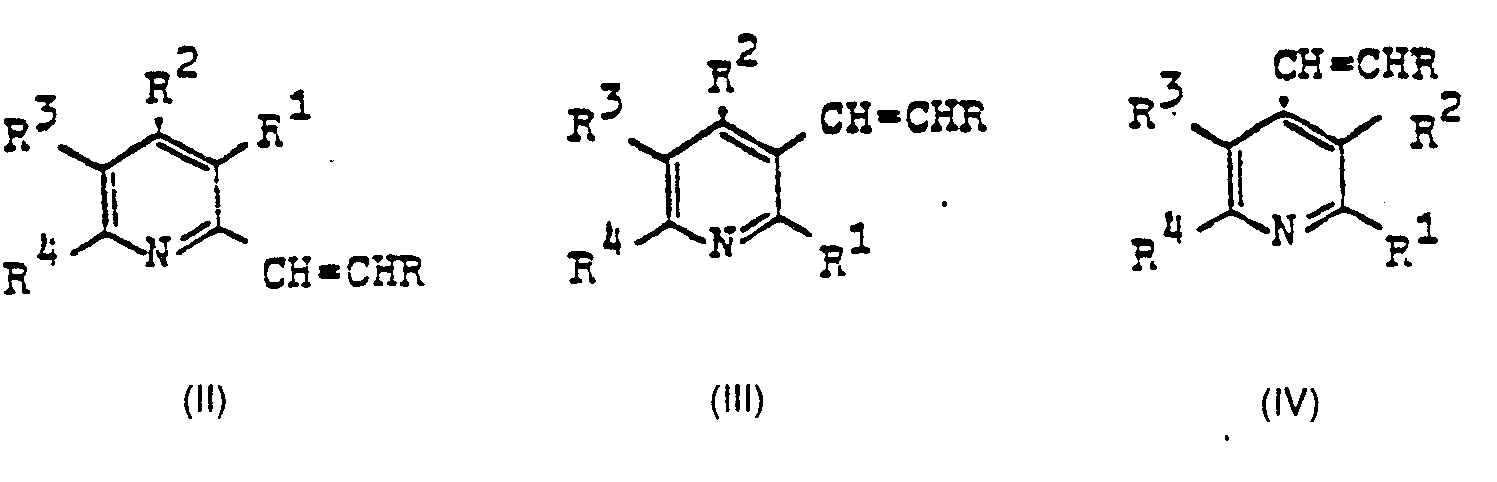


- R für Wasserstoff oder eine Methylgruppe steht,
- R', R2, R3 und R4 untereinander gleich oder verschieden sind und jeweils für Wasserstoff, eine Methyl- oder Ethylgruppe, einen gerad- oder verzweigtkettigen Alkylrest mit 3 bis 4 C-Atomen, einen gegebenenfalls durch eine Alkylgruppe mit 1 bis 4 C-Atomen, durch Halogen oder eine Nitrogruppe substituierten Phenylrest, eine Gruppe der allgemeinen Formel -R'-A-R" worin
- A Sauerstoff oder Schwefel,
- R' eine Methylen-, Ethylen- oder gegebenenfalls durch eine Alkylgruppe mit 1 bis 4 C-Atomen, durch Halogen oder eine Nitrogruppe substituierte Phenylengruppe und
- R" eine Methyl-, Ethyl- oder gegebenenfalls durch eine Alkylgruppe mit 1 bis 4 C-Atomen, durch Halogen oder eine Nitrogruppe substituierte Phenylgruppe bedeuten, eine Halogen- oder Nitrogruppe, sowie eine Gruppe der allgemeinen Formeln ―ORIII, ―COORIII, ―SO2RIII, ―CONRIIIRIV oder ―SO2NRIIIRIV. worin
- RIII und RIV untereinander gleich oder verschieden sind und jeweils eine Methyl- oder Ethylgruppe, einen gerad- oder verzweigtkettigen Alkylrest mit 3 bis 4 C-Atomen oder einen gegebenenfalls durch eine Alkylgruppe mit 1 bis 4 C-Atomen, durch Halogen oder eine Nitrogruppe substituierten Phenylrest bedeuten, stehen
und außerdem in den Formeln (I), (II), (III), (V), (VI) und (VIII) R2 und R3 oder in der Formel (III) R3 und R4, in den Formeln (II) und (IV) R3 und R4 oder R1 und R2, sowie in den Formeln (II) und (IV) sowohl R3 und R4 als auch R1 und R2 gemeinsam mit dem Heterocyclus einen anellierten, gegebenenfalls durch eine Alkylgruppe mit 1 bis 4 C-Atomen, durch Halogen oder eine Nitrogruppe substituierten aromatischen Sechsring bilden können, - h) 0 bis 22 Gew.% unter (a) bis (g) nicht genannter Monomerer, deren einpolymerisierte Reste gegenüber Isocyanatgruppen inert sind,
mit der Maßgabe, daß die Summe der unter (a) und (b) genannten Prozentzahlen 6 bis 70, die Summe der unter (c), (d) und (g) genannten Prozentzahlen 10 bis 60 und die Summe der Prozentzahlen der unter (a) bis (h) genannten Komponenten 100 beträgt, in Frage. - a) 6 bis 70 Gew.% mindestens eines Esters der allgemeinen Formel
- (a) Als Ester der allgemeinen Formel

- Komponente (a) ist im erfindungsgemäß zu verwendenden Copolymerisat (A1) in einer Menge von 6 bis 70, vorzugsweise 6 bis 50 Gew.% einpolymerisiert.
- (b) Als Hydroxyalkylester der Acrylsäure und/oder Methacrylsäure der allgemeinen Formel

- Komponente (b) kann in einer Menge von 0 bis 50, vorzugsweise 0 bis 25 Gew.% im Polyhydroxypolyacrylatharz (A1) einpolymerisiert sein. Die Summe der unter (a) und (b) genannten Prozentzahlen beträgt 6 bis 70, vorzugsweise 6 bis 50 Gew.%.
- (c) Als Alkylester der Acrylsäure und/oder Methacrylsäure, die Homopolymerisate mit Glasübergangstemperaturen von + 5 °C bis + 120 °C bilden, kommen z. B. in Frage Methylacrylat, Methylmethacrylat, Ethylmethacrylat, tert.-Butylacrylat, n-Butylmethacrylat und i-Butylmethacrylat oder deren Mischungen, wobei Methylmethacrylat und tert.-Butylacrylat bevorzugt sind.
- Komponente (c) ist im erfindungsgemäß zu verwendenden Copolymerisat (A1) in einer Menge von 10 bis 50, vorzugsweise 25 bis 50 Gew.% einpolymerisiert.
- (d) Als Vinylaromaten kommen beispielsweise Styrol, a-Methylstyrol, o- und p-Chlorstyrol, o-, m-, p-Methylstyrol und p-tert.-Butylstyrol oder deren Gemische in Betracht, wobei Styrol bevorzugt ist.
- Die Vinylaromaten (d) können im Polyhydroxypolyacrylatharz (A1) in Mengen von 0 bis 10. vorzugsweise 0 bis 7 Gew.% einpolymerisiert sein.
- Die Summe der unter (c) und (d) genannten Prozentzahlen beträgt im allgemeinen 10 bis 50, vorzugsweise 25 bis 50 Gew.%.
- (e) Als Alkylester und/oder bis zu 2 Ethersauerstoffbrücken enthaltende Alkylglykolester der Acrylsäure und/oder Methacrylsäure, die Homopolymerisate mit Glasübergangstemperaturen von -80 bis + 4,5 °C bilden, sind beispielsweise Ethylacrylat, n-Butylacrylat, i-Butylacrylat, 2-Ethylhexylacrylat, 2-Ethylhexylmethacrylat, Ethylglykolacrylat, Ethylglykolmethacrylat, Ethyldiglykolacrylat, Ethyldiglykolmethacrylat, Laurylacrylat und Laurylmethacrylat, oder deren Mischungen geeignet, wobei n-Butylacrylat und i-Butylacrylat bevorzugt sind.
- Komponente (e) ist im erfindungsgemäß zu verwendenden Copolymerisat (A1) in einer Menge von 10 bis 60, vorzugsweise 20 bis 50 Gew.% einpolymerisiert.
- (f) Als Amide der Acrylsäure und/oder Methacrylsäure, die am Amidstickstoff gegebenenfalls einen oder zwei Alkylreste mit 1 bis 8 Kohlenstoffatomen, welche gegebenenfalls eine Carbonylgruppe enthalten können, oder einen oder zwei Phenylreste als Substituenten tragen, kommen beispielsweise Acrylamid, Methacrylamid, N-Methylacrylamid, N-Methylmethacrylamid, N-Ethylacrylamid, N-Isopropylacrylamid, N,N-Dimethylacrylamid, N,N-Diethylacrylamid, N,N-Diisopropylacrylamid, N-Phenylacrylamid, N,N-Di-n-butylacrylamid und N-(1,1-dimethyl-3-oxo-butyl)-acrylamid (= Diacetonacrylamid), vorzugsweise Acrylamid und Methacrylamid, in Betracht.
- Komponente (f) kann im Polyhydroxypolyacrylatharz (A1) in einer Menge von 0 bis 10, vorzugsweise 0 bis 5 Gew.% einpolymerisiert sein.
- (g) Als polymerisierbare, olefinisch ungesättigte, heterocyclische Verbindungen der oben angegebenen allgemeinen Formeln (I) bis (VIII), wobei R für Wasserstoff ode eine Methylgruppe steht. RI, R2, R3 und R4 untereinander gleich oder verschieden sind und jeweils für Wasserstoff, eine Methyl- oder Ethylgruppe, einen gerad- oder verzweigtkettigen Alkylrest mit 3 bis 4 C-Atomen, einen gegebenenfalls durch eine Alkylgruppe mit 1 bis 4 C-Atomen, Halogen, wie z. B. Chlor oder Brom, oder eine Nitrogruppe substituierten Phenylrest, eine Gruppe der allgemeinen Formel -R'-A-R", worin A Sauerstoff oder Schwefel. R' eine Methylen-, Ethylen- oder gegebenenfalls durch eine Alkylgruppe mit 1 bis 4 C-Atomen, durch Halogen oder eine Nitrogruppe substituierte Phenylengruppe und R" eine Methyl, Ethyl- oder gegebenenfalls durch eine Alkylgruppe mit 1 bis 4 C-Atomen, durch Halogen- oder eine Nitrogruppe substituierte Phenylengruppe bedeuten, eine Halogen- oder Nitrogruppe, sowie eine Gruppe der allgemeinen Formeln ―ORIII, ―COORIII, ―SO2RIII, ―CONRIIIRIV oder ―SO2NRIIIRIV, worin RIII und R'V untereinander gleich oder verschieden sind und jeweils eine Methyl- oder Ethylgruppe, einen gerad-oder verzweigtkettigen Alkylrest mit 3 bis 4 C-Atomen oder einen gegebenenfalls durch eine Alkylgruppe mit 1 bis 4 C-Atomen, durch Halogen oder eine Nitrogruppe substituierten Phenylrest bedeuten, stehen und außerdem in den Formeln (I), (II), (III), (V), (VI) und (VIII) R2 und R3, oder in der Formel (III) R3 und R4, in den Formeln (11) und (IV) R3 und R4 oder R' und R2, sowie in den Formeln (II) und (IV) sowohl R3 und R4 als auch R' und R2 gemeinsam mit dem Heterocyclus einen anellierten, gegebenenfalls durch eine Alkylgruppe mit 1 bis 4 C-Atomen, Halogen, wie z. B. Chlor oder Brom, oder eine Nitrogruppe substituierten aromatischen Sechsring bilden können, kommen z. B. N-Vinylimidazole wie 1-Vinyl-2-methylimidazol, 1-Vinyl-2-phenylimidazol. 1-Vinylbenzimidazol. 1-Vinyl-2-ethylimidazol. 1-Propenyl-2-methylimidazol, 1-Vinyl-4-methylimidazol, 1-Vinyl-2-ethyl-4-methylimidazol, 1-Vinyl-4-nitroimidazol, 1-Vinylimidazol und 1-Propenylimidazol oder deren Mischungen in Betracht, wobei 1-Vinylimidazol, 1-Vinyl-2-methylimidazol und 1-Vinyl-2-phenylimidazol bevorzugt sind. Darüberhinaus sind als olefinisch ungesättigte heterocyclische Verbindungen (g) Vinylheterocyclen der Formeln (11) bis (VIII), beispielsweise 2-Vinylpyridin. 3-Vinylpyridin, 4-Vinylpyridin, 5-Ethyl-2-vinylpyridin, 6-Methyl-3-vinylpyridin. 2-Vinylchinolin, 2-Vinylisochinolin, 4-Vinylchinolin, 2-Vinylchinoxalin. 4-Vinylchinazolin, 2-Vinylpyrimidin, 4-Vinylpyrimidin und 2-Vinylpyridazin oder deren Gemische geeignet, wobei 3-Vinylpyridin und 4-Vinylpyridin bevorzugt sind.
- Komponente (g) ist im erfindungsgemäß zu verwendenden Copolymerisat (A1) in einer Menge von 1 bis 25, vorzugsweise 2 bis 20 Gew.% einpolymerisiert.
- (h) Als unter (a) bis (g) nicht genannte Monomere, deren einpolymerisierte Reste gegenüber-Isocyanatgruppen inert sind, die also unter den beim erfindungsgemäßen Verfahren in Frage kommenden Umsetzungsbedingungen nicht mit Isocyanat- oder verkappten Isocyanatgruppierungen reagieren, seien beispielsweise genannt Vinylester mit 1 bis 12 Kohlenstoffatome enthaltenden Carbonsäuren, wie z. B. Vinylacetat, Vinylpropionat, Vinylpivalat, Vinyl-2-ethylhexanat, Vinyllaurat, Vinylbenzoat, Vinylhalogenide, wie z. B. Vinylchlorid, Vinylidenhalogenide, wie etwa Vinylidenchlorid, sowie N-Vinylpyrrolidon und N-Vinylcaprolactam und Gemische der genannten Monomeren.
- Komponente (h) kann im Polyhydroxypolyacrylatharz in einer Menge von 0 bis 20, vorzugsweise 0 bis 10 Gew.% einpolymerisiert sein.
- Die Summe der unter (a) bis (h) genannten Prozentzahlen beträgt 100.
- Das hydroxylgruppenhaltige Copolymerisat (A1) weist im allgemeinen Hydroxylzahlen zwischen 30 und 250, vorzugsweise 50 bis 150 auf.
- Das Polyhydroxypolyacrylatharz (A1) läßt sich aus den Monomeren (a) bis (h) nach üblichen Polymerisationsverfahren, beispielsweise durch kontinuierliche oder diskontinuierliche radikalinitiierte Polymerisation, vorzugsweise diskontinuierlich in organischer Lösung bei Temperaturen zwischen 80 und 160 °C, z. B. in Gegenwart radikalliefernder Polymerisationsinitiatoren herstellen. Für das erfindungsgemäße Verfahren werden die Polyhydroxypolyacrylatharze (A1), die im allgemeinen mittlere Molekulargewichte im Zahlenmittel (Mn) zwischen 1 000 und 20 000, bevorzugt zwischen 2 000 und 10 000, bzw. K-Werte (nach Fikentscher) zwischen 12 und 40, vorzugsweise zwischen 15 und 30 aufweisen, zweckmäßigerweise in organischen, gegenüber Isocyanatgruppen inerten Lösungsmitteln gelöst eingesetzt. Derartige geeignete Lösungsmittel sind z. B. Ester, wie n-Butylacetat, Ethylacetat und Isopropylacetat, Ether, wie z. B. Tetrahydrofuran. Dioxan und Diethylglykol, Etherester, wie z. B. Ethylglykolacetat, Methylglykolacetat und Butylglykolacetat. Kohlenwasserstoffe, insbesondere aromatische Kohlenwasserstoffe, wie Xylol oder Toluol, Ethylbenzol und Halogenkohlenwasserstoffe, wie Chlorbenzol, so wie Gemische dieser Lösungsmittel.
- (A2) Unter den erfindungsgemäß einzusetzenden Polyesterpolyolen (A2) werden die üblichen Polyesterpolyole verstanden, die mindestens jeweils zwei Ester- und Hydroxylgruppen enthalten und in üblichen organischen gegenüßer Isocyanatgruppen inerten Lacklösungsmitteln bzw. Lacklösungsmittelgemischen löslich sind. Besonders kommen hierfür etwa die bekannten gesättigten Polyesterpolyole und Polycaprolactonpolyole sowie hydroxylgruppenhaltige Alkydharze, aber auch in der Kette Doppelbindungen enthaltende und urethanmodifizierte Polyesterpolyole in Frage.
- Der erfindungsgemäße Einsatz der Polyesterpolyole (A2) neben den oben genannten Polyhydroxypolyacrylatharzen als Komponente (A1) ergibt im Vergleich zu Systemen, die keine Polyesterkomponente enthalten, Lacke mit deutlich höheren Festkörpergehalten bei Spritzviskosität bzw. niedrigeren Viskositäten bei konstantem Festkörpergehalt. Dabei bleiben aber überraschenderweise gleichzeitig die vorteilhaften Eigenschaften der auf reinen Polyacrylaten basierenden Systemen, wie sehr rasche Härtung der Lackschichten bei Raumtemperatur zu superbenzinfesten witterungsbeständigen Filmen hoher Kratzfestigkeit und Flexibilität erhalten.
- Die genannten Polyesterpolyole besitzen im allgemeinen zwischen 30 und 500, vorzugsweise zwischen 50 und 400 liegende Hydroxylzahlen, sowie zwischen 0 und 30, bevorzugt 0 und 15, liegende Säurezahlen und entsprechende Molekulargewichte (Mn) im Zahlenmittel etwa zwischen 250 und 5 000, vorzugsweise zwischen 400 und 3 000. Die durchschnittliche Funktionalität der Polyester liegt im Bereich zwischen 2 und 6, bevorzugt zwischen 2, 3 und 5, wobei unter Funktionalität in diesem Zusammenhang die durchschnittliche Zahl der reaktionsfähigen Hydroxylgruppen pro Polyestermolekül verstanden wird. Dieser bevorzugte Funktionalitätsbereich ergibt sich dadurch, daß einerseits zu wenig verzweigte Polyesterpolyole nur schwach vernetzende Lackfilme geringer Härtungsgeschwindigkeit und niedriger mechanischer Festigkeit ergeben, andererseits bei zu stark verzweigten Polyolen Überzüge eines sehr hohen Vernetzungsgrades und damit zu hoher Sprödigkeit resultieren.
- Die Polyesterole lassen sich im allgemeinen nach üblichen Methoden, etwa entsprechend dem Stand der Technik herstellen durch Umsetzung von aliphatischen und/oder cycloaliphatischen und/oder aromatischen, gegebenenfalls olefinisch ungesättigten Polycarbonsäuren, deren Anhydriden oder kurzkettigen Hydroxyalkyl- bzw. Alkylestern mit einem Überschuß an polyfunktionellen aliphatischen und cycloaliphatischen Alkoholen. sowie aromatische Gruppen enthaltenden mehrwertigen Alkoholen mit aliphatisch gebundenen Hydroxylfunktionen. Die ebenfalls erfindungsgemäß zu verwendenden Polycaprolactonpolyole können nach an sich bekannten Verfahren durch Polymerisation von Lactonen. wobei polyfunktionelle aliphatische Alkohole als Kettenstarter fungieren, hergestellt werden. Auch die üblicherweise verwendeten nach bekannten Verfahren des Standes der Technik hergestellten hydroxylgruppenhaltigen ölmodifizierten Alkydharze lassen sich erfindungsgemäß als Komponente (A2) einsetzen, wenn sie den o. a. Bedingungen bezüglich Hydroxylzahl, Säurezahl, Molekulargewicht und Funktionalität entsprechen.
- Für die Herstellung der Polyesterpolyole eignen sich als Polycarbonsäuren besonders solche der Formel

- R einen n-wertigen gesättigten, gegebenenfalls olefinisch ungesättigten aliphatischen Kohlenwasserstoffrest mit 2 bis 18. vorzugsweise 2 bis 8 Kohlenstoffatomen, einen gegebenenfalls ungesättigte cycloaliphatische Gruppen enthaltenden Kohlenwasserstoffrest mit 4 bis 18, bevorzugt 6 bis 12 Kohlenstoffatomen oder einen aromatischen Kohlenwasserstoffrest mit 6 bis 12, bevorzugt 6 bis 10 Kohlenstoffatomen, und
- n eine ganze Zahl von 2 bis 3, vorzugsweise 2 bedeuten
- Zum Einsatz hierfür kommen z. B. : Bernsteinsäure, Adipinsäure, Glutarsäure, Korksäure, Sebazinsäure, Cyclobutan-1.3-dicarbonsäure, Hexahydrophthalsäure, Hexahydroisophthalsäure, Hexahydroterephthalsäure, Tricyclodecandicarbonsäure, Endoethylenhexahydrophthalsäure, 4-Methylhexahydrophthalsäure, Tetrahydrophthalsäure, Endoethylentetrahydrophthalsäure, Phthalsäure, Isophthalsäure, Terephthalsäure, Naphthalin-1,5-dicarbonsäure, Trimellithsäure, Pyromellithsäure, und in untergeordneten Mengen auch Maleinsäure, Fumarsäure, Citraconsäure, Mesaconsäure und Itaconsäure, wobei Phthalsäure, Isophthalsäure, Hexahydrophthalsäure und Adipinsäure besonders bevorzugt sind.
- Als für die Umsetzung mit überschüssigen mehrwertigen Alkoholen geeignete Polycarbonsäureanhydride kommen beispielsweise die Anhydride der Bernsteinsäure, Hexahydrophthalsäure, Endoethylenhexahydrophthalsäure, 4-Methylhexahydrophthalsäure, Tetrahydrophthalsäure, Endoethylentetrahydrophthalsäure, Phthalsäure, Trimellithsäure, in untergeordneten Mengen der Maleinsäure und Citraconsäure, sowie das Dianhydrid der Pyromellithsäure in Frage, wobei die Anhydride der Hexahydrophthalsäure und Phthalsäure bevorzugt sind.
- Zur Herstellung der Polyester eignen sich zum Beispiel folgende Alkohole einer Funktionalität zwischen 2 und 4 und eines Molekulargewichtsbereiches von 62 bis 300 :
- Zweiwertige Alkohole, wie Ethylenglykol, Propandiol-1,2, Propandiol-1,3, Butandiol-1,4, Butandiol-1,3. Pentandiol-1,5, Hexandiol-1,6, Octandiol-1,8, Decandiol-1,10, 2-Methylpentandiol-1,5, 2-Ethylbutandiol-1,4, 2.2-Dimethylpropandiol-1,3, 2-Ethylhexandiol-1,3, Diethylenglykol, Triethylenglykol, Dipropylenglykol, Tripropylenglykol, Cyclohexandiol-1,4, 1.4-Dihydroxymethylcyclohexan, 1,4-Dihydroxyethylcyclohexan, 1.3-Dihydroxymethylcyclohexan, 4,4'-Dihydroxydicyclohexylpropan, 4,4'-Dihydroxymethyldicyclohexylpropan, 3,3'-Dimethyl-4,4'-dihydroxydicyclohexylpropan, 3(4),8(9)-Dihydroxymethyltricyclo-[5.2.1.02-6]-decan, 1,4-Dihydroxymethylbenzol, zweifach oxethyliertes Hydrochinon, zwei- und vierfach oxethyliertes Bisphenol A (= 4,4'-Dihydroxydiphenylpropan) und das Esterdiol aus 2.2-Dimethylpropandiol-1,3 und 2,2-Dimethyl-3-hydroxypropionsäure, sowie drei- und mehrwertige Alkohole wie Trimethylolethan, Trimethylolpropan, Glycerin und Pentaerythrit, wobei Ethylenglykol, Propandiol-1,2, Butandiol-1,3, Hexandiol-1.6. 2,2-Dimethylpropandiol-1,3, 1,4-Dihydroxymethylcyclohexan, Diethylenglykol, Triethylenglykol und Trimethylolpropan bevorzugt sind.
- Die Herstellung derartiger geeigneter Polyesterpolyole kann gemäß dem Stand der Technik erfolgen. wie er etwa in der einschlägigen Literatur beschrieben ist :
- 1. Johannes Scheiber, Chemie und Technologie der künstlichen Harze, Wissenschaftliche Verlagsgesellschaft mbH, Stuttgart, 1943
- 2. Ullmanns Encyklopädie der technischen Chemie, Bd. 14 (1963), S. 80 bis 106
- 3. Hans Wagner/Hans Friedrich Sarx. Lackkunstharze, 5. Aufl., Carl Hanser Verlag, München, 1971
- 4. Houben-Weyl, Methoden der Organischen Chemie. Hrsg. E. Müller, Bd. XIV/2. Makromolekulare Stoffe, Teil 2. 4. Aufl., Georg Thieme Verlag, Stuttgart, 1963, S. 1 bis 47.
- Neben den hier erwähnten erfindungsgemäß zu verwendenden Polyesterpolyolen lassen sich als Komponente (A2) auch die gebräuchlichen durch Polyaddition von e-Caprolacton oder seinen Derivaten an polyfunktionelle Alkohole herzustellenden Polycaprolactonpolyole verwenden.
- Die für das erfindungsgemäße Verfahren einzusetzenden Polycaprolactonpolyole weisen im allgemeinen zwei bis vier endständige Hydroxylgruppen auf und werden, wie u. a. in der US-A 3 169 945 beschrieben, durch kationische Polymerisation z. B. von e-Caprolacton unter Verwendung von Alkoholen einer Funktionalität von zwei bis vier als Initiatoren (= Starter) hergestellt. Als derartige Initiatoren werden Diole. wie etwa Ethylenglykol, Diethylenglykol, Triethylenglykol. Propandiol-1,2, Propandiol-1,3, Polyethylenglykol, Polypropylenglykol und gemischte Poly(oxyethylen-oxypropylen) glykole, Triole, wie Trimethylolpropan. Glycerin und 1,2,6-Hexantriol und Tetrole, wie beispielsweise Pentaerythrit eingesetzt. Die erfindungsgemäß zu verwendenden Polycaprolactonpolyole besitzen Molekulargewichte im Zahlenmittel (Mn) etwa zwischen 250 und 4000. bevorzugt zwischen 500 und 3000. Polycaprolactondiole werden bevorzugt in Abmischung mit höhertunktionellen Polycaprolactonpolyolen eingesetzt, so daß eine durchschnittliche Funktionalität etwa zwischen 2, 3 und 4, vorzugsweise 2, 3 und 3, erreicht wird. Ebenso bevorzugt ist der erfindungsgemäße Einsatz von Polycaprolactonpolyolen mit den erstgenannten Polyesterpolyolen derartig, daß eine durchschnittliche Gesamtfunktionalität der Komponenten (A2) von vorzugweise zwischen 2, und 5 resultiert, wobei Funktionalität die bereits zuvor angegebene Bedeutung haben soll.
- Die hydroxylgruppenhaltige Bindemittelkomponente (A) besteht allgemein aus 40 bis 99 Gew.%, bevorzugt 45 bis 95 Gew.% eines oder mehrerer Polyhydroxypolyacrylate (A1) und 1 bis 60 Gew.%. vorzugsweise 5 bis 55 Gew.% eines oder mehrerer löslicher Polyesterpolyole (A2). Daneben kann die Komponente (A2) - etwa herstellungsbedingt - noch untergeordnete Mengen anderer niedermolekularer Verbindungen mit gegenüber Isocyanat reaktiven Gruppen enthalten. Als solche seien etwa die zur Herstellung der Polyesterpolyole eingesetzten polyfunktionellen Alkohole des Molekulargewichtsbereichs von 62 bis 300 genannt, die in den erfindungsgemäßen Lackmischungen als reaktive Verdünner fungieren können, d. h. letztlich in die gehärteten Überzüge eingebaut werden. Die Mitverwendung dieser niedermolekularen Polyole beschränkt sich jedoch auf Mengen von maximal 10 Gew.% der Komponente (A2).
- Die erfindungsgemäße Polyolkomponente (A) weist Hydroxylzahlen von insgesamt 30 bis 250, vorzugsweise von 50 bis 170 auf. Sie kann durch einfaches Abmischen des in organischer Lösung vorliegenden Polyhydroxypolyacrylatharzes (A1) mit der lösungsmittelfreien Polyesterpolyolkomponente (A2) hergestellt werden, wobei dieses Verfahren im Falle des Vorliegens bei Raumtemperatur flüssiger Polyester zu bevorzugen ist. Bei Verwendung fester Polyesterole ist es dagegen günstiger, beide Komponenten (A1) und (A2) in organischer Lösung miteinander zu mischen. Ebenfalls möglich ist es, das erfindungsgemäße Polyhydroxypolyacrylatharz (A1) bei Anwesenheit der Polyesterolkomponente (A2) in organischer Lösung aus den Monomeren (a) bis (h) zu polymerisieren, wie es beispielsweise in der DE-A 23 14 044 beschrieben ist. Hierzu wird das Polyesterol, gegebenenfalls nach Verdünnung mit organischen Lösungsmitteln entweder teilweise oder vollständig vorgelegt und anschließend die Monomerenmischung samt Katalysator zudosiert und, wie bereits beschrieben, polymerisiert. Noch fehlende Anteile an Polyesterpolyol oder Lösungsmittel können nach der Polymerisation zur vorliegenden Mischungen hinzugefügt werden. Man kann die Polymerisation selbstverständlich auch in Anwesenheit eines teilweise ungesättigten Polyesterols, für dessen Herstellung etwa untergeordnete Mengen an Maleinsäureanhydrid oder Fumarsäure verwendet werden, durchführen. Hierbei sind allerdings, wie aus der JA-A 75-22092 und der DE-A 26 44 550 sowie 26 44 691 hervorgeht, nur Polyesterpolyole einsetzbar, die durchschnittlich maximal eine Doppelbindung, bevorzugt weniger als 0.8 Doppelbindungen pro Molekül enthalten, einsetzbar. Bei höheren Konzentrationen an vernetzenden Doppelbindungen im Polyesterpolyol führt die Copolymerisationsreaktion im allgemeinen zu vernetzten bzw. gelierten und damit unbrauchbaren Produkten. Nach Durchführung der Acrylatpolymerisation können gegebenenfalls noch fehlende Anteile an Polyesterpolyol oder Lösungsmittel zur vorliegenden Mischung hinzugefügt werden.
- Als organische Lösungsmittel für die Abmischung der Komponenten (A1) und (A2), die Herstellung von (A1) in Gegenwart von (A2) bzw. die Verdünnung des Polyolgemisches (A) eignen sich die bereits genannten gegenüber Isocyanatgruppen inerten Lacklösungsmittel, in welchen die Polyhydroxypolyacrylatharze (A1) gelöst vorliegen.
- (B) Als erfindungsgemäß zu verwendende, gegebenenfalls teilweise oder vollständig mit CH-, NH-oder OH-aciden Blockierungsmitteln verkappte, Isocyanuratgruppen aufweisende Polyisocyanate einer Funktionalität zwischen 2, 5 und 6, vorzugsweise zwischen 3 und 5, eignen sich solche mit vorwiegend cycloaliphatisch gebundenen Isocyanatgruppen. Bevorzugt sind dabei derartige Isocyanuratgruppen enthaltende Polyisocyanate, die aus 3-lsocyanatomethyl-3,5,5-trimethylcyclohexylisocyanat (= Isophorondiisocyanat = IPDI) als monomerem Diisocyanat erhalten werden. Die Herstellung derartiger Isocyanuratgruppen enthaltender Polyisocyanate kann z. B. nach üblichen Methoden erfolgen, wie sie beispielsweise in den GB-PS 1 391 066, DE-A 23 25 826 oder DE-A 27 32 662 beschrieben sind, z. B. durch Trimerisierung des Diisocyanats bei Temperaturen zwischen ca. 40 und 120 °C in Anwesenheit von Katalysatoren, wie etwa Metallverbindungen, z. B. Metallnaphthenaten, Erdalkaliacetaten, -formiaten und -carbonaten. Metallalkoxiden und Eisenacetylacetonat, bevorzugt sekundären und tertiären Aminen, wie Aziridinen in Kombination mit Trialkylaminen oder Triethylendiamin. kombiniert mit Propylenoxid.
- Ebenfalls in Frage kommen Isocyanuratgruppen aufweisende Polyisocyanate etwa auf Basis von 1,4-Diisocyanatocyclohexan (= Cyclohexan-1.4-diisocyanat) und 4,4'-Diisocyanatodicyclohexylmethan (= Dicyclohexylmethan-4,4'-diisocyanat).
- Auch Kombinationen der hier genannten bevorzugten cycloaliphatischen isocyanuratgruppenhaltigen Polyisocyanate (B1) mit Biuretgruppen enthaltenden Isocyanataddukten (B2), die vorwiegend aliphatisch gebundene Isocyanatgruppen aufweisen, sind erfindungsgemäß einsetzbar. Als bevorzugtes Polyisocyanat (B2) sei hier vor allem das seit langem bekannte und, wie oben erwähnt. speziell in Zweikomponenten-Polyurethanlacken für den Automobilreparatursektor eingesetzte biuretisierte Hexamethylendiisocyanat genannt. Seine Herstellung erfolgt, wie beispielsweise in DE-C 1 101 394, DE-C 1 104 394, DE-C 1 174 759, DE-C 1 174 760, DE-C 1 227 004, DE-C 1 227 007, der GB-A 1 044 932 und der DE-A 1 931 055 beschrieben, etwa durch Einwirkung von freiem oder gebundenem Wasser (z. B. als Kristallwasser oder in Form von Ameisensäure), primären aliphatischen Monoaminen oder tertiären aliphatischen Monoalkoholen bei Temperaturen zwischen 80 und 200 °C auf Hexamethylendiisocyanat und anschließendes Entfernen des überschüssigen Diisocyanates mittels Vakuumdestillation im Dünnschichtverdampfer. Als erfindungsgemäß einzusetzende Isocyanatkomponenten (B2) eignen sich ebenfalls isocyanuratgruppenhaltige Polyisocyanate mit vorwiegend aliphatisch gebundenen Isocyanatgruppen, wobei speziell das durch Trimerisierung von Hexamethylendiisocyanat erhaltene Isocyanataddukt bevorzugt ist. Diese Produkte können z. B. durch katalytische Trimerisierung eines Teils der Isocyanatgruppen von organischen Diisocyanaten, wie beispielsweise in der DE-C 1 201 992, den DE-A 1 644 809. DE-A 1 670 667, DE-A 2 325 826. DE-A 2 616 415. DE-A 2 616 416. DE-A 2 644 684, DE-A 2 724 914 und DE-A 2 806 731 beschrieben, hergestellt werden.
- Die Komponente (B) setzt sich zusammen aus 60 bis 100 Gew.%, vorzugsweise 70 bis 100 Gew.%. solcher Polyisocyanate (B1). die Isocyanuratgruppen und vorwiegend cycloaliphatisch gebundene Isocyanatgruppen aufweisen, und 0 bis 40 Gew.%, bevorzugt 0 bis 30 Gew.% der obengenannten Biuretgruppen und/oder Isocyanuratgruppen enthaltenden Polyisocyanate (B2) mit vorwiegend aliphatisch gebundenen Isocyanatgruppen, wobei die Summe der unter (B1) und (B2) genannten Prozentzahlen 100 beträgt.
- Anstelle der obengenannten Mischungen aus den Polyisocyanatkomponenten (B1) und (B2) sind für das erfindungsgemäße Verfahren ebenfalls isocyanuratgruppenhaltige Polyisocyanate (B) mit vorwiegend cycloaliphatisch gebundenen Isocyanatgruppen, welche sowohl cycloaliphatische als auch aliphatische Diisocyanate in eingebauter Form enthalten, verwendbar. Als cycloaliphatische Diisocyanate kommen etwa 1,4-Diisocyanatocyclohexan und 4,4'-Diisocyanatodicyclohexylmethan, bevorzugt aber Isophorondiisocyanat, als aliphatisches Diisocyanat vorzugsweise Hexamethylendiisocyanat in Frage. Diese gemischt cycloaliphatischlaliphatischen Polyisocyanate werden im allgemeinen, wie z. B. in der DE-A 30 33 860 beschrieben, durch Trimerisierung des Diisocyanatgemisches bei Temperaturen zwischen 40 und 100 °C und bevorzugtem Einsatz geeigneter Hydroxylgruppen-substituierter quaternärer Ammoniumhydroxide hergestellt. Für das erfindungsgemäße Verfahren geeignete gemischte isocyanurathaltige Addukte enthalten beispielsweise 60 bis 99 Gew.%, bevorzugt 70 bis 98 Gew.% cycloaliphatisches Diisocyanat. vorzugsweise lsophorondiisocyanat, und 1 bis 40 Gew.%, bevorzugt 2 bis 30 Gew.% aliphatisches Diisocyanat, vorzugsweise Hexamethylendiisocyanat eingebaut, wobei die Summe der unter 1) und 2) angegebenen Prozentzahlen 100 beträgt.
- Selbstverständlich sind für das erfindungsgemäße Verfahren sämtliche vorgenannten Polyisocyanat-Addukte in allen möglichen Kombinationen einsetzbar.
- Der erfindungsgemäße Einsatz derartiger Polyisocyanatmischungen, die in untergeordneten Mengen biuretgruppenhaltige Addukte mit aliphatisch gebundenen Isocyanatgruppen - etwa auf Basis von Hexamethylendiisocyanat - bzw. Trimerisate aus cycloaliphatischen und in geringeren Mengen aliphatischen Diisocyanaten - etwa Isophorondiisocyanat und Hexamethylendiisocyanat - umfassen, kann in gewissen Fällen vorteilhaft sein : bedingt durch die teilweise Verwendung aliphatischer Isocyanataddukte können Lackfilme besonders hoher Elastizität und Vernetzungsgeschwindigkeit resultieren, wobei überraschenderweise die durch den Einsatz cycloaliphatischer Trimerisate implizierten Vorteile, wie etwa ein hohes Härteniveau der Lackfilme und ein relativ günstiges pot life sowie vor allem eine niedrige Inhalationstoxizität der Lackmischungen weitgehend erhalten bleiben.
- Als für die Lackpolyisocyanate (B) zu verwendende Blockierungsmittel kommen in Frage :
- CH-, NH- oder OH-acide Blockierungsmittel wie z. B. Malonsäuredialkylester. Acetessigsäuredialkylester. Acetylaceton, s-Caprolactam, Pyrrolidon, Phenole, p-Hydroxybenzoesäureester, Cyclohexanol, t-Butanol, bevorzugt Oxime wie Benzophenonoxim. Cyclohexanonoxim, Methylethylketoxim. Dimethylketoxim, besonders bevorzugt sind dabei Methylethylketoxim und Dimethylketoxim.
- Komponente (B) kann unverkappt, teilweise oder vollständig verkappt sein. Bevorzugt sind unverkappte Polyisocyanate.
- Die Mengenverhältnisse der erfindungsgemäß zu verwendenden Bindemittelkomponenten Polyhydroxypolyacrylat (A1). Polyesterpolyol (A2) sowie Polyisocyanat bzw. Polyisocyanatgemisch (B) werden zweckmäßigerweise so gewählt, daß das Äquivalentverhältnis von - gegebenenfalls verkappten - Isocyanatgruppen zu reaktionsfähigen Hydroxylgruppen zwischen 0,25 : und 4:1, vorzugsweise zwischen 0,5 : 1 und 2 : 1, liegt.
- Die Herstellung von Überzügen nach dem erfindungsgemäßen Verfahren erfolgt durch Vermischen der Komponenten (A) und (B), zweckmäßigerweise gelöst in organischem Lösungsmittel oder Lösungsmittelgemisch, gegebenenfalls Zusatz von Pigmenten, wie üblichen Weiß- und Schwarzpigmenten, etwa Titandioxiden (Rutil), Zinksulfiden und Ruß oder Buntpigmenten, z. B. Cadmiumsulfid, Eisenoxidgelb, Eisenoxidrot, Chromoxid, Benzidingelb. Phthalocyaninblau, Phthalocyaningrün. Thioindigo und Chinacridonen, z. B. in Mengen von bis zu 250 %, bezogen auf Gesamtmenge Bindemittel (= Komponenten (A) und (B)), sowie anderer für die Verarbeitung von 2-Komponentenlacken üblicher Hilfs- und Zusatzstoffe und Auftragen auf das zu überziehende Substrat. Prinzipiell können auch Katalysatoren, wie z. B. Metallverbindungen, etwa Blei-, Zink- und Kobaltnaphthenate, Blei-, Zinn- und Calciumoctoat, Dibutylzinndiacetat, Dibutylzinndilaurat, Eisenacetylacetonat und Basen wie Triethylendiamin und Diethylethanolamin in Mengen von ca. 0,001 bis 10 Gew.%, bezogen auf die Gesamtbindemittelmenge, verwendet werden, jedoch erfolgt die Herstellung der Überzüge vorzugsweise ohne Katalysatorzugabe, da es, wie bereits erwähnt, ein überraschender Vorteil der erfindungsgemäßen Lackmischungen ist, daß sie ohne Beschleuniger sehr rasch zu harten, kratzfesten und superbenzinfesten Schichten aushärten und dabei dennoch praxisgerechte Topfzeiten ergeben.
- Als Auftragsmethoden kommen die üblichen in Betracht, beispielsweise Spritzen, Tauchen, Streichen oder Walzen.
- Nach dem erfindungsgemäßen Verfahren lassen sich beispielsweise Metallteile aus Aluminium, Zink, Zinn. Eisen und Stahl, wie Stahlbleche, oder verzinkte Stahlbleche und Aluminiumbleche, darüberhinaus auch andere Substrate wie etwa Holz, Papier, Beton und Kunststoffe, z. B. PVC und Polyamid beschichten.
- Die Härtung der Überzüge kann nach dem Auftragen auf das Substrat in üblicher Weise erfolgen, beispielsweise bei Raumtemperatur innerhalb von 24 Stunden bis 7 Tagen, oder zweckmäßigerweise nach Ablüften bei Raumtemperatur, bei Temperaturen von etwa 60 bis 80 °C innerhalb von 20 bis 60 Minuten.
- Nach dem erfindungsgemäßen Verfahren lassen sich Überzüge mit besonders vorteilhaften Eigenschaften erhalten. Die erfindungsgemäß erhaltenen Überzüge zeichnen sich insbesondere durch hohe Kratzfestigkeit, ausgezeichnete Superbenzinfestigkeit nach relativ kurzen Trocknungszeiten, gleichzeitig hohe Elastizität, guten Glanz und hervorragende Witterungsstabilität bei rascher Härtung und relativ langen Topfzeiten sowie hohen Festkörpergehalten bei Spritzviskosität der zugrundeliegenden Lackmischungen aus.
- Die in den Beispielen und Vergleichsbeispielen genannten Teile und Prozente sind, soweit nicht anders angegeben, Gewichtsteile und Gewichtsprozente.
- Die Herstellung der Polyacrylatharze A bis C erfolgt entsprechend dem Stand der Technik.
- In einem mit Blattrührer, Rückflußkühler, Zulaufgefäß, Thermometer und Gaseinleitungsrohr versehenen Reaktionsgefäß werden 100 Teile n-Butylacetat/Xylol 1 : 1 auf 100 °C erhitzt. Unter Einhalten dieser Temperatur und starkem Rühren wird eine Lösung von 77,5 Teilen Butandiol-(1,4)-monoacrylat, 42,5 Teilen Hydroxyethylacrylat, 75 Teilen Methylmethacrylat, 90 Teilen t-Butylacrylat, 190 Teilen n-Butylacrylat und 25 Teilen 1-Vinylimidazol sowie 10 Teilen Azodiisobuttersäurenitril in 130 Teilen n-Butylacetat/Xylol 1 : mit konstanter Zulaufgeschwindigkeit unter Luftausschluß (im schwachen Stickstoffstrom) innerhalb eines Zeitraumes von 4 Stunden zugetropft. Anschliessend werden zur Nachpolymerisation noch 2,5 Teile Azodiisobuttersäurenitril in 75 Teilen n-Butylacetat/Xylol 1 : 1 im Verlauf von 2 Stunden gleichmäßig zudosiert.
- Das erhaltene Polyacrylatharz besitzt folgende Kennzahlen :
- Hydroxylzahl = ca. 102 (bez. auf fest)
- Viskosität bei 23 °C = 2 750 mPa - s
- K-Wert (3 %ig in Dimethylformamid) = 21,8.
- Die Herstellung erfolgt unter den gleichen Bedingungen wie bei Polyacrylatharz A mit dem Unterschied, daß die nachstehend genannten Comonomeren eingesetzt werden : 103 Teile Hydroxyethylacrylat, 50 Teile Methylmethacrylat, 152 Teile t-Butylacrylat, 192,5 Teile n-Butylacrylat und 2.5 Teile Acrylsäure. Die Kennzahlen des Copolymerisates lauten :
- Hydroxylzahl = ca. 98.
- Säurezahl = 6,5,
- Viskosität bei 23 °C = 3 400 mPa - s ;
- K-Wert (3 %ig in Dimethylformamid) = 23.2.
- In einem wie oben beschriebenen Reaktionsgefäß wird eine Mischung aus 100 Teilen Ethylglykolacetat. 200 Teilen Xylol und 149 Teilen Glycidylester von a,ß-Dialkylalkanmonocarbonsäuren der Bruttoformel C,jH2403 auf 135 °C erhitzt. Anschließend wird bei dieser Temperatur ein Gemisch aus 101 Teilen Methylmethacrylat, 94 Teilen Hydroxyethylmethacrylat, 111 Teilen Styrol, 44 Teilen Acrylsäure, 1,5 Teilen t-Dodecylmercaptan und 5 Teilen Di-tert.-Butylperoxid im Verlauf von 2 Stunden mit konstanter Zulaufgeschwindigkeit zugetropft und die Harzlösung noch 6 Stunden bei 135 °C nachreagieren lassen. Die Polymerisatlösung mit einem Festkörpergehalt von 60 % wird mit Xylol auf 50 % Feststoffgehalt verdünnt und besitzt eine Auslaufzeit von 250 sec im DIN-Becher 4 bei 23 °C. Weitere Kennzahlen :
- OH-Zahl (bez. auf fest) = ca. 150.
- Säurezahl = ca. 7.
- K-Wert = 23,9.
- In ein mit Blattrührer, Füllkörperkolonne mit Kühler sowie Vakuumvorrichtung und Vorlagegefäß. Thermometer und Gaseinleitungsrohr versehenes Reaktionsgefäß werden 1 314 Teile Adipinsäure, 90 Teile Phthalsäureanhydrid, 524 Teile Trimethylolpropan und 708 Teile Propandiol-1,2 eingefüllt. Die Mischung wird unter Stickstoffatmosphäre aufgeschmolzen und bei Normaldruck unter Rühren und langsamer Temperatursteigerung bis auf maximal 180 °C so lange verestert, bis etwa 290 Teile Wasser abdestilliert sind. Anschließend setzt man die Veresterung unter Vakuum (ca. 150 bis 200 mbar) fort, bis eine Säurezahl von < 4 erreicht ist. Der Polyester wird nun auf 70 bis 80 °C abgekühlt und unter Rühren in Xylol/n-Butylacetat 1 : 1 gelöst, wobei ein Festkörpergehalt von ca. 62 % eingestellt wird. Die Lösung besitzt eine Auslaufzeit von 40 Sekunden im DIN-4-Becher bei 23 °C und eine Hydroxylzahl von ca. 215 (bez. auf fest).
- Es wird ebenso verfahren, wie für Polyesterol A beschrieben, mit dem Unterschied, daß die obengenannten Einsatzstoffe in den nachstehend angegebenen Mengen verwendet werden : 1 314 Teile Adipinsäure, 177 Teile Phthalsäureanhydrid. 321 Teile Trimethylolpropan und 843 Teile Propandiol-1,2. Das resultierende Polyesterol (62%ig in Xylol/n-Butylacetat 1 : 1) besitzt folgende Kennzahlen :
- Auslaufzeit im DIN-4-Becher bei 23 °C = Sekunden ;
- Säurezahl = ca. 3 ;
- Hydroxylzahl = ca. 170 (bez. auf fest).
- In der für die Herstellung von Polyesterol A verwendeten Apparatur werden 1 232 Teile Hexahydrophthalsäureanhydrid, 292 Teile Adipinsäure, 281 Teile Trimethylolpropan, 279 Teile Ethylenglykol, 403 Teile 1,4-Dihydroxymethylcyclohexan und 234 Teile 2,2-Dimethylpropandiol-1,3 bei bis auf maximal 200 °C ansteigender Temperatur verestert, bis ca. 190 Teile Wasser abdestilliert sind. Anschließend läßt man bei 200 °C im Vakuum weiter reagieren, bis eine Säurezahl von ca. 10 erreicht ist und verdünnt das erhaltene Polyesterol, wie oben beschrieben, mit Xylol/n-Butylacetat 1 : 1. Das Produkt hat folgende Kennzahlen :
- Auslaufzeit im DIN-4-Becher bei 23 °C, 50 %ig in Xylol/n-Butylacetat 1 : 1 = 25 Sekunden ;
- Hydroxylzahl = ca. 105 (bez. auf fest).
- Zur Herstellung der erfindungsgemäßen Überzüge werden folgende Polyisocyanatkomponenten (B) eingesetzt :
- Isocyanuratgruppenhaltiges Polyisocyanat mit vorwiegend cycloaliphatisch gebundenen Isocyanatgruppen auf Basis von lsophorondiisocyanat, 70 %ig in Xylol/Ethylglykolacetat 1 : 1 ; NCO-Gehalt = ca. 12%.
- Biuretgruppenhaltiges Polyisocyanat mit aliphatisch gebundenen Isocyanatgruppen auf Basis von Hexamethylendiisocyanat, 75 %ig in Xylol/Ethylglykolacetat 1 : 1 ; NCO-Gehalt = ca. 16,5 %.
- Isocyanuratgruppenhaltiges Polyisocyanat mit aliphatisch gebundenen Isocyanatgruppen auf Basis von Hexamethylendiisocyanat, lösungsmittelfrei ; NCO-Gehalt = ca. 22 %.
- Die obengenannten Polyacrylatharze und Polyesterole A bis C werden, wie in Tabelle 1 angegeben. mit den Polyisocyanaten I bis III kombiniert und die Eigenschaften der hieraus erhaltenen Klarlackfilme ermittelt.
- Dazu werden jeweils die in Tabelle 1 genannten Mengen an Copolymerisat- und Polyesterlösung mit Festkörpergehalten von ca. 62 % für die Beispiele 1 bis 7 und die Vergleichsbeispiele 8 bis 10 sowie ca. 50 % für die Vergleichsbeispiele 11 und 12 mit den in der Tabelle 1 angegebenen stöchiometrischen Mengen an Polyisocyanat bzw. Polyisocyanatgemisch (OH/NCO = 1 : 1) gründlich vermischt und anschließend mit n-Butylacetat auf Spritzviskosität (Auslaufzeit 20 sec. DIN-Becher 4 bei 23 °C) verdünnt. Bei den Vergleichsbeispielen 10 und 12 wird zusätzlich noch je eine Formulierung unter Katalysatorzugabe (24 Teile 1 %ige Lösung von Dibutylzinndilaurat in n-Butylacetat, entsprechend 0,07 % fest/fest, und 37 Teile 4 %ige Lösung von Calciumoctoat in n-Butylacetat, entsprechend 0,43 % fest/fest) hergestellt. Die Mischungen werden anschließend auf Stahlbleche mit einer Trockenschichtdicke von 40 bis 50 µm aufgespritzt. Die Härtung der Lackschichten erfolgt entweder 1 Tag und 7 Tage bei Raumtemperatur oder nach 30 Minuten Ablüften bei Raumtemperatur sowohl 30 Minuten als auch 60 Minuten bei 80 °C im Umluftofen. Für die Härtung von 7 Tagen bei Raumtemperatur und 60 Minuten bei 80 °C werden jeweils die Pendelhärte nach König, die Kratzfestigkeit und Erichsentiefung, für die Härtung von 1 Tag bei Raumtemperatur die Pendelhärte nach König und für 30 Minuten bei 80 °C die Pendelhärte und die Erichsentiefung geprüft. Die Prüfergebnisse sind ebenfalls in Tabelle 1 zusammengefaßt.
- Wie aus Tabelle 1 hervorgeht, zeigen die erfindungsgemäß hergestellten Klarlackfilme ohne Verwendung von Katalysator gleichzeitig rasche Härtung, hohe Endhärte, Kratzfestigkeit und Elastizität sowohl bei Raumtemperaturtrocknung als auch bei forcierter Trocknung. Die entsprechend aus einem Polyesterpolyol (Vergleichsbeispiel 8) oder Polyacrylatharzen (Vergleichsbeispiele 9 bis 12) gemäß Stand der Technik und dem isocyanuratgruppenhaltigen Polyisocyanat I erhaltenen Filme zeigen - auch bei Einsatz hoher Katalysatormengen -ein weit weniger günstiges Eigenschaftsspektrum als die erfindungsgemäßen Überzüge, etwa nicht ausreichende Elastizität bei hoher Härte und Kratzfestigkeit oder umgekehrt.
- 400 Teile der Copolymerisatlösungen mit Festkörpergehalten von ca. 62 % für die Beispiele 1 bis 7 sowie die Vergleichsbeispiele 8 bis 10 und von ca. 50 % für die Vergleichsbeispiele 11 und 12 werden mit 350 Teilen Titandioxid (Rutil) und 120 Teilen eines Lösungsmittelgemisches von n-Butylacetat/Xylol/Ethylglykolacetat 4 : 4 : 2 zu einem Lack angerieben. Zu dem pigmentierten Lackansatz werden jeweils die in Tabelle 1 angegebenen stöchiometrischen Mengen an Polyisocyanatlösung bzw. Polyisocyanatgemisch zugegeben und die erhaltenen Lacke mit dem oben angegebenen Lösungsmittelgemisch auf Spritzviskosität (Auslaufzeit 20 sec., DIN-Becher 4 bei 23 °C) verdünnt. Für die Vergleichsbeispiele 10 und 12 wird zusätzlich noch je eine Formulierung unter Zugabe eines Katalysatorgemisches aus 24 Teilen 1 %iger Lösung von Dibutylzinndilaurat (entsprechend 0,07 % fest auf Bindemittel) und 37 Teilen 4 %iger Lösung von Calciumoctoat in n-Butylacetat (entsprechend 0,43 % fest auf Bindemittel) hergestellt. Die Lacke werden anschließend mit einer Trockenschichtdicke von ca. 50 J.Lm auf Stahlbleche aufgespritzt. Die lackierten Bleche werden 30 Minuten bei Raumtemperatur abgelüftet und anschließend 60 Minuten bei 80 °C im Umluftofen, außerdem 7 Tage bei Raumtemperatur getrocknet. Es wird jeweils die Pendelhärte nach König gemäß DIN 53 157, die Kratzfestigkeit gemäß DIN 53 230, die Erichsentiefung nach DIN 53 156 sowie die Superbenzinfestigkeit (jeweils nach Trocknung von 60 Minuten bei 80 °C und nach 4 Tagen Raumtemperaturtrocknung) der gehärteten Lackfilme, außerdem der Festkörpergehalt der fertigen Lackmischungen bei Spritzviskosität (s. o.) sowie ihr pot life geprüft, wobei hierunter die Zeit bis zur Gelierung der genannten Lösungen bei 23 °C verstanden wird.
- Zur Prüfung der Superbenzinfestigkeit läßt man einen mit Superbenzin getränkten Wattebausch 5 Minuten auf den gehärteten Lackfilm einwirken, wobei die Watte während dieser Zeit mit einem Glasschälchen abgedeckt wird. Nach Entfernen des Wattebauschs wird 35 Minuten abgelüftet und anschließend bewertet (Benotung 0 bis 5 entsprechend DIN 53 230).
- Die Prüfergebnisse sind in Tabelle 2 zusammengefaßt. Die pigmentierten Lacke der Beispiele 1 bis 7 und der Vergleichsbeispiele 8 bis 12 ergeben hochglänzende glatte Lackschichten. Aus Tabelle 2 geht eindeutig hervor, daß die erfindungsgemäßen Lackmischungen ohne Katalysatorzugabe sehr rasch zu harten, kratzfesten Filmen hoher Elastizität und hervorragender Superbenzinbeständigkeit aushärten und gleichzeitig verarbeitungsgerechte Topfzeiten ergeben. Weiterhin zeigen die erfindungsgemäßen Lacke für den Einsatz auf dem Automobilreparatursektor interessante relativ hohe Festkörpergehalte. Die Vergleichsbeispiele 8, 9 und 11 führen einerseits zwar zu ebenso harten, teilweise kratzfesten, andererseits jedoch viel zu spröden Lackschichten, in einem Fall (Vergleichsbeispiel 9) sogar geringerer Superbenzinfestigkeit. Die stark katalysierten Lackmischungen der Vergleichsbeispiele 10 und 12 ergeben zum Teil deutlich elastischere Schichten bei gleicher Härte und guter Kratzfestigkeit, jedoch liegen sowohl die Elastizität als auch die Benzinbeständigkeit der Filme immer noch wesentlich unter dem Niveau der erfindungsgemäßen Überzüge. Die katalysierten Lackmischungen zeigen deutlich kürzere Topfzeiten als die erfindungsgemäßen katalysatorfreien Einstellungen. Außerdem liegen die Festkörpergehalte bei Spritzviskosität für die erfindungsgemäßen Beispiele 1 bis 7 zwar niedriger als bei der Kombination aus Polyesterpolyol (C) und Polyisocyanat I (Vergleichsbeispiel 8), aber andererseits deutlich höher als bei den Vergleichsmischungen auf Basis reiner Polyacrylate des Standes der Technik (Vergleichsbeispiele 9 bis 12).


das dadurch gekennzeichnet ist, daß man als Polyhydroxypolyacrylatharze (A1) 40 bis 99 Gew.% hydroxylgruppenhaltige Copolymerisate aus
mit der Maßgabe, daß die Summe der unter (a) und (b) genannten Prozentzahlen 6 bis 70, die Summe der unter (c), (d) und (g) genannten Prozentzahlen 11 bis 60 und die Summe der Prozentzahlen der unter (a) bis (h) genannten Komponenten 100 beträgt, als Polyesterpolyole (A2) 1-60 Gew.% in üblichen gegenüber Isocyanaten inerten Lacklösungsmittein oder Lacklösungsmittelgemischen, die im wesentlichen eine oder mehrere aromatische und/oder Halogen- und/oder Ether- und/oder Ester- und/oder Ketogruppen enthalten, lösliche, Hydroxylgruppen aufweisende Polyester mit Hydroxylzahlen zwischen 30 und 500 sowie Säurezahlen zwischen 0 und 30, wobei diese Polyesterpolyole (A2) noch bis zu 10 Gew.% polyfunktionelle Alkohole mit Molekulargewichten von 62 bis 300 enthalten können. mit der Maßgabe, daß die Summe der unter (A1) und (A2) genannten Prozentzahlen 100 beträgt und als Isocyanuratgruppen und gegebenenfalls Biuretgruppen aufweisende Polyisocyanate (B) einer Funktionalität zwischen 2, 5 und 6 (B1) 60 bis 100 Gew.% solcher Polyisocyanate, die Isocyanuratgruppen und vorwiegend cycloaliphatisch gebundene Isocyanatgruppen aufweisen und (B2) 0 bis 40 Gew.% Biuretgruppen und/oder Isocyanuratgruppen enthaltender Polyisocyanate mit vorwiegend aliphatisch gebundenen Isocyanatgruppen, mit der Maßgabe, daß die Summe der unter (B1) und (B2) genannten Prozentzahlen 100 beträgt, einsetzt.
und die Carboxylgruppen mit jeweils unterschiedlichen Kohlenstoffatomen von R verknüpft sind.
Claims (25)
mit


und außerdem in den Formeln (I), (II), (111), (V), (VI) und (VIII) R2 und R3 oder in der Formel (III) R3 und R4, in den Formeln (II) und (IV) R3 und R4 oder R' und R2, sowie in den Formeln (II) und (IV) sowohl R3 und R4 als auch R' und R2 gemeinsam mit dem Heterocyclus einen anellierten, gegebenenfalls durch eine Alkylgruppe mit 1 bis 4 C-Atomen, durch Halogen oder eine Nitrogruppe substituierten aromatischen Sechsring bilden können,


Applications Claiming Priority (2)
| Application Number | Priority Date | Filing Date | Title |
|---|---|---|---|
| DE19833322830 DE3322830A1 (de) | 1983-06-24 | 1983-06-24 | Verfahren zur herstellung von ueberzuegen |
| DE3322830 | 1983-06-24 |
Publications (3)
| Publication Number | Publication Date |
|---|---|
| EP0129813A2 EP0129813A2 (de) | 1985-01-02 |
| EP0129813A3 EP0129813A3 (en) | 1986-05-21 |
| EP0129813B1 true EP0129813B1 (de) | 1987-11-11 |
Family
ID=6202332
Family Applications (1)
| Application Number | Title | Priority Date | Filing Date |
|---|---|---|---|
| EP84106929A Expired EP0129813B1 (de) | 1983-06-24 | 1984-06-16 | Verfahren zur Herstellung von Überzügen |
Country Status (9)
| Country | Link |
|---|---|
| US (1) | US4578426A (de) |
| EP (1) | EP0129813B1 (de) |
| JP (1) | JPS6013860A (de) |
| AT (1) | ATE30736T1 (de) |
| AU (1) | AU569894B2 (de) |
| BR (1) | BR8403059A (de) |
| DE (2) | DE3322830A1 (de) |
| ES (1) | ES8607369A1 (de) |
| ZA (1) | ZA844792B (de) |
Cited By (1)
| Publication number | Priority date | Publication date | Assignee | Title |
|---|---|---|---|---|
| CN102766263A (zh) * | 2012-08-13 | 2012-11-07 | 佛山市高明同德化工有限公司 | 羟基丙烯酸树脂及其制备方法 |
Families Citing this family (47)
| Publication number | Priority date | Publication date | Assignee | Title |
|---|---|---|---|---|
| US4503175A (en) * | 1983-12-19 | 1985-03-05 | E. I. Du Pont De Nemours And Company | Acrylic polyurethane coating composition |
| US4731416A (en) * | 1984-10-01 | 1988-03-15 | The Dow Chemical Company | Polyurethane-type adhesives containing nonaqueous solutions of acrylate polymers |
| JPH064692B2 (ja) * | 1984-11-02 | 1994-01-19 | 武田薬品工業株式会社 | ウレタン樹脂組成物 |
| DE3621706A1 (de) * | 1986-06-28 | 1988-01-07 | Bayer Ag | Verfahren zur herstellung von isocyanatgruppen aufweisenden prepolymeren, die nach diesem verfahren erhaeltlichen prepolymeren und ihre verwendung als bindemittel in einkomponentenlacken |
| DE3628123C1 (de) * | 1986-08-19 | 1988-02-11 | Herberts Gmbh | Pigmentdispersion und deren Verwendung |
| US4931324A (en) * | 1986-10-28 | 1990-06-05 | Rexham Corporation | Decorative sheet material simulating the appearance of a base coat/clear coat paint finish |
| US4810540A (en) * | 1986-10-28 | 1989-03-07 | Rexham Corporation | Decorative sheet material simulating the appearance of a base coat/clear coat paint finish |
| US5342666A (en) | 1986-10-28 | 1994-08-30 | Rexham Industries Corp. | Injection molded plastic article with integral weatherable pigmented film surface |
| US4943680A (en) * | 1986-10-28 | 1990-07-24 | Rexham Corporation | Method of making a decorative sheet material simulating the appearance of a base coat/clear coat paint finish |
| US4788262A (en) * | 1986-12-08 | 1988-11-29 | Mobay Corporation | Polyisocyanate blends with improved compatibility with coreactants |
| US6835267B1 (en) | 1987-03-27 | 2004-12-28 | Avery Dennison Corporation | Dry paint transfer process and product |
| US5707697A (en) * | 1987-03-27 | 1998-01-13 | Avery Dennison Corporation | Dry paint transfer product having high DOI automotive paint coat |
| DE3901325A1 (de) * | 1989-01-18 | 1990-07-19 | Basf Ag | Haarfestigungsmittel |
| US5051464A (en) * | 1989-09-01 | 1991-09-24 | E. I. Du Pont De Nemours And Company | Waterborne acrylourethane pigment dispersant polymer |
| DE4024204A1 (de) * | 1990-07-31 | 1992-02-06 | Basf Lacke & Farben | Ueberzugsmittel auf der basis hydroxylgruppen enthaltender polykondensations- und polyadditionsprodukte sowie deren verwendung |
| JP2697398B2 (ja) * | 1990-09-07 | 1998-01-14 | 株式会社日立製作所 | 車両構体およびその製作方法 |
| DE4213361A1 (de) * | 1992-04-23 | 1993-10-28 | Bayer Ag | Verfahren zur Herstellung von Isocyanatpräpolymeren und ihre Verwendung zur Herstellung von Beschichtungsmitteln |
| US5447267A (en) * | 1993-02-08 | 1995-09-05 | Matsushita Electric Industrial Co., Ltd. | Method of soldering electronic part using a bond for tacking the electronic part |
| EP0602259B1 (de) * | 1992-12-14 | 2001-04-25 | Kawasaki Jukogyo Kabushiki Kaisha | Wagenkasten und Verfahren zum Zusammenbau desselben |
| JPH06220397A (ja) * | 1993-01-25 | 1994-08-09 | Mazda Motor Corp | 二液型ウレタン塗料組成物 |
| DE4317784A1 (de) * | 1993-05-28 | 1994-12-01 | Basf Lacke & Farben | Verfahren zur Erzeugung von strukturierten Beschichtungen auf Kunststoffoberflächen |
| US5445850A (en) * | 1994-02-18 | 1995-08-29 | Ppg Industries, Inc. | Aminoplast cured acid etch resistant coating with good durability |
| IL116255A (en) † | 1995-01-05 | 2004-02-19 | Du Pont | High-solids coating composition |
| DE19535603A1 (de) * | 1995-09-25 | 1997-03-27 | Basf Lacke & Farben | 3-Komponenten-Beschichtungsmittel mit hoher Lösemittelbeständigkeit und hoher Abklebfestigkeit |
| DE19544737C1 (de) * | 1995-12-01 | 1996-12-12 | Synthopol Chemie Dr Koch | Bindemittel auf Polyester-Acrylatbasis, Verfahren zu dessen Herstellung und seine Verwendung |
| CZ75298A3 (cs) * | 1996-02-29 | 1998-07-15 | Synthopol Chemie Dr. Rer. Pol. Koch Gmbh & Co. Kg | Nové polyesterpolyoly a jejich použití jako polyolových komponent v dvousložkových polyurethanových nátěrových hmotách |
| DE19623371A1 (de) * | 1996-06-12 | 1997-12-18 | Herberts Gmbh | Bindemittel- und Überzugsmittelzusammensetzung und deren Verwendung bei der Mehrschichtlackierung |
| DE19626886A1 (de) * | 1996-07-04 | 1998-01-08 | Huels Chemische Werke Ag | Blockierte Polyisocyanate, ein Verfahren zu ihrer Herstellung sowie deren Verwendung |
| US5744816A (en) * | 1996-09-04 | 1998-04-28 | Premix, Inc. | Low pressure sheet molding compounds |
| CA2236555C (en) * | 1997-06-05 | 2002-07-16 | Joseph John Spanier | Low voc ultra high solids thermosetting coating composition and method of its preparation |
| DE19841842C2 (de) | 1998-09-12 | 2000-07-06 | Basf Coatings Ag | Strukturviskose, von organischen Lösemitteln und externen Emulgatoren freie Pulverklarlack-Slurry, Verfahren zu ihrer Herstellung und ihre Verwendung |
| US6472493B1 (en) * | 1999-11-23 | 2002-10-29 | E. I. Du Pont De Nemours And Company | Clear coating composition having improved early hardness and water resistance |
| DE10001442A1 (de) * | 2000-01-15 | 2001-10-18 | Basf Coatings Ag | Strukturviskose, von organischen Lösemitteln freie Pulverklarlack-Slurry, Verfahren zu ihrer Herstellung und ihre Verwendung |
| DE10040223C2 (de) * | 2000-08-17 | 2002-12-05 | Basf Coatings Ag | Strukturviskose, von organischen Lösemitteln und externen Emulgatoren freie Pulverklarlack-Slurry, Verfahren zu ihrer Herstellung und ihre Verwendung |
| DE10044670C1 (de) * | 2000-09-09 | 2002-06-13 | Basf Coatings Ag | Thermisch oder thermisch und mit aktinischer Strahlung härtbarer, nicht wäßriger Beschichtungsstoff, Verfahren zu seiner Herstellung und seine Verwendung |
| DE10055464B4 (de) * | 2000-11-09 | 2006-06-14 | Basf Coatings Ag | Strukturviskose, von organischen Lösemitteln und externen Emulgatoren freie Pulverklarlack-Slurry und ihre Verwendung |
| DE10238146A1 (de) * | 2002-08-15 | 2004-02-26 | Basf Ag | Wasseremulgierbare Isocyanate mit verbesserten Eigenschaften |
| DE10258573A1 (de) * | 2002-12-14 | 2004-07-01 | Degussa Ag | Polymermodifizierte Harze |
| US20060089452A1 (en) * | 2004-10-27 | 2006-04-27 | Schneider John R | Liquid coating compositions that include a compound formed from at least one polyfunctional isocyanurate, related multi-layer composite coatings, methods and coated substrates |
| EP1915409B1 (de) * | 2005-08-17 | 2010-04-21 | Akzo Nobel Coatings International BV | Beschichtungszusammensetzung, enthaltend ein polyisocyanat und ein polyol |
| WO2007048145A2 (en) | 2005-10-21 | 2007-04-26 | Entrotech, Inc. | Protective sheets, articles, and methods |
| US7888431B2 (en) * | 2006-02-10 | 2011-02-15 | E.I. Du Pont De Nemours & Co. | Coating compositions having improved early hardness |
| US10035932B2 (en) | 2007-09-25 | 2018-07-31 | Aero Advanced Paint Technology, Inc. | Paint replacement films, composites therefrom, and related methods |
| US10981371B2 (en) | 2008-01-19 | 2021-04-20 | Entrotech, Inc. | Protected graphics and related methods |
| US9309434B2 (en) * | 2010-10-20 | 2016-04-12 | Basf Coatings Gmbh | Scratch resistant refinish clearcoat |
| SI3448949T1 (sl) | 2016-09-20 | 2024-02-29 | Ppg Advanced Surface Technologies, Llc | Aplikacije sloja laka z zmanjšanimi pomanjkljivostmi, artikli in postopki |
| CN114341280B (zh) * | 2019-07-12 | 2023-08-01 | 3D系统公司 | 用于3d印刷的建筑材料 |
Family Cites Families (20)
| Publication number | Priority date | Publication date | Assignee | Title |
|---|---|---|---|---|
| US3169945A (en) * | 1956-04-13 | 1965-02-16 | Union Carbide Corp | Lactone polyesters |
| DE1201992B (de) * | 1963-04-11 | 1965-09-30 | Bayer Ag | Verfahren zur Herstellung von Polymeren mit Cyanuratstruktur |
| US3358010A (en) * | 1964-03-11 | 1967-12-12 | Mobay Chemical Corp | Biuret polyisocyanates |
| US3549583A (en) * | 1966-12-14 | 1970-12-22 | Nippon Paint Co Ltd | Polyurethane liquid containing compositions |
| GB1216479A (en) * | 1966-12-14 | 1970-12-23 | Nippon Paint Co Ltd | Coating compositions |
| US3932342A (en) * | 1966-12-14 | 1976-01-13 | Nippon Paint Co., Ltd. | Methyl methacrylate lacquers containing polyisocyanates |
| DE1720265C3 (de) * | 1967-02-23 | 1975-01-30 | Basf Ag, 6700 Ludwigshafen | Verfahren zur Herstellung von lichtbeständigen Überzügen |
| GB1391066A (en) * | 1971-07-16 | 1975-04-16 | Ici Ltd | Urethane oils |
| DE2325826C3 (de) * | 1973-05-22 | 1981-01-29 | Chemische Werke Huels Ag, 4370 Marl | Isocyanato-isocyanurate und Herstellung lagerstabiler Lösungen hiervon |
| DE2626900C2 (de) * | 1976-06-16 | 1978-04-13 | Hoechst Ag, 6000 Frankfurt | Verfahren zur Herstellung von hydroxylgruppenenthaltenden Mischpolymerisaten |
| DE2732662A1 (de) * | 1977-07-20 | 1979-02-01 | Veba Chemie Ag | Isocyanuratgruppen - und endstaendig- blockierte isocyanatgruppen-enthaltende verbindungen |
| DE2806731A1 (de) * | 1978-02-17 | 1979-08-23 | Bayer Ag | Verfahren zur herstellung von isocyanuratgruppen aufweisenden polyisocyanaten |
| DE2900592A1 (de) * | 1979-01-09 | 1980-07-17 | Bayer Ag | Hydroxyl- und tertiaere aminogruppen enthaltende niedermolekulare acrylatharze |
| DE3010719A1 (de) * | 1980-03-20 | 1981-09-24 | Bayer Ag, 5090 Leverkusen | Verfahren zur herstellung von metalleffektlackierungen und witterungsbestaendige metalleffekt-mehrschichtlackierungen aufweisende flaechengebilde |
| DE3018131A1 (de) * | 1980-05-12 | 1981-11-19 | Basf Ag, 6700 Ludwigshafen | Polyisocyanate enthaltende haftkleber |
| DE3027776C2 (de) * | 1980-07-23 | 1982-11-25 | Degussa Ag, 6000 Frankfurt | Verfahren zur Herstellung eines Hydroxylgruppen aufweisenden, mit ε-Caprolacton modifizierten (Meth)acrylatharzes |
| DE3033860A1 (de) * | 1980-09-09 | 1982-04-15 | Bayer Ag, 5090 Leverkusen | Neue isocyanato-isocyanurate, ein verfahren zu ihrer herstellung, sowie ihre verwendung als isocyanatkomponente in polyurethanlacken |
| DE3137133A1 (de) * | 1981-09-18 | 1983-04-07 | Basf Ag, 6700 Ludwigshafen | Verfahren zur herstellung von ueberzuegen |
| JPS58109528A (ja) * | 1981-12-23 | 1983-06-29 | Takeda Chem Ind Ltd | ポリウレタン樹脂用組成物 |
| DE3226131A1 (de) * | 1982-07-13 | 1984-01-19 | Basf Ag, 6700 Ludwigshafen | Verfahren zur herstellung von ueberzuegen |
-
1983
- 1983-06-24 DE DE19833322830 patent/DE3322830A1/de not_active Withdrawn
-
1984
- 1984-06-16 AT AT84106929T patent/ATE30736T1/de not_active IP Right Cessation
- 1984-06-16 DE DE8484106929T patent/DE3467369D1/de not_active Expired
- 1984-06-16 EP EP84106929A patent/EP0129813B1/de not_active Expired
- 1984-06-22 ES ES533646A patent/ES8607369A1/es not_active Expired
- 1984-06-22 BR BR8403059A patent/BR8403059A/pt unknown
- 1984-06-25 AU AU29858/84A patent/AU569894B2/en not_active Ceased
- 1984-06-25 JP JP59129423A patent/JPS6013860A/ja active Pending
- 1984-06-25 US US06/624,293 patent/US4578426A/en not_active Expired - Lifetime
- 1984-06-25 ZA ZA844792A patent/ZA844792B/xx unknown
Cited By (2)
| Publication number | Priority date | Publication date | Assignee | Title |
|---|---|---|---|---|
| CN102766263A (zh) * | 2012-08-13 | 2012-11-07 | 佛山市高明同德化工有限公司 | 羟基丙烯酸树脂及其制备方法 |
| CN102766263B (zh) * | 2012-08-13 | 2013-10-30 | 佛山市高明同德化工有限公司 | 羟基丙烯酸树脂及其制备方法 |
Also Published As
| Publication number | Publication date |
|---|---|
| ES8607369A1 (es) | 1986-05-16 |
| AU2985884A (en) | 1985-01-03 |
| US4578426A (en) | 1986-03-25 |
| AU569894B2 (en) | 1988-02-25 |
| DE3322830A1 (de) | 1985-01-03 |
| ES533646A0 (es) | 1986-05-16 |
| JPS6013860A (ja) | 1985-01-24 |
| DE3467369D1 (en) | 1987-12-17 |
| EP0129813A2 (de) | 1985-01-02 |
| ZA844792B (en) | 1985-02-27 |
| EP0129813A3 (en) | 1986-05-21 |
| BR8403059A (pt) | 1985-05-28 |
| ATE30736T1 (de) | 1987-11-15 |
Similar Documents
| Publication | Publication Date | Title |
|---|---|---|
| EP0129813A2 (de) | Verfahren zur Herstellung von Überzügen | |
| EP0130451B1 (de) | Verfahren zur Herstellung von Überzügen | |
| DE2618809C2 (de) | Verfahren zur Herstellung von in organischen Lösungsmitteln löslichen Copolymerisaten und Verwendung derselben in Reaktionslacken | |
| EP0541604B1 (de) | Überzugsmittel auf der basis hydroxylgruppen enthaltender polykondensations- und polyadditionsprodukte sowie deren verwendung | |
| EP0099011B1 (de) | Verfahren zur Herstellung von Überzügen | |
| DE69523086T2 (de) | 1,4-Cyclohexan-Dimethanol enthaltende Beschichtungszusammensetzungen | |
| DE2825627A1 (de) | Monomermasse | |
| EP0753030A1 (de) | Wässriges mehrkomponenten-polyurethan-beschichtungsmittel, verfahren zu seiner herstellung und seine verwendung in verfahren zur herstellung einer mehrschichtlackierung | |
| DE3621706A1 (de) | Verfahren zur herstellung von isocyanatgruppen aufweisenden prepolymeren, die nach diesem verfahren erhaeltlichen prepolymeren und ihre verwendung als bindemittel in einkomponentenlacken | |
| DE69200251T2 (de) | Verfahren zum Verlängern der Topfzeit von Polyol-Polyisocyanat-Mischungen. | |
| EP0650992B1 (de) | Verwendung von Polyesterpolyolen als Bindemittelkomponente in Zweikomponenten-Polyurethanlacken | |
| EP0166962B1 (de) | Neue Polyesterpolyole und ihre Verwendung als Polyol-Komponente in Zweikomponenten-Polyurethanlacken | |
| DE10003319A1 (de) | Neue Bindemittelkombinationen für wetterbeständige Coil-Coating-Beschichtungen | |
| EP0571829B1 (de) | Ungesättigte Polyesterpolyole und ihre Verwendung in Zweikomponenten-Polyurethanlacken | |
| EP0075206B1 (de) | Verfahren zur Herstellung von Überzügen | |
| EP0318800B1 (de) | Neue Polyesterpolyole und ihre Verwendung als Polyol-Komponente in Zweikomponenten-Polyurethanlacken | |
| EP0555705B1 (de) | Pulverlack, ein Verfahren zu seiner Herstellung und seine Verwendung | |
| DE3705090A1 (de) | Neue lackbindemittel fuer die kunststofflackierung | |
| DE2644550B1 (de) | Verfahren zur herstellung von ueberzuegen und reaktionslack zur durchfuehrung des verfahrens | |
| DE69736616T2 (de) | Zusammensetzung für die Herstellung einer matten oder seidigen Beschichtung, Verwendung dieser Zusammensetzung sowie daraus hergestellte Beschichtung | |
| EP0697440A2 (de) | Thermisch härtbare Zusammensetzung, insbesondere für die Verwendung als Autolack | |
| DE2500309C3 (de) | Härtbare Überzugsmassen mit hohem Feststoffgehalt | |
| DE2644691A1 (de) | Copolymerisatloesung aus acrylharz, verfahren zu ihrer herstellung und verwendung derselben in reaktionslacken | |
| DE19925543A1 (de) | Urethanisierte beta-Hydroxyalkylamid-Verbindung, ein Verfahren zu ihrer Herstellung sowie deren Verwendung zur Herstellung von Pulverlacken | |
| WO1994026697A1 (de) | Oximverbindungen als vernetzer für copolymerisate |
Legal Events
| Date | Code | Title | Description |
|---|---|---|---|
| PUAI | Public reference made under article 153(3) epc to a published international application that has entered the european phase |
Free format text: ORIGINAL CODE: 0009012 |
|
| AK | Designated contracting states |
Designated state(s): AT BE CH DE FR GB IT LI NL SE |
|
| PUAL | Search report despatched |
Free format text: ORIGINAL CODE: 0009013 |
|
| AK | Designated contracting states |
Kind code of ref document: A3 Designated state(s): AT BE CH DE FR GB IT LI NL SE |
|
| 17P | Request for examination filed |
Effective date: 19860430 |
|
| 17Q | First examination report despatched |
Effective date: 19870326 |
|
| GRAA | (expected) grant |
Free format text: ORIGINAL CODE: 0009210 |
|
| AK | Designated contracting states |
Kind code of ref document: B1 Designated state(s): AT BE CH DE FR GB IT LI NL SE |
|
| REF | Corresponds to: |
Ref document number: 30736 Country of ref document: AT Date of ref document: 19871115 Kind code of ref document: T |
|
| ITF | It: translation for a ep patent filed | ||
| REF | Corresponds to: |
Ref document number: 3467369 Country of ref document: DE Date of ref document: 19871217 |
|
| GBT | Gb: translation of ep patent filed (gb section 77(6)(a)/1977) | ||
| ET | Fr: translation filed | ||
| PLBE | No opposition filed within time limit |
Free format text: ORIGINAL CODE: 0009261 |
|
| STAA | Information on the status of an ep patent application or granted ep patent |
Free format text: STATUS: NO OPPOSITION FILED WITHIN TIME LIMIT |
|
| 26N | No opposition filed | ||
| ITTA | It: last paid annual fee | ||
| EAL | Se: european patent in force in sweden |
Ref document number: 84106929.7 |
|
| PGFP | Annual fee paid to national office [announced via postgrant information from national office to epo] |
Ref country code: FR Payment date: 19980522 Year of fee payment: 15 |
|
| PGFP | Annual fee paid to national office [announced via postgrant information from national office to epo] |
Ref country code: SE Payment date: 19980525 Year of fee payment: 15 |
|
| PGFP | Annual fee paid to national office [announced via postgrant information from national office to epo] |
Ref country code: CH Payment date: 19980604 Year of fee payment: 15 Ref country code: AT Payment date: 19980604 Year of fee payment: 15 |
|
| PGFP | Annual fee paid to national office [announced via postgrant information from national office to epo] |
Ref country code: BE Payment date: 19980609 Year of fee payment: 15 |
|
| PGFP | Annual fee paid to national office [announced via postgrant information from national office to epo] |
Ref country code: GB Payment date: 19980615 Year of fee payment: 15 |
|
| PGFP | Annual fee paid to national office [announced via postgrant information from national office to epo] |
Ref country code: NL Payment date: 19980618 Year of fee payment: 15 |
|
| PGFP | Annual fee paid to national office [announced via postgrant information from national office to epo] |
Ref country code: DE Payment date: 19980626 Year of fee payment: 15 |
|
| PG25 | Lapsed in a contracting state [announced via postgrant information from national office to epo] |
Ref country code: GB Free format text: LAPSE BECAUSE OF NON-PAYMENT OF DUE FEES Effective date: 19990616 Ref country code: AT Free format text: LAPSE BECAUSE OF NON-PAYMENT OF DUE FEES Effective date: 19990616 |
|
| PG25 | Lapsed in a contracting state [announced via postgrant information from national office to epo] |
Ref country code: DE Free format text: LAPSE BECAUSE OF THE APPLICANT RENOUNCES Effective date: 19990619 |
|
| PG25 | Lapsed in a contracting state [announced via postgrant information from national office to epo] |
Ref country code: SE Free format text: THE PATENT HAS BEEN ANNULLED BY A DECISION OF A NATIONAL AUTHORITY Effective date: 19990629 |
|
| PG25 | Lapsed in a contracting state [announced via postgrant information from national office to epo] |
Ref country code: LI Free format text: LAPSE BECAUSE OF NON-PAYMENT OF DUE FEES Effective date: 19990630 Ref country code: FR Free format text: THE PATENT HAS BEEN ANNULLED BY A DECISION OF A NATIONAL AUTHORITY Effective date: 19990630 Ref country code: CH Free format text: LAPSE BECAUSE OF NON-PAYMENT OF DUE FEES Effective date: 19990630 Ref country code: BE Free format text: LAPSE BECAUSE OF NON-PAYMENT OF DUE FEES Effective date: 19990630 |
|
| BERE | Be: lapsed |
Owner name: BASF A.G. Effective date: 19990630 |
|
| PG25 | Lapsed in a contracting state [announced via postgrant information from national office to epo] |
Ref country code: NL Free format text: LAPSE BECAUSE OF NON-PAYMENT OF DUE FEES Effective date: 20000101 |
|
| GBPC | Gb: european patent ceased through non-payment of renewal fee |
Effective date: 19990616 |
|
| REG | Reference to a national code |
Ref country code: CH Ref legal event code: PL |
|
| EUG | Se: european patent has lapsed |
Ref document number: 84106929.7 |
|
| NLV4 | Nl: lapsed or anulled due to non-payment of the annual fee |
Effective date: 20000101 |
|
| REG | Reference to a national code |
Ref country code: FR Ref legal event code: ST |