EP0115313A2 - Stabile Öl-in-Wasser-Emulsionen mit hohem Ölgehalt - Google Patents
Stabile Öl-in-Wasser-Emulsionen mit hohem Ölgehalt Download PDFInfo
- Publication number
- EP0115313A2 EP0115313A2 EP84100651A EP84100651A EP0115313A2 EP 0115313 A2 EP0115313 A2 EP 0115313A2 EP 84100651 A EP84100651 A EP 84100651A EP 84100651 A EP84100651 A EP 84100651A EP 0115313 A2 EP0115313 A2 EP 0115313A2
- Authority
- EP
- European Patent Office
- Prior art keywords
- emulsions
- monoacylcyanamides
- oil
- weight
- salts
- Prior art date
- Legal status (The legal status is an assumption and is not a legal conclusion. Google has not performed a legal analysis and makes no representation as to the accuracy of the status listed.)
- Withdrawn
Links
Classifications
-
- A—HUMAN NECESSITIES
- A61—MEDICAL OR VETERINARY SCIENCE; HYGIENE
- A61K—PREPARATIONS FOR MEDICAL, DENTAL OR TOILETRY PURPOSES
- A61K8/00—Cosmetics or similar toiletry preparations
- A61K8/02—Cosmetics or similar toiletry preparations characterised by special physical form
- A61K8/04—Dispersions; Emulsions
- A61K8/06—Emulsions
- A61K8/062—Oil-in-water emulsions
-
- C—CHEMISTRY; METALLURGY
- C09—DYES; PAINTS; POLISHES; NATURAL RESINS; ADHESIVES; COMPOSITIONS NOT OTHERWISE PROVIDED FOR; APPLICATIONS OF MATERIALS NOT OTHERWISE PROVIDED FOR
- C09K—MATERIALS FOR MISCELLANEOUS APPLICATIONS, NOT PROVIDED FOR ELSEWHERE
- C09K23/00—Use of substances as emulsifying, wetting, dispersing, or foam-producing agents
-
- C—CHEMISTRY; METALLURGY
- C09—DYES; PAINTS; POLISHES; NATURAL RESINS; ADHESIVES; COMPOSITIONS NOT OTHERWISE PROVIDED FOR; APPLICATIONS OF MATERIALS NOT OTHERWISE PROVIDED FOR
- C09K—MATERIALS FOR MISCELLANEOUS APPLICATIONS, NOT PROVIDED FOR ELSEWHERE
- C09K23/00—Use of substances as emulsifying, wetting, dispersing, or foam-producing agents
- C09K23/22—Amides or hydrazides
Definitions
- DE-A1-16 44 942 discloses stable, thixotropic 01-in-water emulsions whose content of non-aqueous inner phase is at least 80% by volume, preferably up to 95% by volume.
- the emulsifiers used to prepare these emulsions consist primarily of alkoxylation products of higher molecular weight alcohols, alkoxyphenols, carboxylic acids, amines, amides or polyols.
- the invention relates to stable oil-in-water emulsions with a non-aqueous phase content of more than 60% by weight, characterized in that the emulsifier consists of water-soluble salts of monoacylcyanamides having 10-20 carbon atoms in the acyl group.
- Monoacylcyanamides and their salts are known from DE-PS 708 428 and GB-PS 428 091. They can be obtained by reacting fatty acids or fatty acid derivatives with cyanamide or alkali cyanamide. To the extent that acidic monoacylcyanamides are formed, they are converted into the corresponding neutral salts by neutralization with alkalis or ammonium bases.
- the amount of emulsifier required for the rapid and complete formation of stable emulsions is comparatively small and is preferably 0.1-3% by weight and in particular 0.5-2% by weight, based on the emulsion.
- the acylcyanamides are in the form of the water-soluble salts, e.g. as a salt of sodium, potassium, magnesium, ammonium and ammonium bases, such as mono-, di- or triethanolamine. They are preferably used as the sodium salt.
- the acyl radicals can be aliphatic, cycloaliphatic or alkyl aromatic in nature. They are preferably derived from fatty acids having 12-18 carbon atoms, these fatty acids can be saturated or unsaturated and are preferably straight-chain.
- Suitable fatty acids or fatty acid mixtures can be obtained from fats of natural origin, such as coconut oil, tallow, palm kernel oil, palm oil, tall oil, cotton seed oil, sunflower oil, rapeseed oil or fish oils.
- Acyl cyanamides derived from C 12 -C 14 fatty acids are preferably suitable for emulsions with very high oil contents, ie exceeding 90% by weight.
- non-aqueous, emulsifiable compounds are suitable as the oil phase, but primarily aliphatic, cycloaliphatic, aromatic and alkylaromatic hydrocarbons, furthermore ester-like or ether-like fats and waxes, fatty alcohols and fatty acids and mixtures thereof.
- the proportion of the non-aqueous phase in such emulsions can e.g. 70-95% by weight.
- the emulsions are characterized by high storage stability even at elevated temperatures and can be diluted with water as required.
- the emulsions can contain additional active ingredients that make them suitable for the respective application. These include e.g. pharmacologically or therapeutically active substances, cosmetics, dyes and fragrances, pigments, antioxidants, biocides, herbicides, corrosion inhibitors or oxidizing agents and, if appropriate, further emulsion auxiliaries, thickeners or additives influencing the consistency.
- additional active ingredients e.g. pharmacologically or therapeutically active substances, cosmetics, dyes and fragrances, pigments, antioxidants, biocides, herbicides, corrosion inhibitors or oxidizing agents and, if appropriate, further emulsion auxiliaries, thickeners or additives influencing the consistency.
- the preparation of the emulsions does not require any special precautions and can e.g. in such a way that the emulsifier is dissolved in the envisaged amount of water, if necessary with heating, the oil phase is added and the two phases are mixed.
- mixing times of 1 - 2 minutes are generally sufficient to form homogeneous, stable emulsions.
- a gradual incorporation of the oil phase is not necessary when using the emulsifiers to be used according to the invention.
- Emulsions with a proportion of 70-80% by weight oil phase are generally liquid to viscous, those with a higher oil content mostly have a paste-like consistency. Under shear stress they show a thixotropic behavior, i.e. after the shear influence has ended, the original viscosity returns to itself after a short time.
- the oily phase consisted of mineral oil (diesel oil), paraffin oil, white spirit, xylene, oleic acid decyl ester and 2-octyl decanol.
- mineral oil diesel oil
- paraffin oil paraffin oil
- white spirit white spirit
- xylene oleic acid decyl ester
- 2-octyl decanol 2-octyl decanol.
- the stability of the emulsions was checked during a standing time of 3 to 6 weeks at a storage temperature of 25 ° C, and after 1 to 3 weeks at a storage temperature of 40 ° C. The results are shown in the following table.
- the sign + indicates that this emulsion showed no signs of segregation.
Landscapes
- Chemical & Material Sciences (AREA)
- Life Sciences & Earth Sciences (AREA)
- Engineering & Computer Science (AREA)
- Materials Engineering (AREA)
- Organic Chemistry (AREA)
- Health & Medical Sciences (AREA)
- Oil, Petroleum & Natural Gas (AREA)
- Birds (AREA)
- Dispersion Chemistry (AREA)
- Epidemiology (AREA)
- Animal Behavior & Ethology (AREA)
- General Health & Medical Sciences (AREA)
- Public Health (AREA)
- Veterinary Medicine (AREA)
- Colloid Chemistry (AREA)
- Emulsifying, Dispersing, Foam-Producing Or Wetting Agents (AREA)
Abstract
Description
- Aus der DE-A1-16 44 942 sind stabile, thixotrope 01-in-Wasser-Emulsionen bekannt, deren Gehalt an nichtwäßriger innerer Phase mindestens 80 Vol.-%, vorzugsweise bis zu 95 Vol.-%, beträgt. Die zur Herstellung dieser Emulsionen verwendeten Emulgatoren bestehen in erster Linie aus Alkoxylierungsprodukten von höhermolekularen Alkoholen, Alkoxyphenolen, Carbonsäuren, Aminen, Amiden oder Polyolen.
- Die Herstellung dieser Emulsionen ist jedoch verhältnismäßig umständlich, da zu Beginn der Emulsionsbildung die Zugabe des zu emulgierenden öls zu der wäßrigen, emulgatorhaltigen Phase in kleinen Schritten und über einen längeren Zeitraum verteilt erfolgen muß. Die zur Bildung stabiler Emulsionen notwendige volle Wirkung entfaltet der Emulgator erst in einem fortgeschrittenen Stadium der Emulsionsbildung. Im technischen Bereich führt eine solche Arbeitsweise zu einem größeren Zeitbedarf und erhöhtem technischen und personellen Aufwand für die Bedienungs- und überwachungsaufgaben.
- Es ergab sich daraus die Aufgabe, ein Emulgatorsystem zu entwickeln, dessen Wirkung für eine vollständige Emulsionsbildung auch bei einmaliger Zugabe der Gesamtmenge an nichtwäßriger Phase zur wäßrigen, emulgatorhaltigen Phase ausreicht.
- Gegenstand der Erfindung sind stabile öl-in-Wasser-Emulsionen mit einem Gehalt an nichtwäßriger Phase von mehr als 60 Gew.-%,, dadurch gekennzeichnet, daß der Emulgator aus wasserlöslichen Salzen von Monoacylcyanamiden mit 10 - 20 Kohlenstoffatomen in der Acylgruppe besteht.
- Monoacylcyanamide sowie deren Salze sind aus der DE-PS 708 428 und der GB-PS 428 091 bekannt. Sie sind durch Umsetzung von Fettsäuren bzw. Fettsäurederivaten mit Cyanamid oder Alkalicyanamid erhältlich. Soweit hierbei saure Monoacylcyanamide entstehen, werden sie durch Neutralisation mit Alkalien oder Ammoniumbasen in die entsprechenden neutralen Salze überführt.
- In den zitierten Patentschriften ist die Verwendung der Verbindungen als Seifenersatz sowie als Netz- und Dispergiermittel genannt. Eine Lehre des Inhaltes, daß die Salze der Monoacylcyanamide sich zur Herstellung von Õ1-in-Wasser-Emulsionen mit hohem, d.h. 60 Gew.-% übersteigenden ölgehalt eignen, ist dem Stand der Technik nicht zu entnehmen.
- Die für eine schnelle und vollständige Bildung stabiler Emulsionen erforderliche Menge an Emulgator ist vergleichsweise gering und beträgt vorzugsweise 0,1 - 3 Gew.-% und insbesondere 0,5 - 2 Gew.-%, bezogen auf die Emulsion. Die Acylcyanamide liegen in Form der wasserlöslichen Salze, z.B. als Salz des Natriums, Kaliums, Magnesiums, Ammoniums sowie von Ammoniumbasen, wie des Mono-, Di-oder Triethanolamins vor. Vorzugsweise kommen sie als Natriumsalz zum Einsatz. Die Acylreste können aliphatischer, cycloaliphatischer oder alkylaromatischer Natur sein. Vorzugsweise leiten sie sich von Fettsäuren mit 12 - 18 Kohlenstoffatomen ab, wobei diese Fettsäuren gesättigt oder ungesättigt sein können und vorzugsweise geradkettig sind.
- Geeignete Fettsäuren bzw. Fettsäuregemische können aus Fetten natürlichen Ursprungs, wie Kokosfett, Talg, Palmkernöl, Palmöl, Tallöl, Baumwoilsaatöien, Sonnenblumenöl, Rapsöl oder Fischölen gewonnen sein.
- Für Emulsionen mit sehr hohen, d.h. 90 Gew.-% übersteigenden ölgehalten eignen sich vorzugsweise von C12 - C14-Fettsäuren abgeleitete Acylcyanamide.
- Als ölphase kommen beliebige nichtwäßrige, emulgierbare Verbindungen in Frage, in erster Linie jedoch aliphatische, cycloaliphatische, aromatische und alkylaromatische Kohlenwasserstoffe, ferner esterartige oder etherartige Fette und Wachse, Fettalkohole und Fettsäuren sowie deren Gemische. Der Anteil der nichtwäßrigen Phase in derartigen Emulsionen kann z.B. 70 - 95 Gew.-% betragen. Die Emulsionen zeichnen sich durch eine hohe Lagerstabilität auch bei erhöhter Temperatur aus und sind beliebig mit Wasser verdünnbar.
- Die Emulsionen können zusätzliche Wirkstoffe enthalten, die sie für den jeweiligen Anwendungszweck geeignet machen. Hierzu zählen z.B. pharmakologisch bzw. therapeutisch wirksame Substanzen, Kosmetika, Farb- und Duftstoffe, Pigmente, Antioxydantien, Biocide, Herbicide, Korrosionsinhibitoren oder Oxidationsmittel sowie gegebenenfalls weitere Emulsionshilfsmittel, Verdickungsmittel bzw. die Konsistenz beeinflussende Zusätze.
- Die Herstellung der Emulsionen erfodert keine besonderen Vorkehrungen und kann z.B. in der Weise erfolgen, daß man den Emulgator in der in Aussicht genommenen Wassermenge ggf. unter Erwärmen löst, die ölphase hinzufügt und beide Phasen durchmischt. Bei Verwendung eines hochtourigen Mischers genügen im allgemeinen Mischzeiten von 1 - 2 Minuten zur Bildung homogener, stabiler Emulsionen. Ein stufenweises Einarbeiten der ölphase ist bei Verwendung der erfindungsgemäß zu verwendenden Emulgatoren nicht erforderlich.
- Emulsionen mit einem Anteil von 70 - 80 Gew.-% ölphase sind im allgemeinen flüssig bis zähflüssig, solche mit höherem ölgehalt meist von pastenartiger Konsistenz. Unter Scherbelastung zeigen sie ein thixotropes Verhalten, d.h. nach Beendigung der Scherbeeinflussung stellt sich nach kurzer Zeit wieder der ursprüngliche Viskositätszustand ein.
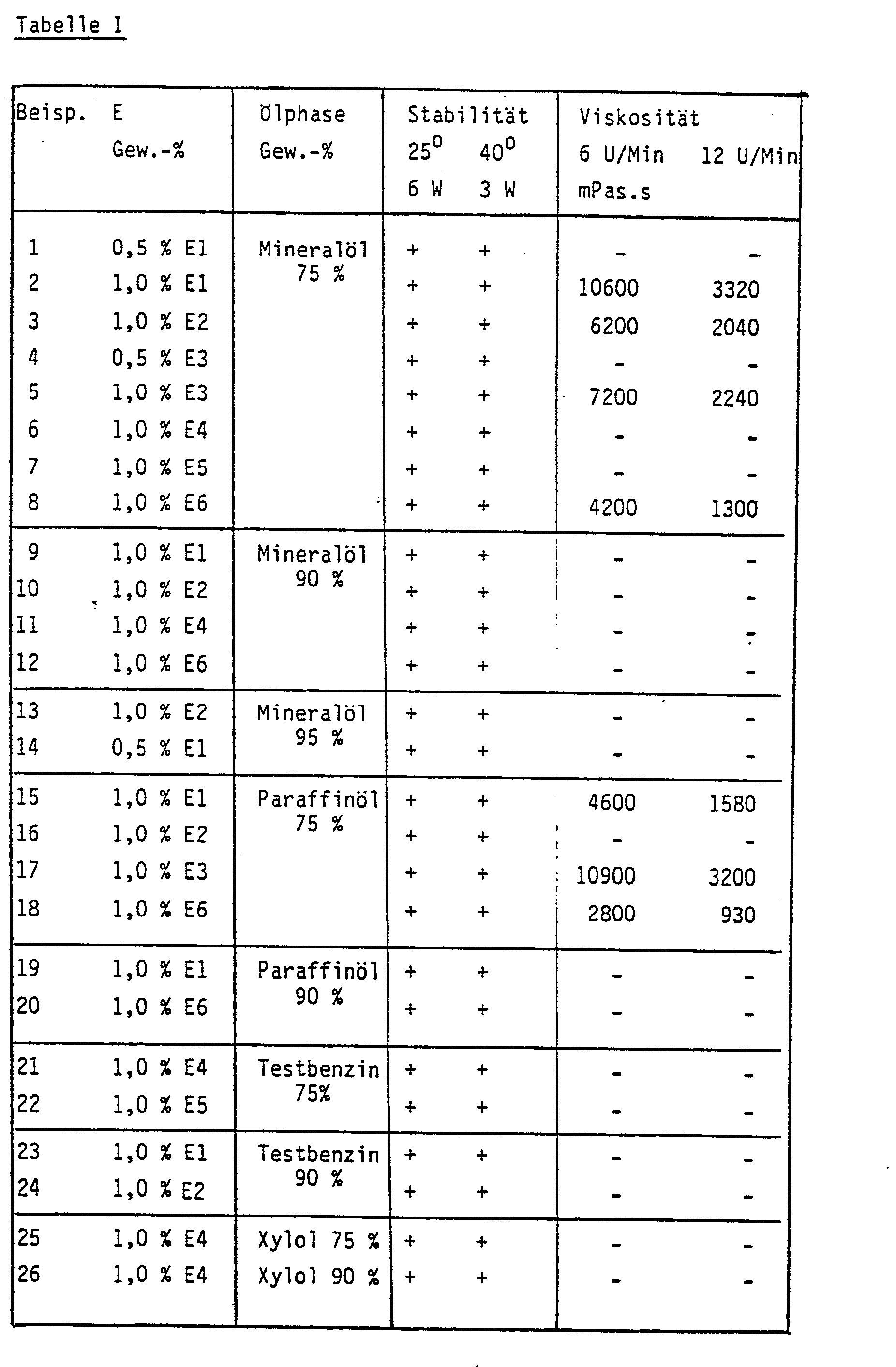
- In den Beispielen wurden die folgenden Monoacylcyanamide in Form ihrer Natriumsalze als Emulgatoren eingesetzt. (CA= Abkürzung für Cyanamid):
- E 1 = Lauroyl-CA
- E2 = Myristoyl-CA
- E3 = Kokosfettsäure-CA
- E4 = Palmitoyl
- E 5 = Stearoyl-CA
- E6 = Talgfettsäure-CA
- Die ölige Phase bestand aus Mineralöl (Dieselöl), Paraffinöl, Testbenzin, Xylol, Ölsäuredecylester und 2-Octyldecanol. Zur Herstellung der Emulsionen wurde der Emulgator in destilliertem Wasser unter Erwärmen gelöst und anschließend die jeweilige ölphase unter Rühren zugemischt. Die Rührvorrichtung wurde mit einer Tourenzahl von ca. 16000 - 17000 Umdrehungen pro Minute betrieben. Die Mischzeit (einschließlich der Zeit für die Zugabe der Ölphase) betrug 2 Minuten.
- Die Stabilität der Emulsionen wurde während einer Standzeit von 3 bis 6 Wochen bei einer Lagertemperatur von 25 °C, und nach 1 bis 3 Wochen bei einer Lagertemperatur von 40 °C geprüft. Die Ergebnisse sind in den folgenden Tabelle aufgeführt.
- Das Zeichen + gibt an, daß diese Emulsion keine Entmischungserscheinungen aufwies.
- Einzelne Emulsionen wurden 52 Wochen bei 25 °C gelagert, wonach ihre Viskosität bei 25 °C mittels eines Rotationsviskosimetersnach BROOKFIELD bei Drehzahlen der Spindel von 6 bzw. 12 Umdrehungen pro Minute gemessen wurde.
- Die Ergebnisse, die ebenfalls in der Tabelle aufgeführt sind, zeigen eine deutliche Thixotropie unter dem Einfluß der Scherwirkung der Meßspindel.

Claims (10)
Applications Claiming Priority (2)
| Application Number | Priority Date | Filing Date | Title |
|---|---|---|---|
| DE3303174 | 1983-01-31 | ||
| DE19833303174 DE3303174A1 (de) | 1983-01-31 | 1983-01-31 | Stabile oel-in-wasser-emulsion mit hohem oelgehalt |
Publications (2)
| Publication Number | Publication Date |
|---|---|
| EP0115313A2 true EP0115313A2 (de) | 1984-08-08 |
| EP0115313A3 EP0115313A3 (de) | 1987-08-12 |
Family
ID=6189664
Family Applications (1)
| Application Number | Title | Priority Date | Filing Date |
|---|---|---|---|
| EP84100651A Withdrawn EP0115313A3 (de) | 1983-01-31 | 1984-01-23 | Stabile Öl-in-Wasser-Emulsionen mit hohem Ölgehalt |
Country Status (4)
| Country | Link |
|---|---|
| US (1) | US4536325A (de) |
| EP (1) | EP0115313A3 (de) |
| JP (1) | JPS59142835A (de) |
| DE (1) | DE3303174A1 (de) |
Families Citing this family (7)
| Publication number | Priority date | Publication date | Assignee | Title |
|---|---|---|---|---|
| GB8431012D0 (en) * | 1984-12-07 | 1985-01-16 | British Petroleum Co Plc | Preparation of emulsions |
| MXPA06001476A (es) * | 2003-08-07 | 2006-05-15 | Procter & Gamble | Emulsiones concentradas de aceite en agua. |
| EP1656099B1 (de) * | 2003-08-07 | 2008-04-09 | The Procter & Gamble Company | Emulsionen mit einer konzentrierten inneren ölphase |
| CN1832724A (zh) * | 2003-08-07 | 2006-09-13 | 宝洁公司 | 个人护理组合物 |
| US20060010004A1 (en) * | 2004-07-09 | 2006-01-12 | Deckner George E | Method for providing customized products |
| SG11201909150XA (en) * | 2017-06-27 | 2020-01-30 | Firmenich & Cie | Process for preparing microcapsules |
| WO2020191018A1 (en) * | 2019-03-20 | 2020-09-24 | Kao Specialties Americas Llc | Stable high solids slurry compositions |
Family Cites Families (4)
| Publication number | Priority date | Publication date | Assignee | Title |
|---|---|---|---|---|
| GB428091A (en) * | 1932-12-14 | 1935-05-07 | Heinz Hunsdiecker | Improvements in or relating to the treatment of textile materials and the preparation of dispersions |
| DE708428C (de) * | 1932-12-15 | 1941-07-21 | Boehme Fettchemie Ges M B H | Verfahren zur Herstellung von Alkalisalzen von Monoacylcyanamiden |
| US2274474A (en) * | 1939-08-10 | 1942-02-24 | American Cyanamid Co | Alkoxy alkylol cyanamide compound |
| GB1227345A (de) * | 1967-10-19 | 1971-04-07 |
-
1983
- 1983-01-31 DE DE19833303174 patent/DE3303174A1/de not_active Withdrawn
-
1984
- 1984-01-23 EP EP84100651A patent/EP0115313A3/de not_active Withdrawn
- 1984-01-24 US US06/573,521 patent/US4536325A/en not_active Expired - Fee Related
- 1984-01-30 JP JP59013550A patent/JPS59142835A/ja active Pending
Also Published As
| Publication number | Publication date |
|---|---|
| JPS59142835A (ja) | 1984-08-16 |
| US4536325A (en) | 1985-08-20 |
| DE3303174A1 (de) | 1984-08-02 |
| EP0115313A3 (de) | 1987-08-12 |
Similar Documents
| Publication | Publication Date | Title |
|---|---|---|
| DE2751128C2 (de) | Kosmetische Emulsion und Verfahren zu ihrer Herstellung | |
| EP0141410A2 (de) | Verfahren zur Erhöhung der Viskosität von Ölen | |
| EP1018541A1 (de) | Klare Weichspülmittelformulierungen | |
| DE865040C (de) | Mit anorganischen Gelen verdickte Schmiermittel oder Bohrfluessigkeiten fuer Erdbohrungen und ihre Herstellung | |
| WO1995018704A1 (de) | Trennmittel für hydraulische bindemittel | |
| EP0047396B1 (de) | Lagerstabile, konzentrierte Emulsion von herbizid wirkenden Phenoxyalkancarbonsäureestern und ein Verfahren zu deren Herstellung | |
| DE3303174A1 (de) | Stabile oel-in-wasser-emulsion mit hohem oelgehalt | |
| EP0452349B1 (de) | Verfahren zur herstellung von amphoteren grenzflächenaktiven imidazolinderivaten | |
| DE69806623T2 (de) | Verfahren zur herstellung eines fettsäure acyl isethionat salz | |
| DE1916283C3 (de) | Emulgatorkombination zum Emulgieren von öl in Wasser | |
| DE60110555T2 (de) | Neue familie von zusammensetzungen aus alkylpolyglykosiden und dimerdiolen, insbesondere verwendbar für die herstellung von versprühbaren öl-in-wasser emulsionen | |
| DE19630176A1 (de) | Stabile multiple Emulsionen des Typs W/O/W insbesondere für kosmetische Zwecke und Verfahren zur Herstellung derselben | |
| DE3541813A1 (de) | Verdickungsmittel fuer tensidhaltige zubereitungen auf basis polyaetherderivate | |
| DE69202498T2 (de) | Pflanzenschutz-Suspoemulsionen. | |
| EP0088887B1 (de) | Lagerstabile, konzentrierte Emulsion von herbizid wirkenden Phenoxyalkancarbonsäureestern und ein Verfahren zu deren Herstellung | |
| DE1644910C3 (de) | Kationische Wachsemulsionen | |
| EP0784707B1 (de) | Verfahren zur herstellung von lederfettungsmitteln | |
| DE1542801A1 (de) | Unkrautvertilgungsmittel | |
| DE102018222066A1 (de) | Verfahren zur Herstellung von kosmetischen Emulsionen umfassend kaltgepresste Öle | |
| AT281569B (de) | Verfahren zur abtrennung von pflanzlichen phosphatidfraktionen aus einer, diese enthaltenden mischung | |
| DE1543937B2 (de) | Verwendung modifizierter kephalinhaltiger phosphatidgemische als emulgatoren fuer o/w-emulsionen und verfahren zur herstellung solcher emulgatoren | |
| CH642273A5 (en) | Process for preparing stable emulsions from liquid hydrocarbons and water | |
| WO1991009096A2 (de) | Schwerflüchtiges lösungsmittel für aromatenhaltige wirkstoffe | |
| AT163211B (de) | Verfahren zur Herstellung von Wundsalben | |
| CH344079A (de) | Zur Bildung von Emulsionen befähigte Mischung |
Legal Events
| Date | Code | Title | Description |
|---|---|---|---|
| PUAI | Public reference made under article 153(3) epc to a published international application that has entered the european phase |
Free format text: ORIGINAL CODE: 0009012 |
|
| AK | Designated contracting states |
Designated state(s): AT BE CH DE FR GB IT LI LU NL SE |
|
| PUAL | Search report despatched |
Free format text: ORIGINAL CODE: 0009013 |
|
| RHK1 | Main classification (correction) |
Ipc: B01F 17/00 |
|
| AK | Designated contracting states |
Kind code of ref document: A3 Designated state(s): AT BE CH DE FR GB IT LI LU NL SE |
|
| STAA | Information on the status of an ep patent application or granted ep patent |
Free format text: STATUS: THE APPLICATION IS DEEMED TO BE WITHDRAWN |
|
| 18D | Application deemed to be withdrawn |
Effective date: 19880215 |
|
| RIN1 | Information on inventor provided before grant (corrected) |
Inventor name: HASE, CHRISTIAN, DR. Inventor name: BORGGREFE, GERHARD, DR. |