EP0452349B1 - Verfahren zur herstellung von amphoteren grenzflächenaktiven imidazolinderivaten - Google Patents
Verfahren zur herstellung von amphoteren grenzflächenaktiven imidazolinderivaten Download PDFInfo
- Publication number
- EP0452349B1 EP0452349B1 EP90900791A EP90900791A EP0452349B1 EP 0452349 B1 EP0452349 B1 EP 0452349B1 EP 90900791 A EP90900791 A EP 90900791A EP 90900791 A EP90900791 A EP 90900791A EP 0452349 B1 EP0452349 B1 EP 0452349B1
- Authority
- EP
- European Patent Office
- Prior art keywords
- formula
- imidazoline
- hydrolysis
- amidoamines
- alkylating agent
- Prior art date
- Legal status (The legal status is an assumption and is not a legal conclusion. Google has not performed a legal analysis and makes no representation as to the accuracy of the status listed.)
- Expired - Lifetime
Links
- 238000000034 method Methods 0.000 title claims abstract description 28
- 150000002462 imidazolines Chemical class 0.000 title claims description 5
- 229940083254 peripheral vasodilators imidazoline derivative Drugs 0.000 title claims description 3
- MTNDZQHUAFNZQY-UHFFFAOYSA-N imidazoline Chemical compound C1CN=CN1 MTNDZQHUAFNZQY-UHFFFAOYSA-N 0.000 claims abstract description 31
- 239000000203 mixture Substances 0.000 claims abstract description 26
- 230000029936 alkylation Effects 0.000 claims abstract description 22
- 238000005804 alkylation reaction Methods 0.000 claims abstract description 22
- XLYOFNOQVPJJNP-UHFFFAOYSA-N water Substances O XLYOFNOQVPJJNP-UHFFFAOYSA-N 0.000 claims abstract description 15
- 239000007864 aqueous solution Substances 0.000 claims abstract description 13
- 239000011541 reaction mixture Substances 0.000 claims abstract description 13
- 150000001875 compounds Chemical class 0.000 claims abstract description 11
- 125000004435 hydrogen atom Chemical group [H]* 0.000 claims abstract description 8
- 239000002585 base Substances 0.000 claims abstract description 7
- 229910052783 alkali metal Inorganic materials 0.000 claims abstract description 6
- 150000001340 alkali metals Chemical class 0.000 claims abstract description 6
- 125000004103 aminoalkyl group Chemical group 0.000 claims abstract description 4
- 230000007062 hydrolysis Effects 0.000 claims description 32
- 238000006460 hydrolysis reaction Methods 0.000 claims description 32
- -1 alkyl radical Chemical group 0.000 claims description 24
- 239000002168 alkylating agent Substances 0.000 claims description 19
- 229940100198 alkylating agent Drugs 0.000 claims description 19
- 125000004432 carbon atom Chemical group C* 0.000 claims description 19
- 239000000243 solution Substances 0.000 claims description 12
- 229910052799 carbon Inorganic materials 0.000 claims description 5
- 125000005843 halogen group Chemical group 0.000 claims description 5
- 229910052739 hydrogen Inorganic materials 0.000 claims description 4
- 239000001257 hydrogen Substances 0.000 claims description 4
- QGZKDVFQNNGYKY-UHFFFAOYSA-O Ammonium Chemical group [NH4+] QGZKDVFQNNGYKY-UHFFFAOYSA-O 0.000 claims description 3
- DGAQECJNVWCQMB-PUAWFVPOSA-M Ilexoside XXIX Chemical compound C[C@@H]1CC[C@@]2(CC[C@@]3(C(=CC[C@H]4[C@]3(CC[C@@H]5[C@@]4(CC[C@@H](C5(C)C)OS(=O)(=O)[O-])C)C)[C@@H]2[C@]1(C)O)C)C(=O)O[C@H]6[C@@H]([C@H]([C@@H]([C@H](O6)CO)O)O)O.[Na+] DGAQECJNVWCQMB-PUAWFVPOSA-M 0.000 claims description 3
- 238000004519 manufacturing process Methods 0.000 claims description 3
- 239000011734 sodium Substances 0.000 claims description 3
- 229910052708 sodium Inorganic materials 0.000 claims description 3
- 229910052801 chlorine Inorganic materials 0.000 claims description 2
- 125000001309 chloro group Chemical group Cl* 0.000 claims description 2
- VGGSQFUCUMXWEO-UHFFFAOYSA-N Ethene Chemical compound C=C VGGSQFUCUMXWEO-UHFFFAOYSA-N 0.000 claims 1
- HZVOZRGWRWCICA-UHFFFAOYSA-N methanediyl Chemical compound [CH2] HZVOZRGWRWCICA-UHFFFAOYSA-N 0.000 claims 1
- 229910052736 halogen Inorganic materials 0.000 abstract description 2
- 125000002768 hydroxyalkyl group Chemical group 0.000 abstract description 2
- 239000003795 chemical substances by application Substances 0.000 abstract 3
- 125000006656 (C2-C4) alkenyl group Chemical group 0.000 abstract 1
- 125000000217 alkyl group Chemical group 0.000 abstract 1
- 125000002947 alkylene group Chemical group 0.000 abstract 1
- 150000002367 halogens Chemical class 0.000 abstract 1
- 239000000047 product Substances 0.000 description 24
- HEMHJVSKTPXQMS-UHFFFAOYSA-M Sodium hydroxide Chemical compound [OH-].[Na+] HEMHJVSKTPXQMS-UHFFFAOYSA-M 0.000 description 21
- 239000007795 chemical reaction product Substances 0.000 description 12
- 235000014113 dietary fatty acids Nutrition 0.000 description 7
- 239000000194 fatty acid Substances 0.000 description 7
- 229930195729 fatty acid Natural products 0.000 description 7
- 150000004665 fatty acids Chemical class 0.000 description 7
- 238000003756 stirring Methods 0.000 description 6
- 238000006243 chemical reaction Methods 0.000 description 5
- FDRCDNZGSXJAFP-UHFFFAOYSA-M sodium chloroacetate Chemical compound [Na+].[O-]C(=O)CCl FDRCDNZGSXJAFP-UHFFFAOYSA-M 0.000 description 5
- FAPWRFPIFSIZLT-UHFFFAOYSA-M Sodium chloride Chemical compound [Na+].[Cl-] FAPWRFPIFSIZLT-UHFFFAOYSA-M 0.000 description 4
- 230000015572 biosynthetic process Effects 0.000 description 4
- 238000003776 cleavage reaction Methods 0.000 description 4
- 239000012153 distilled water Substances 0.000 description 4
- 230000007017 scission Effects 0.000 description 4
- 239000000126 substance Substances 0.000 description 4
- 239000002562 thickening agent Substances 0.000 description 4
- OKKJLVBELUTLKV-UHFFFAOYSA-N Methanol Chemical compound OC OKKJLVBELUTLKV-UHFFFAOYSA-N 0.000 description 3
- 239000002253 acid Substances 0.000 description 3
- 150000008044 alkali metal hydroxides Chemical class 0.000 description 3
- 239000003153 chemical reaction reagent Substances 0.000 description 3
- 239000011521 glass Substances 0.000 description 3
- 238000002360 preparation method Methods 0.000 description 3
- 239000000344 soap Substances 0.000 description 3
- XDOFQFKRPWOURC-UHFFFAOYSA-N 16-methylheptadecanoic acid Chemical compound CC(C)CCCCCCCCCCCCCCC(O)=O XDOFQFKRPWOURC-UHFFFAOYSA-N 0.000 description 2
- OBETXYAYXDNJHR-UHFFFAOYSA-N alpha-ethylcaproic acid Natural products CCCCC(CC)C(O)=O OBETXYAYXDNJHR-UHFFFAOYSA-N 0.000 description 2
- 239000002280 amphoteric surfactant Substances 0.000 description 2
- 235000019864 coconut oil Nutrition 0.000 description 2
- 239000003240 coconut oil Substances 0.000 description 2
- 150000004985 diamines Chemical class 0.000 description 2
- 150000002148 esters Chemical class 0.000 description 2
- 239000012467 final product Substances 0.000 description 2
- 238000009472 formulation Methods 0.000 description 2
- 239000008233 hard water Substances 0.000 description 2
- 125000002636 imidazolinyl group Chemical group 0.000 description 2
- 229910052757 nitrogen Inorganic materials 0.000 description 2
- 125000004433 nitrogen atom Chemical group N* 0.000 description 2
- 150000003254 radicals Chemical class 0.000 description 2
- 238000010992 reflux Methods 0.000 description 2
- 239000011780 sodium chloride Substances 0.000 description 2
- 239000007858 starting material Substances 0.000 description 2
- 238000003786 synthesis reaction Methods 0.000 description 2
- WRIDQFICGBMAFQ-UHFFFAOYSA-N (E)-8-Octadecenoic acid Natural products CCCCCCCCCC=CCCCCCCC(O)=O WRIDQFICGBMAFQ-UHFFFAOYSA-N 0.000 description 1
- SMZOUWXMTYCWNB-UHFFFAOYSA-N 2-(2-methoxy-5-methylphenyl)ethanamine Chemical compound COC1=CC=C(C)C=C1CCN SMZOUWXMTYCWNB-UHFFFAOYSA-N 0.000 description 1
- NIXOWILDQLNWCW-UHFFFAOYSA-N 2-Propenoic acid Natural products OC(=O)C=C NIXOWILDQLNWCW-UHFFFAOYSA-N 0.000 description 1
- LQJBNNIYVWPHFW-UHFFFAOYSA-N 20:1omega9c fatty acid Natural products CCCCCCCCCCC=CCCCCCCCC(O)=O LQJBNNIYVWPHFW-UHFFFAOYSA-N 0.000 description 1
- AOHAPDDBNAPPIN-UHFFFAOYSA-N 3-Methoxy-4,5-methylenedioxybenzoic acid Chemical compound COC1=CC(C(O)=O)=CC2=C1OCO2 AOHAPDDBNAPPIN-UHFFFAOYSA-N 0.000 description 1
- QSBYPNXLFMSGKH-UHFFFAOYSA-N 9-Heptadecensaeure Natural products CCCCCCCC=CCCCCCCCC(O)=O QSBYPNXLFMSGKH-UHFFFAOYSA-N 0.000 description 1
- VHUUQVKOLVNVRT-UHFFFAOYSA-N Ammonium hydroxide Chemical compound [NH4+].[OH-] VHUUQVKOLVNVRT-UHFFFAOYSA-N 0.000 description 1
- FPVVYTCTZKCSOJ-UHFFFAOYSA-N Ethylene glycol distearate Chemical compound CCCCCCCCCCCCCCCCCC(=O)OCCOC(=O)CCCCCCCCCCCCCCCCC FPVVYTCTZKCSOJ-UHFFFAOYSA-N 0.000 description 1
- OYHQOLUKZRVURQ-HZJYTTRNSA-N Linoleic acid Chemical compound CCCCC\C=C/C\C=C/CCCCCCCC(O)=O OYHQOLUKZRVURQ-HZJYTTRNSA-N 0.000 description 1
- ZQPPMHVWECSIRJ-UHFFFAOYSA-N Oleic acid Natural products CCCCCCCCC=CCCCCCCCC(O)=O ZQPPMHVWECSIRJ-UHFFFAOYSA-N 0.000 description 1
- 239000002202 Polyethylene glycol Substances 0.000 description 1
- 206010040880 Skin irritation Diseases 0.000 description 1
- 150000007513 acids Chemical class 0.000 description 1
- 229910001854 alkali hydroxide Inorganic materials 0.000 description 1
- 150000001447 alkali salts Chemical class 0.000 description 1
- 150000008051 alkyl sulfates Chemical class 0.000 description 1
- 239000000908 ammonium hydroxide Substances 0.000 description 1
- 239000003945 anionic surfactant Substances 0.000 description 1
- 125000003178 carboxy group Chemical group [H]OC(*)=O 0.000 description 1
- FOCAUTSVDIKZOP-UHFFFAOYSA-N chloroacetic acid Chemical compound OC(=O)CCl FOCAUTSVDIKZOP-UHFFFAOYSA-N 0.000 description 1
- UKMSUNONTOPOIO-UHFFFAOYSA-N docosanoic acid Chemical compound CCCCCCCCCCCCCCCCCCCCCC(O)=O UKMSUNONTOPOIO-UHFFFAOYSA-N 0.000 description 1
- POULHZVOKOAJMA-UHFFFAOYSA-N dodecanoic acid Chemical compound CCCCCCCCCCCC(O)=O POULHZVOKOAJMA-UHFFFAOYSA-N 0.000 description 1
- 230000000694 effects Effects 0.000 description 1
- 239000003925 fat Substances 0.000 description 1
- 235000019197 fats Nutrition 0.000 description 1
- 235000019387 fatty acid methyl ester Nutrition 0.000 description 1
- 229940100608 glycol distearate Drugs 0.000 description 1
- 238000010438 heat treatment Methods 0.000 description 1
- MNWFXJYAOYHMED-UHFFFAOYSA-N heptanoic acid Chemical compound CCCCCCC(O)=O MNWFXJYAOYHMED-UHFFFAOYSA-N 0.000 description 1
- IPCSVZSSVZVIGE-UHFFFAOYSA-N hexadecanoic acid Chemical compound CCCCCCCCCCCCCCCC(O)=O IPCSVZSSVZVIGE-UHFFFAOYSA-N 0.000 description 1
- FUZZWVXGSFPDMH-UHFFFAOYSA-N hexanoic acid Chemical compound CCCCCC(O)=O FUZZWVXGSFPDMH-UHFFFAOYSA-N 0.000 description 1
- 239000012433 hydrogen halide Substances 0.000 description 1
- 229910000039 hydrogen halide Inorganic materials 0.000 description 1
- 230000003301 hydrolyzing effect Effects 0.000 description 1
- VKOBVWXKNCXXDE-UHFFFAOYSA-N icosanoic acid Chemical compound CCCCCCCCCCCCCCCCCCCC(O)=O VKOBVWXKNCXXDE-UHFFFAOYSA-N 0.000 description 1
- 238000006317 isomerization reaction Methods 0.000 description 1
- QXJSBBXBKPUZAA-UHFFFAOYSA-N isooleic acid Natural products CCCCCCCC=CCCCCCCCCC(O)=O QXJSBBXBKPUZAA-UHFFFAOYSA-N 0.000 description 1
- OYHQOLUKZRVURQ-IXWMQOLASA-N linoleic acid Natural products CCCCC\C=C/C\C=C\CCCCCCCC(O)=O OYHQOLUKZRVURQ-IXWMQOLASA-N 0.000 description 1
- 229910052751 metal Inorganic materials 0.000 description 1
- 239000002184 metal Substances 0.000 description 1
- 125000001160 methoxycarbonyl group Chemical group [H]C([H])([H])OC(*)=O 0.000 description 1
- 150000004702 methyl esters Chemical class 0.000 description 1
- 230000007935 neutral effect Effects 0.000 description 1
- 230000003472 neutralizing effect Effects 0.000 description 1
- QIQXTHQIDYTFRH-UHFFFAOYSA-N octadecanoic acid Chemical compound CCCCCCCCCCCCCCCCCC(O)=O QIQXTHQIDYTFRH-UHFFFAOYSA-N 0.000 description 1
- WWZKQHOCKIZLMA-UHFFFAOYSA-N octanoic acid Chemical compound CCCCCCCC(O)=O WWZKQHOCKIZLMA-UHFFFAOYSA-N 0.000 description 1
- 239000003921 oil Substances 0.000 description 1
- 235000019198 oils Nutrition 0.000 description 1
- 150000002888 oleic acid derivatives Chemical class 0.000 description 1
- 229920001223 polyethylene glycol Polymers 0.000 description 1
- WBHHMMIMDMUBKC-XLNAKTSKSA-N ricinelaidic acid Chemical compound CCCCCC[C@@H](O)C\C=C\CCCCCCCC(O)=O WBHHMMIMDMUBKC-XLNAKTSKSA-N 0.000 description 1
- FEUQNCSVHBHROZ-UHFFFAOYSA-N ricinoleic acid Natural products CCCCCCC(O[Si](C)(C)C)CC=CCCCCCCCC(=O)OC FEUQNCSVHBHROZ-UHFFFAOYSA-N 0.000 description 1
- 150000003839 salts Chemical class 0.000 description 1
- 231100001068 severe skin irritation Toxicity 0.000 description 1
- 239000002453 shampoo Substances 0.000 description 1
- 231100000475 skin irritation Toxicity 0.000 description 1
- 230000036556 skin irritation Effects 0.000 description 1
- 229960002668 sodium chloride Drugs 0.000 description 1
- 229940023144 sodium glycolate Drugs 0.000 description 1
- 125000001424 substituent group Chemical group 0.000 description 1
- 239000004094 surface-active agent Substances 0.000 description 1
- 150000003511 tertiary amides Chemical class 0.000 description 1
- JEJAMASKDTUEBZ-UHFFFAOYSA-N tris(1,1,3-tribromo-2,2-dimethylpropyl) phosphate Chemical compound BrCC(C)(C)C(Br)(Br)OP(=O)(OC(Br)(Br)C(C)(C)CBr)OC(Br)(Br)C(C)(C)CBr JEJAMASKDTUEBZ-UHFFFAOYSA-N 0.000 description 1
- 125000002948 undecyl group Chemical group [H]C([*])([H])C([H])([H])C([H])([H])C([H])([H])C([H])([H])C([H])([H])C([H])([H])C([H])([H])C([H])([H])C([H])([H])C([H])([H])[H] 0.000 description 1
Classifications
-
- C—CHEMISTRY; METALLURGY
- C07—ORGANIC CHEMISTRY
- C07C—ACYCLIC OR CARBOCYCLIC COMPOUNDS
- C07C231/00—Preparation of carboxylic acid amides
- C07C231/10—Preparation of carboxylic acid amides from compounds not provided for in groups C07C231/02 - C07C231/08
-
- C—CHEMISTRY; METALLURGY
- C07—ORGANIC CHEMISTRY
- C07C—ACYCLIC OR CARBOCYCLIC COMPOUNDS
- C07C233/00—Carboxylic acid amides
- C07C233/01—Carboxylic acid amides having carbon atoms of carboxamide groups bound to hydrogen atoms or to acyclic carbon atoms
- C07C233/34—Carboxylic acid amides having carbon atoms of carboxamide groups bound to hydrogen atoms or to acyclic carbon atoms having the nitrogen atom of at least one of the carboxamide groups bound to a carbon atom of a hydrocarbon radical substituted by amino groups
- C07C233/35—Carboxylic acid amides having carbon atoms of carboxamide groups bound to hydrogen atoms or to acyclic carbon atoms having the nitrogen atom of at least one of the carboxamide groups bound to a carbon atom of a hydrocarbon radical substituted by amino groups with the substituted hydrocarbon radical bound to the nitrogen atom of the carboxamide group by an acyclic carbon atom
- C07C233/36—Carboxylic acid amides having carbon atoms of carboxamide groups bound to hydrogen atoms or to acyclic carbon atoms having the nitrogen atom of at least one of the carboxamide groups bound to a carbon atom of a hydrocarbon radical substituted by amino groups with the substituted hydrocarbon radical bound to the nitrogen atom of the carboxamide group by an acyclic carbon atom having the carbon atom of the carboxamide group bound to a hydrogen atom or to a carbon atom of an acyclic saturated carbon skeleton
Definitions
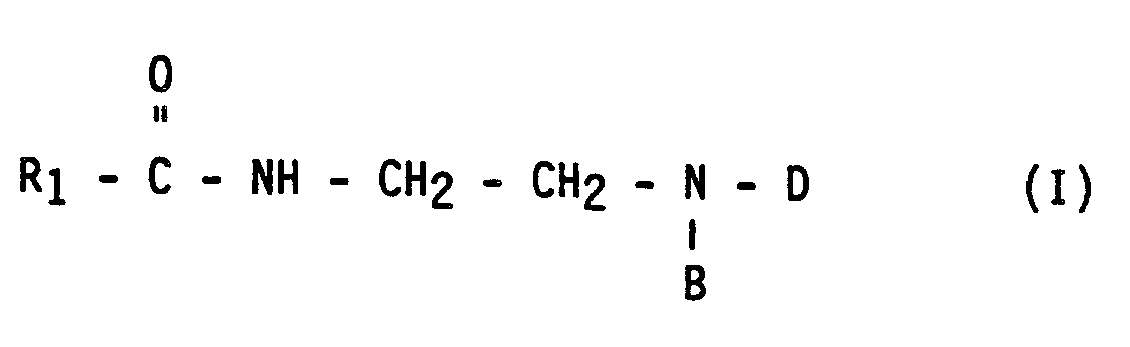
- the invention relates to a new process for the preparation of amphoteric surfactant products of the formula I.
- R1 is an alkyl radical with 5 to 21 carbon atoms
- B is an aminoalkyl or hydroxyalkyl radical with 2 to 4 carbon atoms
- D is a - R2 - COOM radical
- R2 is an alkylene radical with 1 to 4 carbon atoms or an alkenylene radical with 2 to 4 Carbon atoms
- M represents hydrogen, ammonium or an alkali metal.
- anionic surfactants these surfactants enable the manufacture of ready-to-use formulations for personal care and hygiene with very little skin irritation. With small amounts of conventional thickeners, they readily allow the viscosity to be set, which is desirable for commercially available finished products of this type.
- the process consists essentially of the hydrolysis of an imidazoline of the formula II in which R1 and B have the meaning given above, under controlled conditions to give an intermediate amidoamine of the formula III, in which R1 and B have the meaning given above, and the subsequent alkylation of this amidoamine with an alkylating agent of the formula V, X - D (V) in which X represents a halogen atom or a hydrogen atom and D has the meaning given above, with the addition of a base to shift the alkylation equilibrium in the desired direction by neutralizing the hydrogen halide acid formed.
- This base can be ammonium hydroxide or any alkali hydroxide, preferably Sodium hydroxide. All of this primarily aims at the formation of the final compound of formula I.
- the imidazoline compounds of the formula II which are suitable as starting material for the process according to the invention are known substances which are prepared by known processes the organic synthesis, for example according to EP-PS 2943 and ES-PS 540 640 by reaction of a fatty acid of the formula R1-COOH or a fatty acid methyl ester of the formula R1-COOCH3 with a diamine of the formula H2N - CH2 - CH2 - NH - B can be.
- fatty acids and the fatty acid residues of the methyl esters in question can be of natural or synthetic origin.
- the starting material is, for example, capronic, heptanoic, caprylic, undecyl, lauric, myristic, palmitic, stearic, behenic, arachic, oleic, linoleic, ricinoleic, ethylhexanoic and isostearic acid and the like
- the individual fatty acids or esters of individual fatty acids can be used for the synthesis of the imidazolines.
- mixtures of fatty acids and fatty acid esters such as those obtainable directly from naturally occurring fats and oils, for example from coconut oil, by splitting or transesterifying with methanol.
- R2 alkenyl radical with 2 to 4 carbon atoms
- acrylic acid and their salts, especially their alkali salts.
- Sodium monochloroacetate is particularly preferred as the alkylating agent.
- the diamines of the formula given above are those in which B represents a hydroxyalkyl or aminoalkyl radical, where B preferably denotes a hydroxyalkyl radical with 2 to 4 carbon atoms, in particular a hydroxyethyl radical.
- an imidazoline of the formula II is reacted directly with an aqueous solution of an alkylating agent (V) by means of a base.
- V alkylating agent
- the hydrolysis of the imidazoline and its alkylation are effected simultaneously.
- a mixture of mono- and dialkylamidoamines is formed and generally a product with a low viscosity is obtained.
- the imidazoline is partially alkylated before its hydrolysis produces a mixture of amidoamines with linear chains, on which the alkylation then continues.
- the end product consists of a complex mixture of alkylated compounds, some of which are formed by alkylation of the imidazoline, subsequent hydrolytic cleavage and further alkylation of the linear hydrolysis products, and part of which are the result of direct hydrolysis of the imidazoline and alkylation of the linear amidoamines.
- the composition of the end product depends on the temperature and pH conditions under which both the imidazoline and the alkali metal hydroxide are added. If one works at a high pH value, the hydrolysis of the imidazoline has priority over the direct alkylation and products of the formula I are formed in which B and D have the meaning given above.
- B and D have the meaning given above.
- the products produced with the aid of the method according to the invention inherently have a high viscosity, as a result of which the technical disadvantages with which the products of the prior art are afflicted are considerably reduced.
- products with high but not excessive viscosities in the range of 1000 to 5000 cP can be manufactured. These products can easily be handled and promoted in the industrial facilities.
- the amount of the thickener required to adjust the viscosity values required by the market for finished products, for example shampoos can be considerably reduced.
- the content of disruptive metal soaps in the products obtained by the process according to the invention is substantially lower than in the products produced by the known processes.
- the targeted hydrolysis of the imidazoline before the alkylation means that the composition of the end product can be controlled and aligned in such a way that the properties mentioned above are achieved.
- GB-A-850 514 discloses a process in which an imidazoline according to the present claim 1 is first hydrolyzed and only then is alkylated. In this process, however, a different ratio of imidazoline to water is used in the hydrolysis.
- the amidoamine of formula III arises when the hydrolysis cleavage occurs between the carbon atom 1 and the nitrogen atom 5 of the imidazoline ring.
- the amidoamine of formula IV arises when the hydrolysis cleavage occurs between the carbon atom 1 and the nitrogen atom 2 of the imidazoline ring.
- the compounds of the formulas VI and VII are obtained in the alkylation with an alkylating agent of the formula X-D from the amidoamine of the formula IV.
- the alkylation of the amidoamine of the formula III leads to the alkylation product of the formula I, which generally makes up the majority of the end product.
- the hydrolysis of the imidazoline of the formula II can be carried out at atmospheric pressure or slightly elevated pressure in a temperature range between 50 and 130 ° C., preferably between 80 and 90 ° C. and with a molar ratio of imidazoline to water between 1: 8 to 1:20, preferably between 1: 8 to 1:15. It should be taken into account that the formation of the secondary amidoamine of the formula III at the expense of the tertiary amidoamine of the formula IV due to long hydrolysis times, in particular hydrolysis times between 1 and 24 hours, preferably between 6 and 15 hours, and high temperatures, in particular temperatures between 50 and 130 ° C, preferably between 90 and 110 ° C, is favored.
- the alkylation of the hydrolysis products takes place, as already indicated above, by known processes.
- the mixture of amidoamines obtained in the previous hydrolysis step is added to an aqueous solution of the alkylating agent, preferably sodium monochloroacetate, at a temperature between 40 and 70 ° C., preferably between 45 and 55 ° C.
- the molar ratio of amidoamines to alkylating agents is between 1: 1 and 4: 1, preferably between 1.5: 1 and 2.8: 1.
- an aqueous alkali metal hydroxide solution preferably sodium hydroxide solution
- an aqueous alkali metal hydroxide solution is gradually added at such a rate while maintaining the specified temperature values added that the pH, measured in a 10% by weight solution of the reaction mixture, is kept between 10 and 11.5, preferably between 10.8 and 11.2, and the alkylation of the amine nitrogen atoms present in a reasonable period of time from about 3 to 6 hours.
- the conditions mentioned at the same time create the possibility, in this phase of the process, of the rate of hydrolysis of the alkylating agent according to the equation ClCH2COOONa + NaOH ⁇ NaCl + HOCH2COONa set to a low value.
- the temperature of the reaction mixture is increased to 80 to 95 ° C, preferably to 85 to 90 ° C.
- the reaction mixture is then kept at this temperature with the continuous addition of sodium hydroxide solution to maintain a pH within the limits specified above until the excess alkylating agent has been destroyed.
- the end product had a water content of 65% by weight and a viscosity of 1500 cP at 20 ° C., measured with a Brookfield viscometer.
- the alkylation was carried out under the same conditions as described in Example 1, 155.8 g (1.3 mol) of sodium monochloroacetate, 107 g of 50% strength by weight aqueous sodium hydroxide solution and 502 g of distilled water being used.
- the end product had a water content of 65% by weight and a viscosity of 180 cP at 20 ° C., determined using a Brookfield viscometer.
Landscapes
- Chemical & Material Sciences (AREA)
- Organic Chemistry (AREA)
- Detergent Compositions (AREA)
- Organic Low-Molecular-Weight Compounds And Preparation Thereof (AREA)
- Emulsifying, Dispersing, Foam-Producing Or Wetting Agents (AREA)
- Cosmetics (AREA)
Abstract
Description
- Die Erfindung betrifft ein neues Verfahren zur Herstellung von amphoteren Tensidprodukten der Formel I

in der R₁ einen Alkylrest mit 5 bis 21 Kohlenstoffatomen, B einen Aminoalkyl- oder Hydroxyalkylrest mit 2 bis 4 Kohlenstoffatomen und D einen - R₂ - COOM - Rest bedeuten, wobei R₂ für eine Alkylenrest mit 1 bis 4 Kohlenstoffatomen oder einen Alkenylenrest mit 2 bis 4 Kohlenstoffatomen und M für Wasserstoff, Ammonium oder ein Alkalimetall steht. Diese Tenside ermöglichen im Gemisch mit anionischen Tensiden die Herstellung von Fertigformulierungen für die persönliche Pflege und Hygiene mit sehr geringer hautreizender Wirkung. Mit geringen Mengen herkömmlicher Verdikkungsmittel ermöglichen sie ohne weiteres die Einstellung der Viskosität, die für handelsübliche Fertigprodukte dieser Art erwünscht ist. - Das Verfahren besteht im wesentlichen aus der Hydrolyse eines Imidazolins der Formel II
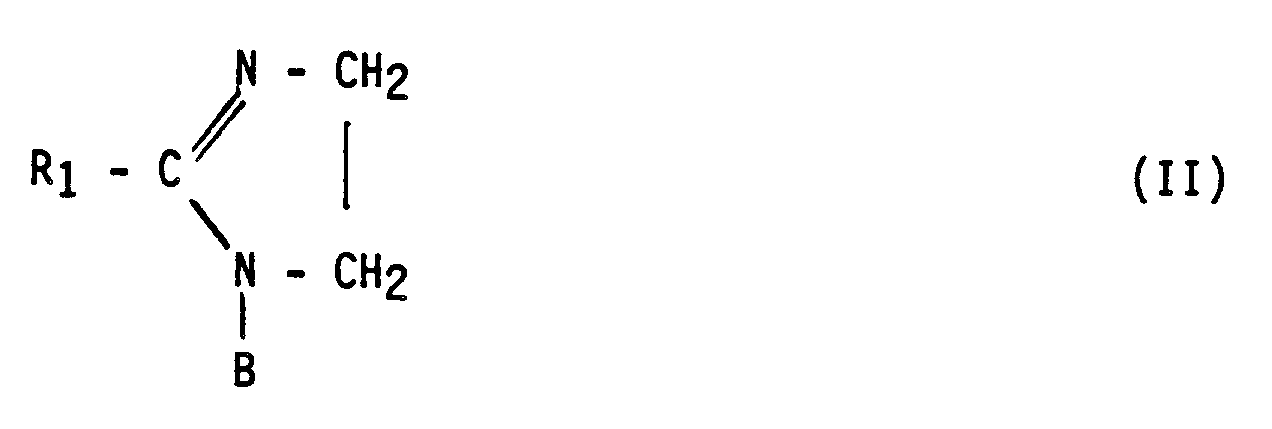
in der R₁ und B die oben angegebene Bedeutung haben, unter kontrollierten Bedingungen zu einem intermediären Amidoamin der Formel III,
in der R₁ und B die oben angegebene Bedeutung haben, und der anschließenden Alkylierung dieses Amidoamins mit einem Alkylierungsmittel der Formel V,
X - D (V)
in der X für ein Halogenatom oder ein Wasserstoffatom steht und D die oben angegebene Bedeutung hat, unter Zugabe einer Base zur Verschiebung des Alkylierungsgleichgewichtes in die gewünschte Richtung durch Neutralisation der entstehenden Halogenwasserstoffssäure Bei dieser Base kann es sich um Ammoniumhydroxid oder um ein beliebiges Alkalihydroxid, vorzugsweise Natriumhydroxid, handeln. All das zielt in erster Linie auf die Bildung der Endverbindung der Formel I ab. - Bei den Imidazolinverbindungen der Formel II, die als Ausgangsmaterial für das erfindungsgemäße Verfahren in Betracht kommen, handelt es sich um bekannte Stoffe, die nach bekannten Verfahren der organischen Synthese, beispielsweise gemäß der EP-PS 2943 und der ES-PS 540 640 durch Reaktion einer Fettsäure der Formel R₁-COOH oder eines Fettsäuremethylesters der Formel R₁ - COOCH₃ mit einem Diamin der Formel H₂N - CH₂ - CH₂ - NH - B hergestellt werden können.
- Diese Fettsäuren und die Fettsäurereste der in Frage kommenden Methylester können natürlicher oder synthetischer Herkunft sein. Als Ausgangsmaterial kommen beispielsweise Capron-, Heptan-, Capryl-, Undecyl-, Laurin-, Myristin-, Palmitin-, Stearin-, Behen-, Arachin-, Öl-, Linol-, Ricinol-, Ethylhexan-, und Isostearinsäure sowie deren Ester in betracht. Dabei können die einzelne Fettsäuren oder Ester einzelner Fettsäuren für die Synthese der Imidazoline verwendet werden. Es können aber auch Fettsäure- und Fettsäureestergemische eingesetzt werden, wie sie durch Fettspaltung oder Umesterung mit Methanol direkt aus natürlich vorkommenden Fetten und Ölen beispielsweise aus Kokosöl, erhältlich sind.
- Als Alkylierungsmittel der Formel V kommen insbesondere Halogenalkansäuren (X = Halogen; R₂ = Alkylenrest mit 1 bis 4 Kohlenstoffatomen), vorzugsweise Monochloressigsäure, und Alkensäuren (X = Wasserstoff; R₂ = Alkenylrest mit 2 bis 4 Kohlenstoffatomen), vorzugsweise Acrylsäure, und deren Salze, insbesondere deren Alkalisalze, in Betracht. Natriummonochloracetat ist als Alkylierungsmittel besonders bevorzugt.
- Bei den Diaminen der oben angegebenen Formel handelt es sich um solche, in denen B für einen Hydroxyalkyl- oder Aminoalkylrest steht, wobei B vorzugsweise einen Hydroxyalkylrest mit 2 bis 4 Kohlenstoffatomen, insbesondere einen Hydroxyethylrest bedeutet.
- Bei den in der EP-PS 1006 und der ES-PS 540 508 beschriebenen Verfahren zur Herstellung von amphoteren Tensiden der hier zu betrachtenden Art wird ein Imidazolin der Formel II direkt mit einer wässrigen Lösung eines Alkylierungsmittels (V) mittels einer Base zur Reaktion gebracht. In diesen Verfahren wird gleichzeitig die Hydrolyse des Imidazolins und seine Alkylierung bewirkt. Es entsteht ein Gemisch aus Mono- und Dialkylamidoaminen und im allgemeinen wird ein Produkt mit niederer Viskosität erhalten. Wie bereits oben erwähnt, wird das Imidazolin schon zum Teil alkyliert, bevor durch seine Hydrolyse ein Gemisch aus Amidoaminen mit linearen Ketten entsteht, an denen die Alkylierung dann weitergeht.
- Das Endprodukt besteht aus einer komplexen Mischung von alkylierten Verbindungen, die zum Teil durch Alkylierung des Imidazolins, anschließende hydrolytische Spaltung und weitere Alkylierung der linearen Hydrolyseprodukte, zum anderen Teil durch direkte Hydrolyse des Imidazolins und Alkylierung der linearen Amidoamine entstanden sind. Die Zusammensetzung des Endproduktes hängt von den Temperatur- und pH-Bedingungen ab, unter denen die Zugabe sowohl des Imidazolins als auch des Alkalihydroxids erfolgt. Arbeitet man bei einem hohen pH-Wert, so hat die Hydrolyse des Imidazolins den Vorrang vor der direkten Alkylierung und es entstehen Produkte der Formel I
in der B und D die oben angegebene Bedeutung haben. Beim Arbeiten im technischen Maßstab ist es jedoch sehr schwierig, unter den vorgenannten Bedingungen auf Dauer Endprodukte zu erhalten, deren Viskositäten sich innerhalb eines akzeptablen engen Schwankungsbereichs bewegen. - Arbeitet man andererseits bei pH-Werten in der Nähe des Neutralpunktes oder im mäßig alkalischen Bereich, beispielsweise bei pH 7 bis 11, so ist die Geschwindigkeit der Alkylierung des Imidazolins größer als die seiner Hydrolyse. Es entsteht ein hochalkyliertes Endprodukt, das eine niedere Viskosität aufweist und im wesentlichen aus einer Mischung von Verbindungen der Formeln VI bis VIII besteht,

in denen R₁, B und D wieder die oben angegebene Bedeutung haben. Nach dem Ende der Reaktion muß ein gegebenenfalls vorhandener Überschuß an Alkylierungsmittel so hydrolysiert werden, daß bei der Verwendung des Endproduktes keine unerwünschten Effekte, beispielsweise starke Hautreizung, auftreten. Wenn beispielsweise Natriummonochloracetat als Alkylierungsmittel eingesetzt wird, entsteht bei dessen Hydrolyse Natriumchlorid und Natriumglycolat. Bei diesem Hydrolyseprozeß werden auch die tertiären Amide der Formeln (VI) bis (VIII) angegriffen, wobei unerwünschte Alkaliseifen entstehen, die im Endprodukt zu einer Erhöhung der Viskosität führen und, noch schwerwiegender, die Verträglichkeit des Produktes mit hartem Wasser stark beeinträchtigen. - Ein weiterer Nachteil der auf diesem Wege hergestellten Produkte besteht darin, daß sie große Mengen Verdickungsmittel, beispielsweise Polyethylenglycoldistearat 6000, erfordern, wenn sie zusammen mit Alkylsulfaten der Formel IX oder Alkylethersulfaten der Formel X
R₂ - O - SO₃ - M (IX)
R₂ - (OCH₂CH₂)n - O - SO₃M (X)
in denen R₂ einen Alkylrest mit 10 bis 18 Kohlenstoffatomen, n eine Zahl von 1 bis 10 und M ein Alkalimetall, vorzugsweise Natrium bedeutet, formuliert werden, damit in den Fertigprodukten die Viskositäten erzielt werden, die der Markt für diese Erzeugnisse verlangt. - Faßt man die Nachteile des bisherigen Standes der Technik zusammen, so läßt sich feststellen, daß nach den bekannten Verfahren entweder Produkte mit hoher aber schlecht reproduzierbarer Viskosität erhalten werden, oder Produkte mit niederer Viskosität, die einerseits bei der praktischen Formulierung erhebliche Mengen an Verdickungsmitteln erfordern, um in den Fertigprodukten ausreichende Viskositätswerte zu erzielen, und die andererseits durch ihren erheblichen Gehalt an Alkalimetallseifen zu einer Stabilitätseinbuße gegenüber hartem Wasser führen.
- Gegenstand der Erfindung ist ein Verfahren zur Herstellung von Gemischen amphoterer grenzflächenaktiver Imidazolinderivate hoher bis mittlerer Viskosität, die hauptsächlich Verbindungen der Formel I enthalten,

in der R₁ einen Alkylrest mit 5 bis 21 Kohlenstoffatomen, B einen Aminoalkyl- oder Hydroxyalkylrest mit 2 bis 4 Kohlenstoffatomen, vorzugsweise einen Hydroxyethylrest, und D einen -R₂-COOM-Rest bedeuten, wobei R₂ für einen Alkylenrest mit 1 bis 4 Kohlenstoffatomen oder einen Alkenylenrest mit 2 bis 4 Kohlenstoffatomen und M für Wasserstoff, Ammonium oder ein Alkalimetall, vorzugsweise Natrium, steht. Das neue Verfahren ist dadurch gekennzeichnet, daß man - A) ein Imidazolin der Formel II,


- B) das Gemisch der erhaltenen Amidoamine mit einem Alkylierungsmittel der Formel V,
X - D (V)
in der X für ein Halogenatom, vorzugsweise ein Chloratom, oder ein Wasserstoffatom steht und D die oben angegebene Bedeutung hat, in einem Molverhältnis von Alkylierungsmittel (V) zu Amidoaminen (III + IV) zwischen 1,5 : 1 und 2,5 : 1 mit Hilfe einer Base bei 40 bis 70°C unter Einhaltung eines pH-Wertes zwischen 10 und 11,5, gemessen in einer 10 gew.-%igen wässrigen Lösung des Reaktionsgemisches, alkyliert, so daß in erster Linie die Endverbindung der Formel I und in geringerem Maße auch Verbindungen der Formeln VI und VII entstehen,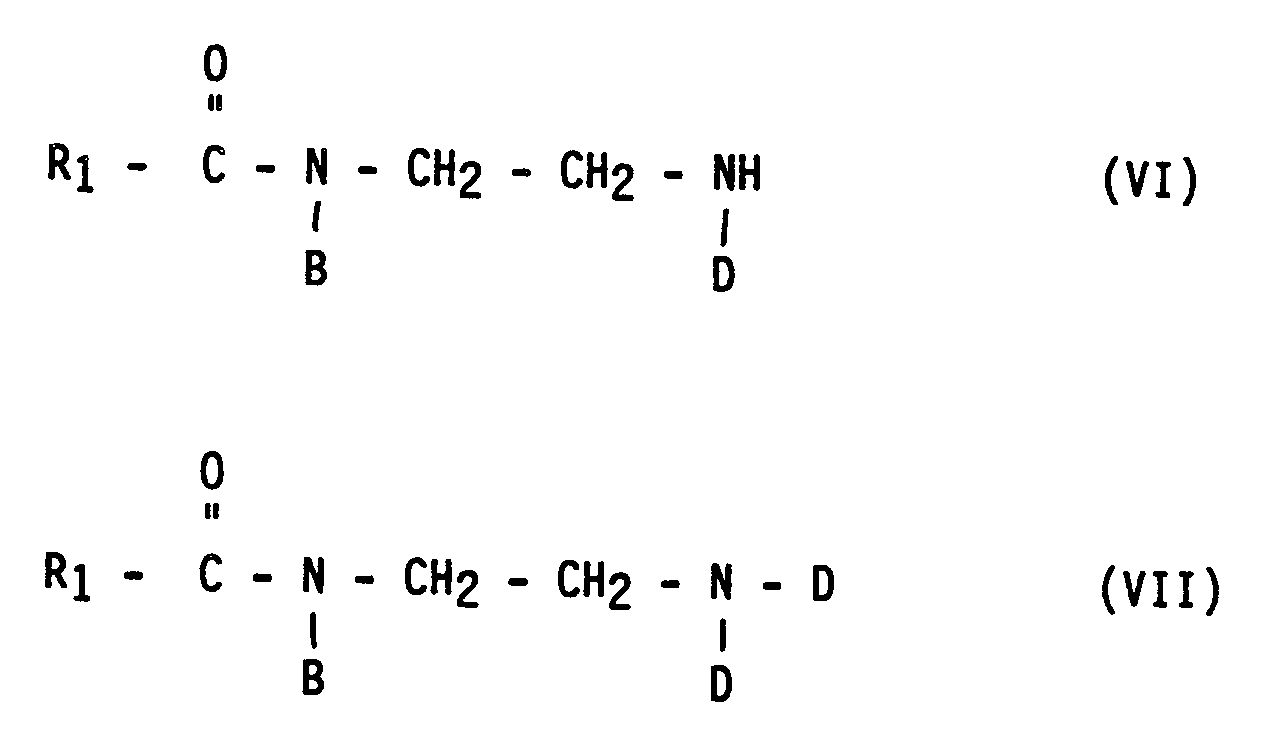
- C) das überschüssige Alkylierungsmittel der Formel V bei einer Temperatur zwischen 80 und 90°C unter Einhaltung eines pH-Wertes zwischen 10 und 11,5, gemessen in einer 10 gew.-%igen wässrigen Lösung des Reaktionsgemisches, hydrolysiert.
- Die mit Hilfe des erfindungsgemäßen Verfahrens hergestellten Produkte weisen von sich aus eine hohe Viskosität auf, wodurch die anwendungstechnischen Nachteile, mit denen die Produkte des Standes der Technik behaftet sind, in erheblichem Maß reduziert werden. Mit Hilfe des neuen Verfahrens können Produkte mit hohen, jedoch nicht übermäßigen Viskositäten im Bereich von 1000 bis 5000 cP hergestellt werden. Diese Produkte können ohne weiteres in den industrieüblichen Anlagen gehandhabt und gefördert werden. Weiterhin kann die Menge des Verdickungsmittels, das erforderlich ist, um die vom Markt geforderten Viskositätswerte bei Fertigprodukten, beispielsweise Shampoos, einzustellen, erheblich reduziert werden. Schließlich ist der Gehalt an störenden Metallseifen in den nach dem erfindungsgemäßen Verfahren erhaltenen Produkten wesentlich geringer als in den nach den bekannten Verfahren hergestellten Produkten.
- Überraschender Weise wird durch die gezielte Hydrolyse des Imidazolins vor der Alkylierung erreicht, daß die Zusammensetzung des Endprodukts kontrolliert und so ausgerichtet werden kann, daß die oben erwähnten Eigenschaften erzielt werden.
- GB-A- 850 514 offenbart ein Verfahren in dem ein Imidazolin gemäß dem vorliegenden Anspruch 1 zunächst hydrolisiert, und erst anschließend alkyliert wird. In diesem Verfahren wird jedoch ein anderes Verhältnis von Imidazolin zu Wasser bei der Hydrolyse eingesetzt.
- Die Herstellung des intermediären Imidazolins der Formel II

in der R₁ und B₁ die oben angegebene Bedeutung haben, ist hinreichend bekannt und beispielsweise in der ES-PS 540 640 und der EP-PS 2943 beschrieben. - Die Hydrolyse des Imidazolins der Formel II kann zwei verschiedene Amidoamintypen hervorbringen. Das Amidoamin der Formel III

entsteht, wenn die Hydrolysespaltung zwischen dem Kohlenstoffatom 1 und dem Stickstoffatom 5 des Imidazolinringes eintritt. Das Amidoamin der Formel IV
entsteht, wenn die Hydrolysespaltung zwischen dem Kohlenstoffatom 1 und dem Stickstoffatom 2 des Imidazolinringes eintritt. - Es wurde überraschenderweise festgestellt, daß bei der Hydrolyse des Imidazolins eine totale Spaltung der -C = N-Bindung abläuft und zwar nach einem kinetischen Mechanismus, in dem die Bildung des Amidoamins der Formel IV bevorzugt ist. Daneben läuft ein langsamer Isomerisierungsprozeß ab, bei dem das Amidoamin der Formel IV unter Bildung des Amidoamins der Formel III verschwindet, welch letzteres thermodynamisch stabiler ist. Es ist deshalb bei der Hydrolyse möglich, durch Steuerung der Temperatur- und Zeitbedingungen das gewünschte Verhältnis zwischen den beiden Amidoamintypen (III) und (IV) im Hydrolyseprodukt einzustellen. Die Eigenschaften des Endproduktes sind optimal, wenn in der Hydrolyse des Imidazolins ein Anteil an Amidoaminen der Formel III von 50 bis 95 Gew.-%, vorzugsweise von 80 bis 90 Gew.-%, bezogen auf das gesamte Hydrolyseprodukt, erreicht wird.
- Wenn es möglich wird, die Zusammensetzung des intermediären Hydrolyseproduktes zu steuern und festzulegen, dann kann man damit auch ein vollkommen definiertes Endprodukt erhalten. Im konkreten Fall werden bei der Alkylierung mit einem Alkylierungsmittel der Formel X-D aus dem Amidoamin der Formel IV die Verbindungen der Formeln VI und VII erhalten. Die Alkylierung des Amidoamins der Formel III hingegen führt zu dem Alkylierungsprodukt der Formel I, das im allgemeinen den größten Teil des Endproduktes ausmacht.
- Die Hydrolyse des Imidazolins der Formel II kann bei atmosphärischem Druck oder leichtem Überdruck in einem Temperaturbereich zwischen 50 und 130 °C, vorzugsweise zwischen 80 und 90 °C und mit einem Molverhältnis von Imidazolin zu Wasser zwischen 1 : 8 bis 1 : 20, vorzugsweise zwischen 1 : 8 bis 1 : 15 durchgeführt werden. Dabei ist zu berücksichtigen, daß die Bildung des sekundären Amidoamins der Formel III zu Lasten des tertiären Amidoamins der Formel IV durch lange Hydrolysezeiten, insbesondere Hydrolysezeiten zwischen 1 und 24 Stunden, vorzugsweise zwischen 6 und 15 Stunden, und hohe Temperaturen, insbesondere Temperaturen zwischen 50 und 130 °C, vorzugsweise zwischen 90 und 110 °C, begünstigt wird.
- Die Alkylierung der Hydrolyseprodukte erfolgt wie oben bereits angegeben nach bekannten Verfahren. Dabei wird das in der vorangegangenen Hydrolysestufe erhaltene Gemisch der Amidoamine einer wäßrigen Lösung des Alkylierungsmittels, vorzugsweise Natriummonochloracetat, bei einer Temperatur zwischen 40 und 70 °C, vorzugsweise zwischen 45 und 55 °C, zugesetzt. Das Molverhältnis von Amidoaminen zu Alkylierungsmitteln liegt dabei zwischen 1 : 1 und 4 : 1, vorzugsweise zwischen 1,5 : 1 und 2,8 : 1. Anschließend wird allmählich eine wässrige Alkalihydroxidlösung, vorzugsweise Natriumhydroxidlösung, unter Beibehaltung der angegebenen Temperaturwerte mit einer solchen Geschwindigkeit zugegeben, daß der pH-Wert, gemessen in einer 10 gew.-%igen Lösung des Reaktionsgemisches, zwischen 10 und 11,5, vorzugsweise zwischen 10,8 und 11,2, gehalten wird und die Alkylierung den vorhandenen Aminstickstoffatomen in einem angemessenen Zeitraum von etwa 3 bis 6 Stunden stattfindet. Die genannten Bedingungen schaffen gleichzeitig die Möglichkeit, in dieser Phase des Prozesses die Geschwindigkeit der Hydrolyse des Alkylierungsmittels entsprechend der Gleichung
ClCH₂COOONa + NaOH → NaCl + HOCH₂COONa
auf einen niedrigen Wert einzustellen. Wenn der gewünschte Alkylierungsgrad erreicht ist, wird die Temperatur des Reaktionsgemisches auf 80 bis 95 °C, vorzugsweise auf 85 bis 90 °C, erhöht. Das Reaktionsgemisch wird dann unter laufender Zugabe von Natriumhydroxidlösung zur Aufrechterhaltung eines pH-Wertes innerhalb der oben angegebenen Grenzen so lange auf dieser Temperatur gehalten, bis das überschüssige Alkylierungsmittel zerstört ist. - In einem mit Heizung und mechanischer Rührvorrichtung versehenen Labor-Glasreaktionsgefäß wurden 165,6 g (0,62 Mol) Hydroxyethylalkylimidazolin (R₁ = C₁₁; über 95 Gew.-% Imidazolingehalt) vorgelegt und unter Rühren auf 80 °C erwärmt. In einem Zeitraum von einer halben Stunde wurden 128 g (7,1 Mol) destilliertes Wasser zudosiert. Die Mischung wurde unter Rühren 15 Stunden lang zum Rückflußkochen erhitzt, so daß durch Hydrolyse eine wässrige Lösung eines Gemisches von Amidoaminen erhalten wurde, in dem bezogen auf Trockensubstanz, 83 Gew.-% sekundäres Amidoamin (III) enthalten waren.
- In einem zweiten Labor-Glasreaktionsgefäß, das ebenso ausgestattet war wie das vorgenannte, wurden 143,6 g (1,23 Mol) Natriummonochloracetat in 482,5 g destilliertem Wasser gelöst. Diese Lösung wurde auf 50 °C erwärmt. Danach wurde unter Rühren innerhalb einer halben Stunde die oben beschriebene Mischung aus Amidoaminen zudosiert. Anschließend wurde 3 Stunden lang unter Beibehaltung der Temperatur von 50 °C und unter weiterem Rühren 64 g einer 50 gew.-%igen wässrigen Natriumhydroxydlösung so zudosiert, daß der pH-Wert einer 10 gew.-%igen wässrigen Lösung des Reaktionsgemisches zwischen 11,1 und 11,5 lag. Schließlich wurde die Temperatur auf 90 °C erhöht und im Verlauf von 5 Stunden 16 g 50 gew.-%ige Natriumhydroxidlösung zudosiert, so daß der pH-Wert einer 10 gew.-%igen wässrigen Lösung des Reaktionsgemisches zwischen 10,0 und 10,5 lag. Das Endprodukt hatte einen Wassergehalt von 65 Gew.-% und bei 20 °C eine Viskosität von 1500 cP, gemessen mit einem Brookfield-Viskosimeter.
- In das im Beispiel 1 beschriebene Labor-Glasreaktionsgefäß wurden 133 g (0,5 Mol) Hydroxyethylalkylimidazolin (R₁ = C₁₁; über 95 Gew.-% Imidazolingehalt) vorgelegt und auf 105 °C erwärmt. Unter Rühren wurden innerhalb einer halben Stunde 103 g (5,7 Mol) destilliertes Wasser zudosiert. Die Mischung wurde unter Rühren 2 Stunden lang zum Rückflußkochen erhitzt, so daß eine wässrige Lösung eines Gemisches von Amidoaminen erhalten wurde, in dem, bezogen auf Trockensubstanz, 73 Gew.-% Amidoamin (III) enthalten waren.
- Die Alkylierung erfolgte unter den gleichen Bedingungen, wie sie im Beispiel 1 beschrieben sind, dabei wurden 155,8 g (1,3 Mol) Natriummonochloracetat, 107 g 50 gew.-%ige wässrige Natriumhydroxidlösung und 502 g destilliertes Wasser eingesetzt.
- Das Endprodukt hatte einen Wassergehalt von 65 Gew.-% und bei 20 °C eine Viskosität von 180 cP, bestimmt mit einem Brookfield-Viskosimeter.
- Mit den gleichen Reagentien und Mengen wie in Beispiel 2, jedoch unter Durchführung der Hydrolyse bei 105 °C im Verlauf von 6 Stunden, wurde eine wäßrige Lösung von Amidoaminen mit einem Gehalt an 96 Gew.-% sekundärem Amidoamin (III), bezogen auf Trokkensubstanz, erhalten.
- Unter Verwendung der gleichen Reagentien in den gleichen Mengen und unter Einhaltung der gleichen Bedingungen wie im Beispiel 2 wurde ein Endprodukt mit einem Wassergehalt von 65 Gew.-% und einer Viskosität bei 20 °C von 5800 cP, gemessen mit einem Brookfield-Viskosimeter, erhalten.
- Mit den gleichen Reagentien in gleichen Mengen und unter den gleichen Bedingungen wie im Beispiel 1, jedoch unter Verwendung eines Alkylhydroxyethylimidiazolins der Formel I, dessen Substituenten R₁ aus einem Gemisch von Alkylresten mit 7 bis 17 Kohlenstoffatomen, abgeleitet aus dem Fettsäureanteil des Kokosöl, wurde ein Endprodukt mit einem Wassergehalt von 65 Gew.-% und einer Viskosität bei 20 °C von 1200 cP, bestimmt mit einem Brookfield-Viskosimeter, erhalten.
Claims (8)
- Verfahren zur Herstellung von Gemischen amphoterer grenzflächenaktiver Imidazolinderivate hoher bis mittlerer Viskosität, die hauptsächlich Verbindungen der Formel I enthalten,
 A) ein Imidazolin der Formel II,
 B) das Gemisch der erhaltenen Amidoamine mit einem Alkylierungsmittel der Formel V,
X - D (V)
in der X für ein Halogenatom, vorzugsweise ein Chloratom oder ein Wasserstoffatom, steht und D die oben angegebene Bedeutung hat, in einem Molverhältnis von Alkylierungsmittel (V) zu Amidoaminen (III + IV) zwischen 1 : 1 und 4 : 1 mit Hilfe einer Base bei 40 bis 70°C unter Einhaltung eines pH-Wertes zwischen 10 und 11,5, gemessen in einer 10 gew.-%igen wässrigen Lösung des Reaktionsgemisches, alkyliert, so daß in erster Linie die Endverbindung der Formel I und in geringerem Maße auch Verbindungen der Formeln VI und VII entstehen,
 C) das überschüssige Alkylierungsmittel der Formel V bei einer Temperatur zwischen 80 und 95°C unter Einhaltung eines pH-Wertes zwischen 10 und 11,5, gemessen in einer 10 gew.-%igen wässrigen Lösung des Reaktionsgemisches, hydrolysiert.
 - Verfahren nach Anspruch 1, dadurch gekennzeichnet, daß in den Formeln I, V, VI und VII R₂ in D einen Ethylenrest und vorzugsweise einen Methylenrest bedeutet.
- Verfahren nach den Ansprüchen 1 und 2, dadurch gekennzeichnet, daß bei der Hydrolyse das Molverhältnis von Imidazolin (II) zu Wasser zwischen 1 : 8 bis 1 : 15 liegt.
- Verfahren nach den Ansprüchen 1 bis 3, dadurch gekennzeichnet, daß die Hydrolyse des Imidazolins (II) bei einer Temperatur zwischen 90 und 110°C durchgeführt wird.
- Verfahren nach den Ansprüchen 1 bis 4, dadurch gekennzeichnet, daß die Hydrolyse des Imidazolins (II) im Verlauf von 6 bis 15 Stunden durchgeführt wird.
- Verfahren nach den Ansprüchen 1 bis 5, dadurch gekennzeichnet, daß die Alkylierung bei einer Temperatur zwischen 45 und 55°C und bei einem pH-Wert zwischen 10,8 und 11,2, gemessen in einer 10 gew.-%igen Lösung des Reaktionsgemisches, durchgeführt wird.
- Verfahren nach den Ansprüchen 1 bis 6, dadurch gekennzeichnet, daß bei der Alkylierung das Molverhältnis von Amidoaminen zu Alkylierungsmittel zwischen 21,5 : 1 und 2,8 : 1 liegt.
- Verfahren nach den Ansprüchen 1 bis 7, dadurch gekennzeichnet, daß die Hydrolyse des überschüssigen Alkylierungsmittels (V) bei 85 bis 90°C unter Einhaltung eines pH-Wertes zwischen 10,8 und 11,2, gemessen in einer 10 gew.-%igen wässrigen Lösung des Reaktionsgemisches, durchgeführt wird.
Applications Claiming Priority (3)
| Application Number | Priority Date | Filing Date | Title |
|---|---|---|---|
| ES8803808 | 1988-12-15 | ||
| ES8803808A ES2012170A6 (es) | 1988-12-15 | 1988-12-15 | Procedimioento para la obtencion de derivados de amidoaminas, tensioactivos anfoteros. |
| PCT/EP1989/001490 WO1990006912A1 (de) | 1988-12-15 | 1989-12-06 | Verfahren zur herstellung von amphoteren grenzflächenaktiven imidazolinderivaten |
Publications (2)
| Publication Number | Publication Date |
|---|---|
| EP0452349A1 EP0452349A1 (de) | 1991-10-23 |
| EP0452349B1 true EP0452349B1 (de) | 1994-06-01 |
Family
ID=8259390
Family Applications (2)
| Application Number | Title | Priority Date | Filing Date |
|---|---|---|---|
| EP89122455A Withdrawn EP0373491A1 (de) | 1988-12-15 | 1989-12-06 | Verfahren zur Herstellung von amphoteren grenzflächenaktiven Imidazolinderivaten |
| EP90900791A Expired - Lifetime EP0452349B1 (de) | 1988-12-15 | 1989-12-06 | Verfahren zur herstellung von amphoteren grenzflächenaktiven imidazolinderivaten |
Family Applications Before (1)
| Application Number | Title | Priority Date | Filing Date |
|---|---|---|---|
| EP89122455A Withdrawn EP0373491A1 (de) | 1988-12-15 | 1989-12-06 | Verfahren zur Herstellung von amphoteren grenzflächenaktiven Imidazolinderivaten |
Country Status (11)
| Country | Link |
|---|---|
| EP (2) | EP0373491A1 (de) |
| JP (1) | JPH04502316A (de) |
| KR (1) | KR910700226A (de) |
| AU (1) | AU4666789A (de) |
| CA (1) | CA2005568A1 (de) |
| DE (1) | DE58907801D1 (de) |
| DK (1) | DK115291D0 (de) |
| ES (2) | ES2012170A6 (de) |
| TR (1) | TR24111A (de) |
| WO (1) | WO1990006912A1 (de) |
| ZA (1) | ZA899581B (de) |
Families Citing this family (9)
| Publication number | Priority date | Publication date | Assignee | Title |
|---|---|---|---|---|
| EP0674616B1 (de) * | 1992-12-17 | 1998-07-29 | Rhodia Chimie | Alpha-amino-substituierte essigsäure-derivate, ihre salze und ihre verwendung in der kosmetik |
| CA2132289A1 (en) * | 1993-10-12 | 1995-04-13 | Bharat Desai | Higher purity imidazoline based amphoacetate surfactants and processes for the preparation thereof |
| US5656586A (en) * | 1994-08-19 | 1997-08-12 | Rhone-Poulenc Inc. | Amphoteric surfactants having multiple hydrophobic and hydrophilic groups |
| GB9423573D0 (en) * | 1994-11-22 | 1995-01-11 | Rhone Poulenc Chemicals | Process for the preparation of amphoacetate surfactants |
| WO2001010820A1 (en) * | 1999-08-09 | 2001-02-15 | Rhodia Inc. | Process for making salt-free amphoterics with high mono amphopropionate content |
| JP4690498B2 (ja) * | 2010-10-08 | 2011-06-01 | ローディア インコーポレイティド | 両性プロピオン酸塩界面活性剤組成物を製造する方法 |
| CN109796364B (zh) * | 2018-12-28 | 2023-01-13 | 广州花语精细化工有限公司 | 一种低粘度两性表面活性剂的制备方法 |
| CN113600097B (zh) * | 2021-07-21 | 2023-02-14 | 上海发凯化工有限公司 | 一种不对称双子咪唑啉磷酸酯盐表面活性剂的制备方法 |
| CN116179219B (zh) * | 2023-02-21 | 2025-11-14 | 广州花语精细化工有限公司 | 一种咪唑啉型两性表面活性剂及其制备方法 |
Family Cites Families (2)
| Publication number | Priority date | Publication date | Assignee | Title |
|---|---|---|---|---|
| DE2725780A1 (de) * | 1977-06-03 | 1978-12-14 | Miranol Chemical Co | Stickstoffhaltige kondensationsprodukte |
| CA1117137A (en) * | 1977-08-18 | 1982-01-26 | Brinley M. Phillips | Organic nitrogen-containing compounds |
-
1988
- 1988-12-15 ES ES8803808A patent/ES2012170A6/es not_active Expired - Lifetime
-
1989
- 1989-12-06 AU AU46667/89A patent/AU4666789A/en not_active Abandoned
- 1989-12-06 WO PCT/EP1989/001490 patent/WO1990006912A1/de not_active Ceased
- 1989-12-06 EP EP89122455A patent/EP0373491A1/de not_active Withdrawn
- 1989-12-06 KR KR1019900701773A patent/KR910700226A/ko not_active Withdrawn
- 1989-12-06 JP JP90501014A patent/JPH04502316A/ja active Pending
- 1989-12-06 EP EP90900791A patent/EP0452349B1/de not_active Expired - Lifetime
- 1989-12-06 ES ES90900791T patent/ES2054331T3/es not_active Expired - Lifetime
- 1989-12-06 DE DE58907801T patent/DE58907801D1/de not_active Expired - Fee Related
- 1989-12-14 CA CA002005568A patent/CA2005568A1/en not_active Abandoned
- 1989-12-14 ZA ZA899581A patent/ZA899581B/xx unknown
-
1990
- 1990-01-02 TR TR90/0021A patent/TR24111A/xx unknown
-
1991
- 1991-06-14 DK DK911152A patent/DK115291D0/da not_active Application Discontinuation
Also Published As
| Publication number | Publication date |
|---|---|
| CA2005568A1 (en) | 1990-06-15 |
| ES2054331T3 (es) | 1994-08-01 |
| DE58907801D1 (de) | 1994-07-07 |
| TR24111A (tr) | 1991-05-01 |
| WO1990006912A1 (de) | 1990-06-28 |
| DK115291A (da) | 1991-06-14 |
| AU4666789A (en) | 1990-07-10 |
| JPH04502316A (ja) | 1992-04-23 |
| ES2012170A6 (es) | 1990-03-01 |
| EP0452349A1 (de) | 1991-10-23 |
| ZA899581B (en) | 1990-11-28 |
| EP0373491A1 (de) | 1990-06-20 |
| DK115291D0 (da) | 1991-06-14 |
| KR910700226A (ko) | 1991-03-14 |
Similar Documents
| Publication | Publication Date | Title |
|---|---|---|
| EP0302329B1 (de) | Verfahren zur Herstellung konzentrierter fliessfähiger wässriger Lösungen von Betainen | |
| EP0243619B1 (de) | Verfahren zur Herstellung einer hochkonzentrierten, fliess- und pumpfähigen Betainlösung | |
| DE69025404T2 (de) | Zyklische amidokarboxyoberflächenaktive verbindungen, herstellung und deren verwendung | |
| DE3826654C1 (de) | ||
| DE69433755T2 (de) | Verfahren zur Herstellung von Imidazolin abgeleiteten Amphoacetat-Tensiden von höherer Reinheit | |
| EP0656346B1 (de) | Verfahren zur Herstellung hochkonzentrierter fliessfähiger wässriger Lösungen von Betainen | |
| EP0452349B1 (de) | Verfahren zur herstellung von amphoteren grenzflächenaktiven imidazolinderivaten | |
| DE2921366A1 (de) | Konzentrierte waessrige oberflaechenaktive zubereitung | |
| DE69738570T2 (de) | Konzentrierte wässerige tensidzusammensetzungen von betaintyp und verfahren zu deren herstellung | |
| EP0647613B1 (de) | Verfahren zur Herstellung hochkonzentrierter fliessfähiger wässriger Lösungen von Betainen | |
| EP0670830B1 (de) | Verfahren zur herstellung dünnflüssiger, lagerstabiler amphotenside | |
| EP0677509B1 (de) | Verfahren zur Herstellung hochkonzentrierter fliessfähiger wässriger Lösungen von Betainen | |
| EP0739878B1 (de) | Verfahren zur Herstellung hochkonzentrierter fliessfähiger wässriger Lösungen von Betainen | |
| EP0749412B1 (de) | Niedrigviskose wässrige konzentrate von betaintensiden | |
| EP0040346B1 (de) | Verfahren zur Raffination des rohen Kondensationsproduktes aus Aminoalkylalkanolaminen und Fettsäuren sowie gewünschtenfalls zur anschliessenden Gewinnung von Amphotensiden mit erhöhter Lagerstabilität | |
| WO1997012856A1 (de) | Verfahren zur herstellung von betaintensiden mit geringem salzgehalt | |
| EP0229340B1 (de) | Verfahren zur Herstellung von flüssigen, hochkonzentrierten Aminoxiden | |
| DE1240872B (de) | Verfahren zur Herstellung wasserloeslicher, kapillaraktiver, als Wasch- und Reinigungsmittel und als Schaumstabilisatoren verwendbarer Ampholyte | |
| DE2725780C2 (de) | ||
| DE19523477A1 (de) | Verfahren zur Herstellung wäßriger, niedrigviskoser Betainkonzentrate | |
| EP0726890B1 (de) | Verfahren zur herstellung von detergensgemischen | |
| DE4430084B4 (de) | Verfahren zur Herstellung von Betainen | |
| DE19636205C2 (de) | Verfahren zur Herstellung dünnflüssiger, lagerstabiler Amphotenside | |
| DE3722186A1 (de) | Verfahren zur herstellung von in 2-stellung substituierten 1-(acylaminoalkyl)-2-imidazolinen | |
| DE69914228T2 (de) | Verfahren zur herstellung von salzfreien amphotheren mit hohem mono-amphopropionatgehalt |
Legal Events
| Date | Code | Title | Description |
|---|---|---|---|
| PUAI | Public reference made under article 153(3) epc to a published international application that has entered the european phase |
Free format text: ORIGINAL CODE: 0009012 |
|
| 17P | Request for examination filed |
Effective date: 19910606 |
|
| AK | Designated contracting states |
Kind code of ref document: A1 Designated state(s): AT BE CH DE ES FR GB IT LI NL SE |
|
| 17Q | First examination report despatched |
Effective date: 19930721 |
|
| RBV | Designated contracting states (corrected) |
Designated state(s): DE ES FR GB IT |
|
| GRAA | (expected) grant |
Free format text: ORIGINAL CODE: 0009210 |
|
| AK | Designated contracting states |
Kind code of ref document: B1 Designated state(s): DE ES FR GB IT |
|
| ET | Fr: translation filed | ||
| REF | Corresponds to: |
Ref document number: 58907801 Country of ref document: DE Date of ref document: 19940707 |
|
| REG | Reference to a national code |
Ref country code: ES Ref legal event code: FG2A Ref document number: 2054331 Country of ref document: ES Kind code of ref document: T3 |
|
| ITF | It: translation for a ep patent filed | ||
| GBT | Gb: translation of ep patent filed (gb section 77(6)(a)/1977) |
Effective date: 19940901 |
|
| PLBE | No opposition filed within time limit |
Free format text: ORIGINAL CODE: 0009261 |
|
| STAA | Information on the status of an ep patent application or granted ep patent |
Free format text: STATUS: NO OPPOSITION FILED WITHIN TIME LIMIT |
|
| 26N | No opposition filed | ||
| PGFP | Annual fee paid to national office [announced via postgrant information from national office to epo] |
Ref country code: GB Payment date: 19951127 Year of fee payment: 7 |
|
| PG25 | Lapsed in a contracting state [announced via postgrant information from national office to epo] |
Ref country code: GB Effective date: 19961206 |
|
| GBPC | Gb: european patent ceased through non-payment of renewal fee |
Effective date: 19961206 |
|
| PGFP | Annual fee paid to national office [announced via postgrant information from national office to epo] |
Ref country code: DE Payment date: 20001129 Year of fee payment: 12 |
|
| PGFP | Annual fee paid to national office [announced via postgrant information from national office to epo] |
Ref country code: FR Payment date: 20001212 Year of fee payment: 12 |
|
| PGFP | Annual fee paid to national office [announced via postgrant information from national office to epo] |
Ref country code: ES Payment date: 20001220 Year of fee payment: 12 |
|
| PG25 | Lapsed in a contracting state [announced via postgrant information from national office to epo] |
Ref country code: DE Free format text: LAPSE BECAUSE OF NON-PAYMENT OF DUE FEES Effective date: 20020702 |
|
| PG25 | Lapsed in a contracting state [announced via postgrant information from national office to epo] |
Ref country code: FR Free format text: LAPSE BECAUSE OF NON-PAYMENT OF DUE FEES Effective date: 20020830 |
|
| REG | Reference to a national code |
Ref country code: FR Ref legal event code: ST |
|
| PG25 | Lapsed in a contracting state [announced via postgrant information from national office to epo] |
Ref country code: ES Free format text: LAPSE BECAUSE OF NON-PAYMENT OF DUE FEES Effective date: 20021207 |
|
| REG | Reference to a national code |
Ref country code: ES Ref legal event code: FD2A Effective date: 20030113 |
|
| PG25 | Lapsed in a contracting state [announced via postgrant information from national office to epo] |
Ref country code: IT Free format text: LAPSE BECAUSE OF NON-PAYMENT OF DUE FEES;WARNING: LAPSES OF ITALIAN PATENTS WITH EFFECTIVE DATE BEFORE 2007 MAY HAVE OCCURRED AT ANY TIME BEFORE 2007. THE CORRECT EFFECTIVE DATE MAY BE DIFFERENT FROM THE ONE RECORDED. Effective date: 20051206 |