EP0113643B1 - 1:2-Kobaltkomplexe von Disazofarbstoffen - Google Patents
1:2-Kobaltkomplexe von Disazofarbstoffen Download PDFInfo
- Publication number
- EP0113643B1 EP0113643B1 EP83810630A EP83810630A EP0113643B1 EP 0113643 B1 EP0113643 B1 EP 0113643B1 EP 83810630 A EP83810630 A EP 83810630A EP 83810630 A EP83810630 A EP 83810630A EP 0113643 B1 EP0113643 B1 EP 0113643B1
- Authority
- EP
- European Patent Office
- Prior art keywords
- nitro
- dye
- hydrogen
- formula
- methyl
- Prior art date
- Legal status (The legal status is an assumption and is not a legal conclusion. Google has not performed a legal analysis and makes no representation as to the accuracy of the status listed.)
- Expired
Links
- 125000000664 diazo group Chemical group [N-]=[N+]=[*] 0.000 title claims description 8
- 125000000449 nitro group Chemical group [O-][N+](*)=O 0.000 claims abstract description 33
- 239000001257 hydrogen Substances 0.000 claims abstract description 21
- 229910052739 hydrogen Inorganic materials 0.000 claims abstract description 21
- ZAMOUSCENKQFHK-UHFFFAOYSA-N Chlorine atom Chemical compound [Cl] ZAMOUSCENKQFHK-UHFFFAOYSA-N 0.000 claims abstract description 12
- 125000002496 methyl group Chemical group [H]C([H])([H])* 0.000 claims abstract description 12
- 150000001768 cations Chemical class 0.000 claims abstract description 10
- 239000000460 chlorine Substances 0.000 claims abstract description 10
- 229910052801 chlorine Inorganic materials 0.000 claims abstract description 10
- 150000004700 cobalt complex Chemical class 0.000 claims abstract description 9
- 125000001424 substituent group Chemical group 0.000 claims abstract description 7
- 239000000975 dye Substances 0.000 claims description 38
- 150000002431 hydrogen Chemical group 0.000 claims description 16
- 239000010985 leather Substances 0.000 claims description 12
- GHMLBKRAJCXXBS-UHFFFAOYSA-N resorcinol Chemical compound OC1=CC=CC(O)=C1 GHMLBKRAJCXXBS-UHFFFAOYSA-N 0.000 claims description 12
- 238000004043 dyeing Methods 0.000 claims description 8
- 238000000034 method Methods 0.000 claims description 7
- XFSXWFOXECTCPD-UHFFFAOYSA-N naphthalen-1-ylsulfamic acid Chemical compound C1=CC=C2C(NS(=O)(=O)O)=CC=CC2=C1 XFSXWFOXECTCPD-UHFFFAOYSA-N 0.000 claims description 6
- UFHFLCQGNIYNRP-UHFFFAOYSA-N Hydrogen Chemical compound [H][H] UFHFLCQGNIYNRP-UHFFFAOYSA-N 0.000 claims description 5
- 230000008878 coupling Effects 0.000 claims description 5
- 238000010168 coupling process Methods 0.000 claims description 5
- 238000005859 coupling reaction Methods 0.000 claims description 5
- 125000000020 sulfo group Chemical group O=S(=O)([*])O[H] 0.000 claims description 4
- 239000003795 chemical substances by application Substances 0.000 claims description 3
- DZQXQAXLDXJEAG-UHFFFAOYSA-N n-(2-hydroxyphenyl)nitramide Chemical compound OC1=CC=CC=C1N[N+]([O-])=O DZQXQAXLDXJEAG-UHFFFAOYSA-N 0.000 claims description 3
- 239000004952 Polyamide Substances 0.000 claims description 2
- 229920002647 polyamide Polymers 0.000 claims description 2
- 210000002268 wool Anatomy 0.000 claims description 2
- 238000004519 manufacturing process Methods 0.000 claims 2
- IQUPABOKLQSFBK-UHFFFAOYSA-N 2-nitrophenol Chemical compound OC1=CC=CC=C1[N+]([O-])=O IQUPABOKLQSFBK-UHFFFAOYSA-N 0.000 claims 1
- 125000004435 hydrogen atom Chemical class [H]* 0.000 abstract 4
- 150000001450 anions Chemical class 0.000 abstract 1
- HEMHJVSKTPXQMS-UHFFFAOYSA-M Sodium hydroxide Chemical compound [OH-].[Na+] HEMHJVSKTPXQMS-UHFFFAOYSA-M 0.000 description 9
- JCXJVPUVTGWSNB-UHFFFAOYSA-N Nitrogen dioxide Chemical class O=[N]=O JCXJVPUVTGWSNB-UHFFFAOYSA-N 0.000 description 6
- VLZVIIYRNMWPSN-UHFFFAOYSA-N 2-Amino-4-nitrophenol Chemical compound NC1=CC([N+]([O-])=O)=CC=C1O VLZVIIYRNMWPSN-UHFFFAOYSA-N 0.000 description 5
- QGZKDVFQNNGYKY-UHFFFAOYSA-N Ammonia Chemical compound N QGZKDVFQNNGYKY-UHFFFAOYSA-N 0.000 description 4
- -1 Y 2 nitro Chemical class 0.000 description 4
- 239000000203 mixture Substances 0.000 description 4
- XLYOFNOQVPJJNP-UHFFFAOYSA-N water Substances O XLYOFNOQVPJJNP-UHFFFAOYSA-N 0.000 description 4
- DOPJTDJKZNWLRB-UHFFFAOYSA-N 2-Amino-5-nitrophenol Chemical compound NC1=CC=C([N+]([O-])=O)C=C1O DOPJTDJKZNWLRB-UHFFFAOYSA-N 0.000 description 3
- 239000002253 acid Substances 0.000 description 3
- CDAWCLOXVUBKRW-UHFFFAOYSA-N 2-aminophenol Chemical compound NC1=CC=CC=C1O CDAWCLOXVUBKRW-UHFFFAOYSA-N 0.000 description 2
- JBIJLHTVPXGSAM-UHFFFAOYSA-N 2-naphthylamine Chemical compound C1=CC=CC2=CC(N)=CC=C21 JBIJLHTVPXGSAM-UHFFFAOYSA-N 0.000 description 2
- SEMRCUIXRUXGJX-UHFFFAOYSA-N 6-aminonaphthalene-2-sulfonic acid Chemical compound C1=C(S(O)(=O)=O)C=CC2=CC(N)=CC=C21 SEMRCUIXRUXGJX-UHFFFAOYSA-N 0.000 description 2
- VYZAMTAEIAYCRO-UHFFFAOYSA-N Chromium Chemical compound [Cr] VYZAMTAEIAYCRO-UHFFFAOYSA-N 0.000 description 2
- DGAQECJNVWCQMB-PUAWFVPOSA-M Ilexoside XXIX Chemical compound C[C@@H]1CC[C@@]2(CC[C@@]3(C(=CC[C@H]4[C@]3(CC[C@@H]5[C@@]4(CC[C@@H](C5(C)C)OS(=O)(=O)[O-])C)C)[C@@H]2[C@]1(C)O)C)C(=O)O[C@H]6[C@@H]([C@H]([C@@H]([C@H](O6)CO)O)O)O.[Na+] DGAQECJNVWCQMB-PUAWFVPOSA-M 0.000 description 2
- WCUXLLCKKVVCTQ-UHFFFAOYSA-M Potassium chloride Chemical compound [Cl-].[K+] WCUXLLCKKVVCTQ-UHFFFAOYSA-M 0.000 description 2
- FAPWRFPIFSIZLT-UHFFFAOYSA-M Sodium chloride Chemical compound [Na+].[Cl-] FAPWRFPIFSIZLT-UHFFFAOYSA-M 0.000 description 2
- 150000001412 amines Chemical class 0.000 description 2
- 229910021529 ammonia Inorganic materials 0.000 description 2
- 150000003863 ammonium salts Chemical class 0.000 description 2
- 150000001868 cobalt Chemical class 0.000 description 2
- BDAGIHXWWSANSR-UHFFFAOYSA-N methanoic acid Natural products OC=O BDAGIHXWWSANSR-UHFFFAOYSA-N 0.000 description 2
- 150000003839 salts Chemical class 0.000 description 2
- 229910052708 sodium Inorganic materials 0.000 description 2
- 239000011734 sodium Substances 0.000 description 2
- ZARYBZGMUVAJMK-UHFFFAOYSA-N 2-amino-4-chloro-5-nitrophenol Chemical compound NC1=CC(Cl)=C([N+]([O-])=O)C=C1O ZARYBZGMUVAJMK-UHFFFAOYSA-N 0.000 description 1
- WZSBYBXNPKFJTA-UHFFFAOYSA-N 2-amino-4-methyl-5-nitrophenol Chemical compound CC1=CC(N)=C(O)C=C1[N+]([O-])=O WZSBYBXNPKFJTA-UHFFFAOYSA-N 0.000 description 1
- GWIAAIUASRVOIA-UHFFFAOYSA-N 2-aminonaphthalene-1-sulfonic acid Chemical compound C1=CC=CC2=C(S(O)(=O)=O)C(N)=CC=C21 GWIAAIUASRVOIA-UHFFFAOYSA-N 0.000 description 1
- OSWFIVFLDKOXQC-UHFFFAOYSA-N 4-(3-methoxyphenyl)aniline Chemical compound COC1=CC=CC(C=2C=CC(N)=CC=2)=C1 OSWFIVFLDKOXQC-UHFFFAOYSA-N 0.000 description 1
- HKTWHHAJDJCUPC-UHFFFAOYSA-N 7-aminonaphthalene-1,3,5-trisulfonic acid Chemical compound C1=C(S(O)(=O)=O)C=C(S(O)(=O)=O)C2=CC(N)=CC(S(O)(=O)=O)=C21 HKTWHHAJDJCUPC-UHFFFAOYSA-N 0.000 description 1
- QGZKDVFQNNGYKY-UHFFFAOYSA-O Ammonium Chemical compound [NH4+] QGZKDVFQNNGYKY-UHFFFAOYSA-O 0.000 description 1
- LSNNMFCWUKXFEE-UHFFFAOYSA-M Bisulfite Chemical compound OS([O-])=O LSNNMFCWUKXFEE-UHFFFAOYSA-M 0.000 description 1
- 241000283707 Capra Species 0.000 description 1
- WHXSMMKQMYFTQS-UHFFFAOYSA-N Lithium Chemical compound [Li] WHXSMMKQMYFTQS-UHFFFAOYSA-N 0.000 description 1
- IOVCWXUNBOPUCH-UHFFFAOYSA-M Nitrite anion Chemical compound [O-]N=O IOVCWXUNBOPUCH-UHFFFAOYSA-M 0.000 description 1
- ZLMJMSJWJFRBEC-UHFFFAOYSA-N Potassium Chemical compound [K] ZLMJMSJWJFRBEC-UHFFFAOYSA-N 0.000 description 1
- 230000002378 acidificating effect Effects 0.000 description 1
- 150000007513 acids Chemical class 0.000 description 1
- 239000003513 alkali Substances 0.000 description 1
- 229910052783 alkali metal Inorganic materials 0.000 description 1
- 235000015278 beef Nutrition 0.000 description 1
- 229910052804 chromium Inorganic materials 0.000 description 1
- 239000011651 chromium Substances 0.000 description 1
- 229910017052 cobalt Inorganic materials 0.000 description 1
- 239000010941 cobalt Substances 0.000 description 1
- GUTLYIVDDKVIGB-UHFFFAOYSA-N cobalt atom Chemical compound [Co] GUTLYIVDDKVIGB-UHFFFAOYSA-N 0.000 description 1
- 229940044175 cobalt sulfate Drugs 0.000 description 1
- 229910000361 cobalt sulfate Inorganic materials 0.000 description 1
- KTVIXTQDYHMGHF-UHFFFAOYSA-L cobalt(2+) sulfate Chemical compound [Co+2].[O-]S([O-])(=O)=O KTVIXTQDYHMGHF-UHFFFAOYSA-L 0.000 description 1
- 239000003086 colorant Substances 0.000 description 1
- 238000004040 coloring Methods 0.000 description 1
- 150000001875 compounds Chemical class 0.000 description 1
- 239000007859 condensation product Substances 0.000 description 1
- WSFSSNUMVMOOMR-UHFFFAOYSA-N formaldehyde Substances O=C WSFSSNUMVMOOMR-UHFFFAOYSA-N 0.000 description 1
- 235000019253 formic acid Nutrition 0.000 description 1
- 150000004698 iron complex Chemical class 0.000 description 1
- 229910052744 lithium Inorganic materials 0.000 description 1
- 229910003002 lithium salt Inorganic materials 0.000 description 1
- 159000000002 lithium salts Chemical class 0.000 description 1
- 239000000463 material Substances 0.000 description 1
- 239000000434 metal complex dye Substances 0.000 description 1
- 230000007935 neutral effect Effects 0.000 description 1
- 229910052757 nitrogen Inorganic materials 0.000 description 1
- 125000004433 nitrogen atom Chemical group N* 0.000 description 1
- QJGQUHMNIGDVPM-UHFFFAOYSA-N nitrogen group Chemical group [N] QJGQUHMNIGDVPM-UHFFFAOYSA-N 0.000 description 1
- 229920002635 polyurethane Polymers 0.000 description 1
- 239000004814 polyurethane Substances 0.000 description 1
- 235000015277 pork Nutrition 0.000 description 1
- 229910052700 potassium Inorganic materials 0.000 description 1
- 239000011591 potassium Substances 0.000 description 1
- 239000001103 potassium chloride Substances 0.000 description 1
- 235000011164 potassium chloride Nutrition 0.000 description 1
- 239000000843 powder Substances 0.000 description 1
- 238000002360 preparation method Methods 0.000 description 1
- 239000011780 sodium chloride Substances 0.000 description 1
- 239000000126 substance Substances 0.000 description 1
Classifications
-
- C—CHEMISTRY; METALLURGY
- C09—DYES; PAINTS; POLISHES; NATURAL RESINS; ADHESIVES; COMPOSITIONS NOT OTHERWISE PROVIDED FOR; APPLICATIONS OF MATERIALS NOT OTHERWISE PROVIDED FOR
- C09B—ORGANIC DYES OR CLOSELY-RELATED COMPOUNDS FOR PRODUCING DYES, e.g. PIGMENTS; MORDANTS; LAKES
- C09B45/00—Complex metal compounds of azo dyes
- C09B45/02—Preparation from dyes containing in o-position a hydroxy group and in o'-position hydroxy, alkoxy, carboxyl, amino or keto groups
- C09B45/24—Disazo or polyazo compounds
- C09B45/30—Disazo or polyazo compounds containing cobalt
-
- Y—GENERAL TAGGING OF NEW TECHNOLOGICAL DEVELOPMENTS; GENERAL TAGGING OF CROSS-SECTIONAL TECHNOLOGIES SPANNING OVER SEVERAL SECTIONS OF THE IPC; TECHNICAL SUBJECTS COVERED BY FORMER USPC CROSS-REFERENCE ART COLLECTIONS [XRACs] AND DIGESTS
- Y10—TECHNICAL SUBJECTS COVERED BY FORMER USPC
- Y10S—TECHNICAL SUBJECTS COVERED BY FORMER USPC CROSS-REFERENCE ART COLLECTIONS [XRACs] AND DIGESTS
- Y10S534/00—Organic compounds -- part of the class 532-570 series
- Y10S534/01—Mixtures of azo compounds
Definitions
- the phenolic diazo component of the disazo dyes is derived from 1-hydroxy-2-amino-4-chloro-5-nitrobenzene, 1-hydroxy-2-amino-4-methyl-5-nitrobenzene, but especially from 1-hydroxy-2-amino -4-nitrobenzene or from 1-hydroxy-2-amino-5-nitrobenzene.
- the disazo dyes contain a 2-naphthylamine sulfonic acid with 1 to 3 sulfo groups, such as. B. 2-naphthylamine-1-, -5-, -6-, -7- or -8-sulfonic acid, 2-naphthylamine-3,6-, -4,8-, -5,7- or -6, 8-disulfonic acid or 2-naphthylamine-4,6,8-trisulfonic acid.
- Monosulfonic acids are preferred, and 2-naphthylamine-6-sulfonic acid in particular.
- Ka ⁇ is a cation, for example an alkali application, such as lithium, potassium or preferably sodium. Furthermore, Ka ⁇ can be an ammonium cation or the ammonium salt of an organic amine.
- the two disazo dyes contained in the 1: 2 cobalt complexes of the formula given can be different or, preferably, the same.
- the compounds of the formula II are of particular importance because of their good coloring properties where Ka ⁇ means a cation.
- the one which the two sulfo groups are each in the 6-position is particularly preferred of the 2-naphthylamine residue.
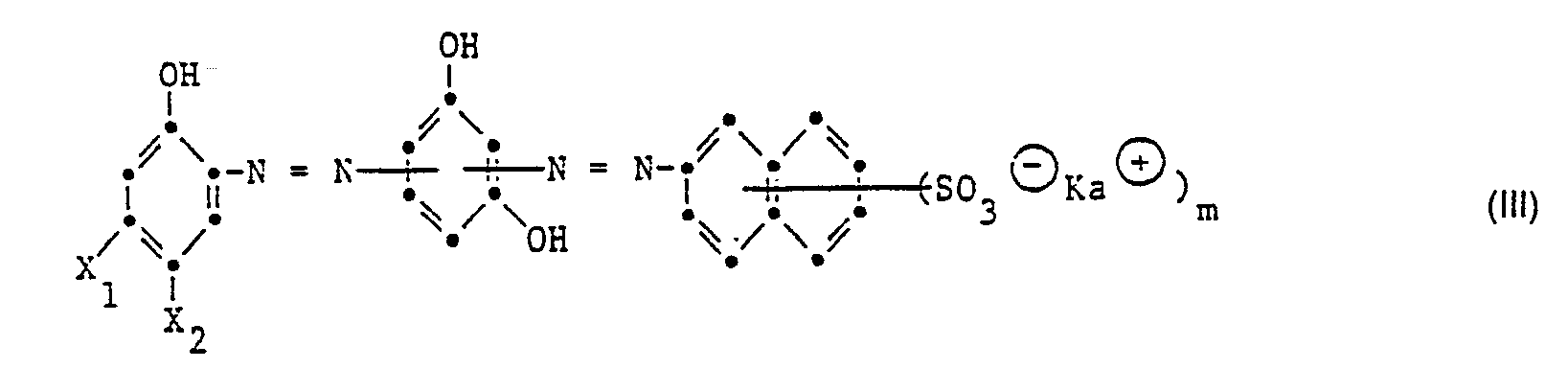
- the dyes of the formula I according to the invention can be prepared by methods known per se, for example by using a dye of the formula III wherein X 1 is nitro or hydrogen, X 2 nitro, hydrogen, chlorine or methyl, where in each case one of the substituents X 1 or X 2 is nitro and the other has one of the meanings given except nitro, Ka ⁇ is a cation and m 1, 2 or 3 means, and a dye of formula IV wherein Y 1 is nitro or hydrogen, Y 2 nitro, hydrogen, chlorine or methyl, where in each case one of the substituents Y 1 or Y 2 is nitro and the other has one of the meanings given except nitro, Ka ⁇ is a cation and n 1, 2 or 3 means reacted with a cobalt-releasing agent to form the 1: 2 cobalt complex, it being possible for the dyes of the formulas III and IV to be identical.
- the dyes of the formulas III and IV are known or can be prepared by known methods by coupling a diazotized aminophenol and a diazotized aminonaphthalenesulfonic acid with resorcinol, the order of coupling being optional.
- the dyes of the formula I according to the invention can also be prepared by first of all adding a dye of the formula V where X 1 and X 2 have the meaning given above, and a dye of the formula VI wherein Y 1 and Y 2 have the meaning given above and where the dyes of the formulas V and VI can be identical, converted into the 1: 2 cobalt complex and then a diazotized sulfonaphthylamine of the formula VII where KaE9 and m have the meaning given above, couples.
- Mixtures of two or more sulfonaphthylamines can also be used.
- the preferred process for the preparation of the 1: 2 cobalt complexes of the formula I according to the invention is that resorcinol is first reacted with a sulfonaphthylamine of the formula VII and then with a nitroaminophenol of the formula VIII couples and then the disazo dye obtained is converted into the 1: 2 cobalt complex.
- sulfonaphthylamine Preferably 1 to 1.2 moles of sulfonaphthylamine and 1 to 0.8 moles of nitroaminophenol are used per mole of resorcinol.
- the new metal complex dyes of the formula I obtainable by the above processes are isolated in the form of their salts, in particular alkali metal salts, especially sodium or lithium salts, or else ammonium salts or salts of organic amines with a positively charged nitrogen atom and are suitable for dyeing and printing various substances , optionally in the presence of a leveling agent, but especially for dyeing and printing nitrogen-containing materials, such as silk or polyurethane, but preferably for dyeing wool, polyamide and in particular furs or leather, all types of leather being suitable, e.g. B. chrome leather, retanned leather or suede from goat, beef and pork.
- the dye obtained is metallized with 50 ml of a 1-molar cobalt sulfate solution for 6 hours at 80 ° and with 2-molar sodium hydroxide solution in a neutral to slightly alkaline pH. It is then salted out with 200 parts of a 1: 1 mixture of potassium chloride and sodium chloride, filtered and dried.
- the dark powder obtained dyes leather in a reddish brown shade with good fastness properties.
- the cobalt complex described above is characterized in that the dyeings on leather have better lightfastness.
Landscapes
- Chemical & Material Sciences (AREA)
- Organic Chemistry (AREA)
- Coloring (AREA)
Description
- Gegenstand der vorliegenden Erfindung sind 1 : 2-Kobalt-Komplexfarbstoffe der allgemeinen Formel

- X, Nitro oder Wasserstoff, X2 Nitro, Wasserstoff, Chlor oder Methyl,
- Y, Nitro oder Wasserstoff, Y2 Nitro, Wasserstoff, Chlor oder Methyl,
- m und n jeweils unabhängig voneinander 1, 2 oder 3 und Ka9 ein Kation
- Die phenolische Diazokomponente der Disazofarbstoffe leitet sich von 1-Hydroxy-2-amino-4-chlor-5-nitrobenzol, 1-Hydroxy-2-amino-4-methyl-5-nitrobenzol, insbesondere aber von 1-Hydroxy-2-amino-4-nitrobenzol oder von 1-Hydroxy-2-amino-5-nitrobenzol ab.
- Als zweite Diazokomponente enthalten die Disazofarbstoffe eine 2-Naphthylaminsulfosäure mit 1 bis 3 Sulfogruppen, wie z. B. 2-Naphthylamin-1-, -5-, -6-, -7- oder -8-sulfosäure, 2-Naphthylamin-3,6-, -4,8-, -5,7- oder -6,8-disulfosäure oder 2-Naphthylamin-4,6,8-trisulfosäure. Bevorzugt sind die Monosulfosäuren und unter diesen insbesondere 2-Naphthylamin-6-sulfosäure.
- Ka⊕ stellt ein Kation, beispielsweise ein Alkalikation, wie Lithium, Kalium oder vorzugsweise Natrium, dar. Ferner kann Ka⊕ ein Ammoniumkation oder das Ammoniumsalz eines organischen Amins sein.
- Die in den 1 : 2-Kobaltkomplexen der angegebenen Formel enthaltenen beiden Disazofarbstoffe können verschieden oder vorzugsweise gleich sein.
- Von besonderer Bedeutung wegen ihrer guten färberischen Eigenschaften sind die Verbindungen der Formel II

- Unter diesen ist diejenige besonders bevorzugt, welche die beiden Sulfogruppen jeweils in 6-Stellung des 2-Naphthylaminrestes trägt.
- Die erfindungsgemässen Farbstoffe der Formel I können nach an sich bekannten Methoden hergestellt werden, beispielsweise indem man einen Farbstoff der Formel III


- Die Farbstoffe der Formeln III und IV sind bekannt oder können nach bekannten Methoden hergestellt werden durch Kuppeln eines diazotierten Aminophenols und einer diazotierten Aminonaphthalinsulfosäure mit Resorcin, wobei die Reihenfolge der Kupplung beliebig sein kann.
- Die Herstellung der erfindungsgemässen Farbstoffe der Formel I kann auch erfolgen, indem man zunächst einen Farbstoff der Formel V


- Man kann auch Gemische von zwei oder mehreren Sulfonaphthylaminen einsetzen.
- Das bevorzugte Verfahren zur Herstellung der erfindungsgemässen 1 : 2-Kobaltkomplexe der Formel I besteht jedoch darin, dass man zunächst Resorcin mit einem Sulfonaphthylamin der Formel VII und danach mit einem Nitroaminophenol der Formel VIII

- Vorzugsweise setzt man dabei 1 bis 1,2 Mol Sulfonaphthylamin und 1 bis 0,8 Mol Nitroaminophenol pro Mol Resorcin ein.
- Die nach den obigen Verfahren erhältlichen neuen Metallkomplexfarbstoffe der Formel I werden in Form ihrer Salze, insbesondere Alkali-, vor allem Natrium- oder Lithiumsalze, oder auch Ammoniumsalze oder Salze von organischen Aminen mit positiv geladenem Stickatoffatom isoliert und eignen sich zum Färben und Bedrucken verschiedener Stoffe, gegebenenfalls in Gegenwart eines Egalisierhilfsmittels, vor allem aber zum Färben und Bedrucken stickstoffhaltiger Materialien, wie Seide oder Polyurethanen, vorzugsweise jedoch zum Färben von Wolle, Polyamid und insbesondere von Pelzen oder Leder, wobei alle Ledersorten geeignet sind, z. B. Chromleder, nachgegerbtes Leder oder Velourleder von Ziege, Rind und Schwein.
- Man erhält braune Färbungen mit guten Echtheiten, insbesondere Licht- und Nassechtheiten.
- Das nachfolgende Beispiel dient der Erläuterung der Erfindung, ohne sie darauf zu beschränken. Teile bedeuten Gewichtsteile und Prozente Gewichtsprozente. Die Temperaturen sind in Grad Celsius angegeben.
-

- In 100 Teile Wasser werden 11 Teile Resorcin eingetragen und mit 26,8 Teilen 2-Naphthylamin-6-sulfonsäure, die nach bekannter Methode mit Säure und Nitrit diazotiert worden ist, versetzt. Durch Zugabe von 2-molarer Natronlauge wird der pH Wert leicht sauer gestellt. Nach Beendigung der ersten Kupplung werden die ebenfalls nach bekannter Methode diazotierten 15,4 Teile 2-Amino-4-nitrophenol zugegeben. Dabei wird mit 2-molarer Natronlauge der pH-Wert leicht alkalisch gehalten. Nach Beendigung der zweiten Kupplung erhält man ein Farbstoffgemisch, dessen Hautkomponente dem in der obigen Formel aufgeführten Disazofarbstoff entspricht.
- Der erhaltene Farbstoff wird mit 50 ml einer 1-molaren Kobaltsulfatlösung 6 Stunden bei 80° und mit 2-molarer Natronlauge neutral bis schwach alkalisch gehaltenem pH-Wert metallisiert. Anschliessend wird mit 200 Teilen einer 1 : 1-Mischung aus Kaliumchlorid und Natriumchlorid ausgesalzen, filtriert und getrocknet. Das erhaltene dunkle Pulver färbt Leder in einem rotbraunen Farbton mit guten Echtheiten.
- Gegenüber dem analogen Chrom- und Eisenkomplex zeichnet sich der vorstehend beschriebene Kobaltkomplex dadurch aus, dass die Färbungen auf Leder bessere Lichechtheit aufweisen.
- Arbeitet man wie im Beispiel 1 beschrieben, verwendet jedoch anstelle von 2-Amino-4-nitrophenol die gleiche Menge 2-Amino-5-nitrophenol, so erhält man einen Farbstoff, der Leder in weniger rotstichigem Braun mit guten Echtheiten färbt.
- Arbeitet man wie im Beispiel 1 beschrieben, verwendet jedoch anstelle von 2-Amino-4-nitrophenol die gleiche Menge eines Gemisches aus gleichen Teilen 2-Amino-4-nitrophenol und 2-Amino-5-nitrophenol, so erhält man einen Farbstoff, der Leder in weniger rotstichigem Braun mit guten Echtheiten färbt.
- Arbeitet man wie im Beispiel 1 beschrieben, verwendet jedoch äquivalente Mengen der in Spalte 2 der folgenden Tabelle aufgeführten Aminophenole sowie der in Spalte 3 verzeichneten Naphthylaminsulfonsäuren, so erhält man Farbstoffe, welche Leder in der in Spalte 4 angegebenen Nuance färben.


- 100 Teile Bekleidungsvelourleder werden bei 50° in einer Lösung von 1 000 Teilen Wasser und 2 Teilen 24 %igem Ammoniak während 2 Stunden aufgewalkt und anschliessend bei 60° in einer Lösung von 1 000 Teilen Wasser, 2 Teilen 24 %igem Ammoniak und 3 Teilen Farbstoff des Beispiels 1 während 1 Stunde gefärbt. Hierauf gibt man ein Lösung von 40 Teilen Wasser und 4 Teilen 85 %iger Ameisensäure zu und färbt noch weitere 30 Minuten. Dann werden die Leder gut gespült und gegebenenfalls noch mit 2 Teilen eines Dicyandiaminoformaldehydkondensationsproduktes während 30 Minuten bei 50° behandelt. Man erhält eine rotbraune Färbung mit guten Echtheiten.
bedeutet, wobei jeweils einer der Substituenten X1 oder X2 und Y1 oder Y2 Nitro ist und der andere eine der angegebenen Bedeutungen ausser Nitro aufweist.
Claims (11)




Applications Claiming Priority (2)
| Application Number | Priority Date | Filing Date | Title |
|---|---|---|---|
| CH4683 | 1983-01-05 | ||
| CH46/83 | 1983-01-05 |
Publications (2)
| Publication Number | Publication Date |
|---|---|
| EP0113643A1 EP0113643A1 (de) | 1984-07-18 |
| EP0113643B1 true EP0113643B1 (de) | 1987-03-04 |
Family
ID=4178097
Family Applications (1)
| Application Number | Title | Priority Date | Filing Date |
|---|---|---|---|
| EP83810630A Expired EP0113643B1 (de) | 1983-01-05 | 1983-12-30 | 1:2-Kobaltkomplexe von Disazofarbstoffen |
Country Status (4)
| Country | Link |
|---|---|
| US (1) | US4923973A (de) |
| EP (1) | EP0113643B1 (de) |
| JP (1) | JPS59155466A (de) |
| DE (1) | DE3370019D1 (de) |
Families Citing this family (4)
| Publication number | Priority date | Publication date | Assignee | Title |
|---|---|---|---|---|
| CH657626A5 (de) * | 1984-06-12 | 1986-09-15 | Ciba Geigy Ag | Verfahren zur herstellung von eisenkomplexfarbstoffen aus naphthylaminsulfonsaeure, resorcin und nitroaminophenol. |
| DE3507833A1 (de) * | 1985-03-06 | 1986-09-11 | Basf Ag, 6700 Ludwigshafen | Disazofarbstoffe |
| US5322408A (en) * | 1992-09-21 | 1994-06-21 | Handi-Loft, Inc. | Device for raising and lowering an impaired person |
| UA22127C2 (uk) * | 1996-09-10 | 1998-04-30 | Сергій Іванович Мірошніченко | Телевізійhа система високої розрізhяльhої здатhості |
Family Cites Families (9)
| Publication number | Priority date | Publication date | Assignee | Title |
|---|---|---|---|---|
| US2136650A (en) * | 1933-06-17 | 1938-11-15 | Calco Chemical Co Inc | Metallized acid polyazo dyes |
| US2200445A (en) * | 1933-11-25 | 1940-05-14 | Gen Aniline & Film Corp | Azo dyestuffs containing a heavy metal in a complex form |
| US2257165A (en) * | 1933-11-25 | 1941-09-30 | Gen Aniline & Film Corp | Azo dyestuffs containing chromium in complex union |
| DE707225C (de) * | 1933-11-26 | 1941-06-16 | I G Farbenindustrie Akt Ges | Verfahren zur Herstellung von komplexen Chromverbindungen von Polyazofarbstoffen |
| US2153531A (en) * | 1936-07-02 | 1939-04-04 | Gen Aniline Works Inc | Metalliferous azo dyes |
| US2117707A (en) * | 1937-01-22 | 1938-05-17 | Du Pont | Azo dye |
| DE2926761A1 (de) * | 1979-07-03 | 1981-01-22 | Bayer Ag | Metallkomplexfarbstoffe |
| DE3029271A1 (de) * | 1980-08-01 | 1982-03-18 | Bayer Ag, 5090 Leverkusen | Metallkomplexfarbstoffe, verfahren zu ihrer herstellung und ihre verwendung zum faerben stickstoffhaltiger materialien |
| DE3133506A1 (de) * | 1981-08-25 | 1983-03-17 | Bayer Ag, 5090 Leverkusen | Saure metallkomplexfarbstoffe |
-
1983
- 1983-12-30 DE DE8383810630T patent/DE3370019D1/de not_active Expired
- 1983-12-30 EP EP83810630A patent/EP0113643B1/de not_active Expired
-
1984
- 1984-01-05 JP JP59000117A patent/JPS59155466A/ja active Granted
-
1989
- 1989-07-17 US US07/382,001 patent/US4923973A/en not_active Expired - Fee Related
Also Published As
| Publication number | Publication date |
|---|---|
| JPH056588B2 (de) | 1993-01-26 |
| JPS59155466A (ja) | 1984-09-04 |
| EP0113643A1 (de) | 1984-07-18 |
| DE3370019D1 (en) | 1987-04-09 |
| US4923973A (en) | 1990-05-08 |
Similar Documents
| Publication | Publication Date | Title |
|---|---|---|
| DE2704364C2 (de) | ||
| CH649775A5 (de) | Wasserloesliche, anionische chromkomplexe, deren herstellung und verwendung. | |
| DE2024047B2 (de) | Polyazofarbstoffe, ihre metallkomplexverbindungen, ihre herstellung und verwendung | |
| DE942345C (de) | Verfahren zur Herstellung neuer direktziehender Azofarbstoffe | |
| EP0113643A1 (de) | 1:2-Kobaltkomplexe von Disazofarbstoffen | |
| EP0098799B1 (de) | 1:2-Metallkomplexe von Azomethinfarbstoffen mit Arylazogruppen | |
| EP0095441B1 (de) | Asymmetrische 1:2-Chromkomplexfarbstoffe | |
| EP0061999B1 (de) | Verwendung von 1:2-Chrom- oder -Kobaltkomplexfarbstoffen zum Färben von Leder oder Pelzen | |
| EP0061998B1 (de) | Verwendung von 1:2-Chrom- oder -Kobaltkomplexfarbstoffen zum Färben von Leder oder Pelzen | |
| DE2500550C2 (de) | Neue Chromkomplexfarbstoffe, deren Herstellung und Verwendung | |
| CH622543A5 (de) | ||
| EP0099857B1 (de) | Metallkomplexe von Azofarbstoffen | |
| EP0082819B1 (de) | Verwendung von 1:2-Kobaltkomplexfarbstoffen zum Färben von Leder oder Pelzen | |
| EP0322357B1 (de) | Verfahren zur Herstellung von Polyazofarbstoffen | |
| EP0037377B1 (de) | Metallkomplexfarbstoffe, deren Herstellung und Verwendung | |
| EP0166687B1 (de) | Eisenkomplexe von Azofarbstoffen aus Naphthylaminsulfonsäure, Resorcin und Nitroaminophenol | |
| DE2540588C2 (de) | Neue Lederfarbstoffe, deren Herstellung und Verwendung | |
| EP0061997A1 (de) | Verwendung von 1:2-Kobaltkomplexfarbstoffen zum Färben von Leder oder Pelzen | |
| EP0112281B1 (de) | Unsymmetrische 1:2-Chromkomplexfarbstoffe, enthaltend eine Azo- und eine Azomethinverbindung | |
| EP0110822B1 (de) | Verwendung von 1:2-Chromkomplexfarbstoffen zum Färben von Leder oder Pelzen | |
| DE2608535A1 (de) | Neue chromkomplexfarbstoffe, ihre herstellung und verwendung | |
| EP0165483B1 (de) | Verfahren zur Herstellung von sauren Nitrofarbstoffen | |
| DE957324C (de) | Verfahren zur Herstellung kupferhaltiger Disazofarbstoffe | |
| EP0078460A1 (de) | Metallkomplexfarbstoffe | |
| DE1274764B (de) | Verfahren zur Herstellung von wasserloeslichen organischen Farbstoffen |
Legal Events
| Date | Code | Title | Description |
|---|---|---|---|
| PUAI | Public reference made under article 153(3) epc to a published international application that has entered the european phase |
Free format text: ORIGINAL CODE: 0009012 |
|
| 17P | Request for examination filed |
Effective date: 19840102 |
|
| AK | Designated contracting states |
Designated state(s): CH DE FR GB IT LI |
|
| GRAA | (expected) grant |
Free format text: ORIGINAL CODE: 0009210 |
|
| AK | Designated contracting states |
Kind code of ref document: B1 Designated state(s): CH DE FR GB IT LI |
|
| ET | Fr: translation filed | ||
| REF | Corresponds to: |
Ref document number: 3370019 Country of ref document: DE Date of ref document: 19870409 |
|
| ITF | It: translation for a ep patent filed | ||
| PLBE | No opposition filed within time limit |
Free format text: ORIGINAL CODE: 0009261 |
|
| STAA | Information on the status of an ep patent application or granted ep patent |
Free format text: STATUS: NO OPPOSITION FILED WITHIN TIME LIMIT |
|
| 26N | No opposition filed | ||
| PGFP | Annual fee paid to national office [announced via postgrant information from national office to epo] |
Ref country code: FR Payment date: 19941109 Year of fee payment: 12 |
|
| PGFP | Annual fee paid to national office [announced via postgrant information from national office to epo] |
Ref country code: GB Payment date: 19941124 Year of fee payment: 12 |
|
| ITTA | It: last paid annual fee | ||
| PG25 | Lapsed in a contracting state [announced via postgrant information from national office to epo] |
Ref country code: GB Effective date: 19951230 |
|
| GBPC | Gb: european patent ceased through non-payment of renewal fee |
Effective date: 19951230 |
|
| PG25 | Lapsed in a contracting state [announced via postgrant information from national office to epo] |
Ref country code: FR Effective date: 19960830 |
|
| REG | Reference to a national code |
Ref country code: FR Ref legal event code: ST Ref country code: CH Ref legal event code: PUE Owner name: CIBA-GEIGY AG TRANSFER- CIBA SC HOLDING AG |
|
| PGFP | Annual fee paid to national office [announced via postgrant information from national office to epo] |
Ref country code: DE Payment date: 19961108 Year of fee payment: 14 |
|
| PGFP | Annual fee paid to national office [announced via postgrant information from national office to epo] |
Ref country code: CH Payment date: 19961126 Year of fee payment: 14 |
|
| REG | Reference to a national code |
Ref country code: CH Ref legal event code: PFA Free format text: CIBA SC HOLDING AG TRANSFER- CIBA SPECIALTY CHEMICALS HOLDING INC. |
|
| PG25 | Lapsed in a contracting state [announced via postgrant information from national office to epo] |
Ref country code: LI Free format text: LAPSE BECAUSE OF NON-PAYMENT OF DUE FEES Effective date: 19971231 Ref country code: CH Free format text: LAPSE BECAUSE OF NON-PAYMENT OF DUE FEES Effective date: 19971231 |
|
| REG | Reference to a national code |
Ref country code: CH Ref legal event code: PL |
|
| PG25 | Lapsed in a contracting state [announced via postgrant information from national office to epo] |
Ref country code: DE Free format text: LAPSE BECAUSE OF NON-PAYMENT OF DUE FEES Effective date: 19980901 |