EP0110031A2 - Verfahren zur Herstellung von 1,2-Diolen - Google Patents
Verfahren zur Herstellung von 1,2-Diolen Download PDFInfo
- Publication number
- EP0110031A2 EP0110031A2 EP83108948A EP83108948A EP0110031A2 EP 0110031 A2 EP0110031 A2 EP 0110031A2 EP 83108948 A EP83108948 A EP 83108948A EP 83108948 A EP83108948 A EP 83108948A EP 0110031 A2 EP0110031 A2 EP 0110031A2
- Authority
- EP
- European Patent Office
- Prior art keywords
- cyanohydrin
- general formula
- hydrogen
- bar
- temperature
- Prior art date
- Legal status (The legal status is an assumption and is not a legal conclusion. Google has not performed a legal analysis and makes no representation as to the accuracy of the status listed.)
- Granted
Links
Classifications
-
- C—CHEMISTRY; METALLURGY
- C07—ORGANIC CHEMISTRY
- C07C—ACYCLIC OR CARBOCYCLIC COMPOUNDS
- C07C29/00—Preparation of compounds having hydroxy or O-metal groups bound to a carbon atom not belonging to a six-membered aromatic ring
Definitions
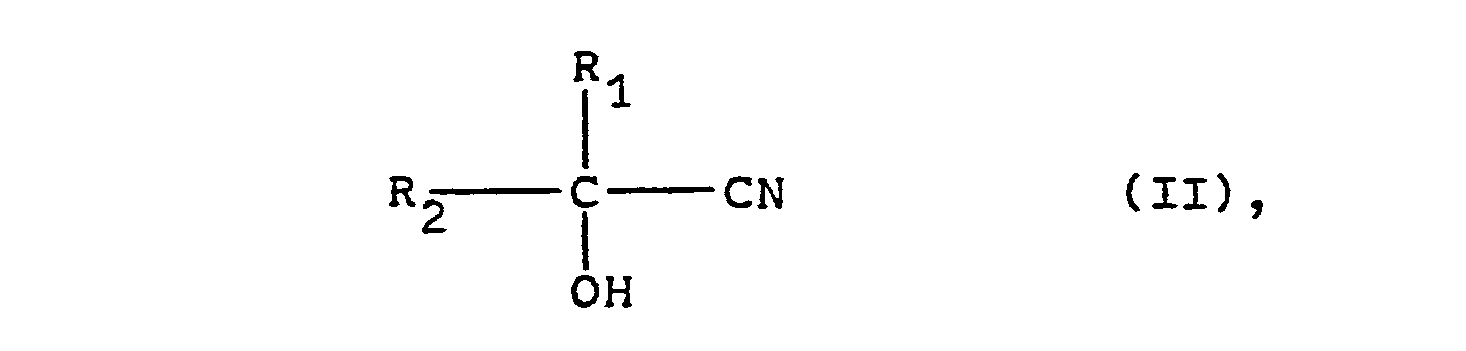
- the cyanohydrins of the general formula (II) which serve as starting materials for the process according to the invention can be prepared in the simplest manner by known methods (cf., for example, Houben-Weyl: Methods of Organic Chemistry, 4th Edition, Georg Thieme Verlag, Stuttgart, Volume VIII, pages 274 to 278) from the corresponding aldehydes or ketones by reaction with hydrocyanic acid. If the cyanohydrins are prepared in aqueous solution, these aqueous solutions can be used directly for the process according to the invention.
- aldehydes or ketones required for the preparation of the cyanohydrins of the general formula (II) can, if necessary, also in a manner known per se (see, for example, Houben-Weyl: Methods of Organic Chemistry, 4th Edition, Georg Thieme Verlag, Stuttgart, Volume VII / 1, pages 13 to 503, or volume VII / 2a-c).
- cyanohydrins of the general formula (II) are Propionaldehydcyanhydrin, Isobutyraldehydcyanhydrin, Valeraldehydcyanhydrin, Hexanalcyanhydrin, Heptanalcyanhydrin, Octanalcyanhydrin, Butanoncyanhydrin, Pentanoncyanhydrin, Methylisopropylketoncyanhydrin, Diisopropylketoncyanhydrin, Cyclohexanoncyanhydrin, 2-Methylcyclohexanoncyanhydrin, 4-hydroxy-4-methylpentanoncyanhydrin, Phenylacetaldehydcyanhydrin , Acetone cyanohydrin, phenylacetone cyanohydrin, 5-chloropentanone-2-cyanohydrin, methoxyacetaldehyde cyanohydrin or mandelonitrile.
- the process according to the invention is particularly suitable for the conversion of glycol nitrile to ethylene glycol, lactic acid nitrile (acetaldehyde cyanohydrin) to 1,2-propanediol or n-butyraldehyde cyanohydrin to 1,2-pentanediol.
- the cyanohydrins of the general formula (II) are hydrogenated in a water-containing medium which must contain at least 1 mol of water per mole of cyanohydrin used.
- water can be used as the sole solvent, otherwise mixtures of water with water-soluble alcohols, such as methanol, ethanol, n-propanol, isopropyl alcohol, n-butanol, isobutyl alcohol, secondary or tertiary butyl alcohol, dioxane or tetrahydrofuran as a solvent.
- the solvent can be used, for example, in an amount between 0.5 and 100 ml, preferably between 1 and 50 ml, per gram of cyanohydrin used.
- the hydrogenation takes place either in the presence of a palladium or platinum catalyst or in the presence of metallic nickel.
- Suitable catalysts are, for example, metallic palladium, in particular as palladium black, metallic platinum, in particular as platinum black, or platinum IV oxide. If metallic palladium or platinum is used, it can be used in free form, but also in the form of supported catalysts with, for example, activated carbon, barium sulfate, aluminum oxide or silicon dioxide as the support material. Particularly preferred catalysts are palladium black or palladium on activated carbon.
- the metallic nickel is preferably used in the activated form of Raney nickel. Mixtures of several catalysts can also be used.
- the amount of catalyst used is not critical, but to achieve short reaction times it is advisable to calculate the catalyst, calculated as active metal, in an amount between 0.1 and 100, preferably between 1 and 10, percent by weight, based on the cyanohydrin used general formula (II) apply.
- an acid is also required in reaction step a).
- a palladium or platinum catalyst this can be an organic acid such as formic acid, acetic acid or oxalic acid.
- mineral acids such as sulfuric acid, phosphoric acid and in particular hydrochloric acid, or acidic ion exchangers are preferably used.
- the organic or inorganic acids are added in the stoichiometric amount of one equivalent, based on the cyanohydrin of the general formula (II) used. The use of an excess of acid is inappropriate.
- the acidic ion exchangers must be added in an amount of at least one equivalent, based on the cyanohydrin of the general formula (II) used. In this case, however, an excess does not bother.
- metallic nickel is used as the hydrogenation catalyst, an acidic ion exchanger is also added as an acid in an amount of again at least one equivalent, based on the cyanohydrin of the general formula (II) used.
- reaction stage a) is carried out at a temperature between -20 and + 25 ° C, preferably between 0 and 20 ° C, and at a hydrogen pressure of less than 10 bar, preferably between 1 and 2 bar. It is particularly advantageous if hydrogen is simply passed through the reaction mixture. After absorption of one mole of hydrogen per mole of cyanohydrin of the general formula (II) used, reaction stage a) is complete.
- reaction stage b the hydrogenation is continued in the presence of metallic nickel, preferably in the activated form of Raney nickel, and under more stringent conditions. It is not necessary; those given in the reaction mixture if contained, remove palladium or platinum catalysts and acidic ion exchangers. However, their separation can be useful in order to facilitate their recovery. If reaction step a) has already been carried out in the presence of metallic nickel, the addition of further catalyst is generally not necessary. In contrast, if reaction step a) was carried out in the presence of a palladium or platinum catalyst, metallic nickel must now be added. The appropriate amounts of catalyst correspond to those given above for reaction step a).
- Reaction stage b) is carried out at a temperature between 30 and 100 ° C., preferably between 45 and 70 ° C., and at a hydrogen pressure between 10 and 150 bar, preferably between 15 and 40 bar.
- the catalysts contained in the reaction mixture and, if appropriate, ion exchangers are separated off, for example by filtration or centrifugation.
- the 1,2-diol contained can then be removed from the remaining solution in a manner known per se, e.g. by fractional distillation or by extraction with a suitable organic solvent and subsequent fractional distillation.
- the mixture After adding 3.5 g of a 10% Pd / activated carbon catalyst, the mixture is hydrogenated with stirring at 15 ° C. and an H 2 pressure of 2 bar until 0.5 mol of hydrogen have been taken up. 1.5 g of an activated Ni catalyst are then added, the temperature is raised to 50 ° C. and the pressure is raised to 15 bar, and the hydrogenation is continued until the end of the H 2 uptake. Then the catalysts and the ion exchanger are filtered off. The solution is concentrated on a rotary evaporator and distilled.
- the 1,2-pentanediol is separated off by distillation.
- the main run goes from 53 to 55 ° C / 0.06 mbar.
- Example 8 is repeated, with the only difference that 13 g of H 2 S0 4 are used instead of HC1. Yield of 1,2-pentanediol: 74% of theory.
- Example 8 is repeated, with the only difference that 15 g of glacial acetic acid are used instead of HC1.
- Example 8 is repeated, with the only difference that a 10% Pt / activated carbon catalyst is used instead of a Pd / activated carbon catalyst.
- Example 8 is repeated, with the only difference that Pd-Mohr is used instead of a Pd / activated carbon catalyst.
- Example 8 is repeated, with the only difference that a 10% Pd / BaSO 4 catalyst is used instead of a Pd / activated carbon catalyst.
- Example 8 is repeated, with the only difference that a 10% Pd / SiO 2 catalyst is used instead of a Pd / activated carbon catalyst.
Landscapes
- Chemical & Material Sciences (AREA)
- Organic Chemistry (AREA)
- Organic Low-Molecular-Weight Compounds And Preparation Thereof (AREA)
- Acyclic And Carbocyclic Compounds In Medicinal Compositions (AREA)
- Low-Molecular Organic Synthesis Reactions Using Catalysts (AREA)
- Furan Compounds (AREA)
Abstract
Description
- Gegenstand der Erfindung ist ein Verfahren zur Herstellung von 1,2-Diolen der allgemeinen Formel

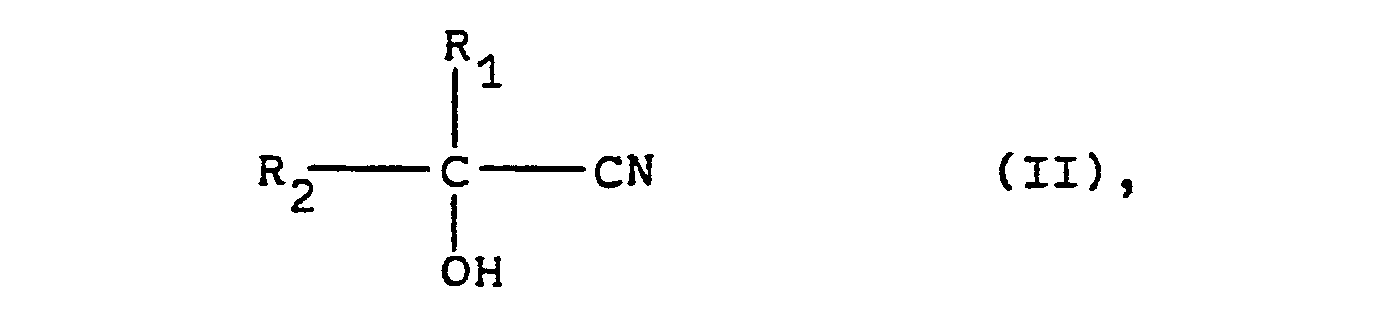
- a) in Gegenwart eines Palladium- oder Platinkatalysators und, bezogen auf das Cyanhydrin der allgemeinen Formel (II), eines Äquivalents einer anorganischen oder organischen Säure oder mindestens eines Äquivalents eines sauren Ionenaustauschers oder in Gegenwart von metallischem Nickel und, wiederum bezogen auf das Cyanhydrin der allgemeinen Formel (II), mindestens eines Äquivalents eines sauren Ionenaustauschers bei einer Temperatur zwischen -20 und +25°C und einem Wasserstoffdruck von weniger als 10 bar hydriert, bis pro Mol eingesetztem Cyanhydrin der allgemeinen Formel (II) ein Mol Wasserstoff aufgenommen ist, und
- b) in Gegenwart von metallischem Nickel bei einer Temperatur zwischen 30 und 100°C und einem Wasserstoffdruck zwischen 10 und 150 bar die Hydrierung bis zur Beendigung der Wasserstoffaufnahme fortführt.
- Die als Ausgangsmaterialien für das erfindungsgemäße Verfahren dienenden Cyanhydrine der allgemeinen Formel (II) können in einfachster Weise nach bekannten Methoden (vgl. z.B. Houben-Weyl: Methoden der organischen Chemie, 4. Auflage, Georg Thieme Verlag, Stuttgart, Band VIII, Seiten 274 bis 278) aus den entsprechenden Aldehyden oder Ketonen durch Umsetzung mit Blausäure hergestellt werden. Sofern die Herstellung der Cyanhydrine in wässriger Lösung vorgenommen wird, können diese wässrigen Lösungen unmittelbar für das erfindungsgemäße Verfahren eingesetzt werden.
- Die zur Herstellung der Cyanhydrine der allgemeinen Formel (II) benötigten Aldehyde oder Ketone ihrerseits können erforderlichenfalls auch in an sich bekannter Weise (vgl. z.B. Houben-Weyl: Methoden der organischen Chemie, 4. Auflage, Georg Thieme Verlag, Stuttgart, Band VII/1, Seiten 13 bis 503, bzw. Band VII/2a-c) hergestellt werden.
- Beispiele für nach dem erfindungsgemäßen Verfahren umzusetzende Cyanhydrine der allgemeinen Formel (II) sind Propionaldehydcyanhydrin, Isobutyraldehydcyanhydrin, Valeraldehydcyanhydrin, Hexanalcyanhydrin, Heptanalcyanhydrin, Octanalcyanhydrin, Butanoncyanhydrin, Pentanoncyanhydrin, Methylisopropylketoncyanhydrin, Diisopropylketoncyanhydrin, Cyclohexanoncyanhydrin, 2-Methylcyclohexanoncyanhydrin, 4-Hydroxy-4-methylpentanoncyanhydrin, Phenylacetaldehydcyanhydrin, Acetoncyanhydrin, Phenylacetoncyanhydrin, 5-Chlorpentanon-2-cyanhydrin, Methoxyacetaldehydcyanhydrin oder Mandelsäurenitril.
- Besonders geeignet ist das erfindungsgemäße Verfahren für die Umsetzung von Glykolnitril zu Ethylenglykol, Milchsäurenitril (Acetaldehydcyanhydrin) zu 1,2-Propandiol oder n-Butyraldehydcyanhydrin zu 1,2-Pentandiol. Die Cyanhydrine der allgemeinen Formel (II) werden in einem wasserhaltigen Medium, das pro Mol eingesetztem Cyanhydrin mindestens 1 Mol Wasser enthalten muß, hydriert. Sofern die Löslichkeit des eingesetzten Cyanhydrins dies zuläßt, kann Wasser als alleiniges Lösungsmittel verwendet werden, sonst kommen auch Mischungen von Wasser mit wasserlöslichen Alkoholen, wie Methanol, Ethanol, n-Propanol, Isopropylalkohol, n-Butanol, Isobutylalkohol, sekundärer oder tertiärer Butylalkohol, Dioxan oder Tetrahydrofuran als Lösungsmittel in Frage. Das Lösungsmittel kann beispielsweise in einer Menge zwischen 0,5 und 100 ml, vorzugsweise zwischen 1 und 50 ml, pro Gramm eingesetztem Cyanhydrin angewandt werden.
- In der Reaktionsstufe a) erfolgt die Hydrierung entweder in Gegenwart eines Palladium- oder Platinkatalysators oder in Gegenwart von metallischem Nickel. Geeignete Katalysatoren sind beispielsweise metallisches Palladium, insbesondere als Palladiummohr, metallisches Platin, insbesondere als Platinschwarz,oder Platin-IV-oxid. Wird metallisches Palladium oder Platin verwendet, so kann es in freier Form eingesetzt werden, aber auch in Form von Trägerkatalysatoren mit beispielsweise Aktivkohle, Bariumsulfat, Aluminiumoxid oder Siliciumdioxid als Trägermaterial. Besonders bevorzugte Katalysatoren sind Palladiummohr oder Palladium auf Aktivkohle. Das metallische Nickel wird vorzugsweise in der aktivierten Form des Raney-Nickels eingesetzt. Es können auch Gemische von mehreren Katalysatoren eingesetzt werden. Die eingesetzte Menge an Katalysator ist nicht kritisch, zur Erzielung kurzer Reaktionszeiten empfiehlt es sich jedoch, den Katalysator, berechnet als aktives Metall, in einer Menge zwischen 0,1 und 100, vorzugsweise zwischen 1 und 10, Gewichtsprozent, bezogen auf das eingesetzte Cyanhydrin der allgemeinen Formel (II), anzuwenden.
- In der Reaktionsstufe a) ist ferner die Gegenwart einer Säure erforderlich. Bei Verwendung eines Palladium- oder Platinkatalysators kann dies eine organische Säure, wie Ameisensäure, Essigsäure;oder Oxalsäure, sein. Bevorzugt werden jedoch Mineralsäuren, wie Schwefelsäure, Phosphorsäure und insbesondere Salzsäure, oder saure Ionenaustauscher verwendet. Die organischen oder anorganischen Säuren werden in der stöchiometrischen Menge von einem Äquivalent, bezogen auf das eingesetzte Cyanhydrin der allgemeinen Formel (II), zugesetzt. Die Anwendung eines Überschusses an Säure ist unzweckmäßig. Die sauren Ionenaustauscher müssen in einer Menge von mindestens einem Äquivalent, bezogen auf das eingesetzte Cyanhydrin der allgemeinen Formel (II), zugesetzt werden. In diesem Falle stört jedoch ein Überschuß nicht. Wird als Hydrierungskatalysator metallisches Nickel verwendet, wird als Säure ein saurer Ionenaustauscher in einer Menge von ebenfalls wieder mindestens einem Äquivalent, bezogen auf das eingesetzte Cyanhydrin der allgemeinen Formel (II), zugesetzt.
- Die Reaktionsstufe a) wird bei einer Temperatur zwischen -20 und +25°C, vorzugsweise zwischen 0 und 20°C, und bei einem Wasserstoffdruck von weniger als 10 bar, vorzugsweise zwischen 1 und 2 bar, durchgeführt. Besonders vorteilhaft ist es, wenn man einfach Wasserstoff durch das Reaktionsgemisch hindurchleitet. Nach Aufnahme von einem Mol Wasserstoff pro Mol eingesetztem Cyanhydrin der allgemeinen Formel (II) ist die Reaktionsstufe a) beendet.
- In der sich nun anschließenden Reaktionsstufe b) wird die Hydrierung in Gegenwart von metallischem Nickel, vorzugsweise in der aktivierten Form des Raney-Nickels, und unter schärferen Bedingungen fortgeführt. Es ist dabei nicht erforderlich,; die im Reaktionsgemisch gegebenenfalls enthaltenen Palladium-.oder Platinkatalysatoren und sauren Ionenaustauscher abzutrennen. Deren Abtrennung kann aber zweckmäßig sein, um ihre Wiedergewinnung zu erleichtern. Wurde bereits die Reaktionsstufe a) in Gegenwart von metallischem Nickel durchgeführt, so ist im allgemeinen der Zusatz von weiterem Katalysator nicht erforderlich. Wurde dagegen die Reaktionsstufe a) in Gegenwart eines Palladium- oder Platinkatalysators durchgeführt, so muß nun metallisches Nickel zugesetzt werden. Die zweckmäßigen Mengen an Katalysator entsprechen den oben für die Reaktionsstufe a) angegebenen.
- Die Reaktionsstufe b) wird bei einer Temperatur zwischen 30 und 100°C, vorzugsweise zwischen 45 und 70°C, und bei einem Wasserstoffdruck zwischen 10 und 150 bar, vorzugsweise zwischen 15 und 40 bar, durchgeführt.
- Besonders hohe Ausbeuten an 1,2 Diolen der allgemeinen Formel (I) werden im allgemeinen erhalten, wenn die Reaktionsstufe a) in Gegenwart eines Palladiumkatalysators durchgeführt wird.
- Nach beendeter Wasserstoffaufnahme werden die im Reaktionsgemisch enthaltenen Katalysatoren und gegebenenfalls Ionenaustauscher beispielsweise durch Filtration oder Zentrifugation, abgetrennt. Aus der verbleibenden Lösung kann dann das enthaltene 1,2-Diol in an sich bekannter Weise, z.B. durch fraktionierte Destillation oder durch Extraktion mit einem geeigneten organischen Lösungsmittel und anschließende fraktionierte Destillaztion, isoliert werden.
- Die Erfindung wird durch die nachfolgenden Beispiele näher erläutert. Prozentangaben bedeuten, sofern nicht anders angegeben, Gewichtsprozente.
- 30,2 g (0,5 mol) Glykolnitril (94,3 %ig) werden in 150 ml H20 gelöst und 300.ml eines sauren Ionenaustauschers zugegeben.
- Nach Zugabe von 3,5 g eines 10 % Pd/Aktivkohle-Katalysators wird unter Rühren bei 15°C und einem H2-Druck von 2 bar bis zur Aufnahme von 0,5 mol Wasserstoff hydriert. Danach werden 1,5 g eines aktivierten Ni-Katalysators zugegeben, die Temperatur auf 50°C und der Druck auf 15 bar erhöht und bis zum Ende der H2-Aufnahme weiterhydriert. Dann wird von den Katalysatoren und vom Ionenaustauscher abfiltriert. Die Lösung wird am Rotationsverdampfer eingeengt und destilliert.
- Der Hauptlauf (26,2 g) geht bei 196 bis 198°C über.

- 24,2 g (0,4 mol) Glykolnitril (94,3 %ig) werden in 200 ml H20 gelöst und mit 40 g HC1 konzentriert versetzt. Nach Zugabe von 2,5 g eines 10 % Pd/Aktivkohle-Katalysators wird unter Rühren bei 20°C und 5 bar Wasserstoffdruck bis zur Aufnahme von 0,4 mol Wasserstoff hydriert. Danach werden 2 g eines aktivierten Ni-Katalysators zugegeben, die Temperatur auf 30°C und der Wasserstoffdruck auf 15 bar erhöht und bis zum Ende der Wasserstoffaufnahme weiterhydriert. Dann wird von den Katalysatoren abfiltriert. Die Lösung wird am Rotationsverdampfer eingeengt und destilliert. Der Hauptlauf (20,6 g) geht bei 196 bis 198°C über.
- 40,0 g (0,5 mol) Acetaldehydcyanhydrin werden in 200 ml H20 gelöst und 300 ml eines sauren Ionenaustauschers zugegeben. Nach Zugabe von 3,5 g eines 10 % Pd/Aktivkohle-Katalysators wird unter Rühren bei 15°C und einem H2-Druck von 2 bar bis zur Aufnahme von 0,5 mol Wasserstoff hydriert. Danach werden 1,5 g eines aktivierten Ni-Katalysators zugegeben, die Temperatur auf 50°C und der Druck auf 15 bar erhöht und bis zum Ende der H2-Aufnahme weiterhydriert. Dann wird von den Katalysatoren unc vom Ionenaustauscher abfiltriert. Die Lösung wird am Rotationsverdampfer eingeengt und destilliert. Der Hauptlauf (28,1 g) geht bei 16 mbar/84°C über.

- 35 g (0,4 mol) Acetoncyanhydrin werden in 250 ml H20 gelöst und 250 ml eines sauren Ionenaustauschers zugegeben. Nach Zugabe von 3,5 g eines 10 % Pd/Aktivkohle-Katalysators wird unter Rühren bei 150C und einem H2-Druck von
- 2 bar bis zur Aufnahme von 0,5 mol Wasserstoff hydriert. Danach werden 1,5 g eines aktivierten Ni-Katalysators zugegeben, die Temperatur auf 50°C und der Druck auf 15 bar erhöht und bis zum Ende der H2-Aufnahme weiterhydriert. Dann wird von den Katalysatoren und vom Ionenaustauscher.abfiltriert. Die Lösung wird am Rotationsverdampfer eingeengt und destilliert.
- Der Hauptlauf (29,3 g) geht bei 16 mbar/79°C über.


- 42,0 g (300 mmol) Mandelsäurenitril werden in 220 ml H20 und 130 ml Ethanol gelöst und 150 ml eines sauren Ionenaustauschers (Lewatit S 100) zugegeben. Nach Zugabe von 4,0 g eines 10 % Pd/Aktivkohle-Katalysators wird unter Rühren bei 15°C und einem H2-Druck von 1,5 bar bis zur Aufnahme von 0,3 mol H2 hydriert. Danach werden 2 g eines aktivierten Ni-Katalysators zugegeben, die Temperatur auf 45°C und der Druck auf 15 bar erhöht und bis zum Ende der Wasserstoffaufnahme weiterhydriert. Dann wird von den Katalysatoren und vom Ionenaustauscher abfiltriert. Die Reaktionslösung wird am Rotationsverdampfer eingeengt. Der Rückstand sind farblose Kristalle,
- die aus Ethanol umkristallisiert werden. Ausbeute an 1-Phenyl-1,2-ethandiol 25,1 g, entsprechend 61 % der Theorie. Schmelzpunkt: 65°C.
- 40,0 g (0,4 mol) Butyraldehydcyanhydrin werden in 250 ml H20 und 60 ml Ethanol gelöst und 200 ml eines sauren Ionenaustauschers (Lewatit S 100) zugegeben. Nach Zugabe von 3 g eines 10 % Pd/Aktivkohle-Katalysators wird unter Rühren bei 15°C und einem H2-Druck von 1,2 bar bis zur Aufnahme von 0,4 mol Wasserstoff hydriert. Danach werden 3 g eines aktivierten Ni-Katalysators zugegeben und die Temperatur auf 50°C und der Wasserstoffdruck auf 15 bar erhöht und bis zum Ende der Wasserstoffaufnahme weiterhydriert. Danach wird von den Katalysatoren und vom Ionenaustauscher abfiltriert. Die 1,2-Pentandiolabtrennung erfolgt destillativ. Der Hauptlauf geht bei 53 bis 55°C/ 0,06 mbar über. Ausbeute an 1,2-Pentandiol: 31,7 g, entsprechend 77 % der Theorie.
- 50,0 g (0,5 mol) Butyraldehydcyanhydrin werden in 100 ml Ethanol und 350 ml H20 gelöst und 300 ml eines sauren Ionenaustauschers (Lewatit S 100)'zugegeben. Nach Zugabe von 4 g eines aktivierten Ni-Katalysators wird unter Rühren bei 15°C und einem Wasserstoffdruck von 1,2 bar bis zur Aufnahme von 0,5 mol Wasserstoff hydriert. Danach wird der Wasserstoffdruck auf 15 bar und die Temperatur auf 50°C erhöht und bis zum Ende der Wasserstoffaufnahme weiterhydriert. Dann wird vom Katalysator und Ionenaustauscher abfiltriert. Die Lösung wird am Rotationsverdampfer eingeengt, danach destilliert. Der Hauptlauf geht bei 53 bis 55°C und 0,06 mbar über. Ausbeute an 1,2-Pentandiol: 35,5 g, entsprechend 68,2 g der Theorie.
- 24,8 g (0,25 mol) Butyraldehydcyanhydrin werden in 180 ml H20 und 20 ml Ethanol gelöst und mit 25 g HC1 konzentriert versetzt. Nach Zugabe von 1,25 g eines 10 % Pd/ Aktivkohle-Katalysators wird unter Rühren bei 25°C und 9 bar Wasserstoffdruck bis zur Aufnahme von 0,25 mol Wasserstoff hydriert. Danach werden 2,0 g eines aktivierten Ni-Katalysators zugegeben, die Temperatur auf 35°C und der Wasserstoffdruck auf 20 bar erhöht und bis zum Ende der Wasserstoffaufnahme weiterhydriert. Die Lösung wird am Rotationsverdampfer eingeengt und destilliert. Der Hauptlauf (19,1 g) geht bei 53 bis 55°C/0,06 mbar über. Ausbeute an 1,2-Pentandiol: 73,3 % der Theorie.
- Beispiel 8 wird wiederholt,mit dem einzigen Unterschied, daß statt HC1 konzentriert 13 g H2S04 eingesetzt werden. Ausbeute an 1,2-Pentandiol: 74 % der Theorie.
- Beispiel 8 wird wiederholt, mit dem einzigen Unterschied, daß statt HC1 konzentriert 15 g Eisessig eingesetzt werden.
- Ausbeute an 1,2-Pentandiol: 70 % der Theorie.
- Beispiel 8 wird wiederholt, mit dem einzigen Unterschied, daß statt eines Pd/Aktivkohle-Katalysators ein 10 % Pt/ Aktivkohle-Katalysator eingesetzt wird.
- Ausbeute an 1,2-Pentandiol: 65 % der Theorie.
- Beispiel 8 wird wiederholt, mit dem einzigen Unterschied, daß statt eines Pd/Aktivkohle-Katalysators Pd-Mohr eingesetzt wird.
- Ausbeute an 1,2-Pentandiol: 72 % der Theorie.
- Beispiel 8 wird wiederholt, mit dem einzigen Unterschied, daß statt eines Pd/Aktivkohle-Katalysators ein 10 % Pd/ BaS04-Katalysator eingesetzt wird.
- Ausbeute an 1,2-Pentandiol: 75 % der Theorie.
- Beispiel 8 wird wiederholt, mit dem einzigen Unterschied, daß statt eines Pd/Aktivkohle-Katalysators ein 10 % Pd/ SiO2-Katalysator eingesetzt wird.
- Ausbeute an 1,2-Pentandiol: 71 % der Theorie.
Claims (7)

Priority Applications (1)
| Application Number | Priority Date | Filing Date | Title |
|---|---|---|---|
| AT83108948T ATE26255T1 (de) | 1982-11-19 | 1983-09-10 | Verfahren zur herstellung von 1,2-diolen. |
Applications Claiming Priority (2)
| Application Number | Priority Date | Filing Date | Title |
|---|---|---|---|
| DE3242749 | 1982-11-19 | ||
| DE3242749A DE3242749C1 (de) | 1982-11-19 | 1982-11-19 | Verfahren zur Herstellung von 1,2-Diolen |
Publications (3)
| Publication Number | Publication Date |
|---|---|
| EP0110031A2 true EP0110031A2 (de) | 1984-06-13 |
| EP0110031A3 EP0110031A3 (en) | 1985-10-30 |
| EP0110031B1 EP0110031B1 (de) | 1987-04-01 |
Family
ID=6178472
Family Applications (1)
| Application Number | Title | Priority Date | Filing Date |
|---|---|---|---|
| EP83108948A Expired EP0110031B1 (de) | 1982-11-19 | 1983-09-10 | Verfahren zur Herstellung von 1,2-Diolen |
Country Status (5)
| Country | Link |
|---|---|
| US (1) | US4482760A (de) |
| EP (1) | EP0110031B1 (de) |
| JP (1) | JPS5995226A (de) |
| AT (1) | ATE26255T1 (de) |
| DE (2) | DE3242749C1 (de) |
Families Citing this family (7)
| Publication number | Priority date | Publication date | Assignee | Title |
|---|---|---|---|---|
| US5072056A (en) * | 1989-09-26 | 1991-12-10 | Carter-Wallace, Inc. | Synthesis of 2-phenyl-1,3-propanediol |
| US5053559A (en) * | 1989-12-29 | 1991-10-01 | Oxaco S.A. | Cleavage of 1,2,4-trioxanes |
| US5741955A (en) * | 1995-01-31 | 1998-04-21 | E. I. Du Pont De Nemours And Company | Process for reductive hydrolysis of nitriles |
| US5599962A (en) * | 1995-01-31 | 1997-02-04 | E. I. Du Pont De Nemours And Company | Process for the preparation of ruthenium hydrogenation catalysts and products thereof |
| US5554778A (en) * | 1995-01-31 | 1996-09-10 | E. I. Du Pont De Nemours And Company | Ruthenium hydrogenation catalysts |
| JP2000178216A (ja) | 1998-12-16 | 2000-06-27 | Mitsubishi Gas Chem Co Inc | イソブチレングリコールの製造方法 |
| CN1318365C (zh) * | 2004-10-29 | 2007-05-30 | 中国石油化工股份有限公司 | 芳基二元醇的制备方法 |
Family Cites Families (4)
| Publication number | Priority date | Publication date | Assignee | Title |
|---|---|---|---|---|
| US2086239A (en) * | 1936-02-10 | 1937-07-06 | Armour & Co | Process of preparing monohydric alcohols |
| US2836613A (en) * | 1956-03-14 | 1958-05-27 | Monsanto Chemicals | 3, 3'-(alkylenedioxy) dipropionitriles |
| US3714270A (en) * | 1970-06-24 | 1973-01-30 | Union Oil Co | Hydration of amines to alcohols |
| US4338290A (en) * | 1980-06-16 | 1982-07-06 | National Distillers & Chemical Corp. | Hydrolysis of halohydrin or dihalide with HI catalyst |
-
1982
- 1982-11-19 DE DE3242749A patent/DE3242749C1/de not_active Expired
-
1983
- 1983-09-10 AT AT83108948T patent/ATE26255T1/de not_active IP Right Cessation
- 1983-09-10 EP EP83108948A patent/EP0110031B1/de not_active Expired
- 1983-09-10 DE DE8383108948T patent/DE3370615D1/de not_active Expired
- 1983-09-28 JP JP58178393A patent/JPS5995226A/ja active Pending
- 1983-11-16 US US06/552,106 patent/US4482760A/en not_active Expired - Fee Related
Also Published As
| Publication number | Publication date |
|---|---|
| US4482760A (en) | 1984-11-13 |
| EP0110031A3 (en) | 1985-10-30 |
| DE3242749C1 (de) | 1984-01-19 |
| DE3370615D1 (en) | 1987-05-07 |
| ATE26255T1 (de) | 1987-04-15 |
| EP0110031B1 (de) | 1987-04-01 |
| JPS5995226A (ja) | 1984-06-01 |
Similar Documents
| Publication | Publication Date | Title |
|---|---|---|
| EP0412337B1 (de) | Verfahren zur Herstellung von 1,3-Propandiol | |
| EP0006460B1 (de) | Verfahren zur Gewinnung von reinem Neopentylglykol | |
| DE2054601C3 (de) | Verfahren zur Herstellung von zweiwertigen Alkoholen | |
| EP0110031B1 (de) | Verfahren zur Herstellung von 1,2-Diolen | |
| DE2944295C2 (de) | Verfahren zur Herstellung von racemischer p-Hydroxy-Mandelsäure | |
| DE2631222C3 (de) | Verfahren zur Herstellung basisch substituierter Phenylacetonitrile | |
| DE2824908A1 (de) | Verfahren zur herstellung von omega, omega'-bis-dialkylaminoalkanen | |
| DE1545792B2 (de) | Verfahren zur Herstellung von 4-Hydroxyplperidinen | |
| EP0038480B1 (de) | Verfahren zur Herstellung von 1-(4-Hydroxy-phenyl)-butan-3-on sowie neue Zwischenprodukte dieses Verfahrens | |
| EP1914218A1 (de) | Verfahren zur Herstellung von 1,2-Diolen aus Carbonylverbindungen | |
| EP0109495B1 (de) | Verfahren zur Herstellung von beta-Hydroxy-alpha-aminocarbonsäuren | |
| DE3942793A1 (de) | Verfahren zur herstellung von n,n-dimethylaminen | |
| EP0474057B1 (de) | Verfahren zur Herstellung von N-(2-Chlor-pyridin-5-yl-methyl)-ethylendiamin | |
| EP0058326B1 (de) | Verfahren zur Herstellung von araliphatischen Aldehyden und/oder Aminen | |
| DE2249993A1 (de) | Verfahren zur spaltung von ketonen | |
| DE19935448B4 (de) | Verfahren zur Herstellung sekundärer aliphatischer Amine aus Aldehyden mittlerer Kettenlänge | |
| DE922648C (de) | Verfahren zur Herstellung von Cycloalkan-1, 1-dicarbonsaeuren | |
| DE523189C (de) | Verfahren zur Herstellung von Estern aus Saeureamiden und Alkoholen | |
| DE2701629C2 (de) | ||
| DE1023027B (de) | Verfahren zur Herstellung von Polyendialdehyden | |
| DE966201C (de) | Verfahren zur Herstellung von Cyclohexanonoxim durch katalytische Hydrierung von Nitrocyclohexansalzen | |
| DE3020298A1 (de) | Verfahren zur herstellung von 2,2-dialkyl-4-methyl-5,5-dialkyl-3- formyl-3-pyrrolin | |
| DE962255C (de) | Verfahren zur Herstellung von aromatischen Aminen | |
| EP0019845A1 (de) | Ethylether des Isocamphyl-guajakols, Verfahren zu ihrer Herstellung und ihre Verwendung zur Herstellung von 3-(Isocamphyl-(5))-cyclohexanol | |
| DE959097C (de) | Verfahren zur Herstellung von basisch substituierten Diarylacetonitrilen |
Legal Events
| Date | Code | Title | Description |
|---|---|---|---|
| PUAI | Public reference made under article 153(3) epc to a published international application that has entered the european phase |
Free format text: ORIGINAL CODE: 0009012 |
|
| 17P | Request for examination filed |
Effective date: 19830910 |
|
| AK | Designated contracting states |
Designated state(s): AT BE CH DE FR GB IT LI NL |
|
| PUAL | Search report despatched |
Free format text: ORIGINAL CODE: 0009013 |
|
| AK | Designated contracting states |
Designated state(s): AT BE CH DE FR GB IT LI NL |
|
| 17Q | First examination report despatched |
Effective date: 19860613 |
|
| ITF | It: translation for a ep patent filed | ||
| GRAA | (expected) grant |
Free format text: ORIGINAL CODE: 0009210 |
|
| AK | Designated contracting states |
Kind code of ref document: B1 Designated state(s): AT BE CH DE FR GB IT LI NL |
|
| REF | Corresponds to: |
Ref document number: 26255 Country of ref document: AT Date of ref document: 19870415 Kind code of ref document: T |
|
| ET | Fr: translation filed | ||
| REF | Corresponds to: |
Ref document number: 3370615 Country of ref document: DE Date of ref document: 19870507 |
|
| PLBE | No opposition filed within time limit |
Free format text: ORIGINAL CODE: 0009261 |
|
| STAA | Information on the status of an ep patent application or granted ep patent |
Free format text: STATUS: NO OPPOSITION FILED WITHIN TIME LIMIT |
|
| 26N | No opposition filed | ||
| PGFP | Annual fee paid to national office [announced via postgrant information from national office to epo] |
Ref country code: DE Payment date: 19890818 Year of fee payment: 7 |
|
| PGFP | Annual fee paid to national office [announced via postgrant information from national office to epo] |
Ref country code: BE Payment date: 19890824 Year of fee payment: 7 |
|
| PGFP | Annual fee paid to national office [announced via postgrant information from national office to epo] |
Ref country code: GB Payment date: 19890831 Year of fee payment: 7 |
|
| PGFP | Annual fee paid to national office [announced via postgrant information from national office to epo] |
Ref country code: CH Payment date: 19890905 Year of fee payment: 7 |
|
| PGFP | Annual fee paid to national office [announced via postgrant information from national office to epo] |
Ref country code: AT Payment date: 19890912 Year of fee payment: 7 |
|
| PGFP | Annual fee paid to national office [announced via postgrant information from national office to epo] |
Ref country code: FR Payment date: 19890928 Year of fee payment: 7 |
|
| ITTA | It: last paid annual fee | ||
| PGFP | Annual fee paid to national office [announced via postgrant information from national office to epo] |
Ref country code: NL Payment date: 19890930 Year of fee payment: 7 |
|
| PG25 | Lapsed in a contracting state [announced via postgrant information from national office to epo] |
Ref country code: GB Effective date: 19900910 Ref country code: AT Effective date: 19900910 |
|
| PG25 | Lapsed in a contracting state [announced via postgrant information from national office to epo] |
Ref country code: LI Effective date: 19900930 Ref country code: CH Effective date: 19900930 Ref country code: BE Effective date: 19900930 |
|
| BERE | Be: lapsed |
Owner name: DEGUSSA A.G. Effective date: 19900930 |
|
| PG25 | Lapsed in a contracting state [announced via postgrant information from national office to epo] |
Ref country code: NL Effective date: 19910401 |
|
| GBPC | Gb: european patent ceased through non-payment of renewal fee | ||
| NLV4 | Nl: lapsed or anulled due to non-payment of the annual fee | ||
| PG25 | Lapsed in a contracting state [announced via postgrant information from national office to epo] |
Ref country code: FR Effective date: 19910530 |
|
| REG | Reference to a national code |
Ref country code: CH Ref legal event code: PL |
|
| PG25 | Lapsed in a contracting state [announced via postgrant information from national office to epo] |
Ref country code: DE Effective date: 19910601 |
|
| REG | Reference to a national code |
Ref country code: FR Ref legal event code: ST |