EP0108898B1 - Neue orale Mopidamolformen - Google Patents
Neue orale Mopidamolformen Download PDFInfo
- Publication number
- EP0108898B1 EP0108898B1 EP83109510A EP83109510A EP0108898B1 EP 0108898 B1 EP0108898 B1 EP 0108898B1 EP 83109510 A EP83109510 A EP 83109510A EP 83109510 A EP83109510 A EP 83109510A EP 0108898 B1 EP0108898 B1 EP 0108898B1
- Authority
- EP
- European Patent Office
- Prior art keywords
- mopidamol
- preparations
- acid
- excipients
- acidic
- Prior art date
- Legal status (The legal status is an assumption and is not a legal conclusion. Google has not performed a legal analysis and makes no representation as to the accuracy of the status listed.)
- Expired
Links
- FOYWNSCCNCUEPU-UHFFFAOYSA-N mopidamol Chemical compound C12=NC(N(CCO)CCO)=NC=C2N=C(N(CCO)CCO)N=C1N1CCCCC1 FOYWNSCCNCUEPU-UHFFFAOYSA-N 0.000 title claims abstract description 62
- 229950010718 mopidamol Drugs 0.000 title claims abstract description 59
- 239000000203 mixture Substances 0.000 claims abstract description 36
- 239000002253 acid Substances 0.000 claims abstract description 30
- 239000003826 tablet Substances 0.000 claims description 42
- 230000002378 acidificating effect Effects 0.000 claims description 32
- 239000000546 pharmaceutical excipient Substances 0.000 claims description 27
- 238000002360 preparation method Methods 0.000 claims description 24
- 239000008187 granular material Substances 0.000 claims description 23
- VZCYOOQTPOCHFL-OWOJBTEDSA-N Fumaric acid Natural products OC(=O)\C=C\C(O)=O VZCYOOQTPOCHFL-OWOJBTEDSA-N 0.000 claims description 17
- 239000001866 hydroxypropyl methyl cellulose Substances 0.000 claims description 16
- 229920003088 hydroxypropyl methyl cellulose Polymers 0.000 claims description 16
- 235000010979 hydroxypropyl methyl cellulose Nutrition 0.000 claims description 16
- UFVKGYZPFZQRLF-UHFFFAOYSA-N hydroxypropyl methyl cellulose Chemical compound OC1C(O)C(OC)OC(CO)C1OC1C(O)C(O)C(OC2C(C(O)C(OC3C(C(O)C(O)C(CO)O3)O)C(CO)O2)O)C(CO)O1 UFVKGYZPFZQRLF-UHFFFAOYSA-N 0.000 claims description 16
- 238000004519 manufacturing process Methods 0.000 claims description 15
- 239000008188 pellet Substances 0.000 claims description 13
- 239000013543 active substance Substances 0.000 claims description 12
- 239000011248 coating agent Substances 0.000 claims description 12
- 238000000576 coating method Methods 0.000 claims description 12
- KRKNYBCHXYNGOX-UHFFFAOYSA-N citric acid Substances OC(=O)CC(O)(C(O)=O)CC(O)=O KRKNYBCHXYNGOX-UHFFFAOYSA-N 0.000 claims description 11
- 239000001530 fumaric acid Substances 0.000 claims description 9
- VZCYOOQTPOCHFL-UHFFFAOYSA-N trans-butenedioic acid Natural products OC(=O)C=CC(O)=O VZCYOOQTPOCHFL-UHFFFAOYSA-N 0.000 claims description 9
- 239000002775 capsule Substances 0.000 claims description 8
- CIWBSHSKHKDKBQ-JLAZNSOCSA-N Ascorbic acid Chemical compound OC[C@H](O)[C@H]1OC(=O)C(O)=C1O CIWBSHSKHKDKBQ-JLAZNSOCSA-N 0.000 claims description 6
- PEDCQBHIVMGVHV-UHFFFAOYSA-N Glycerine Chemical compound OCC(O)CO PEDCQBHIVMGVHV-UHFFFAOYSA-N 0.000 claims description 6
- FEWJPZIEWOKRBE-UHFFFAOYSA-N Tartaric Acid Chemical compound [H+].[H+].[O-]C(=O)C(O)C(O)C([O-])=O FEWJPZIEWOKRBE-UHFFFAOYSA-N 0.000 claims description 5
- 150000007513 acids Chemical class 0.000 claims description 5
- 210000001035 gastrointestinal tract Anatomy 0.000 claims description 5
- 239000000314 lubricant Substances 0.000 claims description 5
- KDYFGRWQOYBRFD-UHFFFAOYSA-N Succinic acid Natural products OC(=O)CCC(O)=O KDYFGRWQOYBRFD-UHFFFAOYSA-N 0.000 claims description 4
- 239000000654 additive Substances 0.000 claims description 4
- WNLRTRBMVRJNCN-UHFFFAOYSA-N adipic acid Chemical compound OC(=O)CCCCC(O)=O WNLRTRBMVRJNCN-UHFFFAOYSA-N 0.000 claims description 4
- 238000007908 dry granulation Methods 0.000 claims description 4
- 235000010944 ethyl methyl cellulose Nutrition 0.000 claims description 4
- 239000011975 tartaric acid Substances 0.000 claims description 4
- XLYOFNOQVPJJNP-UHFFFAOYSA-N water Substances O XLYOFNOQVPJJNP-UHFFFAOYSA-N 0.000 claims description 4
- BJEPYKJPYRNKOW-REOHCLBHSA-N (S)-malic acid Chemical compound OC(=O)[C@@H](O)CC(O)=O BJEPYKJPYRNKOW-REOHCLBHSA-N 0.000 claims description 3
- GAWIXWVDTYZWAW-UHFFFAOYSA-N C[CH]O Chemical group C[CH]O GAWIXWVDTYZWAW-UHFFFAOYSA-N 0.000 claims description 3
- 229920001479 Hydroxyethyl methyl cellulose Polymers 0.000 claims description 3
- BJEPYKJPYRNKOW-UHFFFAOYSA-N alpha-hydroxysuccinic acid Natural products OC(=O)C(O)CC(O)=O BJEPYKJPYRNKOW-UHFFFAOYSA-N 0.000 claims description 3
- 239000011668 ascorbic acid Substances 0.000 claims description 3
- 229960005070 ascorbic acid Drugs 0.000 claims description 3
- 235000010323 ascorbic acid Nutrition 0.000 claims description 3
- 239000004922 lacquer Substances 0.000 claims description 3
- 239000001630 malic acid Substances 0.000 claims description 3
- 235000011090 malic acid Nutrition 0.000 claims description 3
- 239000002245 particle Substances 0.000 claims description 3
- 238000005550 wet granulation Methods 0.000 claims description 3
- UYUXSRADSPPKRZ-UHFFFAOYSA-N D-glucuronic acid gamma-lactone Natural products O=CC(O)C1OC(=O)C(O)C1O UYUXSRADSPPKRZ-UHFFFAOYSA-N 0.000 claims description 2
- UYUXSRADSPPKRZ-SKNVOMKLSA-N D-glucurono-6,3-lactone Chemical compound O=C[C@H](O)[C@H]1OC(=O)[C@@H](O)[C@H]1O UYUXSRADSPPKRZ-SKNVOMKLSA-N 0.000 claims description 2
- 229920002125 Sokalan® Polymers 0.000 claims description 2
- 239000001361 adipic acid Substances 0.000 claims description 2
- 235000011037 adipic acid Nutrition 0.000 claims description 2
- 150000008064 anhydrides Chemical class 0.000 claims description 2
- 229960003403 betaine hydrochloride Drugs 0.000 claims description 2
- 239000011230 binding agent Substances 0.000 claims description 2
- HOPSCVCBEOCPJZ-UHFFFAOYSA-N carboxymethyl(trimethyl)azanium;chloride Chemical compound [Cl-].C[N+](C)(C)CC(O)=O HOPSCVCBEOCPJZ-UHFFFAOYSA-N 0.000 claims description 2
- 235000014113 dietary fatty acids Nutrition 0.000 claims description 2
- 125000001495 ethyl group Chemical group [H]C([H])([H])C([H])([H])* 0.000 claims description 2
- 239000001761 ethyl methyl cellulose Substances 0.000 claims description 2
- 239000003925 fat Substances 0.000 claims description 2
- 239000000194 fatty acid Substances 0.000 claims description 2
- 229930195729 fatty acid Natural products 0.000 claims description 2
- 150000004665 fatty acids Chemical class 0.000 claims description 2
- 125000002496 methyl group Chemical group [H]C([H])([H])* 0.000 claims description 2
- 229920003087 methylethyl cellulose Polymers 0.000 claims description 2
- 229920001522 polyglycol ester Polymers 0.000 claims description 2
- 239000003232 water-soluble binding agent Substances 0.000 claims description 2
- 239000001828 Gelatine Substances 0.000 claims 3
- 229920000159 gelatin Polymers 0.000 claims 3
- 235000019322 gelatine Nutrition 0.000 claims 3
- 239000001384 succinic acid Substances 0.000 claims 2
- HFVMEOPYDLEHBR-UHFFFAOYSA-N (2-fluorophenyl)-phenylmethanol Chemical compound C=1C=CC=C(F)C=1C(O)C1=CC=CC=C1 HFVMEOPYDLEHBR-UHFFFAOYSA-N 0.000 claims 1
- RTBFRGCFXZNCOE-UHFFFAOYSA-N 1-methylsulfonylpiperidin-4-one Chemical compound CS(=O)(=O)N1CCC(=O)CC1 RTBFRGCFXZNCOE-UHFFFAOYSA-N 0.000 claims 1
- QISOBCMNUJQOJU-UHFFFAOYSA-N 4-bromo-1h-pyrazole-5-carboxylic acid Chemical compound OC(=O)C=1NN=CC=1Br QISOBCMNUJQOJU-UHFFFAOYSA-N 0.000 claims 1
- PXRKCOCTEMYUEG-UHFFFAOYSA-N 5-aminoisoindole-1,3-dione Chemical compound NC1=CC=C2C(=O)NC(=O)C2=C1 PXRKCOCTEMYUEG-UHFFFAOYSA-N 0.000 claims 1
- DGAQECJNVWCQMB-PUAWFVPOSA-M Ilexoside XXIX Chemical compound C[C@@H]1CC[C@@]2(CC[C@@]3(C(=CC[C@H]4[C@]3(CC[C@@H]5[C@@]4(CC[C@@H](C5(C)C)OS(=O)(=O)[O-])C)C)[C@@H]2[C@]1(C)O)C)C(=O)O[C@H]6[C@@H]([C@H]([C@@H]([C@H](O6)CO)O)O)O.[Na+] DGAQECJNVWCQMB-PUAWFVPOSA-M 0.000 claims 1
- JFCQEDHGNNZCLN-UHFFFAOYSA-N anhydrous glutaric acid Natural products OC(=O)CCCC(O)=O JFCQEDHGNNZCLN-UHFFFAOYSA-N 0.000 claims 1
- CHKVPAROMQMJNQ-UHFFFAOYSA-M potassium bisulfate Chemical compound [K+].OS([O-])(=O)=O CHKVPAROMQMJNQ-UHFFFAOYSA-M 0.000 claims 1
- 159000000001 potassium salts Chemical class 0.000 claims 1
- 239000001120 potassium sulphate Substances 0.000 claims 1
- 229910052708 sodium Inorganic materials 0.000 claims 1
- PMZURENOXWZQFD-UHFFFAOYSA-L sodium sulphate Substances [Na+].[Na+].[O-]S([O-])(=O)=O PMZURENOXWZQFD-UHFFFAOYSA-L 0.000 claims 1
- 239000000126 substance Substances 0.000 abstract description 9
- 150000003839 salts Chemical class 0.000 abstract description 5
- 238000000034 method Methods 0.000 abstract description 2
- 208000024172 Cardiovascular disease Diseases 0.000 abstract 1
- 206010028980 Neoplasm Diseases 0.000 abstract 1
- 208000007536 Thrombosis Diseases 0.000 abstract 1
- 230000002785 anti-thrombosis Effects 0.000 abstract 1
- 239000003146 anticoagulant agent Substances 0.000 abstract 1
- 201000011510 cancer Diseases 0.000 abstract 1
- 230000036210 malignancy Effects 0.000 abstract 1
- 239000004480 active ingredient Substances 0.000 description 17
- 239000007941 film coated tablet Substances 0.000 description 15
- 230000036765 blood level Effects 0.000 description 10
- 230000036470 plasma concentration Effects 0.000 description 8
- 238000007792 addition Methods 0.000 description 7
- 239000007903 gelatin capsule Substances 0.000 description 7
- 238000012360 testing method Methods 0.000 description 7
- CSCPPACGZOOCGX-UHFFFAOYSA-N Acetone Chemical compound CC(C)=O CSCPPACGZOOCGX-UHFFFAOYSA-N 0.000 description 6
- KFZMGEQAYNKOFK-UHFFFAOYSA-N Isopropanol Chemical compound CC(C)O KFZMGEQAYNKOFK-UHFFFAOYSA-N 0.000 description 6
- 238000010521 absorption reaction Methods 0.000 description 6
- HQKMJHAJHXVSDF-UHFFFAOYSA-L magnesium stearate Chemical compound [Mg+2].CCCCCCCCCCCCCCCCCC([O-])=O.CCCCCCCCCCCCCCCCCC([O-])=O HQKMJHAJHXVSDF-UHFFFAOYSA-L 0.000 description 6
- 230000001225 therapeutic effect Effects 0.000 description 5
- 239000002671 adjuvant Substances 0.000 description 3
- 230000008901 benefit Effects 0.000 description 3
- 235000015165 citric acid Nutrition 0.000 description 3
- 238000004090 dissolution Methods 0.000 description 3
- 238000009472 formulation Methods 0.000 description 3
- 229920003132 hydroxypropyl methylcellulose phthalate Polymers 0.000 description 3
- 229940031704 hydroxypropyl methylcellulose phthalate Drugs 0.000 description 3
- 238000001727 in vivo Methods 0.000 description 3
- 235000019359 magnesium stearate Nutrition 0.000 description 3
- 235000002906 tartaric acid Nutrition 0.000 description 3
- FEWJPZIEWOKRBE-JCYAYHJZSA-N Dextrotartaric acid Chemical compound OC(=O)[C@H](O)[C@@H](O)C(O)=O FEWJPZIEWOKRBE-JCYAYHJZSA-N 0.000 description 2
- LFQSCWFLJHTTHZ-UHFFFAOYSA-N Ethanol Chemical compound CCO LFQSCWFLJHTTHZ-UHFFFAOYSA-N 0.000 description 2
- 241000282412 Homo Species 0.000 description 2
- 230000008859 change Effects 0.000 description 2
- 239000013078 crystal Substances 0.000 description 2
- 230000000694 effects Effects 0.000 description 2
- 230000006872 improvement Effects 0.000 description 2
- 238000000338 in vitro Methods 0.000 description 2
- 210000000936 intestine Anatomy 0.000 description 2
- 230000004899 motility Effects 0.000 description 2
- 229920000036 polyvinylpyrrolidone Polymers 0.000 description 2
- 235000013855 polyvinylpyrrolidone Nutrition 0.000 description 2
- 239000000843 powder Substances 0.000 description 2
- 239000001509 sodium citrate Substances 0.000 description 2
- NLJMYIDDQXHKNR-UHFFFAOYSA-K sodium citrate Chemical compound O.O.[Na+].[Na+].[Na+].[O-]C(=O)CC(O)(CC([O-])=O)C([O-])=O NLJMYIDDQXHKNR-UHFFFAOYSA-K 0.000 description 2
- 239000007787 solid Substances 0.000 description 2
- 210000002784 stomach Anatomy 0.000 description 2
- JHPBZFOKBAGZBL-UHFFFAOYSA-N (3-hydroxy-2,2,4-trimethylpentyl) 2-methylprop-2-enoate Chemical compound CC(C)C(O)C(C)(C)COC(=O)C(C)=C JHPBZFOKBAGZBL-UHFFFAOYSA-N 0.000 description 1
- FALRKNHUBBKYCC-UHFFFAOYSA-N 2-(chloromethyl)pyridine-3-carbonitrile Chemical compound ClCC1=NC=CC=C1C#N FALRKNHUBBKYCC-UHFFFAOYSA-N 0.000 description 1
- 241001136792 Alle Species 0.000 description 1
- 229920000623 Cellulose acetate phthalate Polymers 0.000 description 1
- 241000282414 Homo sapiens Species 0.000 description 1
- CERQOIWHTDAKMF-UHFFFAOYSA-N Methacrylic acid Chemical compound CC(=C)C(O)=O CERQOIWHTDAKMF-UHFFFAOYSA-N 0.000 description 1
- ZLMJMSJWJFRBEC-UHFFFAOYSA-N Potassium Chemical compound [K] ZLMJMSJWJFRBEC-UHFFFAOYSA-N 0.000 description 1
- 229920001800 Shellac Polymers 0.000 description 1
- 229920002472 Starch Polymers 0.000 description 1
- 239000006096 absorbing agent Substances 0.000 description 1
- 230000001133 acceleration Effects 0.000 description 1
- 238000007605 air drying Methods 0.000 description 1
- KDYFGRWQOYBRFD-NUQCWPJISA-N butanedioic acid Chemical compound O[14C](=O)CC[14C](O)=O KDYFGRWQOYBRFD-NUQCWPJISA-N 0.000 description 1
- 239000004359 castor oil Substances 0.000 description 1
- 235000019438 castor oil Nutrition 0.000 description 1
- 229940081734 cellulose acetate phthalate Drugs 0.000 description 1
- 238000007906 compression Methods 0.000 description 1
- 230000003111 delayed effect Effects 0.000 description 1
- 238000009792 diffusion process Methods 0.000 description 1
- 239000007884 disintegrant Substances 0.000 description 1
- 239000002552 dosage form Substances 0.000 description 1
- 238000001035 drying Methods 0.000 description 1
- 210000001198 duodenum Anatomy 0.000 description 1
- 239000002702 enteric coating Substances 0.000 description 1
- 238000009505 enteric coating Methods 0.000 description 1
- 239000000945 filler Substances 0.000 description 1
- 238000011049 filling Methods 0.000 description 1
- 239000007888 film coating Substances 0.000 description 1
- 238000009501 film coating Methods 0.000 description 1
- 230000037406 food intake Effects 0.000 description 1
- 235000012631 food intake Nutrition 0.000 description 1
- -1 for example Chemical class 0.000 description 1
- 235000011087 fumaric acid Nutrition 0.000 description 1
- VANNPISTIUFMLH-UHFFFAOYSA-N glutaric anhydride Chemical compound O=C1CCCC(=O)O1 VANNPISTIUFMLH-UHFFFAOYSA-N 0.000 description 1
- ZEMPKEQAKRGZGQ-XOQCFJPHSA-N glycerol triricinoleate Natural products CCCCCC[C@@H](O)CC=CCCCCCCCC(=O)OC[C@@H](COC(=O)CCCCCCCC=CC[C@@H](O)CCCCCC)OC(=O)CCCCCCCC=CC[C@H](O)CCCCCC ZEMPKEQAKRGZGQ-XOQCFJPHSA-N 0.000 description 1
- 239000011872 intimate mixture Substances 0.000 description 1
- 239000000463 material Substances 0.000 description 1
- 238000005259 measurement Methods 0.000 description 1
- 239000012528 membrane Substances 0.000 description 1
- 239000004005 microsphere Substances 0.000 description 1
- 238000002156 mixing Methods 0.000 description 1
- 239000002444 monopotassium citrate Substances 0.000 description 1
- 235000015861 monopotassium citrate Nutrition 0.000 description 1
- 235000016337 monopotassium tartrate Nutrition 0.000 description 1
- 239000003960 organic solvent Substances 0.000 description 1
- 230000000704 physical effect Effects 0.000 description 1
- 230000004962 physiological condition Effects 0.000 description 1
- 239000004584 polyacrylic acid Substances 0.000 description 1
- 229920000642 polymer Polymers 0.000 description 1
- 239000001267 polyvinylpyrrolidone Substances 0.000 description 1
- KYKNRZGSIGMXFH-ZVGUSBNCSA-M potassium bitartrate Chemical compound [K+].OC(=O)[C@H](O)[C@@H](O)C([O-])=O KYKNRZGSIGMXFH-ZVGUSBNCSA-M 0.000 description 1
- 239000001472 potassium tartrate Substances 0.000 description 1
- WKZJASQVARUVAW-UHFFFAOYSA-M potassium;hydron;2-hydroxypropane-1,2,3-tricarboxylate Chemical compound [K+].OC(=O)CC(O)(C(O)=O)CC([O-])=O WKZJASQVARUVAW-UHFFFAOYSA-M 0.000 description 1
- 125000002924 primary amino group Chemical group [H]N([H])* 0.000 description 1
- 239000005871 repellent Substances 0.000 description 1
- 230000000979 retarding effect Effects 0.000 description 1
- 239000004208 shellac Substances 0.000 description 1
- ZLGIYFNHBLSMPS-ATJNOEHPSA-N shellac Chemical compound OCCCCCC(O)C(O)CCCCCCCC(O)=O.C1C23[C@H](C(O)=O)CCC2[C@](C)(CO)[C@@H]1C(C(O)=O)=C[C@@H]3O ZLGIYFNHBLSMPS-ATJNOEHPSA-N 0.000 description 1
- 235000013874 shellac Nutrition 0.000 description 1
- 229940113147 shellac Drugs 0.000 description 1
- WBHQBSYUUJJSRZ-UHFFFAOYSA-M sodium bisulfate Chemical compound [Na+].OS([O-])(=O)=O WBHQBSYUUJJSRZ-UHFFFAOYSA-M 0.000 description 1
- 229910000342 sodium bisulfate Inorganic materials 0.000 description 1
- 159000000000 sodium salts Chemical class 0.000 description 1
- 238000001228 spectrum Methods 0.000 description 1
- 239000008107 starch Substances 0.000 description 1
- 235000019698 starch Nutrition 0.000 description 1
- 238000003860 storage Methods 0.000 description 1
- 229940014800 succinic anhydride Drugs 0.000 description 1
- 238000002560 therapeutic procedure Methods 0.000 description 1
- 238000001665 trituration Methods 0.000 description 1
- 210000002700 urine Anatomy 0.000 description 1
- 239000002966 varnish Substances 0.000 description 1
Images


Classifications
-
- A—HUMAN NECESSITIES
- A61—MEDICAL OR VETERINARY SCIENCE; HYGIENE
- A61K—PREPARATIONS FOR MEDICAL, DENTAL OR TOILETRY PURPOSES
- A61K9/00—Medicinal preparations characterised by special physical form
- A61K9/20—Pills, tablets, discs, rods
- A61K9/2004—Excipients; Inactive ingredients
- A61K9/2013—Organic compounds, e.g. phospholipids, fats
-
- A—HUMAN NECESSITIES
- A61—MEDICAL OR VETERINARY SCIENCE; HYGIENE
- A61K—PREPARATIONS FOR MEDICAL, DENTAL OR TOILETRY PURPOSES
- A61K31/00—Medicinal preparations containing organic active ingredients
- A61K31/33—Heterocyclic compounds
- A61K31/395—Heterocyclic compounds having nitrogen as a ring hetero atom, e.g. guanethidine or rifamycins
- A61K31/495—Heterocyclic compounds having nitrogen as a ring hetero atom, e.g. guanethidine or rifamycins having six-membered rings with two or more nitrogen atoms as the only ring heteroatoms, e.g. piperazine or tetrazines
- A61K31/505—Pyrimidines; Hydrogenated pyrimidines, e.g. trimethoprim
-
- A—HUMAN NECESSITIES
- A61—MEDICAL OR VETERINARY SCIENCE; HYGIENE
- A61K—PREPARATIONS FOR MEDICAL, DENTAL OR TOILETRY PURPOSES
- A61K9/00—Medicinal preparations characterised by special physical form
- A61K9/48—Preparations in capsules, e.g. of gelatin, of chocolate
- A61K9/4841—Filling excipients; Inactive ingredients
-
- A—HUMAN NECESSITIES
- A61—MEDICAL OR VETERINARY SCIENCE; HYGIENE
- A61K—PREPARATIONS FOR MEDICAL, DENTAL OR TOILETRY PURPOSES
- A61K9/00—Medicinal preparations characterised by special physical form
- A61K9/48—Preparations in capsules, e.g. of gelatin, of chocolate
- A61K9/50—Microcapsules having a gas, liquid or semi-solid filling; Solid microparticles or pellets surrounded by a distinct coating layer, e.g. coated microspheres, coated drug crystals
- A61K9/5073—Microcapsules having a gas, liquid or semi-solid filling; Solid microparticles or pellets surrounded by a distinct coating layer, e.g. coated microspheres, coated drug crystals having two or more different coatings optionally including drug-containing subcoatings
- A61K9/5078—Microcapsules having a gas, liquid or semi-solid filling; Solid microparticles or pellets surrounded by a distinct coating layer, e.g. coated microspheres, coated drug crystals having two or more different coatings optionally including drug-containing subcoatings with drug-free core
-
- A—HUMAN NECESSITIES
- A61—MEDICAL OR VETERINARY SCIENCE; HYGIENE
- A61P—SPECIFIC THERAPEUTIC ACTIVITY OF CHEMICAL COMPOUNDS OR MEDICINAL PREPARATIONS
- A61P7/00—Drugs for disorders of the blood or the extracellular fluid
- A61P7/02—Antithrombotic agents; Anticoagulants; Platelet aggregation inhibitors
Definitions
- the invention relates to new oral mopidamole forms with a significantly improved bioavailability compared to the oral commercial form and significantly lower inter- and intra-individual fluctuations in blood levels.
- these new galenical forms of preparation offer particular advantages over the galenic forms known hitherto.
- the mopidamol (2,6-bis (diethano) amino) -4-piperidino-pyrimido- [5,4-d] pyrimidine) is an active ingredient which has been known for years.
- the galenical preparations containing this active ingredient which have been known hitherto have, because of the special physical properties of the mopidamol for certain applications have some disadvantages.
- mopidamol Since mopidamol is only water-soluble in an acidic environment, it can only dissolve and be absorbed from solid galenic forms if the galenic preparations have been in the acidic range for a sufficiently long time, i. H. the solubility and thus also the absorption strongly depend on the residence time and the pH value in the stomach and upper intestinal tract. This leads to strong inter- and intra-individual fluctuations in the blood level, since motility of the test person, pH value of the patient in the stomach and intestine and food intake have a strong influence on absorption.
- a new mopidamoi preparation which is to be administered orally and which releases the active ingredient quickly has now been found, which is characterized in that, in 1 mole of mopidamol, in intimate admixture, it mixes more than 1 val of an orally tolerable, acidic excipient, if appropriate in addition to customary other additives, contains.
- This mopidamole preparation is characterized by the fact that it leads to a reproducible high bioavailability of the mopidamol regardless of the physiological conditions of the gastrointestinal tract (for example regardless of the pH value, the buffer capacity and the motility of this tract).
- the forms according to the invention are notable for the fact that they contain an intimate mixture of mopidamol and an excess in the ratio of 1 mol of mopidamol to at least 1 val of a physiologically acceptable acid-reacting substance. It was not expected that an excess of acid would lead to a significant increase in the bioavailability of the mopidamol.
- FIG. 2 shows on the basis of the blood level values of the oral commercial form, a film-coated tablet without the addition of acid and one with 250 mg of fumaric acid addition, a significant increase in the rate of absorption and the amount of active substance absorbed.
- citric acid tartaric acid, malic acid, ascorbic acid, fumaric acid, succinic acid, adipic acid etc.
- monopotassium and sodium salts of the acids mentioned such as. B. monopotassium citrate and monopotassium tartrate but also sodium bisulfate, betaine hydrochloride etc.
- anhydrides such as succinic anhydride, glutaric anhydride or D-glucuronic acid- ⁇ -lactone, which hydrolyze to acids in the presence of water, can be used to increase the solubility of mopidamol.
- Formulations containing fumaric acid are preferred. These forms of preparation are characterized by a high storage stability.
- mopidamol can also be pelleted together with the acidic auxiliaries,. wherein the pellets with a diameter of 0.1 to 2.0 mm (preferably 0.5 to 1.0 mm) are separated out and filled into hard gelatin capsules.
- the mopidamole granules and the pellets can then be coated with a lacquer which releases at least 90% of the active ingredient over a period of 2 hours in the gastrointestinal tract.
- the active ingredient can also be processed with the acidic adjuvant and other directly tabulable adjuvants and the lubricant to form a tablet that can be tabletted directly, which is then compressed into tablet cores, which are then provided with a varnish or flavor-covering coating.
- a retarding film coating By omitting the disintegrant and using a retarding film coating, the release of the active ingredient can be distributed over a relatively long period of time (cf. Example 15).
- the active ingredient can also first be converted into granules by means of wet or dry granulation, to which the acidic excipients and a lubricant are subsequently added; only then is the mass pressed into tablet cores.
- Fumaric acid has proven to be a particularly suitable acid. It is physiologically complete harmless acid, easy to compress and does not produce hygroscopic mixtures in connection with mopidamol. Essential to the invention is their low solubility; it ensures that there is always a sufficient acid microsphere in the gastrointestinal tract around the granules, in which the sparingly soluble mopidamol dissolves safely and completely.
- mopidamole granules differ in the way that in addition to readily water-soluble binders such as PVP, mucid-forming auxiliaries or even water-repellent auxiliaries can also be mixed with the mopidamol and the acidic adjuvant in the presence of water.
- position intermediaries such as. B. fatty acid glycerol polyglycol esters
- solubility of the active ingredient and the stability of its solutions can be further improved (cf. Example 14).
- the mopidamol dissolves completely in vitro in a short time and regardless of the pH of the release environment.
- Mopidamol acid combinations can also be realized as tablets in a surprisingly simple way. It was found that even in the presence of conventional tablet auxiliaries, the compression process during tableting is sufficient to bring about a sufficiently intimate mechanical connection between the active ingredient and the added acid.
- the tablet examples with 25, 50 and 100 mg primary sodium citrate for 250 mg mopidamole each and with 50 and 125 mg fumaric acid for 250 mg mopidamole illustrate this. For taste reasons, the tablets were each provided with a thin hydroxypropyl methyl cellulose coating.
- auxiliaries such as methyl, ethyl, hydroxyethyl or hydroxypropylmethyl cellulose are also suitable.
- the mixtures, consisting of mopidamol and acidic substances can be granulated with fats or enteric coatings such as cellulose acetate phthalate, shellac, hydroxypropylmethyl cellulose phthalate dissolved in organic solvents and then pressed and broken again into granules.
- these forms have to release the active ingredient in a pH environment in which the active ingredient is practically no longer soluble in the biological sense. If the release is further delayed, i. H. If the small mopidamol units come into deeper sections of the intestine, complete dissolution and absorption is no longer guaranteed.
- the optimum absorption of the mopidamol is achieved in that, in the sense of the invention, the relationships between the type and amount of acidic excipient, the type of additives, the type of processing, and the release of the active substance have been determined exactly.
- Figure 2 shows the mean values of the mopidamol plasma levels of 6 test subjects after administration of a form according to the invention in comparison with two conventional formulations. It turns out that the acidic form shows considerably higher plasma levels than the conventional forms.
- the tablets are coated with hydroxypropylmethyl cellulose to cover the taste.
- the finished film-coated tablets weigh approx. 4 mg more than the tablets.
- the tablets are coated with hydroxypropylmethyl cellulose to cover the taste.
- the finished film-coated tablets weigh approximately 4.25 mg more than the tablets.
- the tablets are coated with hydroxypropylmethyl cellulose to cover the taste.
- the finished film-coated tablets weigh approximately 4.5 mg more than the tablets.
- the tablets are coated with hydroxypropylmethyl cellulose to cover the taste.
- the finished film-coated tablets weigh approximately 5.0 mg more than the tablets.
- the tablets are coated with hydroxypropylmethyl cellulose to cover the taste.
- the finished film-coated tablets weigh approximately 4.5 mg more than the tablets.
- the tablets are coated with hydroxypropylmethyl cellulose to cover the taste.
- the finished film-coated tablets weigh about 5.25 mg more than the tablets.
- the tablets are coated with hydroxypropylmethyl cellulose to cover the taste.
- the finished film-coated tablets weigh approximately 4.2 mg more than the tablets.
- the tablets are coated with hydroxypropylmethyl cellulose to cover the taste.
- the finished film-coated tablets weigh approximately 4.5 mg more than the tablets.
- the tablets are coated with hydroxypropylmethyl cellulose to cover the taste.
- the finished film-coated tablets weigh approximately 4.9 mg more than the tablets.
- the tablets are coated with hydroxypropylmethyl cellulose to cover the taste.
- the finished film-coated tablets weigh about 6.5 mg more than the tablets.
- the tablets are coated with hydroxypropylmethyl cellulose to cover the taste. This increases the weight of the film-coated tablets by approximately 6.2 mg.
- the tablets are coated with hydroxypropylmethyl cellulose to cover the taste.
- the finished film-coated tablets weigh approximately 4.5 mg more than the tablets.
- the finished trituration is filled into capsules of size 000.
- the granulate produced according to Example 15 with the aid of a roller comparator and subsequent dry granulation is mixed with 0.5% magnesium stearate and filled into hard gelatin capsules.
- Spherical tartaric acid crystals 1 are coated with 6. These are coated in a suitable coating pan after moistening with 4, dissolved in isopropanol, and, in small portions, with a powder mixture of 2, 3 and 5. After application of the entire powder mixture, the resulting pellets are sieved, dried and filled into hard gelatin capsules.
- the isolated citric acid crystals are coated with a mixture of 2, 3, 5 and 6 using dissolved 4.
- the sieved pellets are filled into hard gelatin capsules.
- Pellets according to Example 18 are sprayed with a solution of hydroxypropylmethylcellulose phthalate / isopropanol (3: 7), dried and filled into hard gelatin capsules.
Landscapes
- Health & Medical Sciences (AREA)
- Life Sciences & Earth Sciences (AREA)
- Veterinary Medicine (AREA)
- Animal Behavior & Ethology (AREA)
- Pharmacology & Pharmacy (AREA)
- Public Health (AREA)
- Chemical & Material Sciences (AREA)
- General Health & Medical Sciences (AREA)
- Medicinal Chemistry (AREA)
- Epidemiology (AREA)
- Bioinformatics & Cheminformatics (AREA)
- Engineering & Computer Science (AREA)
- Biophysics (AREA)
- Molecular Biology (AREA)
- General Chemical & Material Sciences (AREA)
- Nuclear Medicine, Radiotherapy & Molecular Imaging (AREA)
- Chemical Kinetics & Catalysis (AREA)
- Hematology (AREA)
- Diabetes (AREA)
- Organic Chemistry (AREA)
- Medicinal Preparation (AREA)
- Cosmetics (AREA)
- Pharmaceuticals Containing Other Organic And Inorganic Compounds (AREA)
- Medicines That Contain Protein Lipid Enzymes And Other Medicines (AREA)
- Medicines Containing Material From Animals Or Micro-Organisms (AREA)
- Acyclic And Carbocyclic Compounds In Medicinal Compositions (AREA)
- Nitrogen Condensed Heterocyclic Rings (AREA)
- Agricultural Chemicals And Associated Chemicals (AREA)
- Detergent Compositions (AREA)
Description
- Die Erfindung betrifft neue orale Mopidamolformen mit einer wesentlich verbesserten Bioverfügbarkeit gegenüber der oralen Handelsform und wesentlich geringeren inter- und intraindividuellen Blutspiegelschwankungen. Diese neuen galenischen Zubereitungsformen bieten in pharmakokinetischer Hinsicht gegenüber den bisher bekannten galenischen Formen besondere Vorteile.
- Das Mopidamol (2,6-Bis(diäthano)amino)-4-piperidino-pyrimido-[5,4-d]pyrimidin) stellt einen seit Jahren bekannten Wirkstoff dar. Die bisher bekannten, diesen Wirkstoff enthaltenden galenischen Zubereitungen weisen wegen der speziellen physikalischen Eigenschaften des Mopidamols für bestimmte Anwendungszwecke einige Nachteile auf.
- Da Mopidamol nur im sauren Millieu gut wasserlöslich ist, kann es aus festen galenischen Formen nur dann in Lösung gehen und resorbiert werden, wenn die galenischen Zubereitungen sich ausreichend lange im sauren Bereich befinden, d. h. die Löslichkeit und damit auch die Resorption hängen stark von der Verweilzeit und dem pH-Wert im Magen und oberen Intestinaltrakt ab. Dies führt zu starken inter- und intraindividuellen Schwankungen der Blutspiegel, da Motilität des Probanden, pH-Wert des Patienten in Magen und Darm und Nahrungsaufnahme einen starken Einfluß auf die Resorption ausüben.
- Aus DE-A-2 931 573 ist es bekannt Mopidamol-Wirkstoff zusammen mit Säureadditionssalzen zu verwenden, aber von einem möglichen Säureüberschuß ist nicht die Rede.
- Es wurde nun eine neue, oral zu verabreichende und den Wirkstoff rasch freisetzende Mopidamoi-Zubereitung gefunden, die dadurch charakterisiert ist, daß sie auf 1 Mol Mopidamol in enger Vermischung mehr als 1 Val eines oral verträglichen, sauren Hilfsstoffes, gegebenenfalls neben üblichen sonstigen Zusatzstoffen, enthält. Diese Mopidamolzubereitung zeichnet sich dadurch aus, daß sie unabhangig von den physiologischen Verhältnissen des Magen-Darmtraktes (beispielsweise unabhängig vom pH-Wert, der Pufferkapazität und der Motilität dieses Traktes) zu einer reproduzierbaren hohen Bioverfügbarkeit des Mopidamols führt.
- Die erfindungsgemäßen Formen zeichnen sich dadurch aus, daß in ihnen eine innige Mischung von Mopidamol und von einem Überschuß im Verhältnis von 1 Mol Mopidamol zu mindestens 1 Val eines physiologisch unbedenklichen sauer reagierenden Stoffes vorliegt. Es war nicht zu erwarten, daß ein Überschuß an Säure zu einer signifikanten Steigerung der Bioverfügbarkeit des Mopidamols führt. Die Figur 2 zeigt an Hand der Blutspiegelwerte der oralen Handelsform, einer Filmtablette ohne Säurezusatz sowie einer solchen mit 250 mg Fumarsäurezusatz eine wesentliche Steigerung der Resorptionsgeschwindigkeit sowie resorbierten Wirkstoffmenge.
- Die Abhängigkeit von Löslichkeit bzw. Auflösegeschwindigkeit des Mopidamols von der Menge an zugesetzter Säure pro Dosis wurden daraufhin untersucht ; die beiden nachstehenden Tabellen und die Figur 1 zeigen diese Abhängigkeit am Beispiel von Mopidamol-Filmtabletten mit unterschiedlichen Zusätzen an primärem Natriumcitrat bzw. Fumarsäure pro Tablette. Die Tabletten wurden in vitro nach der USP XX-paddie-Methode bei 100 U/min in 500 ml verdünntem Mc Ilvain-Puffer von pH 6 untersucht.
(Siehe Tabelle Seite 3 f.) -

- Es war nicht vorhersehbar, daß Mopidamol, wenn es in nur relativ kleinen absoluten Mengen vorliegt und vollständig gelöst ist, stark übersättigte Lösungen bildet, und daß dieses Verhalten besonders dann eintritt, wenn mehr als 1 Val einer sauer reagierenden Substanz pro Mol Mopidamol vorliegt. Ein weiterer Vorteil dieser Formen besteht darin, daß infolge der pH-unabhängigen Löslichkeit das Freigabeprofil und damit auch die Blutspiegel gesteuert werden können, ohne daß ein Verlust an Bioverfügbarkeit eintritt.
- Der außerordenlich überraschende Befund der Steigerung der relativen Bioverfügbarkeit gegenüber der oralen Handelsform (Mischung von Mopidamol mit Füllstoffen, wie Stärke, und Schmiermitteln, wie Magnesiumstearat) kann möglicherweise daran liegen, daß sich übersättigte, höher konzentrierte Wirkstofflösungen bilden.
- Da Mopidamol eine systemisch wirkende Substanz ist, d. h. therapeutische Wirksamkeit nur besteht, solange eine möglichst vollständige Resorption aufrecht erhalten wird, ist damit eine weitere Verbesserung der therapeutischen Wirkung gegeben. Insgesamt weisen die erfindungsgemäßen neuen galenischen Formen gegenüber konventionellen Formulierungen folgende Vorteil auf :
- 1. Höhere Bioverfügbarkeit
- 2. Höhere therapeutische Sicherheit, die dadurch erreicht wird, daß einerseits die inter- und intraindividuellen Schwankungen verkleinert werden und zum anderen völlig unzureichende Blutspiegelwerte nicht auftreten.
- 3. Durch Steuerung der Freigabe kann eine Verbesserung der therapeutischen Wirkung und Vermeidung von Nebenwirkungen bei höheren Dosierungen erreicht werden.
- 4. Die höhere Bioverfügbarkeit ermöglicht in einigen Fällen eine Reduzierung der Dosis.
- Es hat sich gezeigt, daß die bemerkenswerte Steigerung der relativen Bioverfügbarkeit des Mopidamols mit einer Vielzahl von Arzneiformen für die orale Anwendung realisierbar ist. Wesentlich für die hohen Blutspiegel ist die Wahl und das richtige Verhältnis von saurem Hilfsstoff zu Mopidamol.
- Eingehende Untersuchungen haben gezeigt, daß mindestens 1 Val saurer Hilfsstoff für 1 Mol Mopidamol benötigt werden, um eine deutliche Verbesserung der Bioverfügbarkeit zu erreichen. Die Menge an saurem Hilfsstoff im Verhältnis zum Mopidamol ist an sich nach oben hin nicht begrenzt ; sie wird nur dadurch limitiert, daß bei zu großer Menge, keine mehr gut schluckbare orale Form des Mopidamols realisierbar ist. Bevorzugt ist ein Verhältnis von 1 bis 8 Val saurer Hilfsstoff zu 1 Mol Mopidamol. Als saure Hilsstoffe eignen sich eine ganze Reihe von pharmazeutisch unbedenklichen organischen Genußsäuren und organischen und anorganischen Salzen wie z. B. Zitronensäure, Weinsäure, Äpfelsäure, Ascorbinsäure, Fumarsäure, Bernsteinsäure, Adipinsäure usw., Monokalium- und Natriumsalze der genannten Säuren wie z. B. Monokaliumcitrat und Monokaliumtartrat aber auch Natriumhydrogensulfat, Betainhydrochlorid usw. Gelegentlich können auch Anhydride wie das Bernsteinsäureanhydrid, Glutarsäureanhydrid oder D-Glucuronsäure-γ-lacton, die in Gegenwart von Wasser zu Säuren hydrolysieren, zur Erhöhung der Löslichkeit des Mopidamols herangezogen werden. Bevorzugt werden Zubereitungsformen, die Fumarsäure enthalten. Diese Zubereitungsformen zeichnen sich durch eine hohe Lagerstabilität aus.
- Die Einfachheit, mit der optimale orale feste Mopidamol-Arzneiformen realisiert werden können, war nicht vorhersehbar und für den Fachmann überaus überraschend. Im Sinne der Erfindung werden z. B. bevorzugte Mopidamoi-Formen dadurch hergestellt, daß in einfacher Weise Mopidamol und Fumarsäure mit und ohne Bindemittel vermischt und dann über Tablettenpressen oder Walzenkompaktoren verdichtet werden. Die verdichteten Körper werden anschließend über Trockengranuliergeräte zur Abfüllung in Hartgelatinekapseln wieder aufgebrochen. Zur Erreichung optimaler Blutspiegel spielen die Menge der sauren Hilfsstoffe, die Art der sauren Hilfsstoffe und das Korngrößenspektrum des Trockengranulates die entscheidende Rolle.
- Andererseits kann aber auch Mopidamol zusammen mit den sauren Hilfsstoffen pelletiert werden, . wobei die Pellets mit einem Durchmesser von 0,1 bis 2,0 mm (vorzugsweise 0,5 bis 1,0 mm) ausgesondert und in Hartgelatinekapseln abgefüllt werden.
- Die Mopidamol-Granulate und die Pellets lassen sich anschließend mit einem Lack überziehen, der im Gastrointestinaltrakt mindestens 90 % des Wirkstoffes über einen Zeitraum von 2 Stunden verteilt freigibt.
- Der Wirkstoff läßt sich auch mit dem sauren Hilfsstoff sowie weiteren direkttabiettierbaren Hilfsstoffen sowie dem Schmiermittel zu einer direkttablettierbaren Mischung verarbeiten, die dann zu Tablettenkernen verpreßt wird, wobei anschließend diese mit einem Lack oder geschmacksabdeckenden Überzug versehen werden. Durch weglassen des Sprengmittels und Verwendung eines verzögernden Filmüberzuges läßt sich die Wirkstoff-Freigabe über einen größerem Zeitraum hinweg verteilen (vgl. Beispiel 15).
- Natürlich kann man auch zuerst den Wirkstoff mit einem bzw. mehreren sauren Hilfsstoffen zuerst feucht oder trocken granulieren, wobei nach Zumischung weiterer Hilfsstoffe die Granulate zu Tablettenkernen verpreßt werden. Man kann aber auch den Wirkstoff mit üblichen Hilfsstoffen zuerst durch Feucht- oder Trockengranulation in ein Granulat überführen, dem nachträglich die sauren Hilfsstoffe sowie ein Schmiermittel zugesetzt werden ; erst dann wird die Masse zu Tablettenkernen verpreßt.
- Als besonders geeignete Säure erweist sich die Fumarsäure. Sie ist eine physiologisch völlig unbedenkliche Säure, gut verpreßbar und erzeugt in Verbindung mit Mopidamol keine hygroskopische Gemische. Erfindungswesentlich ist ihre geringe Löslichkeit ; sie sorgt dafür, daß im Gastrointestinaltrakt um das Granulatkorn stets eine ausreichende saure Mikrosphäre vorhanden ist, in der sich das schwerlösliche Mopidamol sicher und vollständig auflöst.
- Wird aus medizinischen Gründen ein in seiner Höhe reduziertes, dafür aber verbreitertes Blutspiegelmaximum gewünscht, so gibt es eine ganze Reihe von galenischen Möglichkeiten. Eine Erhöhung des Säurezusatzes führt zu einer Beschleunigung der Mopidamoi-Freigabe, eine Verringerung dagegen zu einer Verlangsamung der Wirkstoff-Freigabe (vgl. Figur 1).
- Weitere Ausführungsformen für Mopidamol-Granulate unterscheiden sich in der Weise, daß neben gut wasserlöslichen Bindemitteln wie PVP auch in Gegenwart von Wasser schleimbildende Hilfsstoffe oder sogar wasserabstoßende Hilfsstoffe dem Mopidamol und dem sauren Hilfsstoff zugemischt werden können. Durch Zusatz von Lögungsvermittlern, wie z. B. Fettsäureglycerinpolyglykolestern, kann die Löslichkeit des Wirkstoffes sowie die Stabilität seiner Lösungen weiter verbessert werden (vgl. Beispiel 14).
- Ist dagegen ein sehr rasch ansteigender Blutspiegel für das Mopidamol gewünscht, so kann man neben einer Erhöhung des Säurezusatzes oder einer Verminderung der Granulatteilchengröße (Vergrößerung der Oberfläche) besonders vorteilhaft die Art der Saüre ändern. Aufgrund der hohen Löslichkeiten insbesondere von Weinsäure, Zitronensäure, Äpfelsäure, Ascorbinsäure usw. löst sich in vitro das Mopidamol in kurzer Zeit vollständig und unabhängig vom pH-Wert des Freigabemillieus auf.
- Mopidamol-Säurekombinationen lassen sich auch als Tabletten auf überraschend einfache Weise realisieren. Es zeigte sich, daß auch in Gegenwart üblicher Tablettenhilfsstoffe der Komprimiervorgang während der Tablettierung ausreicht, um eine genügend innige mechanische Verbindung zwischen Wirkstoff und zugesetzter Säure zu bewirken. Die Tablettenbeispiele mit 25, 50 und 100 mg primäres Natriumcitrat auf jeweils 250 mg Mopidamol und mit 50 und 125 mg Fumarsäure auf 250 mg Mopidamol verdeutlichen dies. Aus Geschmacksgründen wurden die Tabletten jeweils mit einem dünnen Hydroxypropyl-methylcellulose-Überzug versehen.
- Ohne im einzelnen weitere Beispiele aufzuführen, ist es dem Fachmann leicht verständlich, daß durch die Art und Menge der zugesetzten Hilftsstoffe, die Art und Menge an saurem Hilfsstoff, die Art der Herstellung (Granulat-Teilchengröße) die Mopidamol-Wirkstofffreigabe in weiten Grenzen den medizinischen Anforderungen angepaßt werden kann.
- So eignen sich neben den Hilfsstoffen Polyvinylpyrrolidon, hydriertes Rizinusöl und Polyacrylsäure genauso auch Hilfstoffe wie Methyl-, Äthyl-, Hydroxyäthyl- oder Hydroxypropylmethyl-cellulose. Außerdem können zur Erreichung der gewünschten Freigabe die Mischungen, bestehend aus Mopidamol und sauren Stoffen, mit in organischen Lösungsmitteln gelösten Fetten oder magensaftresistenten Lacken wie Cellulose-acetatphthalat, Schellack, Hydroxypropylmethylcellulosephthalat granuliert und dann verpreßt und wieder in Granulate gebrochen werden.
- Sind aus therapeutischen Gründen höheren Mopidamol-Dosierungen notwendig und hohe Blutspiegelspitzen wegen eventueller Nebenwirkungen zu vermeiden, so gelingt dies erfindungsgemäß besonders durch die Formen, wie sie in dem Beispiel 15 beschrieben sind. Da diese Formen den Wirkstoff kontrolliert, z. B. zwischen 1 und 2,0 Stunden, abgeben, befinden sich die kleinen Teilchen daher bereits zum größten Teil im Duodenum, d. h. in einem pH-Bereich über pH 4.0 (vgl. auch Figur 3, welche die Auflösungsgeschwindigkeit bei pH 4 zeigt).
- Deshalb müssen diese Formen den Wirkstoff in einen pH-Millieu freisetzen, in dem der Wirkstoff im biologischen Sinne praktisch nich mehr löslich ist. Verzögert man die Freigabe weiter, d. h. kommen die kleinen Mopidamol-Einheiten in tiefere Darmabschnitte, so ist eine vollständige Auflösung und Resorption nicht mehr gewährleistet. Das Optimum an Resorption des Mopidamols wird dadurch erreicht, daß im Sinne der Erfindung die Zusammenhänge zwischen der Art und Menge an saurem Hilfsstoff, der Art der Zuschlagstoffe, der Art der Verarbeitung, der eingestellten Wirkstofffreigabe genau bestimmt wurden.
- In vivo Prüfung der erfindungsgemäßen Formen an Menschen :
- Alle Prüfungen wurden an gesunden, freiwilligen Probanden, meist in Form von cross over Versuchen ausgeführt. Da Mopidamol nur zu einem sehr geringen Teil im Urin ausgeschieden wird, wurde als biologisch relevanter Parameter ausschließlich der Plasmaspiegel, der durch Fluoreszenzmessung bestimmt wurde, herangezogen. Es wurde verschiedene galenische Formen am Menschen überprüft. Da sich jedoch in-vivo die erfindungsgemäßen neuen, oralen und unverzögerten Formen sich gegenseitig nich signifikant unterscheiden, werden in der Figur 2 und den Tabellen 2 und 3 nur die Ergebnisse mit Beispiel 11 gezeigt.
- Abbildung 2 zeigt die Mittelwerte der Mopidamol-Plasmaspiegel von 6 Probanden nach Gabe einer erfindungsgemäßen Form im Vergleich zu zwei konventionellen Formulierungen. Es zeigt sich, daß bei der säurehaltigen Form erheblich höhere Plasmaspiegel auftreten, als bei den konventionellen Formen.
- Eine Vergleich der Werte der Fläche unter der Plasmaspiegelkurvr (AUC) von konventionellen Tabletten oder Kapseln mit den erfindungsgemäßen Formen sowie die relativen Bioverfügbarkeiten zeigt Tabelle 2.
(Siehe Tabelle 2 Seite 6 f.) -

- Die Plasmaspiegel der Einzelprobanden und Tabelle 2 zeigen, daß vor allem bei niedrigen Werten der Handelsformen und den gelegentlich auftretenden « Non-absorbern » eine sehr starke Erhöhung des Plasmaspiegels auftritt während bei Probanden die bereits mit den Handelsformen gute Plasmaspiegel aufweisen, nur eine relativ geringe Anderung eintritt. Dadurch werden die sonst üblichen Plasmaspiegelschwankungen, die eine Therapieerschwernis darstellen, deutlich verringert.
- Dies zeigt auch ein Vergleich der Variationskoeffizienten von Handelsform und erfindungsgemäßer Form in Tabelle 3. Die Variationskoeffizienten der neuen Formen weisen erheblich niedrigere Werte auf.

- MCG x Zeit/ML 85,4 70,4 57,5
- In den Zeichnungen bedeutet :
- MCG/ML = Mikrogramm pro Milliliter
- MG = Milligramm
- Die folgenden Beispiele sollen die Erfindung näher erläutern :
-

- 1 + 2 + 3 + 4 + 5 werden mit 125 g demin. Wasser befeuchtet und durch ein Sieb mit 1,6 mm Maschenweite geschlagen. Das Granulat wird bei einer Temperatur von 45 °C im Umlufttrockenschrank getrocknet. Nochmals durch dasselbe Sieb gegeben. Anschließend werden 6 + 7 feingesiebt zugegeben, gemisch und verpreßt.
- Stempeldurchmesser : 11 mm
- Wölbungsradius : 11 mm
- Die Tabletten werden mit Hydroxypropylmethylcellulose geschmacksabdeckend überzogen. Die fertigen Filmtabletten wiegen ca. 4 mg mehr als die Tabletten.
-

- 1 + 2 + 3 + 4 + 5 mischen wie im Beispiel 1 angegeben. Befeuchten, Trocknen, Sieben und 6 + 7 + 8 fein-gesiebt zugeben. Mischen und pressen.
- Stempeldurchmesser : 11 mm
- Wölbungsradius : 11 mm
- Die Tabletten werden mit Hydroxypropylmethylcellulose geschmacksabdeckend überzogen. Die fertigen Filmtabletten wiegen ca. 4,25 mg mehr als die Tabletten.
-

- 1 + 2 + 3 + 4 + 5 mischen wie im Beispiel 1 angegeben. Befeuchten, Trocknen, Sieben und 6 + 7 + 8 feingesiebt zugeben. Mischen und pressen.
- Stempeldurchmesser : 11 mm
- Wölbungsradius : 11 mm
- Die Tabletten werden mit Hydroxypropylmethylcellulose geschmacksabdeckend überzogen. Die fertigen Filmtabletten wiegen ca. 4,5 mg mehr als die Tabletten.
-
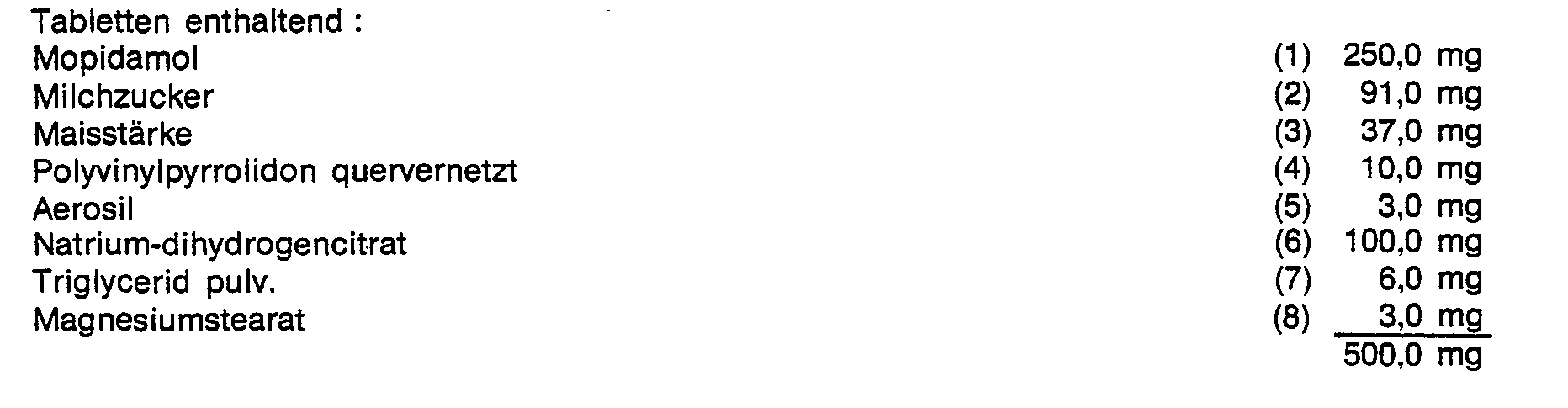
- 1 + 2 + 3 + 4 + 5 mischen wie im Beispiel 1 angegeben. Befeuchten, Trocknen, Sieben und 6 + 7 + 8 feingesiebt zugeben. Mischen und pressen.
- Stempeldurchmesser : 11 mm
- Wölbungsradius : 11 mm
- Die Tabletten werden mit Hydroxypropylmethylcellulose geschmacksabdeckend überzogen. Die fertigen Filmtabletten wiegen ca. 5,0 mg mehr als die Tabletten.
-

- 1 + 2 werden gemischt und mit 50 g Aethanol befeuchtet, daraufhin durch ein Sieb mit 1,6 mm-Maschenweite geschlagen und getrocknet. Nach dem Trocknen gibt man dieses Gut nochmals durch dasselbe Sieb, 3 + 4 + 5 + 6 + 7 + 8 werden feingesiebt und zugemischt. In Gelatine-Steckkapseln der Größe 000 abfüllen.
-

- 1 + 2 + 3 + 4 + 5 mischen wie im Beispiel 1 angegeben. Befeuchten, Trocknen, Sieben und 6 + 7 + 8 feigesiebt zugeben. Mischen und pressen.
- Stempeldurchmesser : 11 mm
- Wölbungsradius : 11 mm
- Die Tabletten werden mit Hydroxypropylmethylcellulose geschmacksabdeckend überzogen. Die fertigen Filmtabletten wiegen ca. 4,5 mg mehr als die Tabletten.
-
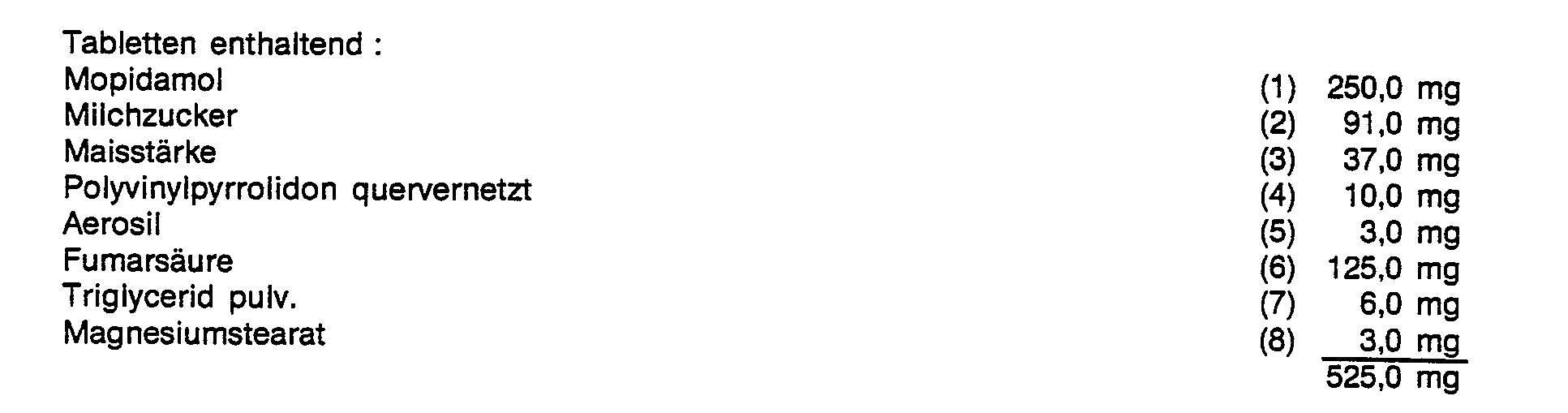
- 1 + 2 + 3 + 4 + 5 mischen wie im Beispiel 1 angegeben. Befeuchten, Trocknen, Sieben und 6 + 7 + 8 feingesiebt zugeben. Mischen und pressen.
- Stempeldurchmesser : 11 mm
- Wölbungsradius : 11 mm
- Die Tabletten werden mit Hydroxypropylmethylcellulose geschmacksabdeckend überzogen. Die fertigen Filmtabletten wiegen ca. 5,25 mg mehr als die Tabletten.
-

- 1 + 2 + 3 + 4 + 5 mischen wie im Beispiel 1 angegeben. Befeuchten, Trocknen, Sieben und 6 + 7 + 8 feingesiebt zugeben. Mischen und pressen.
- Stempeldurchmesser : 11 mm
- Wölbungsradius : 11 mm
- Die Tabletten werden mit Hydroxypropylmethylcellulose geschmacksabdeckend überzogen. Die fertigen Filmtabletten wiegen ca. 4,2 mg mehr als die Tabletten.
-

- 1 + 2 + 3 + 4 + 5 mischen wie im Beispiel 1 angegeben. Befeuchten, Trocknen, Sieben und 6 + 7 + 8 feingesiebt zugeben. Mischen und pressen.
- Stempeldurchmesser : 11 mm
- Wölbungsradius : 11 mm
- Die Tabletten werden mit Hydroxypropylmethylcellulose geschmacksabdeckend überzogen. Die fertigen Filmtabletten wiegen ca. 4,5 mg mehr als die Tabletten.
-
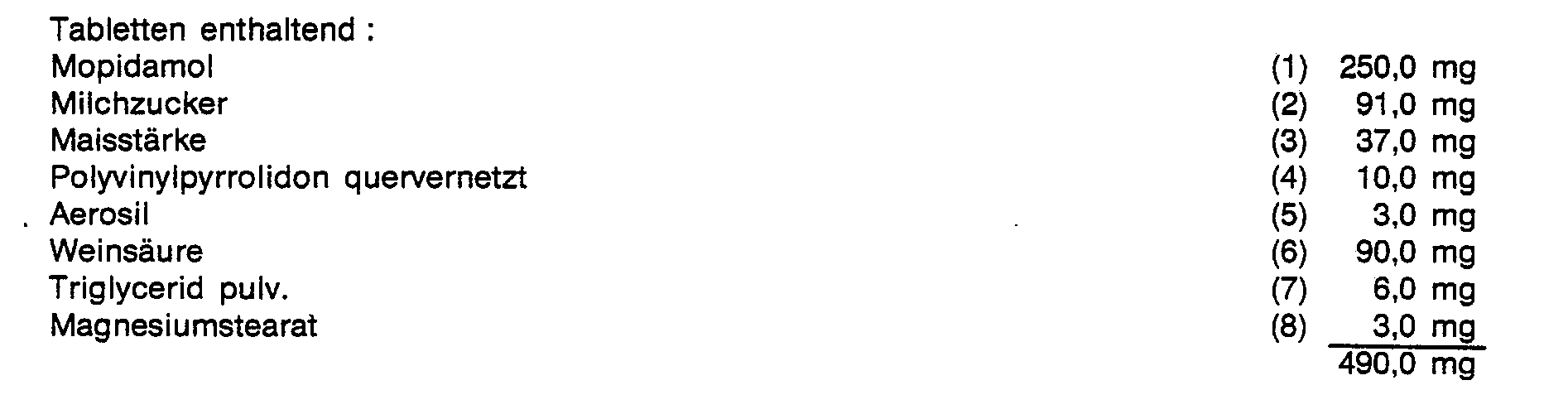
- 1 + 2 + 3 + 4 + 5 mischen wie in Beispiel 1 angegeben. Befeuchten, Trocknen, Sieben und 6 + 7 + 8 feingesiebt zugeben. Mischen und pressen.
- Stempeldurchmesser : 11 mm
- Wölbungsradius : 11 mm
- Die Tabletten werden mit Hydroxypropylmethylcellulose geschmacksabdeckend überzogen. Die fertigen Filmtabletten wiegen ca. 4,9 mg mehr als die Tabletten.
-
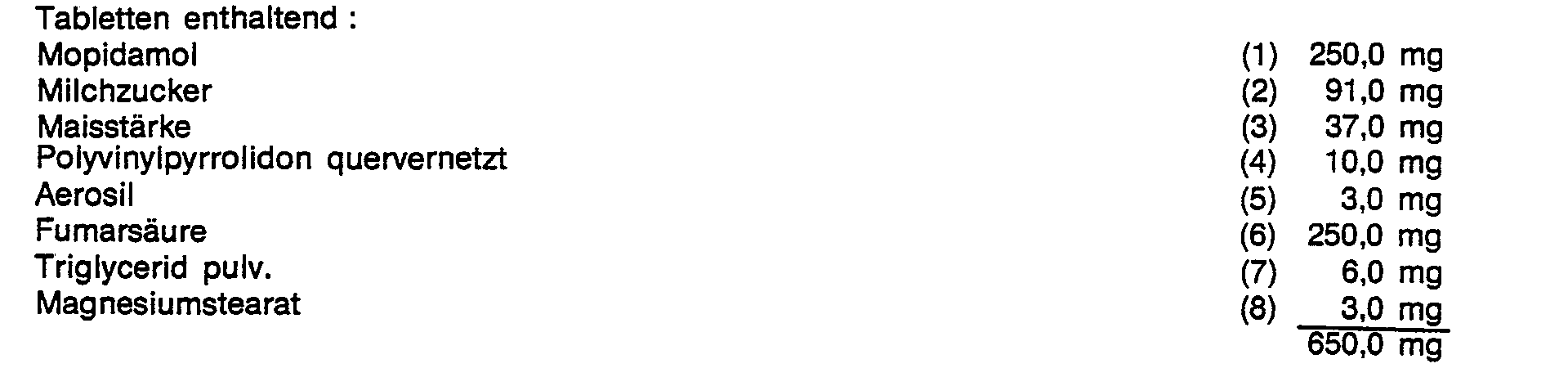
- 1 + 2 + 3 + 4 + 5 mischen wie in Beispiel 1 angegeben. Befeuchten, Trocknen, Sieben und 6 + 7 + 8 feingesiebt zugeben. Mischen und pressen.
- Stempeldurchmesser : 11 mm
- Wölbungsradius : 11 mm
- Die Tabletten werden mit Hydroxypropylmethylcellulose geschmacksabdeckend überzogen. Die fertigen Filmtabletten wiegen ca. 6,5 mg mehr als die Tabletten.
-

- 1 + 2 + 3 werden gemischt und mit der Lösung von 4 in 100 ml Aceton befeuchtet. Die feuchte Mischung wird durch ein Sieb mit 1,6 mm Maschenweite geschlagen, getrocknet und nochmals durch dasselbe Sieb gegeben. 5 wird zugemischt. Das fertige Granulat wird zu Tabletten verpreßt.
- Stempel : 12 mm
- Wölbungsradius : 10 mm
- Die Tabletten werden mit Hydroxypropylmethylcellulose geschmacksabdeckend überzogen. Dadurch erhöht sich das Gewicht der Filmtabletten um ca. 6,2 mg.
-
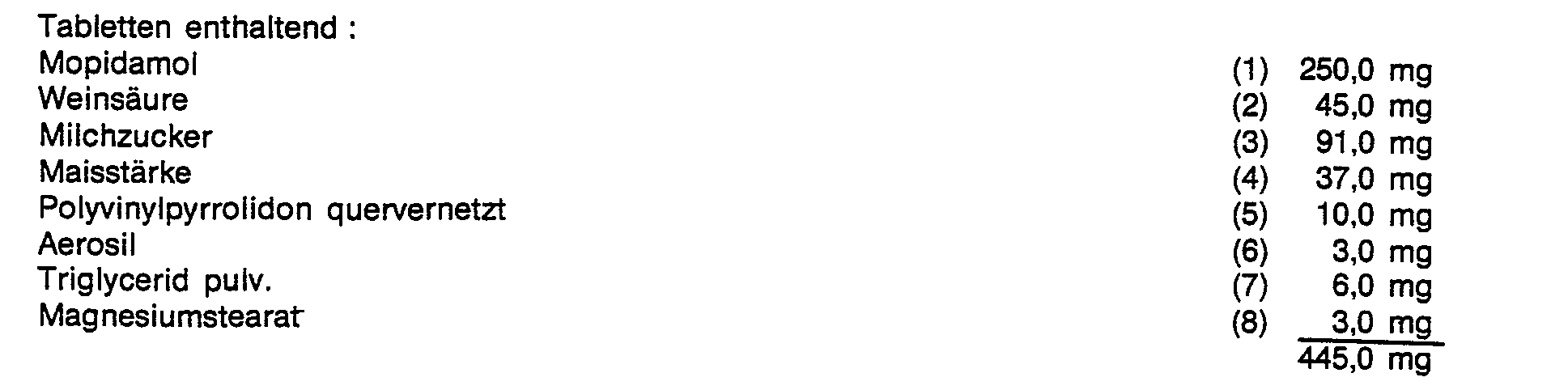
- 1 + 2 werden verrieben und mit 50 ml Aceton befeuchtet und wie im Beispiel 1 angegeben weiter bearbeitet, es werden 3 bis 8 feingesiebt zugegeben. Mischen und pressen.
- Stempeldurchmesser : 11 mm
- Wölbungsradius : 11 mm
- Die Tabletten werden mit Hydroxypropylmethylcellulose geschmacksabdeckend überzogen. Die fertigen Filmtabletten wiegen ca. 4,5 mg mehr als die Tabletten.
-

- 1 + 2 werden in 3 gut verrieben, dann wird 4 und zuletzt 5 untermischt.
- Die fertige Verreibung wird in Kapseln der Größe 000 abgefüllt.
-

- Diese Bestandteile werden gemischt, auf einem Walzenkompaktor verdichtet und anschließend granuliert. Nach Zumischen von 0,06 kg Magnesiumstearat wird die Mischung zu Oblong-Tabletten verpreßt. Diese werden mit einer Lösung von Methacrylsäure-Methacrylsäureestermischpolimerisat und Hydroxypropylmethyl-cellulosephthalat im Verhältniss 2 8 (Aceton/lsopropanol 1 : 1) besprüht, bis eine intakte Diffusionsmembran entstanden ist.
- Das nach Beispiel 15 mit Hilfe eines Walzenkompators und anschließender Trockengranulation hergestellte Granulat wird mit 0,5% Magnesiumstearat gemischt und in Hartgelatine-Steckkapseln abgefüllt.
-

- Sphärische Weinsäurekristalle 1 werden mit 6 überzogen. Diese werden in einem geeigneten Dragierkessel jeweils nach Befeuchten mit 4, gelöst in Isopropanol, und, in kleinen Portionen, mit einer Pulvermischung aus 2, 3 und 5 beschichtet. Nach Auftragung der gesamten Pulvermischung werden die entstandenen Pellets gesiebt, getrocknet und in Hartgelatine-Steckkapseln abgefüllt.
-


- Wie im Beispeil 17 beschrieben, werden die isolierten Zitronensäurekristalle mit einer Mischung aus 2, 3, 5 und 6 unter Verwendung von gelösten 4 beschichtet. Die gesiebten Pellets füllt man in Hartgelatine-Steckkapseln ab.
- Pellets nach Beispiel 18 werden mit einer Lösung von Hydroxypropylmethylcellulosephthalat/ Isopropanol (3 : 7) besprüht, getrocknet und in Hartgelatine-Steckkapseln abgefüllt.
Claims (15)
Priority Applications (1)
| Application Number | Priority Date | Filing Date | Title |
|---|---|---|---|
| AT83109510T ATE21481T1 (de) | 1982-10-09 | 1983-09-24 | Neue orale mopidamolformen. |
Applications Claiming Priority (2)
| Application Number | Priority Date | Filing Date | Title |
|---|---|---|---|
| DE3237575 | 1982-10-09 | ||
| DE19823237575 DE3237575A1 (de) | 1982-10-09 | 1982-10-09 | Neue orale mopidamolformen |
Publications (2)
| Publication Number | Publication Date |
|---|---|
| EP0108898A1 EP0108898A1 (de) | 1984-05-23 |
| EP0108898B1 true EP0108898B1 (de) | 1986-08-20 |
Family
ID=6175408
Family Applications (1)
| Application Number | Title | Priority Date | Filing Date |
|---|---|---|---|
| EP83109510A Expired EP0108898B1 (de) | 1982-10-09 | 1983-09-24 | Neue orale Mopidamolformen |
Country Status (18)
| Country | Link |
|---|---|
| US (2) | US4596705A (de) |
| EP (1) | EP0108898B1 (de) |
| JP (1) | JPH07558B2 (de) |
| AT (1) | ATE21481T1 (de) |
| AU (1) | AU560251B2 (de) |
| CA (1) | CA1228546A (de) |
| DE (2) | DE3237575A1 (de) |
| DK (1) | DK158541C (de) |
| ES (1) | ES8500743A1 (de) |
| FI (1) | FI79650C (de) |
| GB (1) | GB2128088B (de) |
| GR (1) | GR79015B (de) |
| IE (1) | IE56058B1 (de) |
| IL (1) | IL69930A (de) |
| NO (1) | NO833638L (de) |
| NZ (1) | NZ205894A (de) |
| PT (1) | PT77467B (de) |
| ZA (1) | ZA837499B (de) |
Families Citing this family (38)
| Publication number | Priority date | Publication date | Assignee | Title |
|---|---|---|---|---|
| DE3237575A1 (de) * | 1982-10-09 | 1984-04-12 | Dr. Karl Thomae Gmbh, 7950 Biberach | Neue orale mopidamolformen |
| GB8414220D0 (en) * | 1984-06-04 | 1984-07-11 | Sterwin Ag | Medicaments in unit dose form |
| GB8524001D0 (en) * | 1985-09-30 | 1985-11-06 | Glaxo Group Ltd | Pharmaceutical composition |
| CA1323833C (en) * | 1987-04-28 | 1993-11-02 | Yatindra M. Joshi | Pharmaceutical compositions in the form of beadlets and method |
| US5364646A (en) * | 1990-01-10 | 1994-11-15 | Dr. Karl Thomae Gmbh | Oral pharmaceutical forms of pimobendan |
| CA2039742A1 (en) * | 1990-04-23 | 1991-10-24 | Andrew B. Dennis | Tablet composition and method for problem pharmaceutical materials |
| US5156845A (en) * | 1990-05-04 | 1992-10-20 | Colgate-Palmolive Company | Dry mouth lozenge |
| US5523289A (en) * | 1991-04-15 | 1996-06-04 | Abbott Laboratories | Pharmaceutical composition |
| DK0585355T3 (da) * | 1991-05-20 | 1995-06-06 | Tanabe Seiyaku Co | Flerlagspræparat med reguleret frigivelse |
| EP1093814A1 (de) * | 1999-10-22 | 2001-04-25 | Boehringer Ingelheim Pharma KG | Verwendung von Dipyridamole oder Mopidamol zur Herstellung eines Medikaments für die Behandlung und Vorbeugung von fibrinabhängigen Mikrozirkulationstörungen |
| HUP0300491A2 (en) * | 2000-02-28 | 2003-07-28 | Vectura Ltd | Improvements in or relating to the delivery of oral drugs |
| US7064130B2 (en) * | 2001-04-20 | 2006-06-20 | Boehringer Ingelheim Pharma Gmbh & Co. Kg | Use of radical-scavenging compounds for treatment and prevention of NO-dependent microcirculation disorders |
| US20030181488A1 (en) | 2002-03-07 | 2003-09-25 | Boehringer Ingelheim Pharma Gmbh & Co. Kg | Administration form for the oral application of 3-[(2-{[4-(hexyloxycarbonylamino-imino-methyl)-phenylamino]-methyl}-1-methyl-1H-benzimidazol-5-carbonyl)-pyridin-2-yl-amino]-propionic acid ethyl ester and the salts thereof |
| WO2004050068A1 (en) * | 2002-11-29 | 2004-06-17 | Janssen Pharmaceutica N.V. | Pharmaceutical compositions comprising a basic respectively acidic drug compound, a surfactant and a physiologically tolerable water-soluble acid respectively base |
| JP2006516593A (ja) * | 2003-02-07 | 2006-07-06 | ベーリンガー インゲルハイム インターナショナル ゲゼルシャフト ミット ベシュレンクテル ハフツング | Mmp−9依存性疾患の治療及び予防のためのジピリダモール又はモピダモールの使用 |
| RU2005136383A (ru) | 2003-04-24 | 2007-06-10 | БЕРИНГЕР ИНГЕЛЬХАЙМ ИНТЕРНАЦИОНАЛЬ ГмбХ (DE) | Применение дипиридамола или мопидамола для лечения и предупреждения тромбоэмболических заболеваний и нарушений, вызываемыхизбыточным образованием и/или повышенным уровнем экспрессии тромбиновых рецепторов |
| DE602004030931D1 (de) * | 2003-11-04 | 2011-02-17 | Supernus Pharmaceuticals Inc | |
| US8709476B2 (en) * | 2003-11-04 | 2014-04-29 | Supernus Pharmaceuticals, Inc. | Compositions of quaternary ammonium compounds containing bioavailability enhancers |
| DE102004011512B4 (de) | 2004-03-08 | 2022-01-13 | Boehringer Ingelheim Vetmedica Gmbh | Pharmazeutische Zubereitung enthaltend Pimobendan |
| US8980894B2 (en) | 2004-03-25 | 2015-03-17 | Boehringer Ingelheim Vetmedica Gmbh | Use of PDE III inhibitors for the treatment of asymptomatic (occult) heart failure |
| EP1579862A1 (de) | 2004-03-25 | 2005-09-28 | Boehringer Ingelheim Vetmedica Gmbh | Verwendung von PDE III Ihibitoren zur Reduktion der Herzgrösse in an Herzversagen leidenden Säugern |
| RU2403033C2 (ru) | 2005-03-22 | 2010-11-10 | Лозан Фарма Гмбх | Солюбилизированный ибупрофен |
| DK1915137T3 (da) | 2005-08-10 | 2013-11-04 | Add Advanced Drug Delivery Technologies Ltd | Oralt præparat med kontrolleret frisætning |
| US20070190145A1 (en) * | 2006-01-27 | 2007-08-16 | Eurand, Inc. | Drug delivery systems comprising weakly basic selective serotonin 5-ht3 blocking agent and organic acids |
| EP2387994A1 (de) * | 2006-01-27 | 2011-11-23 | Eurand, Inc. | Arzneimittelabgabesysteme mit einem schwachen Basisarzneimittel und organischen Säuren |
| US7731604B2 (en) * | 2006-10-31 | 2010-06-08 | Taylor Made Golf Company, Inc. | Golf club iron head |
| EP1920785A1 (de) * | 2006-11-07 | 2008-05-14 | Boehringer Ingelheim Vetmedica Gmbh | Pimobendan-Cyclodextrin Komplex enthaltendes flüssiges Präparat |
| UA97813C2 (uk) * | 2006-12-05 | 2012-03-26 | Янссен Фармацевтика Н.В. | Фумаратна сіль (альфа s, бета r)-6-бром-альфа-[2-(диметиламіно)етил]-2-метоксі-альфа-1-нафталеніл-бета-феніл-3-хінолінетанолу |
| US8133506B2 (en) * | 2008-03-12 | 2012-03-13 | Aptalis Pharmatech, Inc. | Drug delivery systems comprising weakly basic drugs and organic acids |
| US8664252B2 (en) | 2008-11-25 | 2014-03-04 | Boehringer Ingelheim Vetmedica Gmbh | Phosphodiesterase type III (PDE III) inhibitors or CA2+-sensitizing agents for the treatment of hypertrophic cardiomyopathy |
| US20110003005A1 (en) * | 2009-07-06 | 2011-01-06 | Gopi Venkatesh | Methods of Treating PDNV and PONV with Extended Release Ondansetron Compositions |
| ES2924478T3 (es) | 2012-03-15 | 2022-10-07 | Boehringer Ingelheim Vetmedica Gmbh | Formulación de comprimidos farmacéuticos para el sector médico veterinario, método de producción y uso de los mismos |
| HUE032635T2 (en) | 2012-09-19 | 2017-10-30 | Taiho Pharmaceutical Co Ltd | For oral administration of pharmaceutical compositions having improved elution and / or absorbance |
| PL3021832T3 (pl) | 2013-07-19 | 2021-08-23 | Boehringer Ingelheim Vetmedica Gmbh | Konserwowana ciekła wodna kompozycja farmaceutyczna zawierająca eteryfikowane pochodne cyklodekstryny |
| BR122019024673B1 (pt) | 2013-12-04 | 2023-04-11 | Boehringer Ingelheim Vetmedica Gmbh | Composições farmacêuticas aprimoradas de pimobendan |
| JP6525897B2 (ja) * | 2016-01-21 | 2019-06-05 | 日清オイリオグループ株式会社 | タブレットの硬度調整剤 |
| US10537570B2 (en) | 2016-04-06 | 2020-01-21 | Boehringer Ingelheim Vetmedica Gmbh | Use of pimobendan for the reduction of heart size and/or the delay of onset of clinical symptoms in patients with asymptomatic heart failure due to mitral valve disease |
| CN109942445A (zh) * | 2019-02-26 | 2019-06-28 | 山东瑞弘生物科技有限公司 | 甜菜碱盐酸盐合成方法 |
Family Cites Families (8)
| Publication number | Priority date | Publication date | Assignee | Title |
|---|---|---|---|---|
| US3322755A (en) * | 1964-03-10 | 1967-05-30 | Boehringer Sohn Ingelheim | Basic-substituted 1, 2, 3, 4-tetrahydropyrimido [5, 4-d]-pyrimidines |
| DD146547A5 (de) * | 1978-07-15 | 1981-02-18 | Boehringer Sohn Ingelheim | Arzneimittel-retardform mit unloeslichen poroesen diffusionshuellen |
| EP0019586A1 (de) * | 1979-05-11 | 1980-11-26 | Ciba-Geigy Ag | Neue antithrombotische Kombinationspräparate |
| DE2931573A1 (de) * | 1979-08-03 | 1981-02-26 | Thomae Gmbh Dr K | Mittel zur bekaempfung des wachstums von krebszellen und dessen herstellung |
| DE3000979A1 (de) * | 1980-01-12 | 1981-07-23 | Dr. Karl Thomae Gmbh, 7950 Biberach | Neue dipyridamol-retardformen und verfahren zu ihrer herstellung |
| DE3124090A1 (de) * | 1981-06-19 | 1983-01-05 | Dr. Karl Thomae Gmbh, 7950 Biberach | Neue orale dipyridamolformen |
| DE3126703A1 (de) * | 1981-07-07 | 1983-01-27 | Dr. Karl Thomae Gmbh, 7950 Biberach | Bromhexin-retardform und verfahren zu ihrer herstellung |
| DE3237575A1 (de) * | 1982-10-09 | 1984-04-12 | Dr. Karl Thomae Gmbh, 7950 Biberach | Neue orale mopidamolformen |
-
1982
- 1982-10-09 DE DE19823237575 patent/DE3237575A1/de not_active Withdrawn
-
1983
- 1983-09-24 DE DE8383109510T patent/DE3365465D1/de not_active Expired
- 1983-09-24 AT AT83109510T patent/ATE21481T1/de not_active IP Right Cessation
- 1983-09-24 EP EP83109510A patent/EP0108898B1/de not_active Expired
- 1983-10-05 FI FI833605A patent/FI79650C/fi not_active IP Right Cessation
- 1983-10-06 DK DK460683A patent/DK158541C/da not_active IP Right Cessation
- 1983-10-06 NO NO833638A patent/NO833638L/no unknown
- 1983-10-07 GR GR72641A patent/GR79015B/el unknown
- 1983-10-07 CA CA000438670A patent/CA1228546A/en not_active Expired
- 1983-10-07 AU AU19985/83A patent/AU560251B2/en not_active Ceased
- 1983-10-07 NZ NZ205894A patent/NZ205894A/en unknown
- 1983-10-07 JP JP58188283A patent/JPH07558B2/ja not_active Expired - Lifetime
- 1983-10-07 ES ES526331A patent/ES8500743A1/es not_active Expired
- 1983-10-07 US US06/539,998 patent/US4596705A/en not_active Expired - Lifetime
- 1983-10-07 ZA ZA837499A patent/ZA837499B/xx unknown
- 1983-10-07 IE IE2358/83A patent/IE56058B1/en not_active IP Right Cessation
- 1983-10-07 IL IL69930A patent/IL69930A/xx not_active IP Right Cessation
- 1983-10-07 GB GB08326877A patent/GB2128088B/en not_active Expired
- 1983-10-07 PT PT77467A patent/PT77467B/de not_active IP Right Cessation
-
1985
- 1985-09-03 US US06/772,166 patent/US4650664A/en not_active Expired - Lifetime
Also Published As
| Publication number | Publication date |
|---|---|
| DK460683A (da) | 1984-04-10 |
| FI833605L (fi) | 1984-04-10 |
| FI79650C (fi) | 1990-02-12 |
| DK460683D0 (da) | 1983-10-06 |
| PT77467B (de) | 1986-05-07 |
| GR79015B (de) | 1984-10-02 |
| AU1998583A (en) | 1984-04-12 |
| JPS5989615A (ja) | 1984-05-23 |
| GB8326877D0 (en) | 1983-11-09 |
| FI79650B (fi) | 1989-10-31 |
| ES526331A0 (es) | 1984-11-01 |
| IL69930A0 (en) | 1984-01-31 |
| IE56058B1 (en) | 1991-04-10 |
| US4650664A (en) | 1987-03-17 |
| GB2128088B (en) | 1986-04-30 |
| US4596705A (en) | 1986-06-24 |
| FI833605A0 (fi) | 1983-10-05 |
| DK158541C (da) | 1990-11-05 |
| DE3237575A1 (de) | 1984-04-12 |
| GB2128088A (en) | 1984-04-26 |
| NZ205894A (en) | 1986-08-08 |
| NO833638L (no) | 1984-04-10 |
| AU560251B2 (en) | 1987-04-02 |
| IE832358L (en) | 1984-04-09 |
| DK158541B (da) | 1990-06-05 |
| PT77467A (de) | 1983-11-01 |
| JPH07558B2 (ja) | 1995-01-11 |
| DE3365465D1 (en) | 1986-09-25 |
| ATE21481T1 (de) | 1986-09-15 |
| EP0108898A1 (de) | 1984-05-23 |
| ZA837499B (en) | 1985-06-26 |
| CA1228546A (en) | 1987-10-27 |
| ES8500743A1 (es) | 1984-11-01 |
| IL69930A (en) | 1986-08-31 |
Similar Documents
| Publication | Publication Date | Title |
|---|---|---|
| EP0108898B1 (de) | Neue orale Mopidamolformen | |
| EP0068191B2 (de) | Orale Dipyridamolformen | |
| EP0299211B1 (de) | DHP-Manteltablette | |
| AT401870B (de) | Stabilisiertes pharmazeutisches mittel, enthaltend einen hmg-coa-reduktase-inhibitor wirkstoff | |
| DE69230112T2 (de) | Fortschrittliches arzneistoffabgabesystem und verfahren zur behandlung von psychiatrischen, neurologischen und anderen erkrankungen mit carbamazepin | |
| EP0720473B1 (de) | Budesonid-pellets mit kontrolliertem freigabeprofil und verfahren zu ihrer herstellung | |
| DE3880762T2 (de) | Orale, acetaminophen enthaltende zusammensetzung mit gesteuerter arzneistoff-freisetzung und verfahren zu ihrer herstellung. | |
| DE69738089T2 (de) | Feste orale Dosierungsformen enthaltend Valsartan | |
| DE69434479T2 (de) | Tramadolhaltiges Arzneimittel mit gesteuerter Wirkstoffabgabe | |
| DE69820287T2 (de) | Pharmazeutische Zubereitung, die Chlodronat als Wirkstoff und silicifizierte mikrokristalline Cellulose als Exipienten umfasst | |
| AT394310B (de) | Verfahren zur herstellung lagerstabiler, schnellzerfallender pharmazeutischer wirkstoff-presslinge | |
| EP0173210A2 (de) | Pellet-Zubereitung | |
| DE3524572A1 (de) | Feste arzneimittelformen zur peroralen anwendung enthaltend 9-deoxo-11-deoxy-9,11-(imino(2-(2-methoxyethoxy)ethyliden)-oxy)-(9s)-erythromycin und verfahren zu ihrer herstellung | |
| DE2224534B2 (de) | Pharmazeutisches praeparat mit langsamer wirkstoffabgabe | |
| DE69814850T2 (de) | Paracetamol enthaltende schlickbare tablette | |
| DE2808514A1 (de) | Nitrofurantoin enthaltende tablette | |
| EP0250648B1 (de) | Pharmazeutisches Präparat zur verzögerten Freigabe von Ibuprofen | |
| EP0306699A1 (de) | Dihydropyridin-Retard-Zubereitung | |
| DE2950154C2 (de) | ||
| DE3040042A1 (de) | Pharmazeutische zubereitung des tiaramids oder seiner pharmazeutisch vertraeglichen salze | |
| DE69021224T2 (de) | Erosionsgesteuertes Freisetzungssystem für Wirkstoffe sowie Verfahren zu dessen Herstellung. | |
| EP1663162B1 (de) | Oral zu applizierende darreichungsform für schwerlösliche saure und amphotere wirkstoffe | |
| DE3419130A1 (de) | Nifedipinkombinationspraeparate und verfahren zu ihrer herstellung | |
| DE3942131A1 (de) | Zusammensetzung auf der basis von trimebutin mit verlaengerter wirkstoff-freisetzung und verfahren zu deren herstellung | |
| AT401872B (de) | Stabilisiertes pharmazeutisches mittel, enthaltend fluvastatin-natrium als wirkstoff |
Legal Events
| Date | Code | Title | Description |
|---|---|---|---|
| PUAI | Public reference made under article 153(3) epc to a published international application that has entered the european phase |
Free format text: ORIGINAL CODE: 0009012 |
|
| AK | Designated contracting states |
Designated state(s): AT BE CH DE FR IT LI LU NL SE |
|
| 17P | Request for examination filed |
Effective date: 19840609 |
|
| GRAA | (expected) grant |
Free format text: ORIGINAL CODE: 0009210 |
|
| AK | Designated contracting states |
Kind code of ref document: B1 Designated state(s): AT BE CH DE FR IT LI LU NL SE |
|
| REF | Corresponds to: |
Ref document number: 21481 Country of ref document: AT Date of ref document: 19860915 Kind code of ref document: T |
|
| REF | Corresponds to: |
Ref document number: 3365465 Country of ref document: DE Date of ref document: 19860925 |
|
| ITF | It: translation for a ep patent filed | ||
| ET | Fr: translation filed | ||
| PLBE | No opposition filed within time limit |
Free format text: ORIGINAL CODE: 0009261 |
|
| STAA | Information on the status of an ep patent application or granted ep patent |
Free format text: STATUS: NO OPPOSITION FILED WITHIN TIME LIMIT |
|
| 26N | No opposition filed | ||
| ITTA | It: last paid annual fee | ||
| EPTA | Lu: last paid annual fee | ||
| EAL | Se: european patent in force in sweden |
Ref document number: 83109510.4 |
|
| PGFP | Annual fee paid to national office [announced via postgrant information from national office to epo] |
Ref country code: FR Payment date: 19980821 Year of fee payment: 16 Ref country code: DE Payment date: 19980821 Year of fee payment: 16 |
|
| PGFP | Annual fee paid to national office [announced via postgrant information from national office to epo] |
Ref country code: SE Payment date: 19980824 Year of fee payment: 16 Ref country code: CH Payment date: 19980824 Year of fee payment: 16 Ref country code: AT Payment date: 19980824 Year of fee payment: 16 |
|
| PGFP | Annual fee paid to national office [announced via postgrant information from national office to epo] |
Ref country code: LU Payment date: 19980825 Year of fee payment: 16 |
|
| PGFP | Annual fee paid to national office [announced via postgrant information from national office to epo] |
Ref country code: NL Payment date: 19980827 Year of fee payment: 16 |
|
| PGFP | Annual fee paid to national office [announced via postgrant information from national office to epo] |
Ref country code: BE Payment date: 19980908 Year of fee payment: 16 |
|
| PG25 | Lapsed in a contracting state [announced via postgrant information from national office to epo] |
Ref country code: LU Free format text: LAPSE BECAUSE OF NON-PAYMENT OF DUE FEES Effective date: 19990924 Ref country code: AT Free format text: LAPSE BECAUSE OF NON-PAYMENT OF DUE FEES Effective date: 19990924 |
|
| PG25 | Lapsed in a contracting state [announced via postgrant information from national office to epo] |
Ref country code: SE Free format text: THE PATENT HAS BEEN ANNULLED BY A DECISION OF A NATIONAL AUTHORITY Effective date: 19990929 |
|
| PG25 | Lapsed in a contracting state [announced via postgrant information from national office to epo] |
Ref country code: LI Free format text: LAPSE BECAUSE OF NON-PAYMENT OF DUE FEES Effective date: 19990930 Ref country code: CH Free format text: LAPSE BECAUSE OF NON-PAYMENT OF DUE FEES Effective date: 19990930 Ref country code: BE Free format text: LAPSE BECAUSE OF NON-PAYMENT OF DUE FEES Effective date: 19990930 |
|
| BERE | Be: lapsed |
Owner name: KARL THOMAE G.M.B.H. Effective date: 19990930 |
|
| PG25 | Lapsed in a contracting state [announced via postgrant information from national office to epo] |
Ref country code: NL Free format text: LAPSE BECAUSE OF NON-PAYMENT OF DUE FEES Effective date: 20000401 |
|
| EUG | Se: european patent has lapsed |
Ref document number: 83109510.4 |
|
| REG | Reference to a national code |
Ref country code: CH Ref legal event code: PL |
|
| PG25 | Lapsed in a contracting state [announced via postgrant information from national office to epo] |
Ref country code: FR Free format text: LAPSE BECAUSE OF NON-PAYMENT OF DUE FEES Effective date: 20000531 |
|
| NLV4 | Nl: lapsed or anulled due to non-payment of the annual fee |
Effective date: 20000401 |
|
| PG25 | Lapsed in a contracting state [announced via postgrant information from national office to epo] |
Ref country code: DE Free format text: LAPSE BECAUSE OF NON-PAYMENT OF DUE FEES Effective date: 20000701 |
|
| REG | Reference to a national code |
Ref country code: FR Ref legal event code: ST |