EP0103796A2 - Neue Dihydropyrimidine, Verfahren zu ihrer Herstellung sowie ihre Verwendung in Arzneimitteln - Google Patents
Neue Dihydropyrimidine, Verfahren zu ihrer Herstellung sowie ihre Verwendung in Arzneimitteln Download PDFInfo
- Publication number
- EP0103796A2 EP0103796A2 EP83108692A EP83108692A EP0103796A2 EP 0103796 A2 EP0103796 A2 EP 0103796A2 EP 83108692 A EP83108692 A EP 83108692A EP 83108692 A EP83108692 A EP 83108692A EP 0103796 A2 EP0103796 A2 EP 0103796A2
- Authority
- EP
- European Patent Office
- Prior art keywords
- alkyl
- nitro
- halogen
- alkoxy
- cyano
- Prior art date
- Legal status (The legal status is an assumption and is not a legal conclusion. Google has not performed a legal analysis and makes no representation as to the accuracy of the status listed.)
- Granted
Links
- 238000000034 method Methods 0.000 title claims description 25
- 230000008569 process Effects 0.000 title claims description 14
- 239000003814 drug Substances 0.000 title claims description 10
- 238000002360 preparation method Methods 0.000 title claims description 4
- 150000003839 salts Chemical class 0.000 claims abstract description 8
- -1 alkyl radical Chemical class 0.000 claims description 66
- 229910052736 halogen Inorganic materials 0.000 claims description 40
- 150000002367 halogens Chemical class 0.000 claims description 40
- 125000003545 alkoxy group Chemical group 0.000 claims description 35
- 125000004432 carbon atom Chemical group C* 0.000 claims description 32
- 125000000449 nitro group Chemical group [O-][N+](*)=O 0.000 claims description 32
- 125000004663 dialkyl amino group Chemical group 0.000 claims description 30
- 125000000217 alkyl group Chemical group 0.000 claims description 27
- 239000001257 hydrogen Substances 0.000 claims description 26
- 229910052739 hydrogen Inorganic materials 0.000 claims description 26
- 125000002924 primary amino group Chemical group [H]N([H])* 0.000 claims description 23
- 150000002431 hydrogen Chemical class 0.000 claims description 21
- 125000004414 alkyl thio group Chemical group 0.000 claims description 20
- 150000001875 compounds Chemical group 0.000 claims description 17
- 125000002887 hydroxy group Chemical group [H]O* 0.000 claims description 16
- UFHFLCQGNIYNRP-UHFFFAOYSA-N Hydrogen Chemical compound [H][H] UFHFLCQGNIYNRP-UHFFFAOYSA-N 0.000 claims description 15
- 125000004093 cyano group Chemical group *C#N 0.000 claims description 15
- 125000004453 alkoxycarbonyl group Chemical group 0.000 claims description 14
- 239000002253 acid Substances 0.000 claims description 12
- 125000003710 aryl alkyl group Chemical group 0.000 claims description 12
- 150000001409 amidines Chemical class 0.000 claims description 11
- 125000002023 trifluoromethyl group Chemical group FC(F)(F)* 0.000 claims description 10
- ZAMOUSCENKQFHK-UHFFFAOYSA-N Chlorine atom Chemical compound [Cl] ZAMOUSCENKQFHK-UHFFFAOYSA-N 0.000 claims description 9
- 125000004122 cyclic group Chemical group 0.000 claims description 9
- 150000003254 radicals Chemical class 0.000 claims description 9
- 229920006395 saturated elastomer Polymers 0.000 claims description 9
- 229930195734 saturated hydrocarbon Natural products 0.000 claims description 9
- 229930195735 unsaturated hydrocarbon Natural products 0.000 claims description 9
- 150000001299 aldehydes Chemical class 0.000 claims description 8
- 125000004104 aryloxy group Chemical group 0.000 claims description 8
- 150000002148 esters Chemical class 0.000 claims description 8
- 125000001997 phenyl group Chemical group [H]C1=C([H])C([H])=C(*)C([H])=C1[H] 0.000 claims description 8
- PXGOKWXKJXAPGV-UHFFFAOYSA-N Fluorine Chemical compound FF PXGOKWXKJXAPGV-UHFFFAOYSA-N 0.000 claims description 7
- 125000003118 aryl group Chemical group 0.000 claims description 7
- 125000001797 benzyl group Chemical group [H]C1=C([H])C([H])=C(C([H])=C1[H])C([H])([H])* 0.000 claims description 7
- 125000005842 heteroatom Chemical group 0.000 claims description 7
- 229910052760 oxygen Inorganic materials 0.000 claims description 7
- IJGRMHOSHXDMSA-UHFFFAOYSA-N Atomic nitrogen Chemical group N#N IJGRMHOSHXDMSA-UHFFFAOYSA-N 0.000 claims description 6
- 125000004423 acyloxy group Chemical group 0.000 claims description 6
- 239000000460 chlorine Substances 0.000 claims description 6
- 229910052801 chlorine Inorganic materials 0.000 claims description 6
- 239000011737 fluorine Substances 0.000 claims description 6
- 229910052731 fluorine Inorganic materials 0.000 claims description 6
- 125000001188 haloalkyl group Chemical group 0.000 claims description 6
- 239000003960 organic solvent Substances 0.000 claims description 6
- 239000001301 oxygen Substances 0.000 claims description 6
- 125000004076 pyridyl group Chemical group 0.000 claims description 6
- 125000003341 7 membered heterocyclic group Chemical group 0.000 claims description 4
- 125000001691 aryl alkyl amino group Chemical group 0.000 claims description 4
- QVGXLLKOCUKJST-UHFFFAOYSA-N atomic oxygen Chemical group [O] QVGXLLKOCUKJST-UHFFFAOYSA-N 0.000 claims description 4
- 125000003178 carboxy group Chemical group [H]OC(*)=O 0.000 claims description 4
- 125000001072 heteroaryl group Chemical group 0.000 claims description 4
- 229910052757 nitrogen Chemical group 0.000 claims description 3
- 125000000951 phenoxy group Chemical group [H]C1=C([H])C([H])=C(O*)C([H])=C1[H] 0.000 claims description 3
- KRTGJZMJJVEKRX-UHFFFAOYSA-N 2-phenylethan-1-yl Chemical compound [CH2]CC1=CC=CC=C1 KRTGJZMJJVEKRX-UHFFFAOYSA-N 0.000 claims description 2
- 150000005840 aryl radicals Chemical class 0.000 claims description 2
- 125000001153 fluoro group Chemical group F* 0.000 claims description 2
- 125000001624 naphthyl group Chemical group 0.000 claims description 2
- 239000000546 pharmaceutical excipient Substances 0.000 claims description 2
- 201000010099 disease Diseases 0.000 claims 4
- 208000037265 diseases, disorders, signs and symptoms Diseases 0.000 claims 4
- 125000000623 heterocyclic group Chemical class 0.000 claims 2
- UUEVFMOUBSLVJW-UHFFFAOYSA-N oxo-[[1-[2-[2-[2-[4-(oxoazaniumylmethylidene)pyridin-1-yl]ethoxy]ethoxy]ethyl]pyridin-4-ylidene]methyl]azanium;dibromide Chemical group [Br-].[Br-].C1=CC(=C[NH+]=O)C=CN1CCOCCOCCN1C=CC(=C[NH+]=O)C=C1 UUEVFMOUBSLVJW-UHFFFAOYSA-N 0.000 claims 1
- XEKOWRVHYACXOJ-UHFFFAOYSA-N Ethyl acetate Chemical compound CCOC(C)=O XEKOWRVHYACXOJ-UHFFFAOYSA-N 0.000 description 57
- LFQSCWFLJHTTHZ-UHFFFAOYSA-N Ethanol Chemical compound CCO LFQSCWFLJHTTHZ-UHFFFAOYSA-N 0.000 description 33
- VEXZGXHMUGYJMC-UHFFFAOYSA-N Hydrochloric acid Chemical compound Cl VEXZGXHMUGYJMC-UHFFFAOYSA-N 0.000 description 25
- WEVYAHXRMPXWCK-UHFFFAOYSA-N Acetonitrile Chemical compound CC#N WEVYAHXRMPXWCK-UHFFFAOYSA-N 0.000 description 21
- RTZKZFJDLAIYFH-UHFFFAOYSA-N Diethyl ether Chemical compound CCOCC RTZKZFJDLAIYFH-UHFFFAOYSA-N 0.000 description 16
- 235000019441 ethanol Nutrition 0.000 description 14
- HEMHJVSKTPXQMS-UHFFFAOYSA-M sodium hydroxide Inorganic materials [OH-].[Na+] HEMHJVSKTPXQMS-UHFFFAOYSA-M 0.000 description 14
- 230000008018 melting Effects 0.000 description 11
- 238000002844 melting Methods 0.000 description 11
- 238000006243 chemical reaction Methods 0.000 description 9
- 238000001704 evaporation Methods 0.000 description 9
- 230000008020 evaporation Effects 0.000 description 9
- XLYOFNOQVPJJNP-UHFFFAOYSA-N water Substances O XLYOFNOQVPJJNP-UHFFFAOYSA-N 0.000 description 9
- 239000013078 crystal Substances 0.000 description 8
- 238000000354 decomposition reaction Methods 0.000 description 7
- 230000000694 effects Effects 0.000 description 7
- 239000012071 phase Substances 0.000 description 7
- OKKJLVBELUTLKV-UHFFFAOYSA-N Methanol Chemical compound OC OKKJLVBELUTLKV-UHFFFAOYSA-N 0.000 description 6
- VMHLLURERBWHNL-UHFFFAOYSA-M Sodium acetate Chemical compound [Na+].CC([O-])=O VMHLLURERBWHNL-UHFFFAOYSA-M 0.000 description 6
- 229940040526 anhydrous sodium acetate Drugs 0.000 description 6
- 239000000203 mixture Substances 0.000 description 6
- QTBSBXVTEAMEQO-UHFFFAOYSA-N Acetic acid Chemical compound CC(O)=O QTBSBXVTEAMEQO-UHFFFAOYSA-N 0.000 description 5
- 239000008346 aqueous phase Substances 0.000 description 5
- 239000002904 solvent Substances 0.000 description 5
- 239000007858 starting material Substances 0.000 description 5
- PEDCQBHIVMGVHV-UHFFFAOYSA-N Glycerine Chemical compound OCC(O)CO PEDCQBHIVMGVHV-UHFFFAOYSA-N 0.000 description 4
- BQVJCMMLDJPBFZ-UHFFFAOYSA-N [amino(phenyl)methylidene]azanium;chloride;hydrate Chemical compound O.Cl.NC(=N)C1=CC=CC=C1 BQVJCMMLDJPBFZ-UHFFFAOYSA-N 0.000 description 4
- HQKMJHAJHXVSDF-UHFFFAOYSA-L magnesium stearate Chemical compound [Mg+2].CCCCCCCCCCCCCCCCCC([O-])=O.CCCCCCCCCCCCCCCCCC([O-])=O HQKMJHAJHXVSDF-UHFFFAOYSA-L 0.000 description 4
- 238000004519 manufacturing process Methods 0.000 description 4
- 239000000126 substance Substances 0.000 description 4
- SRWILAKSARHZPR-UHFFFAOYSA-N 3-chlorobenzaldehyde Chemical compound ClC1=CC=CC(C=O)=C1 SRWILAKSARHZPR-UHFFFAOYSA-N 0.000 description 3
- 0 CCCCC(CCC)C1NC(C)NC(C)C1* Chemical compound CCCCC(CCC)C1NC(C)NC(C)C1* 0.000 description 3
- 241001465754 Metazoa Species 0.000 description 3
- ZMXDDKWLCZADIW-UHFFFAOYSA-N N,N-Dimethylformamide Chemical compound CN(C)C=O ZMXDDKWLCZADIW-UHFFFAOYSA-N 0.000 description 3
- DNIAPMSPPWPWGF-UHFFFAOYSA-N Propylene glycol Chemical compound CC(O)CO DNIAPMSPPWPWGF-UHFFFAOYSA-N 0.000 description 3
- DBMJMQXJHONAFJ-UHFFFAOYSA-M Sodium laurylsulphate Chemical compound [Na+].CCCCCCCCCCCCOS([O-])(=O)=O DBMJMQXJHONAFJ-UHFFFAOYSA-M 0.000 description 3
- 239000004480 active ingredient Substances 0.000 description 3
- 150000001298 alcohols Chemical class 0.000 description 3
- 230000037396 body weight Effects 0.000 description 3
- 238000009472 formulation Methods 0.000 description 3
- 239000000047 product Substances 0.000 description 3
- 239000000454 talc Substances 0.000 description 3
- 235000012222 talc Nutrition 0.000 description 3
- 229910052623 talc Inorganic materials 0.000 description 3
- 206010001497 Agitation Diseases 0.000 description 2
- VTYYLEPIZMXCLO-UHFFFAOYSA-L Calcium carbonate Chemical compound [Ca+2].[O-]C([O-])=O VTYYLEPIZMXCLO-UHFFFAOYSA-L 0.000 description 2
- IAZDPXIOMUYVGZ-UHFFFAOYSA-N Dimethylsulphoxide Chemical compound CS(C)=O IAZDPXIOMUYVGZ-UHFFFAOYSA-N 0.000 description 2
- MYMOFIZGZYHOMD-UHFFFAOYSA-N Dioxygen Chemical compound O=O MYMOFIZGZYHOMD-UHFFFAOYSA-N 0.000 description 2
- WQZGKKKJIJFFOK-GASJEMHNSA-N Glucose Chemical compound OC[C@H]1OC(O)[C@H](O)[C@@H](O)[C@@H]1O WQZGKKKJIJFFOK-GASJEMHNSA-N 0.000 description 2
- KFZMGEQAYNKOFK-UHFFFAOYSA-N Isopropanol Chemical compound CC(C)O KFZMGEQAYNKOFK-UHFFFAOYSA-N 0.000 description 2
- WRQNANDWMGAFTP-UHFFFAOYSA-N Methylacetoacetic acid Chemical compound COC(=O)CC(C)=O WRQNANDWMGAFTP-UHFFFAOYSA-N 0.000 description 2
- 229920003171 Poly (ethylene oxide) Polymers 0.000 description 2
- JUJWROOIHBZHMG-UHFFFAOYSA-N Pyridine Chemical compound C1=CC=NC=C1 JUJWROOIHBZHMG-UHFFFAOYSA-N 0.000 description 2
- VYPSYNLAJGMNEJ-UHFFFAOYSA-N Silicium dioxide Chemical compound O=[Si]=O VYPSYNLAJGMNEJ-UHFFFAOYSA-N 0.000 description 2
- 229920002472 Starch Polymers 0.000 description 2
- WYURNTSHIVDZCO-UHFFFAOYSA-N Tetrahydrofuran Chemical compound C1CCOC1 WYURNTSHIVDZCO-UHFFFAOYSA-N 0.000 description 2
- 229960000583 acetic acid Drugs 0.000 description 2
- 239000000654 additive Substances 0.000 description 2
- 150000008052 alkyl sulfonates Chemical class 0.000 description 2
- 239000002220 antihypertensive agent Substances 0.000 description 2
- 229940030600 antihypertensive agent Drugs 0.000 description 2
- PXXJHWLDUBFPOL-UHFFFAOYSA-N benzamidine Chemical compound NC(=N)C1=CC=CC=C1 PXXJHWLDUBFPOL-UHFFFAOYSA-N 0.000 description 2
- 230000036772 blood pressure Effects 0.000 description 2
- 239000000969 carrier Substances 0.000 description 2
- 210000004351 coronary vessel Anatomy 0.000 description 2
- 239000003085 diluting agent Substances 0.000 description 2
- 239000002270 dispersing agent Substances 0.000 description 2
- 239000003995 emulsifying agent Substances 0.000 description 2
- WCQOBLXWLRDEQA-UHFFFAOYSA-N ethanimidamide;hydrochloride Chemical compound Cl.CC(N)=N WCQOBLXWLRDEQA-UHFFFAOYSA-N 0.000 description 2
- 239000000706 filtrate Substances 0.000 description 2
- 235000011187 glycerol Nutrition 0.000 description 2
- 229920005610 lignin Polymers 0.000 description 2
- 239000000314 lubricant Substances 0.000 description 2
- 235000019359 magnesium stearate Nutrition 0.000 description 2
- BDAGIHXWWSANSR-UHFFFAOYSA-N methanoic acid Natural products OC=O BDAGIHXWWSANSR-UHFFFAOYSA-N 0.000 description 2
- 229920000609 methyl cellulose Polymers 0.000 description 2
- 239000001923 methylcellulose Substances 0.000 description 2
- 235000010981 methylcellulose Nutrition 0.000 description 2
- 231100000252 nontoxic Toxicity 0.000 description 2
- 230000003000 nontoxic effect Effects 0.000 description 2
- 229920000036 polyvinylpyrrolidone Polymers 0.000 description 2
- 239000011435 rock Substances 0.000 description 2
- 235000019333 sodium laurylsulphate Nutrition 0.000 description 2
- 239000008107 starch Substances 0.000 description 2
- 235000019698 starch Nutrition 0.000 description 2
- 239000003826 tablet Substances 0.000 description 2
- 229940124597 therapeutic agent Drugs 0.000 description 2
- 230000002792 vascular Effects 0.000 description 2
- RYHBNJHYFVUHQT-UHFFFAOYSA-N 1,4-Dioxane Chemical compound C1COCCO1 RYHBNJHYFVUHQT-UHFFFAOYSA-N 0.000 description 1
- ZDVRPKUWYQVVDX-UHFFFAOYSA-N 2-(trifluoromethyl)benzaldehyde Chemical compound FC(F)(F)C1=CC=CC=C1C=O ZDVRPKUWYQVVDX-UHFFFAOYSA-N 0.000 description 1
- XNWFRZJHXBZDAG-UHFFFAOYSA-N 2-METHOXYETHANOL Chemical compound COCCO XNWFRZJHXBZDAG-UHFFFAOYSA-N 0.000 description 1
- FPYUJUBAXZAQNL-UHFFFAOYSA-N 2-chlorobenzaldehyde Chemical compound ClC1=CC=CC=C1C=O FPYUJUBAXZAQNL-UHFFFAOYSA-N 0.000 description 1
- CZMRCDWAGMRECN-UHFFFAOYSA-N 2-{[3,4-dihydroxy-2,5-bis(hydroxymethyl)oxolan-2-yl]oxy}-6-(hydroxymethyl)oxane-3,4,5-triol Chemical compound OCC1OC(CO)(OC2OC(CO)C(O)C(O)C2O)C(O)C1O CZMRCDWAGMRECN-UHFFFAOYSA-N 0.000 description 1
- 125000004179 3-chlorophenyl group Chemical group [H]C1=C([H])C(*)=C([H])C(Cl)=C1[H] 0.000 description 1
- OSWFIVFLDKOXQC-UHFFFAOYSA-N 4-(3-methoxyphenyl)aniline Chemical compound COC1=CC=CC(C=2C=CC(N)=CC=2)=C1 OSWFIVFLDKOXQC-UHFFFAOYSA-N 0.000 description 1
- HBAQYPYDRFILMT-UHFFFAOYSA-N 8-[3-(1-cyclopropylpyrazol-4-yl)-1H-pyrazolo[4,3-d]pyrimidin-5-yl]-3-methyl-3,8-diazabicyclo[3.2.1]octan-2-one Chemical class C1(CC1)N1N=CC(=C1)C1=NNC2=C1N=C(N=C2)N1C2C(N(CC1CC2)C)=O HBAQYPYDRFILMT-UHFFFAOYSA-N 0.000 description 1
- OQLZINXFSUDMHM-UHFFFAOYSA-N Acetamidine Chemical compound CC(N)=N OQLZINXFSUDMHM-UHFFFAOYSA-N 0.000 description 1
- 240000002470 Amphicarpaea bracteata Species 0.000 description 1
- LXXKDDBRIQNJDI-UHFFFAOYSA-N CC1C(C2)CC2C1 Chemical compound CC1C(C2)CC2C1 LXXKDDBRIQNJDI-UHFFFAOYSA-N 0.000 description 1
- DVFVNJHIVAPTMS-UHFFFAOYSA-N Cc1ccccc1C(F)(F)F Chemical compound Cc1ccccc1C(F)(F)F DVFVNJHIVAPTMS-UHFFFAOYSA-N 0.000 description 1
- 235000019739 Dicalciumphosphate Nutrition 0.000 description 1
- RWSOTUBLDIXVET-UHFFFAOYSA-N Dihydrogen sulfide Chemical class S RWSOTUBLDIXVET-UHFFFAOYSA-N 0.000 description 1
- XTHFKEDIFFGKHM-UHFFFAOYSA-N Dimethoxyethane Chemical compound COCCOC XTHFKEDIFFGKHM-UHFFFAOYSA-N 0.000 description 1
- 239000004097 EU approved flavor enhancer Substances 0.000 description 1
- PNKUSGQVOMIXLU-UHFFFAOYSA-N Formamidine Chemical compound NC=N PNKUSGQVOMIXLU-UHFFFAOYSA-N 0.000 description 1
- 108010010803 Gelatin Proteins 0.000 description 1
- 206010020772 Hypertension Diseases 0.000 description 1
- 238000006000 Knoevenagel condensation reaction Methods 0.000 description 1
- 239000002202 Polyethylene glycol Substances 0.000 description 1
- 235000021355 Stearic acid Nutrition 0.000 description 1
- 150000007513 acids Chemical class 0.000 description 1
- 230000009471 action Effects 0.000 description 1
- 239000000443 aerosol Substances 0.000 description 1
- 150000008055 alkyl aryl sulfonates Chemical class 0.000 description 1
- 229940045714 alkyl sulfonate alkylating agent Drugs 0.000 description 1
- 235000012211 aluminium silicate Nutrition 0.000 description 1
- 230000003276 anti-hypertensive effect Effects 0.000 description 1
- 239000007900 aqueous suspension Substances 0.000 description 1
- 125000005228 aryl sulfonate group Chemical group 0.000 description 1
- 125000000649 benzylidene group Chemical group [H]C(=[*])C1=C([H])C([H])=C([H])C([H])=C1[H] 0.000 description 1
- 230000004071 biological effect Effects 0.000 description 1
- 239000008280 blood Substances 0.000 description 1
- 210000004369 blood Anatomy 0.000 description 1
- 238000009835 boiling Methods 0.000 description 1
- 210000004556 brain Anatomy 0.000 description 1
- 229910000019 calcium carbonate Inorganic materials 0.000 description 1
- 239000001506 calcium phosphate Substances 0.000 description 1
- 239000002775 capsule Substances 0.000 description 1
- 150000001722 carbon compounds Chemical class 0.000 description 1
- 239000012876 carrier material Substances 0.000 description 1
- 210000003169 central nervous system Anatomy 0.000 description 1
- 230000002490 cerebral effect Effects 0.000 description 1
- 230000008859 change Effects 0.000 description 1
- 239000000812 cholinergic antagonist Substances 0.000 description 1
- 239000003086 colorant Substances 0.000 description 1
- 239000000470 constituent Substances 0.000 description 1
- NEFBYIFKOOEVPA-UHFFFAOYSA-K dicalcium phosphate Chemical compound [Ca+2].[Ca+2].[O-]P([O-])([O-])=O NEFBYIFKOOEVPA-UHFFFAOYSA-K 0.000 description 1
- 229940038472 dicalcium phosphate Drugs 0.000 description 1
- 229910000390 dicalcium phosphate Inorganic materials 0.000 description 1
- 235000014113 dietary fatty acids Nutrition 0.000 description 1
- WASQWSOJHCZDFK-UHFFFAOYSA-N diketene Chemical compound C=C1CC(=O)O1 WASQWSOJHCZDFK-UHFFFAOYSA-N 0.000 description 1
- 239000008298 dragée Substances 0.000 description 1
- 229940079593 drug Drugs 0.000 description 1
- 239000000839 emulsion Substances 0.000 description 1
- 150000002170 ethers Chemical class 0.000 description 1
- IMHBTDWTTQPAQW-UHFFFAOYSA-N ethyl 5-(2-nitrophenyl)-3-oxopent-4-enoate Chemical compound CCOC(=O)CC(=O)C=CC1=CC=CC=C1[N+]([O-])=O IMHBTDWTTQPAQW-UHFFFAOYSA-N 0.000 description 1
- OOLACLSWHSRUNZ-UHFFFAOYSA-N ethyl 5-[2-[(4-methylphenyl)methoxy]phenyl]-3-oxopent-4-enoate Chemical compound CCOC(=O)CC(=O)C=CC1=CC=CC=C1OCC1=CC=C(C)C=C1 OOLACLSWHSRUNZ-UHFFFAOYSA-N 0.000 description 1
- YCJSSJYJRWBZKV-UHFFFAOYSA-N ethyl 6-methyl-4-(2-nitrophenyl)-2-phenyl-1,4-dihydropyrimidine-5-carboxylate Chemical compound CCOC(=O)C1=C(C)NC(C=2C=CC=CC=2)=NC1C1=CC=CC=C1[N+]([O-])=O YCJSSJYJRWBZKV-UHFFFAOYSA-N 0.000 description 1
- VYBAREOBWPOSDI-UHFFFAOYSA-N ethyl 6-methyl-4-[2-[(4-methylphenyl)methoxy]phenyl]-2-phenyl-1,4-dihydropyrimidine-5-carboxylate;hydrochloride Chemical compound Cl.CCOC(=O)C1=C(C)NC(C=2C=CC=CC=2)=NC1C1=CC=CC=C1OCC1=CC=C(C)C=C1 VYBAREOBWPOSDI-UHFFFAOYSA-N 0.000 description 1
- XYIBRDXRRQCHLP-UHFFFAOYSA-N ethyl acetoacetate Chemical compound CCOC(=O)CC(C)=O XYIBRDXRRQCHLP-UHFFFAOYSA-N 0.000 description 1
- 239000000194 fatty acid Substances 0.000 description 1
- 229930195729 fatty acid Natural products 0.000 description 1
- 235000013312 flour Nutrition 0.000 description 1
- 235000019264 food flavour enhancer Nutrition 0.000 description 1
- 235000019253 formic acid Nutrition 0.000 description 1
- 210000001035 gastrointestinal tract Anatomy 0.000 description 1
- 229920000159 gelatin Polymers 0.000 description 1
- 239000008273 gelatin Substances 0.000 description 1
- 235000019322 gelatine Nutrition 0.000 description 1
- 235000011852 gelatine desserts Nutrition 0.000 description 1
- 239000012362 glacial acetic acid Substances 0.000 description 1
- 239000008103 glucose Substances 0.000 description 1
- 150000002334 glycols Chemical class 0.000 description 1
- 239000008187 granular material Substances 0.000 description 1
- GNOIPBMMFNIUFM-UHFFFAOYSA-N hexamethylphosphoric triamide Chemical compound CN(C)P(=O)(N(C)C)N(C)C GNOIPBMMFNIUFM-UHFFFAOYSA-N 0.000 description 1
- 230000001631 hypertensive effect Effects 0.000 description 1
- 238000001990 intravenous administration Methods 0.000 description 1
- 238000002955 isolation Methods 0.000 description 1
- 150000002576 ketones Chemical class 0.000 description 1
- 239000007788 liquid Substances 0.000 description 1
- 230000004060 metabolic process Effects 0.000 description 1
- XKORCTIIRYKLLG-ARJAWSKDSA-N methyl (z)-3-aminobut-2-enoate Chemical compound COC(=O)\C=C(\C)N XKORCTIIRYKLLG-ARJAWSKDSA-N 0.000 description 1
- FBBDGYRZFQBQOY-UHFFFAOYSA-N methyl 2,6-dimethyl-4-(3-nitrophenyl)-1,4-dihydropyrimidine-5-carboxylate;hydrochloride Chemical compound Cl.COC(=O)C1=C(C)NC(C)=NC1C1=CC=CC([N+]([O-])=O)=C1 FBBDGYRZFQBQOY-UHFFFAOYSA-N 0.000 description 1
- OJEXGYXCJRXPGD-UHFFFAOYSA-N methyl 4-(2-chlorophenyl)-2,6-dimethyl-1,4-dihydropyrimidine-5-carboxylate Chemical compound COC(=O)C1=C(C)NC(C)=NC1C1=CC=CC=C1Cl OJEXGYXCJRXPGD-UHFFFAOYSA-N 0.000 description 1
- FZDZFGOVPIOZNV-UHFFFAOYSA-N methyl 4-(2-chlorophenyl)-2-(3-chlorophenyl)-6-methyl-1,4-dihydropyrimidine-5-carboxylate;hydrochloride Chemical compound Cl.COC(=O)C1=C(C)NC(C=2C=C(Cl)C=CC=2)=NC1C1=CC=CC=C1Cl FZDZFGOVPIOZNV-UHFFFAOYSA-N 0.000 description 1
- SMDOMPOHLXRRTR-UHFFFAOYSA-N methyl 4-(2-chlorophenyl)-6-methyl-2-pyridin-2-yl-1,4-dihydropyrimidine-5-carboxylate Chemical compound COC(=O)C1=C(C)NC(C=2N=CC=CC=2)=NC1C1=CC=CC=C1Cl SMDOMPOHLXRRTR-UHFFFAOYSA-N 0.000 description 1
- GDQJCXJSYCWTBV-UHFFFAOYSA-N methyl 4-(3-chlorophenyl)-6-methyl-2-phenyl-1,4-dihydropyrimidine-5-carboxylate;hydrochloride Chemical compound Cl.COC(=O)C1=C(C)NC(C=2C=CC=CC=2)=NC1C1=CC=CC(Cl)=C1 GDQJCXJSYCWTBV-UHFFFAOYSA-N 0.000 description 1
- MTAIQNSRDSGJKV-UHFFFAOYSA-N methyl 5-(3-chlorophenyl)-3-oxopent-4-enoate Chemical compound COC(=O)CC(=O)C=CC1=CC=CC(Cl)=C1 MTAIQNSRDSGJKV-UHFFFAOYSA-N 0.000 description 1
- GKSMNBZFSFFBDM-UHFFFAOYSA-N methyl 5-(3-nitrophenyl)-3-oxopent-4-enoate Chemical compound COC(=O)CC(=O)C=CC1=CC=CC([N+]([O-])=O)=C1 GKSMNBZFSFFBDM-UHFFFAOYSA-N 0.000 description 1
- 150000004702 methyl esters Chemical class 0.000 description 1
- 235000013336 milk Nutrition 0.000 description 1
- 239000008267 milk Substances 0.000 description 1
- 210000004080 milk Anatomy 0.000 description 1
- 230000004048 modification Effects 0.000 description 1
- 238000012986 modification Methods 0.000 description 1
- QIQXTHQIDYTFRH-UHFFFAOYSA-N octadecanoic acid Chemical compound CCCCCCCCCCCCCCCCCC(O)=O QIQXTHQIDYTFRH-UHFFFAOYSA-N 0.000 description 1
- OQCDKBAXFALNLD-UHFFFAOYSA-N octadecanoic acid Natural products CCCCCCCC(C)CCCCCCCCC(O)=O OQCDKBAXFALNLD-UHFFFAOYSA-N 0.000 description 1
- 239000003921 oil Substances 0.000 description 1
- 235000019198 oils Nutrition 0.000 description 1
- 125000003854 p-chlorophenyl group Chemical group [H]C1=C([H])C(*)=C([H])C([H])=C1Cl 0.000 description 1
- 239000003208 petroleum Substances 0.000 description 1
- 230000000144 pharmacologic effect Effects 0.000 description 1
- 150000002989 phenols Chemical class 0.000 description 1
- 239000006187 pill Substances 0.000 description 1
- 229920001223 polyethylene glycol Polymers 0.000 description 1
- 239000001267 polyvinylpyrrolidone Substances 0.000 description 1
- 235000013855 polyvinylpyrrolidone Nutrition 0.000 description 1
- 229920001592 potato starch Polymers 0.000 description 1
- 239000000843 powder Substances 0.000 description 1
- 239000002244 precipitate Substances 0.000 description 1
- 230000001376 precipitating effect Effects 0.000 description 1
- UMJSCPRVCHMLSP-UHFFFAOYSA-N pyridine Natural products COC1=CC=CN=C1 UMJSCPRVCHMLSP-UHFFFAOYSA-N 0.000 description 1
- 238000010992 reflux Methods 0.000 description 1
- 210000002345 respiratory system Anatomy 0.000 description 1
- 238000012552 review Methods 0.000 description 1
- 239000008159 sesame oil Substances 0.000 description 1
- 235000011803 sesame oil Nutrition 0.000 description 1
- 150000004760 silicates Chemical class 0.000 description 1
- 239000000377 silicon dioxide Substances 0.000 description 1
- 210000002460 smooth muscle Anatomy 0.000 description 1
- 239000001509 sodium citrate Substances 0.000 description 1
- NLJMYIDDQXHKNR-UHFFFAOYSA-K sodium citrate Chemical compound O.O.[Na+].[Na+].[Na+].[O-]C(=O)CC(O)(CC([O-])=O)C([O-])=O NLJMYIDDQXHKNR-UHFFFAOYSA-K 0.000 description 1
- 235000011121 sodium hydroxide Nutrition 0.000 description 1
- 239000007787 solid Substances 0.000 description 1
- 239000000243 solution Substances 0.000 description 1
- 210000002023 somite Anatomy 0.000 description 1
- 239000008117 stearic acid Substances 0.000 description 1
- 230000000638 stimulation Effects 0.000 description 1
- 210000002784 stomach Anatomy 0.000 description 1
- 239000000725 suspension Substances 0.000 description 1
- 239000006188 syrup Substances 0.000 description 1
- 235000020357 syrup Nutrition 0.000 description 1
- YLQBMQCUIZJEEH-UHFFFAOYSA-N tetrahydrofuran Natural products C=1C=COC=1 YLQBMQCUIZJEEH-UHFFFAOYSA-N 0.000 description 1
- 238000011287 therapeutic dose Methods 0.000 description 1
- 229940124549 vasodilator Drugs 0.000 description 1
- 239000003071 vasodilator agent Substances 0.000 description 1
- 230000003235 vasospasmolytic effect Effects 0.000 description 1
- 235000015112 vegetable and seed oil Nutrition 0.000 description 1
- 239000008158 vegetable oil Substances 0.000 description 1
- 238000010626 work up procedure Methods 0.000 description 1
Classifications
-
- C—CHEMISTRY; METALLURGY
- C07—ORGANIC CHEMISTRY
- C07D—HETEROCYCLIC COMPOUNDS
- C07D239/00—Heterocyclic compounds containing 1,3-diazine or hydrogenated 1,3-diazine rings
- C07D239/02—Heterocyclic compounds containing 1,3-diazine or hydrogenated 1,3-diazine rings not condensed with other rings
- C07D239/20—Heterocyclic compounds containing 1,3-diazine or hydrogenated 1,3-diazine rings not condensed with other rings having two double bonds between ring members or between ring members and non-ring members
-
- A—HUMAN NECESSITIES
- A61—MEDICAL OR VETERINARY SCIENCE; HYGIENE
- A61P—SPECIFIC THERAPEUTIC ACTIVITY OF CHEMICAL COMPOUNDS OR MEDICINAL PREPARATIONS
- A61P9/00—Drugs for disorders of the cardiovascular system
-
- A—HUMAN NECESSITIES
- A61—MEDICAL OR VETERINARY SCIENCE; HYGIENE
- A61P—SPECIFIC THERAPEUTIC ACTIVITY OF CHEMICAL COMPOUNDS OR MEDICINAL PREPARATIONS
- A61P9/00—Drugs for disorders of the cardiovascular system
- A61P9/02—Non-specific cardiovascular stimulants, e.g. drugs for syncope, antihypotensives
-
- A—HUMAN NECESSITIES
- A61—MEDICAL OR VETERINARY SCIENCE; HYGIENE
- A61P—SPECIFIC THERAPEUTIC ACTIVITY OF CHEMICAL COMPOUNDS OR MEDICINAL PREPARATIONS
- A61P9/00—Drugs for disorders of the cardiovascular system
- A61P9/08—Vasodilators for multiple indications
-
- A—HUMAN NECESSITIES
- A61—MEDICAL OR VETERINARY SCIENCE; HYGIENE
- A61P—SPECIFIC THERAPEUTIC ACTIVITY OF CHEMICAL COMPOUNDS OR MEDICINAL PREPARATIONS
- A61P9/00—Drugs for disorders of the cardiovascular system
- A61P9/10—Drugs for disorders of the cardiovascular system for treating ischaemic or atherosclerotic diseases, e.g. antianginal drugs, coronary vasodilators, drugs for myocardial infarction, retinopathy, cerebrovascula insufficiency, renal arteriosclerosis
-
- A—HUMAN NECESSITIES
- A61—MEDICAL OR VETERINARY SCIENCE; HYGIENE
- A61P—SPECIFIC THERAPEUTIC ACTIVITY OF CHEMICAL COMPOUNDS OR MEDICINAL PREPARATIONS
- A61P9/00—Drugs for disorders of the cardiovascular system
- A61P9/12—Antihypertensives
Definitions
- the invention relates to new dihydropyrimidines, processes for their preparation and their use in medicaments, in particular in medicaments which influence the circulation.
- the new dihydropyrimidines according to the invention of the general formula (I) or (Ia) have valuable pharmaceutical properties. Due to their circulatory effects, they can be used as antihypertensive agents, as vasodilators, as cerebral therapeutic agents and as coronary therapeutic agents.
- the ylidene B-keto esters of the formula (II) used as starting materials can be prepared by methods known from the literature (cf. G. Jones, "The Knoevenagel Condensation", in Org. Reactions, Vol. XV, 204 ff (1967)).
- the enaminocarboxylic acid esters (V) used as starting materials are known or can be prepared by methods known from the literature (cf. A.C. Cope, J. Am. Chem. Soc. 67, 1017 (1945)).
- ß-ketocarboxylic acid esters (VI) used as starting materials are known or can be prepared by methods known from the literature (eg D. Borrmann, "Reaction of Diketene with Alcohols, Phenols and Mercaptans", in Houben-Weyl, Methods of Organic Chemistry, Vol. VII / 4, 230 ff (1968); Y. Oikawa, K. Sugano and 0. Yonemitsu, J. Org. Chem. 43, 2087 (1978)).
- aldehydes (IV) used as starting materials are known or can be prepared by methods known from the literature (cf. TD Harris and GP Roth, J. Org. Chem. 44, 146 (1979), German Offenlegungsschrift 2 165 260, July 1972, German Offenlegungsschrift 2,401,665, July 1974, Mijano et al., Chem. Abst. 59 (1963), 13,929c, E. Adler and H.-D. Becker, Chem. Scand. 15, 849 (1961), EP Papadopoulos, M. Mardin and Ch. Issidoridis, J. Org. Chem. 31, 615 (1966), JA Chem. Soc. 78, 2543 (1956)).
- amidines (III) used as starting materials are known or can be prepared by methods known from the literature (cf.Houben-Weyl, Methods of Organic Chemistry, Vol. 11/2, page 38 ff (1958); RL Shoiner and FW Neumann, Chem. Reviews 35, 351 (1944)).
- inert organic solvents can be used as diluents for all process variants A, B and C.
- These preferably include alcohols such as ethanol, methanol, isopropanol, ethers such as dioxane, diethyl ether, tetrahydrofuran, glycol monomethyl ether, glycol dimethyl ether or glacial acetic acid, dimethylformamide, dimethyl sulfoxide, acetonitrile, pyridine and hexamethylphosphoric acid triamide.
- reaction temperatures can be varied within a wide range. Generally you work between 20 and 150 ° C, but preferably at. Boiling temperature of the respective solvent.
- the reaction can be carried out under normal pressure, but also under elevated pressure: in general, the process is carried out under normal pressure.
- reaction can be carried out with or without addition of base or acid, but it has been found that a reaction in the sense of the invention is preferably carried out in the presence of weaker acids, e.g. Acetic acid or formic acid takes place.
- weaker acids e.g. Acetic acid or formic acid takes place.
- aryl radicals optionally 1- or 2-fold substituted by halogen, hydroxy, cyano, amino, nitro, carboxy, alkoxy, alkylthio, carbalkoxy, acyloxy, monoamino or dialkylamino, each with up to 4 carbon atoms in the alkyl, alkoxy and acyl radicals,
- the compounds according to the invention can exist in stereoisomeric forms which either behave like image and mirror image (enantiomers) or do not behave like image and mirror image (diastereomers). Both the antipodes and the racemic forms as well as the diastereomer mixtures are the subject of the present invention. Like the diastereomers, the racemic forms can be separated into the stereoisomerically uniform constituents in a known manner (see, e.g., E.L. Eliel, Stereochemistry of Carbon Compounds, McGraw Hill, 1962).
- the new active compounds can be converted into the customary formulations in a known manner, such as tablets, capsules, dragees, pills, granules, aerosols, syrups, emulsions, suspensions and solutions, using inert, non-toxic, pharmaceutically suitable excipients or solvents.
- the therapeutically active compound should be in one Concentration of about 0.5 to 90 wt .-% of the total mixture may be present, ie in amounts which are sufficient to achieve the dosage range indicated.
- the formulations are prepared, for example, by stretching the active ingredients with solvents and / or carriers, optionally using emulsifiers and / or dispersants, e.g. if water is used as a diluent, organic if necessary. Solvents can be used as auxiliary solvents.
- tablets can of course also contain additives, such as sodium citrate, calcium carbonate and dicalcium phosphate, together with various additives, such as starch, preferably potato starch, gelatin and the like, in addition to the carrier substances mentioned.
- Lubricants such as magnesium stearate, sodium lauryl sulfate and talc can also be used for tableting.
- the active ingredients can be mixed with various flavor enhancers or colorants in addition to the abovementioned auxiliaries.
- solutions of the active ingredients can be used using suitable liquid carrier materials.
- the ethyl acetate phase is extracted once more with 100 ml of 1 N hydrochloric acid, the combined aqueous phases are shaken out 1 ⁇ with ether and then with concentrated Sodium hydroxide solution made alkaline. It is extracted twice with ethyl acetate, the combined ethyl acetate phases are washed with water, dried and concentrated. The oil obtained is stirred with a little cold acetonitrile; the crystals formed will suction filtered and washed with cold acetonitrile. 12.2 g (55.71% of theory) of a slightly yellow-colored product with a melting point of 102-105 ° C. are obtained.
- 6-Methyl-4- [2- (4-methylbenzyloxy) phenyl] -2-phenyl-1,4-dihydro-pyrimidine-5-carboxylic acid ethyl ester hydrochloride 10.2 g (30 mmol) of 2- (4-methylbenzyloxy) benzylidene-acetoacetic acid ethyl ester are mixed with 5.75 g (33 mmol) of benzamidine hydrate hydrochloride and 2 n 95 g (36 mmol) of anhydrous sodium acetate in 90 ml of ethanol Cooked at reflux overnight.
- the filtrate (ethyl acetate and aqueous hydrochloric acid) is separated, the ethyl acetate phase is shaken once with 50 ml of 1N hydrochloric acid, the combined aqueous phases are shaken once with ether, separated and concentrated sodium hydroxide solution made alkaline. It is extracted twice with ethyl acetate, the combined ethyl acetate phases are washed with water, dried and concentrated. The oily evaporation residue is dissolved in ethanol, mixed with 20 ml of 1 N hydrochloric acid and concentrated. After repeated concentration with acetonitrile, the crystals formed are stirred with acetonitrile and suction filtered. 1.4 g of slightly yellow-colored crystals of melting point 237 ° C. are obtained with decomposition, giving a total yield of 4.1 g (36.25% of theory).
- the aqueous phase is made alkaline with concentrated sodium hydroxide solution and extracted twice with ethyl acetate.
- the combined ethyl acetate phases are washed with water, dried and concentrated.
- the crystalline evaporation residue is converted from acetonitrile crystallized. 2.5 g of a slightly yellow substance with a melting point of 225-27 ° C. are obtained.
Landscapes
- Health & Medical Sciences (AREA)
- Organic Chemistry (AREA)
- Chemical & Material Sciences (AREA)
- Engineering & Computer Science (AREA)
- Bioinformatics & Cheminformatics (AREA)
- Cardiology (AREA)
- Heart & Thoracic Surgery (AREA)
- Chemical Kinetics & Catalysis (AREA)
- General Health & Medical Sciences (AREA)
- General Chemical & Material Sciences (AREA)
- Nuclear Medicine, Radiotherapy & Molecular Imaging (AREA)
- Animal Behavior & Ethology (AREA)
- Life Sciences & Earth Sciences (AREA)
- Pharmacology & Pharmacy (AREA)
- Medicinal Chemistry (AREA)
- Public Health (AREA)
- Veterinary Medicine (AREA)
- Urology & Nephrology (AREA)
- Vascular Medicine (AREA)
- Pharmaceuticals Containing Other Organic And Inorganic Compounds (AREA)
- Saccharide Compounds (AREA)
Abstract
Description
- Die Erfindung betrifft neue Dihydropyrimidine, Verfahren zu ihrer Herstellung sowie ihre Verwendung in Arzneimitteln, insbesondere in kreislaufbeeinflussenden Arzneimitteln.
- Es ist bereits bekanntgeworden, daß man aus Benzamidin und α,β-ungesättigten Ketonen Dihydropyrimidine erhalten kann (vgl. Silbersmith, J. Org. Chem. 27, 4090 (1982)). Dagegen ist weiterhin bekanntgeworden, daß Benzylidenmalonsäureester mit Amidinen 3,4-Dihydropyridone-2 ergeben (DE 2 242 787).
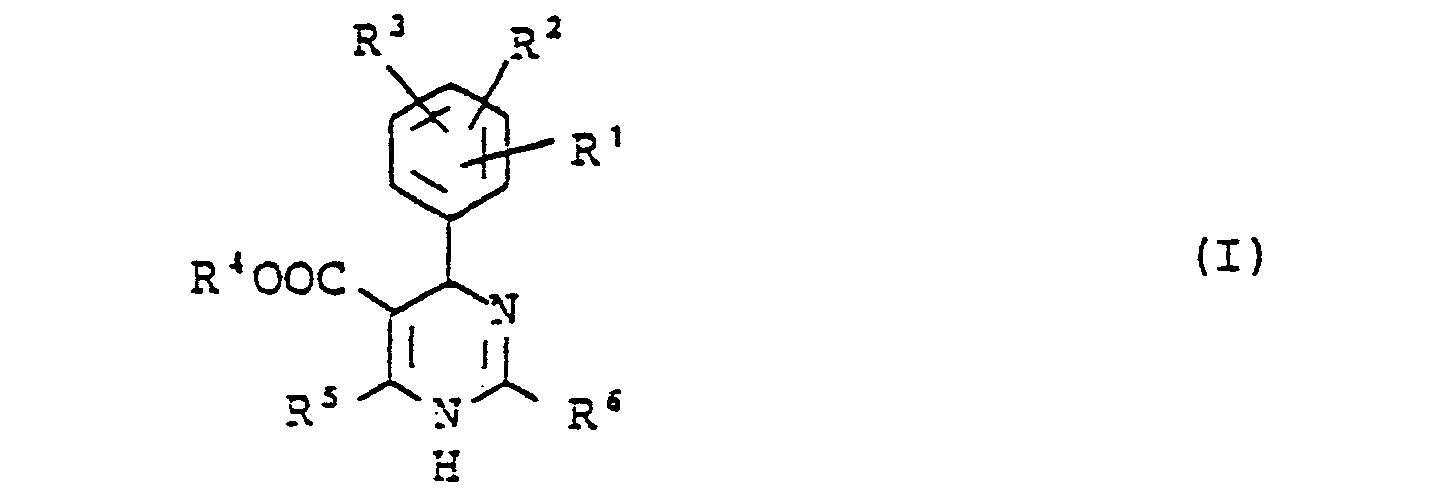
- Die Erfindung betrifft neue Dihydropyrimidine der allgemeinen Formel (I)


- R1, R2 und R 3 gleich oder verschieden sind und für
Wasserstoff, einen Alkylrest, Halogen, Halogenalkyl, Nitro, Cyano, Hydroxy, Alkoxy, Aralkyl, Amino, Monoalkylamino oder Dialkylamino oder für den Rest
- X 0, S, SO oder SO2 bedeutet und R8,R9 gleich oder verschieden sind und für Wasserstoff, Alkyl, Halogen, Alkoxy, Nitro oder CF3 stehen;
- R 4 für Wasserstoff oder einen geradkettigen, verzweigten oder cyclischen, gesättigten oder ungesättigten Kohlenwasserstoffrest steht, der gegebenenfalls ein oder zwei gleiche oder verschiedene Heterokettenglieder aus der Gruppe O, CO, NH, N-Alkyl, S oder S02 enthält und der gegebenenfalls substituiert ist durch Halogen, Nitro, Cyano, Hydroxy, Aryl, Aralkyl, Heteroaryl, Amino, Monoalkylamino oder Dialkylamino;
- R 5 für einen geradkettigen, verzweigten oder cyclischen, gesättigen oder ungesättigten Kohlenwasserstoffrest steht, der gegebenenfalls substituiert ist durch Halogen, Hydroxy, Cyano, Alkoxy, Alkylthio, Aryloxy, Alkoxycarbonyl, Amino, Monoalkylamino, Dialkylamino, Aralkylamino oder durch einen 5- bis 7-gliedrigen heterocyclischen Ring, und
- R 6 für Wasserstoff, einen geradkettigen, verzweigten oder cyclischen, gesättigten oder ungesättigten Kohlenwasserstoffrest steht oder gegebenenfalls durch Halogen, Hydroxy, Cyano, Nitro, Alkoxy, Alkylthio, Aryloxy, Alkoxycarbonyl, Amino, Monoalkylamino oder Dialkylamino substituiert ist, oder für einen gegebenenfalls durch Halogen, Hydroxy, Cyano, Alkoxy, Alkylthio, Carboxy, Carbalkoxy, Acyloxy, Amino, Nitro, Mono- oder Dialkylamino-substituierten Aralkyl-, Aryl-oder heterocyclischen Rest steht,
- sowie ihre pharmakologisch unbedenklichen Additionssalze.
- Die neuen erfindungsgemäßen Dihydropyrimidine der allgemeinen Formel (I) bzw. (Ia) besitzen wertvolle pharmazeutische Eigenschaften. Aufgrund ihrer kreislaufbeeinflussenden Wirkung können sie als antihypertensive Mittel, als Vasodilatatoren, als Cerebraltherapeutika sowie als Coronartherapeutika Verwendung finden.
- Die erfindungsgemäßen Verbindungen der allgemeinen Formel (I) bzw. (Ia) können hergestellt werden, indem man
- A) Yliden-ß-ketoester der allgemeinen Formel (II)

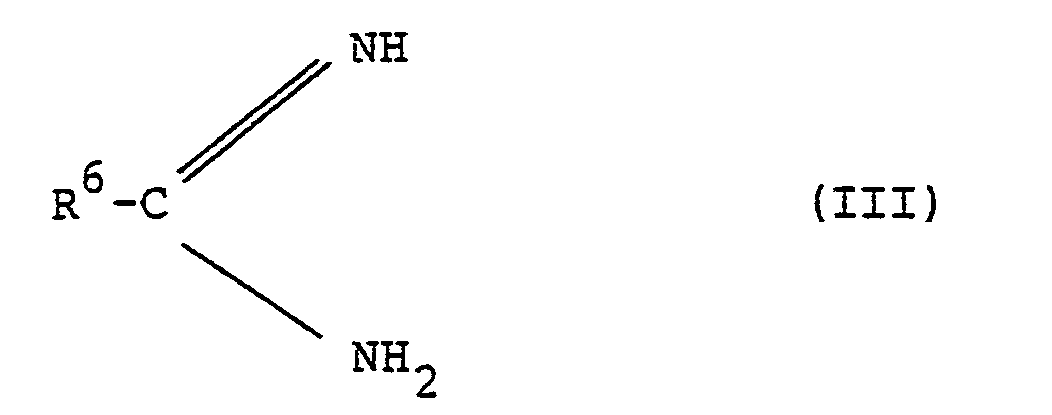
- R1,R2,R3,R4 und R5 die oben angegebene Bedeutung haben, mit Amidinen der allgemeinen Formel (III)

- R 6 die oben angegebene Bedeutung hat, gegebenenfalls in Gegenwart inerter organischer Lösungsmittel bei Temperaturen zwischen 20° und 150°C mit oder ohne Basen- oder Säurezusatz umsetzt, oder
- R1,R2,R3,R4 und R5 die oben angegebene Bedeutung haben, mit Amidinen der allgemeinen Formel (III)
- Aldehyde der allgemeinen Formel (IV)

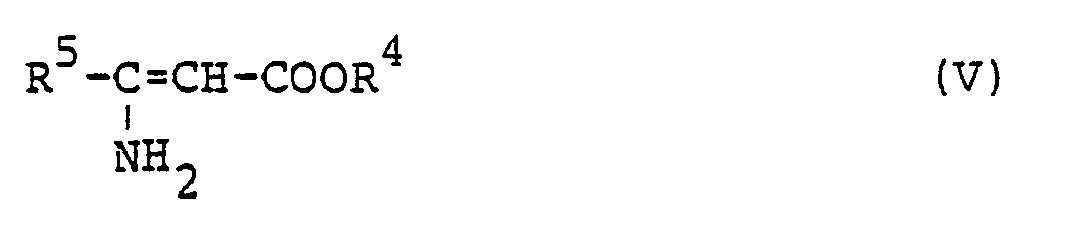
- R 1,R 2 und R 3 die oben angegebene Bedeutung haben, mit Enaminocarbonsäureestern der allgemeinen Formel (V)

- R 4 und R 5 die oben angegebene Bedeutung haben,
- und Amidinen der allgemeinen Formel (III) wie oben beschrieben umsetzt, oder
- R 1,R 2 und R 3 die oben angegebene Bedeutung haben, mit Enaminocarbonsäureestern der allgemeinen Formel (V)
- C) Aldehyde der allgemeinen Formel (IV)

- R1,R2 und R 3' die oben angegebene Bedeutung haben, mit Amidinen der Formel (III)

- R 6 die oben angegebene Bedeutung hat und β-Ketocarbonsäureestern der allgemeinen Formel (VI)

- R4 und R5 die oben angegebene Bedeutung haben, gegebenenfalls in Gegenwart inerter organischer Lösungsmittel mit oder ohne Basen- bzw. Säurezusatz umsetzt.
- R1,R2 und R 3' die oben angegebene Bedeutung haben, mit Amidinen der Formel (III)
- Setzt man nach Verfahrensvariante A) 3-Chlorbenzylidenacetessigsäuremethylester mit Acetamidin um, so läßt sich die Reaktion durch folgendes Formelschema wiedergeben:

- Setzt man nach Verfahrensvariante B) 3-Chlorbenzaldehyd mit β-Aminocrotonsäuremethylester und Benzamidin um, so läßt sich die Reaktion durch folgendes Formelschema wiedergeben:

- Setzt man nach Verfahrensvariante C) 2-Trifluormethylbenzaldehyd mit Formamidin und Acetessigsäureethylester um, so läßt sich die Reaktion durch folgendes Formelschema wiedergeben:

- Die als Ausgangsstoffe verwendeten Yliden-B-ketoester der Formel (II) können nach literaturbekannten Methoden dargestellt werden (vgl. G. Jones, "The Knoevenagel Condensation", in Org. Reactions, Vol. XV, 204 ff (1967)).
- Die als Ausgangsstoffe verwendeten Enaminocarbonsäureester (V) sind bekannt oder können nach-literaturbekannten Methoden dargestellt werden (vgl. A.C. Cope, J. Am. Chem. Soc. 67, 1017 (1945)).
- Die als Ausgangsstoffe verwendeten ß-Ketocarbonsäureester (VI) sind bekannt oder können nach literaturbekannten Methoden dargestellt werden (z.B. D. Borrmann, "Umsetzung von Diketen mit Alkoholen, Phenolen und Mercaptanen", in Houben-Weyl, Methoden der organischen Chemie, Vol. VII/4, 230 ff (1968); Y. Oikawa, K. Sugano und 0. Yonemitsu, J. Org. Chem. 43, 2087 (1978)).
- Die als Ausgangsstoffe verwendeten Aldehyde (IV) sind bekannt oder können nach literaturbekannten Methoden dargestellt werden (vgl. T.D. Harris und G.P. Roth, J. Org. Chem. 44, 146 (1979), Deutsche Offenlegungsschrift 2 165 260, Juli 1972, Deutsche Offenlegungsschrift 2 401 665, Juli 1974, Mijano et al., Chem. Abst. 59 (1963), 13 929 c, E. Adler und H.-D. Becker, Chem. Scand. 15, 849 (1961), E.P. Papadopoulos, M. Mardin und Ch. Issidoridis, J. Org. Chem. 31, 615 (1966), J. A. Chem. Soc..78, 2543 (1956)).
- Die als Ausgangsstoffe verwendeten Amidine (III) sind bekannt oder können nach literaturbekannten Methoden hergestellt werden (vgl. Houben-Weyl, Methoden der organischen Chemie, Vol. 11/2, Seite 38 ff (1958); R.L. Shoiner und F.W. Neumann, Chem. Reviews 35, 351 (1944)).
- Für alle Verfahrensvarianten A, B und C kommen als Verdünnungsmittel alle inerten organischen Lösungsmittel in Frage. Hierzu gehören vorzugsweise Alkohole wie Ethanol, Methanol, Isopropanol, Ether wie Dioxan, Diethylether, Tetrahydrofuran, Glykolmonomethylether, Glykoldimethylether oder Eisessig, Dimethylformamid, Dimethylsulfoxid, Acetonitril, Pyridin und Hexamethylphosphorsäuretriamid.
- Die Reaktionstemperaturen können in einem größeren Bereich variiert werden. Im allgemeinen arbeitet man zwischen 20 und 150°C, vorzugsweise jedoch bei der. Siedetemperatur des jeweiligen Lösungsmittels.
- Die Umsetzung kann bei Normaldruck, aber auch bei erhöhtem Druck durchgeführt werden: Im allgemeinen arbeitet man unter Normaldruck.
- Die Umsetzung kann mit oder ohne Basen- bzw. Säurezusatz durchgeführt werden, es hat sich jedoch gezeigt, daß eine Umsetzung im Sinne der Erfindung vorzugsweise in Gegenwart von schwächeren Säuren wie z.B. Essigsäure oder Ameisensäure stattfindet.
- Von besonderem Interesse sind Dihydropyrimidine der allgemeinen Formel (I) in welcher
- R 1, R 2 und R 3 gleich oder verschieden sind und jeweils für Wasserstoff, Alkyl mit 1-4 Kohlenstoffatomen, Halogen, Nitro, Cyano, Hydroxy, Amino, Alkoxy.mit 1-4 Kohlenstoffatomen, Benzyl, Monoalkylamino oder Dialkylamino mit jeweils 1-4 Kohlenstoffatomen in den Alkylresten oder für Halogenalkyl mit 1-4 Kohlenstoffatomen, oder für den Rest

- X 0, S oder SO2 bedeutet und
- R8 und R9 gleich oder verschieden sind und jeweils für Wasserstoff, Nitro, Trifluormethyl, Halogen, Alkyl oder Alkoxy mit jeweils 1-4 Kohlenstoffatomen stehen und
- R 4 für Wasserstoff oder einen geradkettigen, verzweigten oder cyclischen Alkyl- oder Alkenylrest steht, der gegebenenfalls ein oder zwei gleiche oder verschiedene Heterokettenglieder aus der Gruppe 0, CO, NH, N-Alkyl mit 1-4 Kohlenstoffatomen, S oder SO2 enthält und der gegebenenfalls substituiert ist durch Halogen, Nitro, Cyano, Hydroxy, Phenyl, Benzyl, Pyridyl, Amino, Monoalkylamino oder Dialkylamino mit jeweils 1 bis 4 Kohlenstoffatomen in den Alkylresten und
- R für einen geradkettigen, verzweigten oder cyclischen-AlkyL- oder Alkenylrest mit bis zu 10 Kohlenstoffatomen' steht, der gegebenenfalls substituiert ist durch Halogen, Hydroxy, Cyano, Amino, Alkoxy, Alkylthio, Alkoxycarbonyl, Monoalkylamino, Dialkylamino mit jeweils 1-4 Kohlenstoffatomen in den Alkyl- und Alkoxyresten, Phenyloxy, Benzylamino oder durch einen 5- bis 7-gliedrigen heterocyclischen Ring der ein oder zwei Heteroatome aus der Gruppe Sauerstoff oder Stickstoff als Ringglieder enthält, und
- R6 für Wasserstoff, einen geradkettigen, verzweigten oder cyclischen Alkyl- oder Alkenylrest mit bis zu 10 Kohlenstoffatomen steht der gegebenenfalls durch Halogen, Hydroxy, Cyano, Nitro, Amino, Alkoxy, Alkylthio, Alkoxycarbonyl, Monoalkylamino oder Dialkylamino mit jeweils 1-4 Kohlenstoffatomen in den Alkyl- und Alkoxyresten .oder durch Phenoxy substituiert ist,
- oder für einen Phenyl-, Naphthyl-, Benzyl- oder Phenethylrest steht oder für einen stickstoffhaltigen Heteroarylrest steht, wobei die Arylreste gegebenenfalls 1- oder 2-fach substituiert sind durch Halogen, Hydroxy, Cyano, Amino, Nitro, Carboxy, Alkoxy, Alkylthio, Carbalkoxy, Acyloxy, Monoamino oder Dialkylamino mit jeweils bis zu 4 Kohlenstoffatomen in den Alkyl-, Alkoxy- und Acylresten,
- sowie ihre pharmakologisch unbedenklichen Additionssalze.
- Von ganz besonderem Interesse sind Verbindungen der allgemeinen Formel (I) in welcher
- R 1, R 2 und R 3 gleich oder verschieden sind und für Wasserstoff, Alkyl mit 1-4 Kohlenstoffatomen, Fluor, Chlor, Nitro, Trifluormethyl, oder für den Rest

- R 8 und R9 gleich oder verschieden sind und für Wasserstoff, Alkyl mit 1 bis 4 Kohlenstoffatomen, Fluor, Chlor, Nitro oder Trifluormethyl stehen,
- R 4 und R5 gleich oder verschieden sind und für Alkyl mit 1-6 Kohlenstoffatomen stehen, das gegebenenfalls in der Kette durch ein Sauerstoff unterbrochen ist und gegebenenfalls substituiert ist durch Fluor, Chlor, Cyano, Nitro und Phenyl, und
- R 6 für Wasserstoff, Alkyl mit 1-4 Kohlenstoffatomen, Phenyl oder Pyridyl steht,
- sowie ihre pharmakologisch unbedenklichen Additionssalze.
- Die vorstehenden Herstellungsverfahren sind lediglich zur Verdeutlichung angegeben, und die Herstellung der Verbindungen der Formel (I) bzw. (Ia) ist nicht auf diese Verfahren beschränkt, sondern jede Modifikation dieser Verfahren ist in gleicher Weise für die Herstellung der erfindungsgemäßen Verbindungen anwendbar.
- Je nach der Wahl der Ausgangssubstanzen können die erfindungsgemäBen Verbindungen in stereoisomeren Formen existieren, die sich entweder wie Bild und Spiegelbild (Enantiomere) oder die sich nicht wie Bild und Spiegelbild (Diastereomere) verhalten. Sowohl die Antipoden als auch die Racemformen als auch die Diastereomerengemische sind Gegenstand der vorliegenden Erfindung. Die Racemformen lassen sich ebenso wie die Diastereomeren in bekannter Weise in die stereoisomer einheitlichen Bestandteile trennen (vgl. z.B. E.L. Eliel, Stereochemistry of Carbon Compounds, McGraw Hill, 1962).
- Die Verbindungen der allgemeinen Formel (I) bzw. (Ia) zeigen interessante biologische Wirkungen. Sie besitzen ein breites und vielseitiges pharmakologisches Wirkungsspektrum und können als Coronarmittel und Blutdruckmittel eingesetzt werden. Im einzelnen seien folgende Hauptwirkungen genannt:
- 1. Die Verbindungen bewirken bei parenteraler, oraler und perlingualer Zugabe eine deutliche Erweiterung der Coronargefäße. Diese Wirkung auf die Coronargefäße wird durch einen gleichzeitigen nitrit- ähnlichen herzentlastenden Effekt verstärkt. Sie beeinflussen bzw. verändern den Herzstoffwechsel im Sinne einer Energieersparnis.
- 2. Die Erregbarkeit des Reizbildungs- und Erregungsleitungssystems innerhalb des Herzens wird herabgesetzt, so daß eine in therapeutischen Dosen nachweisbare Antiflimmerwirkung resultiert.
- 3. Der Tonus der glatten Muskulatur der Gefäße wird unter der Wirkung der Verbindungen stark vermindert. Diese gefäßspasmolytische Wirkung kann im gesamten Gefäßsystem stattfinden, oder sich mehr oder weniger isoliert in umschriebenen Gefäßgebieten (wie z.B. im Gehirn) manifestieren.
- 4. Die Verbindungen senken den Blutdruck von normotonen und hypertonen Tieren und können somit als antihypertensive Mittel verwendet werden.
- 5. Die Verbindungen haben stark muskulär-spasmolytische Wirkungen, die an der glatten Muskulator des Magens, Darmtraktes, des Urogenitaltraktes - und des Respirationssystems deutlich werden.
- 6. Die Verbindungen besitzen ebenfalls blutzuckersenkende Eigenschaften und zeigen Wirkung auf das zentrale Nervensystem.
- Die neuen Wirkstoffe können in bekannter Weise in die üblichen Formulierungen übergeführt werden, wie Tabletten, Kapseln, Dragees, Pillen, Granulate, Aerosole, Sirupe, Emulsionen, Suspensionen und Lösungen, unter Verwendung inerter, nichttoxischer, pharmazeutisch geeigneter Trägerstoffe oder Lösungsmittel. Hierbei soll die therapeutisch wirksame Verbindung jeweils in einer Konzentration von etwa 0,5 bis 90 Gew.-% der Gesamtmischung vorhanden sein, d.h. in Mengen, die ausreichend sind, um den angegebenen Dosierungsspielraum zu erreichen.
- Die Formulierungen werden beispielsweise hergestellt durch Verstrecken der Wirkstoffe mit Lösungsmitteln und/oder Trägerstoffen, gegebenenfalls unter Verwendung von Emulgiermitteln und/oder Dispergiermitteln, wobei z.B. im Fall der Benutzung von Wasser als Verdünnungsmittel gegebenenfalls organische. Lösungsmittel als Hilfslösungsmittel verwendet werden können.
- Als Hilfsstoffe seien beispielsweise aufgeführt:
- Wasser, nicht-toxische organische Lösungsmittel, wie Paraffine (z.B. Erdölfraktionen), pflanzliche öle (z.B. Erdnuß-/Sesamöl), Alkohole (z.B. Ethylalkohol, Glycerin), Glykole (z.B. Propylenglykol, Polyethylenglykol), feste Trägerstoffe, wie z.B. natürliche Gesteinsmehle (z.B. Kaoline, Tonerden, Talkum, Kreide), synthetische Gesteinsmehle (z.B. hochdisperse Kieselsäure, Silikate), Zucker (z.B. Roh-, Milch- und Traubenzucker), Emulgiermittel (z.B. Polyoxyethylen-Fettsäure-Ester, Polyoxyethylen-Fettalkohol-Ether, Alkylsulfonate und Arylsulfonate), Dispergiermittel (z.B. Lignin, Sulfitablaugen, Methylcellulose, Stärke und Polyvinylpyrrolidon) und Gleitmittel (z.B. Magnesiumstearat, Talkum, Stearinsäure und Natriumlaurylsulfat).
- Die Applikation erfolgt in üblicher Weise, vorzugsweise oral oder parenteral, insbesondere perlingual oder intravenös. Im Falle der oralen Anwendung können Tabletten selbstverständlich außer den genannten Trägerstoffen auch Zusätze, wie Natriumcitrat, Calciumcarbonat und Dicalciumphosphat zusammen mit verschiedenen Zuschlagstoffen, wie Stärke, vorzugsweise Kartoffelstärke, Gelatine und dergleichen enthalten. Weiterhin können Gleitmittel, wie Magnesiumstearat, Natriumlaurylsulfat und Talkum zum Tablettieren mitverwendet werden. Im Falle wäßriger Suspensionen und/oder Elixiere, die für orale Anwendungen gedacht sind, können die Wirkstoffe außer den obengenannten Hilfsstoffen mit verschiedenen Geschmacksaufbessern oder Farbstoffen versetzt werden.
- Für den Fall der parenteralen Anwendung können Lösungen der Wirkstoffe unter Verwendung geeigneter flüssiger Trägermaterialien eingesetzt werden.
- Im allgemeinen hat es sich als vorteilhaft erwiesen, bei intravenöser Applikation Mengen von etwa 0,01 bis 10 mg/kg, vorzugsweise etwa 0,01 bis 5 mg/kg Körpergewicht pro Tag zur Erzielung wirksamer Ergebnisse zu verabreichen, und bei oraler Applikation beträgt die Dosierung etwa 0,1 bis 20 mg/kg, vorzugsweise 0,5 bis 5 mg/kg Körpergewicht pro Tag.
- Trotzdem kann es gegebenenfalls erforderlich sein, von den genannten Mengen abzuweichen, und zwar in Abhängigkeit vom Körpergewicht des Versuchstieres bzw. der Art des Applikationsweges, aber auch aufgrund der Tierart und deren individuellem Verhalten gegenüber dem Medikament bzw. deren Art von dessen Formulierung und dem Zeitpunkt bzw. Intervall, zu welchem die Verabreichung erfolgt. So kann es in einigen Fällen ausreichend sein, mit weniger als der vorgenannten Mindestmenge auszukommen, während in anderen Fällen die genannte obere Grenze überschritten werden muß. Im Falle der Applikation größerer Mengen kann es empfehlenswert sein, diese in mehrers Einzelgaben über den Tag zu verteilen. Für die Applikation in der Humanmedizin ist der gleiche Dosierungsspielraum vorgesehen. Sinngemäß gelten hierbei auch die obigen Ausführungen.
- 6-MethyL-4-(2-nitrophenyl)-2-phenyl-1,4-dihydro-pyrimidin-5-carbonsäureethylester.

- 15,8 g (60 mmol) 2-Nitrobenzylidenacetessigsäureethylester werden mit 11,5 g (66 mmol) Benzamidin-hydrochloridhydrat und 5,91 g (72 mmol) wasserfreiem Natriumacetat in 180 ml Ethanol 18 Stunden zum Rückfluß gekocht. Es wird abgekühlt und eingeengt. Der erhaltene Eindampfrückstand wird in einem Gemisch von Essigester, Wasser und 100 ml 1 N Salzsäure aufgenommen, gut durchgeschüttelt und getrennte Die Essigesterphase wird noch einmal mit 100 ml 1 N Salzsäure extrahiert, die vereinten wäßrigen Phasen werden 1 x mit Ether ausgeschüttelt und anschließend mit konzentrierter Natronlauge alkalisch gestellt. Es wird 2 x mit Essigester extrahiert, die vereinten Essigesterphasen werden mit Wasser gewaschen, getrocknet und eingeengt. Das erhaltene Öl wird mit wenig kaltem Acetonitril verrührt; die gebildeten Kristalle werden abgesaugt und mit kaltem Acetonitril gewaschen. Man erhält 12,2 g (55,71 % der Theorie) eines leicht gelb gefärbten Produktes vom Schmelzpunkt 102-105°C.
- 2,6-Dimethyl-4-(3-nitrophenyl)-1,4-dihydropyrimidin-5-carbonsäuremethylester-hydrochlorid

- 6-Methyl-4-[2-(4-methylbenzyloxy)-phenyl]-2-phenyl-1,4-dihydro-pyrimidin-5-carbonsäureethylester-hydrochlorid

- Analog Verfahren A wurden hergestellt (siehe folgende Tabelle).


- 4-(3-Chlorphenyl)-6-methyl-2-phenyl-1,4-dihydro-pyrimidin-5-carbonsäuremethylester-hydrochlorid

- 4.21 g (30 mmol) 3-Chlorbenzaldehyd werden mit 3,45 g (30 mmol) ß-Aminocrotonsäuremethylester, 5,22 g (30 mmol) Benzamidinhydrochlorid-hydrat und 2,95 g (36 mmol) wasserfreiem Natriumacetat in 90 ml Ethanol 16 Stunden gekocht. Es wird abgekühlt und eingeengt. Der Eindampfrückstand wird mit 75 ml Essigester und 50 ml 1 N Salzsäure versetzt und magnetisch gerührt. Das ausgefallene Salz wird abgesaugt, mit Essigester gewaschen und getrocknet. Man erhält 2,7 g leicht gelbgefärbte Kristalle vom Schmelzpunkt 237°C unter Zersetzung.
- Das Filtrat (Essigester und wäßrige Salzsäure) wird getrennt, die Essigesterphase einmal mit 50 ml 1 N Salzsäure ausgeschüttelt, die vereinten wäßrigen Phasen 1 mal mit Ether geschüttelt, getrennt und mit konzentrierter Natronlauge alkalisch gestellt. Es wird 2 x mit Essigester extrahiert, die vereinten Essigesterphasen werden mit Wasser gewaschen, getrocknet und eingeengt. Der ölige Eindampfrückstand wird in Ethanol gelöst, mit 20 ml 1 N Salzsäure versetzt und eingeengt. Nach mehrmaligem Einengen mit Acetonitril werden die entstandenen Kristalle mit Acetonitril verrührt und abgesaugt. Man erhält 1,4 g leicht gelbgefärbter Kristalle vom Schmelzpunkt 237°C unter Zersetzung, wodurch eine Gesamtausbeute von 4,1 g (36,25 % der Theorie) erhalten wird.
- 4,21 g (30 mmol) 3-Chlorbenzaldehyd werden mit 3,24 ml (30 mmol) Acetessigsäuremethylester, 5,22 g (30 mmol) Benzamidin-hydrochlorid-hydrat und 2,95 ml (36 mmol) wasserfreiem Natriumacetat in 90 ml Ethanol 16 Stunden gekccht. Es wird abgekühlt und eingeengt. Der Eindampfrückstand wird mit 50 ml 1 N Salzsäure und 75 ml Essigester versetzt und magnetisch gerührt, wobei hellgelbe Kristalle ausfallen. Es wird abgesaugt und mit Essigester gewaschen. Man erhält 4,4 g leicht gelbgefärbter Kristalle vom Schmelzpunkt 236-38°C unter Zersetzung. Aus dem Filtrat werden nach der bei Methode B beschriebenen Aufarbeitung noch 1,3 g der Verbindung erhalten, wodurch sich die Ausbeute auf 5,7 g (50,4 % der Theorie) erhöht.
- 4-(2-Chlorphenyl)-2,6-dimethyl-1,4-dihydro-pyrimidin-5-carbonsäuremethylester

- 8,42 g (60 mmol) 2-Chlorbenzaldehyd werden mit 6,48 ml (60 mmol) Acetessigsäuremethylester, 6,72 g (60 mmol) Acetamidin-HCl und 5,91 g (72 mmol) wasserfreiem Natriumacetat in 180 ml Ethanol 18 Stunden gekocht. Es wird abgekühlt und eingeengt. Der erhaltene Eindampfrückstand wird mit 100 ml 1 N Salzsäure und Essigester versetzt und gut durchgeschüttelt. Es wird getrennt, die Essigesterphase mit 100 ml 1 N Salzsäure ausgeschüttelt, die vereinten wäßrigen Phasen 1 x mit Ether ausgeschüttelt und getrennt. Die wäßrige Phase wird mit konzentrierter Natronlauge alkalisch gestellt und 2 x mit Essigester ausgeschüttelt. Die vereinten Essigesterphasen werden mit Wasser gewaschen, getrocknet und eingeengt. Der kristalline Eindampfrückstand wird aus Acetonitril umkristallisiert. Man erhält 2,5 g einer leicht gelben Substanz vom Schmelzpunkt 225-27°C.
- Analog Verfahren C wurden hergestellt:
- 2-(4-Chlorphenyl)-4-(3-chlorphenyl)-6-methyl-1,4-di- hydro-oyrimidin-5-carbonsäuremethylester-hydrochlorid vom Schmelzpunkt: 228°C unter Zersetzung.
- 2-(3-Chlorphenyl)-4-(2-chlorphenyl)-6-methyl-1,4-di- hydro-pyrimidin-5-carbonsäuremethylester-hydrochlorid vom Schmelzpunkt: 219-222°C unter Zersetzung.
- 4-(2-Chlorphenyl)-6-methyl-2-(4-pyridyl)-1,4-dihydro- pyrimidin-5-carbonsäuremethylester vom Schmelzpunkt: 150°C.

- 4-(2-Chlorphenyl)-6-methyl-2-(2-pyridyl)-1,4-dihydro- pyrimidin-5-carbonsäuremethylester vom Schmelzpunkt: 145°C.
Claims (10)





Priority Applications (1)
| Application Number | Priority Date | Filing Date | Title |
|---|---|---|---|
| AT83108692T ATE30720T1 (de) | 1982-09-18 | 1983-09-03 | Neue dihydropyrimidine, verfahren zu ihrer herstellung sowie ihre verwendung in arzneimitteln. |
Applications Claiming Priority (2)
| Application Number | Priority Date | Filing Date | Title |
|---|---|---|---|
| DE19823234684 DE3234684A1 (de) | 1982-09-18 | 1982-09-18 | Neue dihydropyrimidine, verfahren zu ihrer herstellung sowie ihre verwendung in arzneimitteln |
| DE3234684 | 1982-09-18 |
Publications (3)
| Publication Number | Publication Date |
|---|---|
| EP0103796A2 true EP0103796A2 (de) | 1984-03-28 |
| EP0103796A3 EP0103796A3 (en) | 1985-07-03 |
| EP0103796B1 EP0103796B1 (de) | 1987-11-11 |
Family
ID=6173593
Family Applications (1)
| Application Number | Title | Priority Date | Filing Date |
|---|---|---|---|
| EP83108692A Expired EP0103796B1 (de) | 1982-09-18 | 1983-09-03 | Neue Dihydropyrimidine, Verfahren zu ihrer Herstellung sowie ihre Verwendung in Arzneimitteln |
Country Status (7)
| Country | Link |
|---|---|
| US (1) | US4822798A (de) |
| EP (1) | EP0103796B1 (de) |
| JP (1) | JPH0613484B2 (de) |
| AT (1) | ATE30720T1 (de) |
| CA (1) | CA1250575A (de) |
| DE (2) | DE3234684A1 (de) |
| ES (1) | ES8504143A1 (de) |
Cited By (17)
| Publication number | Priority date | Publication date | Assignee | Title |
|---|---|---|---|---|
| EP0157219A1 (de) * | 1984-03-08 | 1985-10-09 | Suntory Limited | 3 N-Substituierte 3,4-Dihydropyrimidinderivate, Verfahren zu ihrer Herstellung und pharmazeutische Zusammensetzungen |
| EP0189870A1 (de) * | 1985-01-26 | 1986-08-06 | Gödecke Aktiengesellschaft | 5-Alkoxy-pyrido [4,3-d] pyrimidine Derivate, Verfahren zu deren Herstellung und diese enthaltende Arzneimittel |
| EP0189883A1 (de) * | 1985-01-28 | 1986-08-06 | Gödecke Aktiengesellschaft | 5-Oxo-pyrido(4,3-d)pyrimidin-Derivate, Verfahren zu deren Herstellung und diese enthaltende Arzneimittel |
| EP0162208A3 (en) * | 1984-05-19 | 1986-11-26 | Suntory Kabushiki Kaisha, Also Known As Suntory Ltd. | Novel n-substituted 3,4-dihydropyrimidine derivatives, processes for preparing them and pharmaceutical compositions |
| EP0163240A3 (de) * | 1984-05-22 | 1987-04-22 | Yoshitomi Pharmaceutical Industries, Ltd. | Dihydroimidazo[1,2-a]pyrimidinderivate, Methode zu ihrer Herstellung und diese enthaltende pharmazeutische Zubereitungen |
| EP0195374A3 (en) * | 1985-03-15 | 1987-08-19 | Suntory Limited | N-substituted 3,4-dihydropyrimidine derivatives, process for the production thereof and composition containing same for treating disorders of cardiovascular system |
| US4698340A (en) * | 1984-07-19 | 1987-10-06 | Fujisawa Pharmaceutical Co., Ltd. | Pyrimidine derivatives, processes for preparation thereof and composition containing the same |
| EP0204317A3 (de) * | 1985-06-03 | 1987-12-16 | E.R. Squibb & Sons, Inc. | 2-Thio- oder Oxo-4-aryl oder heterocyclo-1,5(2H)-pyrimidindicarbonsäurediester und 3-Acyl-5-pyrimidincarbonsäuren und Ester |
| EP0202654A3 (de) * | 1985-05-20 | 1987-12-16 | E.R. Squibb & Sons, Inc. | 5-Carboxy-1,4-dihydropyrimidinderivate |
| US4727073A (en) * | 1984-10-01 | 1988-02-23 | Fujisawa Pharmaceutical Co., Ltd. | Pyrimidine derivatives and composition of the same |
| US4918074A (en) * | 1984-03-12 | 1990-04-17 | Yoshitomi Pharmaceutical Industries, Ltd. | Polyazaheterocycle compounds |
| US4920124A (en) * | 1987-02-21 | 1990-04-24 | Suntory Limited | N-substituted 3,4-dihydropyrimidine compounds as agents for treating disorders of cardiovascular system |
| WO1999054312A1 (de) * | 1998-04-18 | 1999-10-28 | Bayer Aktiengesellschaft | Verwendung von dihydropyrimidinen als arzneimittel und neue stoffe |
| WO1999054329A1 (de) * | 1998-04-18 | 1999-10-28 | Bayer Aktiengesellschaft | Neue 2-heterocyclisch substituierte dihydropyrimidine |
| WO1999054326A1 (de) * | 1998-04-18 | 1999-10-28 | Bayer Aktiengesellschaft | Dihydropyrimidine |
| WO2000058302A1 (de) * | 1999-03-25 | 2000-10-05 | Bayer Aktiengesellschaft | Dihydropyrimidine und ihre verwendung zur behandlung von hepatitis b |
| US7074784B2 (en) | 2000-03-16 | 2006-07-11 | Siegfried Goldmann | Medicaments against viral diseases |
Families Citing this family (13)
| Publication number | Priority date | Publication date | Assignee | Title |
|---|---|---|---|---|
| US4728652A (en) * | 1985-05-20 | 1988-03-01 | E. R. Squibb & Sons, Inc. | 2-substituted thio or oxy-4-aryl or heterocyclo-5-carboxy-1,4-dihydropyrimidines, composition containing them, and method of using them to reduce blood pressure |
| US5202330A (en) * | 1985-06-03 | 1993-04-13 | E. R. Squibb & Sons, Inc. | 2-thio or oxo-4-aryl or heterocyclo-1,5(2H)-pyrimidinedicarboxylic acid diesters and 3-acyl-5-pyrimidinecarboxylic acids and esters |
| US4684655A (en) * | 1986-03-14 | 1987-08-04 | E. R. Squibb & Sons, Inc. | 1,2,3,4-tetrahydro-6-substituted-4-aryl-3-substituted-2-thioxo(or oxo)-5-pyrimidinecarboxylic acids and esters and use thereof to lower blood pressure |
| US4684656A (en) * | 1986-03-14 | 1987-08-04 | E. R. Squibb & Sons, Inc. | 1,2,3,4-tetrahydro-6-substituted-4-aryl-3-(substituted sulfonyl)-2-thioxo(or oxo)-5-pyrimidinecarboxylic acids and esters and method of using them to lower blood pressure |
| US4753946A (en) * | 1987-04-08 | 1988-06-28 | E. R. Squibb & Sons, Inc. | Pyrimidinecarboxylic acid derivatives |
| KR880013917A (ko) * | 1987-05-19 | 1988-12-22 | 모리 히데오 | 새로운 피리디닐피리미딘유도체, 그 제조법 및 그것을 유효성분으로 하는 살균제 |
| SE9702564D0 (sv) | 1997-07-02 | 1997-07-02 | Astra Ab | New compounds |
| CN100412065C (zh) * | 2004-08-13 | 2008-08-20 | 天津天士力集团有限公司 | 一种4-(对氟苯基)-6-异丙基-2-甲胺基嘧啶-5-甲酸甲酯的合成方法 |
| US20060292254A1 (en) * | 2005-06-08 | 2006-12-28 | More Robert J | Orally and nasally administered appetite suppressant |
| CN101104604B (zh) * | 2006-07-10 | 2011-03-02 | 北京摩力克科技有限公司 | 光学纯二氢嘧啶类化合物及其用于制备治疗和预防病毒性疾病的药物的用途 |
| PT2514750E (pt) | 2007-06-18 | 2014-01-23 | Sunshine Lake Pharma Co Ltd | Tiazolil dihidropirimidinas substituídas com bromo-fenilo |
| US20130267517A1 (en) | 2012-03-31 | 2013-10-10 | Hoffmann-La Roche Inc. | Novel 4-methyl-dihydropyrimidines for the treatment and prophylaxis of hepatitis b virus infection |
| CA2881322A1 (en) | 2012-09-10 | 2014-03-13 | F. Hoffmann-La Roche Ag | 6-amino acid heteroaryldihydropyrimidines for the treatment and prophylaxis of hepatitis b virus infection |
Family Cites Families (1)
| Publication number | Priority date | Publication date | Assignee | Title |
|---|---|---|---|---|
| DE2218644C3 (de) * | 1972-04-18 | 1982-08-19 | Bayer Ag, 5090 Leverkusen | Basische Ester von 1,4-Dihydropyridinen, Verfahren zu ihrer Herstellung sowie ihre Verwendung als Arzneimittel |
-
1982
- 1982-09-18 DE DE19823234684 patent/DE3234684A1/de not_active Withdrawn
-
1983
- 1983-08-26 US US06/526,931 patent/US4822798A/en not_active Expired - Fee Related
- 1983-09-03 AT AT83108692T patent/ATE30720T1/de not_active IP Right Cessation
- 1983-09-03 EP EP83108692A patent/EP0103796B1/de not_active Expired
- 1983-09-03 DE DE8383108692T patent/DE3374407D1/de not_active Expired
- 1983-09-14 JP JP58168503A patent/JPH0613484B2/ja not_active Expired - Lifetime
- 1983-09-16 CA CA000436914A patent/CA1250575A/en not_active Expired
- 1983-09-16 ES ES525692A patent/ES8504143A1/es not_active Expired
Non-Patent Citations (1)
| Title |
|---|
| CHEMICAL ABSTRACTS, Band 75, 1971, Seite 217, Nr. 47266e, COLUMBUS, OHIO, (US). A. ZIDERMANE et al.: "Antitumor action of dihydropyridine and dihydropyrimidine derivatives". * |
Cited By (26)
| Publication number | Priority date | Publication date | Assignee | Title |
|---|---|---|---|---|
| US4640922A (en) * | 1984-03-08 | 1987-02-03 | Suntory Limited | 3N-substituted 3,4-dihydropyrimidines as agents for treating disorders of cardiovascular system |
| EP0157219A1 (de) * | 1984-03-08 | 1985-10-09 | Suntory Limited | 3 N-Substituierte 3,4-Dihydropyrimidinderivate, Verfahren zu ihrer Herstellung und pharmazeutische Zusammensetzungen |
| US4918074A (en) * | 1984-03-12 | 1990-04-17 | Yoshitomi Pharmaceutical Industries, Ltd. | Polyazaheterocycle compounds |
| US4683234A (en) * | 1984-05-19 | 1987-07-28 | Suntory Limited | 2,6-Dimethyl-3N,5-disubstituted-4-(substituted phenyl)3,4-dihydropyrimidine compounds and a method for treating disorders of cardiocircular system |
| EP0162208A3 (en) * | 1984-05-19 | 1986-11-26 | Suntory Kabushiki Kaisha, Also Known As Suntory Ltd. | Novel n-substituted 3,4-dihydropyrimidine derivatives, processes for preparing them and pharmaceutical compositions |
| EP0163240A3 (de) * | 1984-05-22 | 1987-04-22 | Yoshitomi Pharmaceutical Industries, Ltd. | Dihydroimidazo[1,2-a]pyrimidinderivate, Methode zu ihrer Herstellung und diese enthaltende pharmazeutische Zubereitungen |
| US4698340A (en) * | 1984-07-19 | 1987-10-06 | Fujisawa Pharmaceutical Co., Ltd. | Pyrimidine derivatives, processes for preparation thereof and composition containing the same |
| EP0169712B1 (de) * | 1984-07-19 | 1990-12-12 | Fujisawa Pharmaceutical Co., Ltd. | Pyrimidin-Derivate, Verfahren zu deren Herstellung und diese enthaltende Zusammenstellungen |
| EP0177287B1 (de) * | 1984-10-01 | 1990-12-05 | Fujisawa Pharmaceutical Co., Ltd. | Pyrimidin-Derivate, Verfahren zu deren Herstellung und diese enthaltende Zusammenstellungen |
| US4727073A (en) * | 1984-10-01 | 1988-02-23 | Fujisawa Pharmaceutical Co., Ltd. | Pyrimidine derivatives and composition of the same |
| EP0189870A1 (de) * | 1985-01-26 | 1986-08-06 | Gödecke Aktiengesellschaft | 5-Alkoxy-pyrido [4,3-d] pyrimidine Derivate, Verfahren zu deren Herstellung und diese enthaltende Arzneimittel |
| EP0189883A1 (de) * | 1985-01-28 | 1986-08-06 | Gödecke Aktiengesellschaft | 5-Oxo-pyrido(4,3-d)pyrimidin-Derivate, Verfahren zu deren Herstellung und diese enthaltende Arzneimittel |
| EP0195374A3 (en) * | 1985-03-15 | 1987-08-19 | Suntory Limited | N-substituted 3,4-dihydropyrimidine derivatives, process for the production thereof and composition containing same for treating disorders of cardiovascular system |
| EP0202654A3 (de) * | 1985-05-20 | 1987-12-16 | E.R. Squibb & Sons, Inc. | 5-Carboxy-1,4-dihydropyrimidinderivate |
| EP0204317A3 (de) * | 1985-06-03 | 1987-12-16 | E.R. Squibb & Sons, Inc. | 2-Thio- oder Oxo-4-aryl oder heterocyclo-1,5(2H)-pyrimidindicarbonsäurediester und 3-Acyl-5-pyrimidincarbonsäuren und Ester |
| US4920124A (en) * | 1987-02-21 | 1990-04-24 | Suntory Limited | N-substituted 3,4-dihydropyrimidine compounds as agents for treating disorders of cardiovascular system |
| WO1999054312A1 (de) * | 1998-04-18 | 1999-10-28 | Bayer Aktiengesellschaft | Verwendung von dihydropyrimidinen als arzneimittel und neue stoffe |
| WO1999054329A1 (de) * | 1998-04-18 | 1999-10-28 | Bayer Aktiengesellschaft | Neue 2-heterocyclisch substituierte dihydropyrimidine |
| WO1999054326A1 (de) * | 1998-04-18 | 1999-10-28 | Bayer Aktiengesellschaft | Dihydropyrimidine |
| US6436943B1 (en) | 1998-04-18 | 2002-08-20 | Bayer Aktiengesellschaft | Use of dihydropyrimidines as medicaments, and novel substances |
| US6503913B1 (en) | 1998-04-18 | 2003-01-07 | Bayer Aktiengesellschaft | 2-heterocyclically substituted dihydropyrimidines |
| US6696451B1 (en) | 1998-04-18 | 2004-02-24 | Bayer Aktiengesellschaft | Dihydropyrimidines |
| BG64649B1 (bg) * | 1998-04-18 | 2005-10-31 | Bayer Aktiengesellschaft | Нови дихидропиримидини |
| US7514565B2 (en) | 1998-04-18 | 2009-04-07 | Bayer Ag | 3,5-Difluoropyridines |
| WO2000058302A1 (de) * | 1999-03-25 | 2000-10-05 | Bayer Aktiengesellschaft | Dihydropyrimidine und ihre verwendung zur behandlung von hepatitis b |
| US7074784B2 (en) | 2000-03-16 | 2006-07-11 | Siegfried Goldmann | Medicaments against viral diseases |
Also Published As
| Publication number | Publication date |
|---|---|
| EP0103796B1 (de) | 1987-11-11 |
| DE3234684A1 (de) | 1984-03-22 |
| EP0103796A3 (en) | 1985-07-03 |
| ES525692A0 (es) | 1985-04-01 |
| US4822798A (en) | 1989-04-18 |
| CA1250575A (en) | 1989-02-28 |
| ES8504143A1 (es) | 1985-04-01 |
| JPH0613484B2 (ja) | 1994-02-23 |
| JPS5973572A (ja) | 1984-04-25 |
| ATE30720T1 (de) | 1987-11-15 |
| DE3374407D1 (en) | 1987-12-17 |
Similar Documents
| Publication | Publication Date | Title |
|---|---|---|
| EP0103796B1 (de) | Neue Dihydropyrimidine, Verfahren zu ihrer Herstellung sowie ihre Verwendung in Arzneimitteln | |
| EP0088274B1 (de) | Neue 1,4-Dihydropyridine, Verfahren zu ihrer Herstellung und ihrer Verwendung in Arzneimitteln | |
| EP0002208B1 (de) | Nitrosubstituierte 1,4-Dihydropyridine, diese enthaltende Arzneimittel sowie deren Herstellung | |
| EP0012180B1 (de) | Neue 1,4-Dihydropyridinverbindungen, Verfahren zu ihrer Herstellung, die genannten Verbindungen enthaltende Arzneimittel und Verfahren zur Herstellung dieser Arzneimittel | |
| EP0088276B1 (de) | Neue Verbindungen, Verfahren zu ihrer Herstellung sowie ihre Verwendung als Arzneimittel | |
| EP0026317B1 (de) | Optisch aktive 1,4-Dihydropyridine, Verfahren zu ihrer Herstellung und ihre Verwendung als Arzneimittel | |
| EP0011706B1 (de) | Verfahren zur Herstellung von teilweise neuen 1,4-Dihydropyridin-3-carbonsäure-Derivaten (I), neue 1,4-Dihydropyridin-3-carbonsäure-Derivate (II) und die Verwendung der Derivate (I) und (II) zur Herstellung von 1,4-Dihydropyridin-3,5-dicarbonsäurediestern | |
| DE2508181C2 (de) | ||
| EP1080086B1 (de) | Dihydropyrimidine | |
| EP0009206A2 (de) | Fluorhaltige 1,4-Dihydropyridine, diese enthaltende Arzneimittel sowie Verfahren zu ihrer Herstellung | |
| EP0039863B1 (de) | 1,4-Dihydropyridine mit unterschiedlichen Substituenten in 2- und 6-Position, Verfahren zu ihrer Herstellung und ihre Verwendung in Arzneimitteln | |
| EP0110259B1 (de) | 1,4-Dihydropyridinderivate, Verfahren zu ihrer Herstellung sowie ihre Verwendung in Arzneimitteln | |
| CH634053A5 (de) | Verfahren zur herstellung neuer aminoalkylidenamino-1.4-dihydropyridine. | |
| EP0179386B1 (de) | 1,4-Dihydropyridin-hydroxyamine, Verfahren zu ihrer Herstellung sowie ihre Verwendung in Arzneimitteln | |
| DE2239815C2 (de) | 2-Alkylamino-dihydropyridine, Verfahren zu ihrer Herstellung sowie diese enthaltende Arzneimittel | |
| CH623038A5 (en) | Process for the preparation of novel isobutyl 2,6-dimethyl-3-methoxycarbonyl-4-(2'-nitrophenyl)-1,4-dihydropyridine- 5-carboxylate | |
| DE2639498A1 (de) | Neue schwefelhaltige amino-dihydropyridine, verfahren zu ihrer herstellung sowie ihre verwendung als arzneimittel | |
| EP0001108A1 (de) | Neue 1,4-Dihydropyridazine, Verfahren zu ihrer Herstellung sowie ihre Verwendung in Arzneimitteln | |
| EP0362632A2 (de) | Basische 4-Aryl-DHP-amide, Verfahren zu ihrer Herstellung und ihre Verwendung in Arzneimitteln | |
| EP0042093A2 (de) | 4-Aralkyl-1,4-dihydropyridine, Verfahren zu deren Herstellung, ihre Verwendung in Arzneimitteln sowie deren Herstellung | |
| EP0214437B1 (de) | Verfahren zur Herstellung von 1,4-Dihydropyridinderivaten über neue Zwischenprodukte | |
| DE2844595A1 (de) | Acylaminodihydropyridine, verfahren zu ihrer herstellung sowie ihre verwendung als arzneimittel | |
| DE2242787A1 (de) | Verfahren zur herstellung von neuen 3,4-dihydropyridonen sowie ihre verwendung als arzneimittel | |
| AT368494B (de) | Verfahren zur herstellung von neuen nitrosubstituierten 1,4-dihydropyridinen | |
| AT368495B (de) | Verfahren zur hestellung von neuen nitrosubstituierten 1,4-dihydropyridinen |
Legal Events
| Date | Code | Title | Description |
|---|---|---|---|
| PUAI | Public reference made under article 153(3) epc to a published international application that has entered the european phase |
Free format text: ORIGINAL CODE: 0009012 |
|
| 17P | Request for examination filed |
Effective date: 19830903 |
|
| AK | Designated contracting states |
Designated state(s): AT BE CH DE FR GB IT LI NL SE |
|
| PUAL | Search report despatched |
Free format text: ORIGINAL CODE: 0009013 |
|
| AK | Designated contracting states |
Designated state(s): AT BE CH DE FR GB IT LI NL SE |
|
| 17Q | First examination report despatched |
Effective date: 19861105 |
|
| GRAA | (expected) grant |
Free format text: ORIGINAL CODE: 0009210 |
|
| AK | Designated contracting states |
Kind code of ref document: B1 Designated state(s): AT BE CH DE FR GB IT LI NL SE |
|
| REF | Corresponds to: |
Ref document number: 30720 Country of ref document: AT Date of ref document: 19871115 Kind code of ref document: T |
|
| ITF | It: translation for a ep patent filed | ||
| REF | Corresponds to: |
Ref document number: 3374407 Country of ref document: DE Date of ref document: 19871217 |
|
| ET | Fr: translation filed | ||
| GBT | Gb: translation of ep patent filed (gb section 77(6)(a)/1977) | ||
| PLBE | No opposition filed within time limit |
Free format text: ORIGINAL CODE: 0009261 |
|
| STAA | Information on the status of an ep patent application or granted ep patent |
Free format text: STATUS: NO OPPOSITION FILED WITHIN TIME LIMIT |
|
| 26N | No opposition filed | ||
| PGFP | Annual fee paid to national office [announced via postgrant information from national office to epo] |
Ref country code: AT Payment date: 19890825 Year of fee payment: 7 |
|
| PGFP | Annual fee paid to national office [announced via postgrant information from national office to epo] |
Ref country code: SE Payment date: 19890921 Year of fee payment: 7 |
|
| PGFP | Annual fee paid to national office [announced via postgrant information from national office to epo] |
Ref country code: NL Payment date: 19890930 Year of fee payment: 7 |
|
| PG25 | Lapsed in a contracting state [announced via postgrant information from national office to epo] |
Ref country code: AT Effective date: 19900903 |
|
| PG25 | Lapsed in a contracting state [announced via postgrant information from national office to epo] |
Ref country code: SE Effective date: 19900904 |
|
| PG25 | Lapsed in a contracting state [announced via postgrant information from national office to epo] |
Ref country code: NL Effective date: 19910401 |
|
| NLV4 | Nl: lapsed or anulled due to non-payment of the annual fee | ||
| ITTA | It: last paid annual fee | ||
| EUG | Se: european patent has lapsed |
Ref document number: 83108692.1 Effective date: 19910527 |
|
| PGFP | Annual fee paid to national office [announced via postgrant information from national office to epo] |
Ref country code: DE Payment date: 19970811 Year of fee payment: 15 |
|
| PGFP | Annual fee paid to national office [announced via postgrant information from national office to epo] |
Ref country code: CH Payment date: 19970821 Year of fee payment: 15 |
|
| PGFP | Annual fee paid to national office [announced via postgrant information from national office to epo] |
Ref country code: GB Payment date: 19970826 Year of fee payment: 15 |
|
| PGFP | Annual fee paid to national office [announced via postgrant information from national office to epo] |
Ref country code: FR Payment date: 19970827 Year of fee payment: 15 |
|
| PGFP | Annual fee paid to national office [announced via postgrant information from national office to epo] |
Ref country code: BE Payment date: 19970924 Year of fee payment: 15 |
|
| PG25 | Lapsed in a contracting state [announced via postgrant information from national office to epo] |
Ref country code: GB Free format text: LAPSE BECAUSE OF NON-PAYMENT OF DUE FEES Effective date: 19980903 |
|
| PG25 | Lapsed in a contracting state [announced via postgrant information from national office to epo] |
Ref country code: LI Free format text: LAPSE BECAUSE OF NON-PAYMENT OF DUE FEES Effective date: 19980930 Ref country code: CH Free format text: LAPSE BECAUSE OF NON-PAYMENT OF DUE FEES Effective date: 19980930 Ref country code: BE Free format text: LAPSE BECAUSE OF NON-PAYMENT OF DUE FEES Effective date: 19980930 |
|
| BERE | Be: lapsed |
Owner name: BAYER A.G. Effective date: 19980930 |
|
| GBPC | Gb: european patent ceased through non-payment of renewal fee |
Effective date: 19980903 |
|
| REG | Reference to a national code |
Ref country code: CH Ref legal event code: PL |
|
| PG25 | Lapsed in a contracting state [announced via postgrant information from national office to epo] |
Ref country code: FR Free format text: LAPSE BECAUSE OF NON-PAYMENT OF DUE FEES Effective date: 19990531 |
|
| PG25 | Lapsed in a contracting state [announced via postgrant information from national office to epo] |
Ref country code: DE Free format text: LAPSE BECAUSE OF NON-PAYMENT OF DUE FEES Effective date: 19990701 |
|
| REG | Reference to a national code |
Ref country code: FR Ref legal event code: ST |